Image

The Ultimate Mammal Migration

My thoughts and sketches were turning north to my road trip along the California Coast.

I would be using the quaint coastal town of Mendocino as my base camp to explore points north and south along the Mendocino County Coast.

Since I was making my visit during Thanksgiving week, I planned to turn my scope and pen towards the west, to witness one of the longest mammalian migrations in the world.

This is the annual migration of the gray whale. In mid November, I was hoping to spot the southern migration of pregnant females as they headed south to the birthing lagoons of Baja California from their summer feeding grounds in the Arctic.

Just down the street from my Mendocino digs at the Mendocino Arts Center, is Mendocino Headlands State Park, one of the best whaling points on the Mendo coast.

Before I headed out on my three hour road trip to the north, I wanted to understand the life cycle and form of the whale that whalers dubbed “Devilfish”.

And to do this, I opened my new Stillman & Birn Beta Series journal and started to fill some pages. Any adventure for me, always starts with a map, in this case, the migration route of the “California” gray whale.

I also did a spread about the morphology of a gray whale. I drew a whale and added labels to various parts and then added a description of the whale’s dive sequence (a valuable tool for identifying grays in the field), and specs of the whale

I set a goal for myself, that I would fill in all the pages of this journal on my weeklong Thanksgiving Break. Let’s see if I can do it. I have cheated a bit by filling in 11 pages so far, some of which are included in this post.

But art is always a bit of a cheat. As Picasso said, “Art is the lie that helps us see the truth.”

And the goal of my sketching life is always to see the “truth”.

Gray whale skeleton at the Long Marine Lab in Santa Cruz.
Image

Airport Sketching (SFO and ORD)

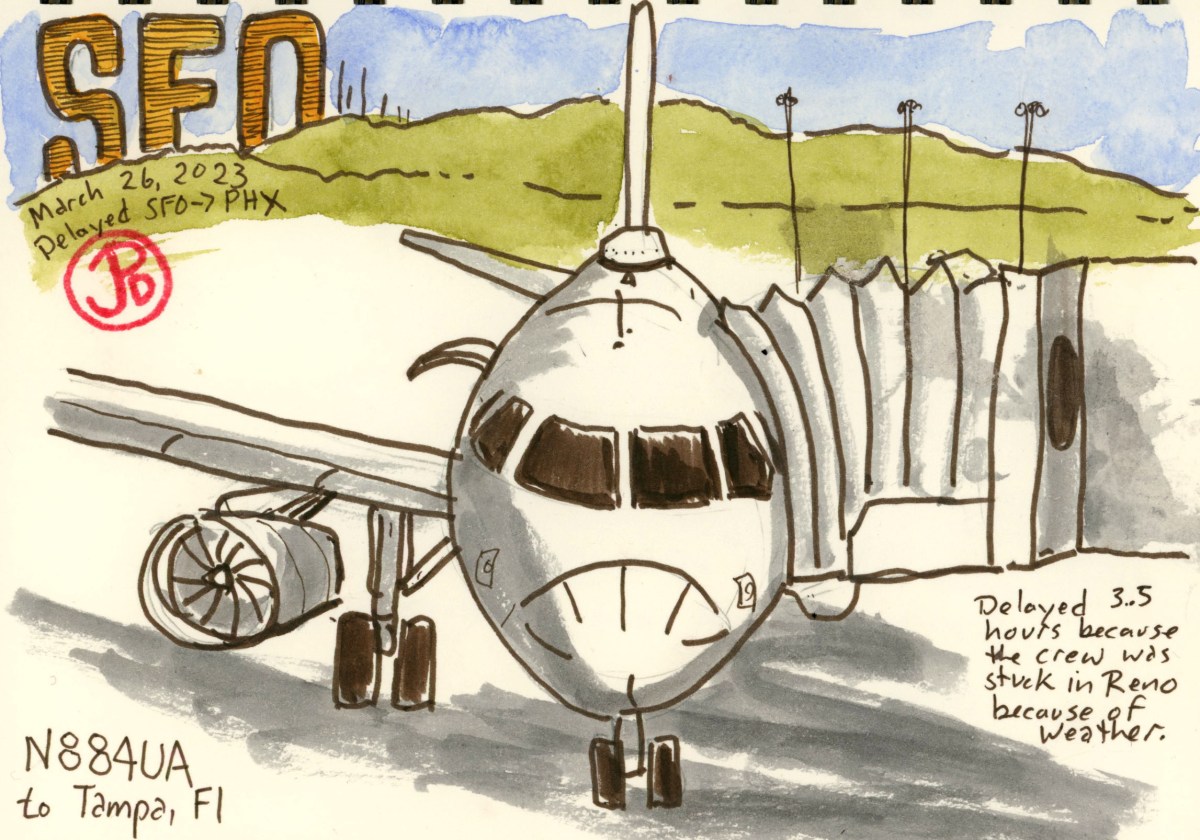
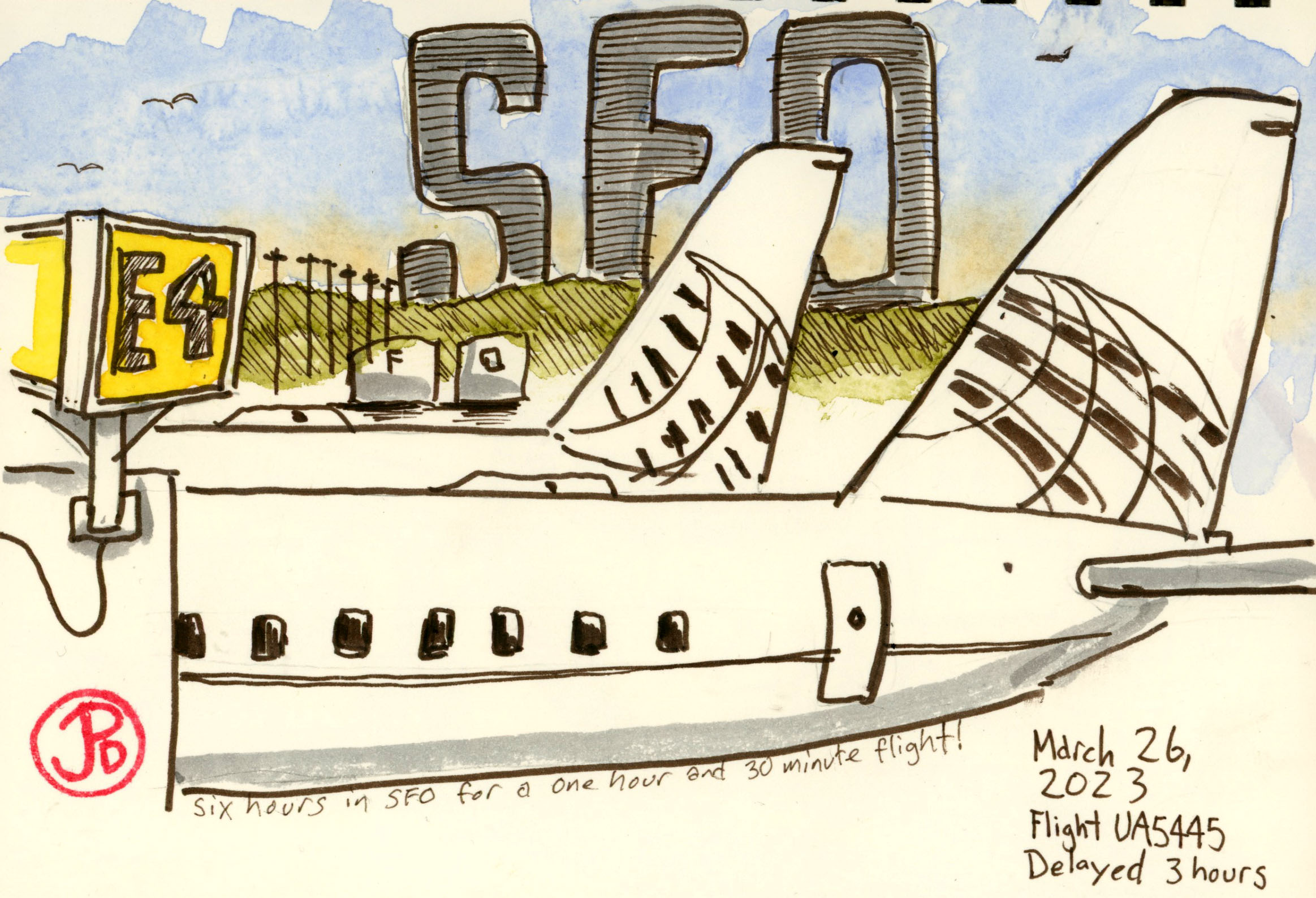
There is always a lot of downtime at an airport. I am the type of traveller that always arrives early, hence the downtime.

Sometimes I read or listen to music but I always try to do an airport sketch.

On my recent trip to the Windy City, I sketched the airplane that would be taking me there. In this case it was United Airlines largest plane in their fleet: the Boeing 777-222A. This plane has a capacity of 28 first class passengers and 336 economy. It’s cruising speed is 639 mph and we made the journey from SFO to ORD in about three and half hours.

I was told that you don’t mess around with Chicago’s O’Hare International Airport. O’Hare is the fourth busiest airport in the world with 54 million passengers passing through in 2021. It had the moniker of the “busiest square mile in the world”.

So I headed out of Chicago for the 45 minute journey to O’Hare with plenty of time to spare. Even though it was a weekday morning, the security checkpoint lines took almost half and hour to navigate. There is a reason you don’t mess with O’Hare. It’s better to be early then to miss your flight.

A bar with a view. This is the view, sans foreground glass, for my O’Hare spread (featured sketch).

I found a window seat at a pizza restaurant (deep dish of course), opened my sketchbook and started to sketch the gate and airplane before me.

Image

Lincoln in the Land of Lincoln

Illinois is known as “The Land of Lincoln”, even though he was born in Kentucky. Lincoln cut his political teeth in Springfield, first as a lawyer and then governor and then later a Senator for the state of Illinois. In 1955, “The Land of Lincoln” became the official state motto.

There was one historical artifact that drew me to a corner of Lincoln Park to visit the Chicago History Museum.

On a past visit to Washington D. C., two highlights of my visit was Ford’s Theatre and the Lincoln memorial.

Ford’s Theatre was where Lincoln was assassinated on the night of April 14, 1865 by the actor John Wilkes Booth during a performance of Our American Cousin.

Lincoln was moved across the street to the Peterson Boarding House where the president was placed on a bed on the ground floor, towards the back of the house. Lincoln was too tall (he was 6 ft 4 in) for the small bed that he was laid at an angle, with his feet hanging off the end. He remained in a coma, never regaining consciousness.

Over 90 people came to pay their last respects to the President who had led the country through the Civil War. He died at 7:22 AM on April 15, 1865. Edwin Stanton, Lincoln’s Secretary of War, saluted Lincoln and said, “He now belongs to the ages.”

I had heard from a docent at the Peterson House, which is now a museum, that the bed on display was a replica and the real bed was in a museum in Chicago.

There is only one historical figure that has more books written about them than Abraham Lincoln and that is the son of god himself: Jesus Christ Superstar.

Now that is saying a lot about Lincoln’s impact to our country and his influence around the world.

But I was here to see and sketch a historic bed.

The “Standing” Lincoln statue in Lincoln Park.

In the same display was a life mask of Lincoln that captured the presidents features shortly before his death. I added this to my sketchbook.

Image

Chicago Skyline

I wanted to sketch Chicago’s skyline but I couldn’t see the forest through the trees. I had to find a vantage point away from the high rise of the Loop.

I found the vantage point near the northern steps of the Field Museum on the shores of Lake Michigan. I found a shady bench and sketched the skyline to the north.

I approached the sketch focusing more on shape and form over detail. To achieve this goal I used thick ink lines by inking my pencil likes with a Faber-Castell 1.5 black ink pen. I had seen this technique to urban sketching used by British sketcher James Hobbs.
I like Hobbs’ quote, “The idea of a drawing being ‘finished’ suggests to me a kind of polished death. I would rather have four quick drawings than one ‘perfect’ work.”

After my sketch, I walked further north on the Lakefront Trail, until I found another skyline view and another shady sketching bench.

A sketch from a Lakefront Trail bench. The building that rises the highest is Chicago’s highest: the Sears Tower.

There is a deadly side of all this verticality in our urban centers. These buildings steal the airspace for our migrating birds who often migrate at night. While the reflective wall of glass windows make for great photos and sketches, these mirrored walls are deadly for birds.

It is estimated that 600 million birds are killed each year from building strikes according to the Cornell Lab of Ornithology. That’s 600 million! And Chicago is one of the deadliest cities in the United States for bird deaths.

The Chicago Tribune noted that about one billion birds die each year from flying into buildings, making it the deadliest city for migrating birds in the entire country.

It is one thing to read about these statistics, it’s quite another to witness it for yourself. One morning while I was walking a block away to get coffee, I saw a bird sitting on the ground. It was an ovenbird (Seiurus aurocapilla).

I could see it’s orange crown, which is difficult to see in life, framed by two black stripes. As I looked up above the canyon of skyscraper on West Chicago Avenue, I could see how this migration met its match.

While there is beautiful architecture in the Windy City, the migrating birds of America pay a heavy price for our “progress”.

Coda: I walked back willing that the ovenbird was just stunned but looking down, the bird was squashed underfoot.

Image

The Pioneer Zephyr (1934)

I have twice taken the California Zephyr from Colfax to Denver and back. One train on my sketchlist is the Original Zephyr at the Museum of Science and Technology.

This 1934 three-car-train set, known as the Pioneer Zephyr, seemed to come out of the future, compared to the steam locomotives that hauled most passenger service in the 1930s. It was a train Buck Rogers might have piloted. This train set seems more airplane than train!

This was one of the first passenger trains powered by a diesel engine and eventually led the way to replacing steam with diesels in the 1950s and 60s on passenger routes.

This stainless steel three-car- train set, set a new speed record on it’s inaugural run from Chicago to Denver on May 26, 1934. The Zephyr had an average speed of 77 mph with a top speed of 112.5 mph over the 1,015 mile journey. The previous “express” made the journey in 27 hours and 45 minutes. The new streamlined Zephyr made the same journey in 13 hours.

As a contrast, the only Amtrak passenger service from Chicago to Denver on train number 5 of the California Zephyr makes the same journey in 18 hours and 15 mins. So much for progress.

The train was retired in 1960 and donated to Chicago’s Museum of Science and Industry. The Pioneer Zephyr is widely regarded as the first successful streamlined passenger train in the United States.

My head on field sketch of the Pioneer Zephyr number 9900. The front of the train looks like a Medieval knight’s battle helm. That or an early pro type of a Cyberman.
The view from the observation car. Now this seems to be the way to travel.
The Zephyr was made of stainless steel which made her much lighter and much more faster than previous locomotives.
Image

“Sue” the T. rex

One of the sights at the Field Museum that I was looking forward to sketching was the largest and most complete Tyrannosaurs rex skeleton in the world.

The Field is a natural history museum, featuring many mounts and taxidermic animals from the museum’s vast collection. It it certainly has one of the best collections in the United States, containing 30 million objects, only a fraction of which can be put on display.

I had to search around for “Sue” because it was no longer on the main floor but had been moved to an upstairs hall.

You think finding one of the largest T. Rex skeletons in existence would be much easier. But it also speaks to the vast number of natural items on display at the Field Museum. After a mazy exploration of the second floor gallery a found the T. rex.

I sat before the 40.5 feet long and 13 foot tall Tyrannosaurus rex skeleton which, out of the 30 unearthed other T. rex skeletons, is the most complete (at 90%) and the largest in existence. I opened my sketchbook and put the remains in my pages.

Paleontologist do not know the gender of “Sue” which begs the question: why the name “Sue”?

“Sue” is named after the explorer who discovered it on August 12, 1990, Sue Hendrickson. The remains where uncovered on the Cheyenne River Indian Reservation in South Dakota. The bones were about 67 million years old.

Sketching a few of “Sue’s” 58 teeth.

Once the skeleton was uncovered, the remains were purchased, on October 4, 1997, by the Field Museum, at auction, for the bid of $7.6 million. We should be lucky that a public institution purchased “Sue” and has put it on display for the world to marvel at the largest Tyrannosaurus rex skeleton in the world!

This is “Sue’s” actual skull and is one of the most studied T. Rex skulls in the world. The skull on the skeleton is a reproduction.
The skull reproduction, which is the skull I sketched on the featured sketches.
Image

The Robie House, Wright’s Masterpiece

Frank Lloyd Wright’s masterpiece of his Prairie Style is found in south Chicago.

I took a taxi from the Museum of Science and Industry west to this architectural icon, just on the border of the University of Chicago. I knew it was closed but I wanted to get a sketch in anyway.

This house is known as the Frederick C. Robie House and is a notable example of Wright’s Prairie-style. It was built between 1909 and 1910 and was commissioned by Fredrick Robie, a bicycle manufacturer. His tenure in the house was short lived. Financial troubles forced Robie to sell his dream house. It is now owned by the University of Chicago.

The Robie house is so well regarded that the American Institute of Architects named it as one of the top ten significant buildings of the 20th century.

When I arrived, I could see through the windows that there was a group touring the house, giving me hope that is was open, despite the closed sign on the gift shop. Nope, it was closed.

I took a position on a low brink wall, across the street from the Robie House on East 58th Street and I started my sketch.

As I was moving towards the midpoint of my sketch, the tour groups filed out and took up positions on either side of me and also started to sketch too! I assumed they were University of Chicago students taking an architectural class.

I felt a kinship in the brother and sisterhood of sketchers as we all sketched parts of the Robie House into sketchbooks, pads, and memories.

This is amazing piece of residential architecture. I hope to return one day, to see the interior.
Image

Skyscrapers of Chicago

Chicago is known as the birthplace of the skyscraper as a result of the previous wooden city that burned in the Great Fire of 1871. After the fire, an 1874 bylaw outlawed wooden building construction in the downtown area. As a result, architects had to find other building materials that were not wood.

The nine story Home Insurance Building (1885), is often credited with being the world’s first skyscraper. It was only 138 feet tall but was built with a steel skeleton which meant that the structure could be built higher than any wooden structure. By 1889, Chicago had five more skyscrapers than New York City. The Home Insurance Building was as razed in 1931 and replaced by an even taller building, the 535 ft tall Field Building.

I have always had an interest in seeing and sketching architecture and I wanted to do a pre trip sketch about Chicago’s skyline. I found my inspiration in a Fodor’s travel guide (2019).

The guide laid out some of Chicago’s more iconic buildings in chronological order. It looks like a stock prospectus, as it grows over time, with occasional dips.

A view of Chicago’s skyscrapers from its tallest skyscraper.
Image

Sketching Chicago’s Tallest Building: The Sears Tower

The tallest building in Chicago once held the title of tallest building in the world for almost 25 years, this is the Sear Tower (now called the Willis Tower).

The tower was completed in 1974 and it tops out at 1,451 feet with 108 stories. It’s is now the third tallest building in the Western Hemisphere and the 23rd tallest building in the world. This skyscraper is a giant amongst giants in the Chicago skyline and speaks to the importance is the Sears Company which, at the time, was the world’s largest retailer.

The Sears Tower dominating the buildings around it. The antenna towers are struck by lightening about 30 times a year! This photo was taken from the river during the architectural river cruise.

My destination in the tower was the 103 floor Skydeck, which gets more than 1.7 million visitors a year making it one of Chicago’s top tourist attractions. The Skydeck is the tallest observation deck in the United States.

I presented my Citypass and was given a 1:30 ticket to the top. I was corralled with other elevation-seekers, through lines, and mazes, and we finally came to the elevator. The elevator is one of the world’s fastest elevators, climbing 1,600 feet per minute. We reached the 103rd floor in just over a minute.

The view from the 103rd floor looking north. In the top right corner is “Big John”, the John Hancock Center, and beyond, Lake Michigan. I couldn’t have asked for a clearer and more beautiful day!
Taking a step out on “The Ledge”. Here my toes are pointing west. If you look at the silver skyscraper (address 222 S. Riverside Plaza) near the center of the photo, just behind it, but also partially obscured by it, is Chicago’s Union Station. This is the starting point and terminus of the California Zephyr.

After spending some time at elevation, I headed down to street level, had a margarita at one of Rick Bayless’ restaurants, and then looked for a good perspective to sketch the tallest building in Chicago. I found a location across the street at 311 South Wacker Park.

I had to lean back, in an almost a sleeping position to fit the tower into my sketchbook. I’ve had warbler neck before but this was the first time I ever had skyscaper neck!

My sketch of the tower, and I needed all of my panoramic sketchbook to capture it!
Image

Big John: The John Hancock Center

After I had visited the very touristy Skydeck on the 103 floor of the Sears Tower, I headed north of the river and went to the 93 floor of the less touristy John Hancock Center.

When the building was completed on May 6, 1968, it was the second tallest building after the Empire State Building. It is now the fifth tallest building in Chicago and the thirteenth in the United States.

This building also has a personal twist. A mother of one of the my former students not only grew up in Chicago but grew up on the 62nd floor of the John Hancock Center! She would swim at the world’s highest indoor swimming pool on the 45th floor. For some reason, it never occurred to me that people actually lived in these skyscrapers. I always thought of them as just office towers. The docent on my architecture river cruise noted that Big John was one of the first residential towers ever built.

The John Hancock Center from Michigan Avenue. My neck hurts just looking at this image!

I entered the tower on the Michigan Avenue side and secured a ticket to the 93 floor. The elevator was not as pacy as the Sears Tower but I arrived at 360 Chicago in due time.

The view from the 93 floor was astonishing. Partly because it seems like you are right on the shore of one of the Great Lakes, Lake Michigan. You can walk around the 93 floor and have views from all the cardinal points of the compass. But first I needed a sketching seat and a drink.

Looking down from the east side of the tower.

I found both at the Cloud Bar on the northern facing part of the tower. Here you certainly pay for the view. At elevation, drinks on my flight to Chicago where cheaper!

I took my bubbling concoction to a table and sketched the shoreline below me and the skyscrapers to my left. Out on the lake where sailboats and motor craft and a steady stream of traffic heading north on Lake Shore Drive.

$21 for Windex in a glass. It was smoking and bubbling like something in Doctor Frankenstein’s lab. But it was delicious!
My Cloud Bar sketch from the 93rd floor. From the view looking north. I chose to only paint in Lake Michigan.