Image

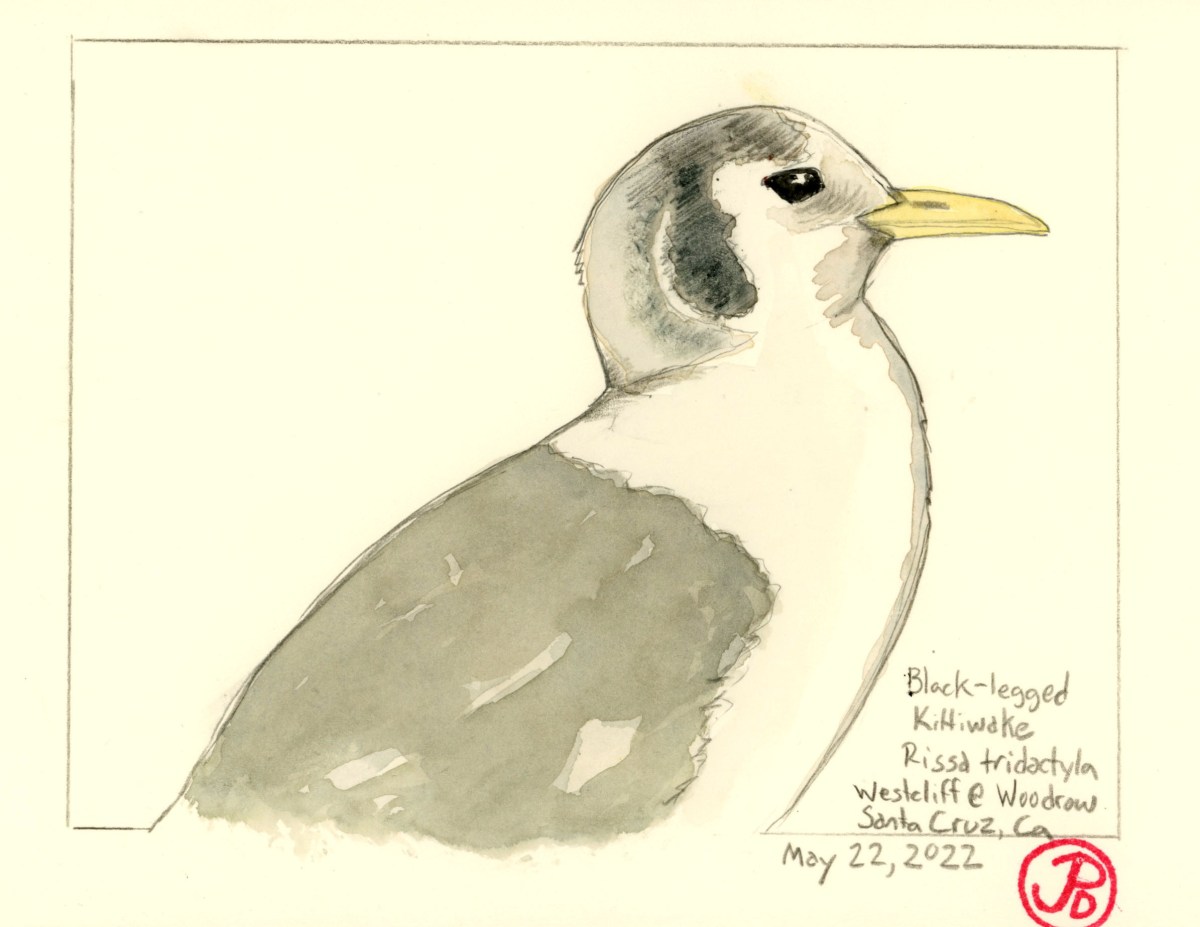
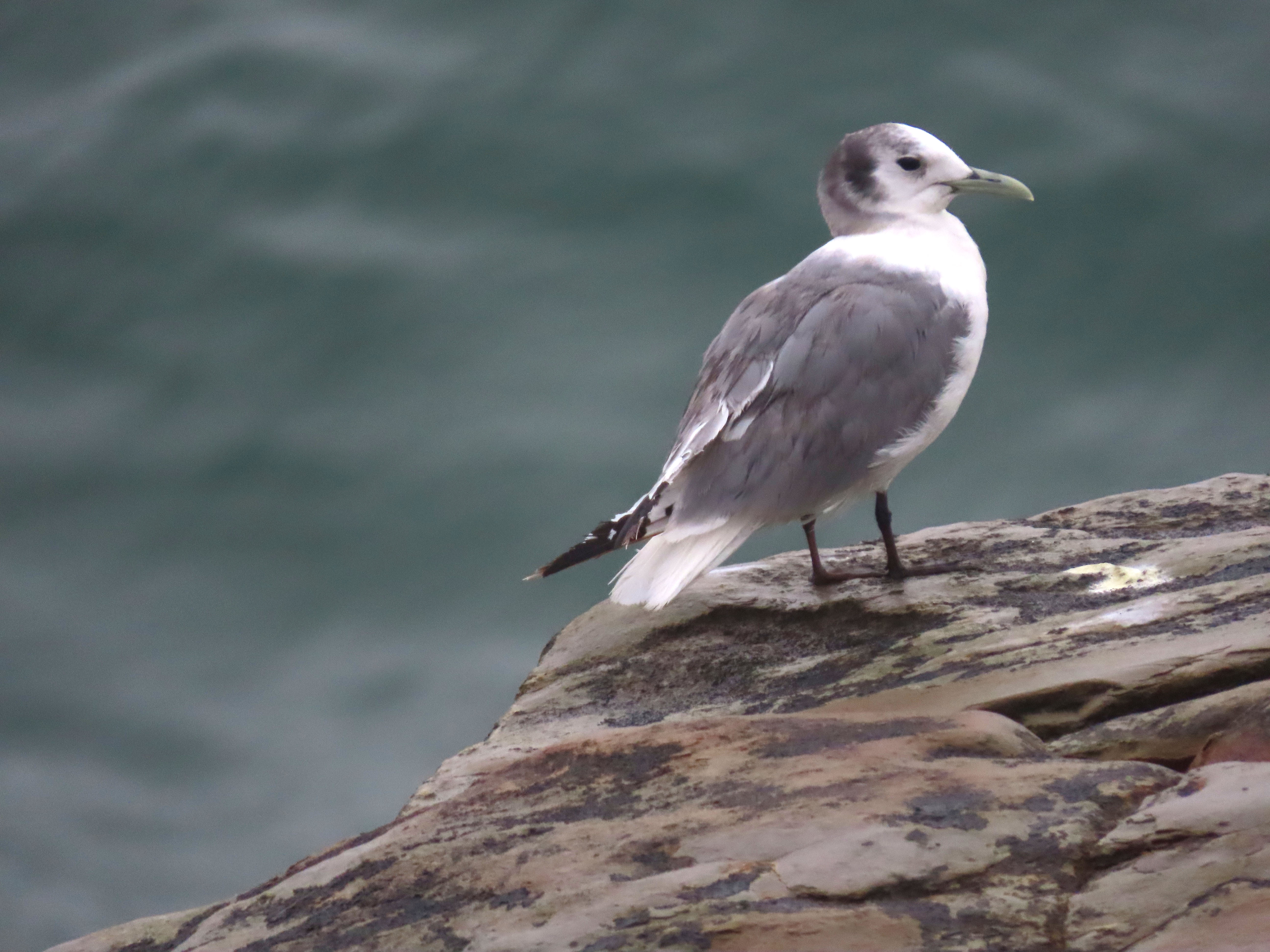
Westcliff Kittiwake

The black-legged kittiwake has been on my Santa Cruz County wish list for sometime. You figure with 29 miles of coastline, this pelagic gull or more correctly, seagull (kittiwakes drink salt water), would be far easier to see in the county. But sadly, it isn’t. The kittiwakes keep to the offshore waters.

The winter is the time to see this gull on the California Coast. Every winter, a few kittiwakes stop for a rest on coastal beaches or cliffs. The county north of Santa Cruz, San Mateo County, can be a good place to see a kittiwake as it rests, bathes, or preens, at gull roosts, usually on a beach where a freshwater creeks flows into the ocean. But every season can be different with many kittiwake sightings on year but some seasons, hardly any.

Perhaps because much of Santa Cruz County’s coastline lies within Monterey Bay and not facing the open ocean, kittiwakes tend to be even scarcer than in counties to the north.

Many times I had searched gull flocks on the northern Santa Cruz coast with no luck. I could not find the smaller gull with the bowlegged walk, wearing black earmuffs with a yellow beak. Waddell Beach, the most northerly beach in the county, has been a good place for large concentrations of roosting gulls. I picked through these flocks in search of a lone kittiwake and had always come up empty.

Now there was another lone adult kittiwake being seen on the rocks at Westcliff Drive and Woodrow. And in the middle of May!

After getting another look at the scissor-tailed flycatcher in Davenport, I headed back to Santa Cruz and walked parts of Westcliff Drive in search of the kittiwake. No luck.

One early morning on the following day, a Sunday, I headed to the San Lorenzo River mouth to look for the recently reported little gull but the whole area was closed off because of a foot race. So I thought I would check Westcliff Drive to see if I could add a county kittiwake. I had missed so many times that I did not have high expectations.

I parked on Columbia Street and I looked east down Westcliff, toward the lighthouse and there was a large feeding flock of gulls, pelicans, and cormorants. I sure hoped the kittiwake was not amongst the hundreds of birds.

I turned and walked west, towards Woodrow and I soon saw a lone whitish bird perched on the rocks. It was a bit too far to identify conclusively but I had a hunch that this was the kittiwake. I picked up my pace and then stopped to raise my bins. It was most certainly a kittiwake! I was now almost jogging because I wanted to take a few photos before the bird flew.

By the time I was inline with the bird on the cliff, I was about 20 yards away and the kittiwake showed no signs of leaving anytime soon.
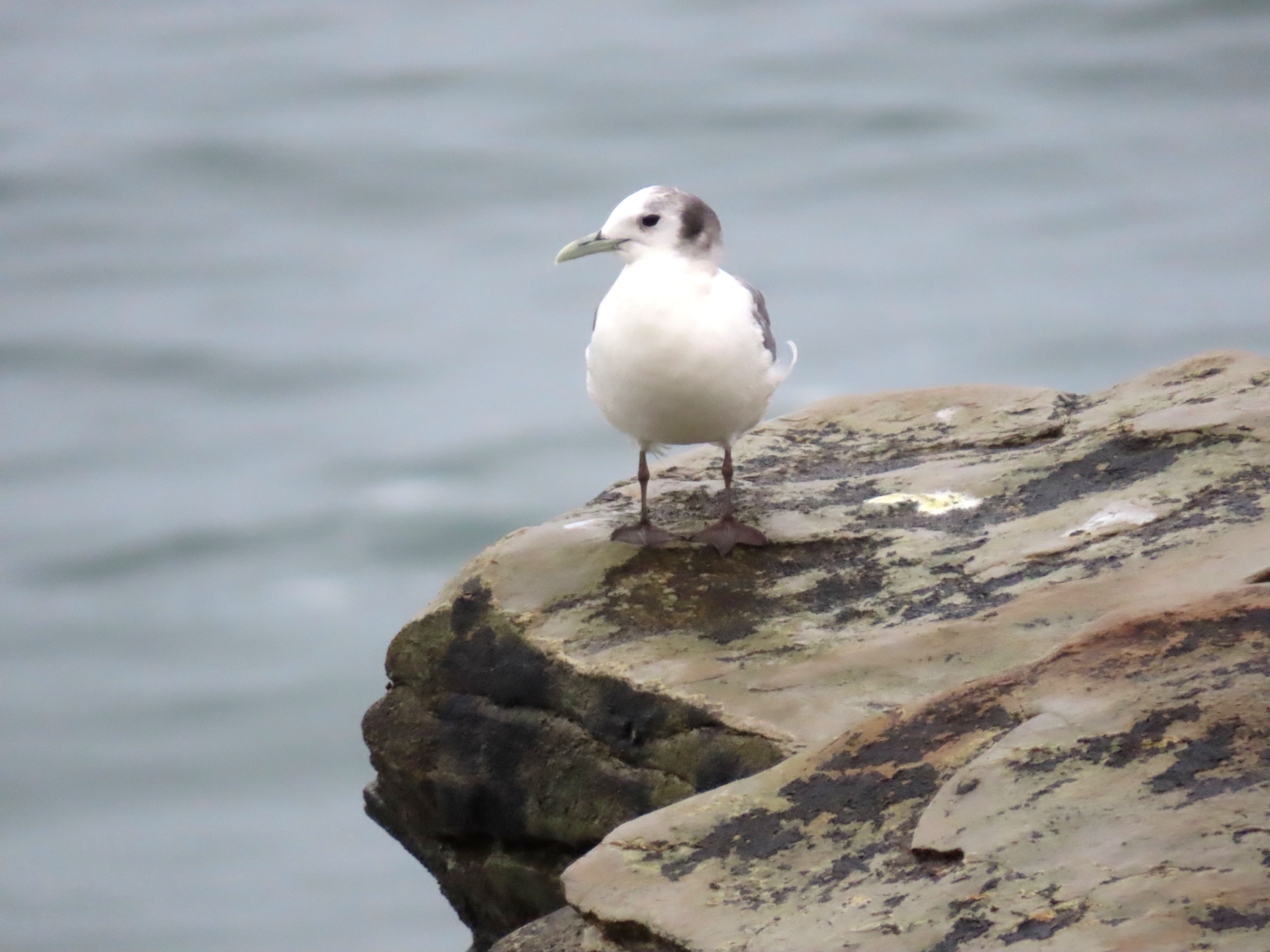
I was able to get some great shot of the kittiwake in the even gray morning light. It did not seem threatened by my presence, this was a bird that spent the majority of it’s life at sea after all. It then took to the air, circled around twice and them flew west.

Just then a local birder arrived and I gave him the news that he had just missed the bird. We stood around chatting about attempts to see kittiwakes in the county and he then turned to leave, heading towards his car parked on Woodrow. Just then, the kittiwake returned to the cliff and I called out “Kittiwake!” and the birder returned to confirm it’s existence.
Image

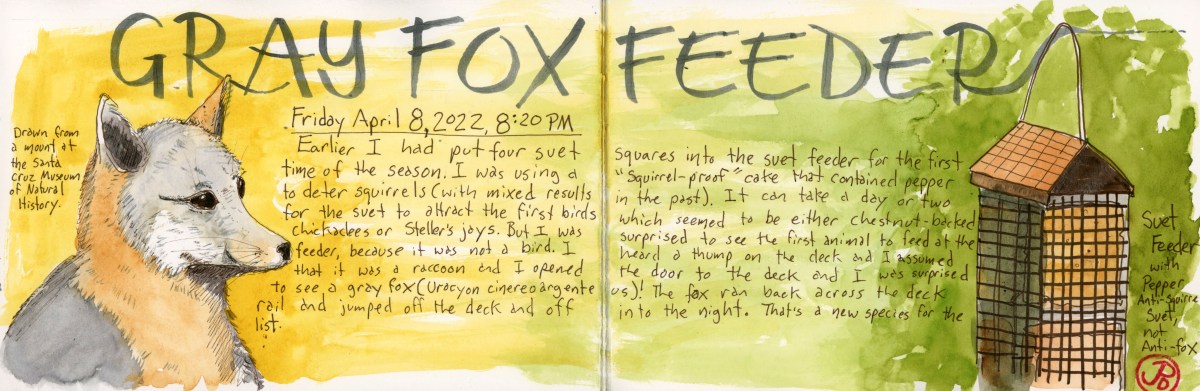
The Night Visit

Clearly the “squirrel-proof”, pepper-infused suet is not working. When I restocked four suet cakes into the suet feeder for the first time this season, it didn’t take long for the local gray squirrels to visit the feeder.

The squirrels do have a habit of eating some suet, pausing, as if thinking, “Damn this is hot!” before going back for a second helping. The chickadees, juncos, Steller’s jays, and song sparrows enjoy the spicy suet but it is definitely not squirrel proof!

On the first night that I set out the suet, at about 8:20, I heard an audible thump on the deck.

When I went to have a look, I fully expected to see a raccoon, which are infrequent nocturnal visitor to the feeder. But instead I was surprised to see a gray fox, having a nibble at the feeder.

The fox instantly turned around and sprinted across the deck railing and then jumped off the deck and into the night leaving me gobsmacked. What an amazing encounter! This was the first gray fox I had ever seen in the park! And it had come to visit my suet.

The only other gray foxes I had seen in the county were ex-gray foxes lying by the roadside.

This sighting increased my yard mammalian list to five: grey and red squirrel, raccoon, striped skunk, and now gray fox. (I could add mountain lion but a neighbor reported this apex predator passing between my cabin and my neighbors, but I didn’t see it myself.)

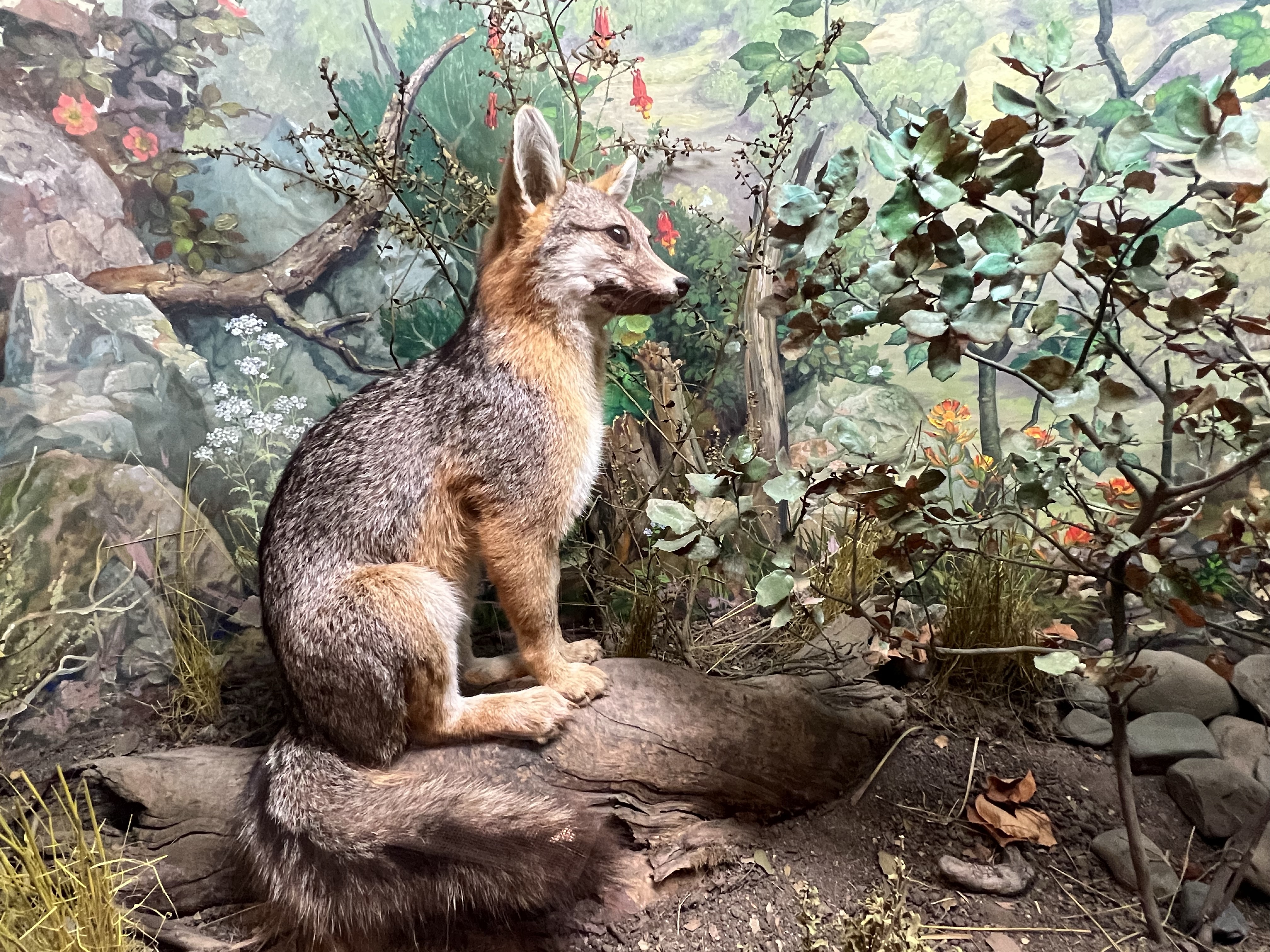
I knew I wanted to do a sketch about the encounter but I wondered how I could do a sketch of a gray fox. I wanted to shy away from copyrighted photographs online , so I chose to sketch an ex-fox, at the Santa Cruz Natural History Museum.

I went to the museum and found the display that included the taxidermy gray fox (Urocyon cinereoargenteus). These mount museums are a sketcher’s delight because you can sketch many reptiles, butterflies, fish, birds and mammals that are not moving. I felt like I was channeling the sprit of John James Audubon.

The gray fox at the Santa Cruz Museum of Natural History.

Image

The Long-tailed Kingbird of Davenport

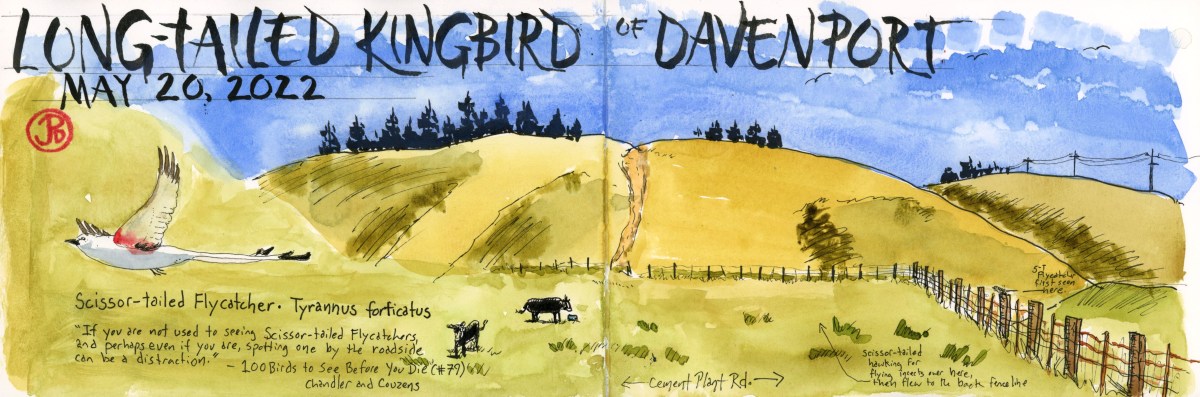
While Grasshopper and I were birding Mines Road and Del Puerto Canyon, a rare flycatcher for the West Coast was found on a barbed wire fence just north of Cement Plant Road in Davenport. I wasn’t going to able to look for it until the following Friday, that is, if it hung around.

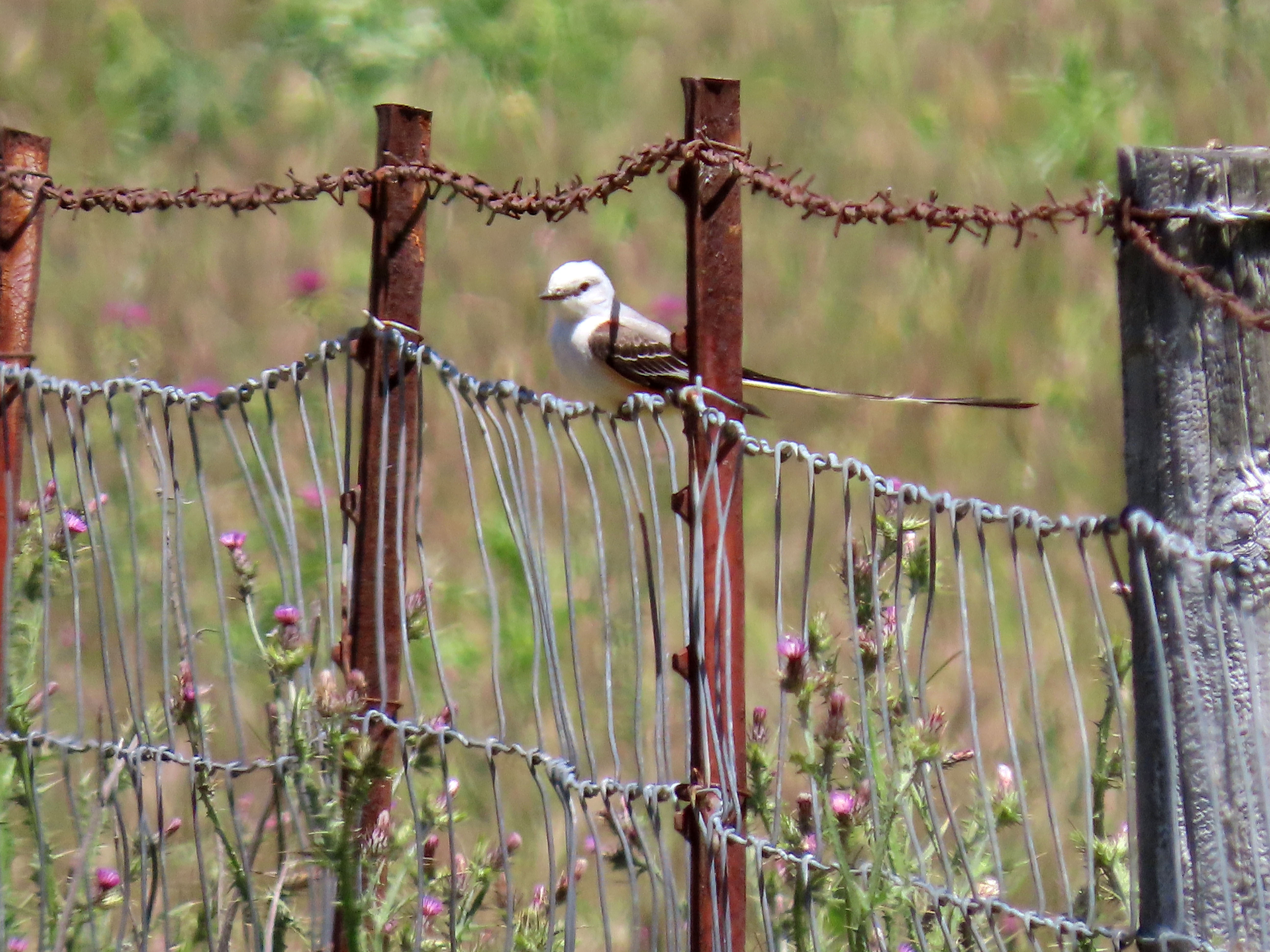
This is arguably one of the most beautiful flycatchers in North America. This is Tyrannus forticatus, the scissor-tailed flycatcher. The flycatcher looks like a kingbird (it is actually related to the western kingbird) with a forked tailed that is twice the length of it’s body. In the book 100 Bird to See Before You Die by David Chandler & Dominic Couzens, the authors rank the scissor- tailed on the list at number 79, ahead of vermillion flycatcher, magnificent frigatebird, angel tern, paradise tanager, tufted puffin, and greater flamingo (all birds I have seen in the wild.)

The adult scissor-tailed was not where it was supposed to be (something all birders love). The bird summers and breeds in the southern middle of the United States, in Texas, Nebraska, eastern Colorado, and western Louisiana. But all this kingbird needs is an open pasture, some cows, lots of hunting perches( like a barbed wire fence), and a sky full of flying insects.

I got off work early because of a buy back day to pay us back for the extra hours of open house and I headed to the coast on Highway 92 and then south on Highway 1 toward Davenport.

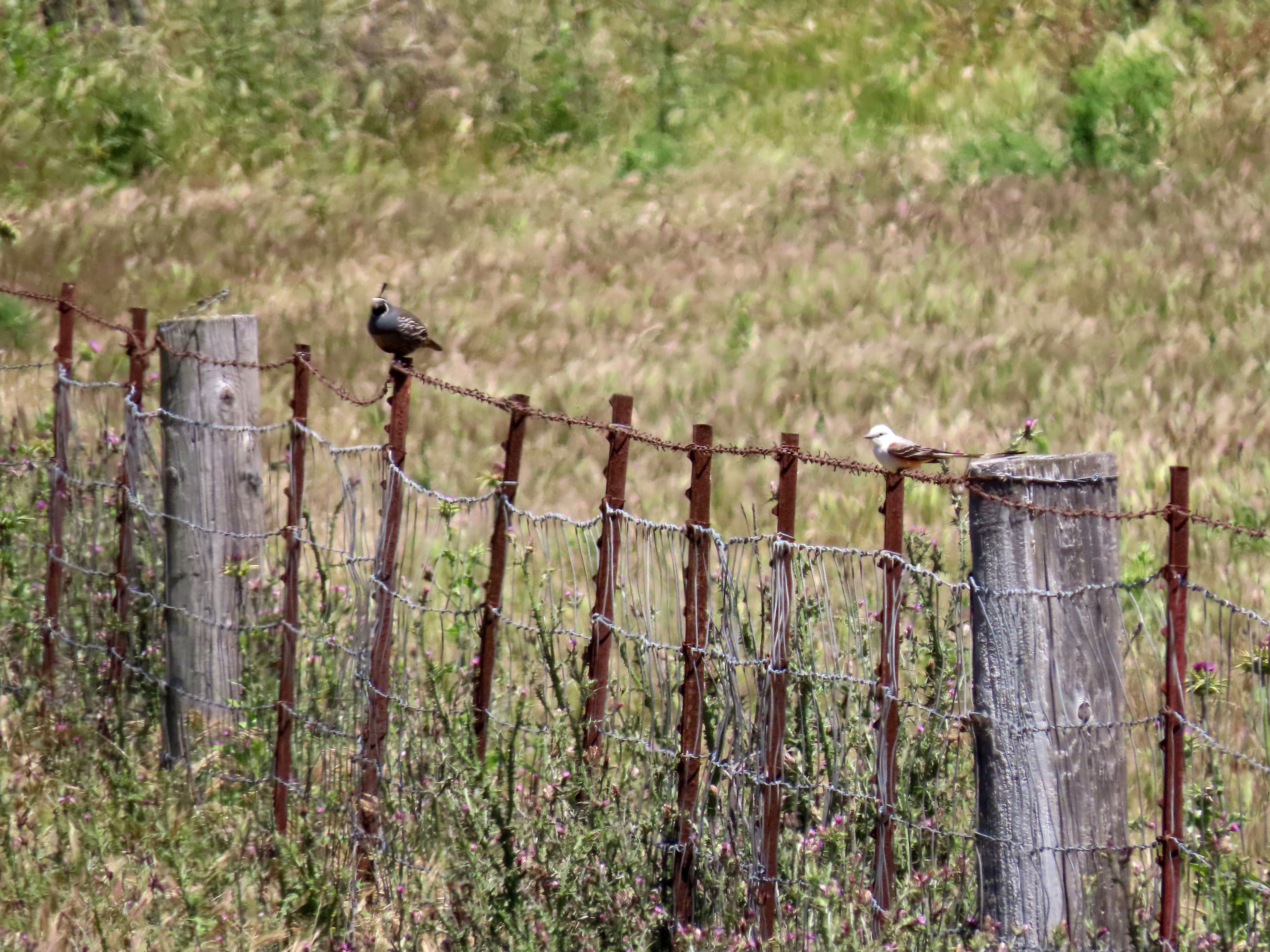
Some birds are extremely hard to add to your life or county list such as rails, wayward warblers, and some thrashers but it is always nice to have a bird handed to you on a plate (a live bird of course!). This was the case with the “Long-tailed Kingbird of Davenport”. As I rolled up, five birders where already peering into the cow pasture along Cement Plant Road. The flycatcher was perched on barbed wire about 30 yards out. This was much closer than it had been seen by others over the past six days!

This is not only a beautiful flycatcher but it is also a pleasure to watch as it is in motion for most of the time, pursuing flying insects from it’s fence perch. It would also fly down to the grass to catch insects on the ground.

This was a wonderful and unexpected Santa Cruz County bird!

You don’t see this combo everyday: California quail and scissor-tailed flycatcher.
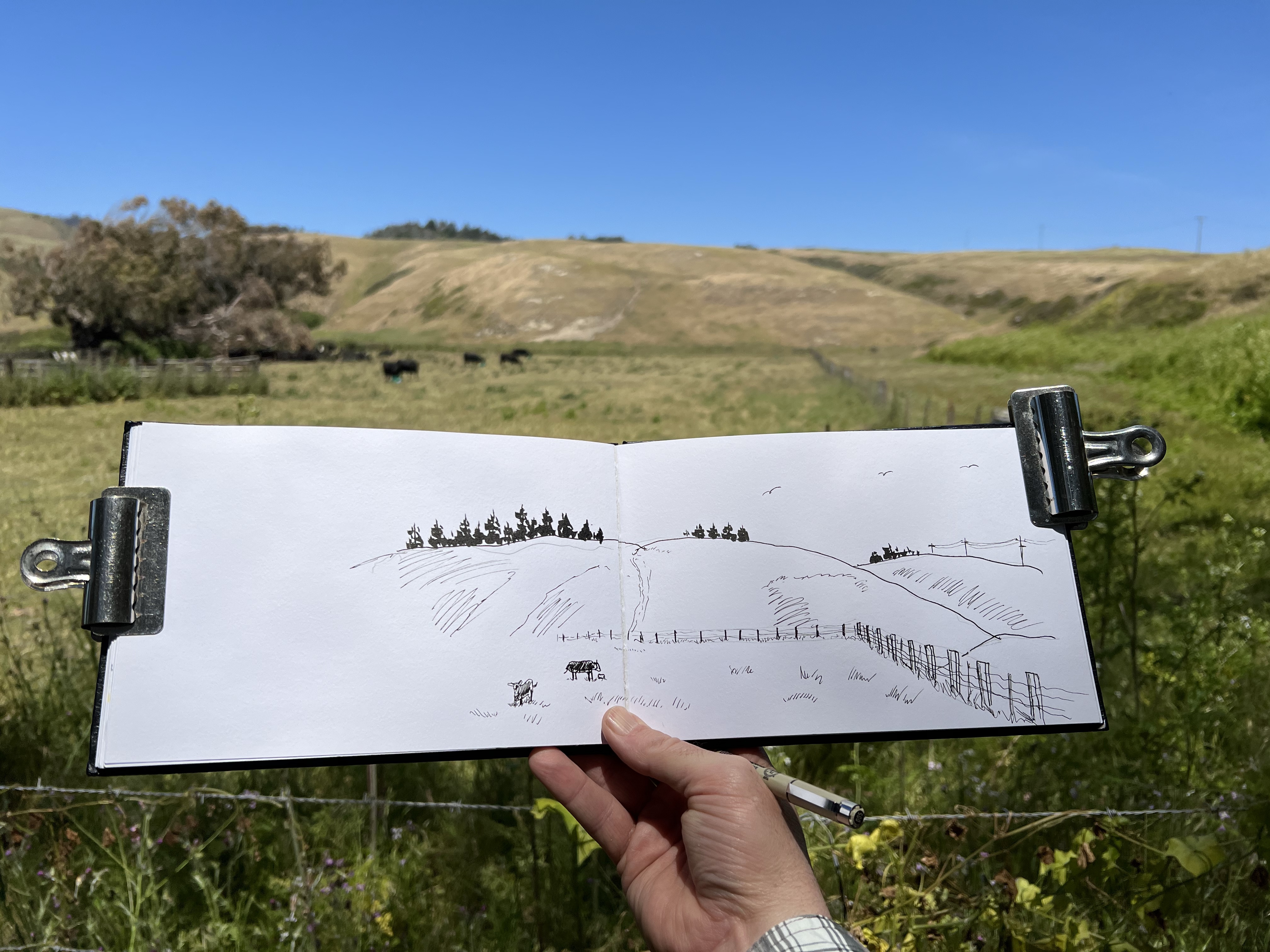
The anchor for my sketch was a field sketch of the cow pasture where I first spotted the scissor-tailed flycatcher. Full disclosure: while there were many more cows in the pasture, I only drew two. I try to follow a whole foods, plant-based diet after all! And don’t get me started about cow farts.

Image

P-3 Orion: The Submarine Hunter

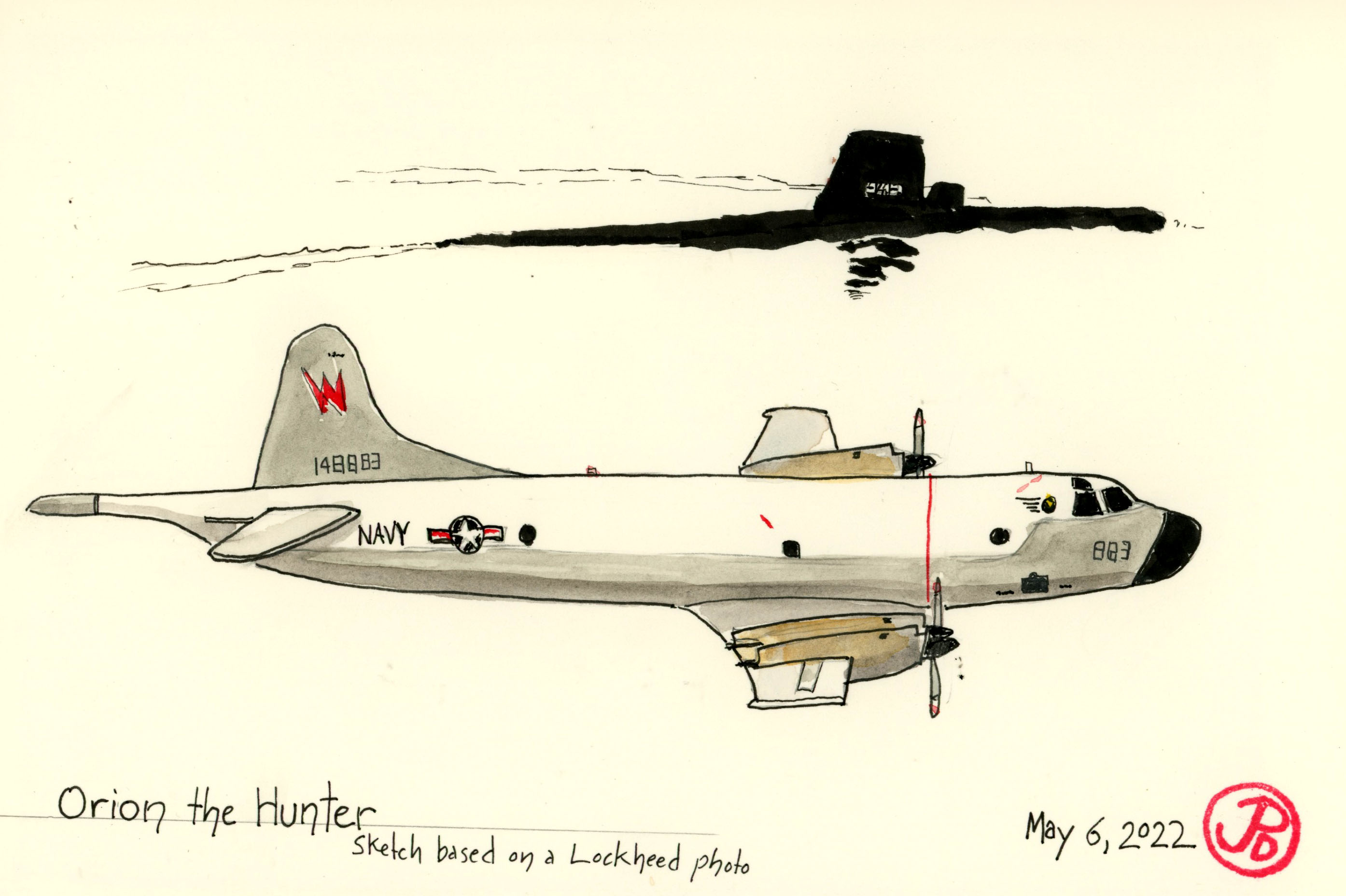
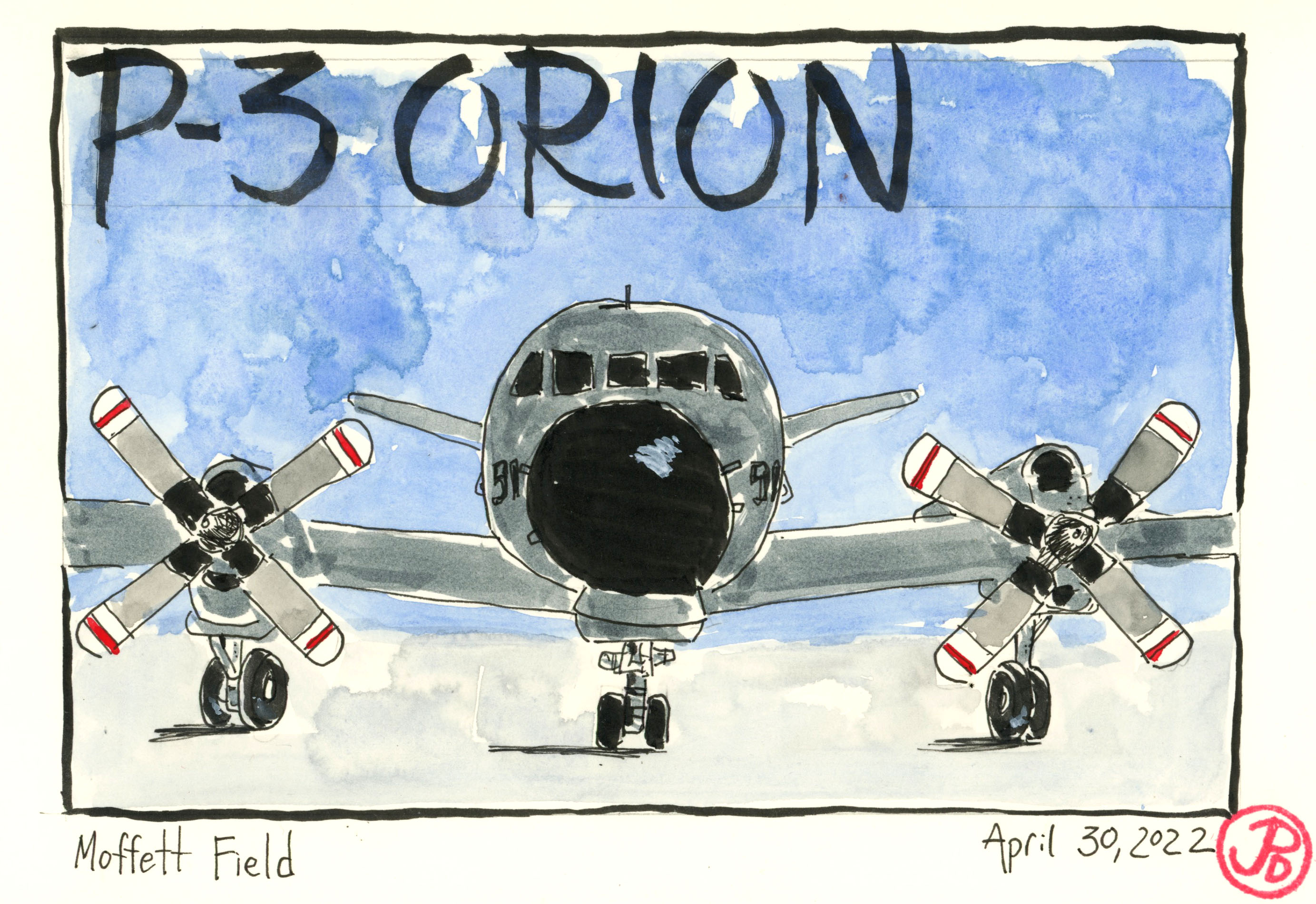
There was one airplane that loomed larger than others in my childhood: the Lockheed P-3 Orion, the submarine hunter. I loved this plane more than the supersonic jets like the F-4 Phantom or the F-14 Tomcat.

The four turboprop patrol plane would pass by my bedroom window on it’s final approach the Navy Base, Moffett Field. The roar of the four props where as recognizable to me as the call of the scrub-jays. I could identify the P-3 in flight as readily as a soaring turkey vulture.

I wanted to make another sketch of my past and bolstered by my sketching experience at the Castle Air Museum, I wanted to find an example of a P-3 on static display because sketching large unmoving objects makes sketching a bit easier. Much easier.

After doing a little research and reconnoissance through Google Earth, I found my subject near the control tower for what is now known as Moffett Federal Airfield. It was a P-3 Alpha or P-3A for short. Now it was time to sketch it.

Parts of the former Naval base are now open to the public so on a Saturday morning, Grasshopper and I ventured forth with our sketching bags to put the P-3 Orion into our sketchbooks.

While we were at Moffett we also visited the excellent Moffett Field Historical Society Museum which covers all the stages of this former base, from the USS Macon to NASA.

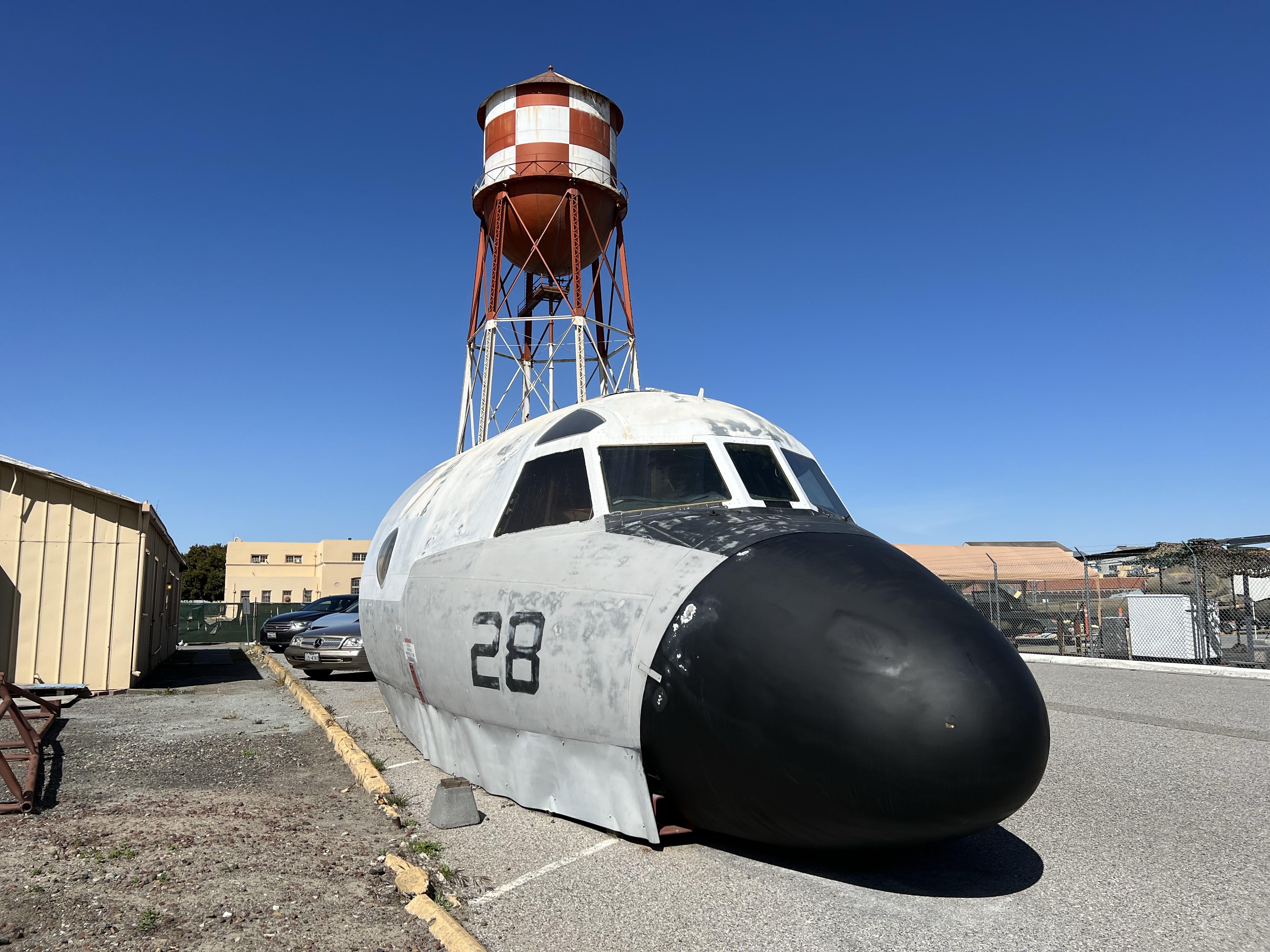
A P-3 flight simulator in the parking lot of the Moffett Field Historical Society Museum.

After visiting the museum we walked south, past the enormous Hangar 1, to the patrol plane, set up our sketching chairs and began to sketch.

The Lockheed P-3 Orion was an extremely successful marine patrol airplane which made it’s way upon the world’s stage in October 1962 as it buzzed two ships bound for Cuba during the Cuban Missile Crisis. It was designed to be used for marine patrol, reconnaissance, and anti-submarine warfare. The P-3 joins the list of aircraft which includes: Boeing’s B-52 and KC-135, and Lockheed’s C-130 and U-2 which have been in service for over 50 years.

Moffett Field was home to squadrons of P-3s which patrolled the Pacific Coast, on the look out for Russian submarines. In honor of this workhorse, one P-3 was put on public display. This was the plane now sat in front of me as I began to sketch.

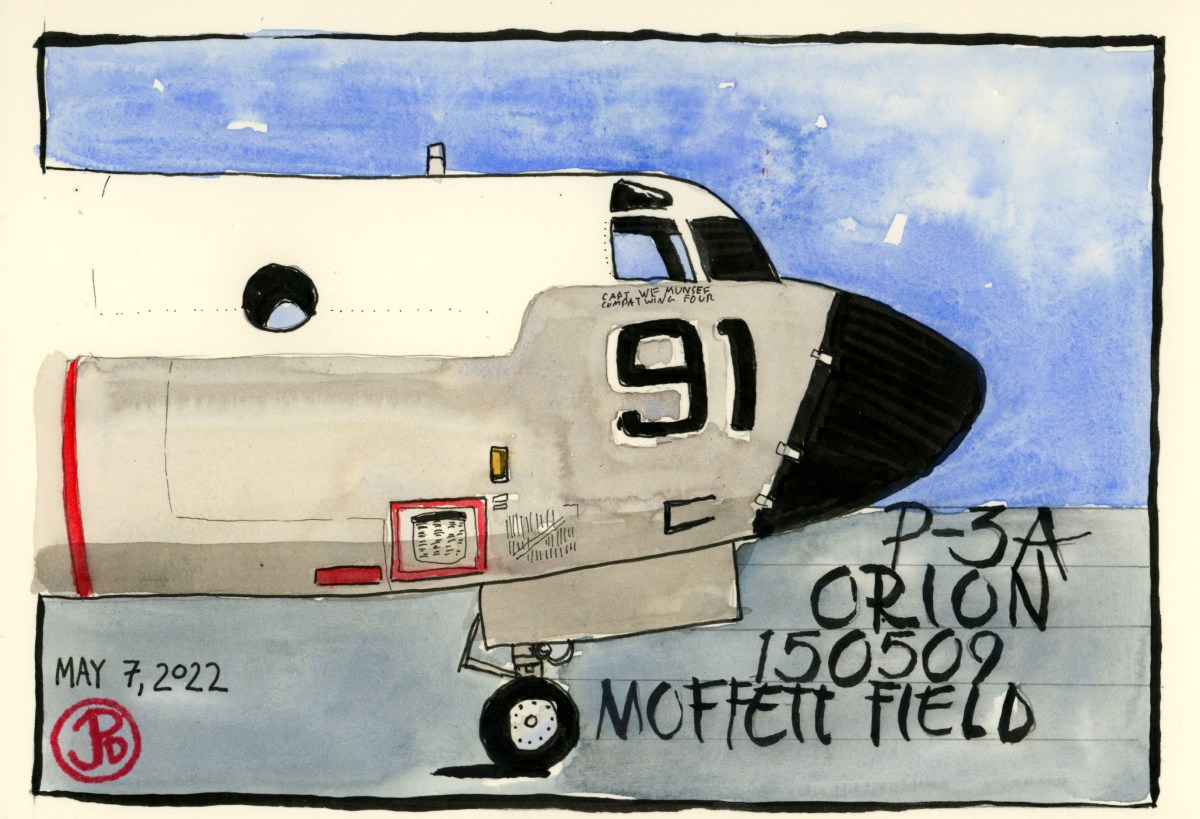
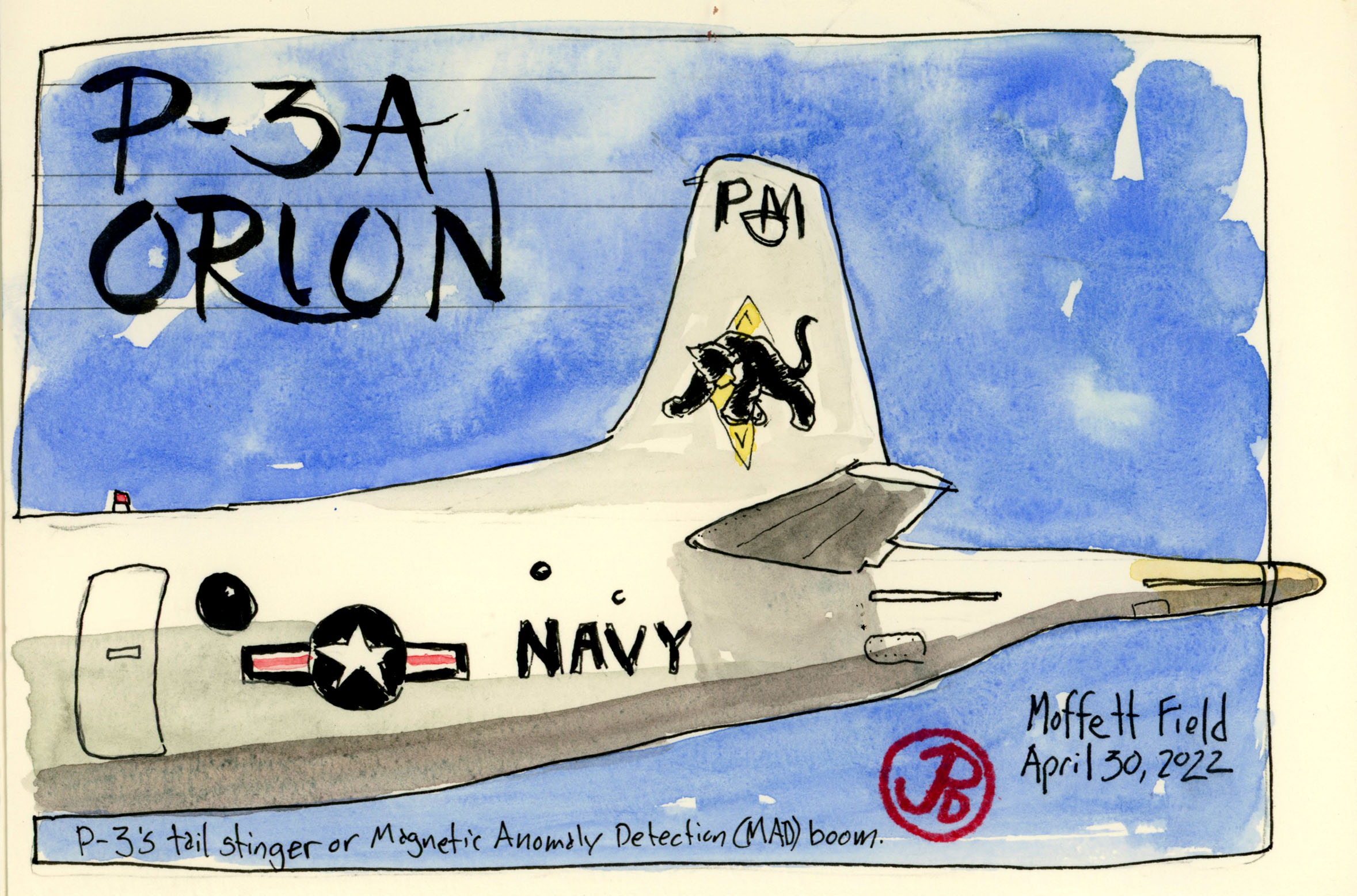
The airplane before me was a P-3A BuNo. 150509. It had a long career serving as a training aircraft and served in many squadrons. She flew 9,914 flying hours and was retired after a 29 year career, where she was the last Alpha in service. This is much more efficient and economical than the Navy’s dirigibles or blimps.

I did three sketches of the P-3A. One head on and two detail sketches of the front and tail of the plane. The distinctive “stinger” tail of the the P-3 houses the Magnetic Anomaly Detection (MAD) boom which detects submarines under the water.

Image

Blimp Hangar, Marin Headlands

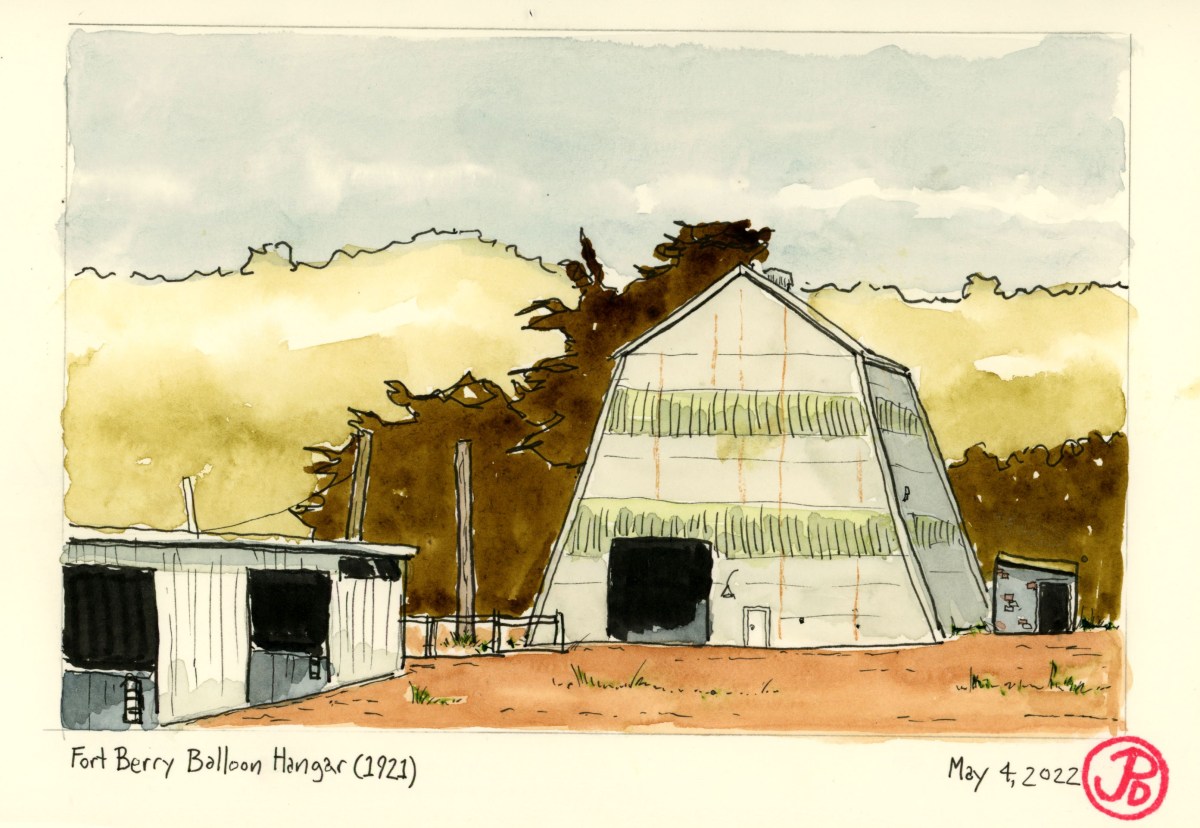
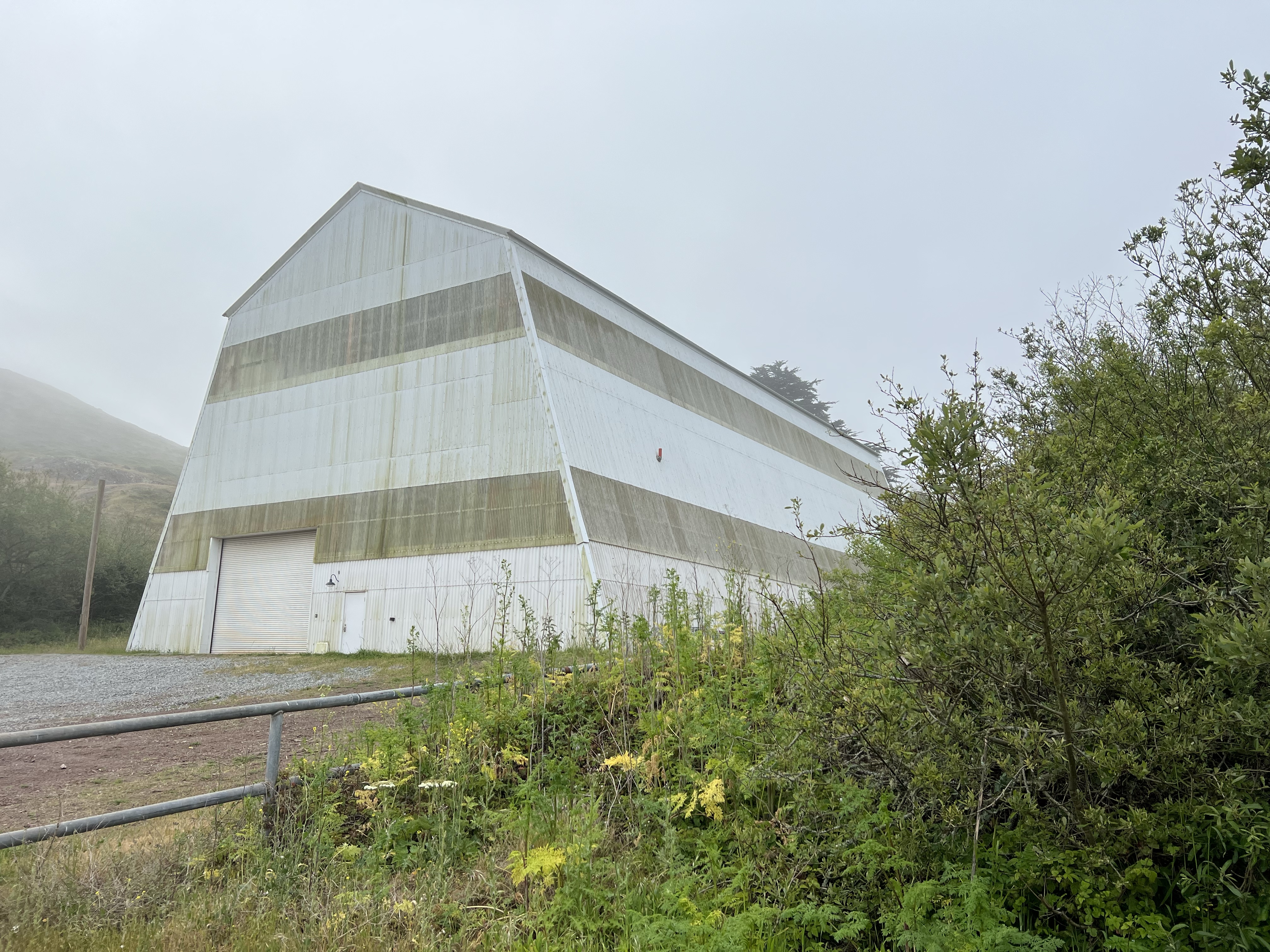
I had driven by it perhaps 30 times during a hawk banding season as a volunteer hawk bander for the Golden Gate Raptor Observatory (GGRO) and I had thought, there’s another military building. This one was big and gray and it reminded me of an oversized barn. This impression made sense because of the horse stables in front of the “barn”.

It turns out that it was a barn of sorts, not for horses but blimps.

This structure is the Fort Berry Balloon Hangar and it was completed on June 27, 1921 for a cost of $99,893.50. At that time the Army was experimenting with tethered balloons for coastal surveillance. Things didn’t turn out so well because the hangar was built and abandoned in the same year (1921). The military sure knows how to spend money! And taxpayers where left with an oversized gray vehicle shed, which what it is used for today.

This is the only surviving blimp hangar of its type that actually housed army balloons. Now it is used to store tractors and other vehicles, according to the man feeding the horses.

The horses are stabled at the Presidio Riding Club in the buildings that where originally built as vehicle sheds.

In my field sketch I included part of the stable on the foreground. I also used a little sketcher’s license by opening the door in the hangar. Shhh don’t tell!

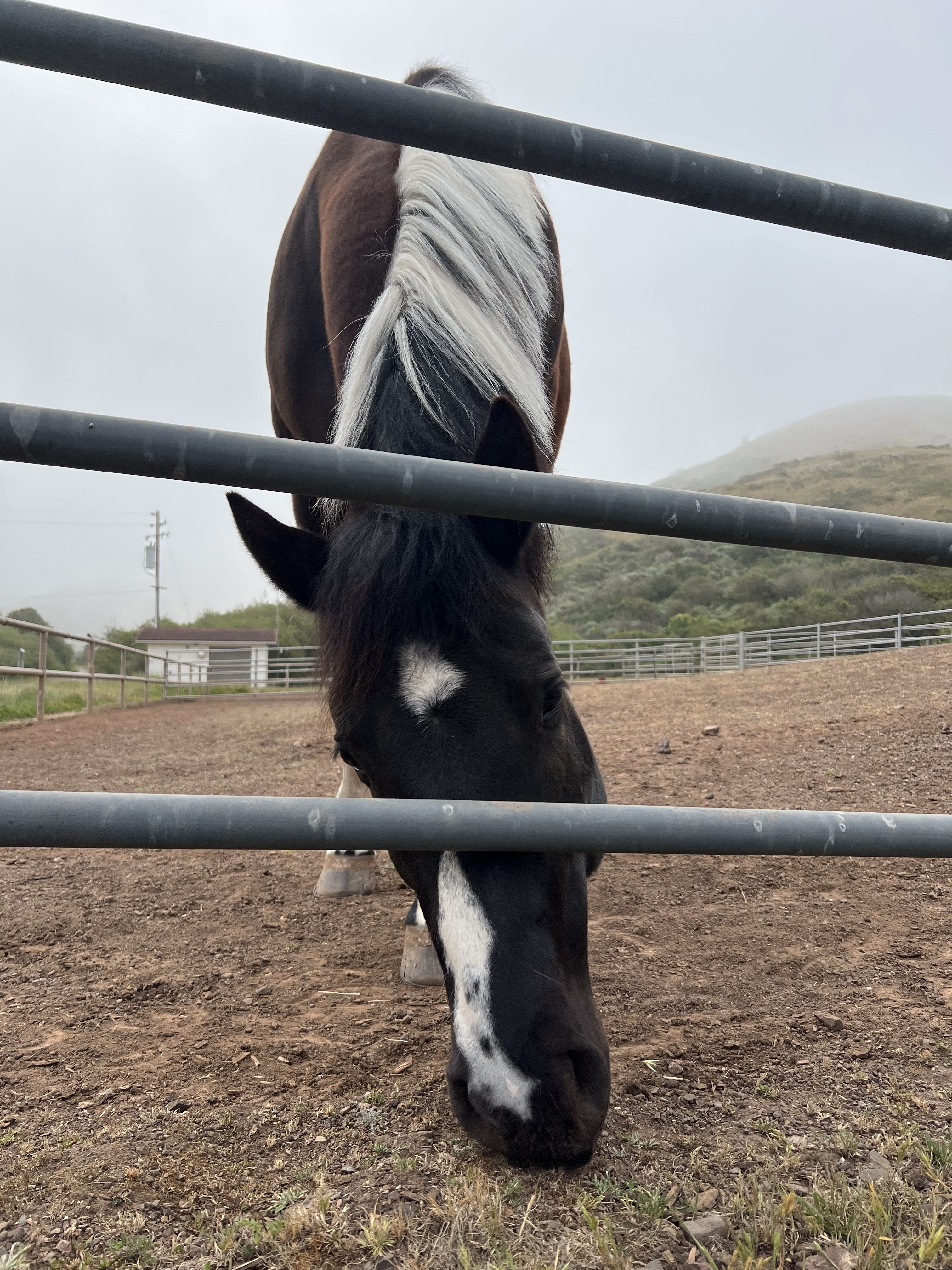
A friendly horse boarded at the Presidio Riding Club, just in front of the blimp hangar.
Image

Big Sound on the Big Island: Coqui Frogs

While the Coqui frog is lionized in its native Puerto Rico as the unofficial National animal, the diminutive frog is the scourge of the Hawaiian Islands!

There are 16 species of Coqui frogs whose common name is onomatopoeically named for their loud mating calls: “Ko-kee”. This small tree frog is about the size of a penny (15-80 mm). But they have a very big voice.

Their calls can reach 100 decibels. To put that in some context, that’s louder than most power tools, dishwashers, food blenders, or a diesel locomotive from 100 feet away. And their calls are slightly less louder than your average rock concert.

On the Hawaiian Islands this frog is an invasive species. It was unintentionally introduced in the late 1980s through imported nursery plants. The frog competes with native species for food (mainly insects) and they have no natural predators (the Indian mongoose does not climb trees) so in some parts of the islands they have reached levels of 2,000 frogs per acre!

The Coqui frog, along with the common myna, finds itself on the IUCN’s list of the 100 of the World’s Worst invasive Alien Species. While they are harmful to native wildlife, they are they harbingers of many a sleepless night.

On the Kona side I had no problems with Coquis and it wasn’t until I was on the windward side and specifically the town of Hilo where I encountered their dubious reputation.

And they are notorious around the Dolphin Bay Hotel. This Hilo mainstay is a wonderful family run hotel just across the Waikuku River from the historic downtown. The staff are friendly and informative and the rooms are a pleasant throwback to another era (it was built in 1968).

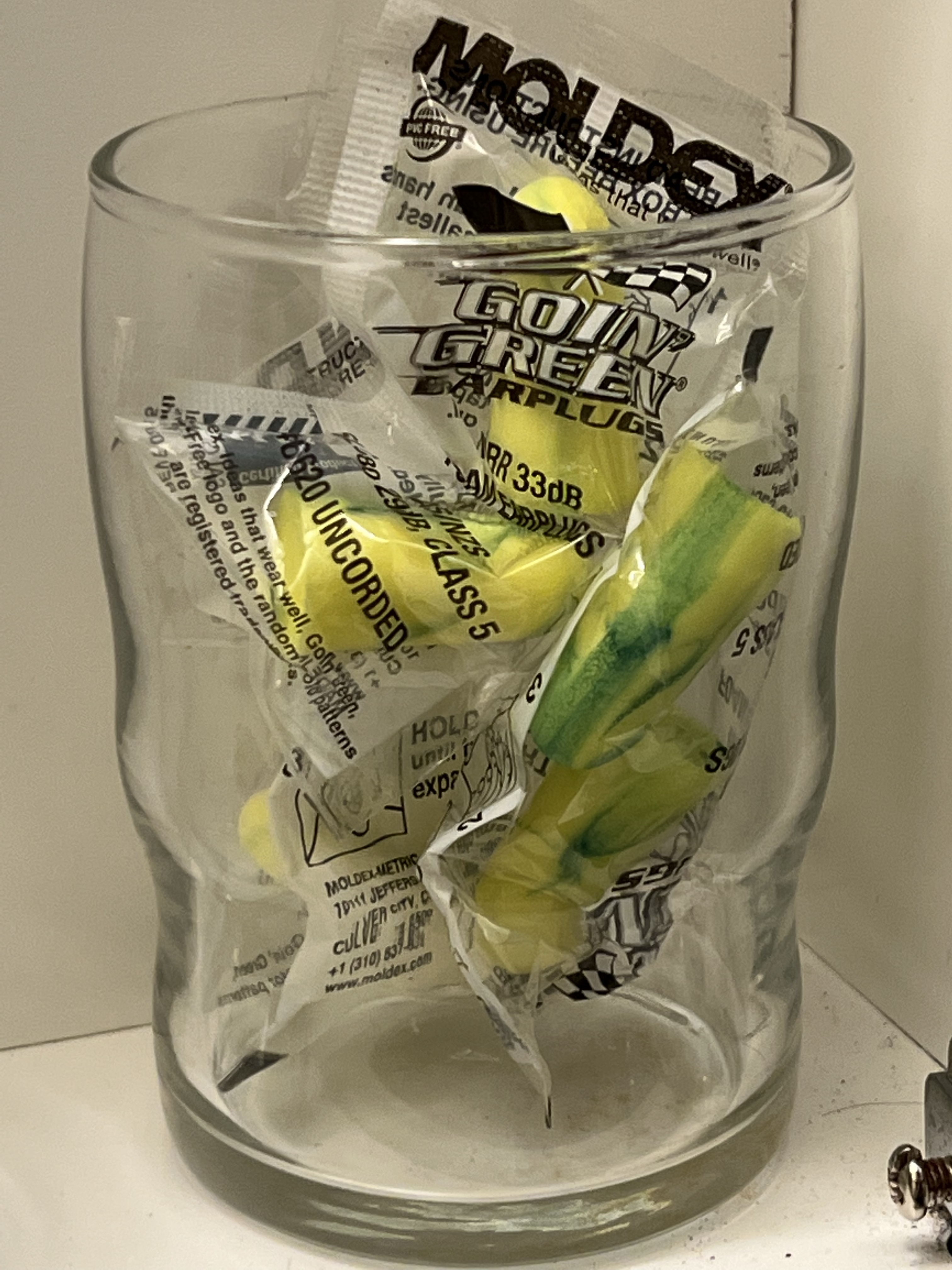
But what is not so pleasant is the incessant chorus of frogs from dusk to dawn. Shutting all the windows and blasting the fan can’t completely cover the frogs! So I used one of the traveler’s best tools: earplugs.

The Dolphin Bay Hotel provides complementary earplugs.
Image

Rainy Day Hilo Sketching

While I was in Hilo, it never stopped raining.

This side of the Big Island averages 130 inches per year. Rain and watercolor field sketching don’t always go hand in hand. So many of the subjects that I wanted to sketch where not going to happen.

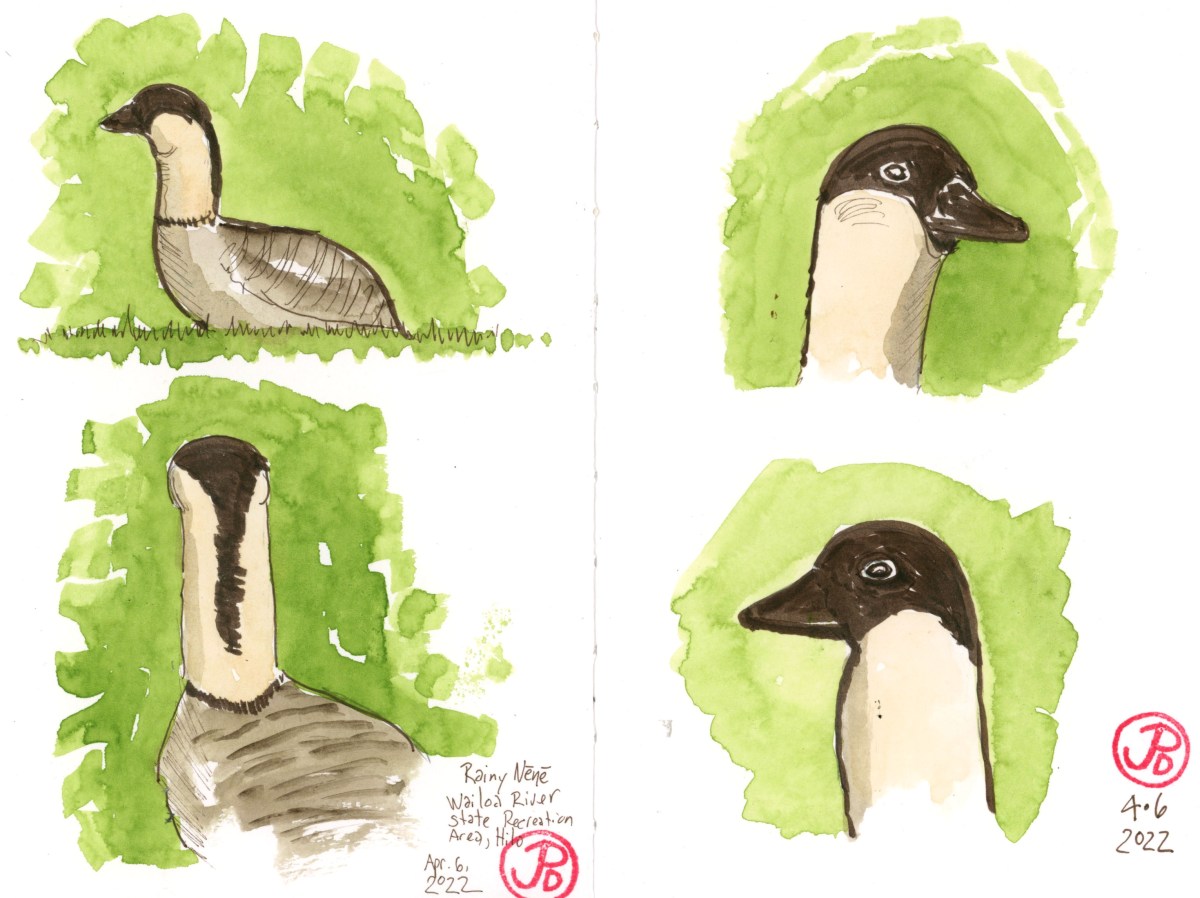
I headed to Wailoa River State Recreation Area to do some field sketching of Hawaii’s state bird, the nene or Hawaiian goose. Geese don’t mind the rain and that they had recently been reported in this park.

When I got there I immediately spotted nene, grazing on grass near the water. Trouble was that water was coming from above, which would make sketching in the open a really task.

I attempted to sketch but the pursuit was given a rain delay. Here, in front of me was a great opportunity to sketch an iconic Hawaiian endemic but the weather was not on my side. I attempted to sketch until the cover of a large tree but raindrops still fell on my sketchbook. So I retreated to my rental car, also know as my sketching blind.

The flock of nene wandered close to the parking lot, grazing on grass so I was able to get a series of sketches in, despite the rain.

Not a bad way to spend a rainy afternoon.

Image

Black Noddys

While I got a lot of my target species on the Kona pelagic, I had not added any noddys to my list, either black or brown.

One of the the most beautiful drives I experienced on Hawaii was in Volcanoes National Park along Chain of Craters Road.

It starts off just near the Visitor’s Center in the heart of the park which seems like it’s stuck in a perpetual rain cloud. Indeed the rain forests that flank the road are lush and something out of the Jurassic Period. One expects a T. Rex to cross the road at any moment.

After a few miles heading downslope towards the Pacific, you cross the alien barrens of lava flows.

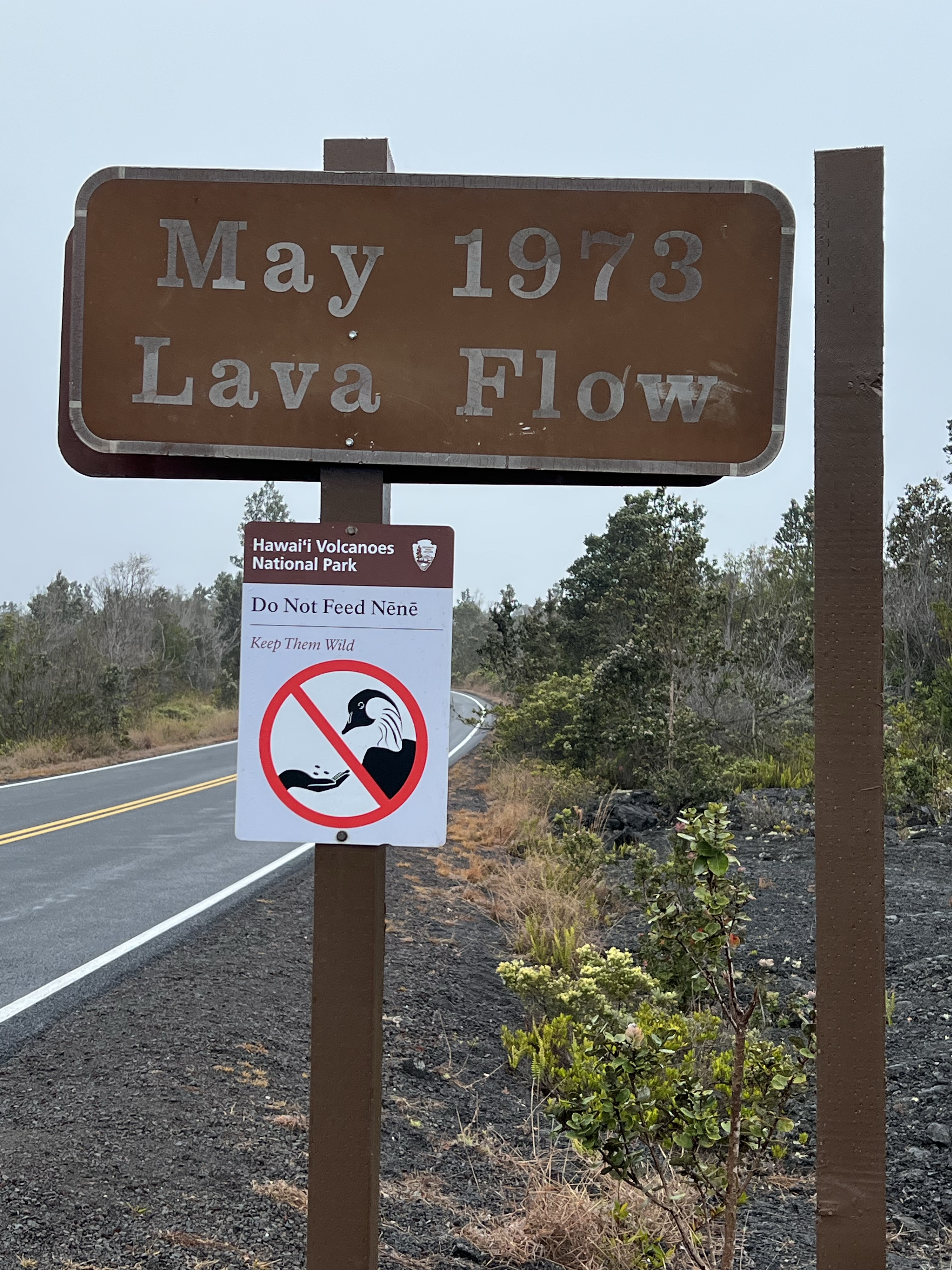
This 1973 lava flow covered the Chain of Craters Road. The Hawaiian goose or nene can be seen here. When I saw one, I made sure I didn’t feed it.

You eventually wind down via a few hairpin turns, altered by lava until you can see the Pacific Ocean, about 40 minutes drive from the Visitor’s Center. When it gets close to the ocean, the road parallels the lava cliffs. Within a mile I would run out of road as the lava flows reclaimed the road and closed it for the foreseeable future.

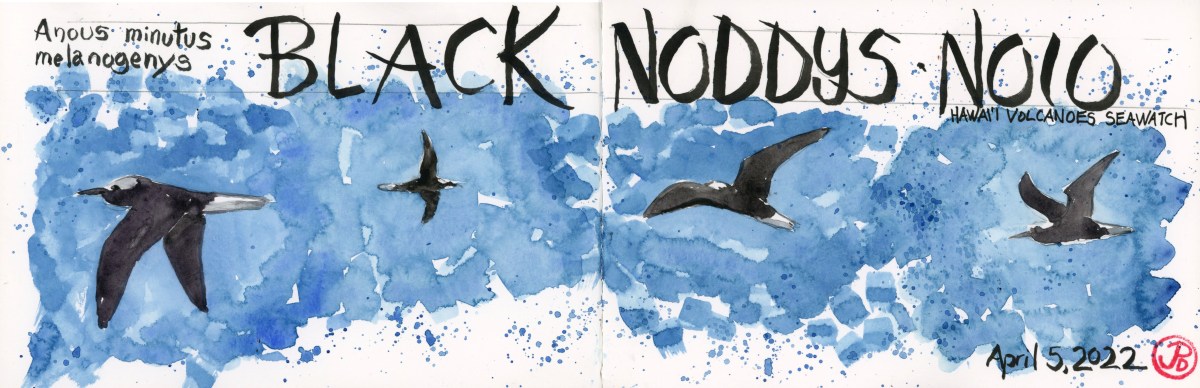
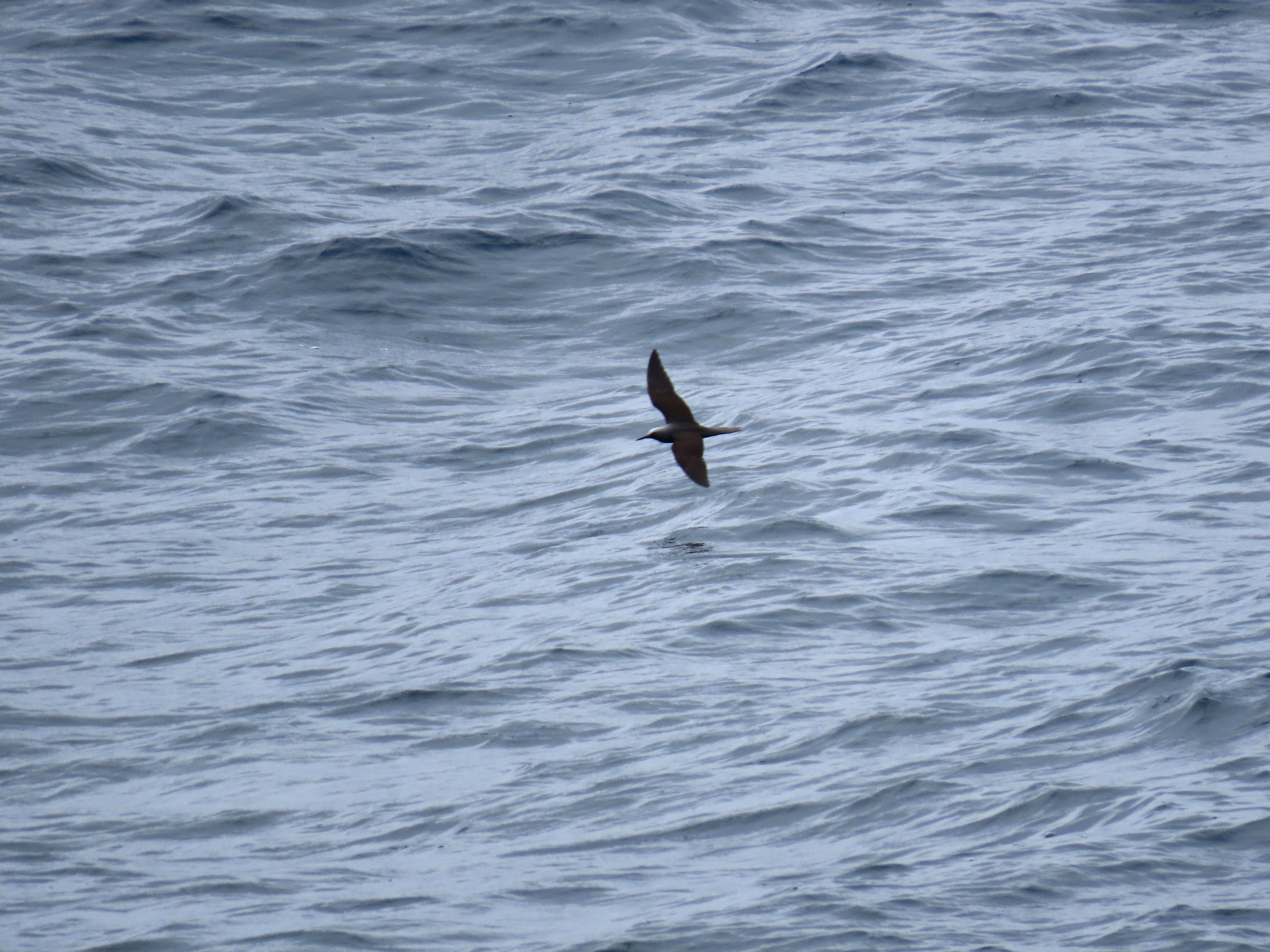
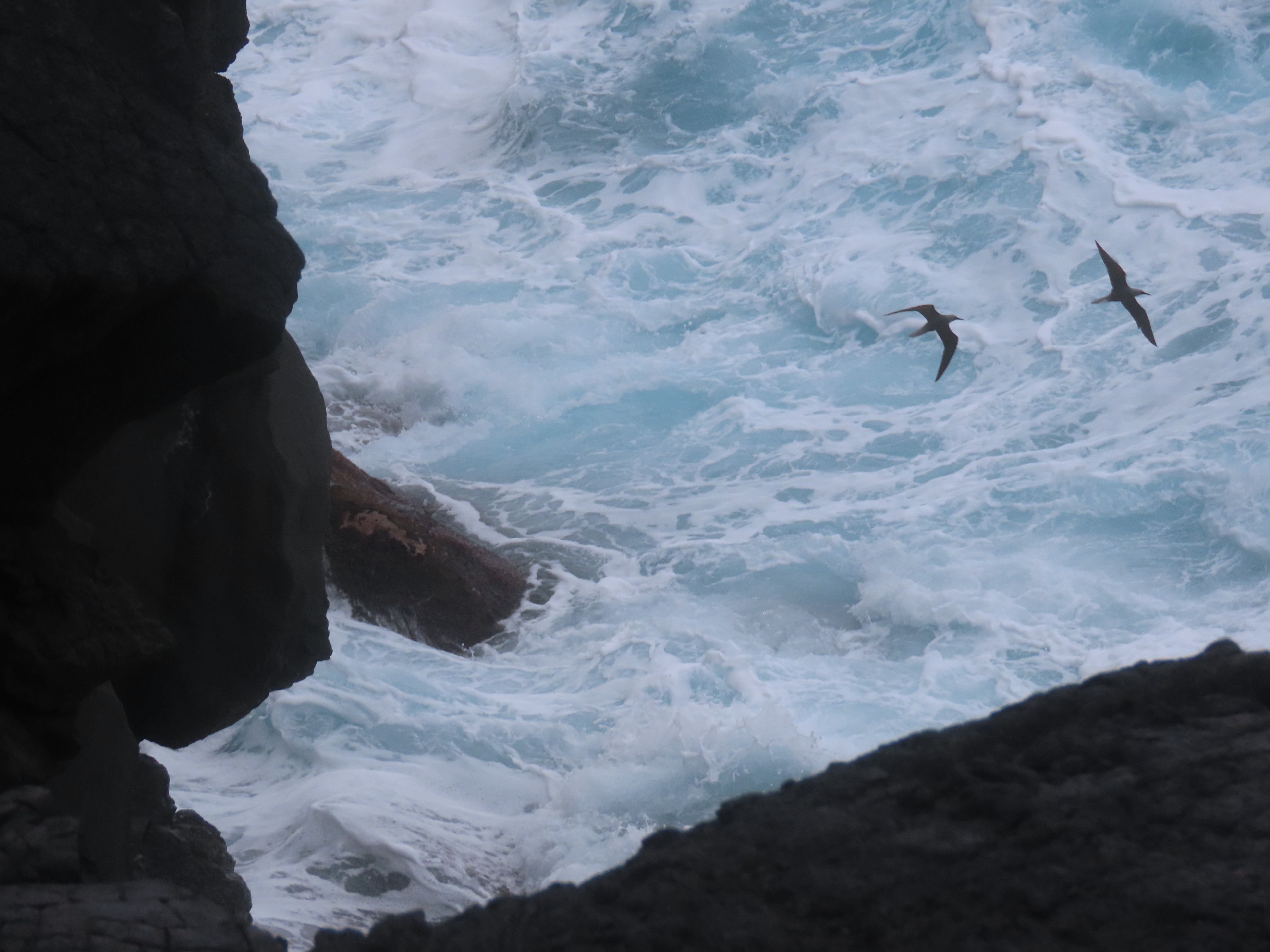
Off to my right and with the naked eye, I spotted black birds skirting above the waves. This could be only one bird: Noio or the Hawaiian black noddy.

I stopped the car and walked to the edge of the cliff to get a better look at the birds through binoculars. The bird’s scientific and common name comes from the noddy’s lack of fear around humans, making them easy to catch. The genus Anous, comes from the Greek, meaning silly, without understanding, and mindless. In English a noddy is a fool or simpleton. It is certainly not easy to catch a good photograph of the noddys as they strafed the waters and disappeared around (or into) cliffs. They are sea cliff nesters and I enjoyed my time with them as they flew to the lava cliffs and foraged in flocks, on the Pacific waters.

A black noddy, photographed from shore.
Two noddys flying from the lava cliffs where they nest.
Image

Moffet Field

Moffet Field looms large in my childhood, from the P-3s returning from their submarine patrols past my bedroom window to watching airshows on the base (often times from my roof). Although I did not visit or see the Navy Base very often, it’s presence was felt (and heard) every day.

The 1920s saw the rise of the airships, the dirigibles. These lighter than air, airships where being used to transport passengers and also as a means to keep an eye on the enemy’s fleet. They seemed to have a bright future both for civilian and military applications.

Germany was the true innovators with their Zeppelins. These are the airships that bombarded England during World War I but were also victim to antiaircraft fire. 71 % of German Zeppelins were lost in combat and 40% of their crews lost their lives.

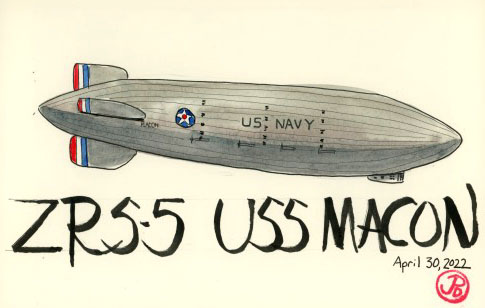
Between the World Wars the US Navy was looking for a new base of operations on the West Coast for the ZRS-5 USS Macon. The Macon was built in 1929 and launched on August 8, 1931. The Macon was 785 feet long with a displacement of 7,401,260 cubic feet. It had a top speed of 75 knots (86 mph) and a range of 6,840 miles. The Macon, and her sister ship, the Akron, where just 20 feet shorter than the more well known Hindenburg. While the Hindenburg was filled with hydrogen (with disastrous results), the Macon and the Akron where the largest helium filled dirigibles ever built.

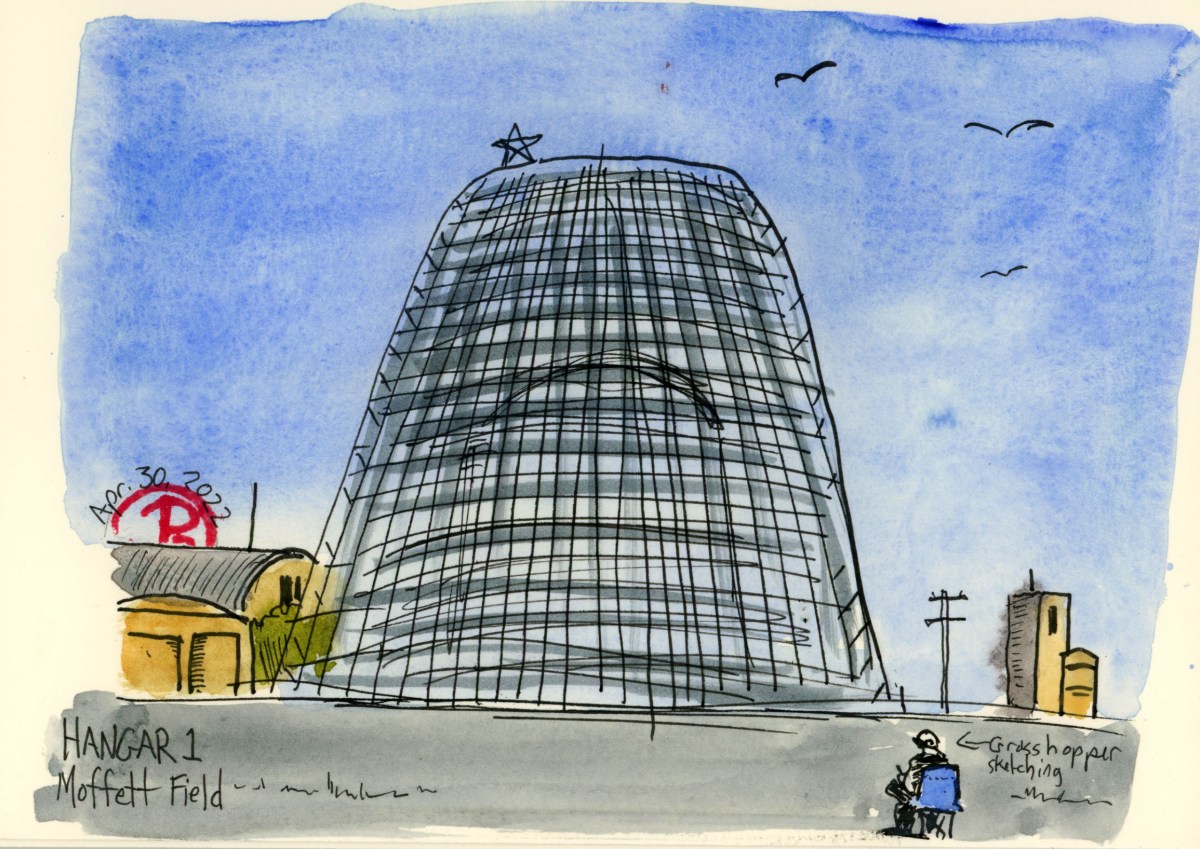
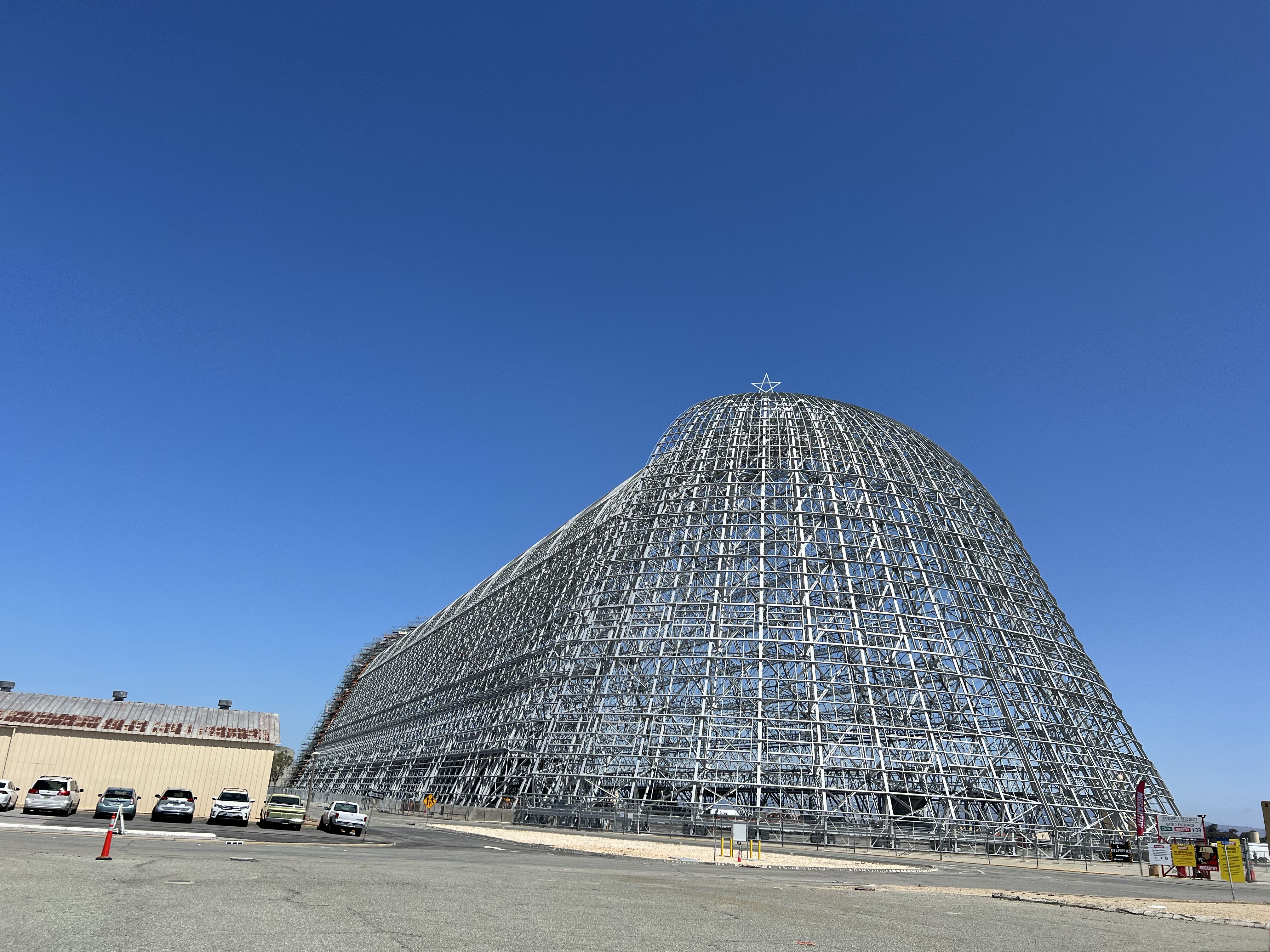
A base site was chosen in the farmlands of the southern Bay Area at Sunnyvale (my home town). Construction on the Navy base started in October 1931 and the centerpiece of the base was, and still is, Hangar No. 1. The hangar was built to house the Macon and other dirigibles. Hangar 1 is considered the largest freestanding structure in the world. The hangar is 1,138 long, 308 feet wide, and is 210 feet tall. The internal area is 351,000 square feet, that is just over eight acres! To give you an idea of the massive size of this hangar, three RMS Titanic ships can fit, side by side, in the hangar, with room to spare!

Hangar 1 is now striped of it’s siding and is currently being restored.

The Navy base was originally named Naval Air Station Sunnyvale but was later renamed after Rear Admiral Donald Moffet who was the Director of Aviation. He was the Captain of the USS Akron (ZRS-4) when it was destroyed in a thunderstorm on April 4 1933 while cruising off the coast of New Jersey. Moffet, along with 72 others perished in the crash, making it the deadliest airship crash in history. As a comparison, in the Hindenburg disaster, 36 people lost their lives, when she burst into flames at Lakehurst, New Jersey on May 6, 1937.

The USS Macon was christened on March 11, 1933 by Rear Admiral Moffett’s widow. The Macon flew from Lakehurst, NJ on October 12, 1933 to her new base on the other side of the country: Moffet’s Field.

The golden age of the great airships was relatively short lived. The USS Macon first flight was on April 21, 1933, and her final flight was on February 12, 1935. A whole two years of service after about 50 flights. She was only at Moffet Field for four months.

Why only 50 flights? Like the Akron before and the Hindenburg afterwards, USS Macon crashed.

On February 12, 1935, The Macon crashed into the Pacific Ocean off the coast of Big Sur. The cause of the crash is debated but her upper fin was damaged in a storm and the airship lost helium causing her to plunge into the ocean. The Macon was fitted with life jackets, unlike like her sister ship and out of 83 crew members, only two perished.

The wreck of the USS Macon now lies on the ocean floor at 1,500 feet below sea level, where it has been added to the National Register of Historic Places. The Macon’s final resting place is within the Monterey Bay National Marine Sanctuary.

With the crash of the USS Macon, the Navy put an end to the airship program and the short era of the Great Airships in the United State was over. The Macon was the last of the great airstps built by the United States Navy.

Sketching Notes: I sketched the framework of Hangar 1. I was more focused on shape and form than the individual details. I sketched in Grasshopper in the foreground for scale. He was sketching the water tower to the left of Hangar 1.

Image

Castle Air Museum

From my childhood bedroom window on Cormorant Court, I looked down at the scrub-jays, mourning doves, and house sparrows at the feeder and birdbath in the backyard. These noticings fueled a lifelong passion for birds.

To look skyward, to the east, was the flight path of planes as they approached Moffett Field, a naval base in Sunnyvale. The sound of the P-3 Orion’s turboprops were the sound of my childhood, along with the calls of scrub-jays and mourning doves. I learned to identify planes as I identified birds. I knew a C-5 from a C-130, an A-4 from an F-4. I just loved things than fly!

I built models of airplanes such as the F-4, B-52, and KC-135 and hung them from the ceiling with push pins and dental floss. I shared this hobby with a neighbor two doors down and he now is a pilot for United Airlines.

So there should be no surprise that I left Santa Cruz at 6:40 AM, my destination was Atwater, two hours and ten minutes away. My destination was the Castle Air Museum. This air museum is one of the largest collections of military planes (or any planes) on the West Coast.

I am always looking for new sketching challenges and Castle’s collection of almost 70 aircraft would fit the bill. In the end, I did ten sketches in just under three hours.

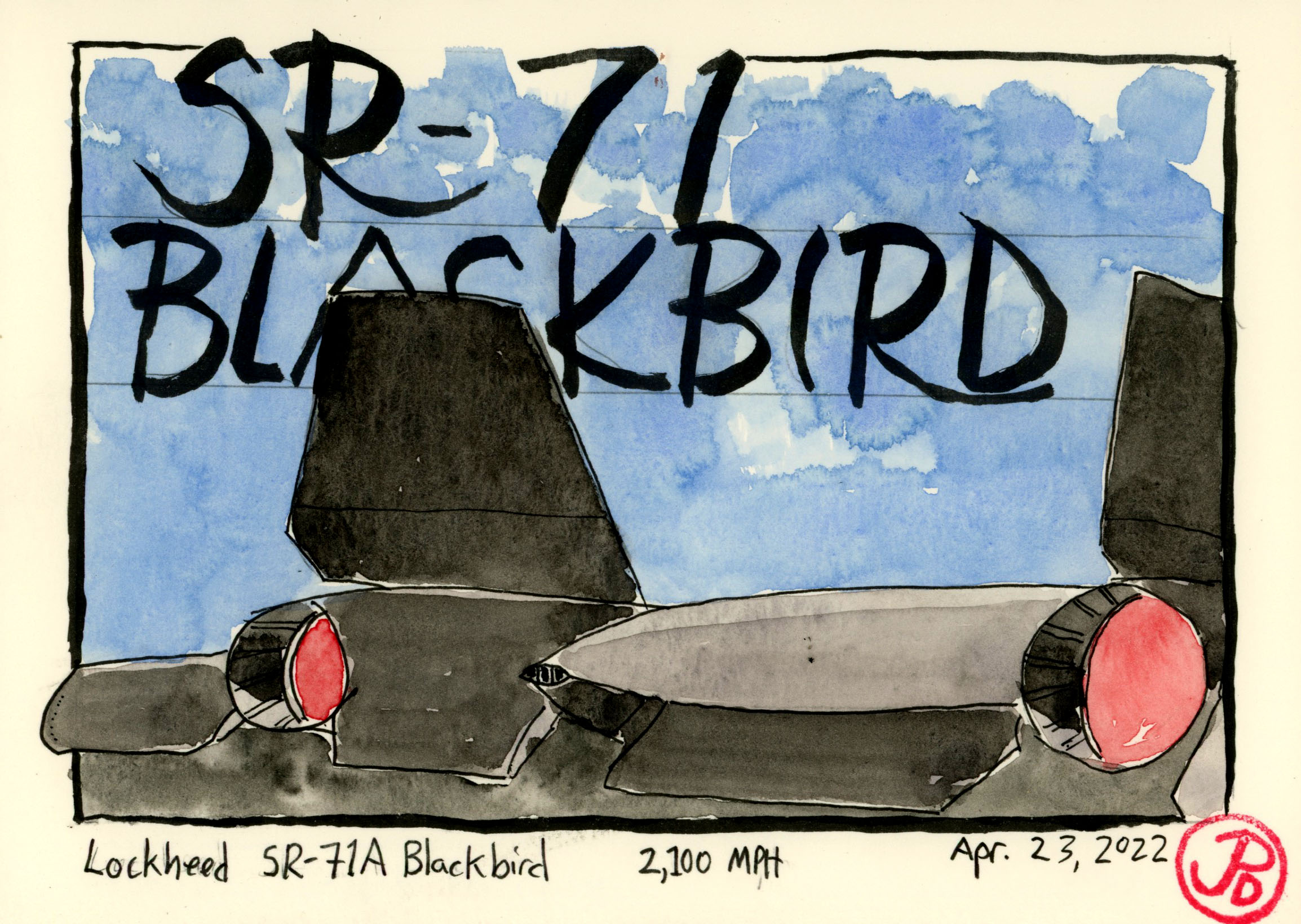
A sketch of the business end of one of the aircraft that mesmerized me as a child, the world’s fastest plane: SR-71 Blackbird. It’s top speed was Mach 3.3, four times as fast as the average cruising speed of a commercial jet. 32 of these high-speed, high-altitude, reconnaissance aircraft where built, 26 still exist and like this Blackbird, are on static display in museums.

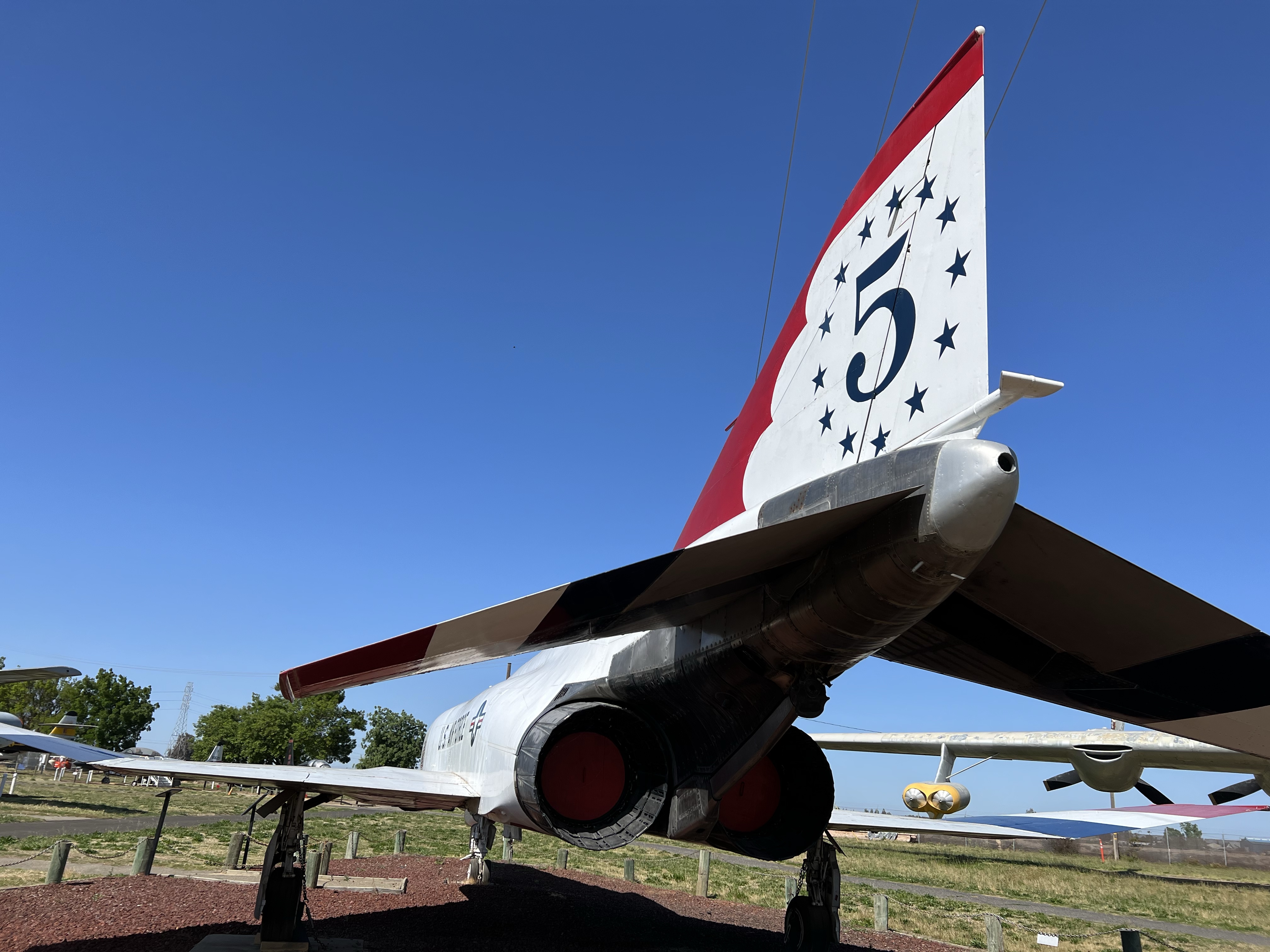
The trip was also a dip into nostalgia as I was sketching an F-4 Phantom, one of the planes I built a model of when I was a kid. As I’ve noted before, you really get to know something when you sketch it.

The business end of an F-4 Phantom. This jet is painted in the livery of the Thunderbirds No. 5, the Air Force Demonstration Squadron. When I was a kid, I built four F-4s in the Blue Angels livery. I would watch the Blue Angles’ performance from my roof.
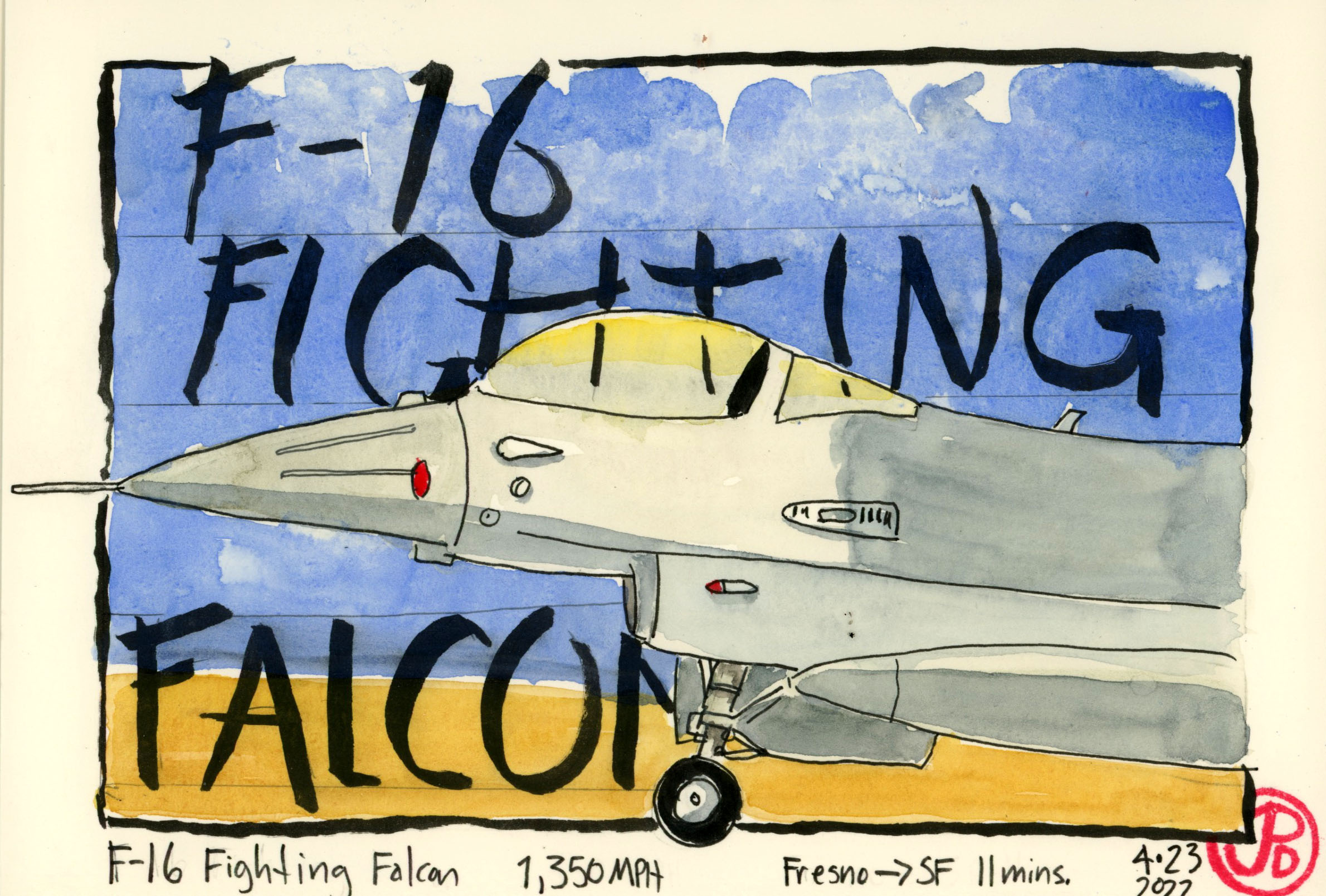
A sketch of an F-16 Fighting Falcon. This plane was part of the National Guard, stationed in Fresno. The F-16 could cover the distance between it’s base in Fresno and San Francisco in 11 minutes!
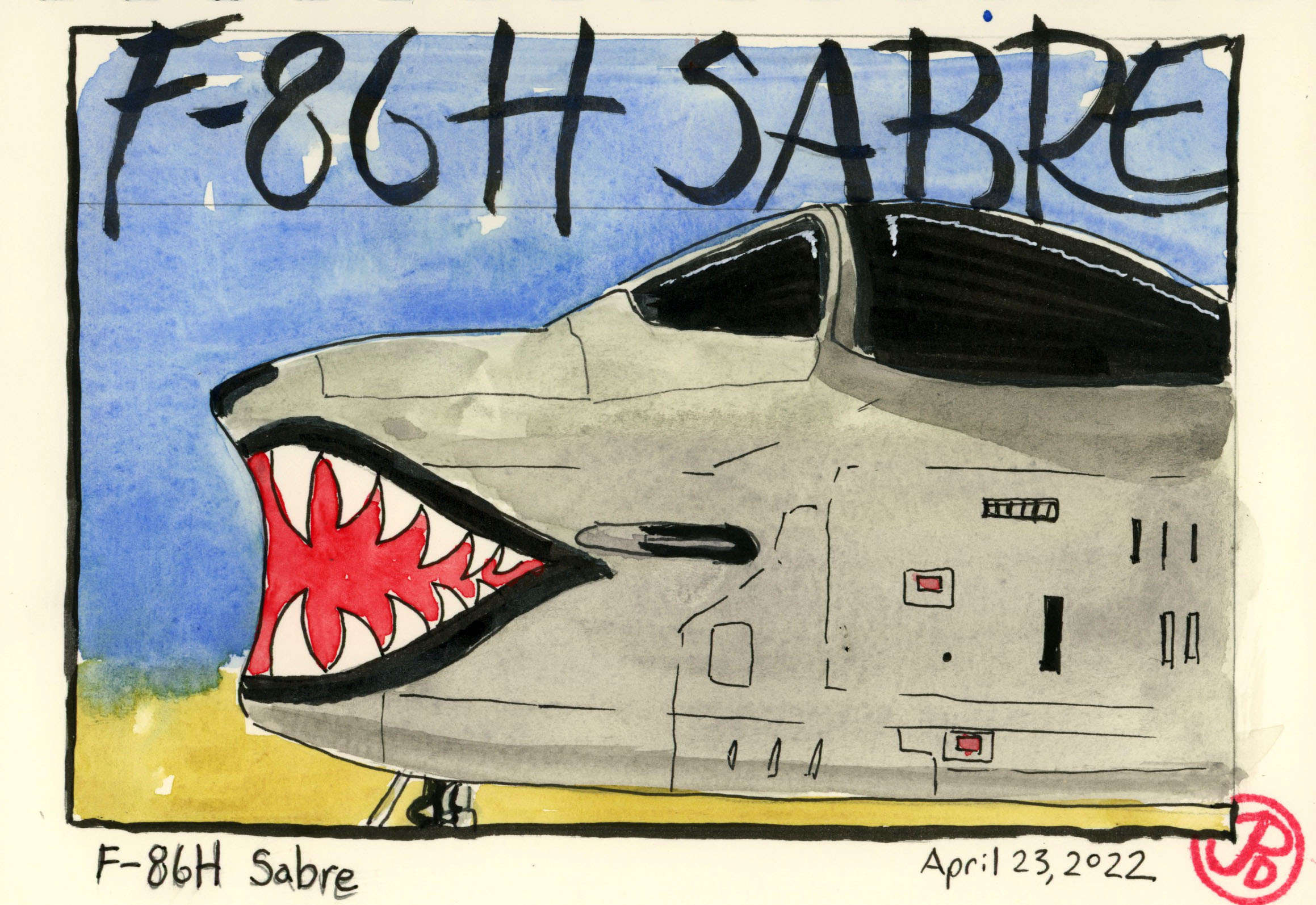
F-86H Sabre, a Korean War swept-wing fighter with a top speed of 600 mph. It’s painted nose is a throw back to the P-40 of World War II.