Image

On the “Real” Golden Pond

What would bring a son the Golden State to a small lake in New Hampshire?

It was a film I saw when I was a kid, the three time Academy Award winning On Golden Pond (1981). The real Golden Pond is to be found in New Hampshire’s Lakes Region and it’s real name is Squam Lake. I planned to spend a few days here sketching and nature loafing.

I would be visiting a few of the filming locations and taking a Squam Lake Natural Science Center pontoon boat ride around the lake to take in the natural beauty of the lake in it’s fall foliage.

On our 90 minute ride we visited some of the bays and islands of the serene New Hampshire lake. We hoped to see two of the emblematic species of this region: common loon and bald eagle. We had no luck with the eagle but near Kimball Island, I spotted four loons and our captain took us over for a closer look.

During the filming of On Golden Pond, the cinematographer noted that it was hard to get good shots of loons because they were so shy and would dive out of view when approached (they are known as “divers” in Britain). Since the 40 years since On Golden Pond was filmed, the lake has become more and more popular with more visitors and boats and house on the lake. As a result the loons are used to the presence people being around them and allow close approach.

IMG_6796A Nature Center pontoon boat passes by Holderness’ famous dock on it’s way to Squam Lake. Behind the boat is the boathouse that Henry Fonda almost took out as he speed away from the dock in the film.

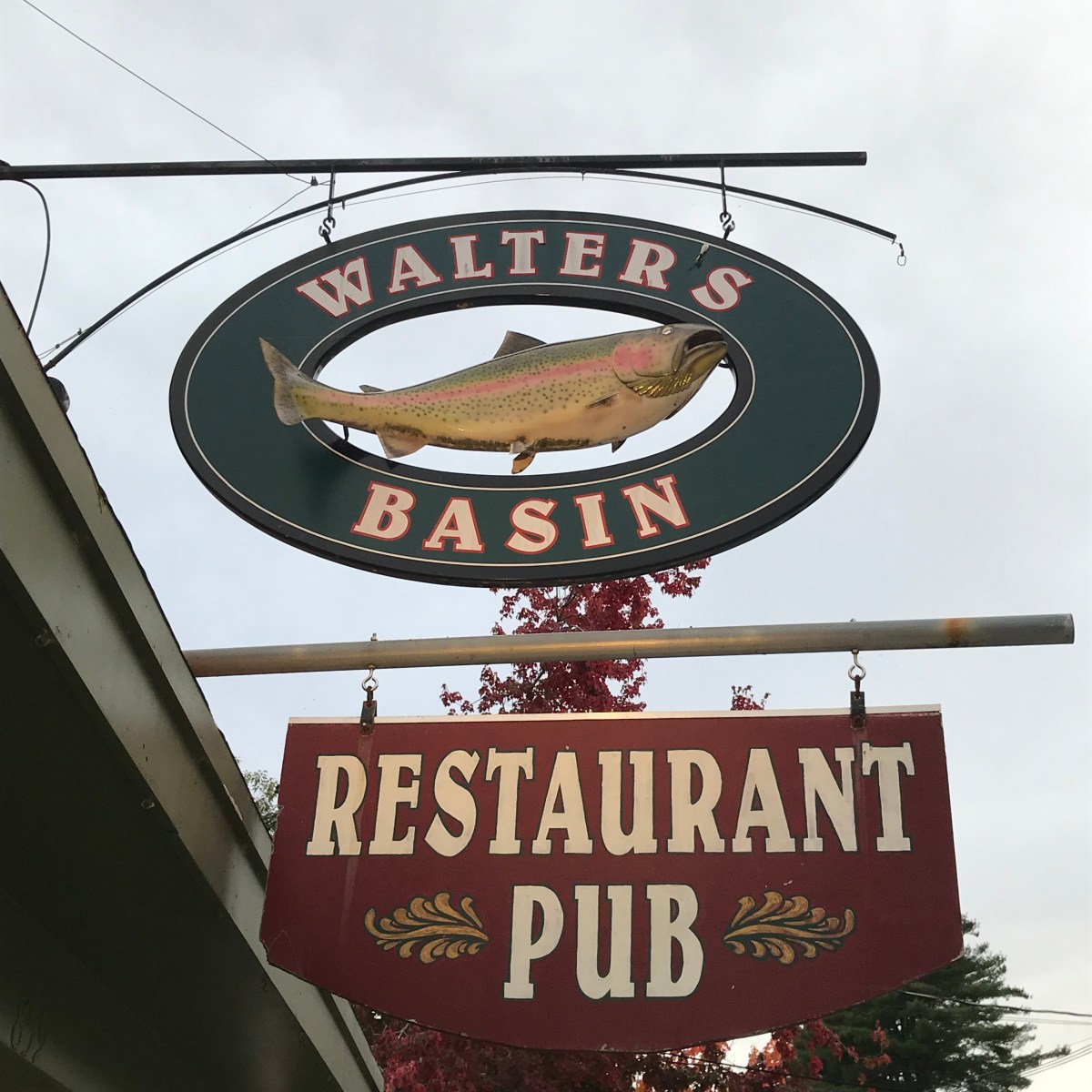
One of the locations featured in the film is the public boat harbor in Holderness. It is know as the Squam Boat Livery to the locals. It was here where legendary film actors Katherine Hepburn and Henry Fonda, playing Ethel and Norman Thayer, stopped to have their vintage 1951 Chris-Craft wooden boat refueled. The wooden boathouse looks very much the same when they filmed here in 1980. What is notable is the tourist industry that has grown up because of the success of the movie. The restaurant next the the harbor is named “Walter’s Basin” a reference to the trout that almost got away in the film who was named “Walter”. The are inn and bed and breakfasts with the name “Golden Pond” in them.
IMG_3074

I stood on the bridge, right where Katherine Hepburn pulled her car up to get the mailman to help look for Norman Thayer and Billy after their boat accident in “Purgatory Cove”. (If you haven’t seen the film this is all meaningless, so go watch On Golden Pond!)

Purgatory Cove

The scene where the boat accident was filmed was near Kimball Island. (This scene scared me when I watched it as a kid). On our boat tour we passed by the cove and our captain pointed out the two rocks featured in the famous scene.

We left we again found a small raft of loons.
IMG_3076

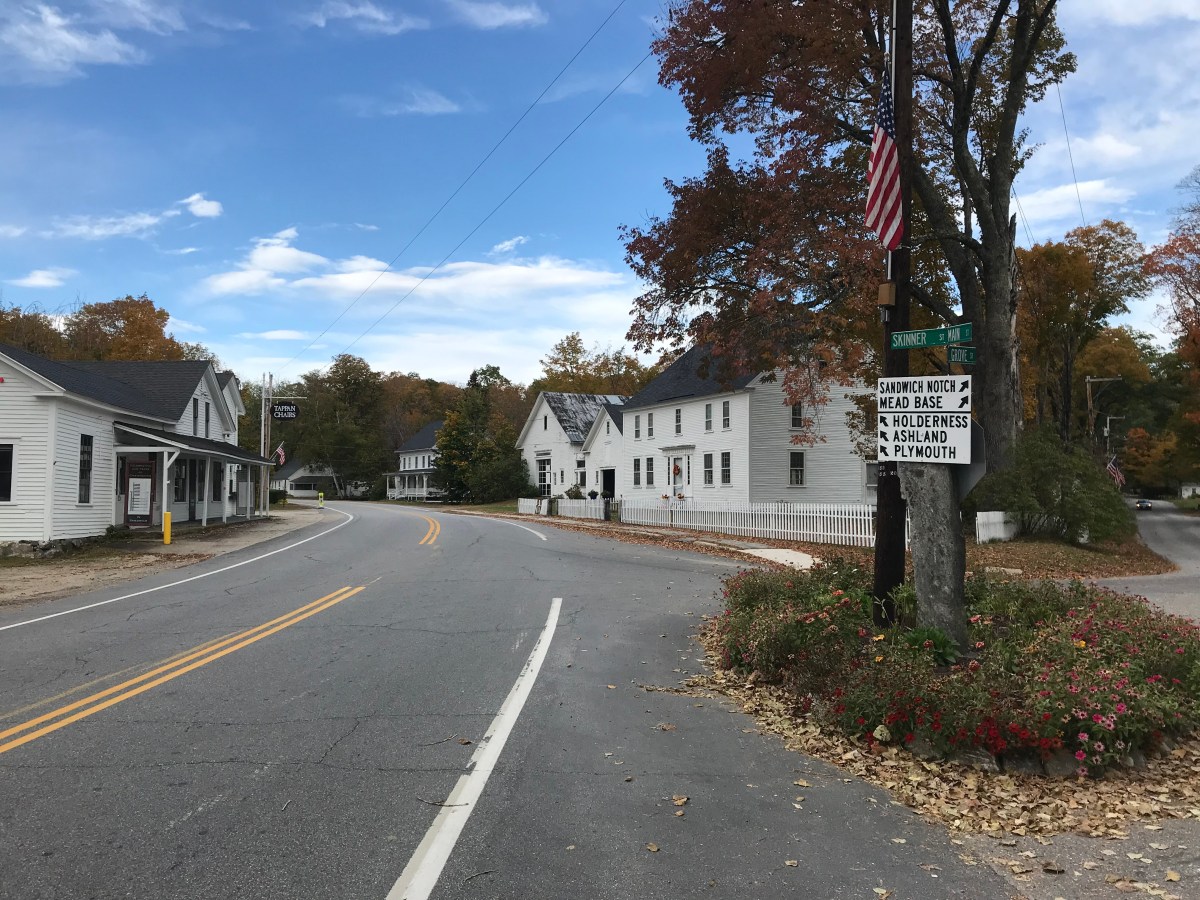
The second unit shot footage of a car driving through the Lakes Region. Some of this unused footage was featured in the opening sequence of the sitcom Newhart, including the main road in Sandwich.
Image

Carriage Roads and Bridges

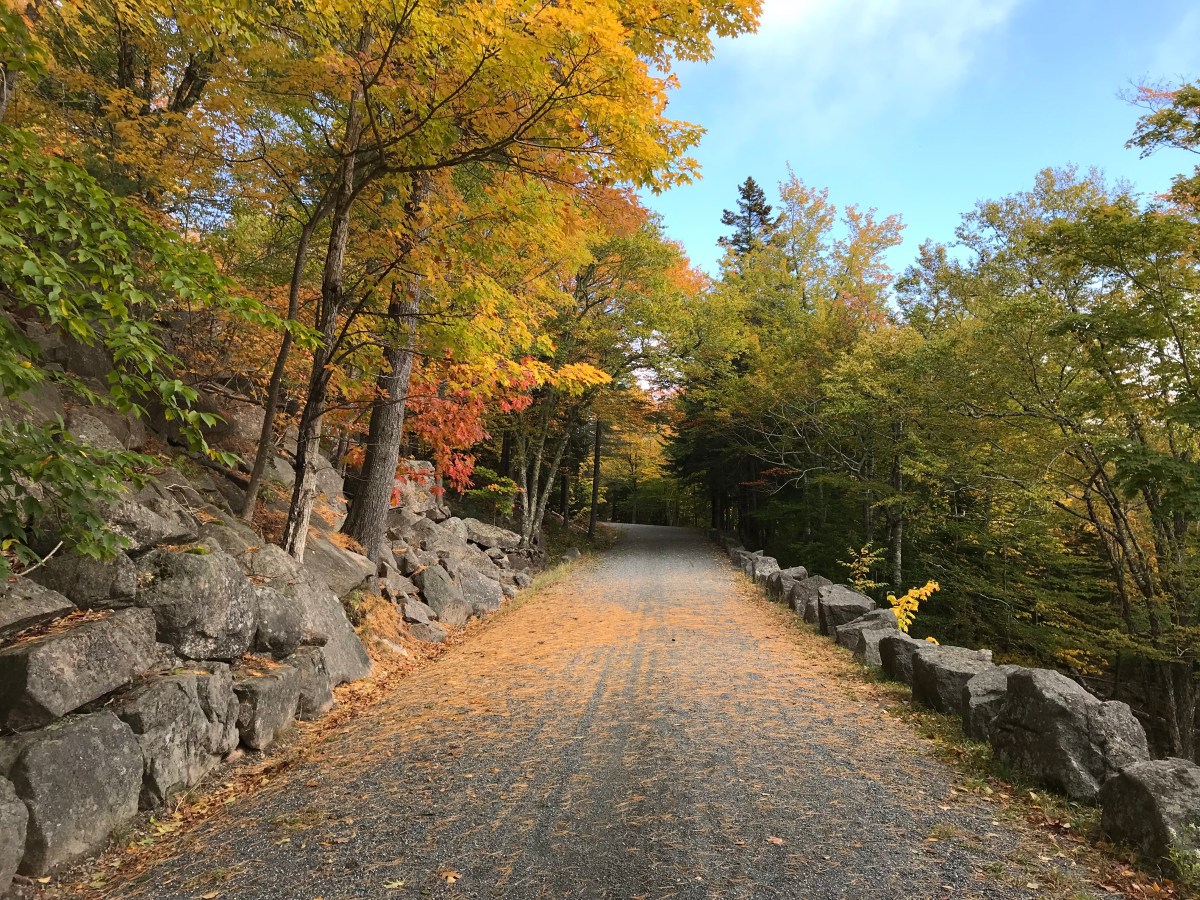
A way to avoid the tourists and fall foliage peepers In Acadia National Park is to hit the 57 miles of Carriage Roads that rise and weave throughout the National Park. It was easy to find peace away from the crowded Jordan House area because anything requiring hiking on a slight rise really thins out the masses.

The Carriage Roads where a gift from philanthropist John D. Rockefeller Jr. and were constructed from 1913 to 1940. The roads were designed and built to fit the lay of the land and meant for taking your time and enjoying the journey. These roads were never built for the automobile in mind and to this day you can only travel by foot, tire, or hoof.

IMG_3294

Walking on a Carriage Road in the fall was certainly one of the highlights of my trip.

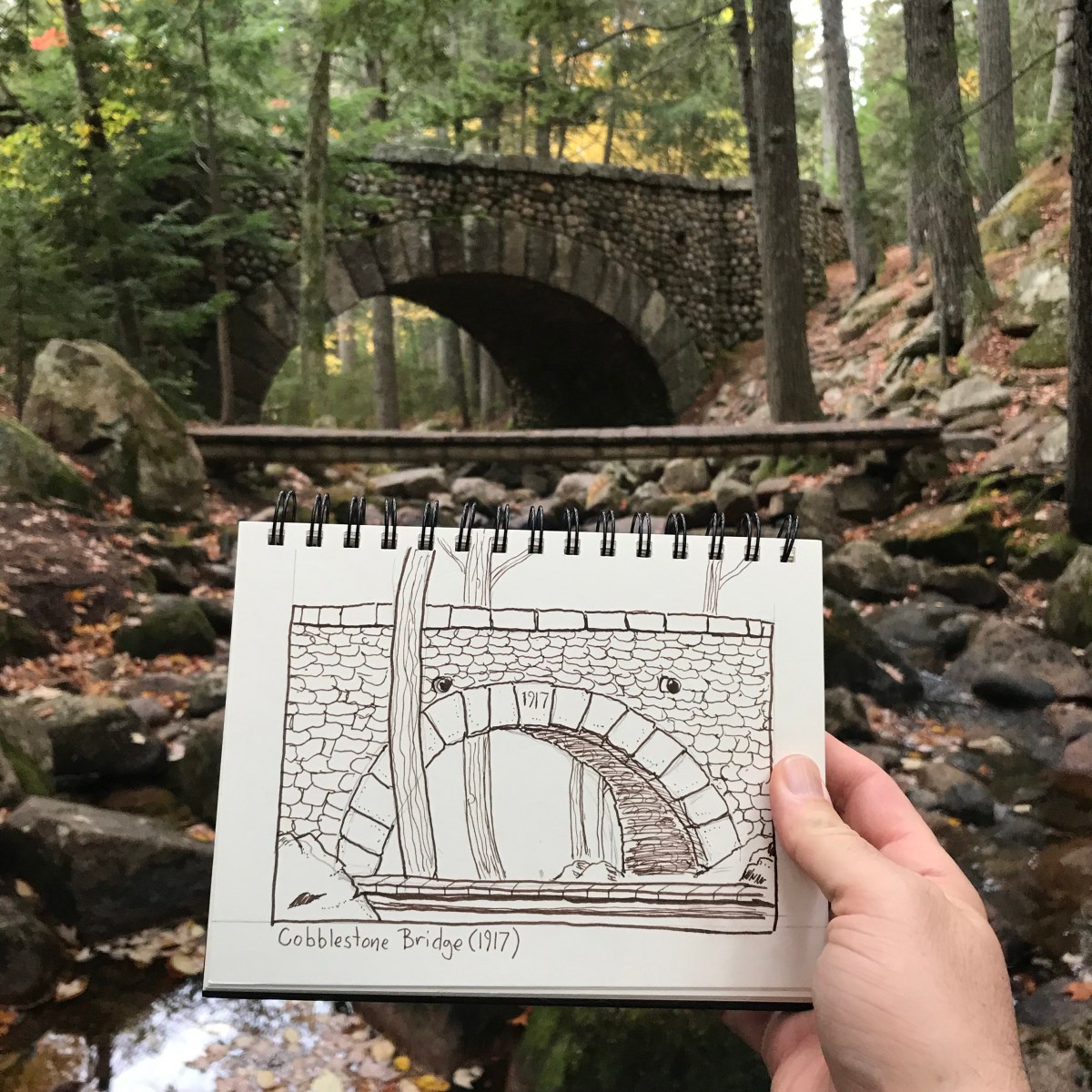
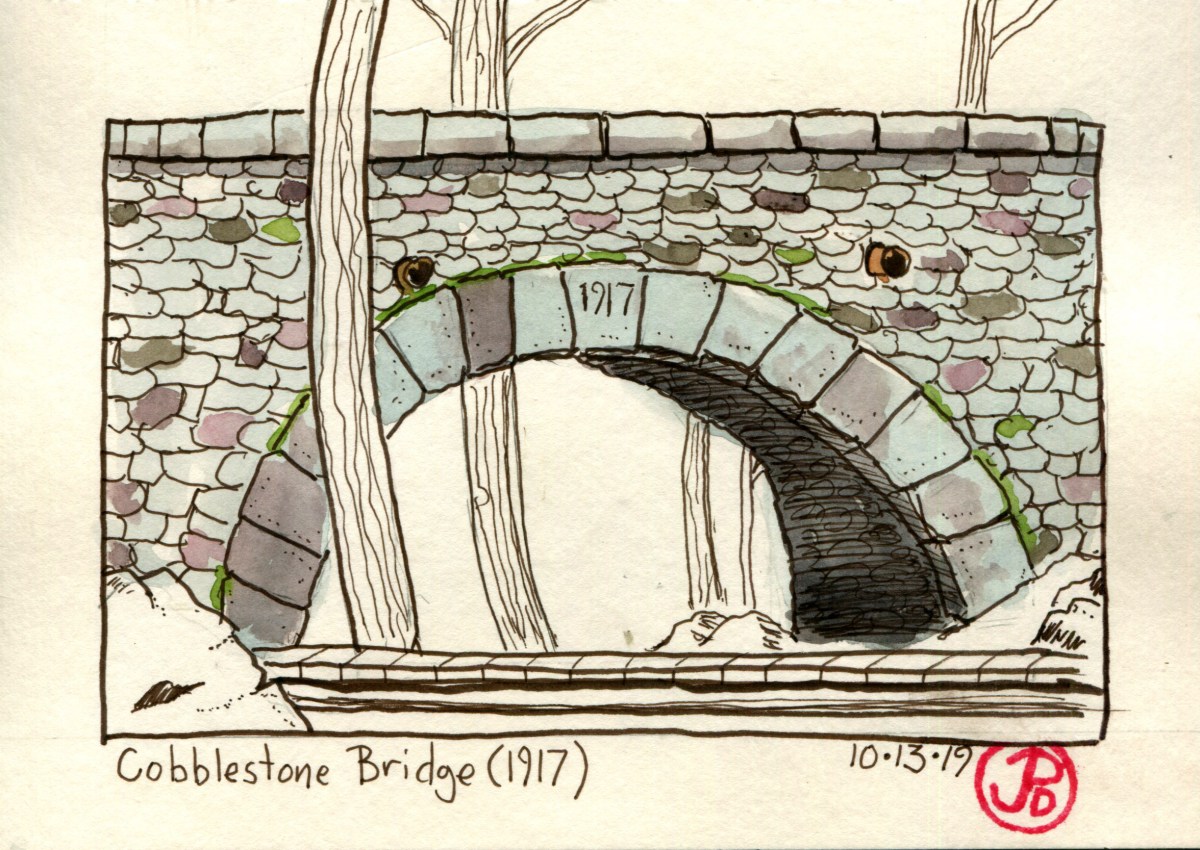
Rockefeller also financed 16 out of the 17 stone-faced bridges. I was heading out early from Jordan Pond to sketch the oldest bridge on the Carriage Road system: Cobblestone Bridge which was completely in 1917.

Less then a mile on the well marked Carriage Roads, I came to the first bridge ever built in the road system. It is different than most of the other 16 bridges in that it is faced in cobblestone, in an attempt to fit into it’s stream-spanning location. I found a streamside rock on Jordan Creek and started to sketch.

IMG_3217

I loved sketching the textures of this bridge. I also loved sketching in my Stillman & Birn Delta Series watercolor journal. I normally don’t like spiral sketchbooks because of their lack of ruggedness for the trials of travel but this this book held up well.

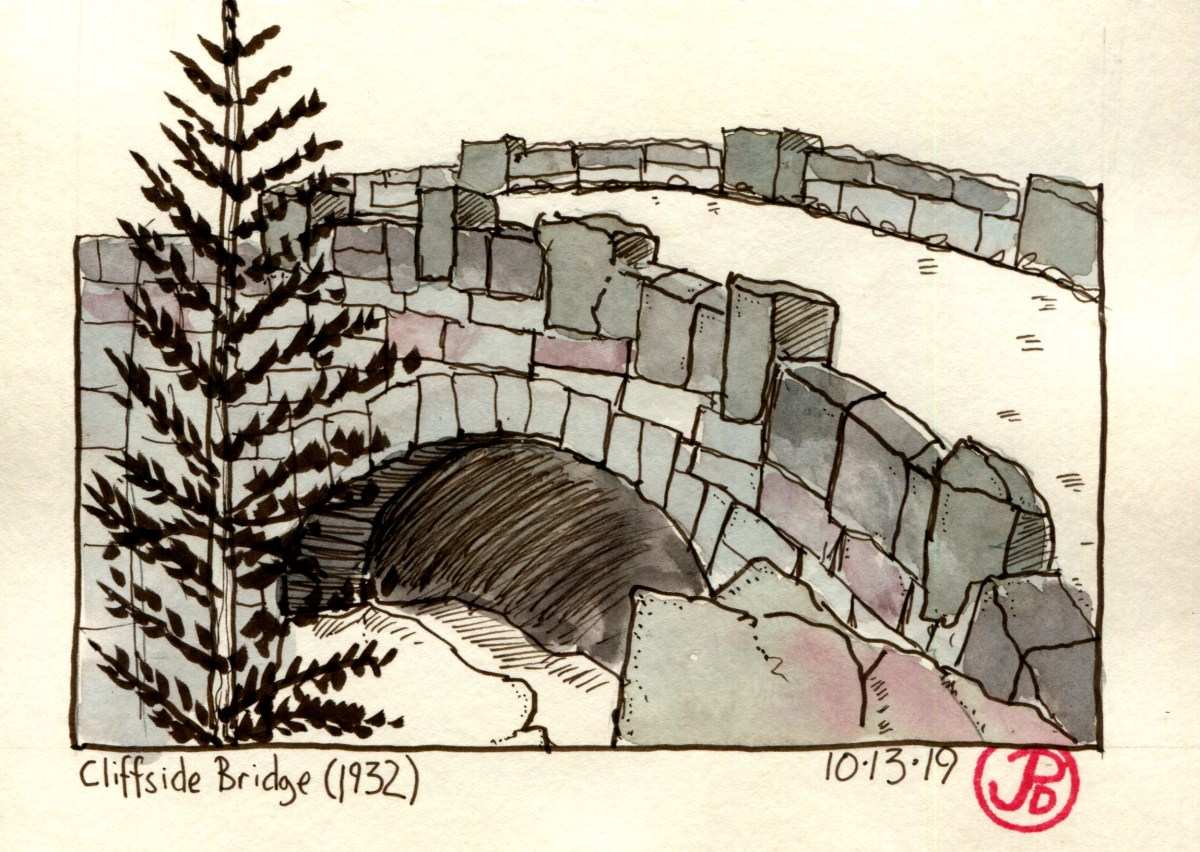
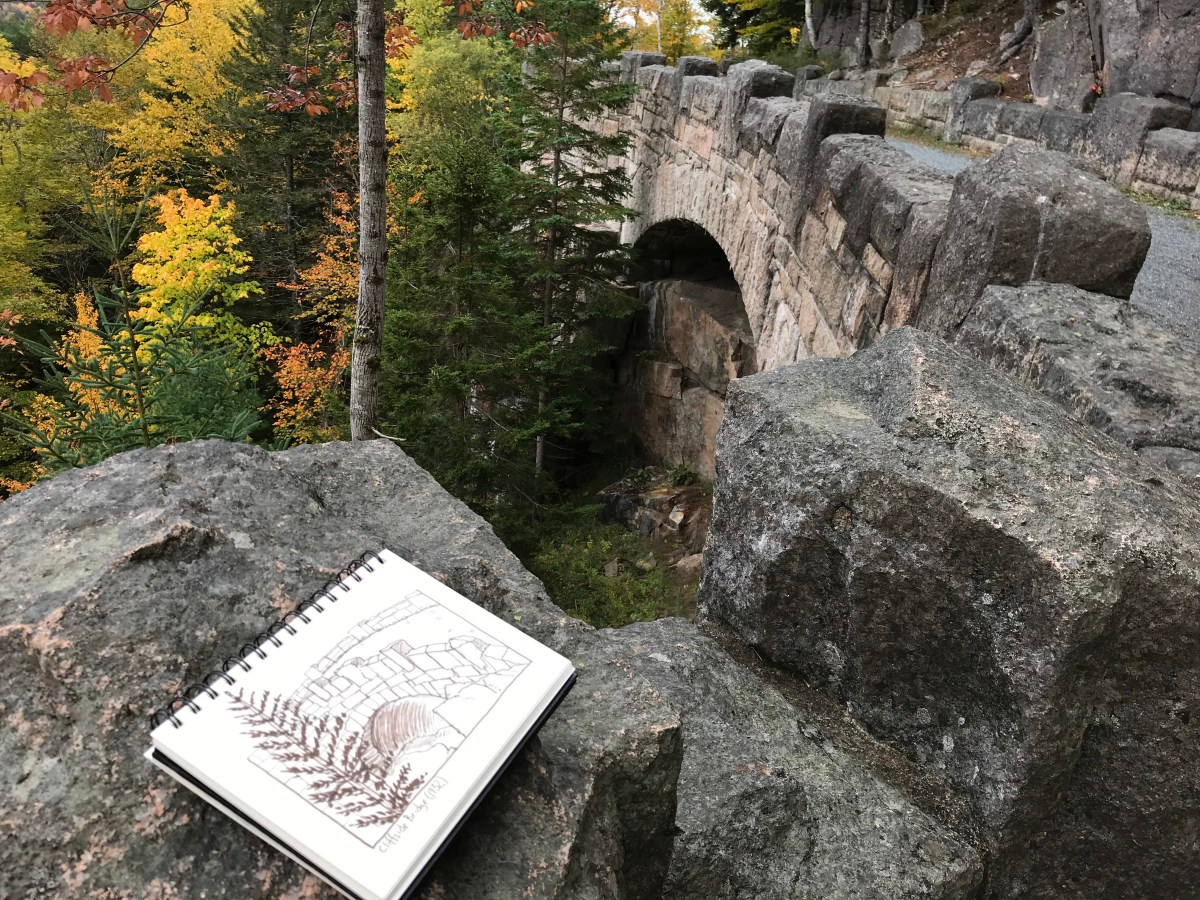
I headed back to the Jordan Pond area, where a good confluence of Carriage Roads exist, and I hiked out to look at two other bridges. I sketched one of them, the Cliffside Bridge which was completed the year my father was born, 1932. This 230 foot bridge is an arch above a ravine and standing above the arch gives way to a beautiful fall foliage panorama.

Cliffside

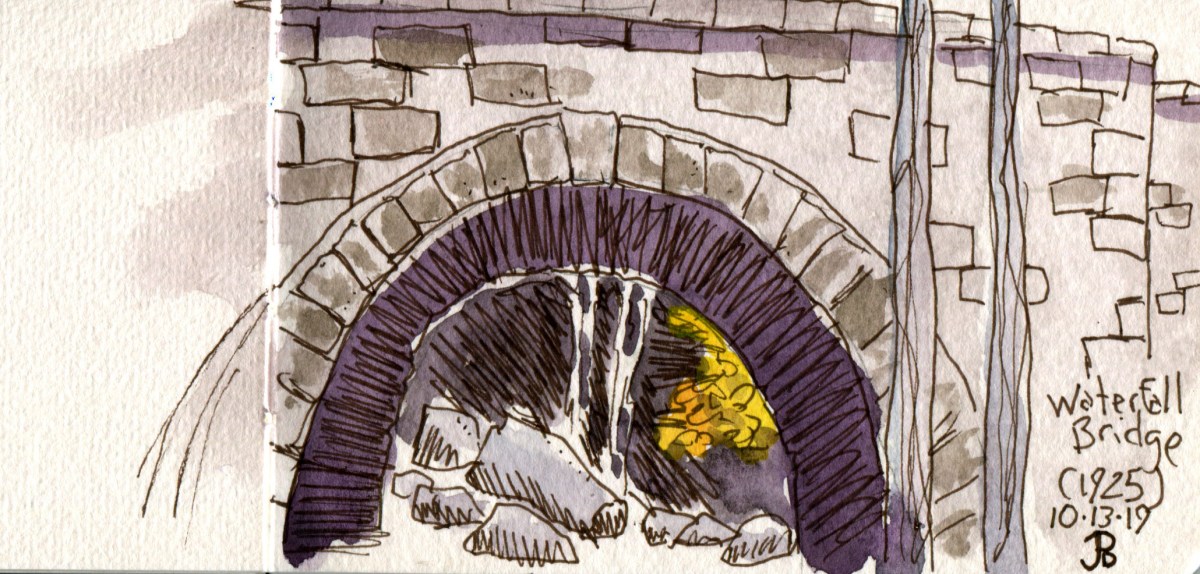
I drove to another trailhead and another carriage road system to see and sketch two more bridges. The first bridge I came to was the Hemlock Bridge (1924) and then I came to the appropriately named Waterfall Bridge (1925) because it’s arch frames a forty foot waterfall. This bridge I sketched in my smaller Aquabook.

Waterfall bridge

Waterfall Bridge in my smaller Aquabook.

Image

Phillip Exeter Academy Library

How do you sketch an architectural masterpiece?

Well first I “shake hands” with the building which means walking around the structure, viewing it from all angles and even walking across the street to find which angle speaks to me.

The building, the Phillip Exeter Academy Library in New Hampshire, was certainly speaking to me. It is on the campus of Exeter Academy (founded in 1681) and is the largest secondary school library in the world. And I wanted to find the best angle that would really showcase the architect, Louis I. Kahn’s lines and form but I had one challenge. It was hard to see the Library through the trees. This is part of the on-the-ground-challenges of field sketching, but I was certainly up for the challenge!

IMG_6592

Louis I. Kahn’s great library at dusk, Exeter, New Hampshire. The interior is every more amazing.

I first became aware of Kahn’s work through the documentary 2003 My Architect: A Son’s Journey, made by his illegitimate son, Nathaniel. I had sketched his West Coast masterpiece, the Salk Institute in La Jolla, California and I wanted to find more examples of his work to add to my sketchbooks.

IMG_6583

The best way to understand a piece of architecture is to sketch it. The more you take the time to notice the more you really “see” it. This is really true of any subject but the best part about architecture, unlike animals, they are very obliging subjects, except for the complexity of the lines and the difficulty of perspective.

The following morning I sketched the library one either side of a coffee and oatmeal break. I sketched it from two different angles and in two different styles. My first sketch was a little more detailed following a pencil sketch while the second I was sketching without a net using micro pens (08 and a brush pen) to do a very loose sketch (featured image). I think I like the latter sketch, it is freer and captured the essence of the library better.

I did say that the interior was more incredible that the brick exterior. I know this because I headed into the space and saw the amazing interior. Unfortunately a librarian also saw me and with an air that said to me that she frequently turns away Louis I. Kahn fans. She told me of the few days of the year you could visit the interior, this was, after all, a school in session and said, “The library has because popular recently, too popular.” I thanked her and got fleeting glimpses of the incredible interior before headed out. Far too fleeting for such an amazing and sketchable space which remained unsketched.

Exeter 2

Image

Northeast Fall Foliage

Autumn is a second spring when every leaf is a flower.

-Albert Camus

One of the highlights of going to the northeast in the fall is the autumn colors which the area is rightly famous for. And it looks like I’d be timing it perfectly, as I did some research to find when the peak times would be in Maine, New Hampshire, and Vermont.

To put this all into a sketch, I chose to do it in the form of a map. So with a few reference materials I created a fall foliage map. Included a Albert Camus quote, a compass rose, and a key.

I couldn’t wait  to become one of the “leaf peepers” and paint some of the autumnal scenes in New England. Before flying to Logan, I prepared my paint palette with autumnal colors: burnt sienna, Winsor yellow, olive green, Quinacridone gold, alizarin crimson, cobalt blue, and cadmium orange.

Image

Pre Trip Sketching

“The world is a book, and those who do not travel read only a page.”

-Saint Augustine

One of my favorite parts about travel, aside from the travel itself, is the preplanning and research that happens months and weeks before the date of departure. These preparations creates the palpable excitement that intensifies to the point of lift off.

I am certainly not a planner that wants to know where I’m going to be every minute of the day. I look at it more as planned improvisation. I see it as the framework but I also want to be open to the serendipitous events that can happen when away from home far away. The event you can never plan for but plan to be open to.

One thing that I booked weeks before my autumn trip to New England, was an afternoon whale watching trip out of Bar Harbor, Maine.

EC Pelagic Card

A pre sketch design sketch.

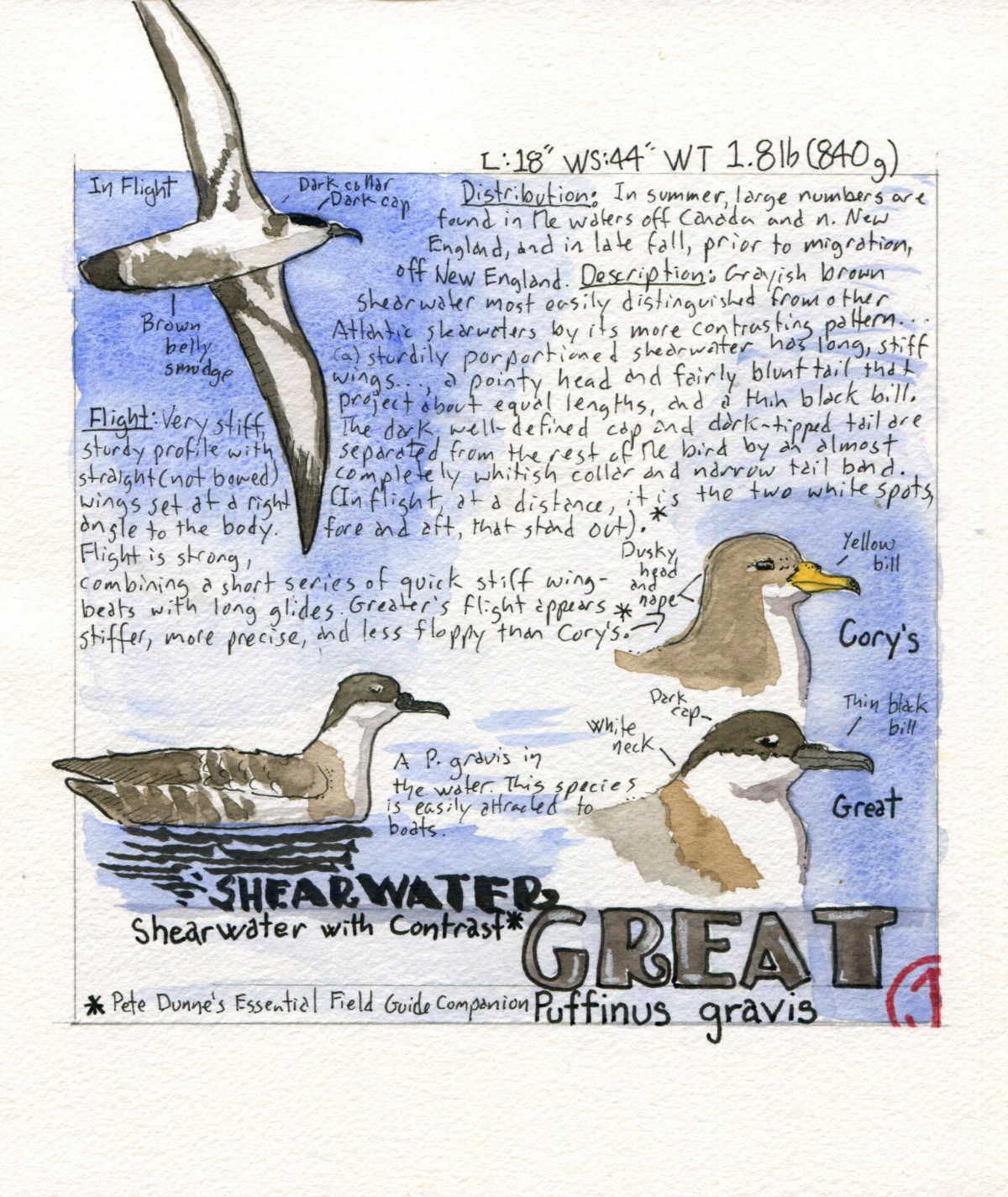
I love whale watching cruises on the West Coast and I have enjoyed seeing humpback, Gray, and blues whale as well as orcas and other dolphins. And I have also enjoyed pelagic birding trips so I was looking forward to Birding on an east coast whaling trip.

You don’t always have a whole lot of time to identify pelagic birds as they pass by so I was going to do a little homework to help me with my fieldwork.

This involves doing a lot of research through field guides and reference books and distilling that knowledge and putting it into a single sketch.

One of the top birds on my East Coast pelagic wish list was great shearwater and I was hoping to see a Manx shearwater too.

Manx shear

Image

Birds of Brazil

At the end of 17 days birding the Cerrado, the southern Amazon Basin, and the Pantanal of Brazil I had added 309 new species to my world lifelist and seen a total of 525 bird species. By the time I boarded the plane in Cuiabá on my way to São Paulo, I had a total of 1,642 world lifers, which is about double the number of species found in the United States.

To reach this number I had to travel. All across the United States from California to Cape May to the Rio Grande Valley in Texas. Two trips to Spain. Then south to the Americas: Costa Rica Panama, Ecuador, and Brazil and over to the western Pacific to Japan.

I had also whiffed on birds all over California and the rest of the United States. I have many birds that might have been.

It is a reminder to stay in the moment and celebrate the bird in front of you. It may me with you a short time or you may get quality time but it never pays to think of the bird that never was.

Image

Bodega Pelagic

“At length did cross an Albatross,

Through the fog it came;

As if it had been a Christian soul,

We hailed it in God’s name.”

The Rime of the Ancient Mariner (1834)

Samuel Taylor Coleridge

We met at 6:30 AM in the dirt parking lot of Bodega Bay Harbor.

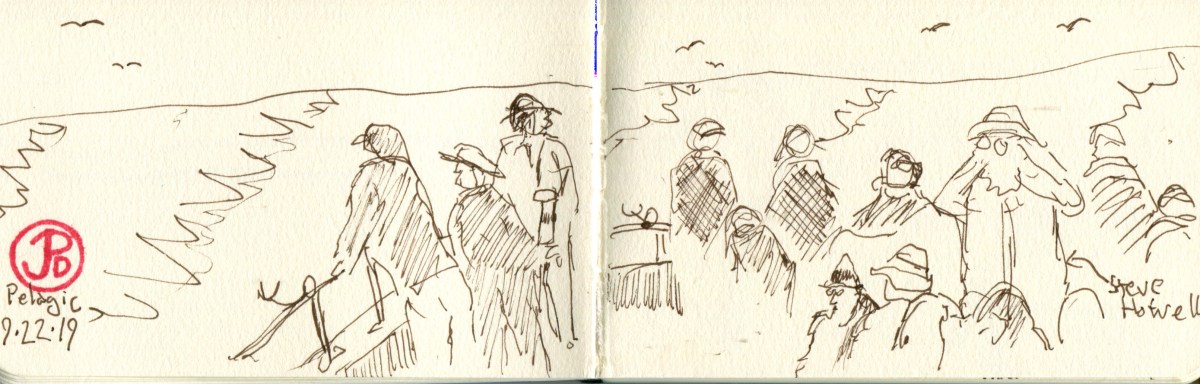
A grizzled, sandaled sea dog of a Welshman stepped forward. He was to be our guide over the next ten hours.

He was and is Steve Howell, seabird author (his book Oceanic Birds of the World was in my pack) and expert of the avian world and he would be helping to identify the pelagic life we would be seeing in the Cordell Bank National Marine Sanctuary.

While it seemed nice and calm on the dock, Captain Rick warned us of choppy and windy conditions. And things seem nice enough as we headed out of the harbor but once we hit open waters the New Sea Angler bobbed on the waves like a cork. There was a steady stream of birders heading to the stern to “feed the fish”. Luckily I had a stomach of iron and I never suffered from seasickness. But this trip was going to test my will and my digesting breakfast.

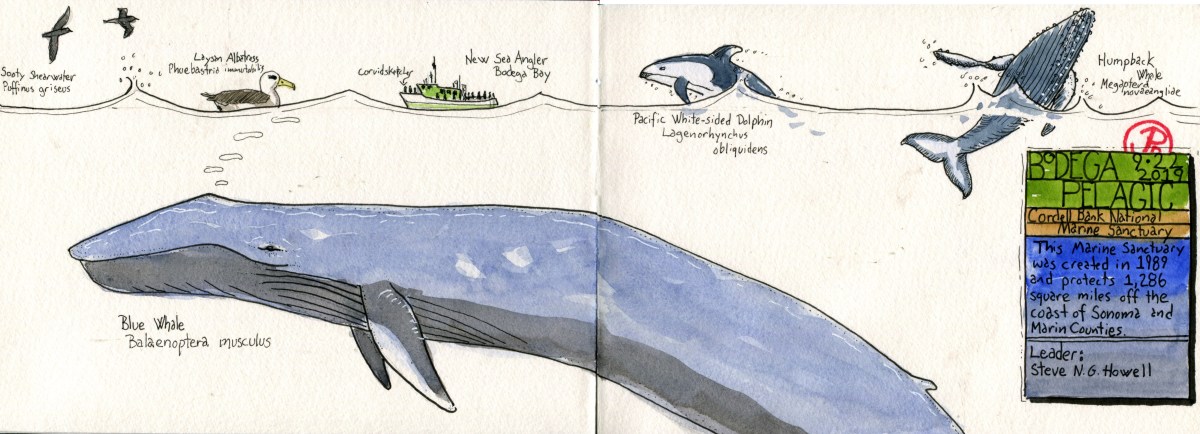
Close to port we saw many nearshore species such as brown pelicans, common murres, cormorants, and California gulls. A little further out we saw our first pelagic species: sooty shearwater. As Steve Howell noted, “They’re called shearwaters because, well, they shear the water.” These dark oceanic birds flew with ease, inches above the rolling water, seemingly cutting the surface.

Even further out, we saw our first whale spout. Off on the horizon, to the port side, I saw a humpback whales breach! This is when a cetacean partially or wholly leaves the water’s surface.

We were seeing a smattering of birds followed by a pelagic barrens of no birds. Captain Rick headed towards an anchovy school where about ten humpbacks were feeding. Soon Pacific white-sided dolphins appeared in the swells besides us. One highlight was a lone humpback that passed under the New Sea Angler and surfaced close to our starboard side. The whale was so close that I could hear the leviathan exhaling!

More shearwaters appeared around us: Buller’s, sooty, and pink-footed. Where the whales are you will find pelagic birds. We were still in relatively shallow waters and we had not yet seen the oceans most iconic species: the albatross. Albatross is a deep water species, rarely seen from land.

When we were out about 25 miles, the winds peaked at 20 knots and we saw our first albatross, easily riding the wind. This was the black -footed albatross and we would see more as we labored above the submarine canyon near Cordell Banks.

Two amazing highlights were just ahead of us, above the canyon’s edge. Two massive whale spouts, one after the other, billowed in the air, just to our starboard. Two bluish-gray whales rolled on the water and then appeared again heading on an easterly course, across the canyon. These whales did not appear black, like the humpbacks but we’re blue like their namesake: blue whale. These are the earth’s largest creatures; the largest creatures that ever have lived on the planet earth.

These two whales had their accompanying mass of pelagic birds but one was a sought after bird for this trip. Mario, one of the spotters, called out, “Laysan!” And every birder within earshot rushed to the bow of the boat, eagerly scanning the pitching waves from a pitching boat. Not an easy task. No albatross.  I moved into position, scanning the waters in front of us. The swell moved towards us revealing the following trough. And there was what looked like a massive western gull. “Laysans on the water in front of the boat!” I exclaimed.

The Laysan sat on the pitching waters, stretching it’s long, narrow wings. The birder density was reaching critical mass on the bow as this was a sought after a lifer as well as a Sonoma County bird. After a quick preen, the albatross stretched out both wings, ran across the waters, and effortlessly lifted off into the air. It headed to the east, presumably to catch up with the blue whales.

Cordell SketchA sketch to pass the time as we headed back to port. I had attempted to sketch earlier but didn’t have my sea legs yet and it came off rather disheveled. Sketching on a moving boat is not as hard as it seems, and I had some experience in the boats of the Amazon and the Pantanal. But Big Blue offers huge challenges for the sketcher of the waters.

Image

The Conception

On Monday of the Labor Day Weekend, 2019, word was out about a boating accident near California’s Channel Islands. When “Santa Cruz Island” and “scuba boat” were mentioned on the radio newscast, I was all ears.

The reason for my instant attention was that I had been to Santa Cruz Island twice. More recently on a camping trip to the Scorpion Bay Anchorage and then in April 2006, a scuba diving trip on a live aboard diving boat out of Santa Barbara.

When more news came out it became clear that a diving boat had caught fire in the early morning hours of September 2 with passengers asleep below deck. The fire quickly engulfed the vessel and the boat sank. At the time of this blog’s writing, it was believed that all the passengers, 34 divers, had perished while five crew members had escaped.

The name of the dive boat was “Conception”.

I headed home after work on Tuesday and rummaged through a storage box that contained my 9 by 12 Canson all media journals. I was looking for the journal that contained sketches from my 2006 dive trip. In the fifth journal I checked, I flipped through the pages to find the dockside sketch of the live aboard dive boat the night before we headed out to Santa Cruz Island. Below the sketch I noted the ships specs: Built: 1981, Length: 79’, Beam 25’, Cruising speed: 12 knots. Above the drawing was neatly stenciled letters in all caps. It was the boat’s name.

Her name was Conception.

This discovery sent chills through my body and a wave of empathy and horror for those who had perished.

Quail Rock

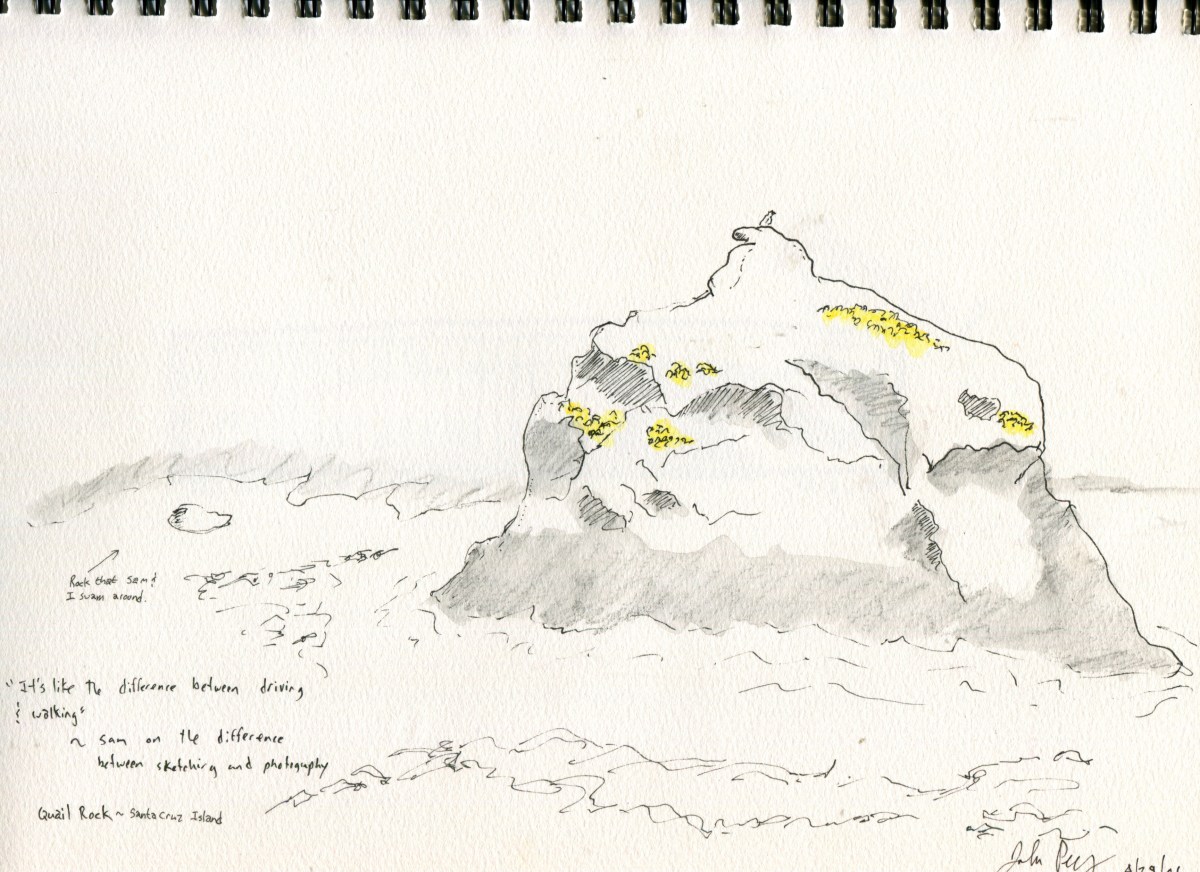
I turned the page to find a near monotoned sketch, dated 4/29/06, of a rock called “Quail Rock”, a sketch I remember doing on the deck of the Conception between dives. I had a quote from my dive buddy written in the bottom left corner: It’s like the difference between driving & walking. ~Sam on the difference between sketching and photography.

The last of the three sketches I did on this trip was the most chilling. It is dated  4/30/06. It is a comic of myself, squeezing into the tight berth below decks in the Conception. It shows me with my arm braced inches above my head, my teeth clenched in frustration as the sound of the boat’s engine drones on.  The title is, “Lower Bunk 10D of the CONCEPTION”. And here is the really chilling aspect of this illustration: it looks like I’m trapped alive in a coffin, like something out of a Poe short story. This was an illusion to show how cramped and uncomfortable my bunk was.

Bunk

Image

Haunted Hospital

There was always that house that your mother told you to stay away from. The odd boxy house at the end of the street. The one where the dogs in the neighborhood wouldn’t even use the front lawn to relieve themselves. That house.

I wanted to sketch Nevada City’s version of that house only it was not a house but a madhouse. The former Nevada County Hospital. The hospital that most locals don’t want you to know about.

The original hospital was built in the 1860s and different wings were added to the main building over it’s lifetime. The building served many purposes over the years but the reason the structure in now infamous is because of a January 2001 shooting spree.

In 2001 the building housed the Nevada County Department of Behavioral Health when a patient, a former school janitor, who was suffering from mental health issues, entered the building and shot three people, two of whom died. He then drove to a Lyons Restaurant near Grass Valley and shot two more people because he thought that they were trying to poison him.

In all, he fired 20 shots from his semi-automatic pistol leaving three people dead. The killer was declared incompetent to stand trial and he was found not guilty by reason of insanity. He is currently at the Napa State Hospital for mentally ill patients.

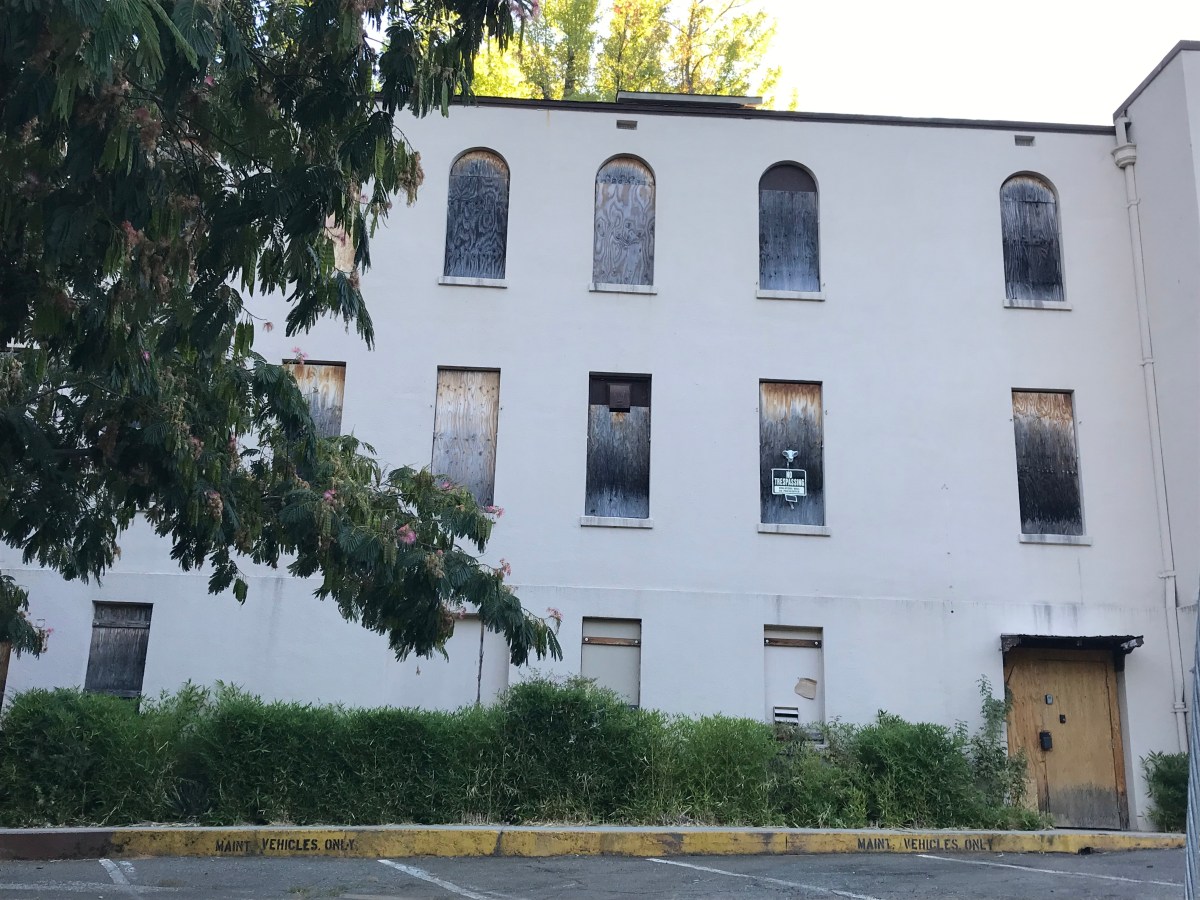
There are no maintenance vehicles in the parking lot of a building that needs lots of maintenance. All the windows of the former hospital are boarded up.
Five years after the tragic events of January 10, 2001, the hospital closed it’s doors for good. The windows were boarded up and the doors locked and the the massive structure sits alone and abandoned, just off a two lane country road, across Highway 49 from downtown Nevada City.

It is hard not to think of the the ghosts of the past as I stood in front of the closed hospital. The structure must have many stories within it’s boarded up walls, some uplifting and happy and others quite tragic. These tales are all silent now and the only sounds I hear are the calls of red-breasted nuthatches and Stellar’s jays from the trees above.

If there was any good that came from the tragedy of January 2001, it was the creation of Laura’s Law, a law that assists outpatient treatment for the mentally ill. The law is named after Laura Wilcox, the first victim that was murdered at the hospital. She was a 19 year old intern who was working at the Department of Behavioral Health during her winter break from college.

Michael Moore’s 2002 Academy Award winning documentary about America’s gun violence epidemic, Bowling For Columbine, is dedicated to Laura Wilcox.

Image

Jaguars in the Morning

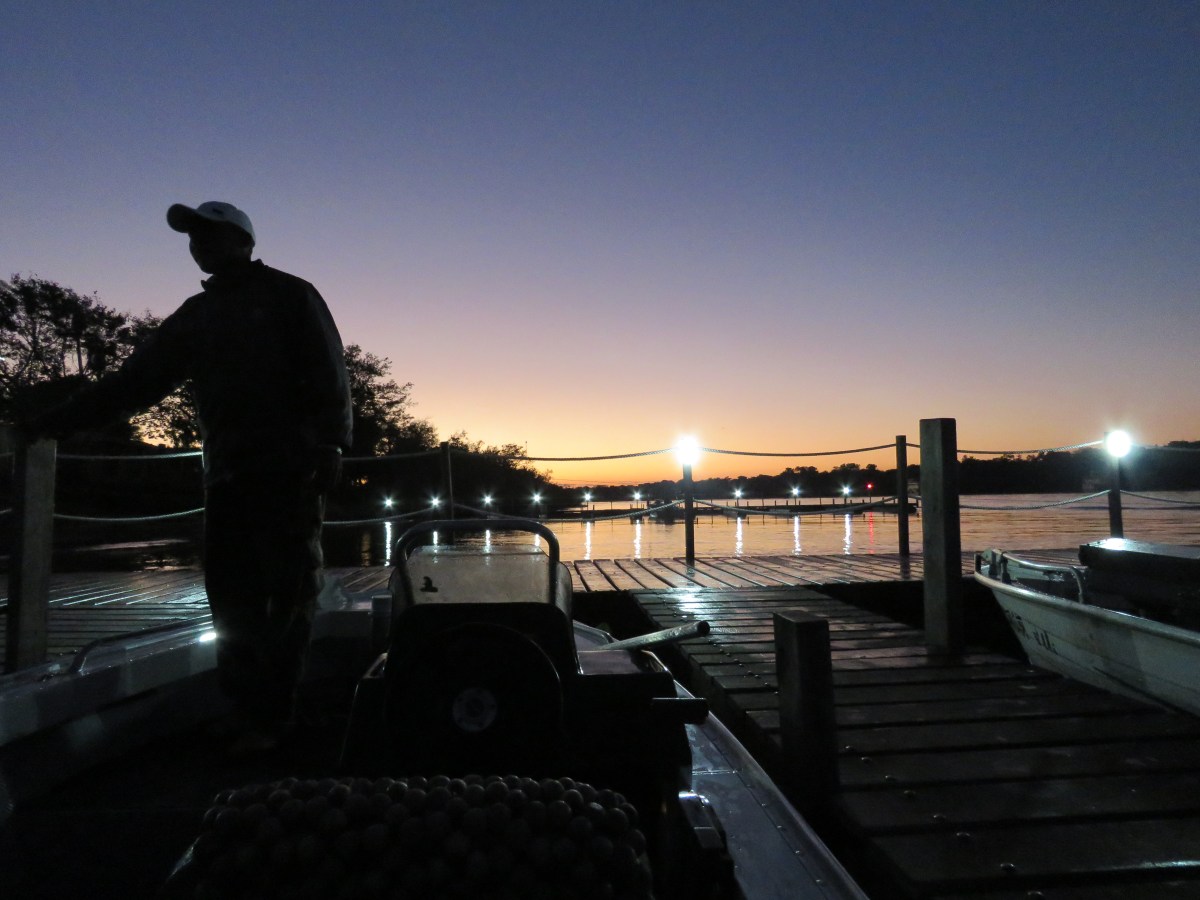
We were at the dock before first light. This was our second jaguar expedition and it seemed hard to beat the six cats we saw the previous afternoon. But that didn’t stop us from trying.

In the back of my mind, it occurred to me that we could be skunked because with wildlife, nothing is guaranteed. The jaguars would either be active and out in the open or reclusive and in deep forest away from the water course. We had been very lucky to see six jags the previous outing, this was more that some of the totals of past tours where numbers of one to four jaguars seen was a pretty good haul.

IMG_5173

To see wildlife, it helps to get an early start and this was certainly true of finding the New World’s largest cat.

We were off up the Cuiaba River and I was glad that I packed a jacket because this was the first time I wore it in Brazil. In the previous week a cold front had moved in from Antarctica, keeping temperatures comfortable and reducing humidity. We were speeding up river to get to the tributaries where jaguar was most likely.

Within an hour we joining a flotilla of other boats, peering into the far-shore green. Two young males had been seen. And now we waited for them to appear.

IMG_5243

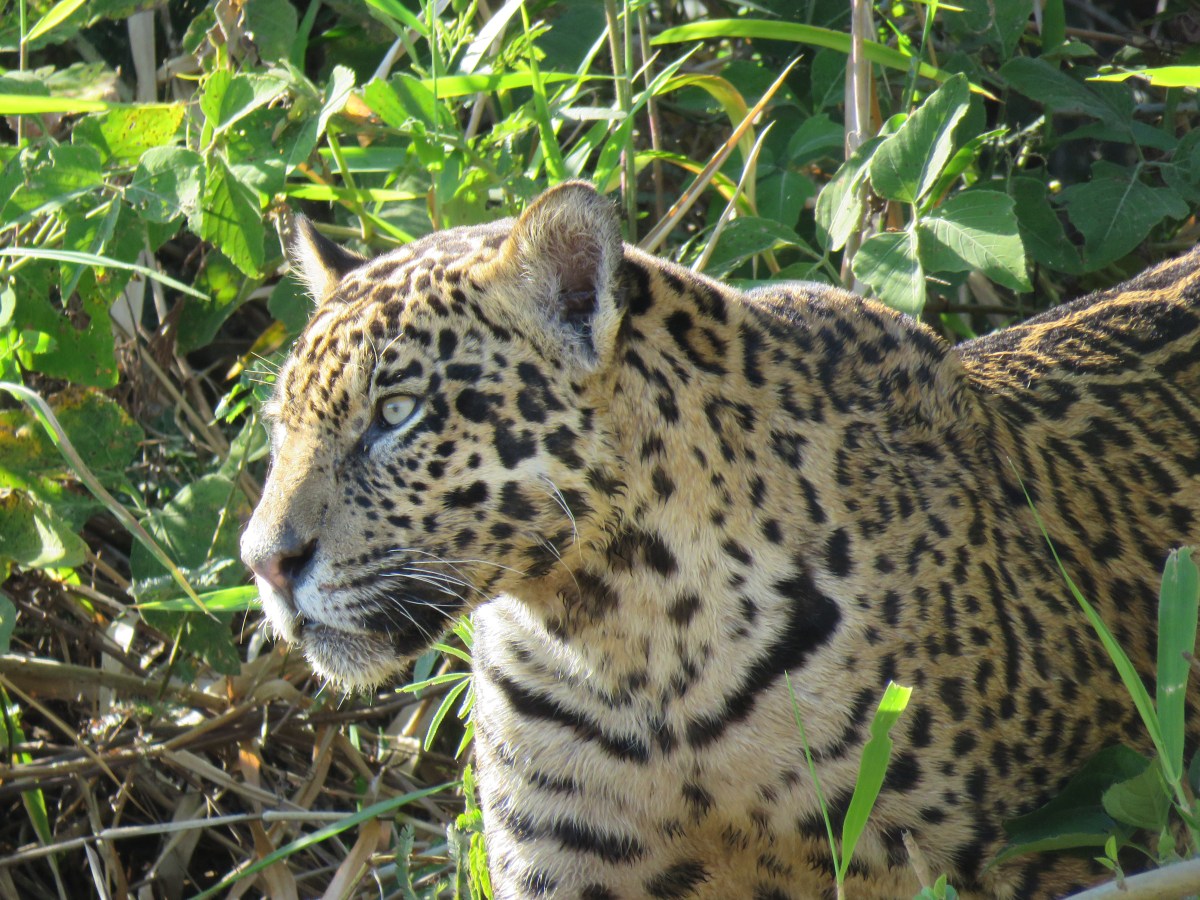
A young male appears out of the green!

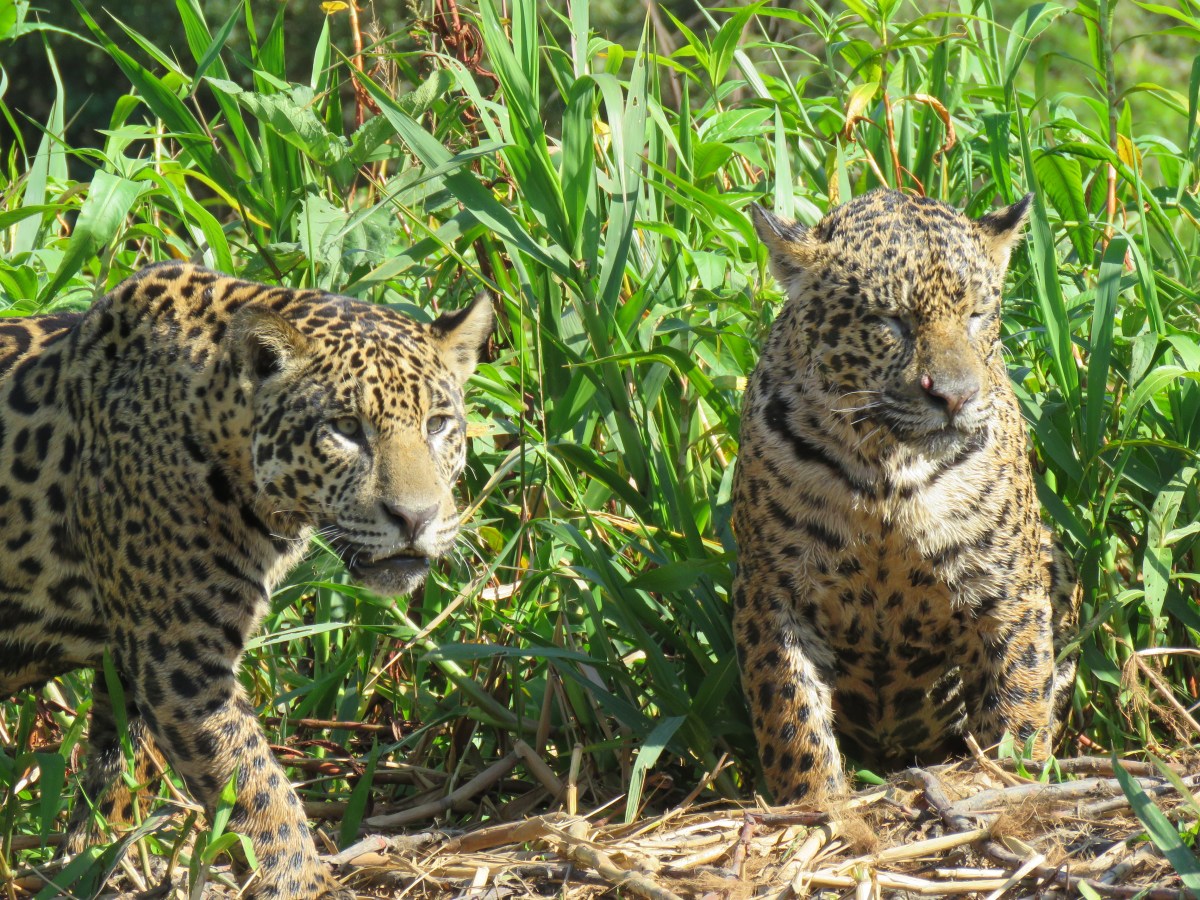
The two young jaguars were heading downstream, making half hearted attempts at hunting caiman. They still have a lot to learn. They had yet to prefect their deathly pounce.

IMG_5329

The two young males hunting along the riverside.

IMG_5321

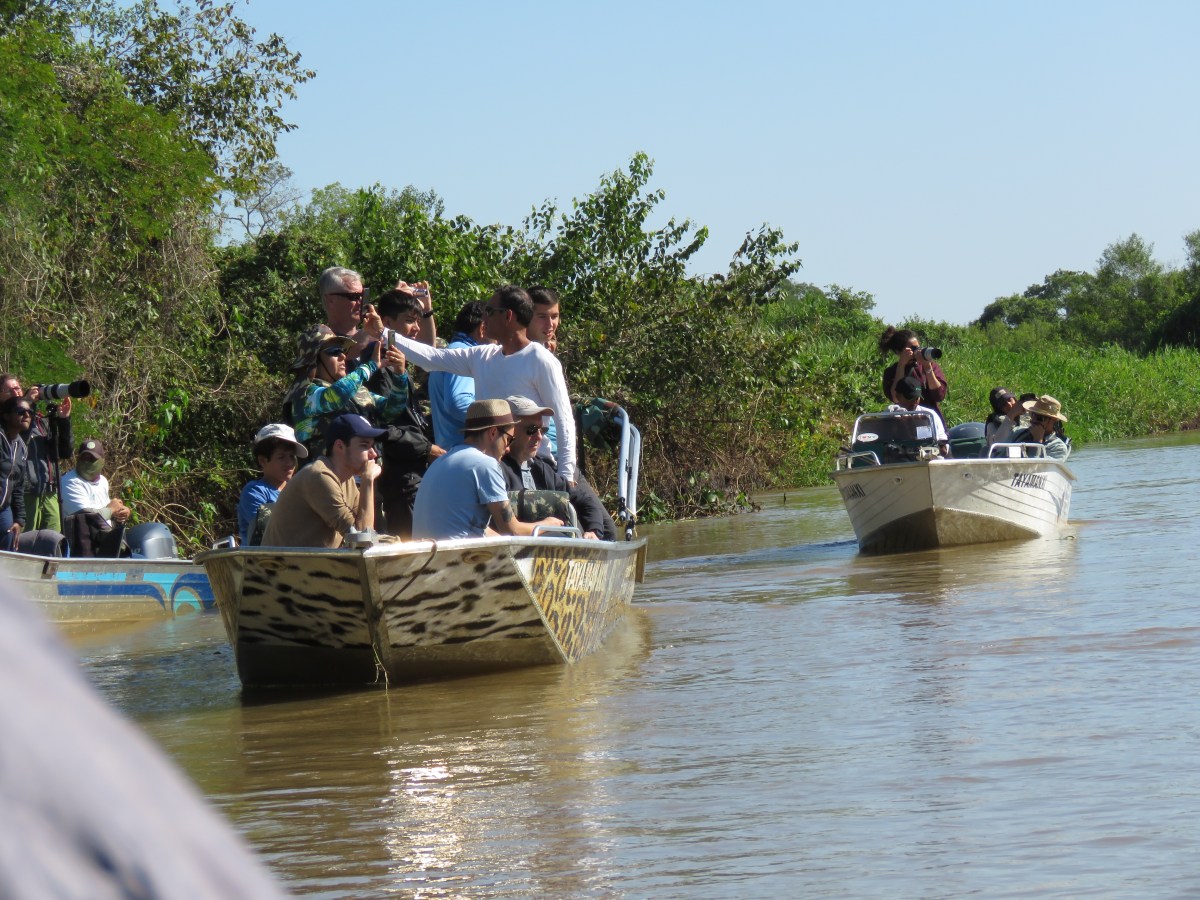
On the other side of the camera. The flotilla of ecotourists that followed the jaguars every move. There’s even a guy taking a selfie. I have very mixed feelings about the intrusion of people into the jaguar’s lives and I wondered how our presence could possible affect the jaguar’s behavior both positively and negatively.

We followed the jaguars along the river. One turned back and swan across the water to the near riverbank, demonstrating what I have already read: that jaguars are excellent swimmers.

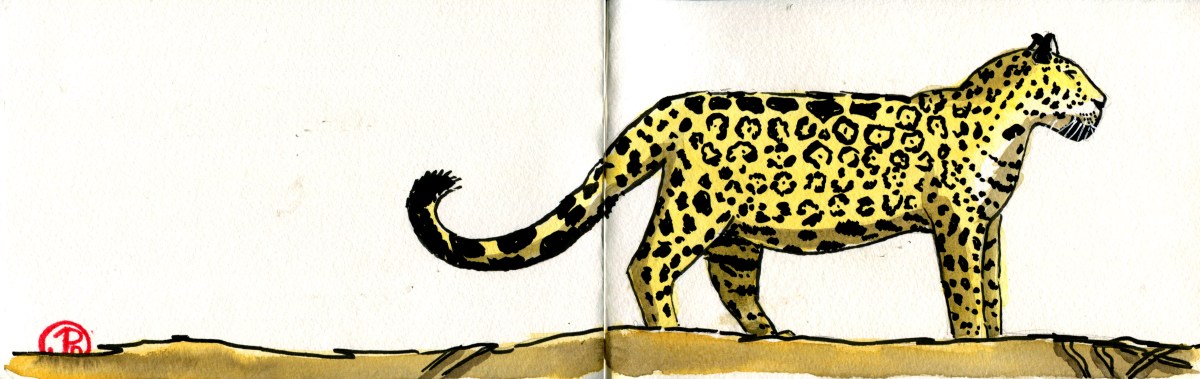
DonacobiusBlack-capped donacobius seemed to be our constant companions in the rivers of the Pantanal. A pair readily defended it’s patch of reeds with an auditory duet of sound.
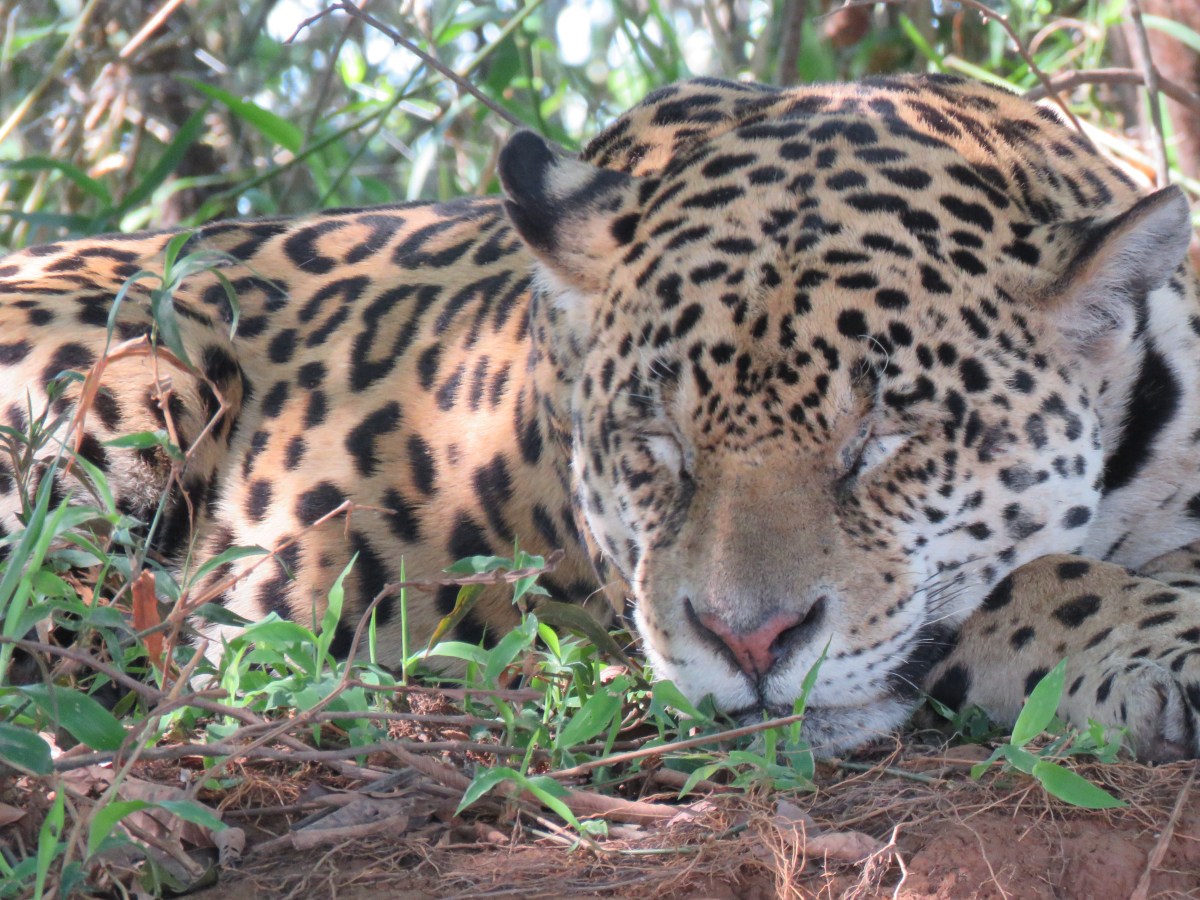
After watching the two young cubs hunting along the river side we headed off in search of more jaguars. At this point in the morning we’d seen a total of eight jaguars.

On one of the smaller tributaries we came upon a single boat on our port side. This was nothing like the flotilla we had just jettisoned. A boat stopped by the riverside meant only one thing: jaguar.

Sure enough there was a female jag on the bank 30 yards away from our boat. To our left was a large male pacing back and forth.

Over the course of the next 30 minutes we watched these two jaguars, from our boat making baby jaguars. We stayed with the amorous cats for about 30 minutes and finally decided to leave them to their privacy.

By the time we got back for lunch and after two boat trips in the Pantanal, we had seen a total of ten jaguars. We had been very lucky. This was a once in a lifetime experience that would live long in my mind and in my sketch book.

IMG_5577