Image

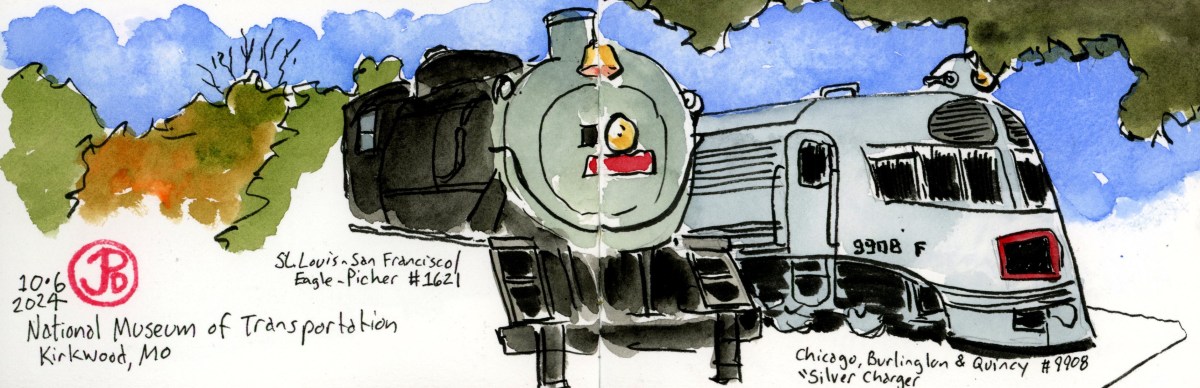
The National Museum of Transportation

There has been a museum on my sketch list for a long time and I used my fall break to finally visit it.

The National Museum of Transportation is in the St. Louis suburb of Kirkwood, Missouri. The 42 acre museum was founded in 1944 and has a large collection of railroad history (and cars and planes).

The museum has it’s own railroad spur to the Union Pacific mainline (formerly Missouri Pacific Railroad) so the larger locomotives in its collection can be shipped on rail.
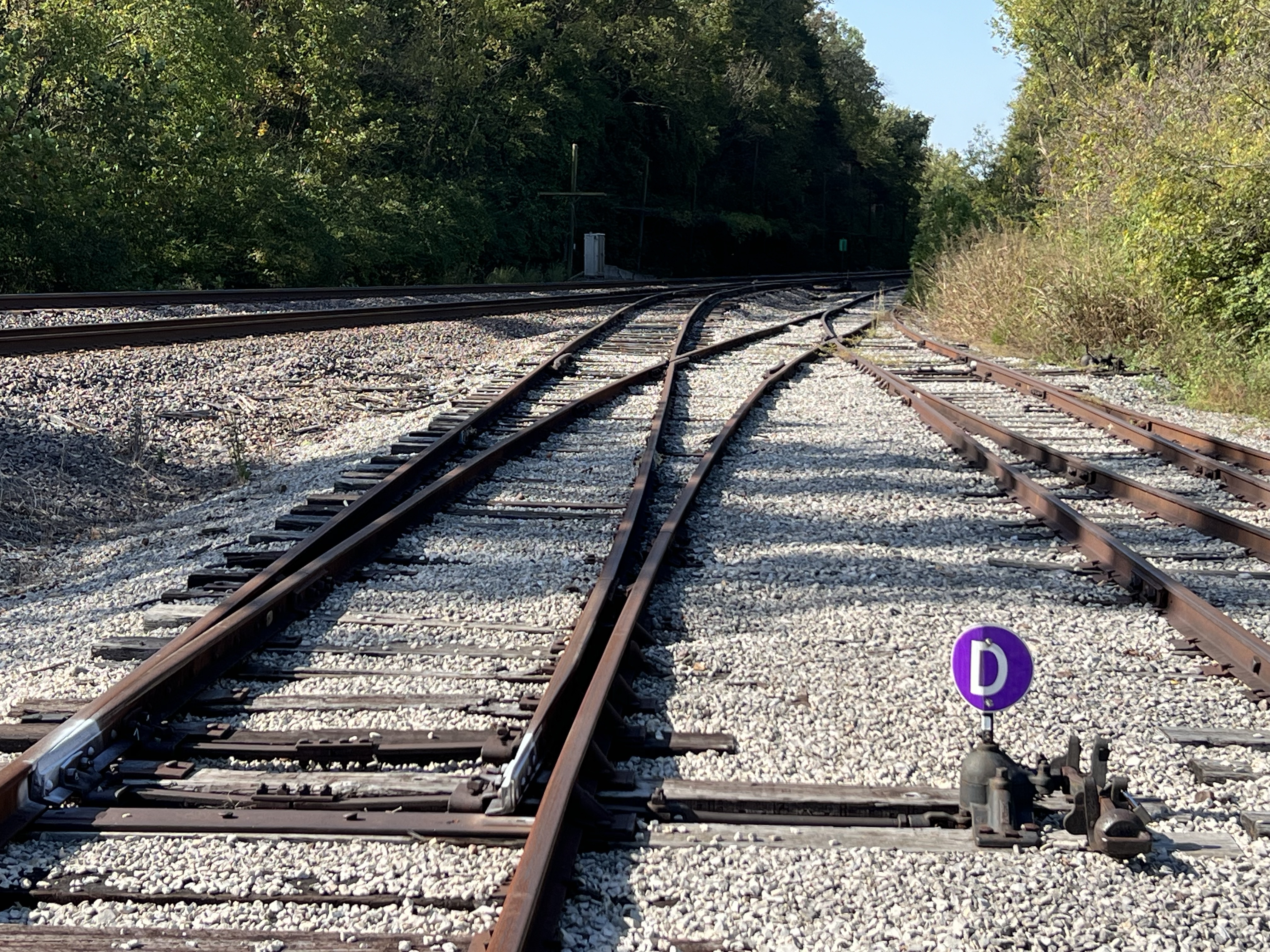
The railroad spur connecting the museum to the UP mainline.

I made up a sketch list before my visit and there were a lot of iconic locomotives to render in ink and watercolor.

I was going to be busy, very busy!

Visiting this museum is like having my favorite train book as a child, The Illustrated Encyclopedia of North American Locomotives by Brian Hollingsworth, come to life. As a child I thought: “I’d like to see that locomotive!” And now I was about to! In fact the museum has 13 iconic locomotives featured in this book. The reason I knew this museum even existed was the common refrain in the book, “now displayed at the Museum of Transportation at St. Louis, Missouri”.
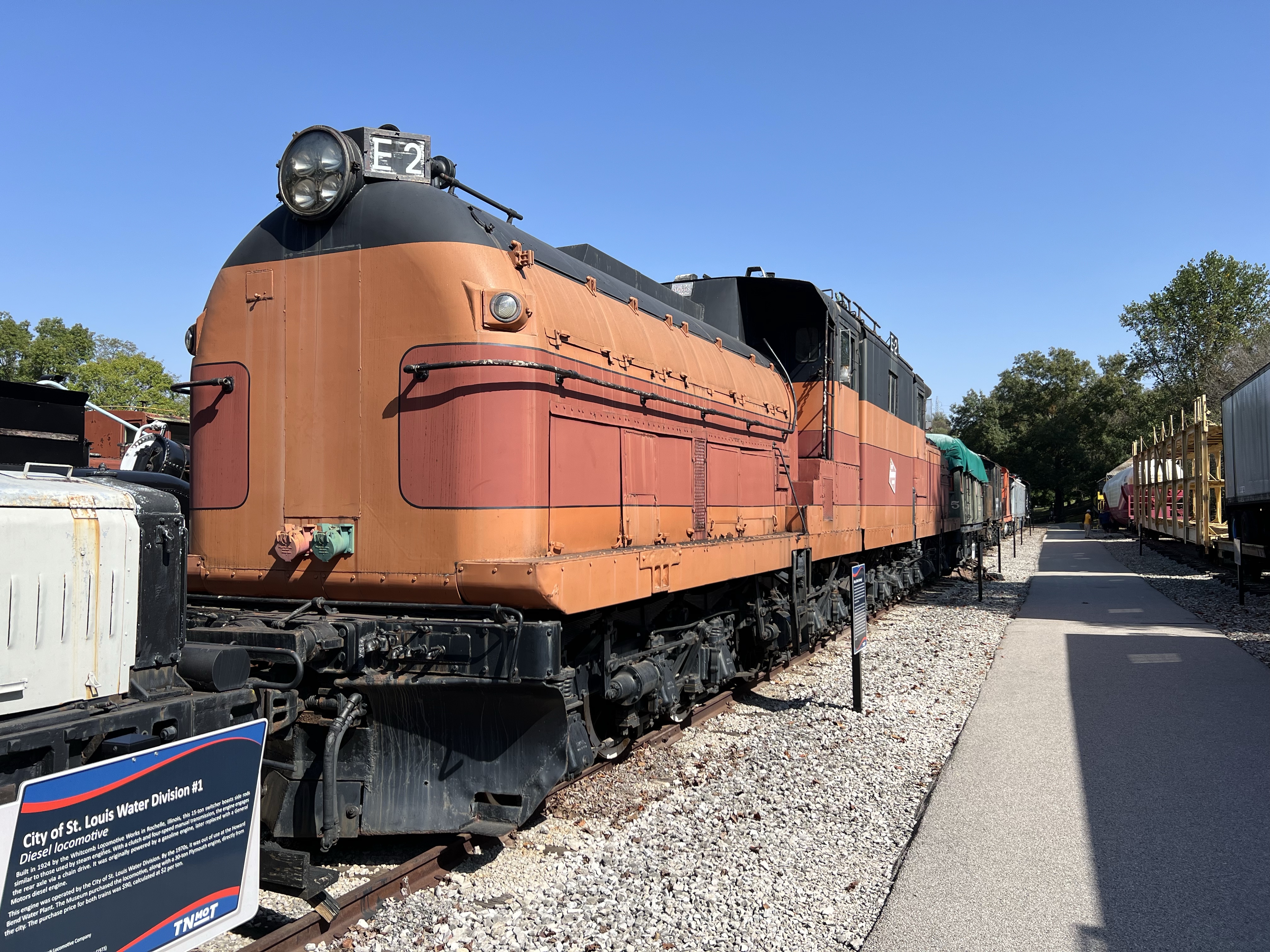
One of the electric locomotives featured in the book is the Chicago, Milwaukee, St. Paul & Pacific Railroad’s Class EP-2. This is the only preserved unit in its class in existence.

I planned to spend a good deal of time on my Sunday visit at the museum sketching. I would do all the line work in the field and then add watercolor back at my hotel.

The museum has an amazing collection of large steam and diesel locomotives to sketch. One of those sketches completed the Norfolk & Western triad of A- Class, J-Class, and now Y-Class.
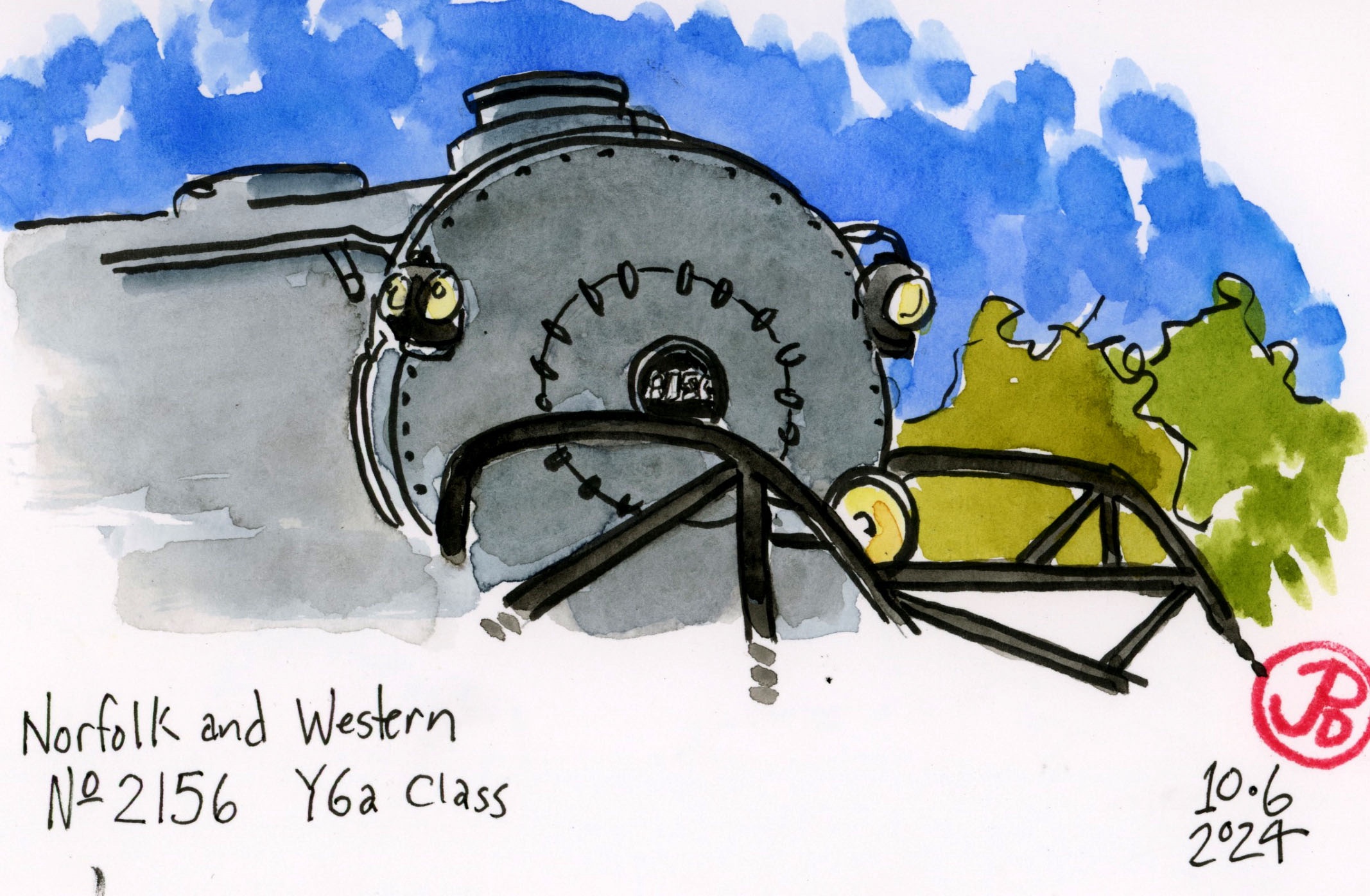
The N & W Y-Class was designed to haul long and heavy coal trains. While it is slightly smaller than Union Pacific’s Big Boys, the Y Class is more powerful than the UP articulated.

The NMOT is also one of the places to see a Union Pacific Big Boy. I have now seen and sketched four of the eight remaining Big Boys.

Freshly painted Big Boy No. 4006 with Centennial No. 6944 reflected in her black livery. This museum is one of the few places to see one of the largest diesels and largest steam locomotives displayed side-by-side.

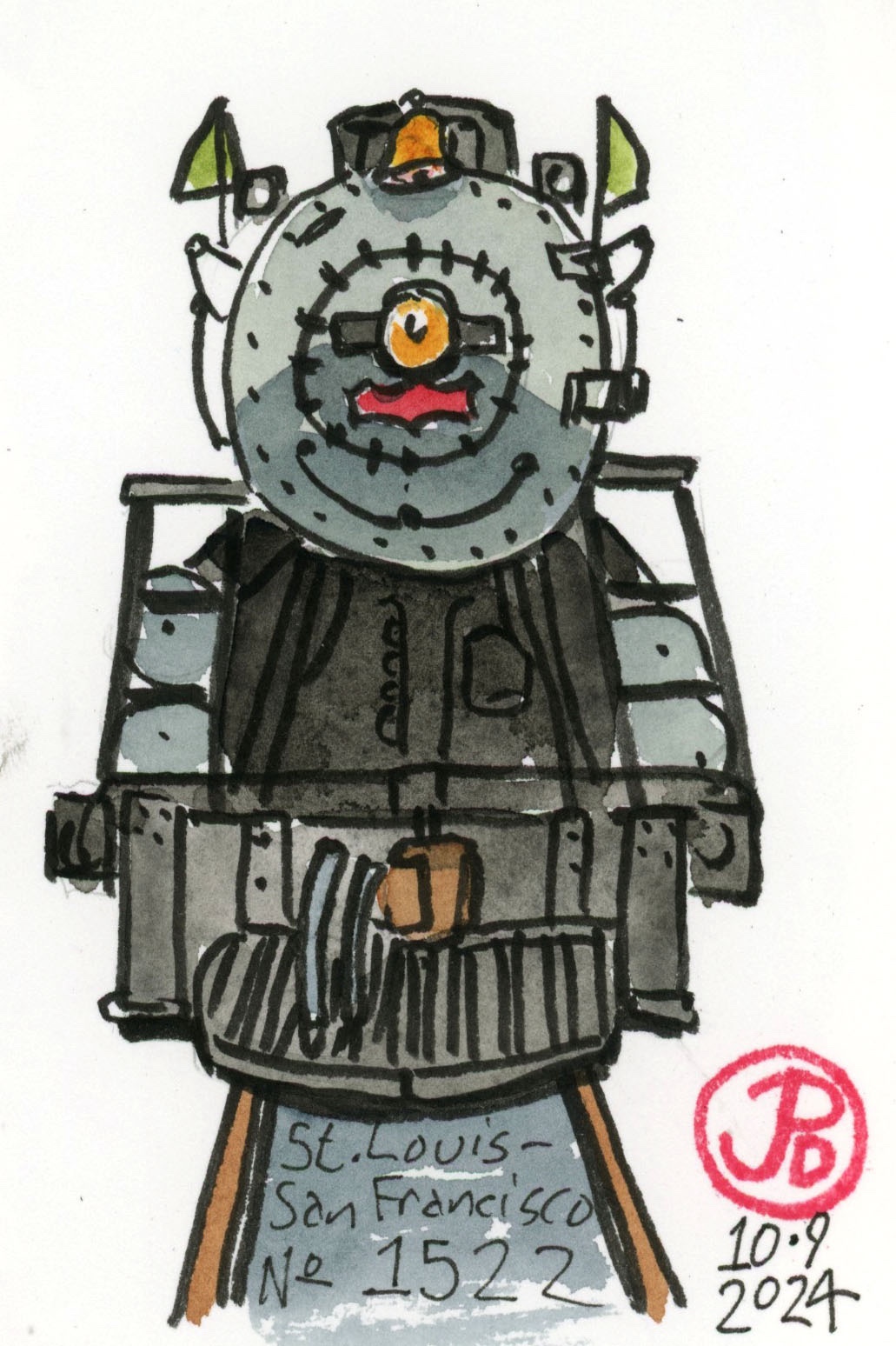
While the Big Boy is a big draw to the museum, there is one locomotive that is the most loved and best known. This is the St. Louis-San Francisco Railway (“Frisco”) No. 1522. This 4-8-2 Mountain type was built in 1926 by Baldwin. The locomotive logged over 1.7 million miles in passenger and freight service. She was restored to working order and was in excursion service from 1988 to 2002 around the Midwest, where many saw and rode behind her.
Image

4014 on the Mountain Sub

One of the legendary railroad routes is the section of the Transcontinental Railroad that climbs the western flank of the Sierra Nevada Mountains up to Donner Pass. The construction of the railroad was an engineering marvel and much of the original route is still in use.

Southern Pacific used their AC articulated cab-forwards to tackle the grades and heavy freight over the pass and now the world’s largest articulated locomotive would be climbing up to Donner Pass for the very first time. And I planned to be there.

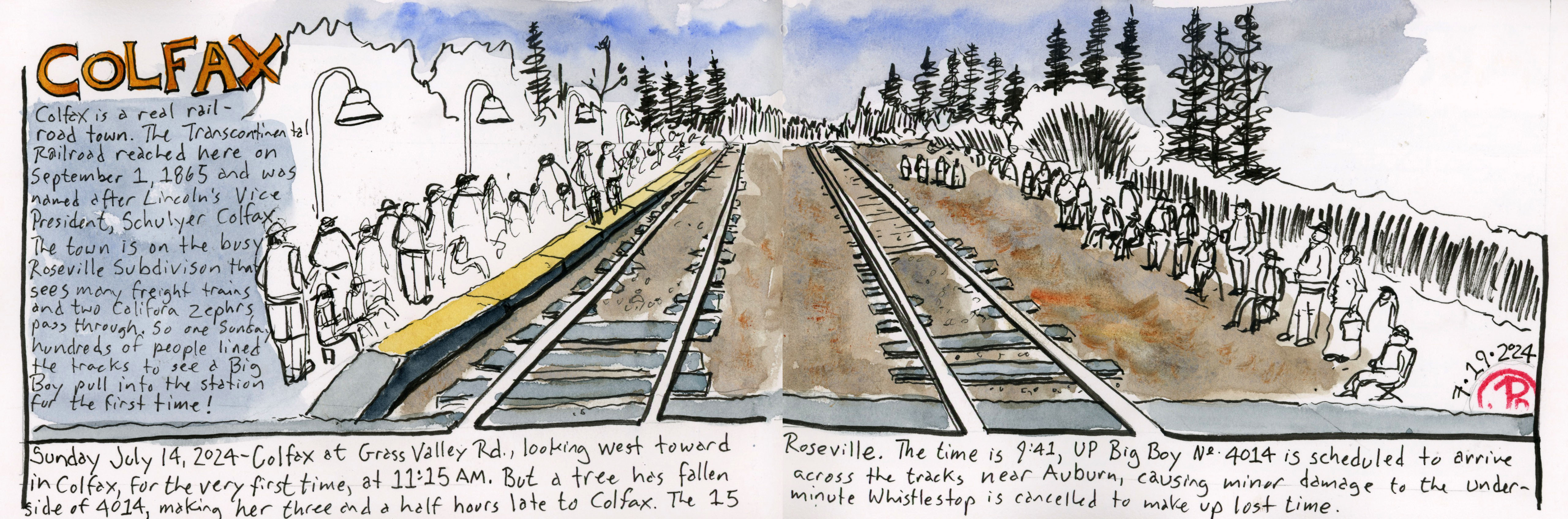
There was a planned 30 minute whistle stop at the historic railroad town of Colfax at 11:15.

I was in Colfax an hour and a half before arrival and more and more people were streaming into town.

4014 left Roseville on time but was halted when the train hit a tree that had fallen near Auburn. The UP tracking app noted that 4014 was “currently stopped near Auburn”. At first I thought it was just a maintenance stop but then word spread that Big Boy had hit a tree and there was some damage to the underside. This was not good. Especially for the hundreds of people waiting in the heat for 4014 at Colfax.

Word spread that the locomotive might have to be towed back to Roseville. The train was now an hour late. I decided to head back to Penn Valley, to air conditioning and the second half of the European Cup Final. I would continue to monitor the UP tracking site. But I had to beat the heat in Colfax.

Just after the game ended (Spain was European champions for the fourth time), the tracker read, “4014 currently moving near Auburn”.

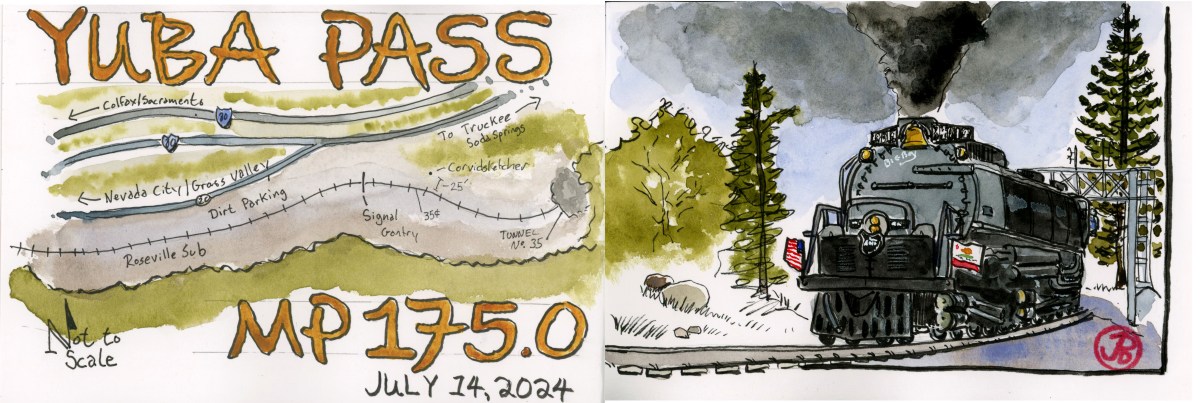
My plan was to drive on Highway 20 to where it merged with Highway 80. This was Yuba Pass and I wanted to see Big Boy in this historic location.

I arrived and there were plenty of other rail fans lining the tracks at Yuba Pass. This was a good sign because 4014 was still climbing the grade and had not reached my position.

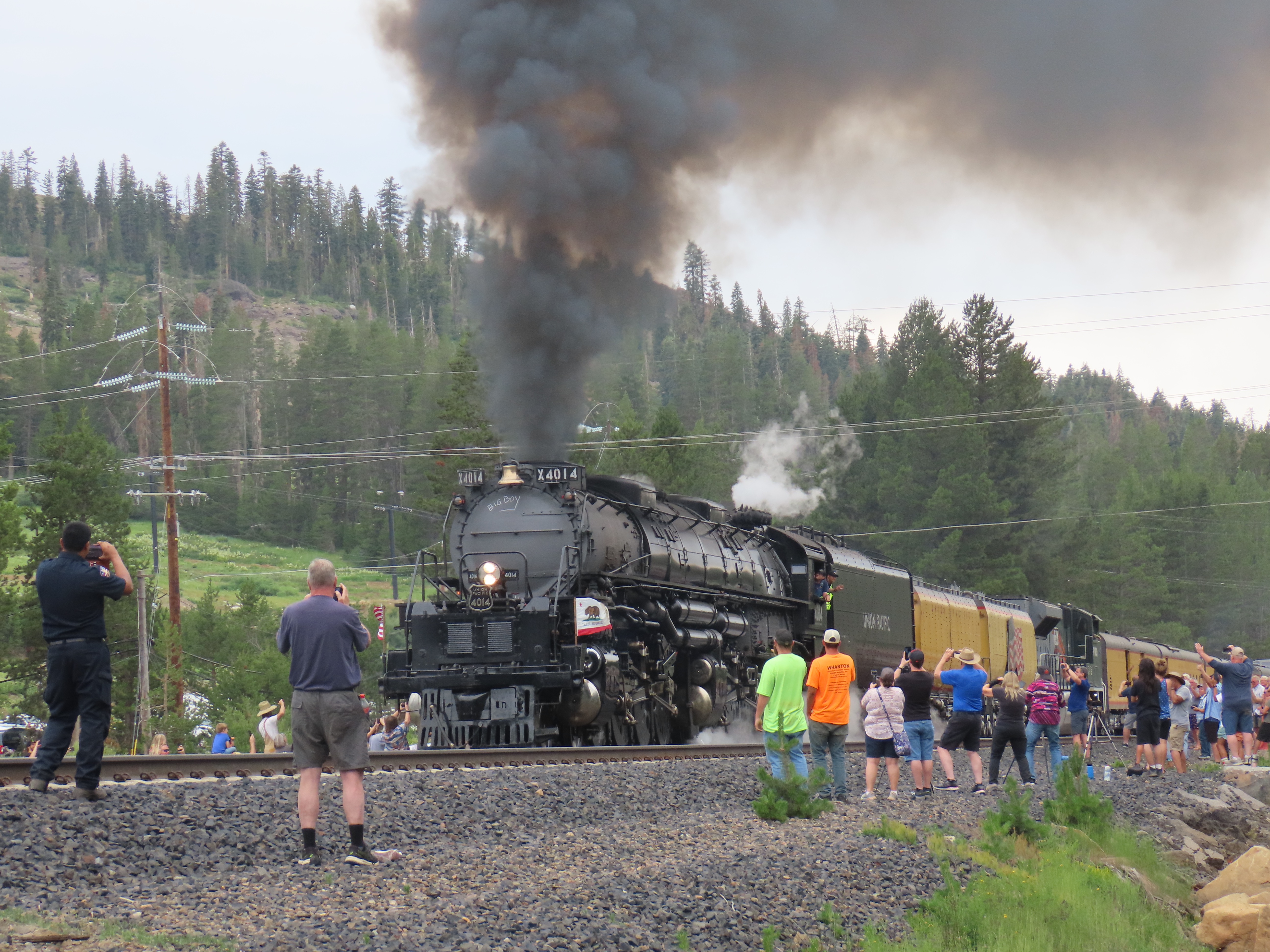
After about a 45 minute wait a plume of steam exhaust appeared down line and the mighty roar of the Big Boy filled the cut.

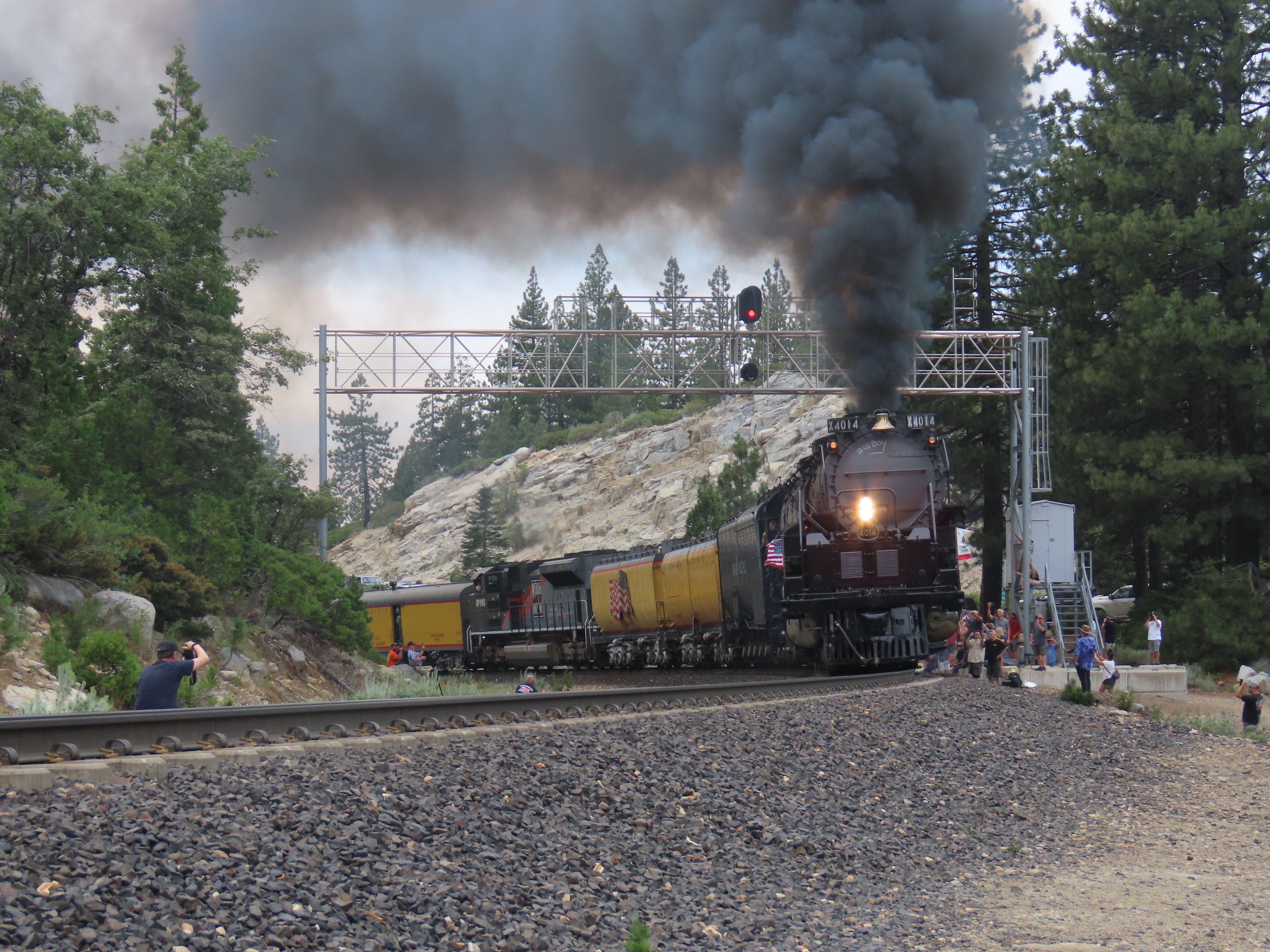
Then the iconic articulated giant appeared working up grade towards my position near the signal gantry. 4014 was putting on a show that enveloped all the senses.

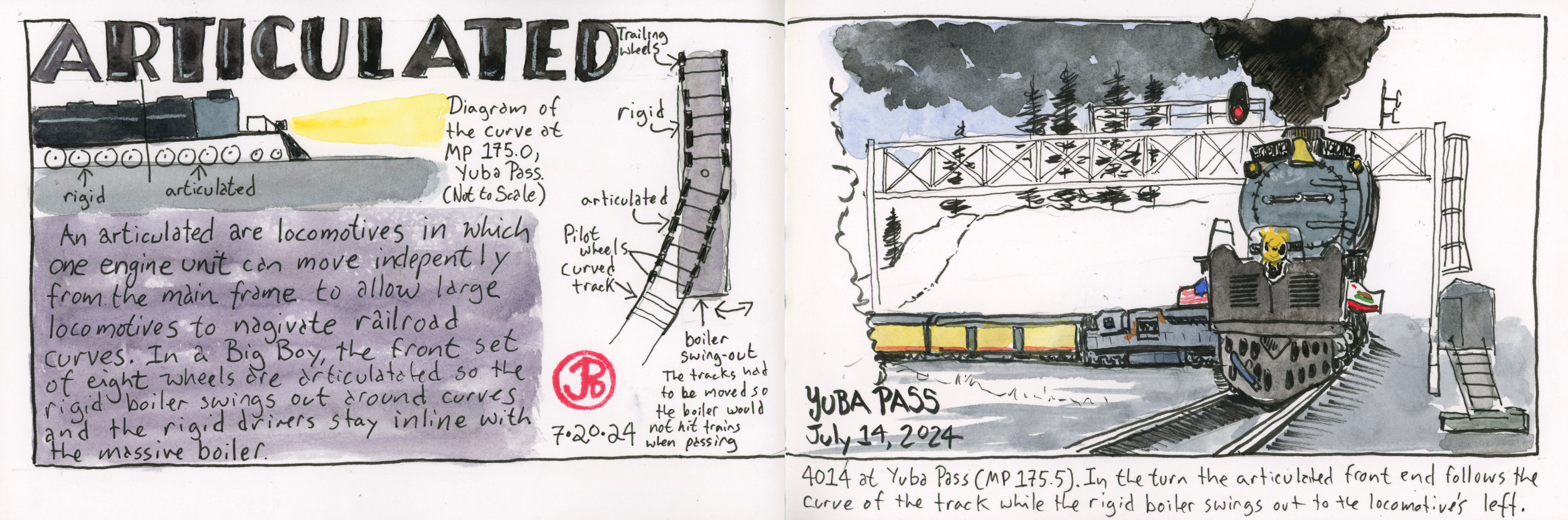
As 4014 rounded the curve, the articulated properties of the design were in full display. While the leading truck and front drivers rounded the curvature of the track the boiler remained rigid making it appear that the drivers and boiler were separating. Afterwards I did a spread to understand the articulation design (below).

After the train disappeared into the tunnel, I headed back to my car and was soon driving east on Highway 80. To my right, I could see the tell-tale exhaust up the hill on the railroad grade. Soon I was pacing with 4014 and I then pulled ahead and planned to head to Soda Springs to see the steam mammoth as she neared Donner Summit.

I made it to Soda Springs off Historic Highway 40 and the biggest challenge was finding a place to park as there were many people waiting trackside for the arrival of the Big Boy.

I found a parking spot and headed down to the grade crossing. There was a festive atmosphere around the tacks and to the south many Cal Fire trucks and personal (including Smokey) looked and listened down track for the first appearance of the 4-8-8-4.

4014 at Soda Springs.

Image

Overnighter in Roseville

4014 would be spending two nights in the important rail hub of Roseville.

Roseville is at the base of the climb up the Sierra Nevada Mountains to Donner Pass. It is here where the tools to conquer the Donner extreme winters are kept. Across the tracks, near the depot, the spreaders and flangers could be seen. A little further down the siding, the ultimate snow fighting machine could be seen: the rotary plows.

But on this July Friday and Saturday an army of foamers, rail fans, history buffs, and the curious would be invading the city of Roseville.

They were all here to see the largest steam locomotive in the world, Union Pacific’s Big Boy No. 4014. For the two display days the largest operable locomotive would be static and not moving. The Goliath would be brought up to steam and boiler pressure to conquer the Sierra Nevadas on Sunday.

I arrived early on Saturday to find a parking spot and to spend some quality time with the 4-8-8-4 before she, or he, was besieged.

Roseville is a busy point on the railroad with many freight trains starting the climb or descending the Sierra Nevadas. The passenger service is alive and well in Roseville with the California Zephyr and the Capital Corridor stopping at the passenger depot.

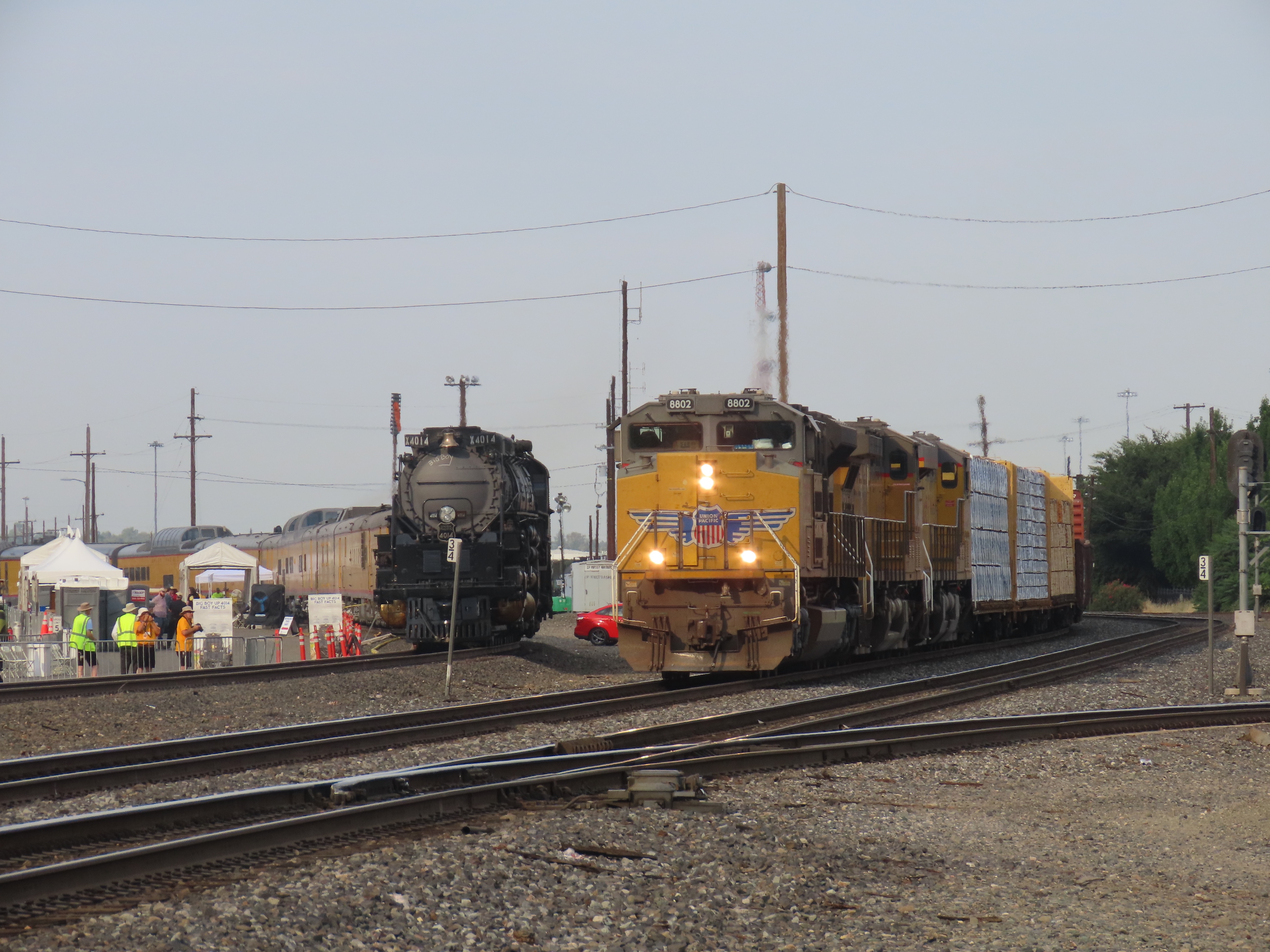
The present and the past of Union Pacific freight. A eastbound freight passes 4014 at Roseville.

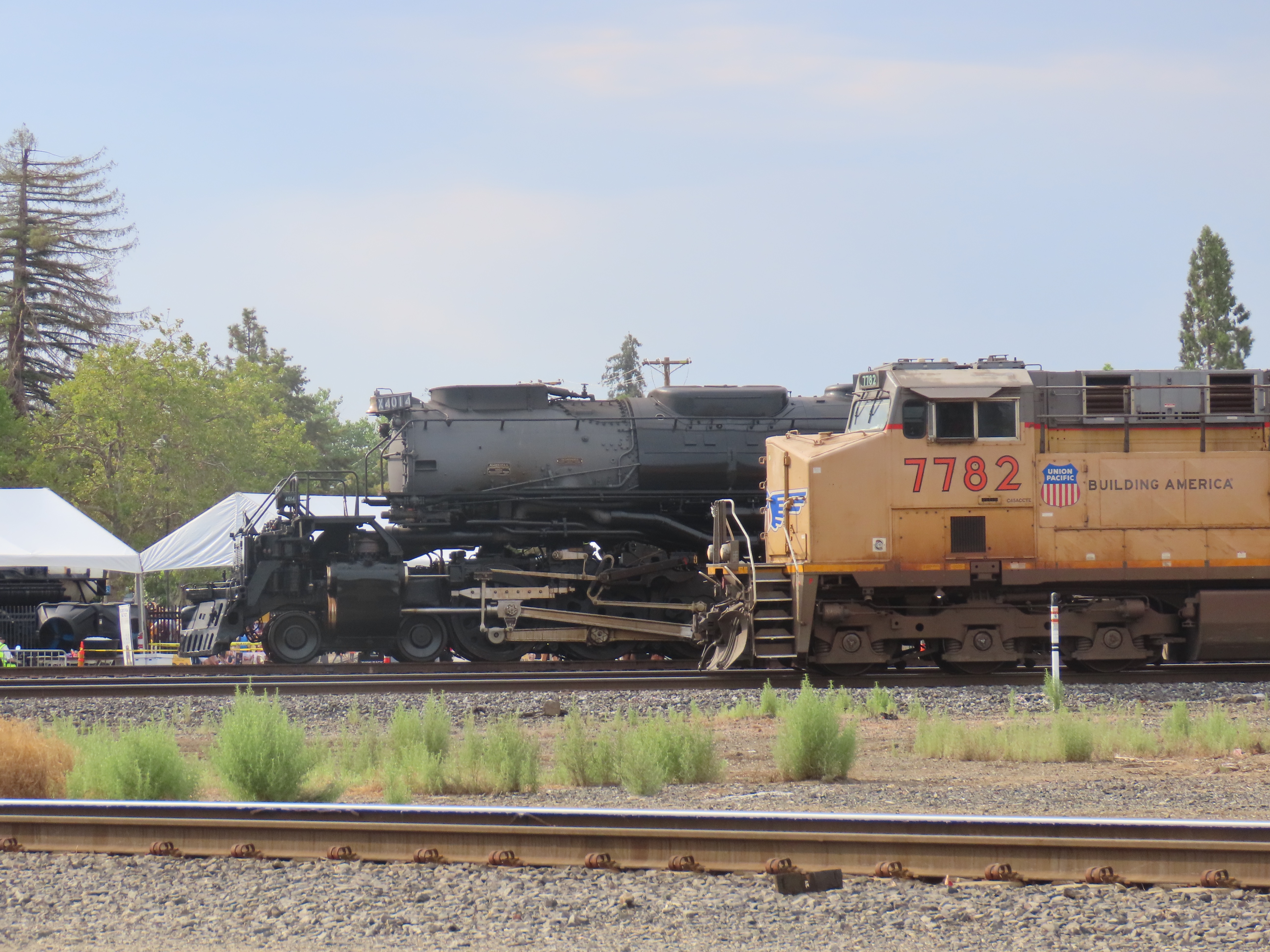
4014 now had a consist of Union Pacific passenger cars. I heard a ticket for the trip from Roseville to Reno, Nevada would set you back $700. The train was parked near the intersection of Atlantic and Vernon Streets near Southern Pacific’s 2252 and a rotary snowplow on display.

Roseville is a very busy point on the line and it was about to get much busier with the influx of people coming into town to see a Big Boy’s first visit.

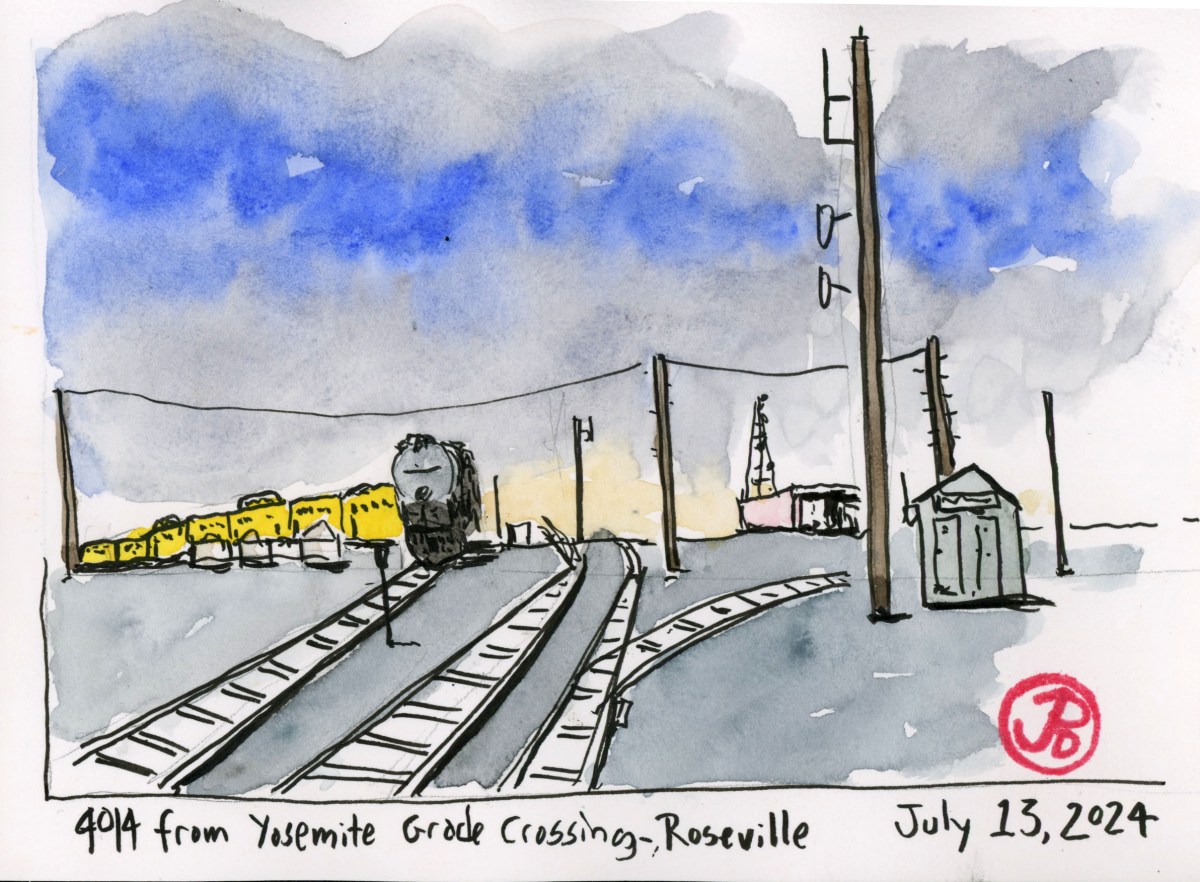
I walked to the grade crossing at Yosemite Street and looked west (towards Sacramento) and sketched 4014 and the Roseville yard (featured sketch).

The viewing of 4014 officially opened at 9:00 AM and there was already a group lined up to get a closer look at the Big Boy.

As the clock ticked closer to 9:00 AM, more and more people were showing up to see the first visit of a Big Boy to Roseville.

This important railroad town was the home of Southern Pacific’s articulated, the cab forward. These massive locomotives were designed to haul freight over the pass and the locomotive was reversed with the cab in front (hence the name) so the crew would not suffer from smoke asphyxiation while traveling through the many tunnels and snow sheds on the route. In the age of steam Roseville had two roundhouses, one was specifically designed for servicing the labor intensive cab forwards. At one point Roseville was home to 60 cab forwards.

Only one Southern Pacific cab forward still exists, the AC-12 No. 4294. She is on static display at the California State Railroad Museum in Sacramento. But unlike Union Pacific’s 4014, 4294 is not operable.

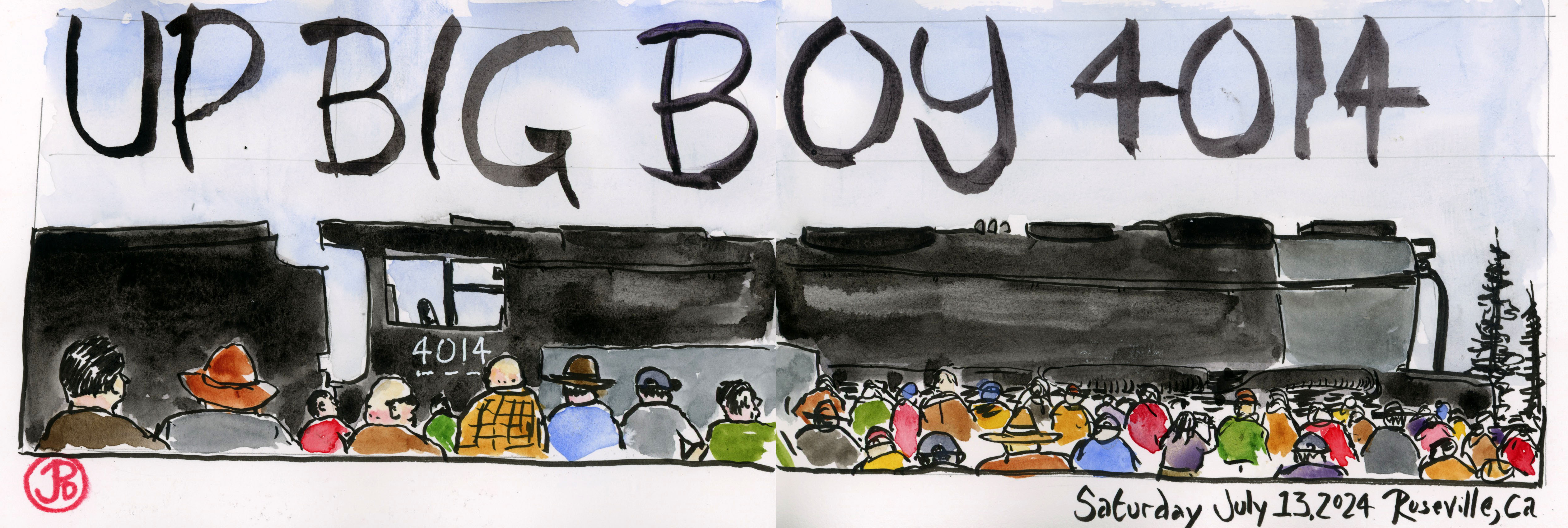
Soon it was hard to see the Big Boy through the forest of people surrounding it. So I did a sketch to capture the experience.

Image

Denver’s Big Boy

The roughly 100 hundred miles that separates Denver, Co, and Cheyenne, Wy is the currently epicenter of Union Pacific’s monster steam locomotive the Big Boys, not because they routinely ran between these two cities but because three of the eight existing Big Boys can be found along Highway 25 in the cities of Denver and Cheyenne.

Cheyenne was the operational headquarters for the 4-8-8-4, freight locomotives that were designed to tackle the Wasatch Mountains between Cheyenne and Ogden, Ut. These were the largest steam locomotives ever built.

Overall, 25 Big Boys were made, currently two are found in Cheyenne and one in Denver. No. 4004 can be seen on display in Holiday Park in Cheyenne. Local residents petitioned Union Pacific to donate a Big Boy to the city of Cheyenne when they saw the rapid disappearance of stream locomotives from the rails in the late 1950s and early 1960s.

Big Boy 4004 at Holiday Park in Cheyenne.

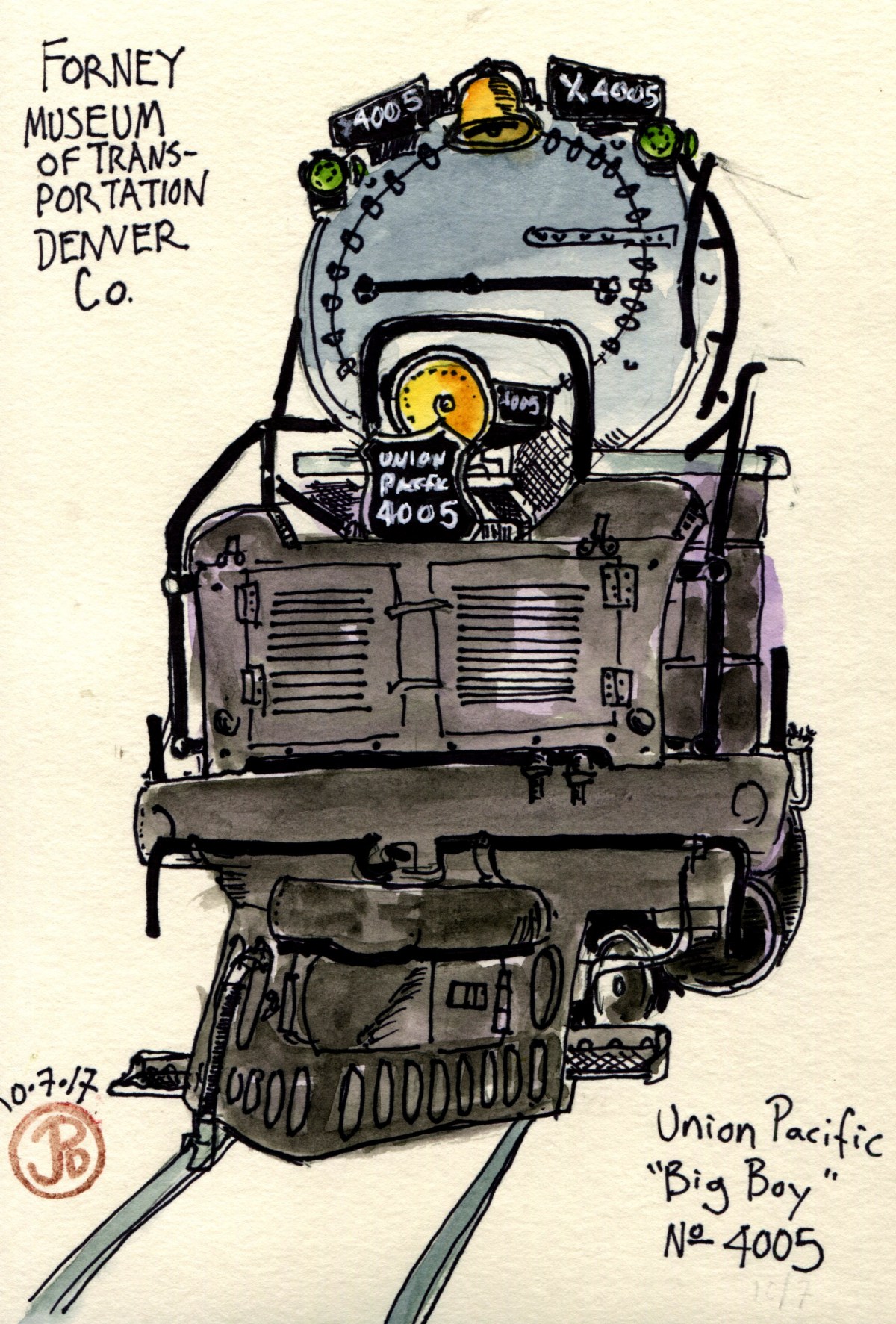
Big Boy No. 4005 had a much more colorful history than 4004. 4005 was only one of two Big Boys that were converted from coal to oil (more on that other converted Big Boy later). 4005 tallied up 1,043,624 road miles in a 20 year career. The giant is also the only Big Boy to ever be involved in a major accident. On April 27, 1953, 4005 hit an opened siding at 50 miles per hour causing the train to derail and the Big Boy fell on it’s left side (the damage is still visible today). The engineer, fireman, head-end brakemen were all killed in the wreck. The locomotive was later repaired in Cheyenne and returned to service.

The 4005 is now on display in Denver’s Forney Museum of Transportation in northern Denver. This is where I returned, this time with Steve, to do a few field sketches of the Big Boy (the featured sketch and the sketch below of 4005’s tender.)

The other Big Boy that was converted to burning oil is perhaps the most famous Big Boy: Union Pacific’s 4014. 4014 is the largest operational steam locomotive in the world. It was on display for many years in California and was shipped, by rail, to the steam shop in Cheyenne and fully restored to working order.

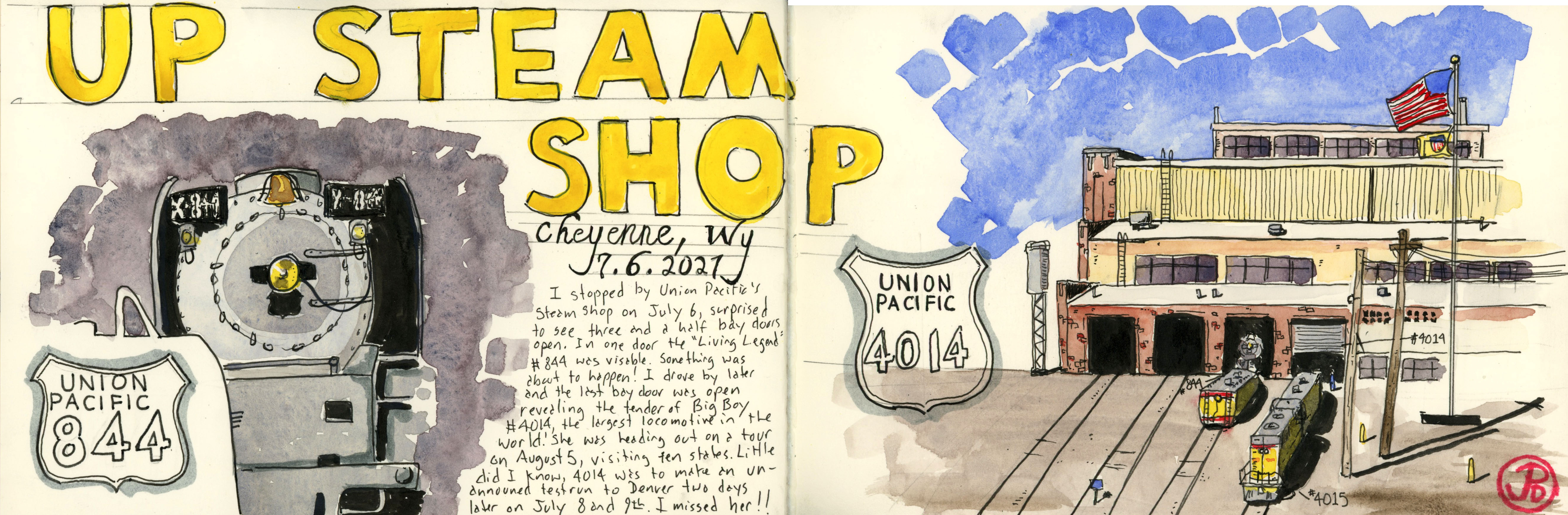
Union Pacific 4014 has proven to be the most illusive Big Boy for me. You would think the largest operational steam locomotive in the world would be easier to see! I have seen the Steam Shop in Cheyenne and the doors have always been closed, hiding 4014 and the Living Legend No. 844. A west coast steam tour was planned for this summer but was cancelled because UP’s rails are crowded with freight traffic to ease the supply chain issues. Yet another opportunity missed to see 4014 under steam.

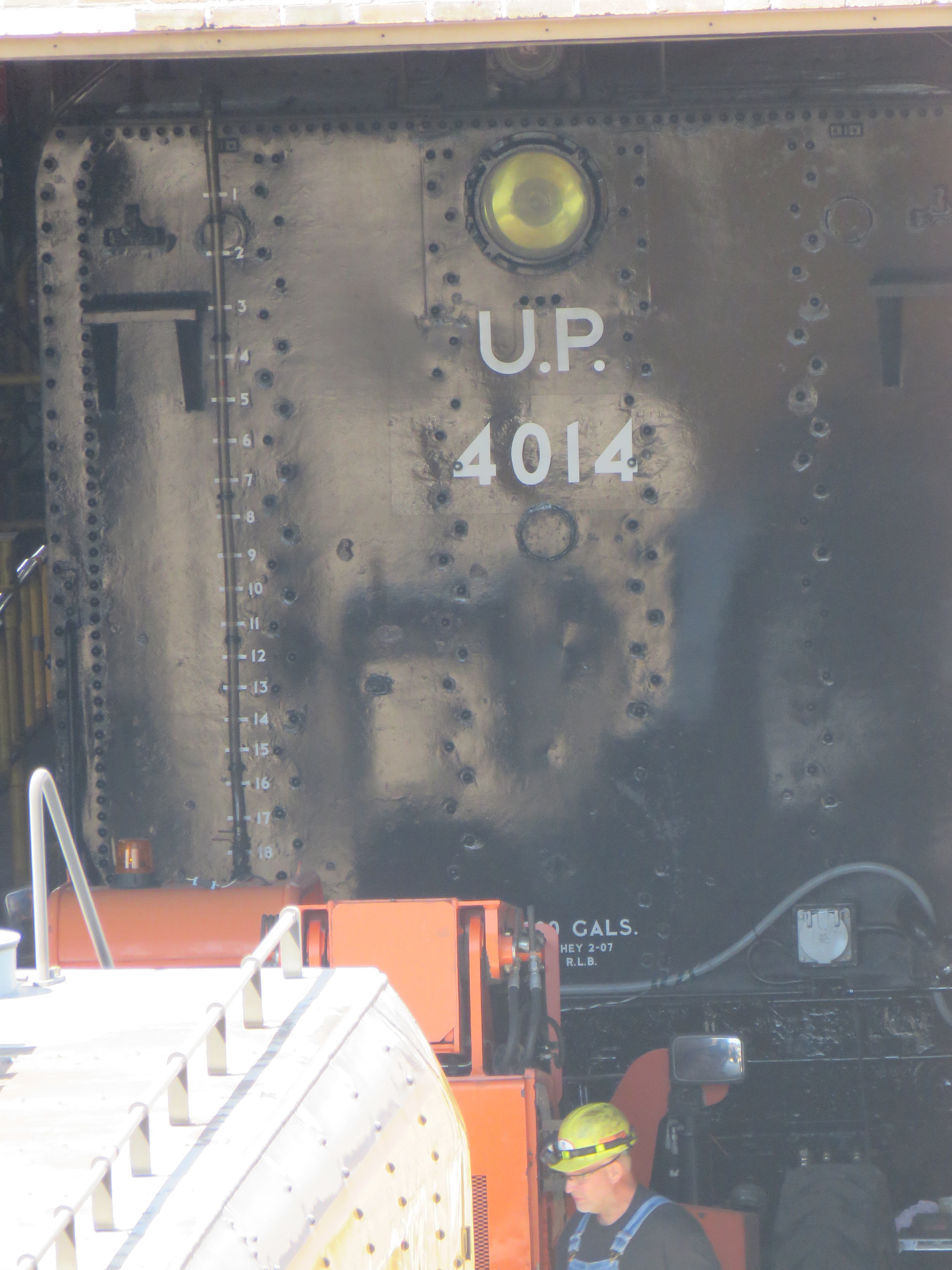
This is the closest I have come to seeing 4014: it’s tender. This was at the steam shop and little did I know that they were preparing to go out on the rails for an unannounced test run as a warm up for it’s 2021 summer steam tour. So close yet so far away!
Image

Southern Pacific’s Cab Forward

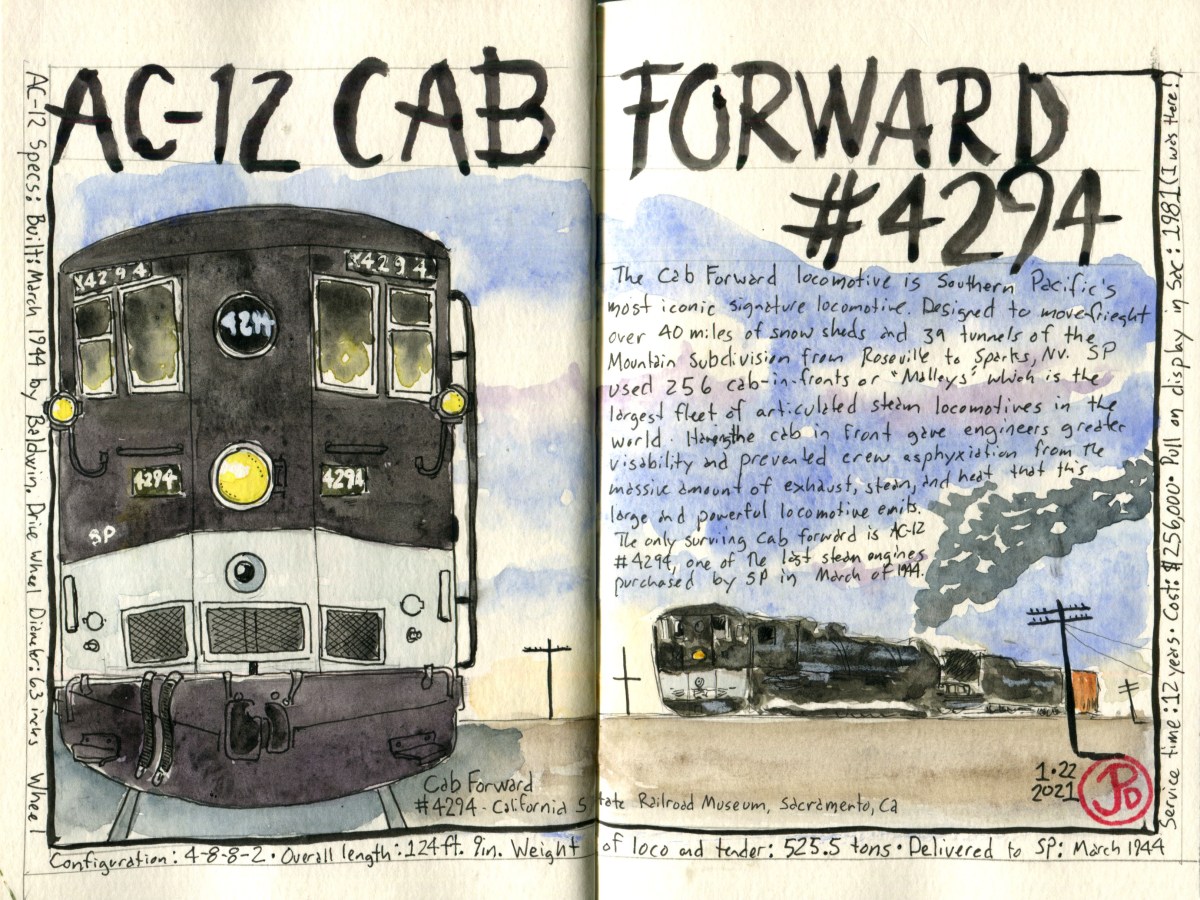
Southern Pacific’s signature, and most iconic locomotive was the 256 AC (Numbers 4000 to 4294) cab forward locomotives.

These were some of the largest and most unique locomotives in the United States. The AC-12 class is less than ten feet shorter than the largest steam locomotives ever built: Union Pacific’s “Big Boy”. The AC-12 locomotive and tender weighed more than a Boeing 747 and an Airbus A380, combined.

The reason the cab forwards were unique is that, as the name implies, the crew cab was in the front of the locomotive, like a modern diesel-electric locomotive, instead of the cab being in back, near the tender.

Having the cab in front gave the engineer and fireman unequalled views of the track ahead. But the real reason for the innovations was to conquers the steep grades of Sacramento’s Mountain Subdivision over the Donner Pass. This massive locomotives operated between Roseville, Ca and Sparks, Nv where a powerful locomotive was needed to tackle the steep grades and have the tractive effort to haul long freight trains over the Sierra Nevada Mountains. A locomotive of this size emits of lots of steam exhaust because a 4-8-8-2 was essentially two locomotives in one.

The Donner Pass route had 40 miles of snow sheds and 39 tunnels. This meant that in a standard locomotive, the crew could suffer from asphyxiation from the steam exhaust. By putting the cab forward, the exhaust stack was behind the crew and they avoided the caustic smoke, steam, and heat that these powerful locomotives emitted.

The cab forward proved to be a very successful locomotive for SP, with 256 of these engines used on it’s rail over the period of 50 years. The railroad had the largest fleet of articulated “Malleys” in the world. As a comparison, Union Pacific fleet contained 25 Big Boy locomotives.

In the 1950s, as diesel replaced steam, cab forwards spend the rest of there working life away from the mountains on the Coast Line and the Western Division. One of the last places cab forwards worked on Southern Pacific rail was the Cal-P line between Oakland and Roseville. 1958 was the last year a cab forward rode the rails, nine of these locomotives were taken out of service on September 24, 1958.

Out of the 256 cab forwards that were built, only one survives. The AC-12 number 4294 which is also the last steam locomotive that Southern Pacific ever purchased. 4294 was in service on March 19, 1944 and was taken off the the roster on March 5, 1956. She was only in service for 12 years.

While the other cab forwards were scrapped, 4294 was put in storage and then was put on static display on October 19, 1958, in front of the Sacramento train station. When the California State Rail Road Museum was opened, 4294 became the centerpiece amongst it’s collection of locomotives and rolling stock.

I was at the museum with my father in 1981 for the official opening of the museum. SouthernPacific’s GS-4 4449 and Union Pacific’s 844 (then numbered 8444) where in attendance and I will never forget when the two locomotive stood, pilot to pilot, on the track outside of the museum!

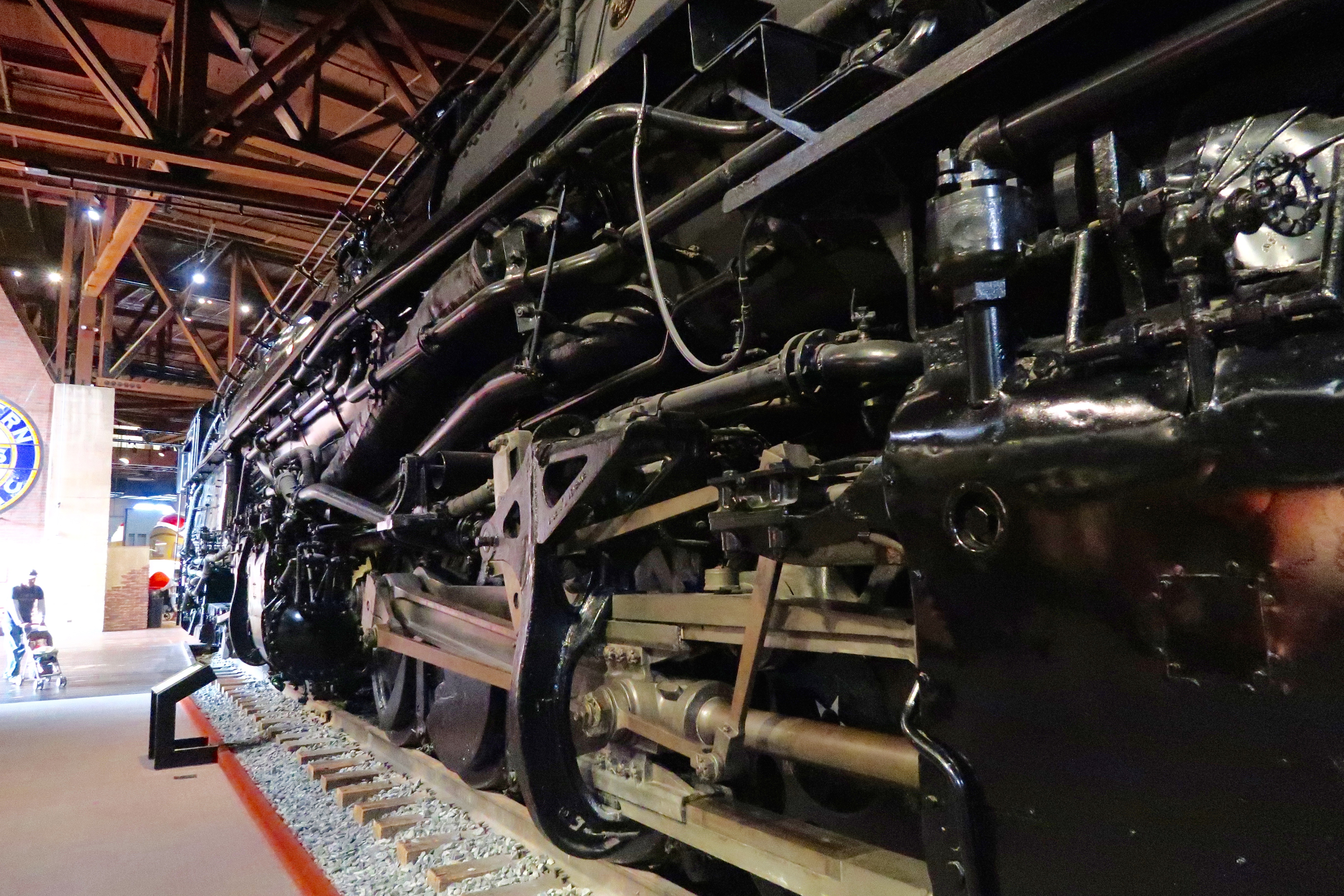
The massive running gear of the AC-12, Cab Forward. 4294 is the only surviving example of this locomotive.

The last time I have visited the museum was in November of 2017 where I did an aborted field sketch of the cab forward. There was something about the proportions of the locomotive that I did not get right. I had planned to return to the California State Rail Museum in the early Spring of 2020 but the cases of Covid-19 were growing at an alarming rate in the state and the museum eventually closed it’s doors for an indeterminate time.

So if I could not sketch the AC-12, at least I could sketch it from an image, which really is the next best thing.

Image

Union Pacific’s Big Boys

Union Pacific Railroad created the largest steam engines in the world to tackle the Sherman Grade from Cheyenne to Ogden, Utah. The articulated 4-8-8-4, if stood on end, would be as tall as a 12 story building and the engine and tender weighed 1,250,000 lbs. 

Of the 25 “Big Boys” built between 1941 to 1944, only eight of them remain, the rest were scrapped. Seven of them are on static display, and one of them, No. 4014, is being restored to working order in Cheyenne, Wyoming at Union Pacific’s Steam Shop. Of the seven on display, I would be seeing and sketching two of them: No. 4004 in Holliday Park in Cheyenne and No. 4005 at the Forney Museum of Transportation in Denver, Colorado.

The Forney Museum of Transportation is only 30 minutes from DEN, so I picked up my Grand Cherokee (I was in the true west after all) and headed to northeastern Denver.

The museum was full of vintage motorcycles, automobiles, aircraft, and bicycles but I made a B-line to the largest single piece in their collection: the impressively massive UP No. 4005.

Up close and personal with a true beast of the era of steam.

The Big Boy doesn’t get many points for style, it was function over form for this freight locomotive. It is not a beautiful engine like the streamlined passenger express engine, SP No. 4449, the steam engine I followed on excursions with my father. But what the Big Boys lacks in style, they made up with pure power and size. The Big Boy is essentially two engines in one, capable of hauling long freight trains over steep grades.

No. 4005 also bears the dubious distinction of being the only Big Boy involved in an accident. In 1953, the engine jumped a track switch at 50 mile per hour while it was hauling a 62 car consist. The engine pitched to her left side killing the engineer and fireman. The engine received massive damage but was repaired at Union Pacific’s Cheyenne facility.

The second Big Boy was No. 4004 in Cheyenne’s Holliday Park. Cheyenne actually has two of these massive engines. No. 4014 is currently being restored to working order in UP’s Steam Shop.

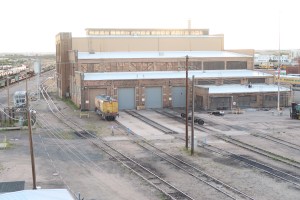
Union Pacific’s Steam Shop, where they are currently restoring Big Boy No. 4014 to working order. I tried to sign up for a tour but it was sold out a month in advance.

I remember my father telling me about the Big Boy on display in a park in Cheyenne and I have always wanted to see one. Once I checked in at the Historic Plains Hotel, across the square from the impressive train depot, I headed down the street to Holliday Park where Big Boy No. 4004 has been on static display since Union Pacific donated the engine to the city of Cheyenne in 1963.

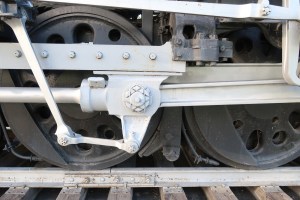
The driving train and and two and the 16 driving wheels of No. 4004 in Cheyenne.

This is one massive engine! Union Pacific always goes big and the Big Boy is the tops in steam power.

A sketch from one of my photographs for Big Boy No. 4004 in Holliday Park, Cheyenne, Wy.


Image

The Oregon Trail

This summer, while I was halfway through reading The Oregon Trail: A New American Journey by Rinker Buck, I was determined to travel the route of the Oregon Trail on my October break. But unlike the Buck brothers, I would not be traveling in a covered wagon pulled by three mules but using the horsepower of a rented car. 

Yes , I wanted to start in St. Louis, Missouri, the traditional “jumping off” point and drive the over 2,000 miles to Portland, Oregon. But how could I pass through Wyoming and not visit our nation’s first National Park? And how could I be so close to Cheyenne and not see one of only eight Union Pacific “Big Boys” in existence, the largest steam engine in the world? And then there was Carhenge and who wouldn’t want to visit Carhenge?

So many destinations keep pulling me off the Oregon Trail l that I decided to have my griddle cake and eat it too. Instead of doing the whole trail, I decided to do the most scenic section, from California Hill in western Nebraska to Independence Rock in central Wyoming. The sights along this section where eagerly awaited by the pioneers of the 19th century. Courthouse Rock. Chimney Rock, Scottsbluff, Fort Laramie. Independence Rock. And I planned to see and sketch them all!

Now before any great or important undertaking, I first make a sketch. In this case, a stylistic map (not even close to scale). These sketches help me visualize my trip. I am a planner but I believe that organized chaos is my creed. I want to be open to the seemingly random coincidences of life on the road. The people you meet and the unexpected gems you encounter while heading off the main trail.

The map is headed with a my favorite quote by N. Scott Momaday from the PBS series, The West:

It’s a landscape that had to be seen to be believed. And I would say, on occasion, it may have to be believed in order to be seen.