Early on a Monday morning I drove to Historic Highway 40, around Donner Summit, to do some sketching.
I love this highway corridor, it’s full of deep California history (native, pioneer, railroad, and highway) as well as personal family history. My parents met at the South Bay Ski Club whose cabin is on Highway 40 near Soda Springs. Without this ski club I would not have come into being.
Historic indeed, there is so much depth of history here.
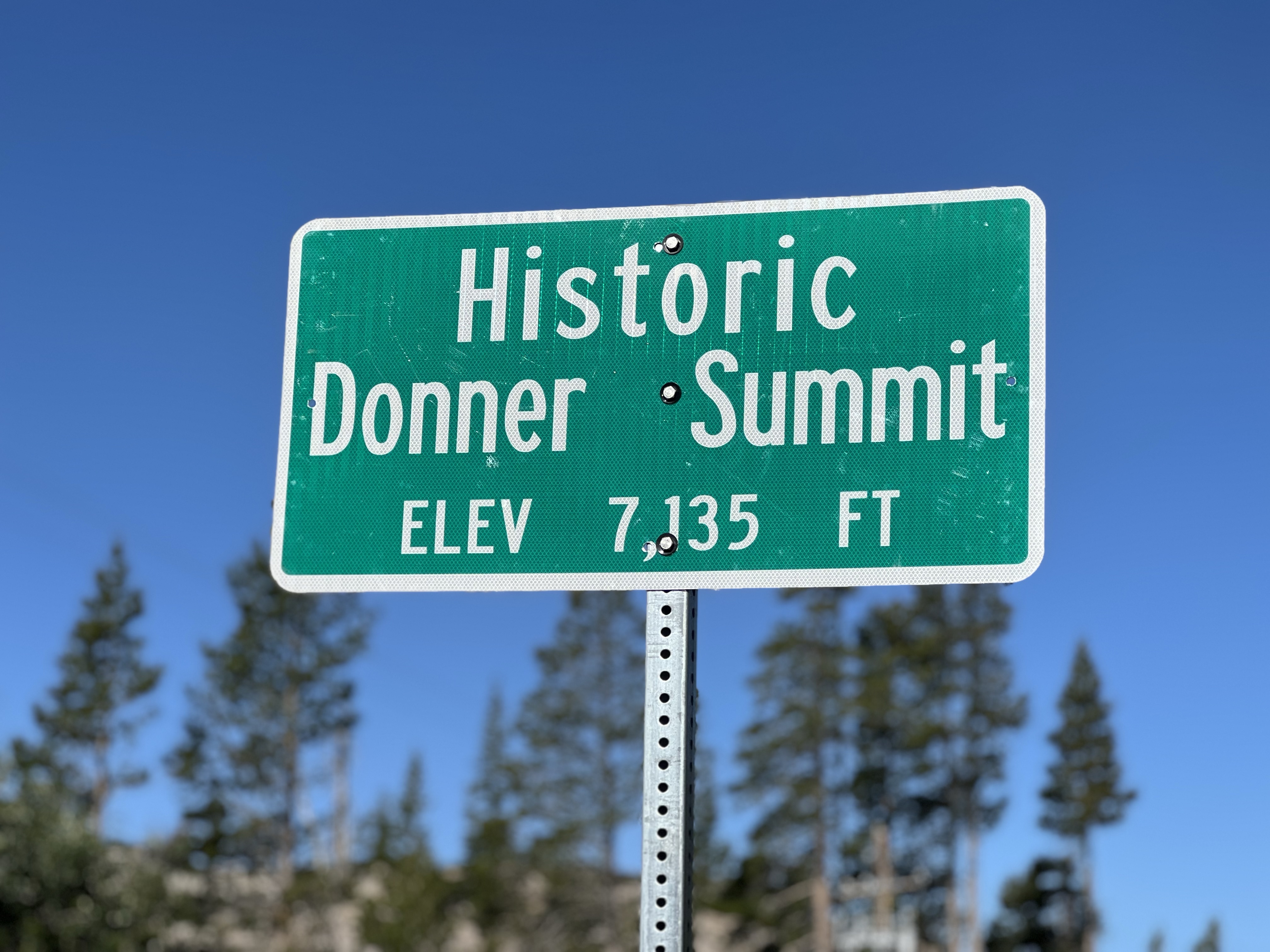
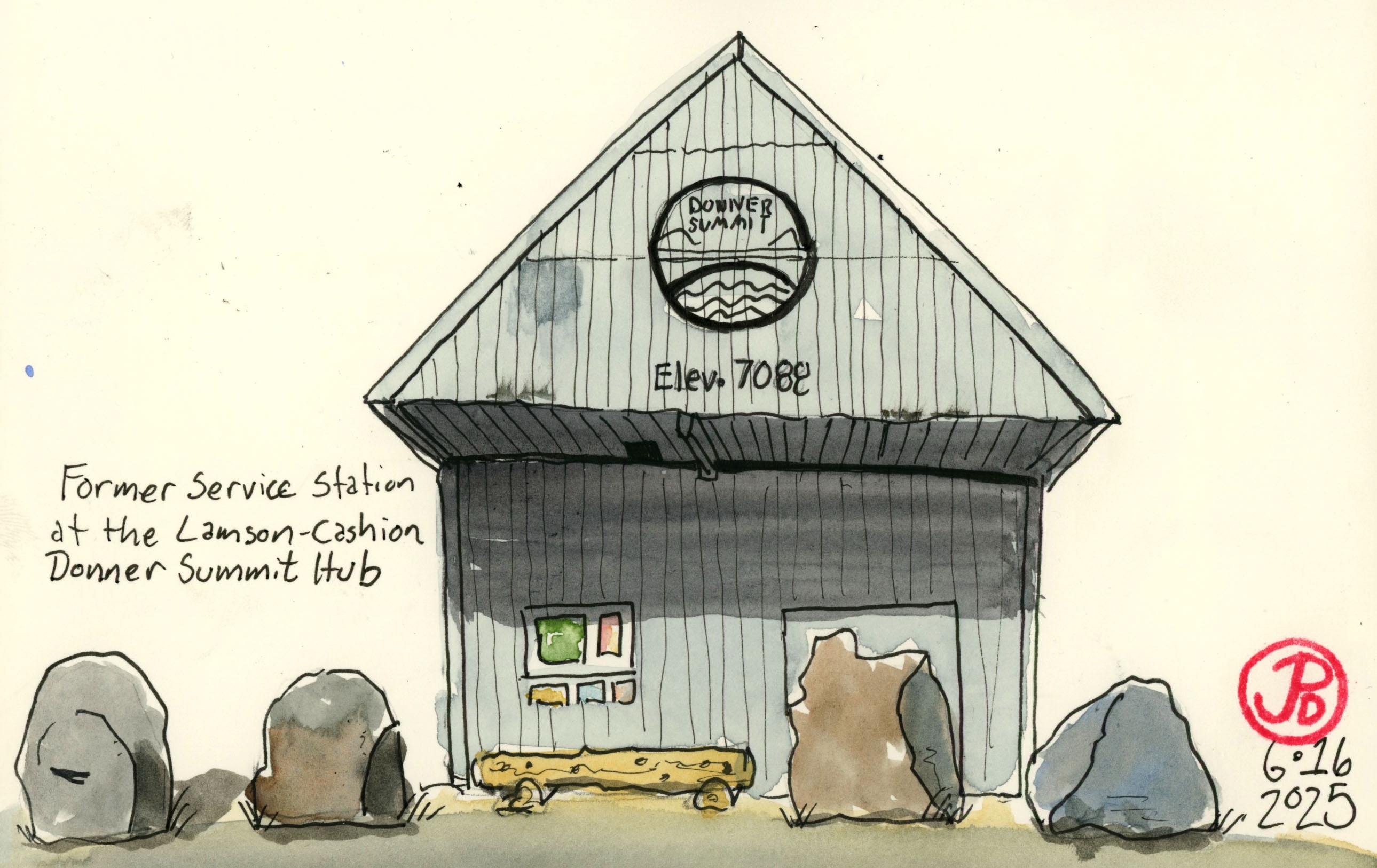
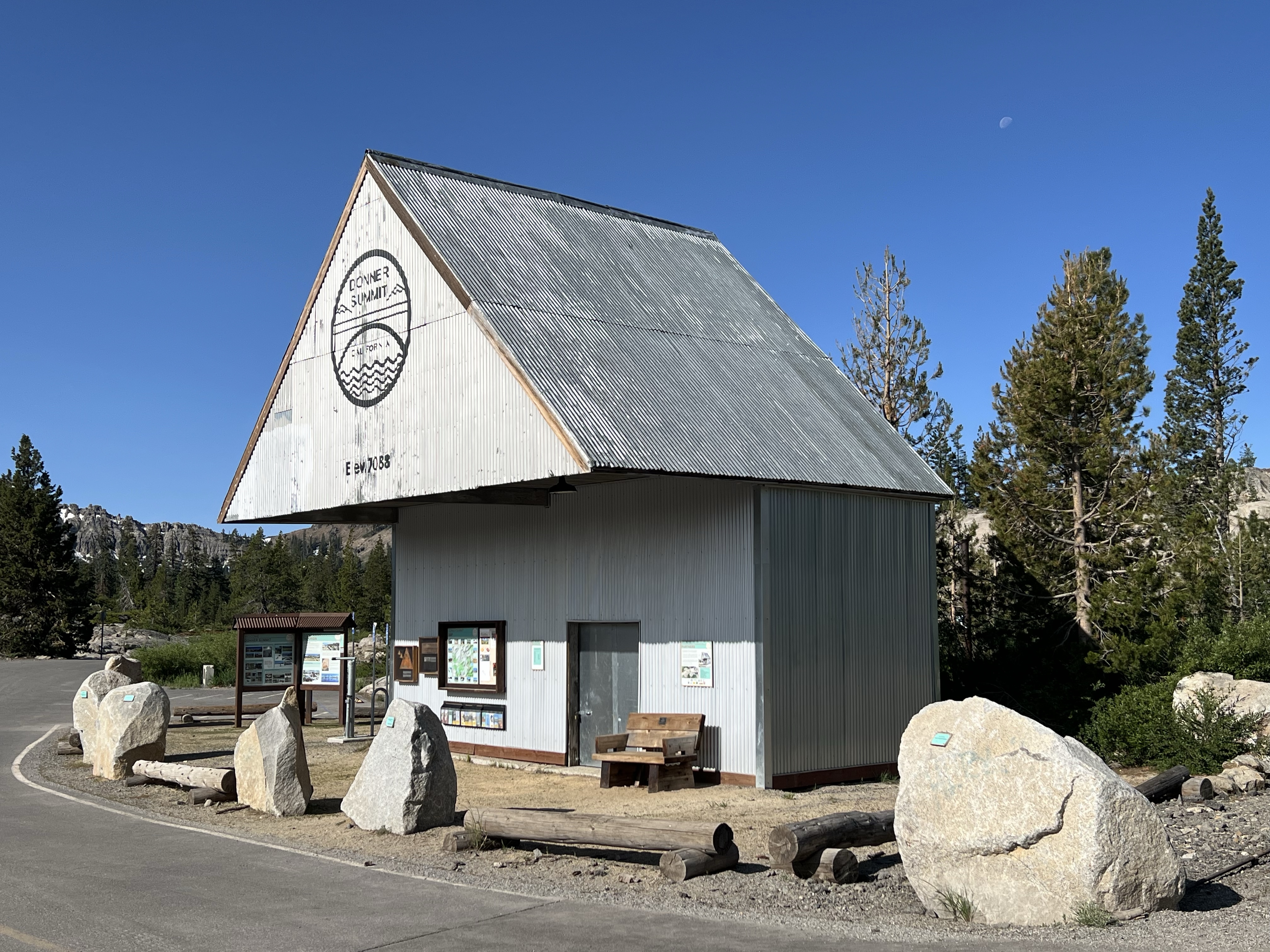
At the summit I sketched a former gas station. The station was used to fuel highway snow clearing equipment used to keep the highway open in the winter.
The Lamson Cashion Donner Summit Hub is where a lot of the threads of Donner Pass come together (hence the name). Just a short list of the points of interest in this general area are: the petroglyphs, Pacific Crest Trail, the Donner Summit Bridge (the Rainbow Bridge), west entrance of Summit Tunnel 6, central shaft of Tunnel 6, and the Donner Summit Trail.
The repurposed gas station is now an information center at the Lamson Cashion Donner Summit Hub.
I then headed down the pass and over the famed “Rainbow Bridge”. I was keeping my eyes (at least one eye) to my left, searching for the mass of rusted metal that has been here for about 75 years. There it was.
My father always pointed out this ominous artifact when we would summer here on the shores of Donner Lake. We were historic rubberneckers.
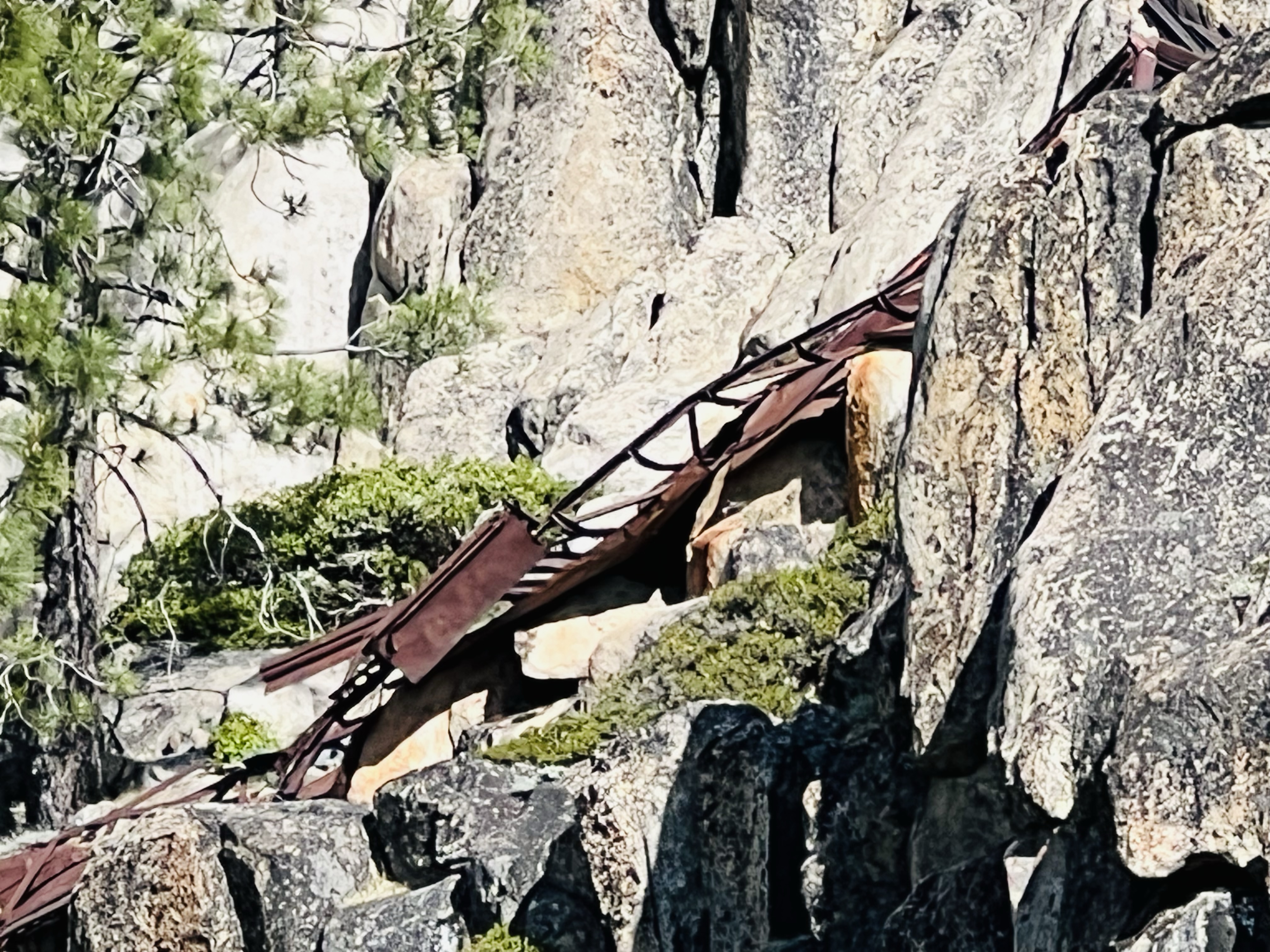
There it is, rusted and compacted by heavy snow loads for almost 75 years.
Highway 40, east of Donner Summit is treacherous, as the Donner Party found out when they attempted to scale the pass in 1846. It is also treacherous for auto traffic on the winding, wet, and icy roadbed while heading down grade.
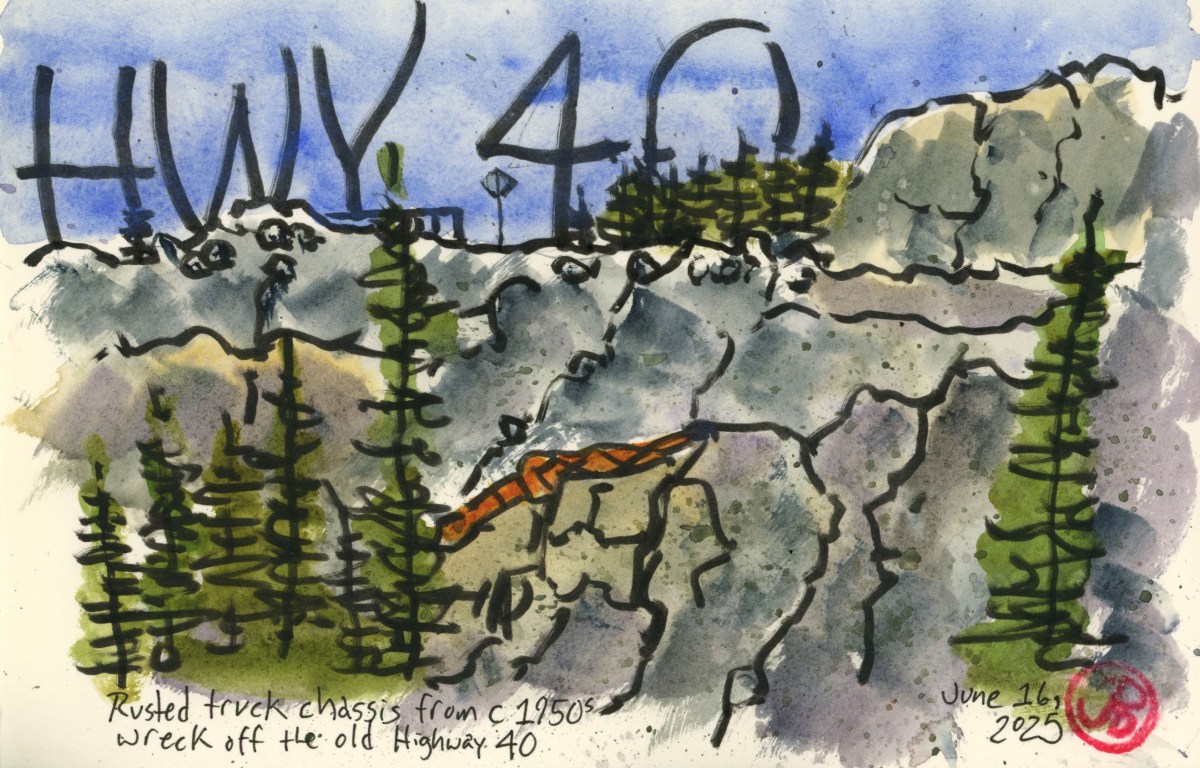
The wreck that my father pointed out is the truck chassis that went over the roadway and settled on a granite shelf sometime in the 1950s. There is not a lot of information about the truck, just that it’s not the “Turkey Truck”. That’s a story for a different post!
I pulled over and found a boulder seat to sketch from using a brush pen to keep it loose and sketchy to the soundtrack of the cooling winds through the pine branches and a male Wilson’s warbler emphatically singing from those branches. I was in Sierra heaven (featured sketch).
After sketching I headed down 40 towards Donner Lake and the Southern Pacific Railroad historic town of Truckee.
Aside from SP’s iconic cab forward locomotives, no other piece of railroad equipment is as renowned as the rotary snowplow for conquering the grades and gales of Donner Summit.
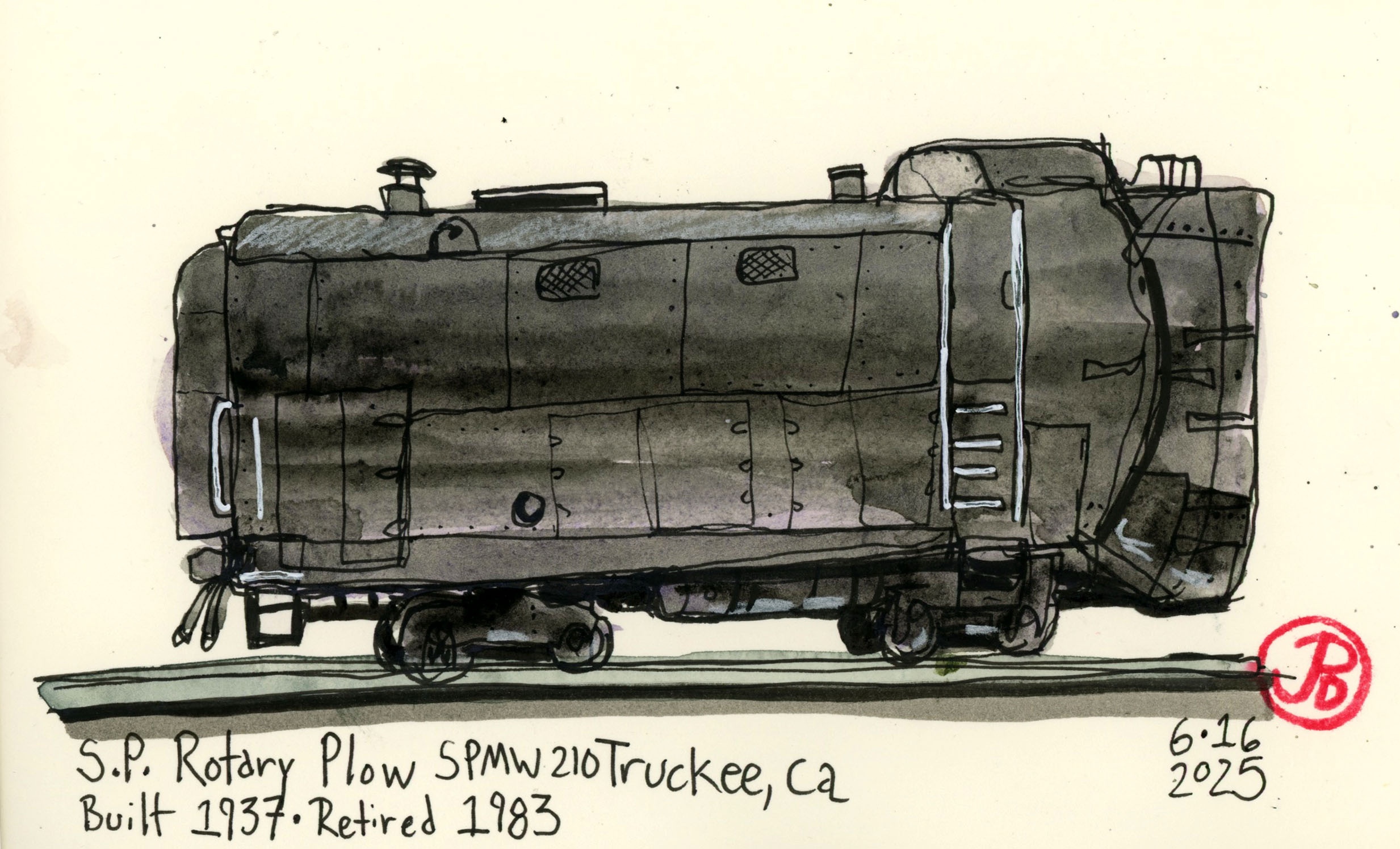
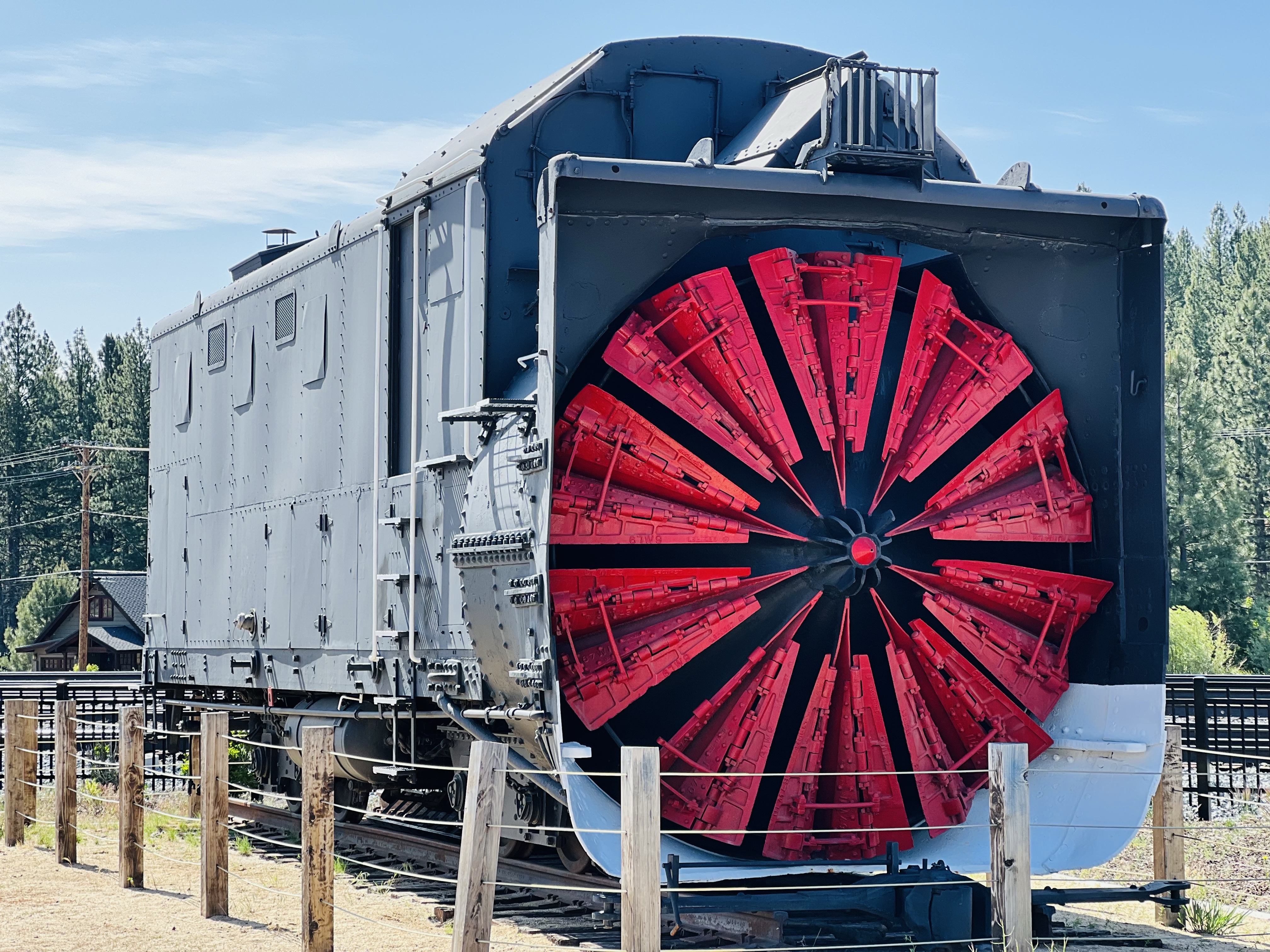
The rotary plow kept the line open in the deepest winters. And the California State Railroad Museum donated Southern Pacific’s SPMW 210. This historic piece of rail equipment now is on static display alongside the tracks it once kept open in the winter time.
This monster could cut through heavy snow. I usually sketch these plows head on but I decided on a different perspective.
While I have sketched these plows many times before, I decided to try from a different angle with a broken continuous-line sketch.
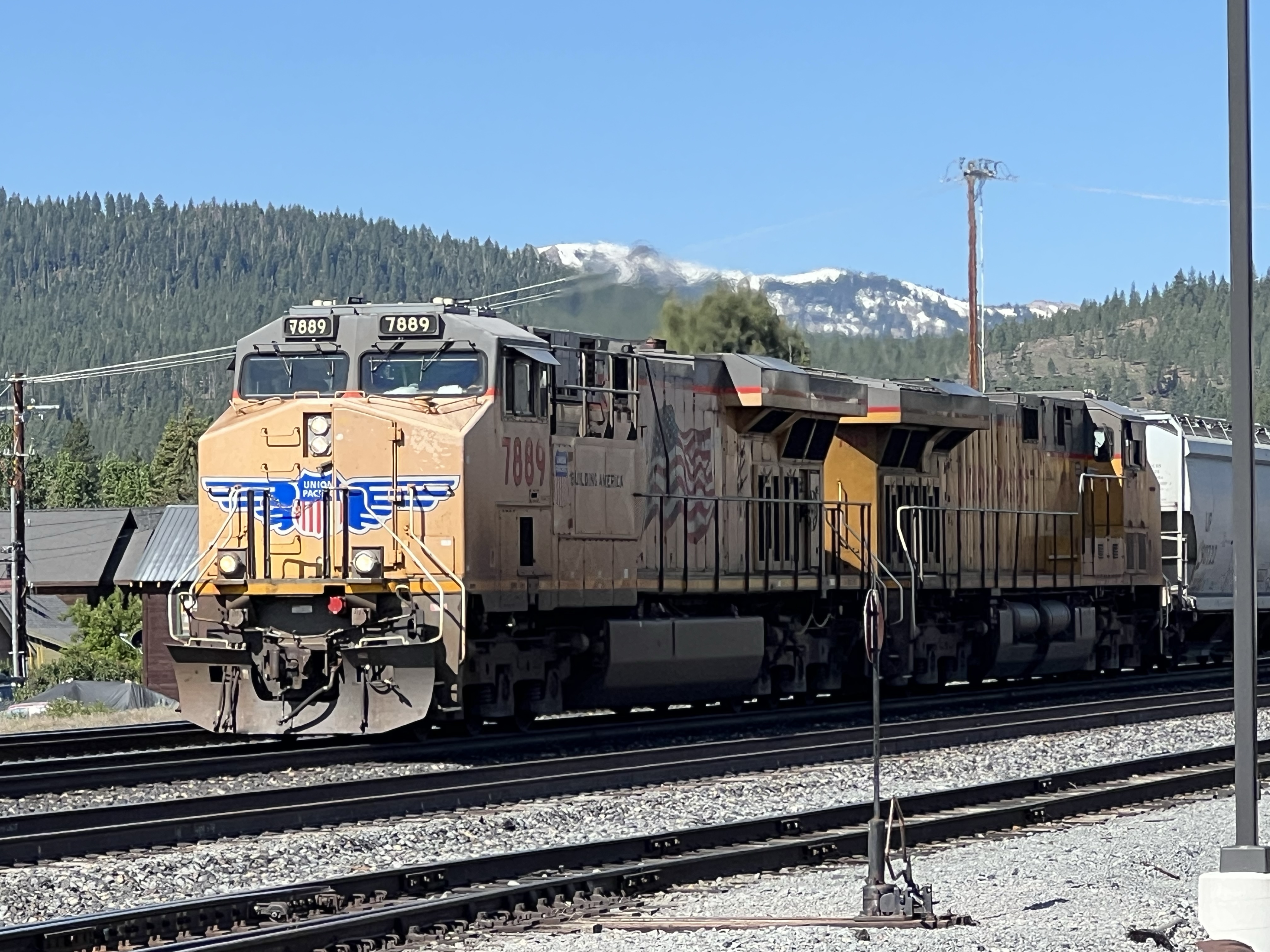
A reminder, courtesy of Union Pacific, that Truckee still remains a rail town. The eastbound freight was an empty covered hopper consist. How do I know it’s empty? Motive power. Only two locomotives on point and one at the end. If the consist was fully loaded, they would need more motive power to travel over Donner Summit.
I have been to many endpoints of the members of the Donner Party: Alder Creek, Donner Lake, the Pioneer Monument, Johnson’s Ranch, Oak Hill Cemetery, and San Juan Bautista. And I have sketched them all. But I had never visited their starting point; until now.
The Pioneer Memorial is near the site of the Breen cabin, one of the Donner Party members. The monument lies near the eastern shore of Donner Lake.
Some of the key members of the party, the Donners and the Reeds, were wealthy residents of Springfield.
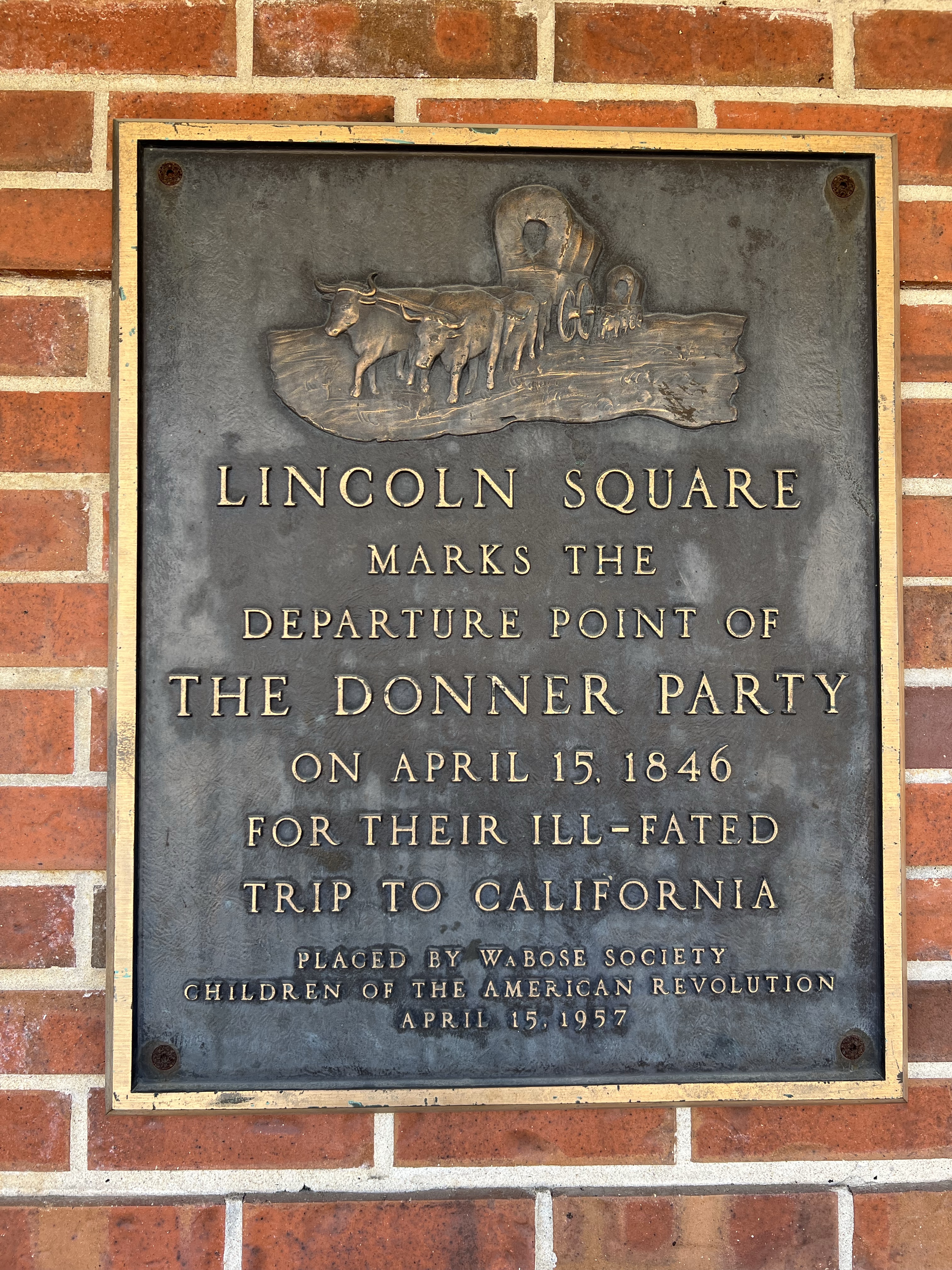
It is from the square near the Old State Capitol that about 90 members of a group of immigrants set out for California on April 15, 1846. The ill-fated group has gone down in history as the Donner Party.
The plaque commemorating the start of a very tragic journey.
I sketched from back the Old State Capitol, which is currently closed for restoration. The Donner plaque is on a building on the left of the sketch which is a stairway that leads to underground parking.
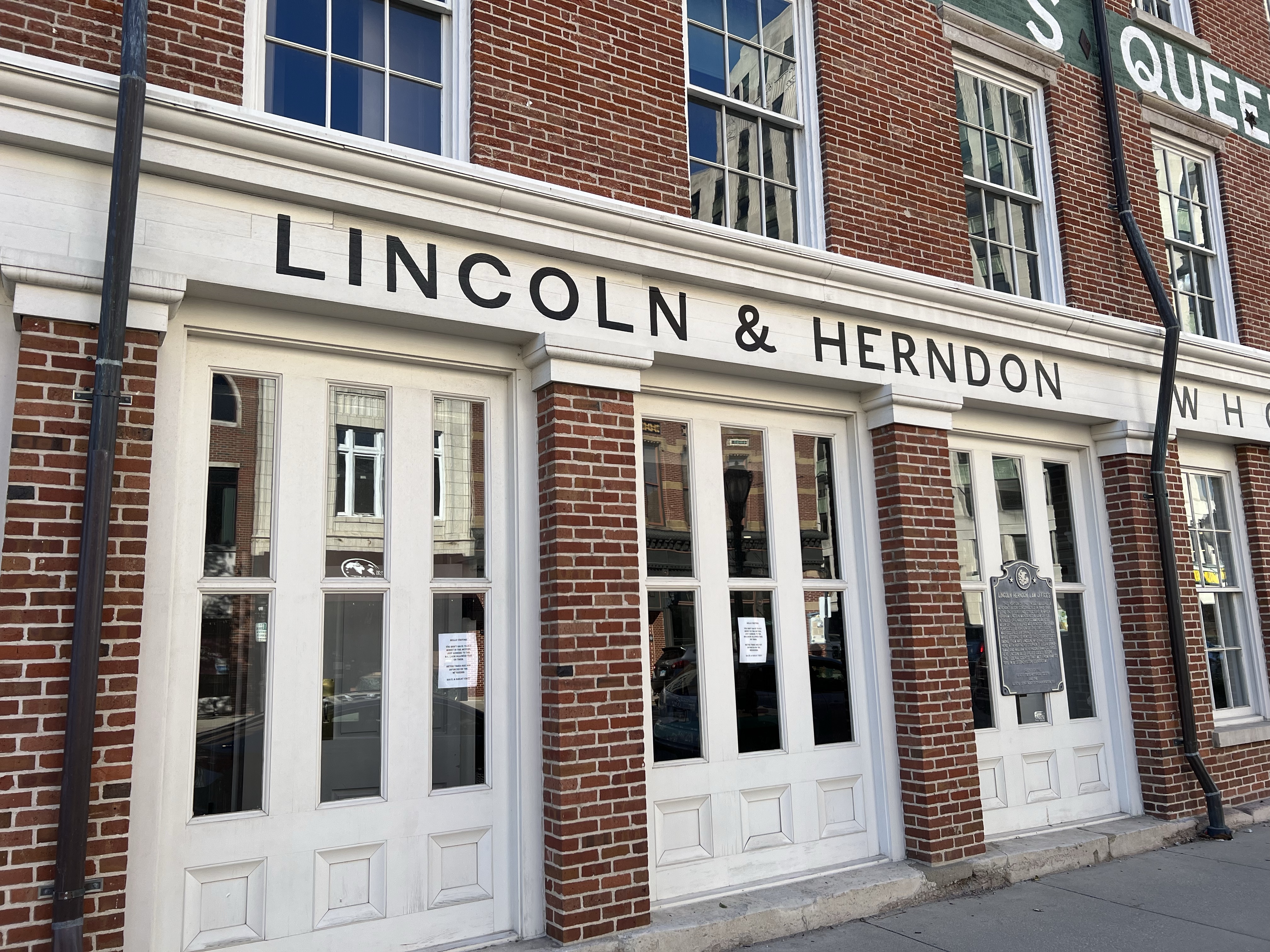
On the square is the law office of Lincoln & Herndon. Much more about one of these law partners in other posts.
One of the legendary railroad routes is the section of the Transcontinental Railroad that climbs the western flank of the Sierra Nevada Mountains up to Donner Pass. The construction of the railroad was an engineering marvel and much of the original route is still in use.
Southern Pacific used their AC articulated cab-forwards to tackle the grades and heavy freight over the pass and now the world’s largest articulated locomotive would be climbing up to Donner Pass for the very first time. And I planned to be there.
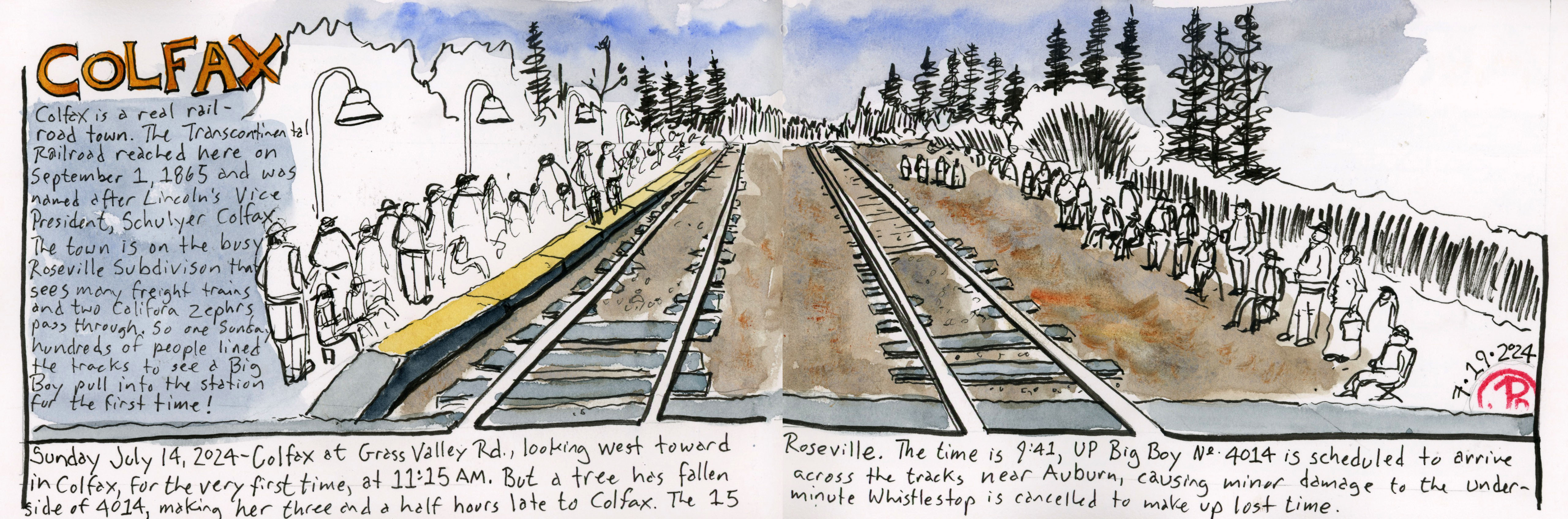
There was a planned 30 minute whistle stop at the historic railroad town of Colfax at 11:15.
I was in Colfax an hour and a half before arrival and more and more people were streaming into town.
4014 left Roseville on time but was halted when the train hit a tree that had fallen near Auburn. The UP tracking app noted that 4014 was “currently stopped near Auburn”. At first I thought it was just a maintenance stop but then word spread that Big Boy had hit a tree and there was some damage to the underside. This was not good. Especially for the hundreds of people waiting in the heat for 4014 at Colfax.
Word spread that the locomotive might have to be towed back to Roseville. The train was now an hour late. I decided to head back to Penn Valley, to air conditioning and the second half of the European Cup Final. I would continue to monitor the UP tracking site. But I had to beat the heat in Colfax.
Just after the game ended (Spain was European champions for the fourth time), the tracker read, “4014 currently moving near Auburn”.
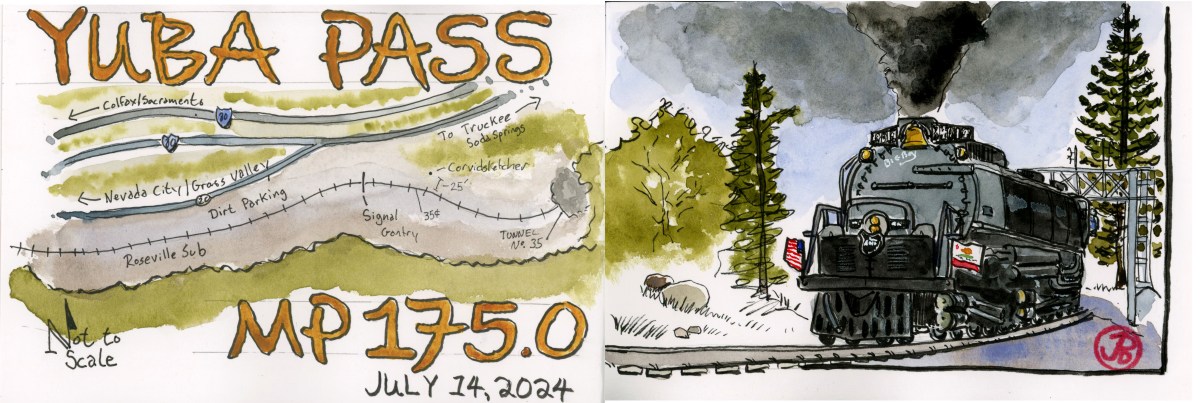
My plan was to drive on Highway 20 to where it merged with Highway 80. This was Yuba Pass and I wanted to see Big Boy in this historic location.
I arrived and there were plenty of other rail fans lining the tracks at Yuba Pass. This was a good sign because 4014 was still climbing the grade and had not reached my position.
After about a 45 minute wait a plume of steam exhaust appeared down line and the mighty roar of the Big Boy filled the cut.
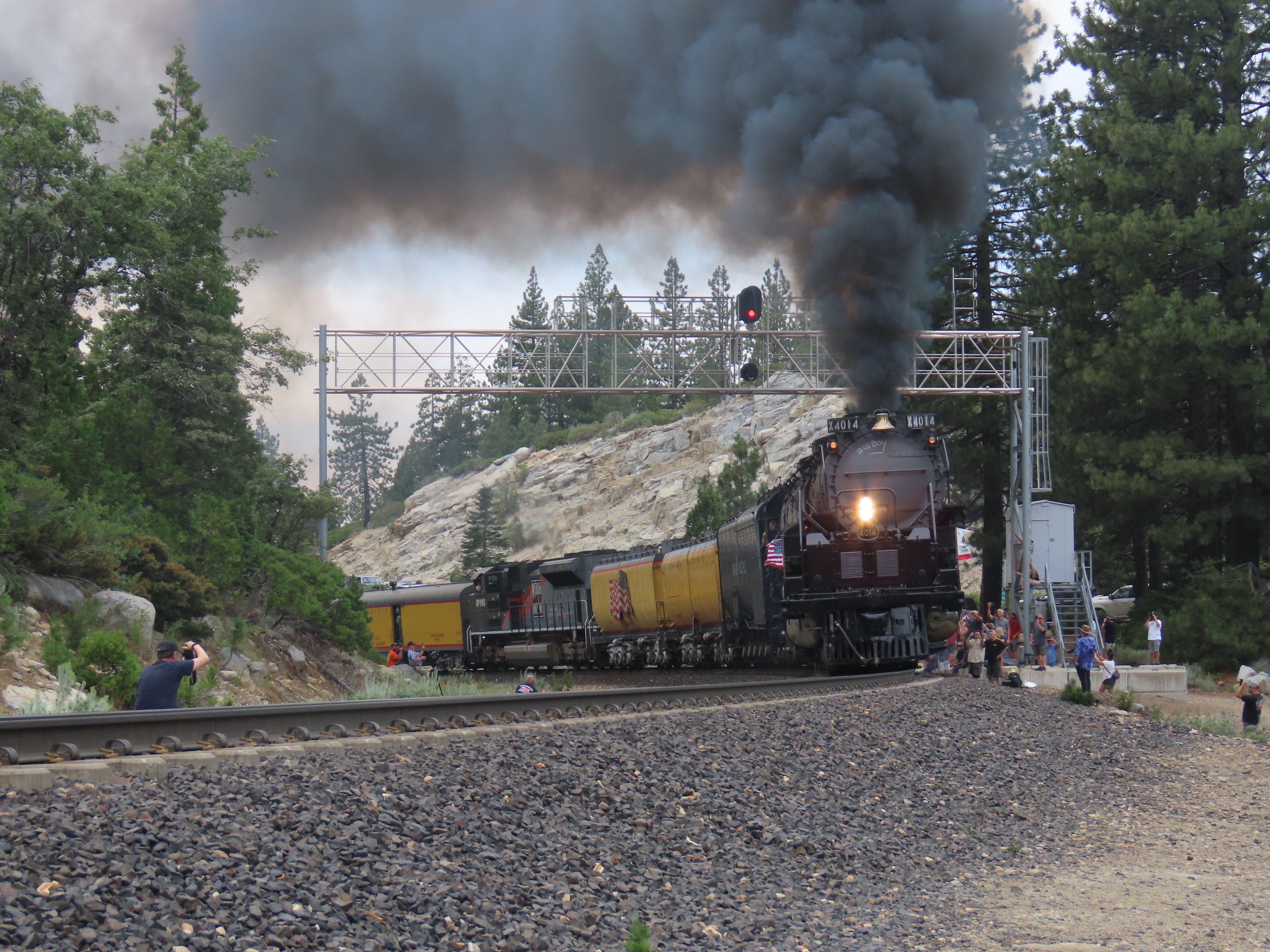
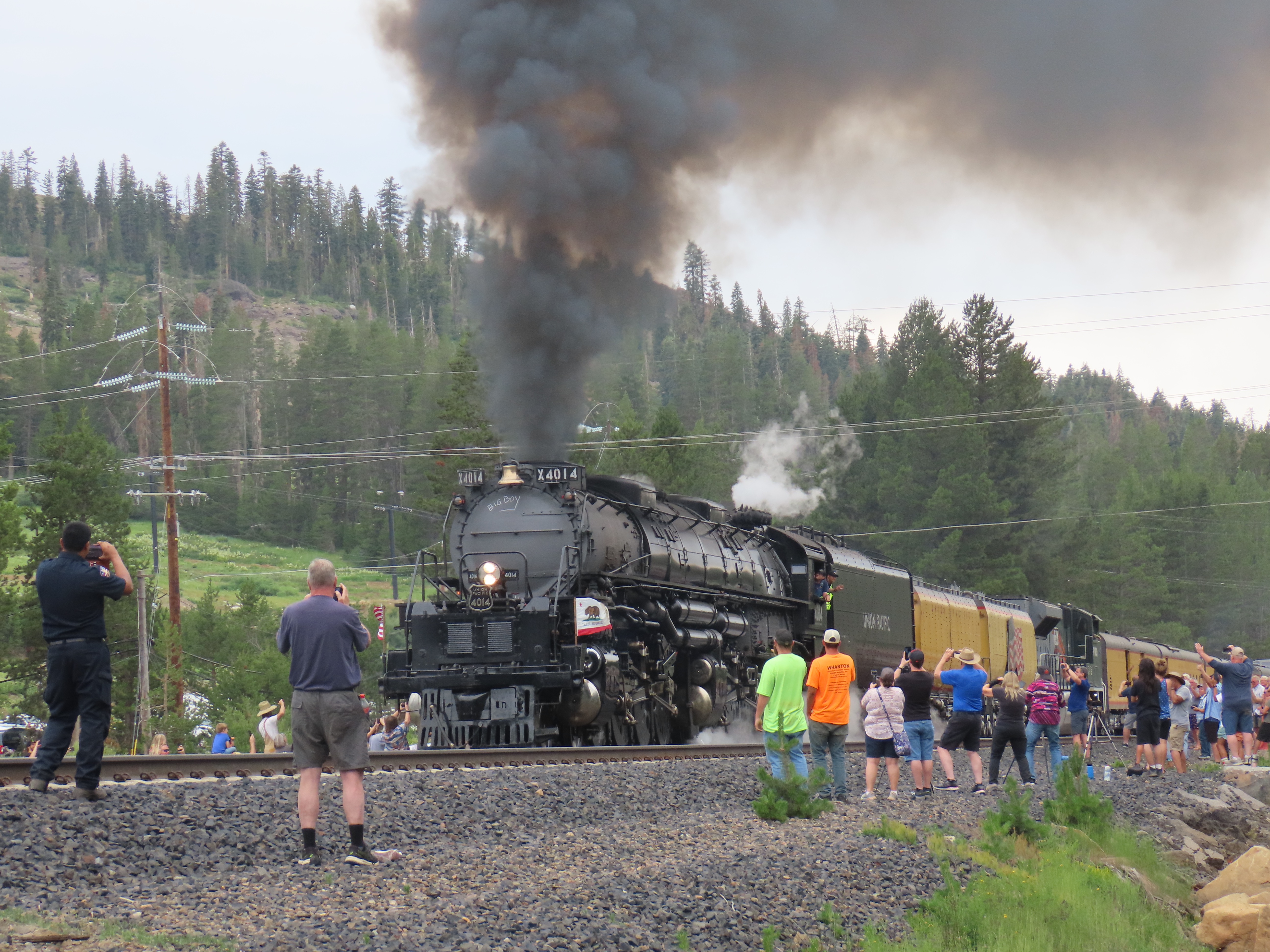
Then the iconic articulated giant appeared working up grade towards my position near the signal gantry. 4014 was putting on a show that enveloped all the senses.
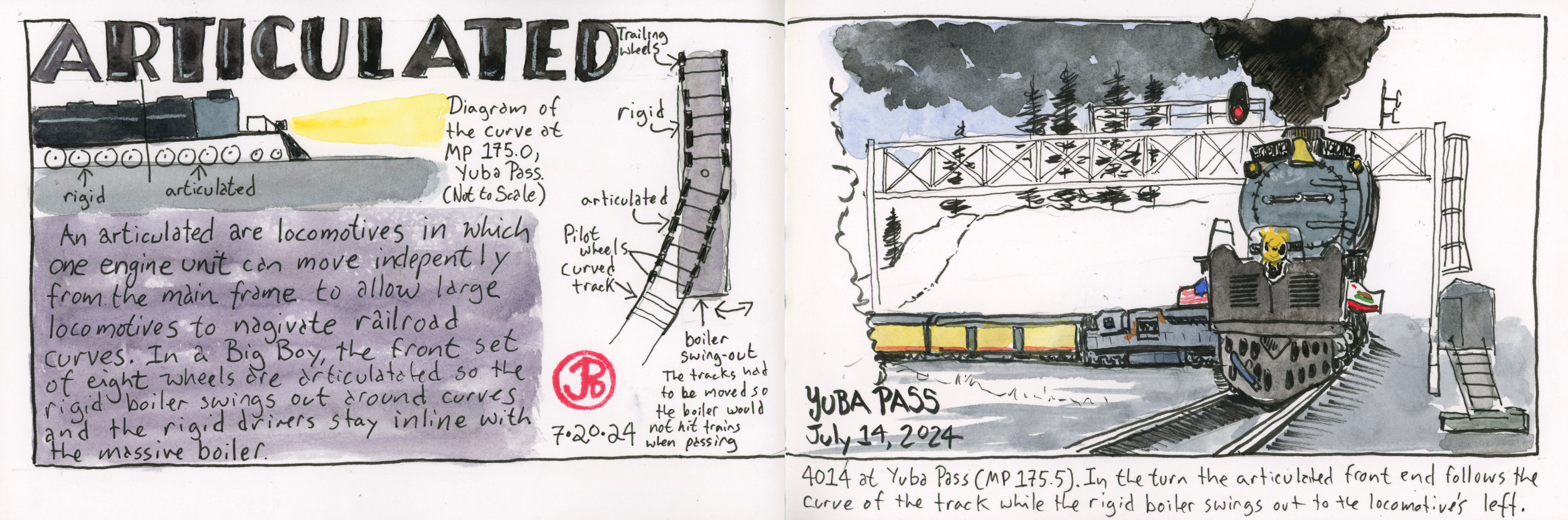
As 4014 rounded the curve, the articulated properties of the design were in full display. While the leading truck and front drivers rounded the curvature of the track the boiler remained rigid making it appear that the drivers and boiler were separating. Afterwards I did a spread to understand the articulation design (below).
After the train disappeared into the tunnel, I headed back to my car and was soon driving east on Highway 80. To my right, I could see the tell-tale exhaust up the hill on the railroad grade. Soon I was pacing with 4014 and I then pulled ahead and planned to head to Soda Springs to see the steam mammoth as she neared Donner Summit.
I made it to Soda Springs off Historic Highway 40 and the biggest challenge was finding a place to park as there were many people waiting trackside for the arrival of the Big Boy.
I found a parking spot and headed down to the grade crossing. There was a festive atmosphere around the tacks and to the south many Cal Fire trucks and personal (including Smokey) looked and listened down track for the first appearance of the 4-8-8-4.
The last steam locomotive that Southern Pacific ever purchased is on display at the California State Railroad Museum in Sacramento. And she’s massive!
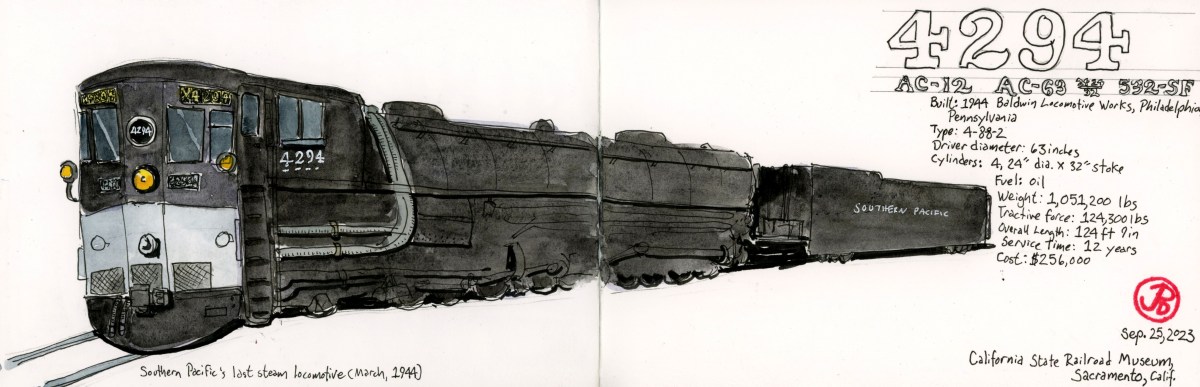
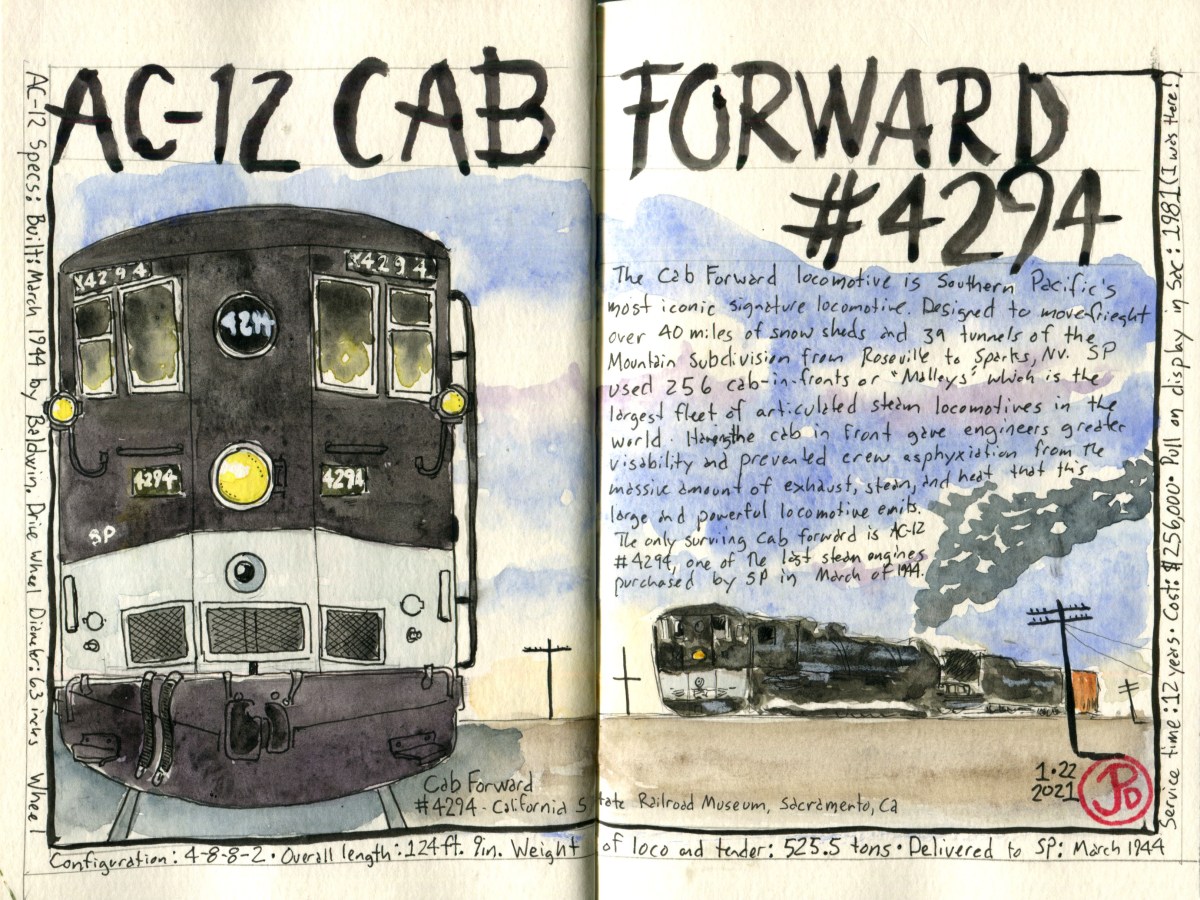
This is the only one of the 256 cab-forwards that still exist. The 4-8-8-2 locomotive was turned around so the cab was in front and the exhaust was behind the cab and crew. The natural habitat of the AC-12 Class No. 4294 was over Donner Summit. And because of the heavy snowfall in the Sierra Nevada Mountains, 37 miles of the line was covered in snow sheds to keep snow off the tracks. This innovative design prevented the crew from smoke exhaust induced asphyxiation.
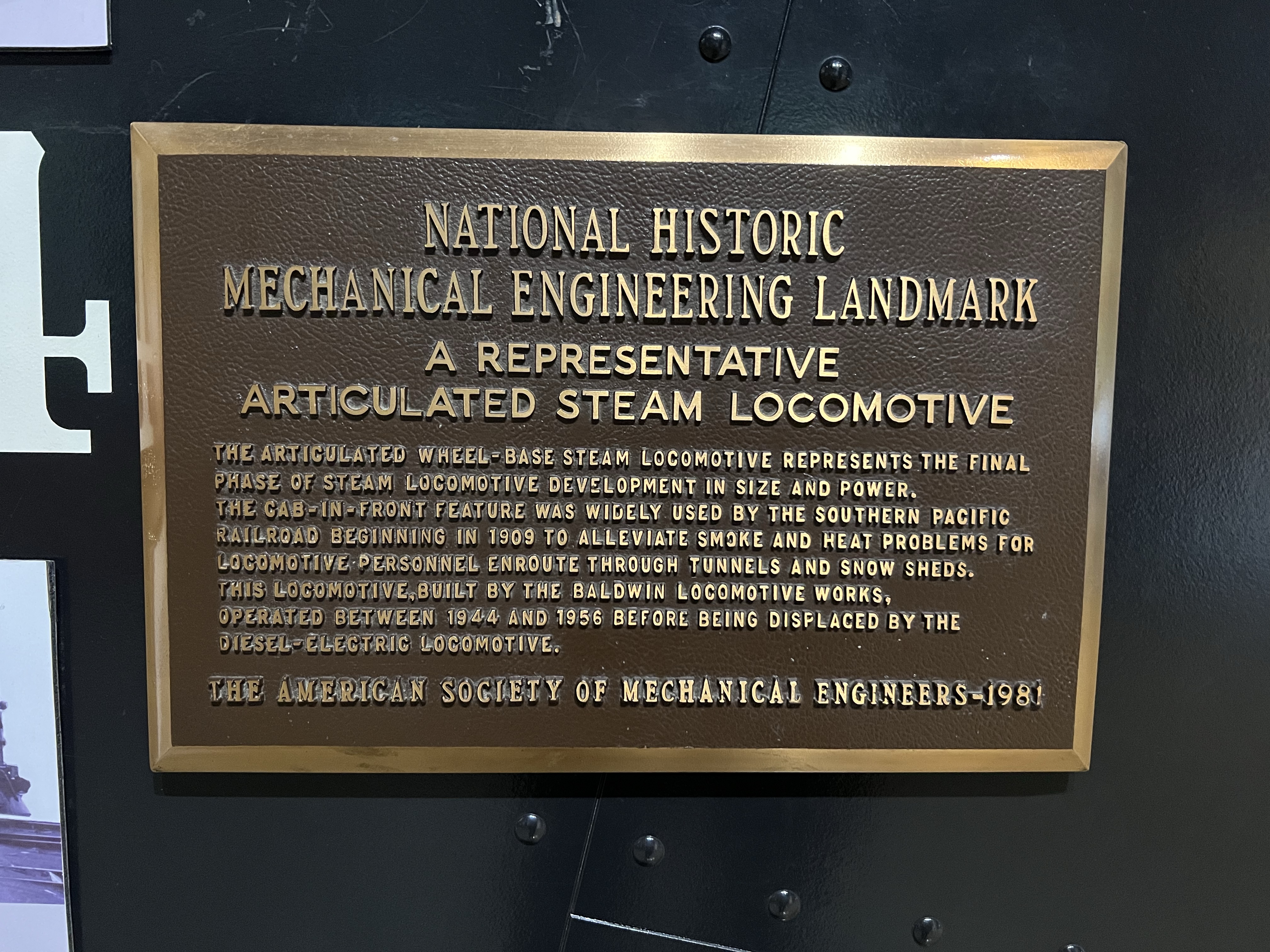
This last of the cab-forwards was such an engineering marvel that it was designated a National Historic Mechanical Engineering Landmark by the American Society of Mechanical Engineers in 1981. It was the first steam locomotive to be added to the list. Of the 300 landmarks in existence, only seven are steam locomotives, including Union Pacific’s Big Boy No. 4023 and Norfolk and Western J-Class No. 611 (more about 611 in a later post).
This locomotive is massive and the largest and most powerful locomotive in the museum’s collection. The locomotive and tender are 123 feet and 8 inches long and the total weight of this Beast of the Sierras is 1,051,200 pounds (525 tons). One of the docents I talked to was old enough to see a cab-forward in action as a child and he told me that the locomotive scared him and the ground shook when it passed by.
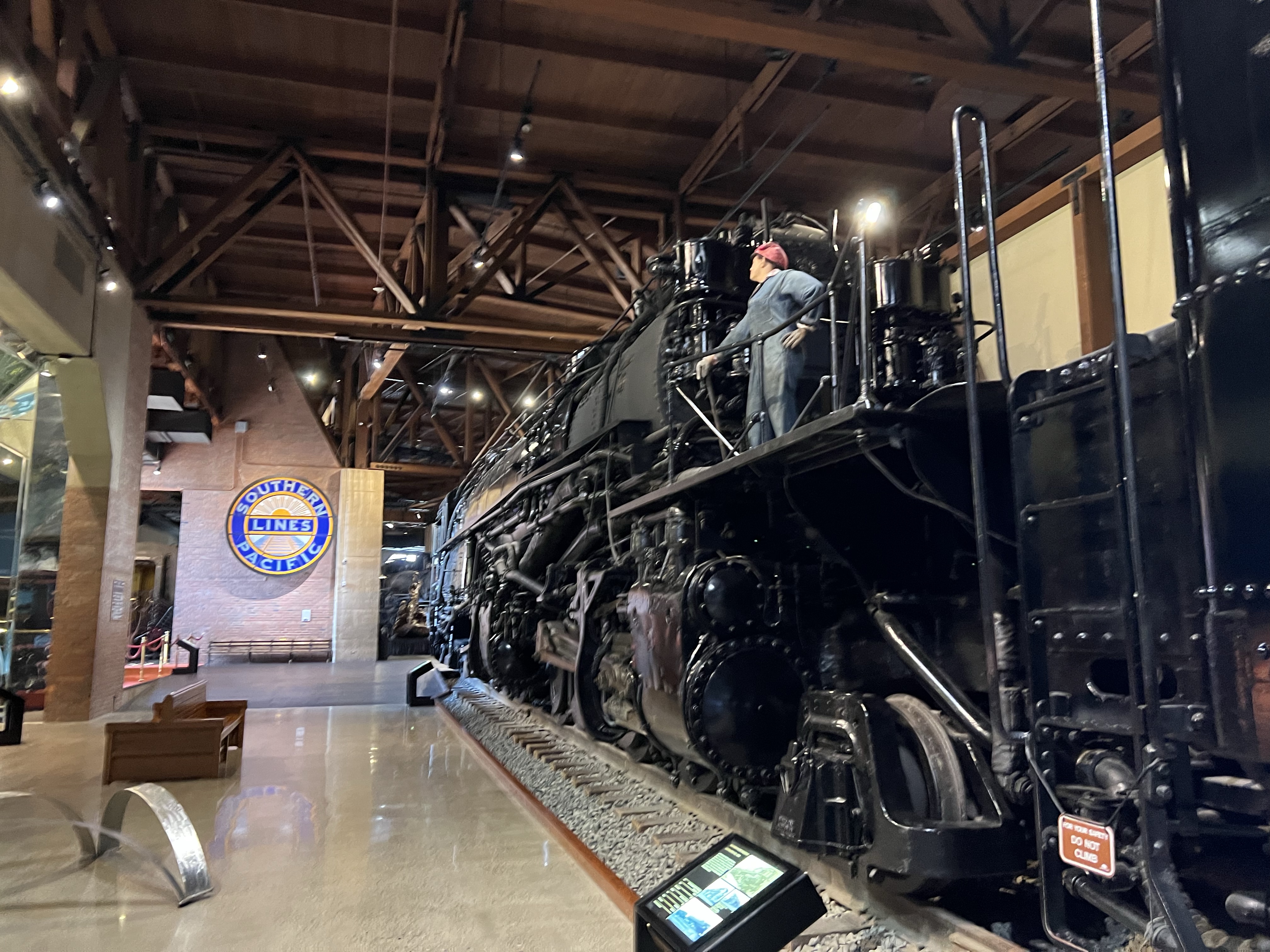
On my visit to the California State Railroad Museum, high on my sketching list was this massive cab-forward. There was only so many perspective to sketch 4294, I tried sketching from above but I couldn’t see the entire locomotive and tender from the third floor gallery so I took a seat under the massive glass Southern Pacific logo and sketched 4294’s front and left side. My wide panoramic journal was perfect for this.
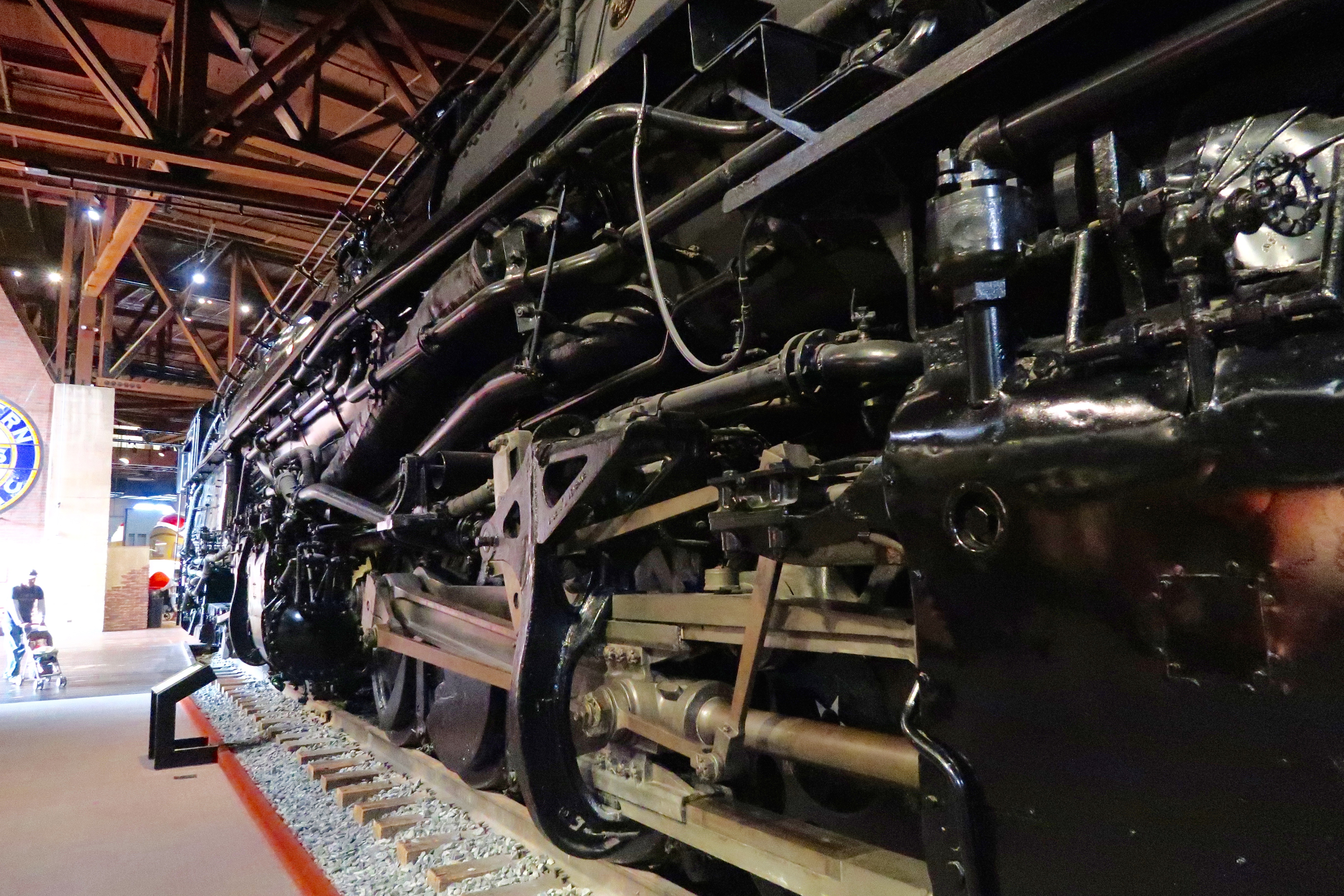
Drawing the complicated running gear was a challenge so I used along of shorthand and used my sketcher’s license!Looking down the length of 4294 to where I sketched this Beast of the Sierras. I sat on the bench under the SP logo that was once at the Port of Oakland.
On my latest sketching odyssey I headed to one my favorite locations in California, if not the world: Donner Pass.
Before I set out, I sketched the rail route of the East Slope of Donner Pass, heavily influenced by a map drawn by John Signor (author, artist, and former Southern Pacific employee) in his marvelous book: Donner Pass: Southern Pacific’s Sierra Crossing.
I would be driving parallel to the Central Pacific side of the first Transcontinental Railroad on Highway 80. In 1865 the railroad became Southern Pacific.
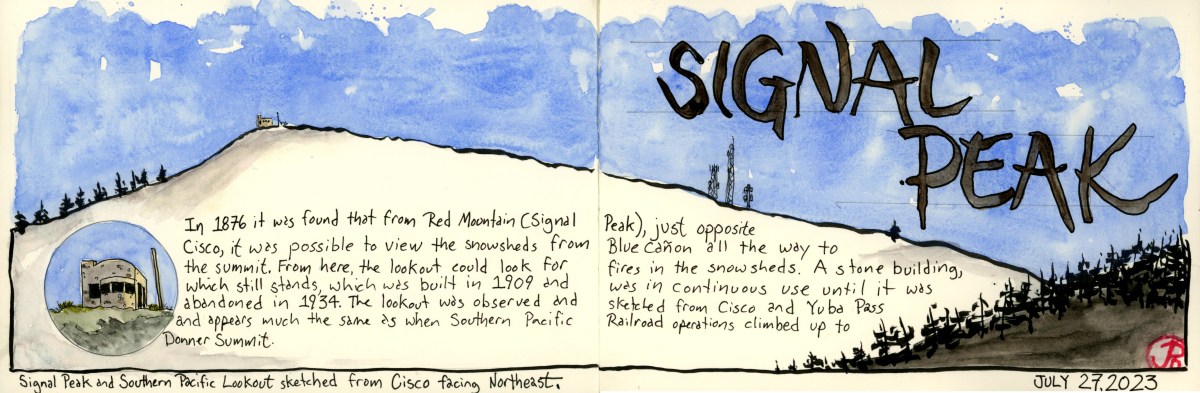
I was looking for a stone structure that was built in 1909 as a fire lookout and I reckoned that Cisco, which is directly across the valley from the building, would be my best position for seeing Southern Pacific’s fire lookout on Red Mountain.
The lookout on Red Mountain was built because, from this vantage point, the rail line from Blue Canon to Donner Summit could be observed. Because 50 miles of the trackage was above 5,000 feet in elevation, snow was a real problem for keeping the line open during the long winters. The solution was to build wooden snowsheds to keep snow off the tracks. Work on the snowsheds began in 1867 and the sheds were completed by 1873. In total, 30 miles of sheds where built.
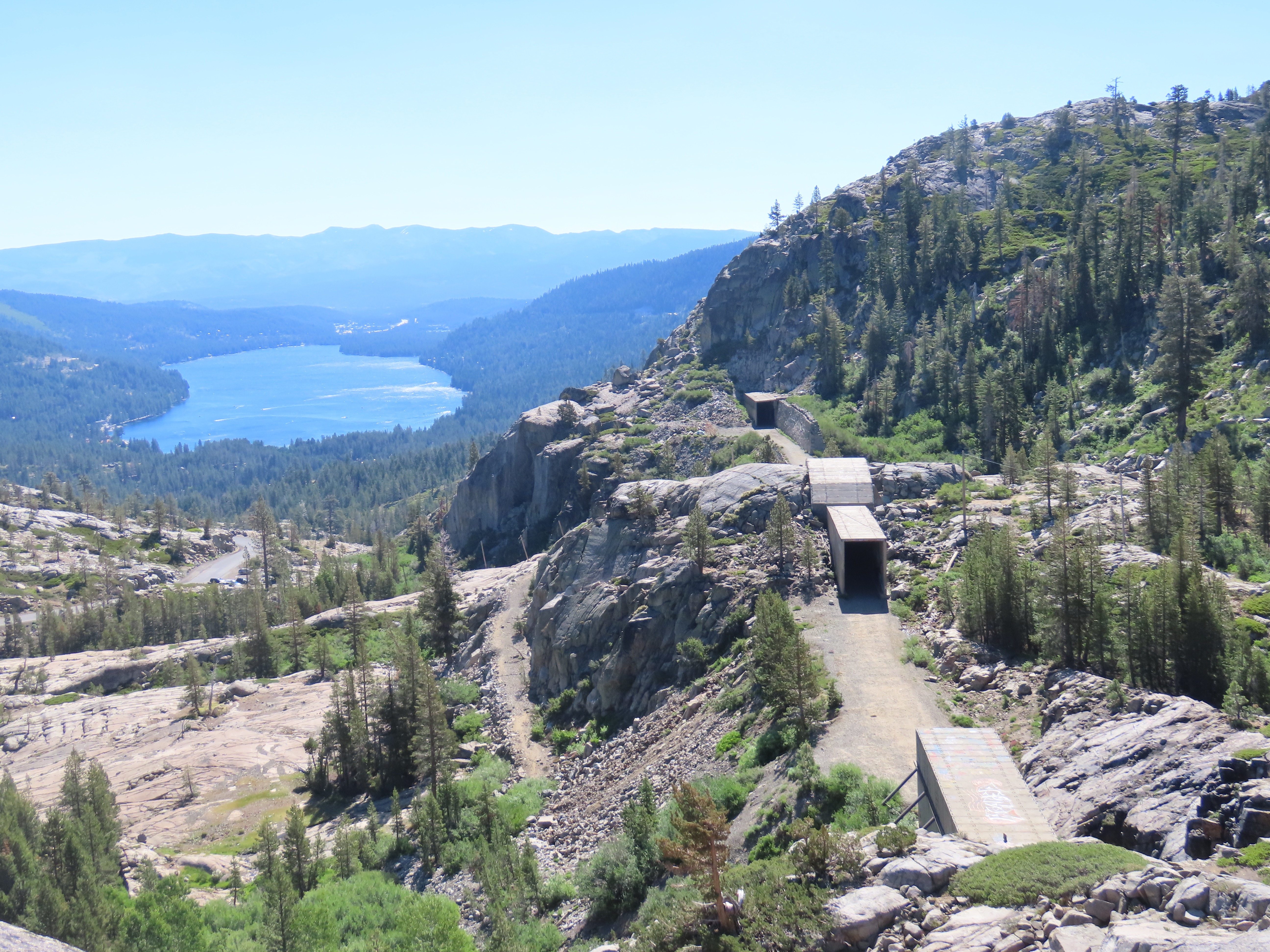
The view from Donner Summit. On the right is the original rail bed of the Transcontinental Railroad. The east portal of the Summit Tunnel (Tunnel #6) and Tunnel #7 is beyond. The snowsheds are made of concrete, replacing the flammable wooden sheds. In the middle ground is Historic Highway 40 and in the background is Donner Lake.
When you combine wooden snowsheds with wood burning steam locomotives the result can be fire.
Southern Pacific employed fire trains that could be called into action to put out fires in the snowsheds but first someone had to observe the smoke. This is where the fire lookout came into play.
The fire lookout was in continuous use until 1934 when it was abandoned.
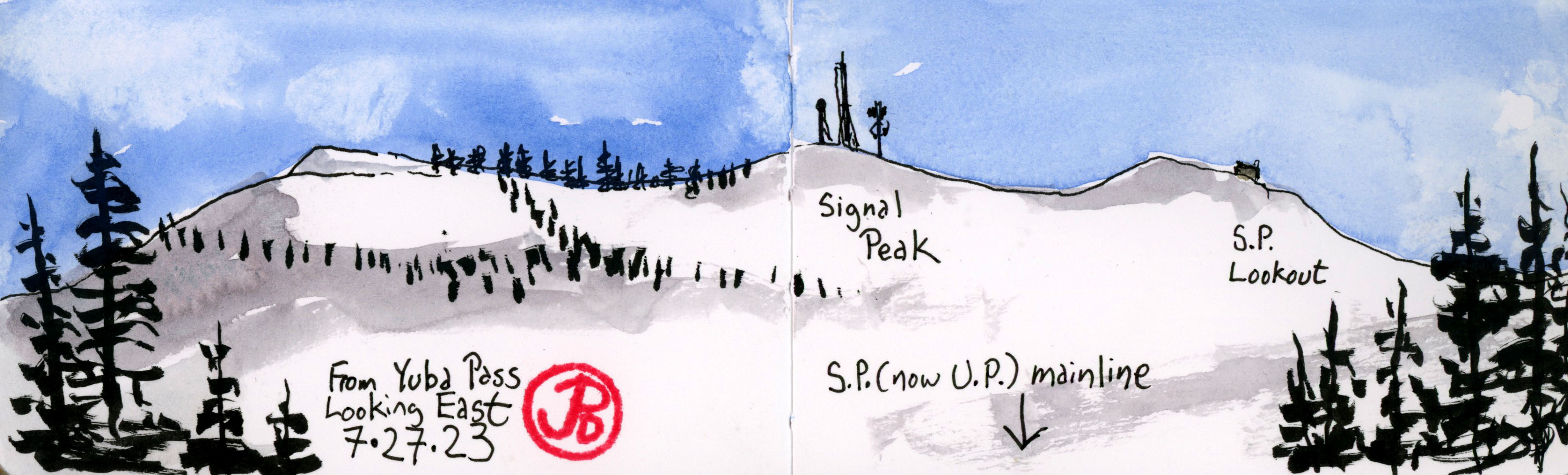
Before I got to Cisco, I pulled off Highway 20, just before it merges into Highway 80 at Yuba Pass. From here I looked down the line and just above the signal gantry was Signal Peak and to the right I spotted the prominent silhouette of the fire lookout.
Yuba Pass with Red Mountain and Signal Peak in the background.
I headed east on 80 for one stop, I took the Cisco exit which just a service station stop. I pulled behind a parked truck and looked to the northeast across the highway.
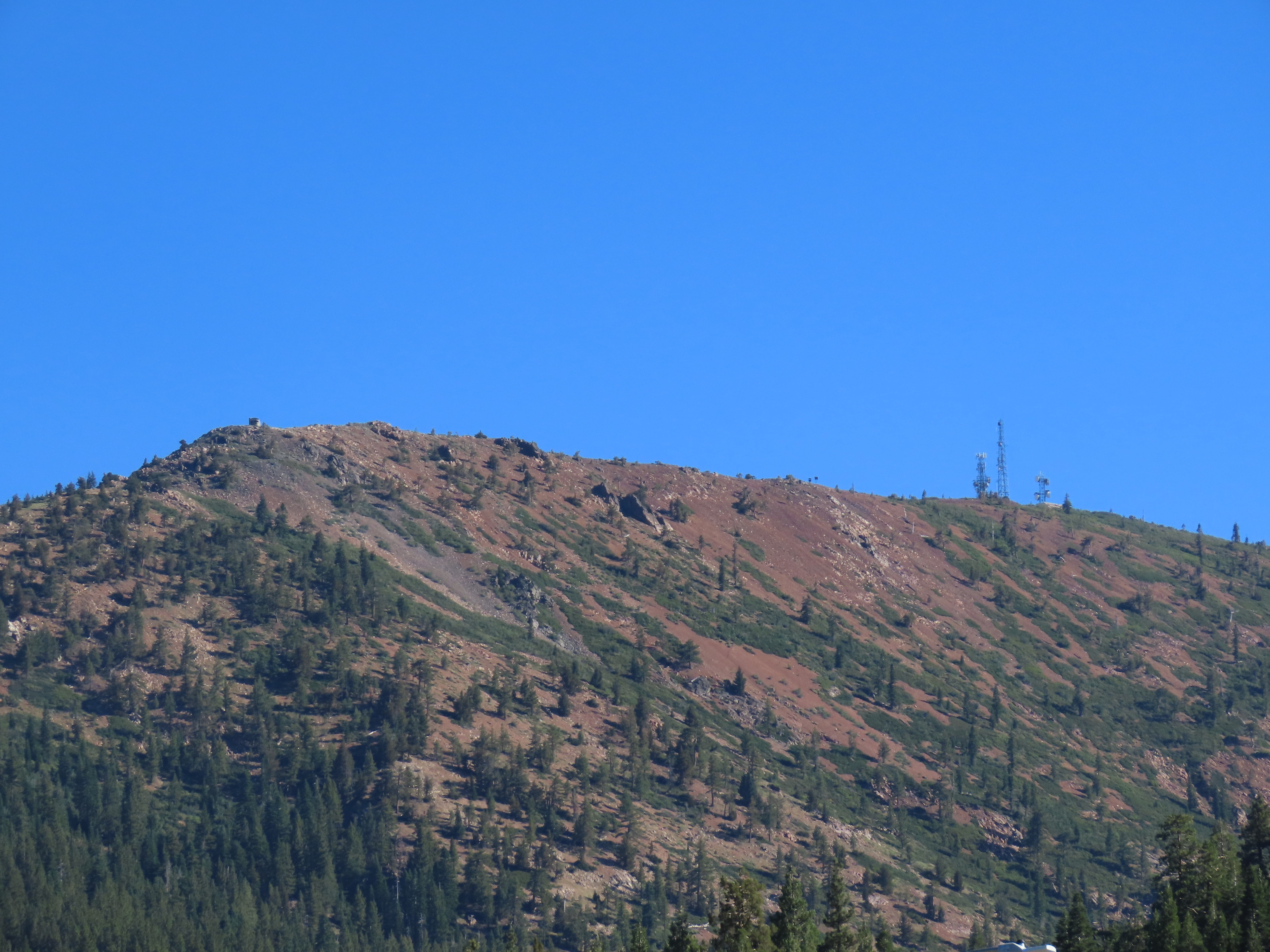
Behind me, further up the hill was the mainline. In front of me was Red Mountain and Signal Peak. To the right was antennas and towers, to the left was the Southern Pacific fire lookout.
Red Mountain and Signal Peak.
Now it was time for a sketch using my Delta panoramic journal (featured sketch) to capture the peak.
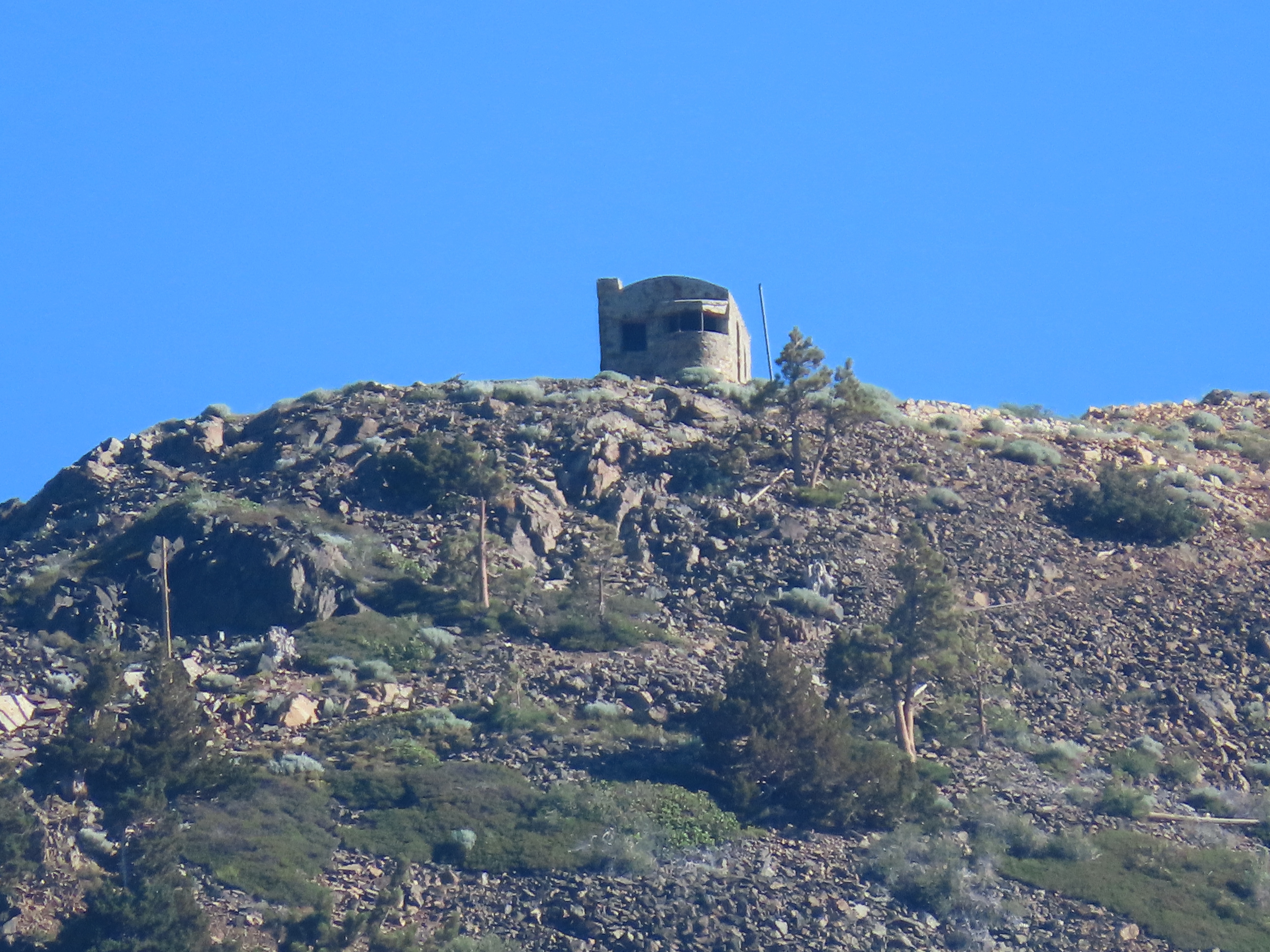
Close up of the Southern Pacific stone lookout built in 1909 and used until 1934.
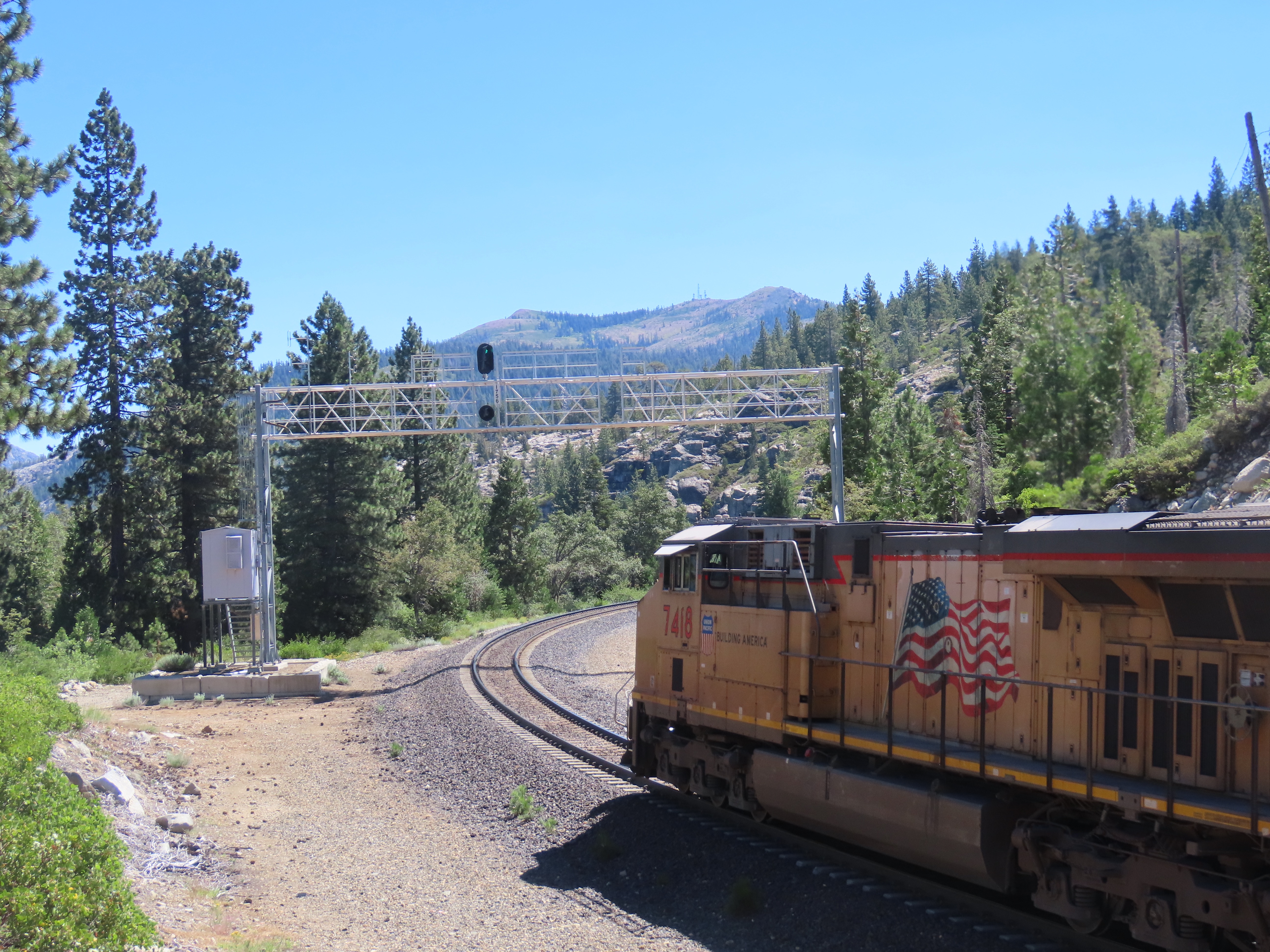
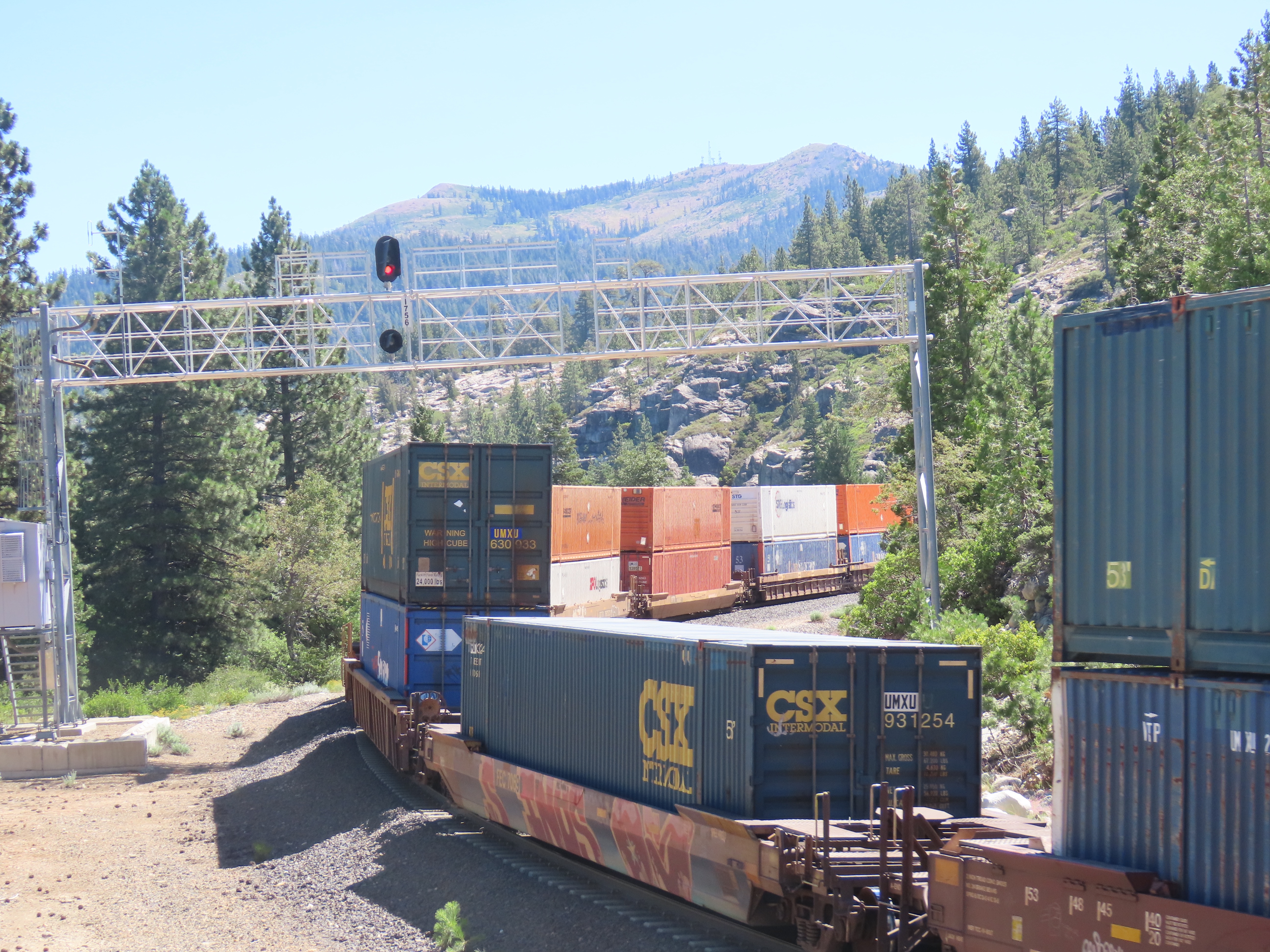
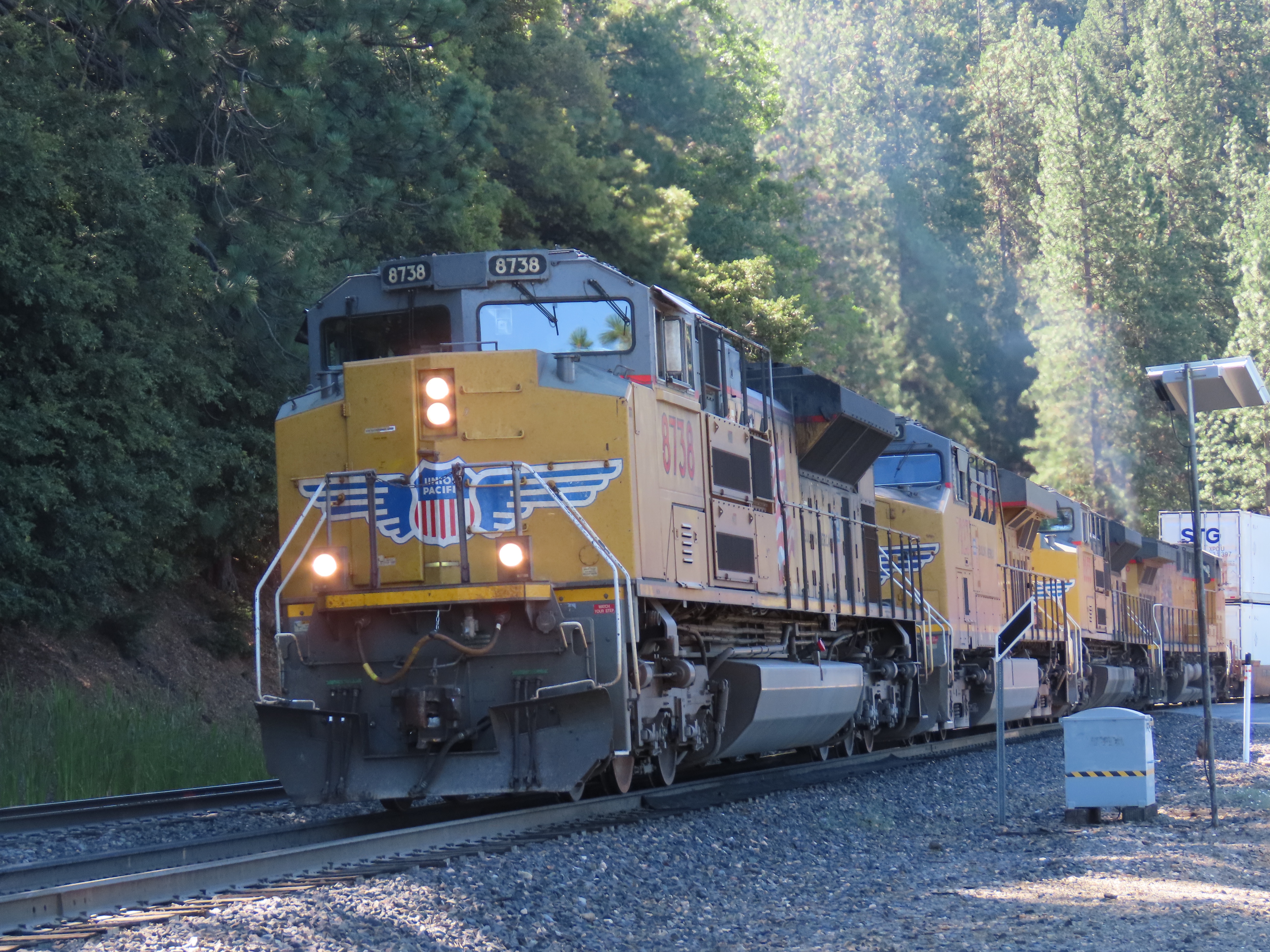
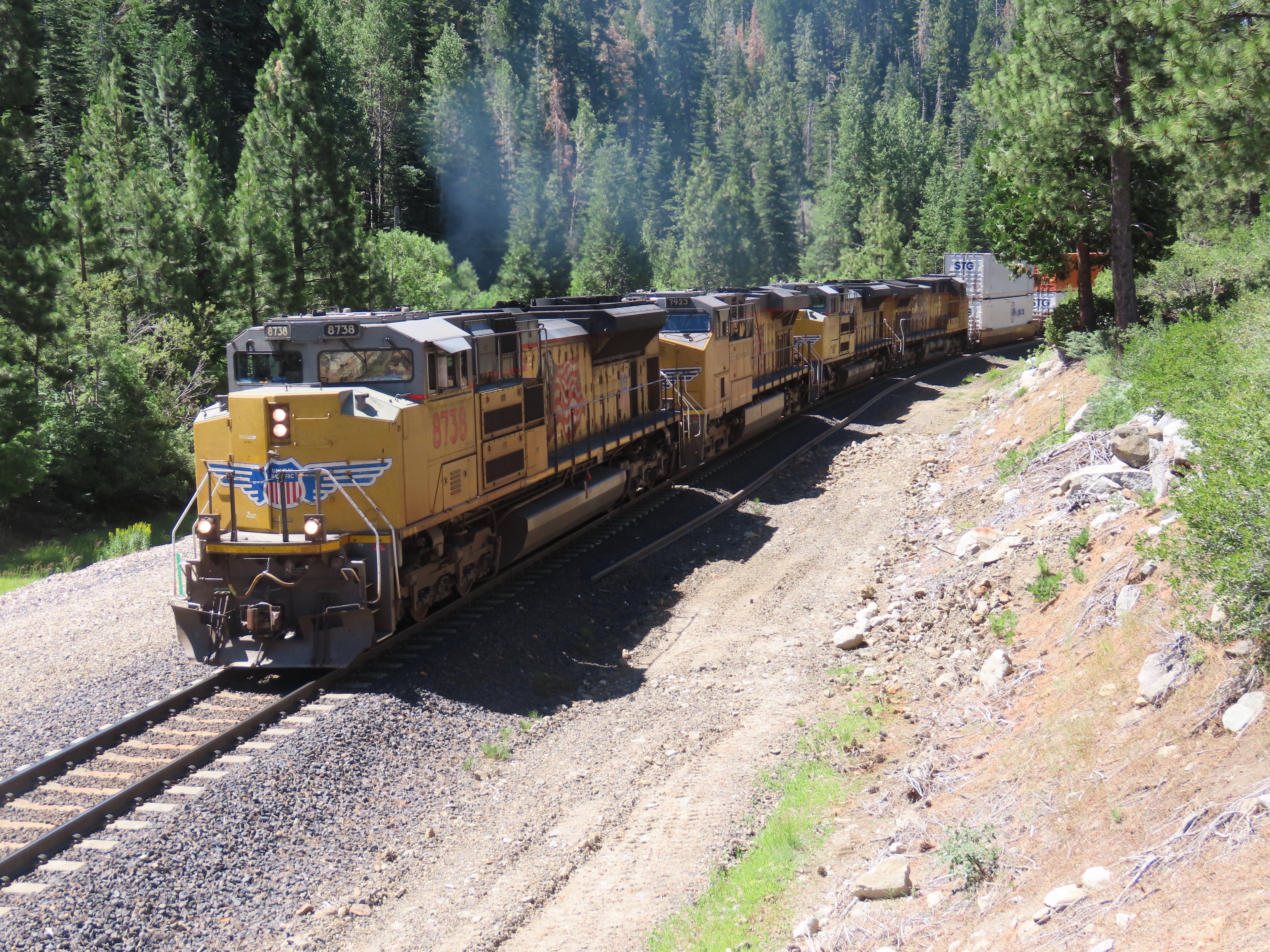
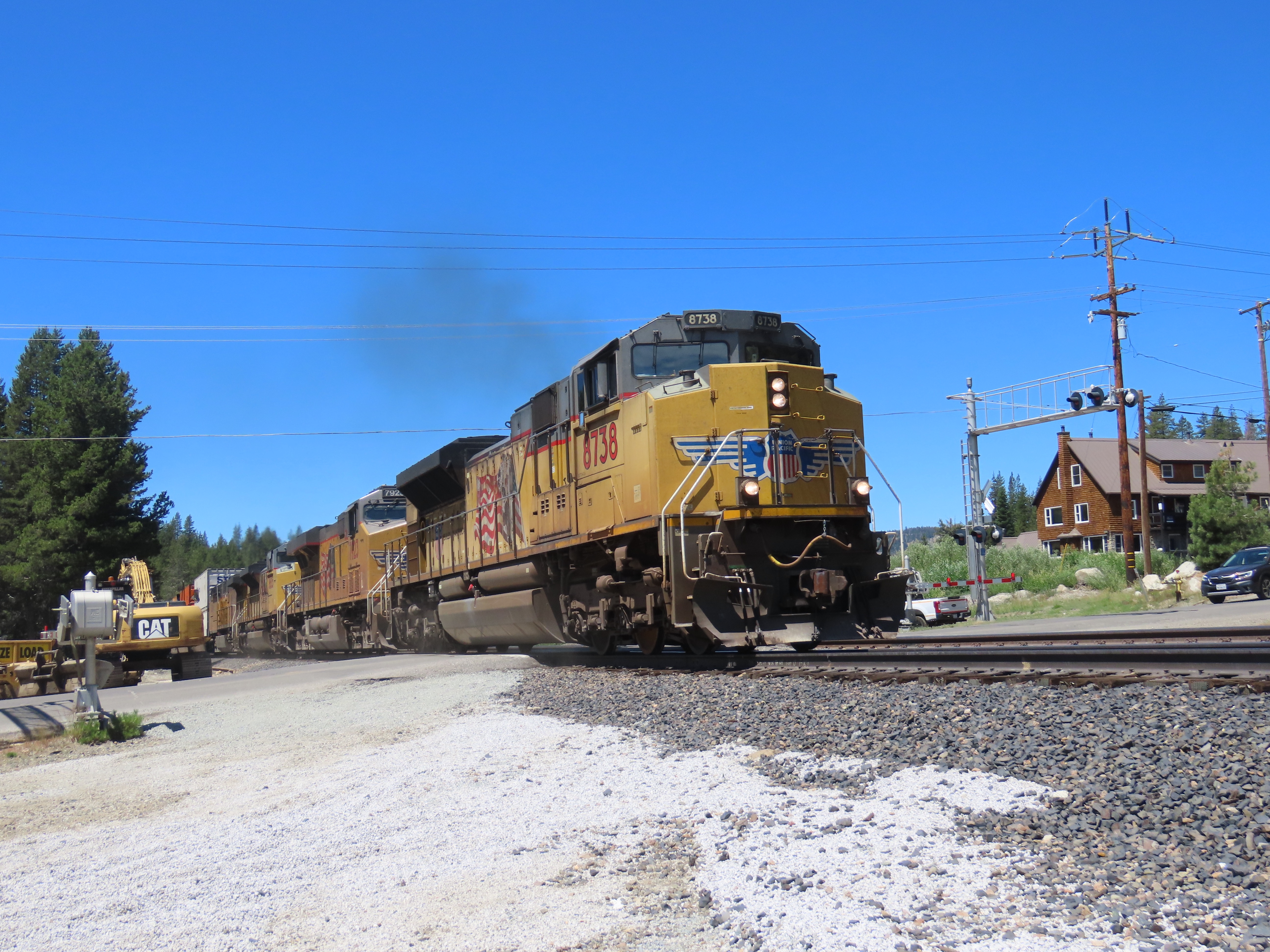
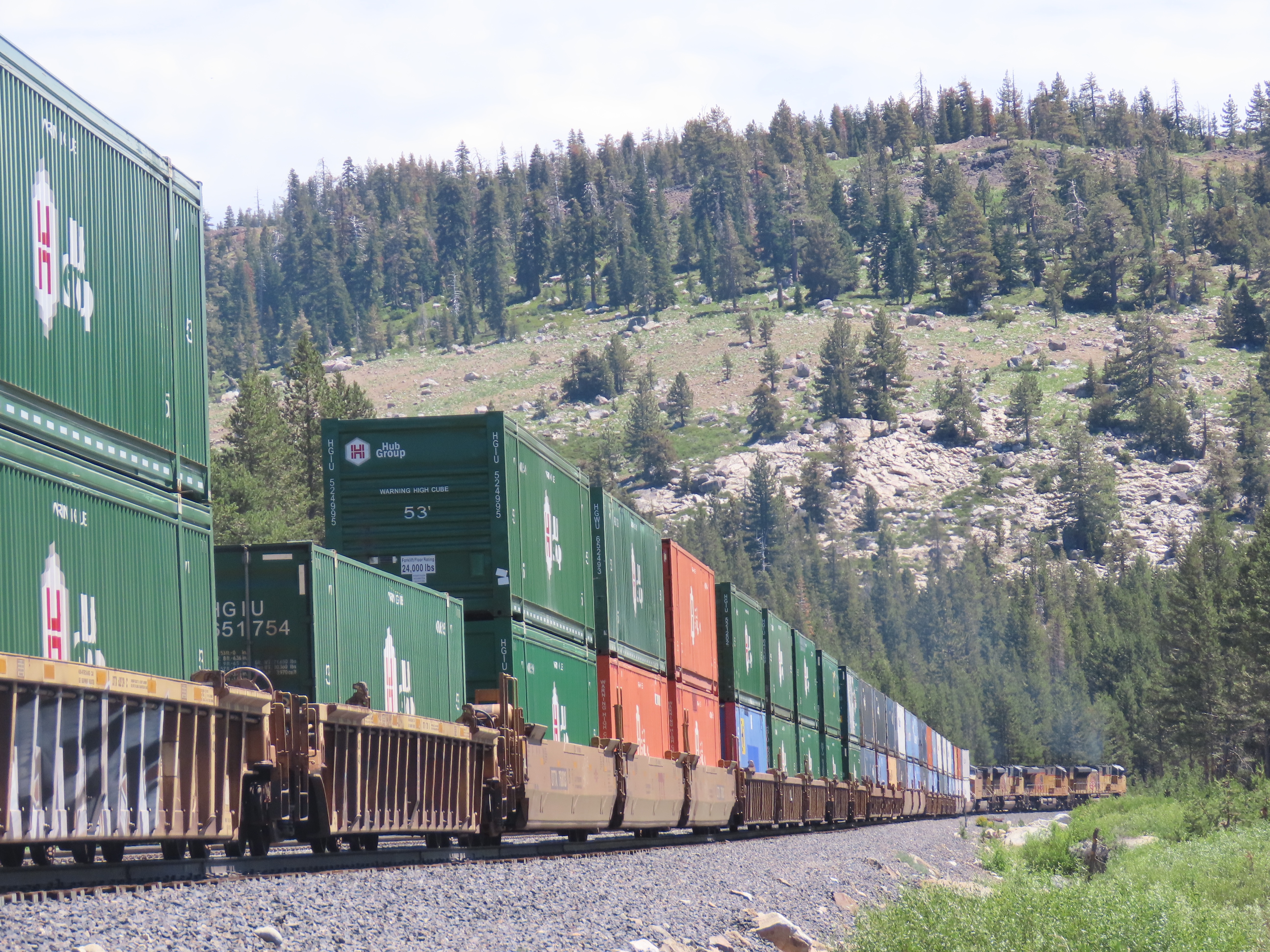
I returned to Yuba Pass to get a sketch of Red Mountain from this perspective. The signal on the gantry was green so an eastbound freight was imminent. Before long I could hear the rumble of a Union Pacific intermodal freight train climbing the grade towards Donner Summit. This consist contained six locomotives and I lost count of how many cars it train contained. (In truth I didn’t attempt to count. Seeing this long freight train mean less truck traffic on America’s highways).
What follows is a series of photographs of the UP freight making the climb to Donner Pass with Signal Peak in the background.
I once chased the California Zephyr Train # 6 from Roseville to Truckee but now I wanted to chase what really makes Union Pacific the big bucks: an intermodal freight train!
Intermodal is freight that is transported by various forms of transportation: ships, trains, planes, and trucks, for example. Most of the intermodal freight trains across the Sierra Nevada consist of double stacked freight containers, known as Container on Flatcar (COFC), or single truck trailers on flat cars, known as Trailer on Flatcar (TOFC) or piggybacks.
I first caught sight of my freight as it really began it’s climb up the western slope of the Sierra Nevada Mountains at Cape Horn, just out of Colfax. (I had just missed it’s passage through Colfax.)
I attempted to follow the train on Historic Highway 40 with some stretches on the highway that relegated Highway 40 to a little used country road: Interstate Highway 80.
Catching up with the train should not be a problem (even on windy side roads) because the average speed of a freight train climbing up to Donner Summit is between 25 to 30 miles per hour. And sometimes the freight’s speed could be even less.
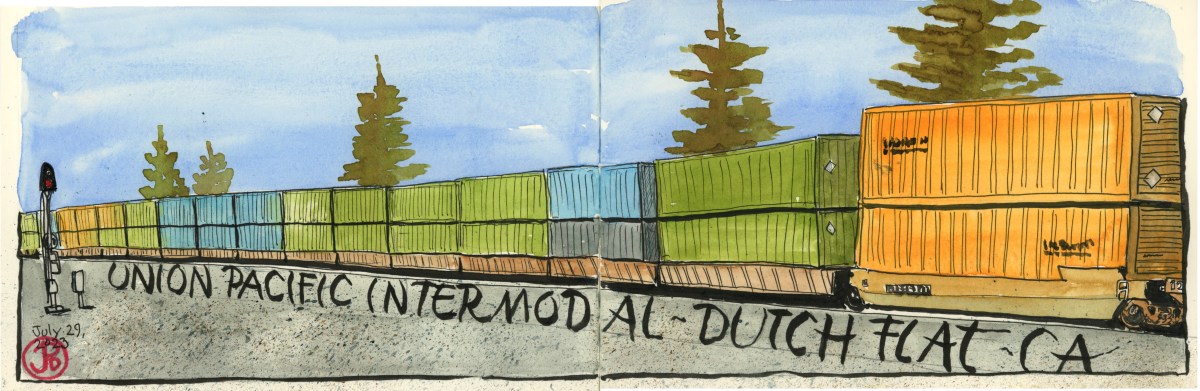
I headed east on a patchwork path of Historic 40, side roads, and Interstate 80. When I thought I was sufficiently ahead of the intermodal, I searched for the mainline. This consisted of picking either side of the road, north or south (at Blue Canon I picked the wrong side), and then driving until I came upon railroad tracks. This I did at the grade crossing at Dutch Flat. The eastbound signal light was green indicating that the train had not passed this point yet.
I picked my vantage point and after about ten minutes I could hear the rumble of the diesel-electric locomotives as they climbed the grade followed by the sounding of the horn, and then the crossing gates were triggered and the safety arms lowered to stop traffic.
The Transcontinental Railroad reached Dutch Flat in June 1866.
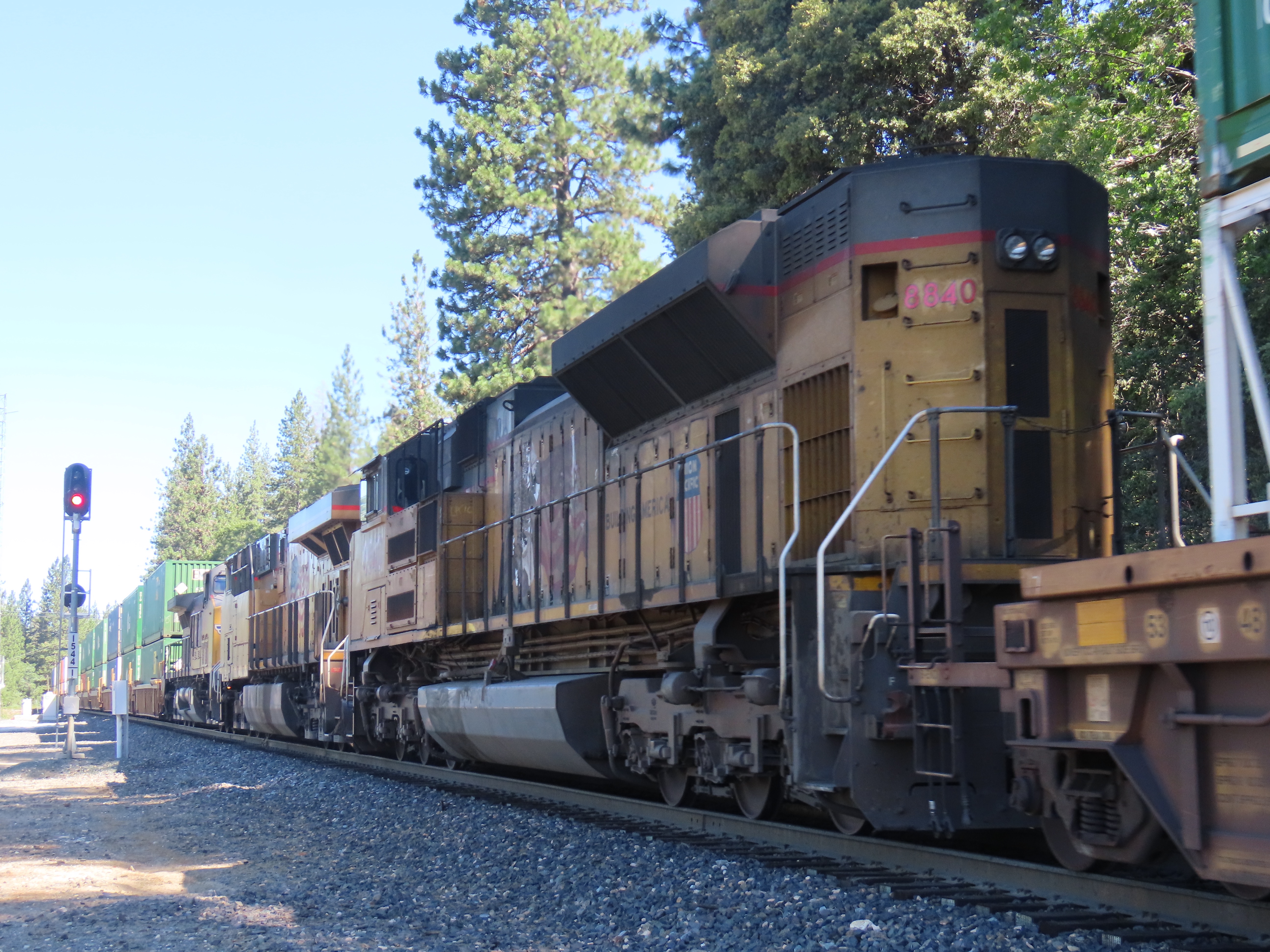
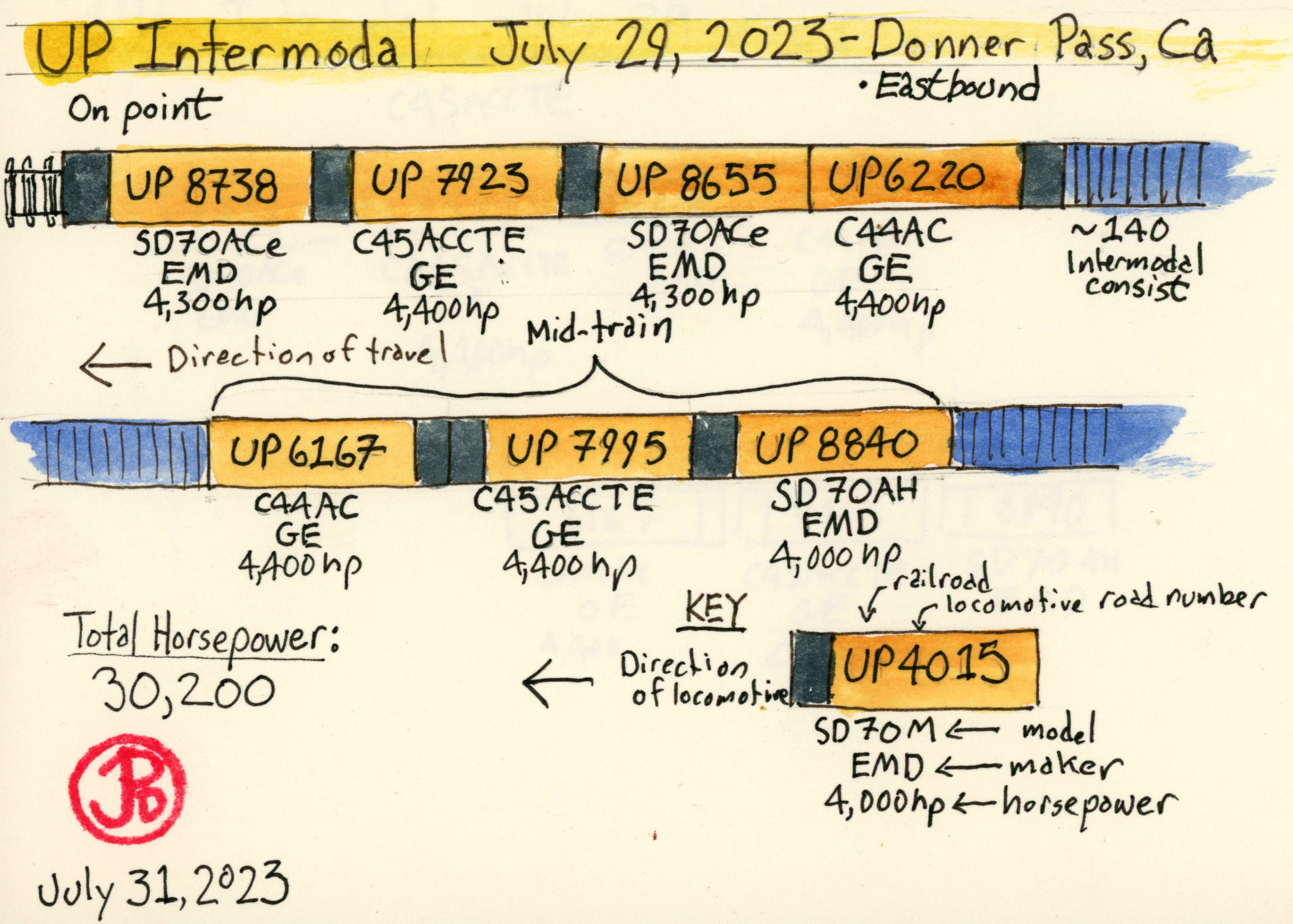
Union Pacific No. 8738 came into view. No. 8738 is an Elctro-Motive Diesel (EMD) SD70ACe. These 408,000 pound locomotives generate 4,300 pounds of horsepower and this consist featured four locomotives on point and three more mid-train. These seven locomotives generate a combined 30,200 pounds of horsepower. They need this power to pull/push the heavy loads up and over Donner Summit.
Just to provide some context, the Southern Pacific locomotive that was designed to tackle the grades and snowsheds of Donner Pass were the cab forwards. The last cab forward built, the AC-12 class No. 4294 (which is preserved ay the California State Railroad Museum in Sacramento) weighed 1,051,000 lbs (locomotive and tender) and the locomotive produced 6,000 pounds of horsepower.
When compared to standard vehicles on Interstate 80, 30,200 horsepower equals about 30 semi trucks or 150 Toyota Camrys.
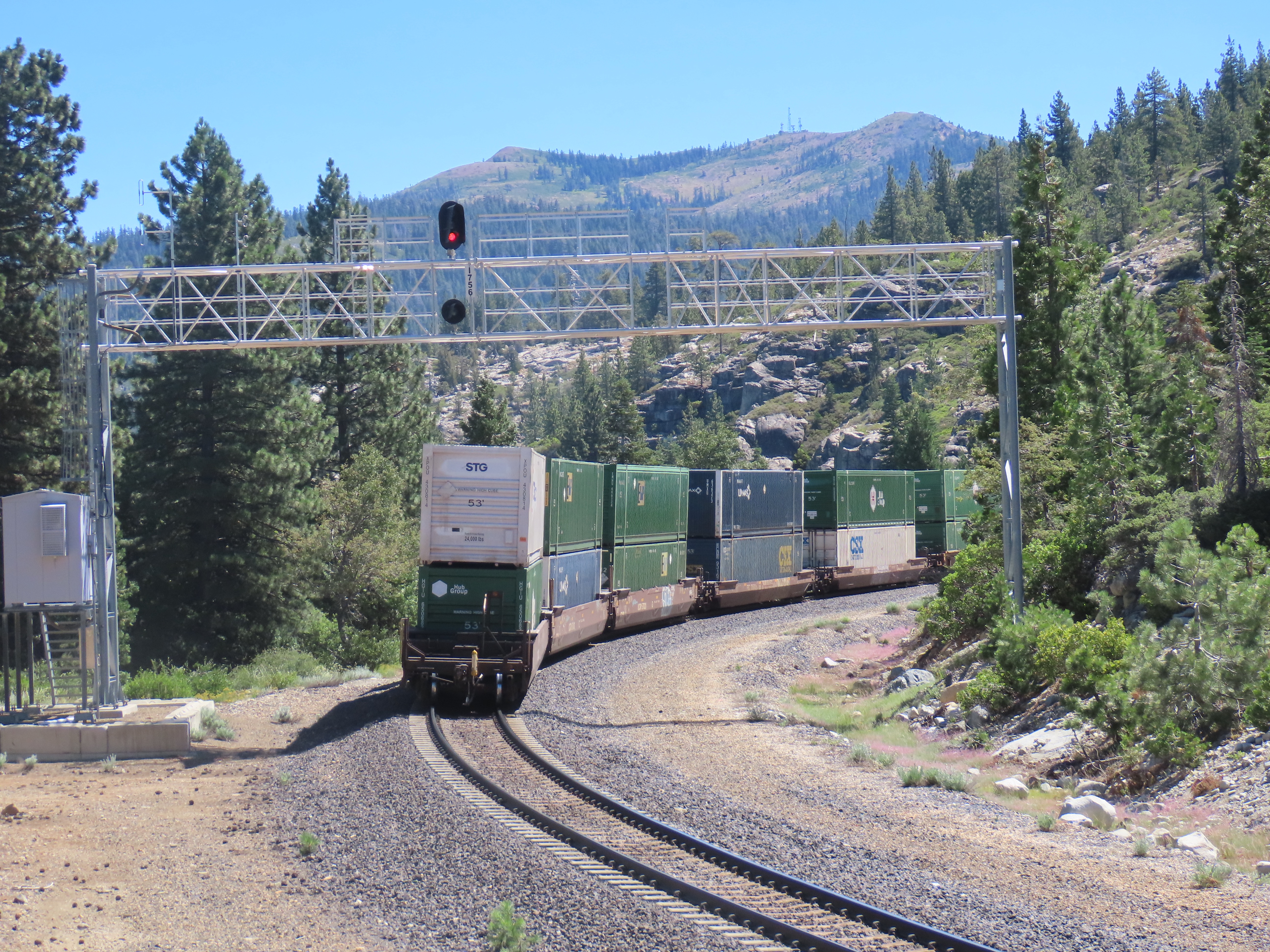
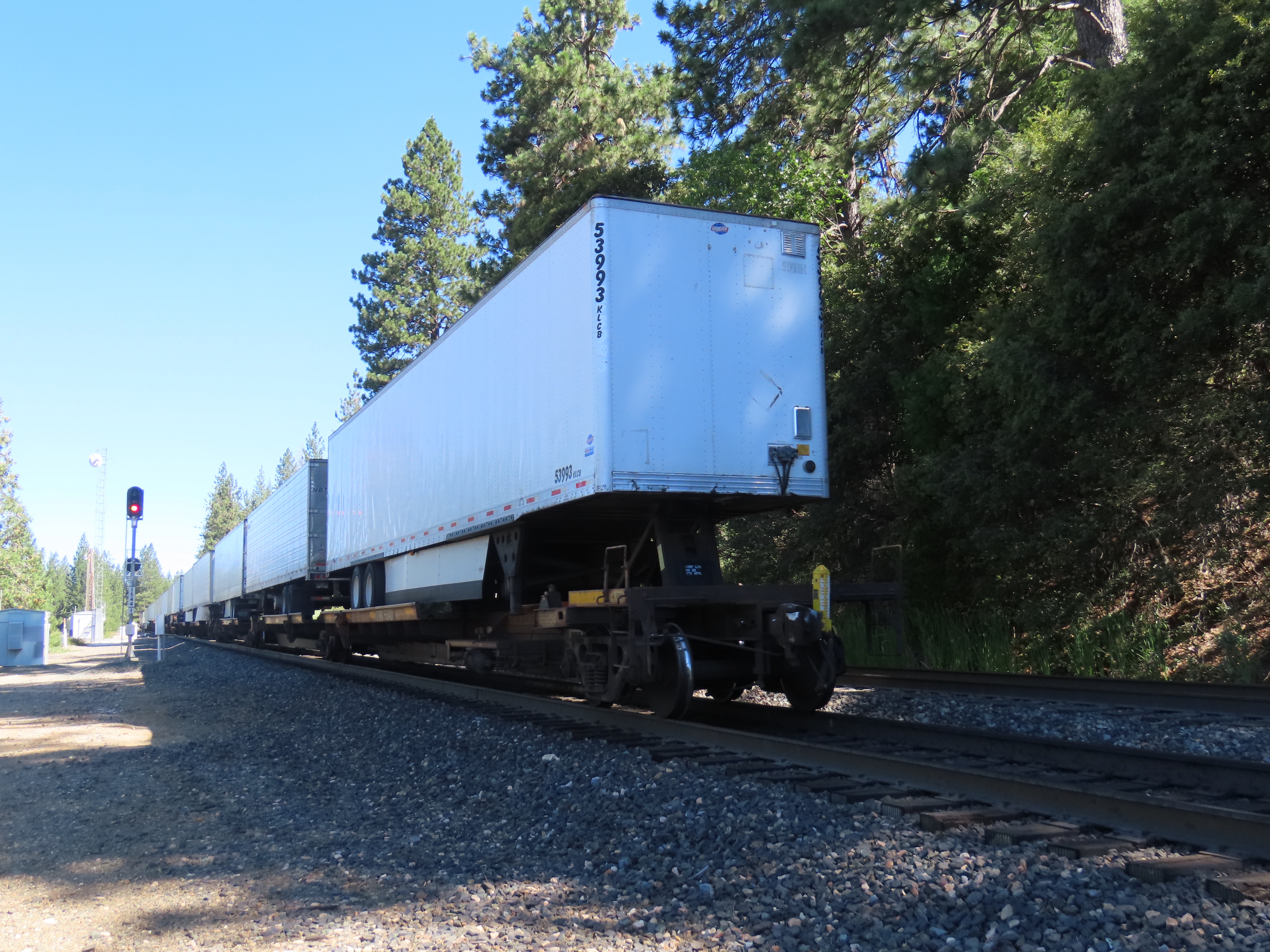
Three helpers to help push and pull the intermodal consist towards Donner Pass. The signal at Dutch Flat is now red, halting any train traffic that should come too close to the tail end of the train.The end of the train consisted of truck trailers on flatcars or piggybacks. This was the end of the train and there was no caboose. Cabooses have not been used on mainlines since the mid-1980s. They have been replaced by a small yellow box known as an End-of Train Device (ETD). This has reduced the crew of freight trains. Now the crew consists of just two people: an engineer and conductor.
Once the train passed I drove down the road into “downtown” Dutch Flat and headed back toward the highway. I came to a grade crossing where the last few cars where just passing. The arm rose and the race was on!
I hit the highway trying to outpace the freight train as well a finding a new point to see the train. I made it to my tried and true spot at Yuba Pass, where Highway 20 merges into 80. I knew I had not missed the train because the signal on the gantry above the rails was green. I must have made really good time because I had to wait almost 30 minutes before I heard the rumble of the diesels laboring on the hill. The intermodal passed and this time I got a wave from the conductor, seated on the left side of the cab. In the days of steam, this would have been the fireman’s position and the conductor would have been riding at the end of the train in a caboose.
The intermodal heading into Yuba Pass.
The average length of a freight train on a Class I railroad is about 5,400 feet. At Soda Springs I wanted to do a little experiment with the intermodal to see if I could come to an estimation on how many cars where in the consist. This started with timing the train from the grade crossing at Soda Springs. How long would the train take to pass a single point? The answer was four minutes and 54 seconds. That was almost a five minute wait for any motorist at the crossing!
Now for a little railroad mathematics. I estimated that it took about 2 seconds for one car to pass so I divided 294 seconds (5 minutes and 54 seconds) by 2 and got 147 train cars. I then subtracted the number of locomotives (7) and came to an estimation that this freight train consist consisted of 140 cars. An intermodal of this length takes a lot of trailer trucks off the roads. Just how many trucks?
I estimated that about 75% of the train consisted of double stacked Container on Flatcar (COFC) which is 105 cars and the remaining 35 cars were Trailer on Flatcar (TOFC). 2 times 105 is 210, add 210 to 35 and we get 245. So this intermodal freight train removes about 245 trailer trucks from Highway 80. Every motorist motoring to Lake Tahoe or Donner Lake should be thankful these Union Pacific freights that put in the hard work that make life a little easier.
The intermodal at the grade crossing at Soda Springs, almost at the top of it’s climb to Donner Summit.The train with it’s 140 cars, heading towards Donner Summit near Sugar Bowl Ski Resort.
Based on my field photos I was able to get the road numbers of all seven locomotives on the freight train. Using a Union Pacific roster I was able to identify the maker and model of each locomotive and it’s horsepower output. There where three EMD (Electro-Motive Diesel Inc.) and four GE (General Electric) locomotives. I put this information into a locomotive map showing the road number, model, maker, horsepower, and direction of travel for each locomotive. The total horsepower output for all seven locomotives was 30,200 hp.
I am a product of skiing. My parents met at the South Bay Ski Club and spent time at the club’s lodge on old Highway 40 in Soda Springs, California. They even honeymooned at another ski resort, Mammoth Mountain, although during the summer.
Highway 40 is historic and follows some of the path over Donner Summit the the ill-fated Donner Party traveled. It also parallels the original path of Central Pacific’s Transcontinental Railroad.
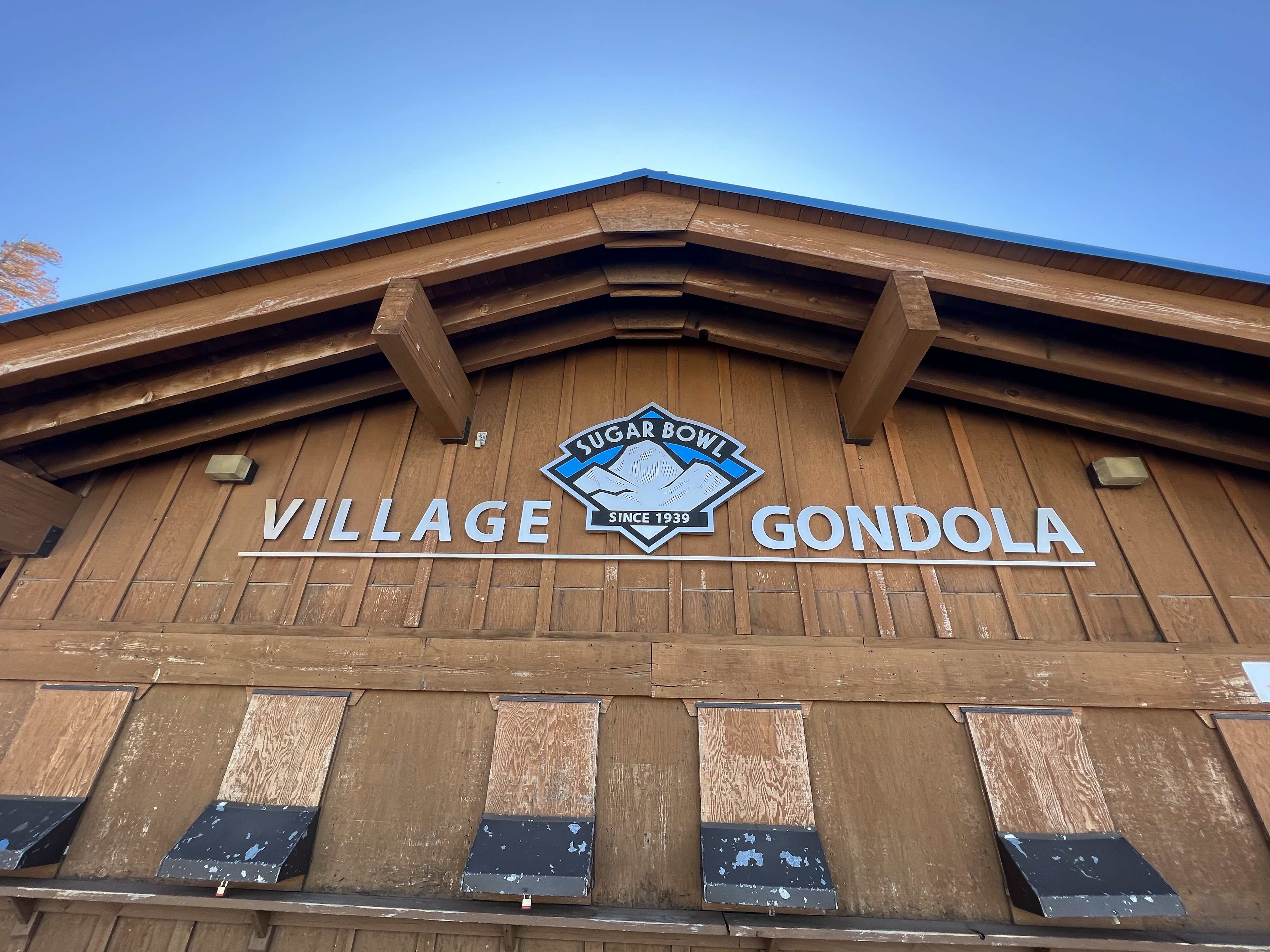
Just west of Donner Summit is a historic ski resort: Sugar Bowl. This resort was opened on December 15, 1939 and the single person chairlift was the first in the state of California and only the second in the nation. This is one of the oldest ski resorts in California (the first in the state in fact) and laid the blueprint for others that followed. It also was the first resort on the west coast to install a gondola, named the Magic Carpet.
The shed off of Highway 40 where the Magic Carpet gondola shuttles skiers to the Sugar Bowl Lodge. In the background are Mt. Lincoln (left) and Mt. Disney.
The ski area has made it onto the silver screen when in 1924, Charlie Chaplin filmed part of the Gold Rush on Mt. Lincoln, standing in as Alaska. When the film was released in 1925, it was the highest grossing silent comedy of the year.
Much has changed at Sugar Bowl since the days when I skied there as a child. Judah Lodge was built as the main lodge for the resort making the gondola an afterthought.
On a recent jaunt to Donner Pass I pulled into the the Gondola parking lot and looked out at the resort with Mt. Lincoln and Mt. Disney in front of me. I sketched the view in my panoramic sketchbook with my brush pen. In early June, the resort was closed for the season after the record snows of the winter of 2023.
The Donner Summit area and this stretch of Highway 40 has a deep meaning in my life. My parents met here and later our family spent time together here. It is a location of deep history from the Native Californians, the immigrant trail to the Donner Party to the Transcendental Railroad and to birth of California’s winter recreation at Sugar Bowl.
Southern Pacific’s signature, and most iconic locomotive was the 256 AC (Numbers 4000 to 4294) cab forward locomotives.
These were some of the largest and most unique locomotives in the United States. The AC-12 class is less than ten feet shorter than the largest steam locomotives ever built: Union Pacific’s “Big Boy”. The AC-12 locomotive and tender weighed more than a Boeing 747 and an Airbus A380, combined.
The reason the cab forwards were unique is that, as the name implies, the crew cab was in the front of the locomotive, like a modern diesel-electric locomotive, instead of the cab being in back, near the tender.
Having the cab in front gave the engineer and fireman unequalled views of the track ahead. But the real reason for the innovations was to conquers the steep grades of Sacramento’s Mountain Subdivision over the Donner Pass. This massive locomotives operated between Roseville, Ca and Sparks, Nv where a powerful locomotive was needed to tackle the steep grades and have the tractive effort to haul long freight trains over the Sierra Nevada Mountains. A locomotive of this size emits of lots of steam exhaust because a 4-8-8-2 was essentially two locomotives in one.
The Donner Pass route had 40 miles of snow sheds and 39 tunnels. This meant that in a standard locomotive, the crew could suffer from asphyxiation from the steam exhaust. By putting the cab forward, the exhaust stack was behind the crew and they avoided the caustic smoke, steam, and heat that these powerful locomotives emitted.
The cab forward proved to be a very successful locomotive for SP, with 256 of these engines used on it’s rail over the period of 50 years. The railroad had the largest fleet of articulated “Malleys” in the world. As a comparison, Union Pacific fleet contained 25 Big Boy locomotives.
In the 1950s, as diesel replaced steam, cab forwards spend the rest of there working life away from the mountains on the Coast Line and the Western Division. One of the last places cab forwards worked on Southern Pacific rail was the Cal-P line between Oakland and Roseville. 1958 was the last year a cab forward rode the rails, nine of these locomotives were taken out of service on September 24, 1958.
Out of the 256 cab forwards that were built, only one survives. The AC-12 number 4294 which is also the last steam locomotive that Southern Pacific ever purchased. 4294 was in service on March 19, 1944 and was taken off the the roster on March 5, 1956. She was only in service for 12 years.
While the other cab forwards were scrapped, 4294 was put in storage and then was put on static display on October 19, 1958, in front of the Sacramento train station. When the California State Rail Road Museum was opened, 4294 became the centerpiece amongst it’s collection of locomotives and rolling stock.
I was at the museum with my father in 1981 for the official opening of the museum. SouthernPacific’s GS-4 4449 and Union Pacific’s 844 (then numbered 8444) where in attendance and I will never forget when the two locomotive stood, pilot to pilot, on the track outside of the museum!
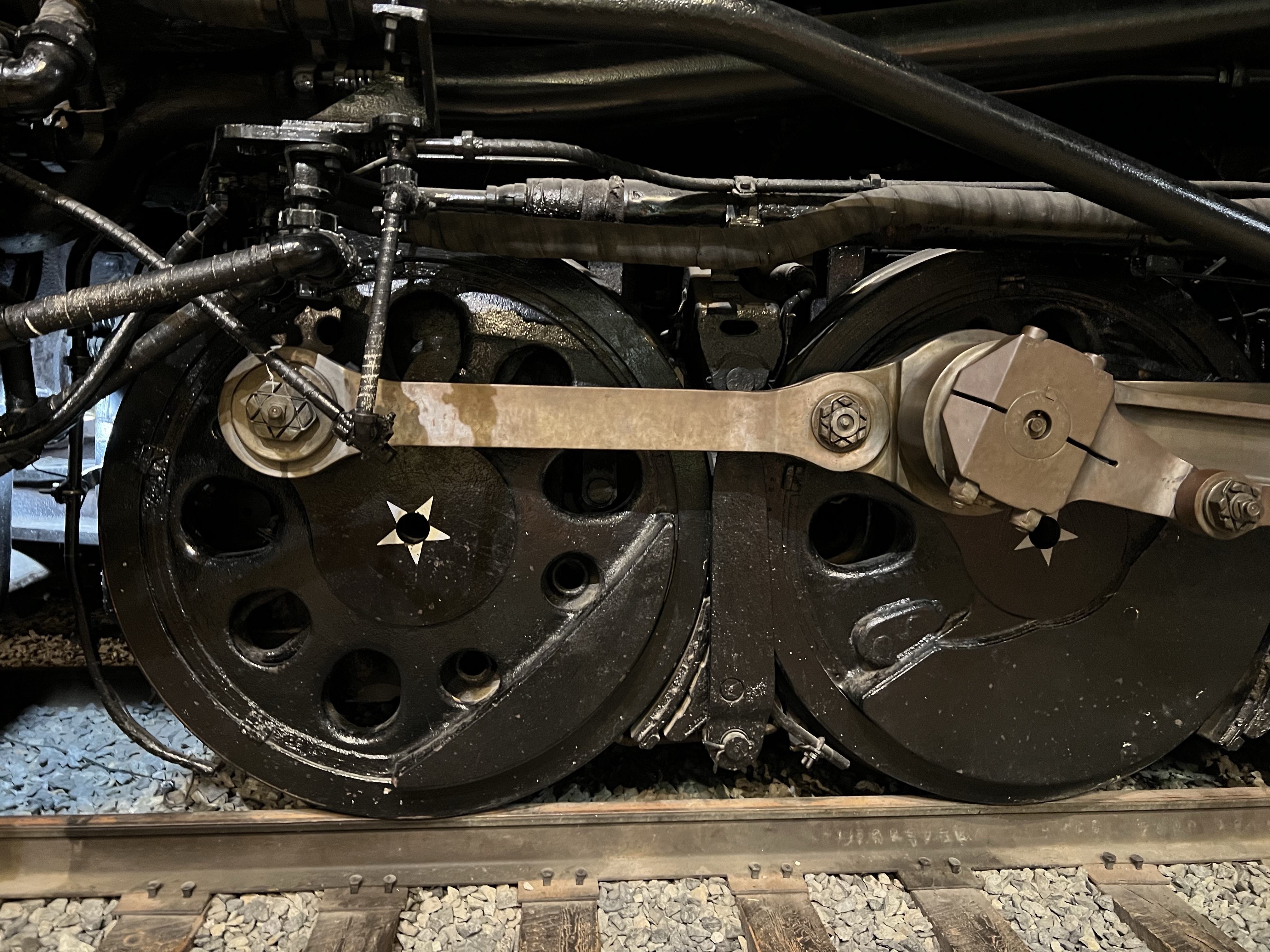
The massive running gear of the AC-12, Cab Forward. 4294 is the only surviving example of this locomotive.
The last time I have visited the museum was in November of 2017 where I did an aborted field sketch of the cab forward. There was something about the proportions of the locomotive that I did not get right. I had planned to return to the California State Rail Museum in the early Spring of 2020 but the cases of Covid-19 were growing at an alarming rate in the state and the museum eventually closed it’s doors for an indeterminate time.
So if I could not sketch the AC-12, at least I could sketch it from an image, which really is the next best thing.
Work on the railroad does to stop for weekends or holidays. And it certainly does not stop for inclement weather.
Some of the deepest snow can be found on the western slope of the Sierra Nevada Mountains and at the summit of Donner Pass. This was the same pass that turned away members of the doomed Donner Party in the Winter of 1846. This pass would not defeat the Southern Pacific Railroad from crossing the pass.
To keep the pass open the railroad, when spreaders and flangers failed, SP used their most powerful snow fighting weapon, the rotary snowplow.
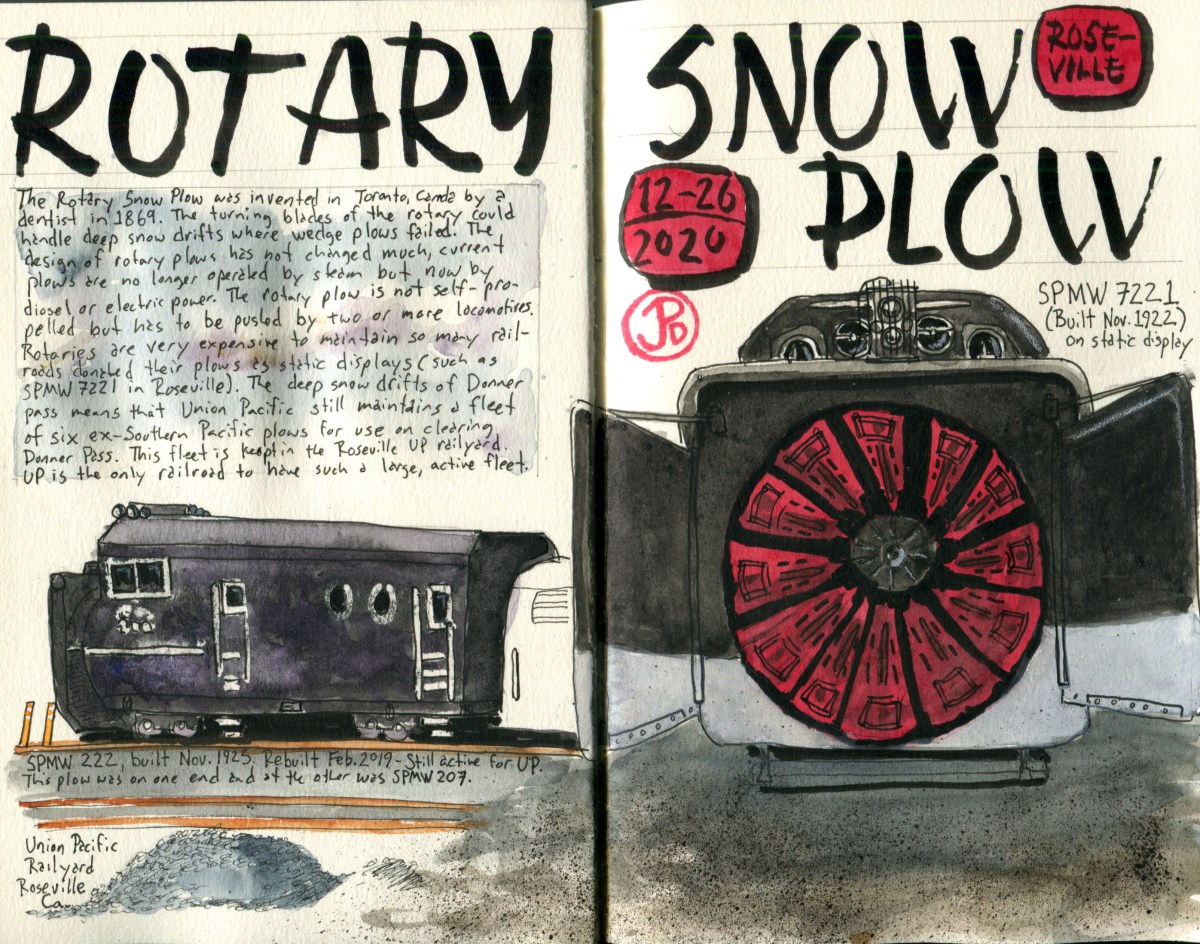
The rotary plow was invented by a dentist in Toronto, Canada in 1869. The plow consists of a circular sent of blades that spins. The rotary plow is not self-propelled but is pushed by a locomotive or most likely locomotives. As the spinning blade cuts through the snow drift, the engineer can control which side of the track the chute, behind the blade assembly, throws the snow. Left or right.
Not much has changed with the design of rotary plows save for powering the prime mover. All early rotaries where powered by steam but they were later converted to diesel or electric power. In fact, most of the current fleet of rotary plows, used by Union Pacific, where built in the 1920s or 30s although they have been retrofitted and rebuilt since then.
The current rotaries still use a steam generator to help prevent some of the moving parts from icing up and seizing.
Most railroads use flanger or spreader plows but these plows meet their match when trying to push heavy snow from tracks. This is where the rotary plow has the distinct advantage. It does not need to be pushed by force, instead the rotating blades cut through snow like a hot knife through butter. And the rotary can throw snow away from the track.
The downside to rotary plows is that they are expensive to maintain. And depending on snowfall, the plows may not be put into service every snow season. It may be even ten years before the rotary is called into action. The plows are also labor intensive to operate with an average crew size of 12. The standard consist of a Southern Pacific rotary train would consist of two rotary plows (one on each each so they can remove snow in both directions), a B Unit for each rotary to supply electrical power and air pressure, and two or three locomotives.
As a result, most railroads have gotten rid of their rotaries and many have been donated to serve as static displays. Three former Southern Pacific plows are on display. One in Roseville, Truckee, and Sacramento, at the California Railroad Museum.
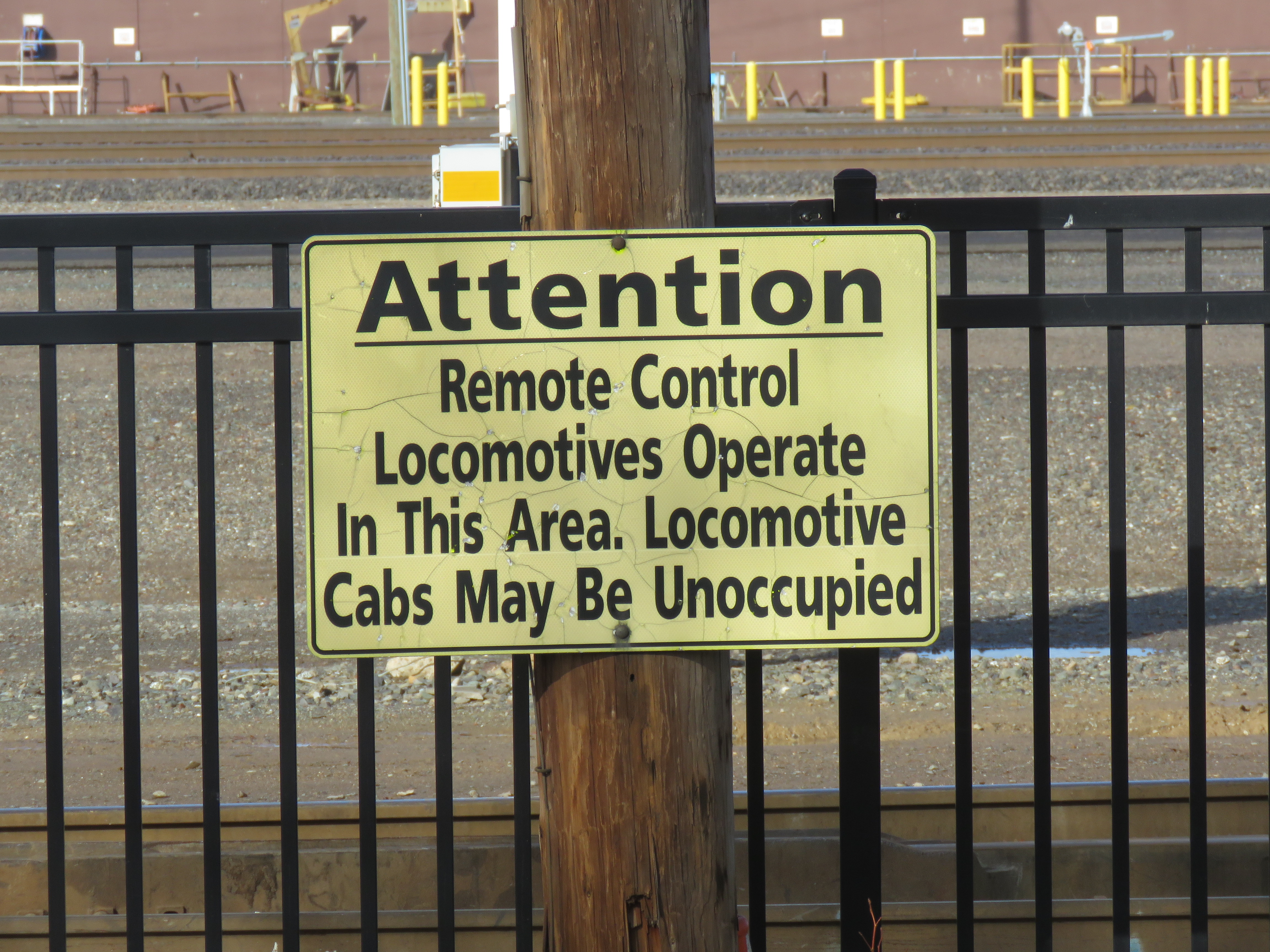
A very interesting sign at the Union Pacific (formerly Southern Pacific) rail yard in Roseville. I wonder if before this sign was installed, the Roseville Police got many calls about runaway locomotives!
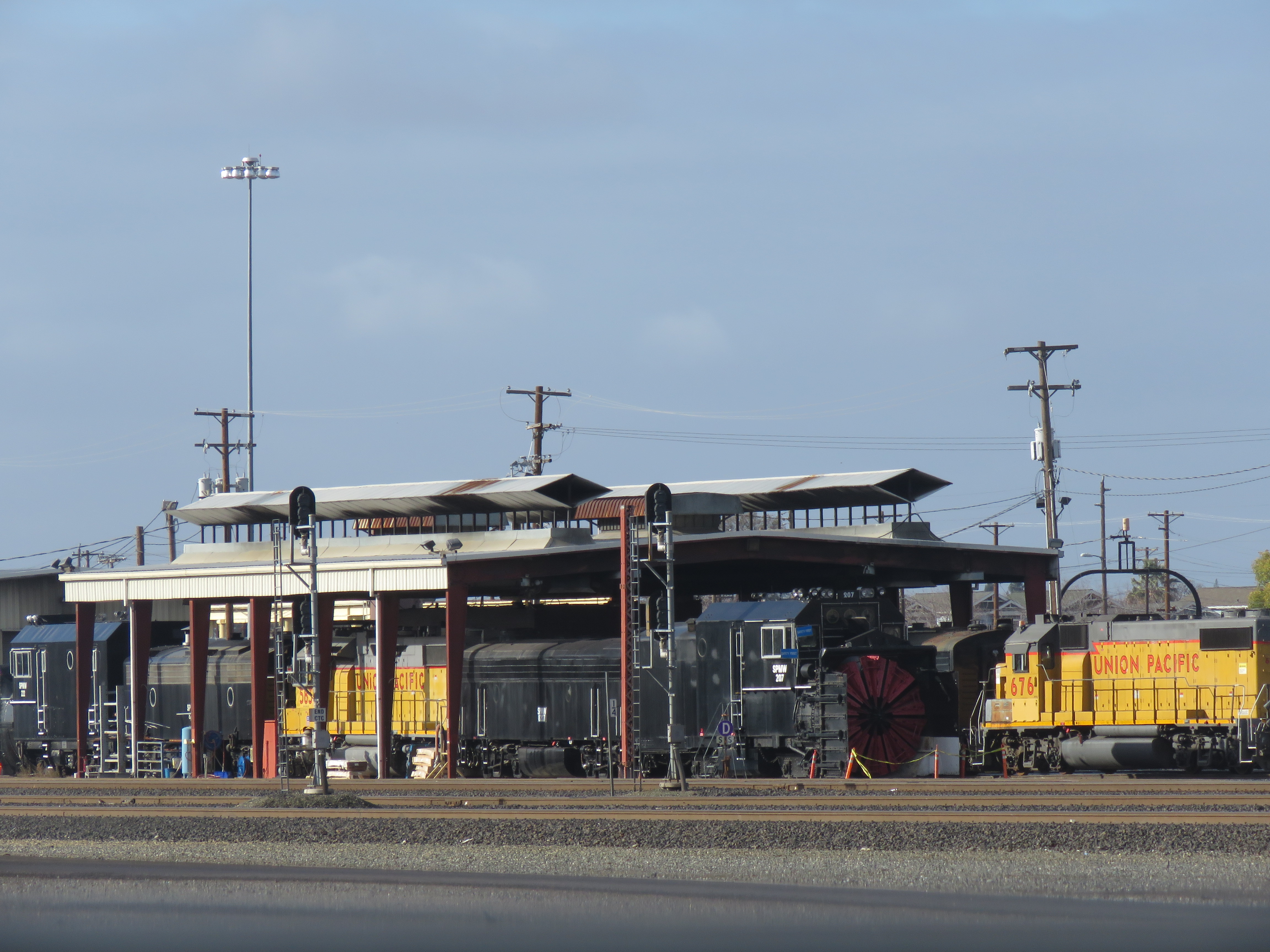
What’s interesting about the rotary plow on static display at Roseville (SPMW 7221) is that it is near the tracks at the Union Pacific rail yard. The rotary was donated to the City of Roseville by Union Pacific in 2014. This is fitting because Roseville is where Union Pacific’s rotary plow fleet is based. As I looked down the tracks toward the rail yard, I noticed, on the far side where two rotaries.
Roseville has been a major division point on the Southern Pacific railroad. At it’s height, during the age of stream, the Roseville yard contained two roundhouses. Roundhouse No. 1 was a 32-stall roundhouse and Roundhouse No. 2 was specially built to house the larger Mallets (4-8-8-2) know as cab forwards. The turntable was large enough to turn these massive locomotives. These locomotive were reversed so the crew rode in the front and the exhaust behind them. This was to avoid asphyxiation in the long snow sheds over Donner Summit.
Union Pacific is one of the few Class I railroads that keeps a rotary fleet and they have the biggest fleet in America with six plows.
Two of Union Pacific’s six active rotary snowplows SPMW # 222 and 207.
The winter of 2017 was the third snowiest winter in recorded history on Donner Pass. The Union Pacific rotaries where put into use to clear the 13 feet deep snow to keep the line open between Roseville and Truckee.
Here is footage of rotaries at work at Donner Pass in February 2017. Credit to Jake Miille Photography.
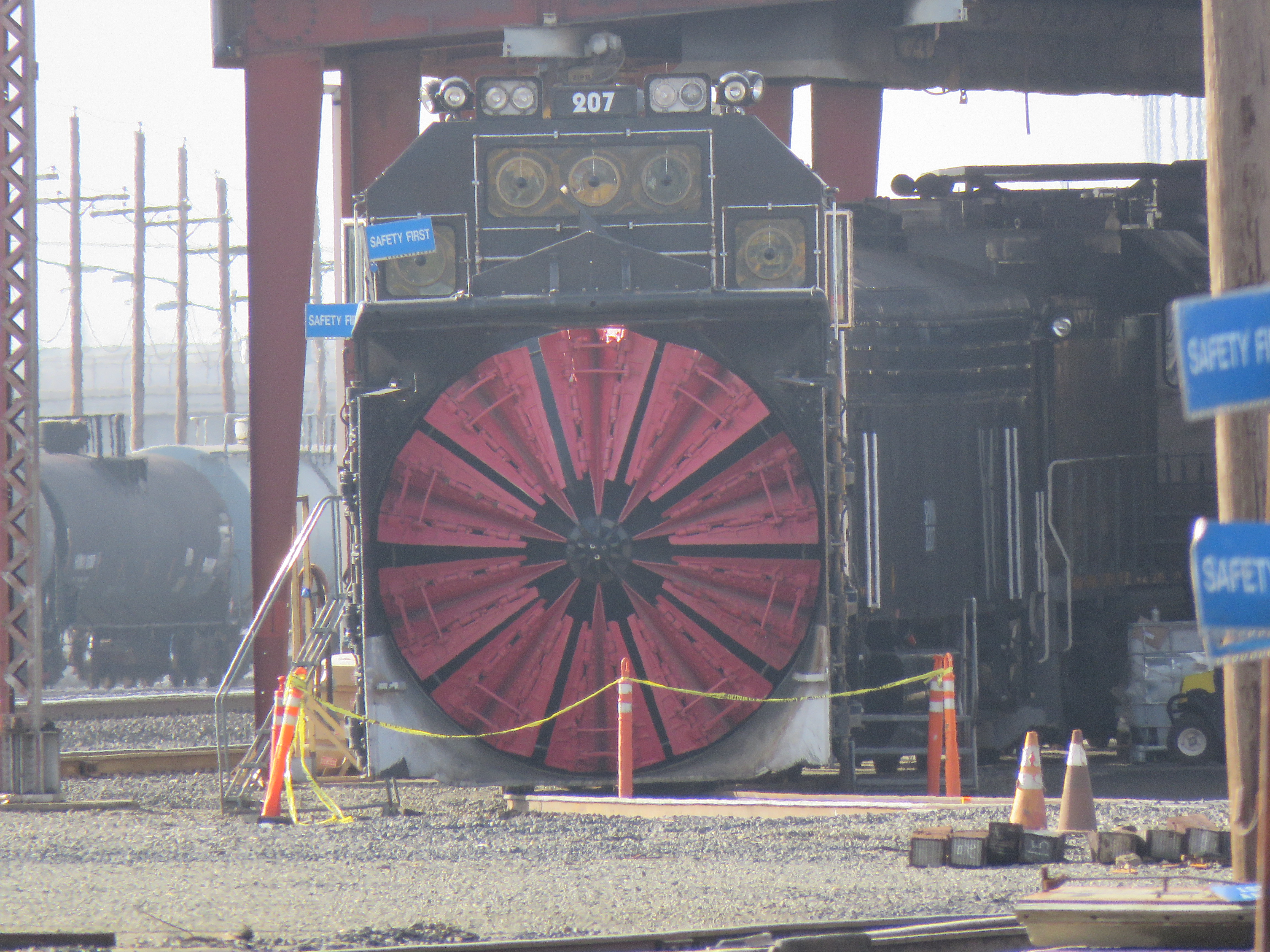
Head on view of SPMW 207 at the Roseville rail yard. This provides a view of the circular, rotating blade that cuts through snow. Number 207 awaits the call to head up towards Donner Pass to clear the line of snow. Number 207 was built in 1926 and has since been upgraded. The “SPMW” stands for “South Pacific Maintenance of Way”.
It was long after dark when we got to Johnson’s Ranch, so the first time I saw it was early in the morning. The weather was fine, the ground was covered with green grass, the birds were singing from the tops of trees, and the journey was over. I could scarcely believe that I was alive.
The scene I saw that morning seems to be photographed on my mind. Most of the incidents are gone from memory, but I can always see the camp near Johnson’s Ranch.
~John Breen, April 24, 1847
John Breen wrote this letter once he had crossed the Sierra Nevada Mountains into the foothills of California as a member of the emigrant group now known as the Donner Party.
Out of the 87 members of this doomed party only 48 survived. Most of the 48 survivors where women and children. Breen and his family were lucky. All of their family members survived.
It is unclear where Breen wrote this well known letter but is was either at Sutter’s Fort (in present day Sacramento) or at Johnson’s Ranch (near Wheatland).
Johnson’s Ranch was the first settlement the emigrants encounter once they entered California on the California Trail. They often paused here after the grueling passage over Donner Summit before heading down to Sutter’s Fort in present day Sacramento. They would camp near the banks of the Bear River.
Once the Breens came into California at Johnson’s Ranch and then Sutter’s Fort, they relocated to the mission town of San Juan Bautista.
Johnson’s Ranch was a Mexican Land Grant that eventually ended up in the hands of Willian Johnson. In 1846 be built a humble adobe house that became known as Johnson’s Rancho.
During the winter of 1847, the seven surviving members of the Forlorn Hope staggered into Johnson’s Ranch. They were a party that set out from Truckee Lake in order to get help for the ill fated Donner Party. The party got lost and of the 17, only seven made it to the ranch. The survivors that made it to included it’s leader William Eddy, and sisters Sarah Fosdick, and Mary Ann Graves.
All of the relief parties that took the remaining survivors from the Lake and Alder Creek Camps back into California, staged and departed from Johnson’s Ranch.
Today the town of Wheatland is near the location of the ranch. Nothing remains of the original ranch. Just California Registered Historical Landmark No. 493. The plaque sits in the town’s park near the railroad tracks. It reads:
The first settlement reached in California by emigrant trains using the Emigrant (‘Donner’) Trail, this was an original part of the 1844 Don Pablo Gutiérrez land grant. It was sold at auction to William Johnson in 1845, and in 1849 part of the ranch was set aside as a government reserve-Camp Far West. In 1866, the town of Wheatland was laid out on a portion of the grant.







 Corvid Sketcher