Image

Kona Pelagic

I was happy to see that a pelagic birding trip was scheduled while I was on the Big Island. It is an excellent opportunity to add some wanted lifers that I would not be able to see with feet firmly planted on solid ground.

We boarded a fishing boat in the wee hours at Honokohau Harbor. While Captain Brian was going over safety, I saw a bird that was flying over from the north: white-faced ibis! This is a rare bird in Hawaii and a good omen for the pelagic.

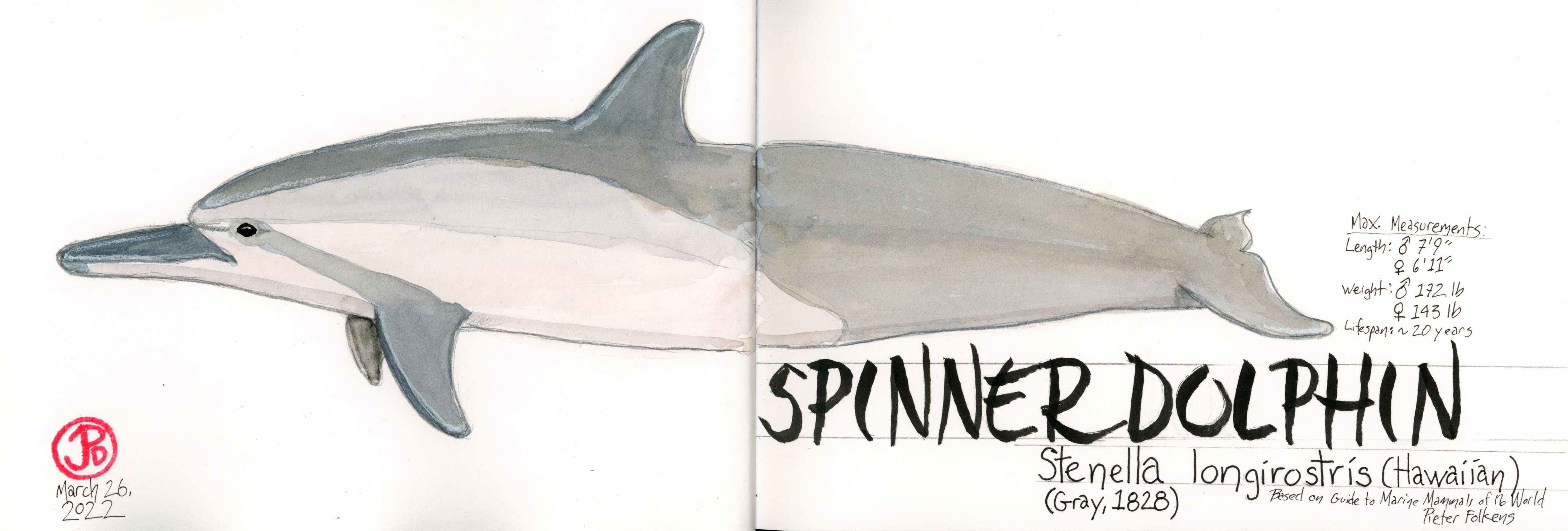
We headed out into the waters west of the Big Island. Looking off to the northwest looked to be another part of the Big Island but in reality was the island of Maui. To our south, fishing boats where headed off in parallel paths to the big fish fishing grounds. Five minutes out of the harbor we saw our first marine mammal, spinner dolphins.
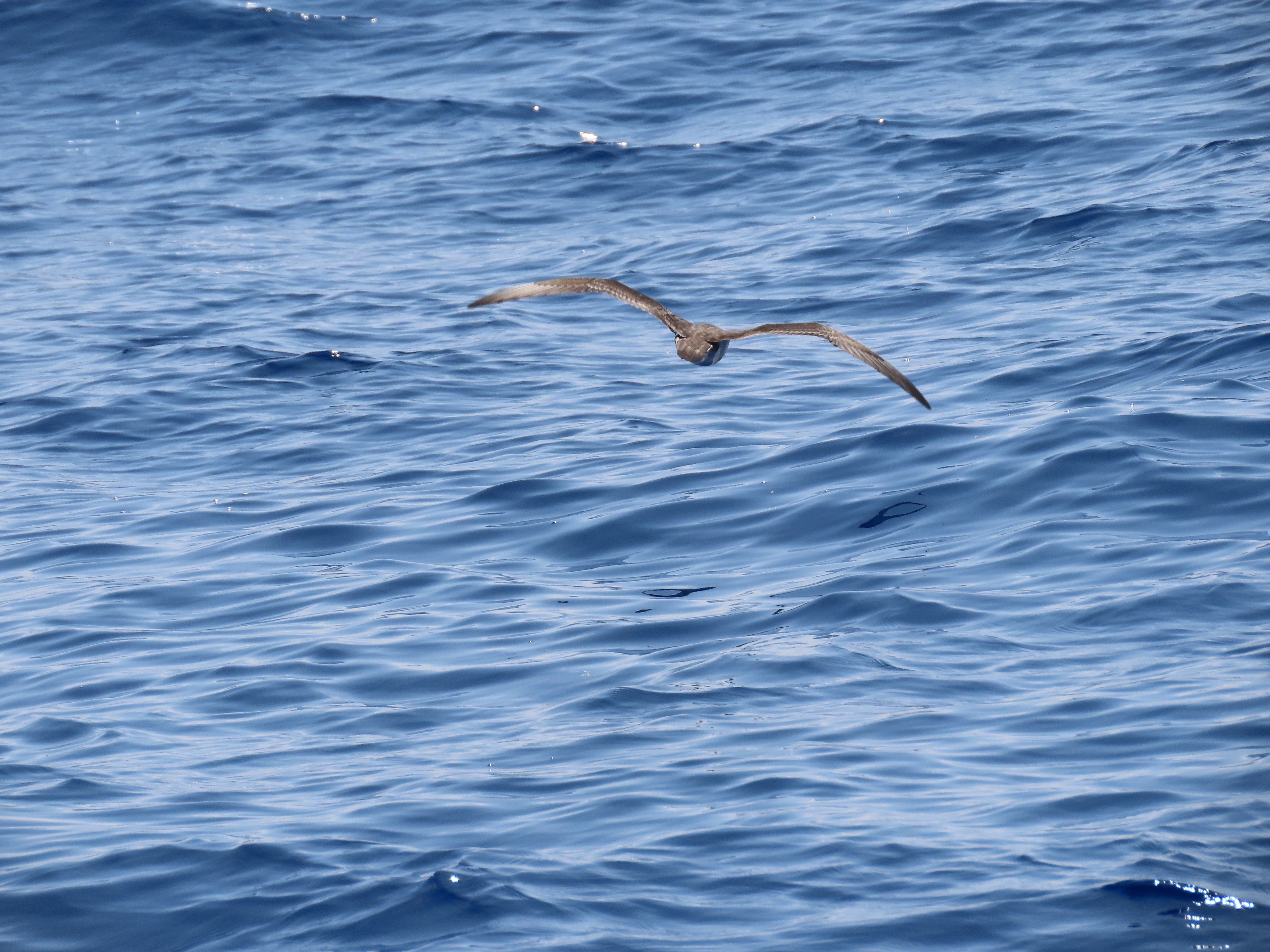
Our first pelagic bird was a brown booby and then we where seeing a smattering of wedge-tailed shearwaters, the most common shearwater in these waters (lifer!). Within the mix of shearwaters were sooty shearwaters, the most common shearwater off of the west coast of California.

Just after 8:00 AM the bird activity started to pick up with the rare (for these waters) Juan Fernandez petrel. Our guide Lance, pointed it out as it crossed our bow heading to the starboard. This was a new bird for me and it was followed by other lifers: Bulwer’s petrel and sooty tern.

Off to the starboard, Lance called out a much desired tern for this trip: white tern (this bird is also known as common fairy-tern and white noddy). The white tern can be easily seen in Honolulu parks, where it nests in trees, laying a single egg right on a flat, horizontal branch.

A little further south and we can upon a Hawaiian petrel, resting on the water! This was later followed by a mottled petrel, both were lifers for me. I was slowly coming to a birding milestone: 1,700 world species seen. If my math was correct, which is always in doubt, I was one bird away from 1,700! I wondered what it would be and if it would even be on this pelagic.
We got great looks at the Hawaiian petrel before it flew off.

I looked up to the bridge where Captain Brian was blasting reggae. I asked Brian, “How’s the view up there?” His response surprised me, “Come on up and have a look!” Now being invited to the bridge simply does not happen on California pelagic trips. Things are just a little more looser or friendlier or both here on the islands. I climbed up and while it was much more pitchy up here (luckily I never get seasick) the view was incredible.
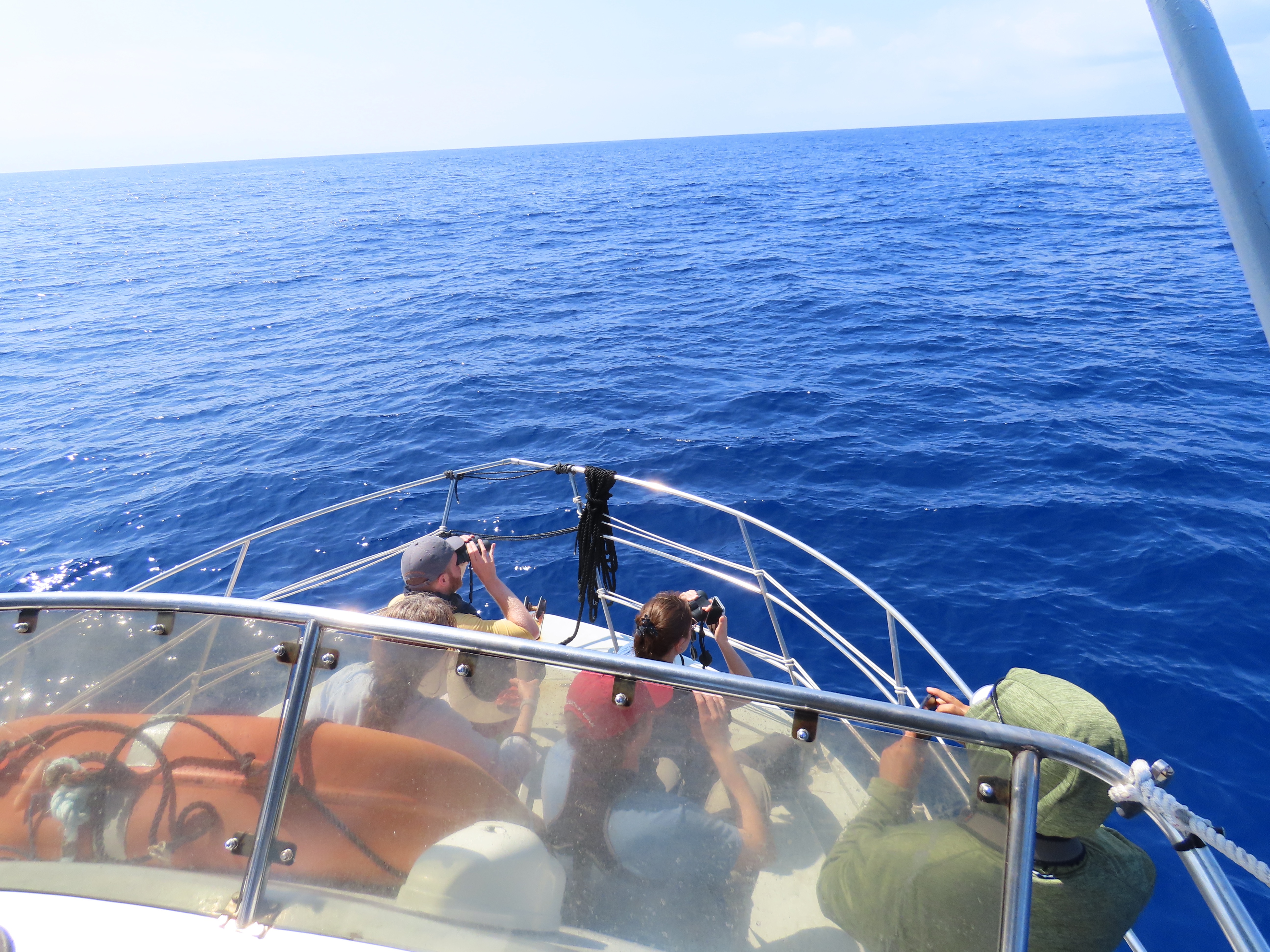
The view from the bridge was outstanding!

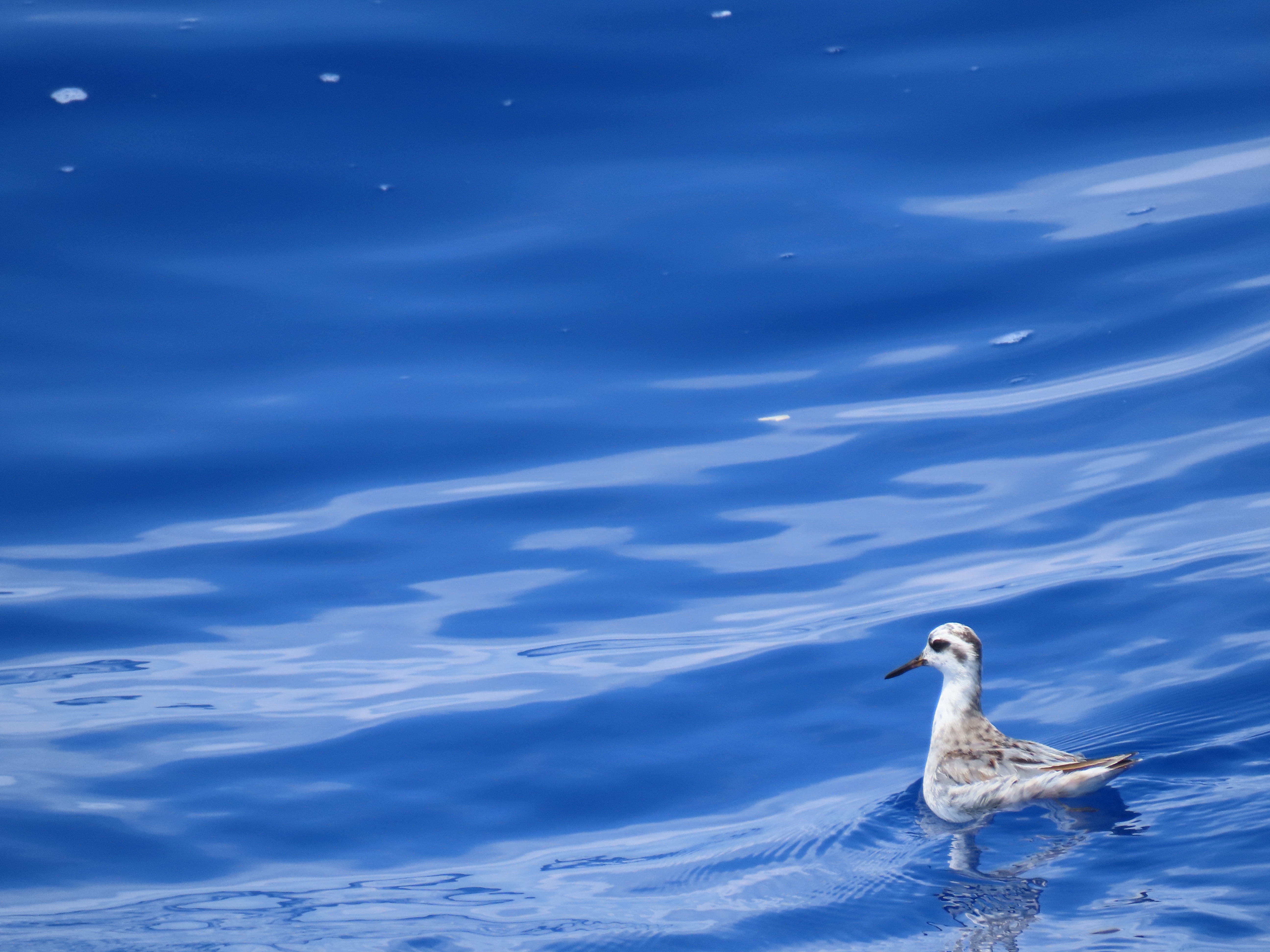
Shortly afterward we spotted a tiny bird on the water. It was like an old friend because red phalaropes are frequently seen on Californian pelagic trips.
A short time later I spotted a tropicbird flying towards our position and something looked at little different, the bird was awfully white. I called out, “Red-tailed tropicbird!” Lance got bins on the bird and confirmed it. And just like that, red-tailed tropicbird became my 1,700th species seen on planet Earth! I celebrated with a high-five from Captain Brian!

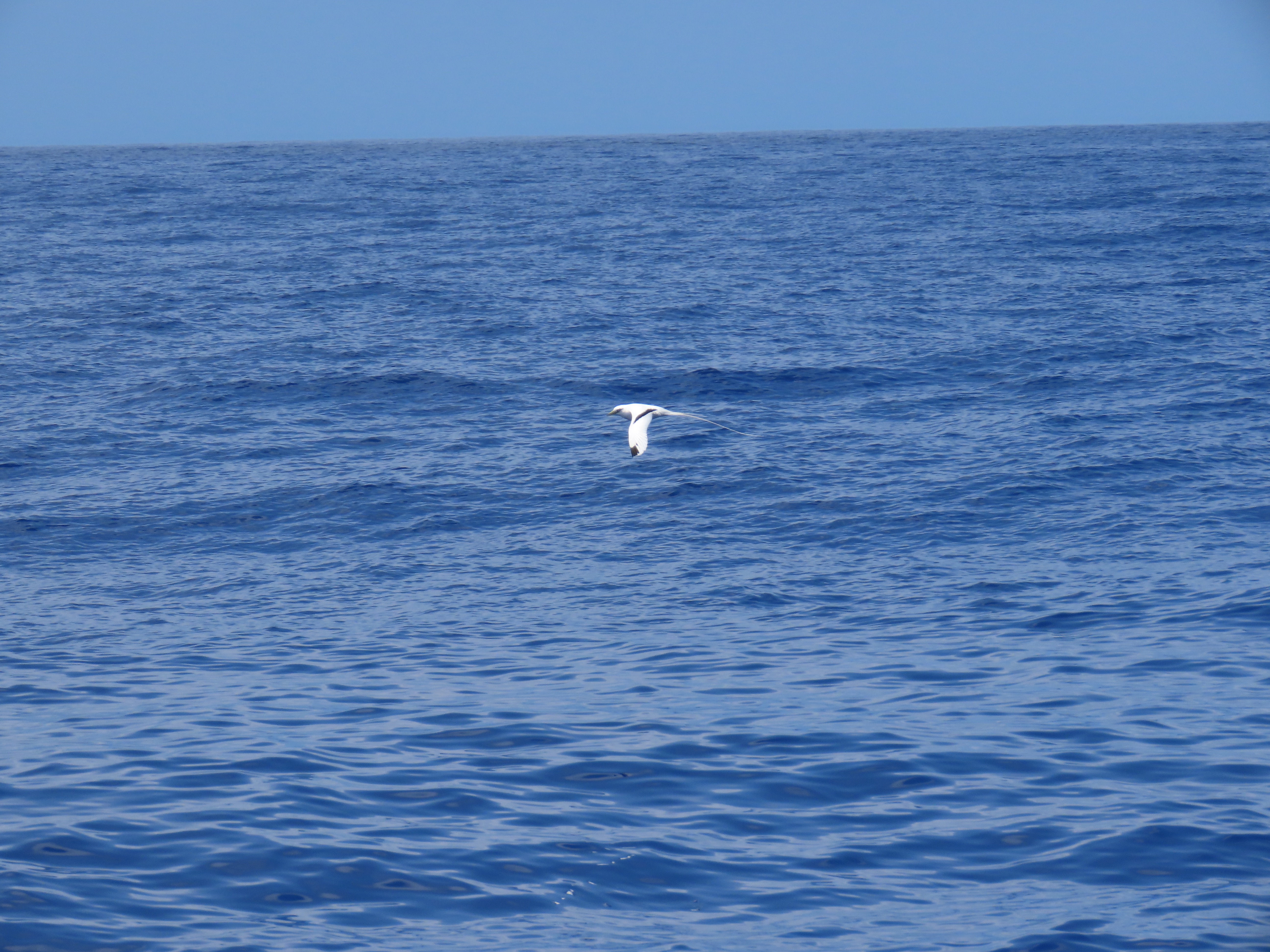
How did I identify a tropicbird I have never seen before? I did my homework. This pre-trip spread compared the three species and red-tailed really stood how with is’s all-white dorsal side. It also helps that is has a bright red streamer flying behind!
This is a white-tailed tropicbird seen on the pelagic. Note the black on the wings and the white tail.

One of the things I like about pelagic birding trips is that it’s not just about birds. Birders tend to appreciate all nature and so most boats will stop to look at marine mammals. In California I have seen different species of dolphin and porpoise and humpbacked, gray, and blue whales. The only marine mammal we had seen on this Kona pelagic were the spinner dolphins, just outside the harbor. But I didn’t think we would see a shark! In this case a hammerhead!
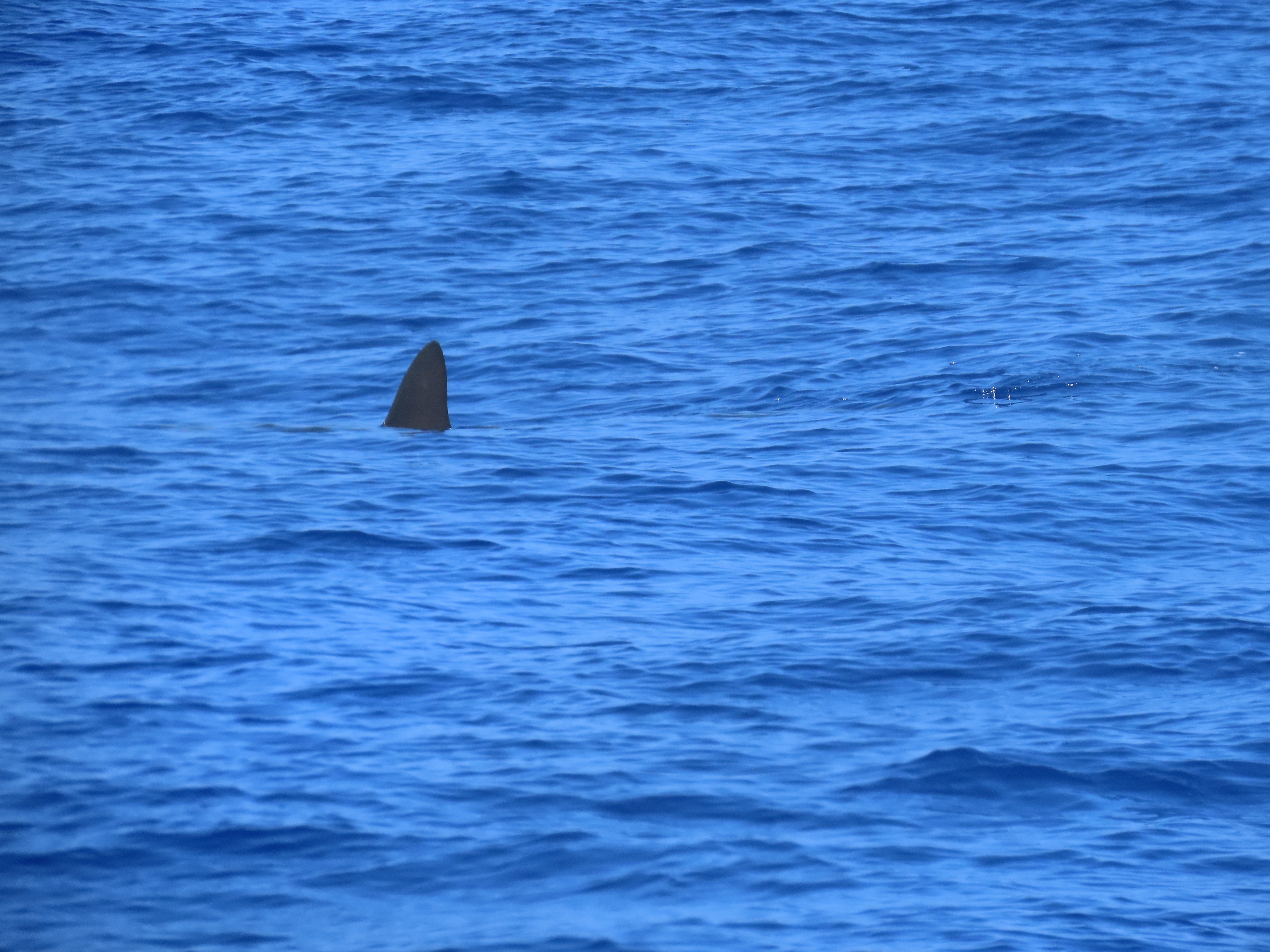
The menacing dorsal fin of a hammerhead shark.

This pelagic was an amazing experience and I saw many birds (eight of them lifers), some dolphins, and a shark.

I can’t image coming to the islands and not taking in it’s incredible flora and fauna.

Why sit by a swimming pool when you have the Pacific Ocean?

Note: Much thanks to our pelagic birding guide, Lance Tanino. If you are in need of a birding guide on the Big Island, I would highly recommend Lance. He really knows his Hawaiian birds and he knows where to find them! Check out his website at: www. hawaiibirdingguide.com.

Image

The Place of Refuge

For me, the Big Island is not all about laying by a pool, sipping Mai Tai’s, or 100% Kona coffee, and listening to Martin Denny.

I wanted to get to know about Hawaiian culture, pre Captain Cook. What was life like on the Big Island before it was the “Big Island”?

Probably the best place on the Big Island, or perhaps any island, to learn about this past is Pu’uhonua O Honaunau National Historic Park, The Place of Refuge.

The Place of Refuge is south of Kealakekua Bay. I arrived when the park opened at 8:30 and almost had the place to myself.

Pu’uhonua O Honaunau has a feeling of peace and power and deep spirituality. This has been regarded as an important center by native Hawaiians for centuries.

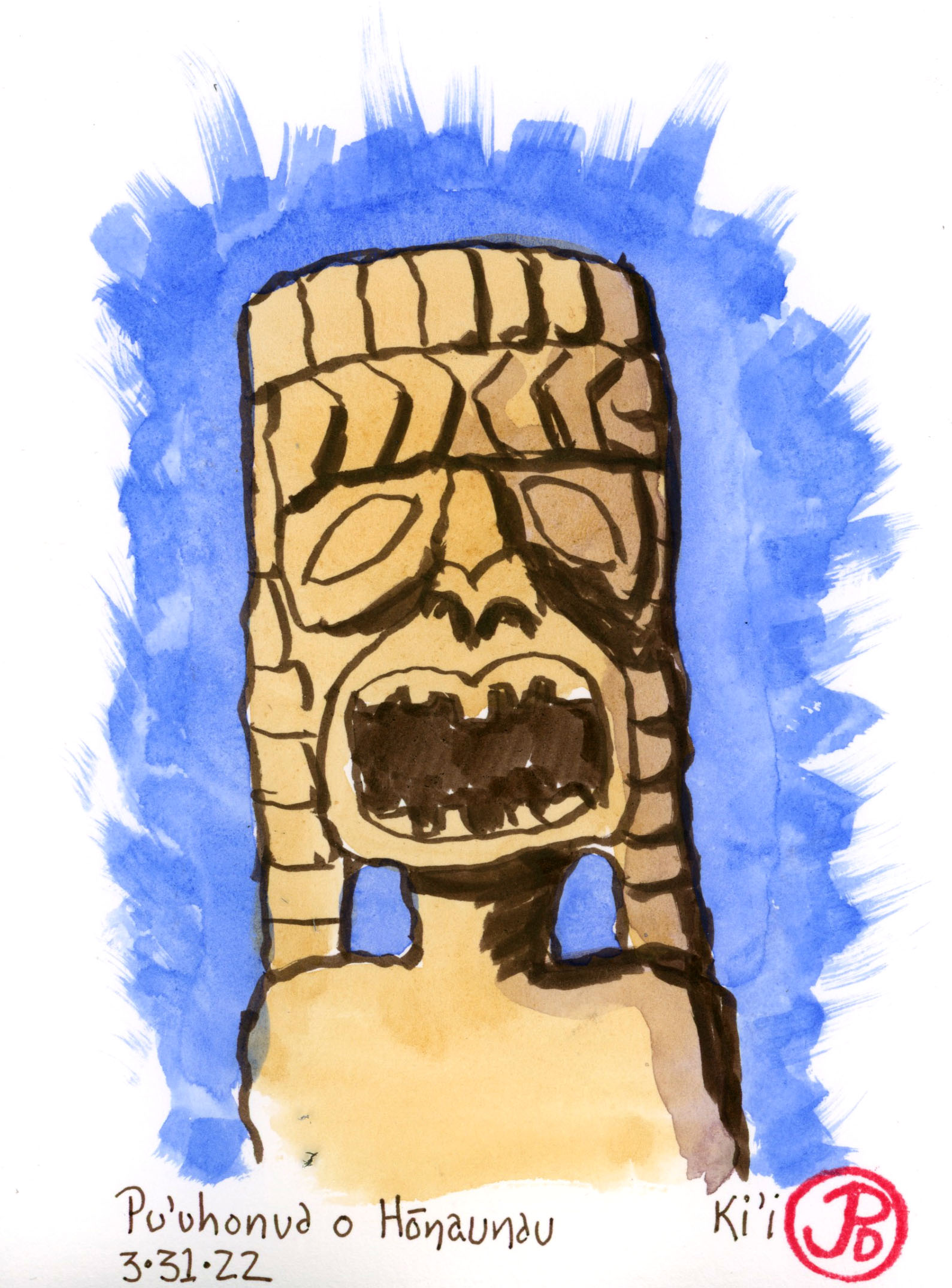
A brush pen field sketch of a Ki’i of a Hawaiian god.

In ancient Hawaii, the kapu system (taboo laws) governed the lives and behaviors of the common people. There where many ways to break a kapu law, for instance, men eating with woman, your shadow (or footsteps) crossing that of a chief, or hunting or fishing out of season and many, many more. The nobility believed that if a taboo law was broken that it would incur the wraith of the gods and as a result cause volcanic eruptions, tsunamis, earthquakes, or lava flows. So the punishment for for breaking kapu was severe: death.

But there was a catch. If you could get to a Honaunau or Place of Refuge, before getting caught, you would be given amnesty, be blessed by a priest, and then be sent home on your way. But first you had to get there, either by running or swimming or both!

Pu’uhonua O Honaunau is such a Place of Refuge and parts of it are well preserved. This was a refuge for many centuries until kapu laws were repealed in 1819 by King Kamehameha II.

The heiau or temple was built about 1650. And it housed the bones of 33 chiefs.

Probably two of the most photographed Ki’i or Tiki statues on the Hawaiian Islands. These two guardians represent Hawaiian gods. These carvings are so much better and more detailed than the Tiki statue at Kona Kai Swim and Racquet Club of my youth.

I wandered round the park and then found a place in the shade, across Keone’ele Cove to sketch the panorama that included the Royal Grounds, Great Wall, Hale o Keawe, palm trees, and carved Ki’is (featured sketch). This was a wonderful meditation as sketching in the field almost always is. I paused at times as people snorkeled in the cove from the snorkel hotspot known as “Two Step”. I also watched a Pacific golden-plover forage on the reef, along with the introduced yellow-billed cardinal. The sketch I made in the shade is the featured sketch.

Bonus fact: This historic park is one of the few places in Hawaii where the Hawaiian flag can fly alone without the US flag.

The Great Wall was constructed over 400 years ago and is 950 feet long and 12 feet high.
Image

Mauna Loa, the Long Mountain

I look forward to seeing and sketching the world’s largest volcano on the planet earth, Mauna Loa, the Long Mountain.

The volcano is so big, and such a major part of the island of Hawaii, that is tough to get a firm perspective of the mountain, so I was going to have to get a little creative with my viewpoints on how to capture the mountain in sketch.

I before I stand before the mighty mountain, pencil and sketchbook in hand, I wanted to do a pre trip sketch to help put the scale of Mauna Loa into perspective.

A volcano I had visited in recent memory was Mount Lassen. This was a volcano that had erupted sometime ago (in May of 1917) but it was clear to see in quite easy to sketch. I was looking forward to comparing both of these volcanoes and how they were alike and different.

A brush pen sketch of Lassen Peak from October 2020.
A spread on the different types of volcanoes at Lassen National Park. Mauna Loa is a shield volcano, which is a volcano that is a broad dome with gentle slopes extending to the ocean floor.

For my spread about Mauna Loa, I based of my sketch on part of a map I picked up at REI. The map was produced by Franko Maps and is titled “Hawaii Adventure Guide”.

The specs of Mauna Loa are incredible. It’s the largest active volcano in the world. It rises 13,100 feet above sea level. But if you look at the base of the seafloor where Mauna Loa rises, it is a 32,000 ft making it the largest mountain on planet Earth. That is almost 3,000 feet taller than Everest. Mauna Loa extends for 74 miles and covers half of the island of Hawai’i and it’s area adds up to about 85% of the area of all the other Hawaiian Island combines.

One of Mauna Loa’s eruptions produced the largest earthquake in Hawaiian history.

Mauna Loa is a very active volcano having erupted 33 times in recorded geologic history. It’s last eruption was in 1984, which is a extremely short time ago on the geological timeline. That eruption came within seven miles of Hilo.

Will Mauna Loa erupt again? It is not a question of “if” but “when”.

Image

Kona Kai Ki’i

Part of my planning for a journey is picking the right journals.

For the Big Island I chose two Stillman & Birn Beta journals. One a hard cover and the other soft cover. I like to break these journals in with a pre-trip sketch or two.

With my softcover Beta, I reached back into my very early connection with the Hawaiian Islands. This is not hard to do, considering I grew up in the state of California.

In the Bay Area in the 1950s there was a fascination with Polynesian or Tiki culture. The very first Tiki bar was open in Emeryville and it was called Trader Vic’s (opened in 1934). The restaurant soon became a chain and they claimed to have invented the Mai Tai cocktail. I remember a huge garlic shaped, wooden shingled Hawaiian themed restaurant on Stevens Creek Boulevard. The building was surrounded by a mote and tiki torches. It was called Don the Beachcomber and reflected the interest of all things Tiki. The restaurant is now gone but Trader Vic’s is still open and selling Mai Tais.

This also reflected that Hawaii officially became a state in 1959, which open the doors to its culture, food, and cocktails.

I spent summers swimming at the swim and racquet club where my family had a membership. It was named Kona Kai Swim and Racquet Club. The club was founded in 1958 and was an oasis in a sea of apricot and cherry orchards.

Kona Kai means “Sea of Kona” and the name of the club certainly does not reflect the club’s surroundings but reflects the Polynesian craze of the time (think: Trader Vic’s, Martin Denny, Mai Tai, Hawaiian shirts, and Don Ho.) The club still exists where it is still an oasis but among Apple’s buildings and the Kaiser hospital that towers above it.

To go along with the Hawaiian theme of Kona Kai, an artist from Maui was hired to carve a Ki’i or Tiki statue to greet members at the entrance. The sculpture was finished in 1967 and it remains at the entrance. It was this Ki’i that I intended to sketch on the first page of my Kona journal (featured sketch).

While I was sketching the statue a man got out of his car and we struck up a conversation about the statue. He told me that the previous week, the woman who hired the artist from Maui, had come to Kona Kai to take some pictures. The man turned out to be the tennis pro. He filled me in about the history of the Ki’i and he noted that it had recently been repainted.

It still looked good for being a wooden 55 year old statue that was exposed to the elements. And despite the astronomical rise in real estate prices in the area, Kona Kai still exists as a thriving swim and tennis club.

It was good to see that a piece of my Silicon Vally past was still in existence while many memories have been bulldozed and covered up.

Image

Hawaii Odds & Ends

Pretrip planning would not be complete without a map.

I was excited to be visiting the Big Island for the first time and one of the best ways to get to know a place is to map it. Drawing imprints information better than any other note taking strategy. Drawing is an active, not a passive, pursuit.

There are two distinct sides to the largest and youngest island in the Hawaiian Island chain. The Kona side (west) and the Hilo side (east). The Kona side is the more sunny and the most popular side. Hilo is on the windward side and experiences more rain (about 130 inches per year) than the leeward or Kona side. I planned to visit both sides. And sketching a map of the islands, helped me put towns and sites into perspective.

I also did a spread that is a visual checklist of some of the sights and experiences I wanted to encounter on the Big Island (featured sketch). Snorkeling at the Cook Monument at Kealakekua Bay, Mauna Kea, Birding on Saddle Road, Pu’uhonua o Honaunau National Historical Park, manta rays, ‘Akaka Falls, Hawai’i Volcano National Park, Kona coffee, and a tropical reef fish called a Moorish idol.

Image

Hawaiian Pelagic

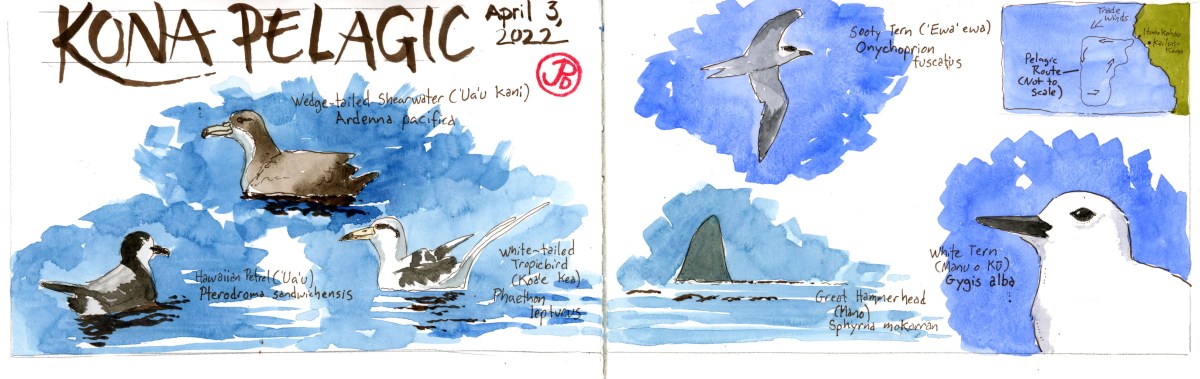
When I found out that there would be a pelagic birding trip out of Kona on April 3, I signed up immediately! This was a chance to add lifers that I would not be able to see from the shore.

As a birder living on the coast it is an absolute privilege (tsunamis and global warming excepted) because it brings you in contact with species that spend the majority of life at sea. To encounter most of these species requires boarding a boat and heading off shore.

I’ve been on many pelagic birding trips from the ports of Bodega Bay, Pillar Point, and Monterey Harbor but I was really looking forward to heading out of Honokohau Harbor on a Hawaiian pelagic! This was entirely new pelagic birding territory.

Pelagic birding can be at once transcendent and deeply frustrating because of the amazing and the not so amazing views of birds. Picking a bird out between swells on a rocking substrate is a challenge and that’s if you are on the right side of the boat when the rare petrel or shearwater makes it’s all too brief appearance.

How do you prepare for such a birding challenge? It’s simple: uncap your pen and sketch.

My first sketch was a study of three tropicbirds. I had a chance of see one or all three while from shore (called a sea watch), on the pelagic, or at Volcanoes National Park. I’ve always wanted to see a tropicbird and sketching then helped me to understand them a little more.

In another spread I sketched six other target species that I hoped to pick up on the pelagic trip. And who knows what other unexpected bird might show.

Image

Big Island Endemics

It had been along time since I had set foot on a Hawaiian island.

The last time was on a family vacation and the island was Kauai. Before that, I had been badly sunburned while snorkeling in Maui. Mom did tell me to wear a t-shirt. Always listen to your mother!

I guess I had avoided Hawaii for a number of reasons, too many to note: too crowded, too touristy, too much introduced flora and fauna, too expensive. My idea of a vacation has never been about laying on a beach getting a tan (see above about Maui snorkeling).

Instead, I go on vacation, waking up at ungodly hours and learning as much as I can in one day. I sketch, bird, sketch some more, walk and hike, learn as much as possible, take a few photos, visit some historical sites, look at architecture, and make time for lunch, repeat. At times my vacations can seem like a job! No sleeping in here. The closest I come to a “vacation” is doing a bit of natureloafing.

But there is one island in the Hawaiian Archipelago that I have not yet visited (Well actually there are a lot more). This is the youngest island, it is merely a million years old and it is still forming today. This is the island of Hawai’i and is also home to Mauna Loa, the world’s largest volcano.

It is also home to some of Hawaii’s endemic birds. And thats what was drawing me to the Big Island (pun intended). Many of the endemic avian species are endangered and I wanted to see as many of the unique birds as I could. the avifauna of Hawaii had been decimated by introduced species such as the black rat and the Indian mongoose and disease carried by not native mosquitos. This has resulted in the loss of 65% of Hawaiian avifauna.

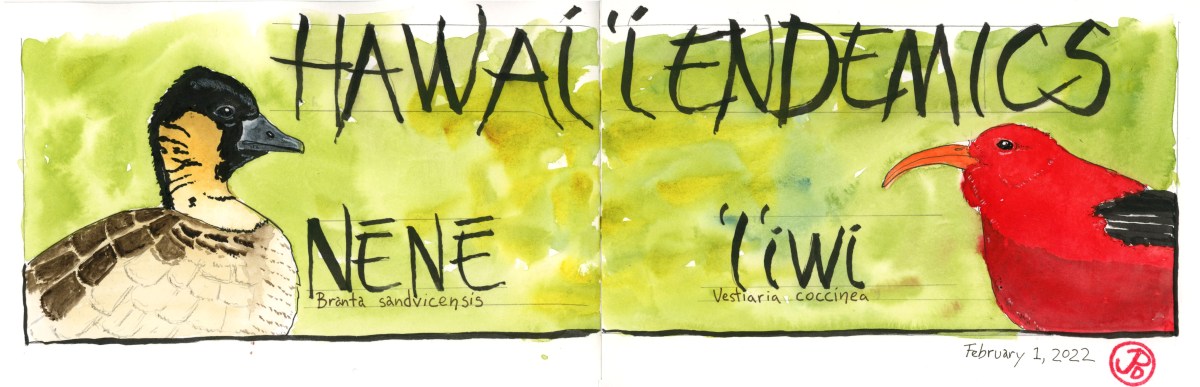
When I planning a trip I like to started with a little hardbound notebook, in this case a Leuchturm 1917. While this is not a watercolor notebook, I like to add an illustration to the front page. In this case I chose to draw the Hawaiian State Bird, the endemic nene, or Hawaiian goose. It is fitting that a state entirely surrounded by water should be the only state with a waterfowl as it’s State Bird.

Well to wet my appetite, I started sketching some of my target species. I’ve learned that when I sketch a bird I have not yet seen in the field, the process helps me etch it’s forms and fieldmarks into my eye. I have that image at the ready for when I might see the bird, for real.

With any list of endemic species the state bird of Hawaii has to top the list. It is the nene or Hawaiian goose. I sketched this beautiful goose and it anchored the left side of my spread. On the right side I sketched another target bird, the Hawaiian honeycreeper: i’iwi. Both of the species are relatively easy to seen on the Big Island.

Another target bird for the Big Island is the Ae’o, the Hawaiian subspecies of the black-necked stilt.
The akispolaau is probably one of the most sought after Hawaiian honeycreepers. It is only found in high-elevation rainforests on the Big Island. I will definitely try to add this amazing and endangered species to my life list!