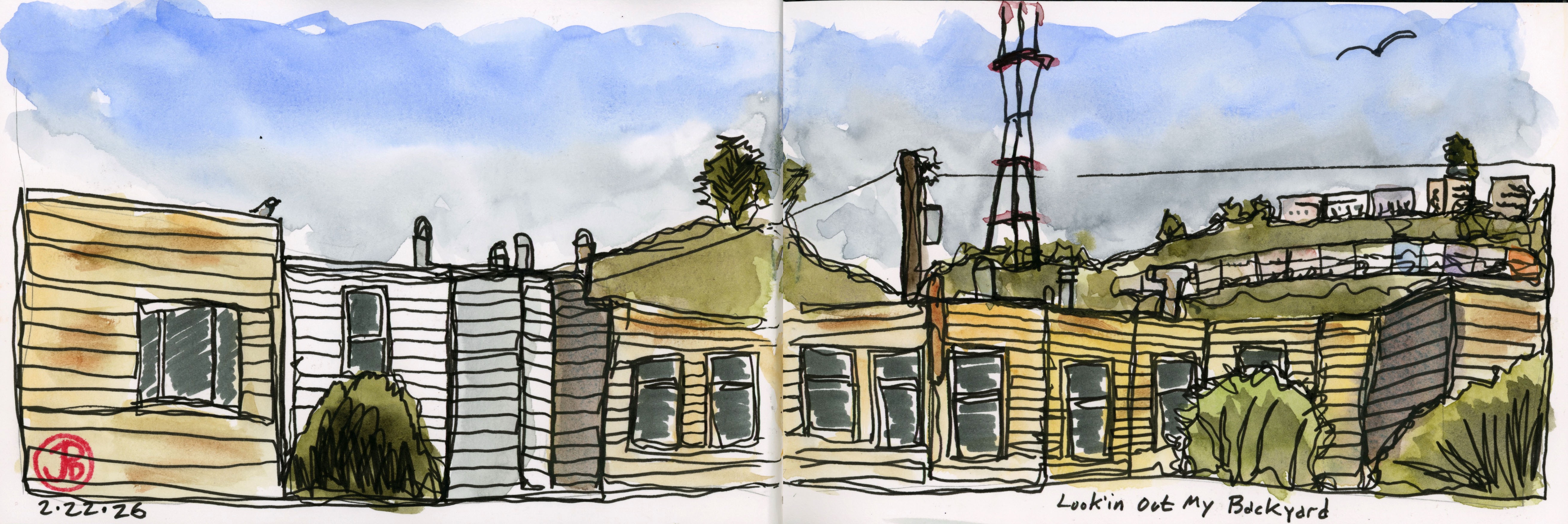
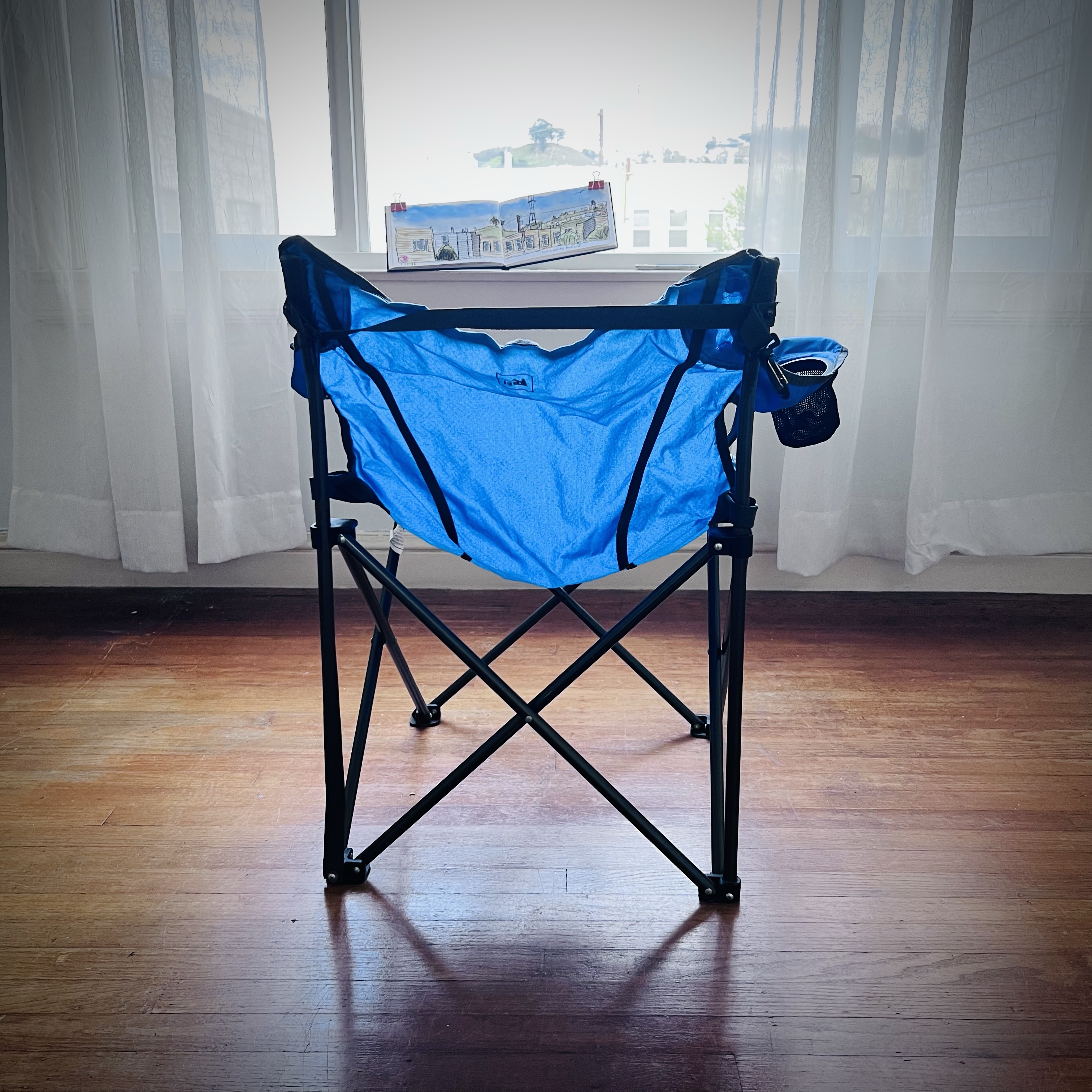
With the tenets upstairs moved out for Italy I used the opportunity to sketch the view from the empty upstairs east facing bedroom.
Now this isn’t exactly sketching out my back door but the sketching above my back door. With the altitude gain I could see the landmark that dominates the view: Sutro Tower.
Sutro Tower was erected between 1971 and 1973. For 45 years the 977 foot tall radio and television transmission tower was the tallest structure in San Francisco before it was usurped by the Salesforce Tower (1,070 feet) in 2018.
In the foreground are the houses that border my backyard, in the middle ground are the houses of the Golden Gate Heights.
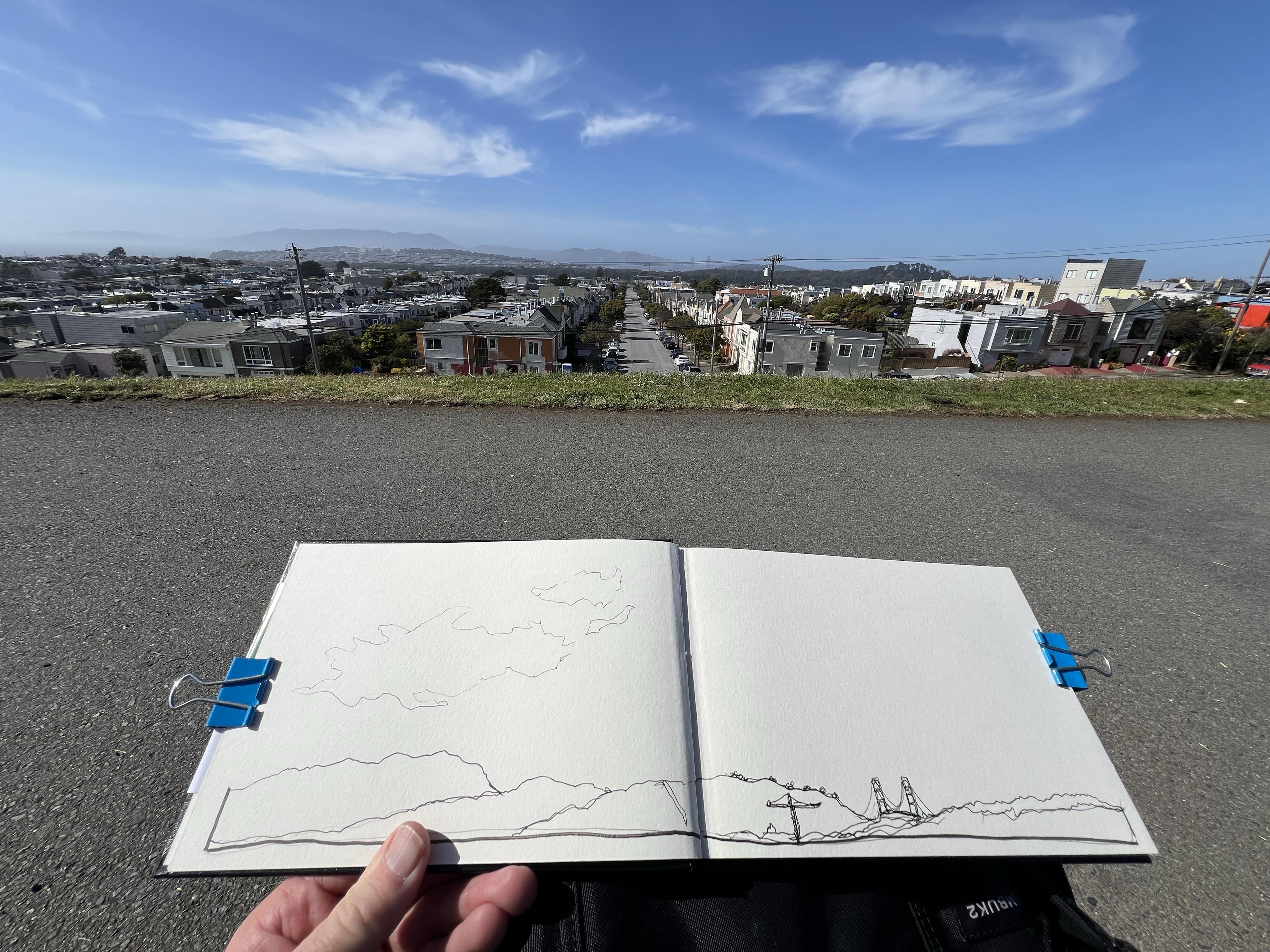
I used my Stillman & Birn panoramic watercolor journal to sketch in the scene. I used a thick pen (Micron 10) and rendered the scene in a continuous-line.
My sketch was loose and not exactly to scale but that what makes continuous-line sketching so exciting and vibrant.
In honor of the recent passing of Bob Weir, I decided to sketch an early bit of Grateful Dead history.
This history is not to be found in the Haight-Ashbury but in the county where the members of the Dead spent much of the time when not touring incessantly: Marin County. Most of band lived in Marin, Bobby in Mill Valley, Mickey in Novato, and Jerry Garcia died at a rehab center in Forest Knolls.
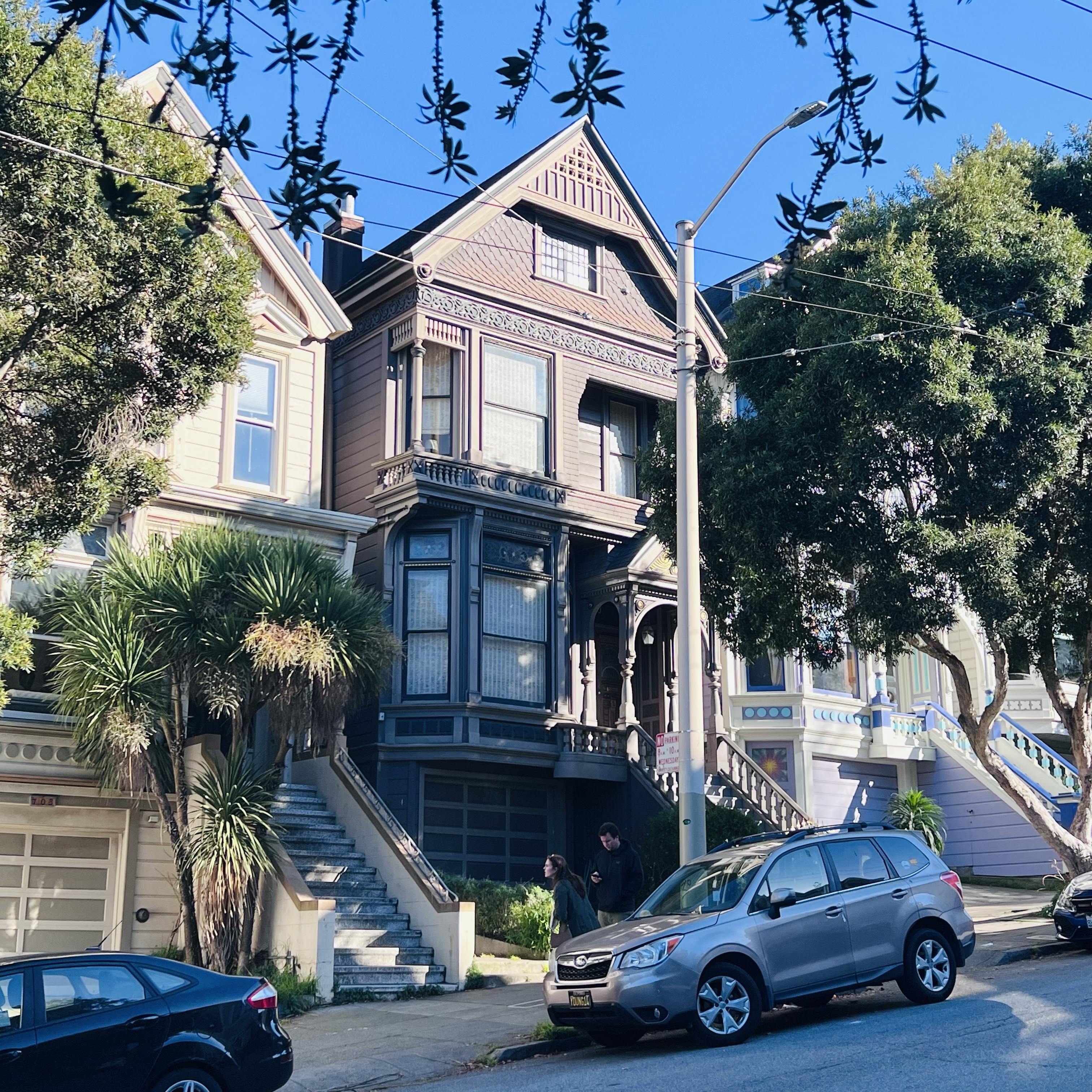
The Dead house at 710 Ashbury. Home to the band in 1966 to 1968.
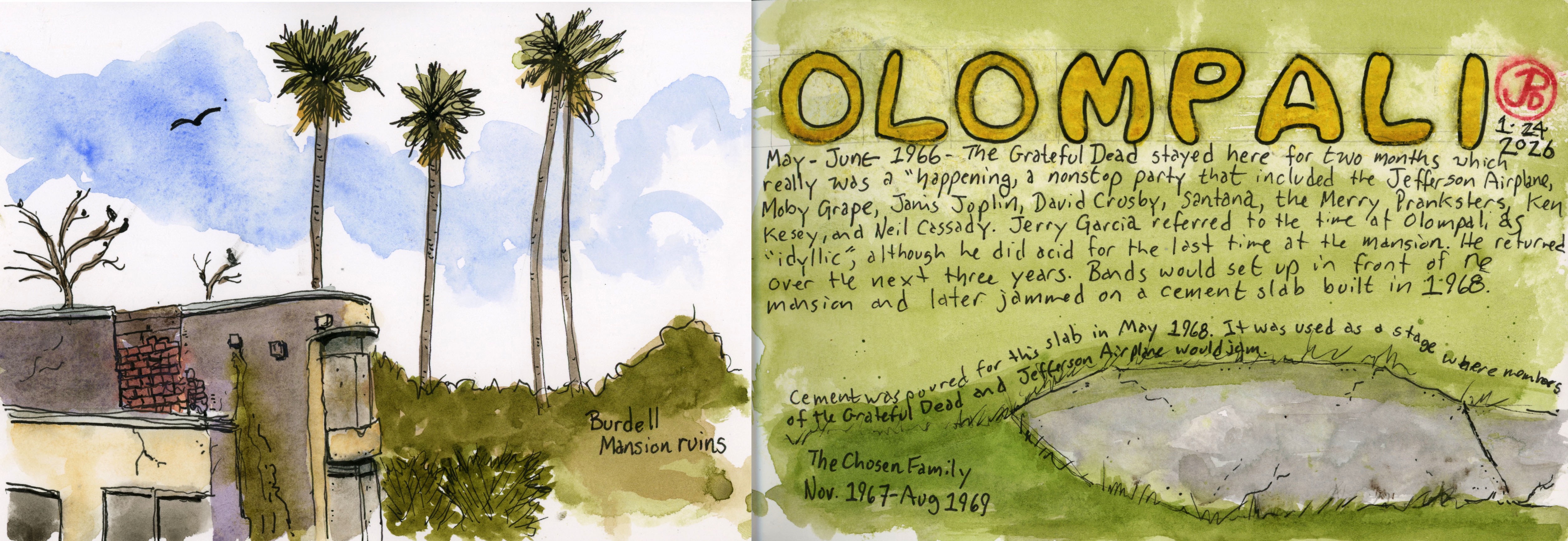
Just north of the town of Novato is Olompali State Historic Park. They are many layers of California history at Olompali: Miwok, Mexican, the Bear Flag Republic, Californios, and the estate of a wealthy San Franciscan dentist.
In 1911, James Burdell, built a 26-room mansion for the then hefty sum of $15,000.
The land and the house on it was eventually sold to the University of San Francisco. In the 1960s the university attempted to sell the property but the buyers always defaulted, leaving Olompoli unsold.
The properties’s most famous tenet was the band the Grateful Dead. The band moved here for a two month stay (May and June) in 1966 to take a vacation away from the Haight-Ashbury.
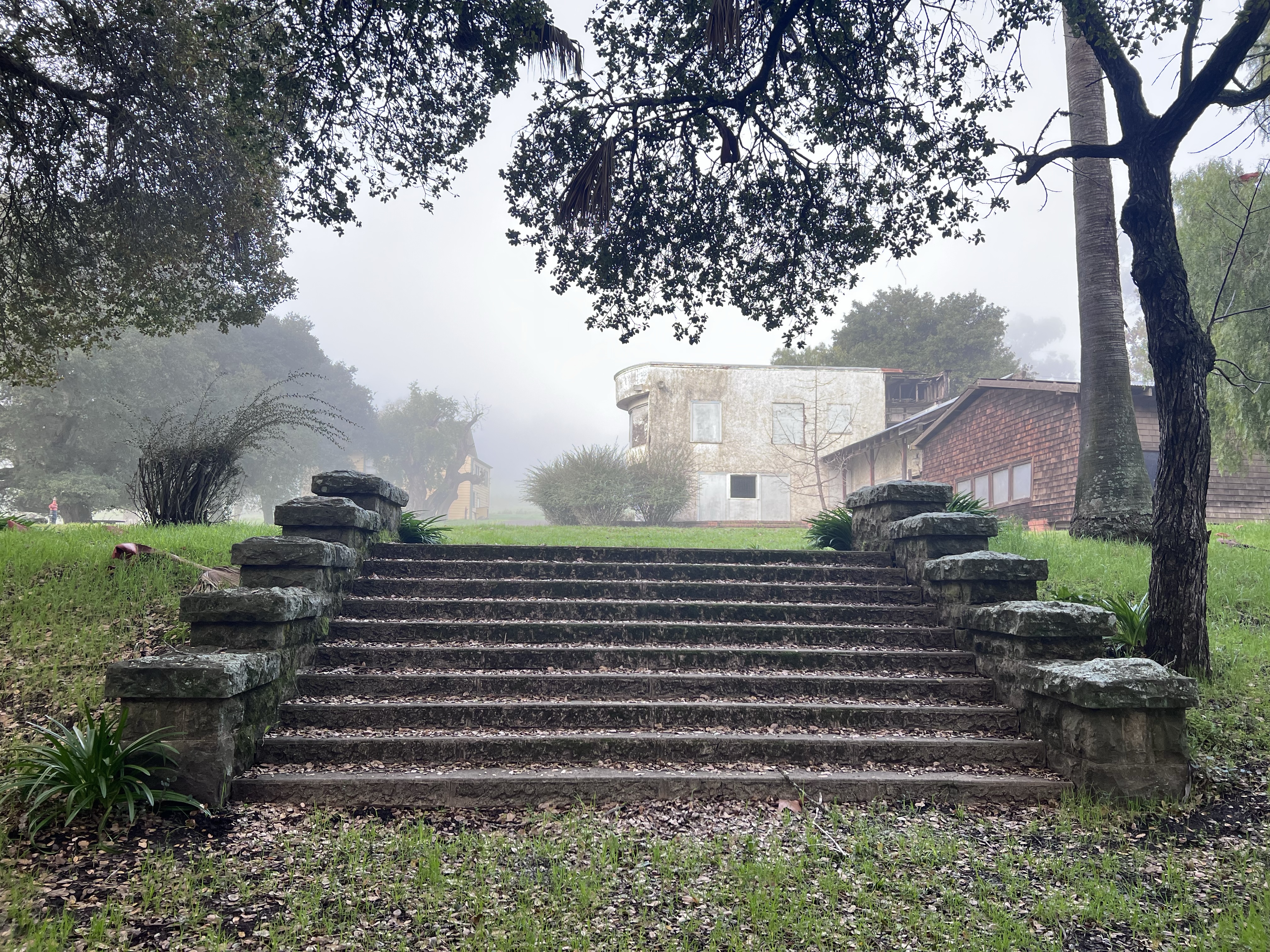
Stairway to . . . The buildings at Olompali have seen better days.
Their two month stay was a “happening”, a nonstop party that included the likes of Jefferson Airplane, Quicksilver Messenger Service, Moby Grape, Janis Joplin, David Crosby, Santana, the Merry Pranksters, Ken Kesey, Neil Cassady, and Timothy Leary.
Jerry Garcia referred to his time at Olompali as “idyllic”. It was also the setting for his last acid trip (it was a bad one). He returned here over the next three years.
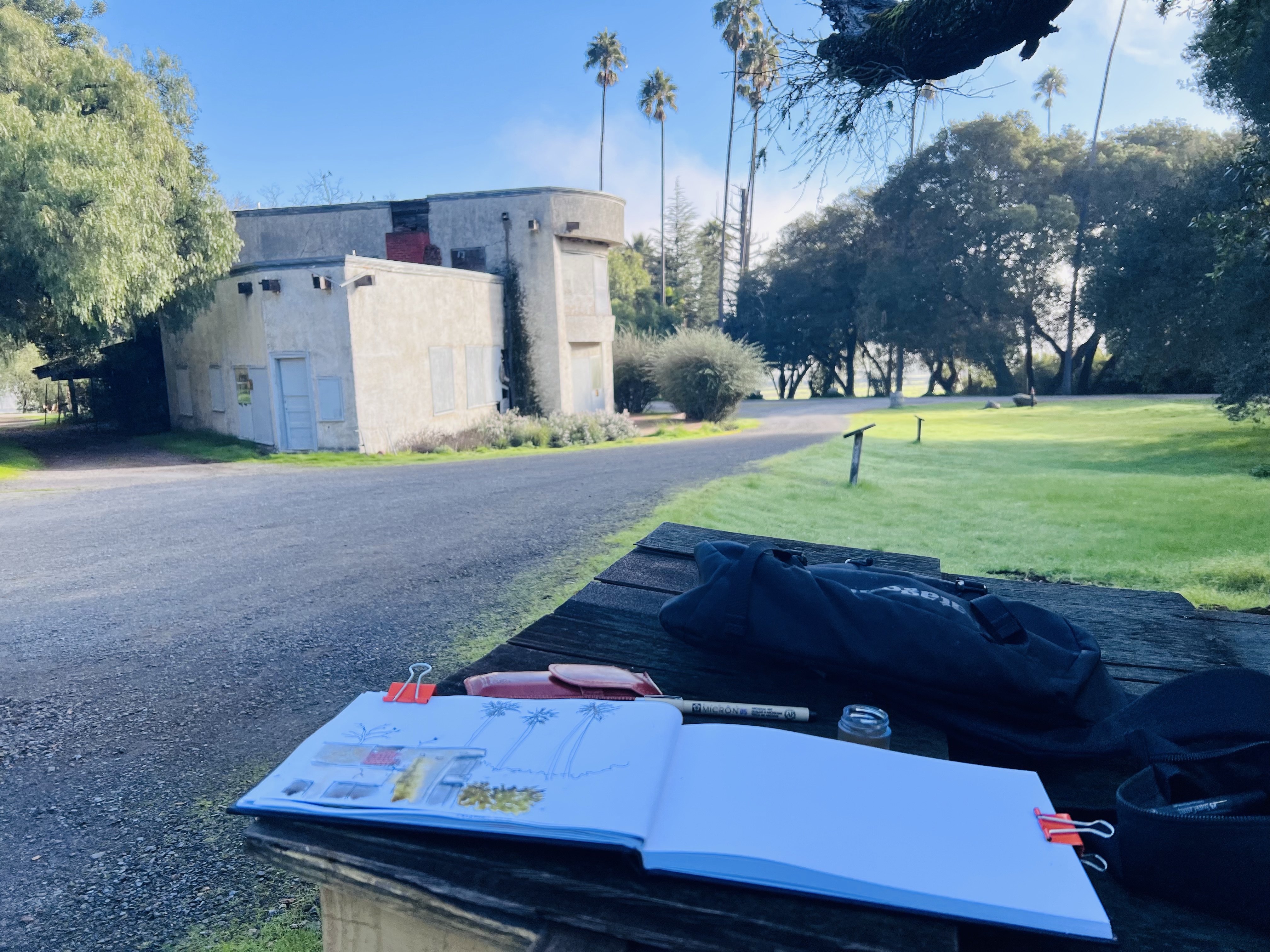
Sketching the remains of the Burdell Mansion. Bands would set up in front of the mansion to jam as people danced on the lawn or cooled down in the swimming pool. The pool was off to the right.
After the Dead left, Don McCoy, a wealthy businessman, turned to the hippie life and started a commune, called the Chosen Family at Olompali in 1967.
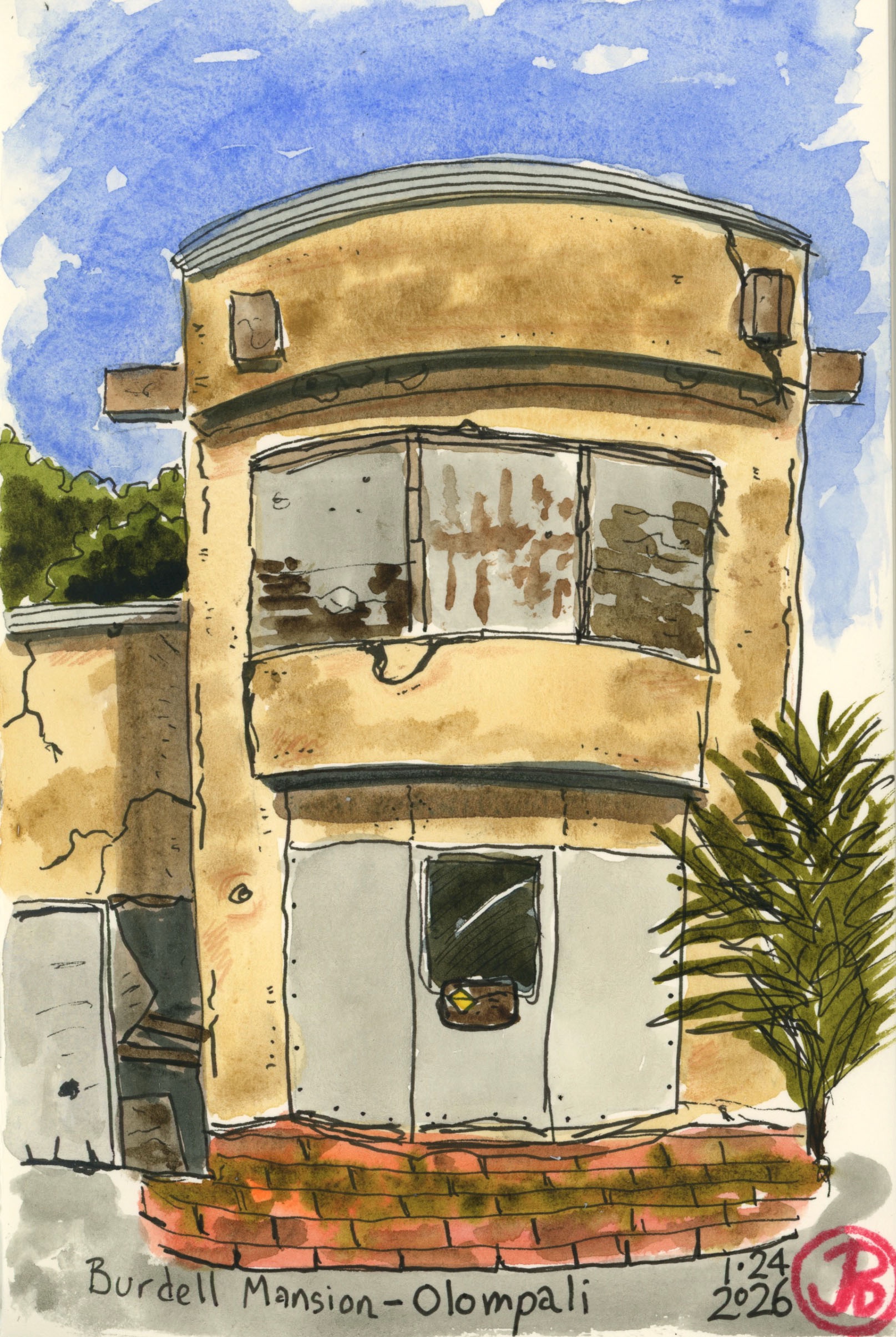
Field sketch of the mansion, which is boarded up.
26 people moved to the mansion where they home schooled their kids and baked bread for charity, amongst other things.
Things soured after about a year with the influx of new members and more drugs and alcohol. Two children drowned in the mansion’s swimming pool. Much of the mansion burned down in a fire in 1969 and the commune was soon evicted.
The land was purchased by the state of California in 1977 and it became Olompali State Historic Park.
In the northwestern corner of the San Francisco is a patch of green and an art museum.
The museum is the Legion of Honor and I headed over on a rainy Friday to see the current exhibit: Manet & Morisot. I also love to look at the museum’s permanent collection.
The museum is a 15 minute drive from my Sunset Digs and being a member means I can visit the museum as many times as I want.
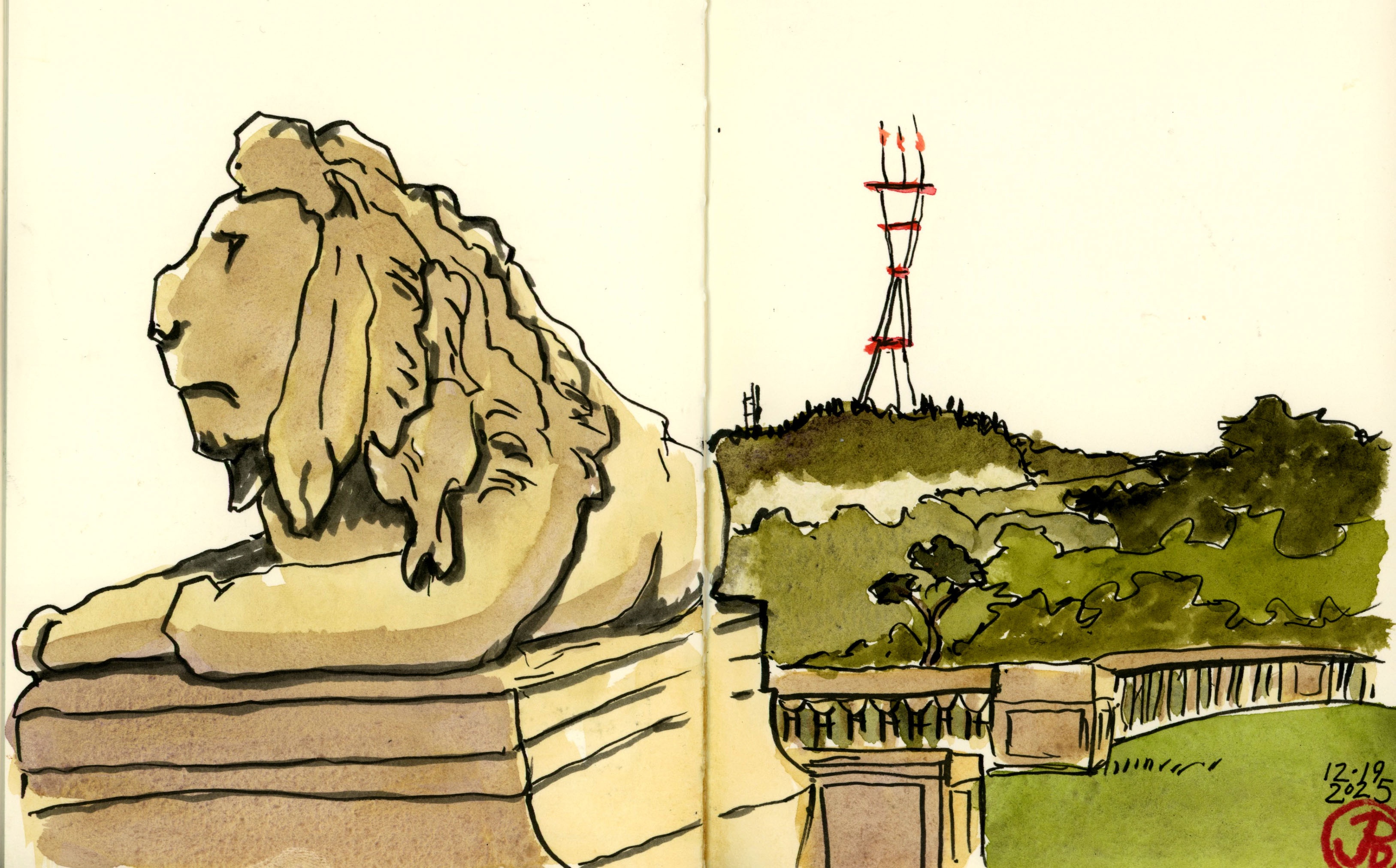
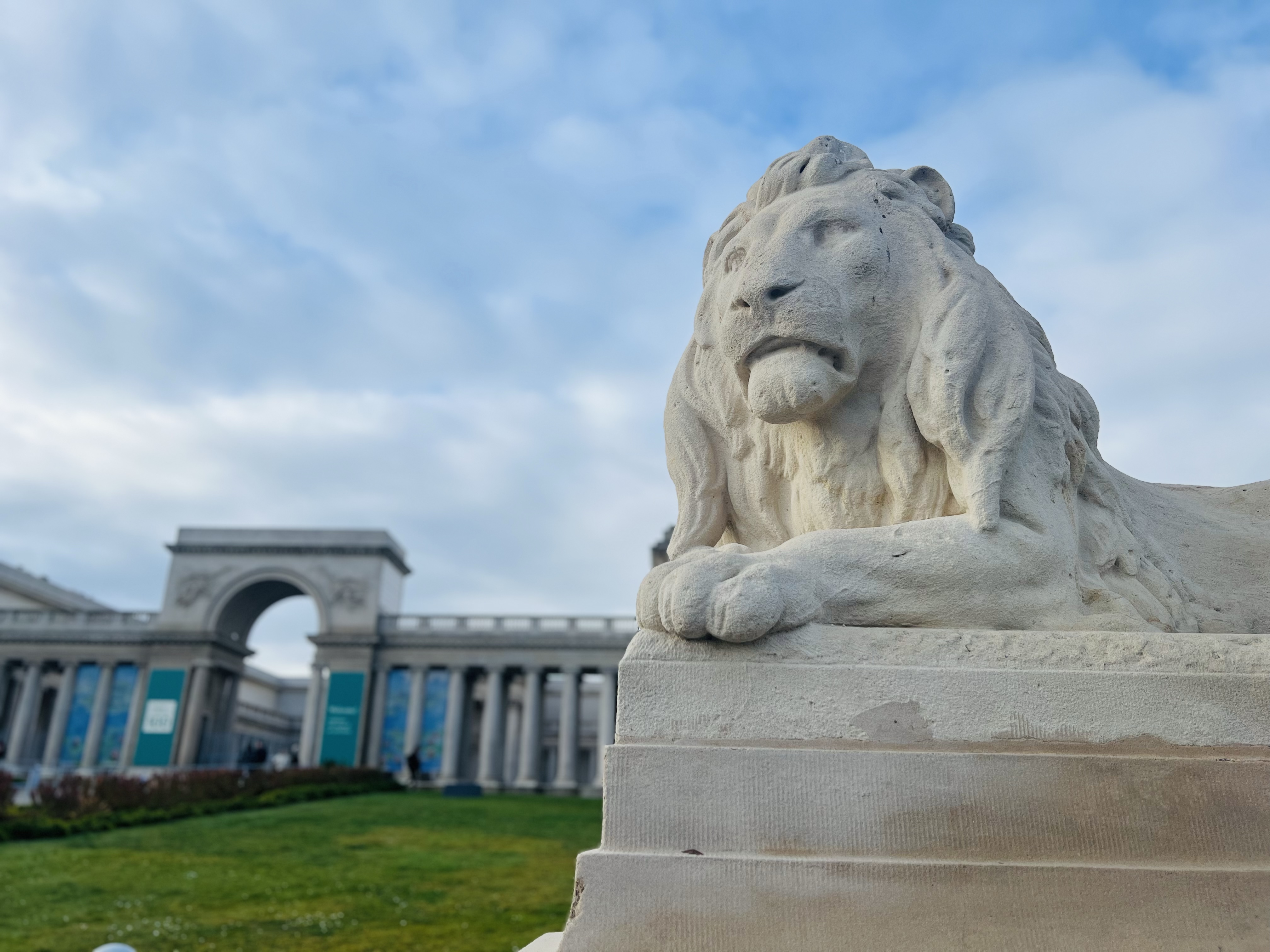
One of two lions framing (or guarding) the entrance to the Legion. I sketched the other lion.
Looking at the masters: Rodin, Van Gough, Picasso, Monet, and others always inspires me to sketch. What I love about looking at the real deal as opposed to a facsimile is that you can really see the hand of the creator on the canvas or board. This was very true of the expressionists as they lay paint on in heavy patches. Step a few feet back to see what emerges!
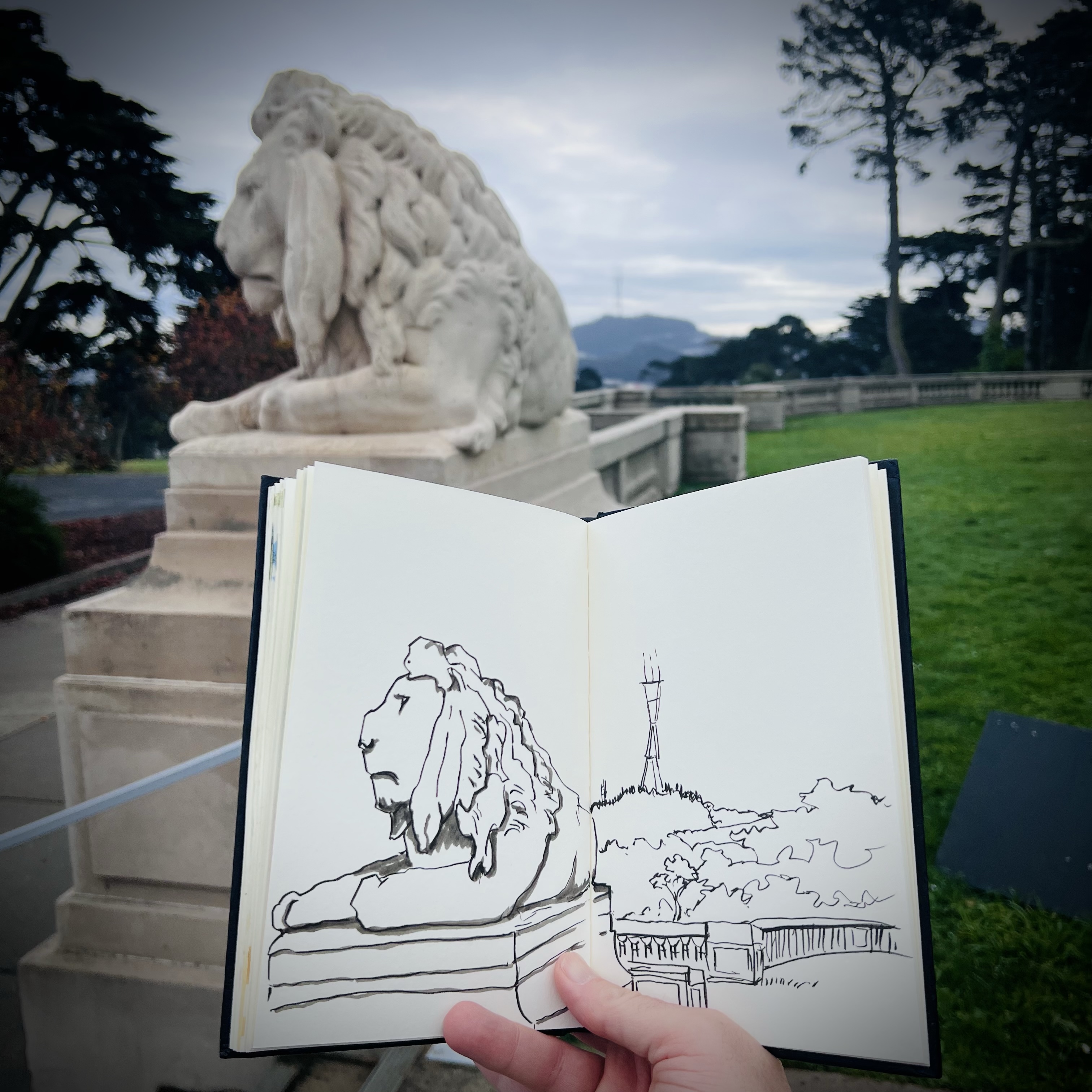
Field sketching with Sutro Tower in the background. This tower has a way of appearing in many of my San Francisco field sketches.
Vertigo and Gallery 6 (1958)
The Legion of Honor was used as a filming location in Hitchcock’s masterpiece, Vertigo (1958).
It was featured twice, both the exterior and one of the museum’s galleries, Gallery 6.
Detective Scottie Ferguson (James Stewart) is on a case and he follows Madeleine (Kim Novak) to the Legion of Honor. She sits for hours looking at a portrait of a lady. Scottie finds out it is a portrait of a lady named Carlotta.
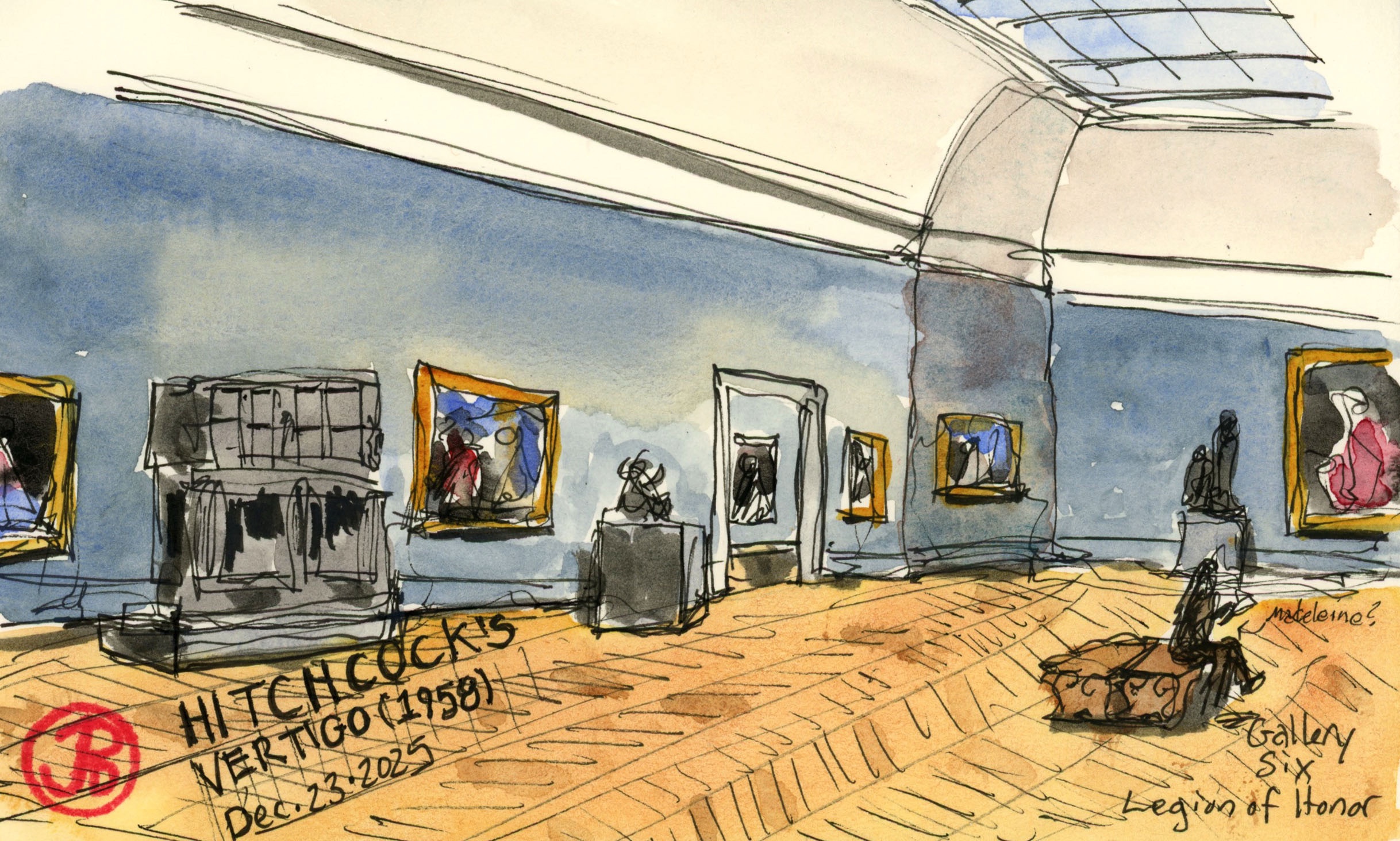
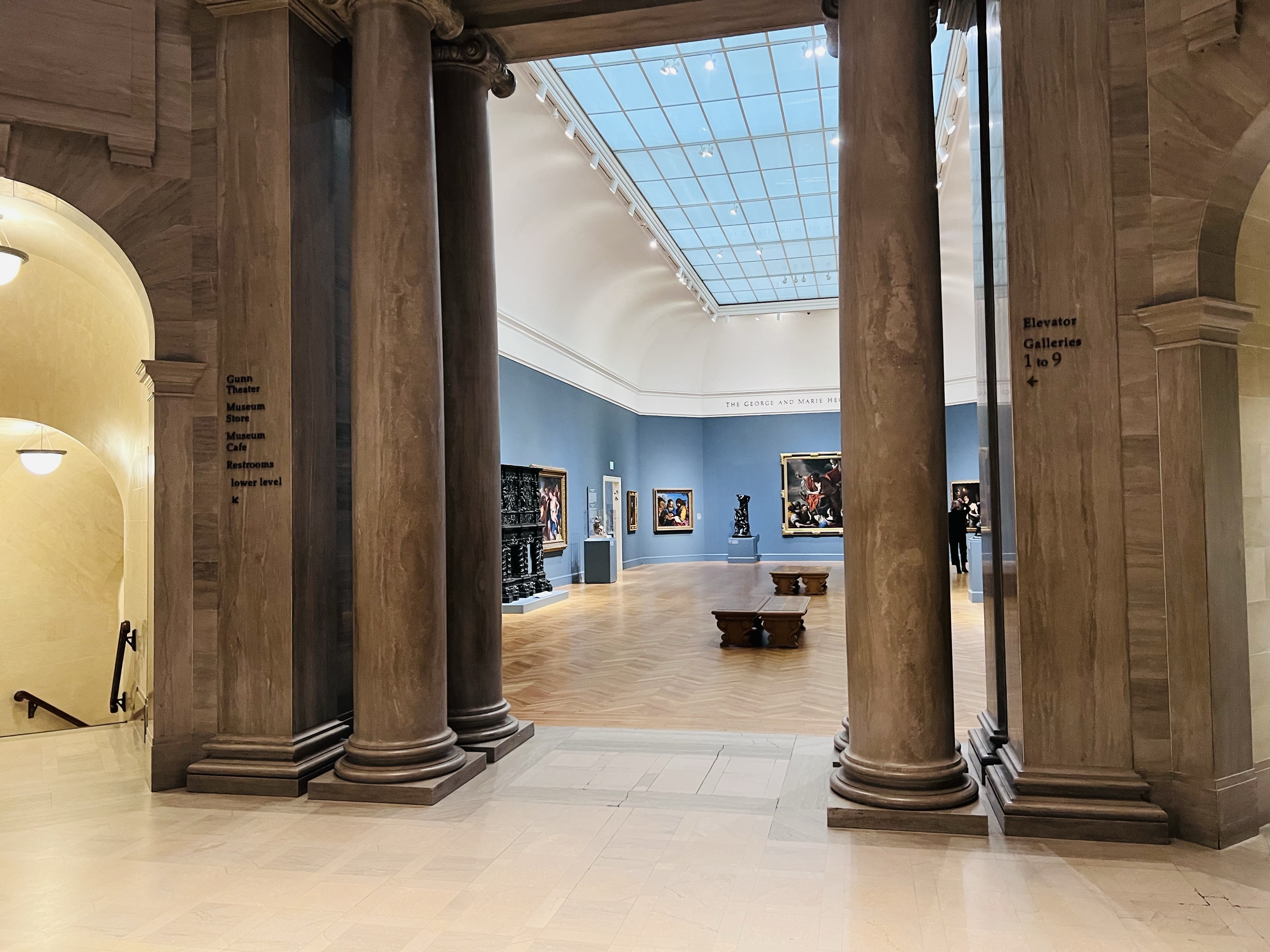
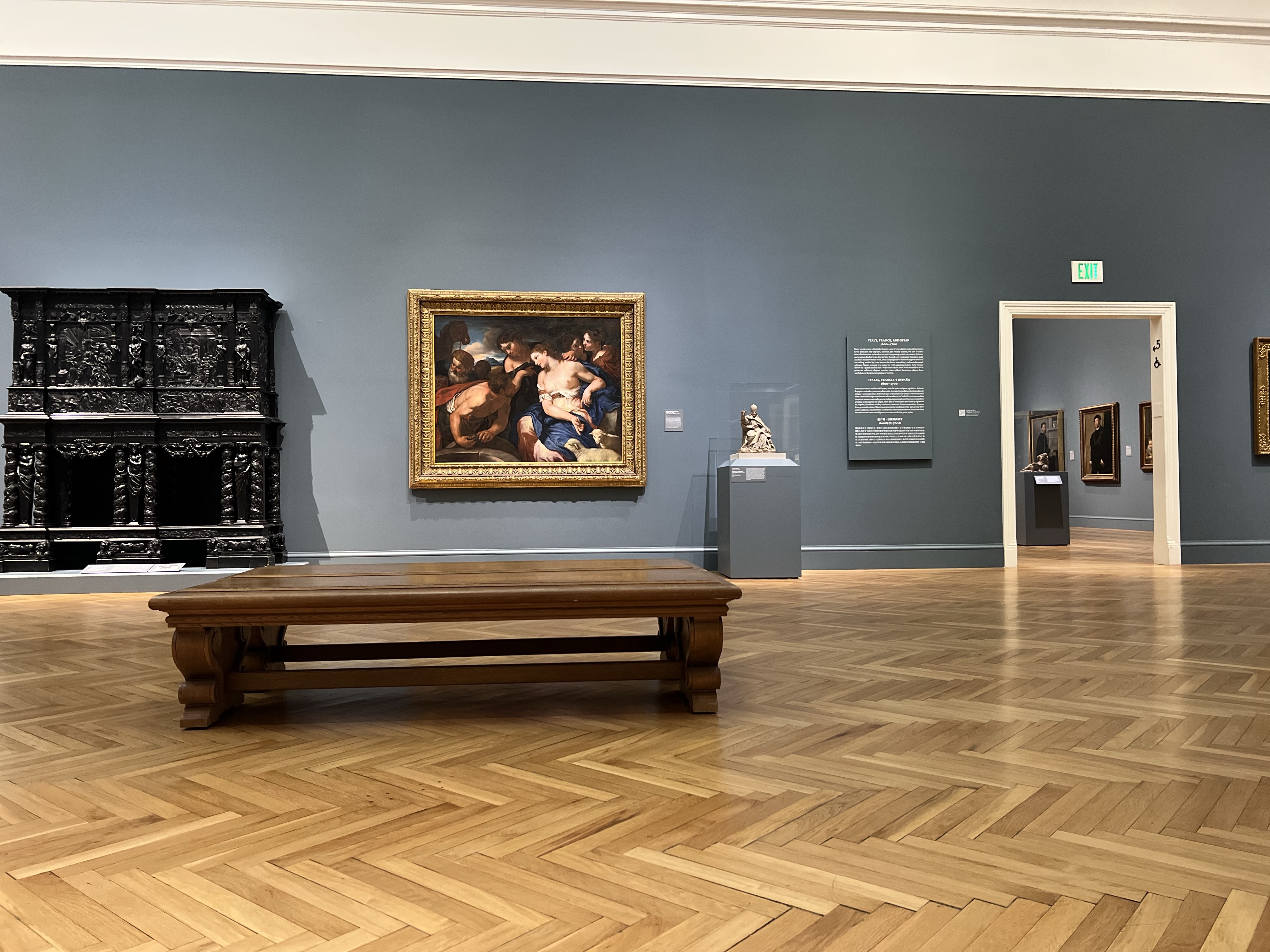
Looking into Gallery 6. James Stewart stood next to the column on the right and in the background Kim Novak sat on a bench toward the left wall.
While Gallery 6 still looks much the same as when filming took place here in 1957, the paintings on the wall were not here. The Carlotta portrait was painted for the film by John Ferren and removed once filming was completed. But what about the other paintings?
This view shows the wall in Gallery 6 where the portrait of Carlotta hung. Kim Novak sat on one of the benches that have not changed since 1957 although the paintings in the gallery have changed.
Now it was time for a painting goose chase and I didn’t have far to go.
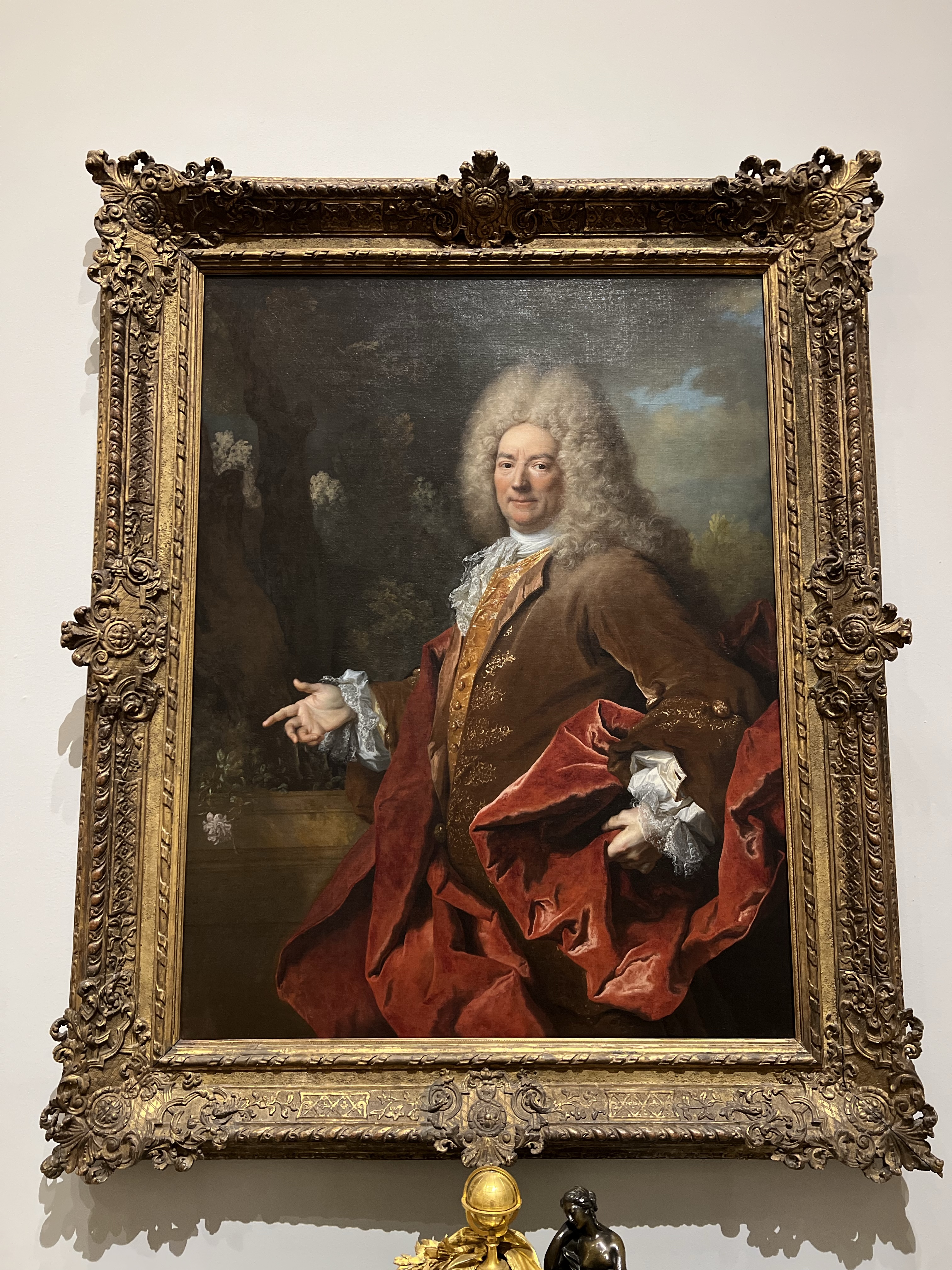
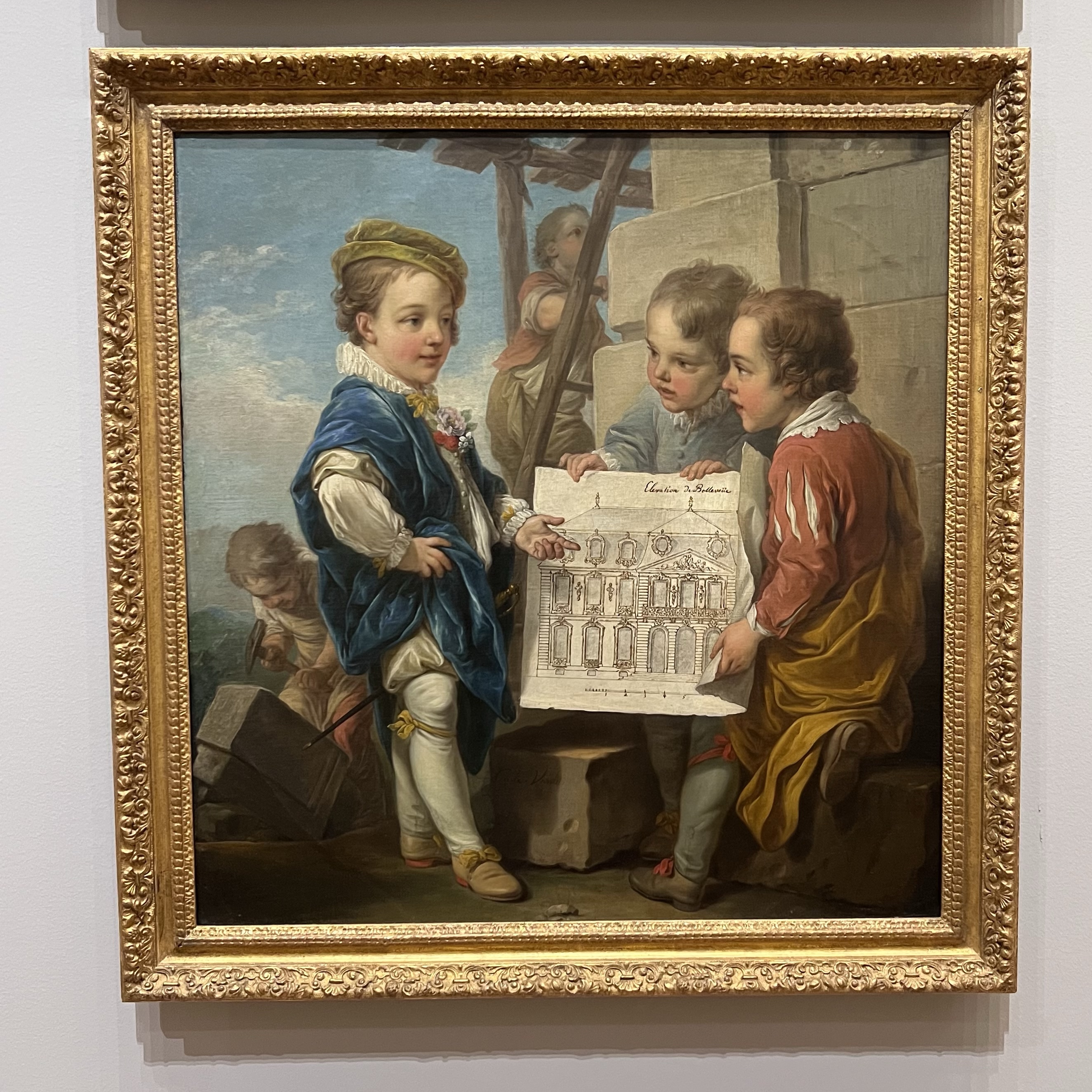
In adjacent Gallery 7 I located two paintings that James Stewart stood in front of during the Gallery 6 scenes. Two pieces of San Franciscan cinema history!
This is French painter Nicolas de Largillière’s Portrait of a Gentleman (1710).The other painting seen behind James Stewart is by French painter Carle Vanloo and is titled Architecture (1753).
For my sketch of Galley 6 I sketched in a continuous-line technique to get the shape of the room and then lifted my pen to add details. So it’s continuous-ish.
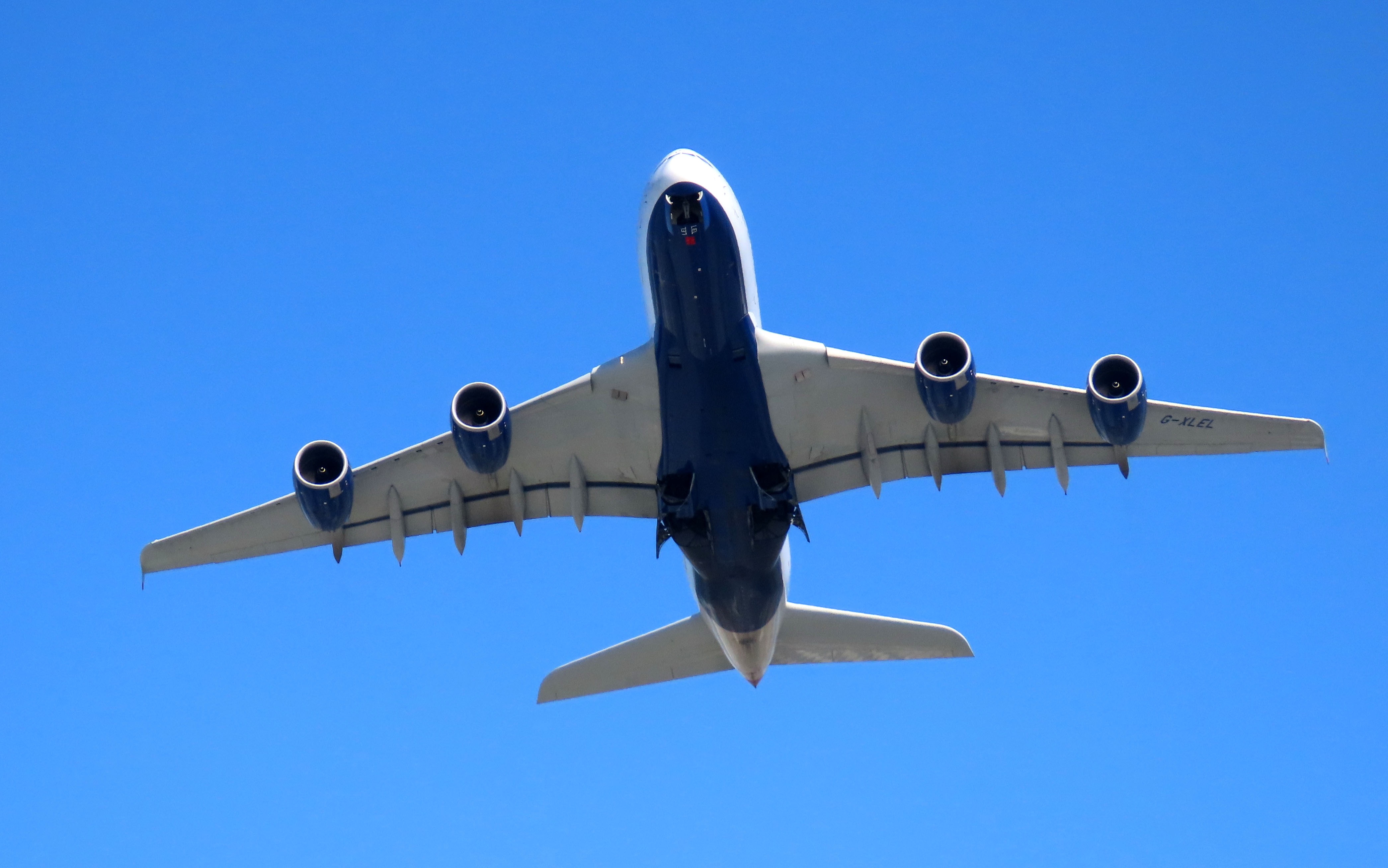
This is the Airbus A380. The A380 is truly an impressive aircraft which I had the pleasure of flying on from SFO to Frankfurt on Lufthansa (the airline currently operates eight A380s but they no longer use them to fly out of SFO).
The A380 is a full double decker with a flight range of 9,200 miles and a capacity of 850 passengers. It is larger than Boeing’s 747 and is designed for long range international flights.
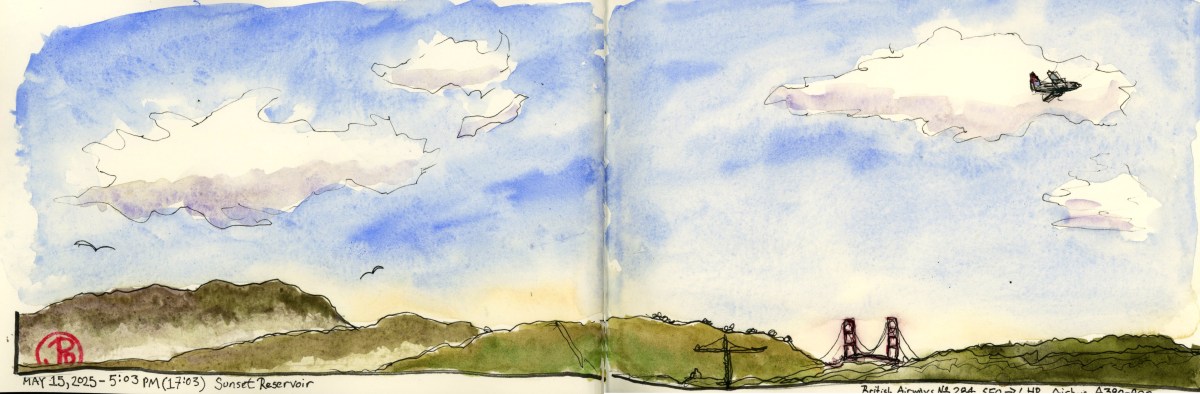
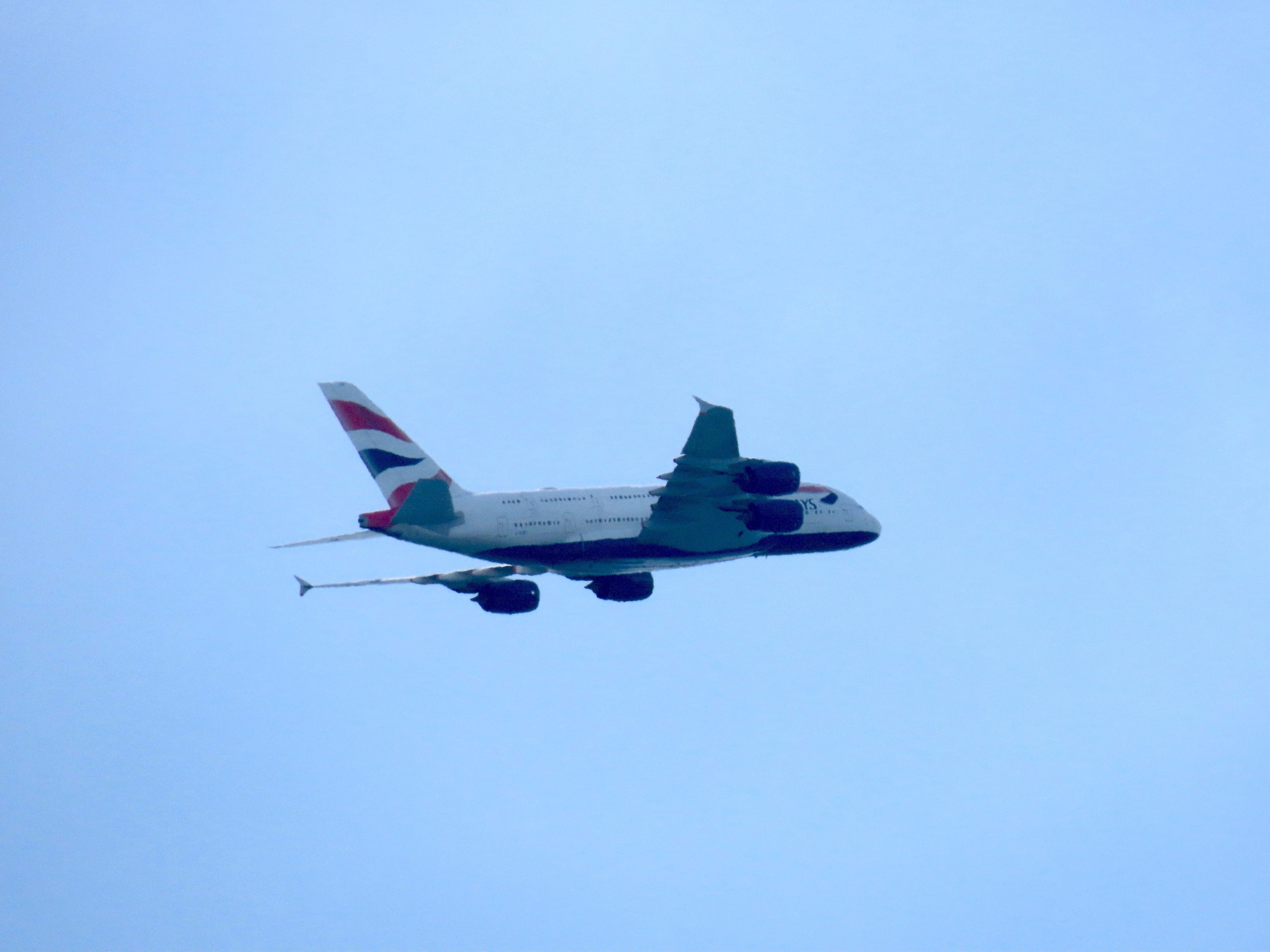
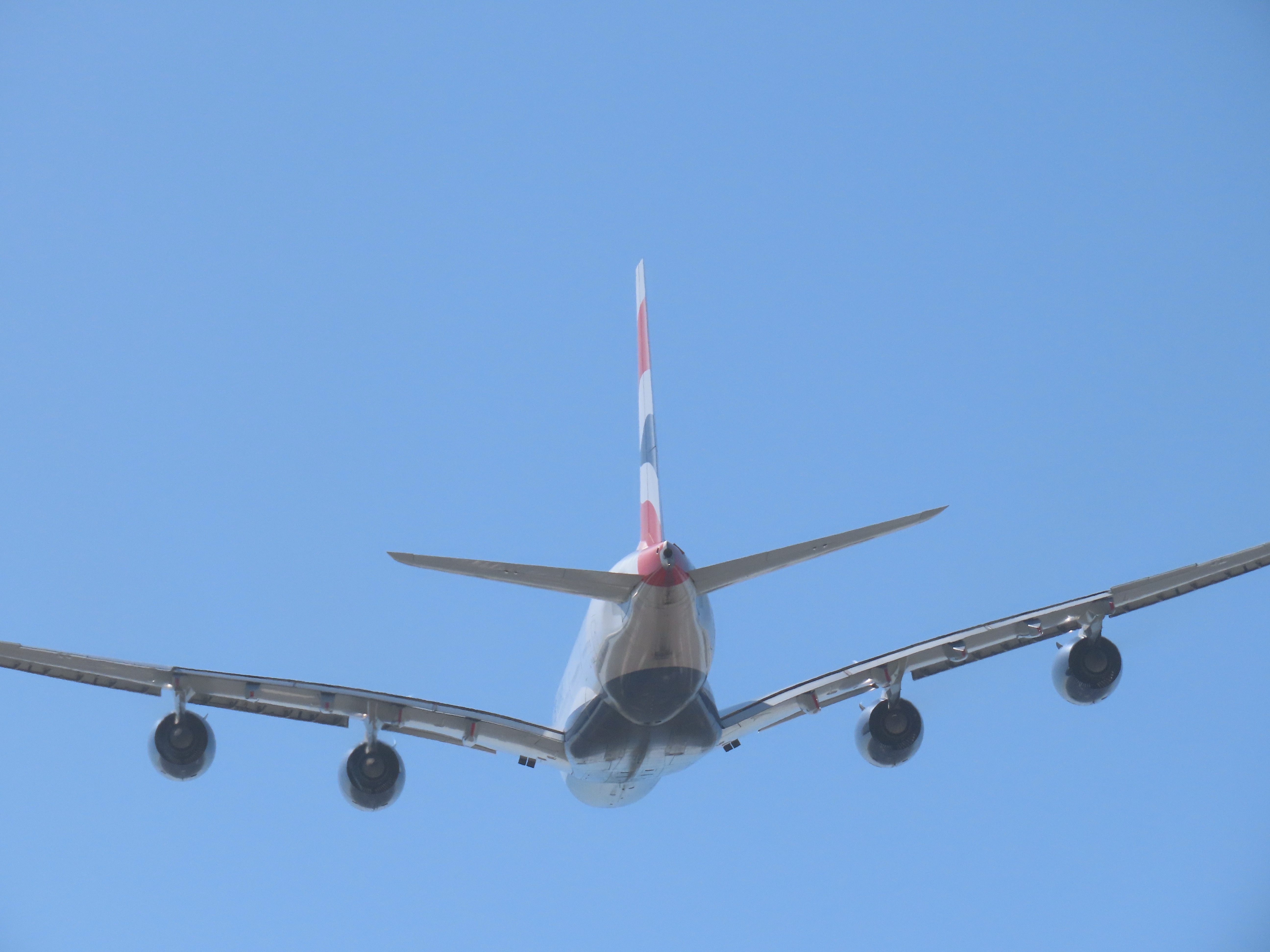
On my afterwork walks I noticed a northbound British Airways A380 at around 5 PM each day. This is flight BA 284. The flight path parallels Ocean Beach and then turns northeast heading toward the Polar route over Greenland to its final destination of Heathrow Airport. I often watch it until it disappears with distance.
After work I wanted to get a sketching perch perspective facing north with the Golden Gate Bridge, Marin Headlands, and Mt. Tamalpais at the base of the panoramic spread and the A380 flying above. Sunset Reservoir fits the bill.
I headed to the northwest corner of the reservoir to Sunset Reservoir Park with a brand new Delta Stillman & Birn sketchbook.
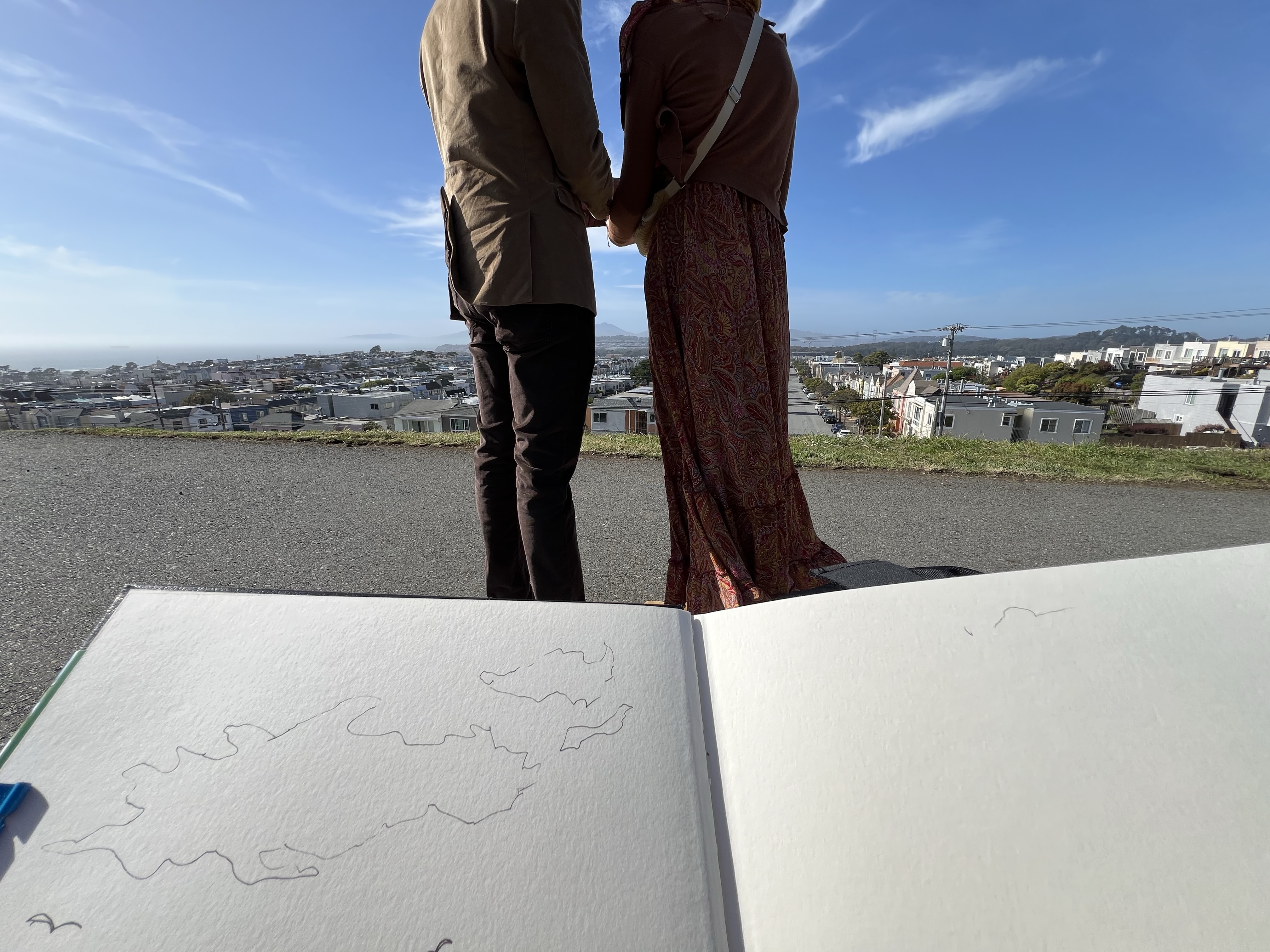
While I was sketching a man and a woman were walking up the path speaking French. I assumed they were from the Lycee Francais de San Francisco school just up Ortega. They had come to take in the amazing views. The woman walked over and asked if I was part of the urban sketchers. I replied that I was not and she told me that she liked to sketch too.
Then she and the man did something that boggled my sketcher’s mind which can be summed up in the following photo:
Yes, unbelievably they commented on my sketching and then turned around to stand between myself and my subject!
My plan was to do a loose sketch of the A380 as it headed northeast. Luckily the French couple moved on to take some more selfies with the distant Golden Gate Bridge in the background, before I had to ask them politely, to get out of my way!
Flight 284 is scheduled to depart SFO at 16:20. It seems it was running a bit late as the A380 passed by at 5:03.
A Heathrow bound British Airways A380 flies past the Sunset Reservoir.
SFO Runway 28R
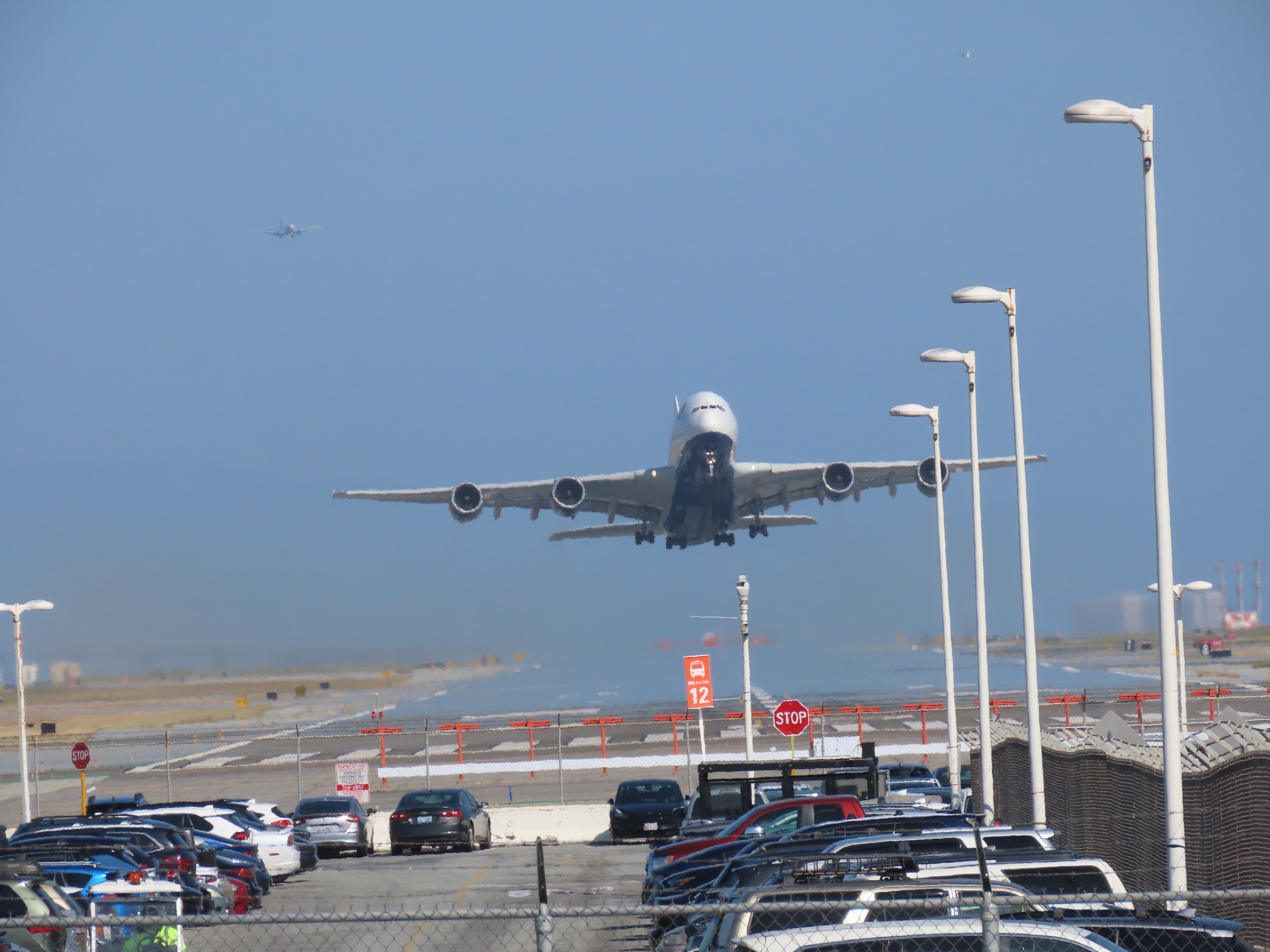
I had sketched and photographed BA Flight 284 as it passed over western San Francisco and now I wanted to witness an A380 take off, head on!
One of the best ways to look down Runway 28R (SFO’s longest) is to cross Highway 101 on San Bruno Avenue. Here you can look down the runway towards aircraft taxiing into position for take off.
As a side note, runways are named after their magnetic heading to the nearest ten degrees so 28 degrees and the R stands for “right” to differentiate the runway from the parallel runway to the left: 28L.
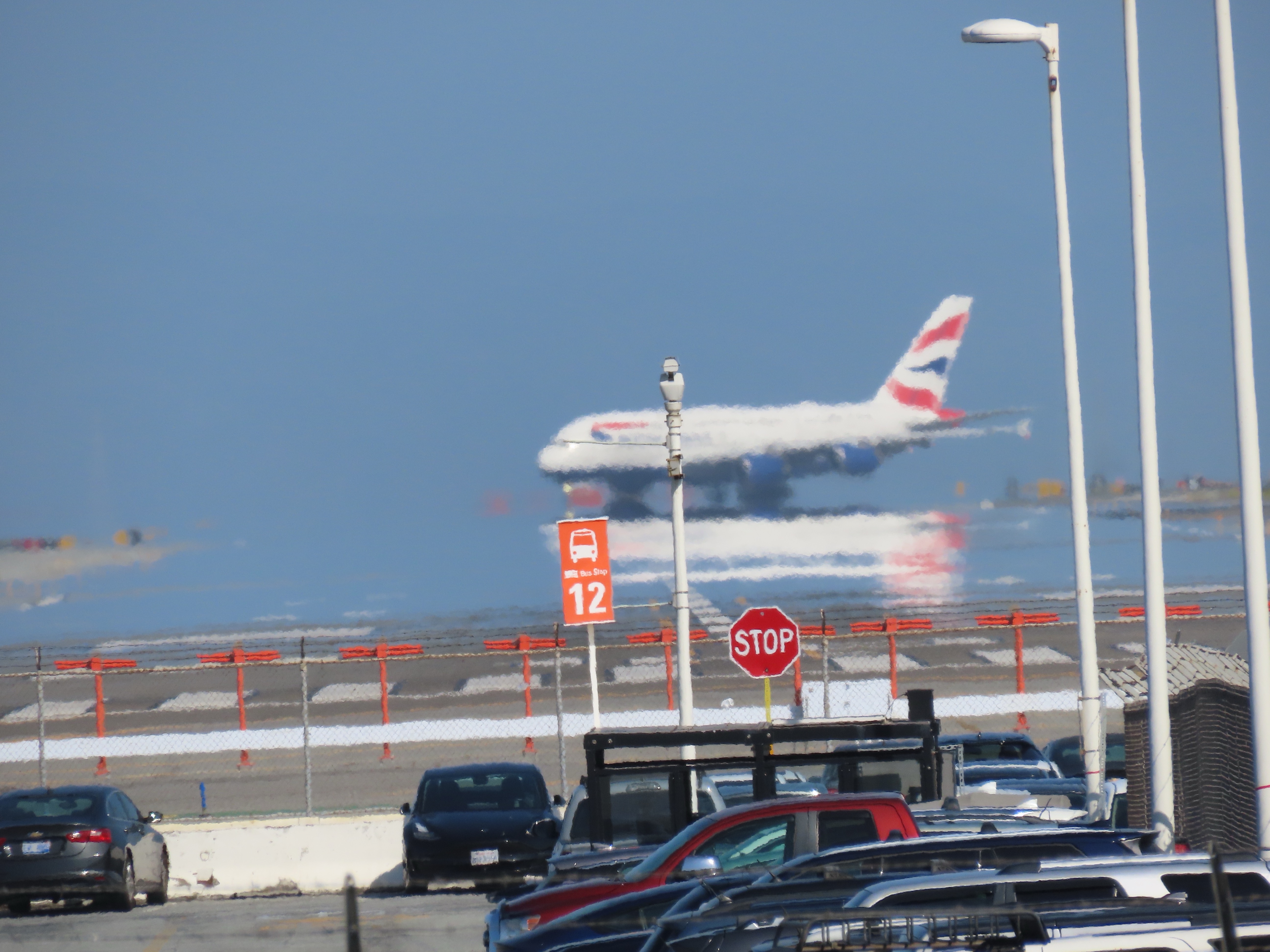
Flight 284 was late getting out of the gate and I spotted the giant, shark like tail fin, sporting the Union Jack, as it crept towards the runway.
The A380 pulling onto Runway 28R. With the distance, the plane looks like a mirage.Flight 284 climbs off Runway 28R at 150 knots heading right toward me!Gear up, the A380 flying overhead. Next stop (10 hours 35 minutes later) Heathrow Airport.
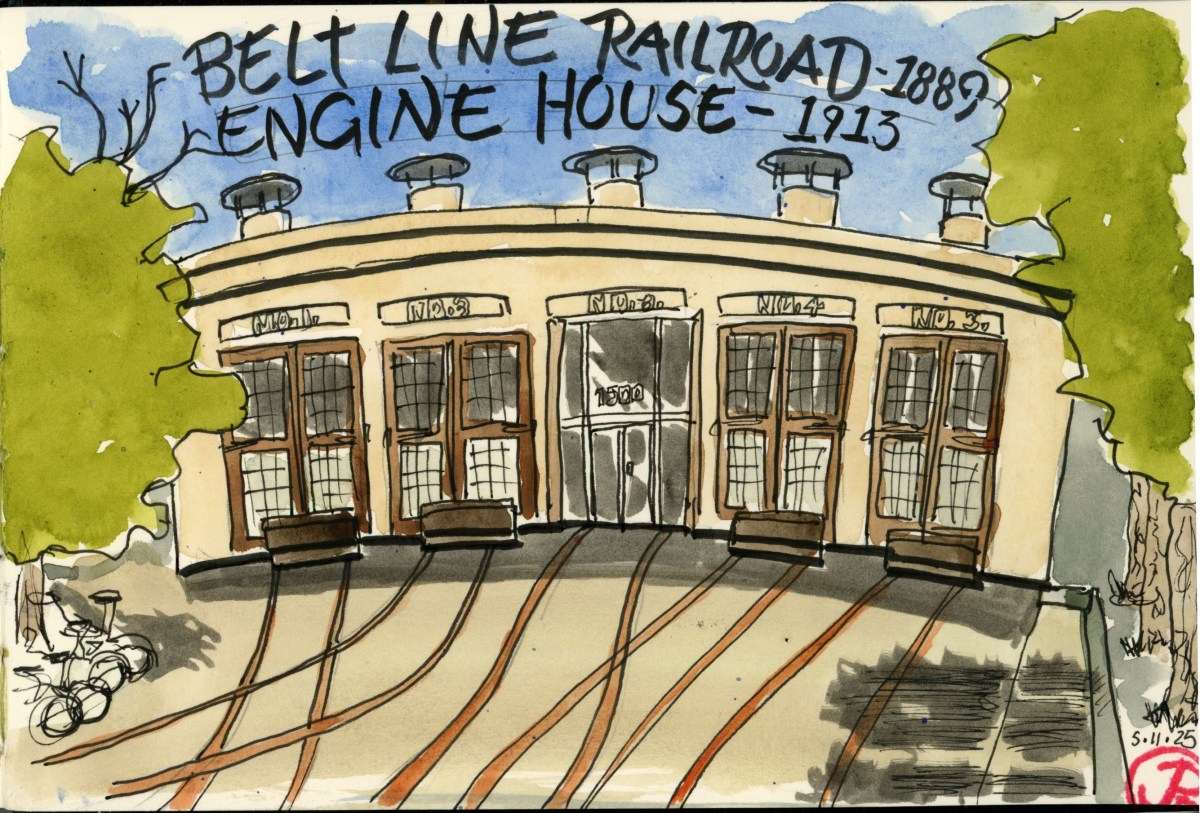
On Sunday I took the N Judah to Embarcadero Station with the intention of sketching a little San Francisco rail history. My main sketching target was the Belt Line Railroad Engine House or Roundhouse at Embarcadero and Sansome.
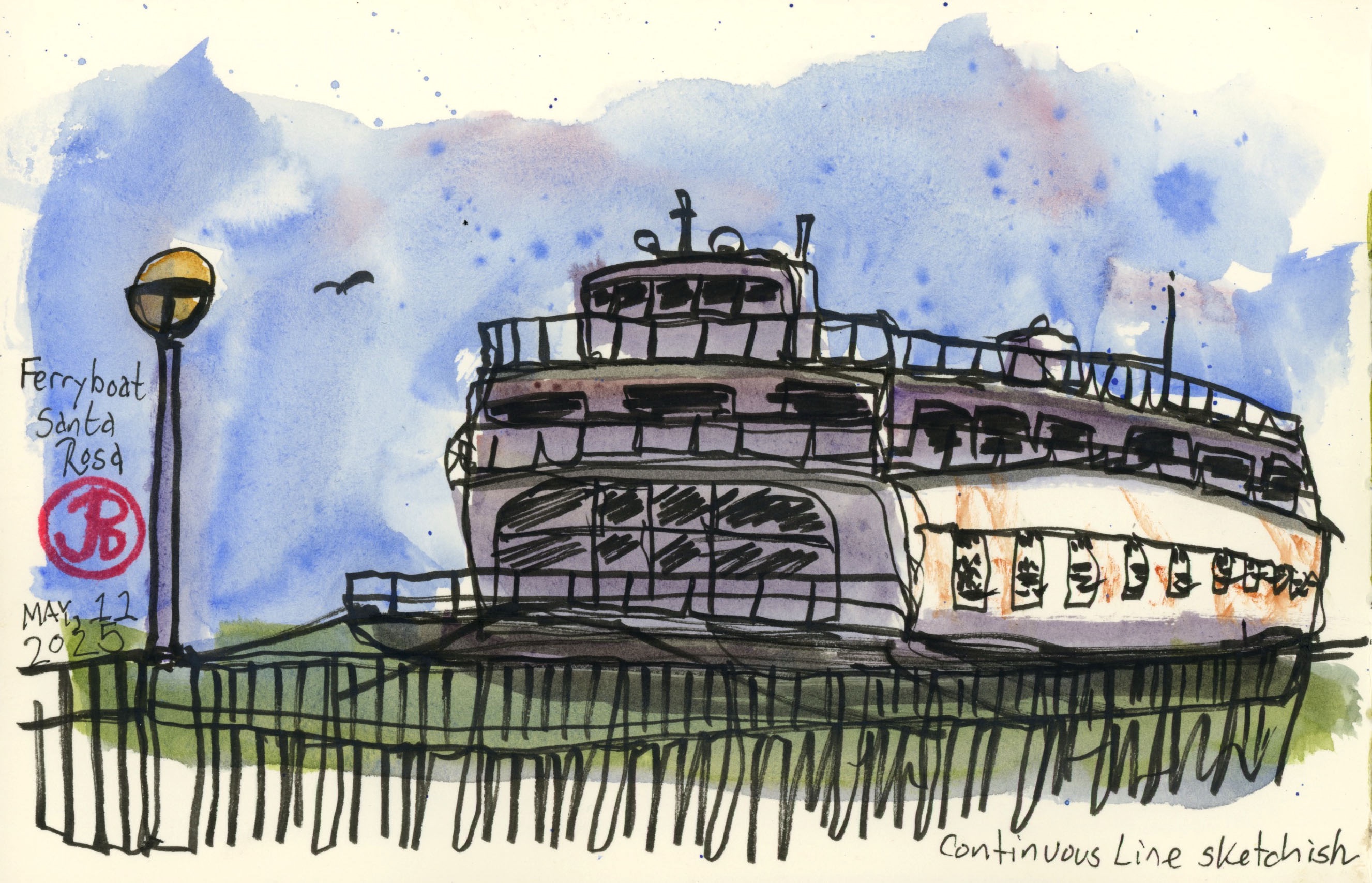
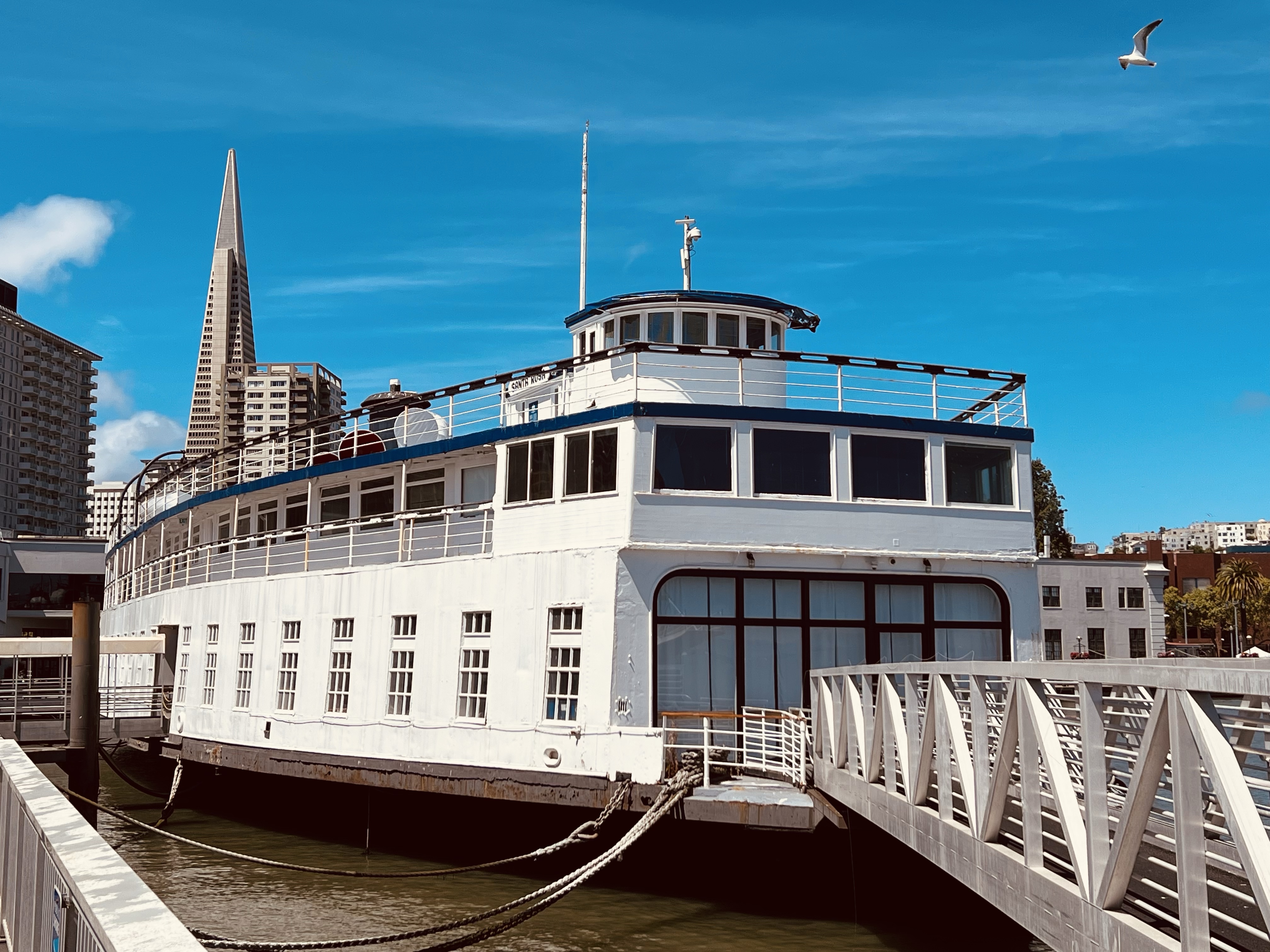
On the walk from the Ferry Building I came upon the 1927 ferry Santa Rosa at Pier 3 and I thought I would head back after my roundhouse sketch to add this piece of rail and nautical history to my spread.
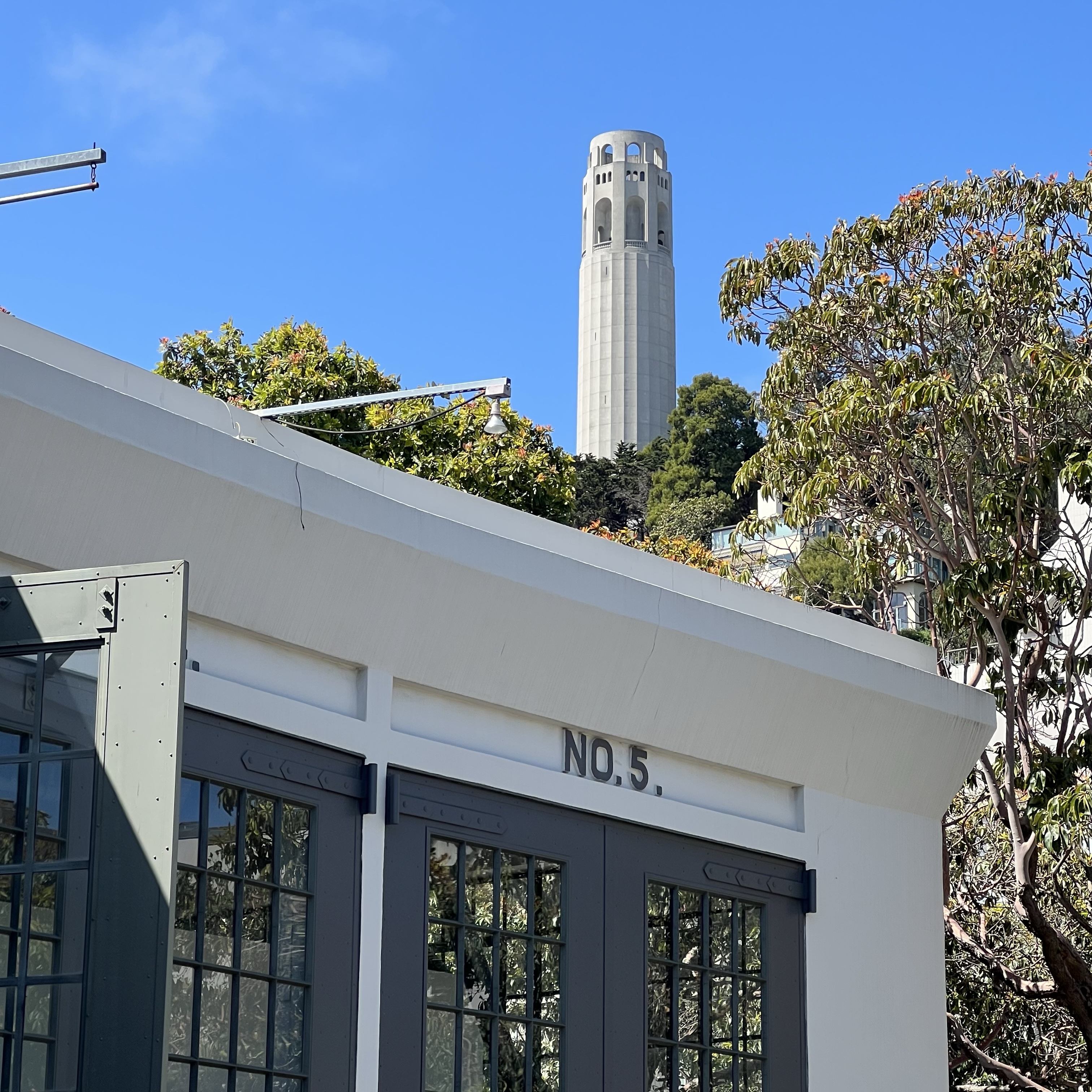
Bay No. 5 with Coit Tower in the background.
The Belt Line Railroad was founded in 1889. The railroad connected the Port of San Francisco with many of the piers and warehouses. The railroad shipped freight cars from the ferry freight terminal (at Pier 43) for railroads such as the Western Pacific, Northwestern Pacific, and the Aitchison, Topeka, & Santa Fe Railway. It also had connections with Southern Pacific on the southern portion of its line. The railroad also served Ft. Mason, the Presidio, and Chrissy Field through the Ft. Mason tunnel.
At its height, the railroad had 67 miles of track. The Belt Line operated 12 steam locomotives and six diesels.
Over time, the Port of San Francisco was eclipsed by the Port of Oakland and shipping traffic slowed. The railroad eventually folded in 1993.
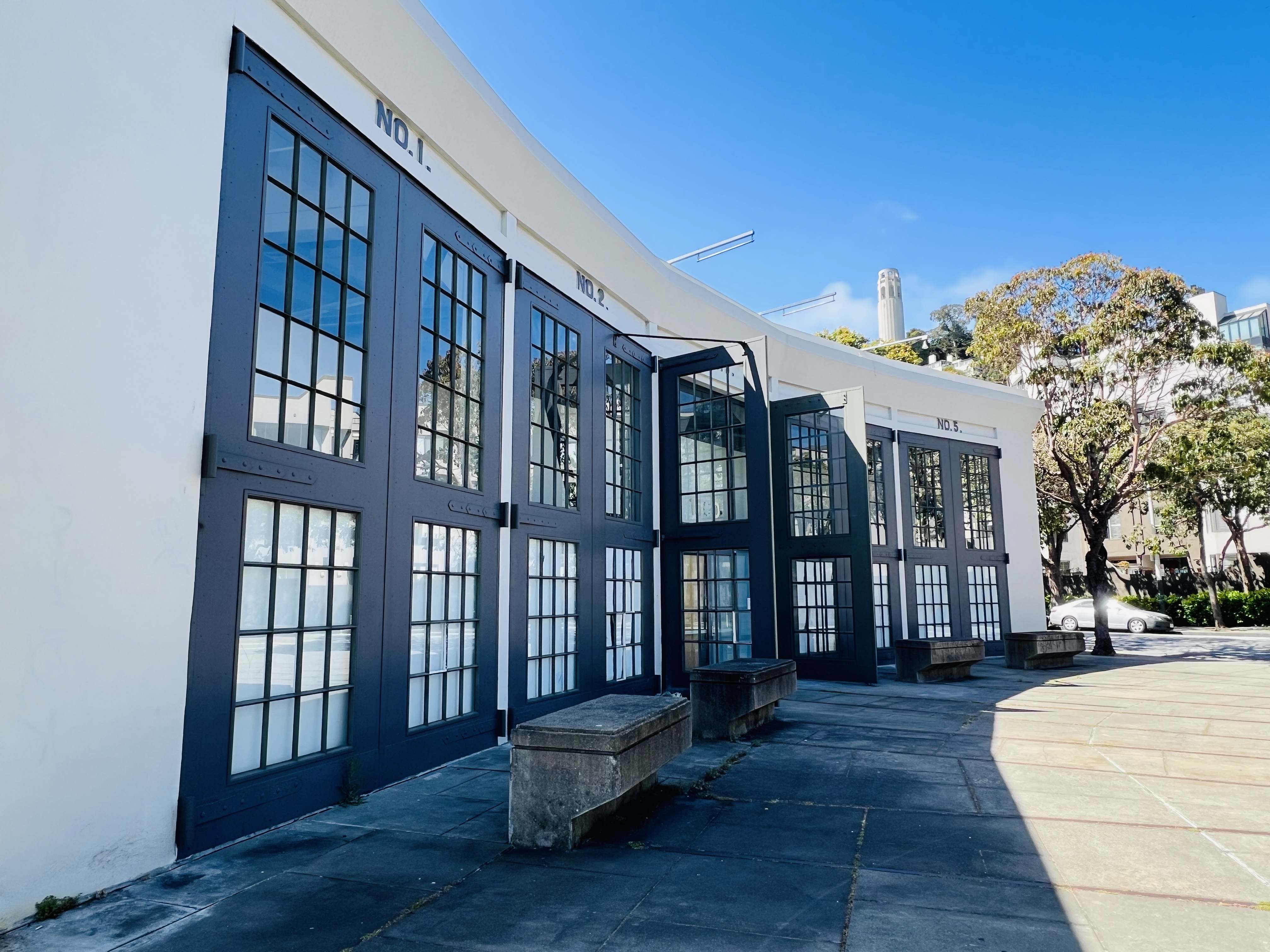
Before me was the reinforced concrete Belt Railroad Engine House or Roundhouse. It was built in 1913 and is now designated as City and County of San Francisco Landmark #114.
The house contains five bays with five tracks snaking out of each bay. The tracks disappear under paving at the intersection of Chestnut and Embarcadero. It was nice to see that some of the the rails were still in place although the engine house now houses another business.
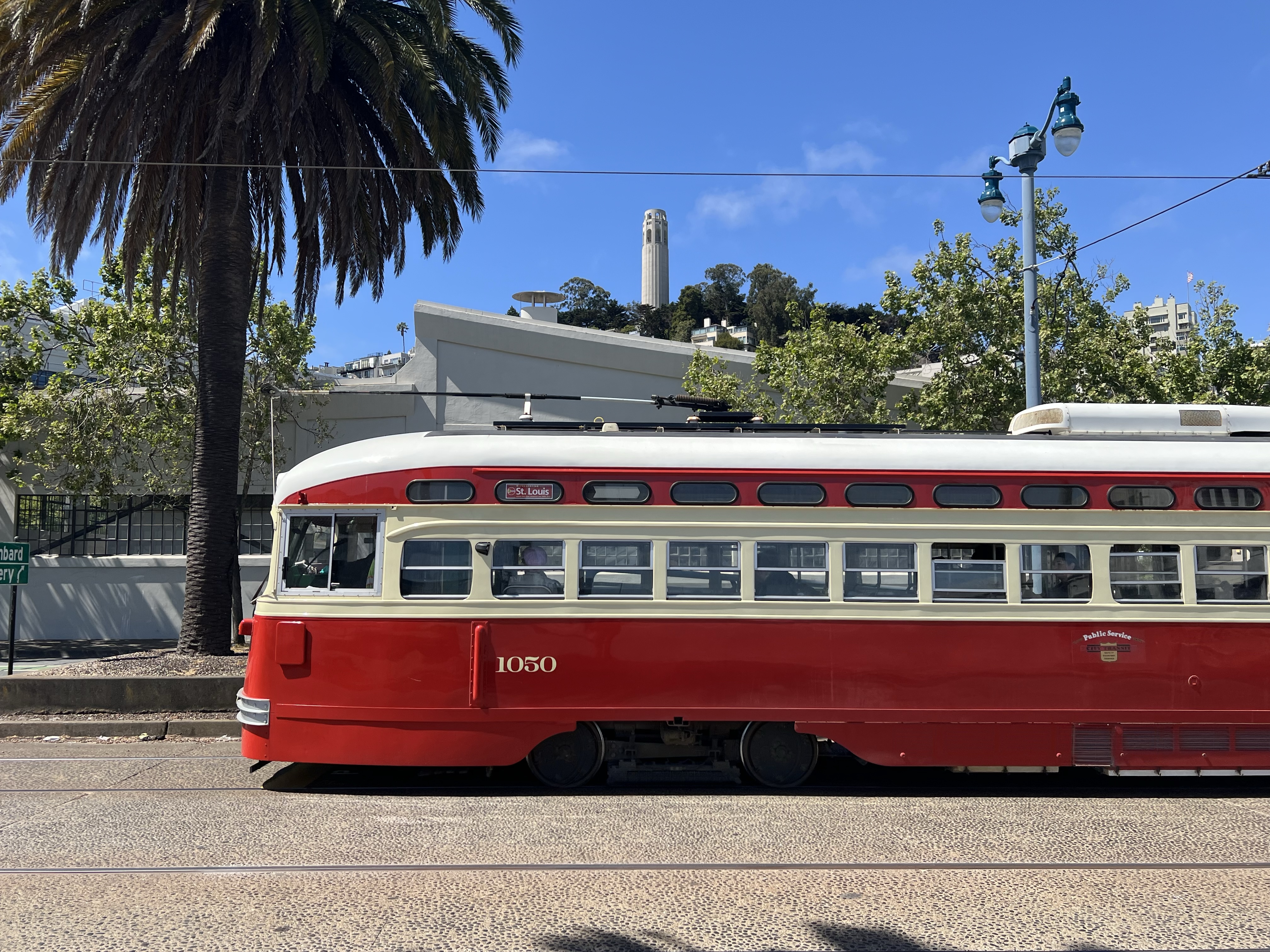
PCC car No. 1050 passes by the Engine House on the F Line. The car is painted in St. Louis livery.
After my sketch I headed back to the Santa Rosa and found a nice sketching bench.
For this sketch I chose to keep it loose and render the ferry in a continuous line sketch. Although I did lift my pen a few times to add some details and shading. So I’ll call it a broken line continuous sketch. For this sketch I experimented with a thicker more expressive pen, my Faber-Castell FM (Fude Medium). I love sketching with this pen!
The Santa Rosa was built in 1927 for the Northwestern Pacific Railroad and was in service until 1968. She was sold to the Puget Sound Navigation Company in 1940 and was renamed MV Enetai. She returned to San Francisco Bay in 1968 and sat unused until Hornblower purchased the ferry in 1989.
The Santa Rosa is now the corporate offices of Hornblower.
I was on the hunt for some Bay Area rail history. I was specifically looking for some ghosts of the Southern Pacific Railroad: the Bayshore Yard.
I started my search at the Bayshore Caltrain Station. Uncanny! Who would have thought?
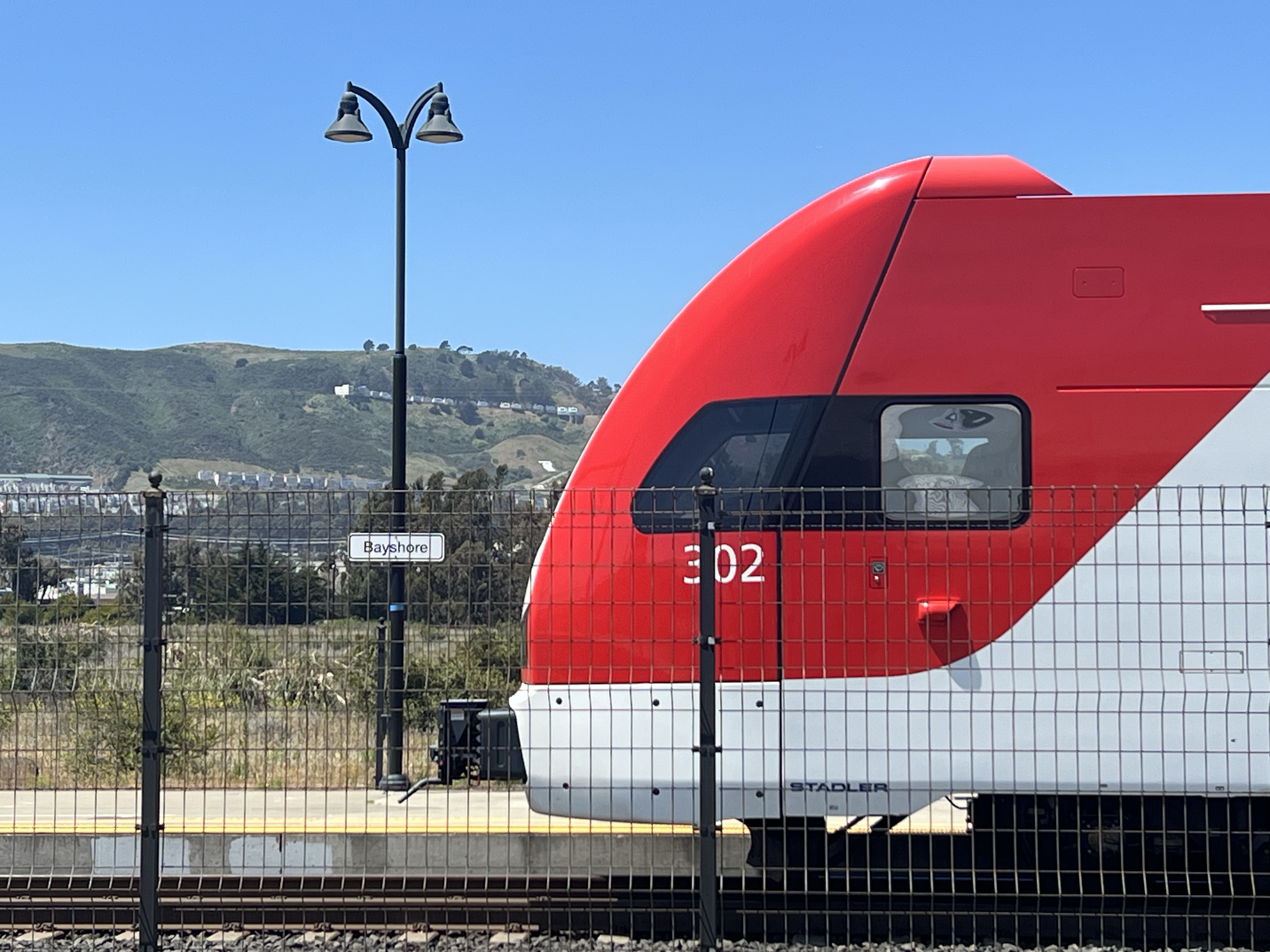
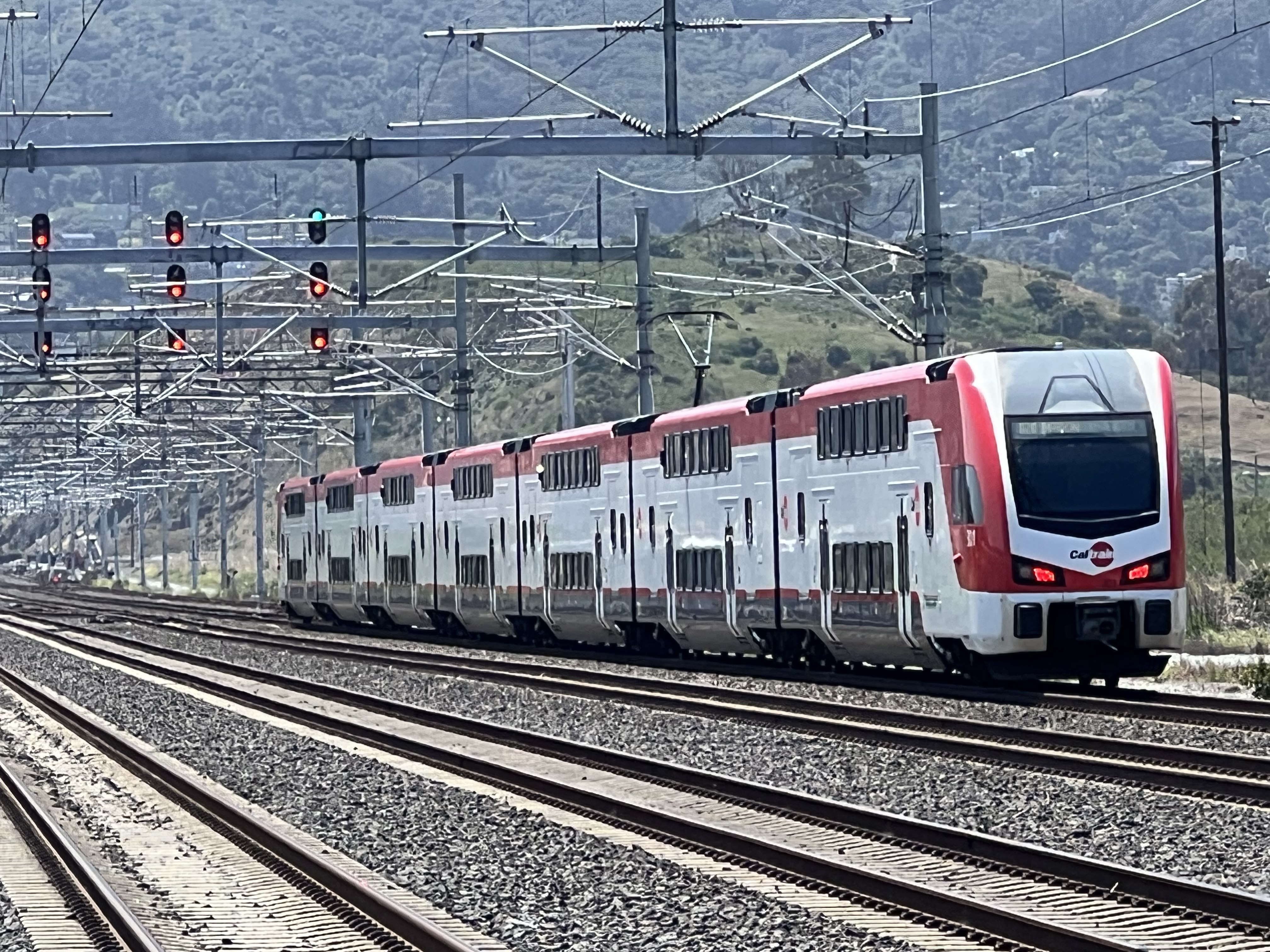
An EMU at Bayshore Station. I was here to see the overgrown fields beyond the tracks.
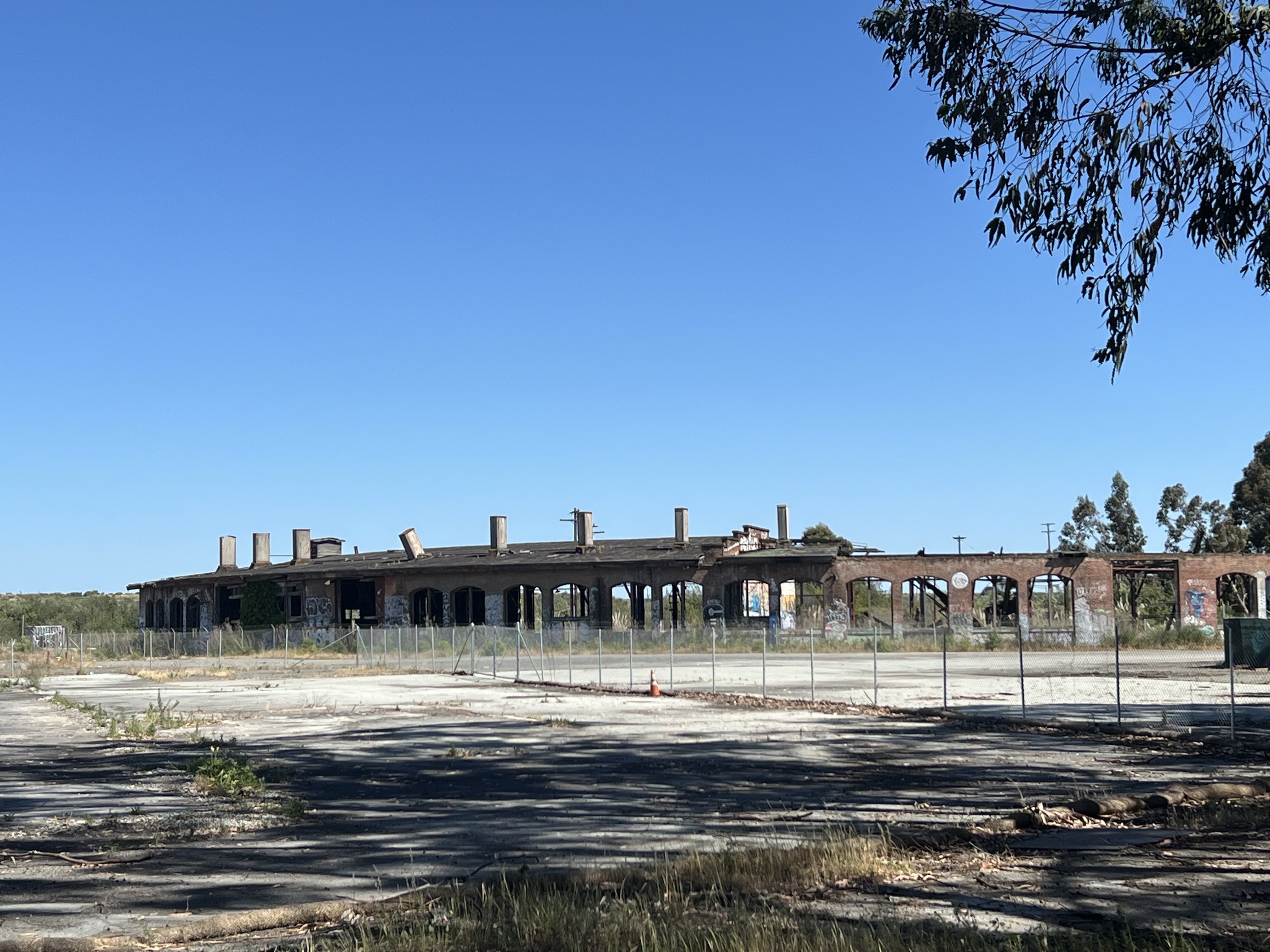
To the west of the tracks is a large overgrown open space punctuated by wooden power poles and bordered by the San Bruno Mountains. On the far edge of the open fields are some dilapidated and graffitied buildings.
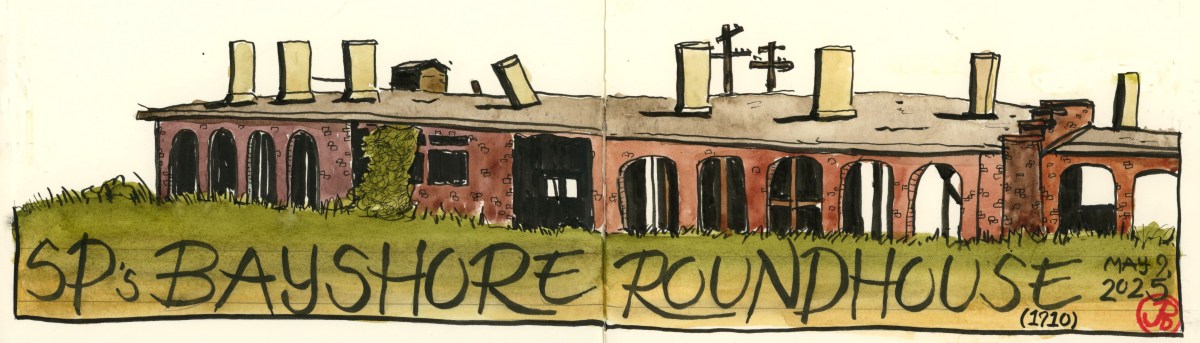
The brick roundhouse and the tank and boiler shop are the only remaining structures of a once bustling train yard and shops. How bustling?
The yard contain 50-65 miles of track, had a capacity of over 2,000 freight cars, and employed 3,000 people.
This was SP’s most heavily travelled stretch with 46.5 million gross tons per mile during WWII.
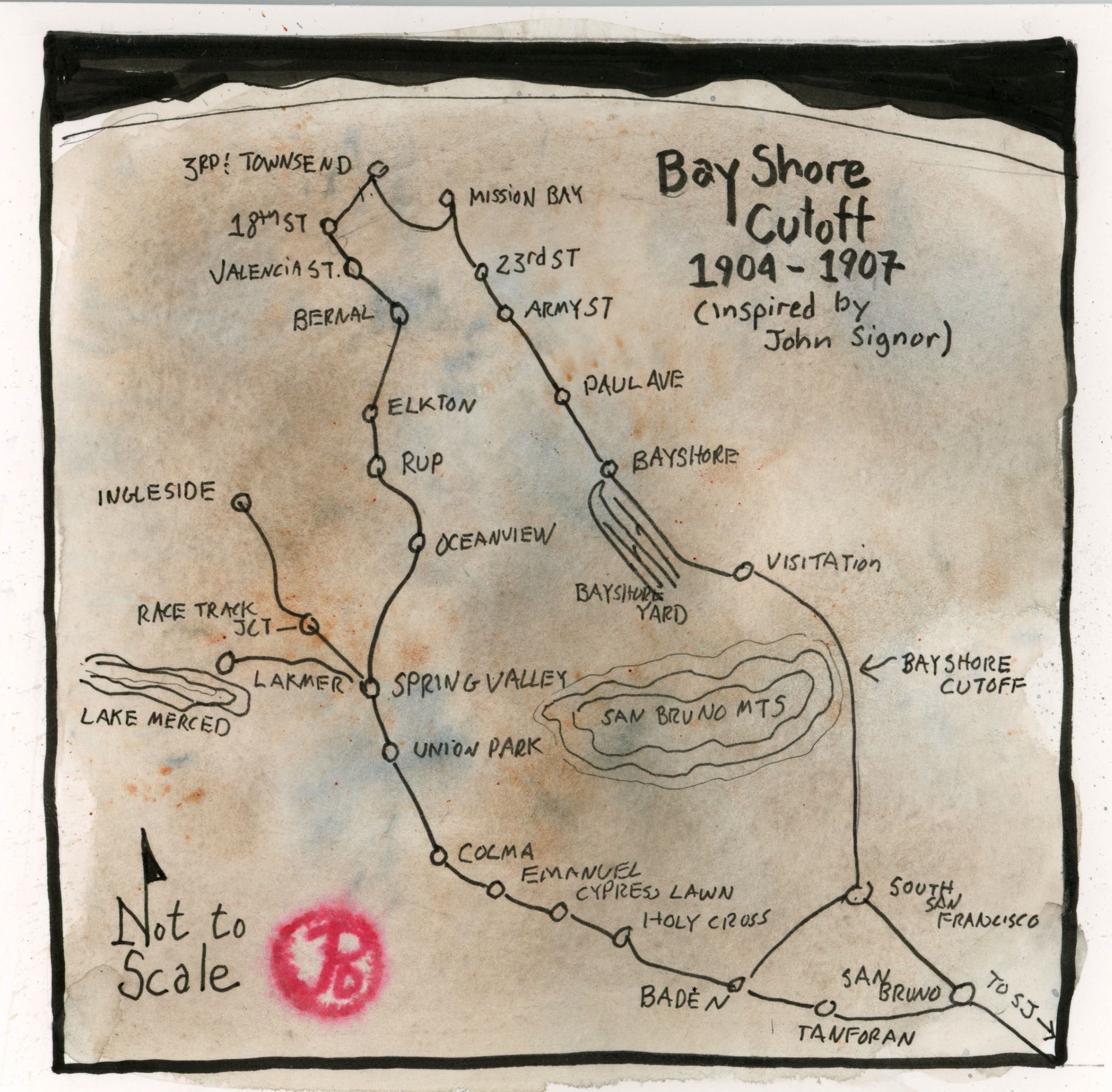
The story of the yard and shops starts with the Bayshore Cutoff.
This drawing is highly influenced by a map John Signor drew from his excellent book on the Coast Line.
As the name implies the Bayshore Cutoff is a short cut that straighten the line around San Bruno Mountain’s southern edge, from San Francisco to San Bruno.
A southbound EMU seven car set leaving Bayshore Station under the tangle of signal gantries and power lines. To the right is the former yard. The current line is along the Bayshore Cutoff.
The cutoff was completed 1907 and cost Southern Pacific $7 million. One reason for the high price tag is that the railroad had to construct five tunnels (20% of the cutoff was in tunnels). The fill from these tunnels was used to fill in Brisbane Lagoon which became Bayshore Yard and Shops.
The benefits of the cutoff were: saving more than three miles on the route, reducing the curvature of the line, and flattening the grade. The improvements cut travel time from San Francisco to San Jose by 30 minutes. The cutoff is still in use today, conveying passengers to and from San Francisco on Caltrain.
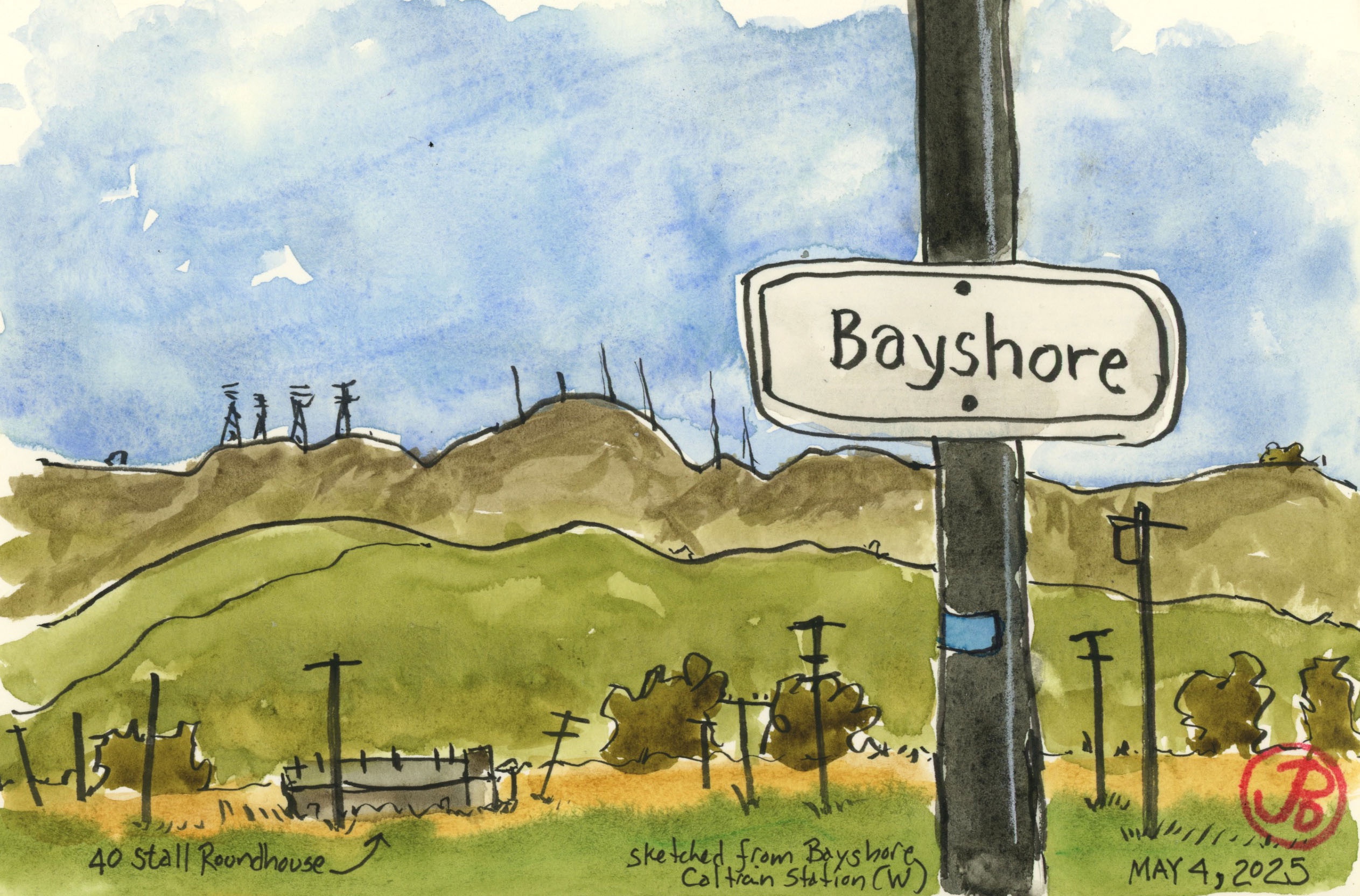
For my Bayshore sketch I took a position on the southbound platform and sketched the Bayshore Station sign in the foreground and the feral field and roundhouse in the background. In the far ground is San Bruno Mountain.
After work I headed up to Brisbane with the intent of sketching the roundhouse from Bayshore Boulevard. The roundhouse is close to the street but the former yard is enclosed in fencing. I was able to find a gap in the eucalyptus trees to get a panoramic sketch (sans graffiti) of Southern Pacific’s Bayshore roundhouse.
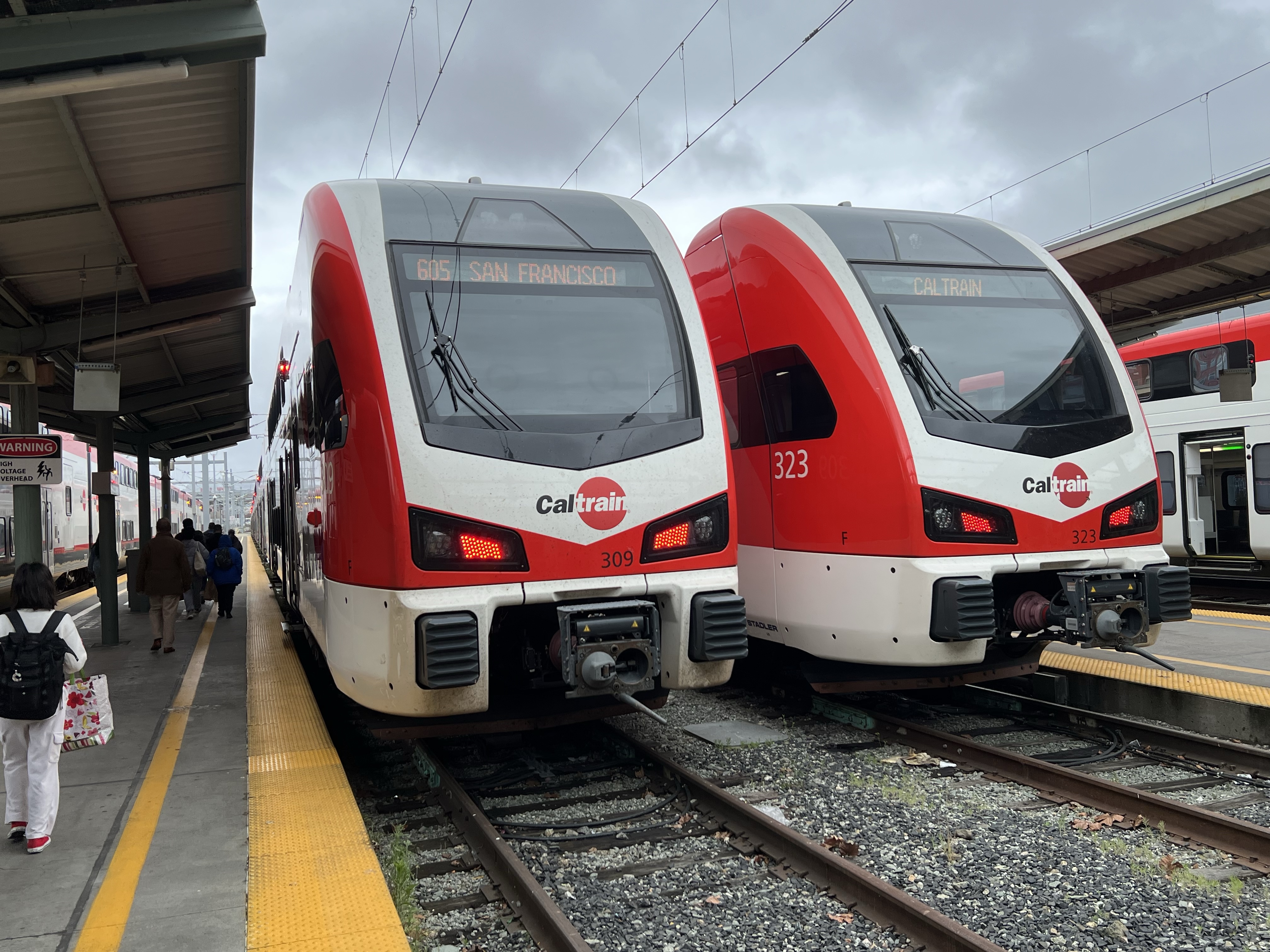
Last fall the new Sadler electric multiple unit sets (EMU) were put into service on the Caltrain route from San Francisco to San Jose and I had been meaning to ride aboard ever since.
So on a gloomy spring morning in late April, I boarded an inbound N Judah to the Caltrain Station at 4th and King.
I was picking a travel window that was not going to be too chaotic with first pitch scheduled at 1:05 at the Giant’s game. Lots of fans use the N Judah and Caltrain to get to the game.
I planned to catch southbound train 610 departing at 9:55 AM and detrain in Palo Alto for lunch on University Avenue.
Two of the new EMUs at the San Francisco Caltrain Station.
My goal was to bring one pen (TWSBI Eco) and one watercolor journal (Stillman & Birn Delta panoramic) and only use continuous line sketching.
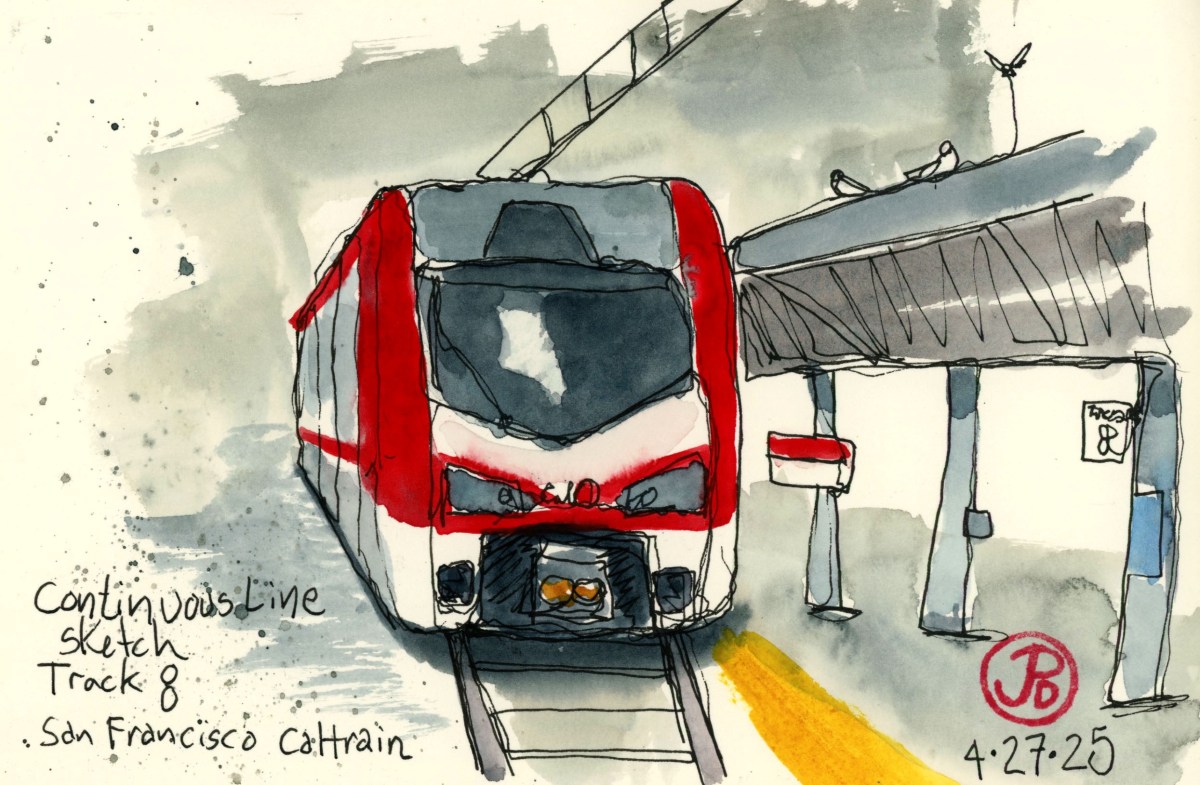
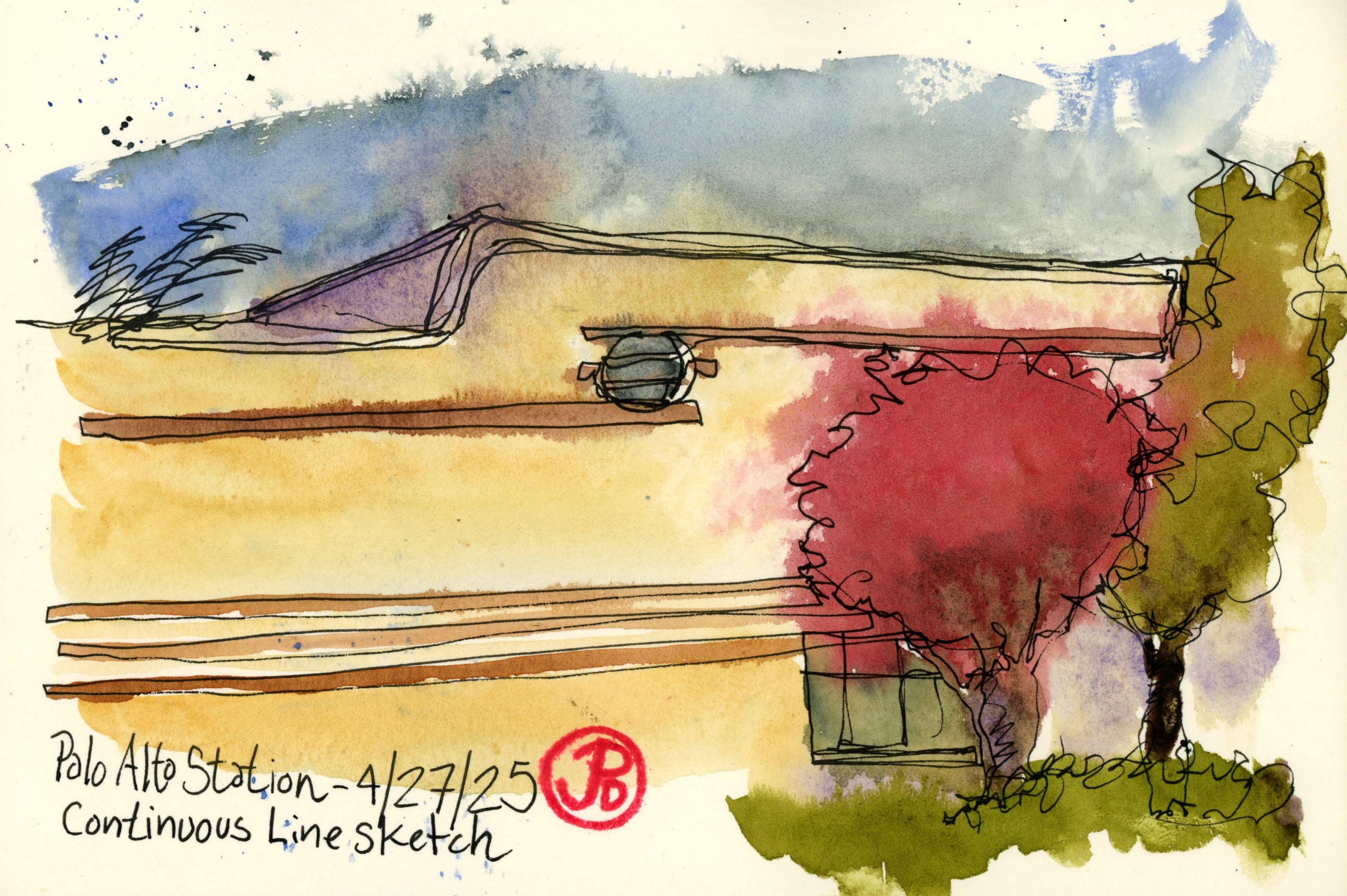
Before catching my train I sketched one of the new units on Track No. 8. (Featured sketch).
The gates opened and I boarded the train and was impressed with the bi-level design. I chose a seat on the top level sitting on the west facing side of the train (where all the historic stations are located).
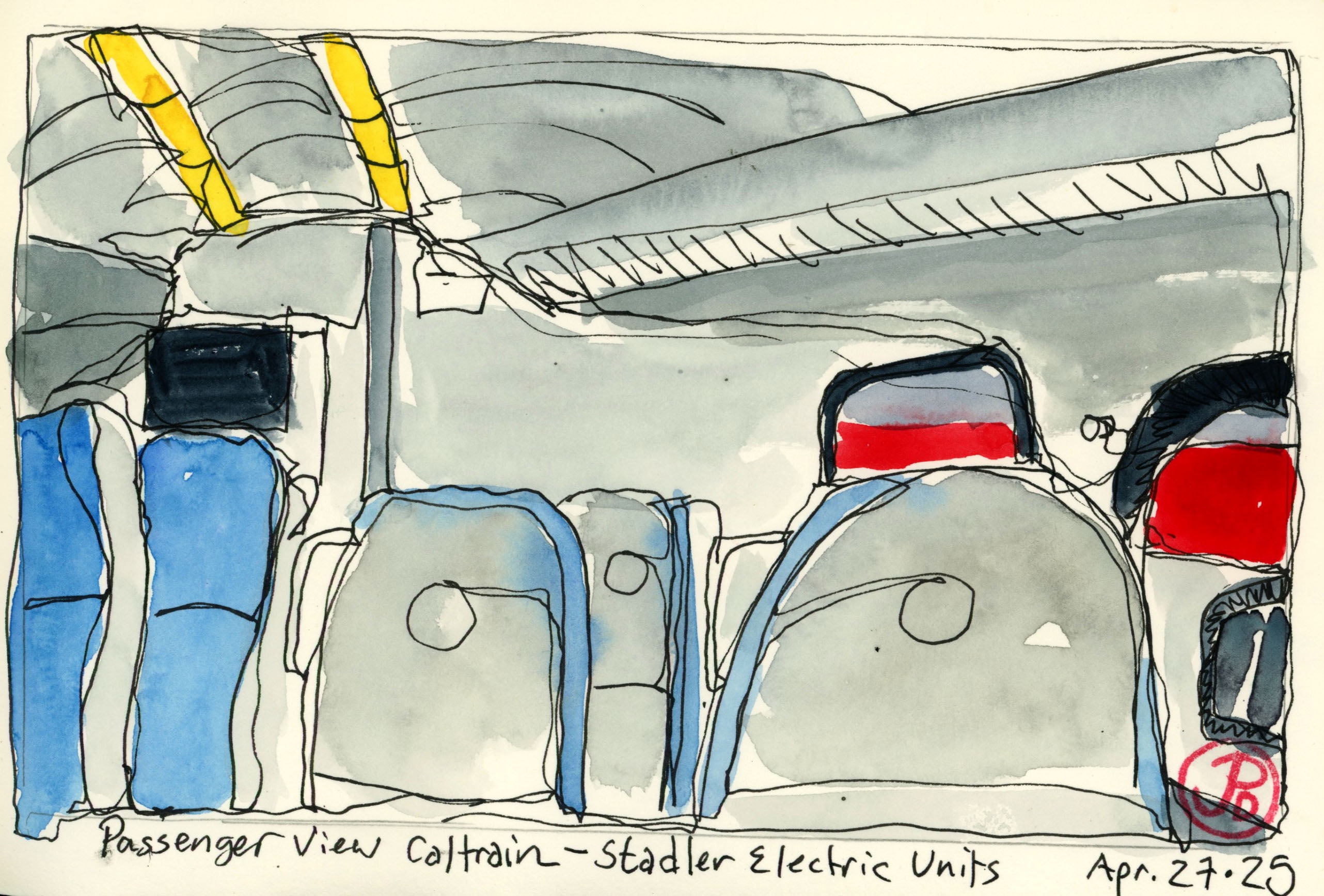
Before the train left I did a continuous line sketch of the interior from my upper deck seat-view. This sketching style loosens up your work including perspective. Normally I would pencil in the vanishing point and convergent lines but this sketching style is absolutely feral!
This takes a little getting used to because loosening up your sketching style causing you to loosen up your perspective of the style.
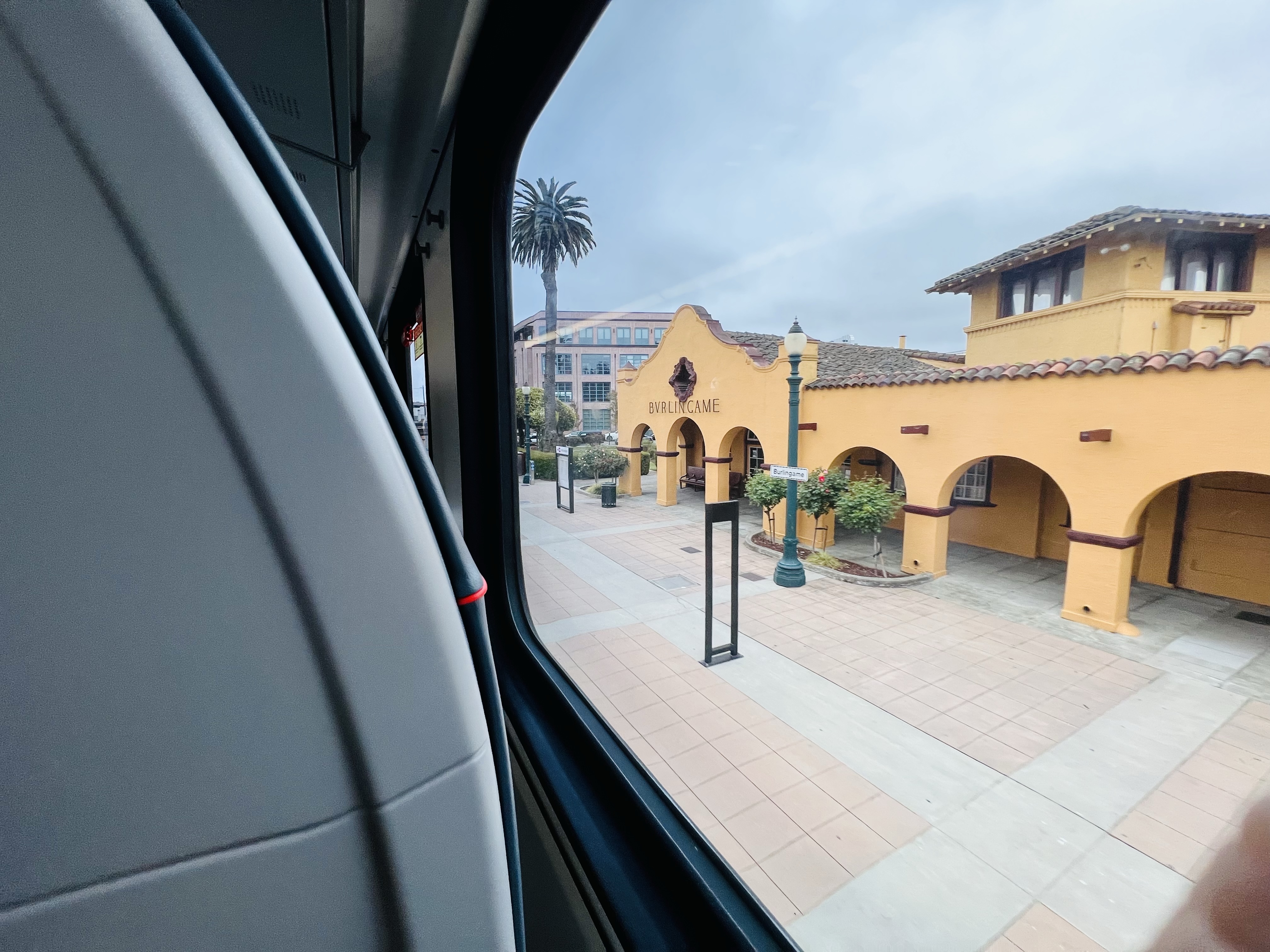
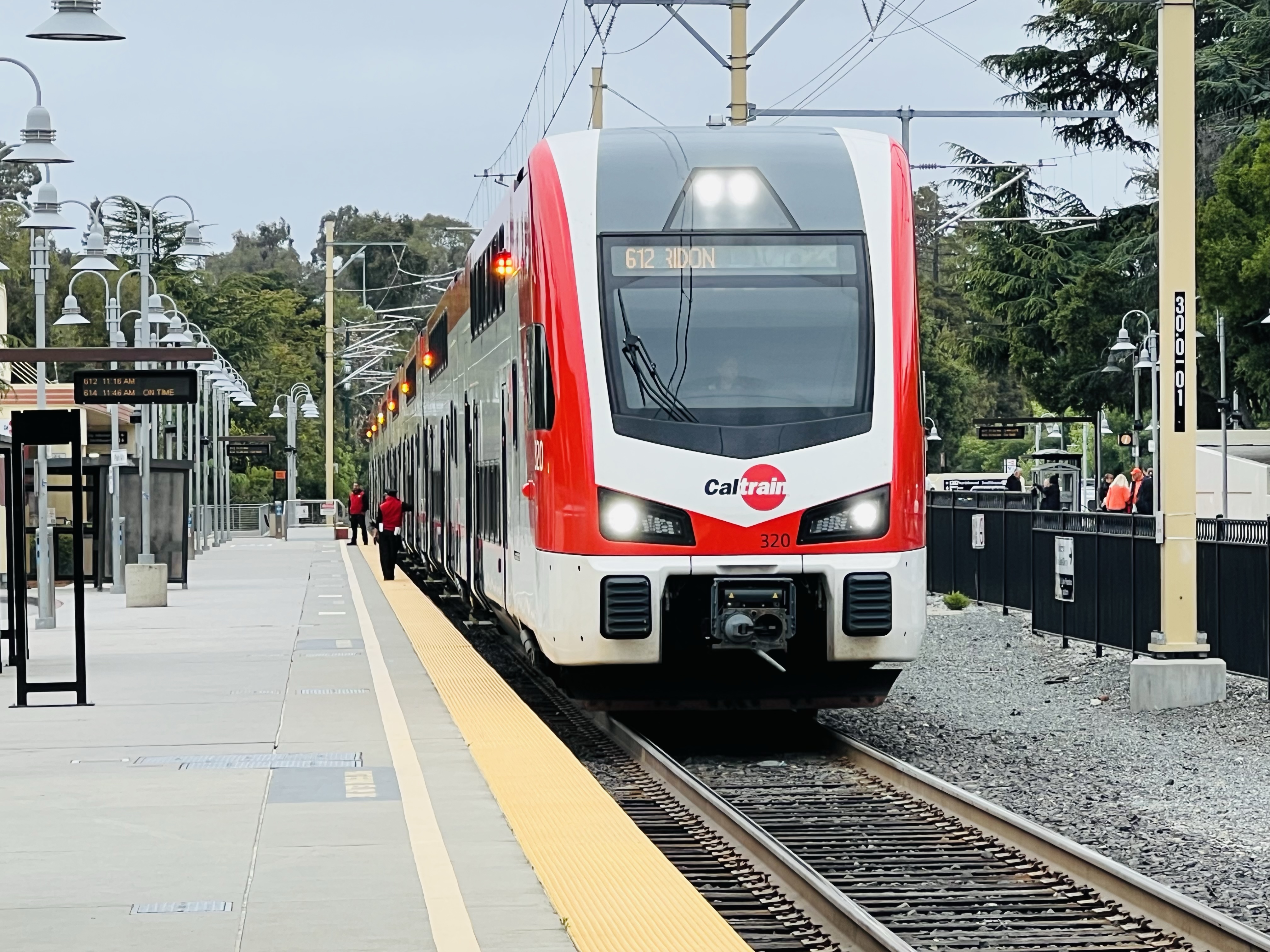
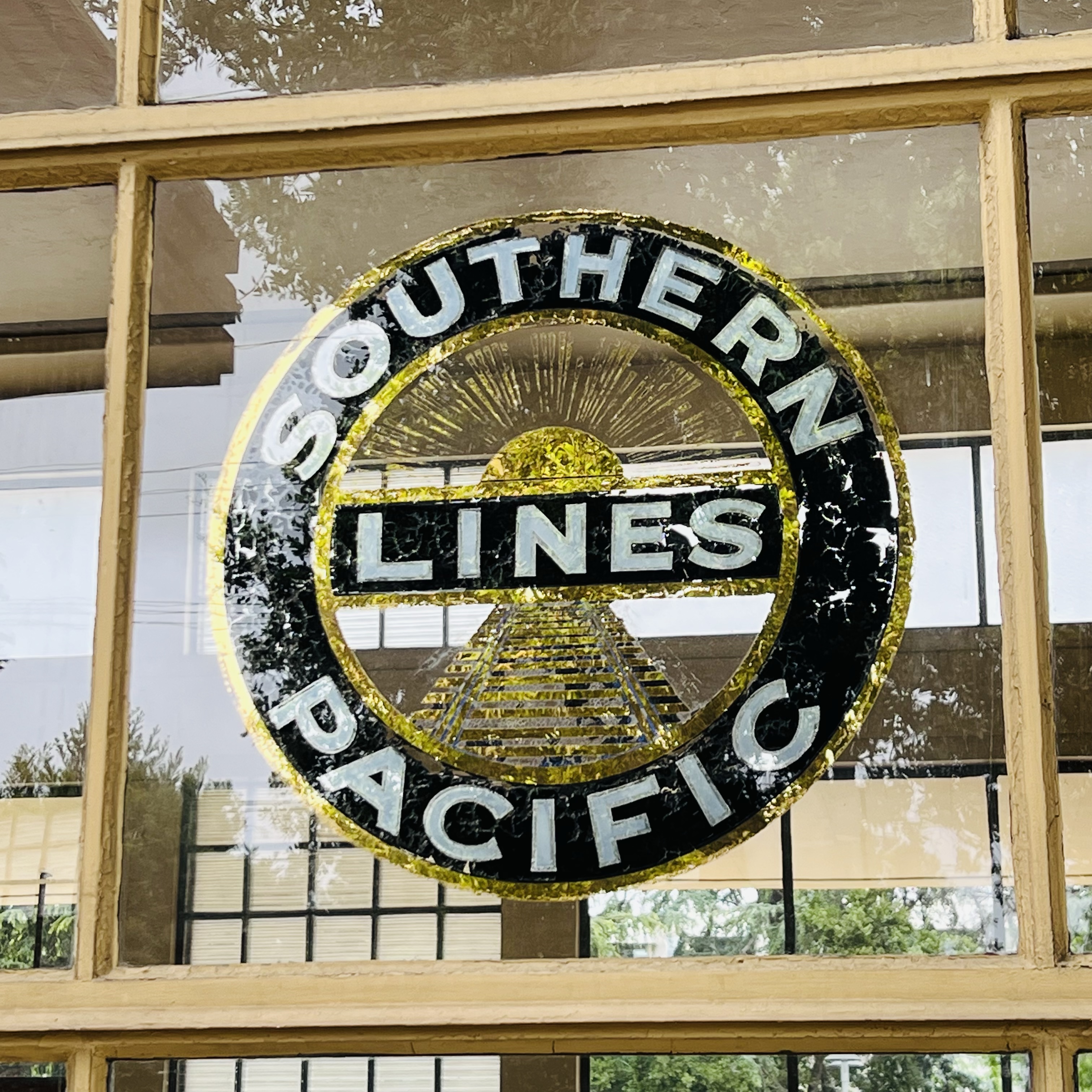
The view of one of my favorite stations on the line: Burlingame. This station is one of the earliest examples of the Mission Revival style and was highly influential in California when it was opened in 1894. An EMU at Palo Alto, Caltrain’s second busiest station after San Francisco.The emblem of the mighty SP when Palo Alto was a stop on the streamlined Daylight passenger service from San Francisco to Los Angeles. The most beautiful passenger train in the world (But I’m biased.)
Before heading to lunch on University, I sketched another of my favorite stations on the line the Streamline Moderne Palo Alto station (1941) which looks like some kind of sea going vessel about to take to the air! The station was rebuilt to match the streamlined GS locomotives that were on point for the Coast Daylights.
Final Thoughts
Caltrain’s new EMUs provided a quiet, comfortable, and quick ride from San Francisco to Palo Alto. The interior is well designed and easy to navigate with screens at both ends of the car that shows the next stop as well as upcoming stops. The seven car units have a European feel that looks more like a fast tram or articulated streetcar rather than a high sped mainline train set.
One quibble with the design is that there is only one restroom aboard the train set. This is not a minor quibble as most stations on the line do not provide opened restrooms (including Palo Alto).
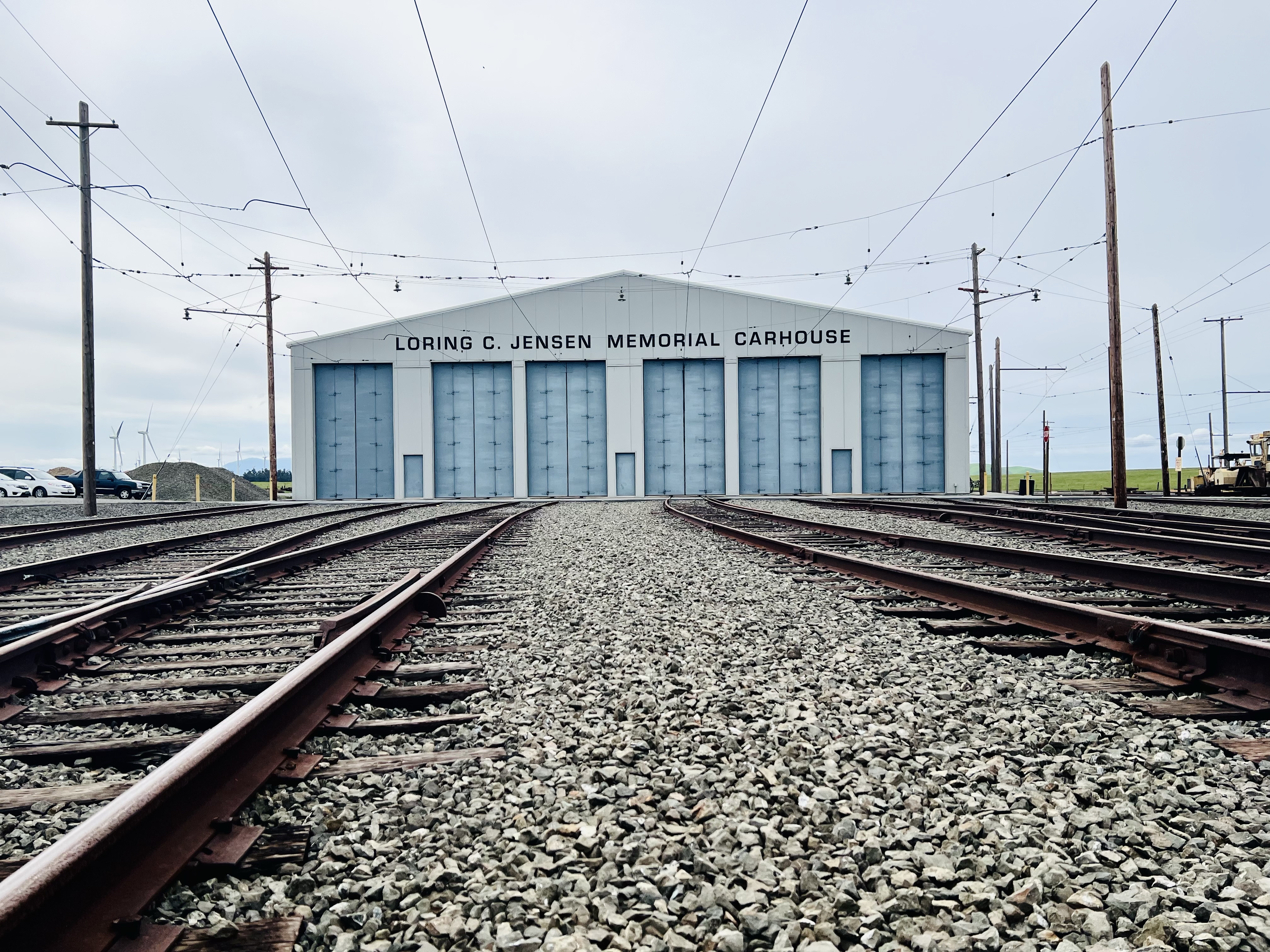
On Saturday I headed out to the Western Railway Museum, and I was hoping that they had enough volunteers to open the Jensen Carhouse.
The impressively large carhouse was built between 2004 and 2008 at an expense of $2.5 million. The indoor storage facility is the most ambitious project the museum has ever undertaken. It allows some of the museum’s vintage cars, locomotives, and streetcars to be stored and protected from the sun, rain, and wind of Solano County.
The only problem: if they do not have enough volunteers, the carhouse does not open to the public.
On my past two visits, the doors remained locked and closed.
The six bays of the Jenson Carhouse.
This Saturday, the carhouse would be open! And I had a few residents that I wanted to sketch!
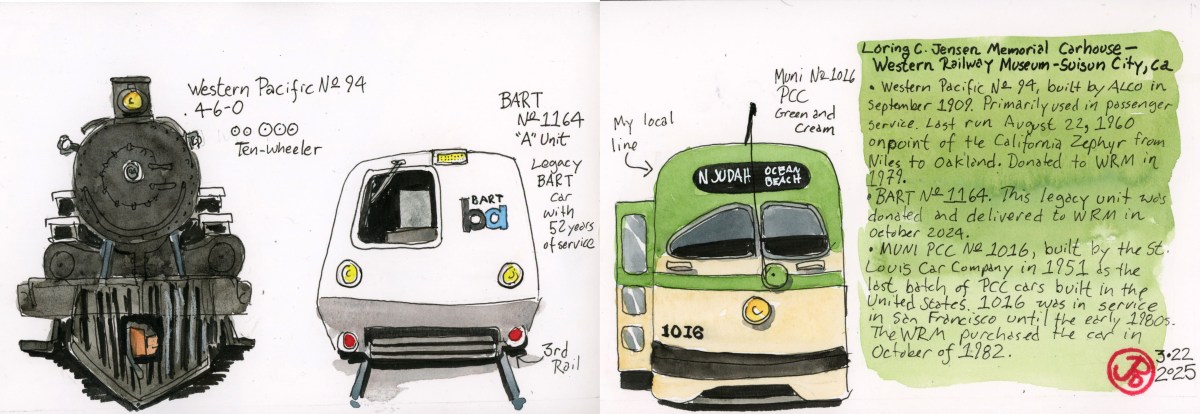
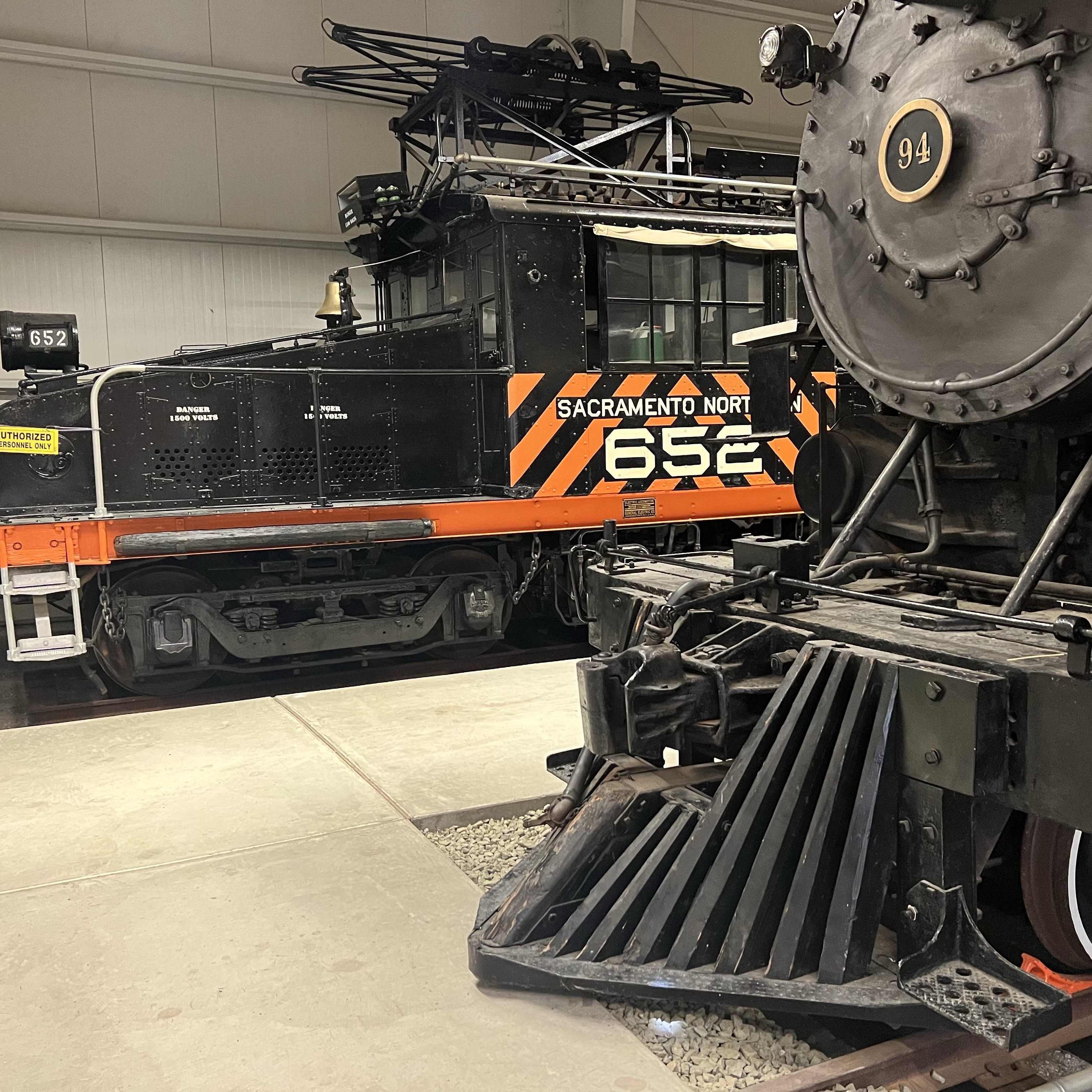
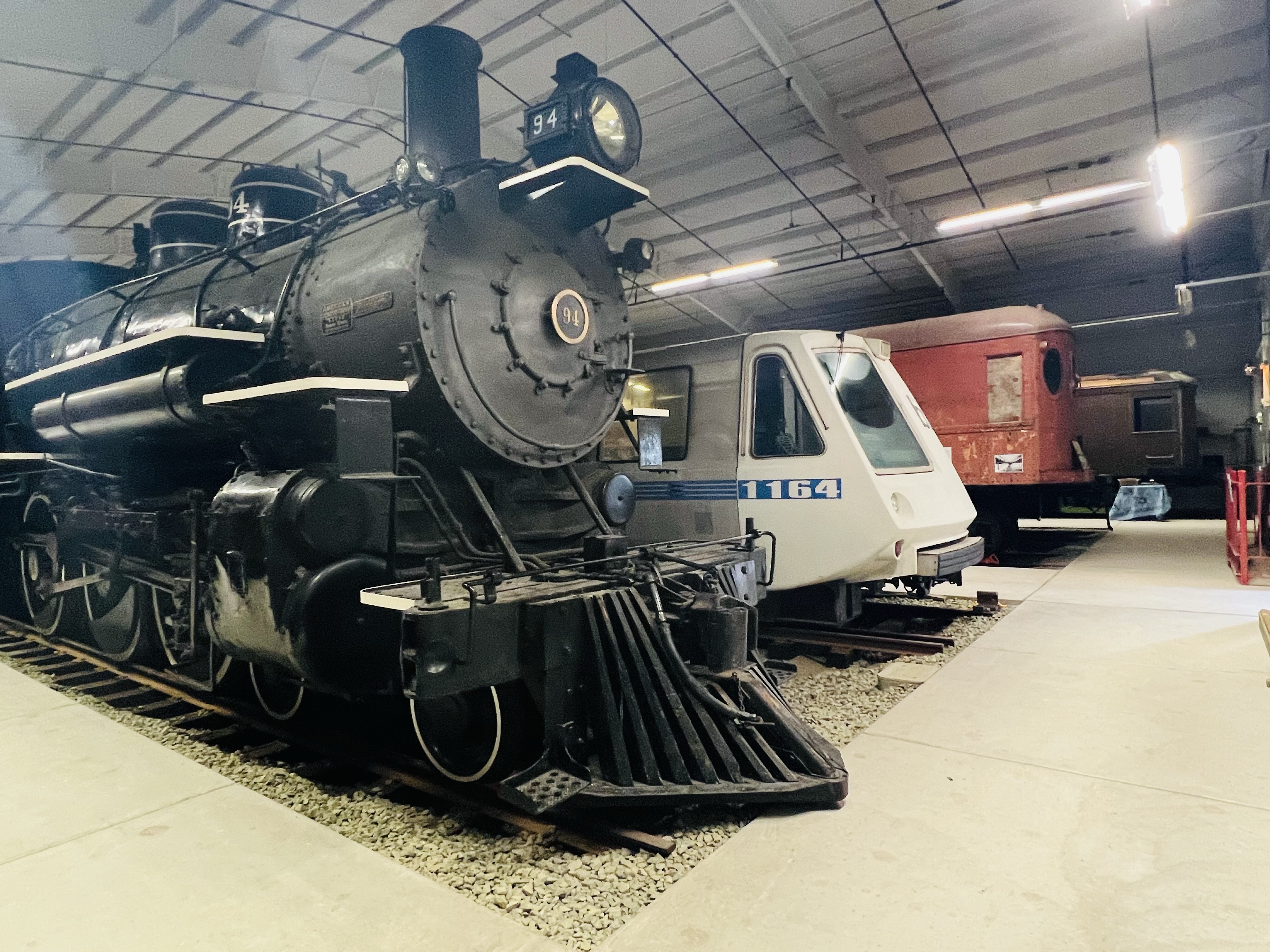
The number one resident I wanted to sketch was the Western Pacific 4-6-0 steam locomotive No. 94.
Two ends of the transit spectrum: steam and electric. Western Pacific’s No. 94 and Sacramento Northern’s No. 652.
Western Pacific 94 was built by American Locomotive Company in 1909. The twenty locomotives in this class were used for passenger service. WP was an early adopter of diesel power and steam ended on the WP in April of 1953. 94 was kept for excursion service. The locomotive was last operated on August 22, 1960 when it was on point of the California Zephyr between Niles and Oakland as part of the 50th anniversary of the passenger service. 94 was donated to the museum in 1979.
The next piece of transit history I sketched was the newly arrived BART legacy A Unit No. 1164. Three units were delivered to the museum in October of 2024 and are now stored in the Jensen Carhouse. BART went into service September 11, 1972 and the original legacy fleet was retired after 52 years of service. The three units donated to WRM have logged more than 15 million miles while in service.
No. 94 seems to dwarf the BART A Unit.
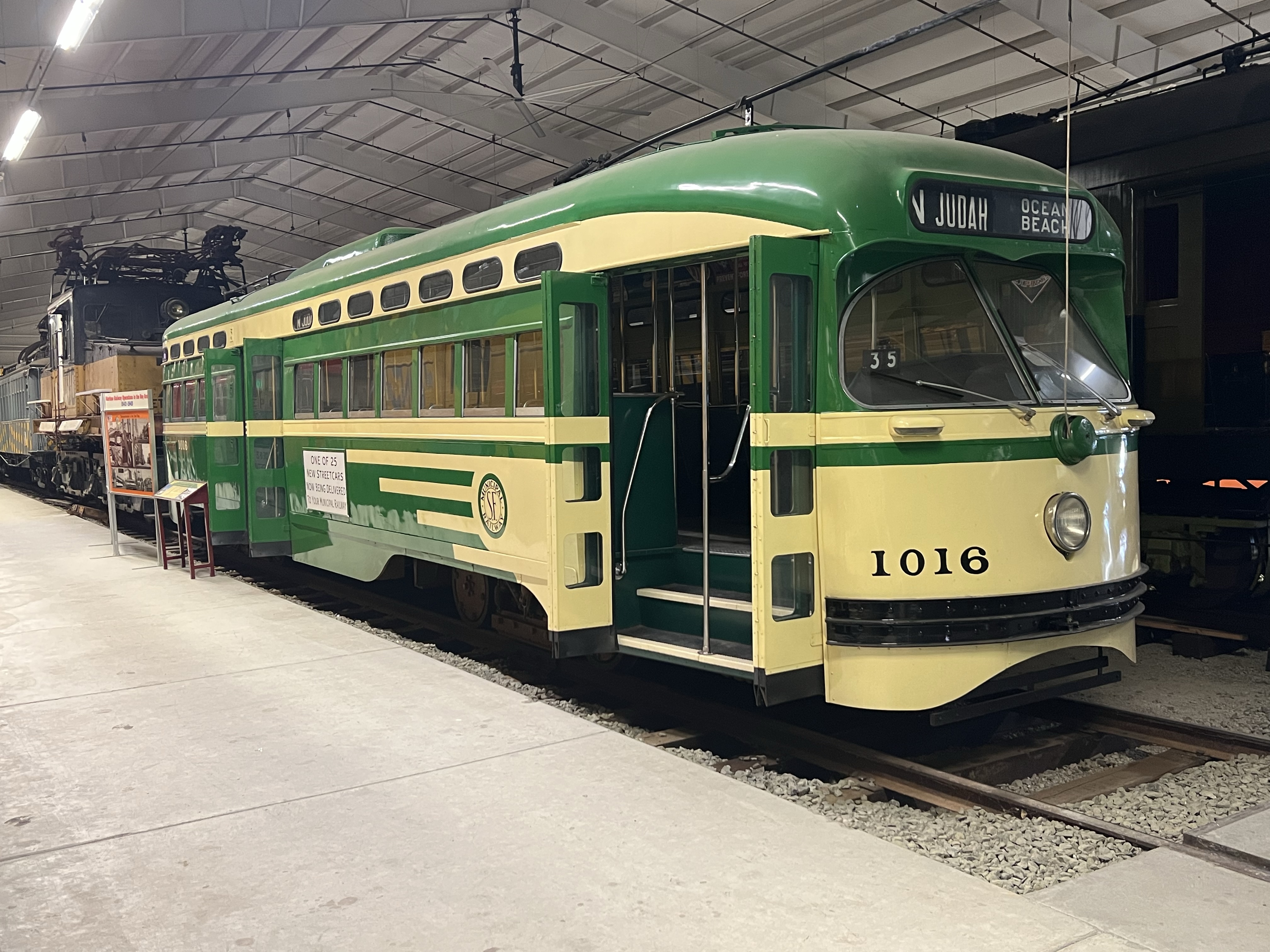
The last denizen I sketched in the carhouse is perhaps my favorite. It is San Francisco’s MUNI PCC car No. 1016. This PCC was built in 1951 by the St. Louis Car Company as part of the last batch of PCCs built in the United States.
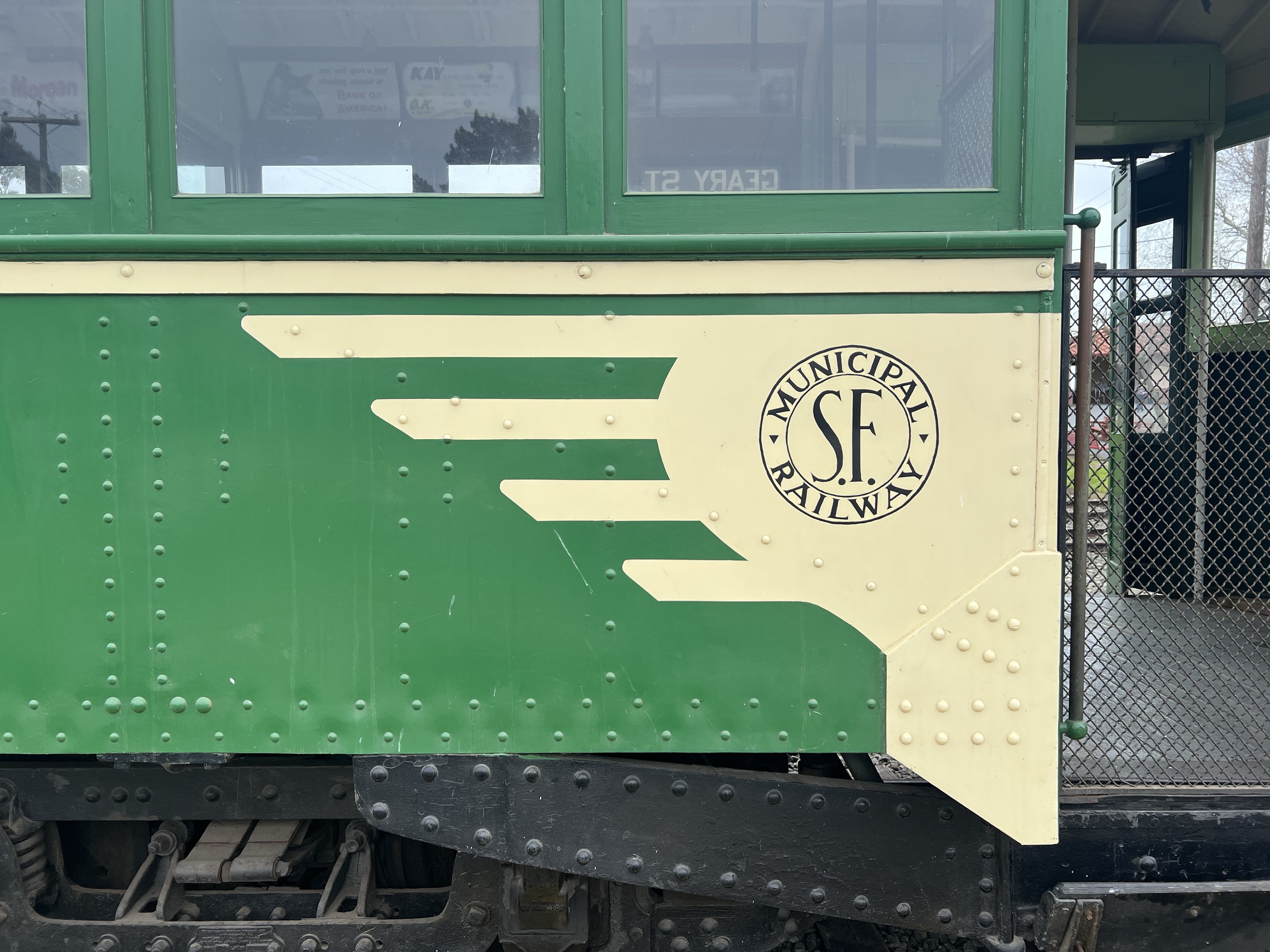
I have always loved the rounded streamlined design of PCC cars and the green and cream livery is my favorite paint scheme. This livery was developed in 1946 and features the MUNI wings.
MUNI’s famous wings on K-type car No. 178. This car type is affectionately known as an “iron monster”.
With the news of the passing of actor Gene Hackman, I thought I would sketch some locations from the film where he played one of his favorite roles: Harry Caul in Francis Ford Coppola’s The Conversation (1974).
The majority of the film was filmed on location in San Francisco. The conversation of the title takes place in Union Square.
The plot revolves around a surveillance expert (Hackman), who is hired to record a conversation between a man and a woman in busy Union Square. We later learn his eyes and ears have been deceiving him. No spoiler alert here, see the film for yourself!
I took the N Judah downtown and got off at the Powell Street Station. I walked past the lengthy cable car queue on Powell and headed towards Union Square.
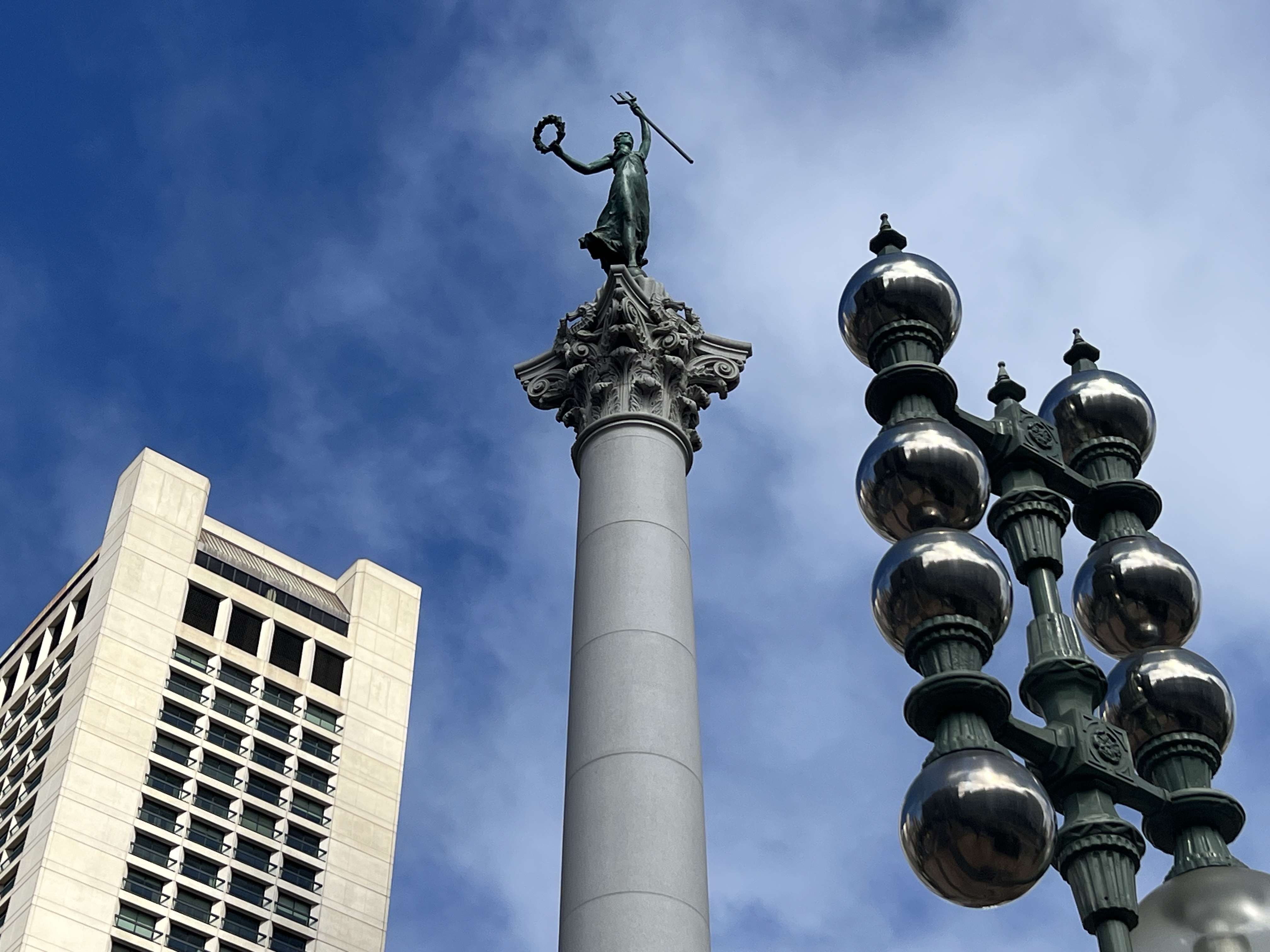
The statue of Nike is the center point of Union Square.
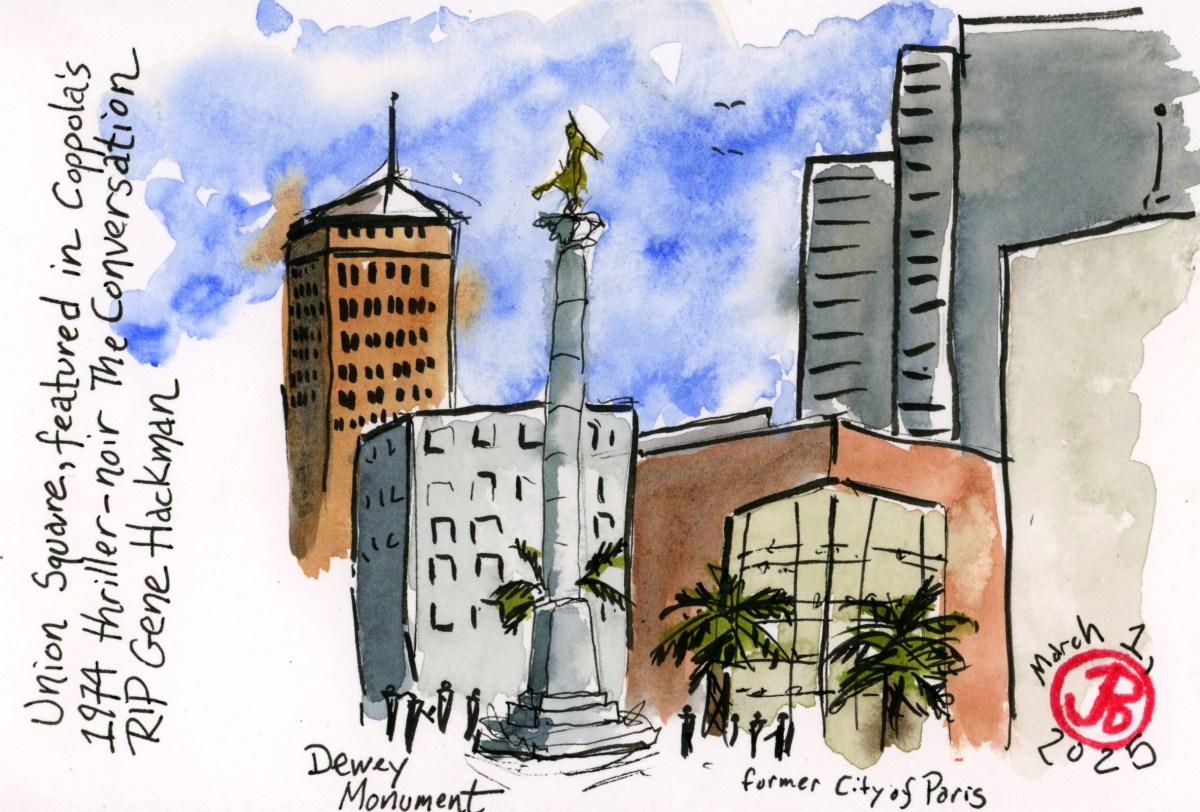
I found a corner of the square to sketch the focal point: the Dewey Monument, which is topped by the Greek goddess Nike, the Goddess of Victory, commemorating Admiral Dewey’s victory at the Battle of Manila Bay in the Philippines.
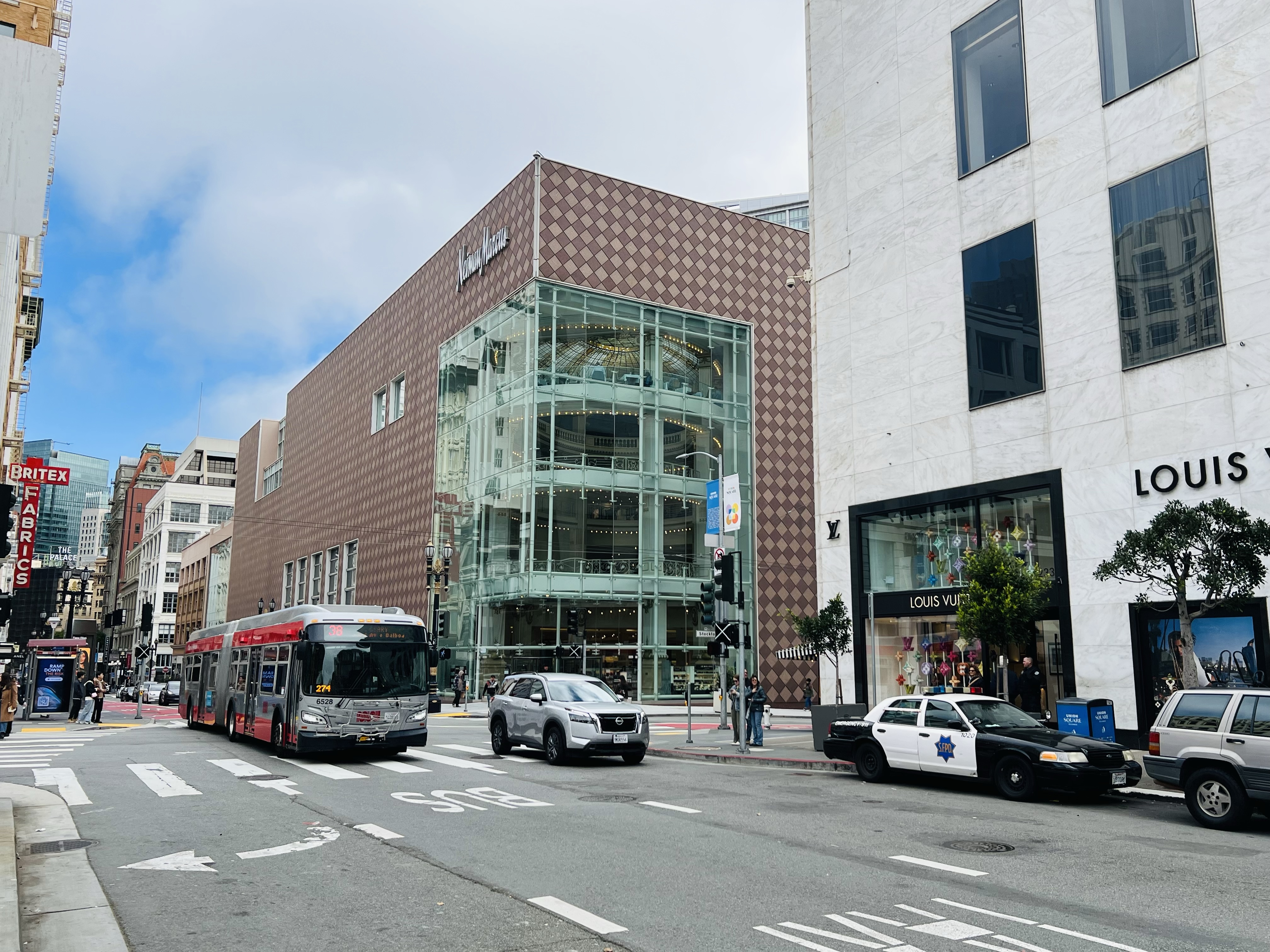
In the background of the sketch (featured sketch) is the former City of Paris department store (now Neiman Marcus), which features at the beginning of the film.
At the time of filming in 1972-73, Neiman Marcus was the City of Paris department store. Harry Caul’s surveillance van was parked where the police car is.
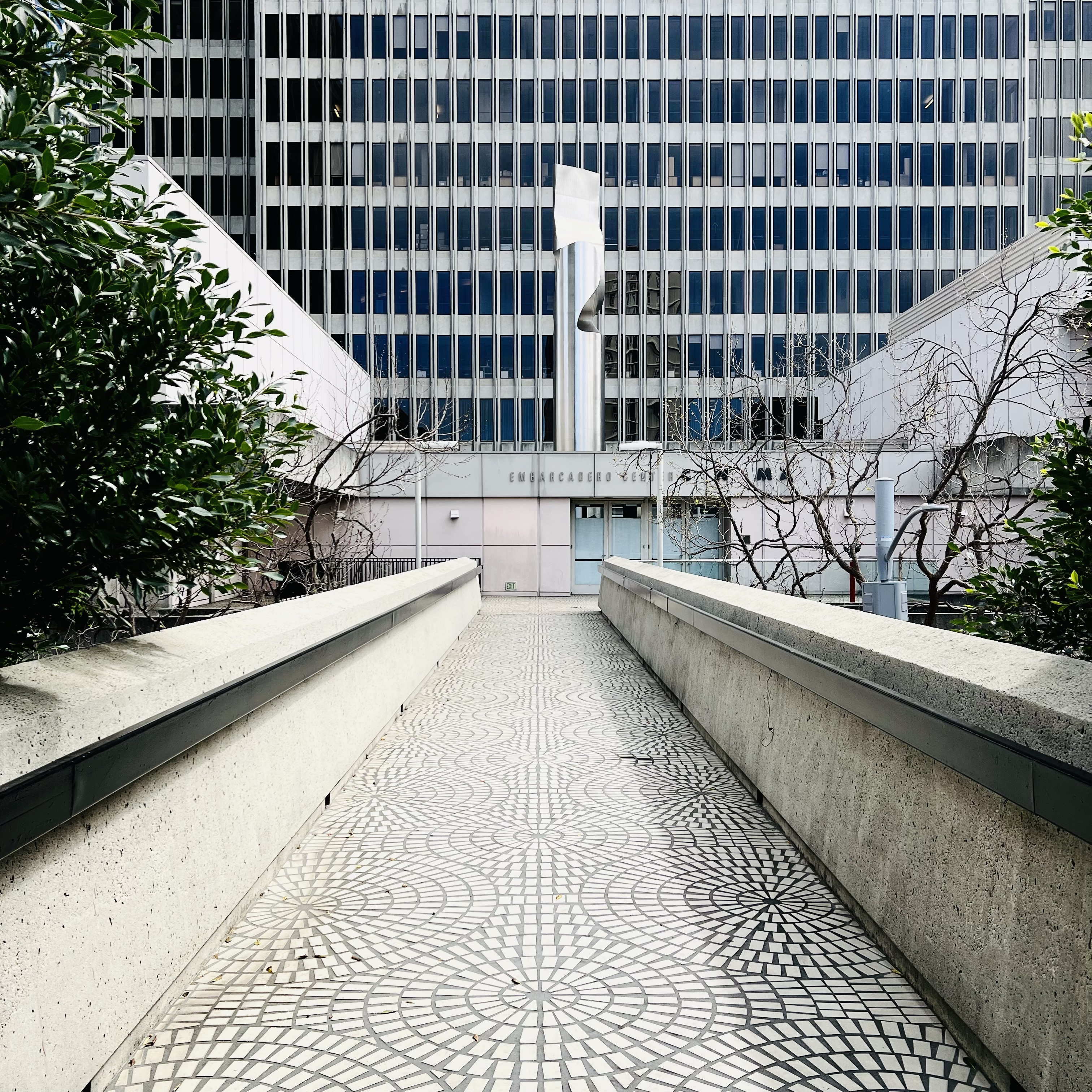
Another San Francisco location that is featured in The Conversation is the Embarcadero One complex. The site was developed in 1971 and was brand new when filming began. The complex is the location of Hackman’s client, the President, portrayed by Robert Duval. His assistant is played by a young Harrison Ford.
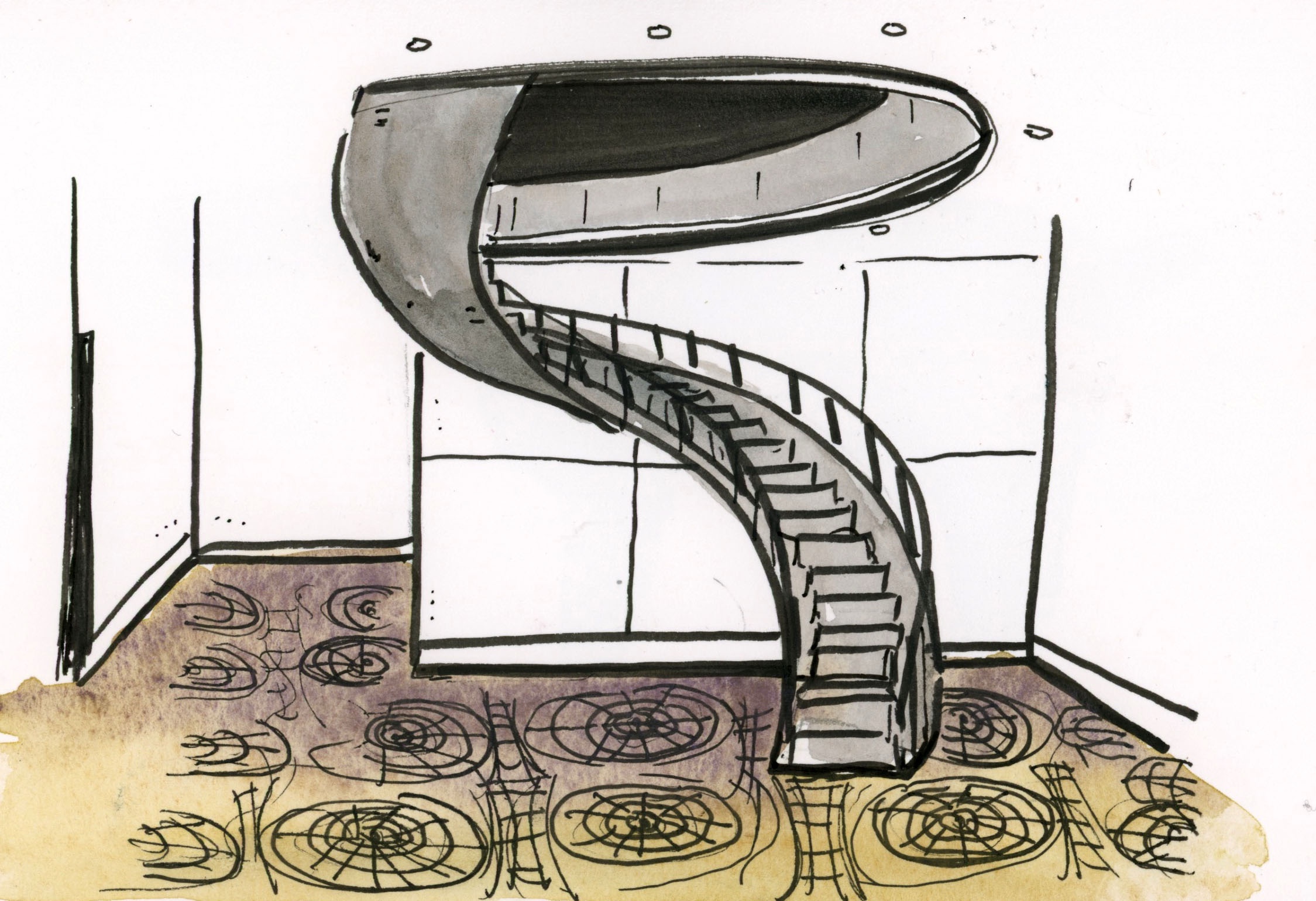
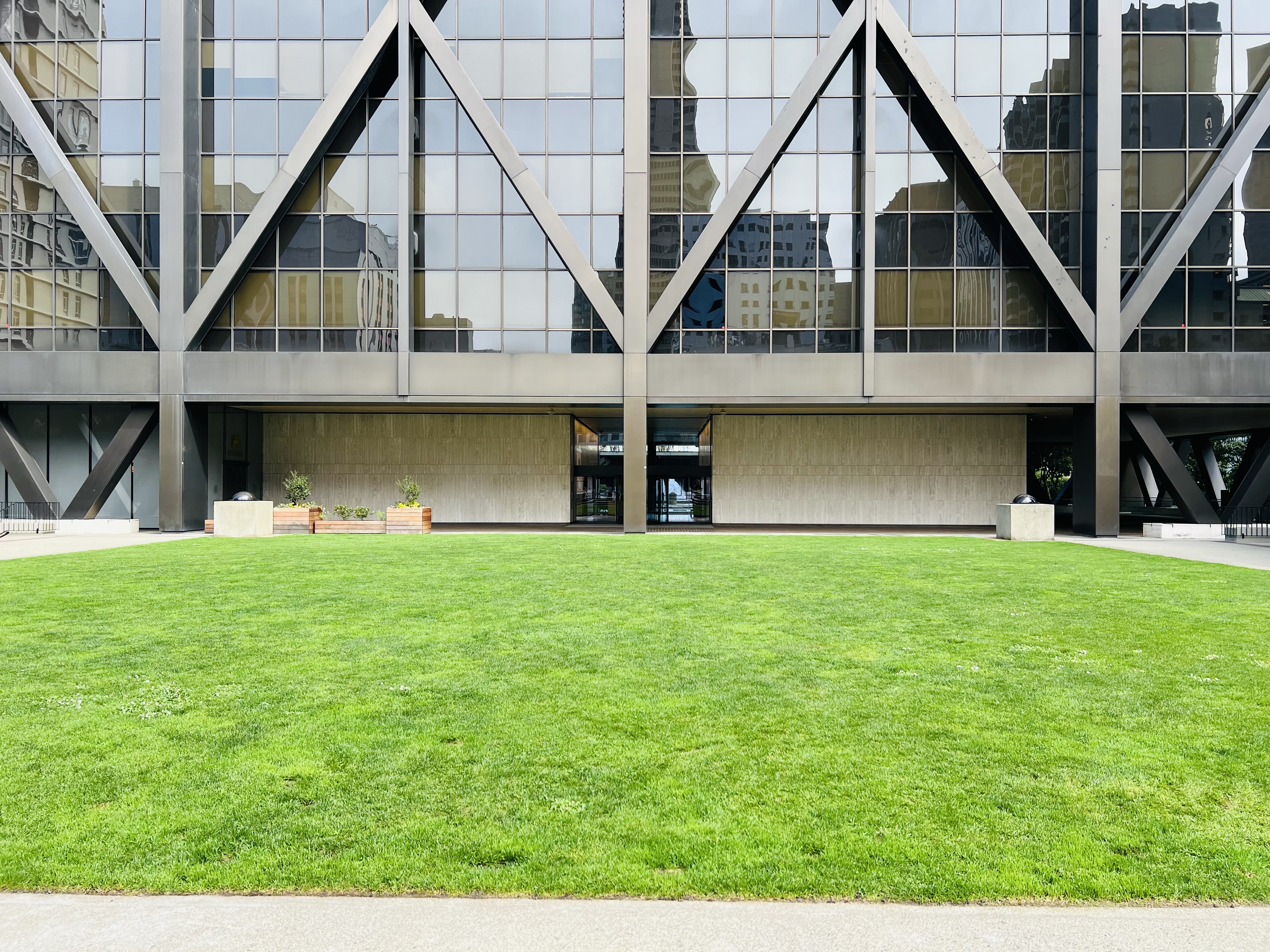
The walkway leading to Embarcadero One was featured twice as Hackman’s character goes to see the Director. The sculpture, Two Columns With Wedge (1971) was only a few years old when filming took place here. The now closed cinema in front of the sculpture was not there at the time of filming. A field sketch of one of the iconic spiral staircases of Embarcadero Center. One of these staircases was featured prominently in The Conversation.After being paid by the President, Hackman walks right to left in front of One Maritime Plaza, which is across the street from One Embarcadero Center. The location looks much the same as it did in the early 1970s.
Walking in the footsteps that the actor Gene Hackman took in one of his seminal lead roles, is my way of honoring a talented performer that had recently left us as well as creating a fitting sketcher’s eulogy.
On a Thursday morning I was on the hunt for two sculptures near the Ferry Building at the base of Market Street.
It wasn’t going to be a tough hunt because sculptures don’t move.
About a week earlier I had done some sketching at the de Young Museum. I had sketched two pieces in the Sculpture Garden by Henry Moore and Clars Oldenburg.
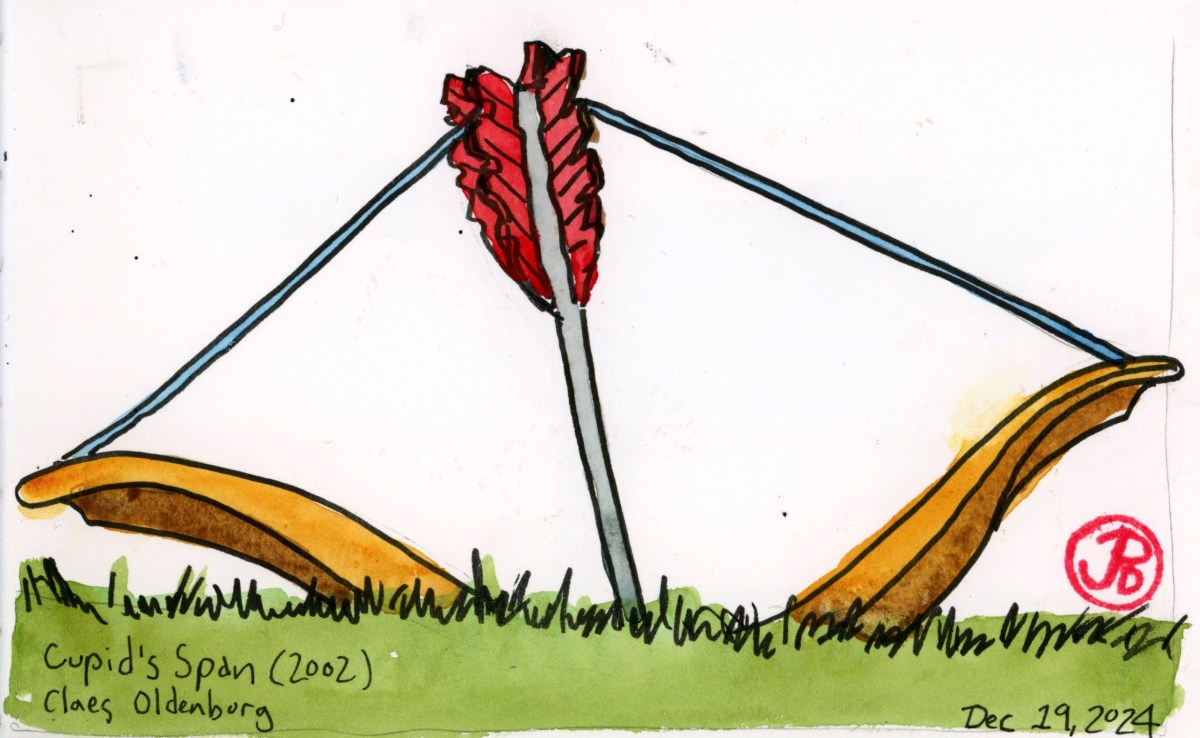
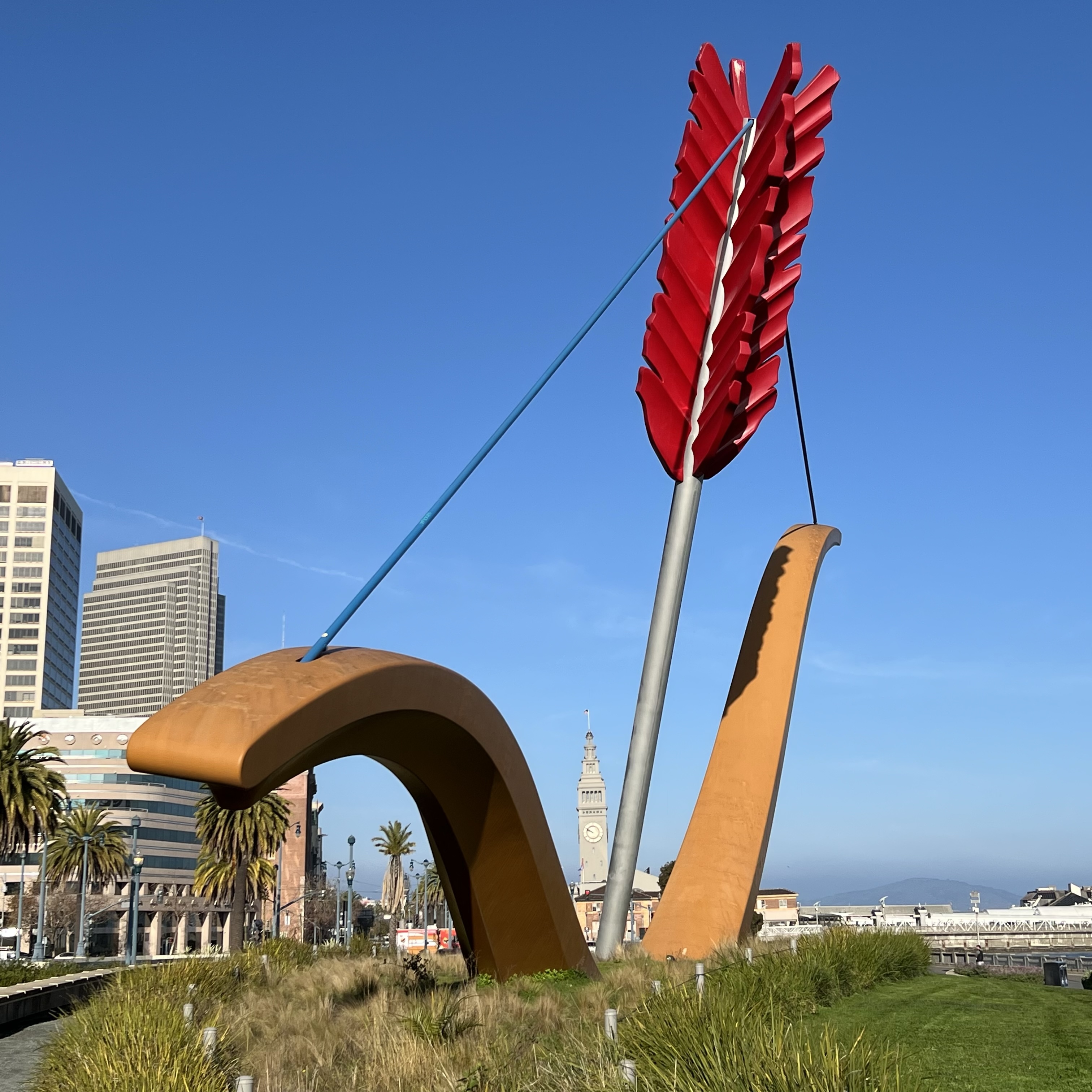
There were other pieces by these artists in San Francisco. One, Cupid’s Span (Oldenburg), near the Bay Bridge and the other Standing Figure Knife Edged (Moore) at Maritime Plaza. Both were within easy walking distance.
Oldenburg’s bow with the Ferry Building in the background.
I took the N Judah towards the Caltrain station and 50 minutes later Cupid’s Span appeared to the left. This was really Muni front door service to this large piece of outdoor public art.
Riding Muni after experiencing the spectacular trams of Oslo over the summer made the City by the Bay’s transit system seem amateurish and unreliable. We could certainly learn something from Europe’s exemplary transit. If you want to be late for work, take Muni!
I sat in the little park before Cupid’s Span. I liked sketching the curves of the bow and the feathers of the arrow. I have always wondered at the meaning of an arrow pulled taunt against a bowstring aimed into the earth. Still wondering what, if anything, it means.
After sketching I headed along the Embarcadero past the Ferry Building. My destination was Maritime Center near the Embarcadero Center (featured in Coppola’s The Conversation).
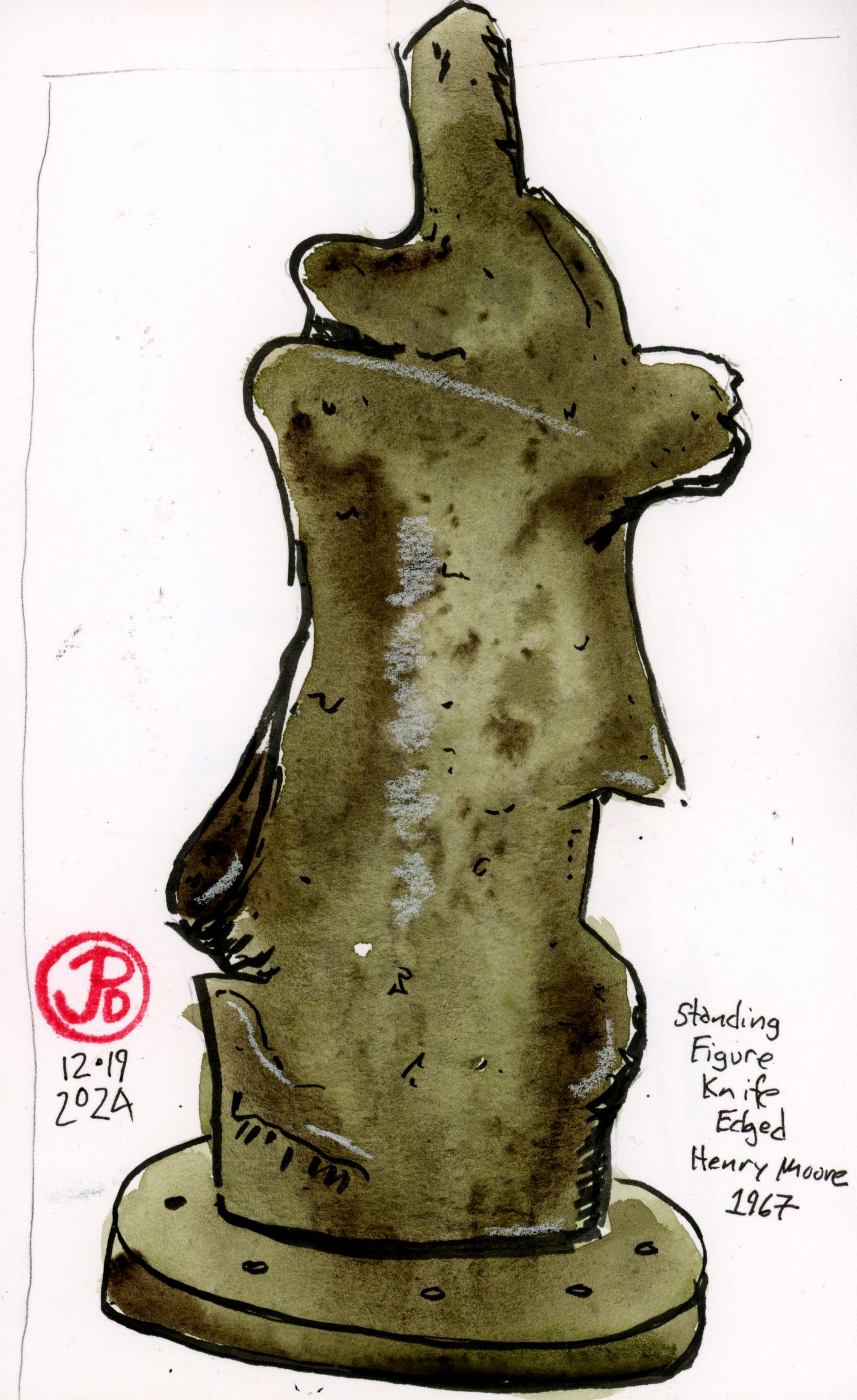
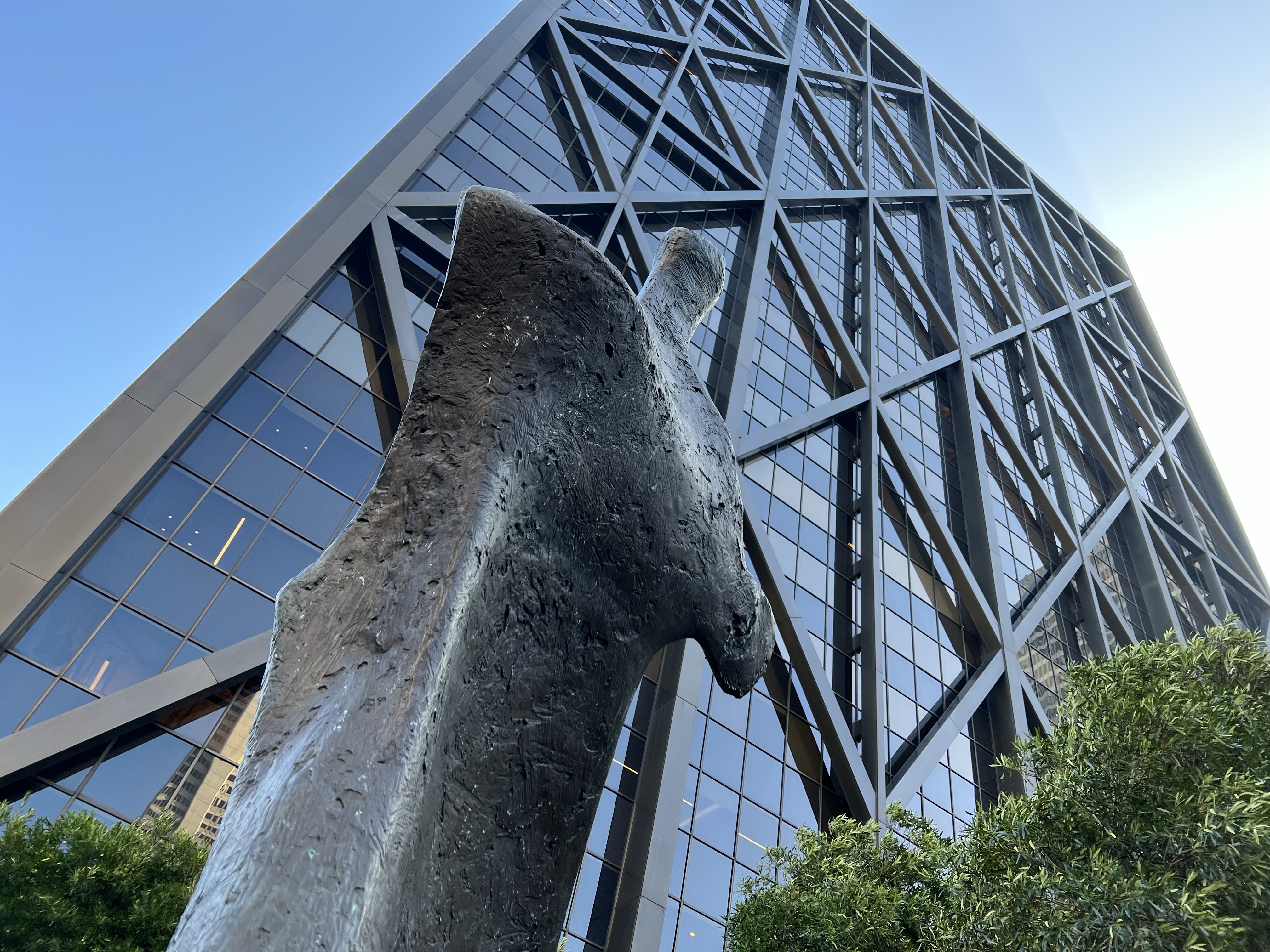
I was searching for the Yorkshire sculptor Henry Moore’s piece Standing Figure Knife Edged. This was a bit of public art that took a bit more searching than Oldenburg’s oversized bow and arrow.
Adding another Henry Moore sculpture to my sketchbook.
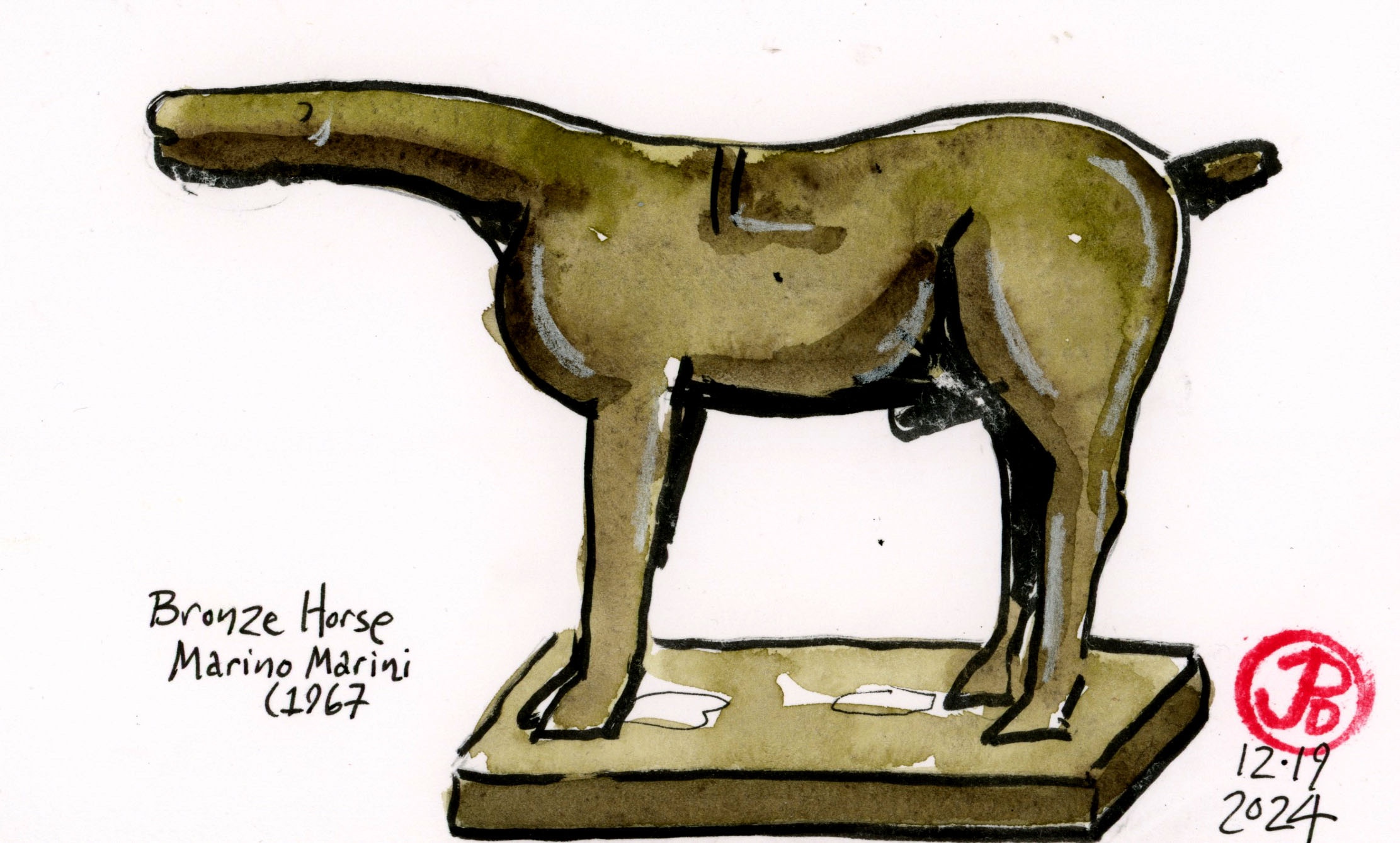
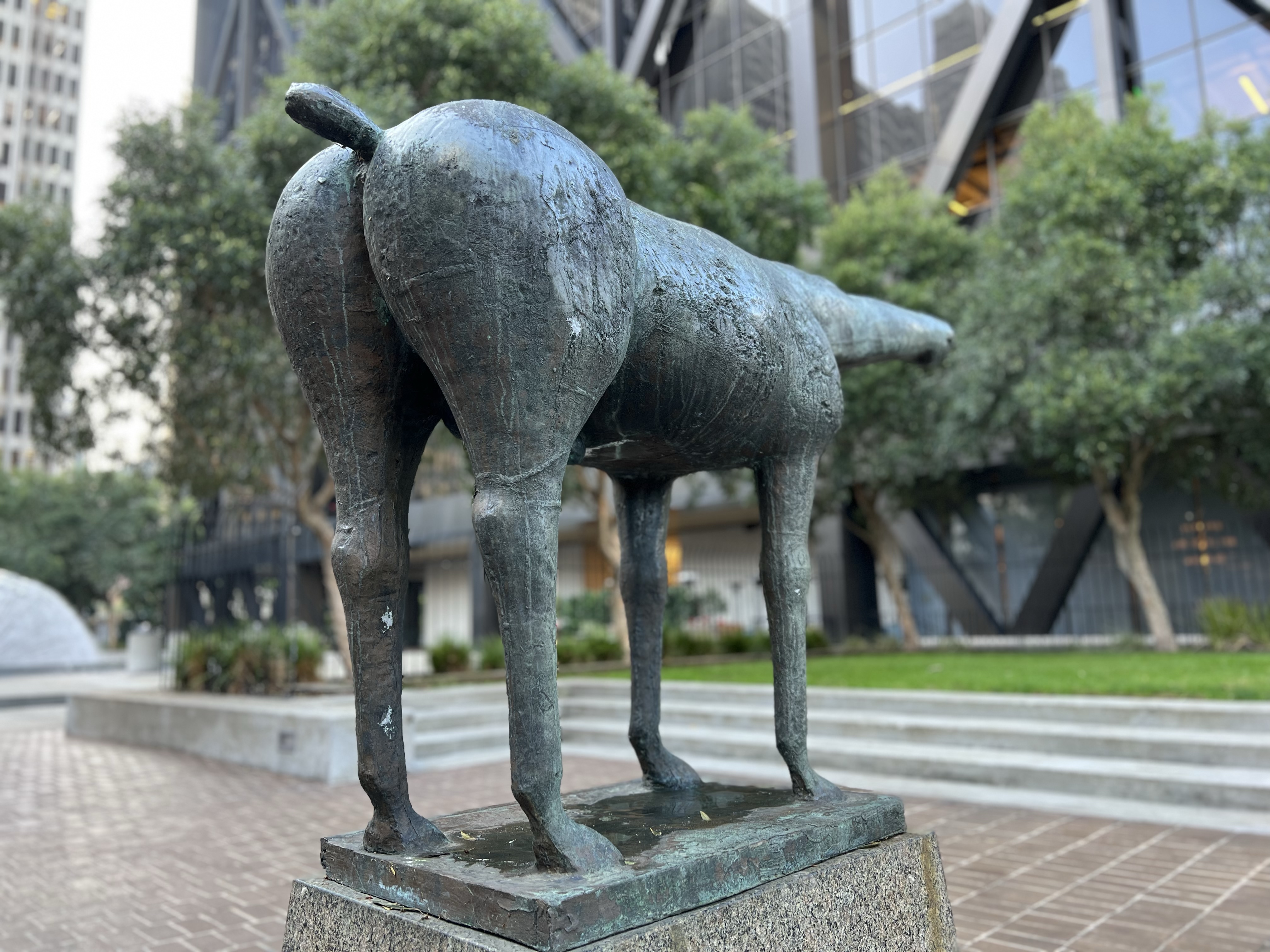
After sketching Moore’s piece I wandered to the other side of the plaza and found another whimsical sculpture, Bronze Horse by Italian sculptor Marino Marini. The sculpture looks like a giant anteater crossed with a horse.
 Corvid Sketcher