I headed to San Francisco’s Golden Gate Park to sketch’s some sculptures on a Sunday afternoon.
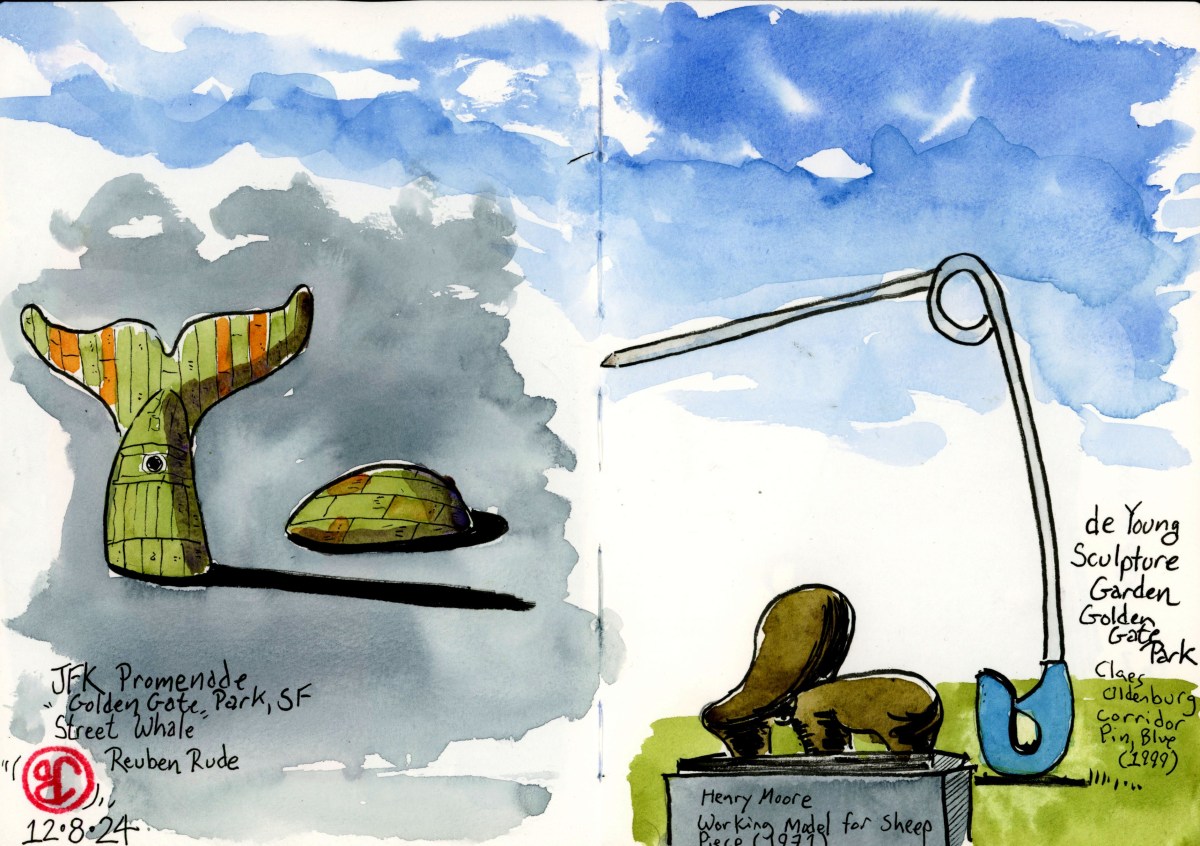
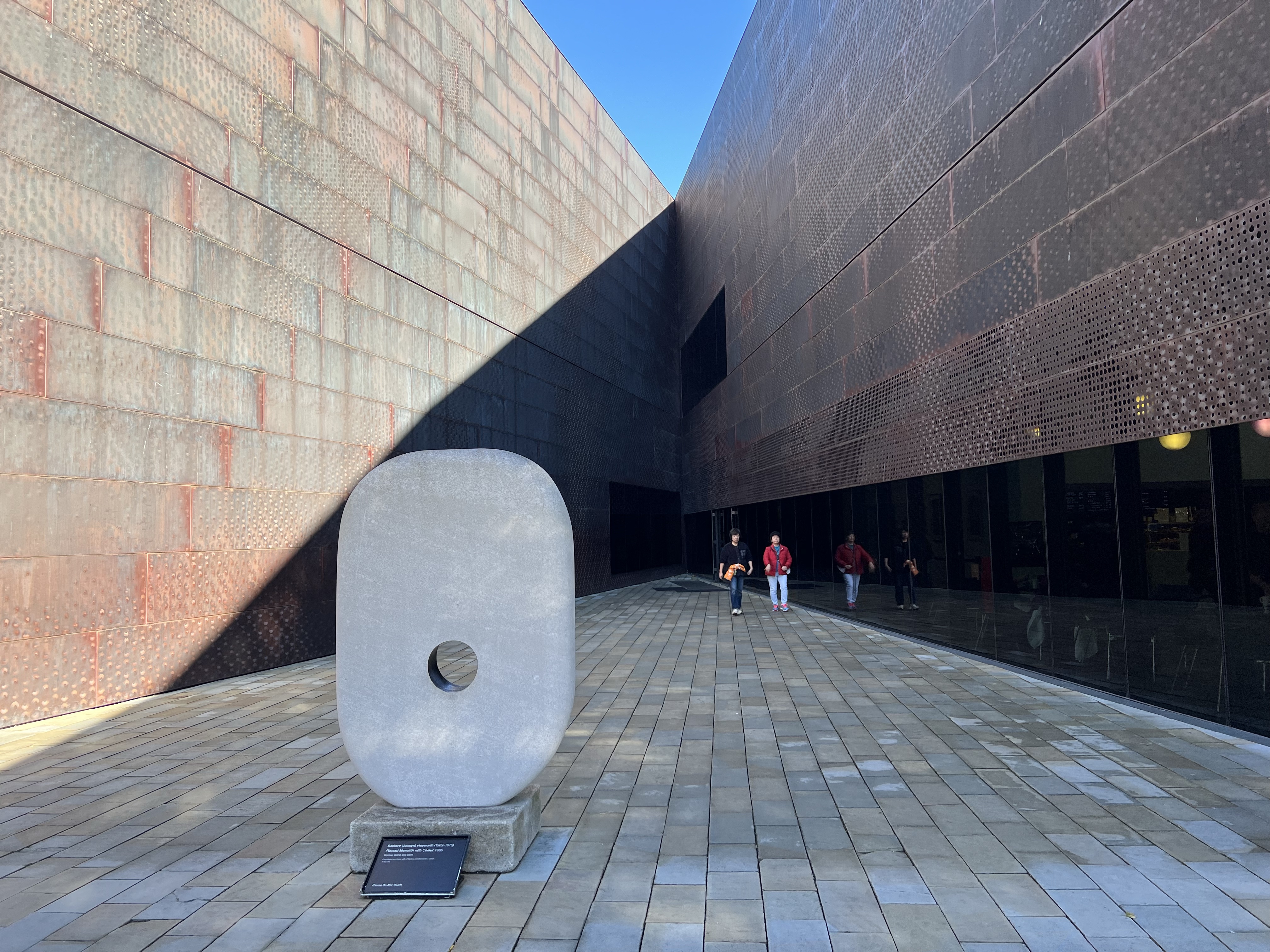
My first destination was the sculpture garden at the de Young Museum. I was going to do a twofer sketch from my sketching bench perspective.
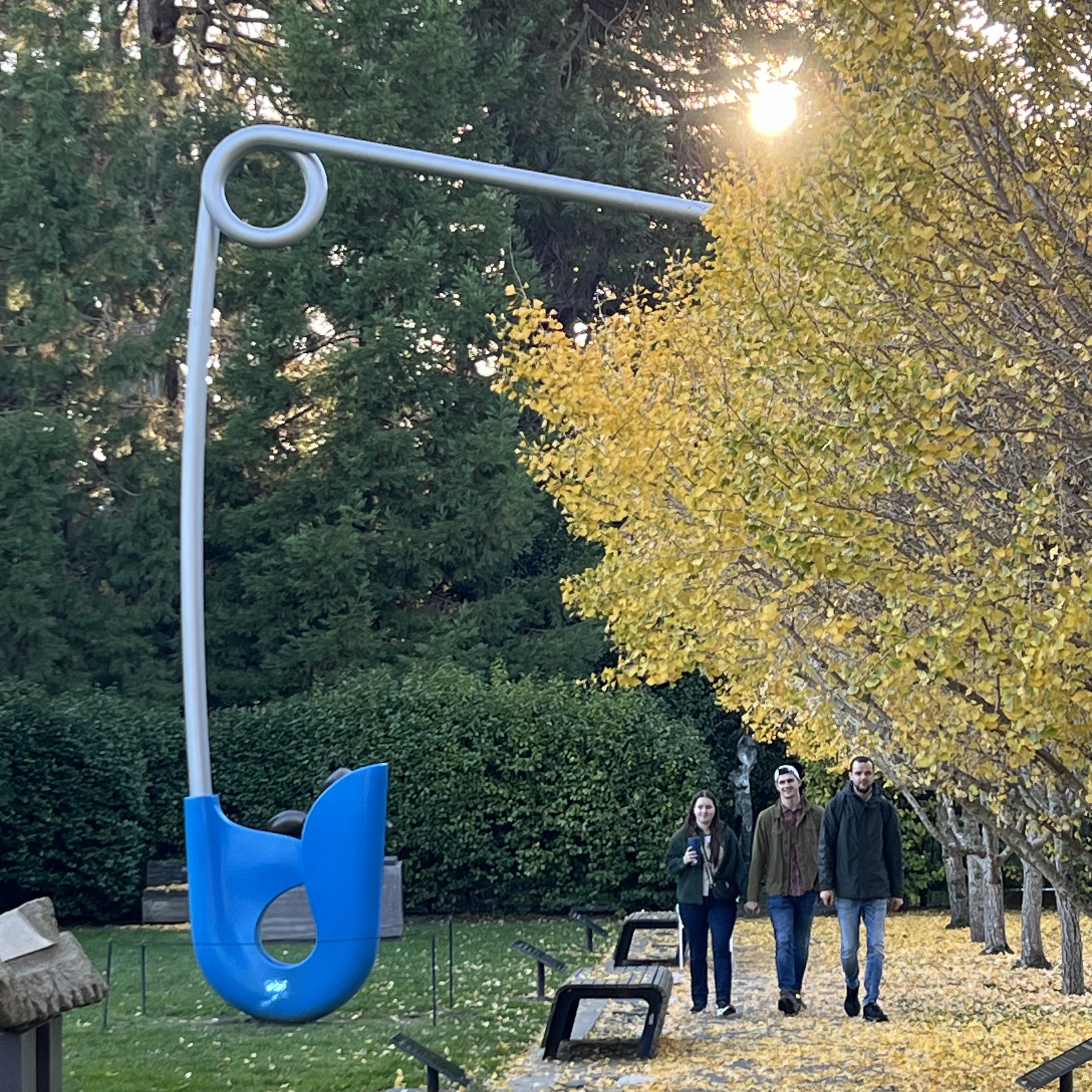
The two pieces that I added to my sketchbook were the 21 foot tall Corridor Pin, Blue (1999) by Claes Oldenburg and in the foreground, Henry Moore’s Working Model for Sheep Piece (1971).
My next piece of public art was to found along The Golden Mile Project along the JFK Promenade just to the north of the de Young Museum.
This roadway in the park has been closed to auto traffic and the road surface is painted with 12 murals produce by a group called Paint the Void.
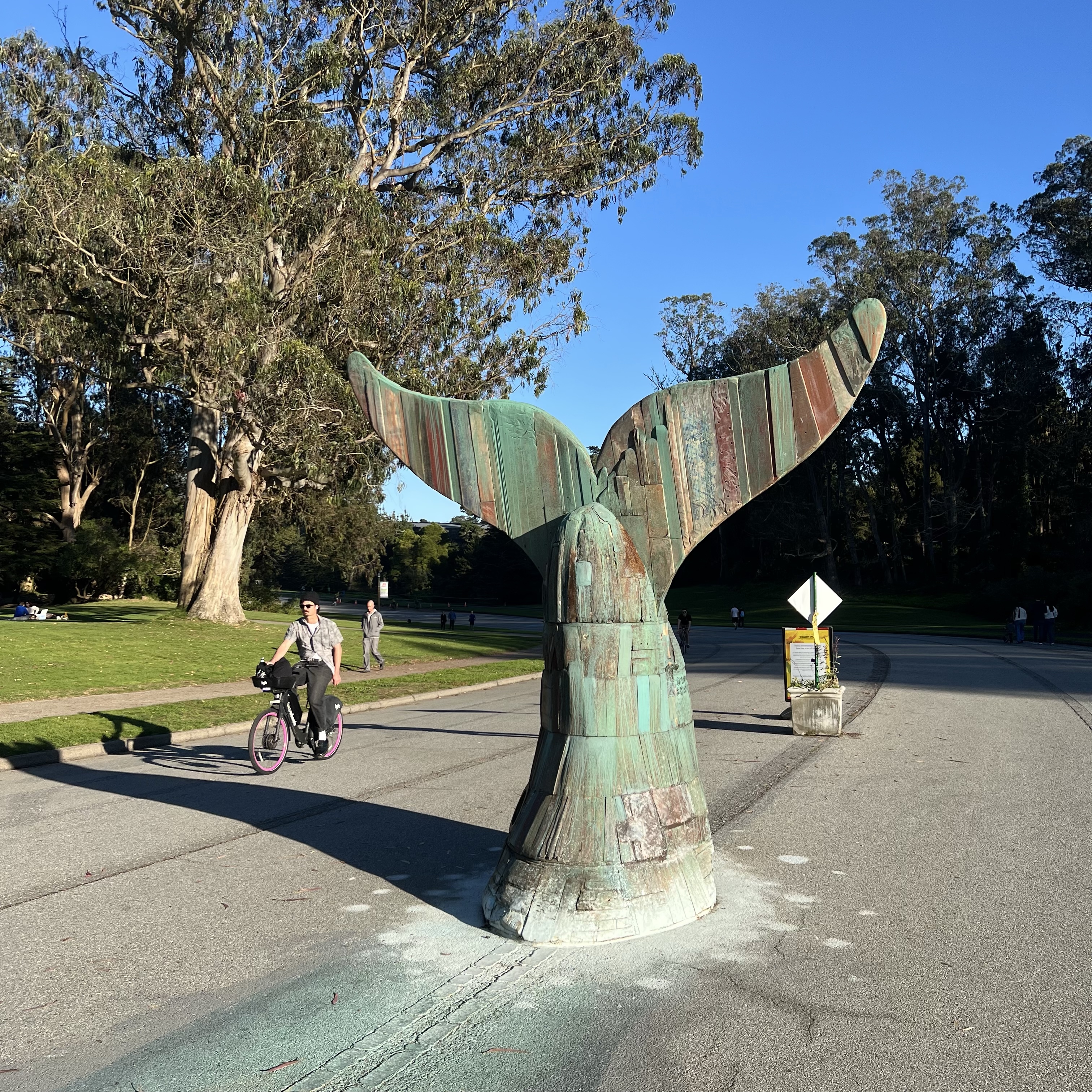
Near the Rose Garden a life sized wooden humpback whale tail breached the roadway. This piece is called Street Whale. I perched on a bike rack and sketched the piece on the left side of my spread.
There is one art museum and one art exhibition from my youth that is at the fore of my memory.
I was in third grade when I visited San Francisco’s de Young Museum and the King Tutankhamen exhibit.
In 1979, the King Tut exhibit was a huge deal in the Bay Area. It seemed everyone had King Tut fever and wanted to see the treasures of his exhumed tomb.
The exhibit featured 55 objects including Tut’s golden death mask and sarcophagus. I have memories of marveling at the superb death mask.
The museum was founded in 1895. It moved to its present site in Golden Gate Park in 1919.
The building was damaged in the 1989 Loma Prieta Earthquake and was demolished. The museum was rebuilt in its current form in 2005.
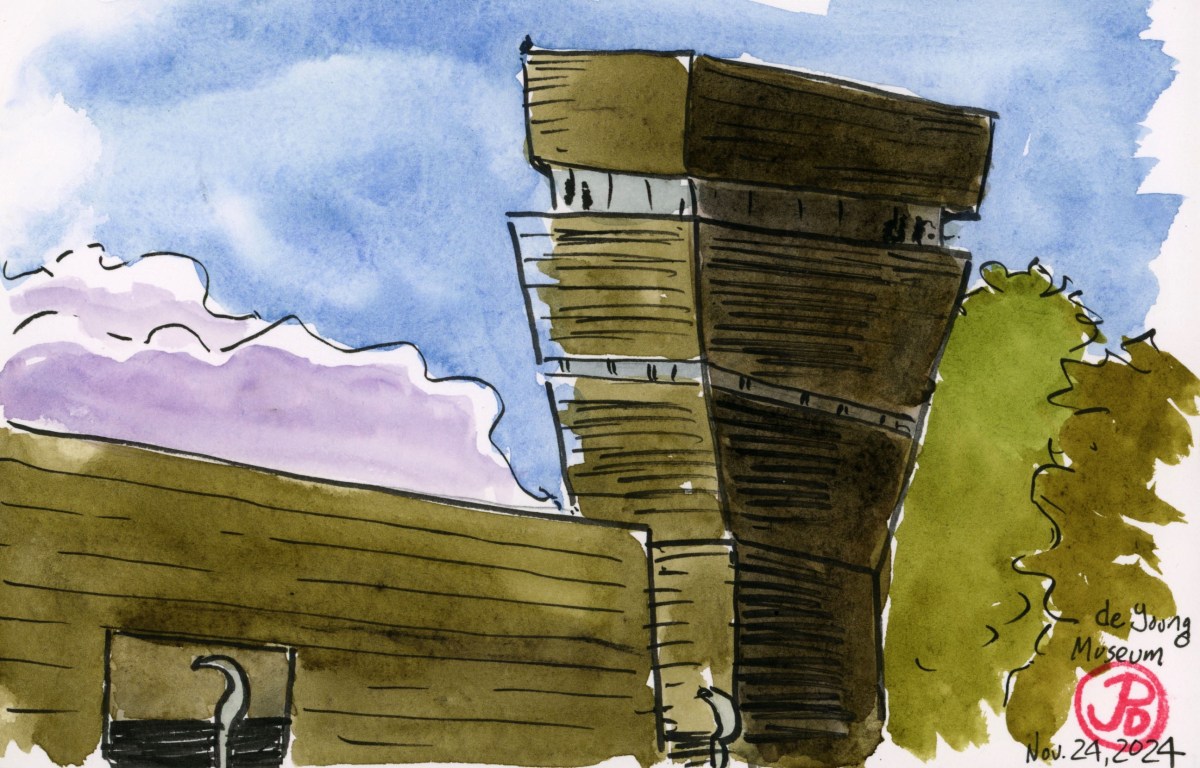
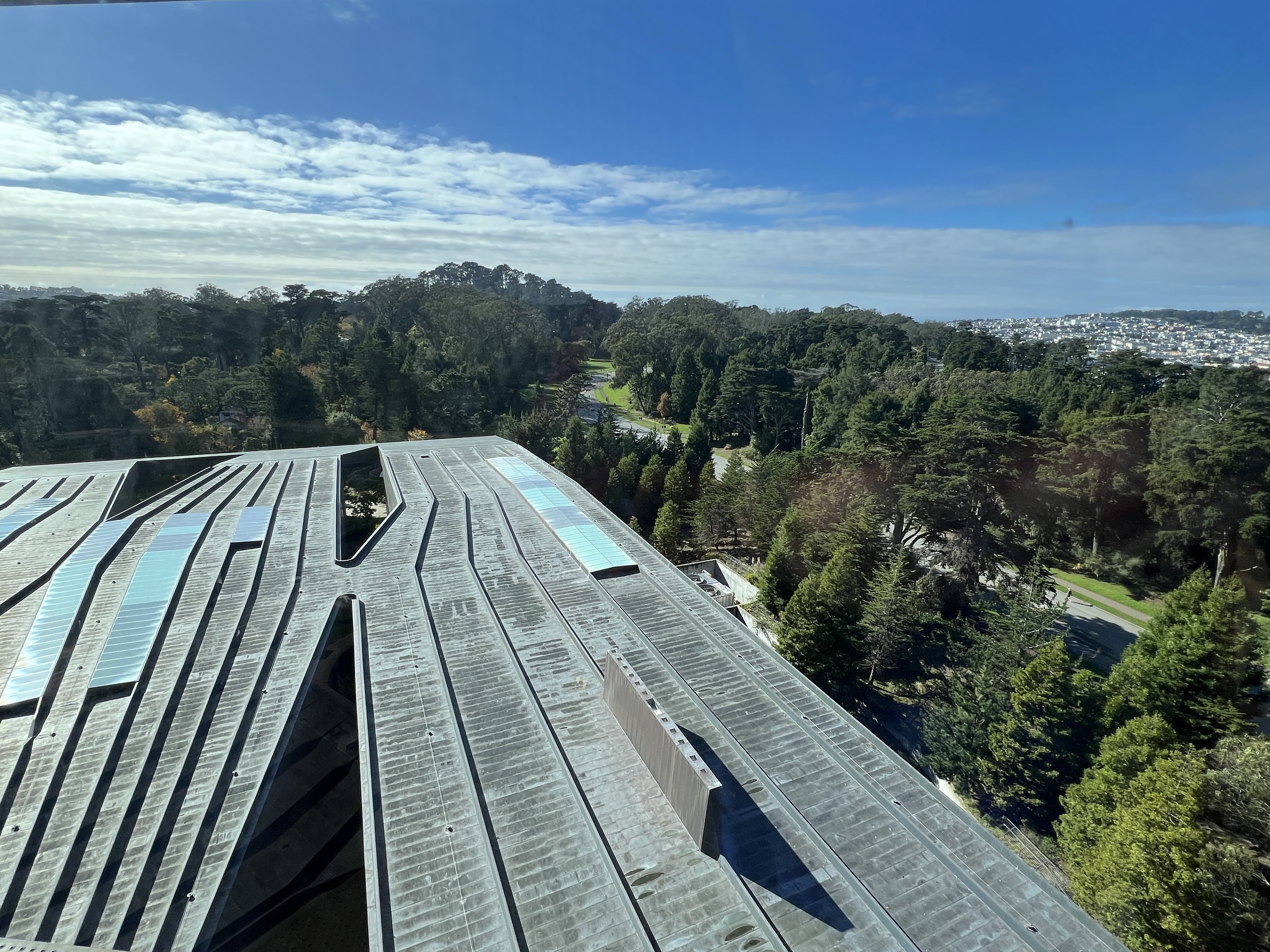
Looking west from the tower with the galleries of the de Young.
I admit that I wasn’t a fan of the new building. But the view from the top is amazing. The building is slowly growing on me.
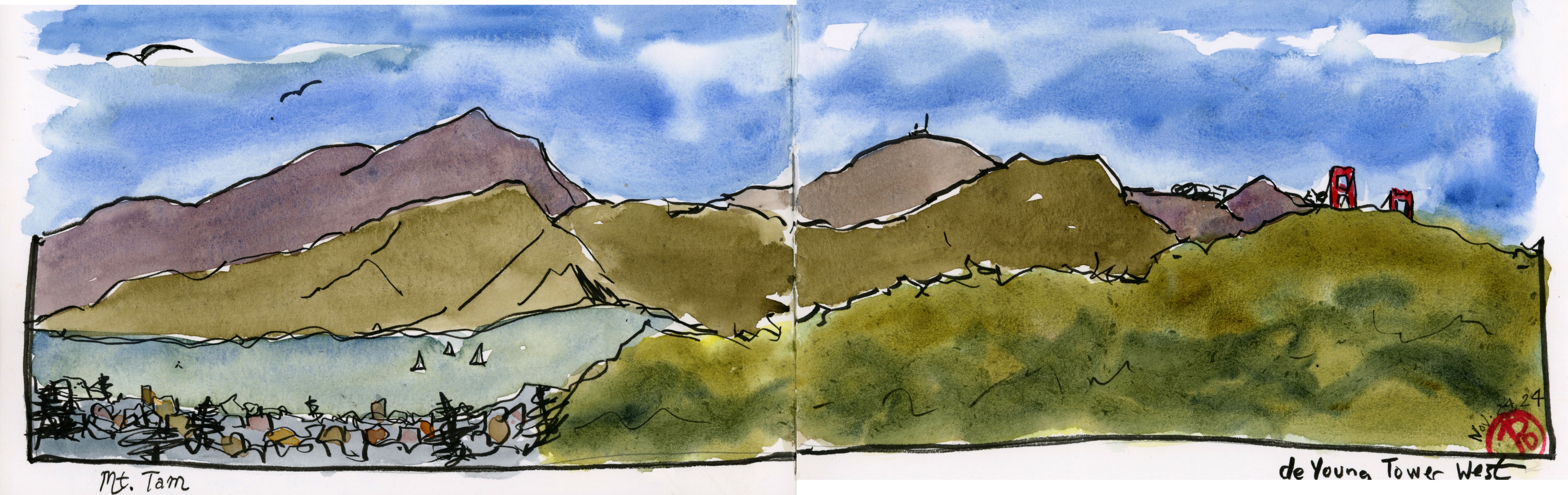
On a recent visit I did a western facing sketch from the top of the de Young tower of the Golden Gate and the Marin Headlands (below).
On a November Saturday morning I decided to pop over the Golden Gate to one of my favorite places in the Bay Area: the Marin Headlands.
I spent 14 seasons as a hawk bander for the Golden Gate Raptor Observatory (GGRO) and I have spent many days in beautiful and sometimes foggy fall weather.
One call from other blinds would be, “RT heading towards Kirby Cove!” The RT is question stood for red-tailed hawk and Kirby Cove was my Saturday hiking/ sketching destination.
The distance from the parking lot on Conzelman Road to Kirby Cove Beach, as the hawk flies, is about a mile but the road from the trailhead takes a winding path downslope, to the beach.
The trail to the beach is a graded fire road that winds down to the Kirby Cove Campground. This proved to be easy hiking.
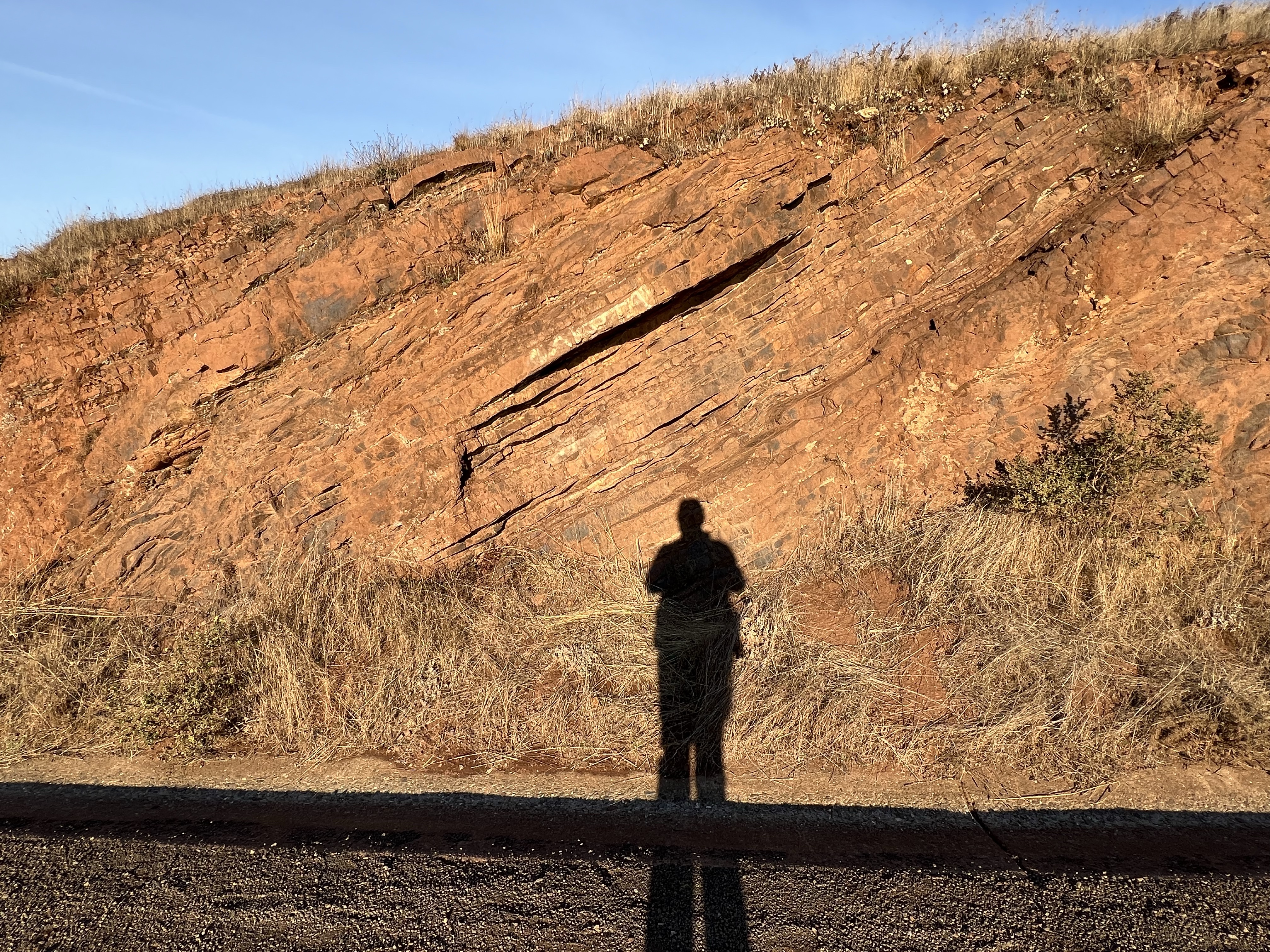
Who doesn’t love a bit of Radiolarian Chert in the morning?
From the trailhead to the beach took about 20 minutes. Before heading to the beach I looked for the Kirby Cove swing which had been taken down. I originally planned to sketch the view with the swing in the foreground. Well it was time for sketching Plan B.
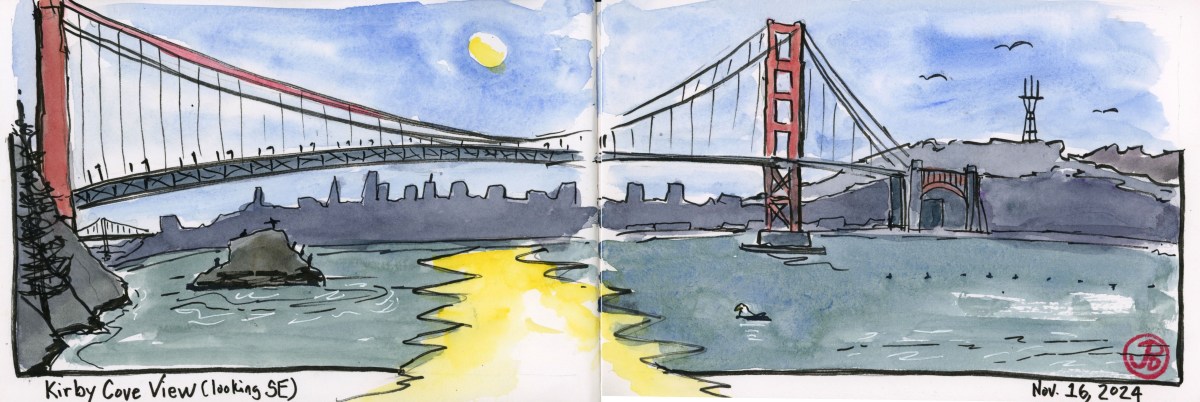
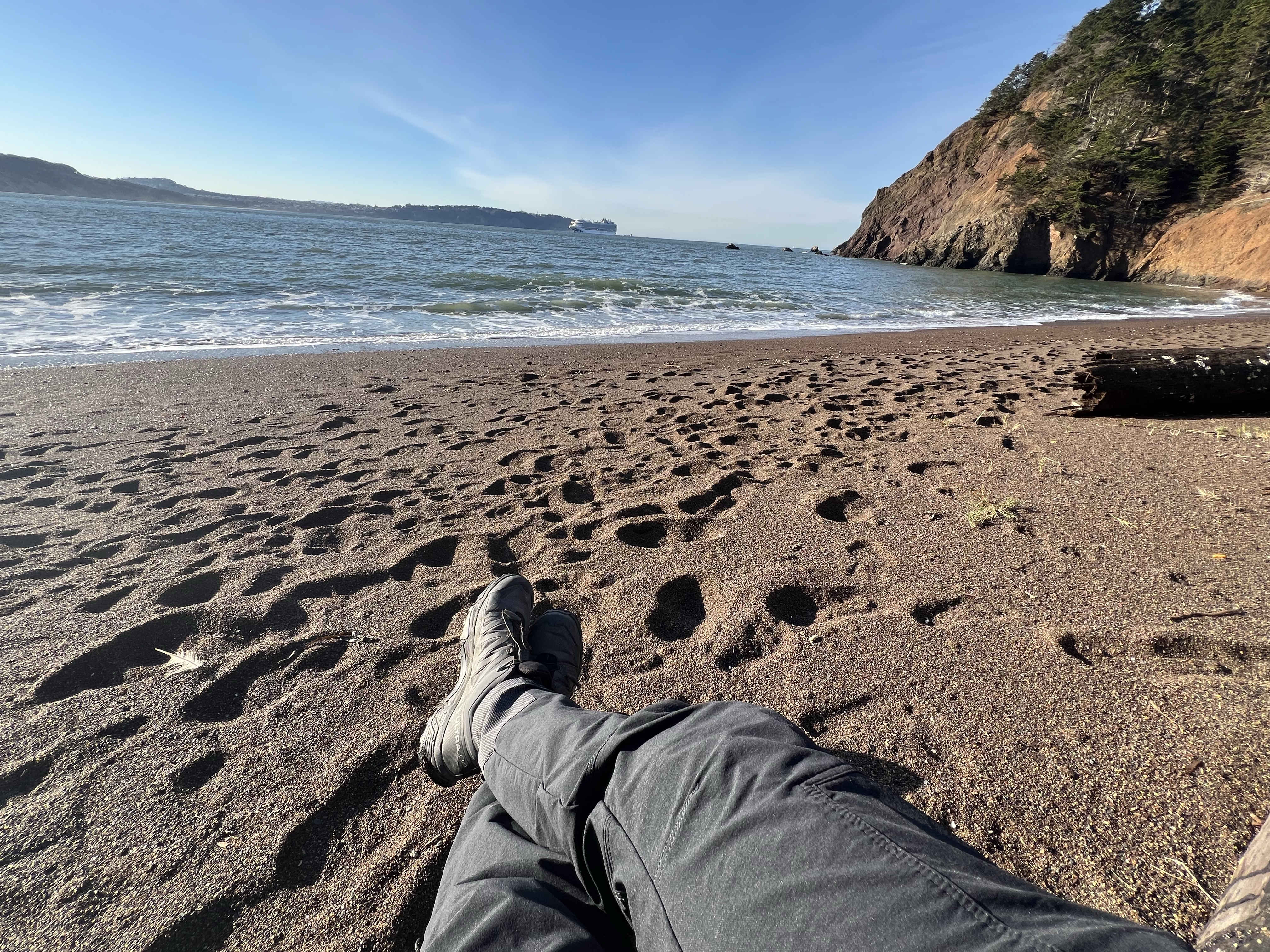
I then headed to the beach and found a sketching seat on a piece of driftwood (a former power pole) and began sketching the view of the Golden Gate, the famous bridge, and the San Francisco skyline in the background.
Beachmaster!
Even thought the nearby campground was full, I had the beach entirely to myself during the duration of my visit.
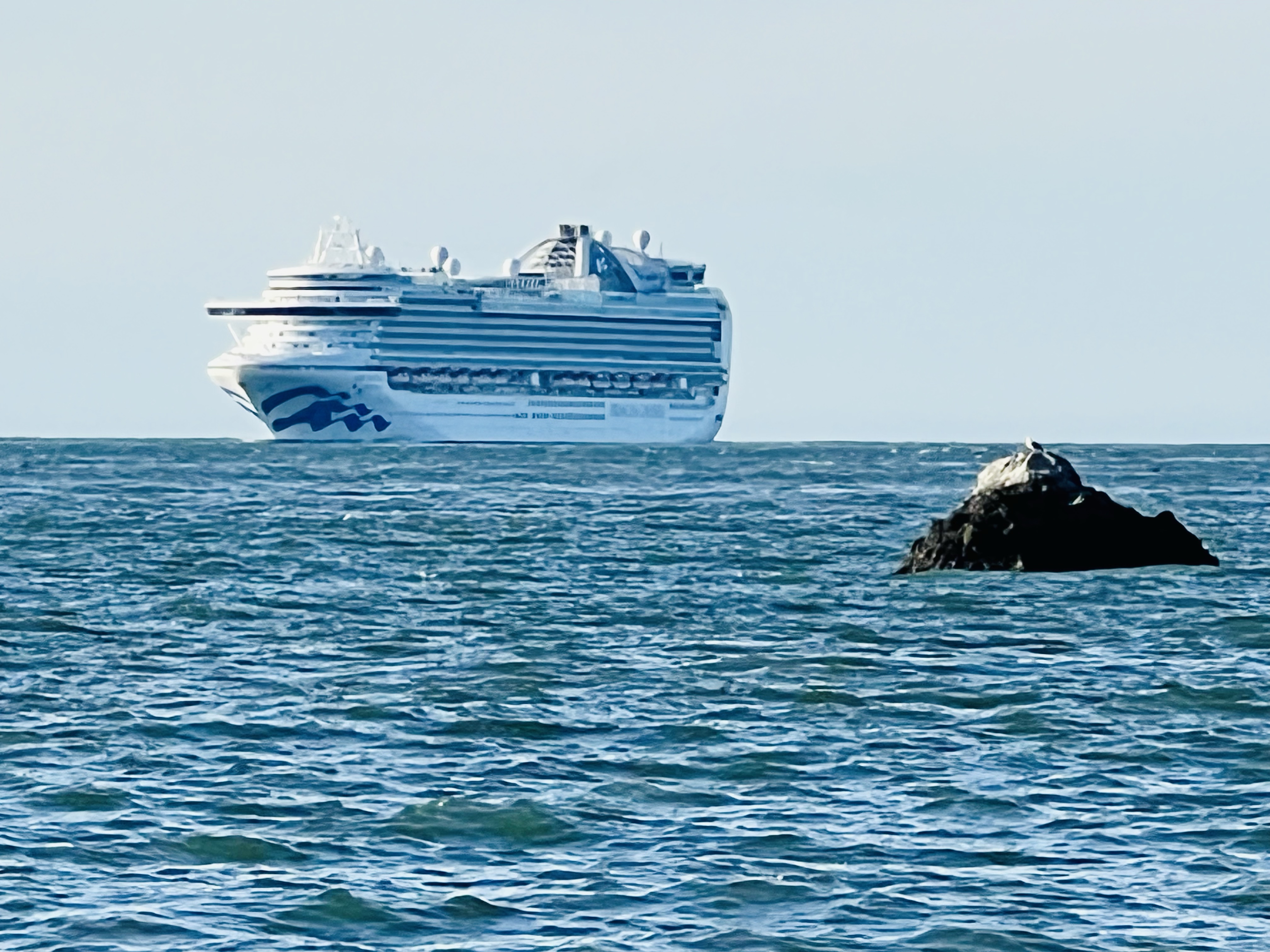
A Princess cruise ship coming into the Golden Gate like so many gold seekers in 1849.
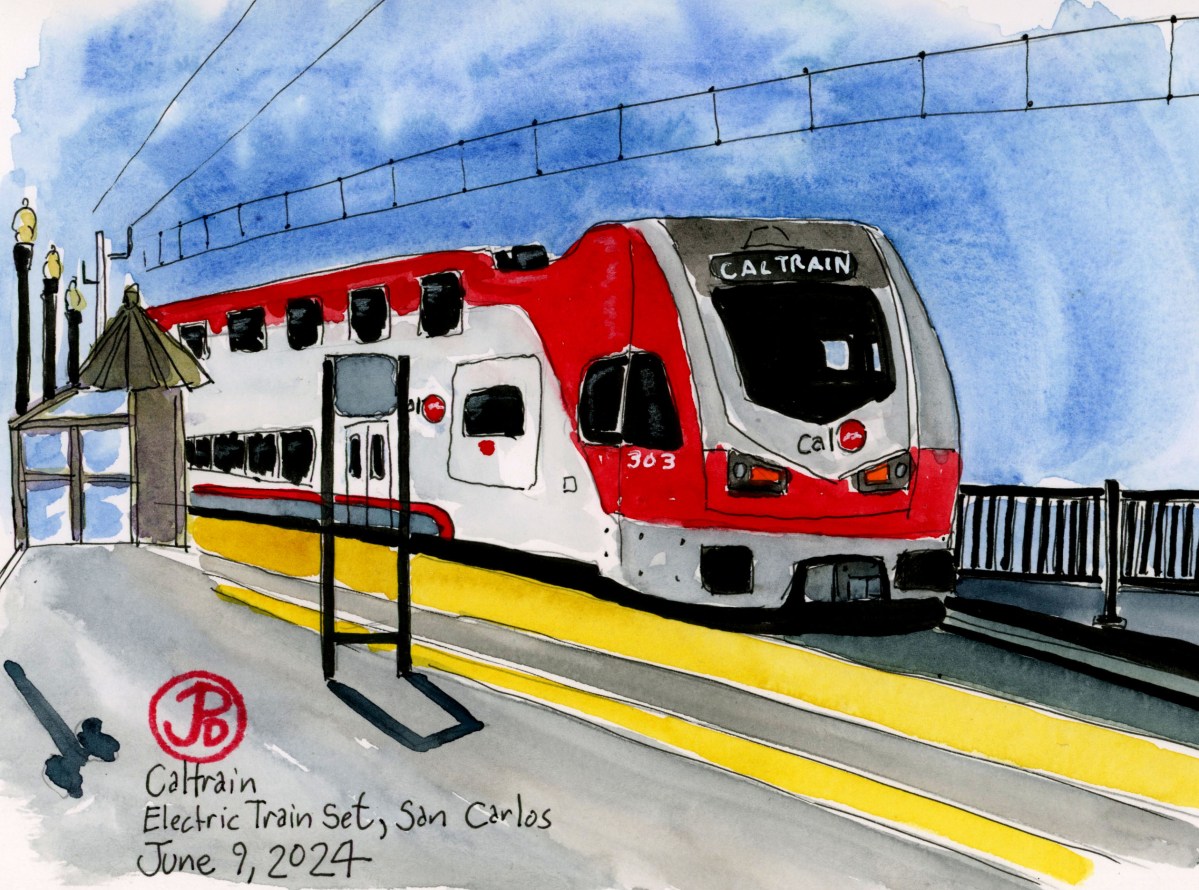
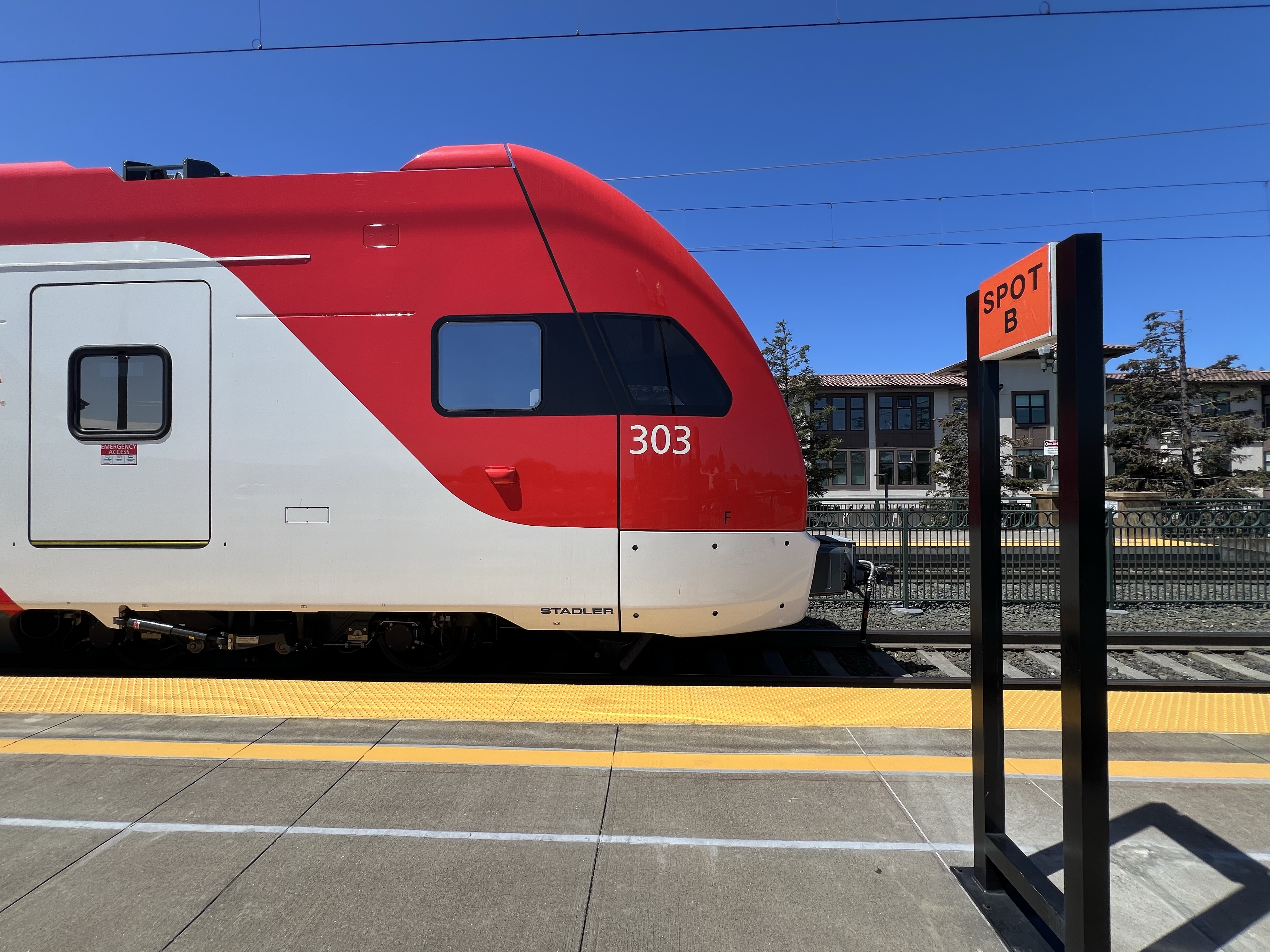
On a recent Saturday morning I had a pleasant surprise as I drove north on El Camino Real at San Carlos. At San Carlos Station was one of the new electric CalTrain sets.
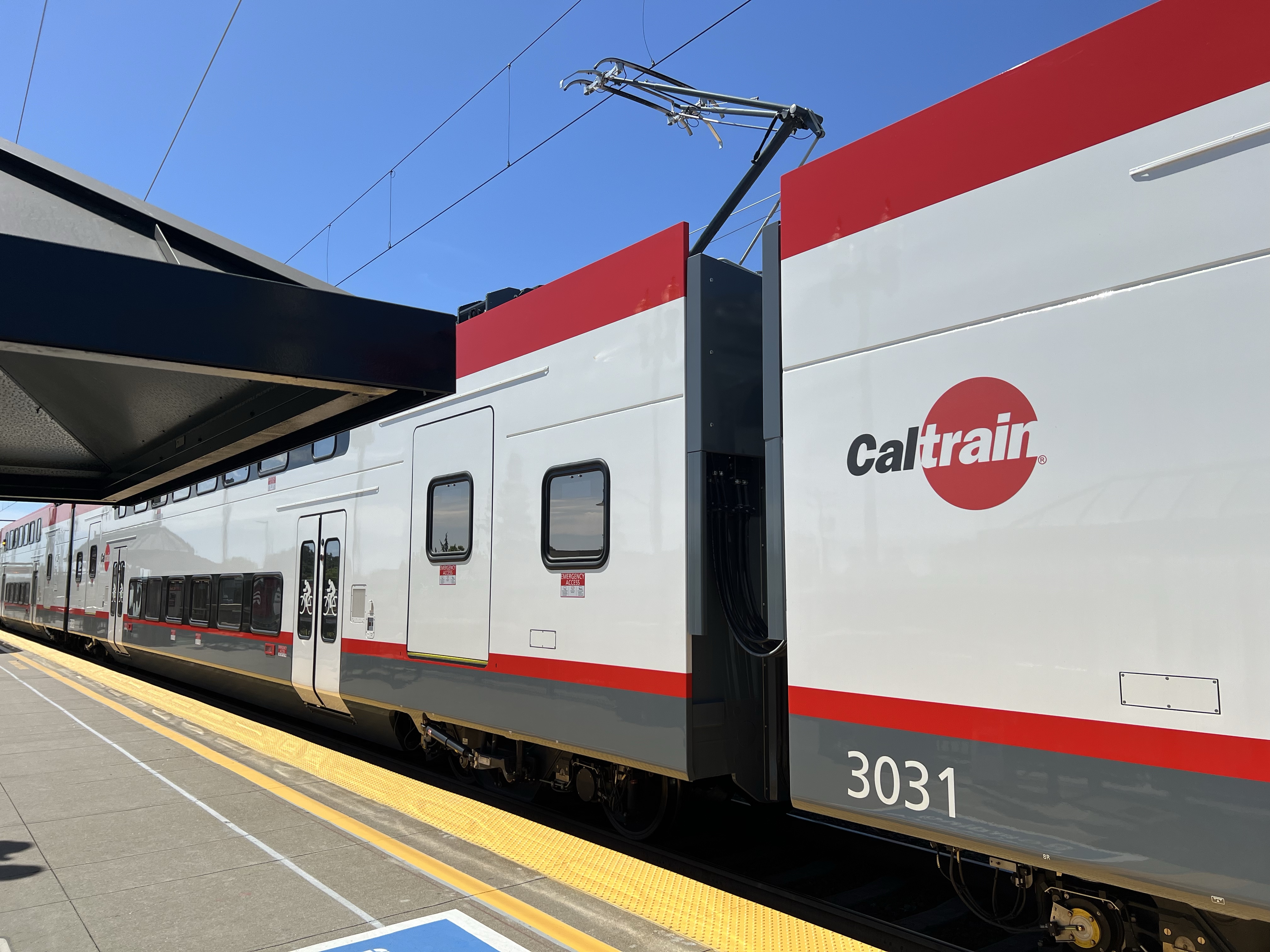
The new trains are built by Stadler, a Swiss-based train manufacturer. The company was founded in 1942 and is headquartered in Bussnang, Switzerland. The company has a factory in Salt Lake City, where Stadler will build 24 train sets for Caltrain.
The train sets are known as BEMUs which stands for battery-equipped electric multiple unit.
I parked, thinking that the train would surely have left the platform by the time I walked to the station but as I walked down San Carlos Avenue, the train was still stationary at the station.
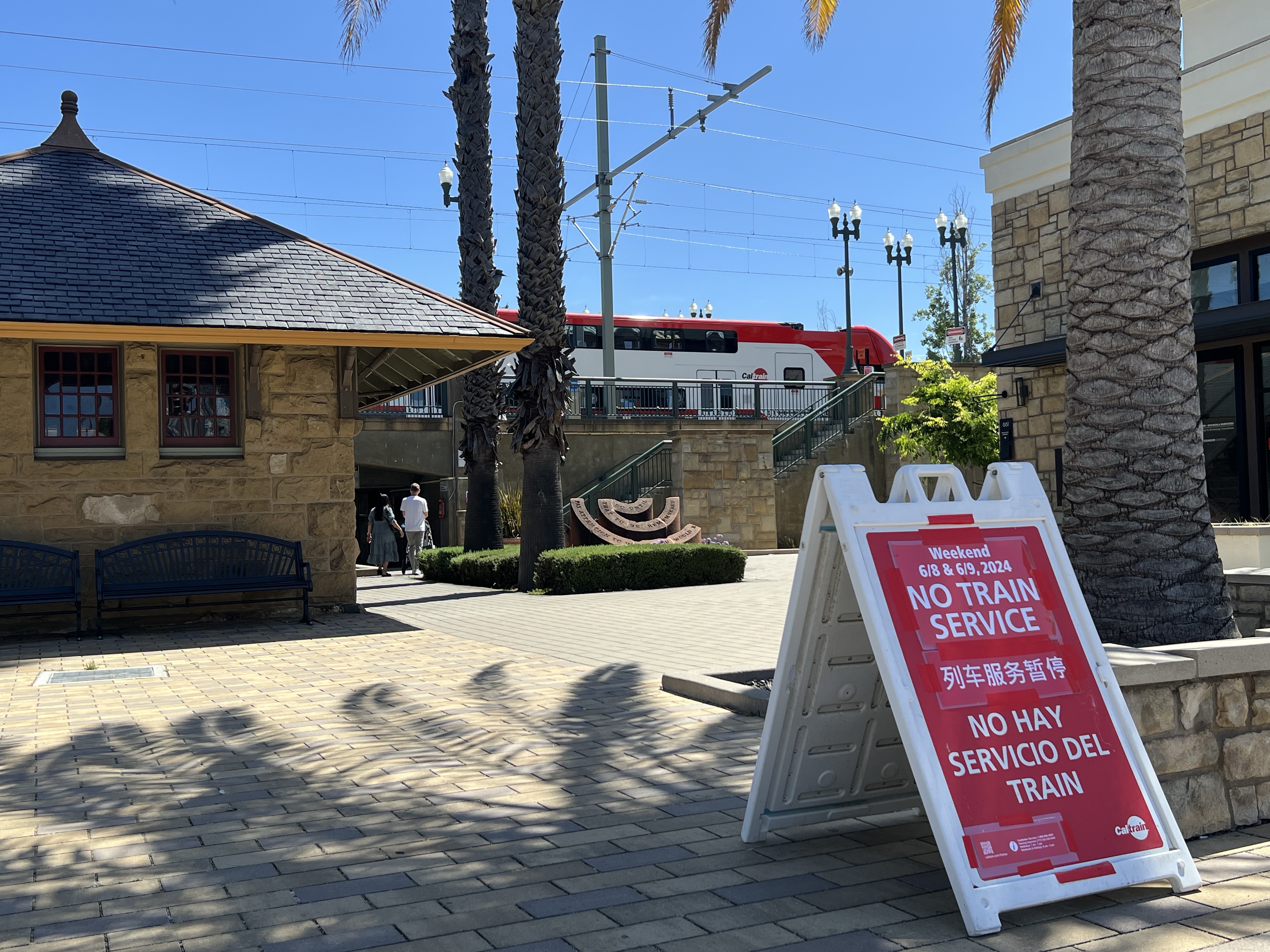
As I crossed El Camino, a placard stated “No Train Service”. The line was closed all weekend.
The line was closed from San Francisco to San Jose so Caltrain could test eight of the new electric train sets. The electrification of the line started in 2017 and electric trains are scheduled to start running on September 21, 2024.
If you think of some of the most iconic passenger trains in modern rail: Japan’s Shinkansen (“Bullet Train”), France’s TGV, Eurostar, Amtrak’s Acela, Chinese Railways CRH, the Bay Area rail corridor was finally being electrified to catch up with the rest of the world, although it would not come close the top speeds of modern Shinkansen (186 mph).
Three quarters of the world’s passenger service are powered by electricity. About time!
This is what powers the new train sets: the pantograph that delivers power from the wires above to the train set below.Not sure if these new trains sets earn any style points. They look like a large streetcar or tram.
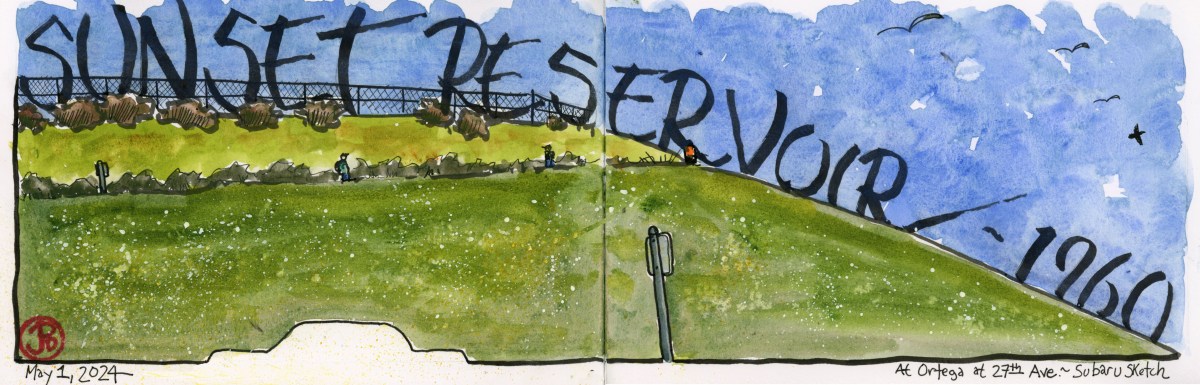
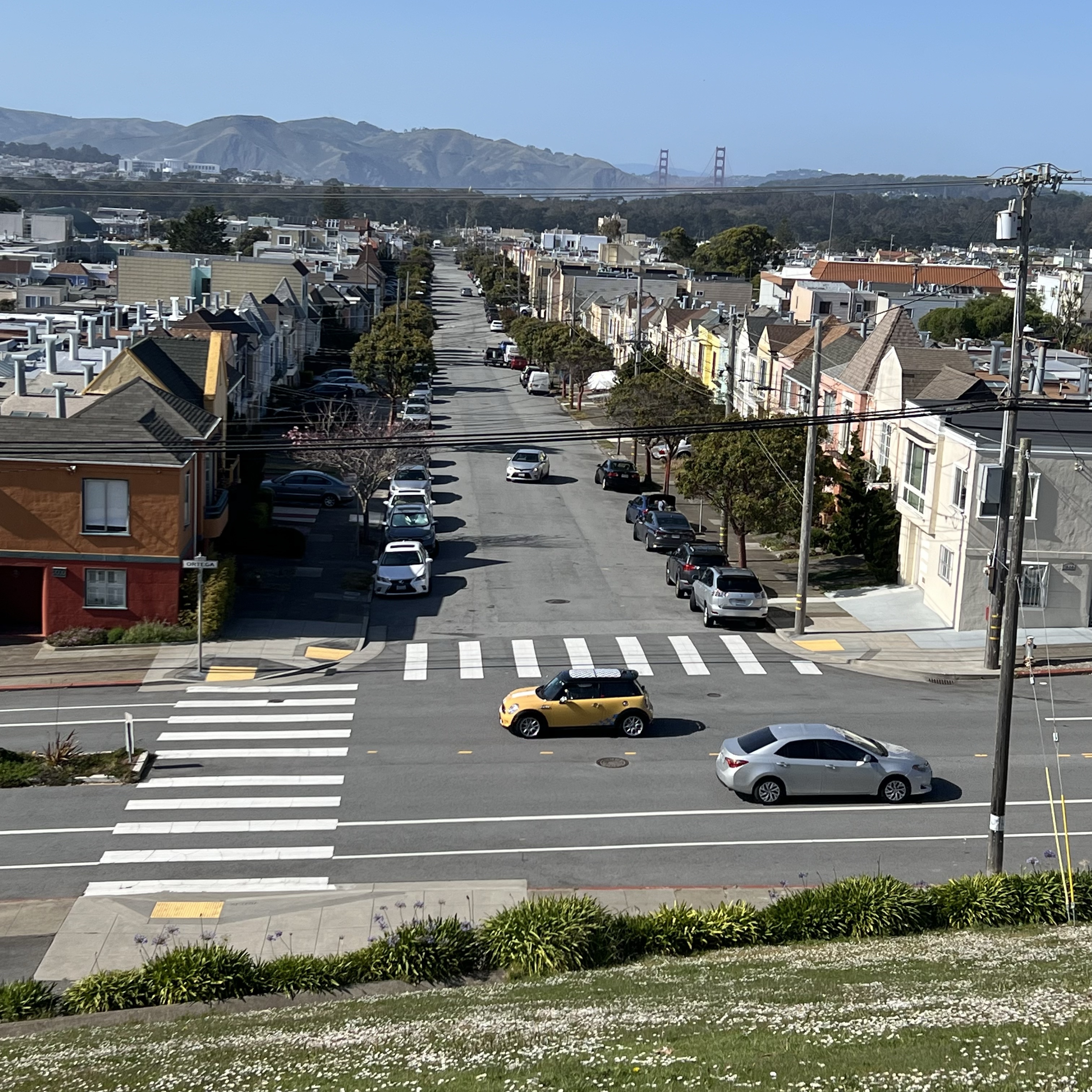
I live a hop, slip but not even a jump from San Francisco’s largest reservoir: Sunset Reservoir.
This terminal reservoir was completed in 1960 and has an impressive capacity of 270 acres. To put this into context the sides of the reservoir are four blocks north and south and two blocks east and west. The surface area is 11 acres.
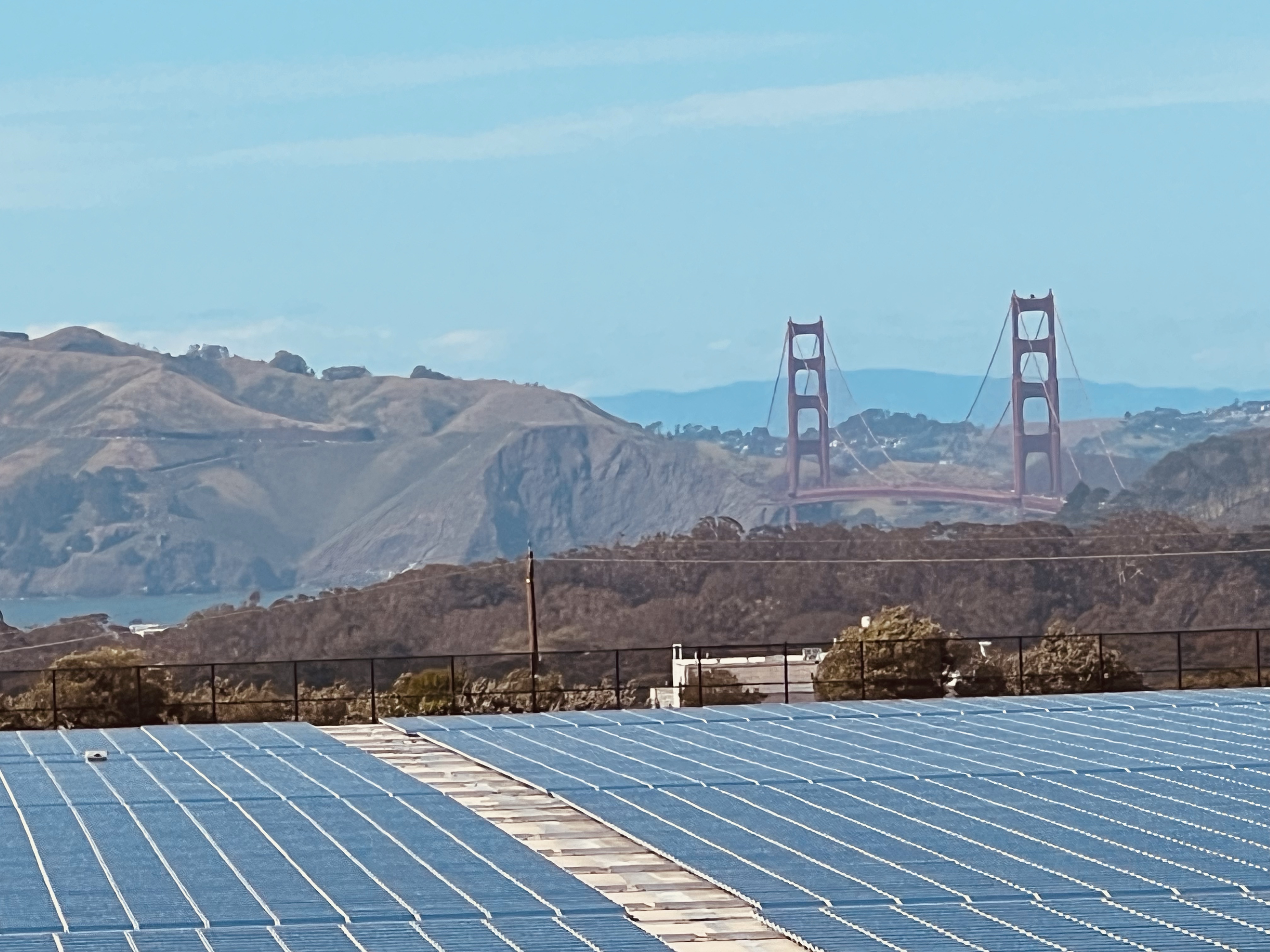
The reservoir is covered and fenced off. Over half of the reservoir is blanketed in 25,000 solar panels. The Sunset Reservoir Solar Project started in December 2010 and has tripled San Francisco’s solar generation capacity.
The irony is that the Sunset is the foggiest part of the city.
Some of the 25,000 solar panels of Sunset Reservoir.
While the reservoir itself is not a sight to behold, the northwest corner (featured sketch) affords some of the best views in the Sunset. Along the embankment are walking paths and at the northwest corner are a line of benches.
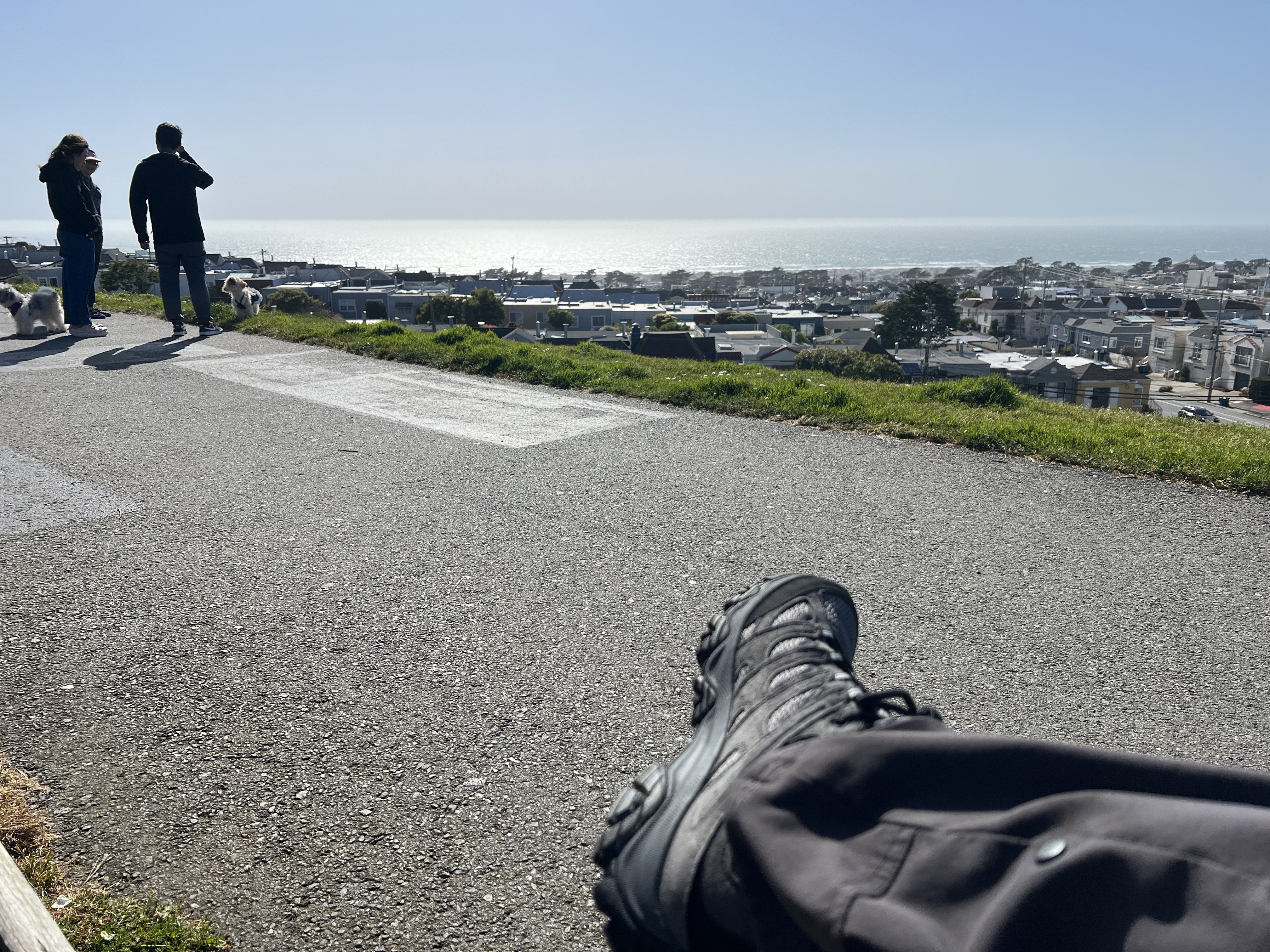
The bench-view to the north. I can almost see the Farallons. These paths are popular with dog walkers.
Here you can look out to the west towards the Pacific Ocean and on a clear day, you can see the Farallon Islands perched on the horizon like a large, gray battleship.
The views to the north as just as stunning taking in Golden Gate Park, the Richmond District, the Golden Gate Bridge, Marin Headlands, and Mt. Tam. On really clear days you can see outer Pt. Reyes.
Looking north down 27th Avenue towards the Golden Gate from one of the walking paths.
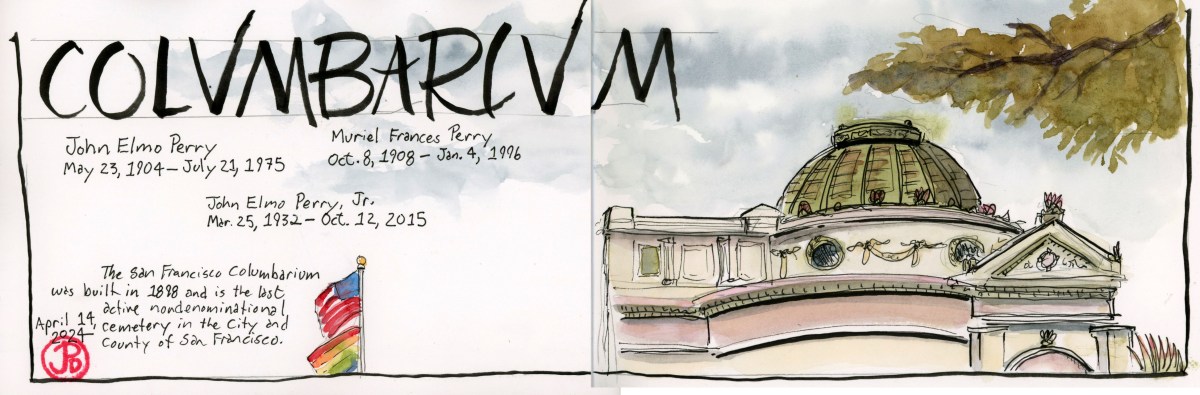
I’ve been wanting to join my local sketch group, Sunset Sketchers, for a weekend sketch and it was fortuitous that Sunday’s location was San Francisco’s Columbarium.
I have been to the Columbarium many times and I have even sketched it a few times.
It is here that my grandparents and father are interred.
In all, we had about 15 local sketchers show up on a cold Sunday morning. The group consisted of a few architects and designers and artists sprinkled with some sketchers for sketch-sake. I’m not sure which group I fit into.
I found a bench and started to sketch the imposing lines of the 1898 Neo-Classical columbarium. The building is very ornate and I was trying to keep my sketch loose and at the same time take a little Sketcher’s Liberty and simplify or leave out certain complex elements.
I was soon joined by another sketcher and we sketched and talked about gear and materials and future sketching trips. I finished my sketch (featured sketch) and I went into the Columbarium to warm up and visit dad and my grandparents.
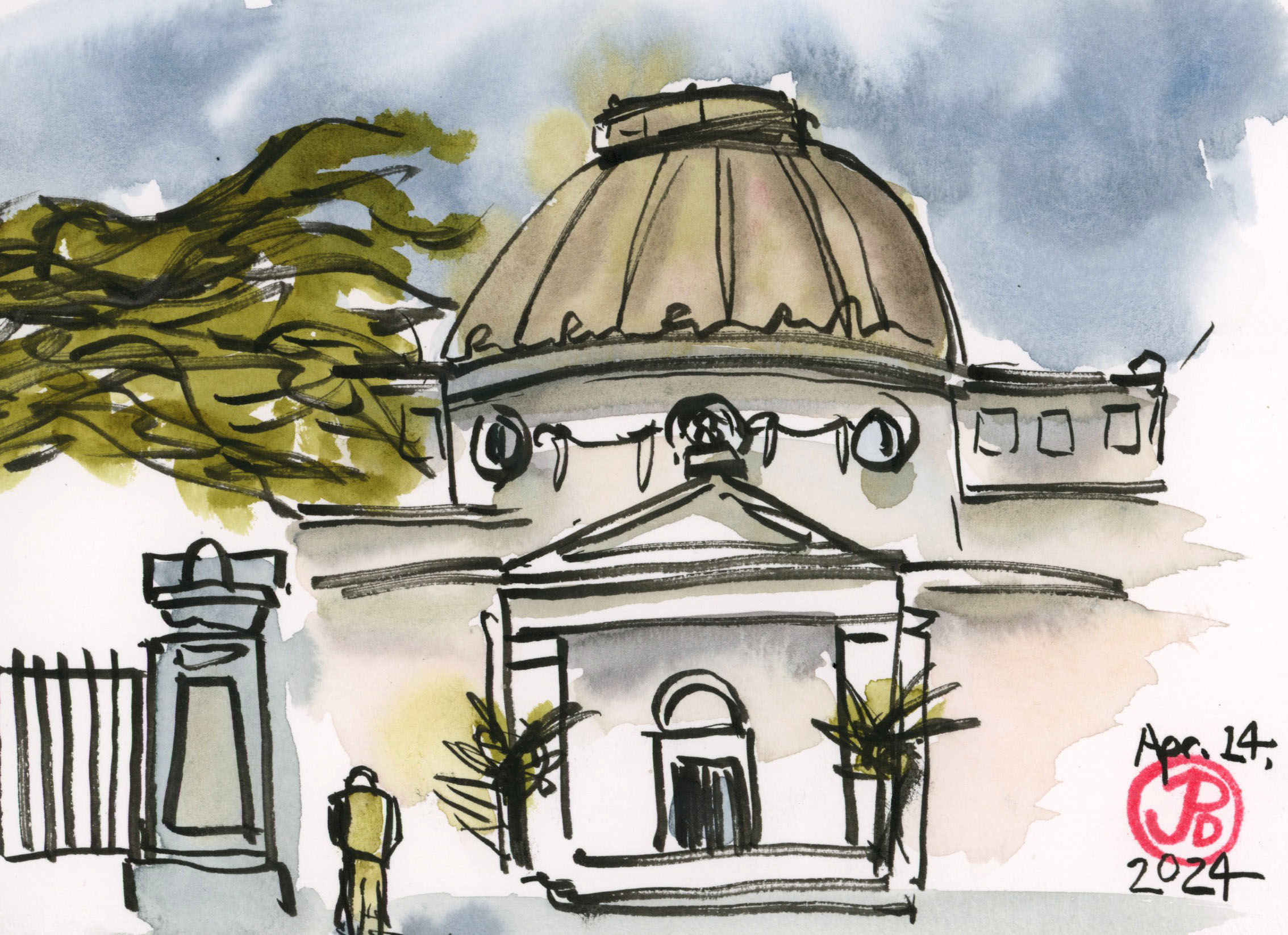
We still had some time before we all met up for the “throw down” so I decided I wanted to sketch the exterior from another perspective. I walked down Loraine Court and sketched the entrance with another Sunset Sketcher (our organizer) for perspective. This time I went really loose with no pencil undersketch. The whole quick sketch was done in brush pen and then painted loosely.
My loose brush- pen sketch with a Sunset Sketcher for scale.
At 12:30 we had the “throw down” where all the sketchers laid their sketches down and it was great to see the columbarium through other sketcher’s eyes.
We all talked about our sketches and shared insights into our process. Comments are allowed but only of the positive variety. You aren’t even allowed to talk trash about your own work!
I recently found an interesting connection between a Norwegian Polar explorer, an Oslo maritime museum, and Golden Gate Park in San Francisco.
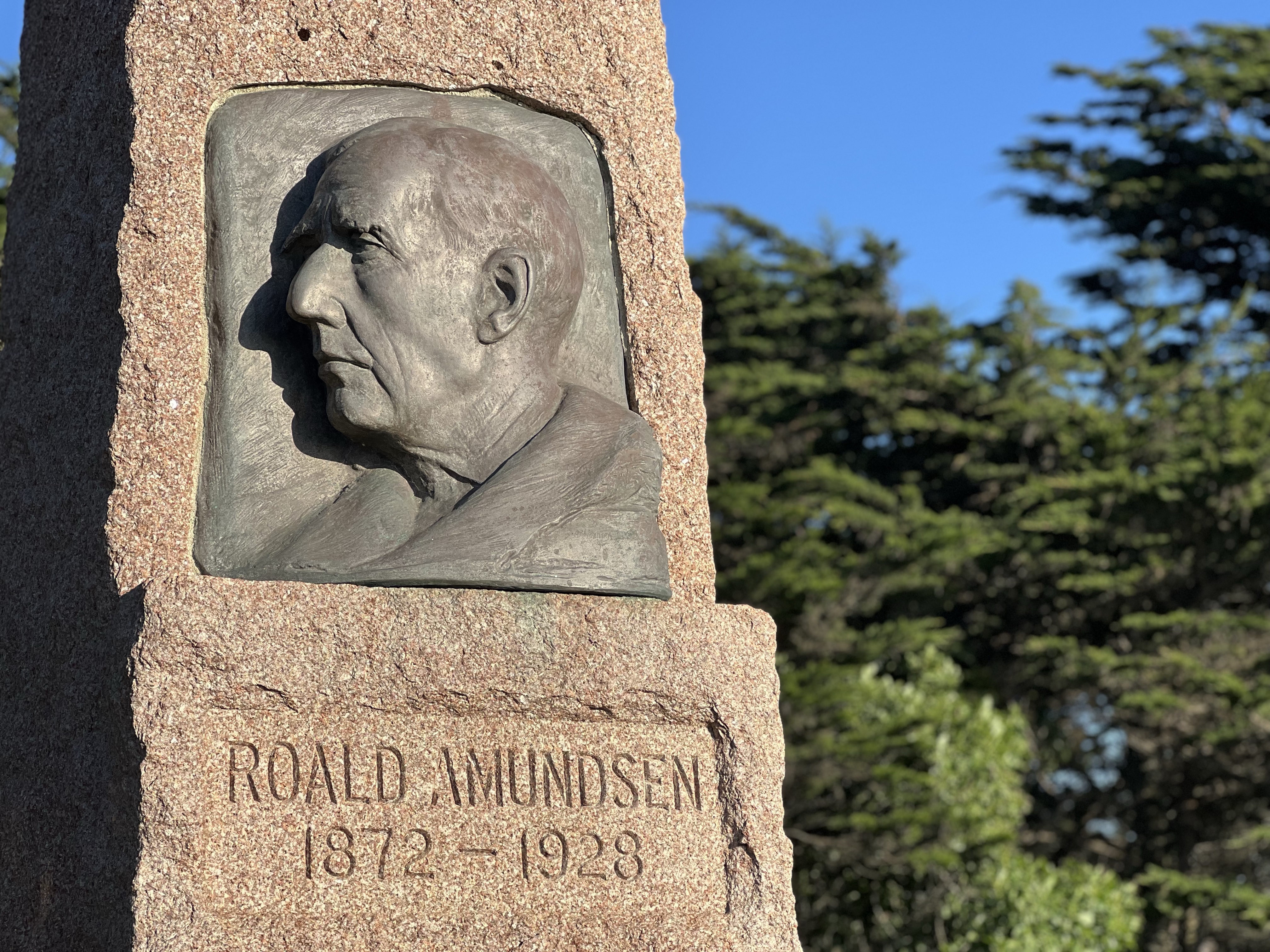
The Norwegian explorer was Roald Amundsen.
The plaque under the monument reads:
Roald Amundsen, the Norwegian polar explorer, was the first to locate the magnetic North Pole and to navigate the Northwest Passage, the Arctic water route from the Atlantic to the Pacific. He left Norway with a crew of six on June 16, 1903 in a 69-foot-long converted herring boat named Gjoa. Amundsen spent three years on the perilous journey. The Gjoa continued on, sailing through the Bering Straits and anchored off Point Bonita, outside the Golden Gate, on October 19, 1906. The San Francisco Norwegian community purchased the Gjoa from Amundsen and donated the ship to the people of San Francisco in 1909. In 1911, Amundsen became the first explorer to reach the South Pole. The Gjoaremained on this site at the western end of Golden Gate Park until 1972, when it was returned to Norway. The restored ship is now on display at the Maritime Museum in Oslo.
The Amundsen monument is a bauta, or stone shaft, or Norwegian granite which was donated by Bay Area Norwegians, March 1, 1930.
I headed west to the end of Golden Gate Park to do an afterwork sketch of the monument that sits in the parking lot just north of the Beach Chalet.
I look forward to sketching the ship that was once on display near this location, it’s bow facing the Pacific Ocean. The Gjoa is now on display at the Fram Museum in Oslo.
The Gjoa was at the western edge of Golden Gate Park until 1970. The elements took their toll on the static Polar ship and rot and vandalism tarnished this once proud and pioneering ship. She was donated to Norway and headed back to her homeland.
A sketch from a c1910 postcard view from Ocean Beach looking east towards the Gjoa and the Dutch Windmill. While the Gjoa is gone, the windmill remains.
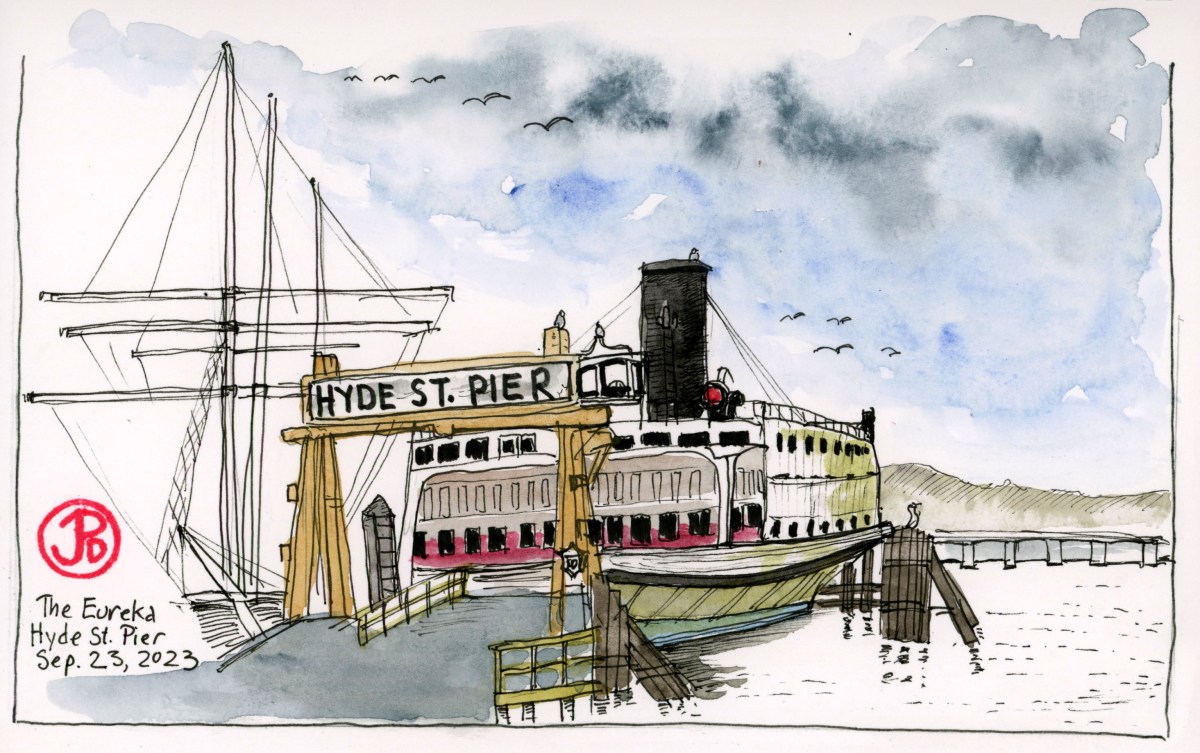
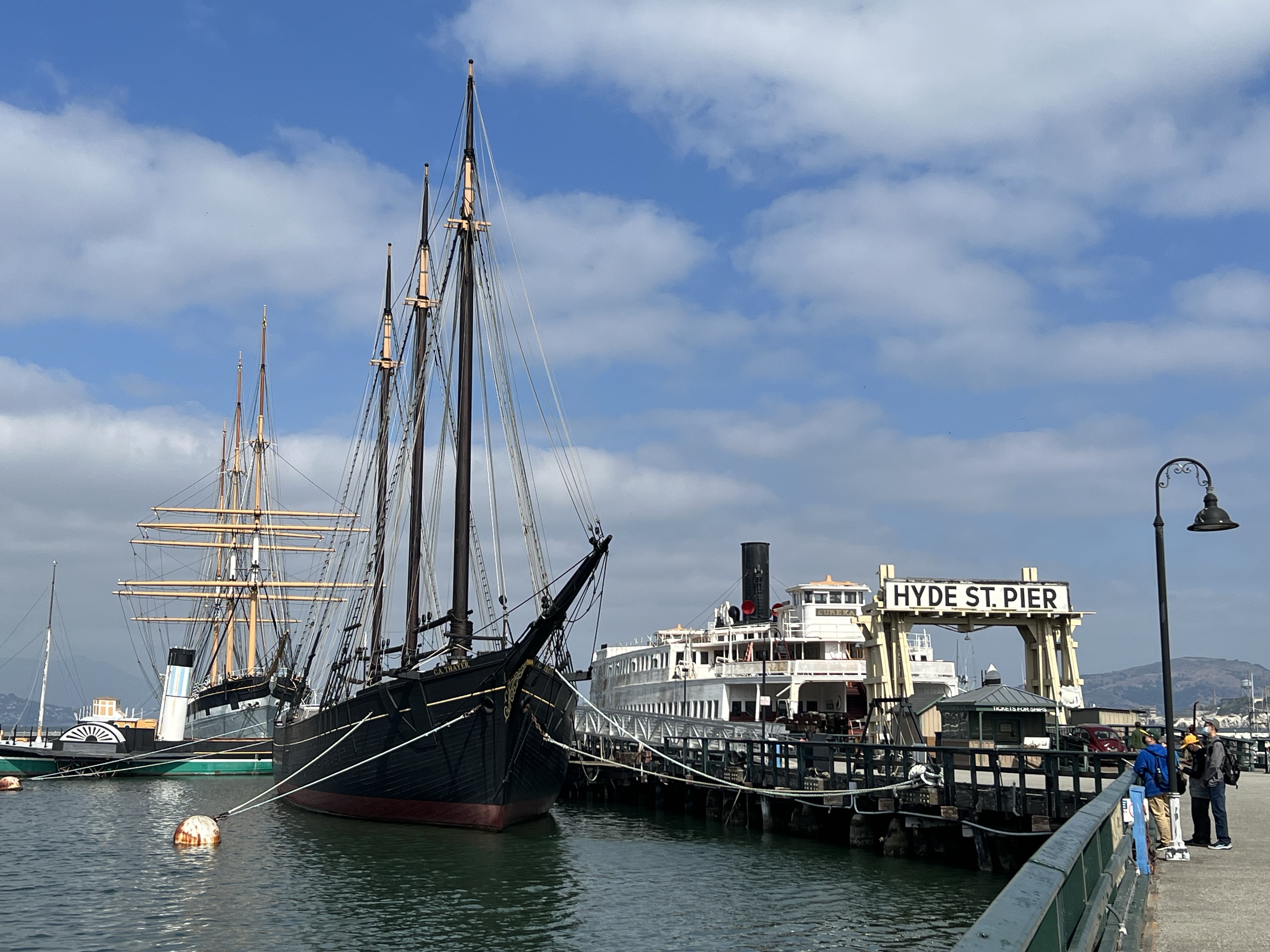
One of the ships docked at the Hyde Street Pier is the former Northwestern Pacific ferry boat Eureka.
In the era before bridges, (the Bay and Golden Gate), the only way to get from San Francisco to Marin or Oakland by rail, was by rail ferry.
The passenger cars would be boarded on the ferry and then, well, ferried, across the Golden Gate to Sausalito or Tiburon where they would be unloaded and continue north on the rails of Northwestern Pacific.
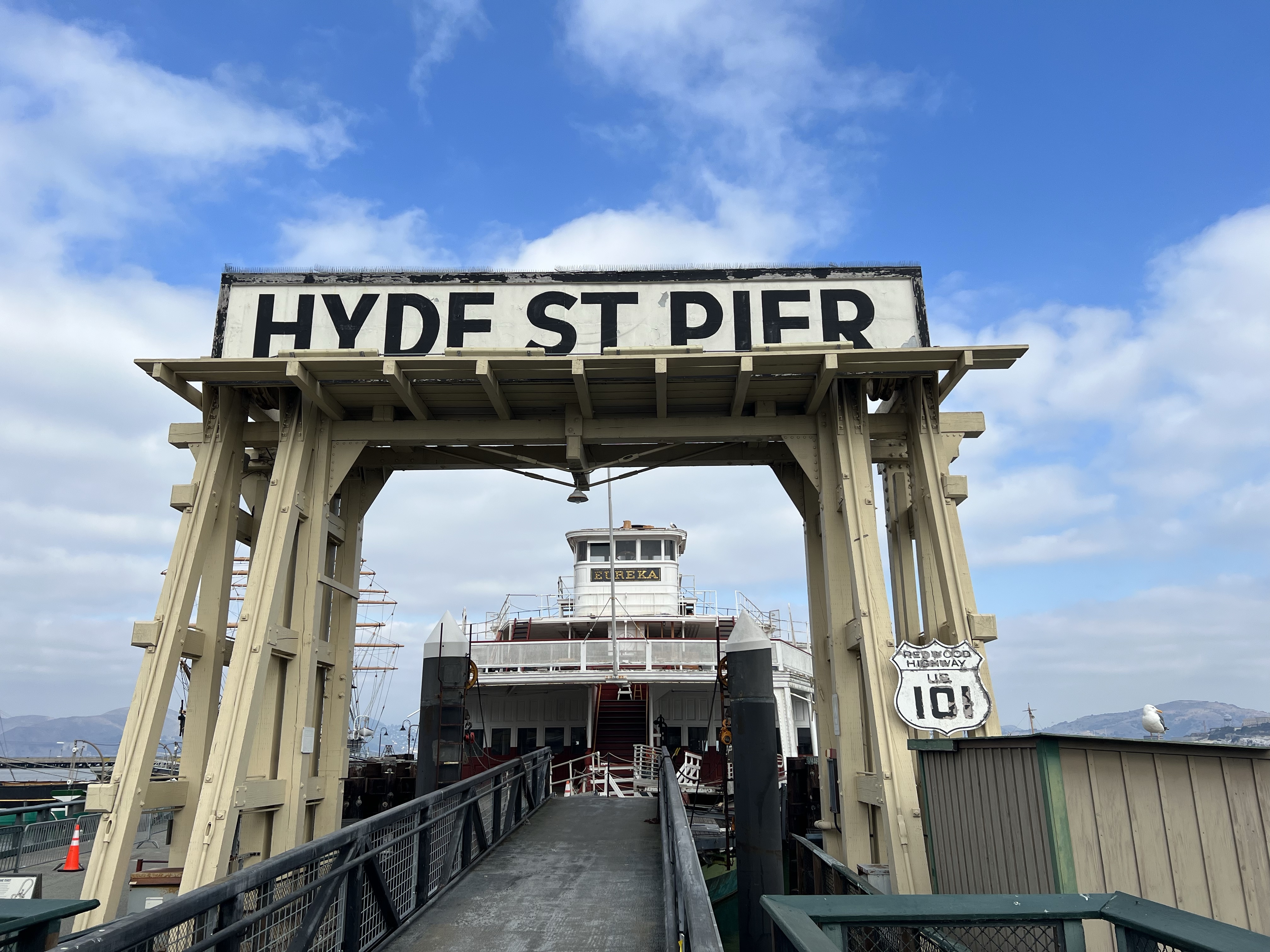
The ferry and the Hyde Street Pier was actually considered part of Highway 101.
The boat was built in 1890 in Tiburon by San Francisco and North Pacific Railroad Company and was originally named the Ukiah, which was as far north as the line reached. The Eureka is a double-ended, wooden hulled ferry-boat that was originally built to hold train cars. Two standard-gauge tracks where built into the main deck.
This 277 foot, 2,564 tonnage boat is the largest wooden-hulled boat afloat in the world.
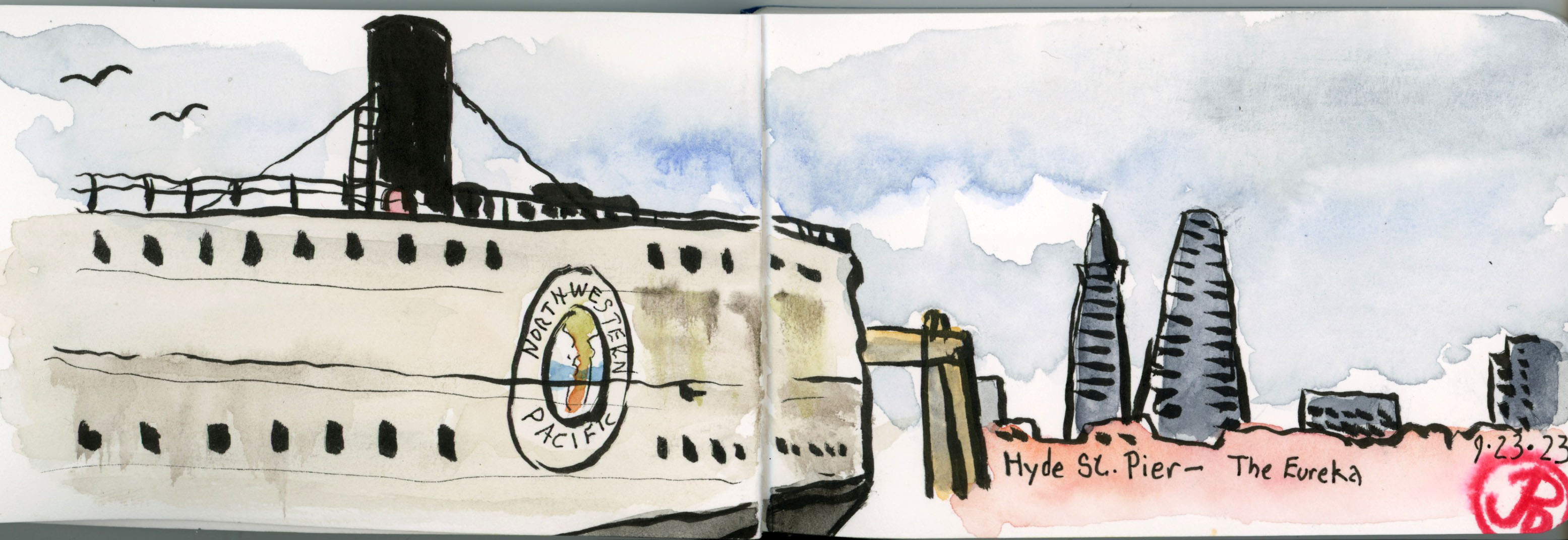
A pen brush field sketch of the Eureka, displaying the Northwestern Pacific circular logo, and the modern San Francisco skyline.
The Ukiah was initially in service to ferry people from San Francisco to Tiburon during the day and then carry freight cars during the night. In 1907 the Northwestern Pacific Railroad took ownership of the Ukiah and it was routed to the Marin port of Sausalito.
During World War I, the ferry was rebuilt and the refurbished ferry was renamed the Eureka, in honor to the northernmost station on the Northwestern Pacific Railroad.
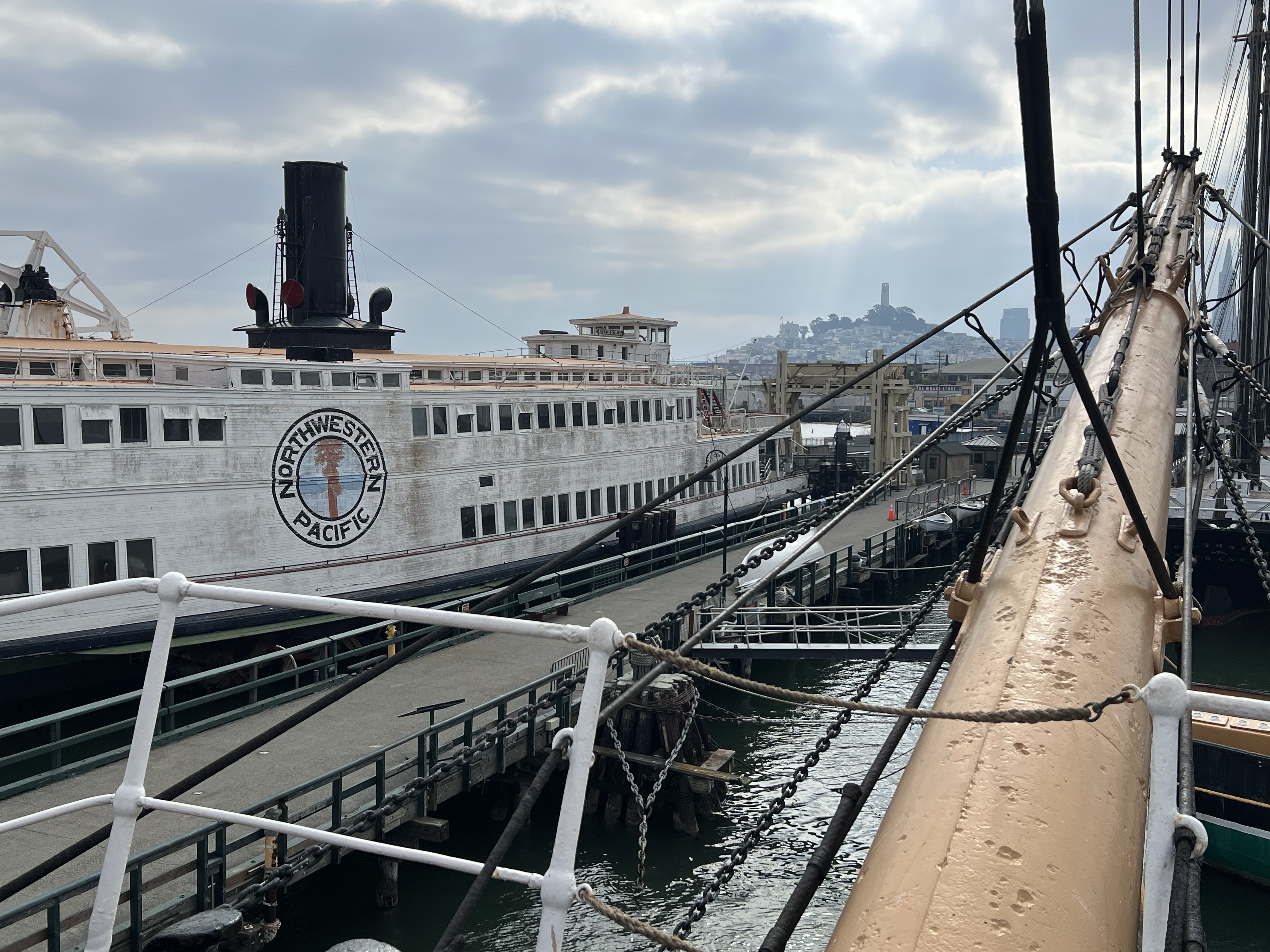
The Eureka from the bow of the Balclutha and Coit Tower echoing the steam stack of the Eureka.
The ferry was later used to ferry automobiles on her main deck and had a capacity of 2, 300 passengers and 120 cars. At this time, the Eureka was the largest and fastest double-ended passenger ferry in existence and because of this, the Eureka was called up for the busiest commuters times from Sausalito to San Francisco. Hyde Street pier was the primary auto terminal to connect San Francisco to points north and east.
When the Golden Gate Bridge was completed in 1937, ferry service passengers dried up and Northwestern Pacific abandoned all ferry service in 1941.
The Eureka found a new life in the 1950s with a new owner, the mighty Southern Pacific. The Eureka now linked passengers on SP’s overland service from Oakland to San Francisco.
Today the Eureka is docked with the C. A. Thayer (foreground), the Eppleton Hall, and the Balclutha (background).




 Corvid Sketcher
