One benefit of sheltering in pace and the global pandemic is that it has forced me to walk around my neighborhood (for sanity’s sake).
When you get out in the neighborhood you start to notice details you haven’t seen before. You noticed the little details of houses that before seemed all the same. Details are the route newly noticed.
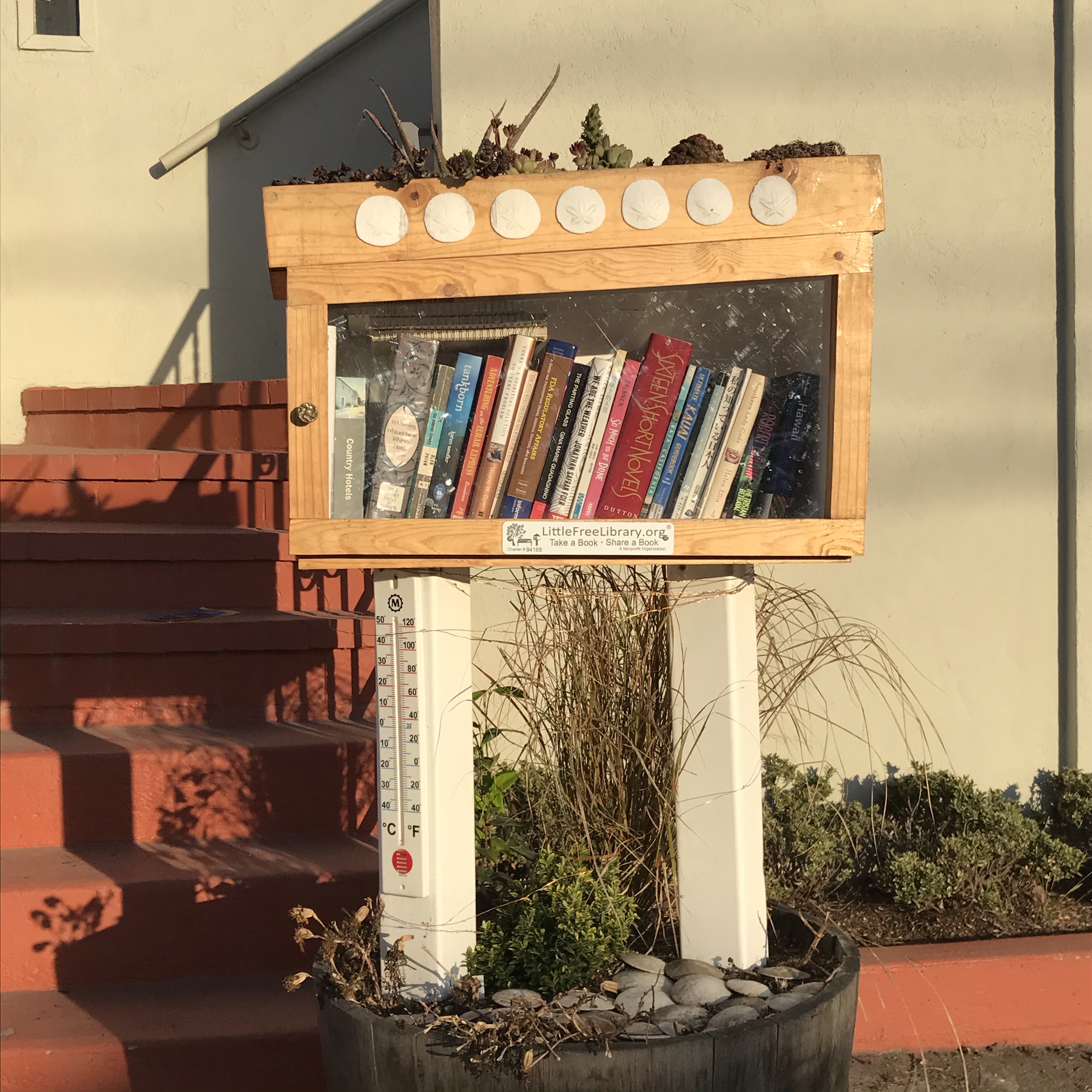
One thing that I have noticed on my walks of San Francisco’s Outer Sunset District is the proliferation of little boxes on wooden poles. These are the little libraries.
The box on top of the pole contains one or two selves lined with books. These boxes are used to take a book or leave a book and they are all free. It seems odd in a city there is actually something free! Well not exactly free. I donated three books:
The Road to Little Dribbling by Bill Bryson (Good but not as good as Notes From a Small Island.)
The Lost City of the Monkey God by Douglas Preston
The Devil’s Highway by Luis Alberto Urrea
The nonprofit company behind these boxes is Little Free Library, a Wisconsin based company that inspired 100,000 boxes (and counting) in 100 countries (and counting).
People can either build their own library of have one pre-made. Once it is installed, usually in the front yard, facing the sidewalk, the library is registered and added to a map so reading in the community know where to find a Little Free Library.
Here’s a two story version on Judah street in front of the St. Paul’s Presbyterian Church and the Far Out West Dune Community Garden.This Little Free Library is a few blocks from Ocean Beach and is topped with succulents and bejeweled with sand dollars. Each of the boxes are as uniques as their owners.
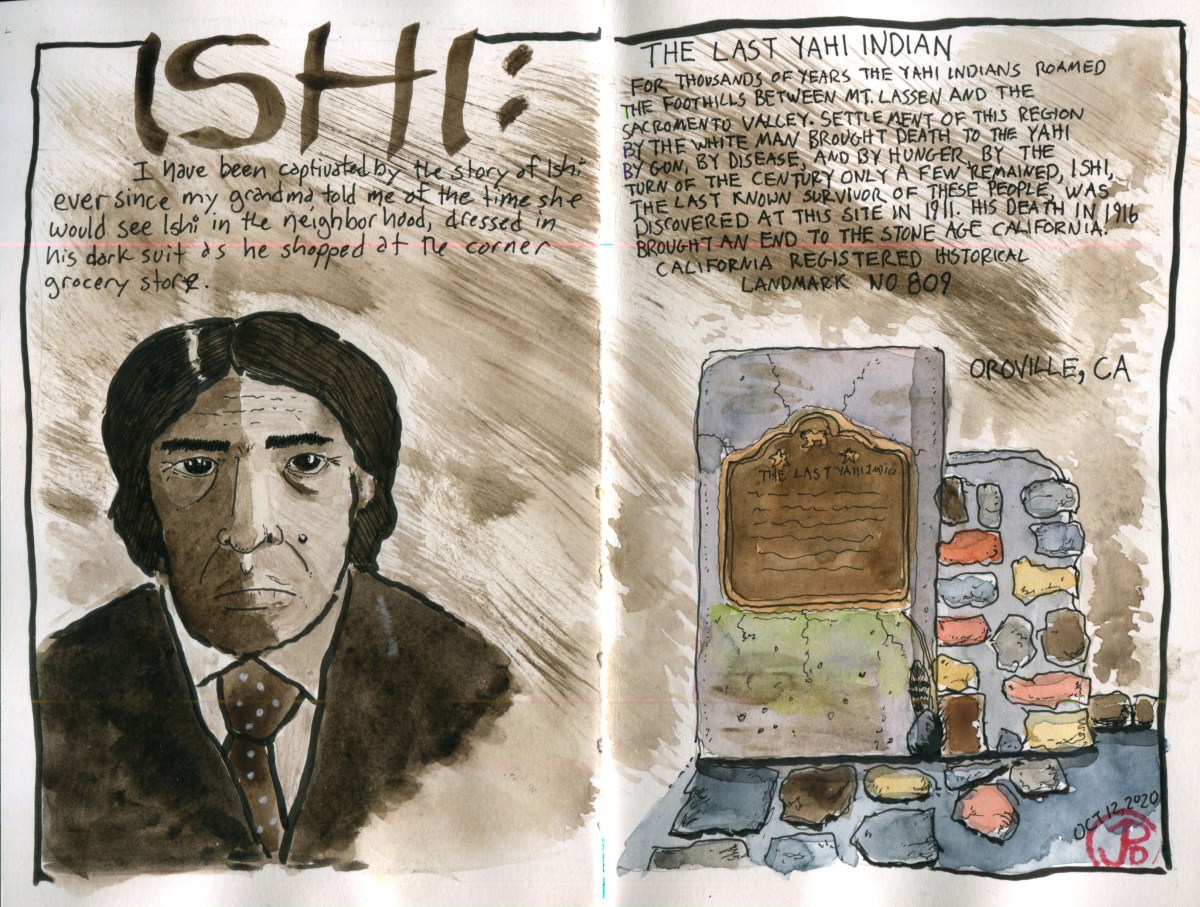
On this Indigenous People’s Day I visited a historical marker to one of the most well known indigenous person in California.
I remember the stories my grandma told me of the man in a suit that she would see in the local corner grocery store in the the inner Sunset neighborhood in San Francisco. He was different but covered in the threads of the times. Although she had seen him as a child, the story she told me in her later years showed what an impression that experience had made on her.
This was the man named “Ishi”, the last surviving member of the Yahi People. And I was going to the point of his intersection with the modern western world.
How did he come to live in San Francisco? It began on an August evening at about 7:30 in eastern Oroville.
On August 29, 1911, Ishi collided with he western world when he was captured near Charles Ward’s Slaughterhouse (note the irony) in Oroville, California. He was captured and put into the Oroville jail (supposedly for his own protection) when the first photograph of him was taken of.
Ishi’s people, the Yahi, had been diminished by attacks by other native tribes and by white settlers who came to California to seek their fortunes in the Gold Rush. His small family group died out and he wandered down from the foothills, tired and dehydrated, to look for food when he was captured.
Ishi at the Oroville jail.
In September, Ishi made his way to San Francisco where he stayed at the University of California Museum of Anthropology at Parnassus and was studied by an anthropologist named Alfred Kroeber. Kroeber learned from Ishi about his culture and language (no living person spoke his language). His voice was recorded as he talked, sang, and told stories.
One favorite story is about the time that Ishi was riding in a car through Golden Gate Park and he made the driver stop the car as he spotted California quail by the side of the road, a bird Ishi would have been very familiar with. Today, there is only one quail remaining in Golden Gate Park, a lone male, which local birders have named “Ishi”.
Ishi’s contact with the modern world proved to be his downfall. He was often sick with western diseases. He died on March 25, 1916 of tuberculosis.
The area where Ishi was found is now a quiet residential neighborhood on a quiet street. The slaughterhouse in gone and the area has been built up with residential, single family houses. The calls of the northern flicker, California quail, and the acorn woodpecker may be the only things recognizable from 1911. At least to Ishi.
Now there is a historical marker, the genesis behind it’s creation was a high school teacher and his son, who wondered why there was not a historical marker about the last of the Yahi: Ishi. And because of their efforts, there now is California Registered Historical Landmark No. 809.
Looking at this marker now, I reflect on our complicated interactions with the native people of California. It is often a tragic story but also with bits of light and wonder. Like the time a little girl saw the man from Parnassus in the local store. A story she would tell, many, many years later to her grandson.
But Oh! as to embrace me she inclin’d, I wak’d, she fled, and day brought back my night.
—John Milton, Sonnet 23
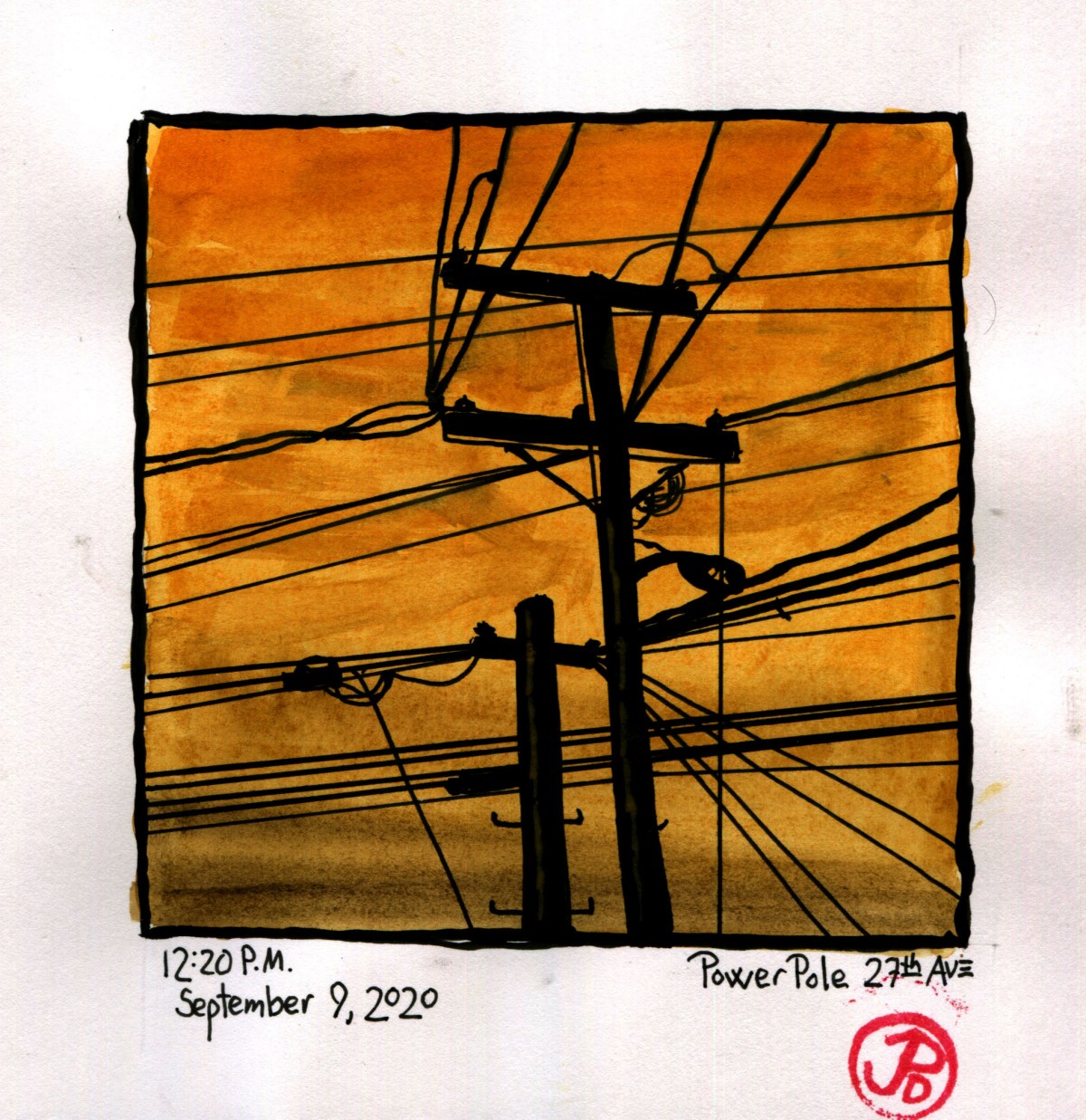
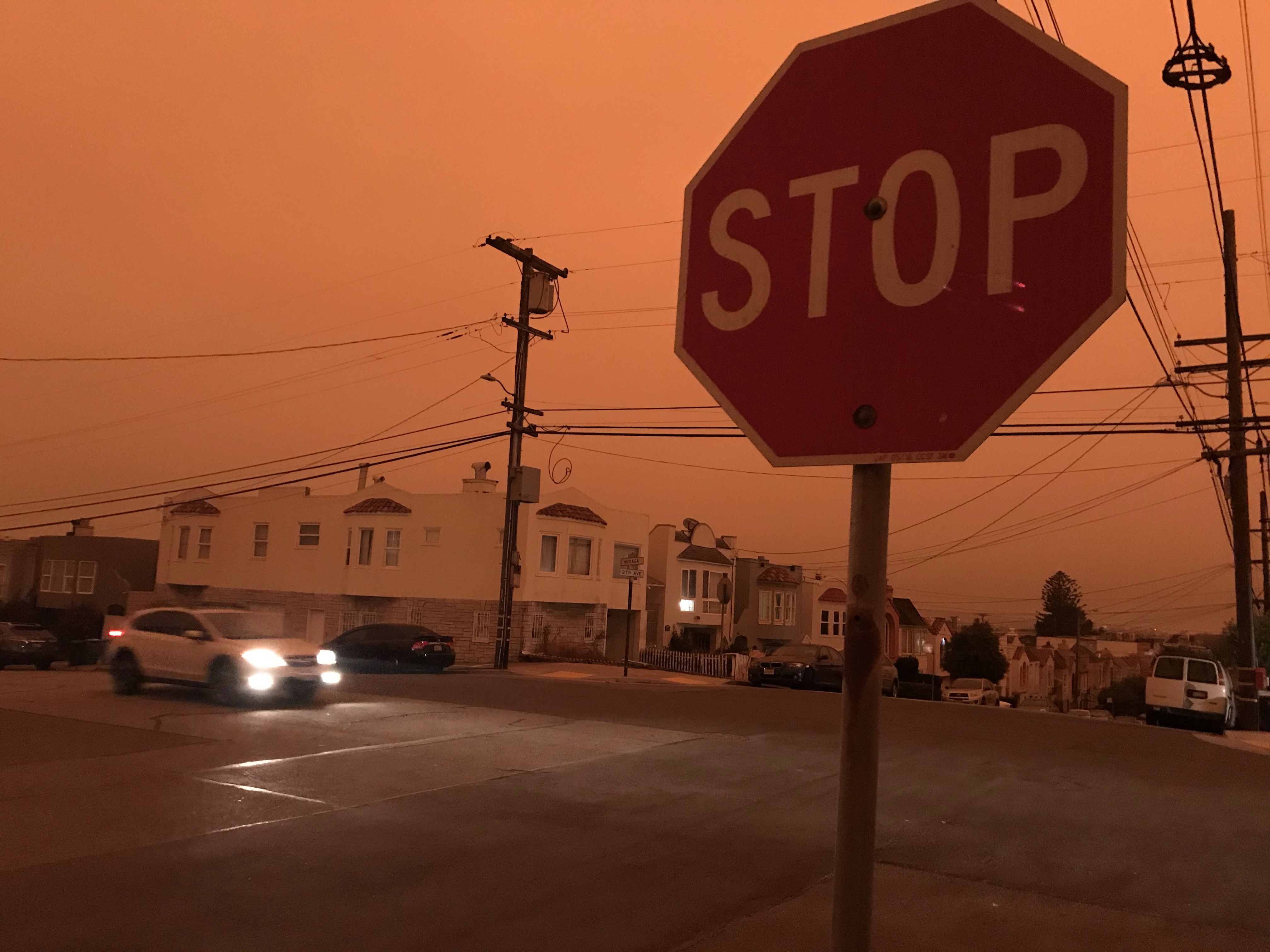
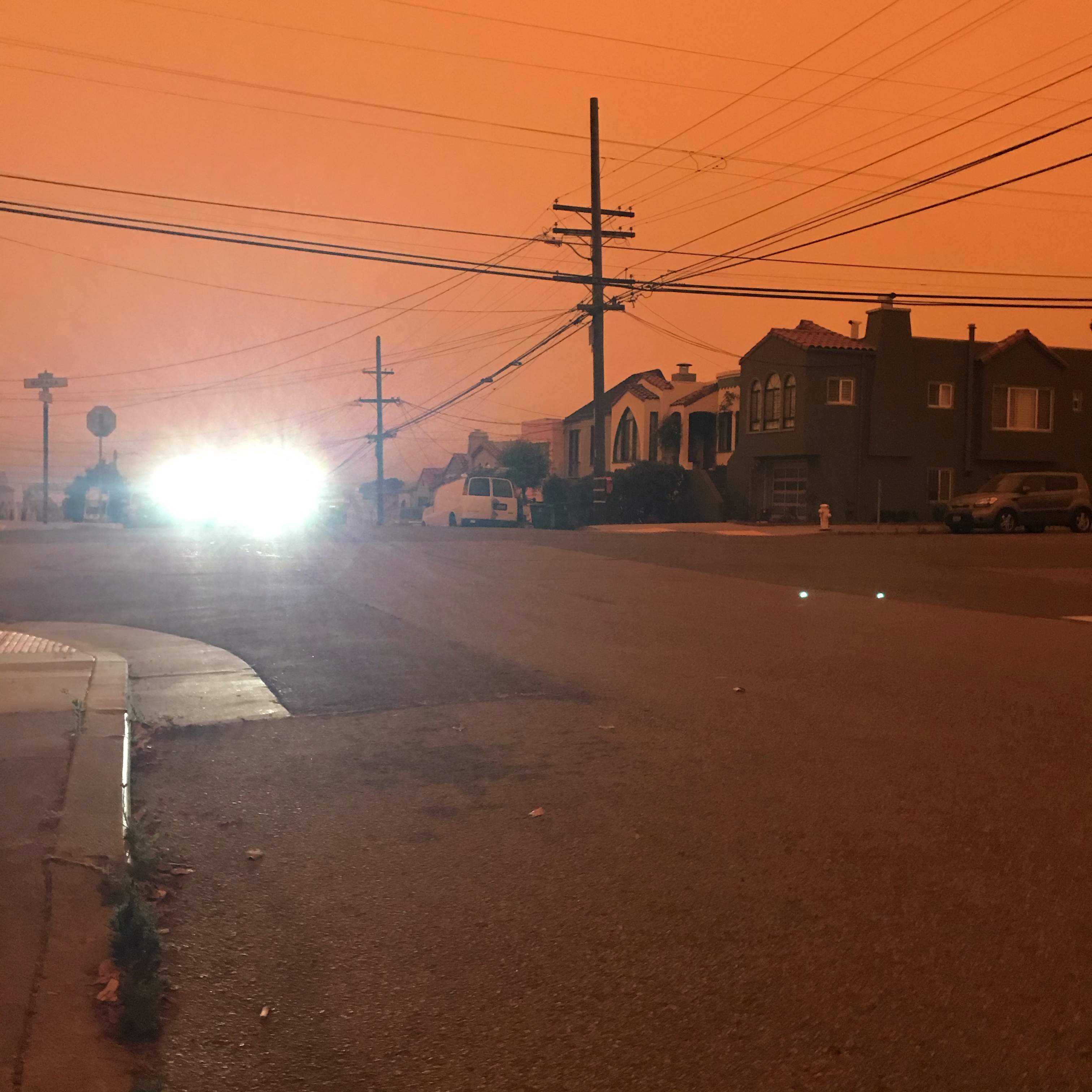
The morning skies of Wednesday September 9, 2020 where an odd orange hue. This dawning day looked like a sepia colored night from a Film Noir based in the foggy, hilly streets of the City By the Bay (think: Out of the Past).
The sun was shrouded by a high, smoky fog. The street lights were on, motorists had their headlights bright, and the birds where silenced by the false-night.
There are currently 28 major wildfires burning in California that have consumed over 2.5 million acres. The smoke from these fires lay thickly in our upper atmosphere, above the coast marine layer (fog) creating the sun’s orange-tinged light.
Many forecasts predicted temperature highs to be in the 90s but the smoke blocked out so much sunlight that many areas in the Bay Area could only muster temps in the 60s.
The only bird that broke the silence was the local California scrub-jay. All other life seemed silent and shrouded in a apocalyptic nightmare!
This photo was taken at 11:30 AM, you could not drive in the gloom without your headlights on!Looking north down 27th Avenue. The Golden Gate Bridge is out there somewhere!
On a Saturday morning, Grasshopper Sparrow and I went down to Stanford University to do some urban sketching.
We parked near the Oval and headed towards the Center of Visual Arts. A red-tail hawk was very vocal from above and we soon found out why as a much larger golden eagle flew low over the museum, circling up on rising rounds and then disappearing to the south. This had to be a great sketching omen!
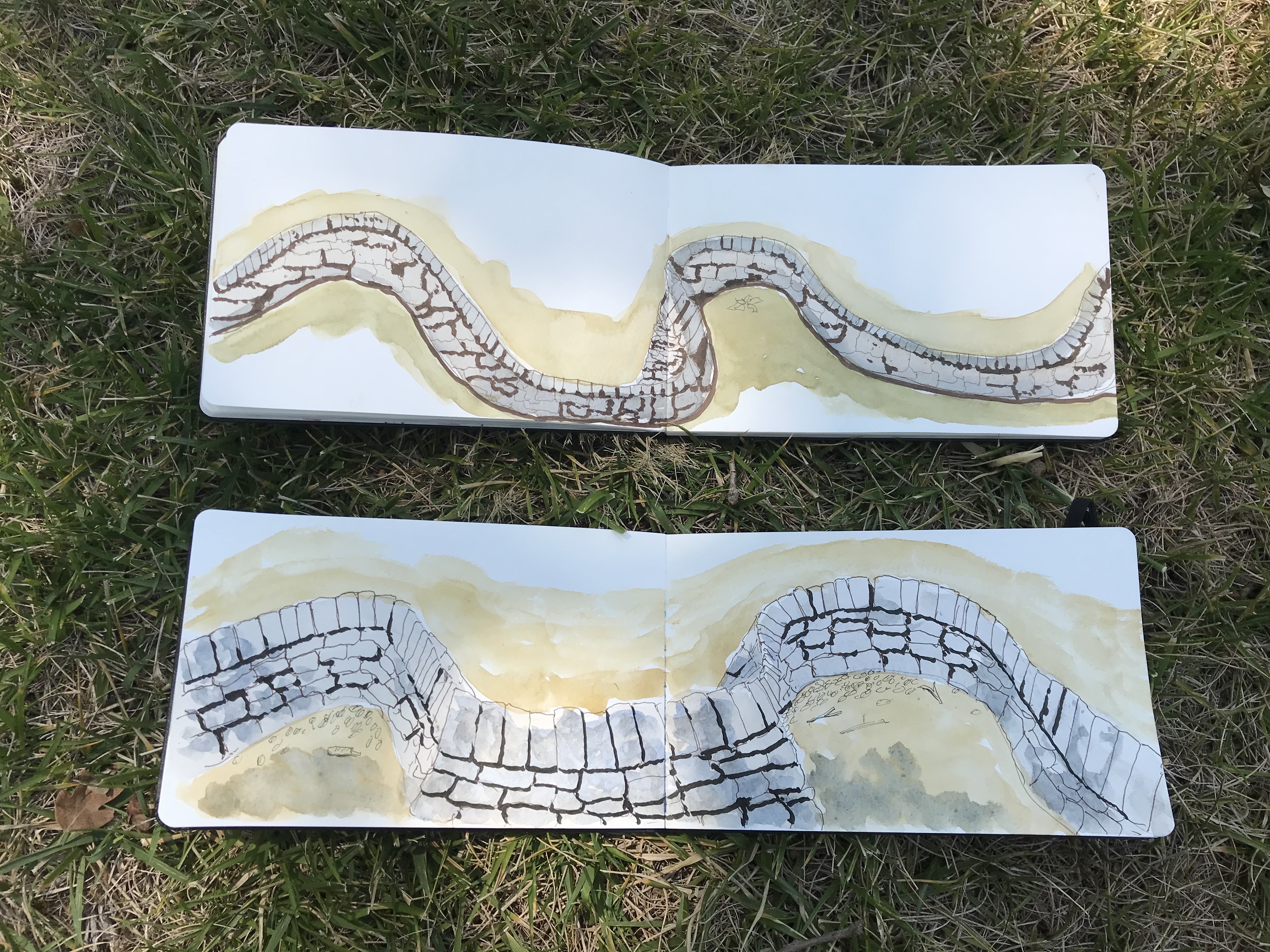
Andy Goldsworthy’s Stone River (2001) is a touchstone in my sketching world. As I have written before, a touchtone is subject that I return to again and again. Usually a touchstone is a building, a bird, or a piece of sculpture; something that is not going anywhere, anytime soon and can be sketched from different perspectives. This was my third time sketching this outdoor sculpture on the Stanford campus and I was excited to share the experience with Grasshopper!
Our sketches of Goldsworthy’s Stone River, resting on Mrs. Fayer’s lawn.
After about a 20 minute sketch I called up a fellow teacher from my school who lives on the Stanford campus. She was Grasshopper’s favorite 3rd grade teacher and rumor has it, that I was his favorite 4th grade teacher. She was home and invited us over. She happens to be one of my favorite people.
We walked through campus and had a lovely time in Mrs. Fayer’s backyard, from ten feet of course! To see the care and love Mrs. Fayer had for her former student was inspiring! This was no idle, simple conversation here. She challenged Grasshopper and asked about his hopes and dreams. When he answered, she dug deeper. It reminded me that all good teachers are also students that never stop learning; about their students or former students (there really is no difference) and life.
On Sunday I wanted to sketch another Goldsworthy touchstone in the Presidio. This was the wooden sculpture called Spire (2008). Goldsworthy has four pieces in the Presidio and I have sketched them all. The last time I sketched Spire was in December 2010.
I parked at Inspiration Point on Arguello Boulevard. I looked up at Spire against the gray summer skies of San Francisco and when I saw some of the trails barricaded off, I should have known something was wrong. Perhaps just another closed area during the ongoing pandemic.
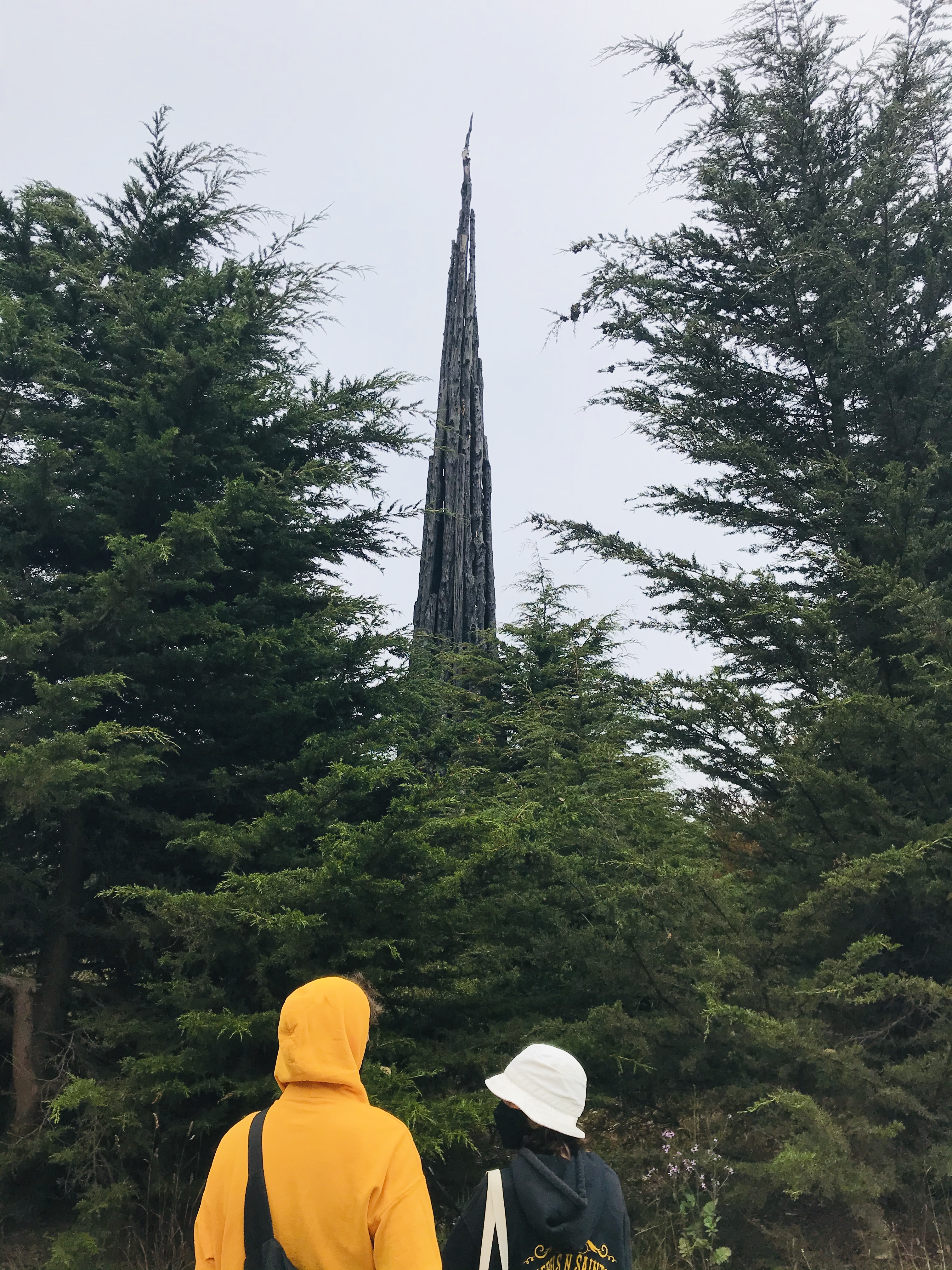
It was a typical gray day in western San Francisco at this time of year, when colors are drained of vibrance and contrast is muted. Spire looked just the same as ever before. Then I noticed that the area around Spire was fenced off and people were milling about as if before some somber memorial. Not a spire then but a funeral pyre.
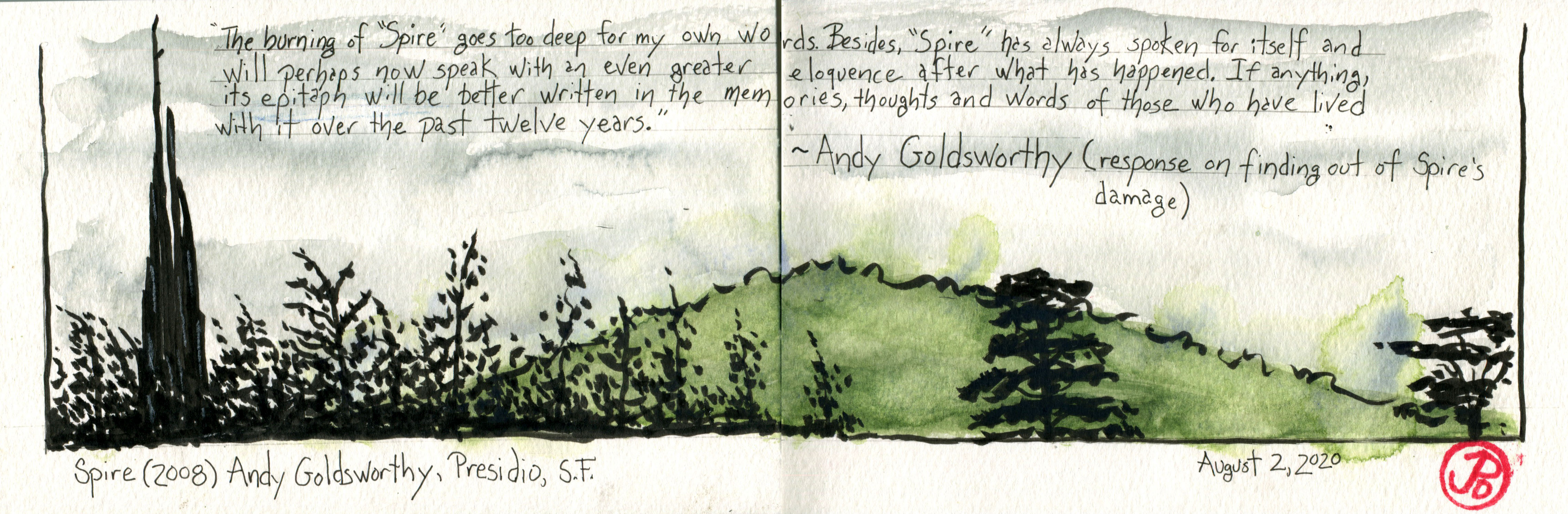
I found out from one of the visitors that Spire had been burned in an act of arson on the morning of June 23 (2020). It is unclear if this fire was part of the recent protests in the City or if it was set by illegal fireworks. At least the piece is still standing in a somewhat altered and charred state. Andy Goldsworthy, often the creator of ephemeral works, commented on the burning of Spire:
The burning of “Spire” goes too deep for my own words. Besides “Spire” has always spoken for itself and will perhaps now speak with an even greater eloquence after what has happen. If anything, its epitaph will be better written in the memories, thoughts and words of those who have lived with it over the past twelve years.
I would also add that it is also “written in the memories, though, words, and sketchbooks“. This response from the artist to what could be viewed as a tragedy is, well, very Goldworthian. His pieces are always subject to the elements and time, whether from the wind and rain or at the hands of an arsonist.
Vistors stand in silence, looking up at the burnt remains of Spire. The sculpture was still standing!
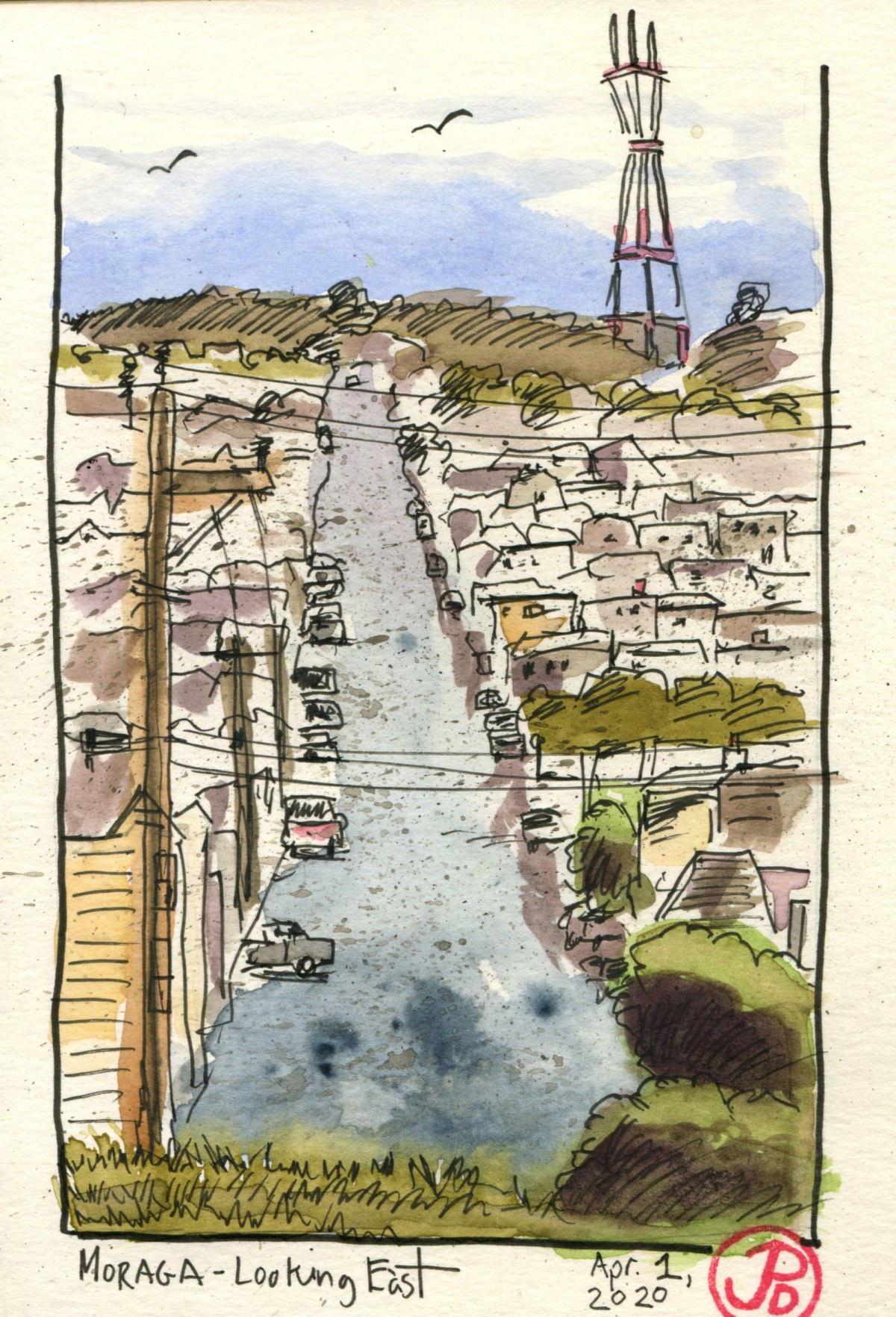
On the verge of comprehending that I may never see my students again this school year, I headed out toward Ocean Beach down Moraga Street.
The day was clear but extremely breezy. It normally takes 25 minutes to reach the sands of the Pacific but somehow, with my heavy mood and the western wind pushing again me, I think it really took 30 minutes.
I had done two recent sketches, facing west, looking out to the vast expanse of the Pacific Ocean, the Farallon Islands and container ships on the horizon.
Instead of doing that view, I turn 180 degree from whence I came and wanted to sketch Moraga Street, climbing up to Grandview Park and Sutro Tower.
This street (as all east/ west streets in the Richmond and Sunset Districts) is named after Spanish Explorer. José Joaquín Moraga was part of the De Anza expedition force that came from Arizona to present day San Francisco in 1776. He stayed behind and helped to found the Presidio. In 1785, he died in San Francisco and is buried at Mission San Francisco de Asís (MissionDolores) which is the oldest structure in San Francisco.
Much of what I was drawing in the Outer Sunset was developed Post World War II, in the 1950s. In fact my day told me stories of coming out into this area when he was a child and playing amongst the sand dunes.
This was the second time I had sketched Sutro Tower on one of my “sanity walks”. It is the most prominent landmark on this side of town. The television tower was constructed in 1973 and at 977 feet, it was the tallest structure in San Francisco (Sutro has now been surpassed in height by the Salesforce Tower at 1,070 feet).
I plopped down behind a dune, on my Crazy Creek chair, and started to sketch. I tried to keep everything loose and not add too many details (sometimes I think I should have put the pen up five minutes earlier). I uses a lot of artist shorthand when sketching in the rows and rows of houses leading up the hill.
On today’s walk I headed north to Golden Gate Park. My intent was to go to the Bison Paddock in the wild western portion near the Chain of Lakes and do some bison sketching.
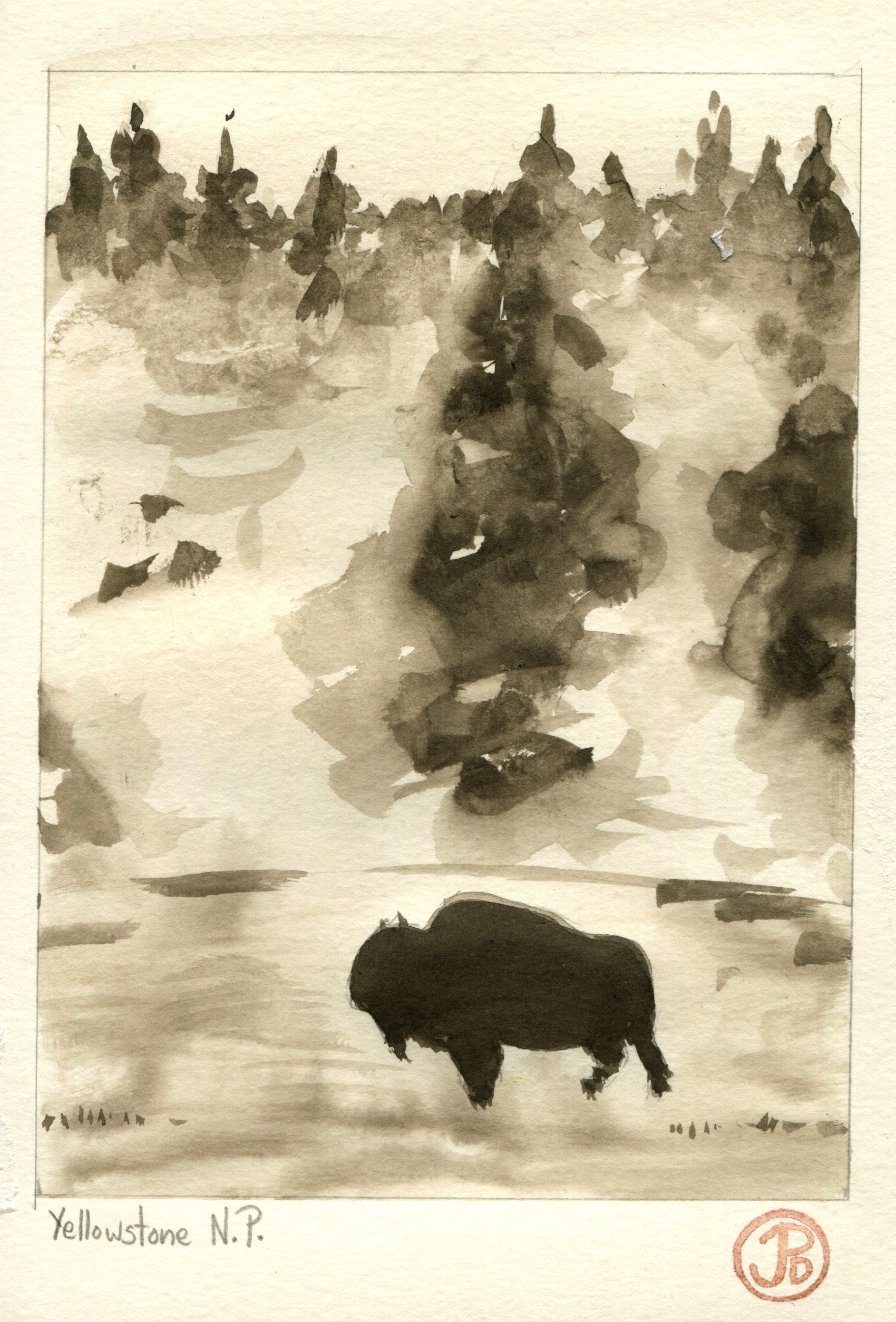
Bison are good subjects because well, they just sit there allowing you some time to get a sketch in. They are certainly better subjects to sketch than say, a Wilson’s warbler, a hyperactive bird that is a challenge even to photograph well. I had practiced sketching American bison in the wild, on a fall trip to Yellowstone National Park in 2017.
This is a sketch from a photo of my October 2017 trip to American’s oldest National Park!
The goal I set for myself was to loosen up my sketches and apply some of the things I have learned in a book I am currently reading, Felix Scheinberger’s excellent: Urban Watercolor Sketching. He advises “less is more” when it comes to watercolor painting and I also take this to mean the economy of the sketch itself. I’m not sure if I succeeded but every sketch can be considered a success because you learn something with each one. And sometimes you learn what not to do!
I picked my spot near the fence and making sure I was at least 12 feet away from any other park visitors (The Bison Paddock is a very popular spot) and I started to sketch a lounging bison. I started using a Micron sepia PN, not using any underlying pencil sketch! I then laid in some color, making sure to leave parts of the sketch unpainted (featured sketch).
An overenthusiastic art lover walked over and would have stood above me breathing into my left ear had I not halted his progress by proclaiming, “I’m practicing social distancing!” He stopped and admired the sketch from a distance.
A bison wandered by, grazing as it went along. I couldn’t let this happen without getting another sketch in! This time I challenged myself to do a continuous line sketch. This means that I sketched the bison without lifting my pen (although the rules of continuous sketching say you can lift your pen for a rest but you have to return to the exact point where you left off). This type of sketching is good practice for loosening up your lines and injecting improvisation into your sketching life.
A continuous line sketch of a bison. To get to other parts of the sketch you have to retrace lines you have already drawn. This is such a freeing way to draw!
Last week I knew for sure that I would be working for much of the three weeks leading up to Spring Break working from home. Add to that the Shelter in Place order that restricted much travel and social gatherings in the City and County of San Francisco. I knew I would be spending a lot of my time indoors, working remotely on my laptop. Communicating with students, lesson planning, talking with my fourth grade team, and assessing student work.
I knew that I would have to create a daily weekday routine that would give my day form and structure. So I created a daily routine diagram to flesh out the blocks of time during my waking hours.
For this diagram I used one of my favorite fonts, Sara Elizabeth. I discovered this font in the Dover publication: Rustic and Rough-Hewn Alphabets by Dan X. Solo. I have used this font in many of my illustrations from Central and South America. I also added illustrations to parts of each chunk of time. I intentionally didn’t add times because I knew that in relation to this weekly schedule, I had to be fluid in such an ever-changing time.
In one of the blocks I added “Creative Time” because for me it is like breathing air. And that is when I created this illustrated timetable.
I will go over every chunk of time:
Wake: This is when I wake up. Represented here by the crowing rooster, if we had roosters in my urban neighborhood, which we don’t. Otherwise I would be woken up much earlier. My wake up time is listed as 7AM. This is a little later than a “normal” working day because I only had to commute from my bed to my computer.
Break the Fast: Breakfast, usually of oatmeal and coffee. Keep it simple.
Teacher Time: This is when I open my work laptop and connect with my students. I do this through messaging on Google classroom. There were many questions the first day and I reminded then that patience is required in the weeks ahead as we are all learning in a new way. The title of this block comes from the name of the 30 minutes we have with our own students during our Coloma overnight trip, which we have, unfortunately, had to cancel.
Lunch: Lunch is from noon to one and I try to be consistent with eating healthy. Something that helps me stick to the normalcy of the working day.
Distance Learning: At this time I might arrange a Google chat and invite my students. They are jazzed to see each other (and what the interior of their houses look like) and I found that I had to do a lot of redirecting (just like in the real classroom) to keep my students focused and not all talking at the same time. I have employed the phrase, “You have the floor!”, just keep it Parlimentary.
Exercise: Physical and mental health are so important in this time of sequestration. I plan to walk down to the Pacific Ocean (25 minutes one way) or down through Golden Gate Park. My goal is to get 45 minutes to an hour of walking in each day, including weekends.
Creative Time: I live to create so this is a must in my day. At this time I can draw, paint, write, or play music. I may also do some field sketching as part of my daily exercise.
HH ~ Read: I love to read and I set about 60 minutes of reading time every day. I have a few books in my reading queue. I am currently reading non-fiction, a wonderful book by Christian Wolmar: A Short History of the Railroad. I am reading this in anticipation of my trip on the California Zephyr to Chicago which I had to cancel in light of the current pandemic. I also have three graphic novels that are extremely popular with my students by local author Raina Telgemeier: Ghosts, Sisters, and Guts. I also love to revisit poems by: Mary Oliver (one of my favorite poets), Basho, William Stafford, Shakespeare, John Donne, Pablo Neruda, Borges, Naomi Shihab Nye, Gary Soto, and Billy Collins. Just to name a few.
Dinner: I have enough healthy food to last me for three weeks (I think!). The Shelter in Place order should be no excuse to eat unhealthy foods.
Great Movies: This is a time to revisit some of my favorite films in my extensive collection of DVDs. Many of these films are considered masterpieces of world cinema. A partial list includes: Amelie, 49 Up (Roger Ebert called the series, “on my top ten greatest films of all time”), Amores Perros, Being There (much better than Forrest Gump), Butterfly (Spanish film about the early days of the Spanish Civil War), Cabaret, Chushingura (The Japanese tale of the 47 Ronin), Citizen Kane, Cria Cuervos (Title refers to the Spanish saying, ” Raise ravens, and they’ll gorge your eyes out”), Das Boot, Delicatessen, Grave of the Fireflies (a Japanese animated heartbreaker), Harakiri, Ikiru, Jean de Florette/ Manon of the Spring (Just amazing!), The Lives of Others, Playtime, Odd Man Out (one of the best soundtracks ever created for film), Once Upon a Time in the West, Rashomon (Seminal piece of World Cinema), Rio Bravo, Senna (a great documentary and I could care less about Formula One), Seven Samurai (one of my all time favorites), Shadow of a Doubt (Hitchcock’s favorite film), Spirited Away (Miyazaki’s masterpiece of animation), The Spirit of the Beehive (a dense film but probably the best Spanish film ever made), The Third Man, Sunset Boulevard, Tokyo Story, Watership Down (love the book and the animated film), Ugetsu, Vertigo (Often recognized as the best film ever made), and Unforgiven. I have many more films on this list but these are the films that speak to me at the moment.
ZZZZZ . . . Repeat: Perhaps a little bedtime reading but this is the time to rest in a time of unrest. I need all the sleep I can get to recharge the batteries to repeat the day and keep to the same route. Again and again. But hopefully not again.
I challenged Grasshopper Sparrow to create his own Daily Route in this time of shelter in place, and I would have to say that he rose to the challenge!
Many of the train stations I had sketched recently were designed and built in a Spanish Mission Revival style: Burlingame, Salinas, San Luis Obispo, and Santa Barbara. Truly the best way to understand an architectural style or architect is to sit in front of a building and sketch it.
And so, on a Friday afternoon, I headed to the Presidio, in the northwest corner of San Francisco, to sketch one of the finer examples of Spanish Mission Revival in the City of Saint Francis. I was also getting back into the habit of doing an after work sketch, which is a great way to decompress from the week’s work.
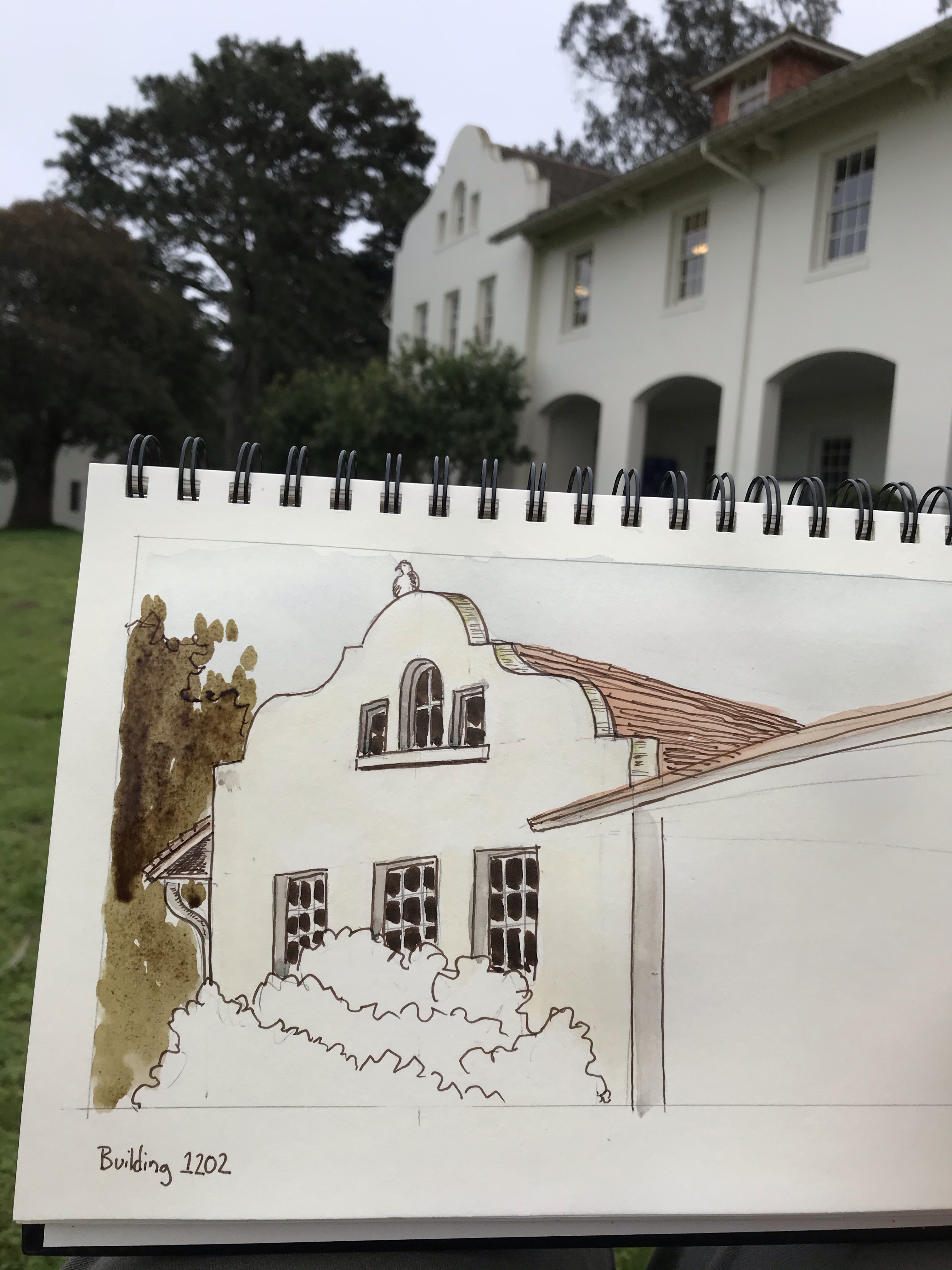
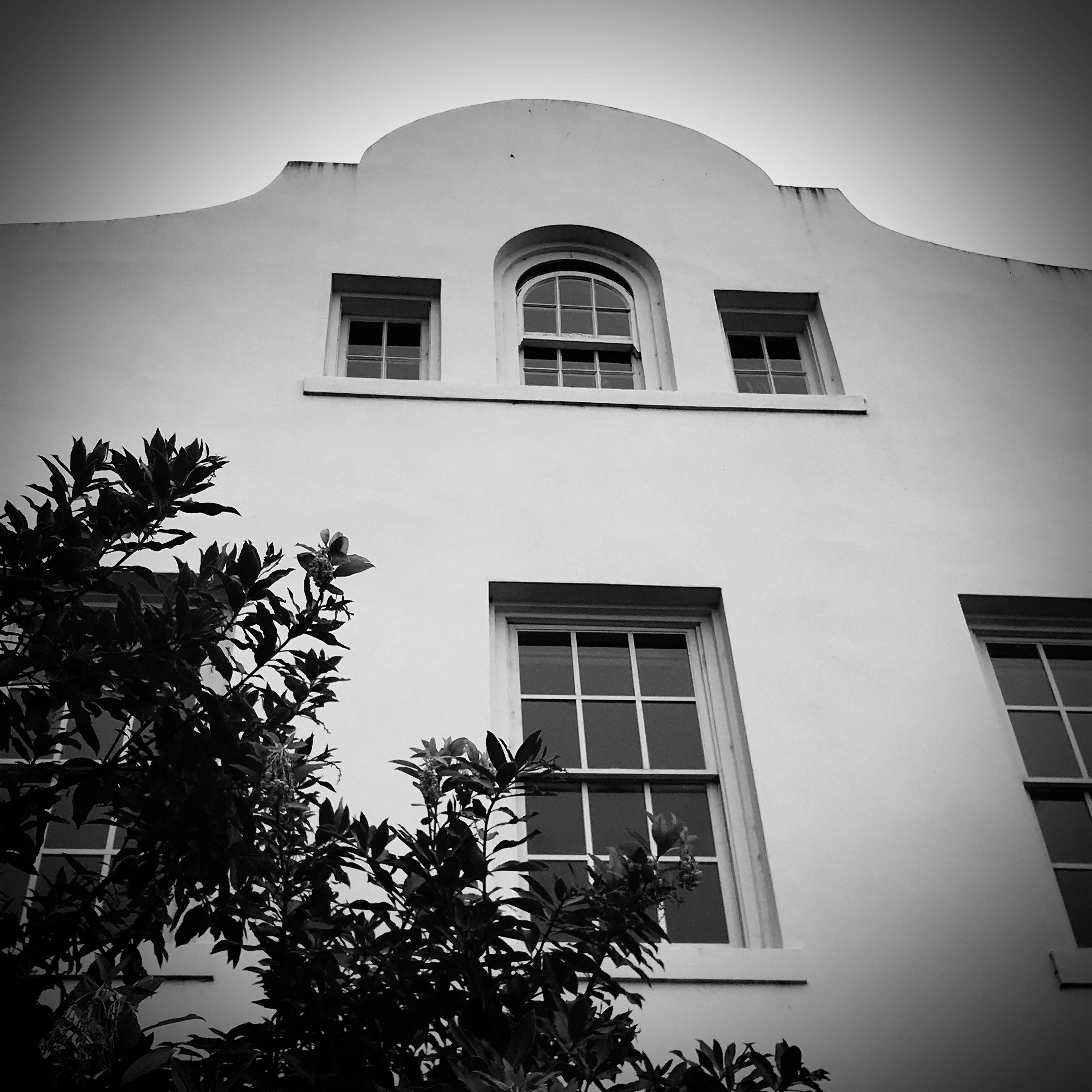
My subject was Fort Winfield Scott and the buildings that lined the parade grounds. These were the army barrack buildings built between 1910 and 1912 as the headquarters for the Coast Artillery District. I walked around the semi-circle of buildings until one spoke to me. It really wasn’t too hard because it was the only building with a hawk at its height.
An adult red-tailed hawk using building 1202 to survey the parade ground for gophers.
I set up my sketching chair on the parade ground and started to sketch building 1202. This was a former Army barrack built in 1911, and housed up to 95 to 109 soldiers.
I framed in the lovely lines of the barracks and added the red-tailed hawk at the top of the curve. The raptor flew to the field, this time coming up with only grasses in its talons. The hawk flew off only to appear later at the top of the flag pole at the edge of the grounds.
Building 1202 now houses the Presidio Graduate School and the World Economic Forum. Both sound a bit mysterious. People kept coming and going from the building. Some where getting on their bikes to ride home. A young woman bikerider stopped and asked me what I was doing. I told her that I was drawing the building and noted that that it was beautiful. She replied that she was “spoiled” to work in the building. These are the nice little conversations you frequently have when urban sketching, it really seems to take out the threat and the isolation of being in the city when people see your sketching.
After sketching historic passenger train stations between San Francisco and San Jose, I decided to expand my scope by visiting all of the existing stations on the Daylight Route from San Francisco to Los Angeles.
Salinas is probably best known as the birthplace of writer John Steinbeck. It is also known as the “Salad Bowl of the World” because its marine climate makes it an ideal location for agriculture. But I was here because it was the third Daylight stop on the line out of San Francisco. This would be the connection point for any traveller from the Monterey Bay Area wishing to head south to The City of Angels or north to the City of Saint Francis.
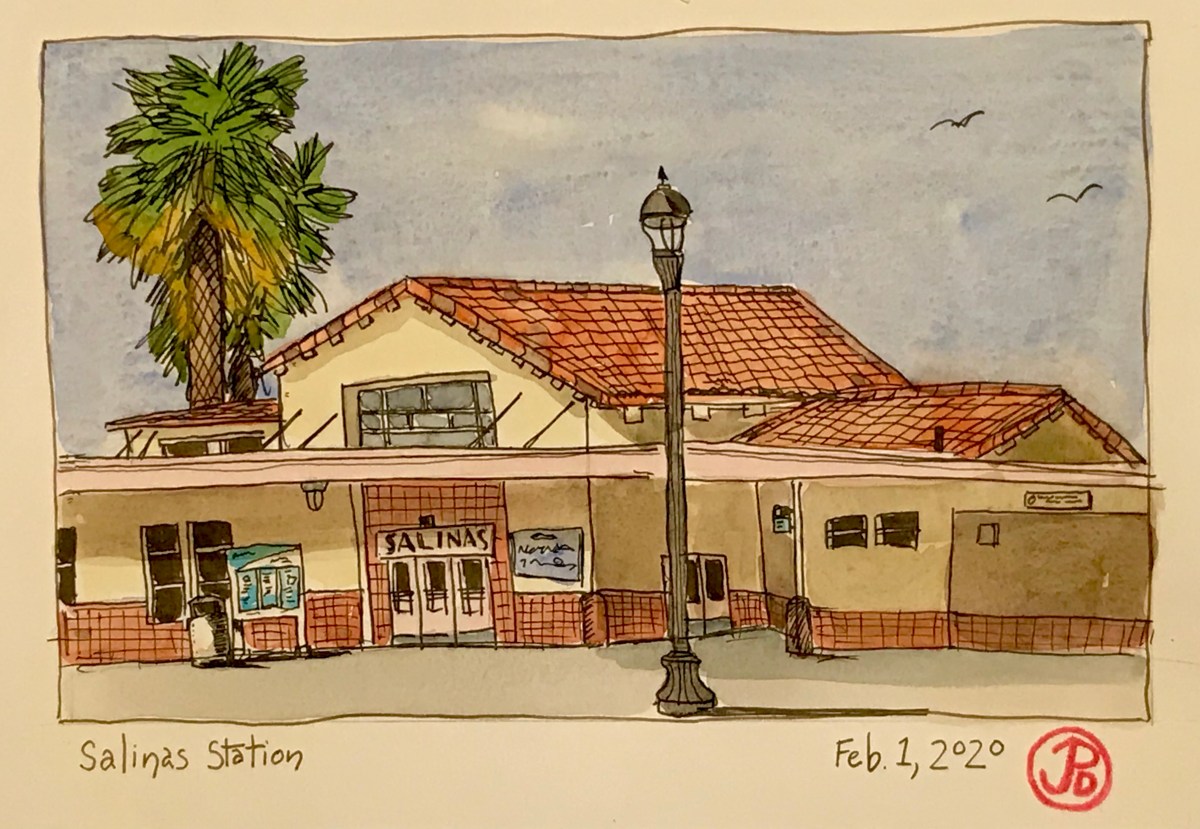
Salinas Station was built by Southern Pacific in 1941. It is designed in an Spanish Revival Style, with its red tiled roof, mixed with touches of the then popular Art Deco style, shown by its clean lines, letter design, and interior.
The station’s construction coincided with the rise of Southern Pacific’s premier passenger train, the Daylight Limited. Promoters called the Daylight, “the most beautiful passenger train in the world”. And this was not mere hyperbole.
This station bears a few commonalities with the two Daylight stations that still exist in the Bay Area, Palo Alto and San Jose. All three stations have murals painted by John MacQuarrie. And two of these murals feature Southern Pacific’s most beautiful locomotive at the the time the GS-2. This streamlined 4-8-4 is in the Palo Alto Station and here at the Salinas.
When the station was completed in 1941, the zenith of Southern Pacific’s passenger steam locomotives had arrived in the “super power” of the GS-4. The increased ridership of this route is evidenced by the the fact that Southern Pacific ordered 28 locomotives from the Lima Locomotive Works between 1941 and 1942.
The John MacQuarrie mural at Salinas was painted in 1941 (the same year as the Palo Alto mural) and prominently features the star motive power at the time, the Golden State 2 (GS-2). Six of these locomotives were built and went into service in 1937.
It was a beautiful winter day in Salinas with a high of 70 degrees. I walked around the station and at the platform, a Los Angles bound Coast Starlight was paused to pick up passengers for destinations to the southland. This Amtrak train replaced the Daylight in 1971. At least from Salinas to Los Angeles.
Salinas station was a station that was still in use. There are actual humans attending to the ticket window who could actually answer questions and issue tickets. The interior contained bathrooms, food vending machines, and benches for passengers waiting for their train to arrive. It was nice, for a change, to see a train station being used for its intended purpose.
It’s great to see that Salinas Station is still a vibrant station on the former Daylight Route. The car to the right is where I would probably be: the Lounge Car! To the right is a couple waving their loved one goodbye and safe travel.
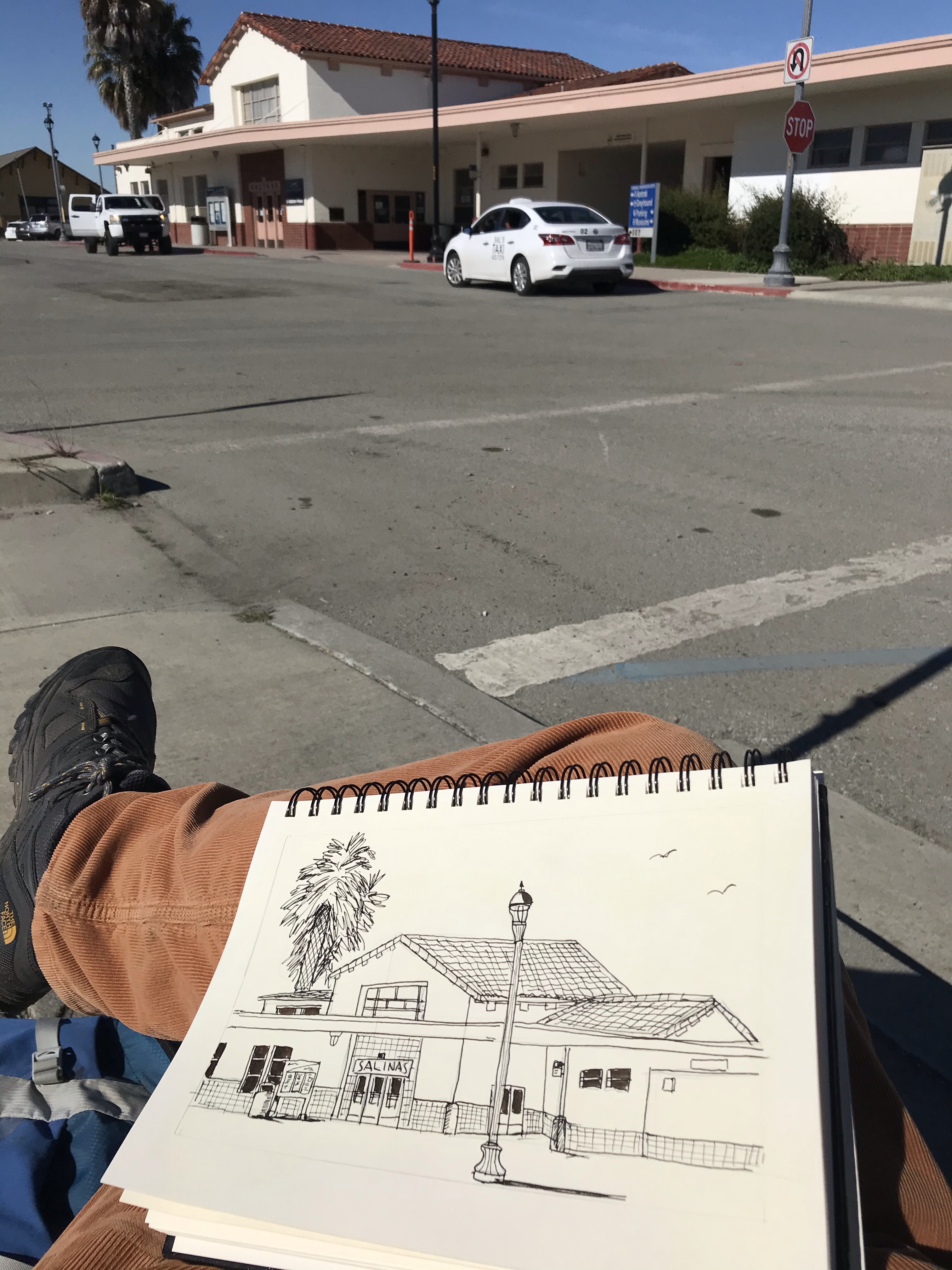
I set up my camp/ sketching chair across from Salinas Station and started to sketch. I originally wanted to sketch the station from a formal view but the parking lot was being rebuilt and was fenced off. So I sketched a little bit off center.
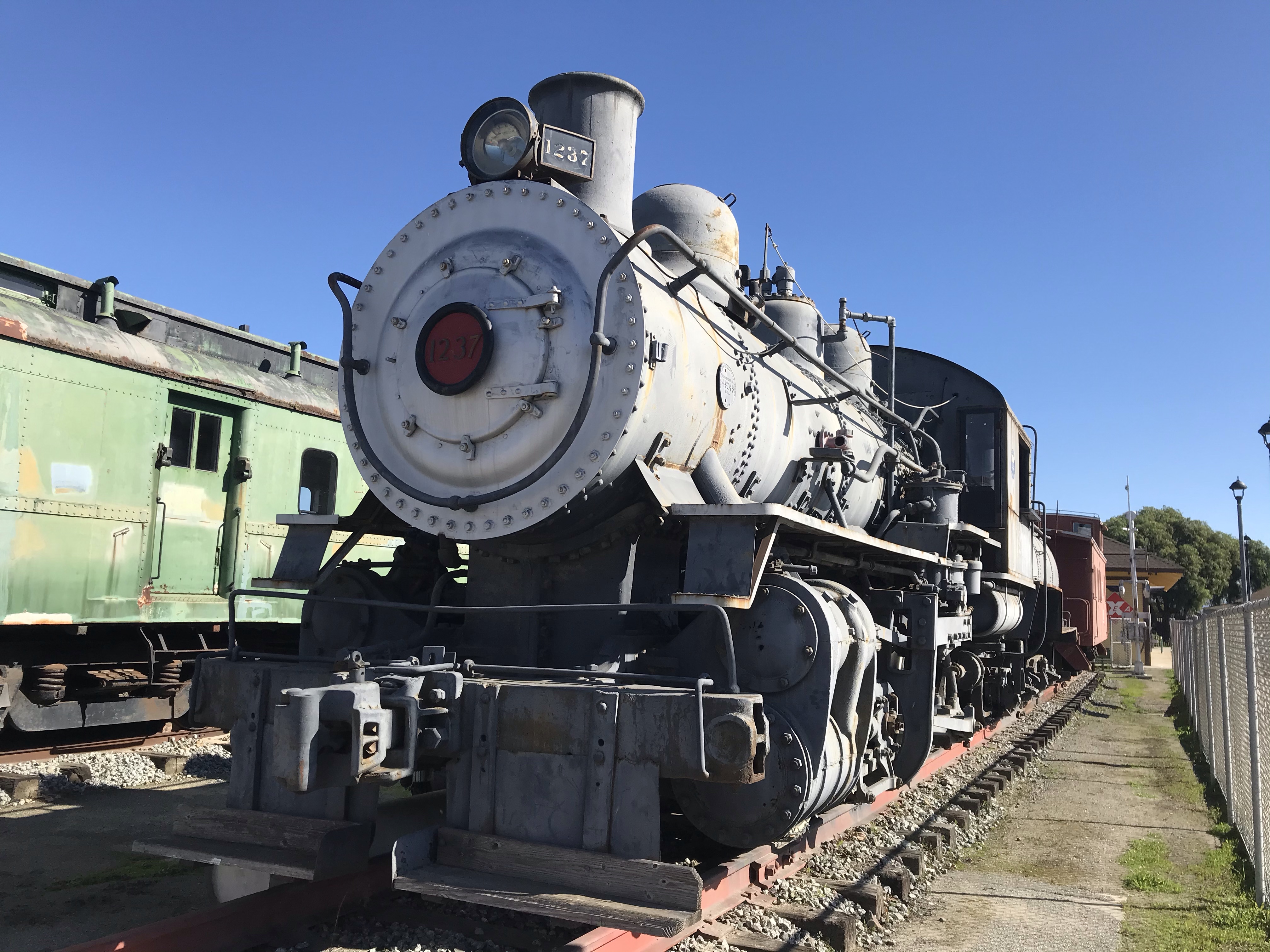
Next to the station is the Monterey & Salinas Valley Railroad Museum. They have a collection featuring a Southern Pacific steam locomotive switcher, a Southern Pacific caboose, and a few rail cars on static display.
Southern Pacific switcher Number 1237 on static display in Salinas. This locomotive is pointing to the north but will likely never move north again.
One of the world’s most beautiful steam passenger trains ran from San Francisco to Los Angles during the 1930s and 1940s.
This was envisioned as a non-stop train connection from San Francisco in the north to Los Angeles in the south. This first started as the Daylight Limited on its inaugural run on April 28, 1922. The first service was only offered on Friday and Saturday.
The rugged 470 mile route became more popular and Southern Pacific added more trains so that by July of 1923, the route ran seven days a week, all year round.
During the Great Depression, passenger railway service was down but Southern Pacific’s president, Angus McDonald gambled on creating a modern train that would provide luxury, efficiency, and speed to the Daylight coastal route. The entire train, from the engine to the observation car would be streamlined in imitation of what was being applied to airplanes and automobiles at the time.
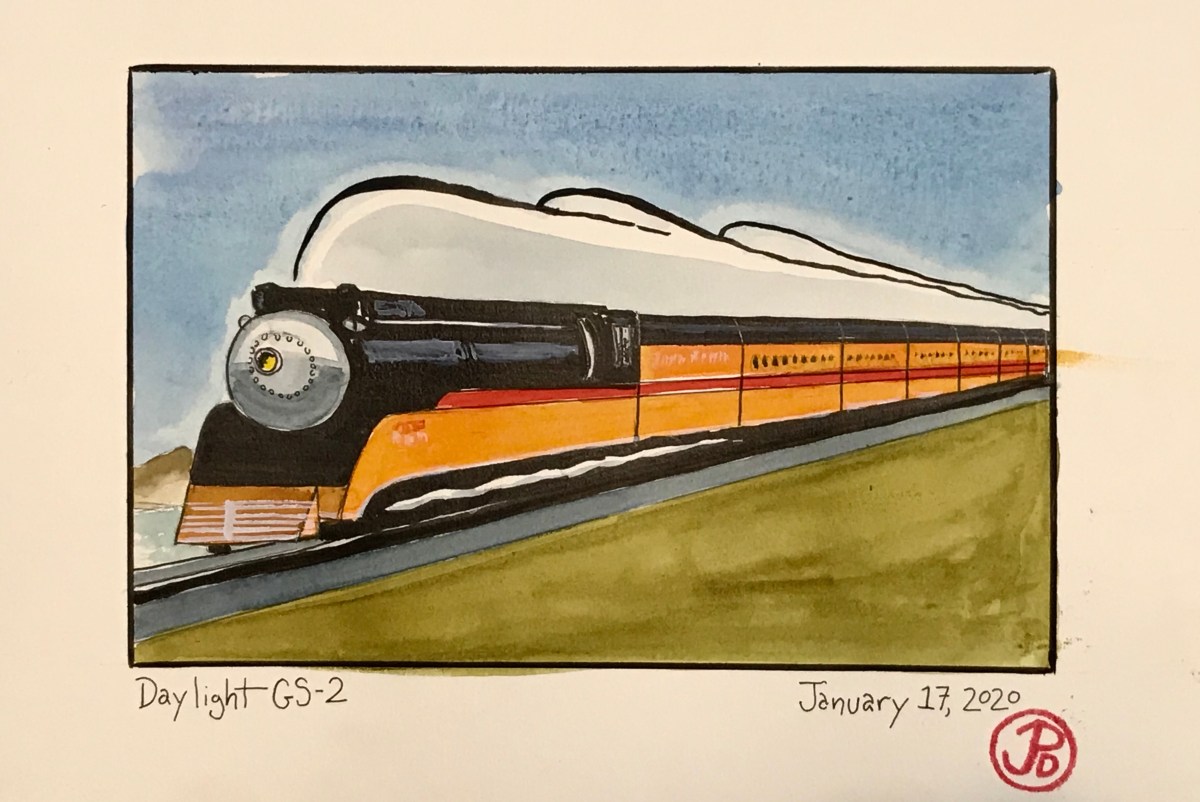
The first steam engine to engender this new vision was the GS-2 (Golden State). An order of six (Numbered 4410 to 4415) were built in Ohio at the Lima Locomotive Works. They were Northern type engines with a 4-8-4 wheel configuration. This engine provided the extra power and speed needed for the 12 hour coastal route.
The GS-2 was the first of the streamlined passenger engines built for Southern Pacific and also the first to feature the classic Daylight livery of orange, red, and black. This paint scheme was extended to the entire length of the train hauled a twelve car train consist, consisting of one diner car.
The first inaugural run of the upgraded Daylight was on March 21, 1937. A champagne bottle was broken on No. 4413 at San Francisco’s Third and Townsend Station. A similar ceremony took place in Los Angles with engine No. 4411 but with a touch of celebrity as film star Olivia deHavilland broke a bottle of champs on the pilot of the GS-2.
All of the stations I have sketched in San Mateo County had the Daylight blow through their platforms. A southbound train leaving San Francisco stopped only at Palo Alto and then San Jose in the Bay Area leaving San Mateo County in the dust.
After San Jose the Daylight’s next stop was Salinas. Then San Luis Obispo, Santa Barbara, Oxnard, Glendale, and finally terminating at Los Angeles’ Union Station.
No GS-2 locomotives survived the dieseization of America’s railways in the 1950s but an updated version of the locomotive, a GS-4, Number 4449, survives and still is operational. She is one of the most popular and beautiful stream locomotives in the world.
It is then fitting that my next destination was in Santa Clara County to the Daylight’s first stop since departing from San Francisco to a Station the bore same streamlined design as South Pacific’s beautiful engine.
A field sketch of the “Queen of Steam”, GS-4 locomotive number 4449 in Portland, Oregon. This is the only operational engine still in existence that worked the Daylight route.
The nose and duel lights of Southern Pacific No. 4449, one of the most famous steam locomotives in the United States. The streamlined nose looks like something out of Buck Rogers.








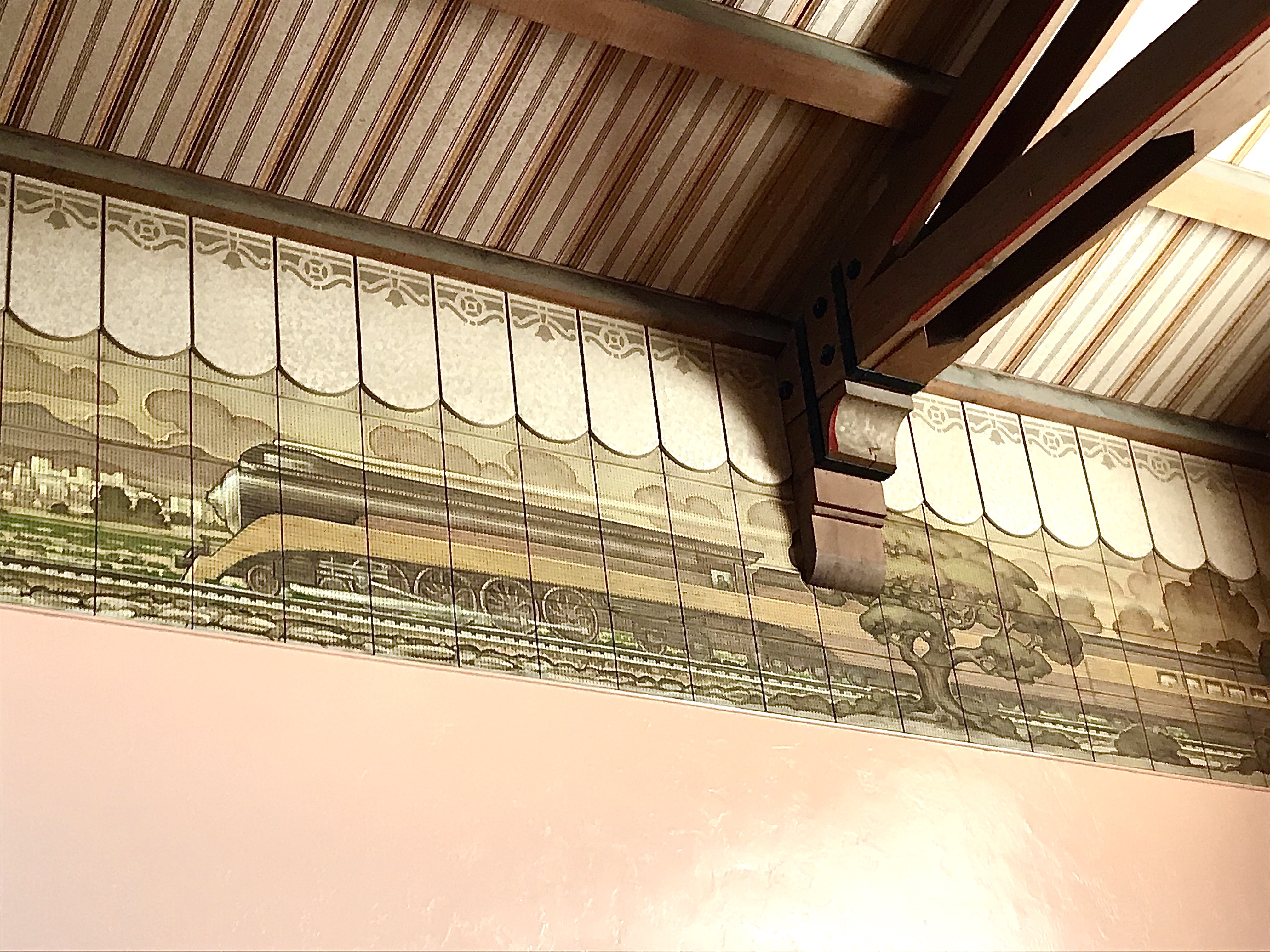 The John MacQuarrie mural at Salinas was painted in 1941 (the same year as the Palo Alto mural) and prominently features the star motive power at the time, the Golden State 2 (GS-2). Six of these locomotives were built and went into service in 1937.
 A field sketch of the “Queen of Steam”, GS-4 locomotive number 4449 in Portland, Oregon. This is the only operational engine still in existence that worked the Daylight route.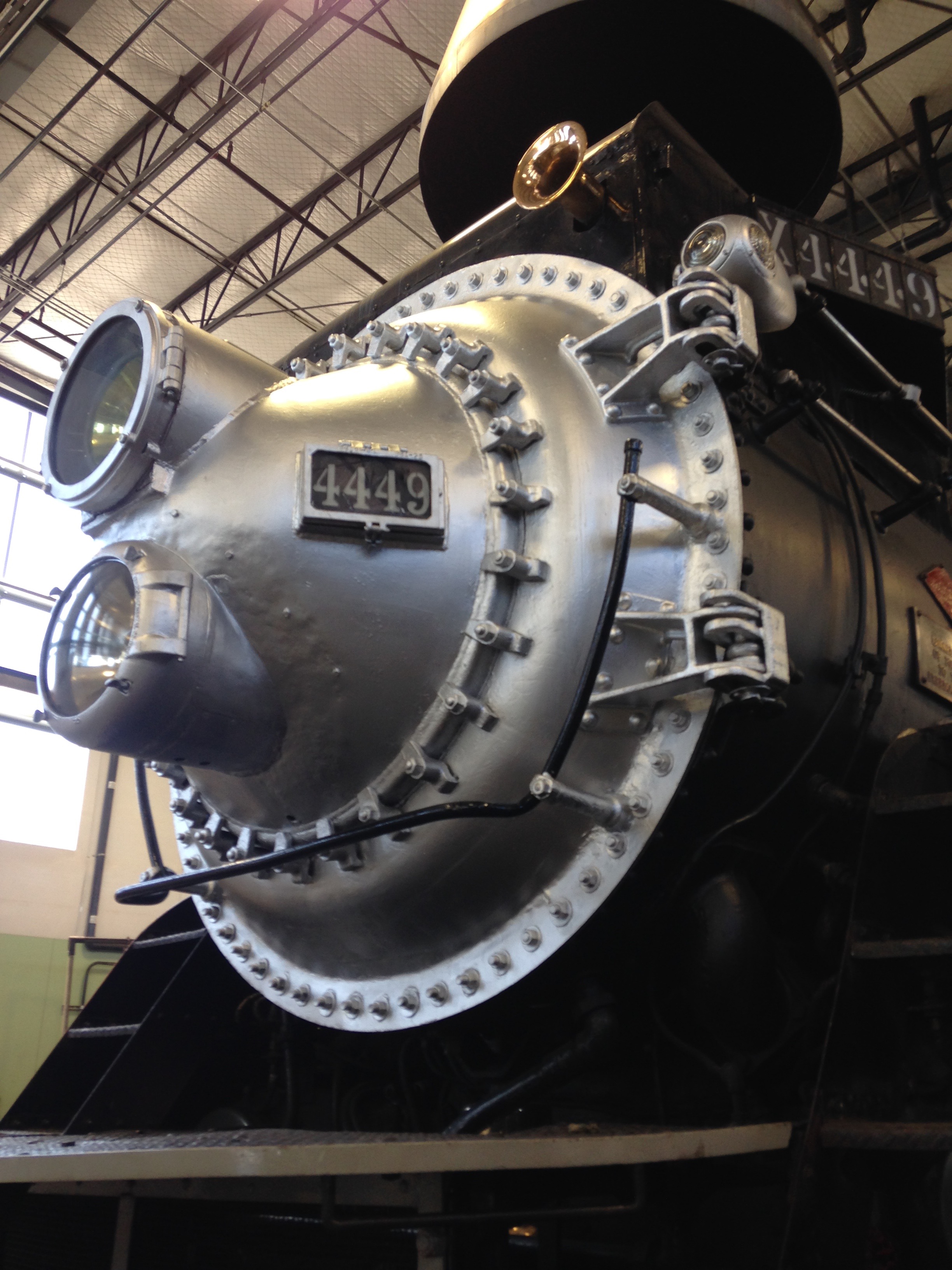
 Corvid Sketcher