Image

Mission Revival in the Presidio

Many of the train stations I had sketched recently were designed and built in a Spanish Mission Revival style: Burlingame, Salinas, San Luis Obispo, and Santa Barbara. Truly the best way to understand an architectural style or architect is to sit in front of a building and sketch it.

And so, on a Friday afternoon, I headed to the Presidio, in the northwest corner of San Francisco, to sketch one of the finer examples of Spanish Mission Revival in the City of Saint Francis. I was also getting back into the habit of doing an after work sketch, which is a great way to decompress from the week’s work.

My subject was Fort Winfield Scott and the buildings that lined the parade grounds. These were the army barrack buildings built between 1910 and 1912 as the headquarters for the Coast Artillery District. I walked around the semi-circle of buildings until one spoke to me. It really wasn’t too hard because it was the only building with a hawk at its height.

An adult red-tailed hawk using building 1202 to survey the parade ground for gophers.

I set up my sketching chair on the parade ground and started to sketch building 1202. This was a former Army barrack built in 1911, and housed up to 95 to 109 soldiers.
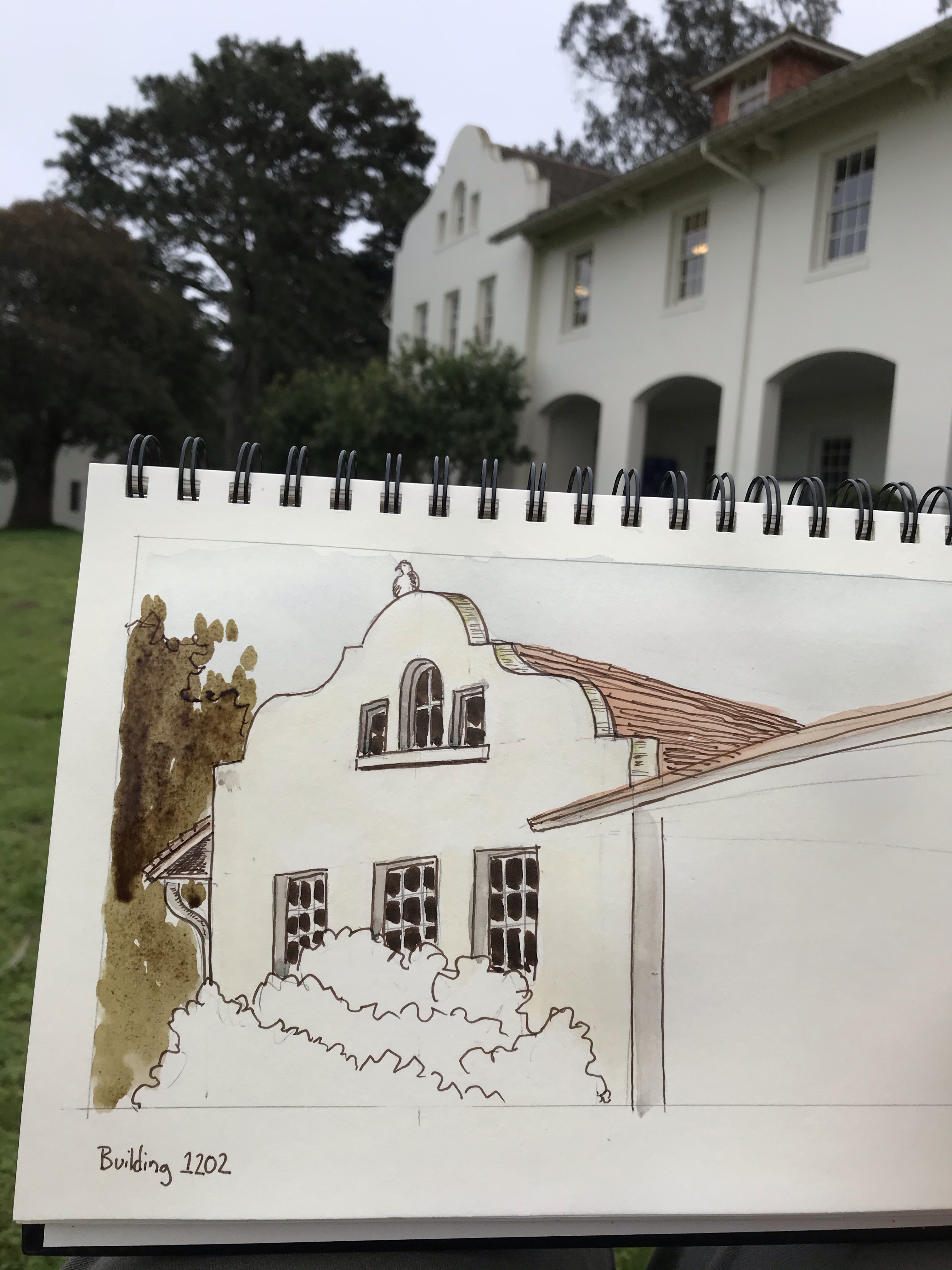
I framed in the lovely lines of the barracks and added the red-tailed hawk at the top of the curve. The raptor flew to the field, this time coming up with only grasses in its talons. The hawk flew off only to appear later at the top of the flag pole at the edge of the grounds.
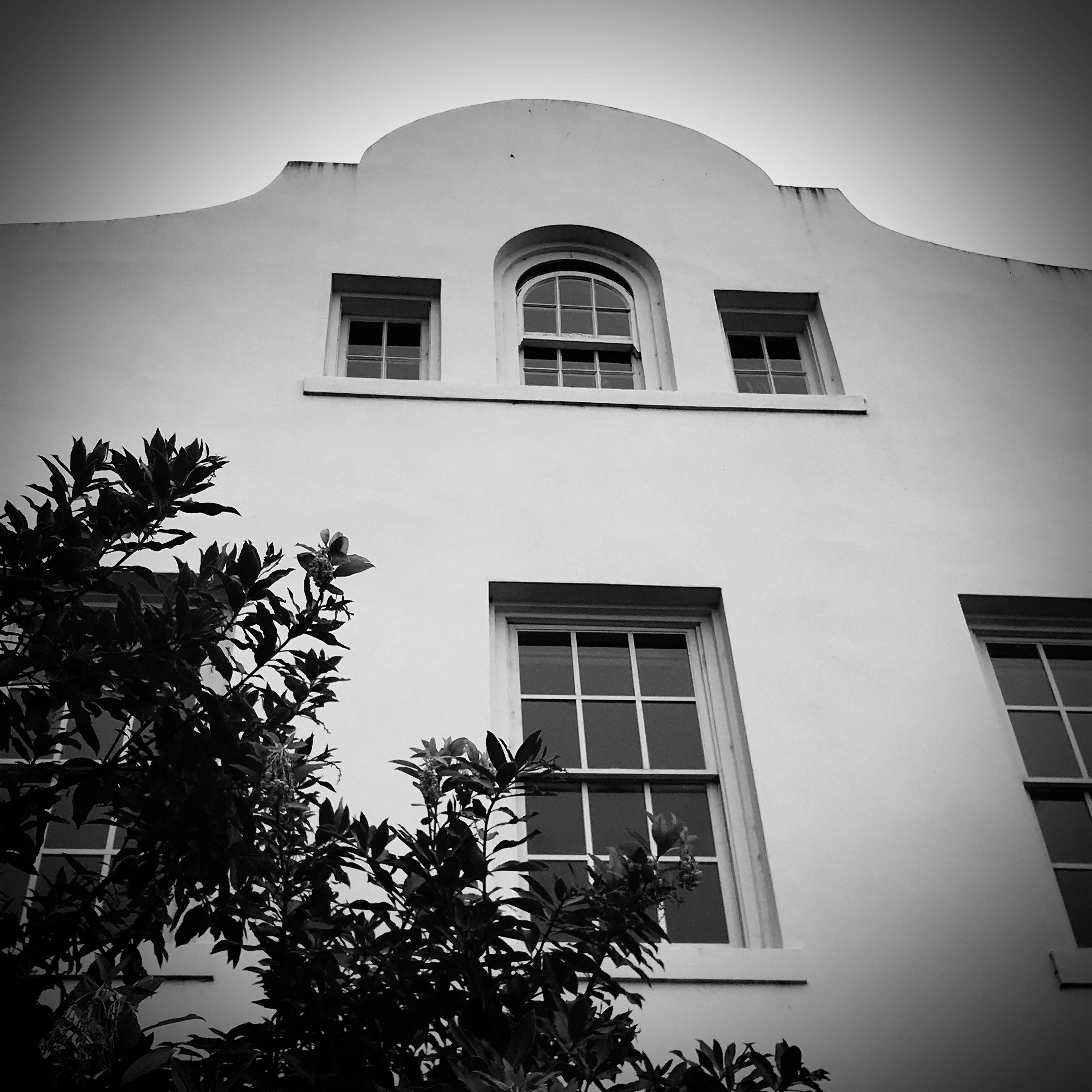
Building 1202 now houses the Presidio Graduate School and the World Economic Forum. Both sound a bit mysterious. People kept coming and going from the building. Some where getting on their bikes to ride home. A young woman bikerider stopped and asked me what I was doing. I told her that I was drawing the building and noted that that it was beautiful. She replied that she was “spoiled” to work in the building. These are the nice little conversations you frequently have when urban sketching, it really seems to take out the threat and the isolation of being in the city when people see your sketching.
Image

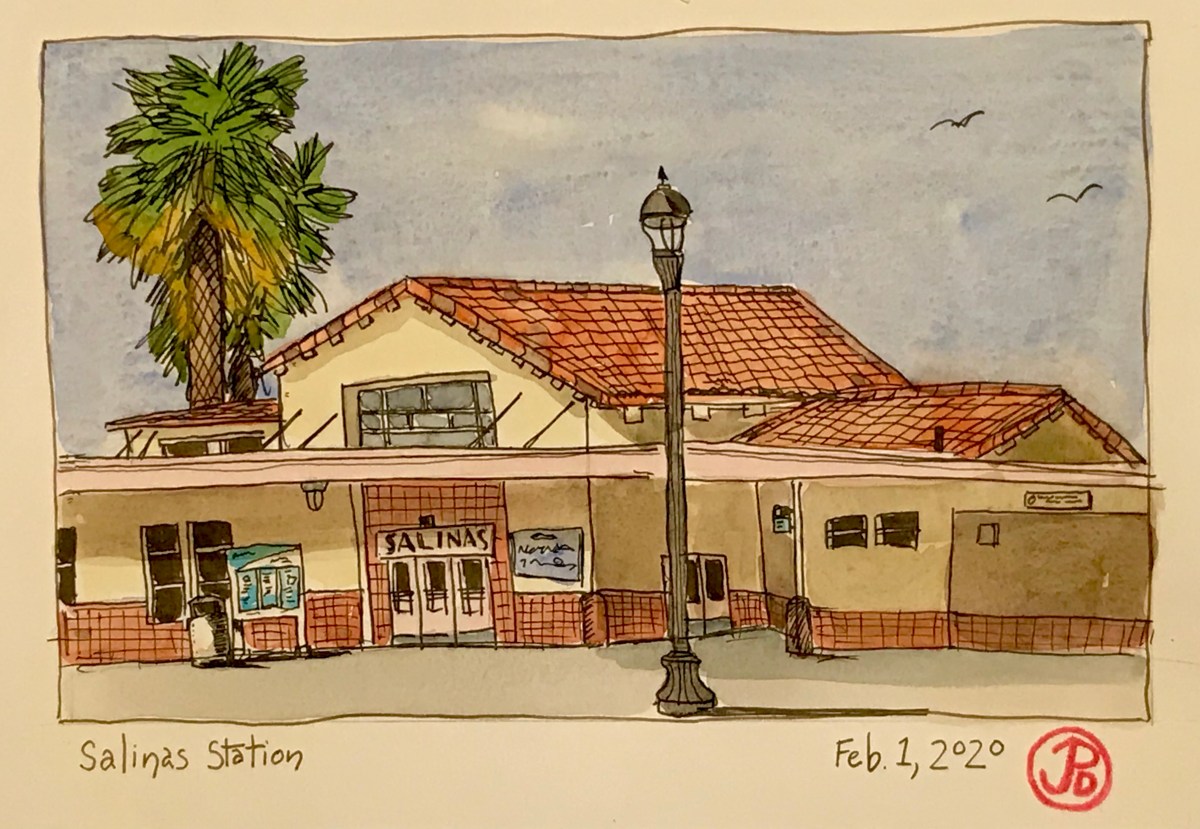
Salinas Station

After sketching historic passenger train stations between San Francisco and San Jose, I decided to expand my scope by visiting all of the existing stations on the Daylight Route from San Francisco to Los Angeles.

Salinas is probably best known as the birthplace of writer John Steinbeck. It is also known as the “Salad Bowl of the World” because its marine climate makes it an ideal location for agriculture. But I was here because it was the third Daylight stop on the line out of San Francisco. This would be the connection point for any traveller from the Monterey Bay Area wishing to head south to The City of Angels or north to the City of Saint Francis.

Salinas Station was built by Southern Pacific in 1941. It is designed in an Spanish Revival Style, with its red tiled roof, mixed with touches of the then popular Art Deco style, shown by its clean lines, letter design, and interior.

The station’s construction coincided with the rise of Southern Pacific’s premier passenger train, the Daylight Limited. Promoters called the Daylight, “the most beautiful passenger train in the world”. And this was not mere hyperbole.

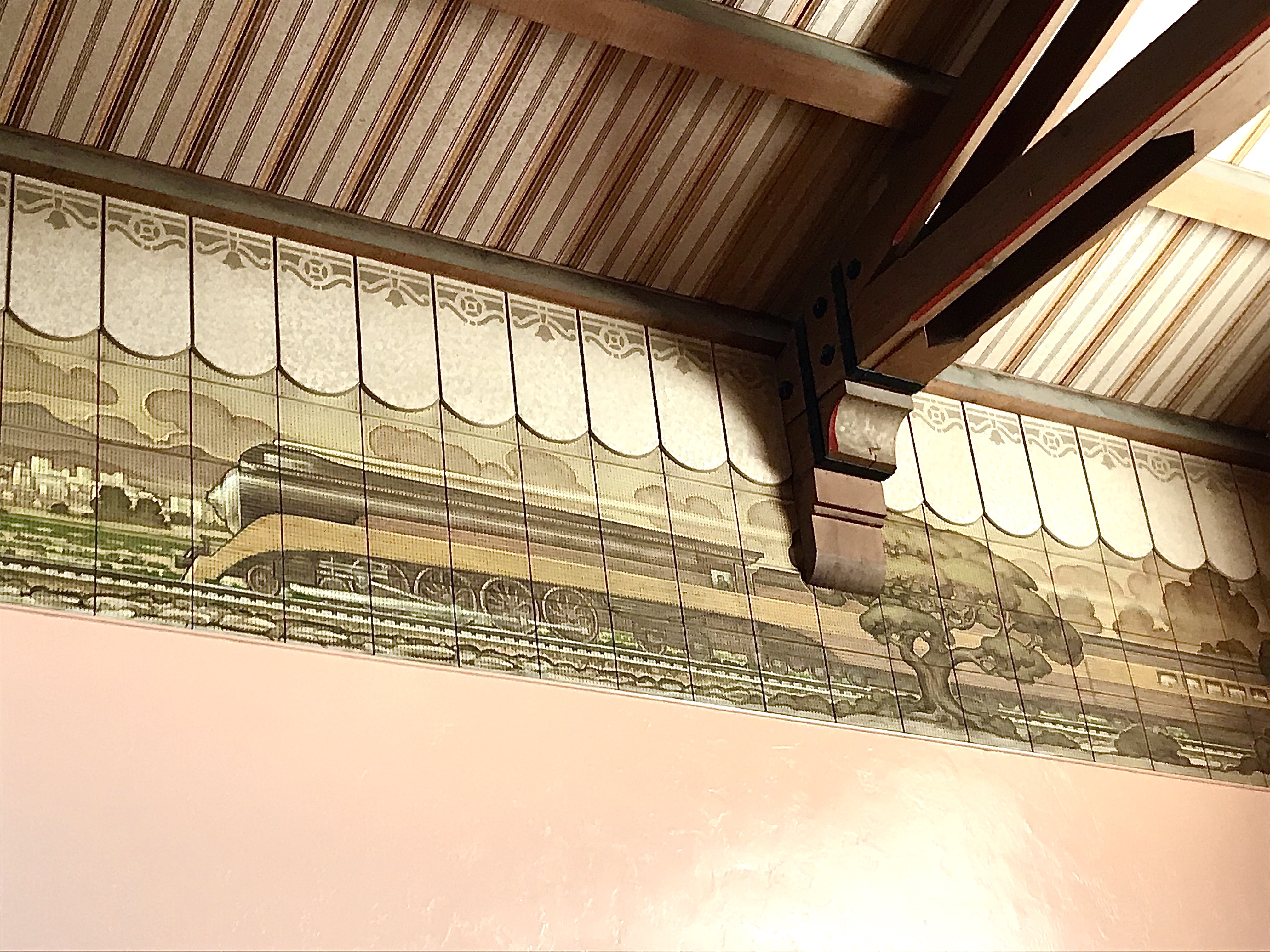
This station bears a few commonalities with the two Daylight stations that still exist in the Bay Area, Palo Alto and San Jose. All three stations have murals painted by John MacQuarrie. And two of these murals feature Southern Pacific’s most beautiful locomotive at the the time the GS-2. This streamlined 4-8-4 is in the Palo Alto Station and here at the Salinas.

When the station was completed in 1941, the zenith of Southern Pacific’s passenger steam locomotives had arrived in the “super power” of the GS-4. The increased ridership of this route is evidenced by the the fact that Southern Pacific ordered 28 locomotives from the Lima Locomotive Works between 1941 and 1942.

The John MacQuarrie mural at Salinas was painted in 1941 (the same year as the Palo Alto mural) and prominently features the star motive power at the time, the Golden State 2 (GS-2). Six of these locomotives were built and went into service in 1937.
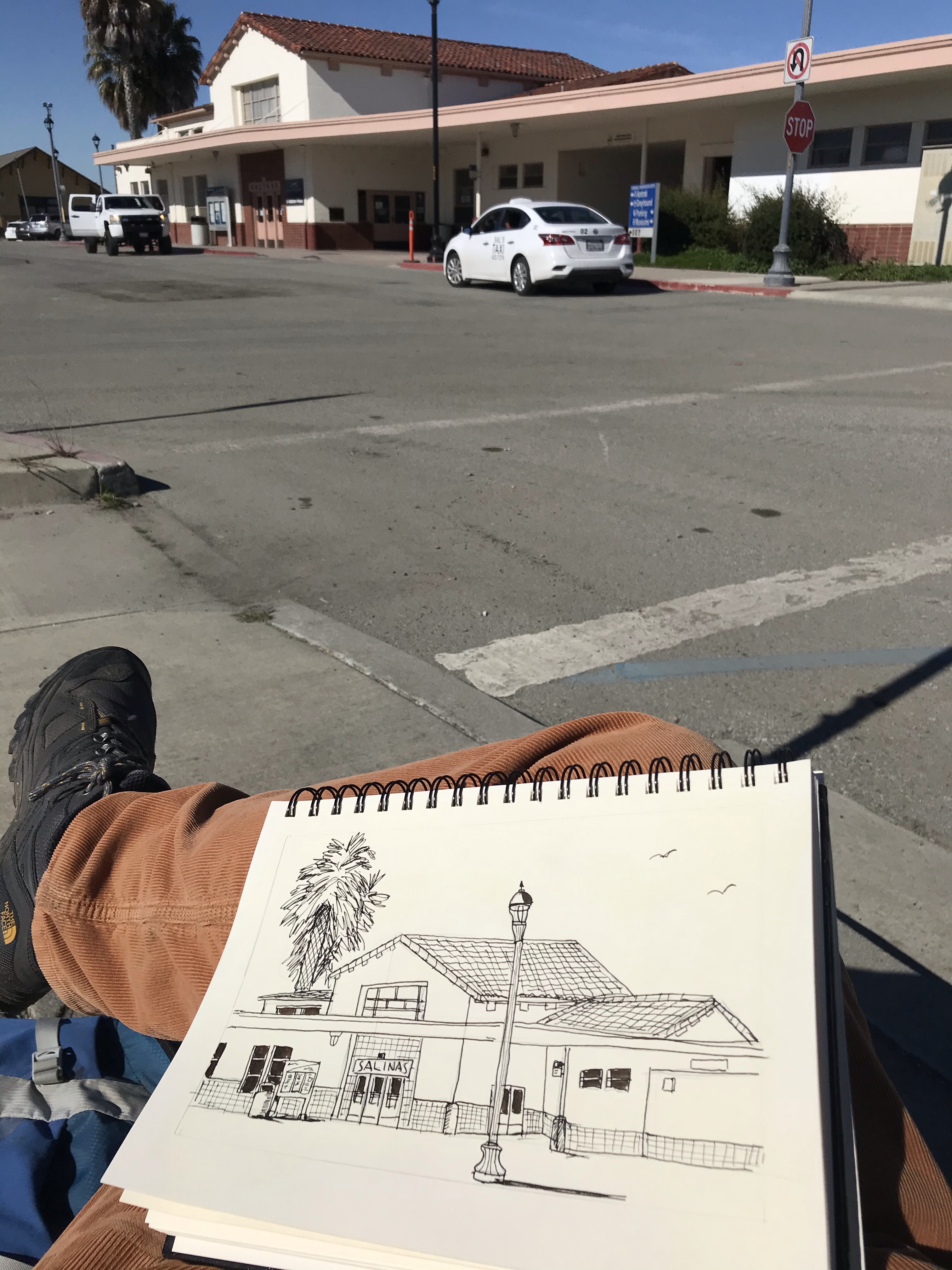
It was a beautiful winter day in Salinas with a high of 70 degrees. I walked around the station and at the platform, a Los Angles bound Coast Starlight was paused to pick up passengers for destinations to the southland. This Amtrak train replaced the Daylight in 1971. At least from Salinas to Los Angeles.

Salinas station was a station that was still in use. There are actual humans attending to the ticket window who could actually answer questions and issue tickets. The interior contained bathrooms, food vending machines, and benches for passengers waiting for their train to arrive. It was nice, for a change, to see a train station being used for its intended purpose.

It’s great to see that Salinas Station is still a vibrant station on the former Daylight Route. The car to the right is where I would probably be: the Lounge Car! To the right is a couple waving their loved one goodbye and safe travel.

I set up my camp/ sketching chair across from Salinas Station and started to sketch. I originally wanted to sketch the station from a formal view but the parking lot was being rebuilt and was fenced off. So I sketched a little bit off center.

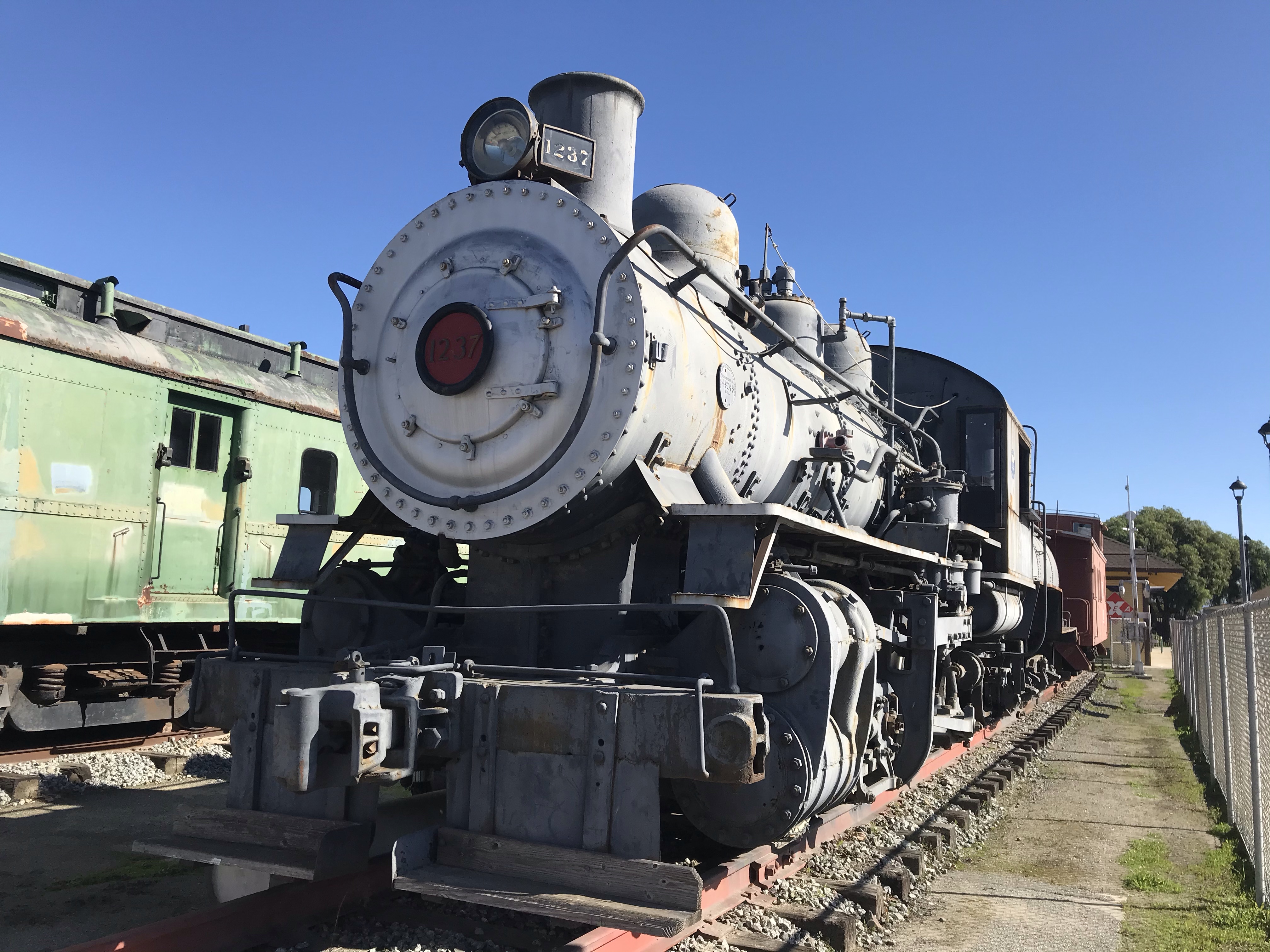
Next to the station is the Monterey & Salinas Valley Railroad Museum. They have a collection featuring a Southern Pacific steam locomotive switcher, a Southern Pacific caboose, and a few rail cars on static display.

Southern Pacific switcher Number 1237 on static display in Salinas. This locomotive is pointing to the north but will likely never move north again.

Image

Southern Pacific’s Daylight

One of the world’s most beautiful steam passenger trains ran from San Francisco to Los Angles during the 1930s and 1940s.

This was envisioned as a non-stop train connection from San Francisco in the north to Los Angeles in the south. This first started as the Daylight Limited on its inaugural run on April 28, 1922. The first service was only offered on Friday and Saturday.

The rugged 470 mile route became more popular and Southern Pacific added more trains so that by July of 1923, the route ran seven days a week, all year round.

During the Great Depression, passenger railway service was down but Southern Pacific’s president, Angus McDonald gambled on creating a modern train that would provide luxury, efficiency, and speed to the Daylight coastal route. The entire train, from the engine to the observation car would be streamlined in imitation of what was being applied to airplanes and automobiles at the time.

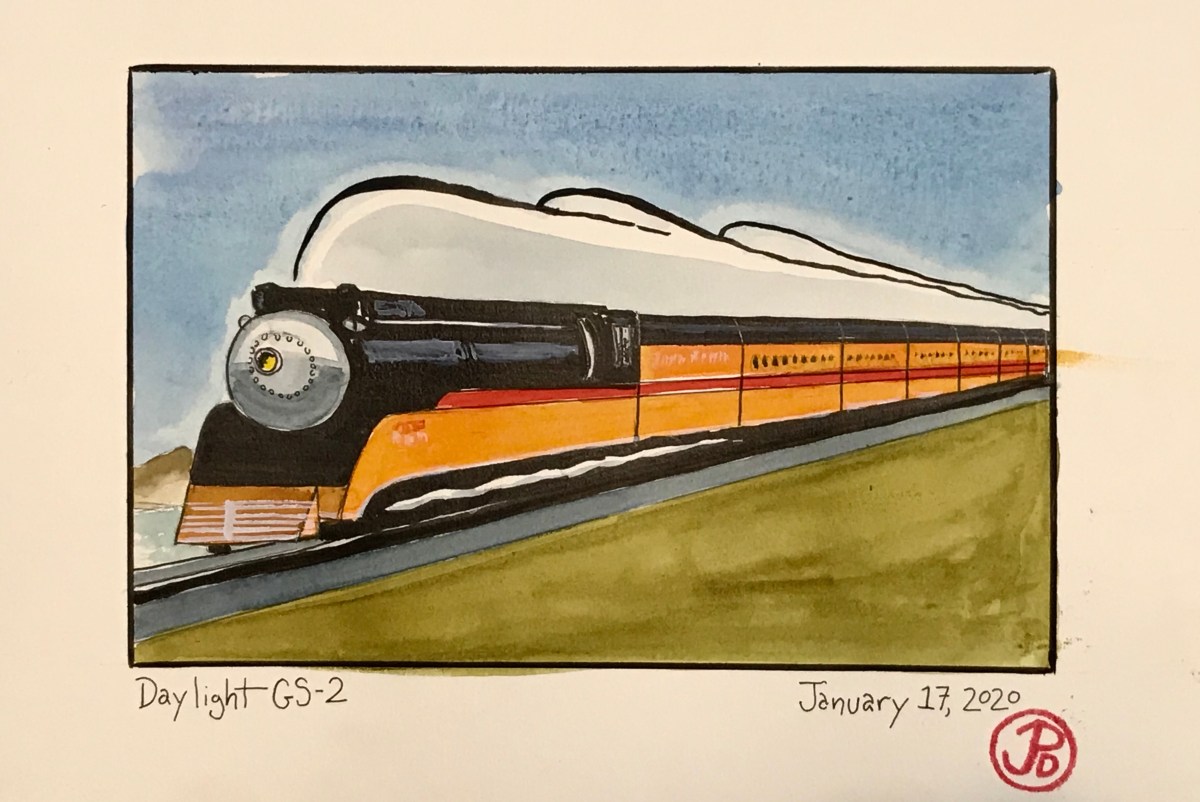
The first steam engine to engender this new vision was the GS-2 (Golden State). An order of six (Numbered 4410 to 4415) were built in Ohio at the Lima Locomotive Works. They were Northern type engines with a 4-8-4 wheel configuration. This engine provided the extra power and speed needed for the 12 hour coastal route.

The GS-2 was the first of the streamlined passenger engines built for Southern Pacific and also the first to feature the classic Daylight livery of orange, red, and black. This paint scheme was extended to the entire length of the train hauled a twelve car train consist, consisting of one diner car.

The first inaugural run of the upgraded Daylight was on March 21, 1937. A champagne bottle was broken on No. 4413 at San Francisco’s Third and Townsend Station. A similar ceremony took place in Los Angles with engine No. 4411 but with a touch of celebrity as film star Olivia deHavilland broke a bottle of champs on the pilot of the GS-2.

All of the stations I have sketched in San Mateo County had the Daylight blow through their platforms. A southbound train leaving San Francisco stopped only at Palo Alto and then San Jose in the Bay Area leaving San Mateo County in the dust.

After San Jose the Daylight’s next stop was Salinas. Then San Luis Obispo, Santa Barbara, Oxnard, Glendale, and finally terminating at Los Angeles’ Union Station.

No GS-2 locomotives survived the dieseization of America’s railways in the 1950s but an updated version of the locomotive, a GS-4, Number 4449, survives and still is operational. She is one of the most popular and beautiful stream locomotives in the world.

It is then fitting that my next destination was in Santa Clara County to the Daylight’s first stop since departing from San Francisco to a Station the bore same streamlined design as South Pacific’s beautiful engine.

A field sketch of the “Queen of Steam”, GS-4 locomotive number 4449 in Portland, Oregon. This is the only operational engine still in existence that worked the Daylight route.
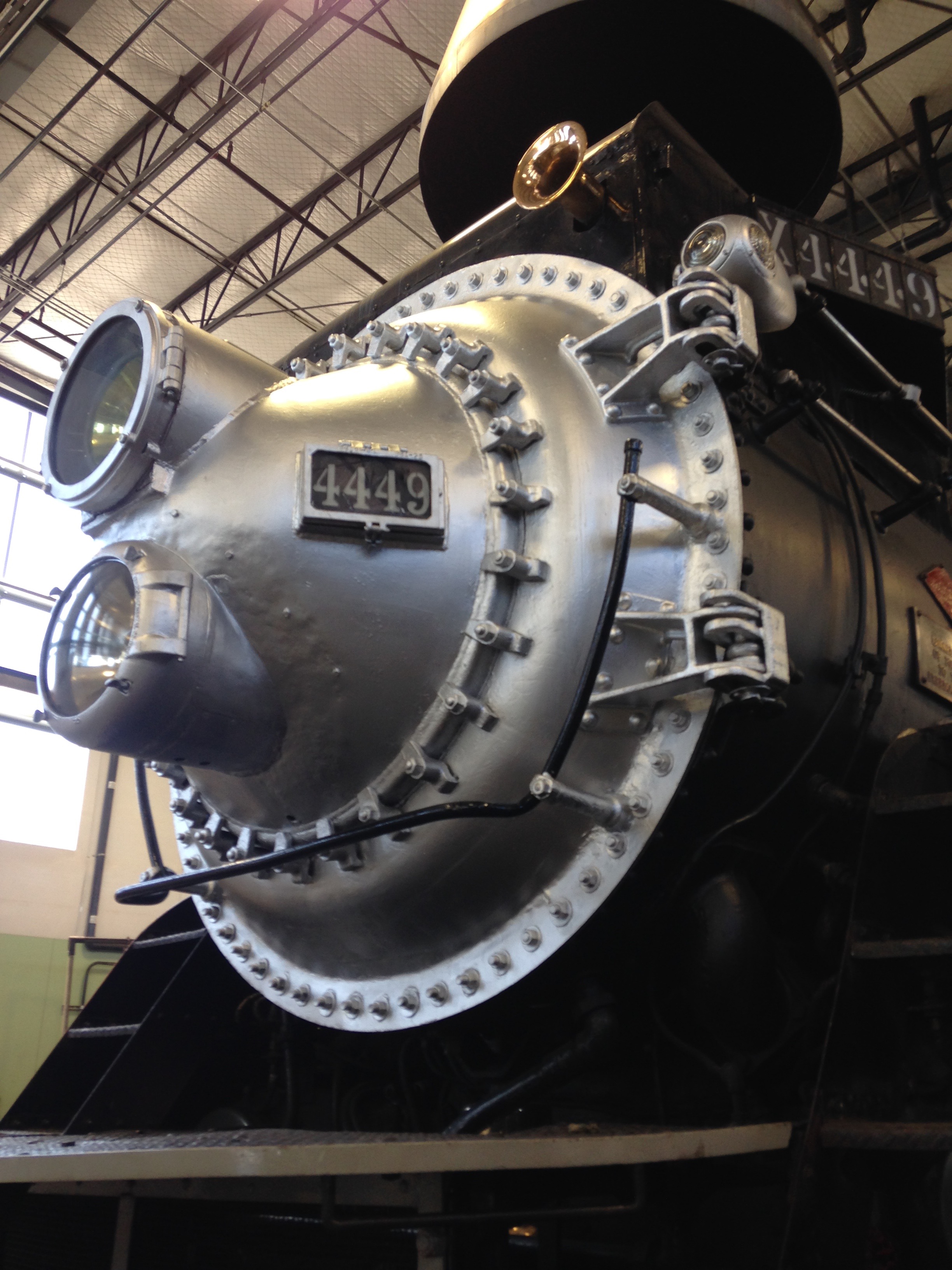
The nose and duel lights of Southern Pacific No. 4449, one of the most famous steam locomotives in the United States. The streamlined nose looks like something out of Buck Rogers.

Image

Railway Depots of San Mateo County

I’ve been wanting to do a sketch project of the passenger railway depots along the current Caltrain line; at least the stations that are architectural and historically interesting. Caltrain runs passenger service from San Francisco to San Jose (and further south to Gilroy). I wanted to narrow the project down to the existing depots in San Mateo County, the county where I am employed.

My own interest in railways and railway depots comes from my own childhood. I have very vivid memories of being on the back of my dad’s bicycle as we went down towards to the Southern Pacific tracks after work. My dad was a huge rail enthusiast having grown up riding the streetcars and trains of San Francisco. We would watch trains from the pedestrian walkway as they came in and out of the Sunnyvale Depot, dropping off commuters. We also took the train north to Palo Alto or San Francisco and I always loved the all too brief visits to each station. I also noted that not all stations were alike. Some depots have architectural merit while others were merely weather shelters where you can buy tickets.

I wanted to start in the north and head south towards the Santa Clara County line. But I would not be starting on the current main line that runs along the eastern part of San Francisco and the Peninsula but the starting point for this project is a marooned station that is west of the main line. This station has been moved a short distance from its original location and now does not have any trains that stop at its platform. It is now part of a historical museum. This is the passenger depot in Colma.

The original mainline passed further west as it headed around San Bruno Mountain than it does today. The second stop, south of San Francisco County, which is in San Mateo County, was then called School House Station because of its proximity to the local one room schoolhouse. At the time this was one of 21 stations built between San Francisco and San Jose. The station was later renamed Colma.

In 1907 the Bayshore Cutoff came into service which straighten out the line to where the main line runs to this day. This new line left Colma off of the mainline like a rerouted highway, taking all the traffic away, leaving a ghost town in their wake. That may be appropriate because Colma is known for all it’s cemeteries. The number of dead in Colma, estimated at 1.5 million, outnumber the living. Hence the town’s motto, “It’s great to be alive in Colma!”

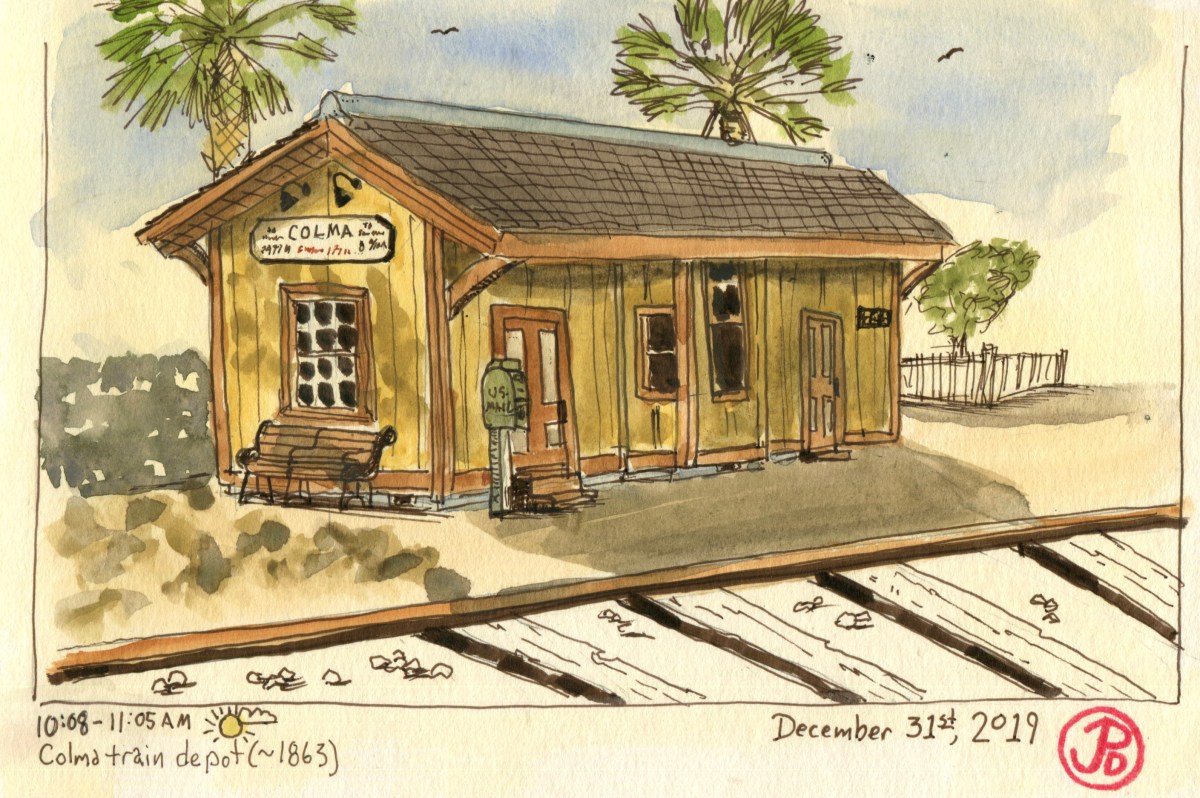
So I set up a sketching chair, readied my supplies, and started to frame in the railway depot. Here I really tried to get the perspective correct before I added pen or paint. This starting part of the sketch takes the most focus and concentration.

Another reason the Colma Depot was a good starting point for this project is that it was the oldest depot on the line, built around 1863, beating out the actual oldest station on the Peninsula mainline at Menlo Park, built in 1867.

Starting with the Colma Depot was a bit of a cheat, because it is no longer an active depot nor is it on the main line. But because the river of rails have been diverted to the east leaving a pool that no longer flows to the sea, I felt it was important to start here, at least to get my feet wet. It was also helpful to start to learn the visual language of Californian train depots. It helps the eye see repeated patterns and forms when I move on to sketching other depots.

My next plan was to ride Caltrain from San Francisco down to all the historic stations in San Mateo County and sketch each one.

Sketch number one of this project is nearing completion. The rusted tracks in front of the station are just a short section. They go from nowhere to nowhere. Just like many of the visitors to Colma. Once they come here, they never leave.

Image

Ben’s Bird in the City of St. Francis

A rainy afternoon is alway a great time to visit one of San Francisco’s museums. In this case I used my recently purchased membership to return to the California Academy of Sciences in Golden Gate Park.

I brought my sketching kit and started to sketch an African penguin as it swam around before feeding time. This was a challenge because I did the sketch in small bits because the penguin did not hold still so I took mental snapshot while the bird was facing the right way and eventually pieced together a few penguins for a sketch.

Swimmiing Ass

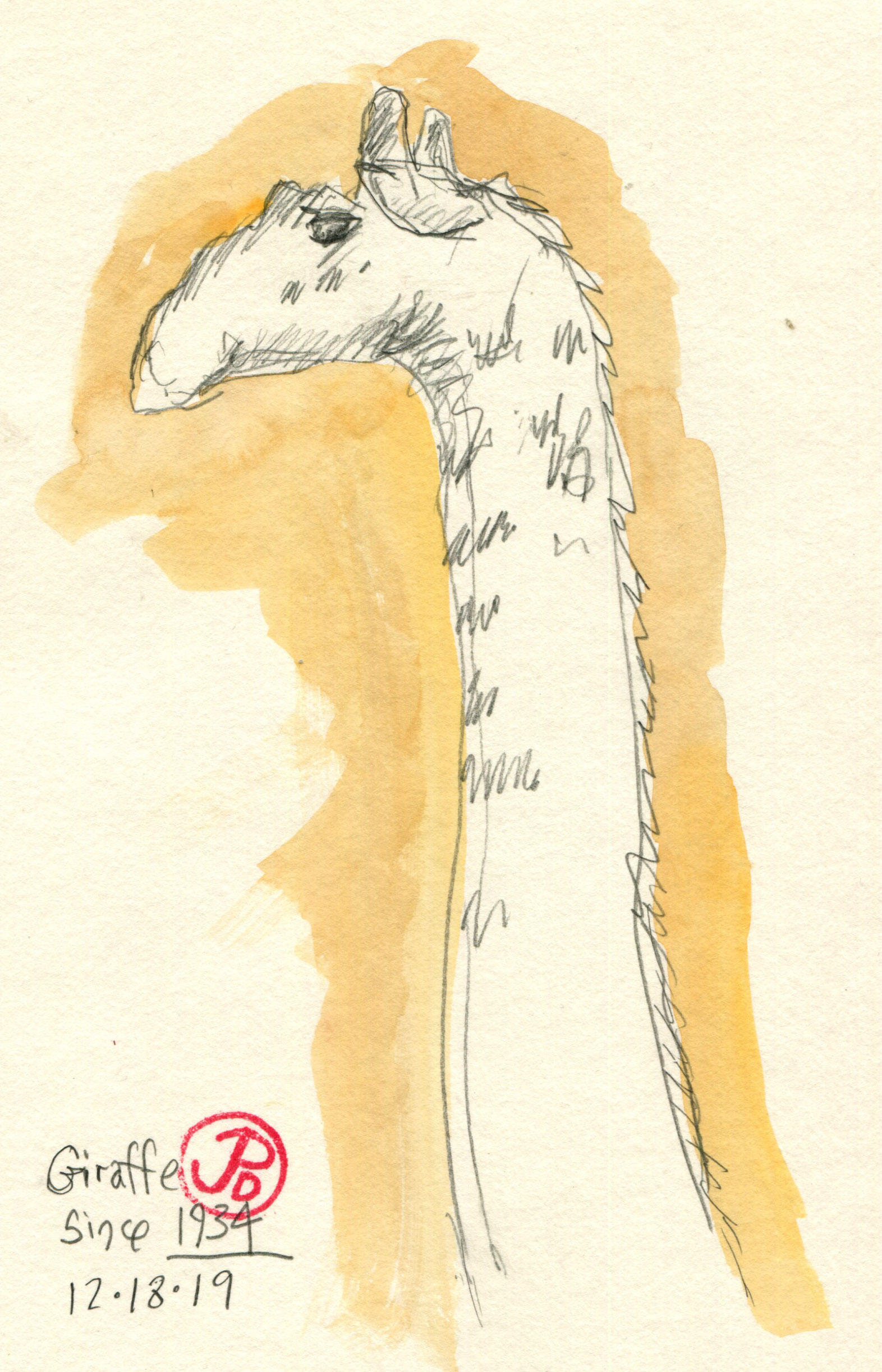
I then went out of the African Hall to sketch something more stationary. A giraffe mount will do. It was amazing to read that the taxidermy giraffes were first put on display in 1934 at the old Steinhart Aquarium. Here was another connection with the past.

Giraffe

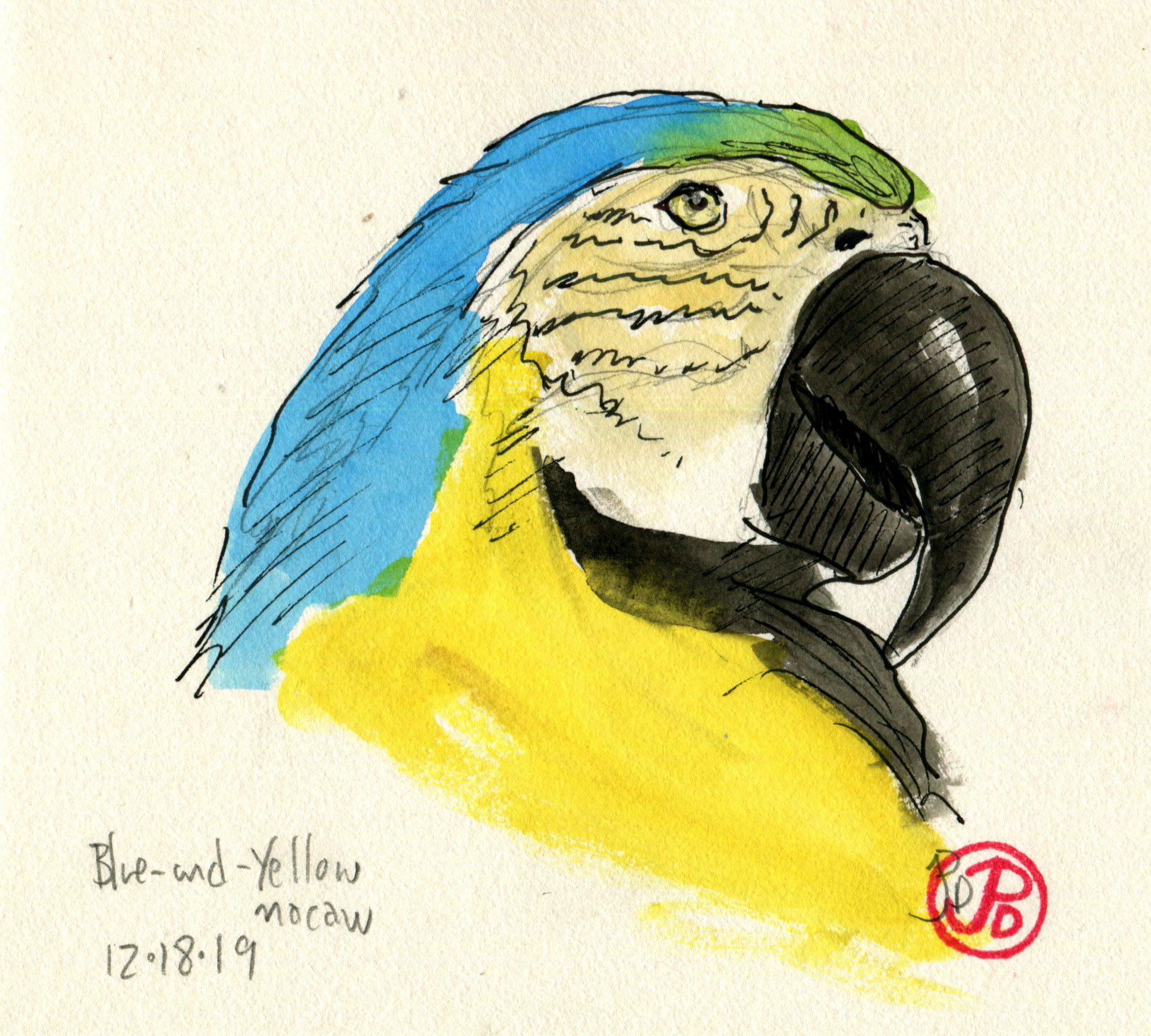
I next went into the Amazon exhibit and sketched one of the blue-and-yellow macaws. It was nice to have them perched for me to sketch but is was even better to see them free flying over the Amazonian rainforest in Brazil last summer! That beats a zoo or aquarium any day!

B and Y Macaw

I overheard one visitor ask the other if she had ever seen a macaw in Hawaii. If she did then that macaw would be very lost but she was referring to a pet that some street performer had as a means of loosening coins from tourists.

I went down to the aquarium and tried a sketch of California’s official marine fish, the garibaldi. This fish was in constant motion and it was hard to capture it’s essence. And the low light in the aquarium didn’t help. At the end I repeated my mantra to perfectionism, “It’s just a sketch.”

I headed over to the alligator exhibit, a direct link with the old aquarium, to look at the seahorse railings and the albino gator. That’s when I saw something very odd, just outside the window.

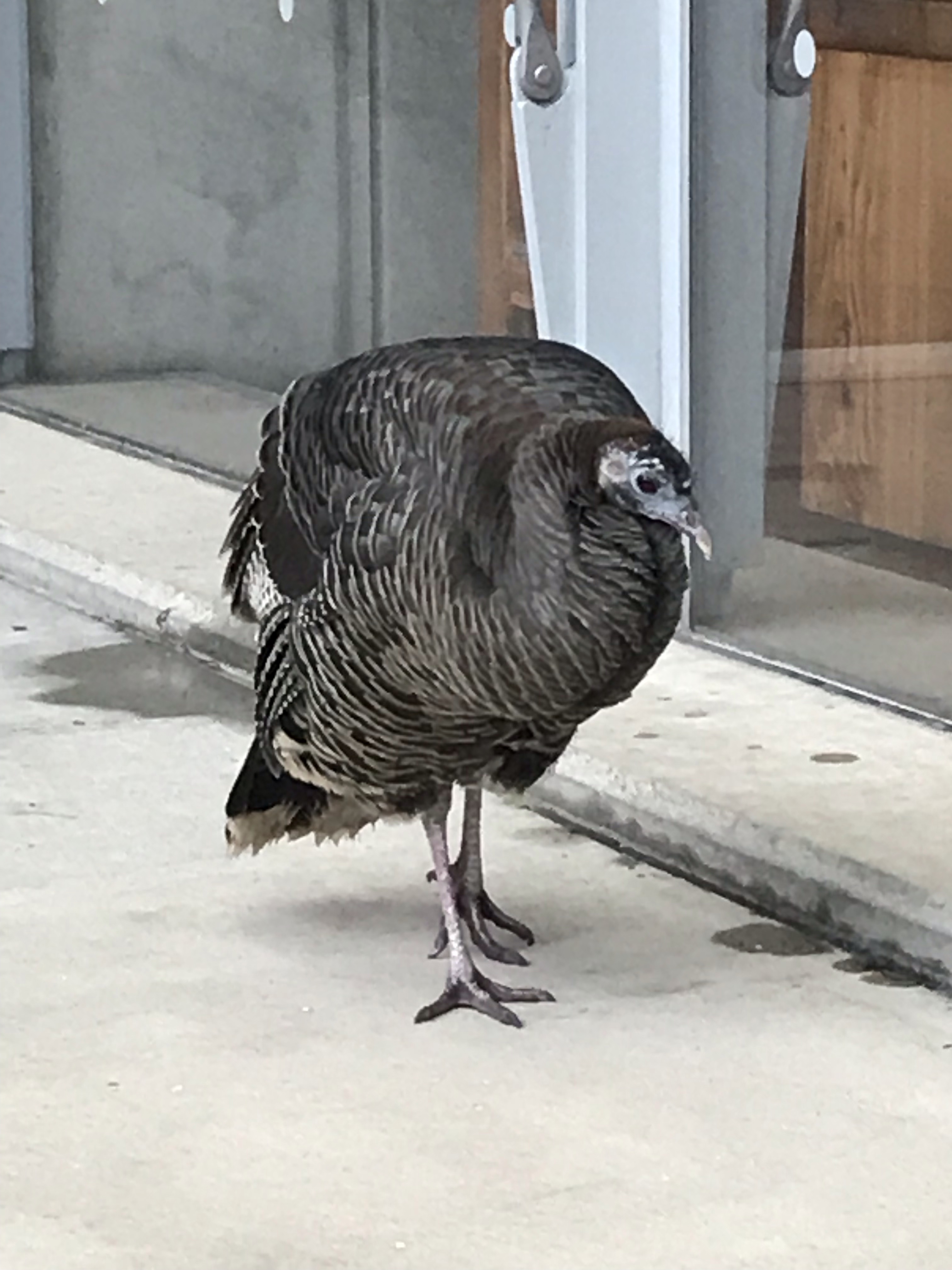
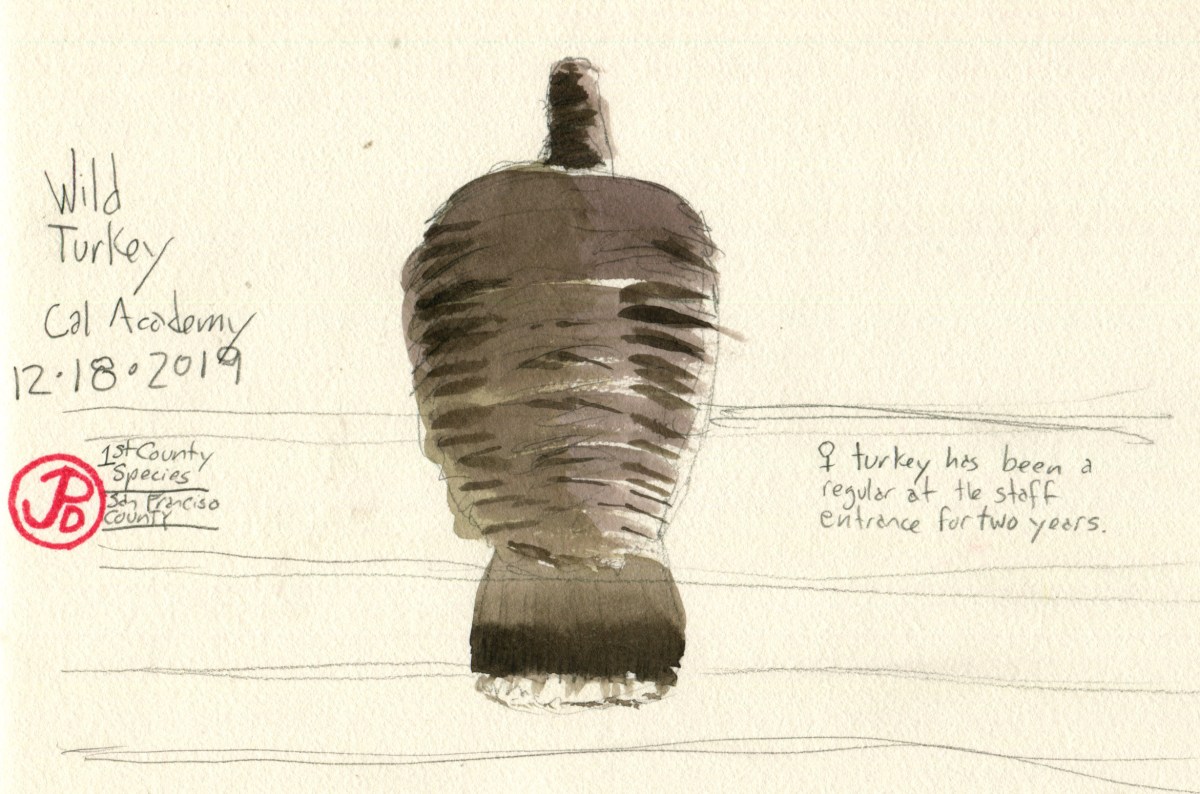
It was a large bird perched on a railing, almost condor sized and I though to myself, “Is this a new exhibit?” As I walked closer I realized that it was not a condor but a wild turkey.

Which reminds me of the time when I was birding on the Big Sur coast at Grimes Point. At that time, in one view, I had seven California condors in front of me, including a group that was sitting at the edge of the road. A German tourist came up and asked me if they were turkeys! Now how the table had turned! And how condor-like Ben Franklin’s favorite bird can appear.

Perched on the railing was probably one of the only wild turkeys in the county and city of San Francisco. This is listed as a rare bird in San Francisco and one had been seen in this area of Golden Gate Park. According to the staff this female had appeared just after Thanksgiving, nearly two years ago.

So the turkey perched calmly on the railing which gave me an opportunity to do a quick sketch of the bird from behind. (Featured Sketch)

Image

Sketching at the California Academy of Sciences

On a recent field trip we took 90 fourth graders to the California Academy of Sciences in San Francisco’s Golden Gate Park. I had come here myself when I was in elementary school, back then it was known as the Steinhart Aquarium. The museum was completely rebuilt in 2008 and bears little resemblance to the museum of my youth.

When the museum reopened, which is about a 45 minute walk from my dwellings, I bought a membership and visited some of the 46 million specimens on display many times. I had since let my membership lapse, but on our recent field trip I thought I would take advantage of the teacher’s discount and reconstitute my membership.

So the week after our field trip, after work, I headed to Cal Academy and bought a teacher’s membership. This museum is a wonderful resource for the natural world and I came prepared with my sketchers kit.

At mid-afternoon, after all the school groups had departed, it seemed that I had the museum to myself. I took advantage of this time and did five quick sketches.

I started by sketching an African penguin. This bird is also referred to as the Jackass penguin, a name that makes fourth graders blush and laugh at the same time, but refers to their braying call. These penguins were easy to sketch as they were roosting on their rocks and posing for me. (Well that statement was very anthropomorphic of me!)

I then headed up to one of the best features of the new building ( well it’s just over ten years old), the living roof. I did a quick sketch with Sutro Tower in the background.

living roof

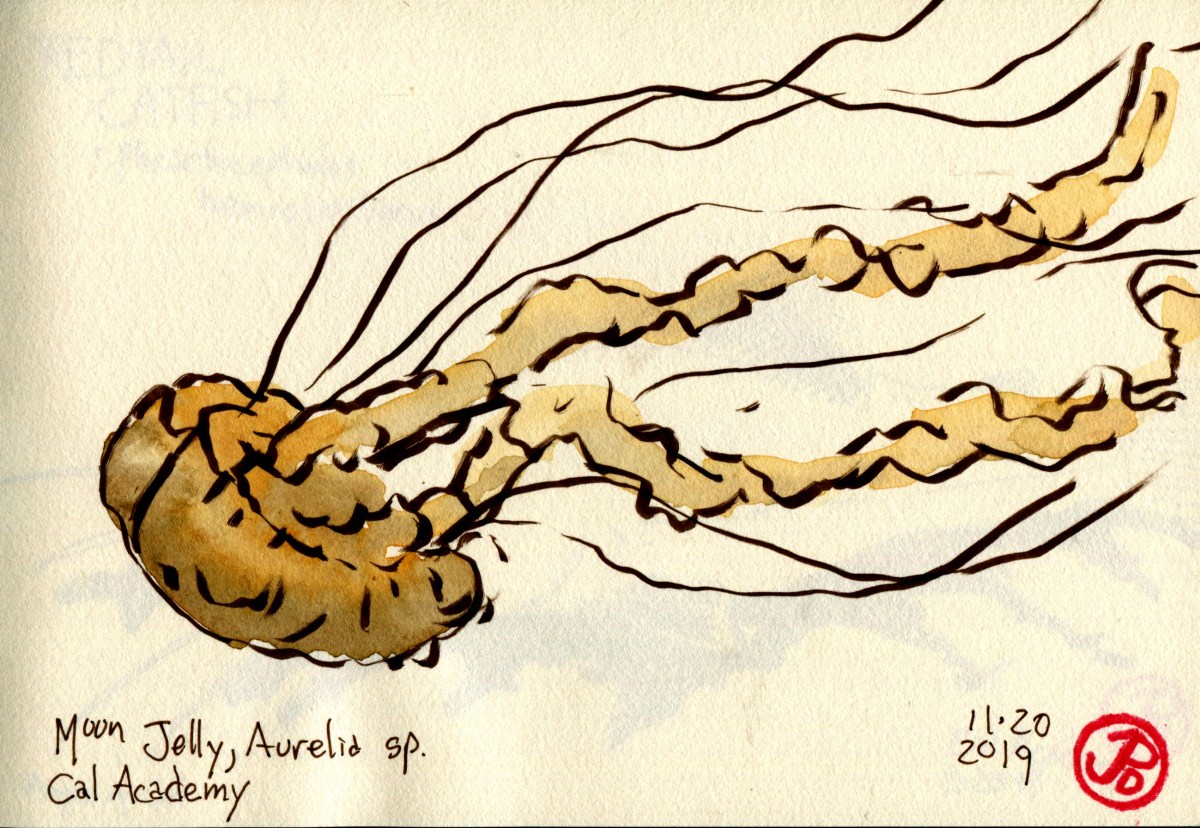
I then headed into the basement where the aquarium is located. Here I sketched a massive but stationary red-tailed catfish(all sketched in pen) in the drowned Amazonian flooded forest tank. I had a grand time sketching a moon jelly with my sepia brush pen, all without a underlying pencil drawing (featured sketch).

redcat

On the way out I passed under the Tyrannosaurus rex skeleton at the entrance. When I was a kid I remember an allosaurus skeleton in a similar place. I liked this little reach back to the past and I sat on a bench for a final sketch. Sketching the entire skeleton with the museum soon to close for the day seemed a daunting task so I just sketched the skull.

T.rex

I look forward to many more visits and more sketchbook pages filled with knowledge and life!

Image

After Work State Bird

There is nothing like ending the day with a little birding. Especially after a day of rainy day recess and rambunctious ten year olds! Also I had looking for a rare bird in the pouring rain on the previous Saturday and had whiffed.

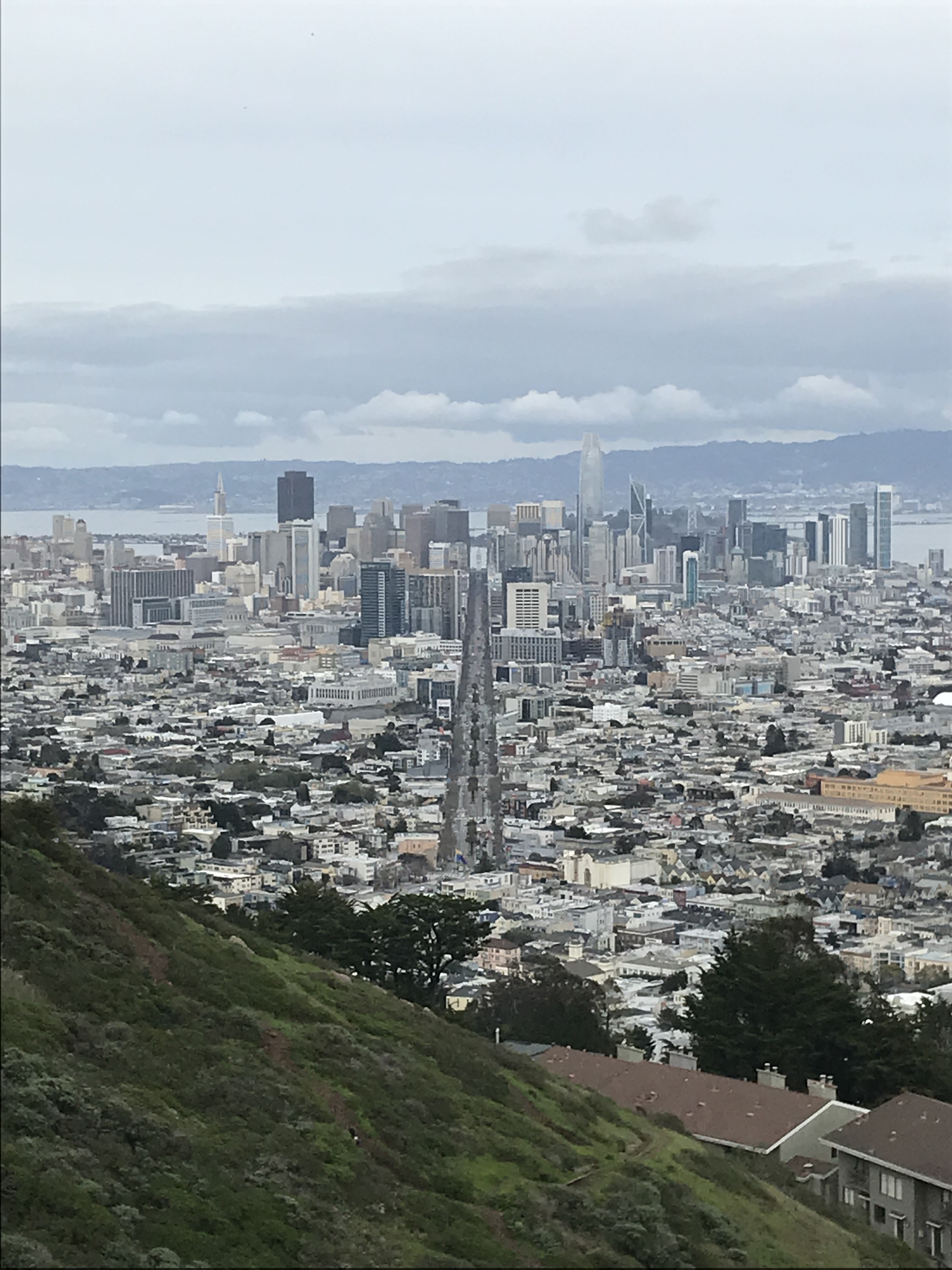
I was determined to try again so I headed to Twin Peaks, a vista that provides some of the best views of downtown San Francisco.

The view of San Francisco from Twin Peaks, looking straight down Market Street.
I pulled into the dirt parking lot, right in between the peaks, it was just after 3:30. I replaced my work shoes with my mucking boot (always in the trunk) and grabbing my car binoculars (ditto) and headed towards the drawn where my target bird was being seen.

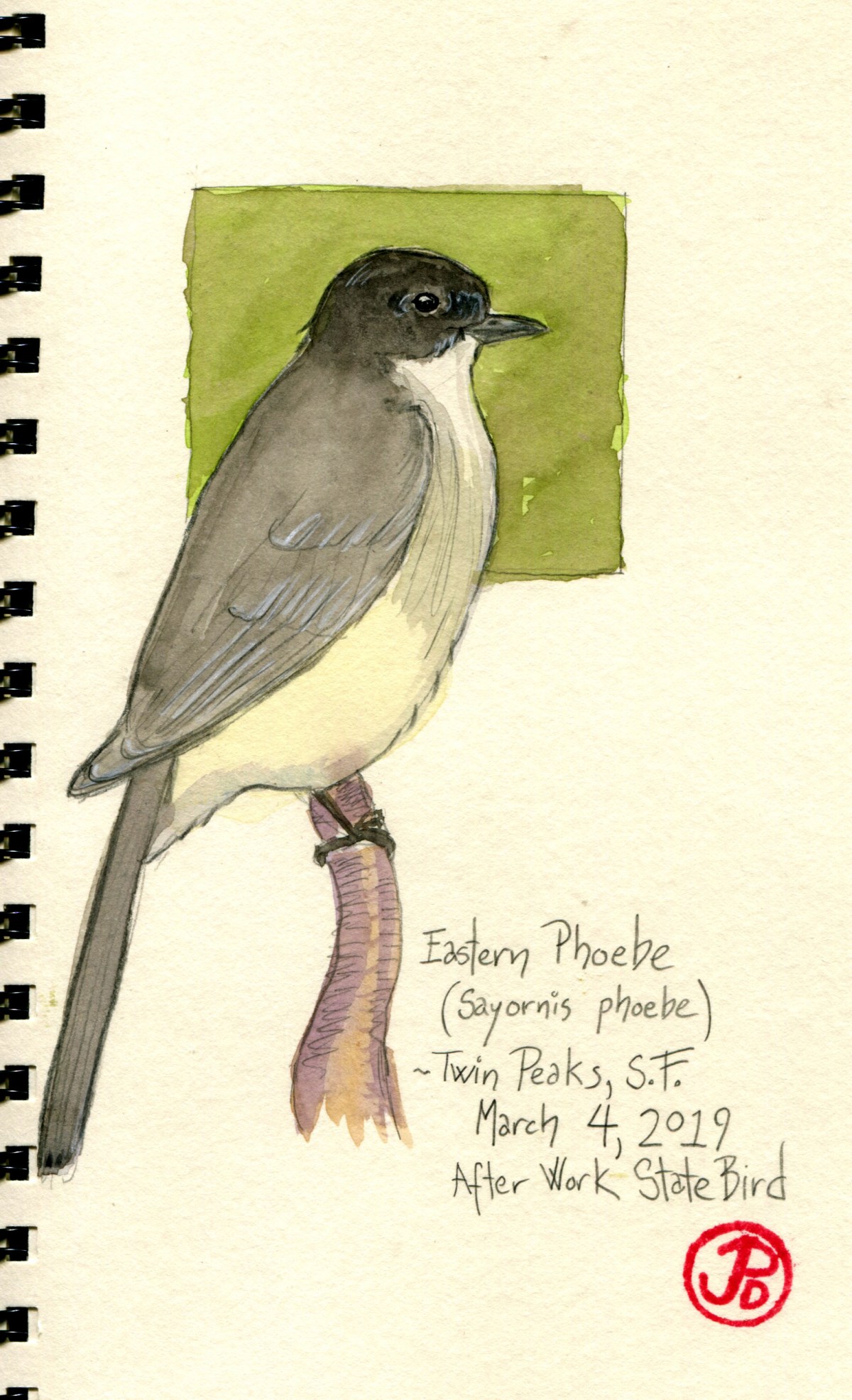
I reached the edge of the road and looked down on the chaparral draw, and immediately I saw a bird flying away down around the curves of the hill and stopping in a coyote brush. This bird did not seem to be a local, something looked off. I walked 20 yards along the road and looked down where I found the bird in my binoculars. Here was my target bird: eastern Phoebe, a very rare bird in San Francisco.

I got great looks at the lost visitor as it hawked from its perch and then returned moving its tail in circular motions which shouted out it’s name, this behavior being very diagnostic of this energetic flycatcher.

I watched the bird for about five minutes then some movement off to  my right caught my attention, just a congress of ravens circling above the South Peak, and then I return my gaze back to the coyote brush and the flycatcher it was gone. Other birders had previously noted that this bird can appear and then suddenly disappear and not be seen again for hours.

Luckily for me I only had to wait for another five minutes before I spotted the bird flying across the road up towards the South Peak where it got in a light tussle with the residence Black Phoebe, two species of Phoebes in one bush is not a bad day’s sighting. And it certainly is a great way to end the day!

Image

Nemesis Bird

Nemesis (noun)

the inescapable agent of someone’s or something’s downfall.

Nemesis Bird (definitely a verb)

the avian agent of a birder’s downfall

I have had a few Nemesis Birds in the 20 years I have been birding.

These are birds that you try to add to your life list, but after repeated attempts, you fail, making you want to pull out the hair that you still have left on your head and chuck your binoculars into the nearest body of water or a deep, dark crevice, whichever is closest.

I’ve had a few nemesis species in my birding life, the plumbeous vireo comes to mind. This small, gray bird’s range skirts the eastern part of California on it’s western edge. The vireo is to be found around the Mono Basin which lies between the Sierra Nevada and the White Mountains.

Well this should be easy, I thought. Just show up where the bird has been reported and with a little patience, you have a lifer.

Such is not the case with a nemesis bird (hence the name), I tried and tried for the plumbeous video all around the Mono Basin in different locations and at different times of the breeding season. No luck. (I finally added this vireo to my life list, not in California but in Arizona’s Madera Canyon.)

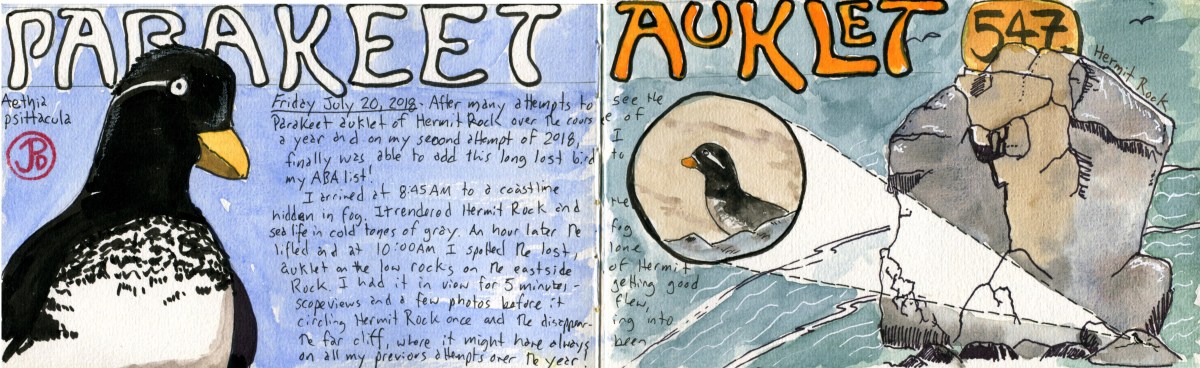
My latest nemesis was a rare visitor from Alaska that was summering on the western edge of San Francisco on Hermit Rock, a mere 15 minute drive from my residence. Well this should be easy, I thought to myself. You get the picture.

It should be a piece of proverbial cake to see the lone parakeet auklet on the entire west coast of California. So I headed out on my first attempt during the summer of 2017 after I had returned from birding in Costa Rica.

As the Jimmy Cliff lyric says, “You can get it if you really want but you must try, try and try ’til you succeed at last.” Went I did the try, try, and try bit but the murrelet remained as illusive as Bonnie and Clyde at a Sunday afternoon church potluck.

Birders had reported seeing the small black alcid with a white tear streak but somehow I had always managed to arrive ten minutes too late. The parakeet had just been on the water or was preening on the cliff face of Hermit Rock but now I was left intensely looking at every pigeon guilimot that flew to or from the rock with the growing urge to take my binoculars by the strap and hulling them around in circles and pitching them into the Pacific!

At the end of the summer of 2017, the auklet remained off my list and I was resigning to going to Alaska in June during my retirement years to add this nemesis bird to my ABA list.

Epilogue

Then during the summer of 2018, after I had returned from Ecuador the parakeet auklet had returned to Hermit Rock! I tried once and failed and then I returned the following day and the coast was fogged in and I began my search. I was soon joined by three other birders.

The fog slowly lifted and an hour after I started my search, a small black alcid with a white teary streak appeared on a low rock, just below the lookout. The auklet remained in view for about five minutes and then flew around the rock twice before disappearing behind the rock on the far side, probably where it had been on all my previous attempts. Bingo! My Nemesis Bird was a Nemesis no longer.

The parakeet auklet (Aethia psittacula).

Image

County Birding

As I slowly creep towards 600 ABA birds on my life list I have looked for other birding challenges in my home state of California.

California is a great place to bird because it has just over 600 species that have been found here, only Texas ranks higher in species total. It is also one of the most populated states which means more traffic, higher housing prices, and more expensive lattes but is also means more birders in the field, reporting more birds!

My latest challenge has been to increase my species totals by county. Three counties are the focus of my challenges: San Francisco (were I live), San Mateo (where I work), and Santa Cruz (where I relax). The goal for each county is to see 200 species in each county. Which means that previously a bird that is being seen in San Mateo County ( a black vulture, for instance) that I had already seen (in the Everglades, for instance), then I was less likely to chase it. But now I gave myself the challenge that if a rarity showed up in one of my three target counties, I would give chase, even if the bird was already on my ABA life list.

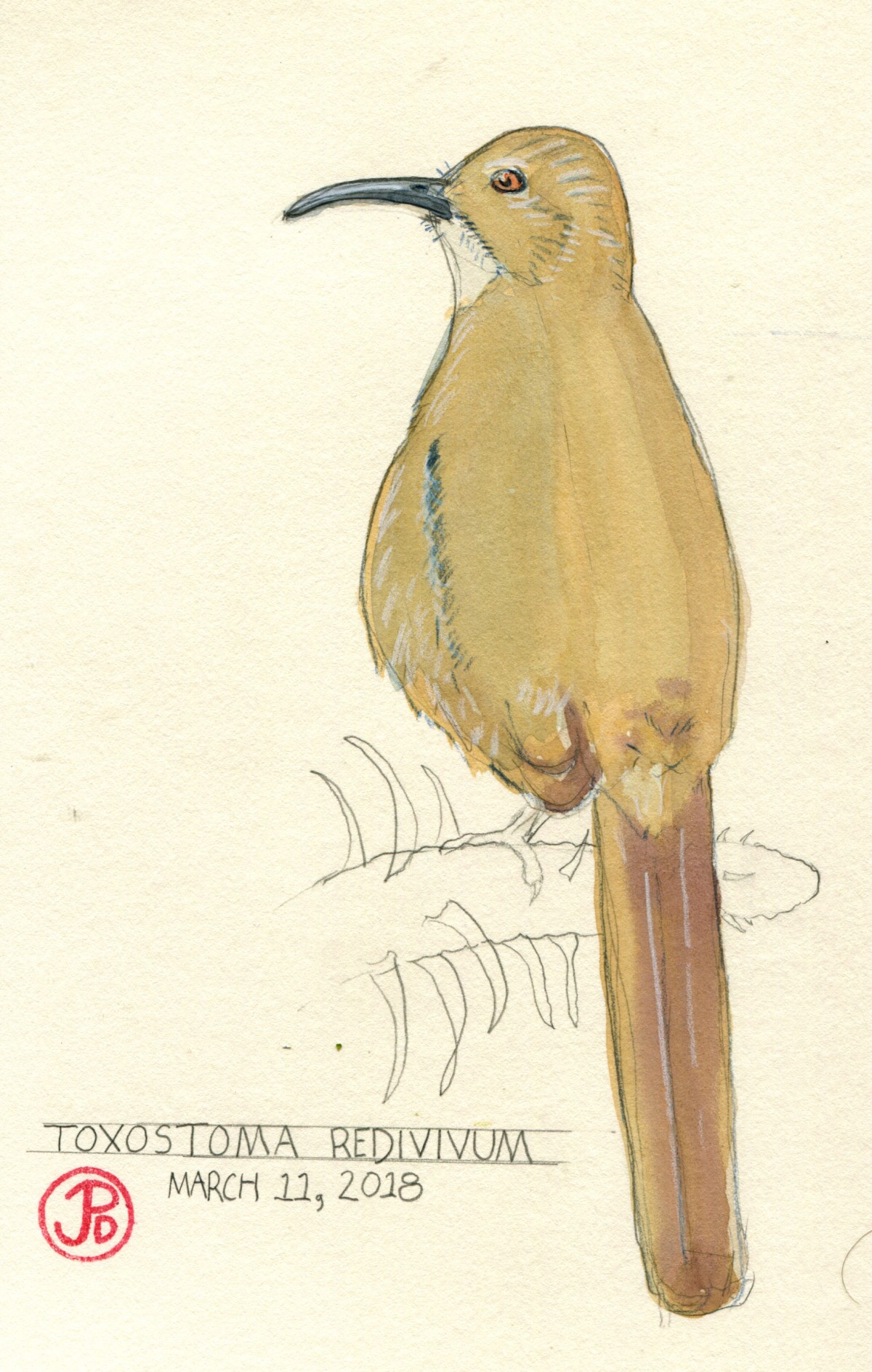
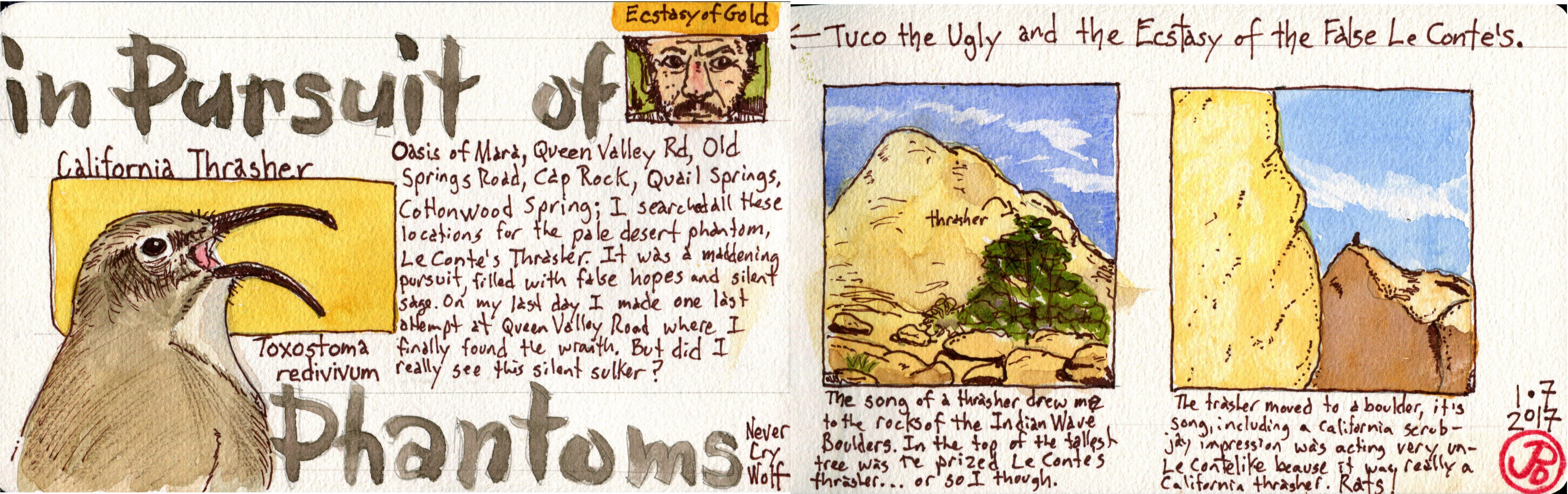
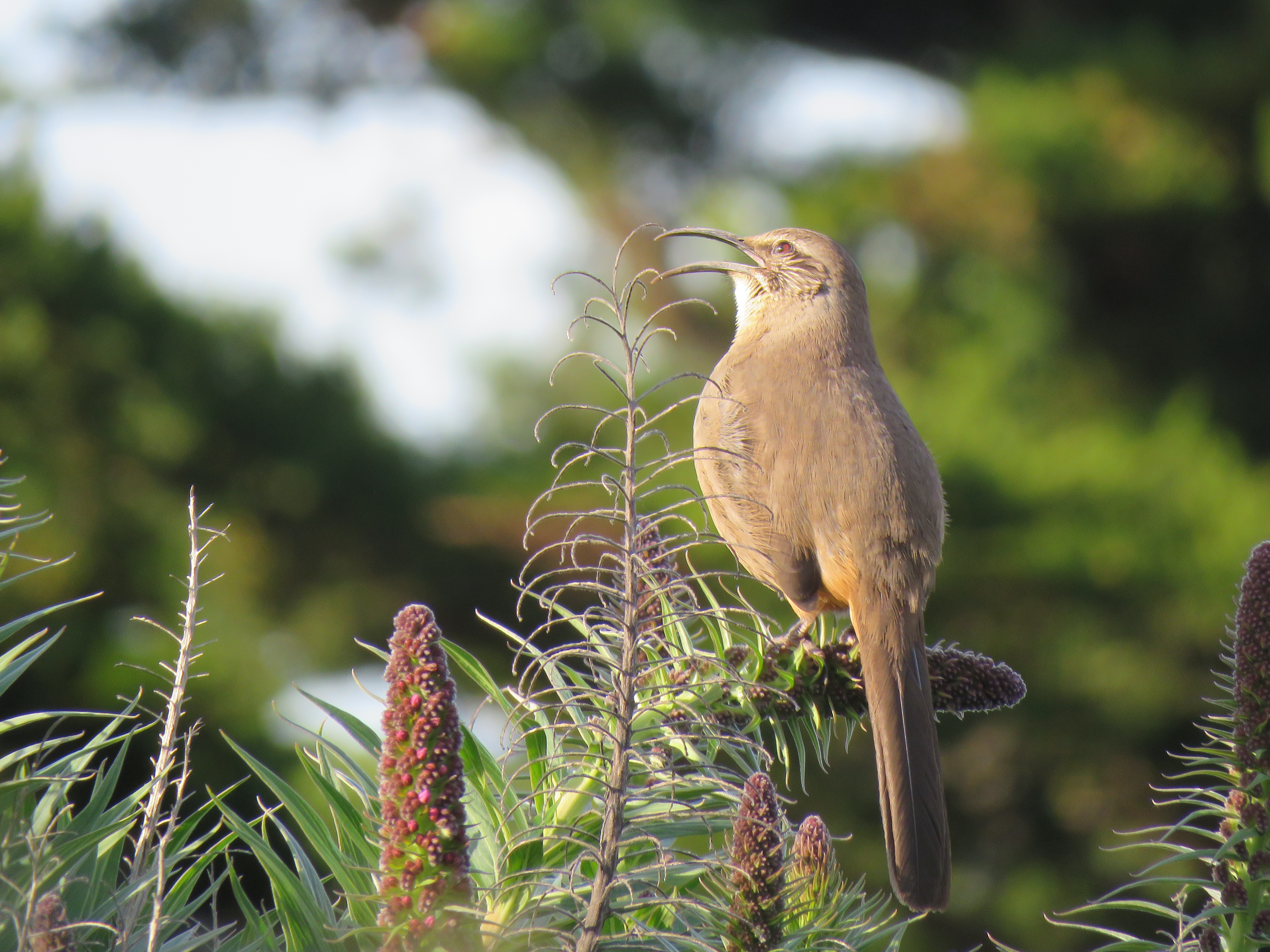
Which brings me to the subject of my featured sketch: the California thrasher (Toxostom redivivum). As the name implies, this mimid is endemic to California and I have seen this sometimes illusive and sulky bird in the North and East Bay Area and in Joshua Tree. In fact in it’s range it is listed as “common and widespread”. Normally if one is reported, I wouldn’t go but when one wintering individual was reported on a hillside off of  Diamond Heights in San Francisco, I grabbed my bins, and headed east! A California thrasher in San Francisco is considered rare for the county. A new bird to add to my City List was only 15 minutes away!

in-pursuit-of-phantoms

A journal spread about my issues with thrashers, from Joshua tree.

So 15 minutes later I was on the sidewalk on Diamond Heights, peering into the dense bushes on the hillside. Nothing. I looked up to the west and saw a large congress of ravens, circling over Twin Peaks. Before the 1980’s the common raven was not so common in San Francisco. Their population has risen since that time and they are now very common on the west side of San Francisco. Could the same thing be happening to the California thrasher? Too early to tell.

After twenty minutes of searching I was still having no luck. And then off to my left I heard the unmistakable song of California’s coastal thrasher. I ran over and found the bird singing, perched on top of a bush. I had great views of the songster for over five minutes before it finally dove down into the bushes.

A new San Francisco City and County bird!

IMG_0938

Image

Sea Watch: Northern Fulmar

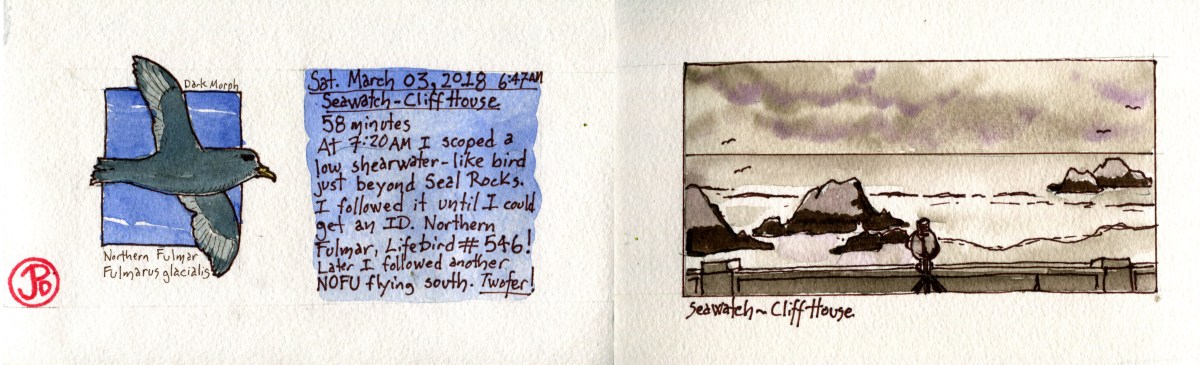
On a Saturday morning in early March, I headed to the platform just below the Cliff House, I set up my tripod and scope to scan the Pacific to the west.

Before I focused my scope on the horizon, looked down at the tideline, sanderlings ebbing and flowing with the tide and a group of willets hung back and rested. I then scanned the rocks, just below my position. It didn’t take long to find the resident black oystercatchers who proclaimed their existence with their raucous calls, a call that carries above the din of the surf. A closer inspection revealed black turnstones and surfbirds working the inshore rocks.

I removed the lens caps from my scope and began to scan the waters beyond Seal Rocks. There was some movement of red-throated loons and cormorants but the bird I was looking for was a true pelagic species. A bird that remained on the outer range of most binoculars but in the winter of 2018, a number of northern fulmars had come closer to shore than in previous winters.

I continued to scan the water looking for something that stood out, something different from the roll of species that normally visited these waters. A 7:20, I caught a bird in my scope that was shearwater-like, flying low to the surface. A dark bird with a large head that was flap-flap gliding near the surface of the waters. This was it! Life bird #546, northern fulmar. toward the end of my sea watch I spotted another fulmar flying off to the south.