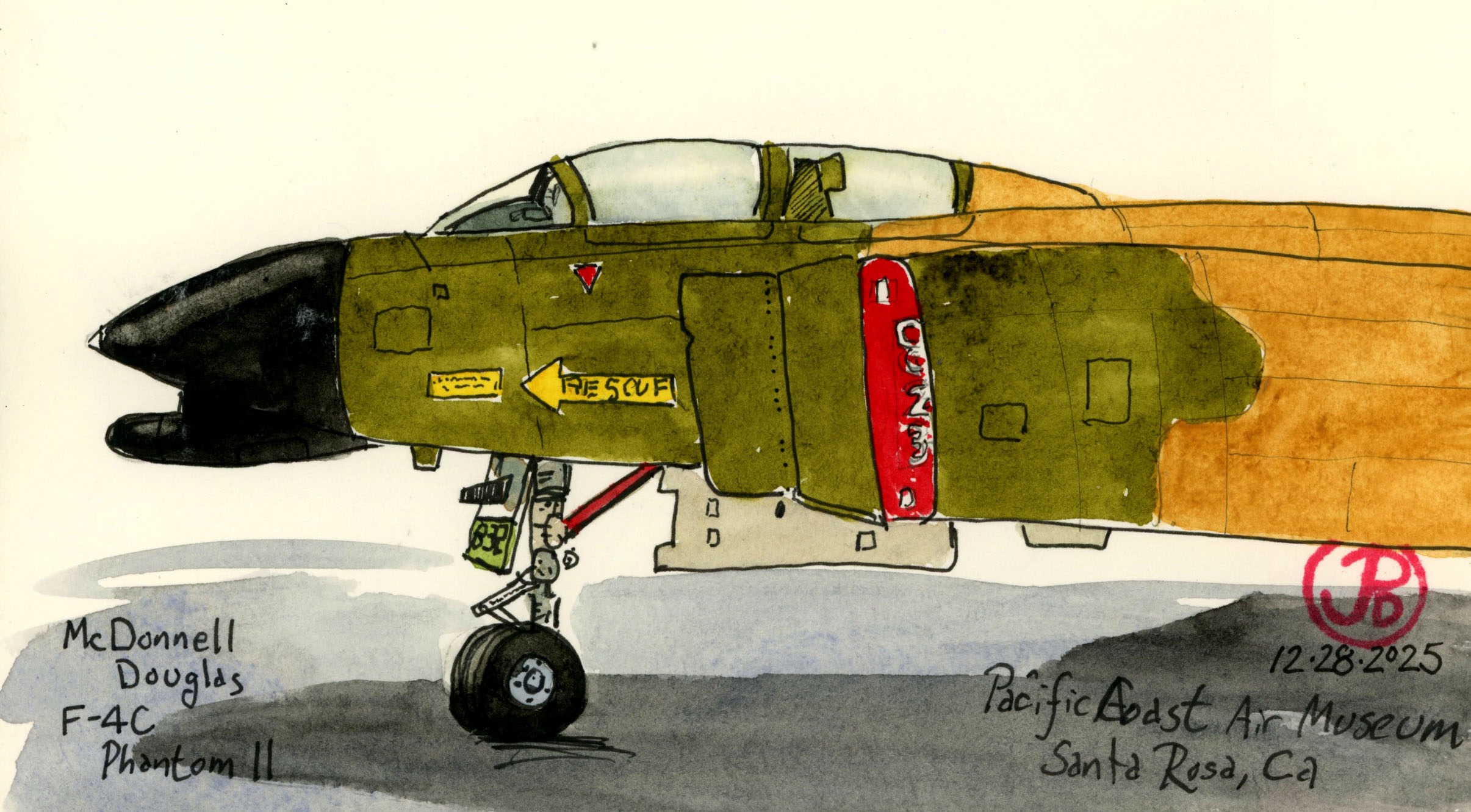
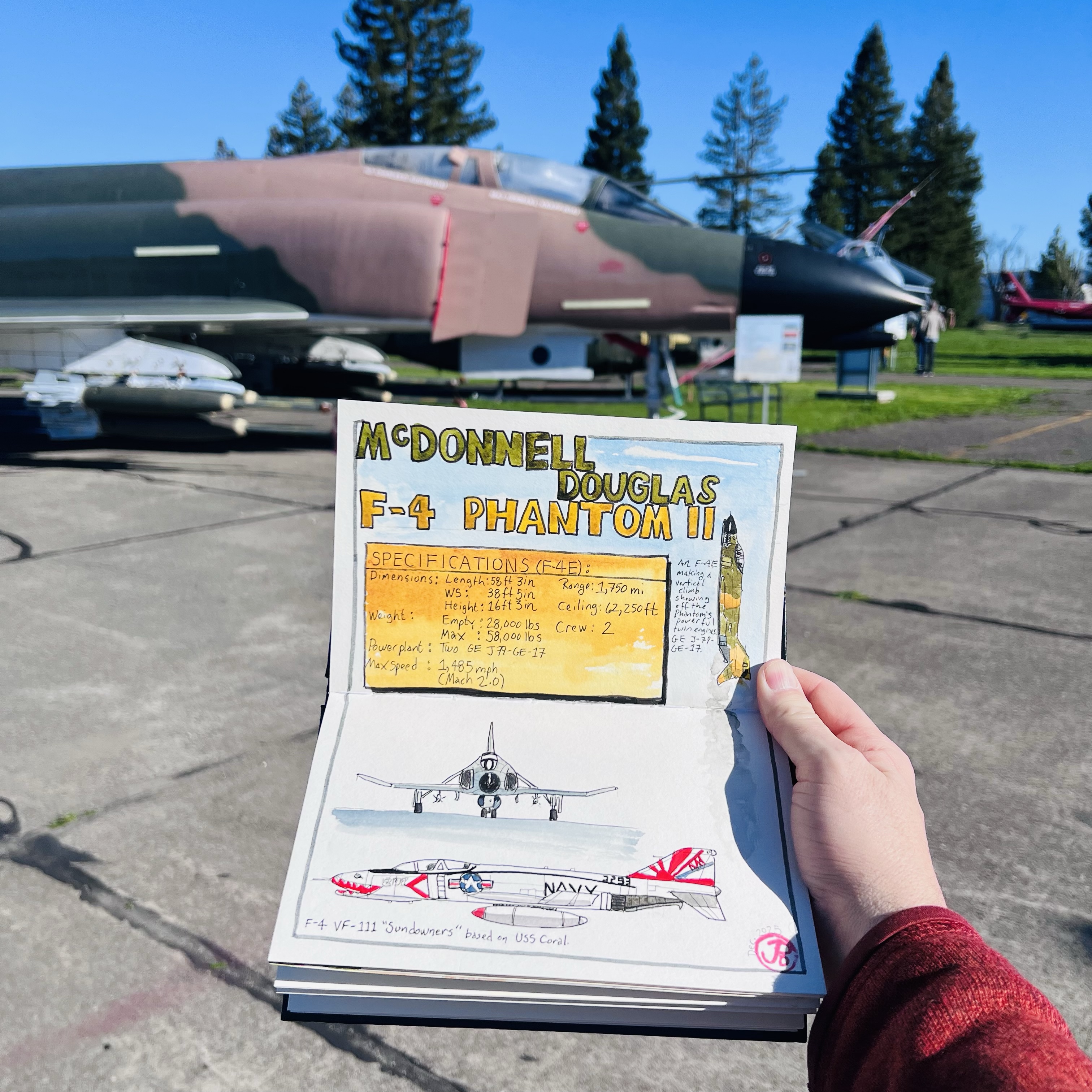
I returned to the Pacific Coast Air Museum in northern Santa Rosa to sketch one of my favorite airplanes: the F-4 Phantom II.
Throughout my life I have been fascinated by things with wings: birds and airplanes. Growing up in Sunnyvale, California, my bedroom window looked out towards the flight path on final approach to Moffett Field, US Navy base.
During my childhood, the most common aircraft that flew by my window was the submarine hunter P-3 Orion. The patrol aircraft were stationed at Moffett.
Every summer, we headed up to the roof during the annual air show to watch the Blue Angels. At the time they flew A-4 Skyhawks but in the year of my birth they, and the Air Force performance team the Thunderbirds, flew the McDonnell Douglas F-4 Phantom II.
This airplane is a beast. At the time it was one of the most powerful fighters in the air reaching speed just over Mach 2. It had earned the nickname the “Flying Brick”.
A docent at the museum who was stationed on an aircraft carrier said you new when you were in the mess when an F-4 took off because you coffee cup shook with power of the fighter’s thrust.
A pre-museum sketch of an aerial beast.
A childhood hobby was building scale model airplanes and my favorite was an F-4 hand painted camo livery.
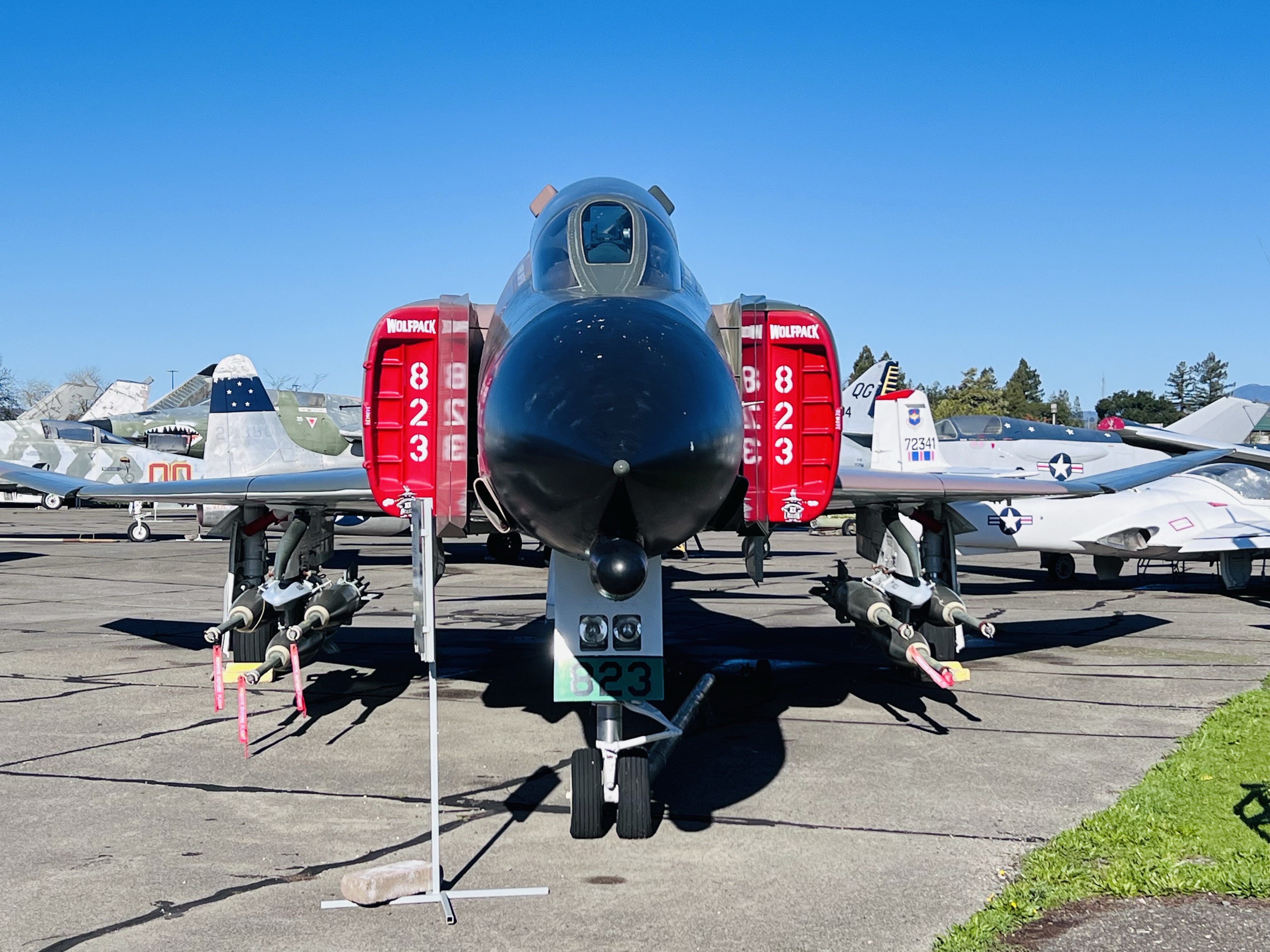
Looking head on at the F-4C.
I was now going to Santa Rosa to sketch a full scale fighter with a similar camo paint scheme.
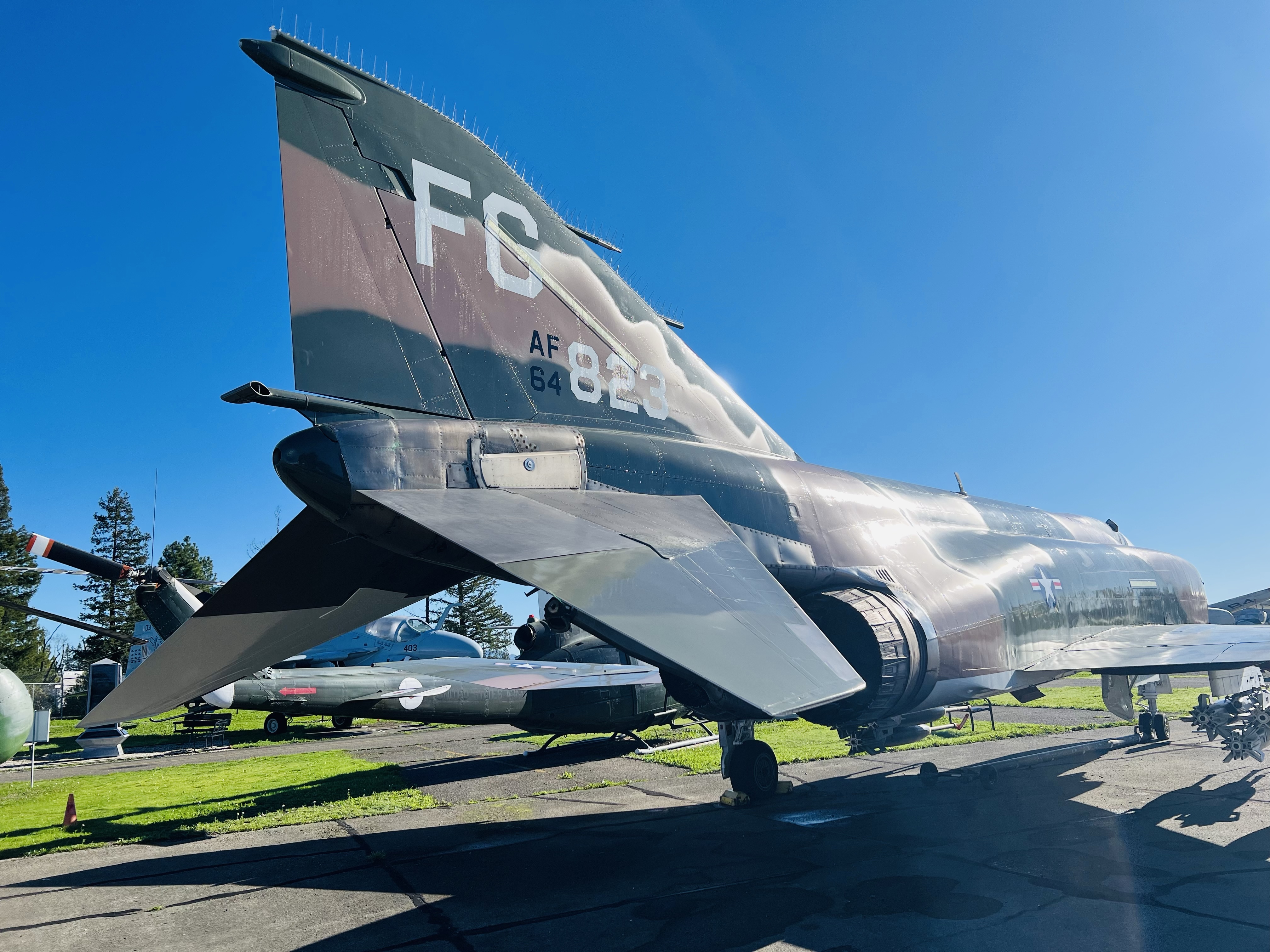
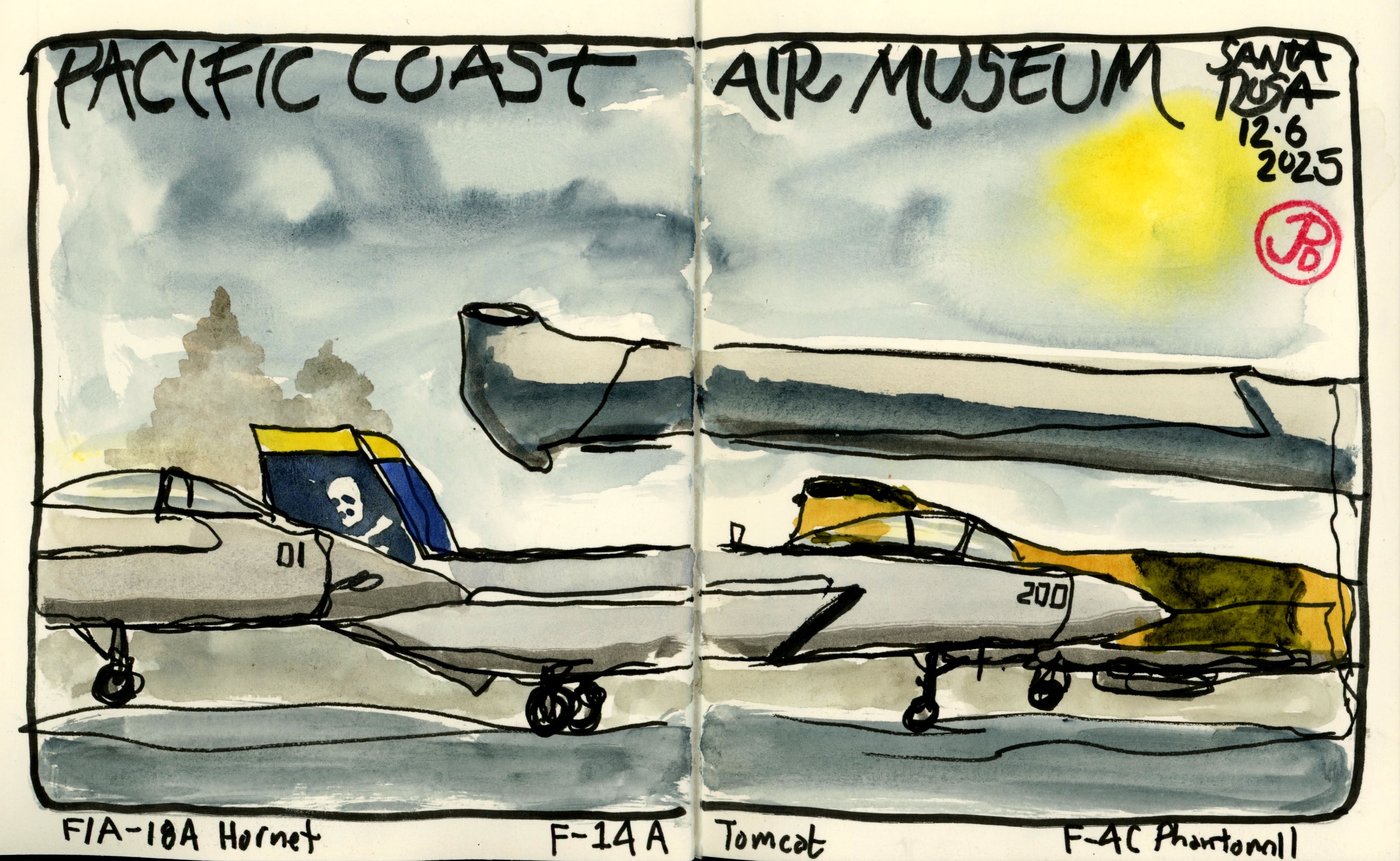
The iconic vertical and angled horizontal stabilizers of the F-4. This jet is an absolute beast. A continuous line sketch of four planes at the museum. The plane on the left, F/A 18 Hornet is what the Blue Angels currently fly. The camouflaged F-4 is on the right.
There is a little known piece of film history in Northern Santa Rosa at the airport, now called the Charles M. Shultz Sonoma County Airport.
While Hitchcock’s Shadow of a Doubt (1943) gets most of the movie history headlines in Santa Rosa, an aircraft hangar was the site of a hair-raising flying stunt in the film It’s a Mad, Mad, Mad, Mad World (1963).
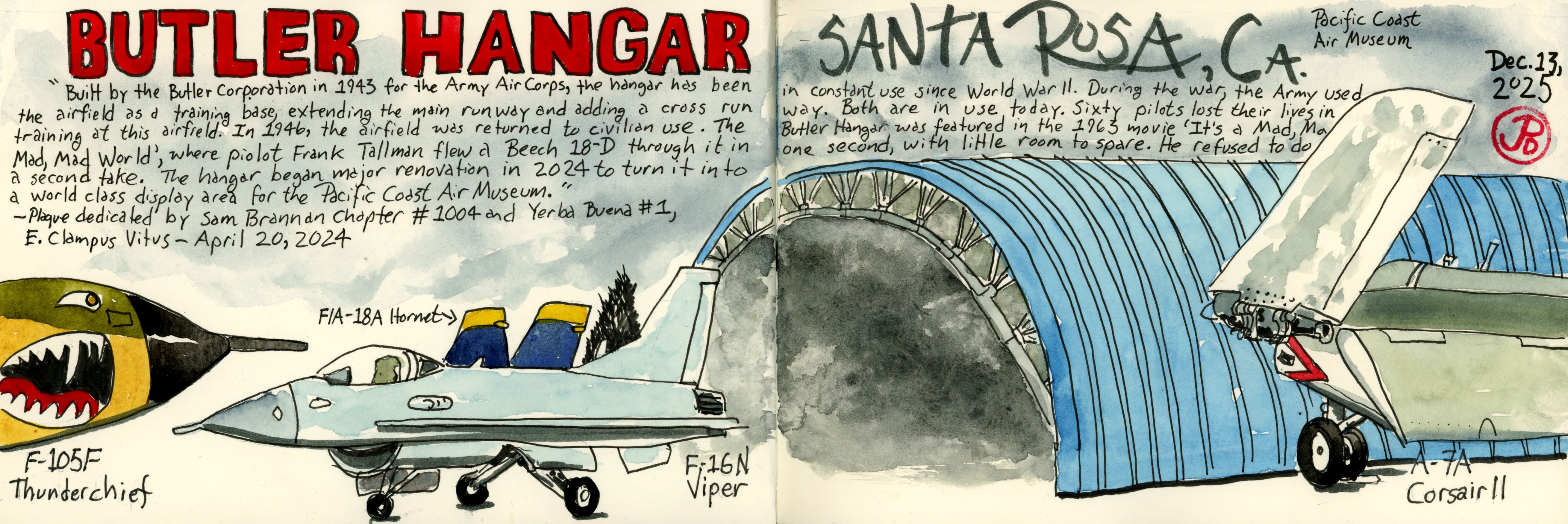
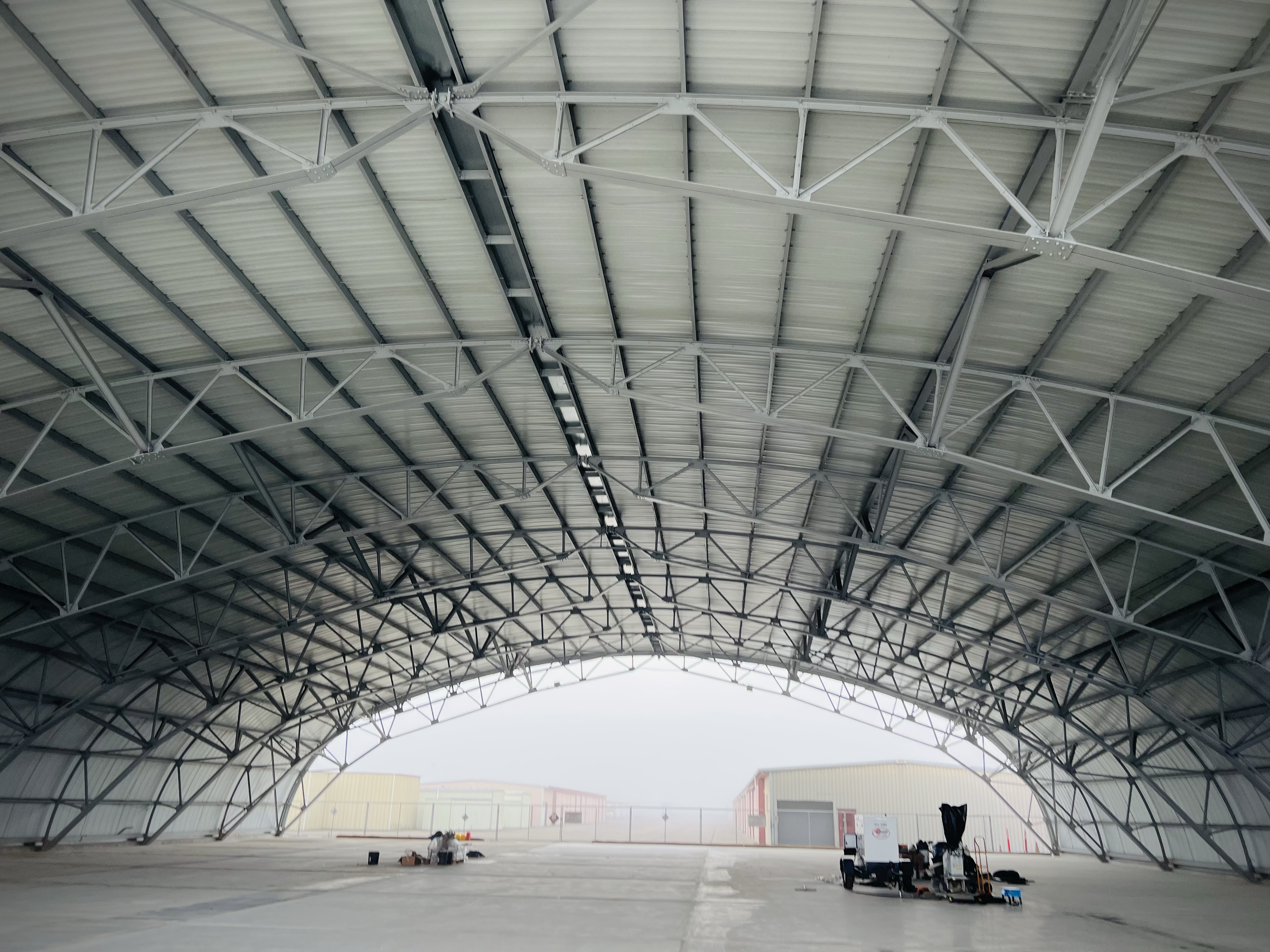
The Butler Hangar was built in 1943, the same year that Shadow was released. The airfield was used during World War Two as a training field. Sixty pilot lost their lives while training here.
One of my favorite fighters, the F-4 Phantom II with the Butler Hangar in the background. As a kid I built an F-4 model and painted it in a similar camo paint scheme.
After the war the airfield, including the hangar, was returned to civilian use and it has been in continuous use since World War Two.
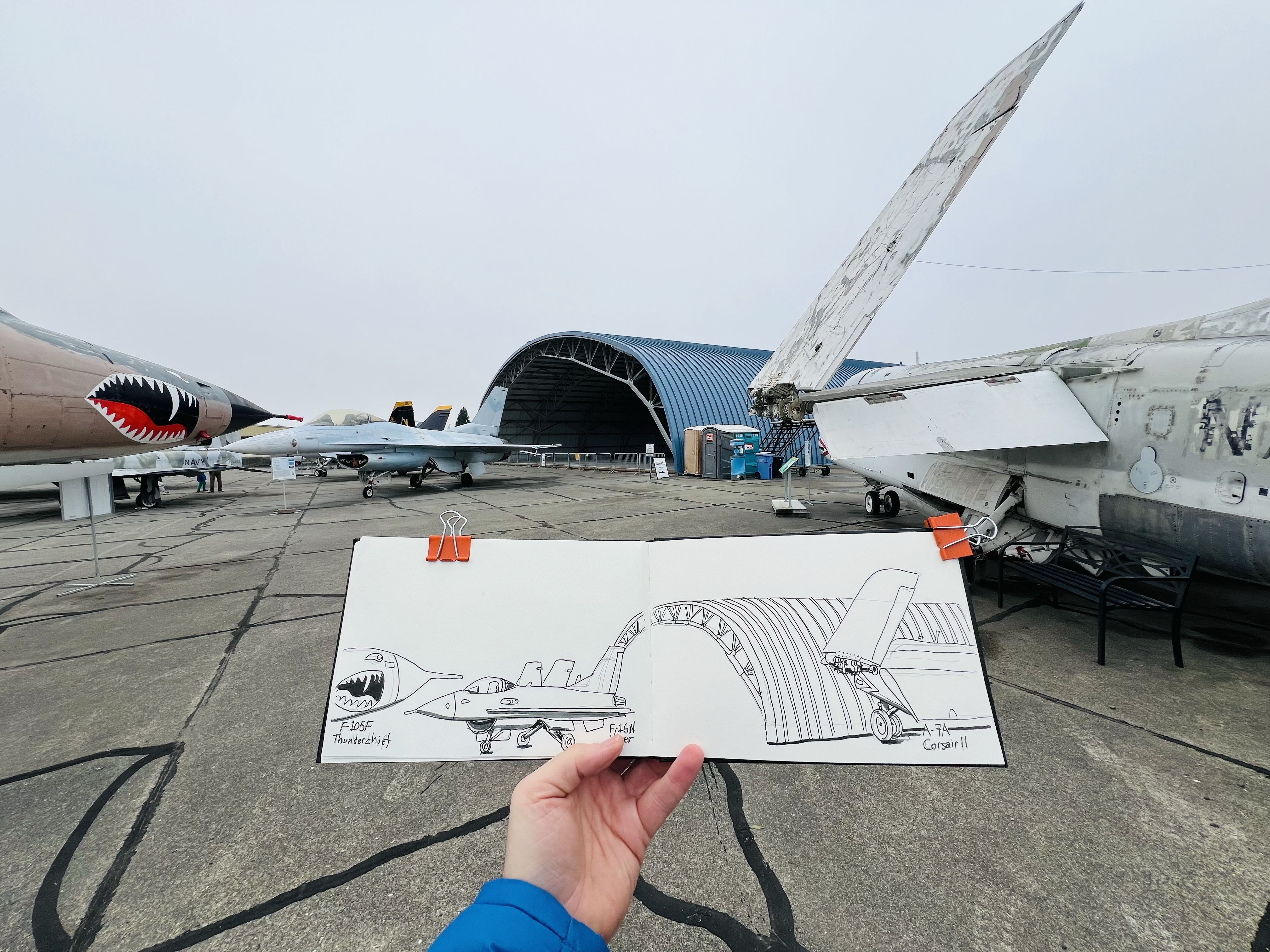
Field sketching at the airfield at the Pacific Coast Air Museum. My sketching backrest was an auxiliary fuel tank from a F-105F Thunderchief.
The hangar was featured in a very short clip of the epic comedy, It’s a Mad, Mad, Mad, Mad, World. It is a screwball road film where a cast of crazed characters, featuring a who’s who of comedy, races across the west coast to find some stolen money ($350,000). Most race in cars while a few travel by air.
Buddy Hackett and Mickey Rooney are forced to fly the twin engine Beech 18-D because the pilot/owner Jim Backus is passed out drunk or possibly dead in the back.
What ensues is some wild flying including buzzing a control tower and flying through a billboard sign (this stunt was the film’s most dangerous and caused damage to the plane).
The pilot who performed the stunts was the one-legged Frank Tallman, a veteran and legend Hollywood stunt flyer.
The stunt was performed on December 4, 1962. Tallman made two low test passes and then lined up to the west of the hangar and speed through, pulling up to avoid hitting trees to the east. He did the stunt in one take and refused to do another pass.
Looking west through the hangar. Tallman flew the Beech 18-D from this direction. The hangars in the background were not built in 1962.
The hangar is now part of the Pacific Coast Air Museum which has an impressive collection of aircraft including the F-4 Phantom, F-16 Viper, F-14 Tomcat, F-15 Eagle, F/A-18 Hornet, A-7A Corsair, A-4 Skyhawk, and many more.
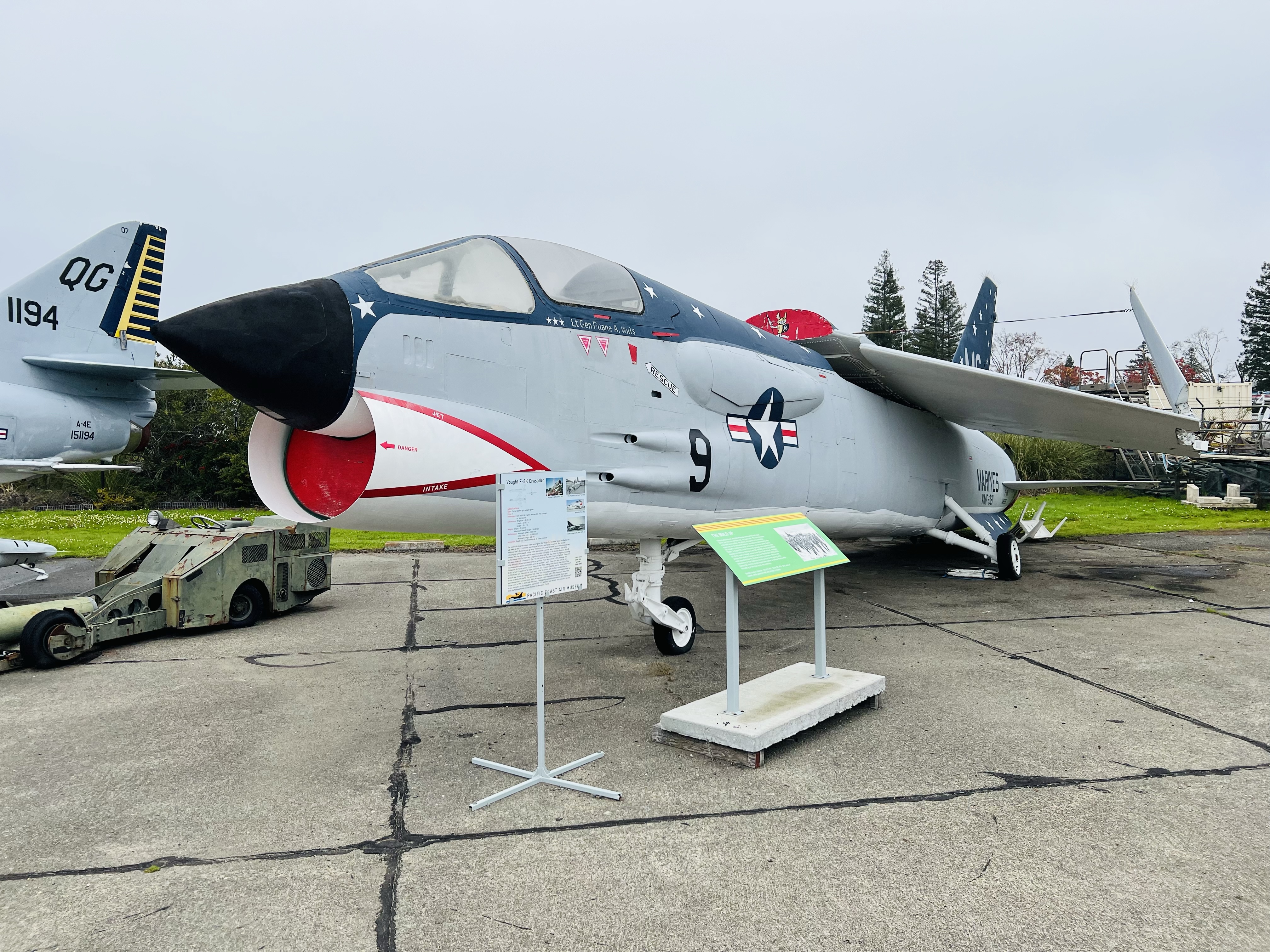
This F-8U Crusader was essentially a playground toy in a San Franciscan park, also known as “the plane in the park”. It was at Larsen Park for 20 years and I remember seeing it as my family drove north on 19th Avenue in the Sunset District. The plane was damaged from vandalism and the foggy maritime weather and was moved to Santa Rosa in 1993 and cosmetically restored.
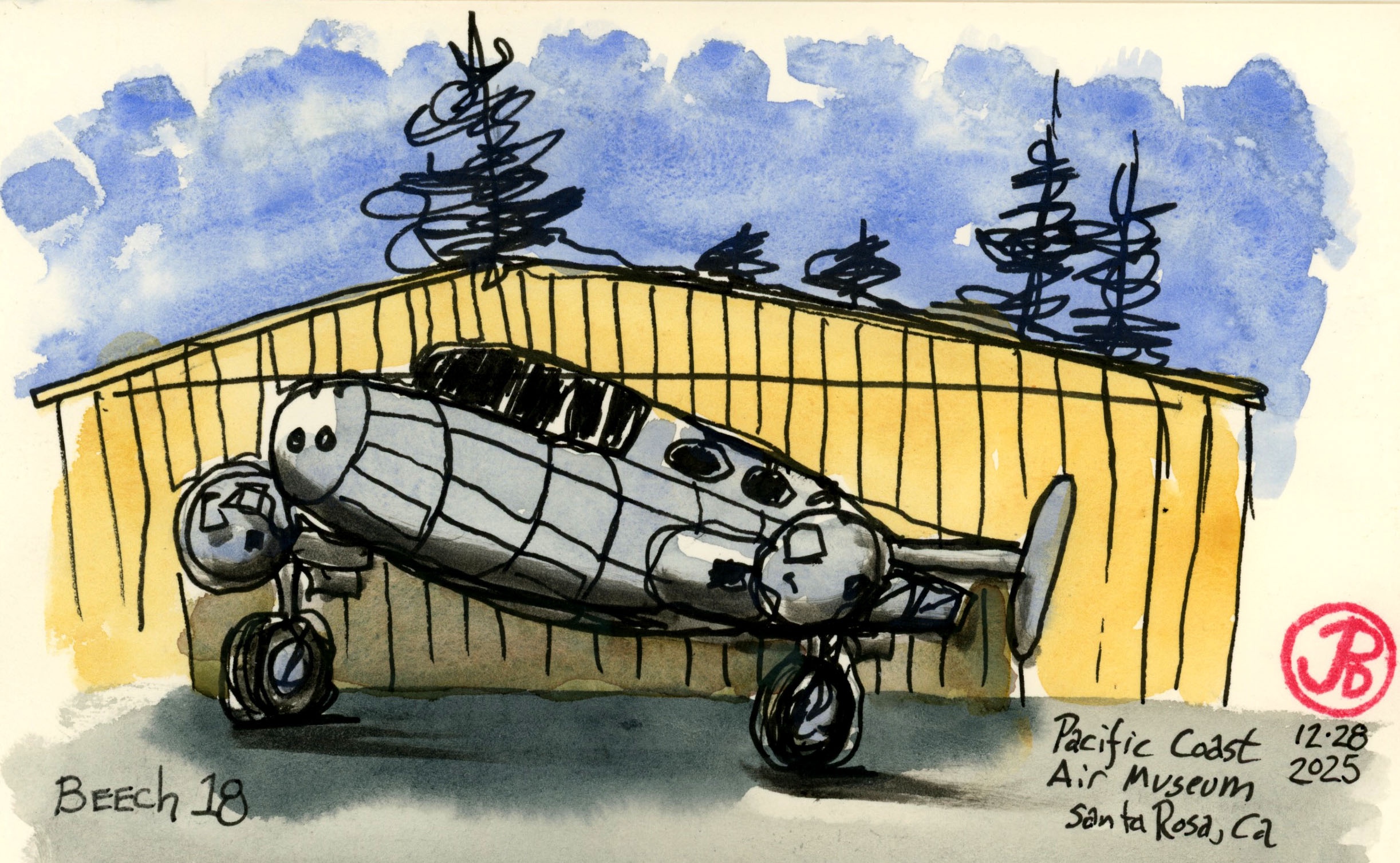
Beech 18
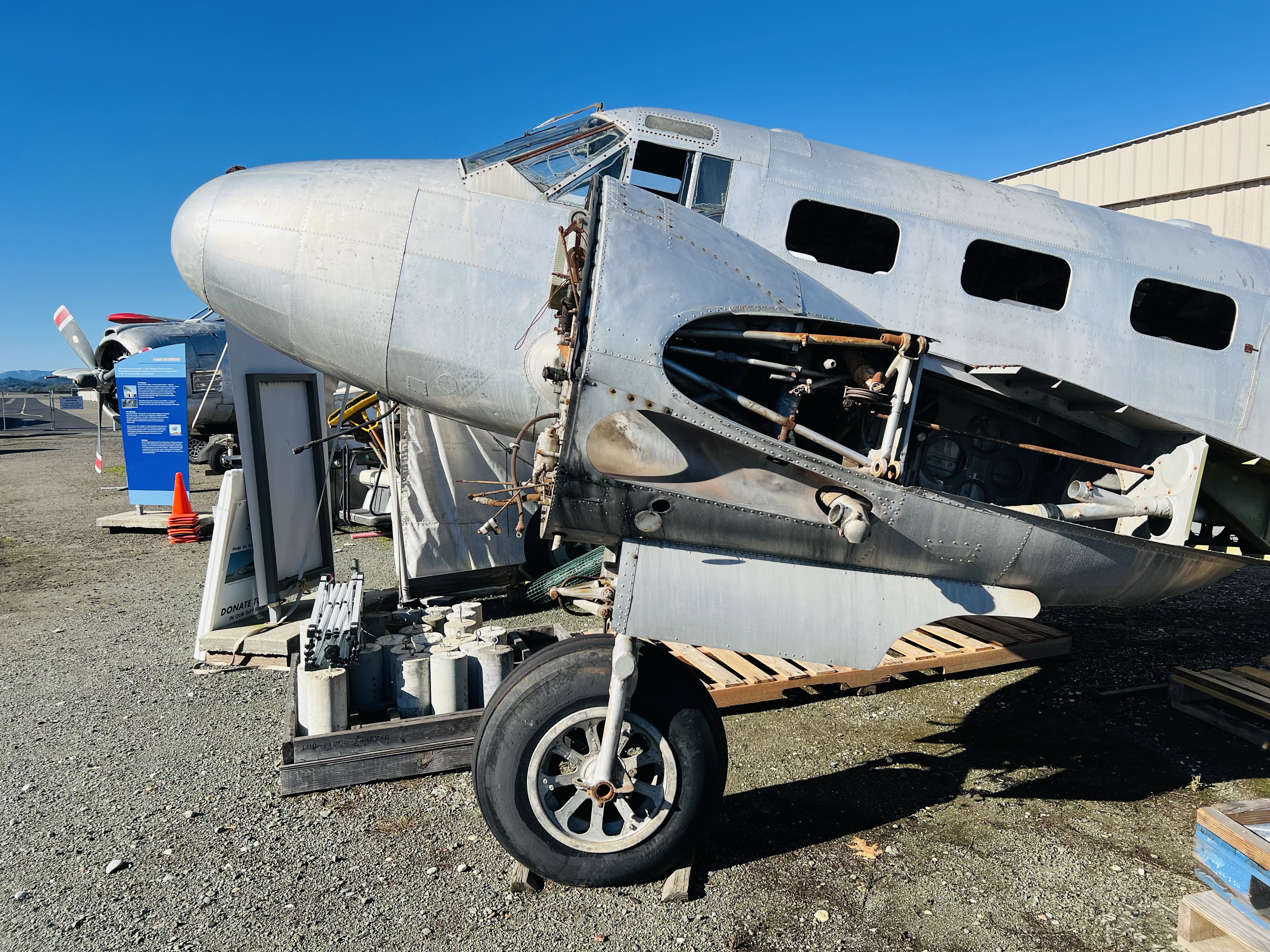
Near the perimeter fence and away from the limelight of the other planes in the museum’s collection sits a silver wingless, moterless twin engine plane that has clearly seen better days.
This is a Beech 18, the same plane that flew through the Butler Hangar.
In the future, plans are to restore the plane (they have the wings somewhere) and display the Beech next to the hangar made famous in an epic comedy.
Alfred Hitchcock’s own favorite film was his 1943’s Shadow of a Doubt starring Teresa Wright and Joseph Cotton.
The noir thriller was filmed in the Sonoma County city of Santa Rosa. The city was picked by Hitchcock and his team as a quaint and peaceful small city in which to inject the Merry Widow Murderer (Cotton). The script was cowritten by Our Town playwright Thornton Wilder in an attempt to capture the flavor of life in a small town.
Uncle Charlie is eventually foiled by his namesake Charlie (Wright) as she slowly realizes who he really is and meets his end on a pilot of a freight train (spoiler alert!).
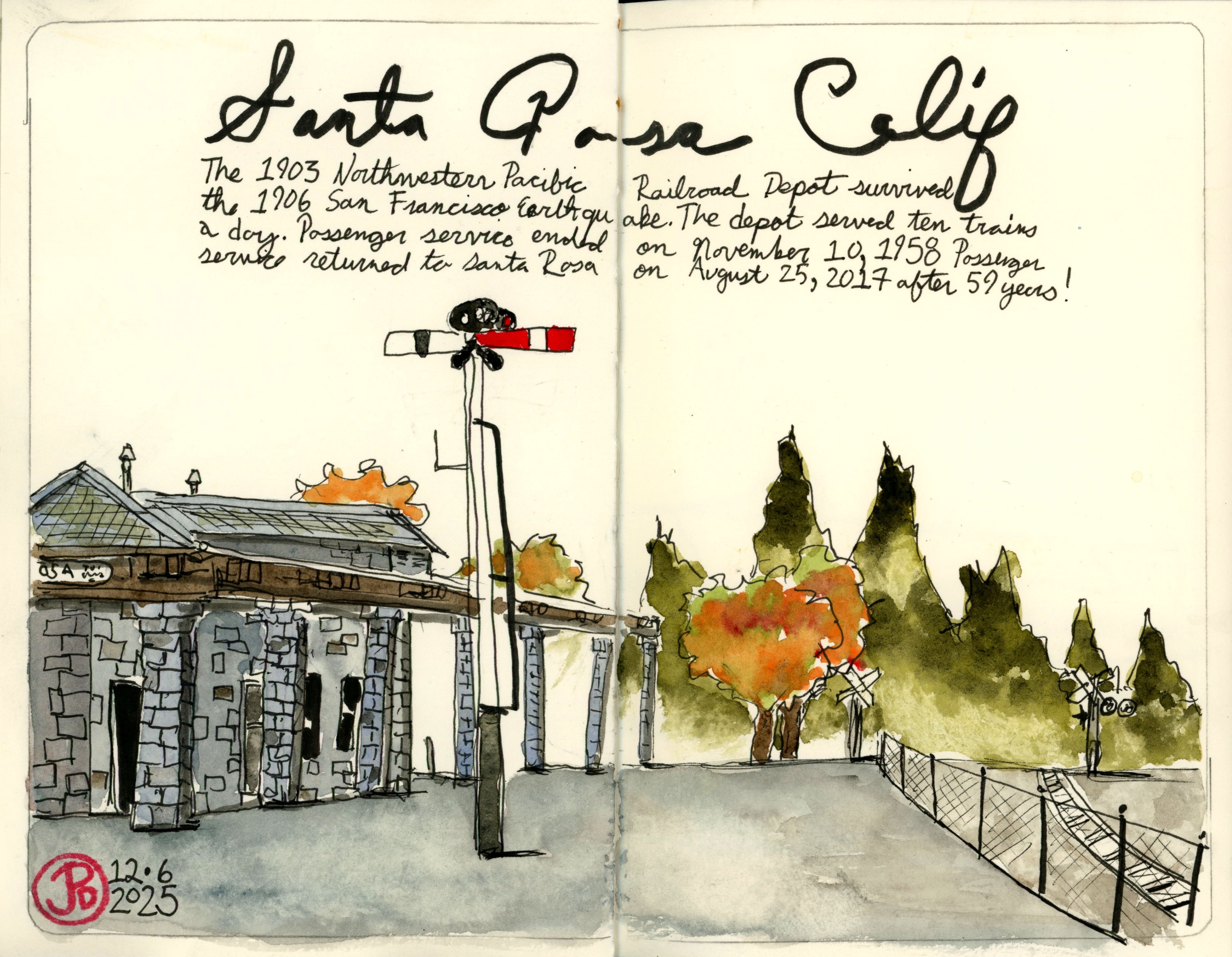
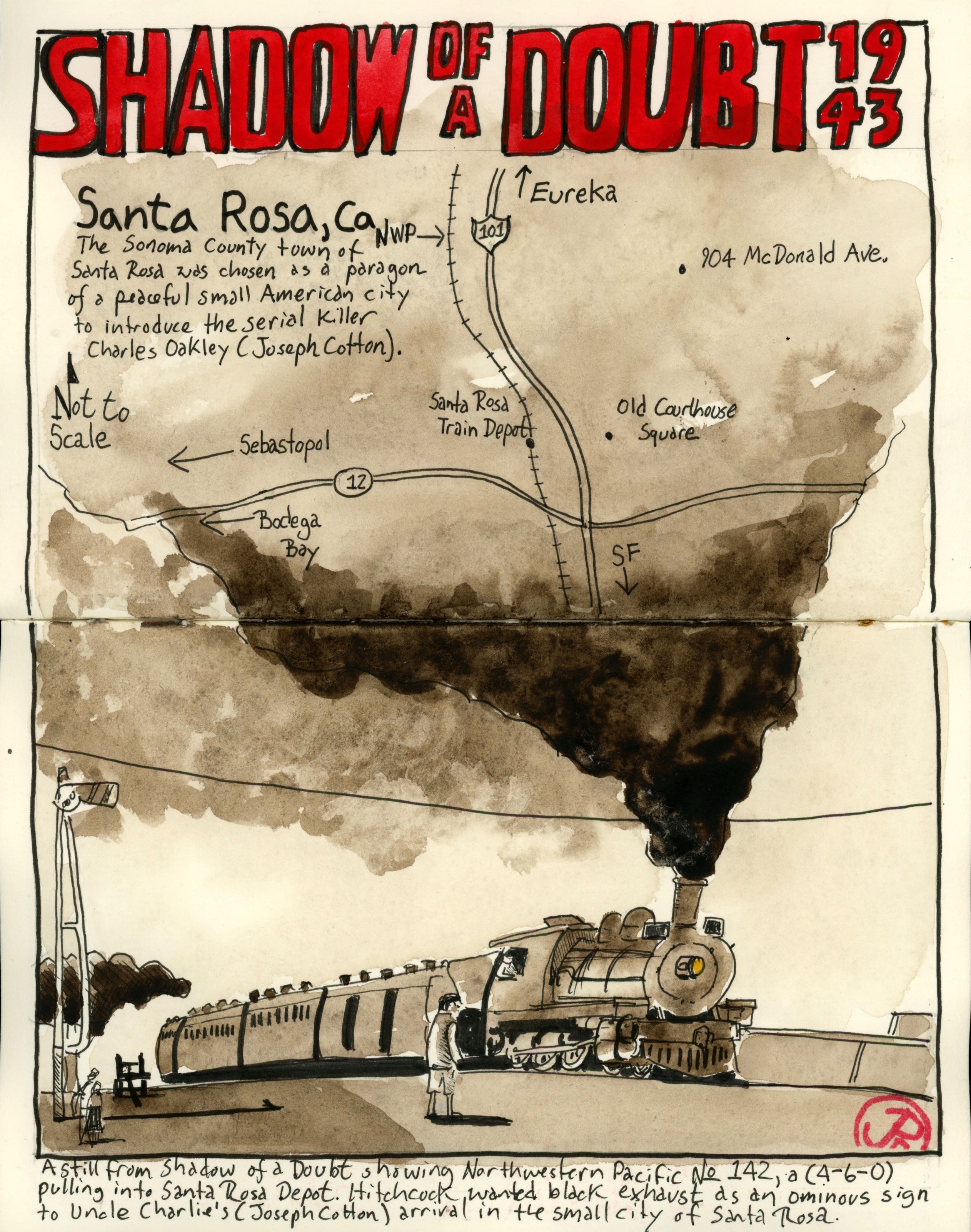
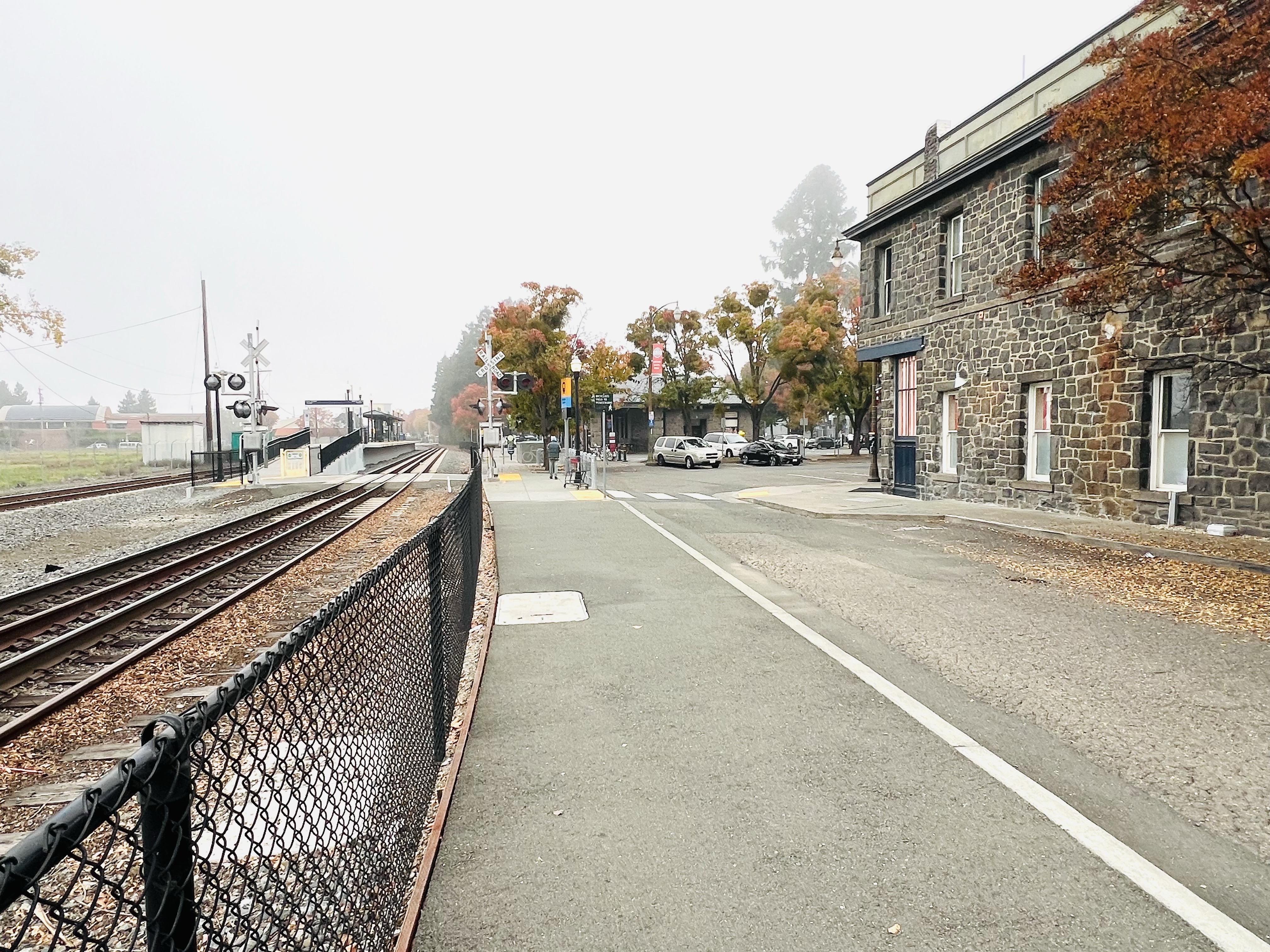
Uncle Charlie first enters idyllic Santa Rosa at the stone Northwestern Pacific (NWP) Depot (1904). The depot looks very much the same as it did in 1943, as it has withstood various earthquakes that have destroyed many of it’s contemporary surrounding buildings.
As the train approaches the depot the exhaust from the locomotive is an ominous pitch black and as the train pulls past the camera, a shadow envelopes the platform. This was all planned by Hitchcock as a modern “something wicked this way comes”. The arrival of Uncle Charlie to Santa Rosa.
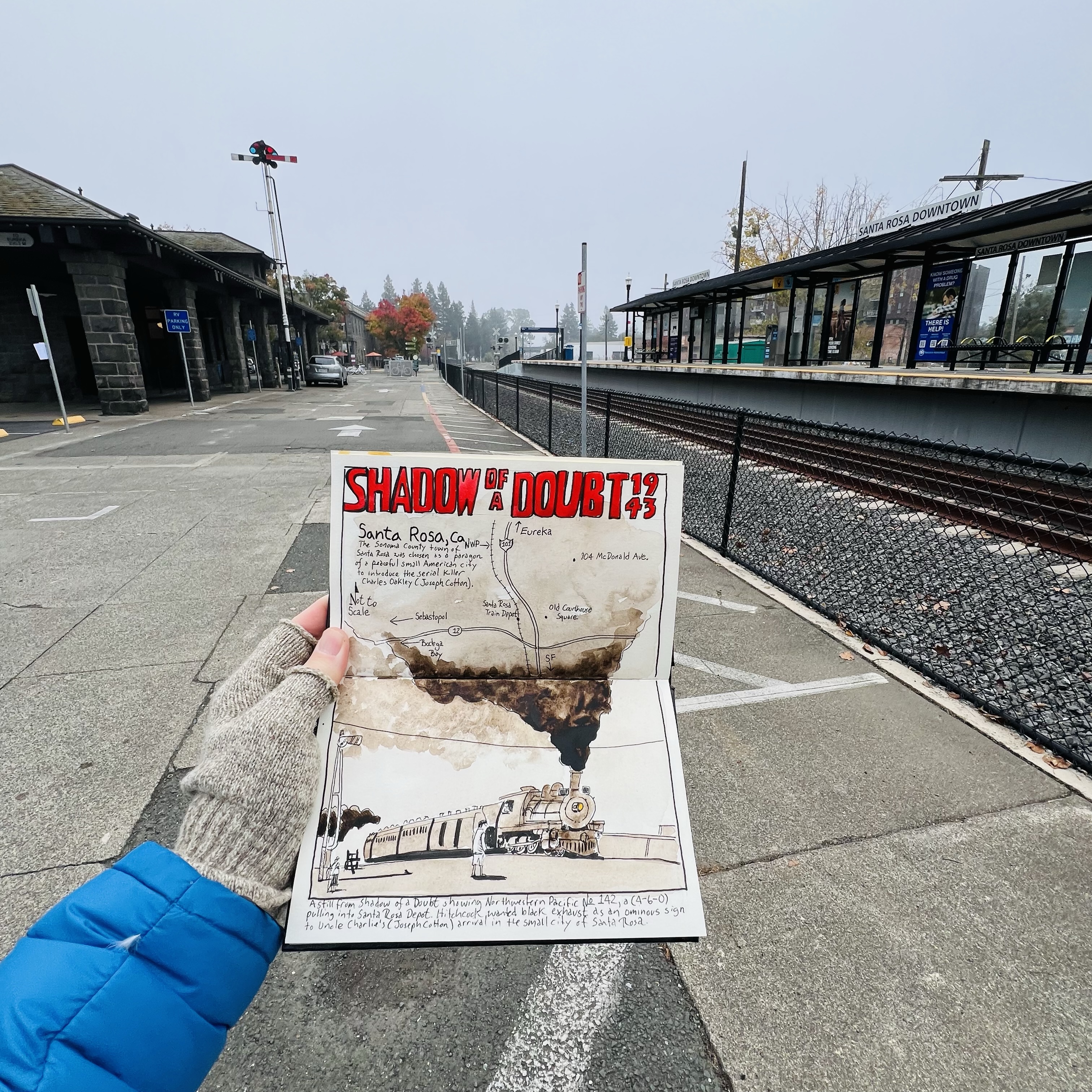
A pre-trip sketch of a frame from the film of Northwestern Pacific No. 142 pulling into Santa Rosa Depot.
I sketched the depot and platform from the approximate camera position when the northbound train first arrives. It was a frigid morning and my fingerless gloves came in handy.
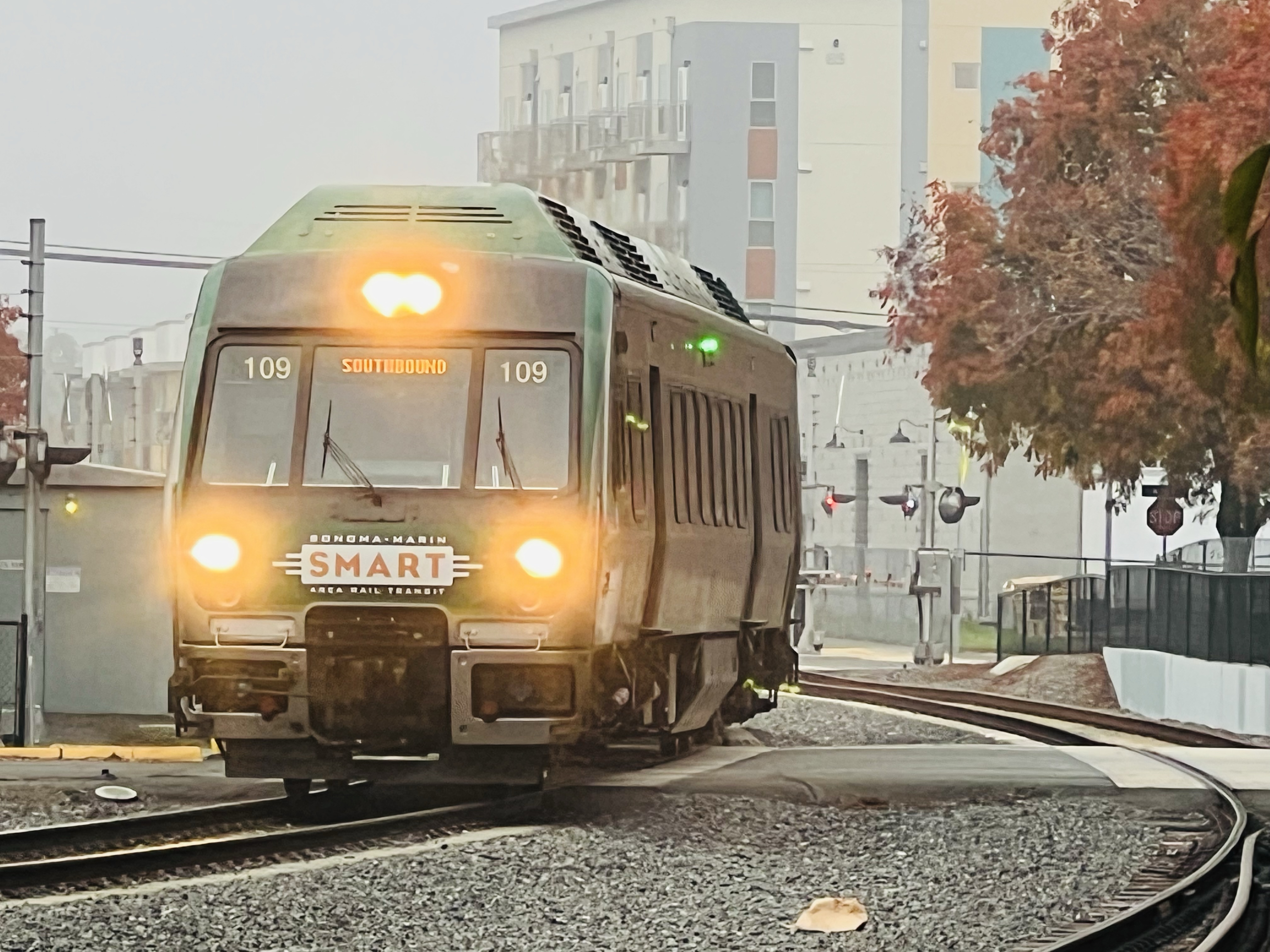
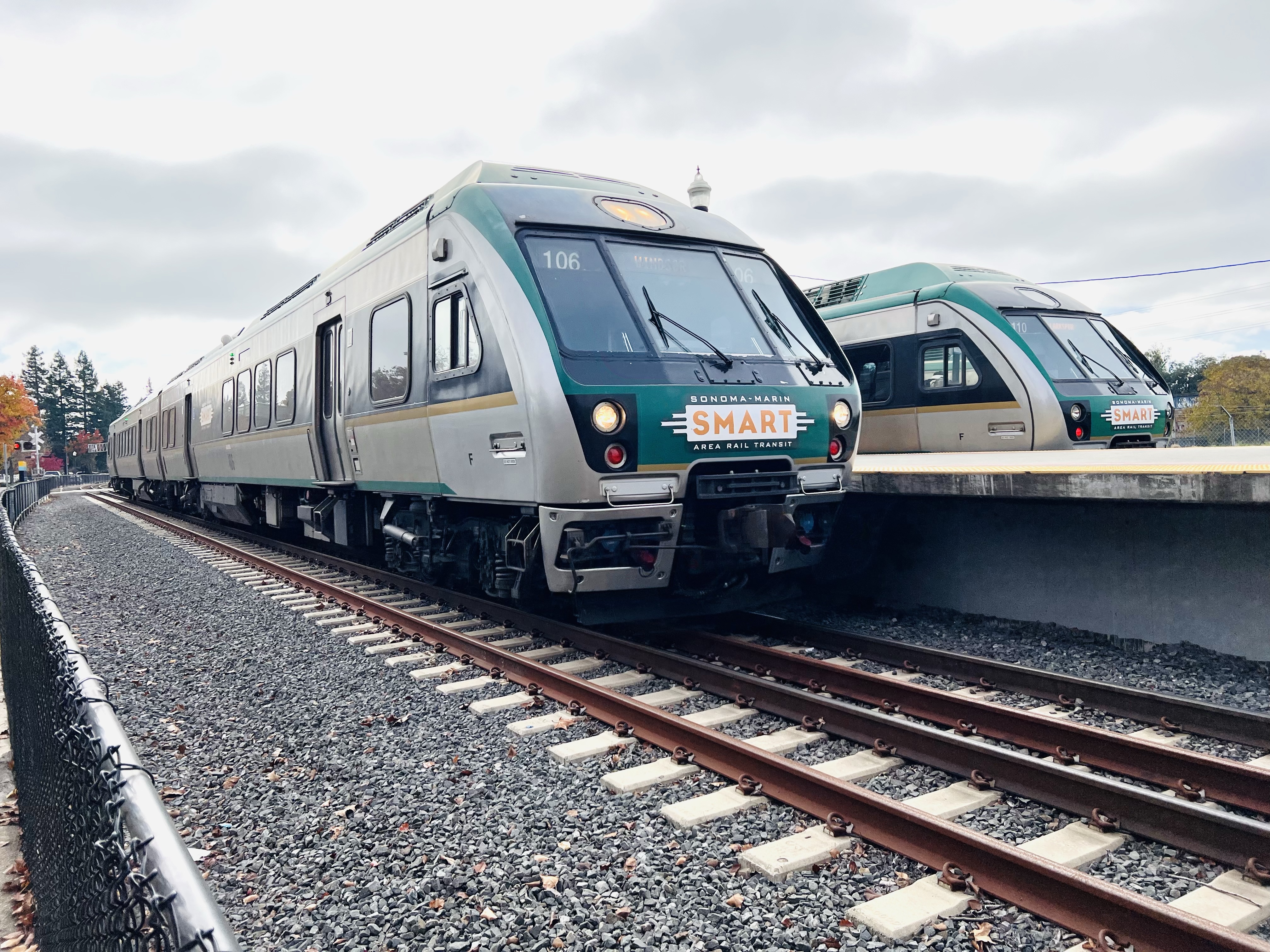
Looking north along the platform towards the depot. This is approximately where Joseph Cotten detrains from the last passenger car.Passenger service to Santa Rosa ceased in 1958. After 67 years, passenger service is alive and well at the Santa Rosa Depot with the SMART train providing service to Larkspur and north to Windsor. Two SMART trains at the Santa Rosa Depot. The near train is a northbound, heading the same direction as NWR No. 142 at the beginning of the film. At one time the line went north, 230.3 miles, to Eureka, California.
As an educator I am fascinated by the seven years and four months that Steven Stayner spent as the abducted “son” of Kenneth Eugene Parnell, answering to the name “Dennis Parnell”.
For years I was under the assumption that his kidnapper keep Steven locked up in a closet, never allowing the boy to see the light of day, but Parnell was keeping Steven hidden in plain sight.
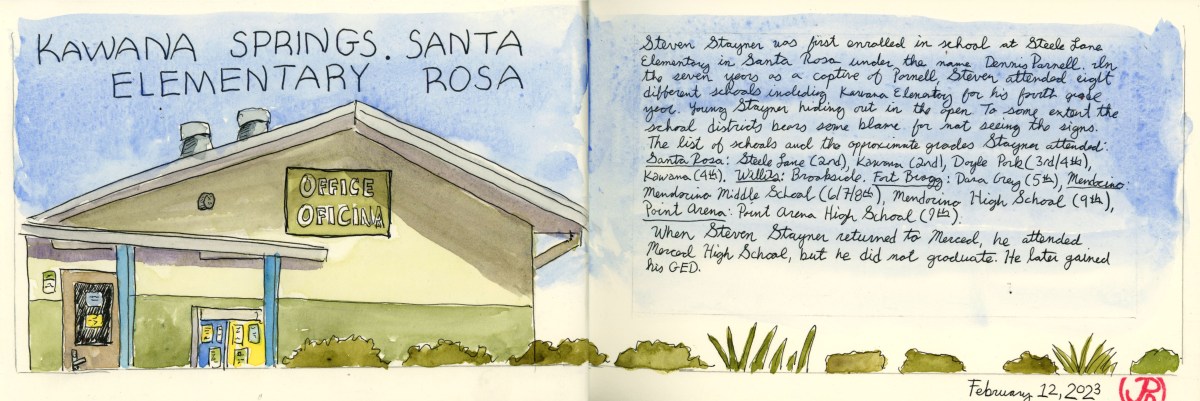
In the seven years of his captivity, Stayner was enrolled in eight different schools in Sonoma and Mendocino Counties. Steven attended 2nd grade through 9th grade as the “adopted” son of Parnell.
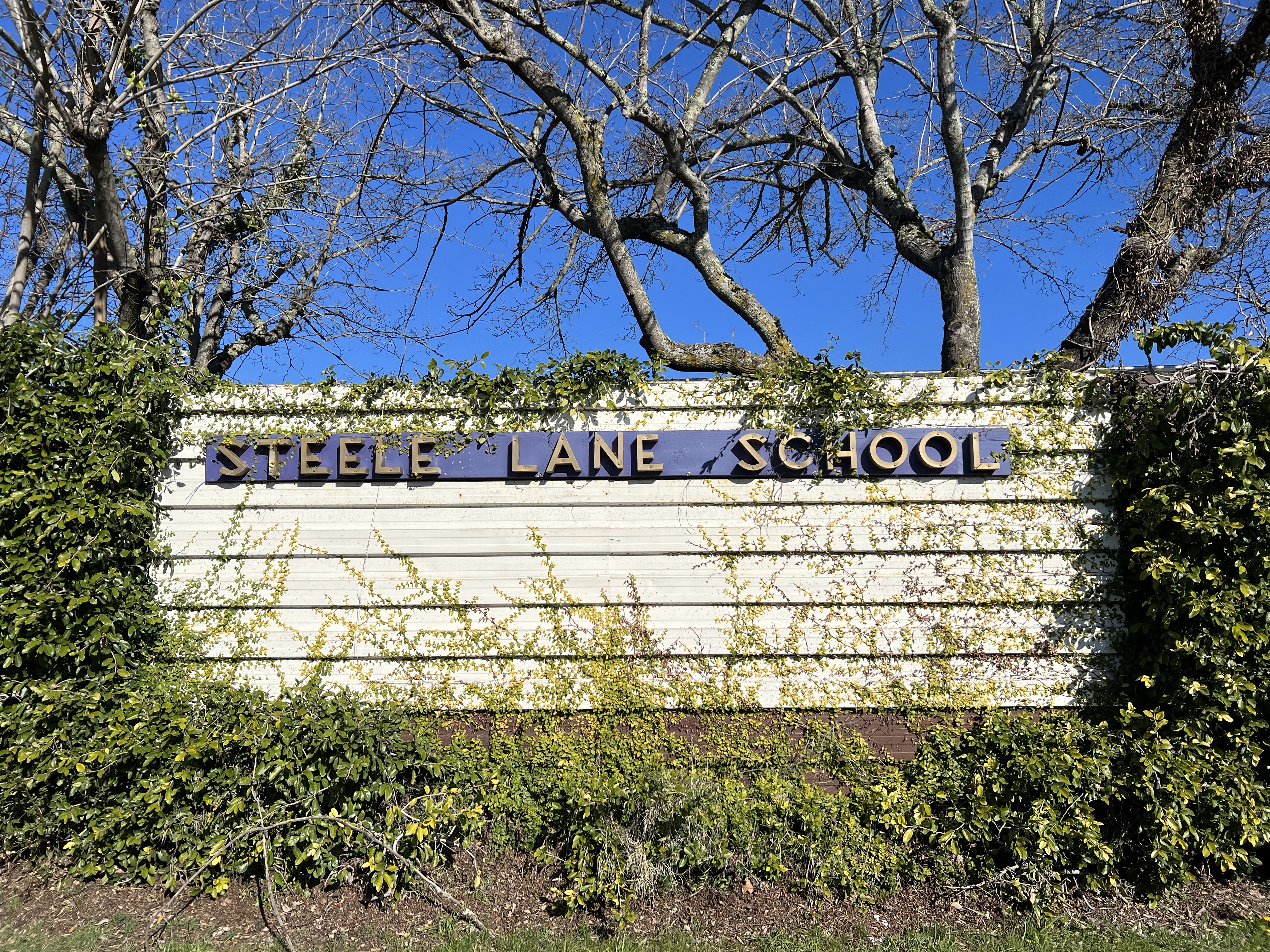
Parnell keep his captive in Yosemite and in a cabin in Catheys Valley but In 1973, they moved northwest to Sonoma County to a trailer park in Santa Rosa and Parnell enrolled Steven (now “Dennis”) at Steele Lane Elementary.
How on earth can you enroll a student without any previous school records? Well this was back in 1973 and I assume things were a bit looser then. But it still begs the question: why weren’t more questions asked about Steele Lane’s newest student and his strange father?
Moreover, the Stayner family had sent missing child posters to many of the districts and schools Steven ended up attending but somehow these posters never found their way onto bulletin boards in school offices or teacher’s lounges.
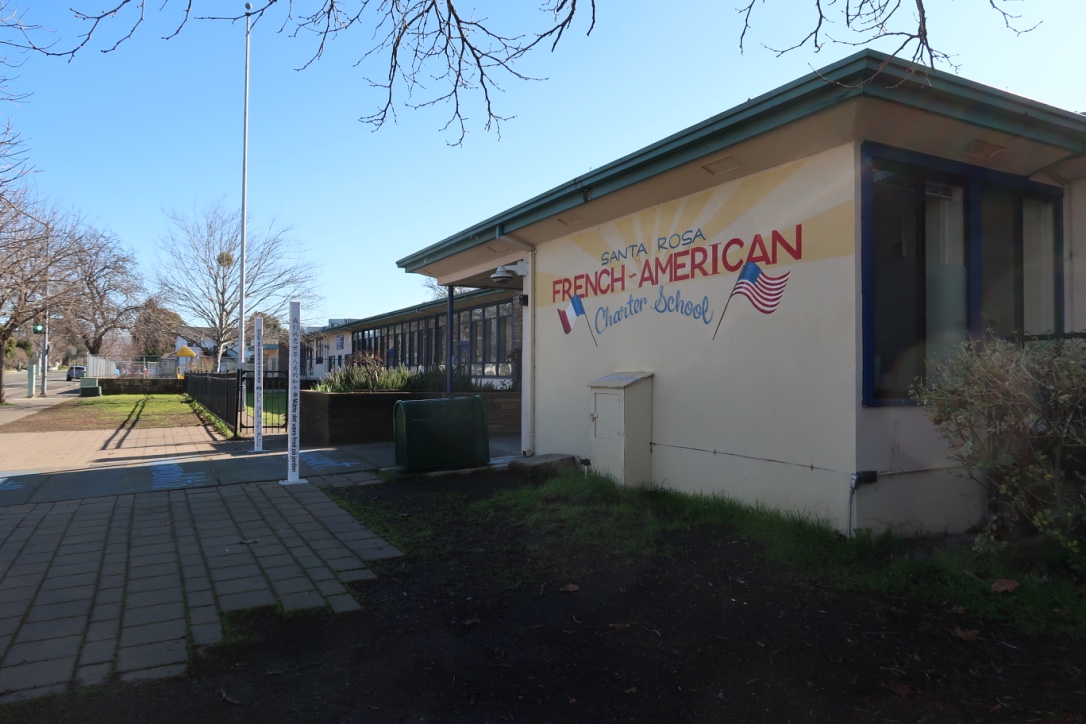
The former Doyle Park Elementary school, in Santa Rosa, where Steven attended 3rd grade. It is now a French-American charter school.
I try to put myself in his teacher’s shoes. Would I have seen the signs? Would I have seen the red flags waving? Often times there are things happening at home that we never know about which can affect their behavior and performance in the classroom. Sometimes it feels like you are just seeing the proverbial tip of the iceberg. As a State Mandated Reporter, teachers are required by law to report any signs of abuse or neglect. But did young “Dennis” show those signs?
Sketching notes: for the featured sketch I could have sketched a few different schools that Steven attended in Sonoma County but I chose Kawana Springs Elementary ( Kawana Elementary in the 1970s) because this is where Steven Stayner attended fourth grade.
Being a fourth grade teacher, Kawana Springs Elementary has a personal connection for me. What would have I thought of my new fourth grade student? Would I have seen the evil lurking below?

 Corvid Sketcher