Colonial Williamsburg is a sketcher’s paradise, especially if you love to sketch architecture.
Williamsburg was the capital of Virginia, preceded by the first permanent English settlement at Jamestown and followed by Richmond (which moved from Williamsburg at the time of the Revolutionary War to be further away from the coast). The capital of Virginia remains in Richmond today.
Colonial Williamsburg represents the capital in the years leading up to the break with Britain. It is billed as the “world’s largest U. S. history museum.”
Many of the current buildings have been restored or even reconstructed to appear as they did in the years before the American Revolution.
Along Williamsburg’s streets are historical reenactors who portray people of the time. Which reminds me of California’s Renaissance Pleasure Faire (a reenactment of Elizabethan England).
You can enter many of the buildings and are met by period interpreters who talk about the life and times of the people of Williamsburg.
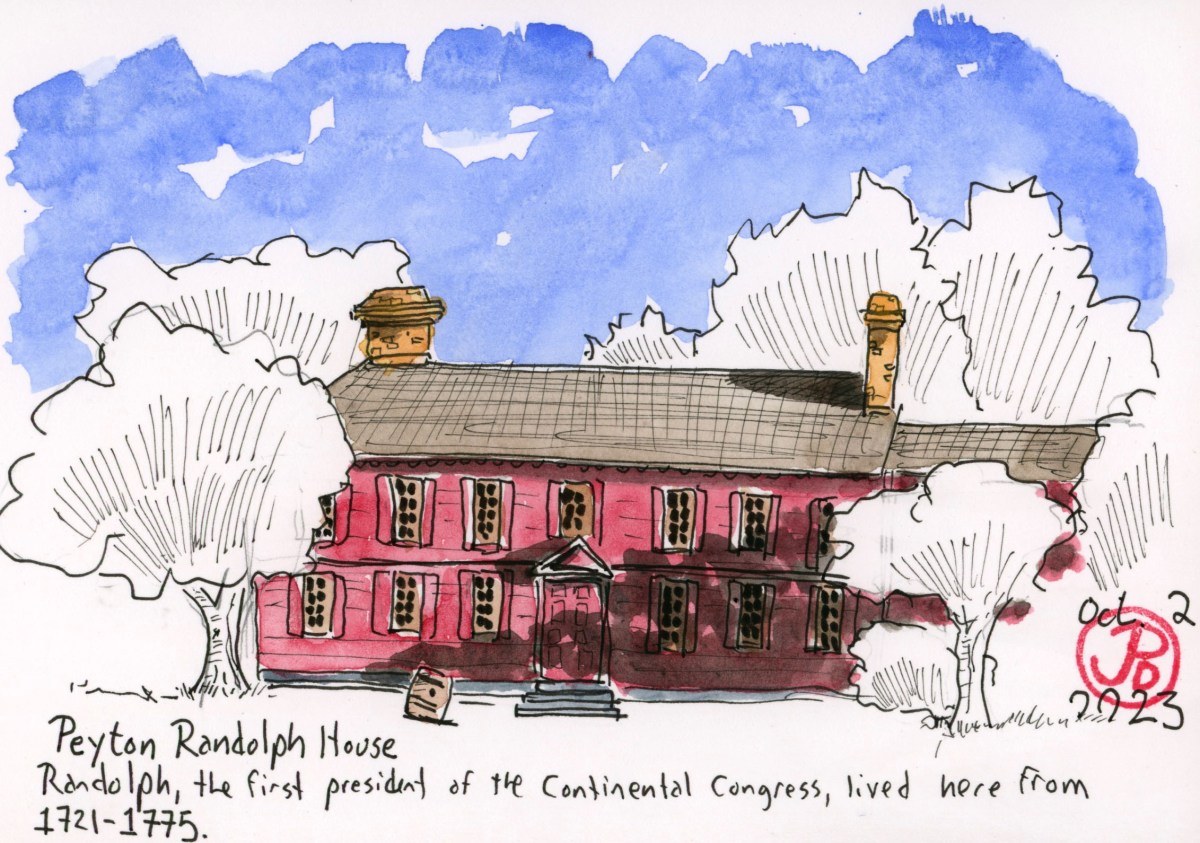
One of these building I toured was the home of Peyton Randolph (featured sketch), one of the Founding Fathers of the United States. He was the first president of the First Continental Congress. Randolph was a very wealthy and influential man. He died in 1775, a year before America’s monumental year. Some historians have theorized that, had he lived, he would have been our Nation’s first president.
It took 27 slaves to tend to the house and part of the tour focused on the slave quarters.
In most cases, slaves slept where they worked. So if you were a cook, you slept in the kitchen. If you where a personal servant to the lord of the house, you slept on a straw stuffed mattress which resembles a large dog bed placed at the foot or the side of their master’s bed.
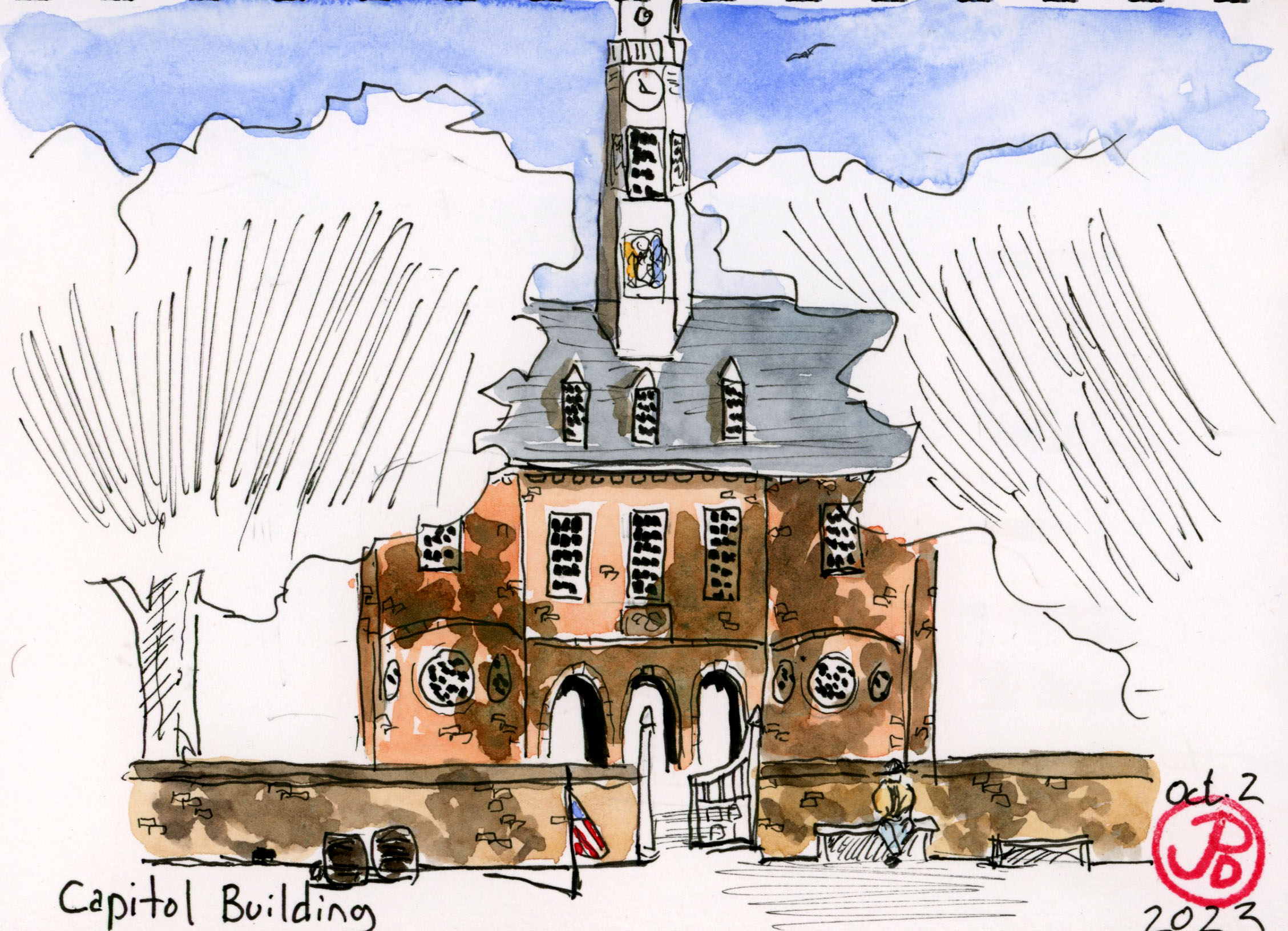
Another building that I toured and sketched was the Capitol Building. It was in this two chambered government building that representatives from the colonies meet with the British government sowing the seeds of our own independence.
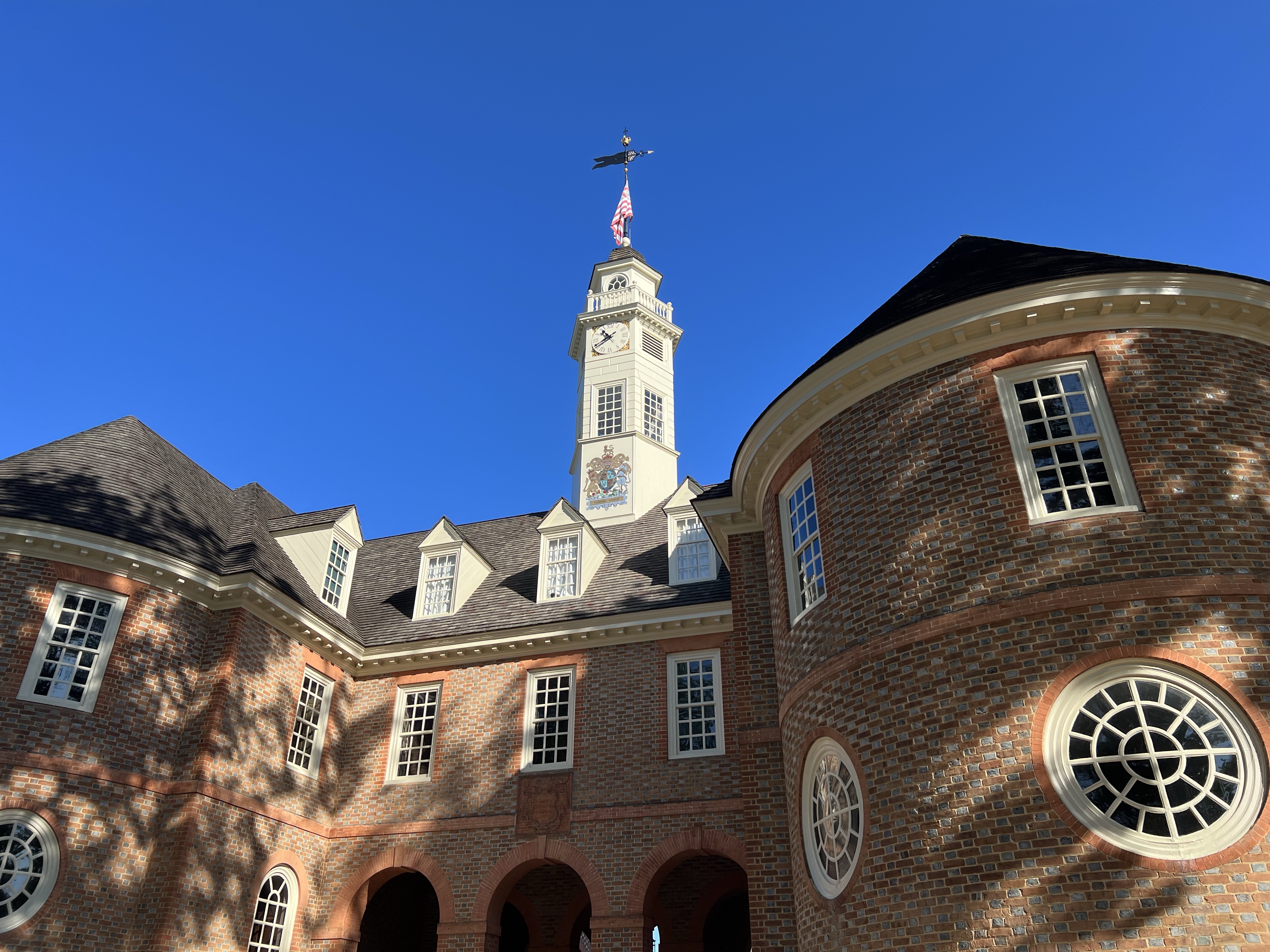
The clock tower of the Capital building. I couldn’t fit the tower into my sketch and it was also shrouded in trees, and I ran out of paper!
Yorktown is one of the vertices of the Virginia’s Historic Triangle. The other two being Colonial Williamsburg and Jamestown.
Yorktown is the site of a major victory of the Revolutionary War. The Battle of Yorktown led to the British surrender and the end of British rule over the colonies. It was also one of the last major land battles of the war. This was the beginning of a new nation.
The American army was led by General George Washington with the help of French and the British forces was commanded h Lieutenant General Cornwallis.
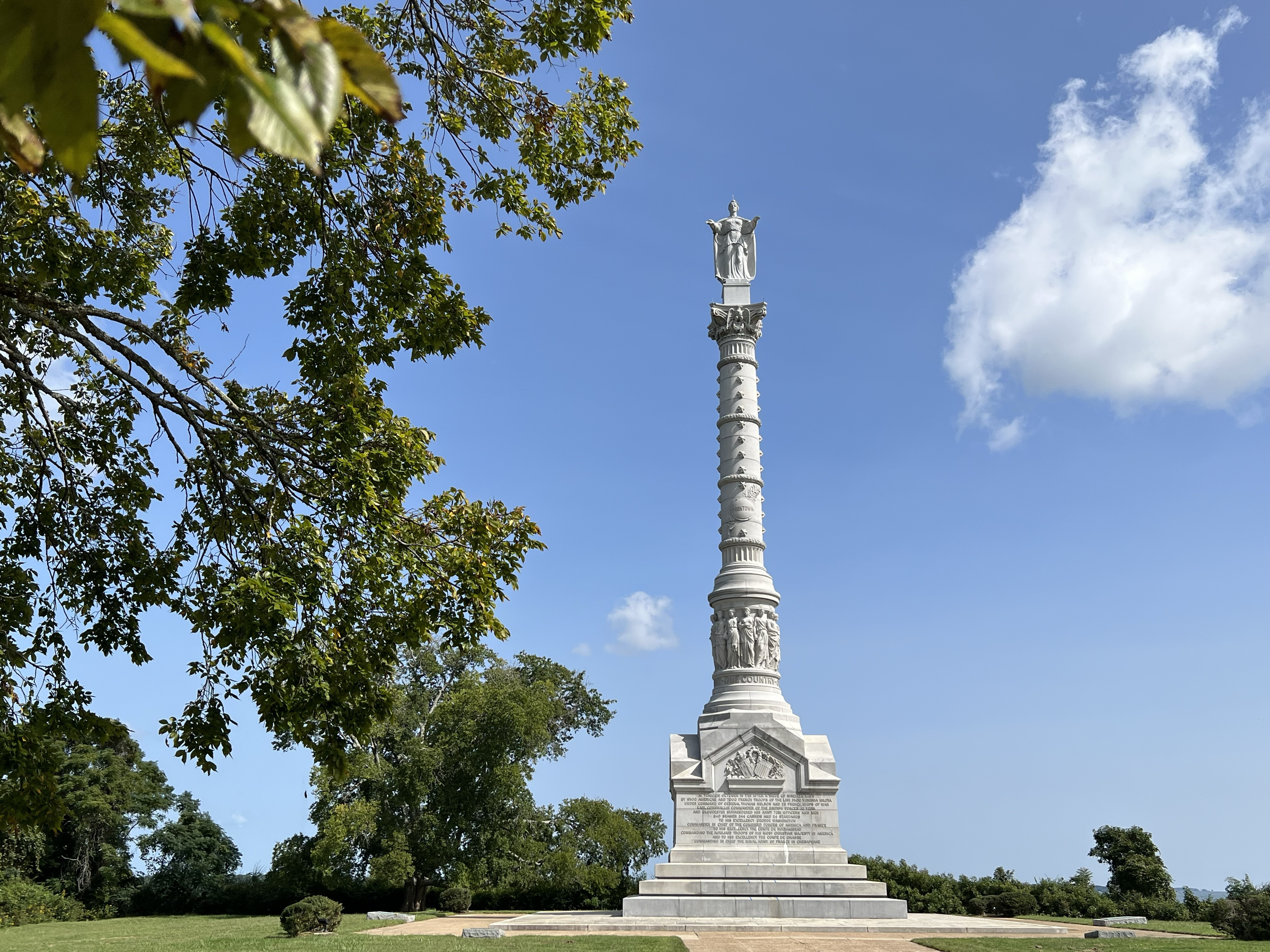
The Yorktown Victory Monument which was completed in 1885, over 100 years after the battle and 20 years after the end of the Civil War!
Signs of this important battle are still visible in the landscape and the buildings that existed from Fall of 1781.
It is one of these signs of battle that I sketched into my sketchbook.
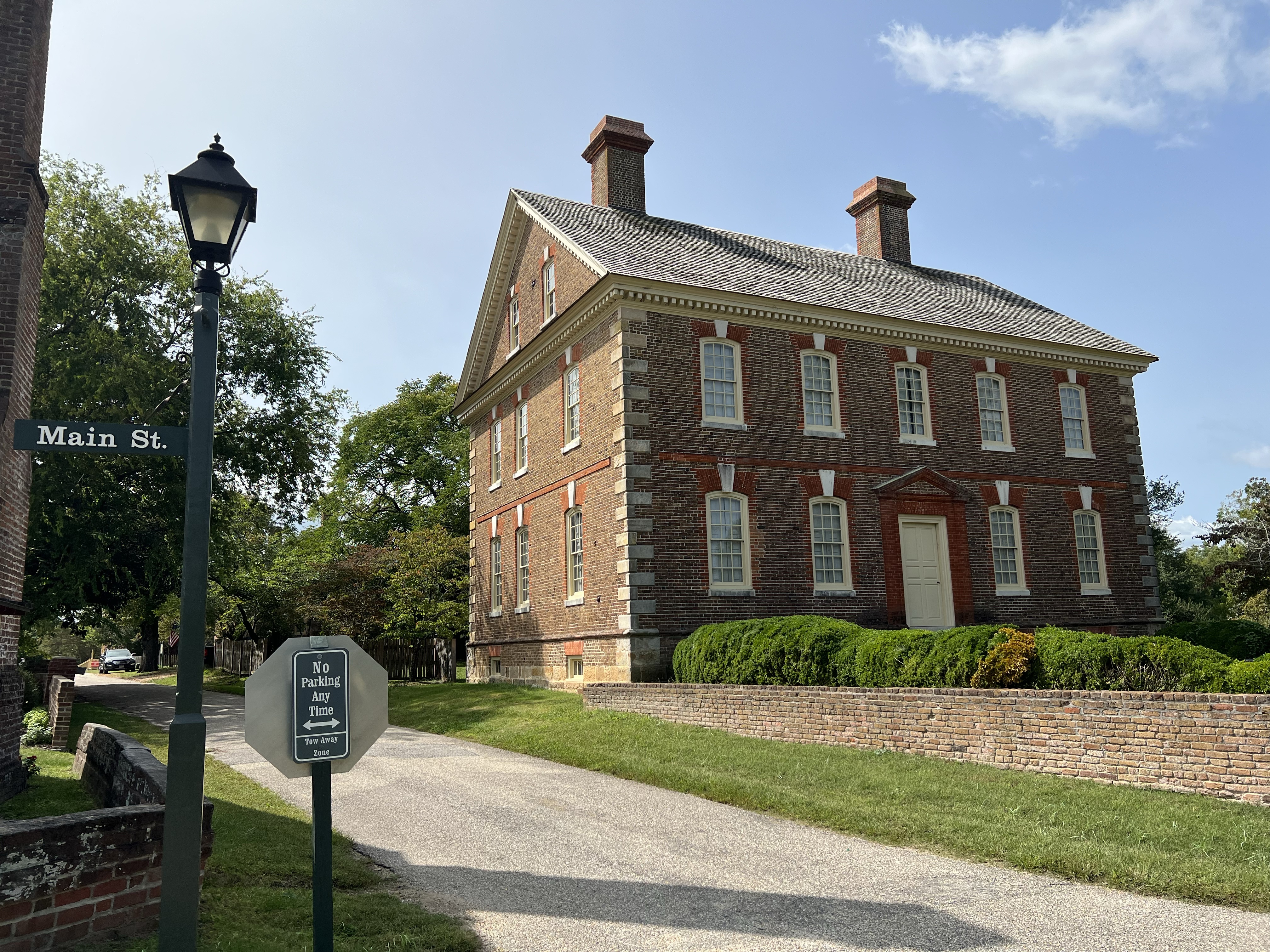
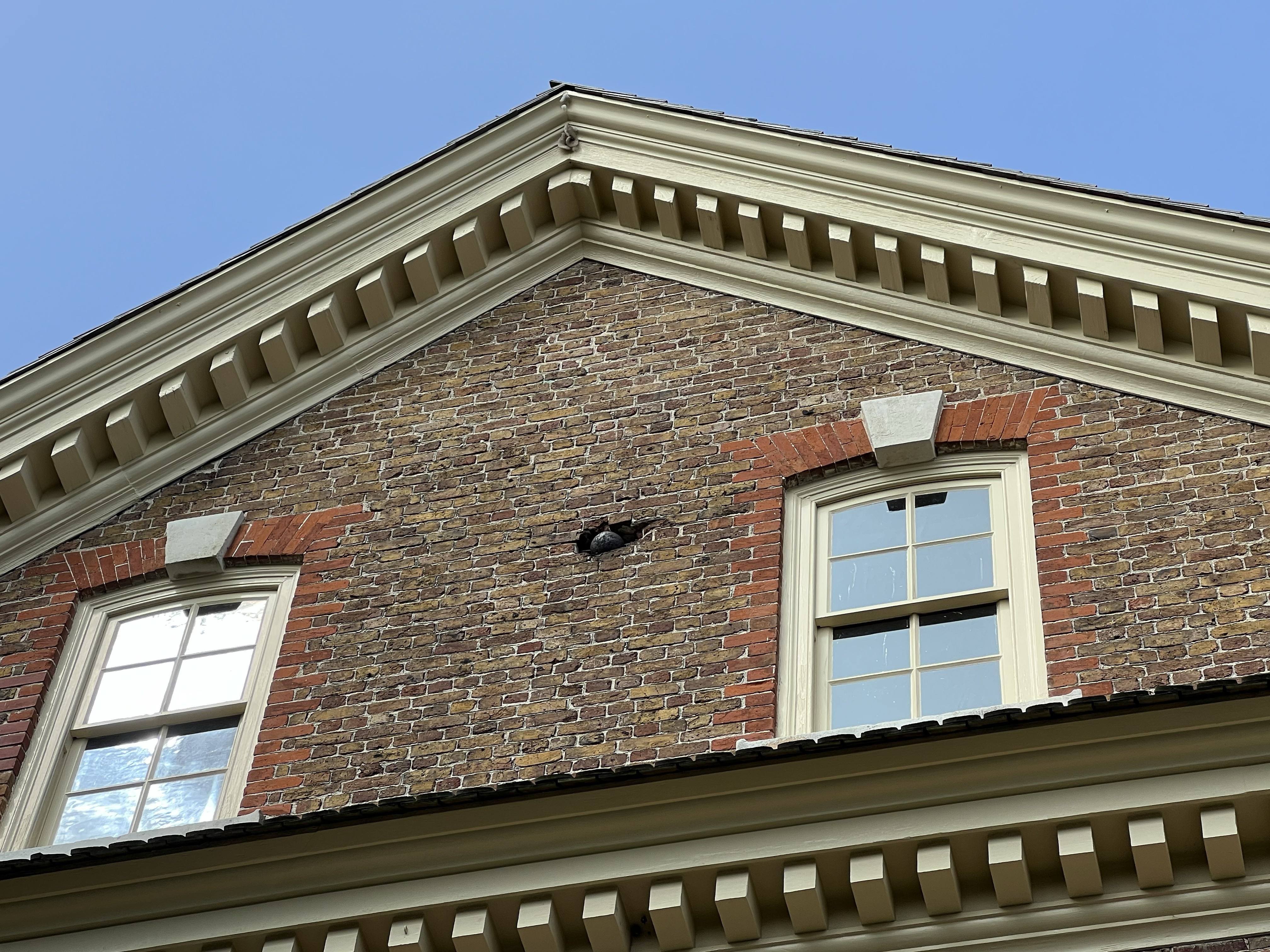
This is the Nelson House on Main Street. Thomas Nelson Jr. served in the Continental Congress and was a signer of the Declaration of Independence. His brick house now has two cannonballs embedded in the brick wall, signs of the fighting in Yorktown. This is the subject of my featured sketch.
Another cannonball embedded in the Nelson House. This one just missed and upstairs window.
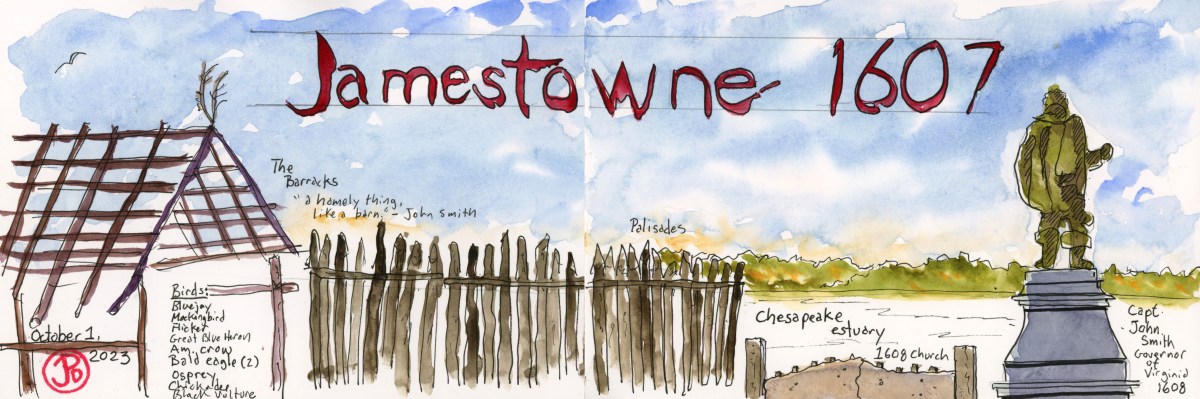
Jamestown, Virginia is the site of the first permanent British settlement in the New World and has been called “America’s Birthplace”.
So I figured this was a great place to start my Virginia rambles and sketches.
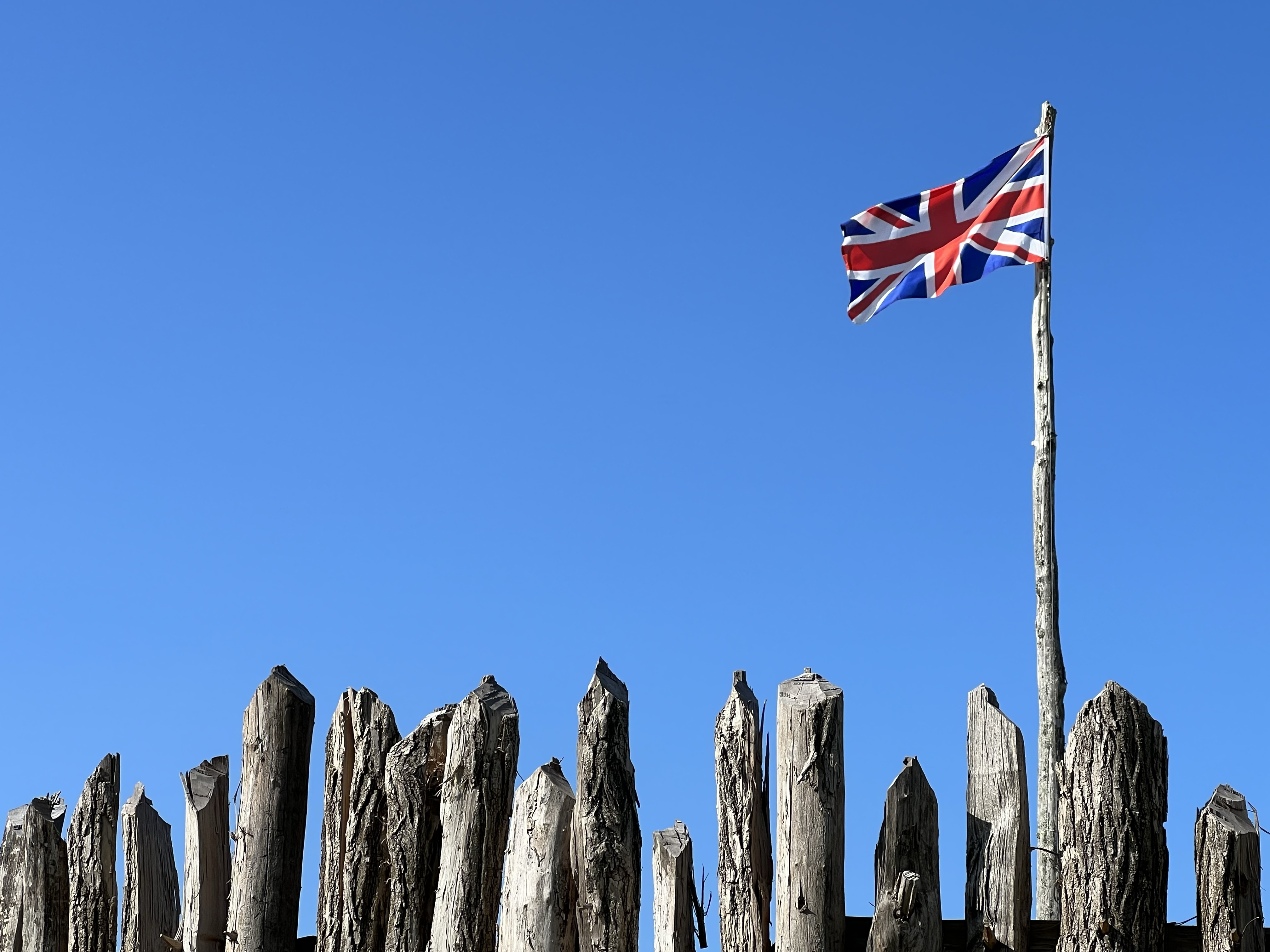
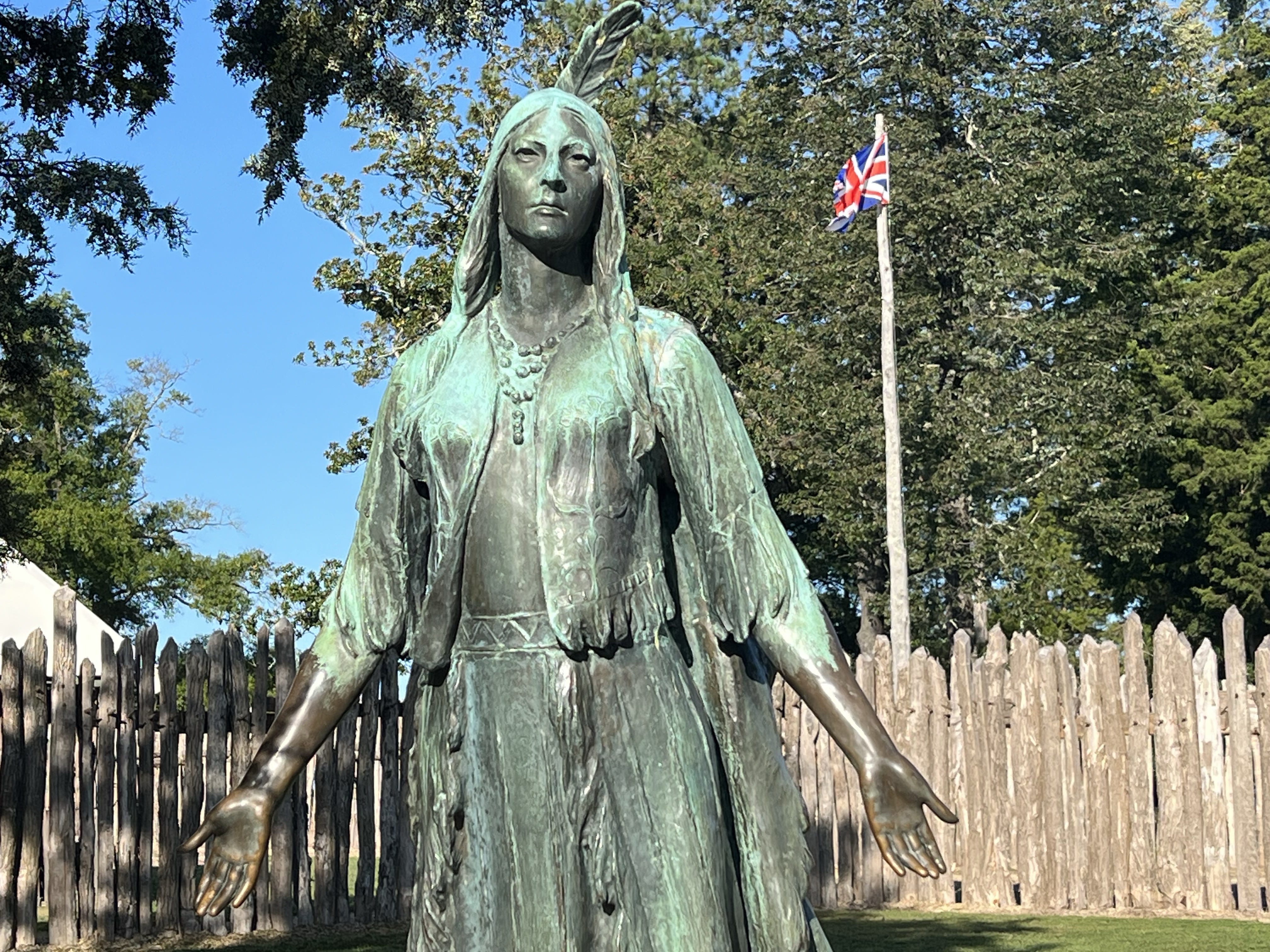
The Union Jack proudly waves over the fort at Jamestown.
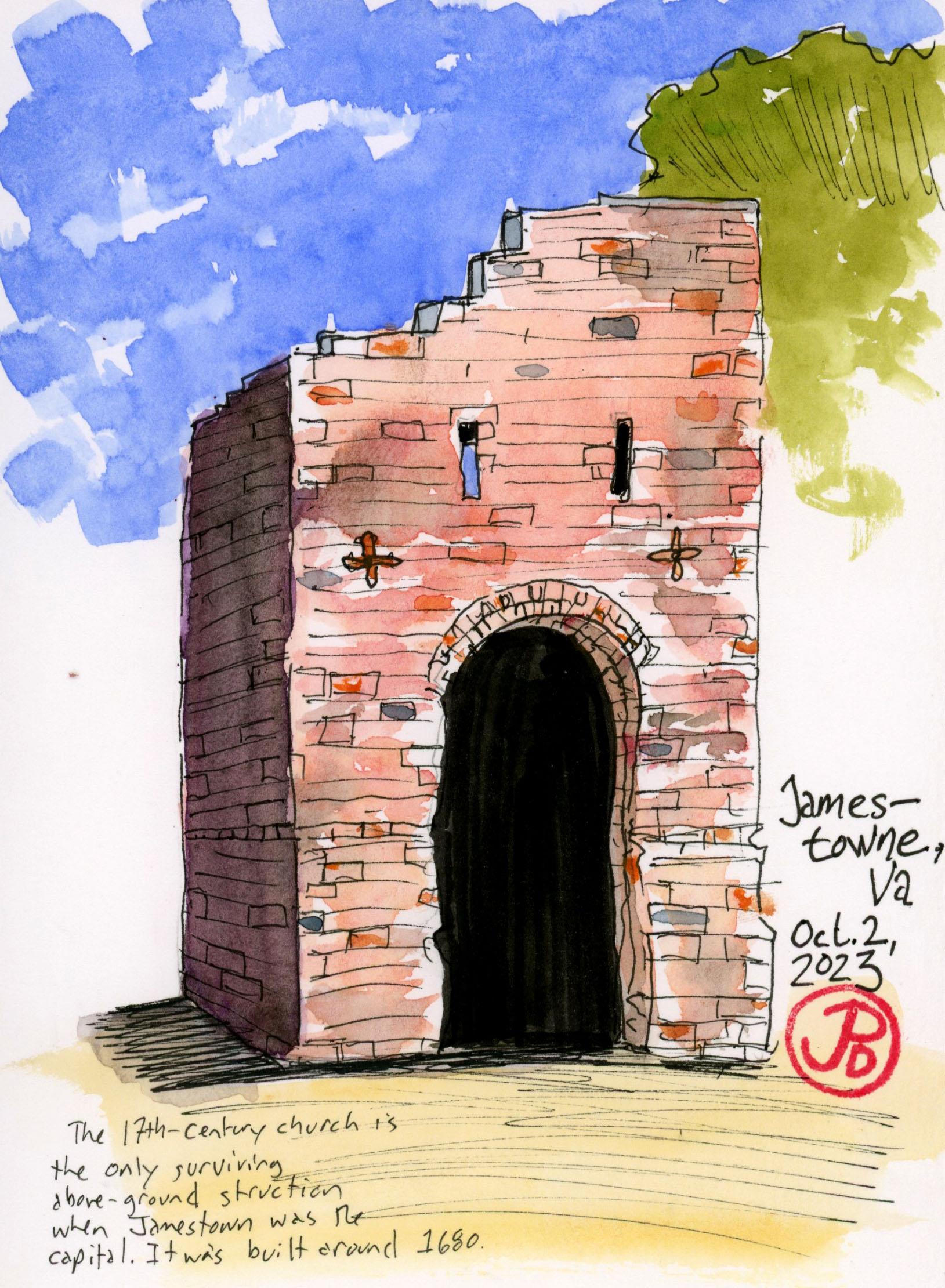
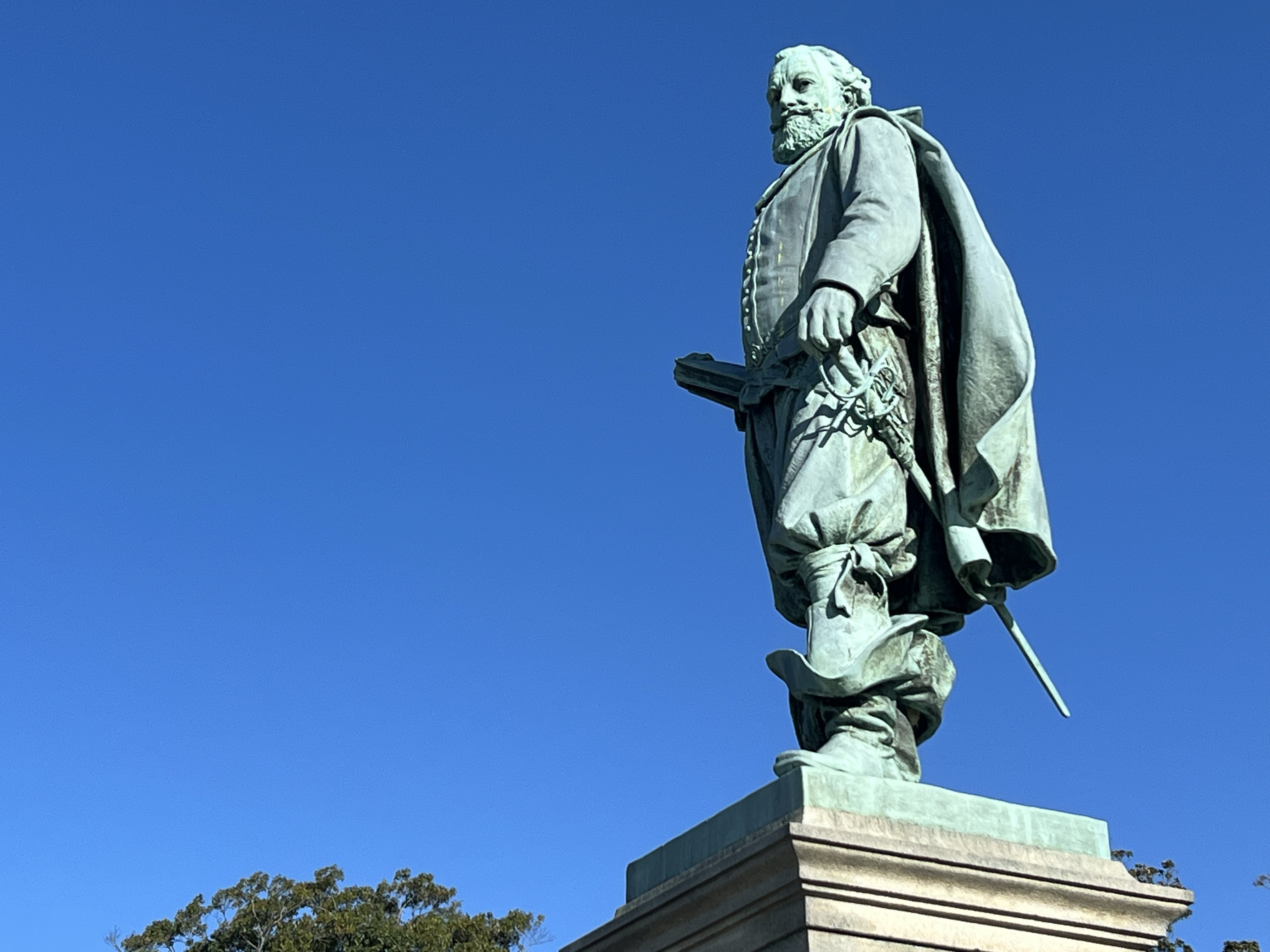
Jamestown is now more of an archeological site than a surviving settlement. There is not much that survived from 1607. There are statues, of Captain John Smith and Pocahontas (not together but separate statues), a monument that looks like a smaller version of the Washington Monument, and some reconstructed structures.
There is one structure that survives to this day of the period when Jamestown was the Capital of Virginia. It is the brick church tower. It was built around 1680 and it the most famous structure of Jamestown. So I had to sketch it of course!
The Jamestown Settlement faces the James River and the Chesapeake Estuary. It was also a great place for birds and I kicked myself for not bringing my binoculars but this was more of a historic and train trip rather than being a birding odyssey. A lone bald eagle climbed above the river and then sailed off to the north.
The Captain John Smith statue looking out to the James River. The beloved (but also hated) and much photographed statue of Pocahontas. Her story represents the good, the bad, and the ugly of the interactions of the native peoples and the English colonists.
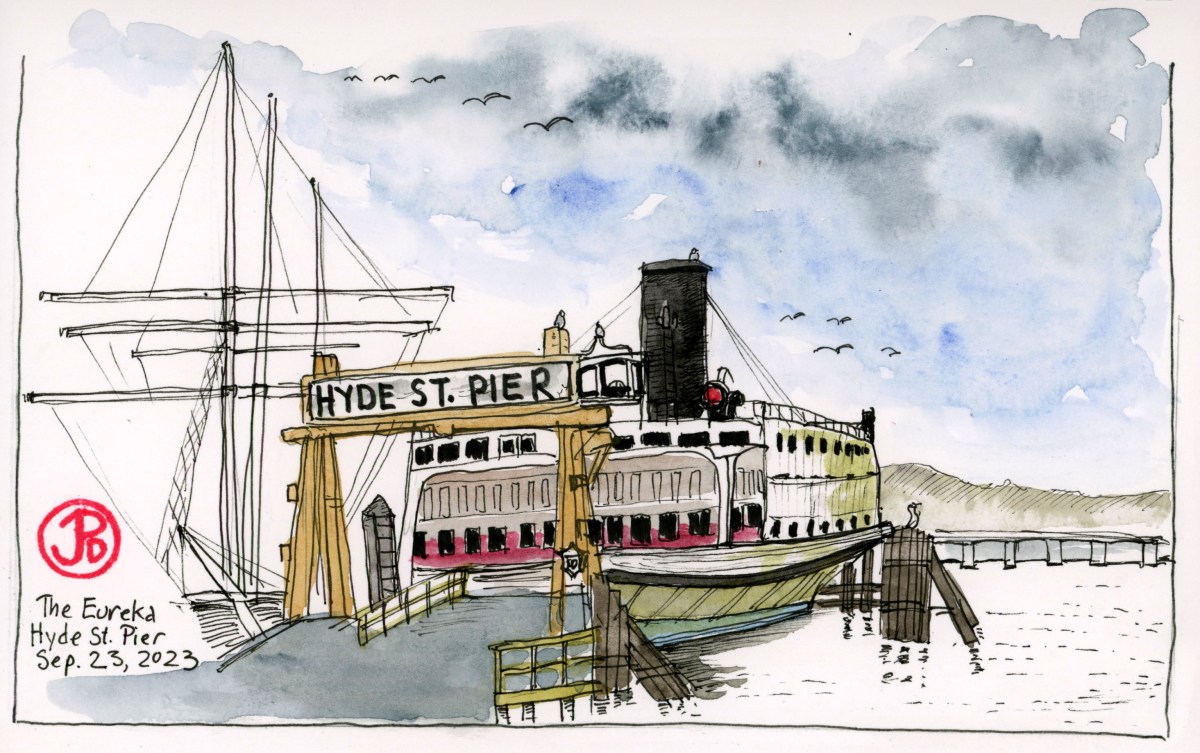
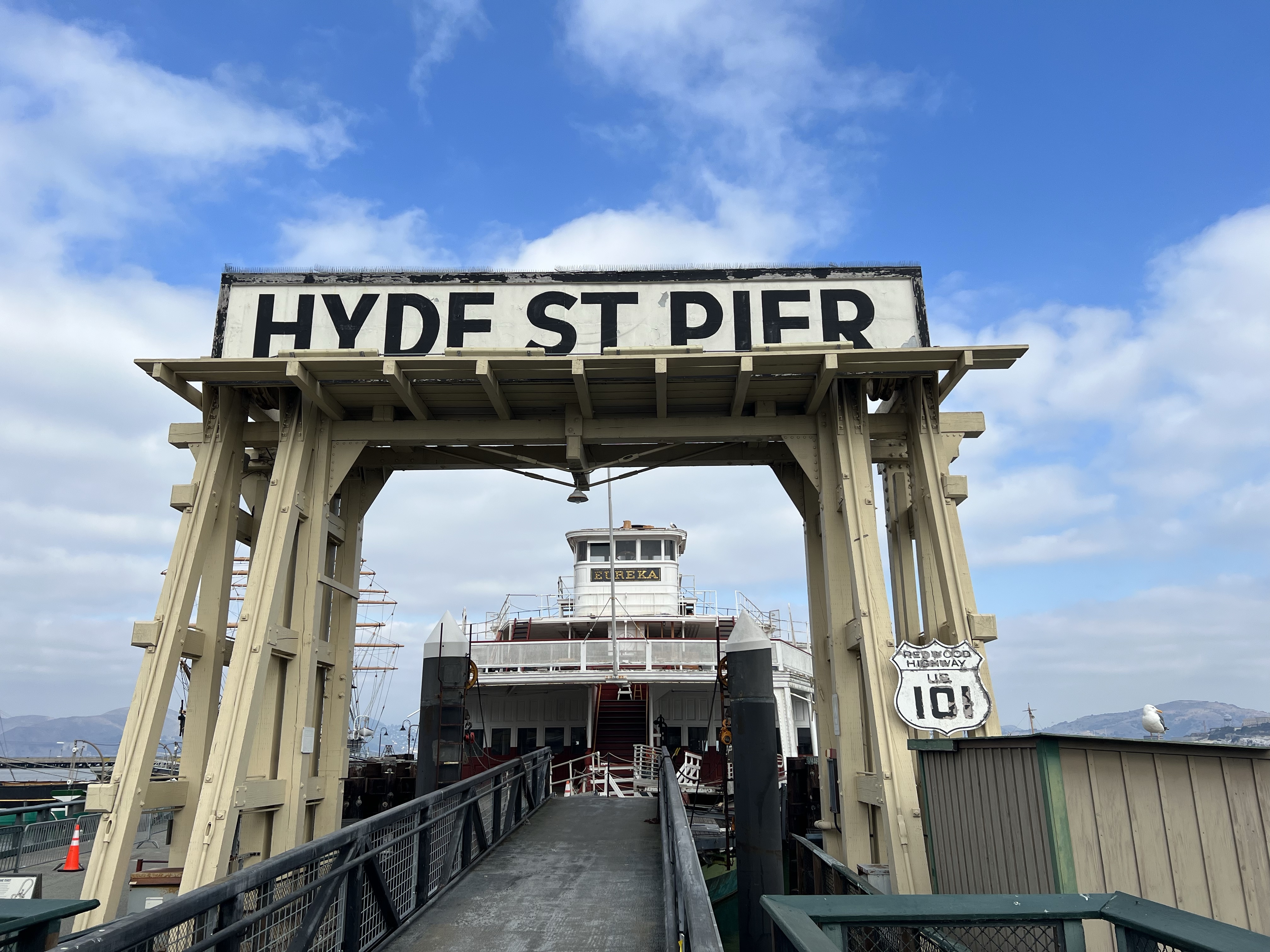
One of the ships docked at the Hyde Street Pier is the former Northwestern Pacific ferry boat Eureka.
In the era before bridges, (the Bay and Golden Gate), the only way to get from San Francisco to Marin or Oakland by rail, was by rail ferry.
The passenger cars would be boarded on the ferry and then, well, ferried, across the Golden Gate to Sausalito or Tiburon where they would be unloaded and continue north on the rails of Northwestern Pacific.
The ferry and the Hyde Street Pier was actually considered part of Highway 101.
The boat was built in 1890 in Tiburon by San Francisco and North Pacific Railroad Company and was originally named the Ukiah, which was as far north as the line reached. The Eureka is a double-ended, wooden hulled ferry-boat that was originally built to hold train cars. Two standard-gauge tracks where built into the main deck.
This 277 foot, 2,564 tonnage boat is the largest wooden-hulled boat afloat in the world.
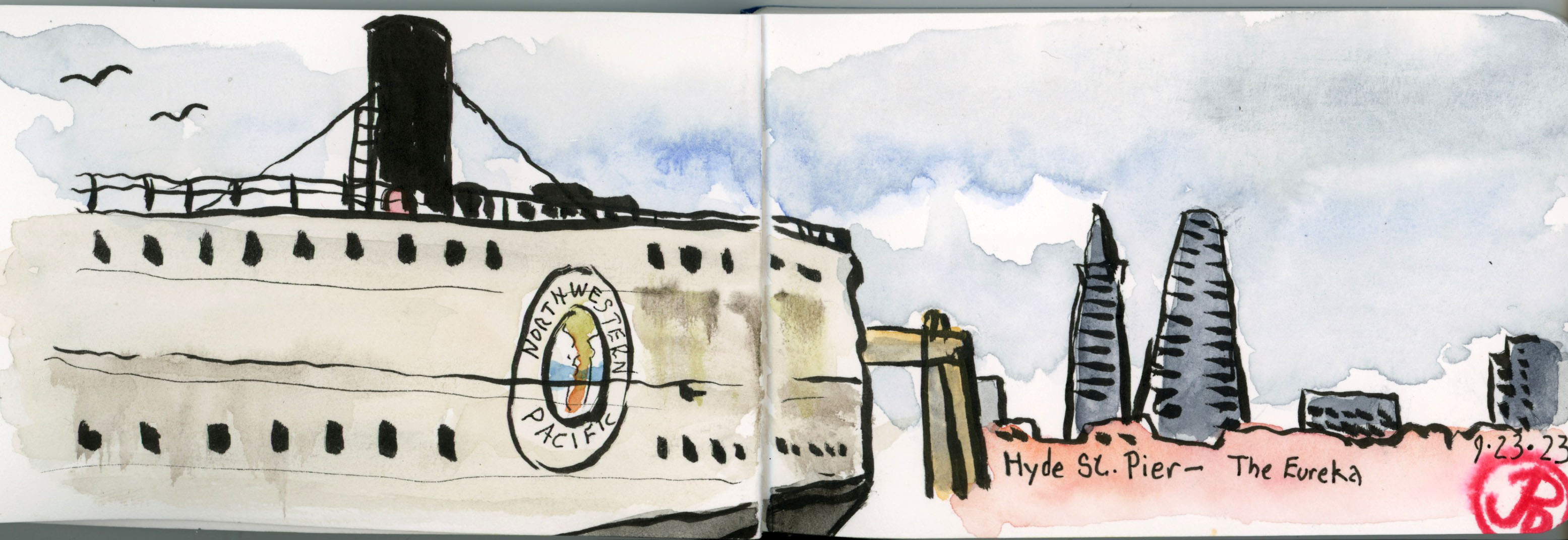
A pen brush field sketch of the Eureka, displaying the Northwestern Pacific circular logo, and the modern San Francisco skyline.
The Ukiah was initially in service to ferry people from San Francisco to Tiburon during the day and then carry freight cars during the night. In 1907 the Northwestern Pacific Railroad took ownership of the Ukiah and it was routed to the Marin port of Sausalito.
During World War I, the ferry was rebuilt and the refurbished ferry was renamed the Eureka, in honor to the northernmost station on the Northwestern Pacific Railroad.
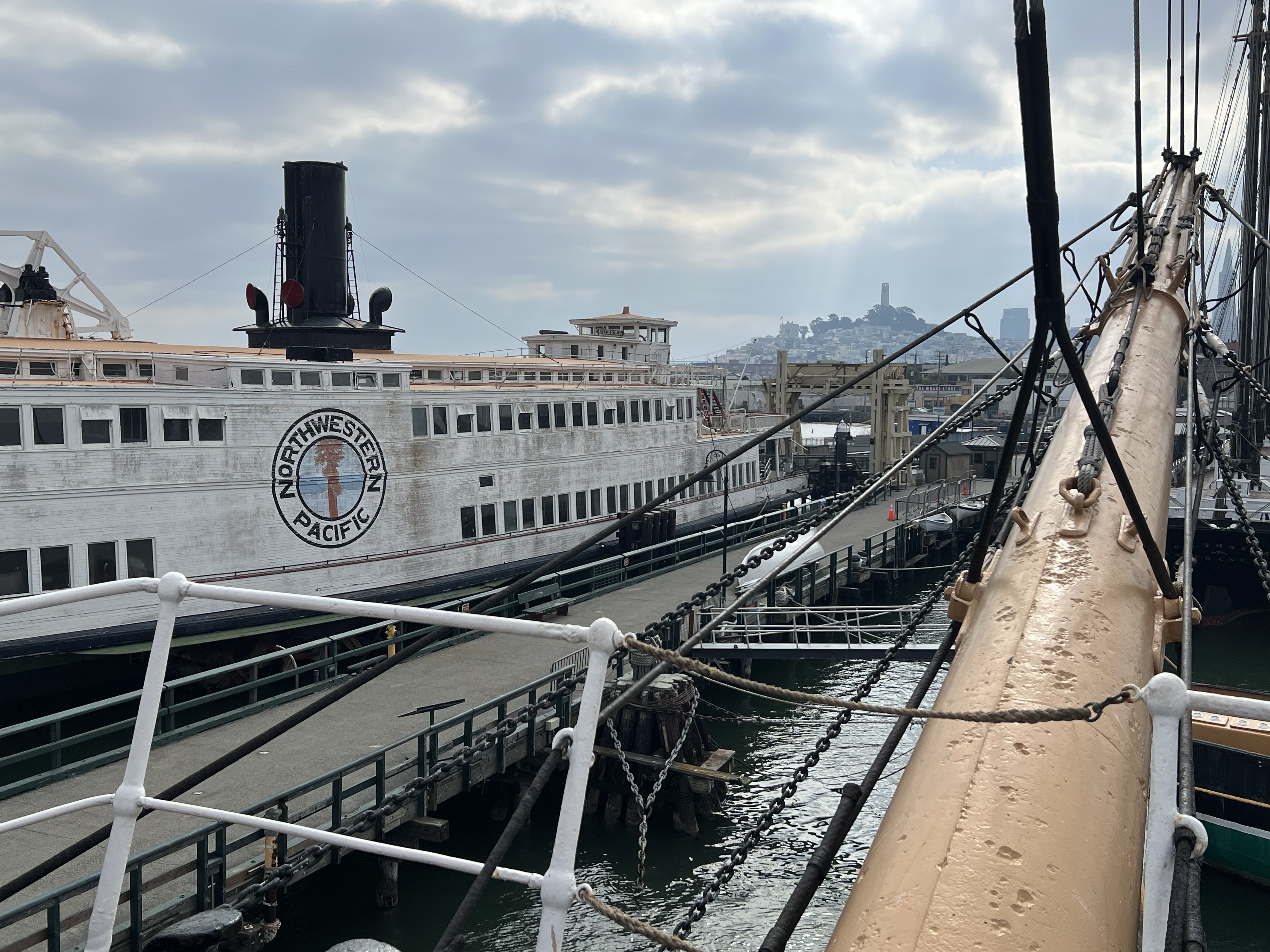
The Eureka from the bow of the Balclutha and Coit Tower echoing the steam stack of the Eureka.
The ferry was later used to ferry automobiles on her main deck and had a capacity of 2, 300 passengers and 120 cars. At this time, the Eureka was the largest and fastest double-ended passenger ferry in existence and because of this, the Eureka was called up for the busiest commuters times from Sausalito to San Francisco. Hyde Street pier was the primary auto terminal to connect San Francisco to points north and east.
When the Golden Gate Bridge was completed in 1937, ferry service passengers dried up and Northwestern Pacific abandoned all ferry service in 1941.
The Eureka found a new life in the 1950s with a new owner, the mighty Southern Pacific. The Eureka now linked passengers on SP’s overland service from Oakland to San Francisco.
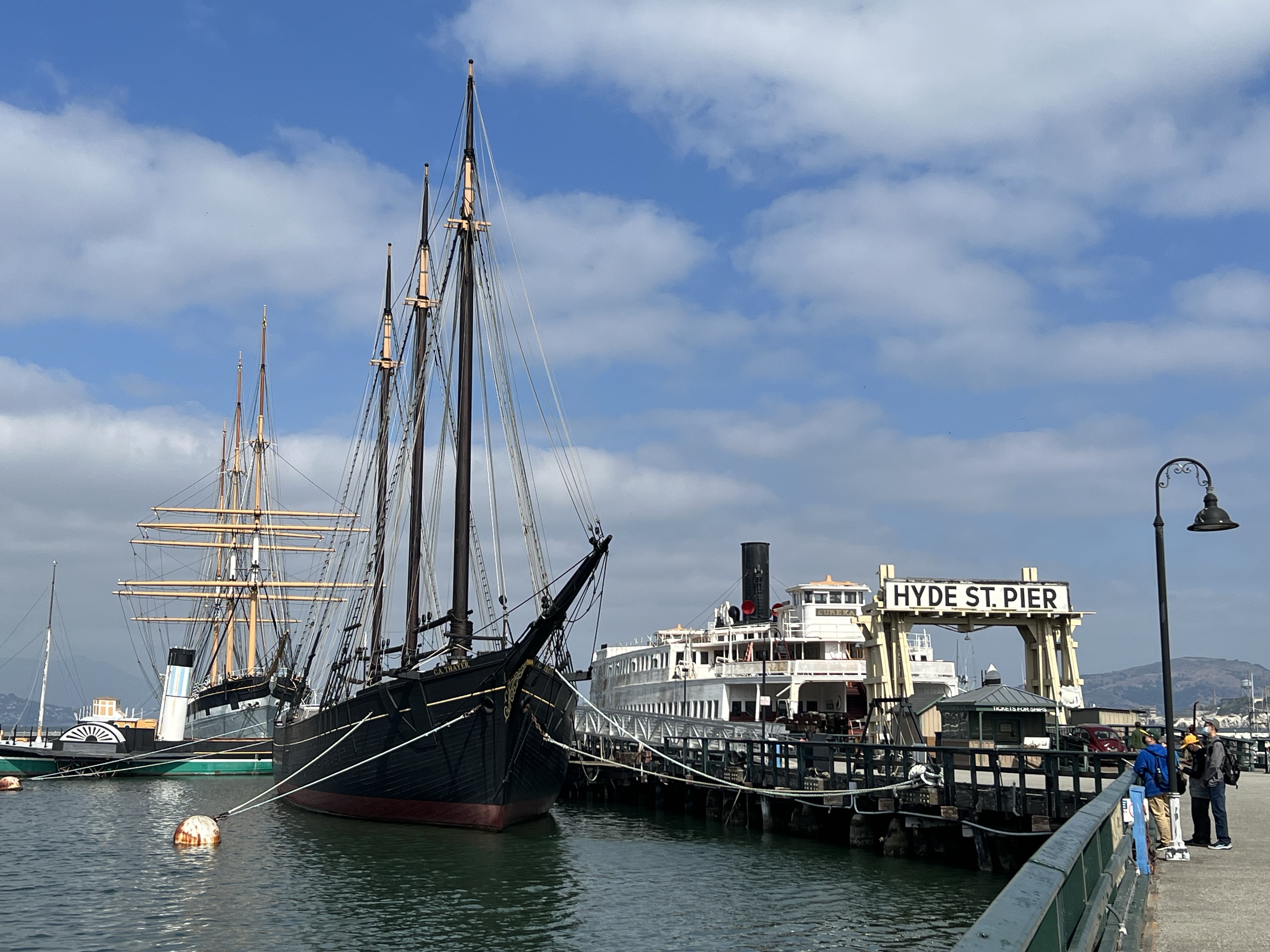
Today the Eureka is docked with the C. A. Thayer (foreground), the Eppleton Hall, and the Balclutha (background).
I got to the California State Railroad Museum in Sacramento a little early so I walked over to sketch the replica of the Central Pacific passenger depot. (The former stations had burned down.)
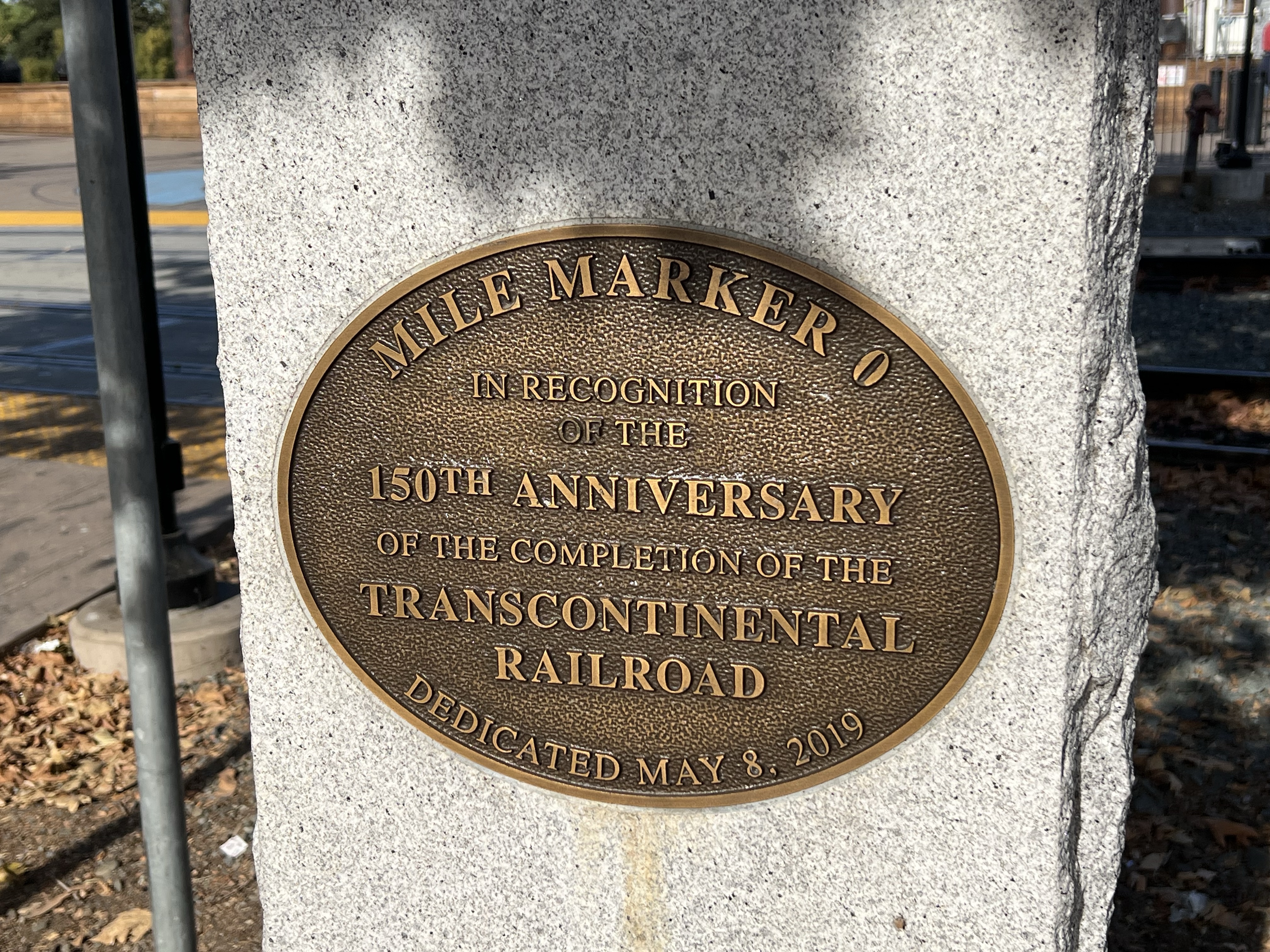
This station is at ground zero from where Central Pacific started the Transcontinental Railroad. Mile Marker 0 was a hundred feet behind me as I sketched.
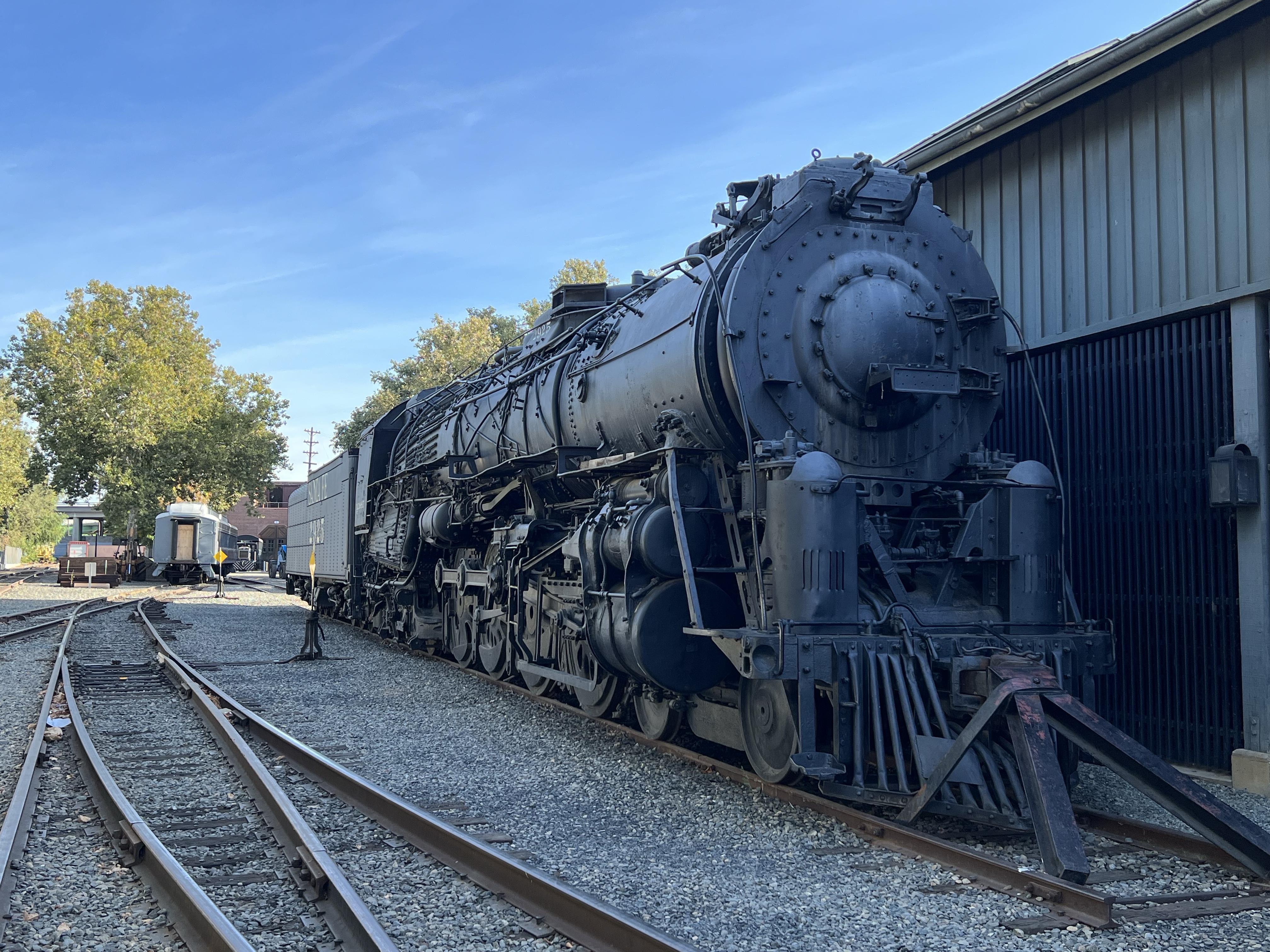
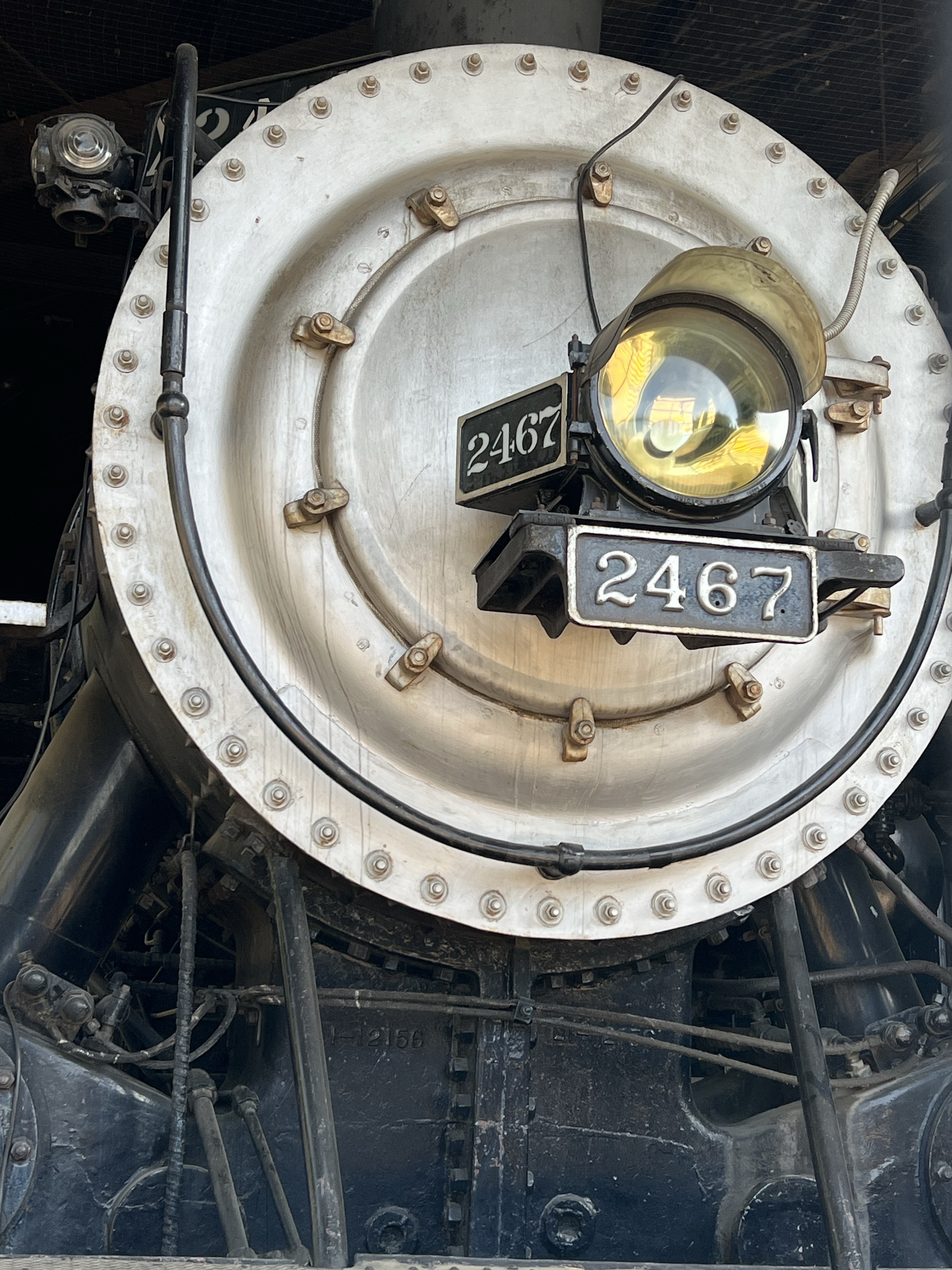
I walked around the depot and looked at two amazing Santa Fe steam locomotives that where sitting on sidings in static display. Both of them had come from New Mexico and both where not in great shape, needing some cosmetic restoration.
Santa Fe No. 2925 is a 4-8-4 passenger locomotive. This is one of the heaviest 4-8-4 Northerns ever built. Today only five of the 30 produced survive. SP No. 2467 is a 4-6-2 Pacific type build in 1921. She pulled passenger trains and was retired in 1956. The locomotive was restored to working order in the 1990s and is still operational.
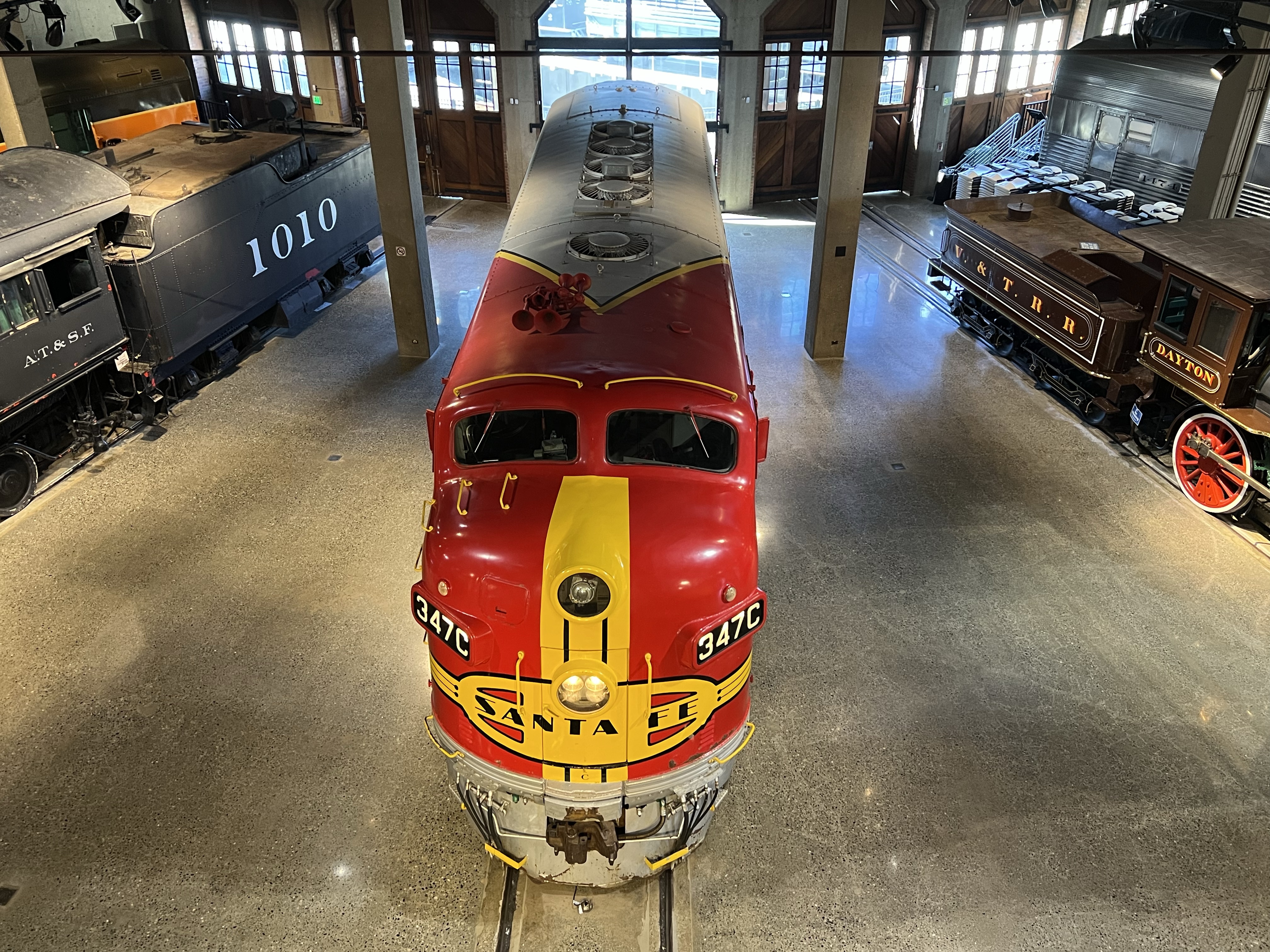
Once in the museum, one locomotive on my sketch list was an EMD diesel-electric F7 painted in the iconic Santa Fe Warbonnet livery.
When I was a child my dad used to take me to the tracks to see passing passenger trains. And one Christmas he got me my first HO train and it was a smaller version of the classic Santa Fe passenger locomotive.
This paint scheme is so famous that if you Google EMD F7, a picture of the Warbonnet F7 comes up.
The iconic Santa Fe units where on point of the 2,227 mile route from Chicago to Los Angeles called the Super Chief. This was one of the first all streamlined diesel cross country route.
Today the only way to get from Los Gatos to Santa Cruz is to drive over Highway 17. You can no longer take a passenger train. The last train ran in 1940.
On the other side of the Santa Cruz Mountains, you can board a train at the Santa Cruz Beach and Boardwalk and it will take you 6.8 miles north into the mountains to the town of Felton.
Detraining here you follow the line past the train shed and machine shop of the Roaring Camp and Big Trees Railroad and the old passenger and freight depot and then you cross Graham Hill Road and walk north on the rails toward Zayante, using the rusty rails as a guide.
The line begins to parallel Zayante Creek. The road builders used the watersheds of the Santa Cruz Mountains as a route to work up and down the summit. A good part of the Santa Cruz to Felton route parallels Santa Cruz County’s largest river, the San Lorenzo.
After a few miles you eventually come to a siding, this is the former stop of Eccles near Olympia Station Road. This was a flag stop as far back as 1901. There was once a passenger shelter (1913) and a freight platform.
The main line and siding at Eccles. The 310 foot siding was probably used to store lumber cars.
The station sign remained in place until 1942, when the station was decommissioned following the abandonment of the the railroad.
After World War II, passenger service was not resumed and the station shelter was torn down. The Eccles sign was saved and was on display at the Santa Cruz Museum of Art and History in downtown Santa Cruz.
Here’s where the Eccles station sign used to be at the Santa Cruz Museum of Art and History. It’s gone, like the rails that once reached over the Santa Cruz Mountains.
One a recent visit to the museum the sign was no longer on display.
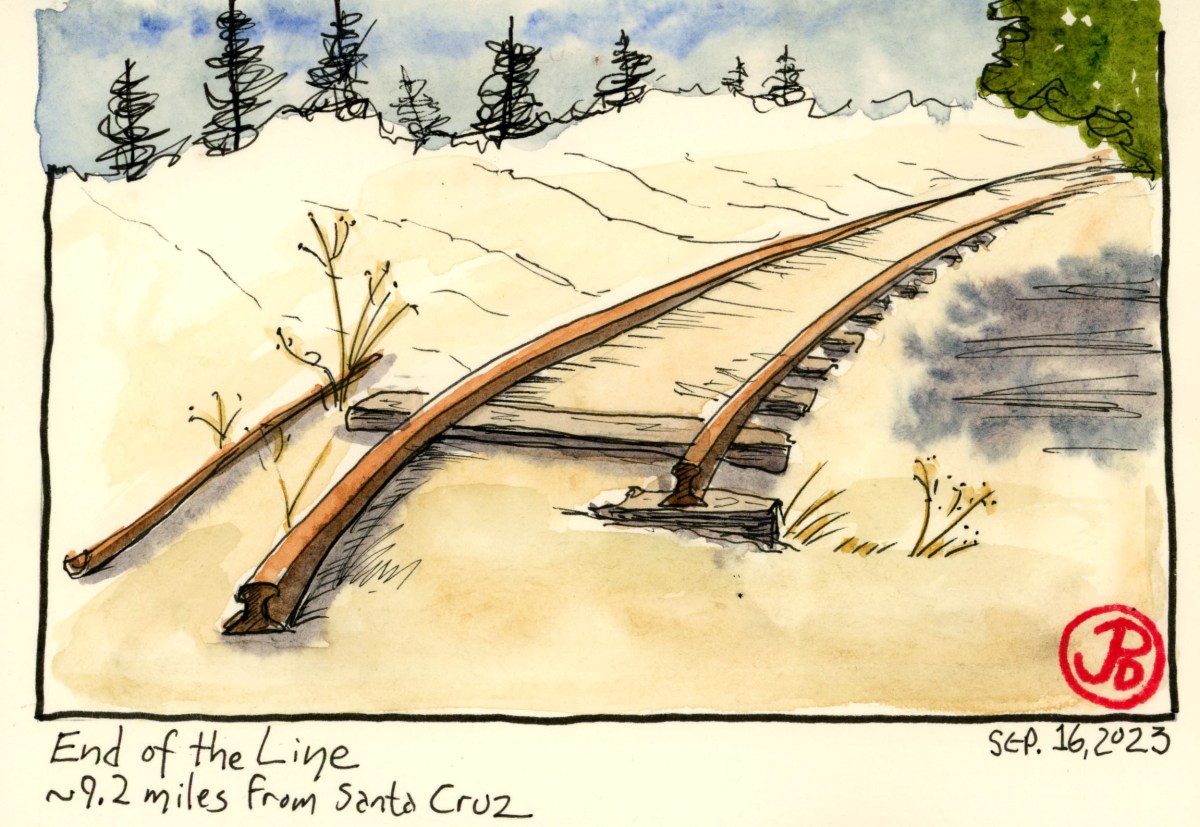
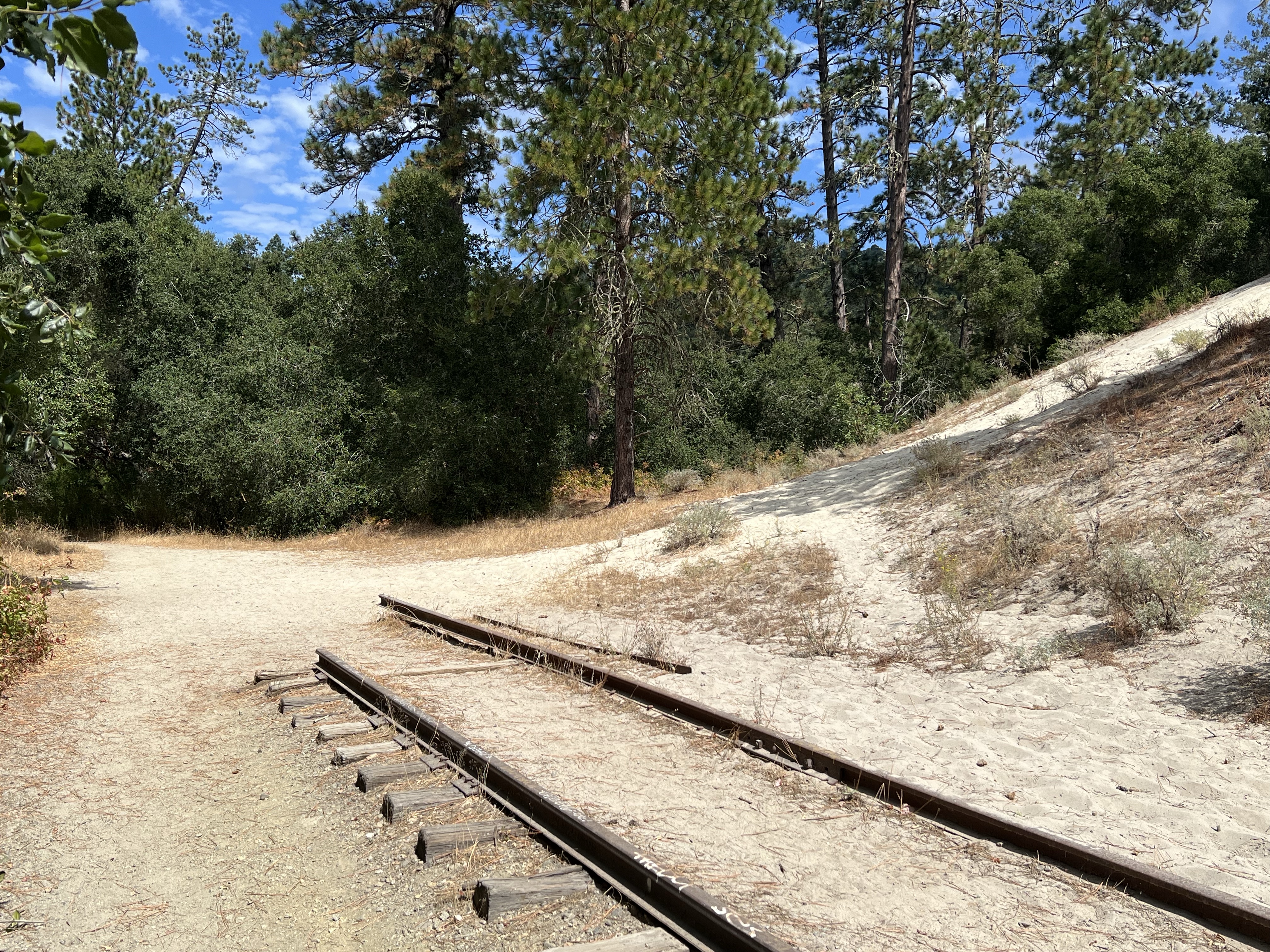
I continued north as the siding rejoined the mainline. And after about a five minute walk, the tracks end without much ceremony. There is no bumper stop to mark the end. And one tail is longer than it’s mate, 4 feet and 8 1/2 inches away.
This is the end of the line and as far north as the tracks go.
He grew up as an only child in San Fransisco in an era when most people got around the city in street cars (or trams as they are called in Britain). He would ride them as a child getting to know the motormen (who where mostly Irish). Once they were beyond the last houses and running out into the sand dunes that would later become the Sunset District, the motormen would let my father take the controls as the motorman ate his lunch. Such a scene seems so unthinkable now!
We were down sketching at Hyde Street Pier and I wanted to show Grasshopper Sparrow some of the vintage streetcars that were running along the Embarcadero.
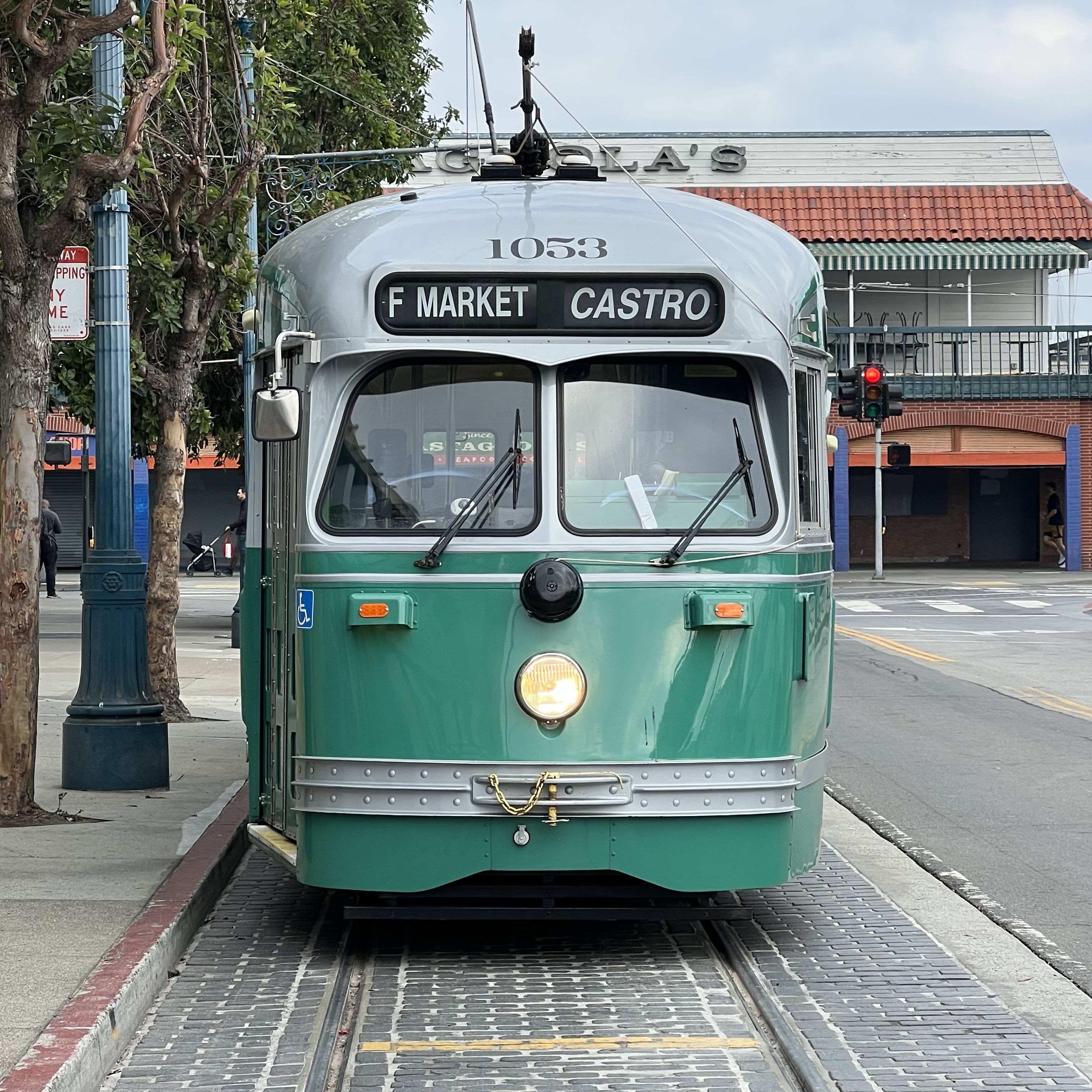
The most common vintage car seen on the F Market Line is a PCC (President’s Conference Committee) car. In this case No. 1053, painted in Brooklyn, New York livery, was built in 1947. MUNI has a fleet of 32 PCC cars.
This weekend was extra special because it was Muni Heritage Weekend and Market Street Railway was bring out some of the vintage cars like San Francisco Municipal Railway’s No. 1, built in 1912.
The one car that I wanted to show Grasshopper was an open-air car from the coastal resort town of Blackpool, England that I read was going to operating this weekend. This car is so unusual and rarely out on the line because it takes a crew of two to operate and has a lower passenger capacity that your normal PCC car. This is the Blackpool boat tram! I remember riding this car in the mid-1980s with my father.
This red and cream boat on wheels announces it’s presence with a nautical air whistle. These novelty cars where built in 1934 and out of the twelve cars in existence, MUNI owns two.
My plan was to drive along the Embarcadero from it’s intersection with Grant Avenue to the Ferry Building in search of the boat. It turns out that we didn’t have to search very hard. The Blackpool boat was at the turn around at Jones and Beach Streets.
So the chase was on! We easily passed the boat and pulled far enough ahead and pulled over just past Bay Street to get a photo run by.
Blackpool’s boat tram is a real head turner. The destination sign reads “NOWHERE IN PARTICULAR”. Here No. 228 heads on the rail right-of-way on Embarcadero towards the Ferry Building and the San Francisco Railway Museum.
We then drove on to the heart of the Heritage Weekend at the San Francisco Railway Museum near the beginning of Market Street and the Embarcadero.
We were able to get a parking spot on Mission and walked over past some vintage buses painted in the famous green and cream livery of MUNI. Shortly after our arrival, the boat pulled in front of the museum and I started a quick field sketch (featured sketch) before it loaded up and left. I finished the sketch with help from one of my photos.
The area around the museum had a carnival feel to it. Many people were out to see and ride these vintage buses and street cars. The museum was selling used rail books outside. I foraged through the titles, many of which my father owned. Perhaps some of these were his books; we ended up donating hundreds of my father’s books when he moved out of his home (my childhood home).
I selected a few titles about mainline steam engines and a book about the streamlined passenger train era. I took Grasshopper into the museum and pointed out a vintage streetcar roller sign that was displayed on the wall, which my father had donated to the museum from his collection of San Francisco street car artifacts.
The roller sign was procured from a streetcar near Fulton at a place called, the Boneyard. Nowadays we would call this “trespassing” and “stealing”. But because of this “stealing” and a railfans’s passion, this bit of San Francisco rail history is preserved and is now on display for all to see.
I talked to the manager of the museum and told her that my dad had donated the sign and he was also pictured in one of the displays. She of course knew my dad and was excited to meet me and noted that I looked just like my father ( but with more hair). This is always nice to hear!
She told me that my father had an interest in streetcars from an early age and he was not allowed to join the local rail society because he was too young so he formed his own youth group with his friends.
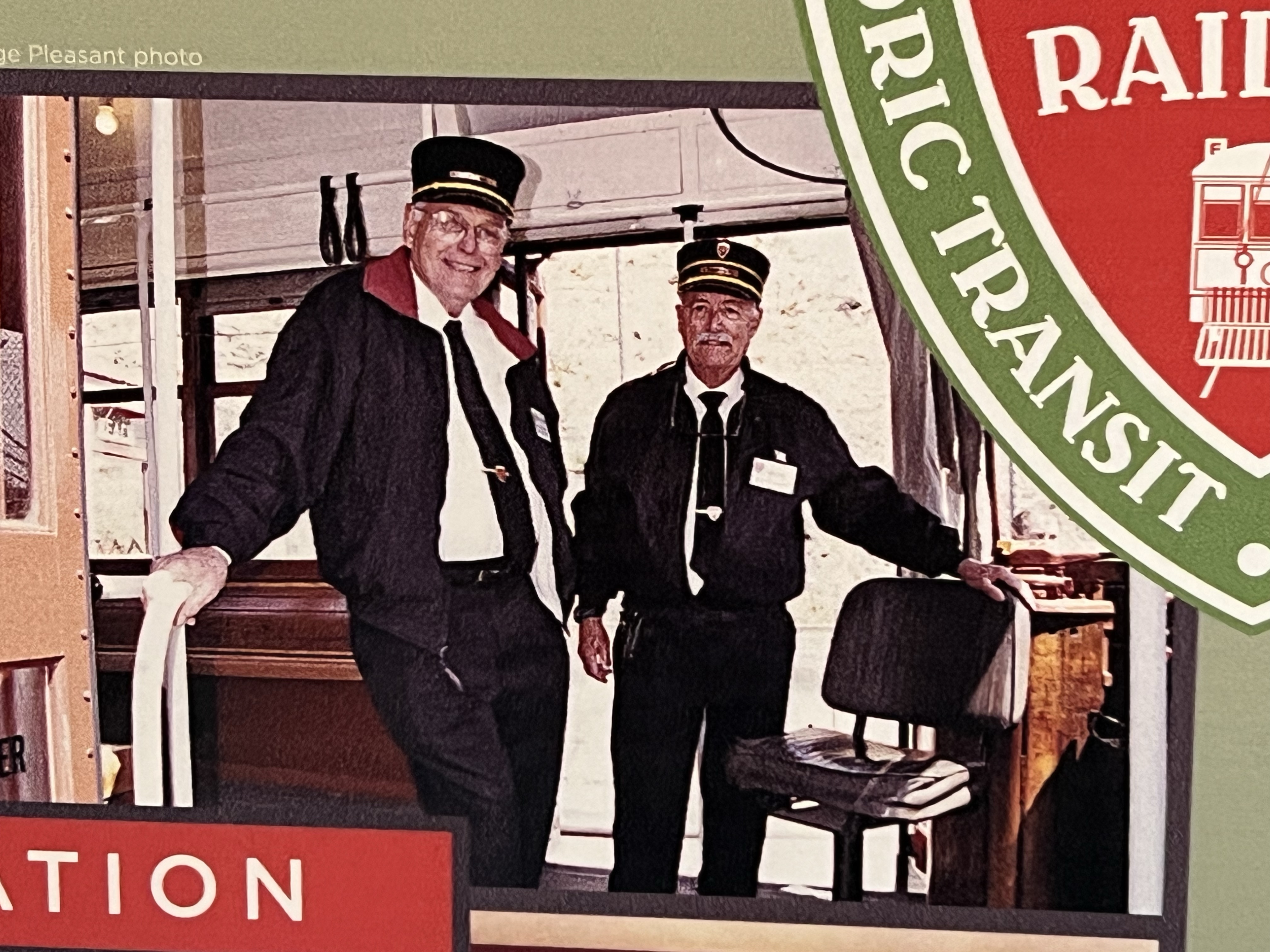
The picture of my dad at the museum is of him in later life aboard a streetcar. He is dressed up his motorman outfit. Standing to his right is his friend Walt, one of his lifelong friends he formed the youth rail group with. He must have been volunteering for some excursion. My dad is looking dapper in his black tie and Market Street Railway motorman’s cap (which I now have).
My 600th post is dedicated to my father, John E. Perry Jr. He introduced me to streetcars and trains, history and travel, and that a good life is well learned. His greatest complement of my sketching: that I drew a nice straight line.
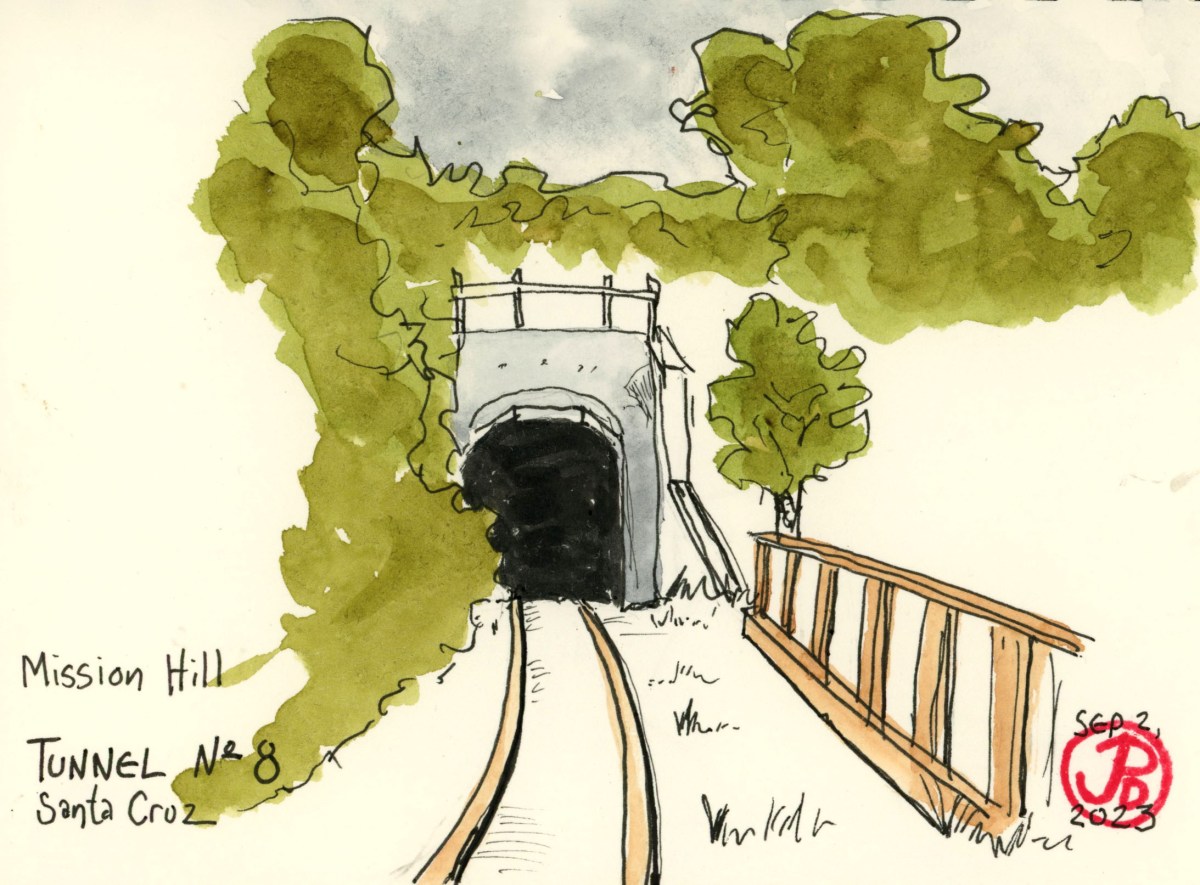
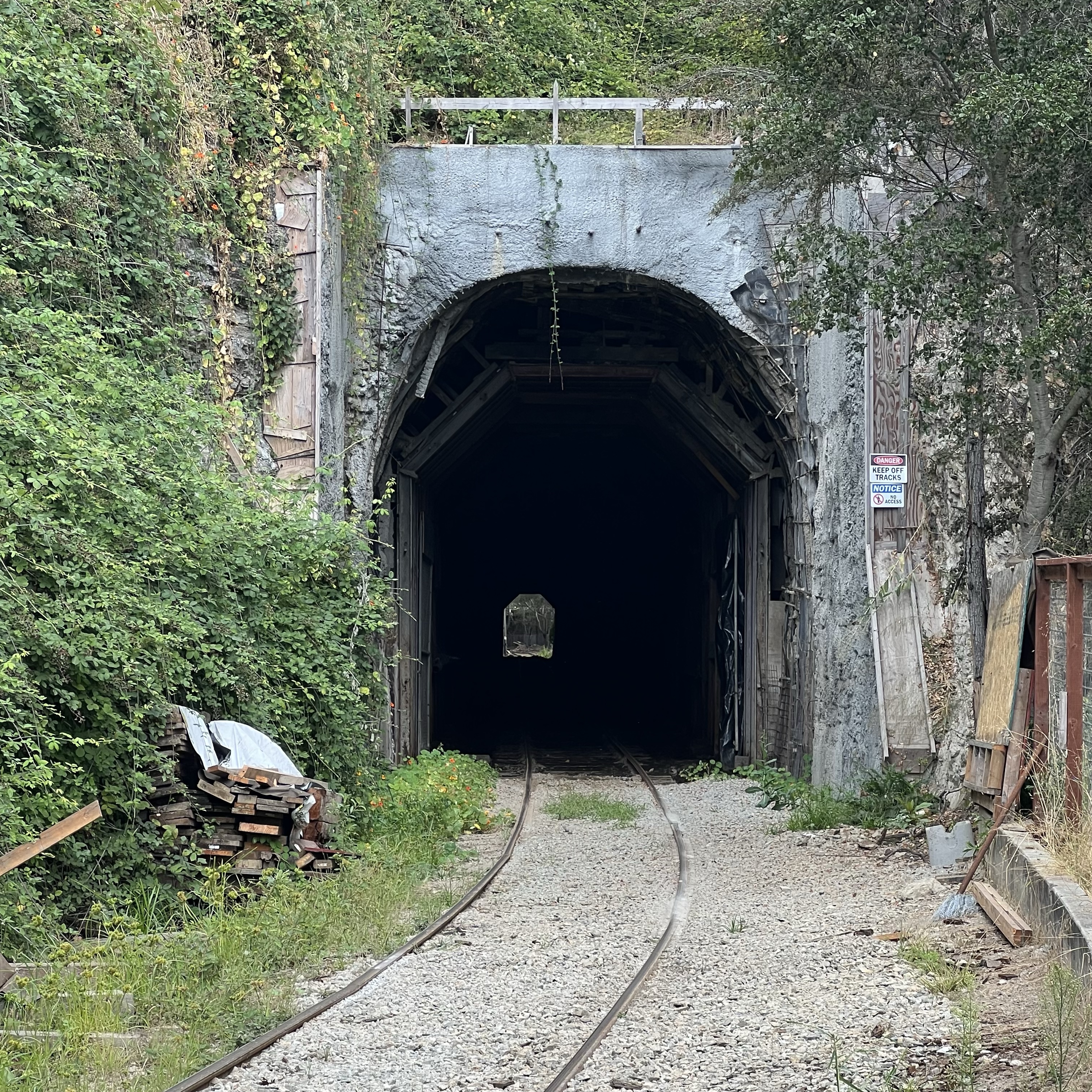
Of all the tunnels on the former South Pacific Coast Railroad there is only one that is still in use for it’s intended purpose. That is Tunnel No. 8, the Mission Hill Tunnel.
This tunnel takes the line through Mission Hill because the town of Santa Cruz did not want the railroad to run through downtown. So they had to bore through the sandstone of Mission Hill. This meant the tunnel was prone to caving in so it was reinforced with internal redwood beams.
The tunnel is built under the Mission Santa Cruz Cemetery and in the early days, steam locomotives passing though would rattle and shake up the earth and occasionally a bone or two would fall onto the line leaving a macabre find for rail crews.
In 1985 the Southern Pacific line was purchased by Norman Clark, owner of the Roaring Camp & Big Trees Narrow Gauge Railroad, and passenger service was revived from Felton to Santa Cruz, a round trip of 16 miles.
The Big Trees & Pacific coming off of Chestnut Street in Santa Cruz on it’s return to Felton. The railroad has some of the most street running rail of any tourist railway. The train is pulling into the right of way heading towards Tunnel No. 8. The train disappearing into Tunnel No. 8 on its way to Felton.
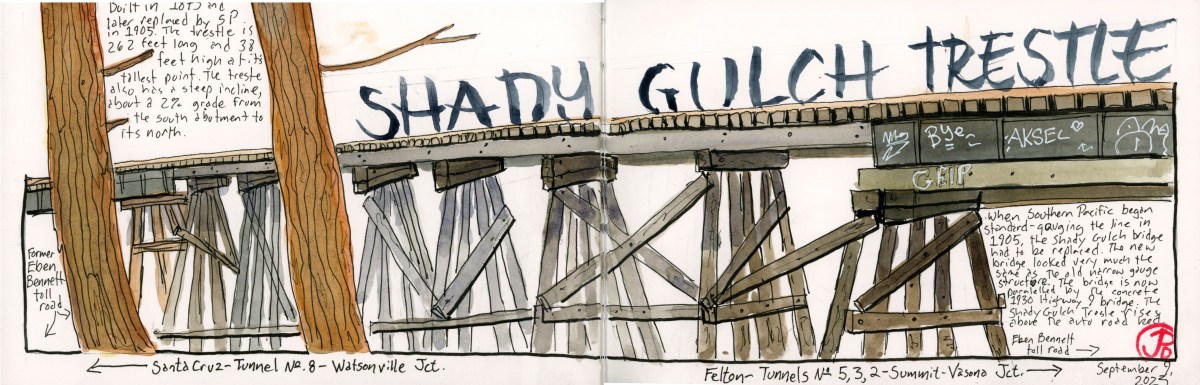
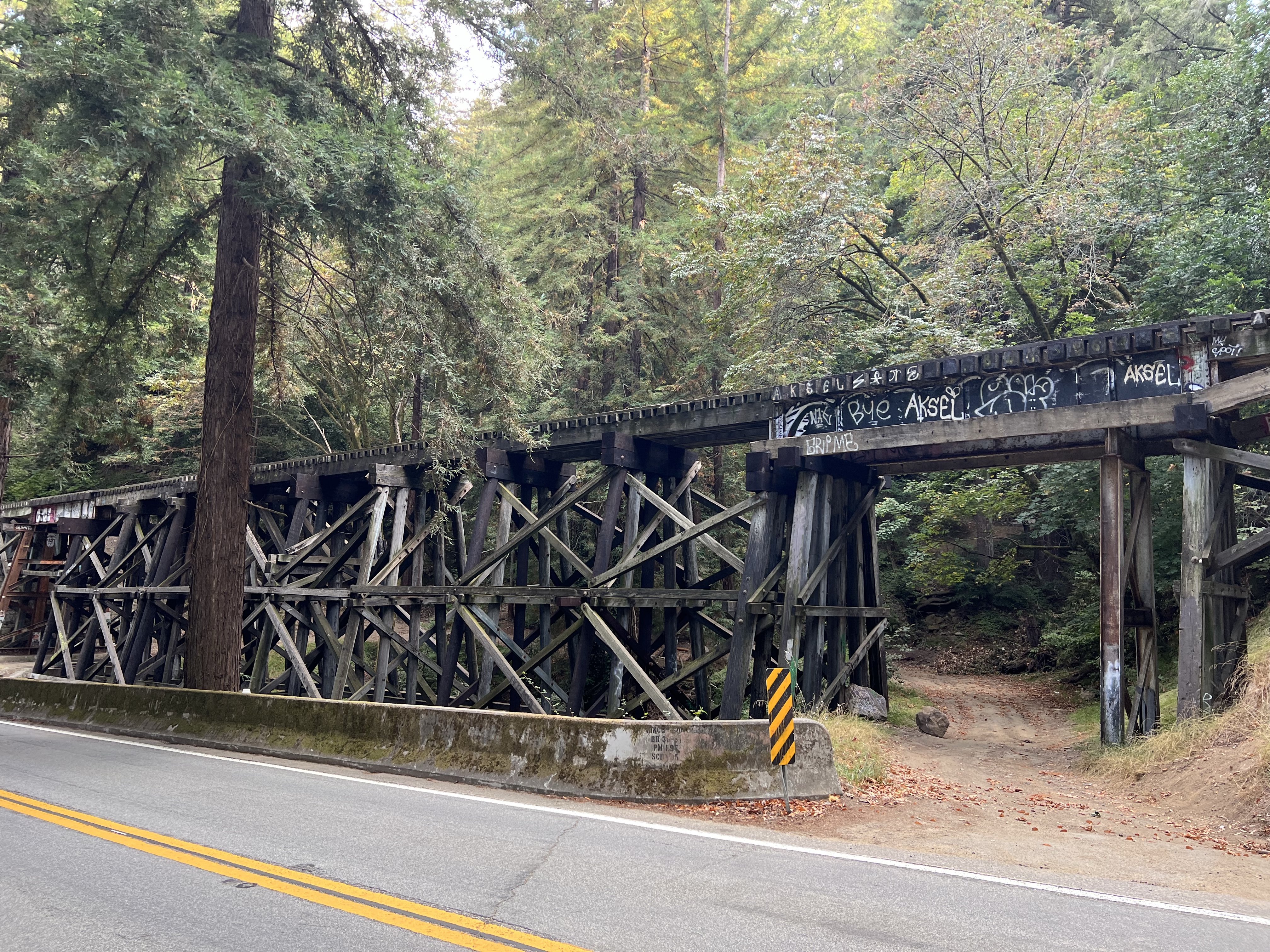
Just up the creek from my cabin is one of the remaining wooden trestles on the former South Pacific Coast Railroad (in 1887 the railroad became Southern Pacific). This is the Shady Gulch Trestle.
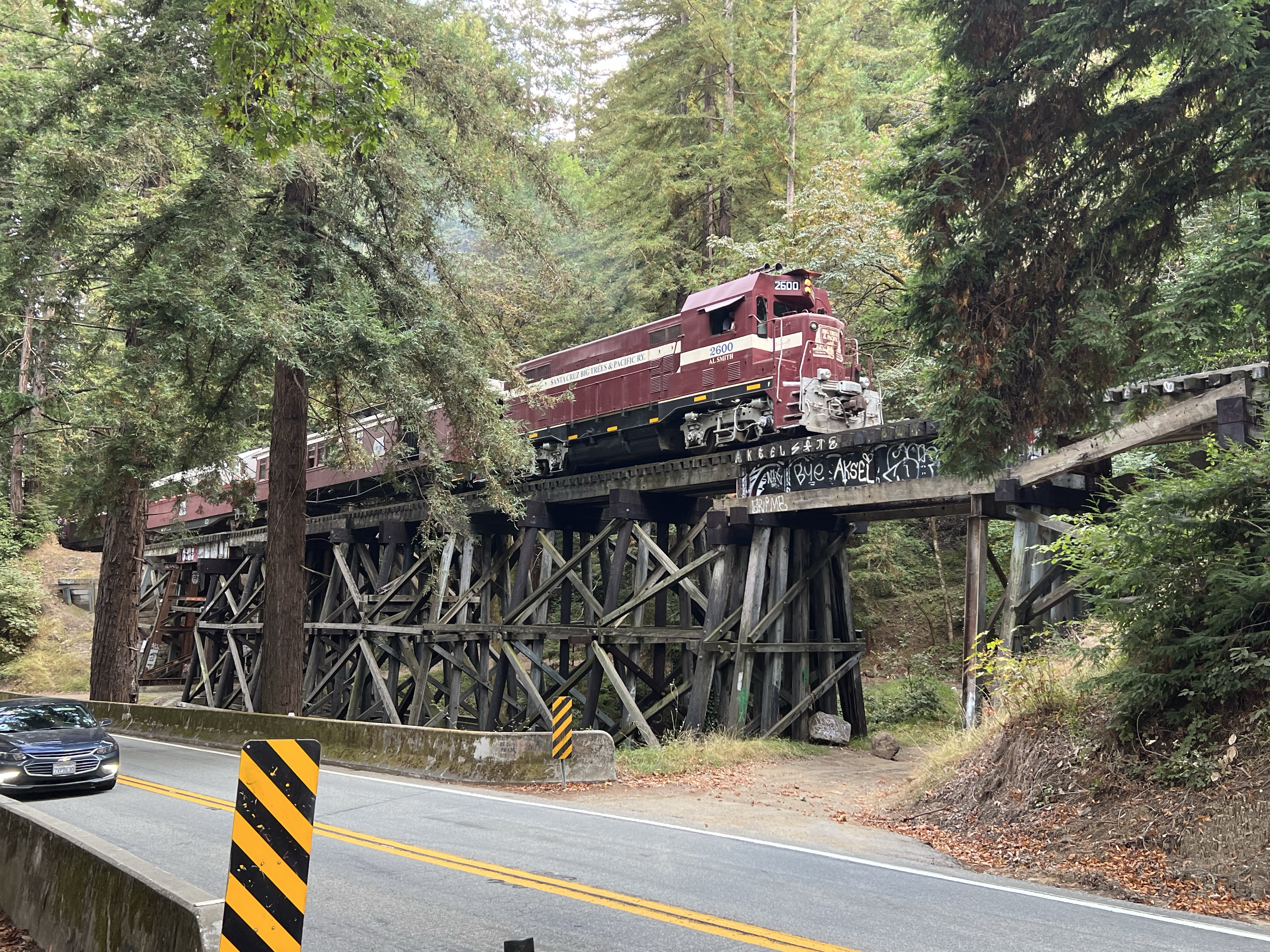
Not only does this trestle still exist but is still used for rail service on the Big Trees and Pacific Railway.
Shady Gulch Trestle with the Highway 9 concrete bridge (1930) in the foreground. The dirt road to the right is the former Eben Bennett toll road. The concrete highway bridge replaced the toll road.
The original trestle was built in 1875 to span Shady Gulch. At the time, the line was built for the narrow gauge South Pacific Coast Railroad. When Southern Pacific acquired the line they rebuilt the trestle in 1905 to accommodate standard gauge.
The trestle of today very much looks like the original narrow gauge trestle of the late 19th century, sans graffiti of course.
The afternoon Felton-bound Big Trees and Pacific crossing the Shady Gulch Trestle. This tourist train tends to stop traffic on Highway 9.
My father spend his childhood summers in the cabin in the 1930, 40s, and 50s. He would tell me of the time a freight would be climbing the grade on the trestle on their way to Felton on a foggy summer’s morning. The wet track would cause the locomotive’s driving wheels to slip. And after many slips and the hyperbolic “chuff-chuff-chuff” of the stream exhaust, the train would back down the grade, sanding the track as they reversed. The freight would make another attempt, this time slowly with the sanded rails helping the drivers grip the steel. And off they went to Felton.
There is a single one car pull off on the north side of the highway bridge. I made three attempts to sketch the trestle but was foiled by a camper van that was camped out in the spot.
Was this guy going to spend the night here? On my third attempt of the day, in late afternoon, the van was finally gone and I was able to park, set up my sketching chair, and start my sketch of the trestle.
I timed my sketching time with the Felton bound afternoon Big Trees and Pacific train.
On my one week fall break I knew I was going to travel nationally. So I chose Virginia. (It’s for lovers, don’t you know?)
High on my list was to see the streamlined Northern 4-8-4, Norfolk and Western No. 611 at the Virginia Museum of Transportation in Roanoke.
This is one of the most iconic American passenger locomotives ever made and is still active in excursion service. She was built in 1950, very late in the steam age, as diesel-electric locomotives where ending the age of steam across the country.
611 is one of the most technically advanced steam locomotives ever built. One disadvantage of stream was the large amount of hours needed to maintain and operate these locomotives.
To counter this, Norfolk and Western built their new streamlined locomotives, the Class J, at their Roanoke Shops. The locomotive was built with a self lubricating system that automatically lubricate over 200 bearings, including the bell mechanism. This meant the Class J could run for 15,000 miles before maintenance was needed. The 14 Class J locomotives could be serviced in about an hour and then be back out on the mainline.
It was such an engineering marvel of it’s time that is was designated a National Historic Mechanical Engineering Landmark by the American Society of Mechanical Engineers. Out of the 300 landmarks there are just seven steam locomotives that are honored with this designation and 611 shares this honor with Southern Pacific’s Cab-forward No. 4294 and Union Pacific’s Big Boy No. 4023, among four others.
I scoured the Virginia Museum of Transportation’s website for more information about 611. She is clearly the star of the show at the museum where she is called “one of the most iconic and beloved trains in American history”. Wow, that is some praise! Then I read the next line: “Inquire BEFORE visiting, locomotive travels”. Travels? Where could 611 travel in October? Where can you possibly hide an almost 400 ton locomotive that responds to the name “The Black Bullet”?!
I think the first time I saw an image of a J-Class was in a Brian Hollingsworth book. In this case: The Illustrated Encyclopedia of the World’s Steam Passenger Locomotives.
It turns out that 611 would not be on static display at the museum. Would I be making this cross-country trip without seeing one of the most iconic 4-8-4s in existence? (Southern Pacific 4449 and Union Pacific 844 would be the other two.)
Nope! It turns out that 611 would be 80 miles to the north in Goshen, Va. The streamlined J-Class would not be on static display but under steam and on point of the Shenandoah Valley Limited! And I got myself a ticket!
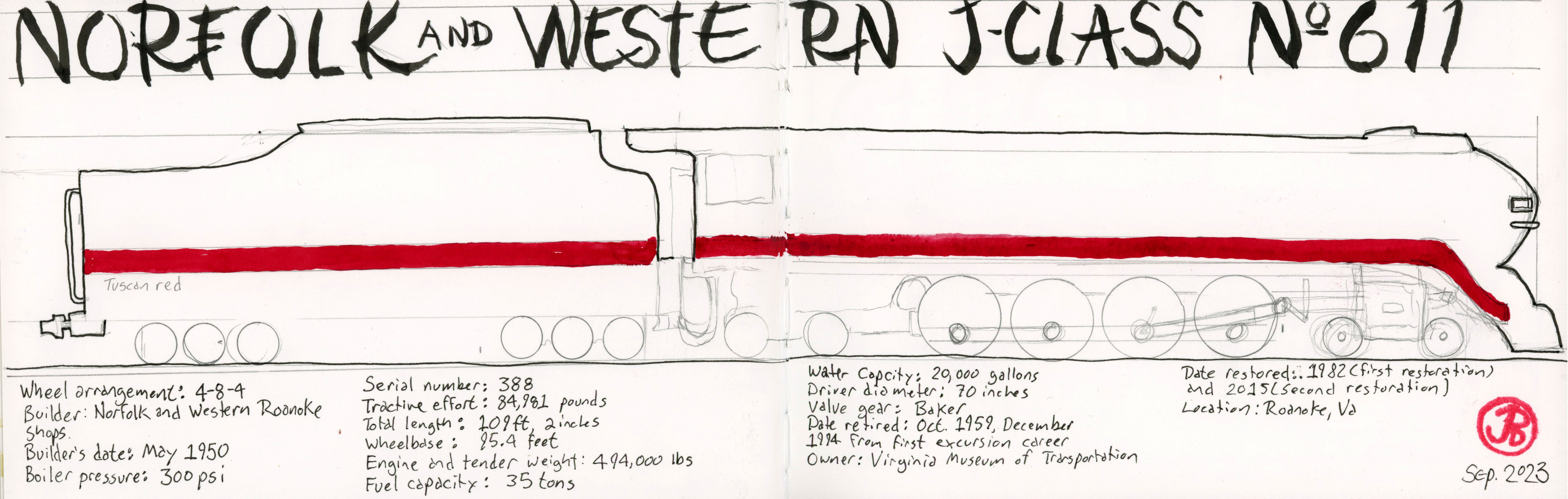
Before I headed east to take in this Queen of Steam, I did three illustrations of 611. One was my version of a stylized promotional period sketch (featured sketch), a realistic head on view (above), and a drawing design of the profile of 611 and tender with specs (below).













 Corvid Sketcher