Image

Embarcadero Sunday Sketching

On Sunday I took the N Judah to Embarcadero Station with the intention of sketching a little San Francisco rail history. My main sketching target was the Belt Line Railroad Engine House or Roundhouse at Embarcadero and Sansome.

On the walk from the Ferry Building I came upon the 1927 ferry Santa Rosa at Pier 3 and I thought I would head back after my roundhouse sketch to add this piece of rail and nautical history to my spread.
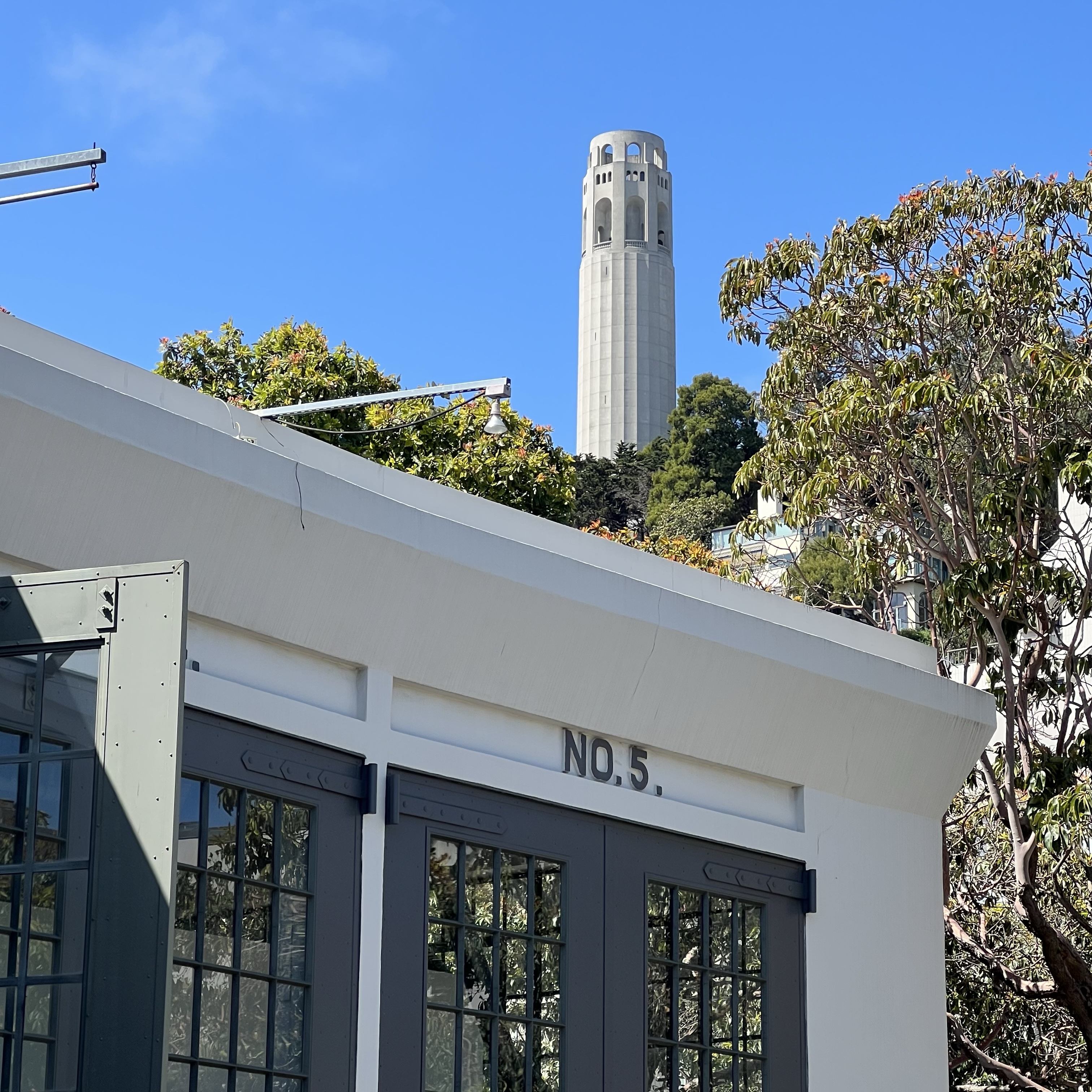
Bay No. 5 with Coit Tower in the background.

The Belt Line Railroad was founded in 1889. The railroad connected the Port of San Francisco with many of the piers and warehouses. The railroad shipped freight cars from the ferry freight terminal (at Pier 43) for railroads such as the Western Pacific, Northwestern Pacific, and the Aitchison, Topeka, & Santa Fe Railway. It also had connections with Southern Pacific on the southern portion of its line. The railroad also served Ft. Mason, the Presidio, and Chrissy Field through the Ft. Mason tunnel.

At its height, the railroad had 67 miles of track. The Belt Line operated 12 steam locomotives and six diesels.

Over time, the Port of San Francisco was eclipsed by the Port of Oakland and shipping traffic slowed. The railroad eventually folded in 1993.
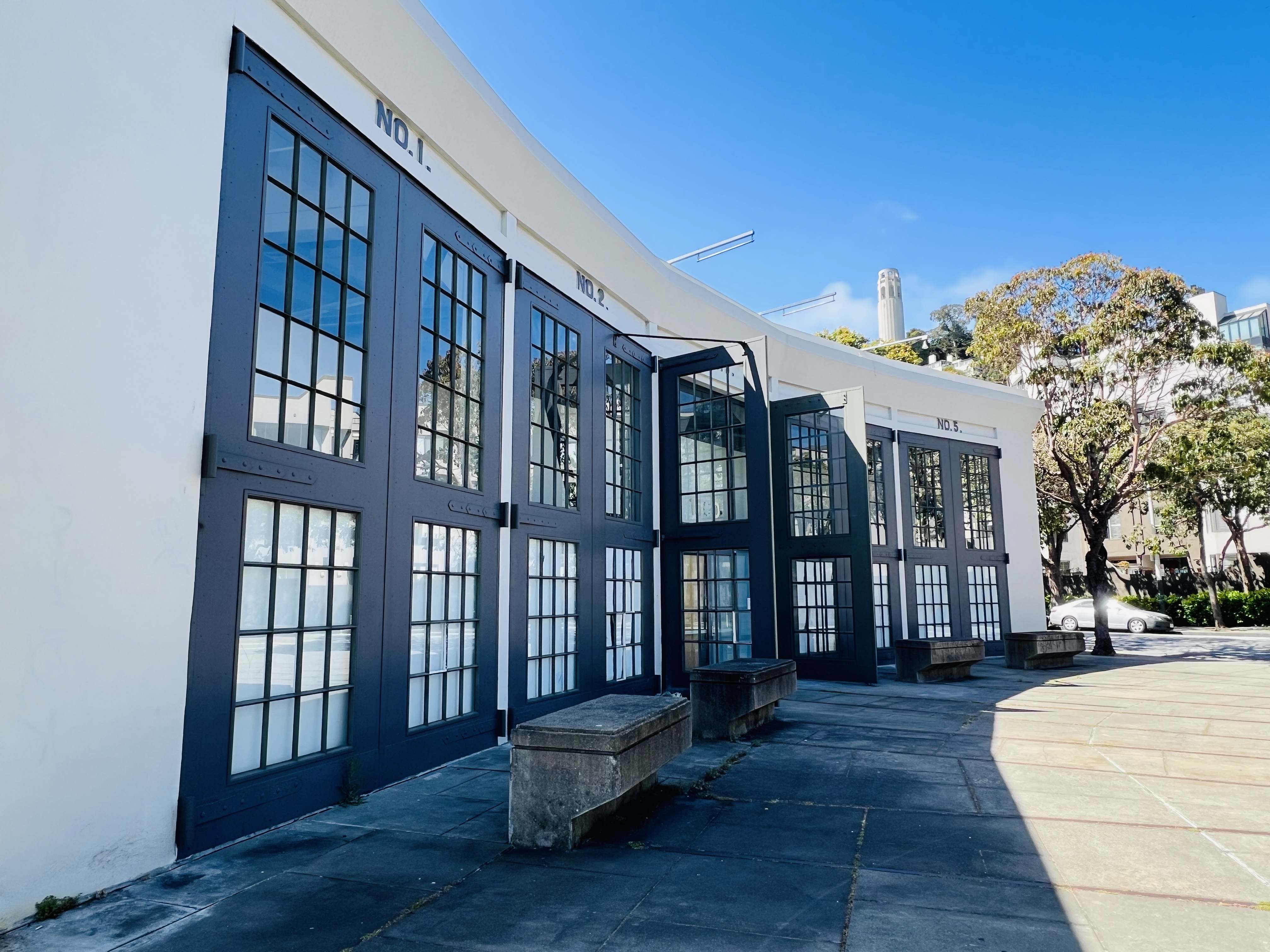
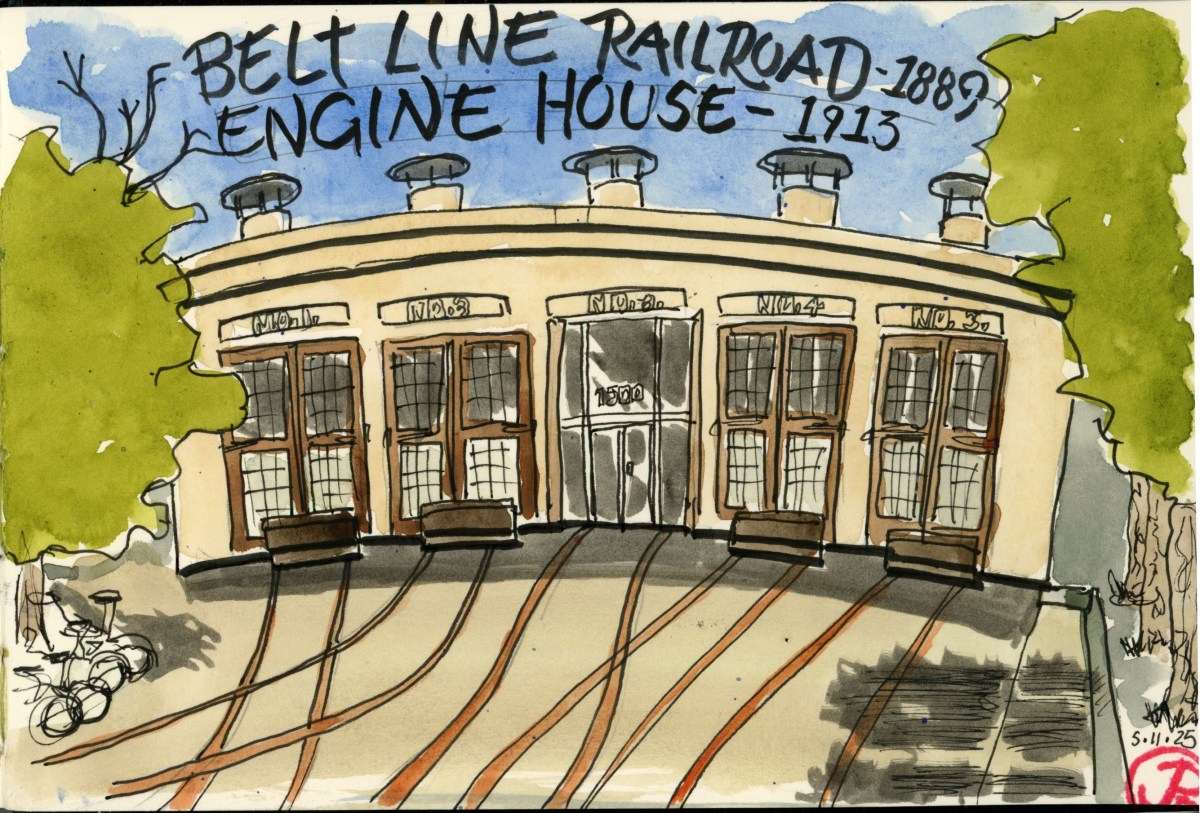
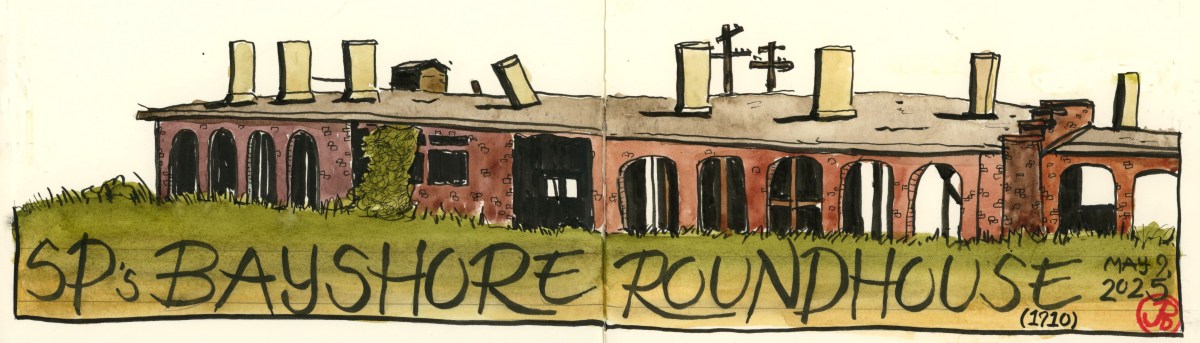
Before me was the reinforced concrete Belt Railroad Engine House or Roundhouse. It was built in 1913 and is now designated as City and County of San Francisco Landmark #114.

The house contains five bays with five tracks snaking out of each bay. The tracks disappear under paving at the intersection of Chestnut and Embarcadero. It was nice to see that some of the the rails were still in place although the engine house now houses another business.
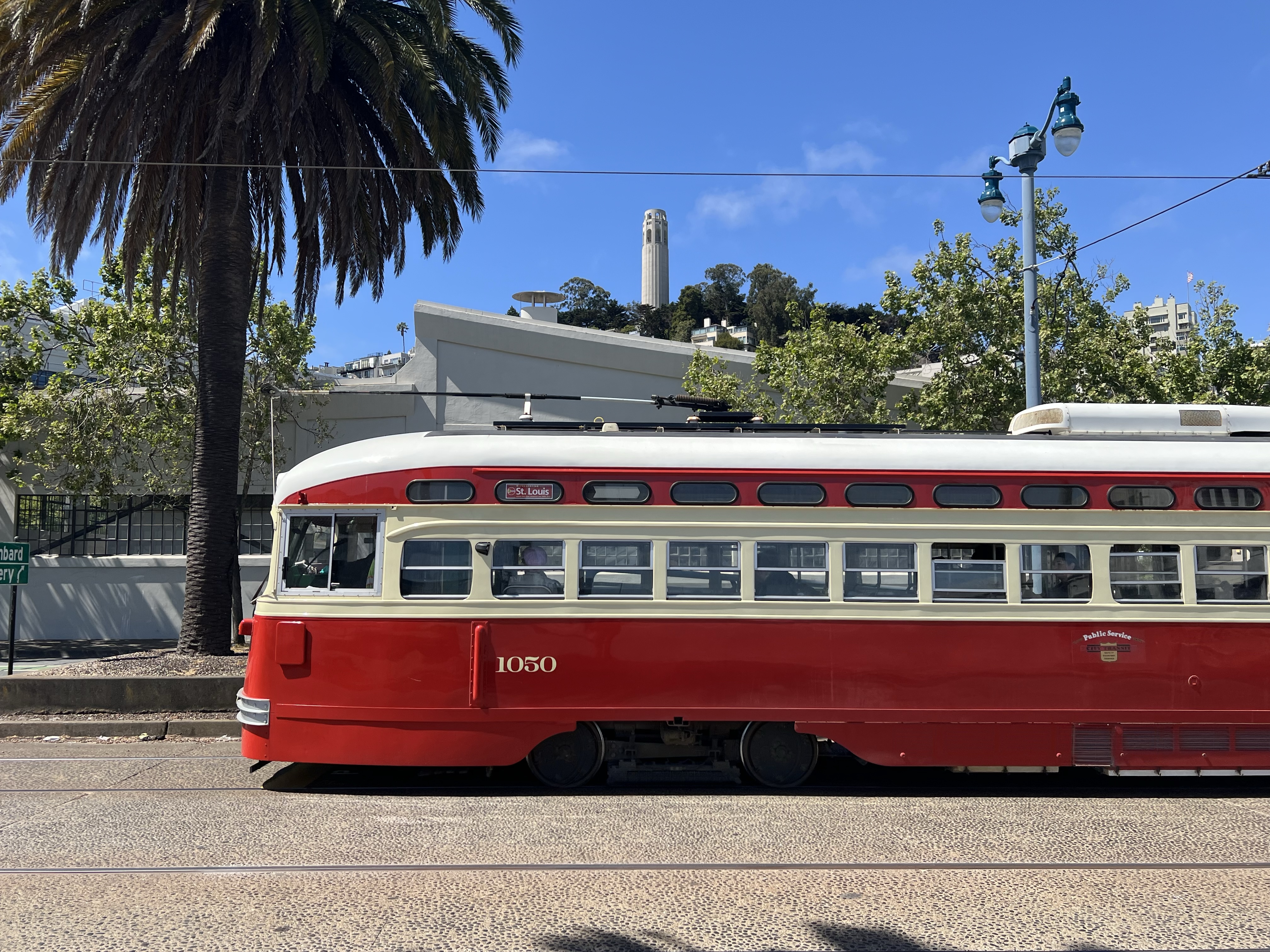
PCC car No. 1050 passes by the Engine House on the F Line. The car is painted in St. Louis livery.

After my sketch I headed back to the Santa Rosa and found a nice sketching bench.

For this sketch I chose to keep it loose and render the ferry in a continuous line sketch. Although I did lift my pen a few times to add some details and shading. So I’ll call it a broken line continuous sketch. For this sketch I experimented with a thicker more expressive pen, my Faber-Castell FM (Fude Medium). I love sketching with this pen!
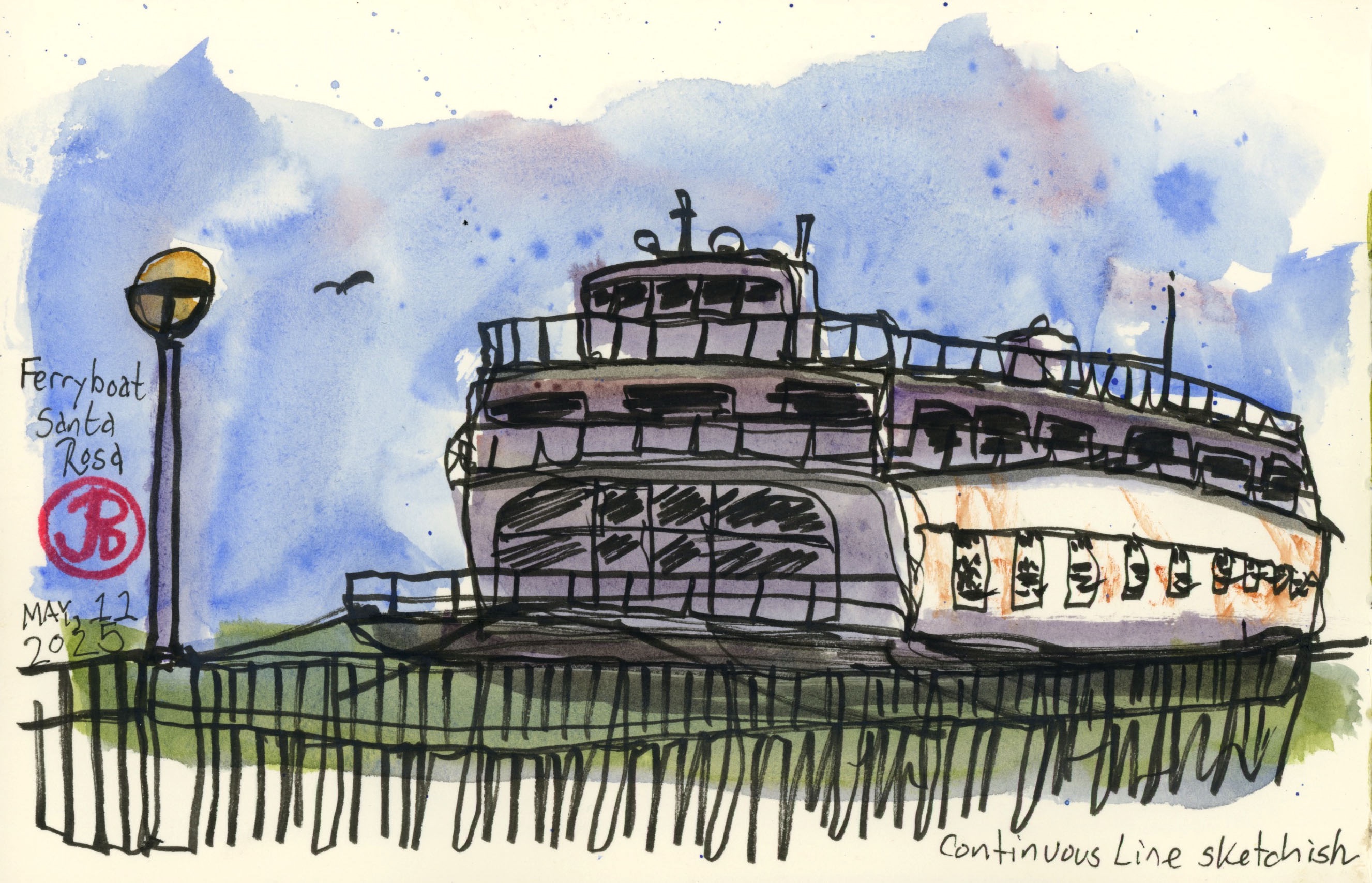
The Santa Rosa was built in 1927 for the Northwestern Pacific Railroad and was in service until 1968. She was sold to the Puget Sound Navigation Company in 1940 and was renamed MV Enetai. She returned to San Francisco Bay in 1968 and sat unused until Hornblower purchased the ferry in 1989.
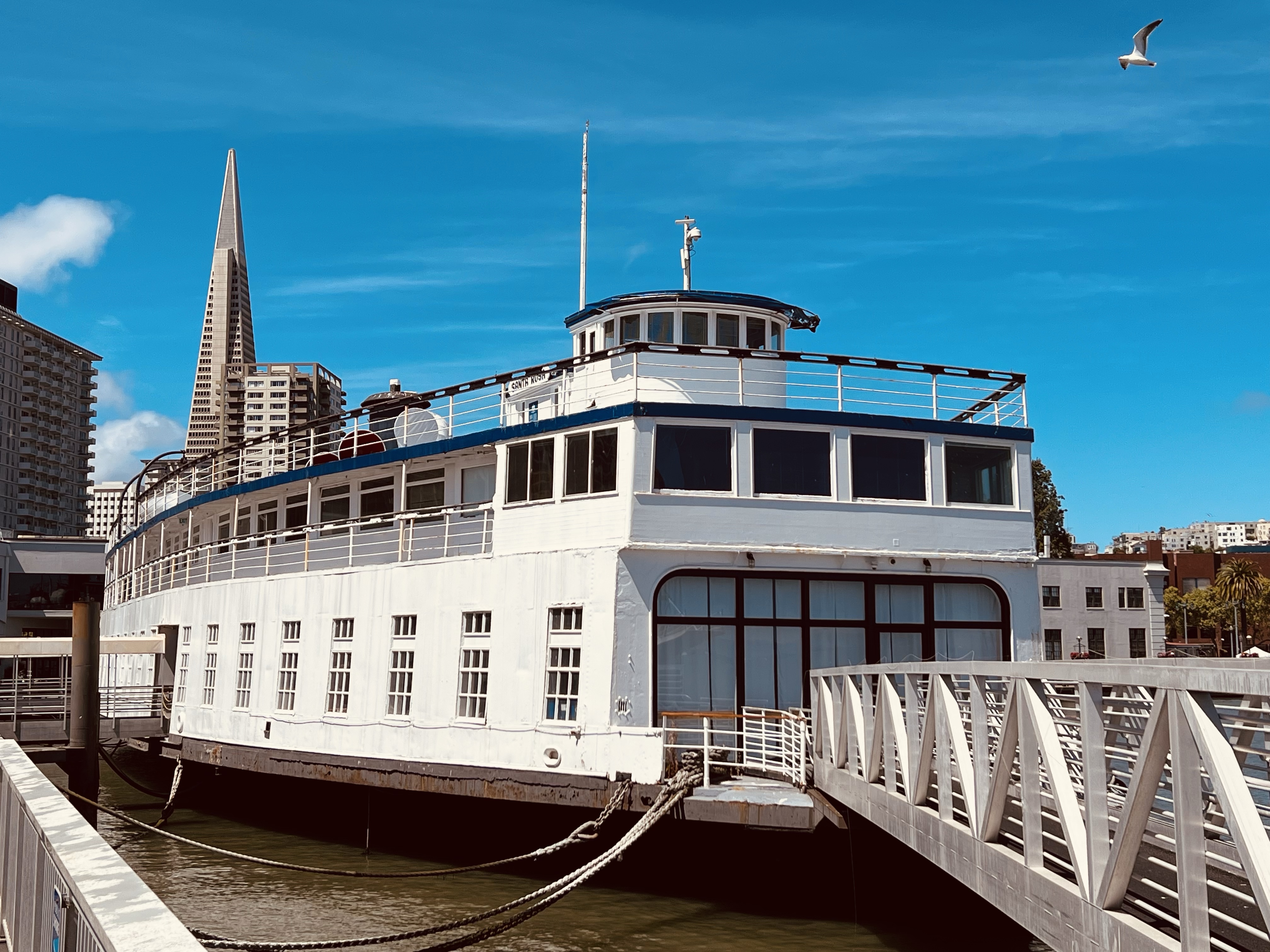
The Santa Rosa is now the corporate offices of Hornblower.
Image

The Bayshore Yard and Roundhouse

I was on the hunt for some Bay Area rail history. I was specifically looking for some ghosts of the Southern Pacific Railroad: the Bayshore Yard.

I started my search at the Bayshore Caltrain Station. Uncanny! Who would have thought?

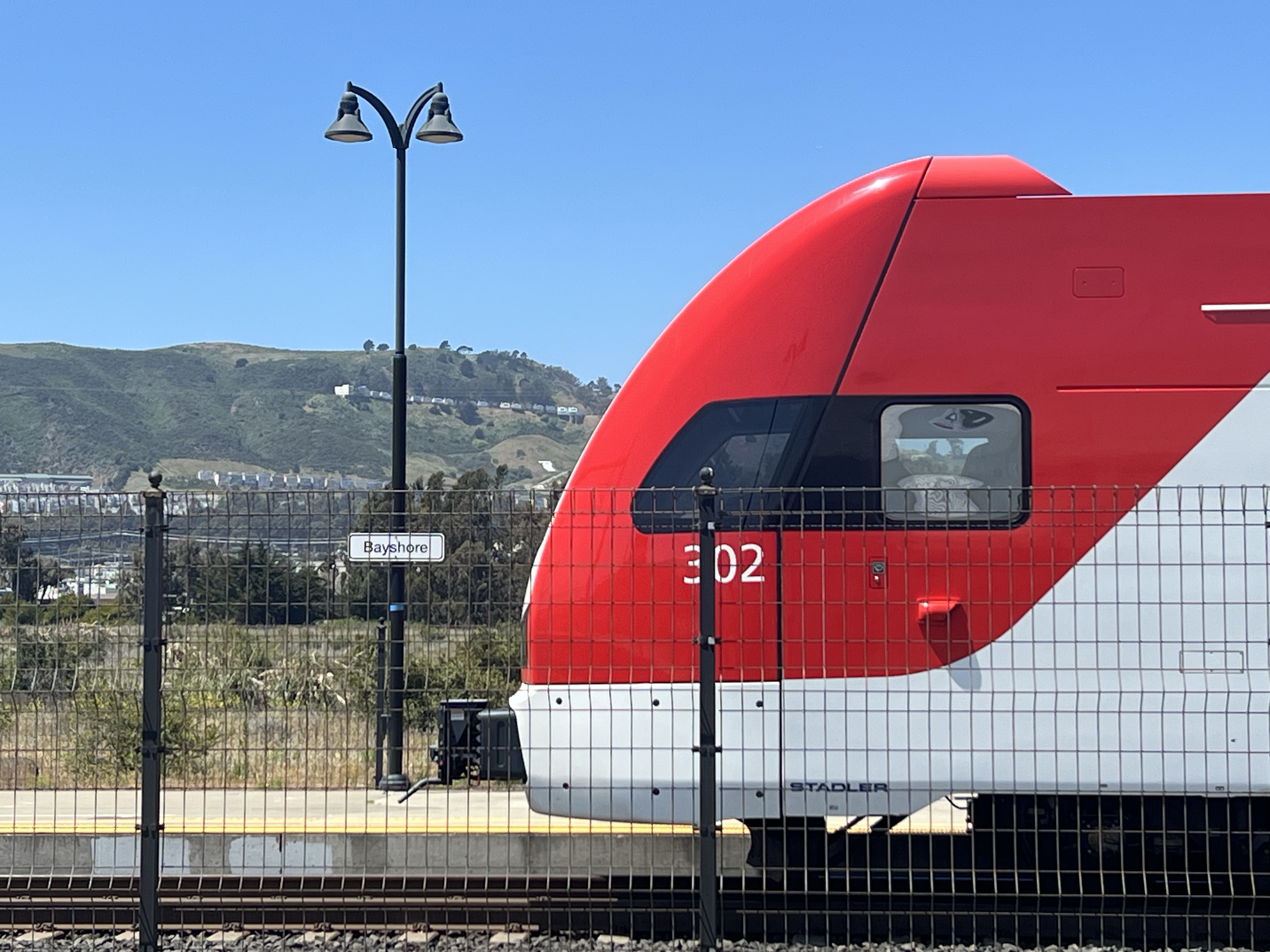
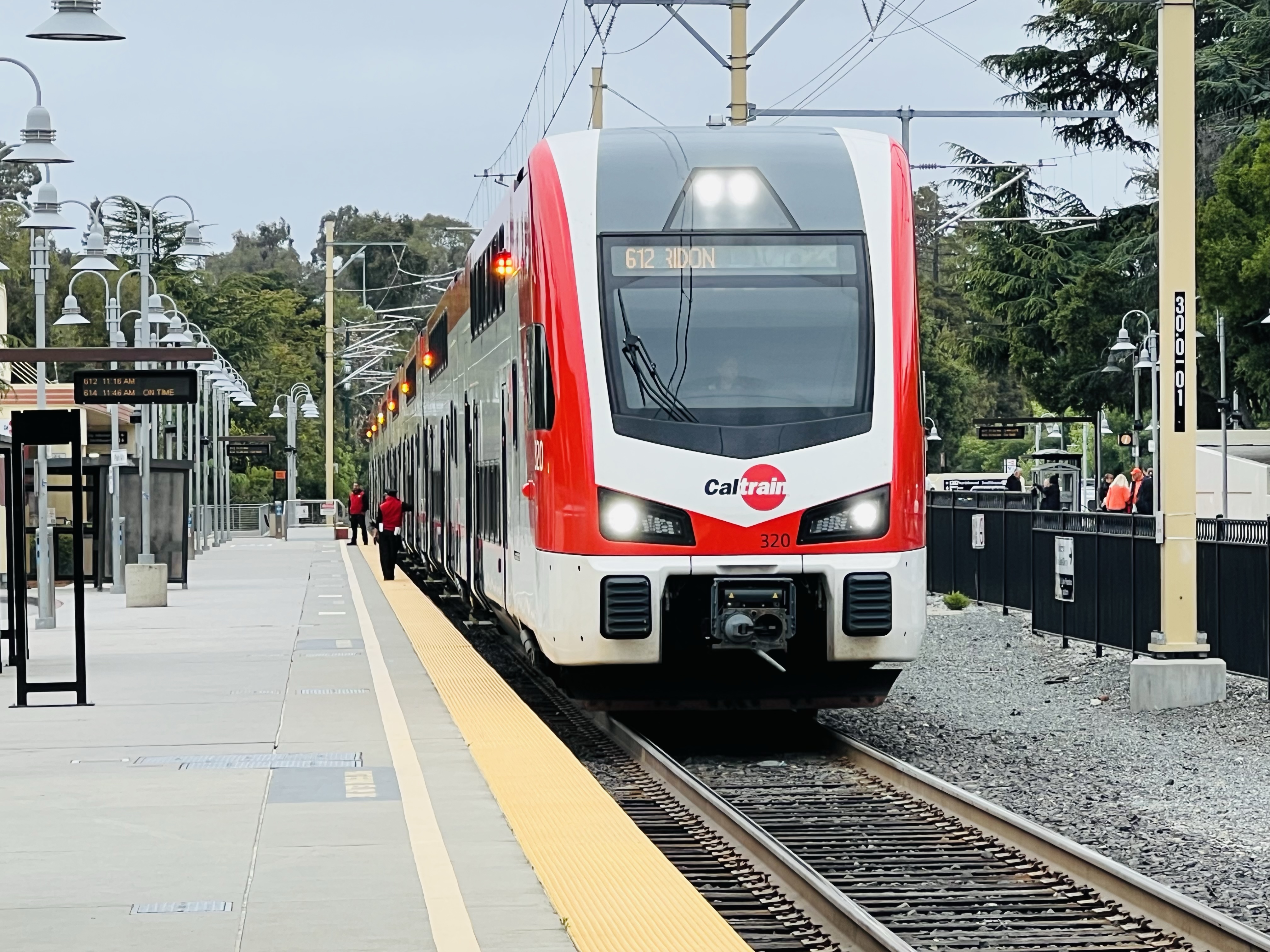
An EMU at Bayshore Station. I was here to see the overgrown fields beyond the tracks.

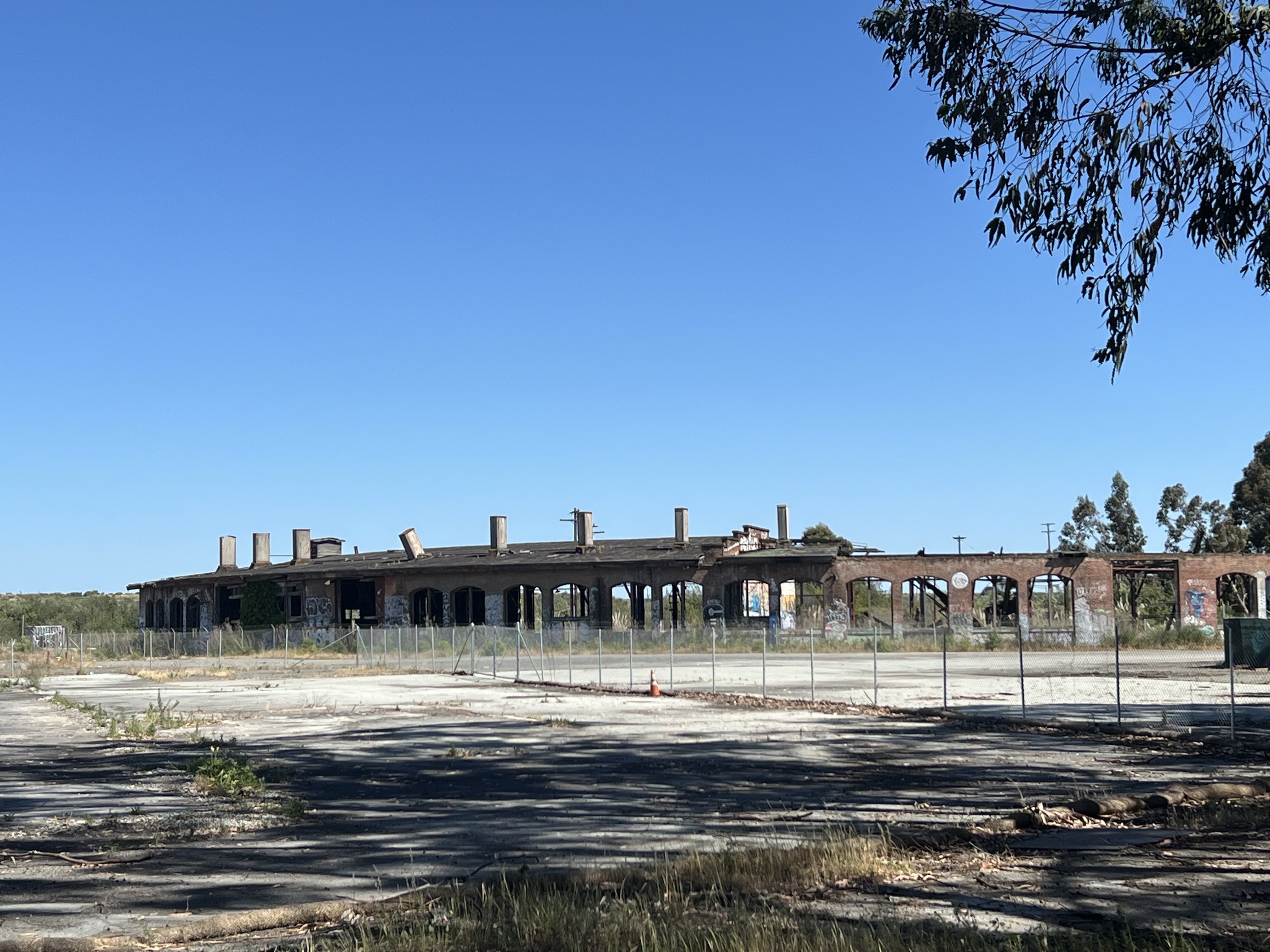
To the west of the tracks is a large overgrown open space punctuated by wooden power poles and bordered by the San Bruno Mountains. On the far edge of the open fields are some dilapidated and graffitied buildings.

The brick roundhouse and the tank and boiler shop are the only remaining structures of a once bustling train yard and shops. How bustling?

The yard contain 50-65 miles of track, had a capacity of over 2,000 freight cars, and employed 3,000 people.

This was SP’s most heavily travelled stretch with 46.5 million gross tons per mile during WWII.

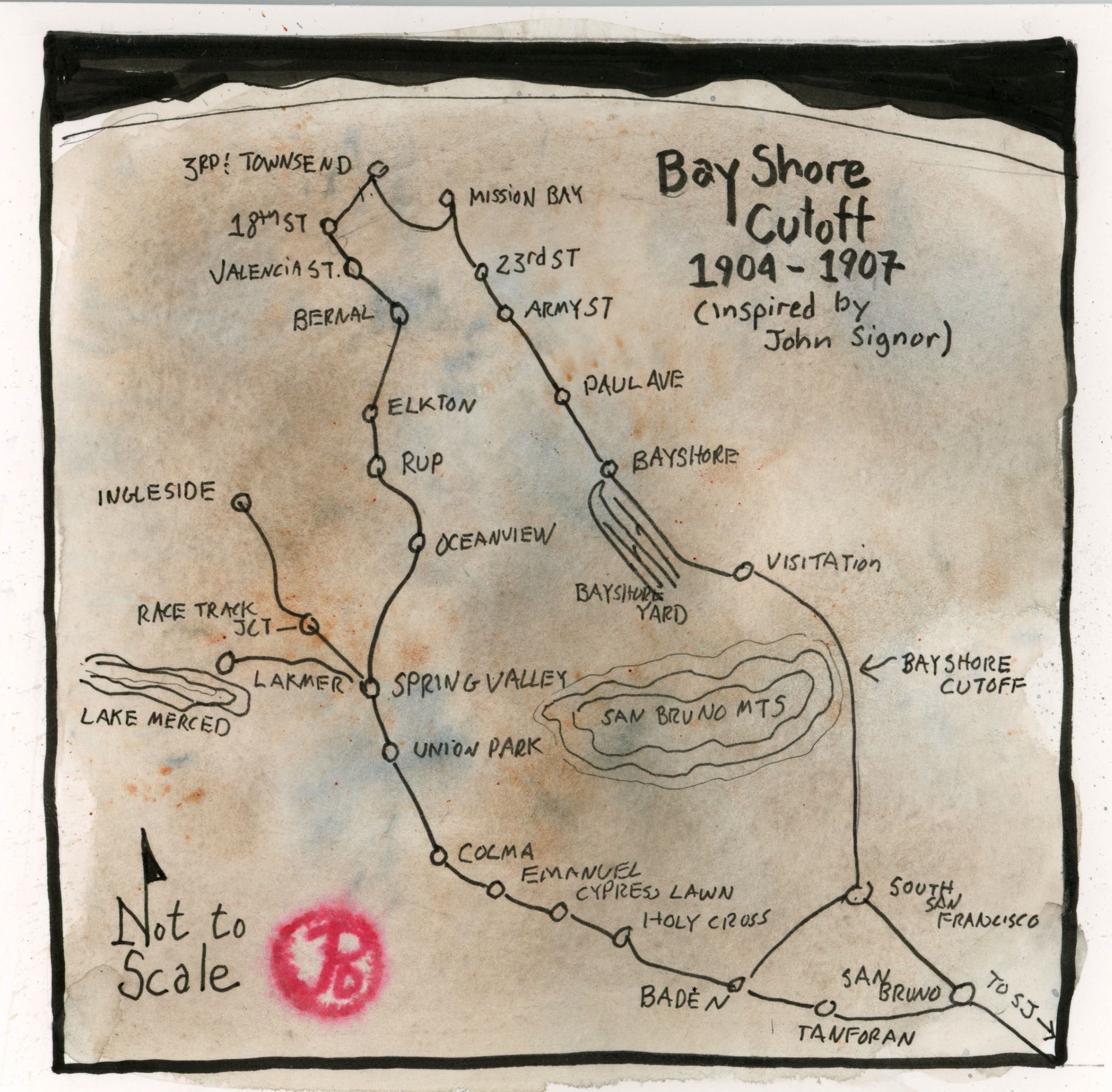
The story of the yard and shops starts with the Bayshore Cutoff.

This drawing is highly influenced by a map John Signor drew from his excellent book on the Coast Line.

As the name implies the Bayshore Cutoff is a short cut that straighten the line around San Bruno Mountain’s southern edge, from San Francisco to San Bruno.

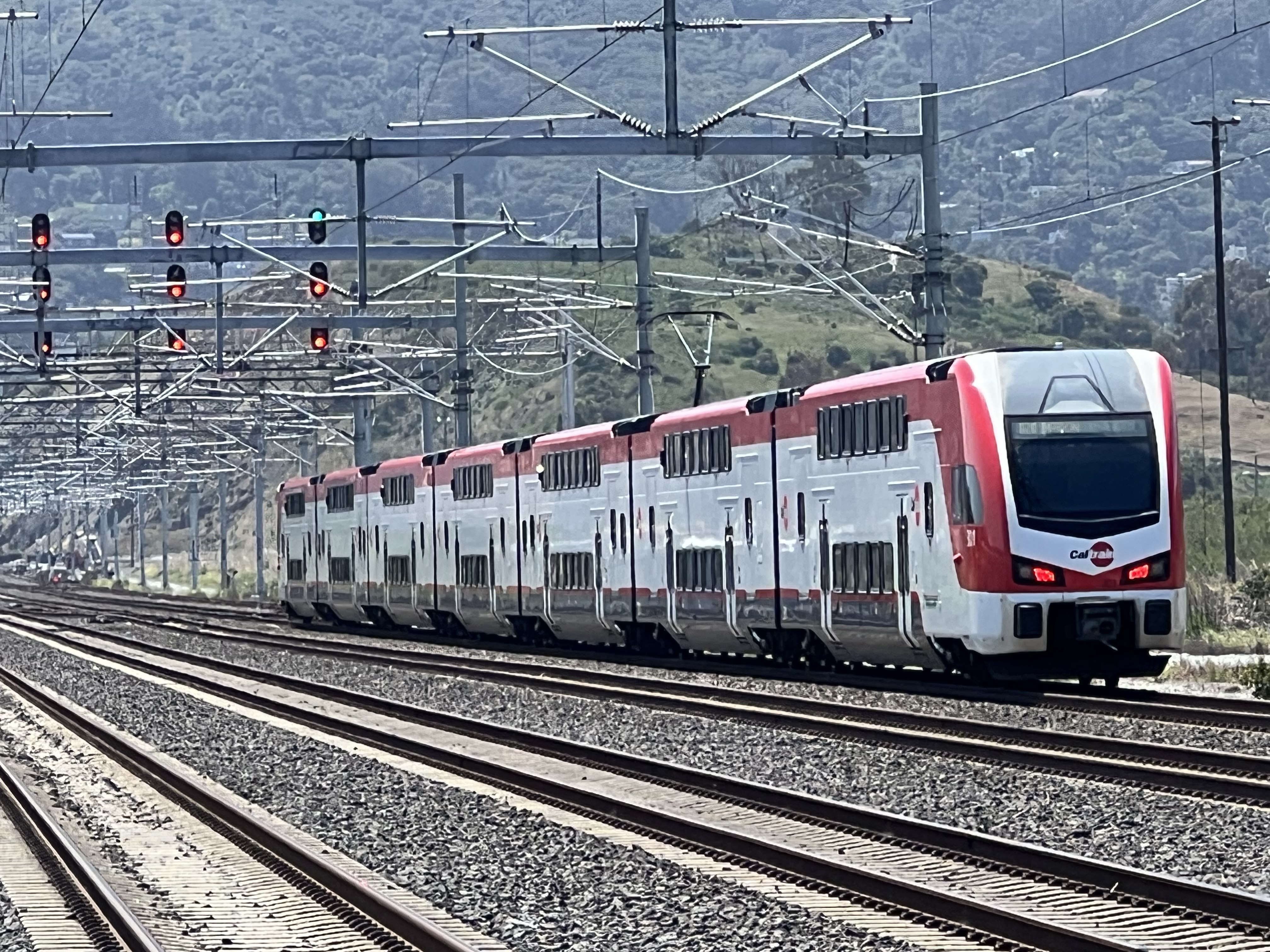
A southbound EMU seven car set leaving Bayshore Station under the tangle of signal gantries and power lines. To the right is the former yard. The current line is along the Bayshore Cutoff.

The cutoff was completed 1907 and cost Southern Pacific $7 million. One reason for the high price tag is that the railroad had to construct five tunnels (20% of the cutoff was in tunnels). The fill from these tunnels was used to fill in Brisbane Lagoon which became Bayshore Yard and Shops.

The benefits of the cutoff were: saving more than three miles on the route, reducing the curvature of the line, and flattening the grade. The improvements cut travel time from San Francisco to San Jose by 30 minutes. The cutoff is still in use today, conveying passengers to and from San Francisco on Caltrain.

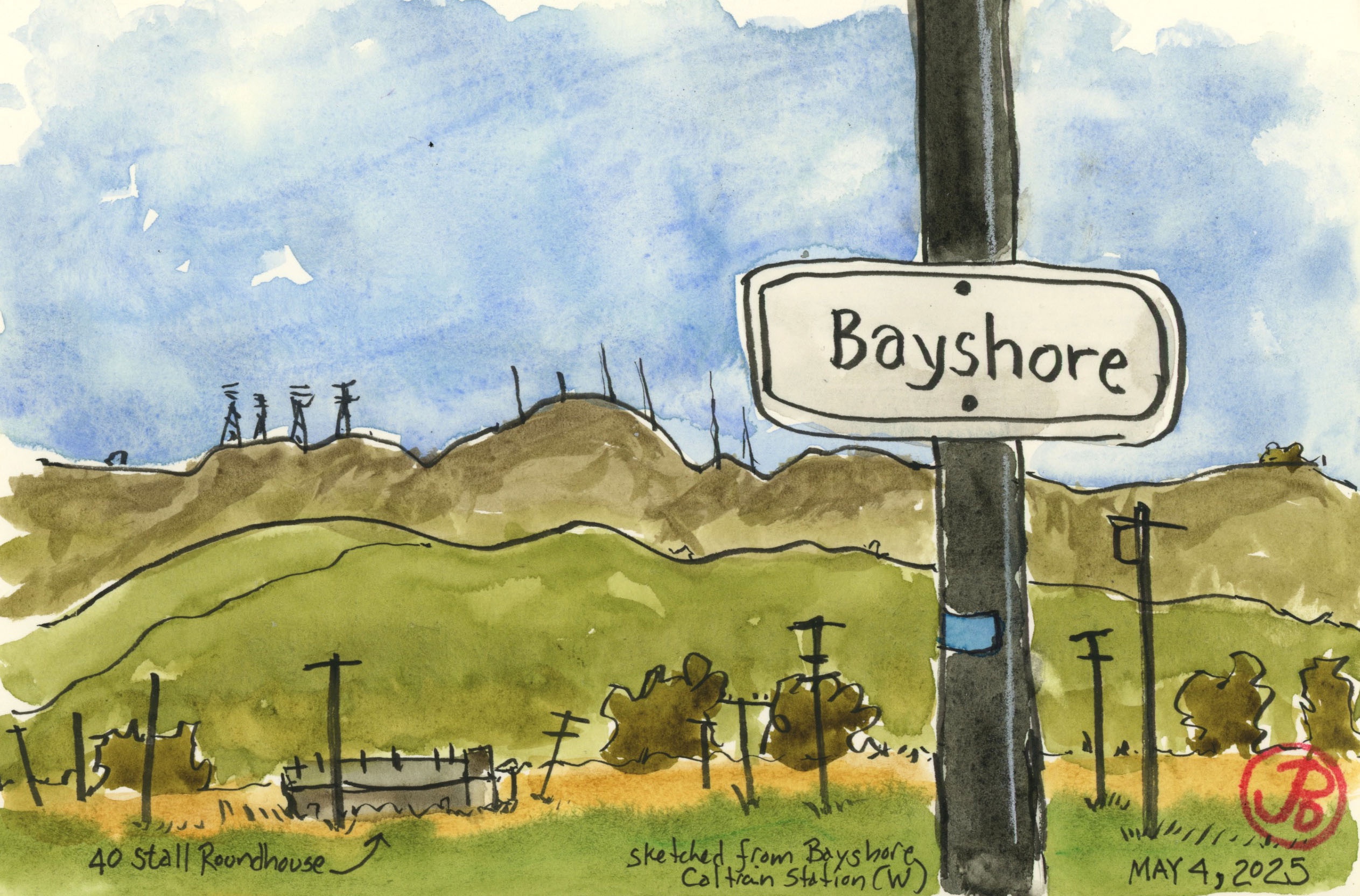
For my Bayshore sketch I took a position on the southbound platform and sketched the Bayshore Station sign in the foreground and the feral field and roundhouse in the background. In the far ground is San Bruno Mountain.

After work I headed up to Brisbane with the intent of sketching the roundhouse from Bayshore Boulevard. The roundhouse is close to the street but the former yard is enclosed in fencing. I was able to find a gap in the eucalyptus trees to get a panoramic sketch (sans graffiti) of Southern Pacific’s Bayshore roundhouse.

The brick shell of the Bayshore Roundhouse.
Image

Sketch Crockett

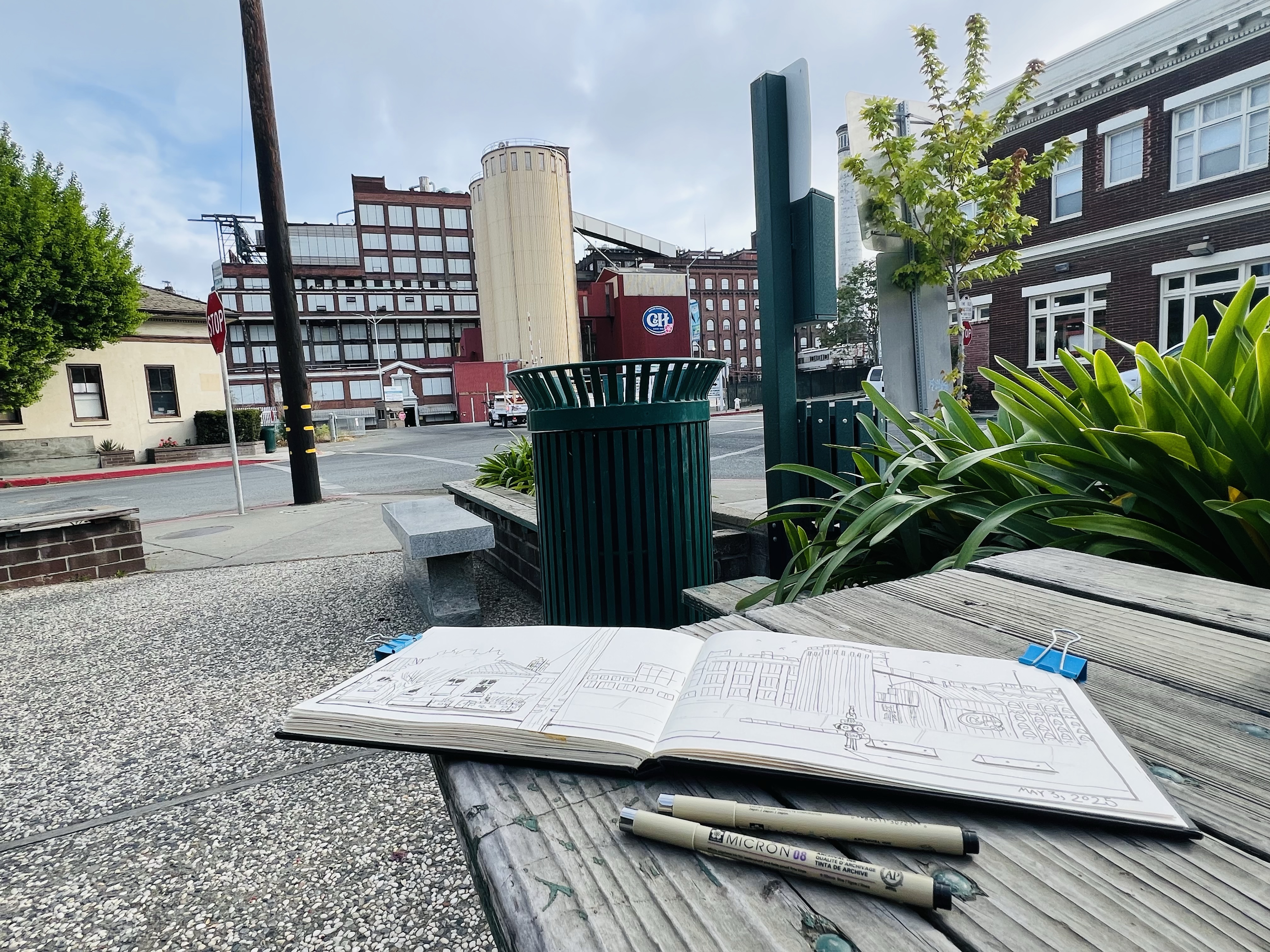
My Saturday morning sketch found me at the corner of Loring and Rolph Ave in the little corner park in Crockett.

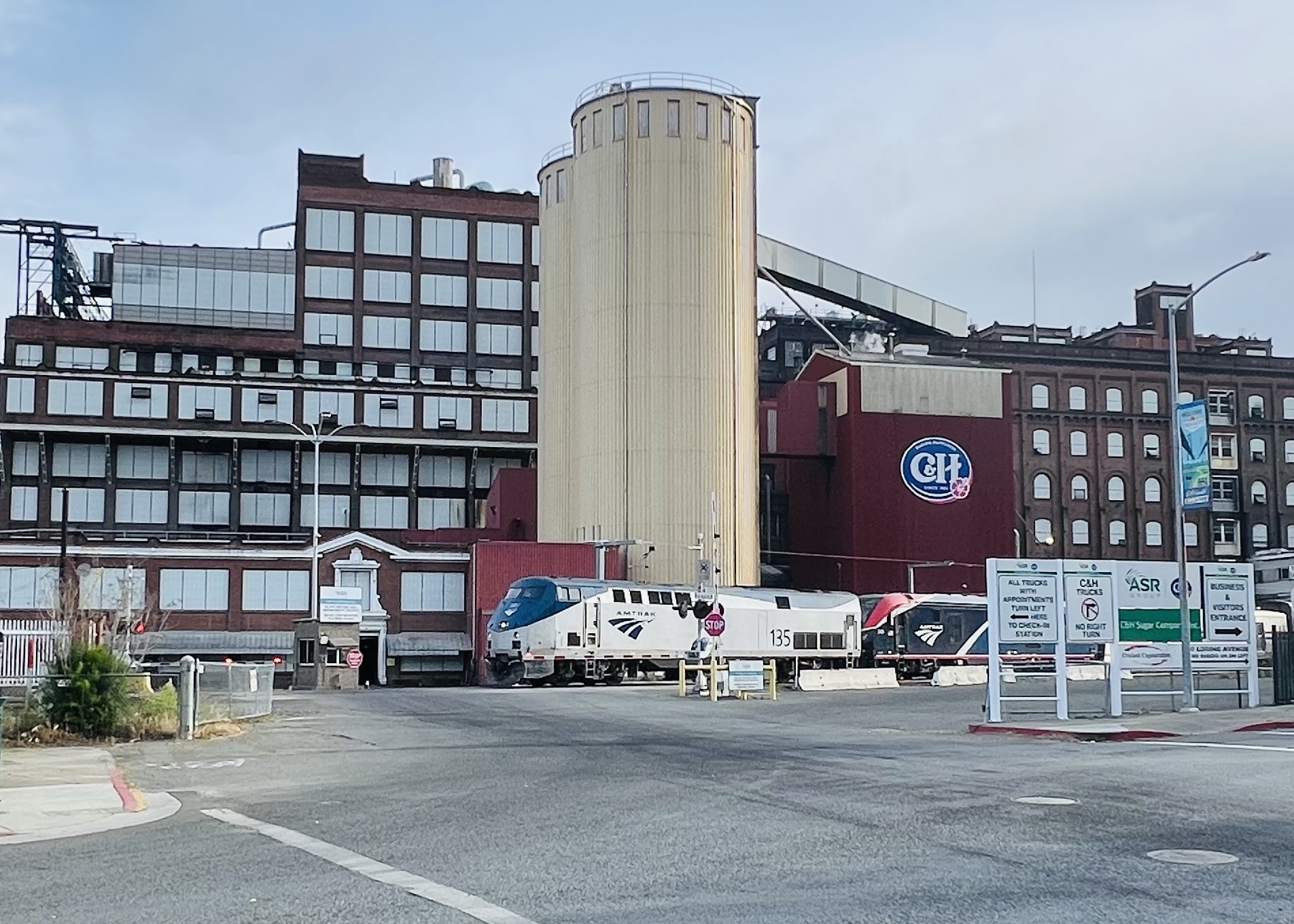
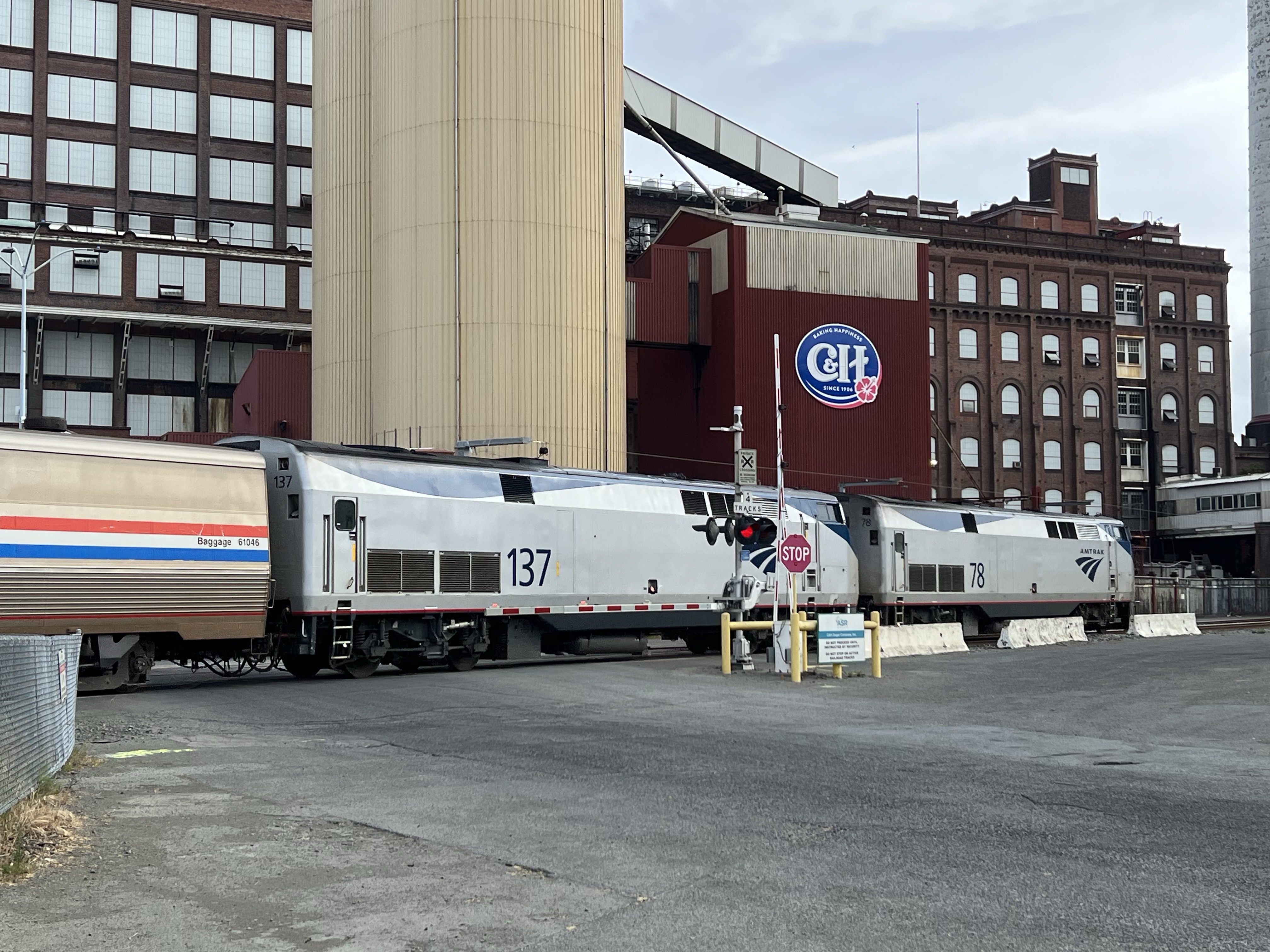
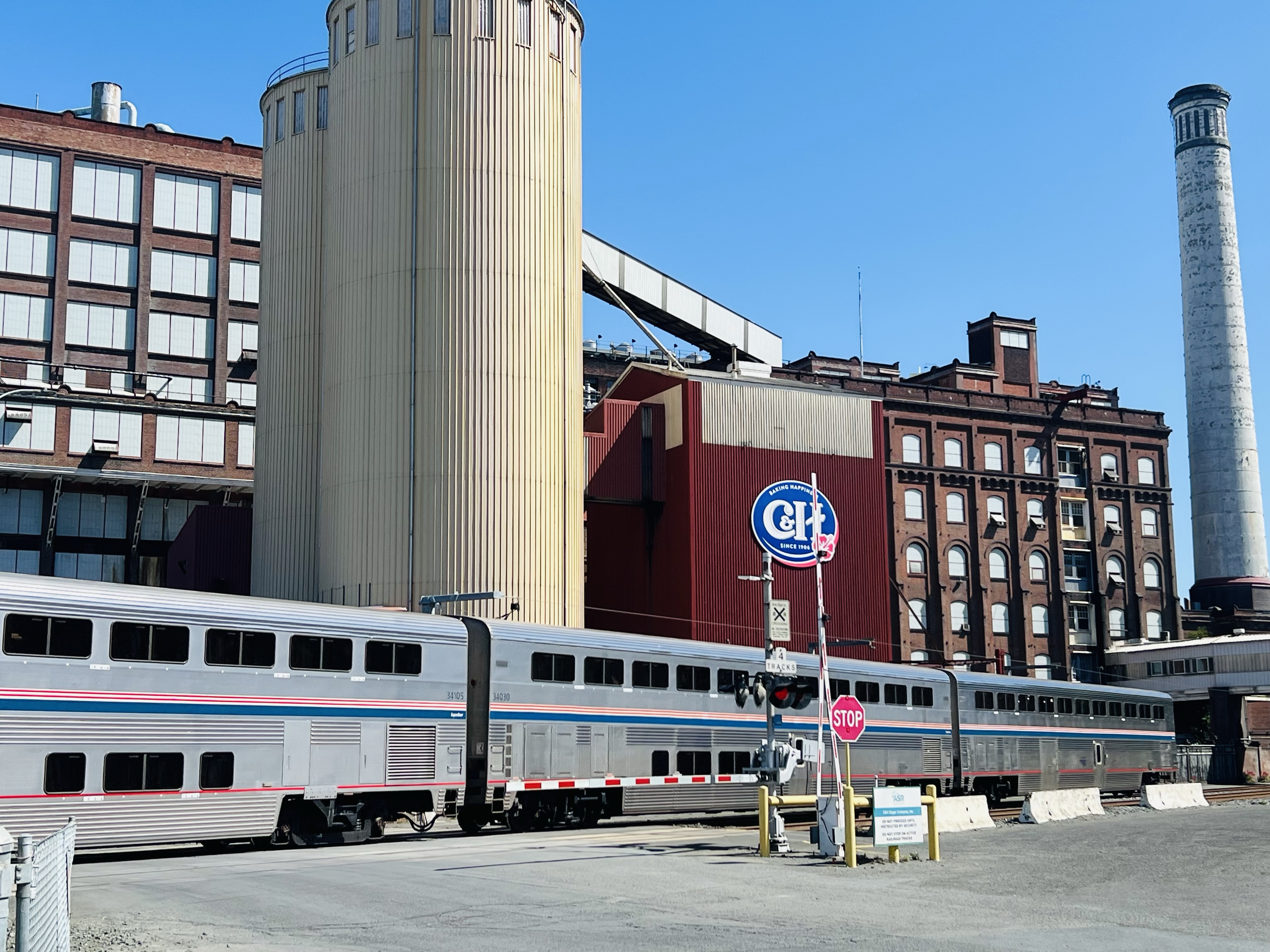
Before me was the C & H factory with the Union Pacific mainline passing in front. To my left was the former Southern Pacific station (sketched on a previous Saturday) and is now a historical museum.

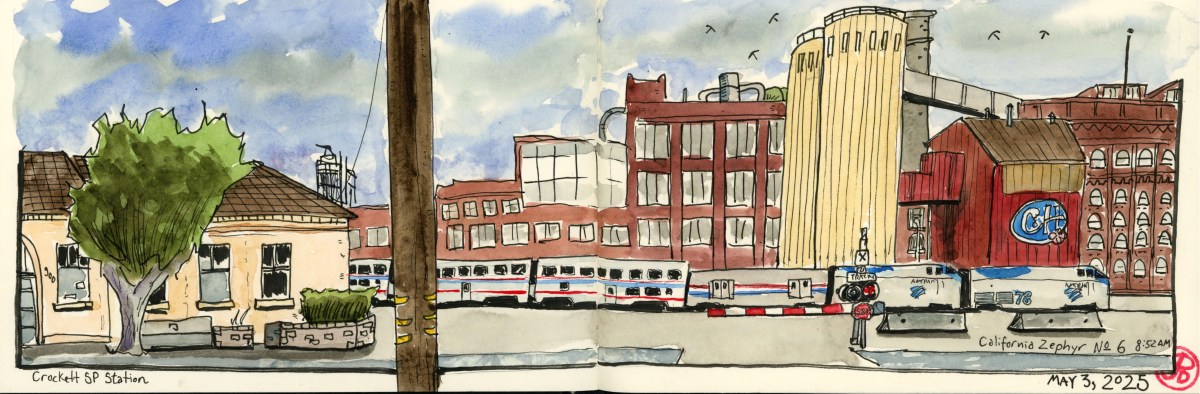
I planned to add my park perspective to my Stillman & Birn Delta panoramic journal. The factory is full of complicated angles and shapes as if the factory was built in stages and at different times (which it probably was). I employed a little sketcher’s shorthand to simplify the details.

In 1906 Crockett became “Sugar Town” when a cooperative of Hawaiian sugarcane growers bought a sugar beet factory and turned it into the California and Hawaiian Sugar Company (C & H). At the company’s peak, 95% of the town’s residents were C & H employees.

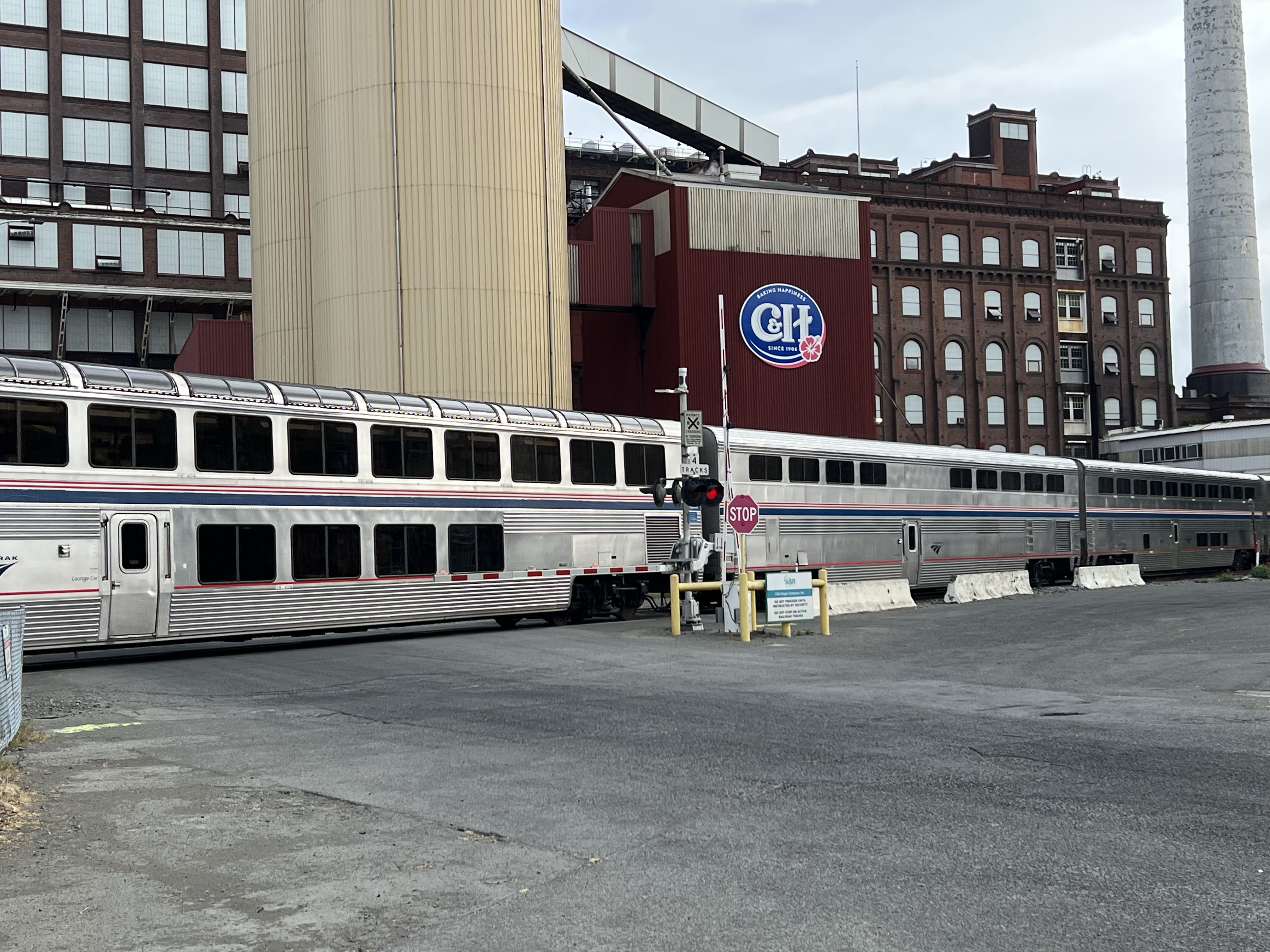
The southbound Coast Starlight No. 11 passes by the complex jumble of the C & H sugar factory at 8:01 AM.

Sketching the factory was a wonderful meditation, as it often is, turning chaos into order. I can think of few other pursuits that offers such satisfaction and peace of mind. I can almost feel my blood pressure drop when I put pen to paper.

Parkside sketching.

I employed a similar sketching techniques to past posts with putting a moving train in my sketch. I draw in the foreground and background and then add the train after it passes (usually from a photo reference).

Two GE P42DCs (No. 78 and 137) on point of the California Zephyr. Next stop: Martinez, final destination: Chicago, Illinois.

The passenger train I sketched into the scene was California Zephyr No. 6. I guess I should explain my fascination with AMTRAK’s longest daily route.

The Zephyr observation car crossing the entrance access to the C & H factory.

I have taken the Zephyr round trip twice, from Colfax, Ca to Denver, Co. The first time was for some Colorado birding and we where up in the Rocky Mountains at Loveland Pass looking for the elusive white-tailed ptarmigan.

It was here that I got a call from my mom and learned that my younger brother had died. I was leaving the next day from Union Station and it was a beautiful if not bittersweet rail journey.

The last trip I took with my stepdad was on the Zephyr and it was a great trip through one of the most scenic stretches of tracks in the United States. So whenever I see the Zephyr pass by, it puts a smile on my face.

Image

UP Eckley Crossing: 748331G (M. P. 27.30)

My Saturday morning sketch location was the pedestrian rail crossing at Eckley Pier in the Carquinez Strait Regional Shoreline.

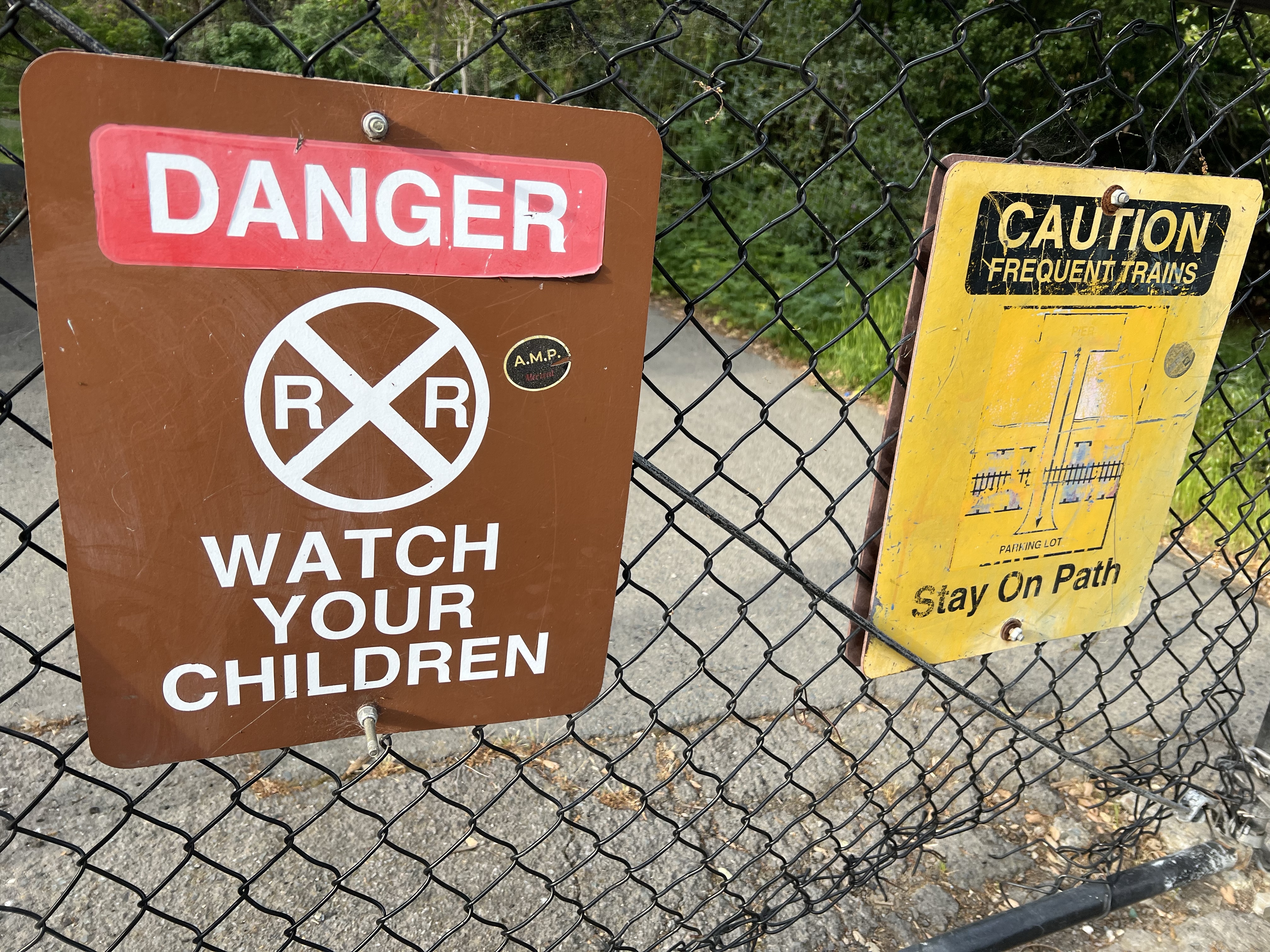
A sign any educator can appreciate.

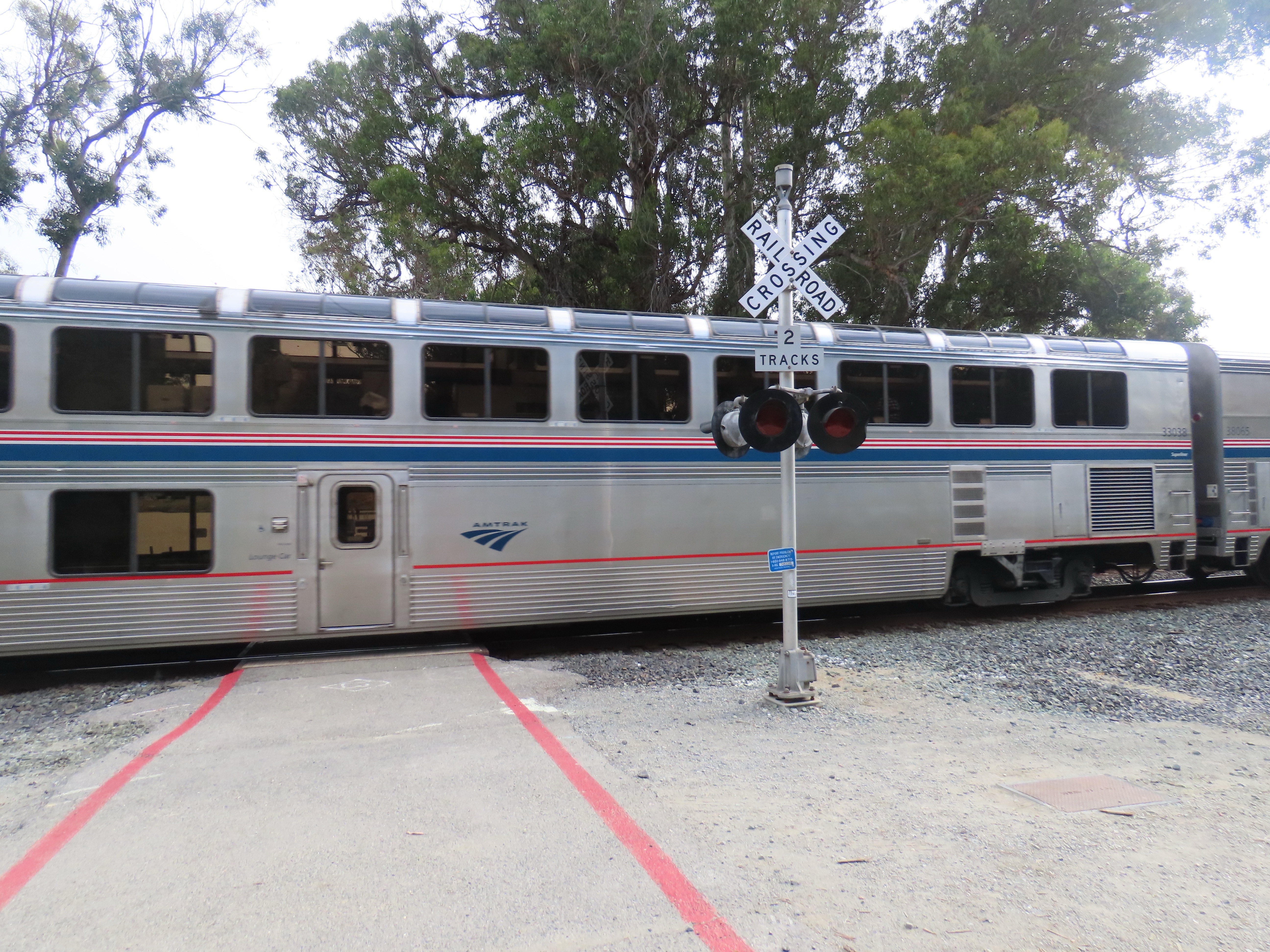
This pedestrian crossing is quite unusual because there are no crossing gates preventing pedestrians, wanting to go to the fishing pier, from heading across two very busy tracks of the Union Pacific main line.

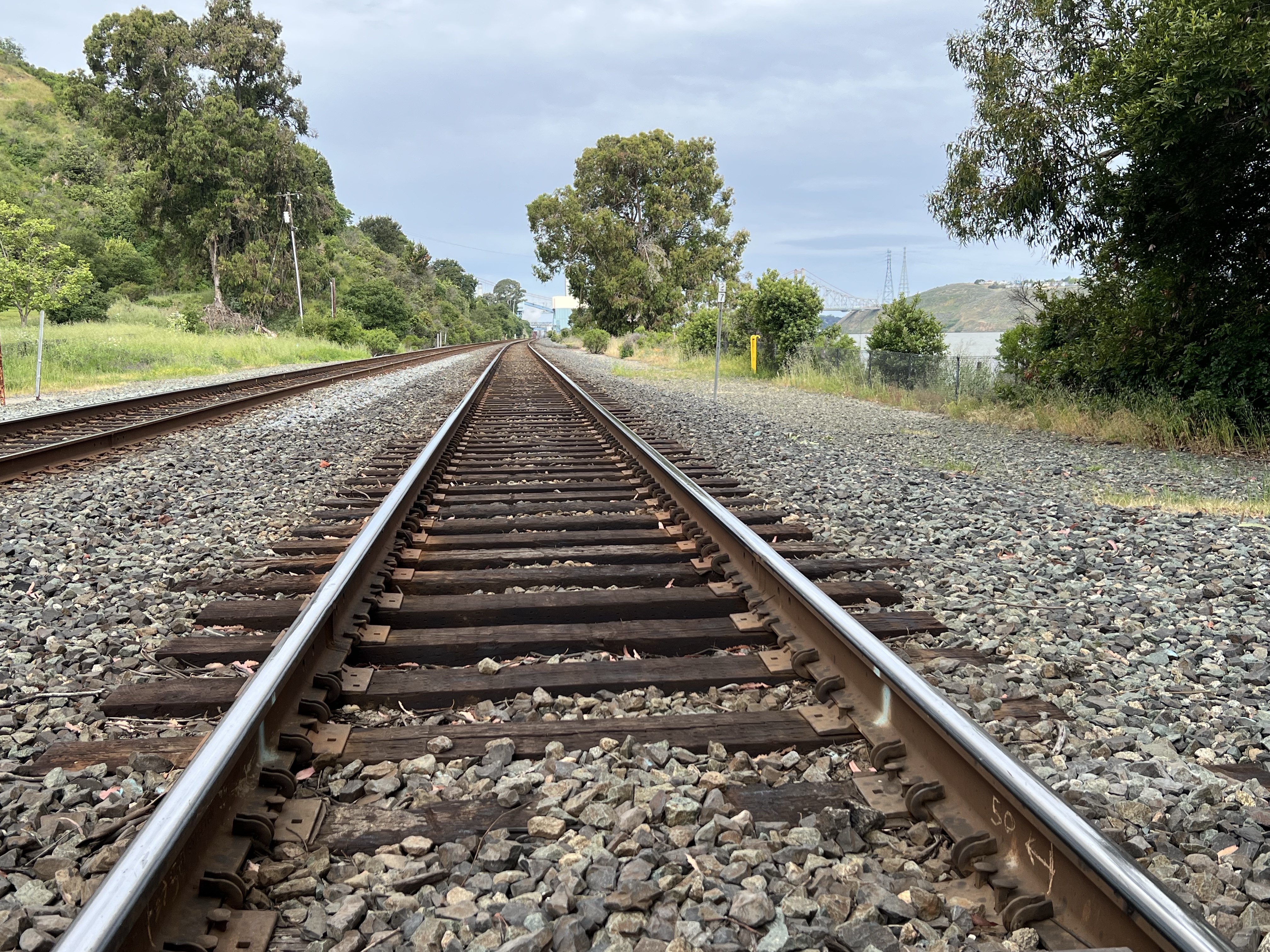
No rusted rails here but polished high iron from lots of use.

I got to the park at 8 AM, when the gates open, and I had plenty of time to catch the Chicago bound California Zephyr No. 6 as it was scheduled to skirt along the southern shore of the Carquinez Strait just shy of 9 AM.

The Zephyr is one of the longest routes operated by AMTRAK (2,438 miles) and as such has the lowest on-time percentage (33%) of any long distance route, primarily because the passenger service is at the whim of their host railroad’s (UP and BNSF) freight traffic. No. 6 should be on time because it left its western terminus of Emeryville at 8:25 AM. It usually gets behind schedule while stopped behind a freight in Nevada or Utah.

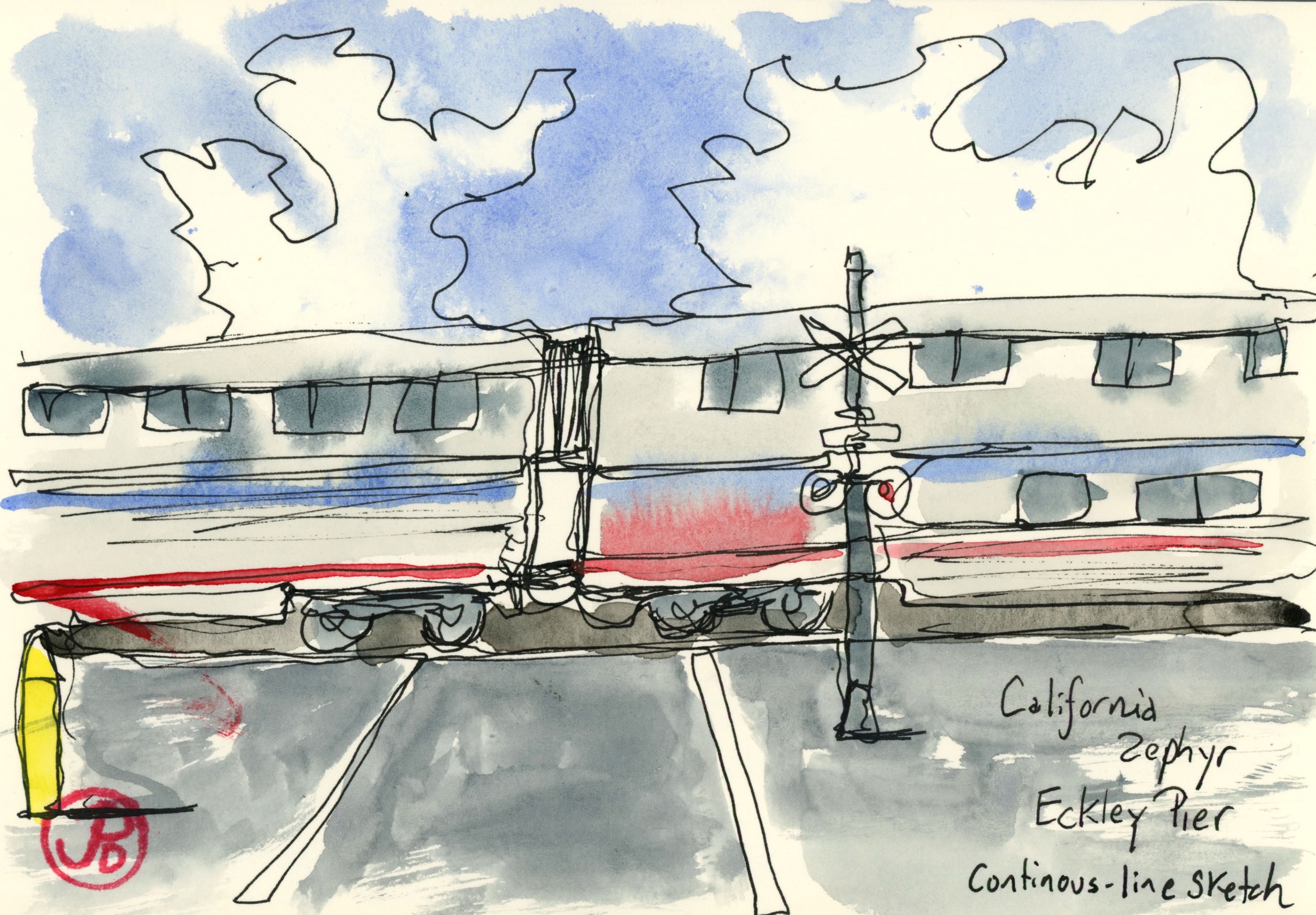
I took a position just south of the parallel tracks to sketch the light signal and crossbuck of the pedestrian crossing.

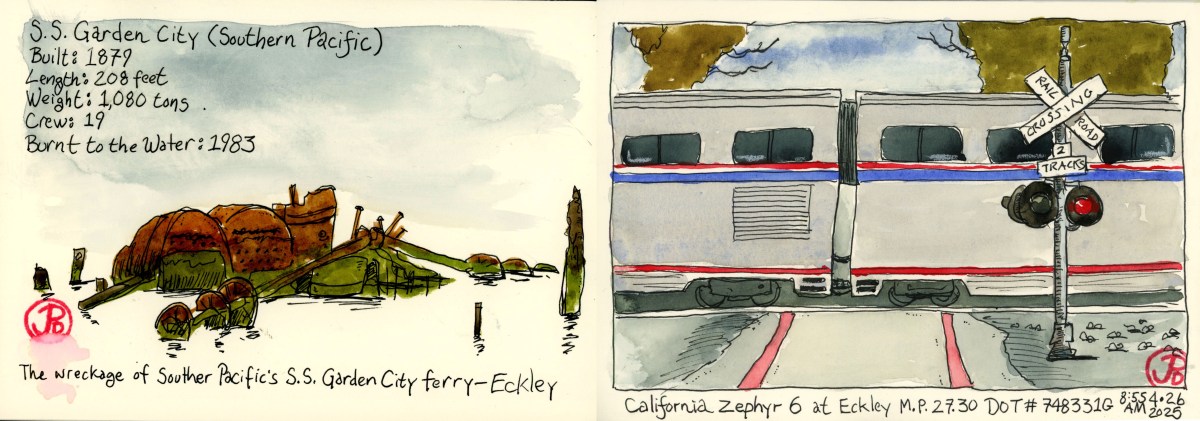
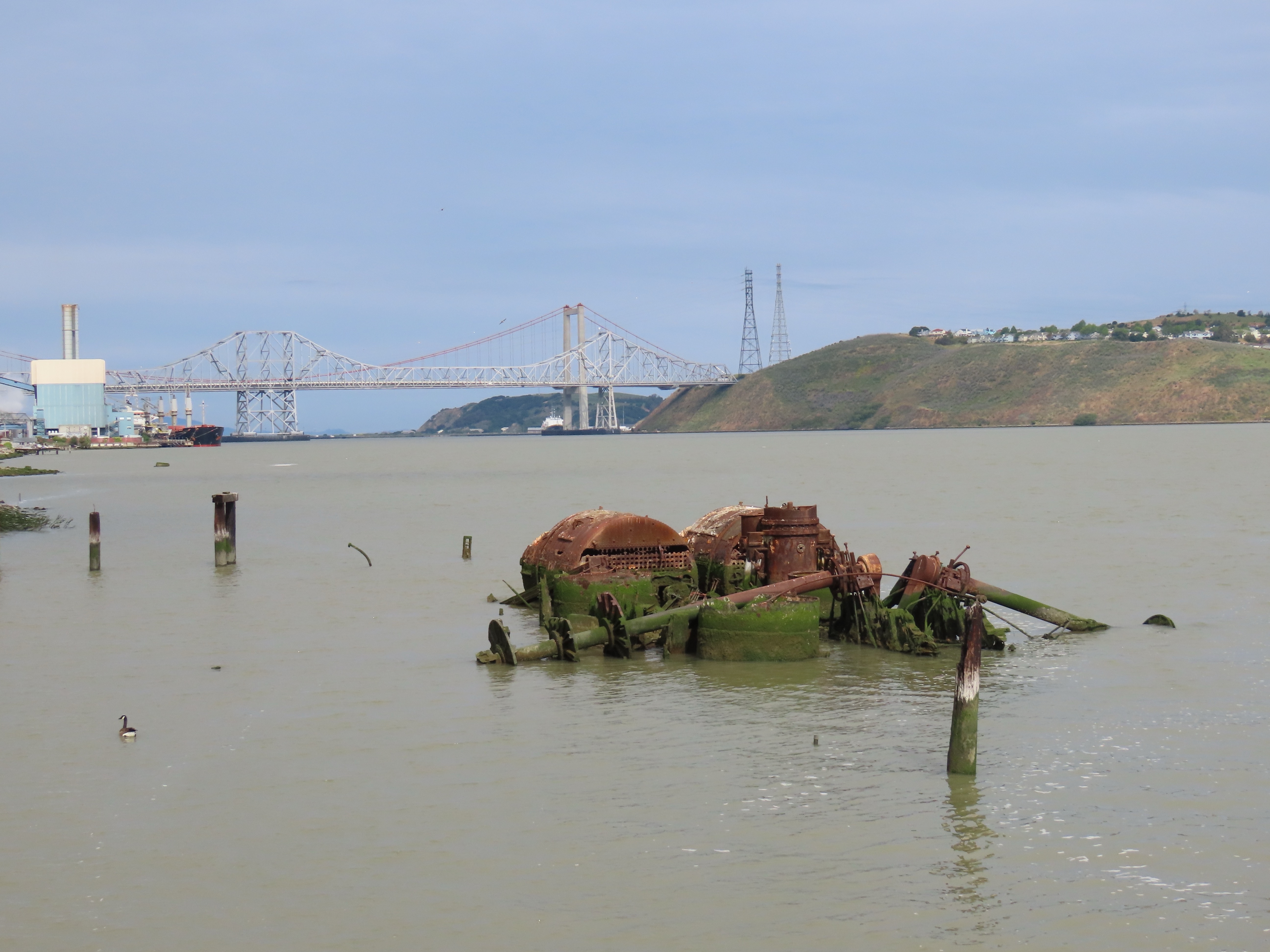
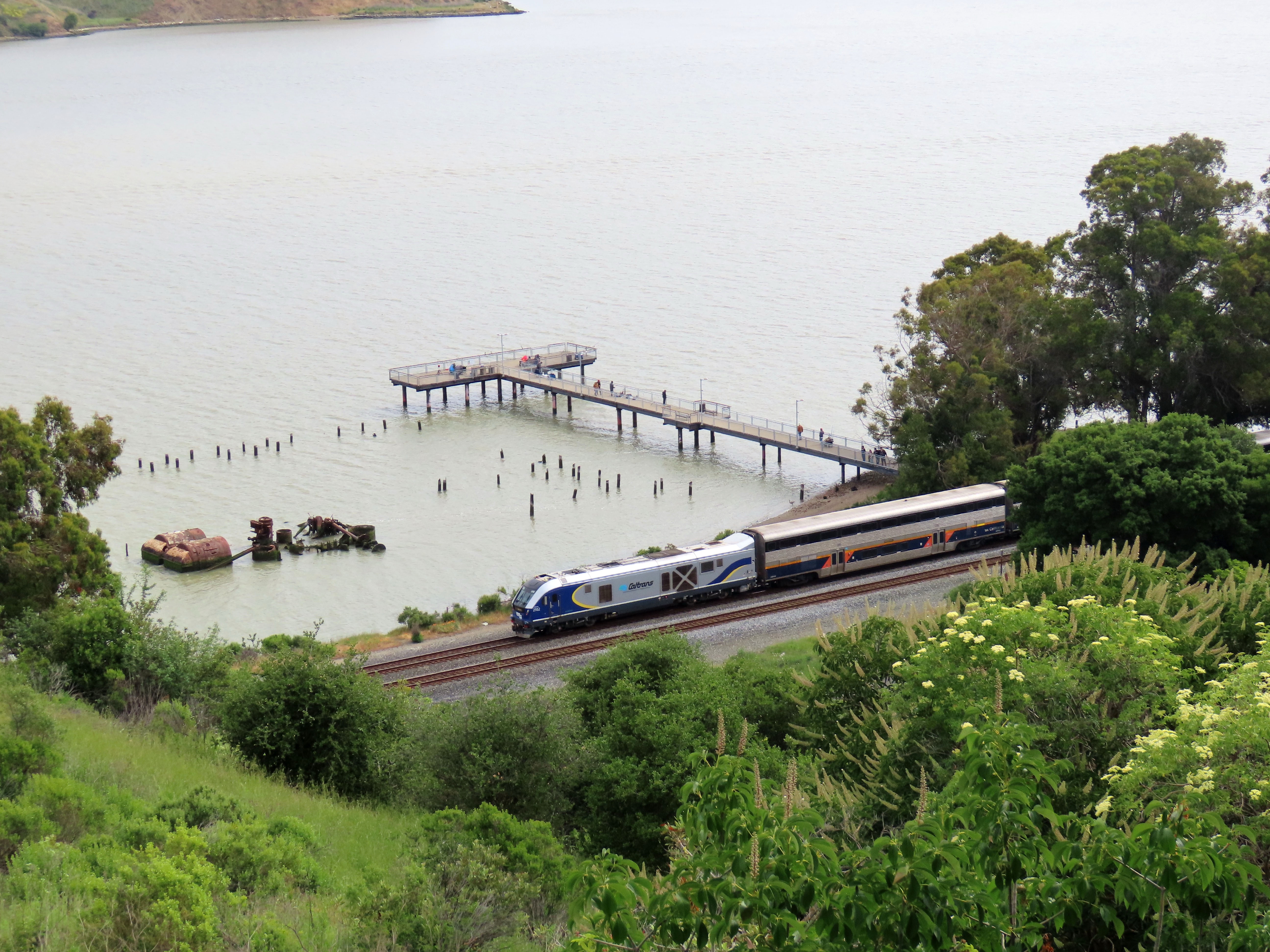
I also had time to get a sketch of another piece of railroad and nautical history: the rusted boilers and paddle wheel hubs of the SS Garden City.

The Garden City was a Southern Pacific ferry that ferried people and automobiles across the waters of the bay. She was built in 1879 and was 208 feet long and weighed 1,080 tons. The wooden side-wheeler had a crew of 19.
The construction of bridges like the Carquinez and Golden Gate rendered the ferries obsolete and in the 1930s, the Garden City was moored at a pier near the current Eckley Pier and it was used as a restaurant and fishing pier until she was abandoned in the 1970s. In 1983, the ferry burned to the boilers, which is about all that remains of this once proud vessel.
What’s left of the SS Garden City in the foreground and one of the bridges that made her obsolete in the background.

It was now nearing nine so I headed across the tracks to take up a position. Down rail the retort of the horn reached me as the Zephyr blew the crossing at Crockett. Shortly thereafter the crossing signal activated with red lights and bell and the Zephyr appeared around the bend.

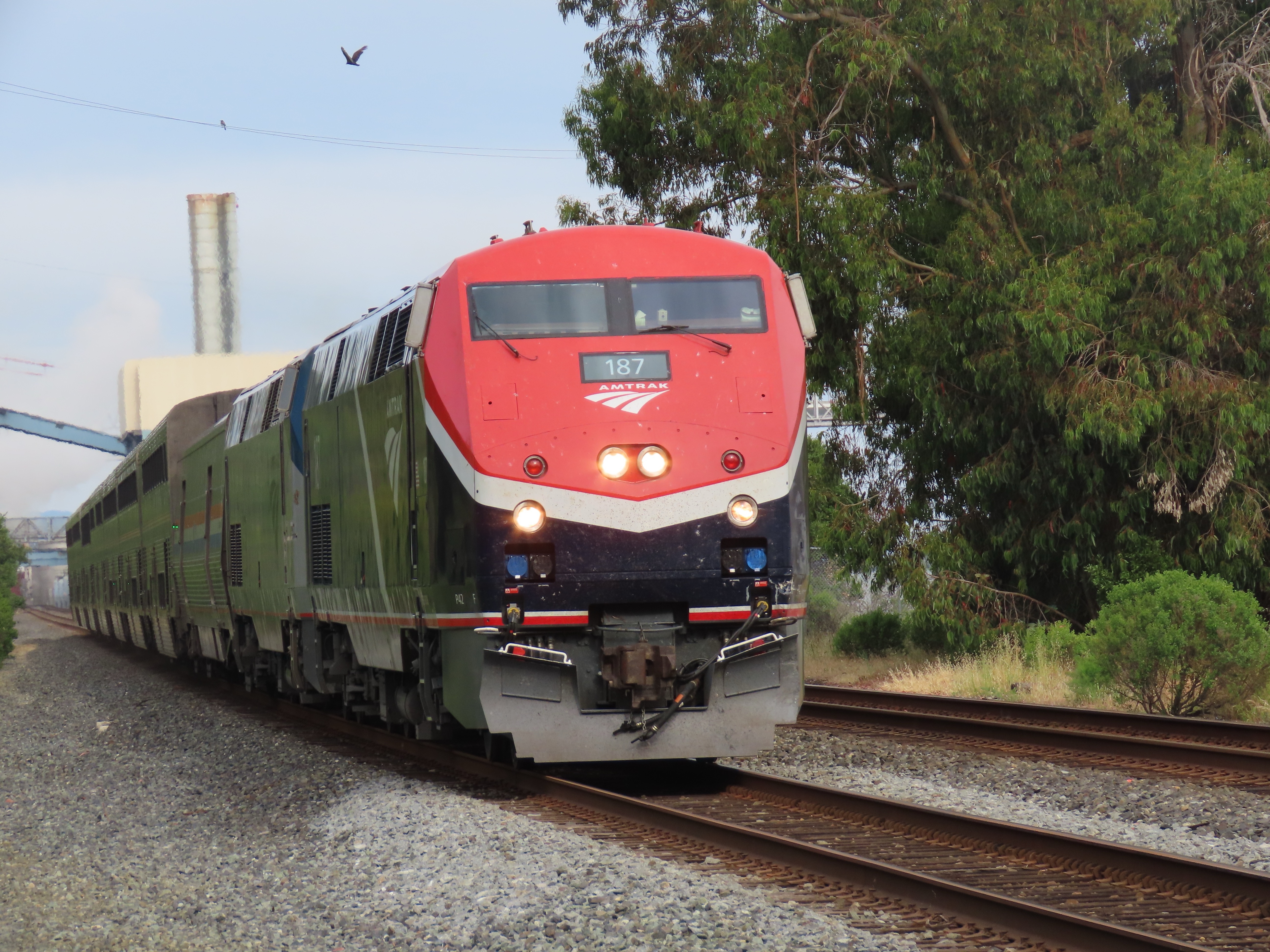
A GE P42DC 187 is on point of the California Zephyr as she heads towards her next stop: Martinez.
Zephyr No. 6 crossing the pedestrian walkway at Eckley. This is my favorite car to ride in while traversing the Sierras and the Rockies: the observation car!
A Capital Corridor heads towards Crockett past the fishing pier and the ruins of the Garden City.

Sketching Notes

Before heading out to Eckley, I pre visualize my sketch. I practice sketching the perspective and location and drew the Superliner train cars that would be a part of the train’s consist so I would be able to draw the cars into my sketch after the train had past. This is using sketcher’s “muscle memory” so drawing the cars would become almost second nature.

A loose continuous line pre-sketch of the pedestrian crossing.

What I drew on location was the foreground and background eucalyptus and then I added the long distance Zephyr from memory. One thing I might do differently is to sketch the train looser to convey the sense of motion.

For my sketch of the Garden City, the core of the sketch was done as a continuous line sketch and I then lifted my pen and add more details.

Both sketches are with my TWSBI Eco fountain pen.

Image

Broadway Station

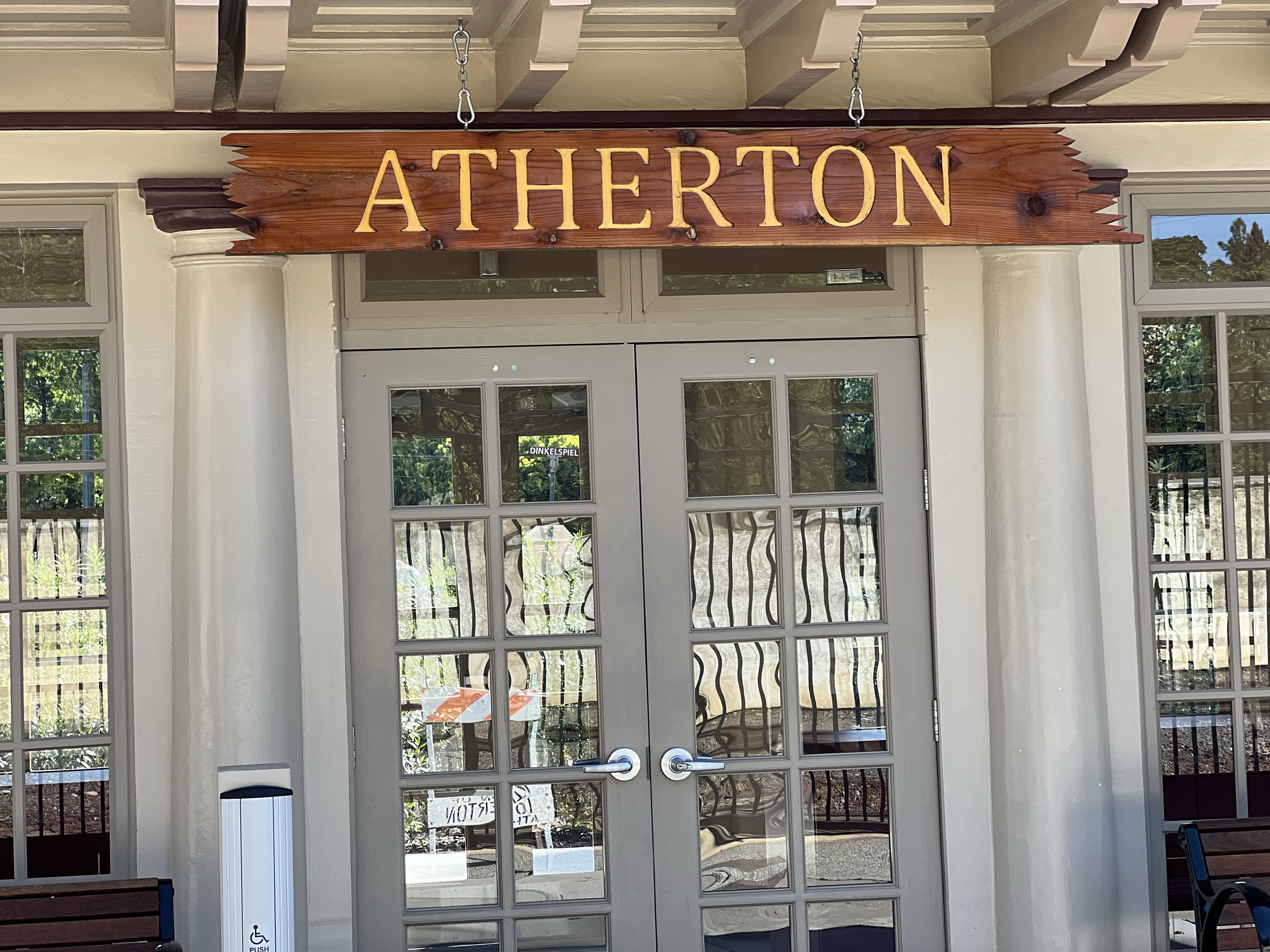
On Monday I did an afterwork sketch of the closed Atherton Station on the Caltrain route and now on Friday I headed to North Burlingame to do another after work sketch of a Caltrain station: Broadway.

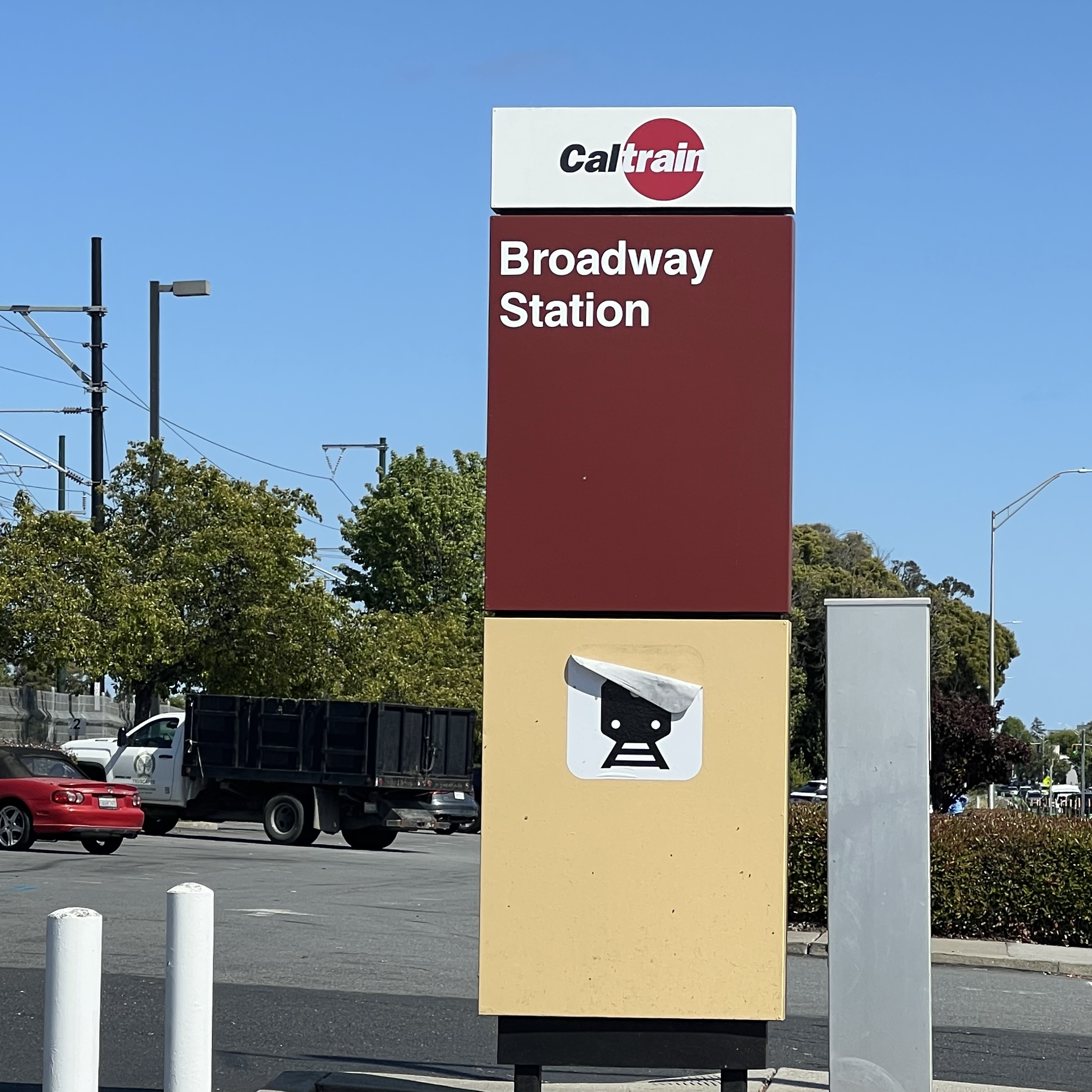
The peeling train sticker on the sign is a living metaphor for the downtrodden Broadway Station.

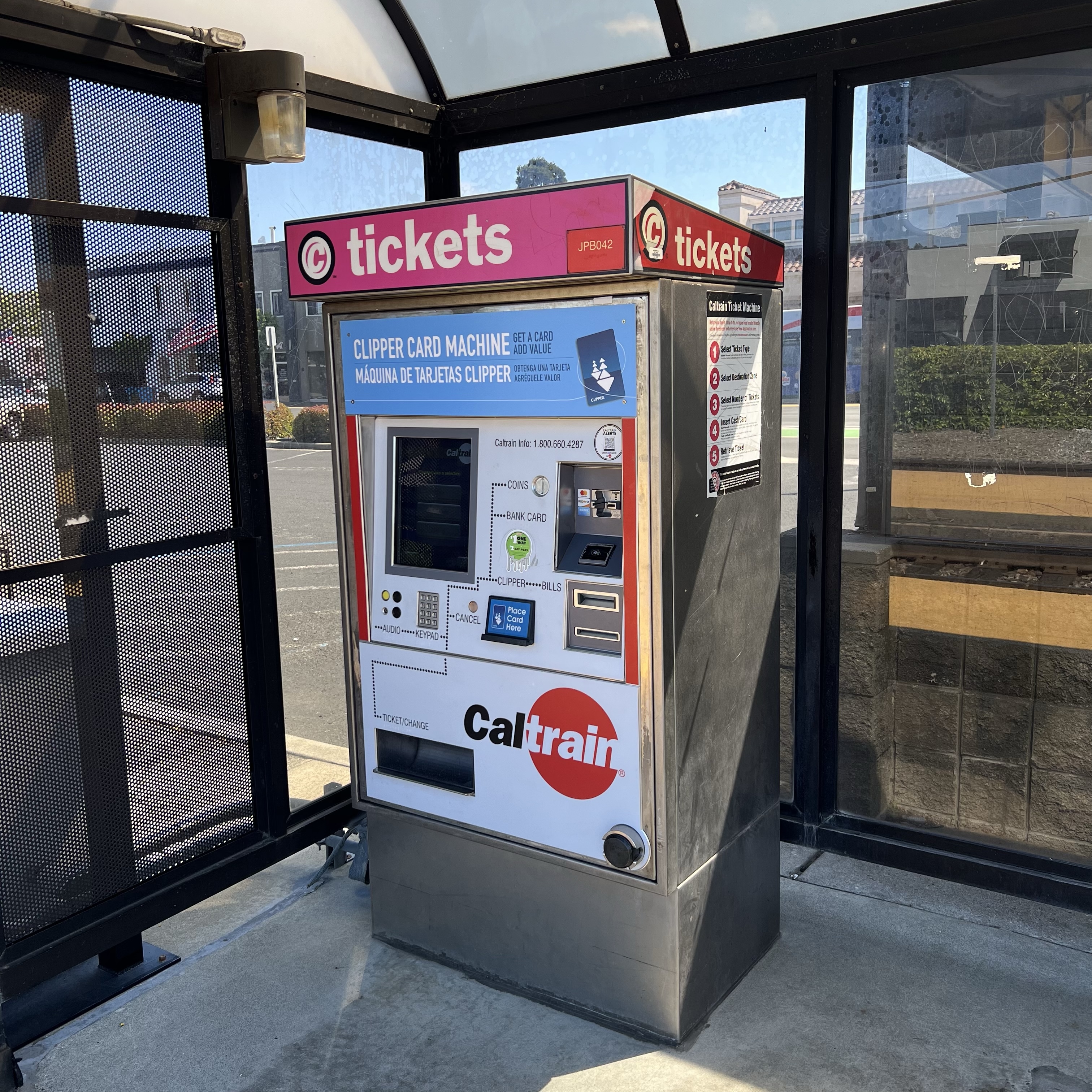
With a name like Broadway, you’d think of a busy station with lots of passenger traffic and a station with a staffed ticket office, a waiting room lined with wooden benches, and perhaps a cafe. Sure that might have been the picture over 70 years ago. Now here is the ticket window:

And there is no cafe. And no passengers for that matter.

Like Atherton, the new electric EMUs speed by this station. The train only stops here on weekends, which is more than can said for Atherton, and the former station is now a restaurant. The platform has some benches, a few shelters, and a sign that reads “No Loitering”. Is sketching a form of loitering?

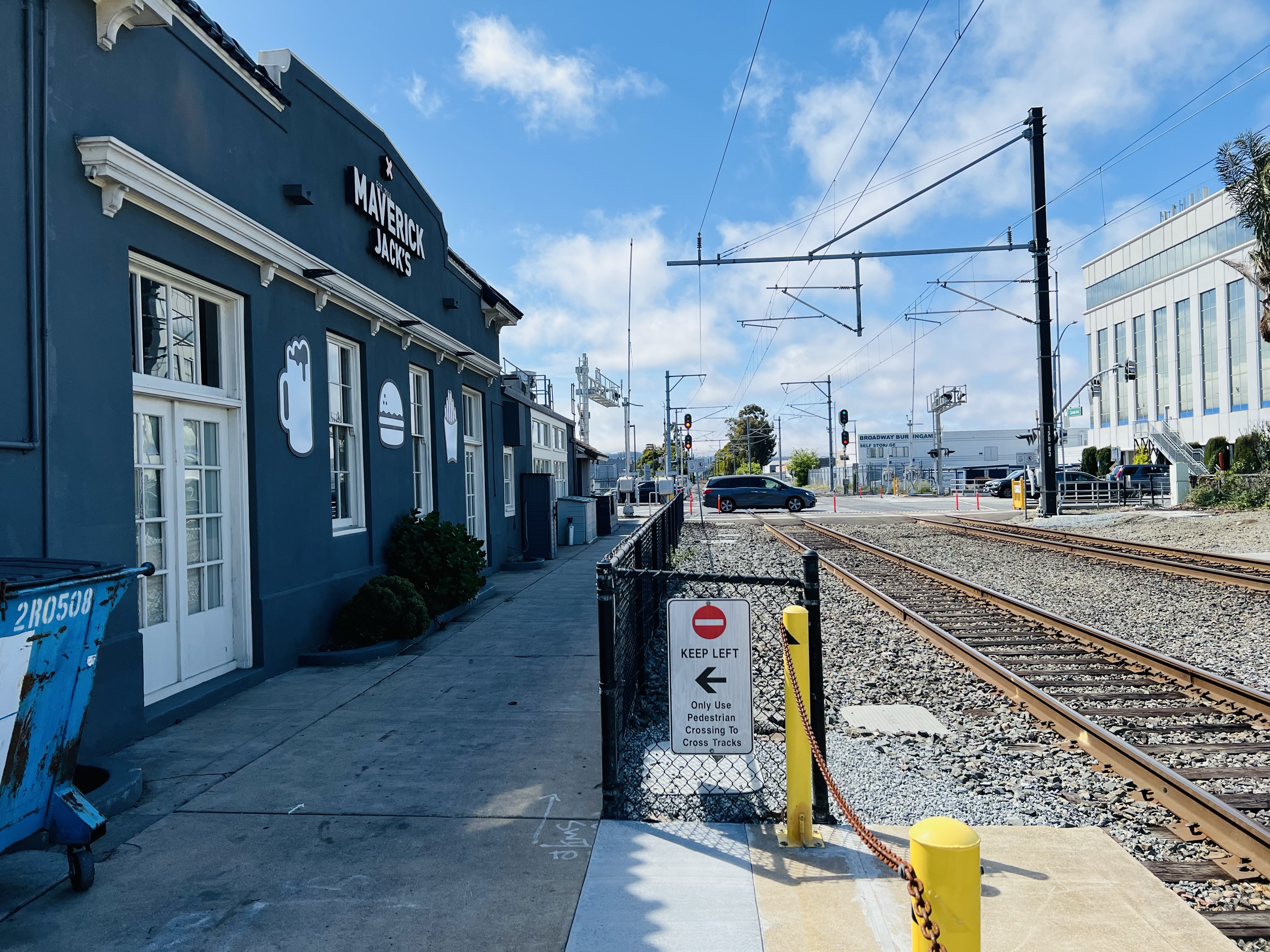
Looking north toward San Francisco with the former station, now a restaurant, on the left.

The Broadway Station suffers from diminishing ridership and a center loading island platform for northbound trains. This means that a hold-out rule is in effect which means that if a train is in the station, a train heading in the opposite direction must wait outside the station until the other leaves before pulling in. This creates delays and is a major reason the station was closed on weekdays on August 1, 2005.

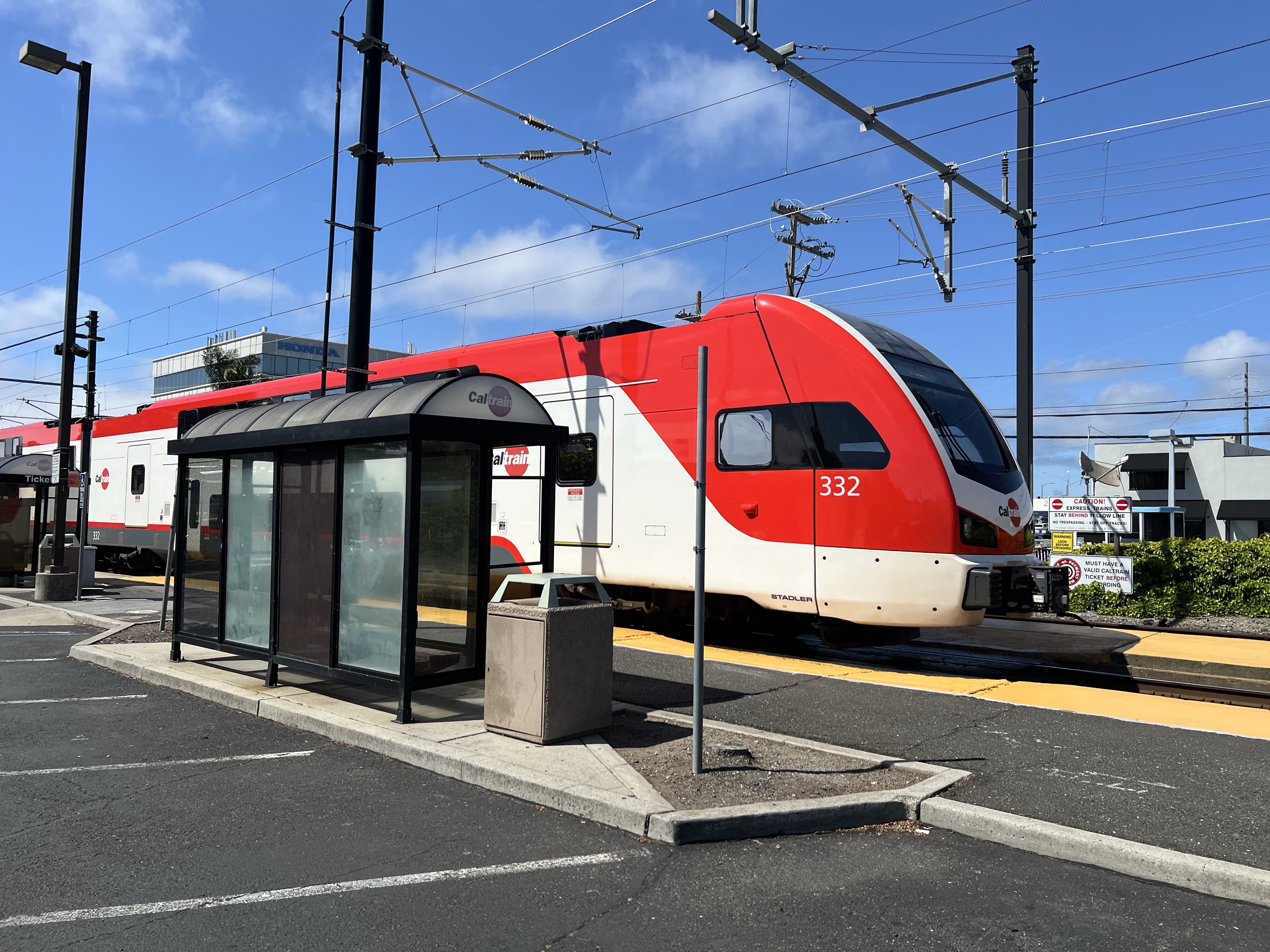
This southbound EMU is not stopping here.

The original station was opened by Southern Pacific in 1911. The station was renamed Buri Buri in 1917 and then to its current name in 1926.

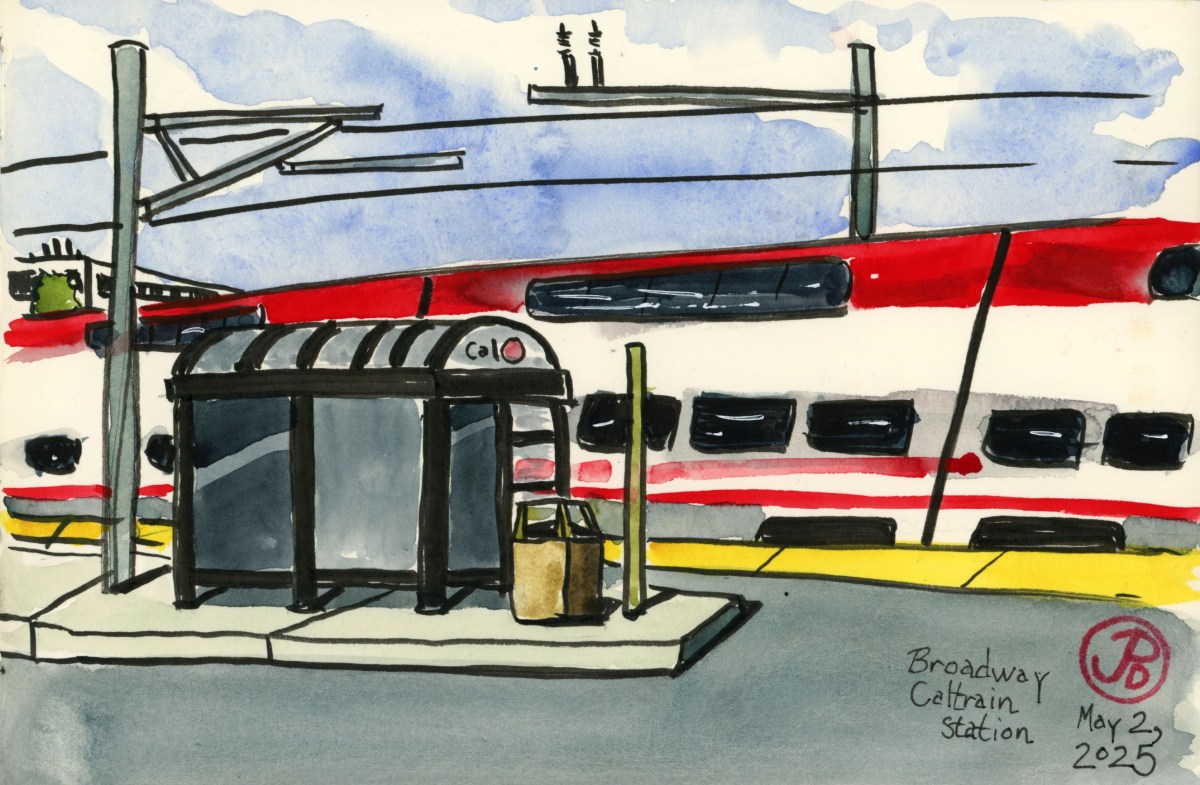
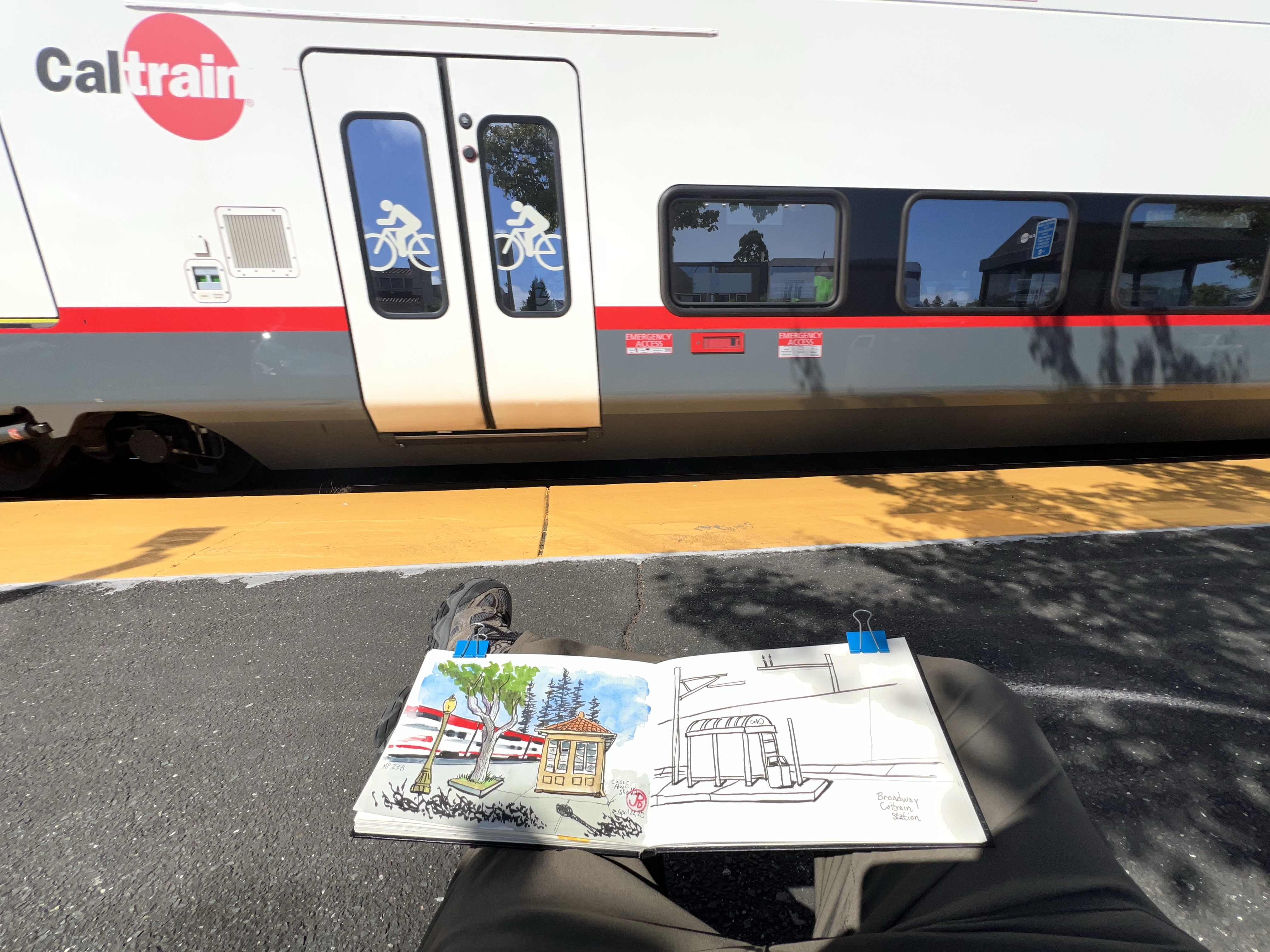
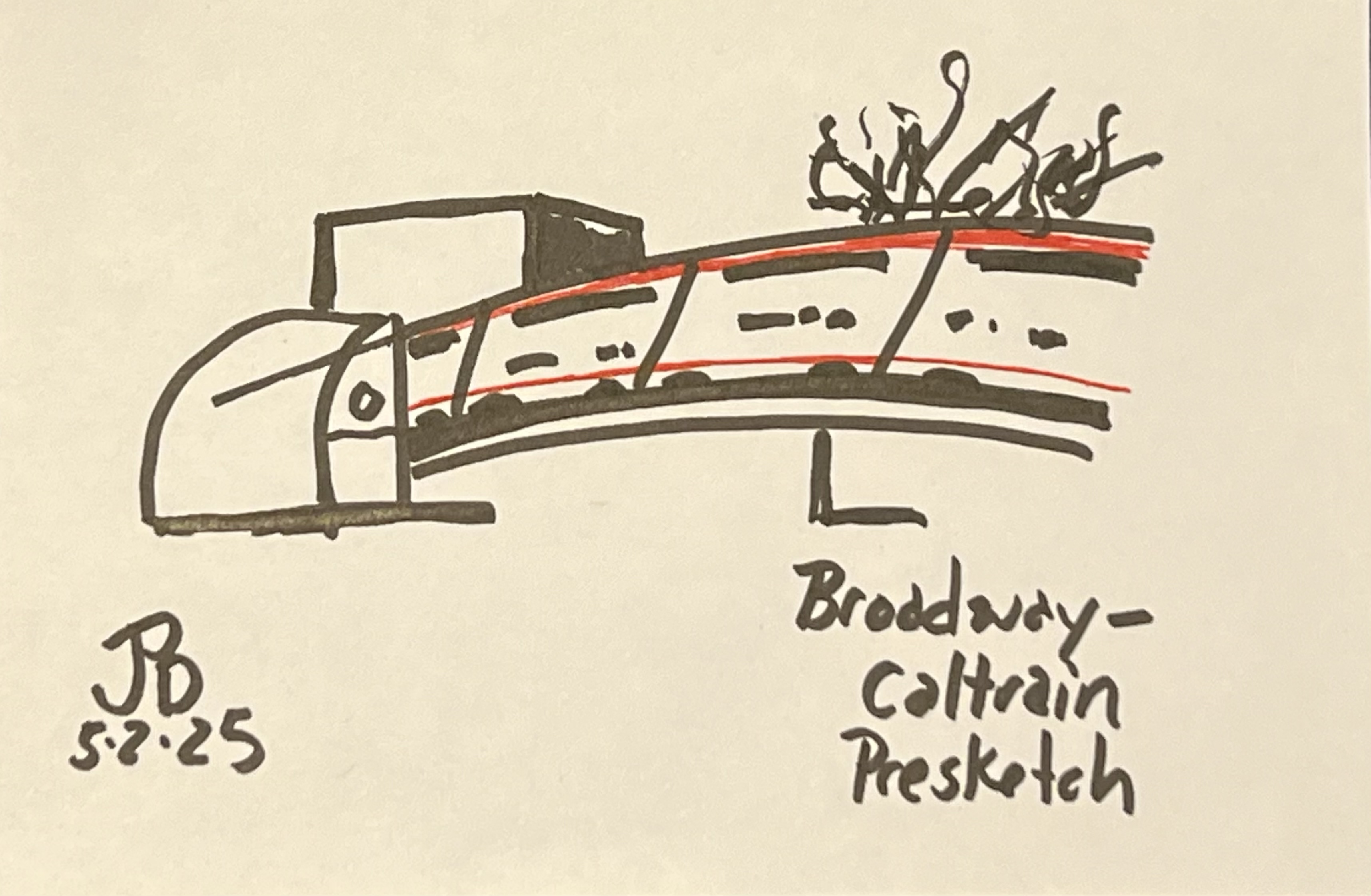
My field sketch and a southbound EMU speeding by at Broadway.

Sketching Notes

During my lunch I sketched out the scene I wanted to sketch on an index card. This is like a storyboard for a tricky scene in a film. What I wanted to do was convey a sense of stillness and motion. The stillness of the shelter and the motion of the train speeding by. In the presketch, or storyboard, I exaggerated the lines of the train. They are curved and kinetic while the shelter remains calm and pedestrian.

Perhaps I could have exaggerated the lines more in my field sketch. That would entail sketching things that aren’t there in front of me. Like sketching in another dimension.

Image

Next Stop, Atherton

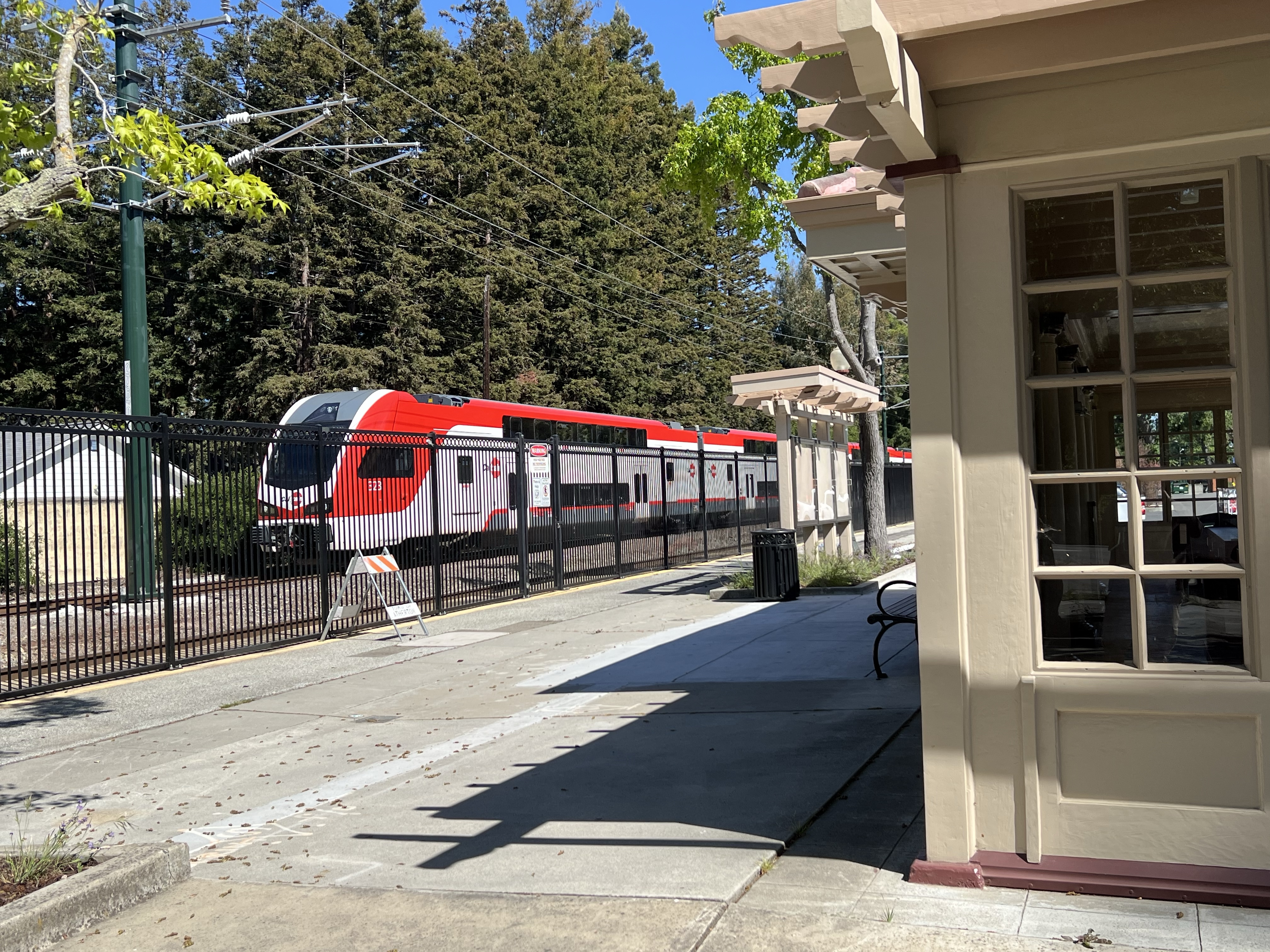
On my weekend Caltrain ride to Palo Alto, we sped past the former passenger shelter at Atherton.

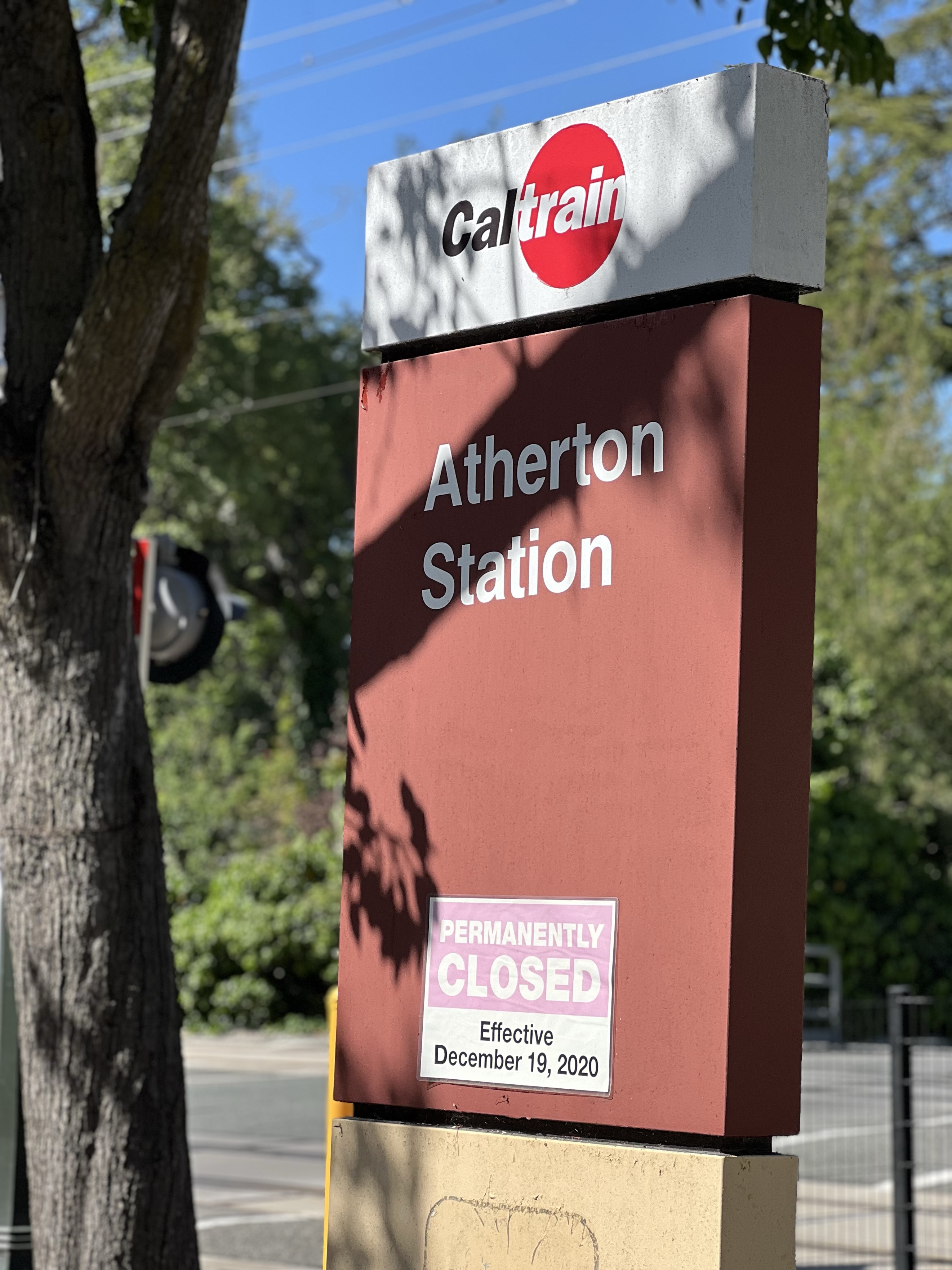
I remember that this used to be a stop on the commuter line but I later found out it had been permanently closed since December 19, 2020.

Where had I been?

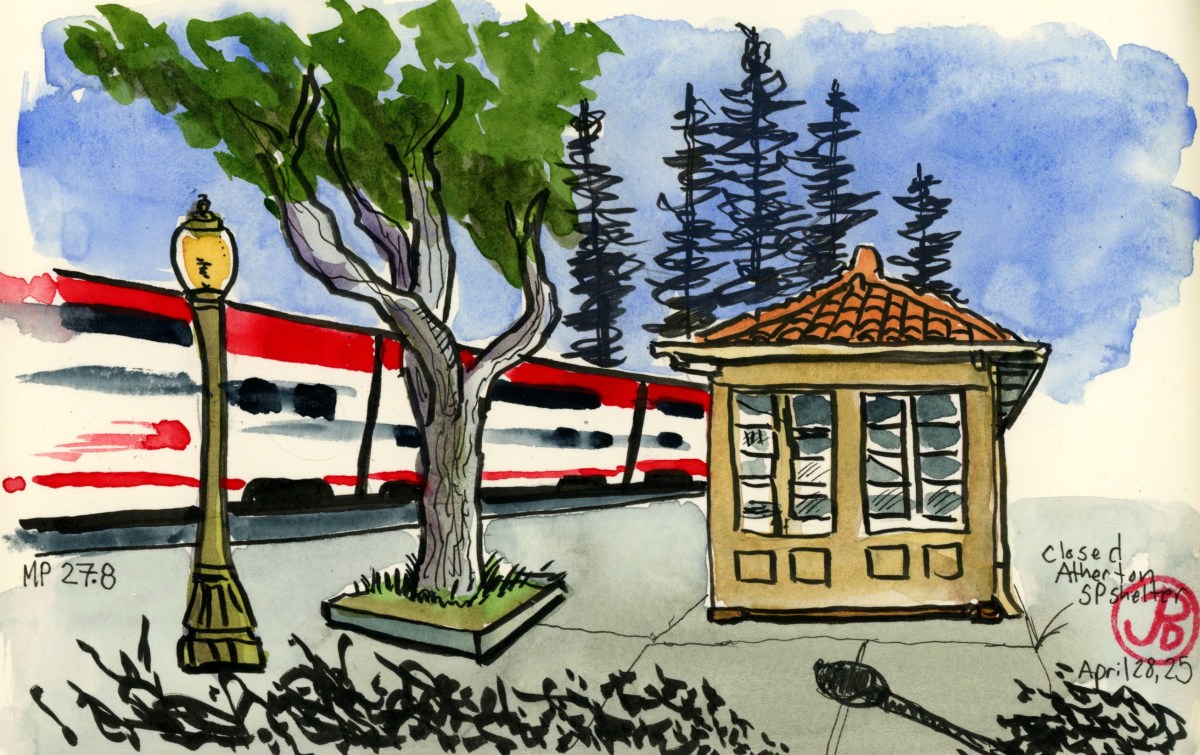
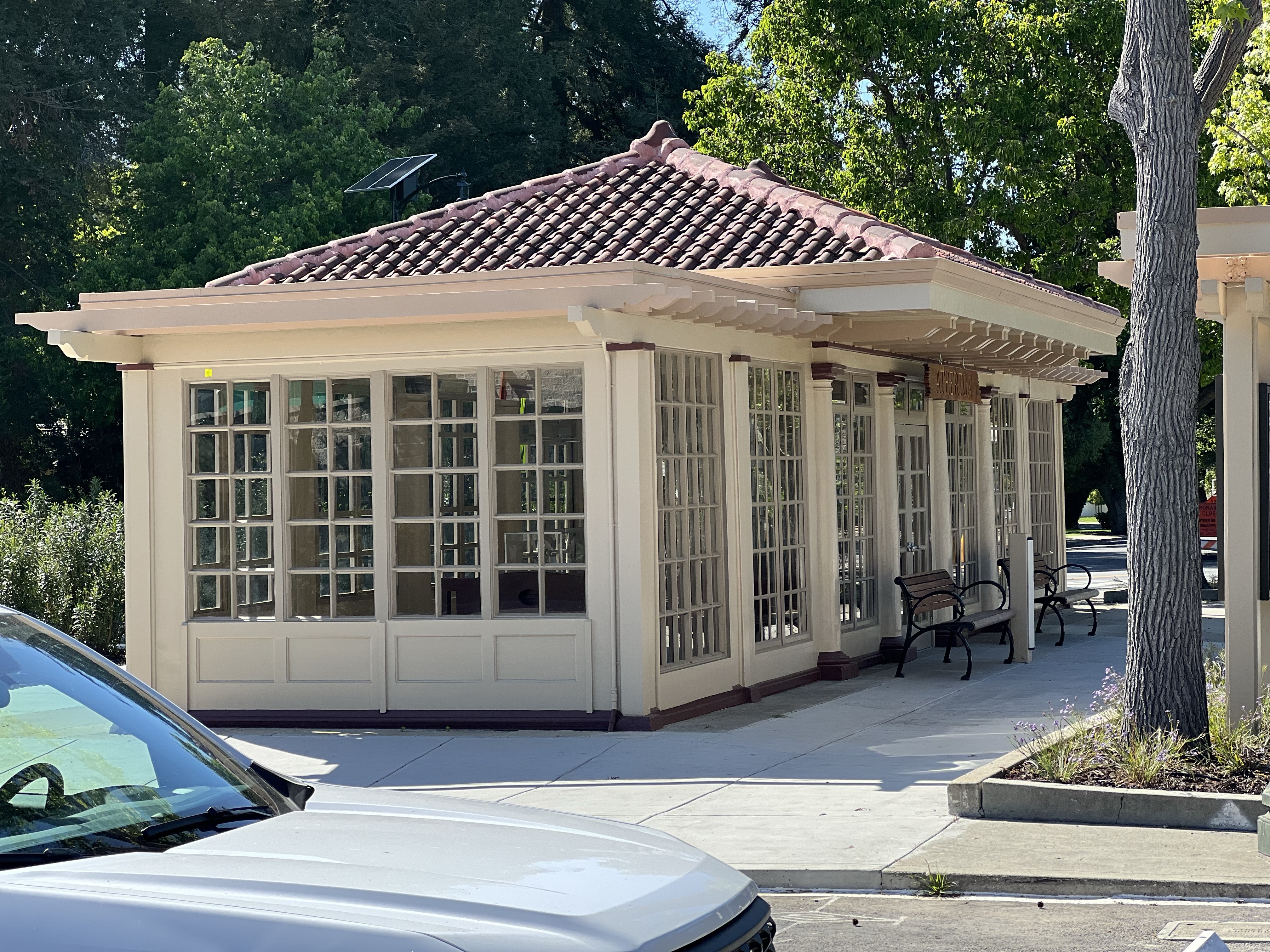
I returned to Atherton to sketch the lonely railroad shelter where passengers no longer detrain or board.

There are a few things to know about the San Mateo County town of Atherton (population 6,823). Atherton had been ranked as having the highest concentration of wealth per capita for a town of its size anywhere in the United States. The town also has the highest median house price in the country at an astonishing $7,950,000!

And then there is the infamous Atherton police blotter. Here are a few examples, and yes these are real: “A man was reported to be sitting down and talking to himself. Police made contact and confirmed he was using a cellphone”, “A resident worried that a noisy hawk in a tree was in distress. When authorities arrived, the hawk was quiet and enjoying dinner”, “Police assisted an Atherton man in a San Francisco bar who forgot where he was and called 9-1-1”, “A family reported being followed by a duck who resides on Tuscaloosa Avenue”, and this takes the cake: “A resident reported a large light in the sky. It was the moon”.

From these police blotter examples we can tell that Athertonians are a vigilant and concerned group of citizens.

When Caltrain announced that they would be electrifying the line, the town of Atherton sued Caltrain alleging the construction would damage some heritage trees. Atherton lost the lawsuit and electrification continued.

A train station without a train.

This is not a great way to treat a rail service that has stopped to pick up passengers in the town since 1866 when the first station opened under the then named Fair Oaks.

Southern Pacific replaced the first structure in 1913. This is the core design of the shelter that remains to this day. The shelter was enlarged in 1954 and later rebuilt in 1990.

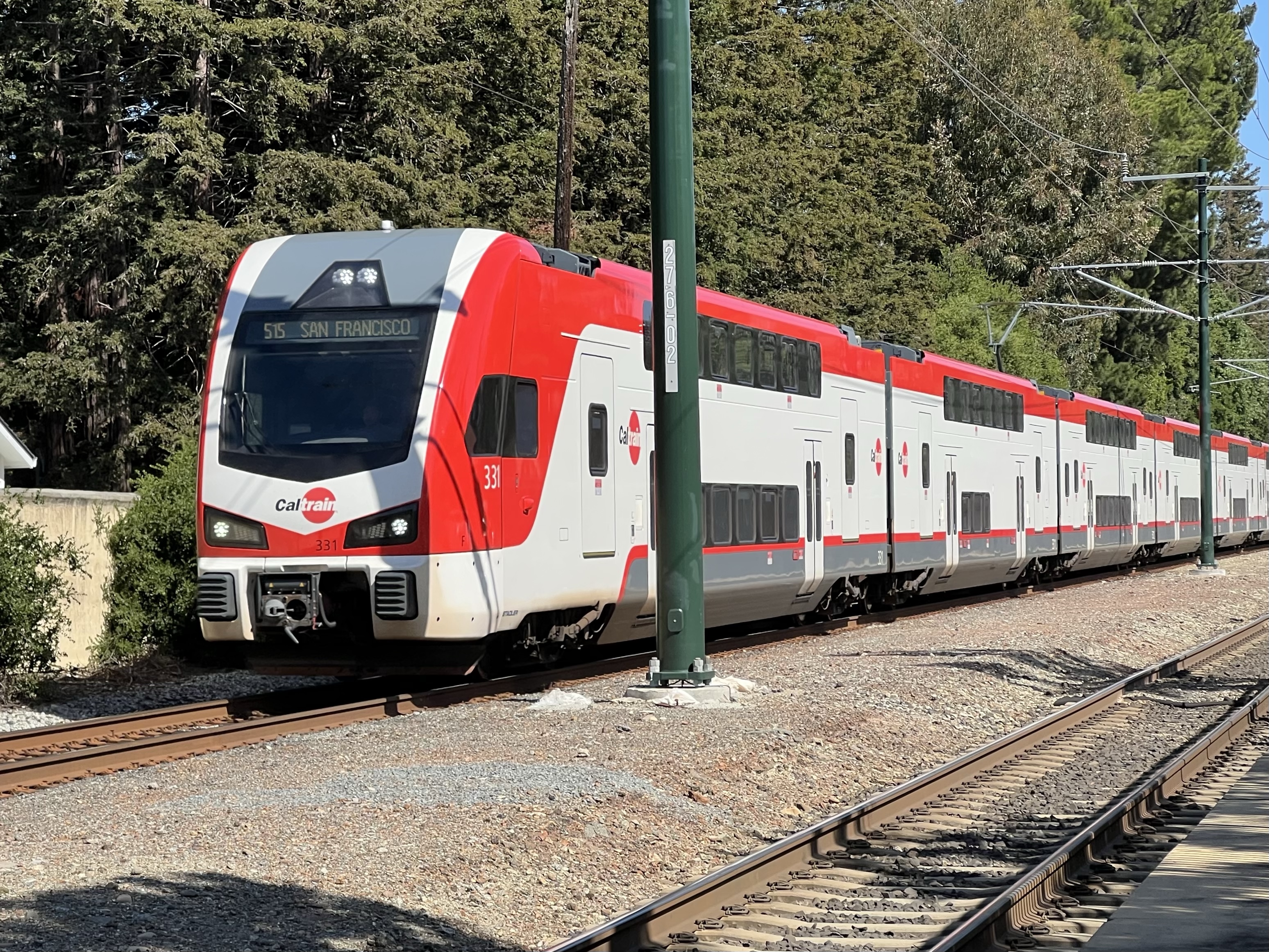
A northbound EMU speeds by the closed shelter. A barrier fence separates the platform from the busy rails. In the featured sketch I left the fence out.

In 2005 weekday service to Atherton was suspended because of low ridership. The station averaging only 122 boardings a day compared to nearby Redwood City at 4,212 boardings per day. The low ridership combined with improvements needed ($30 million in improvements) to the aging center loading platform island meant that this train stop was doomed.

Perhaps a fitting end for a town that sued to halt progress but in the end now watches the future pass them by.

A busy afternoon in Atherton. During my 45 minute visit, five trains sped past the station. This one is northbound to San Francisco.

I did an afterwork sketch and I can imagine a new police blotter posting: “A strange man was sitting down near Atherton Station. Turns out he was only sketching.”

Image

Caltraining

Last fall the new Sadler electric multiple unit sets (EMU) were put into service on the Caltrain route from San Francisco to San Jose and I had been meaning to ride aboard ever since.

So on a gloomy spring morning in late April, I boarded an inbound N Judah to the Caltrain Station at 4th and King.

I was picking a travel window that was not going to be too chaotic with first pitch scheduled at 1:05 at the Giant’s game. Lots of fans use the N Judah and Caltrain to get to the game.

I planned to catch southbound train 610 departing at 9:55 AM and detrain in Palo Alto for lunch on University Avenue.

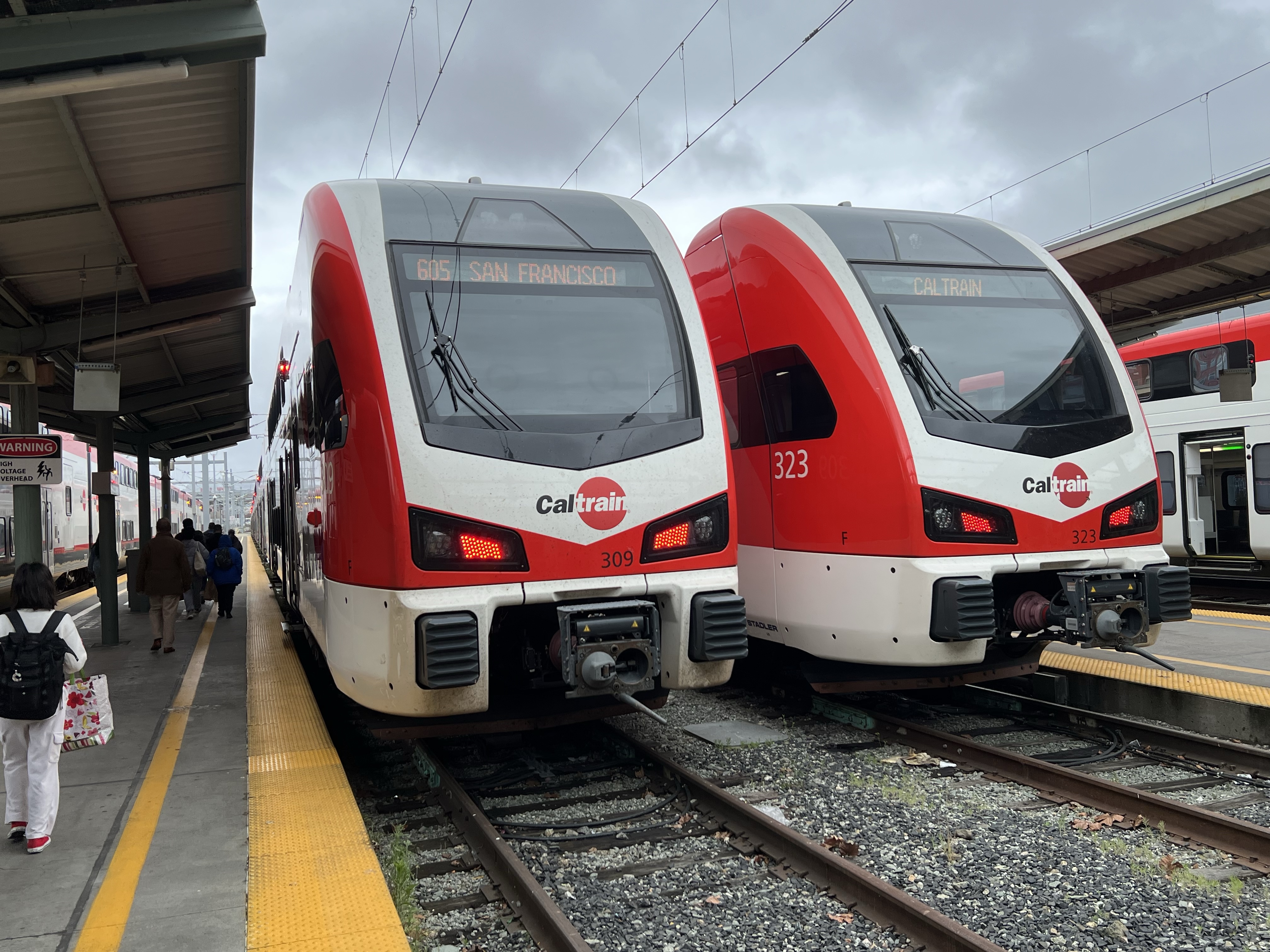
Two of the new EMUs at the San Francisco Caltrain Station.

My goal was to bring one pen (TWSBI Eco) and one watercolor journal (Stillman & Birn Delta panoramic) and only use continuous line sketching.

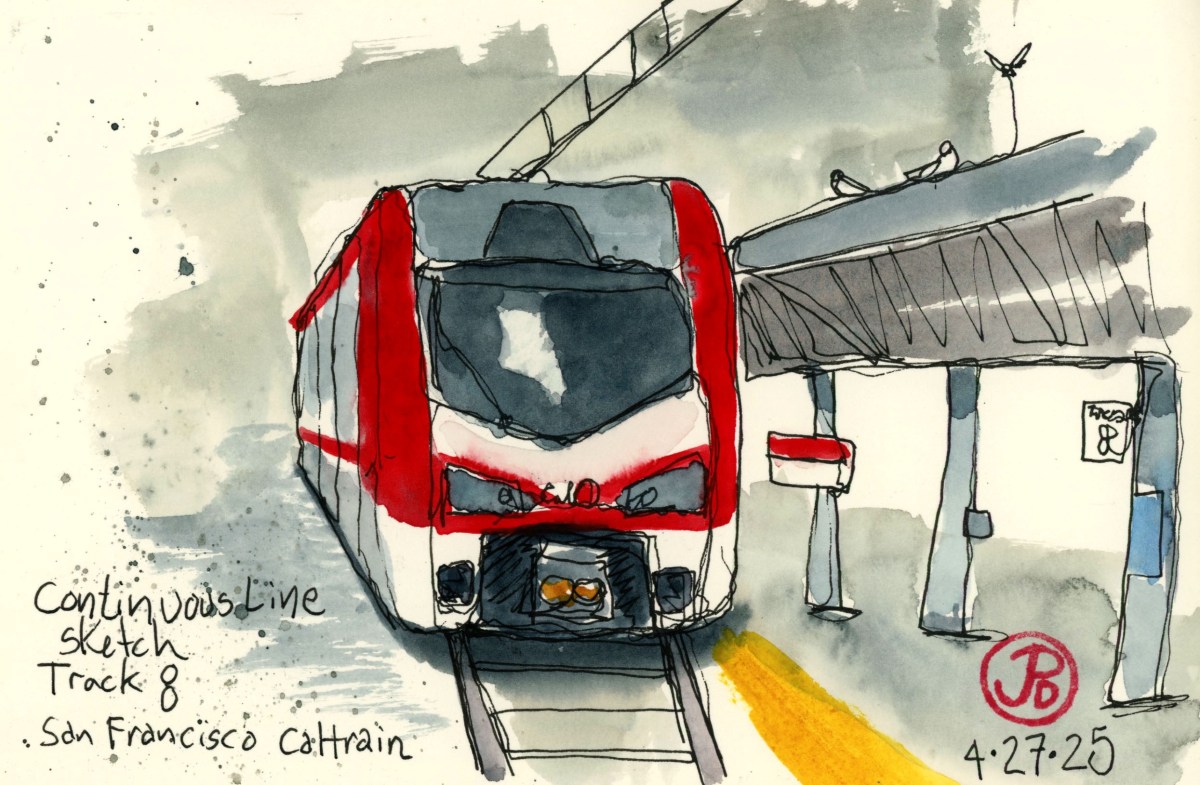
Before catching my train I sketched one of the new units on Track No. 8. (Featured sketch).

The gates opened and I boarded the train and was impressed with the bi-level design. I chose a seat on the top level sitting on the west facing side of the train (where all the historic stations are located).

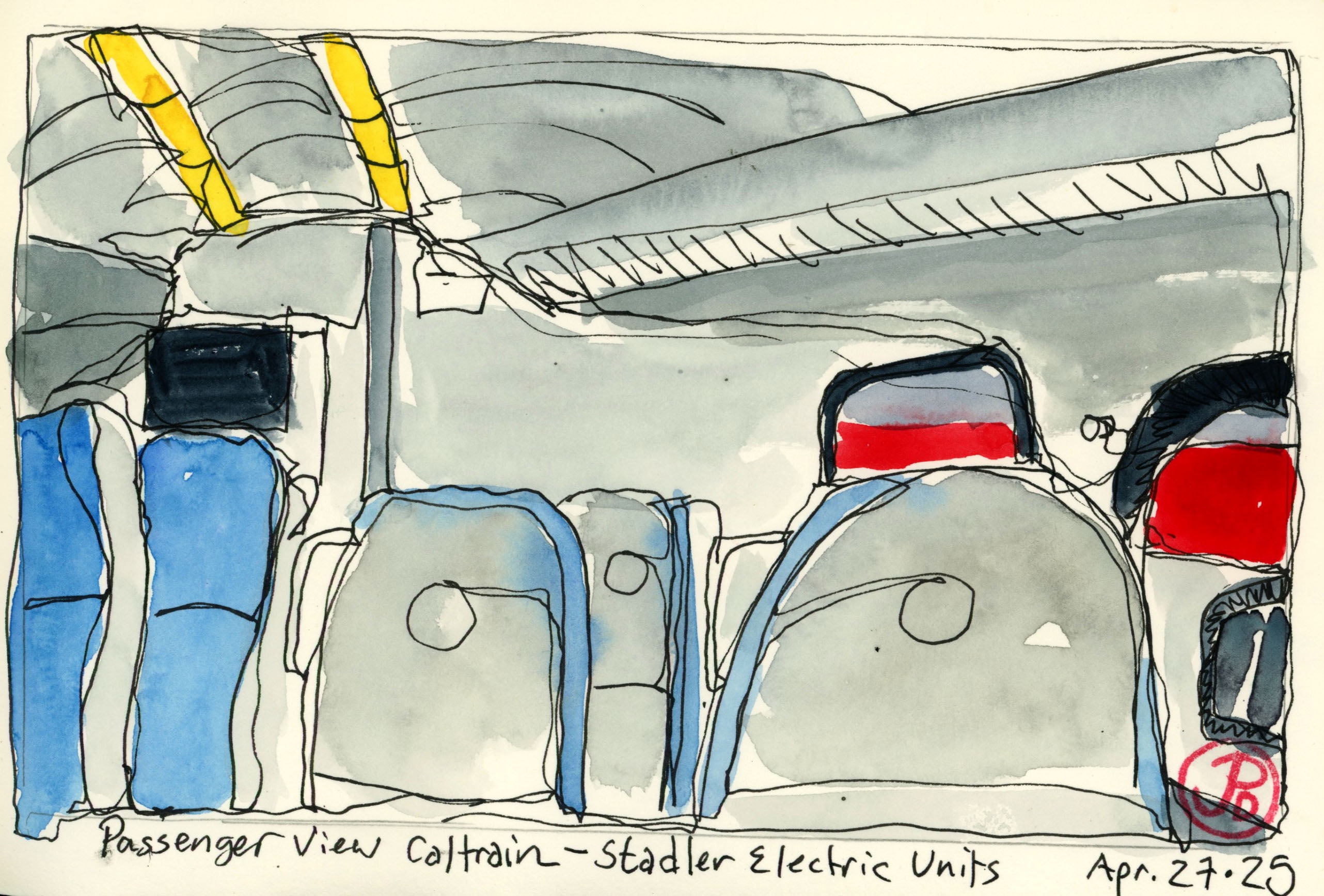
Before the train left I did a continuous line sketch of the interior from my upper deck seat-view. This sketching style loosens up your work including perspective. Normally I would pencil in the vanishing point and convergent lines but this sketching style is absolutely feral!

This takes a little getting used to because loosening up your sketching style causing you to loosen up your perspective of the style.

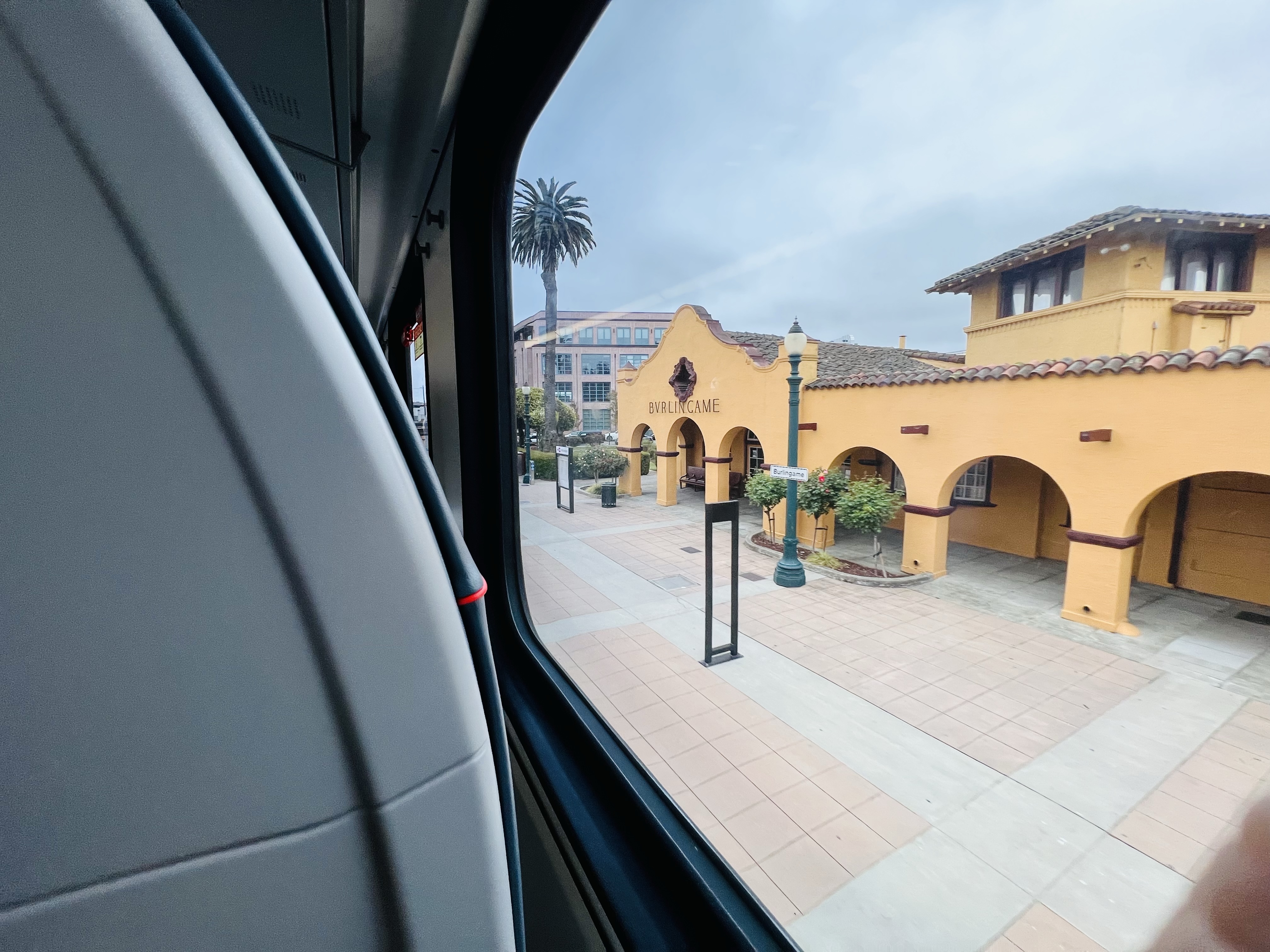
The view of one of my favorite stations on the line: Burlingame. This station is one of the earliest examples of the Mission Revival style and was highly influential in California when it was opened in 1894.
An EMU at Palo Alto, Caltrain’s second busiest station after San Francisco.
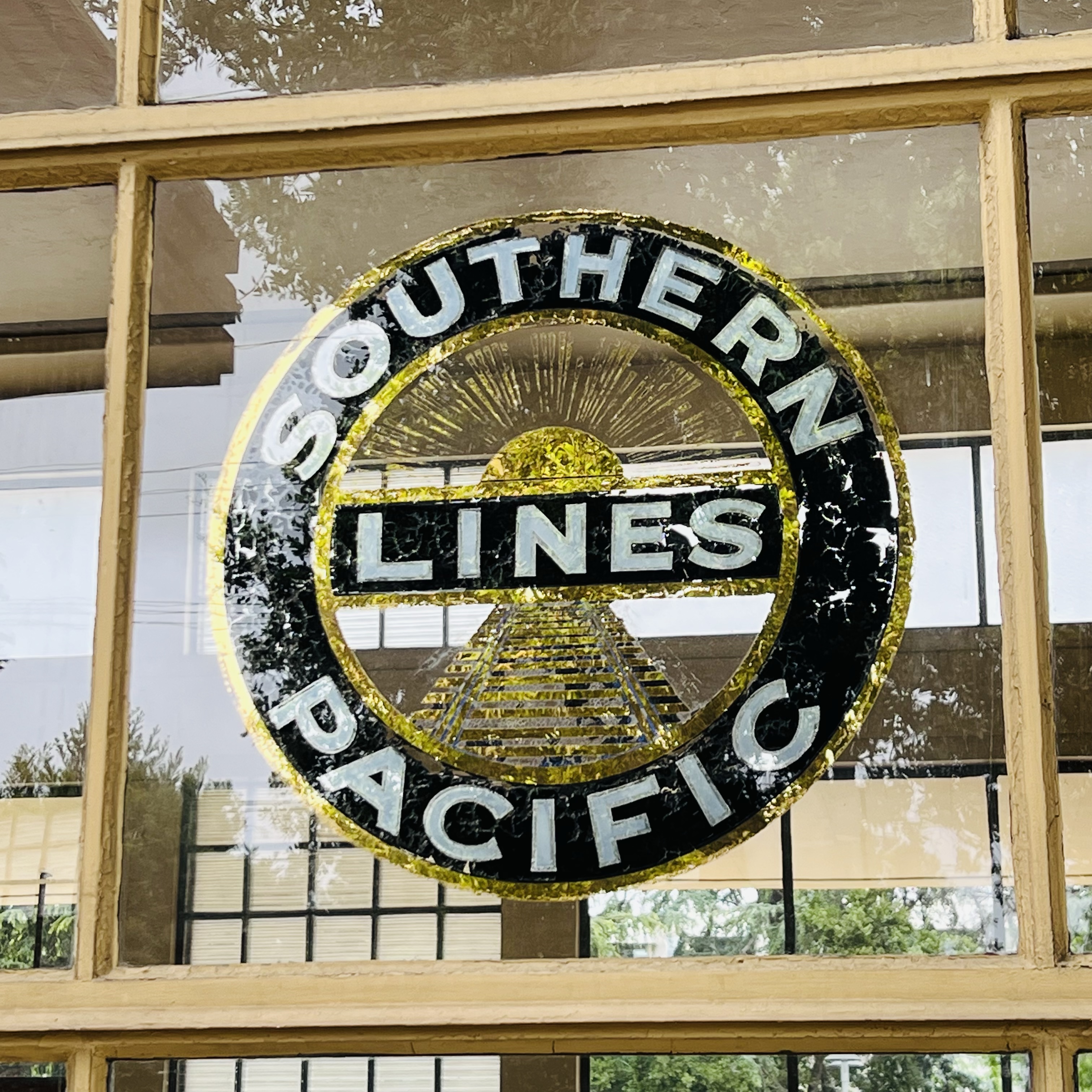
The emblem of the mighty SP when Palo Alto was a stop on the streamlined Daylight passenger service from San Francisco to Los Angeles. The most beautiful passenger train in the world (But I’m biased.)

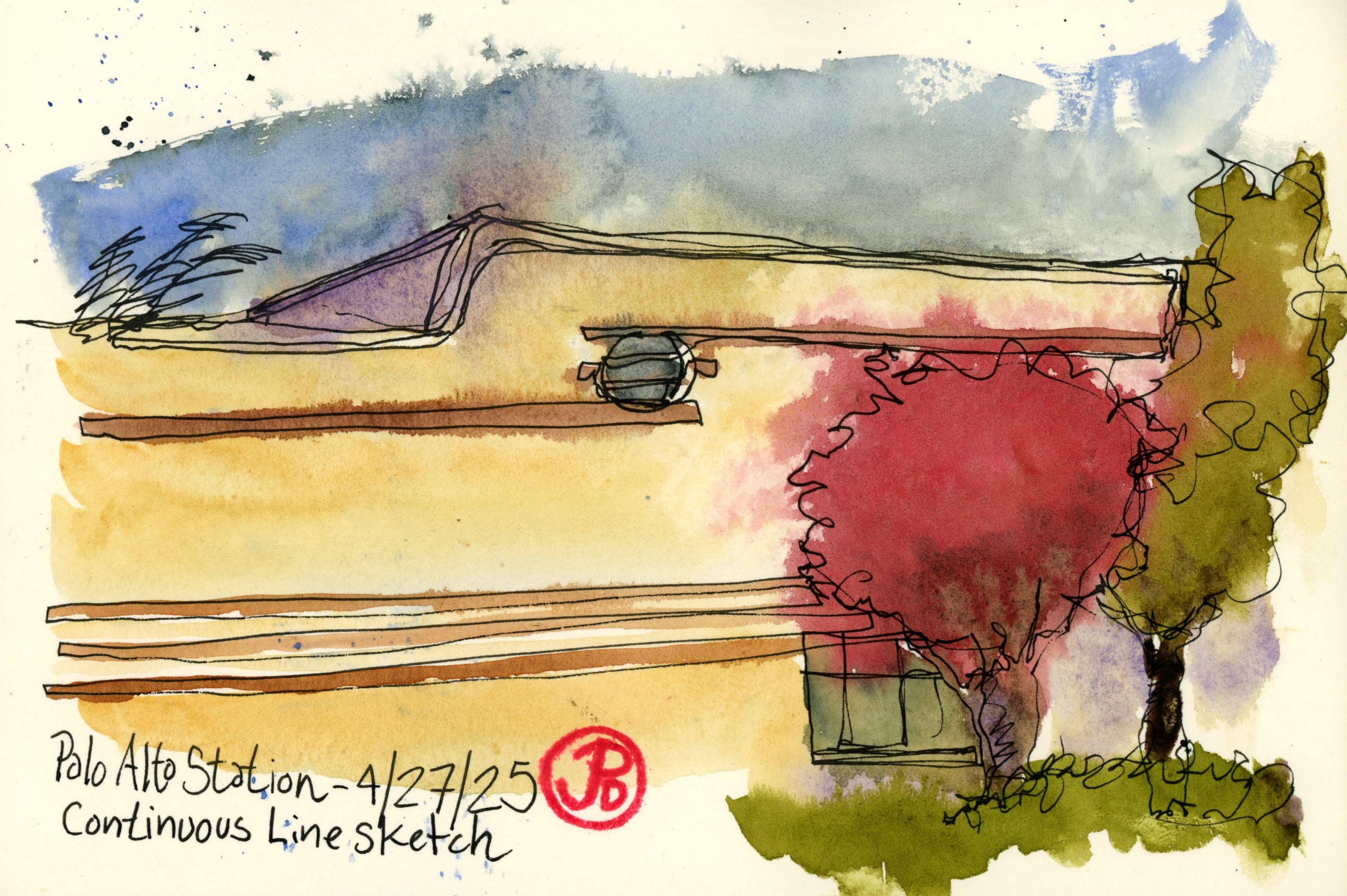
Before heading to lunch on University, I sketched another of my favorite stations on the line the Streamline Moderne Palo Alto station (1941) which looks like some kind of sea going vessel about to take to the air! The station was rebuilt to match the streamlined GS locomotives that were on point for the Coast Daylights.

Final Thoughts

Caltrain’s new EMUs provided a quiet, comfortable, and quick ride from San Francisco to Palo Alto. The interior is well designed and easy to navigate with screens at both ends of the car that shows the next stop as well as upcoming stops. The seven car units have a European feel that looks more like a fast tram or articulated streetcar rather than a high sped mainline train set.

One quibble with the design is that there is only one restroom aboard the train set. This is not a minor quibble as most stations on the line do not provide opened restrooms (including Palo Alto).

Image

Maude’s Railcar Home

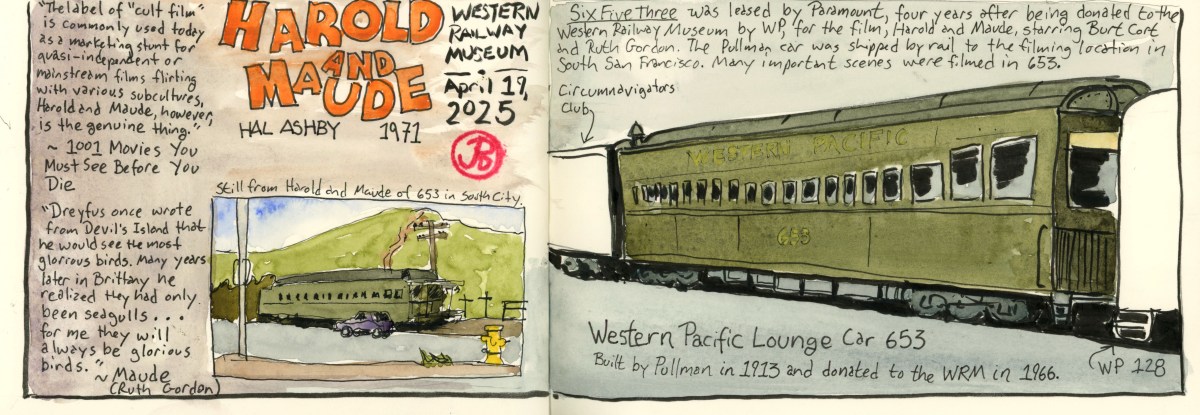
One of my favorite movies of all time is Hal Ashby’s Harold and Maude (1971).

It is a great cult classic and is a very quirky and eccentric film that is now widely praised while being panned and ignored during its initial release.

One other reason I really enjoy this film is that it was filmed on location in the San Francisco Bay Area and the Santa Cruz Boardwalk and Wharf.

This film provides a snapshot of what the Bay Area looked like in the early 1970s, back when I came into the world. The area has changed a lot over the last 50 years, yet some things do remain the same.

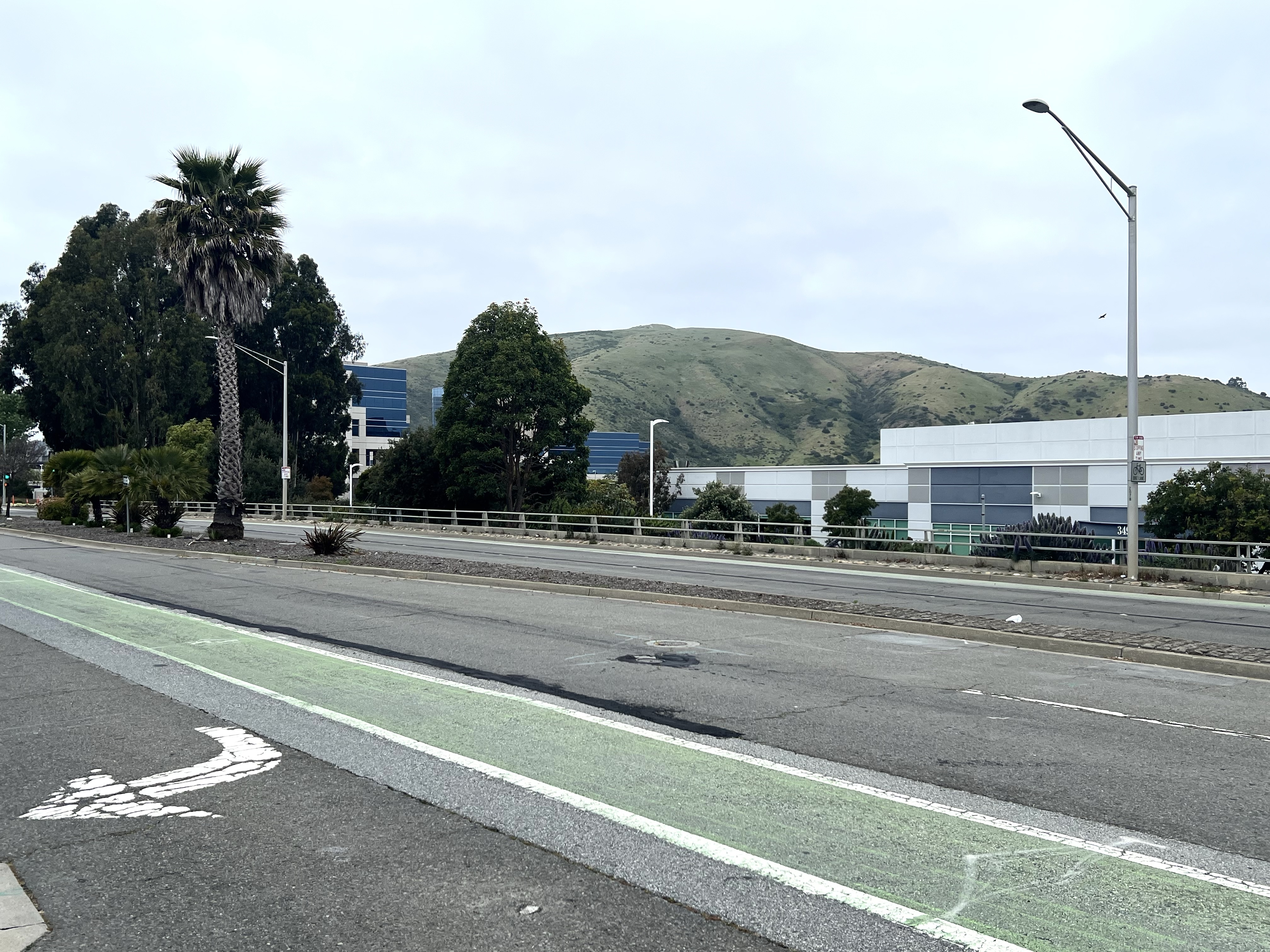
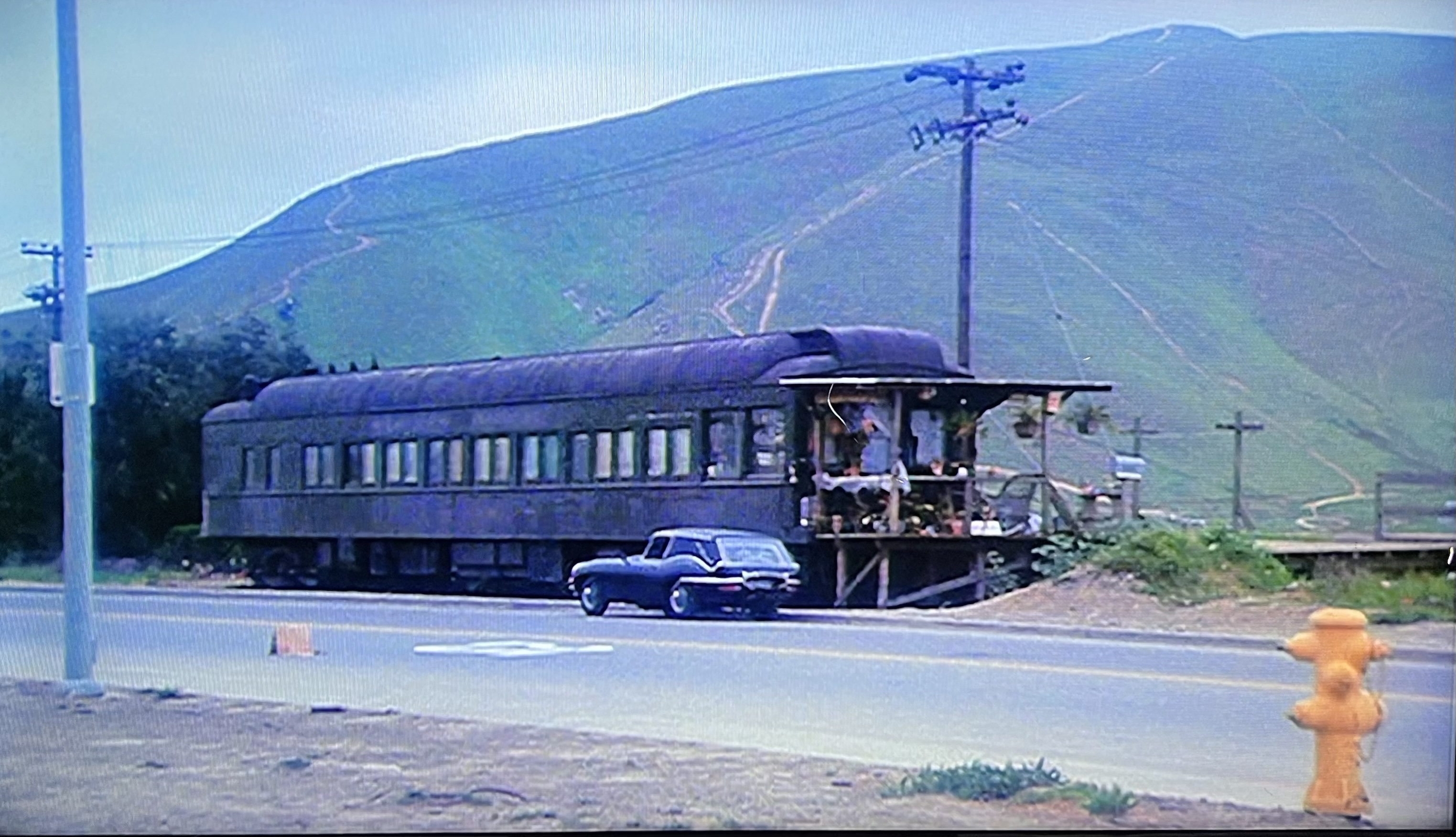
This is Oyster Point Boulevard between Eccles Avenue and Gull Drive in South San Francisco. There was once a rail siding here and this is location of Maude’s railcar home. The rails are now gone, they were taken up when the street was widened. The green hills in the background are still there but the foreground is much changed and are now blocked by biotech buildings and taller trees. (South City prides itself as the “Home of Biotech”).

A still from Harold and Maude showing Maude’s railcar home and Harold’s Jaguar-hearse on Oyster Point Boulevard between Eccles and Gull. There is still a fire hydrant at this location.

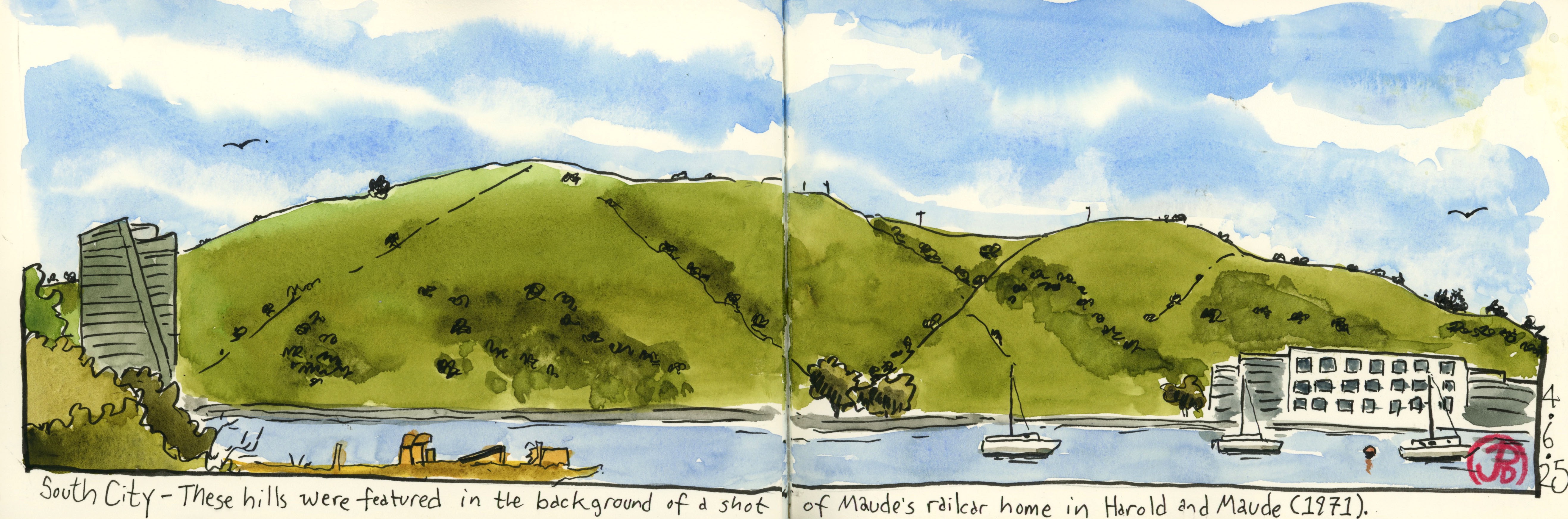
I headed behind the biotech buildings to the San Francisco Bay Trail to get a view of the green hills that were the background to the shot. The hills look much the same as they did in the early 1970s. I found a bench and started a sketch in my panoramic sketchbook.

Maude’s Pullman

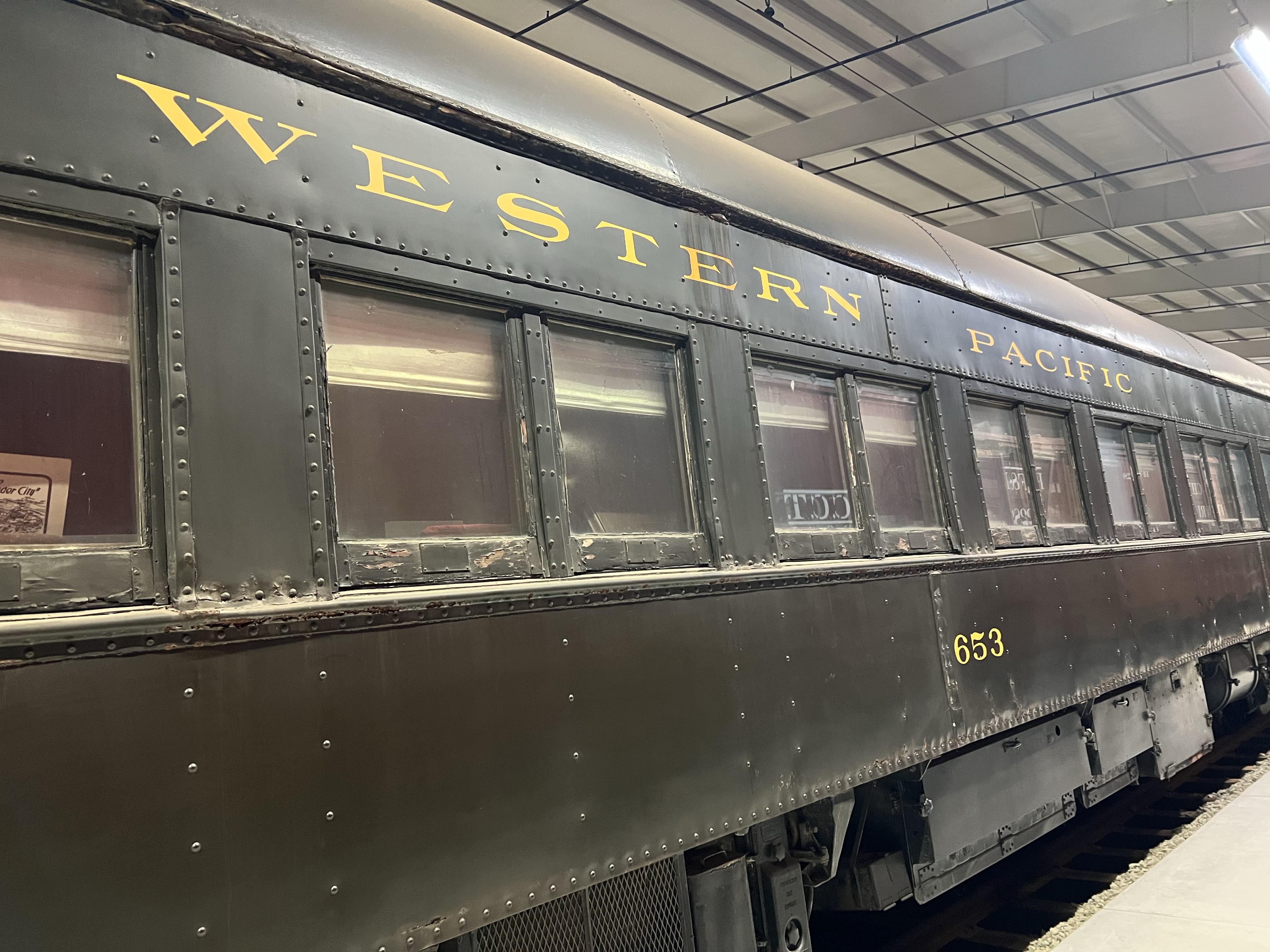
The passenger car used in the filming of Harold and Maude is Western Pacific’s lounge car 653.

The car was built by Pullman in 1913. It was originally built as a sleeper car and later converted to a buffet lounge car in 1931.

In 1939 Western Pacific used the car on the “Exposition Flyer” from Oakland to Chicago. WP operated the passenger service from Salt Lake City to Oakland through the famed Feather River Canyon. The route was later replaced by the California Zephyr in 1949.

Western Pacific donated the car to the Western Railway Museum (then named the California Railway Museum) in 1966.

Universal leased the car from the museum and it was shipped by rail to the filming location: a rail siding in South San Francisco. Filming took place in 1970/71.

A piece of movie history at Rio Vista Junction.

The exterior of 653 is featured in the film but many important scenes where filmed inside the Pullman car, such as when Maude (Ruth Gordon) sings “If You Want to Sing Out” (by Cat Stevens), at the piano.

I was delighted to find that this piece of rail and film history still exists and is perverse in the Jensen Carhouse at the Western Railway Museum at Rio Vista Junction.

I was able to enter the carhouse on a tour and get a sketch from the same perspective seen in the above movie still (featured sketch). The nearest end of the car from my sketching perspective served as Maude’s entrance.

Image

Crockett Sketching

On a Saturday morning I headed up to Sugar Town on the Carquinez Strait.

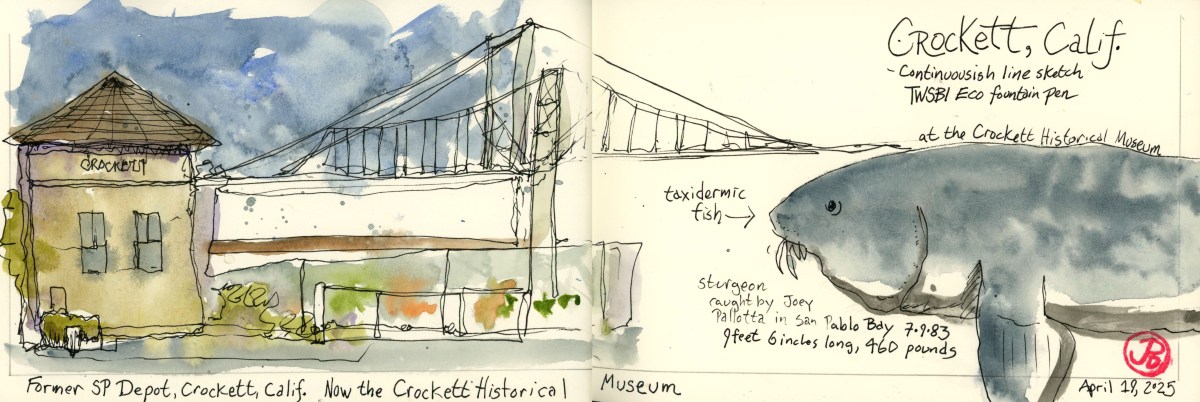
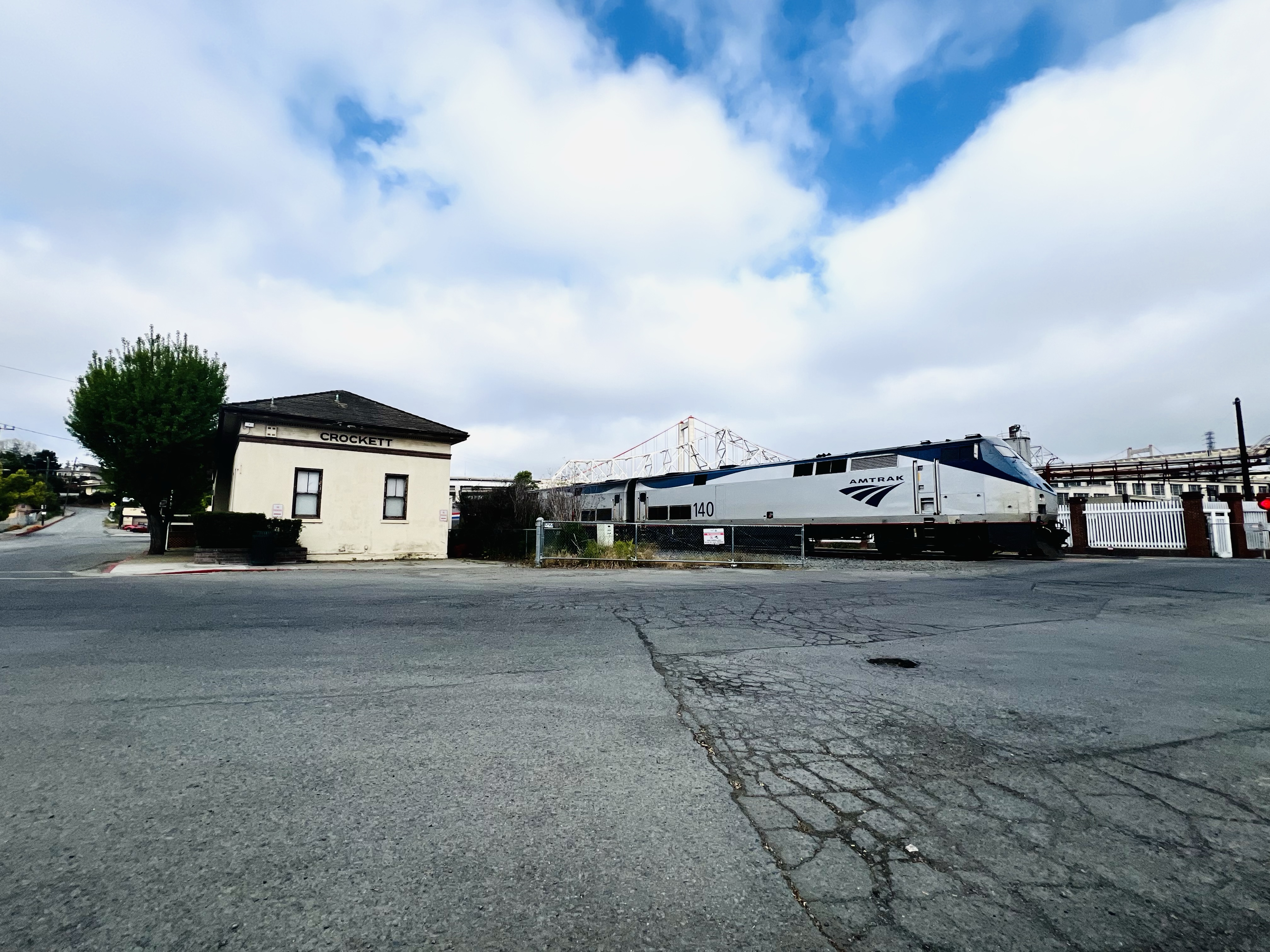
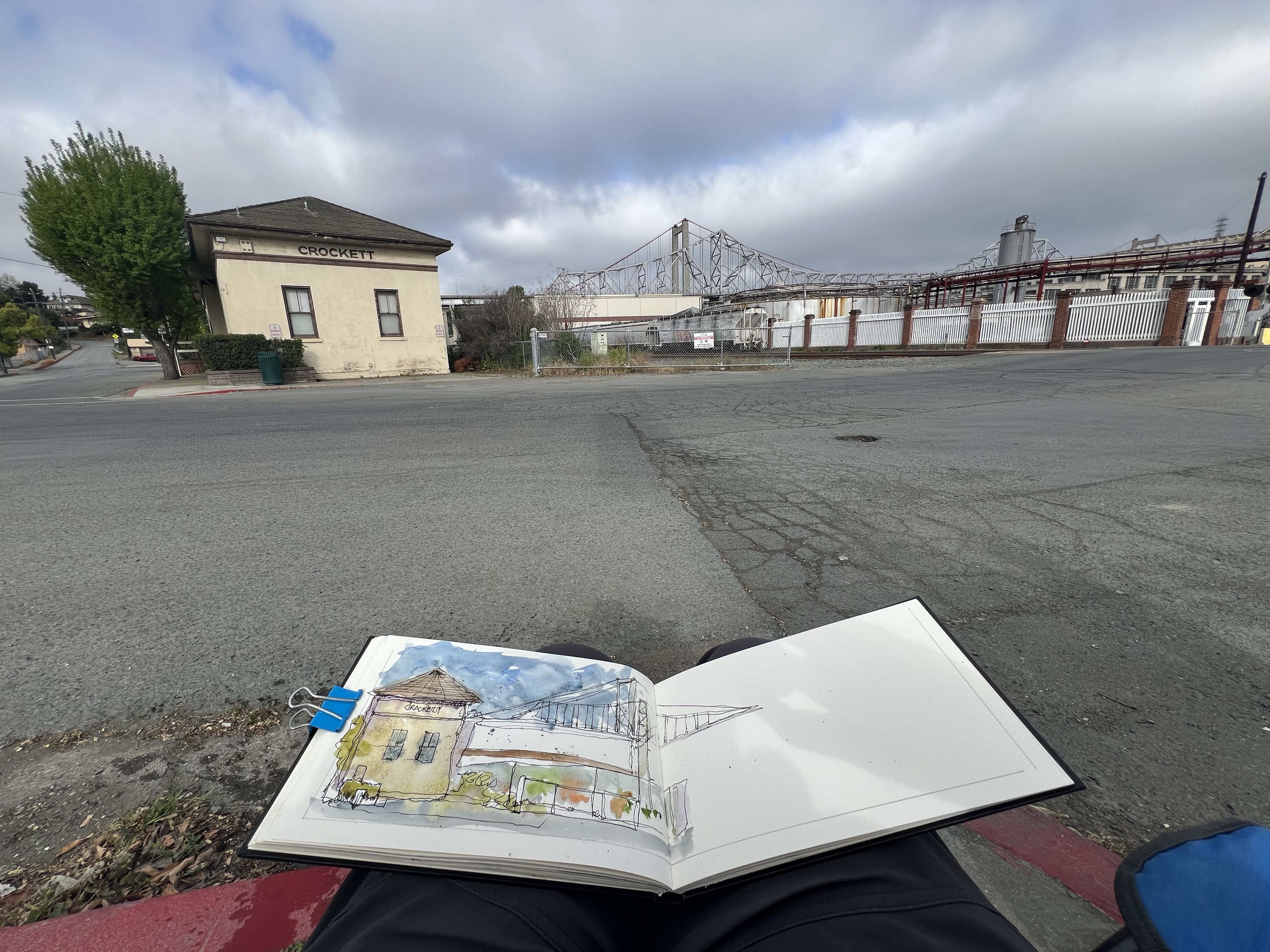
My sketching target: the former Crockett Southern Pacific Depot with the two parallel spans of the Carquinez Bridges in the background. The depot is now home to the Crockett Historical Museum. Open Wednesday and Saturday from 10am to 3pm. Ish!

This is a busy place for rail with seven trains passing by including a California Zephyr, a Coast Starlight, a San Joaquin, Capital Corridors, and a Union Pacific freight during my two hours visit.

Coast Starlight No. 11 passes by the C & H Factory to its final destination of Los Angeles’ Union Station. The train was running a little late. Shocker!

My sketching goal was to render the scene in a continuous line sketch. This means you never lift your pen for the entire sketch. No pencil, no erasing, no going back, this is truly sketching without a net!

Eastbound California Zephyr Number 6 passing the former SP Depot at 8:56 AM without stopping. Final destination: Chicago.

I set up my sketching chair across the street from the depot just at the entrance to the company that made Crockett a company town, the C & H (California & Hawaii) sugar factory. For my sketch I used my TWSBI Eco fountain pen.

Nothing like starting the weekend with a field sketch!

Continuous line sketching can be challenging and I lifted my pen off the page once or twice (to photograph Zephyr Number 6) but I restarted where I left off. So my sketch is really a broken continuous line sketch.

In the end I like the imperfect lines of the sketch. This technique is a great way to loosen up your line work and in the end I am pleased with the result. It may not be the most accurate form of sketching but it sure has a lot of soul!

I added some wet on wet washes and paint splatter, which looseness, matches the line work.

When the museum finally opened at 10:25, I was drawn to the large 460 pound taxidermy sturgeon in a glass case. So I added it to the right side of the spread.

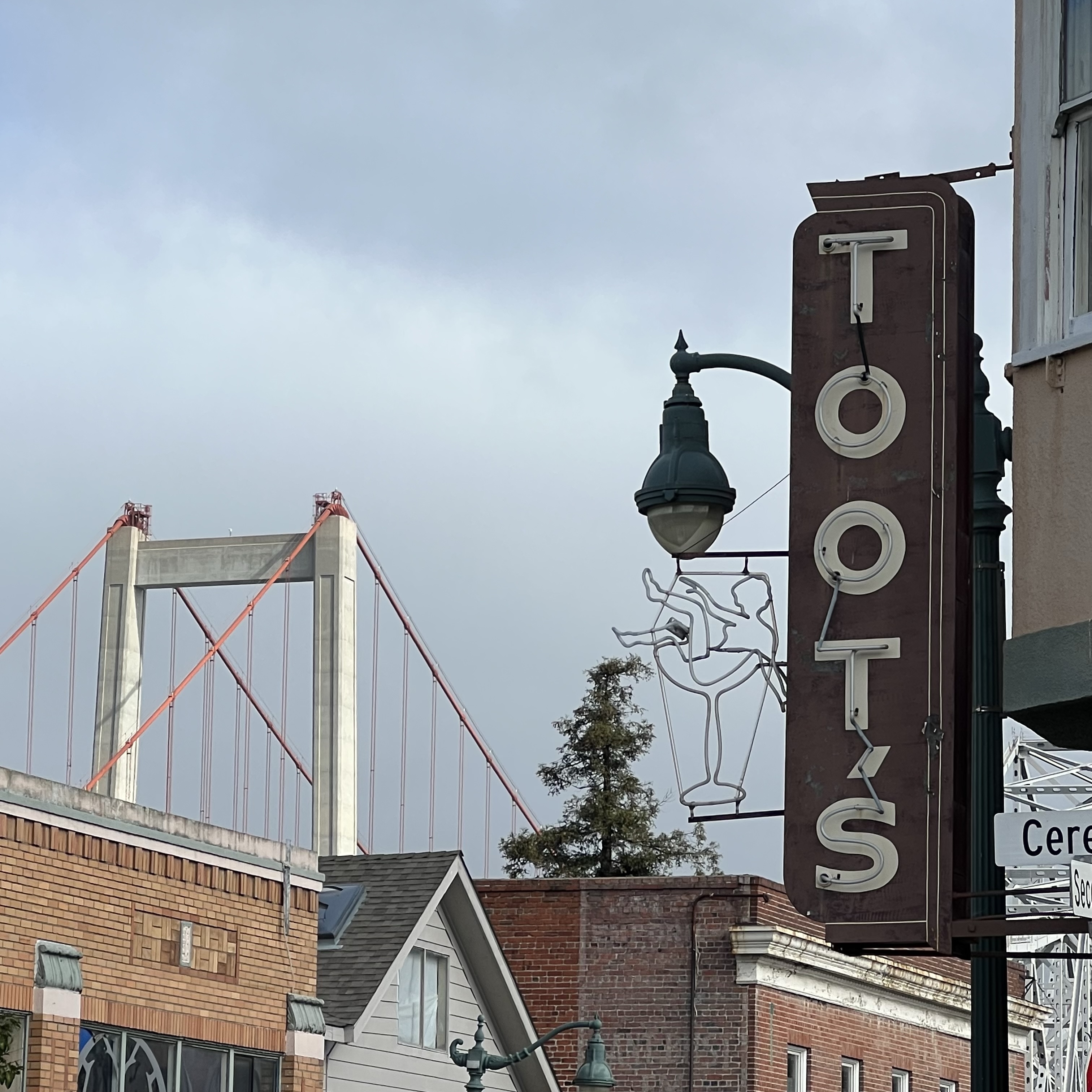
Main Street Crockett with Toot’s bar and the new span of the 2003 Carquinez Bridge towering over the town.

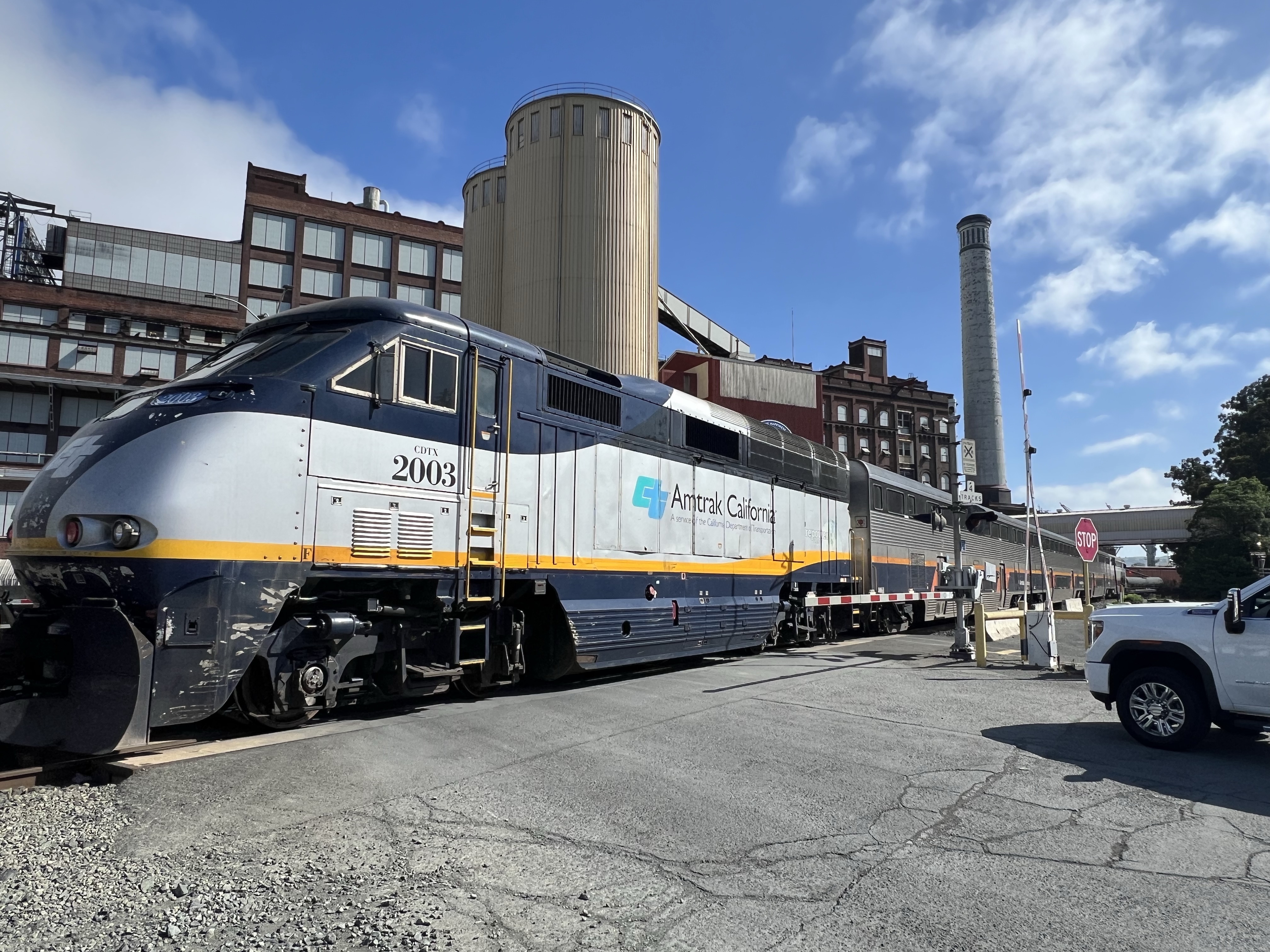
The trains never stop rolling through Crockett. This is a Sacramento-bound Capital Corridor train passing the sugar factory.