Image

Nevada City Sketching

One sketching target in Nevada City is the Nevada Hose Company No. 1. (Just to avoid confusion, Nevada City is in California.) I have always wanted to sketch this historic building but had not gotten around to it.

This firehouse is very detailed and complex and it seemed like the perfect subject for a continuous-line sketch. I suppose this method can become an excuse if the sketch turns out all wrong! But there are no mistakes in sketching.

The historic firehouse was opened May 30, 1861 and was in use until 1938. Throughout its history the hose carts were under different motive power: human, horse, and combustion engine.
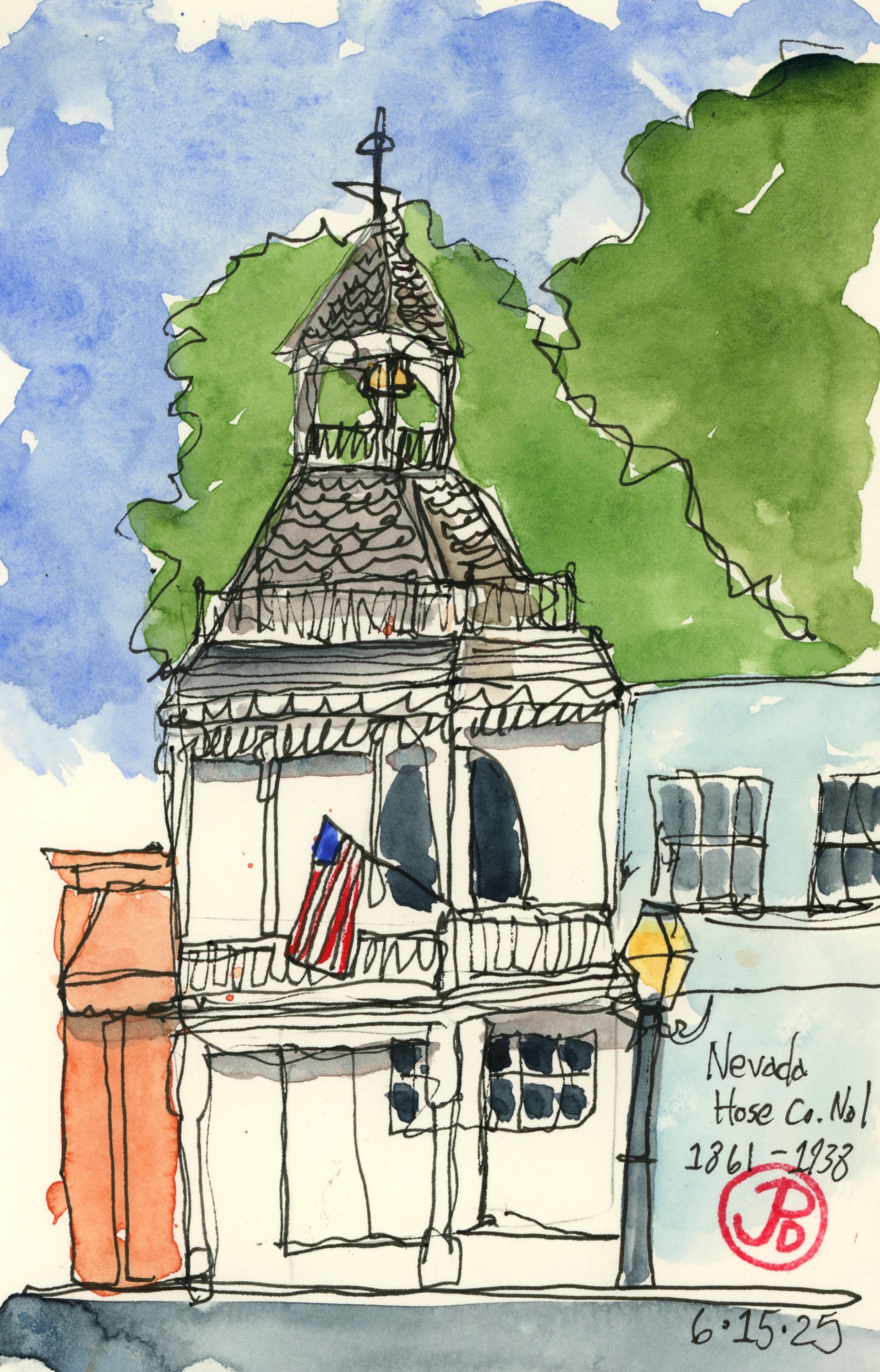
What’s surprising about this building is that it exists at all. Most wooden structures in Gold Rush towns were destroyed by fire. That would certainly be ironic, a firehouse destroyed by fire.
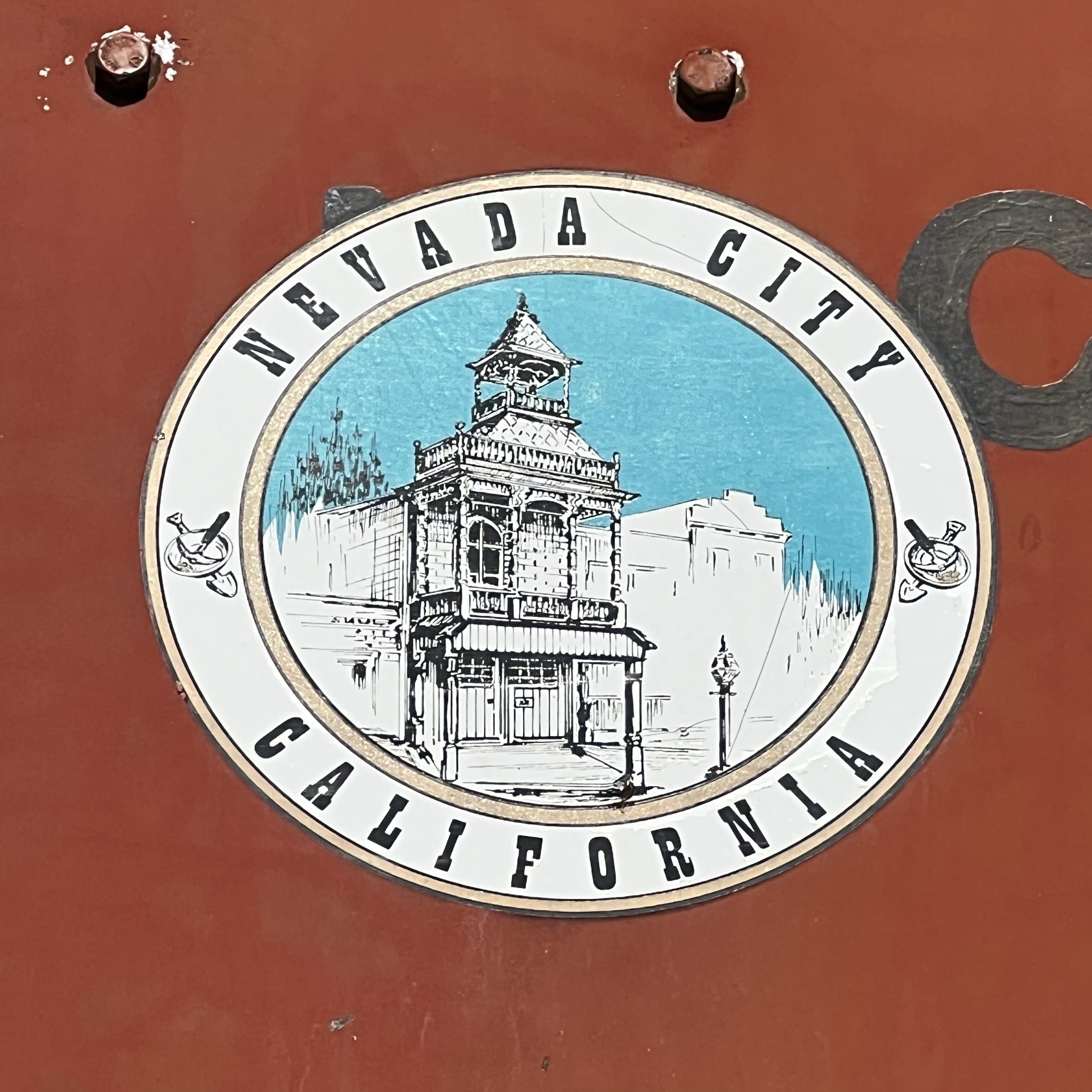
The firehouse is an iconic symbol for Nevada City.

After my morning’s sketch I drove off to look for other Nevada City sites to add to my sketchbook. I settled on a flat car on static display from the Nevada County Narrow Gauge Railroad.

The railroad ended near here, the depot was destroyed in a fire, and the opposite terminus ended parallel to the mainline in Colfax.

I rendered the car in a loose broken continuous-line sketch.

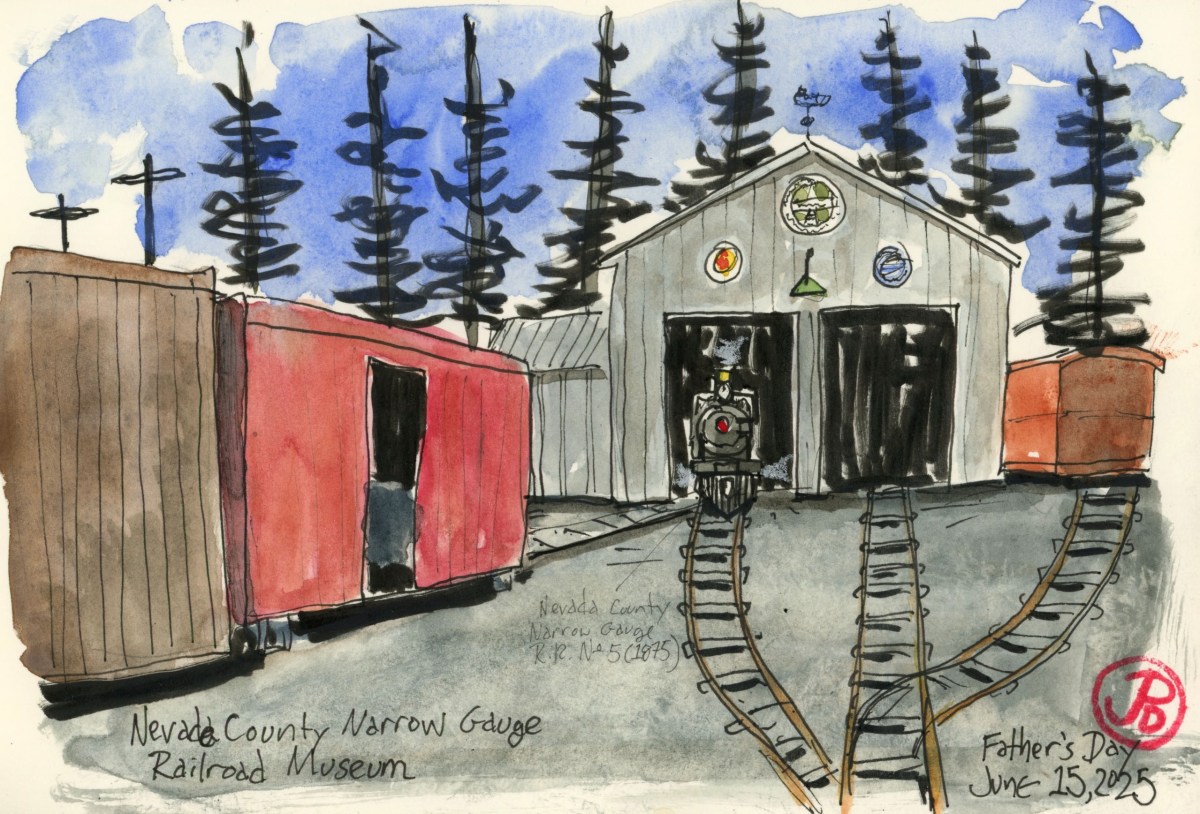
While reading the interpretive signs for the narrow gauge railroad I read a notice of the upcoming Steam Days at the Nevada County Narrow Gauge Railroad Museum where two of the locomotives in the museum’s collection would be under steam!

One of these days would be today, Father’s Day, and the museum would be opening in 45 minutes. So I knew where I would be next sketching next!

The star of the museum’s collection is the “Tahoe” No. 5. This 2-6-0 Mogul type is a narrow gauge steam locomotive that hauled freight and passengers on the line. The locomotive was built by Baldwin Locomotive Works in 1875 for the Carson Tahoe Logging & Fluming Company.
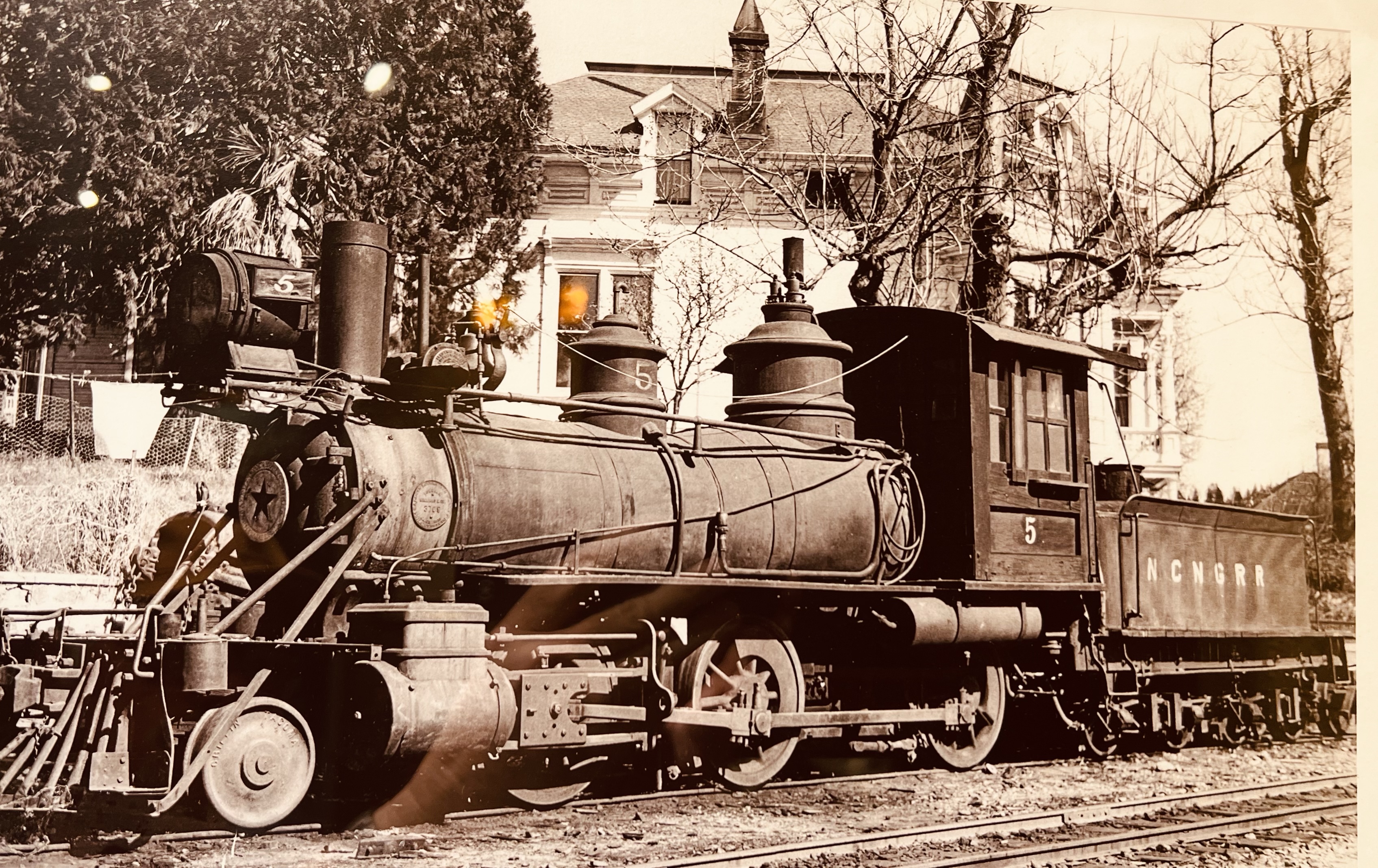
A period photo of No. 5 in front of the rail director’s house in Grass Valley.

The locomotive was purchased by the NCNGRR in 1899 where it was in service until the 1940s when it was purchased by the Frank Lloyd Productions to become a Hollywood locomotive. No. 5 was first featured in the John Wayne film, “The Spoilers” (1942).

By the 1970s the locomotive was sitting neglected on the Denver Street back lot at Universal. No. 5 was last featured in the doomed film, “The Twilight Zone”, in 1979. No. 5 was briefly featured in the first segment of the film, featuring actor Vic Morrow who was killed with two child actors in a helicopter accident.

The museum leased the locomotive from Universal and it returned to Nevada City in 1985.

When I first visited the museum with my stepfather, the No. 5 was on static display, having been a movie locomotive for Universal Studios. The locomotive had been electrified and pushed during movie production, and had not been under steam for a really long time. The locomotive was featured in about 100 film productions. So I was excited to see this 1875 locomotive under its own steam power.
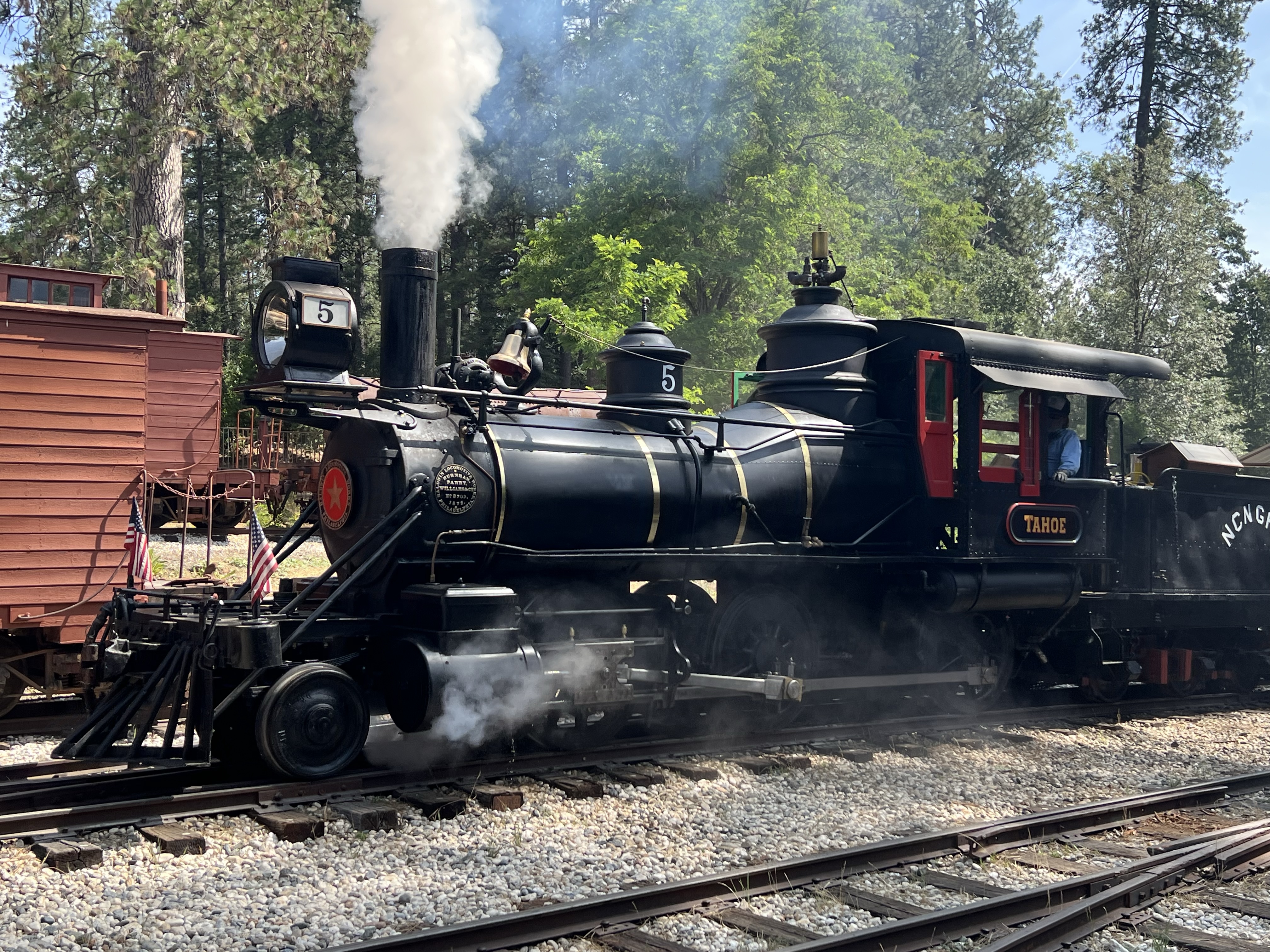
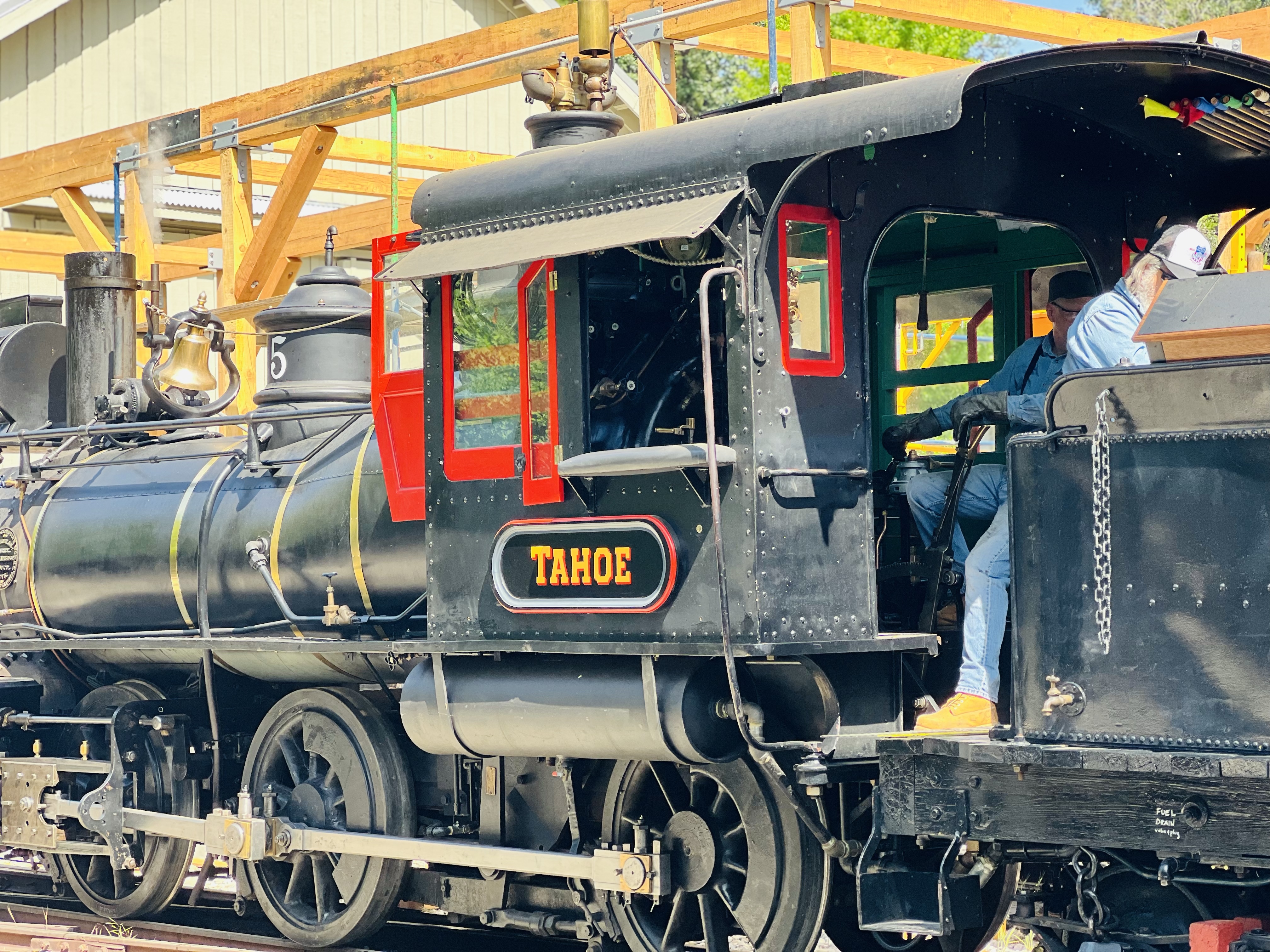
Seeing the No. 5 under steam was a thing of beauty! It was like seeing the dead brought back to life.
The third driver is further back from the second to support the weight of the firebox.

Image

Mare Island and the Muddy Puppy

The former Naval base on Mare Island is a sketcher’s paradise. It’s full of cranes, condemned buildings, dry docks, bridges and rusted rails. Plenty of shapes and perspectives to add to my sketchbook.

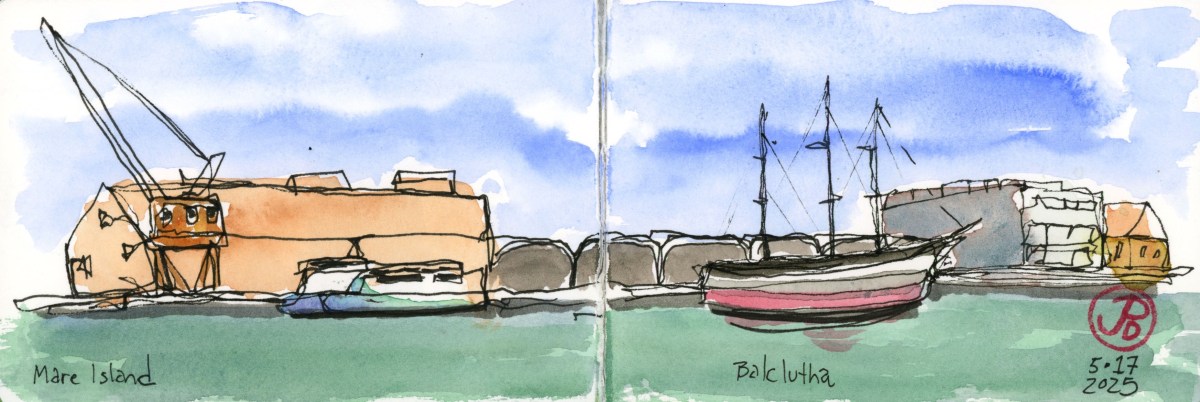
On a recent journey to Vallejo to visit a friend, I headed to the ferry terminal across the Napa River from Mare Island to do a park bench continuous line sketch of the river front with the Balclutha moored to the dock (featured sketch).

The 1886 three master (aka Star of Alaska) is temporarily on display here while the pier at the San Francisco Maritime National Historic Park is rebuilt.

Also moored nearby is a modern bay ferry which I included in the sketch as a bookend to Bay Area maritime history.

Mare Island Mud Puppy

From my sketching position near the Vallejo Ferry Terminal I was looking across the Napa River towards the location of one of the most infamous sinkings in Mare Island history.

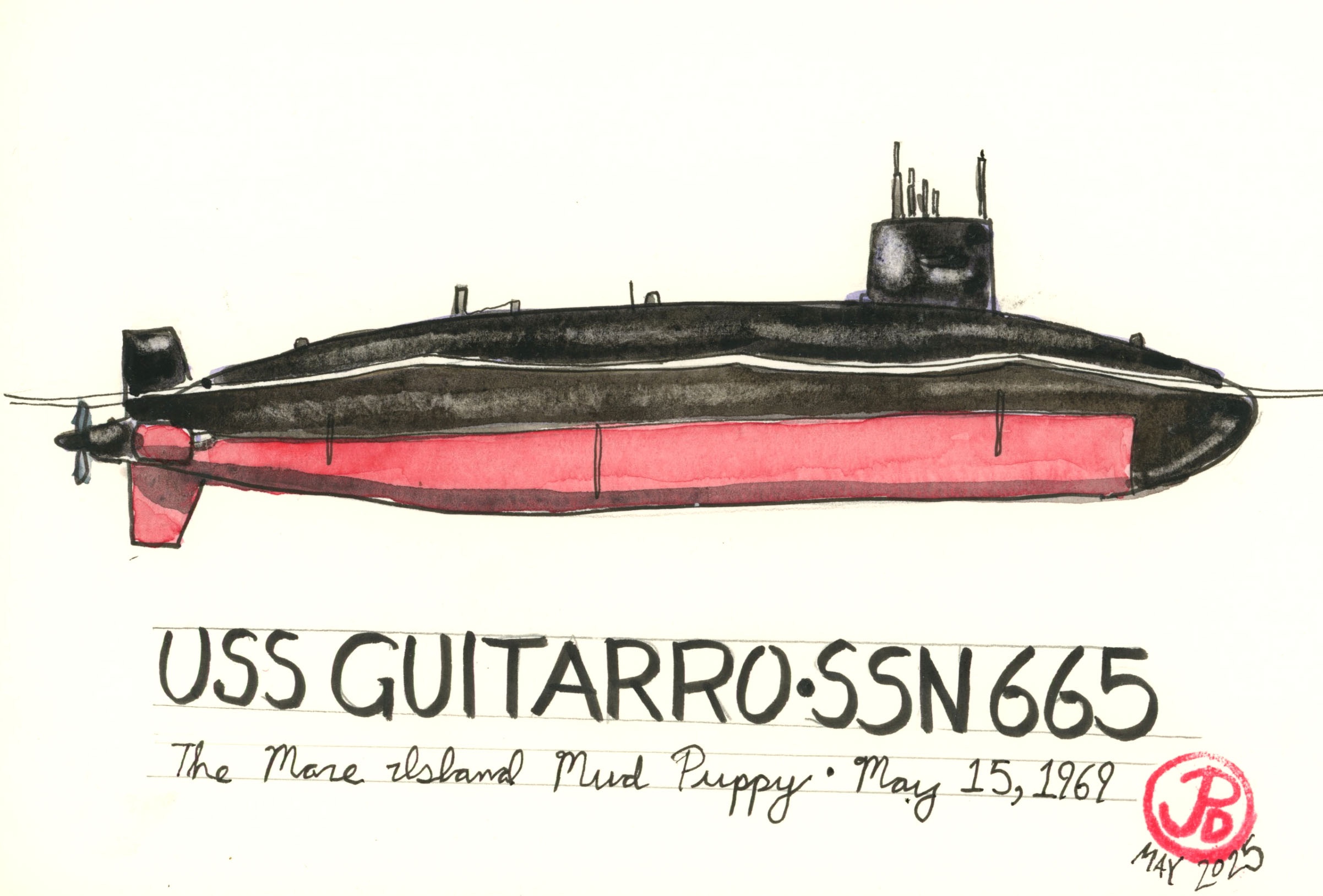
On May 15, 1969 the Sturgeon-class nuclear submarine the USS Guitarro was moored to the pier in the Napa River. The sub had been built and launched (July 27, 1968) on Mare Island and now was still under construction.

Two construction groups were working on different parts of the sub at the same time. They began adding water to the ballast tanks, unbeknownst to each other. The construction groups were warned that the Guitarro was riding low in the water but did not heed the warnings.

At 20:30 (8:30 PM) the groups, after returning from lunch, noticed the sub taking a downward angle and the Guitarro was taking on water from her forward hatches. At 20:55 the Guitarro sank to the bottom of the river leaving her sail above the waterline thus earning the dubious nickname: “Mare Island Mud Puppy”.

The sub was refloated a few days later and damages were estimated to be between $15 and $22 million. The sinking of the Guitarro put an end to submarine construction and repair at Mare Island. Mare Island Naval Shipyard was once the premier West Coast submarine port. The last sub built at Mare Island was the USS Drum in 1970.

The USS Guitarro was commissioned (32 months late) on September 9, 1972. She was in service until 1992 when she was decommissioned and scrapped at Puget Sound, Washington in 1994.

Image

Point Pinos Lighthouse

On NPR I heard a report on the Newshour about lighthouses and their women keepers.

One lighthouse featured was the Point Pinos Lighthouse in Pacific Grove, just northwest of Monterey. What I didn’t know but learned from the report was that the lighthouse is the oldest light in continuous use on the West Coast. So it seemed like a great Saturday morning sketch adventure.

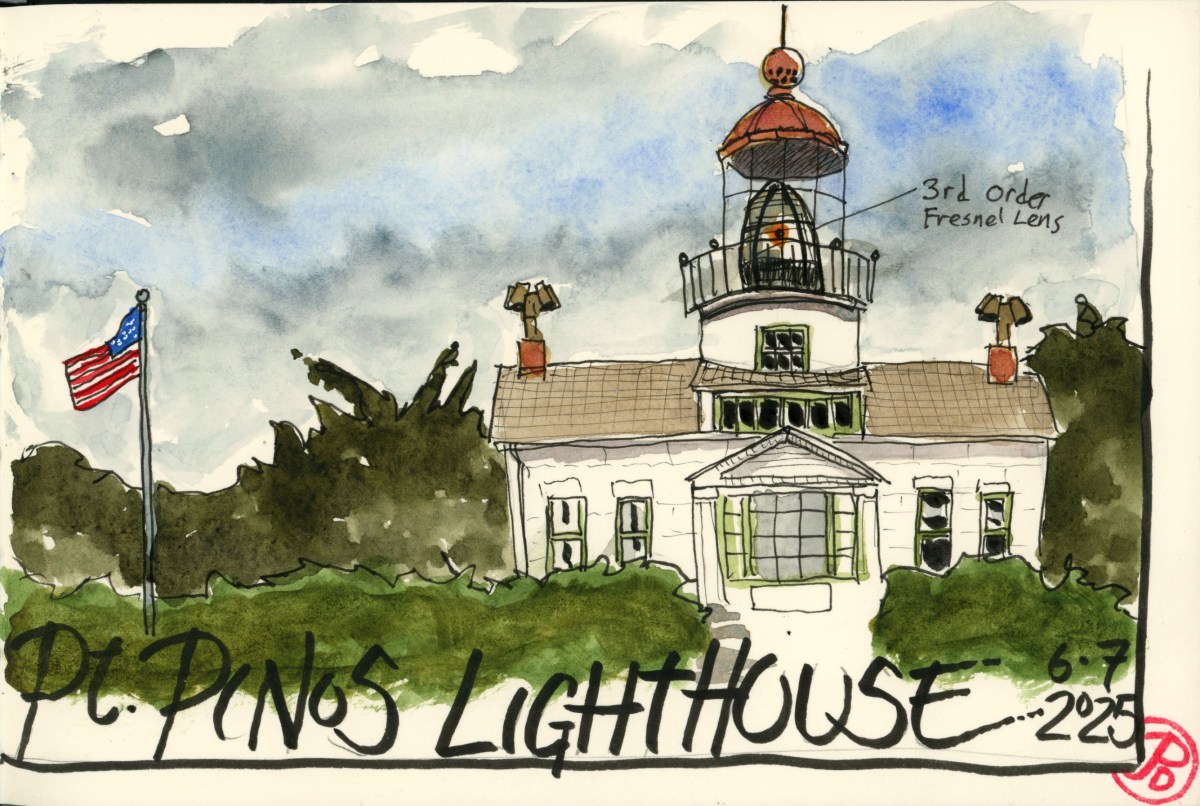
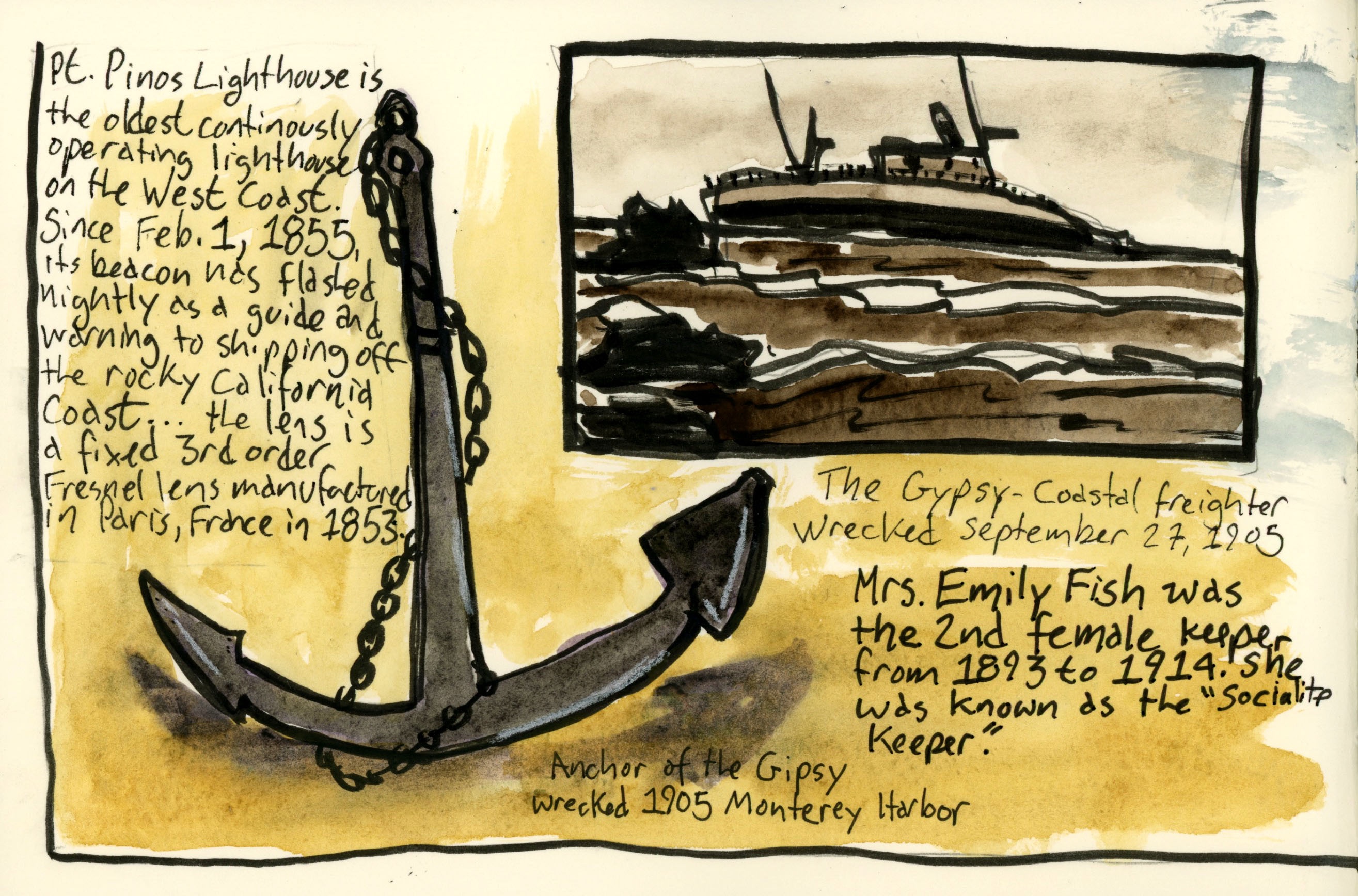
The light first shown its beam on February 1, 1855. The current lens is a 3rd-order Fresnel Lens that was built in Paris, France in 1853 which is the lighthouse’s original lens. In clear weather the light can be seen from 17 miles at sea. In dense fog the foghorns are activated.

The first woman lighthouse keeper was Charlotte Layton. She became keeper when her husband, the first keeper at Point Pinos, was murdered by while taking part in a posse to capture the bandit Anastasio Garcia. Garcia got Layton first. She was the keeper from 1856-1860.

Perhaps the lighthouse’s most famous female keeper is Emily Fish, known as the “Socialite Keeper” for her entertaining at the lighthouse. She served as keeper from 1893 to 1914. While she was not the first woman lighthouse keeper at Pt. Pinos, she was the last.

Emily Fish’s bedroom at the lighthouse.

When I arrived at the lighthouse just after 11, I was greeted by Nancy, the docent interviewed on the Newshour. I told her I was here because of seeing the lighthouse featured on the news.

I jokingly asked her if she had signed many autographs yet.

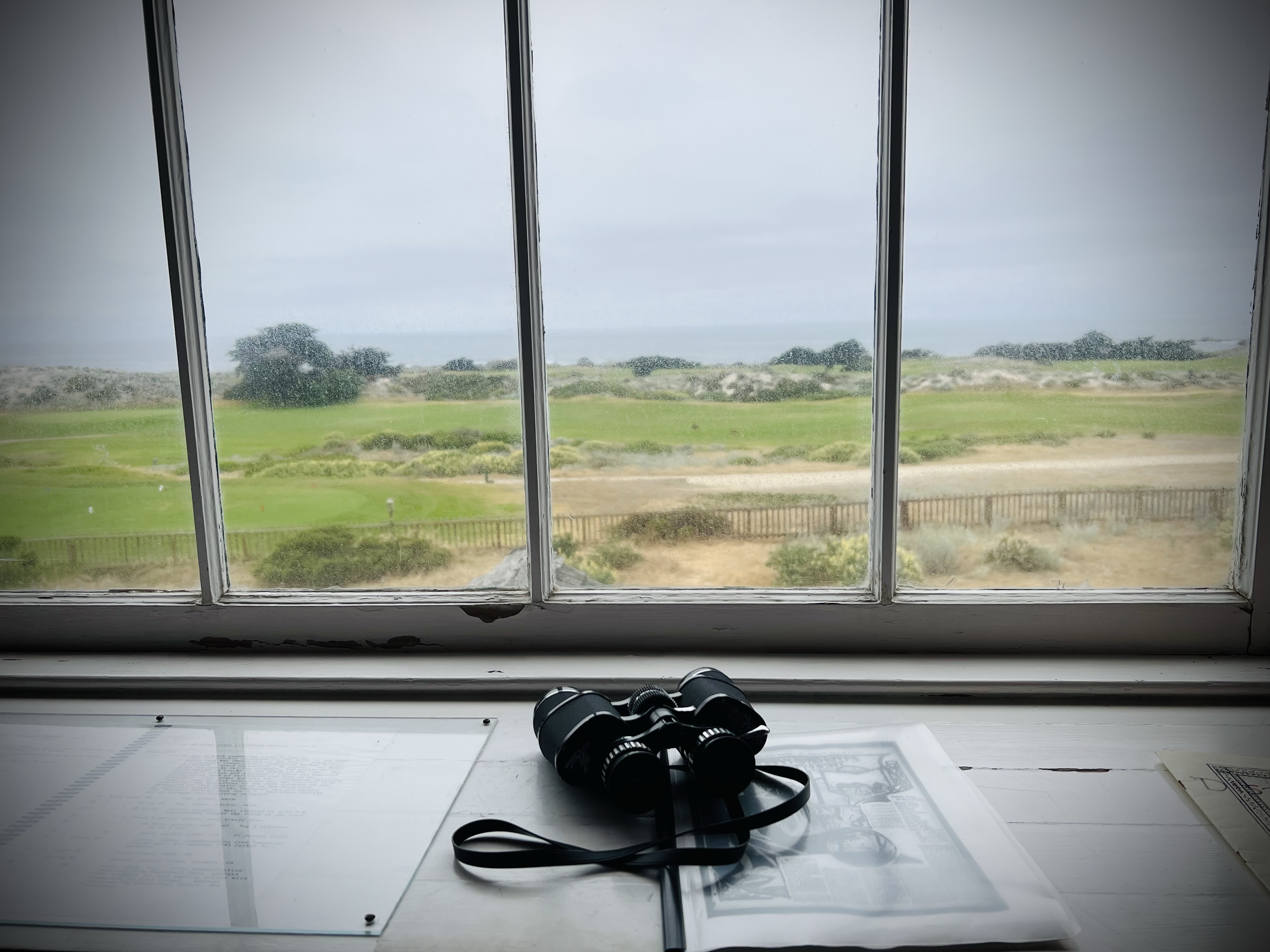
The observation room with great views of the Pacific Ocean. You feel this was a room where Emily Fish spent time filling out the keeper logs.

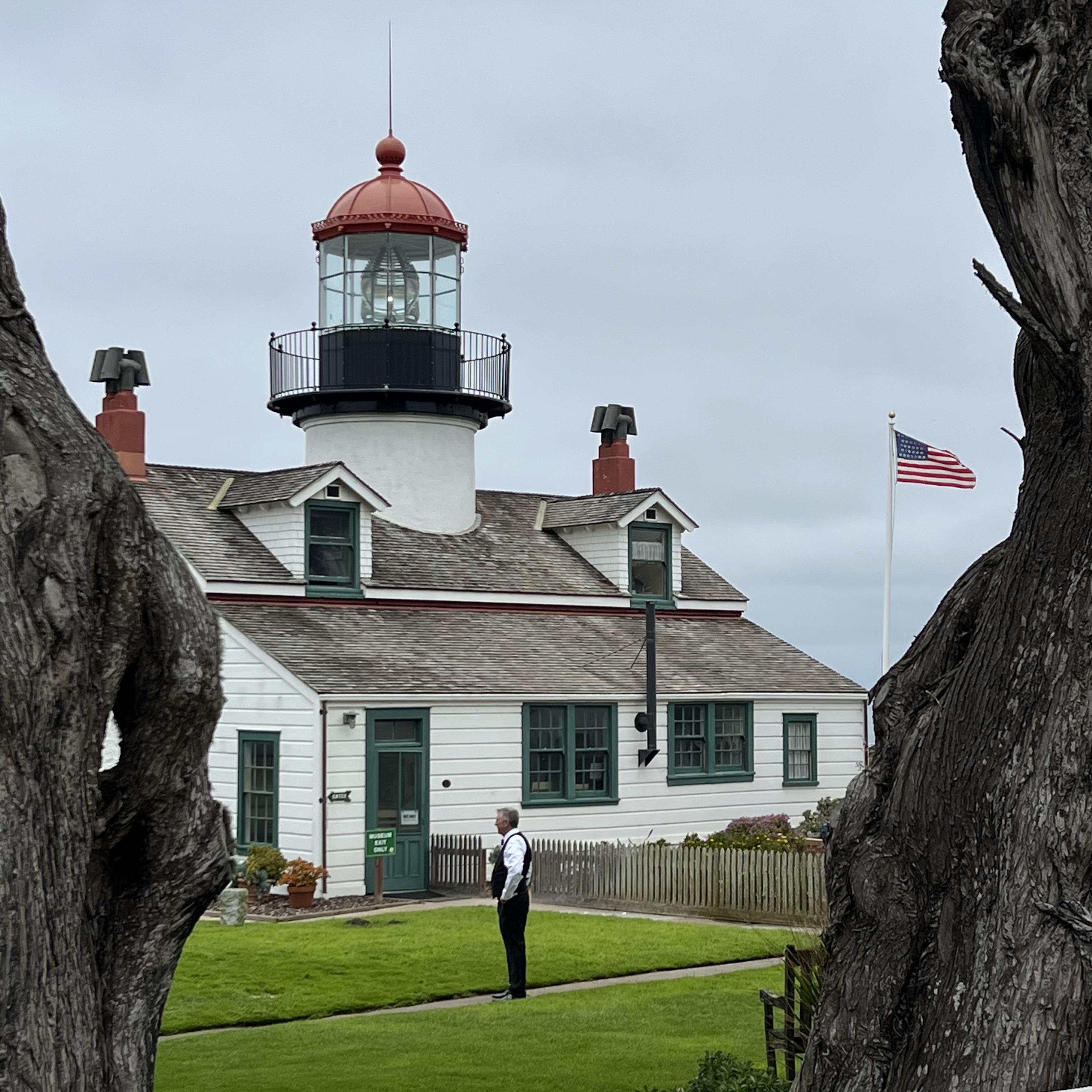
I walked around the lighthouse to look for a sketching perspective and thought the view from the front would do just fine (featured sketch).

On the lighthouse grounds is the only remainder of the freighter Gipsy: her anchor. This is a reminder of why lighthouses exist, to let sailors at sea know where they are and that land is near. And hopefully the two shall not meet, well not at speed anyway.

The Gipsy hauled freight and people up and down the California Coast from San Francisco to San Diego. The ship was known as “Old Perpetual Motion”. On a foggy night on September 27, 1905, the ship was going from San Francisco to Monterey when the inexperienced relief captain mistook a red marker construction light for the marker at the end of Monterey wharf. The ship was wrecked on the rocks near McAbee Beach. The ship was a total loss.

Image

Sacramento Valley National Cemetery

As a tribute to Flag Day and Father’s Day I did a sketch at a National Cemetery.

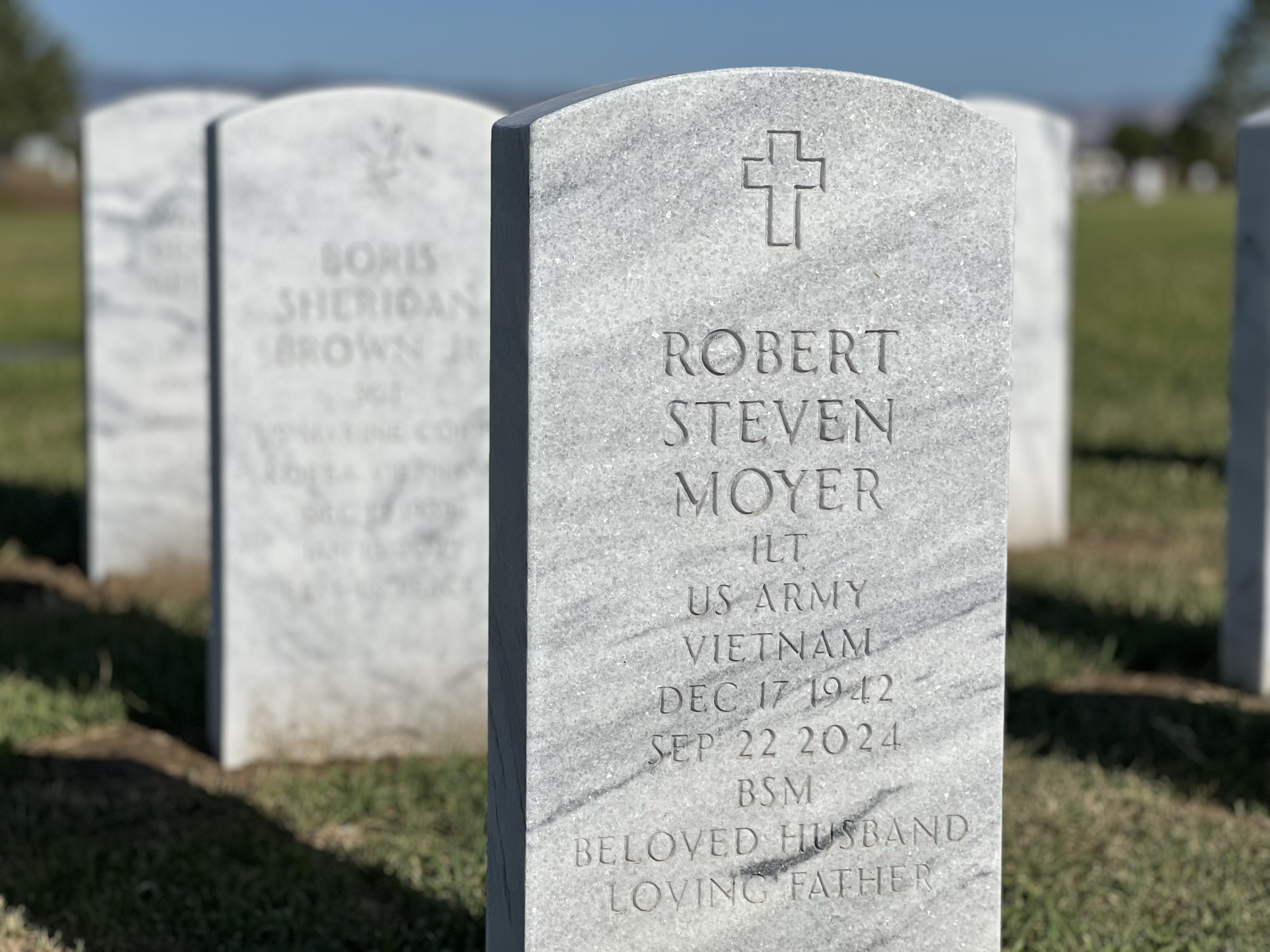
My stepfather, a Vietnam Veteran, was laid to rest at the Sacramento Valley National Cemetery in Dixon.

The military service was very moving, especially when Taps was played.

When Steve was laid to rest, the tombstones were backlogged so I knew I wanted to return to see and sketch the military marker.

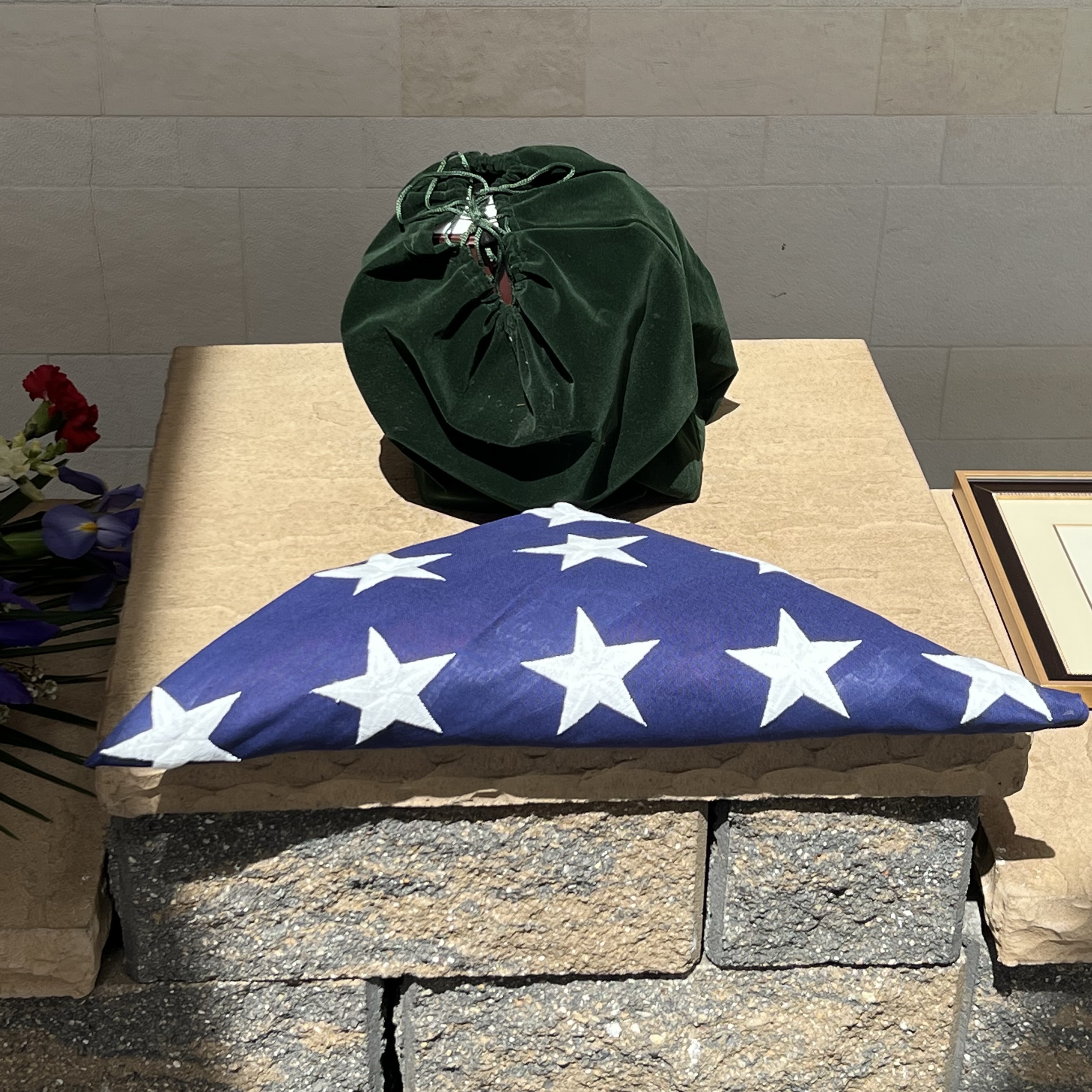
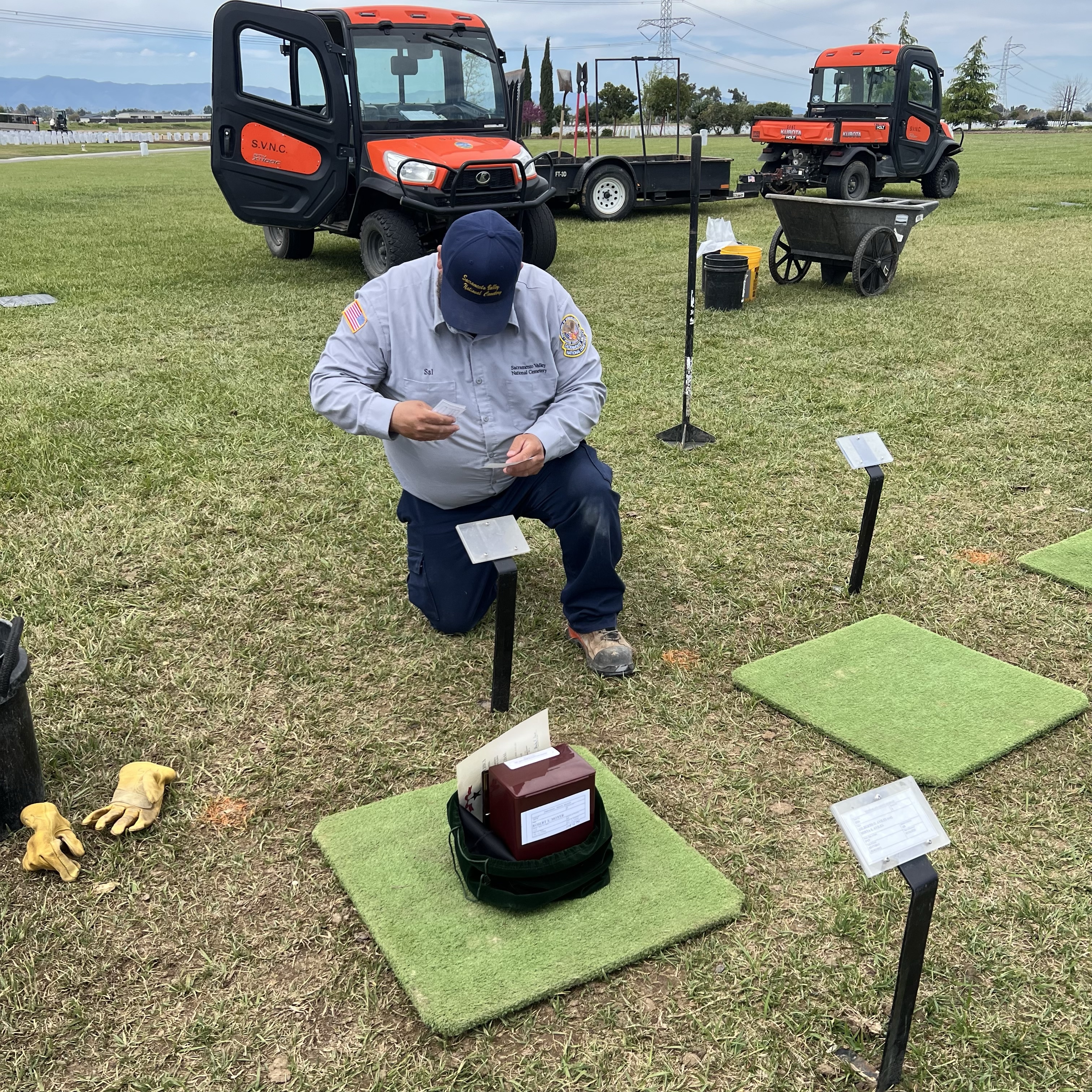
The plot before the tombstone was added. Buried with Steve is his Silver Star citation.

One my way up to my mother’s on my official first day of summer, I stopped at the National Cemetery just after it opened at 8 AM on a Friday morning.

Cars were already lined up for a morning service and there were plenty of cars parked in the parking lot.

The tall flag pole at the center of the cemetery had the Stars and Stripes flying at full staff.

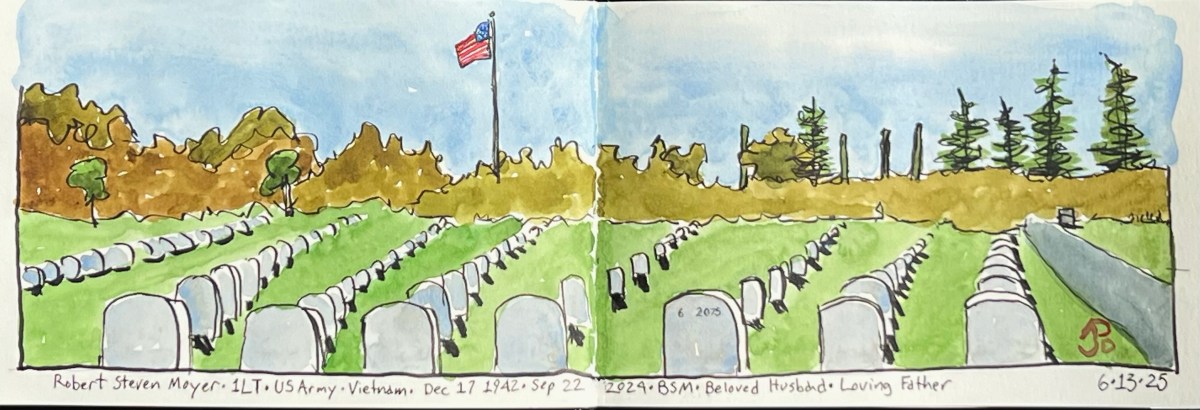
The austere markers all look the same, the marble soldiers stand in lines. There are limits on what text you can place on a military marker. Short and to the point without much flowery rhapsodizing.

I found Steve’s marker and I was surprised to see how many markers had fallen in line since my visit about a month ago.

I picked a sketching perspective with Steve’s marker in the foreground and the line of marble reaching out to the distant trees. Above the trees was the flag at full staff (featured sketch).

Shortly after my sketch the flag was lowered to half staff, a sign of mourning. I later found out that at Arlington National Cemetery, flags are lowered to half staff, half an hour before the first funeral of the day and a half an hour after the last funeral of the day. I expect this National Cemetery follows the same procedures as its more famous eastern counterpart.

Image

SFO From the Bay Trail

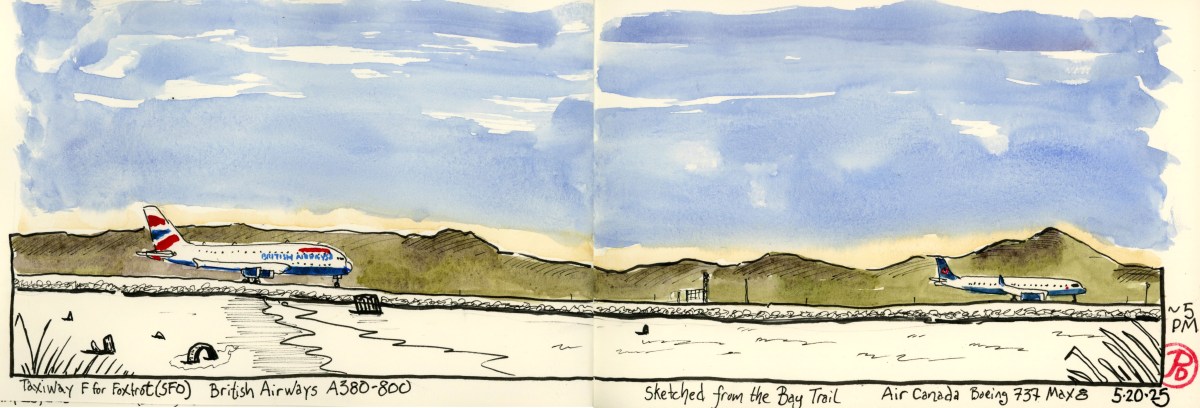
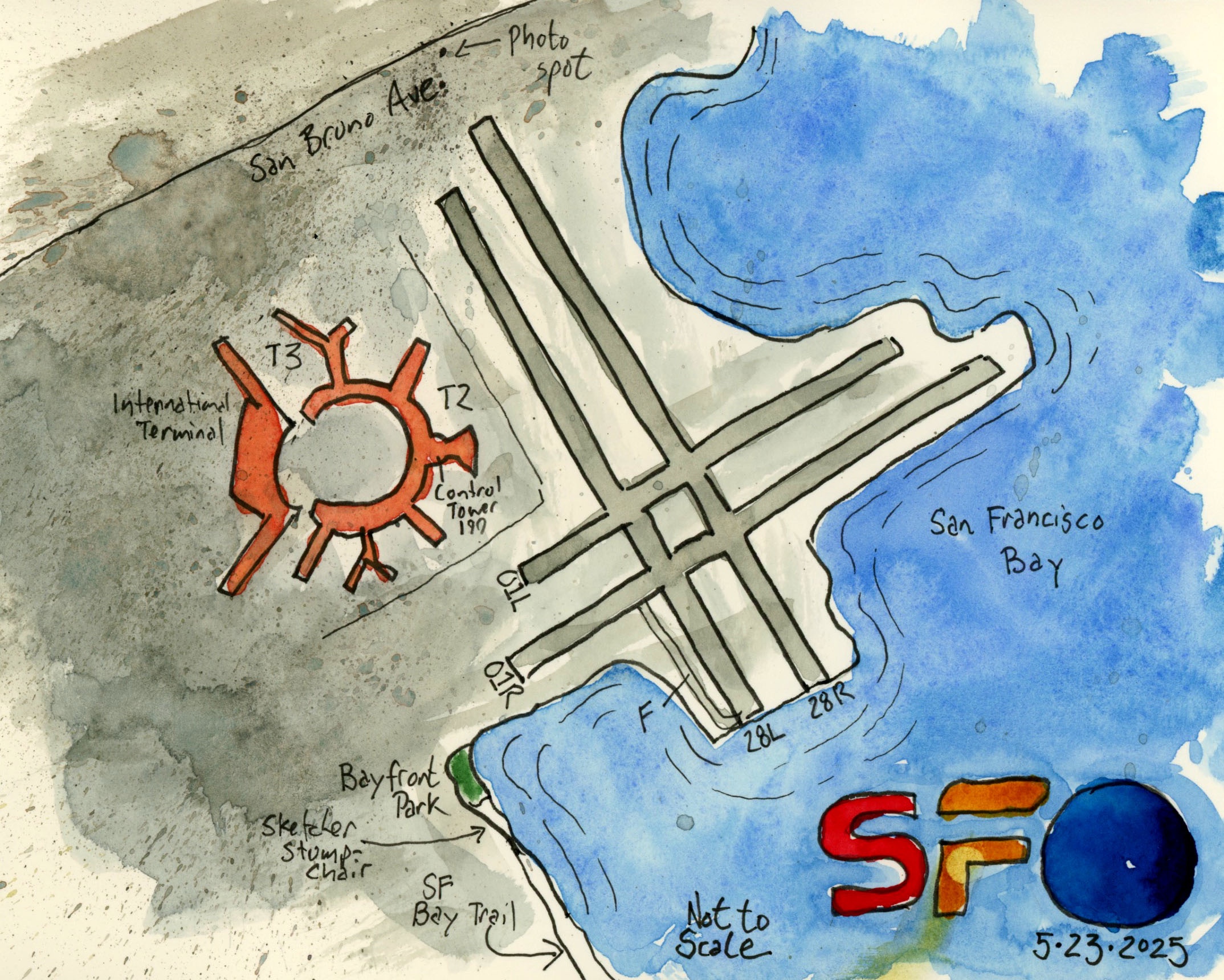
My Tuesday after work sketch took me to the San Francisco Bay Trail which parallels Runways 28R and 28L and Taxiway F.

These are the two runways that handle most international traffic at San Francisco International Airport. In my two hours there, I saw planes landing or taking off from airlines such as Cathay Pacific, Condor (German), Lufthansa, SAS, Aer Lingus, Virgin Atlantic, Qatar, Iberian, Swiss, TAP Air (Portugal), Turkish Airlines, Zipair (Japan), and British Airways. San Francisco is really an international destination.

This trail and Bayfront Park are a well known location for plane spotting as you have unobstructed views of planes taxiing, taking off, and landing.

I was here to see the large passenger jet that largely replaced Boeing’s 747 on long distance international routes.

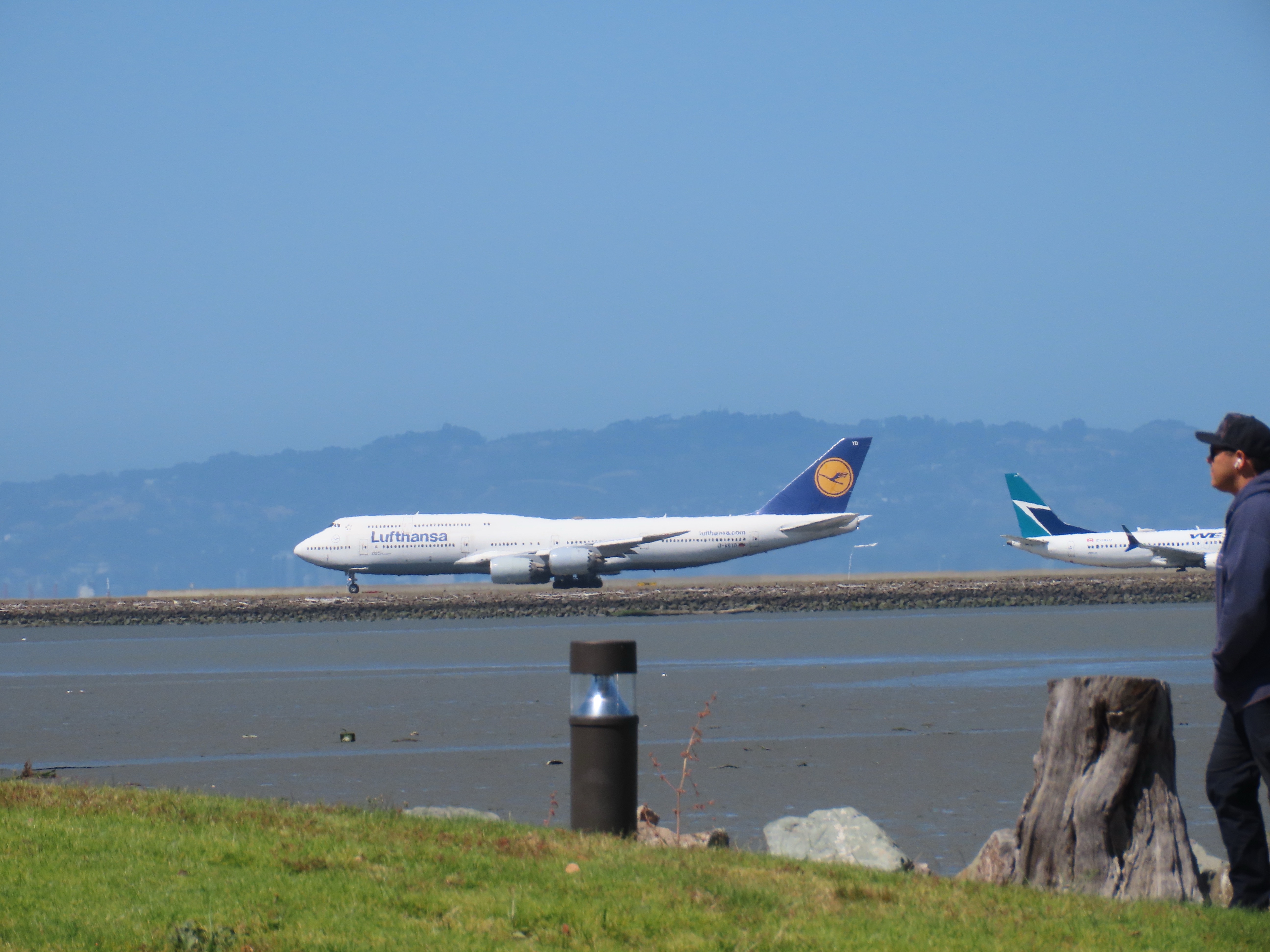
In an uncanny coincidence a Lufthansa 747-8 was on Taxiway F headed to Runway 28R when I was driving down Millbrae Avenue toward the airport. After I parked and walked up to the Bay Trail the 747 was throttling up for takeoff. Only four airlines currently have 747s in their fleet: Lufthansa, Korean Air, Air China, and Rossiya.

One of the few Boeing 747s throttling up for takeoff on Runway 28R. This is a 747-8, the largest 747 and Boeing’s largest passenger jet. This “stretched” 747 was designed to compete with the A380.

I was here to see the big boy that competed with the 747, Airbus’s A380. Two airlines fly A380s out of SFO, British Airways and Emirates. BA flight 284 was scheduled to depart at 16:20. But the flight was running a little late, which seems to be the norm.

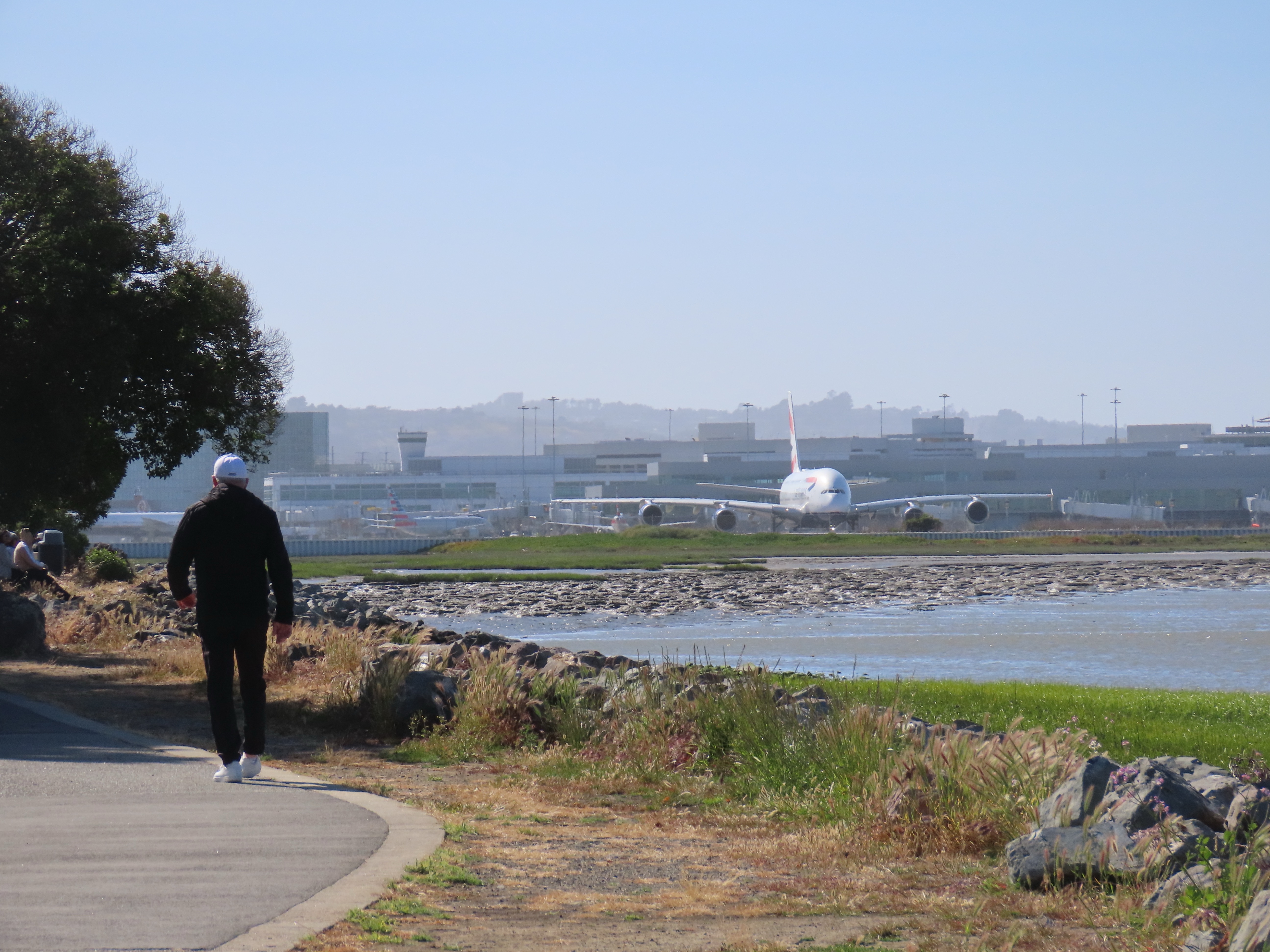
The Bay Trail in the foreground and British Airways A380 is pulling away from Gate A11. This is one of 12 in BA’s fleet.
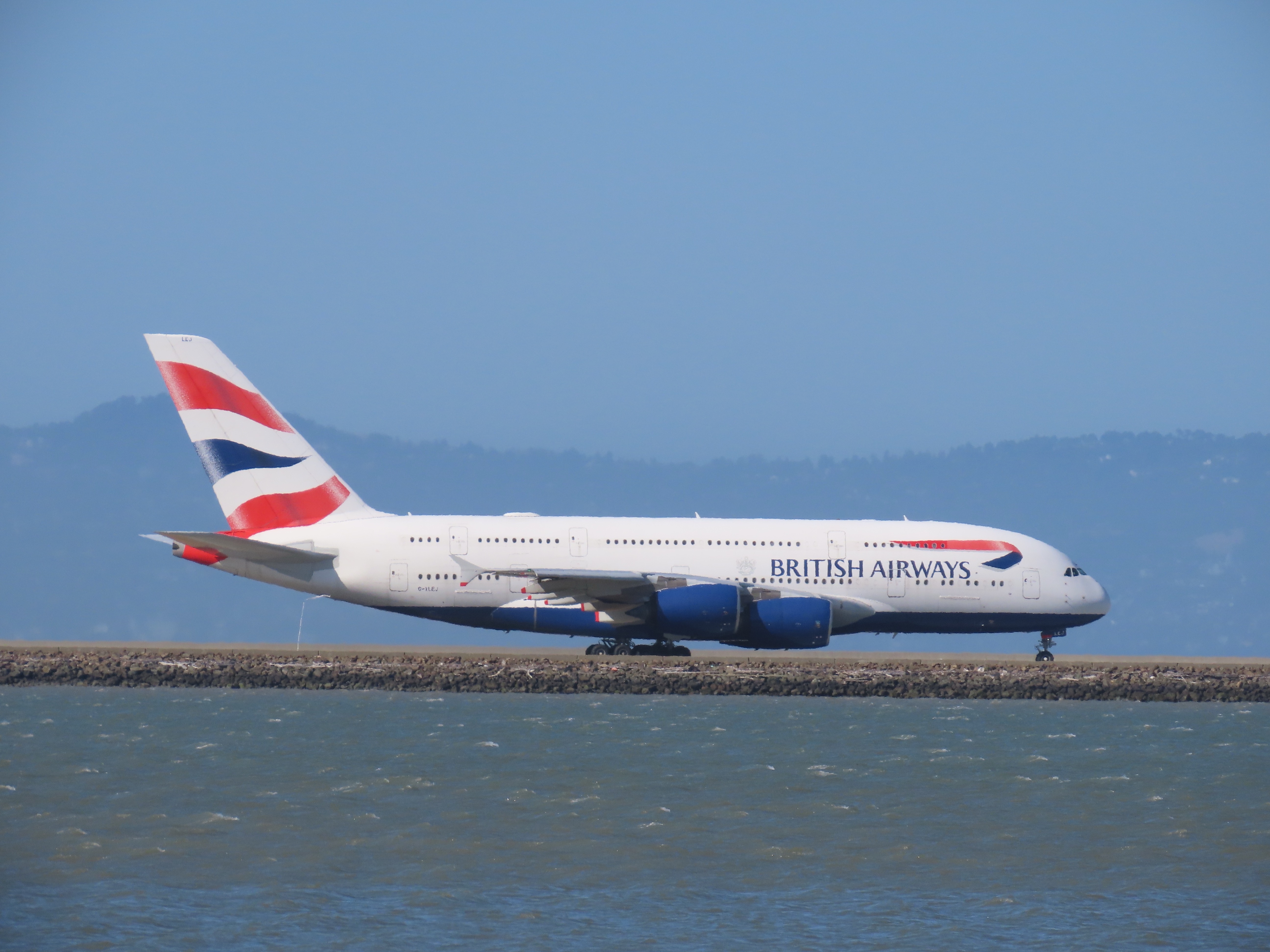
Flight 284 on the Taxiway F for Foxtrot. This airplane is so large that the suffix “Super” is part of its call sign.
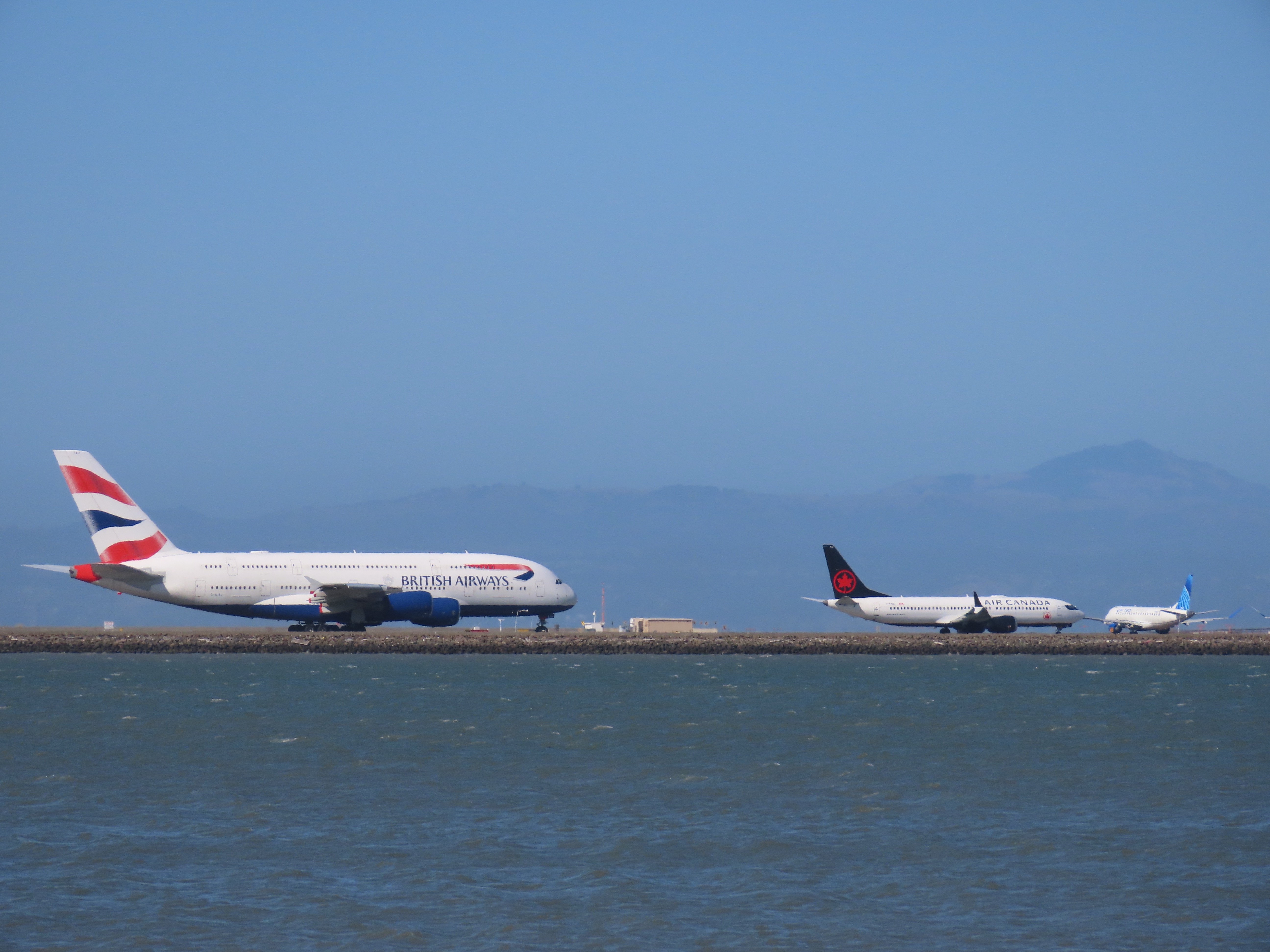
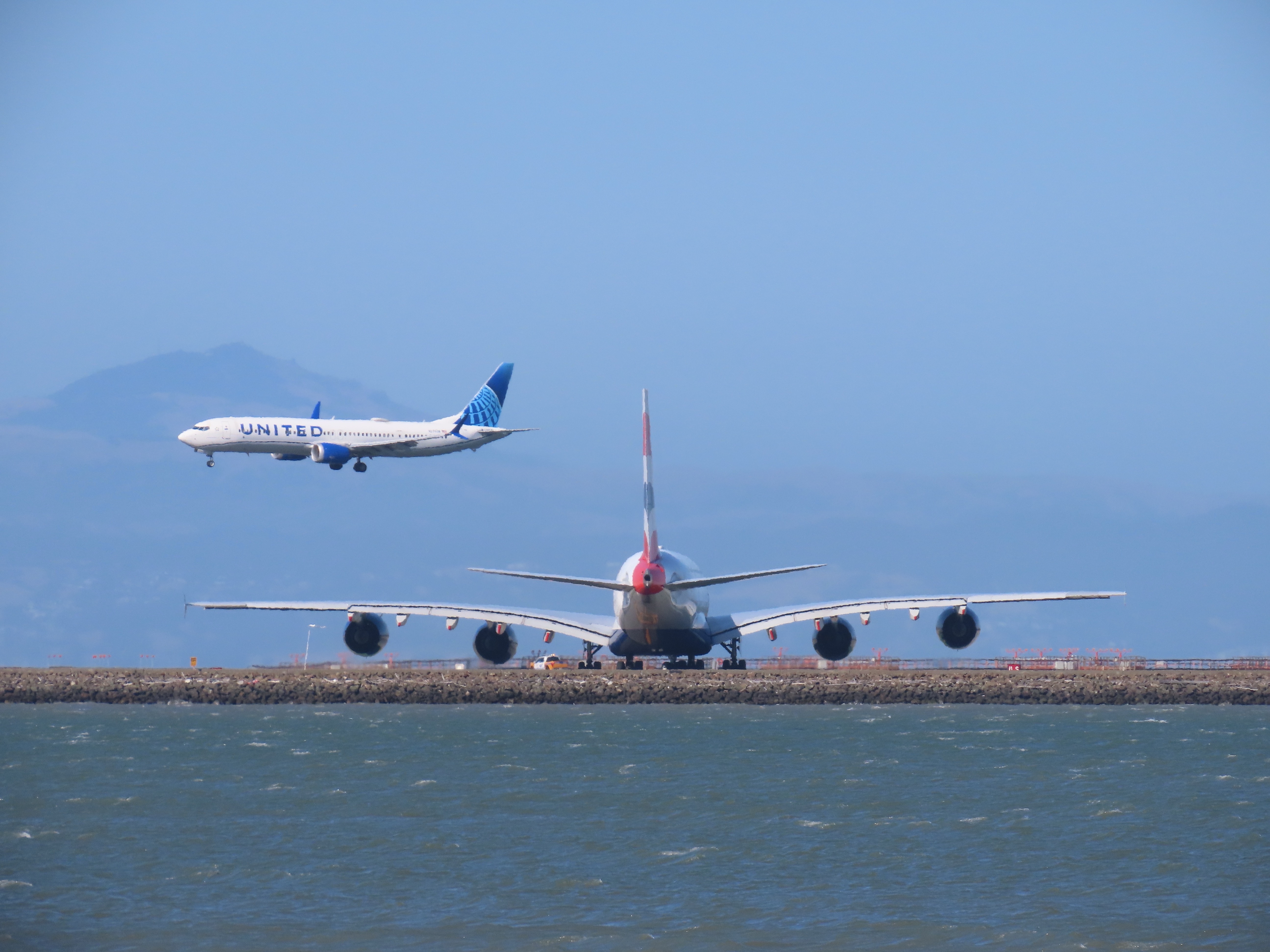
This photo shows the scale of the world’s largest passenger plane compared to others on the tarmac. The aircraft in front of the A380 is an Air Canada Boeing 737 Max 8.
A380 on its way to line up for takeoff as a much smaller United Airlines jet lands.
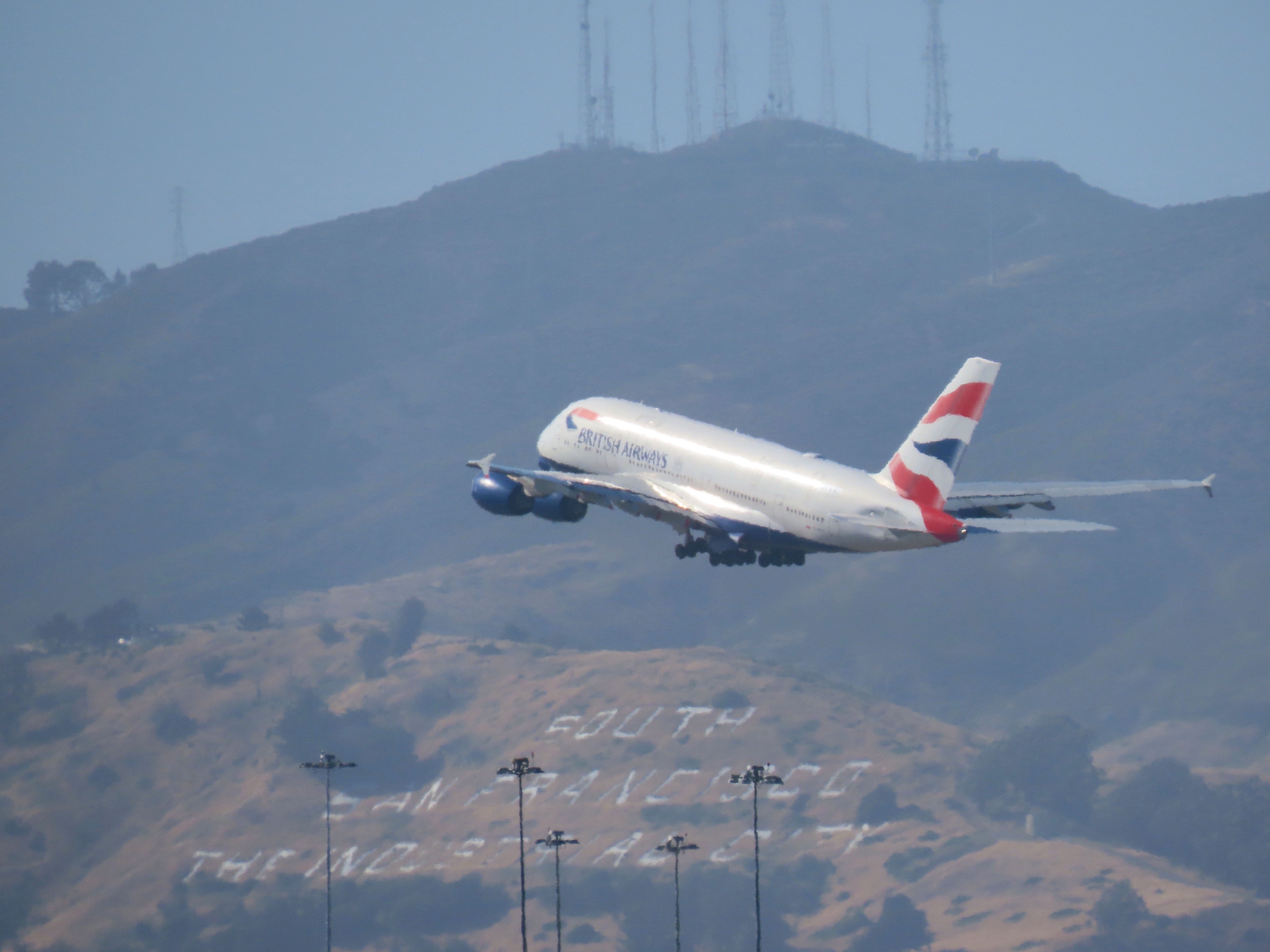
Gear up with the South San Francisco sign below and San Bruno Mountain above.

Sketching Notes

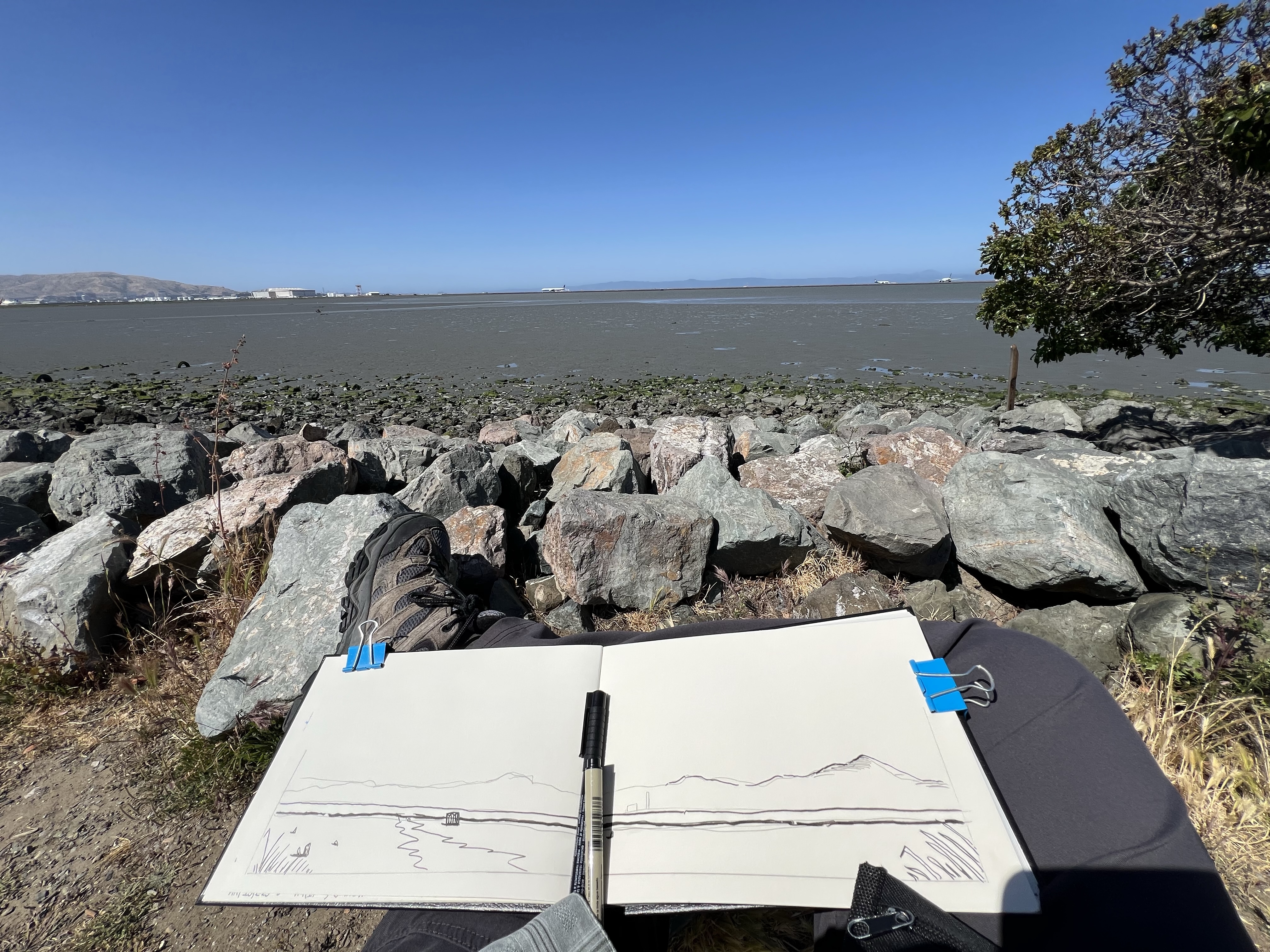
I found a tree stump seat with the taxiways and runways in front of me. I first sketched in the fill as the runways are surround by the bay on three sides. In the background I penciled in the East Bay hills and mountains including Mt. Diablo. The tide was low when I stared sketching but was slowly filling in during the two hours of my visit.

Later I would add two planes on the taxiway, based on photographs taken in the field.

To my left and in the distance I could see the red, white, and blue tail of the A380 at Gate A11.

Image

A380 Over the Golden Gate

In 2025, the largest passenger jet turns 20.

This is the Airbus A380. The A380 is truly an impressive aircraft which I had the pleasure of flying on from SFO to Frankfurt on Lufthansa (the airline currently operates eight A380s but they no longer use them to fly out of SFO).

The A380 is a full double decker with a flight range of 9,200 miles and a capacity of 850 passengers. It is larger than Boeing’s 747 and is designed for long range international flights.

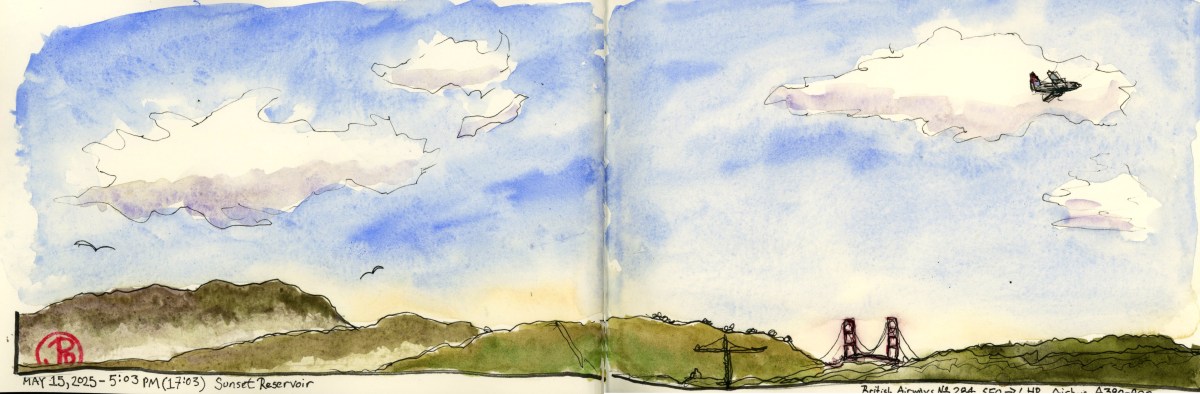
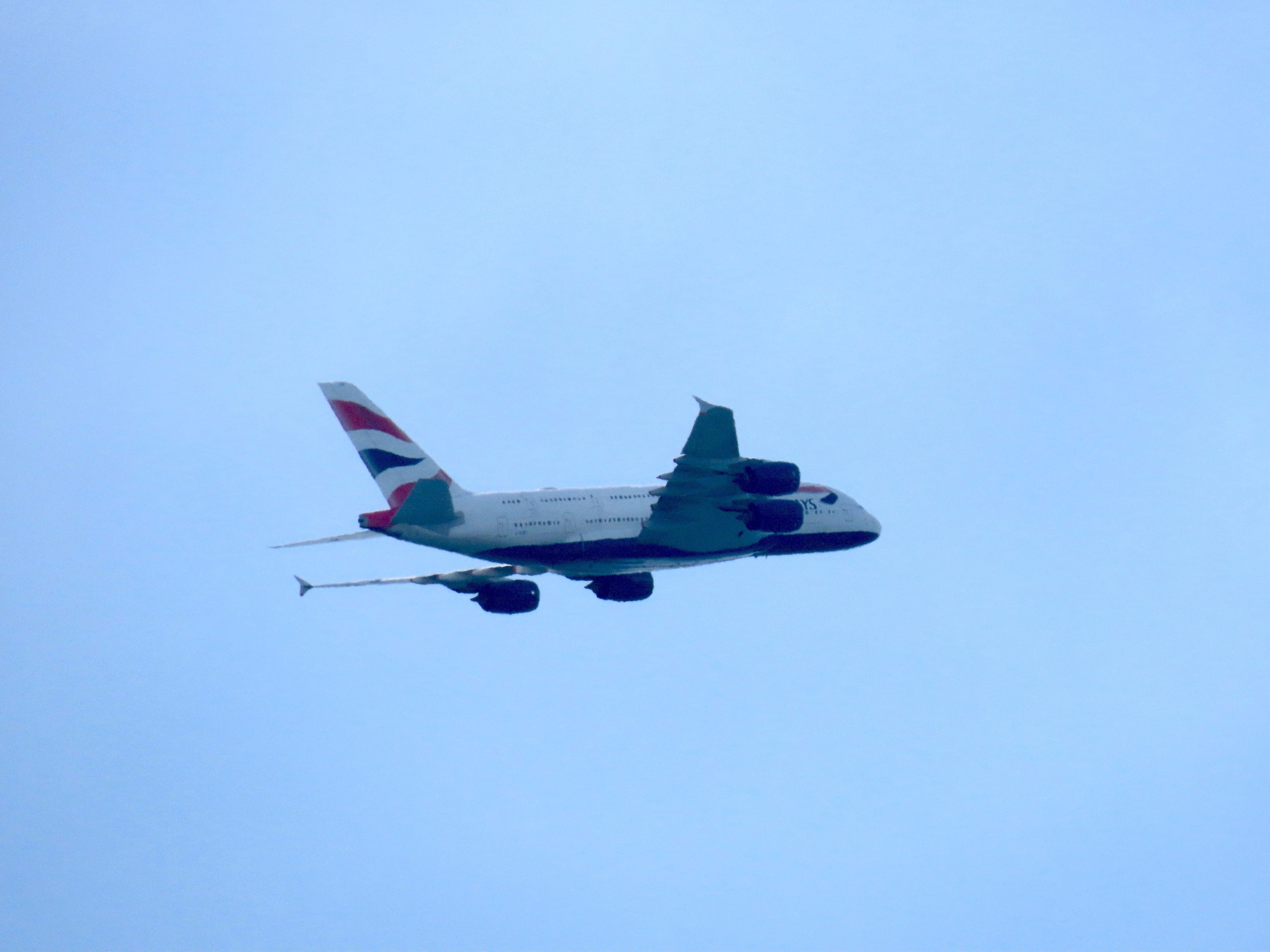
On my afterwork walks I noticed a northbound British Airways A380 at around 5 PM each day. This is flight BA 284. The flight path parallels Ocean Beach and then turns northeast heading toward the Polar route over Greenland to its final destination of Heathrow Airport. I often watch it until it disappears with distance.

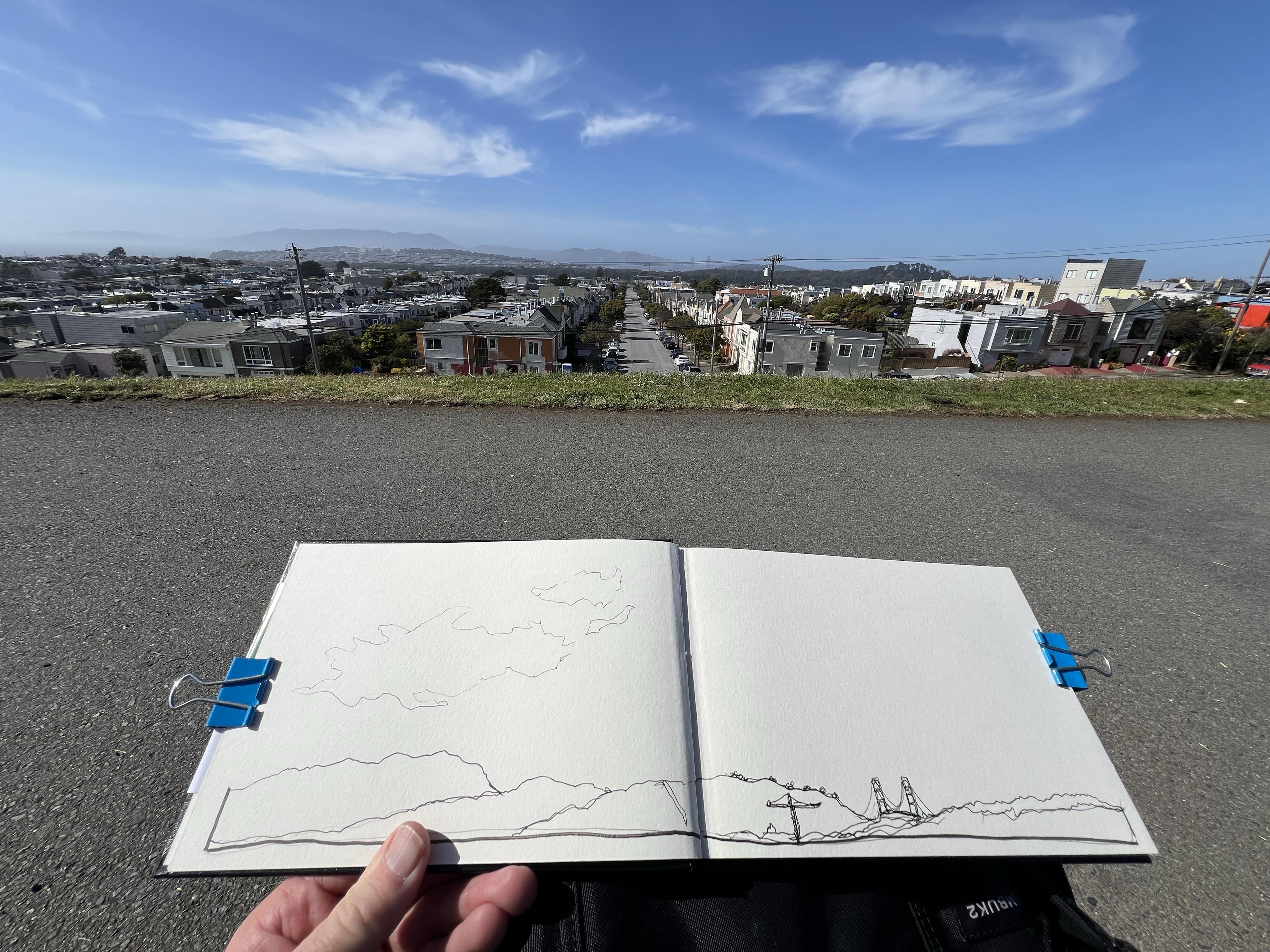
After work I wanted to get a sketching perch perspective facing north with the Golden Gate Bridge, Marin Headlands, and Mt. Tamalpais at the base of the panoramic spread and the A380 flying above. Sunset Reservoir fits the bill.

I headed to the northwest corner of the reservoir to Sunset Reservoir Park with a brand new Delta Stillman & Birn sketchbook.

While I was sketching a man and a woman were walking up the path speaking French. I assumed they were from the Lycee Francais de San Francisco school just up Ortega. They had come to take in the amazing views. The woman walked over and asked if I was part of the urban sketchers. I replied that I was not and she told me that she liked to sketch too.

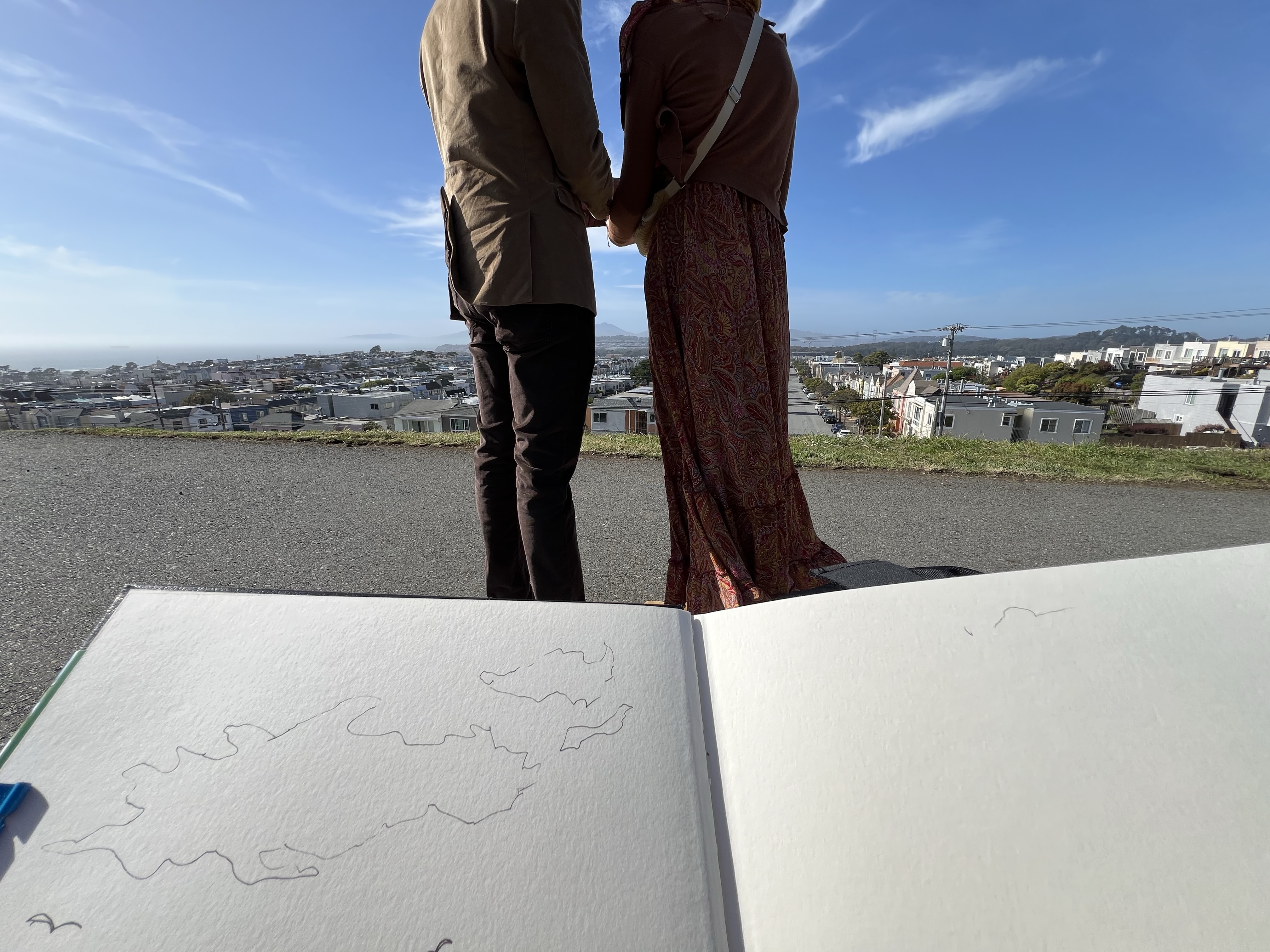
Then she and the man did something that boggled my sketcher’s mind which can be summed up in the following photo:

Yes, unbelievably they commented on my sketching and then turned around to stand between myself and my subject!

My plan was to do a loose sketch of the A380 as it headed northeast. Luckily the French couple moved on to take some more selfies with the distant Golden Gate Bridge in the background, before I had to ask them politely, to get out of my way!

Flight 284 is scheduled to depart SFO at 16:20. It seems it was running a bit late as the A380 passed by at 5:03.

A Heathrow bound British Airways A380 flies past the Sunset Reservoir.

SFO Runway 28R

I had sketched and photographed BA Flight 284 as it passed over western San Francisco and now I wanted to witness an A380 take off, head on!

One of the best ways to look down Runway 28R (SFO’s longest) is to cross Highway 101 on San Bruno Avenue. Here you can look down the runway towards aircraft taxiing into position for take off.

As a side note, runways are named after their magnetic heading to the nearest ten degrees so 28 degrees and the R stands for “right” to differentiate the runway from the parallel runway to the left: 28L.

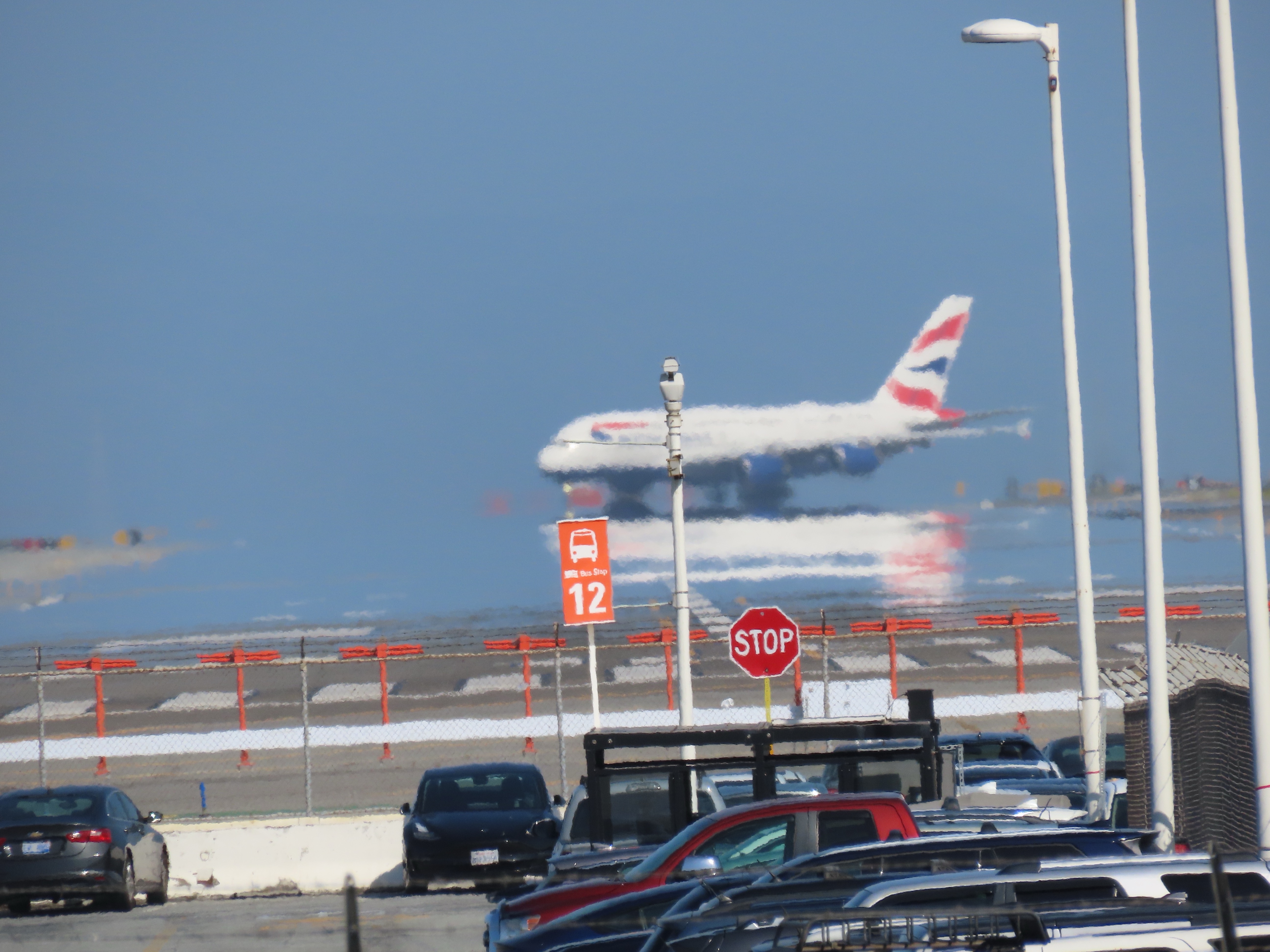
Flight 284 was late getting out of the gate and I spotted the giant, shark like tail fin, sporting the Union Jack, as it crept towards the runway.

The A380 pulling onto Runway 28R. With the distance, the plane looks like a mirage.
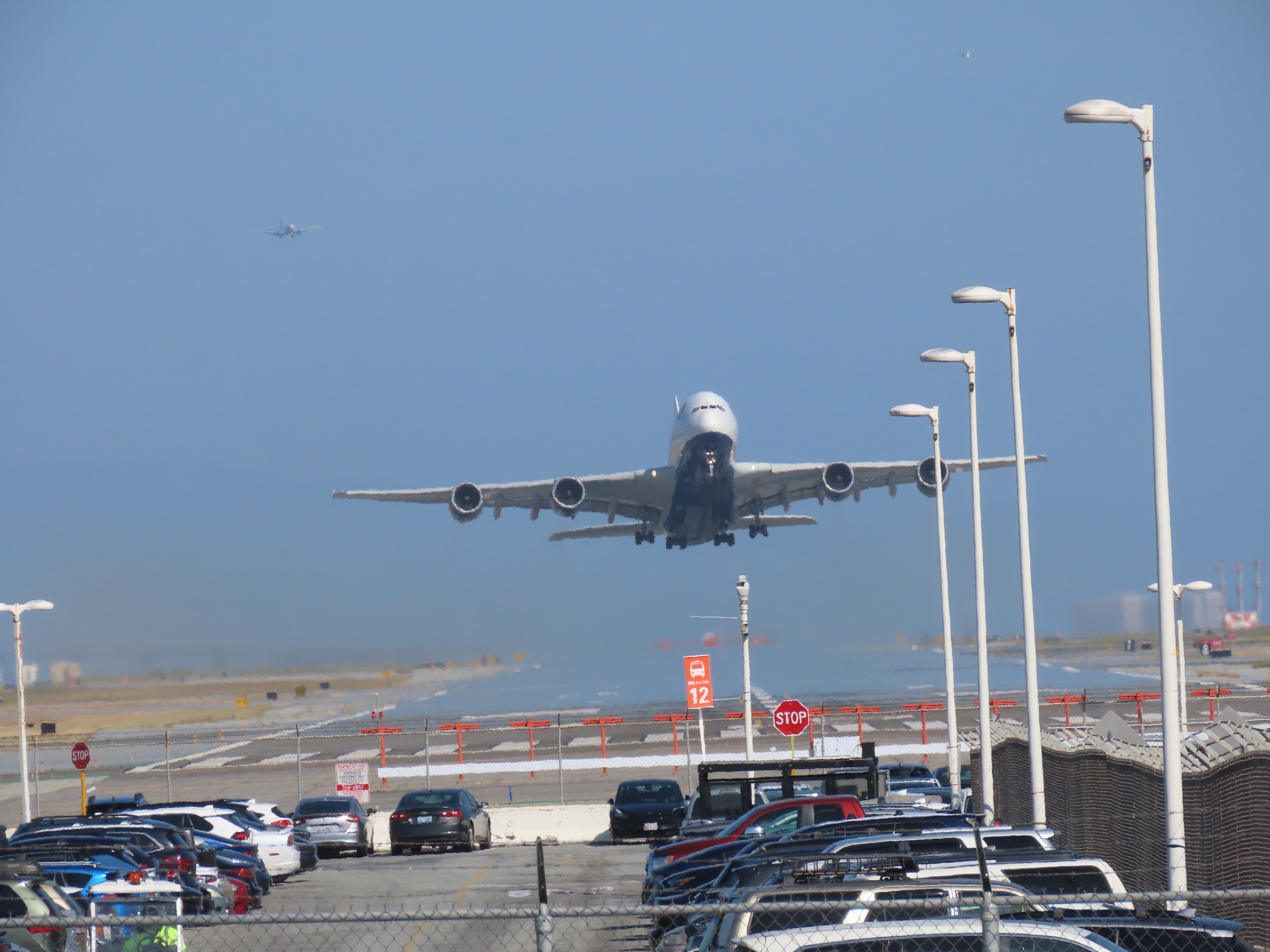
Flight 284 climbs off Runway 28R at 150 knots heading right toward me!
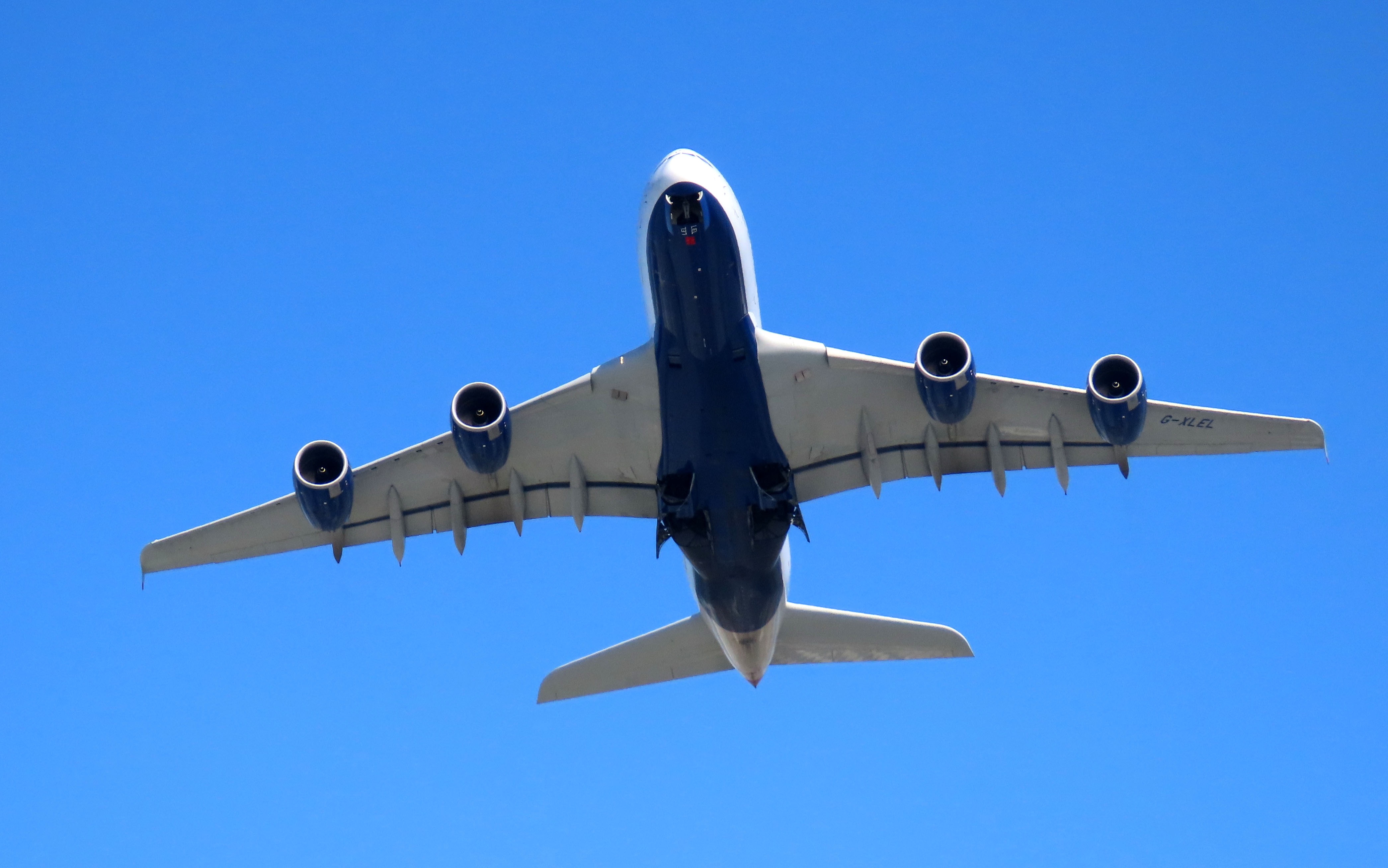
Gear up, the A380 flying overhead.
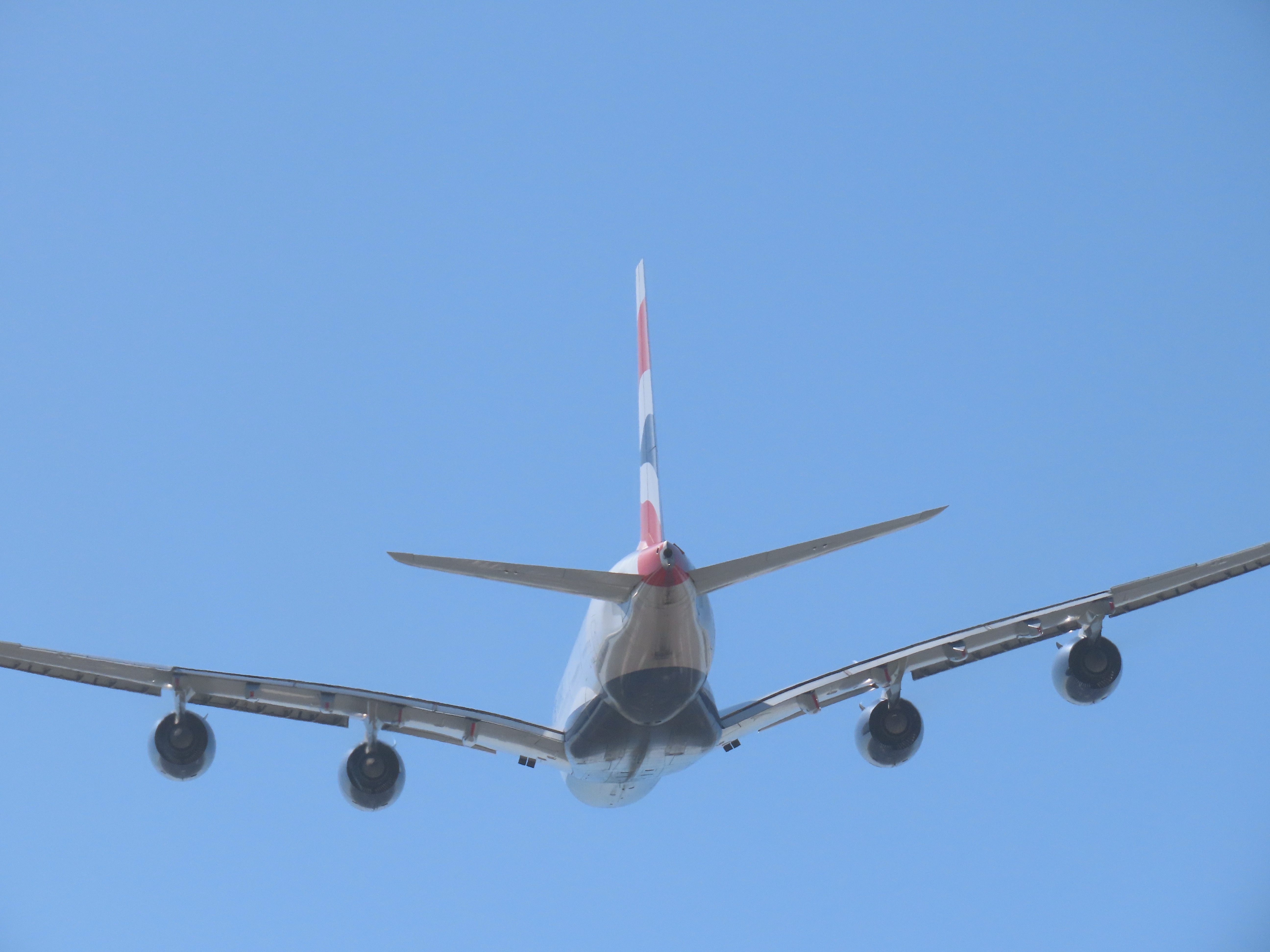
Next stop (10 hours 35 minutes later) Heathrow Airport.
Image

Loma Prieta Bell’s Sparrow

In late May I made my annual pilgrimage to the birding hotspot Loma Prieta (Upper Saddle).

I left my cabin at 6:40 AM and 35 minutes later I pulled into the dirt parking lot on the ridge that straddles Santa Cruz and Santa Clara Counties.

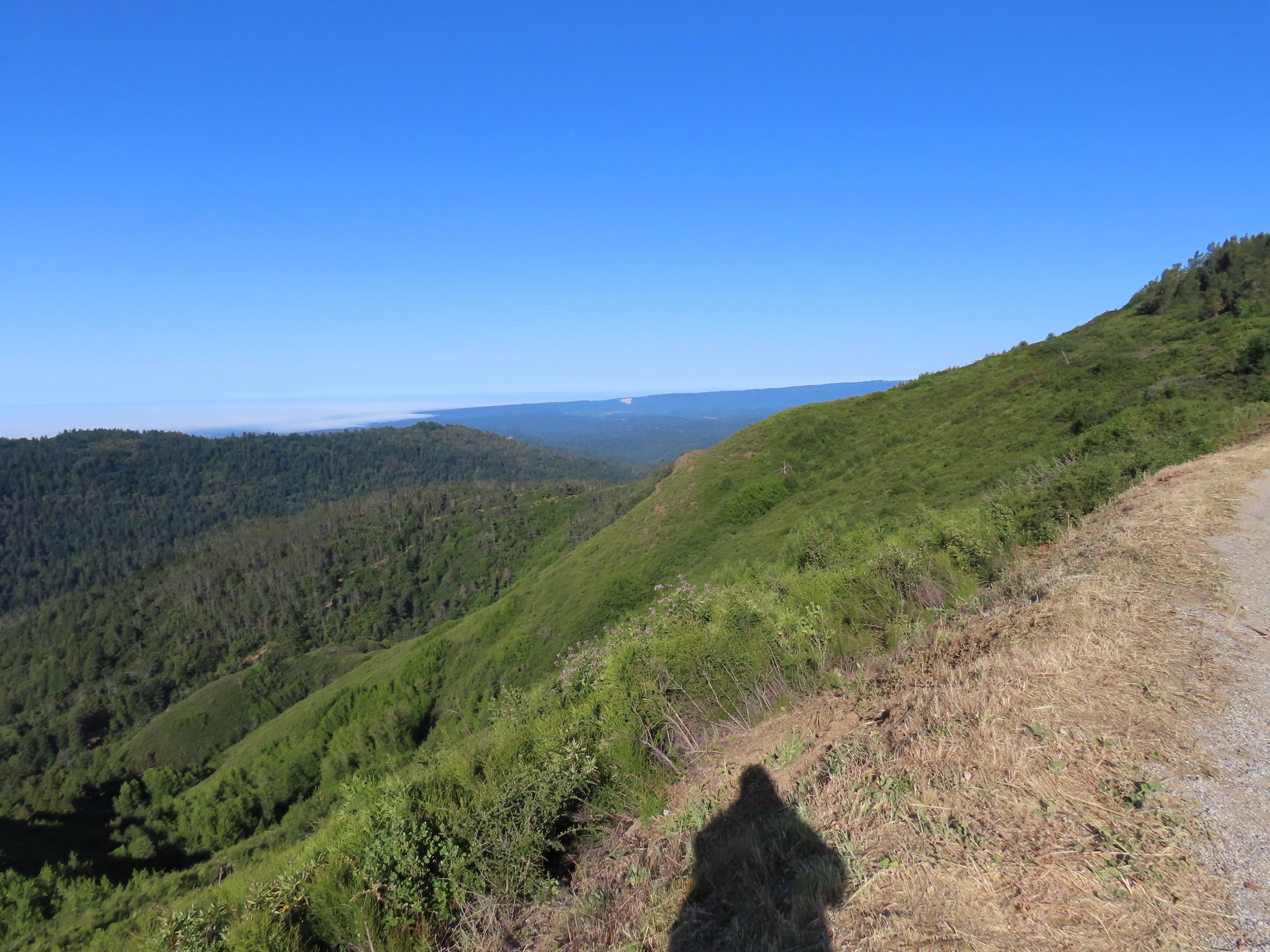
It can be very windy and hemmed in by dense fog up here but not today. I could look down and see fog covering Monterey Bay. Today it was clear and warm without much of a breeze. In fact it was already getting warm.

My target was the pair of Bell’s sparrows that had recently been seen here since mid May. This would be a Santa Clara County bird for me.

I walked down Mt. Madonna Road and aside from singing spotted towhees and wrentits, and a far off babbling California thrasher, it was pretty quiet. I did not hear or see any black-chinned or Bell’s sparrows.

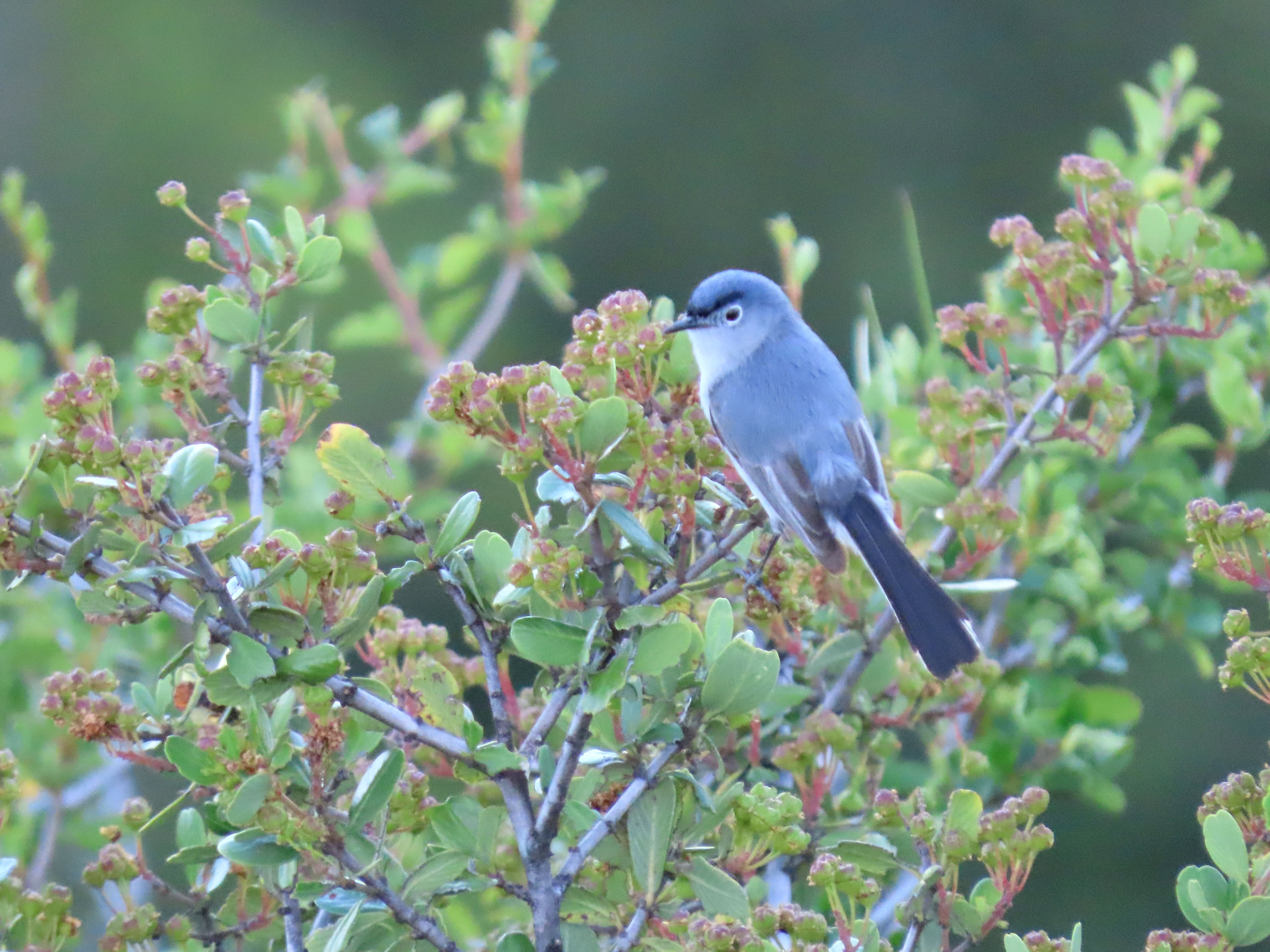
On my way back to the parking lot I first heard and then saw a blue-grey gnatcatcher.

Blue-gray gnatcatcher.

As I headed to the parking lot there were now six other birders in the area, looking for the Bell’s.

As I reached my car a pair of birders had just spotted a pair of Bell’s sparrows right from the parking lot. So I figured I’d stay a bit longer.

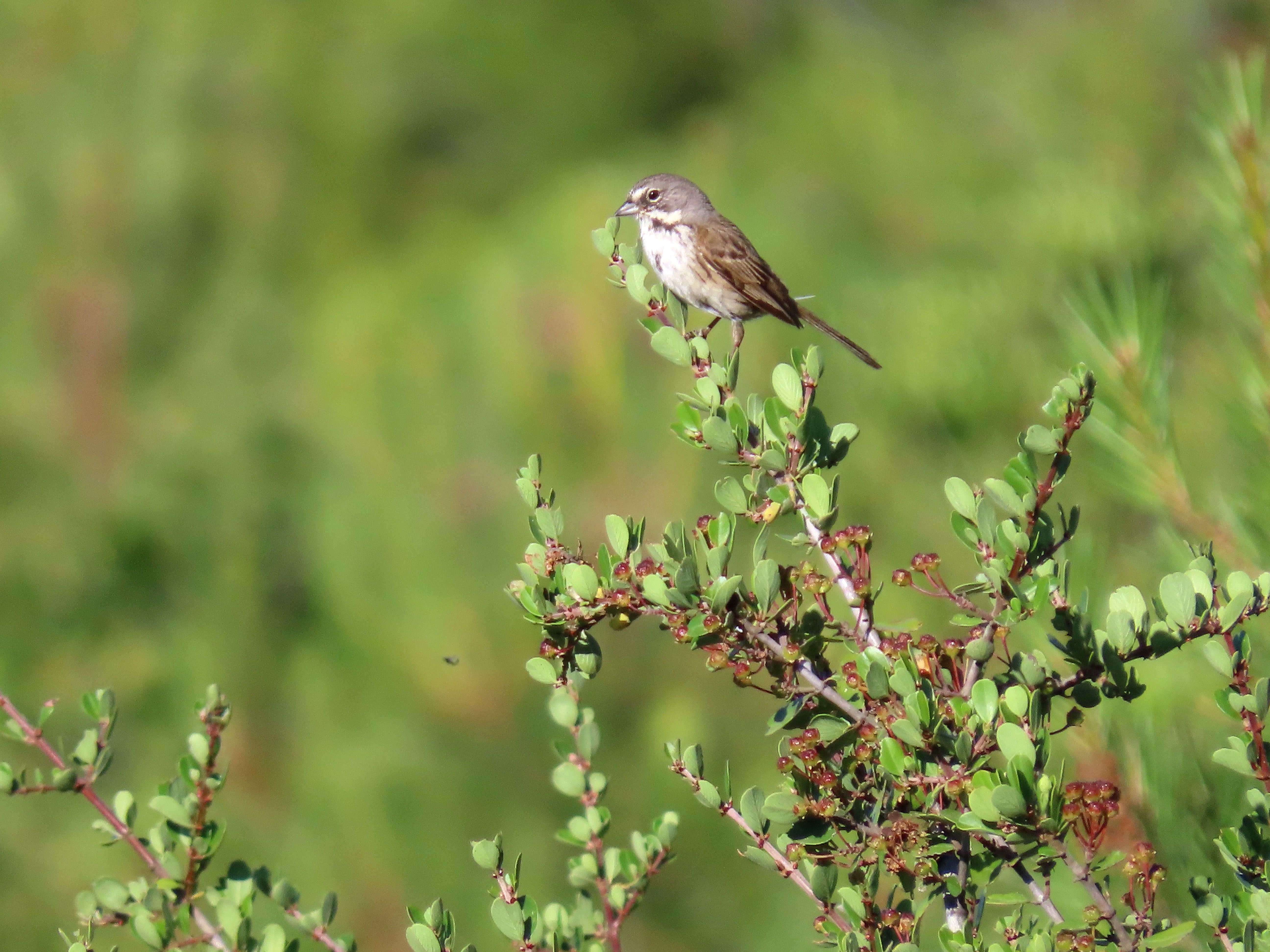
I was rewarded about five minutes later when a bird flew towards me and perched on a nearby bush in front of me. Bell’s sparrow! A new county bird!

Bell’s sparrow.

Sketching Notes

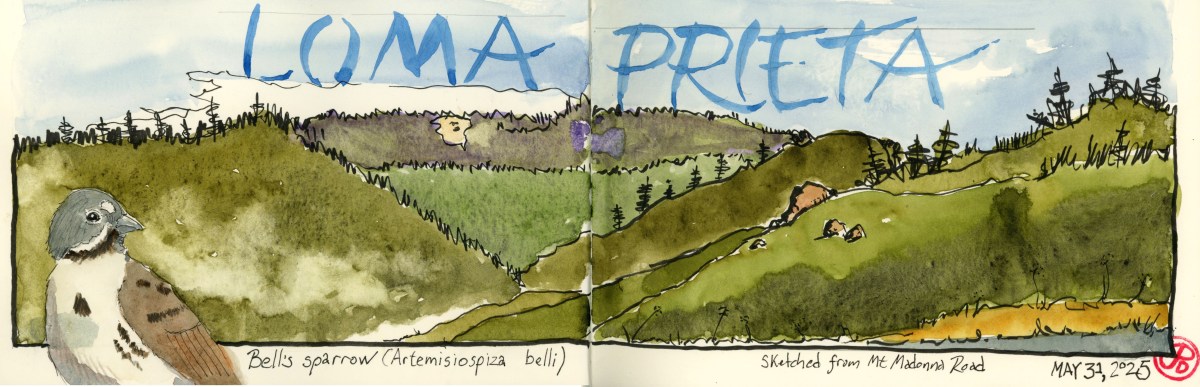
Loma Prieta Ridge is one of the best panoramic views in Santa Cruz County. So I took a pause in Bell’s sparrow spotting and opened my panoramic watercolor journal to capture the scene.

What a view, best in the county!

I left the lower left side blank. I initially was going to add a Bell’s sparrow but I hadn’t seen one yet. So I thought I would add a blue-grey gnatcatcher to that corner, based on my field photo.

After seeing the Bell’s from the parking lot, I returned to my original plan and the result is my featured sketch.