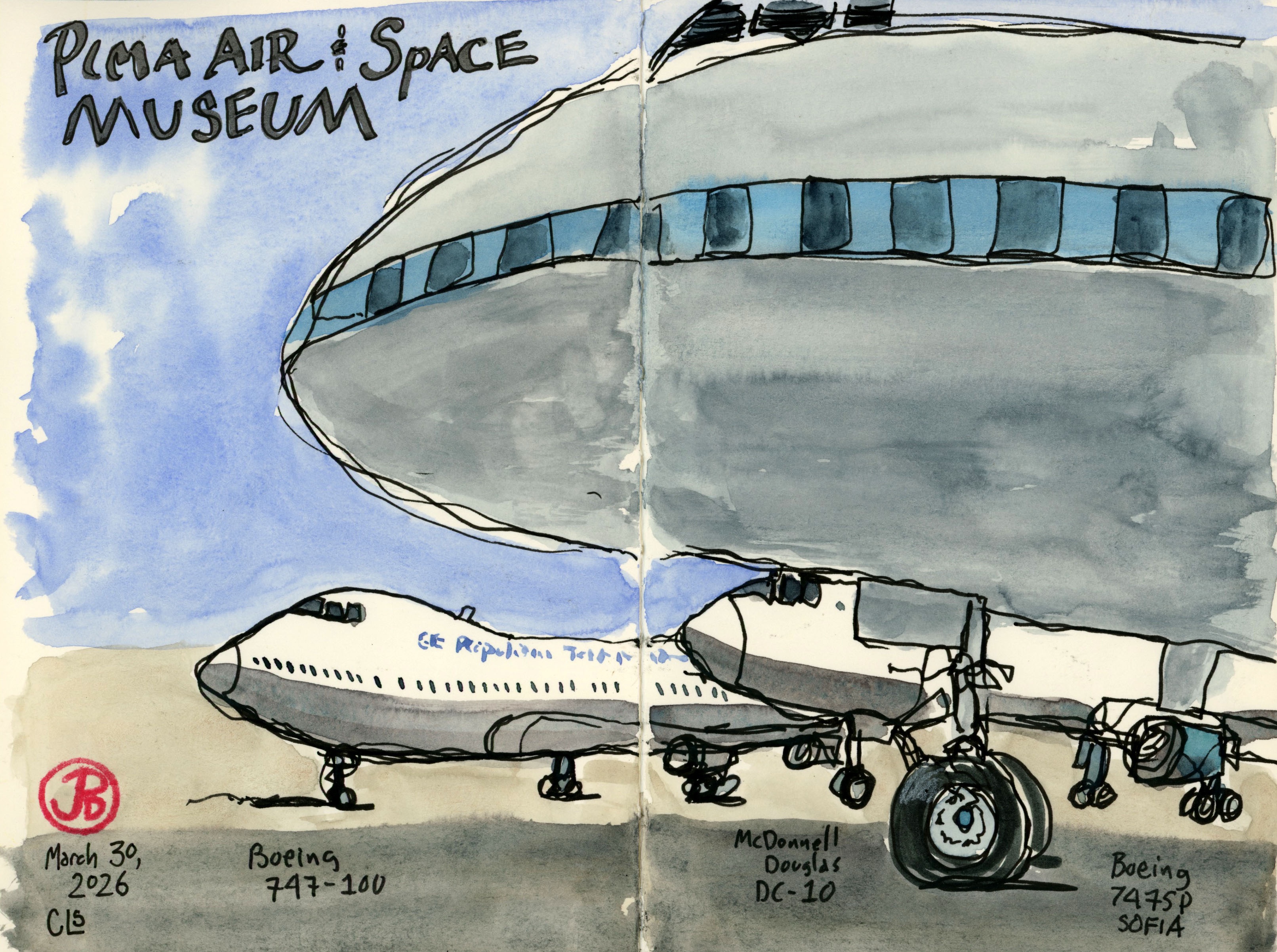
Pima Air & Space Museum, Part 1

While in Tucson, I wanted to visit and sketch one of the best and biggest air museums in the west if not the entire United States, the Pima Air & Space Museum. This place is epic!

Now where to start?

What is impressive about the museum is the sheer size of the collection, not just in the number of aircraft in their collection (over 400) but the massive size of the planes including three B-52s, two B-29s, and two 747s. You need a lot of real estate to display these massive machines and they have it.
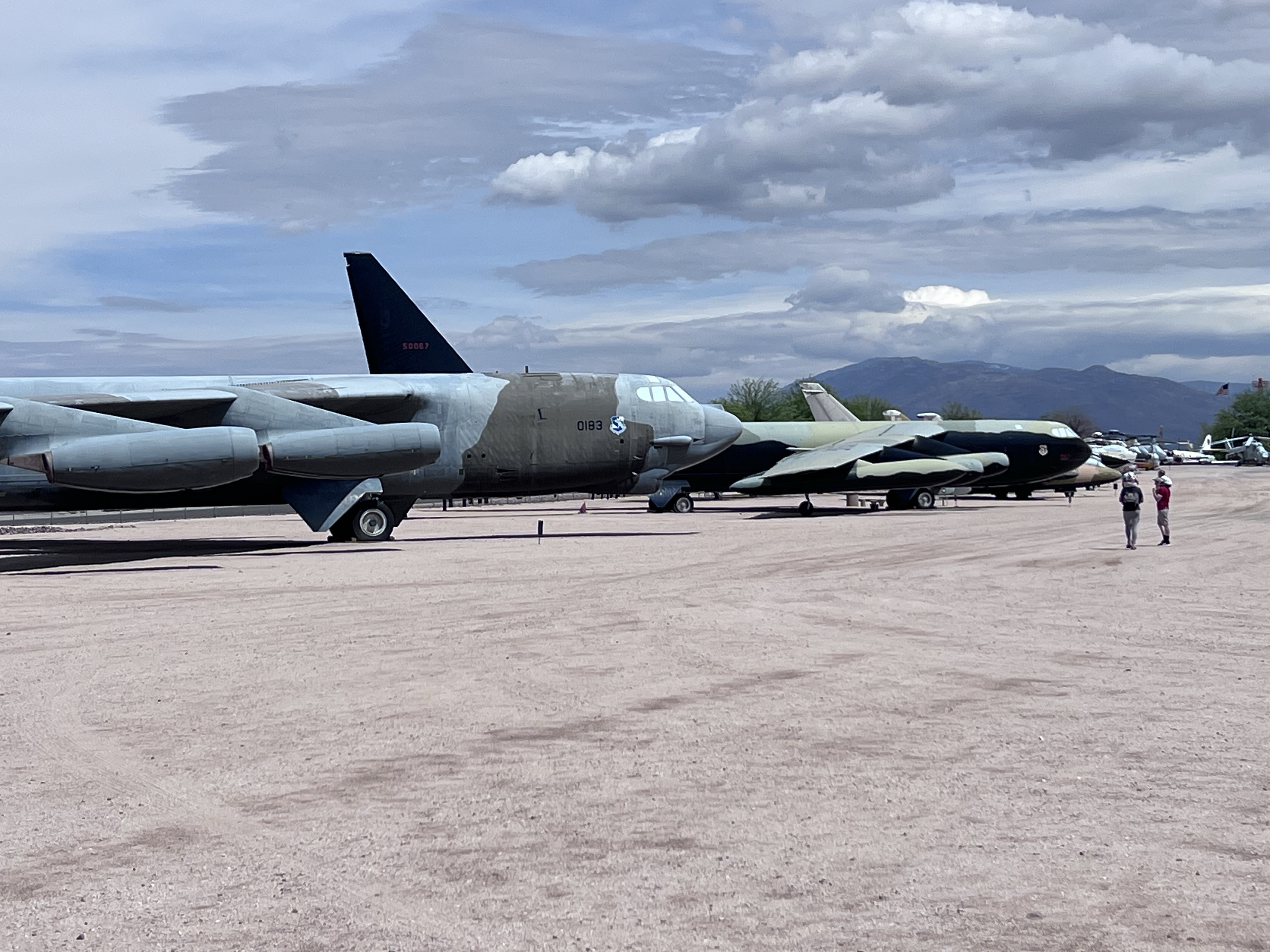
Two of the three B-52s in the museum’s collection.

What I also liked about the size and scale of the museum, unlike others I have visited, is that you actually have space to stand back and take in the whole aircraft and walk around them for a 360 degree view and they weren’t crowded in with tons of other aircraft, making sketching or plane viewing, rather difficult.
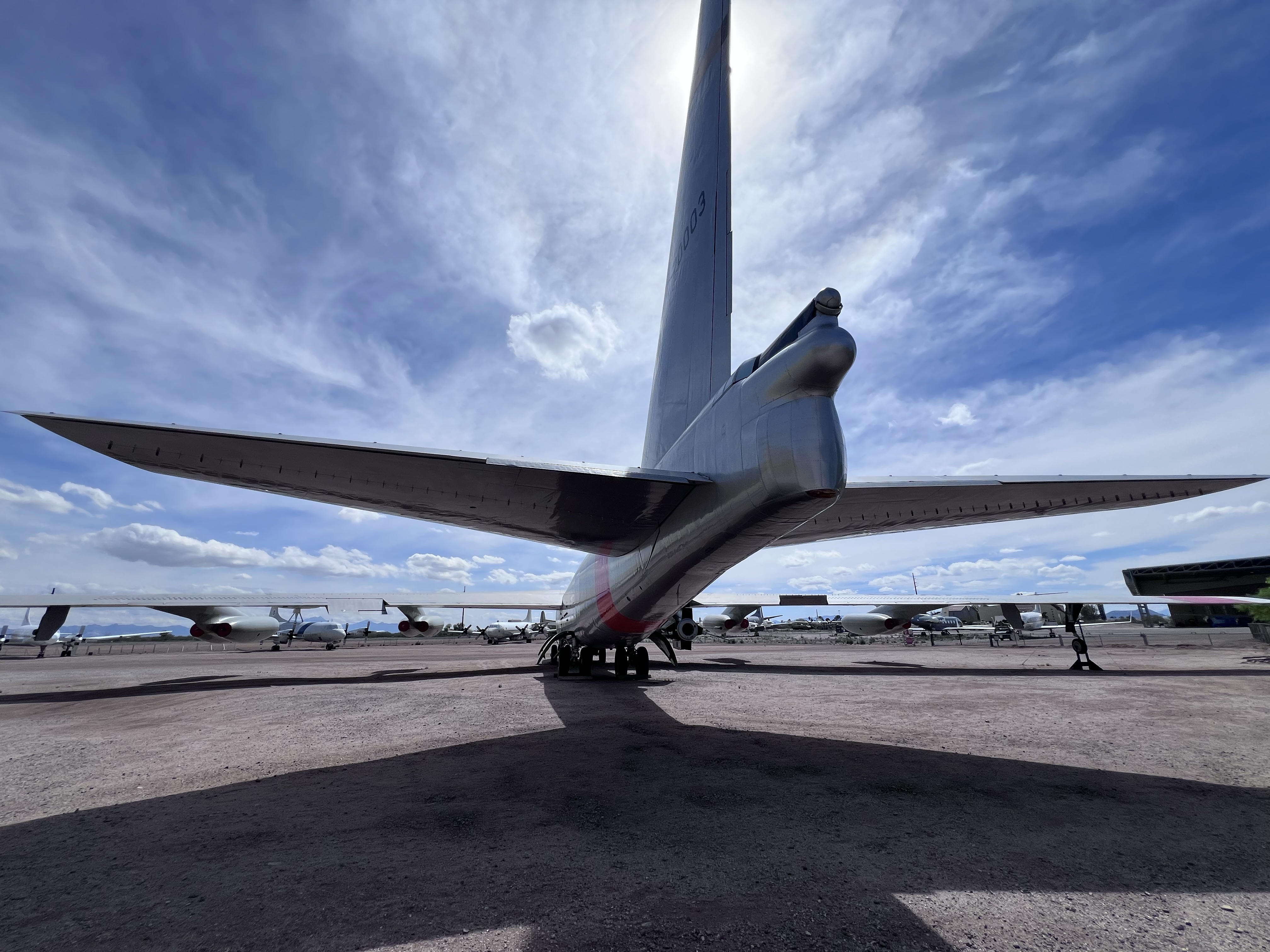
Getting a 360 view of the massive end of a Boeing B-52 (and they have three).

Some of the aircraft is displayed in hangers but the majority of the collection is outside under the desert sun.
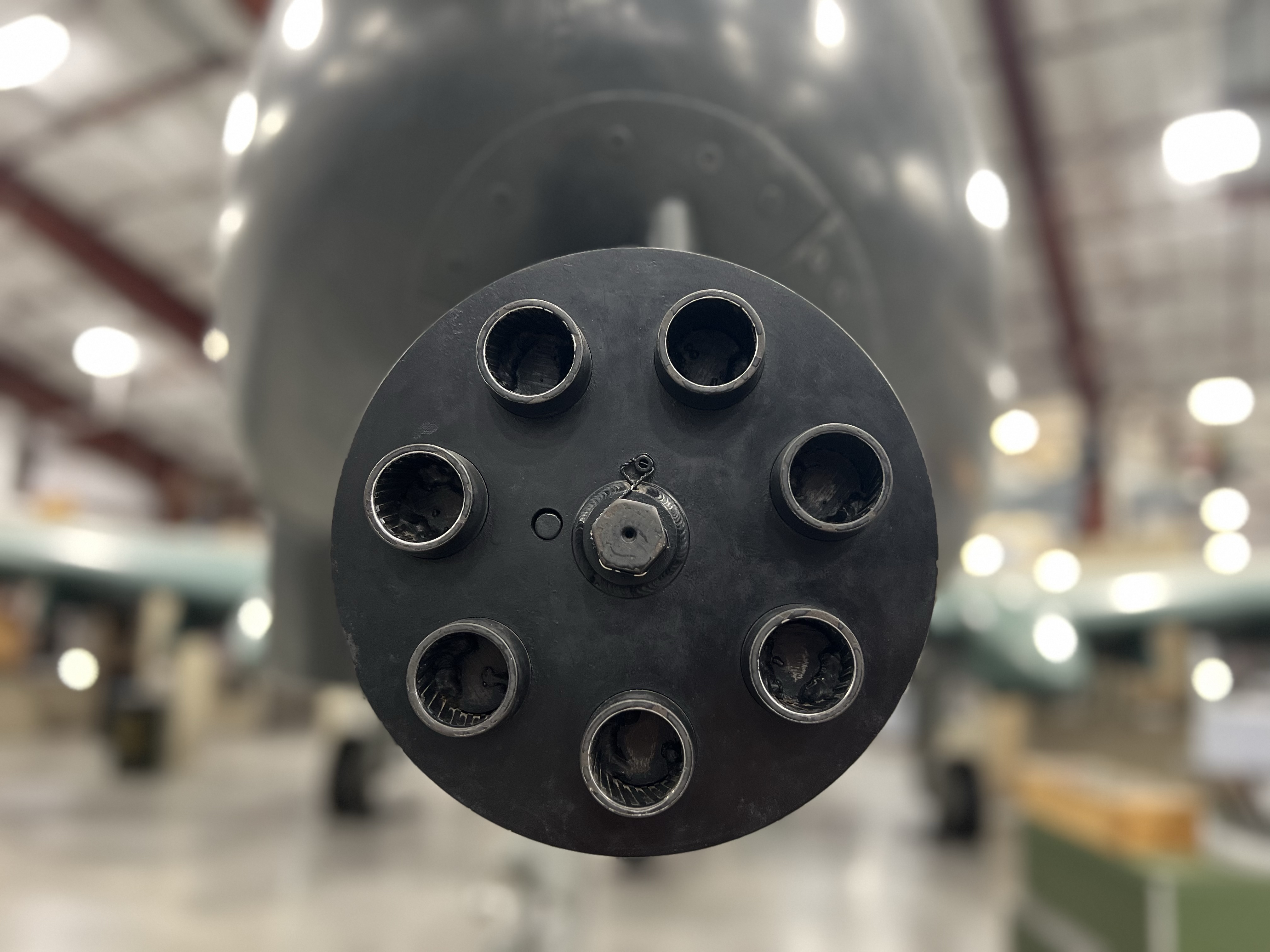
The business end of an A-10 Warthog. This maybe one of the only museums where you can see this static plane, step outside and see one taking off at the adjacent Air Force Base.

Sketching outside was going to be a challenge in the desert sun for my coastal constitution and fair skin. I employed 45 SPF sunscreen, long sleeves, a buff, and a wide brimmed hat.

While sketching a line of some of the museum’s largest aircraft, two 747s, a DC-10, and a triple 7, I looked for shade in my sketching positions.

Luckily a Boeing 747 provides quite a bit of shade to sketch under. I rendered the scene with a continuous-line sketch (featured sketch).

In this post I included sketches of some of the museum’s largest planes, they all happen to be made by Boeing: the B-29 Superfortress, the B-52 Stratofortress and the 747, the world’s first jumbo jet.

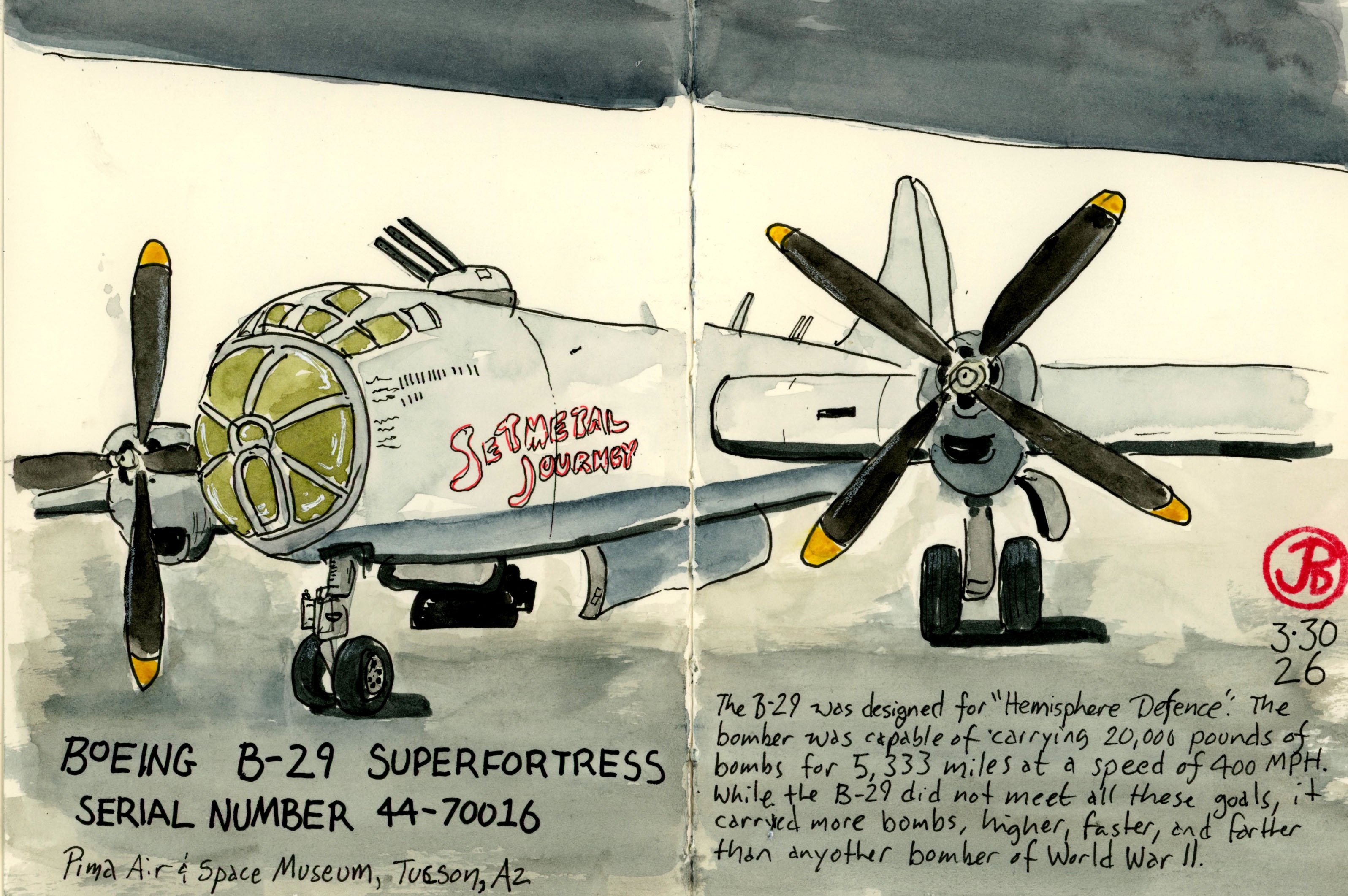
While the B-52s and the 747s were outside, the heavy World War Two bomber, the Boeing B-29 Superfortress was indoors.

The Boeing B-29 Superfortress is known for the destruction it wreaked on Japan during WW II with the dropping of incendiary bombs on Japan’s wooden cities and also dropping the two atomic bombs on Hiroshima and Nagasaki that virtually ending the war in the Pacific Theater.
Image

SFO From the Bay Trail

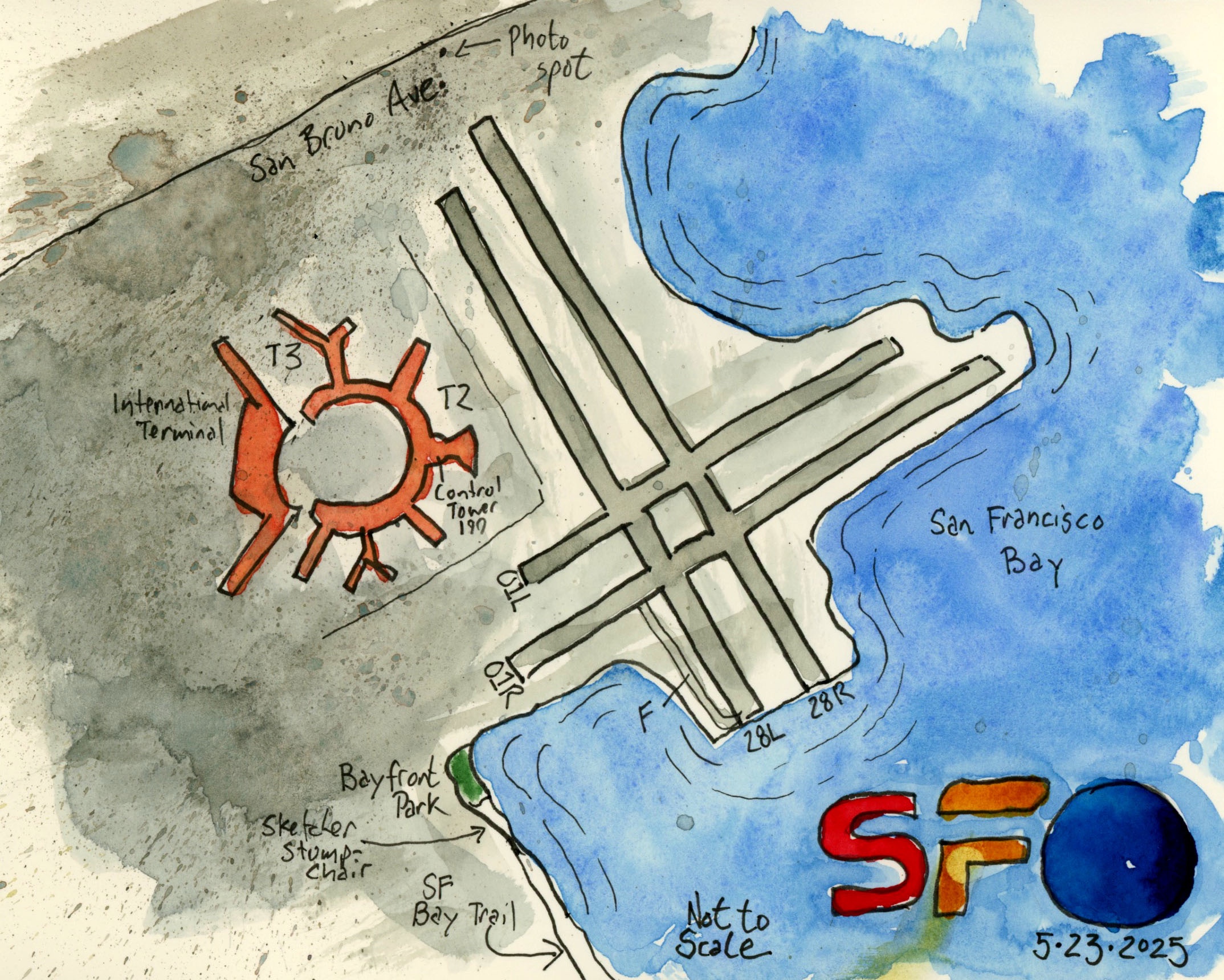
My Tuesday after work sketch took me to the San Francisco Bay Trail which parallels Runways 28R and 28L and Taxiway F.

These are the two runways that handle most international traffic at San Francisco International Airport. In my two hours there, I saw planes landing or taking off from airlines such as Cathay Pacific, Condor (German), Lufthansa, SAS, Aer Lingus, Virgin Atlantic, Qatar, Iberian, Swiss, TAP Air (Portugal), Turkish Airlines, Zipair (Japan), and British Airways. San Francisco is really an international destination.

This trail and Bayfront Park are a well known location for plane spotting as you have unobstructed views of planes taxiing, taking off, and landing.

I was here to see the large passenger jet that largely replaced Boeing’s 747 on long distance international routes.

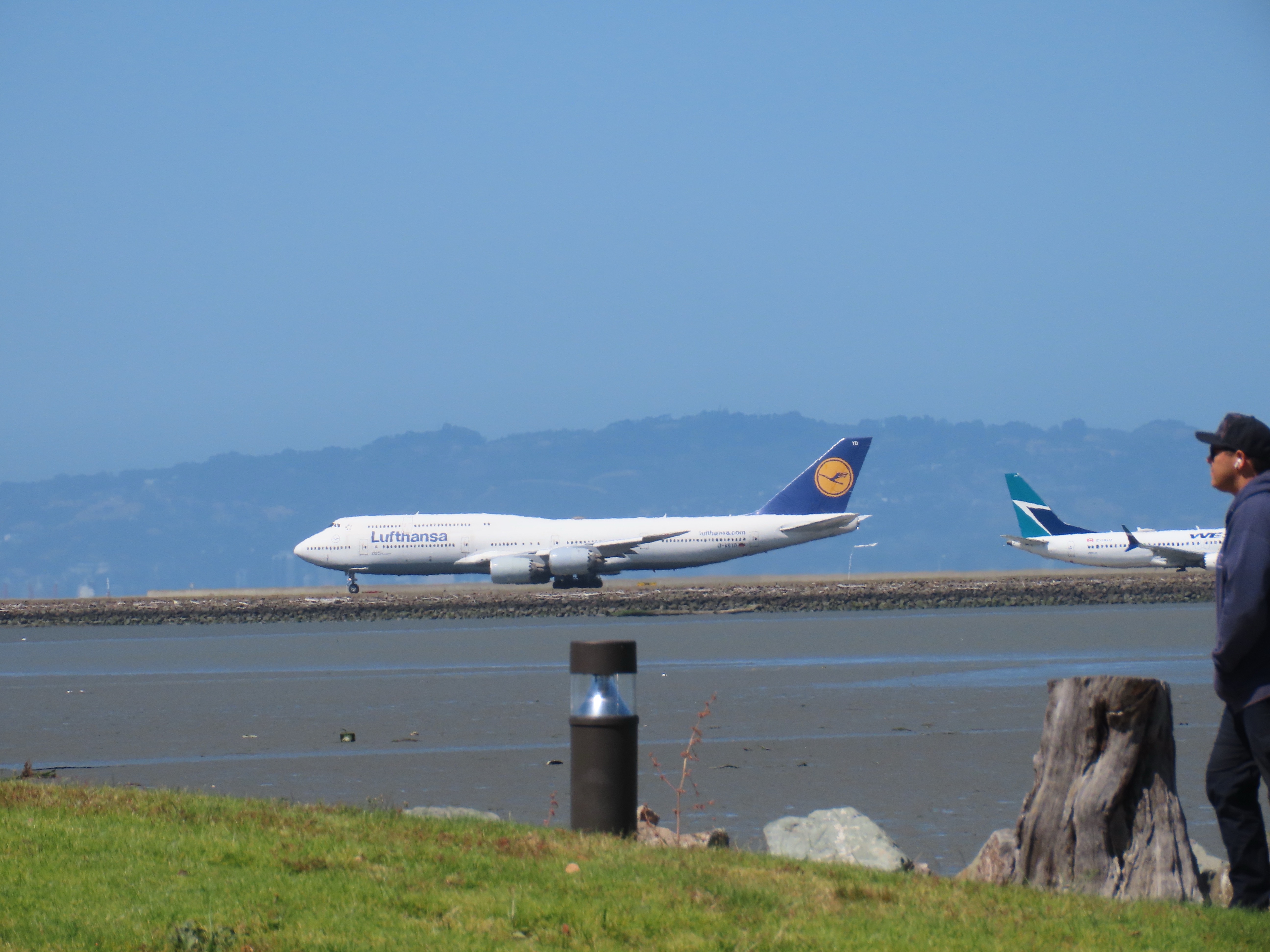
In an uncanny coincidence a Lufthansa 747-8 was on Taxiway F headed to Runway 28R when I was driving down Millbrae Avenue toward the airport. After I parked and walked up to the Bay Trail the 747 was throttling up for takeoff. Only four airlines currently have 747s in their fleet: Lufthansa, Korean Air, Air China, and Rossiya.

One of the few Boeing 747s throttling up for takeoff on Runway 28R. This is a 747-8, the largest 747 and Boeing’s largest passenger jet. This “stretched” 747 was designed to compete with the A380.

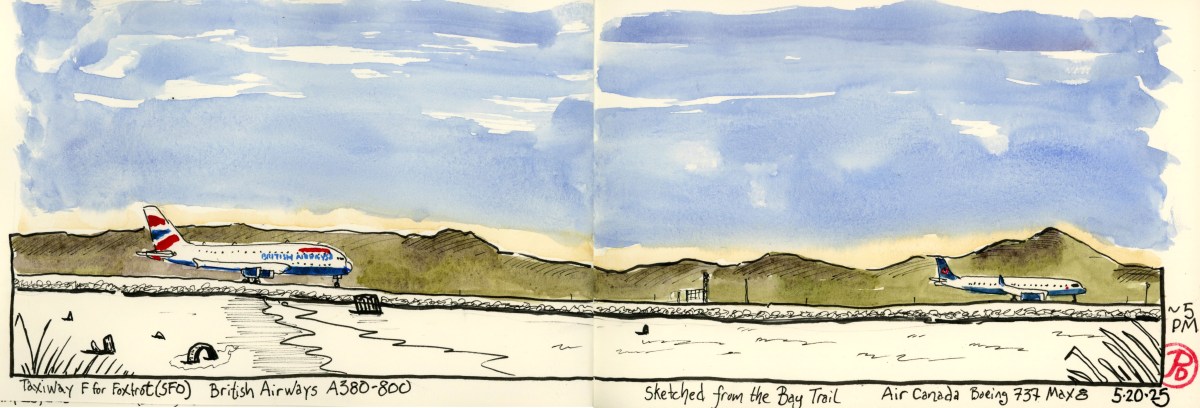
I was here to see the big boy that competed with the 747, Airbus’s A380. Two airlines fly A380s out of SFO, British Airways and Emirates. BA flight 284 was scheduled to depart at 16:20. But the flight was running a little late, which seems to be the norm.

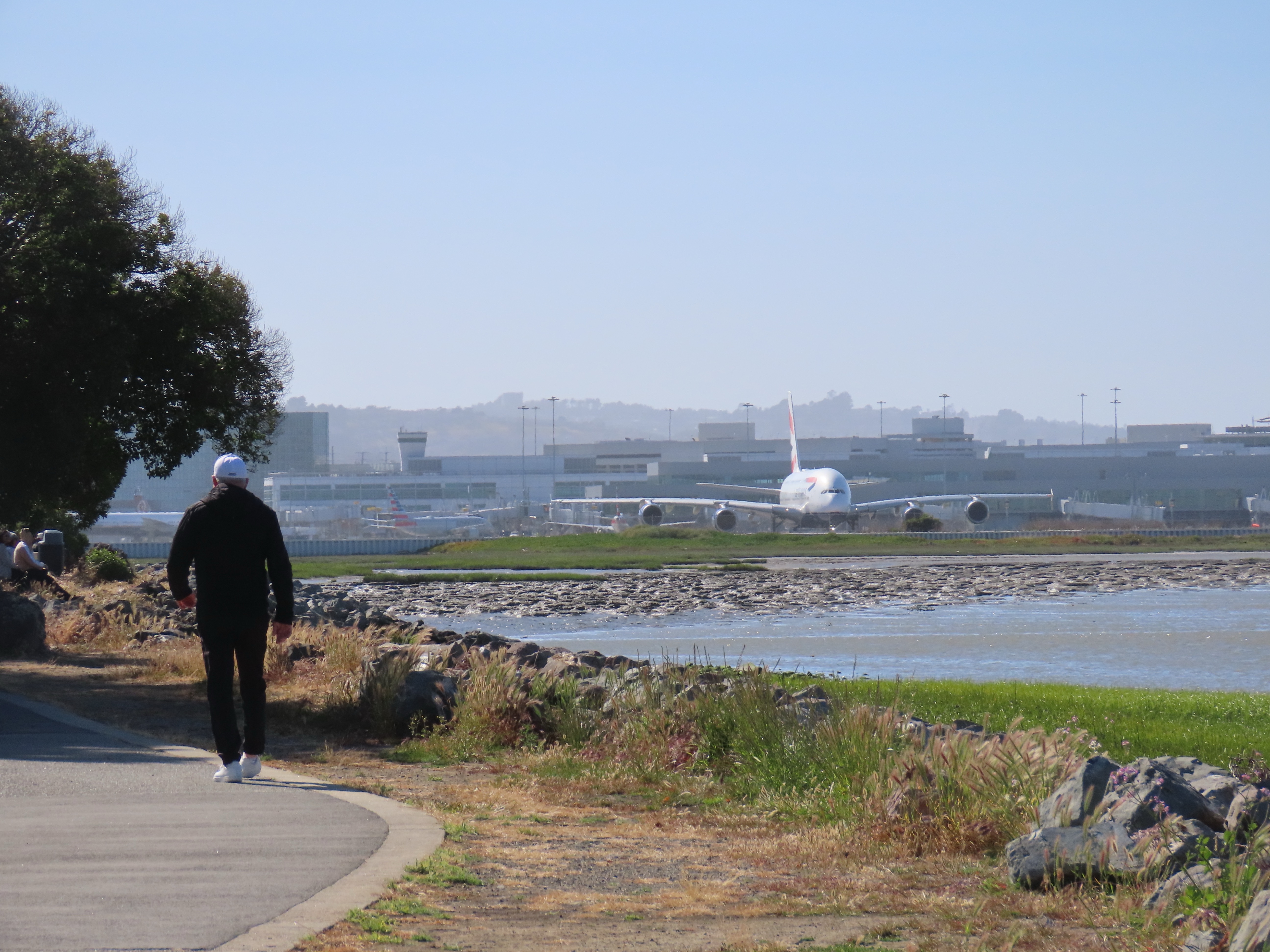
The Bay Trail in the foreground and British Airways A380 is pulling away from Gate A11. This is one of 12 in BA’s fleet.
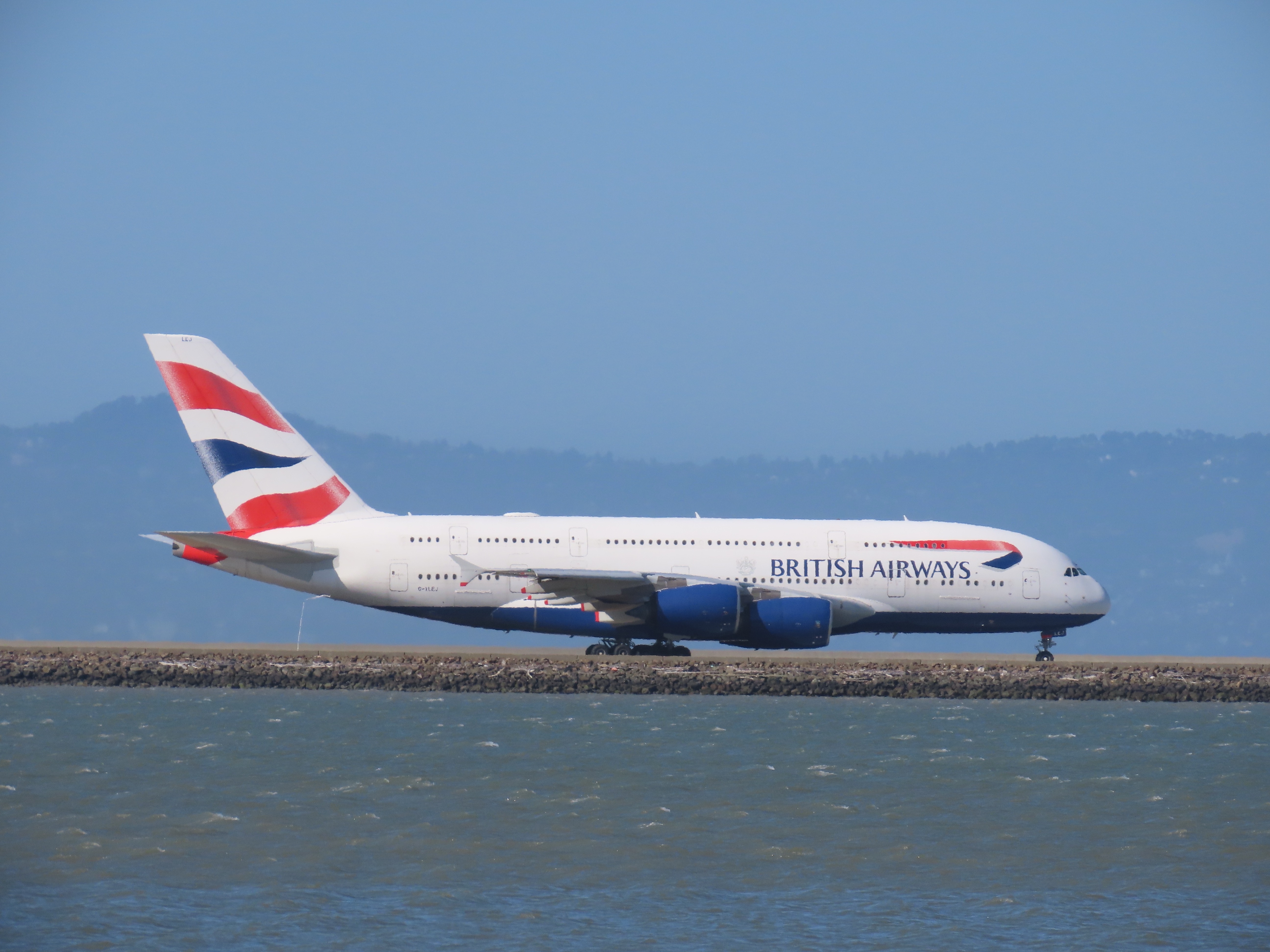
Flight 284 on the Taxiway F for Foxtrot. This airplane is so large that the suffix “Super” is part of its call sign.
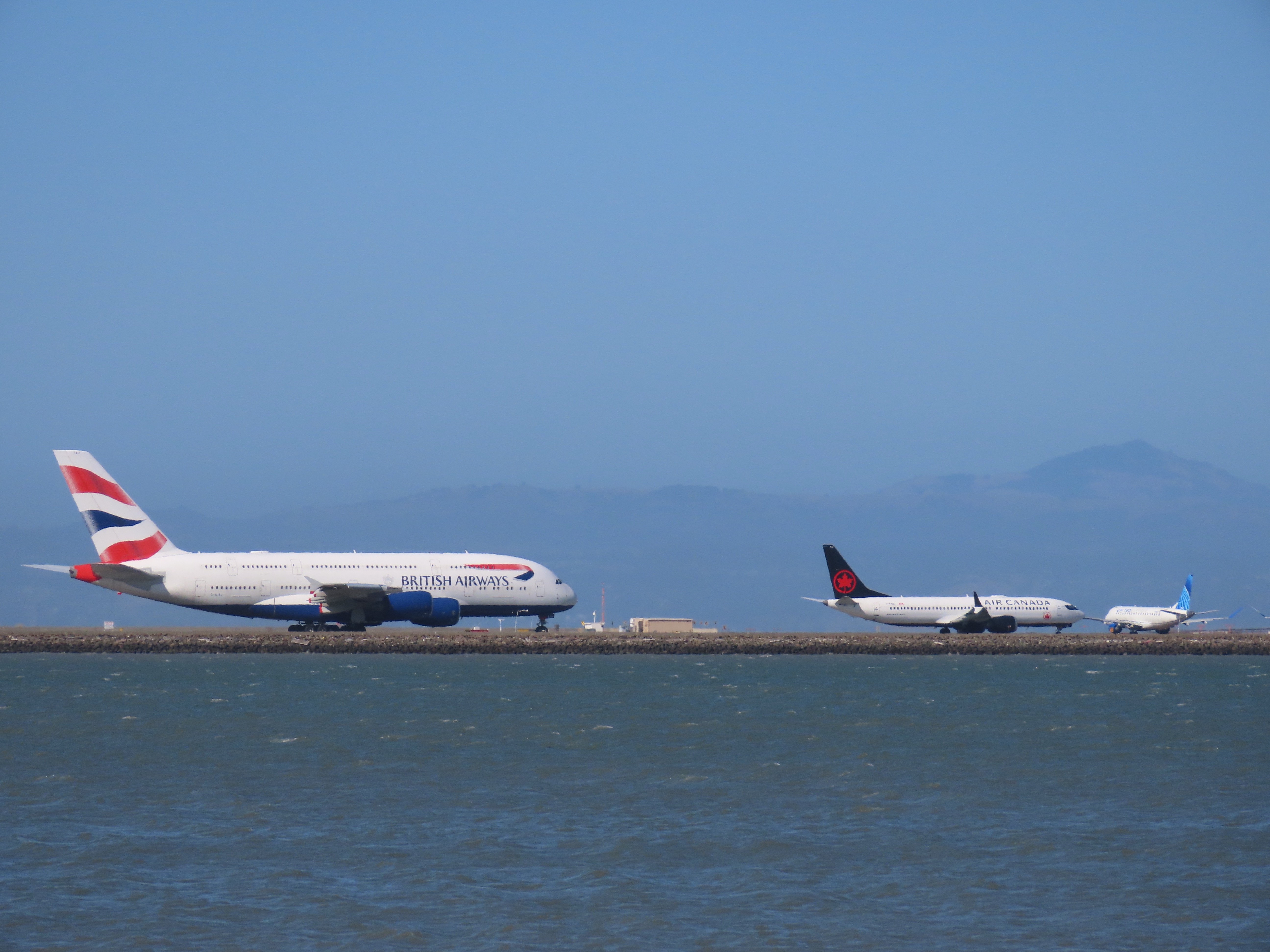
This photo shows the scale of the world’s largest passenger plane compared to others on the tarmac. The aircraft in front of the A380 is an Air Canada Boeing 737 Max 8.
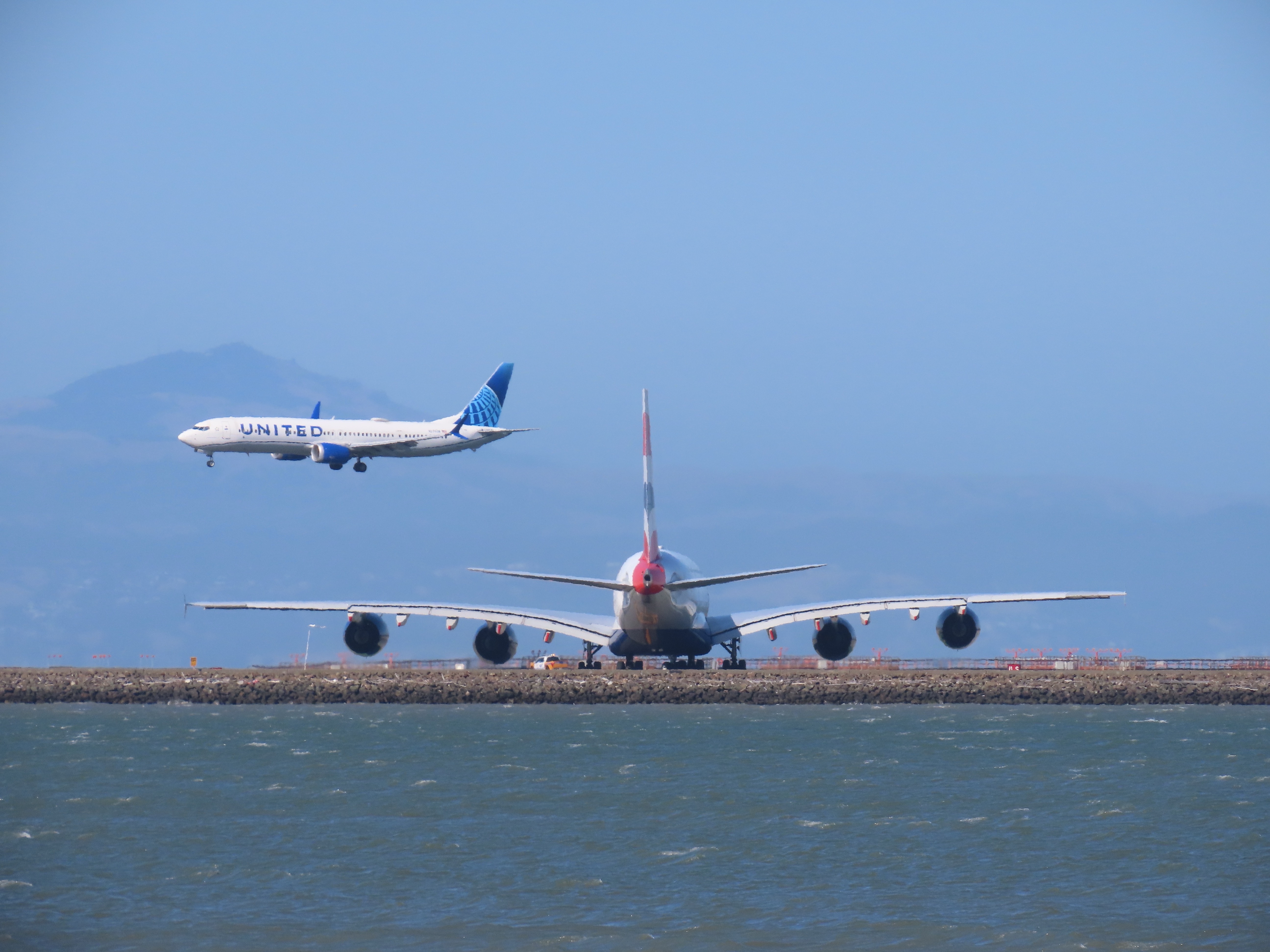
A380 on its way to line up for takeoff as a much smaller United Airlines jet lands.
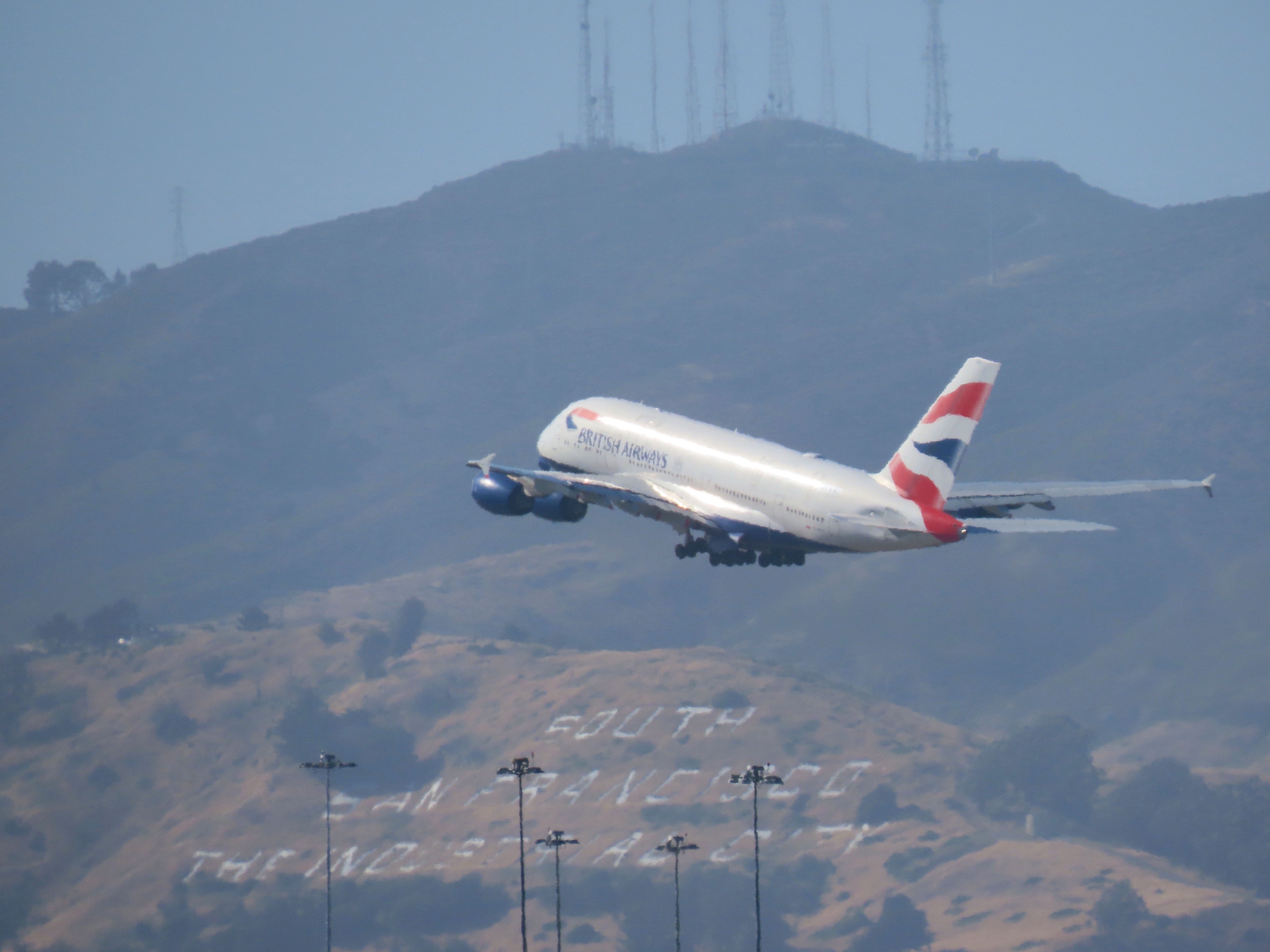
Gear up with the South San Francisco sign below and San Bruno Mountain above.

Sketching Notes

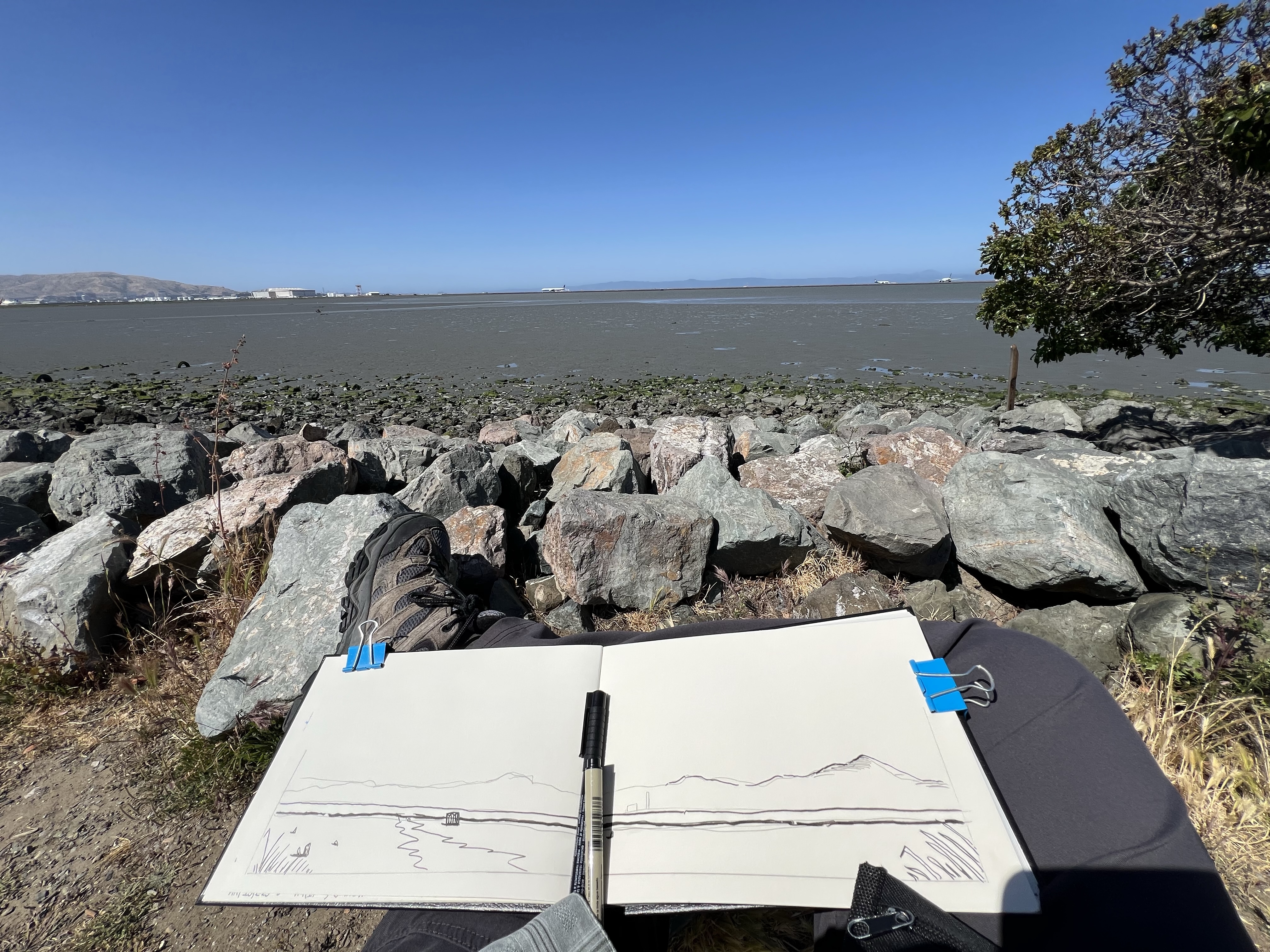
I found a tree stump seat with the taxiways and runways in front of me. I first sketched in the fill as the runways are surround by the bay on three sides. In the background I penciled in the East Bay hills and mountains including Mt. Diablo. The tide was low when I stared sketching but was slowly filling in during the two hours of my visit.

Later I would add two planes on the taxiway, based on photographs taken in the field.

To my left and in the distance I could see the red, white, and blue tail of the A380 at Gate A11.