The town of Mendocino is really a sketcher’s paradise.
I have sketched this town many times and there are endless angles, perspectives, and hidden gems to add to my sketchbook.
As a sketcher you can either “zoom” in or “zoom” out depending on what strikes your fancy (no zoom lens required). For much of my panoramic sketches I chose to zoom out with a wide angle perspective.
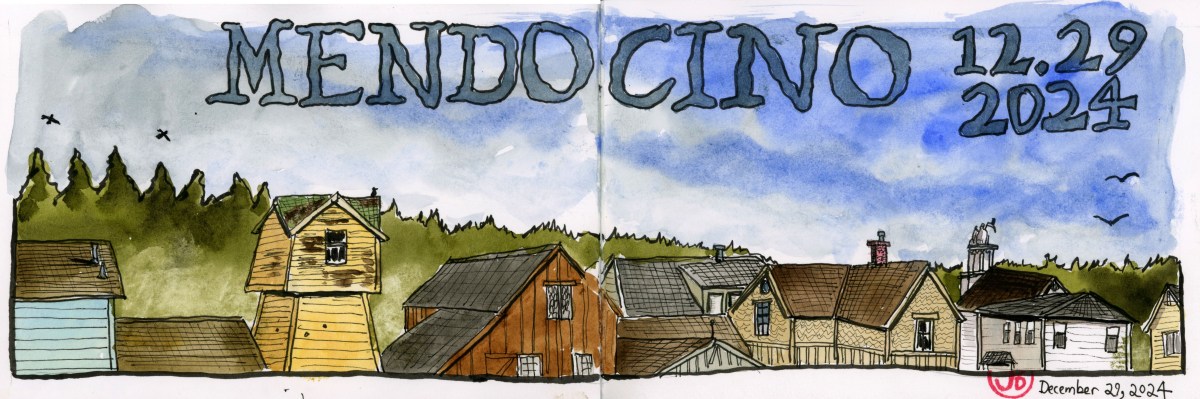
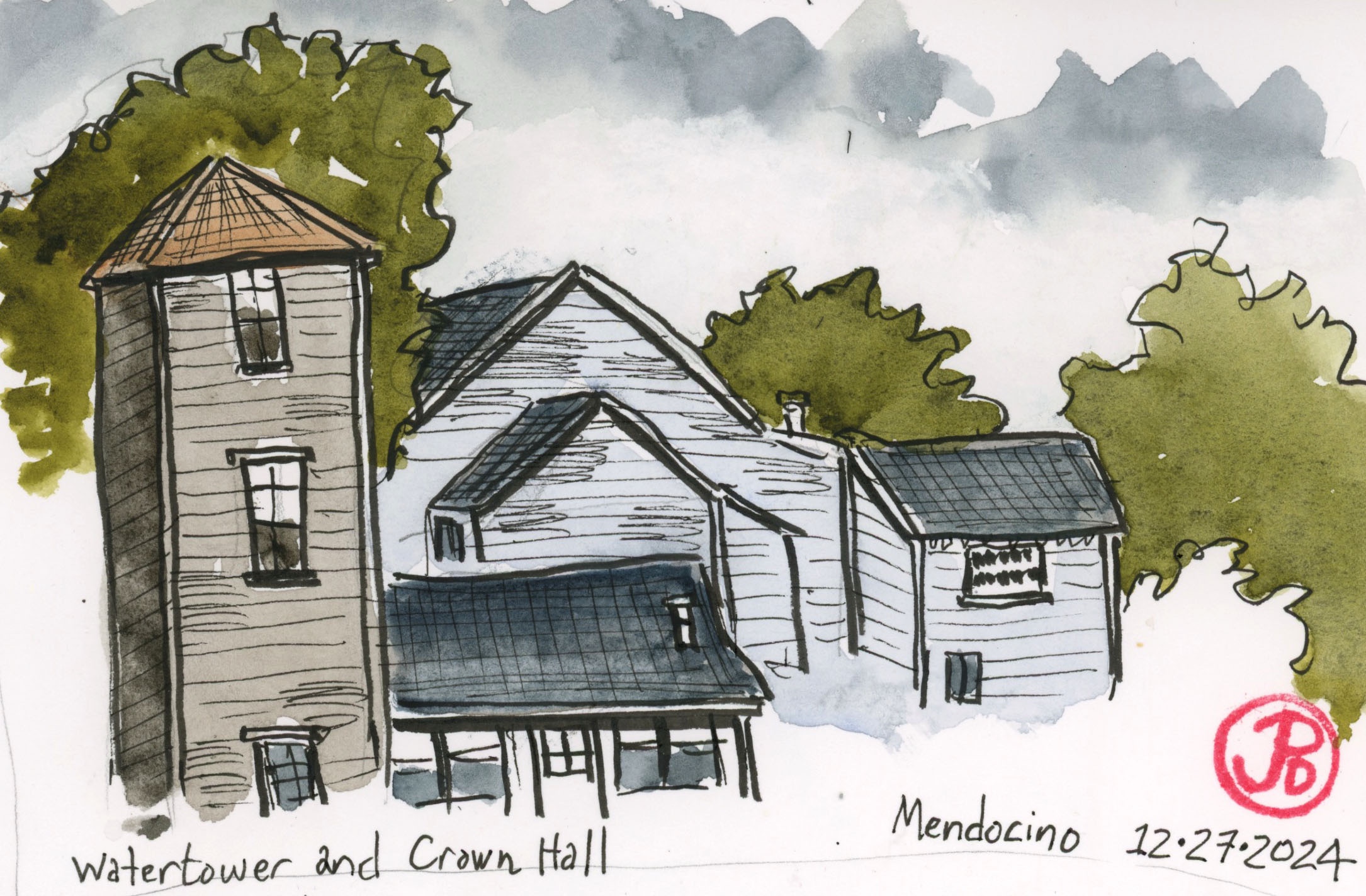
For the featured sketch I positioned myself across the street from the Blair House (used in Murder, She Wrote) right beside Heider Field. The sketch looks towards Lansing Street at a water tower, old buildings, and the Masonic Lodge. A rustic townscape.
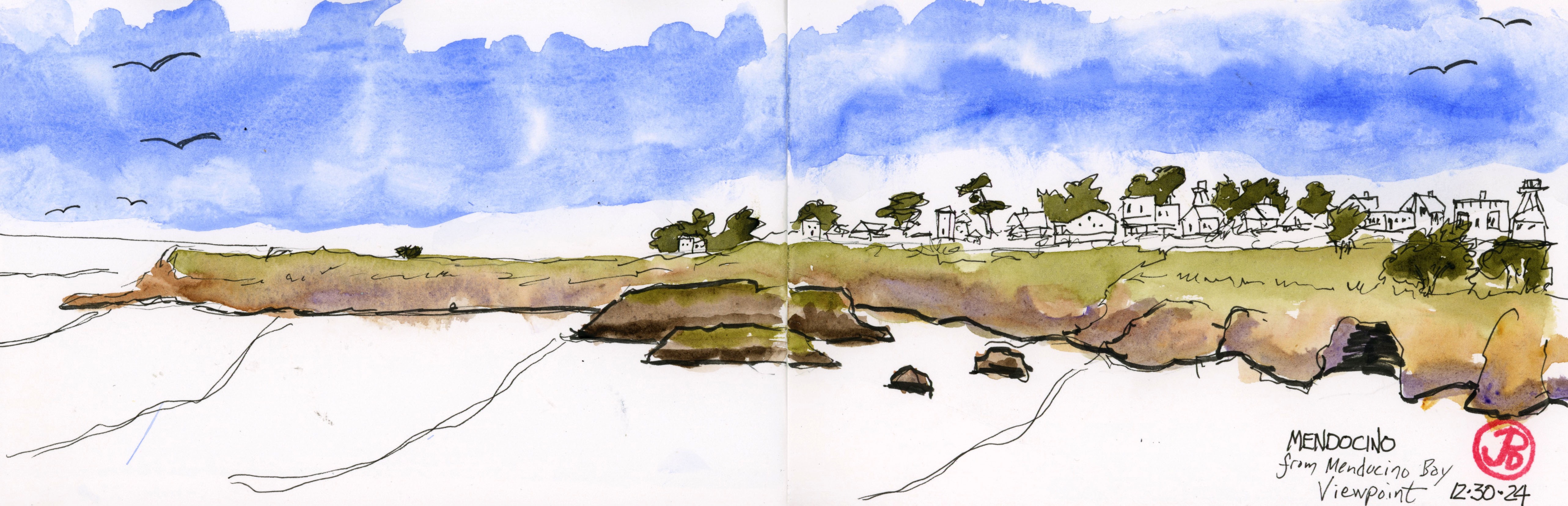
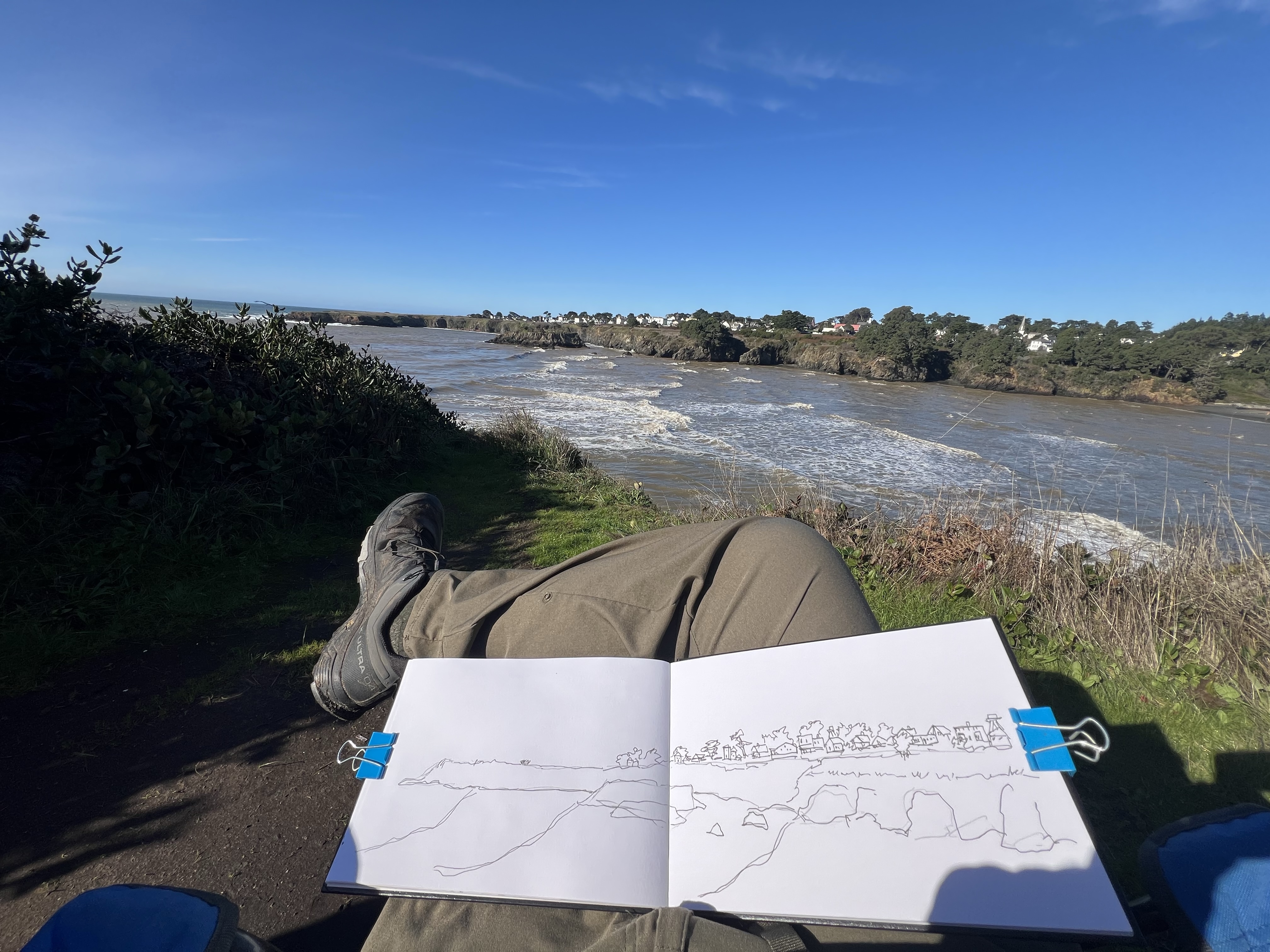
On another day I took a wide angle perspective from the small park across the Big River mouth to draw the bluffs and the town (below).
A panoramic sketch of Mendocino. What a view!
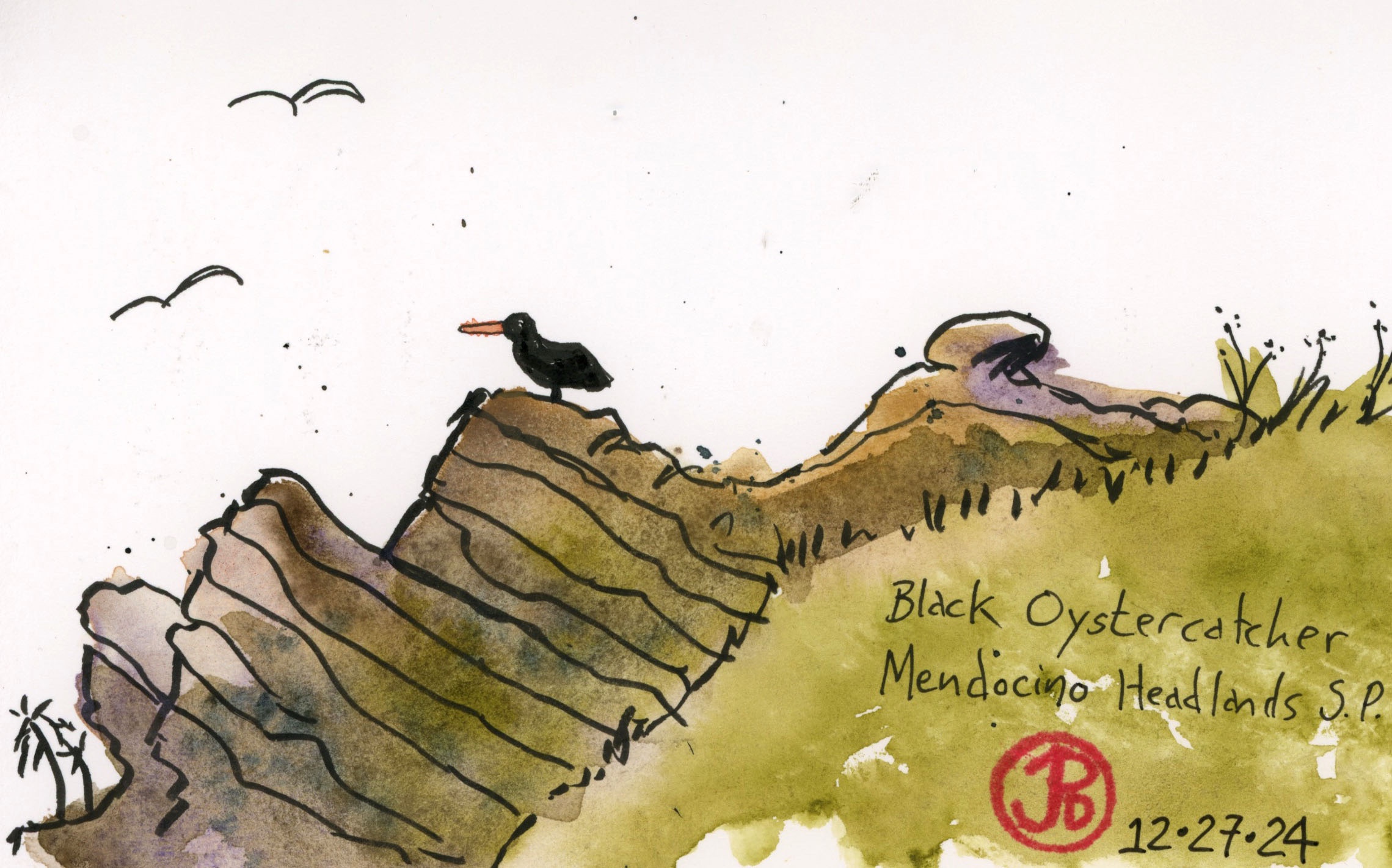
I did do a few sketches a little more “zoomed in”. One was of a water tower and the back of the Crown Hall and the other is at the Mendocino Headlands State Park and a black oystercatcher.
Black oystercatchers are easy to see at the Mendocino Bluffs.
While many painters, sculptors, and artists are attracted to the picturesque town to the south, Ft. Bragg has plenty of objects to sketch.
And I added a few to my sketchbook.
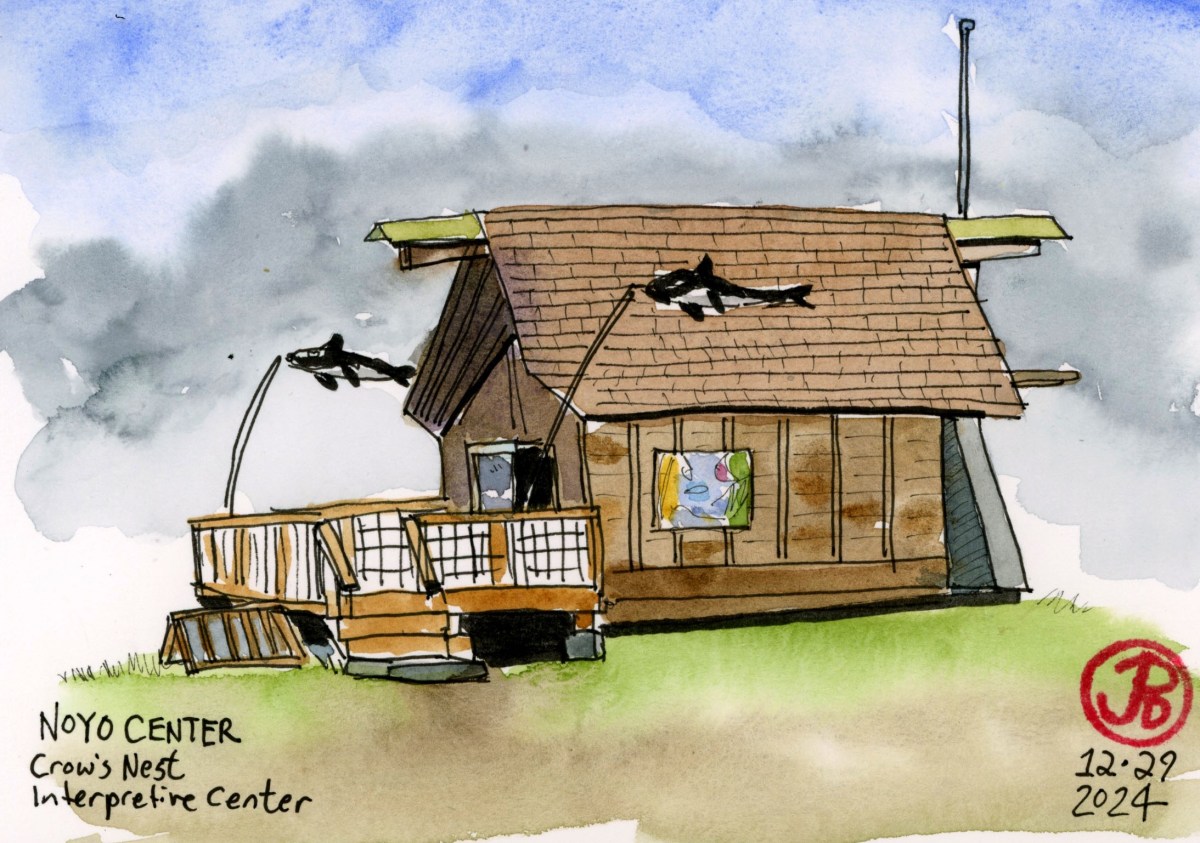
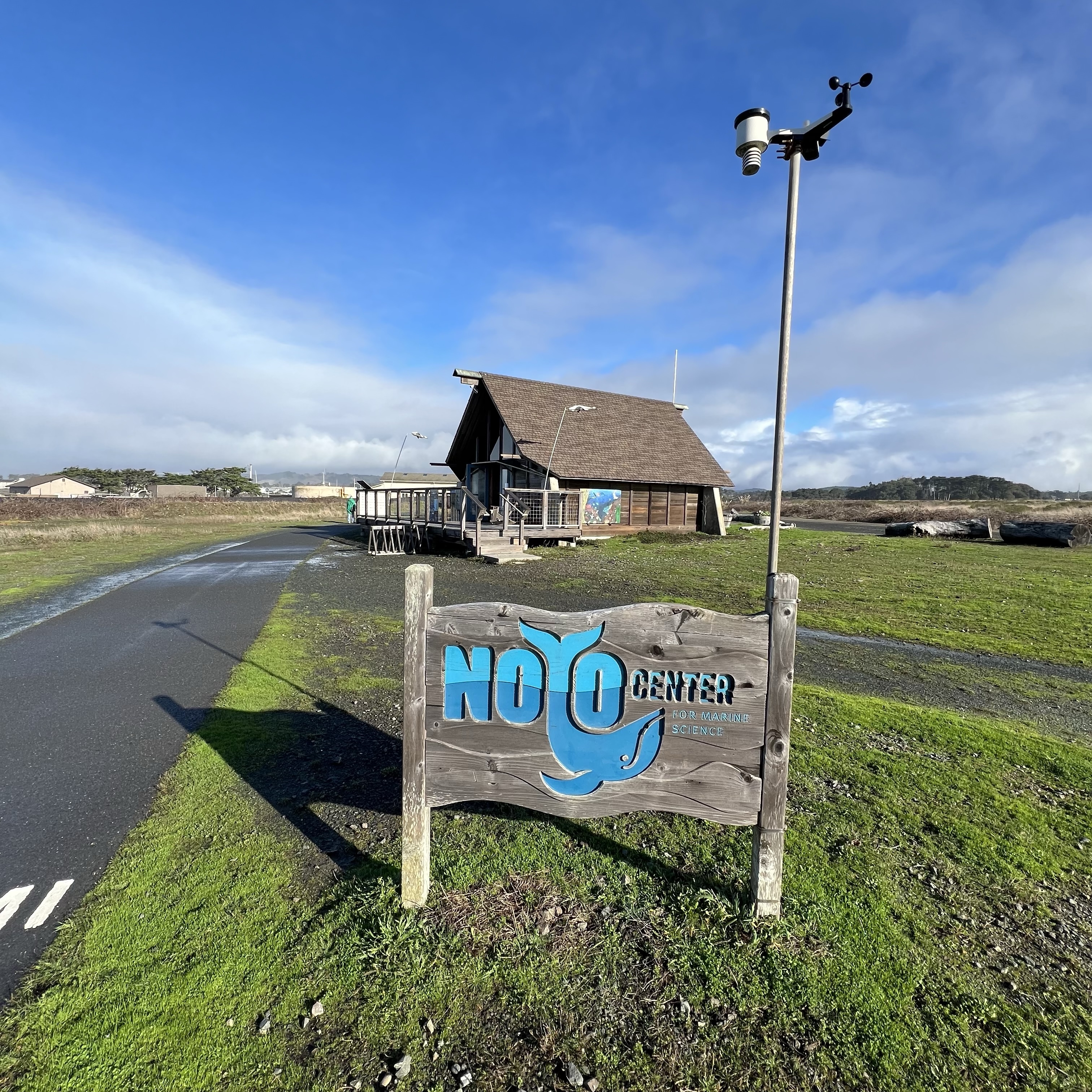
I hiked out on the Noyo Bluffs, north of the river mouth. My destination was the Noyo Center’s Crow’s Nest Interpretive Center.
This center has marine mammal skulls and bones, maps and diagrams, a tide pool tank, and a deck for whale watching.
I sat at a picnic table and sketched the interpretive center. All this hiking and sketching makes me thirsty.
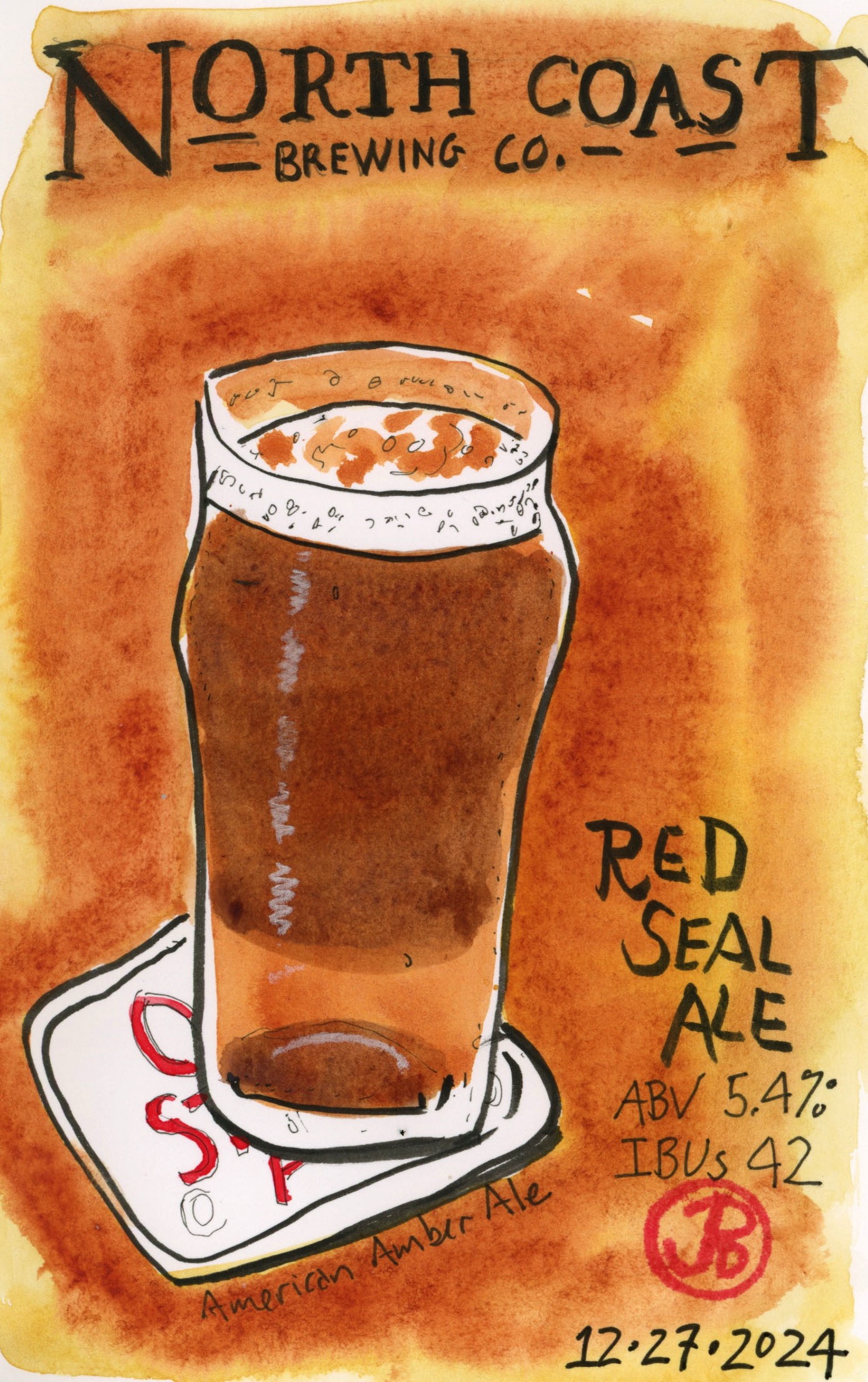
Good thing I was in Fort Bragg, because on Highway One, near the train depot, is the North Coast Brewing Company. Across the street from the brewery is their pub where you can get a bite to eat and sample their brews.
North Coast has been brewing since 1988, well before I could legally drink. They always have creative names for their brews such as Scrimshaw, Old Rasputin, Brother Thelonious, Old No. 38 Stout (named after a California Western Railroad steam locomotive), and my favorite Red Seal Ale (sketched above).
I have enjoyed sketching in the town of Fort Bragg, just to the north of Mendocino.
The genesis of Fort Bragg as a town was the huge strands of coast redwoods and lumber mills sprang up to harvest the timber.
Now how to get the lumber to markets like San Francisco to help build the growing city?
Lumber was shipped south by boat but once the California Pacific connected Ft. Bragg with Willitis and the Northwestern Pacific, milled lumber could be shipped by rail.
The rails of the past lives on as the Skunk Train. Now a tourist railroad.
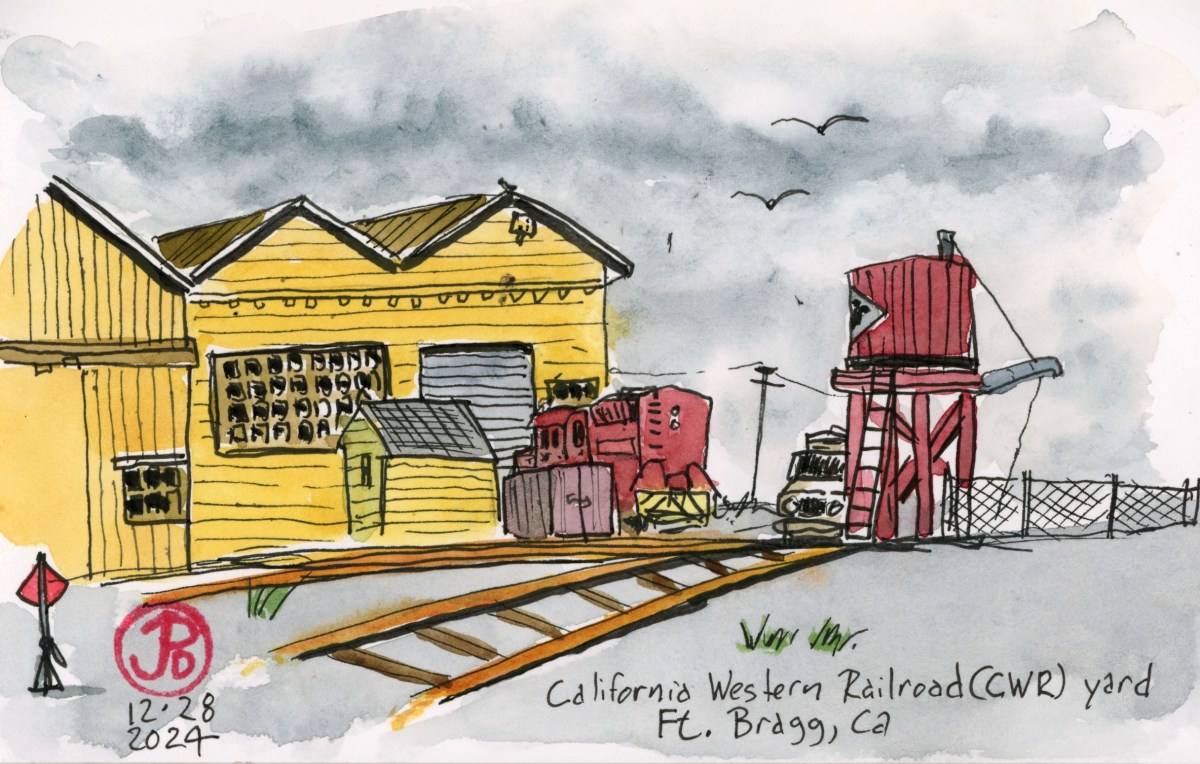
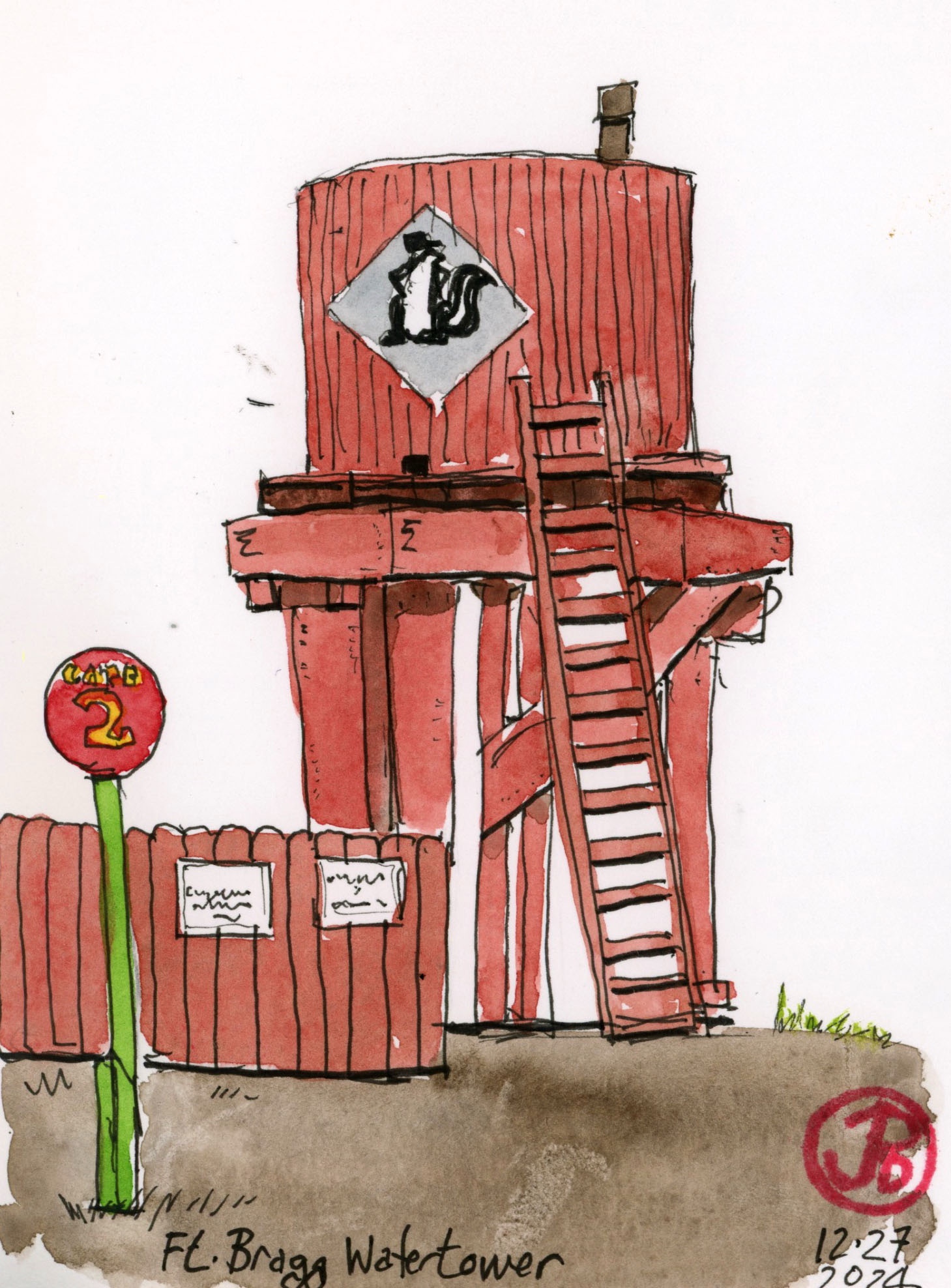
I did some sketching at the train yard (featured sketch) including the water tower with the skunk logo.
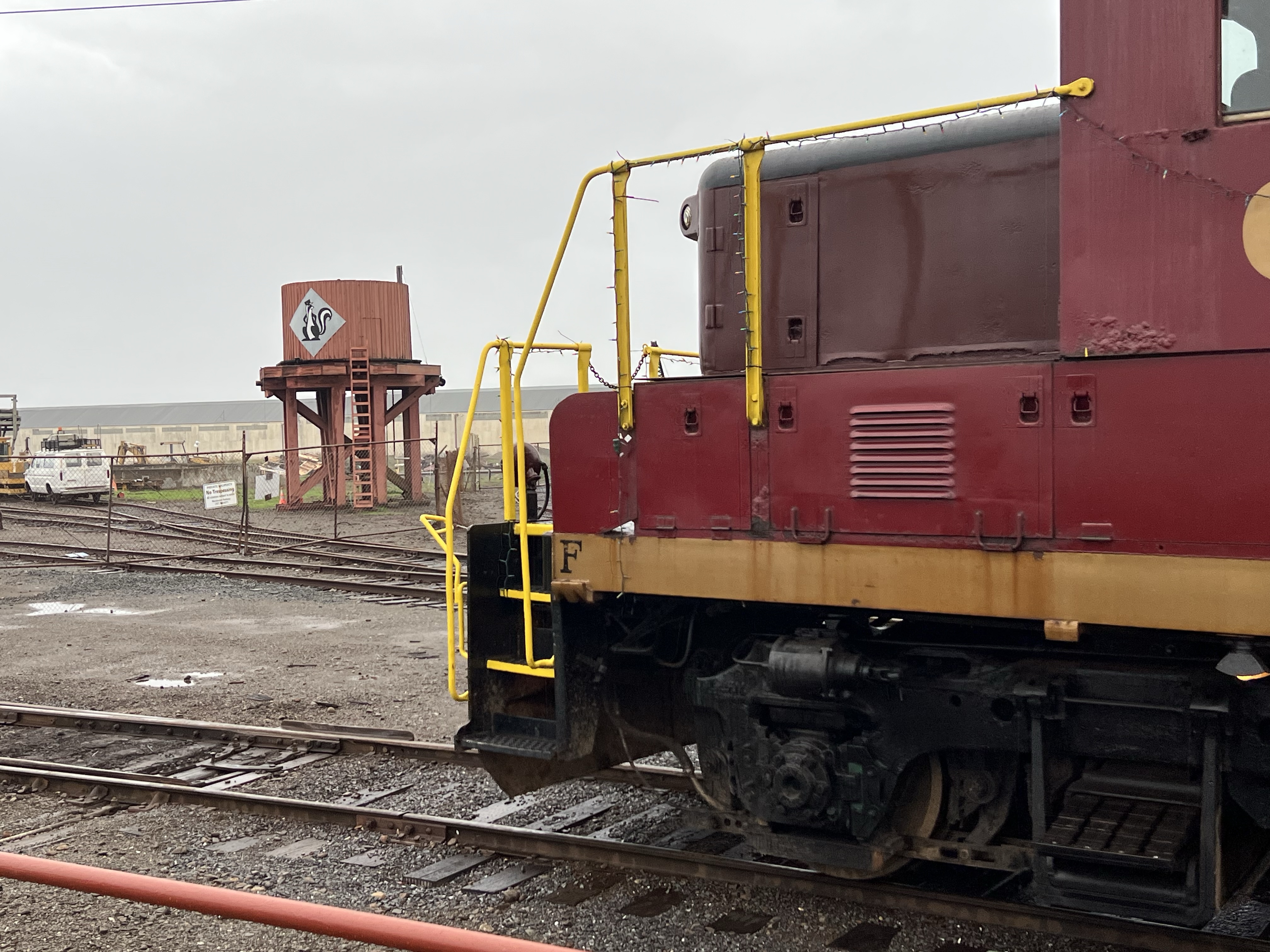
The past and present of Skunk Train. A diesel pulling into the station with a water tower of the steam age in the background.
My Christmas morning tradition does not entail waking early and opening gifts under the lighted Christmas tree but waking early and heading west to find some feather gifts at Gray Lodge Wildlife Area.
The main draw of driving the auto route is the thousands of wintering waterfowl that can be seen from my movable birding blind.
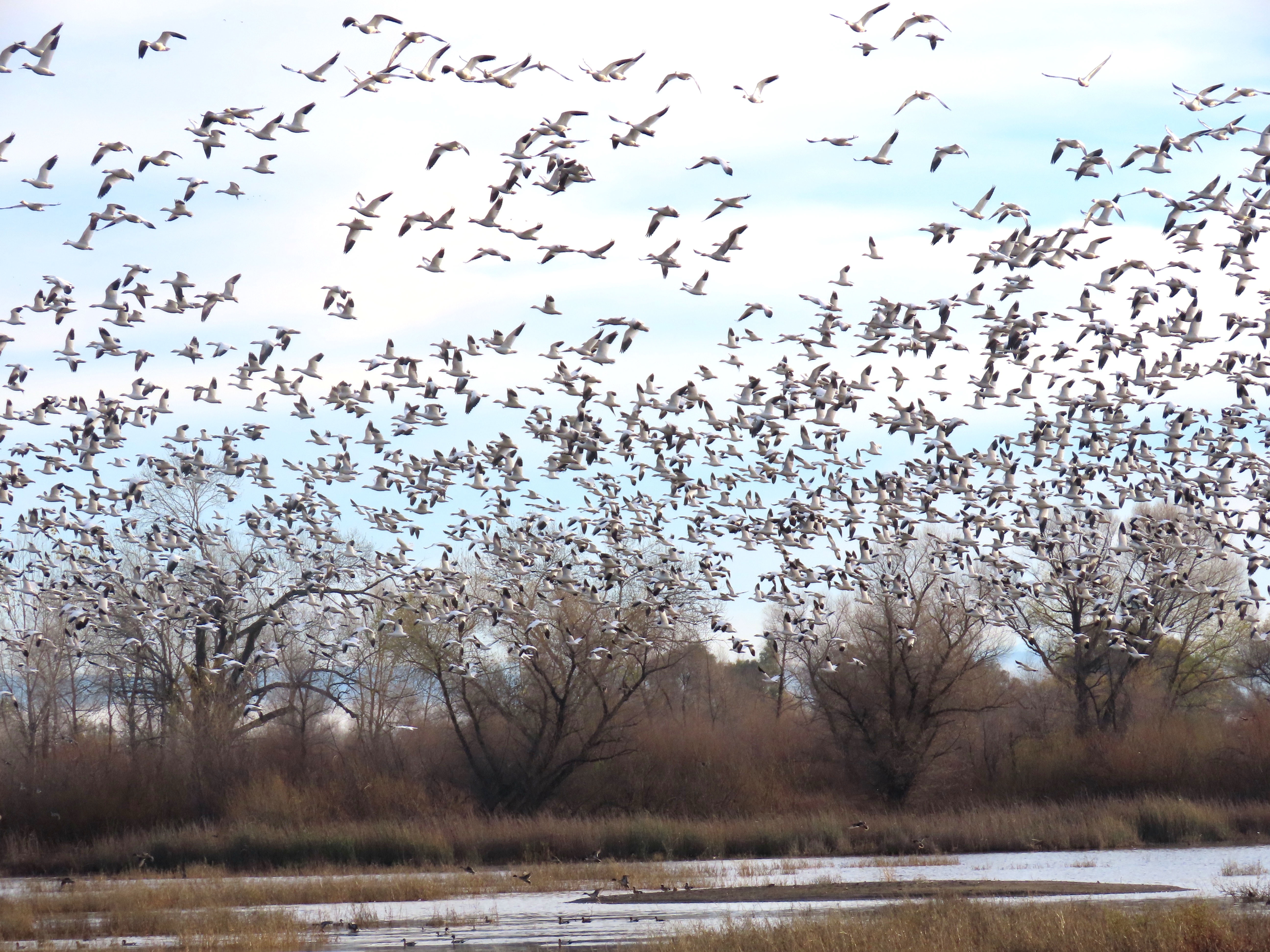
There is nothing like the sight and sound of thousands of snow geese bursting into flight!
There also a lot of wintering raptors at Gray Lodge. On my visit I saw red-tailed, red-shouldered, sharp-shinned, and Cooper’s hawks, peregrine falcon, American kestrel, and bald eagle.
While not considered a raptor, there are plenty of turkey vultures about, including this one sunning itself.
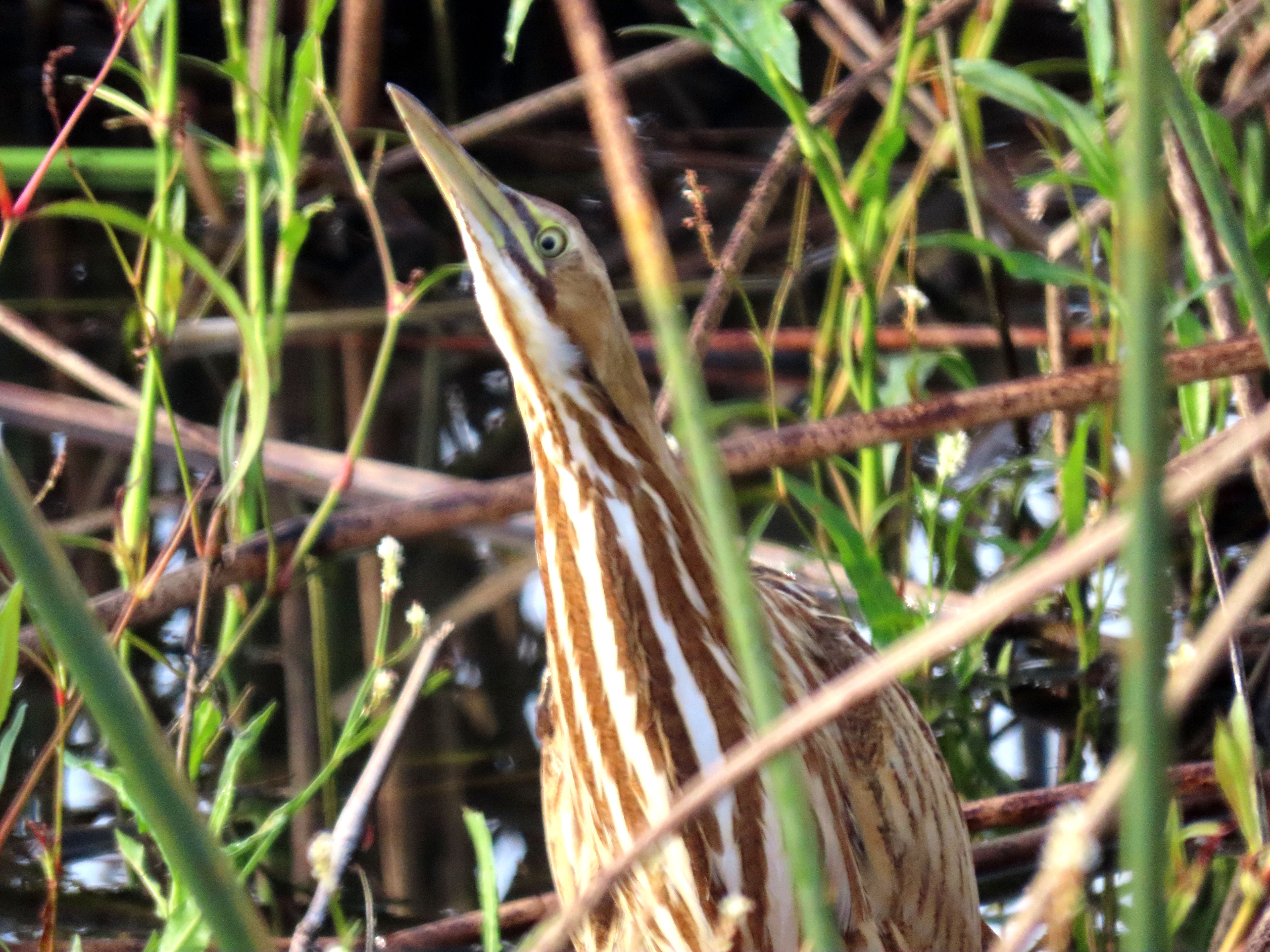
During my morning visit I notched up 63 species of birds including some species that I don’t regularly encounter at Gray Lodge including the secretive sora and American bittern (below).
On a Thursday morning I was on the hunt for two sculptures near the Ferry Building at the base of Market Street.
It wasn’t going to be a tough hunt because sculptures don’t move.
About a week earlier I had done some sketching at the de Young Museum. I had sketched two pieces in the Sculpture Garden by Henry Moore and Clars Oldenburg.
There were other pieces by these artists in San Francisco. One, Cupid’s Span (Oldenburg), near the Bay Bridge and the other Standing Figure Knife Edged (Moore) at Maritime Plaza. Both were within easy walking distance.
Oldenburg’s bow with the Ferry Building in the background.
I took the N Judah towards the Caltrain station and 50 minutes later Cupid’s Span appeared to the left. This was really Muni front door service to this large piece of outdoor public art.
Riding Muni after experiencing the spectacular trams of Oslo over the summer made the City by the Bay’s transit system seem amateurish and unreliable. We could certainly learn something from Europe’s exemplary transit. If you want to be late for work, take Muni!
I sat in the little park before Cupid’s Span. I liked sketching the curves of the bow and the feathers of the arrow. I have always wondered at the meaning of an arrow pulled taunt against a bowstring aimed into the earth. Still wondering what, if anything, it means.
After sketching I headed along the Embarcadero past the Ferry Building. My destination was Maritime Center near the Embarcadero Center (featured in Coppola’s The Conversation).
I was searching for the Yorkshire sculptor Henry Moore’s piece Standing Figure Knife Edged. This was a bit of public art that took a bit more searching than Oldenburg’s oversized bow and arrow.
Adding another Henry Moore sculpture to my sketchbook.
After sketching Moore’s piece I wandered to the other side of the plaza and found another whimsical sculpture, Bronze Horse by Italian sculptor Marino Marini. The sculpture looks like a giant anteater crossed with a horse.
I headed to San Francisco’s Golden Gate Park to sketch’s some sculptures on a Sunday afternoon.
My first destination was the sculpture garden at the de Young Museum. I was going to do a twofer sketch from my sketching bench perspective.
The two pieces that I added to my sketchbook were the 21 foot tall Corridor Pin, Blue (1999) by Claes Oldenburg and in the foreground, Henry Moore’s Working Model for Sheep Piece (1971).
My next piece of public art was to found along The Golden Mile Project along the JFK Promenade just to the north of the de Young Museum.
This roadway in the park has been closed to auto traffic and the road surface is painted with 12 murals produce by a group called Paint the Void.
Near the Rose Garden a life sized wooden humpback whale tail breached the roadway. This piece is called Street Whale. I perched on a bike rack and sketched the piece on the left side of my spread.
Ever since my babysitter let me stay up and watch Halloween on television (mom sure knew how to pick a babysitter), I have loved the films of John Carpenter.
One of Carpenter’s lesser known films was filmed on location in the Northern Bay Area. This is The Fog (1980).
This paranormal ghost thriller was filmed in Marin and Sonoma Counties, north of San Francisco. I wanted to revisit some these beautiful locations and do some Saturday morning sketching so I headed north over the Golden Gate Bridge.
The fictional town of Antonio Bay were really the west Marin towns of Stinson Beach, Olema, Pt. Reyes Station, and Inverness.
My first stop was Stinson Beach, or more accurately just southeast of Stinson Beach on Highway One.
About 50 minutes from leaving my Sunset digs, I was sitting in my sketching chair sketching the town of Stinson Beach.
The scene before me that I was adding to my panoramic sketchbook was the same view used for the title sequence for The Fog.
After finishing my sketch (featured sketch), I drove north on Highway One through Stinson and then skirted the shoreline of Bolinas Lagoon on my way to Olema.
Scenes were filmed in this area at the junction of Highway One and Sir Francis Drake Boulevard. The location featured two generations of scream queens who happen to be mother and daughter: Janet Leigh (Psycho) and Jamie Lee Curtis (Halloween). Neither did much screaming in The Fog.
Olema parking lot. The parking lot and the bar in the blue building to the right were used as filming locations in The Fog.
I continued on to Pt. Reyes Station where the “downtown” of Antonio Bay was filmed. The Fog demonstrates the patchwork nature of how location filming is used to create one whole location is is not usually geographically accurate.
After visiting Oslo’s Vigeland Park this summer, Europe’s largest sculpture park devoted to a single artist, I wanted to sketch some of the free public sculptures within my home turf.
One of perhaps the most famous and well recognized sculptures in the world is to be found in San Francisco’s Legion of Honor in Lincoln Park. This in Rodin’s The Thinker.
I didn’t want to sketch the statue from the front of even the side but from behind, including the many admirers that come to photograph the masterpiece, often mimicking the famous pose.
The sculpture is in the courtyard of the museum with no admission necessary to take a selfie. So this sculpture meets my criteria of free public art.
While The Thinker is close to my home I wanted to find some public art close to my work in San Mateo.
It turns out that one stop down Highway 92 there is a piece in a business park titled “Untitled”(2016) by T. Olle Lundberg.
This piece of Corten steel and concrete has been given the name “Falling Slabs” because this is exactly what it looks like. Heavy steel plates falling like dominos.
There is one art museum and one art exhibition from my youth that is at the fore of my memory.
I was in third grade when I visited San Francisco’s de Young Museum and the King Tutankhamen exhibit.
In 1979, the King Tut exhibit was a huge deal in the Bay Area. It seemed everyone had King Tut fever and wanted to see the treasures of his exhumed tomb.
The exhibit featured 55 objects including Tut’s golden death mask and sarcophagus. I have memories of marveling at the superb death mask.
The museum was founded in 1895. It moved to its present site in Golden Gate Park in 1919.
The building was damaged in the 1989 Loma Prieta Earthquake and was demolished. The museum was rebuilt in its current form in 2005.
Looking west from the tower with the galleries of the de Young.
I admit that I wasn’t a fan of the new building. But the view from the top is amazing. The building is slowly growing on me.
On a recent visit I did a western facing sketch from the top of the de Young tower of the Golden Gate and the Marin Headlands (below).