Image

Blackpool’s Boat Tram (Post 600!)

My father really loved street cars.

He grew up as an only child in San Fransisco in an era when most people got around the city in street cars (or trams as they are called in Britain). He would ride them as a child getting to know the motormen (who where mostly Irish). Once they were beyond the last houses and running out into the sand dunes that would later become the Sunset District, the motormen would let my father take the controls as the motorman ate his lunch. Such a scene seems so unthinkable now!

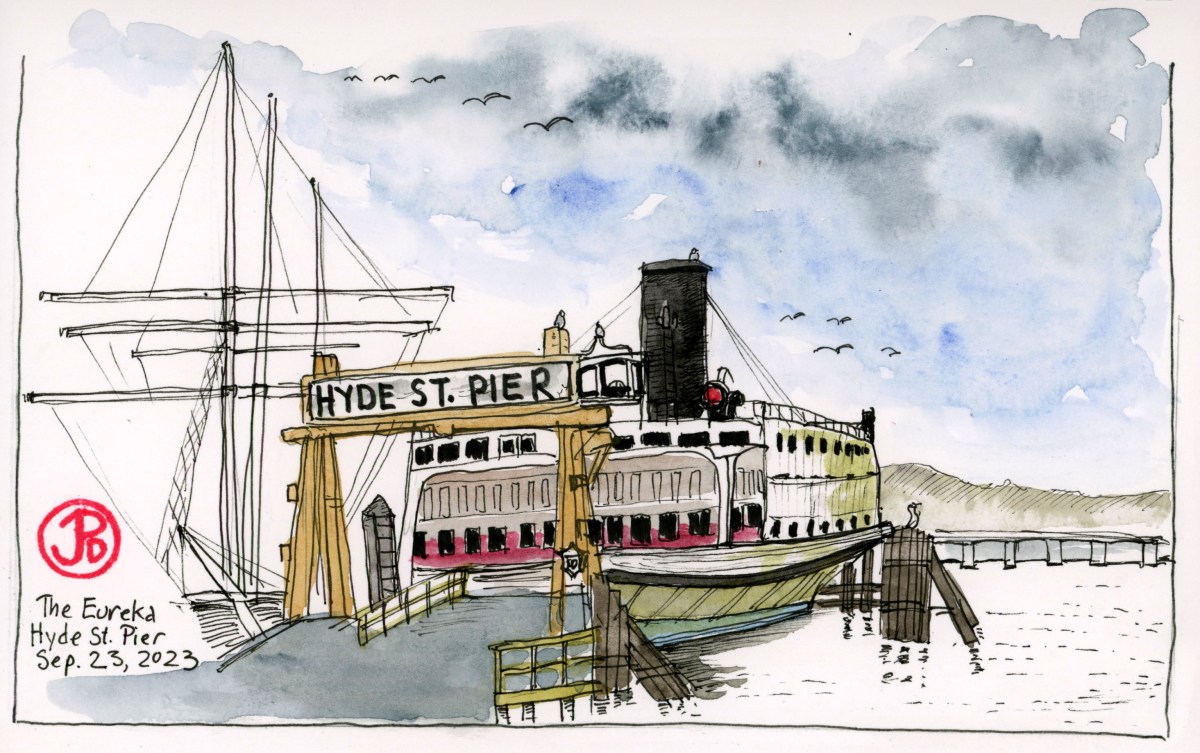
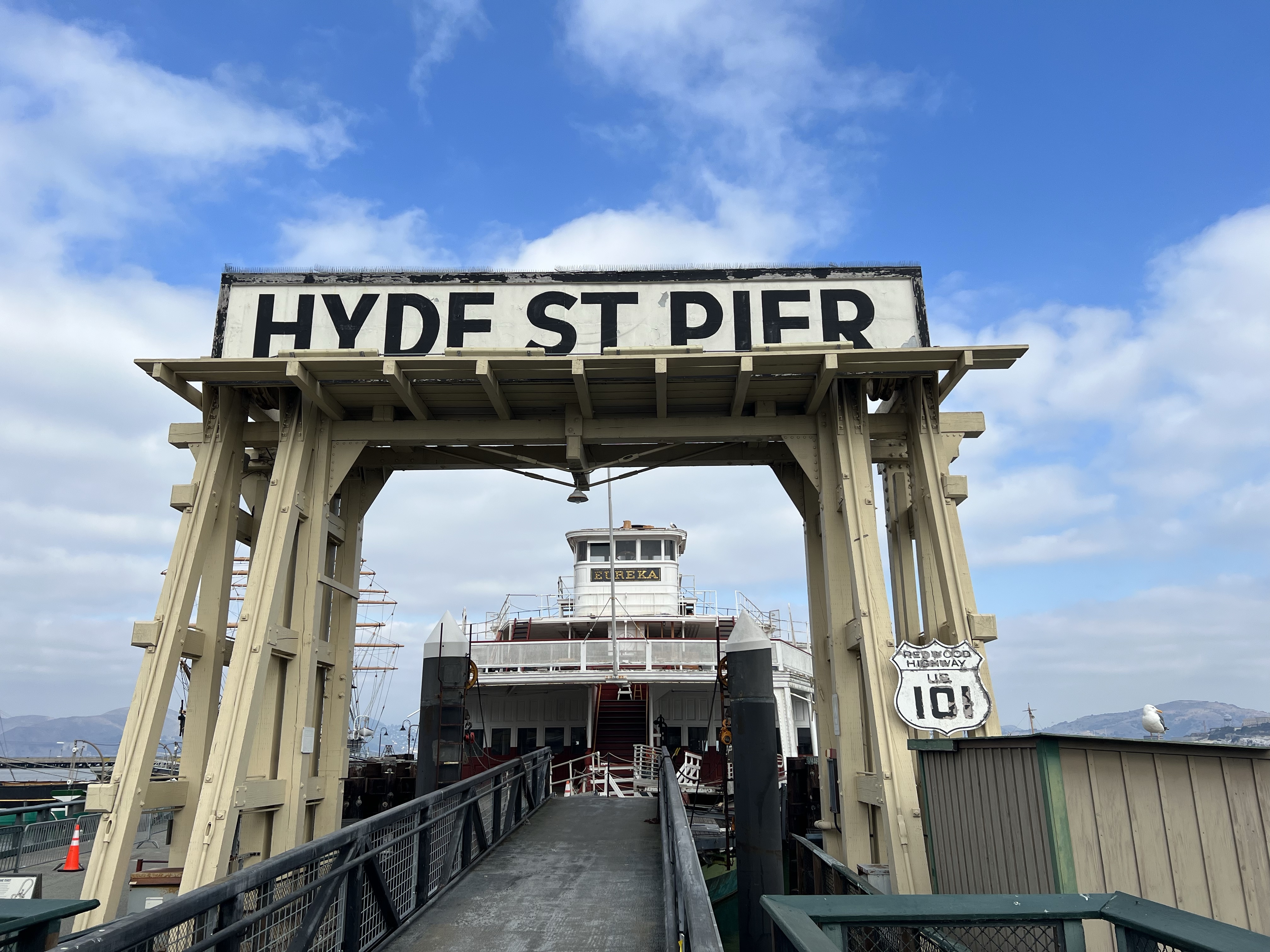
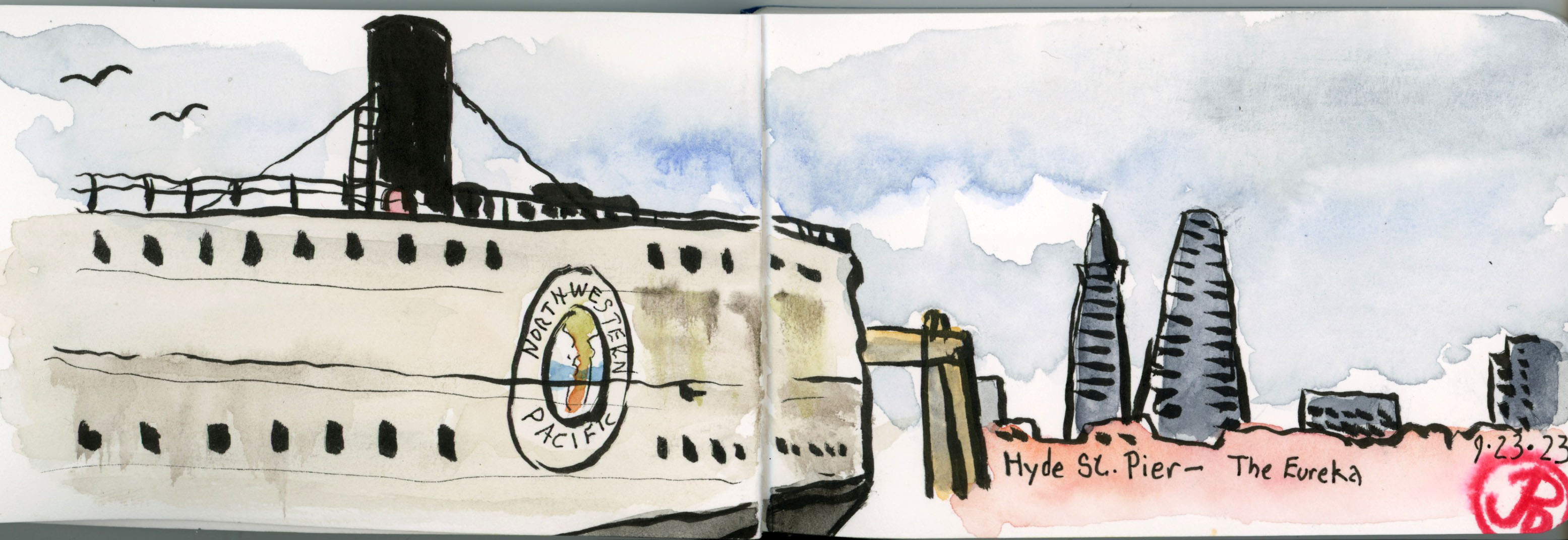
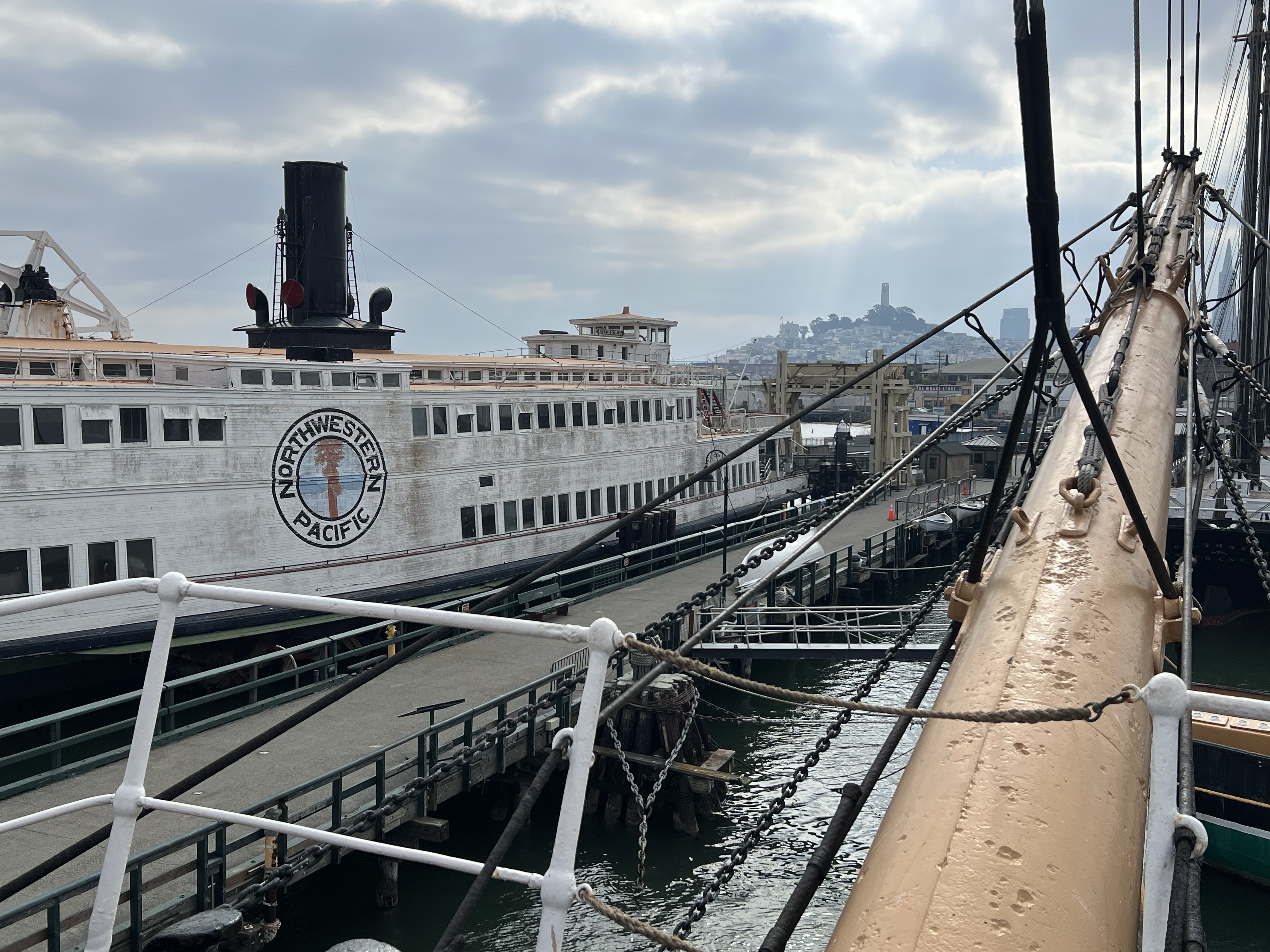
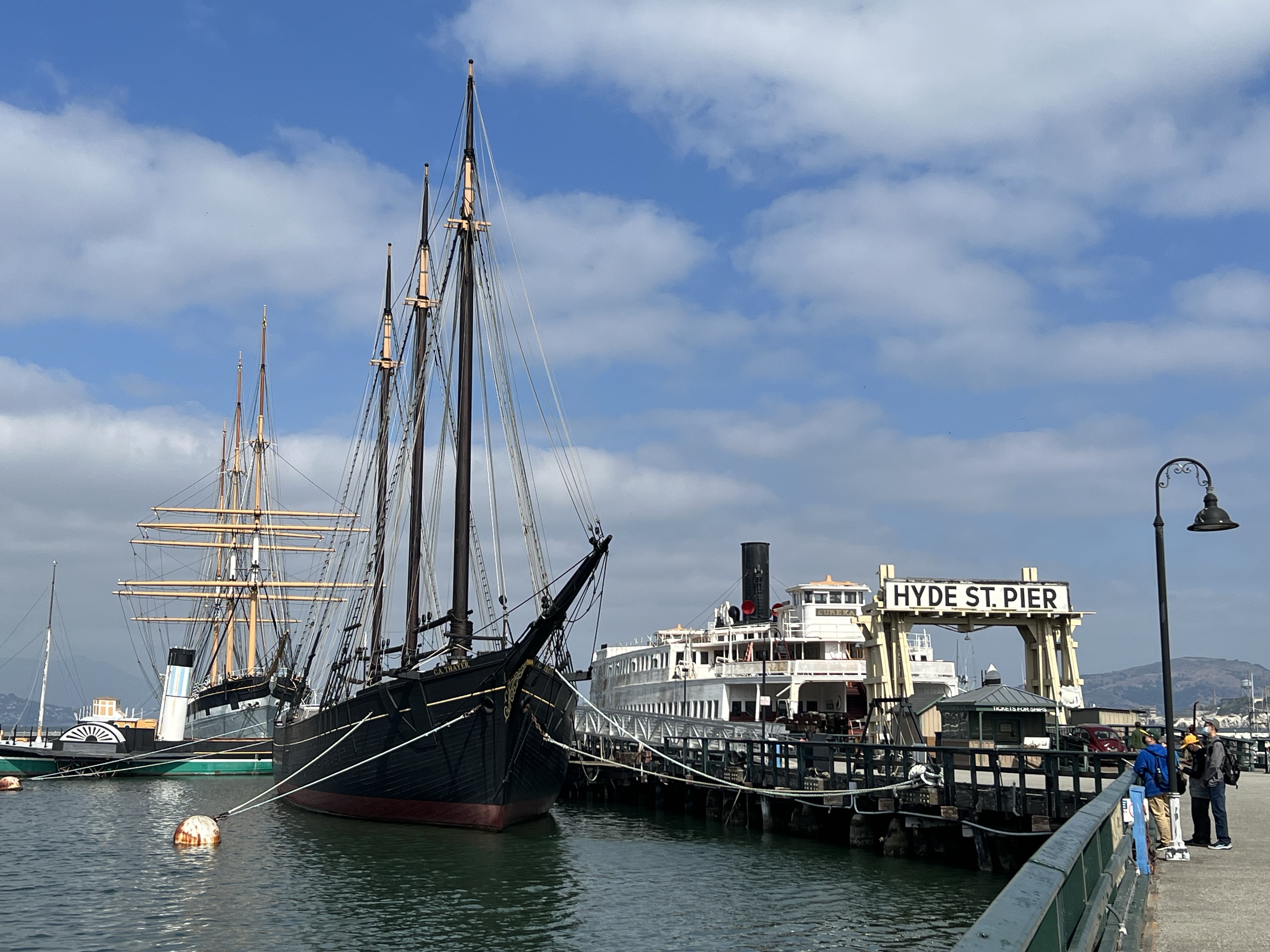
We were down sketching at Hyde Street Pier and I wanted to show Grasshopper Sparrow some of the vintage streetcars that were running along the Embarcadero.

The most common vintage car seen on the F Market Line is a PCC (President’s Conference Committee) car. In this case No. 1053, painted in Brooklyn, New York livery, was built in 1947. MUNI has a fleet of 32 PCC cars.

This weekend was extra special because it was Muni Heritage Weekend and Market Street Railway was bring out some of the vintage cars like San Francisco Municipal Railway’s No. 1, built in 1912.

The one car that I wanted to show Grasshopper was an open-air car from the coastal resort town of Blackpool, England that I read was going to operating this weekend. This car is so unusual and rarely out on the line because it takes a crew of two to operate and has a lower passenger capacity that your normal PCC car. This is the Blackpool boat tram! I remember riding this car in the mid-1980s with my father.

This red and cream boat on wheels announces it’s presence with a nautical air whistle. These novelty cars where built in 1934 and out of the twelve cars in existence, MUNI owns two.

My plan was to drive along the Embarcadero from it’s intersection with Grant Avenue to the Ferry Building in search of the boat. It turns out that we didn’t have to search very hard. The Blackpool boat was at the turn around at Jones and Beach Streets.

So the chase was on! We easily passed the boat and pulled far enough ahead and pulled over just past Bay Street to get a photo run by.

Blackpool’s boat tram is a real head turner. The destination sign reads “NOWHERE IN PARTICULAR”. Here No. 228 heads on the rail right-of-way on Embarcadero towards the Ferry Building and the San Francisco Railway Museum.

We then drove on to the heart of the Heritage Weekend at the San Francisco Railway Museum near the beginning of Market Street and the Embarcadero.

We were able to get a parking spot on Mission and walked over past some vintage buses painted in the famous green and cream livery of MUNI. Shortly after our arrival, the boat pulled in front of the museum and I started a quick field sketch (featured sketch) before it loaded up and left. I finished the sketch with help from one of my photos.

The area around the museum had a carnival feel to it. Many people were out to see and ride these vintage buses and street cars. The museum was selling used rail books outside. I foraged through the titles, many of which my father owned. Perhaps some of these were his books; we ended up donating hundreds of my father’s books when he moved out of his home (my childhood home).

I selected a few titles about mainline steam engines and a book about the streamlined passenger train era. I took Grasshopper into the museum and pointed out a vintage streetcar roller sign that was displayed on the wall, which my father had donated to the museum from his collection of San Francisco street car artifacts.

The roller sign was procured from a streetcar near Fulton at a place called, the Boneyard. Nowadays we would call this “trespassing” and “stealing”. But because of this “stealing” and a railfans’s passion, this bit of San Francisco rail history is preserved and is now on display for all to see.

I talked to the manager of the museum and told her that my dad had donated the sign and he was also pictured in one of the displays. She of course knew my dad and was excited to meet me and noted that I looked just like my father ( but with more hair). This is always nice to hear!

She told me that my father had an interest in streetcars from an early age and he was not allowed to join the local rail society because he was too young so he formed his own youth group with his friends.

The picture of my dad at the museum is of him in later life aboard a streetcar. He is dressed up his motorman outfit. Standing to his right is his friend Walt, one of his lifelong friends he formed the youth rail group with. He must have been volunteering for some excursion. My dad is looking dapper in his black tie and Market Street Railway motorman’s cap (which I now have).

My 600th post is dedicated to my father, John E. Perry Jr. He introduced me to streetcars and trains, history and travel, and that a good life is well learned. His greatest complement of my sketching: that I drew a nice straight line.

Image

Tunnel No. 8

Of all the tunnels on the former South Pacific Coast Railroad there is only one that is still in use for it’s intended purpose. That is Tunnel No. 8, the Mission Hill Tunnel.

This tunnel takes the line through Mission Hill because the town of Santa Cruz did not want the railroad to run through downtown. So they had to bore through the sandstone of Mission Hill. This meant the tunnel was prone to caving in so it was reinforced with internal redwood beams.

The tunnel is built under the Mission Santa Cruz Cemetery and in the early days, steam locomotives passing though would rattle and shake up the earth and occasionally a bone or two would fall onto the line leaving a macabre find for rail crews.

In 1985 the Southern Pacific line was purchased by Norman Clark, owner of the Roaring Camp & Big Trees Narrow Gauge Railroad, and passenger service was revived from Felton to Santa Cruz, a round trip of 16 miles.

The Big Trees & Pacific coming off of Chestnut Street in Santa Cruz on it’s return to Felton. The railroad has some of the most street running rail of any tourist railway. The train is pulling into the right of way heading towards Tunnel No. 8.
The train disappearing into Tunnel No. 8 on its way to Felton.
Image

Shady Gulch Trestle

Just up the creek from my cabin is one of the remaining wooden trestles on the former South Pacific Coast Railroad (in 1887 the railroad became Southern Pacific). This is the Shady Gulch Trestle.

Not only does this trestle still exist but is still used for rail service on the Big Trees and Pacific Railway.

Shady Gulch Trestle with the Highway 9 concrete bridge (1930) in the foreground. The dirt road to the right is the former Eben Bennett toll road. The concrete highway bridge replaced the toll road.

The original trestle was built in 1875 to span Shady Gulch. At the time, the line was built for the narrow gauge South Pacific Coast Railroad. When Southern Pacific acquired the line they rebuilt the trestle in 1905 to accommodate standard gauge.

The trestle of today very much looks like the original narrow gauge trestle of the late 19th century, sans graffiti of course.

The afternoon Felton-bound Big Trees and Pacific crossing the Shady Gulch Trestle. This tourist train tends to stop traffic on Highway 9.

My father spend his childhood summers in the cabin in the 1930, 40s, and 50s. He would tell me of the time a freight would be climbing the grade on the trestle on their way to Felton on a foggy summer’s morning. The wet track would cause the locomotive’s driving wheels to slip. And after many slips and the hyperbolic “chuff-chuff-chuff” of the stream exhaust, the train would back down the grade, sanding the track as they reversed. The freight would make another attempt, this time slowly with the sanded rails helping the drivers grip the steel. And off they went to Felton.

There is a single one car pull off on the north side of the highway bridge. I made three attempts to sketch the trestle but was foiled by a camper van that was camped out in the spot.

Was this guy going to spend the night here? On my third attempt of the day, in late afternoon, the van was finally gone and I was able to park, set up my sketching chair, and start my sketch of the trestle.

I timed my sketching time with the Felton bound afternoon Big Trees and Pacific train.

Image

Post No. 611: Norfolk and Western J Class No. 611

On my one week fall break I knew I was going to travel nationally. So I chose Virginia. (It’s for lovers, don’t you know?)

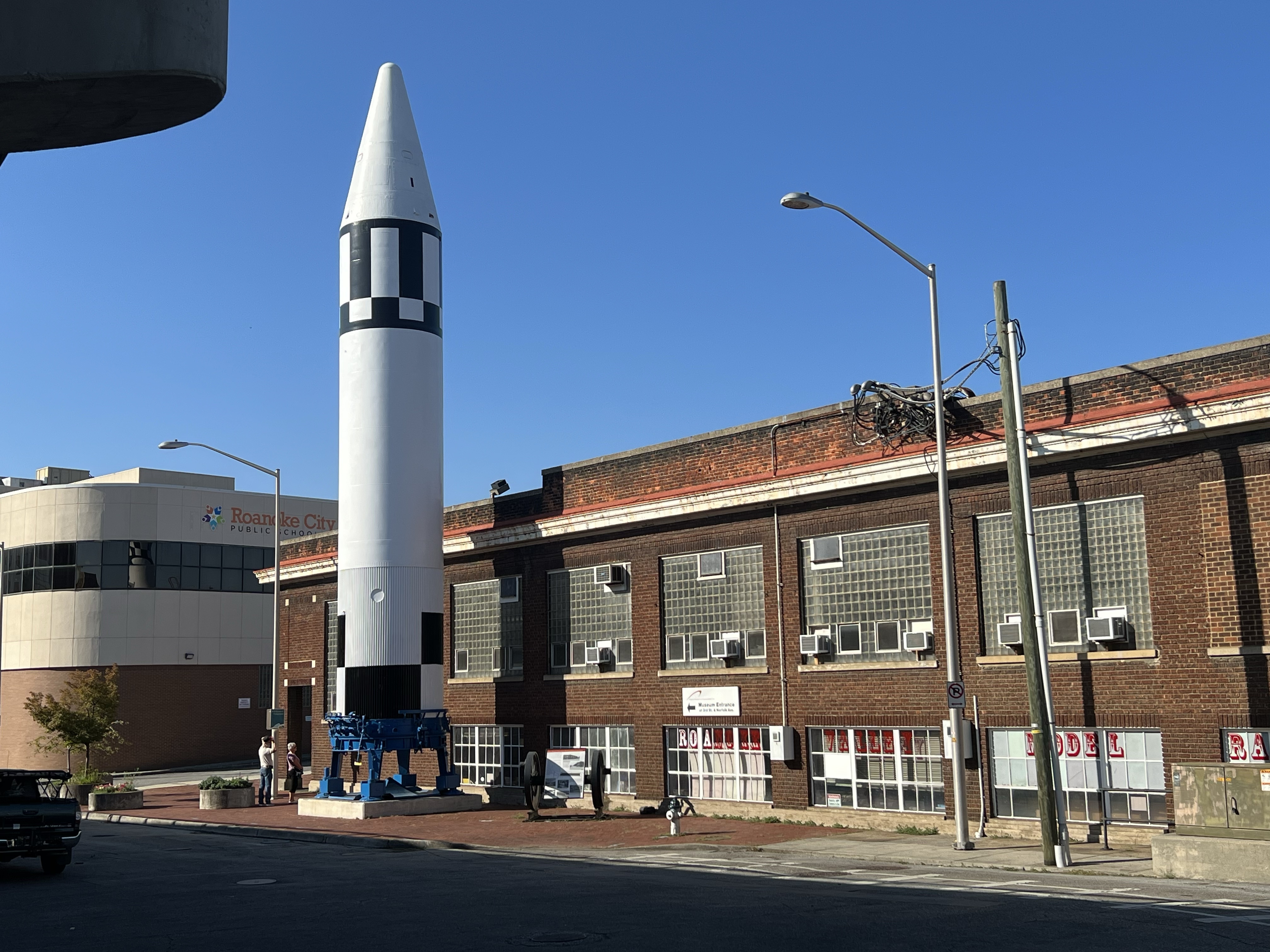
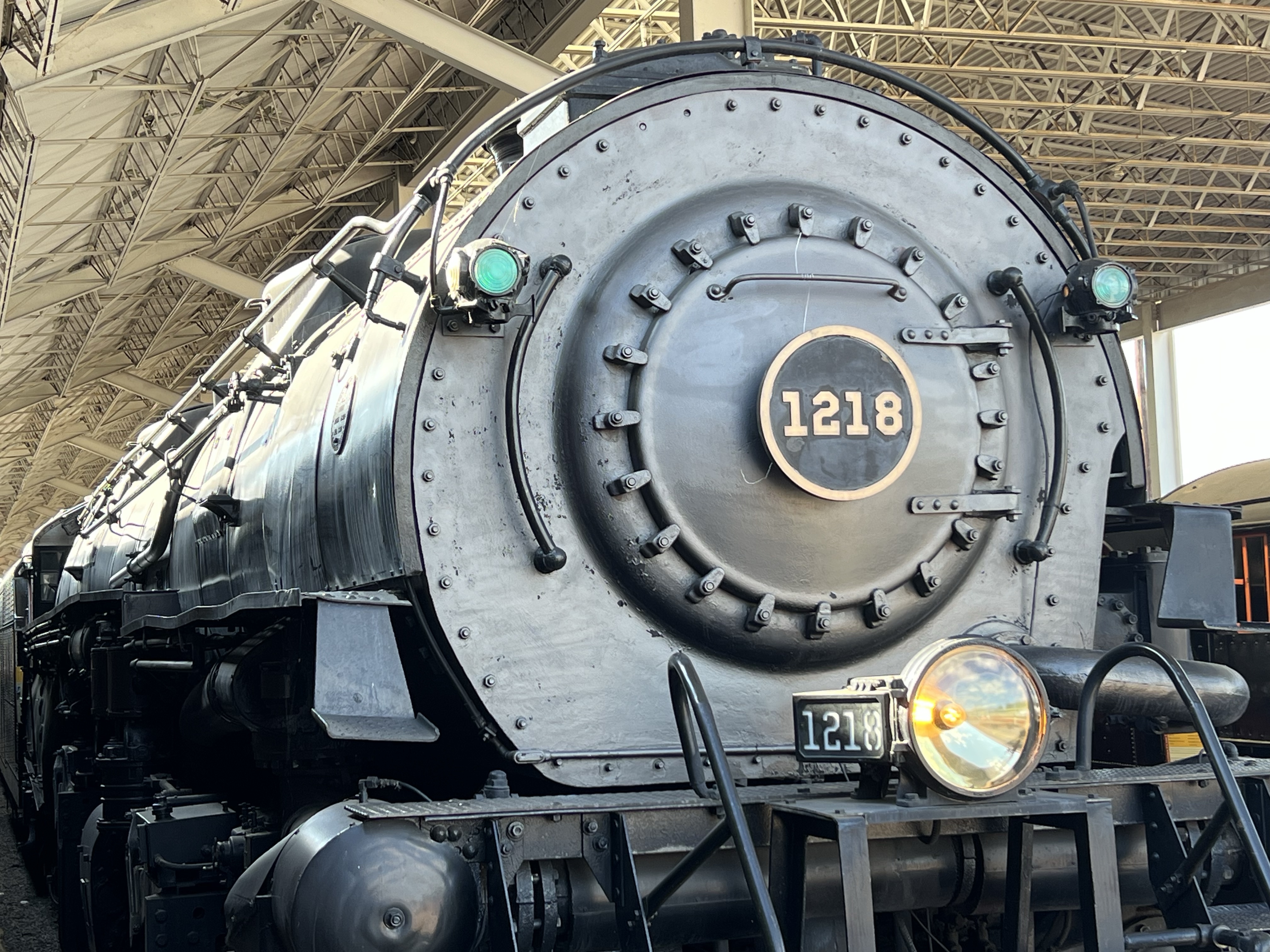
High on my list was to see the streamlined Northern 4-8-4, Norfolk and Western No. 611 at the Virginia Museum of Transportation in Roanoke.

This is one of the most iconic American passenger locomotives ever made and is still active in excursion service. She was built in 1950, very late in the steam age, as diesel-electric locomotives where ending the age of steam across the country.

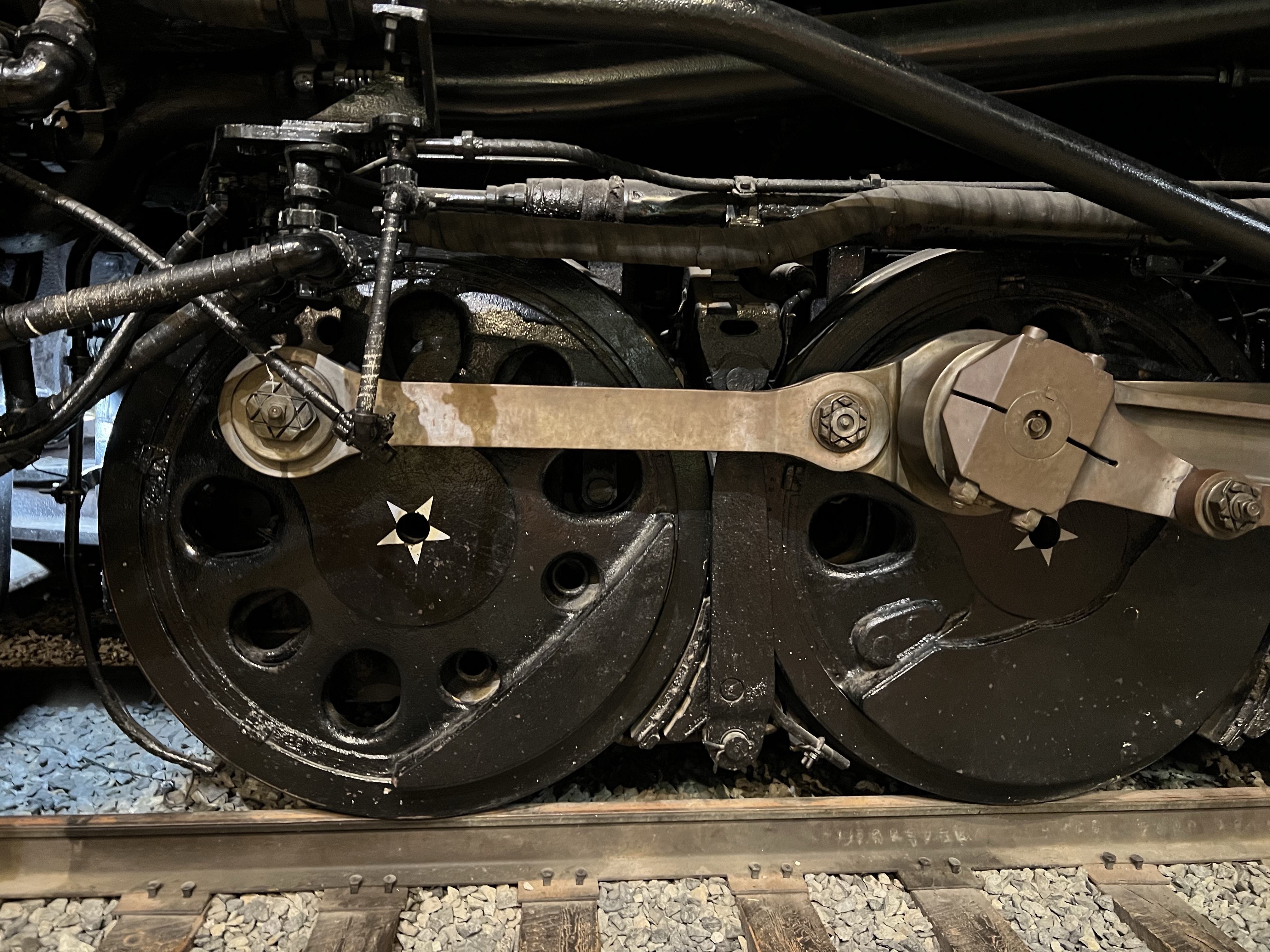
611 is one of the most technically advanced steam locomotives ever built. One disadvantage of stream was the large amount of hours needed to maintain and operate these locomotives.

To counter this, Norfolk and Western built their new streamlined locomotives, the Class J, at their Roanoke Shops. The locomotive was built with a self lubricating system that automatically lubricate over 200 bearings, including the bell mechanism. This meant the Class J could run for 15,000 miles before maintenance was needed. The 14 Class J locomotives could be serviced in about an hour and then be back out on the mainline.

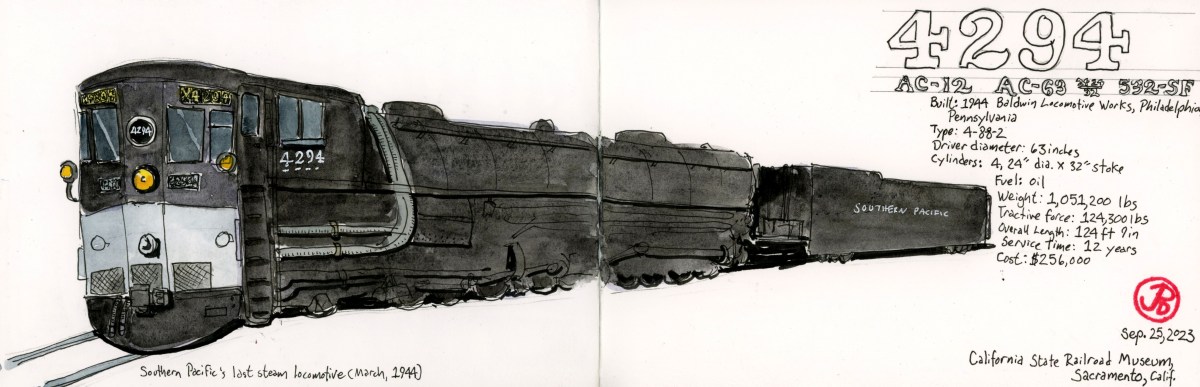
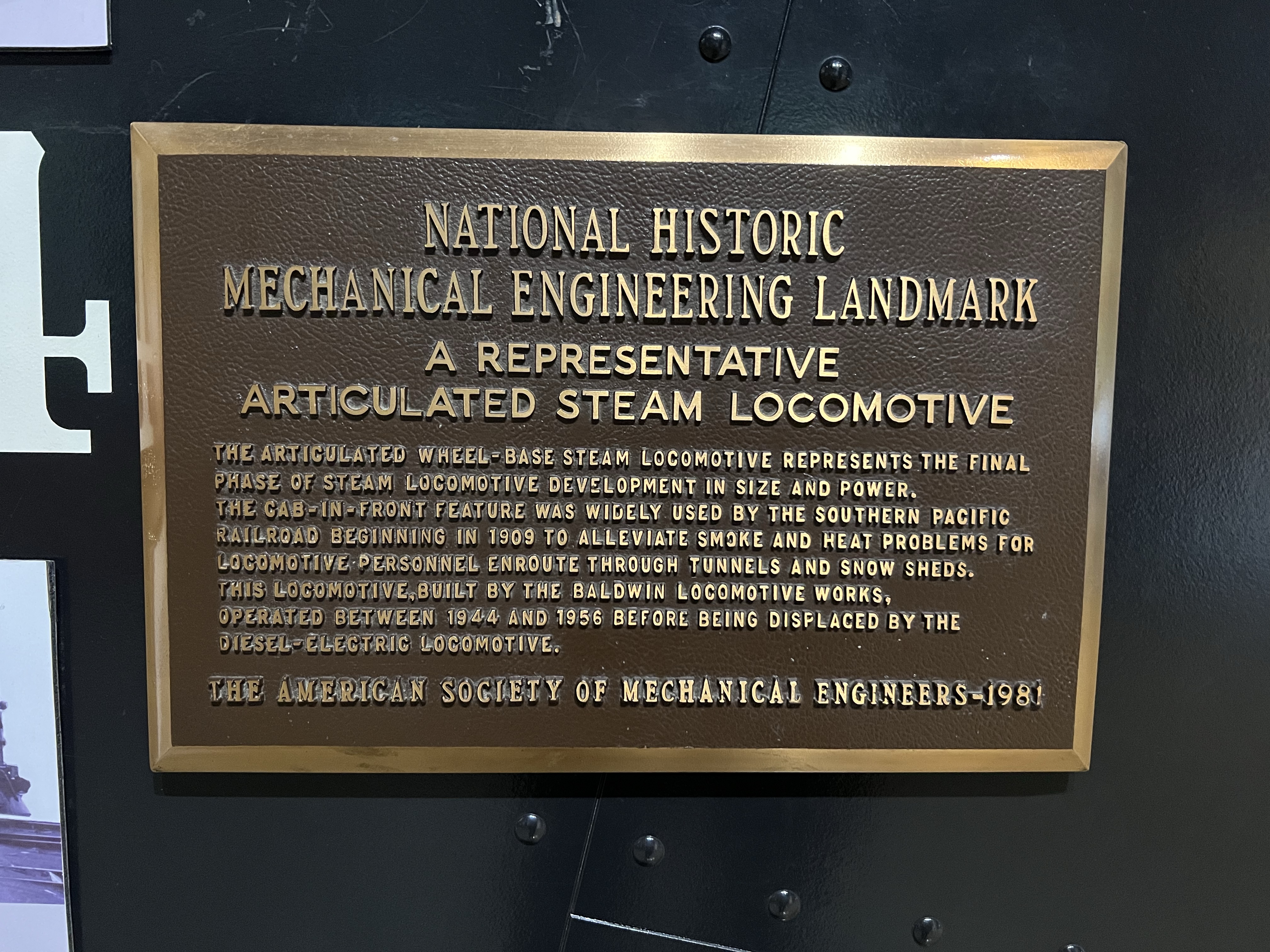
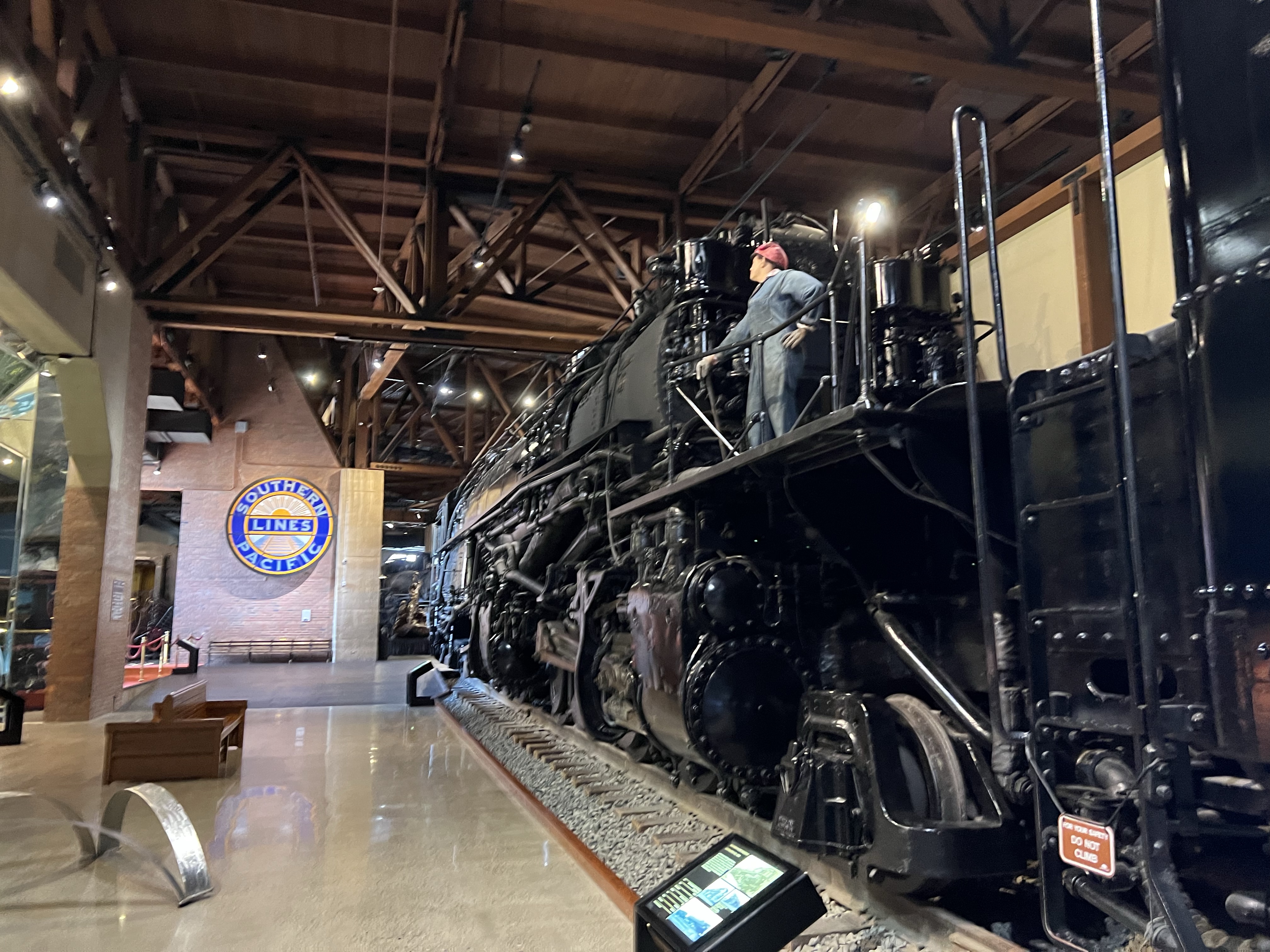
It was such an engineering marvel of it’s time that is was designated a National Historic Mechanical Engineering Landmark by the American Society of Mechanical Engineers. Out of the 300 landmarks there are just seven steam locomotives that are honored with this designation and 611 shares this honor with Southern Pacific’s Cab-forward No. 4294 and Union Pacific’s Big Boy No. 4023, among four others.

I scoured the Virginia Museum of Transportation’s website for more information about 611. She is clearly the star of the show at the museum where she is called “one of the most iconic and beloved trains in American history”. Wow, that is some praise! Then I read the next line: “Inquire BEFORE visiting, locomotive travels”. Travels? Where could 611 travel in October? Where can you possibly hide an almost 400 ton locomotive that responds to the name “The Black Bullet”?!

I think the first time I saw an image of a J-Class was in a Brian Hollingsworth book. In this case: The Illustrated Encyclopedia of the World’s Steam Passenger Locomotives.

It turns out that 611 would not be on static display at the museum. Would I be making this cross-country trip without seeing one of the most iconic 4-8-4s in existence? (Southern Pacific 4449 and Union Pacific 844 would be the other two.)

Nope! It turns out that 611 would be 80 miles to the north in Goshen, Va. The streamlined J-Class would not be on static display but under steam and on point of the Shenandoah Valley Limited! And I got myself a ticket!

Before I headed east to take in this Queen of Steam, I did three illustrations of 611. One was my version of a stylized promotional period sketch (featured sketch), a realistic head on view (above), and a drawing design of the profile of 611 and tender with specs (below).

Image

Capote’s In Cold Blood

Why has it taken me so long to read Truman Capote’s “non-fiction novel” masterpiece In Cold Blood (1965)? I’m not quite sure.

I’ve known about the book and basically knew what it was about but I had never picked it up to read it. Simply a case of “too many books, too little time”.

In Cold Blood is a true crime account of the shocking murders of four members of the Clutter family in their rural Western Kansas farm house.

The killings were a result of a botched robbery by two ex-cons, Dick Hickock and Perry Smith.

Hickok was told by a fellow cell mate, who had worked for Mr. Cutter as a farmhand, that Mr Clutter was a rich man and had a safe in his office full of cash.

This was far from the truth. There was no safe, no huge amounts of cash. Hickock and Smith left the house with a small transistor radio, binoculars, and just $40.

What In Cold Blood does better that most “true crime” accounts is getting into the mind of a murderers and answering the question what makes a man kill another man, in cold blood.

Capote was able to do this by cultivating a friendship with the murderers, especially Perry Smith. This is shown in the film Capote (2005) with a brilliant performance by Phillip Seymour Hoffman as the southern writer.

In Cold Blood was Capote’s last great work. The book took six years to research and write and this prolonged process somehow destroyed him and he was never the same after and never finished another novel.

He became a regular on talk show where he was a true celebrity.

Image

Zayante: Tunnel No. 5

One of the more interesting tunnels on the South Pacific Coast Railroad is Tunnel No. 5 in Zayante.

This is one only two tunnels on the former South Pacific Coast line that is still in use, although not by a railroad.

As the railroad climbed its way up Zayante Creek it came to a granite outcrop that the builders could not go around or over so they had to tunnel through it.

Granite is stable and solid and because of that they did not have to add any interior wooden supports. When completed Tunnel No. 5, at 250 feet, was the second shortest on the line.

The tunnel was active until the Southern Pacific’s abandonment in November of 1940.

The tunnel began it’s current use in 1952 when the Western States Atomic Vault Company bought the tunnel, sealed both ends and used Tunnel No. 5 as a fire-flood-nuclear-proof storage silo, housing records (mainly microfilm and microfiche) for many companies including Disney. The silo officially opened on May 2, 1954.

The eastern portal was made the entrance to the facility and a guard shack was built (featured sketch) where a guard was stationed 24/7. We did not see any signs of a guard so we could not ask for a tour. (The facility is currently owned by Iron Mountain).

In times past, the company would allow tours inside the facility and one visitor deemed it the “most interesting dull place in the world”.

One can only guess the nearly 70 year old “secret” files that now reside in the former railroad tunnel known as Tunnel No. 5.

Peeping through the fencing toward the eastern portal of Tunnel No. 5. One of the two windowed buildings appears to be the guard shack. The parking lot now looks like an odd junk sale with junk that no one wants to buy!
The former rail bed (sans rails) looking towards Eccles and Felton and Santa Cruz.
Image

Tunnel No. 3, Laurel and Glenwood

On a historic rail sketching adventure, Grasshopper and I headed up into the Santa Cruz Mountains to sketch a portal of one of the longest rail tunnels on the former South Pacific Coast Railroad (later Southern Pacific) route.

This 28 mile route started at Vasona Junction in Los Gatos and climbed over the Santa Cruz Mountains to the beach town of Santa Cruz.

Part of this route still exists as the Big Trees and Pacific Railroad which operates a tourist train from Felton to the Santa Cruz Beach Boardwalk.

The tunnel we were looking for is the Glenwood Tunnel, also known as Tunnel No. 3. This 5,793 foot tunnel was active from 1879 to 1942. The original tunnel was built for narrow gauge but when Southern Pacific took over the line in 1887, they later converted the line to standard gauge (4 ft 8.5 in).

When the South Pacific Coast Railroad was first planned, then had to figure out how to get the road bed into the San Lorenzo Valley. To do this they had to built two one-mile long tunnels: Tunnel No. 2 (Summit Tunnel) and Tunnel No. 3 (Glenwood Tunnel).

From northbound Highway 17, we took the Laurel exit heading towards the former township of Laurel. We passed a few mountain homes and two bikers laboring up the hill as we headed down towards the former rail-bed.

We parked and headed out to a get a better look. The west portal of the Glenwood Tunnel was visible, but parts were obscured by trees and a power pole. The “private property” sign kept us at bay. Was this the best view we would get?

The not-so-great view.

I climbed up a side road, probably also private property, that parallels the rail bed, to get a better sketching vantage point. Even here, the portal was obscured by redwoods but I started a sketch anyway (which, like Tunnel No. 3, I abandoned).

Not being satisfied with the sketch I returned to where Grasshopper was sketching. His only company was a barking dog on the other side of a fence. There was a house just to our left.

A man peeked over the fence with his cup of coffee and said, “You can walk up to the tunnel if you want.”

This was the owner of the house (let’s call him “Bill”) and we had a nice conversation with him about living in the redwoods, winter storms, history, his spring-fed water system, and trains and tunnels.

We thanked Bill and walked around the chain that crossed the rail bed and headed towards the western portal of the Glenwood Tunnel. Now this was the way to sketch the tunnel (featured sketch).

Grasshopper sketching the western portal of Tunnel No. 3. Bill’s spring-fed water system can be seen on the right.
Corvidsketcher in the western portal of Tunnel No. 3.

We walked into the 1909 concrete portal. The tunnel ended in about 50 feet.

In 1940, winter storms and landslides closed portions of the route permanently. Southern Pacific made the decision to abandon the line. The major tunnels were dynamited at both ends, closing the tunnels for good. The concrete portals are all that still remain.

Now that we firmly had tunnel fever, we had to find the other side of the tunnel, the eastern portal.

Tunnel No. 3 now passes under Highway 17 so you have to cross over the highway to find the other end.

The eastern portal of the Glenwood Tunnel at Glenwood Drive.

The eastern portal of the Glenwood Tunnel is much harder to get to than the western portal. To get a comparable view you would have to scrabble down a steep hillside or trespass through a stable to reach the rail bed which now seems to be a creek bed.

So we had to make due and sketch the portal from the side of Glenwood Drive, which the concrete portal now supports.

Image

Signal Peak and the Southern Pacific Fire Lookout

On my latest sketching odyssey I headed to one my favorite locations in California, if not the world: Donner Pass.

Before I set out, I sketched the rail route of the East Slope of Donner Pass, heavily influenced by a map drawn by John Signor (author, artist, and former Southern Pacific employee) in his marvelous book: Donner Pass: Southern Pacific’s Sierra Crossing.

I would be driving parallel to the Central Pacific side of the first Transcontinental Railroad on Highway 80. In 1865 the railroad became Southern Pacific.

I was looking for a stone structure that was built in 1909 as a fire lookout and I reckoned that Cisco, which is directly across the valley from the building, would be my best position for seeing Southern Pacific’s fire lookout on Red Mountain.

The lookout on Red Mountain was built because, from this vantage point, the rail line from Blue Canon to Donner Summit could be observed. Because 50 miles of the trackage was above 5,000 feet in elevation, snow was a real problem for keeping the line open during the long winters. The solution was to build wooden snowsheds to keep snow off the tracks. Work on the snowsheds began in 1867 and the sheds were completed by 1873. In total, 30 miles of sheds where built.

The view from Donner Summit. On the right is the original rail bed of the Transcontinental Railroad. The east portal of the Summit Tunnel (Tunnel #6) and Tunnel #7 is beyond. The snowsheds are made of concrete, replacing the flammable wooden sheds. In the middle ground is Historic Highway 40 and in the background is Donner Lake.

When you combine wooden snowsheds with wood burning steam locomotives the result can be fire.

Southern Pacific employed fire trains that could be called into action to put out fires in the snowsheds but first someone had to observe the smoke. This is where the fire lookout came into play.

The fire lookout was in continuous use until 1934 when it was abandoned.

Before I got to Cisco, I pulled off Highway 20, just before it merges into Highway 80 at Yuba Pass. From here I looked down the line and just above the signal gantry was Signal Peak and to the right I spotted the prominent silhouette of the fire lookout.

Yuba Pass with Red Mountain and Signal Peak in the background.

I headed east on 80 for one stop, I took the Cisco exit which just a service station stop. I pulled behind a parked truck and looked to the northeast across the highway.

Behind me, further up the hill was the mainline. In front of me was Red Mountain and Signal Peak. To the right was antennas and towers, to the left was the Southern Pacific fire lookout.

Red Mountain and Signal Peak.

Now it was time for a sketch using my Delta panoramic journal (featured sketch) to capture the peak.

Close up of the Southern Pacific stone lookout built in 1909 and used until 1934.

I returned to Yuba Pass to get a sketch of Red Mountain from this perspective. The signal on the gantry was green so an eastbound freight was imminent. Before long I could hear the rumble of a Union Pacific intermodal freight train climbing the grade towards Donner Summit. This consist contained six locomotives and I lost count of how many cars it train contained. (In truth I didn’t attempt to count. Seeing this long freight train mean less truck traffic on America’s highways).

What follows is a series of photographs of the UP freight making the climb to Donner Pass with Signal Peak in the background.

Image

The Coastal Hoosegow

The big house, the bucket, the calaboose, the cooler, the gray bar hotel, the hoosegow, the joint, the jug, the pen, the pokey, the slammer, and stoney lonesome.

These are all slang for jail.

On my way down the coast, I did a Friday afterwork jail sketch in the town of Half Moon Bay.

On a side street that parallels Main is a small building that sits alone. In case anyone wondered what this building was, it reads “JAIL BUILT-1909” in big black letters across the top. (The jail was actually built in 1919.)

This was Half Moon Bay’s small two-cell jail. This isn’t, even with the wildest imagination, the Big House.

The jail is built of reinforced concrete on a concrete foundation, built to keep people in. Not like it’s formerly interned were serious criminals. The cost of the jail was $3,000.

The Half Moon Bay Jail reopened in 2018 as a historical museum.
The two cells and constable’s office.

The jail held prisoners until they could be transferred to the county jail in Redwood City. Locals also spent the night here having had too much fun in Half Moon Bay’s saloons.

The jail was used as a jail and sheriff’s office until 1967 where it was little used until it was reopened as a historical museum in 2018. It is the oldest public building in Half Moon Bay.

I then headed 45 minutes south on Highway One to the small town of Davenport to sketch their small jail.

This two-cell jail was built in 1914 of Santa Cruz Portland Cement, made at the Davenport Cement Plant. This small jail was built to last and looks solid for a building that is over 100 years old.

The jail housed two horse thieves from San Mateo and like Half Moon Bay, locals that had imbibed a bit too much in Davenports’s saloon.

In 1936, when the new jail on Front Street in Santa Cruz was built, the Davenport clink became redundant.

It is now a historical and art museum.

Image

Visiting a Troll’s Cave

Keflavik is where the international airport is location, about 45 minutes from the capital of Reykjavik.

I had some time to kill before my flight left (a whole day and a half in fact) so I did what I always like to do to pass the time, sketch.

One of the more intriguing sites of Keflavik is a troll’s cave near the harbor. As mentioned in another post, about 50% of Icelanders strongly believe in hidden people such as trolls, elves, and dwarfs.

So I sketched Skessuhelir, Giganta’s Cave. This attraction is a little bit like an amusement park without the rides, games, or food stands. It’s an attraction that defies description. It’s like a roadside attraction without the road. It is more like a harborside attraction really.

On the way to Giganta’s Cave. Keep you children close. Real close!

Trolls in Iceland function a bit like the bogyman in American culture, “If you don’t eat your broccoli, the troll will come and get you!” or “If you don’t clean up your room the Bogyman is coming for you!” Here was a chance to visit a troll and live to tell the tale.

Inside the cave, everything is oversized, the chair, toothbrush, shoes, and bed. In the darker end of the cave stood what looked like a Christmas tree but instead of being covered in lights and decorations, the troll’s tree was covered in baby’s pacifiers! I liked this Icelandic dark humor.

The troll herself!!
The troll seems to be a bit of a celebrity here in Keflavik. There is even a mural dedicated to her.

There was plenty of public art along the jetty and I sketched a bird sculpture of course. The sculpture mirrored the gulls, Arctic terns, and fulmars flying along the jetty.