Image

Year’s Ending-Begining

“The best way to find out if something needs to be in the picture is to leave it out.”

-Tom Hoffmann

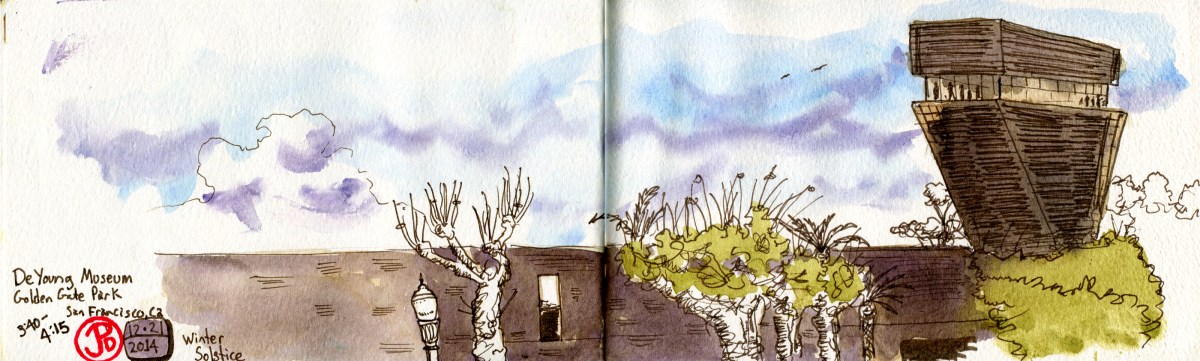
I end the year 2014 with a sketch and I begin the year with a sketch. And what exactly else is a sketcher supposed to do?

I am currently reading Tom Hoffmann’s excellent book Watercolor Painting (2012). While the title seems pedestrian and predictable, this book is anything but. So many of my watercolor books are about technique, if you want to paint this way do A, B and maybe C. Hoffmann offers few techniques or tricks. Instead his book is more about what not to paint. The secret to sketching and painting is seeing. Seeing your sketch and knowing what to include and what to leave out, how much detail one should add, and when to stop and put your pens and paints away and close your sketchbook. In other words: simplify.

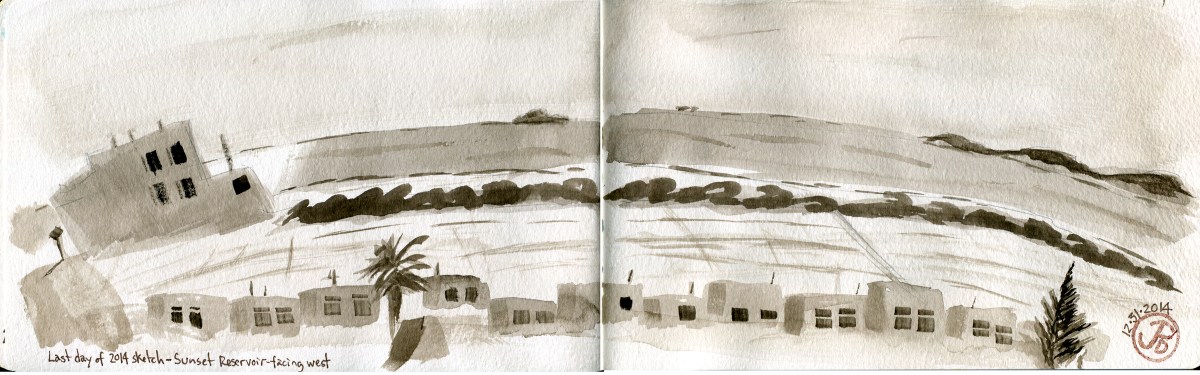
To this end I followed one of Hoffmann’s suggestions and headed to Sunset Reservoir, turned towards Big Blue and created a five-value monochrome sketch. I chose sepia and painted the scene before me on this crisp and clear day, the final day of 2014. It seemed a fitting, zen-like way to end the year. By only using one color, I was forced to assess the values in front of me. I took the complex scene before me and translated it into a simple sketch.
Peace


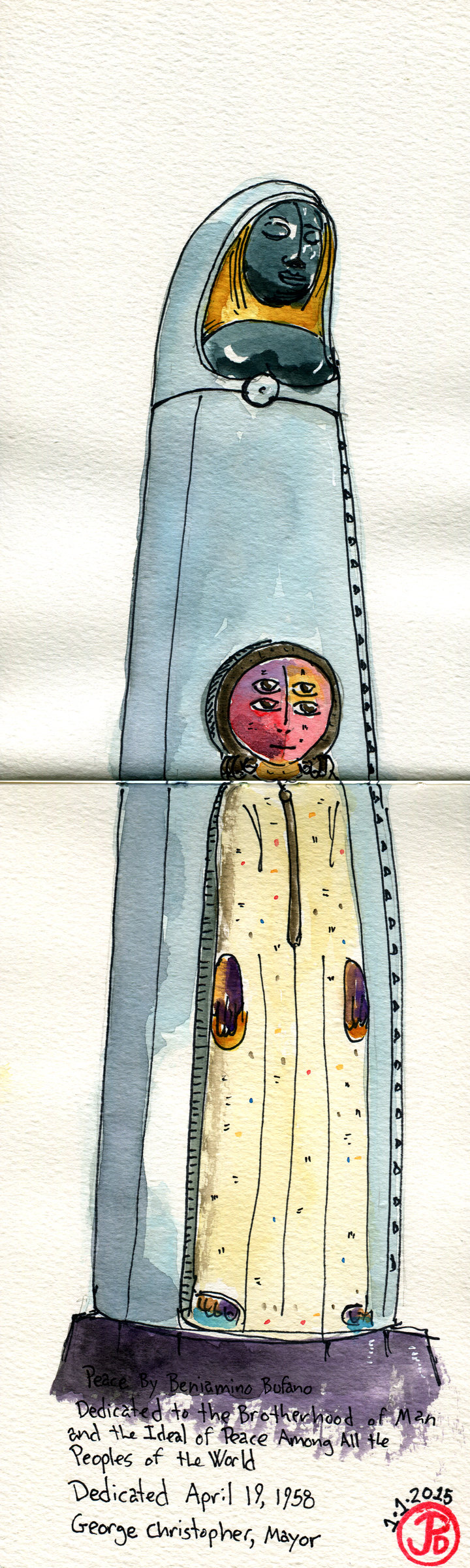
For my first sketch of the 2015 I chose a subject that I have seen many times as a child and a subject that I wanted to sketch for some time: Benny Bufano’s sculpture: Peace. For four decades this 30 foot sculpture greeted visitors to the San Francisco International Airport and now has been downgraded to the side of the road on Brotherhood Way. It seems ironic that a sculpture that is dedicated to “the Ideal of Peace Among All the Peoples of the World” should be marooned amid all the new construction where motorists rarely stop and look at the statute and it is increasingly hemmed in by the jumble of boxy homes that surrounds it.

It is a fitting subject to begin the New Year with, for sketching brings me much peace in a world that can be cluttered and confusing. Perhaps this is an apt metaphor for the stature itself as she peacefully gazes above and beyond the constant stream of traffic and the cookie cutter homes that run rampant, up the hillside behind her.

Happy New Year. May 2015 bring you much joy and peace.
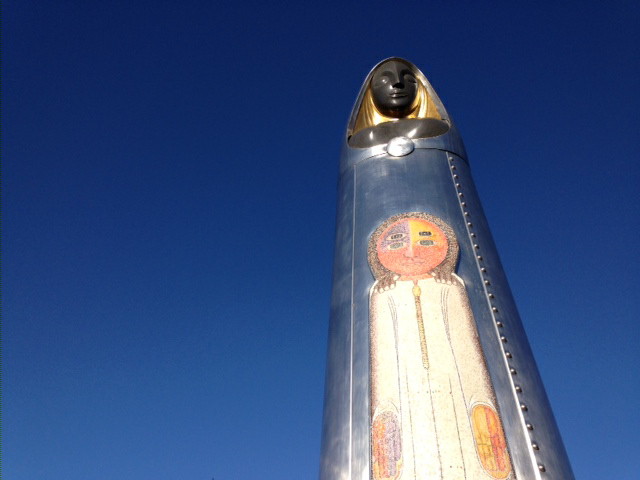
photo (9)


Peace by Beniamino Bufano (1958)
Image

My Back Yard

“it suited me very well to do so and to rusticate in the forests and the streams”

-Captain Joshua Slocum

Every city, of any size, needs a place for it’s citizens to relax and find peace. A place to recharge or to participate in sport or to just nature loaf. The City of Saint Francis is blessed with the 1,017 acre Golden Gate Park, a park that is 20 percent larger than New York’s Central Park.

This park was birthed in the Outside Lands of San Francisco’s western edge, in sandy soil that no one thought anything would grow. But today, almost 130 years after it’s beginnings, Golden Gate Park boasts a large urban forest that provides habitat to many animals including coyotes, great horned owls, and hawks. The most viewed wildlife in the park are the 250 different bird species that occur here. There is one bird that has visited my back yard, pushed ahead of a massive northern storm front,  a Eurasian visitor, the very rare: rustic bunting.

This is a bird that will bring birders from all over the state and country. It is found in Northern Europe and Siberia and some have strayed to Alaska’s western Aleutian Islands. This male first year bird was first seen on December 7, a few days before a large weather system arrived in the Bay Area in the evening of December 10. This storm system dumped up to nine inches of rain on the drought-parched soil of California, creating power outages, urban flooding and closing schools (including my own). Every cloud have a silver lining and these dark storm clouds that brought wind and rain also brought a lost visitor from the east.

rustic
One of 17 life birds seen in Golden Gate Park: life bird #454, rustic bunting.

Image

Bubbling Well Pet Memorial Park

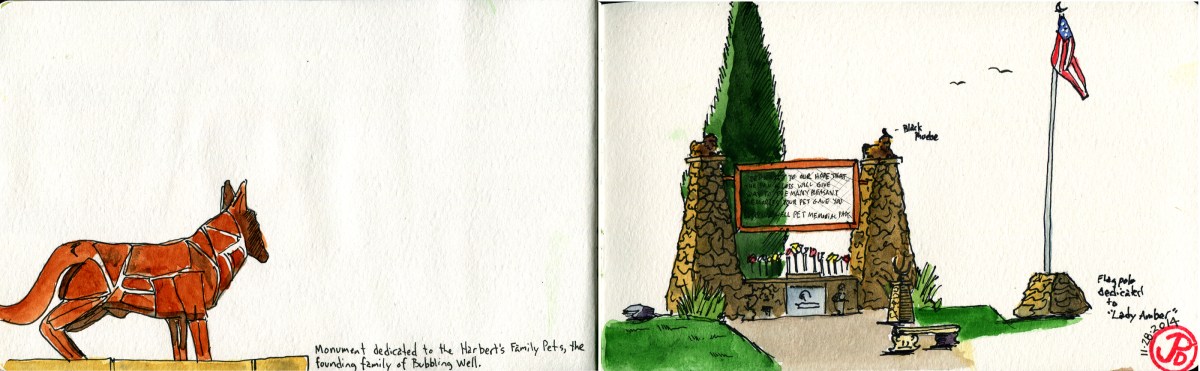
A first time visitor might think that this blog should be re-titled, “Cemetery Scribblings” after seeing this post. A second sketch of a cemetery and a connection to the turbulent year, 1978. What brought me to this cemetery in Napa, was a 1978 film which the late film critic Roger Ebert hailed as a “masterpiece” and placed it on his list of the top ten films of all time. The film is Errol Morris’ first feature “Gates of Heaven”. This documentary follows the plight of two Californian pet cemeteries, one fails and is forced to close and the other survived (taking the 450 pets buried in from the first cemetery) and is still open to this day, run by the same family.

Bubbling Well Pet Memorial Park is in the foothills of Napa Valley and commands a view of this world famous wine region. It has grown since it’s screen debut but the twin lion-clad stone columns and flag pole remains much the same as in 1978.

unnamed

(A still from the final shot of “Gates of Heaven”.)

It is easy to be dismissive of pet owners who treat their dogs and cats better than they treat fellow human beings. When I was a child our three dogs were simply pets that did not get dressed up in sweaters or have portraits painted of them which were proudly displayed above our mantelpiece because our dogs were just  dogs, the family pet.
As I walked among the graves, reading the many inscriptions, I was touched by the connections between pet and owner. It was clear that these animals played a large part in their owner’s lives, enriching it and giving meaning to it. This bond of trust and friendship is best described in “Gates of Heaven” by Mac, the owner of the now defunct Foothill Pet Cemetery in Los Altos:

People like people because they like one another. And people don’t trust one another thoroughly like an animal and a human being. I can know you very well. But when I turn my back, I don’t know you. Not truly. But my little dog, I can turn my back on my little dog and I know he’s back there. He’s my little friend. He’s not gonna jump on me or bite me or anything like that. But human beings cannot be this way.

Morris’ film is, on the surface, a documentary about two pet cemeteries but it is really about something much deeper. It is one of those films that can be viewed over and over again. As Ebert writes, “this 85-minute film about pet cemeteries has given me more to think about over the past 20 years than most of the other films I’ve seen.” Now that’s really saying something!

As I stroll through the Park reading the inscriptions: “I Love you Princess”, “My Best Friend”, and “God is Love-Backward It’s Dog”, I share this moment with the 12,500 pets buried here and the geriatric emu that hobbles around on the hill. This visit has given me much to think about and reflect on. Love and loss, hope and redemption, and the unbreakable tie we have with animals and the natural world.

Emu

The geriatric emu hobbling along with Bubbling Well Pet Memorial Park and Napa Valley in the background.

Image

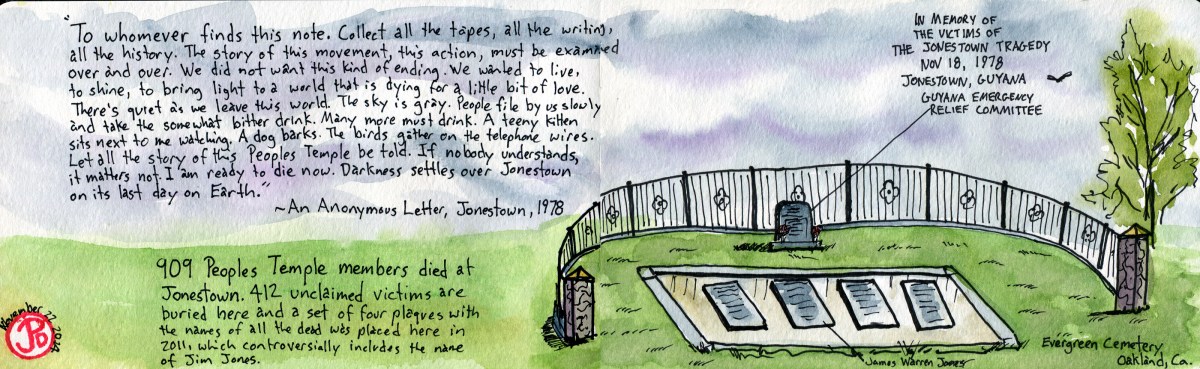
November 18, 1978

“Those who do not remember the past are condemned to repeat it.”

This quote is from a sign that hung in the pavilion of Jonestown, Guyana. It somehow seems prophetic than many in San Francisco, now in 2014, do not remember or know about the tragic events of 1978. Perhaps for many, it is something they want to forget. Some who hear about it now, simply cannot believe it to be true, as if the brain could not fully understand the senseless waste that occurred in a far off South American jungle.
It was the events of November 18, 1978, that brought me to a cemetery near Mills College in East Oakland. It was 36 years ago, this month, that this tragedy rocked San Francisco, the Bay Area, and the world. It was at Evergreen Cemetery that 412 unclaimed victims were buried. And I had come to pay my respects. In 2011, four plaques were placed here, listing all of the dead. Controversially, included among the dead is that of the mastermind and leader of the Peoples Temple: Jim Jones.
Cemeteries are here for the sole purpose that we do not forget the past; Those who peopled it and those who shaped it. As I look over the 909 names engraved in stone I wonder what we have learned from Jonestown and what we have vowed never to repeat again. The answer is varied to the many people who ask the question but to me the lesson is simple: never stop questioning and never stop learning.
And as we head into “the Season of Giving” I thank this experience, and this sketch for reinforcing a simple but deep truth.
And also that the past only exists if someone remembers it and takes the time to commit pen to paper.

Stoen

A detail from one of the plaques including the name of John Victor Stoen, who is, in some ways, the catalyst to the Jonestown tragedy.

Resources:

Books

Raven: The Untold Story of the Rev. Jim Jones and His People

Tim Reiterman

This classic study of Jones and the Peoples Temple is written by a San Francisco reporter that covered the story and was shot on a visit to Jonestown on its last day on Earth and lived to tell the tale.

Season of the Witch

David Talbot

An excellent overview of a very turbulent time in San Francisco history, including chapters on the City’s most infamous spiritual leader.

Documentary

Jonestown: The Life and Death of Peoples Temple

PBS (American Experience)

A 2007 PBS production featuring the anonymous letter reproduced on the left hand page. A haunting viewing proving that truth is stranger than fiction.


Image

Ravens of Fort Fun

“The raven is a bird whose historical and literary pre-eminence is unapproached.”

– R. Bosworth Smith, Bird Life and Bird Lore (1905)

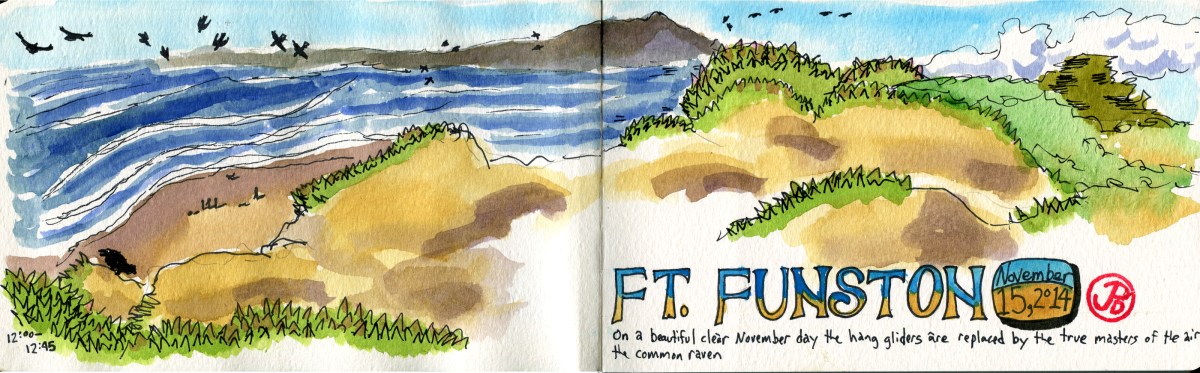
San Francisco’s Fort Funston, known as Ft. Fun to locals, is loved by hang glider pilots and off led dog owners alike. Situated in the southwestern corner of San Francisco at the southern end of Ocean Beach, this is one of the only places you can legally hang glide in the city. It is also a place where dogs of all shapes and sizes can stretch their legs and get a vacation from cramped city living.

On this calm, clear November day, the winds off the Pacific were mild and no hang gliders where up in the air. There is one other population that loves Fort Funston and that’s the common raven, the true master of the air.

These ebony birds filled the air, riding the updrafts above the 200 foot cliffs. This consistent updraft is known as the “Funston Shear” by local hang glider pilots. Lying back in the ice plant, watching the largest songbird spin, soars, dive, and invert I am  amazed by the shear joy ravens seem to display at simply flying. Raven are considered to be some of the most intelligent animals in the world. They are highly social and have developed a strong bond with human beings, going as far back as nomadic hunter-gatherers. Their intelligence and adaptability has helped them expand their range into more urban areas. Ravens started to appear in San Francisco in the early 1980’s and now they have a strong foothold in the City by the Bay.

Ravens also share something else with humans: a complex communication system. As corvid researcher John Marzluff writes, “Ravens have perhaps the most complex vocabulary of any bird. They scream, trill, croak, cackle, warble, yell, kaw, and make sounds like wood blocks, bells, and dripping water. . Variety and unpredictability define crow, raven, and other corvid calls, so whenever you hear something inexplicable in the forest or field, odds are that a corvid is the source.”

photo 1

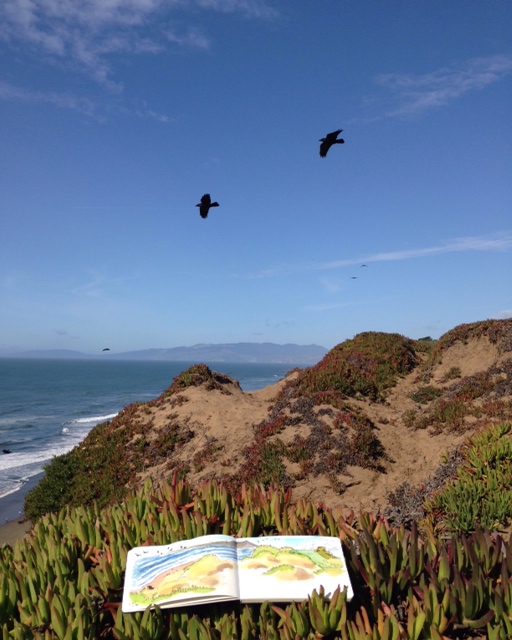
Common Raven (Corvus corax) perched at the entrance to the hiking path at Fort Funston. The ravens at Fort Funston allow close approach and provide many opportunities to observe this endlessly entertaining bird.

photo 2

Reclining on an ice plant “love seat”, sketching, watching ravens, and reveling in nature. A wonderful fall day at Fort Funston.

Image

Sea Elephants

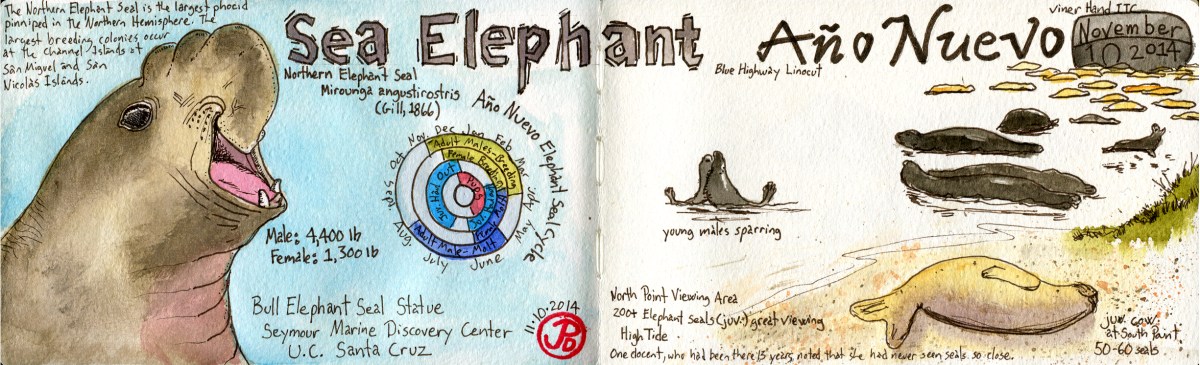
The last time I visited the sea elephants at Ano Nuevo State Park, you could walk out onto the beach on a docent-led tour that took you within yards of these massive marine mammals, the largest pinnipeds in the northern hemisphere. Now, almost thirty years later, the beach has been taken away by the fingers of the ceaseless tide. You can no longer walk among the seals but on this foggy November morning I was blessed with a large gathering of juvenile seals and a high tide, placing them at the base of the viewing area.

What prompted me to make a right turn into Ano Nuevo on my way to Santa Cruz, was the book I am currently reading to my fourth graders: Island of the Blue Dolphins. This book is loosely based on the Lone Woman of San Nicolas Island. In one chapter, the main character, Karana, tries to hunt a sea elephant (northern elephant seal) for it’s tusks. It has been a long time since I have seen elephant seals up close and to my surprise I was about to see them very close.

On the way out to Ano Nuevo Point, a sign noted that there were 50-60 seals at the South Point viewing area and 200+ juvenile seals at the North Point viewing area. I first stopped off at South Point and looked over the bluff to see a juvenile cow, right below me on the beach. There was no use for my binoculars as I sketched her into the lower right hand corner of my journal. I then immediately headed out to North Point. The tide was high and all the seals were pushed into the cove making viewing easy on the eyes. I filled in the rest of the page with layer upon layer of sleeping seals and two young males sparring in the surf. As I was sketching, the docent, who had been out for 13 seasons, told me she had never seen the seals so close. I guess timing is everything.

There was one thing missing from my sketch and that was the emblematic adult bulls. These huge, two ton seals with oversized snouts and deeply scarred chests would be arriving in December and January to claim their patch of the sand to try and become the beach master. There were plenty of four year old males sparring with each other in a mock fight, honing their skills for a real grudge match in four or five years time.

To sketch an adult male I had to head further south to the Seymour Marine Discovery Center at U.C. Santa Cruz. Here I found the three life-sized statues of a bull, cow and calf. I sketched the male on the left side of the page. I certainly had no problem sketching this specimen, he wasn’t going anywhere.

Processed with VSCOcam with c1 preset

25 feet! I can barely stay back 15!


Image

Halloween

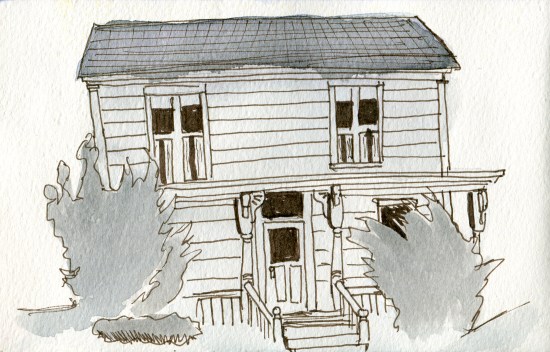
On this All Hallow’s Eve I give you a page I did over the summer during my Mission Rally in Southern California.The subject is an old house in the quiet South Pasadena neighborhood.Ever since my baby sitter allowed me to say up late and watch the movie “Halloween” in the early 1980’s, I have wanted to visit this house. “Halloween” was the highest grossing independent film ever made and it became a mainstay on network television during October, (think: “Viewer Discretion is Advised”, my babysitter lacked this discretion).I love this truly frightening film ,which spawned many rip-offs, because it tied into so many urban myths such as the local haunted house. My friend points to the ugly grey house on the corner and begins, “It was ten years ago in this very house. . . ” Every child had one of these houses in their neighborhood and in “Halloween”, this house was the Myers’ House in Haddonfield, Illinois. In reality it was a house in South Pasadena built in 1888.

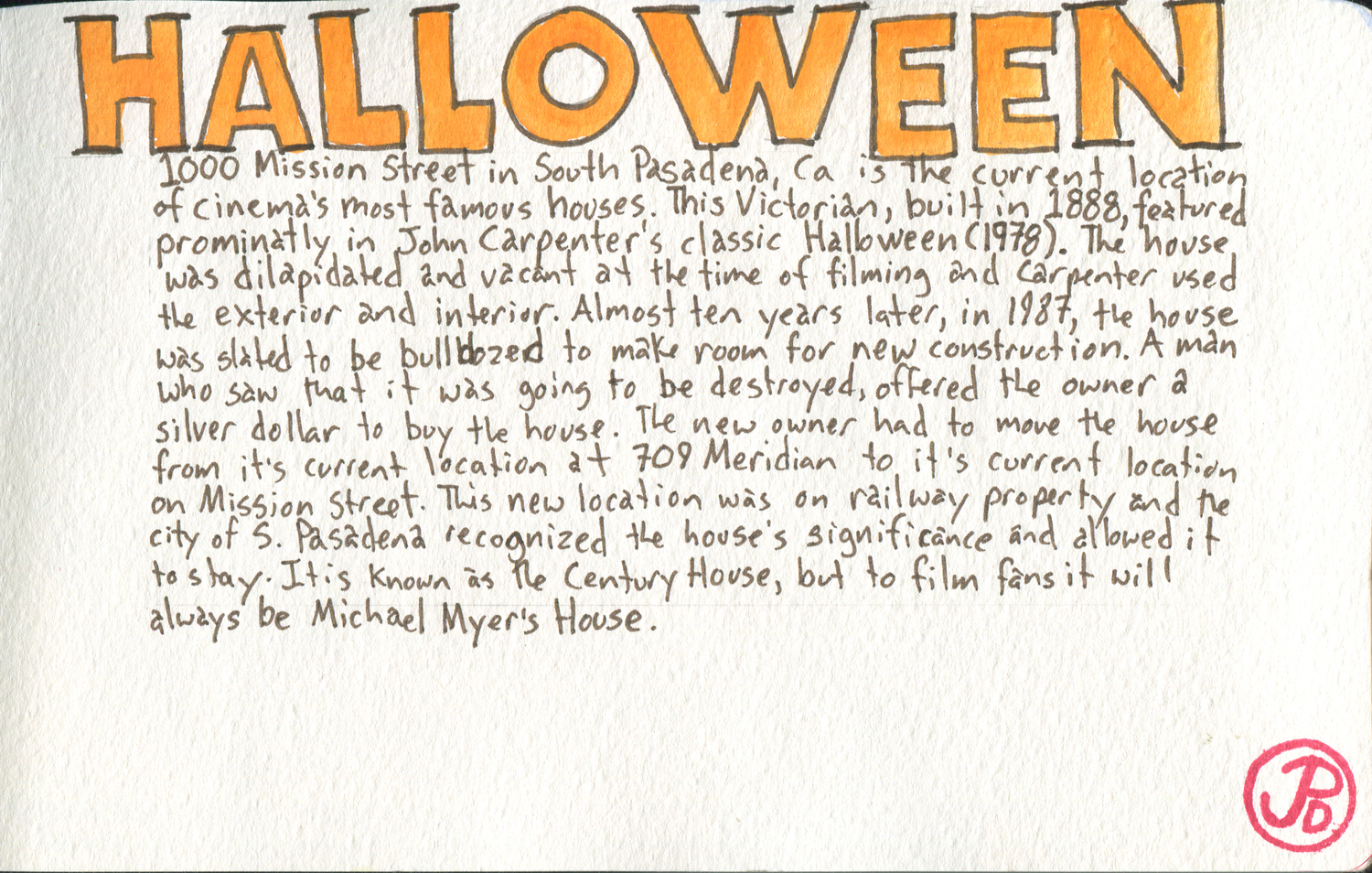
1000 Mission Street in South Pasadena, Ca is the current location of one of cinema’s most famous houses. This Victorian, built in 1888, featured prominently in John Carpenter’s classic Halloween (1978). The house was dilapidated and vacant at the time of filming and Carpenter used the exterior and interior. Almost ten years later, in 1987, the house was slated to be bulldozed to make room for new construction. A man was saw that it was going to be destroyed, offered the owner a silver dollar to buy the house. The new owner had to move the house from it’s current location at 709 Meridan to it’s current location on Mission Street. This new location was railway property and the city of S.Pasadena recognized the house’s significance and allowed it to stay. It is known as the Century House, but to film fans it will always be Michael Myer’s house.

An illustration from the sketcher’s early masterpiece, Death Crash (1982).

I wrote and illustrated this book in fourth grade and it was heavily influenced by my viewing of “Halloween”. Something that would have never happened without the help of my baby sitter, who clearly did not use discretion. As a fourth grade teacher, I wonder what I would think if a piece of writing like this came across my desk.

Happy Halloween!

Image

Taking Notes

“Write what should not be forgotten.” -Isabel Allende

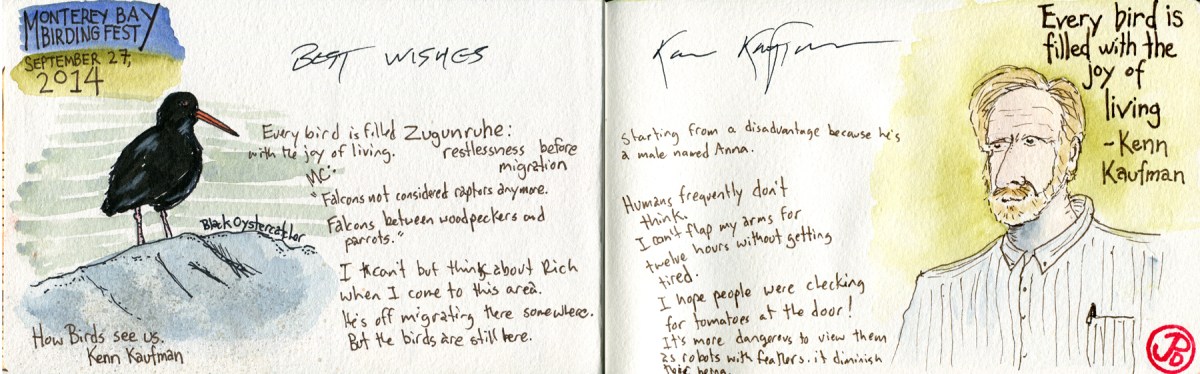
While my journals are filled with landscapes, urban scenes, and birds, I sometimes use my journal to simply take notes. Such was the case when I attended a talk by bird guru Kenn Kaufman at the Monterey Bay Birding Festival. Kaufman is the author of Kingbird Highway, an autobiography about his quest on a shoestring to see as many birds in one year (a big year).
As I was waiting for the talk to start I began sketching the black oystercatcher that was displayed on the screen. I placed the sketch in the far corner of the page. As I looked at the shape of the bird and concentrated on its beak, what happened then is what always happens when I sketch, I lose sense of time and I don’t seem to realize what’s going on around me. I am just focused, seeing. A meditation in public. Sometimes when I pause, I sense that I’m being watched. The odds that someone would be looking at me in a room full of perceptive birders is very high. But I sensed that someone to my right was watching my progress. That never really stopped me from sketching. I didn’t look up from my work.
When I did look up from my work, I met the woman sitting next to me. It turns out that she is the editor of the Albatross, the newsletter of the Santa Cruz Bird Club and she took an interest in my note taking. There are times like this, these serendipitous moments, when life provides a fork in the trail. A time when the right person sees my work and as a result my note taking page, which was done for no other reason than self knowledge, is published in the November-December issue of the Albatross.
You can find the article here:

http://santacruzbirdclub.org/59-2.pdf

Oystercatcher

A black oystercatcher at Big Sur.

Image

Blue Angels

Having grown up in the Valley of Heart’s Delight with my bedroom window looking out towards Mount Hamilton and the flight path of airplanes on final approach to Moffett Field, I developed a love of aircrafts and all things that fly. I built scale models of the P-3C Orions that where stationed at Moffett and the drone of their four turboprop engines where part of the sound track of my youth. The monotony of P-3s passing by my bedroom window, returning from submarine patrol, where occasionally disrupted by a C-130 or the largest airplane in the air, the C-5 Galaxy and occasionally, the far sexier F-16 Falcon. No aircraft was more eagerly awaited than the Blue Angels, the blue and gold A-4F Skyhawks arriving for the annual air show.

My fascination with military grade planes and the Blue Angels has waned over the years like my interest in Star Wars action figures. I have left the Valley of Heart’s Delight ( now known as Silicon Valley) and moved north to the city of St. Francis. In 1994, Moffett Field was closed as a navel air field and the Blue Angels followed me up north to San Francisco and Fleet Week.

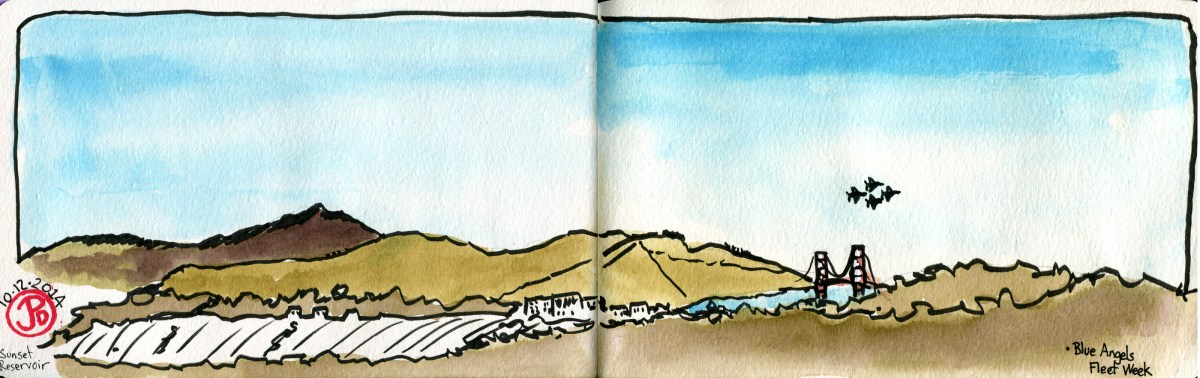
San Francisco has a love/hate relationship with Fleet Week and the Blue Angels. With the increased traffic and deafening roar of supersonic jets overhead I can understand why. I got out of Dodge during Fleet Week and retreated to the peace of the Santa Cruz Mountains. I did return to the City on Sunday, in time for the last Angel show of Fleet Week. I climbed to the highest point within a two block walk: Sunset Reservoir. I look north towards Golden Gate Park, the Marin Headlands, the Golden Gate Bridge, and Mount Tamalpais.

I have also had the same reservations about the Blue Angels and the use of taxpayer dollars as I look out across the crumbling infrastructure of San Francisco’s streets, not to mention the underpaid and overworked teachers, the true homeland security of the United States. But waiting up on that hill for the first sighting of the F/A-18s, I am brought back to my childhood, eagerly waiting at my bedroom window for the blue and gold gashawks to appear. While I scan the skies the costs and my mixed feelings about the military fades away as the the blue diamond appear over the City.

Blue SFO

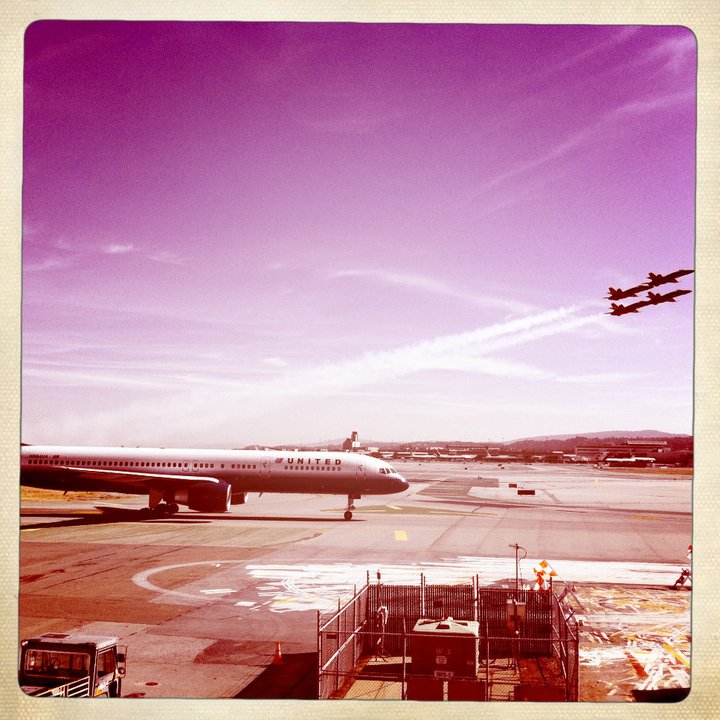
Blue Angels taking off at San Francisco International Airport in 2010.

Blue 3

The sketcher on the tarmac of SFO with Blue Angel F/A-18 H number 1.

Image

Nests

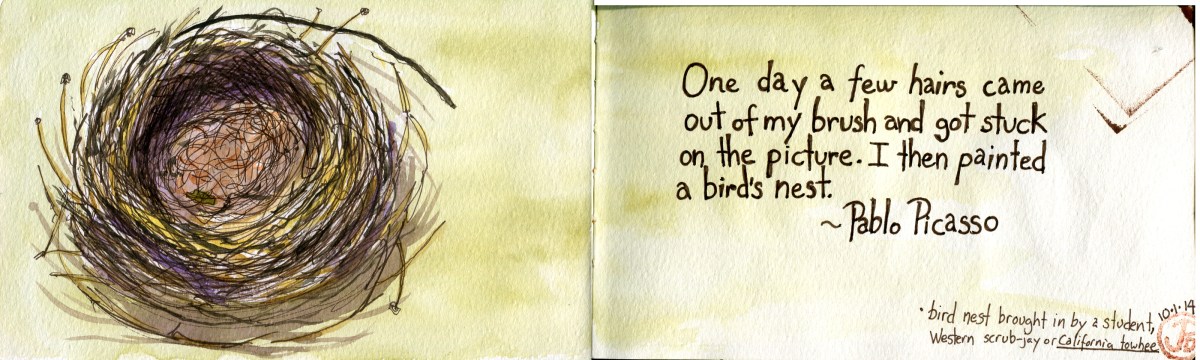
The other day a student brought in a nest that he found in his grandparent’s backyard. I suppose it really was just a matter of time that a student brought some sort of bird biofact into the classroom. I do talk about birds quite a bit in class and I was thankful it wasn’t an old owl pellet or a dead bird. And of course I did what any sketcher would do, I took the nest home and I drew it. The more I sketched the nest, it’s twists and curves, the more I was able to see its architecture and design. I began to see things I hadn’t noticed before, like the petal-less flower stems that ringed the base and the variety of materials used. At first I though the nest belonged to a scrub-jay but upon further measurements and research, including looking at Maryjo Koch’s wonderful book The Nest, I determined that the nest was made by a California towhee.

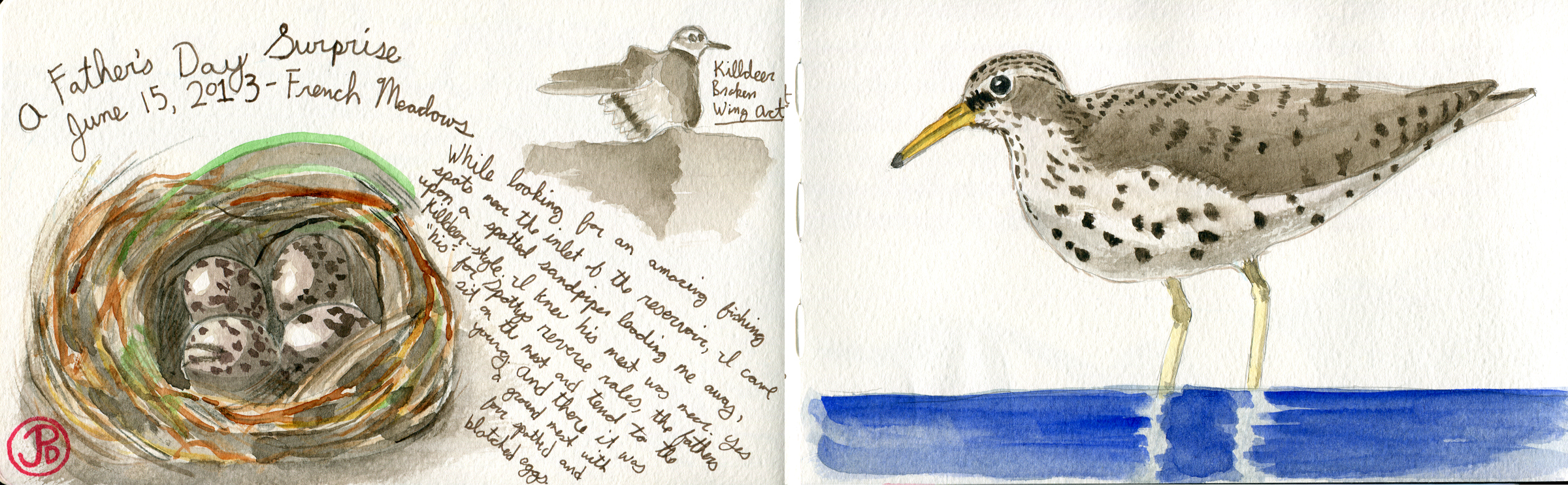
I like it when the detective work is taken out of the equation when it comes to identifying a  nest. Such as seeing a scrub-jay fly into a rose bush at a community garden or a steller’s jay nesting in a potted tree on the patio of a busy restaurant (See the bottom sketch in the Mission #1 post). One nest discovery that made it into my journal was from an experience  hiking around the alien landscape of French Meadows Reservoir in the Sierra Nevadas. While hiking among the rocky shoreline I startled a spotted sandpiper who limped away from me with a “broken” wing. I had seen this mock behavior with other ground nesting birds like the killdeer and I know that I was very close to it’s nest and the bird was trying to lead me away. I was careful not to step on the nest and I found it after a short search. The sandpiper’s nest contains four blotched eggs. An interesting fact about the spotted is that the males broods the eggs instead of the female.

Spotted sandpiper