Image

Plaza de Toros de Las Ventas

It is impossible to believe the emotional and spiritual intensity and pure, classic beauty that can be produced by a man, an animal, and a piece of scarlet serge draped over a stick.

Ernest Hemingway, Death in the Afternoon

A traveler visits a foreign country to experience a different culture, to see exotic flora and fauna, and sample strange cuisine. And some of us travel to be challenged, to broaden our perspectives, and to see how the rest of the world lives. I can think of few experiences that can be more challenging to a vegetarian nature- lover than attending a corrida at the Plaza de Toros de Las Ventas on an Easter Sunday afternoon in Madrid. Why did I attend such an event? I have had an obsession with bulls and matadors from an early age.

It all started with reading The Story Ferdinand written  by Murio Leaf and illustrated by Robert Lawson. This 1936 classic is about a young bull that gets chosen for the bullfights in Madrid because of his supposed bravery and ferociousness, in reality he sat on a bumble bee. Ferdinand really just wants to sit under a cork oak and smell the flowers, instead of charging the matador. Once in the ring, he smells the flowers in all the ladies hair and he could care less with participating in the ancient and brutal art form. The Story of Ferdinand was banned in Spain for its overt pacifist message in a time of brutal world aggression. But as a child I loved the simple black line illustrations and the simple but powerful tale.

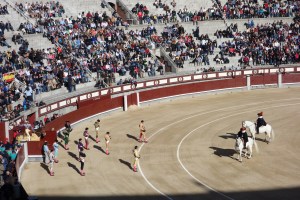
A corrida is a odd mix of the strange and familiar. The trumpet sounds and the paseo enters the ring led by the two Alguacils dressed in costumes of the reign of Philip II. The three matadors follow in their suits of light sparkling in the Madrid afternoon sun followed by their Cuadrilla. The Matadors doff their hats to the directors box, and spectacle is ready to begin.
DSC05713

The paseo at Las Ventas, Madrid, the most famous bullring in the world.

The bull that came out of the toril gate on that Easter afternoon was no Ferdinand. This bull was willing to charge the cape and could care less about the few flowers that adorned ladies hair.

The toro charged around the ring and the first matador came out holding his cape in both hands. The bull turned for a pass. The toro caught the matador with his horns and raised him into the air. He landed on his side and bull lowered his head and gored the matador. Toro: 1, Matador: 0. But in this traditional dance of death, the toro seldom wins. And this corrida was no different.
 

Lesser kes

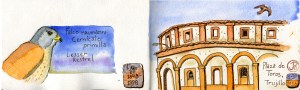
Many of the villages in the Spanish countryside have a Plaza de Toros such as the ring in Trujillo which was opened in 1848 and closed in 1998. This bullring now provides a habit for a nesting colony for the lesser kestrel. As this agile predator stilled above the red tiled roof of the ring, I reflected on this very different dance of death.

IMG_4349Corvidsketcher, sketching the Plaza de Toros La Piedad in Trijillo, with lesser kestrels flying above.

Image

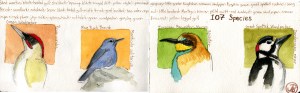
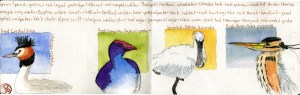
107 Species

Life bird number one was a wood pigeon sitting in Neptune’s hand in the Plaza del Castillo seen from the bus coming from Barajas Airport to Atocha Train Station in Madrid. I figured this was an auspicious start to my Spanish birding adventure.

The next morning I got common blackbird (Turdus merula) in front of the Prado on a walk from my flat in the Lavapiés neighborhood to the Estadio Santiago Bernabéu. On the walk I got many house sparrows and rock pigeons, the official species of many American cities. This trickle of life birds, two in two days, was just the opening act of the deluge of aves to follow.

My birding adventure started in earnest on Monday morning. The calls of swifts (the cinematic soundtrack that represents pastoral spring or summer) directed my gaze skywards to the narrow grey window of sky between the buildings of Lavapiés. A lifer on the way back from the coffee shop was not a bad way to start a birding adventure.

Pau picked me up in front of my flat and we left the traffic of Madrid and headed south west for the province of Extremadura. On the drive out of Madrid to Saucedilla these are the lifers seen from the car, without binoculars: grey heron, spotless starling, kestrel, marsh harrier, booted eagle, white stork, red kite, hoopoe, common buzzard, black, and griffin vulture.

We stopped in the small village of Saucedilla to have a bocadillo e una caña in the small cafe. After our repass we walked across the square to the 16th century Church of St. John the Baptist. The church was covered with jawdaws and we circled the church looking for our prize. Three lesser kestrels flew in  and hovered above the church. Bingo! In the area around Saucedilla other highlights included: purple swamp-hen, purple heron, spoonbill, water rail, bearded reeding, Savi’s, Sardinian, fan-tailed, and sedge warbler, black-winged kite, and Iberian grey shrike.

Aves 2

At the close of the day, Monday March 28, I added 42 new bird species to my world list. The highlight at the end of the day was a little owl (Athene noctua) perched a stone wall seen from the porch of our base camp at Casa Rural Las Canteras.

On Tuesday we headed out to Monfragüe National Park where I added 26 new species. See the previous blog post on Parque Nacional Monfragüe.

On Wednesday we explored some reservoirs in Extremadura. Highlights included: red-cresteted grebe, shelduck, lapwing, greenshank, the “blue bullet” kingfisher, great spotted cuckoo, great bustard, bee-eater, and Scops owl. Total lifers: 22 species.

Aves 3

On Thursday we were attempting to find the Eurasian eagle owl with the assistance of a local farmer. We missed out but found an abandoned nest. Highlights included: little bustard, Montagu’s harrier, pallid swifts, and green sandpiper. Total lifers: 7 species.

On our last day in Extremadura we headed to the mountains and the monastery town of Guadalupe. Highlights included: jay, nuthatch, sparrow hawk, and green woodpecker. Total lifers: 6 species.

On April 4th, in San Sebastián I added two more species: firecrest and yellow-legged gull.

My guide in Extremadura was Pau Lucio. I would highly recommend him if you plan to bird this amazing part of Spain. His guiding company is called Birdwatching Spain and more info can be found at their website: http://birdwatchingspain.net


Image

Code 5

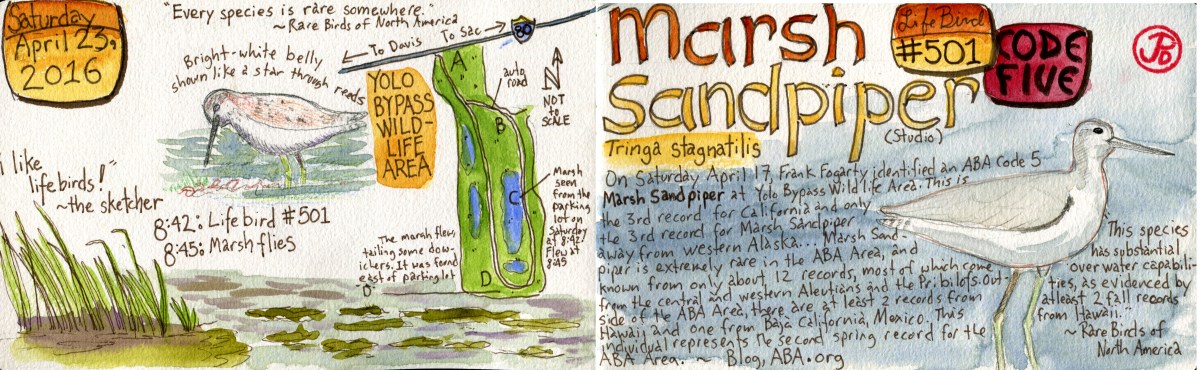
I picked up DICK at 7AM. We were going to attempt to add a very rare bird to our life lists. Our destination was parking lot C at the Yolo Byway Wildlife Area near Davis.

What drives a rational being to wake up at six on a Saturday morning and drive two hours just to see a rather drab sandpiper? This bird was not endangered or threatened, it is common on it’s home range, which happens to be in Eastern Europe to Central Asia. As Rare Birds of North America points out, “Every species is rare somewhere”. This bird is so rare in North America that the American Birding Association (ABA) rates it a Code 5.

Here is how the ABA defines the code:

Code 5: Accidental.

Species that are recorded five or fewer times in the ABA Checklist Area, or fewer than three records in the past 30 years.

Now that’s rare, extremely  rare. This bird was only the 3rd sighting in the state of California. And only the twelveth record in the United States, the majority have been in the Aleutians and the Pribilofs in Alaska.

In all the excitement I forgot to mention our quarry: marsh sandpiper (Tringa stagnatilis).

We arrived at parking lot C at 8:30 and there were already about 50 birders looking into the pond  for the marsh sandpiper. I scanned the waders in front of me, afraid to ask if it had been seen. Perhaps it had flown and we where out of luck. A birder mentioned that the bird had been seen earlier but was now foraging out of sight behind some reeds off to our left.

I threaded my way through the many tripod legs to get a better look into the reeds. A birder called, “Rail!”and I looked off to the right, only to miss the Virginia rail disappearing into the rushes. I returned my attention to the reeds and their hidden gem.

Through the reeds I saw a flash of white, something that seemed out of place. The phantasm methodically worked its way to the right and came into view. “There it is!” I said in unison with a birder standing at my elbow. All binos, cameras and scopes turns towards the reeds. In my mind I ticked off the boxes: a bright white belly (Check), dark needle-like bill (Check),  greenish-yellow legs (Check), a wader that looked like nothing I had seen before (Check). At 8:42 I got United States Lifebird No. 501! We all enjoyed great views in perfect morning light as the Tringa foraged in the shallows, picking bugs off the surface of the water.

At 8:45 the show came to an end, all the waders, including the shining, white gem, took to the air and we where able to observe the bird in flight as it tailed a groups of dowitchers. All watchers willed the bird to circle back and return to the waters in front of us. Our bird had flown. . . well not exactly. The sandpaper was refound near lot D but on the following day, it was seen one more time and then the marsh sandpiper was gone.

Image

Parque Nacional Monfragüe

Monfragüe National Park is the crown jewel of the Extremadura region. This is one of Spain’s 15 National Parks and was established in 2007. The 17.852 hectare park is recognized by UNESCO as a Bioshere region. But of course we were here for the raptors. Monfragüe hosts 15 regular breeding species, including the world’s largest breeding concentration of Eurasian black vultures. The real highlight for a birder in Monfragüe is to see the blue Iberian skies covered in raptors: vultures, kites, hawks, and eagles and we were not let down.

This is the land of the old world vultures, the ones with long, snake-like necks and a billowy scarf of feathers. These were the vultures of National Geographic, the Jungle Book, and Ferdinand the Bull.

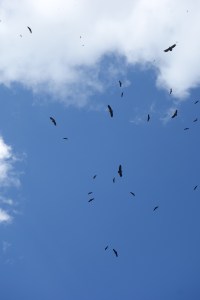
DSC05819

The skies full of vultures (three species), kites (two species), and eagles (one species) at Monfragüe. In California we would describe this scene as “raptorlicious”.

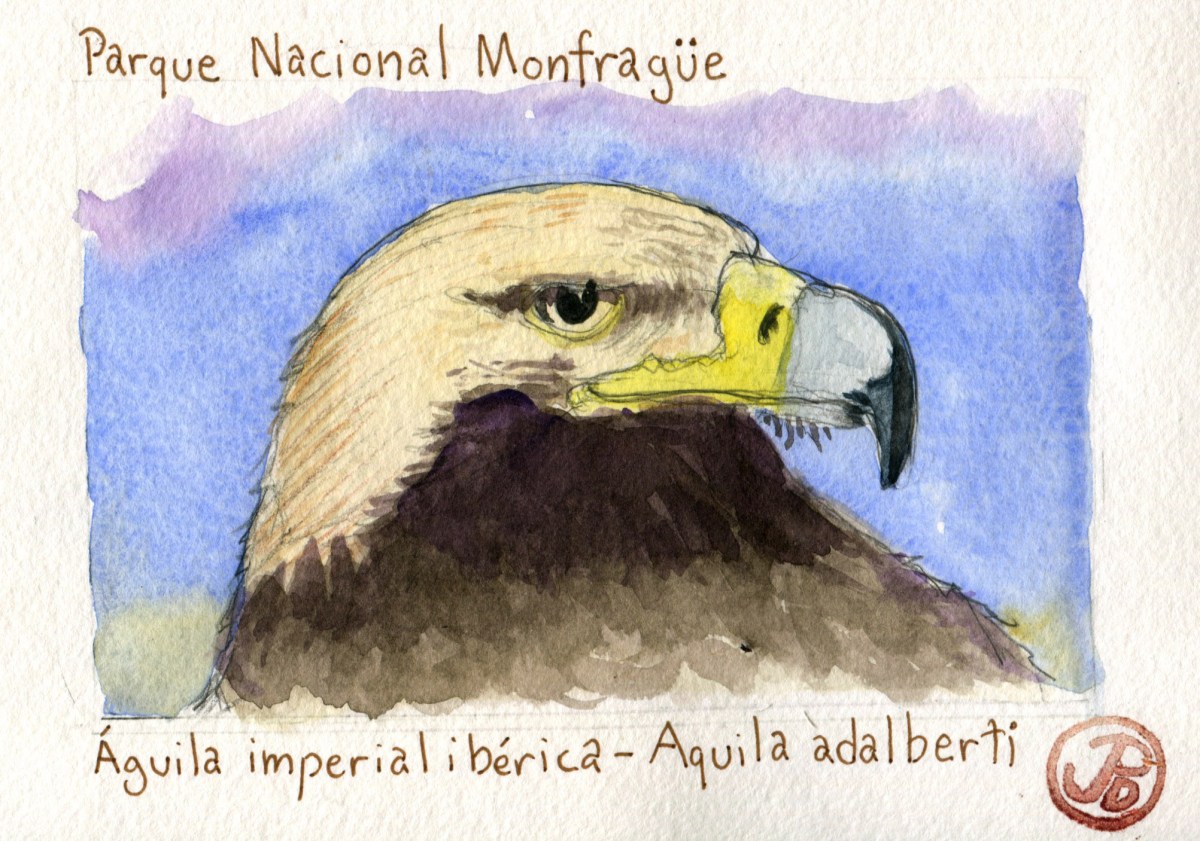
When Pau and I set out from Las Canteras early on a misty morning, our destination was Monfragüe and our prize was the bird that the two English brother twitchers would inevitable ask us about as they indeed greeted us in the evening with, “Did you get Spanish imperial eagle?” This eagle is the the prize bird for any birder visiting Monfragüe. It is a very rare bird, in the 1960’s only 30 pairs existed. Powerlines, poisoning and habitat destruction where the causes of the eagle’s decline. Through conservation efforts the eagle’s population has slowly increased. In 2011, there were 318 pairs in Spain. On the drive to the National Park, I told Pau that I wanted to find the imperial eagle by myself. I picked through the many huge kettles of raptors looking for the eagle with snowy white leading shoulders. No luck. No yet anyway.

We came to a stretch of road that was across the river from steep cliffs that rose above the water. The road was lined with birders and their scopes. Their attention was fixes on the cliffs and the skies above. Pau pulled over and I reminded him, “Leave the imperial to me.”

I stepped out of the car and looked up. Above me was a large raptor rising on the thermals of the warm road. I raised my binos to my eyes. It turned to the left, slightly dipping it’s wing. A dusting of “snow” on it’s shoulders. I love when life birds, especially rare ones, are this easy to find! Spanish imperial eagle.

Pau later showed me the female on a nest. This eagle and the precious eggs she was incubating was a good sign that the Spain Imperial eagle would continue to thrive in Extremadura.

IMG_4302

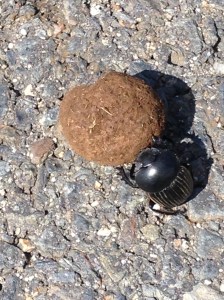
 “Will Break for Dung Beetles”, Monfragüe, it’s not just about the raptors, it pays of to look down.

My guide in Extremadura was Pau Lucio. I would highly recommend him if you plan to bird this amazing part of Spain. His guiding company is called Birdwatching Spain and more info can be found at their website: http://birdwatchingspain.net

Image

Extremadura and Las Canteras


Why Spain? You ask. The answer has been the same on recent trips both when boarding a plane or hitting the road. Birds, birds, birds.

Extremadura, the province southwest of Madrid, boasts an amazing array of avian riches in Europe, a high consentration of raptors and a handful of endemics which are birds that are found nowhere else in Europe.

Birders come from all over Europe to make a pilgrimage to this rural part of Spain to see Spainish imperial eagle (which once graced the flag of Franco’s Spain), Egyptian, griffon, and black vultures, black stork, Iberian magpie, bee-eater, lesser kestrel, great and little bustard. Many of the twitchers hailed from the mighty triad of birding nations of Northern Europe: the Netherlands, Germany, and Great Britain.

Extremadura sits on the flyway that bridges Northern Europe with Africa. This part of the Iberian Peninsula provides breeding habits for the colorful European bee-eater and roller as well as providing a year round habitat from many other species.

For this expedition I hired the services of a guide to take me to the birds, work as a translator and go-between with the locals, and help me navigate rural Spanish cuisine (which for me meant cheese, bread, and beer but sometimes augmented with wine.)

Las Canteras

My mastery of Castilian is clearly demonstrated by my different spelling of Las Canteras in this spread. It’s great to know that my spelling is appalling in any language!

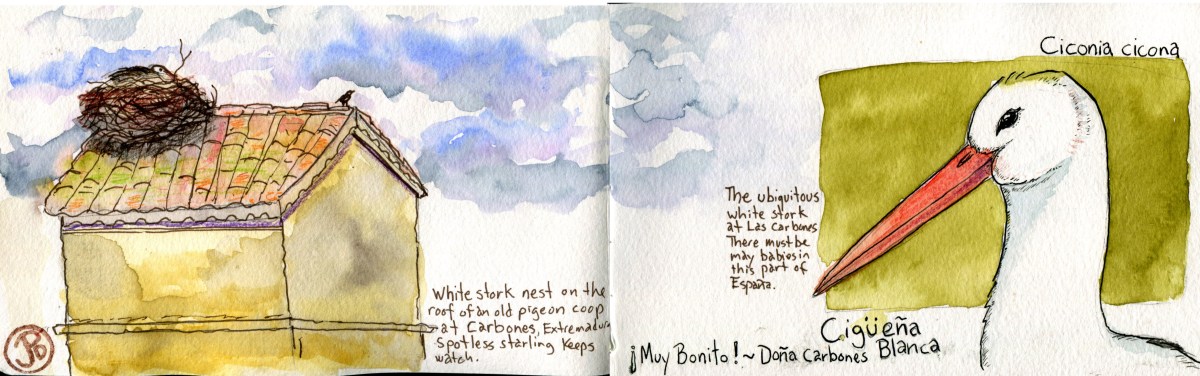
My guide, Pau, chose Casa Rural Las Canteras Birdwatching Center as our base camp. From the front porch you could view the crumbling stone barn that had been reclaimed as a white stork rookery, containing at least eight active nests.  On the other side of the porch was a scope fixed on a little owl. No I mean that’s what the owl is called: Athene noctua ( odd name for a daylight owl). It seemed that no matter when you looked through the scope, the little owl is always perched on the stone wall. Uncanny! Well I had to sketch the owl on it’s permanent perch.

2016-03-31 18.55.26

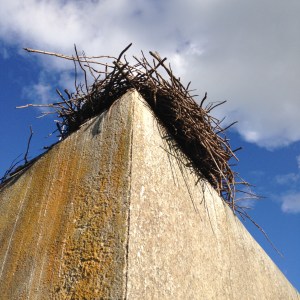
So this is where babies are made! White stork nest at Las Canteras.

Las Canteras (or Carbones) is run by the innkeeper and his mother, whom I dubbed Doña Carbones. She looked at my white stork sketch and offered a little art criticism: “¡Muy bonito!” I’ll take it!


Image

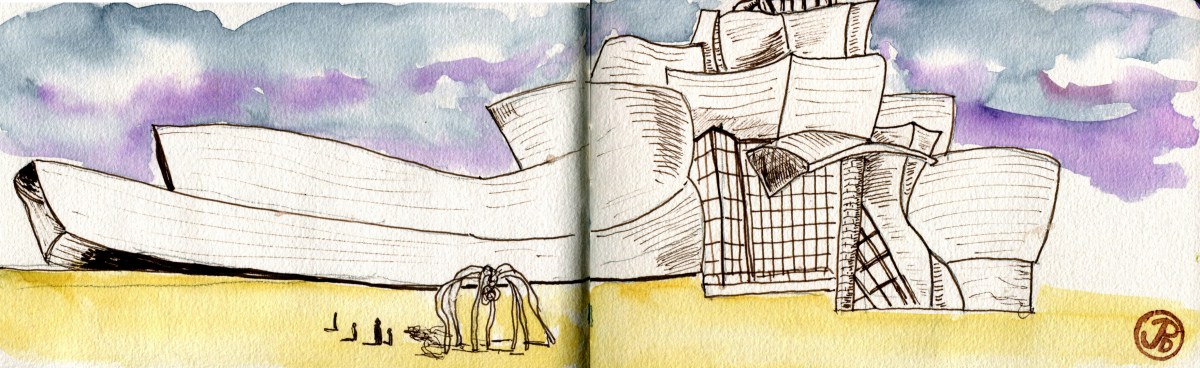
Guggenheim Bilbao: A Chameleon Silver-Flying Fish

The Guggenheim Museum Bilbao, a review: there is nothing in the galley halls that matches the architectural sculpture of Frank Gehry’s masterpiece.

Sketching the Guggenheim Bilbao provides it’s challenges; there is not a straight line in the building. The sketch starts in one place and then ends in another. The organic nature of the architecture dictates a less systematic approach that can leave the sketch a little  disoriented. It seems to be a building that is impossible to truly capture. Its curvaceous lines and the color of the titanium sides, mirrors the ambient colors that are constantly changing with the overcast skies that shift to sunshine, then rain, and back to the grey skies of the Basque Country.The Guggenheim is a chameleon silver-flying fish that cannot be defined in the halls of science.

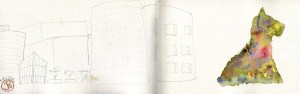
Puppy

Jeff Koons ‘”Puppy”

After two attempts to capture this strange beast (interrupted by the ubiquitous Basque rain), I settled for a much more agreeable Bilbao icon to sketch. The dog that “guards” the contemporary art museum: Jeff Koons’ flower sculpture, known to the locals simply as “puppy”.

I again became part of the scenery and experience to a bunch of French teenagers and a geriatric, cane-wielding, beret-wearing Basque, the Spanish love their daily afternoon constitutionals. He looked at my painting and commented, “¡El perro!” I’m still trying to determine if it was a statement of fact, a question, or a bit of art criticism.

I think this is one of my favorite sketches from Spain. It was very loose and freeing to use a wet on wet technique and let the unpredictable nature of watercolor do what is does best. I call it organized chaos.

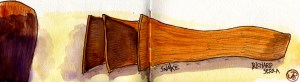
Snake

One of the pieces that matches the magnificence of Gehry’s Guggenheim, Richard Serra’s sculpture: Snake.

Image

Guernica and El Clásico

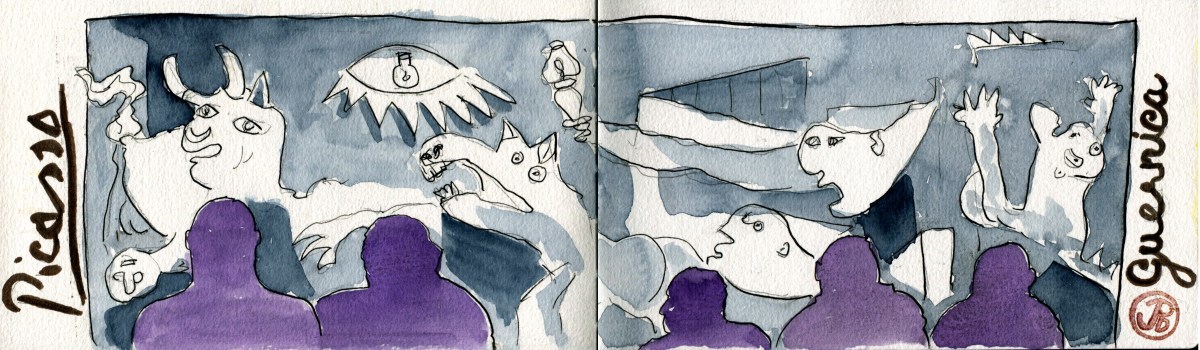
On Saturday it was about unfinished business from over 25 years ago, which was the last time I was in Madrid. Back then I had a backpack and a Eurorail pass. We stayed in Madrid for a short time and visited the Prado. I knew that Picasso’s masterpiece was just down the road but we must have been suffering from art museum fatigue (it’s easy to contract at the Prado) and the oppressive heat of Madrid in summer. This trip I was not going to miss Picasso’s massive work (I mean that in many ways): Guernica. This painting has been called, “the most famous single work of the 20th century”.

I was staying in the Lavapiés neighborhood in Madrid which was within walking distance of three points of the Madrid Art Triangle, which includes three of the most famous art museums in the world, the Prado, the Thyssen-Bornemisza, and the Reina Sofia. My destination on Saturday afternoon was the Reina Sofia, home to Picasso’s ultimate statement about war and it’s atrocities. Guernica refers to the small town in the Basque Country, near Bilbao. This was the setting of a tragedy, when on a Monday market day civilians were bombed by German and Italian aircraft in April of 1937 during the Spanish Civil War. This  was in someways a dress rehearsal for the bombing of cities and civilians during World War II. The painting  has gone on represent all victims of wars.

The painting hung in New York because the creator only wanted Guernica to hang in the Prado in a democratic Spain. Franco outlived Picasso and Guernica returned to Spain in 1981, six years after the dictator’s death.

Before visiting gallery 206, I already envisioned how I wanted to sketch Guernica. I knew that it was one of the most popular attractions in all of Madrid, if not Spain. I also knew that photography was not allowed anywhere near the painting (they sell more postcards and posters that way). I placed myself towards the back of the gallery sketching Guernica filtered through the crowd standing in front of me. I was in no way going to sketch every detail of the complex painting, that’s why it’s called a sketch after all.

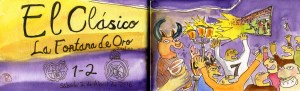
After a siesta I headed to the bar La Fontana de Oro  just off Puerta del Sol to watch one of the most viewed sporting rivalries in history: El Clásico. Real Madrid vs Barcelona. Just to give you some numbers, it is estimated to have a worldwide viewing audience of 400 million. Keep in mind that this is just a normal league game that is played twice a season. By contrast, the highest  viewing audience for the Super Bowl was 114.4 million. They don’t call Futbol the world’s game for nothing. El Clasico

My version of  watching El Clásico in Madrid at La Fontana de Oro as Real Madrid defeated their bitter rivals Barcelona 2-1.

I wanted Los Blancos to win but judging from past contests Real would end the match with ten men and Barca  would win yet again Barcelona were on a 39 game  winning streak and they were heavily favorited to win on their home pitch, Camp Nou. But it was not to be, Los Blancos ended the match with ten men but Real equalized with a Benzema overhead kick and Ronaldo scored the winner with amazing technique and ball control. It was a great experience to be in Madrid when they defeat their southern rivals and to commemorate the experience I made the sketch above on the bus ride up to Bilbao the following morning. The influence of Picasso and Guernica is evident, as I peopled La Fontana de Oro with characters out of a Picasso painting. This sketch however is the anti-Guernica. Unless of course you are a Barcelona fan.

Image

Sketches of Spain

For my two week spring break I headed to the Iberian Peninsula with two sketch books, paints, my Escoda Prado synthetic sable travel brushes, and binoculars. This is the first time I had sketched in a foreign country (no Texas jokes please). It took a little while to “shakes hands with the place” as Goldsworthy would say. A little while to warm up to Spain.

My travels took me to two of the greatest sporting venues in the world, two of the greatest art museums in the world, the top birding destination in Europe, and an art museum that is an architectural masterpiece. Madrid, Extremadura, and Bilbao.

Over the next series of posts I will share pages of my sketchbooks from the Corrida De Toros at the Plaza de Toros de Las Ventas, to the 107 species of birds I saw in Extremadura and the chameleon-silver flying fish that is the Guggenheim Museum in Bilbao.

Enjoy the rich colors, traditions, and cuisine of Spain!

Drinks

Care for a drink with your sketch?

Image

500! The Emperor!

As I headed out the door on The Quest for 500, the light rain that constitutes fog in San Francisco, was heavy, making visibility limited to a few blocks. I wondered how I was going to find a needle in the haystack, a single goose among thousands of other geese, in a thick blanket of fog.

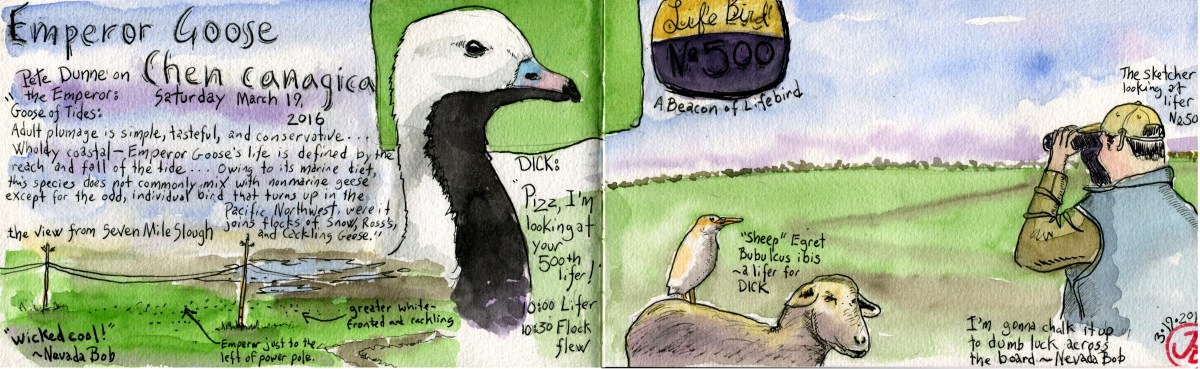
As I headed north into Marin County, blue sky started to appear over Mt. Tam. I was on my way to pick up DICK and then we headed northeast on Highway 12, past the riverside town of Rio Vista to green fields, framed by a levee to pick through the thousands of greater white-fronted and cackling geese. Our prize was a pied-headed marine goose that usually forages through the tidal flats on the islands of the Bering Sea, where it breeds, and winters on the Aleutian Islands in Alaska. A few individuals wander south to Washington and Oregon and an even fewer number, the needles, head farther south into California. Since 1884 there have been only 38 accepted sightings in California. This was the quest for the Emperor goose.

We had a vague idea where the goose might be, other birders had whiffed on it earlier in the week and our best case scenario would be that we come upon a group of birders that already had the Emperor in their scopes and we check it off our lists. Once we turned off Highway 12 I was surprised to find only one Prius load of birders. It looked like we had to find this goose on our own.

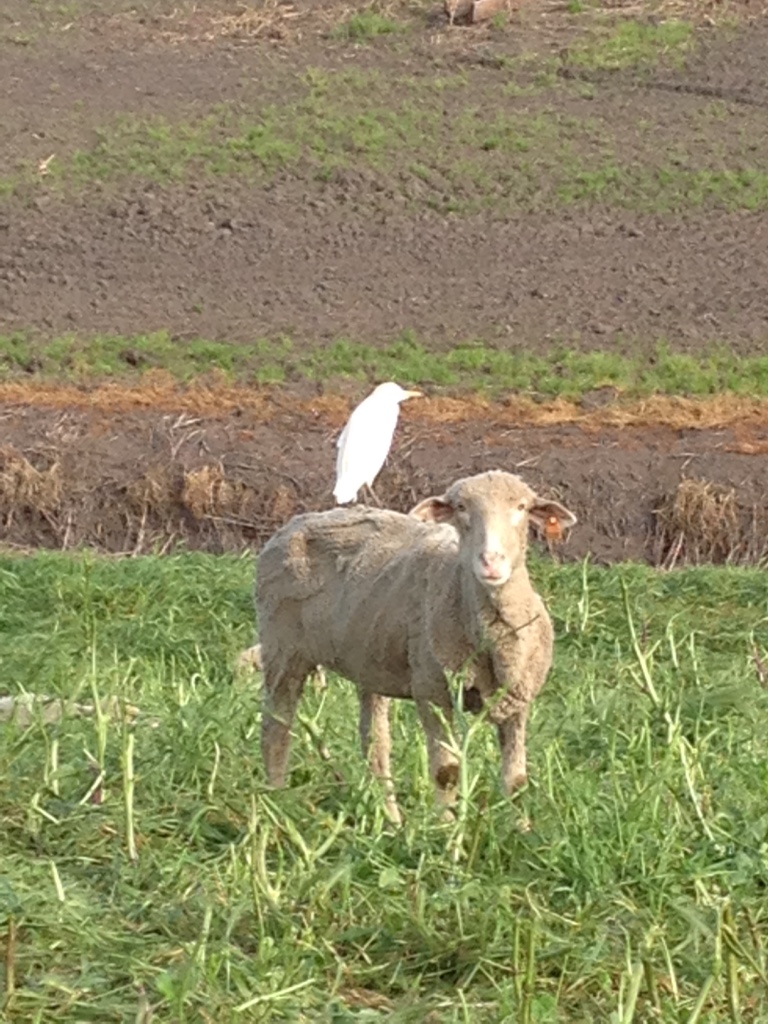
Over the vast green fields we could see little grouped specks as far as the eye could see. This was going to be a tough lifer.We turned right on the levee road, Seven Mile Slough to our left and the fields to our right. A herd of sheep grazing the hill appeared to the right. On one sheep was a “sheep” egret, a small white bird that associates with livestock. Lifer for DICK.

thumb_IMG_4141_1024

The “sheep” egret on its movable perch, otherwise known as cattle egret, Bubulicus ibis.

We stopped every time we saw a flock of foraging geese and scanned the groups for the beacon. No luck. We approached a turn in the road, leading back north towards Highway 12. We stopped and surveyed the vast mass of geese that were forging on either side of the power poles that bisected the field. They were close enough that we didn’t need a scope but there were a lot of geese to pick through. The tall green grass and the up and down feeding dance of the geese made our search even more difficult.

Five minutes into the search DICK said, “I’m looking at your 500th lifer!” I raised my glasses and looked at the flock of geese just to the left of the power pole. The Emperor raised it’s head like a beacon of light, standing out, an exclamation point that announced itself amid all the white-fronted and cackling geese. Life bird No. 500!

thumb_IMG_4151_1024

Corvidsketcher looking at life bird No. 500, Emperor goose, Chen canagica.

We were soon joined by another birder and his two dogs. Then another and another car stopped to see the goose. One couple, Nevada Bob and his wife, had left Nevada a 6 AM to see the Emperor. In all we we had great looks with the sun at our backs for about 30 minutes until something spooked the birds and the flock erupted into the air and the geese and the needle disappeared. The show was over.

Coda

Like the Emerpor’s unique head and neck, a contrast of black and white, light and dark, the experience was also mixed with pathos. Directly across the creased and pock-marked levee road  from where we found the Emperor was a handmade wooden cross with the name Tony Paul Ludricks painted across the top. I later learned that on May 24, 2015, a car veered off the levee road and into the slough. The 20 year old passenger was able to swim to safety but the driver was not so lucky. Tony was 16 years old.


Image

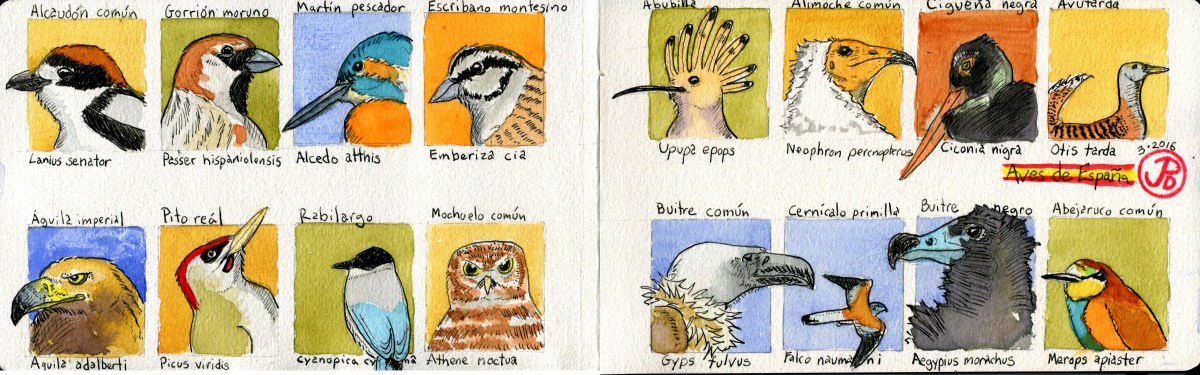
Aves de España

Before heading out on a birding trip I like to sketch the birds I might see. By sketching their form, painting their plumage, and writing down their name, I internalize the bird so when I see it in the field for the first time, a recognize the species in the same way that when you write something down or draw it, you tend to remember it better.

For a good part of my time in Spain I will be birding one of the best birding locations in Europe. Extremadura, southwest of Madrid, is world renown because it sits between Northern Europe and Africa, generating birds that are found few other places in Europe. It is the home of many raptors: Spainish imperial eagle, griffon, Egyptian, and black vultures, lesser kestrel. Not to mention the non-raptors: bee-eater, bustards, and hoopoe! Virtually every bird will be a lifer!

Each portrait includes their Spanish common name and their binomial scientific name.

The birds in English, from top left to bottom right are : woodchat shrike, Spanish sparrow, kingfisher, rock bunting, hoopoe, Egyptian vulture, black stork, great bustard, Spanish imperial eagle, green woodpecker, azure-winged magpie, little owl, Eurasian griffon vulture, lesser kestrel, black vulture, and European bee-eater.