Image

Davis Station

My brother spent almost half of his life in the Central Valley college town, Davis, California. He attended the University of California at Davis (UCD), worked in it’s public and private schools, got married, and raised his three children in “The City of All Things Right and Relevant!”

For Mother’s Day we where meeting my mother and sister-in-law in Davis so I arrived a little early to I sketch the historic train station and do a little railfanning.

Most towns start with a train station and Davisville, as Davis was then known, got their passenger depot in 1868. The original station burned down and the current station was built by Southern Pacific Railroad in 1913. The station is built in a Mission revival style. The University Farm, which later became UCD, opened five years before the current building was finished. At the time, the University wanted a befitting station to the town and the university stop. And they certainly got one!

Three passenger trains stop at Davis: the Capital Corridor, AMTRAK’s Coast Starlight, and the California Zephyr.

A view of Davis Station from Track 1. The SP stands for Southern Pacific. The bike racks in the foreground tells you this is Bike City, Davis.

I sat on the north side of the station and sketched it’s Mission Revival stylings. The station is island by three sets of tracks which at the time was an important stop on the Cal-P line. While I was sketching the station, I was very familiar with it’s curved lines, arches, and tile roof because I had sketched all of California’s Spanish Mission and a few Southern Pacific Mission Revival stations (Burlingame Station comes to mind). Davis Station and the Davis Tower are the only examples of Mission Revival in the city of Davis.

The interlocking control tower still stands just northeast of the station. This will have to be for another sketching day.
A Union Pacific freight blazes through Davis Station with it’s curved track. Union Pacific owns the tracks and freight, not passengers service, pays the bills for the railroad.

There were a few clues that a train was coming down the line at Davis Station. The first was that the signal light was green, meeting that whatever train was heading down the line had the “high ball”, in other words, the train had the right of passage. The other clue was that people began to arrive at the station with their flowers in pots or plastic; it was Mother’s Day after all.

At 10:40 AM, a westbound Union Pacific freight train sped through the curve at Davis Station on track 1, the engineer giving me a thumbs up as the train rumbled through. At 10:50 AM, on track 2, the eastbound Capital Corridor train #724, pulled into Davis to take on passengers on her way to California’s capital: Sacramento.

The westbound Train # 731 was right on time and pulled into Davis at 11:10 AM. This Capital Corridor passenger train was heading to San Jose.

On point was locomotive 2004. I looked down at the front truck, containing the leading axels of the locomotive and stenciled, in yellow, where the two letters “GP”. In an odd bit of coincidence, I has replaced the initials “SP” on the Davis Station with my brother’s initials, “GP”, as an honor to his memory.

A westbound Capitol Corridor train pulls into Davis Station on it’s way to San Jose. On point is Locomotive 2004, an EMD F59PHI with “California” styling. I should say so.
In one of those “I-can-make-this-sh*t-up” moments, the initials “GP”, my bother’s intials, were stenciled into the trucks of locomotive 2004. Unreal.

Image

California Zephyr Train #5: Denver to Colfax

My return journey was a beautiful but a somber one.

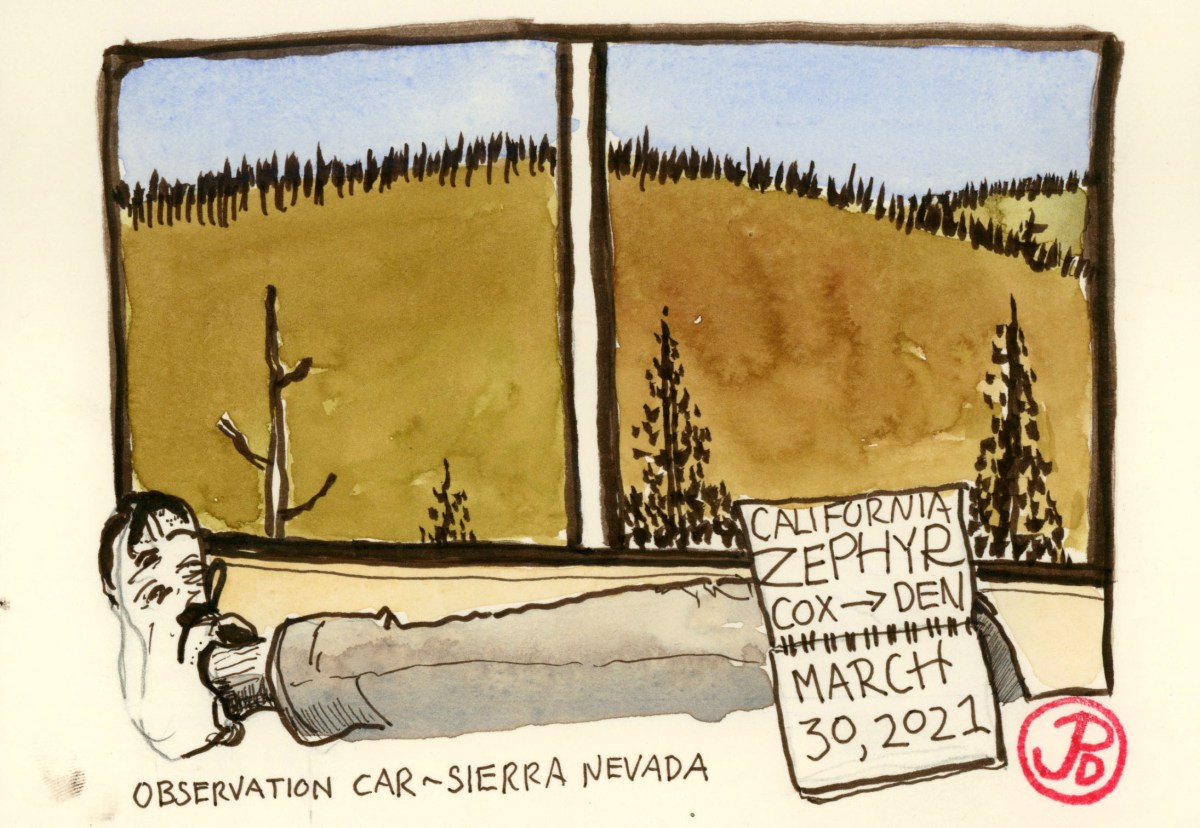
I spent much of my time in my roomette with short trips to the dining and observation car.

Taking the train back gave me the chance to reflect on the almost 47 years of my brother’s life. I lost myself in the landscapes and continued to sketch during our brief “Sketch Breaks”. Sketching provided the focus and “in the moment” experience my soul needed. Sketcher therapy I suppose.

One other activity that kept my mind busy was train birding. I created a list of all the birds seen from the train, without binoculars. I tallied 43 species as well as six mammals including elk and bighorn sheep. A highlight was having an adult bald eagle keeping pace with the Zephyr while we followed the Colorado River in Utah.

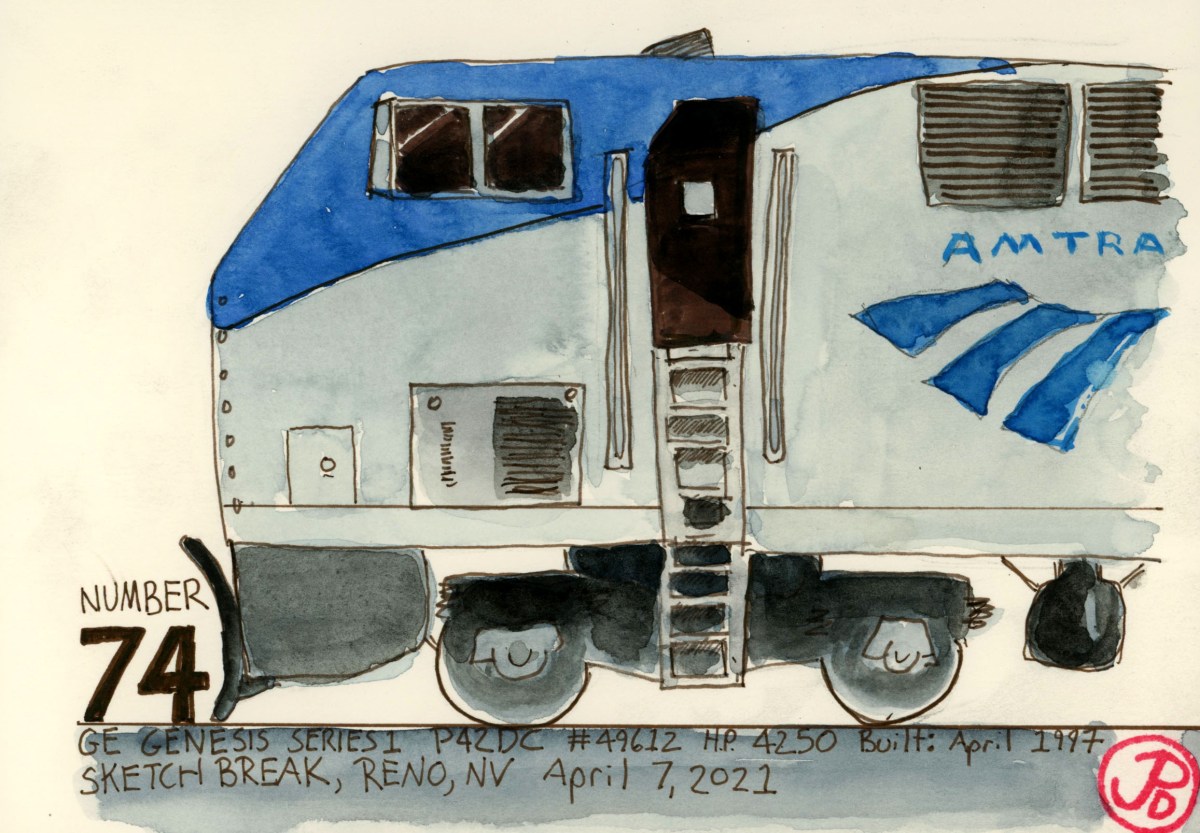
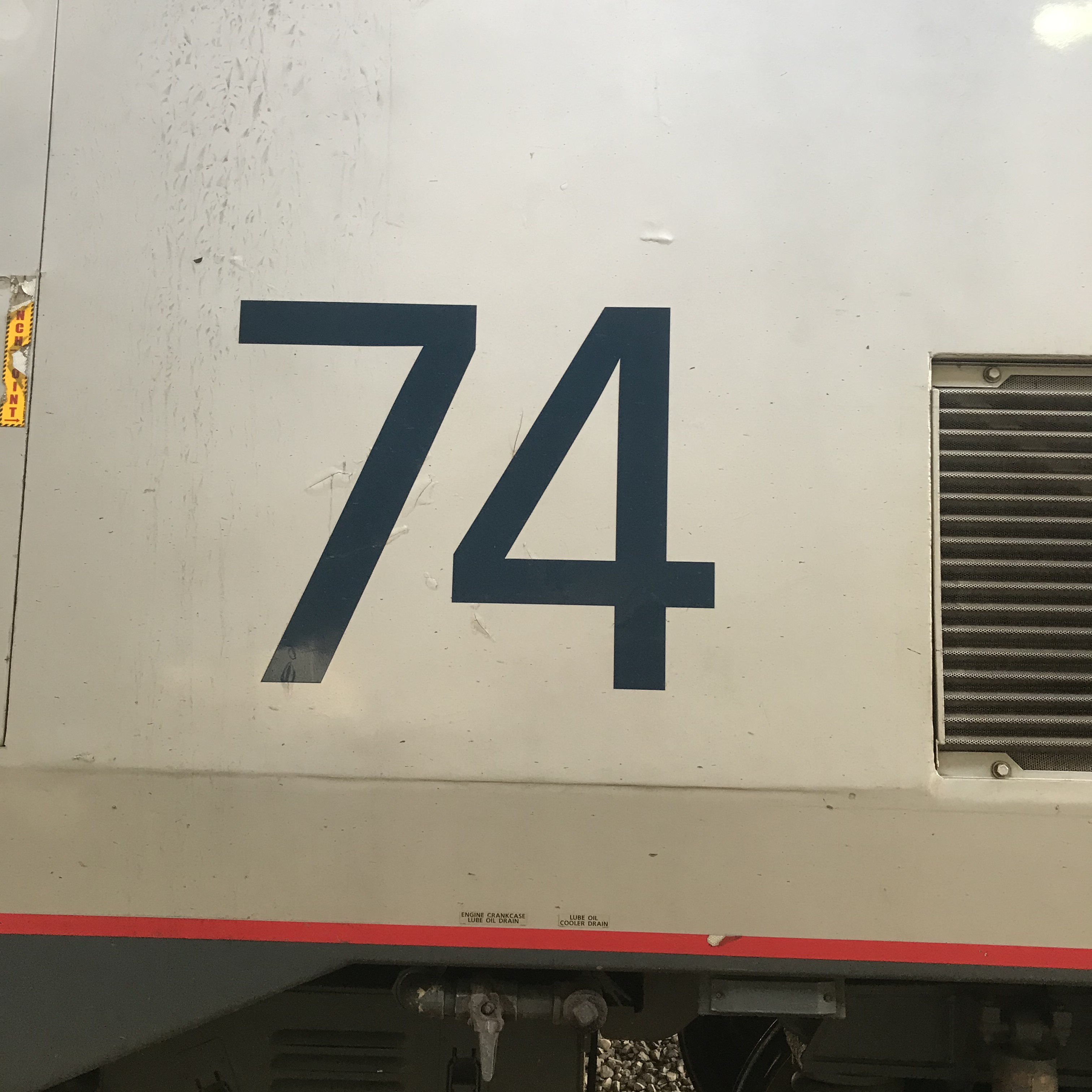
In Reno, the Zephyr pauses for a little longer than most stops because there is a crew change. This is when the engineer is replaced by a fresh one. During this time I sketched the profile of the locomotive on point, a General Electric P42DC, built in April of 1997. In an uncanny instance of coincidence, the locomotive number is 74, my brother was born in 1974. This seems to be the perfect locomotive to lead me back home to my mother.

1974 was the year of my brother’s birth. It was also the number of the locomotive on point that would take me back to my mother.
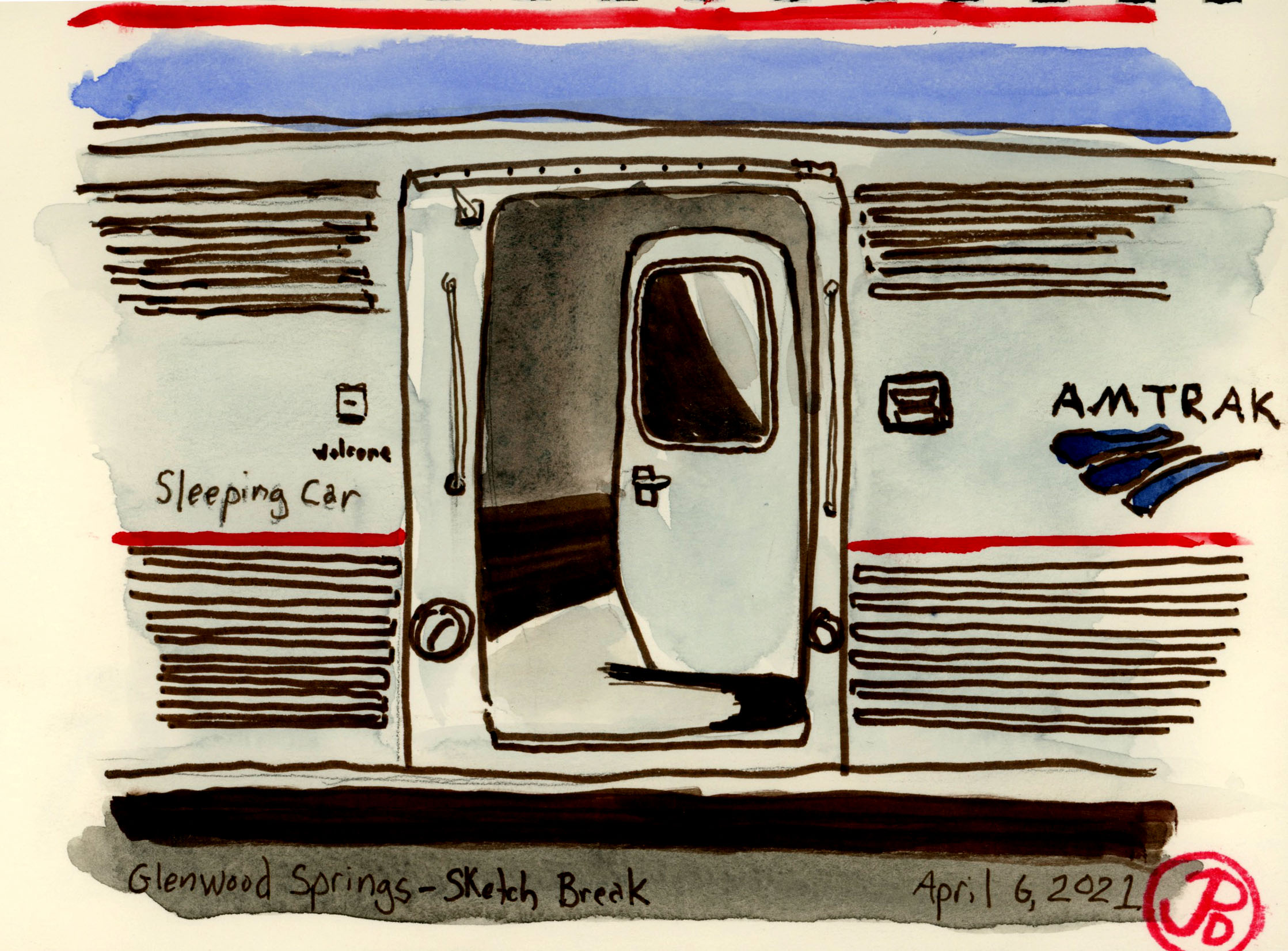
A quick sketch of my Sleeping Car entrance during a sketch break at Glenwood Springs. My sleeping car was just behind the locomotives. I added watercolor once I was back in my roomette.
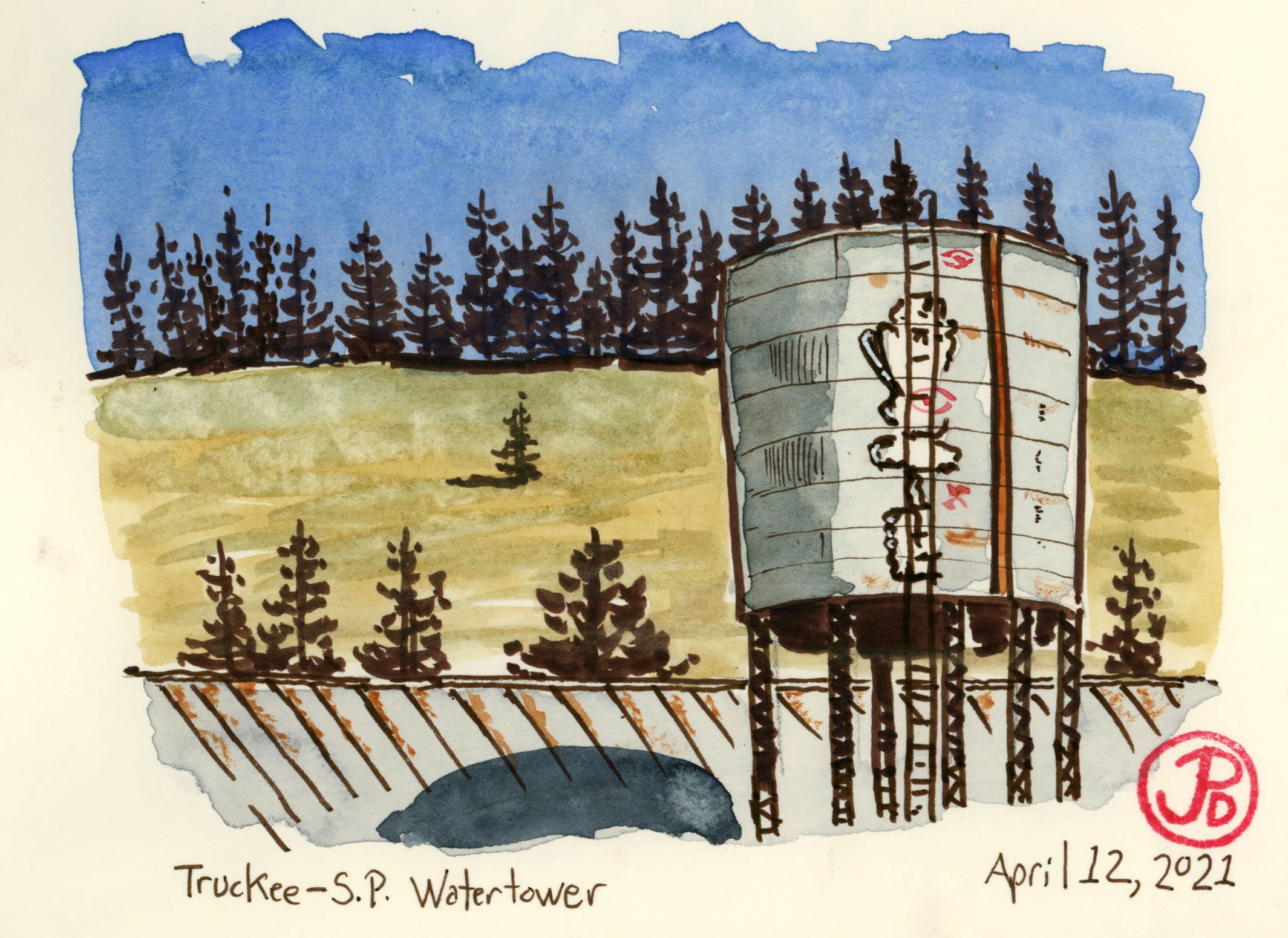
I had spent time during the last year sketching the existing Southern Pacific water towers. So I knew the form well. I was surprised to see from my Superlunar perch, an existing water tower as we pulled out of Truckee to climb Donner Pass. I have been to Truckee many times but I had never seen this tower. I returned later to capture the water tower. There are 15 surviving examples in California. I have seen about five.

In Truckee, I called my mom to let her know that California Zephyr Number 5 was running on time. This was going to be the first time I had seen my mom since learning if my brother’s passing. I suppose that I could have booked a last minute fight from the Mile High City to be there much sooner but the pace, the landscape, and the rocking lullaby of the Zephyr seemed to be the right choice for taking me back to California.

At this point I was on the route of the first Transcontinental Railroad. And I would need the strength of those who built it to face the reality, once I stepped off the Zephyr at one of the Central Pacific’s rail camps that was later renamed Colfax.

The anticipation mounted as we ascended down the western flank of the Sierra Nevada Mountains, each mile bringing me closer to my mother.

In past train journeys, one of my favorites scenes is when a train pulls into a station and looking out the window, I see someone alight from the train, search the platform for that familiar face, and then the embrace. I don’t always know the relationship contained in that embrace but it is a story on that reunion of love, in the the stage of the train depot.

What would the observer on the second story of the Superlunar have thought of the man departing the train and embracing someone, clearly his mother, in the middle of the street in Colfax?

I know what I would have though, and I did.

Image

Sketches From the Zephyr

Sketching from a moving train takes practice. I figured I had sketched from a moving boat racing up the Cristalino River in Brazil, how hard could this be?

It always helps to have an expansive view, perhaps of a mountain range in the distance that moves slowly, while the foreground blurs by. In any case you have to work fast and create a quick image from different snap shots from the journey.

It helps to have a few tricks in your sketcher’s toolbox. You have to capture things quickly, using a bit of short hand when trying to get the “essence” of the scene. This means leaving a whole lot of information out. You have to only include what is the most important. Good thing the average speed of the California Zephyr is only 55 miles an hour, the maximum speed limit when I got my driver’s permit. The reason for the slow speed is because the Zephyr is on a freight route. These rails are not built for high speed. The trade off is that sketching from the second story of a Superliner car is a bit easier.

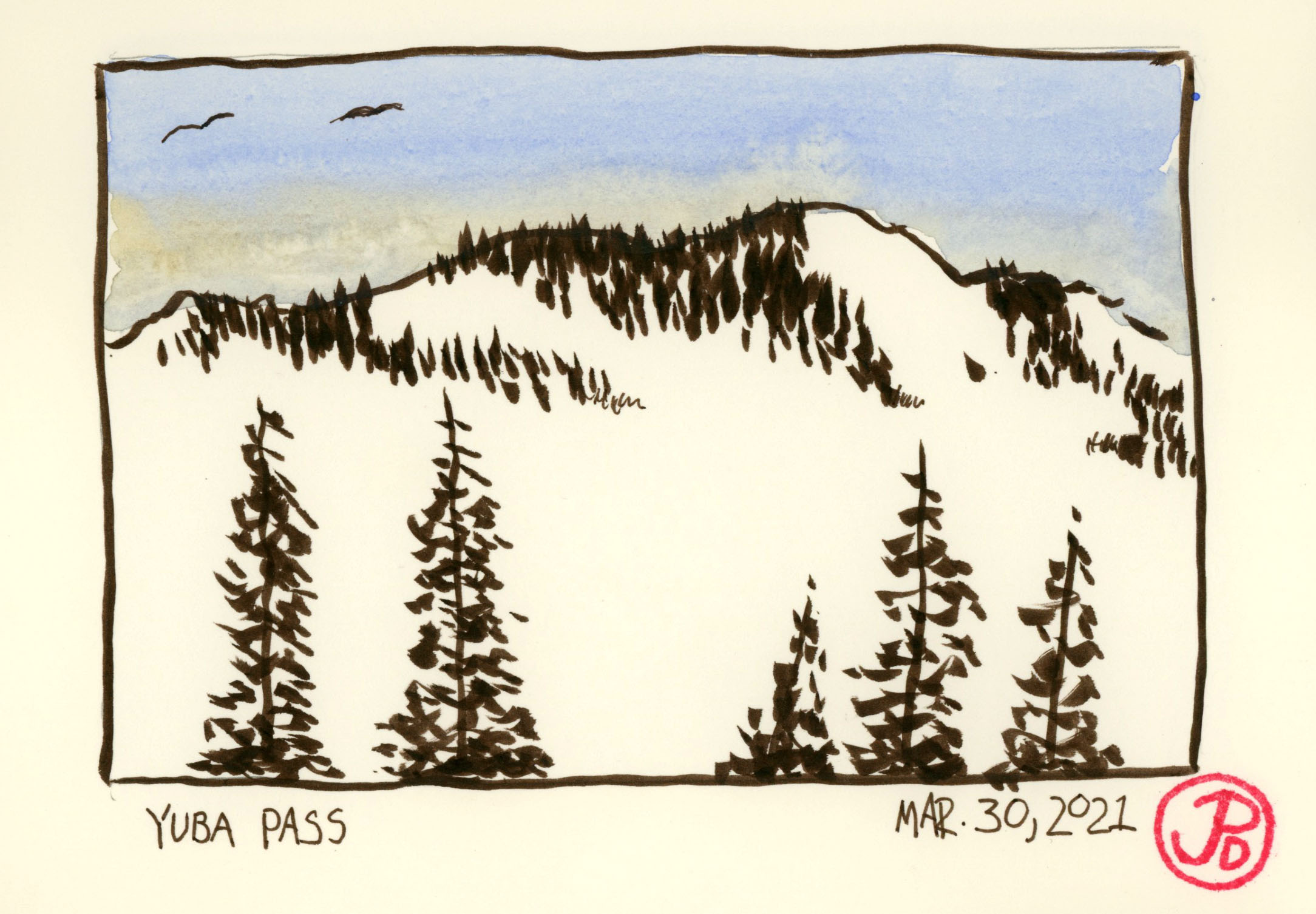
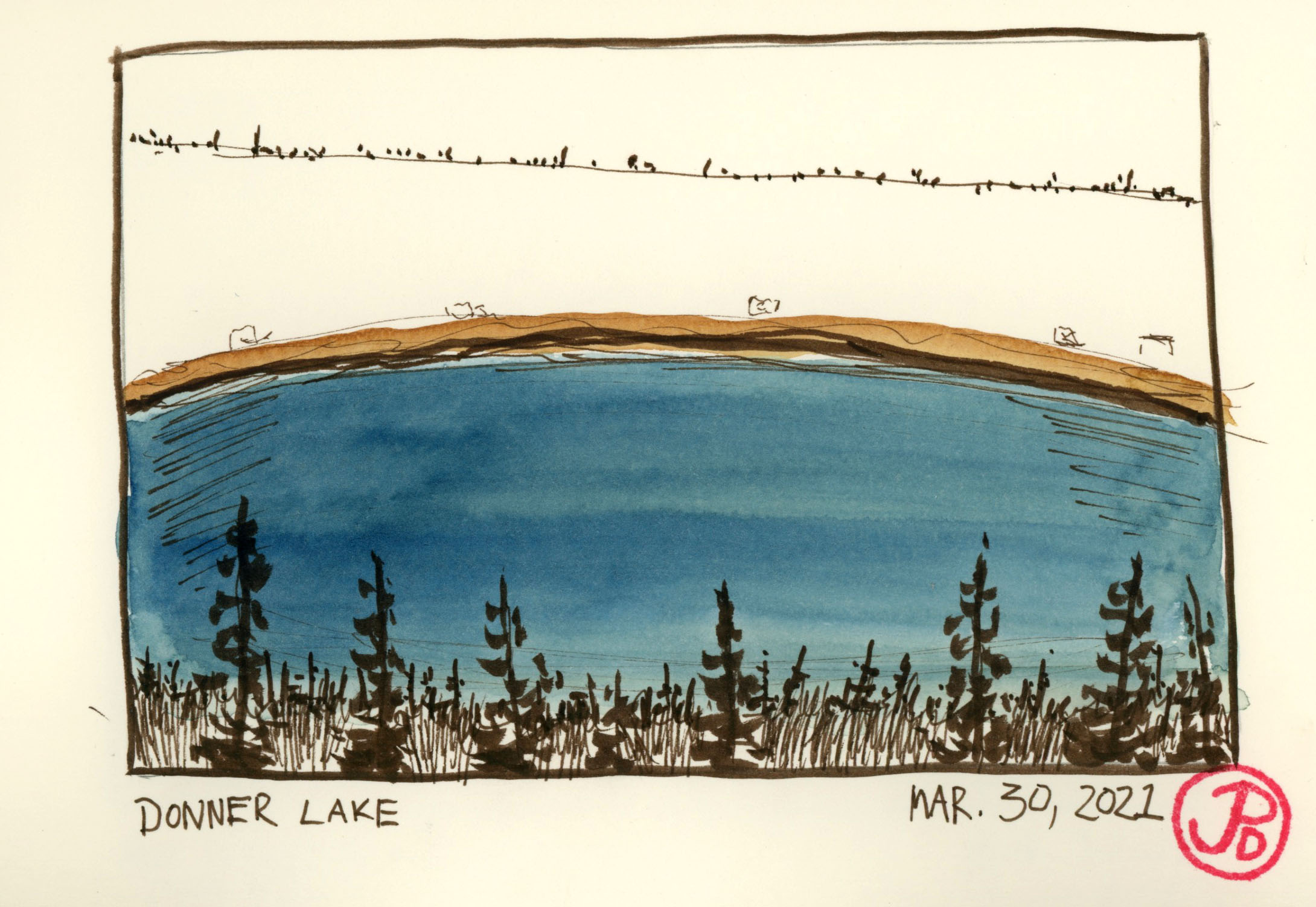
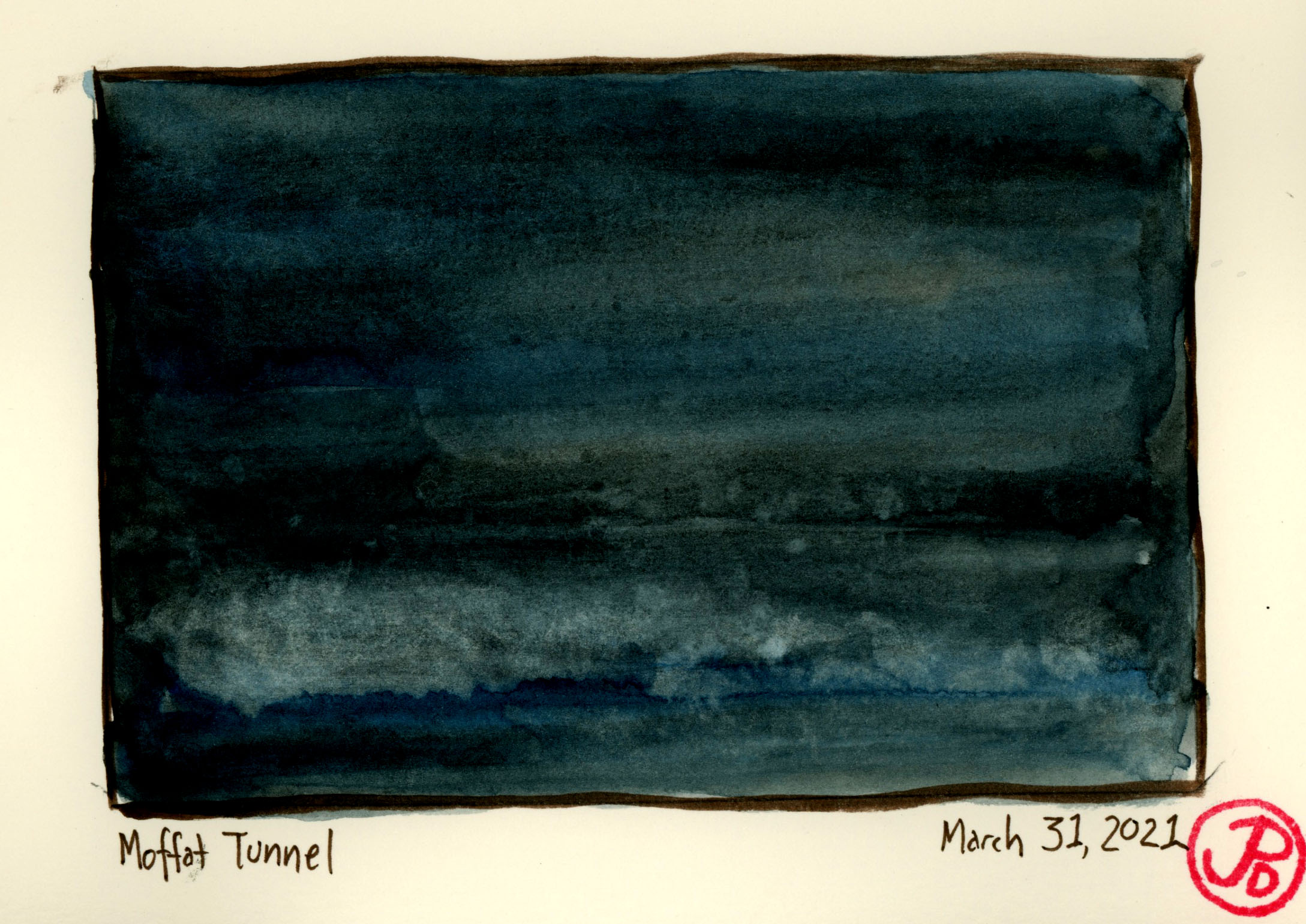
Below are a few Zephyr sketches from Colfax to Denver.

A observation car quick sketch from Yuba Pass.
Donner Lake, formerly Truckee Lake. The east shore was the sight of the lake camps of the Donner Party in the winter of 1846-47.
Okay I will have to admit that this one is a bit tongue and cheek. Moffat Tunnel crosses under the Continental Divide and is six miles long. It takes the Zephyr ten minutes to pass through the tunnel.

Moffat Tunnel was first opened in 1928 at an altitude of 9,200 feet. At 6.2 miles long, it is the fourth longest railroad tunnel in North America. About 15 trains a day pass through Moffat Tunnel which is about 50 miles west of Denver.

Image

California Zephyr #6: Colfax to Denver

“Trains seems to rattle out stories, as though the motion of the track acts to shake up thoughts and loosen tongues. There’s a world outside the window and a whole separate world within.” ~Ticket the Ride, Tom Chessyre (My California Zephyr book)

For a while now I have wanted to ride the California Zephyr, one of AMTRAK’s most scenic routes.

Last Spring, I had to cancel my train journey but this Spring Break I booked an abbreviated trip, not departing from Emeryville but Colfax and detraining in Denver instead of Chicago.

I chose Colfax because it is a 35 minute drive from my mother’s house in Penn Valley. The train was running two minutes late. When I would finish the journey to Denver, the number 6 was running two hours late. Freight trains are given priory over passage service like the California Zephyr.

Four other people boarded at Colfax, two middle aged women looked like they were headed to Reno. The two other travelers were a bit older and appeared to be heading further down the line. They are all traveling in coach. I never saw them again.

Colfax is not one of the “Fresh Air- Smoke Break” stops (oxymoron I know), so the Zephyr stops only long enough to pick up or drop off passengers.

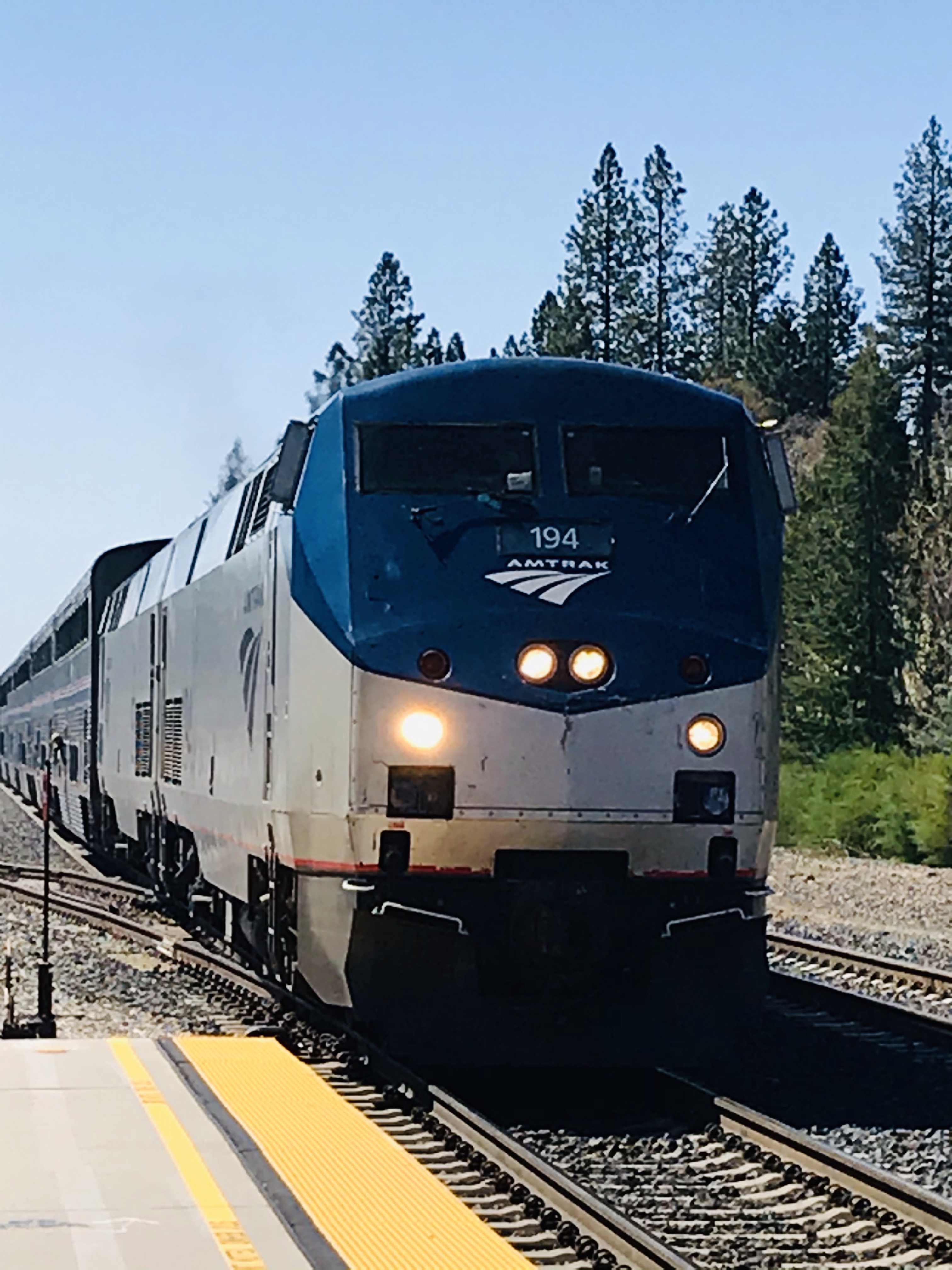
The California Zephyr train # 6 pulling into Colfax running two minutes late. On point is a General Electric P42DC, built September of 2001. Number 194 and 153 are now 20 years old.

Number six pulls into Colfax. The platform is too short for the two locomotives with the eight car consist. I am on the first car behind the locomotives, sleeper car 32048 and roomette number 003. This will be my address for the next 30 hours or so. Once I have boarded, the train slowly pulls forward so the Reno travelers can board the coach car, at the end of the train.

There is something wonderful about stepping off the platform and into another moving world. The California Zephyr is a self-contained world with everything you could possibly need: food, drink, a bathroom, and a bed (not to mention the amazing views).

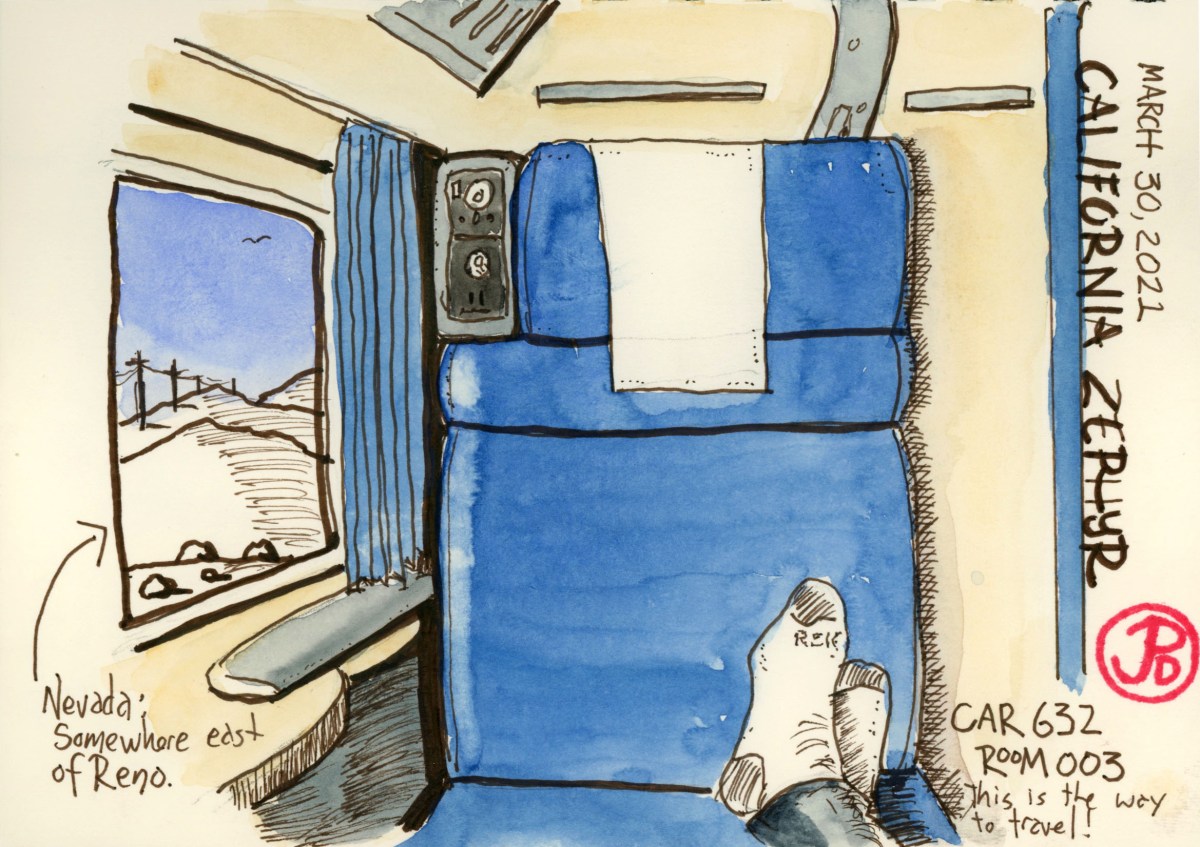
The locomotive throttled up and headed east out of Colfax and my car attendant showed me to my roomette (featured sketch). I set my bag down and I headed to the opposite side of the train to see the first of many views: Cape Horn. If there is one problem with the Zephyr is that there are great views on both sides of the train and unless your sitting in the observation car, your roomette faces only one side of the train.

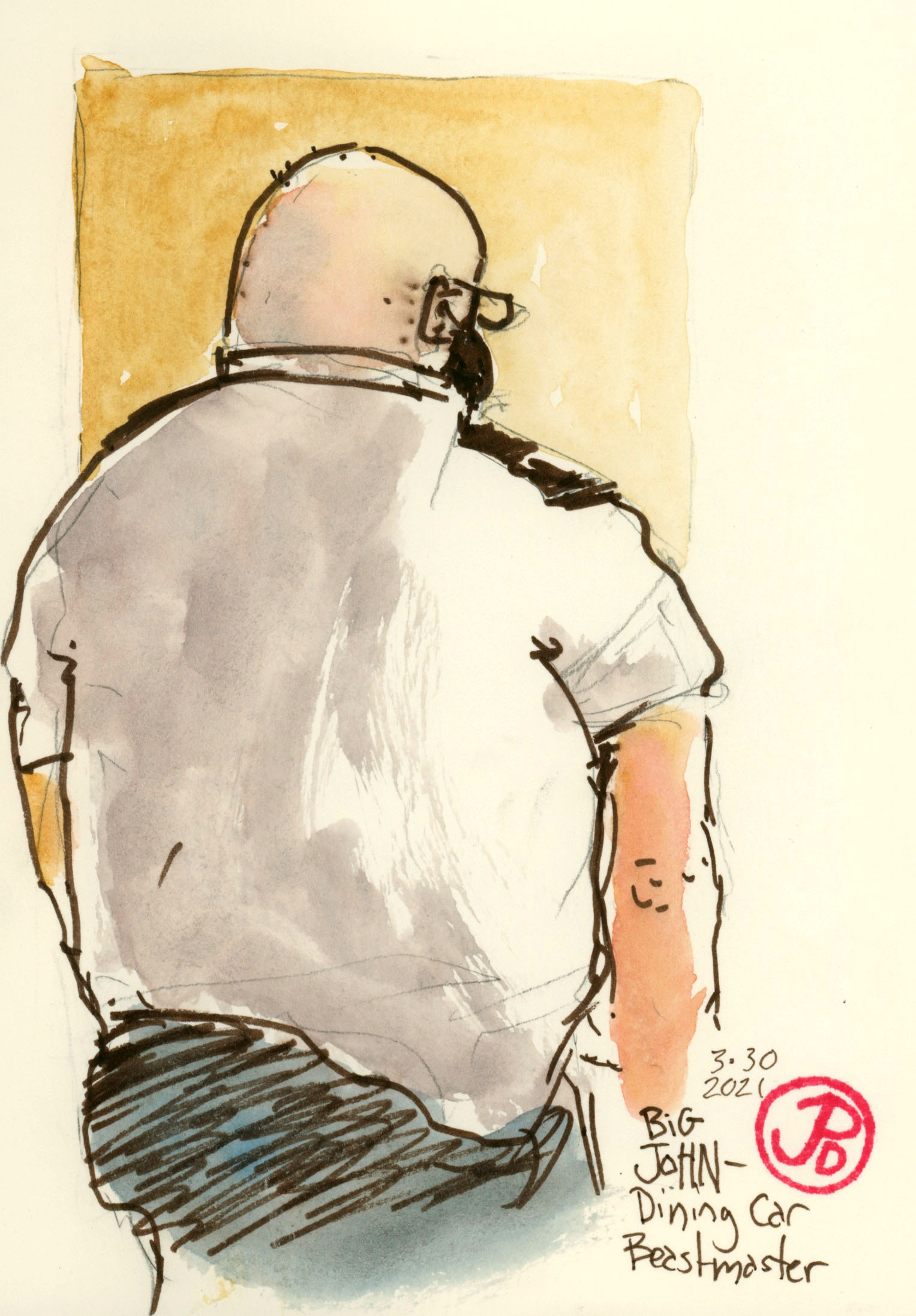
I book a late lunch in the dining car with the dining car attendant, John. I head to the observation car and wait for my name to be called. Here I do my first sketch abroad the Zephyr. Over the course of the journey I do many more.

John, also known as Big John, seems to have worked for Amtrak for a while. He reminds everyone that they are short staffed for this leg of the journey. This is because many of the Amtrak workers have been furloughed because of Corvid-19. At one point, one of the engineers helps out with lunch service. Don’t worry. Some engineers are on board and there was someone at the controls as we headed over the Sierra Nevada Mountains.

I enjoyed talking train talk with the engineer, now promoted to dining car assistant. He tells me a little about the locomotive and we discuss the recently restore Big Boy 4014, that largest steam locomotive in operation.

After lunch I head back to my roomette and do some more scenic sketches.

Image

Post 400: A Zephyr Deferred

Zephyr: (n) a gentle wind from the west.

Last spring break I booked a roomette on the California Zephyr, a 2,438 mile journey from Emeryville, Ca to Chicago, Il. This route passes through such cities as Sacramento, Truckee, Reno, Salt Lake City, Denver, Omaha, and Chicago. It is one of the most scenic routes on the AMTRAK network.

Last spring I was going to travel the entire route but then Covid 19 happened and I had to cancel the trip. I knew that this rail dream was deferred and at first chance I would rebook this trip because I have always wanted to travel by rail through the Sierra Nevada and the Rocky Mountains.

The opportunity came in spring break of 2021. Instead of traveling the whole route, I booked a round trip with a roomette from Colfax, Ca (near my mom’s house) to Denver, Co. This stretch includes the most scenic parts of the route and Denver provides it’s own destinations.

On this trip, I plan to do many quick sketches of train views along the route. At California Arts Supply in San Mateo, I got a custom Ronquad which is a 4 by 6 piece of card stock that would be a template for framing each sketch. I used my Ronquad on the featured sketch.

But why Denver and not Chicago? Both cities provide great sketching opportunities but Denver has an edge over Chicago: life birds! I had a few ABA lifers on my list: scaled quail, dusky grouse, American three-toed woodpecker, brown-capped and black rosy-finch, sharp-tail grouse, and the much sought after white-tailed ptarmigan. And while Chicago offers lots of architecture sketching opportunities, Denver has that too but also beautiful landscapes.

The Zephyr stops at the historic Union Station in downtown Denver and I booked a “Pullman” room in the hotel at the station, the Crawford Hotel. I admit this is a bit a splurge but I love the idea of stepping off the train in the evening, after a two day trip, and walking a short distance to my room in Union Station. It seems a throwback to a different era. An era when more people travelled by rail, when the airline industry was in it’s infancy.

As I do before any trip, I do a few sketches to build knowledge and excitement. The featured sketch is from the AMTRAK website for the California Zephyr. This location looks to be somewhere in the Rocky Mountains. I also like to do a map of my future journey. In this case, Train 6, from Colfax to Denver with all the stops in between.

California Zephyr map showing all the stops from Colfax, Ca to Denver, Co.

Image

California Zephyr and Southern Pacific Ghosts

On a Saturday morning I drove over the Bay Bridge to the Emeryville Amtrak Station to sketch the California Zephyr Train # 6. This is the train I booked a roomette on back in April. I had to cancel the trip because of the pandemic. This route usually runs seven days a week but with the current Covid situation, it now runs just three times a week: Tuesday, Thursday, and Saturday. Unfortunately I would not be board the train, although it was very tempting!

I wanted to challenge myself to do a quick sketch because I didn’t know how long the California Zephyr would be at the platform before it departed. I guessed I would have at least 15 minutes because the engineer stepped out of the cab and walked down the platform to a get a packed lunch while the conductors assisted with boarding. I liked the ephemeral nature of this challenge because unlike a piece of sculpture or architecture, the Zephyr was not going be here for long. For this task, it helps to have a smaller journal so I went with my Stillman & Birn Delta Series 6 X 8″ sketchbook.

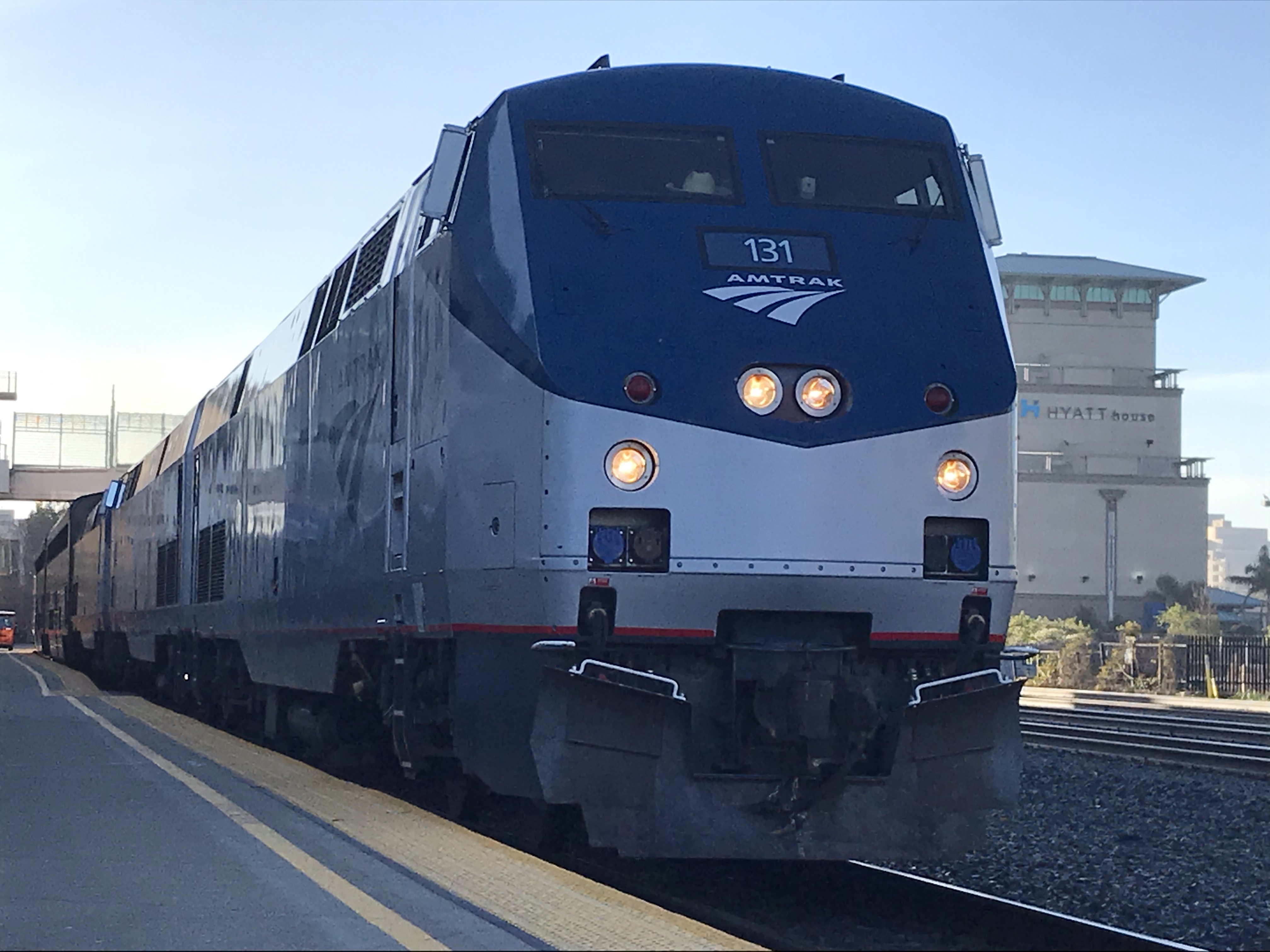
California Zephyr # 6, pulling into Emeryville Station. This is one of Amtrak’s longest routes. In three days time it will end it’s journey in Chicago. Note the cowboy hat in the window. This consist was a little odd because it contained three instead of two locomotives. It also did not include a baggage car, so the Zeph has no baggage.

I also wanted to work with perspective by sketching the train as it reversed toward my eyeline and vanishing point. If you don’t get the perspective right, the whole sketch can fall apart. That’s why it’s best to lay in your perspective lines in pencil.

Emeryville is the western terminus of it’s 2,438 mile journey and train number 6 pulled into the platform at 8:45 AM to take on it’s first passengers. I first established where my eye or horizon line was by holding my pencil straight out at arm’s length and closing one eye. I added the line to my sketch. I then blocked in the position of the front of the locomotive. Next, I added the vanishing point on the eyeline. This is where all the lines of the receding train converge. Now it was about adding shapes and details and then inking the sketch before the Zephyr departed at it’s schedule time of 9:10 AM.

Eastbound California Zephyr heading out towards the north and eventually climbing out of the Sacramento Valley up into the Sierra Nevada Mountains towards the legendary Donner Pass. On the platform, wearing a red coat, is a fellow train nerd. In three days and 2,438 miles later, the Zephyr will end it’s journey in Chicago.

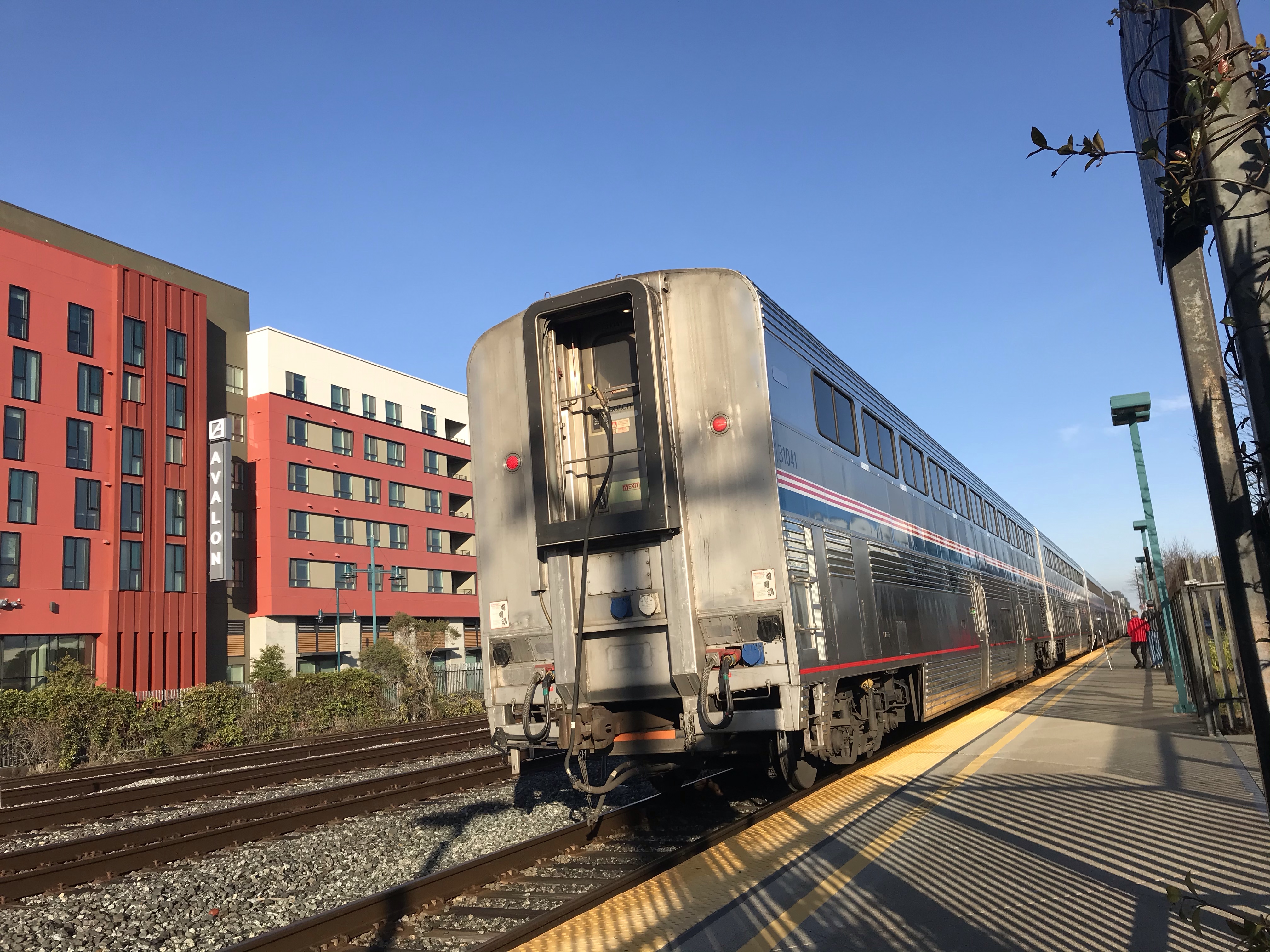
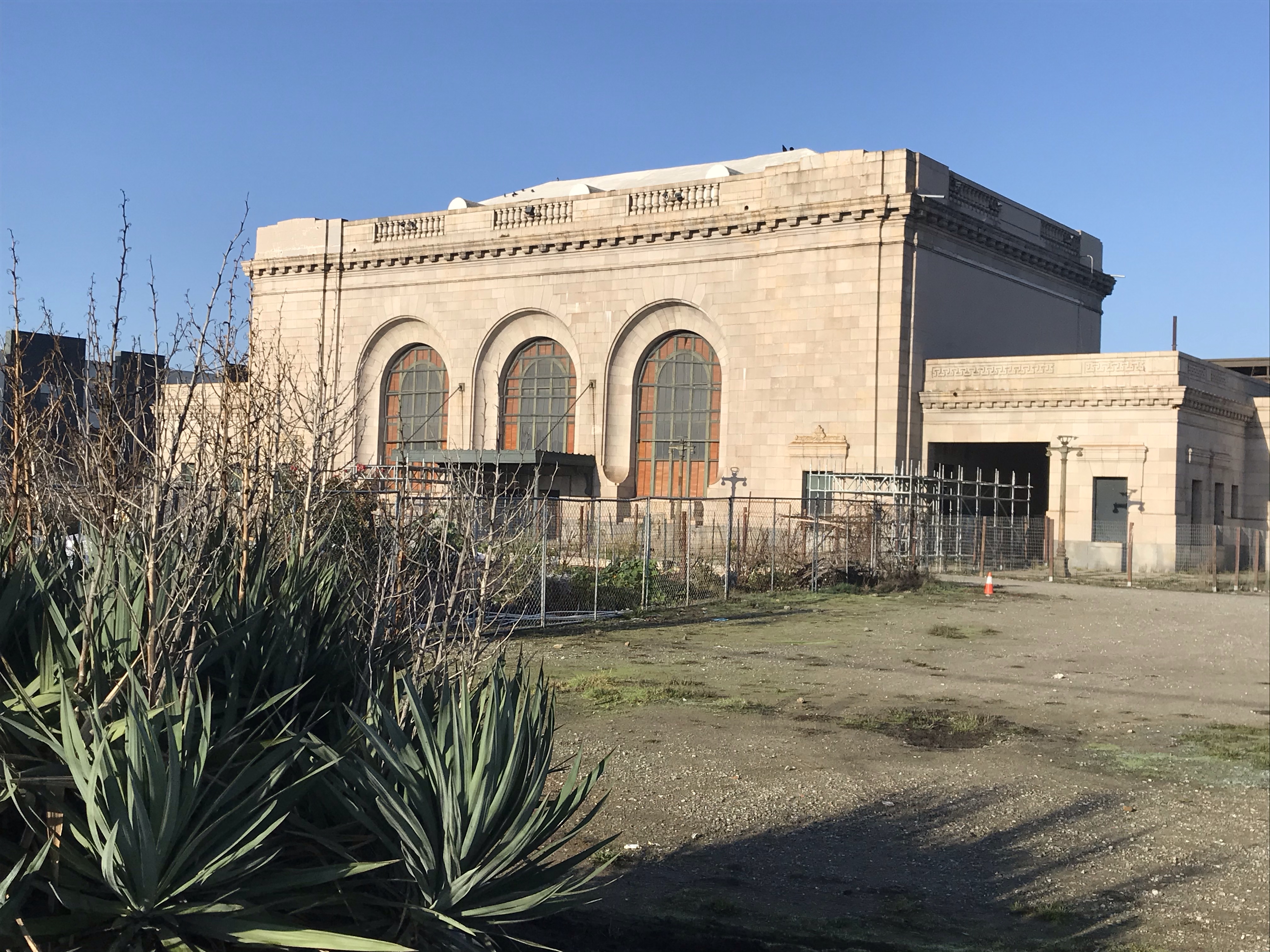
After the California Zephyr departed, right on time, I headed south into West Oakland to take a look at the old station that Emeryville Station replaced. This is Oakland’s 16th Street Station.

The current building was designed by architect Jarvis Hunt in a Beaux-Arts style and completed in 1912. It was Southern Pacific’s main passenger station in Oakland. Passengers could take ferries from Oakland Pier to San Francisco, which was two miles away.

Once the Bay Bridge was built, in 1936, it put an end to ferry service and passengers then could take buses over the bridge to get into San Francisco. In 1971, Amtrak took over passenger service from Southern Pacific.

On October 17, 1989, the Loma Prieta Earthquake struck, severely damaging 16th Street Station. The earthquake also damaged the Cypress Structure, which was parallel to the railroad tracks. 14 blocks of this double deck freeway structure, collapsed or was damaged starting at 16th Street and heading to the MacArthur Maze. In total, 42 people lost their lives here. The most in any single location.

In the 1990’s, the rails were removed to make way for the construction of the 880 Freeway which replaced the Cypress Structure and 16th Street Station was left marooned without rails. The station was closed on August 5, 1994.

The abandoned 16th Street Southern Pacific Station. This was once the terminus of the superliner, the City of San Francisco.

From 16th Street Station I headed two miles to the Oakland Pier. This was once the busy hub of Southern Pacific’s Western Division. Oakland Pier was one of the busiest rail terminals in the country handling 763 trains a day and 56,000 passengers in a 24 hour period.

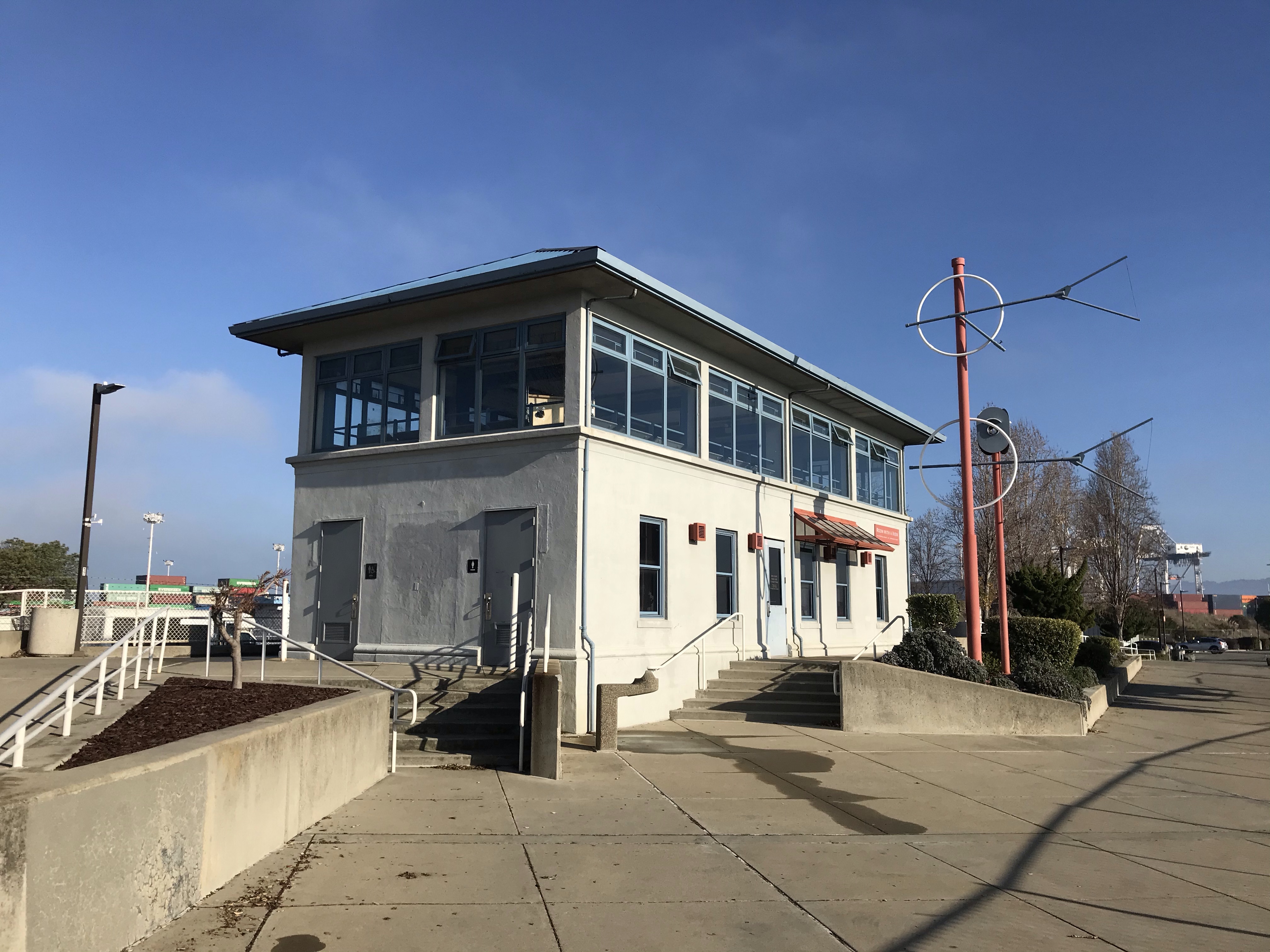
To control all this rail traffic, the Oakland Pier Control Tower made an average of 1,900 switches in a day! The majority of railroad tracks are now gone and the Oakland Pier is busy with shipping and truck traffic. The only reminder of this busy railroad hub is the remaining control tower.

The massive Oakland Pier interlocking control tower. The two poles to the right were used for “hooping up” orders, which was a way to pass orders to a train in motion. Using these poles to transfer train orders meant that the train did not have to stop to pick up orders. The tall pole was either for the engineer or fireman and the shorter one was for the conductor in the caboose.
Image

California Zephyr, Colfax

“The only way of catching a train I have ever discovered is to miss the train before.” ~G. K. Chesterton

The romance of the rails on a long distance journey has always been calling me. Being rocked to sleep to the rhythm of the rails and meeting strangers on a train, drew me to want to go on an American rail odyssey. On my Spring Break, I booked a ticket on the California Zephyr, from Emeryville in California to Chicago, Illinois. This is Amtrak’s longest daily route. The route covers 2,438 miles and makes 33 stops.

Then the pandemic was upon us and I cancelled by railway journey and sheltered in place for my two week break in the Santa Cruz Mountains. The lure of the rails became the lonesome far-off whistle of a Johnny Cash song (sans Folsom Prison of course).

During early July, I visited my mother near Grass Valley in the Gold Country. She lives 40 minutes away from one of the 33 stops on the California Zephyr Route. So I decided to go make the drive to Colfax.

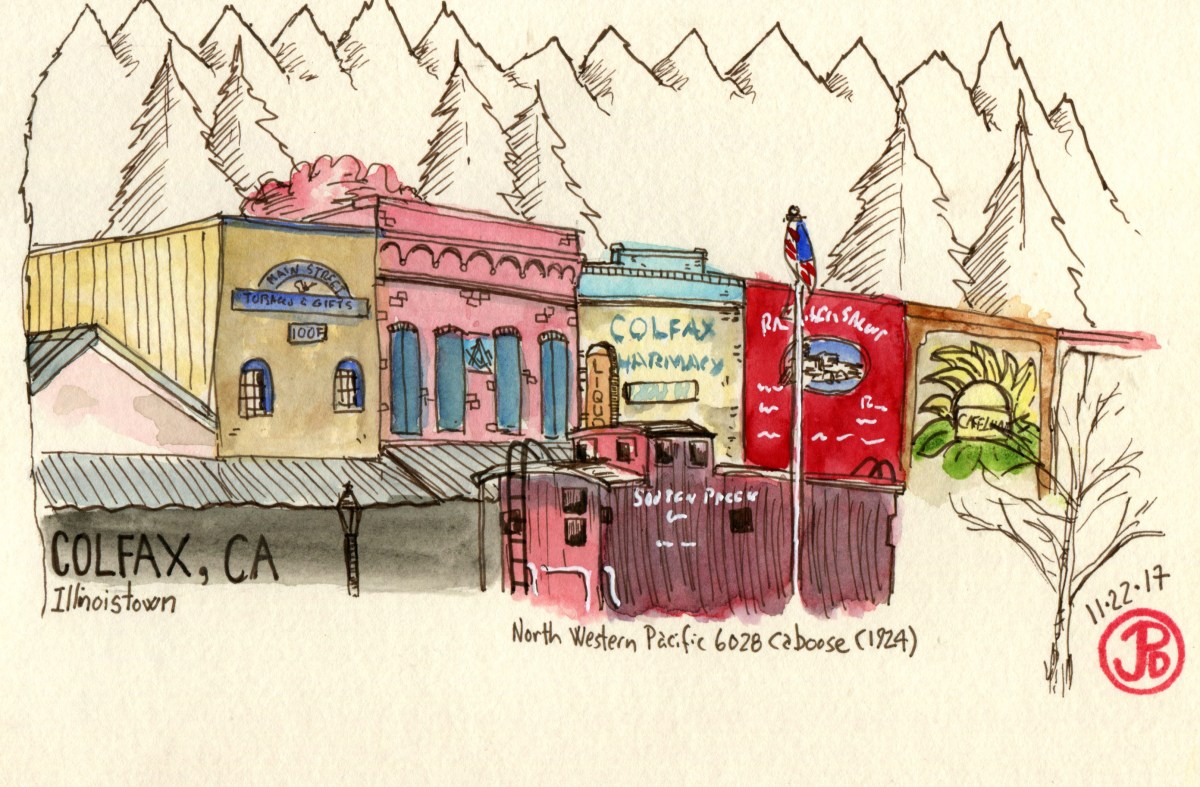
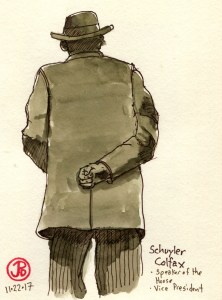
Colfax is on the route of the Central Pacific side of the Transcontinental Railway and it was, at one time, a railway camp called Camp 10. The camp was later called Illinoistown but was again renamed after the Speaker of the House, Schulyer Colfax by Leland Stanford, when Colfax came to see the progress on the railroad. Colfax later served as the 17th Vice President during Ulysses S. Grant’s first term.

The town of Colfax (population 1,800) bears an important meeting point of the east and westbound Zephyrs. The westbound train (Number 5) arrives at Colfax at 11:48 AM. The train’s final destination is Emeryville in the San Francisco Bay Area. The eastbound train (Number 6) arrives less than 30 minutes later at 12:21 PM. Train number 6’s finally destination is Chicago, the journey will end about 50 hours later, if the the Zephyr is running on time.

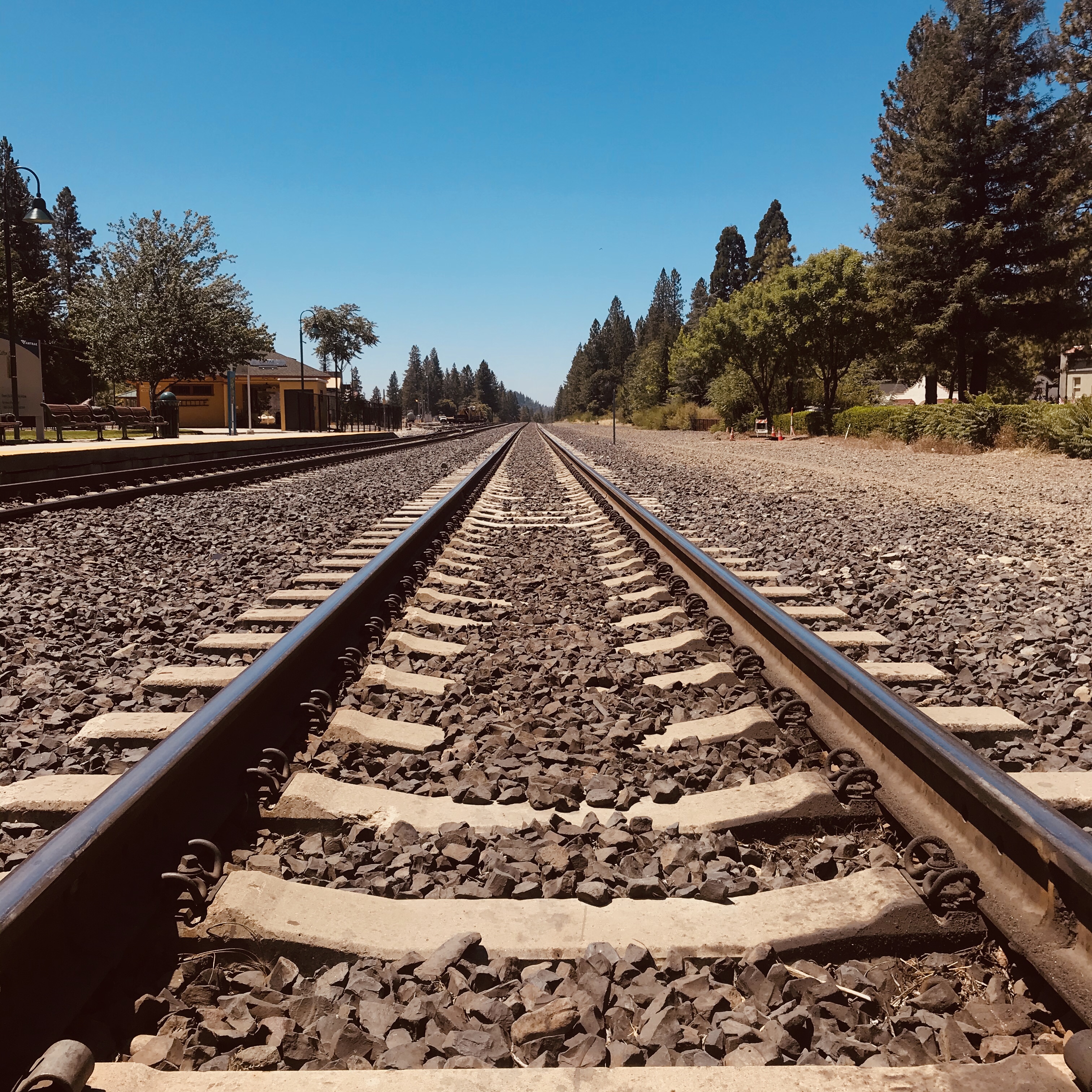
Looking westward down the rails of the transcontinental mainline. The historic Southern Pacific Colfax depot can be seen on the left.

I arrived at Colfax Depot at 11:20. Train number 5 was running on time so I found a view point next to the line and sketched in the perspective, the railway crossing sign, and the background trees. Now all I needed was the California Zephyr to pull in for her portrait and do a quick sketch with my brush pen before she departed. I figured I had about five minutes.

Westbound California Zephyr arrives at Colfax headed by two General Electric P42DC diesel-electic locomotives.

The westbound Zephyr was running a little early, which was pretty incredible because the train’s origin was Chicago. The train rolled to a stop and two passengers disembarked and I was able to get a loose brush pen sketch in before the train made it’s way down the gentle slope of the western side Sierra Nevada Mountains towards Sacramento, the original terminus of the Transcontinental Railroad.

The eastbound train was running about 20 minutes late. So I crossed the tracks and found a new vantage point right next to the rail crossing guard. The Chicago bound Number 6 pulled into Colfax and I have a short time to sketch the Zephyr. A woman passenger had decided to crossed the tracks, always a bad idea with an approaching train, and she became cut off as the Zephyr blocked the road and sidewalks to load and unload passengers. I’m not sure if she caught her train.

While I longed to catch the train I missed back in April, it was good to see, if not sketch, this iconic American railway route, the California Zephyr.

Image

California Zephyr

I have always wanted to travel on the original Transcontinental Railroad, from the West Coast to the East and see some the sights from the original right of way over the Sierra Nevada and Rocky Mountains. The closest you can come to doing this today is by taking the California Zephyr.

AMTRAK operates the California Zephyr from Emeryville to Chicago (not the East but the Middle Coast). The daily route covers 2,438 miles and takes 51 hours and 30 minutes (that is if the train is running on time). The route covers seven states and stops at 35 stations including Sacramento, Reno, Salt Lake City, Helper (Utah), Denver, and Omaha, to name a few of the major stops.

So I booked a roomette for my Spring Break in April. Which at $550, I thought was a good deal because it included two nights and all the food was part of the fare.

Since the time of booking the trip, the spread of Coronavirus and Covid-19 (not related to Corvid in any way!) in the United States has thrown a monkey wrench into the works. At this time my continental train trip hangs in the balance as some predictions estimate that the virus might spike in late April.

One thing that I sketched, regardless of if I would be boarding the California Zephyr in Emeryville in early April or not, was to sketched out the route with all the stops in a visual map (featured sketch). I also drew the locomotive that is used on this route, the P42DC, with all it’s specifications (below).

The workhorse of much of AMTRAK’s long distance routes, General Electric’s P42DC.

Image

Camp 20-Illinoistown-Colfax

November 22, 2017. Colfax Train Depot.

I have always loved train travel. The idea of a traveling community that passes through landscapes, towns, and cities in stasis. On this day, one of the biggest travel days of the calandar, I was in stasis in an important railway town on the transcontinental railway, Camp 20. Later to become Illinoistown and later renamed for the Speaker of the House, Schuyler Colfax by then Governor Leland Stanford.

The only statue in existence of Schuyler Colfax, later to be Vice President under Grant. Stanford named the town after him after a brief visit by Colfax. At the Southern Pacific Passenger Depot.

The east bound passanger train from Sacramento, worked it’s way up the valley into the station. The California Zephyr was running a little late. I walked over to my car and headed out towards Highway 174 to the Historical Viewpoint for Cape Horn. I waited and down below, the Zephyr passed and soon, on the distant hill, the train worked it’s way up the mountain and started up the grade towards the Cape Horn cut, high above the North Fork of the American River. The cars rounding the horn and disappearing from sight. I returned to the train depot to start working my Colfax sketch.

I was sitting on a bench at the restored Southern Pacific passenger depot platform as the westbound California Zephyr worked itself down from the heights of the Sierra Nevada, on it’s way to Sacramento and the San Francisco Bay Area. The train, now being headed by two underwhelming Amtrak diesels, paused long enough for passengers to embark and disembark, as relatives greeted or waved goodbye to those on the platform. And I was just in limbo, not on the train but wanting to be there, as the cars rocked gentle on the steel rails.

Colfax east

Eastbound California Zephyr rolling into Colfax station on it’s way to it’s final destination  of Chicago. The old Southern Pacific passenger depot is on the left.