Image

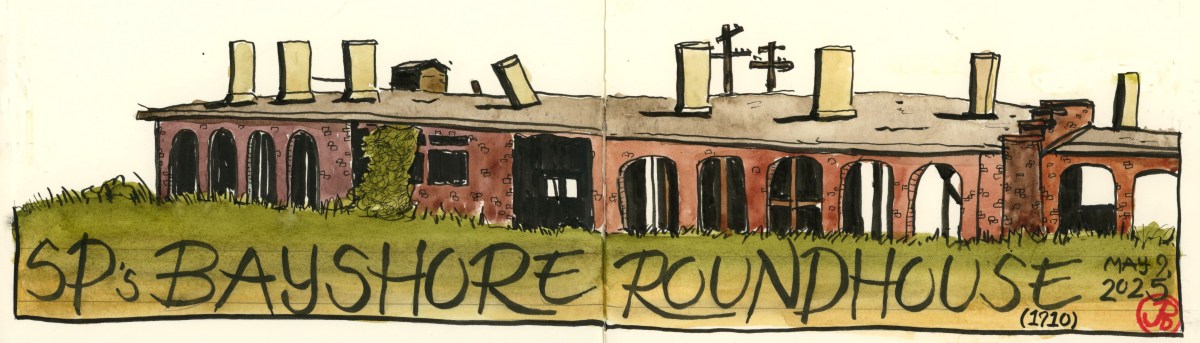
The Bayshore Yard and Roundhouse

I was on the hunt for some Bay Area rail history. I was specifically looking for some ghosts of the Southern Pacific Railroad: the Bayshore Yard.

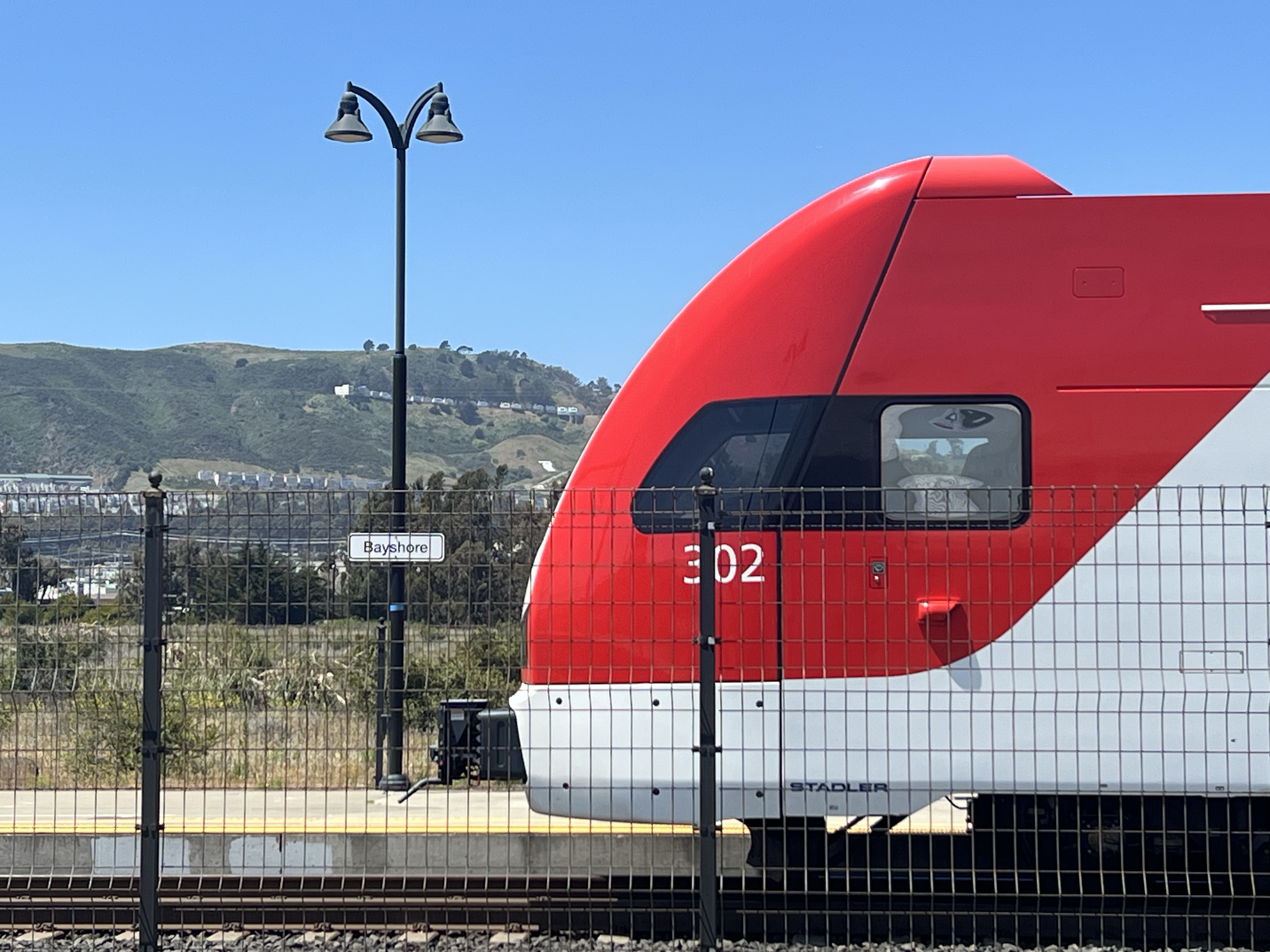
I started my search at the Bayshore Caltrain Station. Uncanny! Who would have thought?

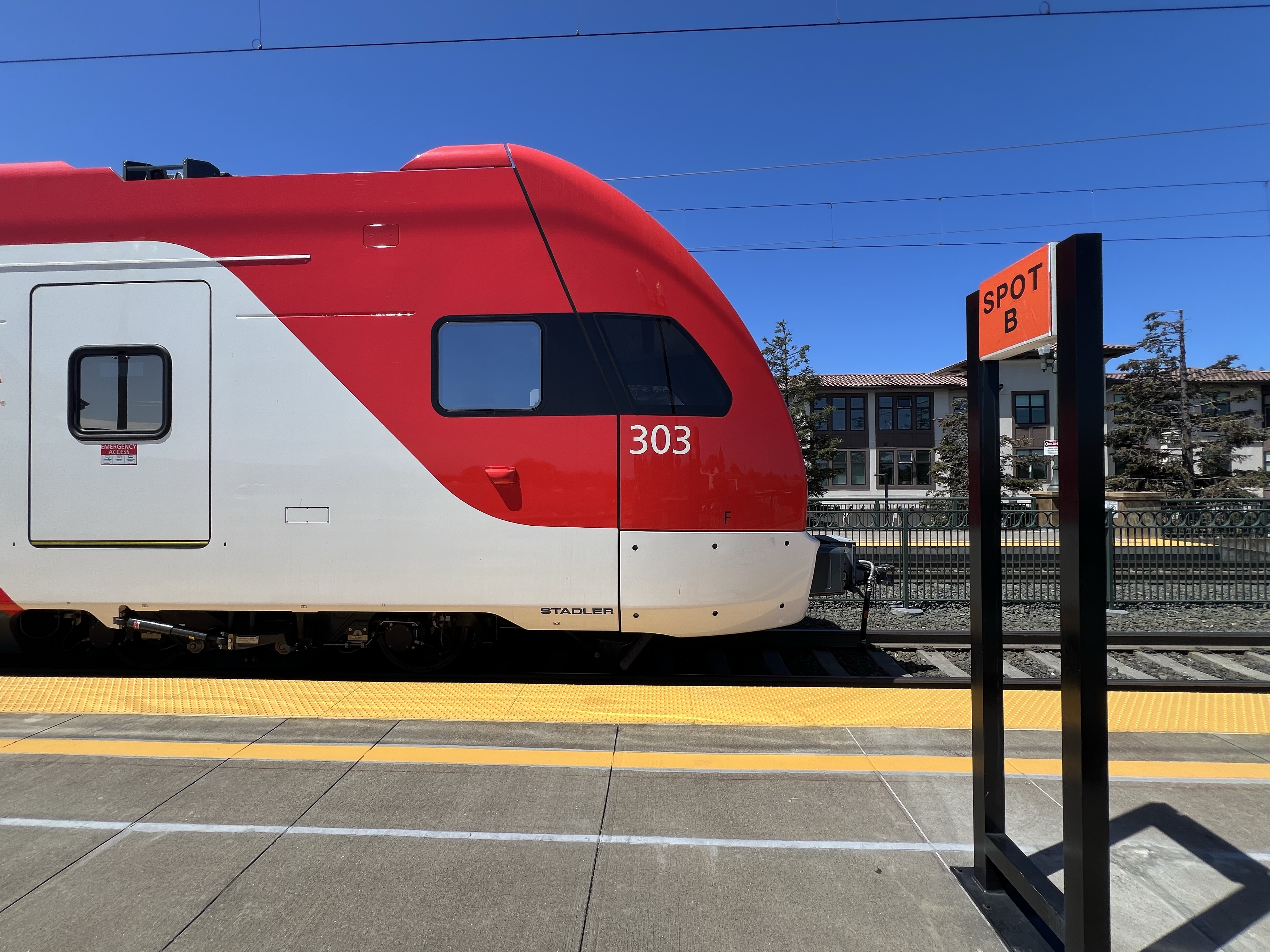
An EMU at Bayshore Station. I was here to see the overgrown fields beyond the tracks.

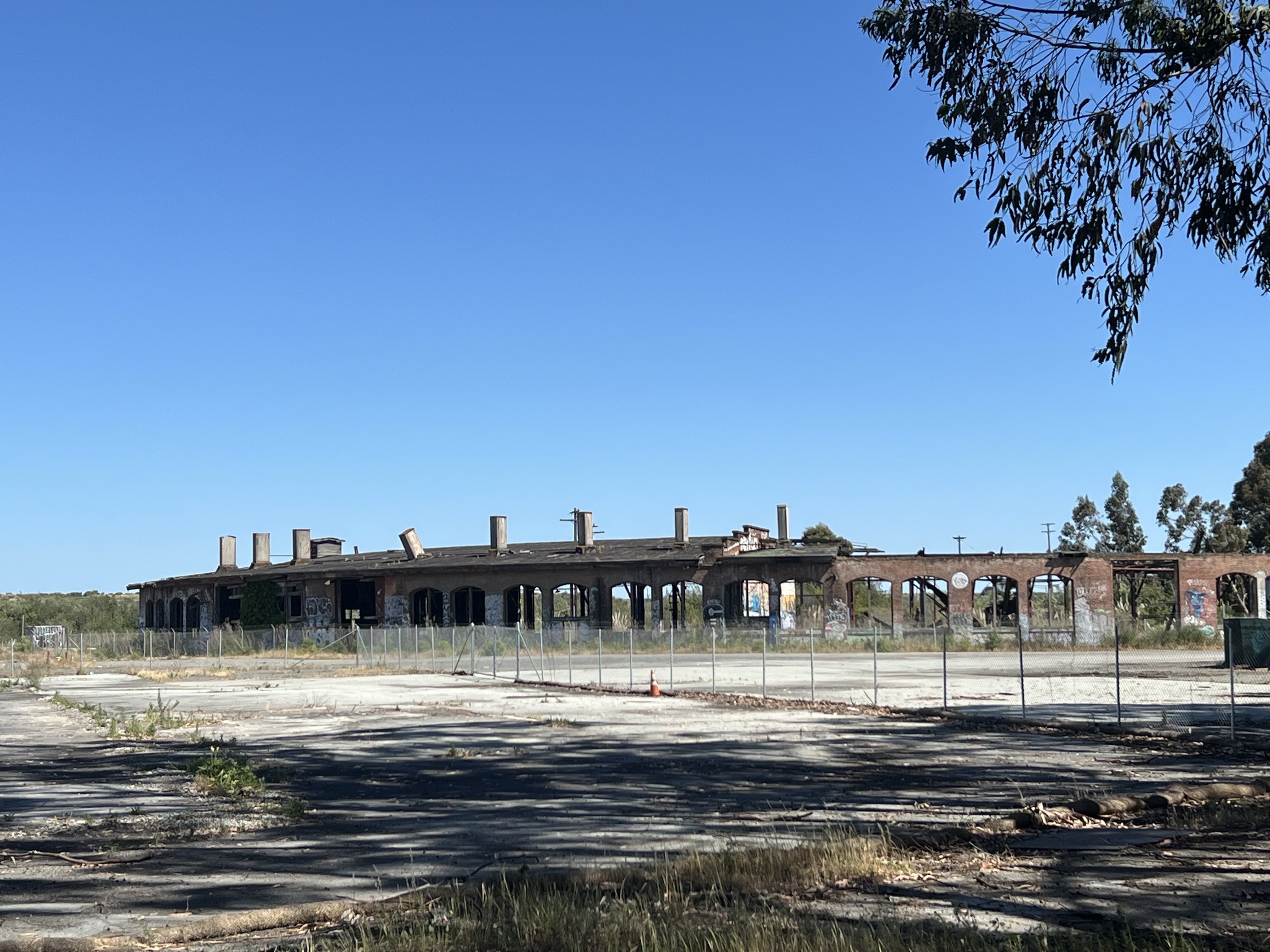
To the west of the tracks is a large overgrown open space punctuated by wooden power poles and bordered by the San Bruno Mountains. On the far edge of the open fields are some dilapidated and graffitied buildings.

The brick roundhouse and the tank and boiler shop are the only remaining structures of a once bustling train yard and shops. How bustling?

The yard contain 50-65 miles of track, had a capacity of over 2,000 freight cars, and employed 3,000 people.

This was SP’s most heavily travelled stretch with 46.5 million gross tons per mile during WWII.

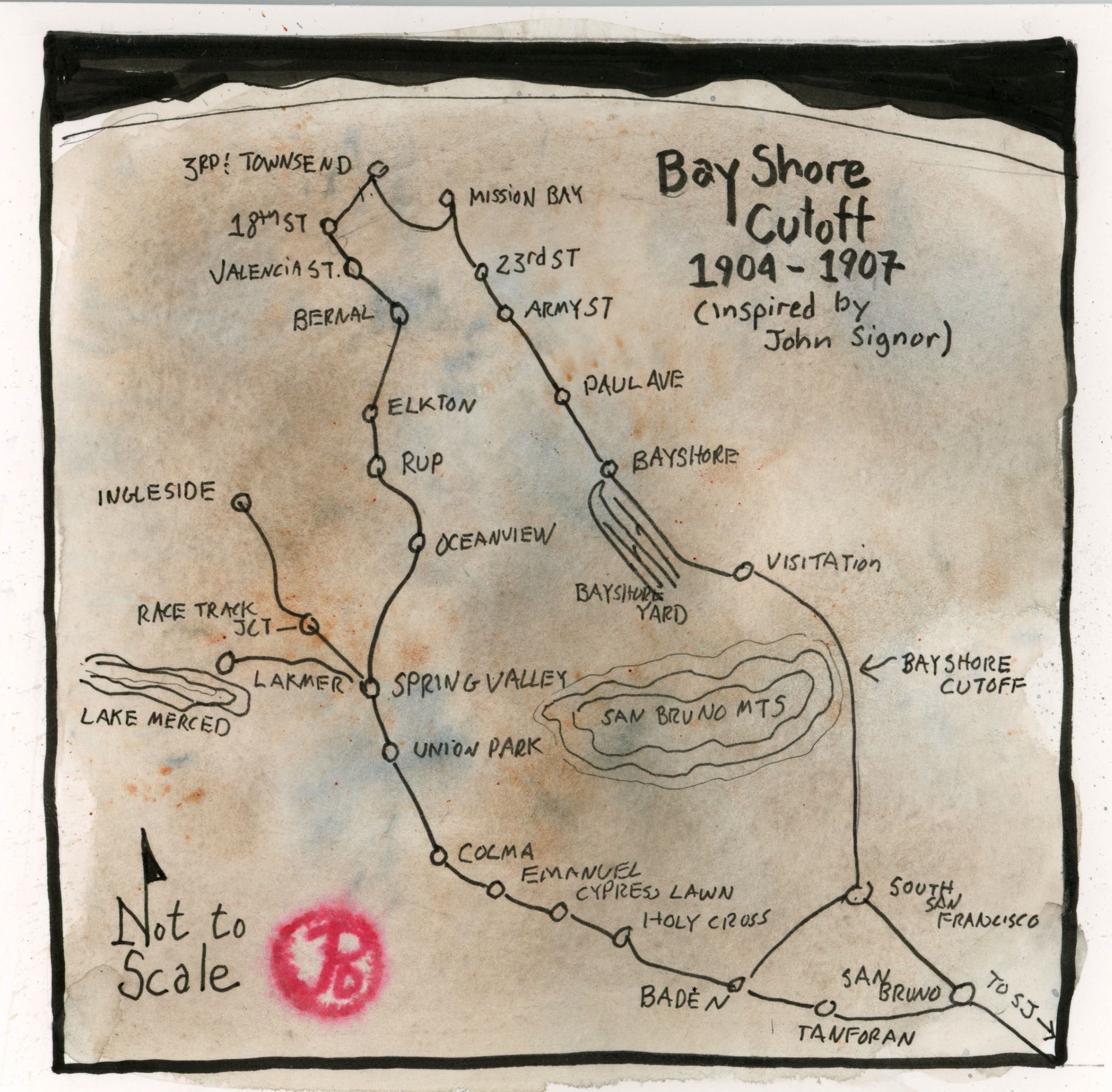
The story of the yard and shops starts with the Bayshore Cutoff.

This drawing is highly influenced by a map John Signor drew from his excellent book on the Coast Line.

As the name implies the Bayshore Cutoff is a short cut that straighten the line around San Bruno Mountain’s southern edge, from San Francisco to San Bruno.

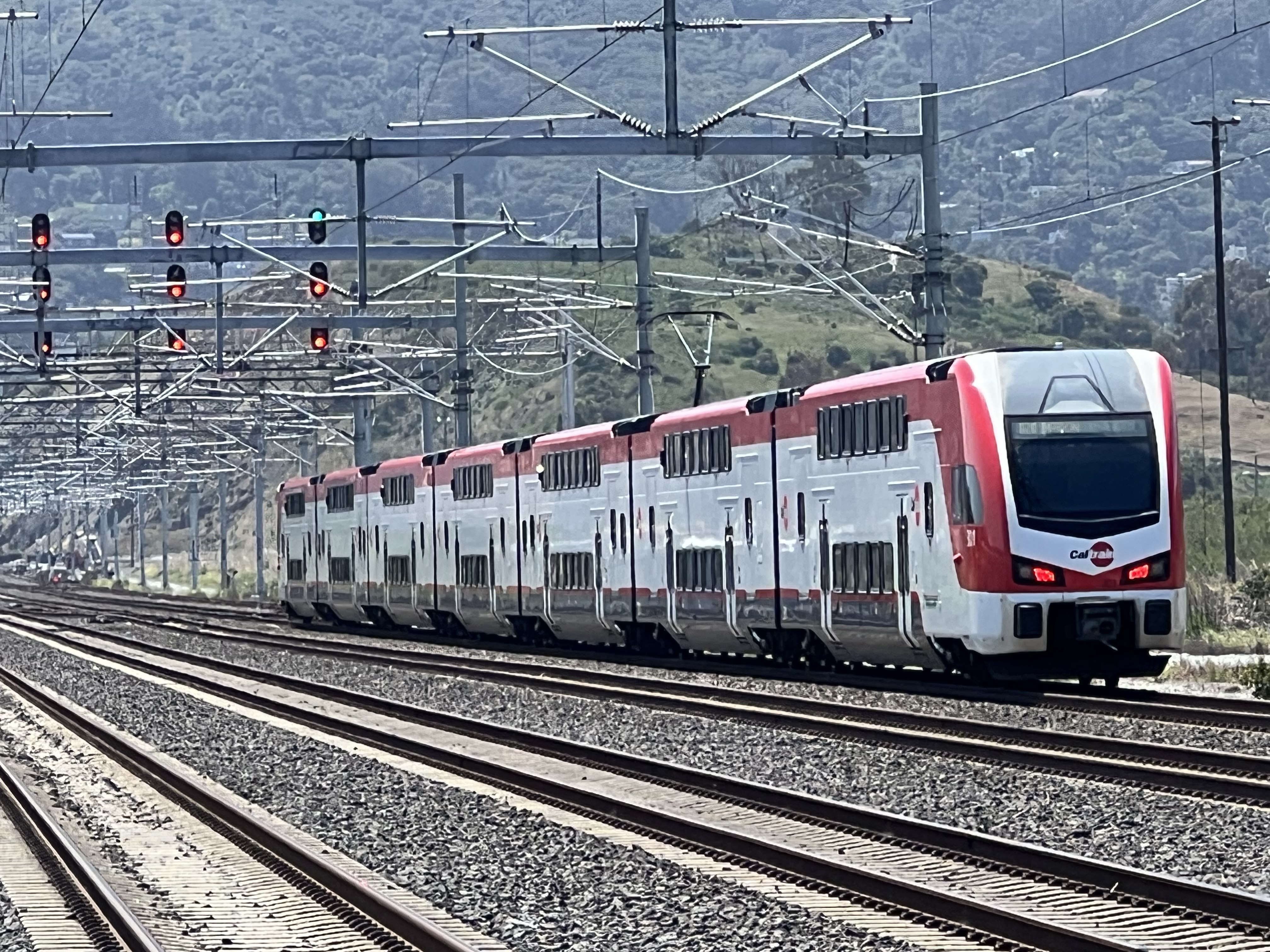
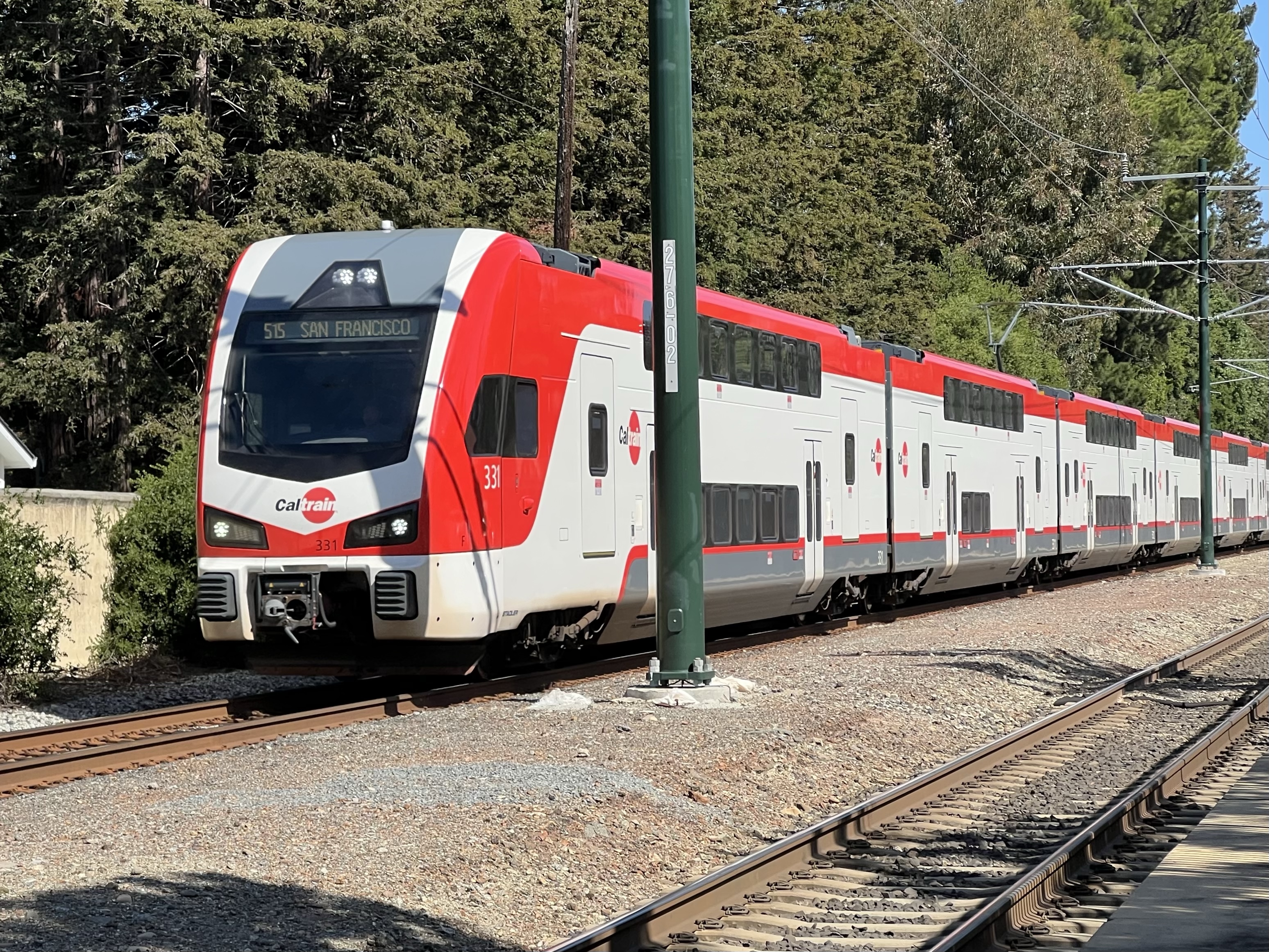
A southbound EMU seven car set leaving Bayshore Station under the tangle of signal gantries and power lines. To the right is the former yard. The current line is along the Bayshore Cutoff.

The cutoff was completed 1907 and cost Southern Pacific $7 million. One reason for the high price tag is that the railroad had to construct five tunnels (20% of the cutoff was in tunnels). The fill from these tunnels was used to fill in Brisbane Lagoon which became Bayshore Yard and Shops.

The benefits of the cutoff were: saving more than three miles on the route, reducing the curvature of the line, and flattening the grade. The improvements cut travel time from San Francisco to San Jose by 30 minutes. The cutoff is still in use today, conveying passengers to and from San Francisco on Caltrain.

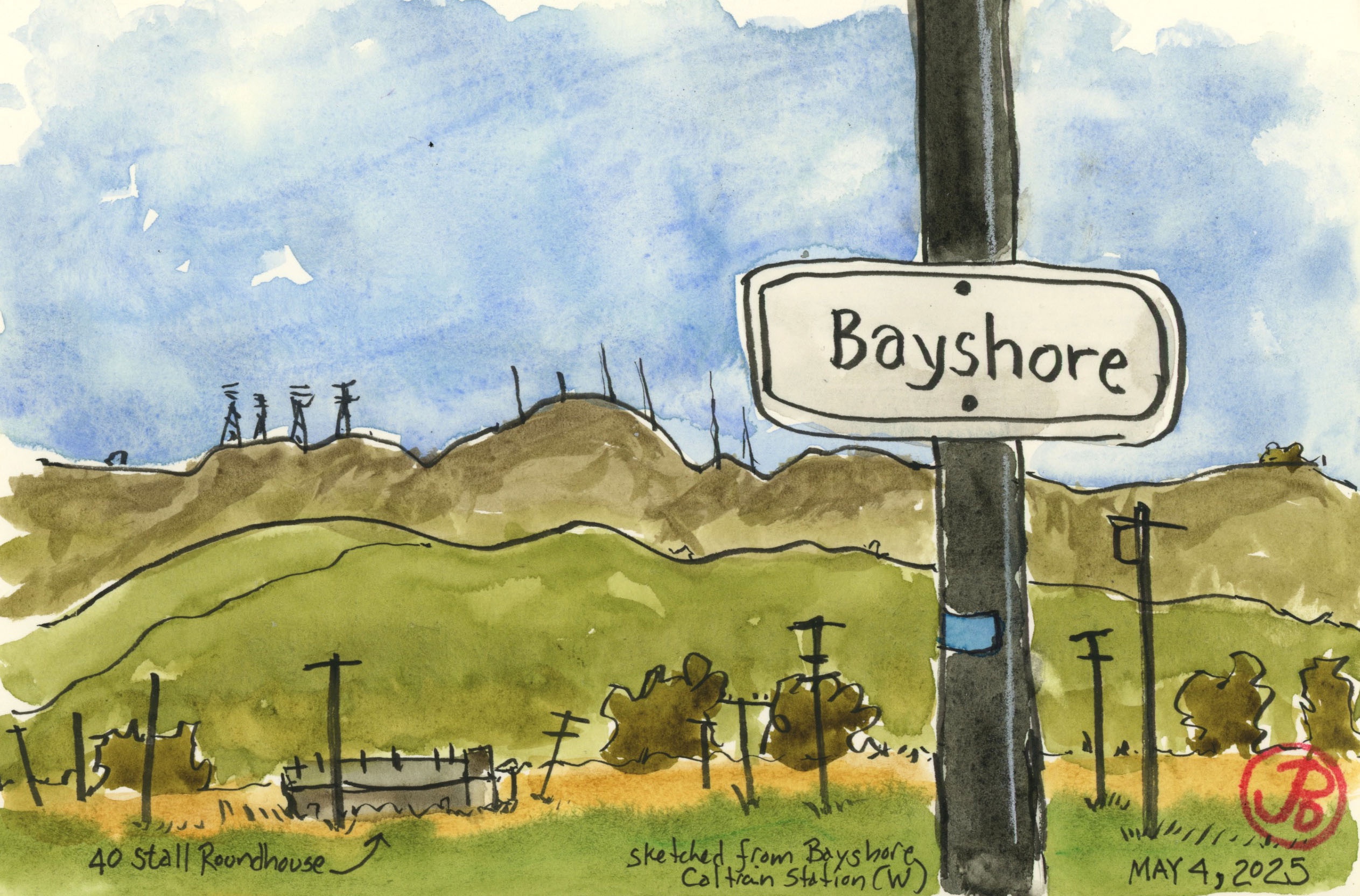
For my Bayshore sketch I took a position on the southbound platform and sketched the Bayshore Station sign in the foreground and the feral field and roundhouse in the background. In the far ground is San Bruno Mountain.

After work I headed up to Brisbane with the intent of sketching the roundhouse from Bayshore Boulevard. The roundhouse is close to the street but the former yard is enclosed in fencing. I was able to find a gap in the eucalyptus trees to get a panoramic sketch (sans graffiti) of Southern Pacific’s Bayshore roundhouse.

The brick shell of the Bayshore Roundhouse.
Image

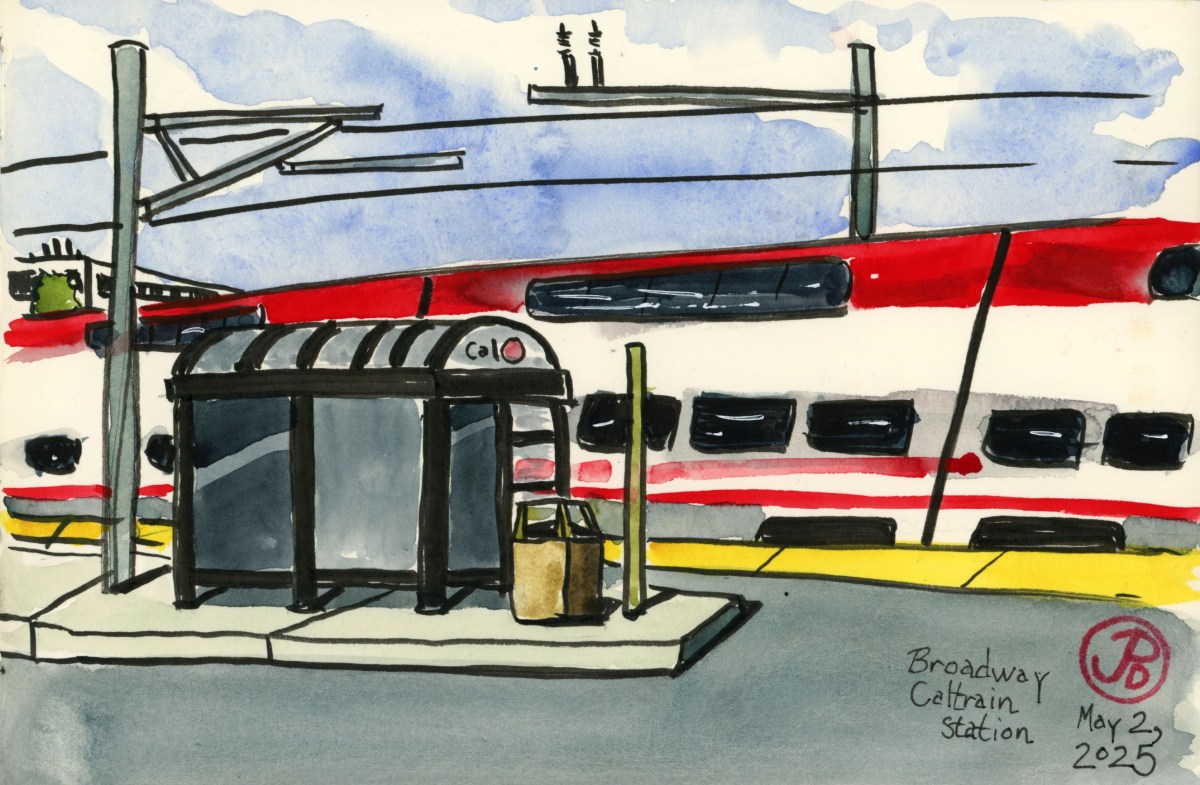
Broadway Station

On Monday I did an afterwork sketch of the closed Atherton Station on the Caltrain route and now on Friday I headed to North Burlingame to do another after work sketch of a Caltrain station: Broadway.

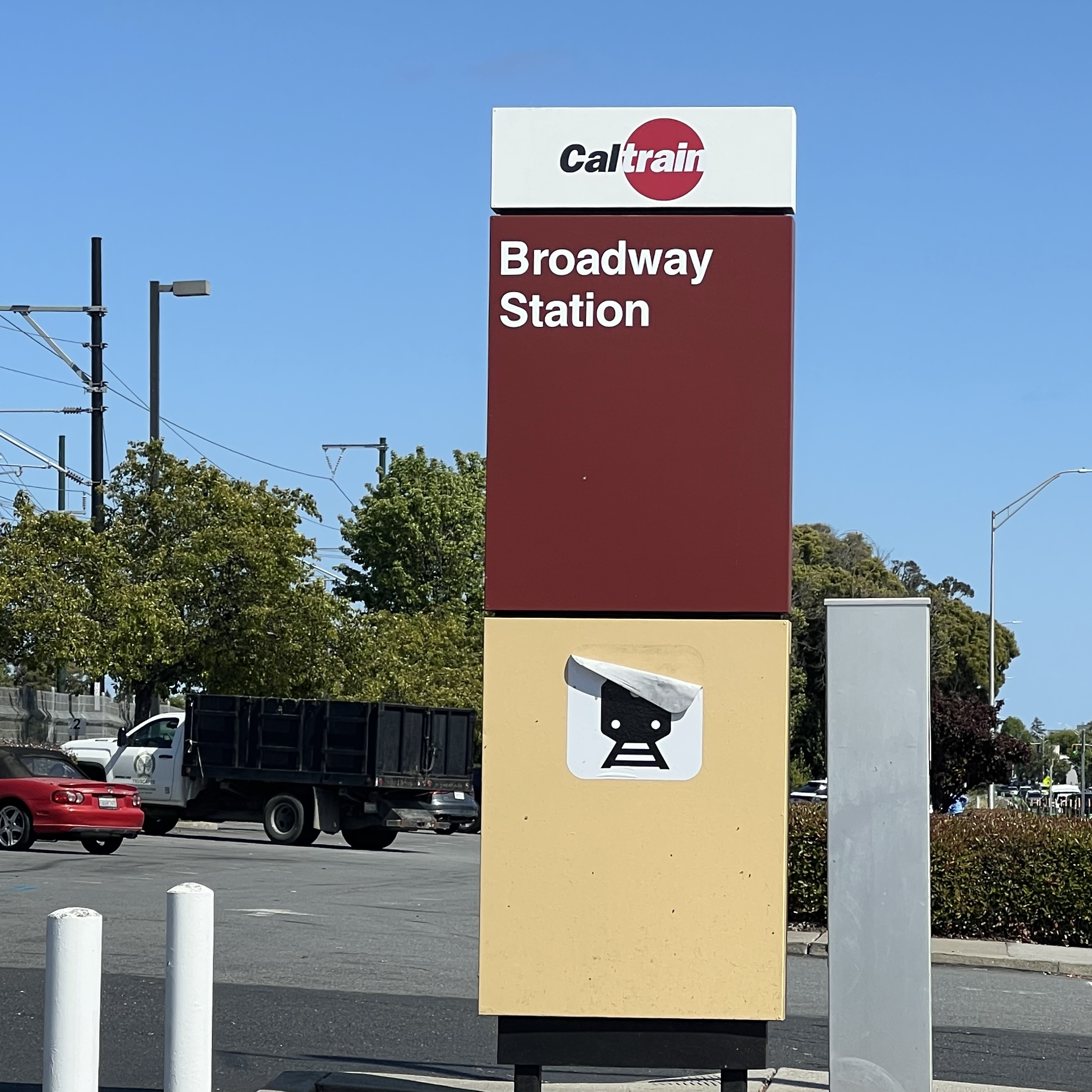
The peeling train sticker on the sign is a living metaphor for the downtrodden Broadway Station.

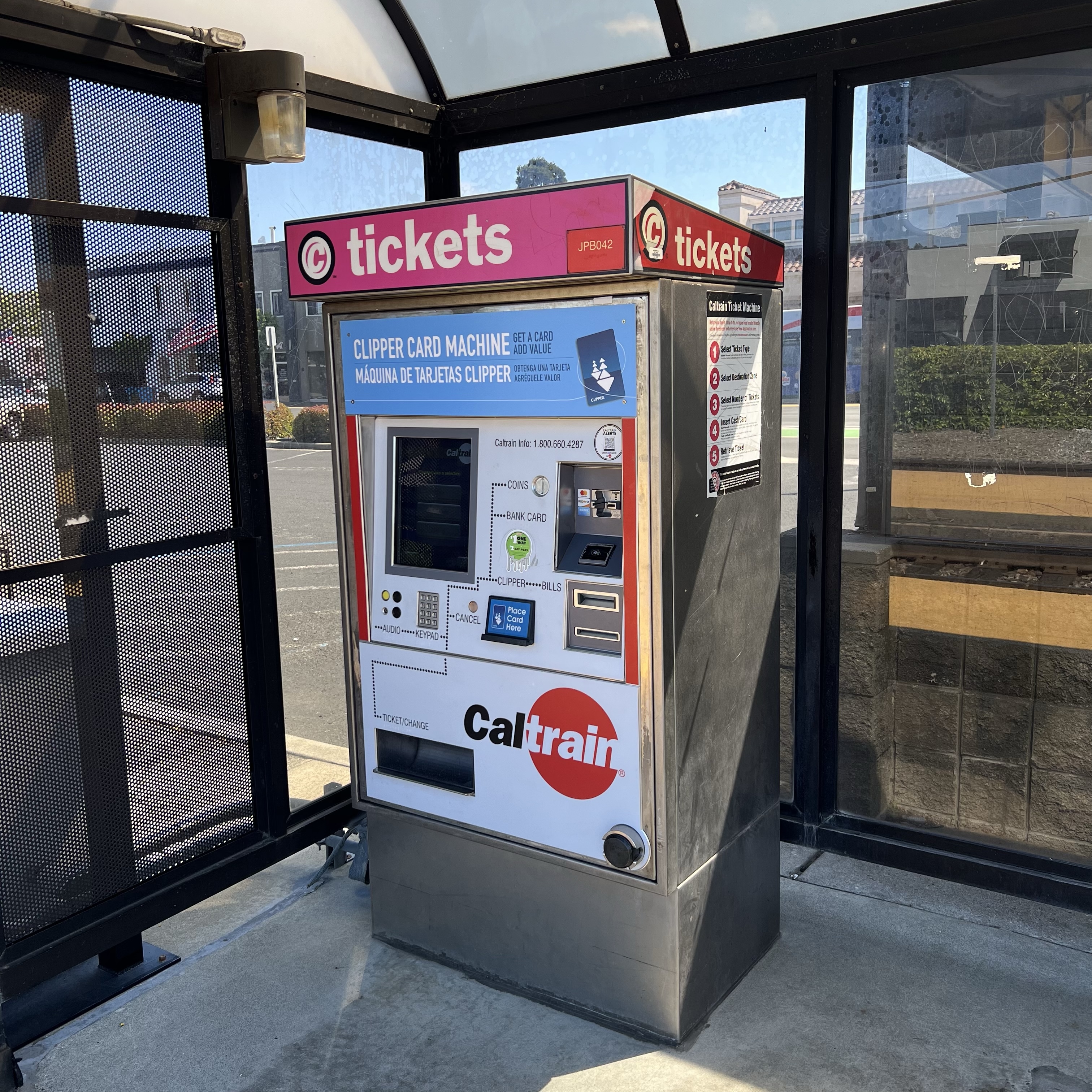
With a name like Broadway, you’d think of a busy station with lots of passenger traffic and a station with a staffed ticket office, a waiting room lined with wooden benches, and perhaps a cafe. Sure that might have been the picture over 70 years ago. Now here is the ticket window:

And there is no cafe. And no passengers for that matter.

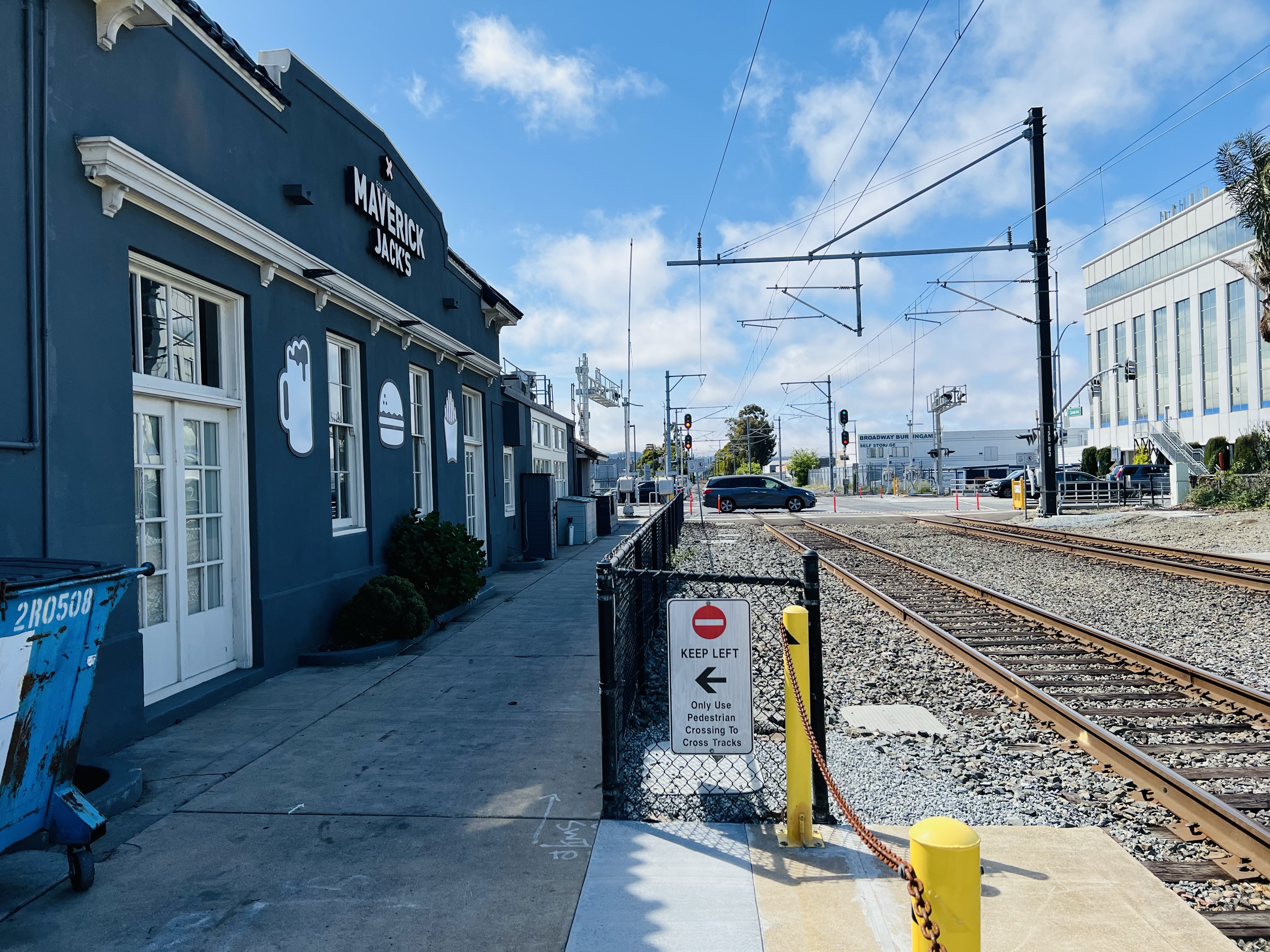
Like Atherton, the new electric EMUs speed by this station. The train only stops here on weekends, which is more than can said for Atherton, and the former station is now a restaurant. The platform has some benches, a few shelters, and a sign that reads “No Loitering”. Is sketching a form of loitering?

Looking north toward San Francisco with the former station, now a restaurant, on the left.

The Broadway Station suffers from diminishing ridership and a center loading island platform for northbound trains. This means that a hold-out rule is in effect which means that if a train is in the station, a train heading in the opposite direction must wait outside the station until the other leaves before pulling in. This creates delays and is a major reason the station was closed on weekdays on August 1, 2005.

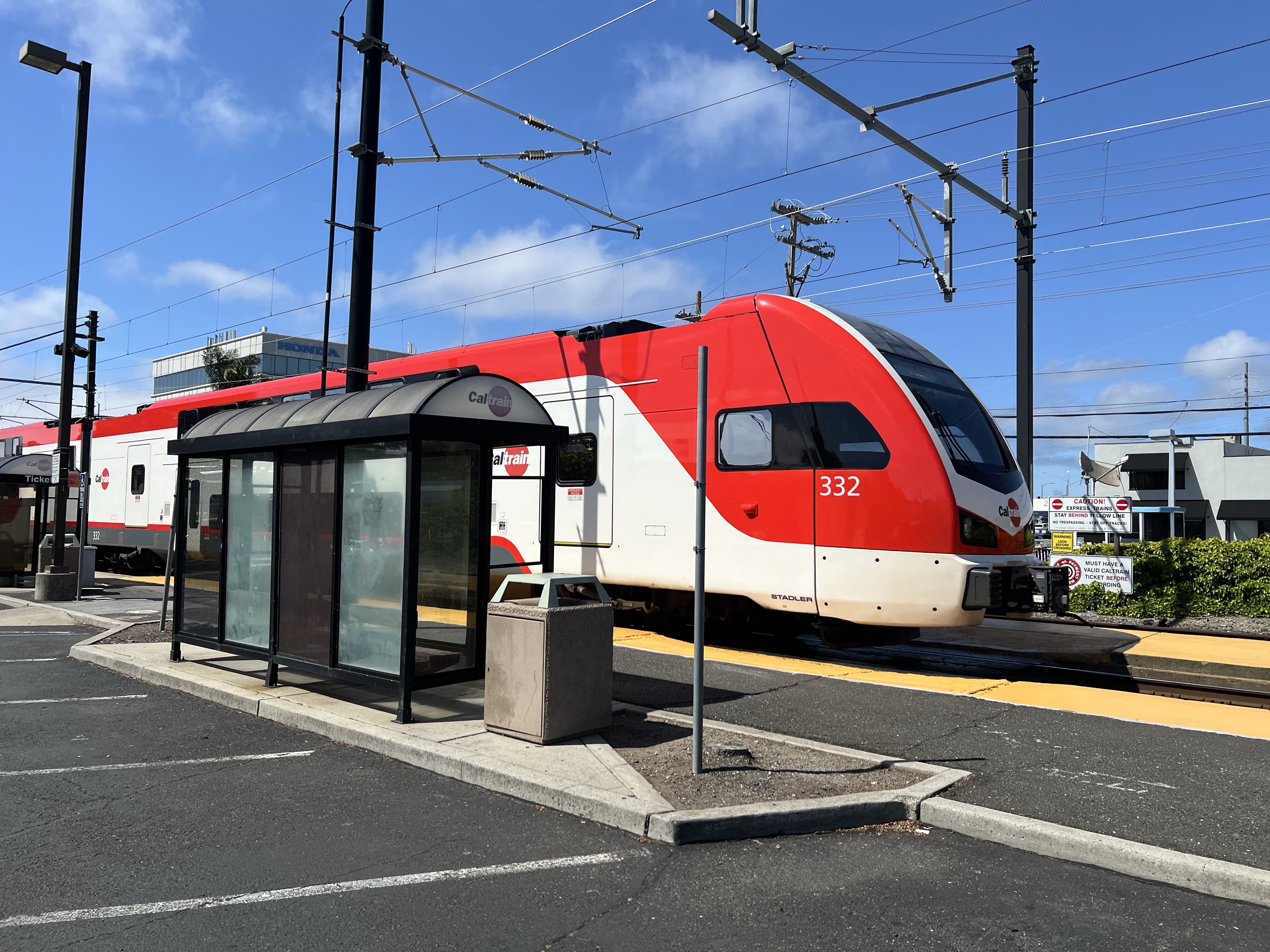
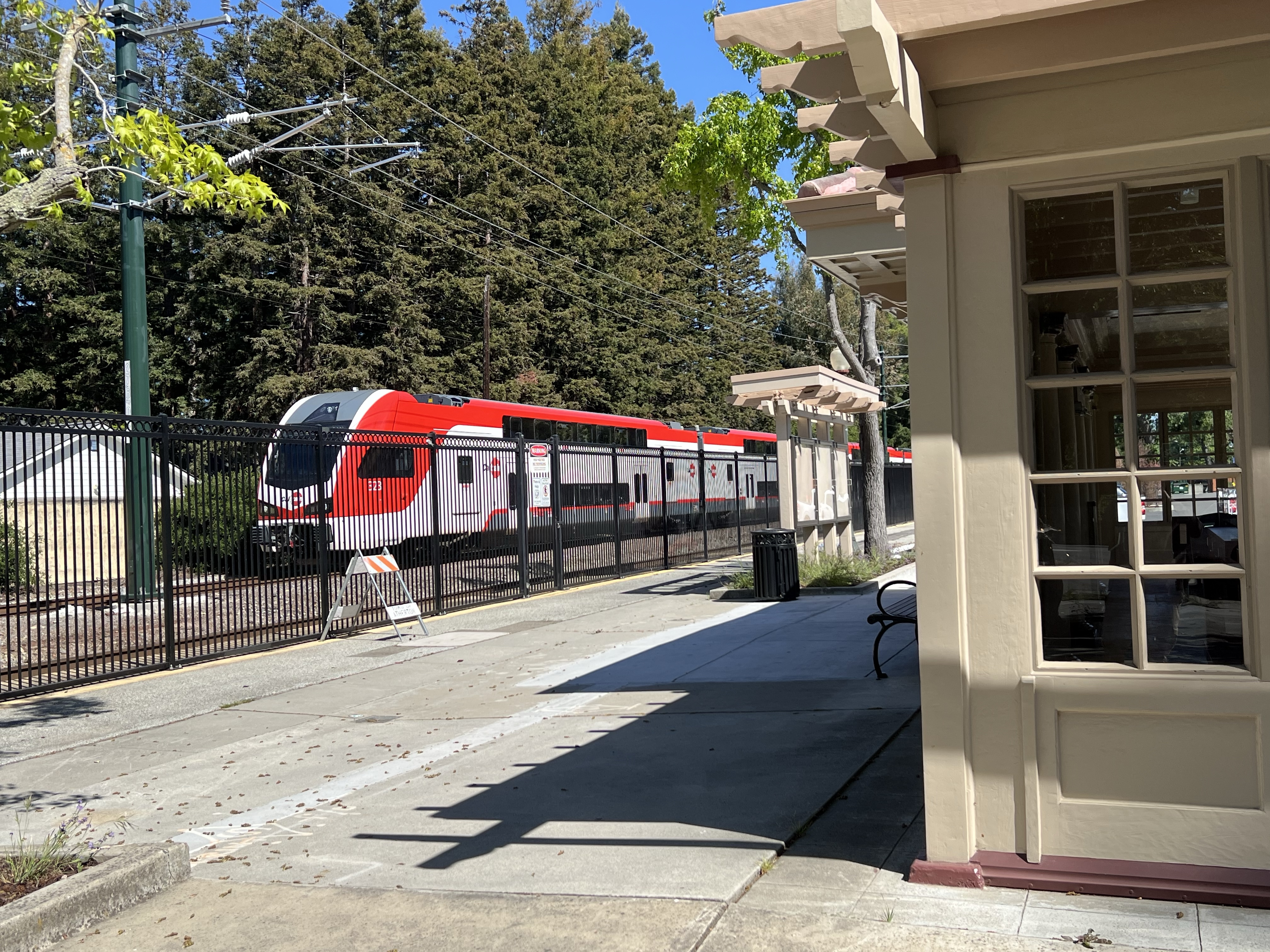
This southbound EMU is not stopping here.

The original station was opened by Southern Pacific in 1911. The station was renamed Buri Buri in 1917 and then to its current name in 1926.

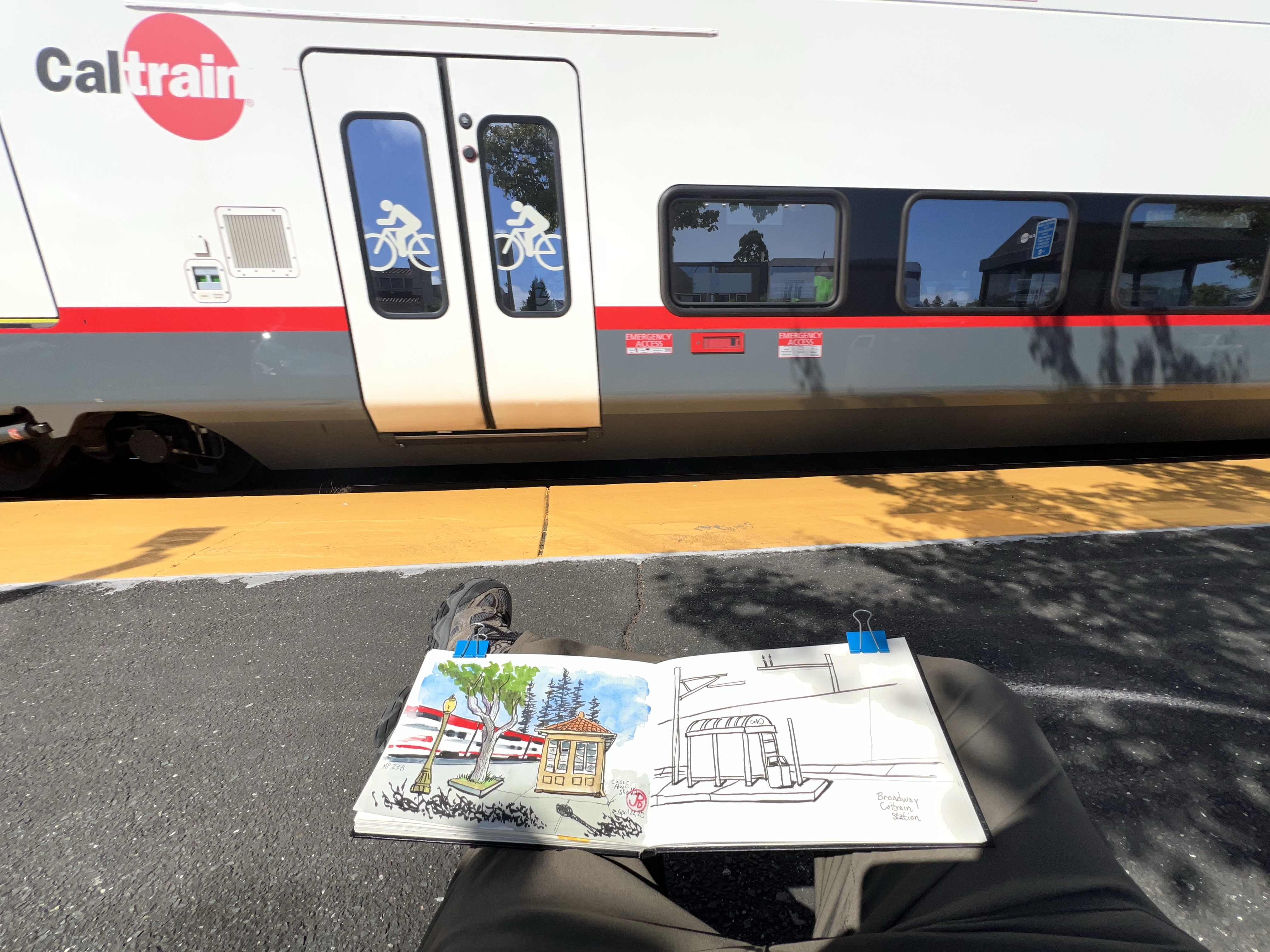
My field sketch and a southbound EMU speeding by at Broadway.

Sketching Notes

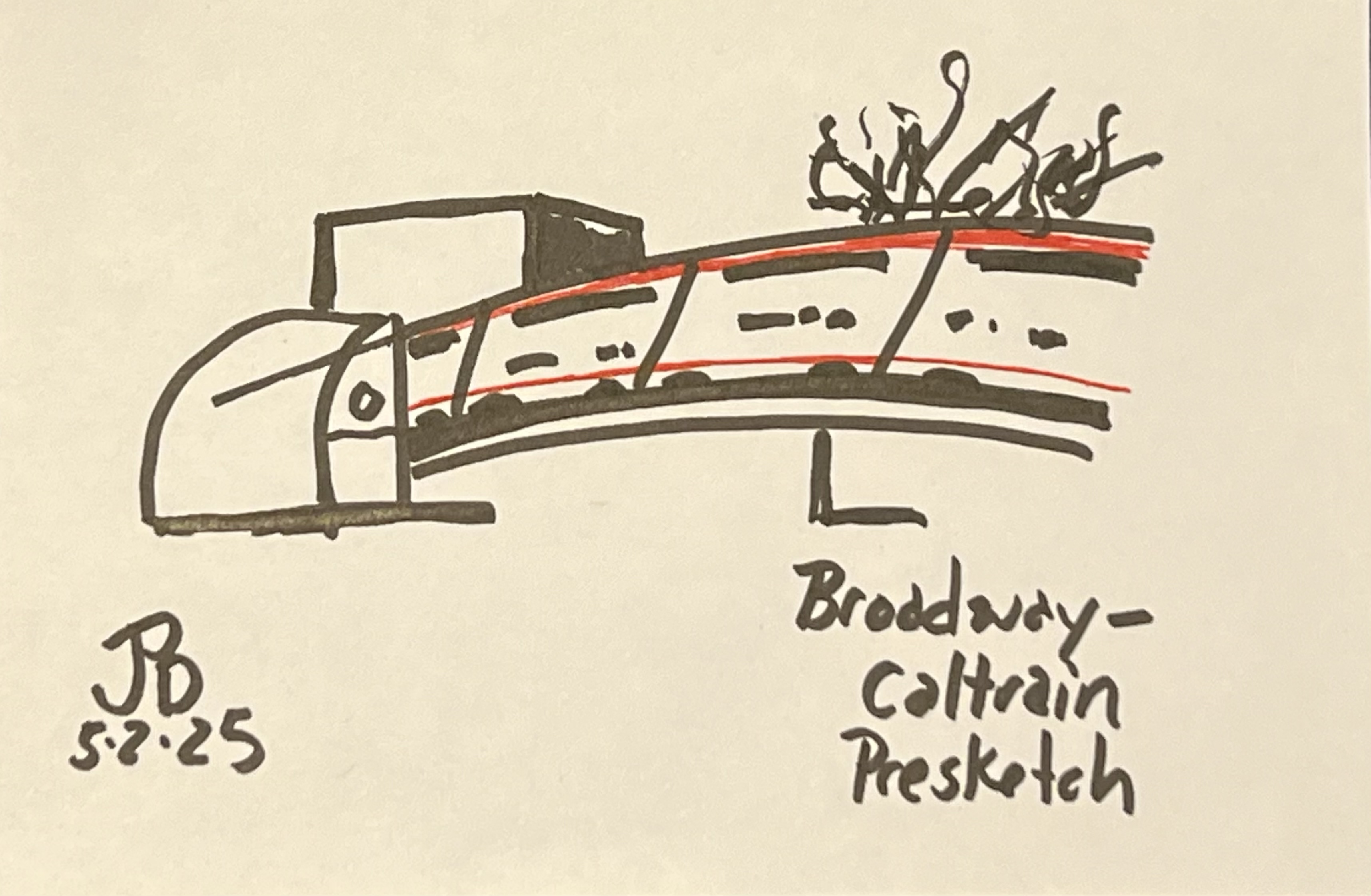
During my lunch I sketched out the scene I wanted to sketch on an index card. This is like a storyboard for a tricky scene in a film. What I wanted to do was convey a sense of stillness and motion. The stillness of the shelter and the motion of the train speeding by. In the presketch, or storyboard, I exaggerated the lines of the train. They are curved and kinetic while the shelter remains calm and pedestrian.

Perhaps I could have exaggerated the lines more in my field sketch. That would entail sketching things that aren’t there in front of me. Like sketching in another dimension.

Image

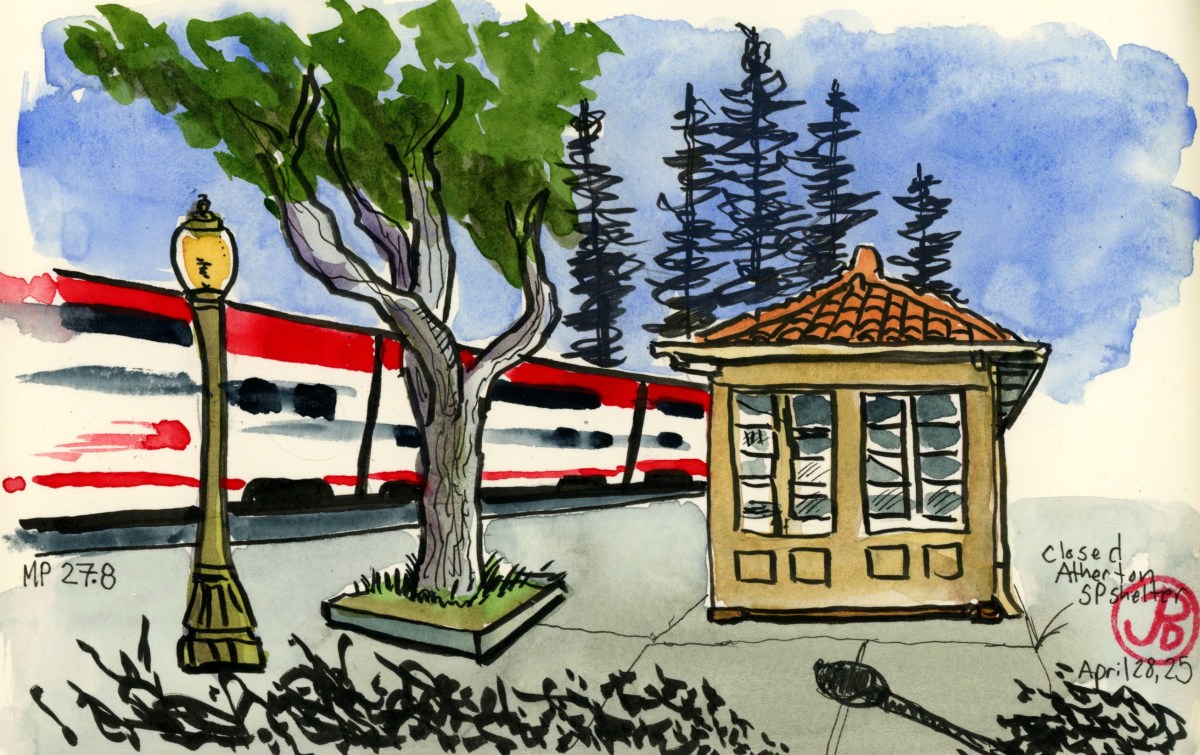
Next Stop, Atherton

On my weekend Caltrain ride to Palo Alto, we sped past the former passenger shelter at Atherton.

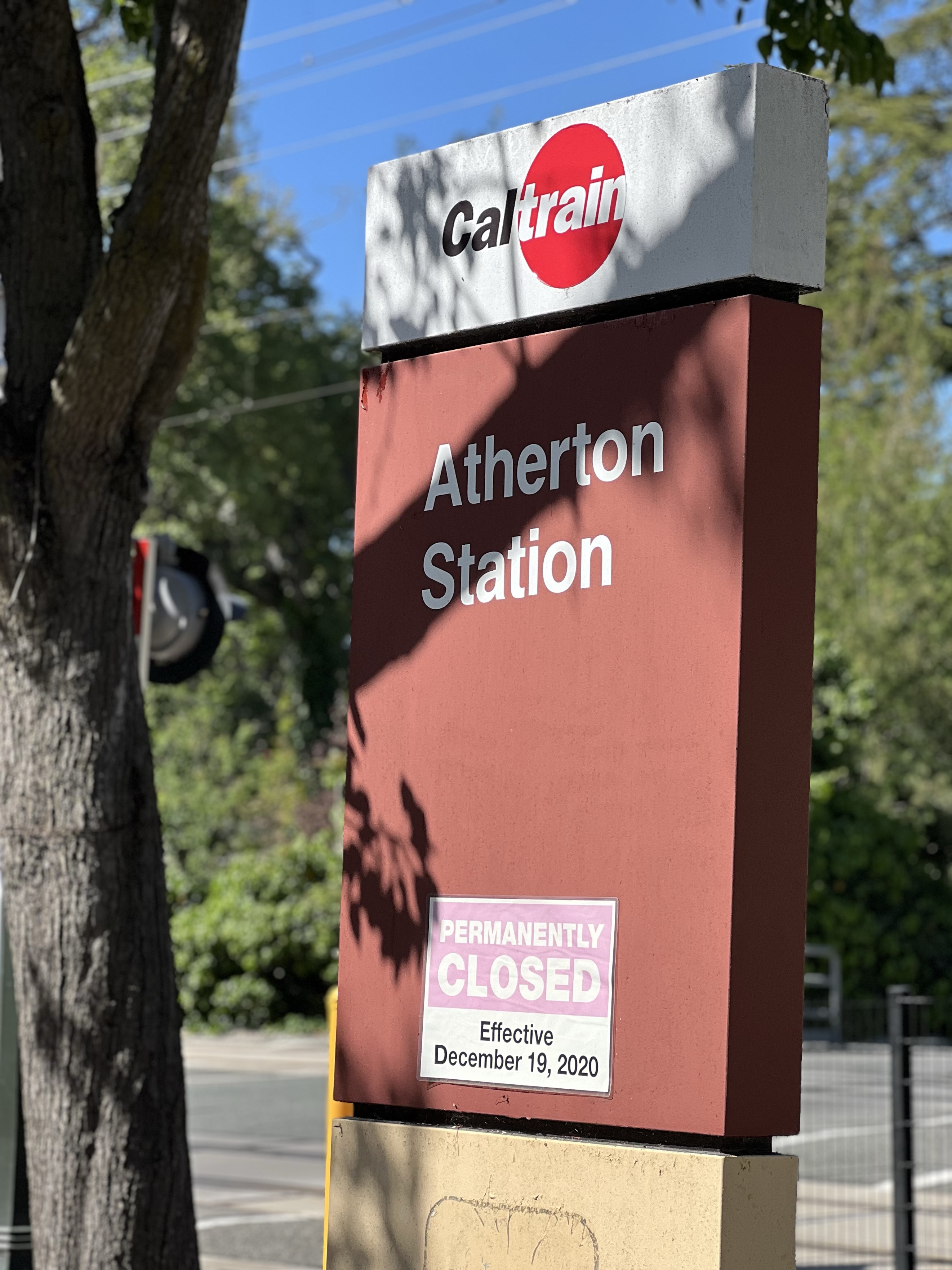
I remember that this used to be a stop on the commuter line but I later found out it had been permanently closed since December 19, 2020.

Where had I been?

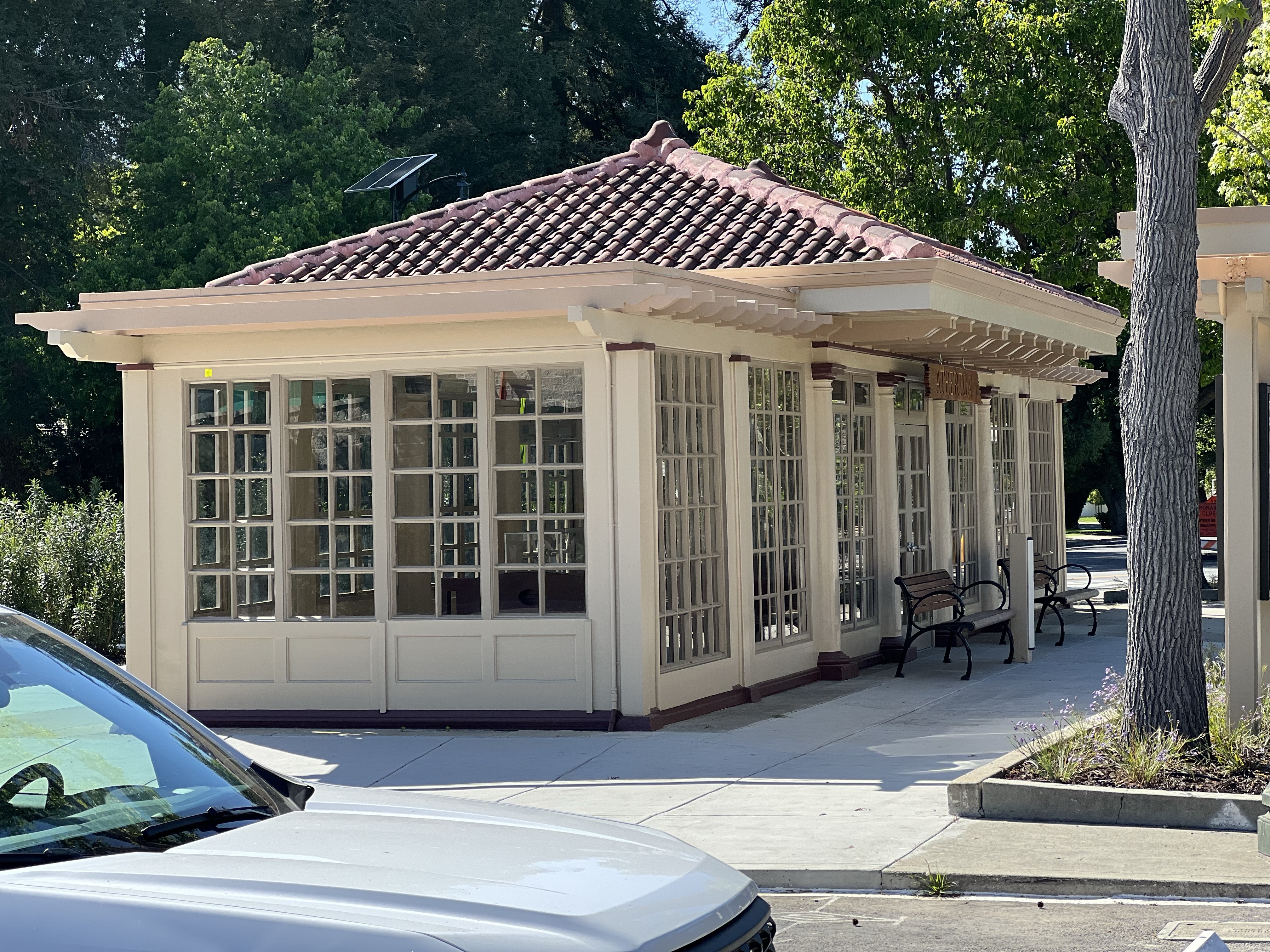
I returned to Atherton to sketch the lonely railroad shelter where passengers no longer detrain or board.

There are a few things to know about the San Mateo County town of Atherton (population 6,823). Atherton had been ranked as having the highest concentration of wealth per capita for a town of its size anywhere in the United States. The town also has the highest median house price in the country at an astonishing $7,950,000!

And then there is the infamous Atherton police blotter. Here are a few examples, and yes these are real: “A man was reported to be sitting down and talking to himself. Police made contact and confirmed he was using a cellphone”, “A resident worried that a noisy hawk in a tree was in distress. When authorities arrived, the hawk was quiet and enjoying dinner”, “Police assisted an Atherton man in a San Francisco bar who forgot where he was and called 9-1-1”, “A family reported being followed by a duck who resides on Tuscaloosa Avenue”, and this takes the cake: “A resident reported a large light in the sky. It was the moon”.

From these police blotter examples we can tell that Athertonians are a vigilant and concerned group of citizens.

When Caltrain announced that they would be electrifying the line, the town of Atherton sued Caltrain alleging the construction would damage some heritage trees. Atherton lost the lawsuit and electrification continued.

A train station without a train.

This is not a great way to treat a rail service that has stopped to pick up passengers in the town since 1866 when the first station opened under the then named Fair Oaks.

Southern Pacific replaced the first structure in 1913. This is the core design of the shelter that remains to this day. The shelter was enlarged in 1954 and later rebuilt in 1990.

A northbound EMU speeds by the closed shelter. A barrier fence separates the platform from the busy rails. In the featured sketch I left the fence out.

In 2005 weekday service to Atherton was suspended because of low ridership. The station averaging only 122 boardings a day compared to nearby Redwood City at 4,212 boardings per day. The low ridership combined with improvements needed ($30 million in improvements) to the aging center loading platform island meant that this train stop was doomed.

Perhaps a fitting end for a town that sued to halt progress but in the end now watches the future pass them by.

A busy afternoon in Atherton. During my 45 minute visit, five trains sped past the station. This one is northbound to San Francisco.

I did an afterwork sketch and I can imagine a new police blotter posting: “A strange man was sitting down near Atherton Station. Turns out he was only sketching.”

Image

Caltraining

Last fall the new Sadler electric multiple unit sets (EMU) were put into service on the Caltrain route from San Francisco to San Jose and I had been meaning to ride aboard ever since.

So on a gloomy spring morning in late April, I boarded an inbound N Judah to the Caltrain Station at 4th and King.

I was picking a travel window that was not going to be too chaotic with first pitch scheduled at 1:05 at the Giant’s game. Lots of fans use the N Judah and Caltrain to get to the game.

I planned to catch southbound train 610 departing at 9:55 AM and detrain in Palo Alto for lunch on University Avenue.

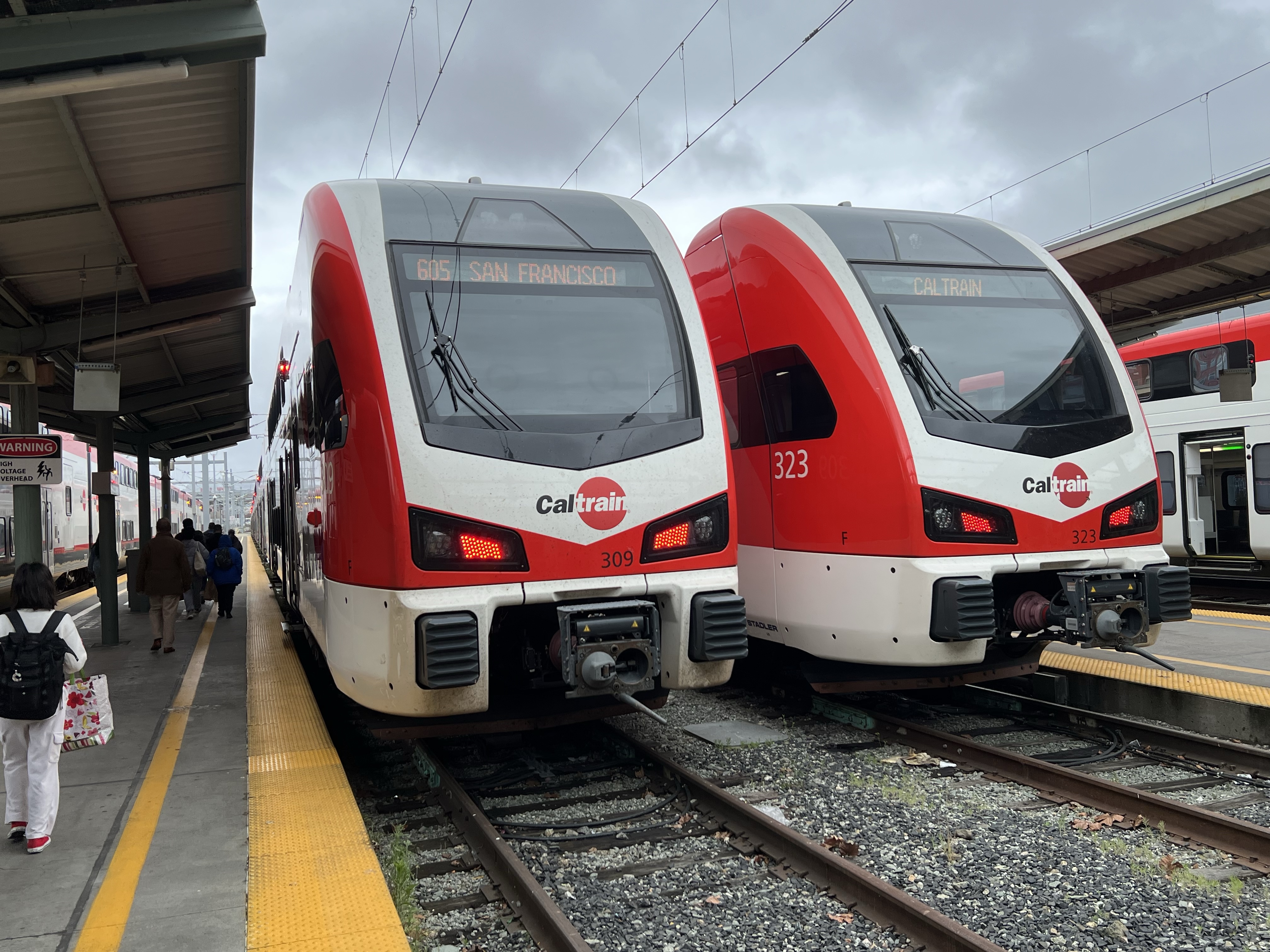
Two of the new EMUs at the San Francisco Caltrain Station.

My goal was to bring one pen (TWSBI Eco) and one watercolor journal (Stillman & Birn Delta panoramic) and only use continuous line sketching.

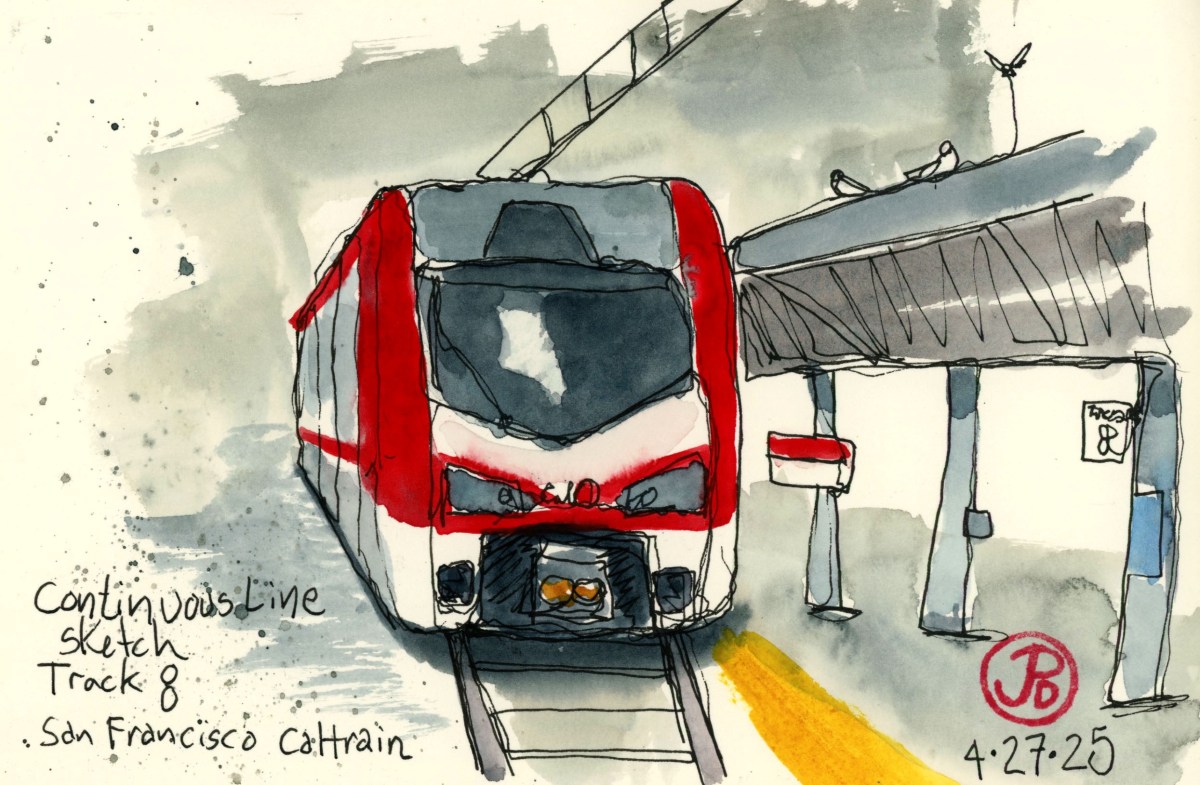
Before catching my train I sketched one of the new units on Track No. 8. (Featured sketch).

The gates opened and I boarded the train and was impressed with the bi-level design. I chose a seat on the top level sitting on the west facing side of the train (where all the historic stations are located).

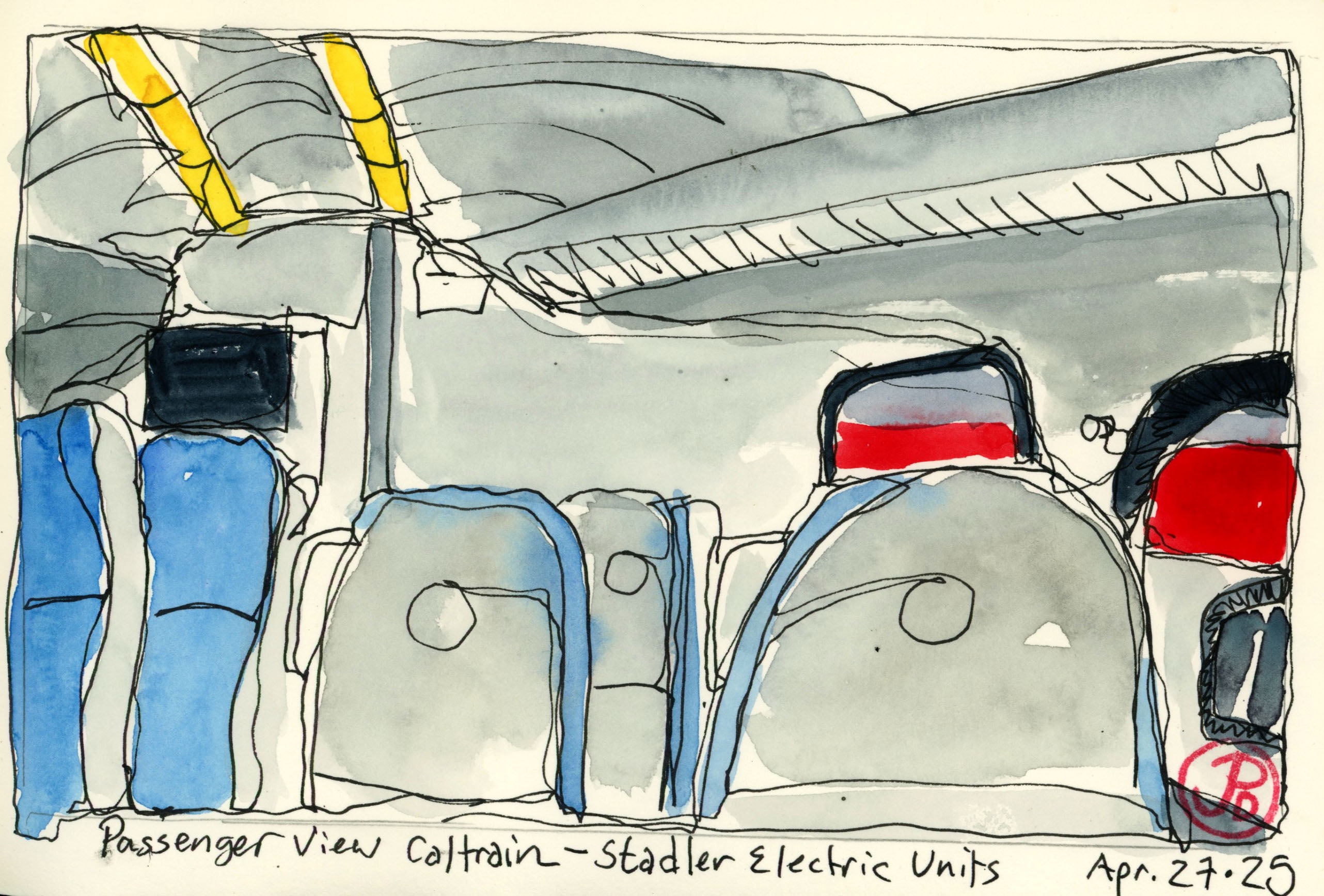
Before the train left I did a continuous line sketch of the interior from my upper deck seat-view. This sketching style loosens up your work including perspective. Normally I would pencil in the vanishing point and convergent lines but this sketching style is absolutely feral!

This takes a little getting used to because loosening up your sketching style causing you to loosen up your perspective of the style.

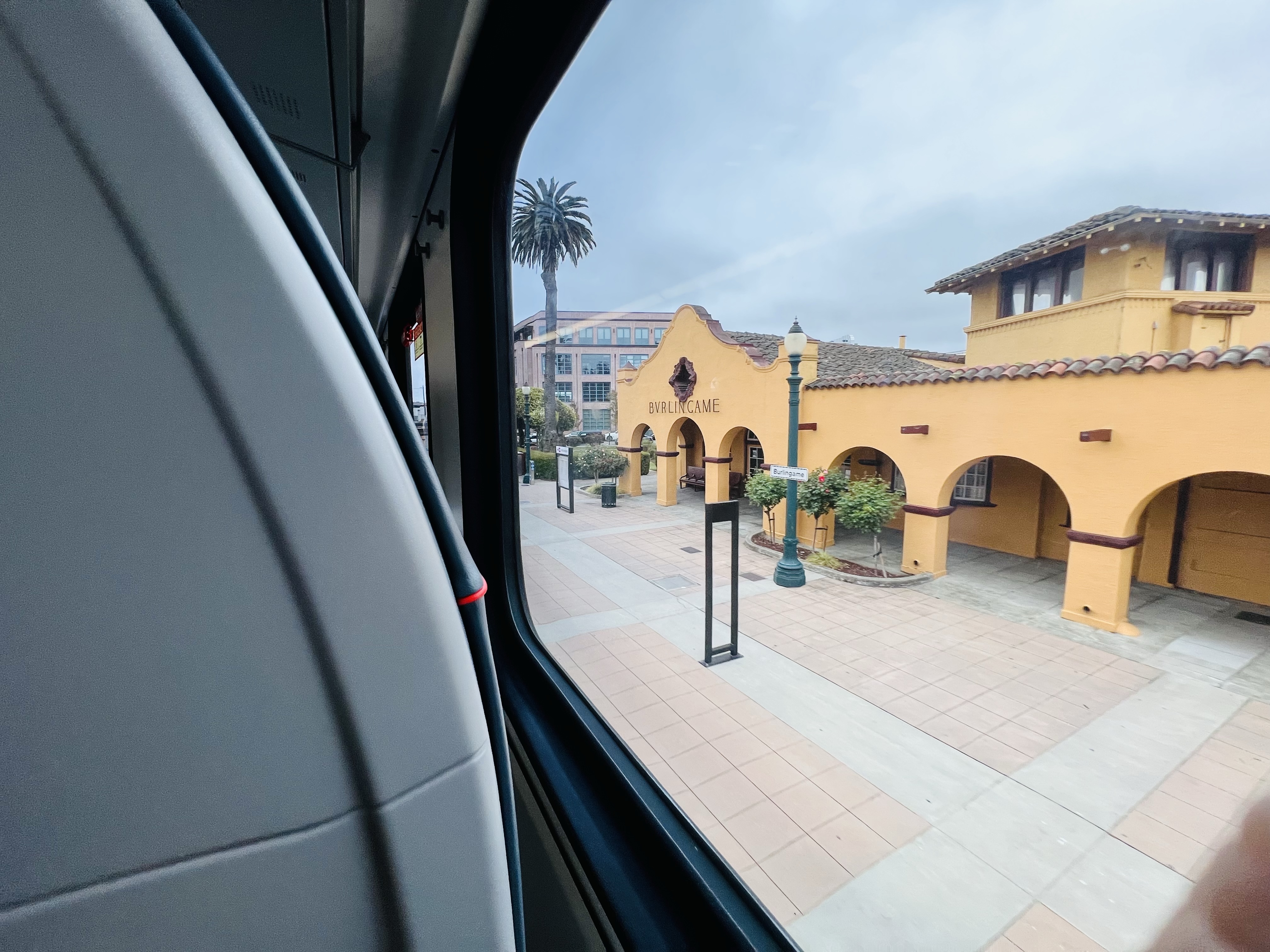
The view of one of my favorite stations on the line: Burlingame. This station is one of the earliest examples of the Mission Revival style and was highly influential in California when it was opened in 1894.
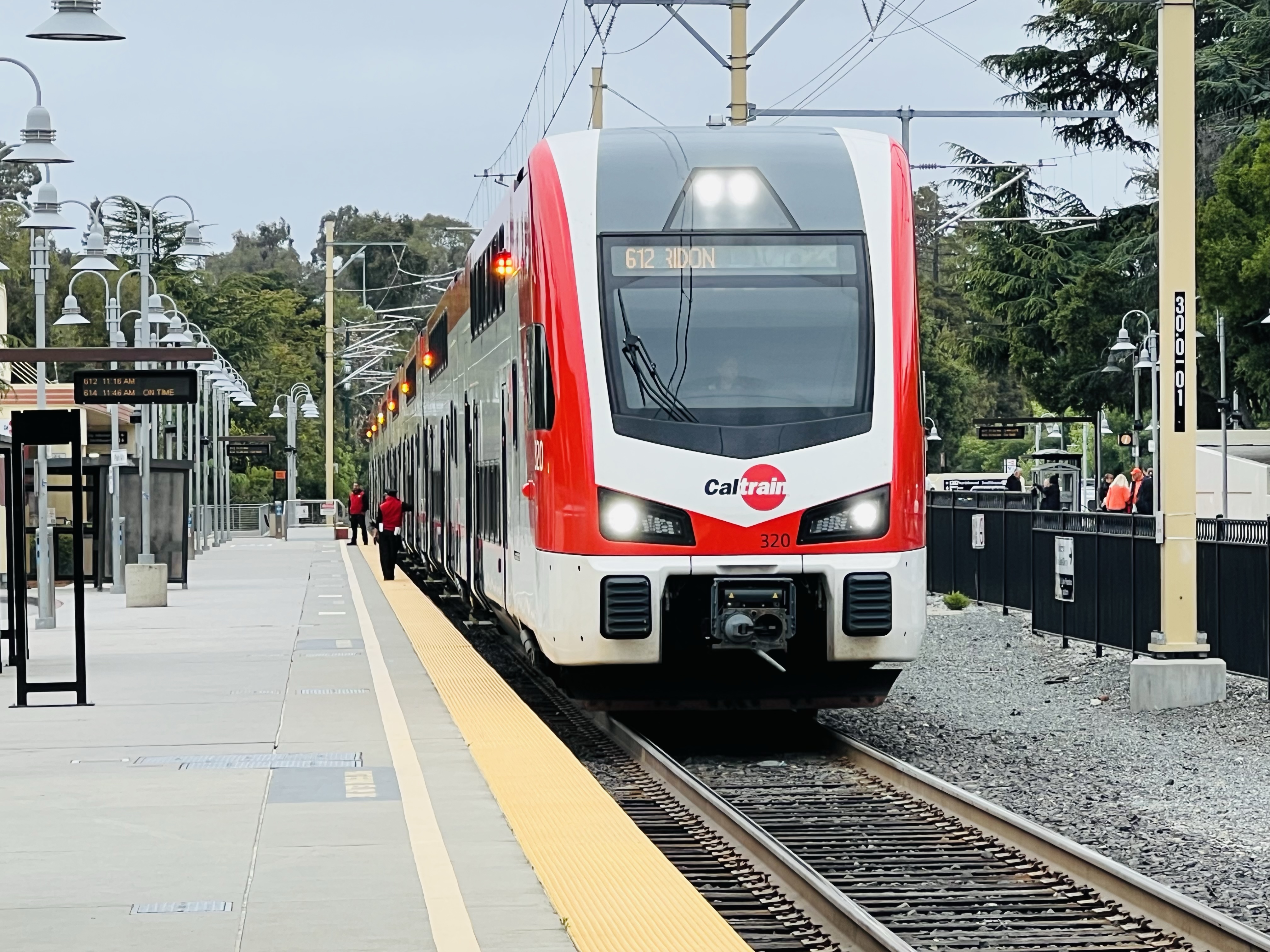
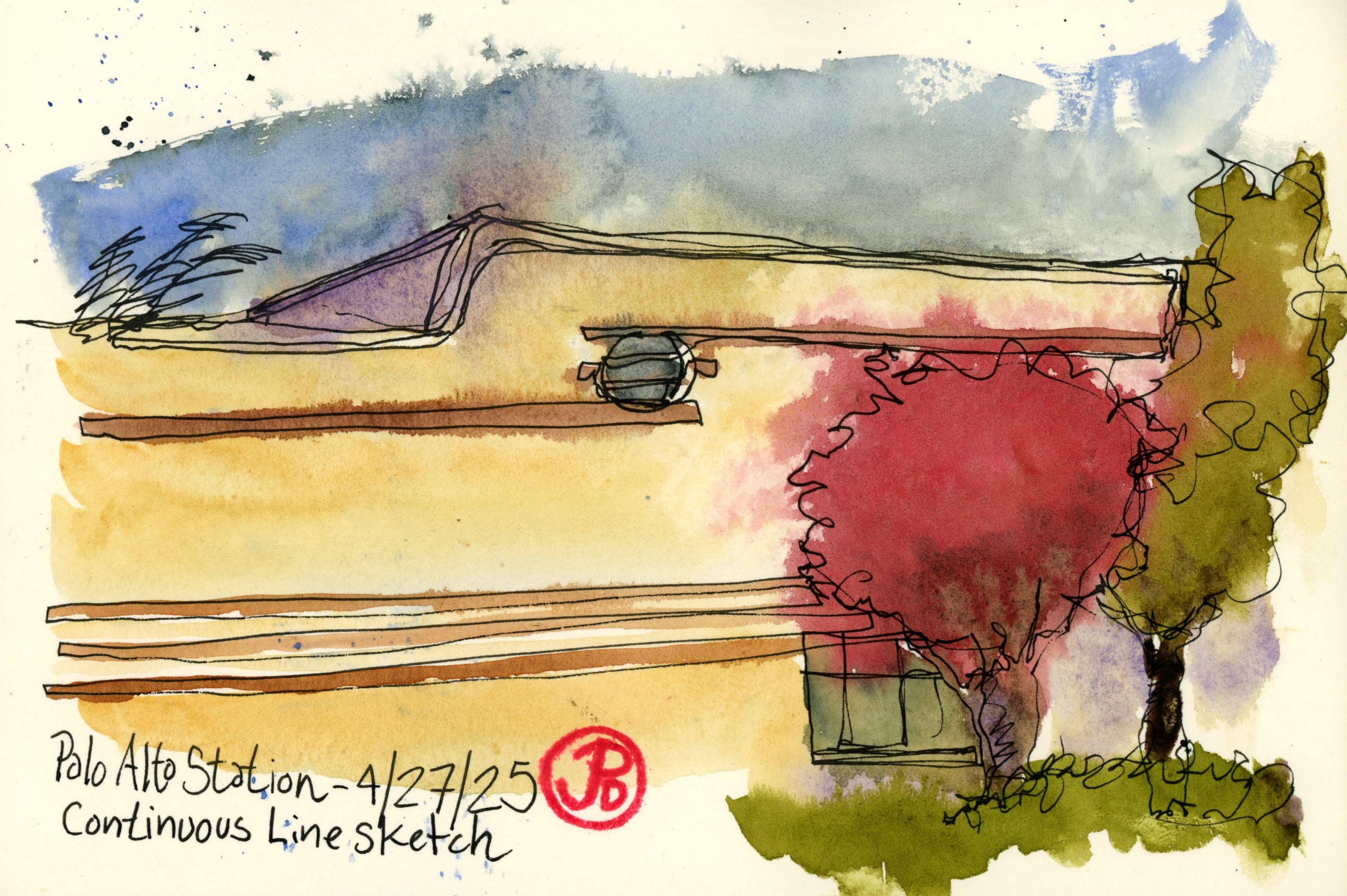
An EMU at Palo Alto, Caltrain’s second busiest station after San Francisco.
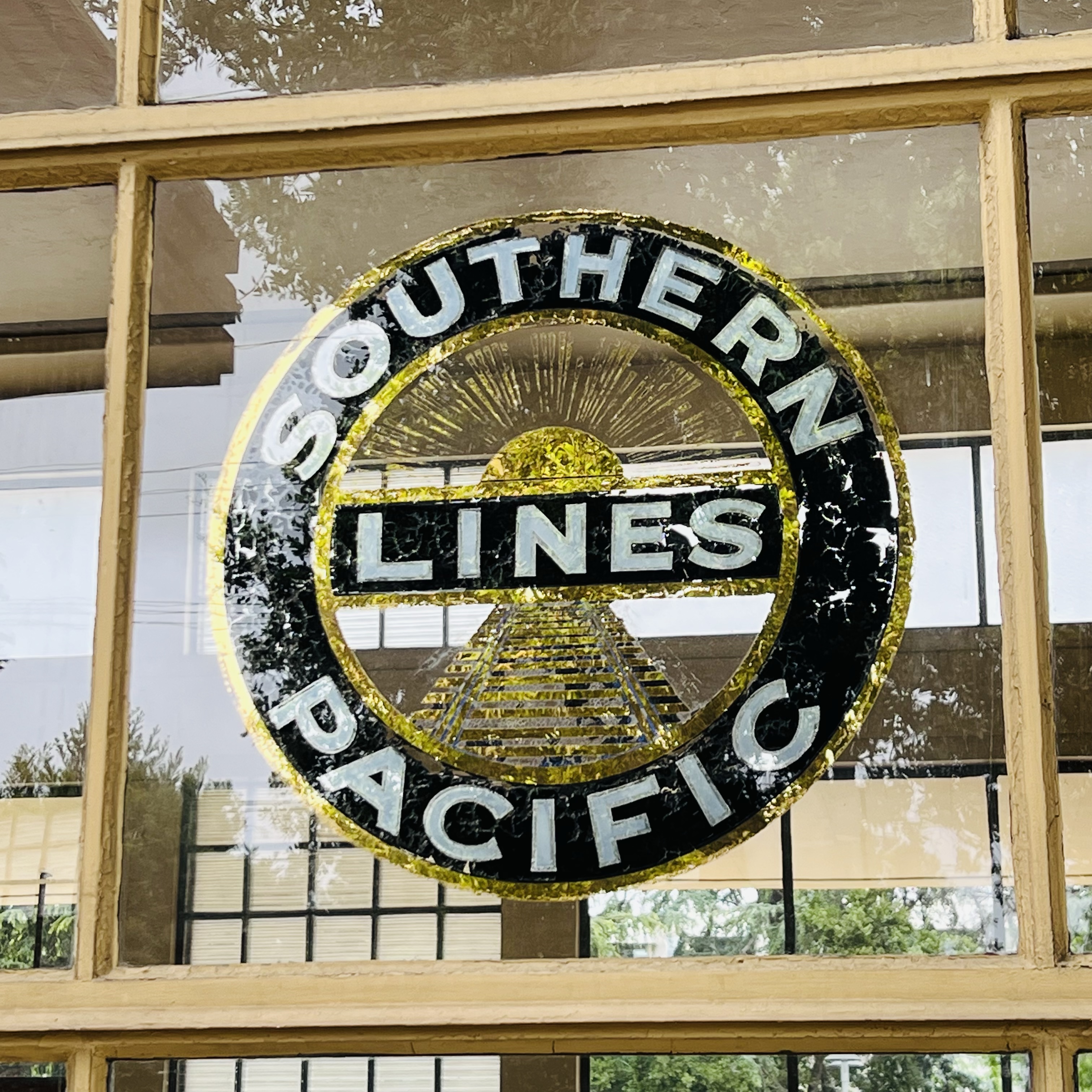
The emblem of the mighty SP when Palo Alto was a stop on the streamlined Daylight passenger service from San Francisco to Los Angeles. The most beautiful passenger train in the world (But I’m biased.)

Before heading to lunch on University, I sketched another of my favorite stations on the line the Streamline Moderne Palo Alto station (1941) which looks like some kind of sea going vessel about to take to the air! The station was rebuilt to match the streamlined GS locomotives that were on point for the Coast Daylights.

Final Thoughts

Caltrain’s new EMUs provided a quiet, comfortable, and quick ride from San Francisco to Palo Alto. The interior is well designed and easy to navigate with screens at both ends of the car that shows the next stop as well as upcoming stops. The seven car units have a European feel that looks more like a fast tram or articulated streetcar rather than a high sped mainline train set.

One quibble with the design is that there is only one restroom aboard the train set. This is not a minor quibble as most stations on the line do not provide opened restrooms (including Palo Alto).

Image

CalTrain Electric

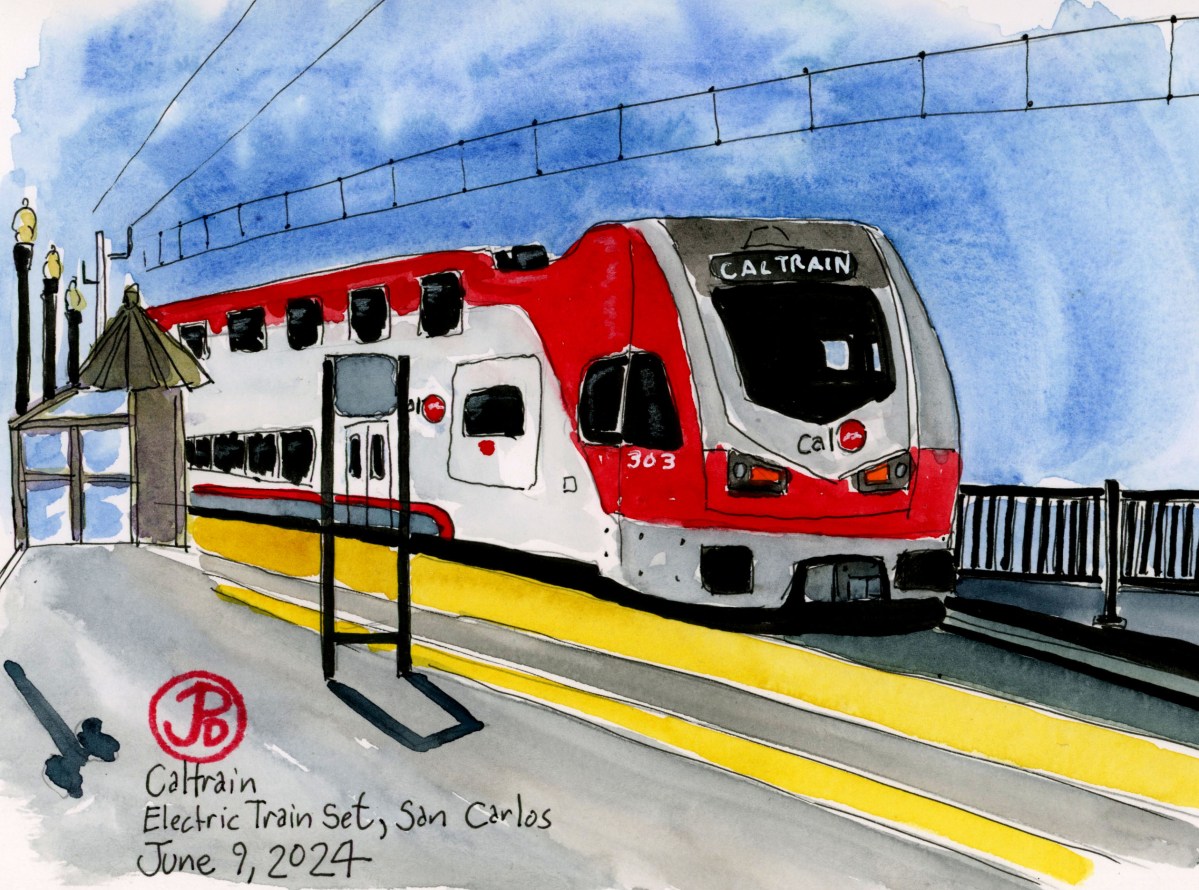
On a recent Saturday morning I had a pleasant surprise as I drove north on El Camino Real at San Carlos. At San Carlos Station was one of the new electric CalTrain sets.

The new trains are built by Stadler, a Swiss-based train manufacturer. The company was founded in 1942 and is headquartered in Bussnang, Switzerland. The company has a factory in Salt Lake City, where Stadler will build 24 train sets for Caltrain.

The train sets are known as BEMUs which stands for battery-equipped electric multiple unit.

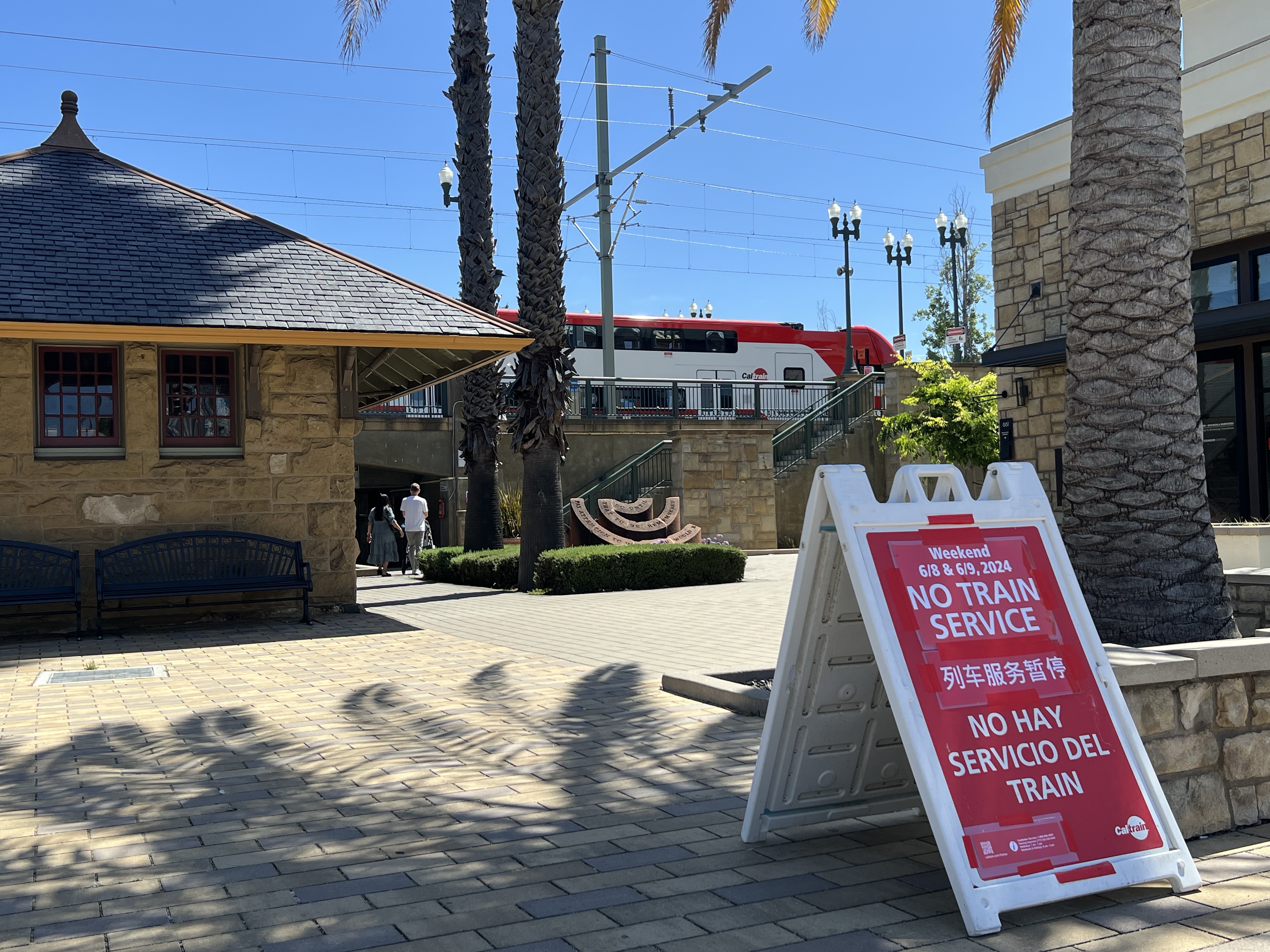
I parked, thinking that the train would surely have left the platform by the time I walked to the station but as I walked down San Carlos Avenue, the train was still stationary at the station.

As I crossed El Camino, a placard stated “No Train Service”. The line was closed all weekend.

The line was closed from San Francisco to San Jose so Caltrain could test eight of the new electric train sets. The electrification of the line started in 2017 and electric trains are scheduled to start running on September 21, 2024.

If you think of some of the most iconic passenger trains in modern rail: Japan’s Shinkansen (“Bullet Train”), France’s TGV, Eurostar, Amtrak’s Acela, Chinese Railways CRH, the Bay Area rail corridor was finally being electrified to catch up with the rest of the world, although it would not come close the top speeds of modern Shinkansen (186 mph).

Three quarters of the world’s passenger service are powered by electricity. About time!

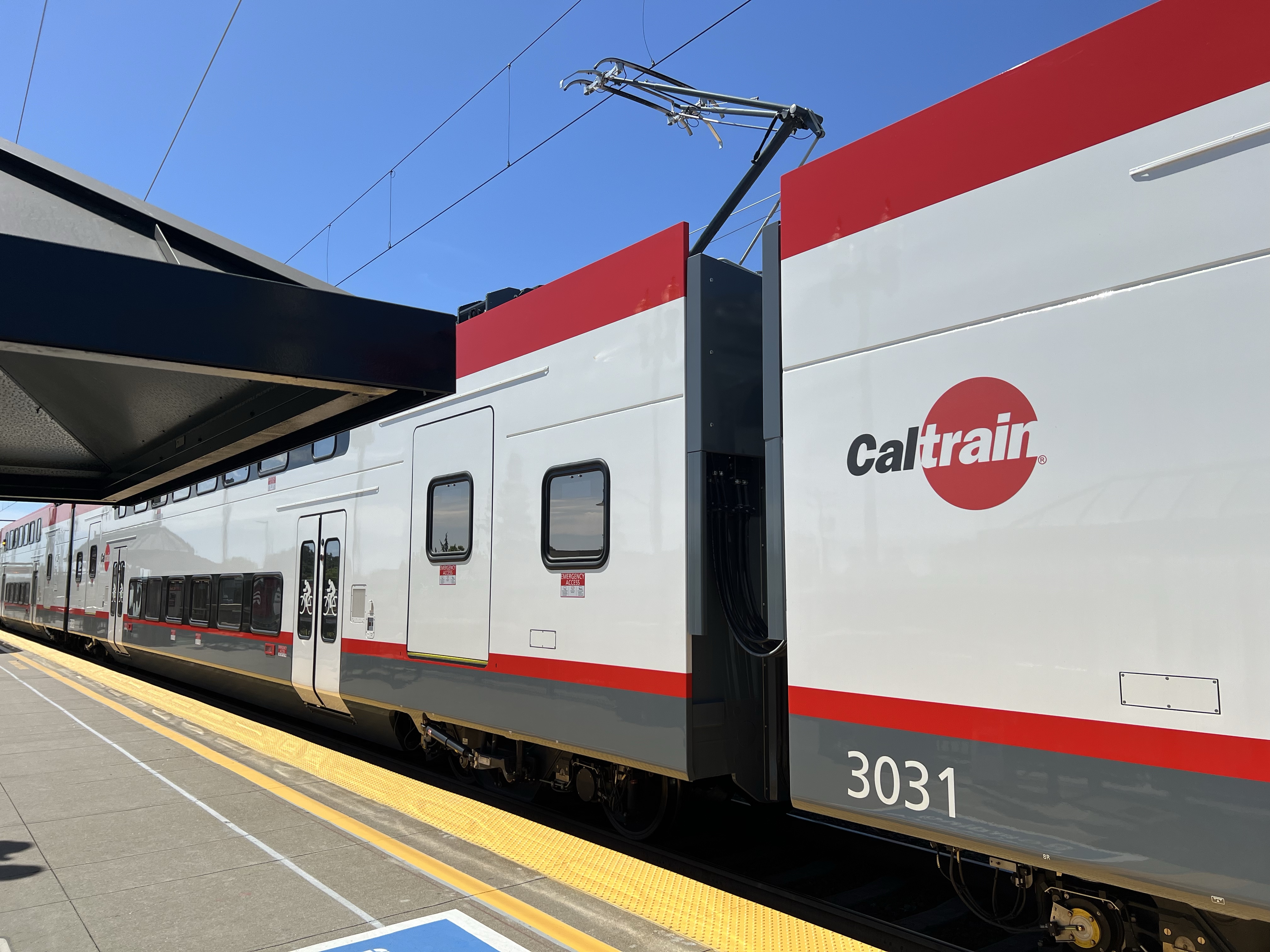
This is what powers the new train sets: the pantograph that delivers power from the wires above to the train set below.
Not sure if these new trains sets earn any style points. They look like a large streetcar or tram.
Image

Santa Clara Control Tower

I have been sketching a few of the remaining Southern Pacific water towers in California but I had yet to add a control tower to my sketchbook.

There are about nine Southern Pacific interlocking control towers still in existence in California and 16 are still in existence on the former SP system. These control towers where once ubiquitous on America’s railroads at busy junctions or rail crossings. Interlocking control towers centralized a group of signals (semaphore and lights) that were controlled by an operator to control the rail traffic by communicating different orders: proceed, caution, or stop. Think of it like a traffic signal for trains.

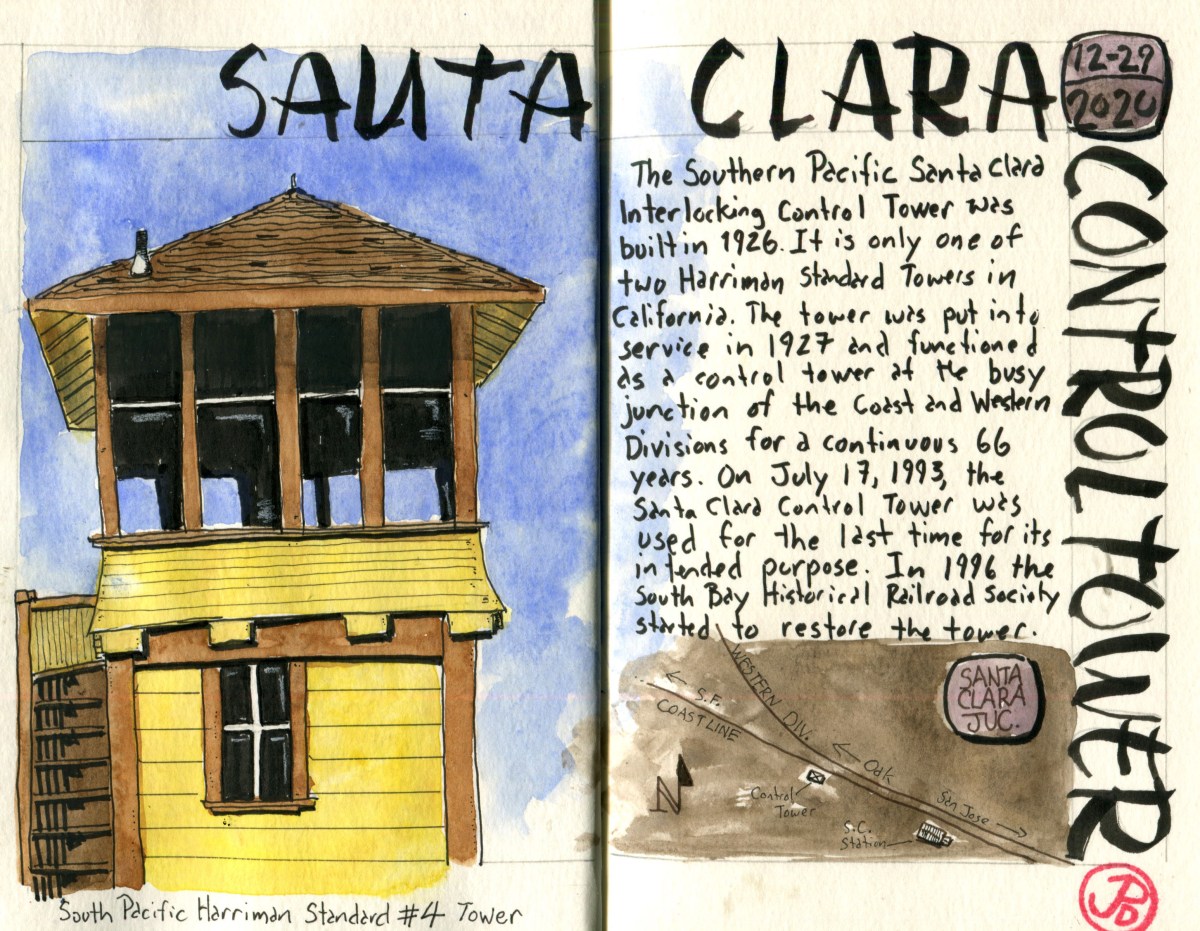
The Santa Clara Southern Pacific Interlocking Control Tower was built by SP in 1926 and put into service in 1927. The tower was in continuous use for 66 years at this very busy junction of the Coast Line and the Western Division. In the 66 years of operation, many trains, both passenger and freight, passed by. The famed Coast Daylight sped by the tower, stopping to take on passengers in San Jose.

The tower was in use until July 17, 1993 when the control of all switches and signals were moved to a centralized control center in San Jose.

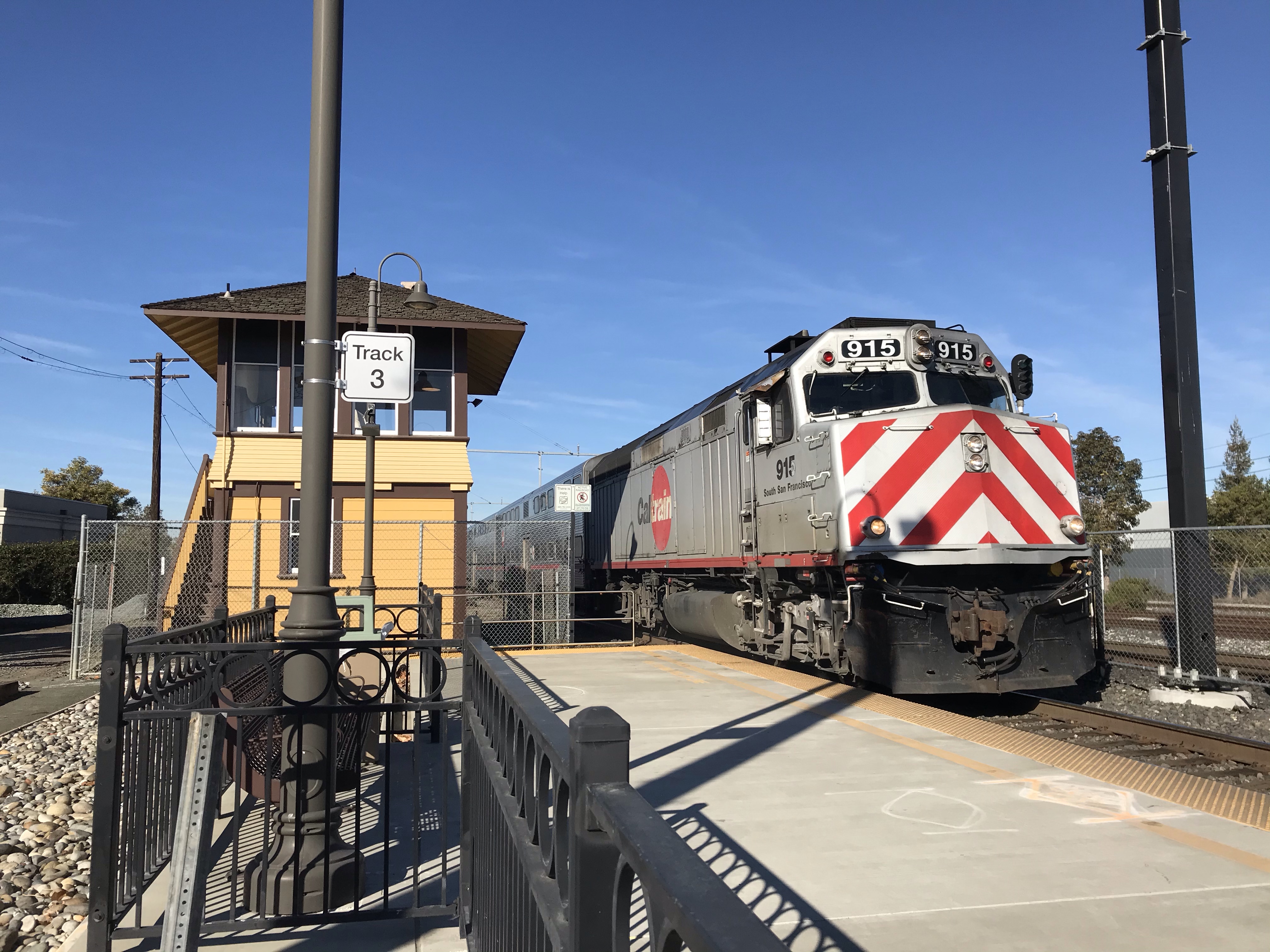
A Southbound Caltrain pulls into Santa Clara Station on its way to the end of its run in San Jose. To the left is the restored control tower. On point is locomotive 915 “South San Francisco”.

Santa Clara is a busy junction where the Coast Line and the Western Division meet. It is busy today with both passenger and freight traffic. The passenger trains that stop or pass this way are Caltrain, Capital Corridor, the Altamonte Corridor Express (ACE), and the Coast Starlight. Four main line track pass Santa Clara, tracks to the northeast are used by Union Pacific for freight. The other three train a primarily used for passenger service with some routes turning off here to head north, on the east side of the Bay, towards Oakland (the Western Division).

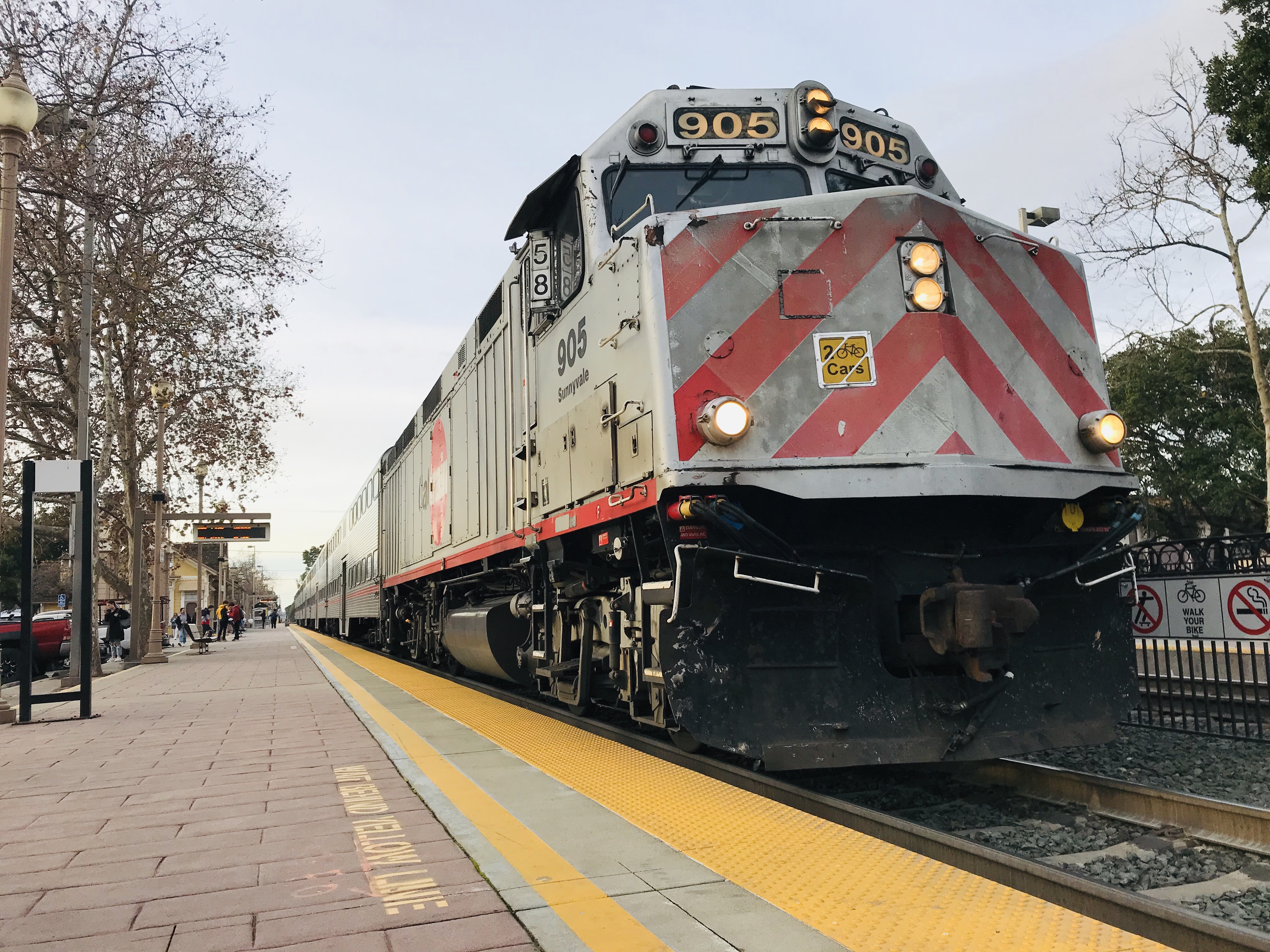
A northbound Caltrain passes the control tower as it pulls out of Santa Clara Station heading toward San Francisco. This consist is being pushed by locomotive 905 “Sunnyvale”, an EMD F40PH-2CAT.

Sketcher’s Folly: Oops I did it again. I made a sketching mistake. In my sketch of the California Theatre in Dunsmuir I left out an “I” and now I made the egregious mistake of misspelling the county of my birth: Santa Clara. What next? Misspelling my own name?! Well at least I’m making new mistakes!

Image

San Jose, the End of the Line

“I became quietly seized with that nostalgia that overcomes you when you have reached the middle of your life and your father has recently died and it dawns on you that when he went he took some of you with him.”
― Bill Bryson, The Lost Continent: Travels in Small Town America

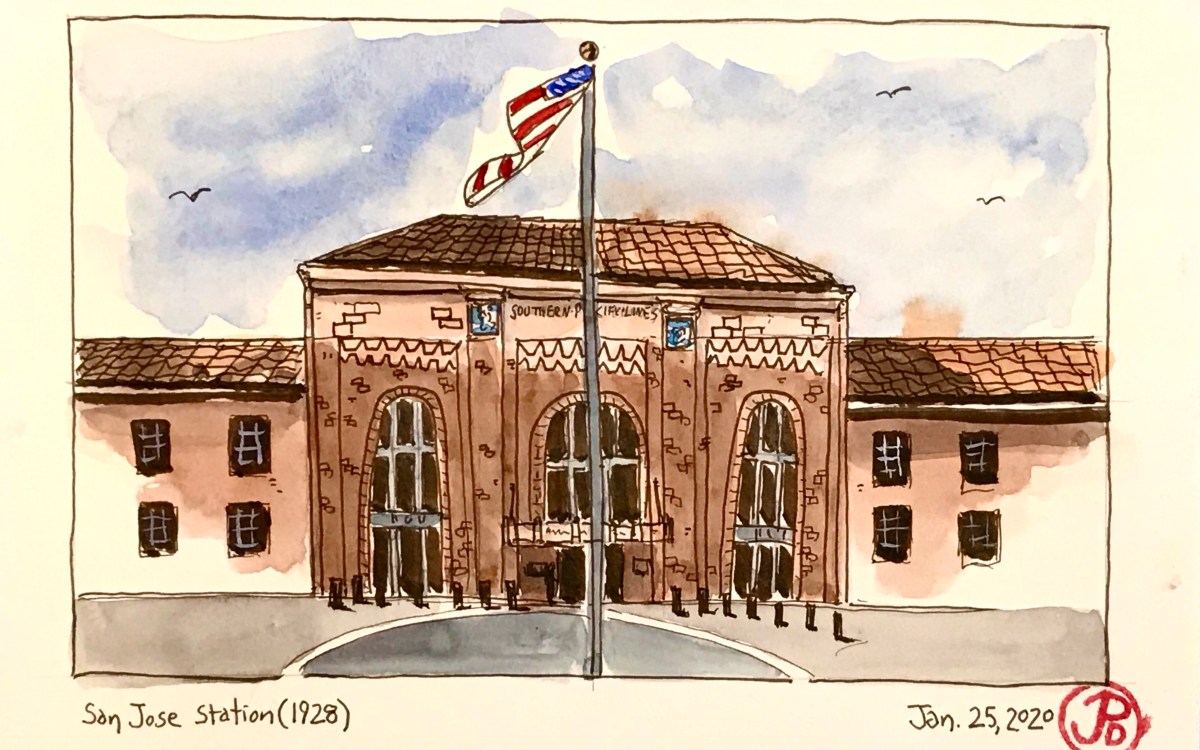
My last historic station sketch was a short train ride down the line from oldest station on route in Santa Clara. This was the end of the line for most southbound Caltrains, San Jose’s Diridon Station.

This is a station that was built to impress, a station to represent a major city and not a town. Much like San Francisco’s old passenger station at 3rd and Townsend Streets.

San Francisco’s main train station was built in a Mission Revival style like Burlingame Station. It was opened in time for the Panama-Pacific International Exposition in 1915. This grand station stood until July 1975. It was torn down because, according to Southern Pacific, it had “outlived its usefulness”.

San Jose’s Station, by contrast, still survives and is in use. The station was designed by SP architect John Christine in an Italian Renaissance Revival style. It cost $100,000 to build and was opened on December 30, 1935.

The interior is grand, featuring a high ceiling with large roof beams and hanging chandeliers. At the northern end of the depot is a mural by John MacQuarrie, at the south end is a clock.

This has always been a busy place. Many routes pass through this station. I remember boarding the Coast Starlight here for a trip to visit a friend in Eugene, Oregon. In its heyday the following routes stopped at this station: the Lark, Coaster, Daylight, Del Monte, and Sunset Limited. Today the station serves Caltrain, Altamont Commuter Express, Capital Corridor, and the Coast Starlight.

I set up my sketching stool on the lawn across the street from the station and started to sketch San Jose’s imposing station. In the background a woman loudly gave a sermon to an audience of none while she waited for a bus.

Coda

The last railway journey of this project was bittersweet for me.

The train ride was through the southern part of the line and through the memories of my youth. There were bits of my youth still standing but much of it altered or gone completely.

The Sunnyvale train station, where I would come to watch commuter trains with my father, was gone now, along with my father. In its place there was a parking structure with a shelter covering a few benches and a ticket machine.
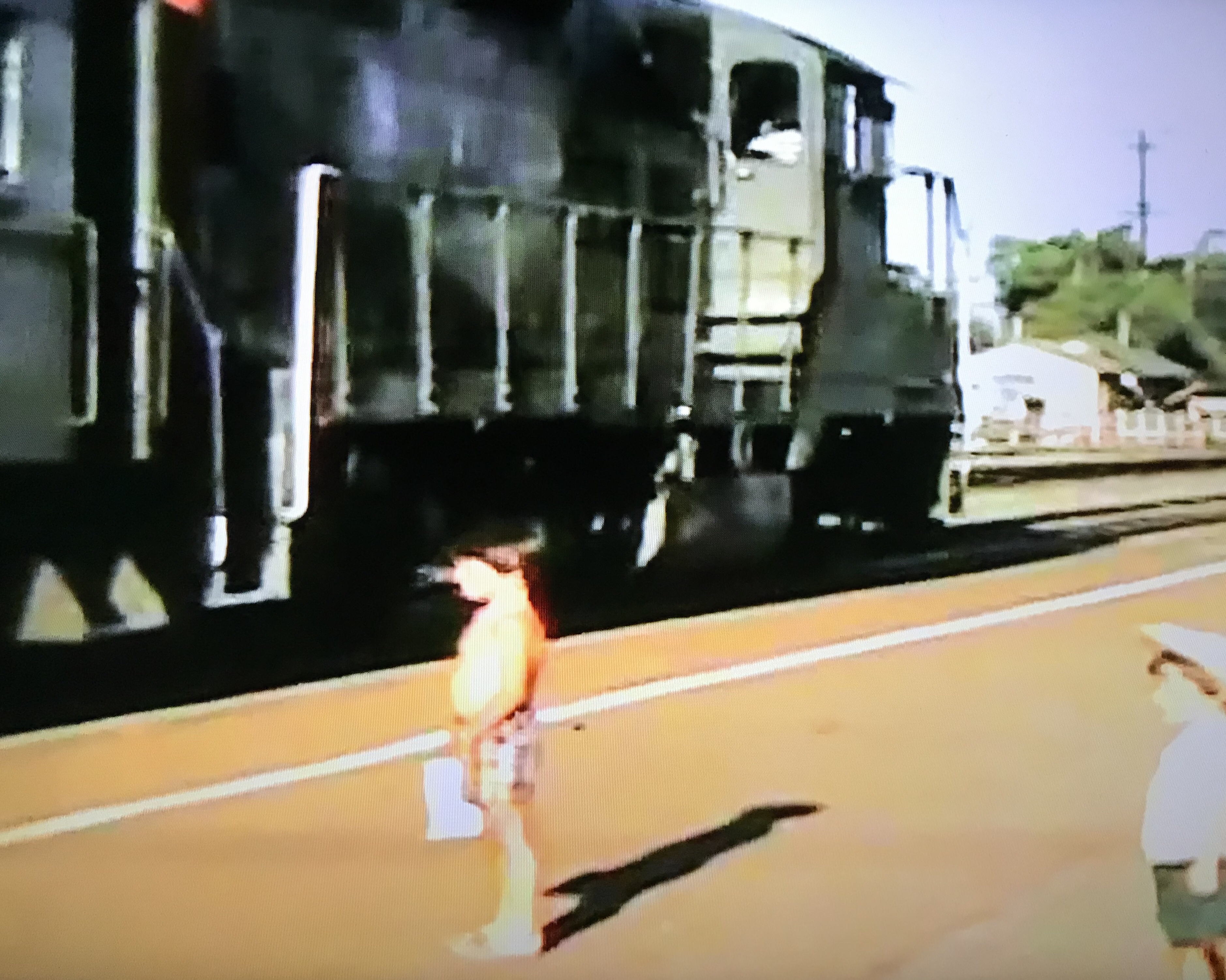
An August 1977 still frame from one of my dad’s Super 8 reels showing a shirtless me watching a commuter train pull into Sunnyvale Station. My brother looks on from further back. I was six years old.

On the east side of the tracks, just out of the Sunnyvale station, was the former Westinghouse Plant (now Northrop Grumman). This is where my father worked for most of his adult life.

Beyond Sunnyvale, the line was surrounded by tech buildings, parking structures, and concreted clutter. The former orchards of the Valley of Heart’s Delight have been paved over years ago. Change is the creed and mantra of Silicon Valley.

The touchstones to the past where to be found along the line in the eight historic passenger train depots I had sketched. They could not be changed or destroyed because they were designated historical landmarks.

On my return journey from San Jose Station I sat on the east side of the train and watched the ever passing progress of the valleys build up. This was a landscape void of familiarity for me. Sunnyvale was much changed with multi-story buildings cluttering and changing its skyline.

We pulled into Mountain View Station, the next stop north of Sunnyvale, and I looked down at the platform at the passengers waiting to board. That’s when I saw an unexpected part of my past, not a place but a person.

It was Rosemary. My neighbor from Cormorant Court, the street in Sunnyvale where I grew up. But she was much more than a neighbor, she is family, so much so that my brother and I call her Aunt Rosemary. Our families still celebrate the holidays together, long after both families have left Cormorant Court.

I realized that the past is not just made up of places or things, but of people. Like Rosemary, who has known me longer than I’ve known myself.

I walked back a few cars to find her and we talked and I showed her some of my sketches and we enjoyed our brief journey together until I disembark at Hillsdale Station.

It seems fitting, that on my quest to find the past, that I found mine at Mountain View Station in the city of my birth. I’ve been finding the past in stone wood, glass, tile, and steel, forgetting the true treasures of the past that are made of flesh and blood.

These are not only the people we know and love throughout our journey here on earth, but also the people that designed, built and use these stations along the railway corridor. After all, these are not just buildings to be looked at but they are meant to be used by the people who fill them with love and life.

Amen
Image

The Oldest Station on the Line

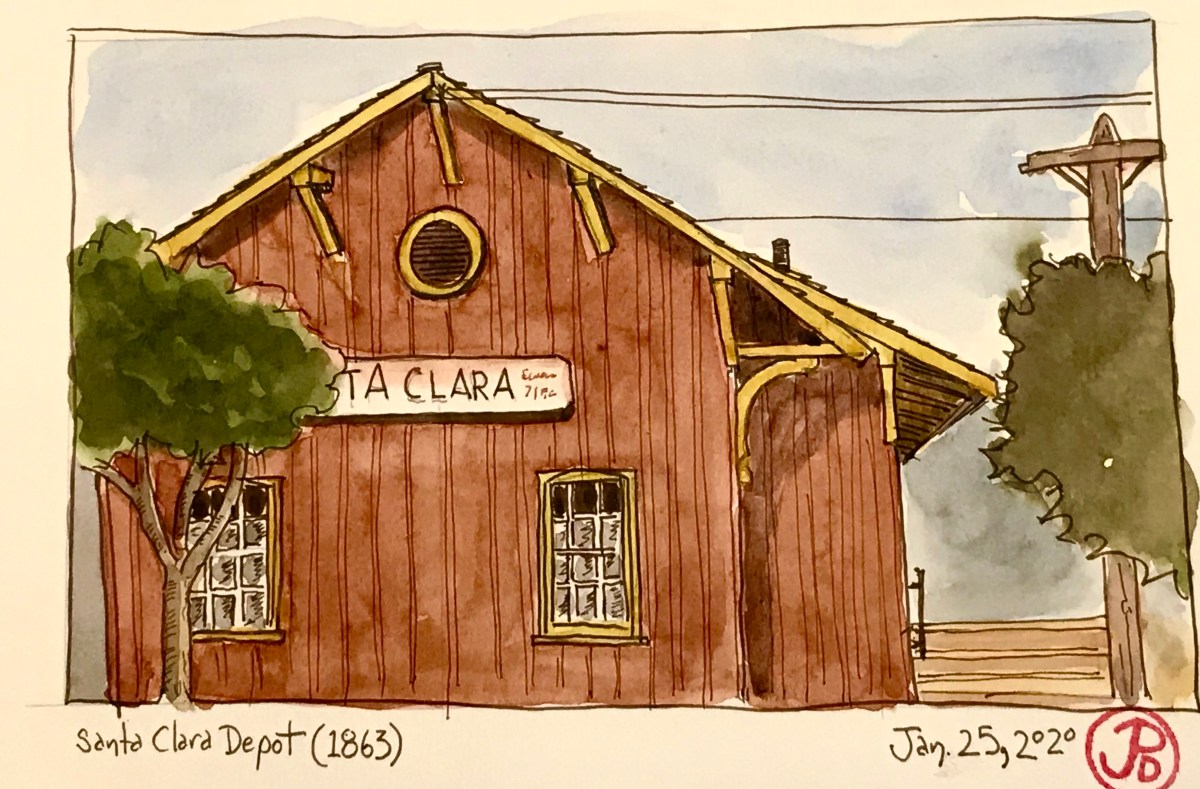
On Saturday Morning I took the earliest southbound train from Hillsdale Station. My destination was the oldest passenger station on the line, and it is was in the county of my own birth: Santa Clara County. This is Santa Clara Station.

This station was built by the San Francisco and San Jose Railroad in 1863. It is the oldest station on the Caltrain line and the oldest passenger depot west of the Rocky Mountains. The station was moved from it’s original location on the opposite side of the tracks, to the west side, where the University of Santa Clara is located. In 1877, the passenger depot was joined to the freight house.

The station is at an important junction to points north. The trains to left (Coast Division) head north to San Francisco and the tracks that head to the right (Western Division) takes train to points north: Dunsmuir, Portland and Seattle. So the junction sees a lot of rail traffic.

By the 1980s, the depot had fallen into disrepair but in 1985 the South Bay Historical Railroad Society was founded with the mission of restoring the depot to it’s former condition. The restoration was completed on 1990.

The passenger depot in January of 2020, looks in great shape compared to other historic depots I have sketched on the line. This is due to the hard work of the volunteer labor of the South Bay Historical Railroad Society.

The depot was a very busy place on a Saturday morning and many children and their families were gathered and waiting for the museum to open at 10:00. The museum houses railroad memorabilia and a large model railroad layout which is the big draw for children. Both child and adult children!

One of the few places you can still see Southern Pacific in action, although in HO scale, is at the South Bay Historical Railroad Society. I had a model railroad when I was a kid. My HO gauge railway ran in an oval with a small town in the center. I had a Santa Fe “Super Chief” locomotive but my favorite was a Daylight GS-4 number 4449. The full scale locomotive pulled its passenger consist past Santa Clara Station but did not stop. Passengers wishing to board the Daylight had to go to San Jose.
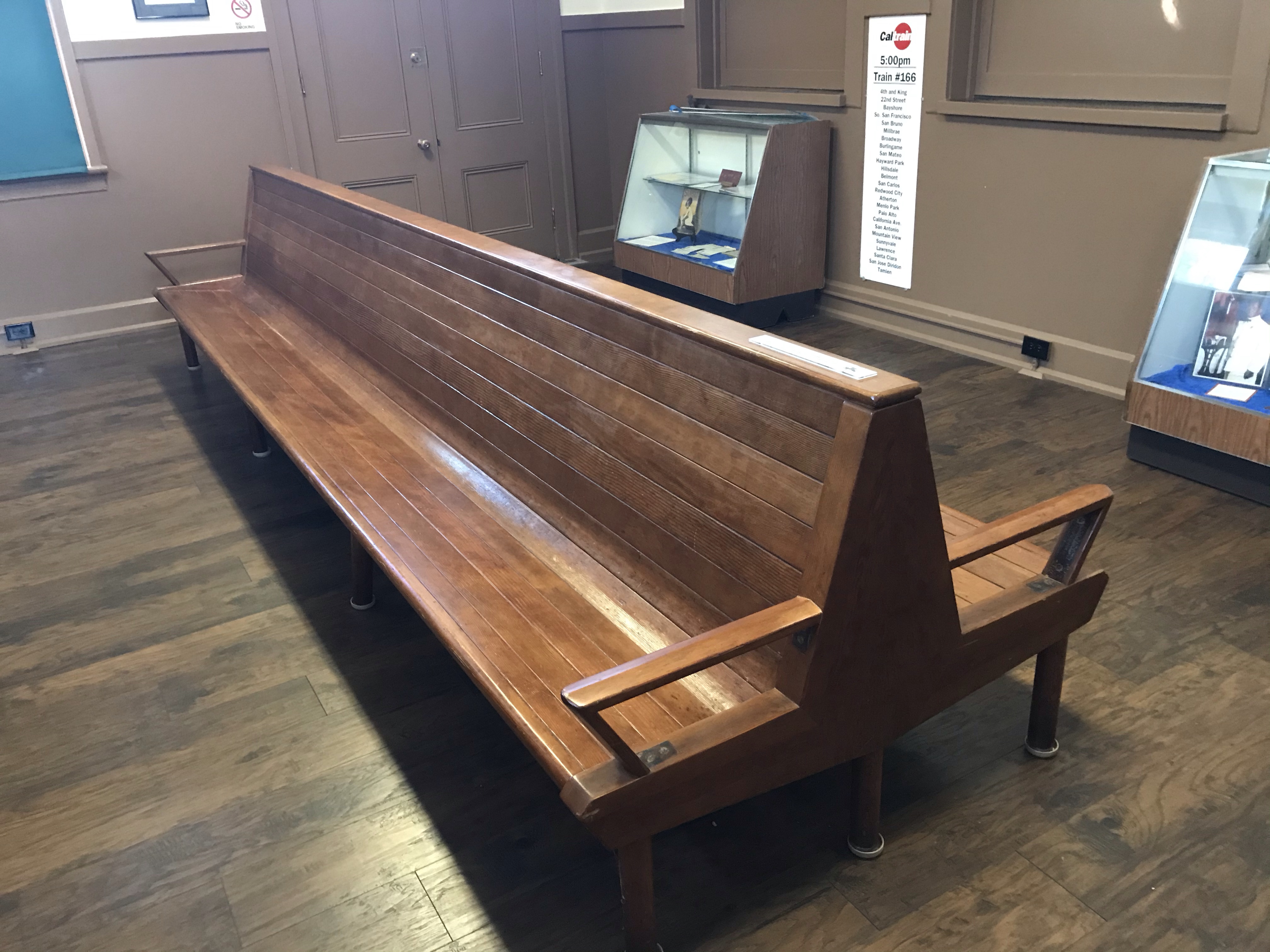
This an original bench in the passenger waiting room of Santa Clara Station.

This control tower was built in 1926 and was in continuous use until July 17, 1993. The tower was built at the junction of Southern Pacific’s Coast and Western Divisions.
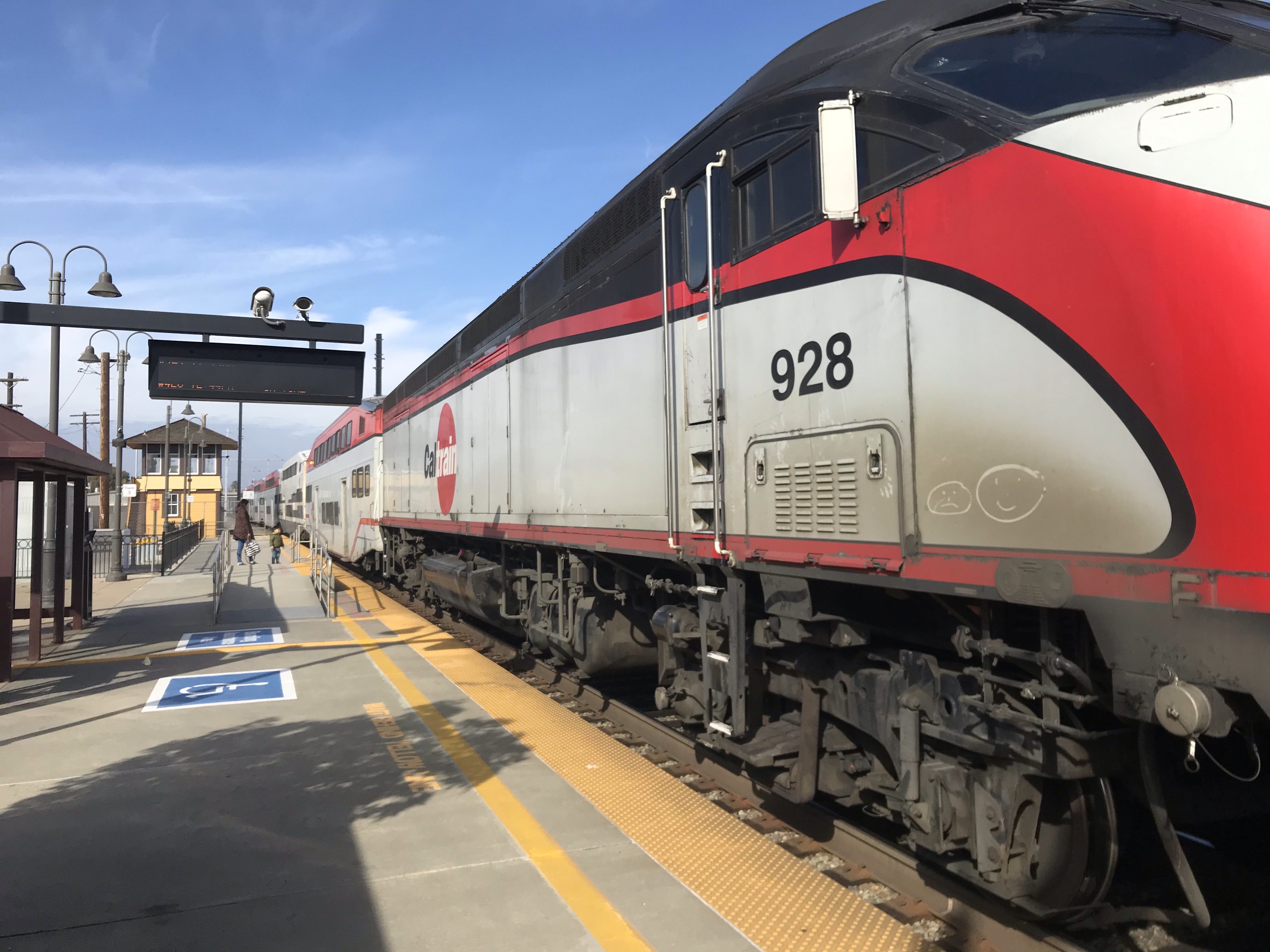
A MP36PH-3C diesel locomotive Number 928 took me to my final destination on this sketching journey, the end of the Caltrain line at San Jose Diridon Station.

Image

Palo Alto Station

The first stop of the streamlined Daylight out of San Francisco was Palo Alto, the town on the doorstep of the Stanford University campus.

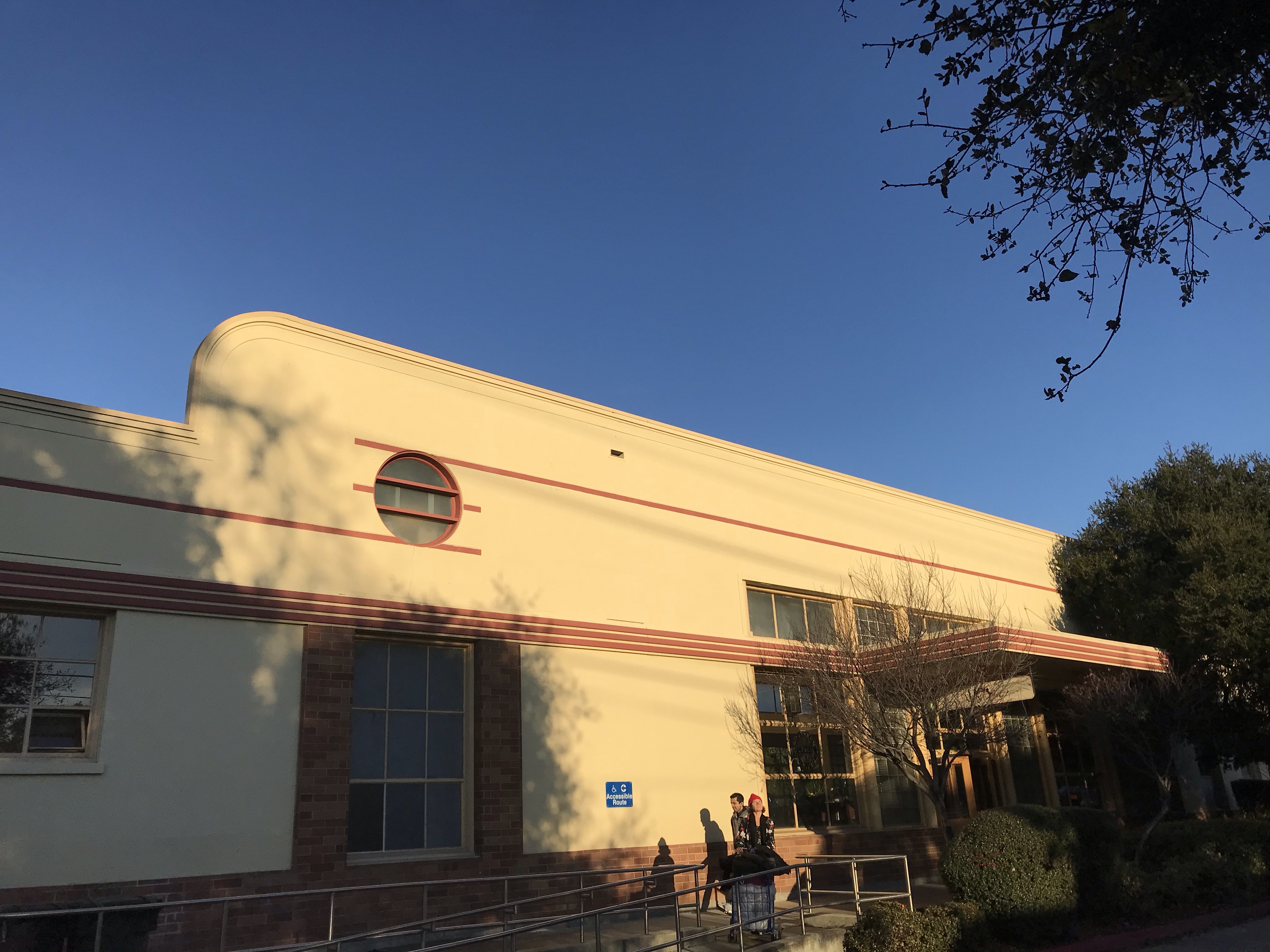
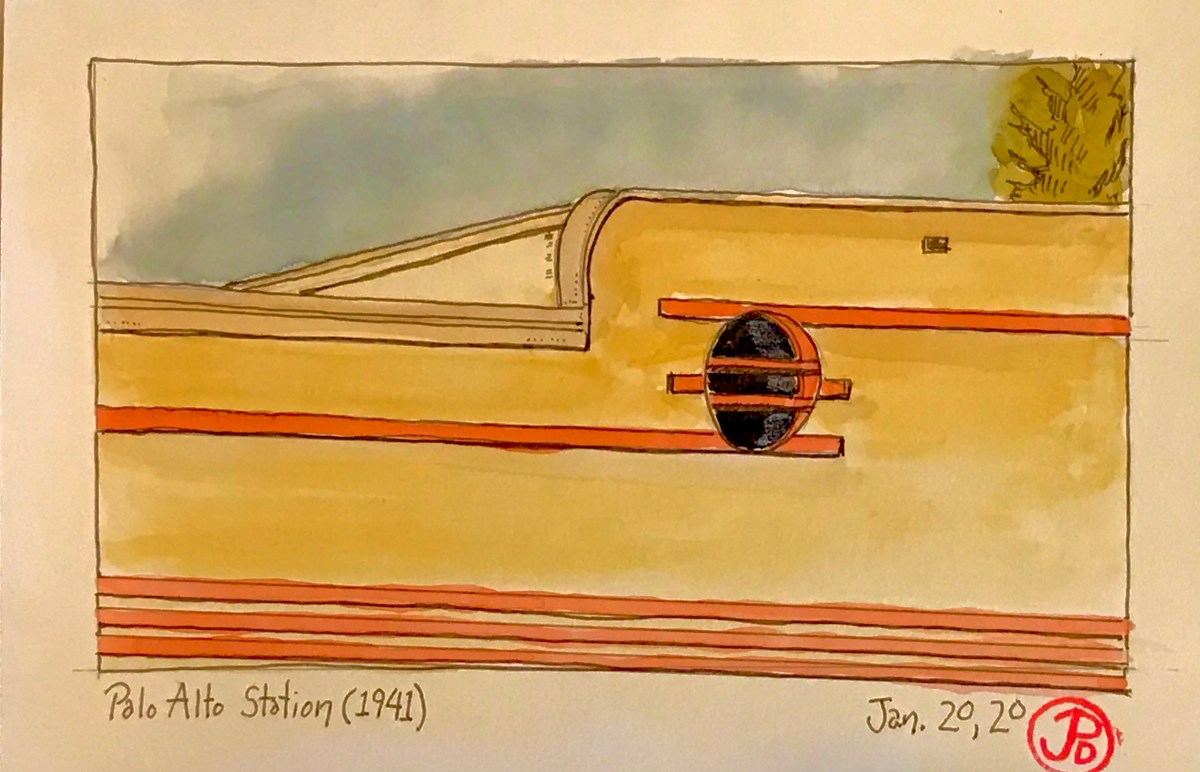
There were two stations on this site before the current station was built in 1940-41 ( The cornerstone was laid on October 22, 1940). This Station was designed in the Streamline Moderne style to reflect the streamlined train sets of the Daylight that stopped to pick up passengers on their way to the southlands. The luscious curve of the station’s roofline is echoed in the sloped skirting of the GS-2 steam engine that pulled it’s twelve-car consist to Los Angles.

I really love this station and enjoyed sketching it’s streamlined profile. Looking up at this station, hemmed in by dark-grey skies, transported me back the 1940s. I felt like I was a two-bit character in a Film Noir, say Double Indemnity (1944), for instance.

The Coastal Route and Palo Alto are briefly featured in this seminal Film Noir, considered by many to be the best Film Noir ever made. The plot involves the murder of a husband by his wife and her lover. The husband, “a Stanford man”, is heading to Palo Alto from Glendale on a Southern Pacific passenger train for a class reunion. Mr. Dietrichson never made it to Palo Alto Station or his reunion. Any more information about the plot would surely be a spoiler. 

I took the number 424 Caltrain from Millbrae at 10:04 AM and I got into Palo Alto at 10:46. I had already scoped the station on a previous visit and I knew that I really wanted to sketch the curvaceous roofline and the round window from the street side entrance of the station.

What I was trying to do with the curvaceous roof was not to sketch the station in it’s entirety but focus in on it’s most emblematic elements. This was a refreshing approach because I chose where I wanted to frame my drawing and I left a lot of other details out of frame.

After I had finished the sketch and painted it, I went around to the front of the station, on the northbound platform and did a quick sketch of the profile of Palo Alto station. This is the view you see from the train.

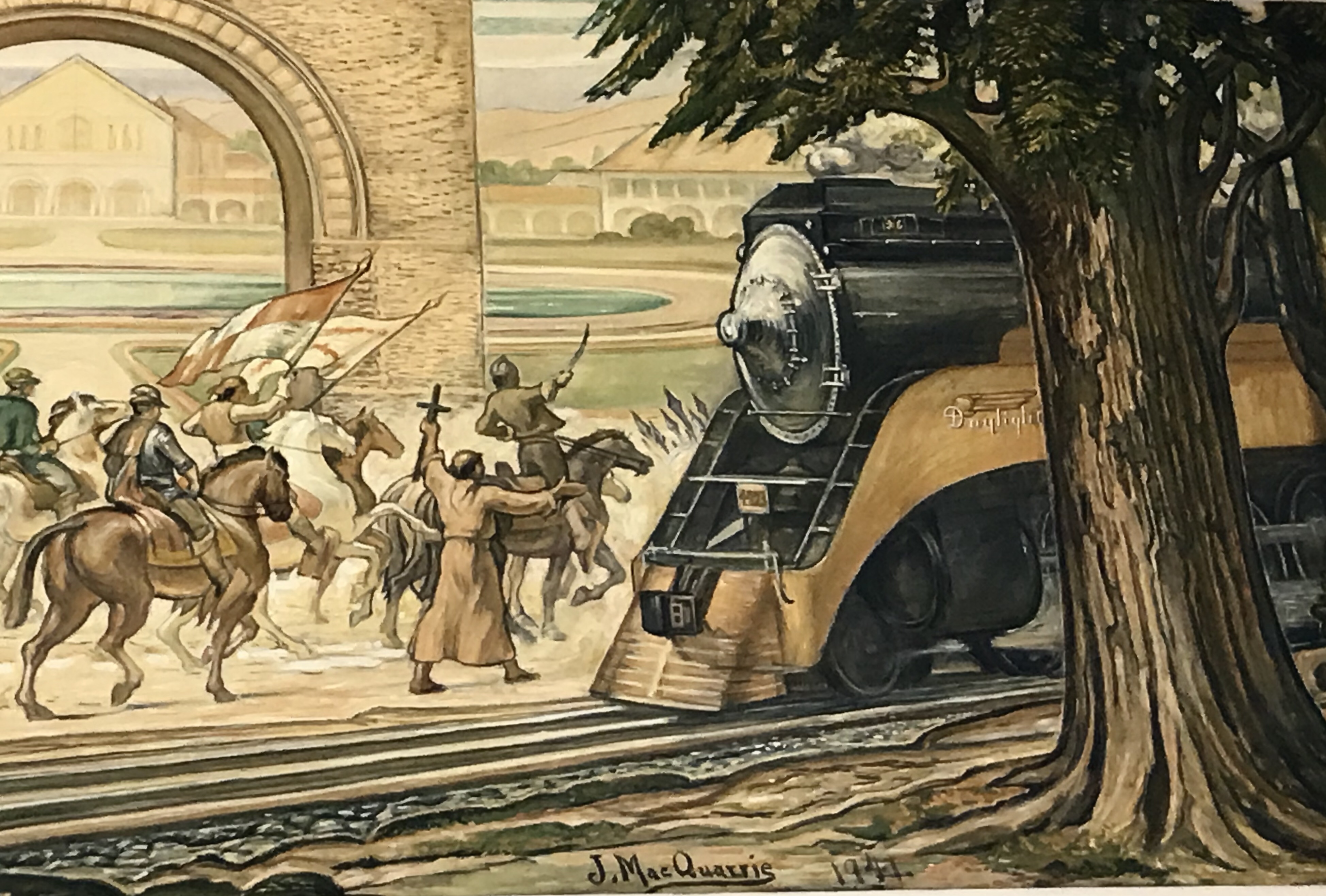
One of the treats of Palo Alto Station is to be found on the inside of the building. This is the 1941 mural painted by San Francisco artist John MacQuarrie.

The mural was complete for the March 8, 1941 dedication ceremony of the new Palo Alto passenger station where the mural was unveiled.

The mural stretches above the wall where the ticket counter is. It depicts the past and future of transportation. A stream of men on horses, Indians with travois, wagons, stage coach, and men and women walking on foot, head to the right with the quad of Stanford University in the background. In the lower left corner the profile of Leland Stanford looks on towards the future of transportation (circa 1940). The future seems to come out from behind the trees as a Daylight GS-3 locomotive proclaims it’s entrance into the mural. This certainly a synthesis between a beautiful and functional form of transportation and a building that does the same.
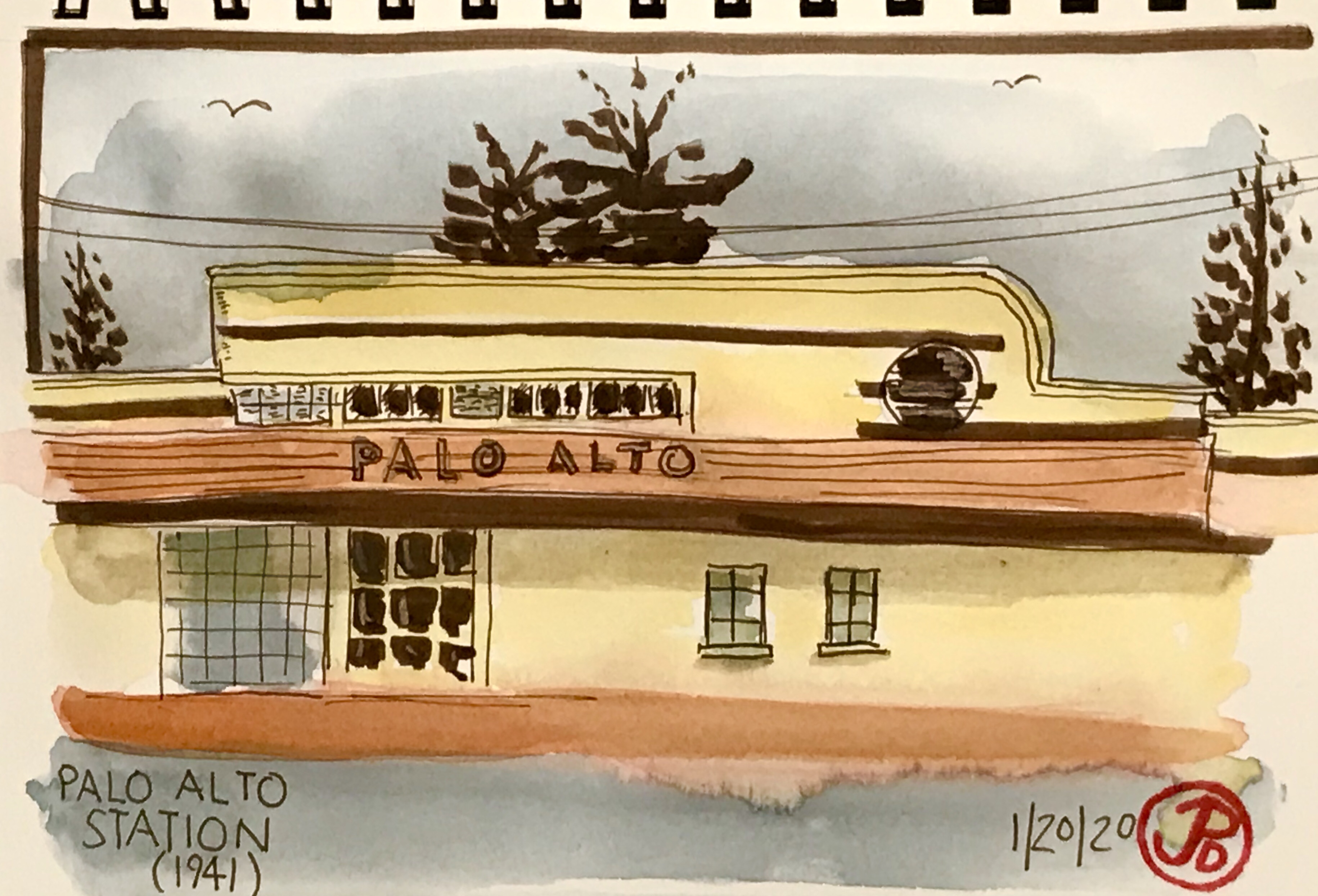
Here is my quick sketch of Caltrain’s most “modern” historic station. I left details out, like the door into the station. I was really trying to get the shapes of the building.
Image

Menlo Park Station

It was now time for an after work train station sketch.

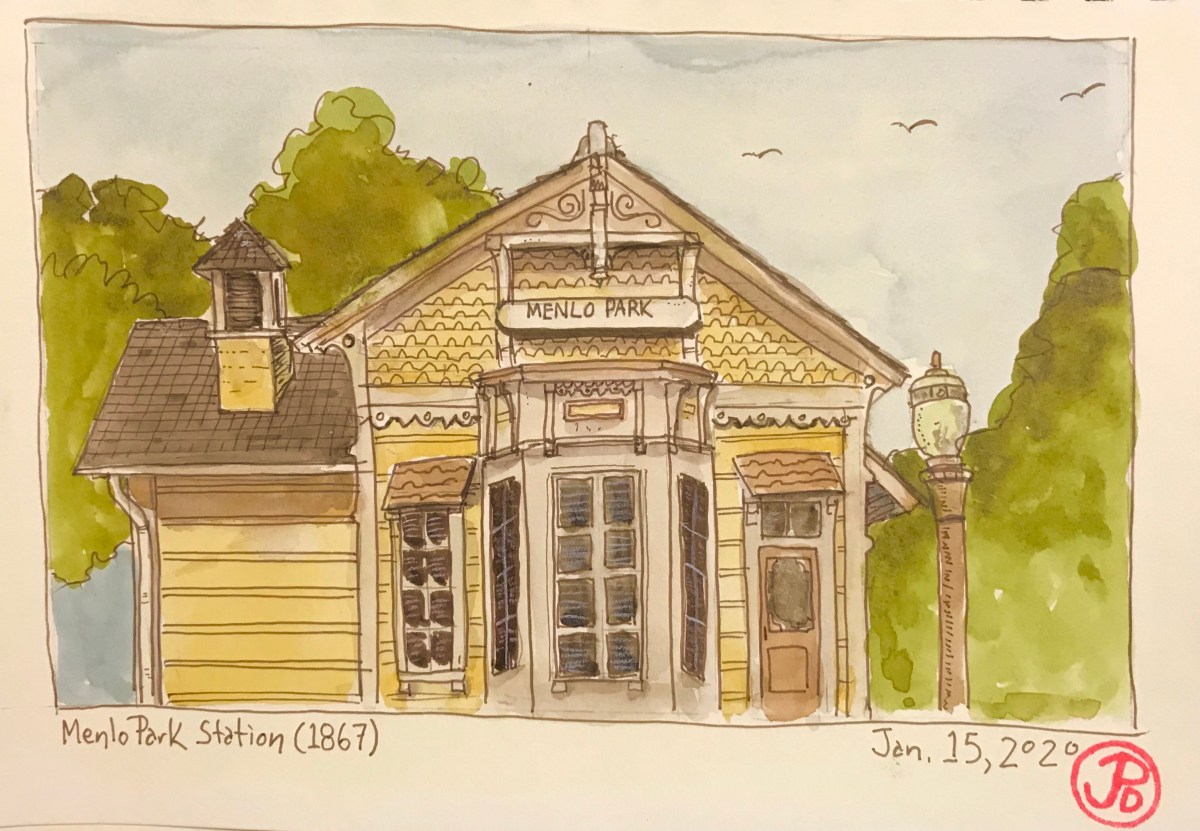
I headed south to one of the oldest stations in San Mateo County and one of the stations furthest south on the line before heading into Santa Clara County. Menlo Park Station is the oldest active train station in San Mateo County. Rail service to Menlo Park began on October 18, 1863. At that time, a simple shelter was on the site before the depot was built. It is considered the oldest active passenger railway station in California. It was built by the San Francisco and San Jose Railway in 1867. The Queen Anne expansion, included a Ladies Parlor, was added to the south side which is featured in the sketch.

When Southern Pacific consolidated the line (in 1870), Victorian ornamentation was added in the 1890s to appeal to the students (and parents) of nearby and newly built Stanford University.

At one time Menlo Park Station had two separate waiting rooms, one for men and one for women. In the office, Stanford University co-founder, Jane Stanford, wife of rail tycoon Leland Stanford, would wait for her train in a private room by herself. In 1905, Jane Stanford died of strychnine poisoning and her murder has never been solved. It is claimed that her ghost has been seen pacing back and forth in the station.

The station is on the same level as the main line just as it was when it was first constructed. The interior is no longer used as a passenger waiting room. Southern Pacific closed the station in 1959. It now houses the Menlo Park Chamber of Commerce.

This fancy vending machine has replaced passenger stations on Caltrain. I always prefer to buy my train tickets from a human being. You can’t do that here in Menlo Park. Nor can you buy tickets on the train from the conductor. Although you can chat with the friendly people at the Chamber of Commerce.

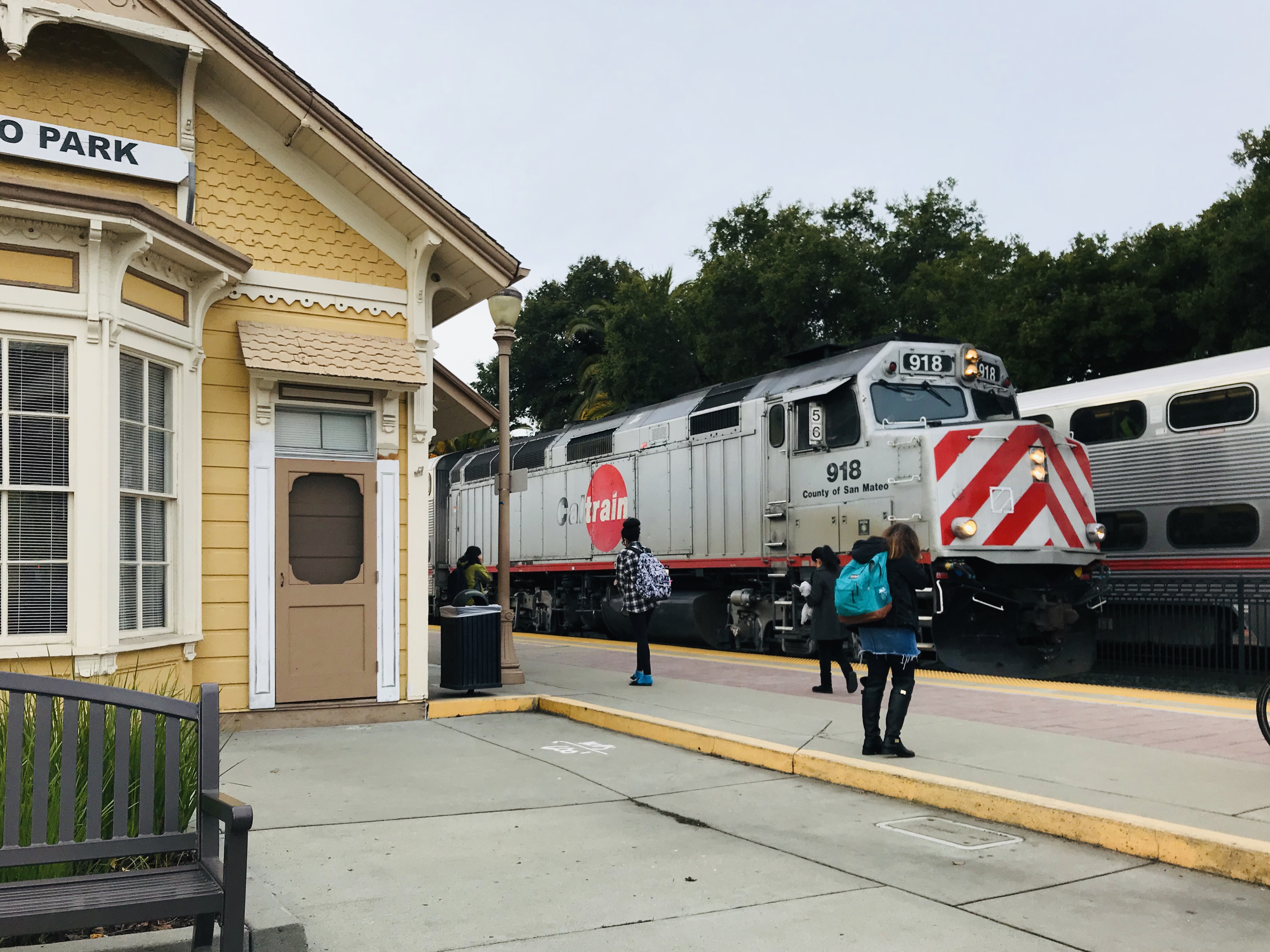
I sat on a north facing bench and started to sketch the elevation view of the station. There was something very comforting about this sketching experience. All around me I was surrounded by commuters. Both high school students and high-tech workers with their bikes milling about the platform or sitting on benches texting their friends waiting for their train. The overall feeling was of a vibrant station that is still in use and gave me hope for transit in the Bay Area. The scene at 4:30 PM in 2020 could not be too much different from a weekday scene at this same station, 70 years ago. Of course it helps to squint.

Menlo Park is a busy station on a Wednesday late afternoon. A southbound and northbound train pull into the station.

Engine Number 905 “Sunnyvale ” is on the point of a southbound train to San Jose. This engine is named after my hometown.

The train station at Sunnyvale is long gone. I never remember it as being an amazing piece of Southern Pacific architecture. The station has been replaced with a ticket shelter that connected to a parking shelter.

Quenching my thirst after my sketch at the redesigned British Bankers Club. I raised a glass to my father, who had to come to Menlo Park when he was at “The Farm” to buy spirits because Palo Alto was a dry town.