Image

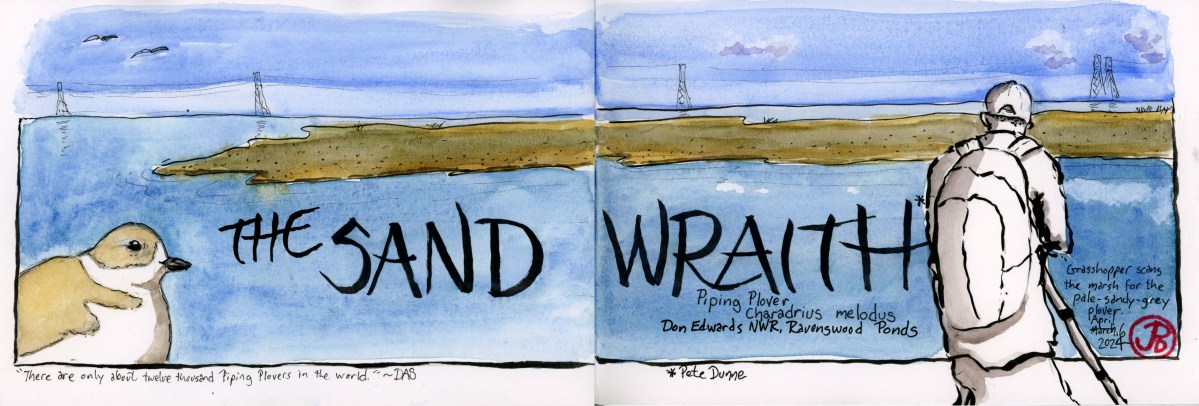
The Sand Wraith

An endangered plover that is rarely seen on the west coast was being seen at the Don Edwards National Wildlife Refuge in southeastern San Mateo County.

Grasshopper Sparrow had seen the piping plover a week before and this Saturday morning was my first opportunity to add a rare Bay Area lifer to my list so I picked up Grasshopper a 7:30 and headed to the ponds east of the vast Meta headquarters.

After a circuitous route around the entrance to the Dumbarton Bridge, we found the muddy parking lot and the trailhead that led to the Ravenswood Ponds.

There were already two cars in the parking lot, the more eyes the better! Within about a five minute ramble we came upon the pond where Charadrius melodus had been seen. Two birders already had scopes focused on the sandbars in the middle of the pond. They had not seen the piping, yet.

We scanned the ponds for about three hours (finding a pale plover amongst hundreds takes time and patience). In that time more eyes with scopes began to arrive.

At times the flock, consisting of western and least sandpipers, dunlin, and semipalmated plovers, would land near the watchers on the mudflats. We would quickly scan the birds for a sandy pale plover with orangish legs that was loosely associating with the semipalms, before the flock would erupt in flight.

Watching the shorebirds fly as one, with flashes of white as the birds twisted and turned as one was an absolute joy!

But the pale stubby-nosed, orange-legged plover was proving to be elusive. It seemed that I had tried to turn every semipalmated plover in my scope-view into a piping, with no luck.

Yup, a rare plover brings the birders out on a clear Saturday morning.

As we were nearing our third hour of Plover Watch 2024, a birder to our left called out, “I got the bird!”

What followed was a play by play of the piping’s location and movement; “Do you see the five wigeon in the far channel? Just to the right below the two pylons? The plover is moving to the right. Passing near the green shrubbery. Now it’s facing us, right near the two ruddy ducks now. It’s now going left just past the two semipalms.”

I was following the plover commentary with my scope, looking for the five wigeon and the shrubbery and the ruddy ducks when I finally came upon a pale plover with a pale broken breast-band.

Lifer!!
Image

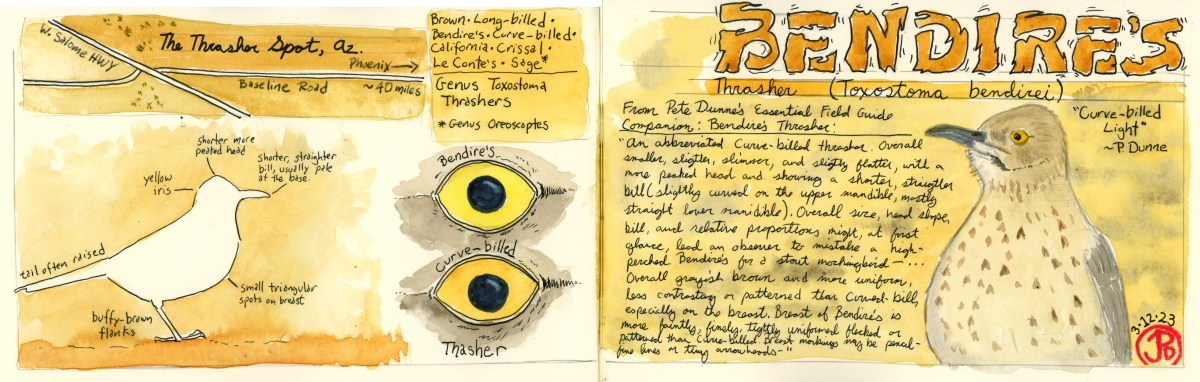
The Search for the Bendire’s at the Thrasher Spot

The Trasher Spot in Arizona is famous in the birding world as the location to see four thrashers: sage, crissal, Bendire’s, and Le Conte’s. It is also known as one of the best spots in it’s range to see the notoriously sulky and ghost-like Le Conte’s thrasher.

I had seen the Le Conte’s thrasher, after many, many attempts, just west of the dump in Borrego Springs, California in January of 2019 so this illusive thrasher was not my target bird for this visit, but the Bendire’s thrasher was.

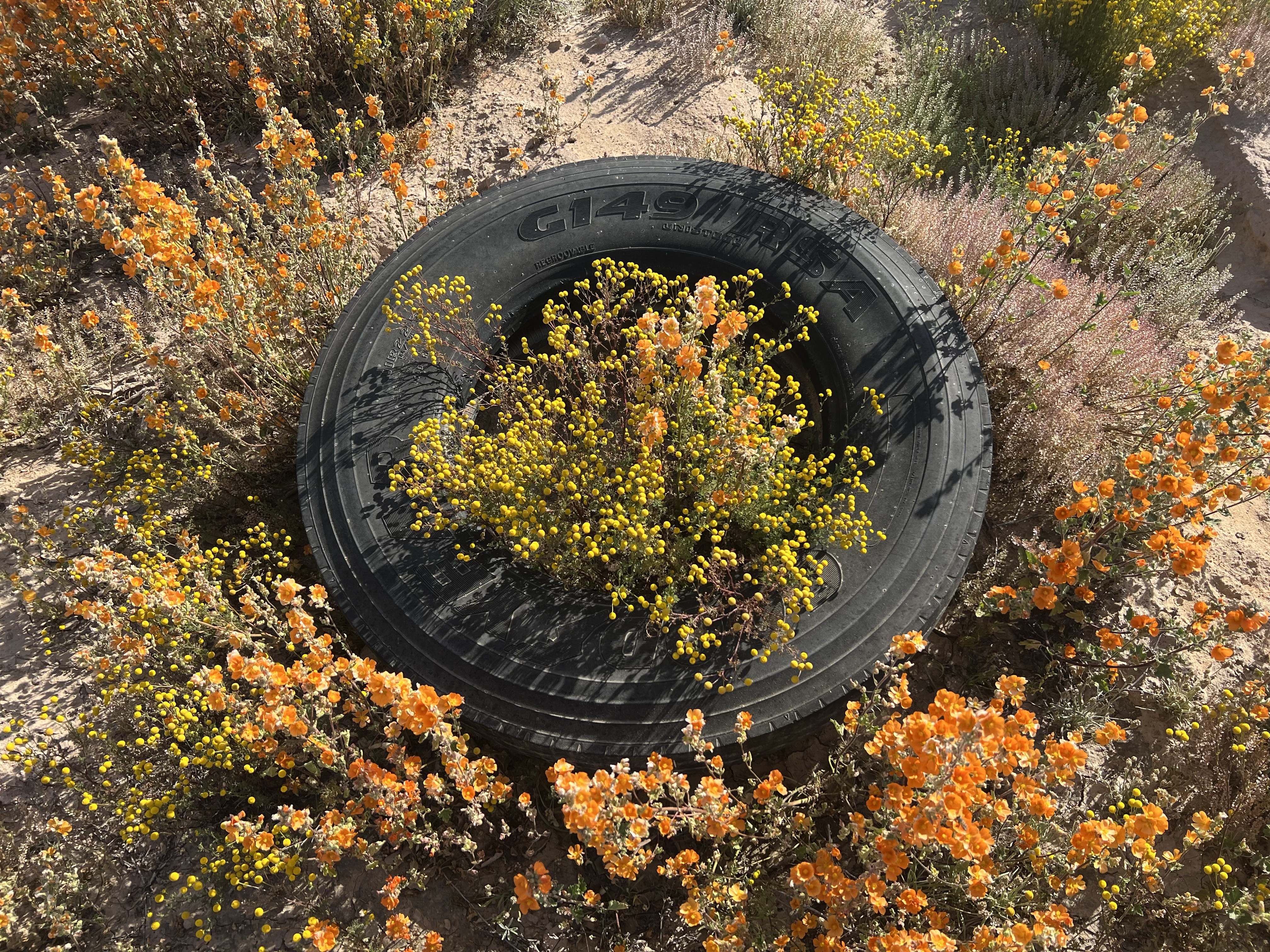
Spring flowers and a tire at the Trasher Spot.

I wandered around the spot and I found no thrasher. A few horned larks and western meadowlarks lifted away as a red-tail circled above. In the taller trees I spotted a bird perched up but as I got a better look it was just a mockingbird. Well that was looking and sounding like a good omen.

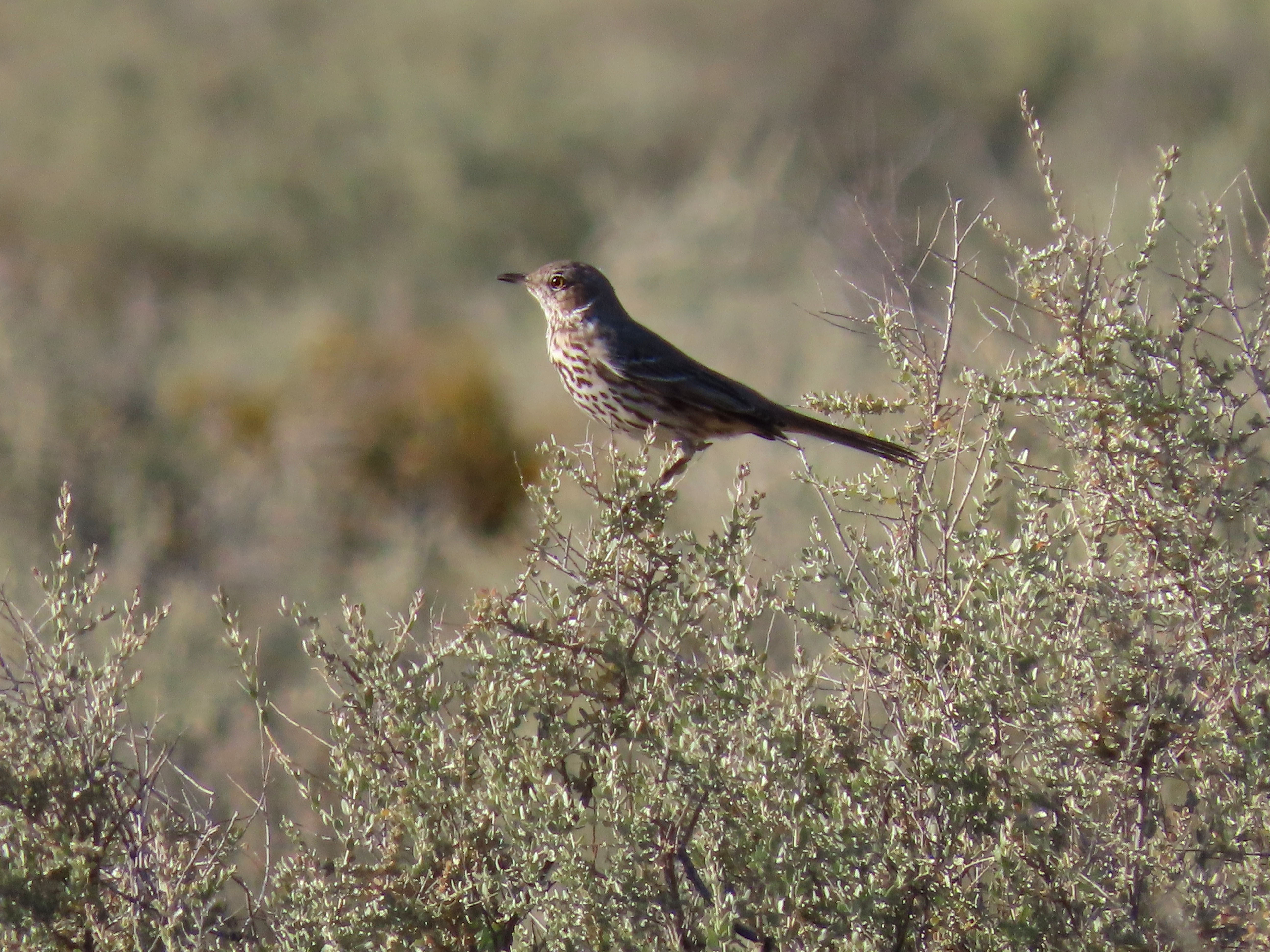
Off to my left a bird was perched up on some sagebrush. Could this be the Bendire’s? I needed to get closer to get a positive identification. As I got closer, the bird flew farther away to another sagebrush perch. I circled round to get the bird in some better light. This was a thrasher alright, not a Bendire’s but a sage thrasher.

After searching for just over an hour and only seeing one thrasher species, the sage thrasher, I decided to pack it in for the day and return again in the morning, my last full day in Phoenix, to add Bendire’s to my life list and I hoped it was not going to be as hard and laborious as the Le Conte’s thrasher.

I headed west on West Salome Highway, making my way back to Highway 10. When I slowed near the intersection of the impossibly named 339th Avenue, I saw a mimid-type bird perched on the roadside announcing the intersection of 339th Avenue.

I immediately pulled over and cursed myself for packing my bins and camera in the trunk. As I stepped out of the car, the bird dropped down and disappeared from sight before I could identify it. I was not going to give up now!

Now I was armed with the instruments of a birder. The mystery mimid flew across the highway and landed in a tree of sticks. The hunt was on!

I managed to scuttle across the highway without becoming a grill ornament on a pick up truck (the state vehicle of Arizona) and bushwhacked ( they were short bushes) and made my siege on the tree-bush.

All I needed was a brief glimpse. Give me the shorter beak with a pale base, the yellow eye, or the arrow shaped markings on the breast. Then I would close out all the North American thrashers! Oh and a photo would be nice.

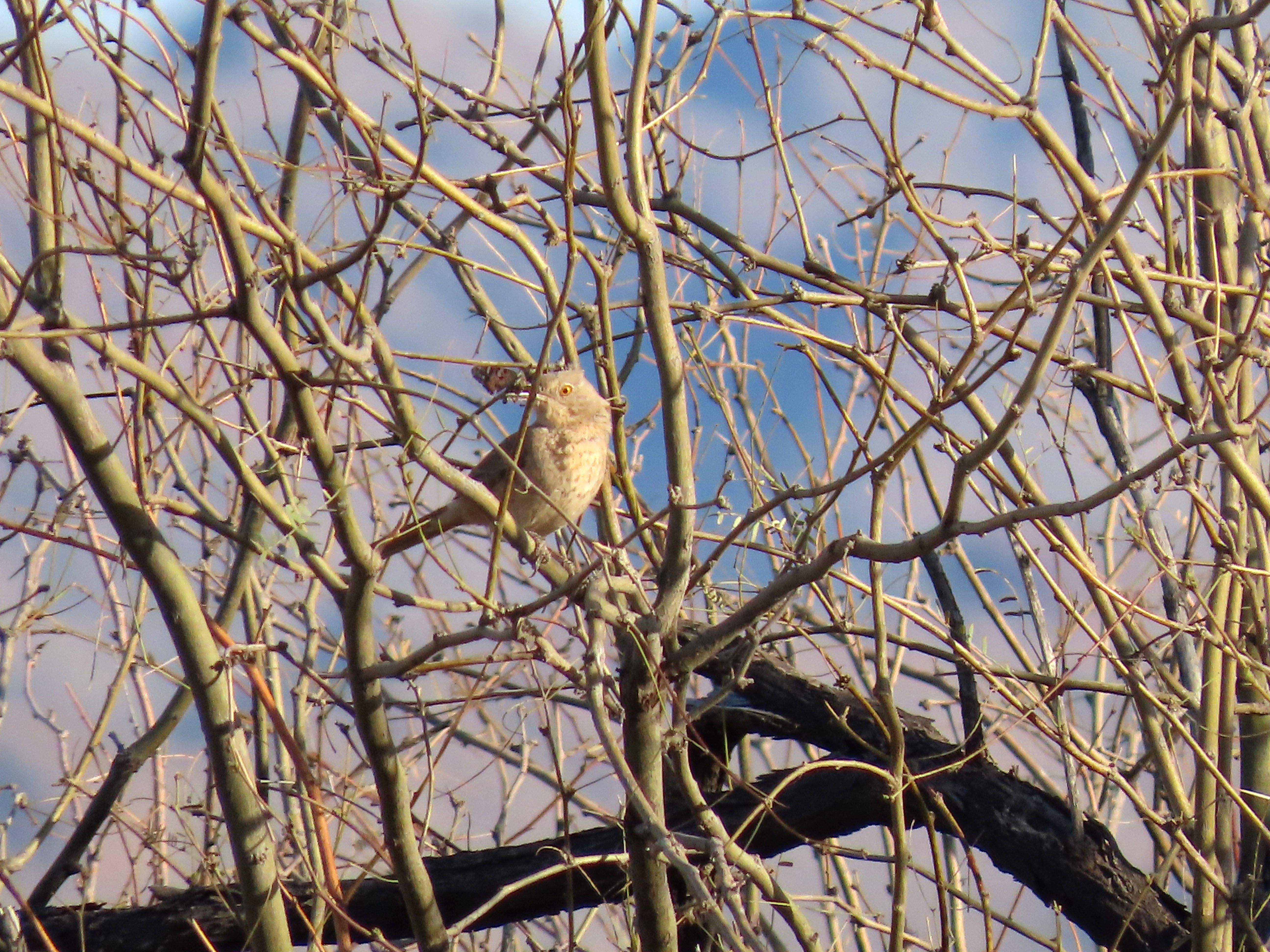
In typical thrasher fashion the bird put a load of branches between itself and myself. But I did get enough pieces of the puzzle that added up to Bendire’s Thrasher. Lifer and the final thrasher on my list! We played a game of hide and seek as I tried to get a photo, the Bendire’s not giving a fig about me and my selfish wants.

This Bendire’s looked a bit odd. It was something about it’s bill. When I put bins on the bird, I noticed it was carrying a butterfly. Was this a snack or a gift?

Image

New Year Mega Rarity

It’s always nice to the start the new year of with a life bird. So much better if the bird is a mega rarity!

This was the Eurasian chat the red-flanked bluetail (Tarsiger cyanurus).

The bird was the sixth California record and only the second chasible bird (that is if you have an ocean going vessel), the other four records are from the Farallon Islands. It was found on December 28, 2022 in a park near the Santa Cruz Lighthouse on West Cliff Drive.

I had planned to head down on New Year’s Day to Lighthouse Field State Beach in Santa Cruz with Grasshopper but on December 31, after record heavy rains, a large cypress tree at the park fell and killed a 72 year old man. The park was closed for safety concerns.

So our Plan B was to bird the San Mateo County coast and have a go at the continuing northern gannet at Pillar Point Harbor.

Highway 92 was closed because of the intense rainfall so it was Highway One down the line to Pillar Point.

We checked the breakwater for a large white bird. No gannet. Heading south, the beaches seemed devoid of gulls. The historic rains had washed away large parts of the beaches, the creeks were flowing at a high capacity turning near shore waters a muddy brown. Not a great day for birding, well not yet anyway.

We reached as far south as Pescadero State Beach, looked out at few roosting gulls (it was still too early for kittiwakes) and returned north to try again for the consolation gannet

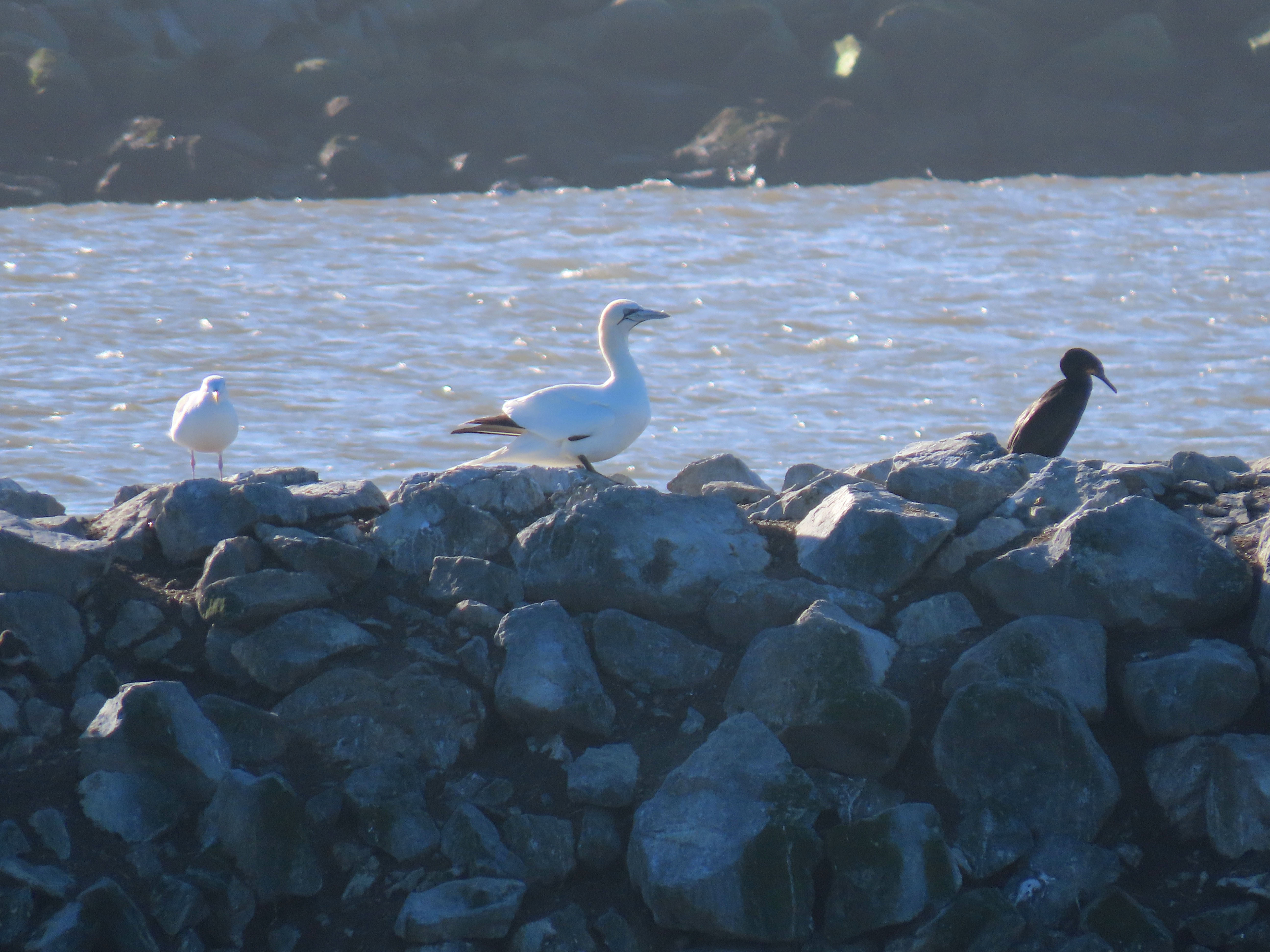
Johnson Pier was now crowed with people buying fresh crab and cod from fishing boats in the harbor. We weaved our way out to the end of the pier to look for an out-of-place big white seabird. Grasshopper spotted the gannet, named “Morris” by locals, immediately. The gannet, the only one on the west coast, was preening and the local gulls and cormorants were giving Morris a wide berth.

The much larger northern gannet sticks out like a sore thumb.

After getting good looks and a few photos, we saw a report that the bluetail had been seen and heard earlier in the morning. So some birders where getting access to the park. After a quick ponder we knew what we had to do: head south and retrace our journey and not stop until we where parked next to Lighthouse Field State Beach.

About an hour later, we parked on a side street, geared up, and entered the park. Still unsure of the location, we knew we had to find the semicircle of birders, intently gazing into the bramble. We began to head east on the trail, dodging puddles that were not far from being ponds, when we spotted the large cypress tree that had fallen across the path in front of us.

The cypress was over 100 feet tall, the papers put the tree at 120 feet, and just beyond the tree and to the left we saw a some birders looking off to the left. The only way to get over the tree was to climb over. Other had already trampled down a path through branches that were now facing upward. Once we got to the location of the bluetail, there were already about 35 to 40 birders in attendance, with more arriving as we searched.

This bird was going to be tough because it was sulky and shy, so patience and perseverance would be needed. Good thing I’m an elementary school teacher!

The bird was being seen among the grasses and branches and the bluetail was moving quickly, not pausing for long. I saw movement a few times which I thought was the bluetail but I wanted better diagnostic looks before I added the bluetail to my list. After about 30 minutes, I finally got a good look at the tail of the bluetail, which was blue and I noted how the bird frequently jerked it’s tail downward like a flycatcher. World life bird number 1,707!

Once I got my views, I stepped aside to let others from the back start their search. I started my anchor sketch of the downed cypress tree and reflected on the tragedy of a man’s death, while not far away, birders chortled in ecstasy.

Image

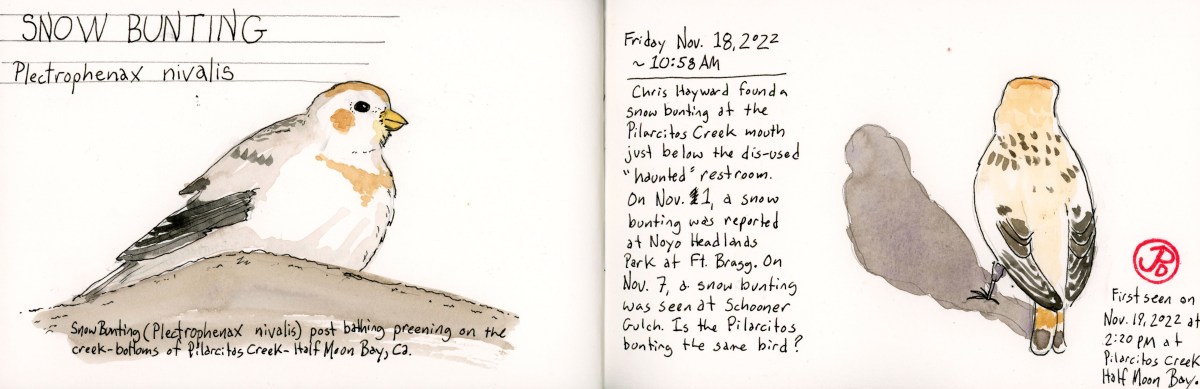
A November Snow in California

Curses for not checking the rare bird alert before leaving work on Friday! A rare California bird, and a lifer, was seen in Half Moon Bay, just about 20 minutes from work. I would have loved a after work lifer, but alas it was not meant to be.

I eventually saw the post when I returned home and the northern visitor was last seen at 4:30 PM before the early winter’s eve turned out the lights. This was a good sign because it meant that the bird might overnight and be re-found on Saturday morning.

Wit this in mind I got up early on Saturday and drove down to Half Moon Bay and walked out to Venice Beach and the Pilarcitos Creek mouth and hoped the snow bunting has overnighted.

Oddly enough there was a snow bunting that was being seen in the Noyo Headlands in Fort Bragg a few weeks ago but had disappeared, presumably flying south. I wondered if this could possibly be the same bird, although it’s very tough to tell.

I arrived at the creek mouth just after 7 AM, and I was the first birder in the area. Below me, on the creek bottoms, were many mallards, killdeer, and Wilson’s snipes. But no bunting.

I continued looking for the next hour, at which point about 15 other birders were scouring the dunes and the beach for the rare visitor. With all these eyes looking for the bird, I figured it was a matter of time before someone would relocate the bird, if it was still in the area.

I decided to head north on Highway 1 to Pillar Point Harbor to look for the northern gannet that had been recently roosting on the breakwater. This is presumedly the same gannet that has been in the area for about eight years. I had first seen it on Alcatraz and it is often seen on the Farallon Islands. In also is seen in Pillar Point,

The snow bunting had not been reported on any birder lists so I headed over the hill to San Mateo to have lunch with my friend. After lunch I checked Sialia and saw a post that the snow bunting had been re-found so I headed back over Highway 92 to the same location I had spent looking for the bird a few hours earlier. But this time I was a lot more successful!

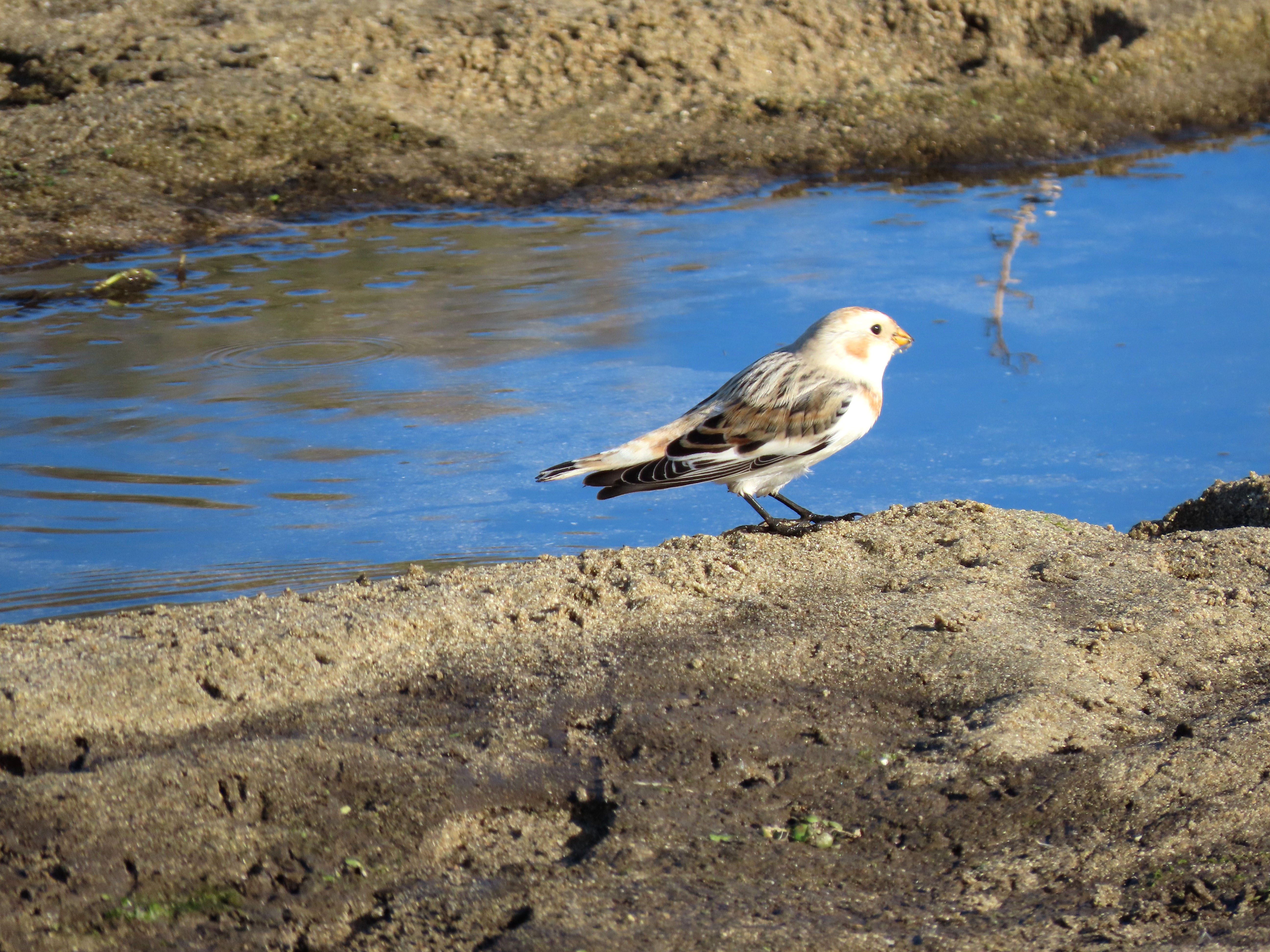
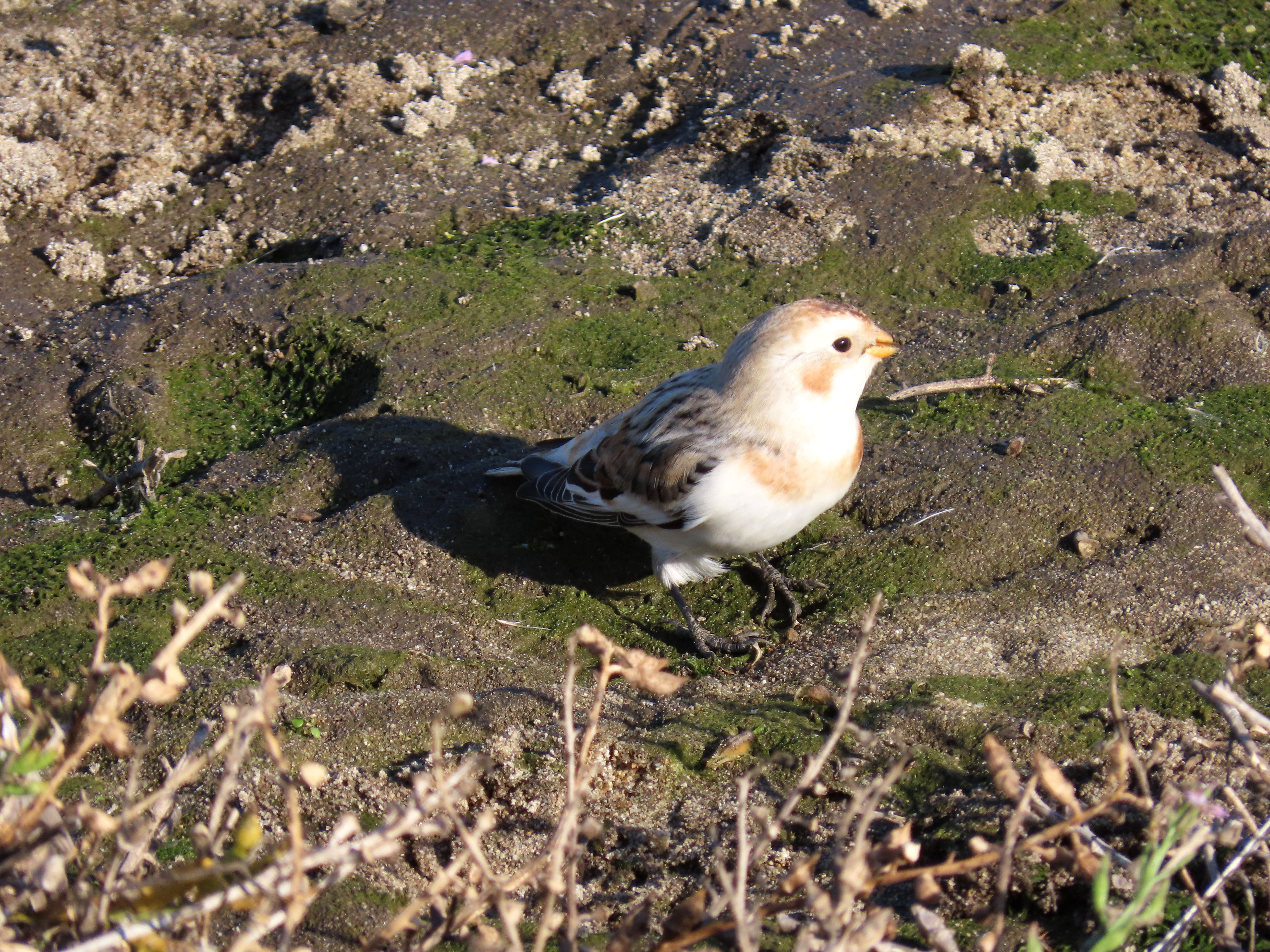
I arrived near the closed down parking lot and restroom and headed down towards the creek. The bunting shown like a white diamond amongst the dark sands.

The snow bunting about to take a bath in the creek.

It also helps that there where three birders already on the bird. I took a seat on the dunes and watched the bunting as it foraged in the creek bottom and then took a bath in the creek.

The bunting did not seem fazed by the attention and was within about ten yards of birders. This was in stark contrast to the Wilson’s snipe that where so skittish that they burst into flight at any provocative.

The shining white diamond was a much sought after lifer. It save me a trip to Alaska!

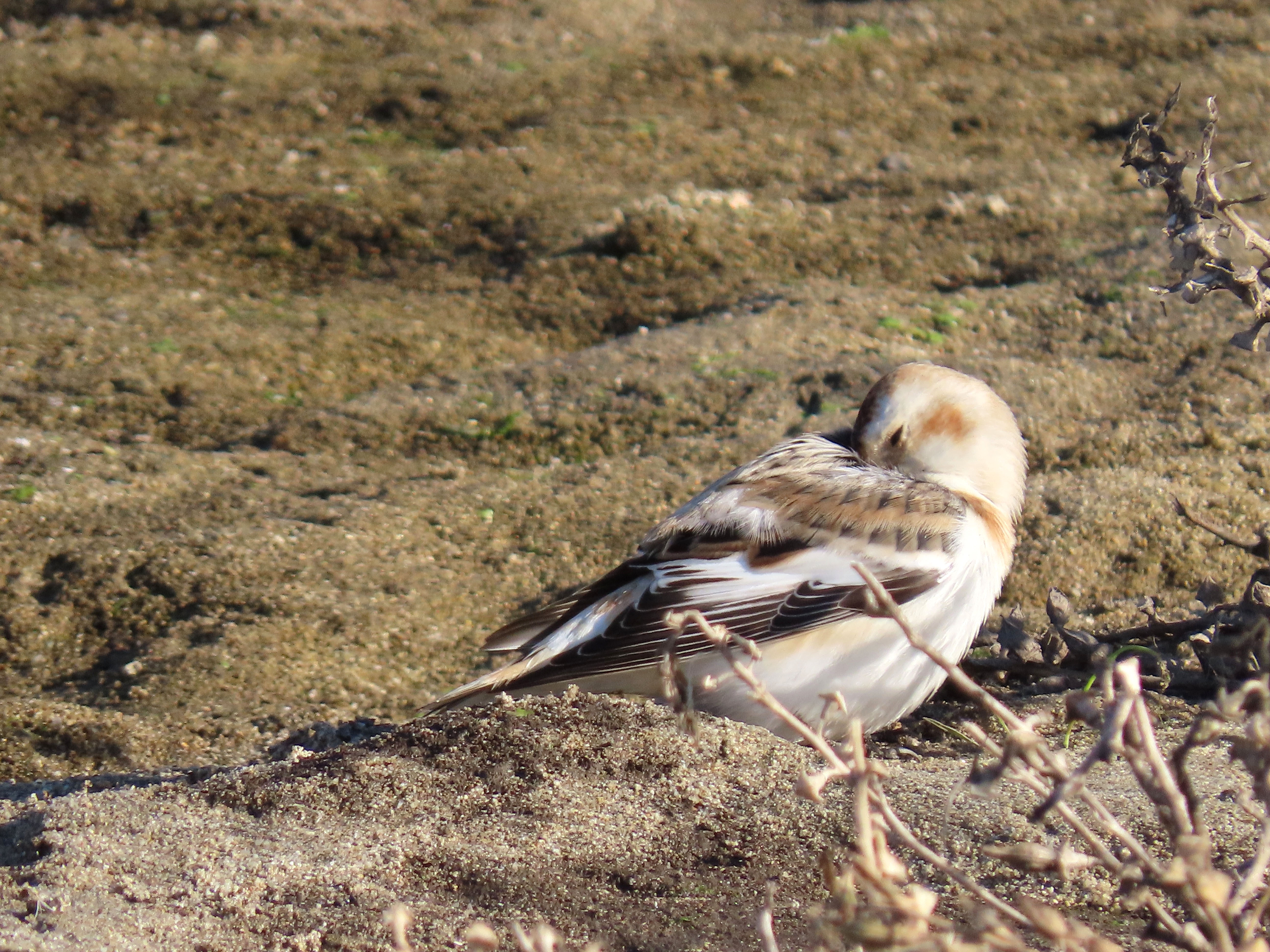
I took some reference photos which was a challenge because the bunting was in constant motion but after it’s bath, the bunting paused so I could capture the bird’s unblurred likeness.

This was world lifer 1,706!

The bunting post-bathing preening.