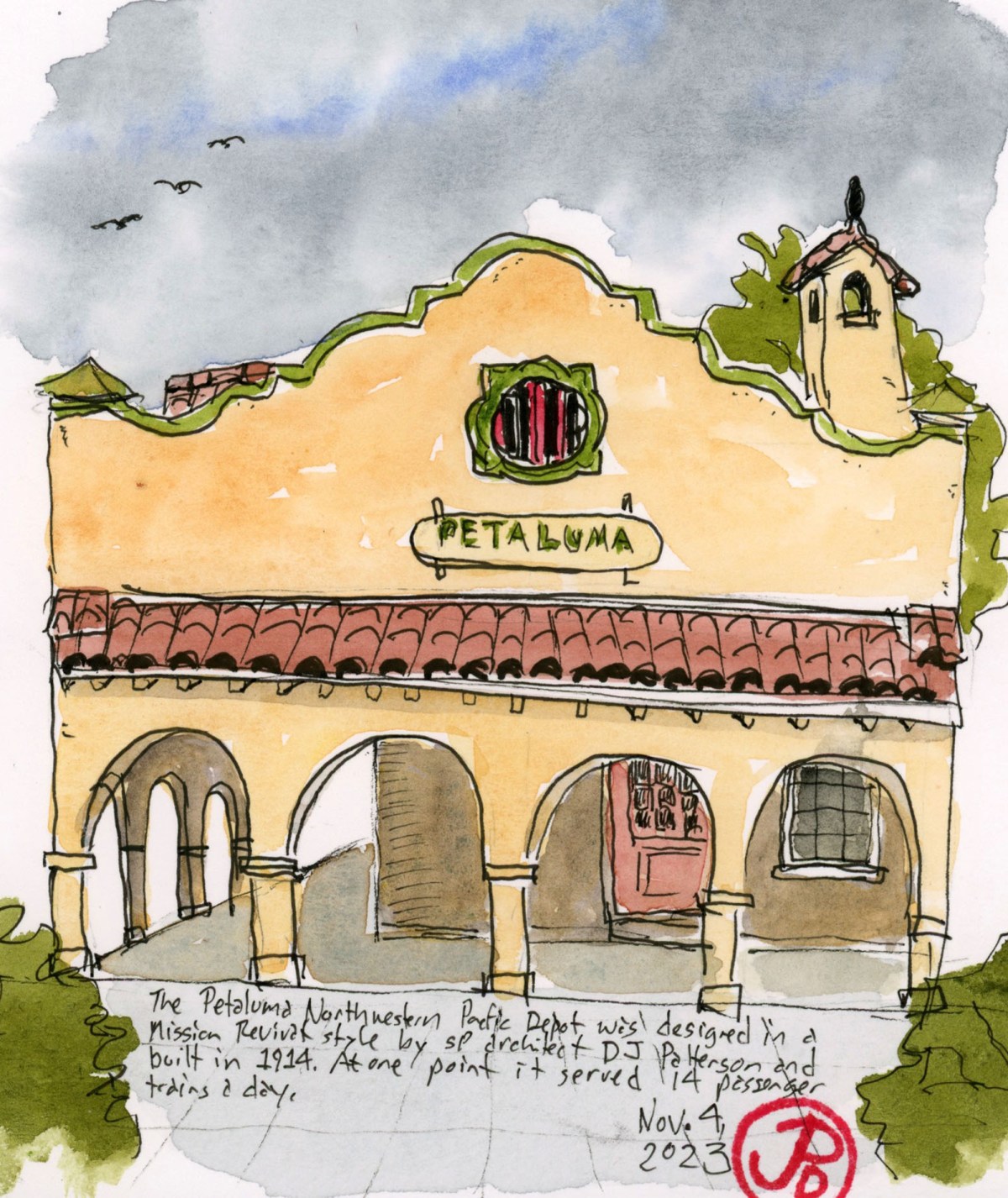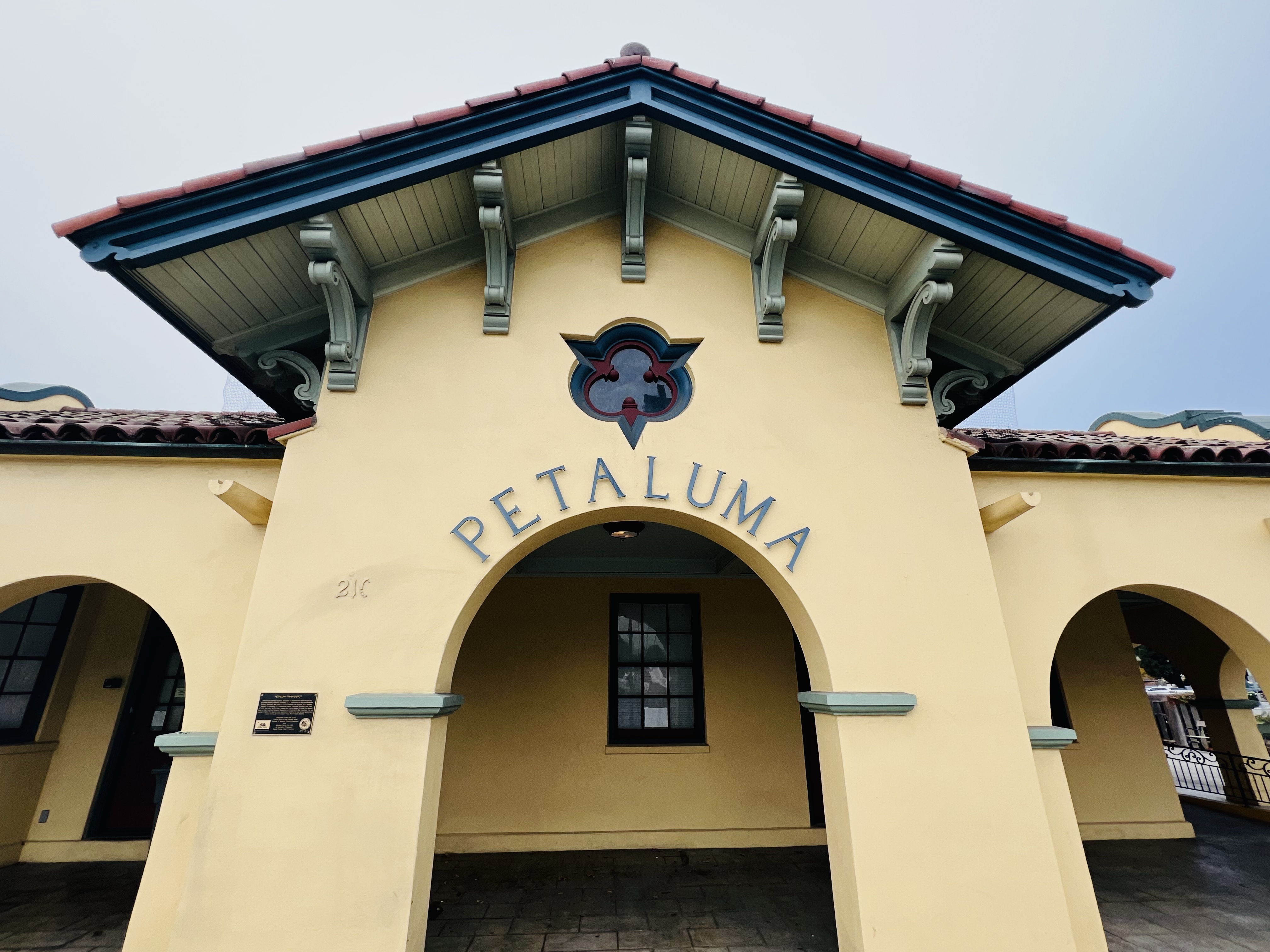
One of the nicest Northeastern Pacific rail depots still in existence, is to be found in the Sonoma County city of Petaluma.
This 1914 depot is designed in the Mission Revival style by Southern Pacific Railroad architect, D. J. Patterson. The passenger station originally cost $7,000 to build. The new station replaced the 1871 wooden stations. Patterson also designed the Galveston, Harrisburg, and San Antonio station. He also designed the Willits Station for the Northwestern Pacific, north of Petaluma.
This was a busy station with 14 passenger trains stopping at Petaluma daily. The construction of the Golden Gate Bridge cut into the passenger numbers and the last passenger train departed from this station in 1958.
That was until almost 60 years later in June 29, 2017 that a passenger train stopped In Petaluma.
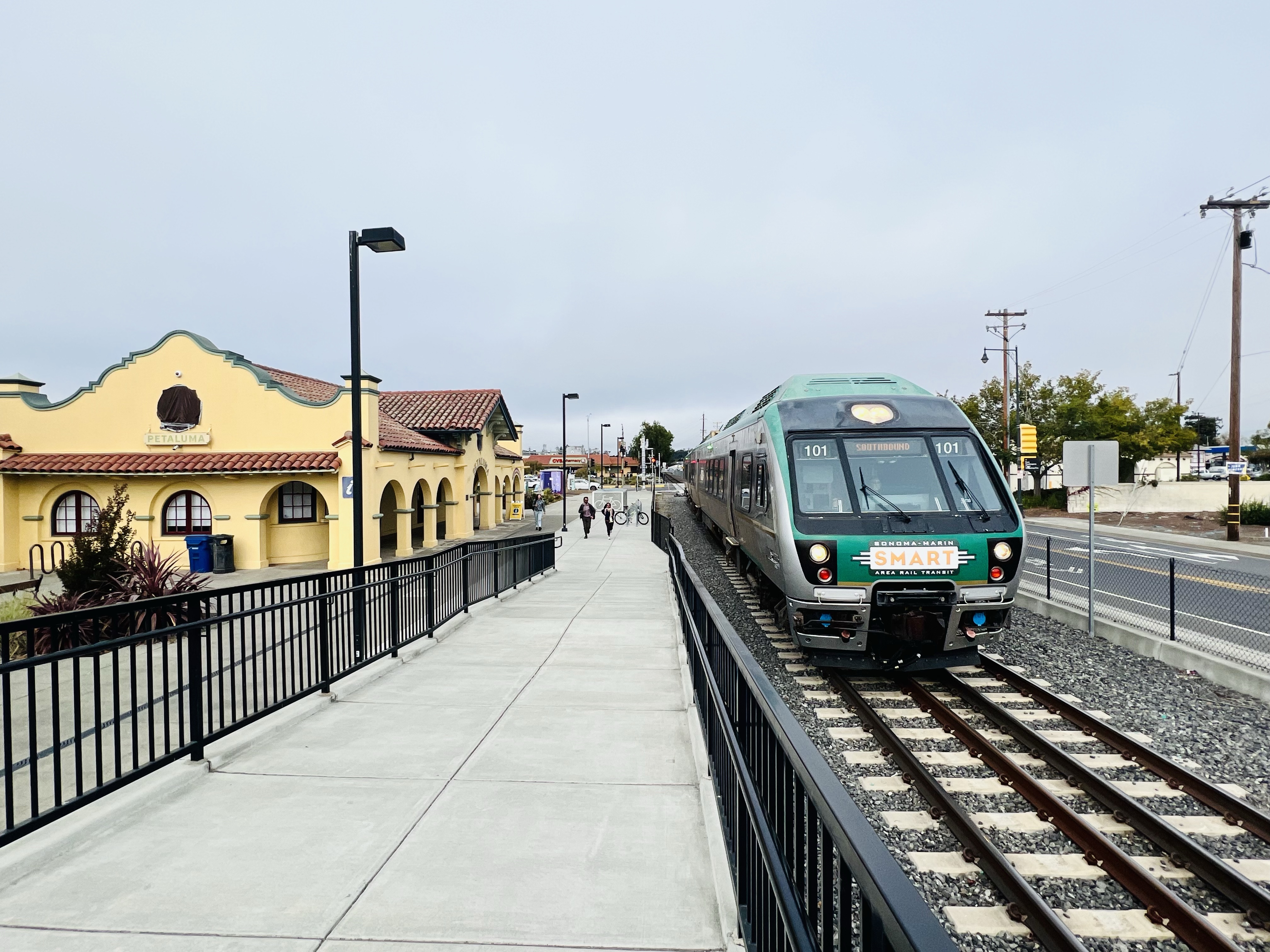
The spot now housed the Petaluma Visitor’s Center but passenger service still lives in the form of SMART trains that travel from Santa Rosa to the ferry terminal at Larkspur.
A southbound SMART train pulls into the Downtown Petaluma station.
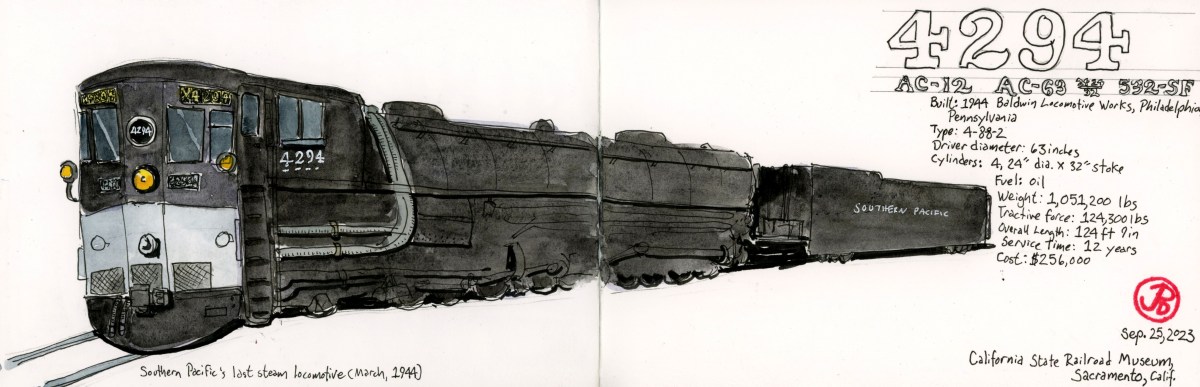
The last steam locomotive that Southern Pacific ever purchased is on display at the California State Railroad Museum in Sacramento. And she’s massive!
This is the only one of the 256 cab-forwards that still exist. The 4-8-8-2 locomotive was turned around so the cab was in front and the exhaust was behind the cab and crew. The natural habitat of the AC-12 Class No. 4294 was over Donner Summit. And because of the heavy snowfall in the Sierra Nevada Mountains, 37 miles of the line was covered in snow sheds to keep snow off the tracks. This innovative design prevented the crew from smoke exhaust induced asphyxiation.
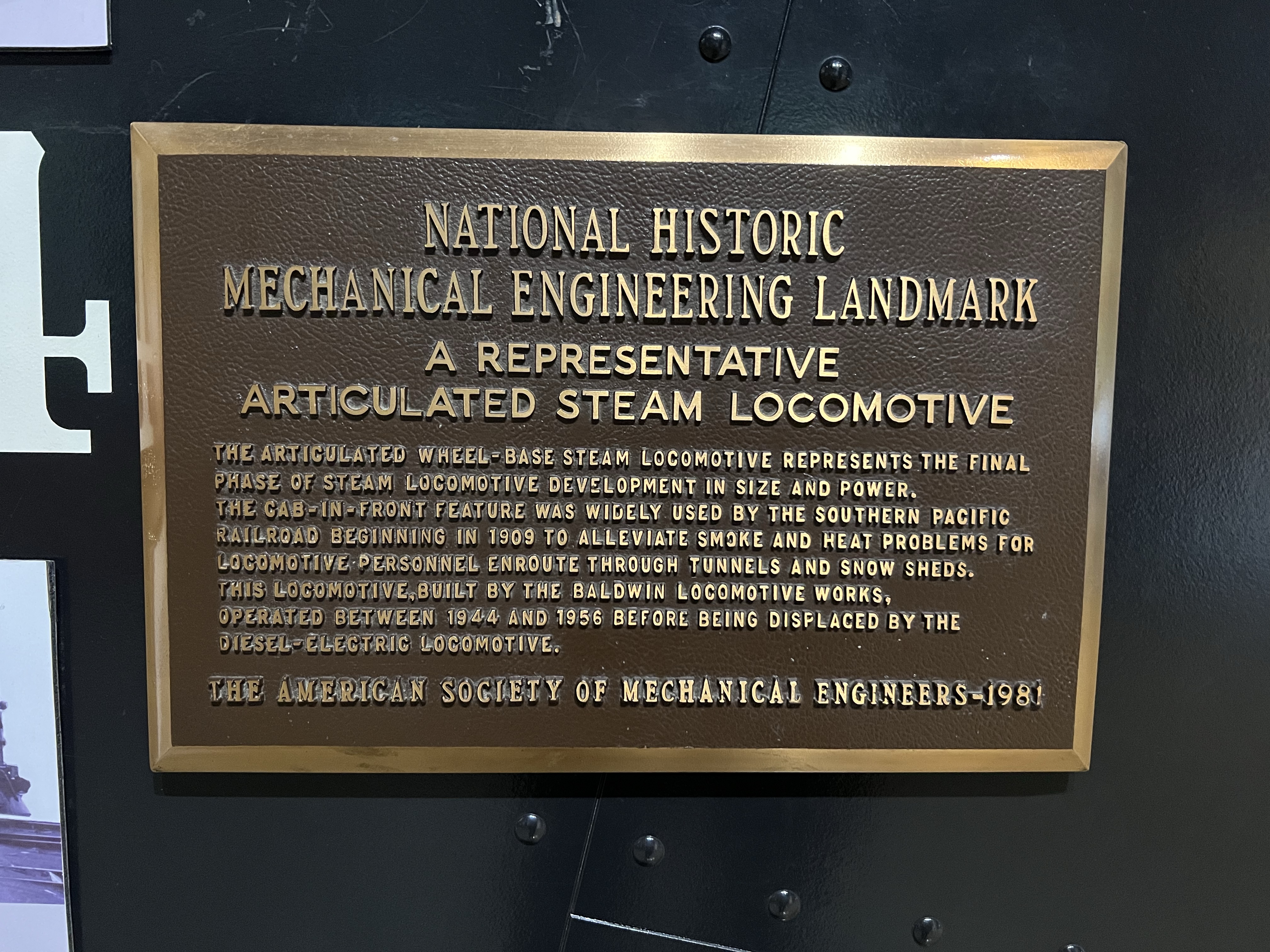
This last of the cab-forwards was such an engineering marvel that it was designated a National Historic Mechanical Engineering Landmark by the American Society of Mechanical Engineers in 1981. It was the first steam locomotive to be added to the list. Of the 300 landmarks in existence, only seven are steam locomotives, including Union Pacific’s Big Boy No. 4023 and Norfolk and Western J-Class No. 611 (more about 611 in a later post).
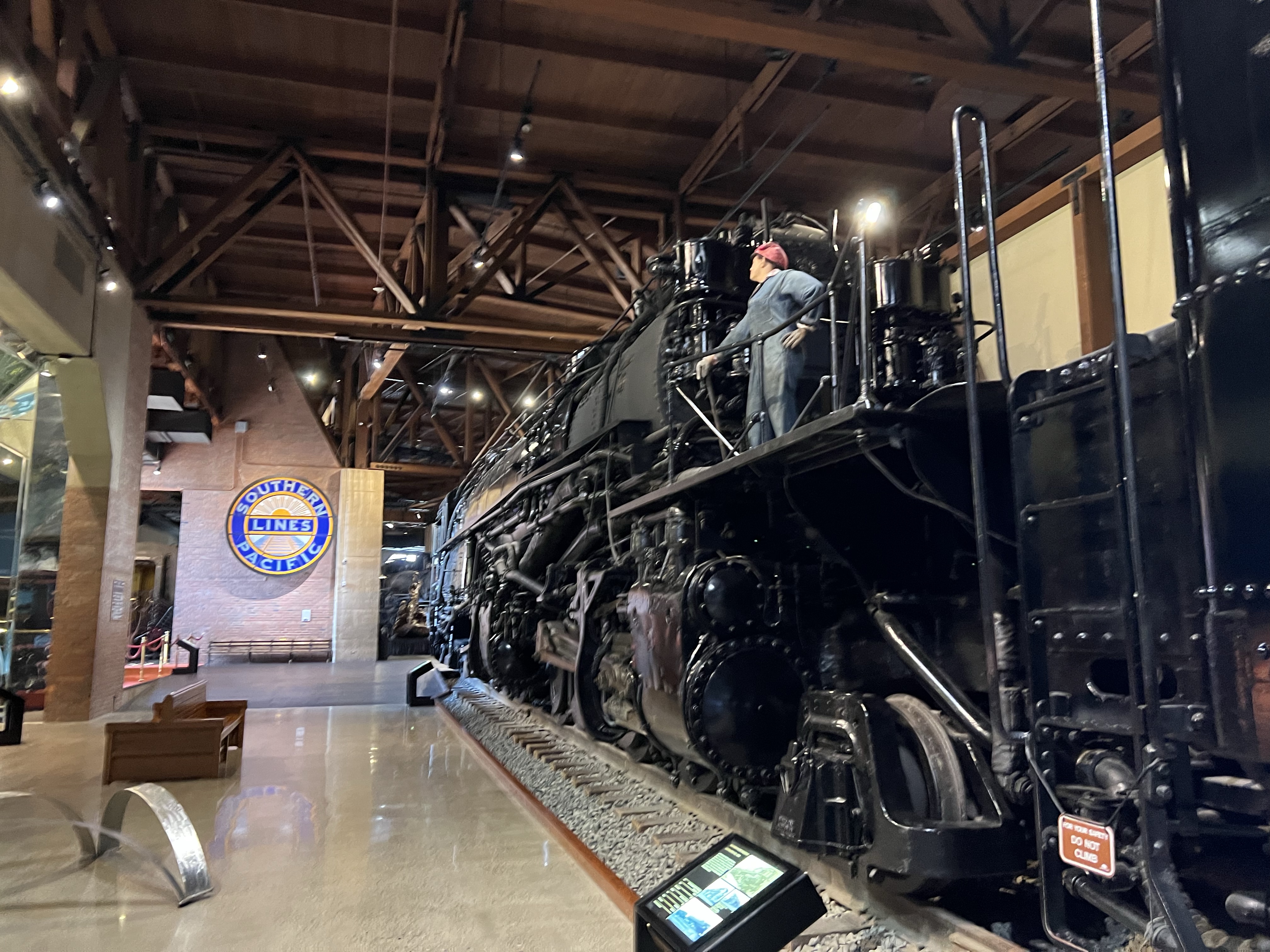
This locomotive is massive and the largest and most powerful locomotive in the museum’s collection. The locomotive and tender are 123 feet and 8 inches long and the total weight of this Beast of the Sierras is 1,051,200 pounds (525 tons). One of the docents I talked to was old enough to see a cab-forward in action as a child and he told me that the locomotive scared him and the ground shook when it passed by.
On my visit to the California State Railroad Museum, high on my sketching list was this massive cab-forward. There was only so many perspective to sketch 4294, I tried sketching from above but I couldn’t see the entire locomotive and tender from the third floor gallery so I took a seat under the massive glass Southern Pacific logo and sketched 4294’s front and left side. My wide panoramic journal was perfect for this.
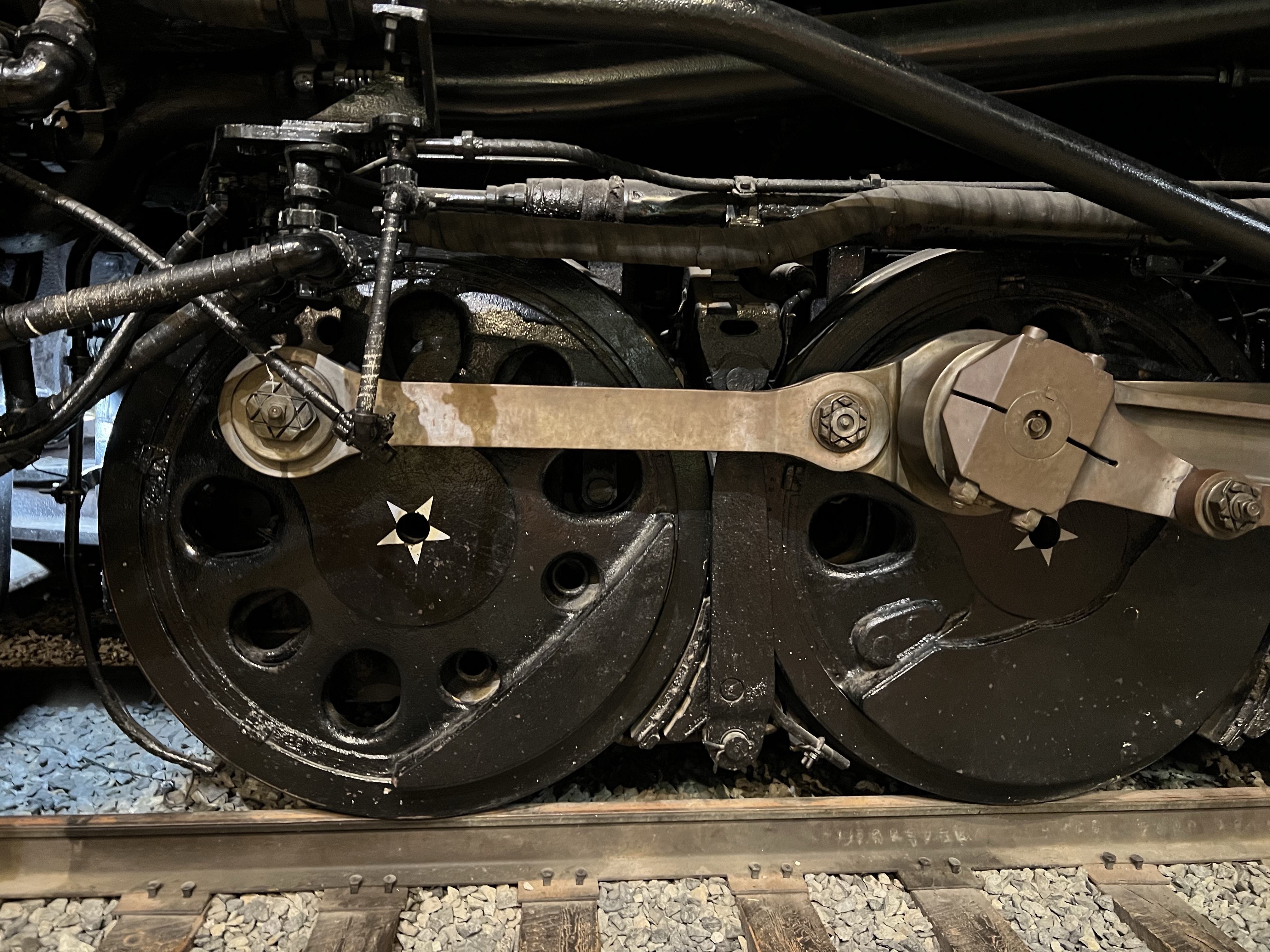
Drawing the complicated running gear was a challenge so I used along of shorthand and used my sketcher’s license!Looking down the length of 4294 to where I sketched this Beast of the Sierras. I sat on the bench under the SP logo that was once at the Port of Oakland.
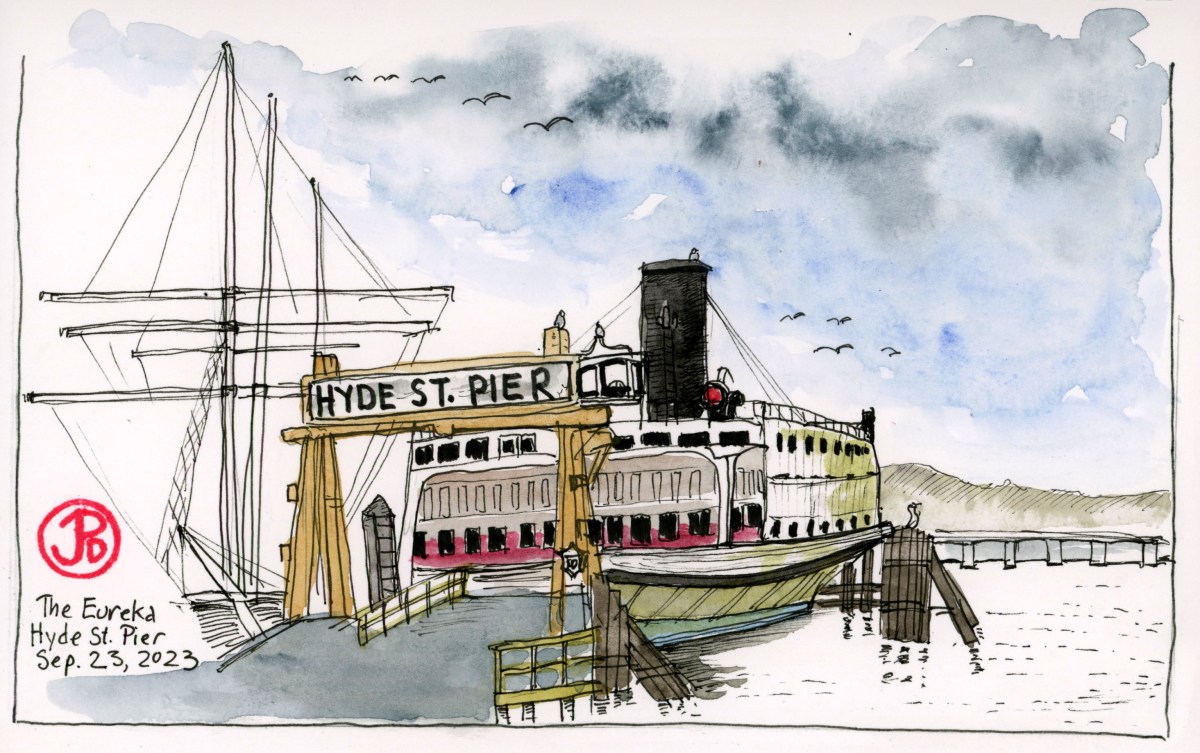
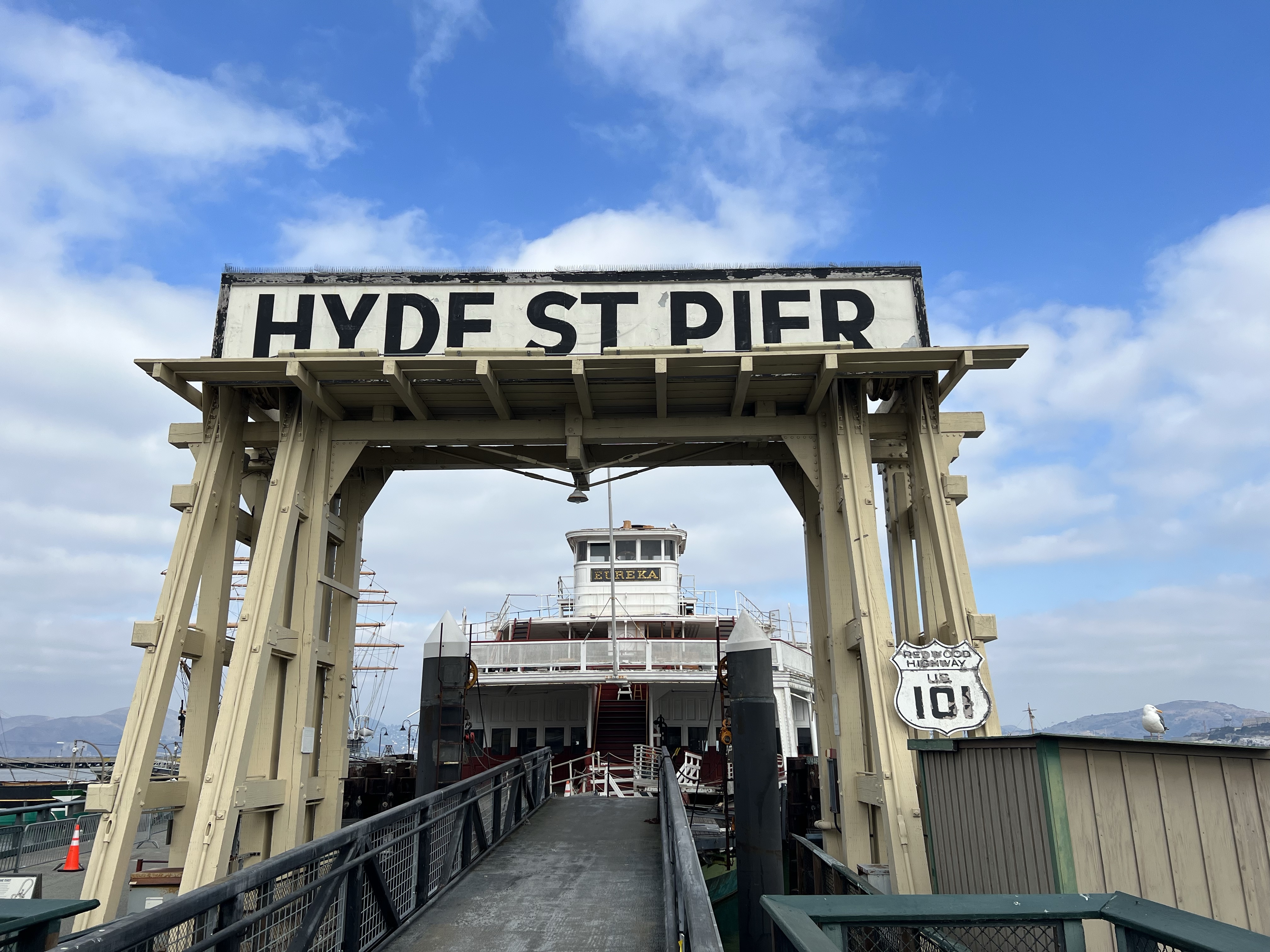
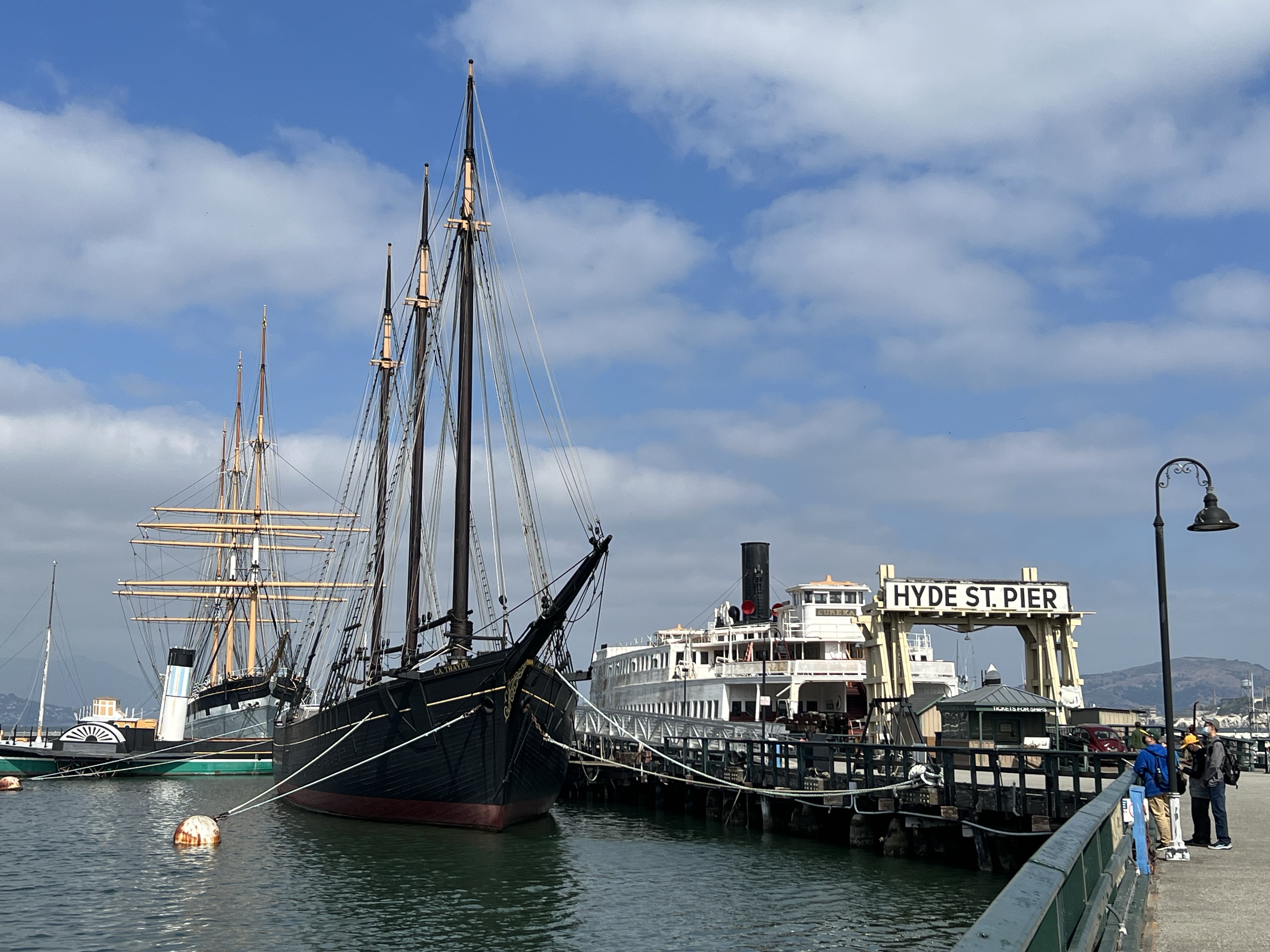
One of the ships docked at the Hyde Street Pier is the former Northwestern Pacific ferry boat Eureka.
In the era before bridges, (the Bay and Golden Gate), the only way to get from San Francisco to Marin or Oakland by rail, was by rail ferry.
The passenger cars would be boarded on the ferry and then, well, ferried, across the Golden Gate to Sausalito or Tiburon where they would be unloaded and continue north on the rails of Northwestern Pacific.
The ferry and the Hyde Street Pier was actually considered part of Highway 101.
The boat was built in 1890 in Tiburon by San Francisco and North Pacific Railroad Company and was originally named the Ukiah, which was as far north as the line reached. The Eureka is a double-ended, wooden hulled ferry-boat that was originally built to hold train cars. Two standard-gauge tracks where built into the main deck.
This 277 foot, 2,564 tonnage boat is the largest wooden-hulled boat afloat in the world.
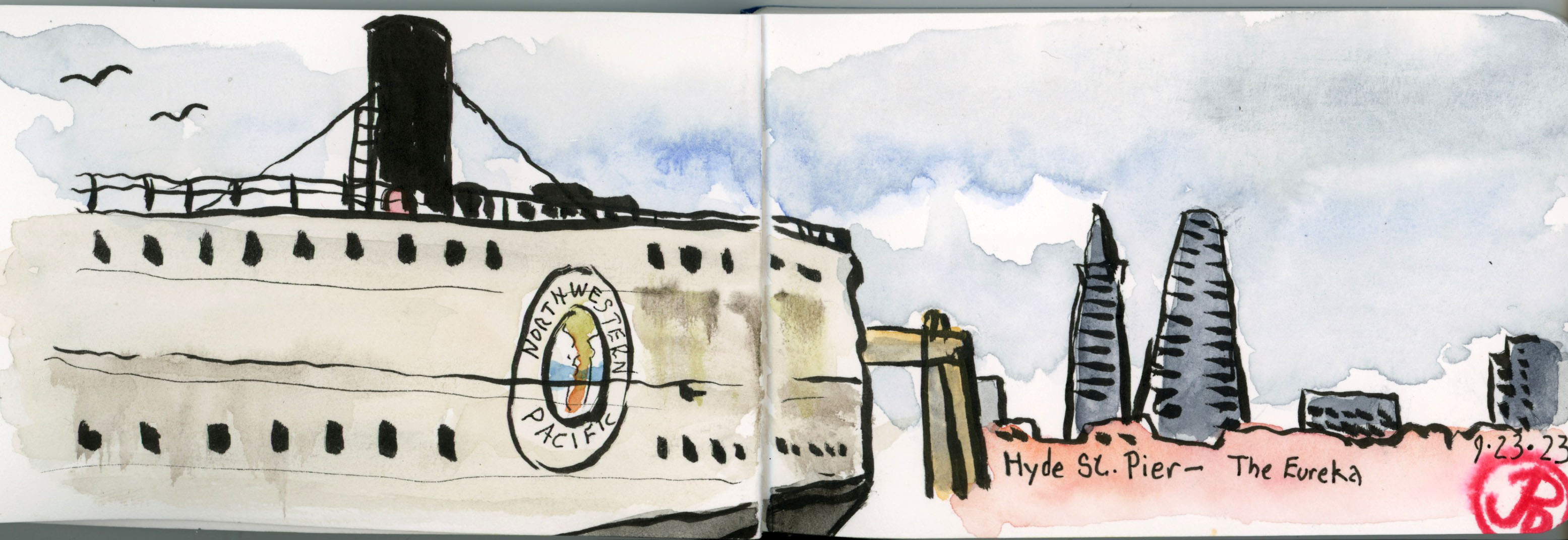
A pen brush field sketch of the Eureka, displaying the Northwestern Pacific circular logo, and the modern San Francisco skyline.
The Ukiah was initially in service to ferry people from San Francisco to Tiburon during the day and then carry freight cars during the night. In 1907 the Northwestern Pacific Railroad took ownership of the Ukiah and it was routed to the Marin port of Sausalito.
During World War I, the ferry was rebuilt and the refurbished ferry was renamed the Eureka, in honor to the northernmost station on the Northwestern Pacific Railroad.
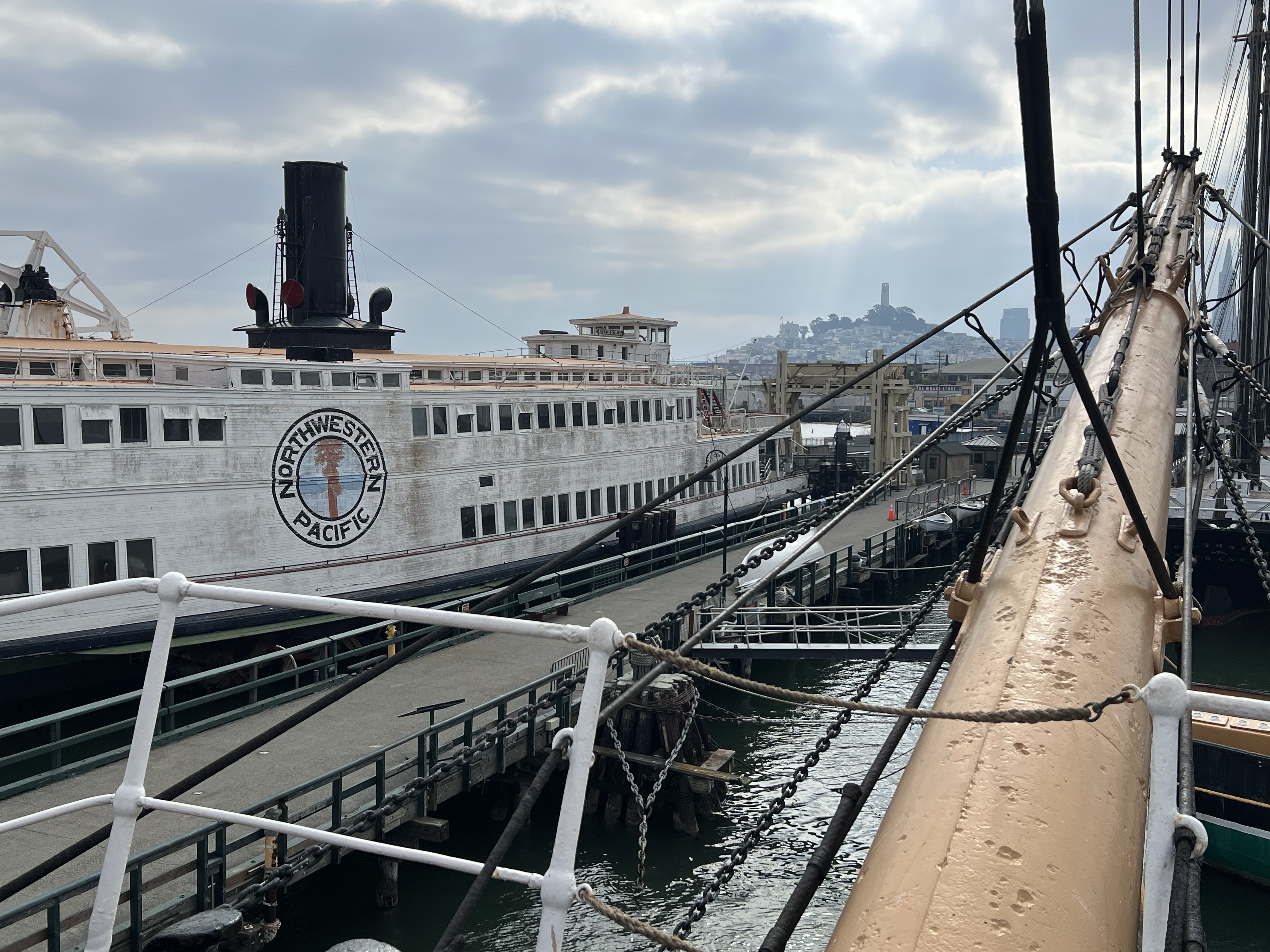
The Eureka from the bow of the Balclutha and Coit Tower echoing the steam stack of the Eureka.
The ferry was later used to ferry automobiles on her main deck and had a capacity of 2, 300 passengers and 120 cars. At this time, the Eureka was the largest and fastest double-ended passenger ferry in existence and because of this, the Eureka was called up for the busiest commuters times from Sausalito to San Francisco. Hyde Street pier was the primary auto terminal to connect San Francisco to points north and east.
When the Golden Gate Bridge was completed in 1937, ferry service passengers dried up and Northwestern Pacific abandoned all ferry service in 1941.
The Eureka found a new life in the 1950s with a new owner, the mighty Southern Pacific. The Eureka now linked passengers on SP’s overland service from Oakland to San Francisco.
Today the Eureka is docked with the C. A. Thayer (foreground), the Eppleton Hall, and the Balclutha (background).
I got to the California State Railroad Museum in Sacramento a little early so I walked over to sketch the replica of the Central Pacific passenger depot. (The former stations had burned down.)
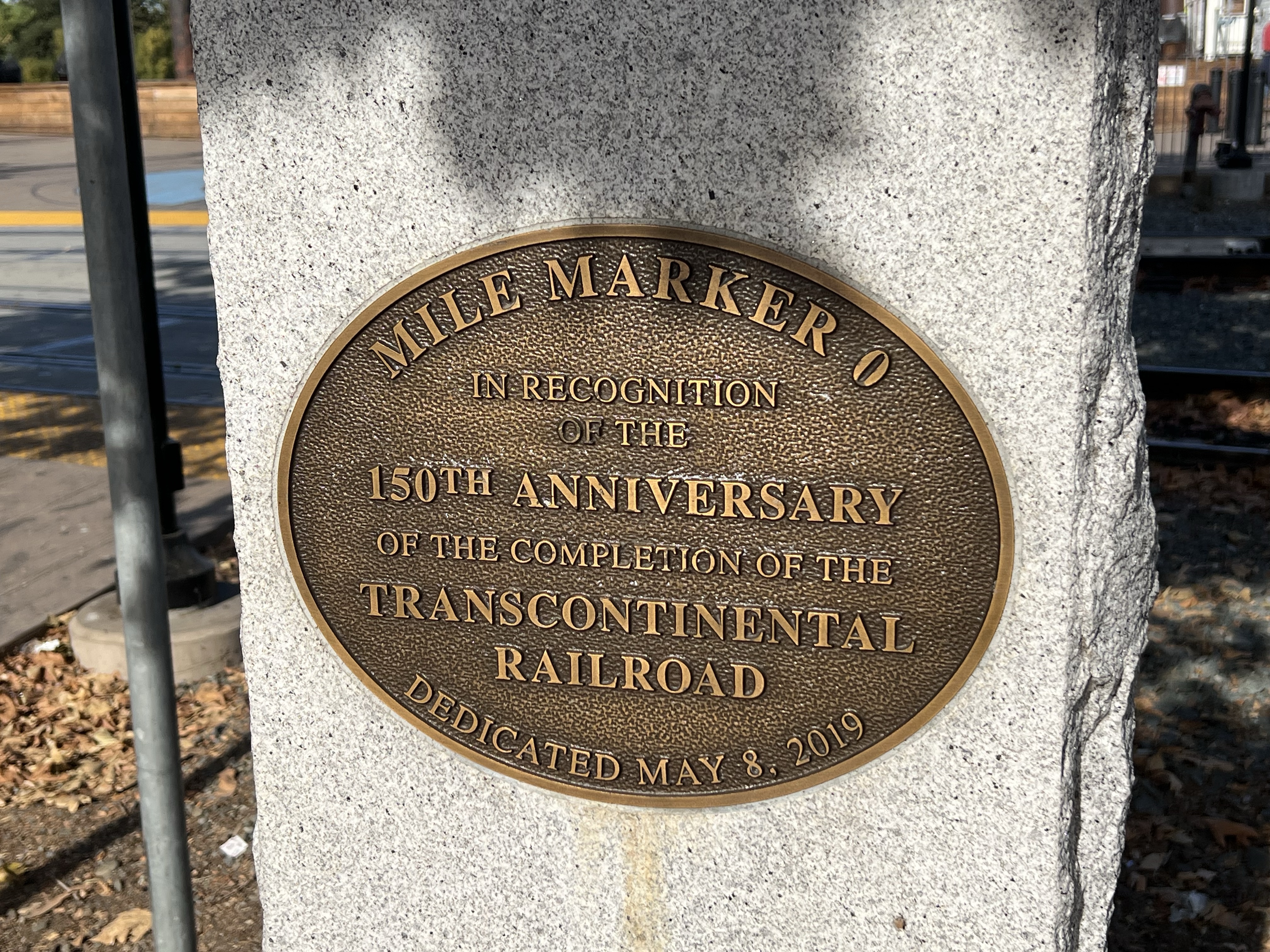
This station is at ground zero from where Central Pacific started the Transcontinental Railroad. Mile Marker 0 was a hundred feet behind me as I sketched.
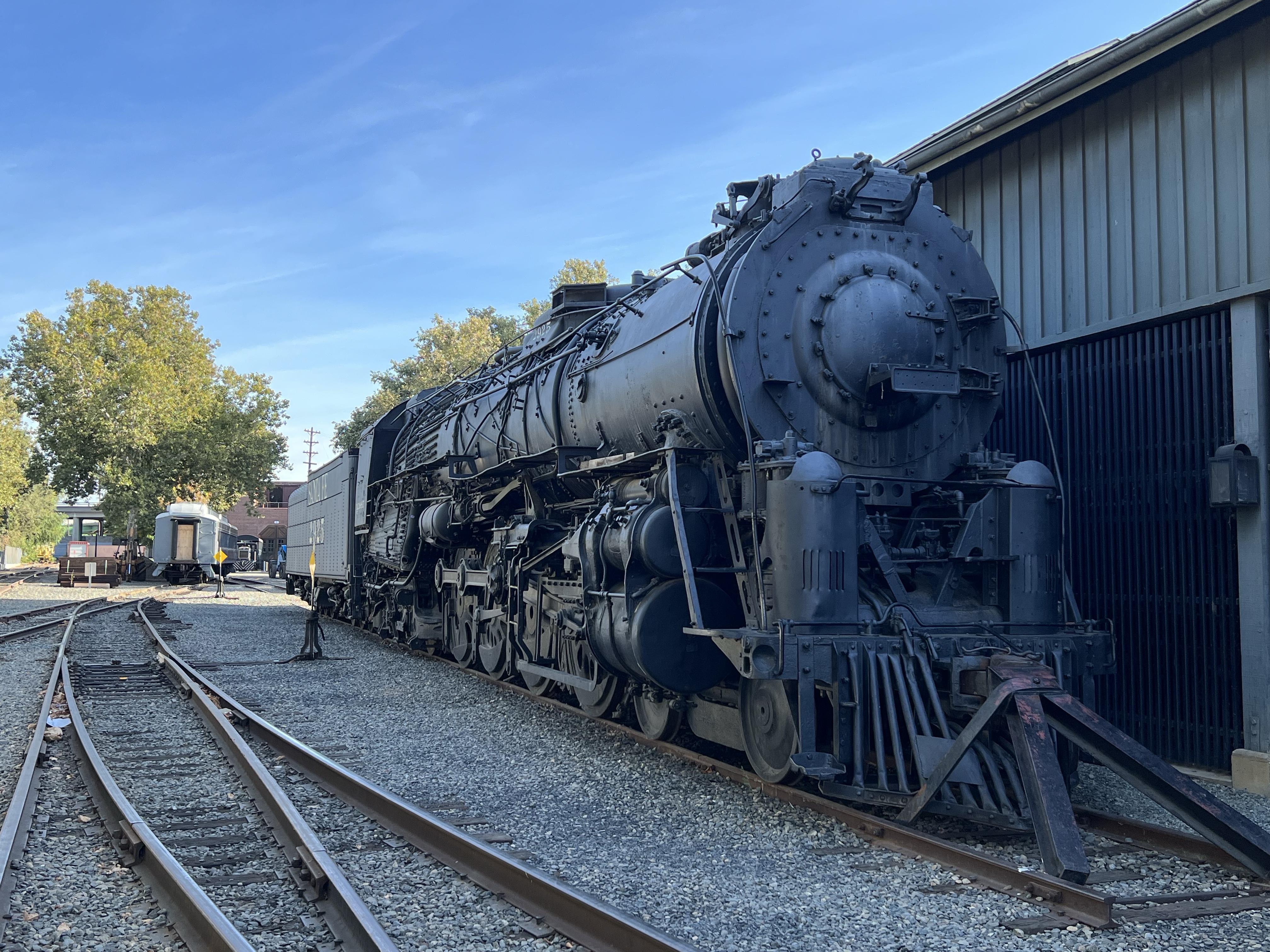
I walked around the depot and looked at two amazing Santa Fe steam locomotives that where sitting on sidings in static display. Both of them had come from New Mexico and both where not in great shape, needing some cosmetic restoration.
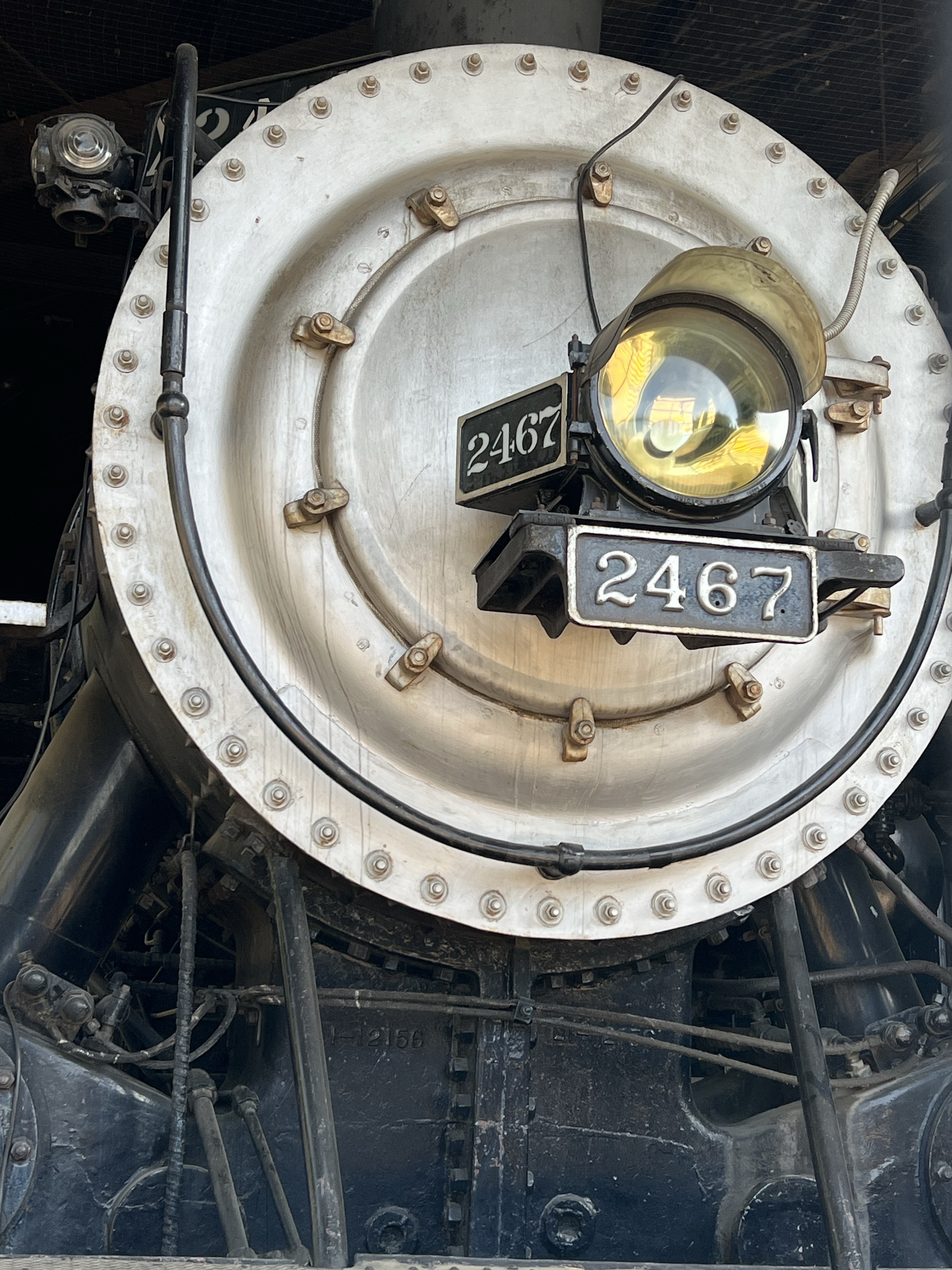
Santa Fe No. 2925 is a 4-8-4 passenger locomotive. This is one of the heaviest 4-8-4 Northerns ever built. Today only five of the 30 produced survive. SP No. 2467 is a 4-6-2 Pacific type build in 1921. She pulled passenger trains and was retired in 1956. The locomotive was restored to working order in the 1990s and is still operational.
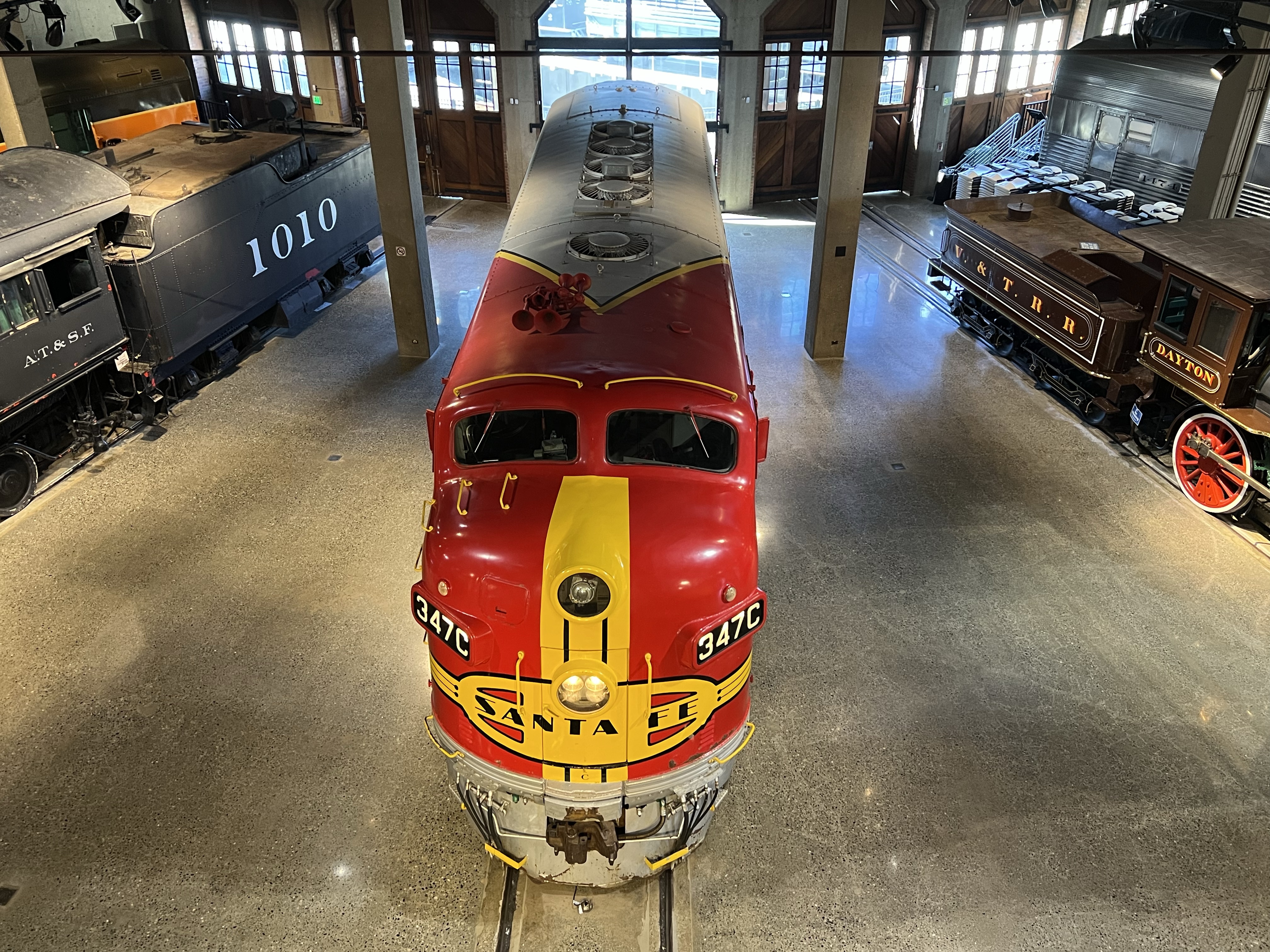
Once in the museum, one locomotive on my sketch list was an EMD diesel-electric F7 painted in the iconic Santa Fe Warbonnet livery.
When I was a child my dad used to take me to the tracks to see passing passenger trains. And one Christmas he got me my first HO train and it was a smaller version of the classic Santa Fe passenger locomotive.
This paint scheme is so famous that if you Google EMD F7, a picture of the Warbonnet F7 comes up.
The iconic Santa Fe units where on point of the 2,227 mile route from Chicago to Los Angeles called the Super Chief. This was one of the first all streamlined diesel cross country route.
Today the only way to get from Los Gatos to Santa Cruz is to drive over Highway 17. You can no longer take a passenger train. The last train ran in 1940.
On the other side of the Santa Cruz Mountains, you can board a train at the Santa Cruz Beach and Boardwalk and it will take you 6.8 miles north into the mountains to the town of Felton.
Detraining here you follow the line past the train shed and machine shop of the Roaring Camp and Big Trees Railroad and the old passenger and freight depot and then you cross Graham Hill Road and walk north on the rails toward Zayante, using the rusty rails as a guide.
The line begins to parallel Zayante Creek. The road builders used the watersheds of the Santa Cruz Mountains as a route to work up and down the summit. A good part of the Santa Cruz to Felton route parallels Santa Cruz County’s largest river, the San Lorenzo.
After a few miles you eventually come to a siding, this is the former stop of Eccles near Olympia Station Road. This was a flag stop as far back as 1901. There was once a passenger shelter (1913) and a freight platform.
The main line and siding at Eccles. The 310 foot siding was probably used to store lumber cars.
The station sign remained in place until 1942, when the station was decommissioned following the abandonment of the the railroad.
After World War II, passenger service was not resumed and the station shelter was torn down. The Eccles sign was saved and was on display at the Santa Cruz Museum of Art and History in downtown Santa Cruz.
Here’s where the Eccles station sign used to be at the Santa Cruz Museum of Art and History. It’s gone, like the rails that once reached over the Santa Cruz Mountains.
One a recent visit to the museum the sign was no longer on display.
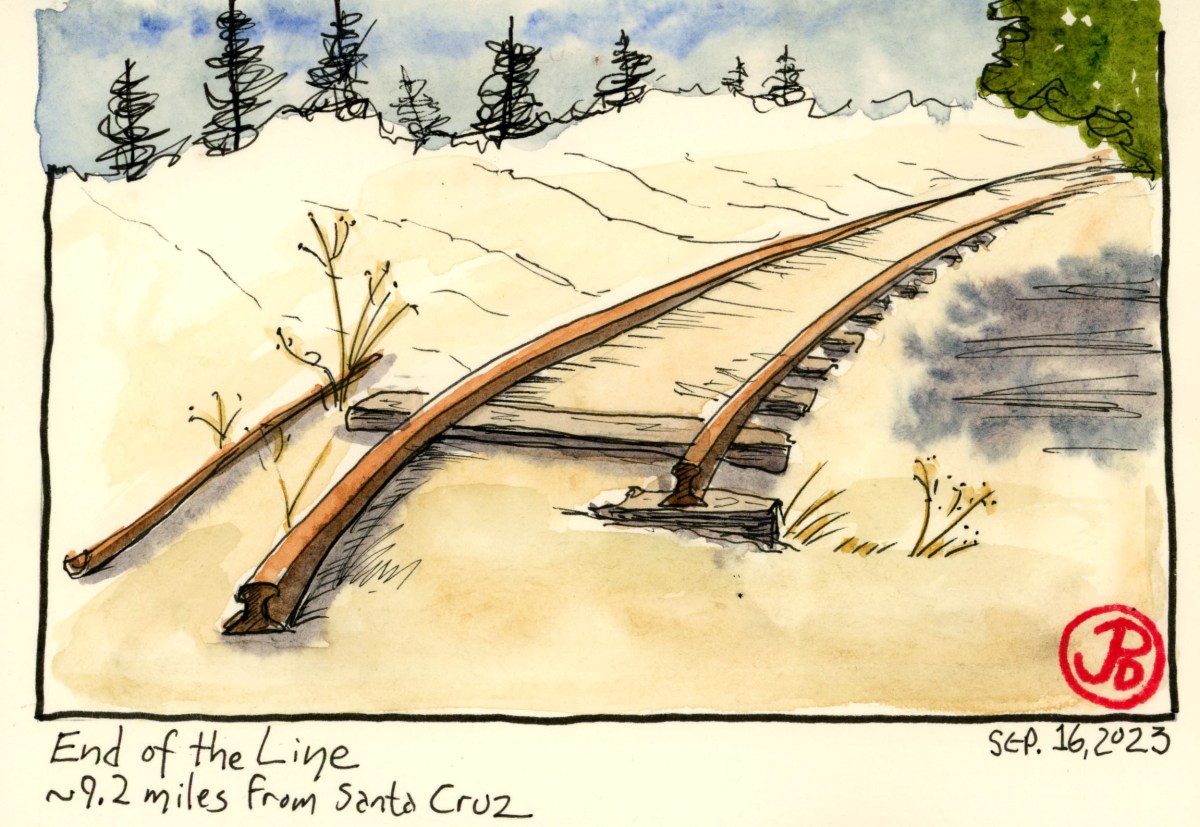
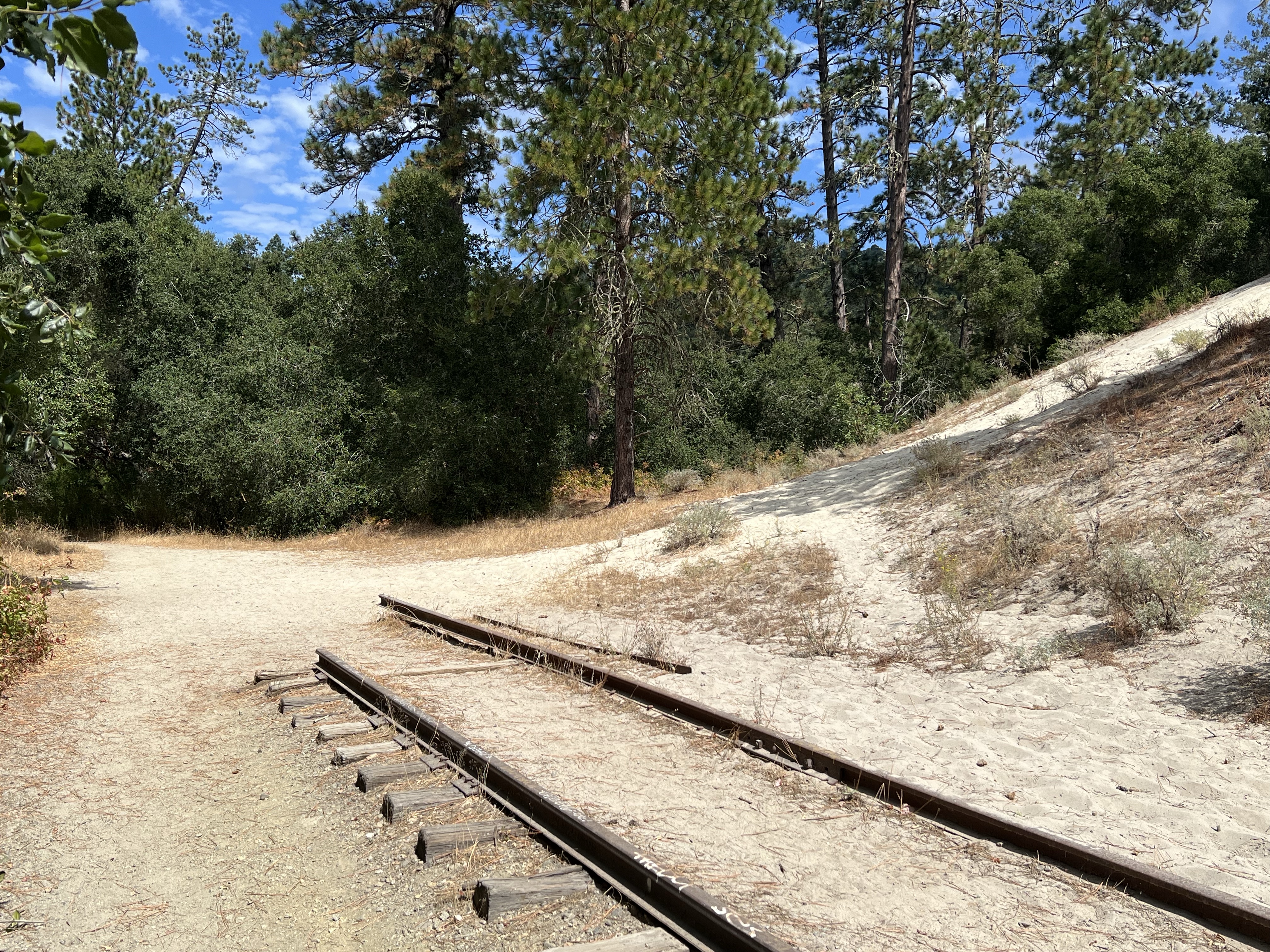
I continued north as the siding rejoined the mainline. And after about a five minute walk, the tracks end without much ceremony. There is no bumper stop to mark the end. And one tail is longer than it’s mate, 4 feet and 8 1/2 inches away.
This is the end of the line and as far north as the tracks go.
Of all the tunnels on the former South Pacific Coast Railroad there is only one that is still in use for it’s intended purpose. That is Tunnel No. 8, the Mission Hill Tunnel.
This tunnel takes the line through Mission Hill because the town of Santa Cruz did not want the railroad to run through downtown. So they had to bore through the sandstone of Mission Hill. This meant the tunnel was prone to caving in so it was reinforced with internal redwood beams.
The tunnel is built under the Mission Santa Cruz Cemetery and in the early days, steam locomotives passing though would rattle and shake up the earth and occasionally a bone or two would fall onto the line leaving a macabre find for rail crews.
In 1985 the Southern Pacific line was purchased by Norman Clark, owner of the Roaring Camp & Big Trees Narrow Gauge Railroad, and passenger service was revived from Felton to Santa Cruz, a round trip of 16 miles.
The Big Trees & Pacific coming off of Chestnut Street in Santa Cruz on it’s return to Felton. The railroad has some of the most street running rail of any tourist railway. The train is pulling into the right of way heading towards Tunnel No. 8. The train disappearing into Tunnel No. 8 on its way to Felton.
Just up the creek from my cabin is one of the remaining wooden trestles on the former South Pacific Coast Railroad (in 1887 the railroad became Southern Pacific). This is the Shady Gulch Trestle.
Not only does this trestle still exist but is still used for rail service on the Big Trees and Pacific Railway.
Shady Gulch Trestle with the Highway 9 concrete bridge (1930) in the foreground. The dirt road to the right is the former Eben Bennett toll road. The concrete highway bridge replaced the toll road.
The original trestle was built in 1875 to span Shady Gulch. At the time, the line was built for the narrow gauge South Pacific Coast Railroad. When Southern Pacific acquired the line they rebuilt the trestle in 1905 to accommodate standard gauge.
The trestle of today very much looks like the original narrow gauge trestle of the late 19th century, sans graffiti of course.
The afternoon Felton-bound Big Trees and Pacific crossing the Shady Gulch Trestle. This tourist train tends to stop traffic on Highway 9.
My father spend his childhood summers in the cabin in the 1930, 40s, and 50s. He would tell me of the time a freight would be climbing the grade on the trestle on their way to Felton on a foggy summer’s morning. The wet track would cause the locomotive’s driving wheels to slip. And after many slips and the hyperbolic “chuff-chuff-chuff” of the stream exhaust, the train would back down the grade, sanding the track as they reversed. The freight would make another attempt, this time slowly with the sanded rails helping the drivers grip the steel. And off they went to Felton.
There is a single one car pull off on the north side of the highway bridge. I made three attempts to sketch the trestle but was foiled by a camper van that was camped out in the spot.
Was this guy going to spend the night here? On my third attempt of the day, in late afternoon, the van was finally gone and I was able to park, set up my sketching chair, and start my sketch of the trestle.
I timed my sketching time with the Felton bound afternoon Big Trees and Pacific train.
One of the more interesting tunnels on the South Pacific Coast Railroad is Tunnel No. 5 in Zayante.
This is one only two tunnels on the former South Pacific Coast line that is still in use, although not by a railroad.
As the railroad climbed its way up Zayante Creek it came to a granite outcrop that the builders could not go around or over so they had to tunnel through it.
Granite is stable and solid and because of that they did not have to add any interior wooden supports. When completed Tunnel No. 5, at 250 feet, was the second shortest on the line.
The tunnel was active until the Southern Pacific’s abandonment in November of 1940.
The tunnel began it’s current use in 1952 when the Western States Atomic Vault Company bought the tunnel, sealed both ends and used Tunnel No. 5 as a fire-flood-nuclear-proof storage silo, housing records (mainly microfilm and microfiche) for many companies including Disney. The silo officially opened on May 2, 1954.
The eastern portal was made the entrance to the facility and a guard shack was built (featured sketch) where a guard was stationed 24/7. We did not see any signs of a guard so we could not ask for a tour. (The facility is currently owned by Iron Mountain).
In times past, the company would allow tours inside the facility and one visitor deemed it the “most interesting dull place in the world”.
One can only guess the nearly 70 year old “secret” files that now reside in the former railroad tunnel known as Tunnel No. 5.
Peeping through the fencing toward the eastern portal of Tunnel No. 5. One of the two windowed buildings appears to be the guard shack. The parking lot now looks like an odd junk sale with junk that no one wants to buy!The former rail bed (sans rails) looking towards Eccles and Felton and Santa Cruz.
On a historic rail sketching adventure, Grasshopper and I headed up into the Santa Cruz Mountains to sketch a portal of one of the longest rail tunnels on the former South Pacific Coast Railroad (later Southern Pacific) route.
This 28 mile route started at Vasona Junction in Los Gatos and climbed over the Santa Cruz Mountains to the beach town of Santa Cruz.
Part of this route still exists as the Big Trees and Pacific Railroad which operates a tourist train from Felton to the Santa Cruz Beach Boardwalk.
The tunnel we were looking for is the Glenwood Tunnel, also known as Tunnel No. 3. This 5,793 foot tunnel was active from 1879 to 1942. The original tunnel was built for narrow gauge but when Southern Pacific took over the line in 1887, they later converted the line to standard gauge (4 ft 8.5 in).
When the South Pacific Coast Railroad was first planned, then had to figure out how to get the road bed into the San Lorenzo Valley. To do this they had to built two one-mile long tunnels: Tunnel No. 2 (Summit Tunnel) and Tunnel No. 3 (Glenwood Tunnel).
From northbound Highway 17, we took the Laurel exit heading towards the former township of Laurel. We passed a few mountain homes and two bikers laboring up the hill as we headed down towards the former rail-bed.
We parked and headed out to a get a better look. The west portal of the Glenwood Tunnel was visible, but parts were obscured by trees and a power pole. The “private property” sign kept us at bay. Was this the best view we would get?
The not-so-great view.
I climbed up a side road, probably also private property, that parallels the rail bed, to get a better sketching vantage point. Even here, the portal was obscured by redwoods but I started a sketch anyway (which, like Tunnel No. 3, I abandoned).
Not being satisfied with the sketch I returned to where Grasshopper was sketching. His only company was a barking dog on the other side of a fence. There was a house just to our left.
A man peeked over the fence with his cup of coffee and said, “You can walk up to the tunnel if you want.”
This was the owner of the house (let’s call him “Bill”) and we had a nice conversation with him about living in the redwoods, winter storms, history, his spring-fed water system, and trains and tunnels.
We thanked Bill and walked around the chain that crossed the rail bed and headed towards the western portal of the Glenwood Tunnel. Now this was the way to sketch the tunnel (featured sketch).
Grasshopper sketching the western portal of Tunnel No. 3. Bill’s spring-fed water system can be seen on the right.Corvidsketcher in the western portal of Tunnel No. 3.
We walked into the 1909 concrete portal. The tunnel ended in about 50 feet.
In 1940, winter storms and landslides closed portions of the route permanently. Southern Pacific made the decision to abandon the line. The major tunnels were dynamited at both ends, closing the tunnels for good. The concrete portals are all that still remain.
Now that we firmly had tunnel fever, we had to find the other side of the tunnel, the eastern portal.
Tunnel No. 3 now passes under Highway 17 so you have to cross over the highway to find the other end.
The eastern portal of the Glenwood Tunnel at Glenwood Drive.
The eastern portal of the Glenwood Tunnel is much harder to get to than the western portal. To get a comparable view you would have to scrabble down a steep hillside or trespass through a stable to reach the rail bed which now seems to be a creek bed.
So we had to make due and sketch the portal from the side of Glenwood Drive, which the concrete portal now supports.
On my latest sketching odyssey I headed to one my favorite locations in California, if not the world: Donner Pass.
Before I set out, I sketched the rail route of the East Slope of Donner Pass, heavily influenced by a map drawn by John Signor (author, artist, and former Southern Pacific employee) in his marvelous book: Donner Pass: Southern Pacific’s Sierra Crossing.
I would be driving parallel to the Central Pacific side of the first Transcontinental Railroad on Highway 80. In 1865 the railroad became Southern Pacific.
I was looking for a stone structure that was built in 1909 as a fire lookout and I reckoned that Cisco, which is directly across the valley from the building, would be my best position for seeing Southern Pacific’s fire lookout on Red Mountain.
The lookout on Red Mountain was built because, from this vantage point, the rail line from Blue Canon to Donner Summit could be observed. Because 50 miles of the trackage was above 5,000 feet in elevation, snow was a real problem for keeping the line open during the long winters. The solution was to build wooden snowsheds to keep snow off the tracks. Work on the snowsheds began in 1867 and the sheds were completed by 1873. In total, 30 miles of sheds where built.
The view from Donner Summit. On the right is the original rail bed of the Transcontinental Railroad. The east portal of the Summit Tunnel (Tunnel #6) and Tunnel #7 is beyond. The snowsheds are made of concrete, replacing the flammable wooden sheds. In the middle ground is Historic Highway 40 and in the background is Donner Lake.
When you combine wooden snowsheds with wood burning steam locomotives the result can be fire.
Southern Pacific employed fire trains that could be called into action to put out fires in the snowsheds but first someone had to observe the smoke. This is where the fire lookout came into play.
The fire lookout was in continuous use until 1934 when it was abandoned.
Before I got to Cisco, I pulled off Highway 20, just before it merges into Highway 80 at Yuba Pass. From here I looked down the line and just above the signal gantry was Signal Peak and to the right I spotted the prominent silhouette of the fire lookout.
Yuba Pass with Red Mountain and Signal Peak in the background.
I headed east on 80 for one stop, I took the Cisco exit which just a service station stop. I pulled behind a parked truck and looked to the northeast across the highway.
Behind me, further up the hill was the mainline. In front of me was Red Mountain and Signal Peak. To the right was antennas and towers, to the left was the Southern Pacific fire lookout.
Red Mountain and Signal Peak.
Now it was time for a sketch using my Delta panoramic journal (featured sketch) to capture the peak.
Close up of the Southern Pacific stone lookout built in 1909 and used until 1934.
I returned to Yuba Pass to get a sketch of Red Mountain from this perspective. The signal on the gantry was green so an eastbound freight was imminent. Before long I could hear the rumble of a Union Pacific intermodal freight train climbing the grade towards Donner Summit. This consist contained six locomotives and I lost count of how many cars it train contained. (In truth I didn’t attempt to count. Seeing this long freight train mean less truck traffic on America’s highways).
What follows is a series of photographs of the UP freight making the climb to Donner Pass with Signal Peak in the background.