Image

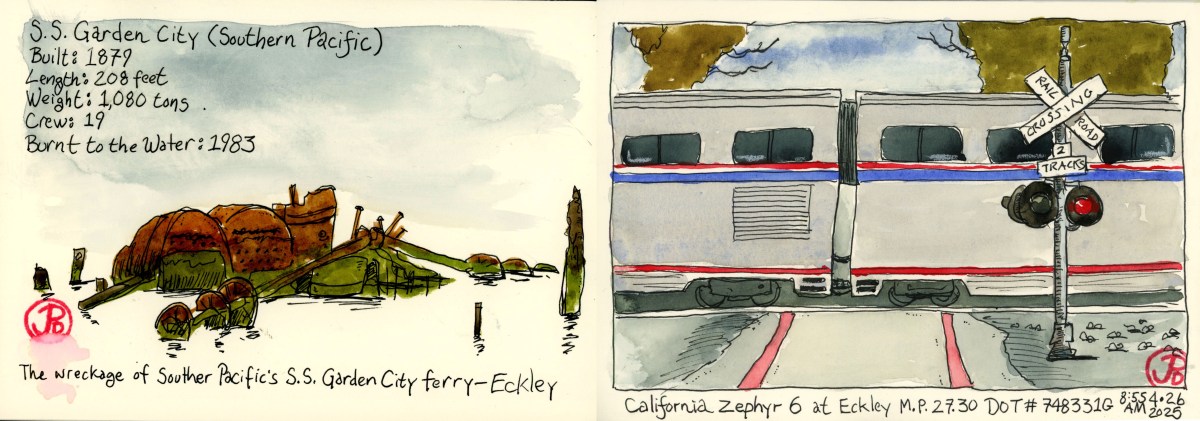
UP Eckley Crossing: 748331G (M. P. 27.30)

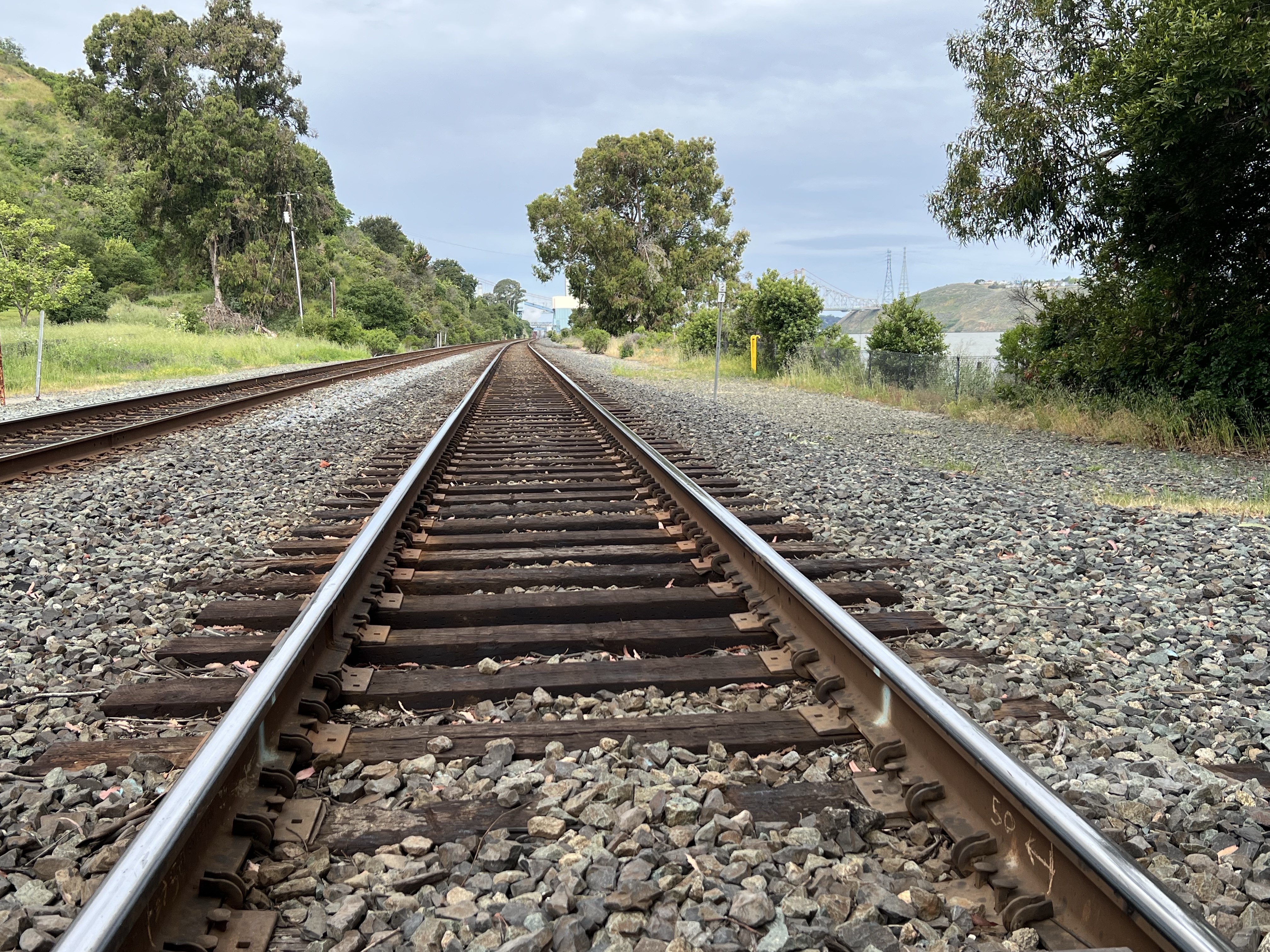
My Saturday morning sketch location was the pedestrian rail crossing at Eckley Pier in the Carquinez Strait Regional Shoreline.

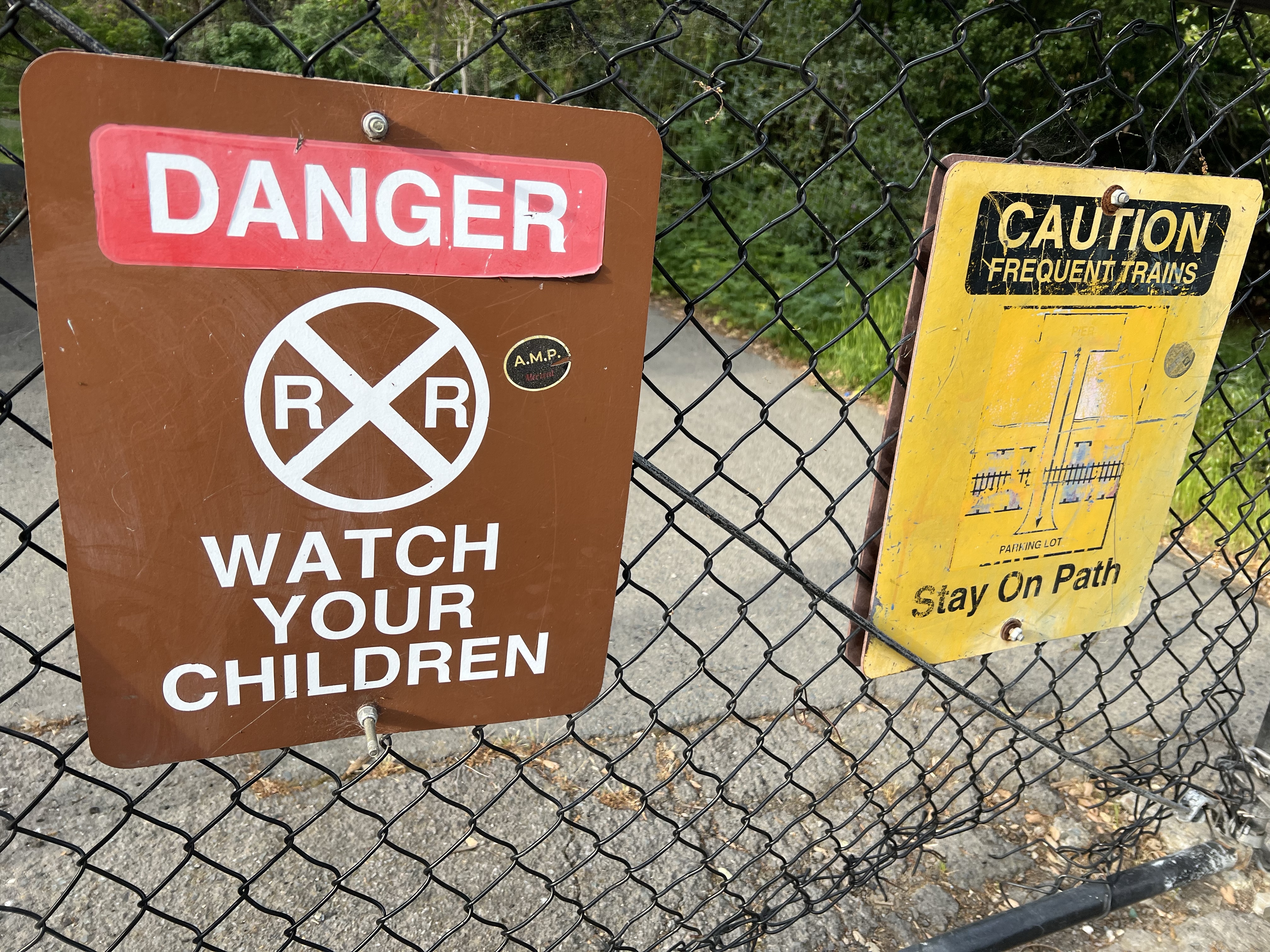
A sign any educator can appreciate.

This pedestrian crossing is quite unusual because there are no crossing gates preventing pedestrians, wanting to go to the fishing pier, from heading across two very busy tracks of the Union Pacific main line.

No rusted rails here but polished high iron from lots of use.

I got to the park at 8 AM, when the gates open, and I had plenty of time to catch the Chicago bound California Zephyr No. 6 as it was scheduled to skirt along the southern shore of the Carquinez Strait just shy of 9 AM.

The Zephyr is one of the longest routes operated by AMTRAK (2,438 miles) and as such has the lowest on-time percentage (33%) of any long distance route, primarily because the passenger service is at the whim of their host railroad’s (UP and BNSF) freight traffic. No. 6 should be on time because it left its western terminus of Emeryville at 8:25 AM. It usually gets behind schedule while stopped behind a freight in Nevada or Utah.

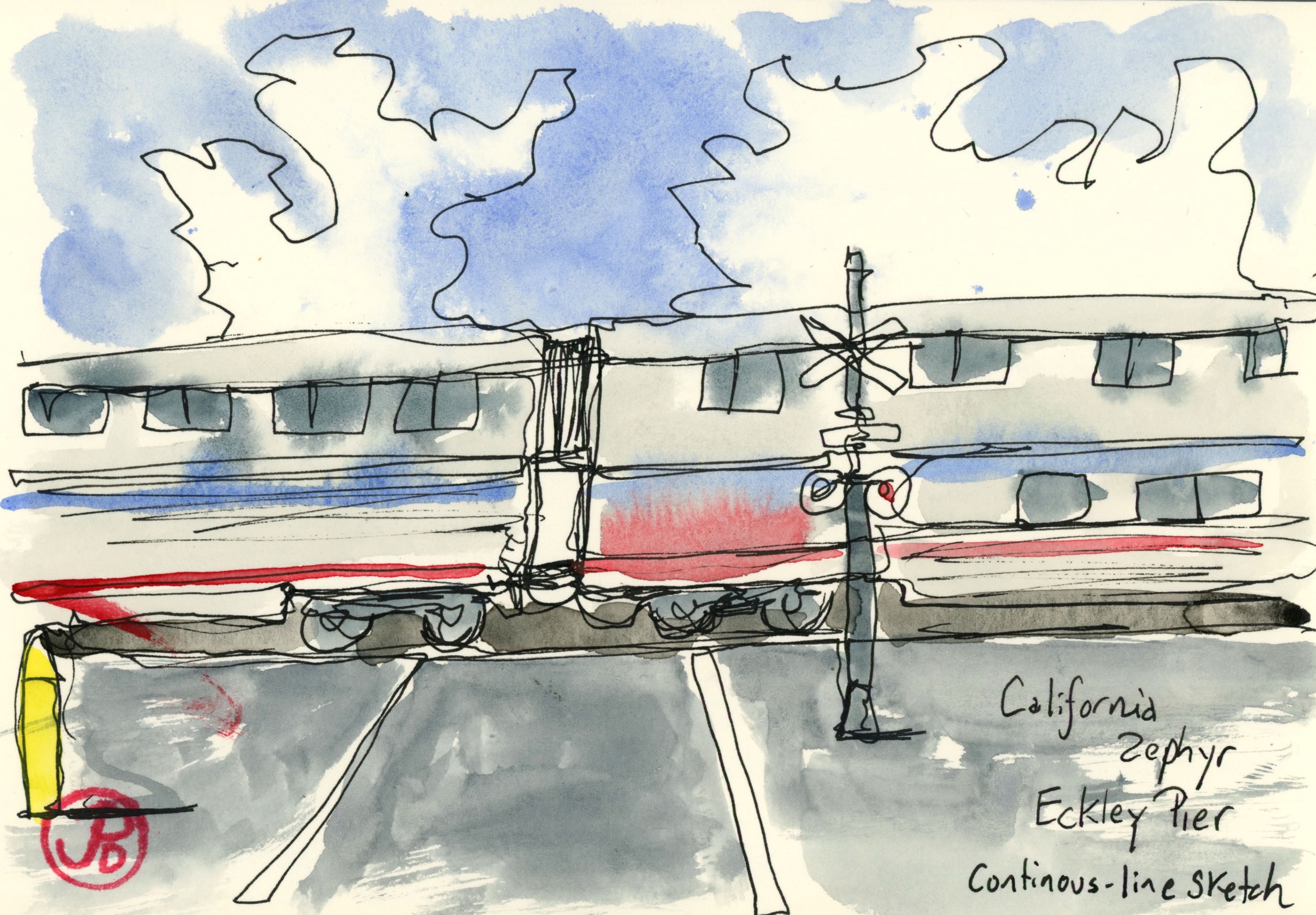
I took a position just south of the parallel tracks to sketch the light signal and crossbuck of the pedestrian crossing.

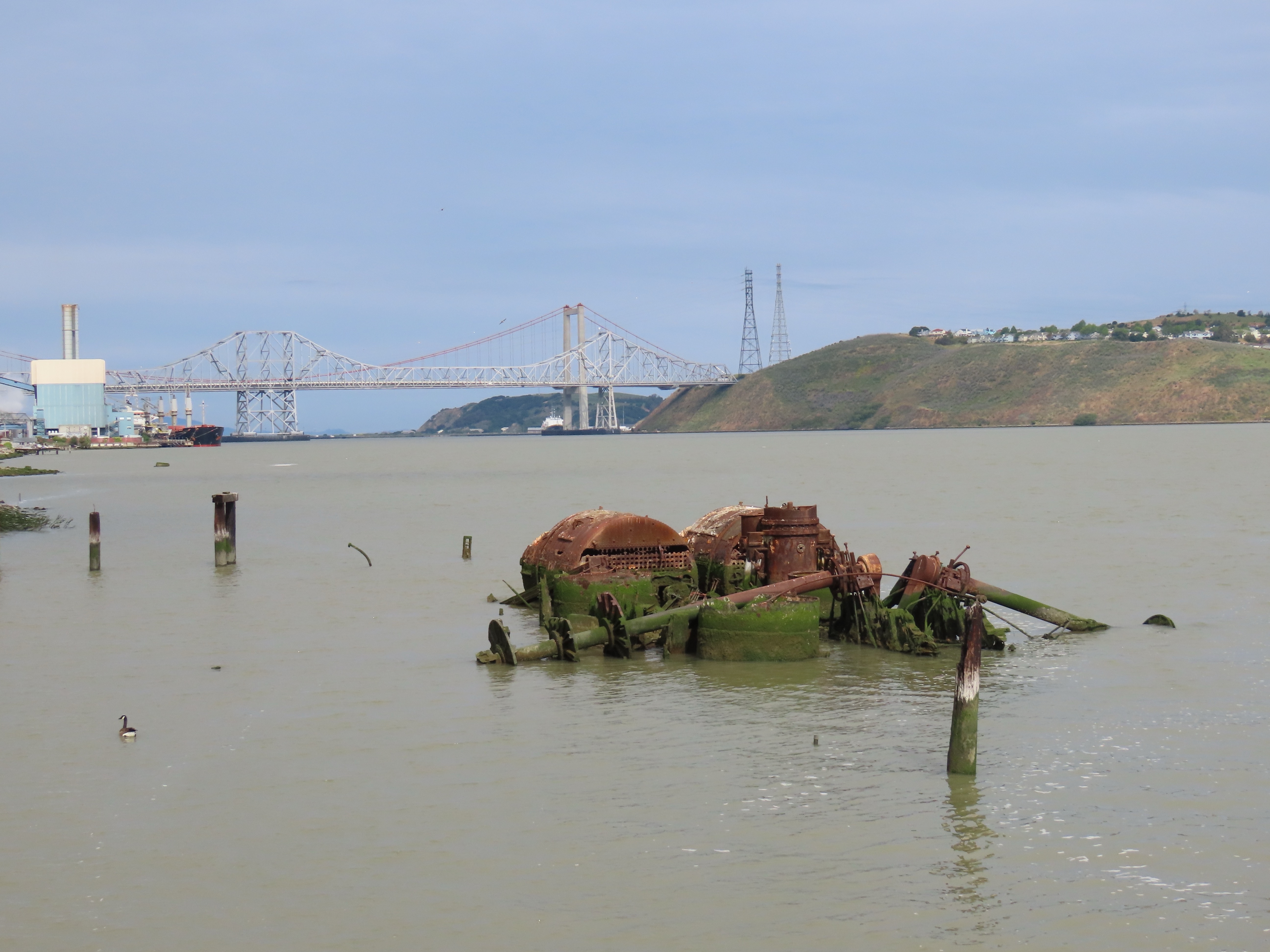
I also had time to get a sketch of another piece of railroad and nautical history: the rusted boilers and paddle wheel hubs of the SS Garden City.

The Garden City was a Southern Pacific ferry that ferried people and automobiles across the waters of the bay. She was built in 1879 and was 208 feet long and weighed 1,080 tons. The wooden side-wheeler had a crew of 19.

The construction of bridges like the Carquinez and Golden Gate rendered the ferries obsolete and in the 1930s, the Garden City was moored at a pier near the current Eckley Pier and it was used as a restaurant and fishing pier until she was abandoned in the 1970s. In 1983, the ferry burned to the boilers, which is about all that remains of this once proud vessel.

What’s left of the SS Garden City in the foreground and one of the bridges that made her obsolete in the background.

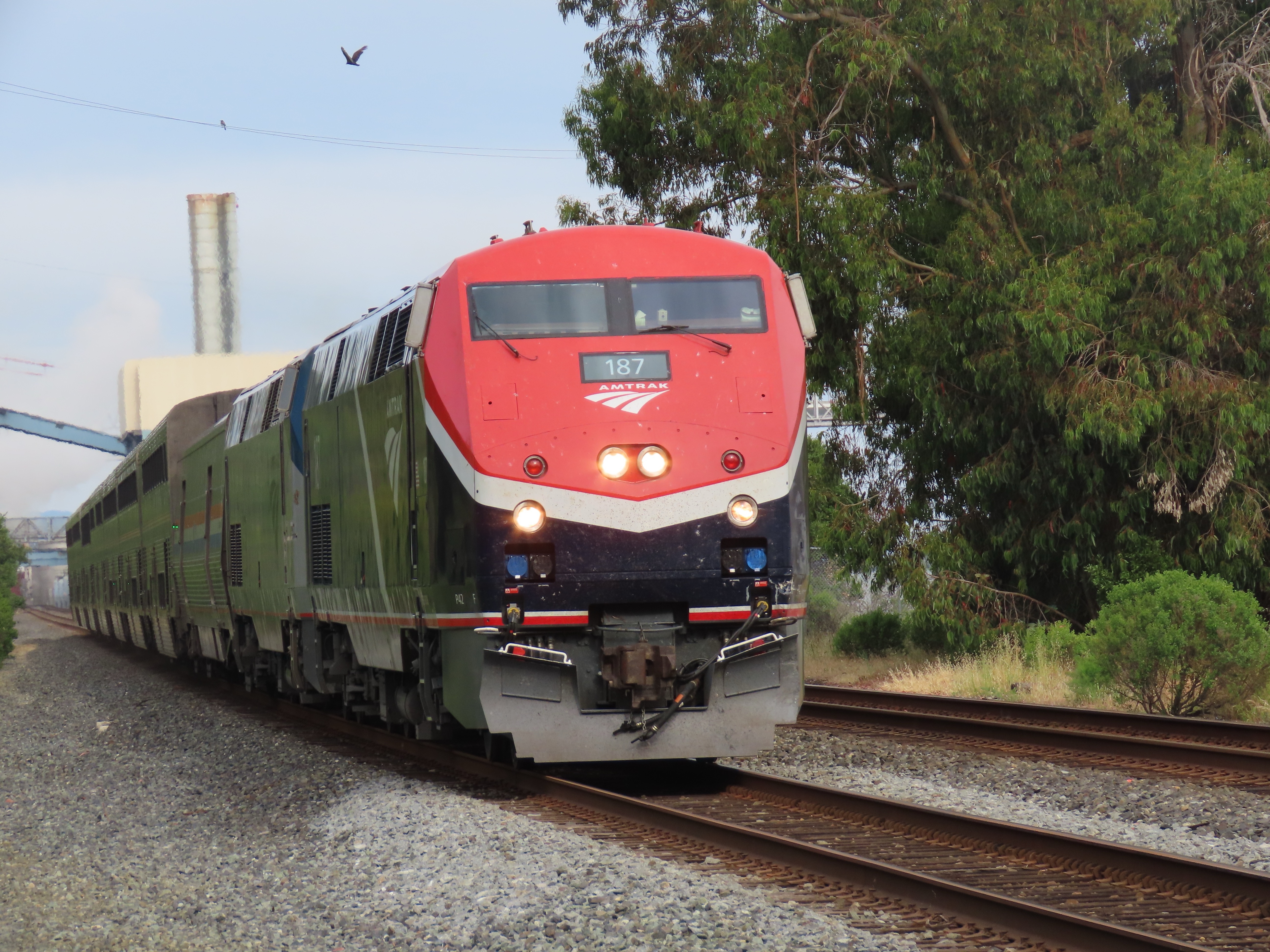
It was now nearing nine so I headed across the tracks to take up a position. Down rail the retort of the horn reached me as the Zephyr blew the crossing at Crockett. Shortly thereafter the crossing signal activated with red lights and bell and the Zephyr appeared around the bend.

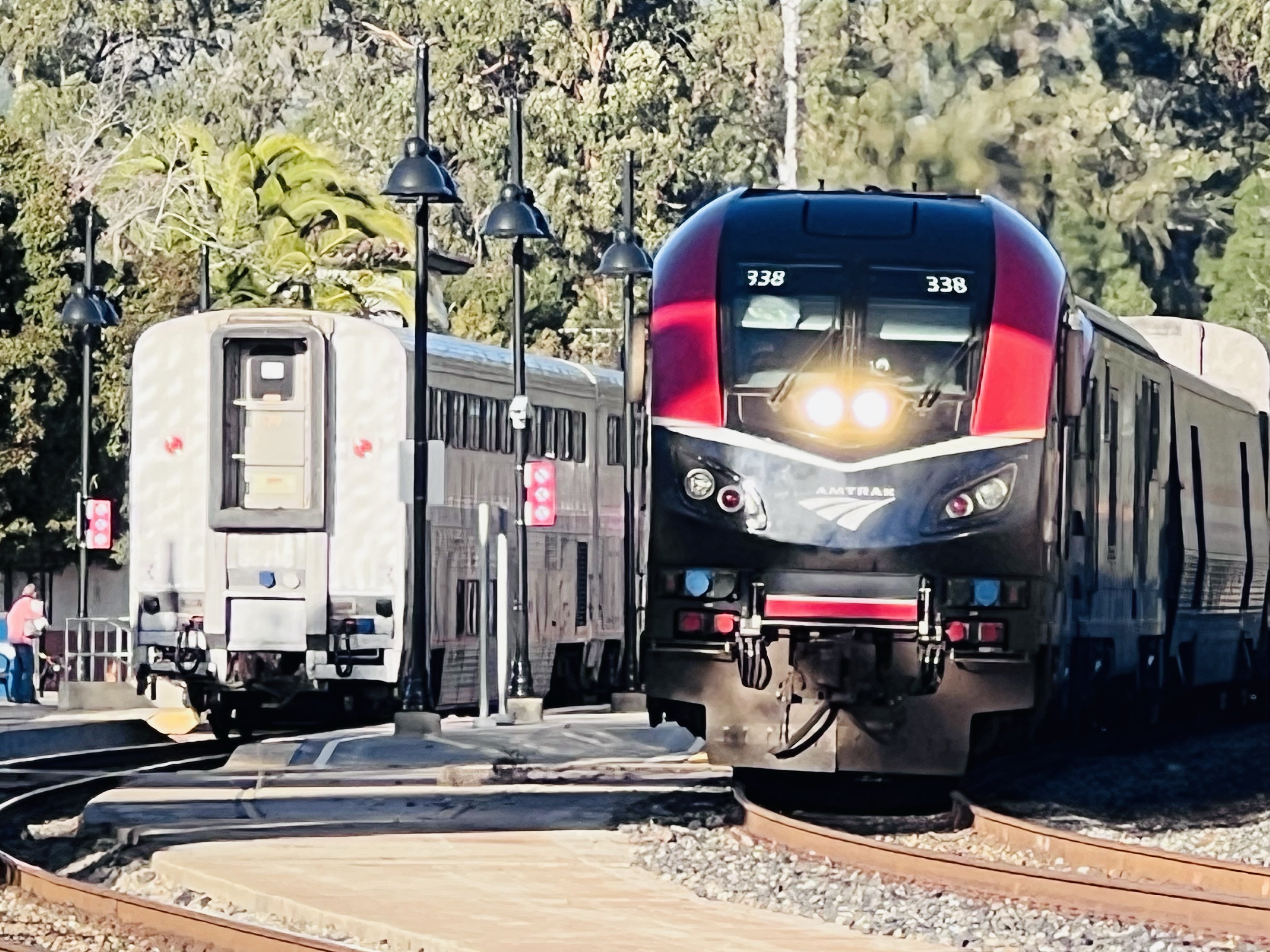
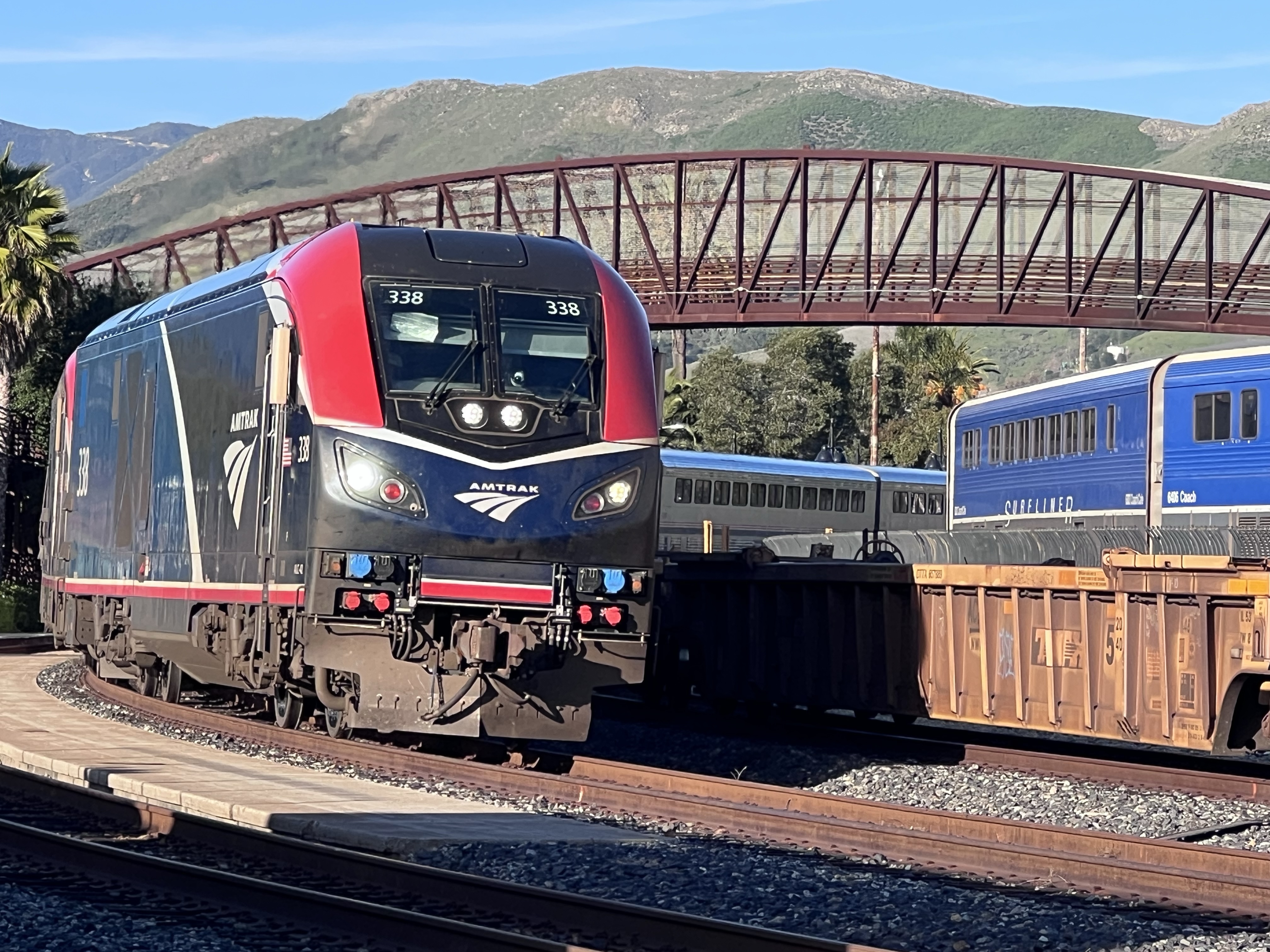
A GE P42DC 187 is on point of the California Zephyr as she heads towards her next stop: Martinez.
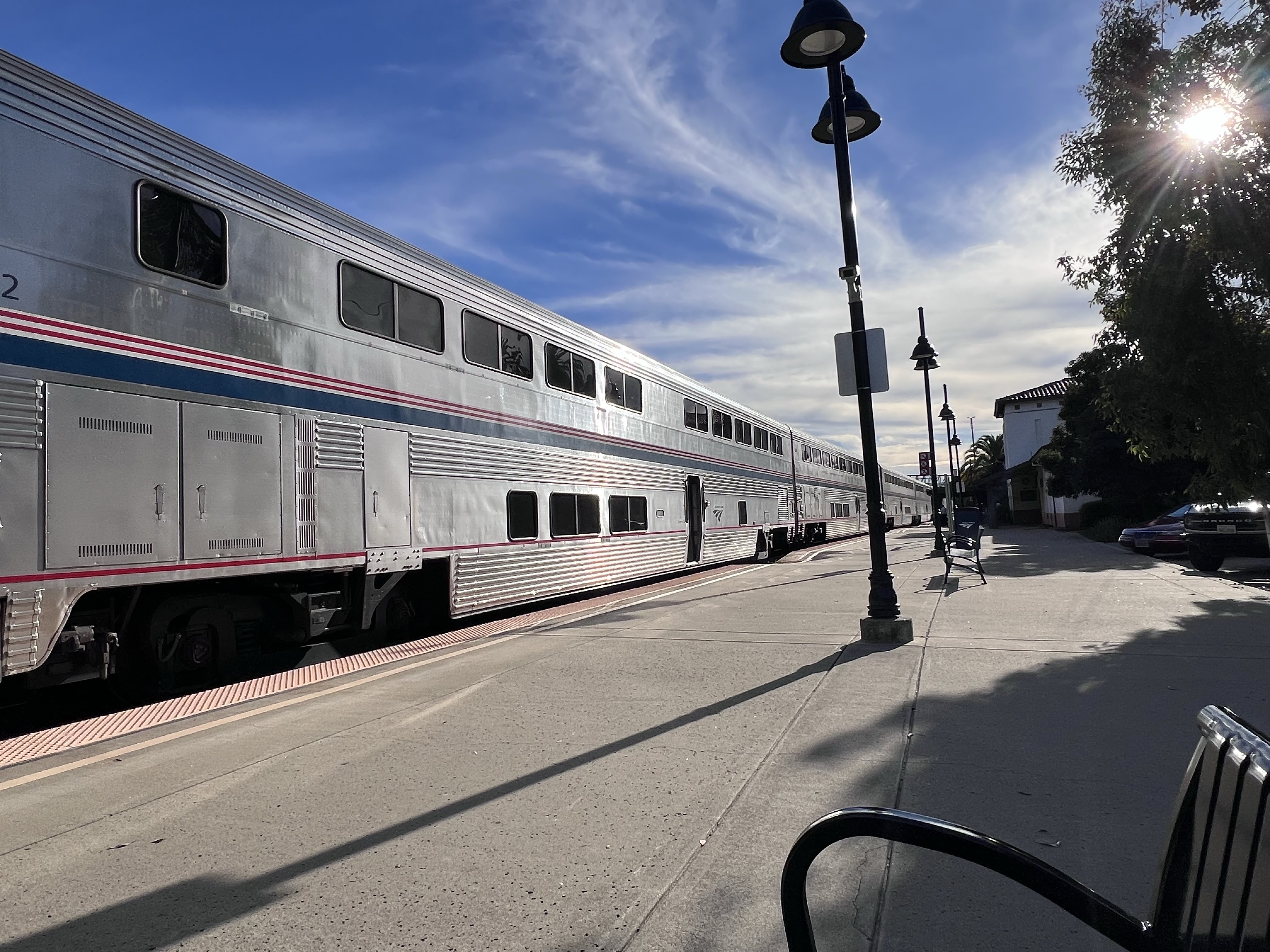
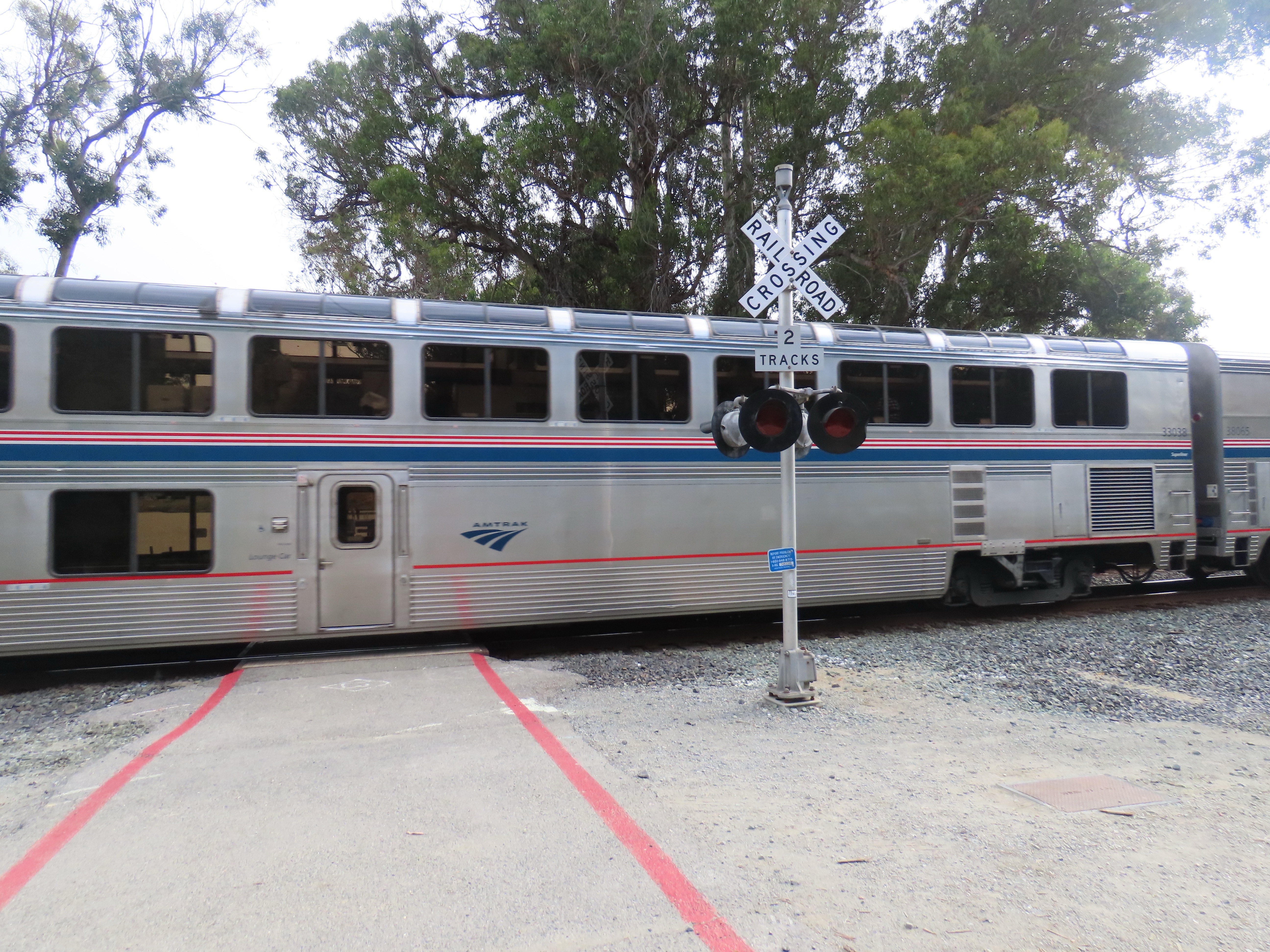
Zephyr No. 6 crossing the pedestrian walkway at Eckley. This is my favorite car to ride in while traversing the Sierras and the Rockies: the observation car!
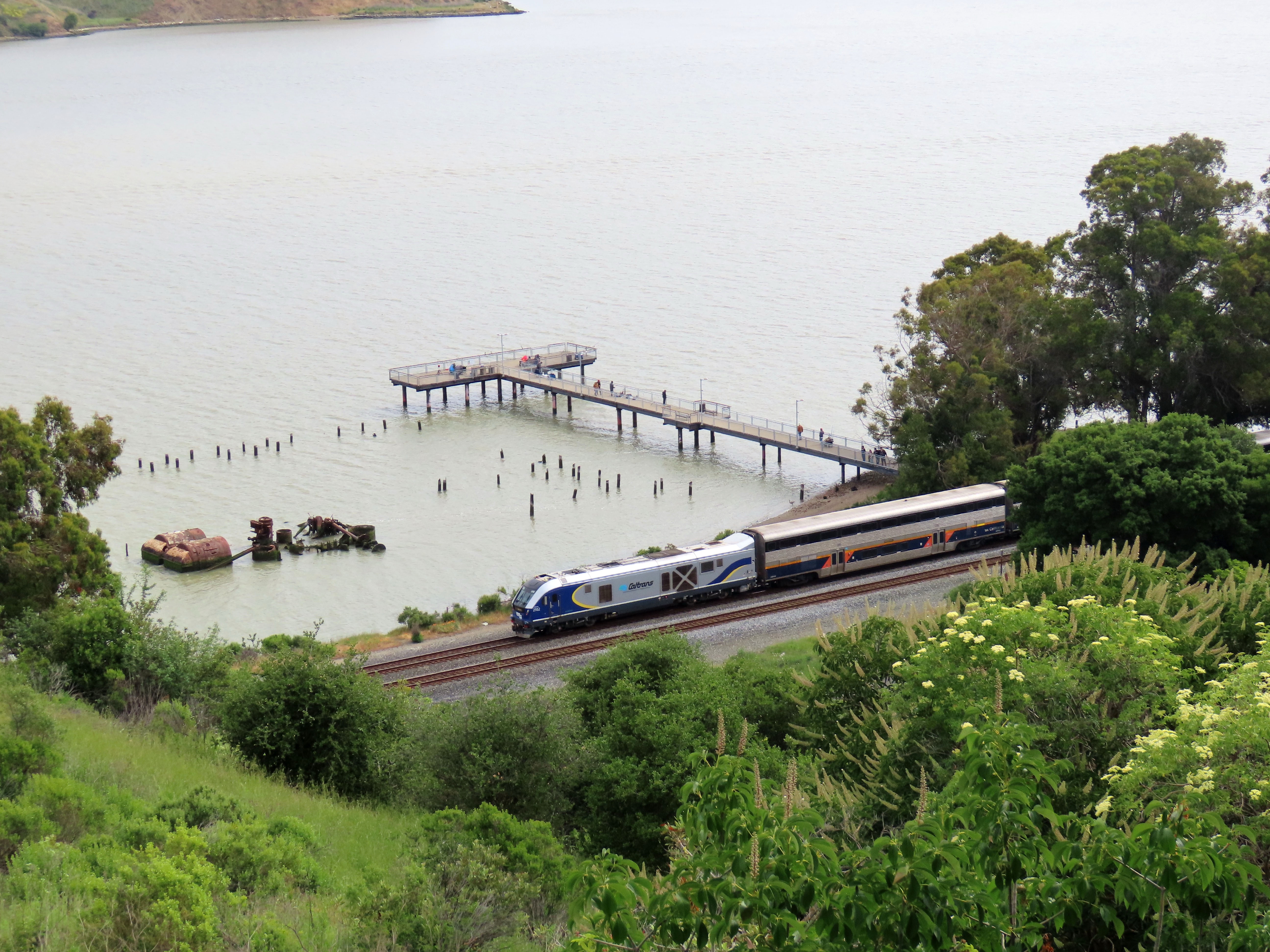
A Capital Corridor heads towards Crockett past the fishing pier and the ruins of the Garden City.

Sketching Notes

Before heading out to Eckley, I pre visualize my sketch. I practice sketching the perspective and location and drew the Superliner train cars that would be a part of the train’s consist so I would be able to draw the cars into my sketch after the train had past. This is using sketcher’s “muscle memory” so drawing the cars would become almost second nature.

A loose continuous line pre-sketch of the pedestrian crossing.

What I drew on location was the foreground and background eucalyptus and then I added the long distance Zephyr from memory. One thing I might do differently is to sketch the train looser to convey the sense of motion.

For my sketch of the Garden City, the core of the sketch was done as a continuous line sketch and I then lifted my pen and add more details.

Both sketches are with my TWSBI Eco fountain pen.

Image

Broadway Station

On Monday I did an afterwork sketch of the closed Atherton Station on the Caltrain route and now on Friday I headed to North Burlingame to do another after work sketch of a Caltrain station: Broadway.

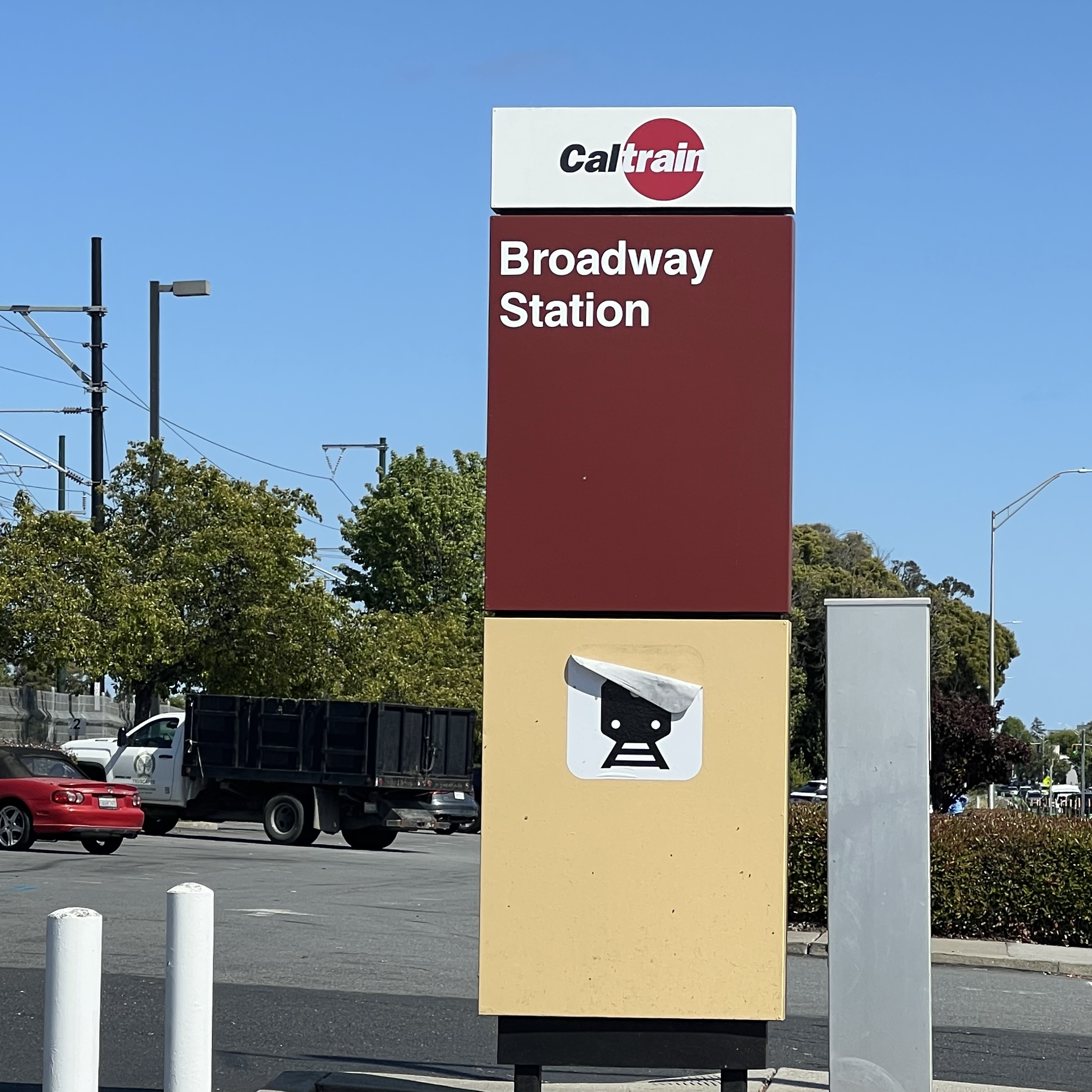
The peeling train sticker on the sign is a living metaphor for the downtrodden Broadway Station.

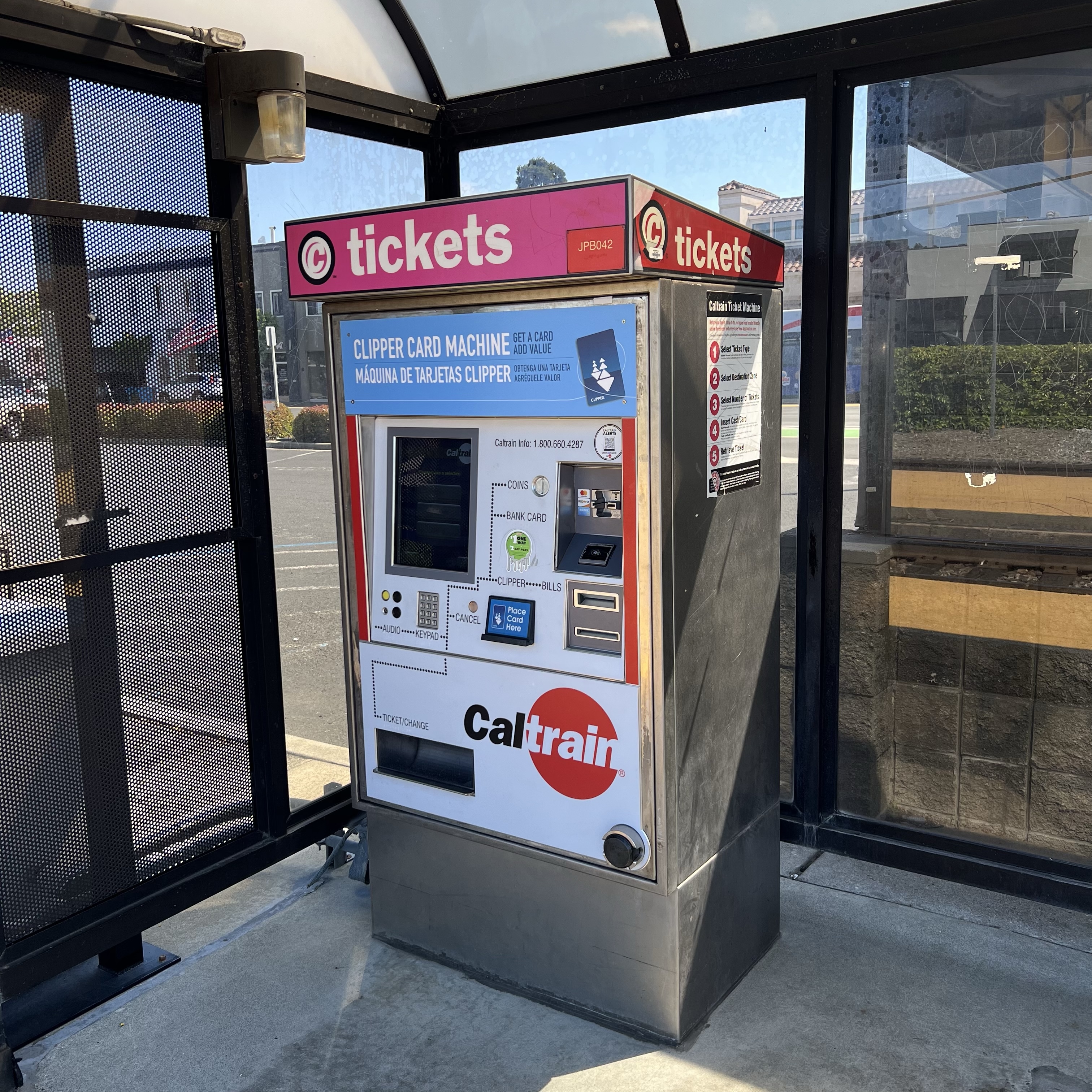
With a name like Broadway, you’d think of a busy station with lots of passenger traffic and a station with a staffed ticket office, a waiting room lined with wooden benches, and perhaps a cafe. Sure that might have been the picture over 70 years ago. Now here is the ticket window:

And there is no cafe. And no passengers for that matter.

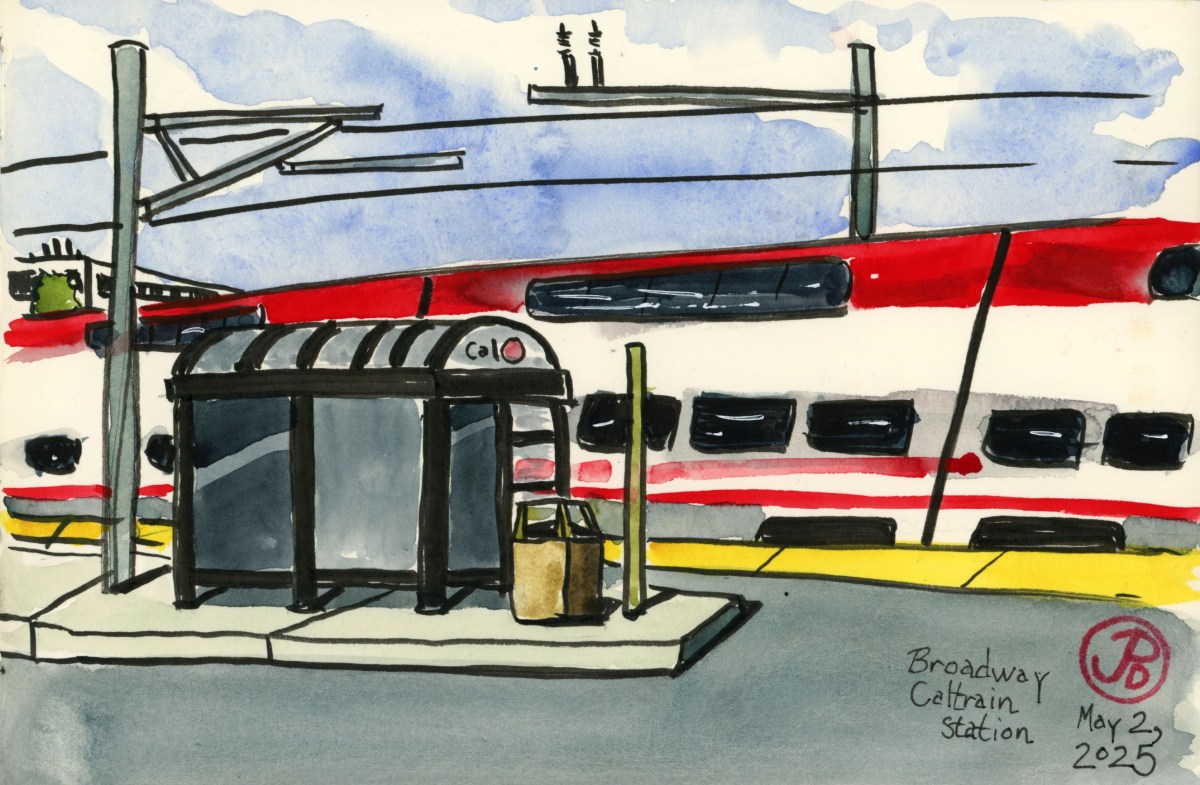
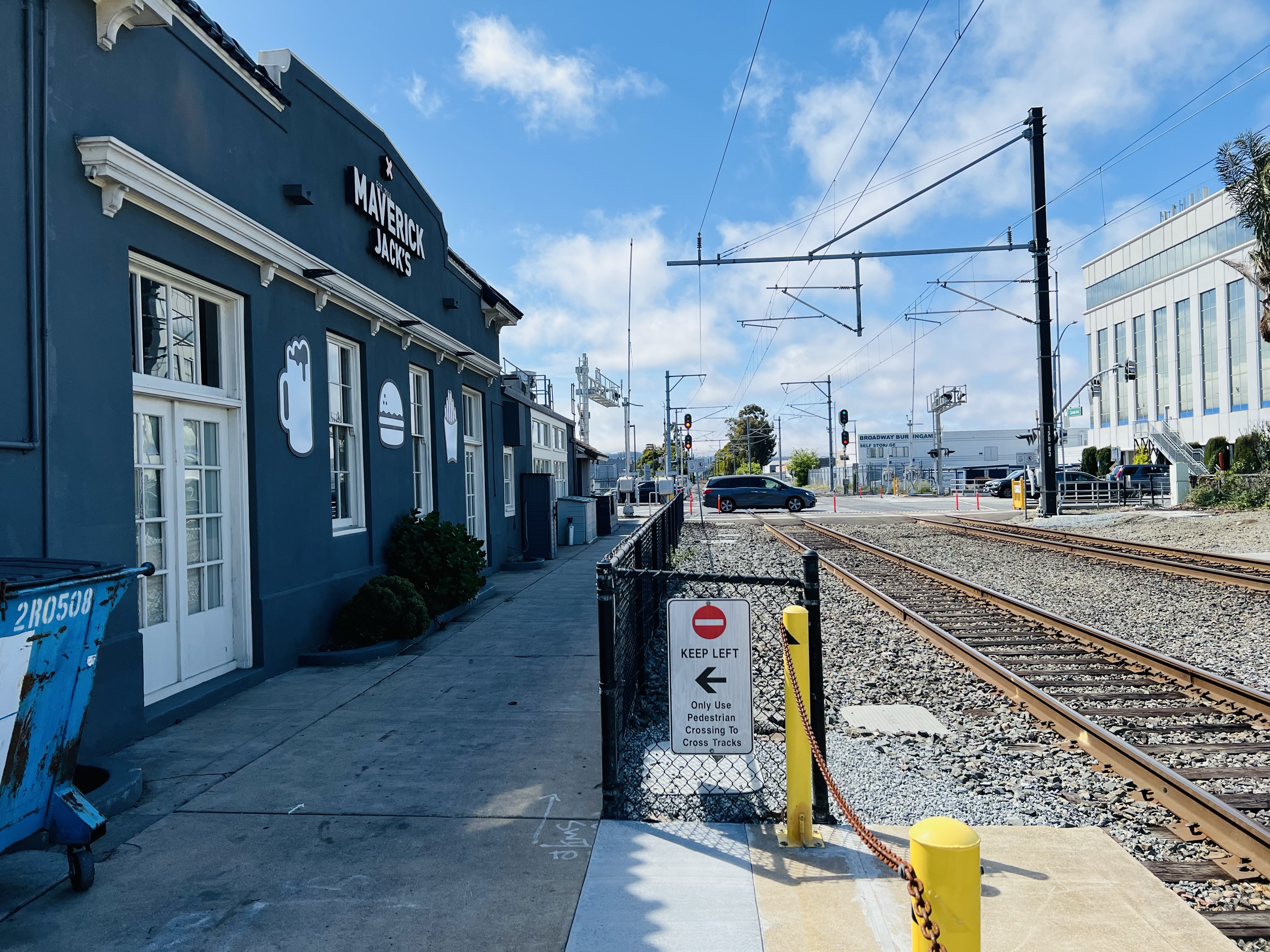
Like Atherton, the new electric EMUs speed by this station. The train only stops here on weekends, which is more than can said for Atherton, and the former station is now a restaurant. The platform has some benches, a few shelters, and a sign that reads “No Loitering”. Is sketching a form of loitering?

Looking north toward San Francisco with the former station, now a restaurant, on the left.

The Broadway Station suffers from diminishing ridership and a center loading island platform for northbound trains. This means that a hold-out rule is in effect which means that if a train is in the station, a train heading in the opposite direction must wait outside the station until the other leaves before pulling in. This creates delays and is a major reason the station was closed on weekdays on August 1, 2005.

This southbound EMU is not stopping here.

The original station was opened by Southern Pacific in 1911. The station was renamed Buri Buri in 1917 and then to its current name in 1926.

My field sketch and a southbound EMU speeding by at Broadway.

Sketching Notes

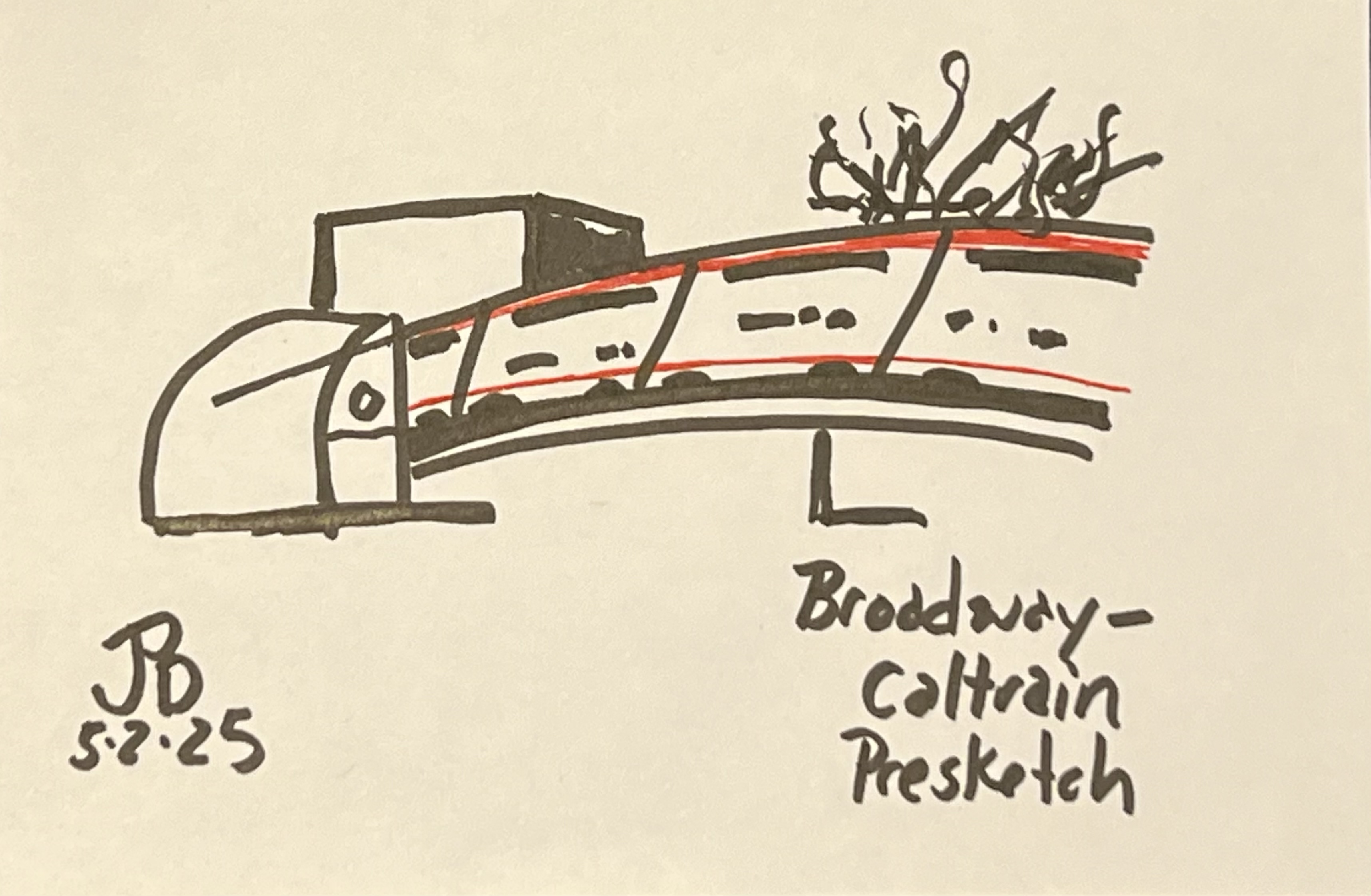
During my lunch I sketched out the scene I wanted to sketch on an index card. This is like a storyboard for a tricky scene in a film. What I wanted to do was convey a sense of stillness and motion. The stillness of the shelter and the motion of the train speeding by. In the presketch, or storyboard, I exaggerated the lines of the train. They are curved and kinetic while the shelter remains calm and pedestrian.

Perhaps I could have exaggerated the lines more in my field sketch. That would entail sketching things that aren’t there in front of me. Like sketching in another dimension.

Image

Crockett Sketching

On a Saturday morning I headed up to Sugar Town on the Carquinez Strait.

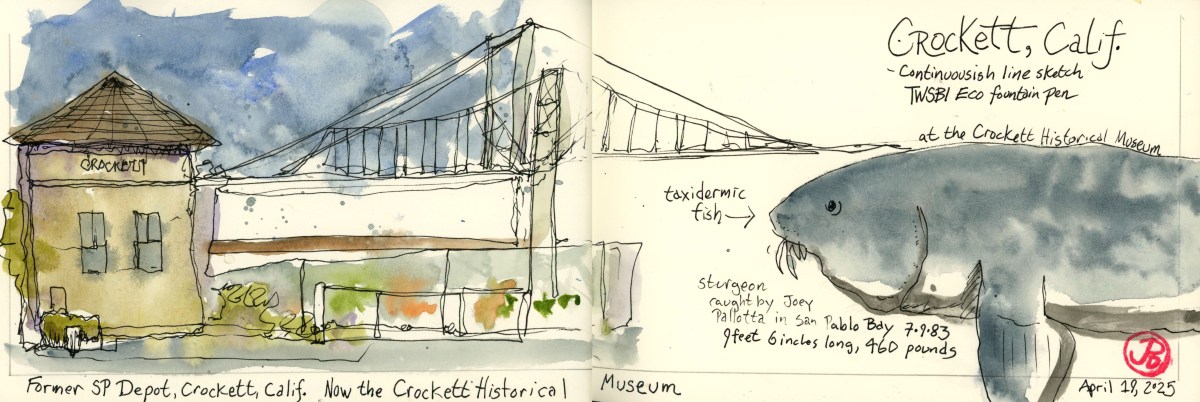
My sketching target: the former Crockett Southern Pacific Depot with the two parallel spans of the Carquinez Bridges in the background. The depot is now home to the Crockett Historical Museum. Open Wednesday and Saturday from 10am to 3pm. Ish!

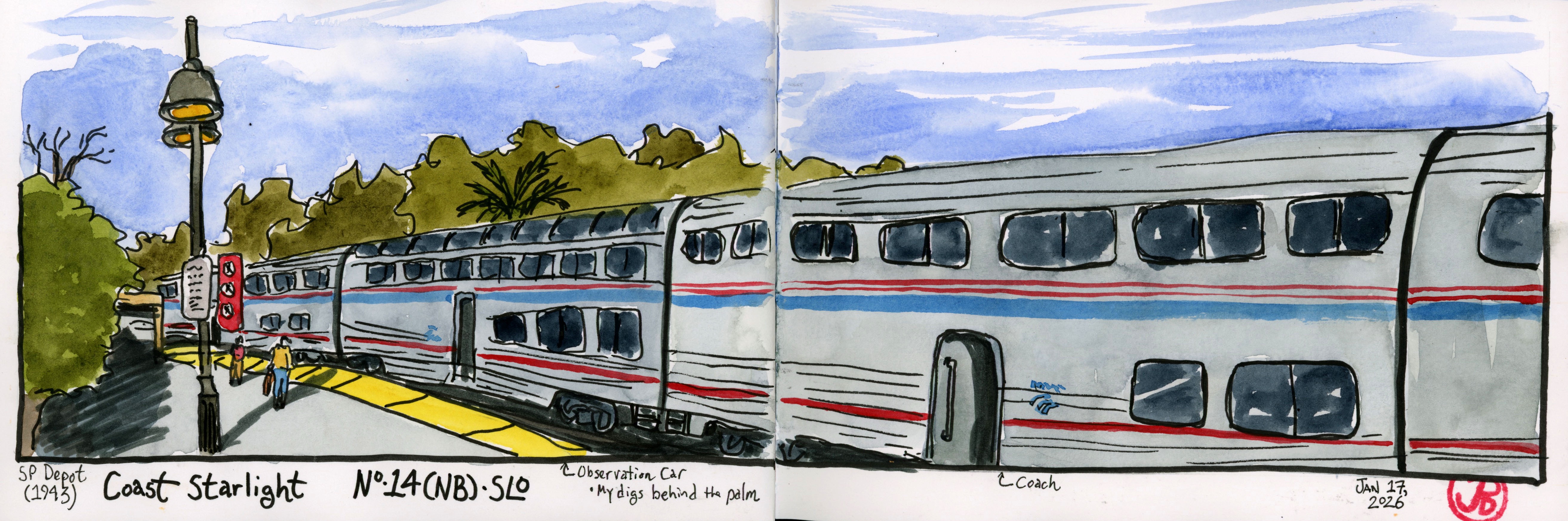
This is a busy place for rail with seven trains passing by including a California Zephyr, a Coast Starlight, a San Joaquin, Capital Corridors, and a Union Pacific freight during my two hours visit.

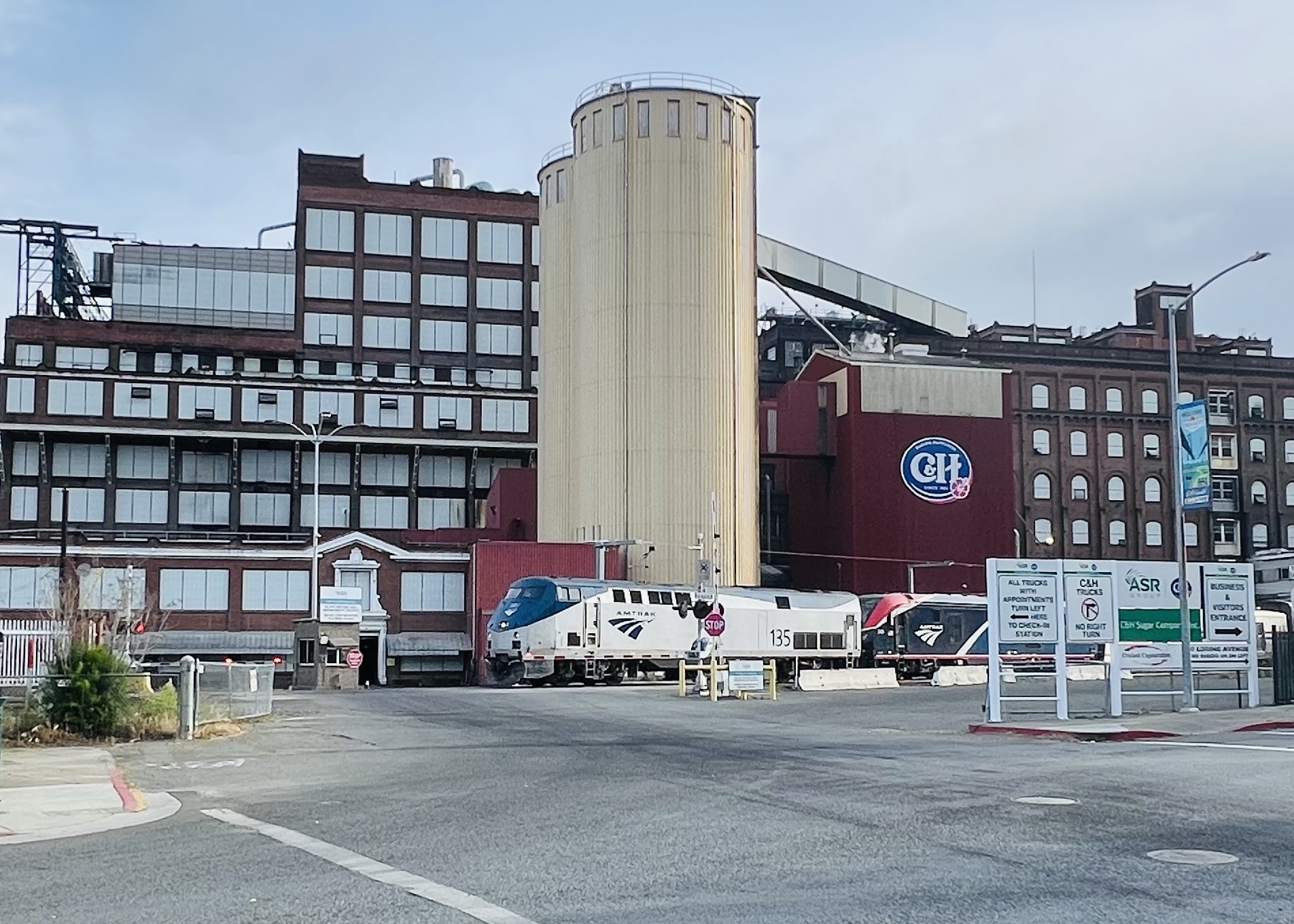
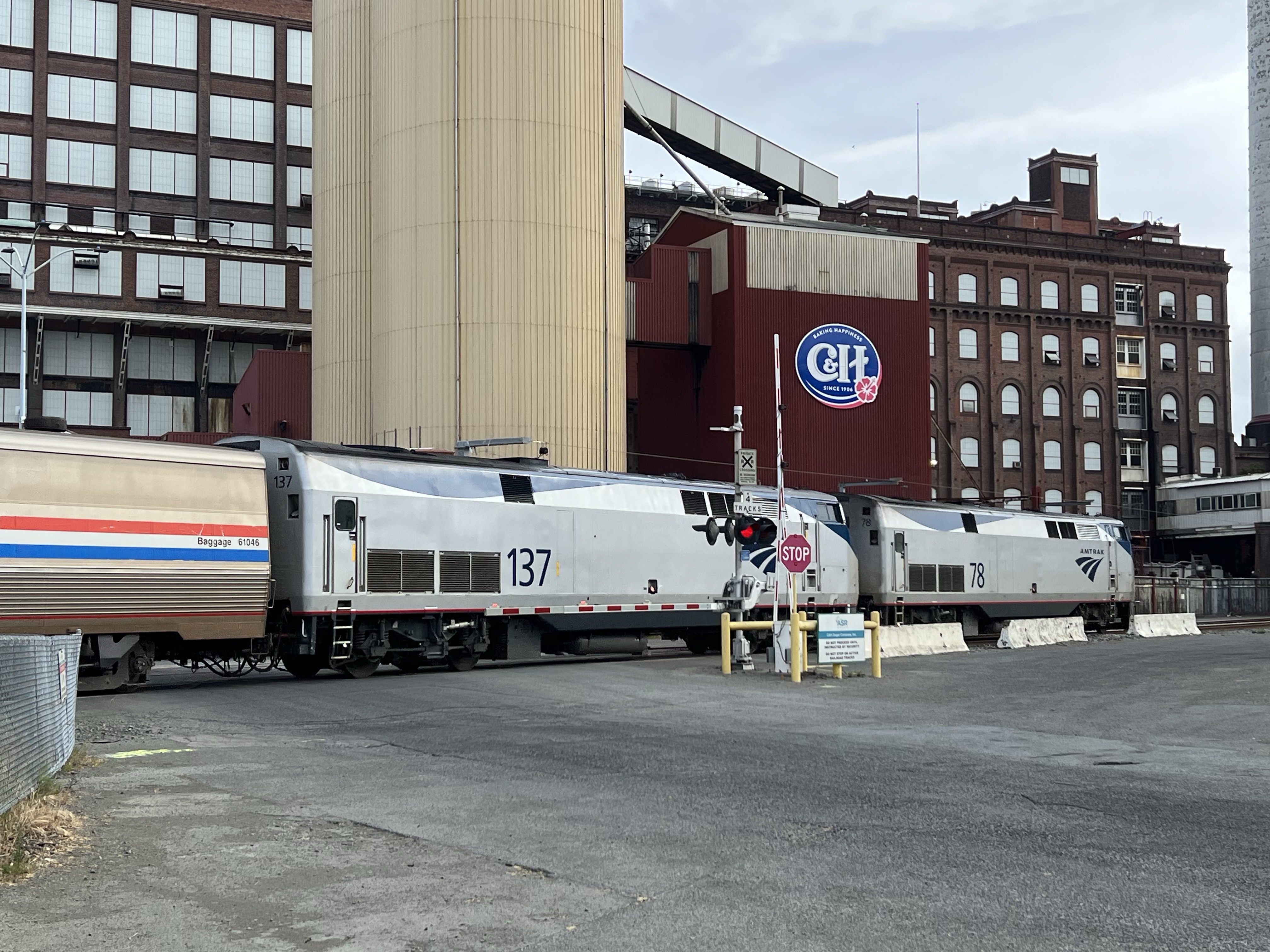
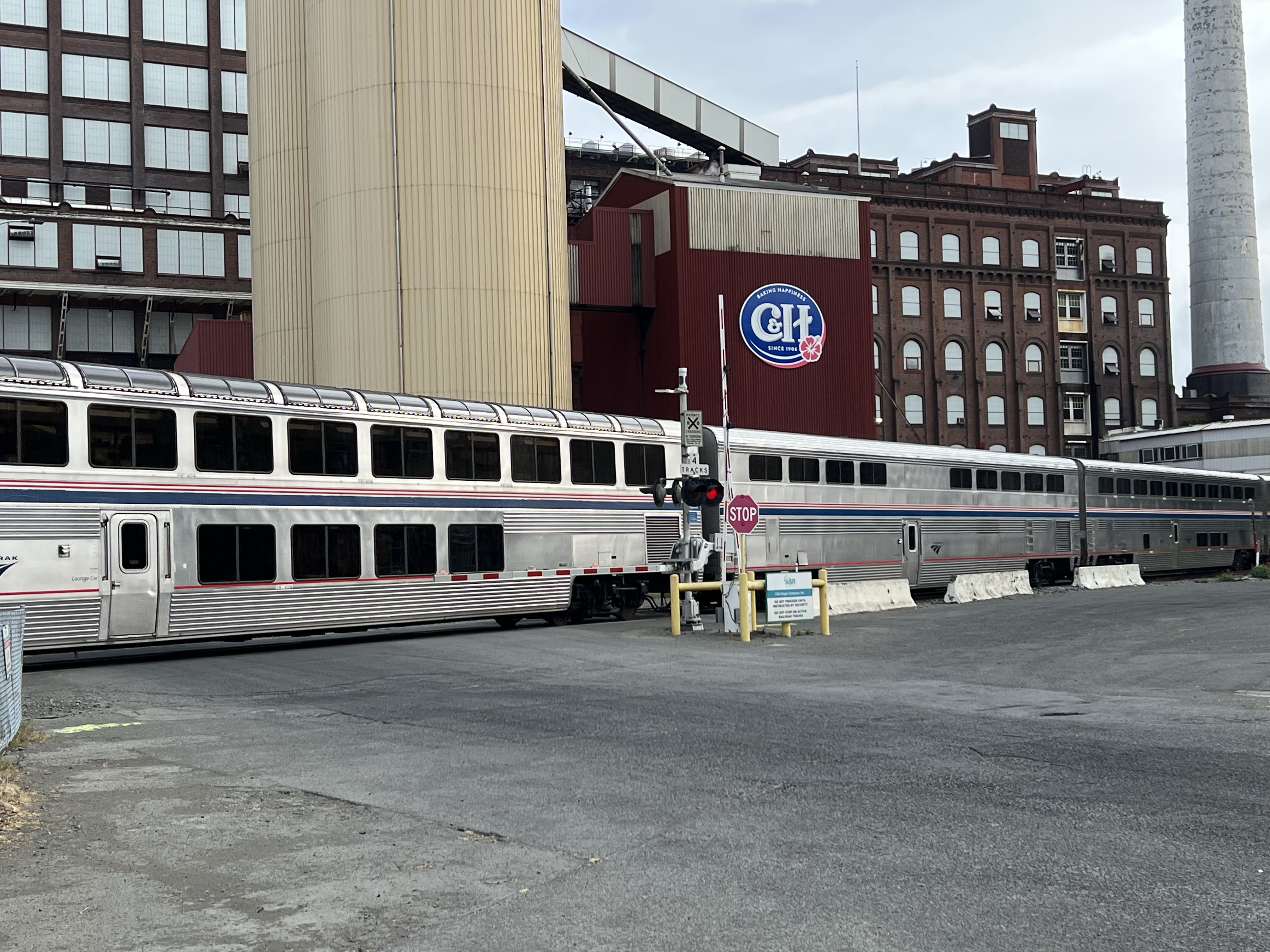
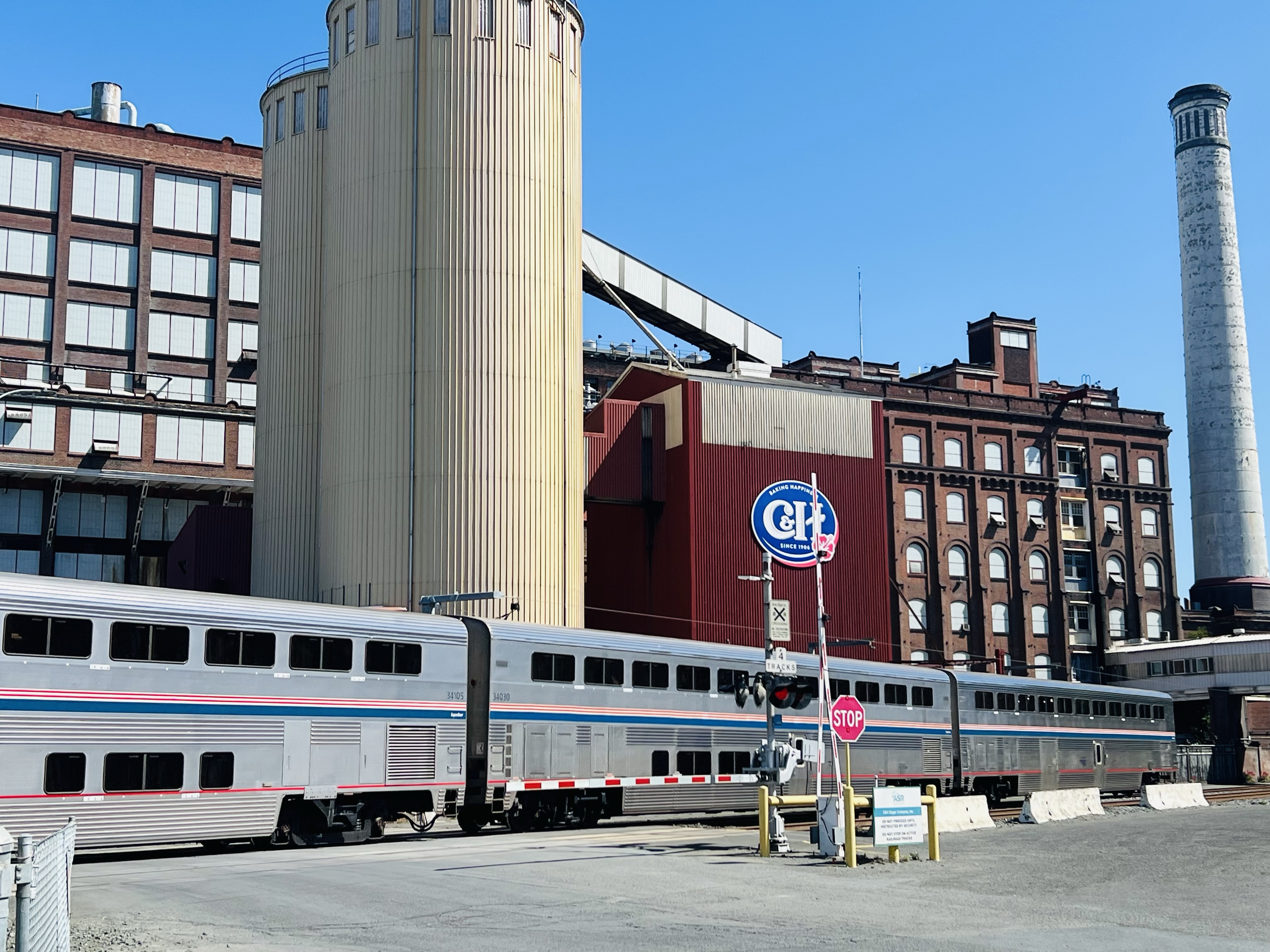
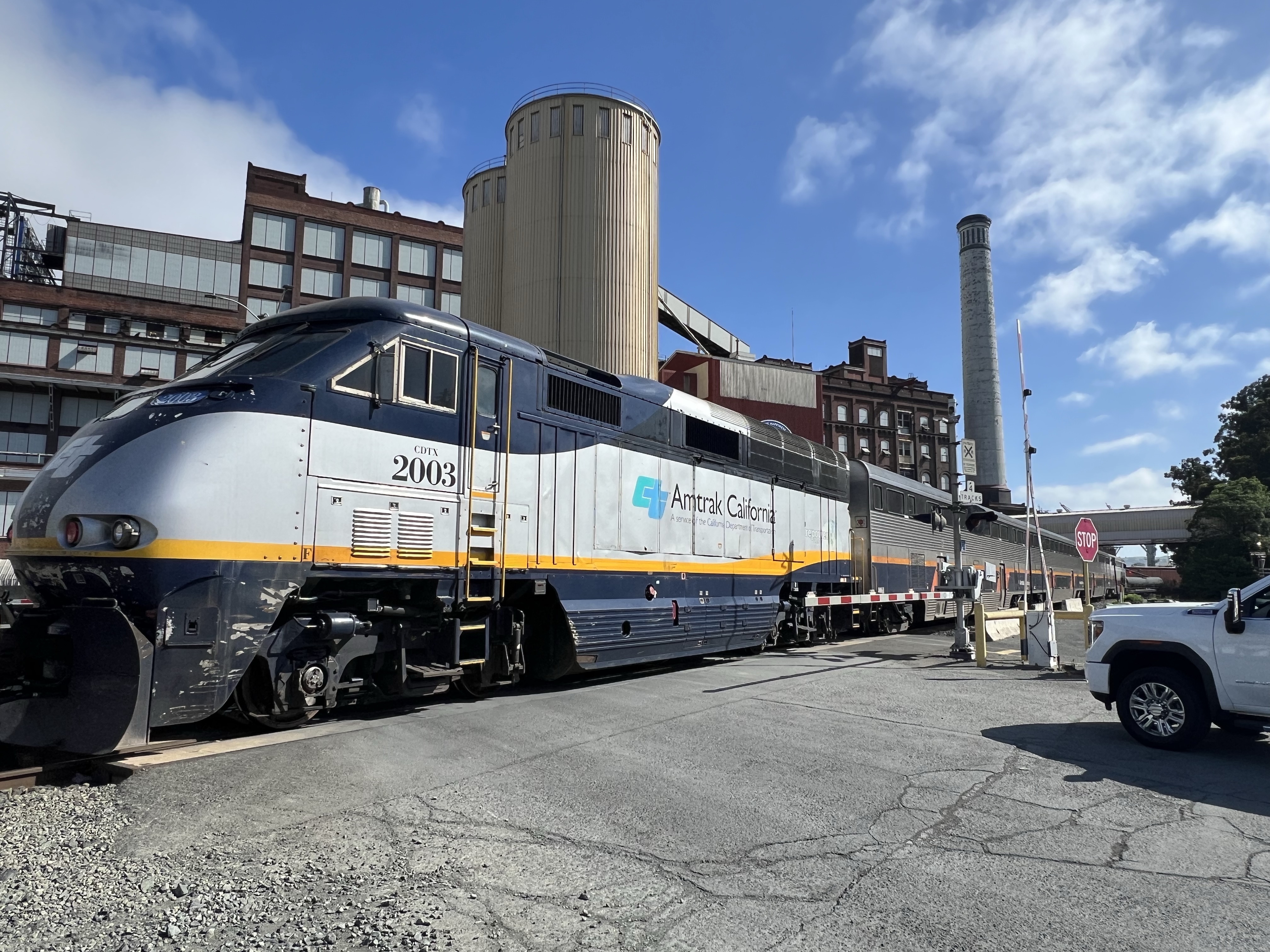
Coast Starlight No. 11 passes by the C & H Factory to its final destination of Los Angeles’ Union Station. The train was running a little late. Shocker!

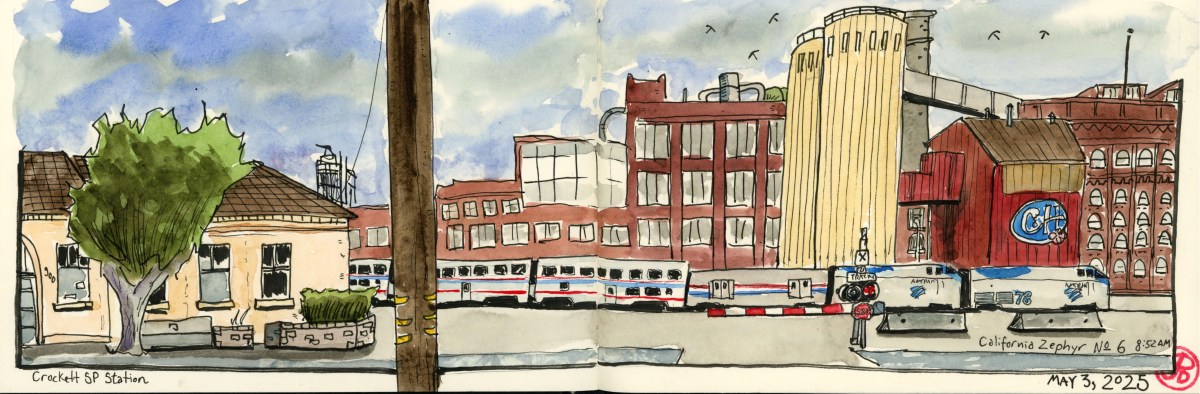
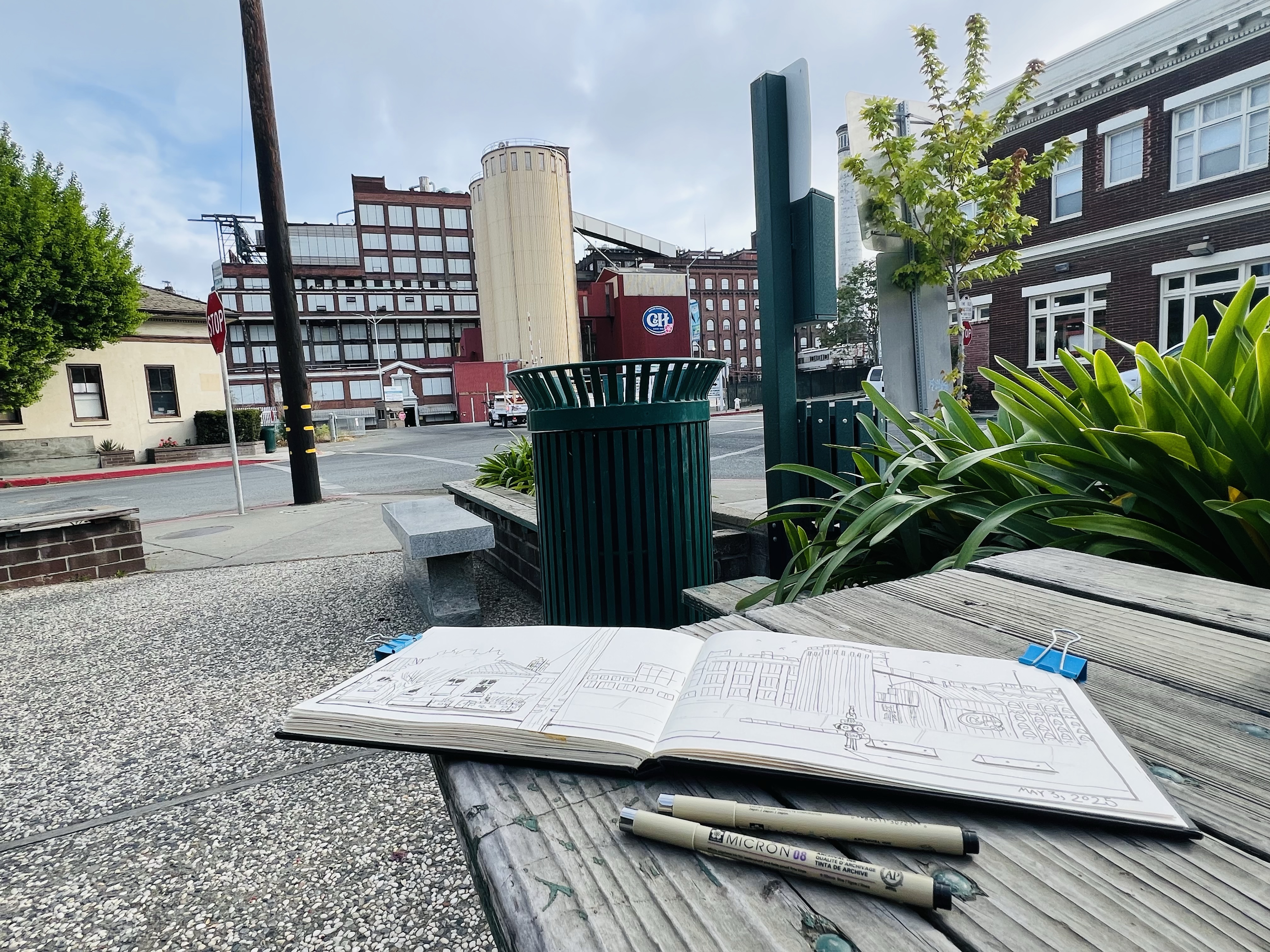
My sketching goal was to render the scene in a continuous line sketch. This means you never lift your pen for the entire sketch. No pencil, no erasing, no going back, this is truly sketching without a net!

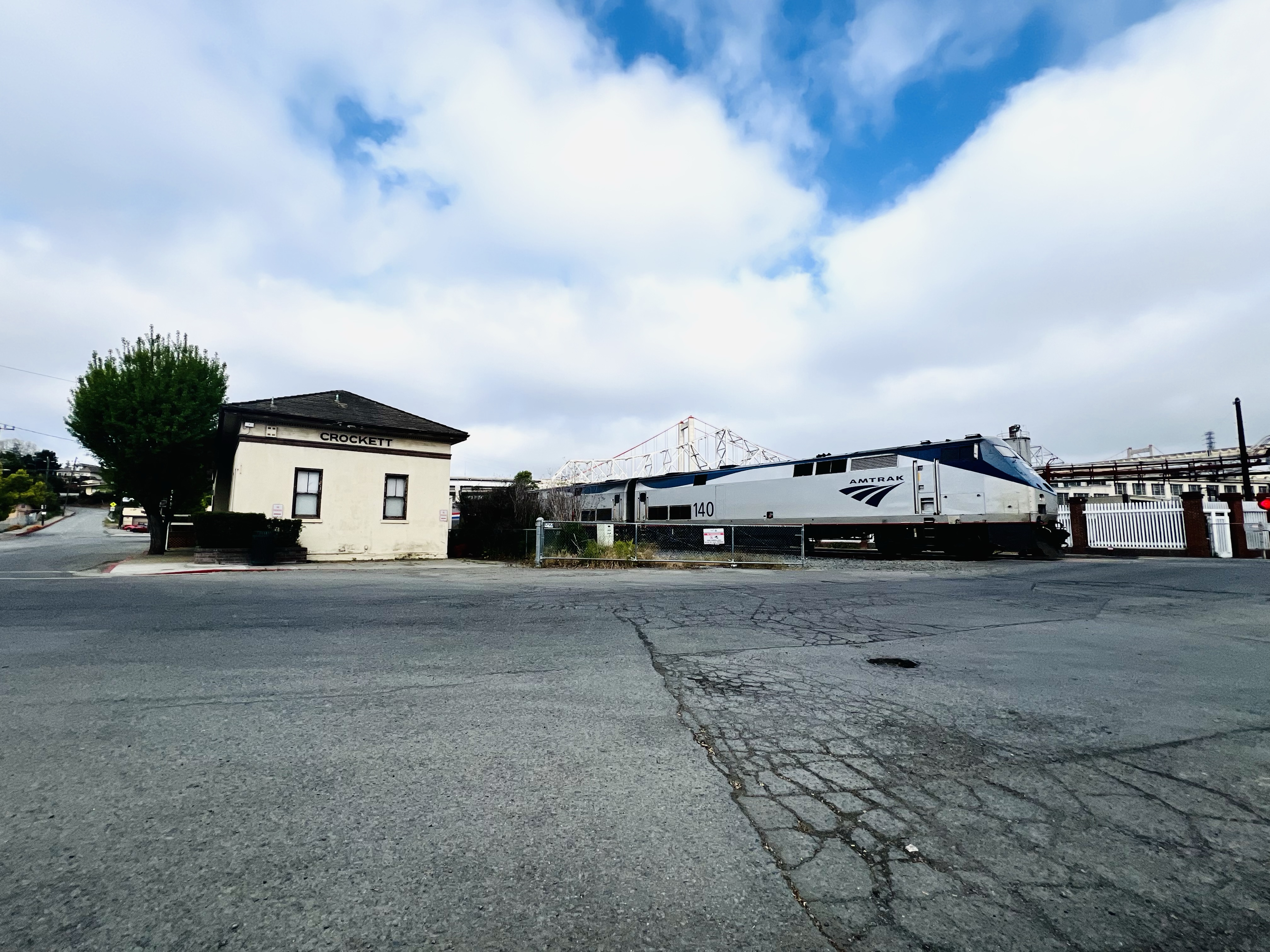
Eastbound California Zephyr Number 6 passing the former SP Depot at 8:56 AM without stopping. Final destination: Chicago.

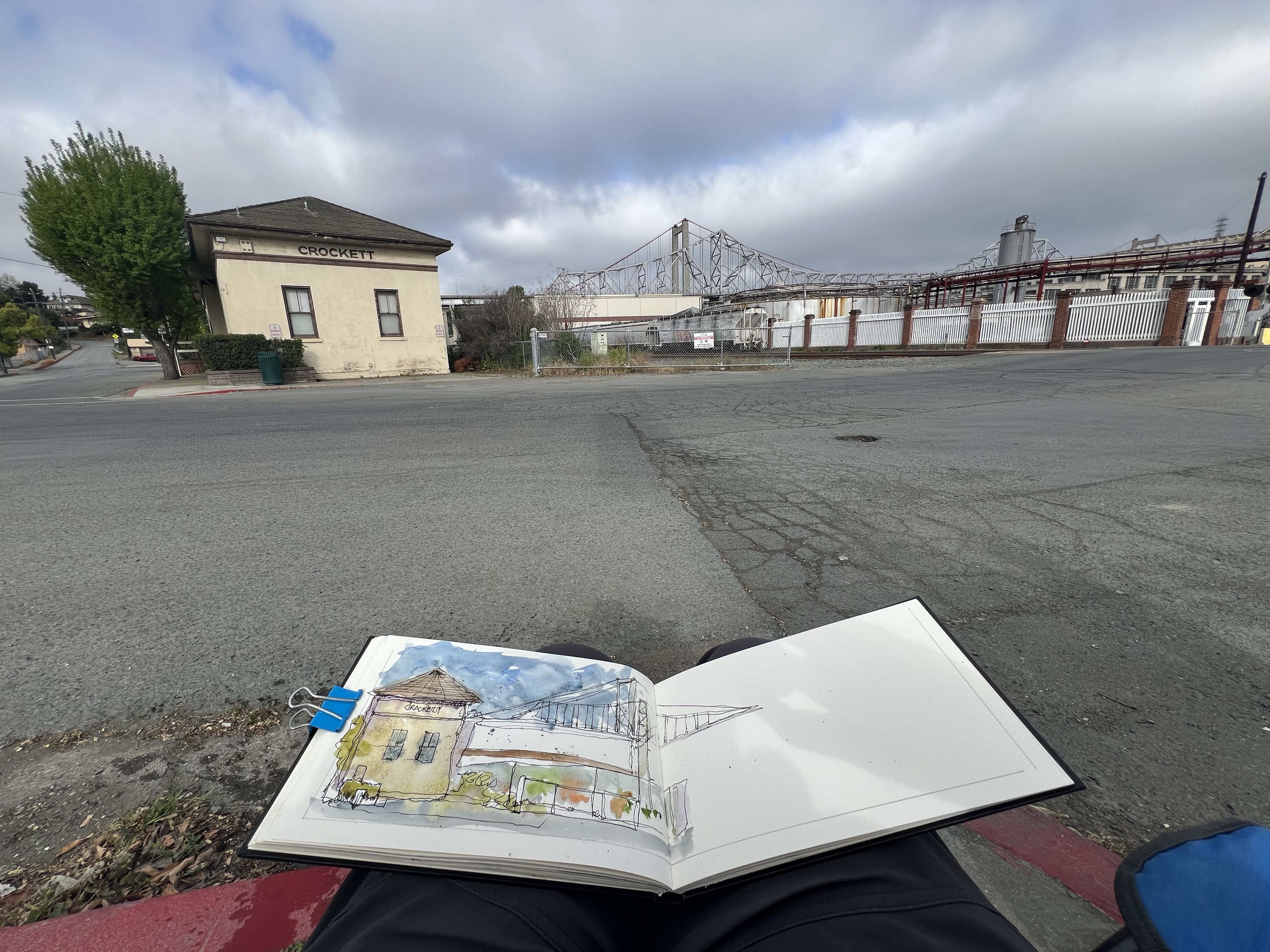
I set up my sketching chair across the street from the depot just at the entrance to the company that made Crockett a company town, the C & H (California & Hawaii) sugar factory. For my sketch I used my TWSBI Eco fountain pen.

Nothing like starting the weekend with a field sketch!

Continuous line sketching can be challenging and I lifted my pen off the page once or twice (to photograph Zephyr Number 6) but I restarted where I left off. So my sketch is really a broken continuous line sketch.

In the end I like the imperfect lines of the sketch. This technique is a great way to loosen up your line work and in the end I am pleased with the result. It may not be the most accurate form of sketching but it sure has a lot of soul!

I added some wet on wet washes and paint splatter, which looseness, matches the line work.

When the museum finally opened at 10:25, I was drawn to the large 460 pound taxidermy sturgeon in a glass case. So I added it to the right side of the spread.

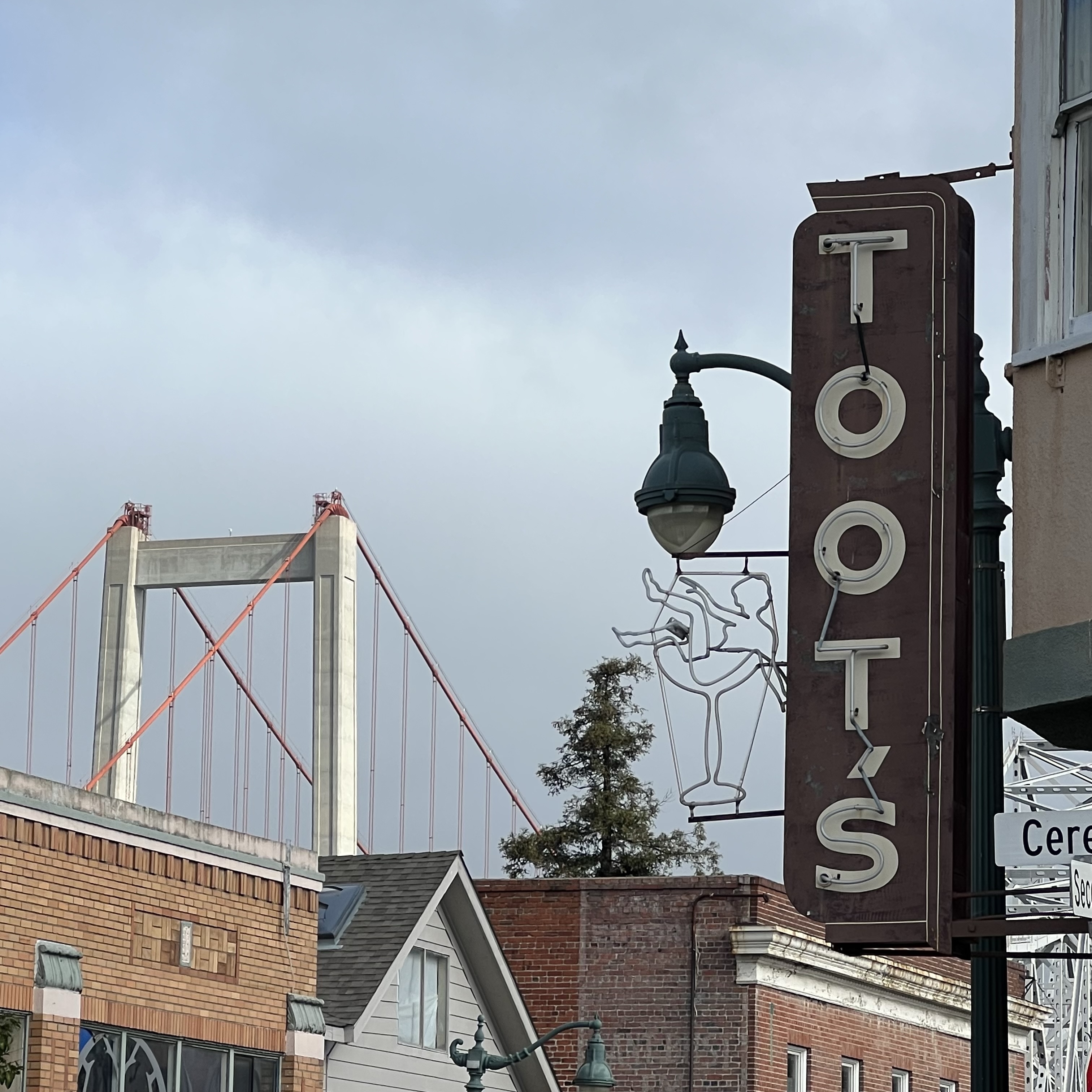
Main Street Crockett with Toot’s bar and the new span of the 2003 Carquinez Bridge towering over the town.

The trains never stop rolling through Crockett. This is a Sacramento-bound Capital Corridor train passing the sugar factory.
Image

Martinez Sketching

I arrived a few hours early in Martinez before meeting my friend for lunch. I wanted to do some sketching around the Martinez AMTRAK Station.

The train station in Martinez is a busy place. While I was sketching, three Capital Corridor trains passed through.

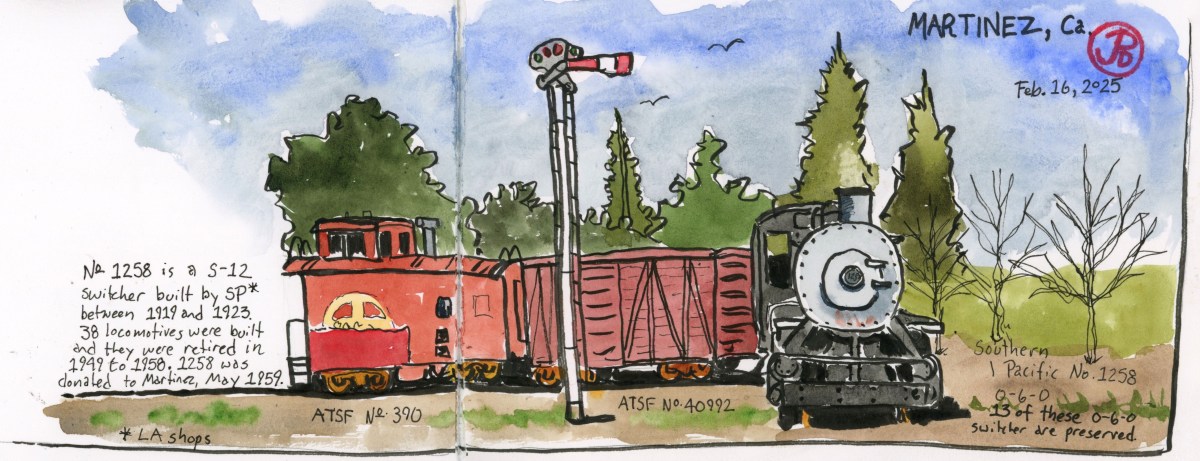
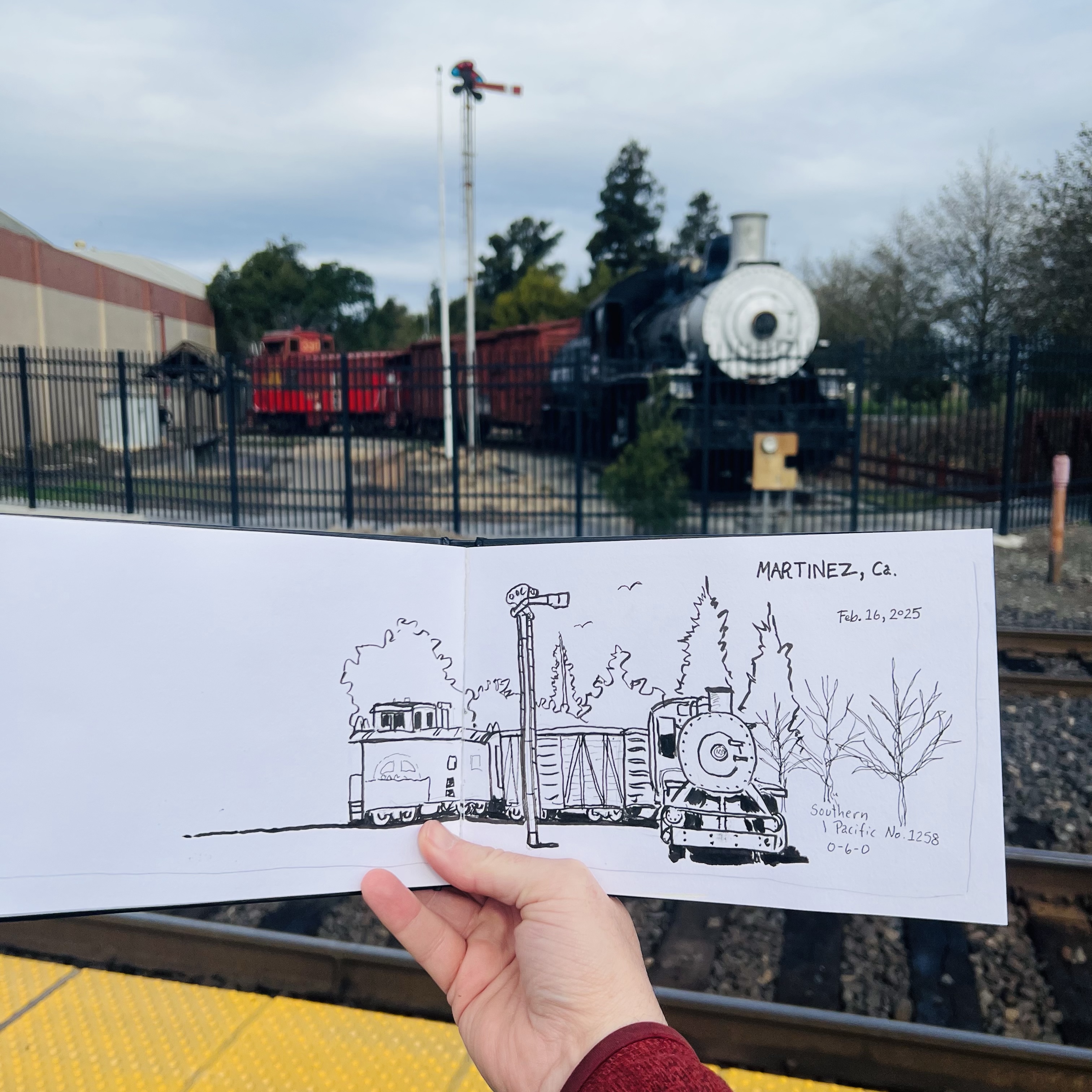
On my last visit I wanted to sketch the Southern Pacific locomotive, with its odd consist of Santa Fe cars, on static display across from the station but I didn’t get around to it. I wanted to add it to a spread on my next visit (featured sketch).

Southern Pacific No. 1258 is an S-12 switcher steam locomotive built at the SP shops in Los Angeles. 38 locomotives where built in this class and there are 13 0-6-0 SP switchers preserved, more than any type of Southern Pacific locomotive built.

Switchers are not sexy nor classy like the GS locomotives. There epitomize function over form. The real workhorses of the Southern Pacific freight yards.

After sketching 1258, I headed to the other side of town to sketch the house of Martinez’s most famous resident.

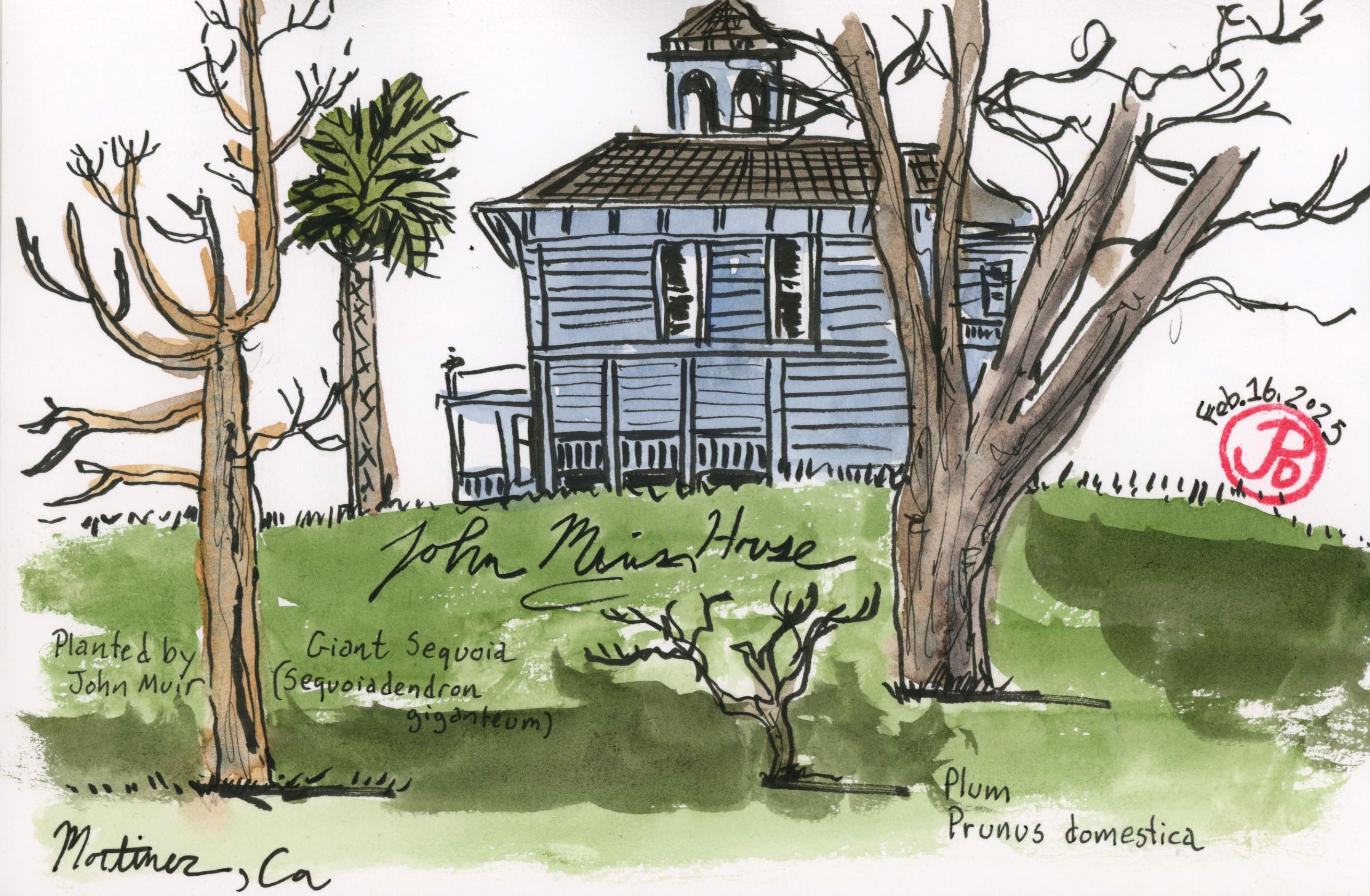
This resident is the writer and naturalist John Muir. He lived here among the fruit orchards with his wife and family.

Muir married into the Strentzel family in 1880. The Strentzels had been farming the land, mainly fruit ranching, since the 1850s. Muir lived here, except when he was off traveling, from 1880 until his death in 1914.

I knew I wanted to do a sketch of the 1882 Italianate house but I needed to find the right perspective.

The touchstone for my sketch was the not-so-giant sequoia that Muir planted years ago. The tree has failed to live up to its name in the Martinez climate.

My Muir-sequoia-bench sketch.

I found a bench with the sequoia in the foreground and the Muir House in the background up the hill.

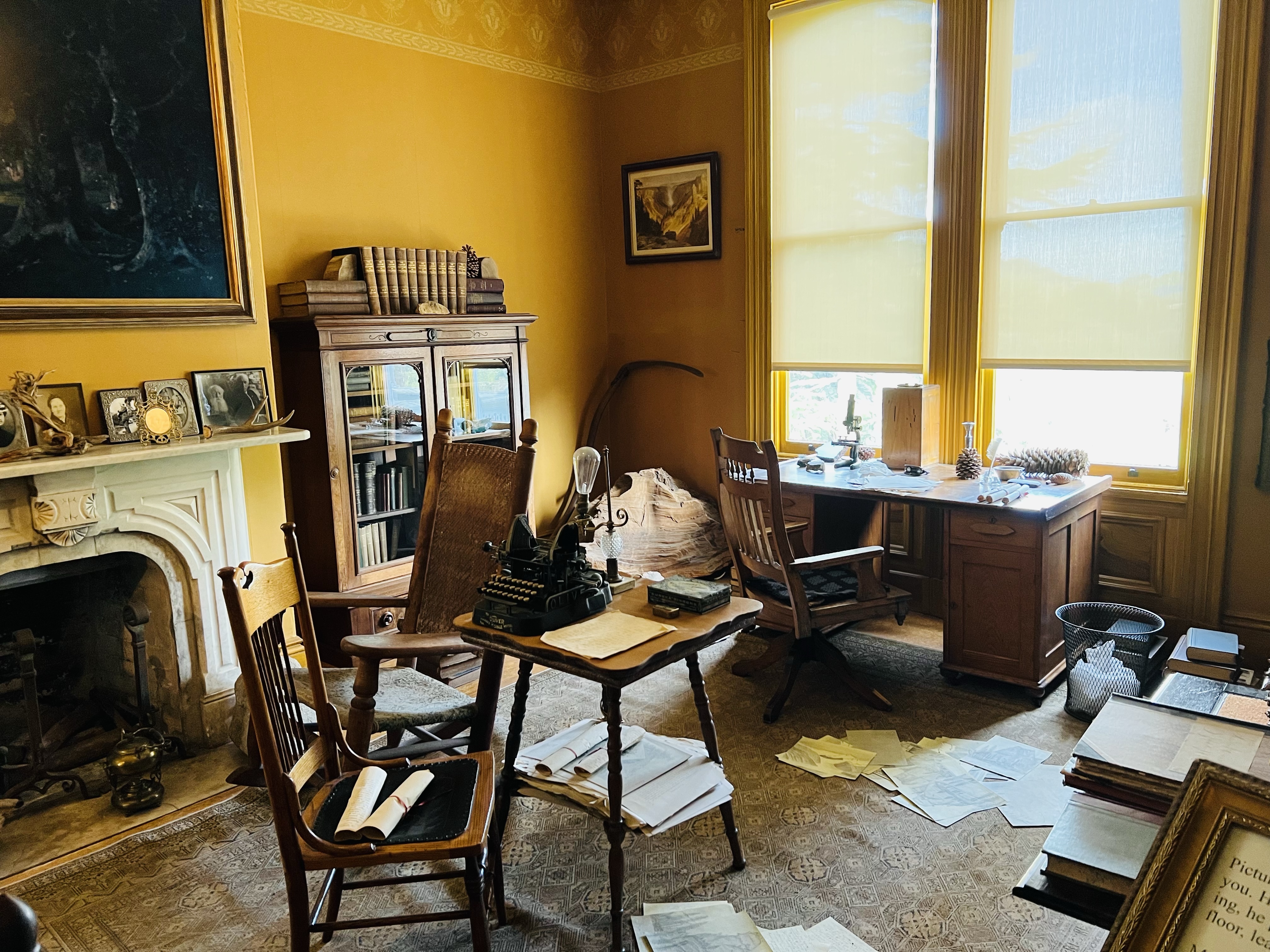
My favorite room in the Muir House. Muir’s “scribble den”.
Image

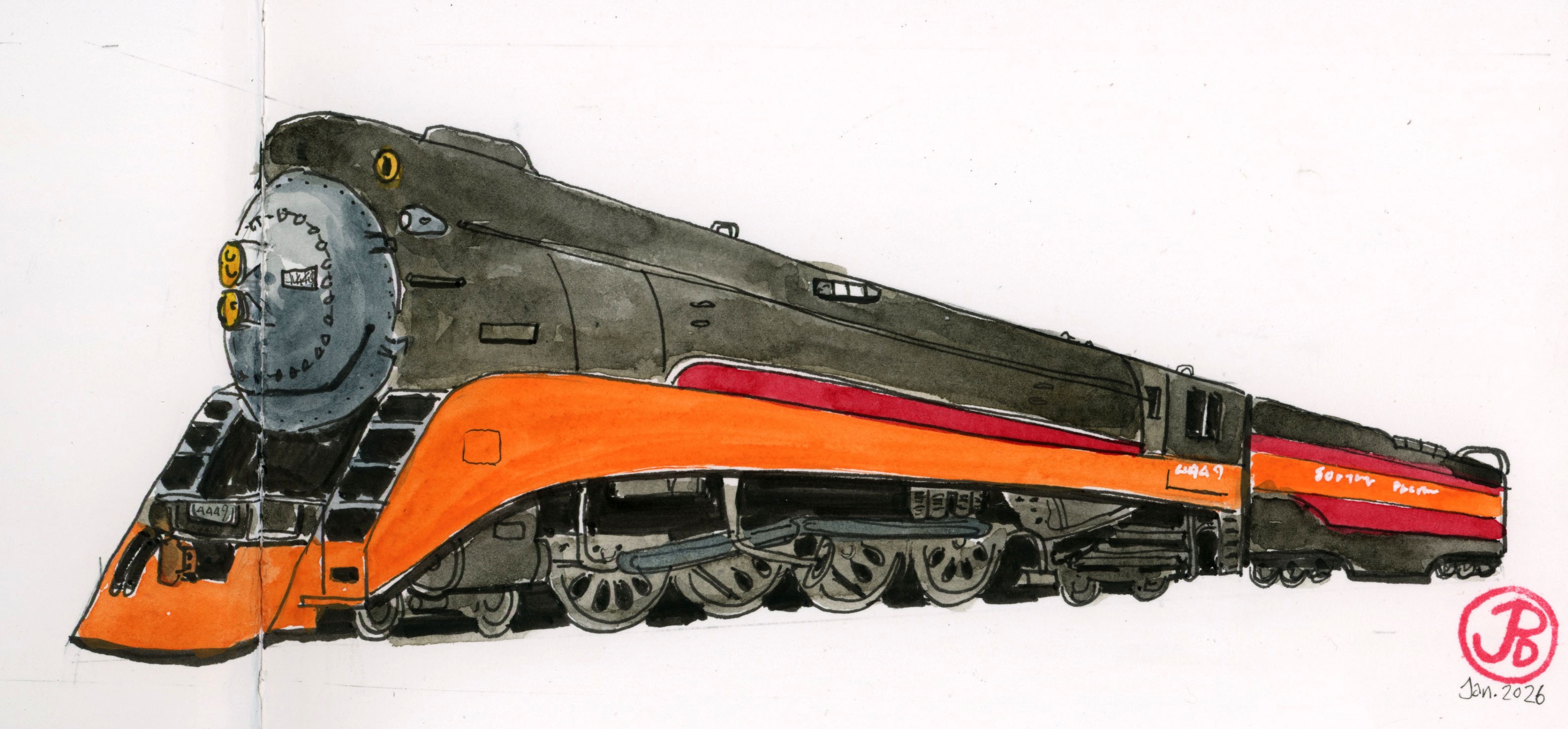
Southern Pacific GS-6 No. 4460

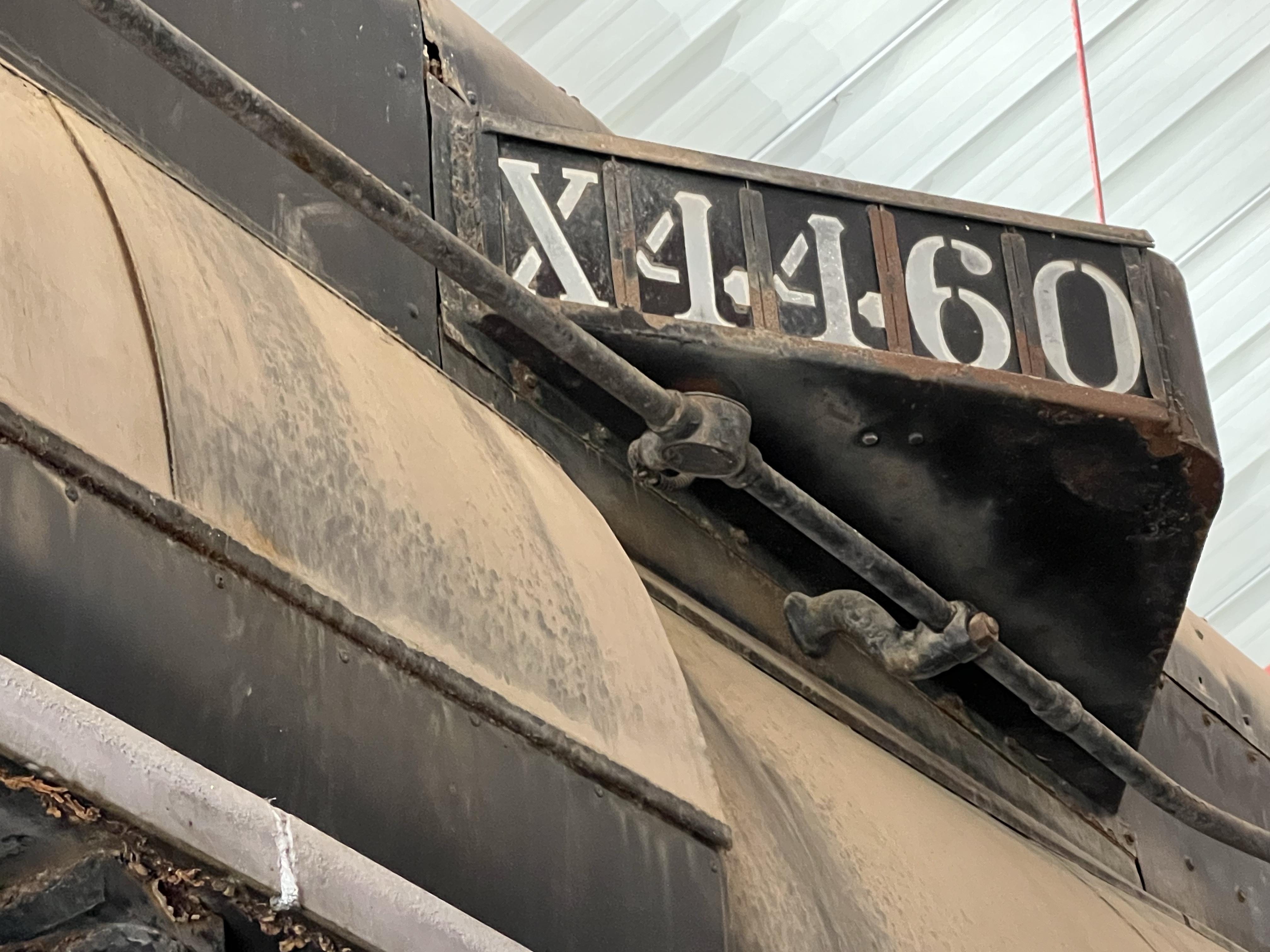
I had to journey to the very edge of the 42 acres of the National Museum of Transportation to see the number one locomotive on my museum sketch list. (Ironically it the first locomotive I saw driving in from Barrett’s Station Road.)

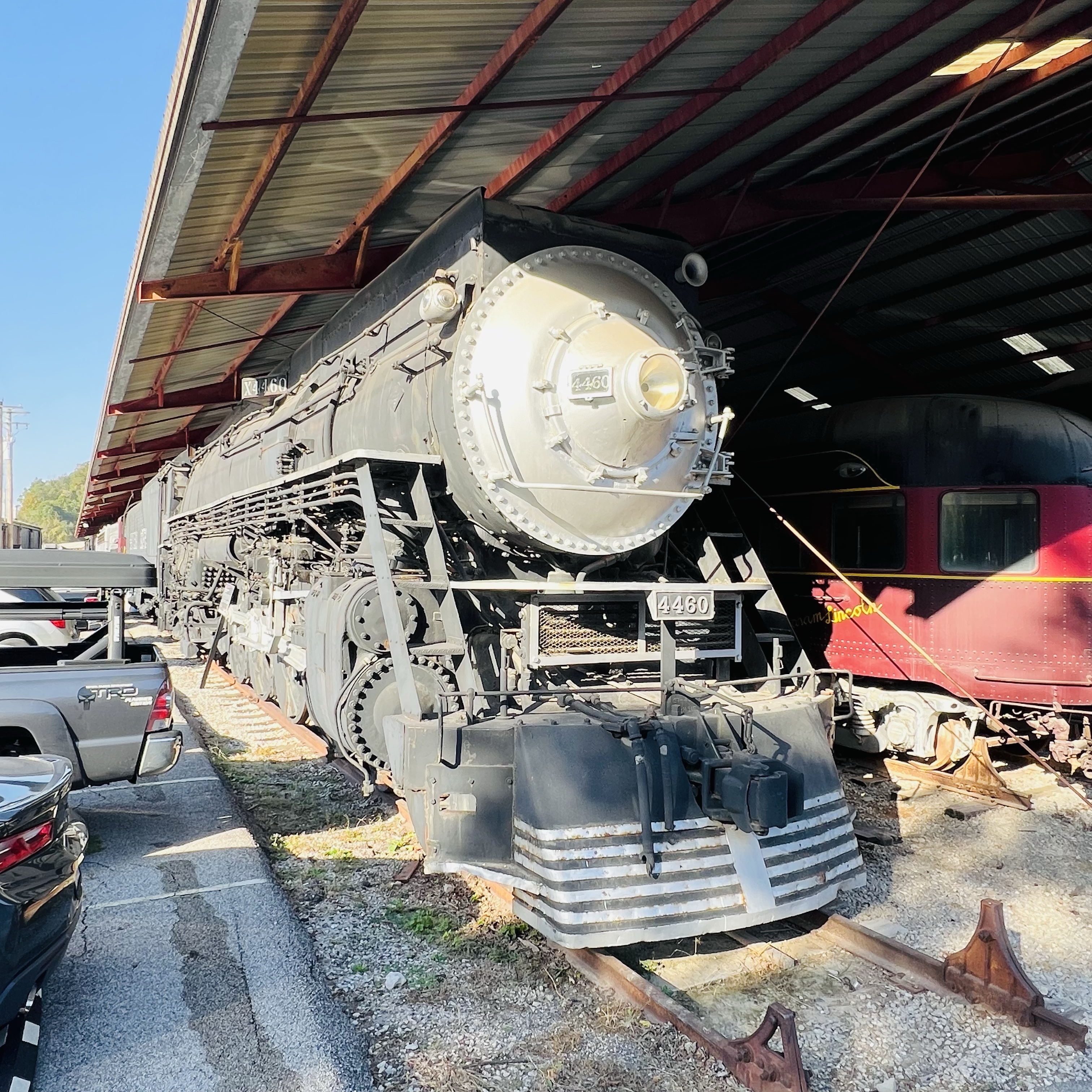
The Northern type 4-8-4 GS-6 (only ten were built) was in the far corner of the engine shed bordered by the employee parking lot. This was an unfortunate and sad location to display one of only two of Southern Pacific’s “Golden State” or “General Service” locomotives in existence.

Another name for 4460 is the “Forgotten Daylight” because it gets far less attention than her famous relative, GS-4 No. 4449. It’s placement in the corner of the engine shed, hemmed in by parked cars at the museum, gives a new meaning to the “Forgotten Daylight”.

No. 4460 with employee’s cars preventing you from getting a nice broadside view of the running gear.

The “War Baby” was built in 1943 by Lima and had to work within the limits of the War Production Board. The side skirting of the previous GSs was removed and the locomotive lacked the mars light of the GS-4, resembling the GS-2s. 4460 was the first GS-6 built at the Lima Locomotive Works in Lima Ohio. These locomotives could be used for passenger and freight trains.

4460 is the last steam locomotive operated by the Southern Pacific. In October 1958 the last run of an SP steam locomotive was between Sacramento and Sparks, Nevada over the famous Donner Pass. This was on a Goodbye to Steam excursion. 4460 ran to Sparks and then back to Sacramento, unassisted.

The iconic GS-6 was not scrapped like so many other steam locomotives but was donated to the Museum of Transportation in April of 1959.

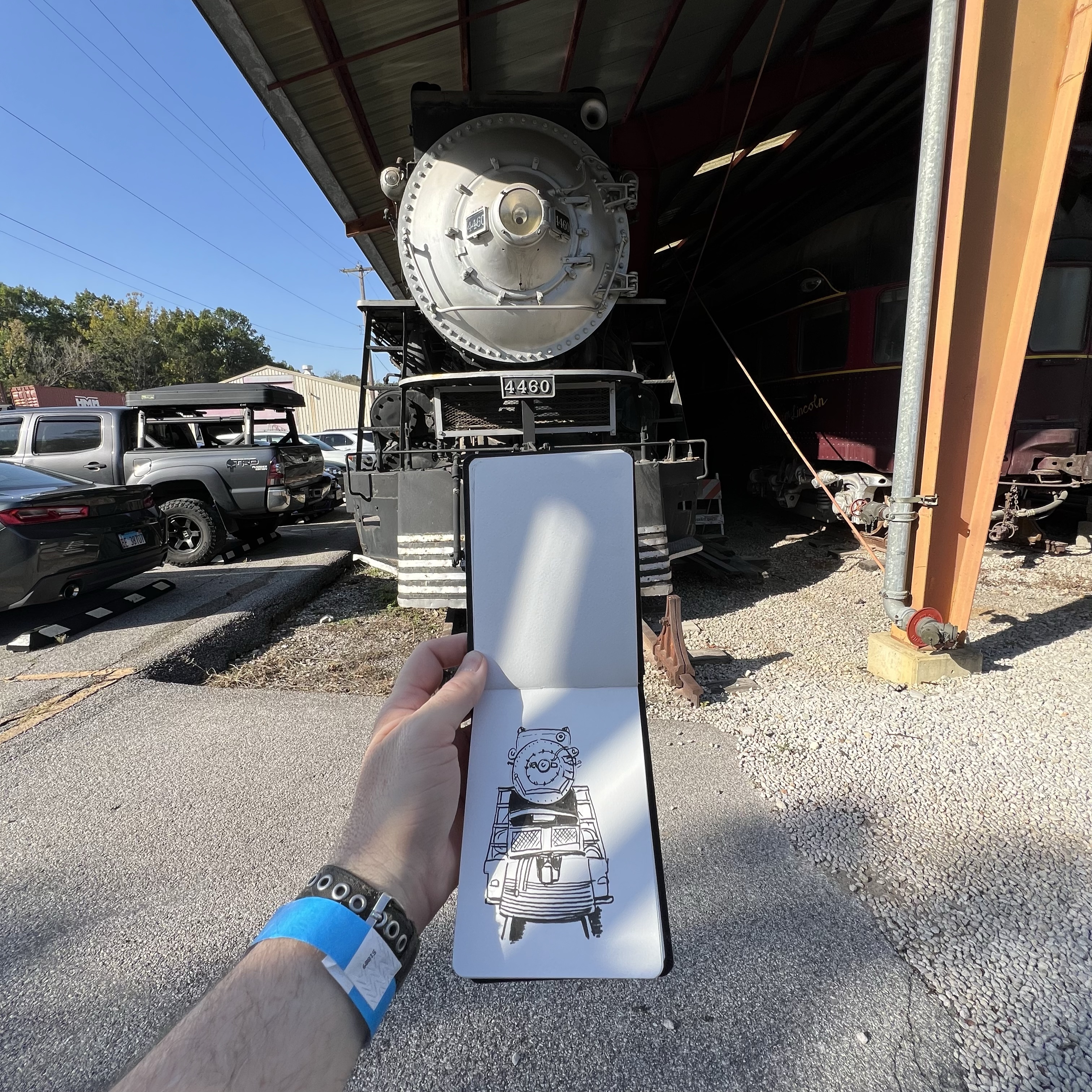
Sketch in progress at the NMOT. This was in my “point and shoot” Hahnemuhle 100% cotton sketchbook.
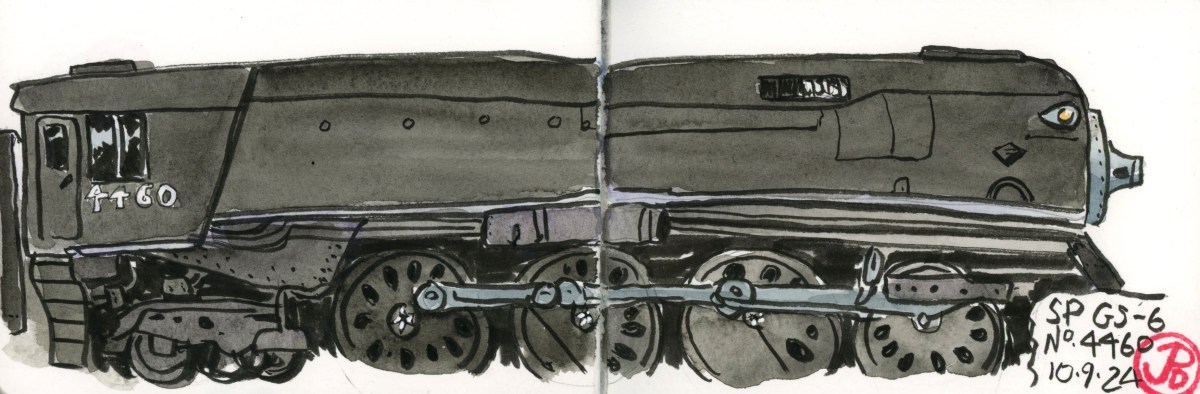
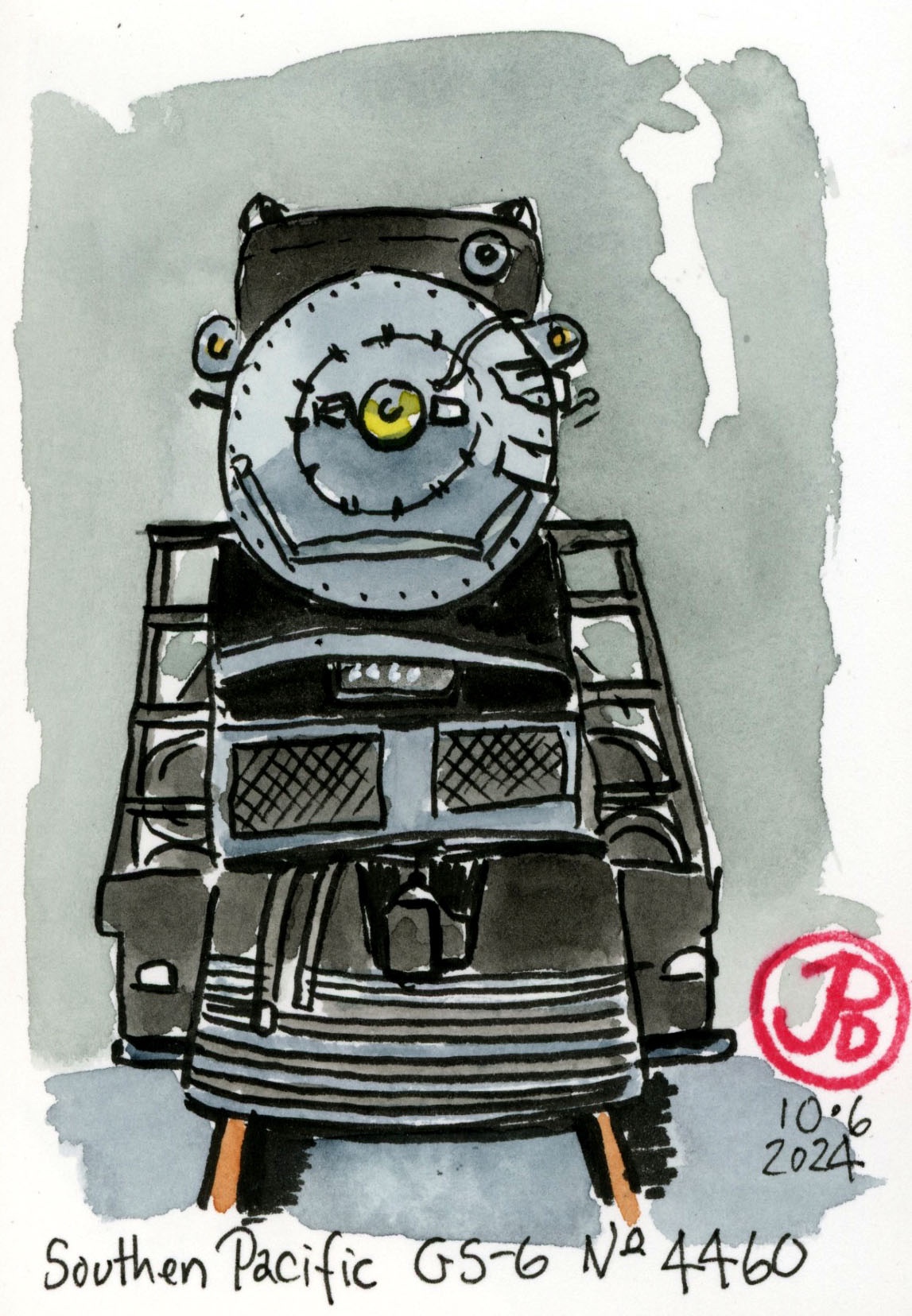
The finished field sketch with watercolor.

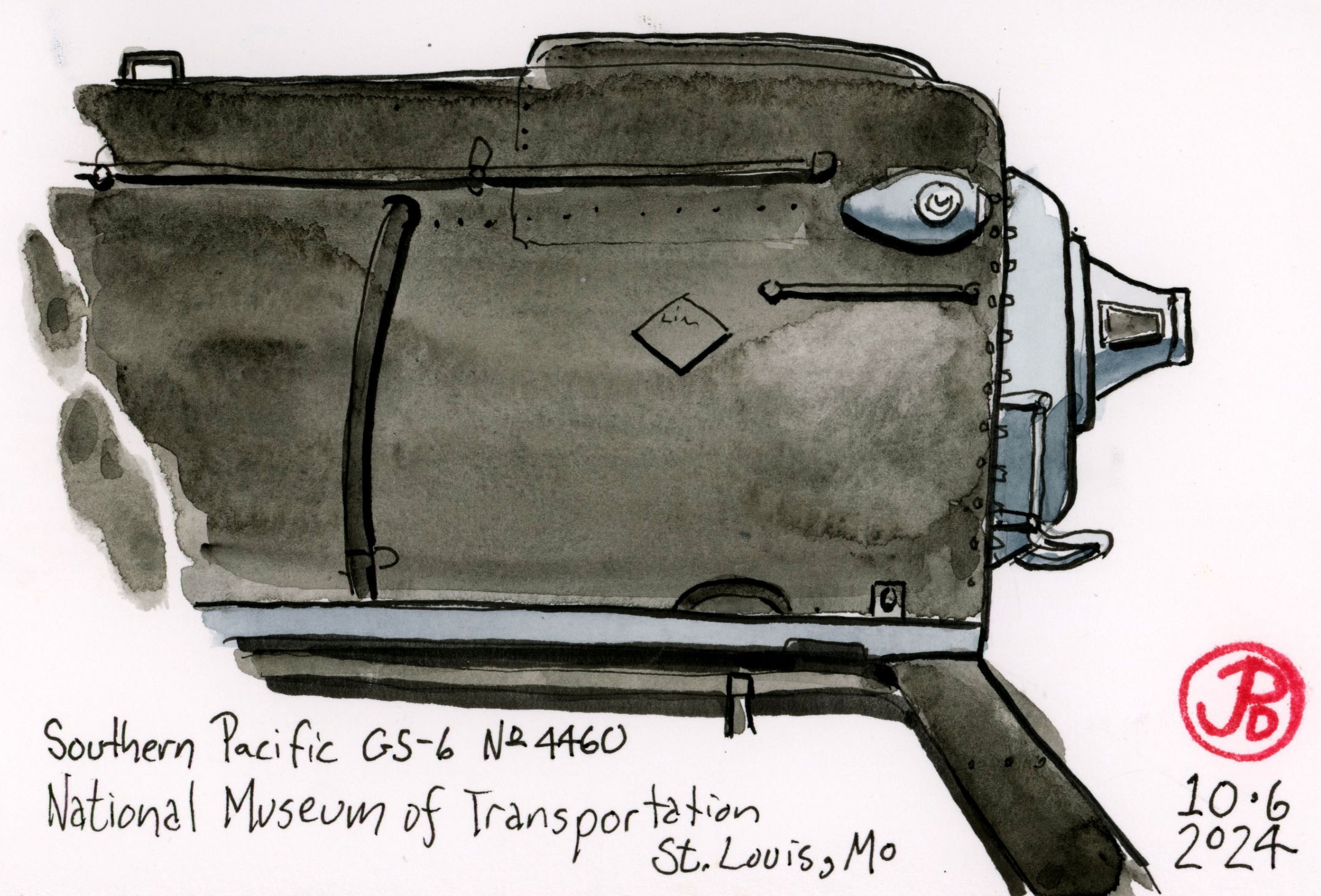
I also sketched 4460 in profile, focusing in on its classy smoke box and headlight.

Image

Midwestern Presketching

Before any great or small journey I do some presketching.

On my October Fall break I planned to visit two midwestern states: Missouri and Illinois. I had been to Illinois before but only to Chicago. Now I planned to visit it’s capital, Springfield. And Missouri, Gateway to the West, would be a first visit for me.

My starting point would be St. Louis, Missouri. I had a few sites, destinations, and sketches on my list, chief among them was the National Museum of Transportation.

This 42 acre museum is in the St. Louis suburb of Kirkwood. Its collection of railroad history includes: Aerotrain No. 3, Big Boy No. 4006, Norfolk & Western Y-class No. 2156, UP Centennial No. 6944, the Silver Charger No. 9908, and the steam locomotive that I was really looking forward to seeing/ sketching: Southern Pacific’s GS-6 No. 4460 (featured sketch).

I also want to sketch the world’s tallest arch, the 630 foot Gateway Arch in St. Louis. I booked at ticket to take me up to the top to see the city of St. Louis and the mighty Mississippi River.

Illinois is known as the “Land of Lincoln” and the epicenter of Lincoln is the state capital of Springfield. It was here that Lincoln lived for 17 years before he left from the Great Western train station to become the 16th President of the United States. In Springfield are the station where he departed, his home, Presidential Museum and Library, and his tomb.

I had much to sketch and many miles to traverse on my short Midwestern jaunt so I drew it out as a map.

Before any trip I like to draw a map to help me visualize where I am going. I like to add travel times (St. Louis to Springfield: 1 hr 27 min) because it helps me plan my time deciding how much time to spend in either city. I’ve always been about seeing less while having quality time on the ground.

In circular inserts I illustrated four of my sketching targets: Lincoln’s house in Springfield, the Lincoln bust at his his tomb (visitors rub his nose for good luck), the National Museum of Transportation (featuring Southern Pacific’s No. 4460), and the Gateway Arch on the banks of the Mississippi in St. Louis.

Let’s go!

Image

Capitola Trestle and Soquel Creek Bridge

Early Saturday morning found me in Capitola Village.

Capitola was founded in 1874 as a beachside resort and in the age before the personal automobile it owed its early popularity to the railroad.
The Santa Cruz Railroad, opened in 1876 and brought sun worshippers to Camp Capitola.

Southern Pacific took over the railroad in 1882. The SP brought beach goers to the small seaside town, passengers detraining at the new depot near the east end of the trestle, this location is known as Depot Hill.

I chose my sketching position above Soquel Creek on the historic Stockton Avenue Bridge (1934) which parallels the trestle. The seaside air was wet with fog, I hoped it wouldn’t smear my ink drawing.

The wooden trestle over Capitola Avenue looking towards Soquel Creek. The Capitola Depot is about 100 yards behind me and up the hill. I have always loved the parking spots under the trestle (parking is a premium in Capitola Village).
Colorized postcard (early 20th Century) of a double header passenger train with three baggage cars, crossing the trestle over Soquel Creek taking beach goers to Santa Cruz. This perspective is close to where I chose to sketch.
Looking down the trestle in direction of the Capitola Depot and beyond, the connection to the mainline at Watsonville Junction (15.7 miles down the line). The green growth around the tracks shows this track has not been active in over ten years.
Image

Muir Trestle, Martinez

I was meeting a friend in the East Bay city of Martinez and I had a little time to sketch before lunch.

Martinez is a hotbed of railroading with both the Union Pacific and BNSF passing through as well as some marquee passenger trains such as the Coast Starlight and the California Zephyr making stops at the Martinez AMTRAK station. And the Capitol Corridor commuter takes on passengers traveling north and south on shorter journeys.

The California Zephyr Train No. 6, at the old Southern Pacific Depot in Martinez. This train is heading east to Chicago. To the right in the background is SP switcher 1258 on static display.

There would certainly be something to sketch here and I was going to start with a historic train trestle.

I parked at the Mount Walda Trailhead. Soaring above me was the 1,600 foot long steel Muir Trestle (aka the Alhambra Trestle). The single track trestle was so long that I could only see and sketch one section of it before it disappeared into the trees to the east. The trestle rises 75 feet above the roads, trees, and houses it crosses over.

A detailed view of the steel supports of the Muir Trestle.

The trestle is within the John Muir National Historic Site. To the north is Muir’s Martinez home. Muir and his wife Wanda sold the land for the trestle for $10 and a lifetime rail pass to the San Francisco and San Joaquin Valley Railway. The original wooden trestle was built through a pear orchard and completed in 1897.

This is a historic photograph of the Stengel-Muir ranch in 1897. The Muir house is on the top left and the trestle is viable behind the house. At the time of the photograph, the trestle was constructed of wood.

At the eastern end of the trestle there was a passenger and freight station named Muir Station. The station is now long gone but is immortalized in a street that parallels the rails named Muir Station Road.
From this station Muir could ship his produce to Oakland or to the port in Martinez.

One of Muir’s neighbors in the Alhambra Valley was John Swett, Muir close friend. Swett was the State Superintendent of Public Education and is known as the “Father of California Public School”.

In 1898, Santa Fe purchased the line and it became their Valley Division. This division still exists as BNSF’s route from Richmond to Fresno.

The Muir Trestle from the intersection of Alhambra Way and Muir Station Road.
I took up a sketching position near the trailhead and started my drawing. The trestle above me is on the Stockton subdivision and is used by BNSF intermodal freight. There was no train crossing during my sketch.

SP 0-6-0 switcher No. 1258 and its consist of a wooden box card and Santa Fe caboose 390 on display across the tracks from the AMTRAK station. The locomotive is in sad shape, missing some hardware like her bell and whistle.
Image

Ghost of the GS

At the Western Pacific Railroad Museum, there are many pieces of railroad equipment: locomotives, cabooses, rolling stock, and maintenance equipment.

It has been said that this railroad museum has the greatest amount of equipment from a single railroad family: Western Pacific (WP).

There is lots to explore at the WPRM and you are free to wander around the yard and look at the diesels and rolling stock. I was in search of an FP7 mock up of WP No. 804-A that was used to pull the California Zephyr. The mockup was just of the cab section and it was on display at Disney’s California Adventure park.

While looking for the cab I came upon an old tender that had the faded WP logo on its side. It was a six axle tender so it must have been attached to a substantially sized steam locomotive.

The mysterious tender.

I thought perhaps that this tender once belonged to the largest locomotive that WP owned and operated the 2-8-8-2 mallet or perhaps a 4-6-6-4 Challenger. The railroad owned 27 mallets, some of which operated up and down the Feather River Route. Sadly all 27 mallets were scrapped as the age of diesels took hold. Was this tender a last relic of the mighty mallets of the WP?
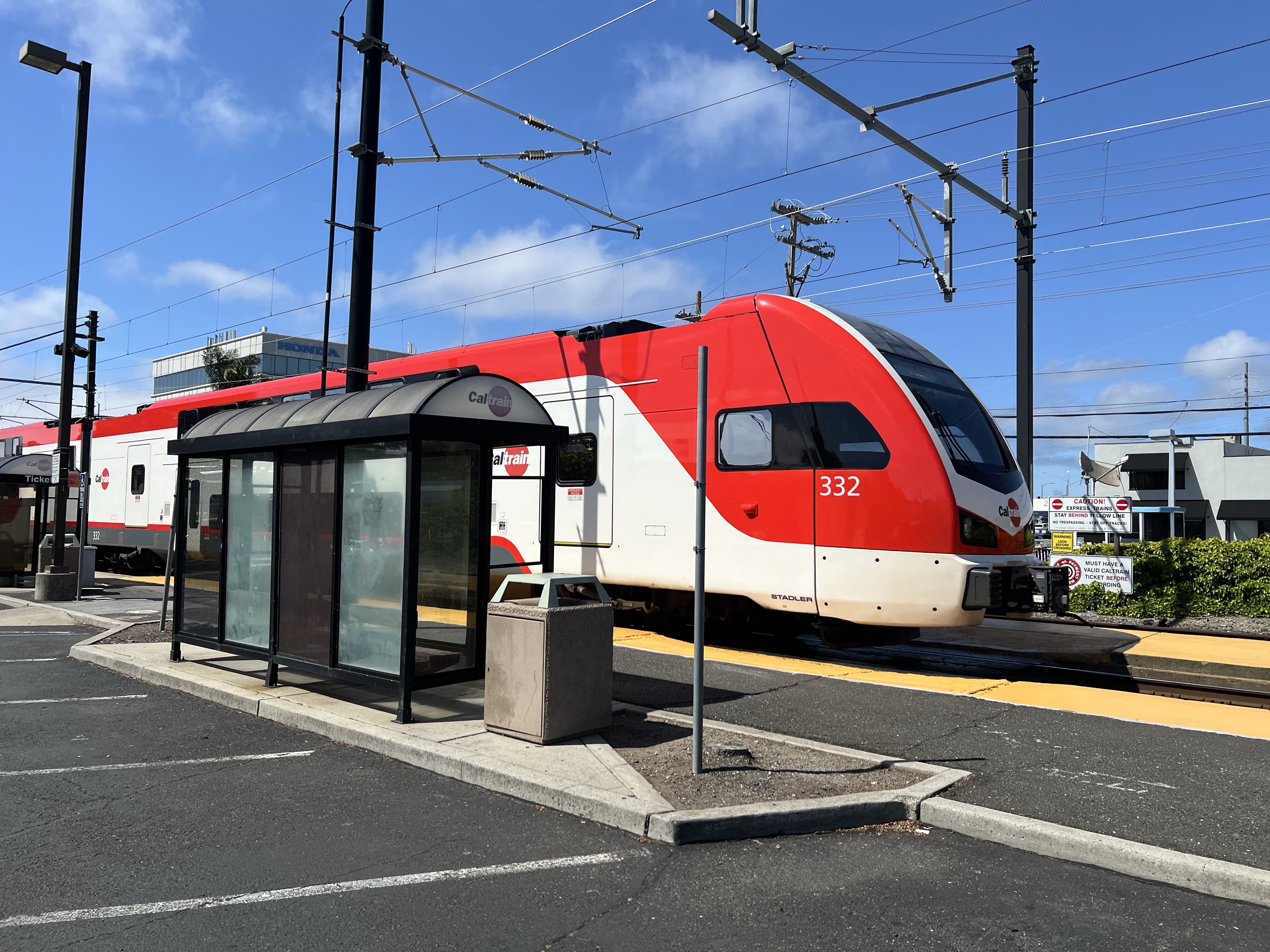
Turns out the answer was much more exciting!

I found out from one of the volunteers that the tender belonged to a GS-6, No. 484. These Northern type 4-8-4s were some of the best passenger locomotives ever made for the Southern Pacific.
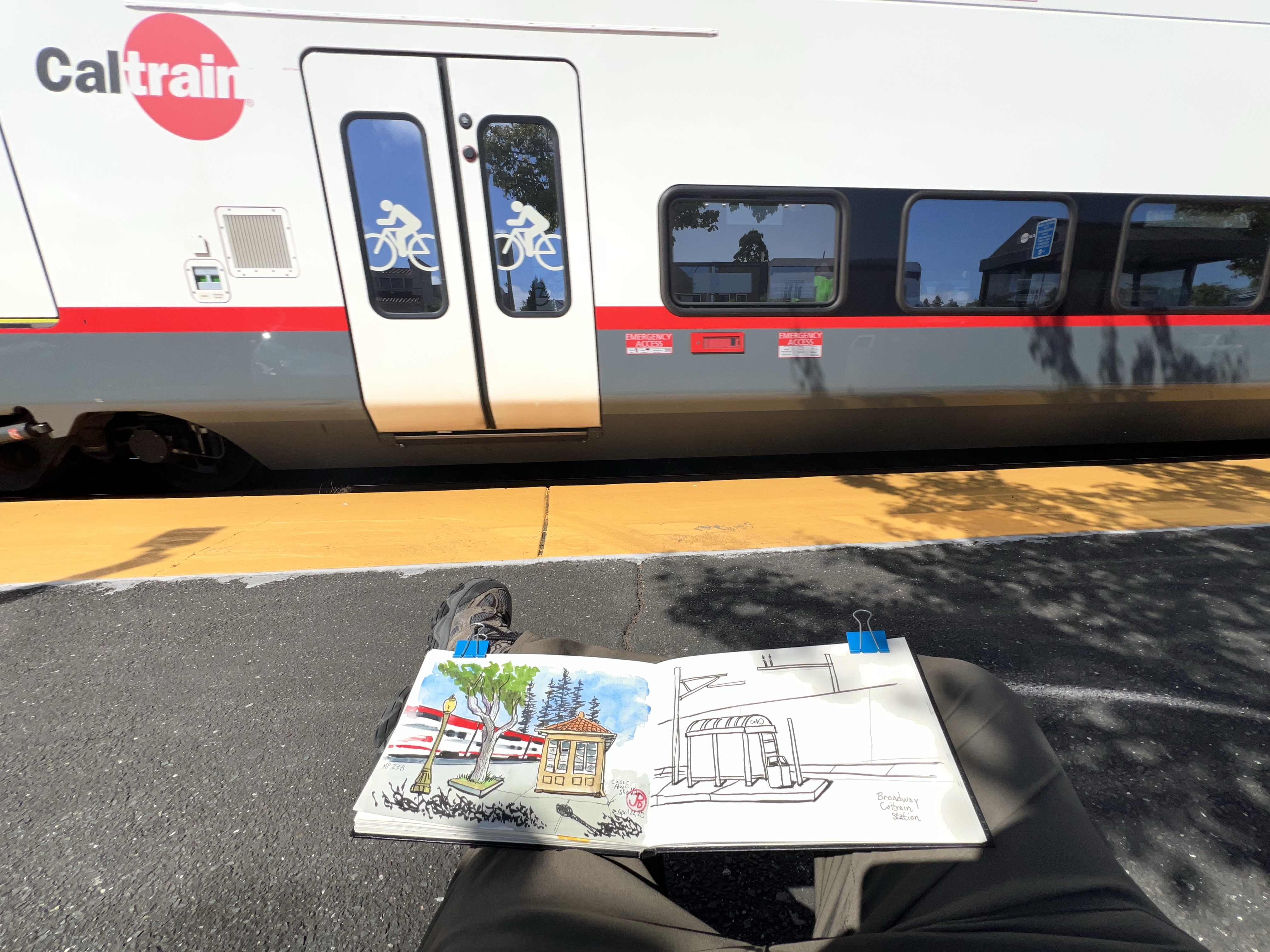
The GS originally stood for Golden State and the streamlined locomotives were on point of one of the most beautiful passenger trains, the Coast Daylight. The train took passengers from San Francisco to Los Angeles in under 10 hours. During the war when the GS-6s were produced in 1943, the GS meant “General Service” because the locomotives were designed for freight as well as passenger service.

During the war railroads needed approval from the War Production Board to order new locomotives. SP and WP both petitioned for a new order of passenger locomotives. They were turned down because they didn’t think streamlined passenger locomotives were necessary for the war effort.

The zenith of the GS class (Golden State or General Service) was the GS-4.

28 GS-4s were built by the Lima Locomotive Works in 1941-42. 10 GS-6s were built in 1943 under war time restrictions, meaning the locomotives had to also be used for freight service and lack the streamlining of the GS-4s. What I was unaware of is that Western Pacific had six GS-6s on its roster (No. 481-486).

During the end of the age of steam (the 1950-60s) many railroads scrapped their steam locomotive fleet. The idea of steam preservation did not take hold until the 1960s and 70s.

One GS locomotive that was preserved and put on static display in Oakes Park in Portland, Oregon was Southern Pacific GS-4 No. 4449. The locomotive was restored to working order and pulled the Freedom Train across the United States in the late 1970s.

A 2016 field sketch of the GS-4 No. 4449 at the Oregon Rail Heritage Center in Portland, Oregon.

There is only one other GS class locomotive that is still is in existence. This is the GS-6 No. 4460.

4460 was the first GS-6 manufactured (built in July of 1943) and it is the last steam locomotive to operate on the Southern Pacific when it made an excursion run from Sacramento to Spark, Nevada in October 1958.

4460 was donated to the National Transportation Museum in St. Louis, Missouri in 1959.

Until my visit to Portola, I assumed there were only two relics of the Southern Pacific’s mighty GS class and finding the tender in the yard was like finding a piece of railroad history gold!

Image

4014 on the Mountain Sub

One of the legendary railroad routes is the section of the Transcontinental Railroad that climbs the western flank of the Sierra Nevada Mountains up to Donner Pass. The construction of the railroad was an engineering marvel and much of the original route is still in use.

Southern Pacific used their AC articulated cab-forwards to tackle the grades and heavy freight over the pass and now the world’s largest articulated locomotive would be climbing up to Donner Pass for the very first time. And I planned to be there.

There was a planned 30 minute whistle stop at the historic railroad town of Colfax at 11:15.

I was in Colfax an hour and a half before arrival and more and more people were streaming into town.

4014 left Roseville on time but was halted when the train hit a tree that had fallen near Auburn. The UP tracking app noted that 4014 was “currently stopped near Auburn”. At first I thought it was just a maintenance stop but then word spread that Big Boy had hit a tree and there was some damage to the underside. This was not good. Especially for the hundreds of people waiting in the heat for 4014 at Colfax.

Word spread that the locomotive might have to be towed back to Roseville. The train was now an hour late. I decided to head back to Penn Valley, to air conditioning and the second half of the European Cup Final. I would continue to monitor the UP tracking site. But I had to beat the heat in Colfax.

Just after the game ended (Spain was European champions for the fourth time), the tracker read, “4014 currently moving near Auburn”.

My plan was to drive on Highway 20 to where it merged with Highway 80. This was Yuba Pass and I wanted to see Big Boy in this historic location.

I arrived and there were plenty of other rail fans lining the tracks at Yuba Pass. This was a good sign because 4014 was still climbing the grade and had not reached my position.

After about a 45 minute wait a plume of steam exhaust appeared down line and the mighty roar of the Big Boy filled the cut.

Then the iconic articulated giant appeared working up grade towards my position near the signal gantry. 4014 was putting on a show that enveloped all the senses.

As 4014 rounded the curve, the articulated properties of the design were in full display. While the leading truck and front drivers rounded the curvature of the track the boiler remained rigid making it appear that the drivers and boiler were separating. Afterwards I did a spread to understand the articulation design (below).

After the train disappeared into the tunnel, I headed back to my car and was soon driving east on Highway 80. To my right, I could see the tell-tale exhaust up the hill on the railroad grade. Soon I was pacing with 4014 and I then pulled ahead and planned to head to Soda Springs to see the steam mammoth as she neared Donner Summit.

I made it to Soda Springs off Historic Highway 40 and the biggest challenge was finding a place to park as there were many people waiting trackside for the arrival of the Big Boy.

I found a parking spot and headed down to the grade crossing. There was a festive atmosphere around the tacks and to the south many Cal Fire trucks and personal (including Smokey) looked and listened down track for the first appearance of the 4-8-8-4.

4014 at Soda Springs.