Image

The Ghosts of Hillsdale

As I was about to leave the Millbrae Depot, Peter, the docent, told me I should go and draw the Hillsdale Depot sometime before Monday. And it was now Saturday afternoon. “Why the rush?”, I wondered.

The reason he thought I should make haste to the depot was that it was going to be demolished, starting on Monday morning!

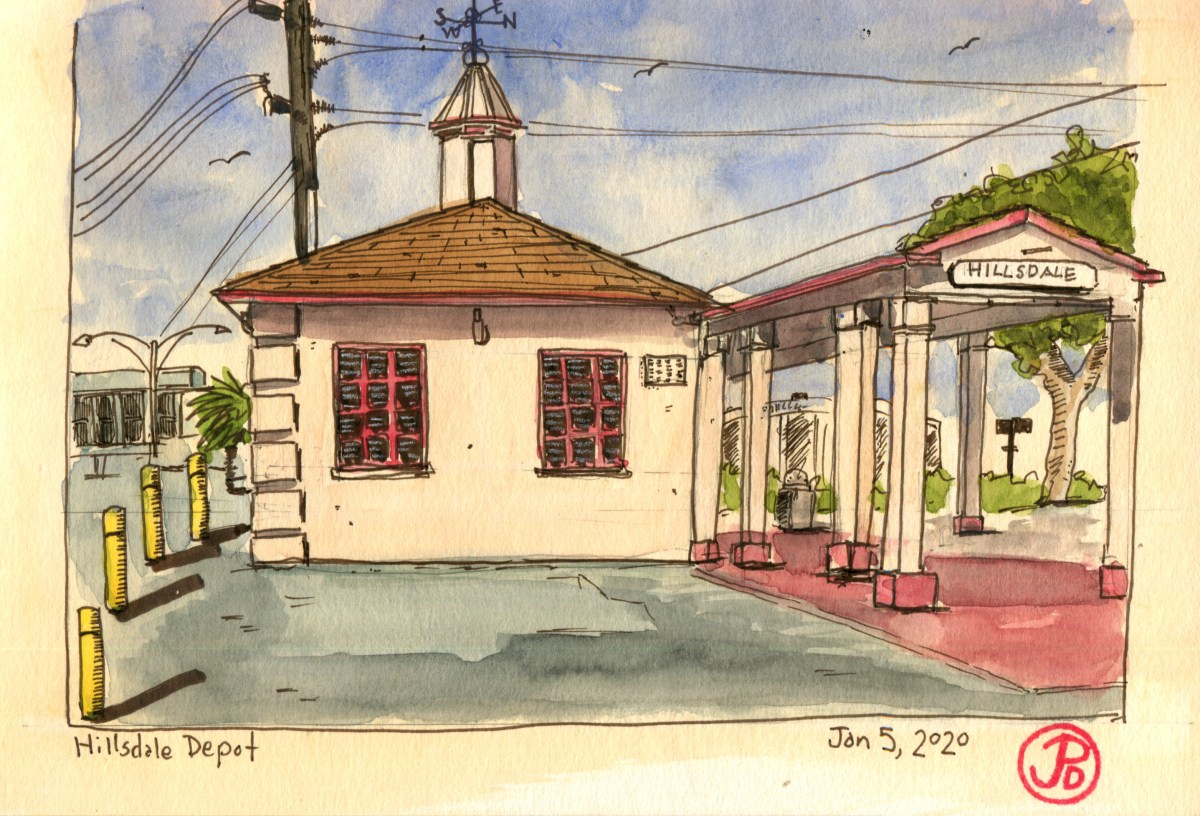
Hillsdale was not on my list of Historic Depots. It was true that it was squarely in San Mateo County, but the depot didn’t meet my criteria for age or architectural merit. The small depot, containing a ticket office and a tiny passenger waiting room, was built sometime in the 1950s. The building has a cupola topped by a weather vane, something I might imagine at Churchill Downs, an architectural reference to Hillsdale’s proximity (about half a mile south) to Bay Meadows Racetrack.

The racetrack was the longest running thoroughbred track in California. It opened in November of 1934 and was in continuous use until it’s last race on August 17, 2008. Many famed horses and jockeys raced here including Seabiscuit and Bill Shoemaker. It was demolished and housing was put in it’s place.

A southbound train on the main line, pulls into Hillsdale Station. The old station, on the left, is no longer near the railway which now has been raised above the station.

At Hillsdale, the mainline no longer passes in front of the platform. The tracks are now to the east and up a rise. The tracks were regraded and raised to cross over Hillsdale Boulevard. The grade separation project eliminates grade crossings (the intersection of automobile roadways and rail) and is part of a major transit development project which will move Hillsdale Station further north, near where the former race track lay. Hence the reason the older depot is now redundant and soon will be a few more spaces in the parking lot.

Engine Number 900 “San Francisco” pulls into Hillsdale Station.

I set up my folding camp chair on the south side of the abandoned station with a late morning winter sun at my back. I began to see the shapes and eventually, the beauty of the small railway station. As Zen sketcher Fredrick Franck noted, “I have learned that what I have not drawn I have never really seen, and that when I start drawing an ordinary thing, I realize how extraordinary it is.”

I also wonder about the memories and ghosts that have passed through or spent time in this station, the people who would have come to meet their loved ones on the platform as a commuter steam engine pulls into Hillsdale. The people who who worked here, perhaps the people met or fell in love here. The crowds returning from a race, either joyous or down on their luck. Or the young man who stopped to get a cup of coffee before boarding a northbound train to the City of Saint Francis.

All are silent now.

Corvidsketcher sketching in the parking lot of Hillsdale Station, the day before the building will be demolished. This may be the last drawing of the station while it is still standing.
Image

Railway Depots of San Mateo County

I’ve been wanting to do a sketch project of the passenger railway depots along the current Caltrain line; at least the stations that are architectural and historically interesting. Caltrain runs passenger service from San Francisco to San Jose (and further south to Gilroy). I wanted to narrow the project down to the existing depots in San Mateo County, the county where I am employed.

My own interest in railways and railway depots comes from my own childhood. I have very vivid memories of being on the back of my dad’s bicycle as we went down towards to the Southern Pacific tracks after work. My dad was a huge rail enthusiast having grown up riding the streetcars and trains of San Francisco. We would watch trains from the pedestrian walkway as they came in and out of the Sunnyvale Depot, dropping off commuters. We also took the train north to Palo Alto or San Francisco and I always loved the all too brief visits to each station. I also noted that not all stations were alike. Some depots have architectural merit while others were merely weather shelters where you can buy tickets.

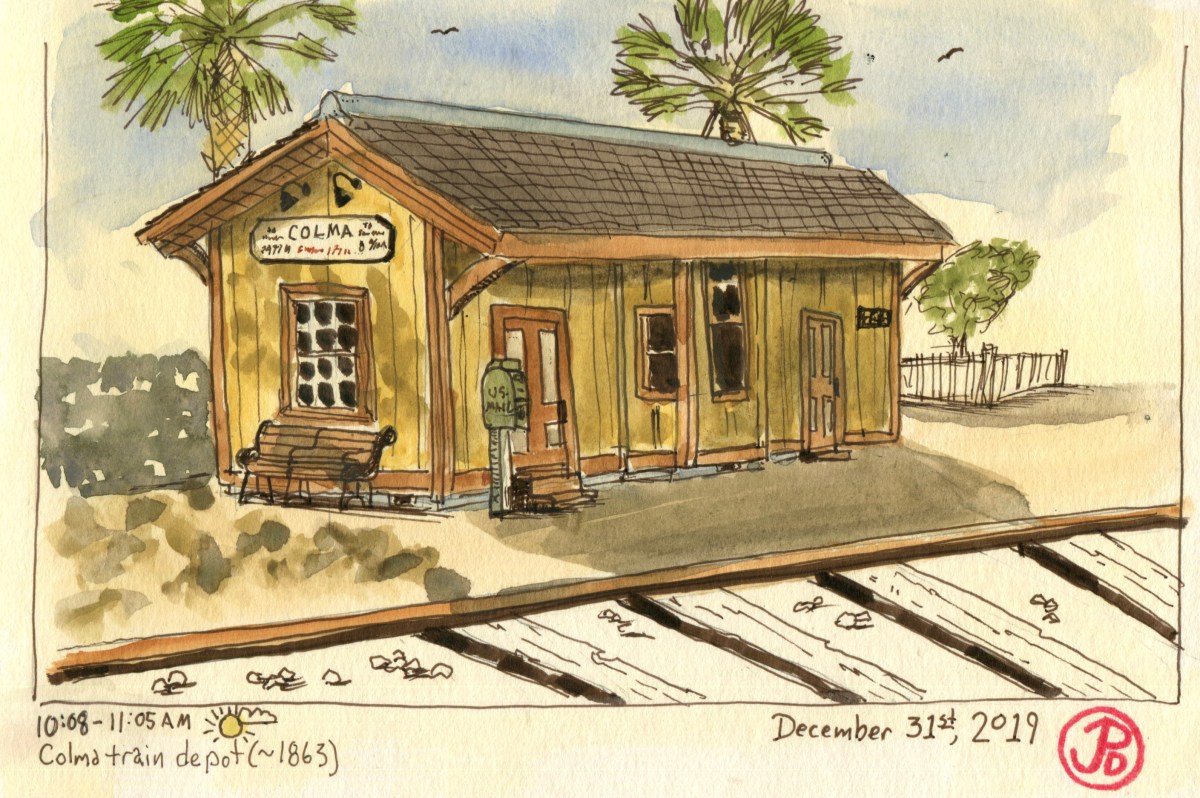
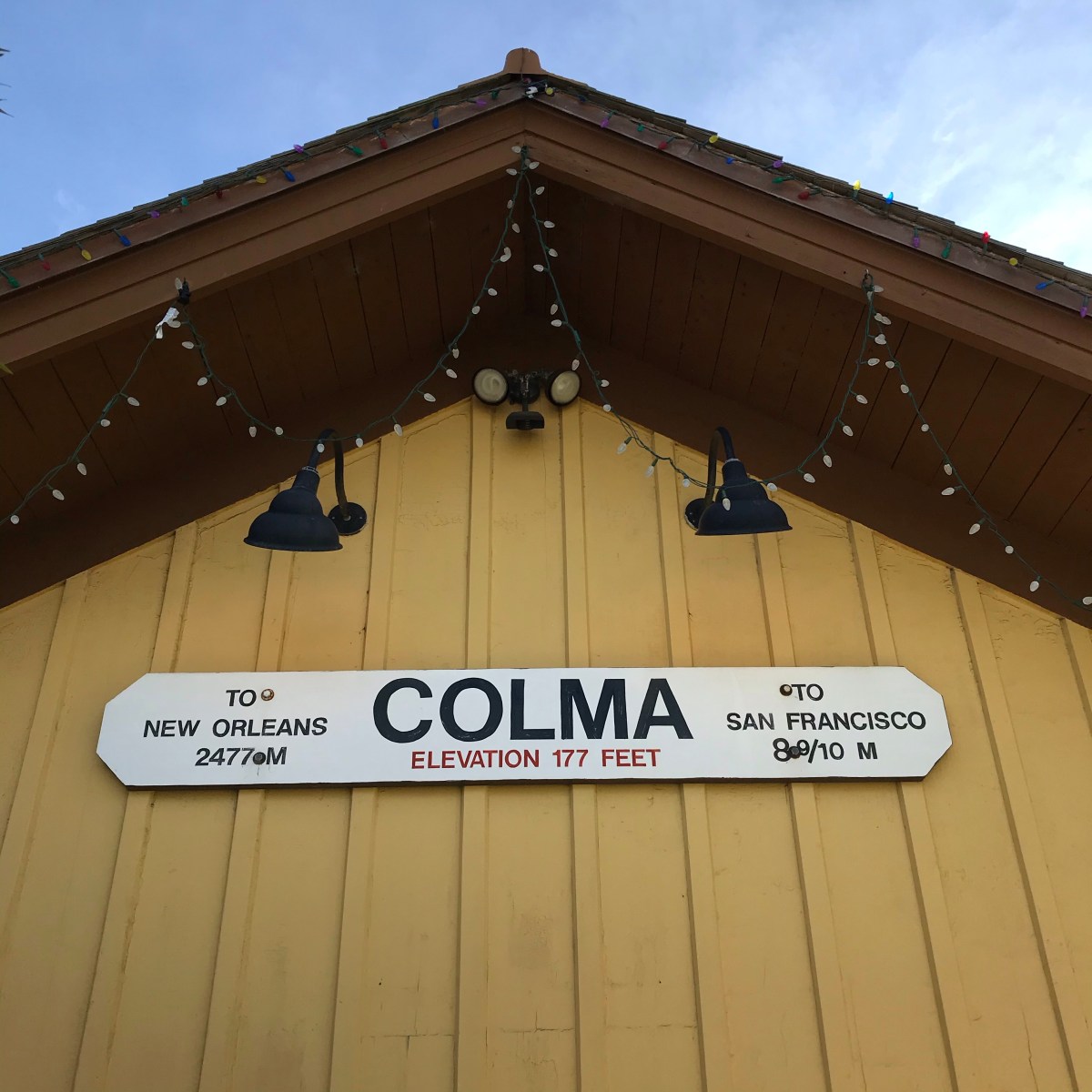
I wanted to start in the north and head south towards the Santa Clara County line. But I would not be starting on the current main line that runs along the eastern part of San Francisco and the Peninsula but the starting point for this project is a marooned station that is west of the main line. This station has been moved a short distance from its original location and now does not have any trains that stop at its platform. It is now part of a historical museum. This is the passenger depot in Colma.

The original mainline passed further west as it headed around San Bruno Mountain than it does today. The second stop, south of San Francisco County, which is in San Mateo County, was then called School House Station because of its proximity to the local one room schoolhouse. At the time this was one of 21 stations built between San Francisco and San Jose. The station was later renamed Colma.

In 1907 the Bayshore Cutoff came into service which straighten out the line to where the main line runs to this day. This new line left Colma off of the mainline like a rerouted highway, taking all the traffic away, leaving a ghost town in their wake. That may be appropriate because Colma is known for all it’s cemeteries. The number of dead in Colma, estimated at 1.5 million, outnumber the living. Hence the town’s motto, “It’s great to be alive in Colma!”

So I set up a sketching chair, readied my supplies, and started to frame in the railway depot. Here I really tried to get the perspective correct before I added pen or paint. This starting part of the sketch takes the most focus and concentration.

Another reason the Colma Depot was a good starting point for this project is that it was the oldest depot on the line, built around 1863, beating out the actual oldest station on the Peninsula mainline at Menlo Park, built in 1867.
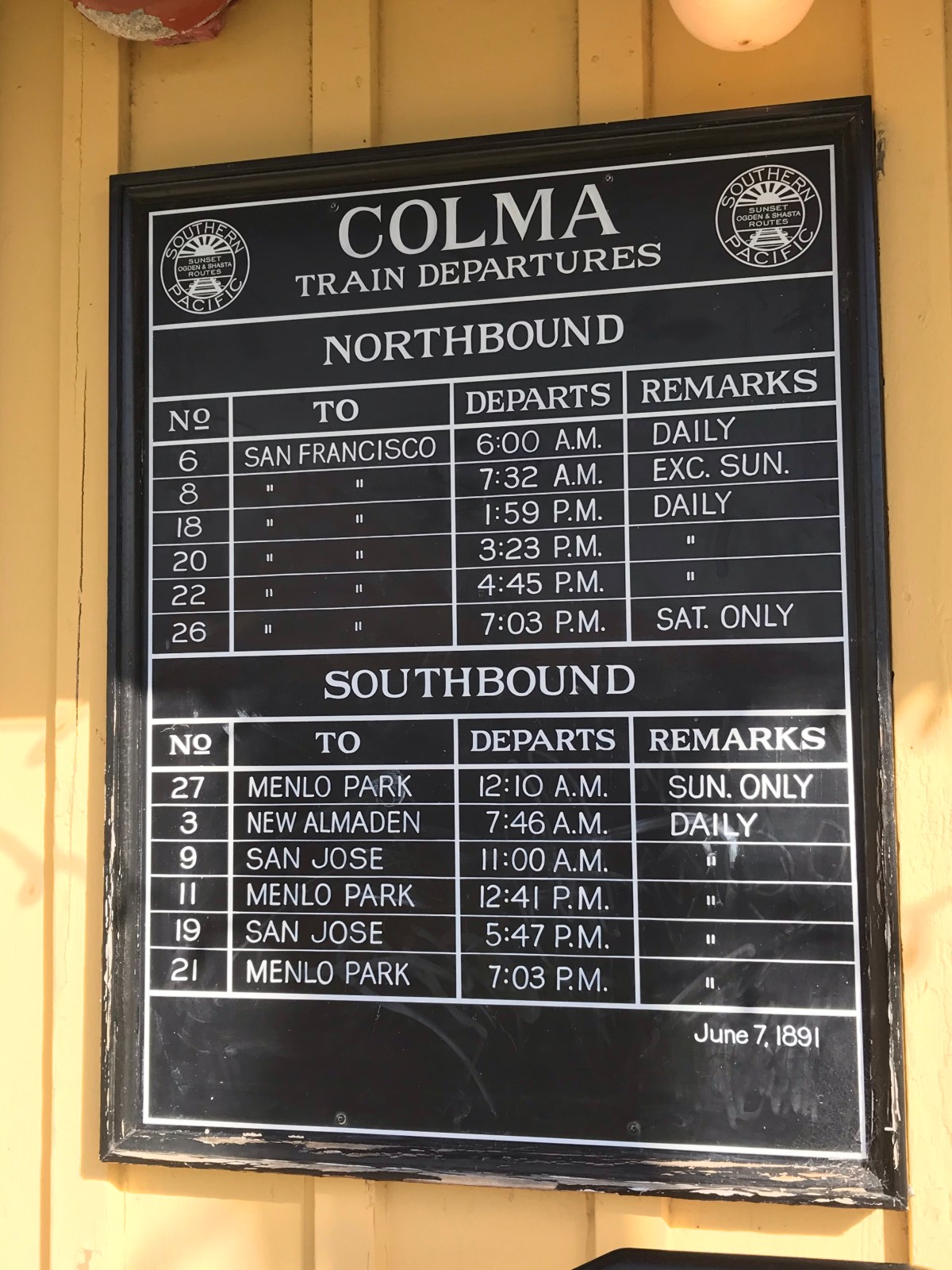
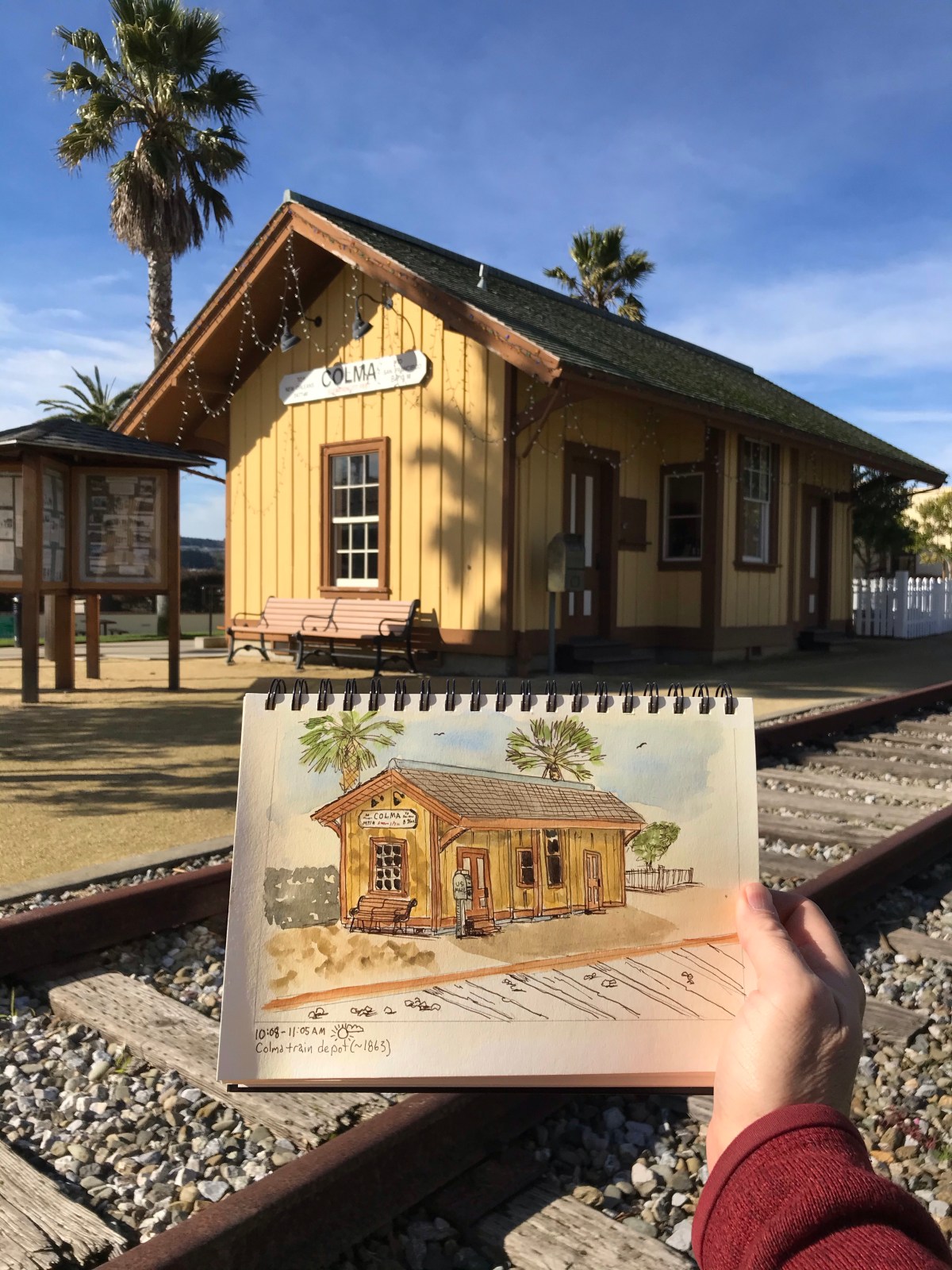
Starting with the Colma Depot was a bit of a cheat, because it is no longer an active depot nor is it on the main line. But because the river of rails have been diverted to the east leaving a pool that no longer flows to the sea, I felt it was important to start here, at least to get my feet wet. It was also helpful to start to learn the visual language of Californian train depots. It helps the eye see repeated patterns and forms when I move on to sketching other depots.

My next plan was to ride Caltrain from San Francisco down to all the historic stations in San Mateo County and sketch each one.

Sketch number one of this project is nearing completion. The rusted tracks in front of the station are just a short section. They go from nowhere to nowhere. Just like many of the visitors to Colma. Once they come here, they never leave.

Image

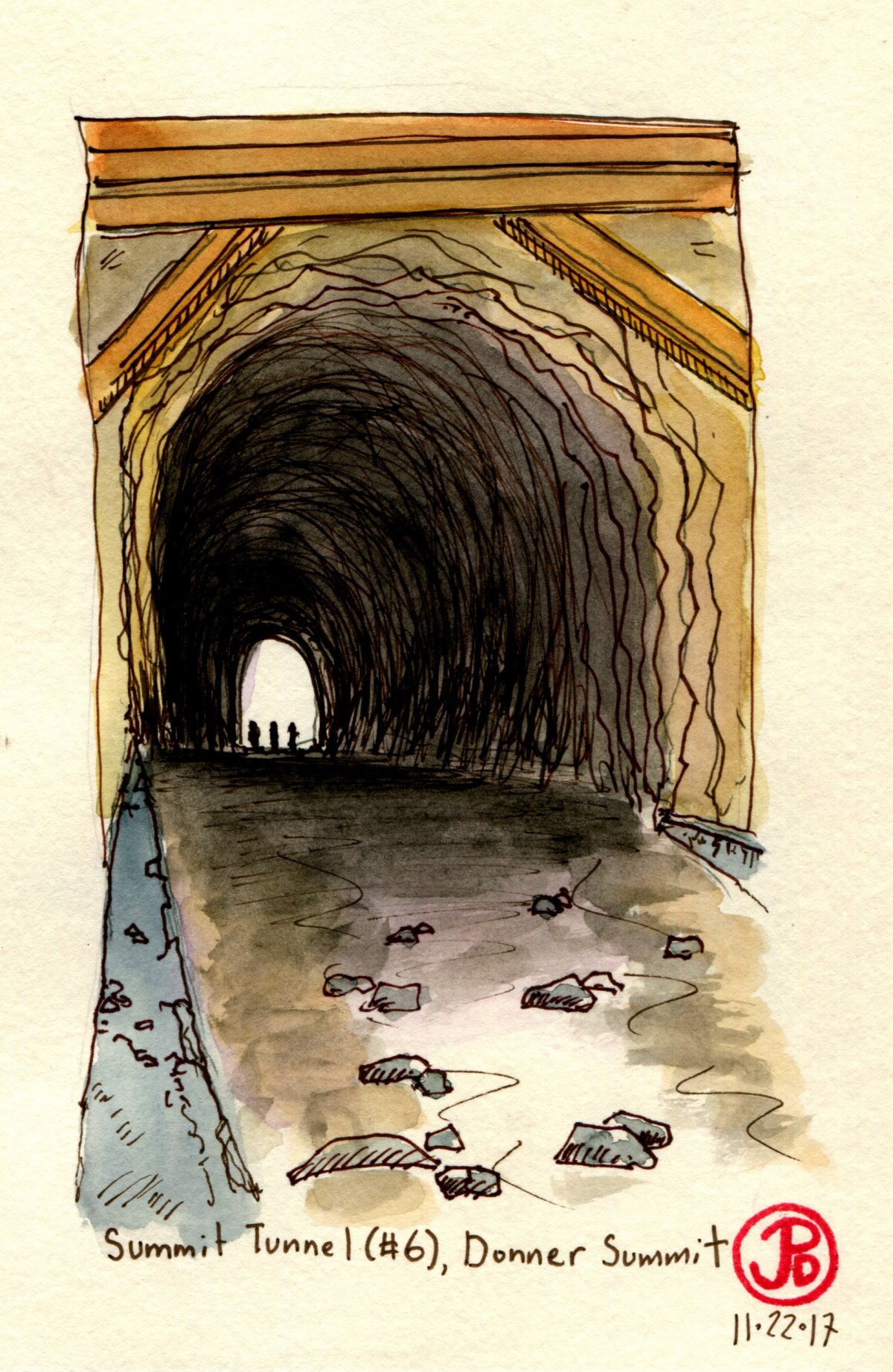
Summit Tunnel #6

The Central Pacific Railway had to bore thirteen tunnels through the Sierra Nevada, this proved to be the biggest challenge of the Transcontinental Railway. None is more of an engineering feat than Tunnel #6, known as the Summit Tunnel, the longest tunnel on the Central Pacific.

Like it’s name implies it is on the summit of the Sierra Nevada at Donner Summit (7,017 feet). This 1,659 foot long tunnel was bore through granite with Chinese laborers using, at first black powder, and then later the more powerful but more volatile, nitroglycerin. The tunnel was started both at the west and east portals and when they finally met, the two bores were just an inch off.

I hiked up from Donner Summit Road, old Highway 40 (the highway is the last incarnation  of the Emigrant Trail), to the east portal. I walked through Tunnel #7 heading west along the abandoned railway grade. The single track was abandoned in 1993 when the line was double tracked to the south.

I entered the Summit Tunnel, found a dry place to sit, and started to sketch the tunnel from the east portal (the featured sketch).

Looking west down the 1,659 feet of the Summit Tunnel (#6).

What impressed me about this tunnel was the sheer effort that went into conquering the Sierran Monolith. Over 12,000 Chinese labored in the mountains, year round, 24 hours a day to will this tunnel into existence. It took just over a year to complete the tunnel (November 30, 1867). The first passenger train passed through on June 18, 1868.

After my sketch, I headed east through Tunnels # 7 and 8 and into the snow sheds that hugged the mountainside down past Donner Lake and into Truckee. The snowsheds are now abandoned and are now canvases for mountain/ urban artists.

The snowsheds where the brainchild of Stanford and despite their cost, were essential to keeping snow off the line during the massive snow falls that are almost a seasonal tradition in these parts. Think: Donner Party. The first sheds were built of wood.

Snowsheds looking east where now a stream instead of trains now runs.

Image

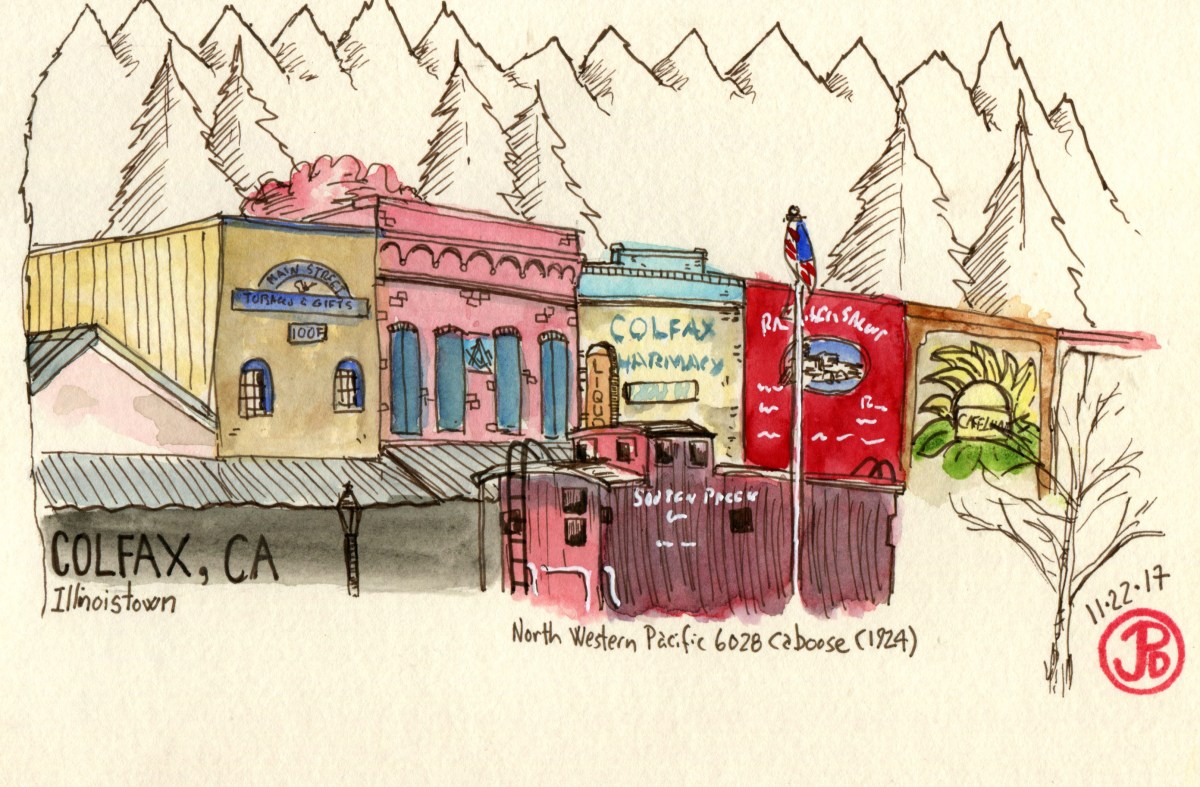
Camp 20-Illinoistown-Colfax

November 22, 2017. Colfax Train Depot.

I have always loved train travel. The idea of a traveling community that passes through landscapes, towns, and cities in stasis. On this day, one of the biggest travel days of the calandar, I was in stasis in an important railway town on the transcontinental railway, Camp 20. Later to become Illinoistown and later renamed for the Speaker of the House, Schuyler Colfax by then Governor Leland Stanford.

The only statue in existence of Schuyler Colfax, later to be Vice President under Grant. Stanford named the town after him after a brief visit by Colfax. At the Southern Pacific Passenger Depot.

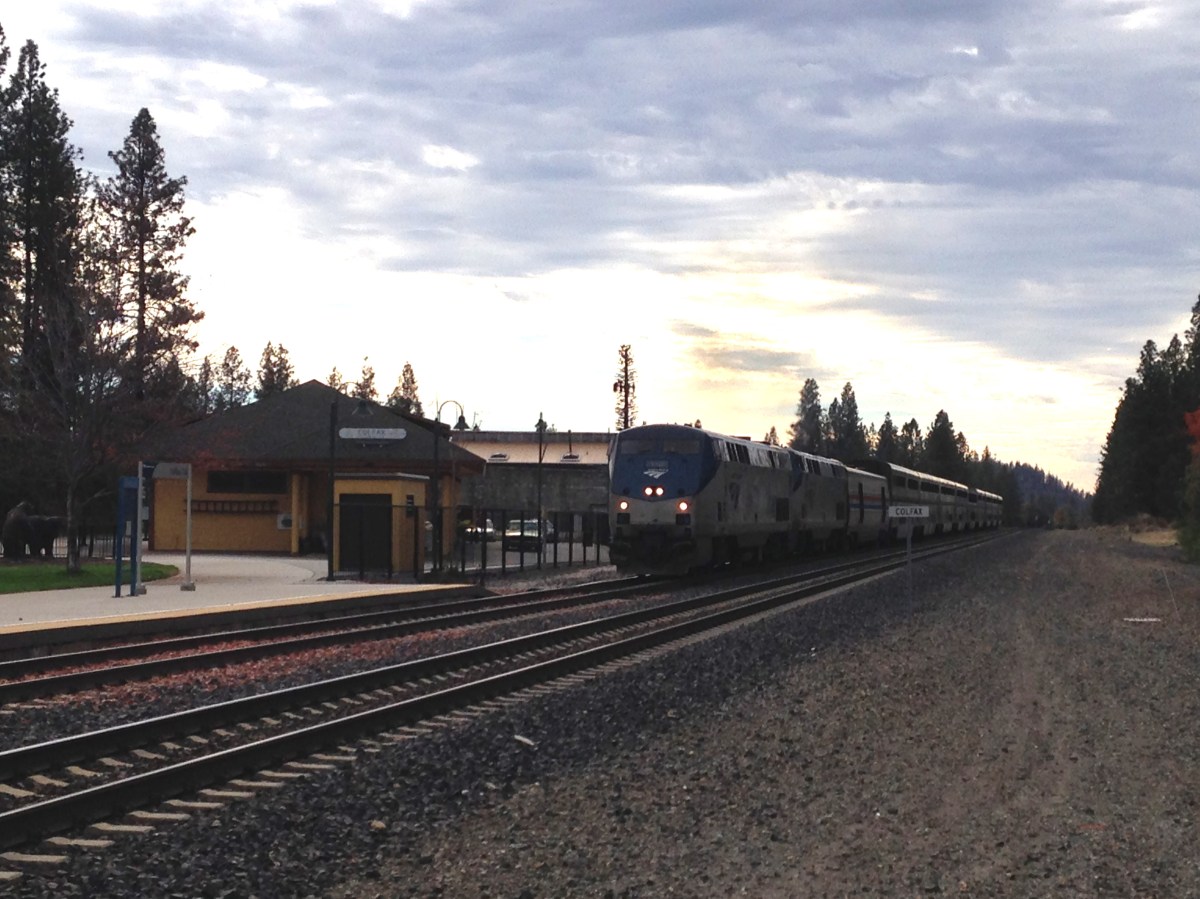
The east bound passanger train from Sacramento, worked it’s way up the valley into the station. The California Zephyr was running a little late. I walked over to my car and headed out towards Highway 174 to the Historical Viewpoint for Cape Horn. I waited and down below, the Zephyr passed and soon, on the distant hill, the train worked it’s way up the mountain and started up the grade towards the Cape Horn cut, high above the North Fork of the American River. The cars rounding the horn and disappearing from sight. I returned to the train depot to start working my Colfax sketch.

I was sitting on a bench at the restored Southern Pacific passenger depot platform as the westbound California Zephyr worked itself down from the heights of the Sierra Nevada, on it’s way to Sacramento and the San Francisco Bay Area. The train, now being headed by two underwhelming Amtrak diesels, paused long enough for passengers to embark and disembark, as relatives greeted or waved goodbye to those on the platform. And I was just in limbo, not on the train but wanting to be there, as the cars rocked gentle on the steel rails.

Colfax east

Eastbound California Zephyr rolling into Colfax station on it’s way to it’s final destination  of Chicago. The old Southern Pacific passenger depot is on the left.