Image

Santa Clara Control Tower

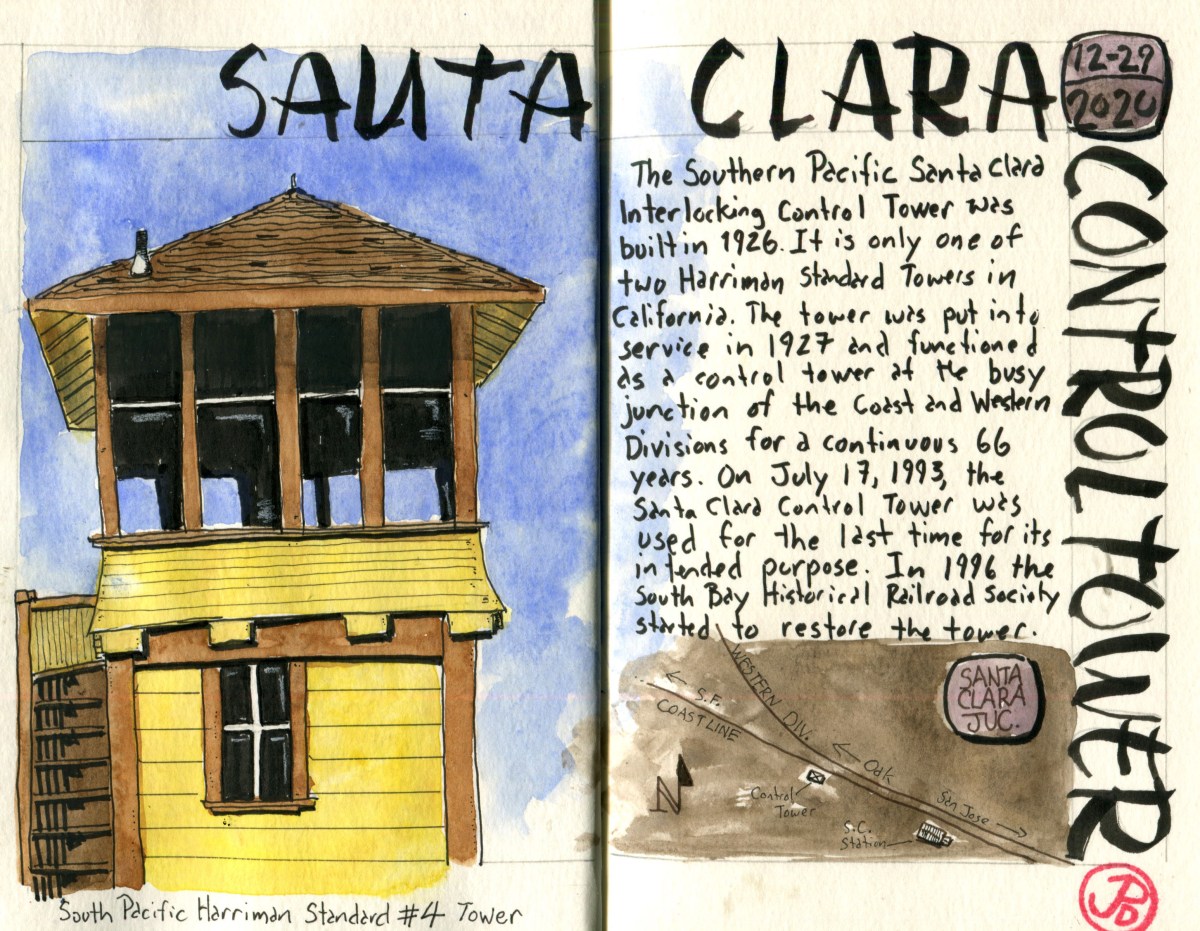
I have been sketching a few of the remaining Southern Pacific water towers in California but I had yet to add a control tower to my sketchbook.

There are about nine Southern Pacific interlocking control towers still in existence in California and 16 are still in existence on the former SP system. These control towers where once ubiquitous on America’s railroads at busy junctions or rail crossings. Interlocking control towers centralized a group of signals (semaphore and lights) that were controlled by an operator to control the rail traffic by communicating different orders: proceed, caution, or stop. Think of it like a traffic signal for trains.

The Santa Clara Southern Pacific Interlocking Control Tower was built by SP in 1926 and put into service in 1927. The tower was in continuous use for 66 years at this very busy junction of the Coast Line and the Western Division. In the 66 years of operation, many trains, both passenger and freight, passed by. The famed Coast Daylight sped by the tower, stopping to take on passengers in San Jose.

The tower was in use until July 17, 1993 when the control of all switches and signals were moved to a centralized control center in San Jose.

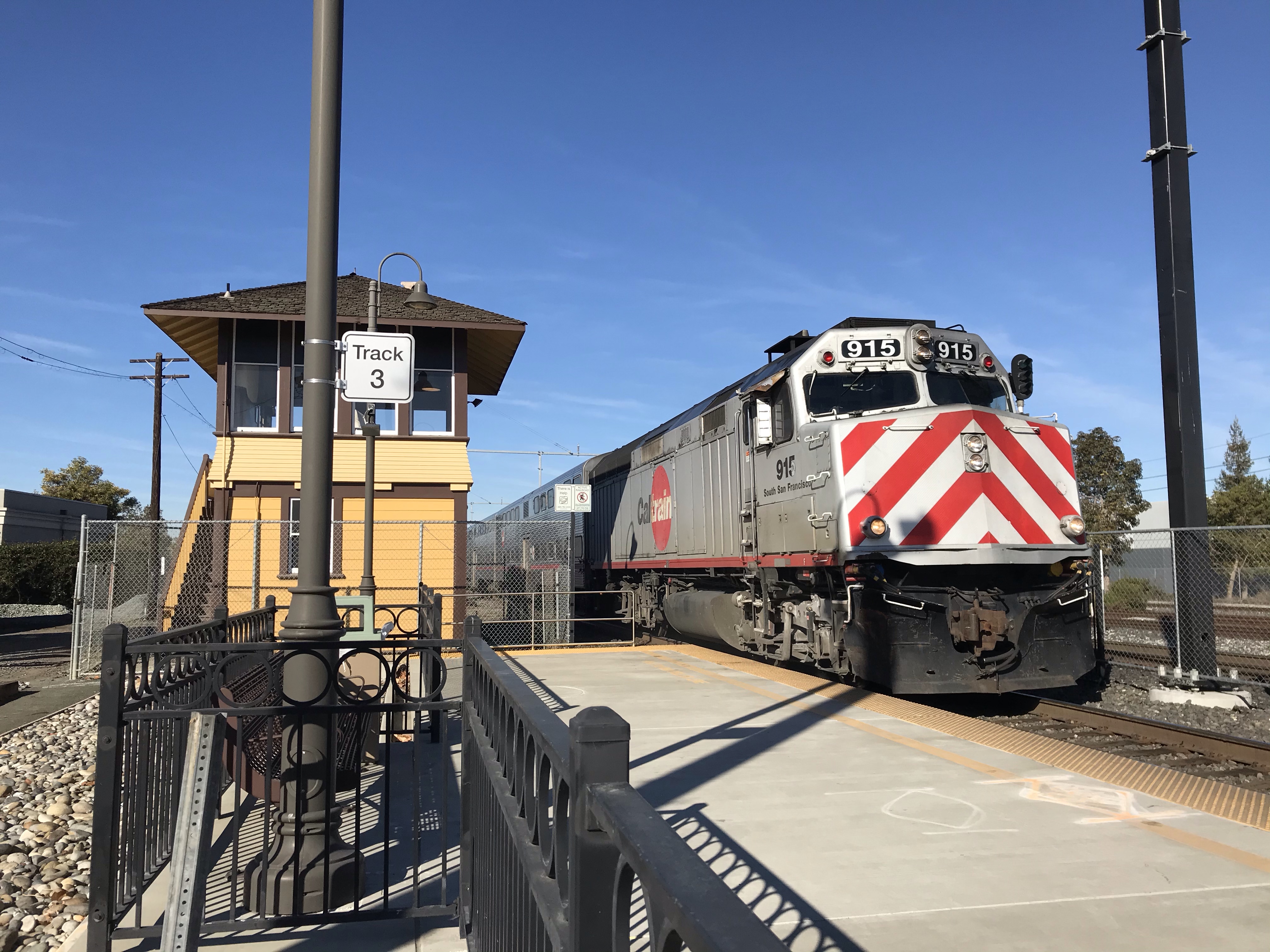
A Southbound Caltrain pulls into Santa Clara Station on its way to the end of its run in San Jose. To the left is the restored control tower. On point is locomotive 915 “South San Francisco”.

Santa Clara is a busy junction where the Coast Line and the Western Division meet. It is busy today with both passenger and freight traffic. The passenger trains that stop or pass this way are Caltrain, Capital Corridor, the Altamonte Corridor Express (ACE), and the Coast Starlight. Four main line track pass Santa Clara, tracks to the northeast are used by Union Pacific for freight. The other three train a primarily used for passenger service with some routes turning off here to head north, on the east side of the Bay, towards Oakland (the Western Division).

A northbound Caltrain passes the control tower as it pulls out of Santa Clara Station heading toward San Francisco. This consist is being pushed by locomotive 905 “Sunnyvale”, an EMD F40PH-2CAT.

Sketcher’s Folly: Oops I did it again. I made a sketching mistake. In my sketch of the California Theatre in Dunsmuir I left out an “I” and now I made the egregious mistake of misspelling the county of my birth: Santa Clara. What next? Misspelling my own name?! Well at least I’m making new mistakes!

Image

Southern Pacific Water Tower: Coyote

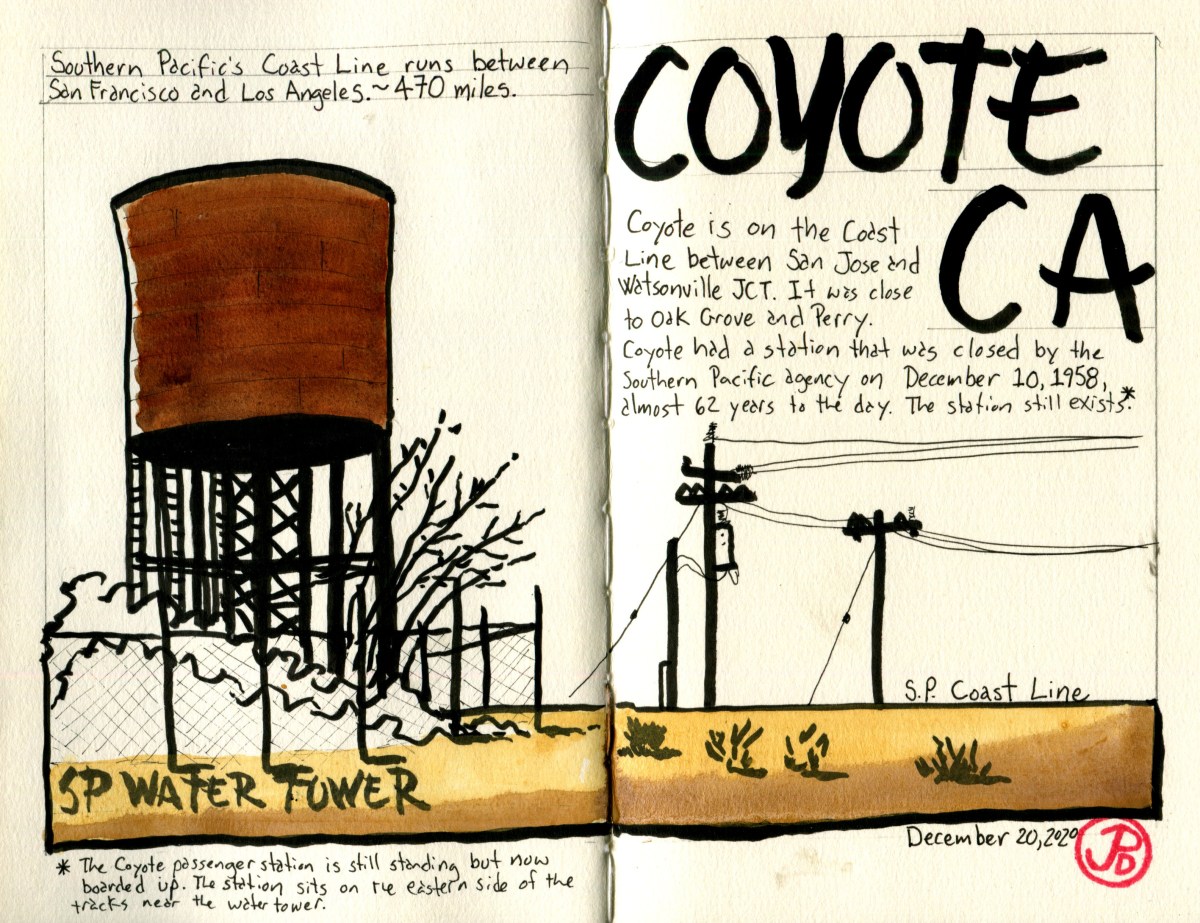
There are two Southern Pacific water towers remaining in the Bay Area, one in San Jose (near the passenger station) and one further south on the Coast Line in Coyote.

I headed to Santa Clara County, the county of my birth, to the Valley of Heart’s Delight (Silicon Valley). The small, blip of a town that is Coyote is south of San Jose and just north of Morgan Hill.

Coyote is on the Coast Line, a 470 mile route that connected San Francisco and Los Angeles. SP’s famous passenger service, the Coast Daylight, blew through Coyote. A resident of Coyote wishing to catch the Daylight to Los Angeles had to either head to San Jose or Salinas. Coyote has a passenger station that was in service until December 10, 1958. The building still exists but is now abandoned and boarded up. At one time it was a private residence.

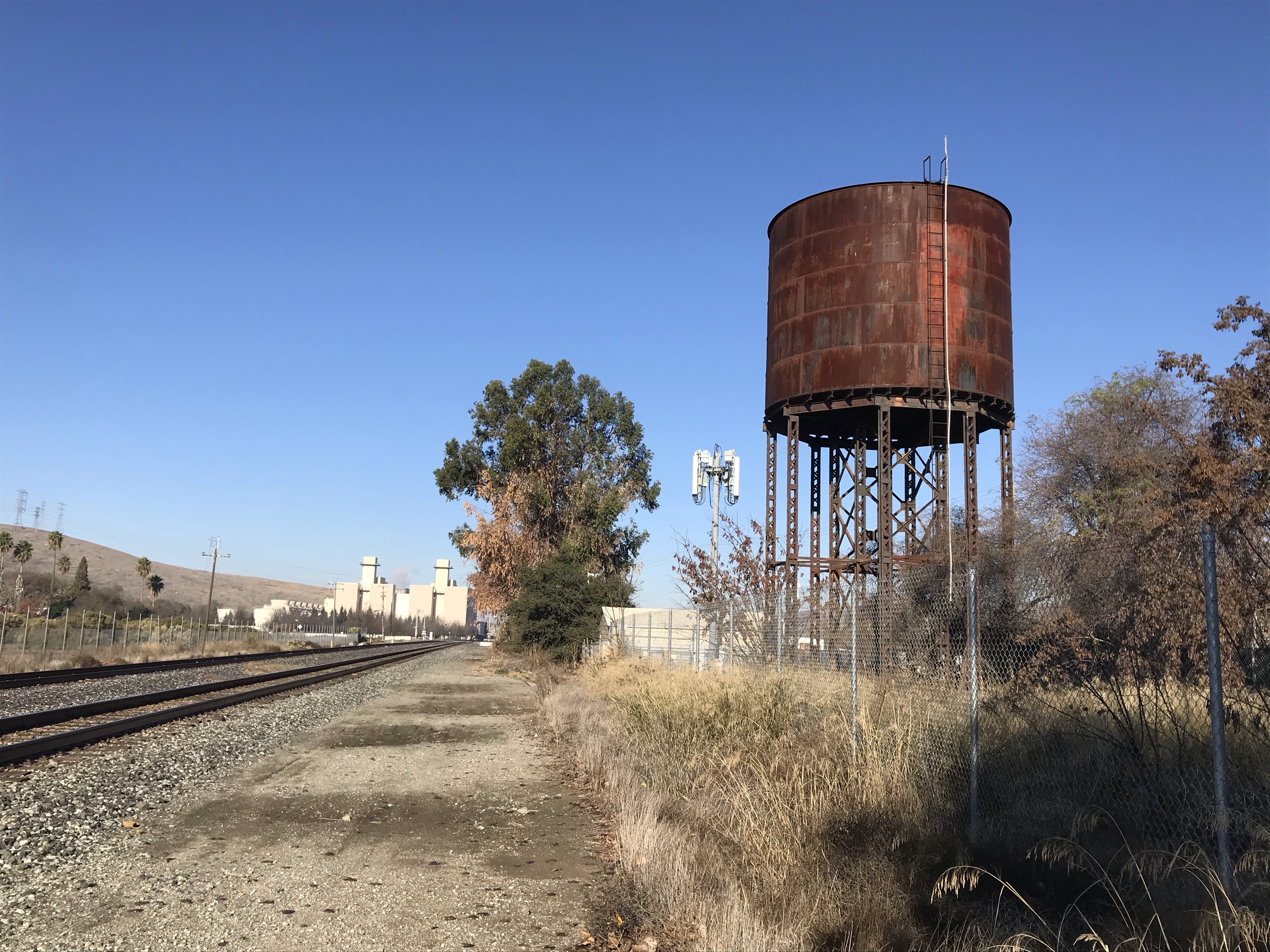
The abandoned Southern Pacific water tower and the double tracks of the Coast Line on the left. To the left of the tracks is the Metcalf Energy Center.

Before heading down to Coyote I stopped off at the town where I grew up: Sunnyvale. As I exited off Highway 280 and headed north on Sunnyvale Saratoga Road, I reflected, as I always do when I’m in Sunnyvale, on how much it has changed from the 20 odd years I spent here.

Along the road, there were things that where very much the same, such as the Longhorn Restaurant on the right (I don’t think I every ate here), and to the left is Fremont High School. The 1925 main building looks very much the same but according to a family friend, who is an assistant principal at Fremont, a lot of renovations are happening on campus.

The reason I turned off the highway was to see another water tower in the South Bay. This tower was not built by Southern Pacific, although it sits just north of the Coast Line. Before Silicon Valley, this area was known as the Valley of the Heart’s Delight and the valley was covered in apricot and cherry orchards.

According to the Sunnyvale orchardist, Charlie Olson, there used too be “eight to nine million” fruit trees in Sunnyvale. Now there are eight to nine hundred.

To process all the fruit, canneries where built along the railroad line. My father, after coming home from work, would put me one the back of his bike and he would ride on the same route he had just come from. He spent his working career at Westinghouse which was also right next to railroad.

During the harvest season, a favorite destination was a pedestrian bridge over the railroad. From this vantage point we could watch commuter trains come and go and also we could look down into the yard of one of the canneries. Here forklifts moved at a frenetic pace and I can still recall the persistent din of the processing plant as workers canned ripe fruit to be shipped, by rail, to the nation. At this time, in the mid to late 1970s, Sunnyvale very much had one foot in the agricultural word.

This cannery was the former Schuckls Cannery which was later bought by California Canners and Growers in 1963. It was in operation until the cannery was demolished in 1984. The year 1984 was a auspicious year in the valley, it was in this year that Apple introduced the Macintosh computer.

This was about to change as the valley and it’s orchards were slowly replaced by Silicon Valley. It is interesting that one of the valley’s sons recognized the beauty of this area but was also one of the catalysts for it’s demise. Steve Jobs, the co-founder of Apple, said, “Silicon Valley for the most part at that time was still orchards-apricot orchards and prune orchards-and it was really paradise.”

Can we say that Sunnyvale is now a paradise? Well I guess it depends on how you define “paradise’.

As I crossed over the railroad tracks as South Matilda Ave. become North Matilda, the water tower came into view.

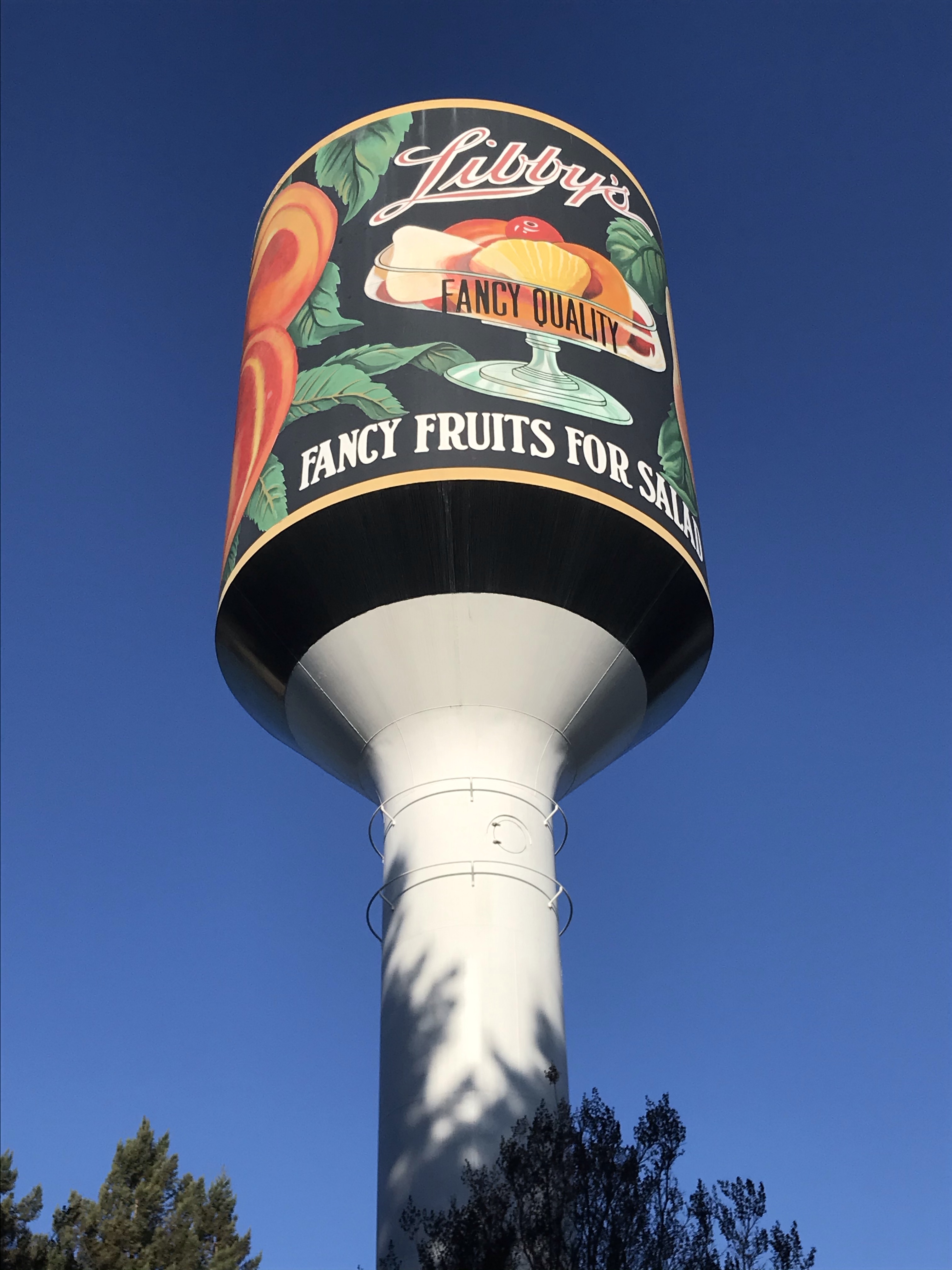
The Libby Water Tower is all that remains of the largest cannery in Sunnyvale. Libby, McNeill and Libby opened it cannery in 1907 and by 1922, it was the largest cannery in the world.

The current water tower was built in 1965 and is shaped like a can of Libby’s Fruit Cocktail. This is all that remains of one of the biggest canneries in the valley. It is now surrounded by a business park with buildings occupied by Walmart and Raytheon.

Looking up at this water tower I can recall the sounds of the cannery working at full capacity, to can the bounty of the Valley of Heart’s Delight.

The Libby Water Tower in Sunnyvale. It has been repainted as a can of Libby’s “Fancy Fruit for Salads”.
Image

Southern Pacific Water Tower: Elmira

I planned to sketched the water tower at Black Butte, in the shadow of Mt. Shasta in Northern California.

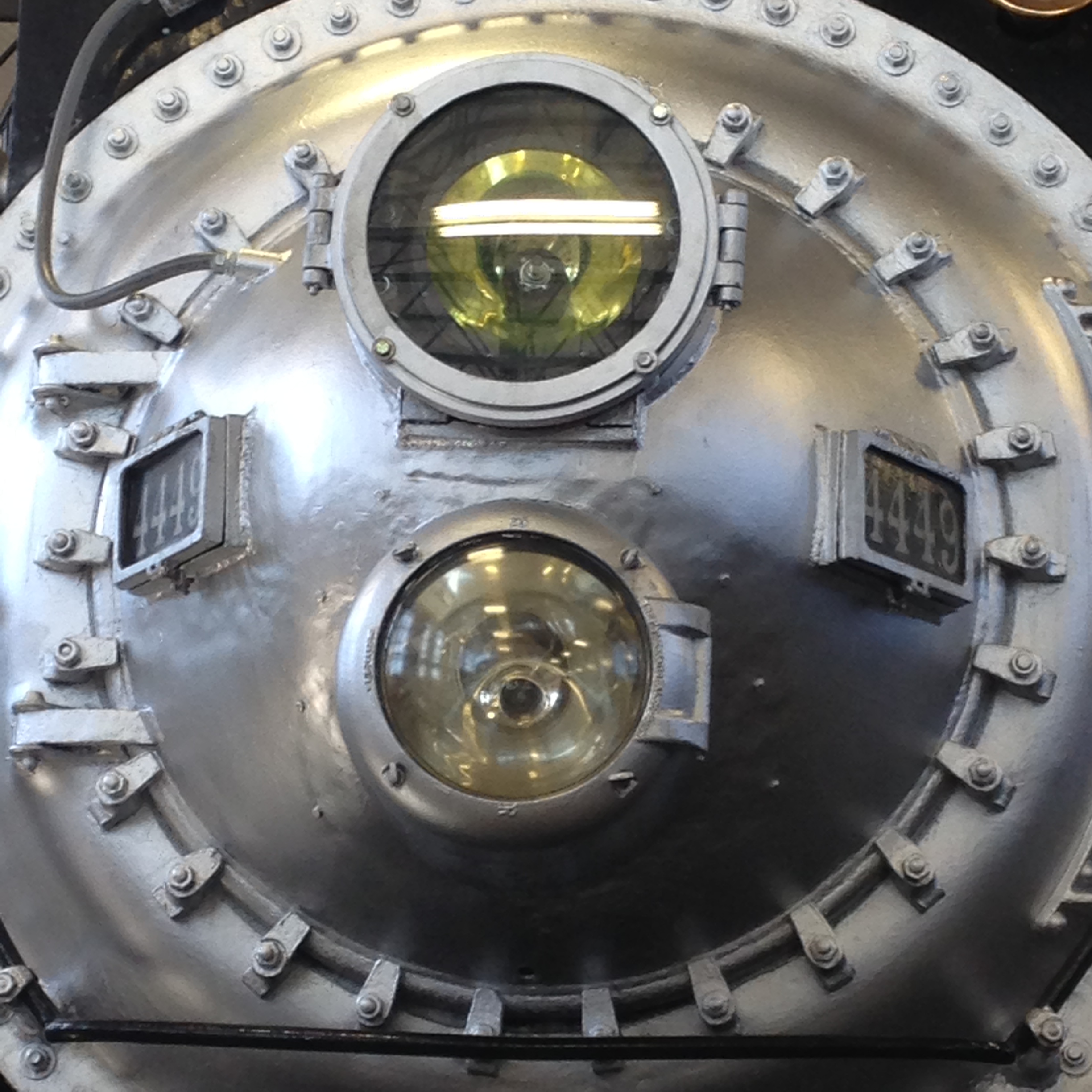
I wanted to sketch this Southern Pacific water tower because of it’s historical significance and also because this is one of the few water towers still in operation as Union Pacific (it’s current owner) keeps this active to water any of UP’s heritage steam engines and other steam excursions that might pass this way. (SP 4449 topped up her tank here in the summer of 1991). The tower was built in 1926.

But not all plans come to fruition. I headed up to Weed to sketch the water tower only to find that the road leading to it was gated and all the signs around the area read “No Trespassing, Do Not Enter”. This area was still very much an active Class I railroad and I’m sure UP didn’t appreciated railroad gawkers and sketchers near their tracks.

So in order not to become a headline in the local paper, I chose to turn back towards Dunsmuir.

Steam engines cannot function without water. If water runs too low in the boiler it can result in a deadly boiler explosion. Therefore railroads built water tanks or towers near railroads, spaced out so there would be water along the line, when the locomotive became “thirsty”.

But I still wanted to sketch a more accessible Southern Pacific water tower so I did some research. I found that in the State of California, there are 16 Southern Pacific water towers still in existence. While I was not able to access one of those, there were still 15 left to find.

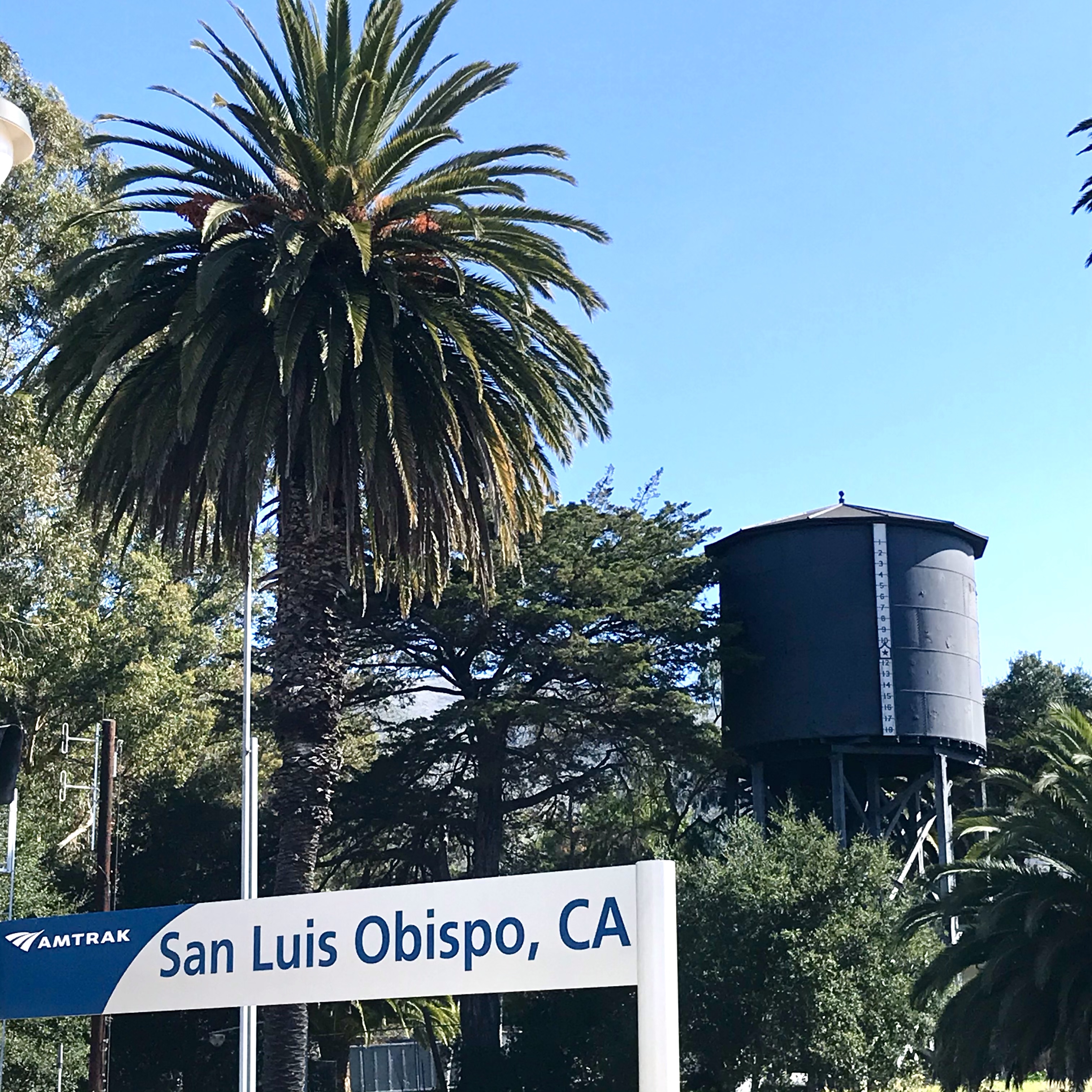
I hade seen the 65,000 gallon restored water tower across from the passenger station in San Luis Obispo. It was built in 1940 and was retired in 1956. I did have it on my sketch list but I didn’t get to it. One down, fifteen to go.

The restored Southern Pacific water tower in San Luis Obispo. This tower was slated to be torn down but local interests intervened and saved it from destruction.

I set my sights on the Southern Pacific water tower in the small Solano County town of Elmira (population 188).

Elmira was a major railroad stop in the early part of the 20th century as it was on the Cal-P line between Vallejo and Sacramento. At Elmira, there was a spur that went to Vacaville, Winters, and Rumsey as part of the Vaca Valley and Clear Lake Railroad. It is easy to understand why a water tower was built here because of the rail traffic and the spur.

Then U.S. Route 40 (now Interstate 80) was created as one the the first Interstate Highways in 1926. It was the first major east-west route, starting in Atlantic City, New Jersey and terminating in San Francisco. The route passed west of Elmira, through the town of Vacaville. Since that time the town of Elmira never recovered. As the population and development in Vacaville grew, the town of Elmira became a rural backwater with a shrinking population.

The same growth in the Nation’s Interstate Highway system also was the death knell for many railroads across the country with trucks and cars replacing freight and passenger service.

The last freight train to run on the spur to Vacaville was in 1985. After that the rails between Vacaville and Elmira were abandoned and then later removed.

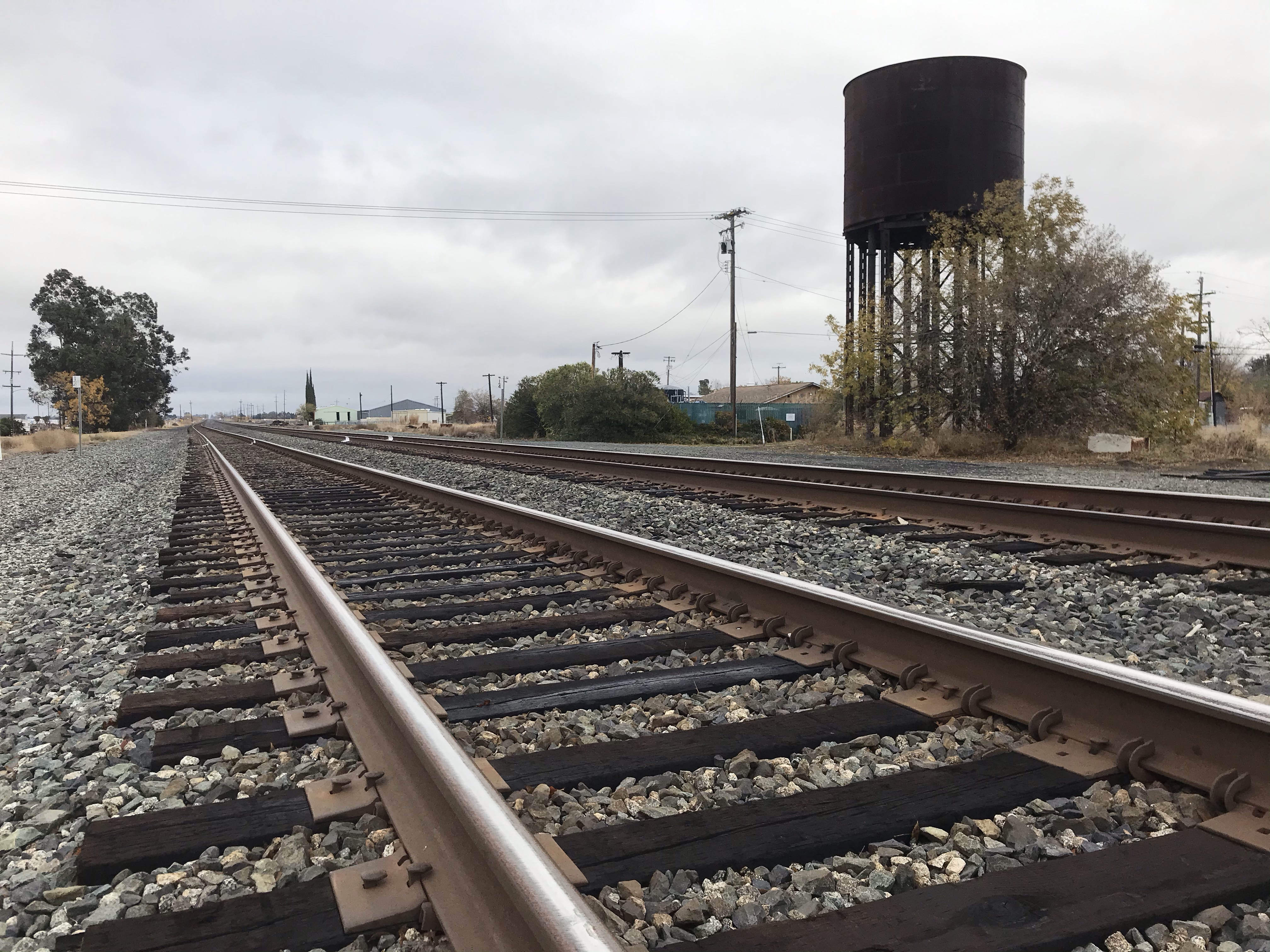
The abandoned but still standing Southern Pacific water tower at Elmira. The tower is not fenced in and there are no historic signs about the tank. It looks to be similar to the 65,000 gallon tower in San Luis Obispo and I imagine that it was built in the 1930s or 40s and used up until the mid 1950s.

The passenger station is now gone but active double tracks still pass the abandoned and rusted water tower at Elmira. The Capital Corridor passenger service runs 16 trains every weekday. The 168 mile service runs from San Jose to the state capital in Sacramento. A few trains head further north to Auburn.

Looking north towards Davis and Sacramento. Two sets of polished tracks pass through Elmira. These rails get lots of use with 16 passenger trains on a normal weekday.
Westbound train number 729 passes by Elmira’s water tower at 9:28 AM on a Saturday morning at a rapid clip. There is no longer a passenger station in Elmira. The closest station is to the south at the Fairfield-Vacaville Station. On point is an EMD F59PHI with “California styling”.
Image

Dunsmuir

Dunsmuir is a train town.

At one time it was a company town for the Southern Pacific Railroad when 3,000 of it’s citizen’s where employed by Southern Pacific Railroad.

Dunsmuir was previously known as Pusher because this is where helper locomotives where either added or taken off trains. They were put on to make it up the Cantara Loop and the climb out of Dunsmuir as the line headed north. Helpers where also used on downslope freight trains to help with dynamic braking.

The town contains a railyard, shops, and a still functioning turntable to turn locomotives around. In it’s heyday, Dunsmuir had a population of 5,000, many of those working for the railroad, serving the labor intensive steam locomotives. When the stream locomotives were replaced by more efficient disel-electric locomotives, the town’s population was almost halved.

Today, the mainline sees two passenger trains and about 15 freight train daily. Most freight trains are now powered by three to four, 4,000 to 6,000 horsepower, diesel-electic engines, so the need to add engines has become obsolete.

Dunsmuir still feels very much like a train town even though Southern Pacific was aquired by Union Pacific in 1996.

The main street, Dunsmuir Avenue, is beautiful in it’s small town charm. And of course the main street parallels the main line.

The crown jewel of downtown Dunsmuir is the California Theatre. This 800 seat movie palace was opened in 1926. The theater featured a stage and a Wurlitzer pipe organ. The theater is only one block from the passenger station and, in it’s heyday, many of Hollywood’s finest and other dignataries visited the theater including Babe Ruth, the Marx Brothers, and Clark Gable.

In recent times the theater has faced some troubling times, after many stops and starts the theater closed in 2016. There was also a Masonic Lodge that met in the building for close to 70 years.

I parked on Dunsmuir Avenue and did a car sketch (great for social distancing) of the the epic sign and marque. I added a bit of artistic license when I added perhaps the best movie ever made featuring a locomotive, Buster Keaton’s masterpiece, The General (1926).

Across from the station is a mural on an oil tank. The mural was created by rail historian, artist, author, and former employee of the Southern Pacific and McCloud Railroad, John Signor. This is a sketch I did from my photograph. It features a Southern Pacific EMD SD45 T-2R diesel-electric locomotive and the famous Daylight GS-4, 4449. This mural represented the future and the past of the Southern Pacific Railroad. It is also a reminder of the name of the railroad that built Dunsmuir.
Only two passages trains stop at Dunsmuir Station. The north and southbound Coast Starlight, an Amtrak service from Seattle, Washington to Los Angeles, California. To catch the Coast Starlight at Dunsmuir, you have to get up very early in the morning (or simply just stay up). The southbound Train 11 arrives in Dunsmuir at 12:35 AM and northbound Train 14 arrives at 4:56 AM!
Dunsmuir is an important division point in the Shasta Division where train crews change over. In this case, a BNSF freight train with a consist of hopper cars, change it’s engineer and conductor. BNSF is granted trackage rights to use this route by the tracks owner: Union Pacific.

Note: Part of sketching, and life I might add, is making mistakes and with this sketch I made one. I am a native Californian and I made unforgivable mistake of misspelling my own state! That sometimes happens when you are so focused on form and not spelling. I added the missing “I” on the street below.

Image

Railroad Park Resort: Caboose # 17

Who doesn’t want to spend the night in a caboose? It ignites the inner child in almost everyone!

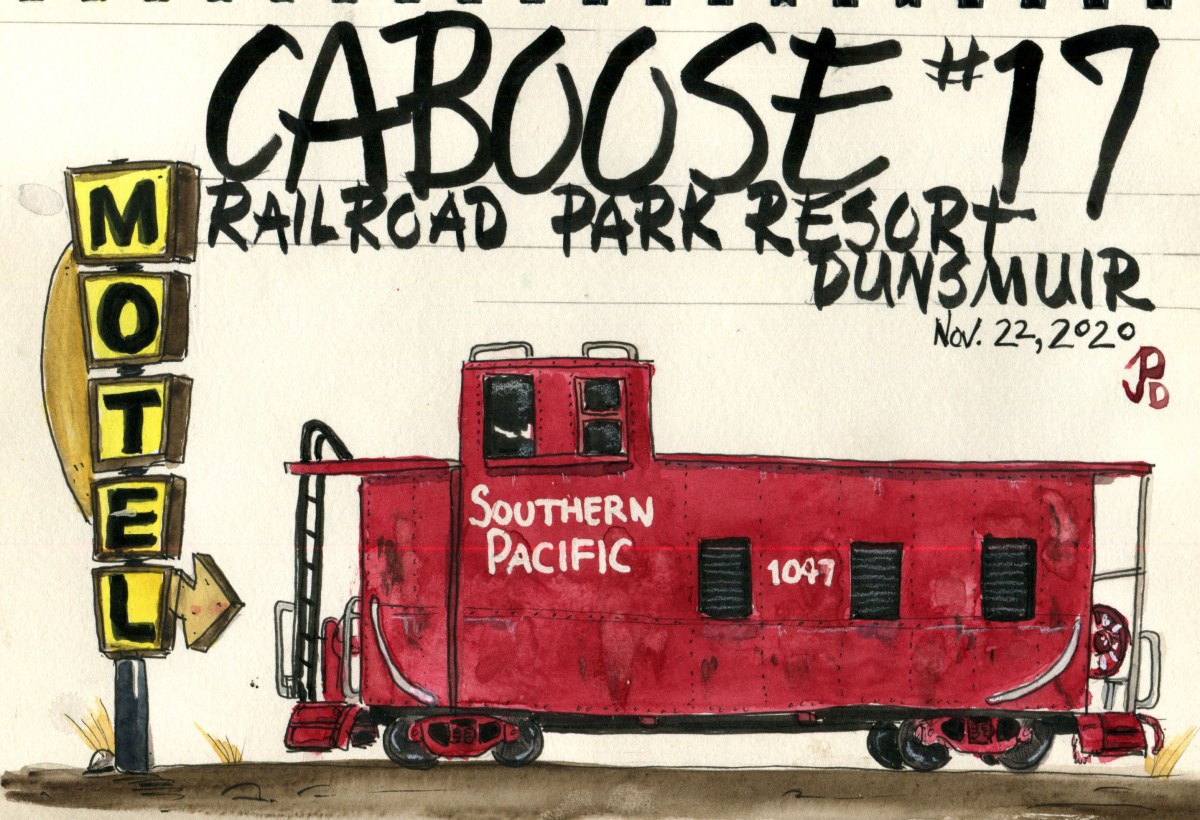
I stayed in a Southern Pacific cupola caboose No. 17 (SP # 1047). This caboose is a class C-40-1 and it was built in 1937 (one of 50 that were built). The caboose arrived at the Railroad Park Resort in the early 1970’s when the interior was remodeled.

This caboose had everything you could ask for in a modern hotel room. The specs of Caboose #17 are: a king sized bed, full bath, refrigerator, microwave, tv (featuring the Resort’s own channel!), an air conditioner (very important on chilly mornings!), and table and chairs. What most hotel rooms lack is a cupola!

The view from the cupola is probably the best out of any of the cabooses at the resort. When looking to the southwest, the rugged peaks of Castle Crags catch the early morning sun.

I put my bags in the caboose, grabbed by sketching bag and chair, and picked my spot to sketch Caboose #17. To the left of the caboose was a sign that proclaimed like a proud exclamation mark: “MOTEL!” with an arrow that shot out of the “L“, pointing to the red caboose as if to proclaim to the unbeliever that, “Yes, you can stay in this caboose!”

A nice way to spend the chilly mornings was to sit in the cupola, with warm coffee, my sketch book and pens. This is s a cupola view of Caboose No. 17. In this view are three other cabooses at the Resort.
Image

The Osprey’s Nest

One of my neighbors knew I was struck with the affliction of birding and told me about the osprey’s nest on top of a Douglas-fir along the railroad about a 30 minute hike up river from my cabin.

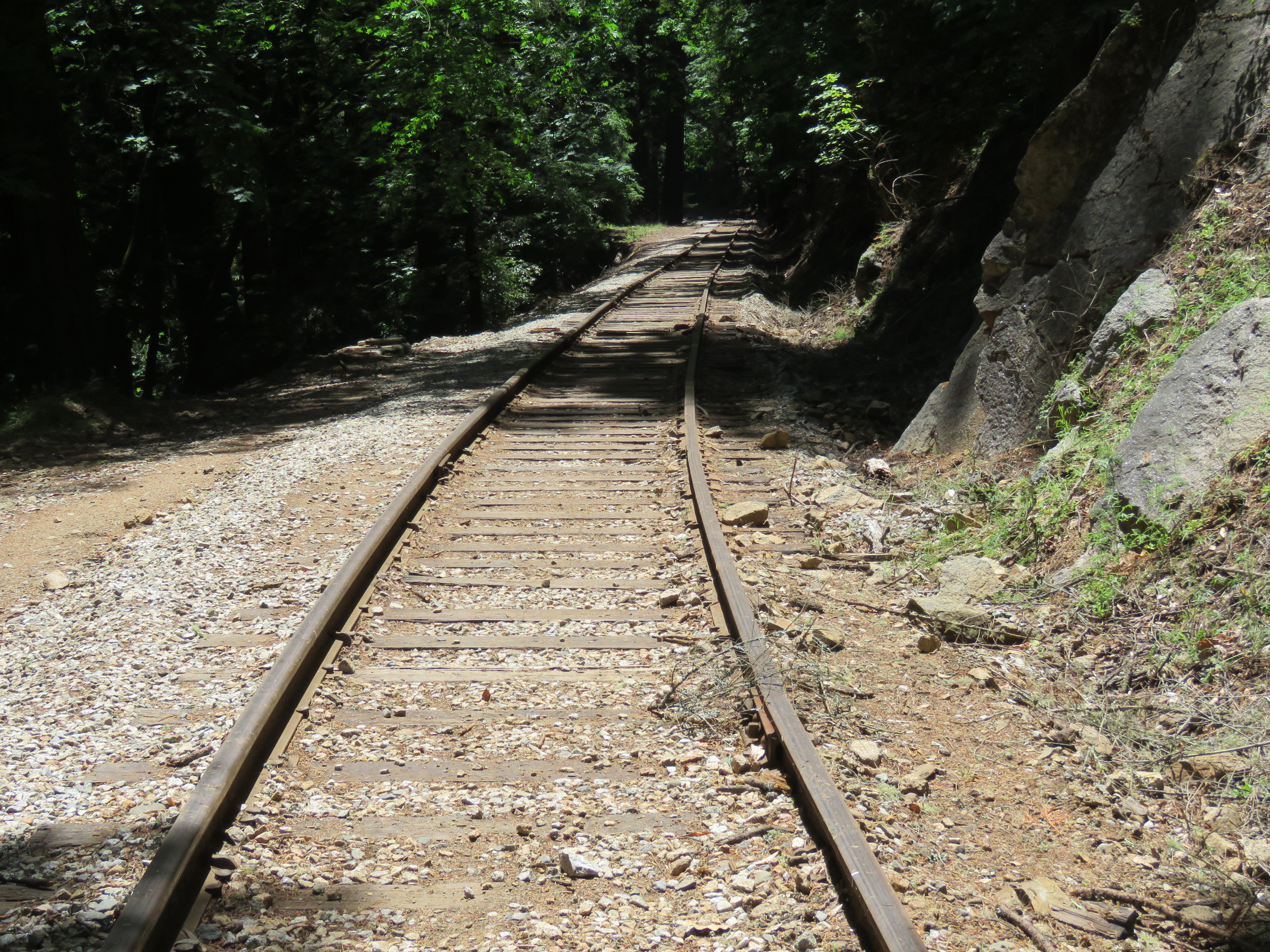
After work on Friday, I hiked out of Paradise Park via the fire road and scrambled up a deer trail to the even grade of the railroad. This railroad is now operated by the Santa Cruz, Big Trees and Pacific Railway and takes tourists from Felton to Santa Cruz Beach Boardwalk. At one time the railroad went over the Santa Cruz Mountains to Los Gatos but now does not go very far beyond Felton. I have hiked this railroad since my youth and it had been a few years since I played hopscotch on railway ties up the San Lorenzo Valley.

Walking along this rustic railroad always feels like I’m participating in a scene from Stand By Me on a quest to find a dead body. But in this case I was in search of a big bunch of sticks on top of a fir, high above the San Lorenzo River.

I kept one eye on the rails and one on the trees off to my right. My neighbor had given me good directions to the nest and when I was 30 minutes out of Paradise, I thought that maybe I had passed the nest. But how could I miss it? So I continued hiking upstream.

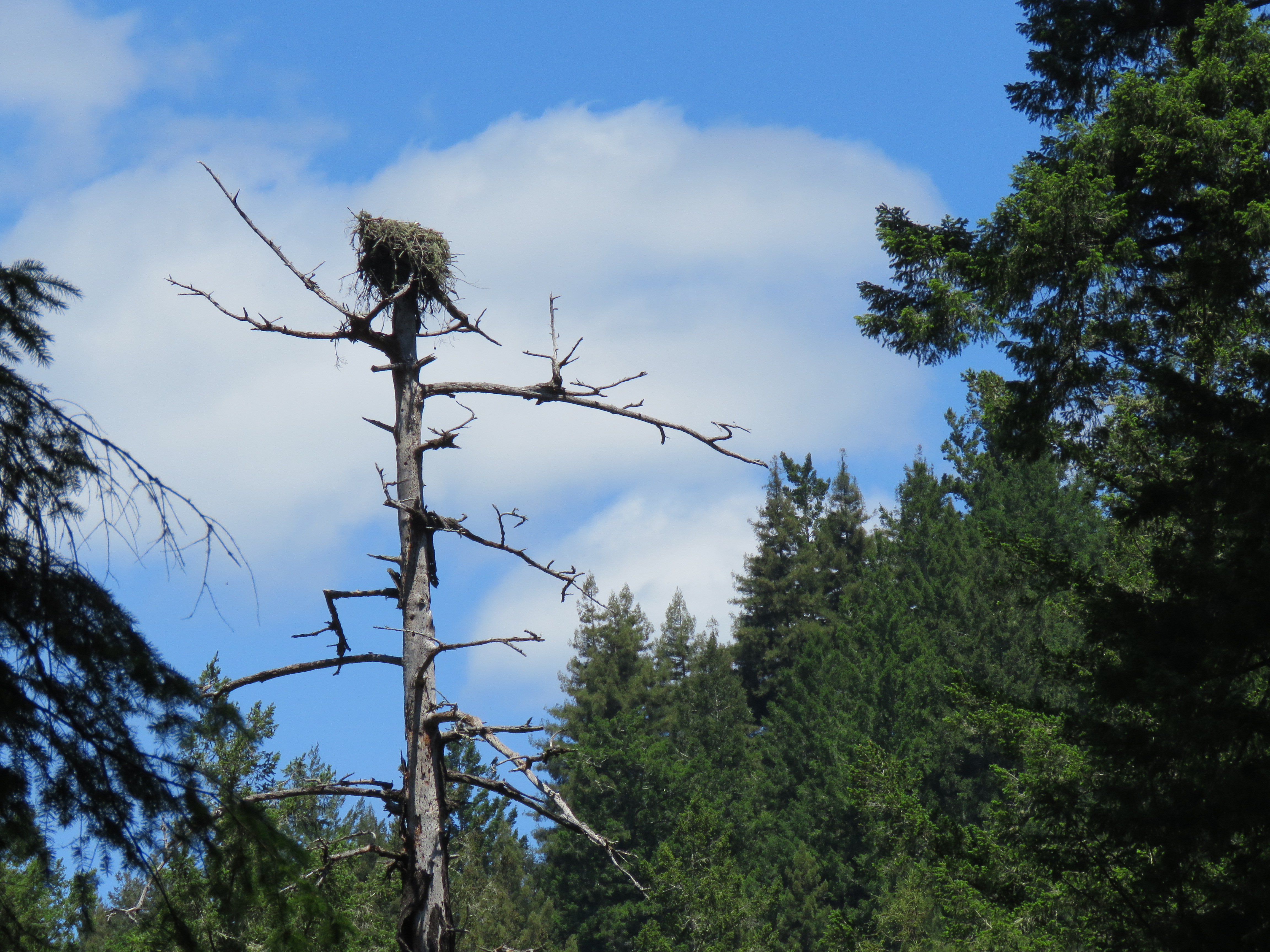
Ten minutes later the osprey nest appeared across the river between a break in the redwoods and firs. I put bins on the nest and could not detect any occupants. But osprey nests are deep and the osprey could be laying low. The only sign of life were the acorn woodpeckers that looked to have used the fir as their granary tree, their acorn larder, for years.

I was at a point in the line where the railroad curves gracefully over a curved viaduct. The concrete arched bridge was build by the Southern Pacific Railroad in March of 1905 and spans Coon Gulch. At this point the San Lorenzo River takes a turn and you can get an amazing view upstream. This point in the line is known as Inspiration Point.

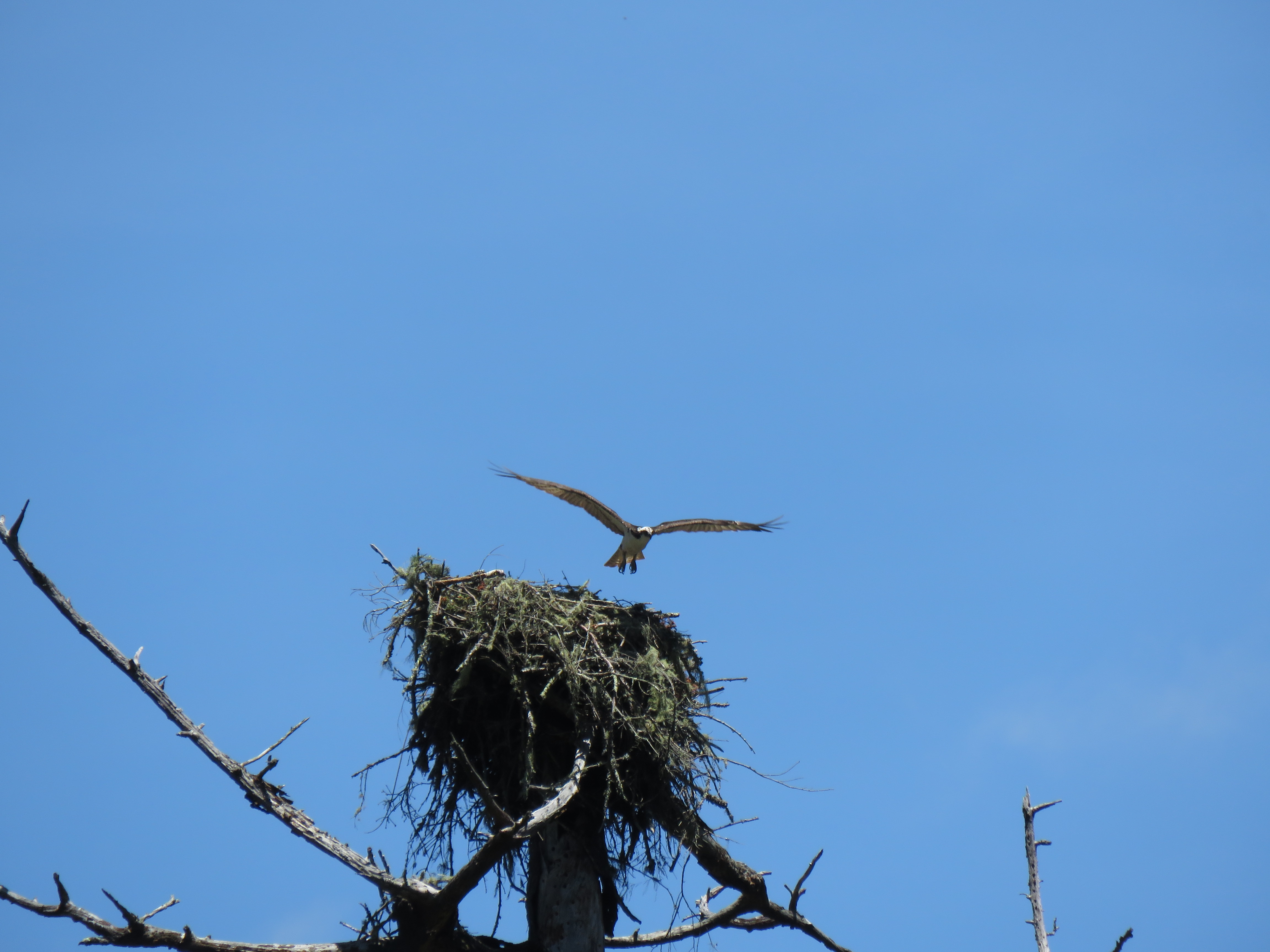
It didn’t take long to see signs of life. An osprey flew in and briefly alighted on the nest. Bingo! The nest is occupied after all. The unseen osprey, presumedly sitting on eggs, sat up in the nest and became visable.

The osprey that flew in could have been the male who is responsible for bringing fish to the nest while the female does most of the incubating of the two to three eggs. The male perched near the nest on a Doug-fir and preened.

First sign of life at the osprey’s nest. Perhaps the male dropping off fish.

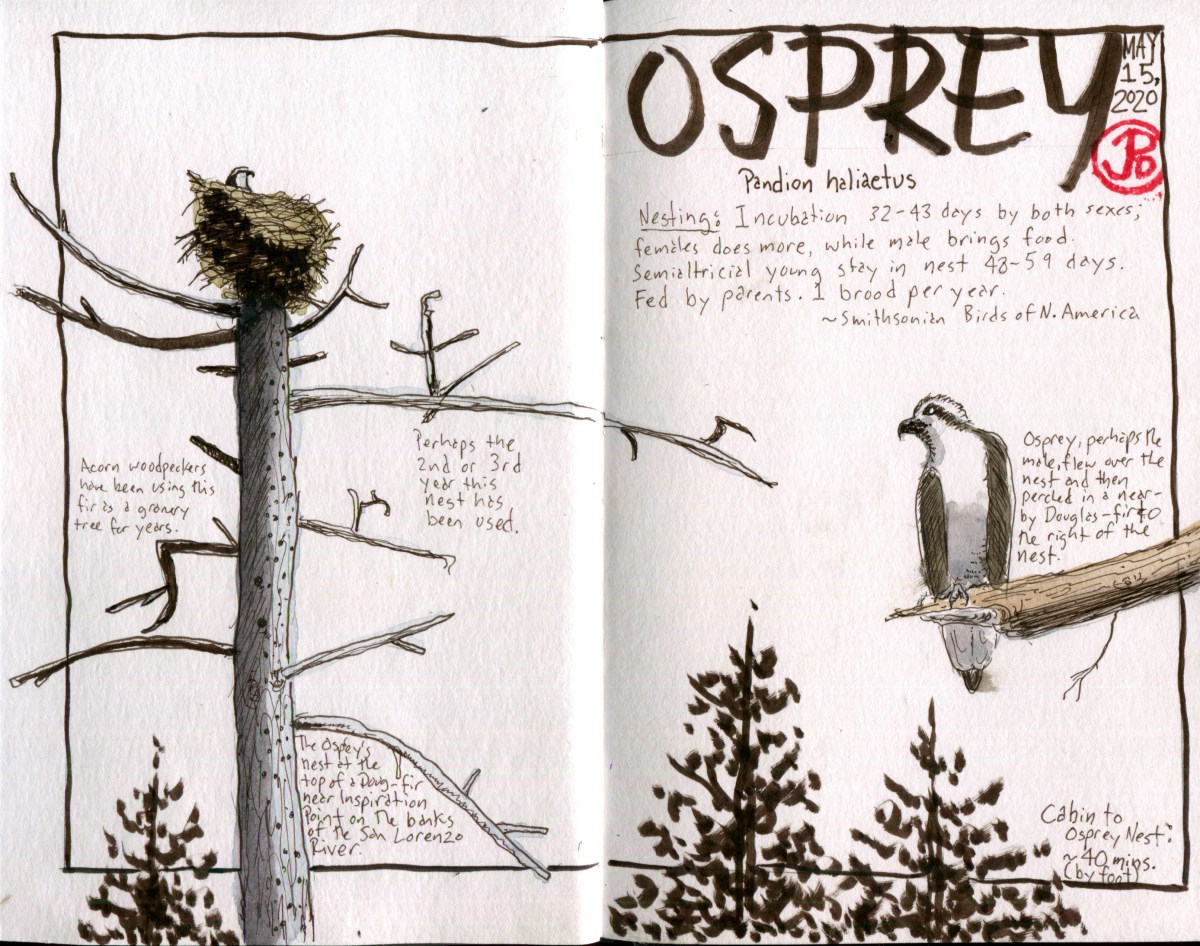
I stood by the railside and sketched the nest. On the left side of the spread is my field sketch (first in pencil then in dark sepia pen) of the Douglas-fir crowned by the osprey nest. The osprey perched on the right was drawn from a field photo I took of the presumed male. The title and text were added back at the cabin. In the end, I decided to create a spread that is almost monochromatic. I resisted the urge to paint in the sky because I didn’t want anything to distract from the form of the Doug-fir and nest.

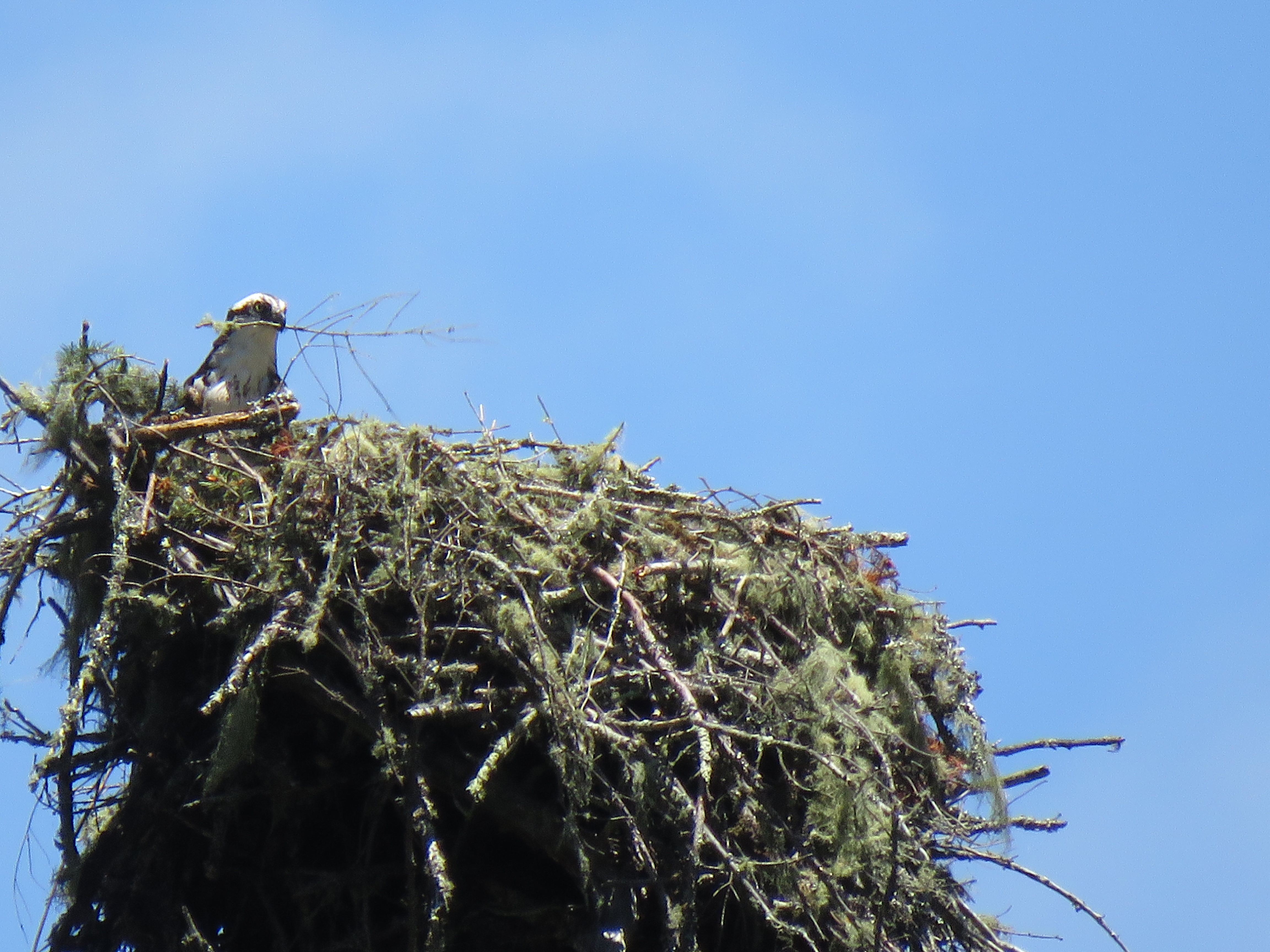
The osprey doing a little housekeeping at the nest. This is presumedly the female who does most of the incubation of the eggs. Both sexes build the nest. A hiker who stopped to look at the nest told me that the nest had been there for past two or three years.
Ospreys reuse their nests each breeding season. A lot of work has gone into this nest over the past two or three seasons.
Image

Santa Barbara Station

The Surfliner was an hour late and I would have even less time to spend with Santa Barbara’s beautiful station. I had to catch the number 14, Coast Starlight back to SLO at 12:40 PM. So I figured I had time for a quick 45 minute sketch and an even shorter lunch but I couldn’t wander too far from the station. Revisiting the “Queen of the Missions” was out of the question.

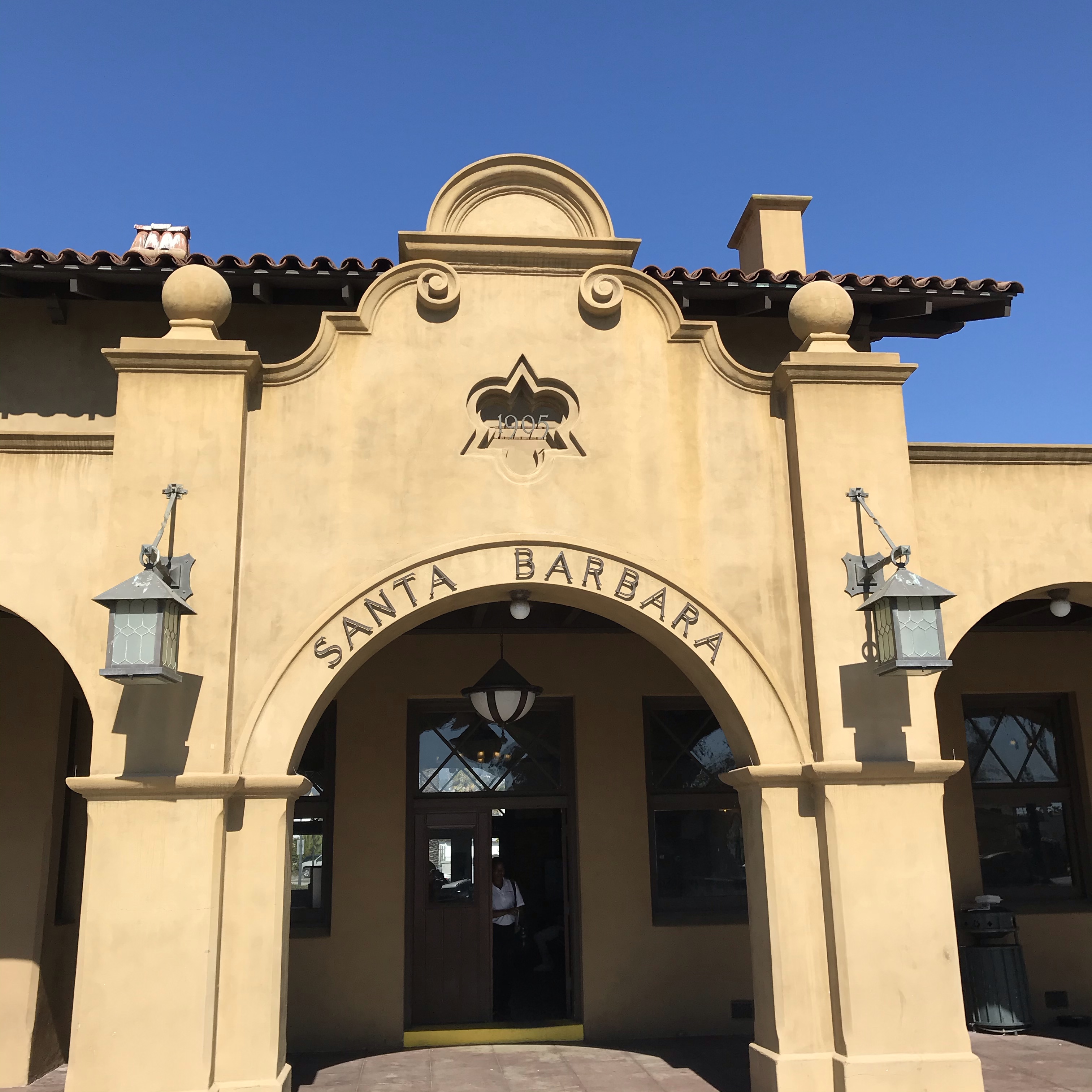
I walked around the station, “shaking hands”with the place. The Santa Barbara passenger station was completed in 1905 and designed in a Spanish Mission Revival style, very much reminiscent of Burlingame Station. This building has all the hallmarks of Mission Revival: arches, a star window (in imitation of Mission Carmel), and adobe tiled roof.

The woman’s waiting room at Santa Barbara Station. Above the fireplace is a base relief representation of Father Serra, founder of the Alta California Missions. He is spreading his arms wide, waiting to hug any neophytes that happen to be in the Station’s waiting room.

Santa Barbara Station was one of seven stations that the Coast Daylight served. The route parallels El Camino Real, the Royal Road, that connected 21 of the Spanish Missions along Alta California’s Coast.

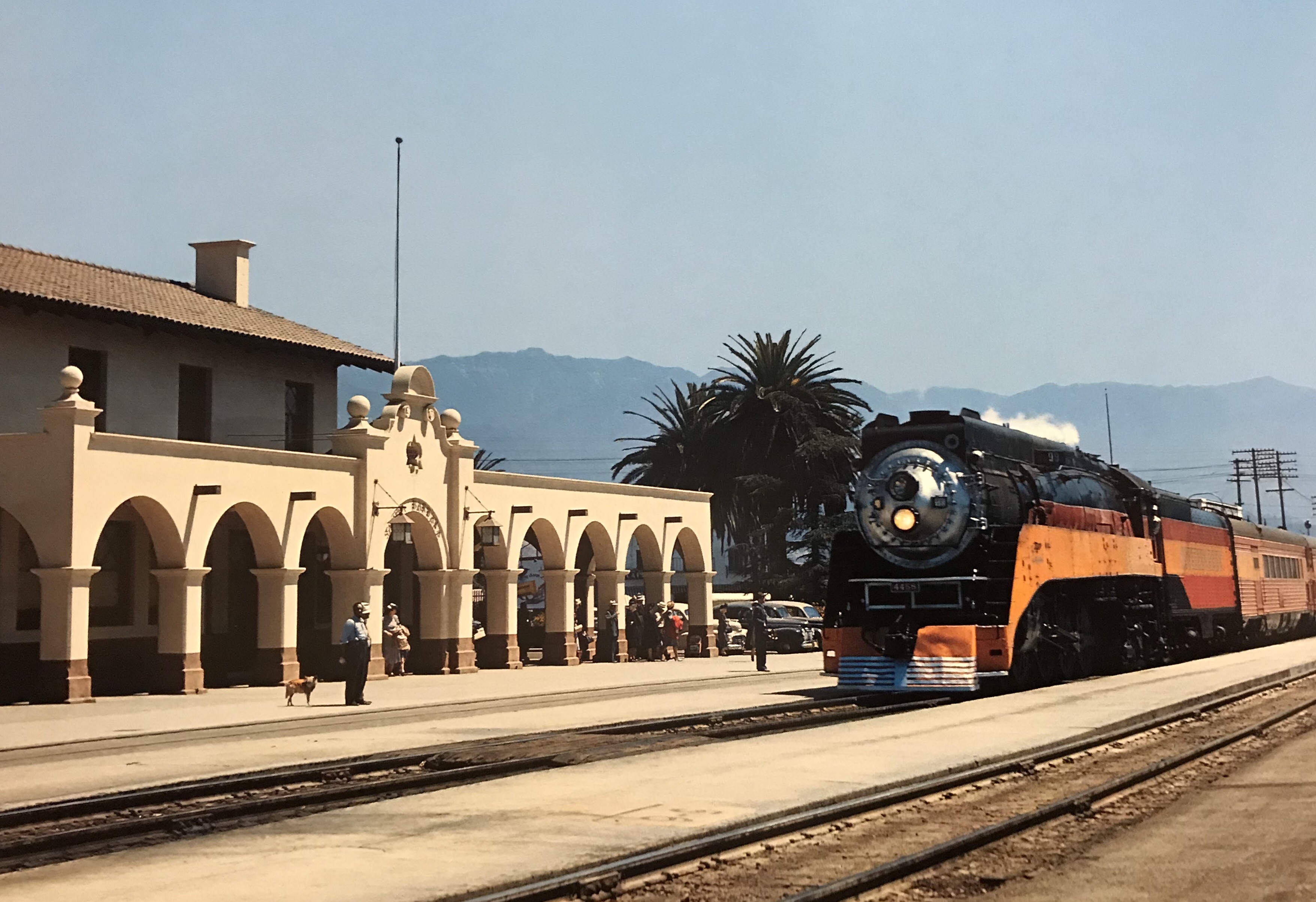
GS-5 Number 4458, pulls into Santa Barbara Station at an unspecified date. The loco pulls train No. 99, a northbound Daylight to San Francisco. There were only two GS-5 locomotives built. Numbers 4458 and 4459. (Union Pacific Museum Collection: SP photo)
Golden State-4 number 4443 taking on water at Santa Barbara in January 1948. The train stopped in Santa Barbara for only four minutes before heading south towards Los Angeles. (Alan Miller Collection: Frank Peterson photo)

The train station served the ever growing resort town on the Pacific Ocean that catered towards the high-end.

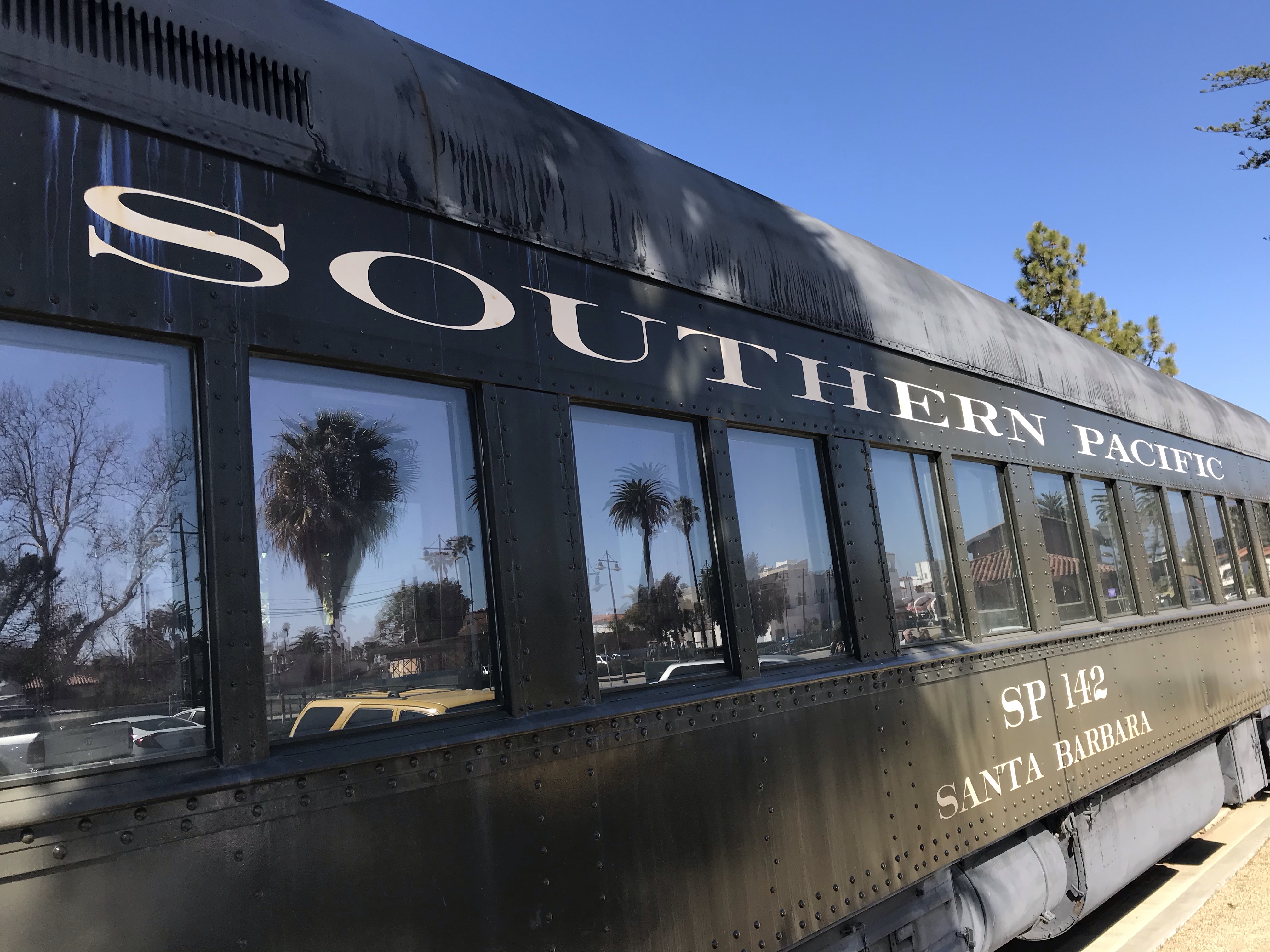
A sign of the wealth and affluence of this area is the Pullman car that is on static display near the train station. Pullman passenger cars where a huge improvement in comfort and safety from the rickety, wooden cars that were uncomfortable and sometimes downright dangerous. They were the height of luxury at the time, for the well-off passengers who could afford to ride on one.

But the Pullman car at Santa Barbara is something very different. In the later part of the 20th century, Pullman produced passenger cars for the extremely wealthy, that could cost up to half a million dollars, which was twenty times the cost of a standard Pullman passenger coach. These cars were considered “mansions on wheels”. They where coupled to the end of a passenger train and at Santa Barbara there were siding tracks where these luxurious cars would over-winter as their owners stayed in nearby posh hotels.

After my sketch I walked down State Street toward the Pacific Ocean and I was passed by a twenty-something driving by in a brand new Rolls Royce, a modern Santa Barbarian mansion on wheels.

Some things like the station and mission remind us of a very different time while others show us that things remain very much the same.

Image

San Luis Obispo Station (Post #300!)

San Luis Obispo marks the midway point on the Coast Daylight passenger route between San Francisco and Los Angeles.

The town is named after the Spanish mission that was founded in 1772 by Father Junípero Serra. It became an important railroad town because it was at the southern end of Cuesta Grade.

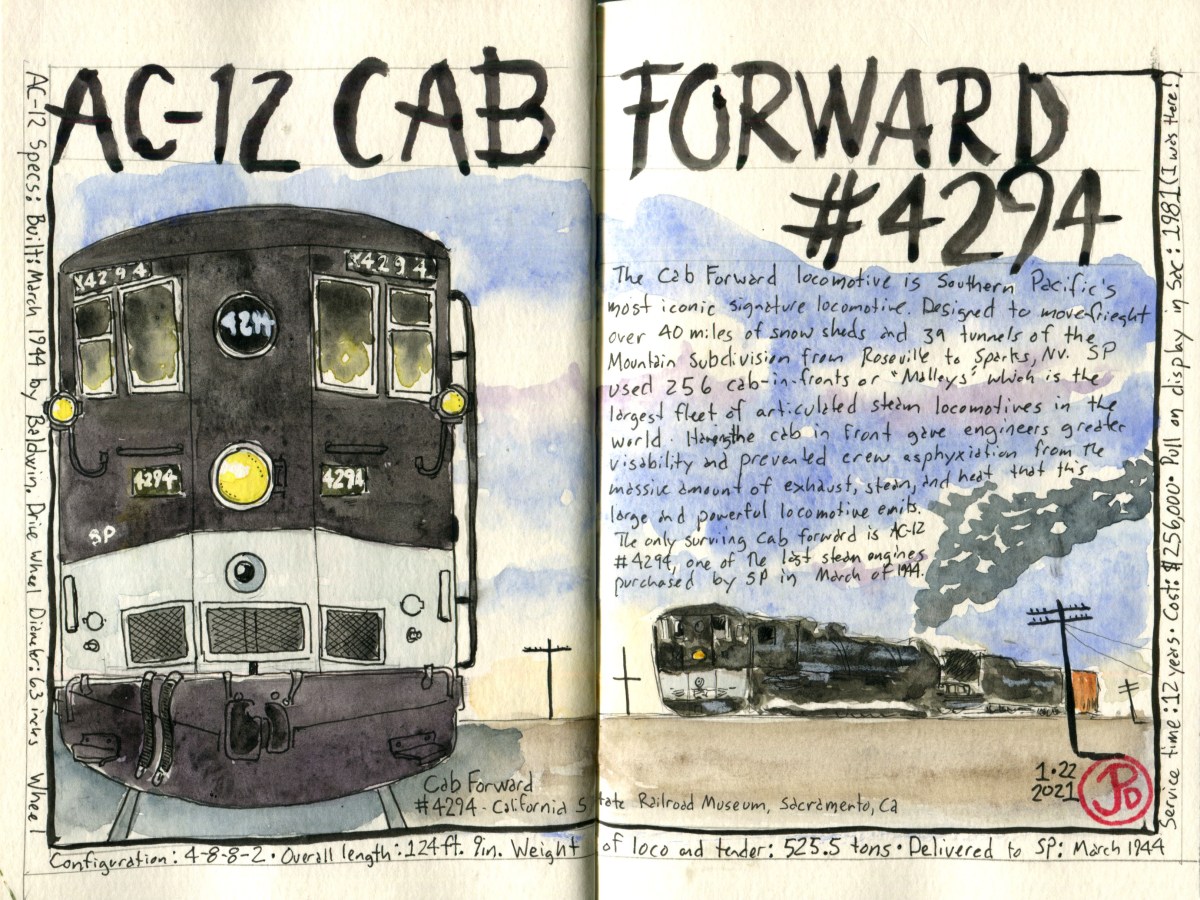
It was a division point on the then Southern Pacific Railroad (now Union Pacific) and because of it, the town had shops to service the locomotives, a roundhouse to turn engines around, and a wye to turn the massive cab-forward around (because it could not fit on the turntable.) This large articulated 4-8-8-2 engine was designed to go through the long show sheds and tunnels over Donner Summit but later, in the 1950s, pulled freight over the coast line and acted as a help engine.

SLO Roundhouse

A quick brush-pen sketch of the site of the roundhouse and turntable. While now little is left of the roadhouse, at the height of operations, the yard employed 44 men. The pile in the foreground are rusted railroad spikes. The line of boxcars in the background have been waiting in storage on a track siding for three weeks.

It was here at San Luis Obispo that northbound Daylights took on a helper to make it over the Cuesta Grade and its where a southbound train had their helper locomotives taken off.

The passenger depot was built in 1943 in a Mission Revival Style, slightly echoing the Spanish Mission that the city is named after.

Across the tracks from the station is the 65,000 gallon water tower used to water the steam locomotives that worked this division. The tower was built in 1940 and has been saved from destruction by the city of SLO. Often engines and crew where changed here but the Daylight GS-4 locomotive would make the entire San Francisco to Los Angeles run without being changed out at San Luis Obispo.

The station is still used as a passenger station although freight trains over Cuesta Grade have stopped. Both the Coast Surfliner and the Coast Starlight stop at this station. But more on these routes in a later post.

Three hours after leaving Santa Cruz, I set up my camp/sketch chair across from the station and sketched an elevation view of SLO Station. It was a glorious morning!

Image

Salinas Station

After sketching historic passenger train stations between San Francisco and San Jose, I decided to expand my scope by visiting all of the existing stations on the Daylight Route from San Francisco to Los Angeles.

Salinas is probably best known as the birthplace of writer John Steinbeck. It is also known as the “Salad Bowl of the World” because its marine climate makes it an ideal location for agriculture. But I was here because it was the third Daylight stop on the line out of San Francisco. This would be the connection point for any traveller from the Monterey Bay Area wishing to head south to The City of Angels or north to the City of Saint Francis.

Salinas Station was built by Southern Pacific in 1941. It is designed in an Spanish Revival Style, with its red tiled roof, mixed with touches of the then popular Art Deco style, shown by its clean lines, letter design, and interior.

The station’s construction coincided with the rise of Southern Pacific’s premier passenger train, the Daylight Limited. Promoters called the Daylight, “the most beautiful passenger train in the world”. And this was not mere hyperbole.

This station bears a few commonalities with the two Daylight stations that still exist in the Bay Area, Palo Alto and San Jose. All three stations have murals painted by John MacQuarrie. And two of these murals feature Southern Pacific’s most beautiful locomotive at the the time the GS-2. This streamlined 4-8-4 is in the Palo Alto Station and here at the Salinas.

When the station was completed in 1941, the zenith of Southern Pacific’s passenger steam locomotives had arrived in the “super power” of the GS-4. The increased ridership of this route is evidenced by the the fact that Southern Pacific ordered 28 locomotives from the Lima Locomotive Works between 1941 and 1942.

The John MacQuarrie mural at Salinas was painted in 1941 (the same year as the Palo Alto mural) and prominently features the star motive power at the time, the Golden State 2 (GS-2). Six of these locomotives were built and went into service in 1937.

It was a beautiful winter day in Salinas with a high of 70 degrees. I walked around the station and at the platform, a Los Angles bound Coast Starlight was paused to pick up passengers for destinations to the southland. This Amtrak train replaced the Daylight in 1971. At least from Salinas to Los Angeles.

Salinas station was a station that was still in use. There are actual humans attending to the ticket window who could actually answer questions and issue tickets. The interior contained bathrooms, food vending machines, and benches for passengers waiting for their train to arrive. It was nice, for a change, to see a train station being used for its intended purpose.

It’s great to see that Salinas Station is still a vibrant station on the former Daylight Route. The car to the right is where I would probably be: the Lounge Car! To the right is a couple waving their loved one goodbye and safe travel.

I set up my camp/ sketching chair across from Salinas Station and started to sketch. I originally wanted to sketch the station from a formal view but the parking lot was being rebuilt and was fenced off. So I sketched a little bit off center.

Next to the station is the Monterey & Salinas Valley Railroad Museum. They have a collection featuring a Southern Pacific steam locomotive switcher, a Southern Pacific caboose, and a few rail cars on static display.

Southern Pacific switcher Number 1237 on static display in Salinas. This locomotive is pointing to the north but will likely never move north again.

Image

San Jose, the End of the Line

“I became quietly seized with that nostalgia that overcomes you when you have reached the middle of your life and your father has recently died and it dawns on you that when he went he took some of you with him.”
― Bill Bryson, The Lost Continent: Travels in Small Town America

My last historic station sketch was a short train ride down the line from oldest station on route in Santa Clara. This was the end of the line for most southbound Caltrains, San Jose’s Diridon Station.

This is a station that was built to impress, a station to represent a major city and not a town. Much like San Francisco’s old passenger station at 3rd and Townsend Streets.

San Francisco’s main train station was built in a Mission Revival style like Burlingame Station. It was opened in time for the Panama-Pacific International Exposition in 1915. This grand station stood until July 1975. It was torn down because, according to Southern Pacific, it had “outlived its usefulness”.

San Jose’s Station, by contrast, still survives and is in use. The station was designed by SP architect John Christine in an Italian Renaissance Revival style. It cost $100,000 to build and was opened on December 30, 1935.

The interior is grand, featuring a high ceiling with large roof beams and hanging chandeliers. At the northern end of the depot is a mural by John MacQuarrie, at the south end is a clock.

This has always been a busy place. Many routes pass through this station. I remember boarding the Coast Starlight here for a trip to visit a friend in Eugene, Oregon. In its heyday the following routes stopped at this station: the Lark, Coaster, Daylight, Del Monte, and Sunset Limited. Today the station serves Caltrain, Altamont Commuter Express, Capital Corridor, and the Coast Starlight.

I set up my sketching stool on the lawn across the street from the station and started to sketch San Jose’s imposing station. In the background a woman loudly gave a sermon to an audience of none while she waited for a bus.

Coda

The last railway journey of this project was bittersweet for me.

The train ride was through the southern part of the line and through the memories of my youth. There were bits of my youth still standing but much of it altered or gone completely.

The Sunnyvale train station, where I would come to watch commuter trains with my father, was gone now, along with my father. In its place there was a parking structure with a shelter covering a few benches and a ticket machine.

An August 1977 still frame from one of my dad’s Super 8 reels showing a shirtless me watching a commuter train pull into Sunnyvale Station. My brother looks on from further back. I was six years old.

On the east side of the tracks, just out of the Sunnyvale station, was the former Westinghouse Plant (now Northrop Grumman). This is where my father worked for most of his adult life.

Beyond Sunnyvale, the line was surrounded by tech buildings, parking structures, and concreted clutter. The former orchards of the Valley of Heart’s Delight have been paved over years ago. Change is the creed and mantra of Silicon Valley.

The touchstones to the past where to be found along the line in the eight historic passenger train depots I had sketched. They could not be changed or destroyed because they were designated historical landmarks.

On my return journey from San Jose Station I sat on the east side of the train and watched the ever passing progress of the valleys build up. This was a landscape void of familiarity for me. Sunnyvale was much changed with multi-story buildings cluttering and changing its skyline.

We pulled into Mountain View Station, the next stop north of Sunnyvale, and I looked down at the platform at the passengers waiting to board. That’s when I saw an unexpected part of my past, not a place but a person.

It was Rosemary. My neighbor from Cormorant Court, the street in Sunnyvale where I grew up. But she was much more than a neighbor, she is family, so much so that my brother and I call her Aunt Rosemary. Our families still celebrate the holidays together, long after both families have left Cormorant Court.

I realized that the past is not just made up of places or things, but of people. Like Rosemary, who has known me longer than I’ve known myself.

I walked back a few cars to find her and we talked and I showed her some of my sketches and we enjoyed our brief journey together until I disembark at Hillsdale Station.

It seems fitting, that on my quest to find the past, that I found mine at Mountain View Station in the city of my birth. I’ve been finding the past in stone wood, glass, tile, and steel, forgetting the true treasures of the past that are made of flesh and blood.

These are not only the people we know and love throughout our journey here on earth, but also the people that designed, built and use these stations along the railway corridor. After all, these are not just buildings to be looked at but they are meant to be used by the people who fill them with love and life.

Amen