Image

SLO Watertower

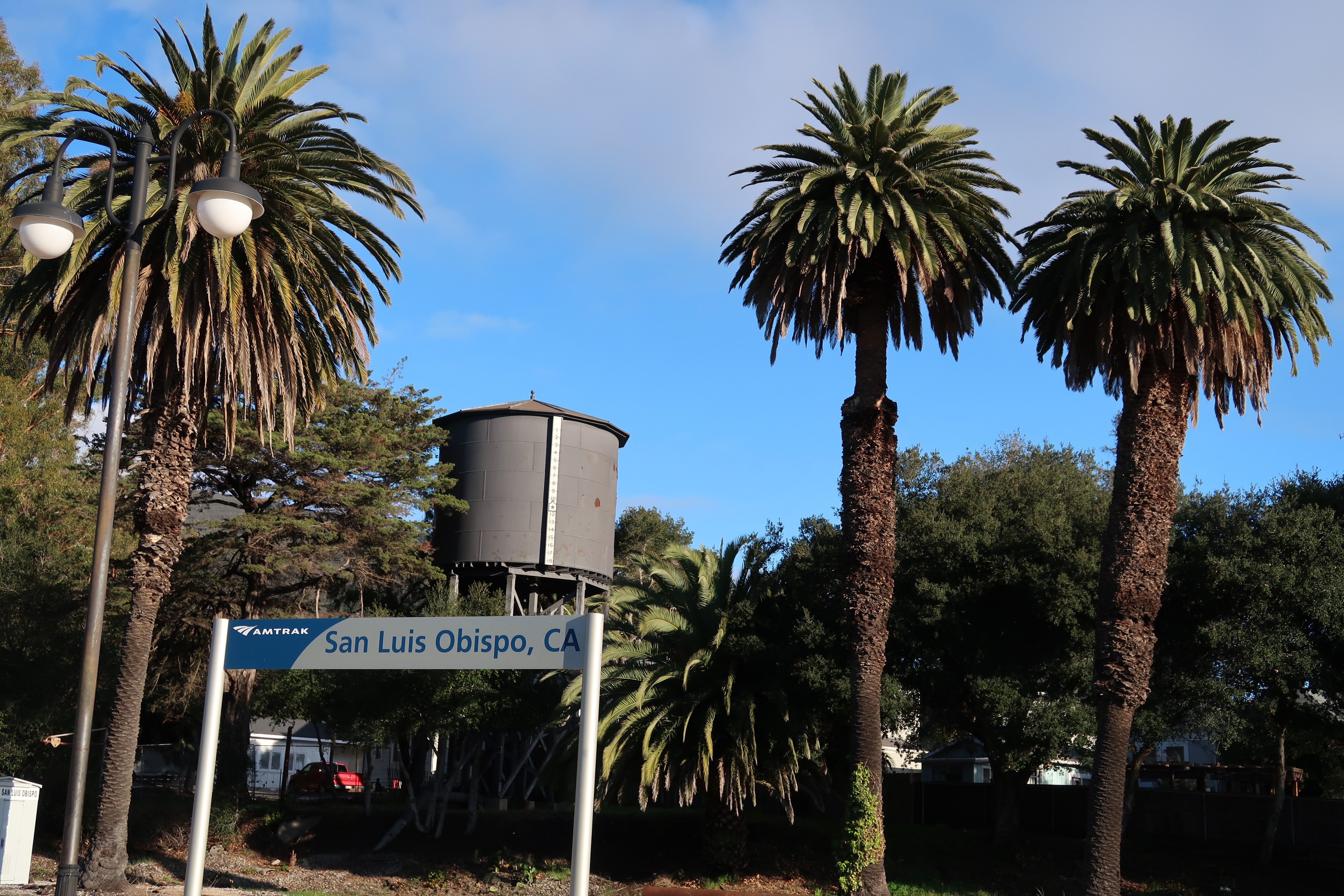
On my way back to the Bay Area from my Malibu adventure, I overnighted in San Luis Obispo. There was a water tower, across the line from the passenger depot that I wanted to add to my sketchbook. One of the few Southern Pacific water towers still standing in California.

I timed my visit with the arrival of Train # 14, the northbound Coast Starlight. This is an AMTRAK route that starts in Los Angles and terminates in Seattle, Washington.

I had about 20 minutes to sketch the water tower before the 14 pulled into San Luis Obispo. The train was already running 30 minutes late. I picked my position and started to sketch. A voice over my shoulder ask if was riding coach or had a roomette.

The voice belonged to an AMTRAK conductor who was about to board the train, SLO is a crew changeover point. I told him I wasn’t boarding the train, just sketching the tower. We had a conversation about other Southern Pacific existing water towers. He recommend a very large tower in the desert of Arizona that I should visit.
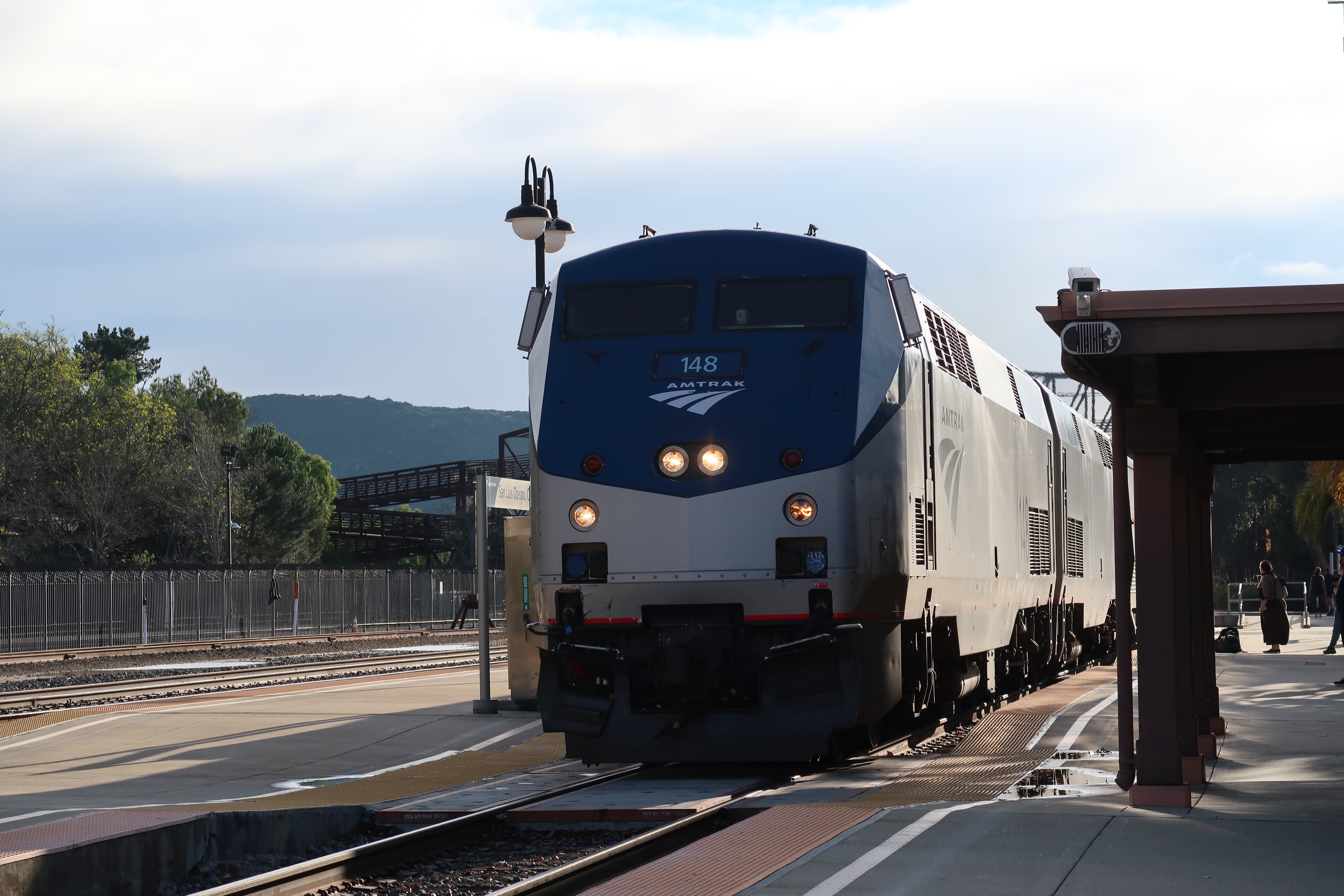
The Coast Starlight arriving at San Luis Obispo, 30 minutes late.

With the recent heavy precipitation over Donner Pass, I wondered aloud if the rotary plows at Roseville had been put to work to clear the pass. The conductor didn’t know. Before long the Coast Starlight pulled into the station and I looked down at my sketchbook and I hadn’t gotten very far but I had a nice conversation with a railroad working man. Two rail nerds chewing the fat!

SLO is was is called a stretch stop, also known in another time as a smoke stop, where the Starlight pauses for about 20 minutes so passengers can get out and stretch their legs, or poison their lungs with nicotine. This is also where crews, engineers and conductors, change over.
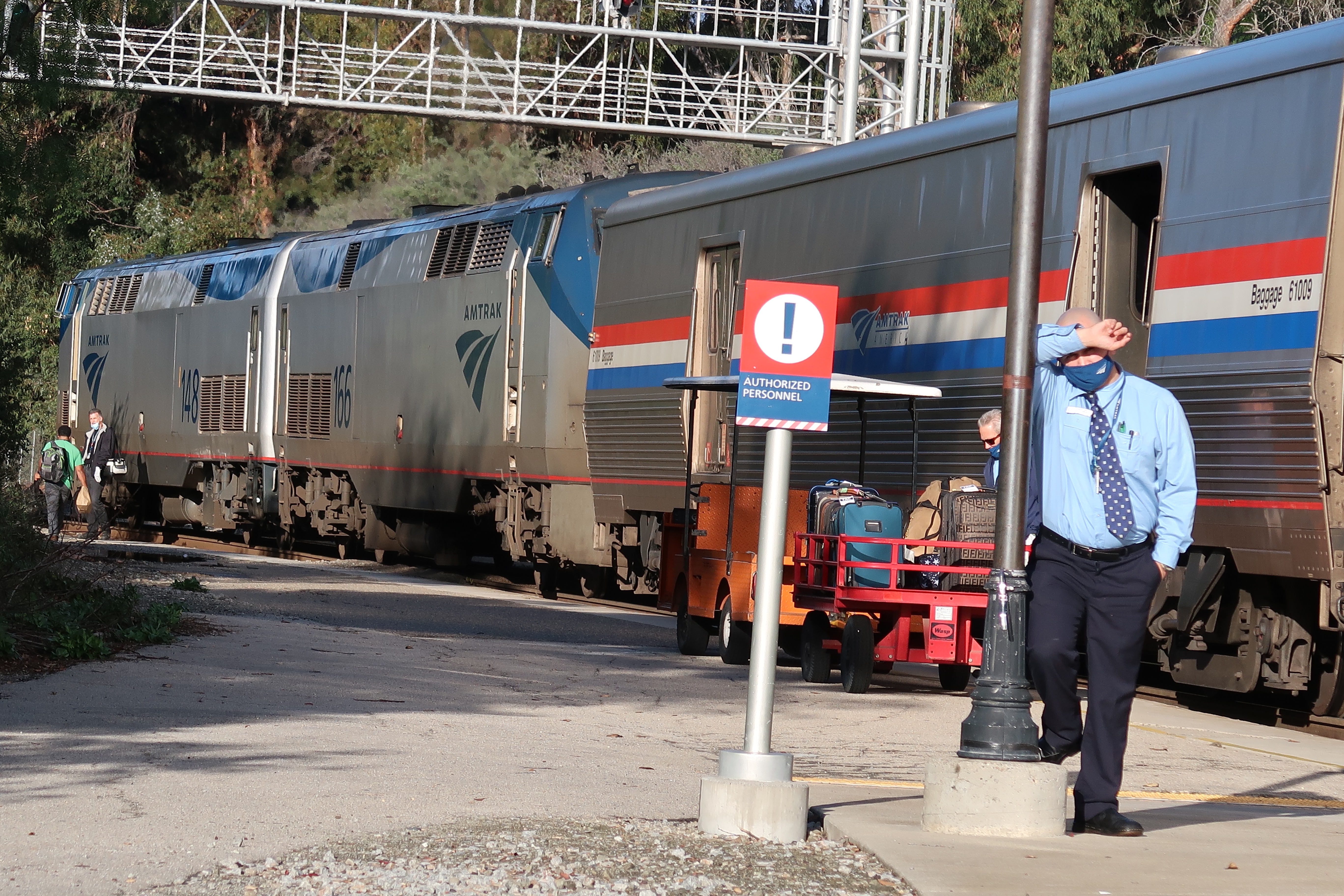
This photos says a lot. The conductor monitors the progress of boarding the train, baggage is being loading into the baggage car, and the engineers are changing over.

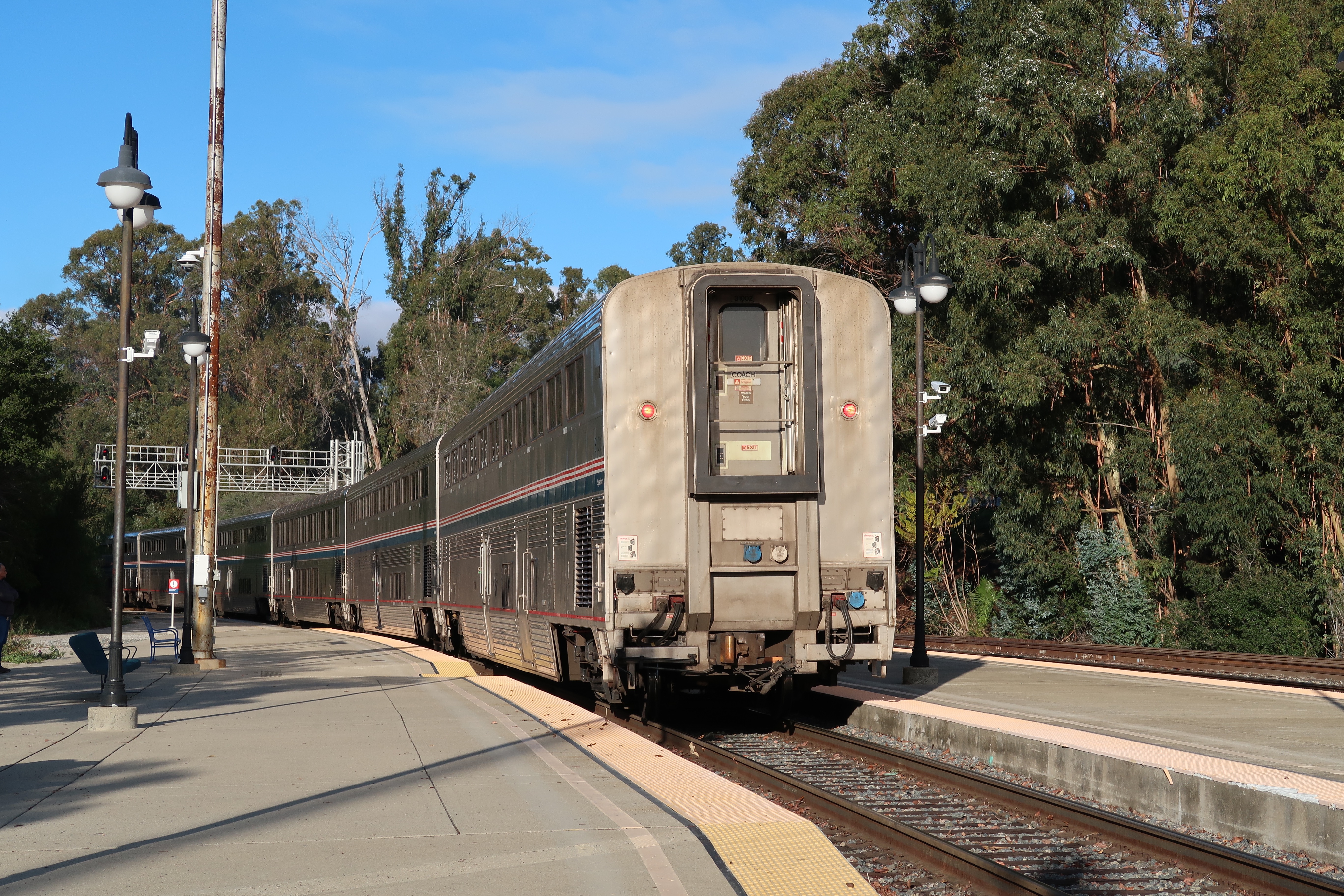
I couldn’t continue sketching because a double decker Superliner passenger car was now between myself and the historic water tower. So I watched the interactions on the platform instead. Passengers where doing laps, other where boarding, some hanging back from the train were vapping, and the train crew was in the process of changing over.

“All aboard!” And passengers filtered back into the cars. The locomotive sounded it’s horn. It was time for the Starlight to start its climb up the Horseshoe Curve on the Cuesta Grade and I watched the train slowly disappear around the curve.
I now turned back to the water tower and restarted my sketch.

The SLO 65,000 gallon water tower was built in 1940, at a cost of $2,130. The watertower was built across from the passenger station so steam locomotives could take on water without having to back into the yard further south down the track. At that time, ten passenger trains passed through SLO. The tank was in service until 1956, when steam was replaced with diesel on the coast line. The tower was preserved and restored by 1998.
Image

Sacred Sites the Union Pacific: Wyoming

On my journey from California to Colorado, I had a few historic sights I wanted to sketch along Highway 80 in Wyoming. This is Union Pacific territory, and the route over the Wasatch Mountains from Ogden Utah to Green River is legendary.

The Evanston Roundhouse and the Ames Monument are relics from a different time. The roundhouse was of a time when steam was the prime motive power of the Union Pacific and the monument the Ames brothers at Sherman Summit is no longer near the mainline (the line is now three miles to the south).

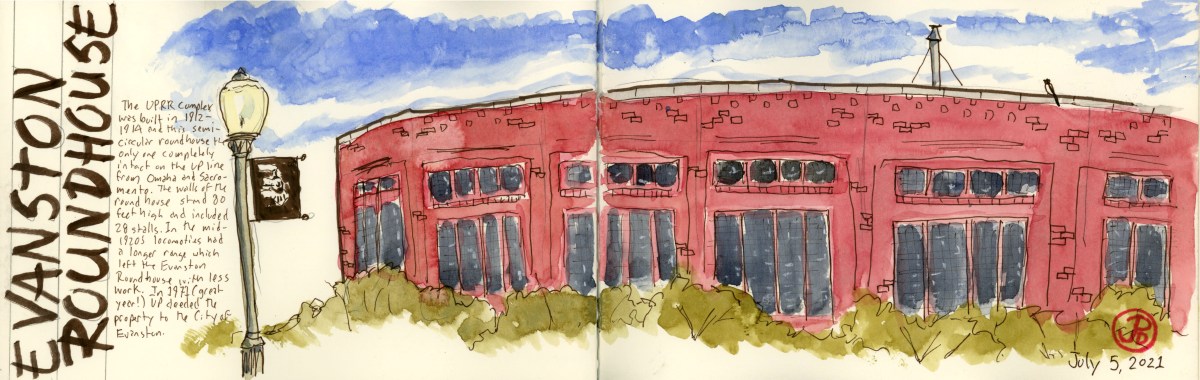
The Evanston Roundhouse is notable because it is the last completely intact roundhouse left on the Union Pacific line from Sacramento to Omaha. It had 28 stalls and is 80 feet high.

The roundhouse at Evanston on the left and the powerhouse on the right. The rusted, overgrown tracks in the foreground tells us that this complex has not been used by Union Pacific for a long time. I had to walk a ways back to photograph the whole massive roundhouse.

The roundhouse and yard was build by UP from 1912 to 1914. The roundhouse was part of a 27 acre complex to service steam locomotives. When steam locomotives became more efficient, they did not need to make so many service stops and the yard at Evanston was often bypassed. The Union Pacific deeded the property to the City of Evanston. The roundhouse is now used as a conference center and a meeting place.

Standing before the red brick semicircular roundhouse reminded me of a Plaza de Toros in Spain. Looking at just one part of the structure gives no indication of it’s form. I sketched one side of the roundhouse with the roofline slowing curving around (featured sketch). To see the entirety of the roundhouse, one has to walk back from the roundhouse by at least 100 yards to take it all in.

An intermodal freight passing through Evanston. The two locomotives on point represent the Transcontinental Railroad. The Union Pacific is pointed east towards Cheyenne and behind # 8990 is a former Southern Pacific locomotive (representing the Central Pacific) facing west toward Sacramento.

The next Union Pacific site is to be found off Highway 80 near the town of Buford (population 1). This is a monument to two brothers who were essential in creating the Union Pacific side of the Transcontinental Railroad.

The Ames Monument was built by the Union Pacific and dedicated to the brothers Oakes and Oliver Ames. It marked the highest point on the original Transcontinental Railroad at Sherman Summit at 8,247 feet. Oliver was one of the first presidents of the Union Pacific Railroad (from 1866-1871) and his brother Oakes was a U.S. Representative from Massachusetts. Both brothers, at the request of Lincoln, were put in charge of financing and building the Union Pacific portion of the railroad. Without the contribution of the Ames brothers, the railroad might never have been completed.

The 60 foot pyramid was build in 1880-1882 of granite at the cost of $64,000. On two side are base-relief portraits of each brother. In 1901, Union Pacific rerouted the mainline a few miles to the south.

On my first attempt to sketch the Ames Monument, a thunderstorm rolled in from the west. This monument being 60 feet high and at one of the highest points on the original Transcontinental Railroad, I though it would be wise to head to my car and return in the morning!
Image

Underpainting

I wanted to experiment with underpainting for some recent field sketches. First I put down a loose, cool, blue wash and on another page a warm orange-red wash. I kept it loose with some paint splatter and some ghosting.

Now I had to find a subject to lay over the wash.

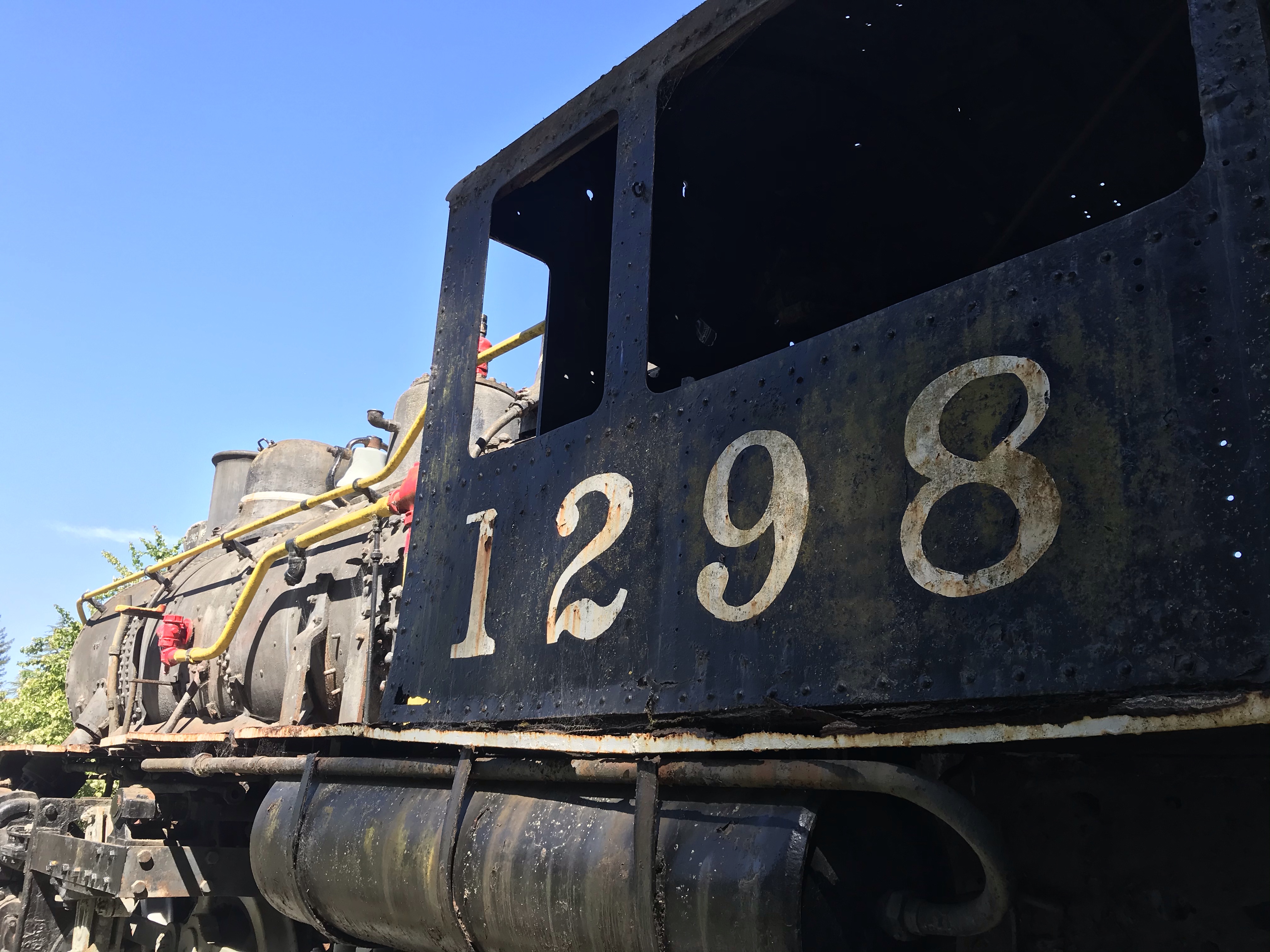
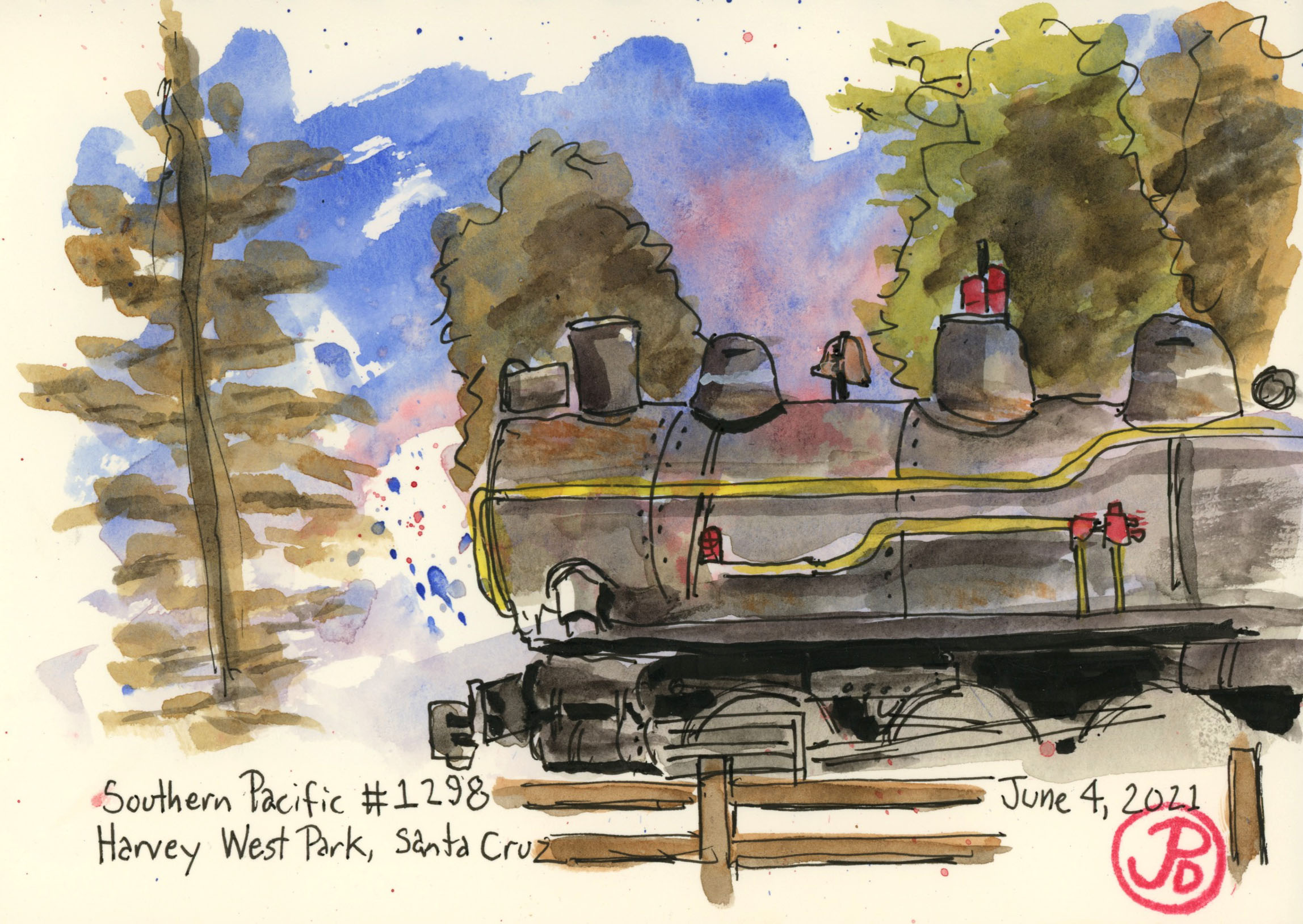
My first subject was to be found at Harvey West Park in Santa Cruz. It was a Southern Pacific 0-6-0 switcher that is on static display in the picnic area. Southern Pacific Number 1298 is an S-10 class yard switcher that was build by Baldwin in 1917. The locomotive was retired in 1956 and was put on static display in Santa Cruz in 1961. In an earlier era, when things was less litigious, children where able to climb on the locomotive and tender. Now the tender was sold and the rusting Number 1298 sits fenced in, in need of a lick of paint.

The word static, implies “not moving”, which is a perfect sketching subject because, well, 1298 is not moving. It was a great subject to capture the form of the locomotive and the trees in the background. For this sketch I chose the page with the cool blue underpainting. I figured it would also work with the sky.

I loosely sketched in the form of the locomotive, tiring to keep details to a minimum. I failed to some degree because I think I added too many details, a problems I have with sketching a highly detailed subject like a locomotive or architecture. The running gear (the driving wheels that propel the locomotive) I simplified and left out a lot of information.

When you put wet watercolor paint over dried paint, it is called glazing. When you glaze in watercolor you can build up layers and depth. Because watercolor is transparent, the underpainting shows through in unexpected ways. And with using a fairly random underpainting the result can be a bit jarring but somehow seems to work. It’s just a sketch, after all.

For my sketch I laid over the warm orange-red wash I choose a jarring subject.

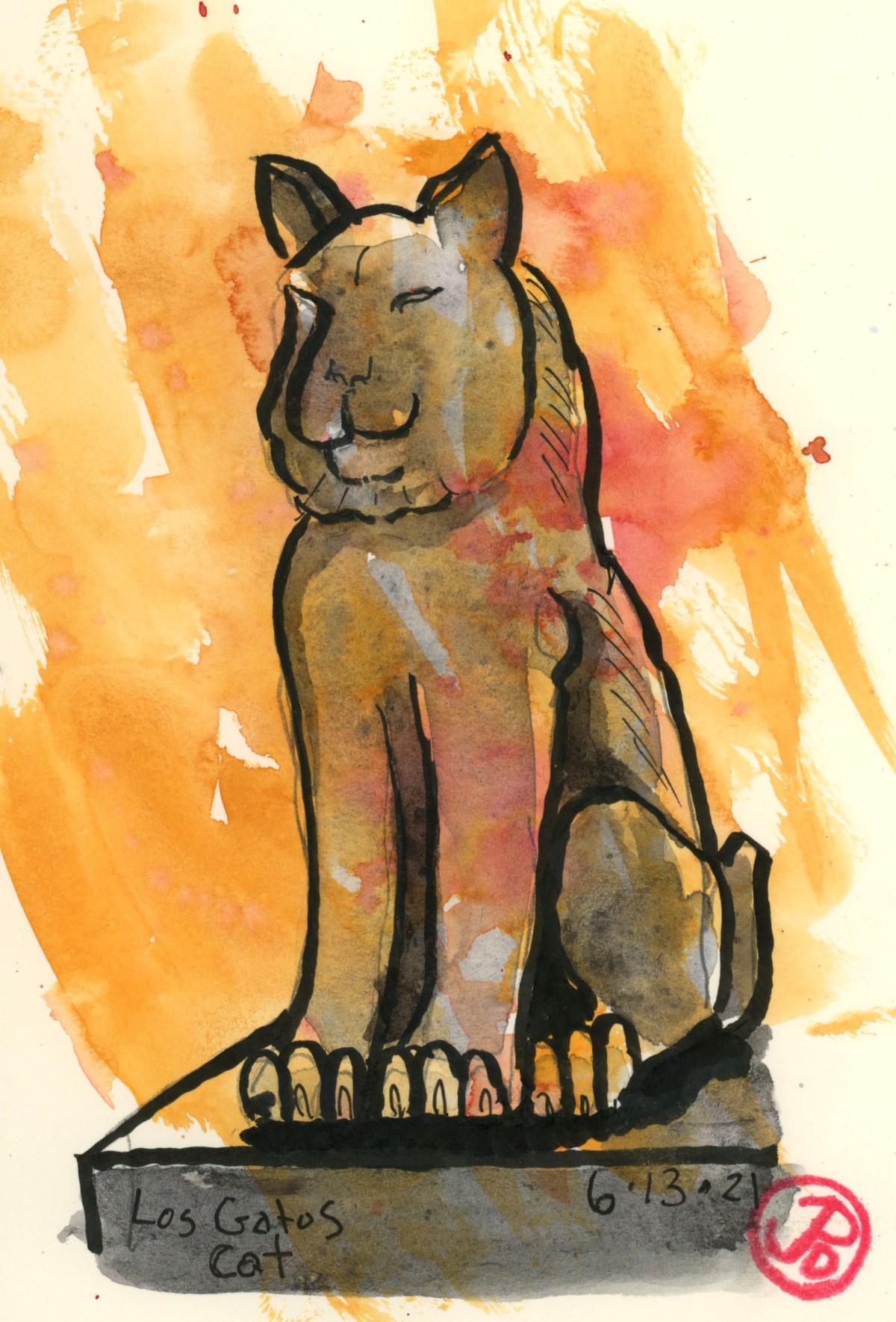
Just outside of Los Gatos, off of Highway 17, are two stone lynx-like statues that guard the driveway to Poets Canyon. The sculptures where created by Robert Paine and are named “Leo” and “Leona”. The sculptures have been in place since 1922. To get to this location is challenging because you can only turn west on Highway 17 (the direction whence I came).

Lucky for me, two 8 foot replicas are to be found at the Los Gatos Shopping Center on Santa Cruz Ave. The new cats are carved out of white marble and weigh in at 6,500 pounds each!

The underpainting is warm and I made no concessions to the true color on the statues. I like the way the sketch turned out (featured sketch).

Image

Davis Station

My brother spent almost half of his life in the Central Valley college town, Davis, California. He attended the University of California at Davis (UCD), worked in it’s public and private schools, got married, and raised his three children in “The City of All Things Right and Relevant!”

For Mother’s Day we where meeting my mother and sister-in-law in Davis so I arrived a little early to I sketch the historic train station and do a little railfanning.

Most towns start with a train station and Davisville, as Davis was then known, got their passenger depot in 1868. The original station burned down and the current station was built by Southern Pacific Railroad in 1913. The station is built in a Mission revival style. The University Farm, which later became UCD, opened five years before the current building was finished. At the time, the University wanted a befitting station to the town and the university stop. And they certainly got one!
Three passenger trains stop at Davis: the Capital Corridor, AMTRAK’s Coast Starlight, and the California Zephyr.

A view of Davis Station from Track 1. The SP stands for Southern Pacific. The bike racks in the foreground tells you this is Bike City, Davis.

I sat on the north side of the station and sketched it’s Mission Revival stylings. The station is island by three sets of tracks which at the time was an important stop on the Cal-P line. While I was sketching the station, I was very familiar with it’s curved lines, arches, and tile roof because I had sketched all of California’s Spanish Mission and a few Southern Pacific Mission Revival stations (Burlingame Station comes to mind). Davis Station and the Davis Tower are the only examples of Mission Revival in the city of Davis.

The interlocking control tower still stands just northeast of the station. This will have to be for another sketching day.
A Union Pacific freight blazes through Davis Station with it’s curved track. Union Pacific owns the tracks and freight, not passengers service, pays the bills for the railroad.

There were a few clues that a train was coming down the line at Davis Station. The first was that the signal light was green, meeting that whatever train was heading down the line had the “high ball”, in other words, the train had the right of passage. The other clue was that people began to arrive at the station with their flowers in pots or plastic; it was Mother’s Day after all.

At 10:40 AM, a westbound Union Pacific freight train sped through the curve at Davis Station on track 1, the engineer giving me a thumbs up as the train rumbled through. At 10:50 AM, on track 2, the eastbound Capital Corridor train #724, pulled into Davis to take on passengers on her way to California’s capital: Sacramento.

The westbound Train # 731 was right on time and pulled into Davis at 11:10 AM. This Capital Corridor passenger train was heading to San Jose.

On point was locomotive 2004. I looked down at the front truck, containing the leading axels of the locomotive and stenciled, in yellow, where the two letters “GP”. In an odd bit of coincidence, I has replaced the initials “SP” on the Davis Station with my brother’s initials, “GP”, as an honor to his memory.

A westbound Capitol Corridor train pulls into Davis Station on it’s way to San Jose. On point is Locomotive 2004, an EMD F59PHI with “California” styling. I should say so.
In one of those “I-can-make-this-sh*t-up” moments, the initials “GP”, my bother’s intials, were stenciled into the trucks of locomotive 2004. Unreal.

Image

California Zephyr Train #5: Denver to Colfax

My return journey was a beautiful but a somber one.

I spent much of my time in my roomette with short trips to the dining and observation car.

Taking the train back gave me the chance to reflect on the almost 47 years of my brother’s life. I lost myself in the landscapes and continued to sketch during our brief “Sketch Breaks”. Sketching provided the focus and “in the moment” experience my soul needed. Sketcher therapy I suppose.

One other activity that kept my mind busy was train birding. I created a list of all the birds seen from the train, without binoculars. I tallied 43 species as well as six mammals including elk and bighorn sheep. A highlight was having an adult bald eagle keeping pace with the Zephyr while we followed the Colorado River in Utah.

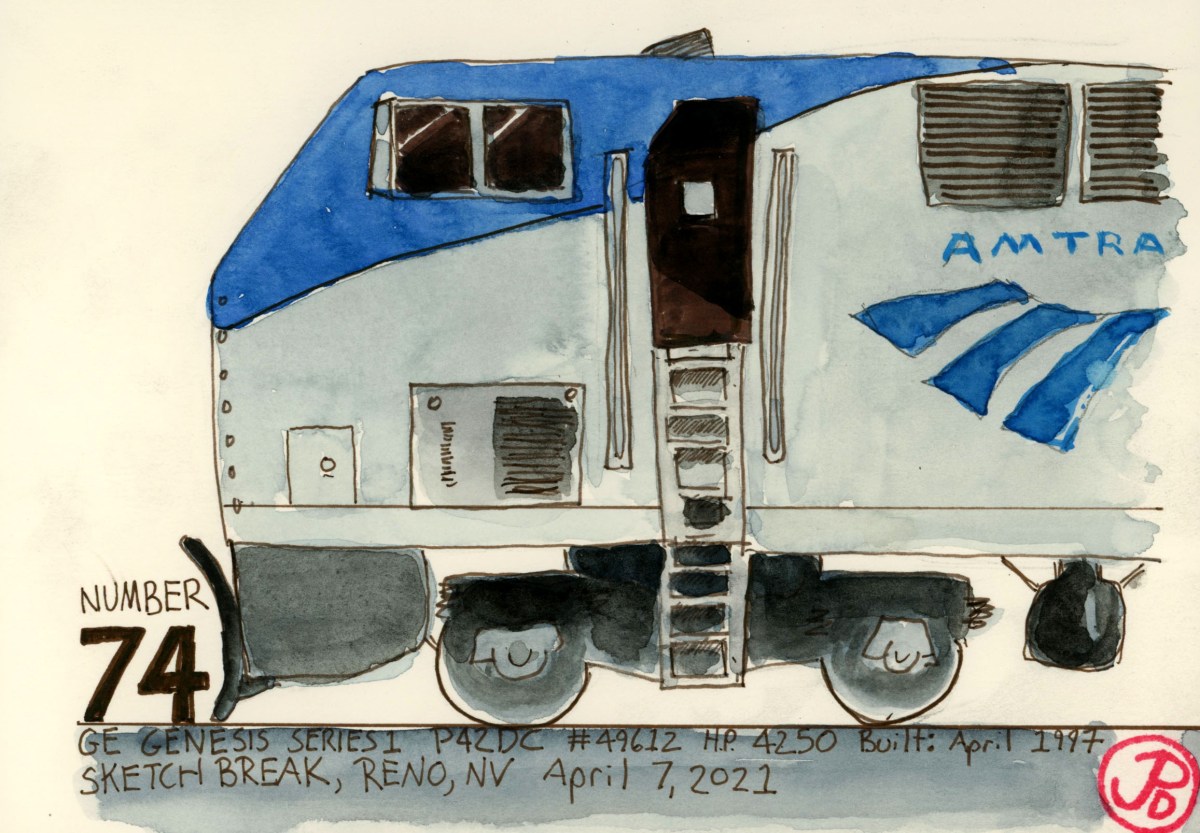
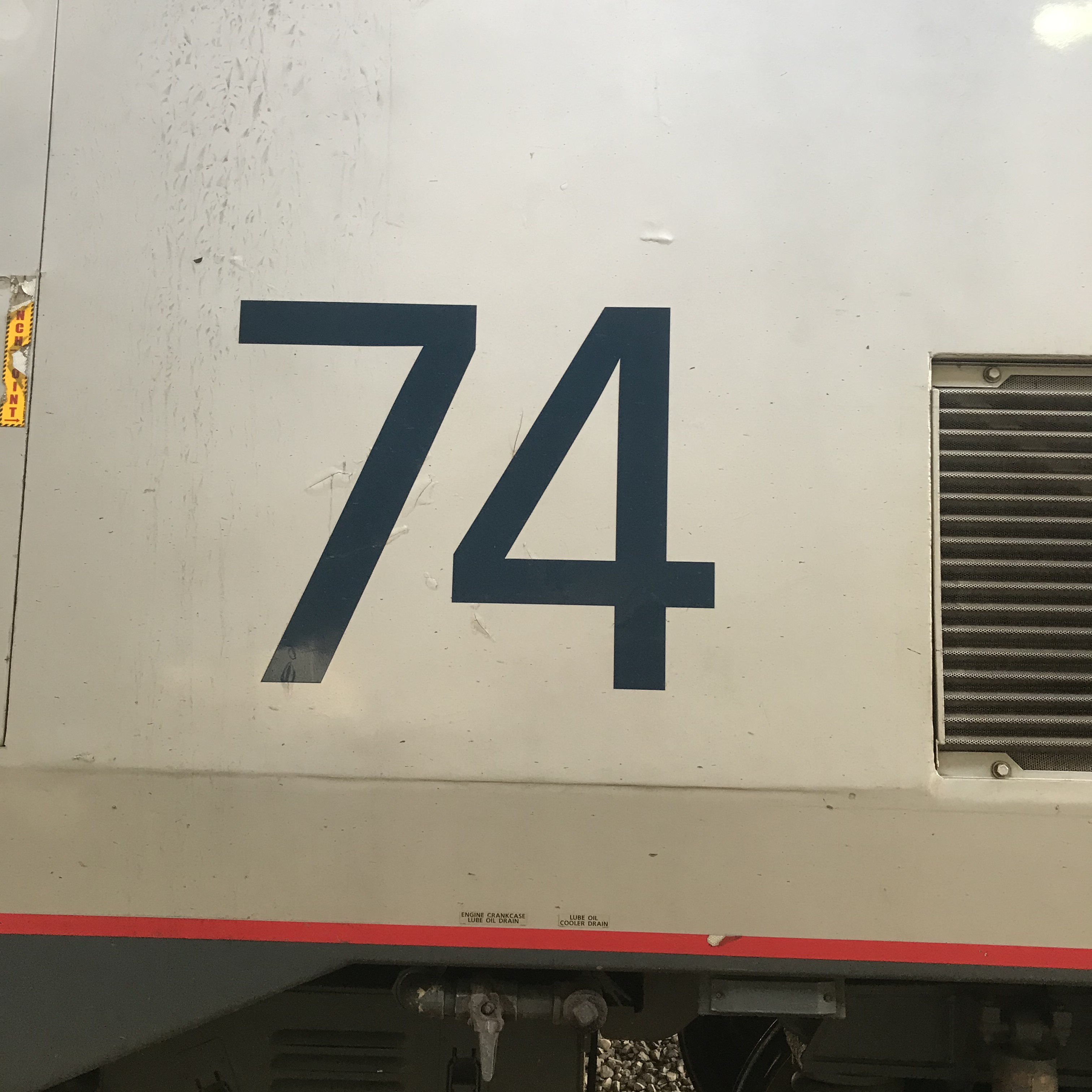
In Reno, the Zephyr pauses for a little longer than most stops because there is a crew change. This is when the engineer is replaced by a fresh one. During this time I sketched the profile of the locomotive on point, a General Electric P42DC, built in April of 1997. In an uncanny instance of coincidence, the locomotive number is 74, my brother was born in 1974. This seems to be the perfect locomotive to lead me back home to my mother.

1974 was the year of my brother’s birth. It was also the number of the locomotive on point that would take me back to my mother.
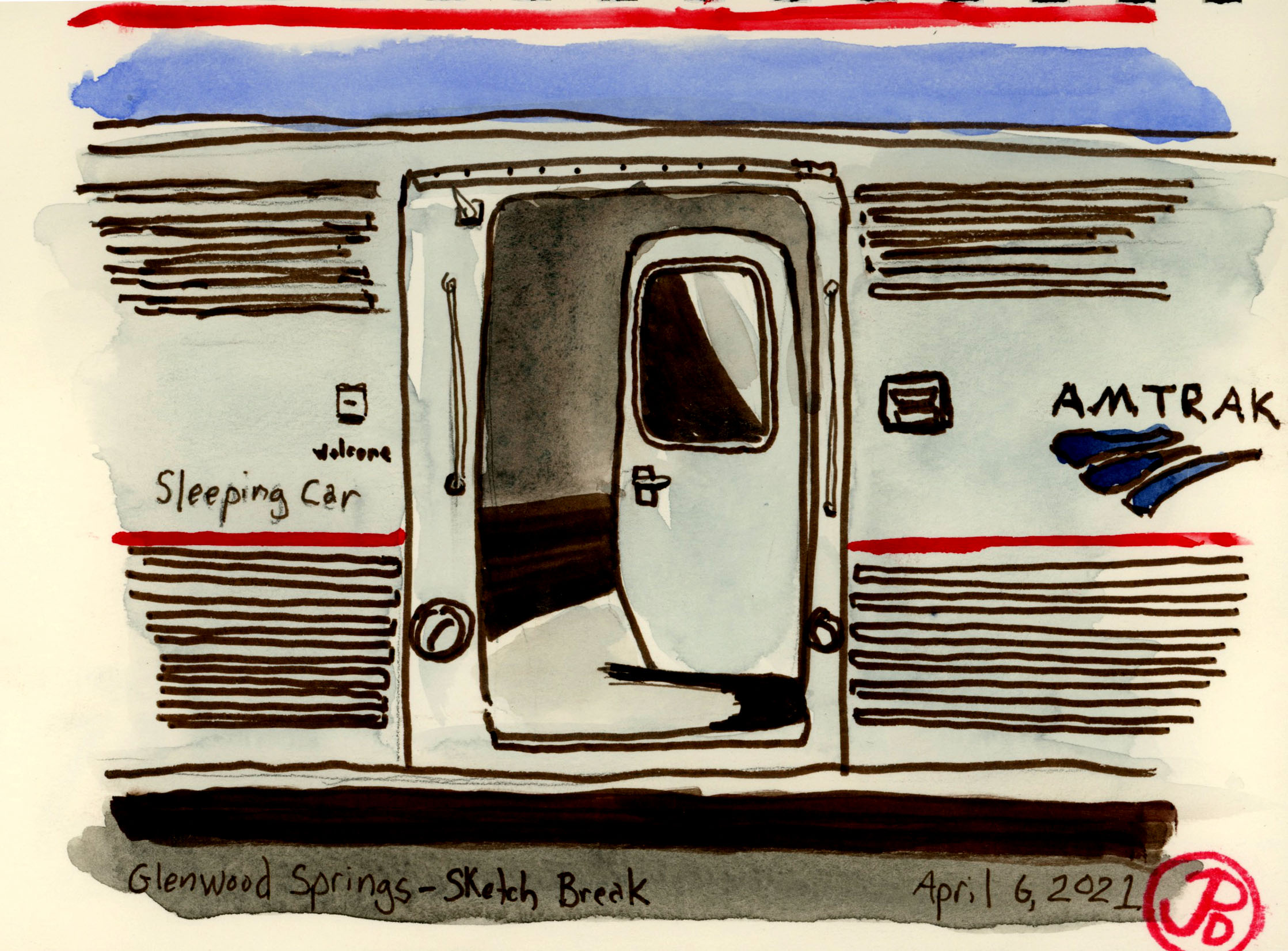
A quick sketch of my Sleeping Car entrance during a sketch break at Glenwood Springs. My sleeping car was just behind the locomotives. I added watercolor once I was back in my roomette.
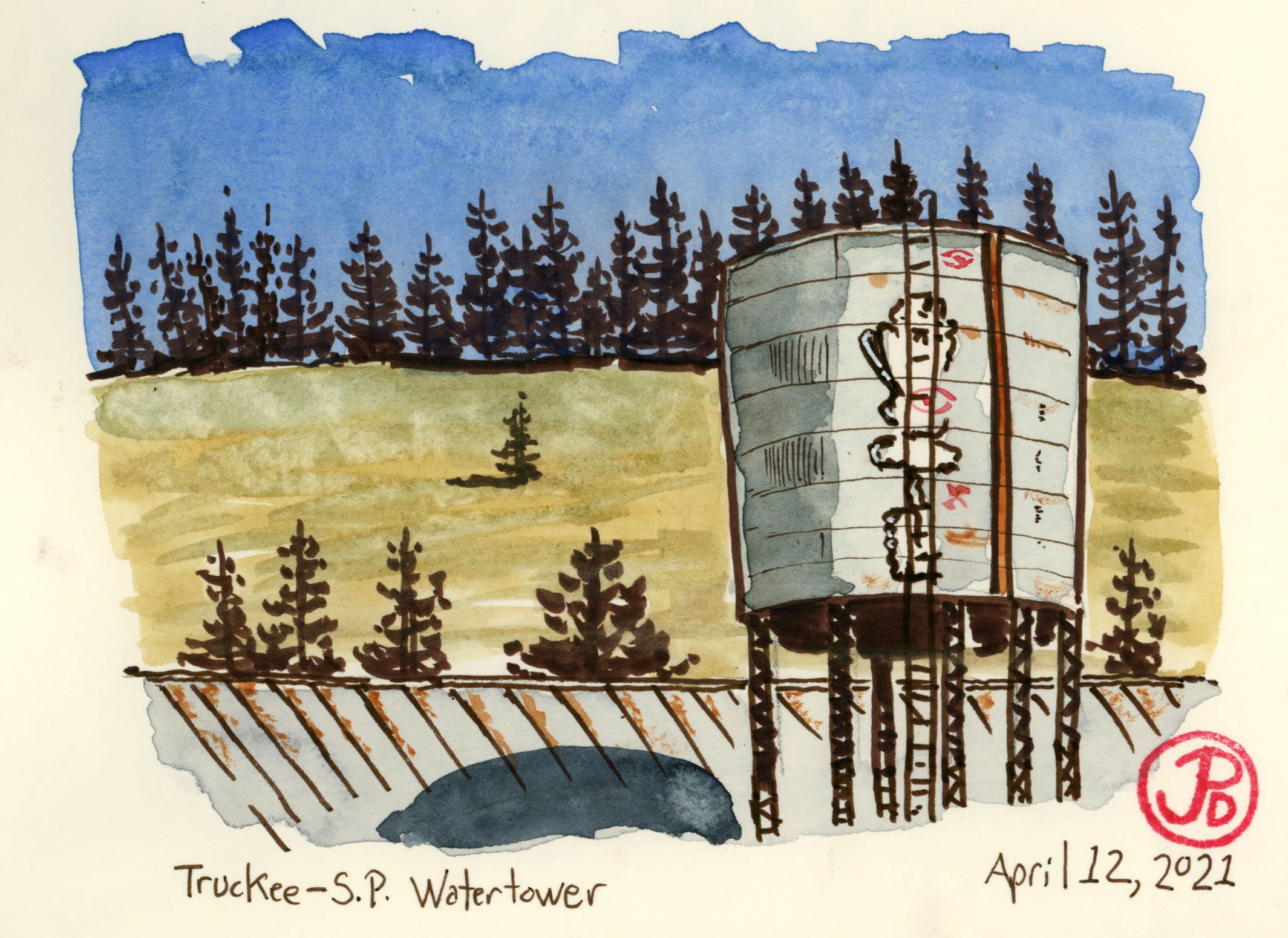
I had spent time during the last year sketching the existing Southern Pacific water towers. So I knew the form well. I was surprised to see from my Superlunar perch, an existing water tower as we pulled out of Truckee to climb Donner Pass. I have been to Truckee many times but I had never seen this tower. I returned later to capture the water tower. There are 15 surviving examples in California. I have seen about five.

In Truckee, I called my mom to let her know that California Zephyr Number 5 was running on time. This was going to be the first time I had seen my mom since learning if my brother’s passing. I suppose that I could have booked a last minute fight from the Mile High City to be there much sooner but the pace, the landscape, and the rocking lullaby of the Zephyr seemed to be the right choice for taking me back to California.

At this point I was on the route of the first Transcontinental Railroad. And I would need the strength of those who built it to face the reality, once I stepped off the Zephyr at one of the Central Pacific’s rail camps that was later renamed Colfax.

The anticipation mounted as we ascended down the western flank of the Sierra Nevada Mountains, each mile bringing me closer to my mother.

In past train journeys, one of my favorites scenes is when a train pulls into a station and looking out the window, I see someone alight from the train, search the platform for that familiar face, and then the embrace. I don’t always know the relationship contained in that embrace but it is a story on that reunion of love, in the the stage of the train depot.

What would the observer on the second story of the Superlunar have thought of the man departing the train and embracing someone, clearly his mother, in the middle of the street in Colfax?

I know what I would have though, and I did.

Image

Yuba Pass, M. P. 177

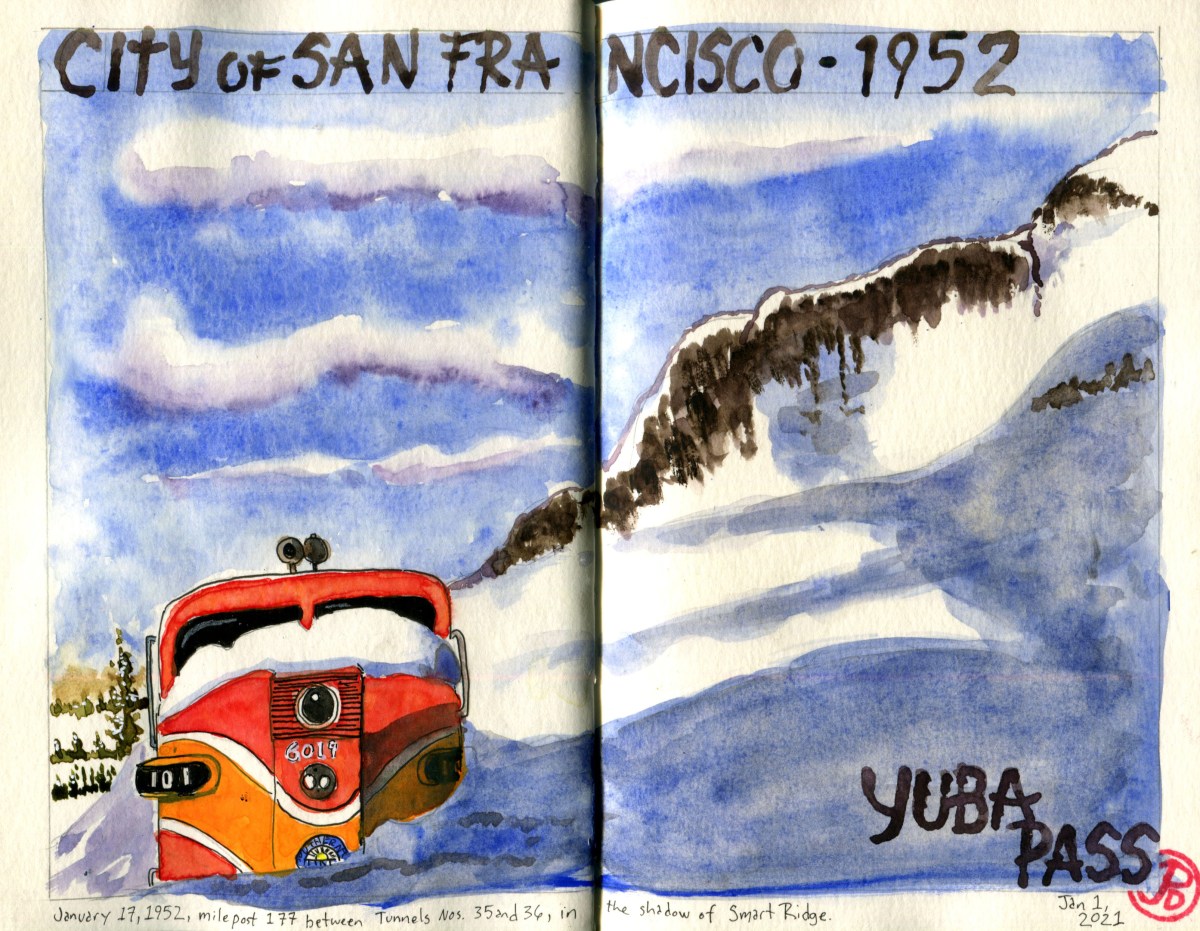
Ever since I had read about the stranding of the City of San Francisco in January 1952, I have wanted to visit the location and do a sketch.

In January of 2021, I did a sketch of the stranded super liner that was based on a historical photo. Since that time I had wondered if the stranding site was accessible or if it was on a part of the line that was far from roads or trails. In January 1952, the whole landscape was snowbound, paralyzing all transportation routes. After some research, I found out that the site was ridiculously accessible because Milepost 177 was a ten minute walk from where Highway 20 joins Highway 80.

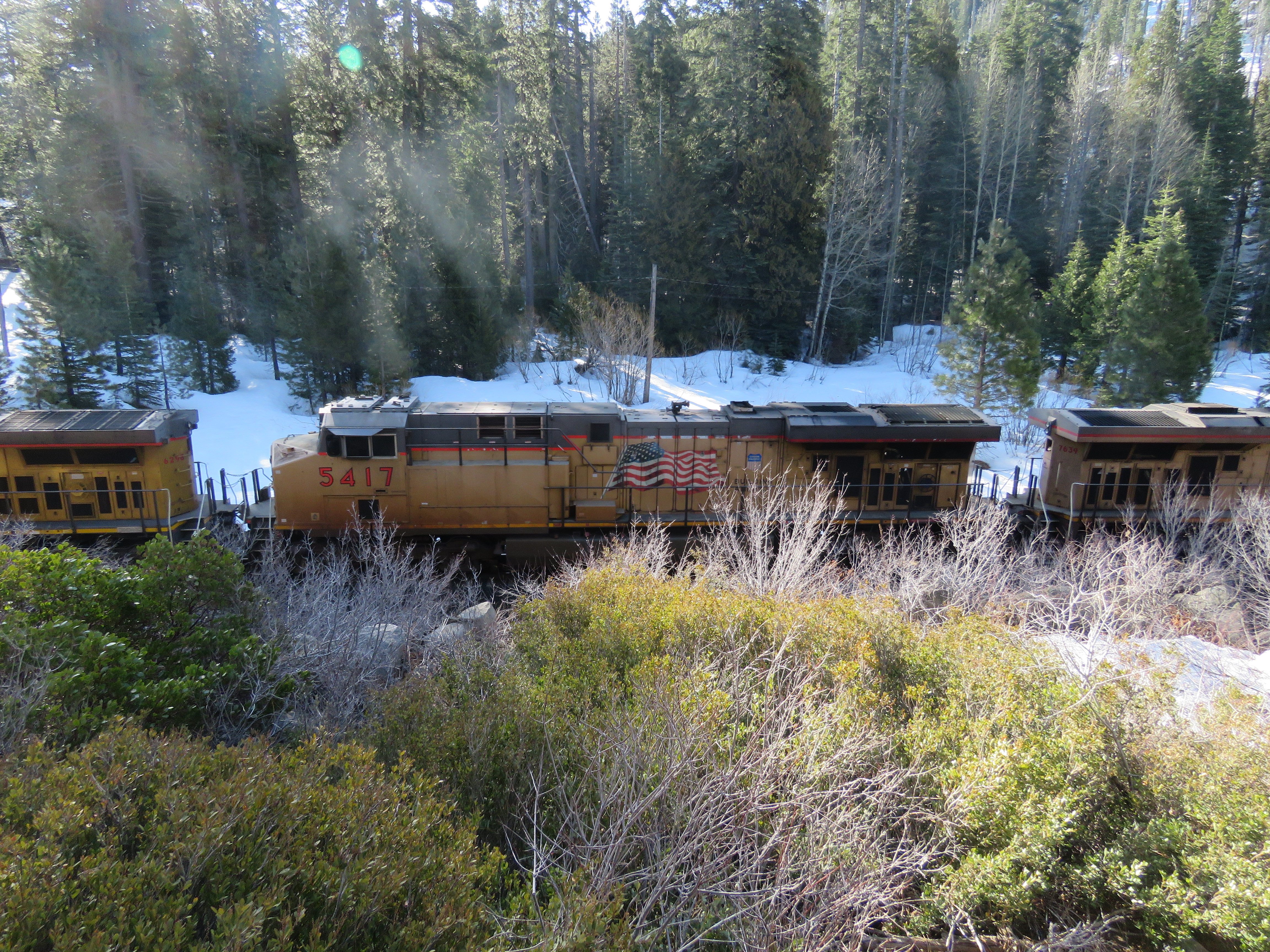
As I pulled off Highway 20, I donned my snowboots, an east bound Union Pacific freight passed by with a consist mainly featuring tanker cars. Freight has the right of way over passage service, it is the bread and butter of the contemporary railroad business.

A UP freight climbing towards Tunnel numbers 35 and 36 and off toward Donner Summit.

I wanted to find the exact location that the City of San Francisco became stranded: milepost 177, between Tunnels 35 and 36. But I also wanted to time my visit so I could see and photograph some trains at Yuba Pass. Well I just missed a freight train but my real prize was now running two minutes late and would depart Truckee at 9:39 AM.

This was the passenger service that replaced the City of San Francisco. It is one of the longest, and some would argue, most beautiful, routes on the Amtrak system. This is the California Zephyr. The hike up to Yuba Pass was extra special because on the following day, I would be boarding the eastbound California Zephyr, Train #6, to Denver, Colorado. Nine days later I would be returning on the westbound, Train #5. This was the train I was waiting for.

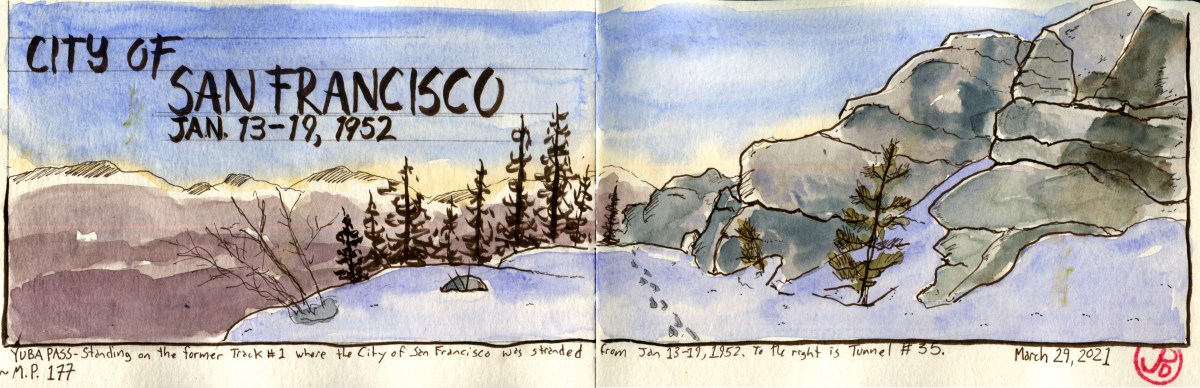
I hiked along the former grade of Track #1, the route is currently single tracked. The hike was relatively easy because it was along a railroad grade and the snow wasn’t too deep. It took me about ten minutes to reach Tunnel # 35. The current track goes through the tunnel but the former track goes around Smart Ridge. It was in this area that the City of San Francisco became stranded in 1952.

I looked at a few arial reference photos and picked my spot, in the shadow of the rocky ridge. I sketched in the ridge on the right and the trees in the background and far off the spine of a mountain range. For this I used Micron dark sepia pens.

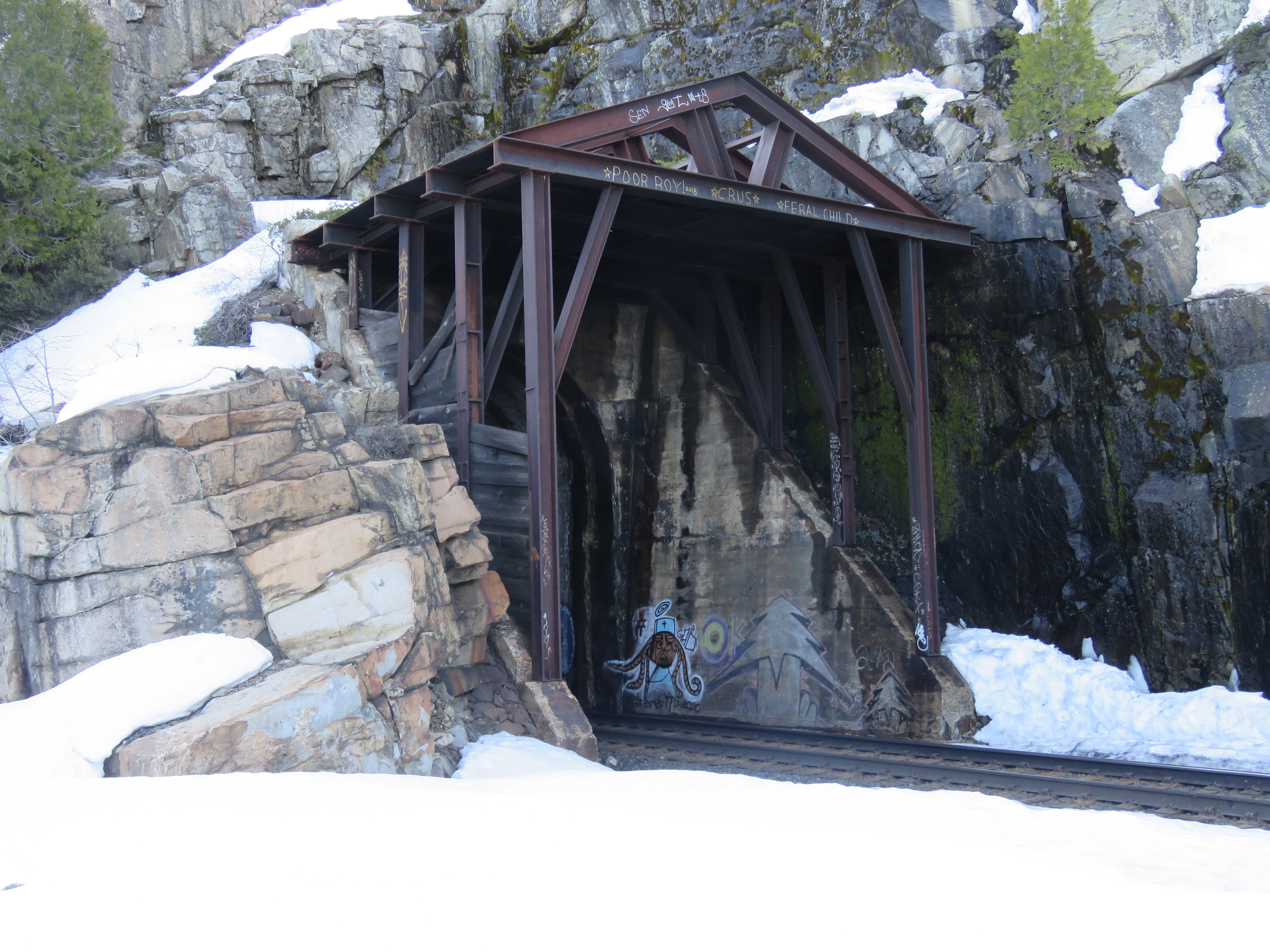
The west entrance of the 738 foot long Tunnel # 35.

I sketched for about 20 minutes and then I walked toward Tunnel #36 to find a good vantage point to photograph the Zephyr and I decided on standing near the eastern entrance of Tunnel #35 so I could photograph the train coming out of Tunnel #36. And then turn westward to capture the Zephyr as it disappeared into Tunnel # 35.

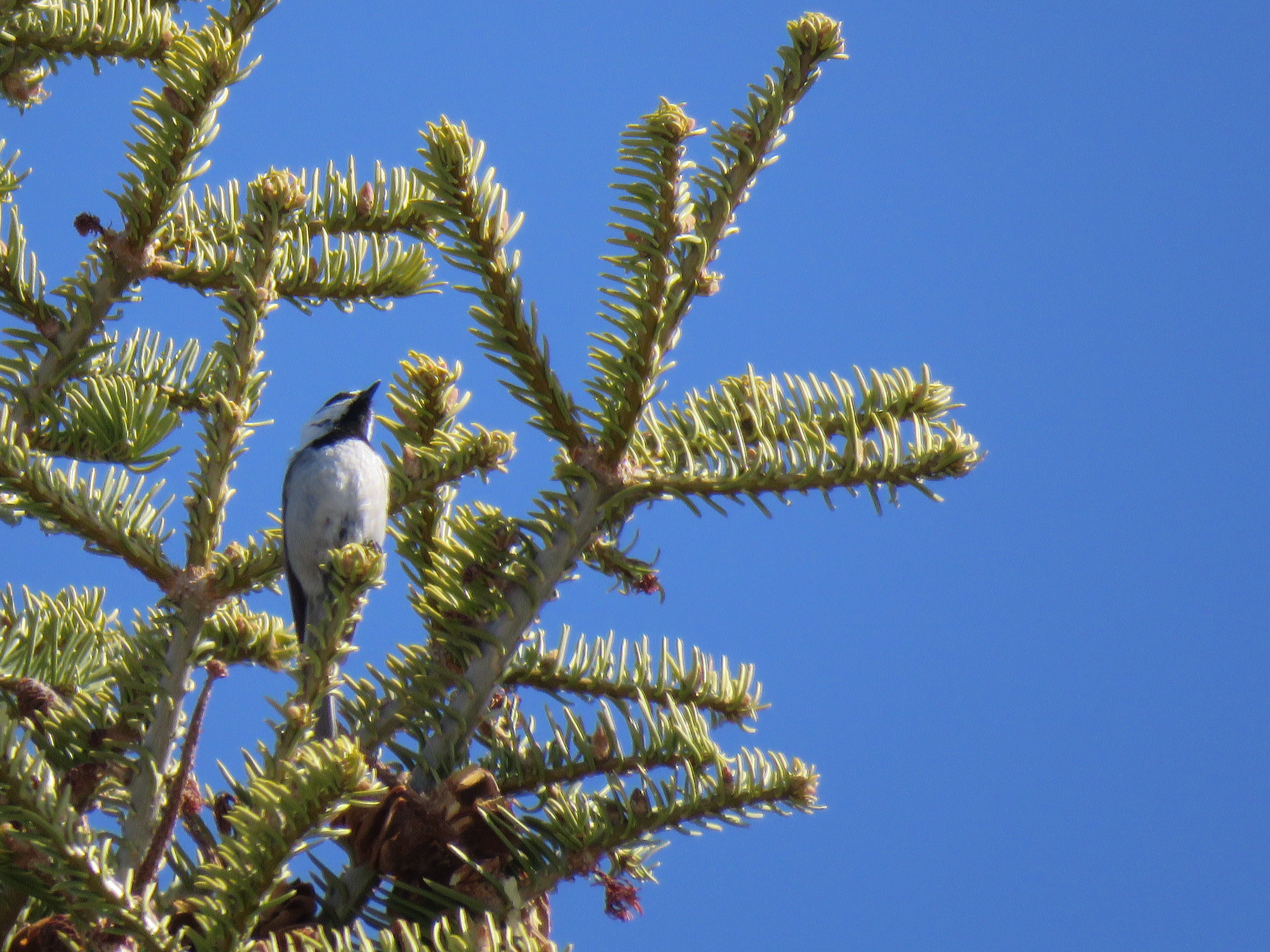
I had no idea when the train would be emerging from the tunnel but I filled my time being serenaded by the beautiful whistle of a mountain chickadee. This is the song of the western mountains. Spring was slowly arriving in the Sierras.

A mountain chickadee singing from the top of a pine. Bird and trains in the Sierra Nevada, I’m in heaven!!

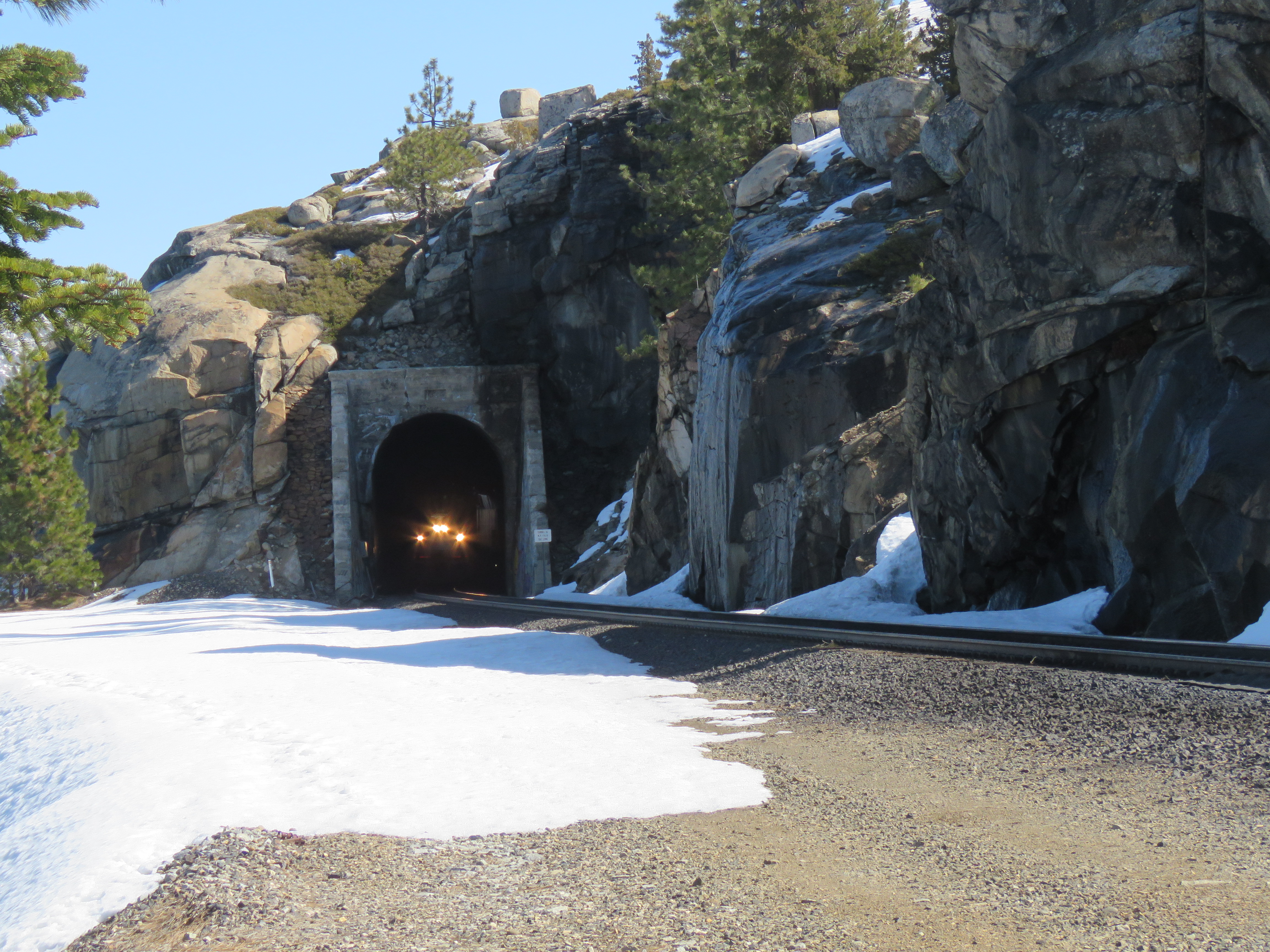
At 10:40, I saw the headlights of the westbound Zephyr.

A first sighting of the California Zephyr coming out of the east portal of the 326 foot long Tunnel #36. In the foreground is the rail bed of the former track #1.
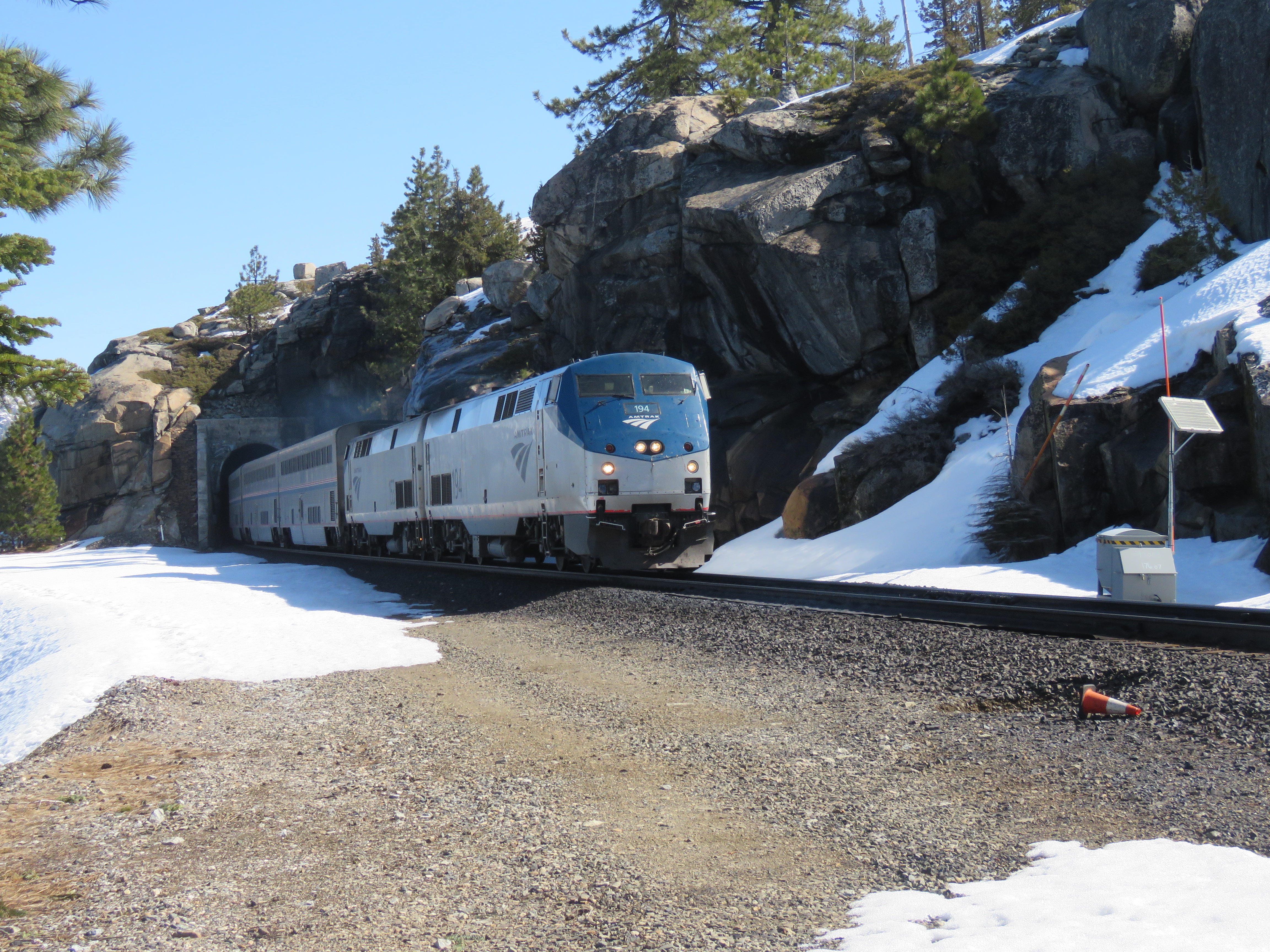
California Zephyr train #5. This train started in Chicago.
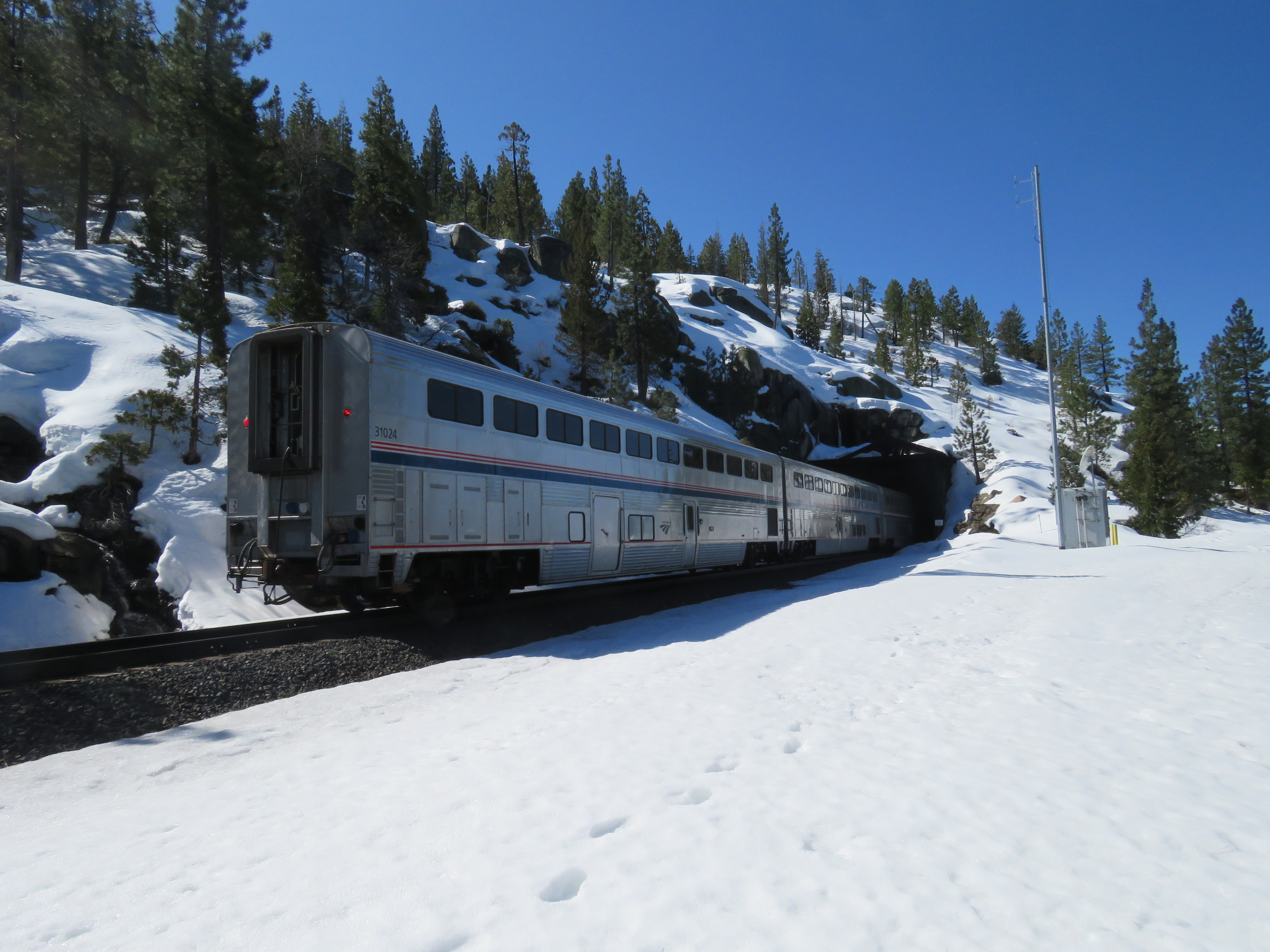
The Zephyr heading into Tunnel #35 as it climbs down the valley toward it’s next stop, Colfax. My footsteps are in the foreground.
Image

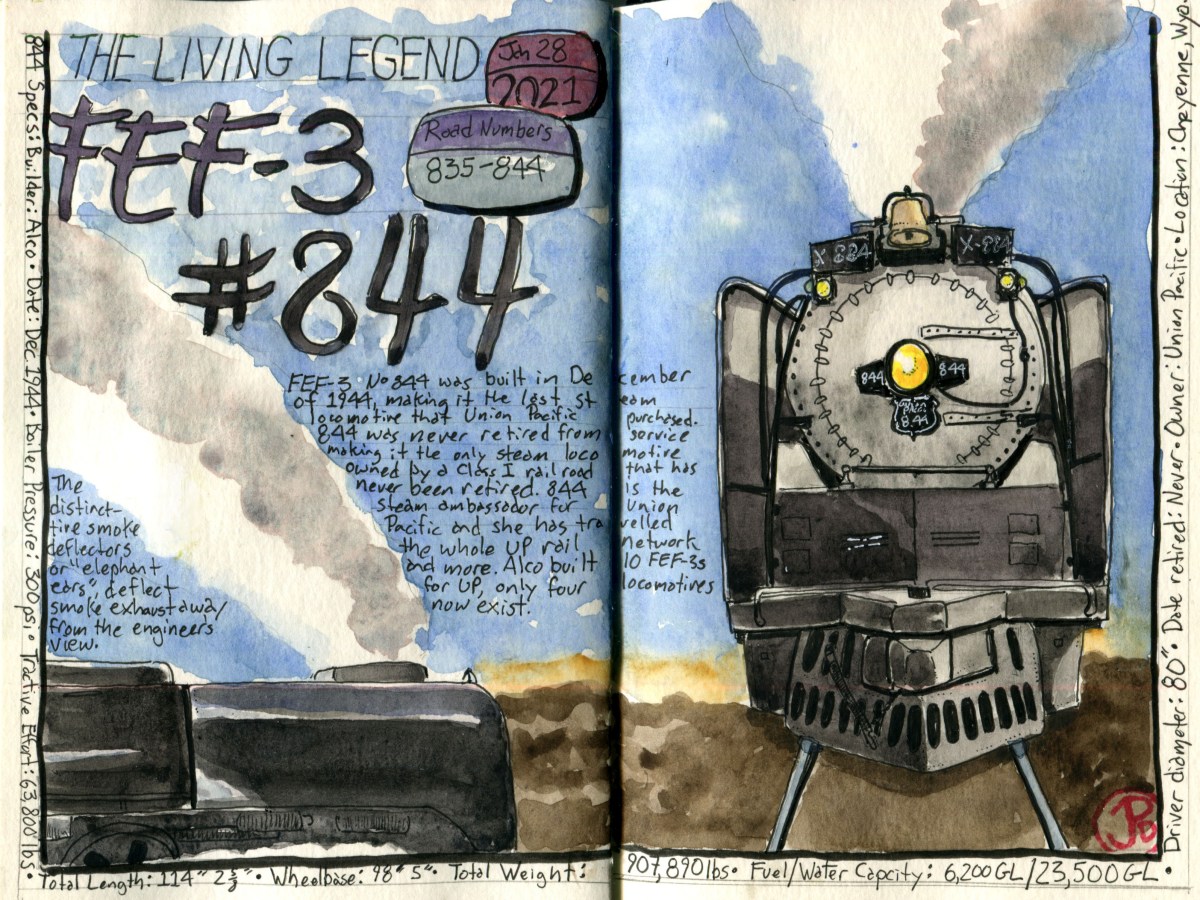
Union Pacific No. 844

If Southern Pacific’s Queen of Steam is 4449 then Union Pacific’s Royalty must be 844.

The FEF class (4-8-4) No. 844 is known as “The Living Legend”. This class of passenger locomotive is a legend for it’s design and motive power but I want to stress the word “Living” because 844 is the only steam locomotive that has never been dropped from UP’s roster, making it the only steam locomotive, owned by a Class I railroad, that has never been retired.

The FEF-3 was designed to be a high speed passenger locomotive and 844 pulled such Union Pacific passenger services as the Overland Limited, Los Angeles Limited, Portland Rose, and Challenger. 844 really had three phases of life. First as a passenger locomotive, secondly, as diesels replaced steam on passenger routes, 844 hauled freight in 1957.

At the end of the age of steam, when steam was being replaced by diesel, Union Pacific had the foresight to preserve one of it’s classic locomotives and 844 entered into her third life as an ambassador to one of the world’s largest railroads: Union Pacific.

I was 10 years old when I first encounter Union Pacific 8444, as she was known then, at the offical opening of the California State Railroad Museum in 1981. She had to be renumbered because there was a diesel locomotive given the road number 844. For the event, two of the most emblematic survivors of the Northern class (wheel arrangement 4-8-4) were in attendance. Southern Pacific’s GS-4 4449, newly repainted in her Daylight livery and Union Pacific’s 8444. On the tracks outside the museum, which paralleled the Sacramento River, these two Superstars of Steam came pilot to pilot. What a sight to see!

844 is not as streamlined as 4449 but the 844’s steam deflectors, also know as “elephant ears”, gives this 4-8-4 a very unique appearance. The steam deflectors help to loft steam exhaust from the chimney or smoke stack to improve the engineer’s visibility and also to keep the exhaust out of the cab.

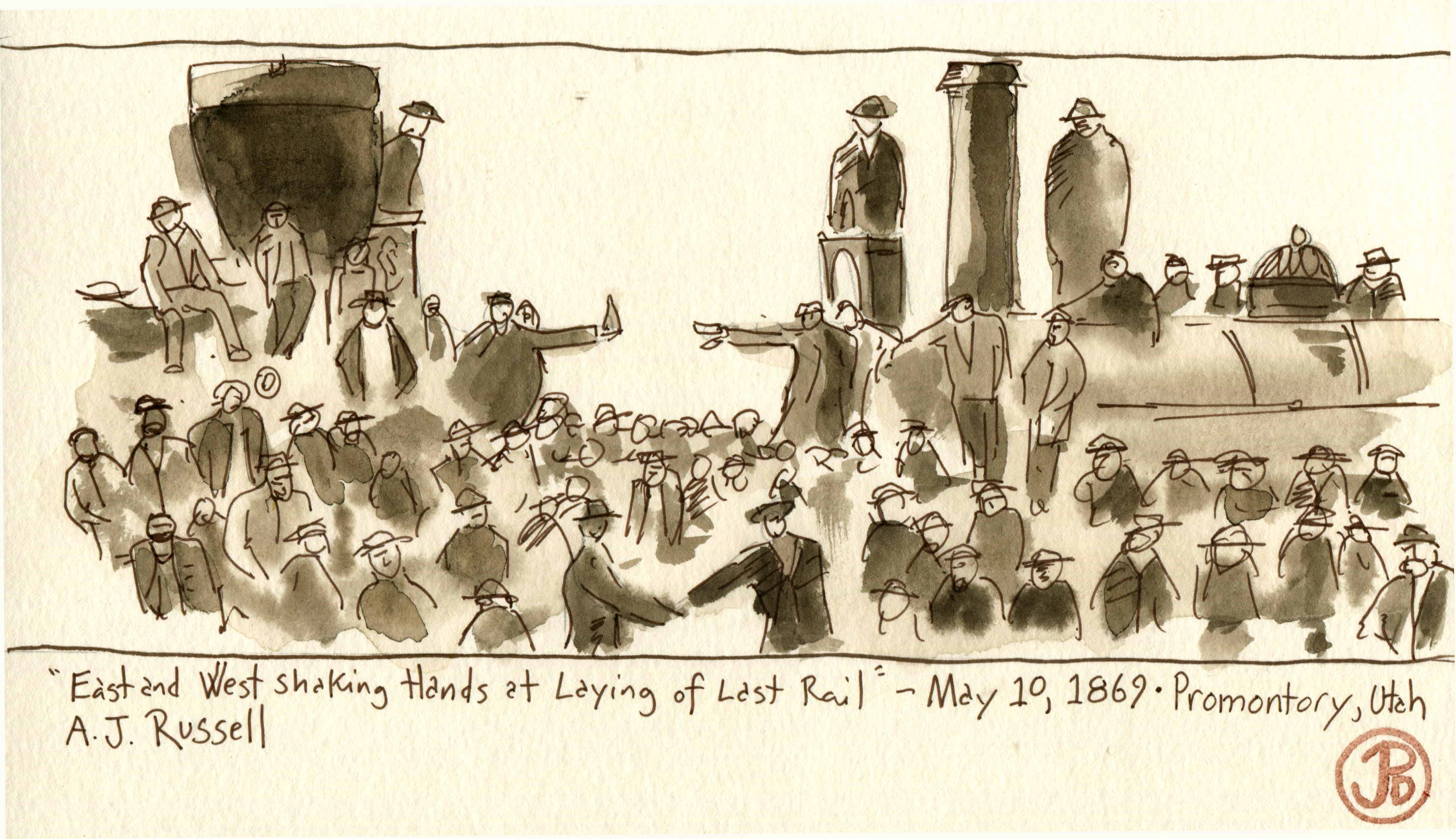
It was an echo of the famous photograph taken at the uniting of the Transcontinental Railroad at Promontory Point, Utah on May 10, 1869. 4449 represented the Central Pacific, later Southern Pacific and 8444 represent, and still does, Union Pacific.

Union Pacific’s steam ambassador has been all across Union Pacific’s rail network. She is a locomotive that brings people to the tracks to see her in action. One annal excursion is Cheyenne Frontier Days from Denver to Cheyenne. In May, 2019, 844 played second fiddle on the inaugural run of the recently restored Big Boy 4014 from Cheyenne to Ogden, Ut to commemorate the 150 Anniversary of the completion of the Transcontinental Railroad. Of course the Big Boy was on point as the lone example of the largest locomotive in operation.

At the ceremony, 844 and 4014 came pilot to pilot, echoing the the famous photograph taken 150 before when Central Pacific’s engine “Jupiter” and Union Pacific’s engine No. 119 came pilot to pilot on May 10, 1869.

The Union Pacific Steam Shop in Cheyenne, Wyoming . This is about as close as I got to seeing the “Air force 1” of Union Pacific: FEF-3 #844 on a visit in the October of 2017. The only sign of steam is the UP yellow tender outside one of the bay doors.
Image

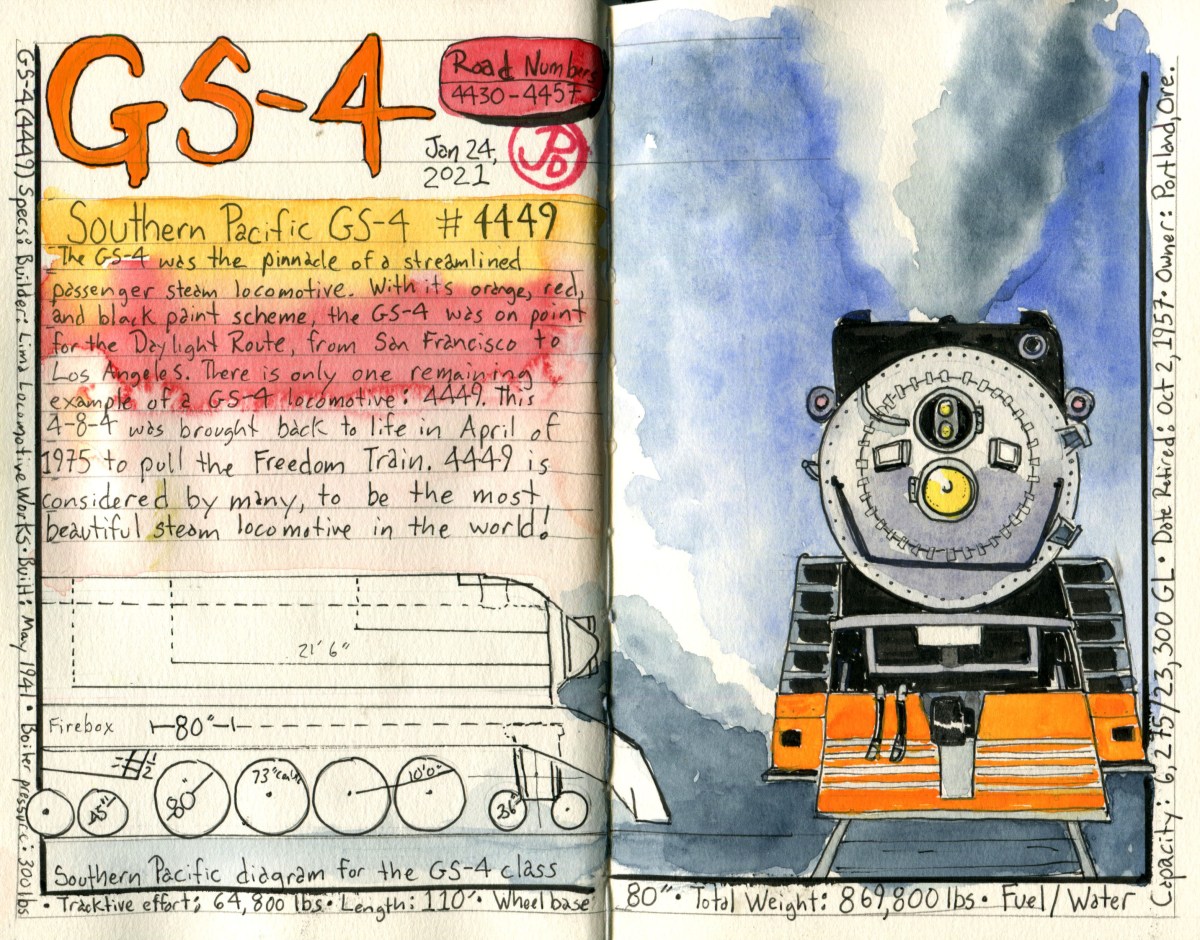
Southern Pacific’s Golden State (GS-4)

There is a concept known as a “spark bird” in birding. This is the bird that first ignites your passion for birds. For the pioneering field guide artist, Roger Tory Peterson, it was the northern flicker. Why can’t a child also have a spark locomotive?

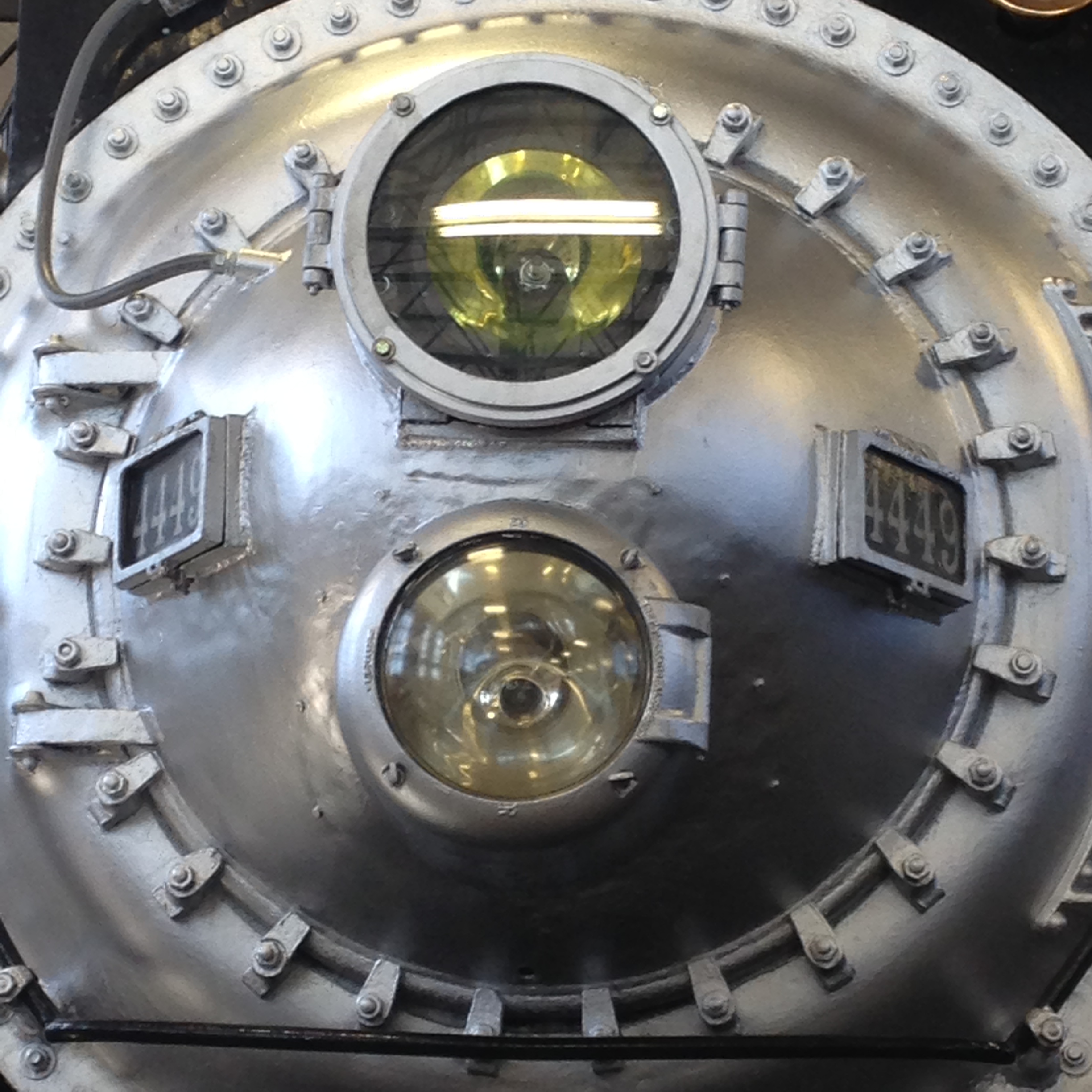
My “spark” locomotive is Southern Pacific’s GS-4 number 4449.

Many children are attracted to trains. Most often it might be a locomotive on static display or maybe watching a commuter or freight train pass by. My passion for steam locomotives comes from my father, who, as an only child growing up in San Francisco, loved anything that rode on two rails: street cars, cable cars, and trains.

While many children, “put away childish things”, my connection to trains, railroads, and locomotives connects me to my father, and that bond has grown stronger since his passing five years ago.

One Christmas, my father gave me a HO scale model railroad. Together, well, mostly my dad, created an oval layout on a large piece of particle board. It came out on our dining room table, a few weeks before Christmas, and stayed up, certainly as long as our neighbor’s Christmas lights. On a part of the oval track was a paper mache tunnel which spanned the tracks. It was made by my father, probably with some help from his father.

My first locomotive was a Santa Fe F7 in the ironic warbonnet paint scheme. This locomotive pulled a short, motley freight consist around the oval, over and over again.

Then one Christmas came an HO replica of one of the most beautiful steam locomotives ever built: Southern Pacific GS-4 #4449. And later came a Daylight baggage car, a few passenger cars, and an observation car.

A GS-4 was a Northern class (4-8-4) of passenger steam locomotives, built for the Daylight route from San Francisco to Los Angeles. Southern Pacific reached it’s zenith with the design of this streamlined locomotive that also had plenty of power and speed to make the 470 mile trip.

The four drive wheels of a GS-4 provide traction to the rails. The four wheels on the other side makes the wheel configurations a 4-8-4. This is the only surviving member of it’s class, 4449 at the Oregon Rail Heritage Center in Portland, Oregon. The white star on the drive wheel indicates an internal bearing and the type of axle grease used.

Out of the 28 GS-4s built by the Lima Locomotive Works, only one survived. As a point of comparison, Union Pacific produced 25 “Big Boys” and now eight are still in existence, including 4014, which has recently returned to steam, making it the largest steam locomotive in operation.

The last remaining GS-4, 4449, was built in May of 1941 and was retired from service on October 2, 1957. It was donated to the City of Portland, Oregon where she was placed on static display at Oaks Park. In the following years the locomotive was vandalized and it builder’s plate and whistle stolen.

In 1974, as our Bicentennial was approaching, 4449 was evaluated to see if she could be restored and brought back to life to haul the Freedom Train, a traveling exhibit featuring historical artifacts aboard train cars that visited all of the Lower 48 states. 4449 was restored and pulled the Freedom Train for many stretches on it’s national tour. 4449 was given the moniker, “The Queen of Steam”.

4449 at speed. This is a still from a Super 8 film my dad took when 4449 was in its Freedom Train livery from May of 1977.
Another still from one of my dad’s Super 8 films of 4449. The amount of steam exhaust emitted from 4449 in this shot would have defiantly put a smile on my dad’s face. Here you can see 4449’s livery of red, white, and blue.

After 4449 was done with it’s two year tour, she returned to Portland, Oregon when in 1981, she was repainted in her red, orange, and black paint scheme of Southern Pacific’s Daylight. During the 1980’s my father and I followed 4449 around the state, this time I took the Super 8 footage while my dad took stills. We even rode on a train pulled by 4449 on a two day excursion from San Francisco to Los Angeles.

One wonders how to keep connected to someone who has passed? While they are in the ethereal and unknown world, that touchstone is often something earthy and physical. It could be a photograph, a house, or a landscape. For me, that touchstone is a locomotive that was built in 1941, nine years after my father was born. While my father is no longer here, 4449, a touchstone to the past, still lives and breaths. When I look into the eyes of her ever-moving mars light, I somehow see the eyes of my father.

Image

Southern Pacific’s Cab Forward

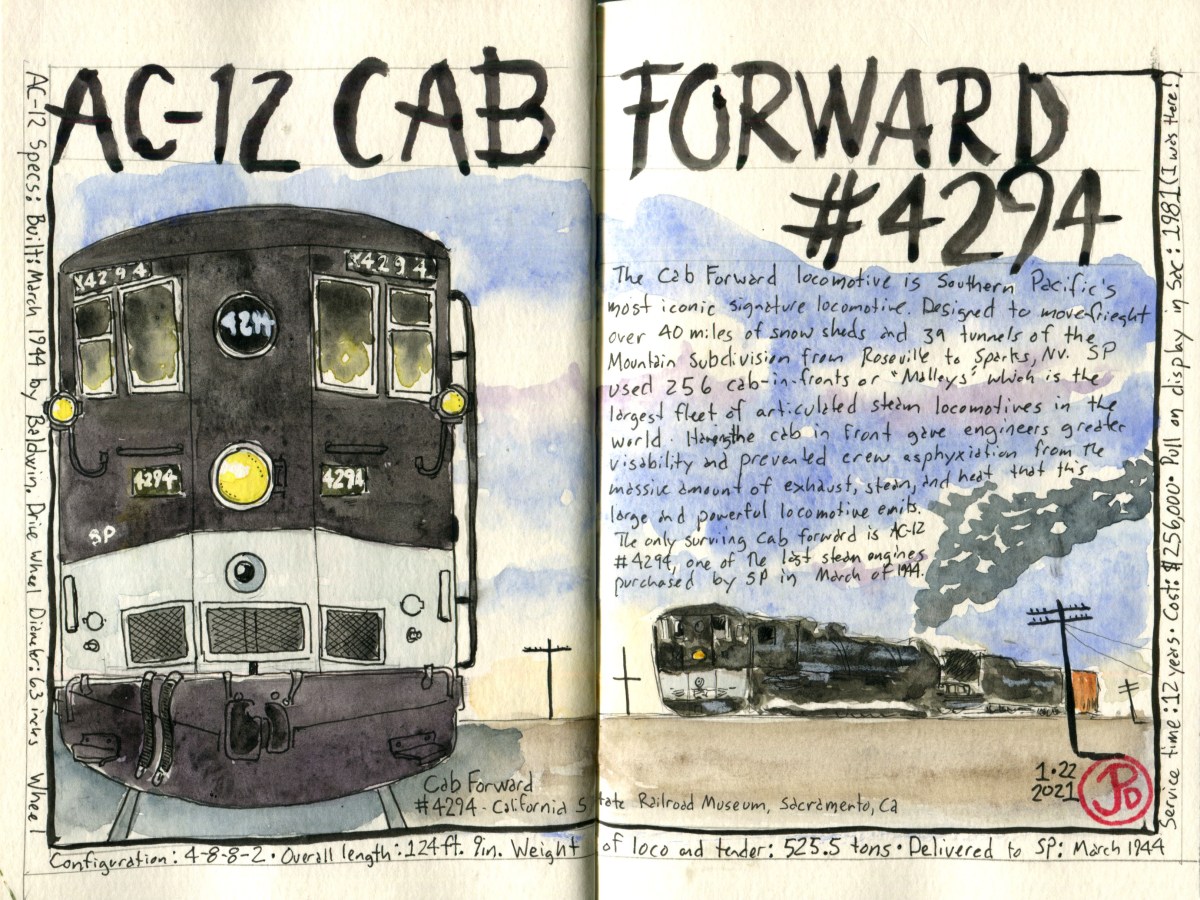
Southern Pacific’s signature, and most iconic locomotive was the 256 AC (Numbers 4000 to 4294) cab forward locomotives.

These were some of the largest and most unique locomotives in the United States. The AC-12 class is less than ten feet shorter than the largest steam locomotives ever built: Union Pacific’s “Big Boy”. The AC-12 locomotive and tender weighed more than a Boeing 747 and an Airbus A380, combined.

The reason the cab forwards were unique is that, as the name implies, the crew cab was in the front of the locomotive, like a modern diesel-electric locomotive, instead of the cab being in back, near the tender.

Having the cab in front gave the engineer and fireman unequalled views of the track ahead. But the real reason for the innovations was to conquers the steep grades of Sacramento’s Mountain Subdivision over the Donner Pass. This massive locomotives operated between Roseville, Ca and Sparks, Nv where a powerful locomotive was needed to tackle the steep grades and have the tractive effort to haul long freight trains over the Sierra Nevada Mountains. A locomotive of this size emits of lots of steam exhaust because a 4-8-8-2 was essentially two locomotives in one.

The Donner Pass route had 40 miles of snow sheds and 39 tunnels. This meant that in a standard locomotive, the crew could suffer from asphyxiation from the steam exhaust. By putting the cab forward, the exhaust stack was behind the crew and they avoided the caustic smoke, steam, and heat that these powerful locomotives emitted.

The cab forward proved to be a very successful locomotive for SP, with 256 of these engines used on it’s rail over the period of 50 years. The railroad had the largest fleet of articulated “Malleys” in the world. As a comparison, Union Pacific fleet contained 25 Big Boy locomotives.

In the 1950s, as diesel replaced steam, cab forwards spend the rest of there working life away from the mountains on the Coast Line and the Western Division. One of the last places cab forwards worked on Southern Pacific rail was the Cal-P line between Oakland and Roseville. 1958 was the last year a cab forward rode the rails, nine of these locomotives were taken out of service on September 24, 1958.

Out of the 256 cab forwards that were built, only one survives. The AC-12 number 4294 which is also the last steam locomotive that Southern Pacific ever purchased. 4294 was in service on March 19, 1944 and was taken off the the roster on March 5, 1956. She was only in service for 12 years.

While the other cab forwards were scrapped, 4294 was put in storage and then was put on static display on October 19, 1958, in front of the Sacramento train station. When the California State Rail Road Museum was opened, 4294 became the centerpiece amongst it’s collection of locomotives and rolling stock.

I was at the museum with my father in 1981 for the official opening of the museum. SouthernPacific’s GS-4 4449 and Union Pacific’s 844 (then numbered 8444) where in attendance and I will never forget when the two locomotive stood, pilot to pilot, on the track outside of the museum!

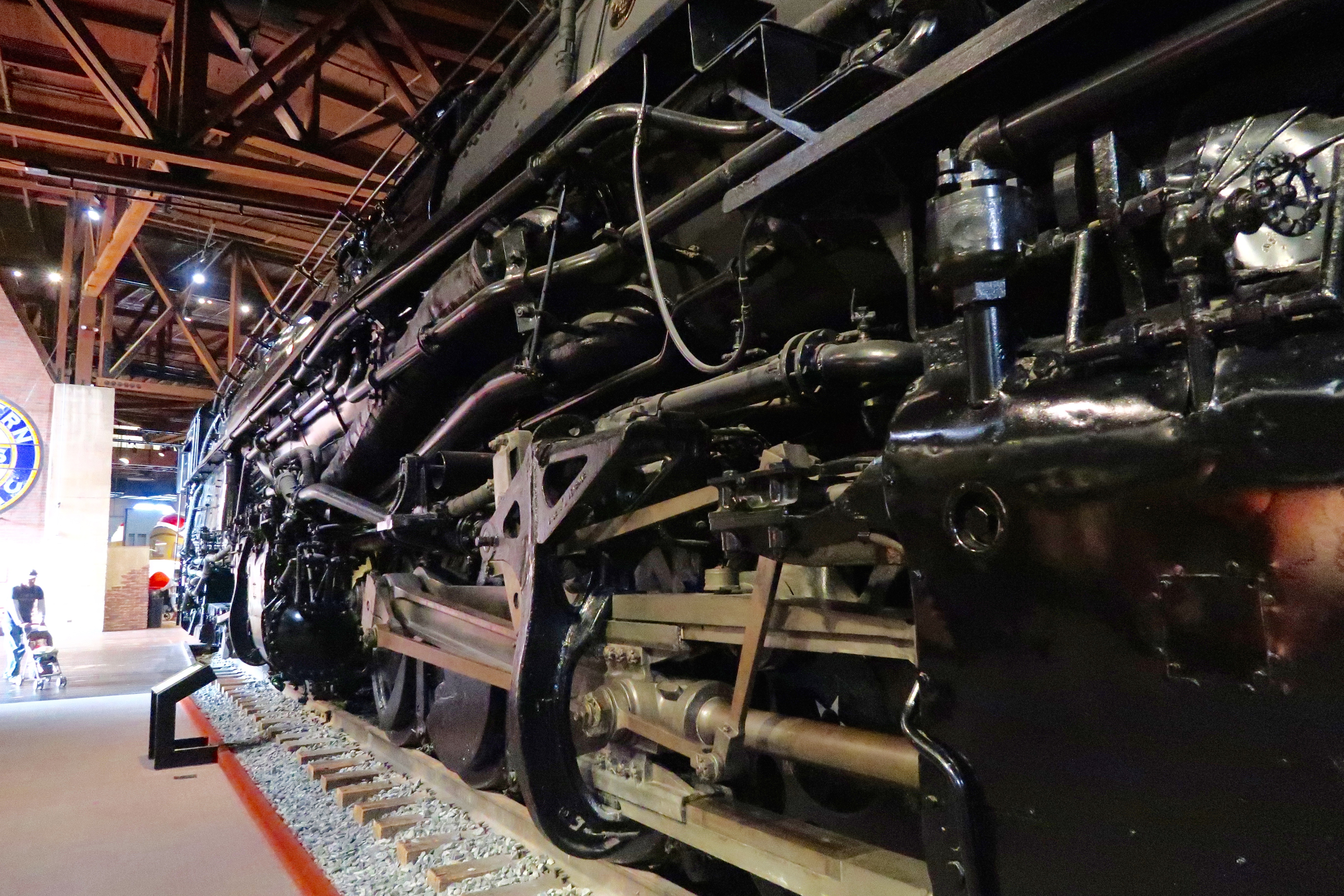
The massive running gear of the AC-12, Cab Forward. 4294 is the only surviving example of this locomotive.

The last time I have visited the museum was in November of 2017 where I did an aborted field sketch of the cab forward. There was something about the proportions of the locomotive that I did not get right. I had planned to return to the California State Rail Museum in the early Spring of 2020 but the cases of Covid-19 were growing at an alarming rate in the state and the museum eventually closed it’s doors for an indeterminate time.

So if I could not sketch the AC-12, at least I could sketch it from an image, which really is the next best thing.

Image

The City of San Francisco, 1952

January 12, 1952. Milepost 177, Yuba Pass.

The snowfall in January of 1952 on the western edge of the Sierra Nevada Mountains was relentless. By mid-January, Highway 40 was closed. There was no way to drive from Sacramento to Truckee or Reno without a huge detour.

The winter storms during the winter of 1951-52 dumped 65 feet of snow on Donner Summit. Southern Pacific took pride in keeping the line open over Donner Pass, even in the winter.

Donner Pass is one of the snowiest places in the Lower 48 with an average snow fall of 411.5 inches of snow each winter. According to the report, Donner Summit Snowfall and Snowpack 1879-2011, there have been four times, since 1880, the snowfall on Donner Summit has exceeded 775 inches, and on two occasions the snowfall has exceeded 800 inches: in 1938 and 1952.

Southern Pacific had an arsenal of snow fighting equipment, including plows, flangers, and spreaders but their ultimatum snow fighting weapon was the rotary plow. They used this plow when the ordinary plows failed to clear snow from the tracks so the rotaries had to be called in to finish the job.

The railroad had always kept the line open, until January, 1952. Heavy snowfall will temporality close the line but so will an avalanche.

The story of the stranded Southern Pacific streamlined passenger service, the City of San Francisco seems to come out of an Agatha Christie novel. Think Murder on the Orient Express without the murder.

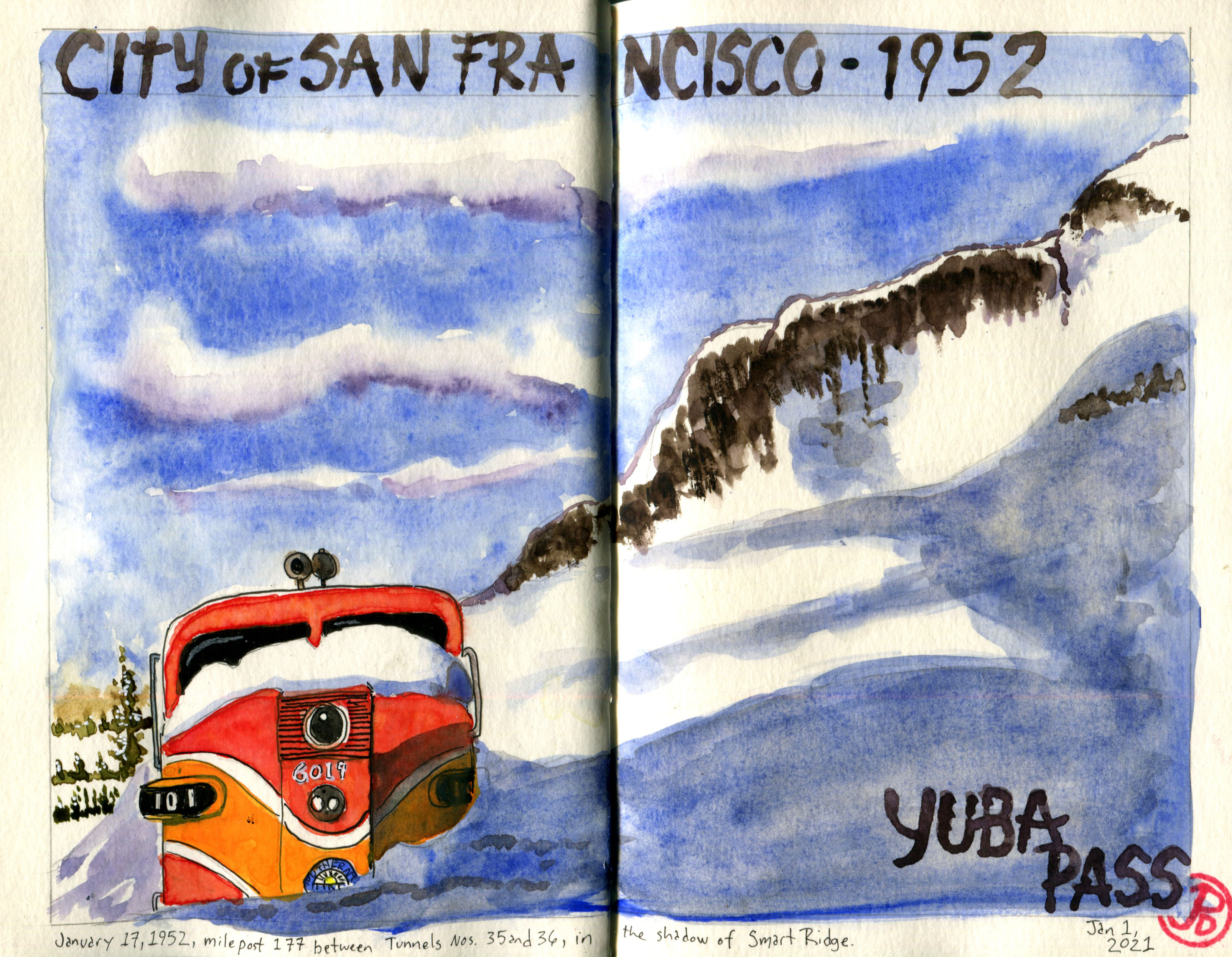
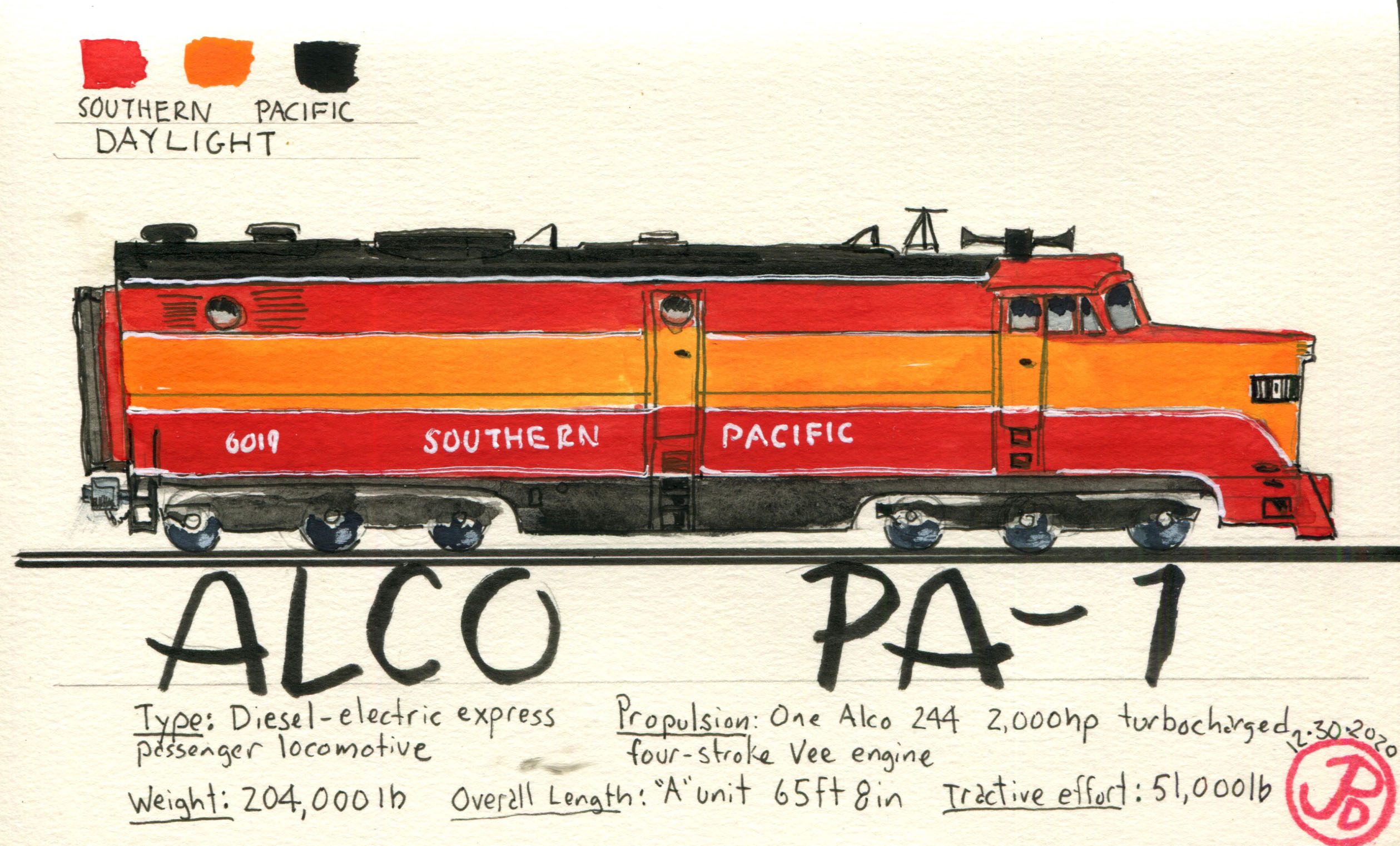
Into the snowy conditions, at just after 10 AM, the westbound City of San Francisco No. 101 headed out of Norden, Ca to make the slow descent, down into the Sacramento Valley on January 12, 1952. The 15 car train was headed by three Alco PA locomotives, decked out in the red, orange, and black of the Daylight paint scheme.

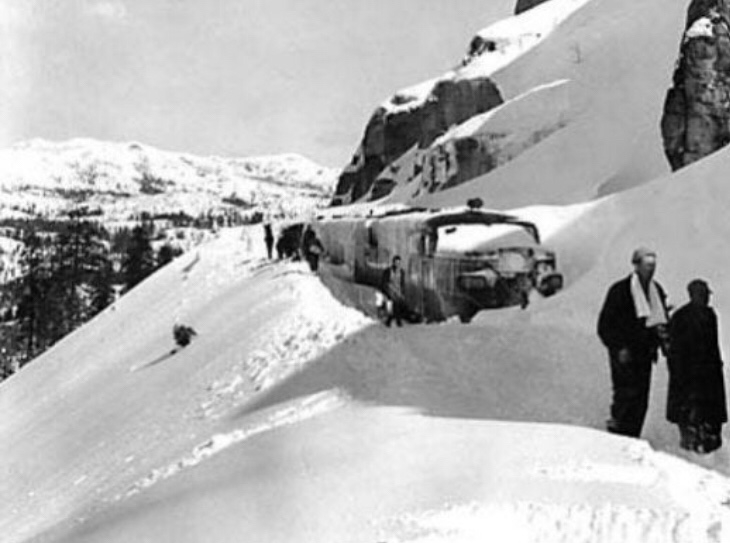
The train was several hours late because of the snowy conditions. As it rounded Smart Ridge on track #1, the train was stopped in it’s tracks, blocked by a snow slide that covered both tracks. The slide was a quarter of a mile wide. The engineer tried to back the train up but the City of San Francisco was trapped by snow on both ends.

At milepost 177, between tunnels 35 and 36, the City of San Francisco became stranded with 196 passengers and 30 crew members aboard. The passengers and crew would be stranded here for three days and the City of San Francisco would be stuck here for six days.

A photograph of passengers leaving the City of San Francisco behind to hike down to Highway 40 and the cars that would take them to Nyack Lodge.

Once the train had become stranded, Southern Pacific sprung into action to try and free the City of San Francisco and rescue those aboard. Rotary plows where sent up from both Roseville and Truckee in a attempt to clear the line and reach the disabled train.

Over the next three days the rescue of the City of San Francisco continued on with the use of rotary plows pushed by cab-forward Mallet locomotives, cars, trucks, helicopters, dog sleds, and Tucker snowcats. The rescue effort would claim two lives and damage rail equipment.

On the first day, the passengers took it their stride with the belief that the ordeal would be over soon. But as the train lost power and with in the heating system, things seem to worsen. The water system aboard the passenger cars froze taking the toilets out of commission. And they were also running low on food.

On the afternoon of the fourth day they were able to get all the passengers to hike down to Highway 40 which had been plowed clear up to Yuba Pass. They were driven by private automobiles to Nyack Lodge. After warming themselves ay the lodge’s fire place, the passengers were then put on a special train that took them down into the valley where they arrived in Roseville just before midnight.

Almost four days late, the train pulled into it’s final destination, just before 4 AM, to the city of Oakland. Oddly enough the City of San Francisco does not go to the city of San Francisco.

On point for the City of San Francisco on January 12, 1952 was an ALCO PA number 6019. Southern Pacific bought 52 PAs. While these locomotives are railran favorites, they proved to be a maintenance nightmare and SP later scraped the locos.