Image

Martinez Sketching

I arrived a few hours early in Martinez before meeting my friend for lunch. I wanted to do some sketching around the Martinez AMTRAK Station.

The train station in Martinez is a busy place. While I was sketching, three Capital Corridor trains passed through.

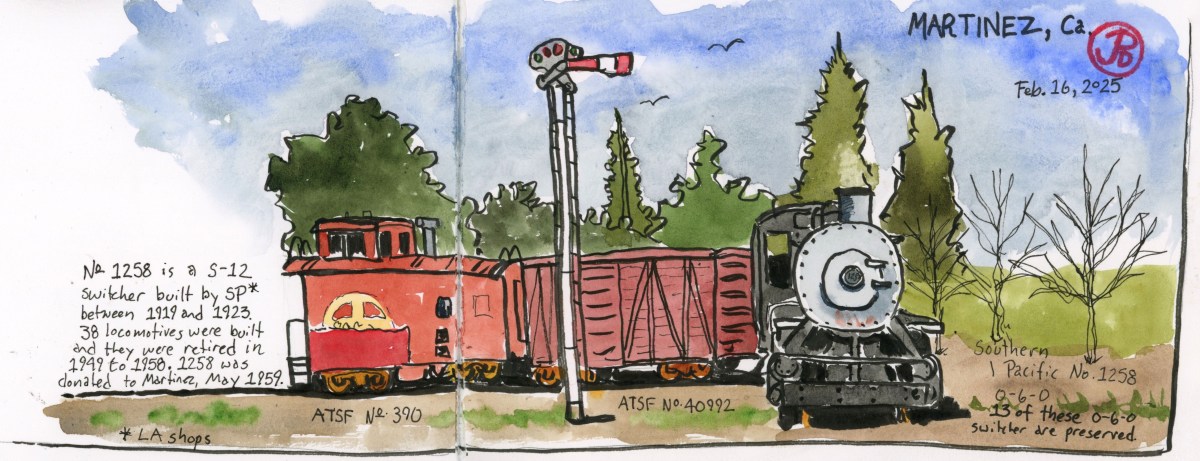
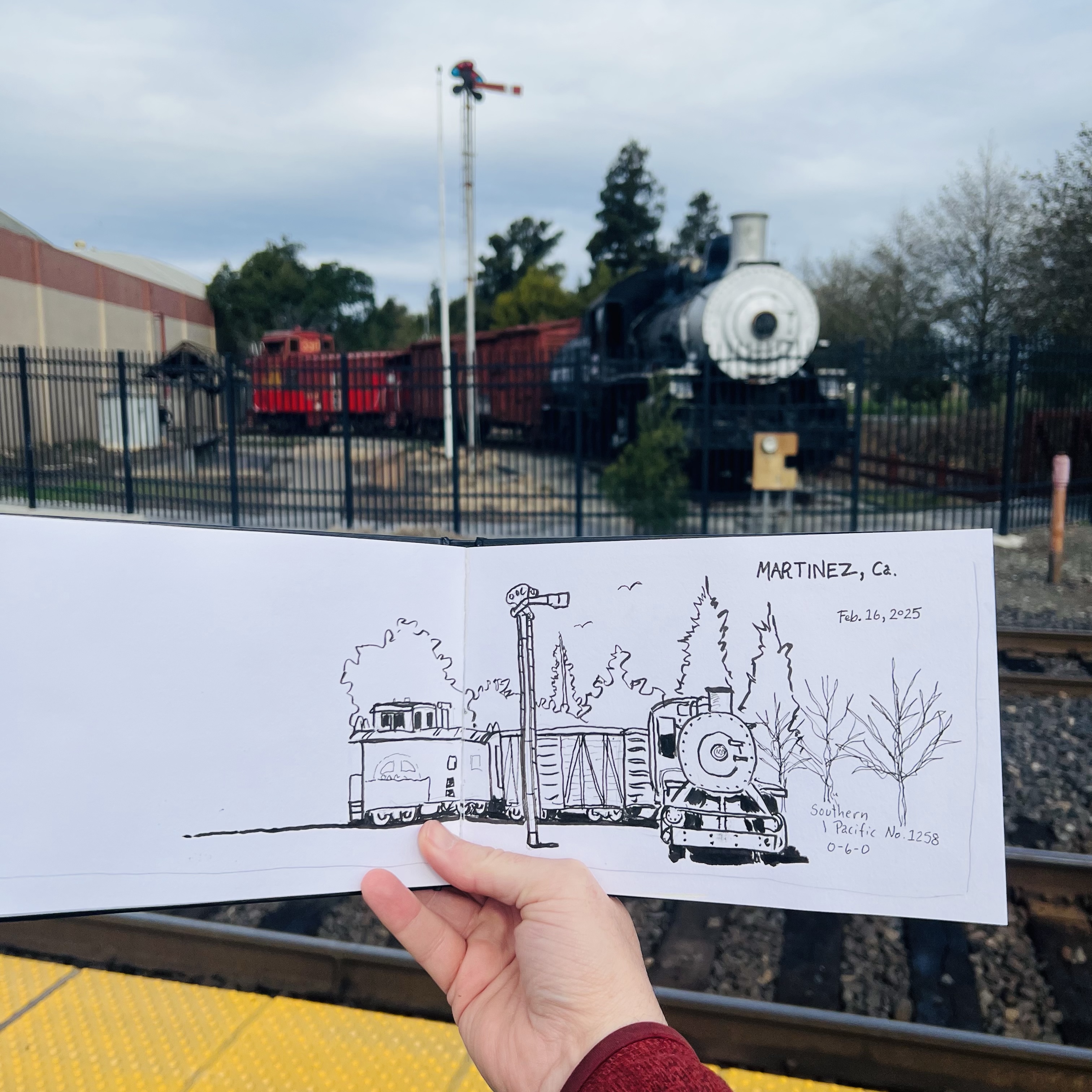
On my last visit I wanted to sketch the Southern Pacific locomotive, with its odd consist of Santa Fe cars, on static display across from the station but I didn’t get around to it. I wanted to add it to a spread on my next visit (featured sketch).

Southern Pacific No. 1258 is an S-12 switcher steam locomotive built at the SP shops in Los Angeles. 38 locomotives where built in this class and there are 13 0-6-0 SP switchers preserved, more than any type of Southern Pacific locomotive built.
Switchers are not sexy nor classy like the GS locomotives. There epitomize function over form. The real workhorses of the Southern Pacific freight yards.

After sketching 1258, I headed to the other side of town to sketch the house of Martinez’s most famous resident.

This resident is the writer and naturalist John Muir. He lived here among the fruit orchards with his wife and family.

Muir married into the Strentzel family in 1880. The Strentzels had been farming the land, mainly fruit ranching, since the 1850s. Muir lived here, except when he was off traveling, from 1880 until his death in 1914.

I knew I wanted to do a sketch of the 1882 Italianate house but I needed to find the right perspective.

The touchstone for my sketch was the not-so-giant sequoia that Muir planted years ago. The tree has failed to live up to its name in the Martinez climate.
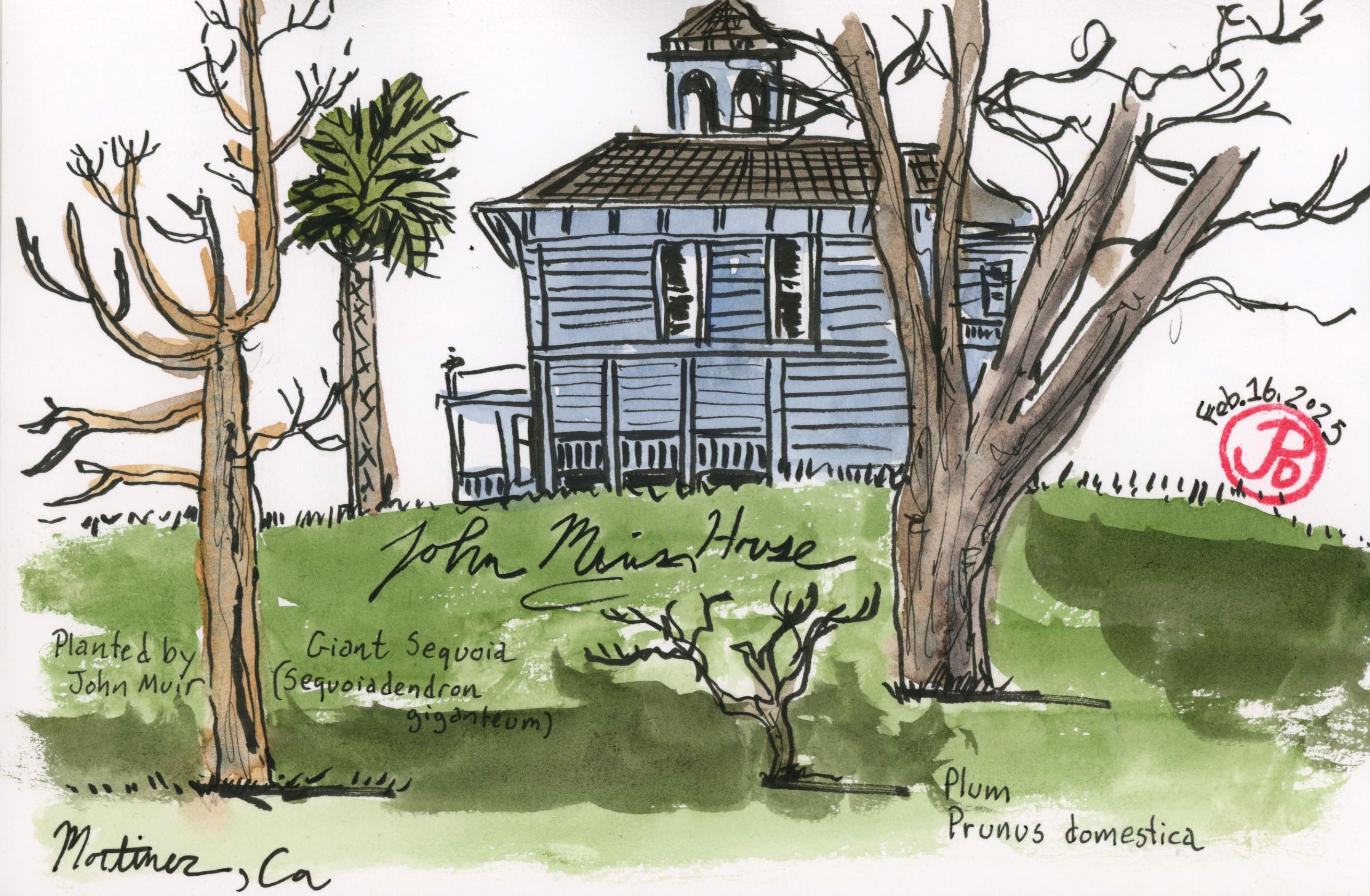
My Muir-sequoia-bench sketch.

I found a bench with the sequoia in the foreground and the Muir House in the background up the hill.
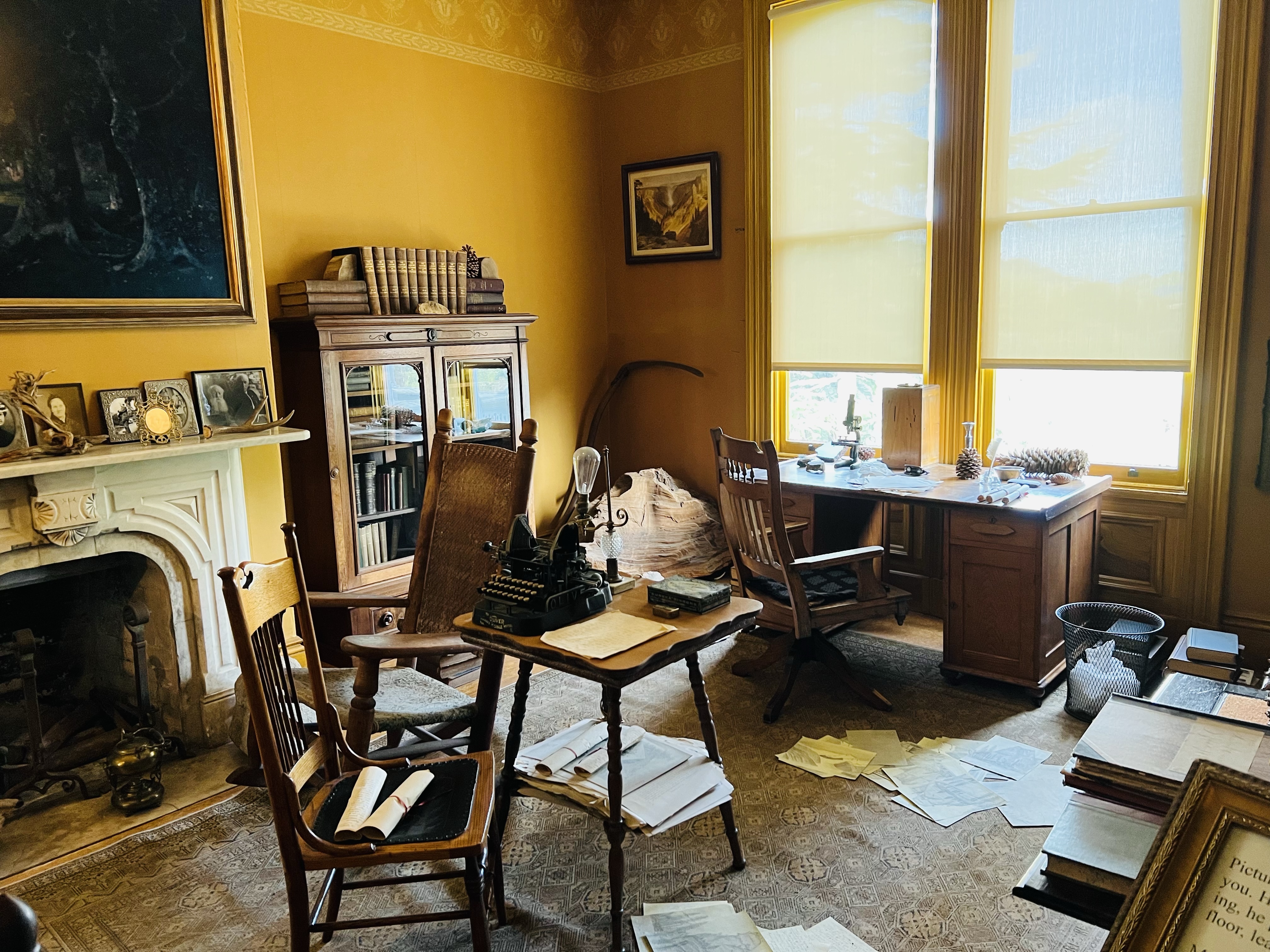
My favorite room in the Muir House. Muir’s “scribble den”.
Image

Western Railway Museum

I have memories that stretch back over 40 years of visiting Rio Vista Junction as a child, now called the Western Railway Museum.

The museum was not as polished and a little more threadbare back then. Lot of passion for trains and streetcars but perhaps without the funds.

My father grew up as an only child in San Francisco during the age of steam, streetcars, and streamlined buses.

Dad spent much of his youthful free time riding the streetcars into the dunes before the Sunset District was developed. He told me that the operators, always Irish, would let my father take the controls while the operator ate his lunch. Such scenes are unthinkable now in the age of lawsuits, codification, and over parenting.

When I was growing up, my dad shared his passion for transit. And the active rolling stock of the museum of Rio Vista was one of my classrooms.

And when I return to the Western Railway Museum, I feel my dad’s presence.

It’s not hard to find evidence of my father at the Western Railway Museum. Just inside the front door, his name is listed as a primary donor.

The old visitors center and gift shop has been replaced by a grand building reminiscent of a train depot that has a gift shop, displays, a cafe, and a research library. The new visitors center was dedicated in 2001.

When I visited the research library, there were many cardboard boxes with my father’s name on it. He was quite the collector. I was told that so far, 12,000 items from my father’s collection had been catalogued.

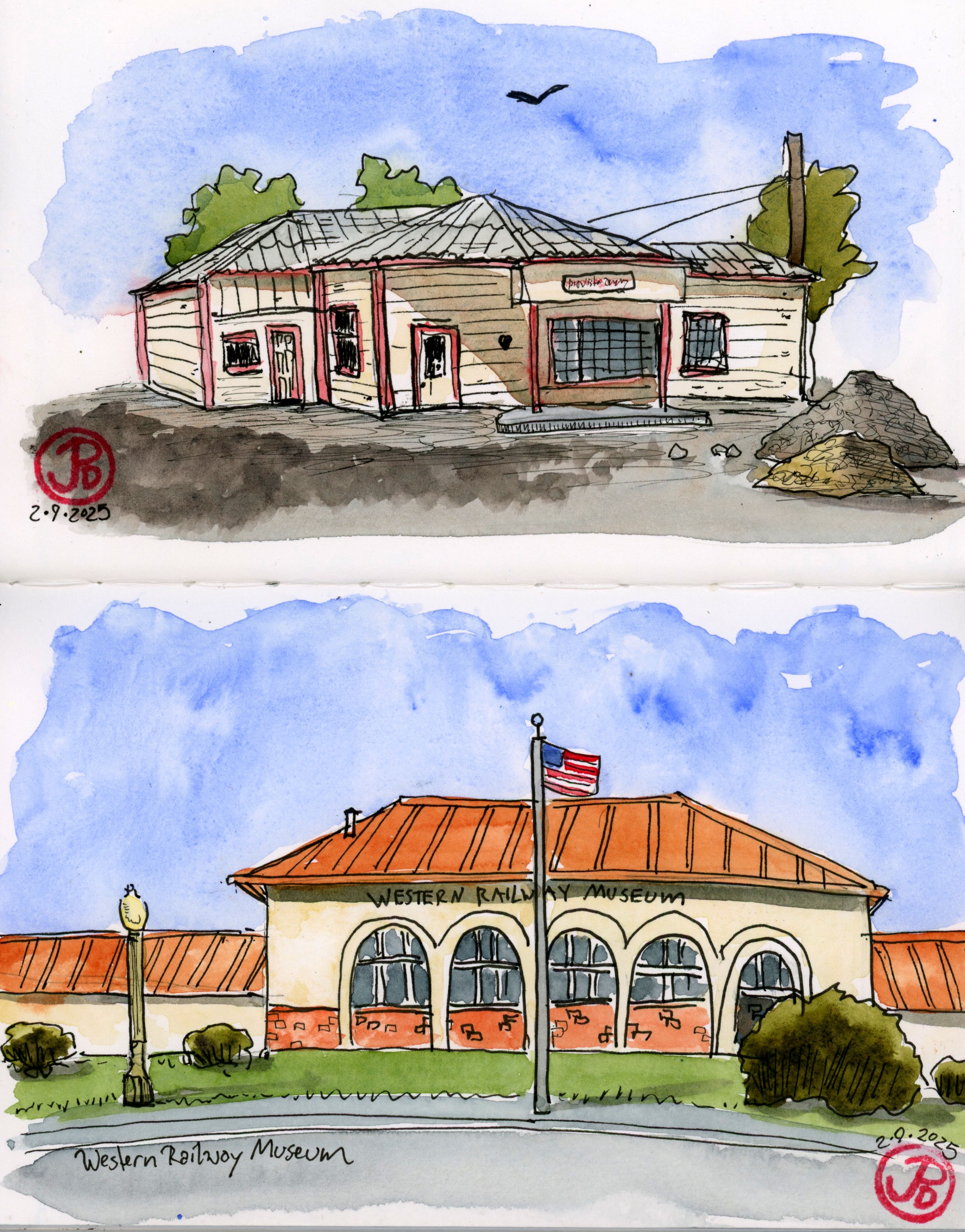
Both centers are still in existence and I sketched both as a contrast to the growth of the museum.

The former visitors center and service station.

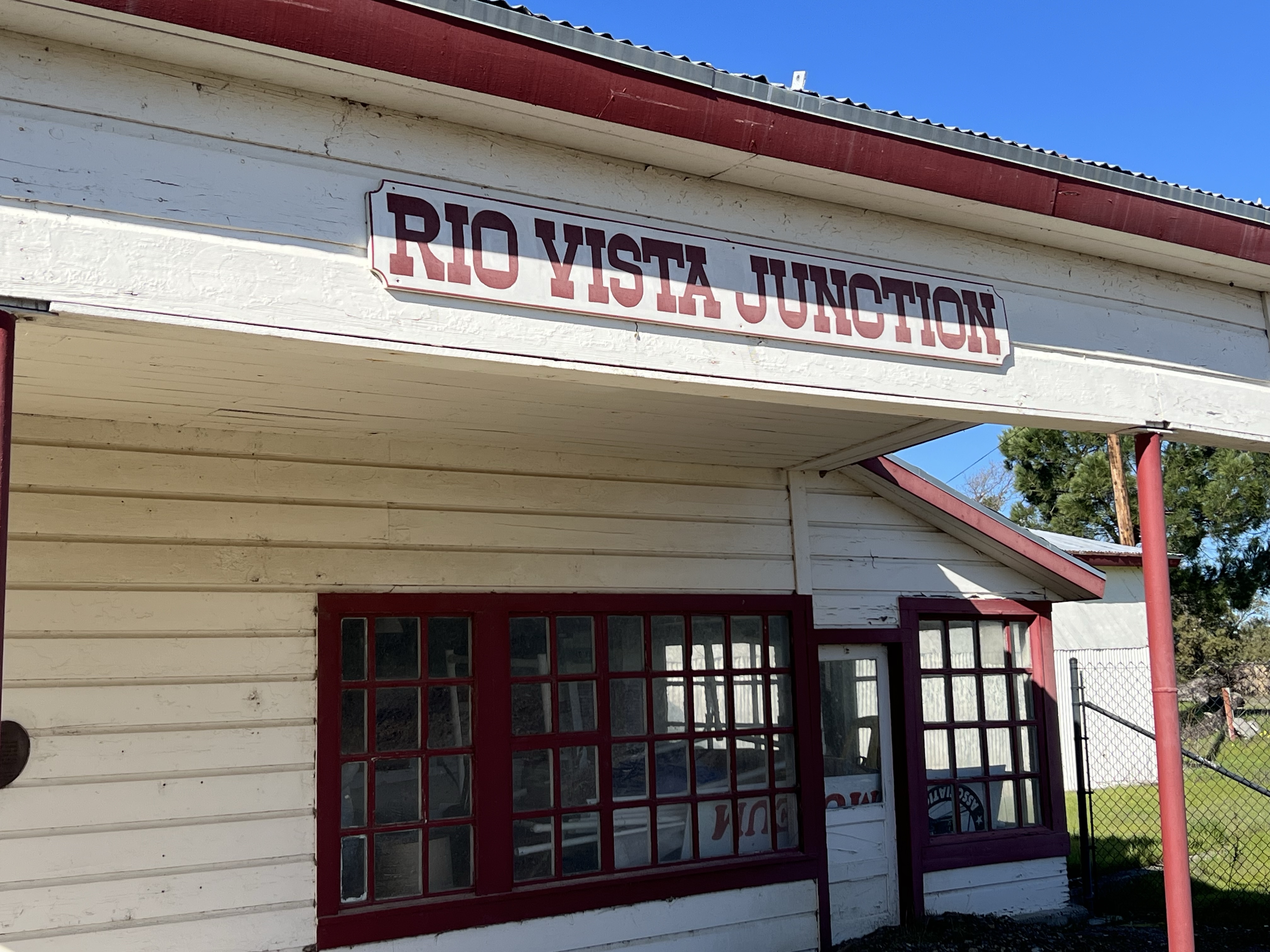
The old visitor center is close to Highway 12 and the Sacramento Northern mainline and was formerly a service station. I assume this is where passengers caught buses to Rio Vista to the east.

And it seems gasoline was not the only service offered at the station. An E Clampus Vitus plaque near the front entrance reads, “Here between 1942 and 1948, the painted ladies serviced the needs of our men from Travis AFB. Closed by order of an unsympathetic sheriff.”

The old and the new, sketched in one spread.

The museum was founded as the California Railway Museum in 1960 on property at Rio Vista Junction by the rails of the Sacramento Northern Railway (the museum purchased 22 miles of the Sacramento Northern in the mid-1990s.)

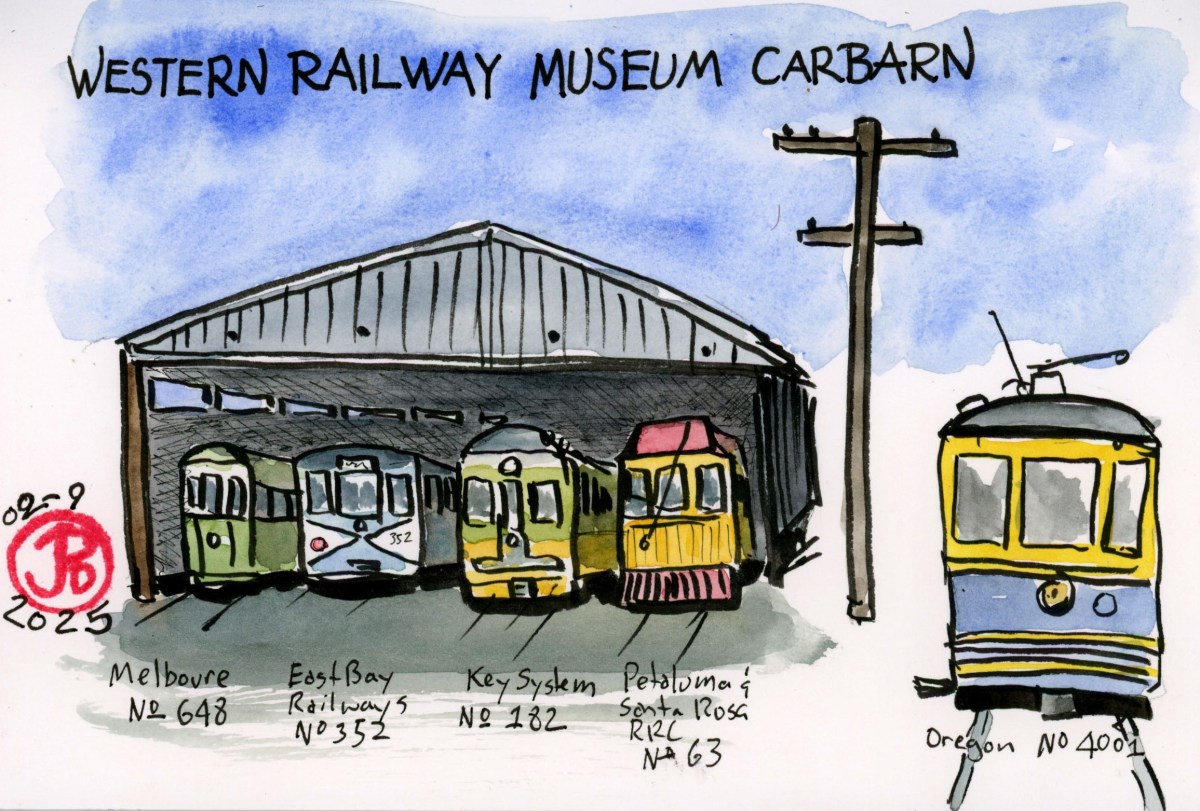
After sketching the two visitors centers from two different eras, I sketched the old carbarn.

The cars facing out (left to right) are a Melbourne car No. 648, East Bay Street Railways No. 352, Key System No. 182, and Petaluma and Santa Rosa No. 63. In the foreground to the right is Portland Traction Company No. 4001. 4001 was waiting for passengers to board.

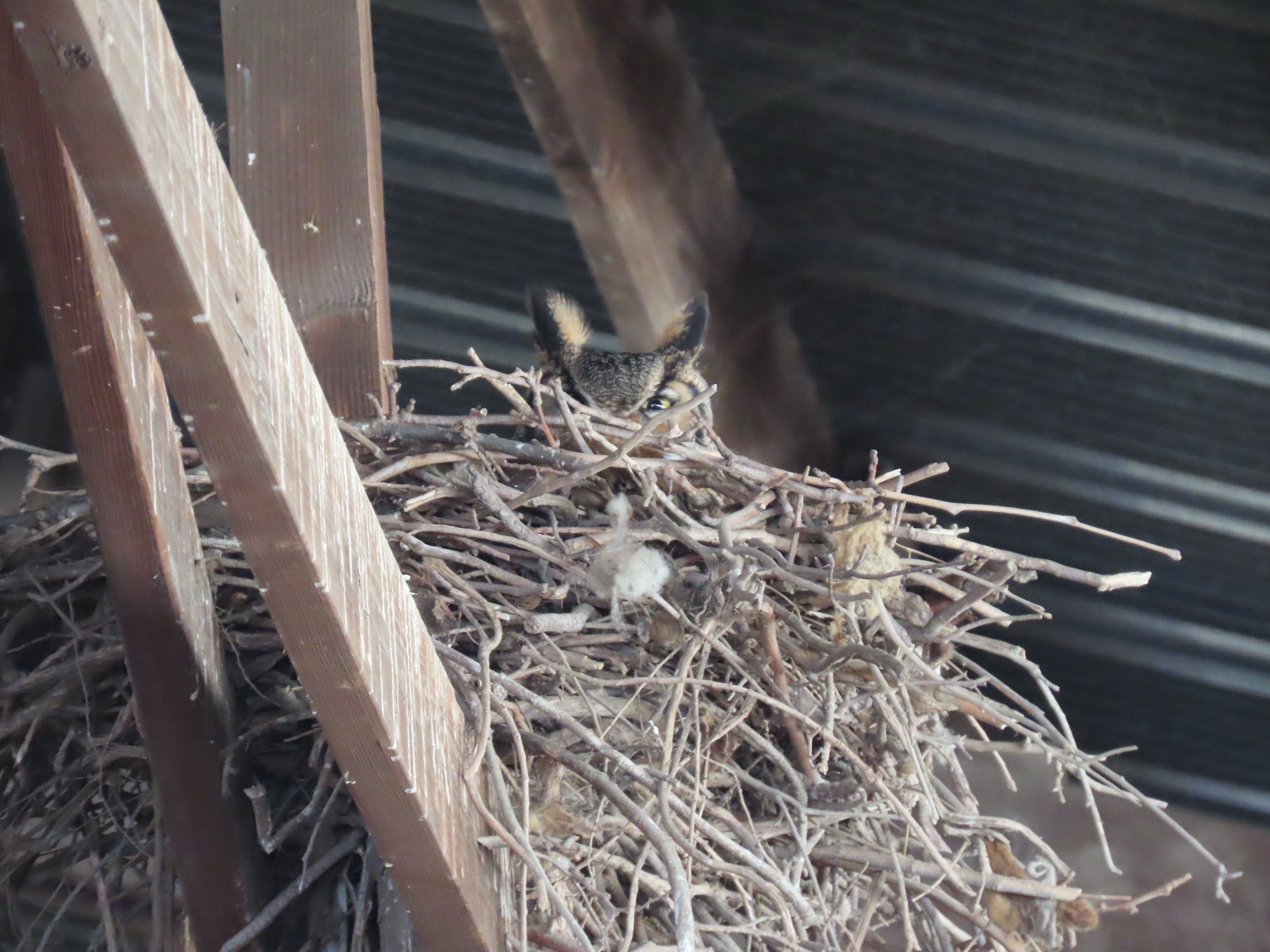
There was one other surprise in the open air carbarn. Earlier I had seen a great horned owl fly from the barn and head to the eucalyptus grove in the picnic area. While I was walking inside the barn I had noticed a very messy nest, it looked like ravens. As I walked near the nest I realized I was being watched.

This was nest was occupied by a great horned owl.

Image

Little Notebook

Before any journey I buy a pocket worthy notebook to record information: notes, maps, travel times, diagrams, field notes, drawings, quotes, addresses, checklists, packing lists, reads and watches, and other tidbits.

While I’m abroad this notebook and the information contained therein is as valuable as my passport.

This is a notebook that I use for pre planning and also as a travel journal for thoughts on the road.

For this trip I bought a Leuchtturm 1917 A6 (3.5 by 6 inch) black notebook. I prefer blank pages over dotted, ruled, or squared. Each page is a canvas of thoughts, facts, fictions, and drawings.

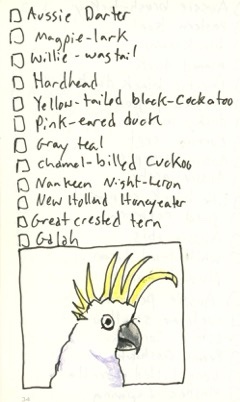
The interior paper is thin and does not take watercolor very well. For this sketch of a sulphur-crested cockatoo I used color pencil. Above the drawing is a checklist of birds I hoped to see in Sydney.

Leuchtturm means “lighthouse” in Deutsch and the company is based in northern Germany. This family-owned stationary company was founded in 1917 in Aschersleben. The company’s motto is “Denken mit der Hand” which translates to “Think with your hand”.

The first and last pages are of a thicker paper and I usually do some watercolor drawings about the destination I will be traveling or some of the fauna I hoped to see.

This summer I will be traveling to Australia! And most of my watercolor drawing are of animals I hoped to see in the Land Down Under and sights I hoped to see and sketch while there.

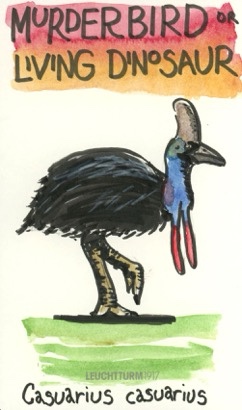
The southern cassowary tops my Australian bird wishlist.

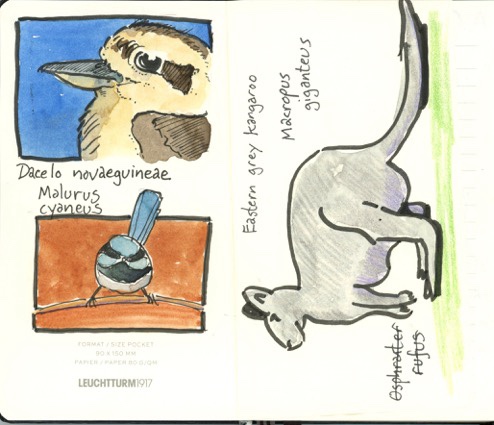
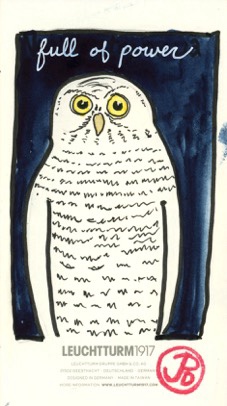
Some of the creatures featured in my notebook, so far, are: southern cassowary (the murder bird), laughing kookaburra (“in the old gum tree”), superb fairy-wren, eastern grey kangaroo, super- crested cockatoo, and powerful owl.

I hope to see Australia’s largest owl, the powerful owl, in one of Sydney’s many parks.
Image

The Railroad of Las Gallinas

Rails are notoriously cagey birds. To see one well, takes lots of patience and a good deal of luck.

When I first started birding the Holy Grail bird was the clapper rail (now called Ridgeway’s rail).

The best place to see them in the Bay Area was historically Palo Alto Baylands. And it helped to be there at high tide, preferably a King tide.

You wait on the boardwalk and look down a channel through the march, a railroad, and get a fleeting glimpse of a rail swimming across.

The idea was that the high waters would flush the rails up making them easier to spot.

I had fleeting views, at low tide.

There are other places of the unbroken marshes that once ringed the San Francisco Bay. That’s why the Ridgeway’s is a gem to see because it is uncommon and elusive and threatened. The rail is on the Red Watch list meaning it is a species of the highest conservation concern. So seeing one is always special.

One of my favorite birding areas Las Gallinas Valley Sanitary District, also happens to be a great place to encounter a Ridgeway’s. You may not always get a good view but you can usually heard them.

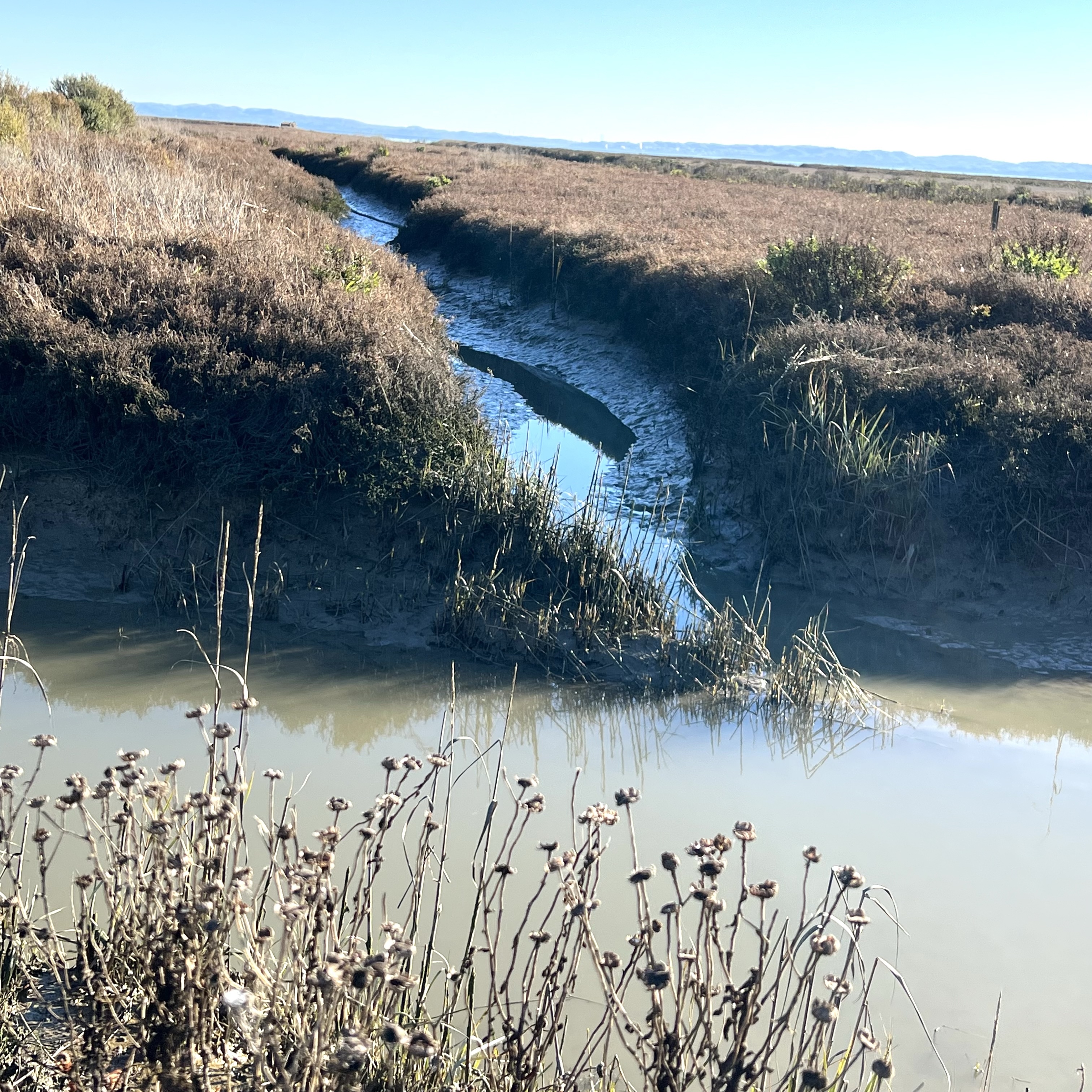
A railroad line at Las Gallinas.

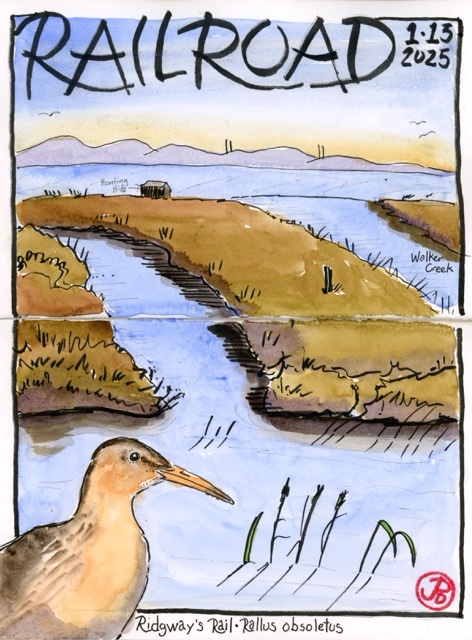
You do have to walk as far east as you can to the marches buffer the bay and Miller Creek adds its water to the bay. To the left is a channel, a railroad, where I have seen rails before.

I walked out to the point, at a very high tide, and sketched the view (featured sketch).

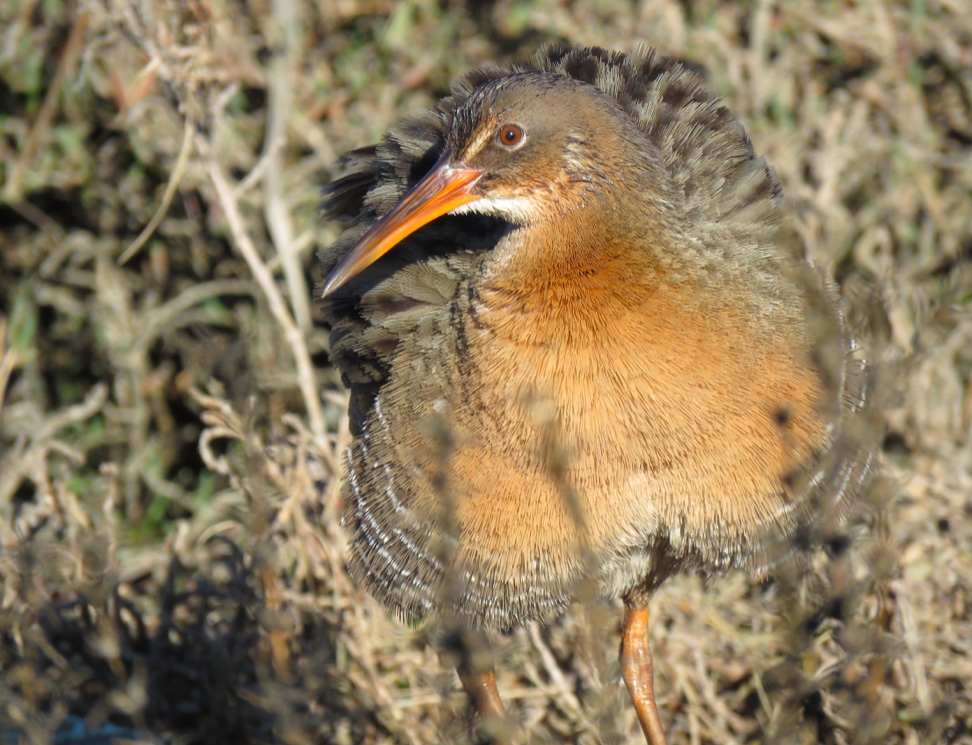
A great view of a Ridgeway’s rail in beautiful light at Bayfront Park. These sights are not too frequent.
Image

The Kingbird and the Cemetery

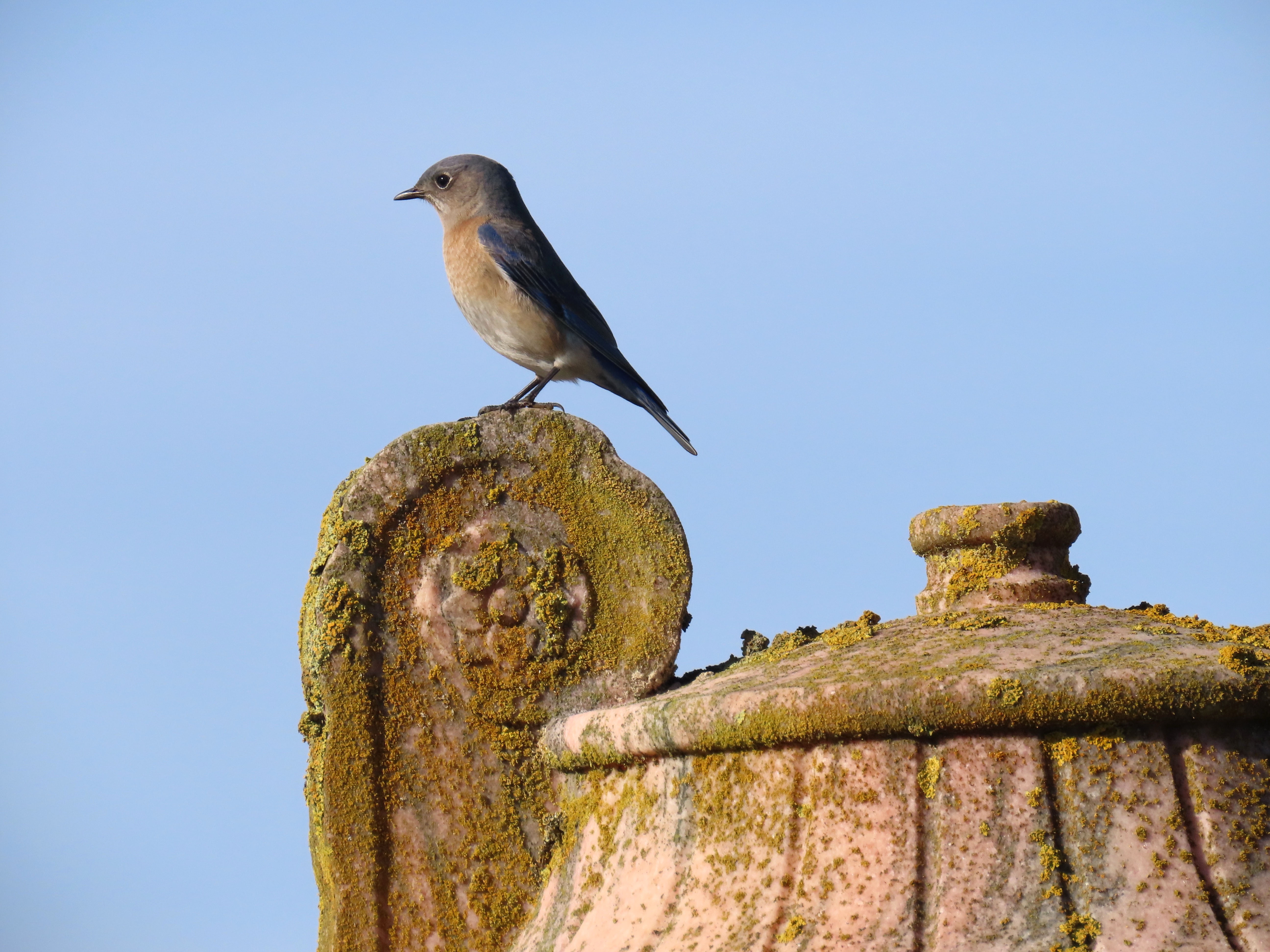
Surprisingly a cemetery is full of life.

The wide open spaces with trees and plenty of perches is an ideal habitat for flycatchers and other avian insectivores.

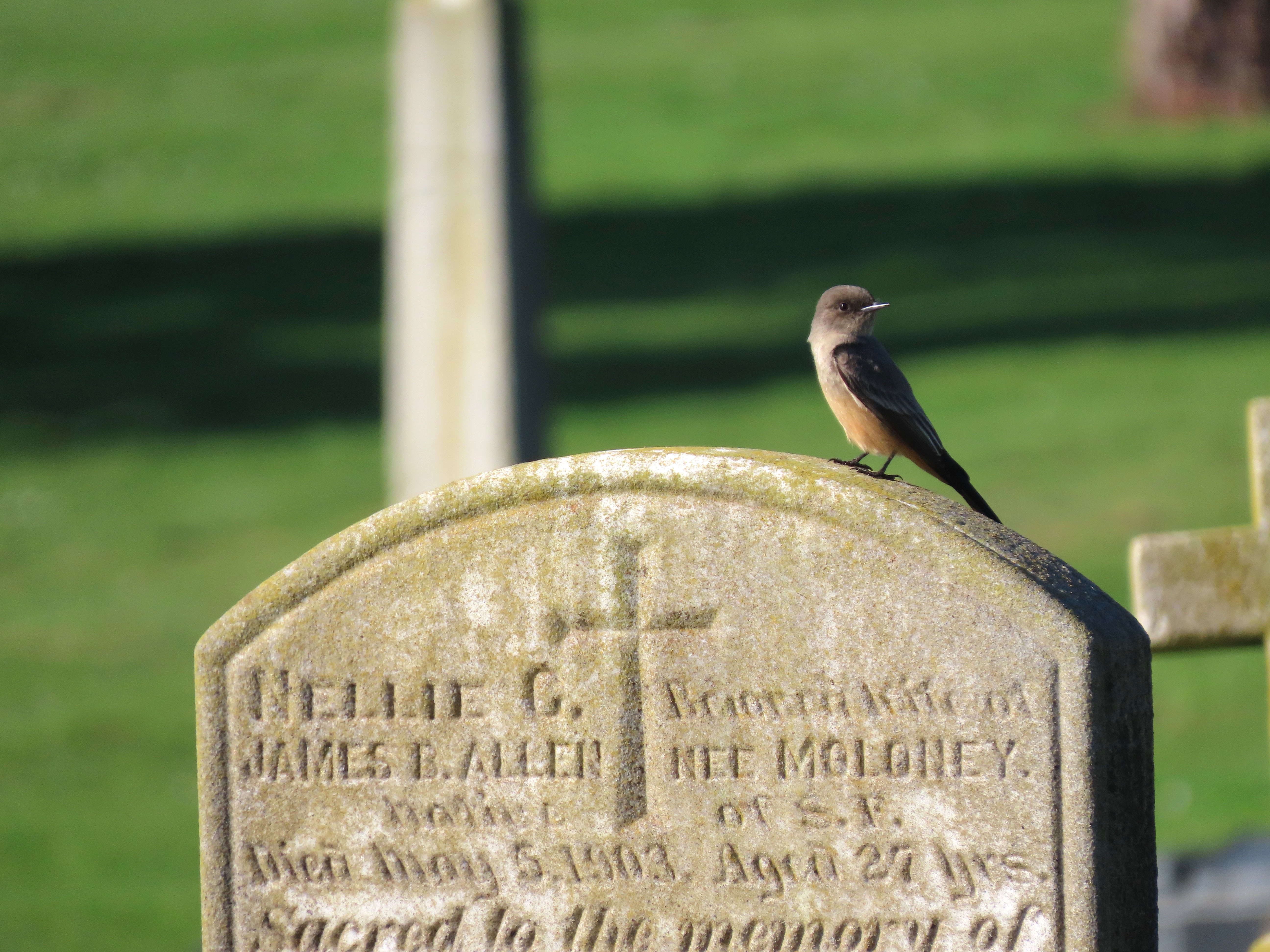
Exhibit A: Say’s Phoebe.
Exhibit B: Western bluebird.

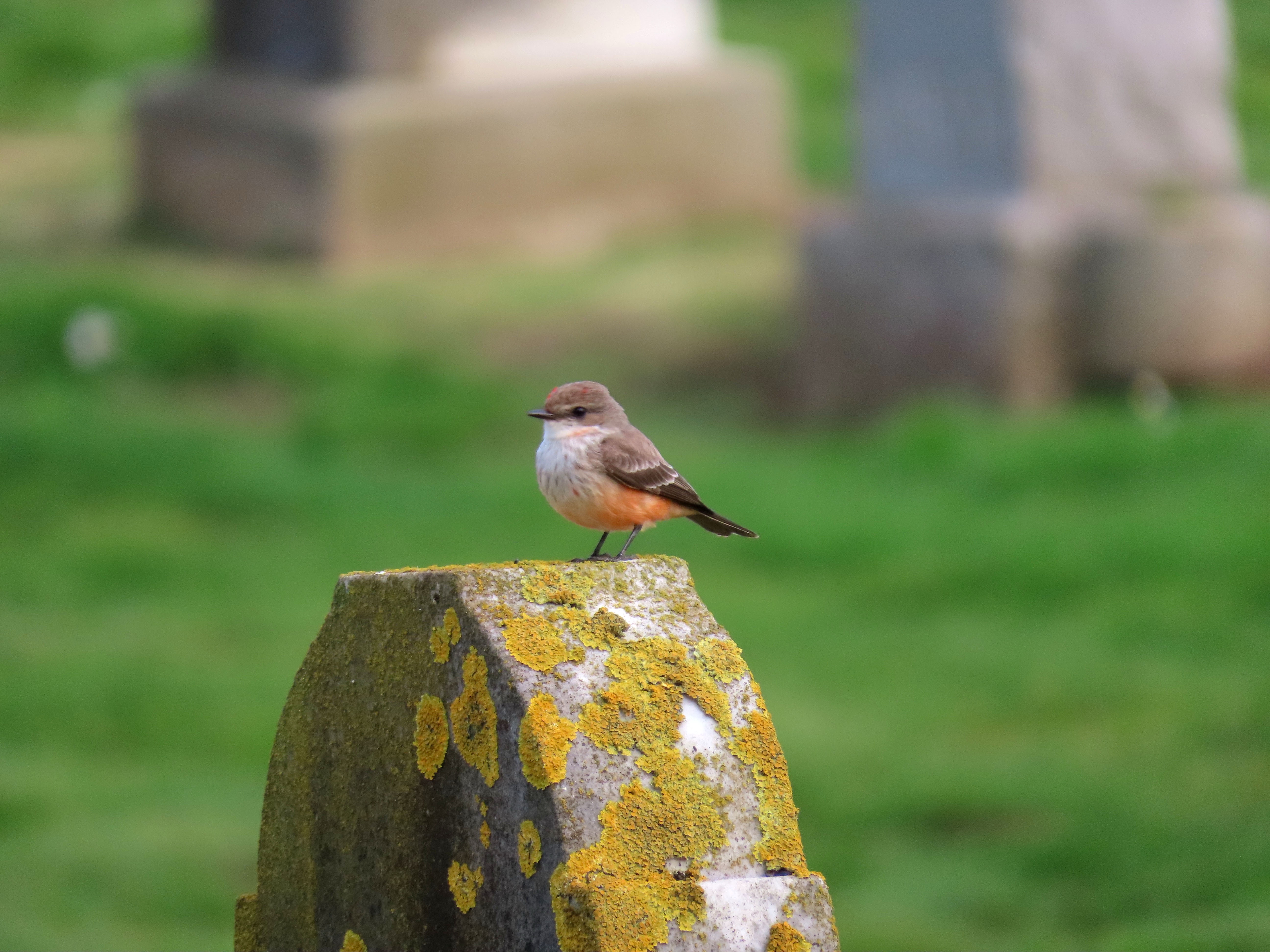
I was heading to Holy Cross Cemetery in Colma (there are more residents below ground than above) to find a vagrant flycatcher.

The flycatcher in question is the stunning vermillion flycatcher (Pyrocephalus obscurus). The normal range of the vermillion in the United States is Arizona, New Mexico, Texas, and Southern California. In the winter, some make their way up the California Coast. And it is one of these wayward birds that I was looking for.

When I drove up to Section G at Holy Cross (featured in the cult classic Harold and Maude) there was a couple standing amongst the tombstones looking in one direction. I bet I knew what they were looking at!

The wayward vermillion flycatcher.

The vermillion was perched on a tombstone and sallied forth to catch a snack on the wing and then land on another hunting perch. It eventually flew up to the top of a pine and disappeared.

I waited for the flycatcher to reappear for about 15 minutes. No luck, so I headed east in Section G. There were plenty of common black phoebes flycatching from the mossy tombstones but no vermillion.

I decided to walk to the eastern edge of Section G which was bordered by 25th Street and then make my way back to where I had first seen the vermillion, I hoped of getting some photo documentation. And that’s when I spotted the flash of yellow!

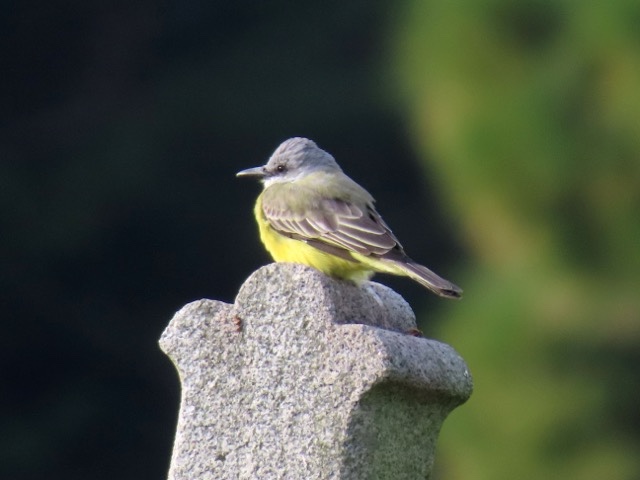
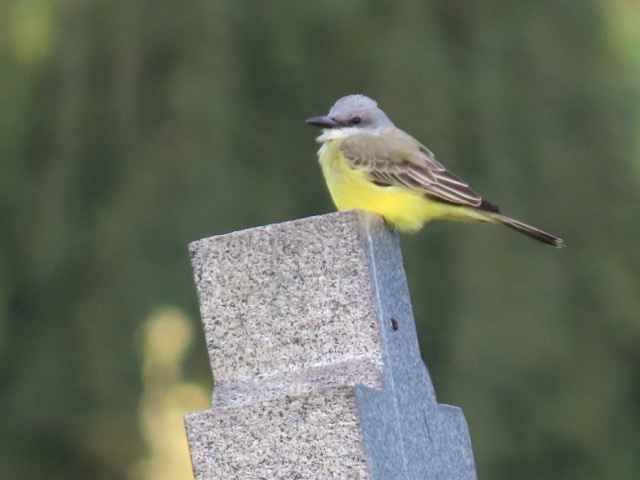
The flash of yellow flew across the street into Section G2 and landed in a tree. I immediately knew what flycatcher it was and I lifted my binoculars to my eyes for confirmation: yes a kingbird.

Tyrannus melancholicus.

And at this time of year at this location I knew it was a tropical kingbird, also known as a TK because it is so common in Central America.

I enjoyed following the kingbird around Section G, getting some documentation with my camera because a TK is considered a rare bird for this location.

Yup, it’s a TK!
Image

Sketching Touchstone: Pt. Arena Lighthouse

A sketching touchstone is a subject that I return to over and over again.

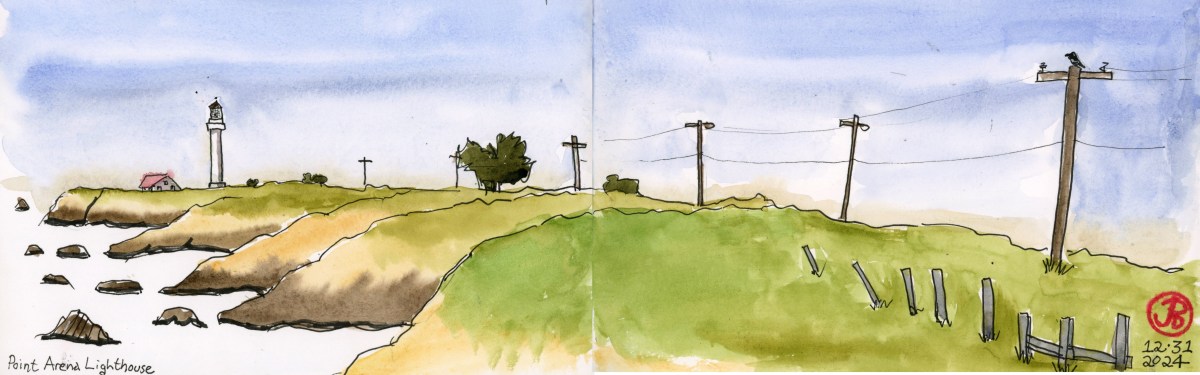
And the Pt. Arena Lighthouse certainly deserves the title.

I have sketched this beautiful lighthouse several other times, but from different angles.

Point Arena is a special place because it is the closest part of the United States to Hawaii. It is the furthest west you can get in the Lower 48.

I drove out to the lighthouse and pulled over at a dirt lot and started to sketch the scene before me.

I was a bit far off from previous sketches but I like the way the power poles and lines leads the eye to the lighthouse in the distance.

My constant companion during the sketch was the world’s largest songbird: the common raven. The corvid was finishing up a meal on a fence post.

The raven then proceeded to give a post-repast repertoire of its gronks, groans, and bill-slapping. It was hard to take my eyes off the entrainment as I was sketching the lighthouse. I added the raven to the closest power pole.

Image

California Registered Historical Landmark No. 714

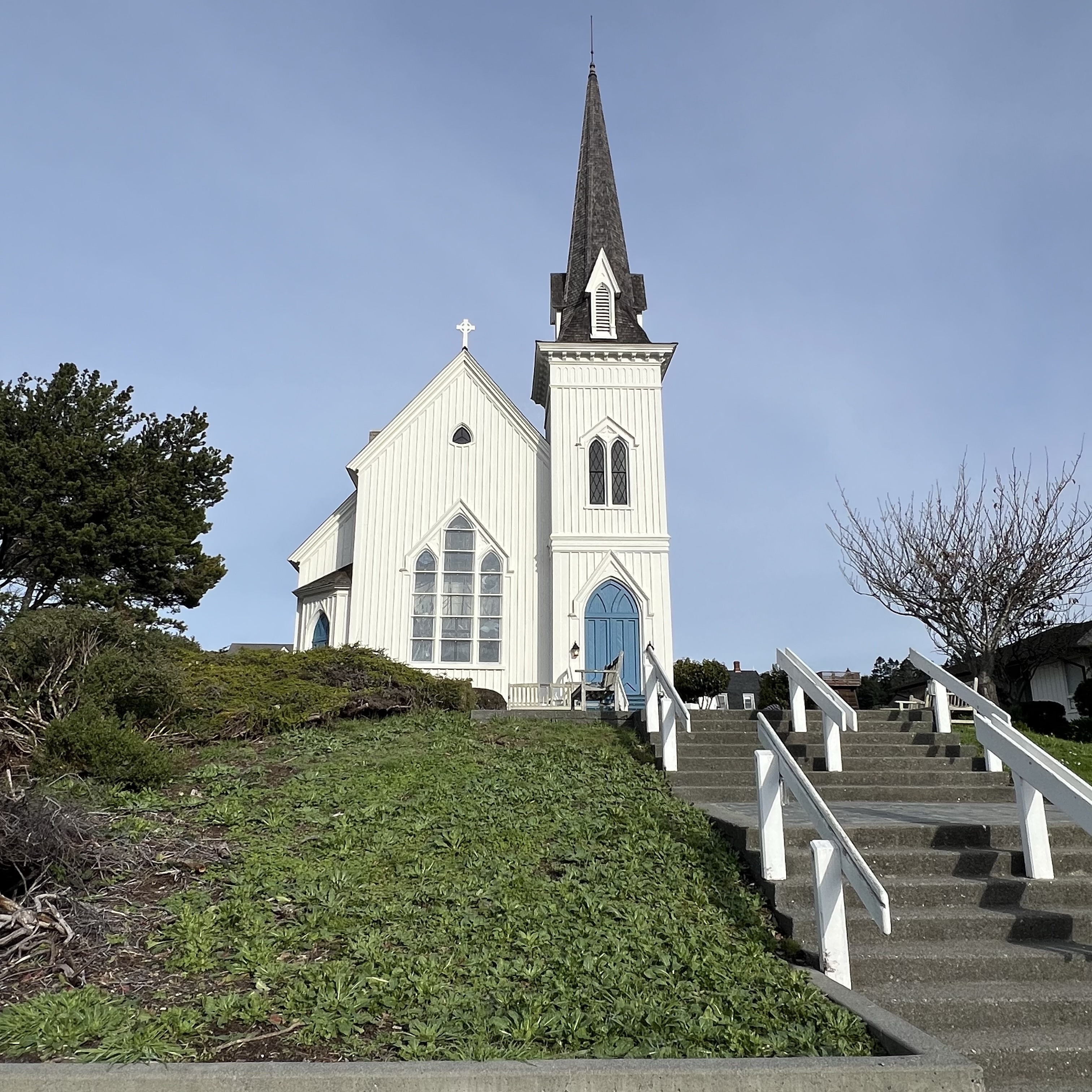
The town of Mendocino has two California Registered Historical Landmarks, both are houses of worship.

I had already sketched the Temple of Kwan Tai on a previous visit and now I wanted to sketch the Mendocino Presbyterian Church.

I sketched the church from my curbside sketching blind and when I finished I walked over to get a closer look at the California State Historic Landmark Plaque.

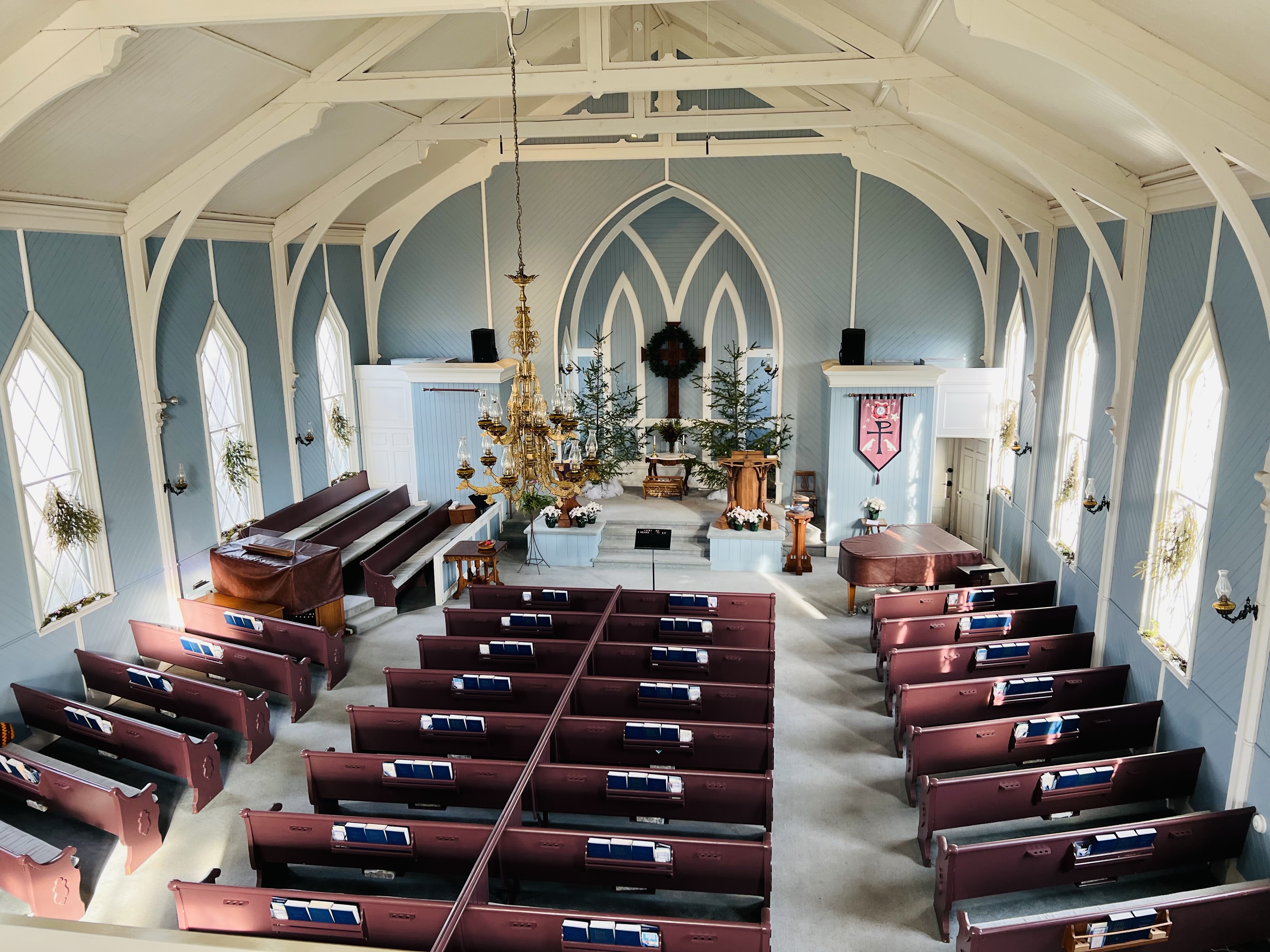
The church was dedicated in 1868 and is the oldest church in continual use in California. As I was reading the plaque a kindly local asked if I wanted to have a look inside.

I replied in the affirmative and the kindly church lady put her dog indoor and returned with the key.

She gave me a brief tour and told me if I was brave (I was) that I could climb the ladder in the choir loft to see the chalk signatures of past pastors and church members on the inside of the bell tower (which I did).

She also said that I could ring the bell, so I grabbed the pull and did.

The church is built of the local wood, the wood that put Mendocino on the map: coast redwood.

Image

The Pygmy Forest of Jug Handle

I left my Caspar cottage at 8:45 and I walked down the road to Jug Handle State Natural Reserve.

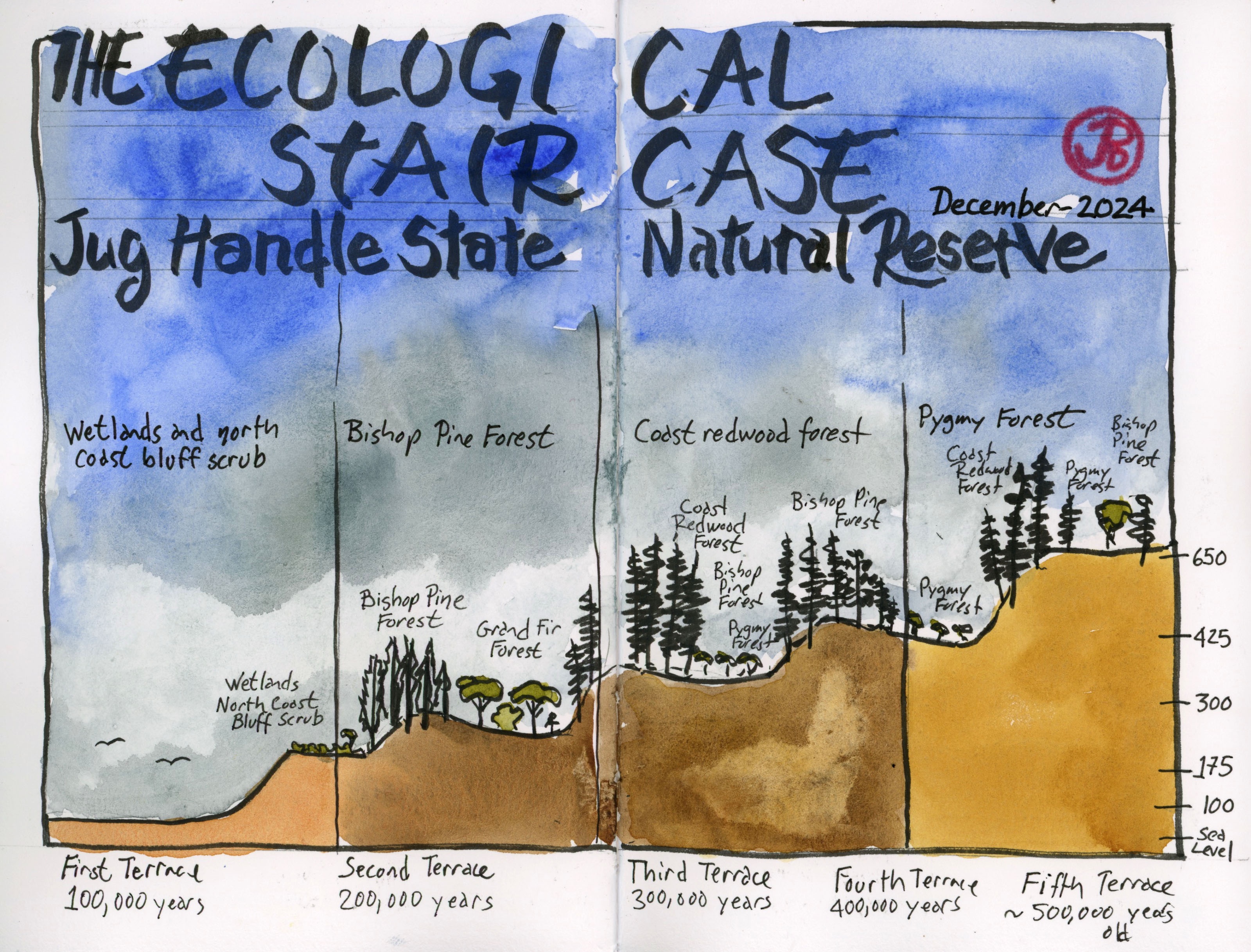
I would he ascending the Biological Staircase of terraces, my final destination would be 2.5 miles from the trailhead on the third terrace. This is the 300,000 year old Pygmy forest!

One reason that the Biological Staircase is so appealing to the naturalist is that you pass through very different habitats, giving you a nice cross section of this rare part of Coastal California.

Weeks before I set off on my journey to the Pygmy forest, I did a sketch of a cross section of the five terraces to help me understand that ecosystems I would be traversing.

The trail was filled with large puddles and portions of the trail became a small stream bed from recent winter rains. This was a wet walk but well worth the mud and the blood and the tears. (Okay just mud, but lots of it.)

I had been on the trail for almost an hour when the tree cover opened up and the morning sun warmed my bones.

I was now nearing my destination: the Pygmy Forest! A small sign marked the beginning of the boardwalk.

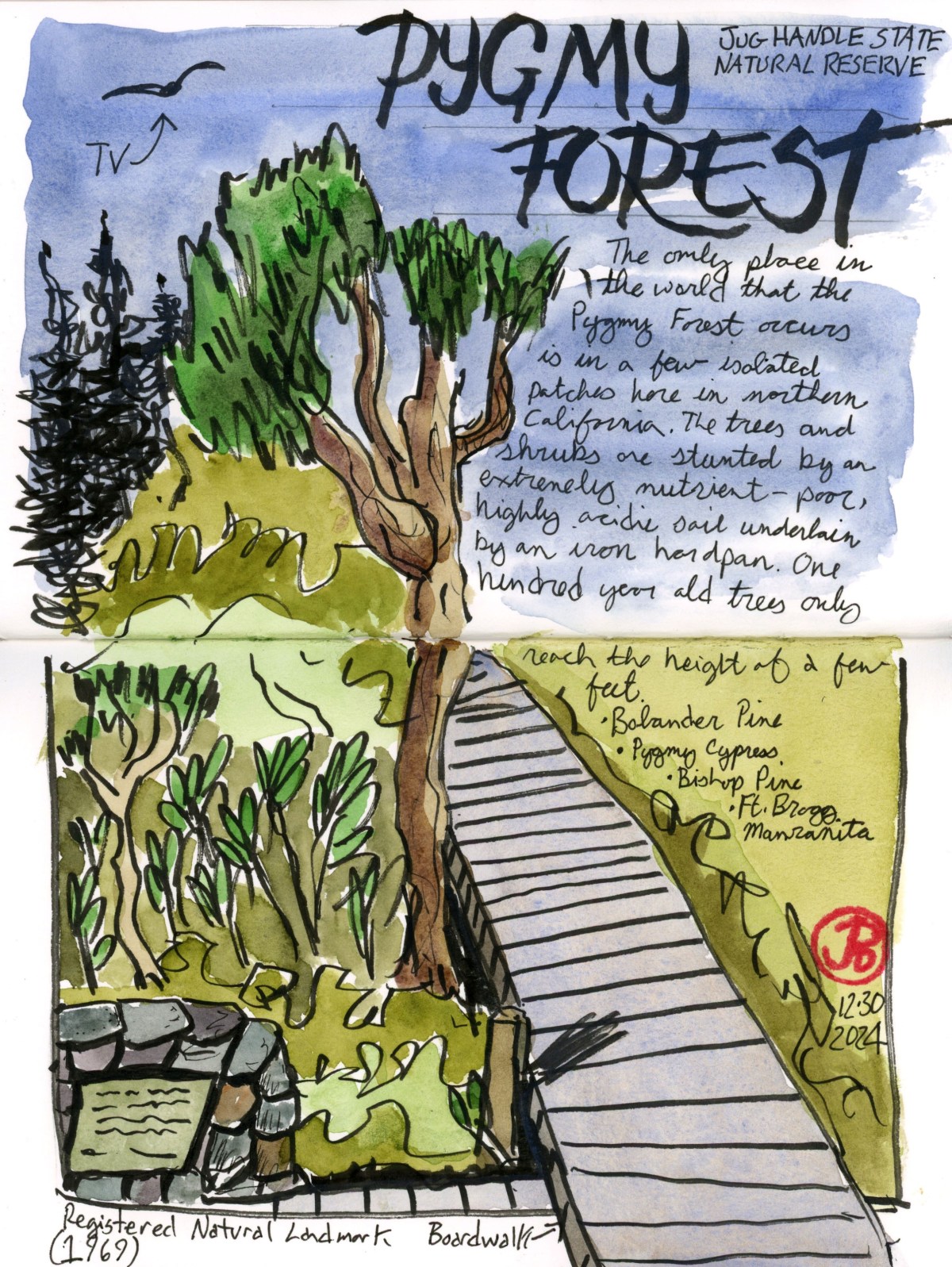
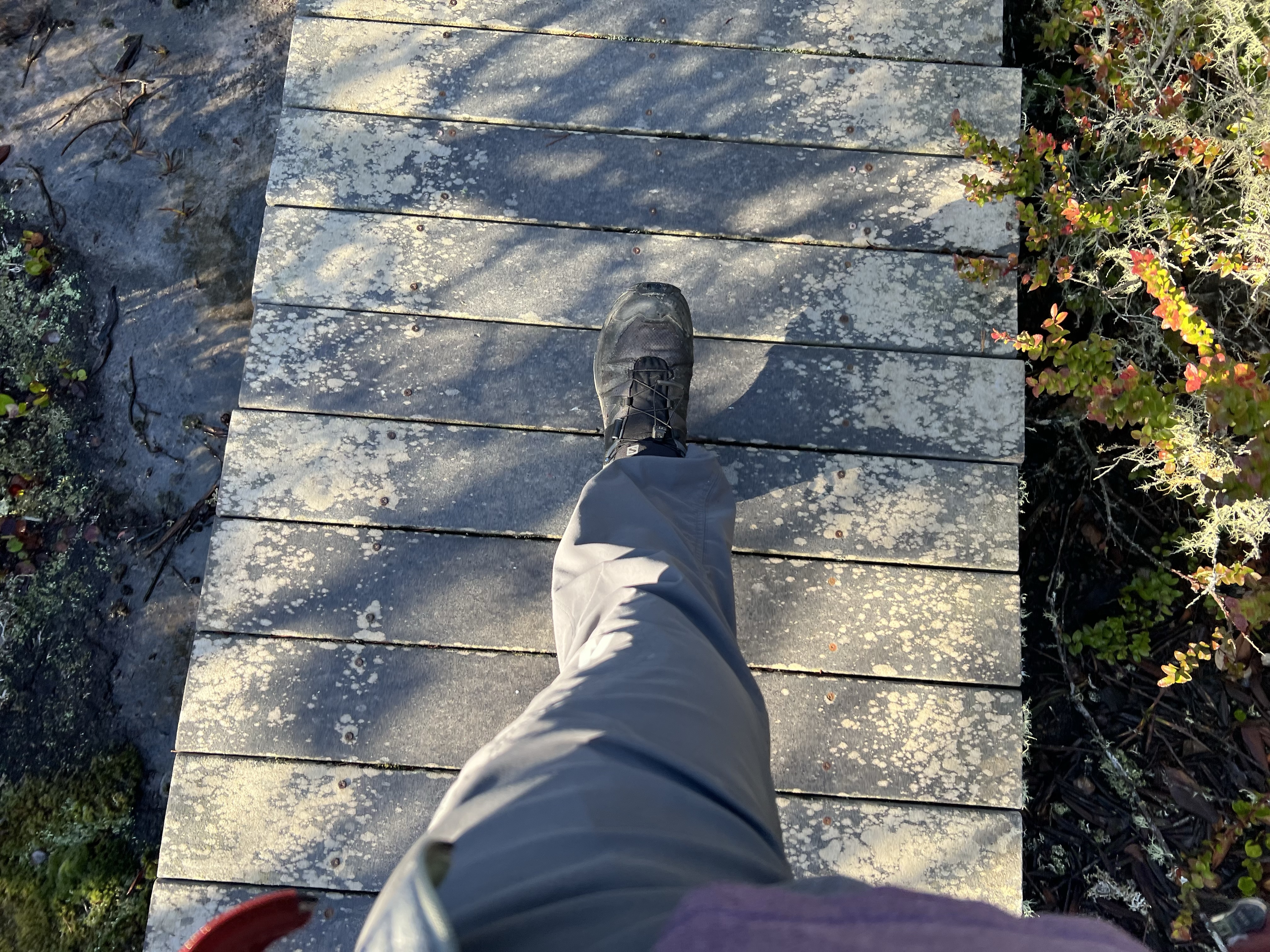
A Pygmy forest occurs when the soil is nutrient poor and plant species are stunted as a result. A Pygmy forest is rare habitat that is only found in a few locations in Northern California. The boardwalk protects the valuable soil from visitor’s damaging footfalls.

The serpentine boardwalk through the Pygmy forest.

Half way through the board walk there was a pull out with benches and a 1968 plaque proclaiming the Pygmy forest as a California Registered Natural Landmark. I rested here, had a snack, and did a sketch of the view. I’ll admit the sketch is a bit loose and wild (featured sketch).

My return journey on the boardwalk.
Image

Mendocino Town-Sketching

The town of Mendocino is really a sketcher’s paradise.

I have sketched this town many times and there are endless angles, perspectives, and hidden gems to add to my sketchbook.

As a sketcher you can either “zoom” in or “zoom” out depending on what strikes your fancy (no zoom lens required). For much of my panoramic sketches I chose to zoom out with a wide angle perspective.

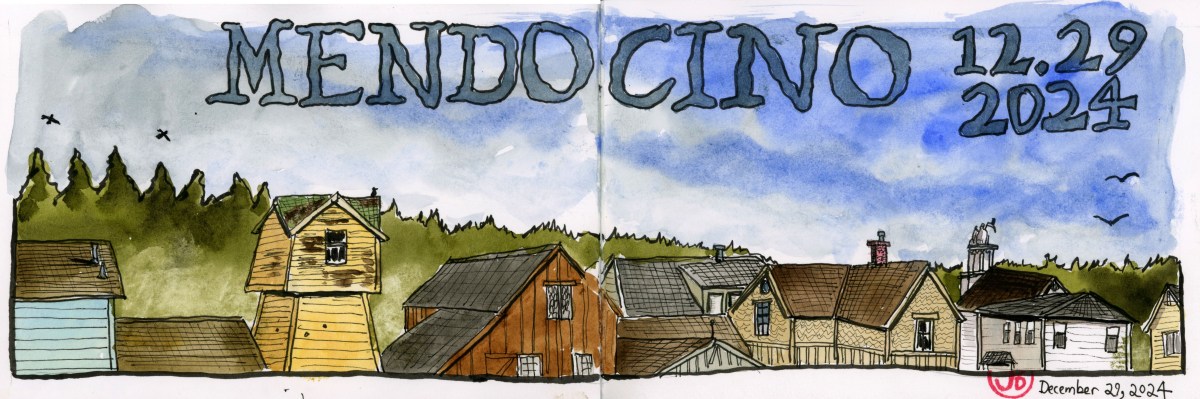
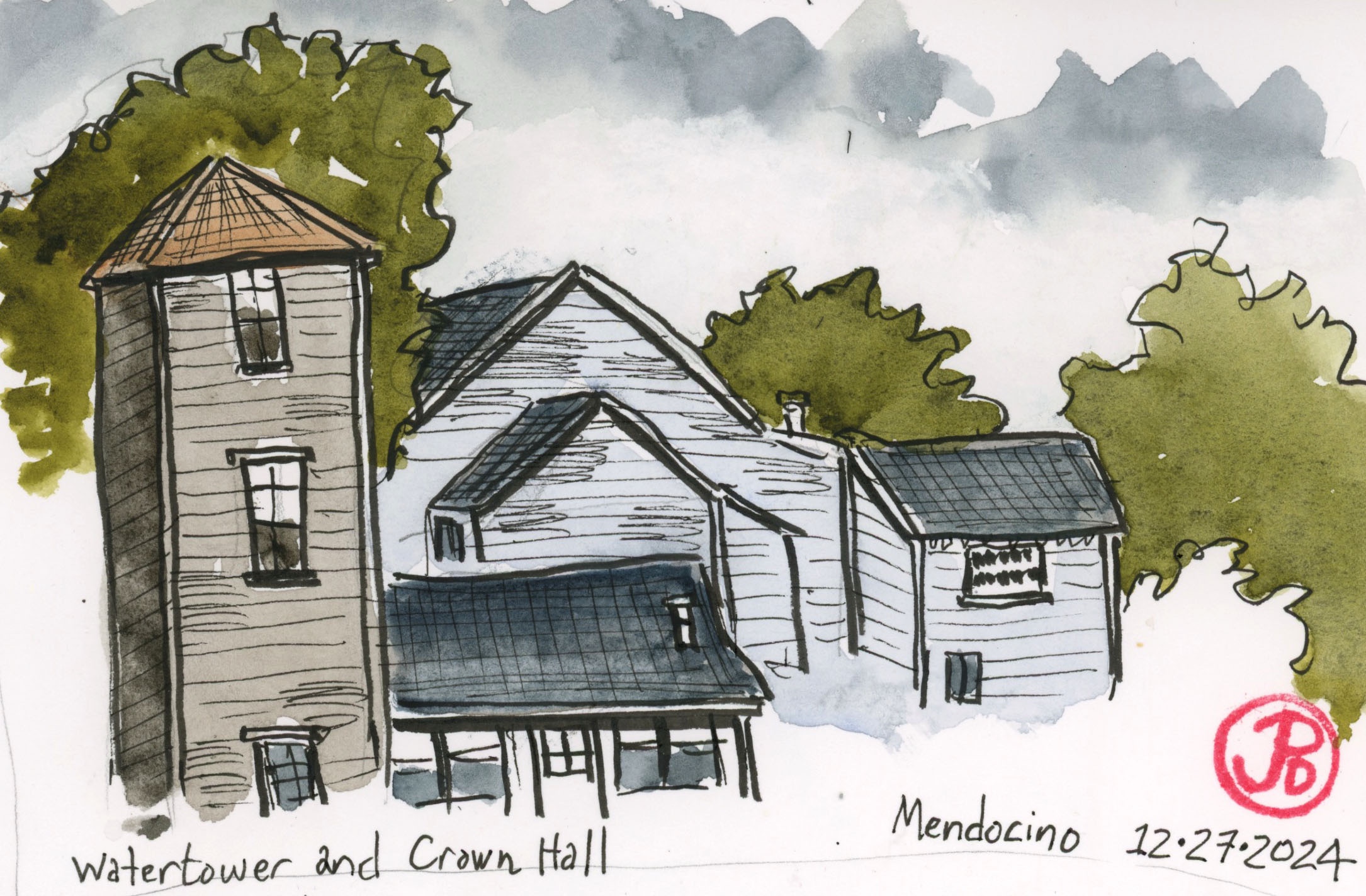
For the featured sketch I positioned myself across the street from the Blair House (used in Murder, She Wrote) right beside Heider Field. The sketch looks towards Lansing Street at a water tower, old buildings, and the Masonic Lodge. A rustic townscape.

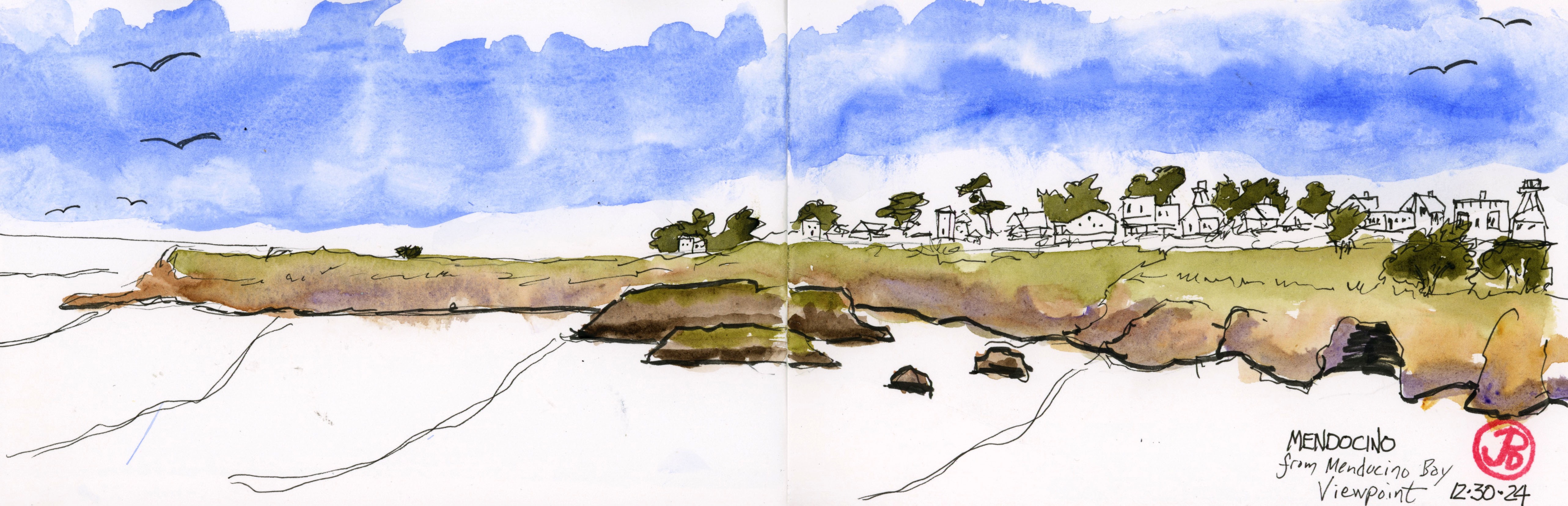
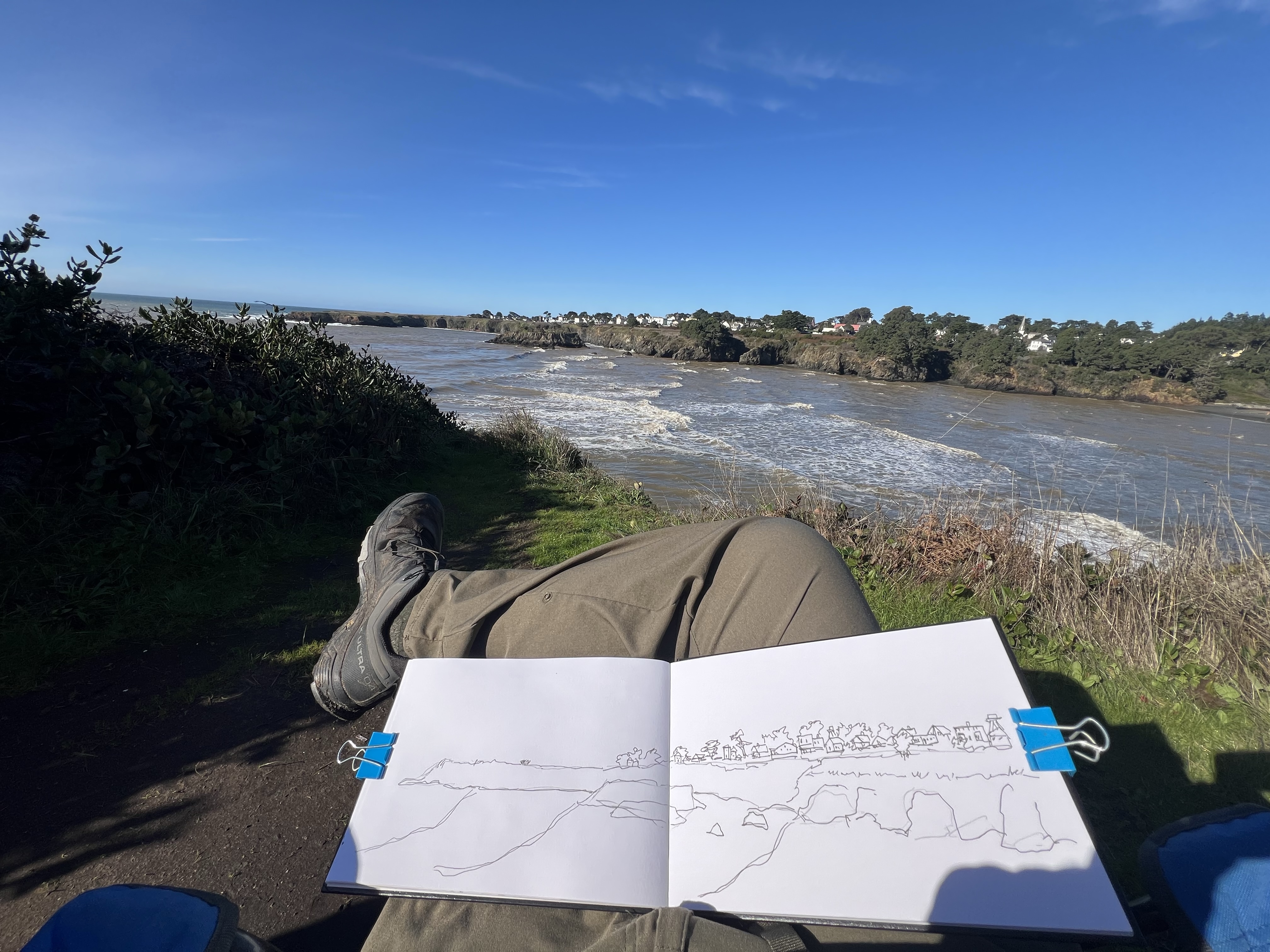
On another day I took a wide angle perspective from the small park across the Big River mouth to draw the bluffs and the town (below).

A panoramic sketch of Mendocino.
What a view!

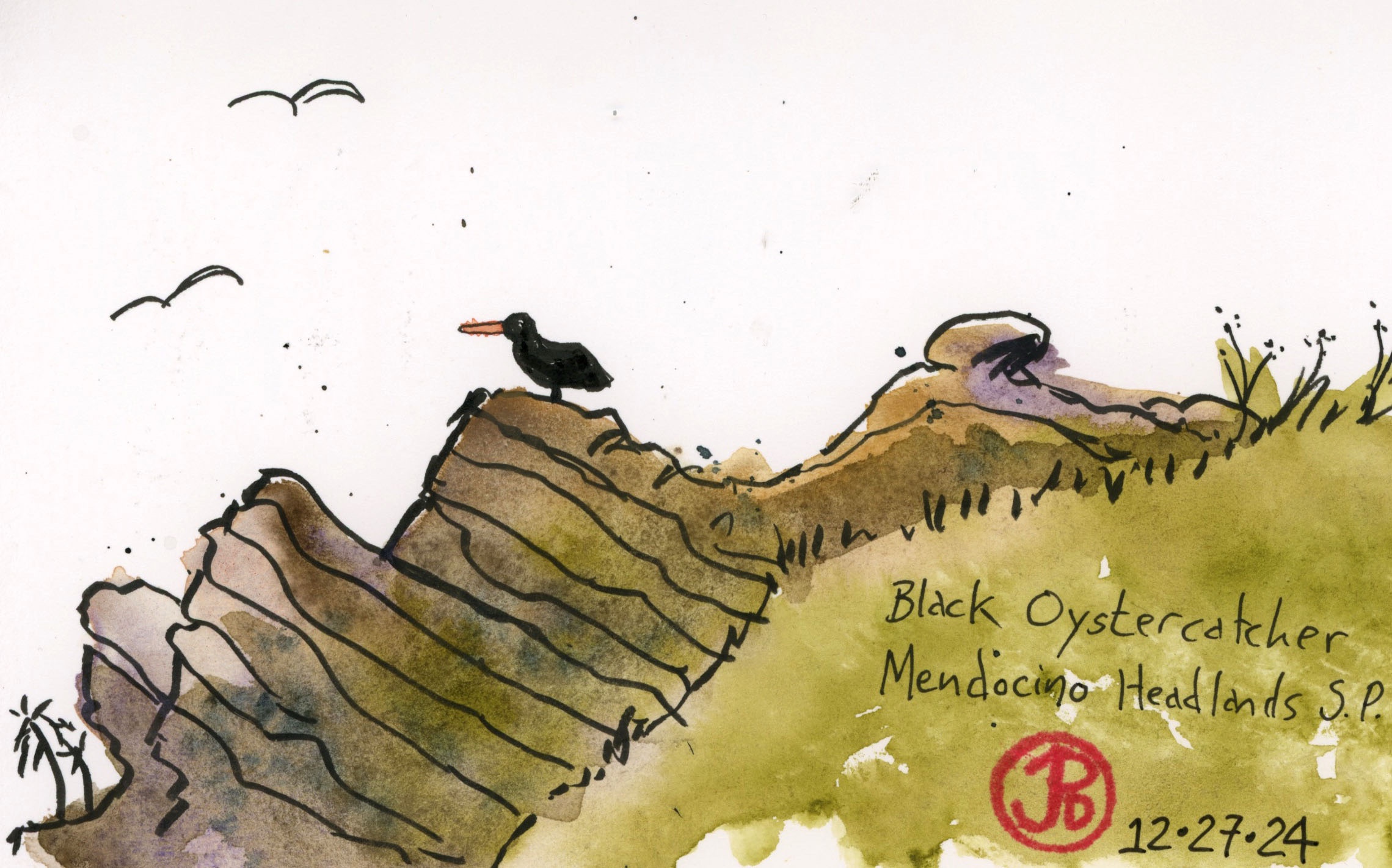
I did do a few sketches a little more “zoomed in”. One was of a water tower and the back of the Crown Hall and the other is at the Mendocino Headlands State Park and a black oystercatcher.

Black oystercatchers are easy to see at the Mendocino Bluffs.
Image

Sketching Ft. Bragg

While many painters, sculptors, and artists are attracted to the picturesque town to the south, Ft. Bragg has plenty of objects to sketch.

And I added a few to my sketchbook.

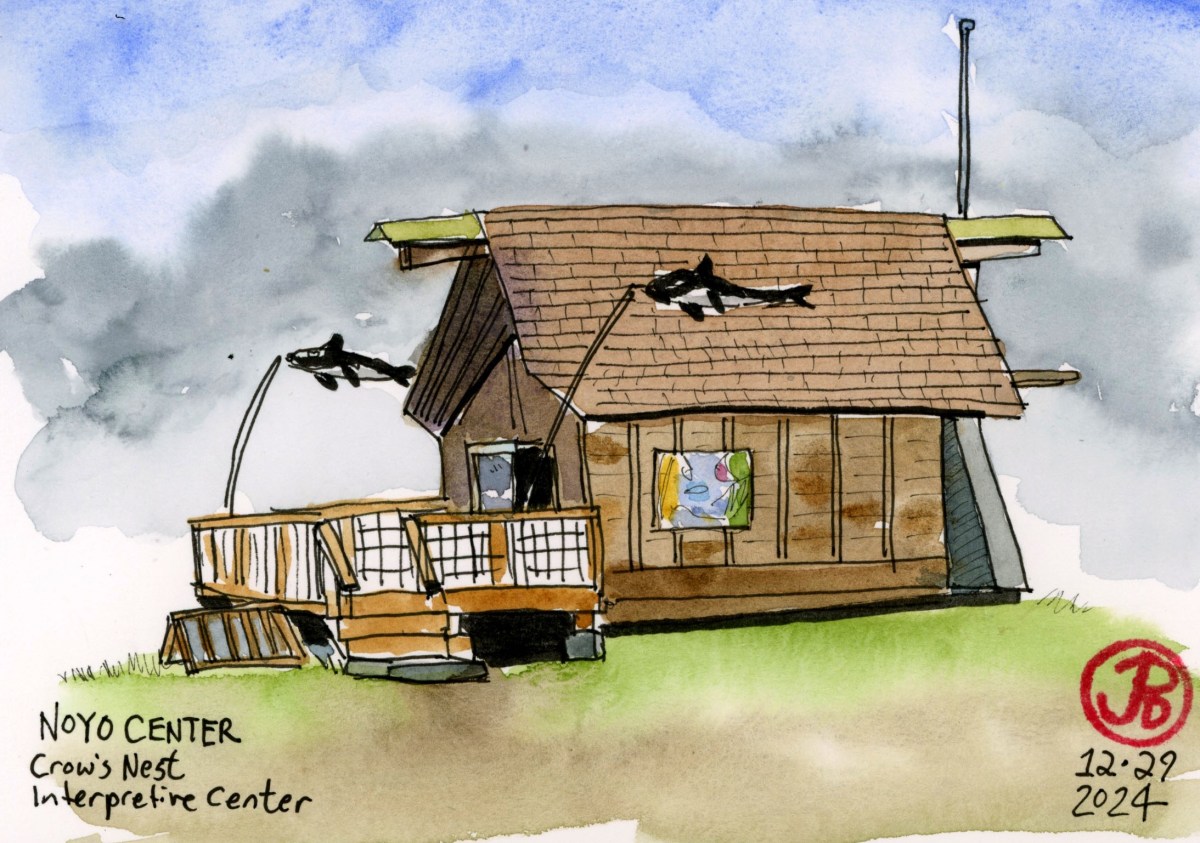
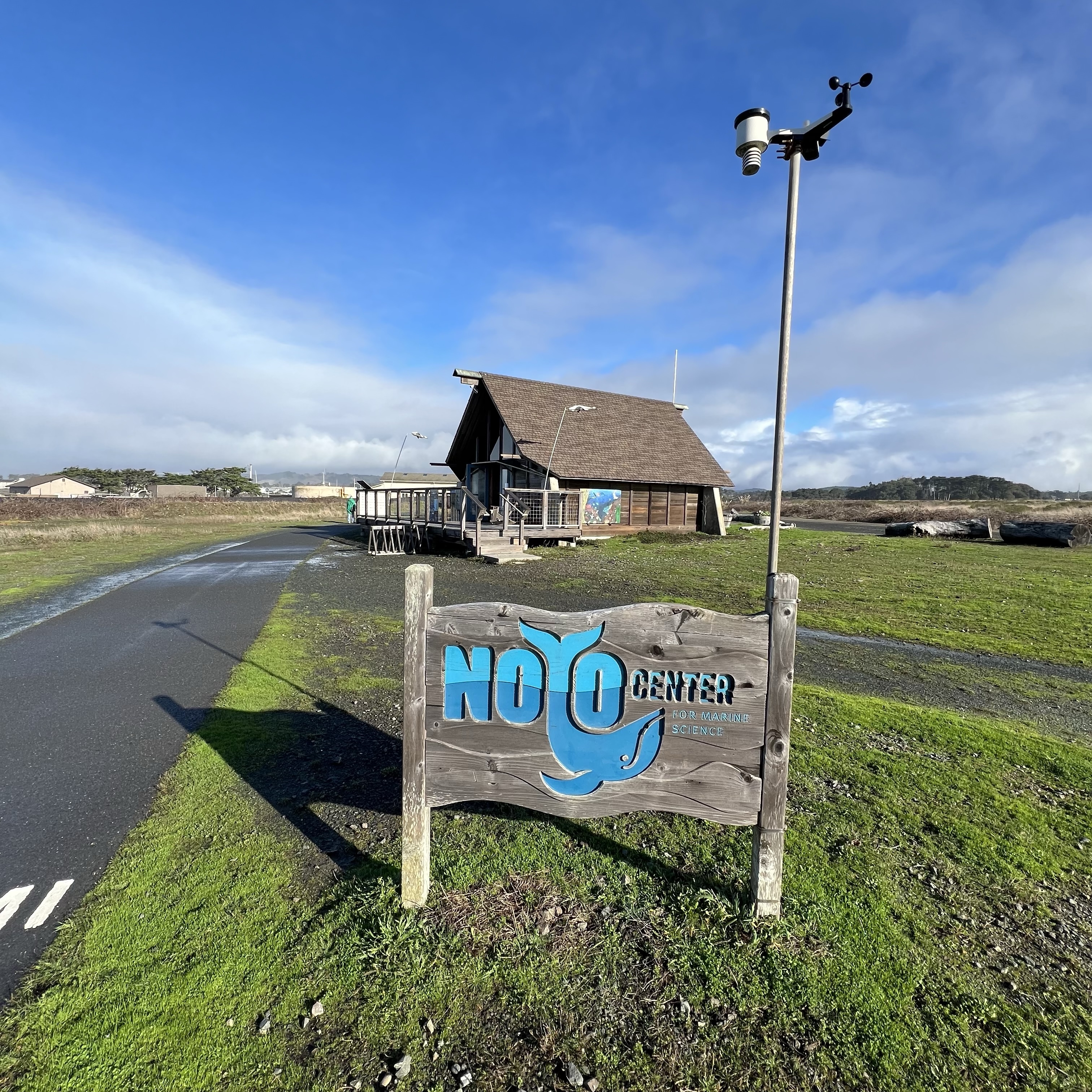
I hiked out on the Noyo Bluffs, north of the river mouth. My destination was the Noyo Center’s Crow’s Nest Interpretive Center.

This center has marine mammal skulls and bones, maps and diagrams, a tide pool tank, and a deck for whale watching.

I sat at a picnic table and sketched the interpretive center. All this hiking and sketching makes me thirsty.

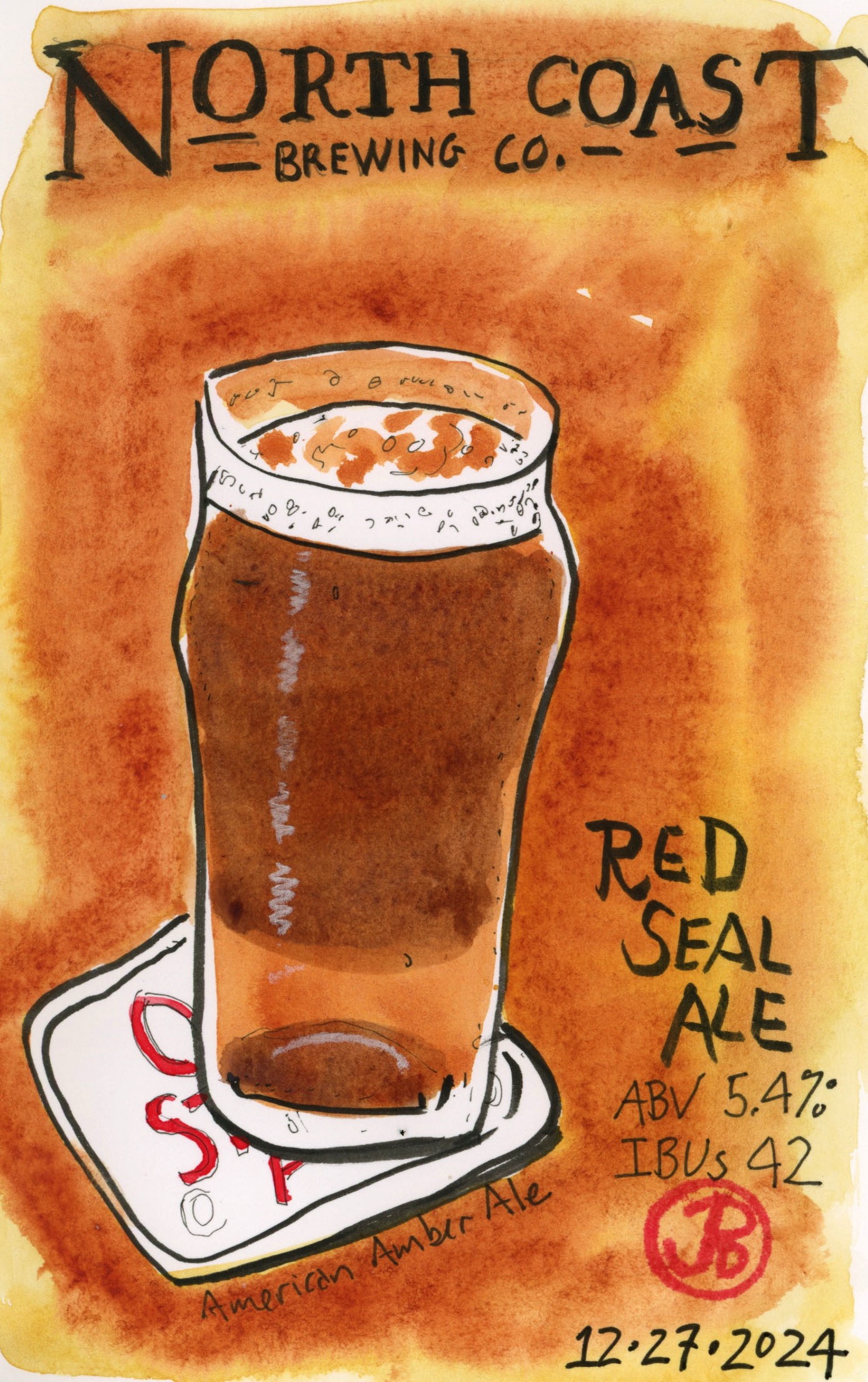
Good thing I was in Fort Bragg, because on Highway One, near the train depot, is the North Coast Brewing Company. Across the street from the brewery is their pub where you can get a bite to eat and sample their brews.

North Coast has been brewing since 1988, well before I could legally drink. They always have creative names for their brews such as Scrimshaw, Old Rasputin, Brother Thelonious, Old No. 38 Stout (named after a California Western Railroad steam locomotive), and my favorite Red Seal Ale (sketched above).

Cheers from Fort Bragg!