Image

Condominium One

Condominium One is one of the seminal buildings in California architecture of the 1960s.

The building looks out at Bihler Point and the Pacific Ocean at The Sea Ranch on the Sonoma County Coast. It was among the first buildings (built by Oceanic) to be constructed at Sea Ranch and it provided the model for most of the structures that were designed and built later.

Sea Ranch provided an opportunity to develop a whole community that tried to work with the land as founding architect Donlyn Lyndon noted:

We wanted each building  to engage the land, to become part  of the way in which people could accommodate to this extraordinary and often chilled and windy terrain. We wanted the relationship between buildings and land to be complementary, to use the buildings to make the land more habitable, without destroying the very qualities that attracted people to this segment of the coast.

This is the mission statement, the creed, that underscores all the early structures that were erected at Sea Ranch.

This was clearly a building I needed to understand and look at. This called for a sketch. As soon as I checked into my room, I headed east from Sea Ranch Lodge and followed the trail out to Bihler Point. I found a spot directly in front of Condominium One, which was to the east and across a sea thrashed cove, and set up my stool, opened my journal, and began to sketch.

The ten unit Condominium One was completed in 1965. And it didn’t look like anything that was built before. The rooflines all slope down toward the ocean, seemingly echoing the sloping hill surrounding it. In the sketch I left the roof unpainted to emphasize the unity of the pitch lines of the roof. The structure is anchored by two towers that rise from the units.
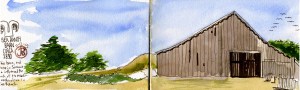
Sea Ranch Barn

The building’s design was influenced by the land but the historic existing structures of the Sonoma coast also had an influence on the building. You can see the influence of the wooden barns that dot the landscape of the coast as well as the barn that directly northwest of the condominium’s location. This barn I sketched and it is part of the “DNA” of the current structures of Sea Ranch.

Donlyn Lyndon also notes that one of the structures that they drove by on their way up to the building site, influenced Condominium One and that was the chapel at Fort Ross.
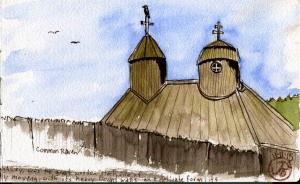
Fort Ross Chapel

The Fort Ross Chapel was built at this Russian settlement in the mid 1820s and is the first Russian Orthodox structure in North America built outside of Alaska.

Lyndon notes the importance of Fort Ross in its influence on Condominium One:

Even more insistently present in our minds, since it then straddled the highway, was the great wooden stockade of Fort Ross. The restored nineteenth-century chapel, which occupies one corner, was especially moving.

And Lyndon brings up the point that the way a building is designed and constructed, can be moving in a way that can surprise the viewer. When you walk into York Minister or Stanford Memorial Church or the Sea Ranch chapel and you look up, the experience really can be moving. Great architecture can convey  that feeling.

Too bad I couldn’t retrace my steps, turn off to the south (ignoring the private property signs), and knock on one the condo’s doors. The bewildered owner would open the door (in my world anyway) and I would ask, “Can I step into your living room? I want to be moved.”


Image

My 50th Post: Maps

Maps, a way to find yourself or a way to document a passage.

Sketching has always been a journey, sometimes a physical one and other times an internal one. The byproduct of the journey results in a journal page, something that is left behind. That’s really what the sketcher tries to do: leave a record of an experience, a cityscape, a natural encounter, or a hike. In some of these leavings I have used a map to record the experience.

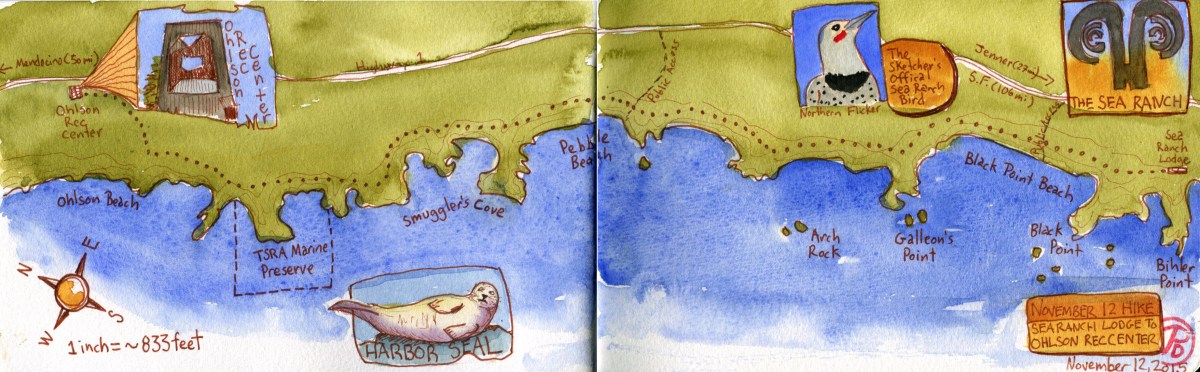
On my recent trip to The Sea Ranch I hiked along the coast from the Sea Ranch Lodge to the Olson Rec Center. There was nothing physically left of the journey but afterwards I memorialized the passage in a journal spread that noted the path and places names of the hike, as well as  the birds I encountered along the way. One being the Official Sea Ranch Bird (proclaimed by the sketcher): the northern flicker.

Bolinas Lagoon

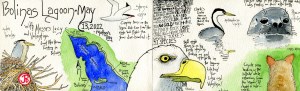
This spread records a birding trip out to western Marin and  Bolinas Lagoon. This sketch was again done after the trip but it records the birds seen: great blue heron, bald eagle, Caspian tern, and Clark’s grebe. I also noted the mammalian life: harbor seal and coyote. When I look back at this page and the insert map, I am brought back to that May day in 2012.

Cuckoo

An extremely rare bird sighting is always a subject for a spread, in this case the uncommon, common cuckoo seen at Watsonville Slough, south of San Francisco on September 29, 2012. This cuckoo was only the second record in the lower 48, a bird that brought people from all over the country to add this rarity to their North American life list. Luckily I didn’t have to go far to see this bird. I was able to get a quick sketch in the field (on the right side above my hanko) and I then added the cuckoo, both clock and bird at a later time. The map shows where the bird was first seen and where I (and many other birders) found the bird on the following day.

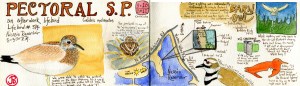
Pectoral

Another lifer and another sketch with a map. This time a pectoral sandpiper in western Marin.

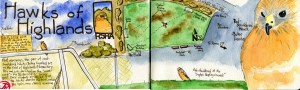
RSHA Highlands

And finally a sketch that is not about a wayward rarity, lost on the west coast but a rather common raptor in the Bay Area: the red-shouldered hawk. This sketch records a series of  sightings of the resident pair of hawks that hunt my school’s playing field in the early morning before students arrive. I included a map to document the bird’s movements from hunting perch to the ground, to the soccer goal post (the “woodwork”), back across the field to the baseball backstop. On some wet mornings I have observed a red-shouldered eating worms like an American robin.

I have used this spread to teach my students how to take notes. It includes a lot of note taking strategies: writing, images and diagram, and of course a map. Ultimately it teaches students to pay attention to their environment, where the mundane is often extraordinary. But the first step is to look around you and see the wonder.


Image

The Sea Ranch

I recently spent a few days at The Sea Ranch on the Sonoma Coast. This is a place to recharge your batteries, write, sketch, hike, and do report cards. The Sea Ranch is about two and a half hours (100 miles) north of San Francisco and runs ten miles south from the Mendocino County border at the Gualala River in a narrow strip in between the rocky-coved coastline and the San Andreas Fault.

It was developed in the 1960’s and it is renowned around the world for its innovative and influential architecture. The original concept was to create buildings that worked with and not against the rugged Sonoma coast landscape. The design and style was influenced from it’s setting and the existing farm buildings on the former sheep ranch. As founding landscape architect Lawerence Halprin expressed it:

I was convinced that Sea Ranch could become a place where nature and human habitation could intersect in a kind of intense symbiosis that would allow people to become part of the ecosystem

I stayed in the iconic Sea Ranch Lodge ( featured sketch) which was among the first four buildings erected on the site to be a place where the community meets, picks up their mail and has a cocktail and a meal. This building is bookended by the iconic stylized rams heads that is Sea Ranch’s logo, designed by Barabara Stauffacher.

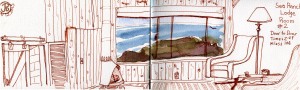
Room #2

I stayed in room number 2. The room had the feeling of being in an elegant coastal barn but with an expansive view out to the west of Big Blue and the lines of pelican and cormorant that passed over Bihler Point.

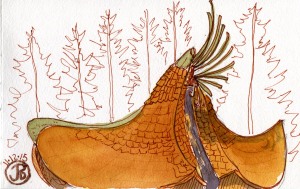
Sea Ranch Chapel

I headed north on Highway One to sketch one of the touchstones of my sketching universe, the Sea Ranch Chapel. I sat on a stone bench in front of the chapel, which was created without a blueprint. I started to sketch, using a Micron “Brown” pen. A visitor wandered out of her way to see what I was doing. She asked knowingly, ‘Doing a sketch?” Then she looked toward the uneven, shingled lines of this odd aquatic sea slug and offered, “Good luck.” But I thought, finally I get to sketch a building, without using a single straight line.

My father once paid me a compliment as he looked over the architectural sketches in one of my journals. He said, “You draw really good straight lines.” This coming from my father who was an engineer and always thought in straight lines. This has always been the best compliment I have every had about my sketching.

So I went into the chapel  and said a few words to close and holy golden light, a message to my departed dad.

Image

Cape May, New Jersey: The Known Center of the Birding Universe

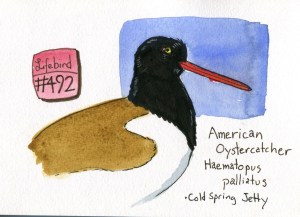
As a contrast to Washington, The City of the Dead, I headed to a point that is directly east, as the fish crow flies, from our Nation’s capital: Cape May, New Jersey. This town is recognized as the oldest beach resort in the United States but I was not here in October for the beaches, unless they contained American oystercatchers or black skimmers, or the hundreds of beautiful Victorian homes that populated the city. Cape May is really for the birds. And that’s what makes a man rent a car, and drive three hours to the end of the Garden State.

American Oyster catcher

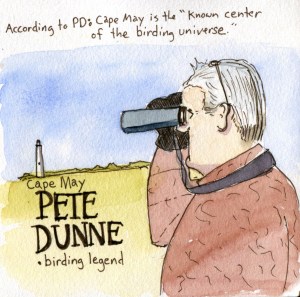
Cape May is the mecca for American birding. It is called “the Known Center of the Birding Universe” by Pete Dunne (more about him later). Unlike other migration sites that are surrounded on three sides by water, thus channeling birds, dragonflies, and butterflies to one point, Cape May is flat. The lack of hills or mountains means that you have clear 360 degree views of the migrations happening all around you. At one point you can see monarch butterflies, merlins, Cooper’s hawks, and cormorants and waterfowl in a tight Vs. Every bush and tree seems loaded with warblers, mainly yellow-rumps aka butter butts.

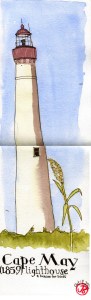
The epicenter of Cape May birding is Cape May Point State Park with it’s own exclamation point: the 157 foot Cape May Lighthouse, built in 1859. It does seems to be a beacon to migrating birds and birders alike.

Cpae May

Everywhere you walk in the state park, the lighthouse is always in view. It is the reference point for ships and for birding land migration ( and it also helps you find your way back to the parking lot).

Birding With a Birding Legend

PeteDunne

Every Monday in the fall there is a birding walk sponsored by New Jersey Audubon. The meet up time is 7:30 AM in the parking lot of the birding hotspot know as “The Meadows”. It was not hard to location the leader of the walk, he was the white haired guy in a camo jacket that everyone was standing around. He loudly announced to the crowd: “It’s another good day to be a birder!” This man is Pete Dunne. This man is a bonafided birding legend.

Dunne is credited with putting Cape May on the birding map. Clay and Pat Sutton write in Birds and Birding at Cape May, “Pete Dunne is eponymous with modern birding, and he has helped change bird-watching forever, both at Cape May and elsewhere.” Not only has Dunne done so much for birding, he’s one hell of a birder, the best I’ve ever birded with. Dunne has spent years in the field, looking at birds; telling the difference between a distant green-wing teal from a wood duck from a American black duck flock. This was like the equivalent of kicking the ball around with Pele, sketching with Picasso, or playing guitar with Django.

He is also not the stuffy, social idiot, that keeps his bird knowledge safely locked neath his multi patched bird-nerd vest that you sometimes encounter in the birding community. He is one funny guy willing to share his vast knowledge with everyone within earshot.

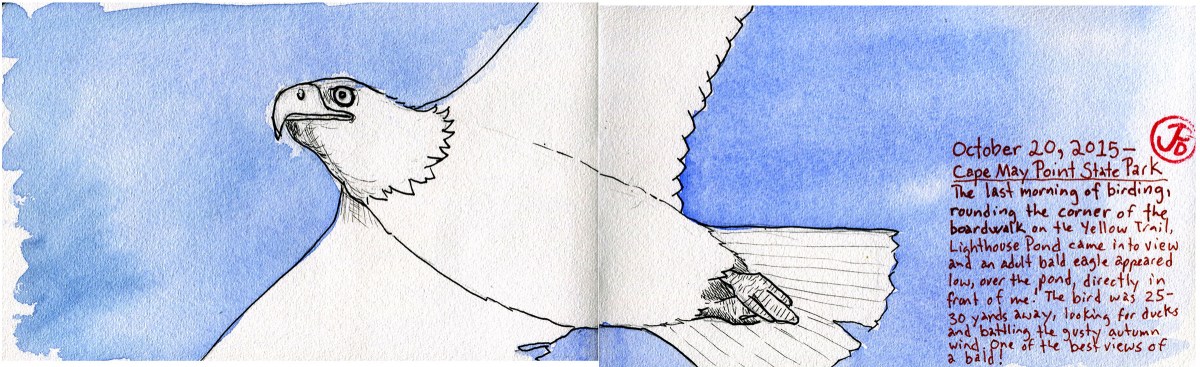
We had a grand day out, birding the marshes, trails and beach. A huge mass of ducks took to the air and Dunne directed us to search the skies above for a raptor. I soon spotted a large raptor heading south above the water. “Eagle!” I shouted. The bird turned, took a dive into the ocean ( returned empty taloned), and headed towards us. It was an adult bald eagle!

Later in the day I caught up with Dunne in the Cape May Bird Observatory. He signed two books for me (he’s written over twenty books). Then he said, “Your a damn-good birder.” Wow, I can only hope I can live up to his blessing!

Coda

On the my last day in Cape May before driving back to Washington DC, I birded Cape Map Point one last time. My last bird was the best sighting of the trip. I was on the boardwalk and rounded the corner as Lighthouse Pond came into view. Just above me, 25 yards away was an adult bald eagle, fighting a mean headwind. I got great looks as the eagle seemed to still in the air, finally peeling off to my right to give a group of birders a show. A fitting final bird for a trip to Washington DC.

Image

Vietnam and Martin’s View

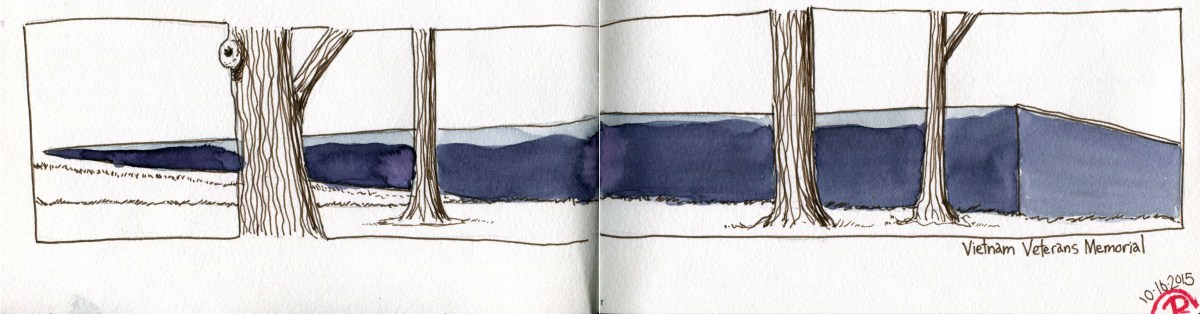
One of the  most daunting war memorials for me to sketch was the Vietnam Veterans Memorial. I had to experience that dark, reflective V, that seems a gapping scar in the green grass, a few times and from different angles before I could put pen to paper. The memorial is continuously crowded with visitors and veterans and I had to decide if I was going to include these people in my sketch. I finally decided to start sketching on an afternoon on one of my last days in a Washington. I selected a park bench that was across a tree dotted expanse of grass. The park bench faced the opposite direction so I had to sit on the edge and backwards. In the end I chose a simple expression to capture the memorial; without people and much color. In the end, like the memorial itself, I kept it to a simple expression, devoid of excess detail.

Wahington M

Martin’s View

When I arrived in DC, I headed out from my Georgetown digs and found my way towards the Lincoln Memorial. It seemed like this is a flame that attracted visitors from all over, who sat on the steps and looked out over the reflecting pool toward the exclamation mark of DC: the Washington Monument.

I started my first sketch of the trip. Where I sat and sketched was just off the right shoulder of where Martin Luther King Jr. gave his famous “I Have a Dream” speech on August 28, 1963. On that day 200,000 people filled the National Mall on either side of the Reflecting Pool. Visiting this spot, this sacred ground, was truly a highlight of my visit. Ever since I had seen excepts of the grainy footage of the”I Have a Dream” speech on television, I have been enamored with King and his words.

I did a sketch of the Martin Luther King Jr Memoral (dedicated August 28, 2011). One of  his quotes that was carved into the marble wall came from California  in 1967.  It was a contrast to the war memorial on the other side of the mall, or maybe it really had the same meaning:

I oppose the war in Vietnam because I love America. I speak out against it not in anger but with anxiety and sorrow in my heart, and above all with a passionate desire to see our beloved country stand as a moral example of the world.

MLKJr

On this Veteran’s Day the wars of the world and particularly the Vietnam War has a face because of the veterans I have know who fought in that conflict. It forever changed them in ways I can never fathom. I thank them for their service and sacrifice.

Image

Washington DC: The City of the Dead

After a hiatus, because the loss of my father and my laptop, I am back to blogging with a new laptop and a new watercolor journal ( the Pentalic 100-Persent Watercolor Journal 5-Inch by 8-Inch).

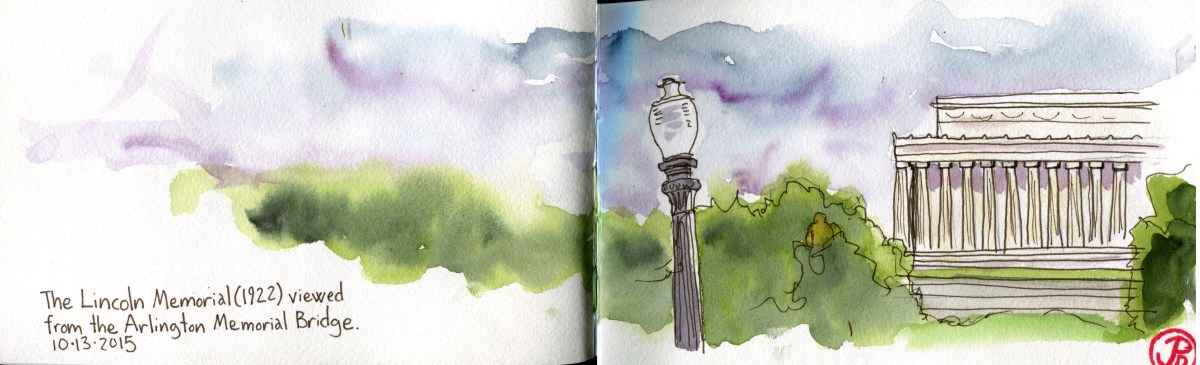
I filled the navy blue journal with a trip to our Nation’s capital. In a sense, Washington DC is a city of the dead. It’s populated by memorials, monuments, and statues, all dedicated to someone (usually a white male) that is no longer on this earth or to some past war and it’s fallen heros . Not to mention the grassy expanse of Arlington National Cemetery, just across the Potomac River from the Lincoln Memorial (the featured sketch was painted on the Arlington Memorial Bridge as I was returning from the thought-provoking rows of earth solders.)

Just to give you a further example that Washington is a city of the dead is underscored by my itinerary on my first full day in Washington:

Started the morning with a visit to Ford’s Theatre where Lincoln was assassinated . Sketched the clothes he was wearing as he was watching the play, the Presidential box where he was sitting, and the single shot pistol that Booth used to shoot the President. After the theatre tour I crossed the street to see the room in the boarding house where Lincoln passed, the morning after he was shot.

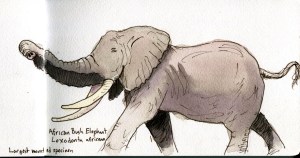
I then headed down Tenth Street to the National Museum of Natural History where I sketched the largest male bush elephant mount in the world (he did not die of natural circumstances) and a very special speciem: “Martha” the last passenger pigeon in the world, which died at the Cincinnati Zoo. The passenger pigeon was considered to be the most numerous bird in North American. A flock of these pigeons was said to take days to pass.

Elephant

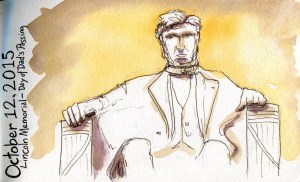
I ended the day at the Vietnam War Memorial Wall and the Lincoln Memorial. The Lincoln Memorial is a wonderful place to visit at night when the crowds die down and you can really get a sketch in without having to dodge large groups of eighth graders armed with “selfie-sticks” who don’t seem to know how to behave in a memorial. Grumble, grumble.

Lincoln M

Image

The 124 Year Old Movie Star

It is not every day that you get to paint a portrait of a movie star.

She has appeared in about 200 films and television shows, including such diverse works as Petticoat Junction, Little House on the Prairie, The Apple Dumpling Gangs Rides Again, Back to the Future III and the Oscar wining High Noon and Unforgiven. I had come to the Gold Country in the Sierra Foothills to capture her likeness in my sketch book.

Her name is Sierra and her number is 3. She lives in a historic roundhouse in Jamestown in the State Historic Park, Railtown 1897. Yes she is a steam engine, a Mogul 2-6-0,  built in 1891 in Patterson, New Jersey. She was recently rebuilt and still pulls passengers on Saturdays from April to October.

No 3

Sierra No. 3, in her star part in High Noon (1952). A star part, as explained by Orson Welles, about his role as Harry Lime in the classic The Third Man (1949), is a part where all the characters talk about you for an hour and when you finally appear, everyone thinks you did an amazing job. This is the part that No. 3 plays in High Noon. Everyone in the town of Hadleyville waits for the noon time train with fear and anxiety because it contains the outlaw coming to meter out revenge on the town and the Marshall, responsible for his imprisonment. Clearly No. 3 should have picked up Best Supporting Actor to Gary Cooper’s Best Actor Academy Award.

No 3 2

Sierra No. 3 looks just as good in color in Clint Eastwood’s Unforgiven (1992). This film in which Eastwood starred and directed, picked up four Academy Awards including Best Picture and Best Director for Eastwood. Unforgiven is only the third western to win Best Picture. While the majority of the film was shot in Alberta, Canada, Eastwood came back to his native state to film the train scenes at Jamestown.

P Junction

No. 3 and the infamous Petticoat Junction water tower, sans petticoats. This show did not win the Academy Award or an Emmy, as far as the sketcher knows.

Image

Devils Postpile, Rainbow Falls, and the Eastern Sierras

In the final week of my summer vacation I headed to the eastern Sierras to an area where I have many great memories: Mammoth Lakes.

My parents spent their honeymoon here in the late 1960’s and we later celebrated my brother’s 1st birthday at this altitude. Mammoth has grown since then and the ski resort is not longer run by it’s founder Dave McCoy (who celebrates his 100th birthday this month), but by a large corporation that’s slowly turning Mammoth into Anywhere U.S.A.

I headed out to a Mammoth staple that has not changed too much in 100,000 years, the basalt column’s of Devils Postpile. I found a nice perch to sketch from and as I sketched each vertical column I lost sense of time, such is the case when your “drawing from the right side of the brain”.

In between lapses of focus I jotted down two questions I overheard at the Postpile: “Did somebody make this?” and “Are those big French fries?” Luckily these questions came from children and not adults. You never know what you might hear from folks on vacation.

After the sketch and painting I head down to the banks of the he Middle Fork of the San Joaquin River. Here I found a creature that I expected to find on such a rough and rugged stretch of water: the American dipper. This was John Muir’s favorite bird. In The Mountains of California (1894), Muir describes the dipper this way:

He is the mountain streams’ own darling, the humming-bird of blooming waters, loving rocky ripple-slopes and sheets of foam as a bee loves flowers, as a lark loves sunshine and meadows. Among all the mountain birds, none has cheered me so much in my lonely wanderings, —none so unfailingly.

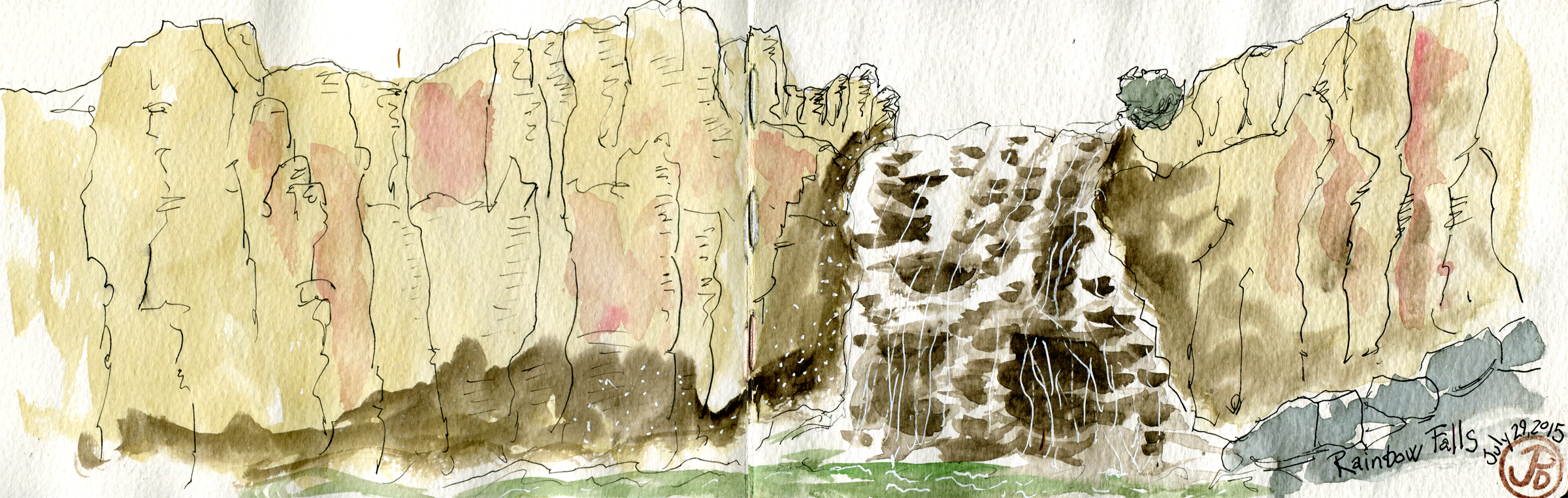
After spending sometime with the dipper, I headed downstream through the burnt snags, the remains of the Rainbow Fire (1992). I did my last sketch at the base of Rainbow Falls. I worked a loose sketch with my Noodler’s Ahab and painted the scene with the waters of the San Joaquin. The mist from the 101 foot falls surrounded me as a few souls braved the cold waters.


Rainbow Falls


Rainbow Falls, Devils Postpile National Monument.


Image

Bodie

Bodie was the first place I ever saw real, honest-to-goodness,  tumbleweed tumble. 

This ghost town, located between Bridgeport and Mono Lake in the eastern Sierras, provides a window into a once booming gold mining town. At it’s height, Bodie had a population of 10,000 and became known as a remote and wicked town boasting 65 saloons. One young girl  whose family was moving to Bodie, wrote in her diary, “Goodbye God, I’m going to Bodie.”

I was not here at 7 AM just to watch the tumbleweed tumble.  I was here to get an easy life bird: greater sage grouse. You just had to wake up early, when the mountain temperature hovers around 40 degrees. I headed south from Bridgeport and then headed east to Bodie. The town opens to the public at nine. As I neared the front entrance, four sage grouse crossed the road. Bingo, a  flock of life birds!

The flock walked or flew across the road and then headed into town. After 30 minutes, the flock took flight and headed up hill and out of town. They must have sensed the hordes of tourists, that was about to descend on this lonely, abandoned town.

Once the town opened I sketched the two story school house. The first Bodie school house was burned down by a “juvenile delinquent”.

Bodie Church

The Bodie Methodist Church steeple and it’s California gull weather vane.

As if to earn it’s wicked credentials, the church’s Ten Commandments, painted on oilcloth, was stolen. I guess the thief or theives, glossed over Commandment Number 8:, “Thou shall not steal”.