“Consider the platypus. In a land of improbable creatures, it stands supreme. It exist in a kind of anatomical nether world halfway between mammal and reptile. Fifty million years of isolation gave Australian animals the leisure to evolve in unlikely directions, or sometimes scarcely to evolve at all. The platypus managed somehow to do both.”-Bill Bryson
Australia has a host of really odd creatures.
Some are only found Down Under such as kangaroos, wallabies, wallaroos, and certain tree-possums.
There is one animal that tops the oddity list and this has to be the duckbill platypus.
The platypus is a monotreme, an order of the only mammals that lay eggs. There are just the platypus and four species of echidnas in existence today in this order.
The platypus seems to be put together from some surplus animal parts: the bill of a duck, body of an otter, the tail of a beaver, and the webbed feet of a goose. Who knew what early scientists made of the platypus?
I hoped to get a chance to see this mammalian oddity in Queensland.
I ordered a platypus model to use as a sketching tool. I think I might bring this long with me in my carry-on. An Aussie mascot.
My Aussie good luck platypus mascot. I wonder if it will bring me a real platypus.
On my visit to North Queensland, I couldn’t be near one of the seven wonders of the natural world without having a look-see.
From the coastal town of Cairns, boats depart on day trips to the Great Barrier Reef.
The reef system runs mostly parallel along the northeastern coast of Australia for 1,400 miles, making it the largest reef system in the world.
The Great Barrier Reef (GBR) is what a tropical rainforest is to biodiversity. Here are a few facts that highlights the mega diversity on hand.
The GNR supports 1,500 species of fish, 4,000 species of mollusks, 400 species of coral, 6 of the 7 world’s species of sea turtles, 14 species of sea snakes, 133 species of sharks and rays, and 242 species of birds. The GBR also contains 25% of all known marine species!
I am planning to dip into a bit of this biodiversity with a snorkeling trip to Michaelmas Cay. While I’m a certified SCUBA diver, I want to spend some time topside, to see some of the breeding seabirds of this cay.
The cay supports 23 species of seabirds and at the height of the breeding season (our summer) there can be up to 20,000 birds on Michaelmas Cay.
Some of the lifers I hope to see on the cay are: brown (common) noddy, sooty, little, great crested, black-naped terns, and masked booby. I also hoped to get great looks at some birds I’ve seen before such as great frigatebird and brown booby but in breeding plumage.
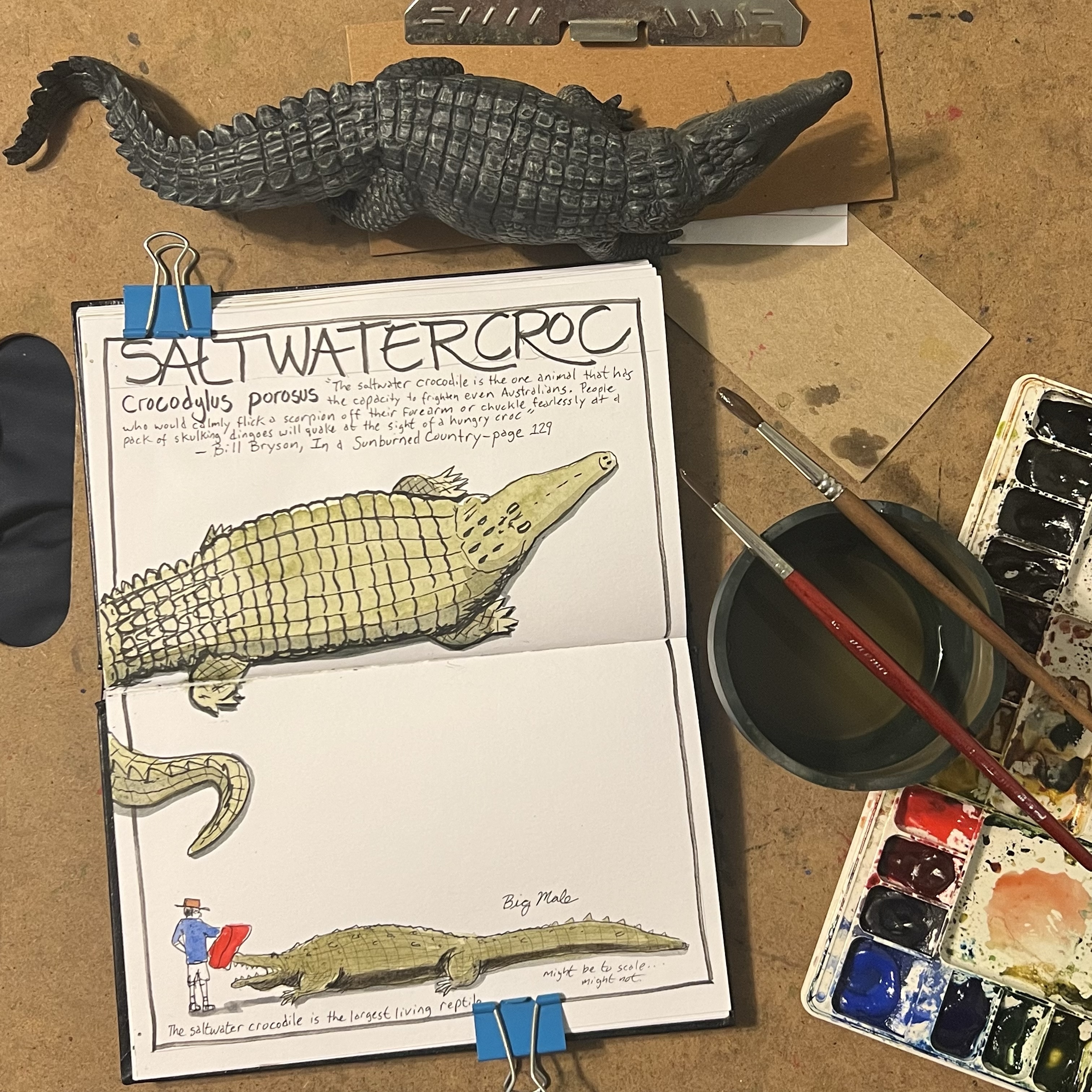
“The saltwater crocodile is the one animal that has the capacity to frighten even Australians. People who would calmly flick a scorpion off their forearm or chuckle fearlessly at a pack of skulking dingos will quake at the sight of a hungry croc.”
-Bill Bryson, In a Sunburned Country
I was looking forward to my encounter with the world’s largest reptile in Queensland on a Daintree River cruise. I just hope it will not be a close encounter!
Australian wildlife has the capacity to kill. Even a cone snail can kill a human! Oz is home to 213 venomous snakes. That is more venomous snakes than anywhere else in the world.
Australia is also home to the Murder bird, a small venomous octopus, the world’s most deadly spider (Sydney funnel-web), stonefish, box jellyfish, the common death adder, the blue bottle, the bull, tiger, and great white shark, and many others.
But as Bill Bryson notes, there is one deadly animal that rises above all others: the saltwater crocodile.
This apex predator sometimes sees humans as prey. In Australia from 1971 to 2013, saltwater creatures crocs killed 106 people. On average there are about 2 fatal attacks per year.
I have seen the American alligator and crocodile in Florida and the Yacare caiman (above) in the Pantanal. I was really looking forward to seeing the largest crocodilian in the world.
In order to sketch a croc I ordered a model to help me sketch. This way I could sketch it from any angle such as from above.
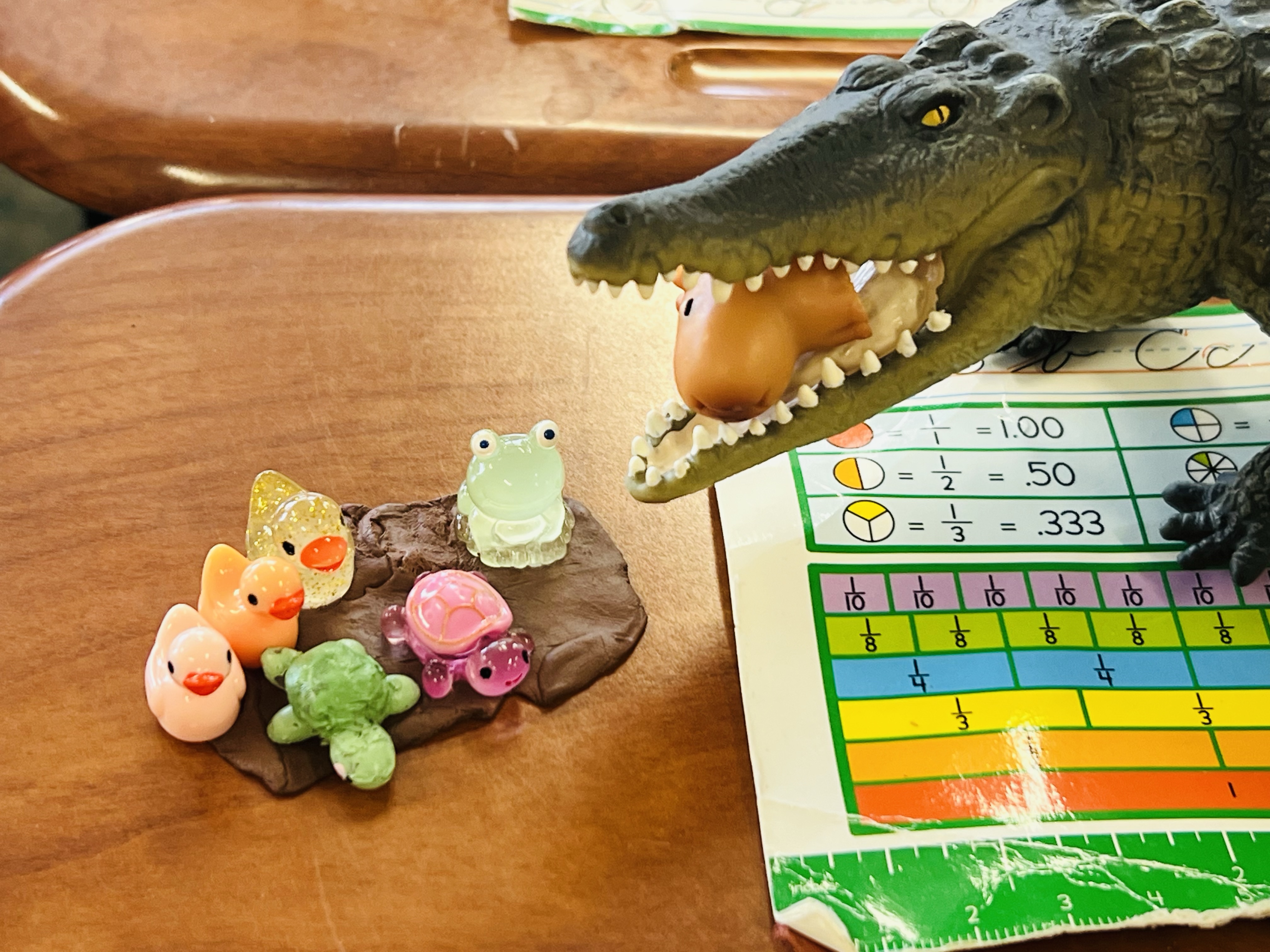
My saltwater croc model and my sketch in progress. My croc eating my student’s capybara! No plastic was harmed in the making of this photograph.
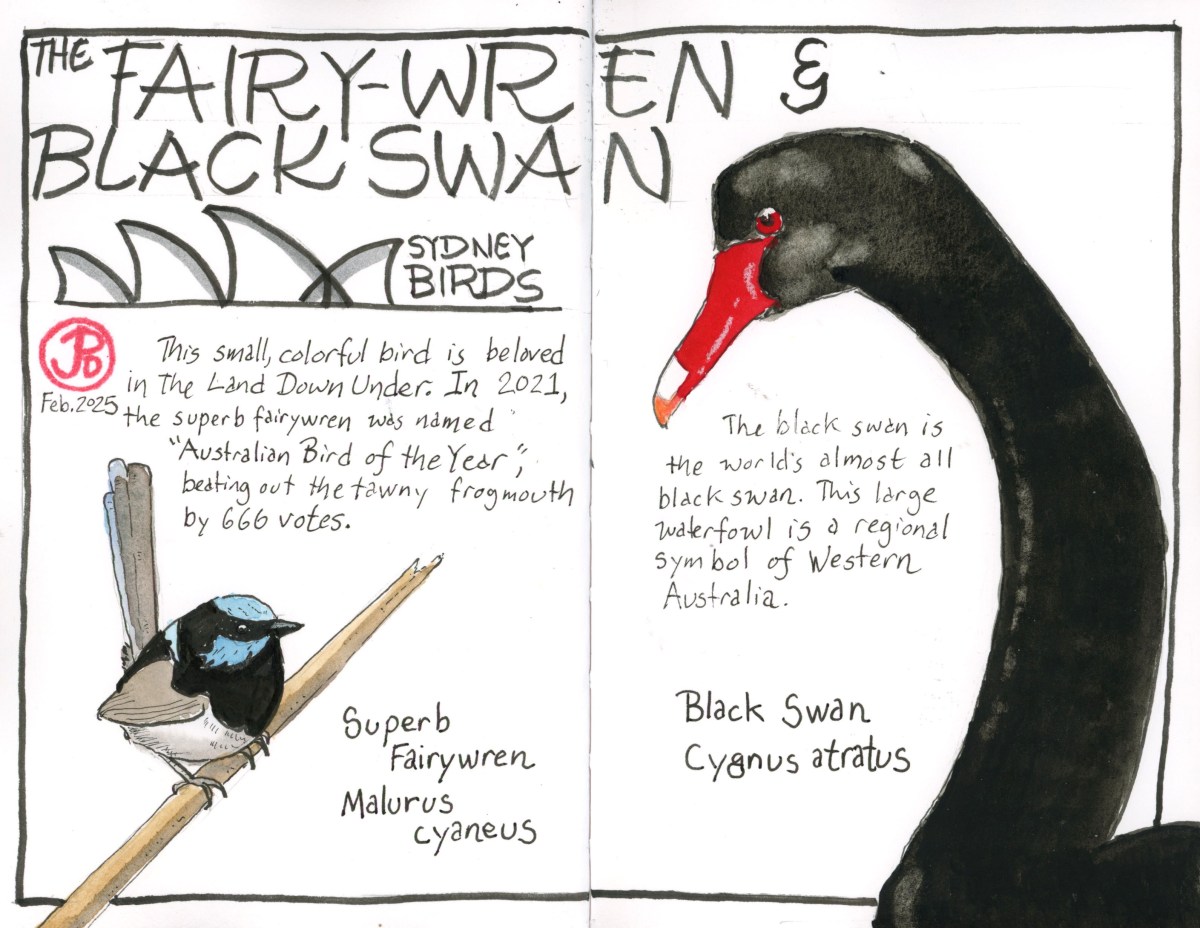
Some of the birds on my Australian trip would be fairly easy to find in Sydney’s parks. Especially a big black swan. The other is a diminutive little bird with a wonderful name of superb fairywren. (This bird is a species featured in The 100 Birds to See Before you Die). Challenge accepted!
The swan can be found in the ponds of Centennial Park. Having seen these all back swans at the San Francisco’s Zoo’s Australian exhibit, I wanted to see this bird in the wild. Or the quasi-wild of an urban park.
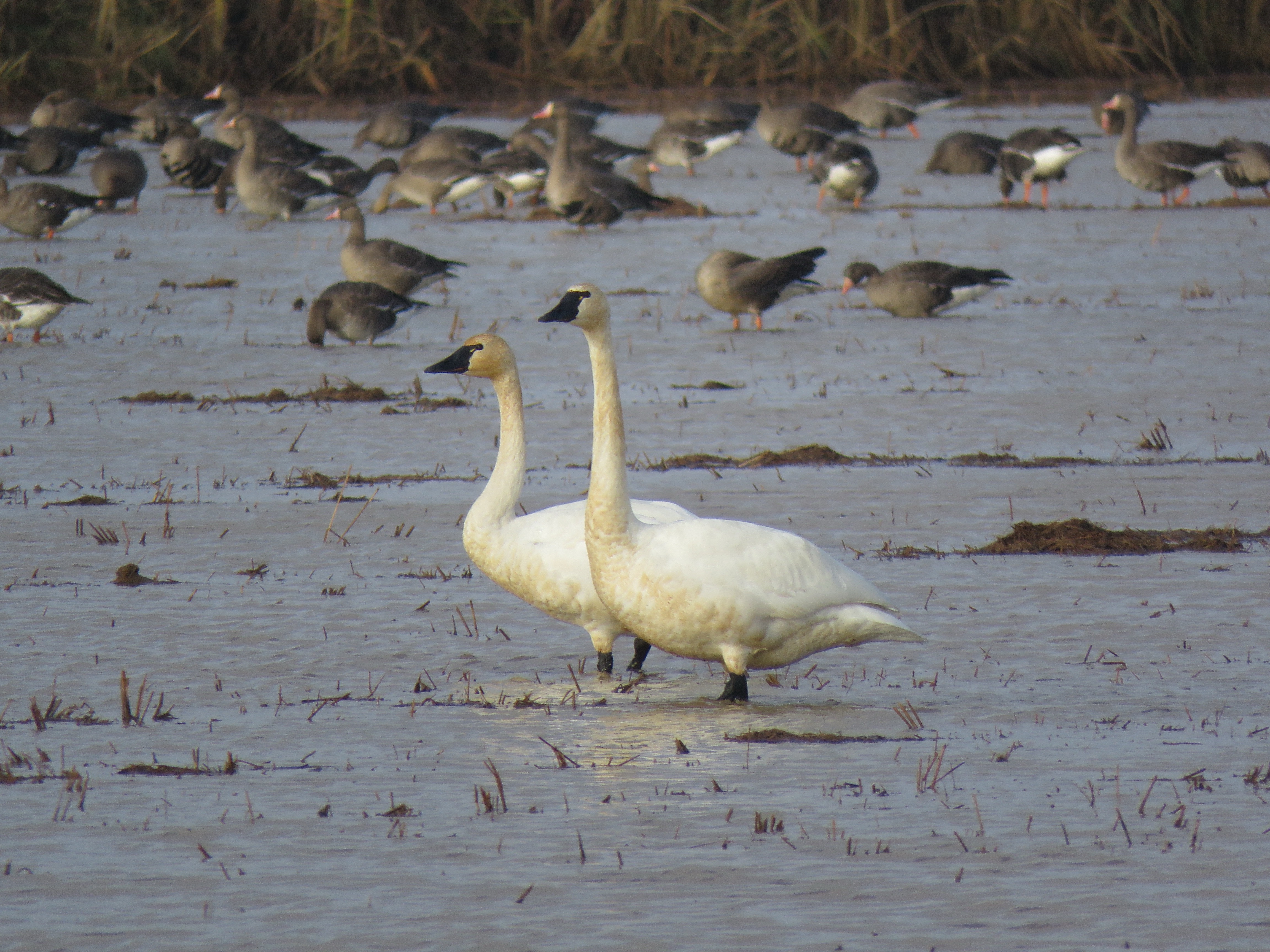
All of the swans found in North America are all white, such as this pair of wintering tundra swans in Yuba County.
The superb fairywren is a member of the Australian wren family. The male and female, like most ducks, are sexually dimorphic. The male is a stunning mixture of black, brown, and an electric blue. The female is a drab brown with a blue tail held erect.
In 2021, the superb fairywren was voted Australian Bird of the Year, beating out the tawny frogmouth.
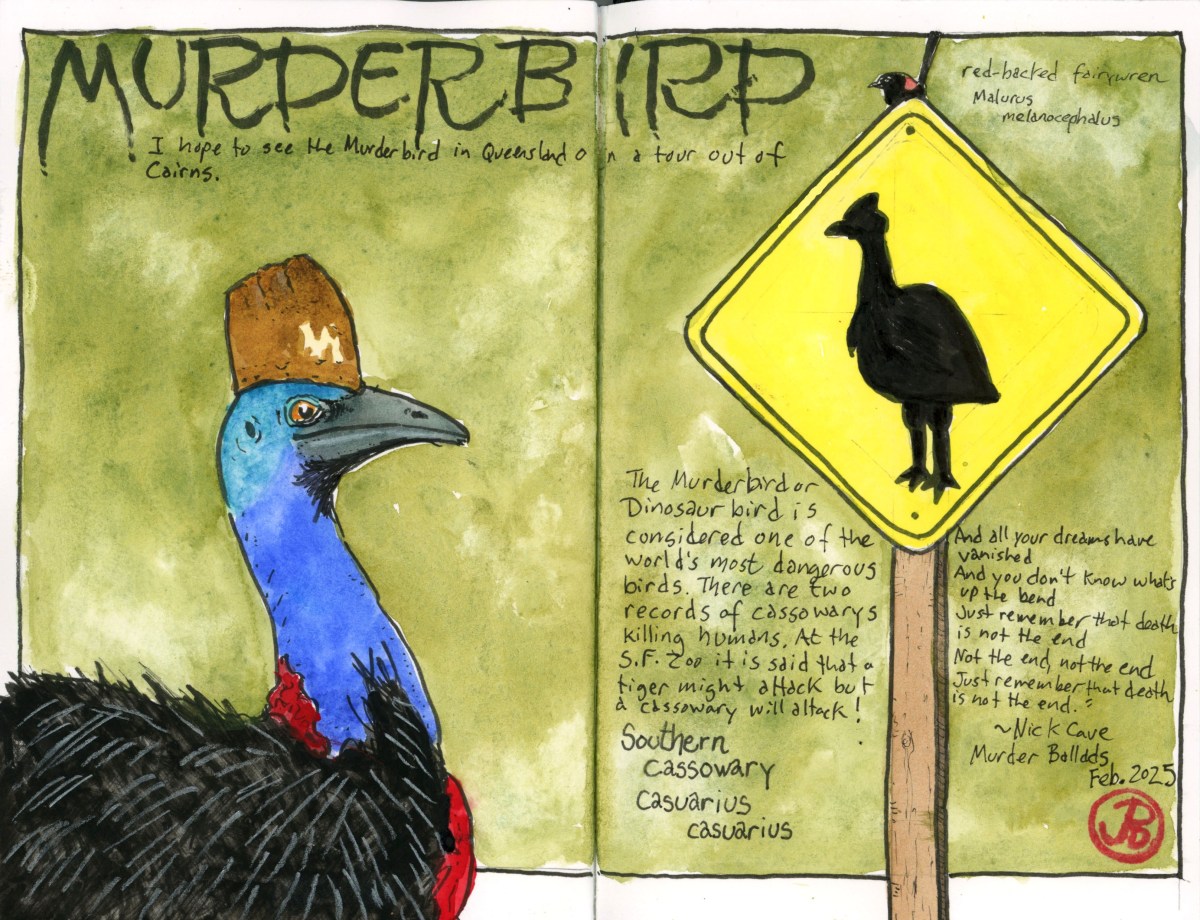
There was one creature in Australia, out of all the deadly and dangerous creatures, that my Australian mate was concerned with me encountering: the murderbird (southern cassowary).
When asking zookeepers at the San Francisco Zoo to list the most dangerous animal in the zoo they often replied: a tiger might attack you but a cassowary will attack you. This flightless beast topped the list.
And I intended to see a cassowary in North Queensland. The Murderbird topped my Australian birding wishlist.
I will be on a five day guided birding trip out of Cairns and we would be looking for the flightless Danger Bird on three different days.
If the tawny frogmouth looks like a Muppet, then the cassowary looks like a denizen of Sesame Street, but from the other side of the tracks. A satanic Big Bird.
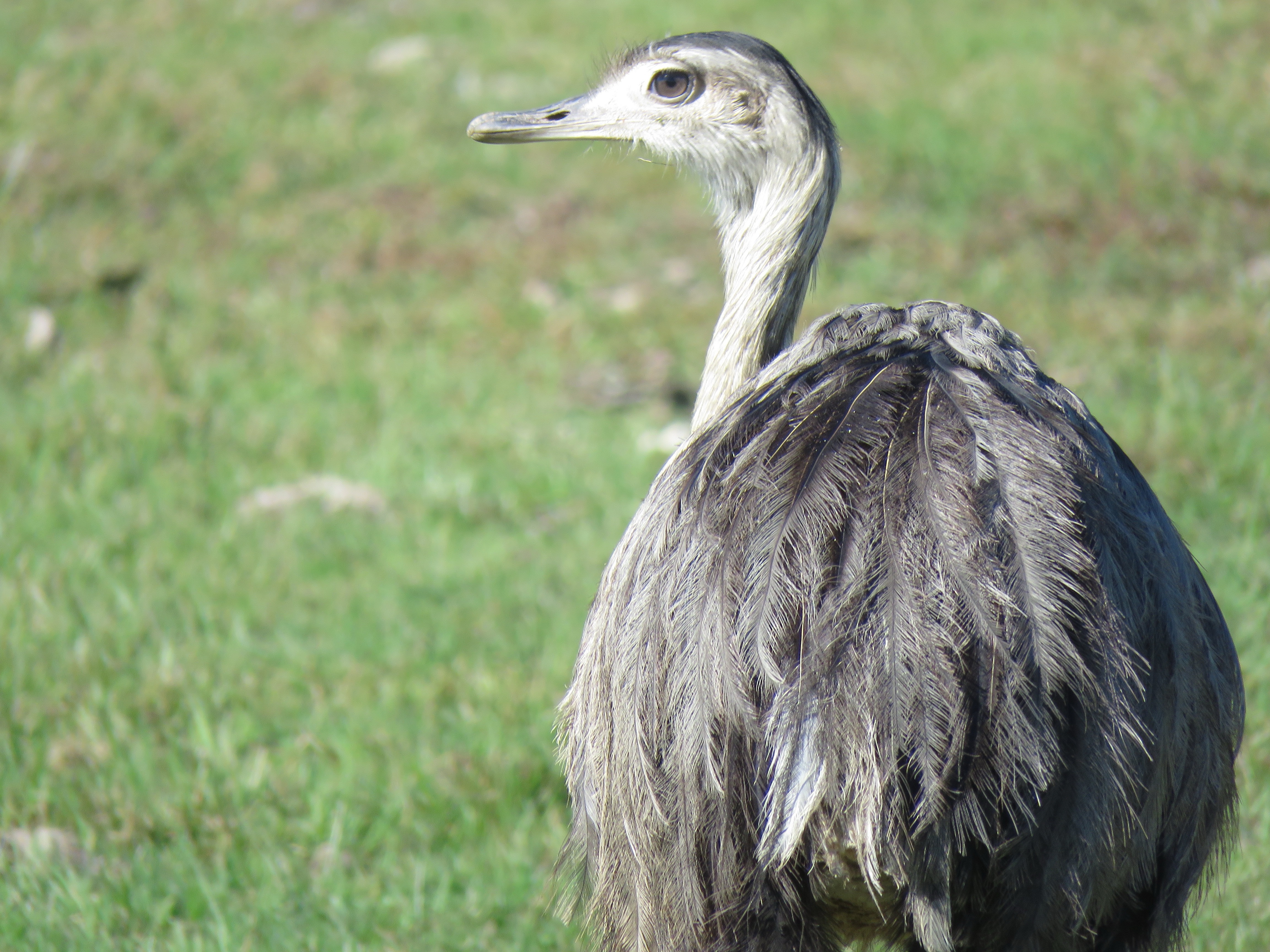
I have seen large flightless birds before, like this greater rhea in Brazil’s Pantanal. The rhea looks friendly and inviting, unlike the cassowary!!
“Kookaburra sits in the old gum tree, / Merry, merry king of the bush is he, / Laugh, Kookaburra, laugh. . .”
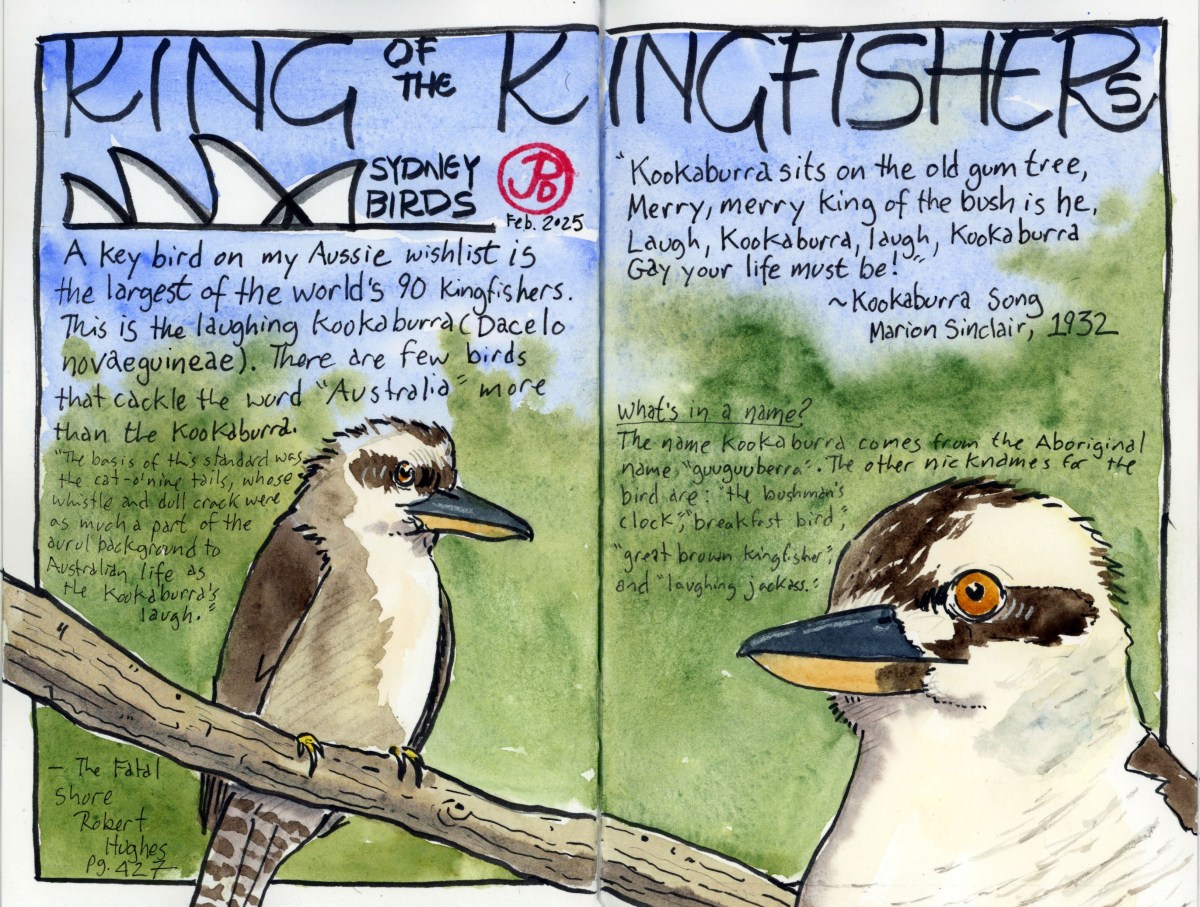
When it comes to a list of Australian birds that anyone from around the world can list, I bet the laughing kookaburra is in the top two.
This is a species that is commonly held in zoo’s collections. And then there is the song we sing in music class, quoted above.
Of course I have seen a real kookaburra at the San Francisco Zoo but I have never seen one free flying in the wild.
Oddly enough the kookaburra is a kingfisher. Out of the world’s 118 kingfishers, the kookaburra is the world’s largest and heaviest kingfisher, yet fish are a very small part of their diet. The “Bushman’s Clock” mainly eats rodents, insects, worms, snakes, and lizards.
The kookaburra’s laughing calls have been made famous as it is often used as jungle foley in films such as Tarzan, Wizard of Oz, The Treasure of Sierra Madre, and The Lost World: Jurassic Park.
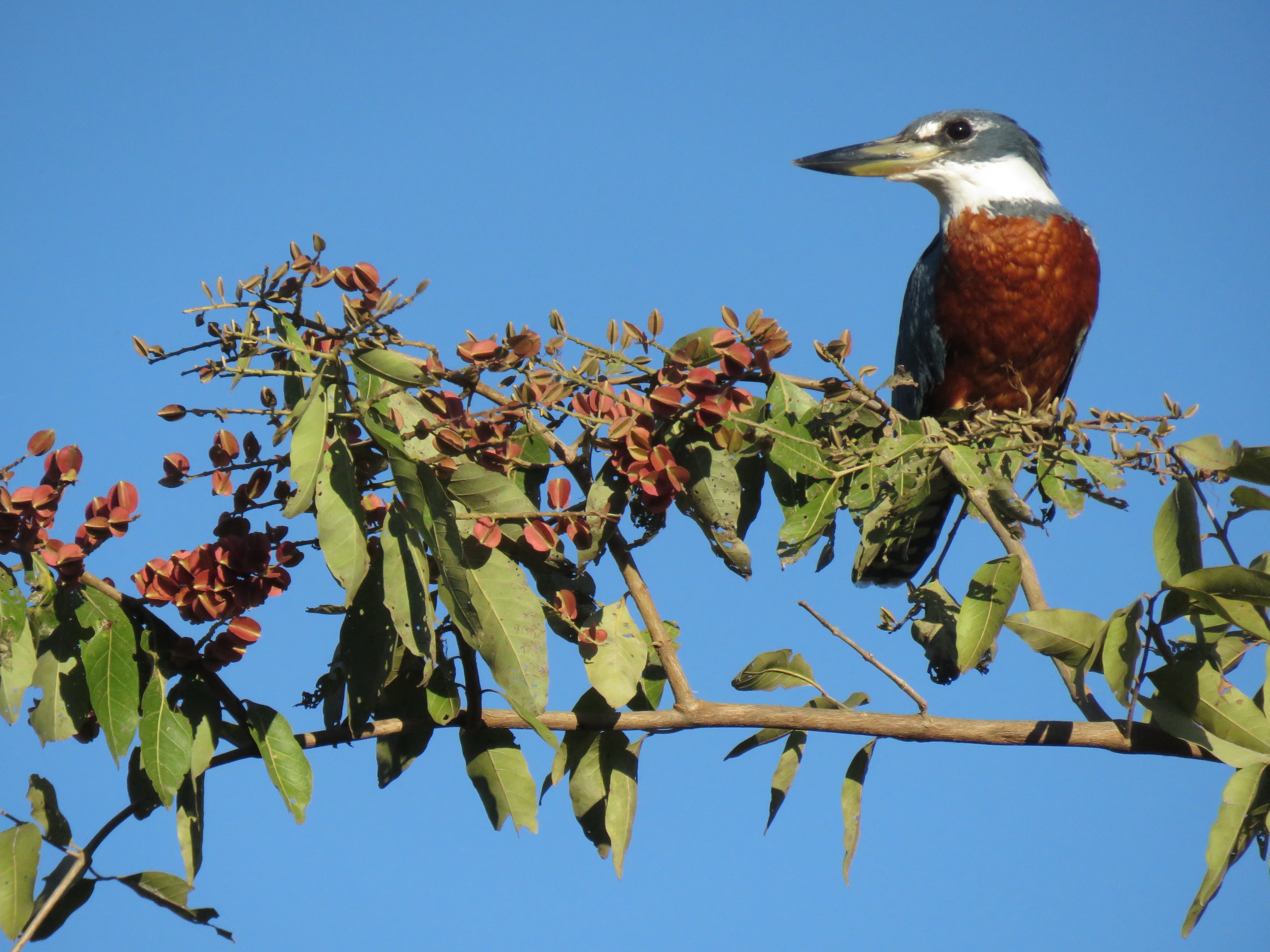
The ringed kingfisher is the largest kingfisher in the Americas. This female was photographed in Brazil’s Pantanal.
For my kookaburra spread I included the first verse of the Kookaburra Song by Marion Sinclair. The song was composed in 1932 and is sung by children all around the world.
There was some controversy involving the song when the flute riff from Men At Work’s hit “Down Under” was deemed to plagiarize the melody of Sinclair’s ditty.
Now all I need is a Vegemite sandwich!
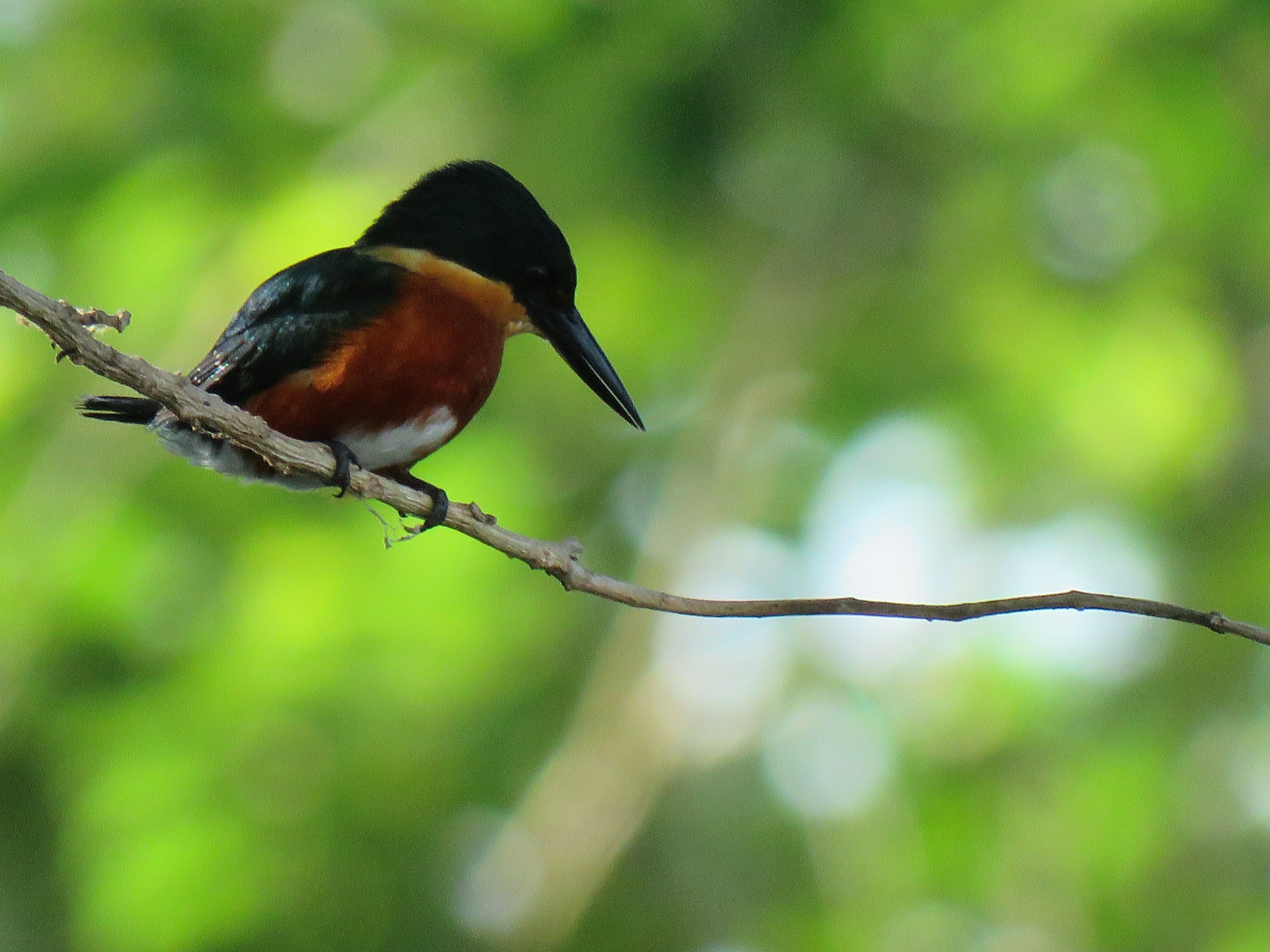
One of the smallest kingfishers in the Americas: a Pygmy kingfisher in Panama.
On my Aussie adventures I hope to add a few other kingfishers to my lifelist: azure, little, forest, red-backed, sacred, and collared kingfisher. And I aimed to add the other kookaburra of Australia to my wishlist: the blue-winged kookaburra. This would more than double my current number of kingfishers (7).
I have wanted to buy an airplane field guide to help me identify the different commercial airplanes I see at airports or flying north up the Pacific Coast. Telling an Airbus A380 from a Boeing 747 is an easy identification but what about other aircraft?
Where I grew up in Sunnyvale is on the flight path to Moffett Field Navel Base. By bedroom window faced the many military planes approaching the runway at Moffett.
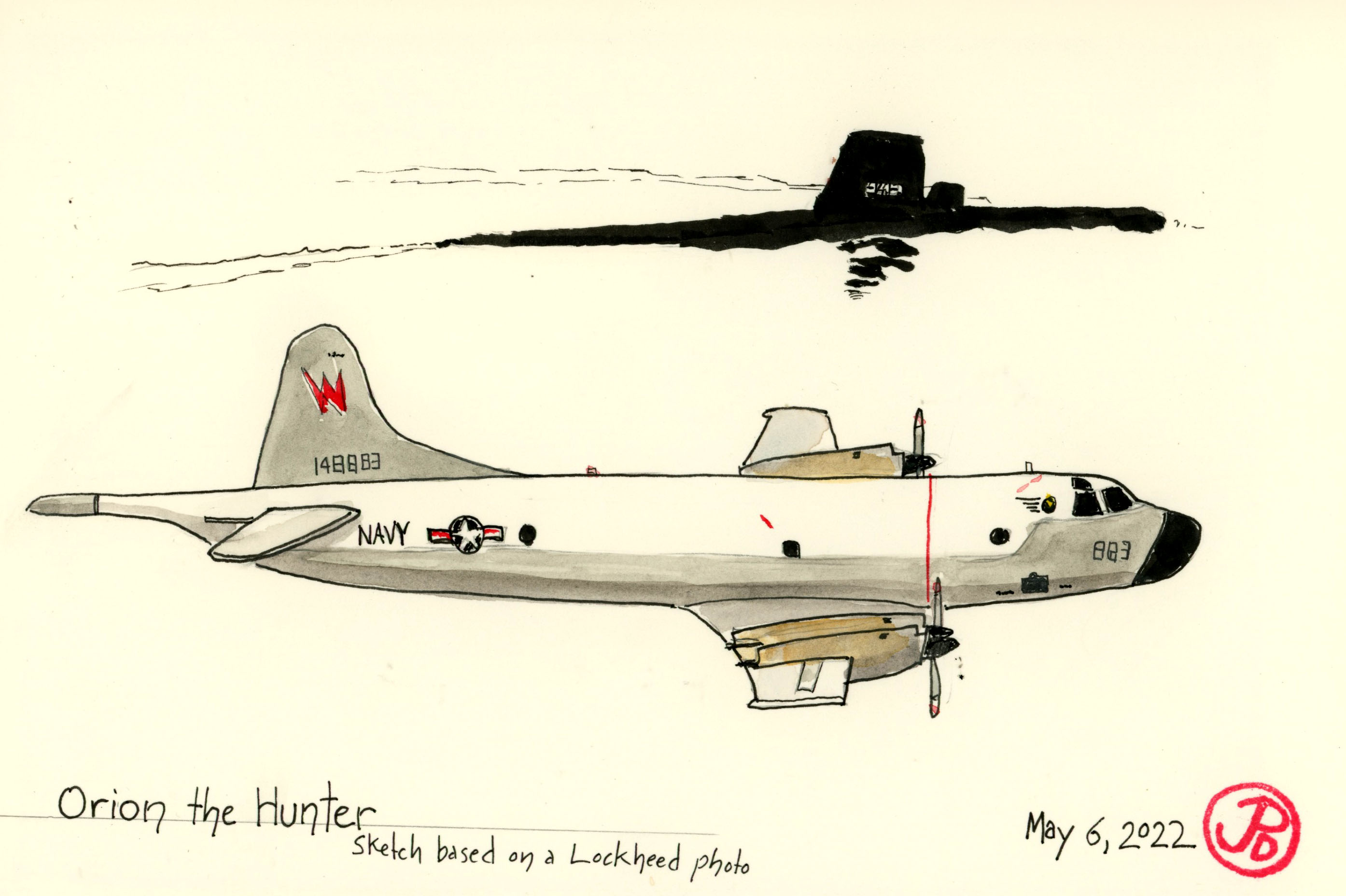
A 2022 sketch of Orion the Hunter.
Like birds, I learned to identify the common Lockheed P-3 Orion, the submarine hunter. But I also could identify other aircraft: C-130 Hercules, C-5 Galaxy, F-16 Falcon, the Blue Angels with their A-4 Skyhawks and later F-18 Hornets as well as other aircraft.
As I hobby I built model airplanes which I hung from the ceiling with dental floss and push pins. Some of my favorites was an F-4 Phantom hand painted in camouflage and a KC-135 refueling a B-52.
These airplanes were easy to identify but when it comes to commercial jets, it is a bit more tricky.
Commercial jets can be broken down to the two major manufacturers: Airbus and Boeing.
Boeing is an American manufacturer founded in 1916. It has produced such iconic passenger planes as the 314 Clipper, the 377 Stratocruiser, the 707, 737, the Triple 7, and the renowned 747.
Airbus on the other hand is a consolidation of different European companies formed in 1970. Iconic aircraft on its roster are: the A220, A320, A330, A350, and the largest passenger plane in the air the A380.
To internalize the simple differences between the two manufacturers I created a short DIY field guide to aircraft, a sort of cheat sheet to use while at the airport (featured sketch).
I guess plane spotting from an airport terminal is a bit like birding in a mount museum, the planes are sitting on the tarmac giving you time for prolonged study. And planes don’t flush easy like spooked birds. Well neither do taxidermy birds!
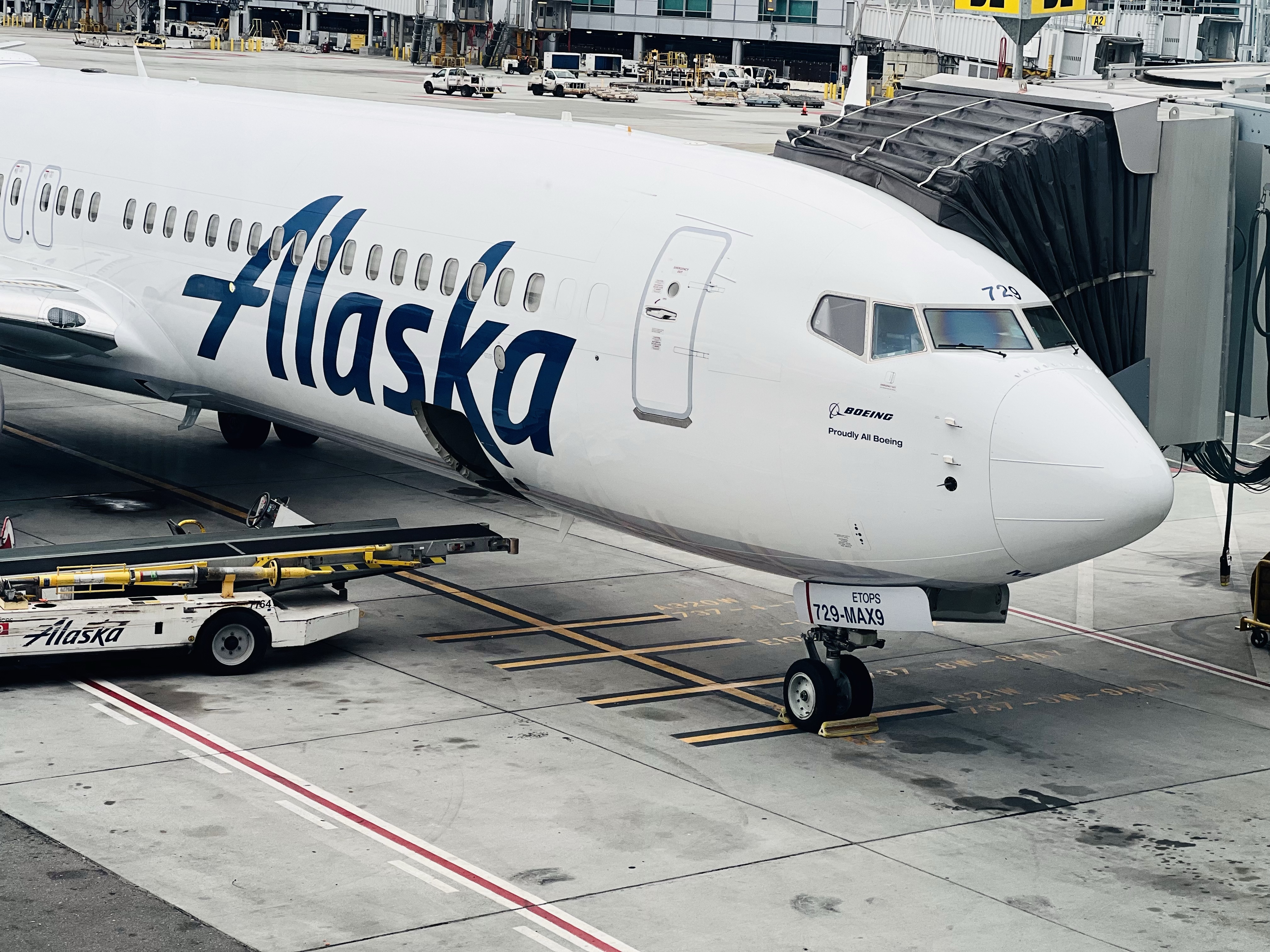
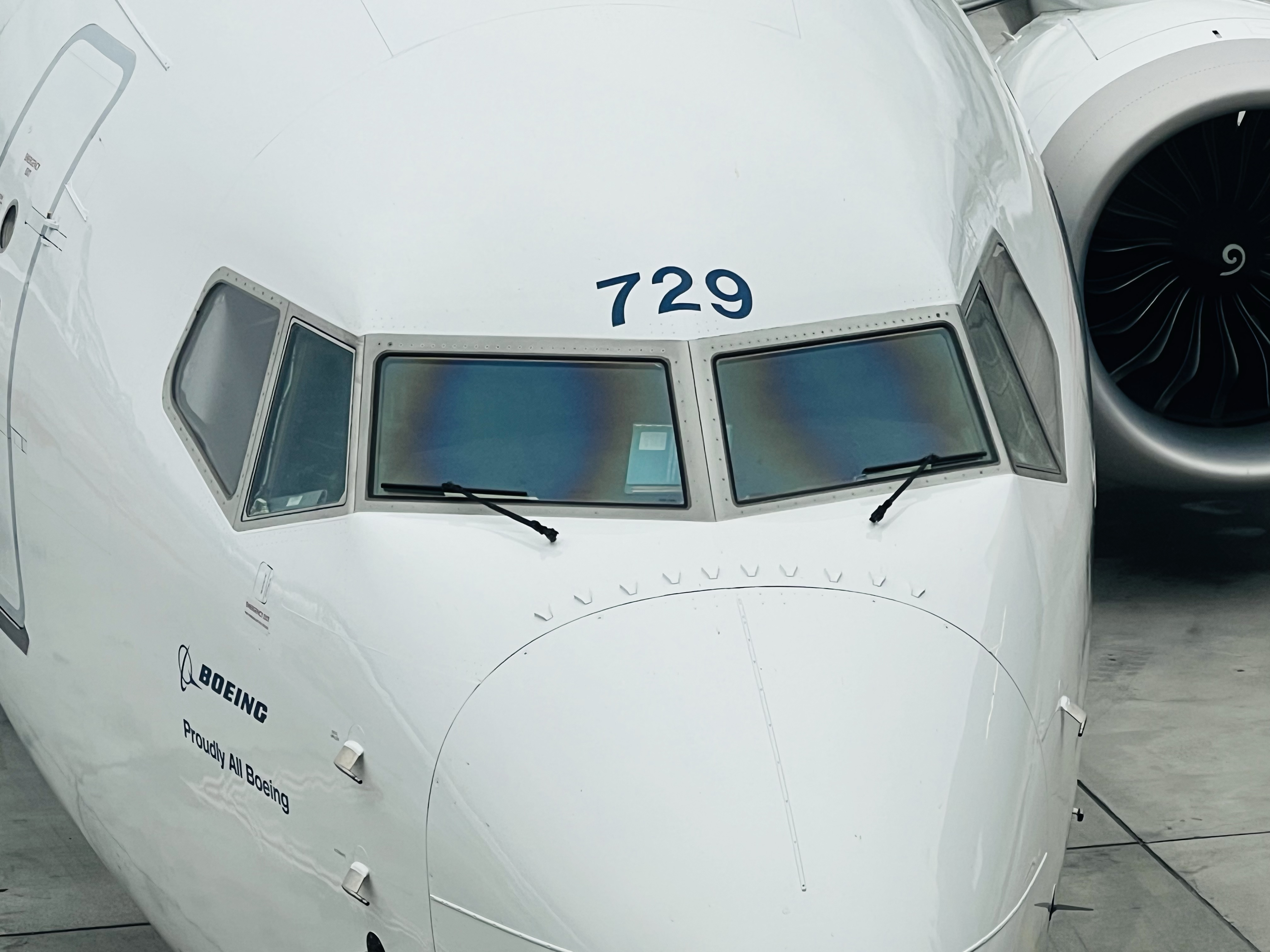
Plane spotting at SFO. This plane has a pointed nose and the side windows form a “V” instead of a straight line. It also helps that it says: “Boeing. Proudly All Boeing” just under the window!Closer detail of the side windows of a Boeing. I believe this is a Boeing 737-9 MAX. Could I identify my plane that would take me to Honolulu? Straight side windows with a notch in the top corner. The nose is rounded and less pointy than a Boeing. This is an Airbus A330-200. It also helps that it’s labeled below the windows.My winged chariot to Hawaii. Another view of the Airbus A330 and the diagnostic cockpit window shape. Not seen in this photo but where the tail meets the fuselage, it is rounded with no extra angle like the Boeing’s tail.
While waiting to board my flight I found a comfy swivel chair and sketched the view before me of the B Gates of Terminal 1 (no pencil required). In the foreground is an Alaska Airlines jet and in the background is a Hawaiian Airlines plane at Gate 11. This was the plane that would be flying me to Honolulu.
I sketched the Alaskan Boeing before it pushed out to the taxiway leading to runways 1 (Left and Right). This left me time to add details to the Hawaiian Airbus and the jumbles of the surrounding scene at SFO.
Most think of the Monterey Aquarium when the namesake of Monterey Bay is mentioned.
As a fourth grade teacher I think of the depth of California History when I think of Monterey: Colton Hall, the Customs House, and the Larkin House.
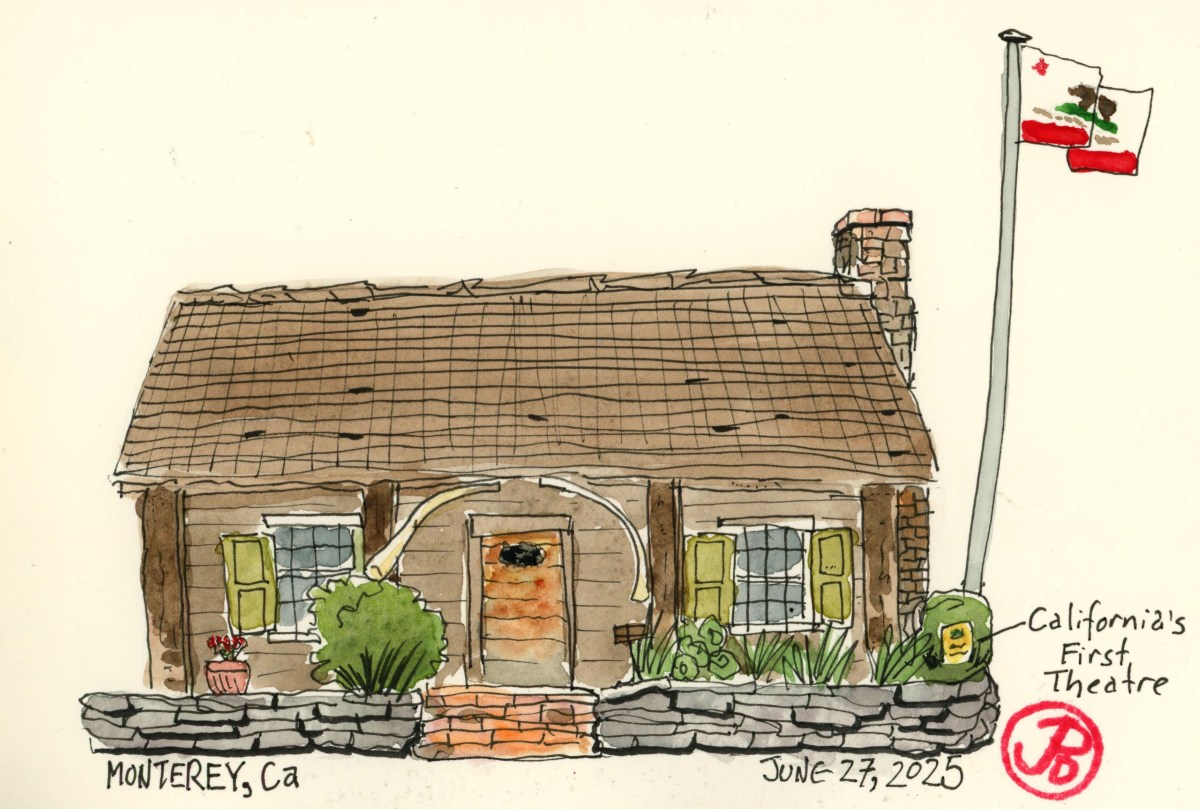
This morning I would not be sketching any of these buildings (although I have already sketched two) I turned my journal to the many firsts in California to be found in Monterey: California’s First Theatre and brick building.
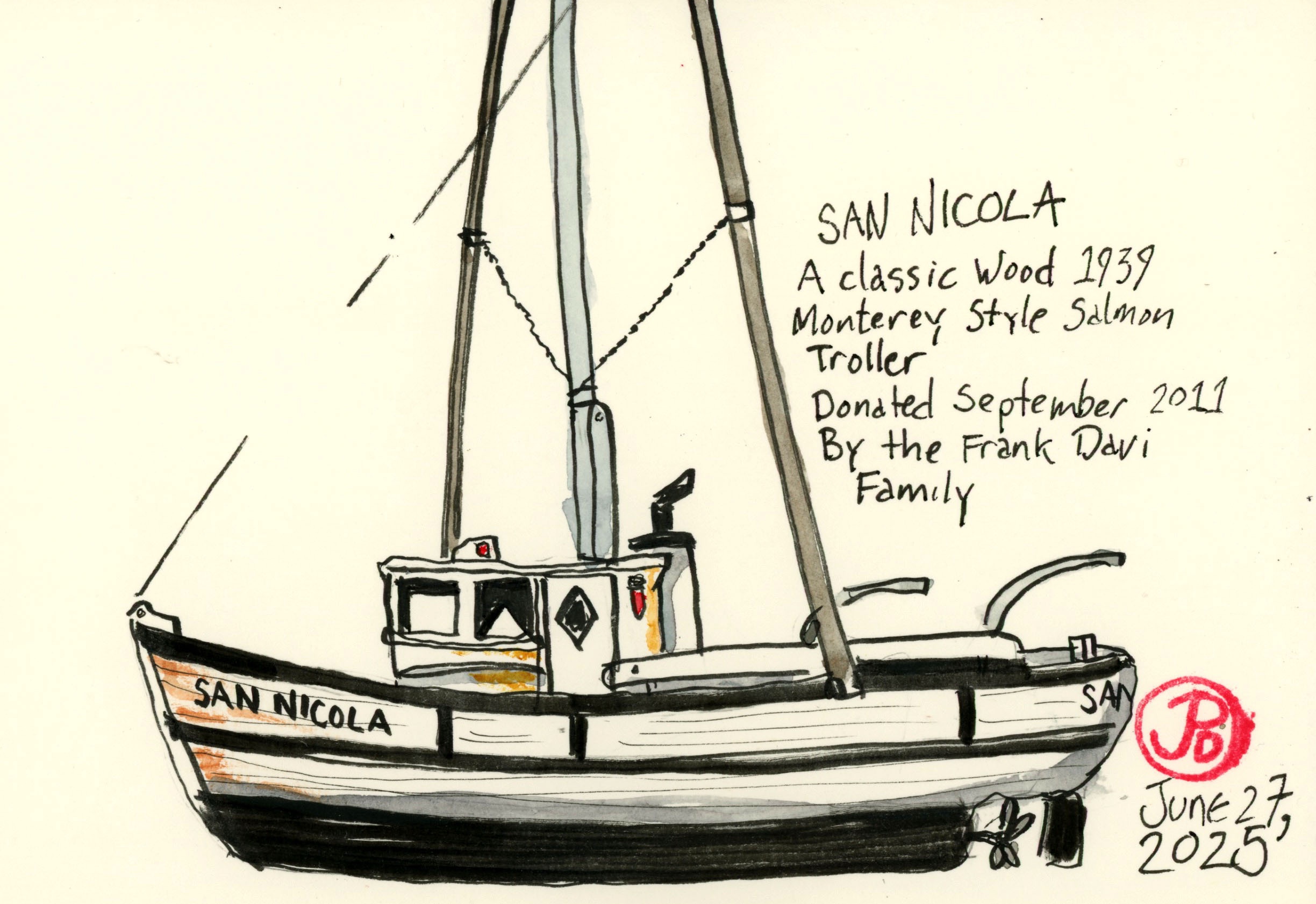
I started off with a warm up sketch of the San Nicola. The San Nicola is a 1939 wooden salmon trawler on display near the entrance to the Monterey Historical District. It is a reminder of Monterey’s fishing heritage.
After my warm-up sketch, it was now time to head to one of the first firsts in Monterey, California’s First Theatre.
Two whale ribs frame the entrance to the theatre.
The theatre was built in 1846 by Jack Swan. It was first used as a theatre in 1850 when the US Army officers of the 1st New York Volunteers put on plays to raise money.
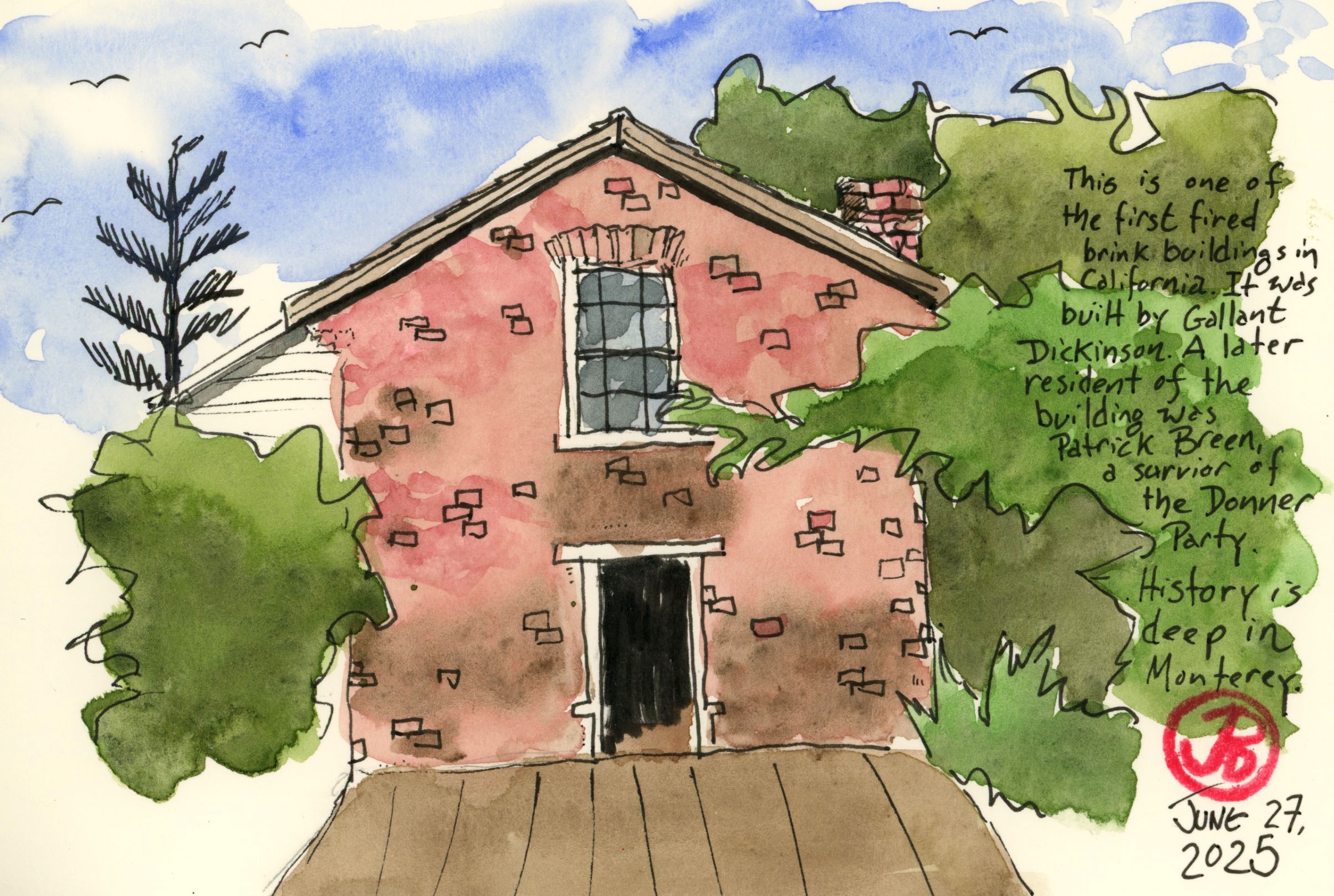
My second first of the day was just around the corner, it is the first brick building in California.
A sketch in progress.
Now this bears a little bit of explanation. The early Spanish and Californios had built buildings with adobe bricks, the first “brick” building was built with European style fired bricks.
The structure was built by Gallant Dickinson in 1947. A well known resident of this building was Patrick Breen, a chronicler and survivor of the Donner Party. The building served as a restaurant in the early part of the 20th century.
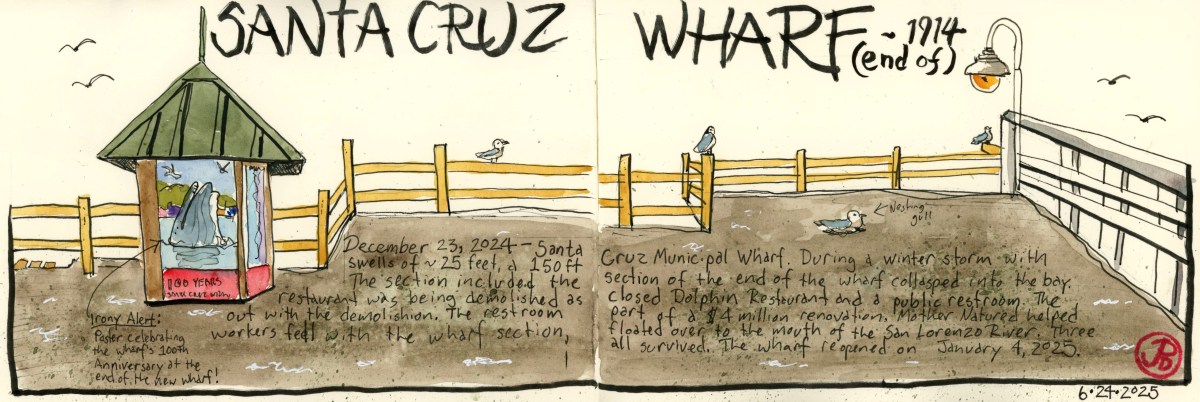
In December of 2024 a winter storm hit the seaside city of Santa Cruz bringing with it 25 foot swells.
One structure that took the brunt of the surge was the Santa Cruz Municipal Wharf.
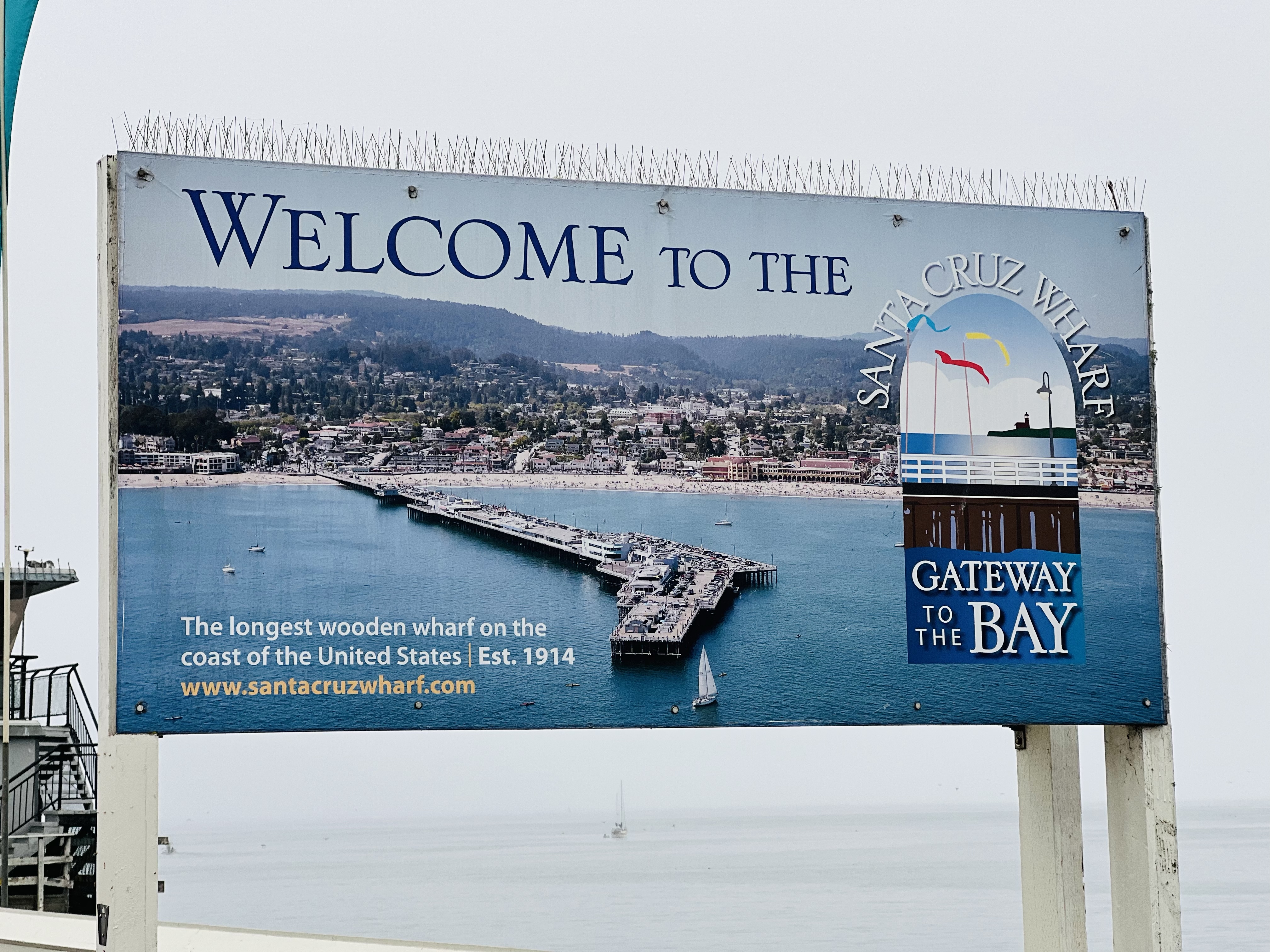
The current wharf was built in 1914 and at 2,745 feet is the longest wooden pier on the west coast of the United States.
Is the Santa Cruz What f still the longest wooden wharf on the west coast?
That all changed with the winter storms of December of 2024 which took 150 feet of the wharf into the bay on December 23. The section included the closed Dolphin Restaurant and a public restroom. The restroom washed ashore at the mouth of the San Lorenzo River, looking like a Mississippi River boat.
The wharf had been closed but then reopened January 4, 2025. I wanted to head out to the wharf, where I have many fond childhood memories, and sketch the new end of the wharf.
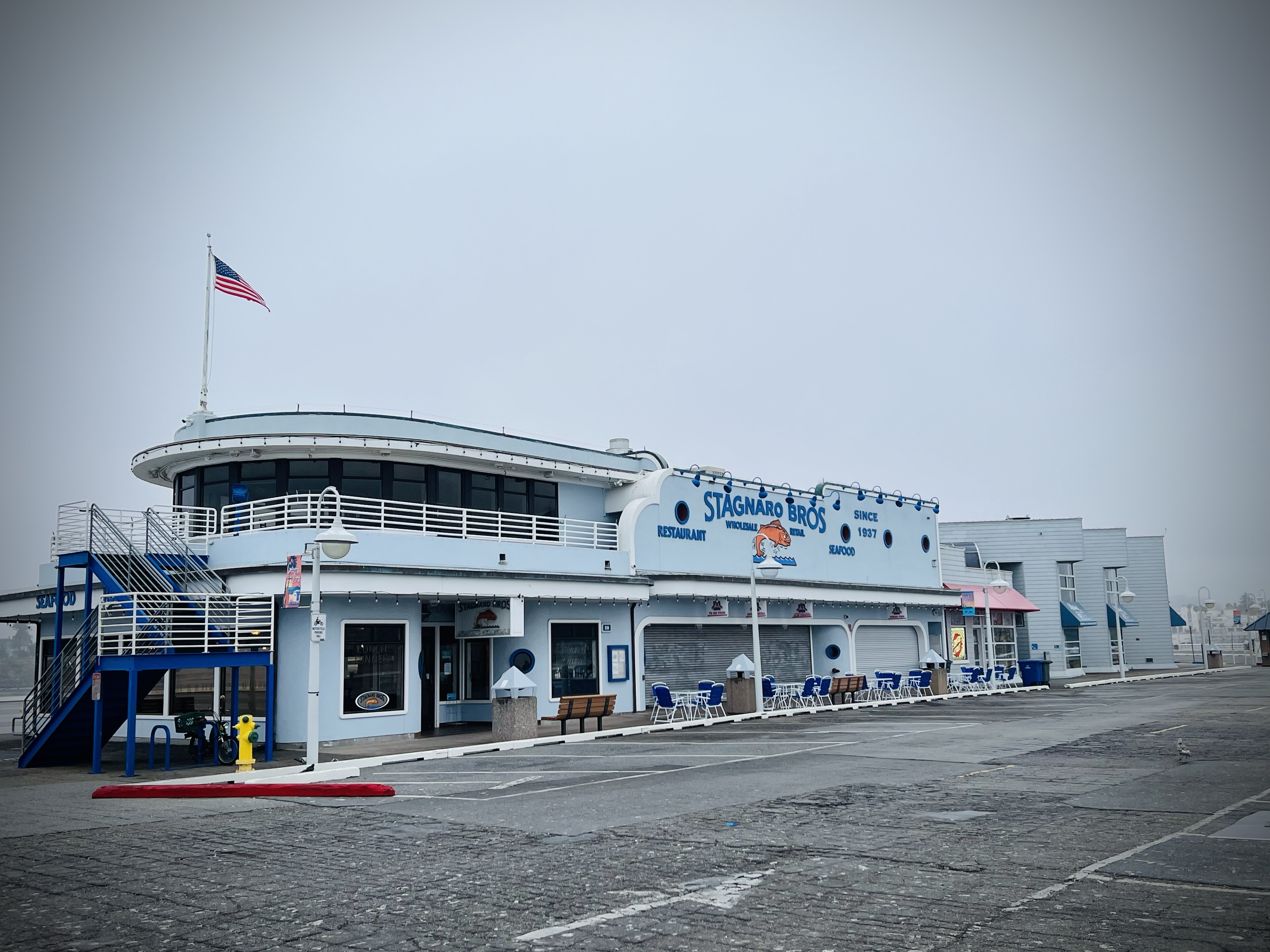
The Dolphin used to be the last restaurant at the end of the wharf. That honor now goes to the historic Stagnero’s. This restaurant and Gilda’s was a favorite of famed director Alfred Hitchcock who had a home in nearby Scott’s Valley.
The Stagnero Brothers restaurant is designed in a Streamlined Moderne style looking like an ocean-going vessel of the 1930s.
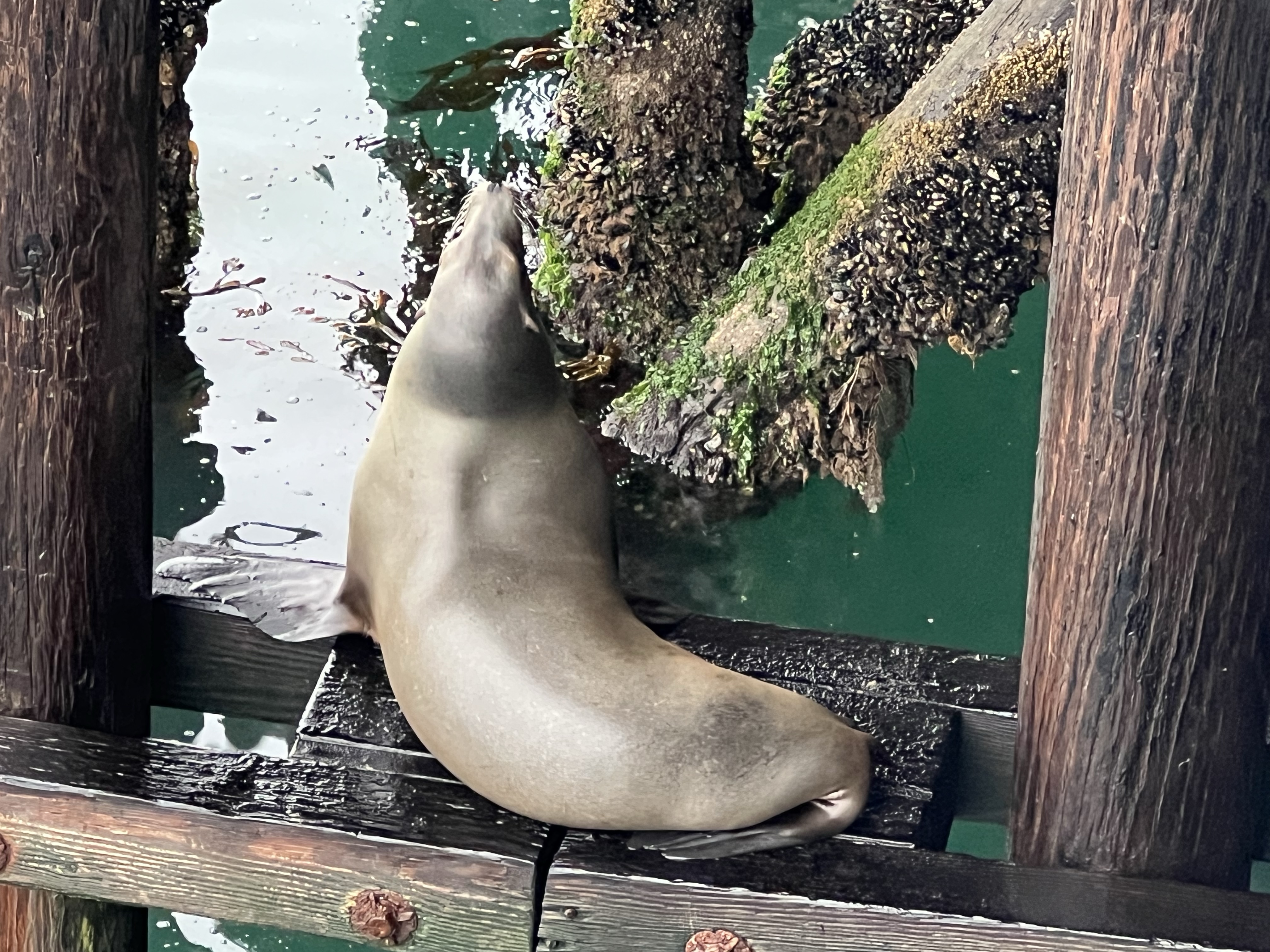
One of the draws at the end of the wharf where openings where you could look down at the resting California sea lions that used the wooden substructure as a haul out location.
The sea lions are still here, they use other sections of the wharf to haul out.
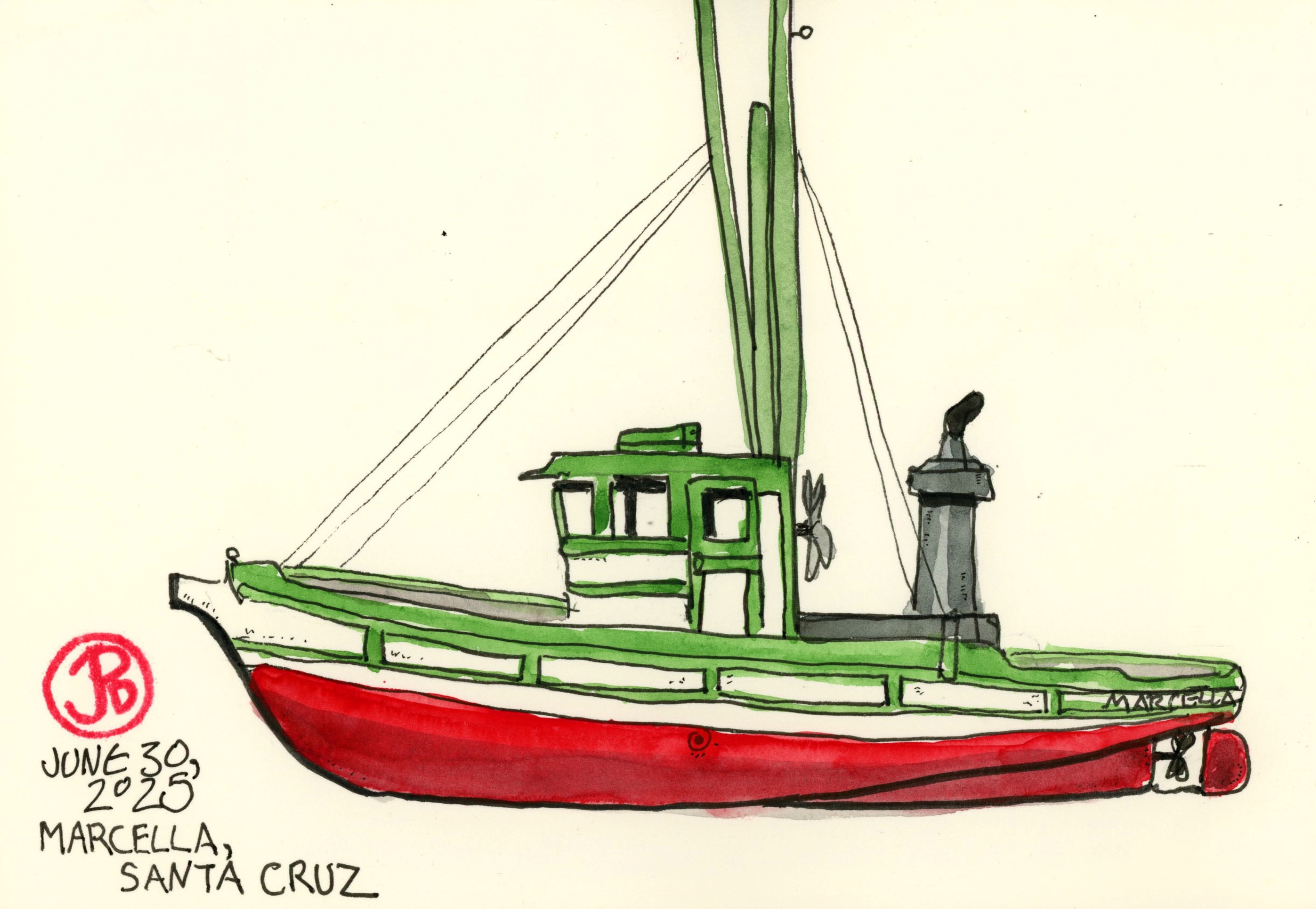
Near the beginning of the wharf there is an old wooden fishing boat which I also sketched.
It was early in the morning and there were already men fishing from the wharf. The wharf is no longer used for industrial fishing but is now used for recreational pursuits.
Early on a Monday morning I drove to Historic Highway 40, around Donner Summit, to do some sketching.
I love this highway corridor, it’s full of deep California history (native, pioneer, railroad, and highway) as well as personal family history. My parents met at the South Bay Ski Club whose cabin is on Highway 40 near Soda Springs. Without this ski club I would not have come into being.
Historic indeed, there is so much depth of history here.
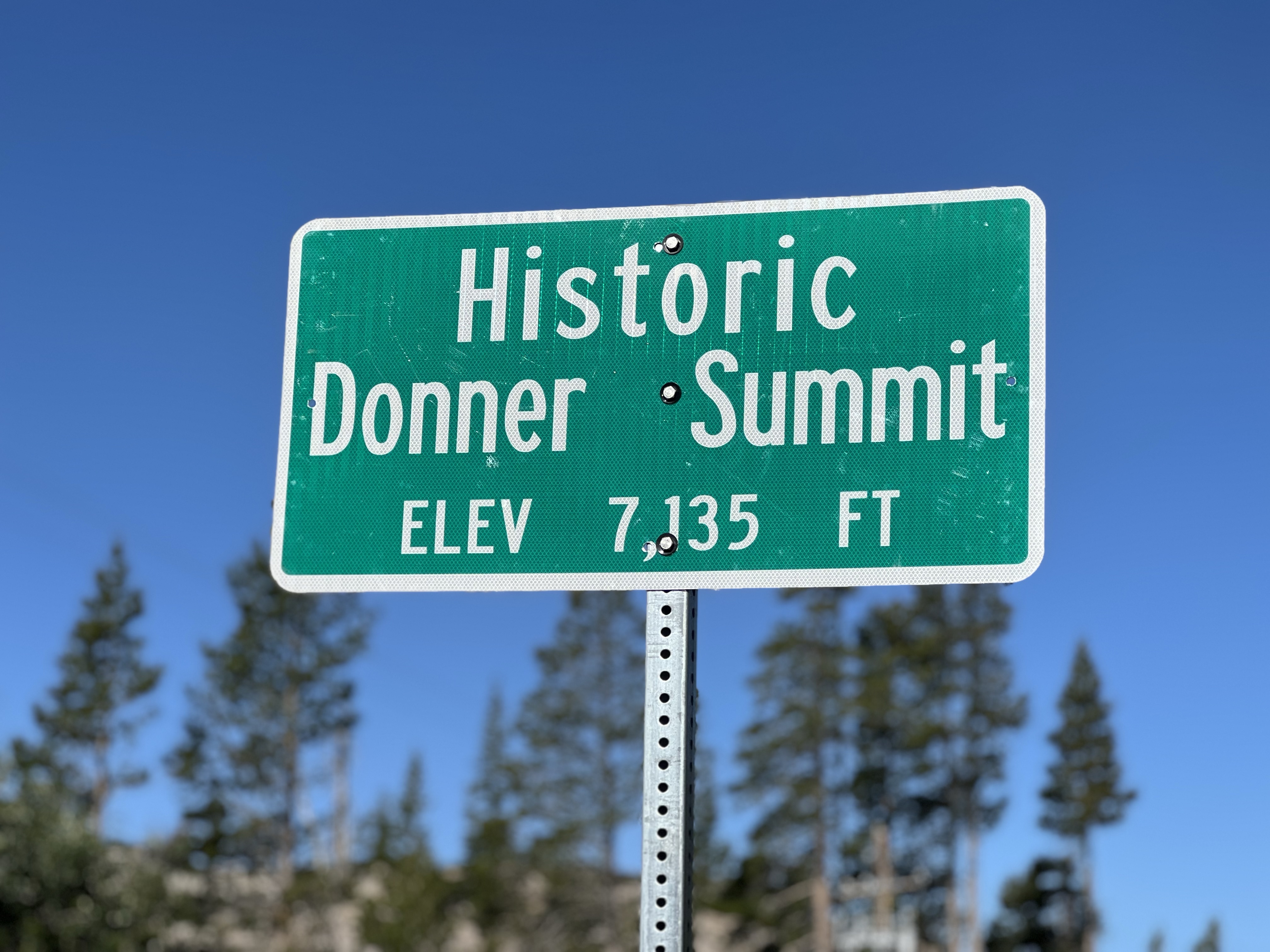
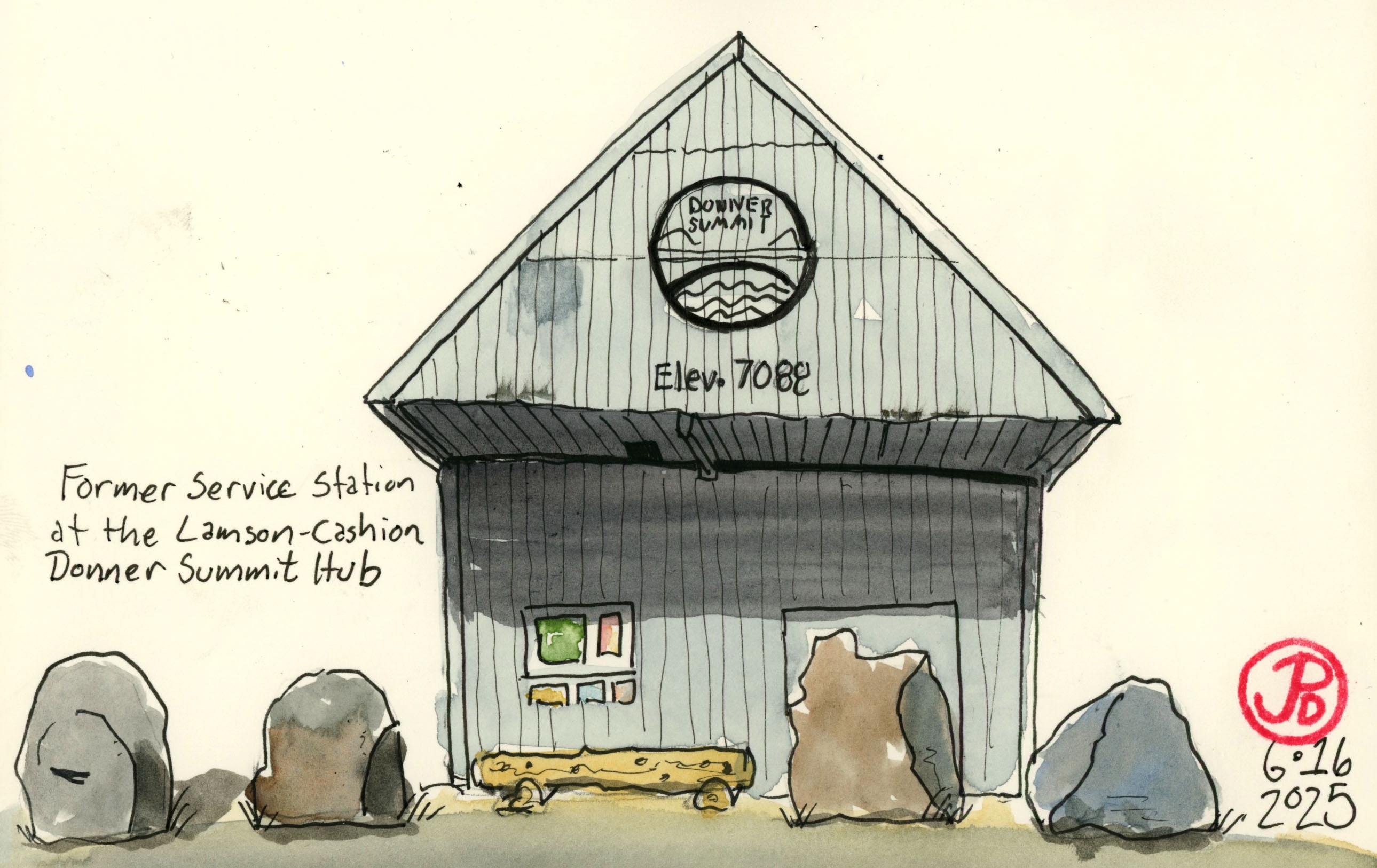
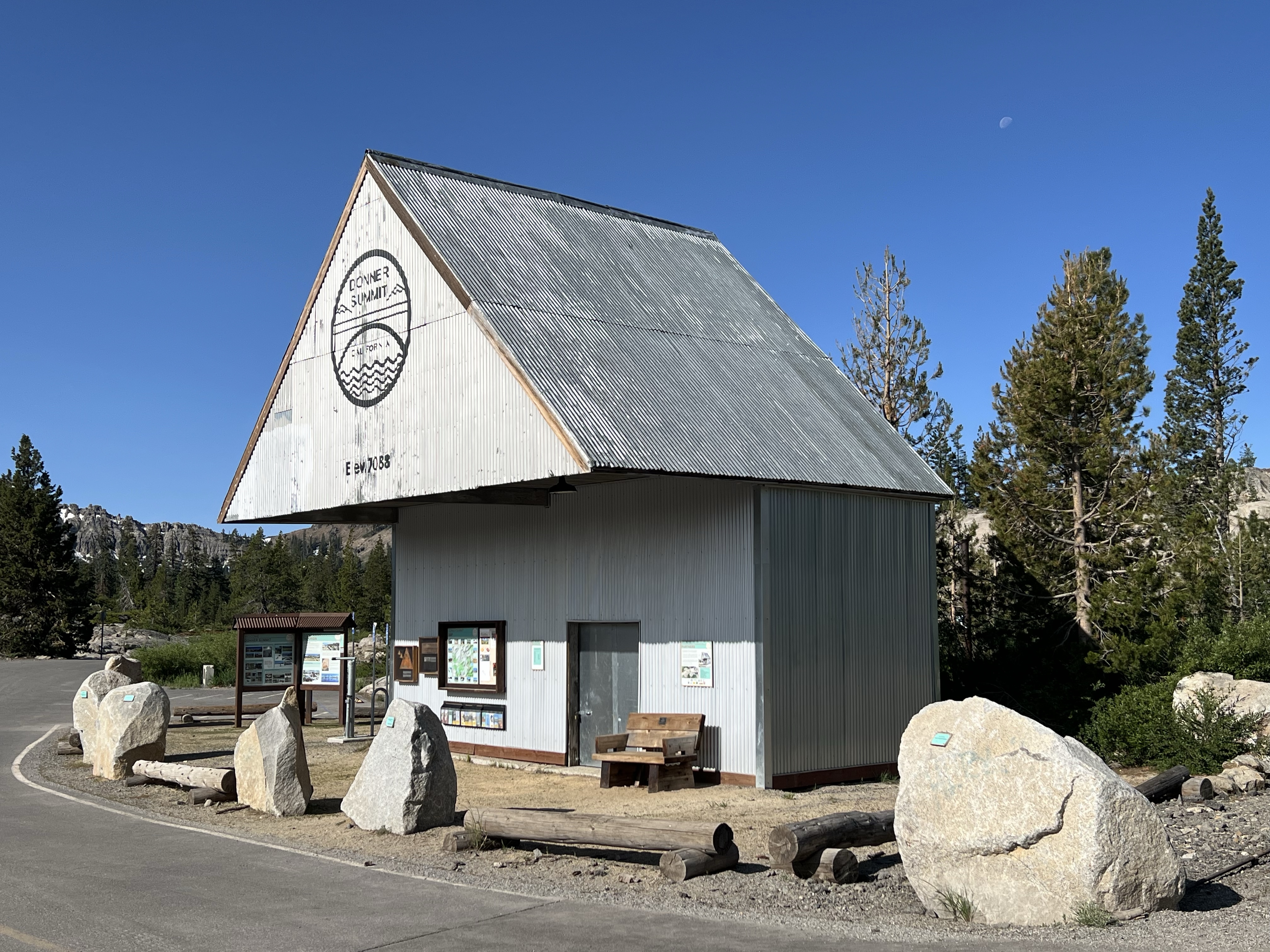
At the summit I sketched a former gas station. The station was used to fuel highway snow clearing equipment used to keep the highway open in the winter.
The Lamson Cashion Donner Summit Hub is where a lot of the threads of Donner Pass come together (hence the name). Just a short list of the points of interest in this general area are: the petroglyphs, Pacific Crest Trail, the Donner Summit Bridge (the Rainbow Bridge), west entrance of Summit Tunnel 6, central shaft of Tunnel 6, and the Donner Summit Trail.
The repurposed gas station is now an information center at the Lamson Cashion Donner Summit Hub.
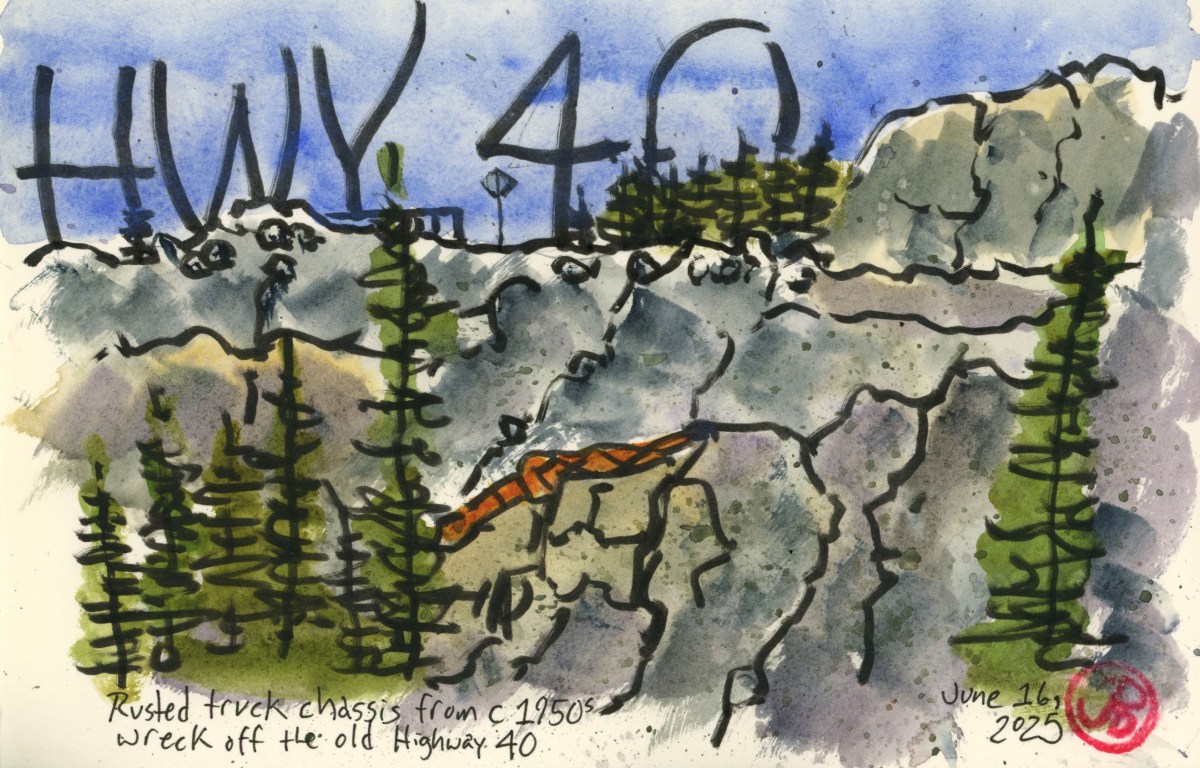
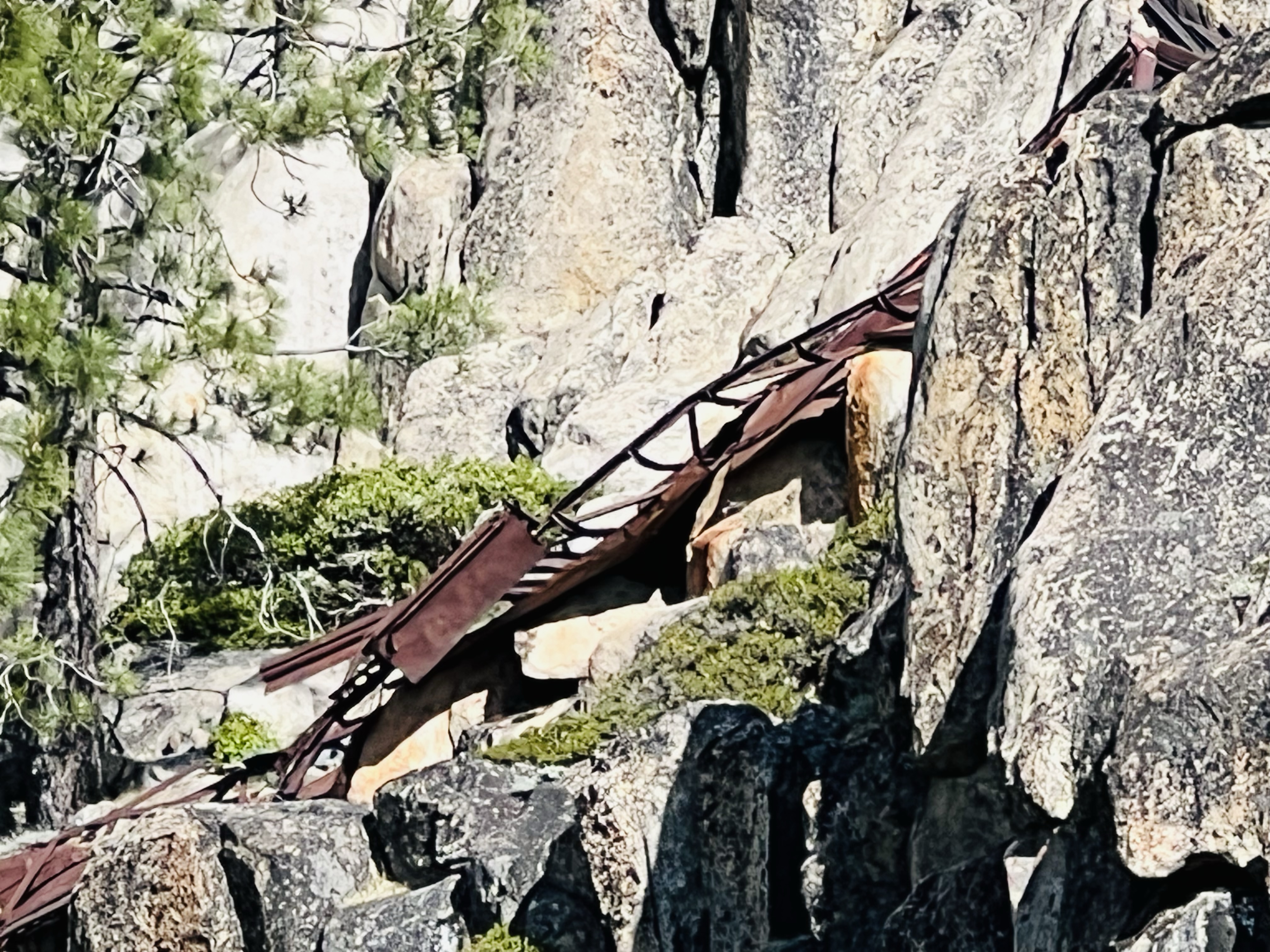
I then headed down the pass and over the famed “Rainbow Bridge”. I was keeping my eyes (at least one eye) to my left, searching for the mass of rusted metal that has been here for about 75 years. There it was.
My father always pointed out this ominous artifact when we would summer here on the shores of Donner Lake. We were historic rubberneckers.
There it is, rusted and compacted by heavy snow loads for almost 75 years.
Highway 40, east of Donner Summit is treacherous, as the Donner Party found out when they attempted to scale the pass in 1846. It is also treacherous for auto traffic on the winding, wet, and icy roadbed while heading down grade.
The wreck that my father pointed out is the truck chassis that went over the roadway and settled on a granite shelf sometime in the 1950s. There is not a lot of information about the truck, just that it’s not the “Turkey Truck”. That’s a story for a different post!
I pulled over and found a boulder seat to sketch from using a brush pen to keep it loose and sketchy to the soundtrack of the cooling winds through the pine branches and a male Wilson’s warbler emphatically singing from those branches. I was in Sierra heaven (featured sketch).
After sketching I headed down 40 towards Donner Lake and the Southern Pacific Railroad historic town of Truckee.
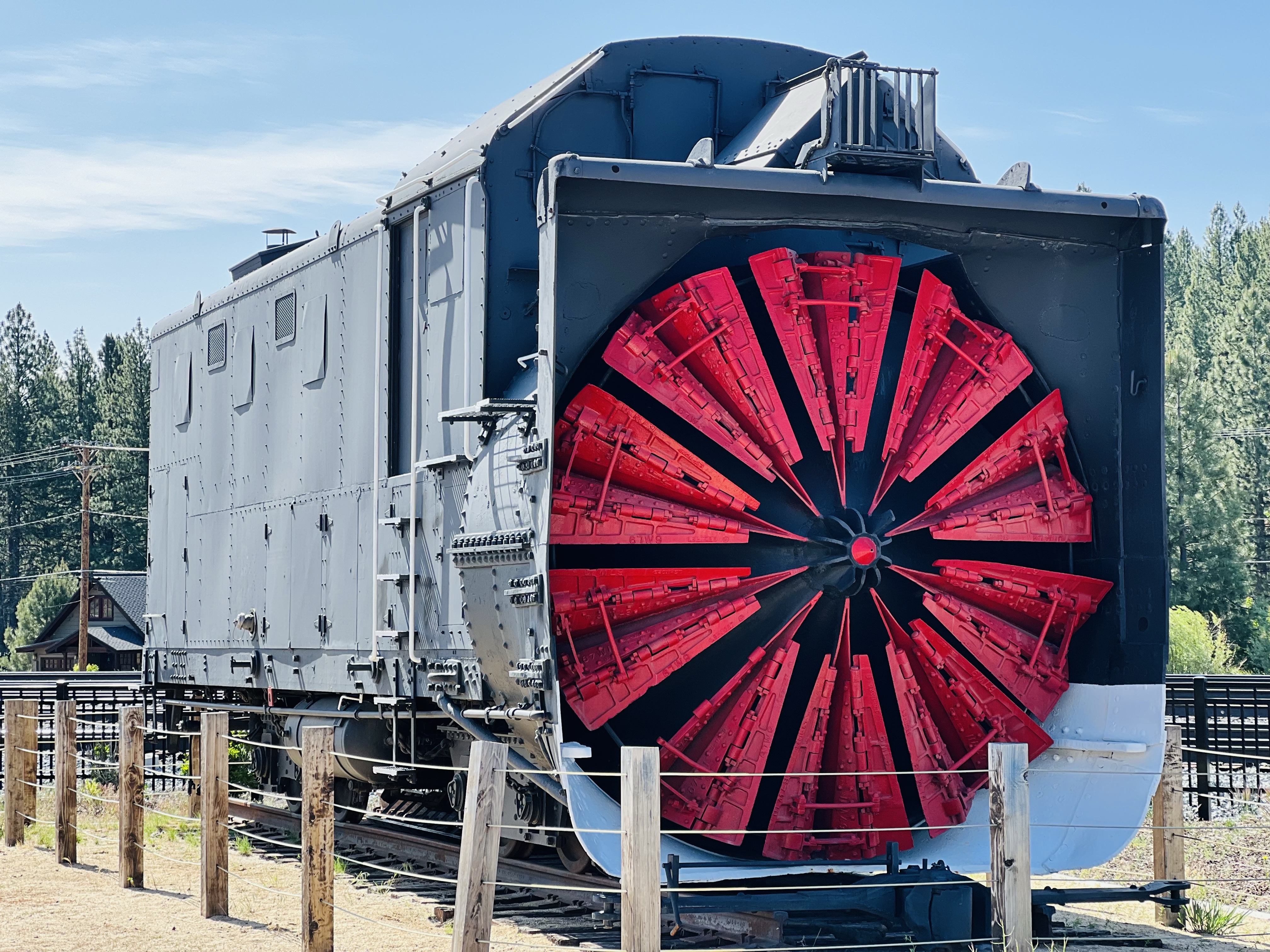
Aside from SP’s iconic cab forward locomotives, no other piece of railroad equipment is as renowned as the rotary snowplow for conquering the grades and gales of Donner Summit.
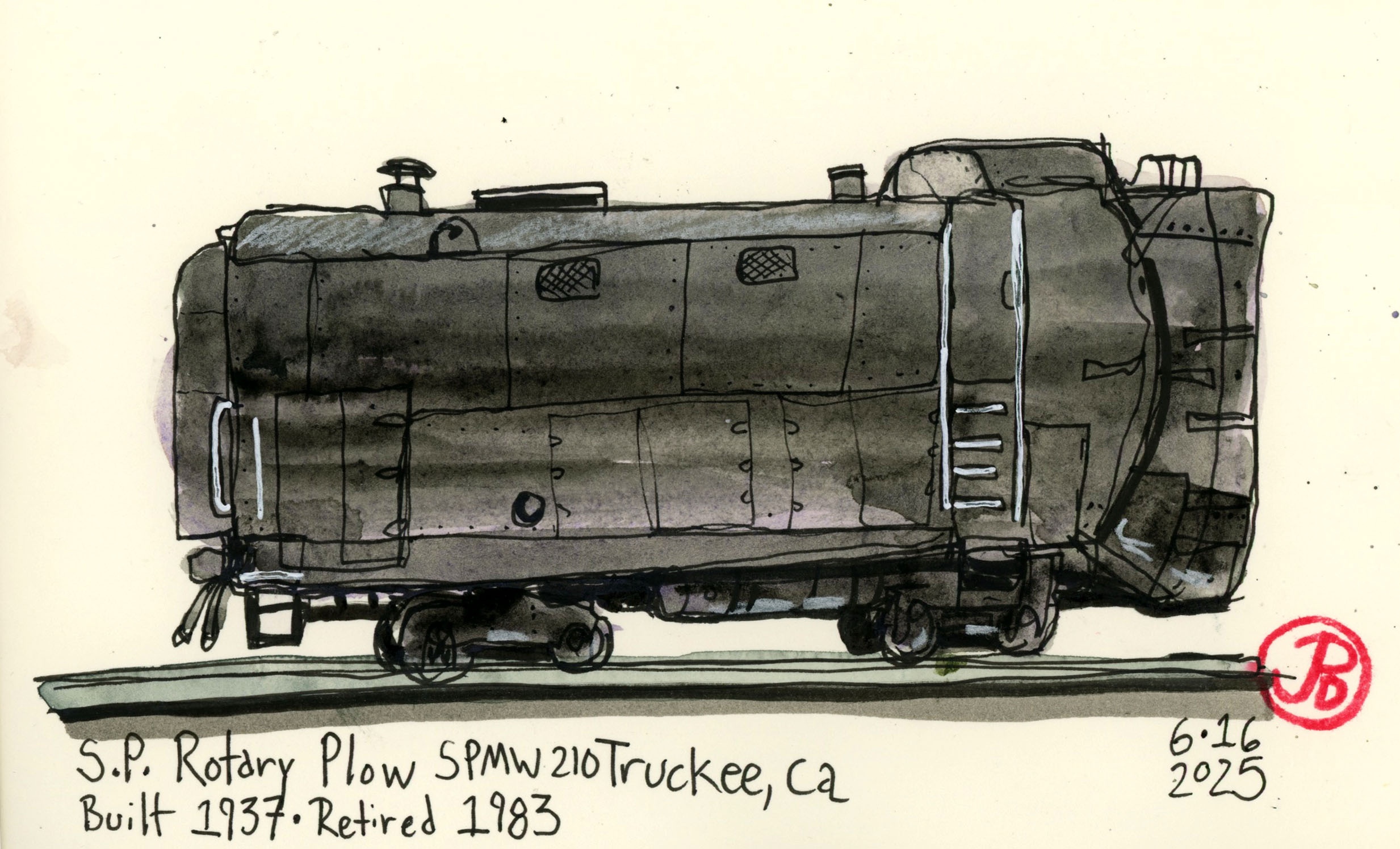
The rotary plow kept the line open in the deepest winters. And the California State Railroad Museum donated Southern Pacific’s SPMW 210. This historic piece of rail equipment now is on static display alongside the tracks it once kept open in the winter time.
This monster could cut through heavy snow. I usually sketch these plows head on but I decided on a different perspective.
While I have sketched these plows many times before, I decided to try from a different angle with a broken continuous-line sketch.
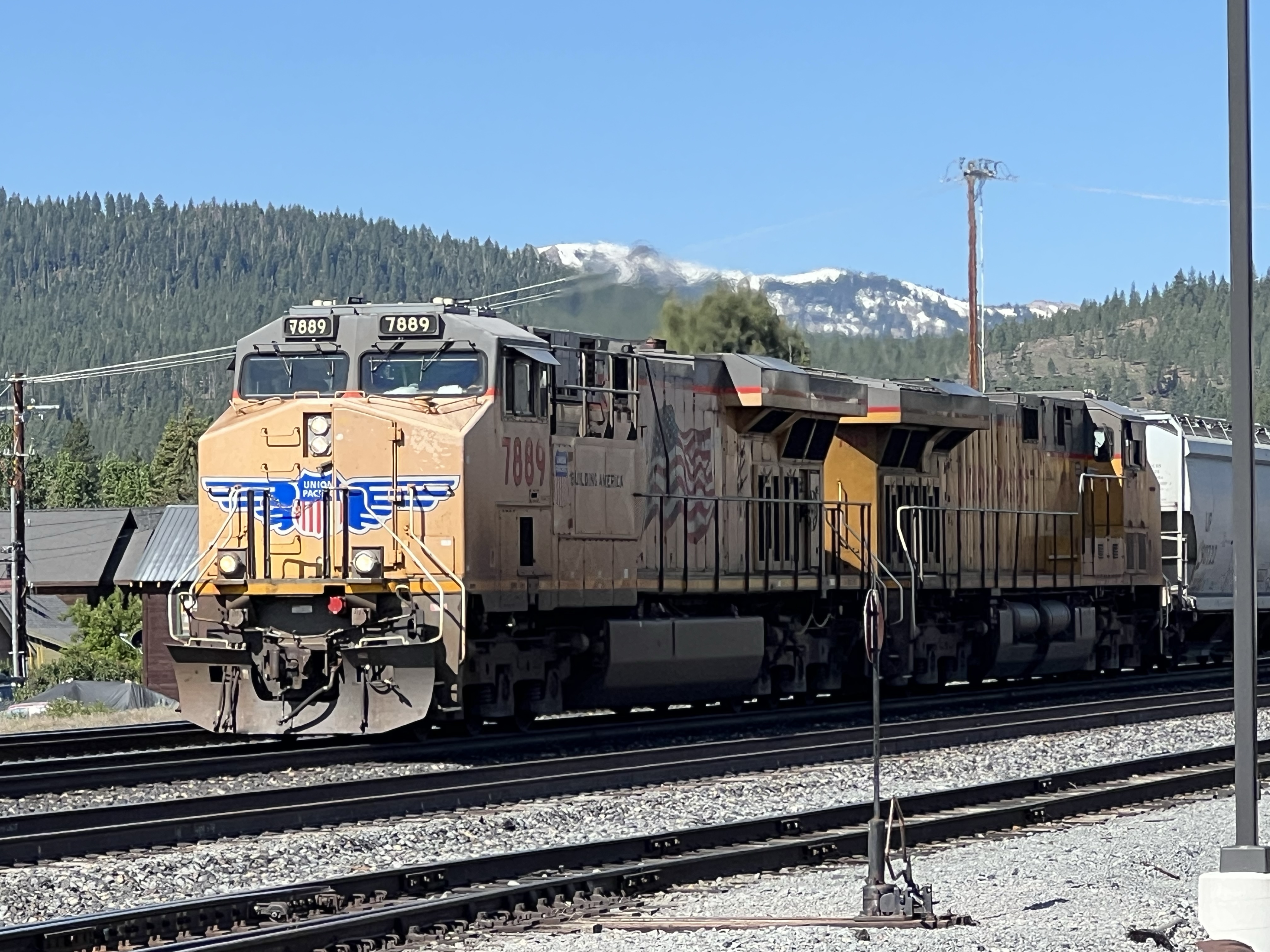
A reminder, courtesy of Union Pacific, that Truckee still remains a rail town. The eastbound freight was an empty covered hopper consist. How do I know it’s empty? Motive power. Only two locomotives on point and one at the end. If the consist was fully loaded, they would need more motive power to travel over Donner Summit.







 Corvid Sketcher