Image

The Spider-man Burglar

I recently heard a rebroadcast on NPR of a This American Life episode titled “My Undesirable Talent” that reminded me of the 2002 crime spree in my neighborhood.

The part of the episode is called Climb Spree and is about a burglar in western San Francisco that climbed up buildings and enter through a skylights, ventilation shafts, or attics to rob local businesses to support his gambling habit.

I wanted to do a spread about the “Spider-man” crime spree. I decided to visit and sketch a few of the businesses where the burglar dropped in and connect these thumbnail sketches with a map of western San Francisco.

He was dubbed the ‘Spider-man Burglar” by the SF Police but his real name is Kristain Marine. He was adopted from Korea by Midwestern parents. People at his church, (The Church of Latter Day Saints), knew him as the guy with Italian shoes who was respectful and soft spoken.

He first stole $200 from the gym where he was working and then proceeded to gamble it all away. He needed money to replace what he had stolen and lost so he committed his first “Spider-man” robbery: a concession stand at City College of San Francisco. He climbed up on the roof and lowered himself down through a skylight. He didn’t even have gloves to conceal his fingerprints so he had to use snowboard mittens.
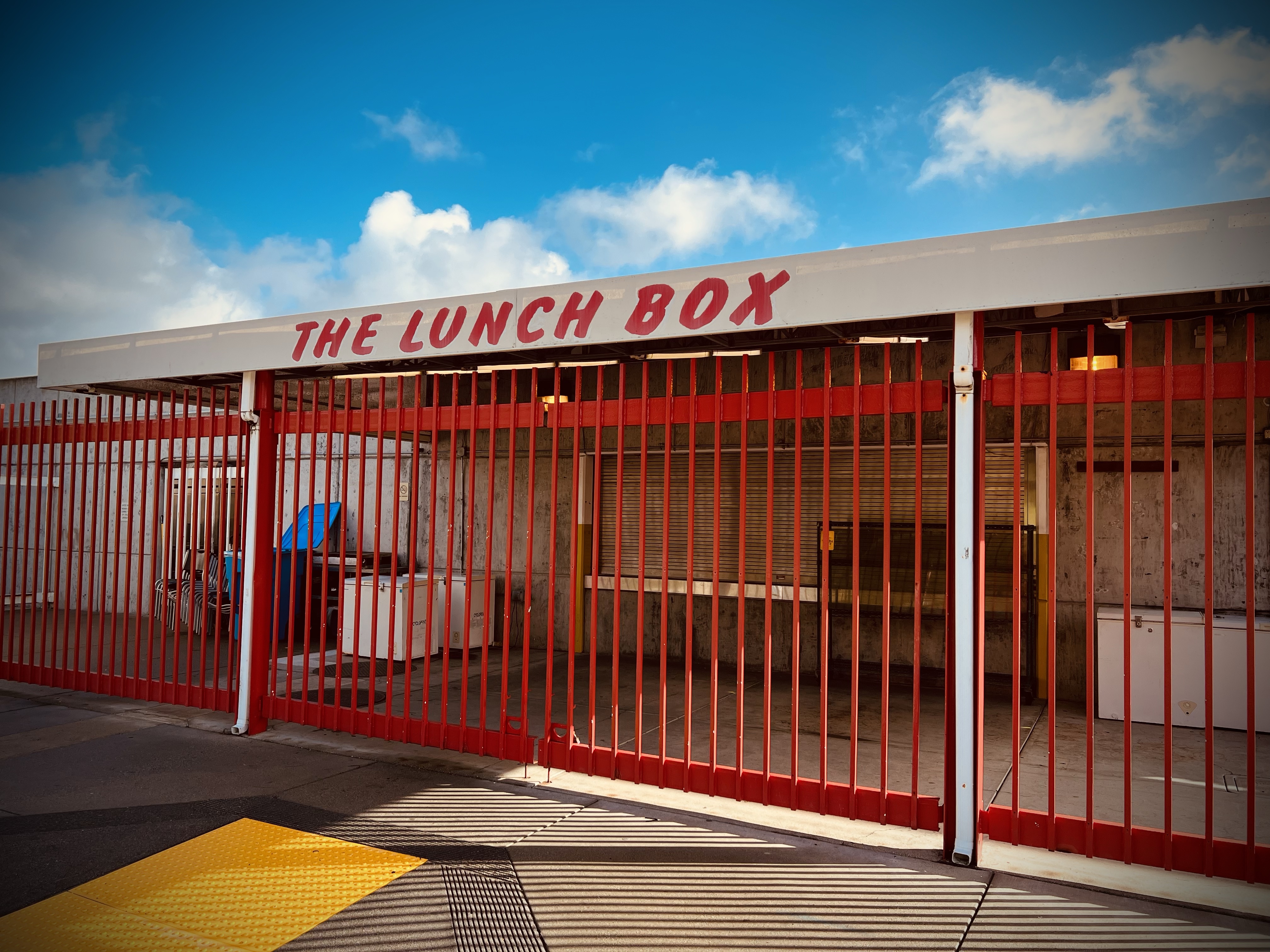
The concession stand at City College. This is where the crime spree all began.

This was the start of 63 burglaries in San Francisco. My thumbnail sketches are of the Church of Latter Day Saints in the Sunset (where he might have attended) and the The Lunch Box concession stand at City College of San Francisco, the location of his first robbery.
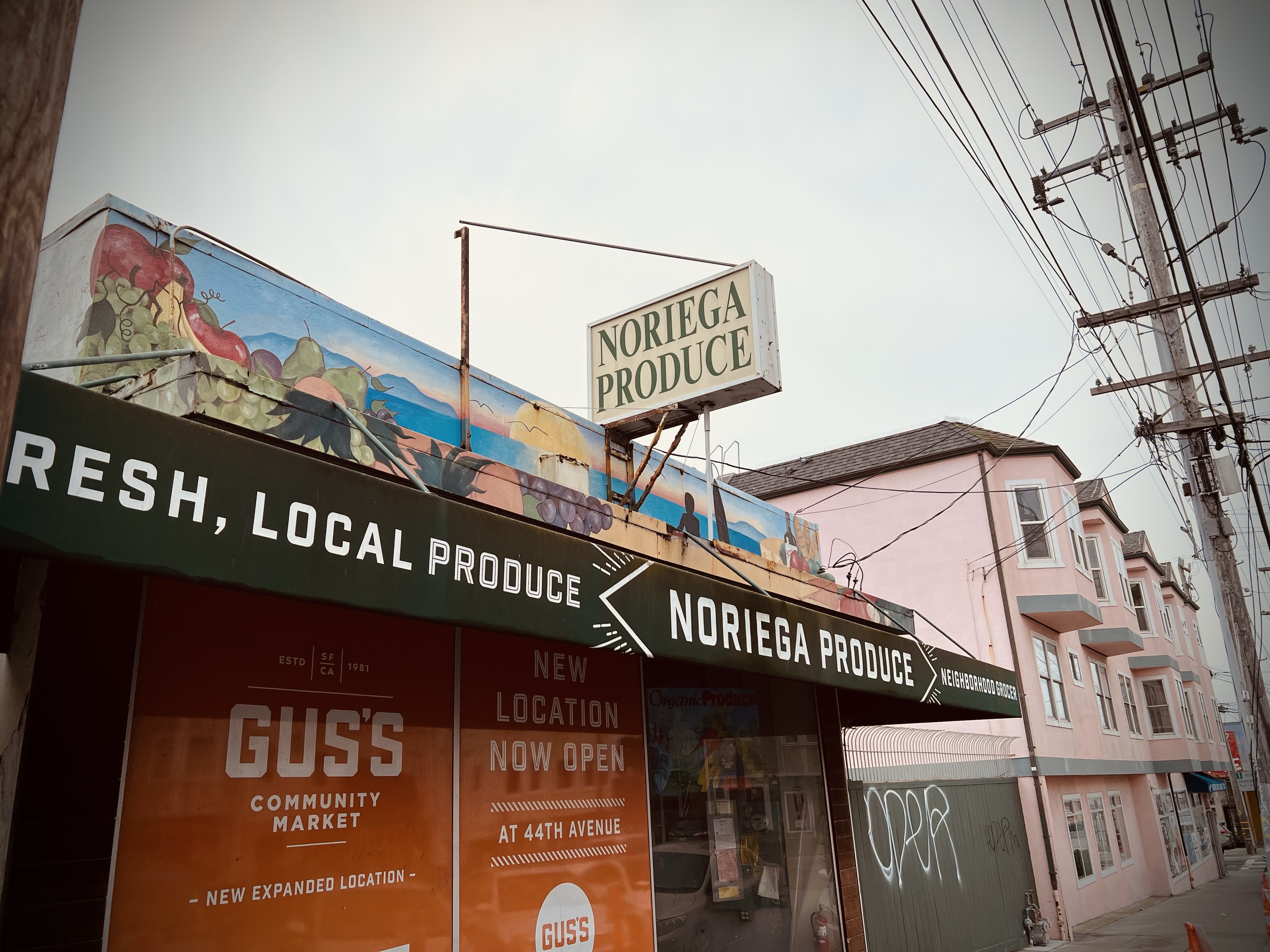
Noriega Produce is now closed. The market has moved up the street and is now called Gus’s, in honor of the Greek immigrant who founded the market.

The next thumbnail is of Noriega Produce, on the western fridge of the continental United States. I once lived a five minute walk away and this was my local market. This market is owned by a Greek immigrant and run by his oldest son. Spider-man robbed this market and had time to have an ice cream bar at the owner’s expense. This was an assault on my neighborhood and the family businesses I patronized. Gus Vardakastanis, the owner, was killed by a hit and run driver in 2017.

The next thumbnail is of a Japanese noodle house called Hotei on 9th Avenue, near Golden Gate Park (this excellent restaurant is now closed). Marine lowered himself down into the restaurant but fell and injured himself. Outside the picture window he noticed a police car. He was trapped, his crime spree was about to end. There was only one way out and that was through the front door.

He walked out the door, said hello to the officer, and pulled his keys out and pretended to lock the door and got away.

The last thumbnail is of Clancey’s Market on the 3900 block of Irving, near Ocean Beach. Most of Marine’s burglaries where starting to show a pattern: early in the mornings on certain days and in certain neighborhoods. The police presence in the Sunset Neighborhood was increased at these times.

Marine was trying to break into this corner market but he became trapped in the attic. After a neighbor heard glass breaking the police where called and they were on the scene in minutes. Marine’s 63 robberies where now over.
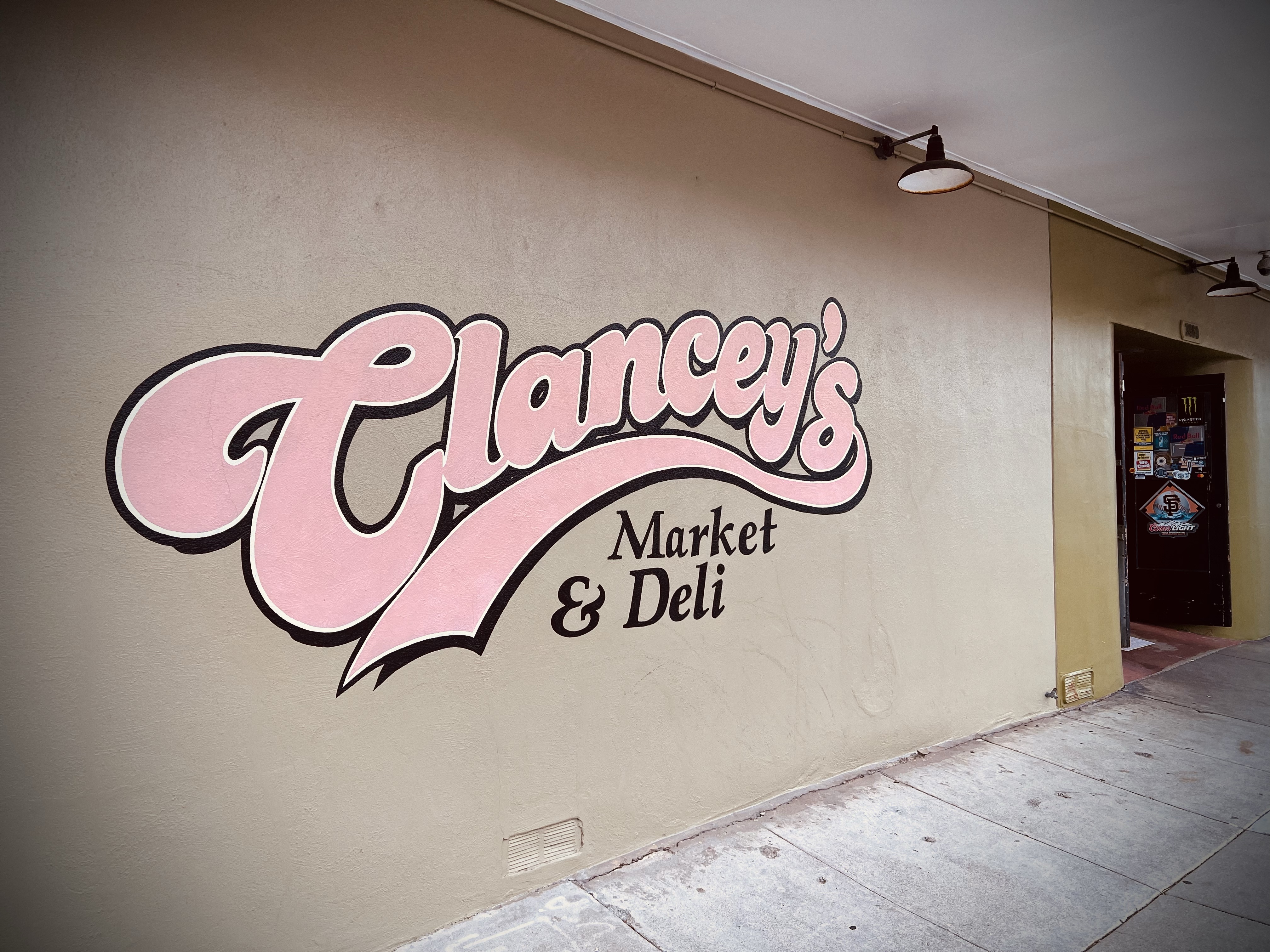
Clancey’s Market and Deli, where “Spiderman’s” crime spree ended.

Marine was a first time offender and he admitted to all his burglaries, even taking investigators to his crime scenes. He was sentenced to six years in prison.

I think the main problem with tone of the This American Life piece and with other media stories is that Marine is portrayed as some sort of comic book super hero. What he did was not super nor heroic. As I visited and sketched some of the 63 local businesses he robbed, I thought mostly about the people who owned these shops, markets, and restaurants. Many of these businesses where and are “ma and pop” family businesses, not big box corporations.

If Marine’s crimes reminded me of any literary “hero” it would be as a kind of corrupt Robin Hood.The Spider-man robber was stealing from the poor and giving it to the casinos.
Image

New Year Mega Rarity

It’s always nice to the start the new year of with a life bird. So much better if the bird is a mega rarity!

This was the Eurasian chat the red-flanked bluetail (Tarsiger cyanurus).

The bird was the sixth California record and only the second chasible bird (that is if you have an ocean going vessel), the other four records are from the Farallon Islands. It was found on December 28, 2022 in a park near the Santa Cruz Lighthouse on West Cliff Drive.

I had planned to head down on New Year’s Day to Lighthouse Field State Beach in Santa Cruz with Grasshopper but on December 31, after record heavy rains, a large cypress tree at the park fell and killed a 72 year old man. The park was closed for safety concerns.

So our Plan B was to bird the San Mateo County coast and have a go at the continuing northern gannet at Pillar Point Harbor.

Highway 92 was closed because of the intense rainfall so it was Highway One down the line to Pillar Point.

We checked the breakwater for a large white bird. No gannet. Heading south, the beaches seemed devoid of gulls. The historic rains had washed away large parts of the beaches, the creeks were flowing at a high capacity turning near shore waters a muddy brown. Not a great day for birding, well not yet anyway.

We reached as far south as Pescadero State Beach, looked out at few roosting gulls (it was still too early for kittiwakes) and returned north to try again for the consolation gannet

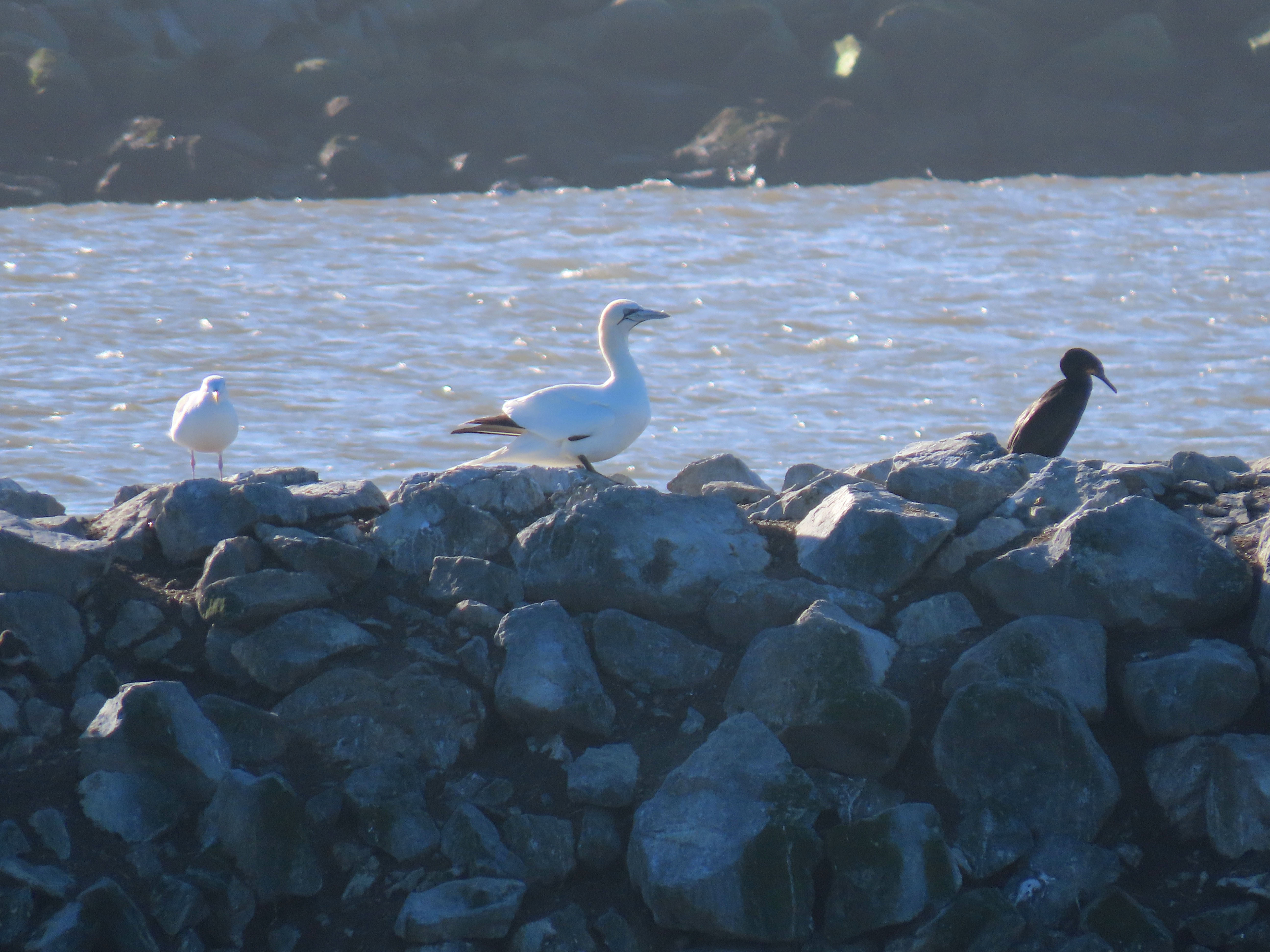
Johnson Pier was now crowed with people buying fresh crab and cod from fishing boats in the harbor. We weaved our way out to the end of the pier to look for an out-of-place big white seabird. Grasshopper spotted the gannet, named “Morris” by locals, immediately. The gannet, the only one on the west coast, was preening and the local gulls and cormorants were giving Morris a wide berth.

The much larger northern gannet sticks out like a sore thumb.

After getting good looks and a few photos, we saw a report that the bluetail had been seen and heard earlier in the morning. So some birders where getting access to the park. After a quick ponder we knew what we had to do: head south and retrace our journey and not stop until we where parked next to Lighthouse Field State Beach.

About an hour later, we parked on a side street, geared up, and entered the park. Still unsure of the location, we knew we had to find the semicircle of birders, intently gazing into the bramble. We began to head east on the trail, dodging puddles that were not far from being ponds, when we spotted the large cypress tree that had fallen across the path in front of us.

The cypress was over 100 feet tall, the papers put the tree at 120 feet, and just beyond the tree and to the left we saw a some birders looking off to the left. The only way to get over the tree was to climb over. Other had already trampled down a path through branches that were now facing upward. Once we got to the location of the bluetail, there were already about 35 to 40 birders in attendance, with more arriving as we searched.

This bird was going to be tough because it was sulky and shy, so patience and perseverance would be needed. Good thing I’m an elementary school teacher!

The bird was being seen among the grasses and branches and the bluetail was moving quickly, not pausing for long. I saw movement a few times which I thought was the bluetail but I wanted better diagnostic looks before I added the bluetail to my list. After about 30 minutes, I finally got a good look at the tail of the bluetail, which was blue and I noted how the bird frequently jerked it’s tail downward like a flycatcher. World life bird number 1,707!

Once I got my views, I stepped aside to let others from the back start their search. I started my anchor sketch of the downed cypress tree and reflected on the tragedy of a man’s death, while not far away, birders chortled in ecstasy.

Image

Sketching Columbia

I have sketched the Gold Rush Town of Columbia many times with various degrees of success. I was returning here in winter when the historic streets are not as crowded with summer visitors. I sketched either in the early morning or at the end of the day when I would have more options for selecting my perspectives.

I had a few buildings on my sketch list, some of which I would be sketching for the first time, while others, I was making a second or third attempt.

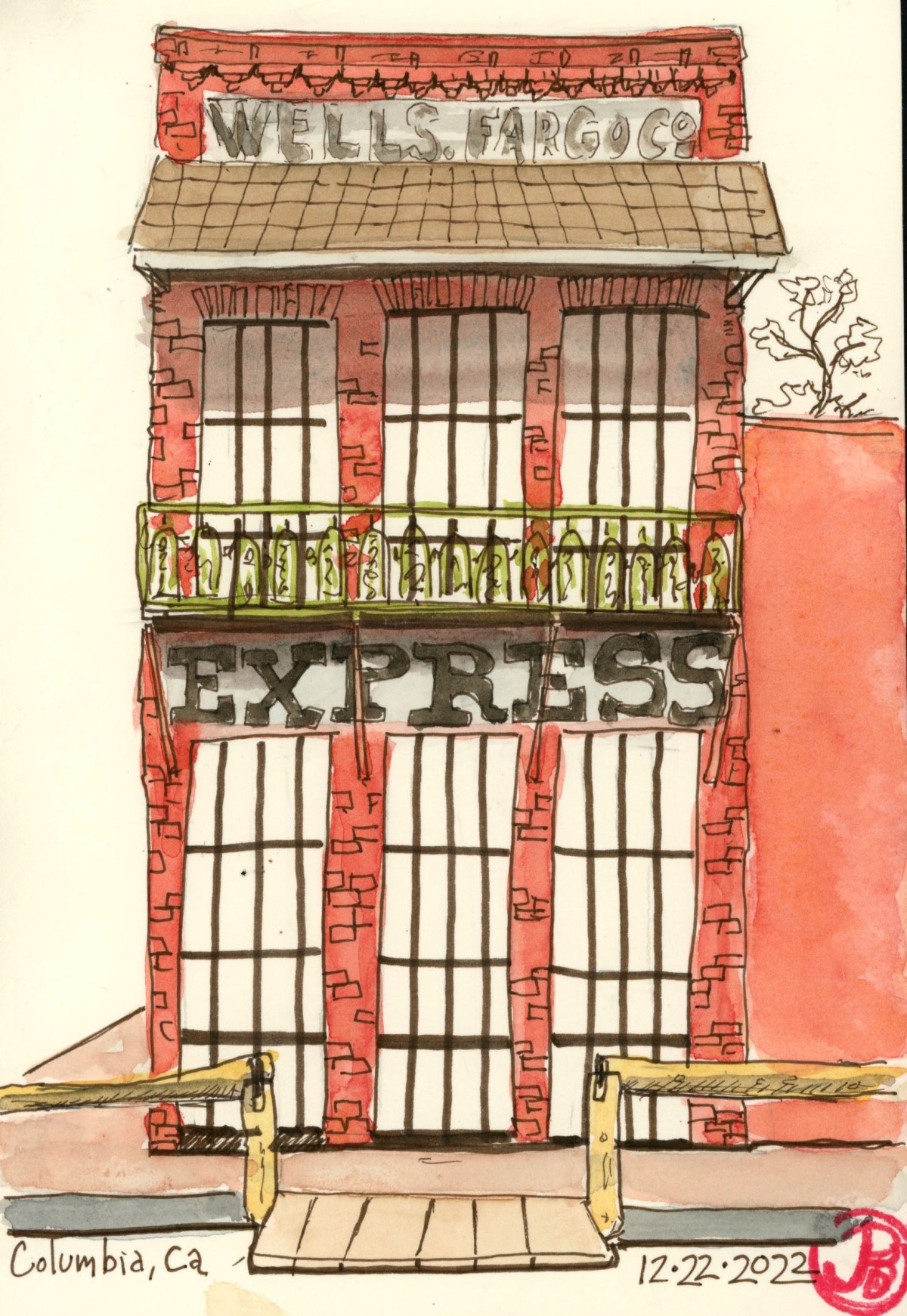
One building that I returned to is probably one of the most famous buildings in the Gold Rush town of Columbia. This is the 1858 Wells Fargo office building. This building, which is photographed many times by visitors, has also appeared in the Clint Eastwood movie Pale Rider (1985), filling in for Yuba City. The exterior and the interior was used when the Preacher trades his collar in for his guns.

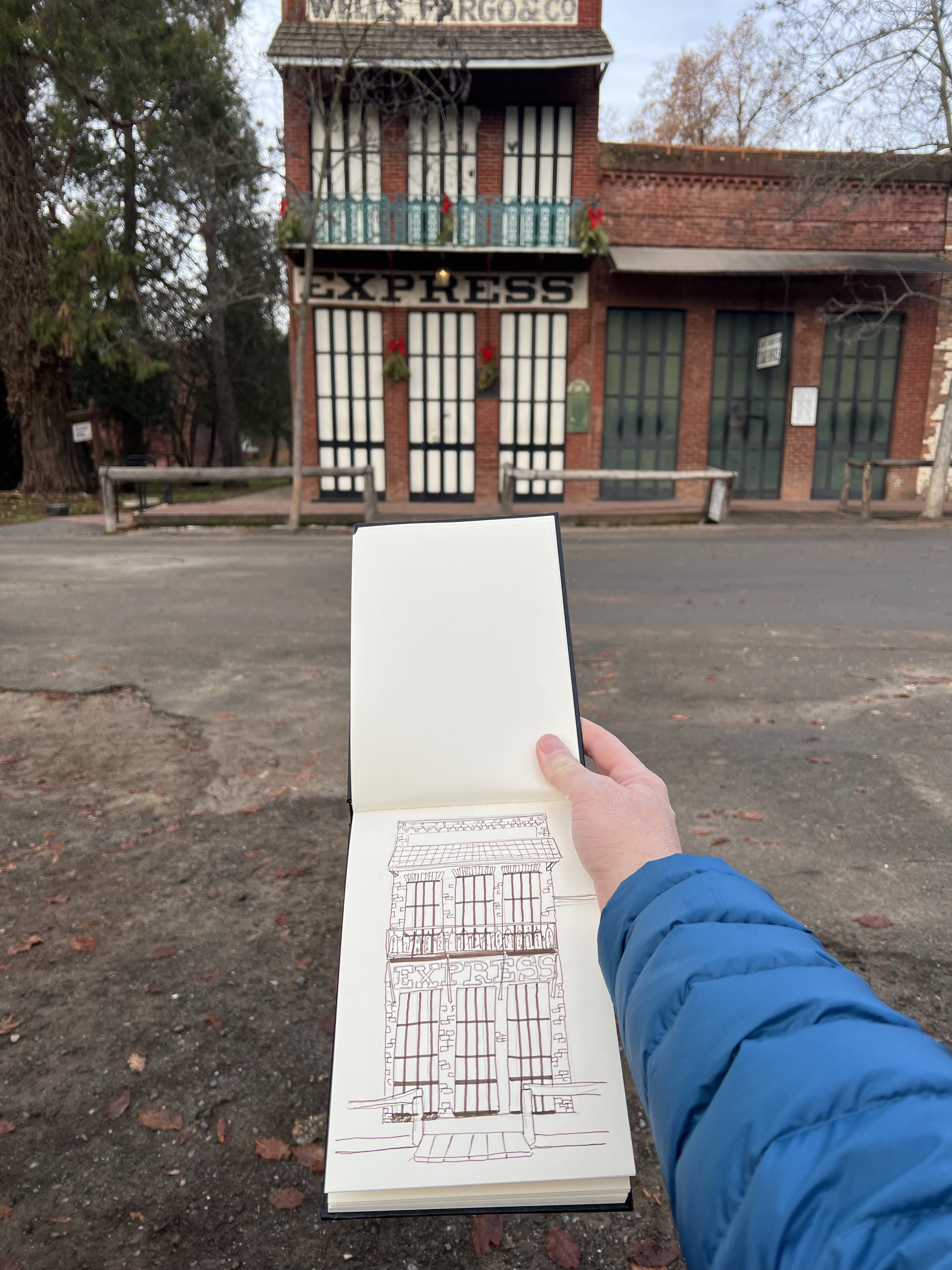
I’m had attempted to sketch this building on two other occasions but I made some mistakes with perspective and aborted the drawings. This time I sat on a bench, across the street (Main Street) from the building and carefully measured out the side ratios by holding out my pencil at eye level. Once the perspective is correct, everything else just falls in place.

In the end, I was very satisfied with the final sketch (featured sketch) which goes to show that patience and perseverance wins the day.

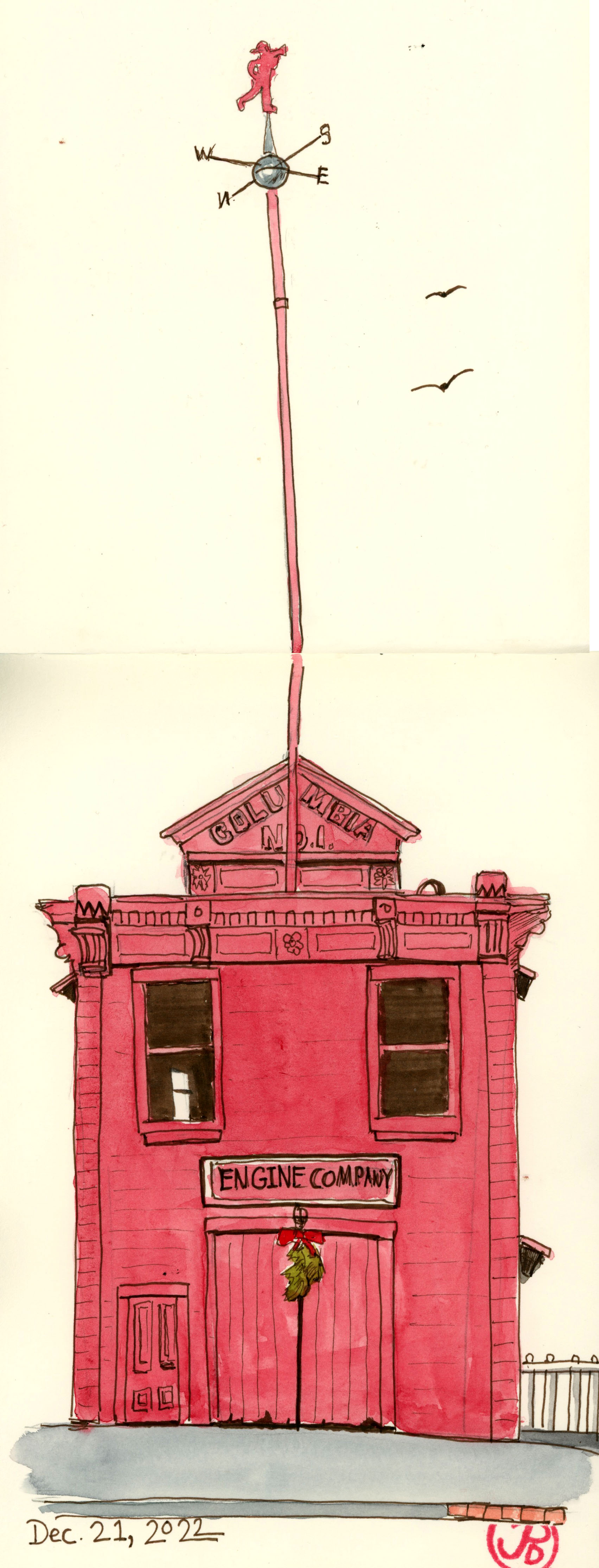
Another building I was interested in sketching was the firehouse, just down Main Street from the Wells Fargo Building. I took a seat across the street at a picnic table and started to sketch. The pole topped by a weather vane reached across the gutter onto the other page.

The firehouse sitting in front of me was built in 1911. Inside of it’s swinging doors is one of the town’s water hand pumper fire engines “Papeet”, built in Boston in 1852. This pumper and the firehouse are featured briefly in the very beginning of the masterpiece High Noon (1952).

At one time, Papeet was bound for Tahiti but the government there was overthrown and the pumper was stuck at the docks of San Francisco. The citizens of Columbia raised money to buy “Papeet” and was eventually returned to Columbia.

Image

High Noon at 70

One of my favorite westerns was released in 1952 and in 2022, has turned 70.

High Noon has risen above so many of the other westerns made at the time. It still holds up today because, well, it’s simply a great movie.

The majority of interiors and exteriors were filmed on the Columbia Pictures Ranch in Burbank. There are a few locations in Northern California, outside of Hollywood that still exist, and I have visited most of them and sketched them too.

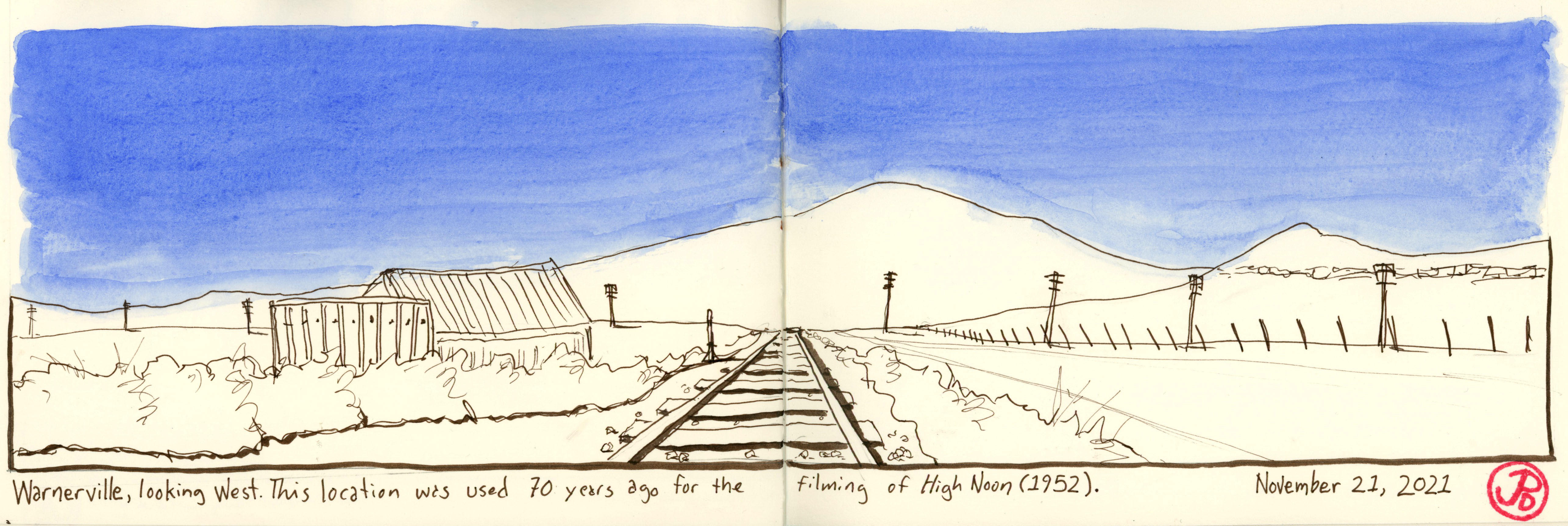
I returned to Warnvillie, a collection of houses, cows, and railroad tracks. This location is one of the most famous locations featured in High Noon and I wanted to sketch it again but from a different perspective.

Before I had attempted to assume the angle of cinematographer Floyd Crosby’s (yes David’s dad) camera, looking westward down the rails, longingly anticipating the noontime train.

It was here that the three outlaws (including Lee Van Cleef) wait the return of Frank Miller who has just been released from prison. It was also the location where Grace Kelly and Katy Jurado board the noontime train on their way out of Hadleyville. And only one of them succeeds. See the film, trust me, it’s worth the 85 minutes.

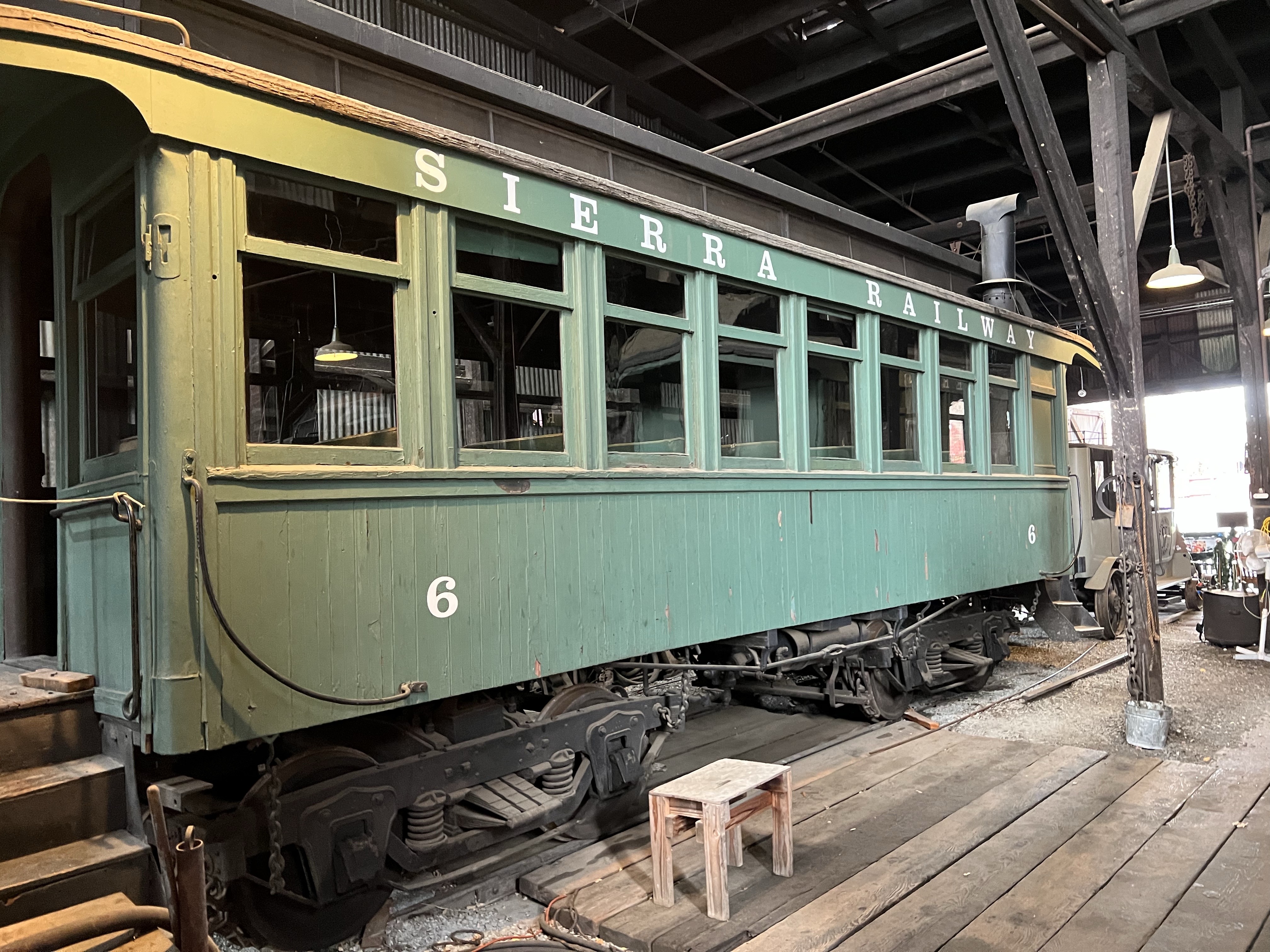
Sierra Railway passenger car No. 6 has been featured in so many westerns including High Noon. Producers like the wide windows that shows the background. The car is now stored the Jamestown Roundhouse.

This time, for my sketch, I sat just to the right of the tracks. Directly in front of me was the site of the Hadleyville Train Depot set, now gone. On the left side of the tracks is the only structure still standing from the filming in the summer and spring of 1951.

This is a corrugated roofed and sided structure that looks like it might have been a pump house. A little further down the tracks are three parallel concrete slabs which are all that remains of the Warnerville water tower, which is prominently seen in the film. The water tower, like the steam locomotives that once pulled freight on this line, are now long gone.

As the tracks lead off toward the horizon, in the direction of Oakdale, the hills remain very much unchanged from 70 years ago.

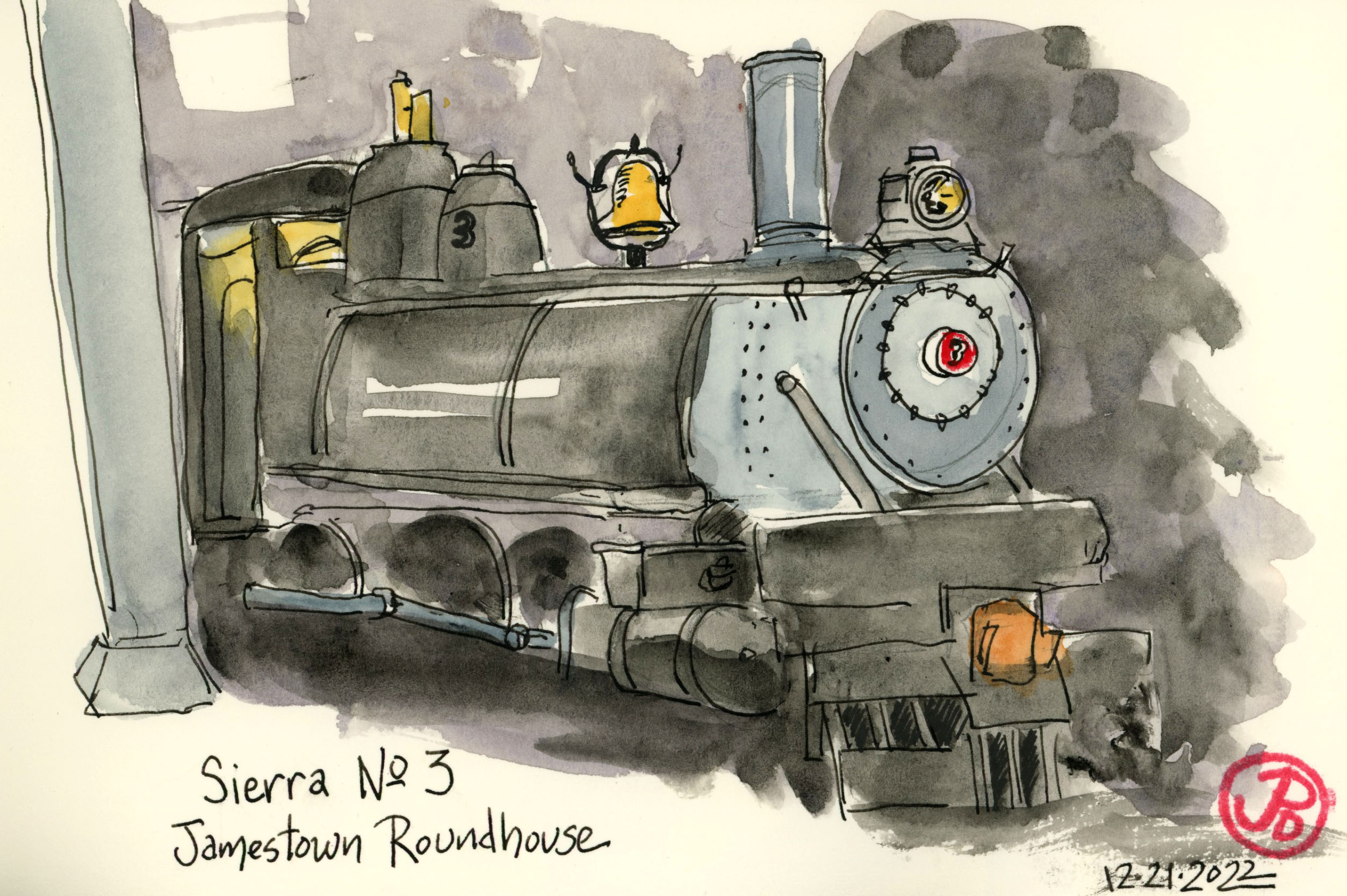
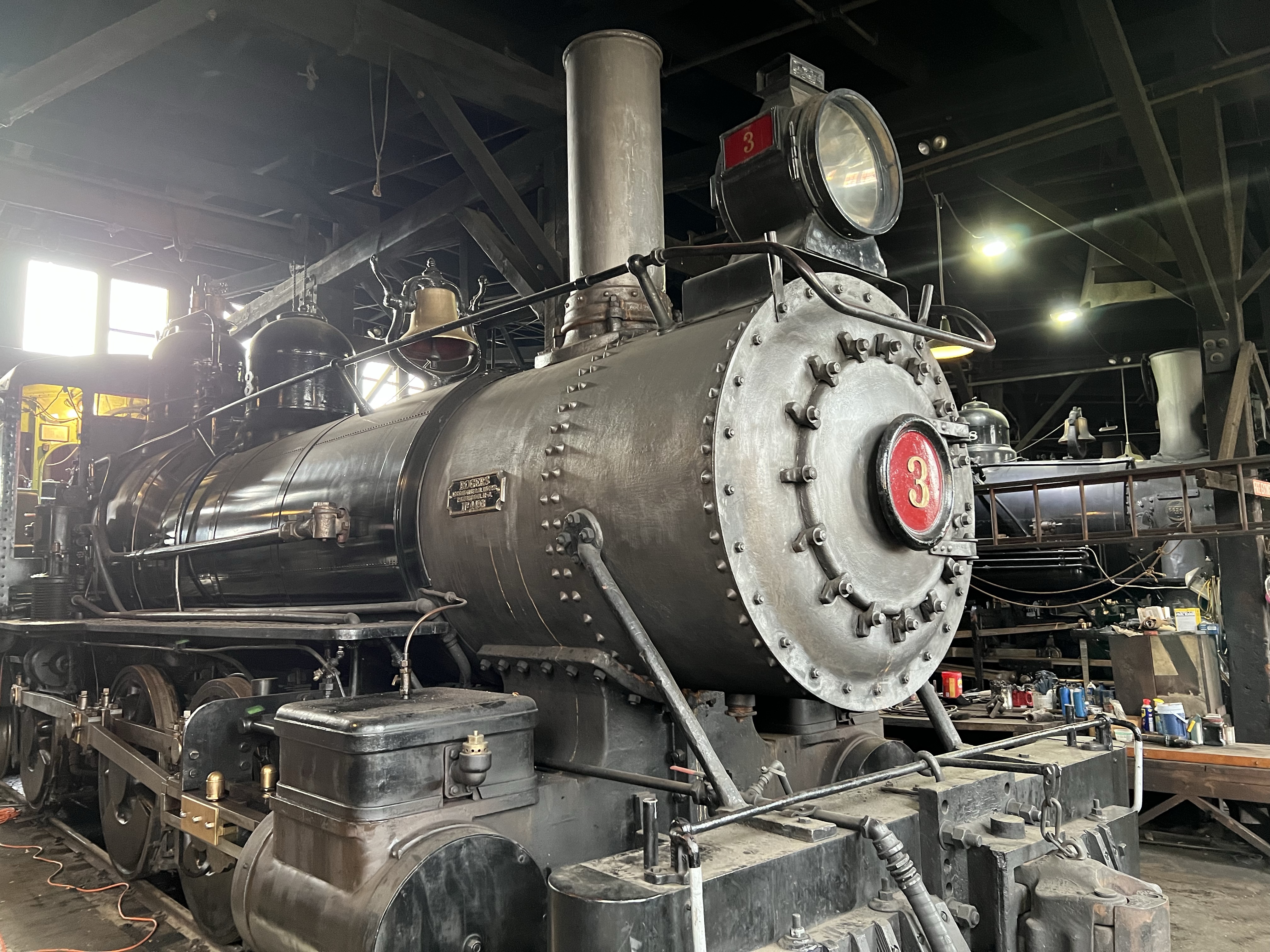
The train that pulls into Hadleyville at noon features Sierra No. 3 on point hauling the “movie train” consist of cars five and six.

Field sketch of Sierra No. 3 in her stall at the Jamestown Roundhouse.

The build up to the train’s arrival is one of the things that make High Noon such a great film. As the minute hand creeps towards noon, Fred Zinnemann and Crosby gives us portraits of the townspeople who nervously await the train, none more so than Marshall Will Kane, who sits at his desk writing out his lay will and testament. The three outlaws have been waiting for the arrival of Frank Miller, the man the Kane put away. The four of them will come into town with only one objective: to kill Will Kane.

A long pull on the whistle cord of Sierra No. 3 announces the arrival of the noon train and Kane will have to do all in his power, without the help of the citizens of Hadleyville, to save his own life.

Image

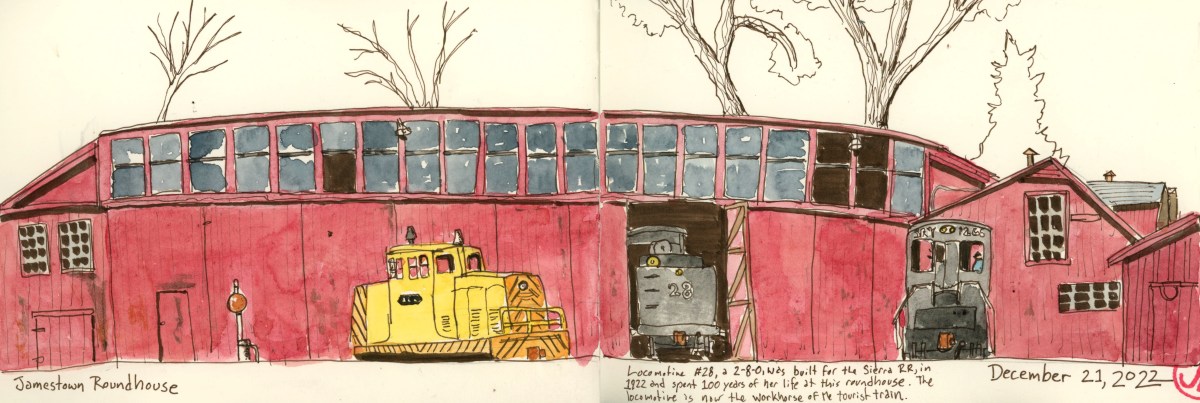
The Jamestown Roundhouse

There are very few roundhouses that still exist in the United States. There is one that still is intact and houses three of Sierra Railroads original steam locomotives.

These structures were built around a turntable and contained stalls where the steam locomotives where kept and served. Most where they obsolete on the age of diesel locomotives but Hollywood saved the Jamestown Roundhouse.

The roundhouse was first built in 1900 but burned down in October of 1910. It was rebuilt right after the fire and then enlarged in 1922 to have a total of six stalls. In 1922 a new turntable was built.

I’m the heyday of westerns, Hollywood needed steam locomotives, vintage rolling stock, and landscapes untouched by the 20th century. Sierra Railroads had all three in spades!

So I found a seat on some railroad ties and started to sketch the red roundhouse at Jamestown.

The Screen Queen, No. 3 in her stall at the roundhouse being repaired back to working order. To her left is Sierra 28, which is also being maintenanced .

The roundhouse itself was used in a few films. There have been three Oscar nominated films filmed on the Sierra: High Noon (1952), Bound for Glory (1976), and Unforgiven (1992).

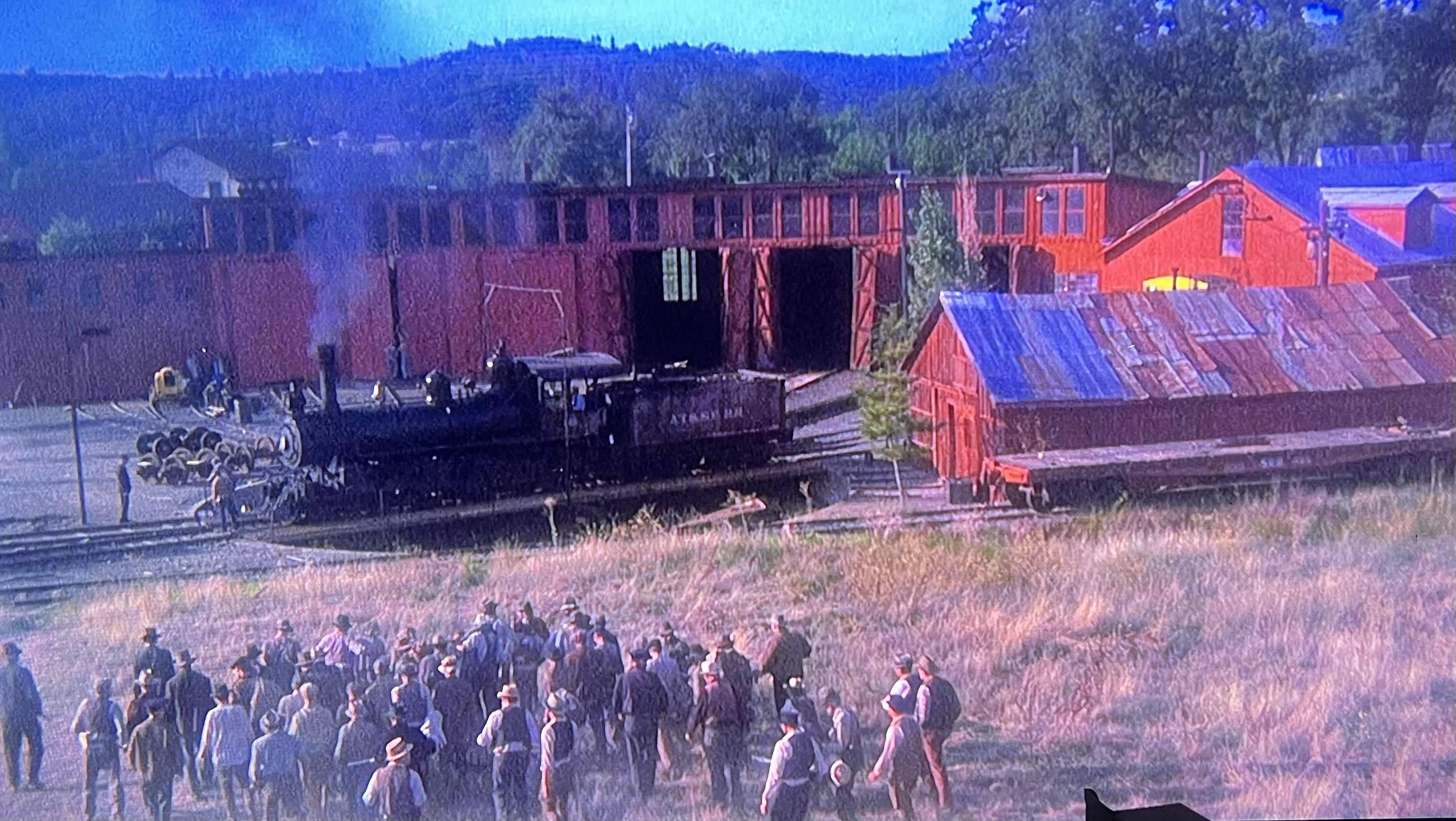
Bound for Glory was a biopic about Woody Guthrie directed by Hal Ashby and the roundhouse was in a brief shot with Sierra No. 3 on the turntable. Above is a still from Bound For Glory. There a few things to point out about this still: to the right you can just make out the top of a yellow locomotive. This a switcher that is used to move locomotives and rolling stock around the turntable and yard. I believe it is switcher No.1638, (which is featured in the featured sketch), which would not be period with the time of the film. Also just to the left of No. 3’s exhaust is a building with white siding. This is the 1913 passenger depot that burned down two years after Bound for Glory was released. The roundhouse looks very much the same as the day filming took place here in 1975.

Image

Mendocino Sketches

I really wanted to sketch more of the very sketchible town of Mendocino but I was off non-whale watching and sketching lighthouses and orca bones.

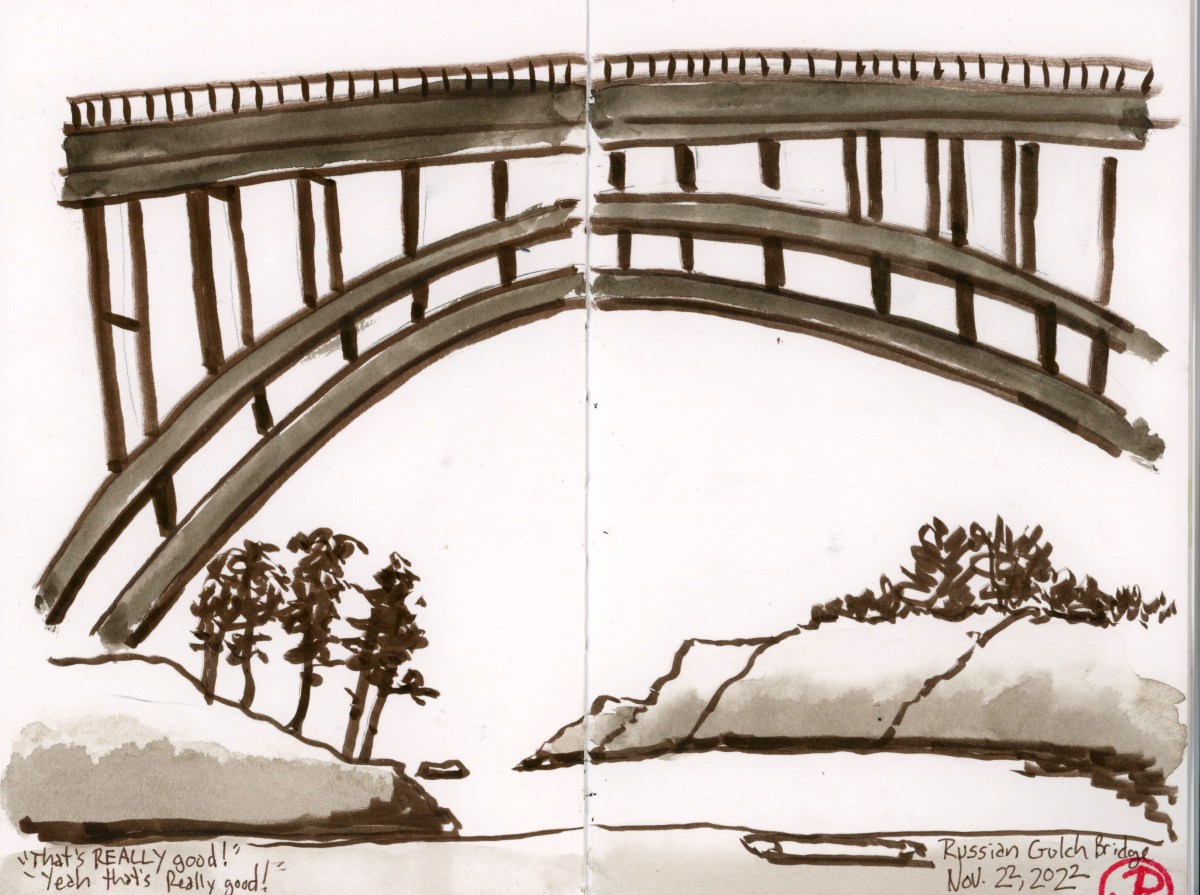
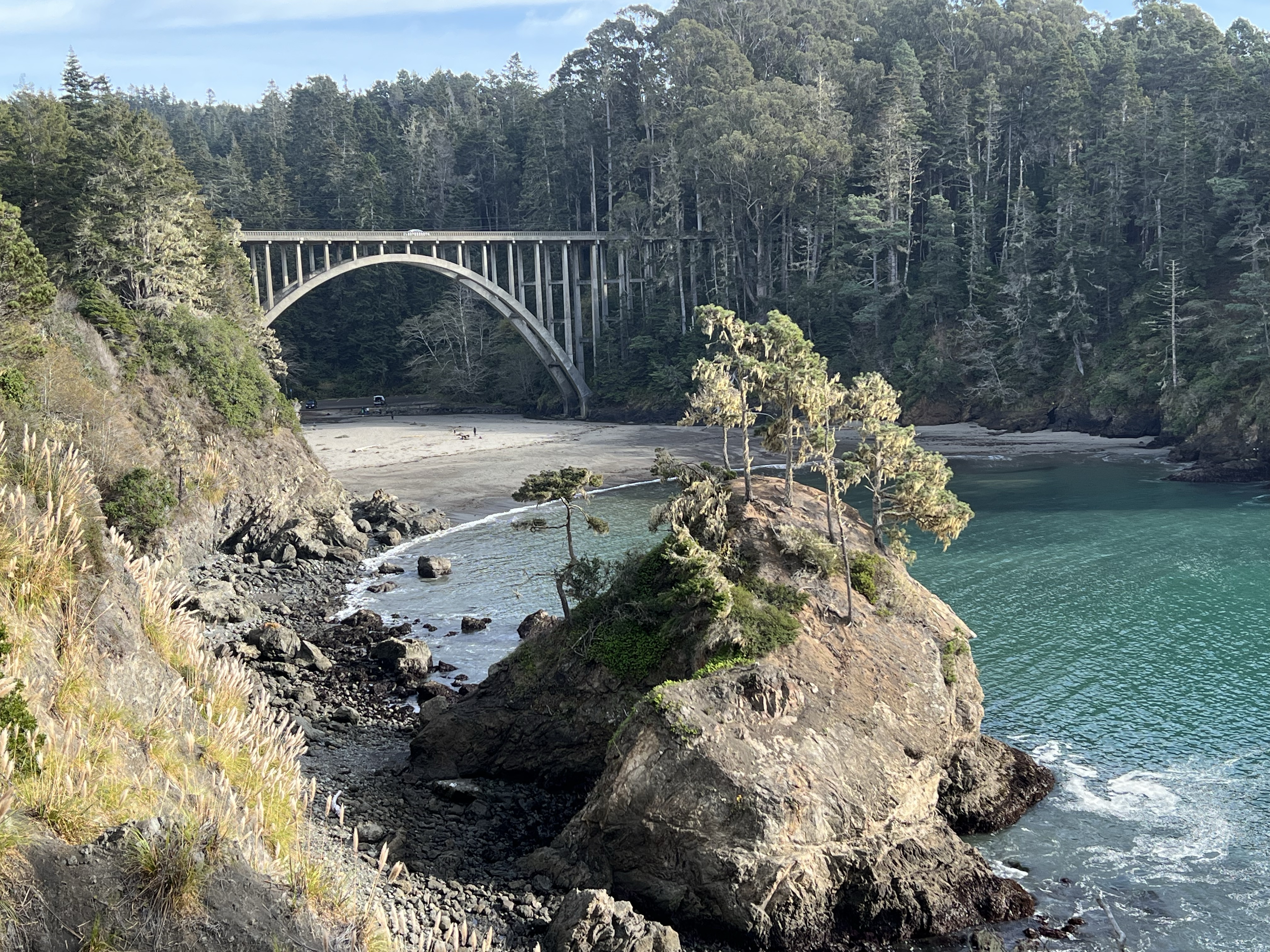
I did head up north on a short drive to Russian Gulch State Park to sketch the 1940 bridge over Russian Gulch Creek.

I set up my sketching chair on the sandy beach looking west under the arches of the bridge.

Behind me, a group of kids gathered around to offer an assessment of my sketching progress. (They where heading out on a spearfishing expedition with their father.) This tends to happen when sketching in the field and children tend to lack a filter when it comes to their artistic opinions.

One piped in, “That’s really good!”

Another echoed, “Yeah, that’s really good!”

Phew! I passed the test! I chatted with the kids about how cool the bridge looked and they agreed. They then wandered off to get into their wetsuits.

On my last morning in Mendocino, I wasn’t going to spend time looking for whales, besides, there was a long line of fog on the horizon. Instead I set out with my sketching chair and bag, to sketch some structures in town.

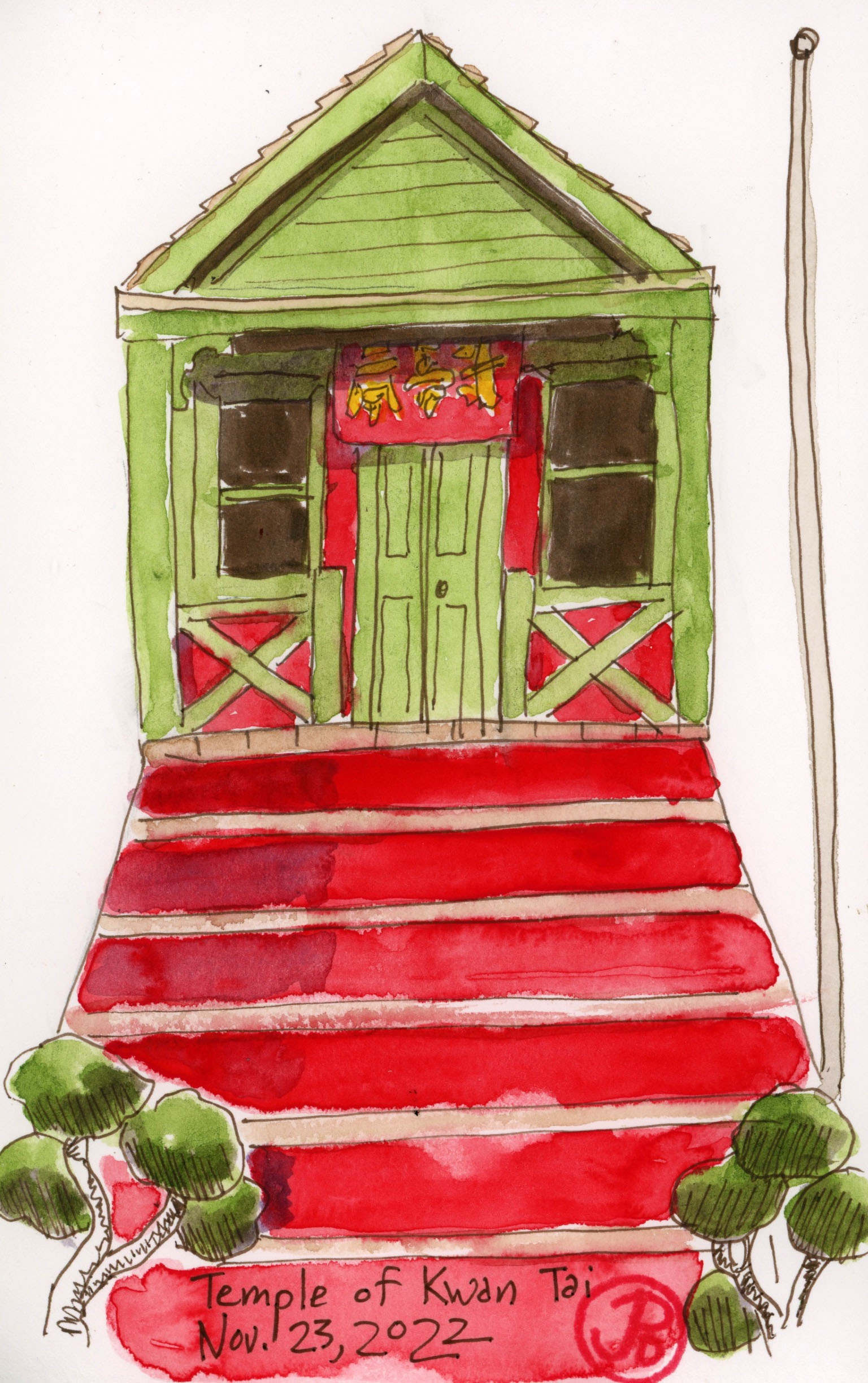
My first sketch was the Temple of Kwan Tai on Albion Street, which is one of the oldest Chinese Taoist Temples in California. It was built in the mid-19th century and is dedicated to the Chinese God of War. The temple has been restored and is now a California Registered Historic Landmark No. 927.

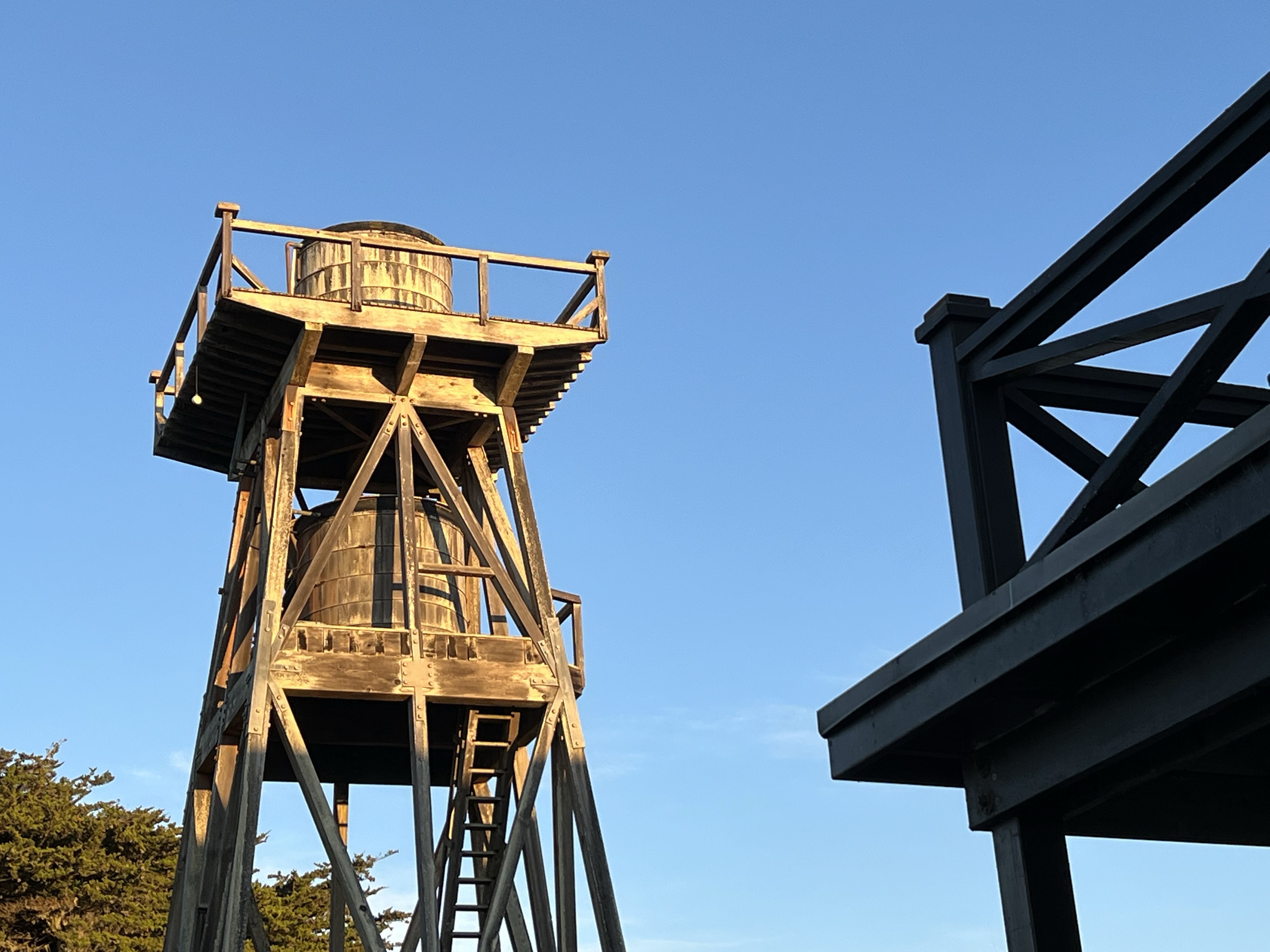
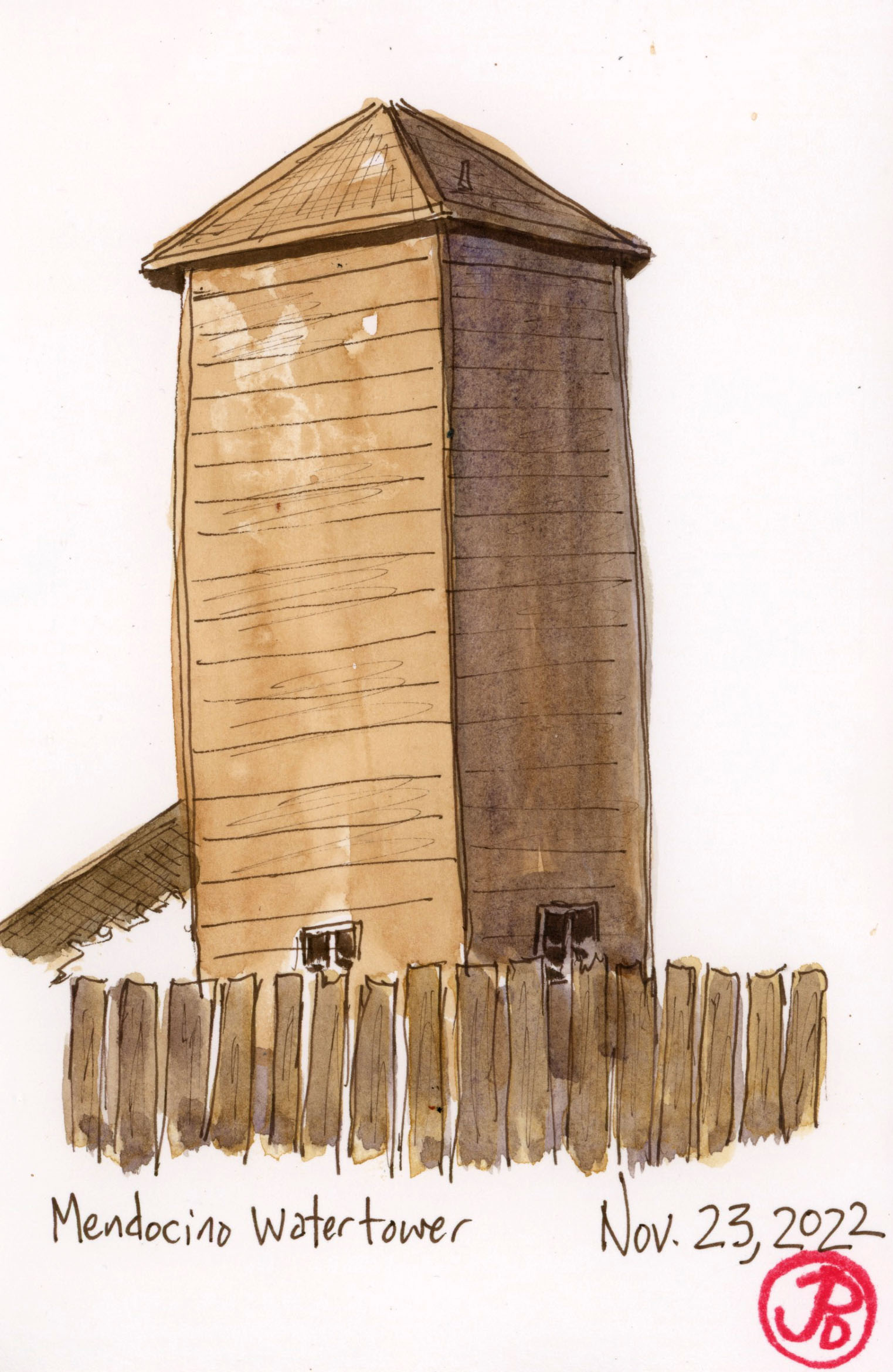
After my temple sketch, I headed down Albion about half a block and sketched a converted water tower.

Mendocino has a really big water problem, as in, the lack of it. Wooden water towers rise in the town like trees. Some of these towers have been converted into rental units. The first time I stayed in Mendocino, I stayed in a three story converted water tower at the MacCallum House. It was a very unique experience.

Image

Mendocino Whale Watch

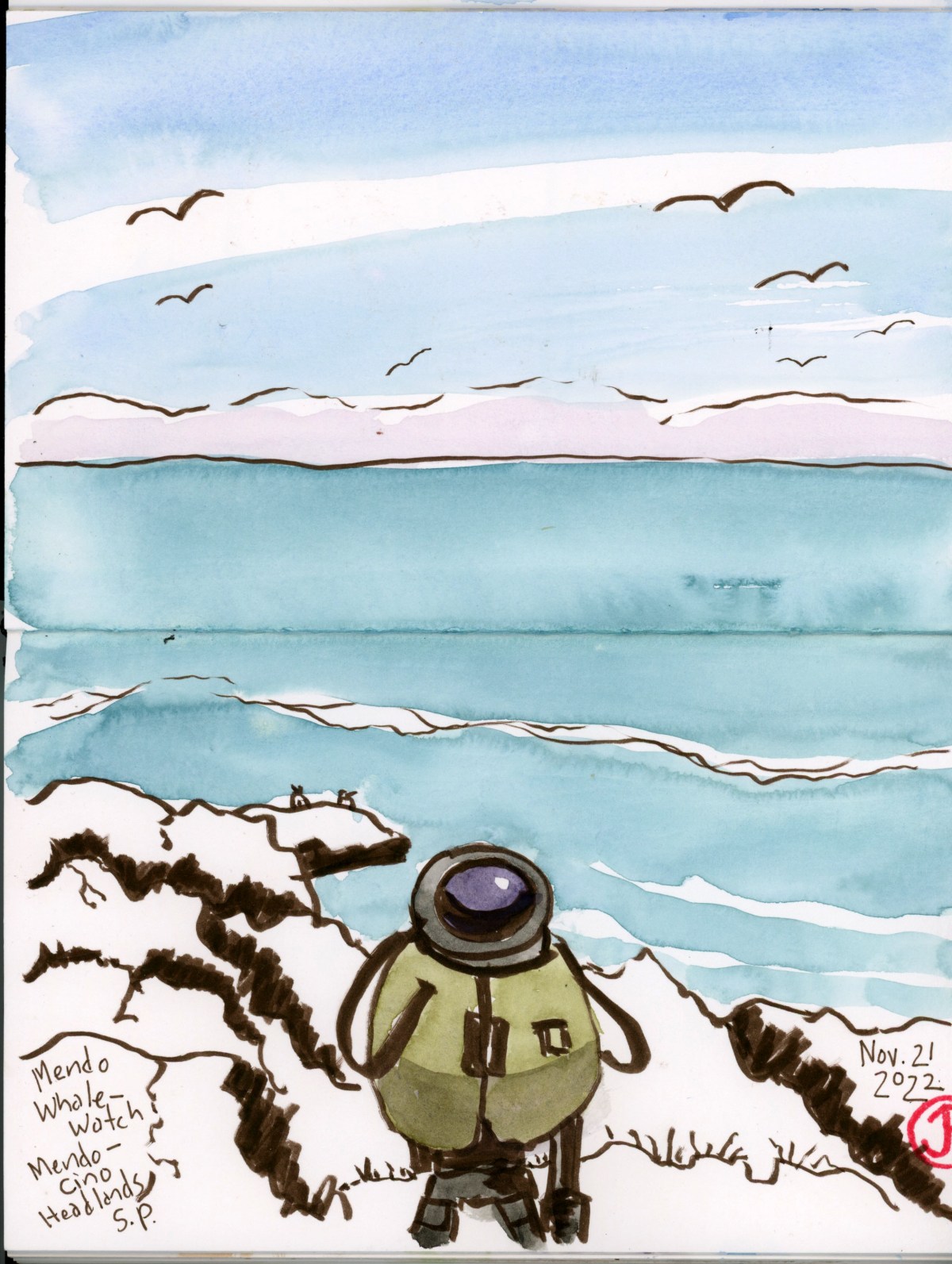
I started my whale watch just down the street from my digs at the Mendocino Art Center at the Mendocino Headlands State Park.

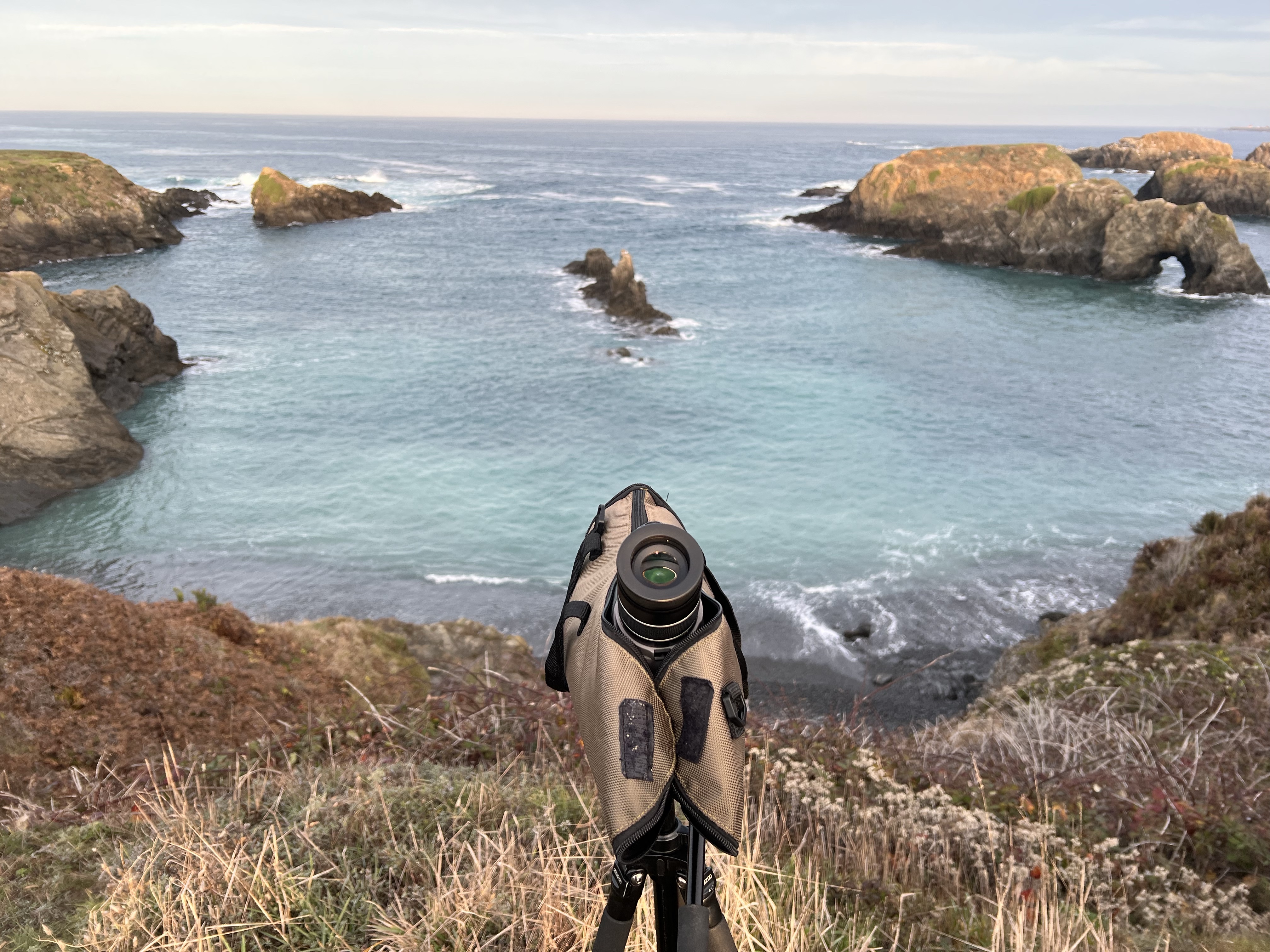
I set up my scope at 7:45 AM and looked for blows just below the horizon.

I looked and I looked. I looked at gulls and I looked at oystercatchers and I looked at the constant stream of common murres heading south.

But no blows.

I looked at a bottling harbor seal and I looked at the lone snow goose on a bluff to the north, and I even turned around to look at the perched white-tail kite and harrier.

Where were the migrating gray whales? Perhaps I was too early.

Perhaps there was a gap in the southern stream of pregnant females on their journey to the birthing lagoons of Baja California. Or maybe they were farther off, just on the other side of the curvature of the earth. But whatever it was, after two mornings of whale watching, I saw zero whales.

The plus of being a sketcher is that you are never bored, and if you have a pen and sketchbook handy, you can pass the time with a sketch (featured sketch).

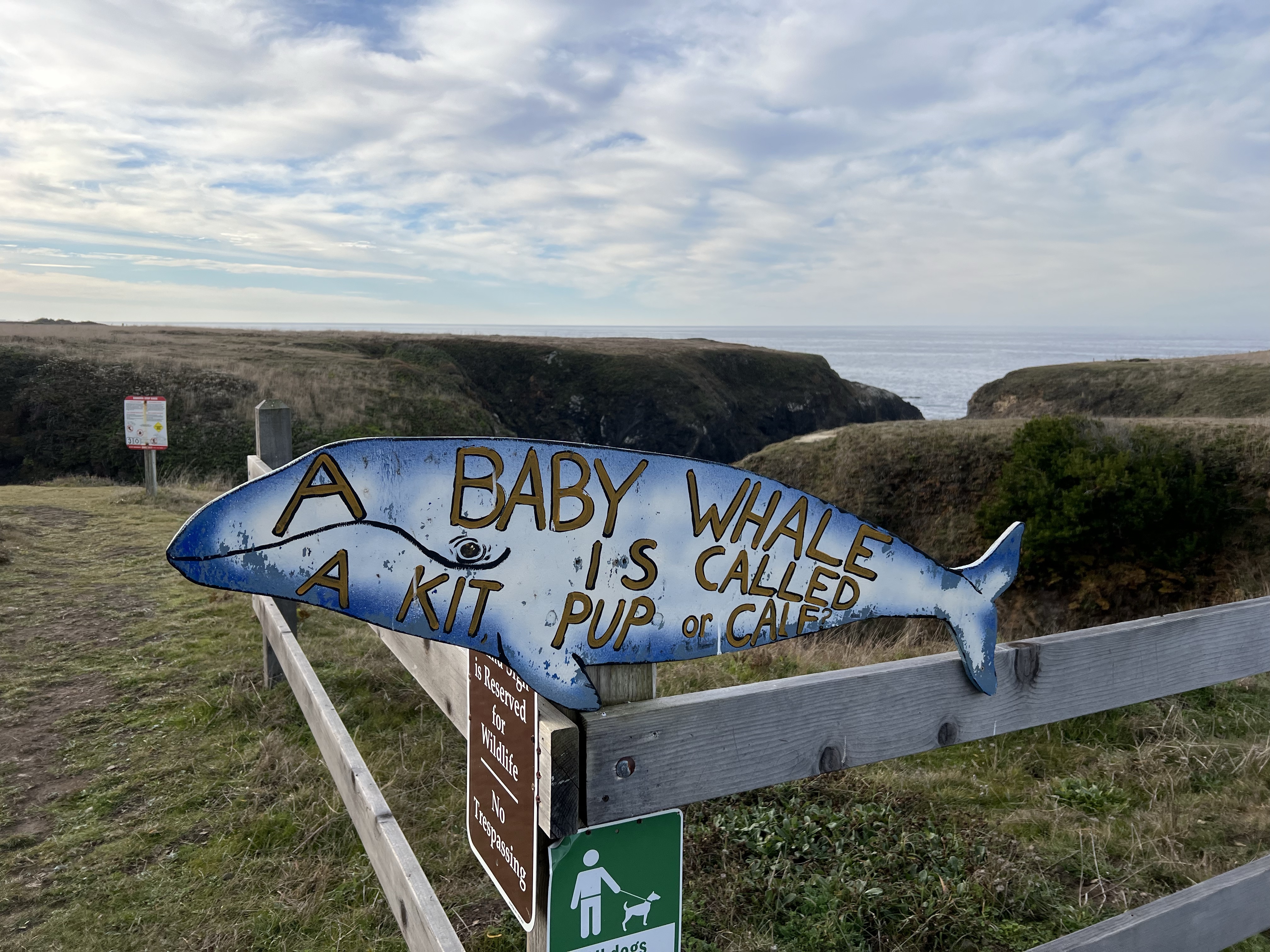
This sign at Point Carrillo Light Station was one of my better “whale” sightings.
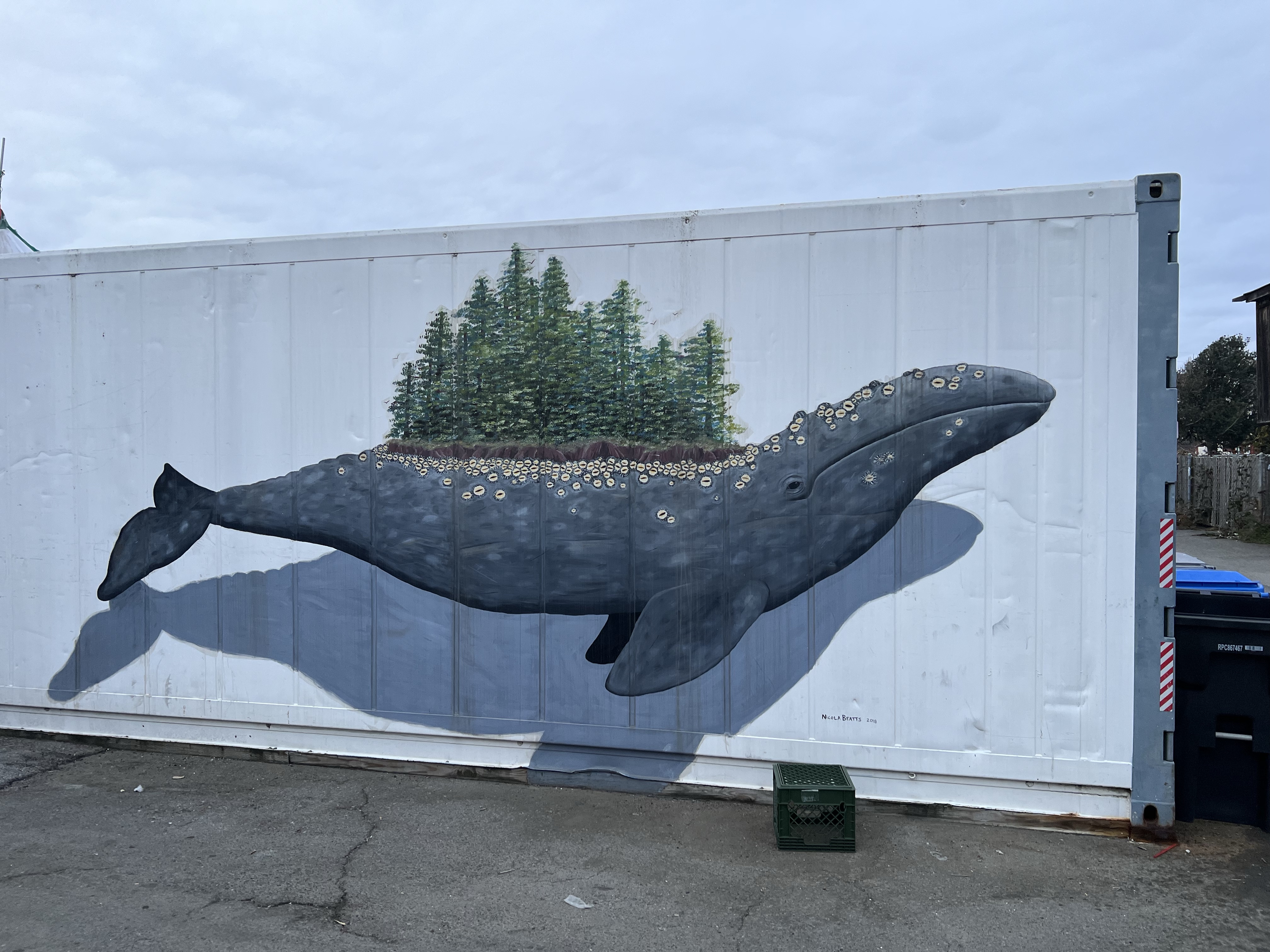
This gray whale mural in a back alley in Fort Bragg was probably the “best” whale sighting of the trip!
Image

A November Snow in California

Curses for not checking the rare bird alert before leaving work on Friday! A rare California bird, and a lifer, was seen in Half Moon Bay, just about 20 minutes from work. I would have loved a after work lifer, but alas it was not meant to be.

I eventually saw the post when I returned home and the northern visitor was last seen at 4:30 PM before the early winter’s eve turned out the lights. This was a good sign because it meant that the bird might overnight and be re-found on Saturday morning.

Wit this in mind I got up early on Saturday and drove down to Half Moon Bay and walked out to Venice Beach and the Pilarcitos Creek mouth and hoped the snow bunting has overnighted.

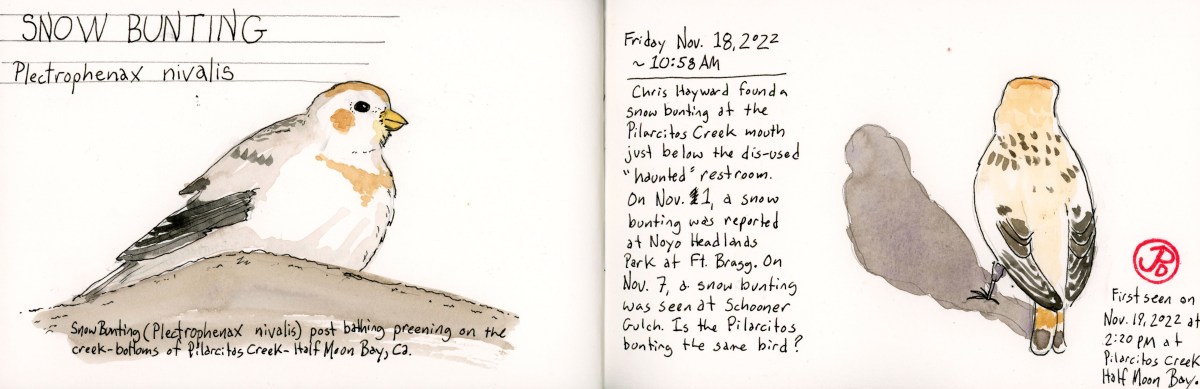
Oddly enough there was a snow bunting that was being seen in the Noyo Headlands in Fort Bragg a few weeks ago but had disappeared, presumably flying south. I wondered if this could possibly be the same bird, although it’s very tough to tell.

I arrived at the creek mouth just after 7 AM, and I was the first birder in the area. Below me, on the creek bottoms, were many mallards, killdeer, and Wilson’s snipes. But no bunting.

I continued looking for the next hour, at which point about 15 other birders were scouring the dunes and the beach for the rare visitor. With all these eyes looking for the bird, I figured it was a matter of time before someone would relocate the bird, if it was still in the area.

I decided to head north on Highway 1 to Pillar Point Harbor to look for the northern gannet that had been recently roosting on the breakwater. This is presumedly the same gannet that has been in the area for about eight years. I had first seen it on Alcatraz and it is often seen on the Farallon Islands. In also is seen in Pillar Point,

The snow bunting had not been reported on any birder lists so I headed over the hill to San Mateo to have lunch with my friend. After lunch I checked Sialia and saw a post that the snow bunting had been re-found so I headed back over Highway 92 to the same location I had spent looking for the bird a few hours earlier. But this time I was a lot more successful!

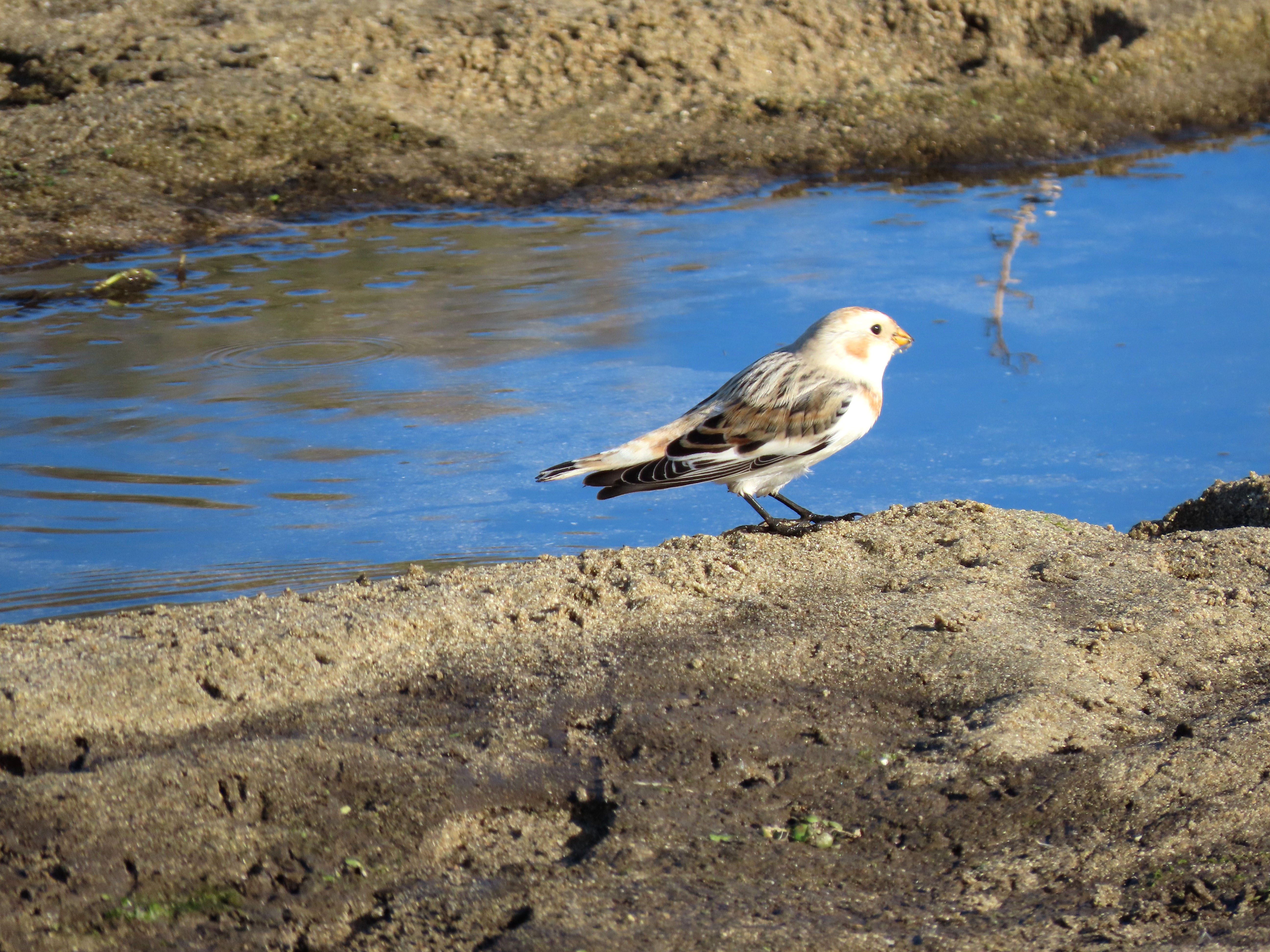
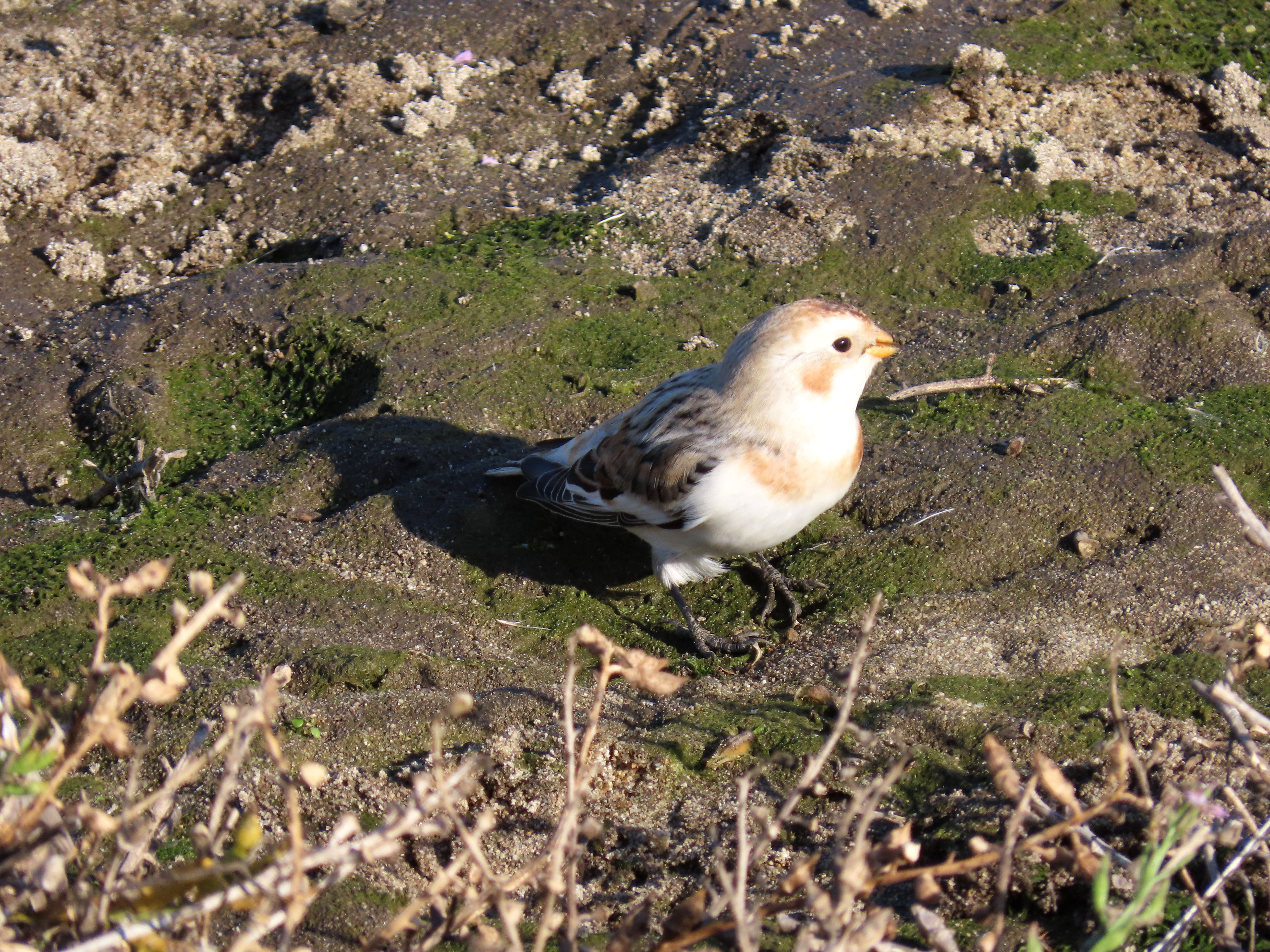
I arrived near the closed down parking lot and restroom and headed down towards the creek. The bunting shown like a white diamond amongst the dark sands.

The snow bunting about to take a bath in the creek.

It also helps that there where three birders already on the bird. I took a seat on the dunes and watched the bunting as it foraged in the creek bottom and then took a bath in the creek.

The bunting did not seem fazed by the attention and was within about ten yards of birders. This was in stark contrast to the Wilson’s snipe that where so skittish that they burst into flight at any provocative.

The shining white diamond was a much sought after lifer. It save me a trip to Alaska!

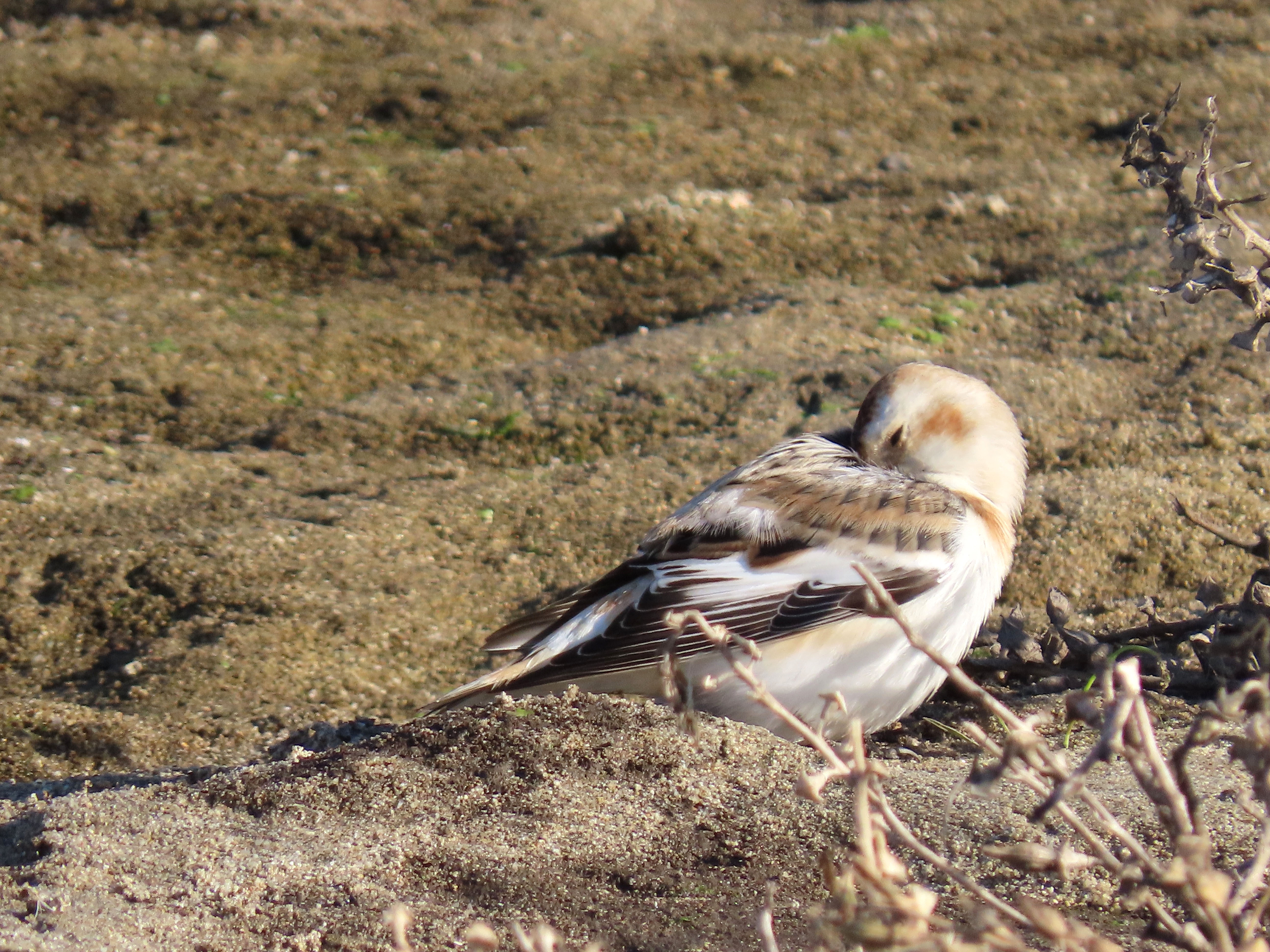
I took some reference photos which was a challenge because the bunting was in constant motion but after it’s bath, the bunting paused so I could capture the bird’s unblurred likeness.

This was world lifer 1,706!

The bunting post-bathing preening.
Image

The Last in Line

The caboose at the end of a freight train is a thing of the past. They have been replaced by technology as railroads cut wages and other expenses. In their place is a small box on the end of the train called a ETD (end of train device).

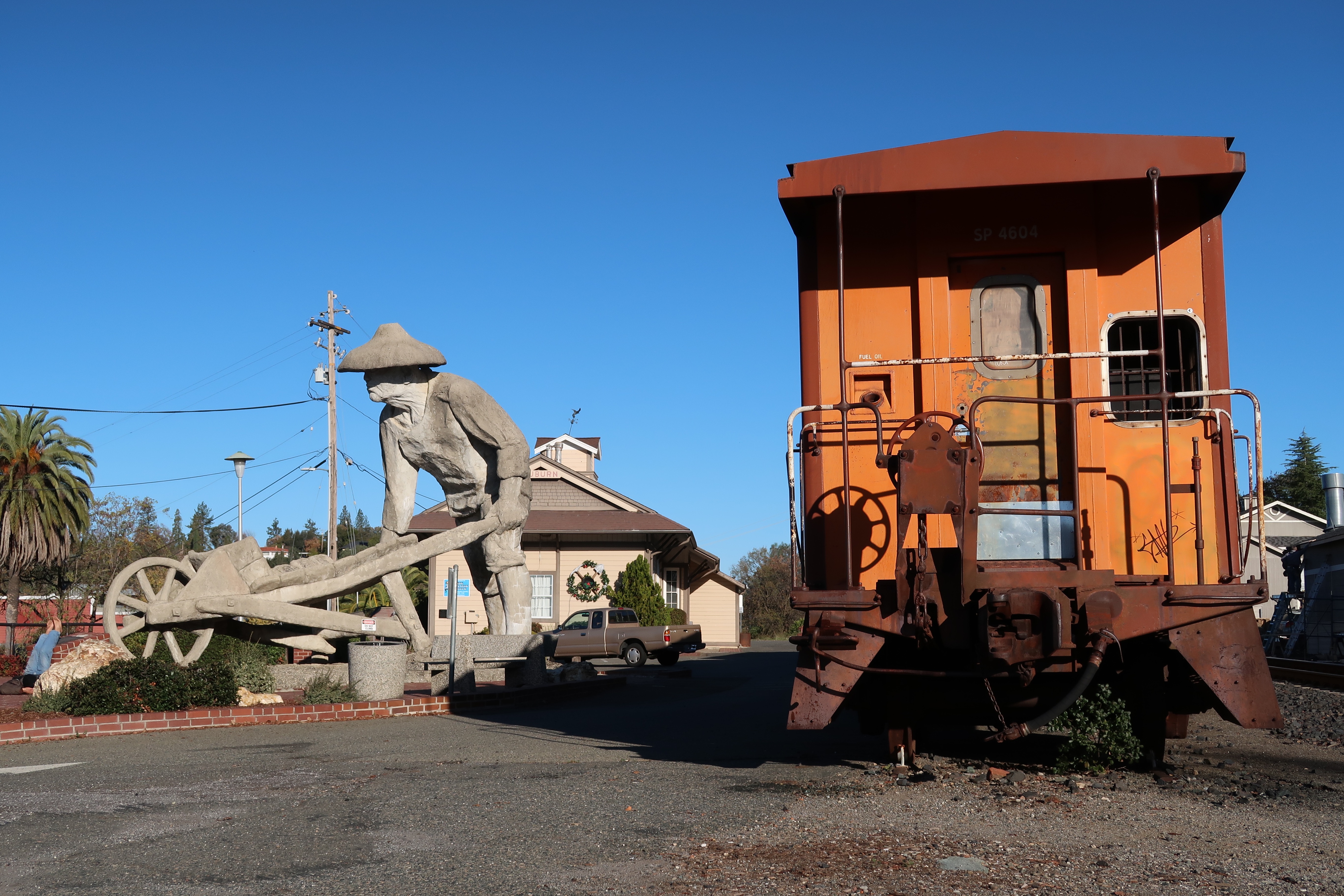
It is not uncommon to find cabooses on static display at museums or near historic railroads. In Auburn, California, an example of one of the last batch of a caboose ordered by Southern Pacific is outside the old Auburn Train Depot. This is a bay window C-50-7 caboose that was built by SP in 1978. This is a very young caboose indeed because ten years later, it was uncommon to see a caboose at the end of a freight train. SP # 4604 was coming to the end of an era.

I headed to Auburn with the intention of sketching the SP caboose. I set up my sketching chair and took up my position behind the caboose and if I was watching a freight train receded down the tracks. Only this caboose was going nowhere anytime soon.

To my left is the large concrete sculpture of a Chinese “Coolie” railroad laborer. This 22 foot tall , 70 ton statue was created by Dr. Kenneth Fox. Fox was a local dentist who created other large concrete statues. Some of the other statues can be found on the opposite side of Highway 80. As well as the gold panner representing Claude Chana near the historic downtown.

Dr. Fox passed away on November 17, 2020 at the age of 95. His massive sculptures are sill found around Auburn including his controversial nudes of mythical warriors that stand outside of his former dental office. They are collectively known as the “Great Concrete Statues of Auburn”.

Most of these statues where created in the 1960s and 70s but they were a little too graphic for Auburn at the time. School bus routes were rerouted so buses would not pass by the topless Amazonian women.

I would love to return to Auburn and sketch these oddities in concrete.

There still standing after 50 years. The archer (on the left) at 42 feet tall, is the tallest statue that Dr. Fox ever created.