Image

Gyr Afterglow

Having an amazing experience in nature while observing an animal can stay with you long after the encounter.

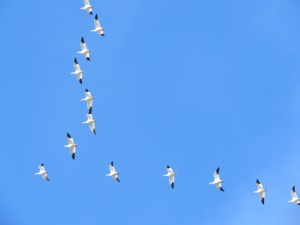
Coming across a mountain lion on the Coast Trail in Pt. Reyes is an experience that readily comes to mind. Or watching thousands of snow geese erupt into the air in the Central Valley is another. Swimming with a 36 foot whale shark (and her 16 foot baby) off the coast of Utila is yet another.

I can now add to those encounters the one I had with the Earth’s largest falcon. It was not just that a Gyrfalcon is such an amazing raptor, but the quality and length of the experience. I had read tales of birders getting far off scope views of a brown smudge on a power pole of previous wayward gyrs. And this was far from my encounter.

Here are some of the reasons why my encounter with a gyrfalcon will last for a long time to come.

The Build Up

A gyr is rare south of Canada and even rarer in California. There are about 15 accepted Gyrfalcon sightings in California. And most of those are from extreme Northern California.

This is a bird that will make most California birders leave work early, jump in their cars and drive all night, just to get a far off glimpse of this falcon.

Luckily for us, this Gyr has been hanging around the Arcata Bottoms for over a month and we hoped she would stick around just one more day until we could focus our bins on her magnificence.

But with a storm rolling in, there was no telling if the bird would be heading off in any direction or if steady rain would hamper the visibility. Draining colors out of distant birds to become brown specks, morphing into a vertical branch on the power pole.

Gyrfalcons are listed as “Sensitive” on eBird and their locations are not available to the public. This makes finding their exact location a little challenging. The reasons for such secrecy is the place of prestige this sought after falconry bird attains in the world market. These hunting falcons are highly prized in the Middle East and because of the rarity of the bird, it was reserved for royalty. Wild birds are therefore, targets for animal smugglers as these birds can fetch $275,000 on the market.

The Performance

A peregrine falcon first called our attention to the presence of the Arctic invader as a PEFA stooped on the female gyr perched on a pole on the south side of Jackson Ranch Road. And for the next two and a half hours we were in the 360 degree theatre of the Gyrfalcon.
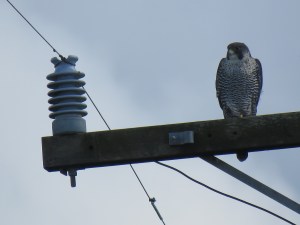
The peregrine falcon, Jackson Ranch Road.

Watching a perched gyr is interesting enough but we got so much more as the bird took advantage of the window between storms to hunt. Flying low across the fields and making repeated passes over the slough, chasing up American coots and grabbing them along the way but then releasing them as if she was just practicing.

At one point the gyr walked around the ground and appearing to be hunting a small mammal, which she ate on the ground. This falcon was showing behavior that was very different from the arial specialist, the peregrine, or the stilling kestrel. This falcon was so much more!

And she rightly takes her place with the mountain lion, snow geese, and whale shark as very memorable animal sightings in the natural world.
 

Image

Queen Falcon, The Gyr

With rain on the wind, I set out with Dickcissel on another Saturday morning heading north. Our destination was four and a half hours away to a piece of open expanse known as the Arcata Bottoms. This is a winter raptor wonderland with white-tailed kites, red-tailed, red-shouldered hawks, harriers, kestrels, merlins, prairie falcons and peregrines and short-eared owls talking over the crepuscular and night shifts.

The weather forecast was uncertain with rain forecast in Arcata and we left the Bay Area under a sheet of rain. We both didn’t say it out loud but this could be a waste of a long road trip if the weather reduced our visibility to nil and out target bird moved on in front, and on into oblivion as far as we where concerned, of an approaching storm front.

We knew the bird had been seen the day before and we hoped the Arctic breeder would not be put off by a bit of winter rain. While our quarry is suited for cold temps with body feathers, down, and feathered legs, we packed rain coats and pants, hats, mud boots, and an umbrella. We had been watching the rain forecast all week and as the weekend loomed, the prediction was that there would be a small window of clearing in the early afternoon and we wanted to take advantage of being in the right place at the right time.

As we neared Arcata, the rain lessened and we began to see patches of blue. We pulled into Eureka (we hoped to later say, “Eureka! We found it!”) and then headed northeast to the area of open farmland, north of Arcata Bay, known as the Arcata Bottoms.

Pulling off the highway we were greeting by a narrow, cracked road with a line of loose chickens that blocked our passage. We were really out in the open country now which contrasted with the cities we had left had left behind earlier in the morning.

It was not long before we saw our first raptor flying low off to our left. It flew up to a distant post. We got the bird in the scope hoping that it would be our target bird but no, it was a juvenile red-tail. We packed the scope into the trunk and headed to Jackson Ranch Road, stopping between the yellow house and the blue-roofed house. This is where our target bird had been seen over the last month.

As we stepped out of the car and geared up, it started to rain. This was not a great sign. Every power pole, post, and open ground was closely inspected with nothing save a raven or a red-tail, but no falcons. We headed back along the road to get a better view of the line of power poles that ran out into the green field. A source had told us that the falcon favored these poles as her favorite perch.

The rain began to abate.

Behind us there was a explosion of activity as three raptors filled the air. The strident call of a peregrine filled the previous quiet air. We quickly ran back from where we had come, which is not all that easy when you are shouldering a scope!

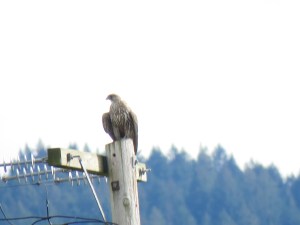
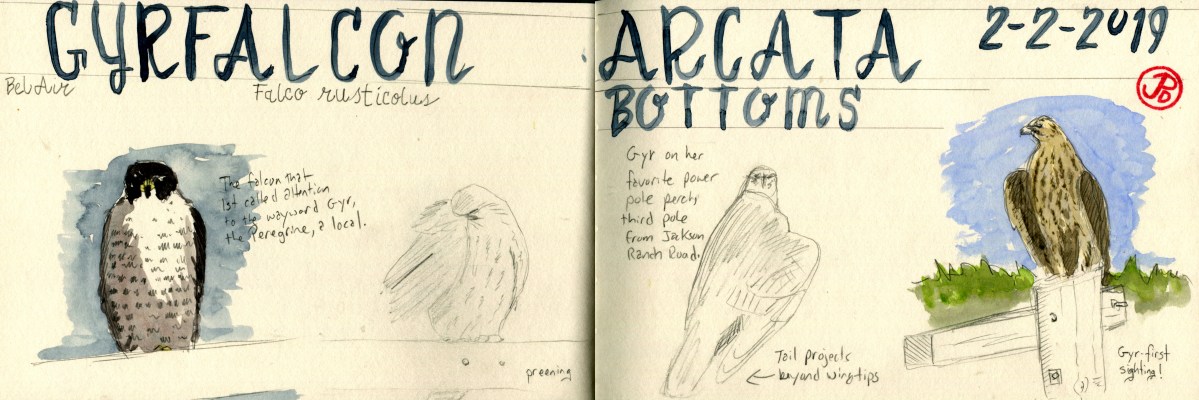
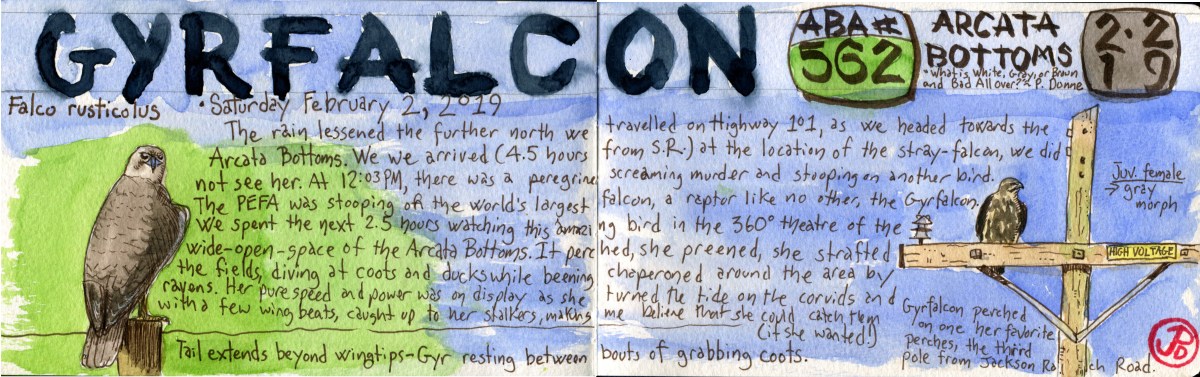
“There it is!”, Dickcissel exclaimed and I got the bird in my bins. It was a perched and did not resemble any other bird I had seen, Falco rusticolus, the largest falcon in the world, the Gyrfalcon! The peregrine was stooping on the gyrfalcon, proclaiming it existence in the world.

The first photo I took of the female gyrfalcon! What a beast!

This is an arctic breeder that is very rare in California. Most gyrs that head south during the winter are juvenile females and we where looking at one of three morphs. This female was a gray morph. The bird rocketed low across the road and landed on her favorite perch: the third power pole from Jackson Ranch Road.

“Have you see the bald eagle?”, a voice asked from the house behind us. It belonged to a woman who lived in the blue-roofed house and she pointed down the road to a bird perched on a power pole. I got the bird in my bins and it was the resident peregrine falcon.

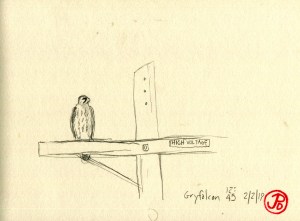
Field sketch of the female gyr on her favorite perch.

For the next two and a half hours we watched this amazing falcon in the 360 degree theatre of the wide-open-space called the Arcata Bottoms.

Some lifers are seen for a short time and you may not get quality looks with the bird being obscured by foliage, seen from a great distance, or the target bird being seen in poor light. The gyr was a completely different story. This was not only an extremely rare bird for California, but we were getting incredible views of the gyr, close up and in great light. This is a falcon of wide open spaces and we had prolonged looks at the perched falcon. Unlike other raptors, the gyrfalcon was extremely active as she flew low over the fields, often being pursued by ravens. She turned and started to chase the corvid, easily closing the distance with her powerful wingbeats. The gyr would return to her favorite power pole perch to preen before raising her wings before launching another sortie, to the consternation of any avian life in the area.

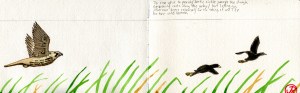
One odd observation was a black Labrador that was running through the fields and chasing American coots up from the slough. The gyr joined in on the attack, flying down a coot with ease. She grabbed a coot and would then release it dropping like a stone back into the slough. I wondered if this was some primeval hunting relationship between the gyrfalcon and Arctic wolves. Such a beneficial relation exists between wolves and ravens in the Arctic north. The gyr made two more passes as she flew above the dog, grabbing a coot along the way and then letting it go. Prey practice I assume

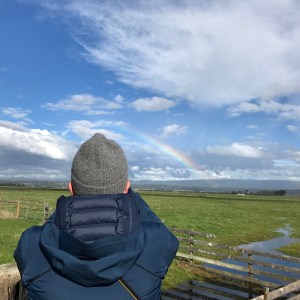
Dickcissel enjoying a gyrfalcon and a rainbow, Arcata Bottoms, California, Raptor Heaven.

Image

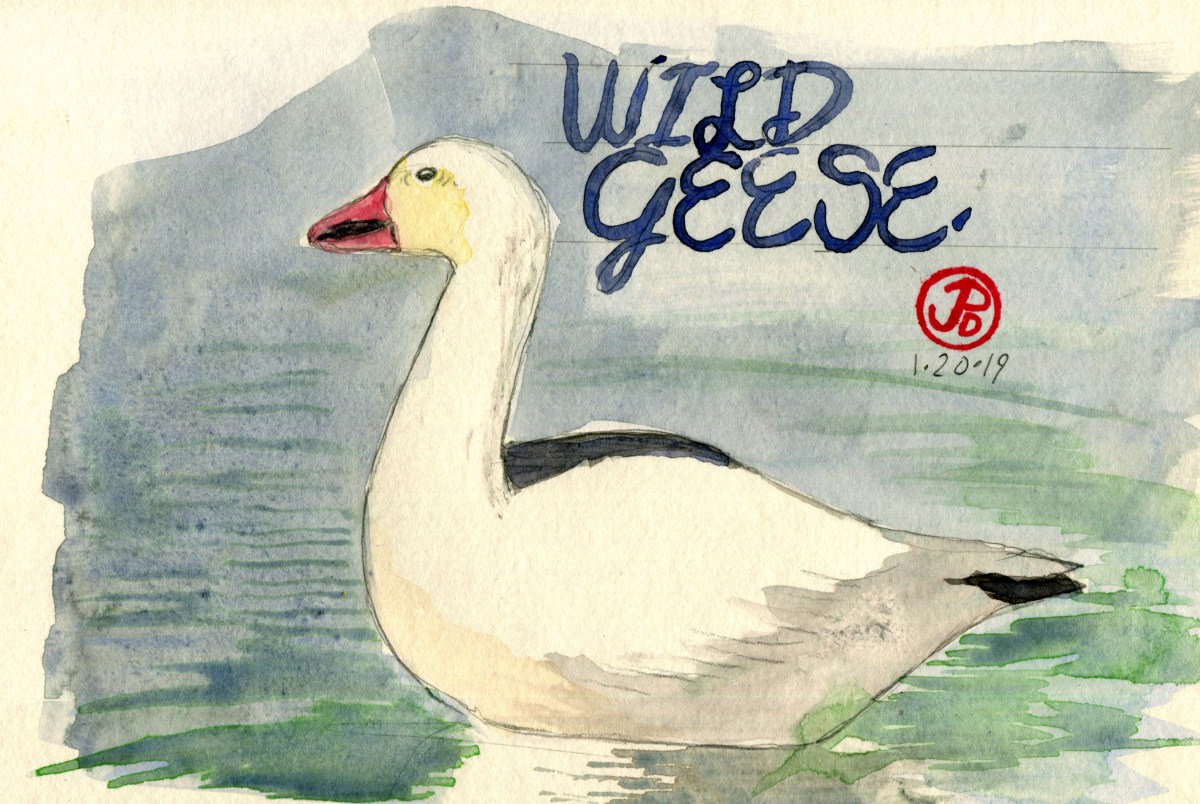
Wild Geese, Mary Oliver

I was saddened to hear of the passing of Mary Oliver.

A poet that made me see truth in the natural world. The depths in the pure animal self.

In the mire of government shut downs and false poets being dropped from their record label I hear a singular voice taking a walk in the woods near her home. Aware. Taking in with the senses of a poet. The bear, egret, and the hawk. These encounters don’t bear headlines but to notice is to live in reality.

The greatest gift we have is our senses. Use them. Use them all. To read our world around us. Power off and power on to the sound of strong winds in rushes, the persistent call of a black phoebe, a red shouldered hawk arcing up to capture its perch, the rush of ants on the forest floor, clouds painting a moving canvas beyond the hands on human.

Mary paints in words, her words. I want to write like her but will never be her.

Her words in one of her most well known poems, Wild Geese, which ends:

Meanwhile the wild geese, high the clean blue air,

are heading home again.

Whoever you are, no matter how lonely,

the world offers itself to your imagination,

calls to you like wild geese, harsh and exciting-

over and over announcing your place

in the family of things.


Image

Closing Out a Genus

There is nothing like closing out a genus or group of birds. Like seeing all the corvids (jays, magpies, crows, and ravens) that exist in the United States or checking off all buteos (broad winged hawks) that breed within our borders.

This can also go beyond our political borders. Last summer I saw both species of condors: California and Andean, although both birds are placed in a separate genus.

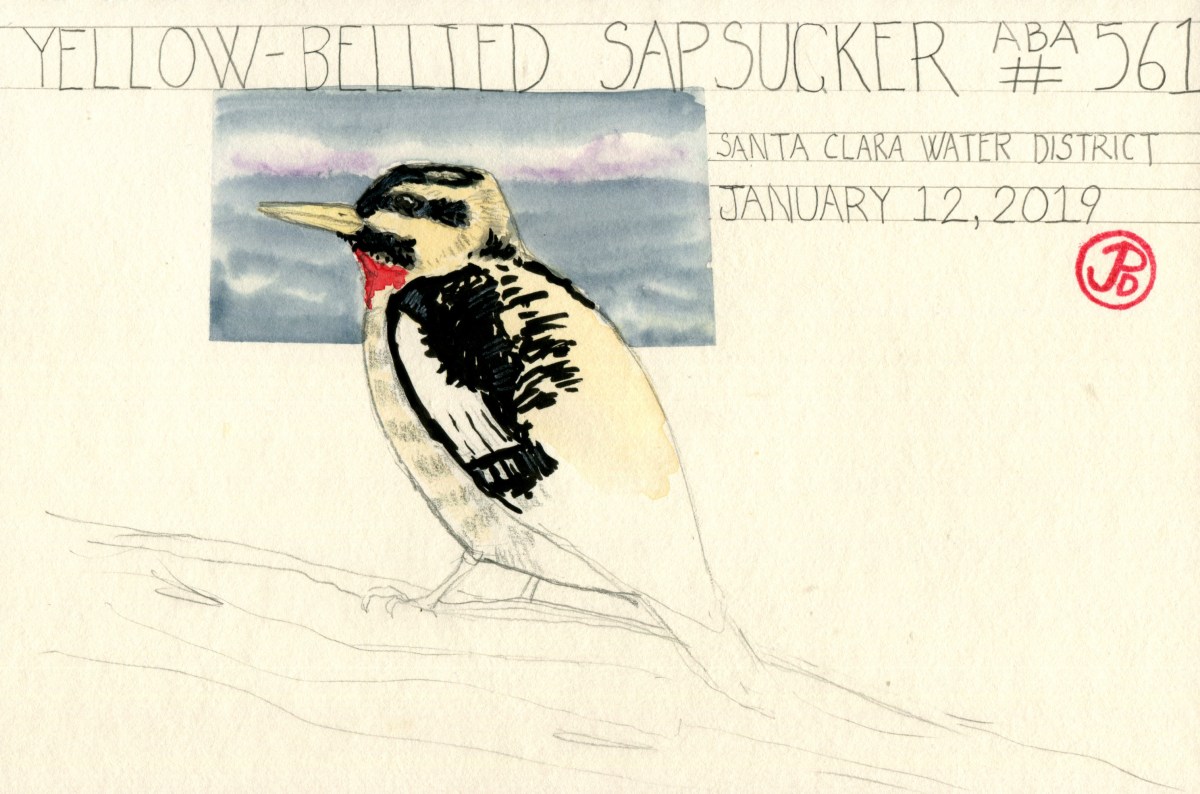
Last Saturday I set out with Dickcissel to close out a genus. In this case Sphyrapicus. I had red-breasted, red-naped, and Williamson’s sapsucker. The only sapsucker missing from my list was the easterner: yellow-bellied sapsucker (Sphyrapicus varius). And one had been spending some time in the south in Santa Clara County.

Sewage ponds, landfills, and water treatment plants may not be a place to spend your Saturday morning but if you’re a birder they can be an avian heaven on earth! In this case it was the Santa Clara County Water District in San Jose and the line of pepper trees that lined the Guadalupe River and the percolation ponds. This is where the shy, juvenile, male sapsucker has been spending it’s time.

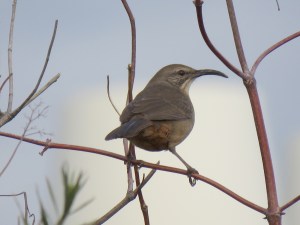
We first walked the line of pepper trees, willing the shy woodpecker into being. There was no movement and no woodpeckers to speak of, aside from the distant call of a northern flicker. As we headed upstream, towards the dam, Dickcissel called my attention to a bird in a bush. It was not a woodpecker but a thrasher (not the ghost wraith LeConte’s) but California thrasher. The bird sat in the top of the bush, allowing great looks and a few photos.

California thrasher, Toxostoma redivivum.

We turned right at the dam and birded the path that led back to the water district buildings. That’s when we first heard the harsh trill of our first woodpecker! We soon found the source of the call: a female Nuttall’s woodpecker.

This is not the woodpecker you’re looking for!

After watching 75 robins feasting on pepper tree berries we headed back to the river road and the trees that lined the path. After making the 90 degree turn to head back downstream, I saw a woodpecker in a snag right in front of me! “There’s the bird!” I exclaimed, in a quiet sort of way, in order not to spook the shy sapsucker. Too late. The bird bounded into the closest pepper tree.

We surrounded the tree like the LAPD on an SLA safe house but the sapsucker flew off toward the path where we just where birding. We rushed over and got some diagnostic looks before the bird disappeared into foliage.

The yellow-bellied headed back from whence we came and we where on a wild woodpecker chase to get more looks and photos. The sapsucker perched briefly in the first pepper tree and then disappeared again. I went up the path and Dickcissel tried to flank the bird on the pond-side of the trees.

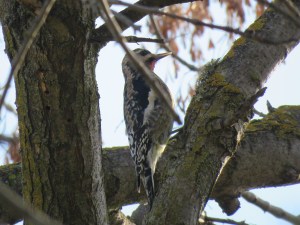
After a short search Dickcissel was on the bird again and I headed over to his position. This time the young male was perched on a near horizontal branch. I noted that this bird is either extremely active or very sedentary. Pete Dunne notes this behavior in the Birding Bible, the Essential Field Guide Companion, that the bird’s behavior is “bi-polar” and we where now observing it’s still stage, where the sapsucker seemed to be impersonating a tree branch, which gave us exceptional looks.

A typical look at the shy sapsucker, always placing himself between a few twigs.

Coda

After spending time with the yellow-bellied sapsucker we headed on a short 15 minute to another location in a residential neighborhood to add another sapsucker to our day.

This was a red-naped sapsucker that was spending time in a sycamore tree on the banks of Guadalupe Creek. Within four minutes of searching I spotted the not-so-shy rep-naped sapsucker on The before mentioned sycamore tree.

Image

King Nemesis: LeConte’s

When I stepped out of the car it was 6:21 AM. It had taken me an hour and seven minutes to get here from La Quinta. The morning air was chilly, very chilly, the temperature was 27 degrees. And here I was, in the high desert, at the Borrego Springs Landfill.

It’s all about a bird of course, not just any bird but a true nemesis that had evaded me, despite numerous attempts at Joshua Tree, Nevada (near Las Vegas), and even the open space preserve just a mile north of my current, cold location. But the view ain’t bad.

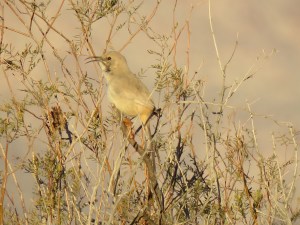
img_8739This harsh, sparse, and dry habitat dominated by saltbush and creosote is the domain of the elusive LeConte’s trasher, which is the Sasquatch of the thrashers because it is a pale, drab bird that prefers to run on the ground rather that fly and has the annoying habit of always keeping dense vegetation in between itself and the observer. In other words, it a damn hard bird to see and see well, that is until the pull of defending it’s territory kicks in. This usually starts in January and lasting through March.
The key to finding LeConte’s at Borrego is to arrive before sunrise, walk out west of the landfill and wait for the sun to kiss the saltbush flats and soon you will should hear the distant sound of an unseen male singing. Well hopefully that’s how it was going to happen.

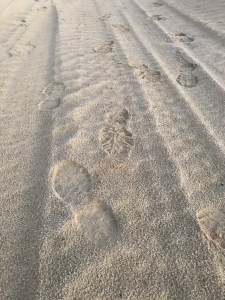
The shoe prints in the frozen desert sands spoke of the other early morning birders on previous days that have come to this location to find LeConte’s. All I had to do, like the Yellow Brick Road, was follow the the footprints that would lead me to the ghost thrasher.

I first hear the rolling-meandering call of a thrasher at 6:41 AM and I rushed to the southwest in search of the singer. But this desert wraith led me on a wild thrasher-case that ended at a dense brush Leaving me gazing into oblivion. Then from my right, I heard another song and I rushed off to the northwest. This time I saw a pale bird with a peachy butt hop to the ground and disappear into a dense thicket. My first, but brief, sighting of this feathered ghost. . . I think.

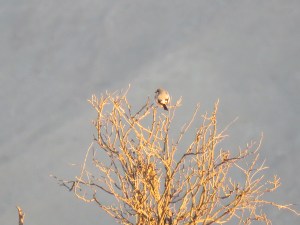
Off to the northwest I clearly heard another thrasher’s song and as I hurried across the flats (dodging bushes along the way) I could see a distant bird perched up on a snag. Could this be my first good look at a LeConte’s?

I moved closer but the bird was still far off and I didn’t want to flush it off it’s singing perch. I raised my camera and zoomed in and:

no, not a LeConte’s thrasher but a loggerhead shrike. This thrasher really does make you see ghosts and phantoms.

From my left came another thrasher song and like a sail boat tacking across the sands, I set a course toward this new singer.

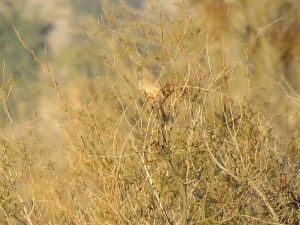
This time I could she a pale bird singing in a mesquite bush. Again I raised my camera to my eye and zoomed into the singer:

Then I zoomed in some more:

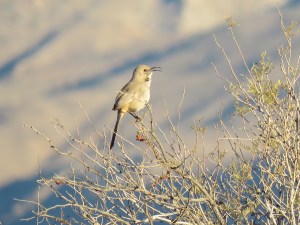
A pale, drab bird with a down-curved bill, peach undertail coverts and a long, dark tail. I was looking at my Nemesis Bird, the LeConte’s thrasher!! Lifer!!! ABA bird number 560! He gave me great views and I was able to capture many images.

As I slowly moved closer the thrasher popped down and out of sight into the bush. I then heard another male singing off to the northwest and off I went.

It was now 7:30 AM, the hour of power! I was able to locate another male perched up and singing on another mesquite bush. This is the bird where I got amazing looks and was able to get some great photographs to document the existence of a desert ghost.

Coda:

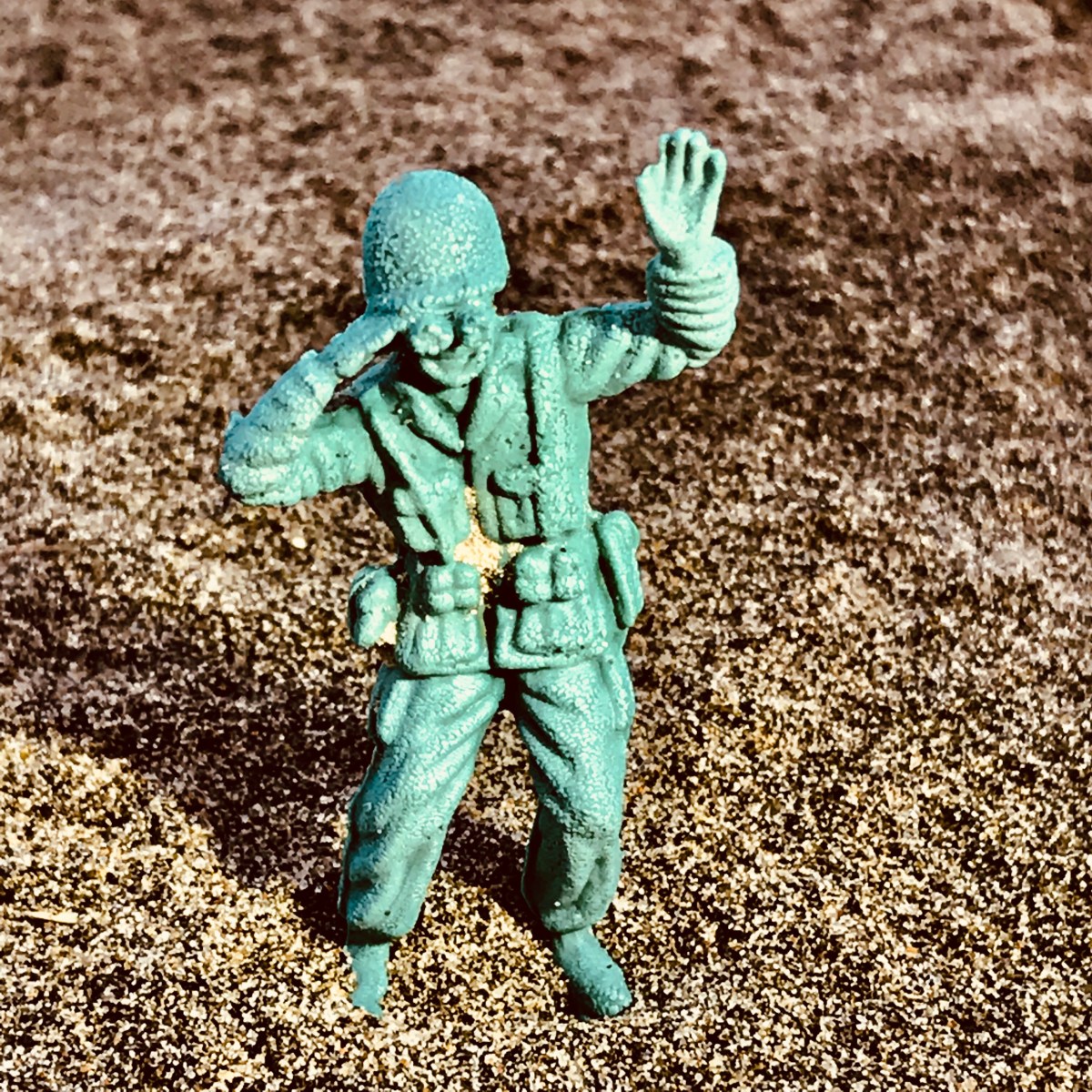
While still in the afterglow of my thrasher experience and once I had returned back home to San Francisco, I checked the pockets of my down jacket that I was wearing on that cold morning, west of the landfill. I pulled out gloves, my scarf, and a figure that I had found, half buried in the sands, just as I was starting my search for LeConte’s thrasher. I have almost forgotten about this figure.

It was a plastic, olive green army action figure, the kind that I used to play with when I was a child. Each figure was in a different pose. There was the soldier crawling on the ground, the solder kneeling on his knee, rifle raised to his eye, the dude with the flame thrower, the guy shouldering a massive bazooka, and the soldier on the phone. But the little green soldier that I held in my hand was none of those, but the solider with left arm raised and in his right hand he held binoculars raised to his eyes, as if shouting out, “I think I see it. . .yes it’s a LeConte’s thrasher!”

Image

And Things

One of the more odd and interesting things that I visited in the Mojave Desert was found north of Joshua Tree. It was a twenty minute drive on a lonely desert country road that led me to the town of Landers. The town’s slogans is “Beautiful Skies, Miles of Smiles”.

My destination was off the main road at the end of a T junction. As I approached the junction, the white dome appeared on my right. This was my destination: The Integratron!

If your first impression of the Integratron is of a flying saucer that has landed on earth for repairs you wouldn’t be too far from the truth.

The grounded spaceship was the cosmic brainchild of George Van Tassel (GVT), who was a ufologist who claimed to have a telepathic connection with beings from the planet Venus.

According to the Integratron’s website, “the structure is based on the design of Moses’ Tabernacle, the writings of Nikola Tesla and telepathic directions from extraterrestrials”. And the building, which was not constructed with a single nail, was funded by donations by Howard Hughes and by hosting UFO conventions on the site in the 1950s through the 1970s. Construction was started in 1957 and was not finished until 1960.

But what was the building built for, aside from returning to Venus? Again according to their website, the building “was designed to be an electrostatic generator for the purpose of rejuvenation and time travel.”

After GVT died in 1978, the building was bought by three sisters and the space is currently being used for “sound baths”. Not sure if this craft will ever make it back to Venus but I might stop by for a bath.

Image

Plants and Birds and Rocks and Things

It was an interesting time to be in a National Park because of the partial government shut down (which at the time of this writing is in it’s third week). Joshua Tree National Park was still open but all the park rangers and maintenance staff where on furlough leave. The advice I received from locals was, “Bring your own toilet paper and trash bags and don’t climb in the Joshua Trees.”

This didn’t stop me from heading into JT (with toilet paper and trash bags) to see and sketch some of the beautiful sights in this high (and sometimes low) desert wonderland.

Plants

Located in the southern part of the park where the high Mojave Desert drops down to the lower Sonoran Desert is a grove of interesting desert plants know as the ocotillo (Fouquieria splendens). These tall plants may look like a type of cactus but they are the sole genus of a Mexican species found the United States, in the Sonoran and Chihuahuan Deserts. After passing through the incredible Cholla Cactus Garden I stopped at the Ocotillo Patch, pulled out my camp chair and started sketching this amazing desert plant.

The Cholla Cactus Garden, Joshua Tree National Park

Birds

I sketched a few birds that I encountered in JT. When hiking in the desert you do not encounter very much avian life but when you do, it’s really something special. At first glance a desert seems a harsh and dry habitat, seemingly lifeless, but only after spending some time in the desert to you see the life that is perfectly adapted to this extreme environment.

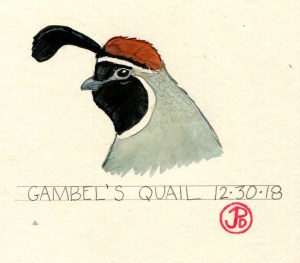
I sketched three birds that I encountered on the Maze Loop hike (~4.6 miles), located in the northern part of the park. The black-throated sparrow, Gambel’s quail, and phainopepla are all common desert species that are relatively easy to see on a desert hike in the high Mojave Desert.

Black-Throated Sparrow

Gambel’s Quail

Phainopepla

Image

Rocks of JT

On the first part of the journey
I was looking at all the life
There were plants and birds and rocks and things
There was sand and hills and rings


                                                      A Horse With No Name

                                                      America

I was in the high desert of Joshua Tree National Park for the plants and birds and rocks and yes even the things.

I always enjoyed sketching sculpture and architecture because unlike animals, they ain’t going anywhere soon. The rock formations of JT are nature’s sculptures and sketching them is a desert meditation where you lose yourself in the lines and contours of weathered rock and at the end of the sketch you come away understanding that rock just a little bit more.

On my second visit to Joshua Tree in two years, I focused much of my sketching time on rocks, some famous like Arch Rock and Skull Rock but others that bear no known name. I named these rocks such as Repose Rock (above) but I’m sure other visitors have given it other names. Jelly Bean Rock seems like a likely canidate.

Skull Rock is probably one of the most visited sights in JT. I suspect one reason is that the rock bears an uncanny resemblance to a human skull, the other is that is about 20 feet off the main road and does not require a hike or even a brisk walk to see it.

Here is a self-named rock that I sketched in the popular rock climbing destination called Hall of Horrors. This I call Balanced Rock and in the sketch I also included some of the plants and some of the “things” but no “rings”.

Image

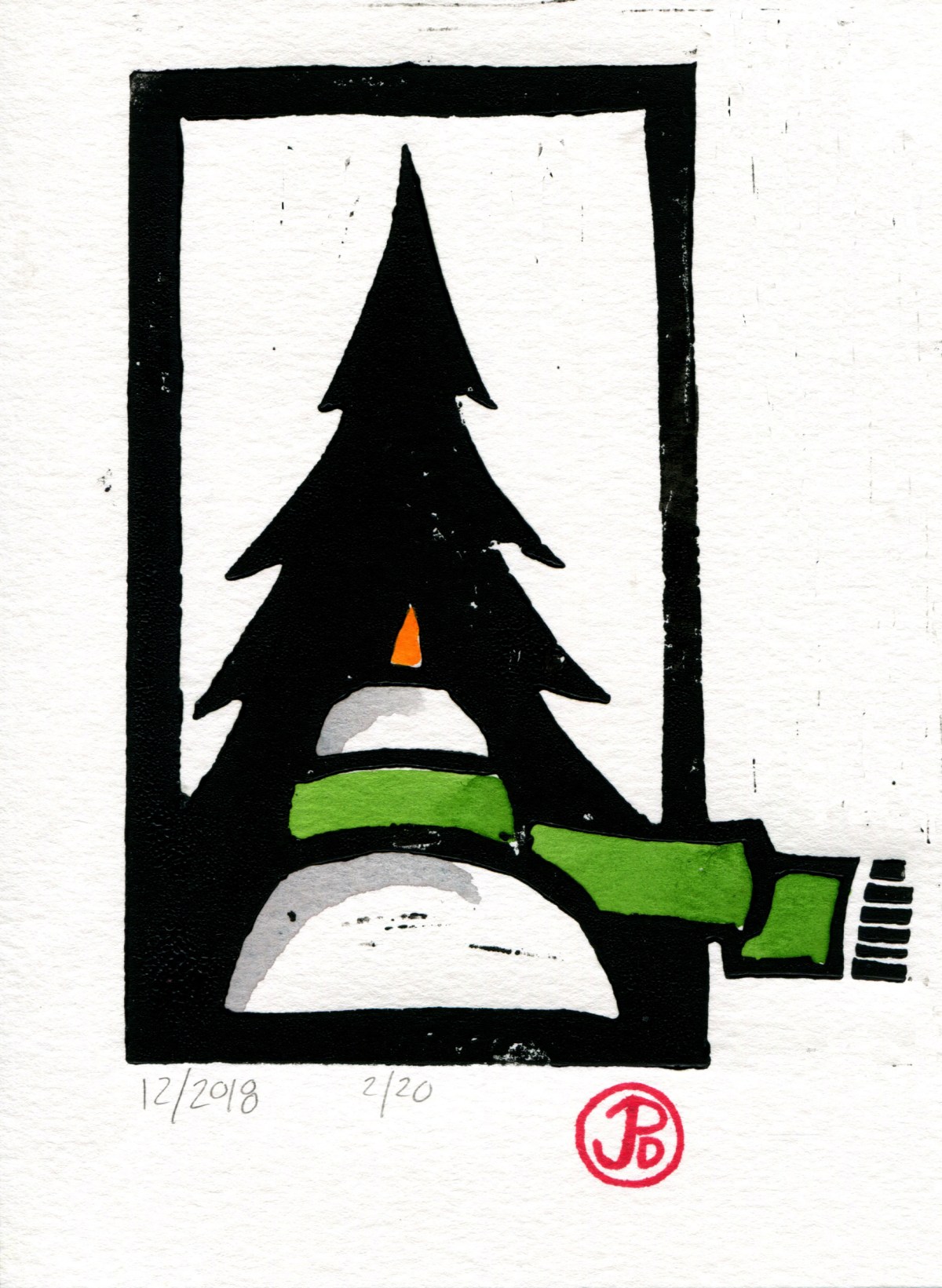
2018 Holiday Linocut Print

This year I was up to my ears in report cards and conferences and I have little fuel in the tank to create my annual holiday linocut prints. But once I started to sketch out designs for this year’s print, my artistic batteries started to recharge.

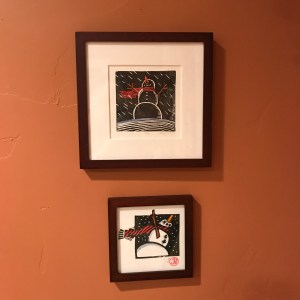
Two of my previous snowman prints at my mother’s house. The one above is from 2007 and the print below is from eight years later. I have definitely improved my technique and understanding of the medium.

Since 2007 I stopped buying things for family and friends and I started to create an annual  holiday snowman print instead. This seemed to me to be in the true spirit of Christmas gift giving. You weren’t going to find me queuing in front of a big box store on Black Friday at an unGodly hour, ready to stimulate our consumer-rich economy! I pulled out a sketch book instead!

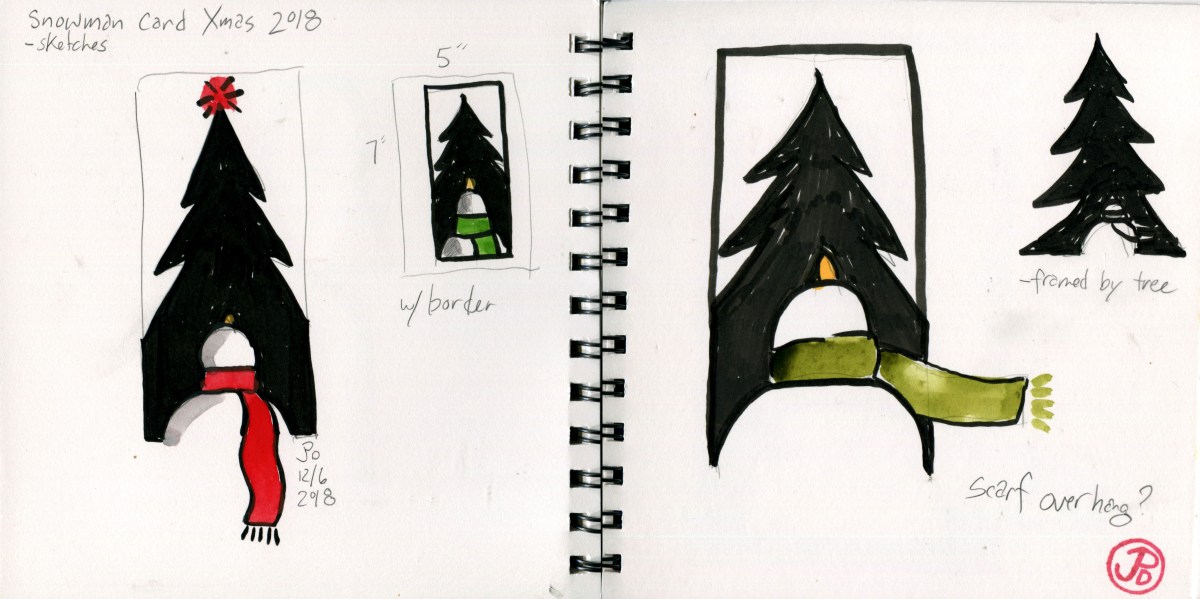
Snowtree sketch

I thought that I wanted a snowman standing in front of a conifer. I first conceived the design as being symmetrical with the silhouetted tree and snowman in alignment. Adding a scarf  was going to throw off the symmetry but I can’t resist a flowing, wind-blown scarf!

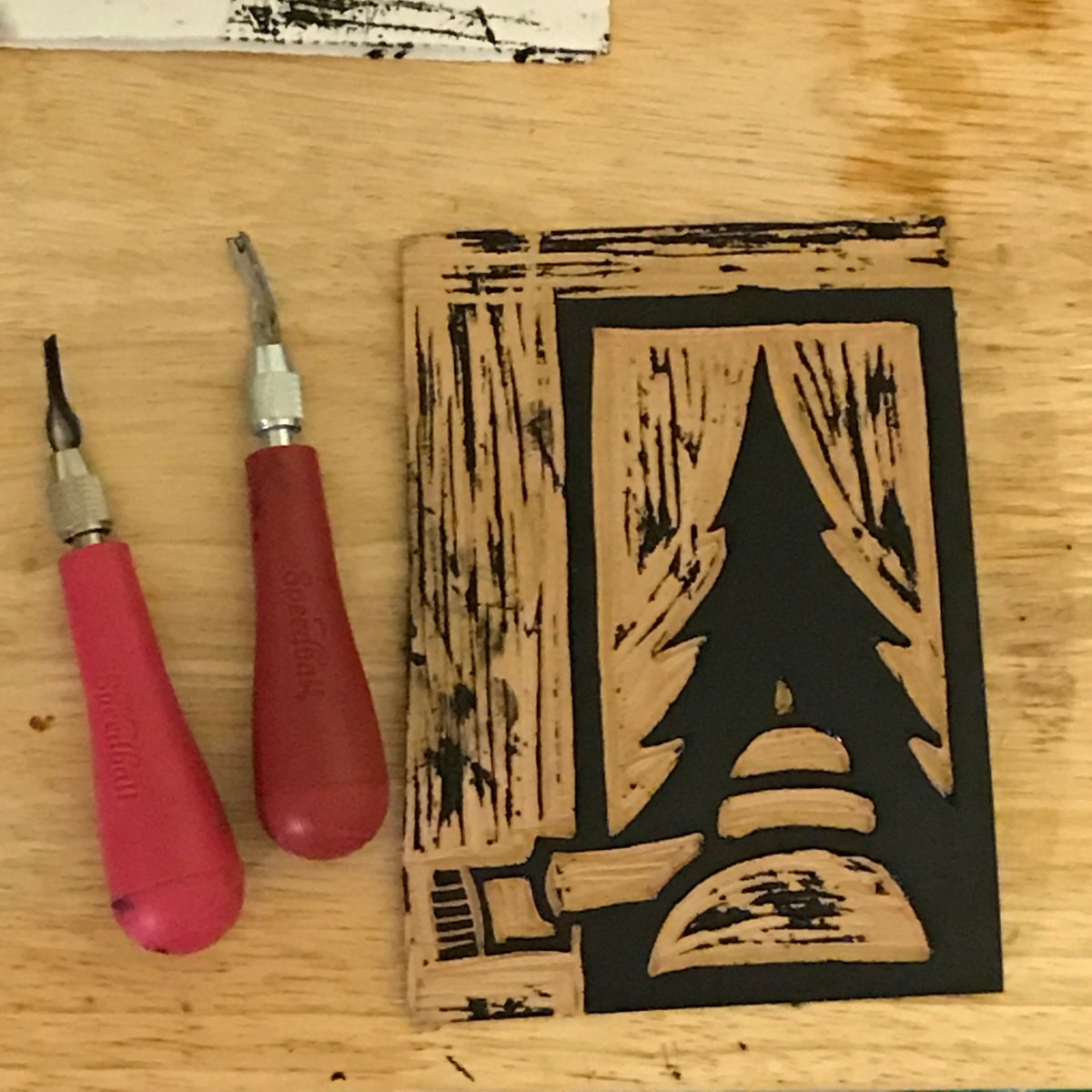
After I had decided on a final design, it was now time to carve the imagine into linoleum. You never get a true sense of what the print will look like until you charge the block and make your first test print.

IMG_0184

Printing is not always a very a pretty process. I use oil-based ink because I hand tint the prints with watercolor. This is very messy and I only want to do it once so my print run was 20 prints.

Happy Holiday to all and a Happy New Year!

Image

Field Sketching: FC Shell Bar

One part of journaling that I can improve on is field sketching. When your subject is a landscape or a piece of architecture then field sketching is a little easier. But when sketching a live, wild animal, then you’re dealing with a beast of another nature!

On a recent Saturday I headed out to the Foster City Shell Bar to do some field sketching. No I was not sketching techies drinking mamosas during brunch, the Shell Bar is a piece of exposed tidal flats along the San Francisco Bay. The Shell Bar is also a hotspot for shorebirds, terns, and gulls.

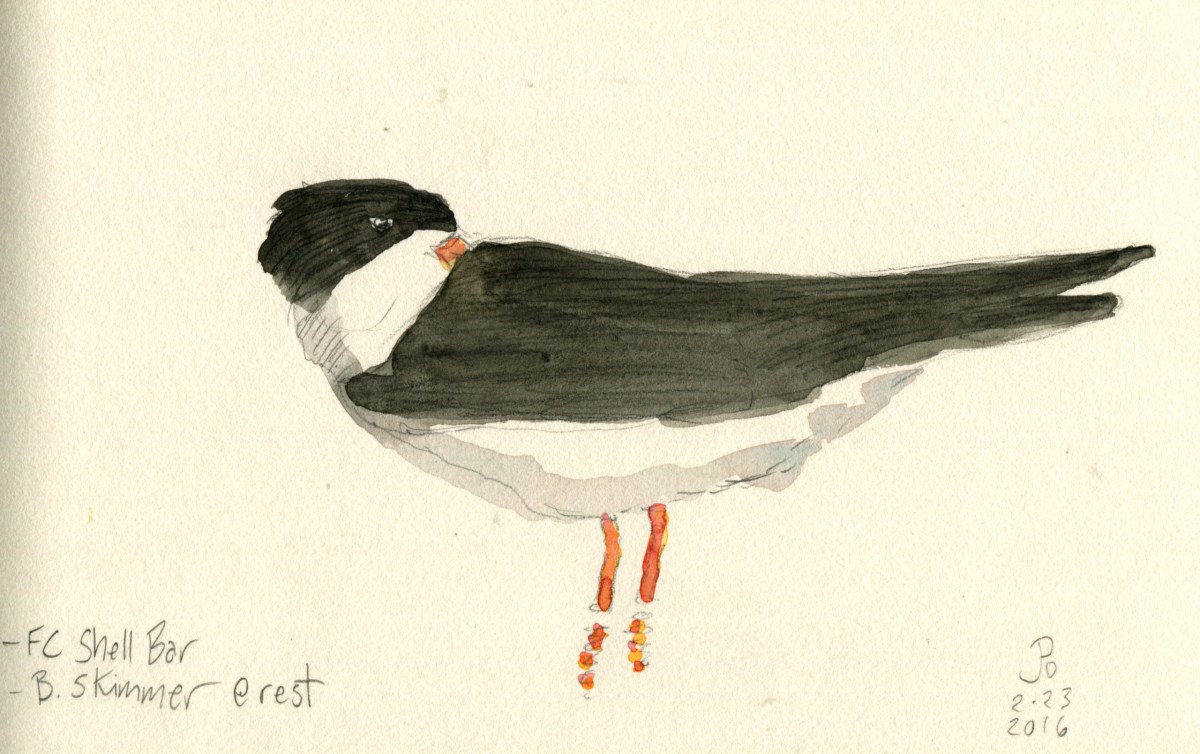
The benefit of sketching at the Shell Bar is that this is where the shorebirds come to rest, making them easier to sketch as they pose in repose. One of my target birds to draw were resting black skimmers, these terns with huge elongated lower mandibles are a specialty for this location. When we arrived there were 50 individuals to sketch from.

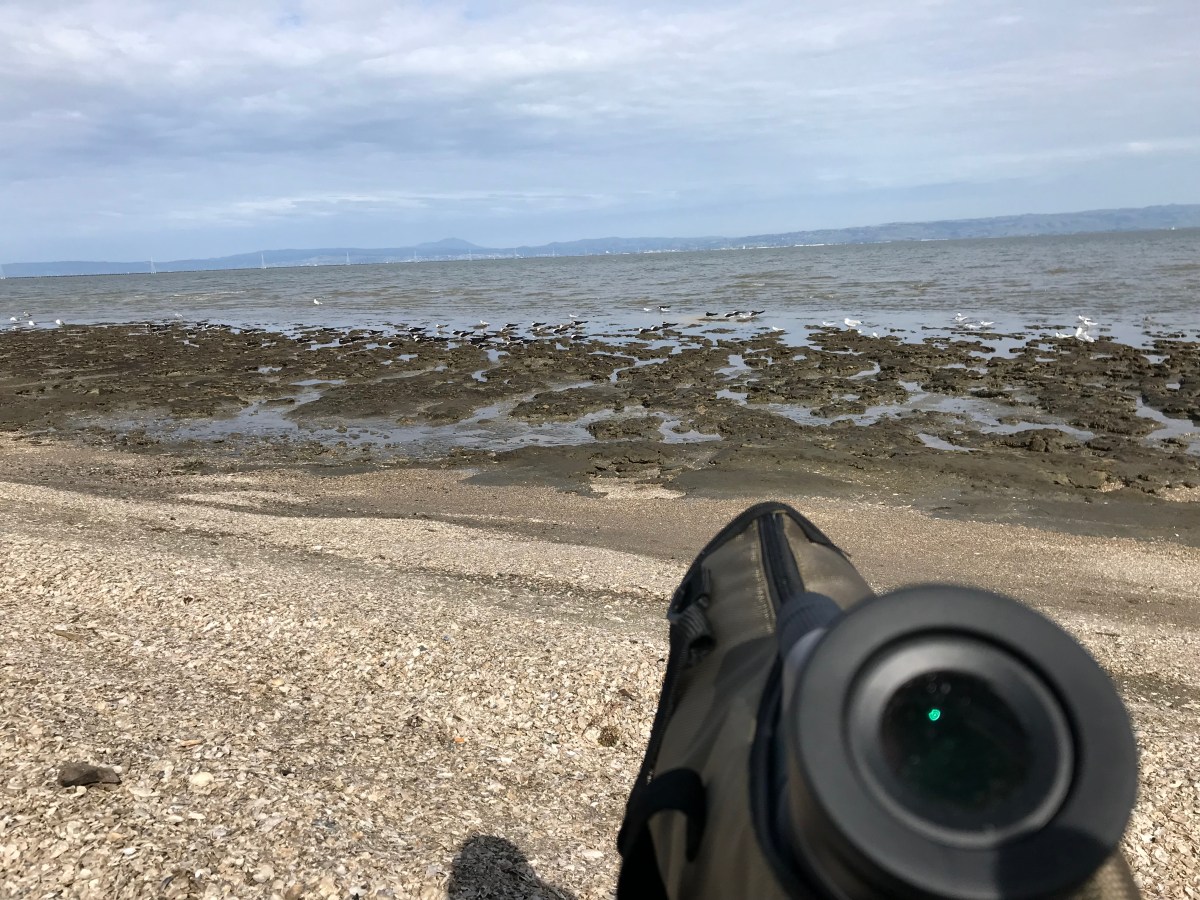
Scope view of the Shell Bar with resting black skimmers in the background.

There are many benefits when sketching a resting bird. One of the first benefits is that the bird is still and is not flying around making them much easier to capture in the pages of a sketchbook. Also most shorebirds at rest, tuck their bills in to their back feathers for warmth, making it easier to sketch because you don’t have to worry about bill length and shape (the black skimmers have one of the more complex and odd bills on the Shell Bar). And another benefit is that most birds when at rest on the shell bar are standing on one leg, simplifying your avian subject even further. It’s easier to draw one leg instead of two! This is especially true of the hundreds of willets resting on the flats.

With me at the Shell Bar, with sketchbook and binoculars, was my birding-skeching acolyte, whom I shall call young Grasshopper Sparrow.

He once referred to an upcoming Disney Cruise to Mexico as, “a five day pelagic instead of a cruise. ” This young birder has his priorities in the right place! He plans to spend his time on the foredeck looking for boobies and tropicbirds. Young Grasshopper is a quick learner!

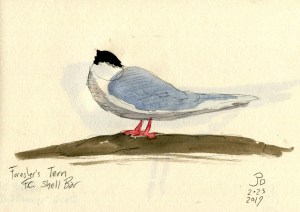
Forster’s tern at rest.

We both sat on the shell bar and sketched the resting terns until the tide slowly covered the flats and the birds dispersed, heading out either north or south from our position.

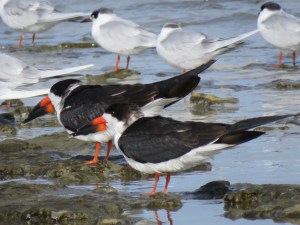
Every good tern deserves another. Two adult black skimmers and Forster’s tern in the back ground.

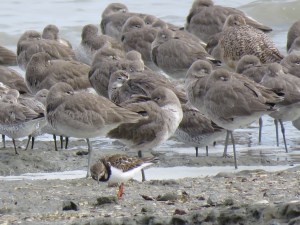
One-legged red knots, willets, and a marbled godwit in the background with a ruddy turnstone turning stones in the foreground.