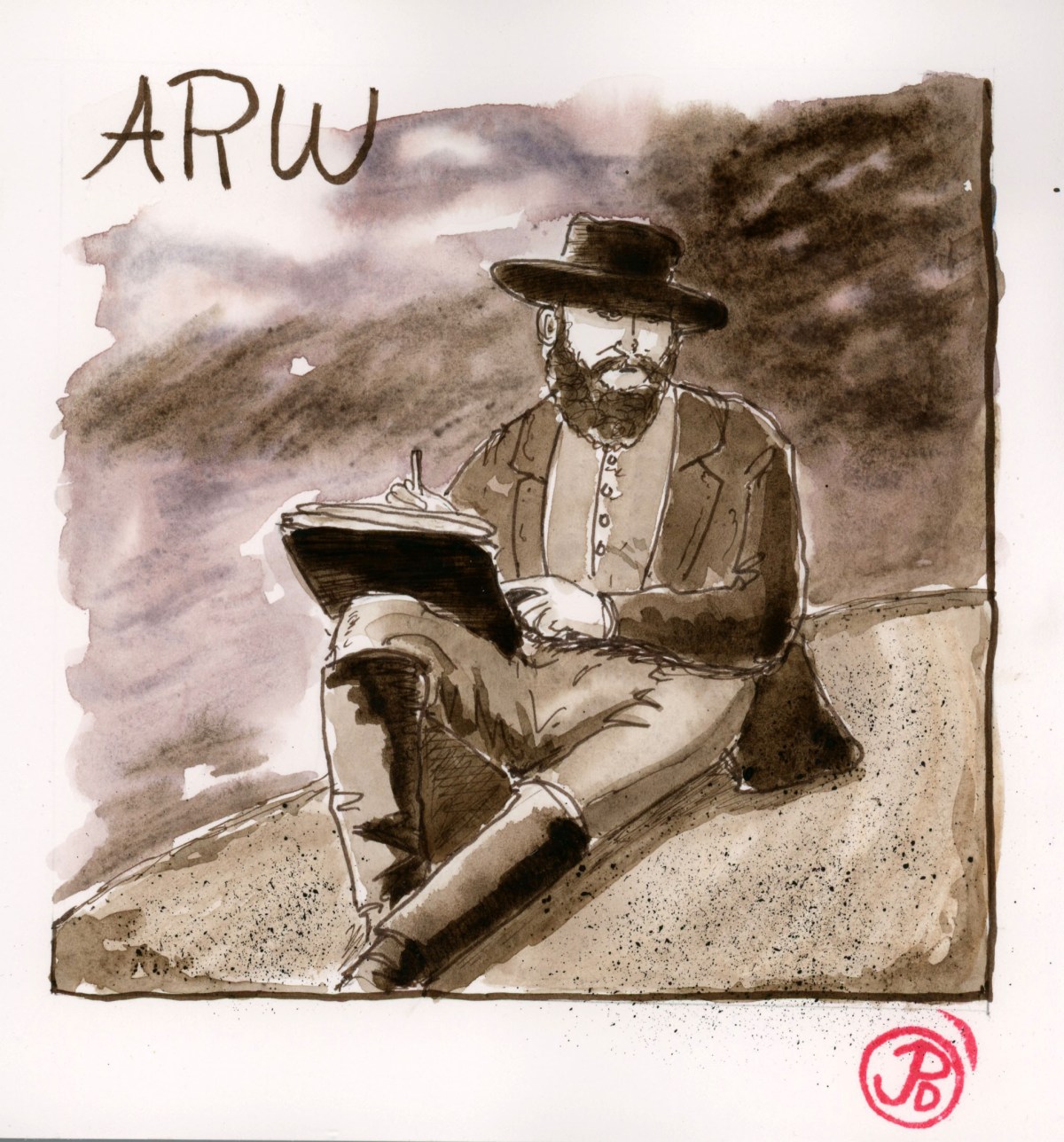
Before I go one any trip I like to add a title page and a map to my sketchbooks.
For my trip to Civi War battlefields in Virginia, West Virginia, Maryland, and Pennsylvania I chose to bring two Stillman and Birn hard cover watercolor journals. One is my new go-to favorite, the panoramic Delta Series journal. And the other is a Beta Series 5.5 ” X 8.5″ sketchbook. I love both of these papers and they are great for sketching on the road with pen and watercolor.
In the Delta journal I created the title page based on the famous image from Ken Burns’ documentary The Civil War, of a silhouetted canon and a glorious sunset in the background. This footage was filmed at Manassas in Virginia. This opening page is the featured sketch.
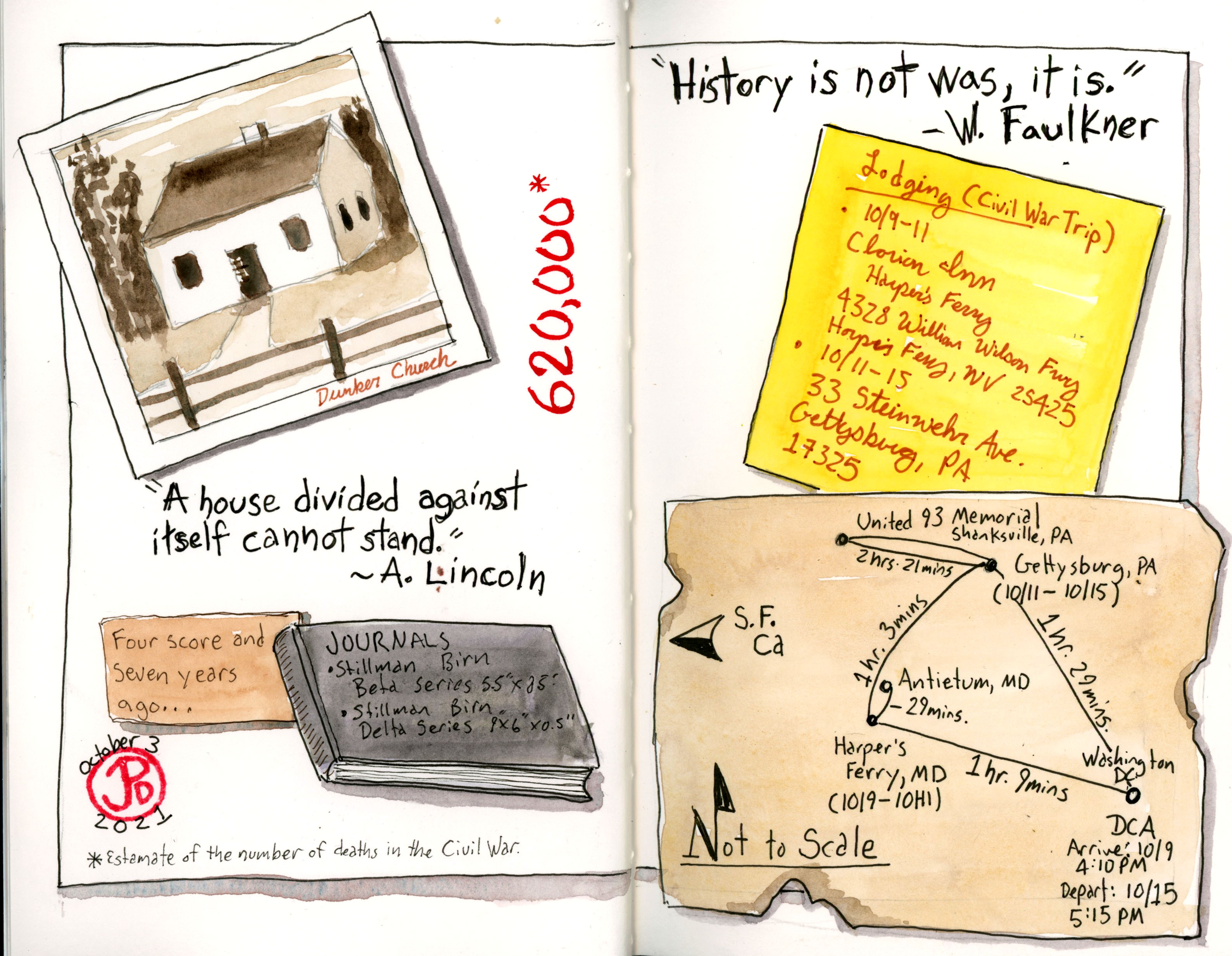
In my Beta sketchbooks I created a map of the places I would be visiting. All of the locations I would be visiting where within 90 minutes of each other. I distressed the map, covering it in mud and blood. Perhaps I added too much “blood”, but somehow since this is the Civil War it was fitting. It is estimated that about 620,000 Americans lost their lives during the Civil War.
In my Beta, created to spread to synthesize a lot of the information about my trip in a creative way. It is a montage of all the important facts of the trip. Well some of them at any rate. This was a fun page to do and involved a few different sketching techniques.
The Westside of Santa Cruz has been recently active with fall migrants, including a few species that are considered rare in California.
I set out early on Sunday morning and the most challenging part of my migrant search was getting to the Westside of Santa Cruz. Streets where blocked off because of a bicycle race which made getting to the Homeless Garden and Antonelli Pond a chore. Highway One was blocked off at Western Drive and I was hoping the two rarities seen the day before would still be in the area. Now I waited, a bit impatiently, as a CHP officer let in a trickle of traffic at Western Drive, in between clumps of cyclists.
I finally made my way across the intersection and turned left on Shafner, which was also blocked off by a CHP officer. Here was where two passions collided: birding and triathletes. And the triathletes were winning.
I found parking at the end of Shafner and crossed the rusted railroad tracks and headed into the Homeless Garden. The garden was already occupied by five birders, with their large lens, looking for the first of the rare migrants on my list: bobolink.
After wandering around for ten minutes, I noticed a triad of birder-photographers with their lens pointed at a row of tall purple flowers. This is always a good sign because I reckoned they where not photographing a white-crowned sparrow or a lesser goldfinch but a rarer visitor called a bobolink.
What’s in a name? Well bobolink is onomatopoeic of it’s call. Other birds whose common name is derived from the sound of it’s call are: chickadee, whip-poor-will, dickcissel, bobwhite, chachalaca, hoopoe, killdeer, poorwill, willet, kookaburra, and of course the cuckoo.
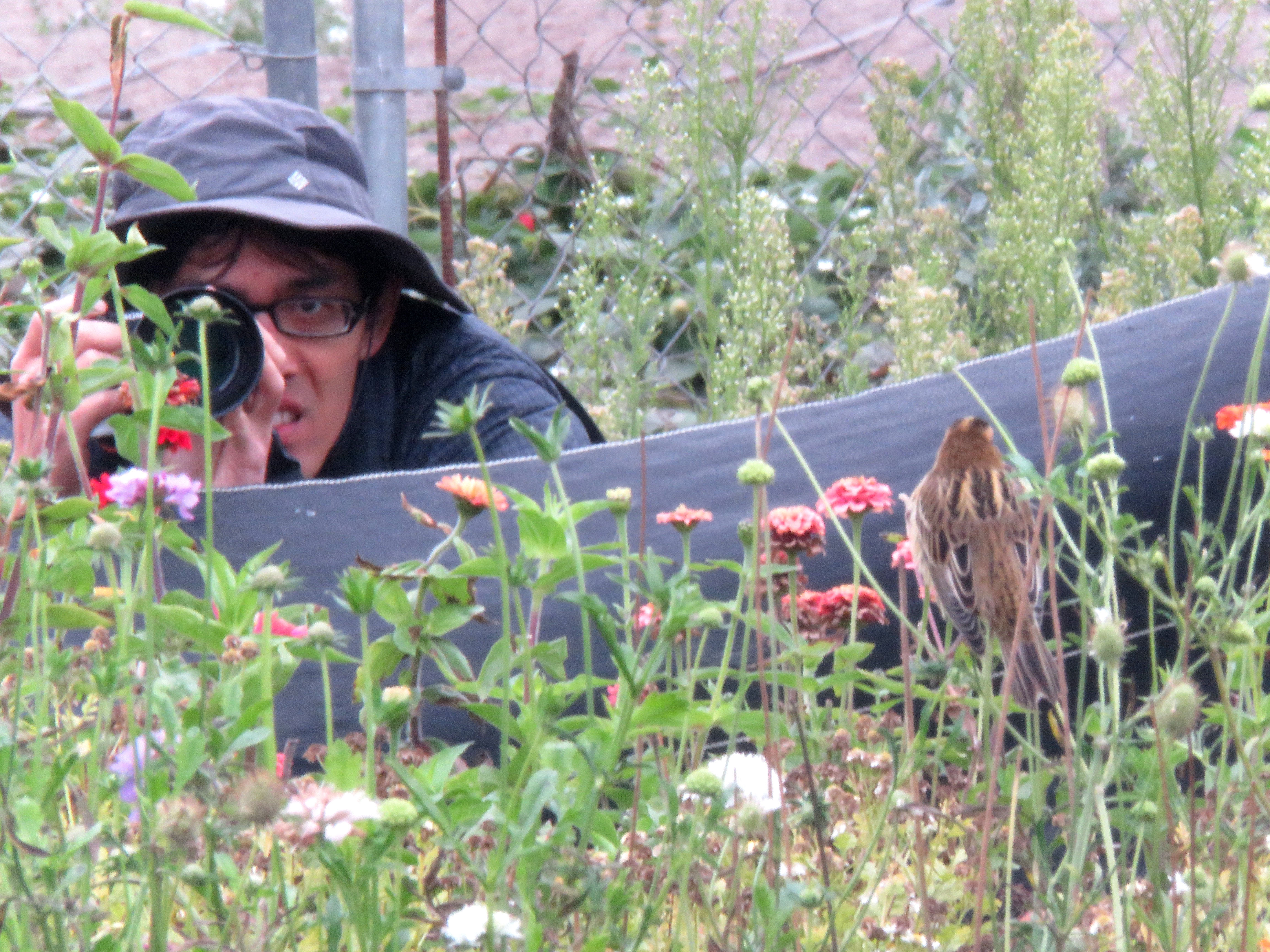
The bobolink with it’s attending birding paparazzi at the Homeless Garden.
And now back to the Homeless Garden in western Santa Cruz: it turns out that the bird all the birders where looking at was the bobolink. The bird was very accommodating as it perched up on the vegetation and held relatively still.
Bobolink (Dolichonyx oryzivorus) at the Homeless Garden in Santa Cruz.
Now I was going to try for the second county bird (and third for the weekend) and this bird was much rarer. This bird had only been recorded in Santa Cruz County once before. I had first seen a white-eyed vireo in Southern Texas in 2013. Now one was out on the West Coast.
I headed east down the railroad tracks and I could see about ten birders peering into the bushes on either side of the track. I had passed two birders who had already given up on the bird and where heading to the garden to look at the bobolink.
Now sometime magic happens in birding. Where you happen to be at just the right place at just the right time. Such was the case as I approached the group of birders and was just about to ask if they had had any luck with the vireo when one of the birders exclaimed, “There’s the bird!” And pointed into the top of a rail side tree. Some of the birders and been searching for the vireo for over two hours and here I come, Johnny- Come-Lately, and the bird seems to appear out of nowhere.
I got bins on the foraging vireo, two white wing bars, yellowish wash, white throat, and a distinctive white eye with a dark pupil. This was the bird all the birders were here to see. White-eyed vireo!
The vireo moved from tree to tree and at one point was foraging with a mixed feeding flock in a pine. Beside the white-eyed, the flock included warbling vireo, pygmy nuthatch, Townsend’s warbler, chestnut-backed chickadee, dark-eyed junco, Bewick’s wren, oak titmouse, both downy and hairy woodpeckers, and bushtits.
As we searched the feeding flock in the pine, we where joined by more birders. I could only gesture to the place where the white-eyed vireo used to be but had not been seen in the last few minutes. We where joined by more and more birders and a tallish, bespectacled man stood to my left peering into the pine. And here is where I used my odd and often under-appreciated superpower: identify obscure “celebrates”.
Low and behold, the birder standing next to me was none other than the acclaimed novelist, Jonathan Franzen. He is the the author of the National Book Award winner, The Corrections (which I have not read). He is also a birder and has written essays about birds and birding (one essay is titled “My Bird Problem”). Franzen now lives in Santa Cruz, which explains why he was here on a Sunday morning, attempting to get a glimpse of the wayward vireo. I’m not sure he got that glimpse because I returned to my car shortly afterwards with a county twofer.
A rare godwit from Siberia has been hanging around with a group of marbled godwits on the Monterey Bay Coast in Santa Cruz County. And I was going to try and find it!
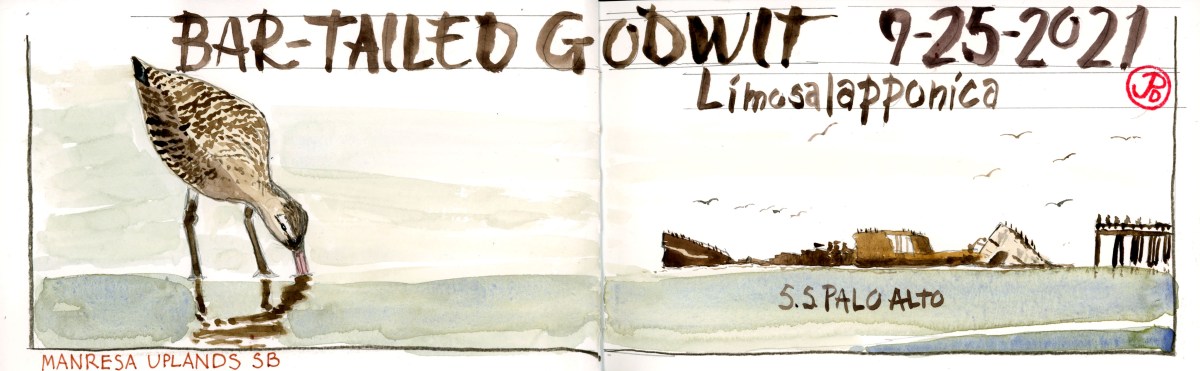
The bar-tailed godwit (Limosa lapponica) could easily be passed over when scanning a flock of foraging godwits. The differences can be subtle, especially if you don’t know what your looking for. The bar-tailed is slightly smaller legged and slightly smaller than the marbled (the difference in size is slight, marbled: 370 grams and the bar-tailed: 340 grams). The bar-tailed has a defined light supercillium (eyebrow) and it’s back is more darkly streaked than the commonly coastal marbled godwit.
This was either going to be a very easy find or a taxing struggle because the godwit flock could be anywhere on the long stretch of beach from Seacliff State Beach in Aptos to Sunset State Beach farther south in Watsonville. I anticipated a lot of leg work over sandy beaches to find the flock.
I first headed to the most northerly location where the flock had been seen: Seacliff State Beach. It is here that the hulk of the SS Palo Alto is rolled over on it’s port side like a huge, beached whale. I scanned the beach from the bluff. No godwit flocks. So I headed down the wooden stairs, used by locals as their personal gym, to the beach below. I headed south and there was a gull flock at the creek sans godwits. I returned to Highway 1 and drove three miles south. It looks like this godwit search was to become my own personal workout.
One of the best things about local birding is that it exposes you to new places, even in your own backyard. Such was the case as I exited Highway 1 at San Andreas Road and passed through La Salva Beach and headed further south. I turned right, heading towards the Pacific. My destination was the trail to Zills Beach. I reckoned that I was somewhere near or in Watsonville.
The trail to the beach that borders an agricultural field.
I headed down the trail, shouldering my scope and tripod. I reached the beach in about five minutes and looking to the south and the north, I did not see any shorebird flocks. Unfazed I decided to try my luck to the north, heading towards Manresa Beach. I set up my scope, to save some legwork, and scanned the water’s edge. I spotted some small peeps, in this case sandering. Beyond the sandering were some larger shorebirds which I hoped were godwits and if they were a flock of godwits, I hoped one of them had a white eyebrow and a darkly streaked back! I shouldered my scope and headed north down the beach to find out.
As I got closer I scoped the flock and indeed, confirmed that it was a flock of marbled godwits but I was too far away to identify a godwit that looked a bit different. As I came closer to the flock I came upon a family of five that was slowly heading up the beach. Lucky a pod of dolphins, frolicking in the inshore waters, was distracting them and they stopped to watch. They were heading towards the godwits too and I was hoping that they wouldn’t flush the flock before I had a chance to identify the bar-tailed. These shorebirds have wings and are at a distinct advantage, should the flock hightail it down the coast to Sunset Beach! That would be a lot of trudging in the sand. A good coastal workout I suppose.
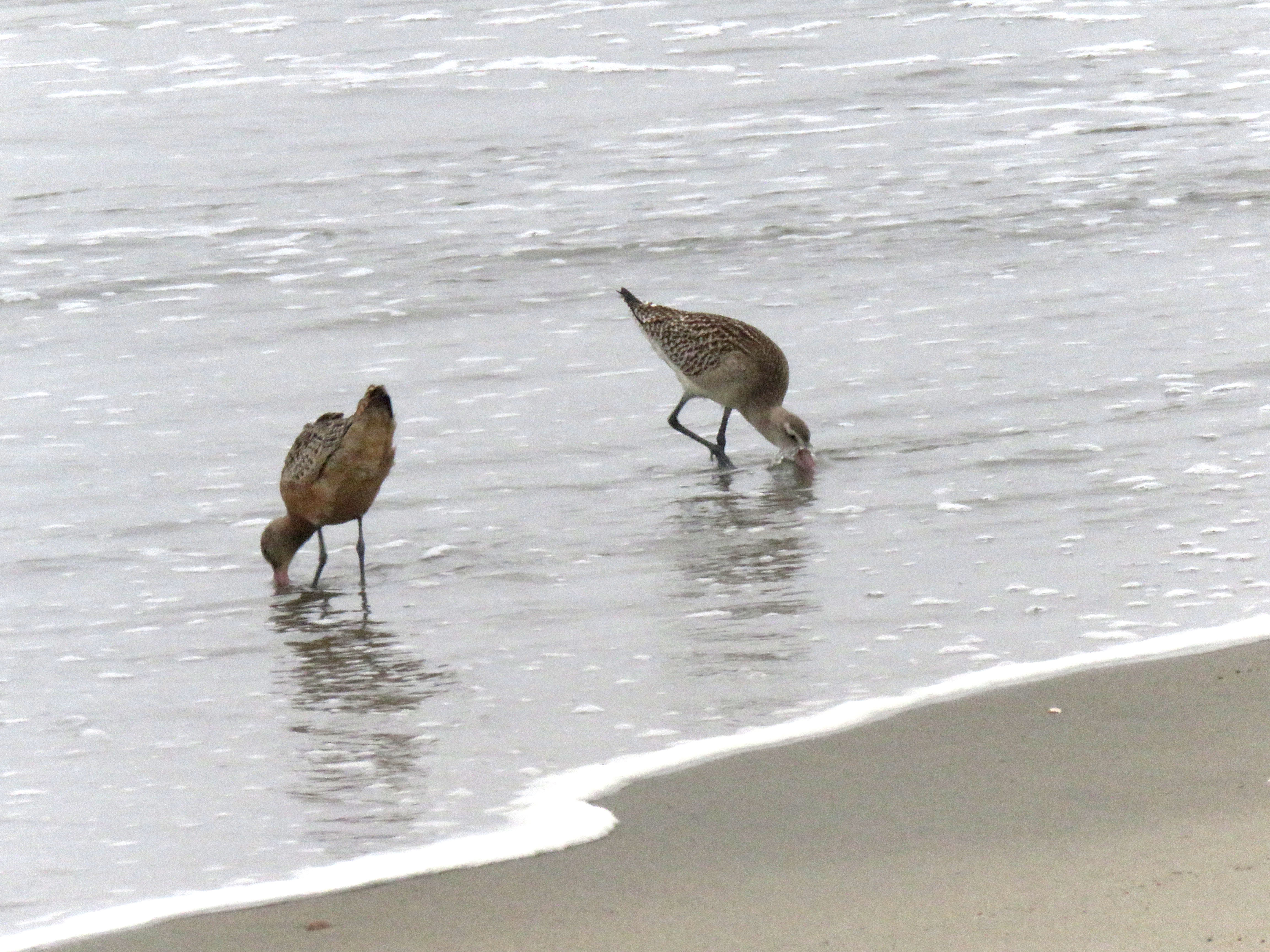
With the family of five preoccupied with dolphins, I headed away from the waterline, in a flanking maneuver to take me closer to the flock without flushing them. I set up the scope and scanned the godwits, left to right, looking for the one that didn’t quite belong. After a short search, I spotted a godwit with a light supercillium and a darker streaked back, compared with the nearby marbled godwits. Bingo! Bar-tailed godwit!
The bar-tailed godwit on the right and a marbled godwit on the left.
I spend about 15 minutes with the bar-tailed, getting scope views and taking photos before a a woman with golden retriever, who was heading south down the waterline, flushed the godwit flock. I traced the flock’s flight down the shoreline toward Sunset Beach. It was inevitable that a dog walker would walk along and send the flock to another part of the beach. At least the golden was on a leash. And I had some good looks at the bar-tailed godwit before it lifting into the air.
Here was an interesting find on the strandline, a former mola mola or ocean sunfish.
As I headed back south along the beach, I felt good about my Godwit Chase, not yet knowing that two more county birds would be added to my list on the following day. But this is a story for another spread and another post. Stay tuned!
When I read the report of an extremely rare plover on a Santa Cruz County beach, I knew that I had to head down with GrassHopper Sparrow, to add this find to my county list! (This was a mega lifer for Grasshopper.)
This plover had only been seen in California on twenty occasions. And when it was first seen on the morning of September 17 by Simon Thornhill, he posted on a birding list serve: “Strange Plover at Laguna Beach”. He noted that the plover was slightly larger than the snowy plovers it was loosely associating with. He included a photo and it was identified by the birding community as a lesser sand plover (Charadrius mongolus).
I had first seen a Lesser Sand Plover in California on October 22, 2016 on Pt. Reyes Beach on the Outer Point of Marin County’s Pt. Reyes. This small plover is usually found in Asia (it was formally know as the Mongolian plover), the east coast of Africa, India, and Australia. So when one wanders into California is would have most likely crossed over from Siberia and headed south through Alaska, Canada, and the states of Washington and Oregon.
A rare plover in Santa Cruz County was a bird too good to pass up so Grasshopper and I headed to the coast on a Sunday afternoon. The weekend pumpkin patch traffic was surprisingly light and we make good time down Highway One into Santa Cruz County.
We parked in the dirt lot, crossed the highway, and started down the trail towards Laguna Beach. As we headed down the trail, we met three other birders coming up the trail. They where smiling and this is always a good sign! The rare plover was still present.
The birders gave us directions to where the sand plover was being seen and they predicted that we would find it in less than five minutes! Let’s hope this prediction comes true.
The wind off the ocean was whipping up the sand and I assumed the plovers would be hunkered down in the dunes about 40 yards from the waterline.
We first observed three snowy plovers in the dunes and we knew the sand plover must be close by. To distinguish a snowy from a sand is not a very tough identification. The sand is larger and uniformly a darker grey with a distinct white supercillium (eyebrow). And also most of the snowies on Laguna Beach were sporting jewelry, colored leg bands to help researchers identify individuals.
While I did not keep track of time, we did find a darker, slightly larger plover that was loosely associating with the snowies, within about five minutes! County lifer 262!!
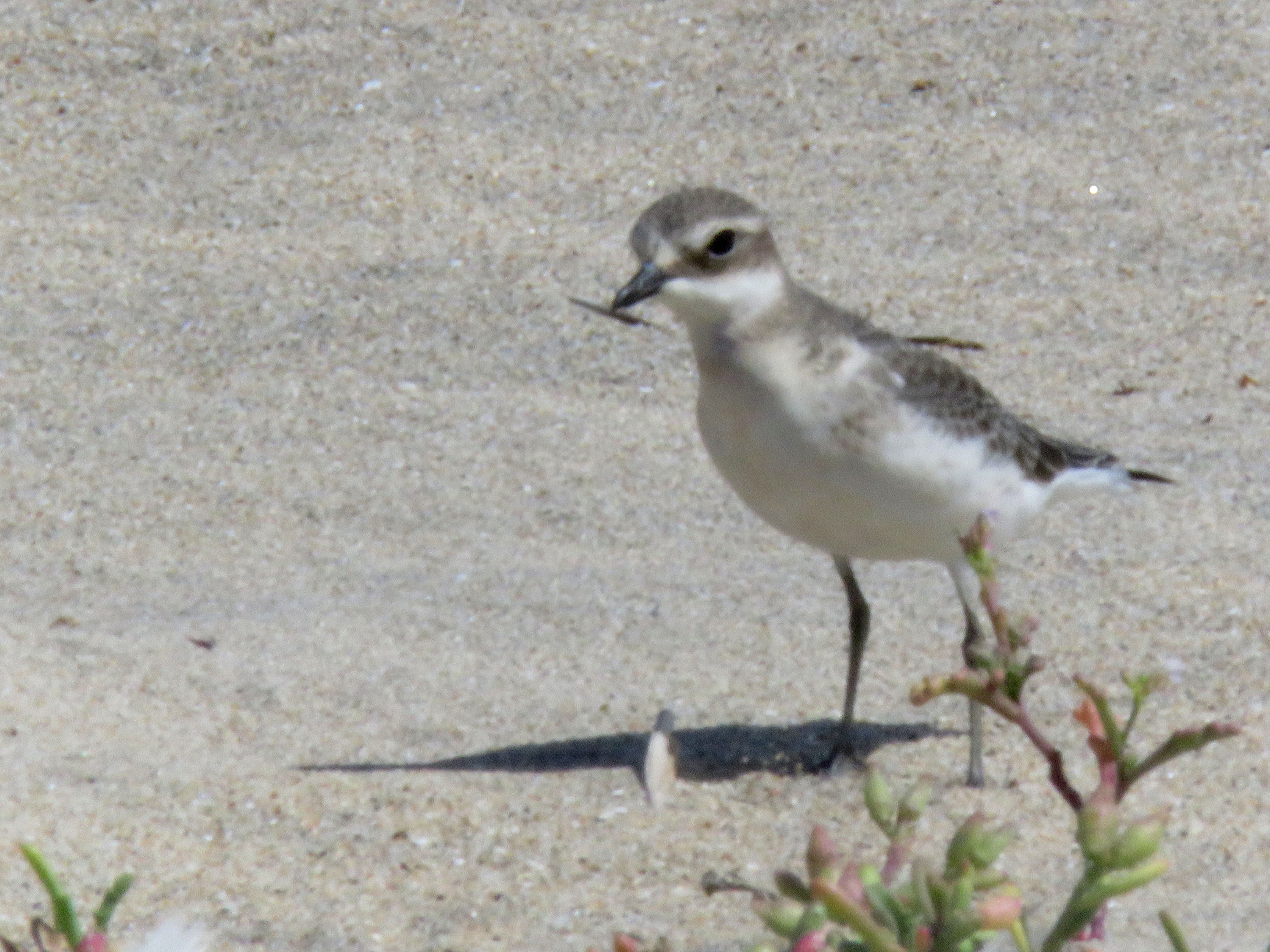
A not-so-sharply-focused photo of the lesser sand plover on the sands of Laguna Beach.
We had the sand plover all to ourselves for about 15 minutes. Over the last couple of days the plover had attracted many birders to this almost forgotten beach on this Santa Cruz County beach.
County lines are a bit strange when it comes to off shore waters. They can seem arbitrary in the same way that county, state, or country lines can be. Only these county lines are drawn over deep water.
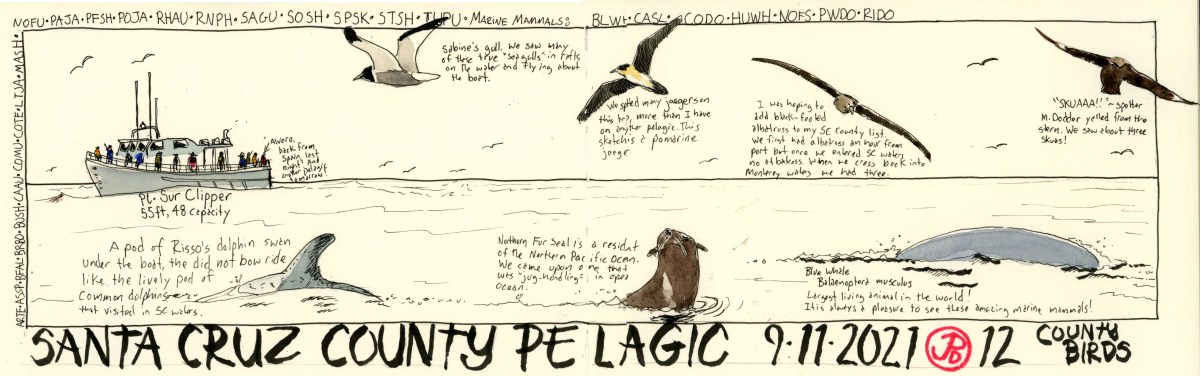
One of Alvaro’s pelagic boat trips was scheduled to head north from Monterey Harbor into Santa Cruz County waters. So I had to take this trip on my quest fro 300 Santa Cruz County birds.
Pelagic birding can be sublime and maddening in equal measures. For one, you are birding from a platform that is pitching in constant motion and the birds are often on a surface that is undulating where birds appear and disappear at a blink of an eye. Some birds fly to and over the boat while other birds, that had been resting on the water, take off at the first sight of a boat and you get a view of a retreating bird. Also because the bird boats are really designed for fishing and not pelagic birding, it is impossible to be two places at once. So if you are on the starboard rail and a rarity is seen on the opposite side of the boat, you have to make a mad scrabble on a surface that make one look like a drunk sailor, and only to find that the bird is gone with a spotter pointing to the spot where the Manx shearwater used to be!
I suppose this is the draw of pelagic birding. It is challenging and it can often give you incredible memorable experiences. Such as the time when our boat was surrounded my a pod of Pacific white-sided dolphins that numbered in the high hundreds or the time when we kept pace with two blue whales or another time when a black-footed albatross flew in and rest in the water a few yards from the boat.
We where scheduled to depart at 7:30 AM and at 7 a group of Santa Cruz Bird Club members where milling about, cleaning their optics and looking at gulls in the harbor. Our leader, Alvaro walked down the wharf. I was surprised to see him upright because he had flow in the night before from Spain, having just finished a birding trip. He said he felt fine but joked that if we found him asleep later in the afternoon we where to kick him awake.
We left on time and we where only about an hour from port when we saw our first pelagic gem: the black-footed albatross. We soon crossed into Santa Cruz water and I wanted to add this albatross to my county list but unfortunately the four that we saw where all in Monterey waters. There where large numbers of shearwaters throughout our trip, the most common being sooty and pink-footed but with sightings of Buller’s and just one short-tailed and Manx shearwaters.
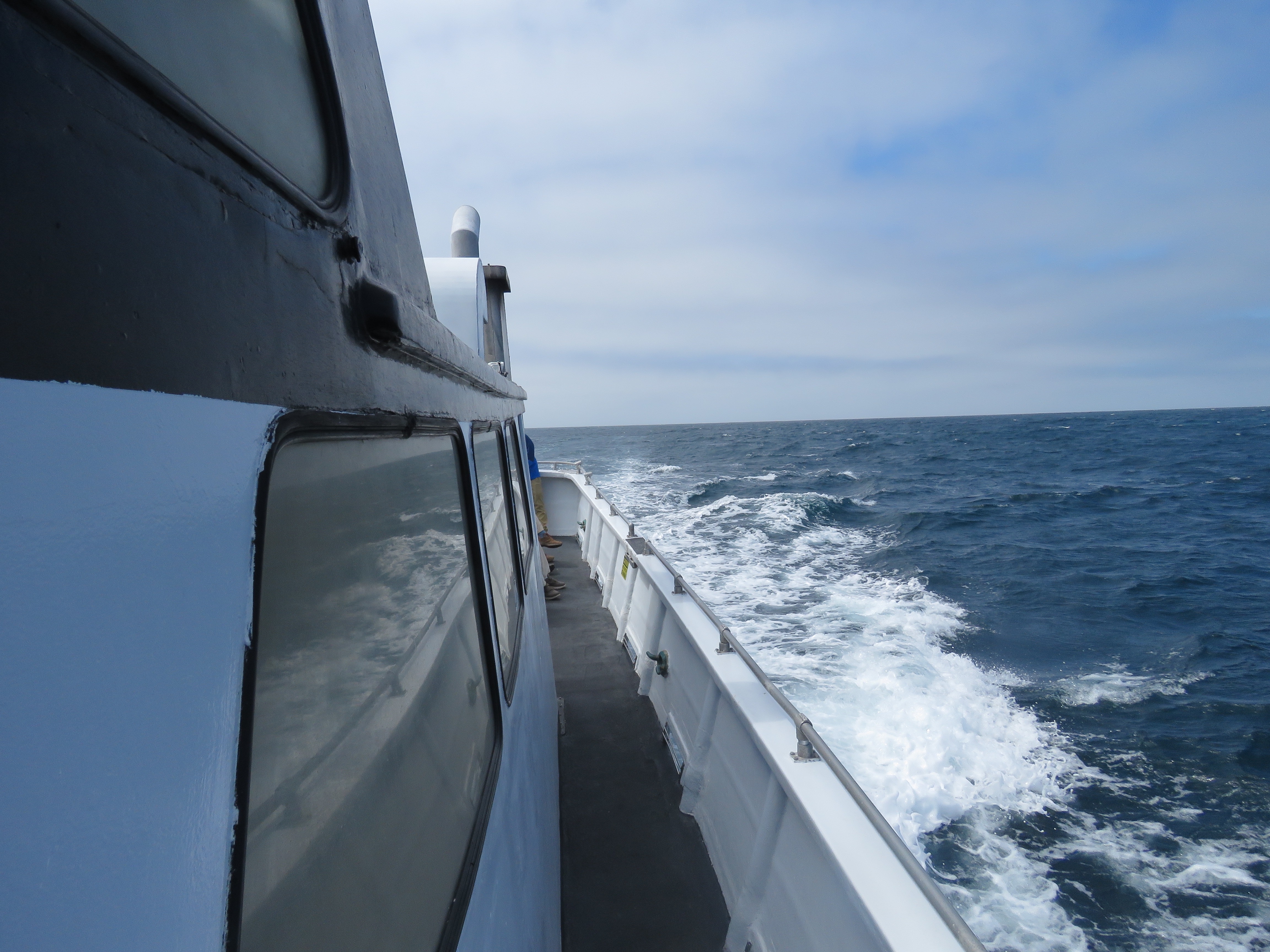
Looking down the port side of the Pt. Sur Clipper, or in pelagic birding parlance, 6 o’ clock to 9 o’clock. Here we are cruising above the Monterey Bay submarine canyon.
In all it was a very pleasurable cruise, even though I did not get an albatross over Santa Cruz waters, I did add 12 new county lifers, including: south polar skua, Arctic and common tern, Sabine’s gull, two jaegers, northern fulmar, Manx, Buller’s, and pink-footer shearwater.
As we headed back towards Monterey Harbor and the pelagic species where being replaced with inshore species like brown pelican, Brant’s cormorant, and western gull, there was one last surprise for use. One of the spotters picked out a far off brown booby flying along the coast. Not a bad way to ended a productive pelagic.
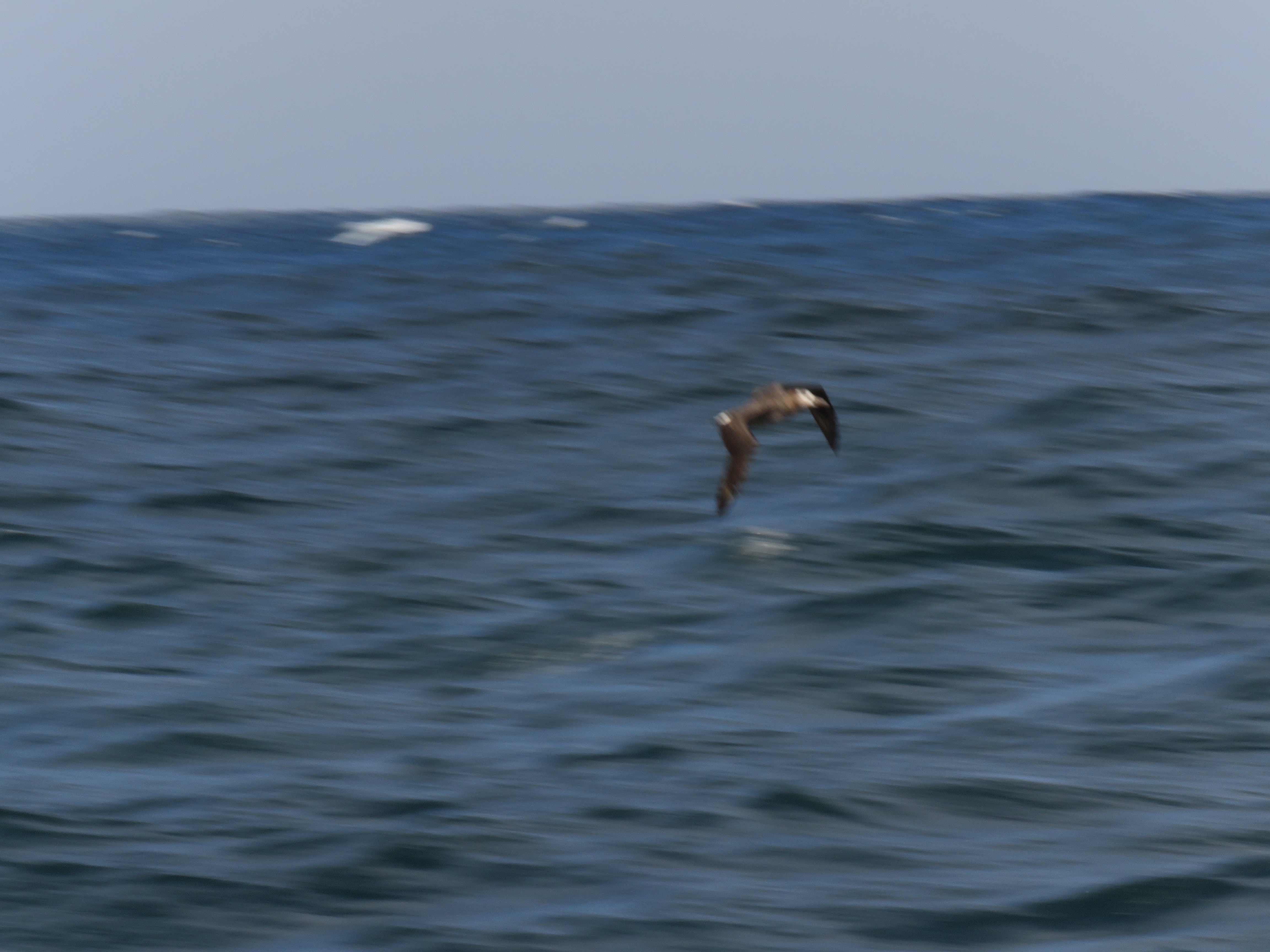
While we whiffed on black-footed albatross in Santa Cruz County, this photo of an albatross, blurred in motion over Monterey waters, sums up the motion and excitement of a classic Monterey Bay Pelagic.
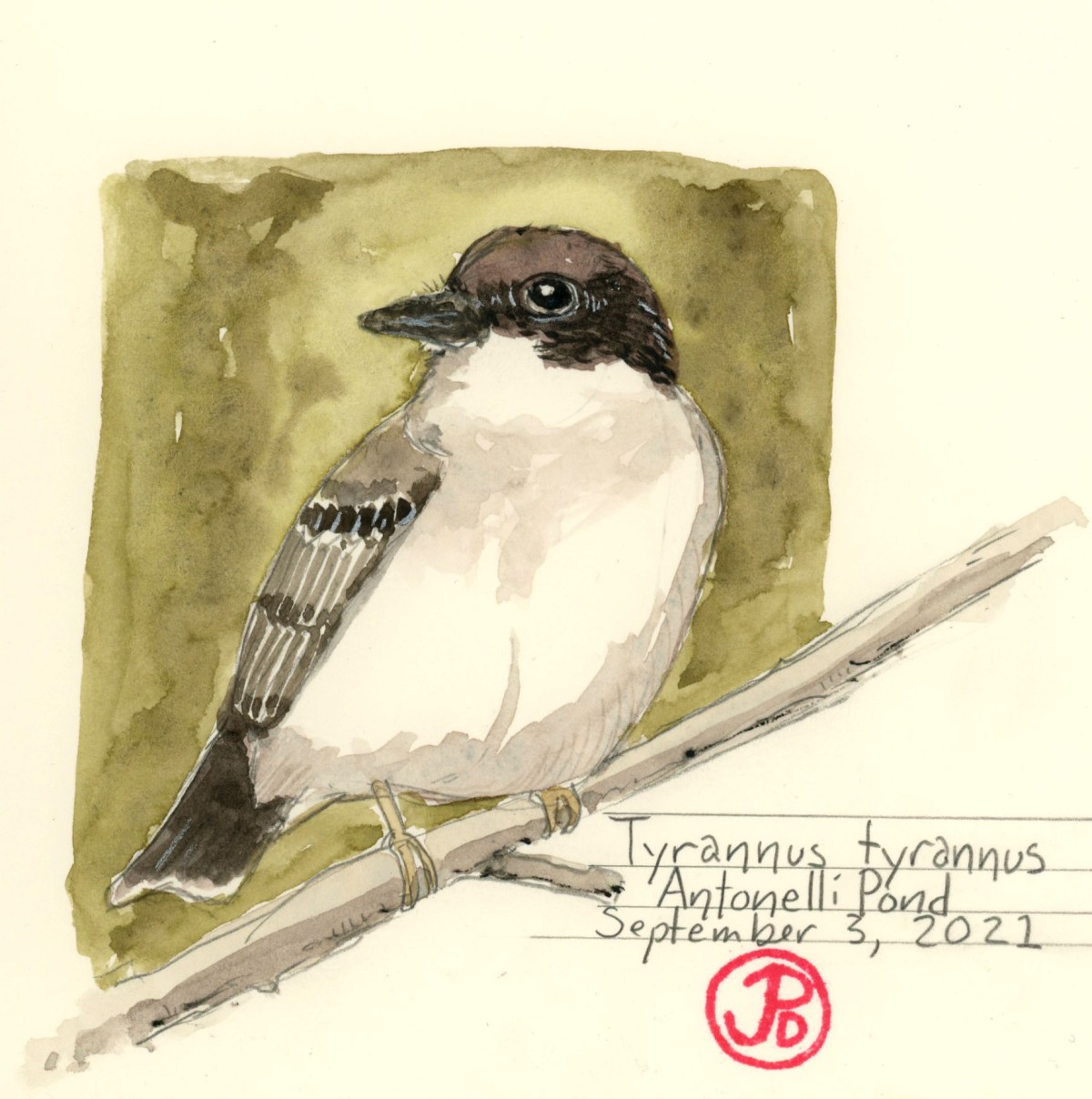
On a Monday, Trrannus tyrannus was first seen in a coffeeberry bush (Rhamnus californica) in the northwest corner of Antonelli Pond in Santa Cruz’s westside. I just hoped this county rarity would stick around until Friday when I could get down the coast to look for it.
The Eastern kingbird, like it’s name implies, breeds on the eastern side of the United States. This kingbird is a neotropical migrant where it spends winters entirely in South America. On their winters grounds, the kingbird travels in flocks and eats berries. (In the north it feeds mainly on insects taken on the wing).
Tyrannus tyrannus, means “tyrant, despot, or king” (take your pick) is named for the kingbird’s aggressive behavior during breeding season. While defending their nesting territory, they will attack birds that are much larger than itself, including hawks, great blue herons, ravens, crows, and even squirrels. There have been reports of kingbirds landing on the back of hawks and vultures, pecking and pulling out feathers. This is the King of Tyrants with a major Napoleon Complex.
So at about five PM I found myself in the northwest corner of Antonnelli Pond reflecting on the long journey this 40 gram bird had made, from the Amazon, eating fruit in flocks to it’s long journey up the Pacific Coast to forage for a few days near a pond in Santa Cruz. So far the coffeeberry bush was sans kingbird.
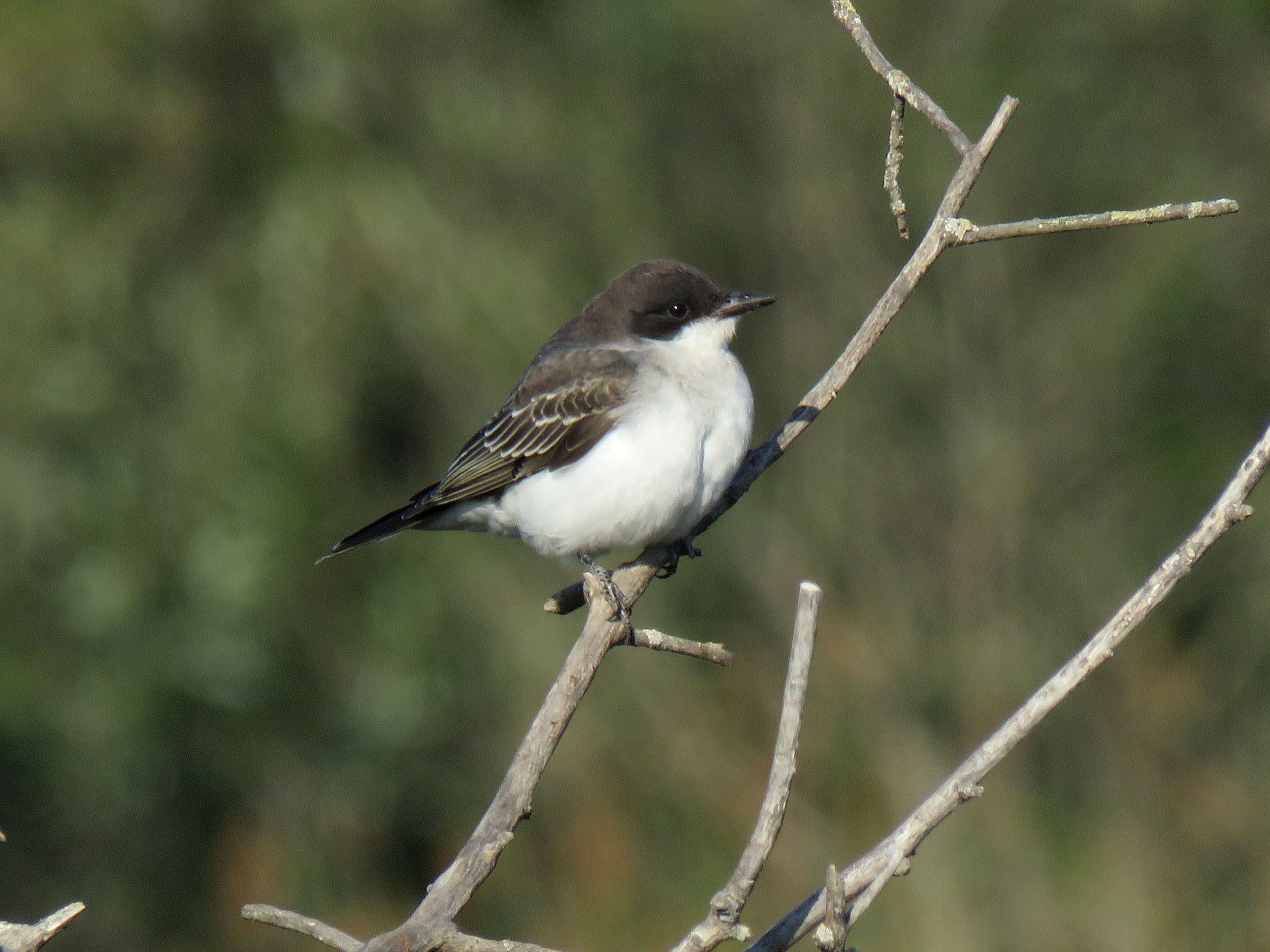
After about a 15 minute wait, a pied bird flew from the north into the bottom of the bush. I attempted to flank the bird to identify it as the wayward tyrant. A bird shot up from the bush, dark above and light below was a fine white border on it’s tail, Bingo! Eastern kingbird! The bird flew to a chain linked fence that bordered the Homeless Garden, where I was able to get a few distant photos.
A common perch for a kingbird: a fence.
The kingbird foraged for a bit in the garden and then flew back and landed on top of the coffeeberry bush in perfect late afternoon light, so I had to take a few photographs to confirm it’s misplaced existence. It stayed on it’s perch for a few minutes and it then flew across the pond and my encounter with the wayward (is their such a thing in nature?) eastern kingbird was over.
The eastern kingbird in great light, showing off it’s kingbird profile.
Often when we are looking for one thing in nature we see so much more. This was the case on Saturday morning, when I returned to Antonelli Pond to look for the eastern kingbird again (and the willow flycatcher that had also been report). While the coffeeberry bush was lacking a kingbird, some movement in the brush in front of me caught my attention.
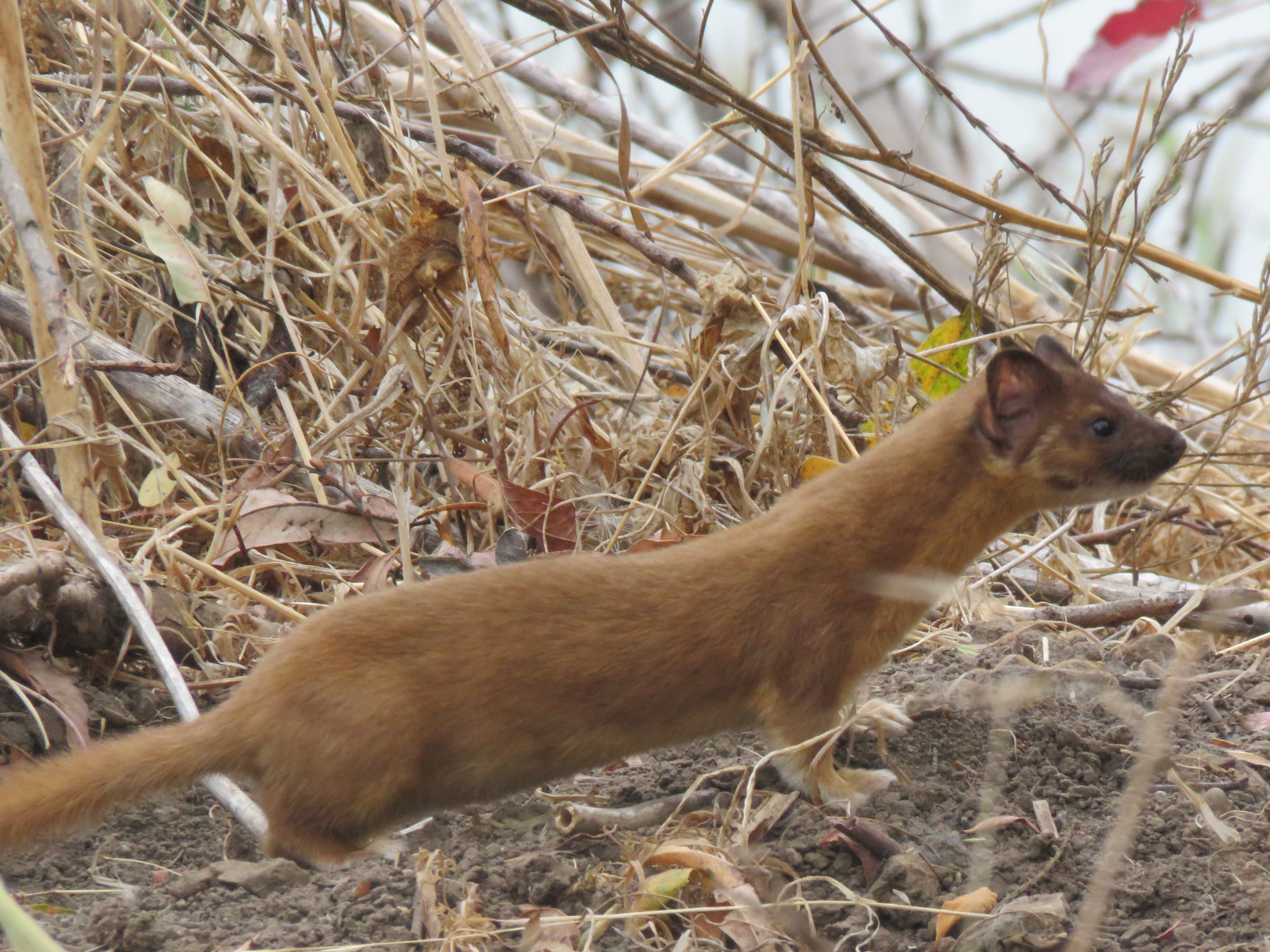
A caught a glimpse of a long mammalian predator. I wanted to entice it out to get a better look so I did my best impersonation of a wounded rodent (I was thinking mouse) and within seconds, it’s snake-like head, ears alert, appeared out of the brush. It was almost licking it’s deadly teeth with delight (I call anthropomorphism on myself!)
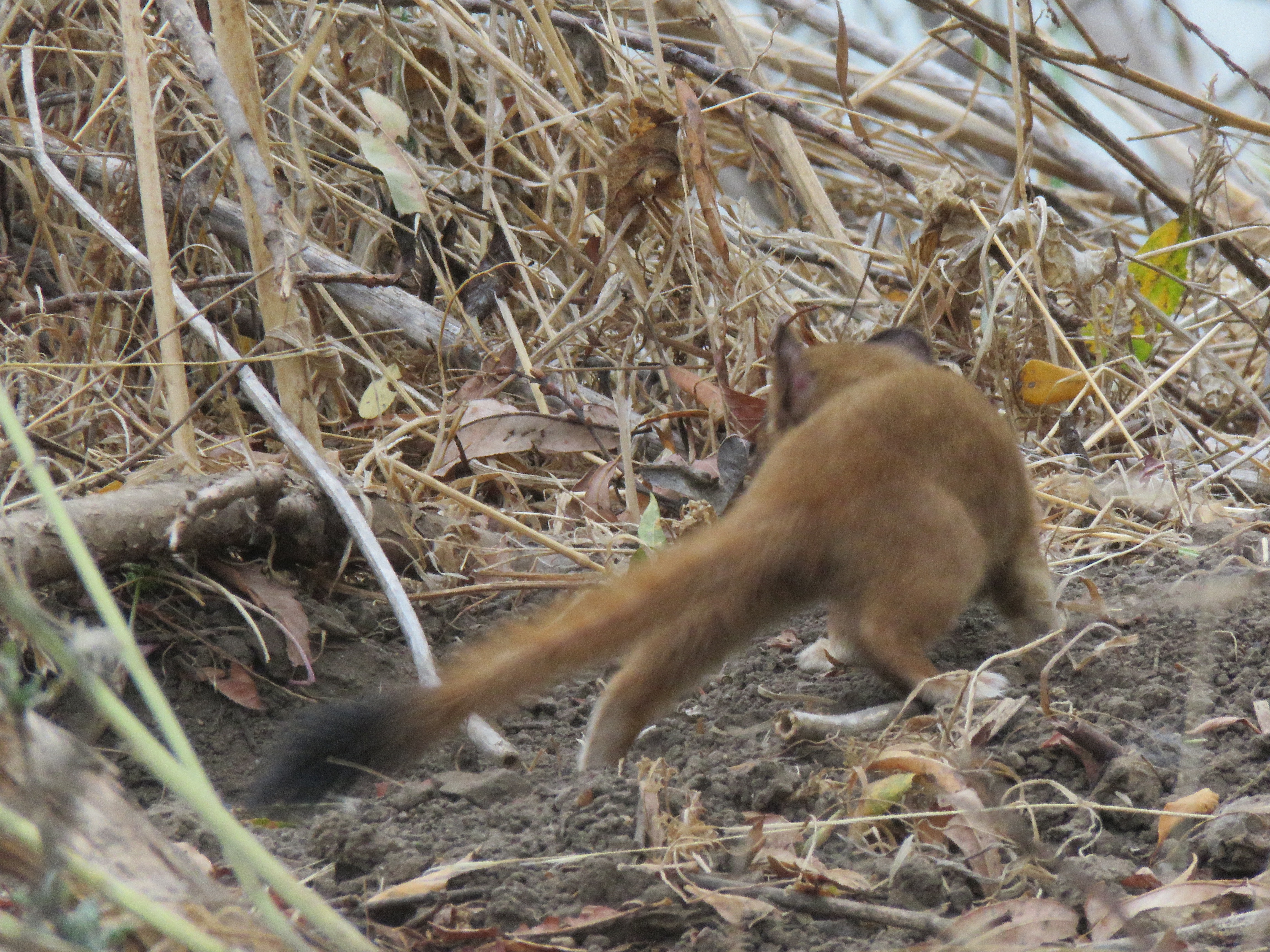
It was a long-tailed weasel (Neogale frenata)! I had seen this predator on two other occasions but both sightings (at Wilder Ranch) were fleeting and I just got a flash of it’s dark-tipped tail as it disappeared into coyote brush.
The long-tailed weasel is an aggressive predator which can take prey twice it’s size such as rabbits and squirrels. On one occasion at Wilder Ranch on the Old Cove Landing Trail, a weasel was hunting bush rabbits and I heard a lagomorphic scream that was hard to forgot. I was not sure if the weasel’s hunt was successful.
The long-tailed weasel, coaxed out of the brush with my wounded rodent impression.The long-tailed weasel showing off it’s black-tipped tail.
A few years ago a friend, who is a Civil War enactor, told me about the men who sketched Civil War battles, as they happened! He asked if I wanted to suit up and sketch one of their reenactments.
I didn’t get a chance to go back in time and sketch a “battle” but the idea of a sketcher that followed an army and pulled out a pencil and paper when battle erupted, truly intrigued me.
The age of photography was at least 30 years old by the time of the outbreak of the Civil War. However it was not a good medium for capturing a battle. The reason for this was that the camera had to be on a tripod and subjects had to hold still because of the long exposures necessary to expose an image on a glass plate. That is why many photographs of the Civil War generals or soldiers are of seated and sometimes standing, in rigid, staged poses. The other common photographs are of the dead, after a battle (the dead hold still, really well).
A photograph of dead soldiers at Gettysburg taken after the battle. (Tim O’ Sullivan/ Library of Congress)
Photography proved to be an unsuitable medium for capturing a battle but a field sketch could be done quickly and then the field sketch would be sent back to New York and turned into an engraving, creating plates for illustrated newspapers.
One of the most notable Civil War Sketchers was Alfred Waud. He was born October 2, 1828 in London. As an art student he studied to be a marine painter. In the end he did not pursue this style but instead he painted theatrical scenery. Waud sailed for New York in 1850 in pursuit of work.
Waud is most well known for following the Army of the Potomac and sketching every battle from the first Bull Run to the Siege of Petersburg in 1965. During this time he worked for the New York Illustrated New and then he 1861, he sketched for Harper’s Weekly.
Waud’s sketch of the death of General John Reynolds at Gettysburg.
Waud was only one of two artists to sketch the Battle of Gettysburg, the bloodiest battle in the Civil War and the turning point of the conflict. His sketches of Pickett’s Charge, on July 3, 1863, is thought to be the only visual account by an actual eyewitness.
Waud’s illustration of Pickett’s Charge showing Lewis Armistead leading his men, hat on sword. This was the fartherest advance by the rebels during the entire Battle of Gettysburg. Armistead was shot and died a few days later.
Waud’s sketch of Warren, surveying the lay of the land at Little Round Top at Gettysburg, July 1863.
“What we need to remember most of all is that the Civil War is not over until we, today, have done our part in fighting it, as well as understanding what happened when the Civil War generation fought it.” -Barbara Fields.
The Civil War. What a daunting episode in our nation’s history.
It is so daunting that it took me a long time to get around to read about it. And reading about it, takes real time and commitment. For example, Shelby Foote’s account of the war is told across three volumes and over 3,000 pages. The Civil War is the most written about event in American History. The estimate is around 100,000 volumes about out National bloodletting. The President of the Union, Abraham Lincoln, is the most written about historical figure, coming only second to Jesus. About 15,000 books have been written about Honest Abe. Where do you have the time? And where do you even start?
The impetus for me, was my late brother Greg. Greg was an educator of American History and a voracious reader of American nonfiction. One summer we decided to read a book that had been sitting on our book shelves for a while, gathering dust. It was yet another biography of Lincoln. But this one, had been hailed as the latest and greatest history of our 16th, and perhaps our greatest presidents. The book: David Herbert Donald’s Lincoln.
Over the summer we held our unofficial book club over the phone. We discussed Lincoln and his times and the events that shaped his presidency. Greg had to fill me in on many of the details of the Civil War. Now here was a huge void in my understanding of American History. I had avoided delving into the Civil War partly because of it’s overwhelming scope and breath as a subject and also because it seemed to be a blotch on our national character that was uncomfortable to face head on. How could it be that a nation called the “United” States of America be so ununited? (Sounds very contemporary I know!)
I wanted to read more about the Civil War and my brother suggested a very enjoyable read: the narrative and fictionalized historical account of the Battle of Gettysburg: Michael Shaara’s The Killer Angels.
After reading the Lincoln biography and Shaarra’s masterpiece (which inspired the film Gettysburg) I asked my brother for a reading recommendation for the best single volume account of the Civil War. I wanted to understand the times and context of the Civil War without taking a lifetime to read about it. Greg’s response was Battle Cry of Freedom by James McPherson.
I bought Battle Cry of Freedom and like any great or important undertaking, it sat on my bookshelf awaiting the first turn of it’s 909 pages. I thumbed through the pages and looked at the photos but I could not bring myself to take the first step on this long journey of learning.
Then on April 5, 2021, Greg died.
His death was the impetus to finally start reading about our nation’s greatest struggle. I spent the summer reading Battle Cry of Freedom. This masterpiece covers the causes of the Civil War as well as focusing on the people who fought it and it’s battles.
I realized that to really understand the Civil War, you had to visit some of the battlefields. And the the one battlefield that seems to rise above the others is Gettysburg, the battle that became the turning point in the war. (spoiler alert: the North won).
I planned to visit Gettysburg and a few other battlesites in Pennsylvania, Maryland, and Virginia. And before I take any trip, I do a bit of sketching.
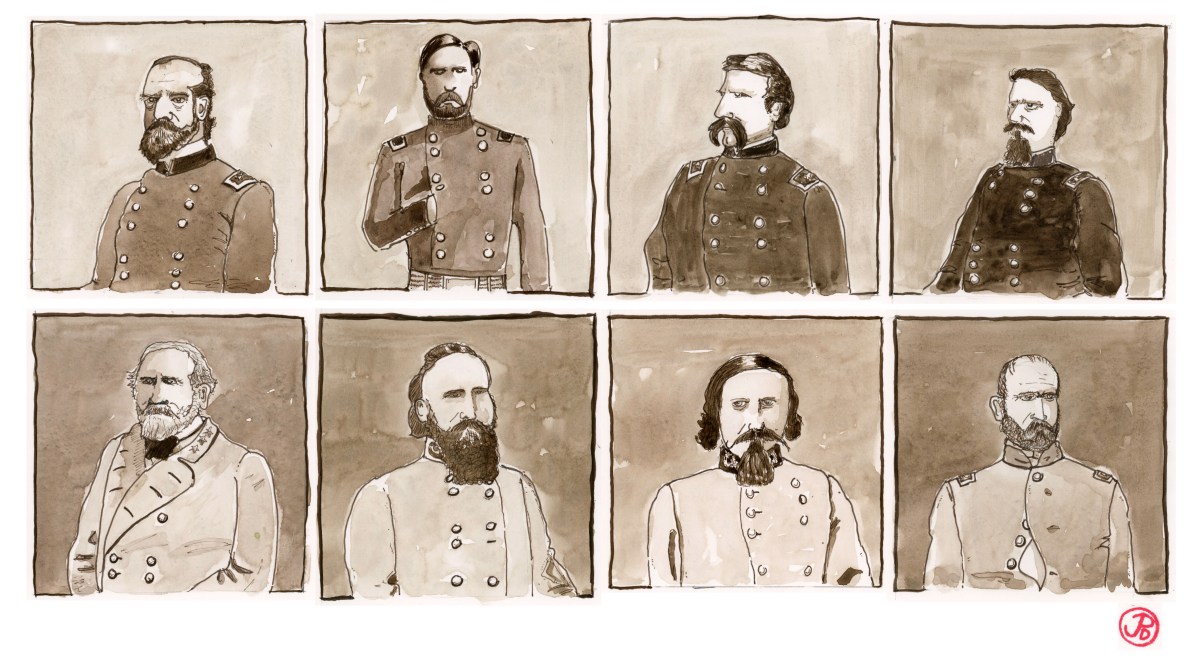
This time I want to sketch the Dramatis personae of the Battle of Gettysburg. Four from the North and four from the South.
By the time of the Civil War, portrait photography was popular and many of the generals, North and South, sat to have their portraits taken. All off my sketches were draw from these portraits.
The Portraits
The North (Left to Right):
Maj. Gen. George G. Meade, head of the Army of the Potomac. Meade became the commander of the Army of the Potomac just three days before the first battle at Gettysburg. Meade’s horse “Old Baldy” was injured during Gettysburg but survived the General to participate in the general’s funeral procession in 1872.
Maj. Gen. John F. Reynolds of the First Corps. Reynolds fought in the Mexican War become friends with Winfield Scott Hancock of the North and Lewis Armistead of the South.This Pennsylvanian was killed on the first day of battle on July 1, 1863. He was a friend and had served under General Meade.
Col. Joshua L. Chamberlain of the 20th Maine. He is know as the Fighting Professor and the hero of Little Round Top for his heroic bayonet charge. Chamberlin taught at Bowdoin College where he was not aloud to enlist, but went on a leave of absence and enlisted anyway. He is one of the key figures in Michael Shaara’s The Killer Angels. Chamberlain suffered six wounds during the Civil War, eventually dying of them in 1914. He is said to be the final casualty of the Civil War.
Maj. Gen. Winfield Scott Hancock of the Second Corps, was fighting in his home state of Pennsylvania. During the fighting in the Peninsula Campaign, he received the nickname, “Hancock, the Superb”. He was wounded on the final day of the Battle while defending Cemetery Ridge against Pickett’s Charge.
The South (left to right):
Gen. Robert E. Lee, Commander of the Army of Northern Virginia. Lee was born in Virginia in 1807. In 1829, he graduated from the US Military Academy, second in his class. He married Mary Anne Curtis and he moved into her family estate home in Arlington, Virginia, later to become Arlington National Cemetery, first opened to bury the Civil War dead. In 1861, Lincoln offered Lee the command of the U.S. Army, he refused and on April 20, 1861, resigned his commission and fought for the South. Lee was a brilliant strategist in the Civil War but the Battle of Gettysburg proved to be his Waterloo.
Lt. Gen. James Longstreet, Commander of the First Corps. Nicknamed “Old Pete” Longstreet served in the Mexican War with many of the men he would be fighting against during the Civil War. Longstreet disagreed with Lee’s tactic on the third day at Gettysburg. He was reluctant to send men forward in what became known as “Pickett’s Charge” because he believed it would fail, which was ultimately the case.Longstreet became a critic of Lee after the war.
Maj. Gen. George E Pickett, head of Pickett’s division in the First Corps. Ranked last in his class at West Point, Pickett served in the Mexican War with Longstreet. The flamboyant Pickett lead the charged on the Northern position on Cemetery Ridge loosing almost his entire division in the process. On their retreat from the charge, Pickett encounter Lee and the General asked Pickett to rally his division for defense, to which Pickett replied, “General Lee, I have no division.”
Brig. Gen. Lewis A. Armistead, came from a military family. He was a West Point drop out that learned his trade during the Mexican War. During the last day of Battle of Gettysburg, Armistead led his Brigade, hat on sword, and made the deepest advance on the Northern lines, becoming mortally wounded in the process. The wounded General was misidentified as Longstreet and under a truce flag on July Fourth, a Northern messenger encountered the very much living Longstreet letting him know that the General “would be taken care of”. Old Pete “told the messenger he believed he could take care of himself quite well”.
The Mendocino County Coast is a sketcher’s paradise with many interesting buildings, coastal views, and flora and fauna (who doesn’t love sketching coast redwoods?).
I have sketched many buildings in and around Mendocino and there are infinite subjects to sketch in this area.
In Ft. Bragg I walked out to Glass Beach. The rock formations appealed to me and I did a loose brush pen sketch from my folding sketcher’s chair (featured sketch). Sketching these rocks was recording a moment in time because the sea coast is always in a state of flux. Rocks crumble and reform, arcs collapse and the unrelenting tide shape and sculpt the coastline.
There seemed to be more common ravens in Ft. Bragg the I remember before. These very intelligent and adaptable birds have been expanding their range along the coast. As I was sketching I was watching these large corvids (the world’s largest songbirds) foraging among the rocks and seaweed like a black oystercatcher. I even slipped one in on my sketch.
I headed south to the scenic and historic town of Mendocino. Here a had a building in mind that I wanted to sketch. This building was built in 1901 by Portuguese settlers and as it turns out, it is the largest hall in the town of Mendocino. This is Crown Hall.
Crown Hall is on a side street (Ukiah Street) that parallels Main Street. The hall can be rented out for weddings and other events. The building features a kitchen, a bar, and a stage.
The stage is what really attracted me to doing a sketch of Crown Hall. This was a venue used by a legendary Northern California folksinger, Kate Wolf. She preformed at various locations in Mendocino and the last Kate Wolf recording released, Live in Mendocino, features live recordings from concerts in Mendocino County, including a concert at Crown Hall in 1982.
Kate Wolf was born in San Francisco in January 27, 1942. When Kate was 27, she visited Big Sur and heard locals playing music in their living rooms. So inspired, she moved to Sonoma County and stared writing and performing music in local bars.
Kate’s following grew in the 1980’s and she performed all around the Golden State and was even featured on the music show, “Austin City Limits” and on the radio show “A Prairie Home Companion”. In 1981, Kate released “Closer to You”, which is probably her best album featuring her own compositions. In 1983 she release the live album “Give Yourself to Love”, the title track becoming one of Kate’s most well known songs.
Sadly, Kate Wolf died at the age of 44 on December 10, 1986 after a long battle with leukemia. In her honor, the Kate Wolf Music Festival was held in June of 1996 in Sebastopol. Since 2001 it has been held at Black Oak Ranch in Laytonville, ca. The three or four day music festival traditionally ends with a cover of “Give Yourself to Love”
I included the first verse and chorus of this song to my sketch.
For my second road trip of the summer, I chose my base camp: Fort Bragg on the Mendocino County Coast. I knew that one adventure I wanted to experience was a ride on the Famous California Western Railroad, also known as the Skunk Train.
The Skunk Train runs from Ft. Bragg to Willits, a train journey of 40 miles. A round trip of seven hours. The former logging railroad crossed 30 bridges and trestles and travels through two long tunnels.
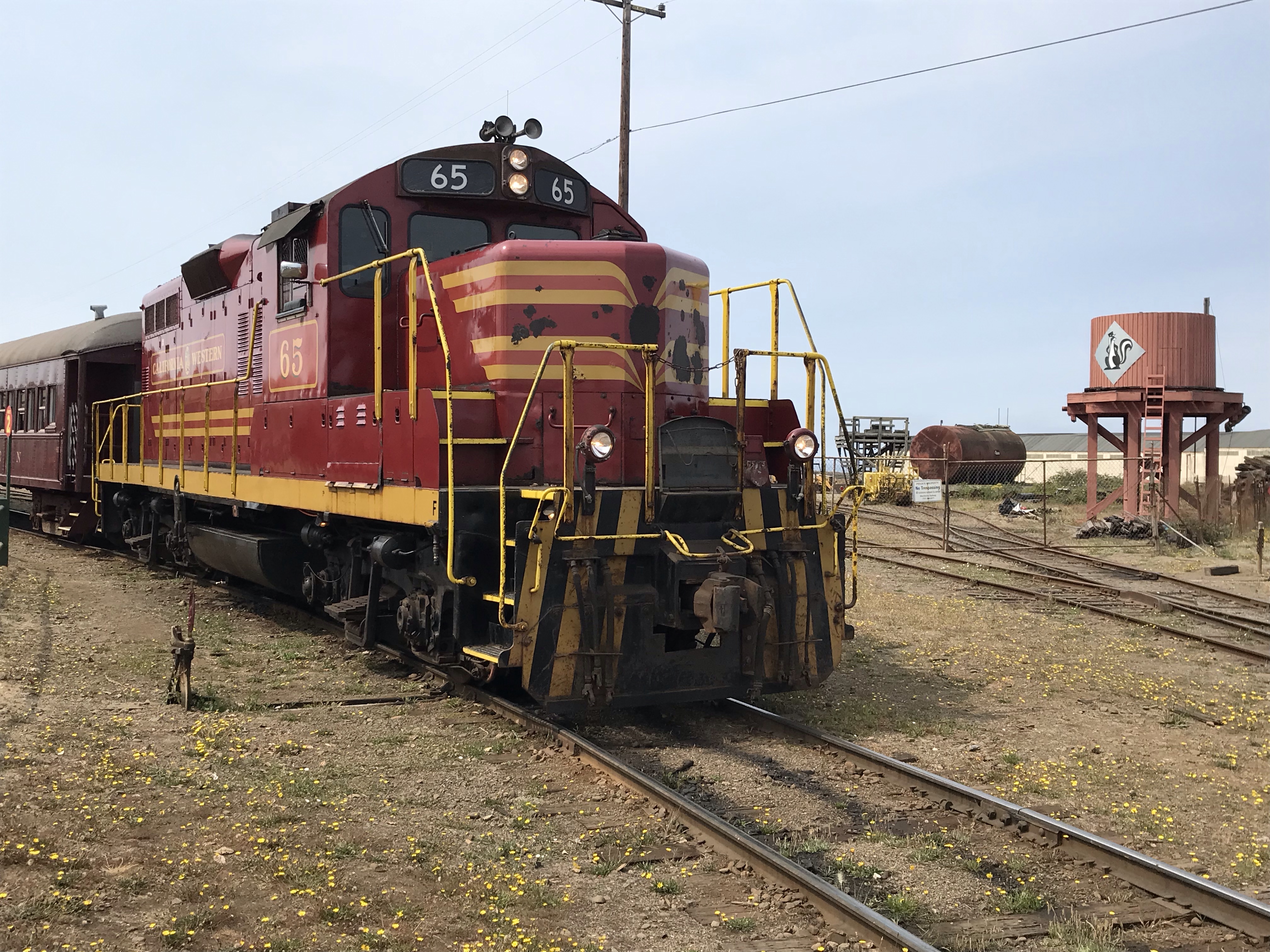
The Skunk at Ft. Bragg. The water tower is for No. 45, a Mikado steam locomotive. Our train (No. 65) was pulled by a former Southern Pacific GP9 diesel built in 1955 by EMD.
The Skunk is a poor reflection of its former self because of the April 11, 2013 partial collapse of the 1,200 foot Tunnel No. 1. The tunnel was built in 1893 and it is in an area known for hill slides. This means that the Skunk Train only runs from Ft. Bragg to Glen Blair Junction, a distance of 3.5 miles. It seems like just when the train gets going, it stops 30 minutes later.
The railroad has also been without an operable steam locomotive. The 2-8-2 No. 45, was built by Baldwin Locomotive Works in 1924. The locomotive is currently being restored and may be once again under steam in the upcoming year.
The end of the line, for now. Plans are underway to open the line in about a year. In the background is the western portal of collapsed Tunnel No. 1.
It is a pleasant ride on the “Pudding Creek Express”, although “express” is hyperbole of the highest order! I chose to get out and explore the area and then catch the second train back to Ft. Bragg. There are a few hiking trails and I hoped to get in a few sketches before the train returned, so I had time to sketch and paint and had extra time to let the paint dry!
I started by sketching the caved in western portal of Tunnel No. 1. The tracks were covered in dirt and rocks filled the entrance. Vegetation was growing up, almost threatening to cover the portal. A train has not passed through here in almost eight years. A maintenance worker told me that they hoped to have the tunnel open in about a year. I’m not sure they could move a mountain but I’m sure that have the funds and the manpower to clear a tunnel.
Motor car M-100 at Willits, facing west towards Ft. Bragg.
On the following day, on a flight of fancy, I decided to drive to Willits to see the eastern end of the line. From Coastal Ft. Bragg to Willits was about an hour with temperature difference of about 30 degrees! I pulled up to the beautiful redwood station in time to see the eastern Skunk pull into the station. The Willits train is a two hour,16 mile, round trip. This trips travels to the highest point on the line (1,740 feet) and travels past the “”Wolf Tree”, a large coast redwood.
The line at Willits is isolated from the Ft. Bragg side of the railroad because of the collapse of Tunnel No. 1 so what ever motive power and cars are what ever was here, prior to April 11, 2013.
On the Ft. Bragg side of the line sits the Motor car M-300 (sketched in the featured sketch). These gas powered cars where used for passenger service in 1925. These motor cars gave the railroad it’s name, because the locals named the cars “skunks” because, “you can smell ’em before you can see ’em.”
The M-100, which is on a siding in Willits, was built by the Edwards Rail Car Company in 1925. It is still operable and used when ridership is down instead of using a diesel with passenger cars.