Image

Sketch Poetry

Poetry frequently makes it’s way into my journal.

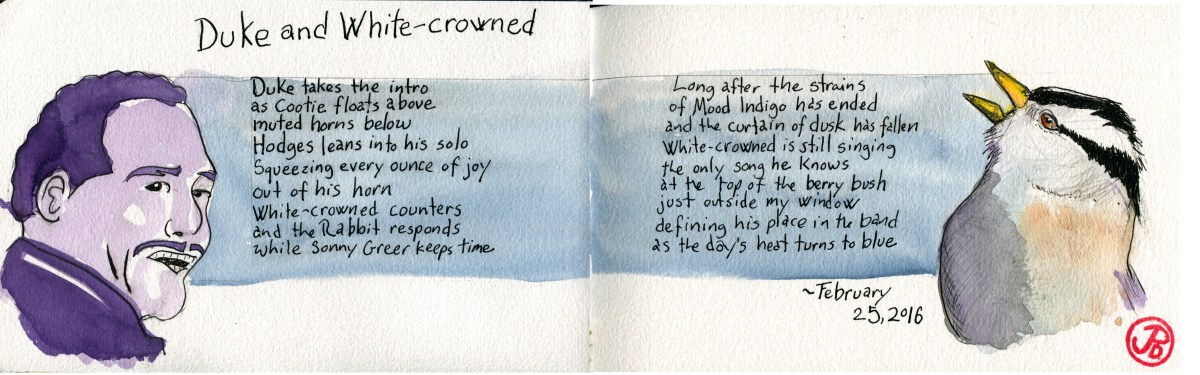
One afternoon I was listening to one of my father’s Duke Ellington CDs, a CD that I had gotten him for Christmas a while ago. My father loved big bands and he saw Ellington, Basie, and Ella as well as west coast greats Brubeck, Cal Tjader, and Vince Guaraldi. It was one of those beautiful February afternoons where the trees have blossomed early and the White-crowned sparrows were singing at the tops of trees to mark out their patch. It seemed to me, and the sparrows, that it was a spring day. As I was listening to Ellington the white-crown in the backyard seemed to be singing with the band so I wrote a poem about it and created a spread.

Duke and White-crowned

Duke takes the intro

as Cootie floats above

muted horns below

Hodges leans into his solo

squeezing every ounce of joy out of his horn

White-crowned counters

and the Rabbit responds

while Sonny Greer keeps time

Long after the strains

of Mood Indigo had ended

and the curtain of dusk has fallen

White-crowned is still singing

the only song he knows

at the top of the berry bush

just outside my window

defining his place in the band

as the day’s heat turns to blue.

I added two illustration as “bookends” to the text, one was sketched from the Ellington CD cover and the other was from a photograph of a white-crowned sparrow.

Condor

This spread was about my experience watching California condors at Grimes Point in Big Sur. it was a magical day with about ten condor perched by Highway One. The drawing is based on a photograph that I took and the condor’s massive wingspan seems to span the coastal hills in the background. I wrote a poem about the condor, included underneath it’s wings.

Bee

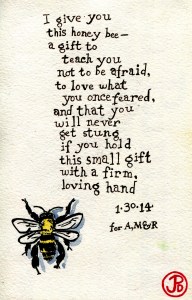
This poem is about my philosophy of nature, that we should not fear nature but embrace it. The poem is dedicated to three of my students as I taught them not to fear the honey bee. During recess on day, I found a bee on the blacktop and I picked it up and showed my students that they had nothing to fear. I then let the bee crawl on their hands and they learned that if you treat nature with respect and acted with confidence the bee will not cease its life by stinging you. I don’t think that lesson is a California State Standard!

Leaves

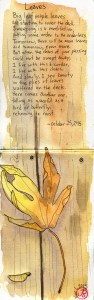
This spread was created to illustrate a poem I wrote shortly after my fathers passing in October. It’s really about accepting what life has dealt you and coping with change.

Image

Life List

We all seem to like making lists. Ingredients for a new recipe, the starting line for a football match, our favorite books or records (a top ten list) or the list of friends we want to invite to a dinner. The list goes on for ever.

And birders are absolutely obsessed with lists. Life list, country list, state list, county list, backyard list, room list, car list, bike list, or walking list. I have never been too obsessed with lists and the list that is most important to me is the number of species of birds I have seen in the United States, because birds do not recognize country, state or county lines. I am currently one bird away from 500 North American birds. I wonder what No. 500 will be?

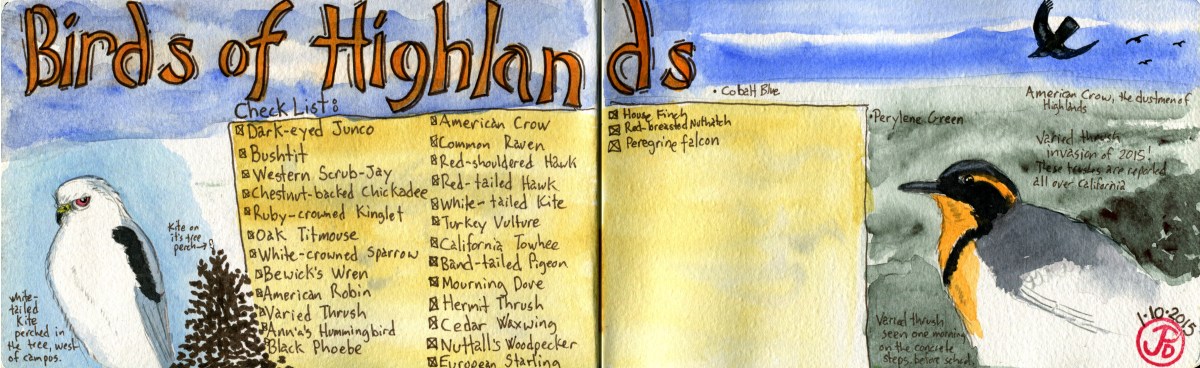
I have recently kept a school list, that is, all the species of birds seen from my school site. The birds could be on the green field, in the trees and bushes, or high above. The only criterion is that I have to see the bird with my feet firmly planted on campus in order to put the bird on the school list.

Let me give you an example of a bird that I was not able to put on my list. One morning as I pulled off the freeway and turned left over the overpass, I spotted a raptor circling off to the south. I pulled off, grabbed my binoculars from the trunk and focused on the raptor catching the warming air off the roadbed. The bird came into focus: adult bald eagle!

I rushed back to the car and headed up the hill to school. Pulling into the parking lot I scanned the horizon for the eagle. My view was obscured by houses and trees. Despite my search, I could not add bald eagle to my school list. But I tired.

What drives a man to want to put a bird on a list?

One of the main problems with listing is that birding becomes more of a sport than an encounter with nature. It becomes simply ticking off a name on a list rather than a celebration of recognizing a bird, that bird, turning on that branch above my head. A birder might say, “It’s just a robin.”  And master birder Rich Stallcup would reply, “ Yes but have you seen that robin?” There is much that is lost with listing and I have been guilty as any birder.

My current school list sits at 28 species. Bird 28 came one morning before school. I was on the yard asking a colleague a question when I looked up, as I am prone to do when I am out doors, an I saw the helmeted flying crossbow. I pointed skyward  and yelled to any students that were within earshot, “Peregrine!” School list bird #28. Can I get an witness, Amen?

Once you travel outside the United States, the world of listing takes on a whole new, a massive, perspective. Now you are in the realm of World List! There are currently about 8,669 bird species on planet Earth. So I have a lot of  birding to do.

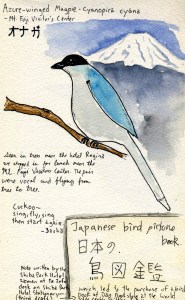
My first experience birding outside of the States was a 2008 trip to Japan. I was not really birding because I left my binoculars at home but there was a freedom in birding with my brown one by ones. I was not on this trip to bird but once you start to bird you can’t take your eyes and ears off of birds. On this trip I, for the first time, used a Moleskine watercolor sketch book, and I have fallen in love with the format ever since. The following three sketches came from the life list that I kept in my Moleskine.

AW Magpie

The azure-winded magpie has a very odd distribution. It is found in Japan, where I saw it, and it is found in eastern Asia and there is an island population in southern and central Spain. I will see the bird again at the end of March as I will be going on a birding trip to Spain.

Bush Warbler

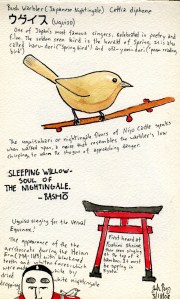
There was one bird which I desired to hear more than any other bird in Japan: the bush warbler (Japanese nightingale). This bird is celebrated in Japanese poetry, prose, and film as the harbinger of spring. I finally heard the bird in Kyoto at the beautiful Fushimi Shrine on my final morning in Japan. I first heard the unmistakable call and I rushed over the where I finally spotted the drab bird calling in a tree.

I added that bird to the world life list!Tree Sparrow

The tree sparrow was an ubiquitous bird in Japan.

Image

PEFA

“No flesh-eating creature is more efficient, or more merciful; it simply does what it was designed to do.”

-J. A. Baker

On one Saturday I was birding Natural Bridges State Park when I saw a bird in direct flight. Stiff wingbeats, with prey clutched in it’s talons. It perched in the top of a Monterey pine at the back entrance to Natural Bridges. I knew what the bird was and I headed closer to affirm my hunch and see what it had taken for it’s mid afternoon repass. Dark helmet with sideburns, a bird that is affectionately called “Elvis” by hawk watchers on Marin Headlands Hawk Hill. Peregrine Falcon, Falco peregrinus, the fastest animal on planet Earth.

Continue reading

Image

The Butcher Watchman and the Cackler

It is not often that I get two life birds in California in one day but bird migration in the winter can always bring surprises.

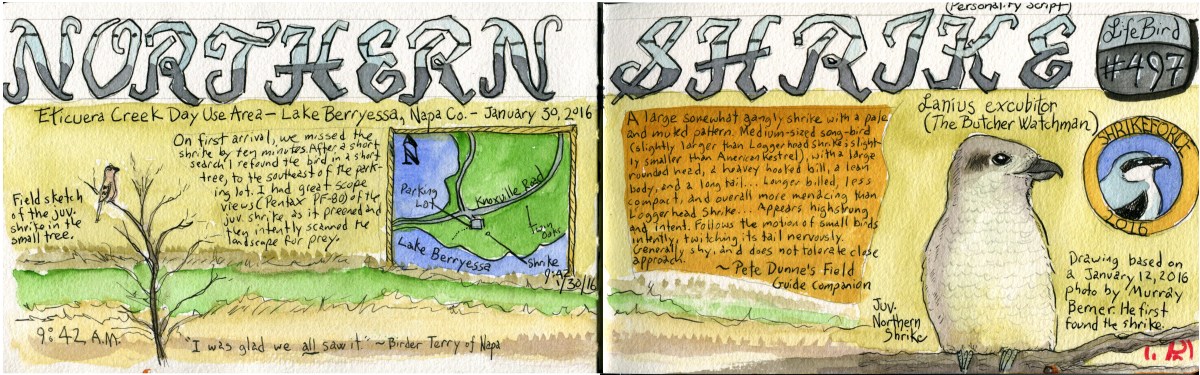
A very unusual songbird had been found on January 12, in remote Napa County on the northern edge of Lake Berryessa. The bird was unusual for two reasons. First that it vacates it’s northern breeding grounds and winters in southern Canada and northern United States. A few strays wander into California making it a rare winter visitor. The second reason this bird is unusual is that it is a predatory songbird that preys on large insects and small birds and rodents. Its scientific name is Lanius excubitor, which translates to butcher watchman. It is also known by the nickname, “butcher bird” for its habit of impaling its prey on thorns and barbed wire fences. In North American this bird is call northern shrike and in Europe it is the great grey shrike.

In any case this was a bird I had struck out on for years and now early on a Saturday morning I met my fellow member of the Shrikeforce Expedition 2016 and headed to the beautiful curvatous, oak-studded hills of north eastern Napa County.

Our destination was the Eticuera Creek Day Use Area. The shrike had been seen from the parking lot. Upon arrival there were three birders scanning the area. They had just had the bird which was good news but it hadn’t appeared in the last ten minutes. It had been seen in a  pair of valley oaks that crowned a low green hill. We searched the bare branches without success. I then followed the line of the hill downslope, pausing at every snag and branch to look for the shrike. I stopped at a lone small tree, nothing. Then I was distracted by a kestrel and a crow, dive bombing a red-tail in an oak across the road. I returned to the scanning the hillside starting again from the twin oaks down towards the small tree, and that’s when I saw a bird. It looked like an oversized paler version of a western scrub jay perched in the upper left hand side of the small tree. I pointed the bird out to the other birders and their scope view confirmed: juvenile northern shrike! Life bird No. 497!

To commemorate this life bird  I created a spread which I started in the parking lot with a field sketch (lower left). Once at home I needed a font that would be menacing enought to represent this predatory butcher bird. I found the font in my much used Dover book Rustic and Rough-Hewn Alphabets by Dan  X. Solo. I chose Personality Script because the shrike has a killer personality. I then wanted to sketch an image of the shrike, which I found on ebird, taken on the day it was found by the birder who found it. I included a quote from the Bible: Pete Dunne’s Field Guide Companion. I also included a map (not to scale) of Northern Lake Berryessa and the parking lot area.

Cackling

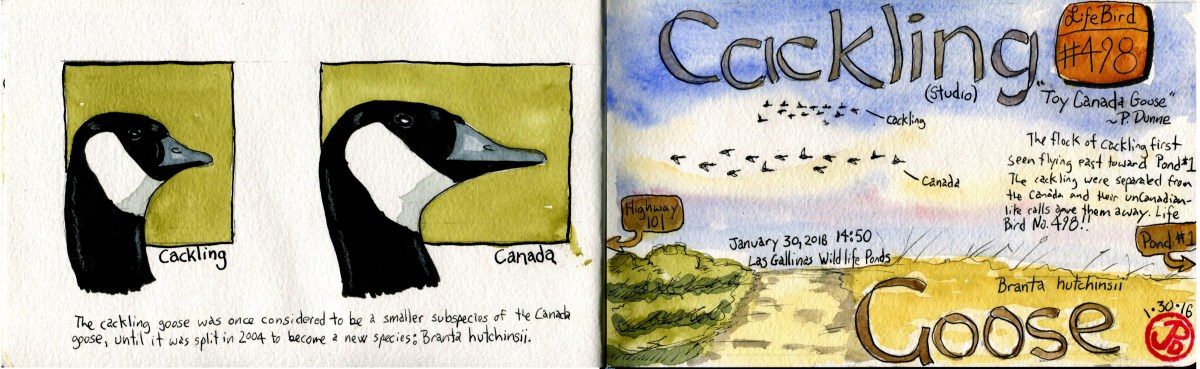
My second lifer of the day was picked up on the way back at Las Gallinas Wildlife Ponds (see previous post). This lifer I have seen before but prior to 2004, it was considered a subspecies of the Canada  goose. It is now recognized as it’s own distinct species and given the name cackling goose.

Coda:

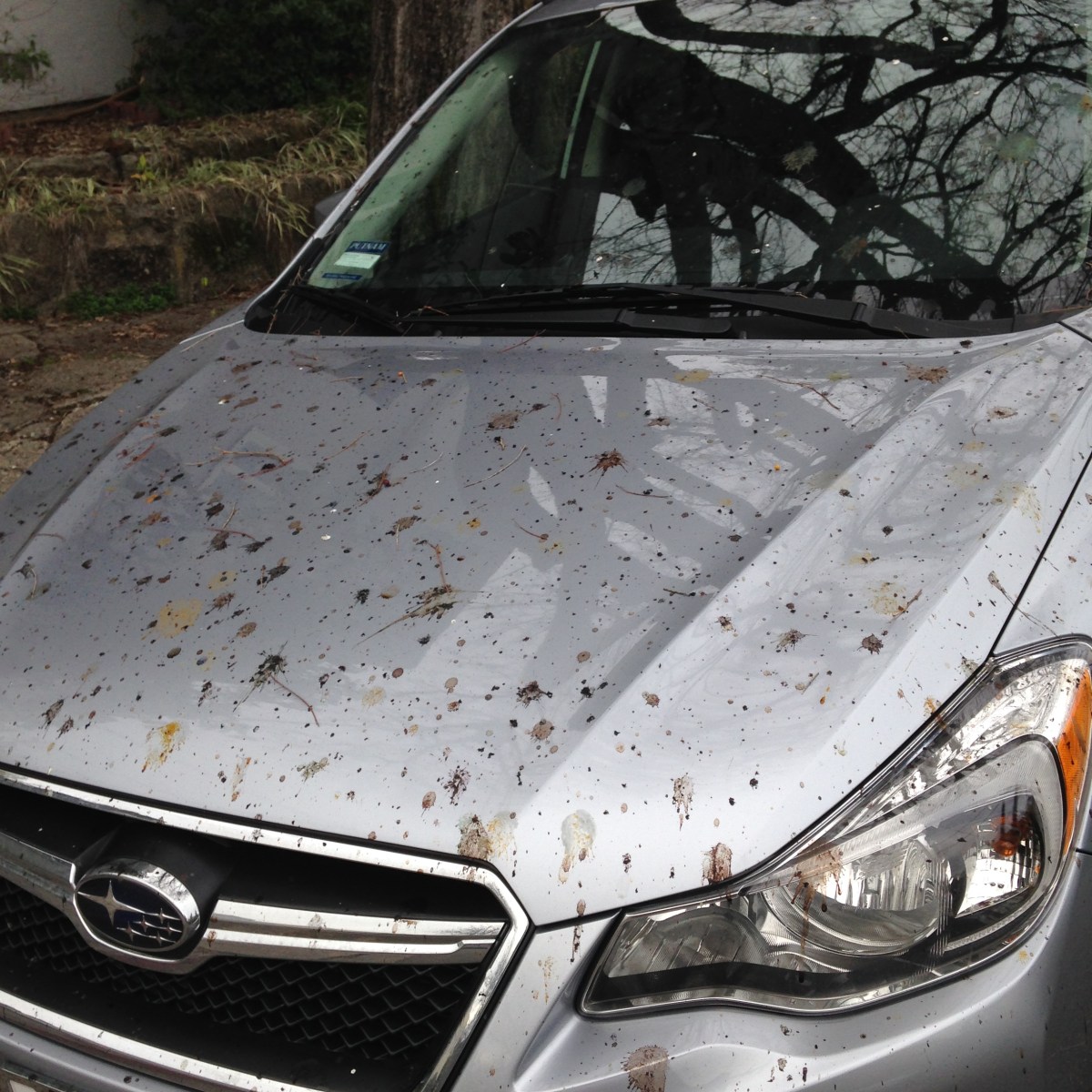
As if the Avian Gods hated my car enough I returned to Marin to find that a large flock of American robins and cedar waxwings gave my brand new car a new “paint” job. But in the end it was worth it for a northern shrike and a flock of cacklers!

IMG_4030

Image

A Needle in the Haystack

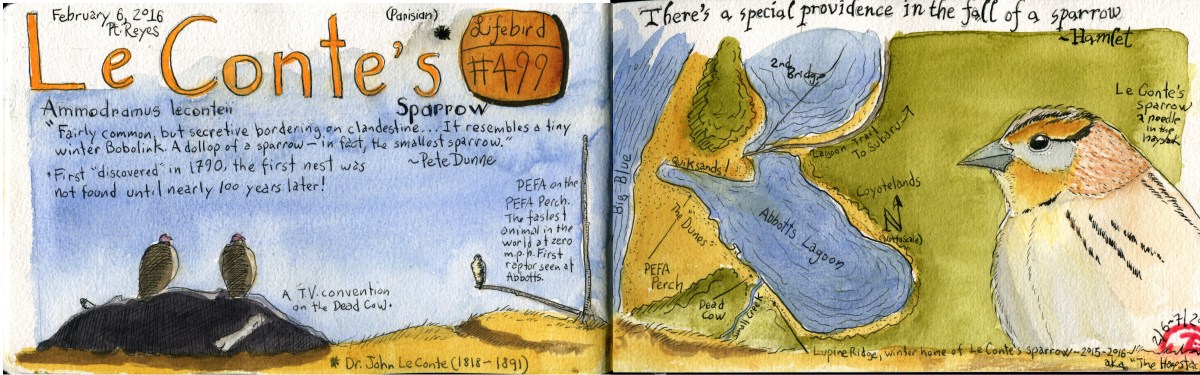
The haystack is the lupine and coyote brush of the southern shore of Abbotts Lagoon in Pt. Reyes National Seashore. The needle is North America’s smallest sparrow, Le Conte’s Sparrow (Ammodramus leconteii). A bird that Pete Dunne describes as “secretive bordering on clandestine”. It was this needle that brought me to this lagoon on the inner reaches of the Pacific Plate on a Saturday morning.

The directions were simple: from the parking lot, head down the Lagoon Trail, past the second bridge the trail peters out. Keep the lagoon to your left, the beach to the right. Walk counter clockwise around the third lagoon, past the dead cow, cross the small creek bed and the Le Conte’s was seen at the base of the lupine ridge about 200 feet from the creek.

Forty minutes later I stood before the lupine ridge. Among the lupine was song and savannah sparrow and a house wren but no Le Conte’s. There were plenty of turkey vultures waiting on fence posts for their turn at the cow . I followed the ridge back and forth, willed the needle to appear at the top of a lupine bush. Was that it moving through the lupine like a feathered mouse? No just a song sparrow.

After about twenty minutes into the search a small flash of orange shot out of a lupine bush into another bush. I looked at the far bush, the sun at my back. A bird appeared at the top of the lupine bush, long enough to go through my checklist: bold striped head pattern, orange buffy wash and white belly, dark streaked sides. Le Conte’s Sparrow, Lifebird No. 499!

A note on the sketch: this sketch was heavily influenced by the line work of R. Crumb. I recently rewatched the documentary Crumb and I completed all the line work with my Noodler’s fountain pen, adding cross hatching and contort lines, before I added any paint.

Le Contes, B&W

Le Conte’s spread without paint, just the line work.

Image

Las Gallinas

Las Gallinas Sewage Ponds.

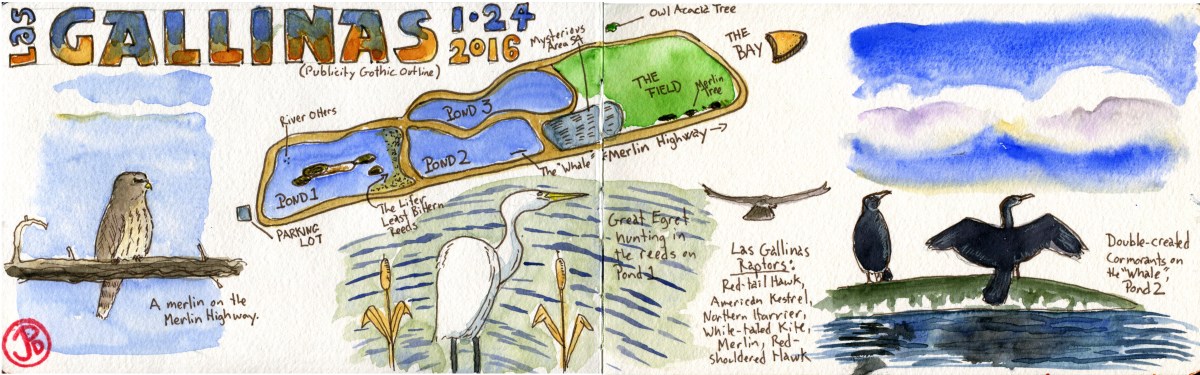
These three ponds in northern Marin County, hold many avian riches. On one side of the trail, you have the ponds with ducks, egrets, pelicans, and cormorants. On the other side you have fields with hawks, falcons, harriers, rails, and owls

The mammalian fauna is also rich with coyotes in the fields and river otters in the waters.

On one Sunday I circled the ponds with binos and sketchbook. A treat was a Merlin perched along the “Merlin Highway”. You rarely see merlins perched in trees, because these small feisty falcons are always   on the move, always moving with a purpose. So a stationary Merlin perched in a tree, scanning the fields for its avian prey, is a temptation that a birder-sketcher cannot pass up!

I then added two more field sketches of a great egret hunting in the reeds and a line of double-crested cormorants drying their feathers in the winter sun. To this I drew a map as a visual journal of my day at Las Gallinas.

Least Bittern

I’ve seen a few life birds in and around the ponds at Las Gallinas. One was a juju bird, that is a bird that I have consistently whiffed on. This bird is  seemingly a mystic ghost that has never filled the lens of my binoculars.  This bird had evaded my life list for years, but a visit to Las Gallinas never let’s me down. This was the secretive and diminutive least bittern. I saw this bird in the reeds on the eastern end of pond one.  Whenever I see a life bird I create a journal spread, and United States life bird No. 452 is the subject of the sketch above.


Image

Dr. Martin Luther King Jr.

It is alway worth remembering; how far we have come and how far we still need to go. On this Martin Luther King Day I remember his words:

I am happy to join with you today in what will go down in history as the greatest demonstration for freedom in the history of our nation.

Five score years ago, a great American, in whose symbolic shadow we stand today, signed the Emancipation Proclamation. This momentous decree came as a great beacon light of hope to millions of Negro slaves who had been seared in the flames of withering injustice. It came as a joyous daybreak to end the long night of captivity.

But one hundred years later, the Negro still is not free. One hundred years later, the life of the Negro is still sadly crippled by the manacles of segregation and the chains of discrimination. One hundred years later, the Negro lives on a lonely island of poverty in the midst of a vast ocean of material prosperity. One hundred years later, the Negro is still languished in the corners of American society and finds himself in exile in his own land. So we have come here today to dramatize an shameful condition.

In a sense we’ve come to our nation’s Capital to cash a check. When the architects of our republic wrote the magnificent words of the Constitution and the Declaration of Independence, they were signing a promissory note to which every American was to fall heir.

This note was a promise that all men, yes, black men as well as white men, would be guaranteed the unalienable rights of life, liberty, and the pursuit of happiness.

It is obvious today that America has defaulted on this promissory note insofar as her citizens of color are concerned. Instead of honoring this sacred obligation, America has given the Negro people a bad check; a check which has come back marked “insufficient funds.”

But we refuse to believe that the bank of justice is bankrupt. We refuse to believe that there are insufficient funds in the great vaults of opportunity of this nation. So we have come to cash this check- a check that will give us upon demand the riches of freedom and the security of justice.

We have also come to this hallowed spot to remind America of the fierce urgency of now. This is no time to engage in the luxury of cooling off or to take the tranquilizing drug of gradualism.

Now is the time to make real the promises of democracy. Now is the time to rise from the dark and desolate valley of segregation to the sunlit path of racial justice. Now is the time to lift our nation from the quicksands of racial injustice to the solid rock of brotherhood. Now is the time to make justice a reality for all of God’s children.

It would be fatal for the nation to overlook the urgency of the moment. This sweltering summer of the Negro’s legitimate discontent will not pass until there is an invigorating autumn of freedom and equality. Nineteen sixty-three is not an end, but a beginning. Those who hope that the Negro needed to blow off steam and will now be content will have a rude awakening if the nation returns to business as usual. There will be neither rest nor tranquility in America until the Negro is granted his citizenship rights. The whirlwinds of revolt will continue to shake the foundations of our nation until the bright day of justice emerges.

But there is something that I must say to my people who stand on the warm threshold which leads into the palace of justice. In the process of gaining our rightful place we must not be guilty of wrongful deeds. Let us not seek to satisfy our thirst for freedom by drinking from the cup of bitterness and hatred. We must forever conduct our struggle on the high plane of dignity and discipline. We must not allow our creative protest to degenerate into physical violence. Again and again we must rise to the majestic heights of meeting physical force with soul force.

The marvelous new militancy which has engulfed the Negro community must not lead us to a distrust of all white people, for many of our white brothers, as evidenced by their presence here today, have come to realize that their destiny is tied up with our destiny. And they have come to realize that their freedom is inextricably bound to our freedom. We cannot walk alone.

And as we walk, we must make the pledge that we shall march ahead. We cannot turn back. There are those who are asking the devotees of civil rights, “When will you be satisfied?”

We can never be satisfied as long as the Negro is the victim of the unspeakable horrors of police brutality.

We can never be satisfied as long as our bodies, heavy with the fatigue of travel, cannot gain lodging in the motels of the highways and the hotels of the cities.

We cannot be satisfied as long as the Negro’s basic mobility is from a smaller ghetto to a larger one.

We can never be satisfied as long as our chlidren are stripped of their selfhood and robbed of their dignity by signs stating “for whites only.”

We cannot be satisfied as long as a Negro in Mississippi cannot vote and a Negro in New York believes he has nothing for which to vote.

No, no, we are not satisfied, and we will not be satisfied until justice rolls down like waters and righteousness like a mighty stream.

I am not unmindful that some of you have come here out of great trials and tribulations. Some of you have come fresh from narrow jail cells. Some of you have come from areas where your quest for freedom left you battered by the storms of persecution and staggered by the winds of police brutality. You have been the veterans of creative suffering. Continue to work with the faith that unearned suffering is redemptive.

Go back to Mississippi, go back to Alabama, go back to South Carolina, go back to Georgia, go back to Louisiana, go back to the slums and ghettos of our northern cities, knowing that somehow this situation can and will be changed. Let us not wallow in the valley of despair.

I say to you today, my friends, so even though we face the difficulties of today and tomorrow, I still have a dream. It is a dream deeply rooted in the American dream.

I have a dream that one day this nation will rise up and live out the true meaning of its creed: “We hold these truths to be self-evident; that all men are created equal.”

I have a dream that one day on the red hills of Georgia the sons of former slaves and the sons of former slave owners will be able to sit down together at the table of brotherhood.

I have a dream that one day even the state of Mississippi, a state sweltering with the heat of injustice, sweltering with the heat of oppression, will be transformed into an oasis of freedom and justice.

I have a dream that my four little children will one day live in a nation where they will not be judged by the color of their skin but by the content of their character.

I have a dream today.

I have a dream that one day down in Alabama, with its vicious racists, with its governor having his lips dripping with the words of interposition and nullification, that one day right down in Alabama little black boys and black girls will be able to join hands with little white boys and white girls as sisters and brothers.

I have a dream today.

I have a dream that one day every valley shall be exhalted, every hill and mountain shall be made low, the rough places will be made plain, and the crooked places will be made straight, and the glory of the Lord shall be revealed, and all flesh shall see it together.

This is our hope. This is the faith that I will go back to the South with. With this faith we will be able to hew out of the mountain of despair a stone of hope. With this faith we will be able to transform the jangling discords of our nation into a beautiful symphony of brotherhood.

With this faith we will be able to work together, to pray together, to struggle together, to go to jail together, to stand up for freedom together, knowing that we will be free one day.

This will be the day when all of God’s children will be able to sing with new meaning, “My country ’tis of thee, sweet land of liberty, of thee I sing. Land where my fathers died, land of the Pilgrims’ pride, from every mountainside, let freedom ring.”

And if America is to be a great nation, this must become true. So let freedom ring from the prodigious hilltops of New Hampshire. Let freedom ring from the mighty mountains of New York. Let freedom ring from the heightening Alleghenies of Pennsylvania.

Let freedom ring from the snow-capped Rockies of Colorado. Let freedom ring from the curvaceous slopes of California. But not only that; let freedom ring from the Stone Mountain of Georgia. Let freedom ring from Lookout Mountain of Tennessee.

Let freedom ring from every hill and molehill of Mississippi. From every mountainside, let freedom ring.

And when this happens, and when we allow freedom ring, when we let it ring from every village and every hamlet, from every state and every city, we will be able to speed up that day when all of God’s children, black men and white men, Jews and gentiles, Protestants and Catholics, will be able to join hands and sing in the words of the old Negro spiritual, “Free at last! Free at last! Thank God Almighty, we are free at last!”

MLKJr


Image

The Crow and the Car

Corvids are tricksters. These ravens, crows, magpies, and jays are some of the most intelligent and miscivious birds in the animal world; Ebony iconoclasts that have been represented in myth, poetry and folktales from Aesop, to Celtic tales, to Poe.

I can watch a pair of ravens for hours, as they turn inverted on the wing and dive bomb their kin or marvel at the secret language of crows, softly cawing to their clan.

The first major birding challenge when I started off was to tell the difference between a crow and a raven, two seemingly identical big black birds. It forced me to look deeper, beyond general appearances, to peel back the layers of shape, voice, and flight pattern.

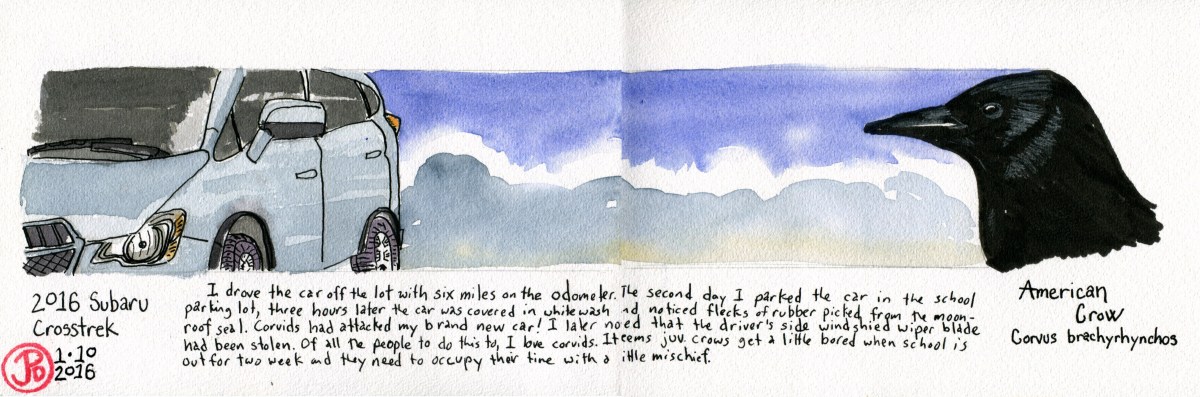
I admire corvids so much as a fellow earth beings, that I named my blog Corvidsketcher. And you’d think if a murder of crows were going to pick on anyone in the Highlands neighborhood on a Sunday afternoon, surely it would not be me. But these birds do not care about what I think and what I love. They were there and young, perhaps they were also a little bored, and they were certainly intelligent and inquisitive, and a bright new shining silver car just appeared in their haunt. Let the mischief commence!

After a few hours in the classroom, I returned to the car that had 6 miles on the a odometer when I drove it off the lot, to find whitewash streaming down the sides. I knew it was only a matter of time before the car was officially “blessed”. Then I saw the small bits of rubber covering the roof! It was part of the moonroof seal. And I thought the moonroof would be great for highway raptor viewing.

It was not until I headed down the hill to the dealership that I heard the metallic rattling coming from the dashboard. Oh no, now what?! At the dealership I found that the driver side windshield wiper blade had been completely removed. A quick search with the words “crow” and “windshield wiper” confirmed my suspicion.

Ornithologist don’t really know why ravens and crows love to pick at moonroofs and swipe windshield wiper blades. It certainly isn’t a source of food for these corvids. It is possible that bored juveniles were just looking for something to occupy their intelligent minds. And that something was my brand new 2016 Subaru.

I have replaced the wiper blades and the moonroof hasn’t leaked, yet. And I still love corvids, even a murder of crow.

Image

A Covered Bridge to the New Year

A new year, a new covered bridge.

For this New Year’s Day sketch I headed upstream on the San Lorenzo to the town of Felton. The San Lorenzo River may be the only river in California that has two covered bridges spanning it’s flow.

The Felton Covered Bridge was complete 1893, 20 years after the Powder Works Bridge (Paradise Park) and is believed to be the tallest covered bridge in the country. This bridge stood as the only entry to the town of Felton for 45 years until it was replaced by a concrete bridge. In was retired from active service in 1937 and became a pedestrian bridge.

Happy 2016!

Image

Covered Bridges of California

There are about 12 covered bridges in California. And like much else such as the coast redwood, giant sequoia, bristlecone pine, and Mount Whitney, these bridges contain a superlative. Now as I teach my fourth graders, a superlative contains “est”as a suffix, and shows that something is without comparison. Such as tallest, largest, oldest tree or the tallest mountain in the lower 48.

California contains the longest single span covered bridge in the United States. The Bridgeport Covered Bridge spans 229 feet across the South Yuba River.

Brigdeport Covered Bridge

I set up my camp chair on Family Beach and using the waters of the chilly South Yuba River, I painted the span. The beach was lacking families on this December morning and an American dipper kept me company as this amazing aquatic songbird dove in the wintery rapids of the river as if it were a summer’s day. The dipper provided entertain while I waited for my washes to dry. I even included Muir’s favorite bird in the sketch.

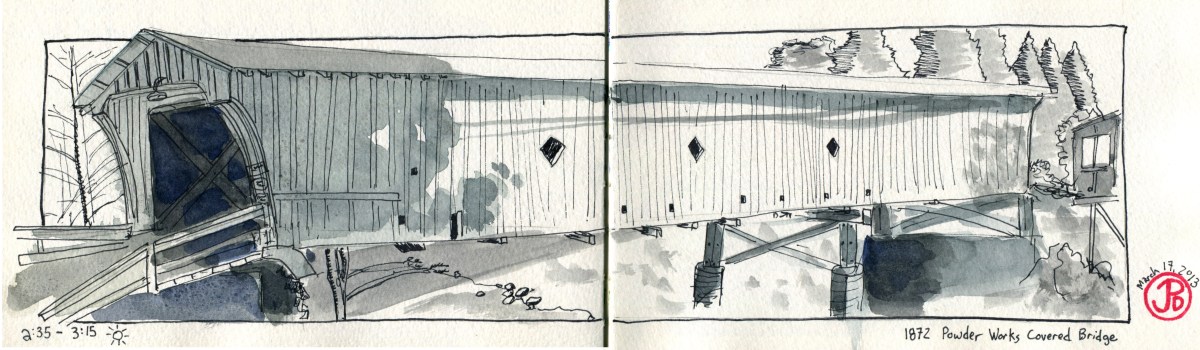
I have been familiar covered bridges from an early age. The covered bridge in Paradise  Park (featured image), near Santa Cruz, has been the only way to cross the San Lorenzo River without getting wet. This bridge was originally built for the California Power Works which formerly occupied the site. The 180 foot span was built in 1872. Unlike the Bridgeport bridge, this bridge is open to foot and automobile traffic making it a bridge in continual use for 143 years.