Image

Muir Trestle, Martinez

I was meeting a friend in the East Bay city of Martinez and I had a little time to sketch before lunch.

Martinez is a hotbed of railroading with both the Union Pacific and BNSF passing through as well as some marquee passenger trains such as the Coast Starlight and the California Zephyr making stops at the Martinez AMTRAK station. And the Capitol Corridor commuter takes on passengers traveling north and south on shorter journeys.

The California Zephyr Train No. 6, at the old Southern Pacific Depot in Martinez. This train is heading east to Chicago. To the right in the background is SP switcher 1258 on static display.

There would certainly be something to sketch here and I was going to start with a historic train trestle.

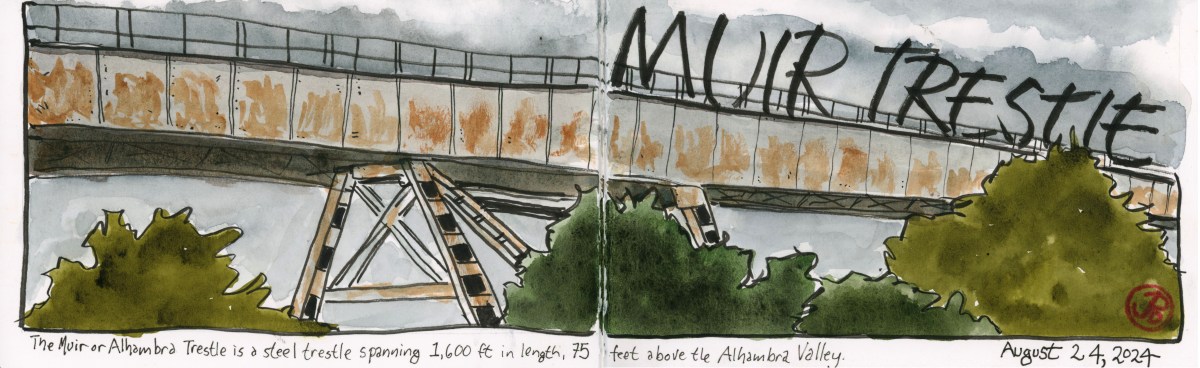
I parked at the Mount Walda Trailhead. Soaring above me was the 1,600 foot long steel Muir Trestle (aka the Alhambra Trestle). The single track trestle was so long that I could only see and sketch one section of it before it disappeared into the trees to the east. The trestle rises 75 feet above the roads, trees, and houses it crosses over.
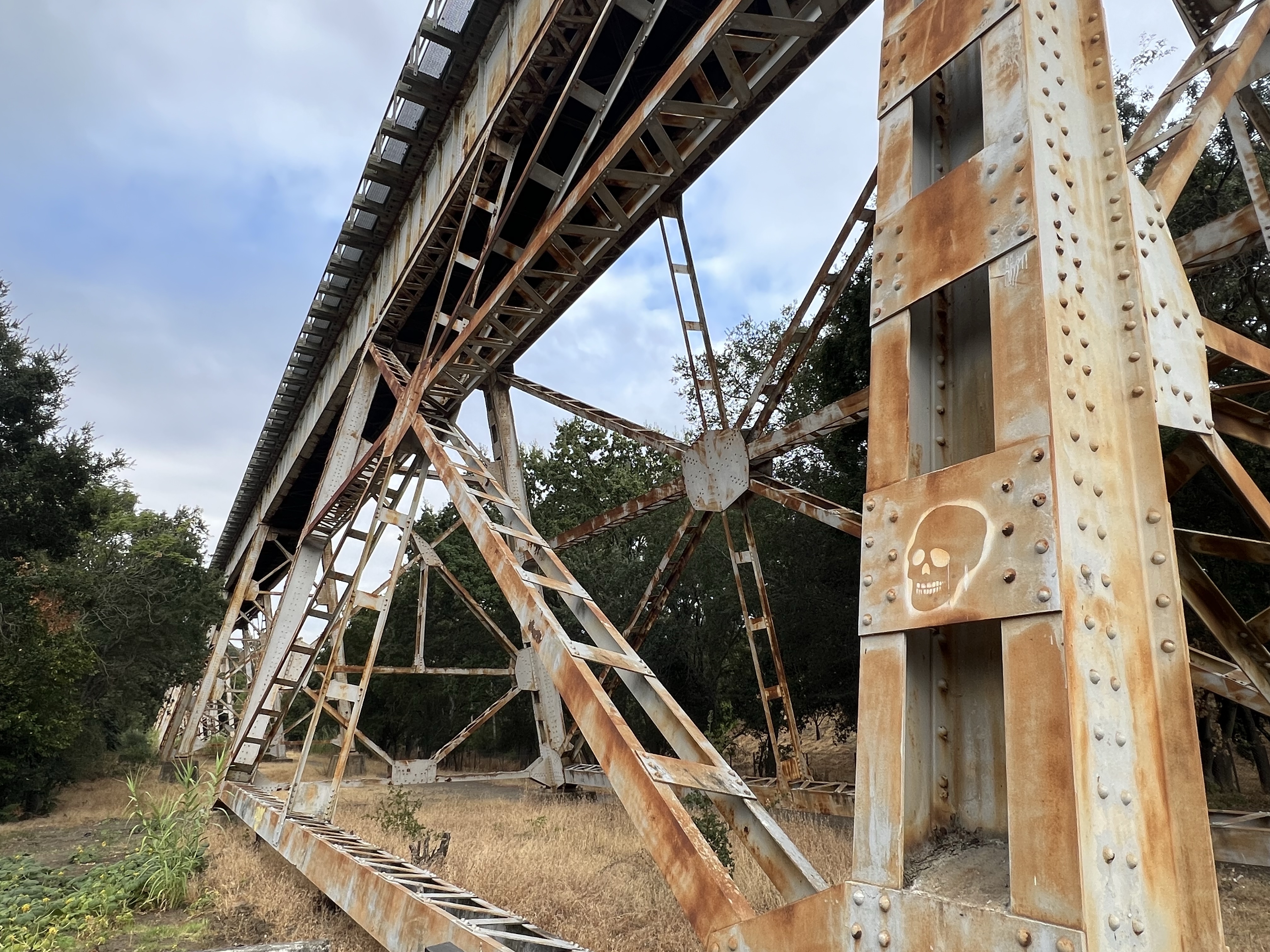
A detailed view of the steel supports of the Muir Trestle.

The trestle is within the John Muir National Historic Site. To the north is Muir’s Martinez home. Muir and his wife Wanda sold the land for the trestle for $10 and a lifetime rail pass to the San Francisco and San Joaquin Valley Railway. The original wooden trestle was built through a pear orchard and completed in 1897.
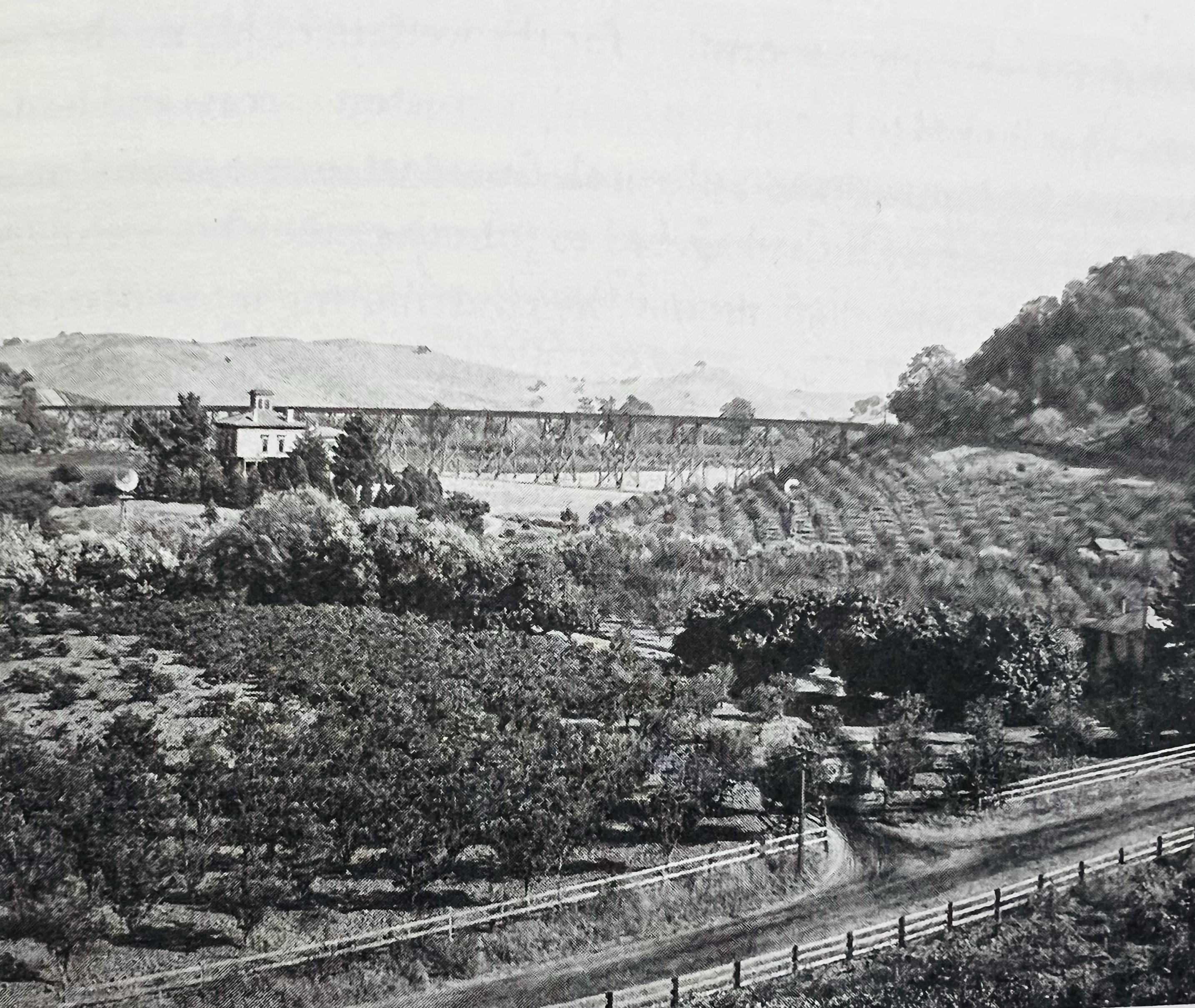
This is a historic photograph of the Stengel-Muir ranch in 1897. The Muir house is on the top left and the trestle is viable behind the house. At the time of the photograph, the trestle was constructed of wood.

At the eastern end of the trestle there was a passenger and freight station named Muir Station. The station is now long gone but is immortalized in a street that parallels the rails named Muir Station Road.

From this station Muir could ship his produce to Oakland or to the port in Martinez.

One of Muir’s neighbors in the Alhambra Valley was John Swett, Muir close friend. Swett was the State Superintendent of Public Education and is known as the “Father of California Public School”.

In 1898, Santa Fe purchased the line and it became their Valley Division. This division still exists as BNSF’s route from Richmond to Fresno.
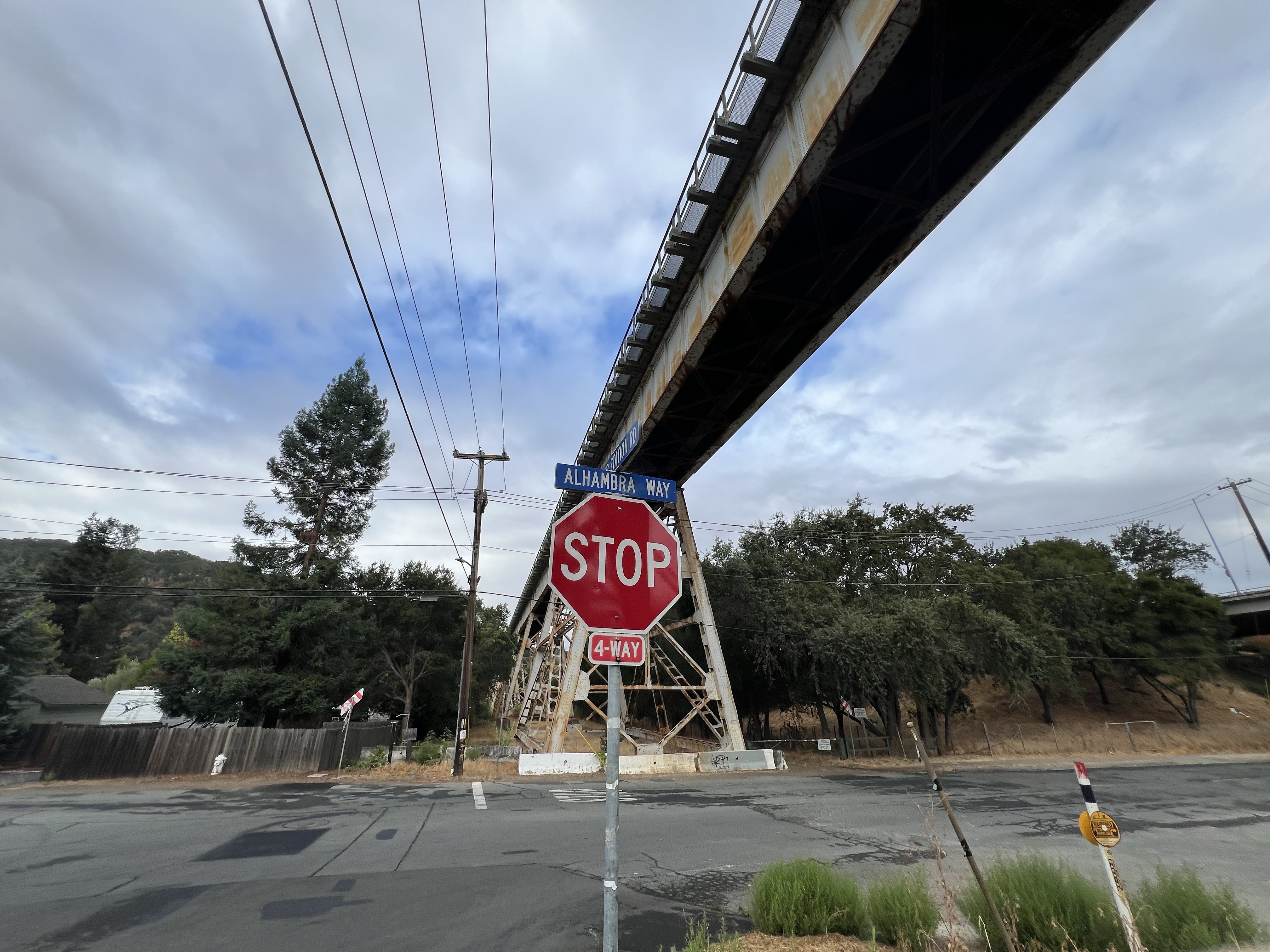
The Muir Trestle from the intersection of Alhambra Way and Muir Station Road.

I took up a sketching position near the trailhead and started my drawing. The trestle above me is on the Stockton subdivision and is used by BNSF intermodal freight. There was no train crossing during my sketch.
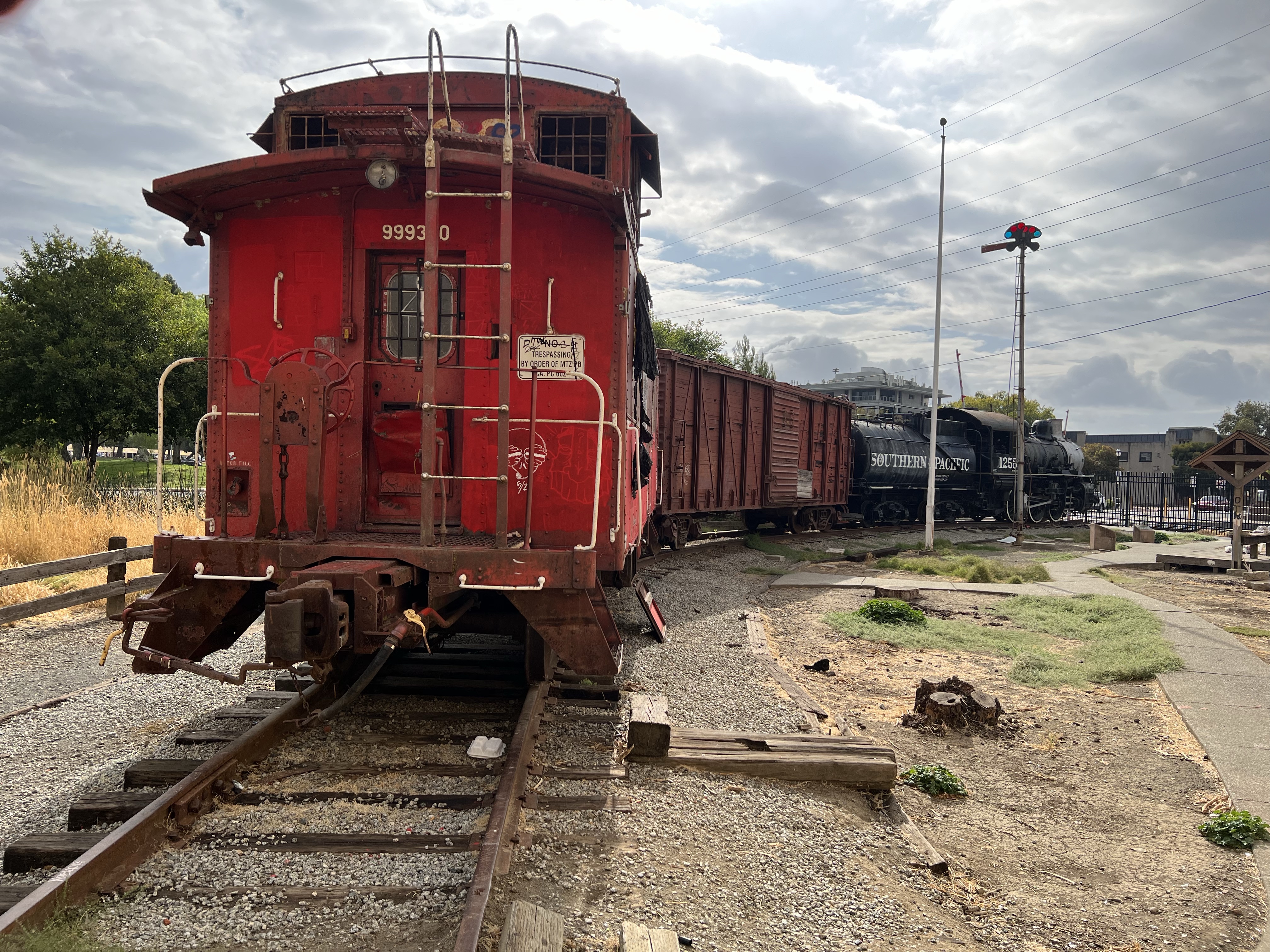
SP 0-6-0 switcher No. 1258 and its consist of a wooden box card and Santa Fe caboose 390 on display across the tracks from the AMTRAK station. The locomotive is in sad shape, missing some hardware like her bell and whistle.
Image

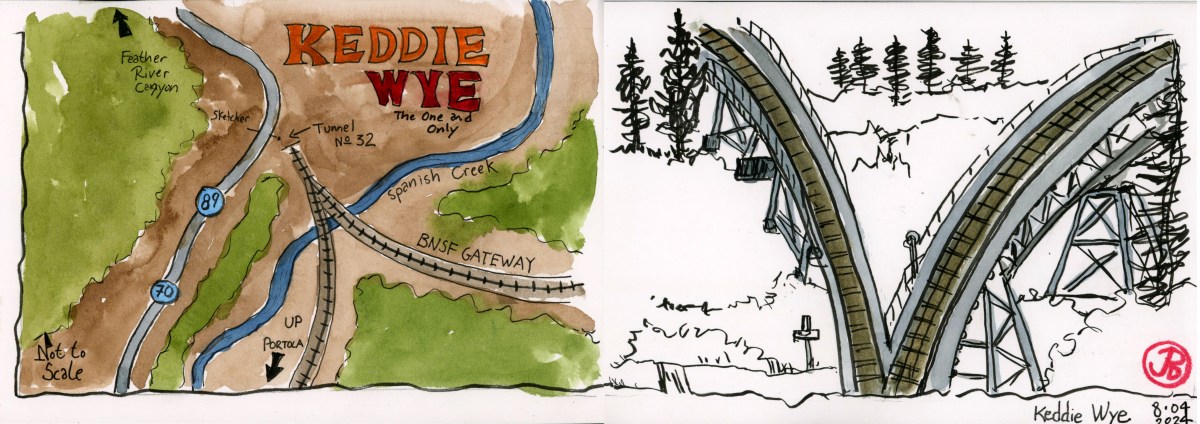
Keddie Wye

One of the Seven Marvels of the Feather River Route is to be found a few miles north of Quincey.

The Feather River Route, also known as the Canyon Subdivision, stretches between Oroville and Portola, Ca and competed with Southern Pacific’s route over the Sierras at Donner Pass.

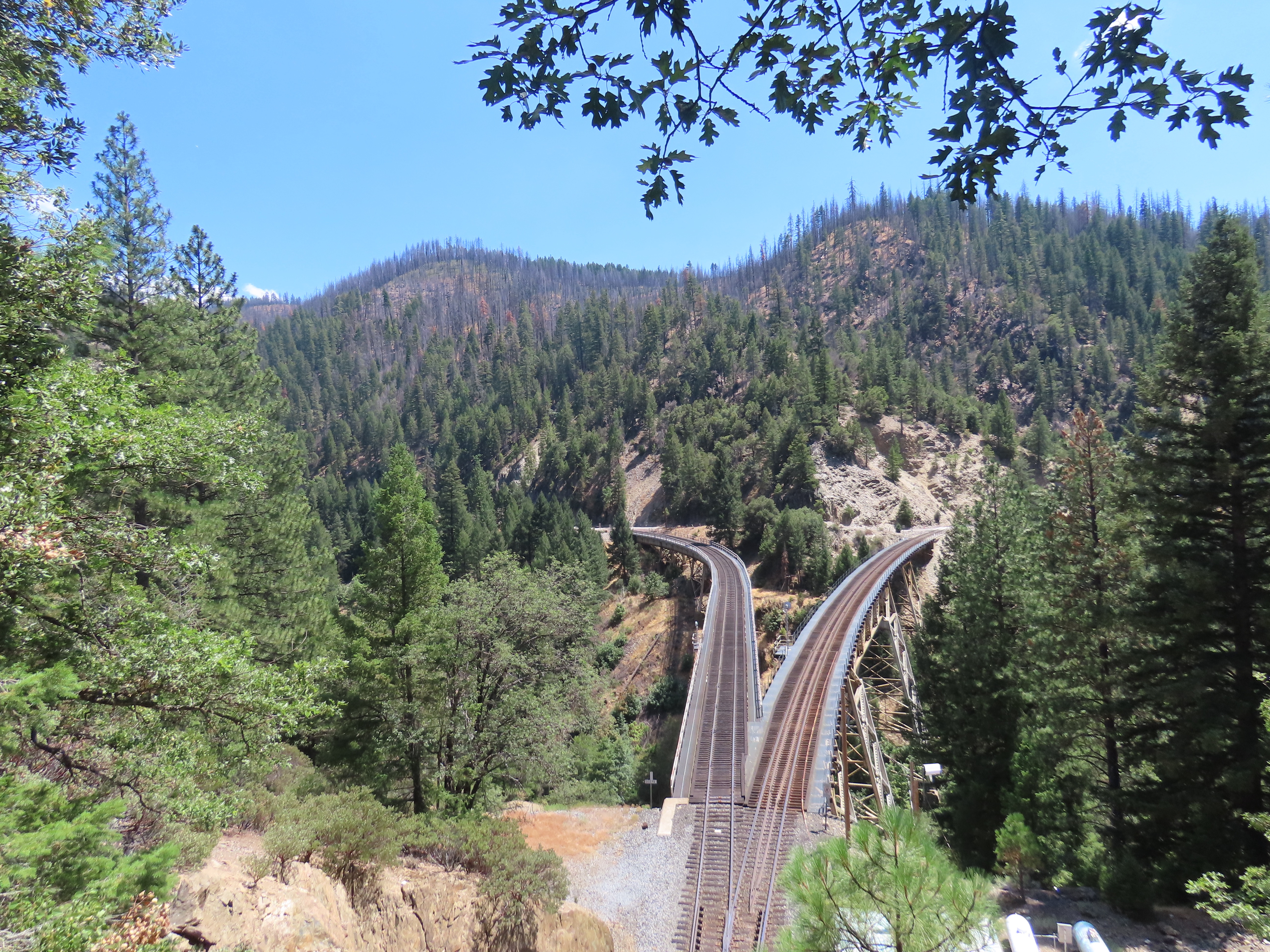
The Marvel is known as the Keddie Wye. This is where two tracks comes together to form one track, looking like the letter “Y”. Now this in itself isn’t much to write home about but when both sides of the “Y” are on trestles above a creek that joins together before entering a tunnel and then you know this is a special piece of railroad engineering.

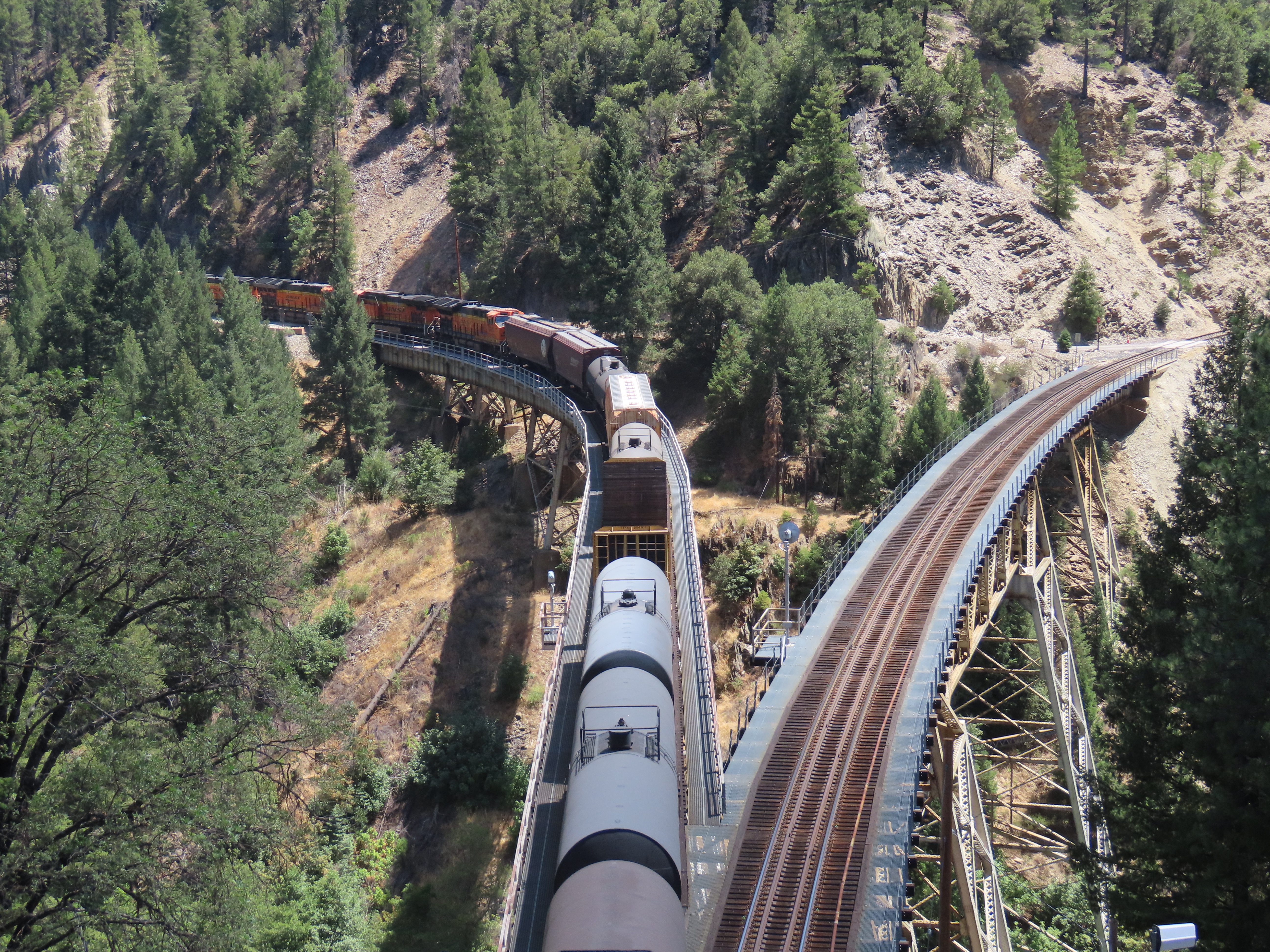
The two forks of the “Y” are also where two different railroads meet. On the right is the former Western Pacific Railroad, now Union Pacific, and one the left is the BNSF (Burlington Northern and Santa Fe).

After about a 45 minute drive from Portola on Highway 70, the famous Keddie Wye appeared to my right. I pulled over and found a vantage point to sketch. I perched on a narrow trail above Tunnel No. 32 looking out to the two forks of the wye.

Now the only thing missing was a freight train. It would have been nice to see a train traverse one side of the “Y”. As I was told at the Western Pacific Railroad Museum, Sunday is a quiet day on the high iron.

After my sketch (right side of the spread), I headed down Highway 70 into the Feather River Canyon proper. The Highway parallels the railroad and the Feather River. This is a beautiful drive and I periodically looked off to left at the rails across the river. No trains.

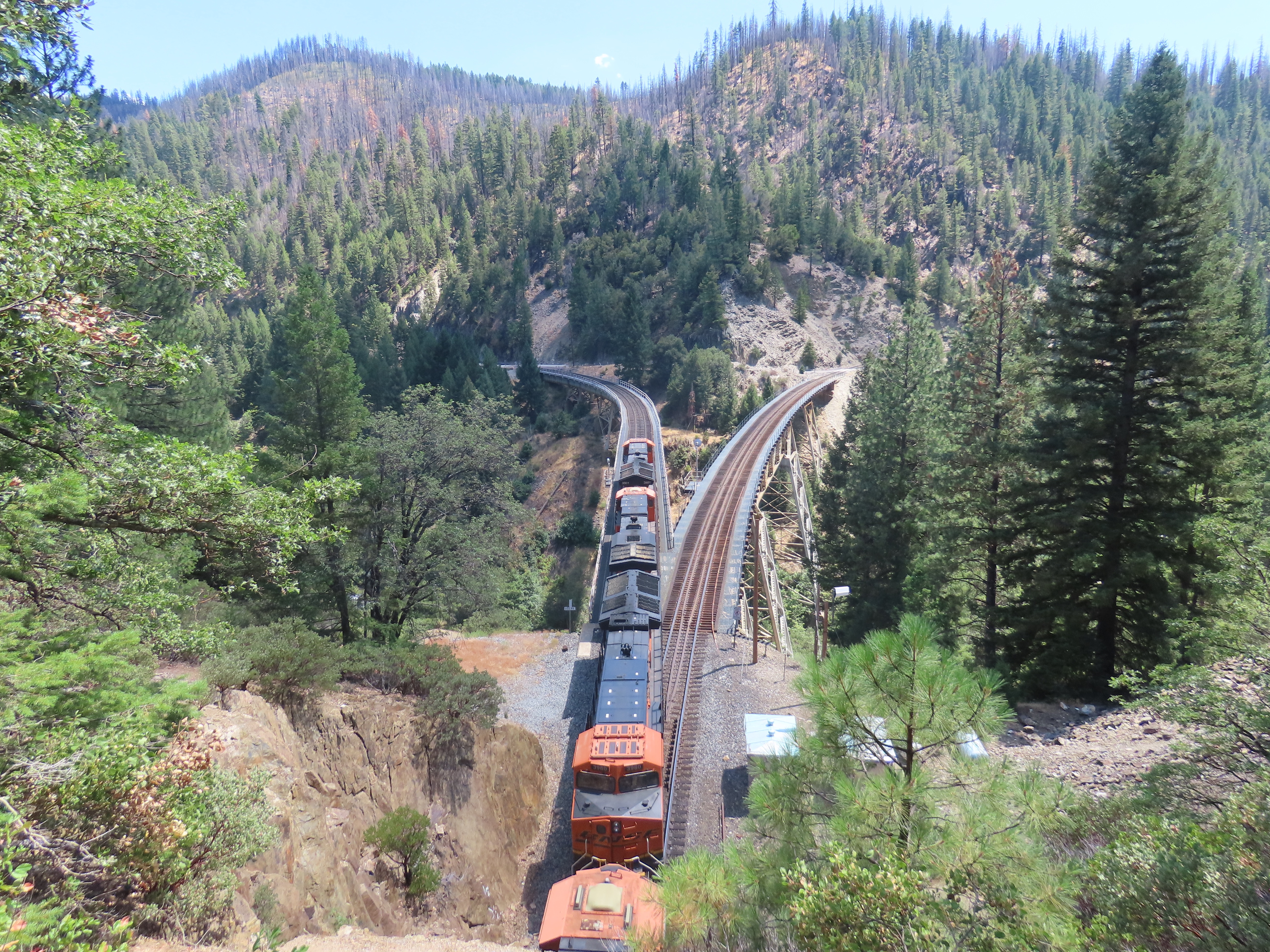
I was about 20 minutes from the wye when I heard the screech of steel wheels on rail. I looked to the left and a Burlington Northern and Santa Fe (BNSF) was climbing up the canyon with a mixed freight consist.

I found the nearest pullout and then reversed direction as I chased the BNSF up canyon. I wasn’t going to miss the freight on Keddie Wye!

As I climbed up Feather River Canyon I kept an eye to my right for glimpses of the train. I should have no problem overtaking the train as the line speed limit was 25-30 mph.

I soon came to the end of the train and before long I was approaching the five bright orange diesels on point. I passed them with time to spare.

Once I reached the wye I reversed direction again and parked at the pull out. I figured I was about ten to fifteen minutes ahead of the freight and I took my position on the narrow path above Tunnel 32. Now I had to just wait, wondering if I would be able to hear the approaching freight from my position.

Within ten minutes I could hear the diesels working up grade and the first locomotive appeared below me. The train headed onto the left side of Keddie Wye onto the BNSF Gateway heading north towards Lookout and Klamath Falls.

What a memorable experience to see a piece of railroad history that is not a static museum piece isolated in time but in use today.

Image

Dunsmuir

Dunsmuir is a train town.

At one time it was a company town for the Southern Pacific Railroad when 3,000 of it’s citizen’s where employed by Southern Pacific Railroad.

Dunsmuir was previously known as Pusher because this is where helper locomotives where either added or taken off trains. They were put on to make it up the Cantara Loop and the climb out of Dunsmuir as the line headed north. Helpers where also used on downslope freight trains to help with dynamic braking.

The town contains a railyard, shops, and a still functioning turntable to turn locomotives around. In it’s heyday, Dunsmuir had a population of 5,000, many of those working for the railroad, serving the labor intensive steam locomotives. When the stream locomotives were replaced by more efficient disel-electric locomotives, the town’s population was almost halved.

Today, the mainline sees two passenger trains and about 15 freight train daily. Most freight trains are now powered by three to four, 4,000 to 6,000 horsepower, diesel-electic engines, so the need to add engines has become obsolete.

Dunsmuir still feels very much like a train town even though Southern Pacific was aquired by Union Pacific in 1996.

The main street, Dunsmuir Avenue, is beautiful in it’s small town charm. And of course the main street parallels the main line.

The crown jewel of downtown Dunsmuir is the California Theatre. This 800 seat movie palace was opened in 1926. The theater featured a stage and a Wurlitzer pipe organ. The theater is only one block from the passenger station and, in it’s heyday, many of Hollywood’s finest and other dignataries visited the theater including Babe Ruth, the Marx Brothers, and Clark Gable.

In recent times the theater has faced some troubling times, after many stops and starts the theater closed in 2016. There was also a Masonic Lodge that met in the building for close to 70 years.

I parked on Dunsmuir Avenue and did a car sketch (great for social distancing) of the the epic sign and marque. I added a bit of artistic license when I added perhaps the best movie ever made featuring a locomotive, Buster Keaton’s masterpiece, The General (1926).

Across from the station is a mural on an oil tank. The mural was created by rail historian, artist, author, and former employee of the Southern Pacific and McCloud Railroad, John Signor. This is a sketch I did from my photograph. It features a Southern Pacific EMD SD45 T-2R diesel-electric locomotive and the famous Daylight GS-4, 4449. This mural represented the future and the past of the Southern Pacific Railroad. It is also a reminder of the name of the railroad that built Dunsmuir.
Only two passages trains stop at Dunsmuir Station. The north and southbound Coast Starlight, an Amtrak service from Seattle, Washington to Los Angeles, California. To catch the Coast Starlight at Dunsmuir, you have to get up very early in the morning (or simply just stay up). The southbound Train 11 arrives in Dunsmuir at 12:35 AM and northbound Train 14 arrives at 4:56 AM!
Dunsmuir is an important division point in the Shasta Division where train crews change over. In this case, a BNSF freight train with a consist of hopper cars, change it’s engineer and conductor. BNSF is granted trackage rights to use this route by the tracks owner: Union Pacific.

Note: Part of sketching, and life I might add, is making mistakes and with this sketch I made one. I am a native Californian and I made unforgivable mistake of misspelling my own state! That sometimes happens when you are so focused on form and not spelling. I added the missing “I” on the street below.