On my latest sketching odyssey I headed to one my favorite locations in California, if not the world: Donner Pass.
Before I set out, I sketched the rail route of the East Slope of Donner Pass, heavily influenced by a map drawn by John Signor (author, artist, and former Southern Pacific employee) in his marvelous book: Donner Pass: Southern Pacific’s Sierra Crossing.
I would be driving parallel to the Central Pacific side of the first Transcontinental Railroad on Highway 80. In 1865 the railroad became Southern Pacific.
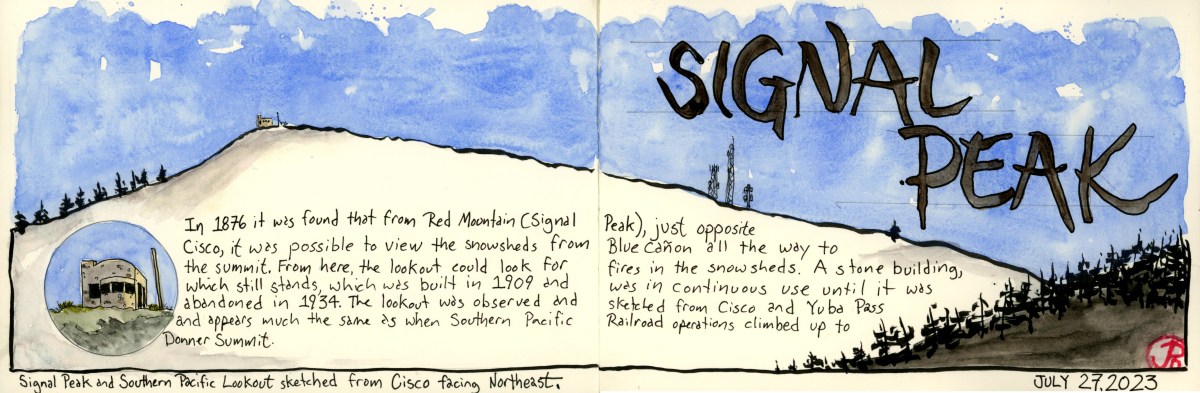
I was looking for a stone structure that was built in 1909 as a fire lookout and I reckoned that Cisco, which is directly across the valley from the building, would be my best position for seeing Southern Pacific’s fire lookout on Red Mountain.
The lookout on Red Mountain was built because, from this vantage point, the rail line from Blue Canon to Donner Summit could be observed. Because 50 miles of the trackage was above 5,000 feet in elevation, snow was a real problem for keeping the line open during the long winters. The solution was to build wooden snowsheds to keep snow off the tracks. Work on the snowsheds began in 1867 and the sheds were completed by 1873. In total, 30 miles of sheds where built.
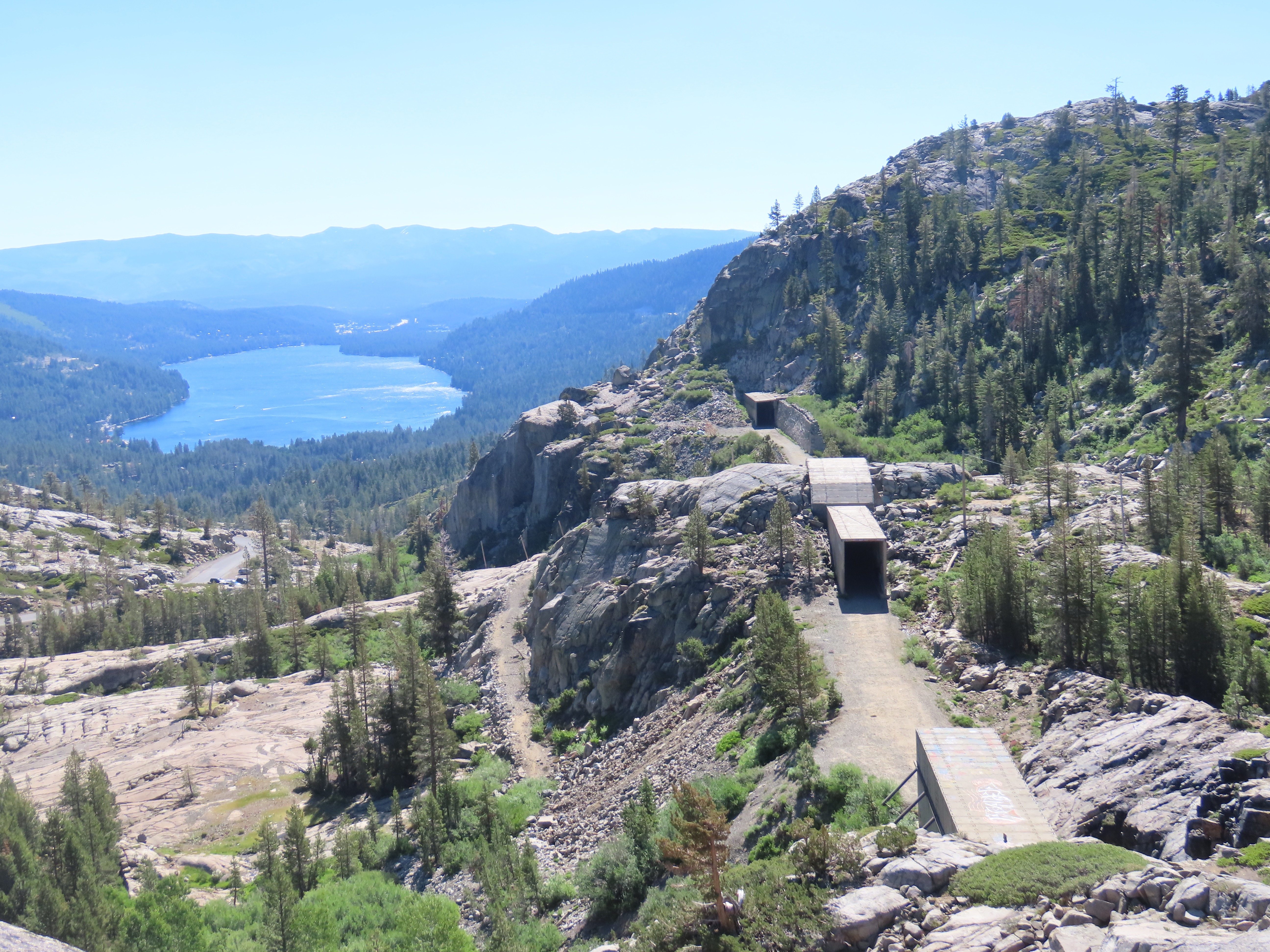
The view from Donner Summit. On the right is the original rail bed of the Transcontinental Railroad. The east portal of the Summit Tunnel (Tunnel #6) and Tunnel #7 is beyond. The snowsheds are made of concrete, replacing the flammable wooden sheds. In the middle ground is Historic Highway 40 and in the background is Donner Lake.
When you combine wooden snowsheds with wood burning steam locomotives the result can be fire.
Southern Pacific employed fire trains that could be called into action to put out fires in the snowsheds but first someone had to observe the smoke. This is where the fire lookout came into play.
The fire lookout was in continuous use until 1934 when it was abandoned.
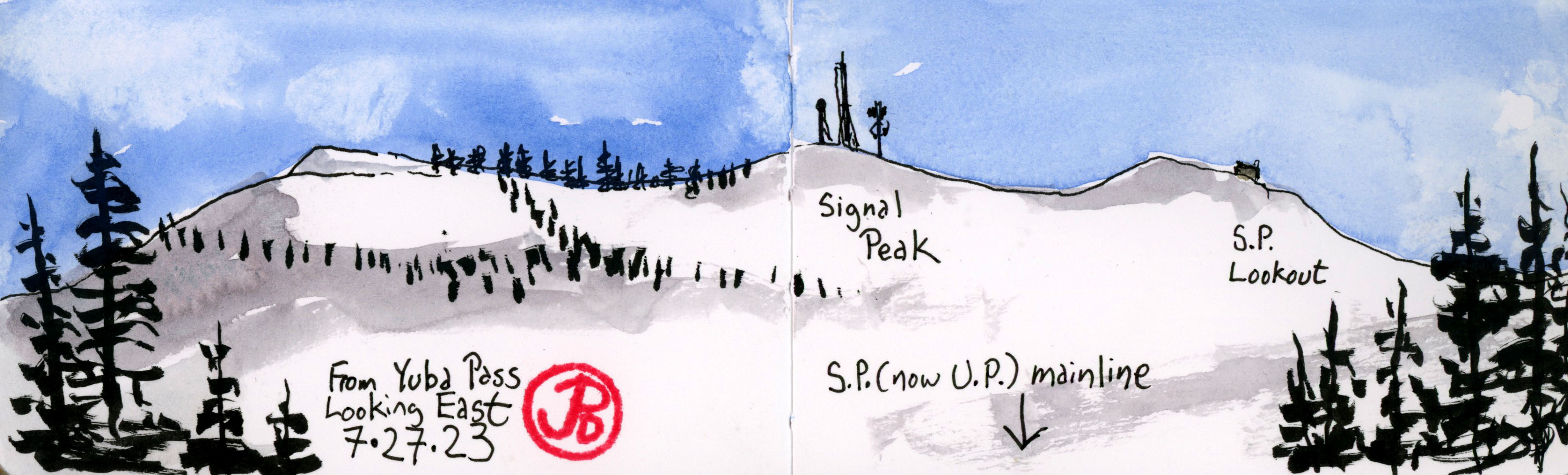
Before I got to Cisco, I pulled off Highway 20, just before it merges into Highway 80 at Yuba Pass. From here I looked down the line and just above the signal gantry was Signal Peak and to the right I spotted the prominent silhouette of the fire lookout.
Yuba Pass with Red Mountain and Signal Peak in the background.
I headed east on 80 for one stop, I took the Cisco exit which just a service station stop. I pulled behind a parked truck and looked to the northeast across the highway.
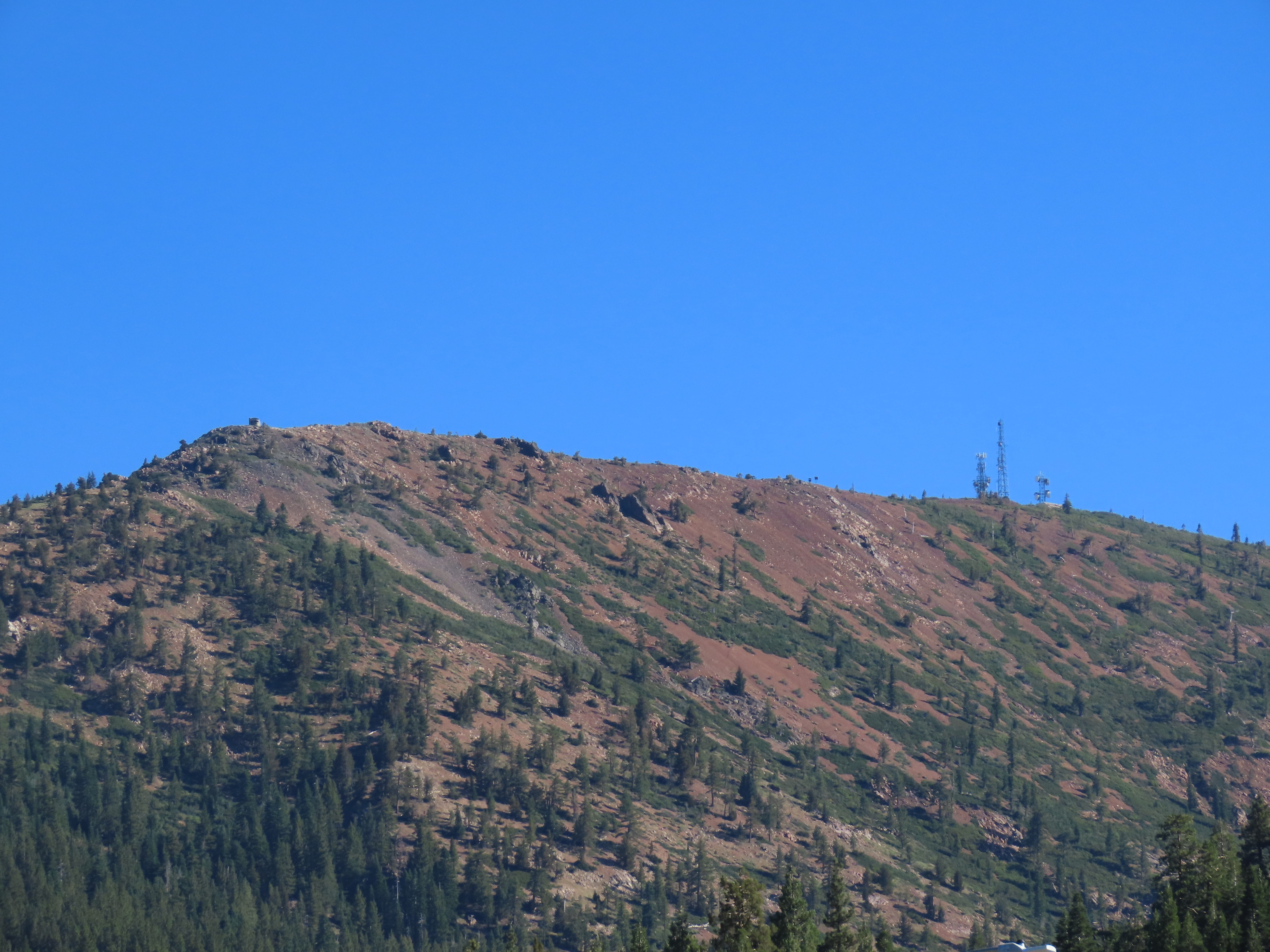
Behind me, further up the hill was the mainline. In front of me was Red Mountain and Signal Peak. To the right was antennas and towers, to the left was the Southern Pacific fire lookout.
Red Mountain and Signal Peak.
Now it was time for a sketch using my Delta panoramic journal (featured sketch) to capture the peak.
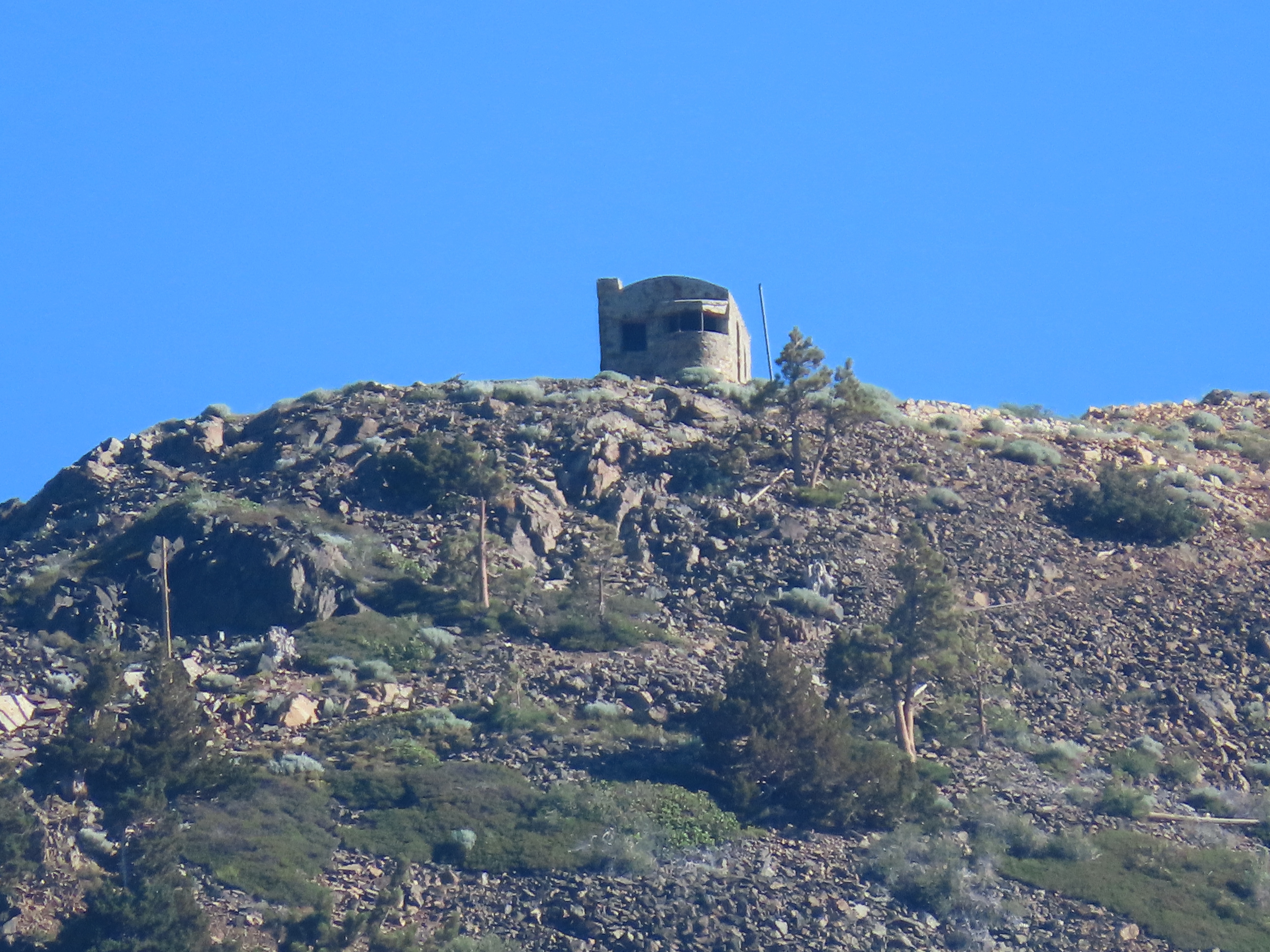
Close up of the Southern Pacific stone lookout built in 1909 and used until 1934.
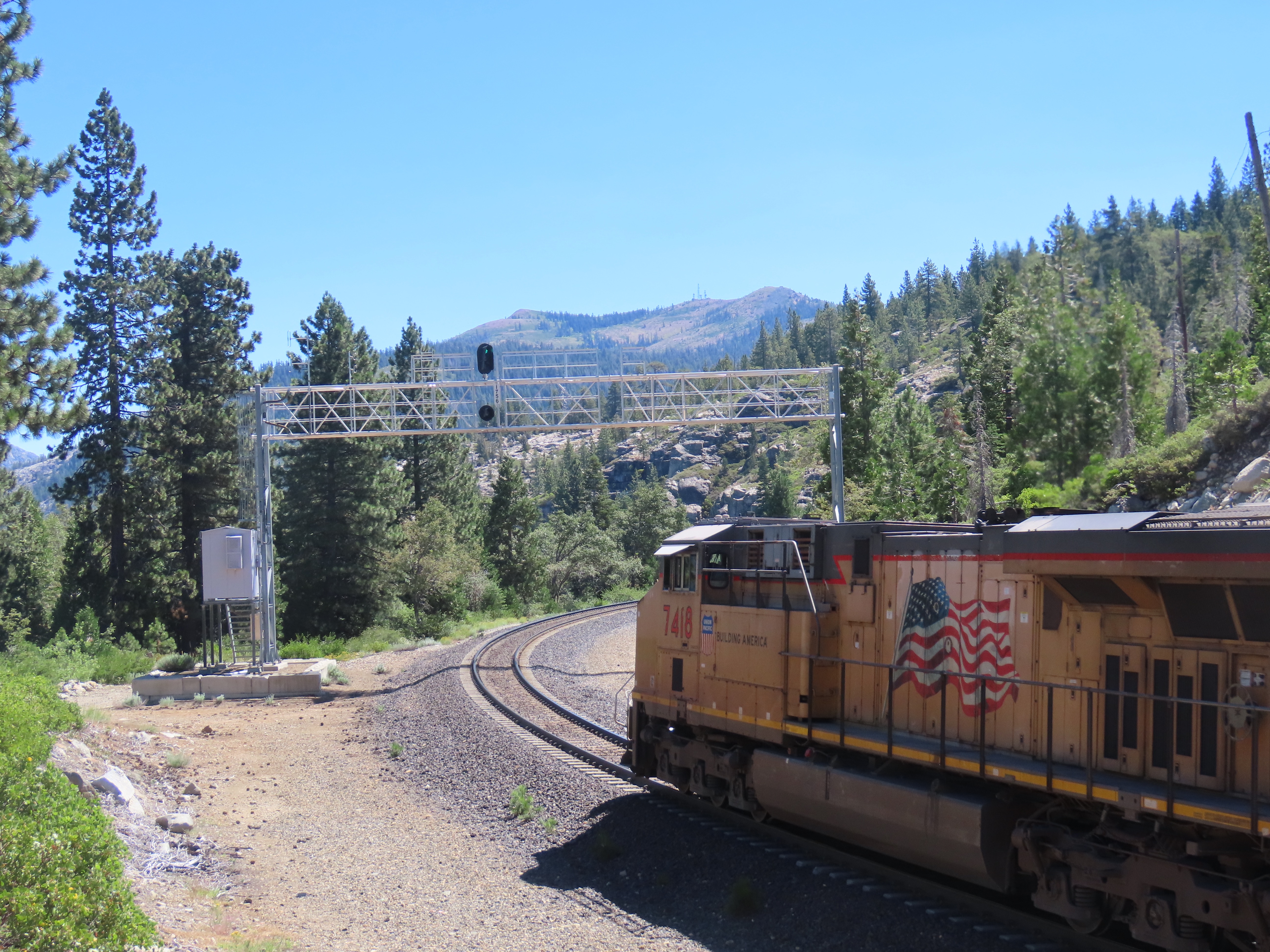
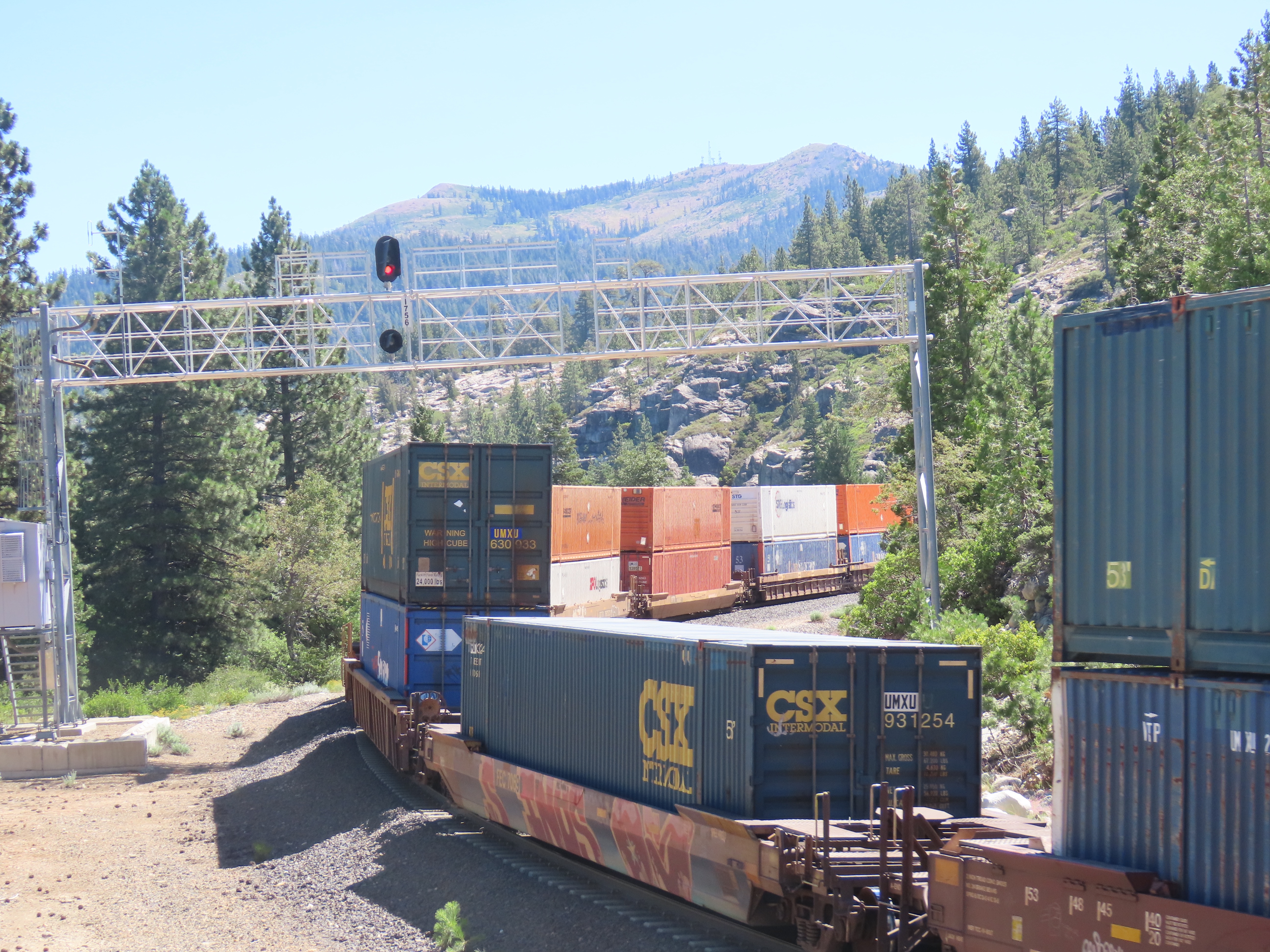
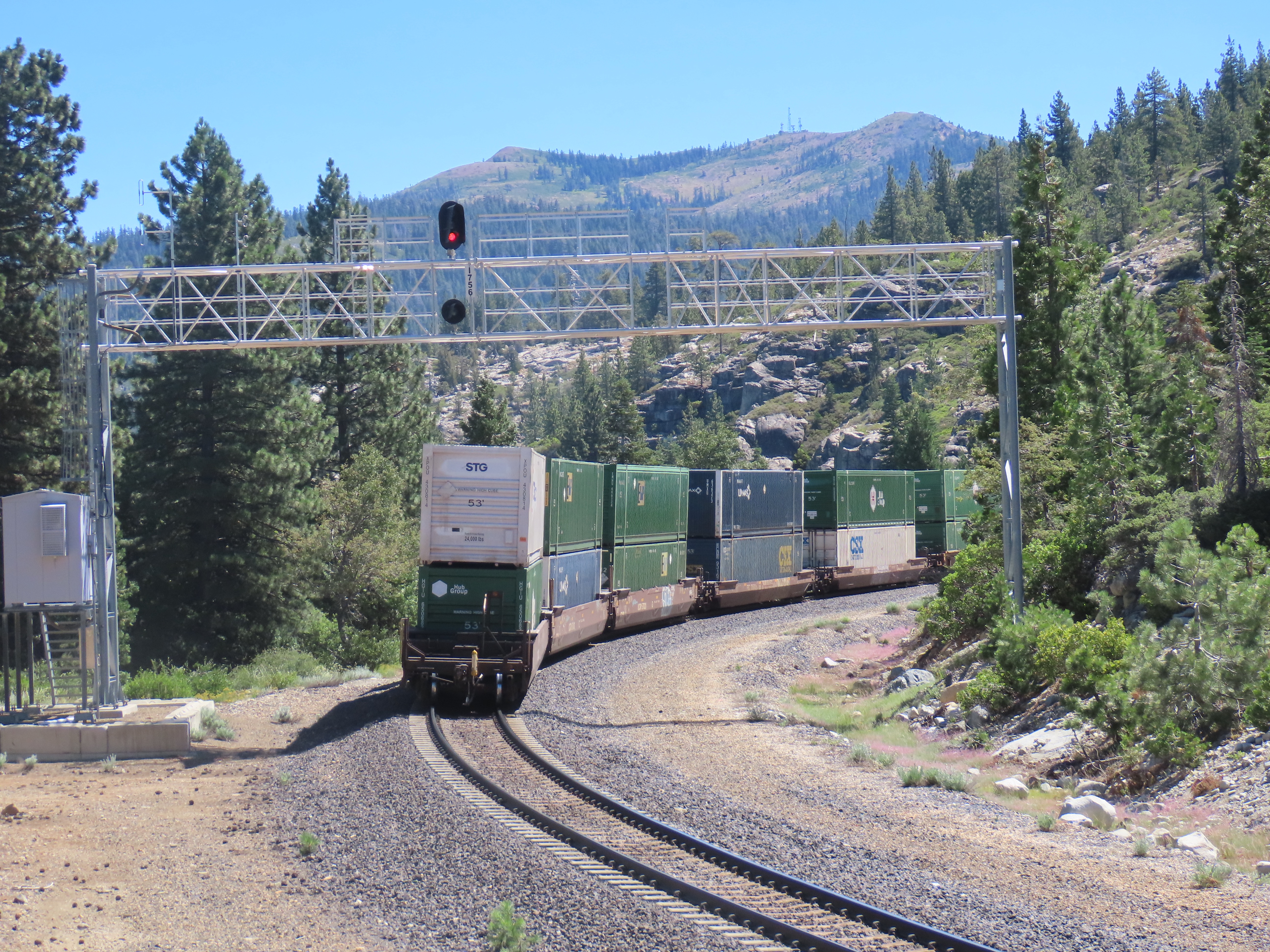
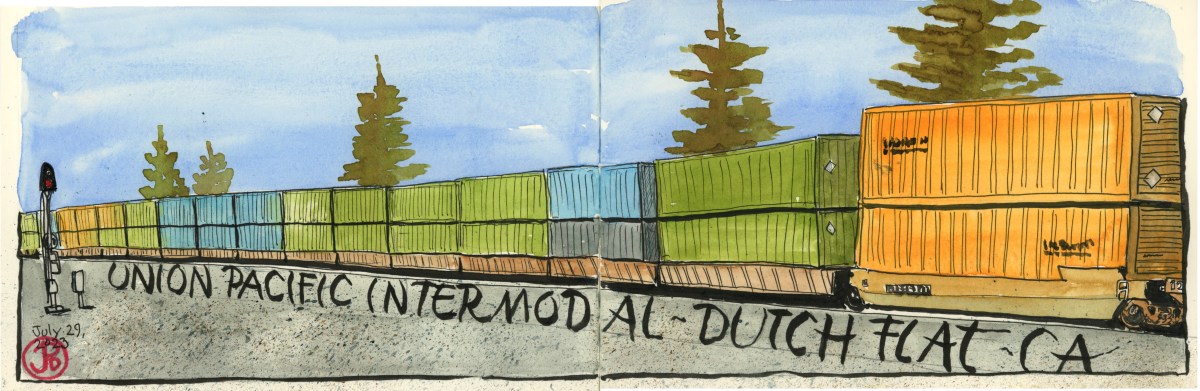
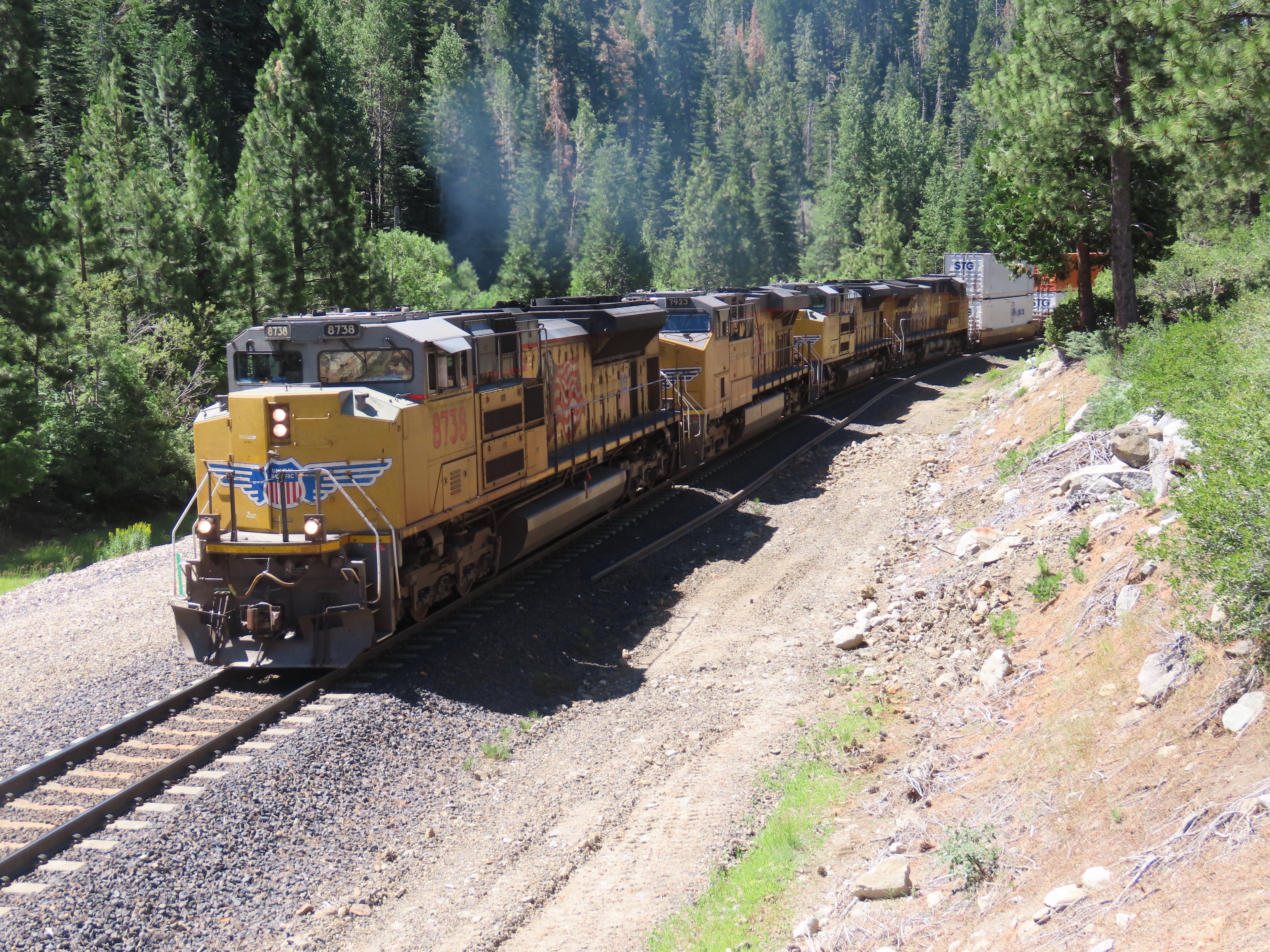
I returned to Yuba Pass to get a sketch of Red Mountain from this perspective. The signal on the gantry was green so an eastbound freight was imminent. Before long I could hear the rumble of a Union Pacific intermodal freight train climbing the grade towards Donner Summit. This consist contained six locomotives and I lost count of how many cars it train contained. (In truth I didn’t attempt to count. Seeing this long freight train mean less truck traffic on America’s highways).
What follows is a series of photographs of the UP freight making the climb to Donner Pass with Signal Peak in the background.
I once chased the California Zephyr Train # 6 from Roseville to Truckee but now I wanted to chase what really makes Union Pacific the big bucks: an intermodal freight train!
Intermodal is freight that is transported by various forms of transportation: ships, trains, planes, and trucks, for example. Most of the intermodal freight trains across the Sierra Nevada consist of double stacked freight containers, known as Container on Flatcar (COFC), or single truck trailers on flat cars, known as Trailer on Flatcar (TOFC) or piggybacks.
I first caught sight of my freight as it really began it’s climb up the western slope of the Sierra Nevada Mountains at Cape Horn, just out of Colfax. (I had just missed it’s passage through Colfax.)
I attempted to follow the train on Historic Highway 40 with some stretches on the highway that relegated Highway 40 to a little used country road: Interstate Highway 80.
Catching up with the train should not be a problem (even on windy side roads) because the average speed of a freight train climbing up to Donner Summit is between 25 to 30 miles per hour. And sometimes the freight’s speed could be even less.
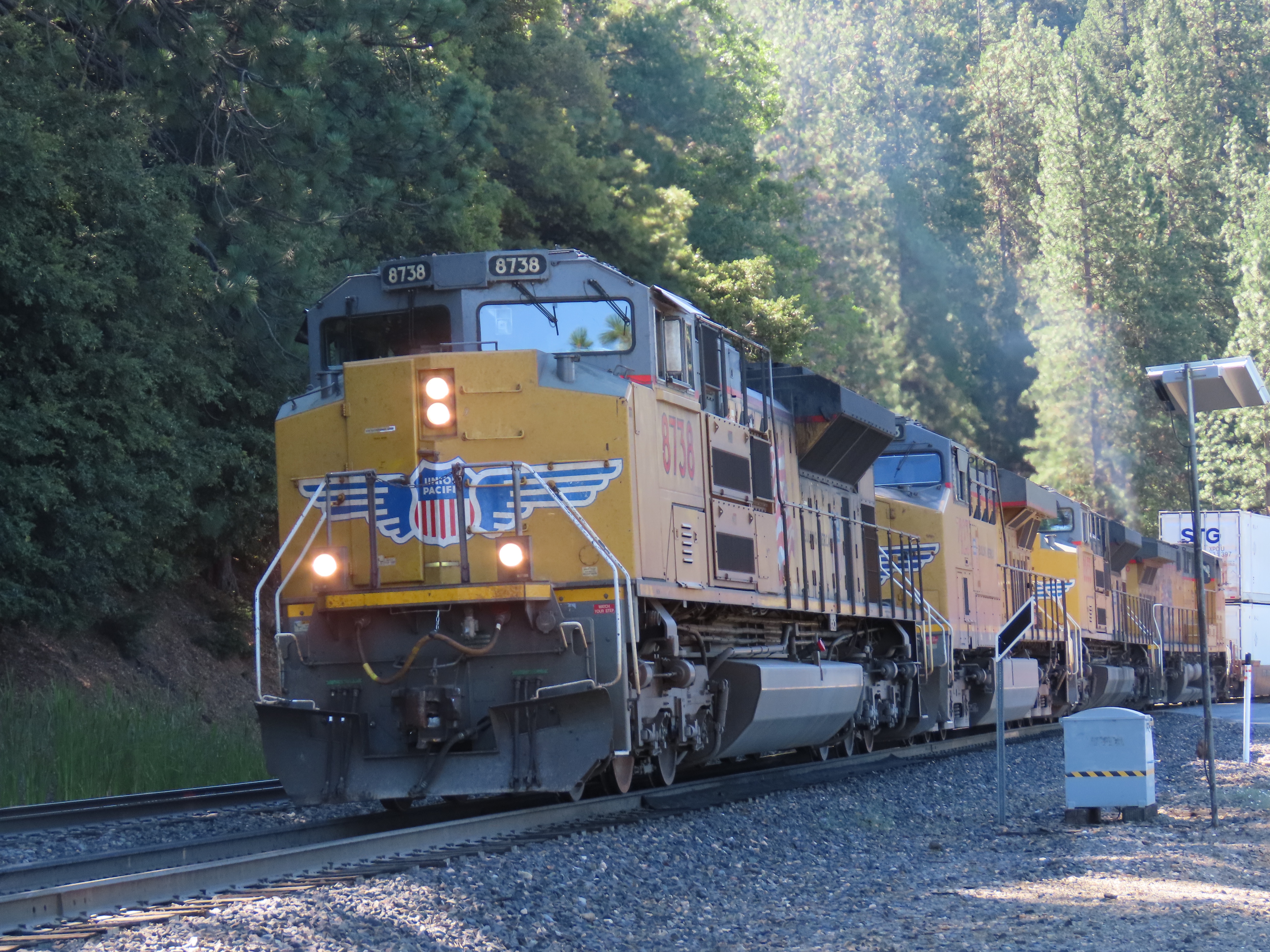
I headed east on a patchwork path of Historic 40, side roads, and Interstate 80. When I thought I was sufficiently ahead of the intermodal, I searched for the mainline. This consisted of picking either side of the road, north or south (at Blue Canon I picked the wrong side), and then driving until I came upon railroad tracks. This I did at the grade crossing at Dutch Flat. The eastbound signal light was green indicating that the train had not passed this point yet.
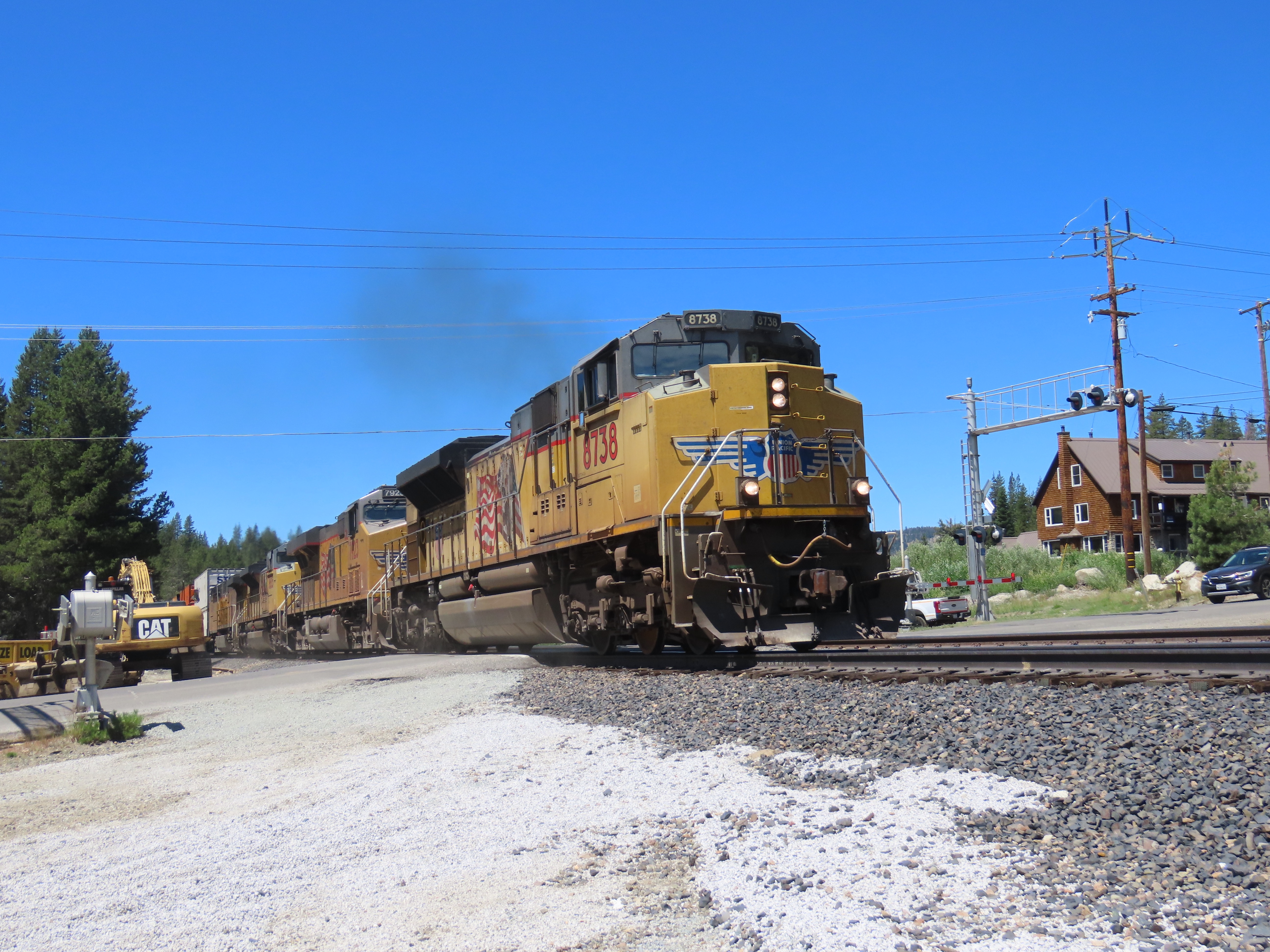
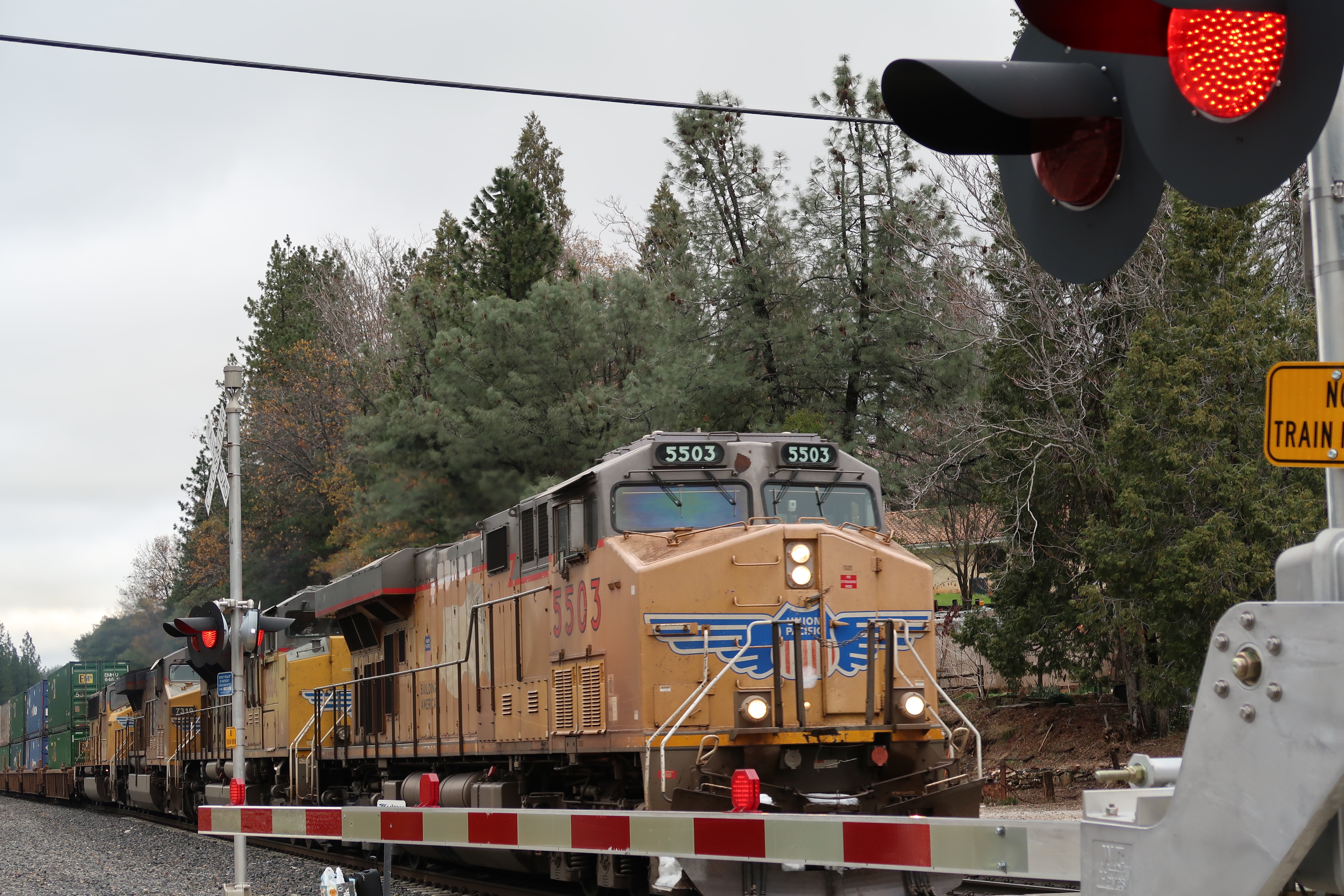
I picked my vantage point and after about ten minutes I could hear the rumble of the diesel-electric locomotives as they climbed the grade followed by the sounding of the horn, and then the crossing gates were triggered and the safety arms lowered to stop traffic.
The Transcontinental Railroad reached Dutch Flat in June 1866.
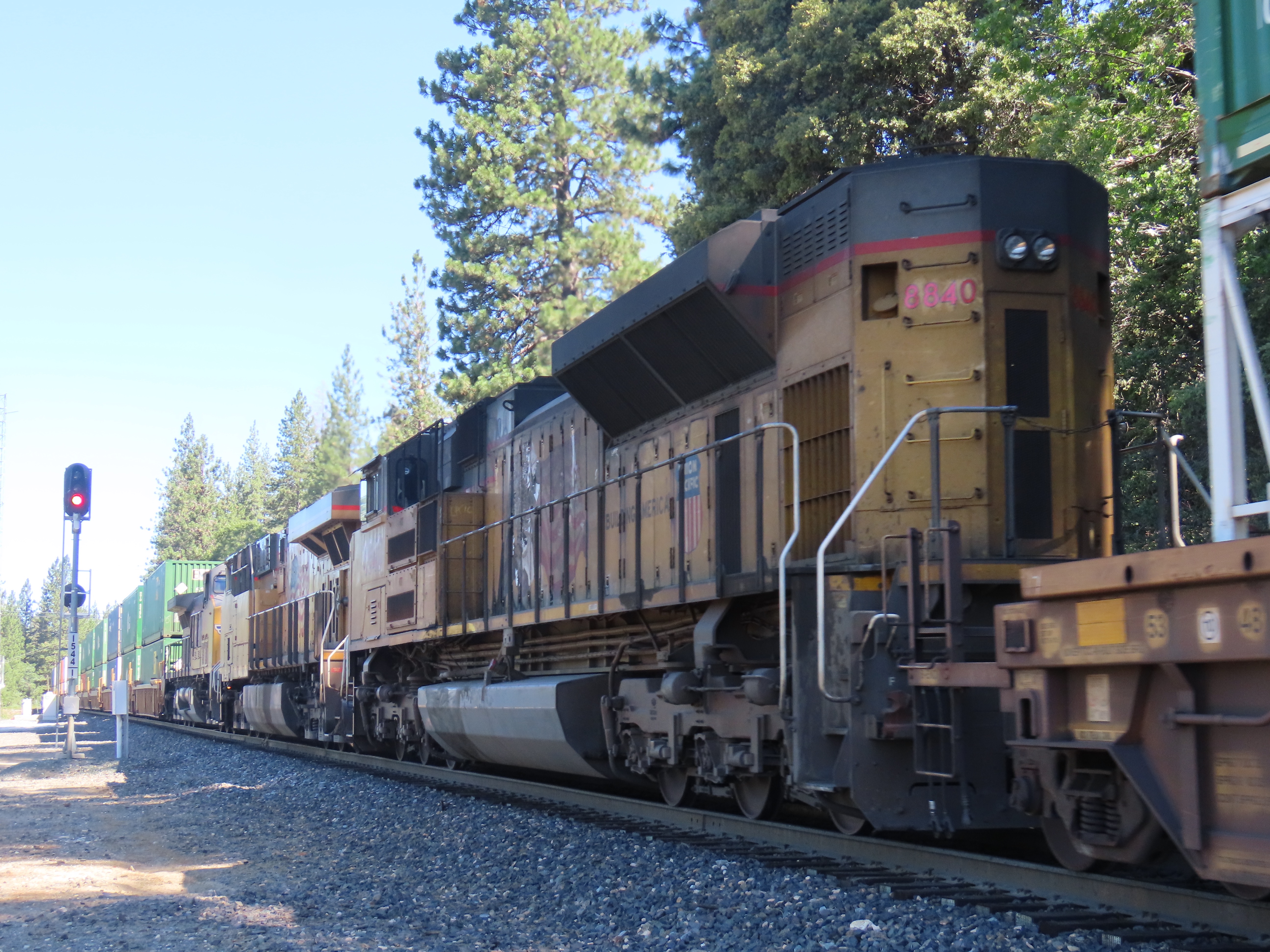
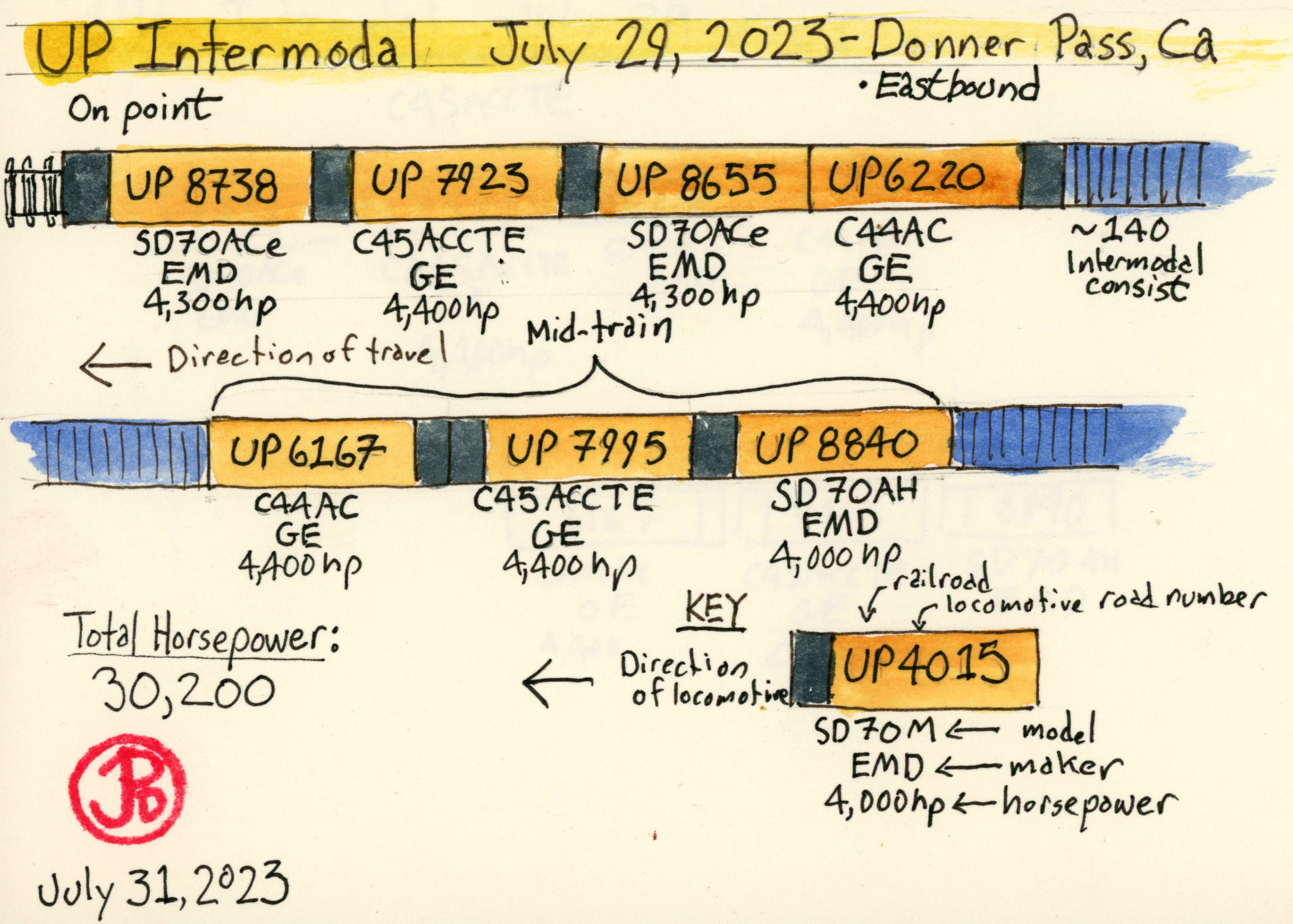
Union Pacific No. 8738 came into view. No. 8738 is an Elctro-Motive Diesel (EMD) SD70ACe. These 408,000 pound locomotives generate 4,300 pounds of horsepower and this consist featured four locomotives on point and three more mid-train. These seven locomotives generate a combined 30,200 pounds of horsepower. They need this power to pull/push the heavy loads up and over Donner Summit.
Just to provide some context, the Southern Pacific locomotive that was designed to tackle the grades and snowsheds of Donner Pass were the cab forwards. The last cab forward built, the AC-12 class No. 4294 (which is preserved ay the California State Railroad Museum in Sacramento) weighed 1,051,000 lbs (locomotive and tender) and the locomotive produced 6,000 pounds of horsepower.
When compared to standard vehicles on Interstate 80, 30,200 horsepower equals about 30 semi trucks or 150 Toyota Camrys.
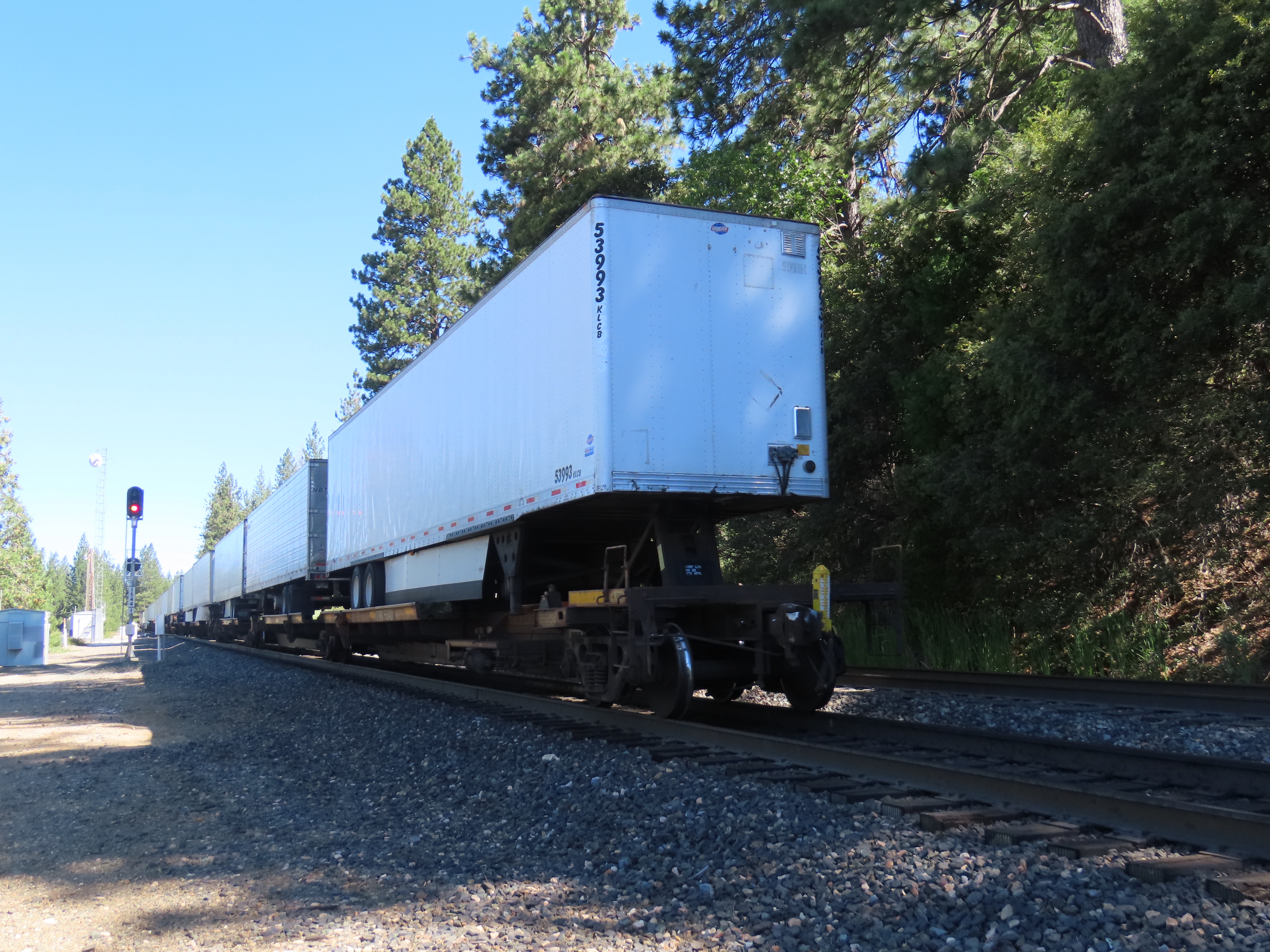
Three helpers to help push and pull the intermodal consist towards Donner Pass. The signal at Dutch Flat is now red, halting any train traffic that should come too close to the tail end of the train.The end of the train consisted of truck trailers on flatcars or piggybacks. This was the end of the train and there was no caboose. Cabooses have not been used on mainlines since the mid-1980s. They have been replaced by a small yellow box known as an End-of Train Device (ETD). This has reduced the crew of freight trains. Now the crew consists of just two people: an engineer and conductor.
Once the train passed I drove down the road into “downtown” Dutch Flat and headed back toward the highway. I came to a grade crossing where the last few cars where just passing. The arm rose and the race was on!
I hit the highway trying to outpace the freight train as well a finding a new point to see the train. I made it to my tried and true spot at Yuba Pass, where Highway 20 merges into 80. I knew I had not missed the train because the signal on the gantry above the rails was green. I must have made really good time because I had to wait almost 30 minutes before I heard the rumble of the diesels laboring on the hill. The intermodal passed and this time I got a wave from the conductor, seated on the left side of the cab. In the days of steam, this would have been the fireman’s position and the conductor would have been riding at the end of the train in a caboose.
The intermodal heading into Yuba Pass.
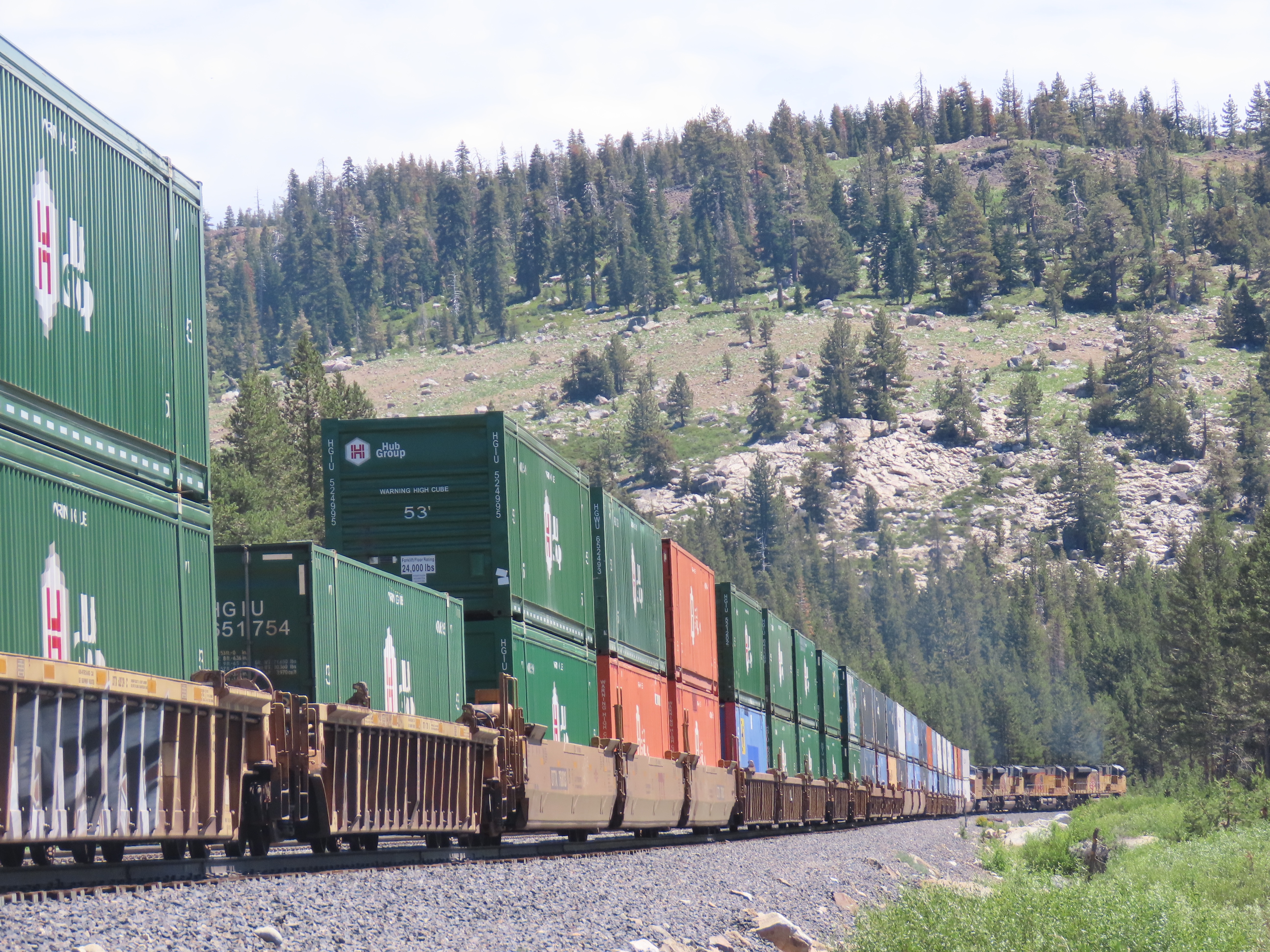
The average length of a freight train on a Class I railroad is about 5,400 feet. At Soda Springs I wanted to do a little experiment with the intermodal to see if I could come to an estimation on how many cars where in the consist. This started with timing the train from the grade crossing at Soda Springs. How long would the train take to pass a single point? The answer was four minutes and 54 seconds. That was almost a five minute wait for any motorist at the crossing!
Now for a little railroad mathematics. I estimated that it took about 2 seconds for one car to pass so I divided 294 seconds (5 minutes and 54 seconds) by 2 and got 147 train cars. I then subtracted the number of locomotives (7) and came to an estimation that this freight train consist consisted of 140 cars. An intermodal of this length takes a lot of trailer trucks off the roads. Just how many trucks?
I estimated that about 75% of the train consisted of double stacked Container on Flatcar (COFC) which is 105 cars and the remaining 35 cars were Trailer on Flatcar (TOFC). 2 times 105 is 210, add 210 to 35 and we get 245. So this intermodal freight train removes about 245 trailer trucks from Highway 80. Every motorist motoring to Lake Tahoe or Donner Lake should be thankful these Union Pacific freights that put in the hard work that make life a little easier.
The intermodal at the grade crossing at Soda Springs, almost at the top of it’s climb to Donner Summit.The train with it’s 140 cars, heading towards Donner Summit near Sugar Bowl Ski Resort.
Based on my field photos I was able to get the road numbers of all seven locomotives on the freight train. Using a Union Pacific roster I was able to identify the maker and model of each locomotive and it’s horsepower output. There where three EMD (Electro-Motive Diesel Inc.) and four GE (General Electric) locomotives. I put this information into a locomotive map showing the road number, model, maker, horsepower, and direction of travel for each locomotive. The total horsepower output for all seven locomotives was 30,200 hp.
The roughly 100 hundred miles that separates Denver, Co, and Cheyenne, Wy is the currently epicenter of Union Pacific’s monster steam locomotive the Big Boys, not because they routinely ran between these two cities but because three of the eight existing Big Boys can be found along Highway 25 in the cities of Denver and Cheyenne.
Cheyenne was the operational headquarters for the 4-8-8-4, freight locomotives that were designed to tackle the Wasatch Mountains between Cheyenne and Ogden, Ut. These were the largest steam locomotives ever built.
Overall, 25 Big Boys were made, currently two are found in Cheyenne and one in Denver. No. 4004 can be seen on display in Holiday Park in Cheyenne. Local residents petitioned Union Pacific to donate a Big Boy to the city of Cheyenne when they saw the rapid disappearance of stream locomotives from the rails in the late 1950s and early 1960s.
Big Boy 4004 at Holiday Park in Cheyenne.
Big Boy No. 4005 had a much more colorful history than 4004. 4005 was only one of two Big Boys that were converted from coal to oil (more on that other converted Big Boy later). 4005 tallied up 1,043,624 road miles in a 20 year career. The giant is also the only Big Boy to ever be involved in a major accident. On April 27, 1953, 4005 hit an opened siding at 50 miles per hour causing the train to derail and the Big Boy fell on it’s left side (the damage is still visible today). The engineer, fireman, head-end brakemen were all killed in the wreck. The locomotive was later repaired in Cheyenne and returned to service.
The 4005 is now on display in Denver’s Forney Museum of Transportation in northern Denver. This is where I returned, this time with Steve, to do a few field sketches of the Big Boy (the featured sketch and the sketch below of 4005’s tender.)
The other Big Boy that was converted to burning oil is perhaps the most famous Big Boy: Union Pacific’s 4014. 4014 is the largest operational steam locomotive in the world. It was on display for many years in California and was shipped, by rail, to the steam shop in Cheyenne and fully restored to working order.
Union Pacific 4014 has proven to be the most illusive Big Boy for me. You would think the largest operational steam locomotive in the world would be easier to see! I have seen the Steam Shop in Cheyenne and the doors have always been closed, hiding 4014 and the Living Legend No. 844. A west coast steam tour was planned for this summer but was cancelled because UP’s rails are crowded with freight traffic to ease the supply chain issues. Yet another opportunity missed to see 4014 under steam.
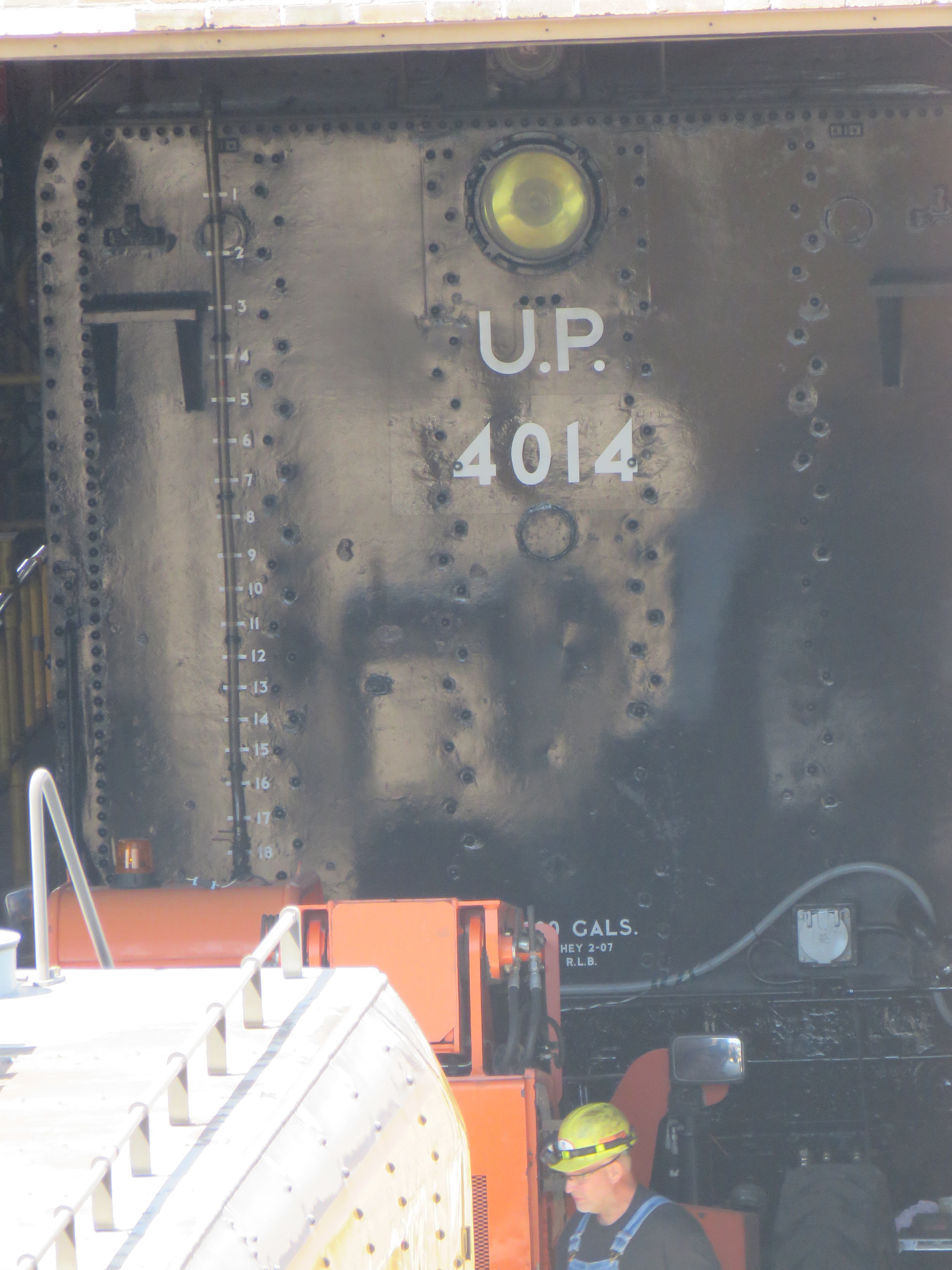
This is the closest I have come to seeing 4014: it’s tender. This was at the steam shop and little did I know that they were preparing to go out on the rails for an unannounced test run as a warm up for it’s 2021 summer steam tour. So close yet so far away!
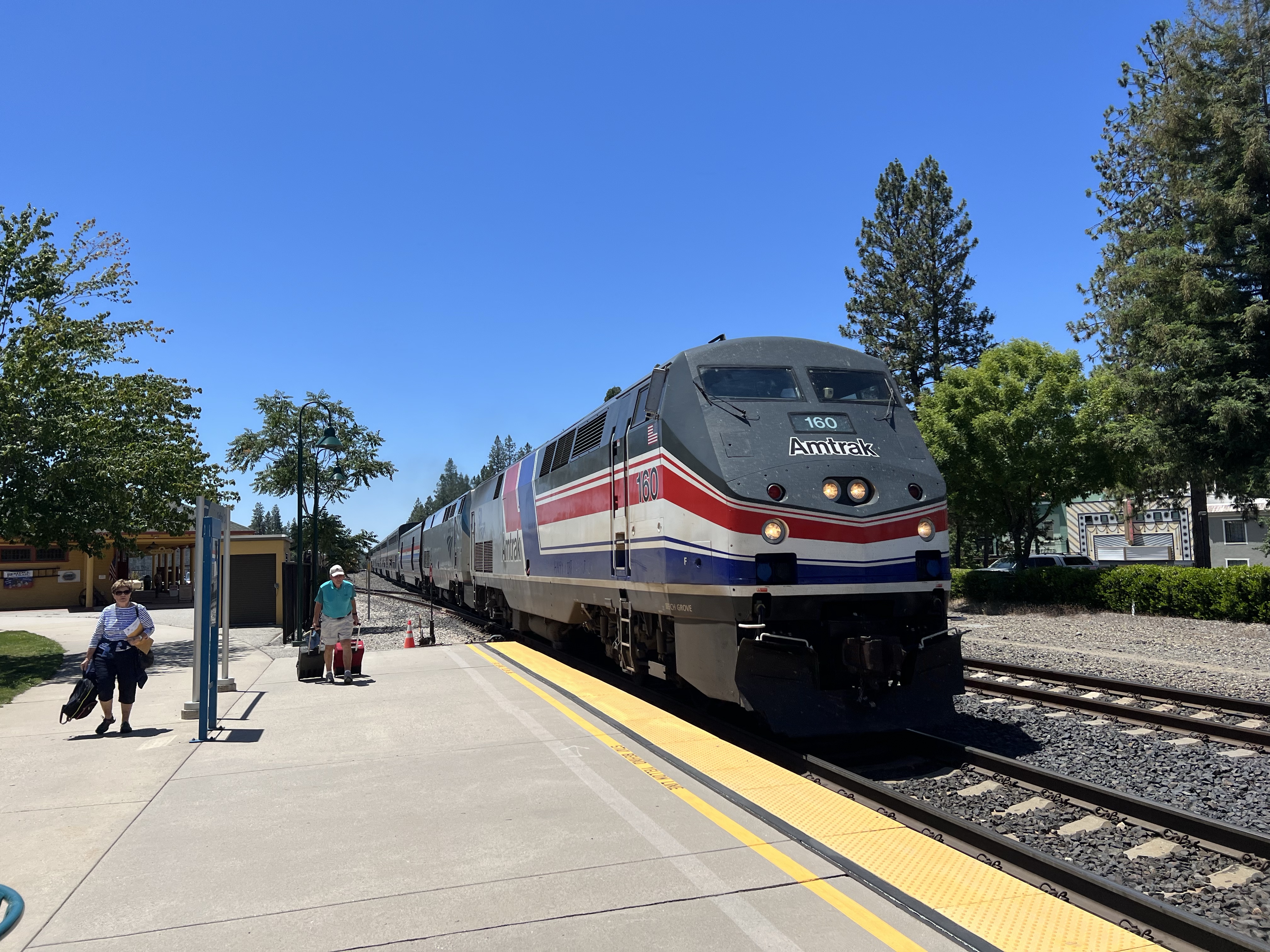
The California Zephyr Train number 6 pulled into Colfax Station running about 30 minutes late.
I was boarding the Zephyr with my mom and her husband Steve and we were heading to Denver, Colorado. We would be spending the night and eating three meals a day on the Zephyr. This is AMTRAK’s longest daily route and it is a village on rails.
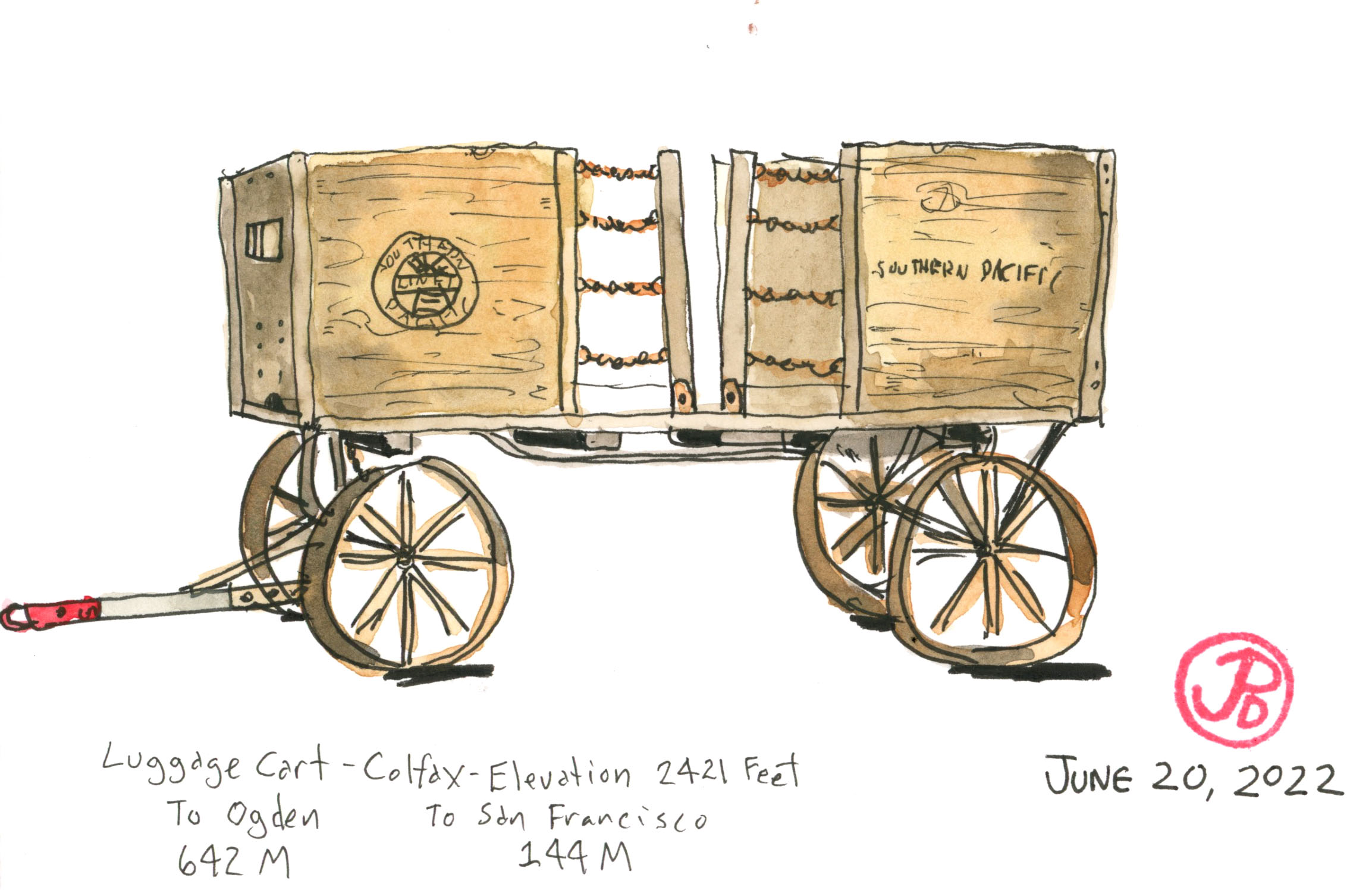
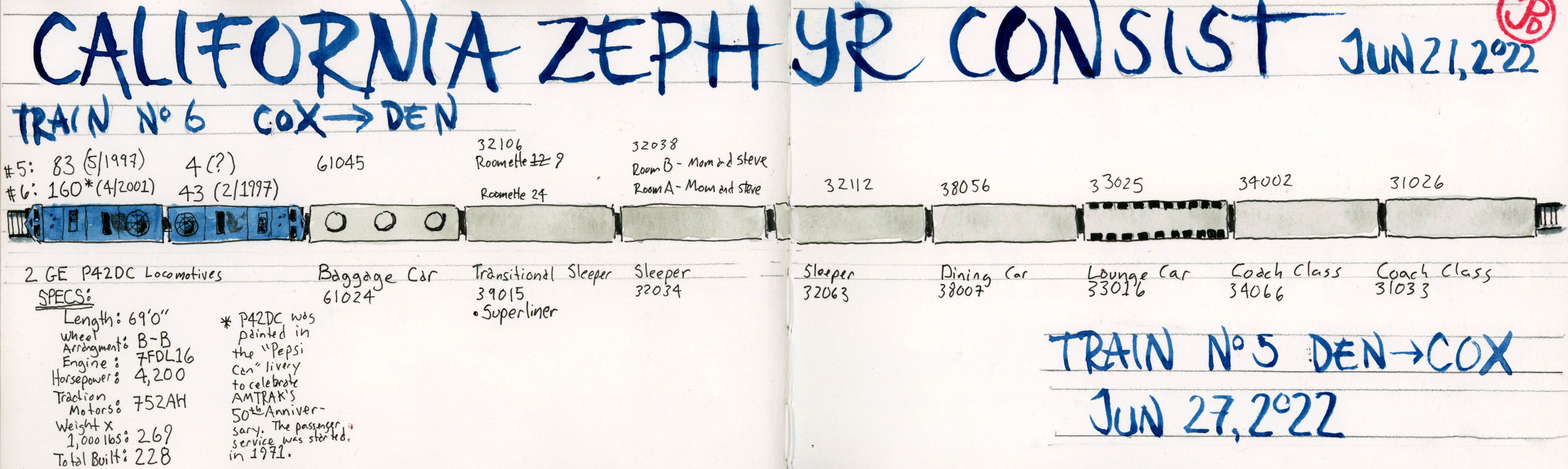
I did a few pre-trip sketches. The first is of the predicted consist of our train. A consist is the make up of the train, for instance: two locomotives, a baggage car, three sleeper cars, a diner car etc. I anticipated two locomotives and eight cars. Turns out I guessed right. I sketched them in and I would label them later during our first stretch break in Reno, Nevada. The second was the baggage cart outside Colfax Station, which I did the day before we boarded the Zephyr.
The eastbound California Zephyr pulls into Colfax. We were the only passengers who boarded. Mom and Steve are “racing” to the platform before the Zephyr’s short stop is over.
I was familiar with sketching from the California Zephyr from my previous trip last April. You have to sketch fast, taking in passing information creating an overall composite or impression. The brush pen was the perfect tool for Zephyr sketching.
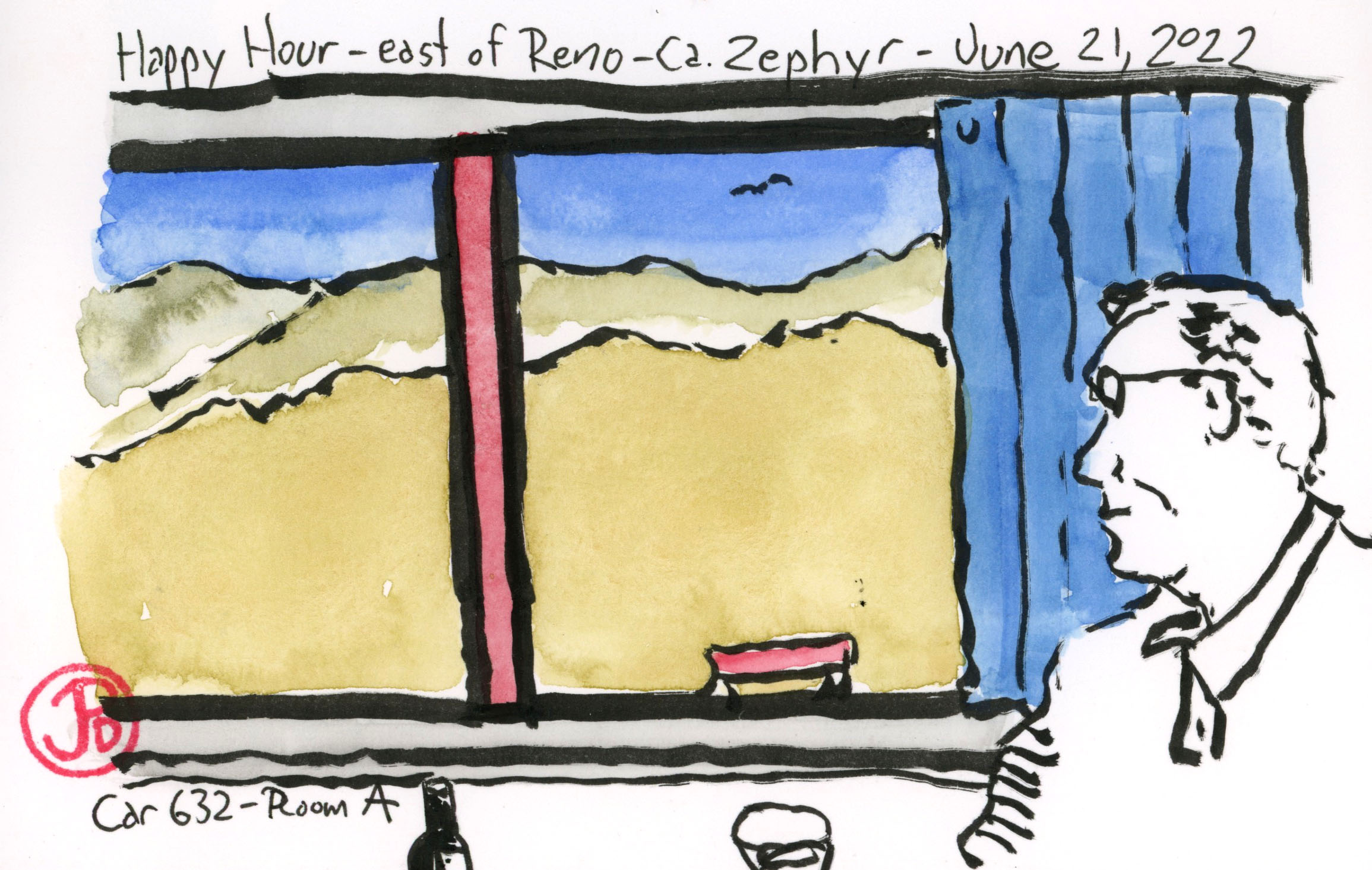
One of my favorite Zephyr sketches was done in Room A (Mom and Steve’s room) during happy hour. We where somewhere east of Reno.
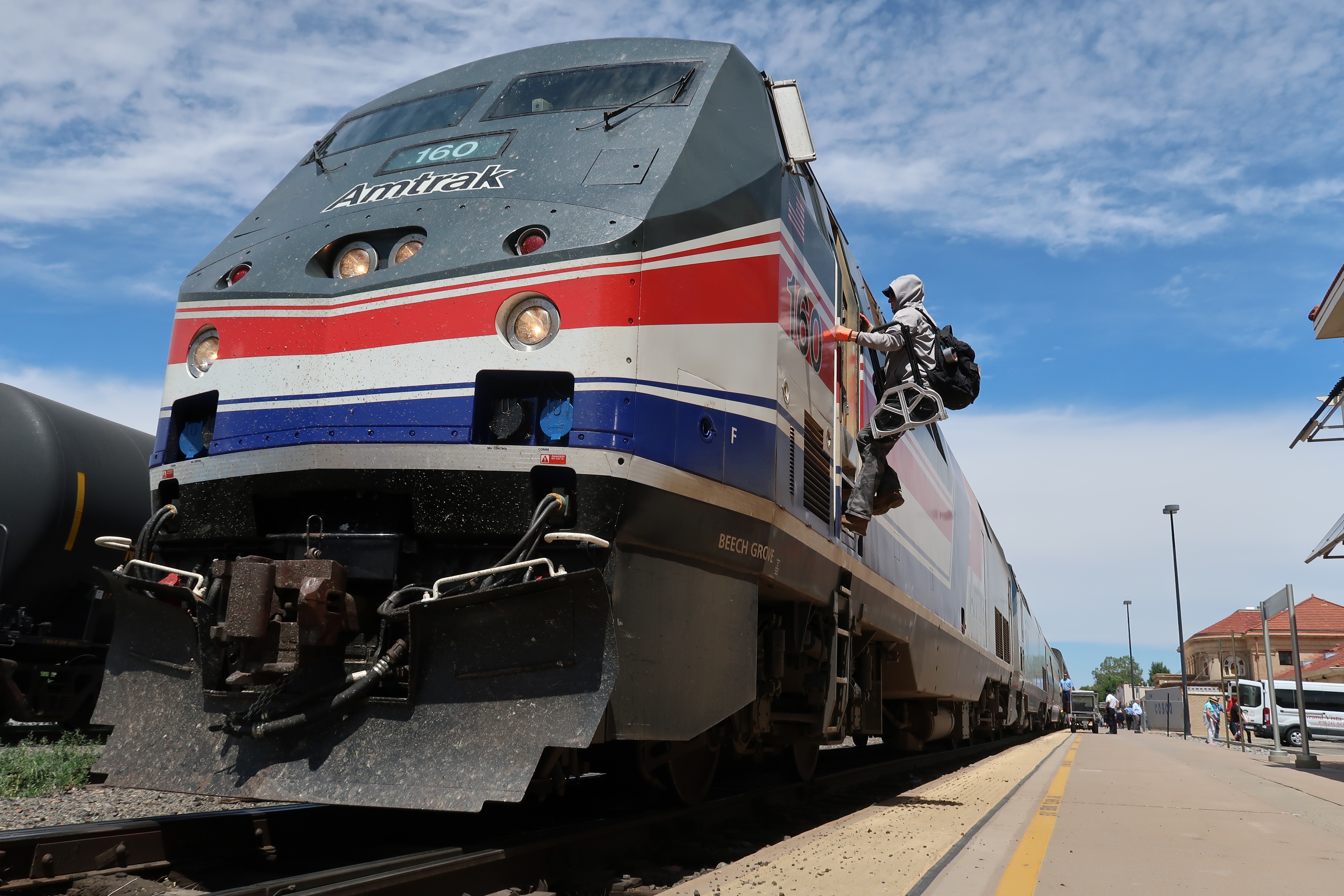
Crew change at Grand Junction, Colorado. Locomotive 160 painted in it’s “Pepsi Can” livery, to celebrate AMTRAK’s 50th anniversary.
Colfax, California is on the original Transcontinental Railroad. At Colfax, the climb of the western flank of the Sierra Nevada Mountains begins in earnest. The town started as a railroad construction camp and then was renamed by Governor Stanford to honor Vice President Schuyler Colfax who visited to check the progress on the western side of the Transcontinental Railroad.
What is special about Colfax is that it is one of the few places on the California Zephyr’s 51 hour and 20 minute route where trains 5 (westbound) and 6 (eastbound), pass within minutes of each other. That is, if the Zephyr is running on time, which is not too often. In California, the AMTRAK passenger service runs on Union Pacific rail and freight always has right of way. It pays the bills after all.
Both Zephyrs where scheduled to be at Colfax within a few minutes of each other at about 12:30 PM. At about 12:15, people with their suitcases began to arrive at the platform. I love the romance of train travel. The farewells at the station as one prepares for a rail journey, often to see far off friends and family over the Christmas Holiday.
12:30 came and went and no Zephyr.
Both Trains 5 and 6 were late. This is AMTRAK after all, a passenger service not known for it’s punctuality. The Chicago-bound, Train #6 was running about 30 minutes late. It had left Emeryville in the morning at 7:21 AM.
The California Zephyr eastbound Train #6 arriving at Colfax, about 30 minutes late. This train’s final destination is Chicago.
Train #6 pulled into Colfax station at 12:59 PM. I had positioned myself on the east side of the grade crossing at Grass Valley Street. The Zephyr had an eight car consist with a baggage car and seven passenger cars and was pulled by two locomotives. The train was too long for the station platform so when the Zephyr stops at the station, it stops traffic on Grass Valley Street. I had no way of knowing which car would be stopped at the grade crossing. It lent a bit of improvisation and serendipity to the sketch. And I would only have a short time to sketch the scene because the Zephyr would be in the station for about three minutes as passenger boarded or disembarked.
The train slowed to a stop and the baggage car came into sketch-view. I would be sketching this car. Great, there are less windows on the baggage car! I quickly sketched in the form of the car and then worked inward to add details. I had all the information I needed in about two minutes of sketch-time (you do lose sense of time when sketching). I would later add a few more details and paint.
Train number 6 headed out of Colfax toward Cape Hope and the summit of the Sierra Nevada Mountains at Donner Pass and then on to Reno, Salt Lake City, Denver, and eventually Chicago. I checked the status of the westbound train train number 5. It was running an hour and a half late. In about 10 minutes I found out the reason why.
Coming down from the summit was a UP freight wearing a dusting of snow on it’s pilot as it headed down towards the Bay Area. The five locomotives (four on point and another at the end) where hauling a long container consist that keeps a lot of trucks off our highways. The Zephyr was running behind this train which explains why it was running an hour and a half late.
I didn’t wait for the westbound Zephyr, I had already gotten my sketch in the book!
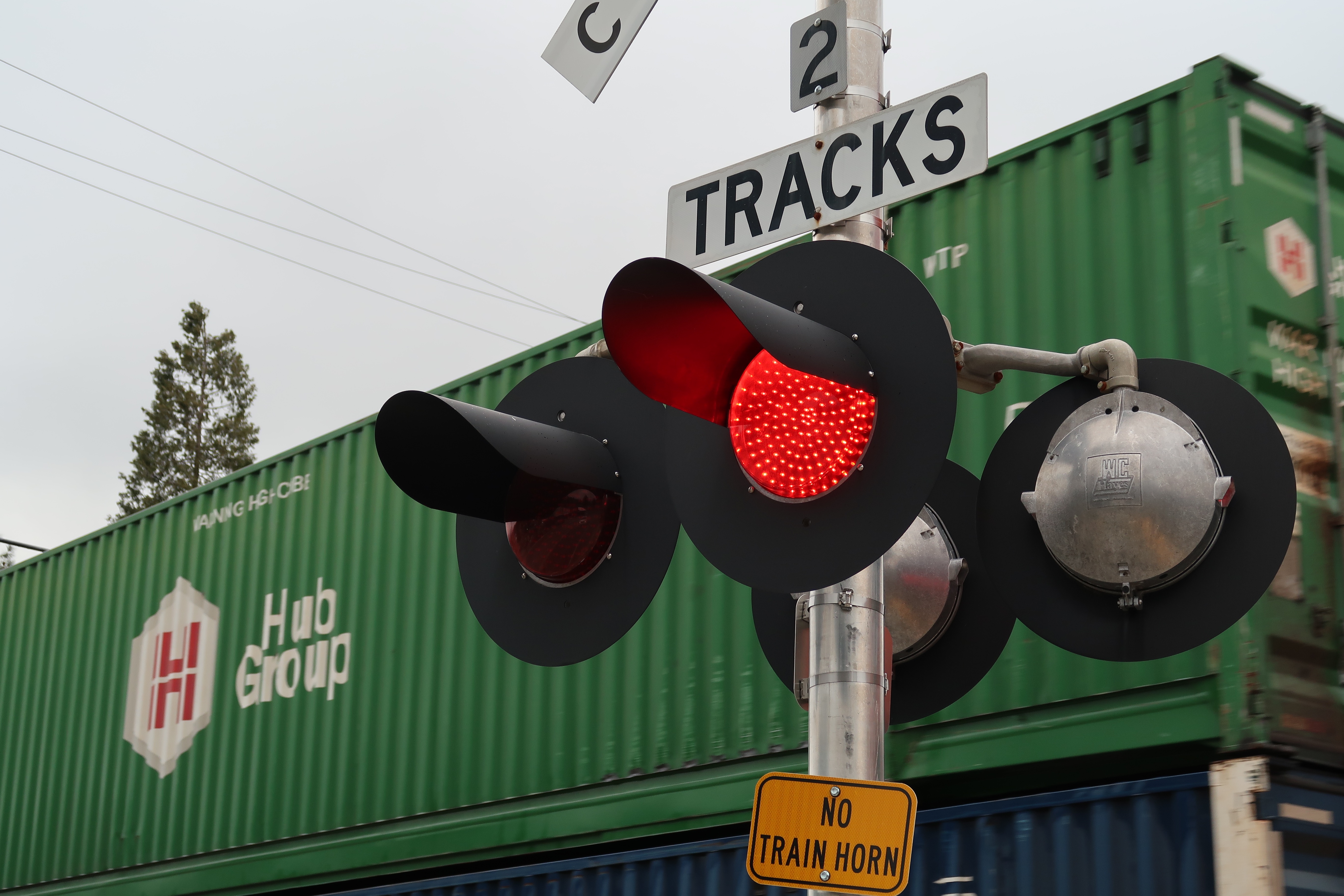
The train town of Colfax is a “No Train Horn” town.
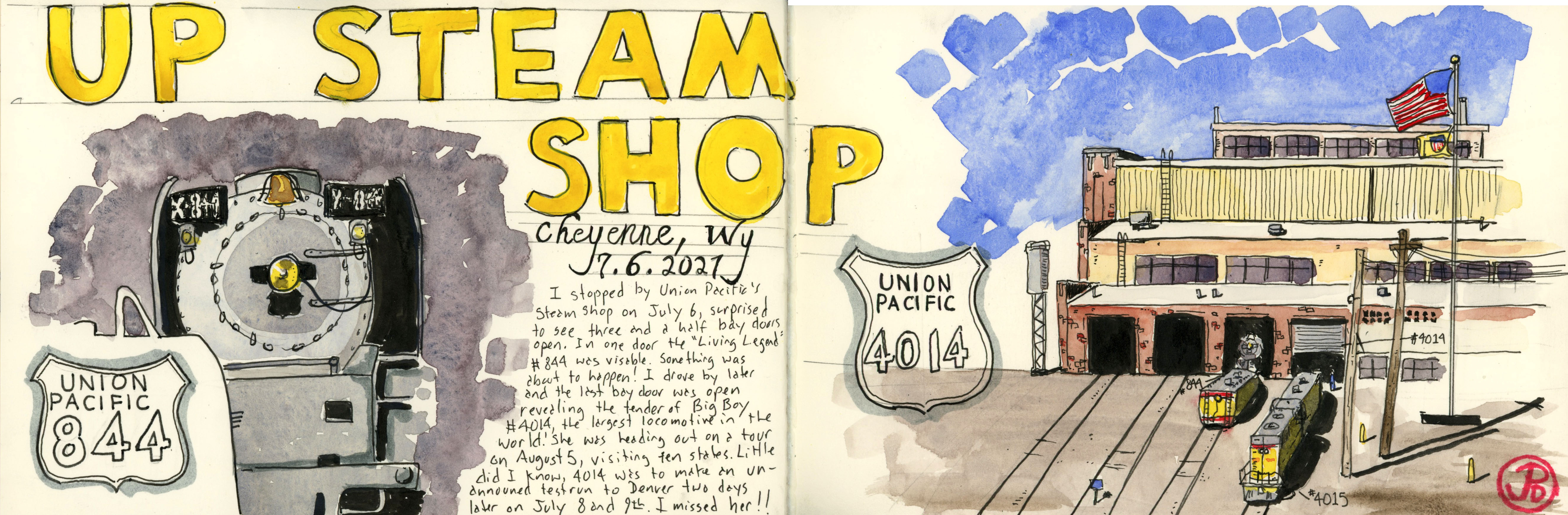
One of the holy sites to steam locomotives in the United States is the Union Pacific Steam Shop in Cheyenne, Wyoming. This is a building where Union Pacific’s legacy steam locomotives are stored and maintained (and in one case fully restored).
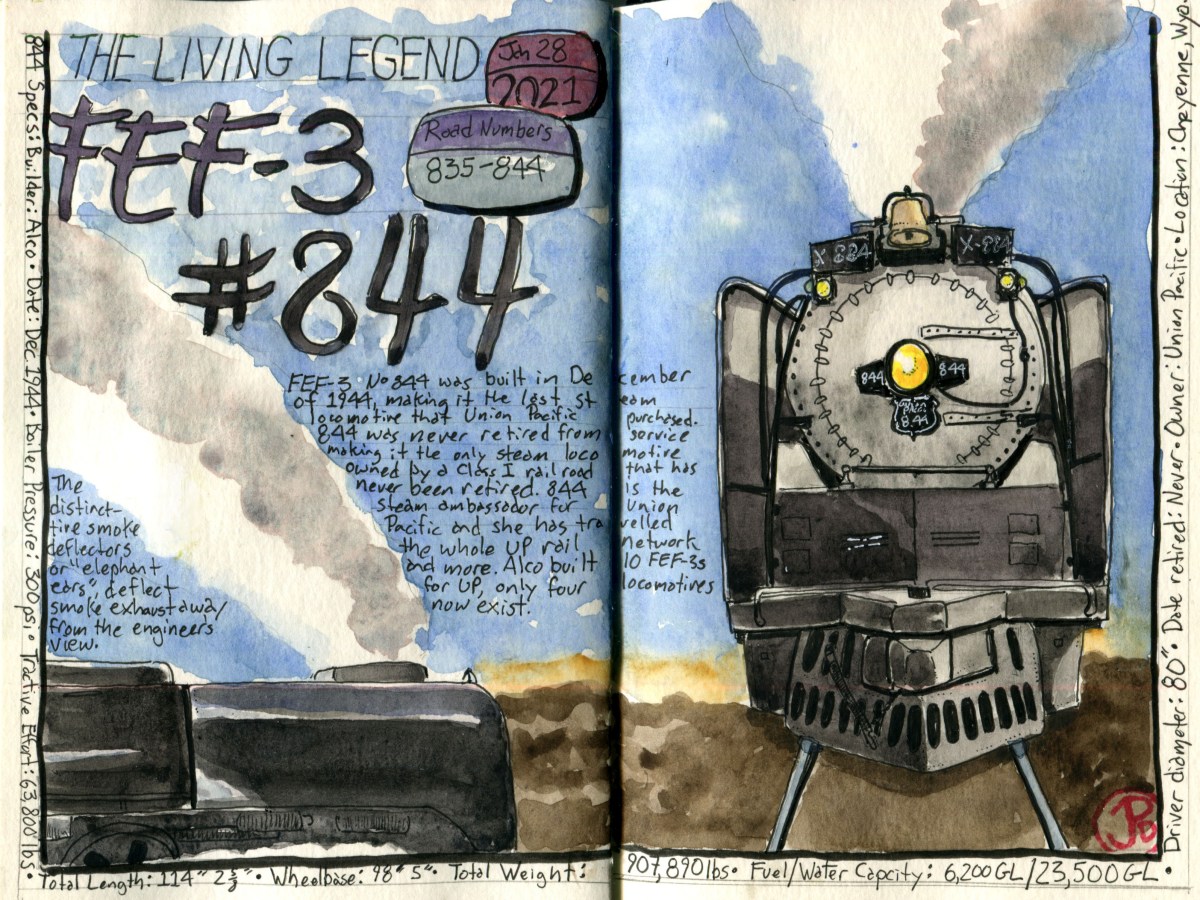
It’s most notable locomotive is the FEF-3 4-8-4 Northern locomotive #844 know to many fans across the world as the “Living Legend”. 844 is notable because it had never been retired since she was built in December of 1944. UP had keep 844 running as an ambassador for the company. As the 150th anniversary of the completion of the first Transcontinental Railroad neared, (where the Central Pacific and the Union Pacific met at Promontory Summit in Utah) Union Pacific had plans, big plans!
They chose the ambitious task of restoring to full operation one of the largest examples of a steam locomotive ever built, the 4-8-8-4 Wasatch type, known to rail fans as the Big Boy. 25 of these massive locomotives were built for the Union Pacific to tackle the the grades between Cheyenne, Wy and Ogden, Ut. There are eight Big Boys still in existence, all on static display, until now.
The steam crew looked at all of the existing Big Boys and decided that #4014, which was on display in the RailGiants Museum in Pomona, California, was the best candidate for restoration. 4014 had been retired in December of 1961 after logging 1,031,205 miles while in service.
The Big Boy was moved, by rail, from California to the Steam Shop in Cheyenne. From 2016 to 2019, 4014 was restored at the Steam Shop and had her first “maiden” run after six decades on May 4, 2019.
So here I stood on the walkway of Highway 180, which spans the tracks and yard in Cheyenne, looking down at the Steam Shop, hoping to get a glimpse of the recently restored monster. Three and a half bay doors were open. In one stood the Living Legend herself, 844!
What’s behind Door Number 3?
I later returned to find that the last bay door was fully opened, revealing the tender of Big Boy 4014! Well her backside will have to do.
Outside of the bay door where 4014 was stabled, there was an extra tender coupled to a UP EMD #4015. It looked like some crew members where making some adjustment to the tender. I didn’t know it at the time but this was a sign that 4014 was soon to be on the move. Two days later, 4014 and it diesel/electric helper an SD70M #4015 indeed were on the move as the crew took the Big Boy out on an unannounced test run from Cheyenne to Denver on July 8 and 9th. This was a test run for the month-long, multi-state tour that 4014 would begin on August 5.
It was hard to believe that I was so close to seeing 4014 in action but had no idea until after the fact, that the Big Boy was strutting out on the mainline. “Ugg!” As Charlie Brown would say.
The tender of 4014. The man in the foreground is 4014’s engineer and director of the Steam Program, Ed Dickens. This feels like a bit of a paparazzi shot. Oh, not for Ed but 4014!Cheyenne is a trainspotter’s paradise with 80 trains passing through every day like this eastbound freight.
On my journey from California to Colorado, I had a few historic sights I wanted to sketch along Highway 80 in Wyoming. This is Union Pacific territory, and the route over the Wasatch Mountains from Ogden Utah to Green River is legendary.
The Evanston Roundhouse and the Ames Monument are relics from a different time. The roundhouse was of a time when steam was the prime motive power of the Union Pacific and the monument the Ames brothers at Sherman Summit is no longer near the mainline (the line is now three miles to the south).
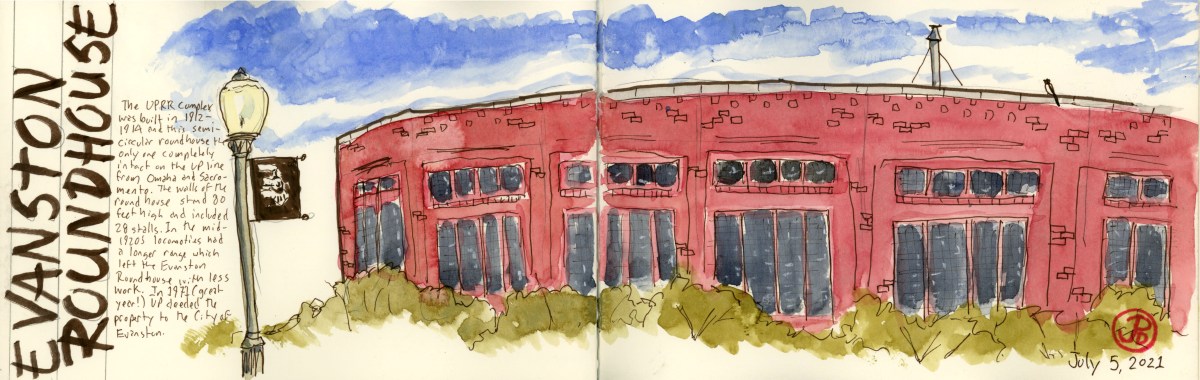
The Evanston Roundhouse is notable because it is the last completely intact roundhouse left on the Union Pacific line from Sacramento to Omaha. It had 28 stalls and is 80 feet high.
The roundhouse at Evanston on the left and the powerhouse on the right. The rusted, overgrown tracks in the foreground tells us that this complex has not been used by Union Pacific for a long time. I had to walk a ways back to photograph the whole massive roundhouse.
The roundhouse and yard was build by UP from 1912 to 1914. The roundhouse was part of a 27 acre complex to service steam locomotives. When steam locomotives became more efficient, they did not need to make so many service stops and the yard at Evanston was often bypassed. The Union Pacific deeded the property to the City of Evanston. The roundhouse is now used as a conference center and a meeting place.
Standing before the red brick semicircular roundhouse reminded me of a Plaza de Toros in Spain. Looking at just one part of the structure gives no indication of it’s form. I sketched one side of the roundhouse with the roofline slowing curving around (featured sketch). To see the entirety of the roundhouse, one has to walk back from the roundhouse by at least 100 yards to take it all in.
An intermodal freight passing through Evanston. The two locomotives on point represent the Transcontinental Railroad. The Union Pacific is pointed east towards Cheyenne and behind # 8990 is a former Southern Pacific locomotive (representing the Central Pacific) facing west toward Sacramento.
The next Union Pacific site is to be found off Highway 80 near the town of Buford (population 1). This is a monument to two brothers who were essential in creating the Union Pacific side of the Transcontinental Railroad.
The Ames Monument was built by the Union Pacific and dedicated to the brothers Oakes and Oliver Ames. It marked the highest point on the original Transcontinental Railroad at Sherman Summit at 8,247 feet. Oliver was one of the first presidents of the Union Pacific Railroad (from 1866-1871) and his brother Oakes was a U.S. Representative from Massachusetts. Both brothers, at the request of Lincoln, were put in charge of financing and building the Union Pacific portion of the railroad. Without the contribution of the Ames brothers, the railroad might never have been completed.
The 60 foot pyramid was build in 1880-1882 of granite at the cost of $64,000. On two side are base-relief portraits of each brother. In 1901, Union Pacific rerouted the mainline a few miles to the south.
On my first attempt to sketch the Ames Monument, a thunderstorm rolled in from the west. This monument being 60 feet high and at one of the highest points on the original Transcontinental Railroad, I though it would be wise to head to my car and return in the morning!
My brother spent almost half of his life in the Central Valley college town, Davis, California. He attended the University of California at Davis (UCD), worked in it’s public and private schools, got married, and raised his three children in “The City of All Things Right and Relevant!”
For Mother’s Day we where meeting my mother and sister-in-law in Davis so I arrived a little early to I sketch the historic train station and do a little railfanning.
Most towns start with a train station and Davisville, as Davis was then known, got their passenger depot in 1868. The original station burned down and the current station was built by Southern Pacific Railroad in 1913. The station is built in a Mission revival style. The University Farm, which later became UCD, opened five years before the current building was finished. At the time, the University wanted a befitting station to the town and the university stop. And they certainly got one!
Three passenger trains stop at Davis: the Capital Corridor, AMTRAK’s Coast Starlight, and the California Zephyr.
A view of Davis Station from Track 1. The SP stands for Southern Pacific. The bike racks in the foreground tells you this is Bike City, Davis.
I sat on the north side of the station and sketched it’s Mission Revival stylings. The station is island by three sets of tracks which at the time was an important stop on the Cal-P line. While I was sketching the station, I was very familiar with it’s curved lines, arches, and tile roof because I had sketched all of California’s Spanish Mission and a few Southern Pacific Mission Revival stations (Burlingame Station comes to mind). Davis Station and the Davis Tower are the only examples of Mission Revival in the city of Davis.
The interlocking control tower still stands just northeast of the station. This will have to be for another sketching day.A Union Pacific freight blazes through Davis Station with it’s curved track. Union Pacific owns the tracks and freight, not passengers service, pays the bills for the railroad.
There were a few clues that a train was coming down the line at Davis Station. The first was that the signal light was green, meeting that whatever train was heading down the line had the “high ball”, in other words, the train had the right of passage. The other clue was that people began to arrive at the station with their flowers in pots or plastic; it was Mother’s Day after all.
At 10:40 AM, a westbound Union Pacific freight train sped through the curve at Davis Station on track 1, the engineer giving me a thumbs up as the train rumbled through. At 10:50 AM, on track 2, the eastbound Capital Corridor train #724, pulled into Davis to take on passengers on her way to California’s capital: Sacramento.
The westbound Train # 731 was right on time and pulled into Davis at 11:10 AM. This Capital Corridor passenger train was heading to San Jose.
On point was locomotive 2004. I looked down at the front truck, containing the leading axels of the locomotive and stenciled, in yellow, where the two letters “GP”. In an odd bit of coincidence, I has replaced the initials “SP” on the Davis Station with my brother’s initials, “GP”, as an honor to his memory.
A westbound Capitol Corridor train pulls into Davis Station on it’s way to San Jose. On point is Locomotive 2004, an EMD F59PHI with “California” styling. I should say so.In one of those “I-can-make-this-sh*t-up” moments, the initials “GP”, my bother’s intials, were stenciled into the trucks of locomotive 2004. Unreal.
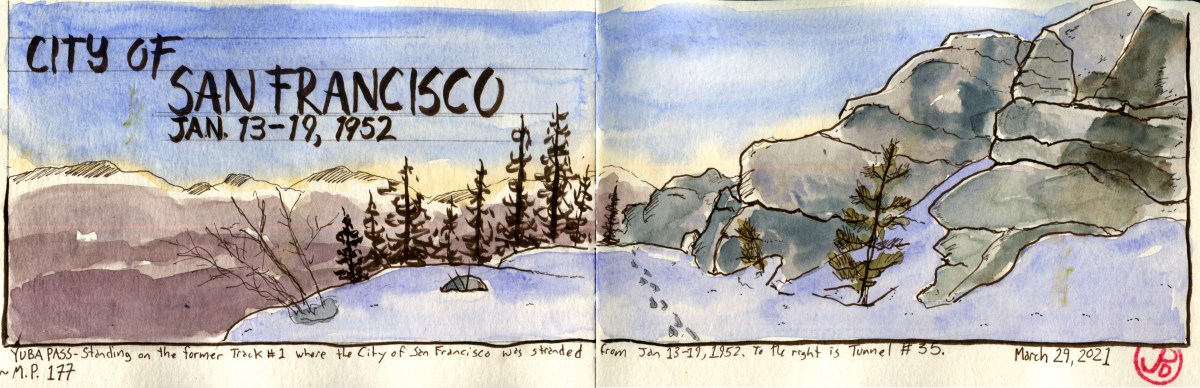
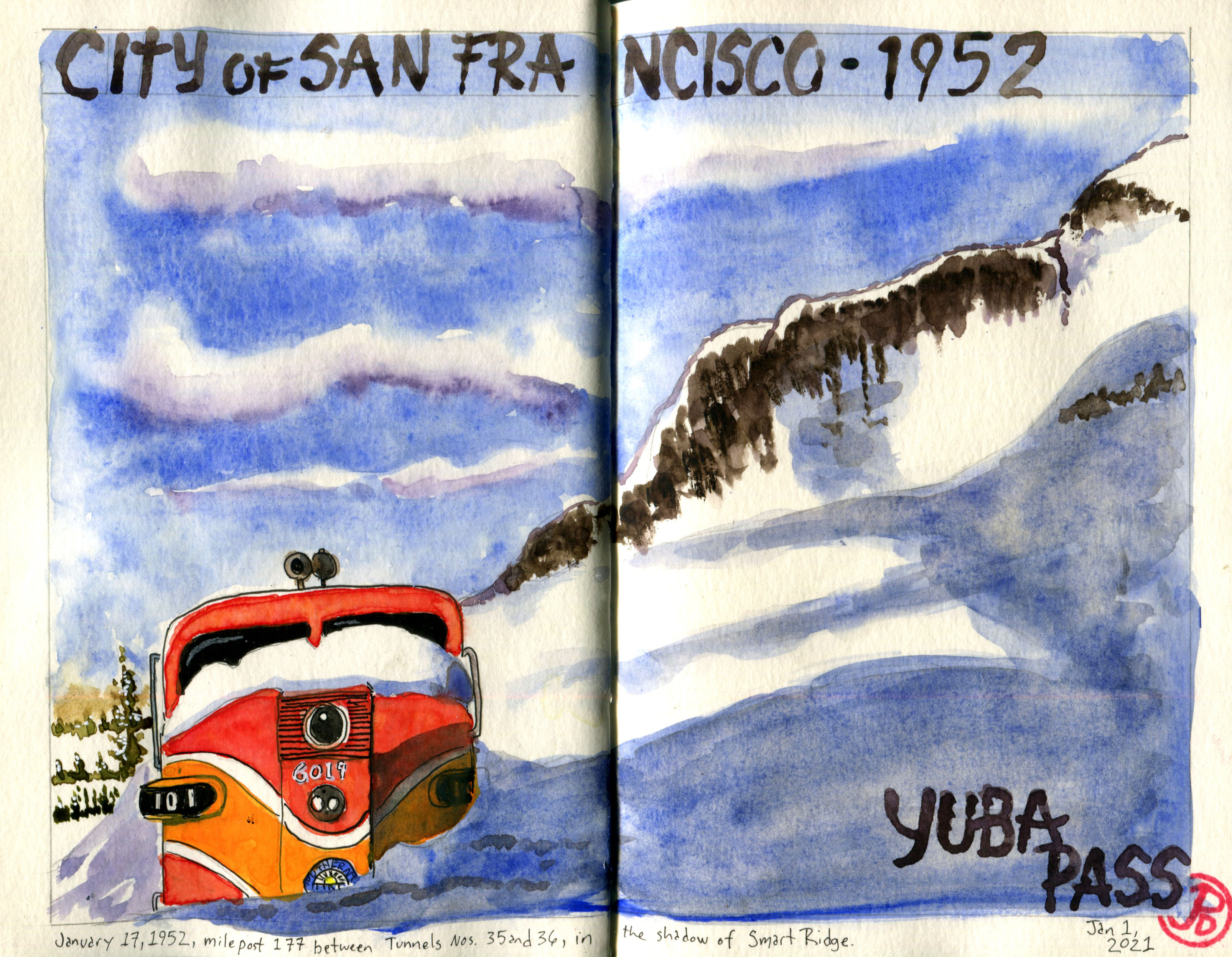
Ever since I had read about the stranding of the City of San Francisco in January 1952, I have wanted to visit the location and do a sketch.
In January of 2021, I did a sketch of the stranded super liner that was based on a historical photo. Since that time I had wondered if the stranding site was accessible or if it was on a part of the line that was far from roads or trails. In January 1952, the whole landscape was snowbound, paralyzing all transportation routes. After some research, I found out that the site was ridiculously accessible because Milepost 177 was a ten minute walk from where Highway 20 joins Highway 80.
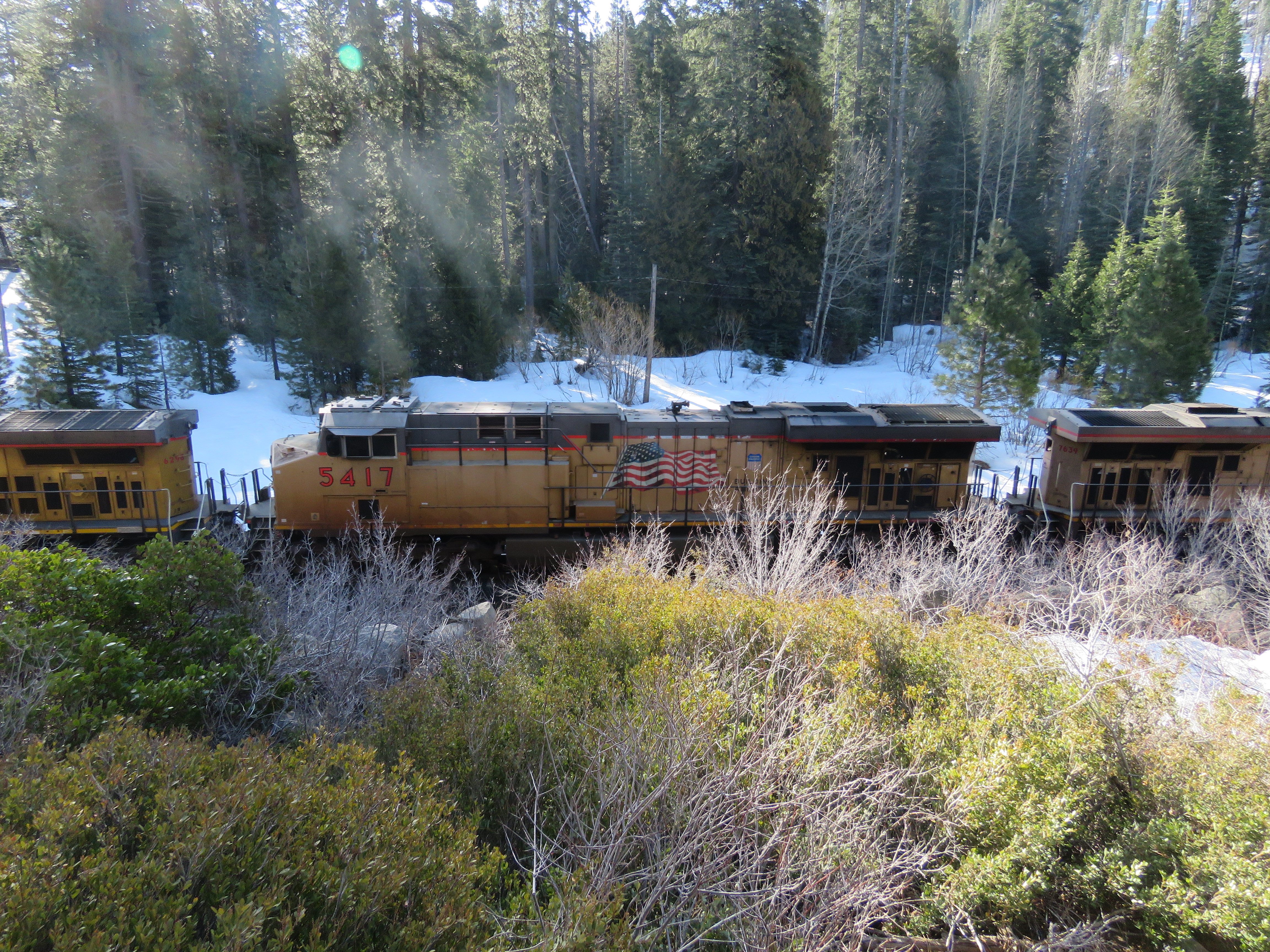
As I pulled off Highway 20, I donned my snowboots, an east bound Union Pacific freight passed by with a consist mainly featuring tanker cars. Freight has the right of way over passage service, it is the bread and butter of the contemporary railroad business.
A UP freight climbing towards Tunnel numbers 35 and 36 and off toward Donner Summit.
I wanted to find the exact location that the City of San Francisco became stranded: milepost 177, between Tunnels 35 and 36. But I also wanted to time my visit so I could see and photograph some trains at Yuba Pass. Well I just missed a freight train but my real prize was now running two minutes late and would depart Truckee at 9:39 AM.
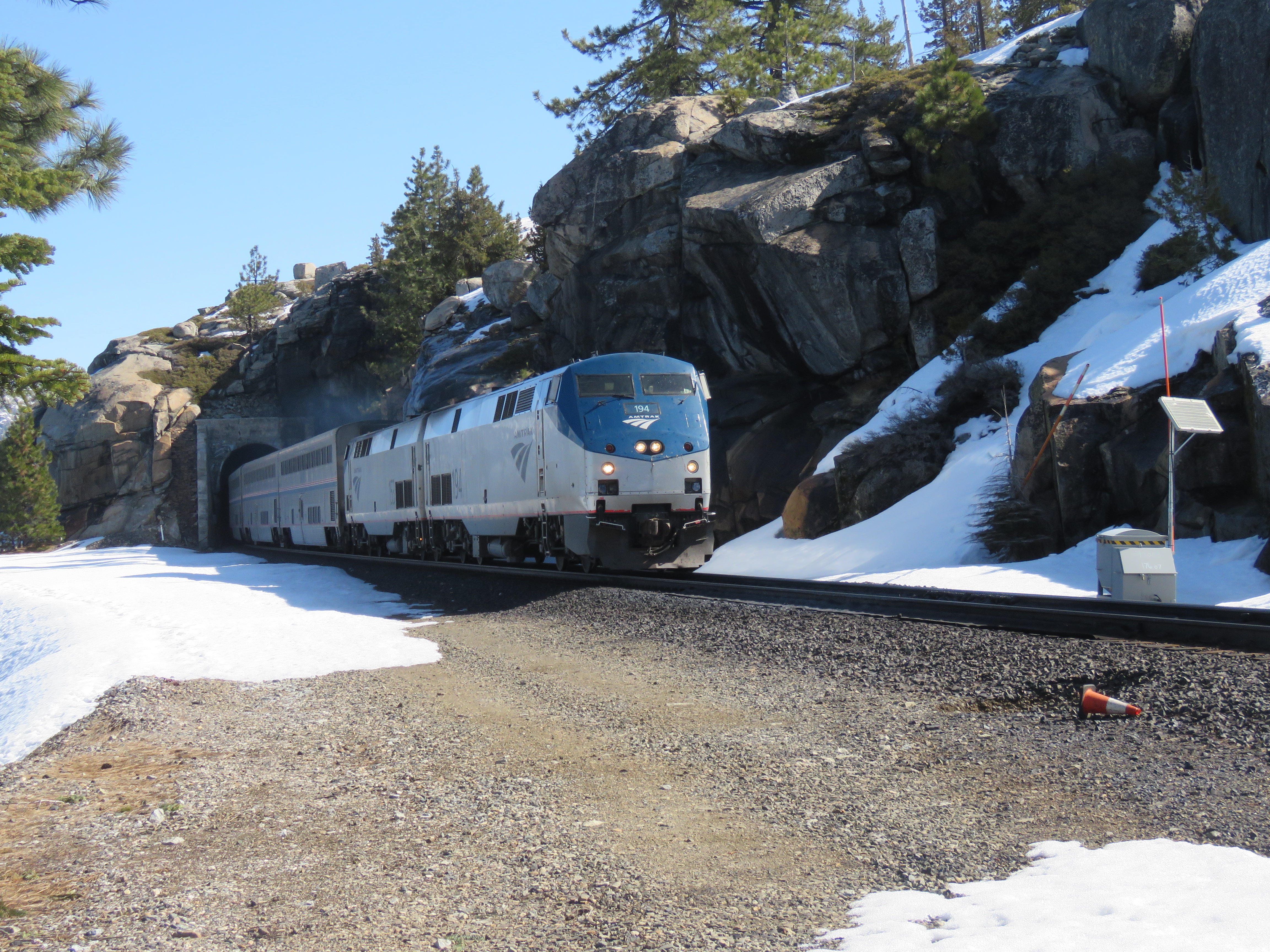
This was the passenger service that replaced the City of San Francisco. It is one of the longest, and some would argue, most beautiful, routes on the Amtrak system. This is the California Zephyr. The hike up to Yuba Pass was extra special because on the following day, I would be boarding the eastbound California Zephyr, Train #6, to Denver, Colorado. Nine days later I would be returning on the westbound, Train #5. This was the train I was waiting for.
I hiked along the former grade of Track #1, the route is currently single tracked. The hike was relatively easy because it was along a railroad grade and the snow wasn’t too deep. It took me about ten minutes to reach Tunnel # 35. The current track goes through the tunnel but the former track goes around Smart Ridge. It was in this area that the City of San Francisco became stranded in 1952.
I looked at a few arial reference photos and picked my spot, in the shadow of the rocky ridge. I sketched in the ridge on the right and the trees in the background and far off the spine of a mountain range. For this I used Micron dark sepia pens.
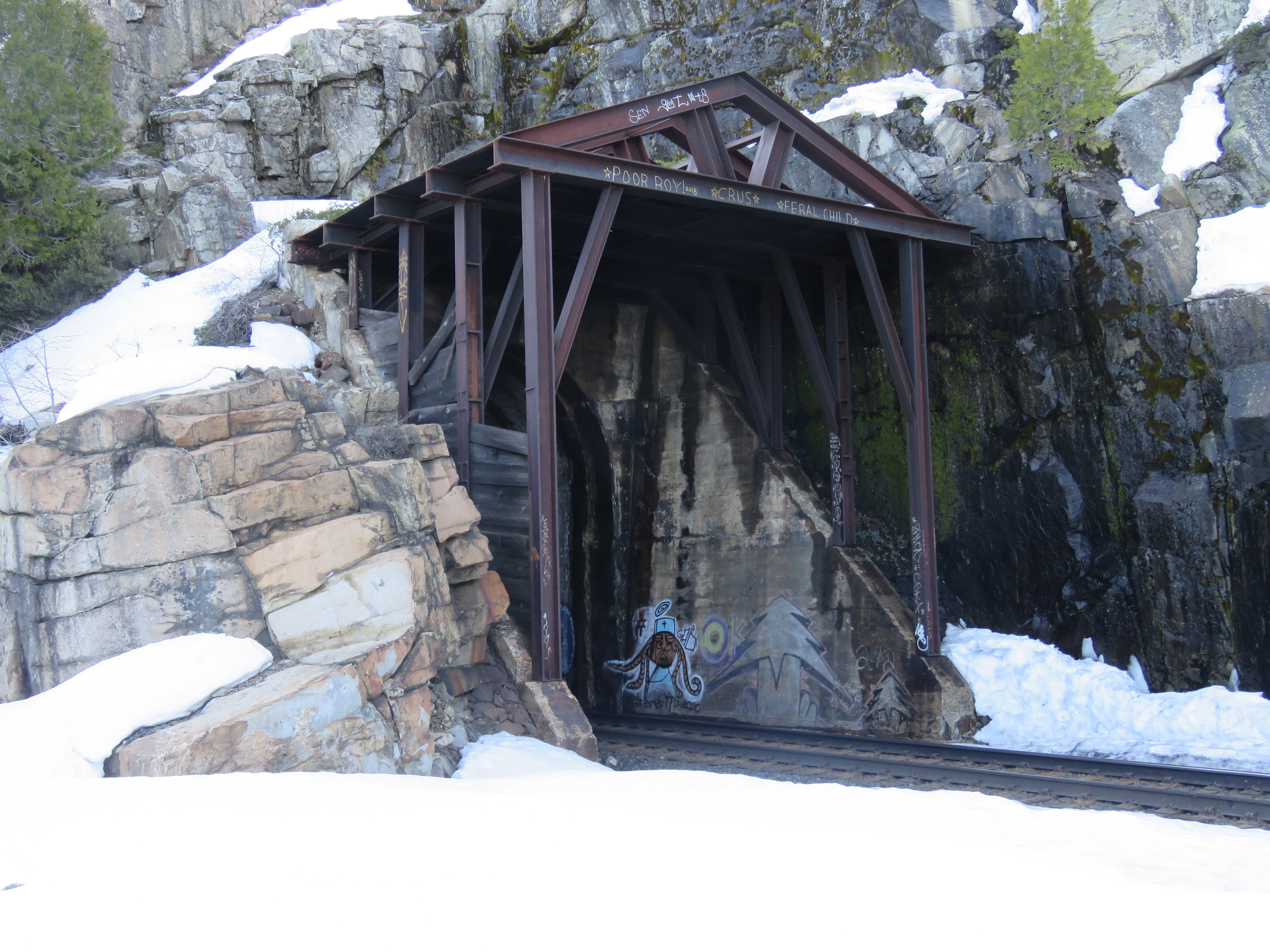
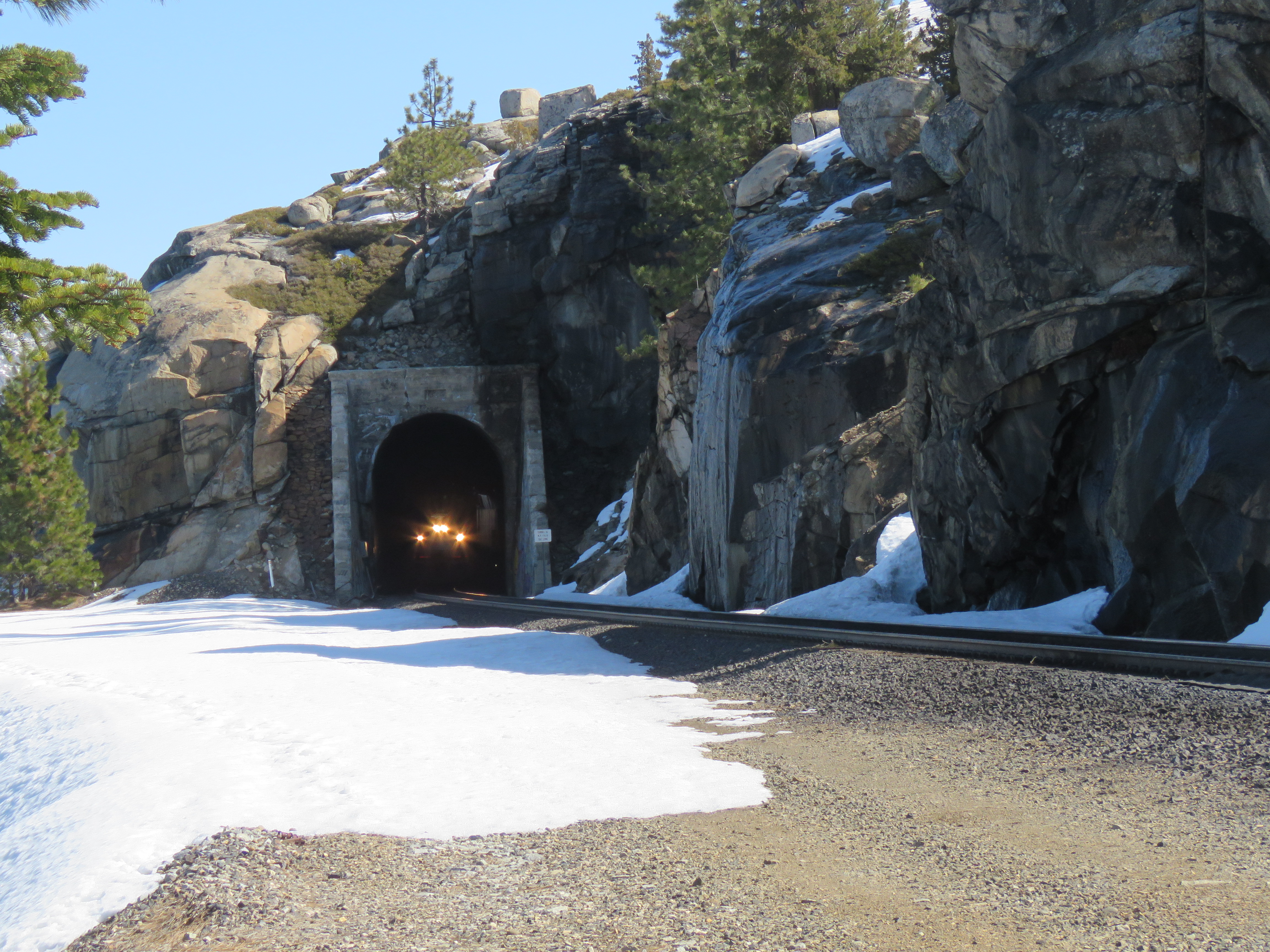
The west entrance of the 738 foot long Tunnel # 35.
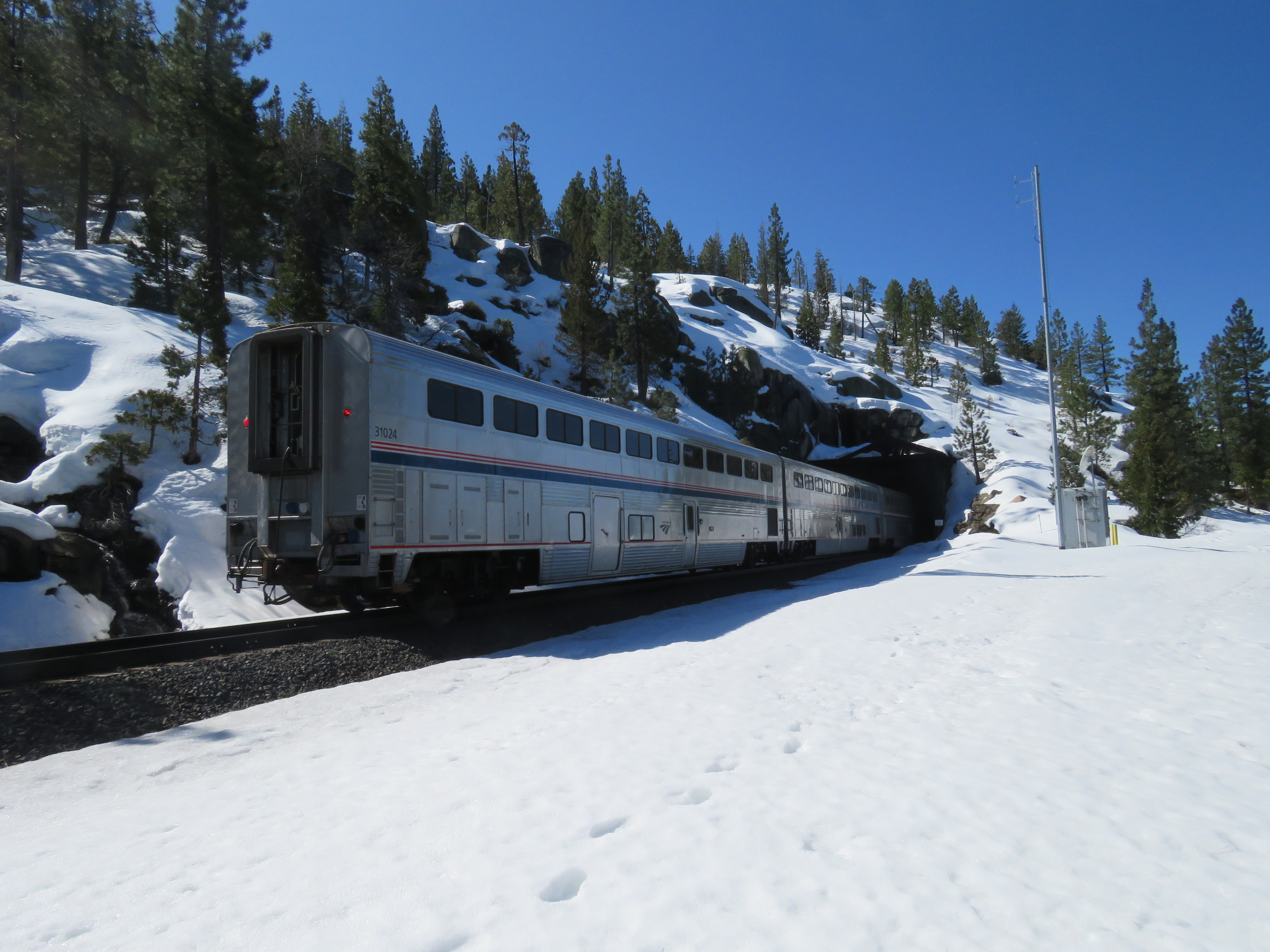
I sketched for about 20 minutes and then I walked toward Tunnel #36 to find a good vantage point to photograph the Zephyr and I decided on standing near the eastern entrance of Tunnel #35 so I could photograph the train coming out of Tunnel #36. And then turn westward to capture the Zephyr as it disappeared into Tunnel # 35.
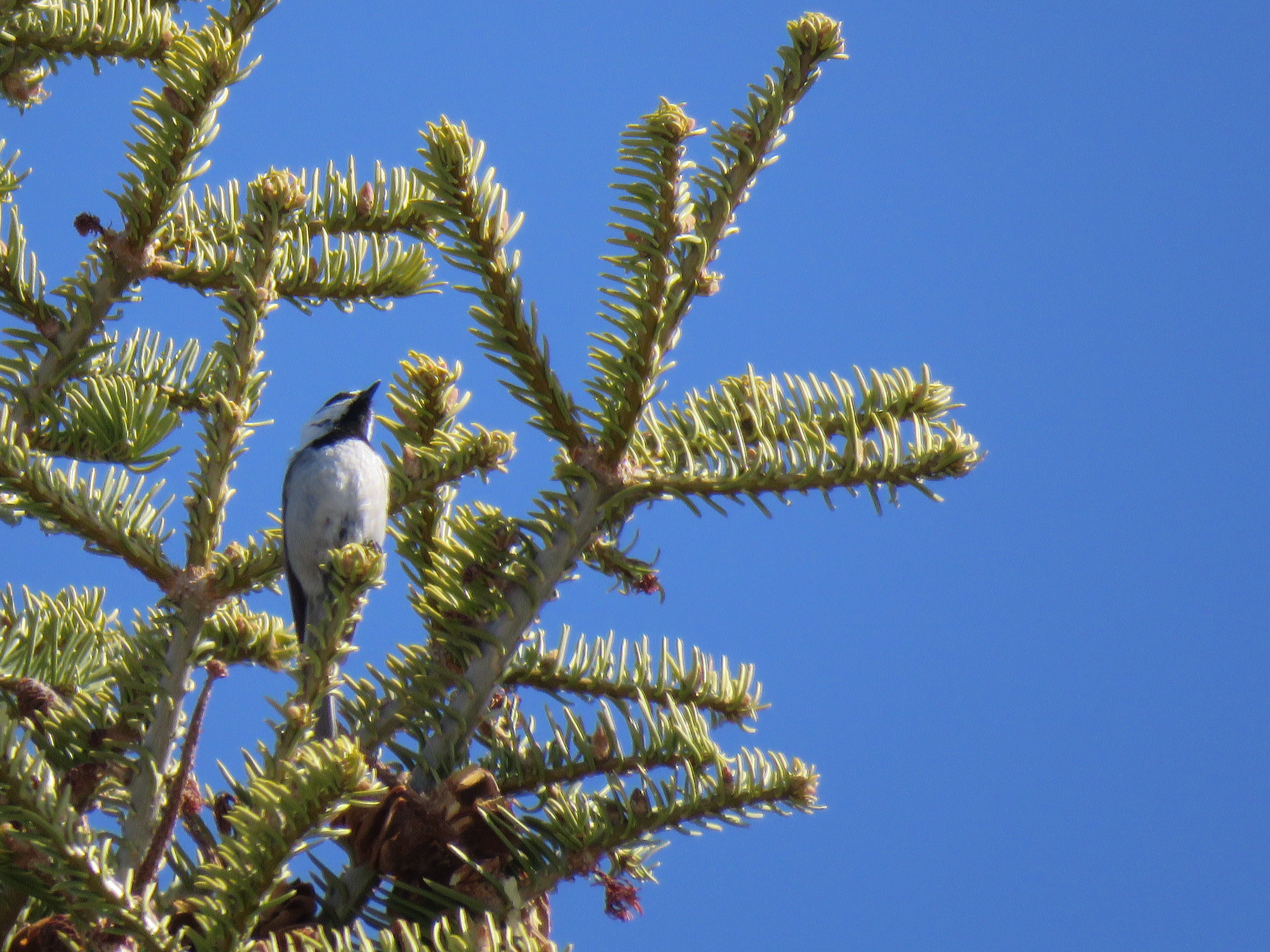
I had no idea when the train would be emerging from the tunnel but I filled my time being serenaded by the beautiful whistle of a mountain chickadee. This is the song of the western mountains. Spring was slowly arriving in the Sierras.
A mountain chickadee singing from the top of a pine. Bird and trains in the Sierra Nevada, I’m in heaven!!
At 10:40, I saw the headlights of the westbound Zephyr.
A first sighting of the California Zephyr coming out of the east portal of the 326 foot long Tunnel #36. In the foreground is the rail bed of the former track #1.California Zephyr train #5. This train started in Chicago.The Zephyr heading into Tunnel #35 as it climbs down the valley toward it’s next stop, Colfax. My footsteps are in the foreground.
If Southern Pacific’s Queen of Steam is 4449 then Union Pacific’s Royalty must be 844.
The FEF class (4-8-4) No. 844 is known as “The Living Legend”. This class of passenger locomotive is a legend for it’s design and motive power but I want to stress the word “Living” because 844 is the only steam locomotive that has never been dropped from UP’s roster, making it the only steam locomotive, owned by a Class I railroad, that has never been retired.
The FEF-3 was designed to be a high speed passenger locomotive and 844 pulled such Union Pacific passenger services as the Overland Limited, Los Angeles Limited, Portland Rose, and Challenger. 844 really had three phases of life. First as a passenger locomotive, secondly, as diesels replaced steam on passenger routes, 844 hauled freight in 1957.
At the end of the age of steam, when steam was being replaced by diesel, Union Pacific had the foresight to preserve one of it’s classic locomotives and 844 entered into her third life as an ambassador to one of the world’s largest railroads: Union Pacific.
I was 10 years old when I first encounter Union Pacific 8444, as she was known then, at the offical opening of the California State Railroad Museum in 1981. She had to be renumbered because there was a diesel locomotive given the road number 844. For the event, two of the most emblematic survivors of the Northern class (wheel arrangement 4-8-4) were in attendance. Southern Pacific’s GS-4 4449, newly repainted in her Daylight livery and Union Pacific’s 8444. On the tracks outside the museum, which paralleled the Sacramento River, these two Superstars of Steam came pilot to pilot. What a sight to see!
844 is not as streamlined as 4449 but the 844’s steam deflectors, also know as “elephant ears”, gives this 4-8-4 a very unique appearance. The steam deflectors help to loft steam exhaust from the chimney or smoke stack to improve the engineer’s visibility and also to keep the exhaust out of the cab.
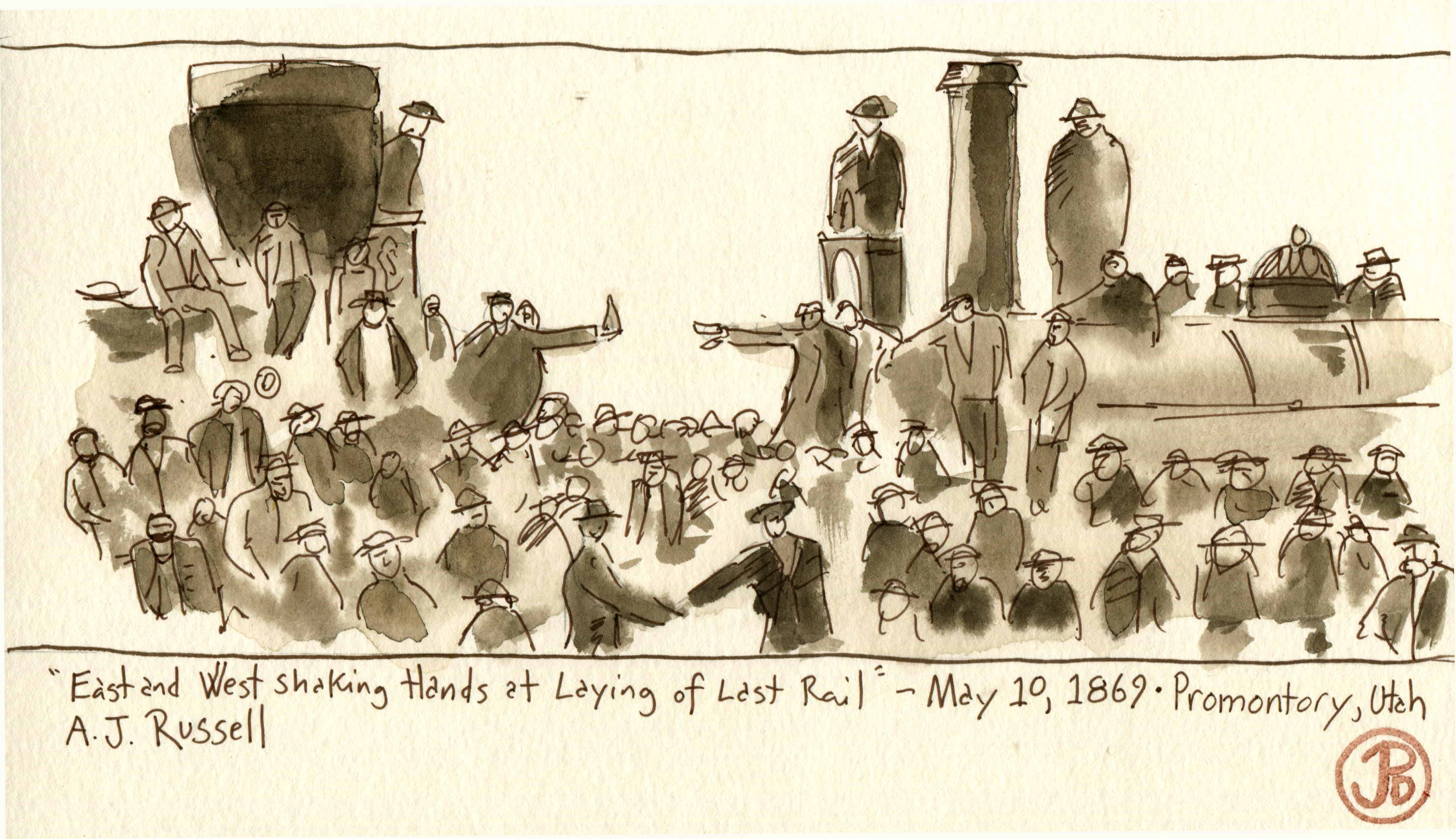
It was an echo of the famous photograph taken at the uniting of the Transcontinental Railroad at Promontory Point, Utah on May 10, 1869. 4449 represented the Central Pacific, later Southern Pacific and 8444 represent, and still does, Union Pacific.
Union Pacific’s steam ambassador has been all across Union Pacific’s rail network. She is a locomotive that brings people to the tracks to see her in action. One annal excursion is Cheyenne Frontier Days from Denver to Cheyenne. In May, 2019, 844 played second fiddle on the inaugural run of the recently restored Big Boy 4014 from Cheyenne to Ogden, Ut to commemorate the 150 Anniversary of the completion of the Transcontinental Railroad. Of course the Big Boy was on point as the lone example of the largest locomotive in operation.
At the ceremony, 844 and 4014 came pilot to pilot, echoing the the famous photograph taken 150 before when Central Pacific’s engine “Jupiter” and Union Pacific’s engine No. 119 came pilot to pilot on May 10, 1869.
The Union Pacific Steam Shop in Cheyenne, Wyoming . This is about as close as I got to seeing the “Air force 1” of Union Pacific: FEF-3 #844 on a visit in the October of 2017. The only sign of steam is the UP yellow tender outside one of the bay doors.














 Corvid Sketcher