Image

The Giant Dipper at 100 (My 700th Post)

A recent Labor Day tradition has been to ride one of my favorite roller coasters of all time. It’s also my birthday weekend.

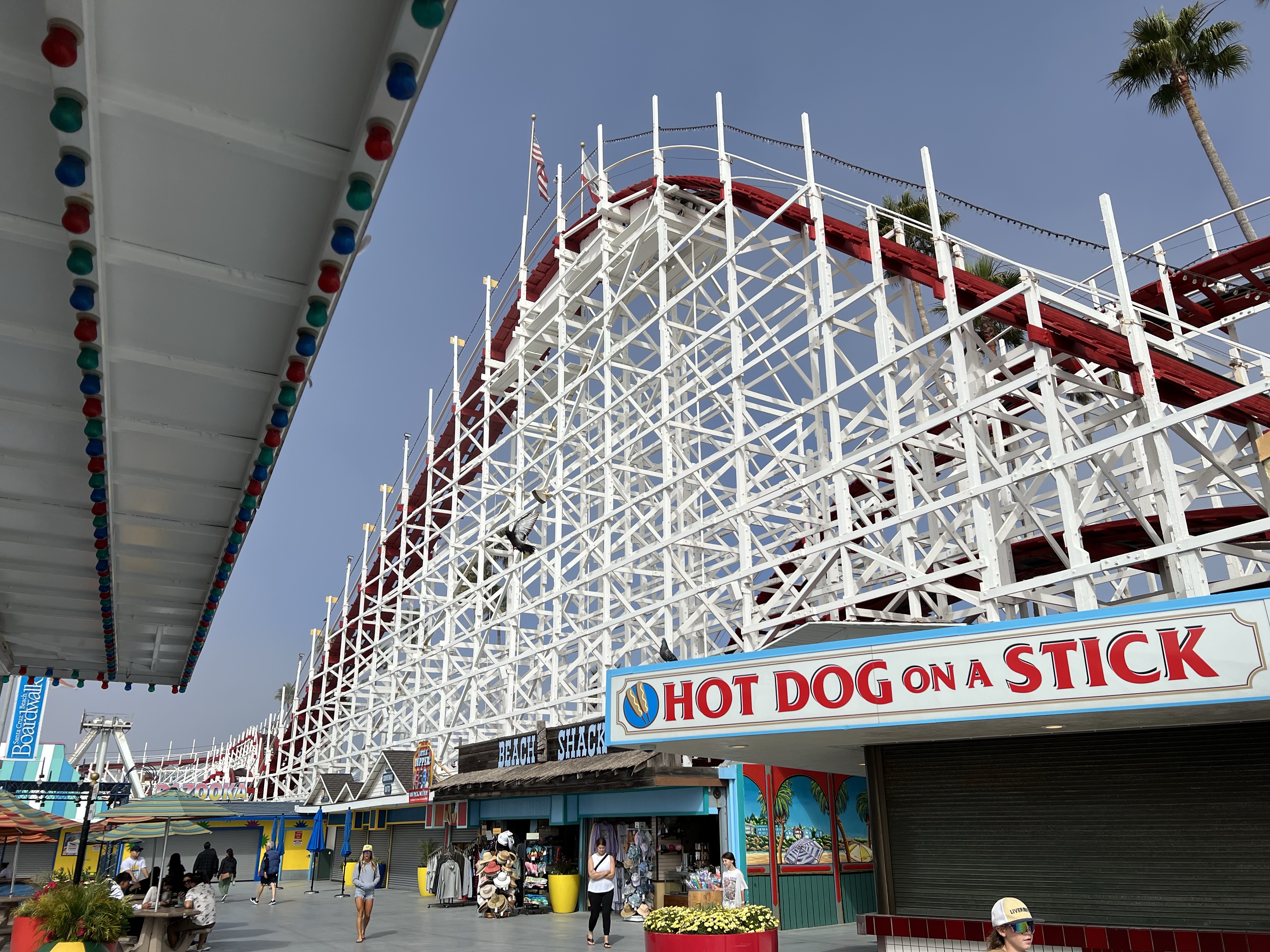
This is not a steel coaster with high speeds, loops, and corkscrews. This is a 100 year old wooden roller coaster at the Santa Cruz Beach Boardwalk.

The big dip of the Giant Dipper.

This is the Giant Dipper and is the oldest roller coaster in California.

I have ridden the Dipper many times since I was tall enough to ride it and like my father before me I ride it every summer. And the ride remains as thrilling now as when I was young!

Partly because I’m not sure how this elderly ride still remains safe and standing. This is a testament to the care and maintenance that keeps the dipper rolling.

The ride starts off dropping into a pitch black tunnel and when it rounds a curve you see the lift incline to take the train to the top of a 65 foot drop. There is a slight pause as the coaster drops, reaching speeds of 55 miles an hour before accelerating up a banked curve and the the coaster takes some rises and dips that nearly lifts you out of your seat. The coaster returns to the boarding station one minute and 52 seconds after leaving it, leaving most riders out of breath and with a hoarse voice from screaming!

Since 1924, more than 66 million riders have ridden the crazy train that is the Giant Dipper.

The Boardwalk and Giant Dipper have been featured in some films including: The Sting II, Harold and Maude, Sudden Impact, The Lost Boys, Us, and Dangerous Minds.

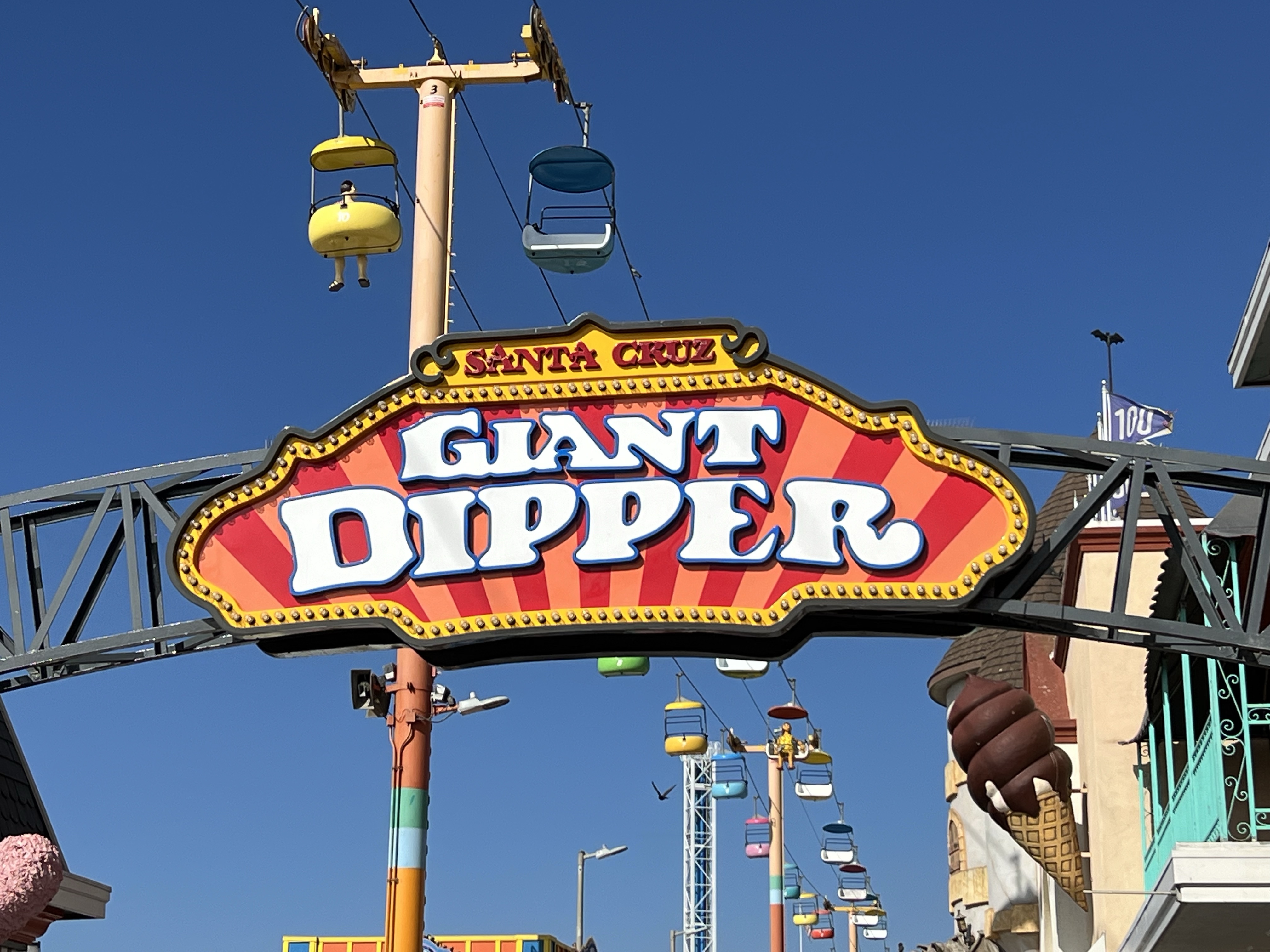
The classic sign was featured in the finale of the fourth Dirty Harry film Sudden Impact.

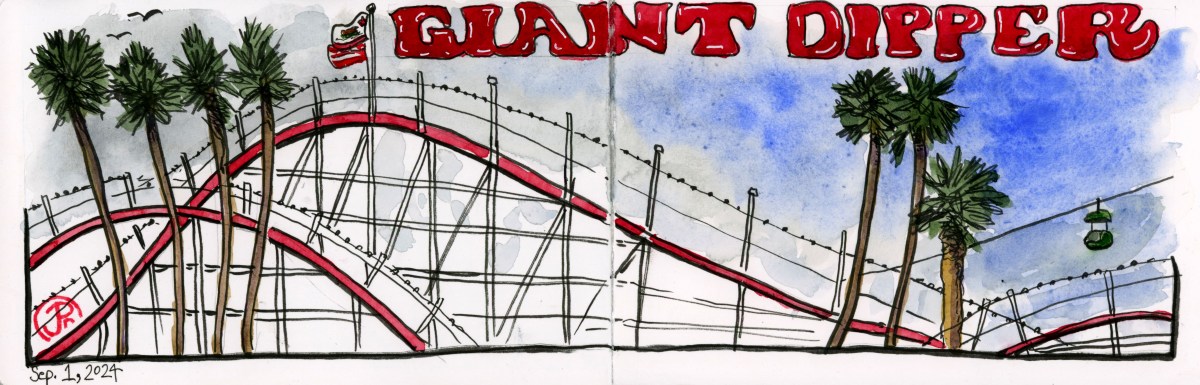
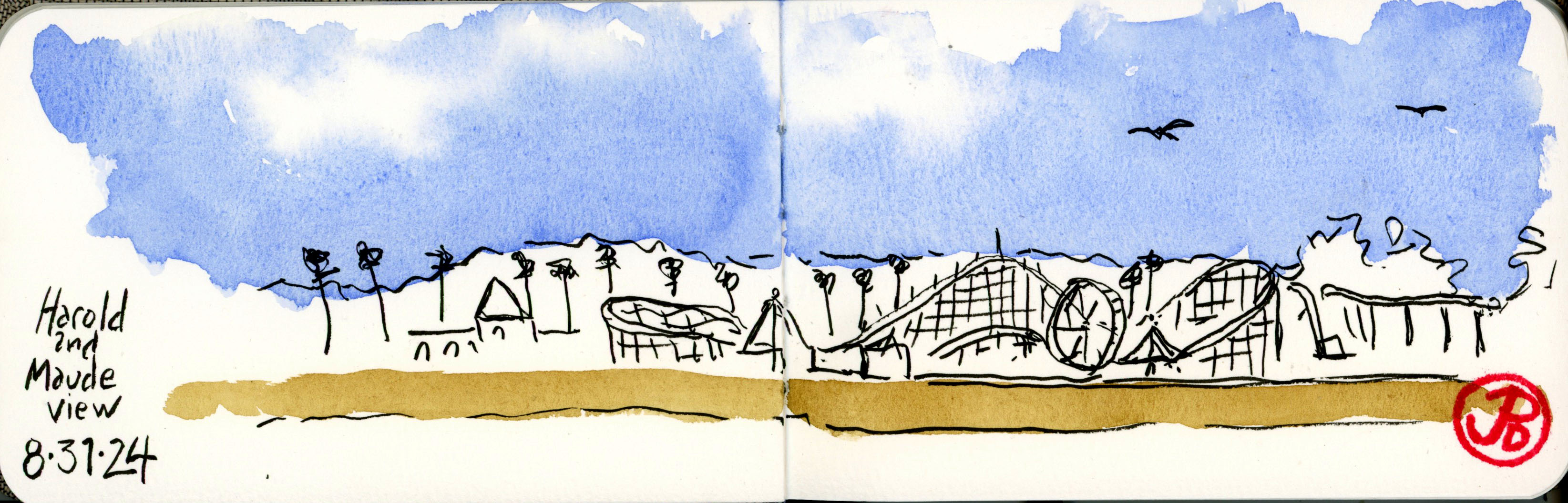
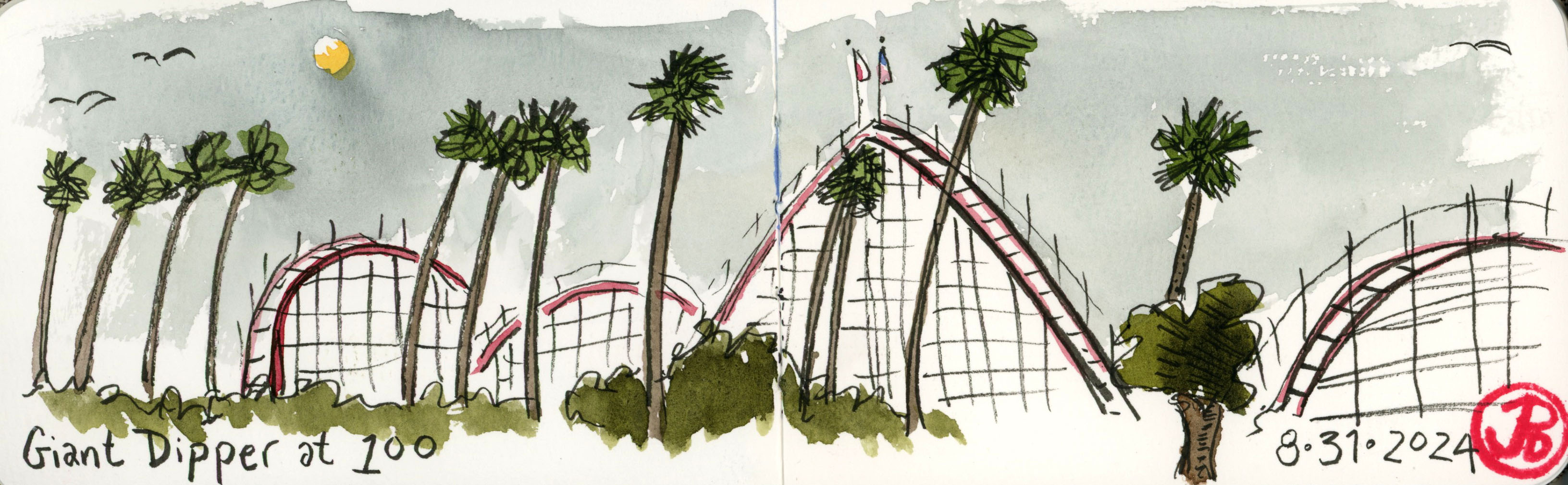
Over the Labor Day weekend, I sketched the Giant Dipper three times. Two were in a small “point and shoot” journal (a gift from my students). One sketch was from the perspective of one of my favorite movies featuring the Dipper, Hal Ashby’s Harold and Maude.

There is a scene filmed on the Santa Cruz Wharf with the lights of the Giant Dipper in the background. This is the scene where Harold gives Maude a token that says, “Harold Loves Maude” and Maude proceeds to chuck it into the ocean saying, “Now I’ll always know where it is.”

I returned on Sunday morning with Grasshopper and sketched the Dipper from the empty parking lot off Beach Street (featured sketch).

A point and shoot sketch from Beach Street.
Image

Overnighter in Roseville

4014 would be spending two nights in the important rail hub of Roseville.

Roseville is at the base of the climb up the Sierra Nevada Mountains to Donner Pass. It is here where the tools to conquer the Donner extreme winters are kept. Across the tracks, near the depot, the spreaders and flangers could be seen. A little further down the siding, the ultimate snow fighting machine could be seen: the rotary plows.

But on this July Friday and Saturday an army of foamers, rail fans, history buffs, and the curious would be invading the city of Roseville.

They were all here to see the largest steam locomotive in the world, Union Pacific’s Big Boy No. 4014. For the two display days the largest operable locomotive would be static and not moving. The Goliath would be brought up to steam and boiler pressure to conquer the Sierra Nevadas on Sunday.

I arrived early on Saturday to find a parking spot and to spend some quality time with the 4-8-8-4 before she, or he, was besieged.

Roseville is a busy point on the railroad with many freight trains starting the climb or descending the Sierra Nevadas. The passenger service is alive and well in Roseville with the California Zephyr and the Capital Corridor stopping at the passenger depot.

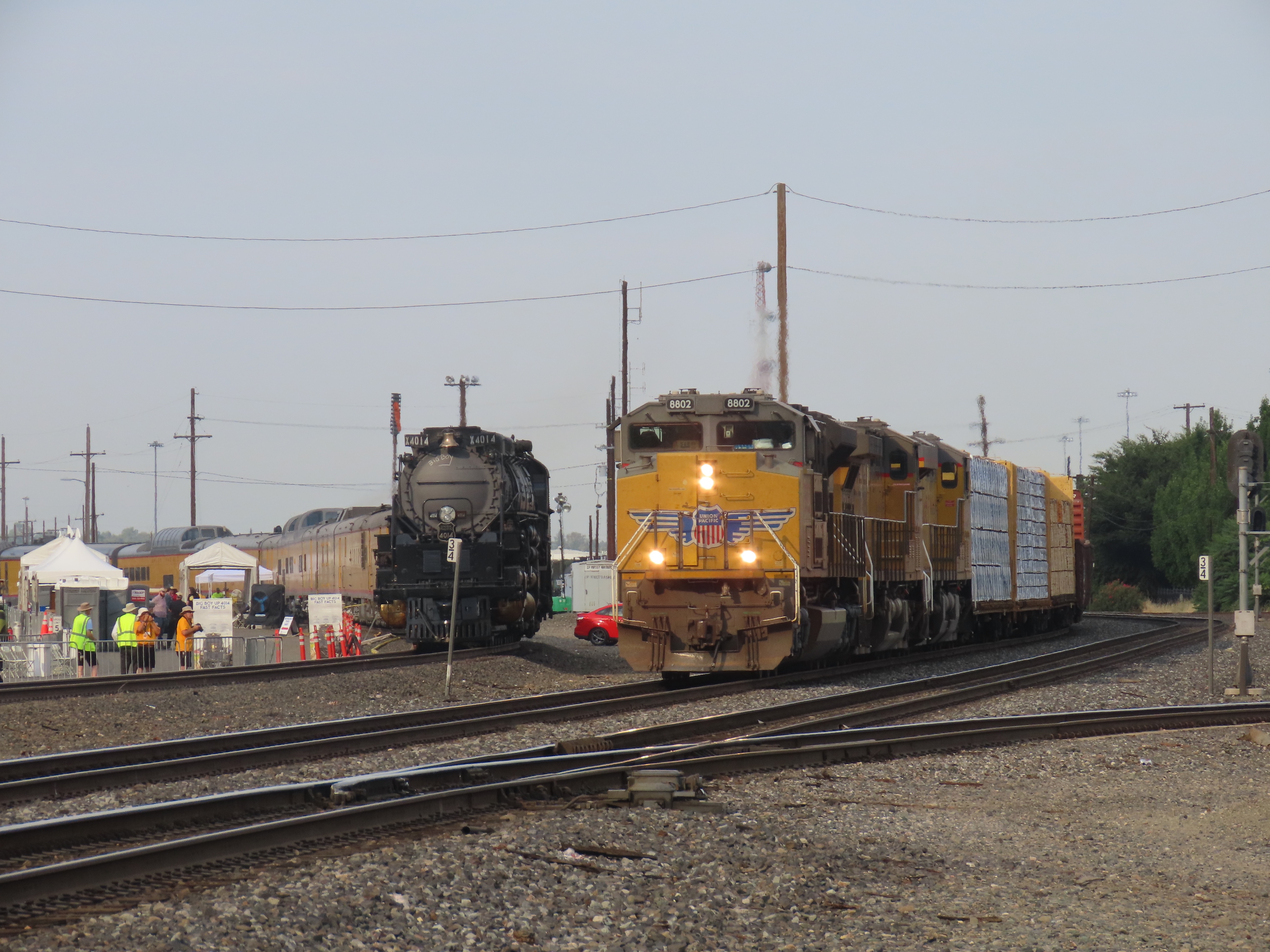
The present and the past of Union Pacific freight. A eastbound freight passes 4014 at Roseville.

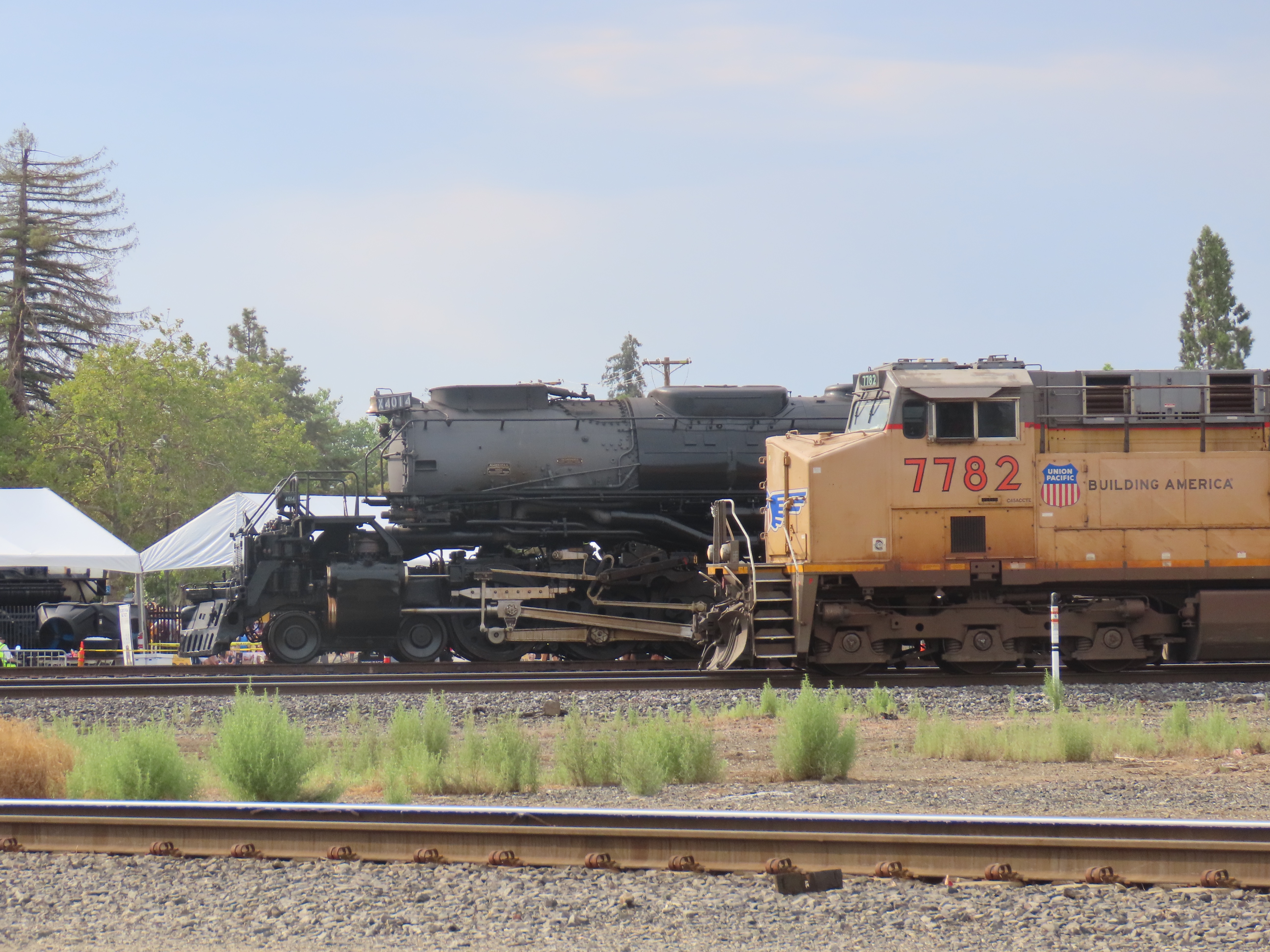
4014 now had a consist of Union Pacific passenger cars. I heard a ticket for the trip from Roseville to Reno, Nevada would set you back $700. The train was parked near the intersection of Atlantic and Vernon Streets near Southern Pacific’s 2252 and a rotary snowplow on display.

Roseville is a very busy point on the line and it was about to get much busier with the influx of people coming into town to see a Big Boy’s first visit.

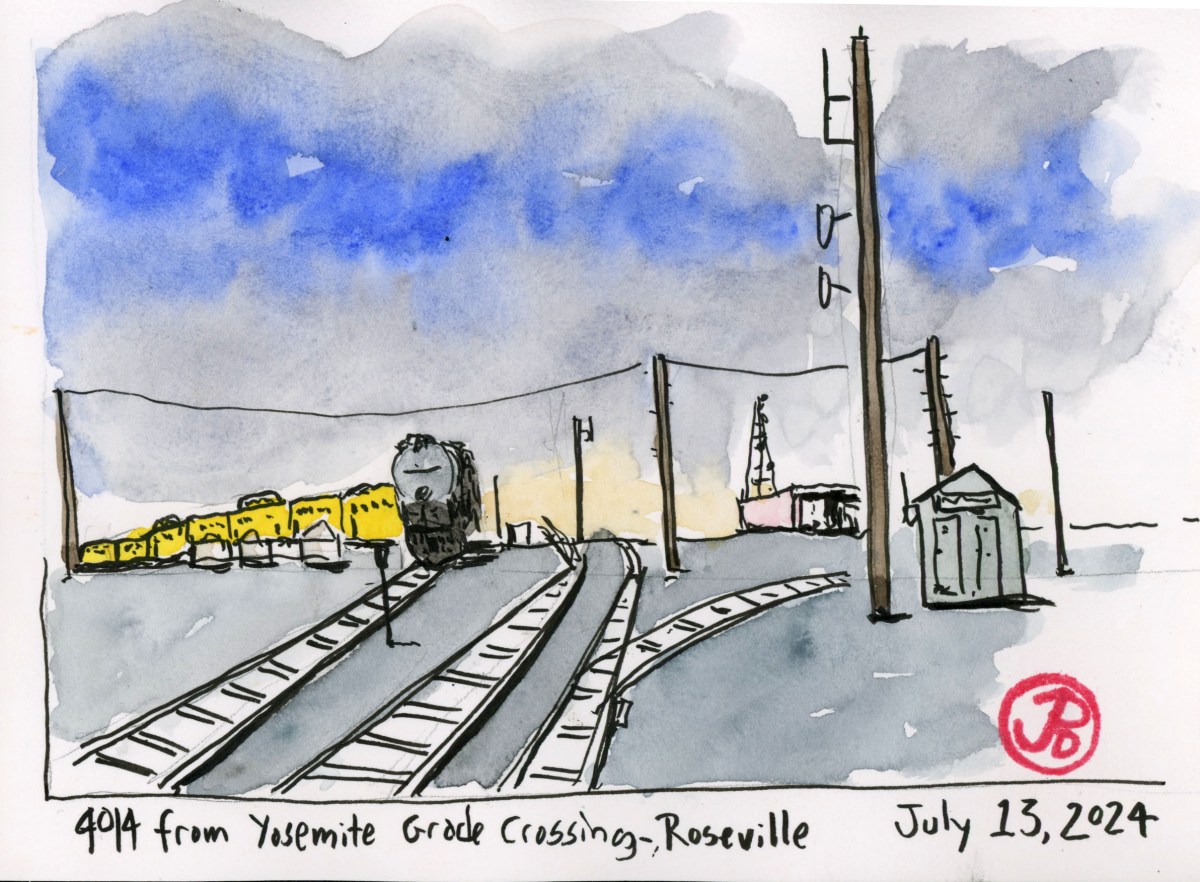
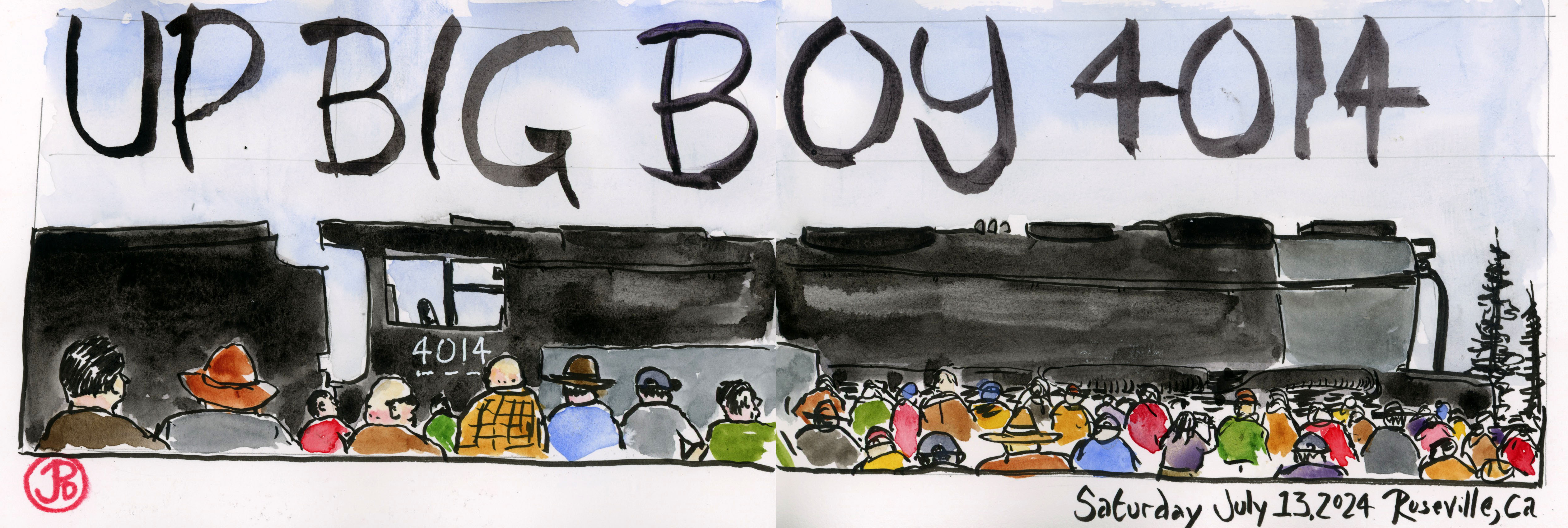
I walked to the grade crossing at Yosemite Street and looked west (towards Sacramento) and sketched 4014 and the Roseville yard (featured sketch).

The viewing of 4014 officially opened at 9:00 AM and there was already a group lined up to get a closer look at the Big Boy.

As the clock ticked closer to 9:00 AM, more and more people were showing up to see the first visit of a Big Boy to Roseville.

This important railroad town was the home of Southern Pacific’s articulated, the cab forward. These massive locomotives were designed to haul freight over the pass and the locomotive was reversed with the cab in front (hence the name) so the crew would not suffer from smoke asphyxiation while traveling through the many tunnels and snow sheds on the route. In the age of steam Roseville had two roundhouses, one was specifically designed for servicing the labor intensive cab forwards. At one point Roseville was home to 60 cab forwards.

Only one Southern Pacific cab forward still exists, the AC-12 No. 4294. She is on static display at the California State Railroad Museum in Sacramento. But unlike Union Pacific’s 4014, 4294 is not operable.

Soon it was hard to see the Big Boy through the forest of people surrounding it. So I did a sketch to capture the experience.

Image

Norsk Folkemuseum

High on my sketch list was the traditional stave church at the Norwegian Folk Museum.

I took the first Bygdoy Ferry to the peninsula to visit this very popular outdoor museum, which is Norway’s largest outdoor museum.

The museum has over 140 buildings from different regions of Norway spanning an impressive span of time.

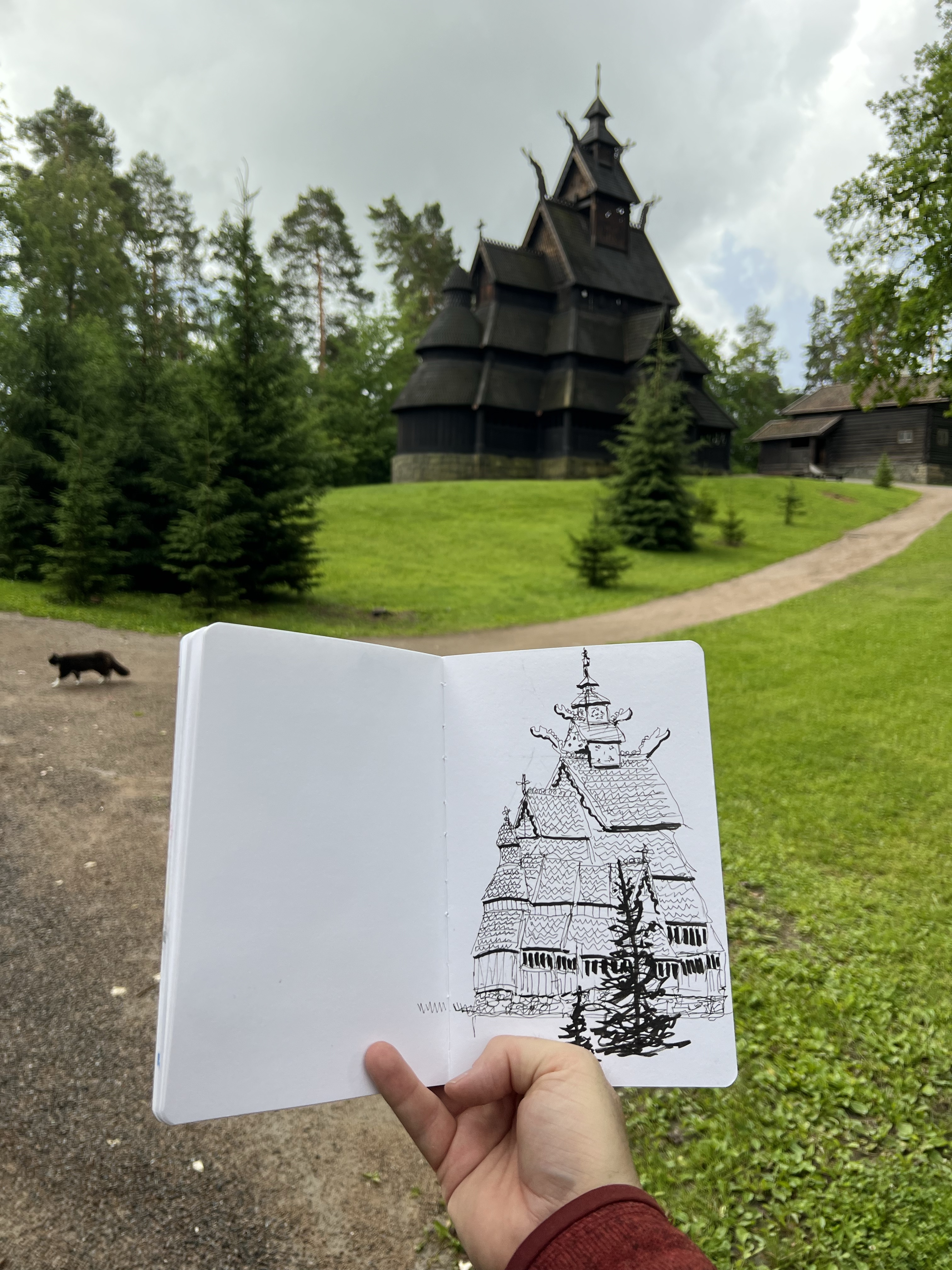
Once the gates opened at 10, I made my way to the stave church, using the map to navigate the large trail system. The church was so full of detail that I went with a very loose style, not focusing on every single shingle but choosing the form of the church.

Church, sketch, and a photobombing cat.

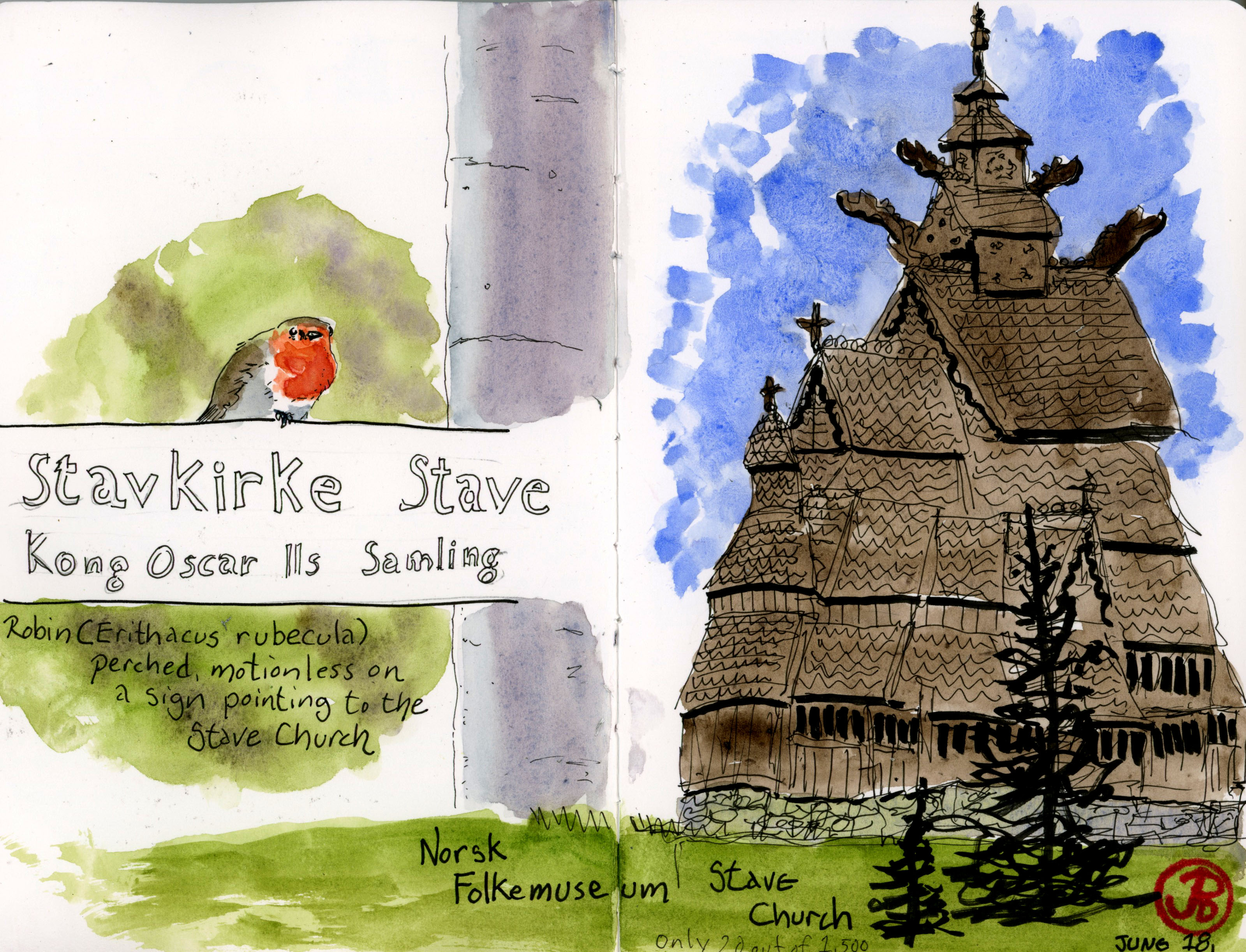
After my sketch I headed to another section and on the way I passed a robin statue-still on a sign. I was almost fooled into believing that this was a wooden carving until the red breast burst into life and shot off to forage in the underbrush. I add this experience to the other side of my spread.

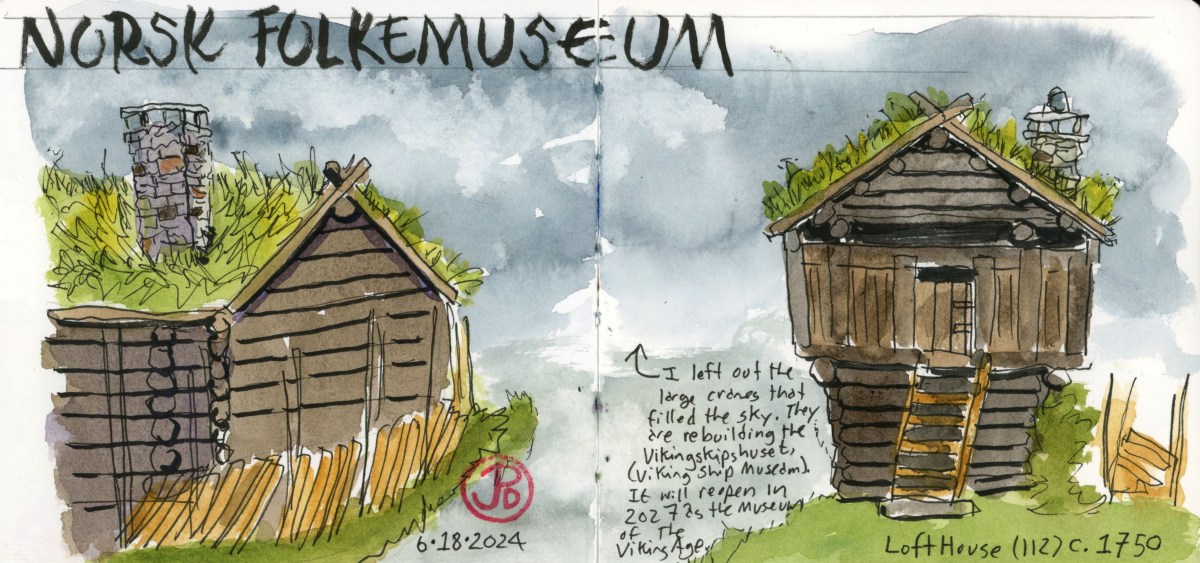
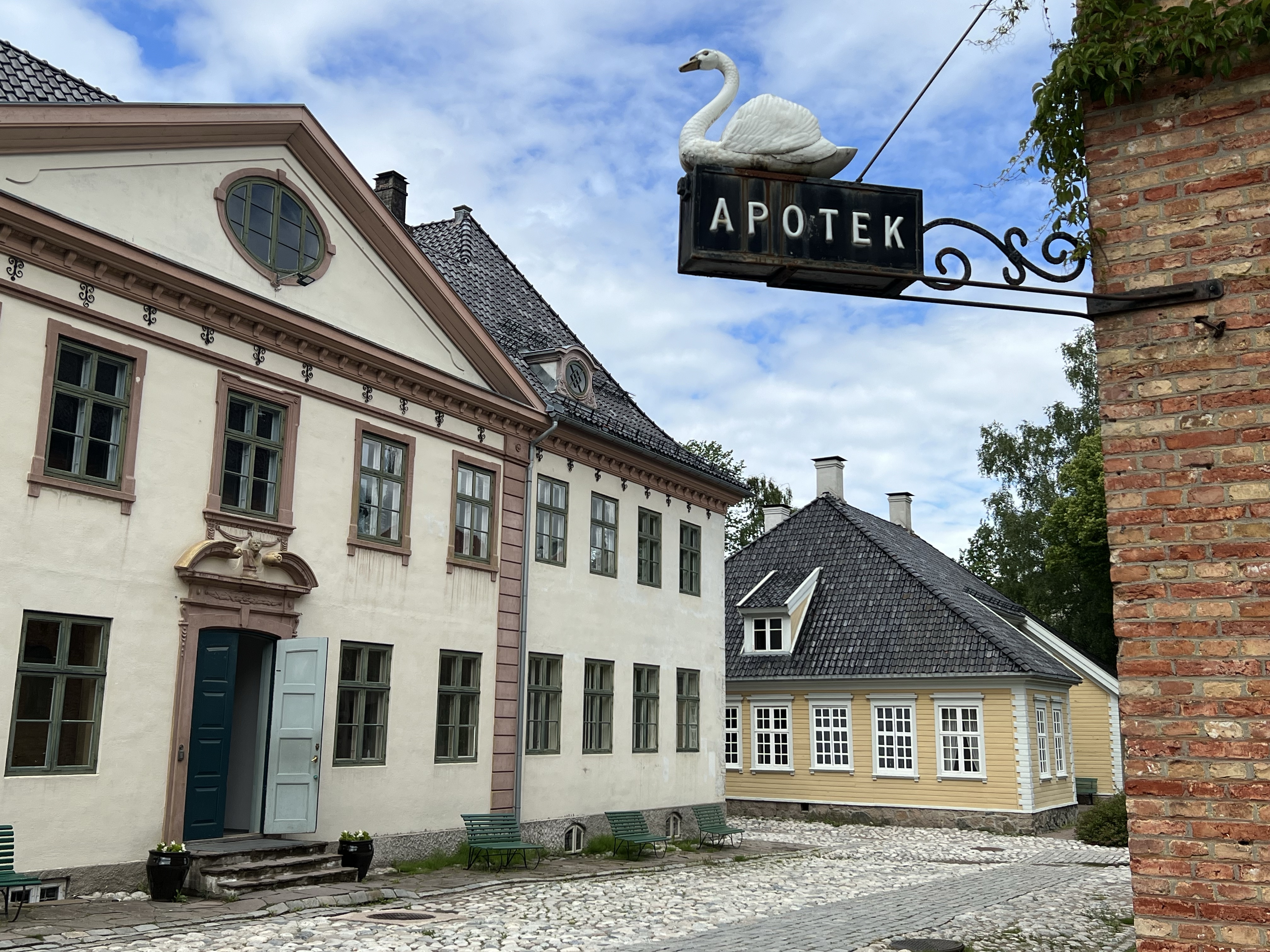
I found a collection of house farmsteads with a living roof of green so I found a bench and started sketching. My sketch was interrupted by rain so I had to finish my sketch in stages while retreating to a nearby house.

For this sketch, featured sketch, I used a little real-time editing. Behind the buildings, huge cranes reached into the air, shattering the feeling of time travel and firmly placing me back in the 21 Century. The cranes where above the site of the Vikingshipshuset (Viking Ship Museum). This museum has one of the most iconic preserved Viking ships in existence, the Oseburg Ship. The museum was closed in September 2021 for a complete renovation. The new museum will reopen in 2027.

This section of the museum felt like I had travelled forward in time from the last two buildings I sketched. I was traveling from Norway’s rural countryside to more developed towns.

Sounds like I need to make another visit to the Bygdoy Peninsula some time in the future!

Image

Corvidsketcher Becomes a Bisonsketcher

On today’s walk I headed north to Golden Gate Park. My intent was to go to the Bison Paddock in the wild western portion near the Chain of Lakes and do some bison sketching.

Bison are good subjects because well, they just sit there allowing you some time to get a sketch in. They are certainly better subjects to sketch than say, a Wilson’s warbler, a hyperactive bird that is a challenge even to photograph well. I had practiced sketching American bison in the wild, on a fall trip to Yellowstone National Park in 2017.

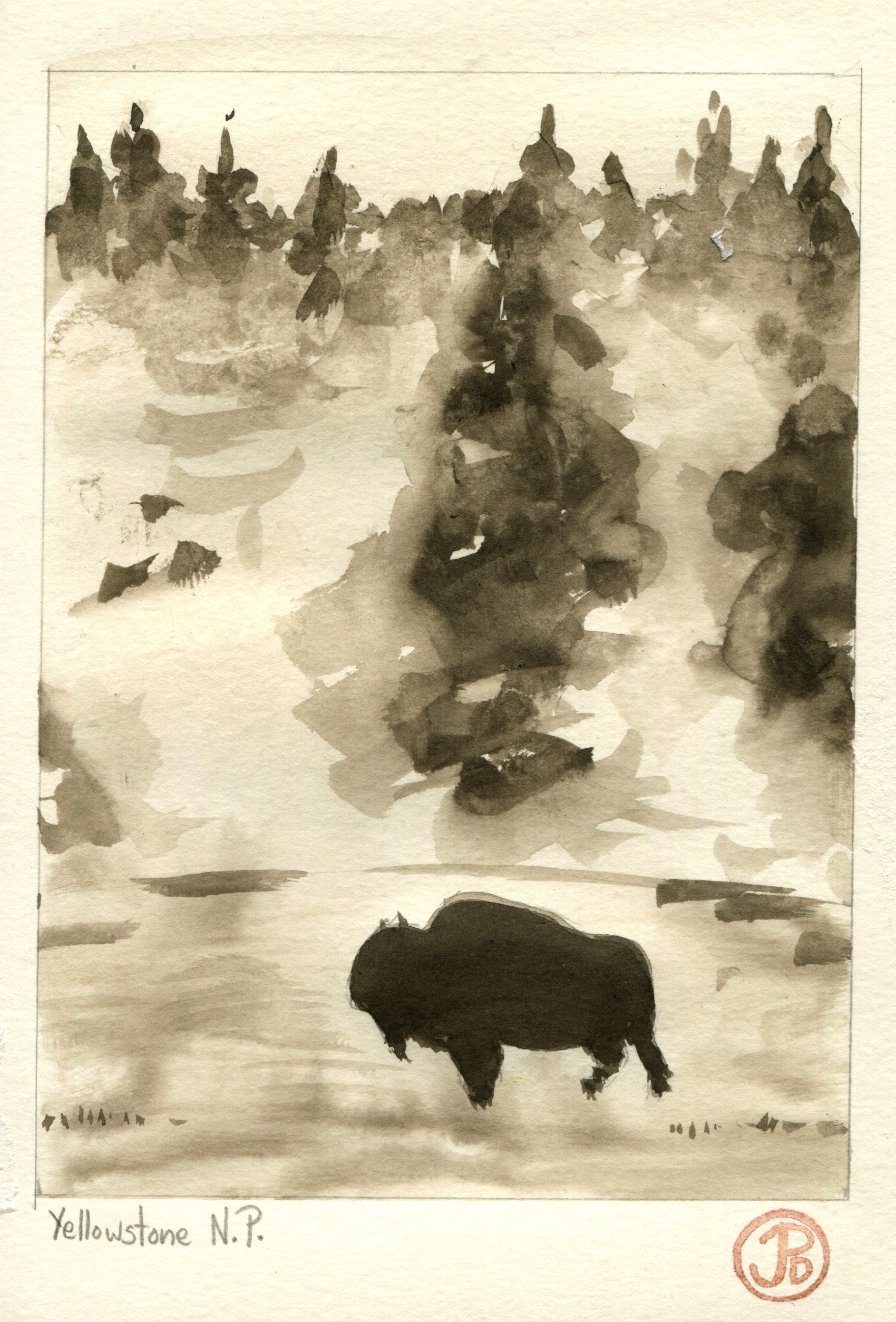
This is a sketch from a photo of my October 2017 trip to American’s oldest National Park!

The goal I set for myself was to loosen up my sketches and apply some of the things I have learned in a book I am currently reading, Felix Scheinberger’s excellent: Urban Watercolor Sketching. He advises “less is more” when it comes to watercolor painting and I also take this to mean the economy of the sketch itself. I’m not sure if I succeeded but every sketch can be considered a success because you learn something with each one. And sometimes you learn what not to do!

I picked my spot near the fence and making sure I was at least 12 feet away from any other park visitors (The Bison Paddock is a very popular spot) and I started to sketch a lounging bison. I started using a Micron sepia PN, not using any underlying pencil sketch! I then laid in some color, making sure to leave parts of the sketch unpainted (featured sketch).

An overenthusiastic art lover walked over and would have stood above me breathing into my left ear had I not halted his progress by proclaiming, “I’m practicing social distancing!” He stopped and admired the sketch from a distance.

A bison wandered by, grazing as it went along. I couldn’t let this happen without getting another sketch in! This time I challenged myself to do a continuous line sketch. This means that I sketched the bison without lifting my pen (although the rules of continuous sketching say you can lift your pen for a rest but you have to return to the exact point where you left off). This type of sketching is good practice for loosening up your lines and injecting improvisation into your sketching life.

A continuous line sketch of a bison. To get to other parts of the sketch you have to retrace lines you have already drawn. This is such a freeing way to draw!