On Saturday morning I headed out on one of my favorite coastal trails, the Old Cove Landing Trail at Wilder Ranch State Park. This is a great trail for hiking and birding featuring coast chaparral and great ocean views. This is also a nice place for sketching.
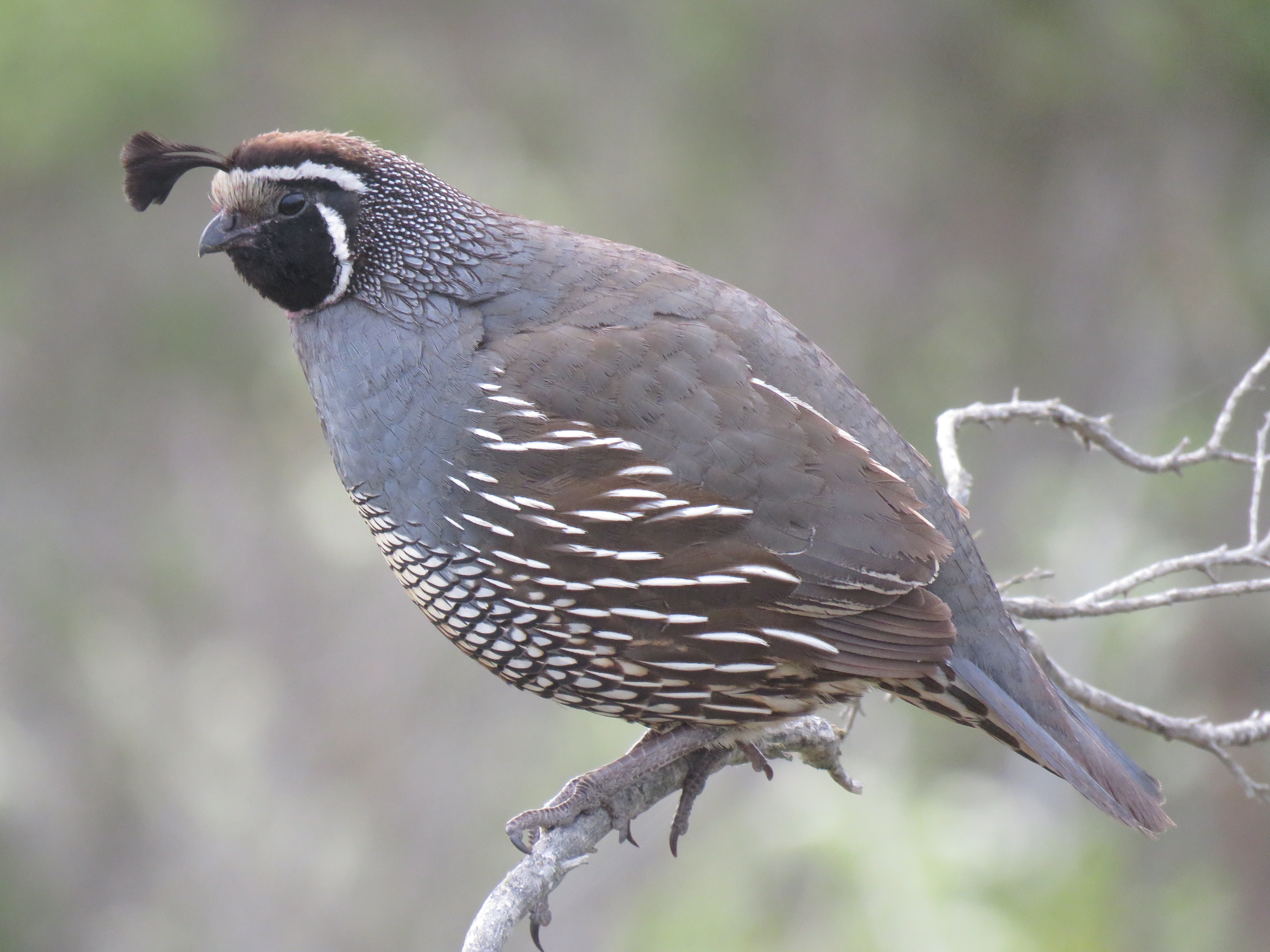
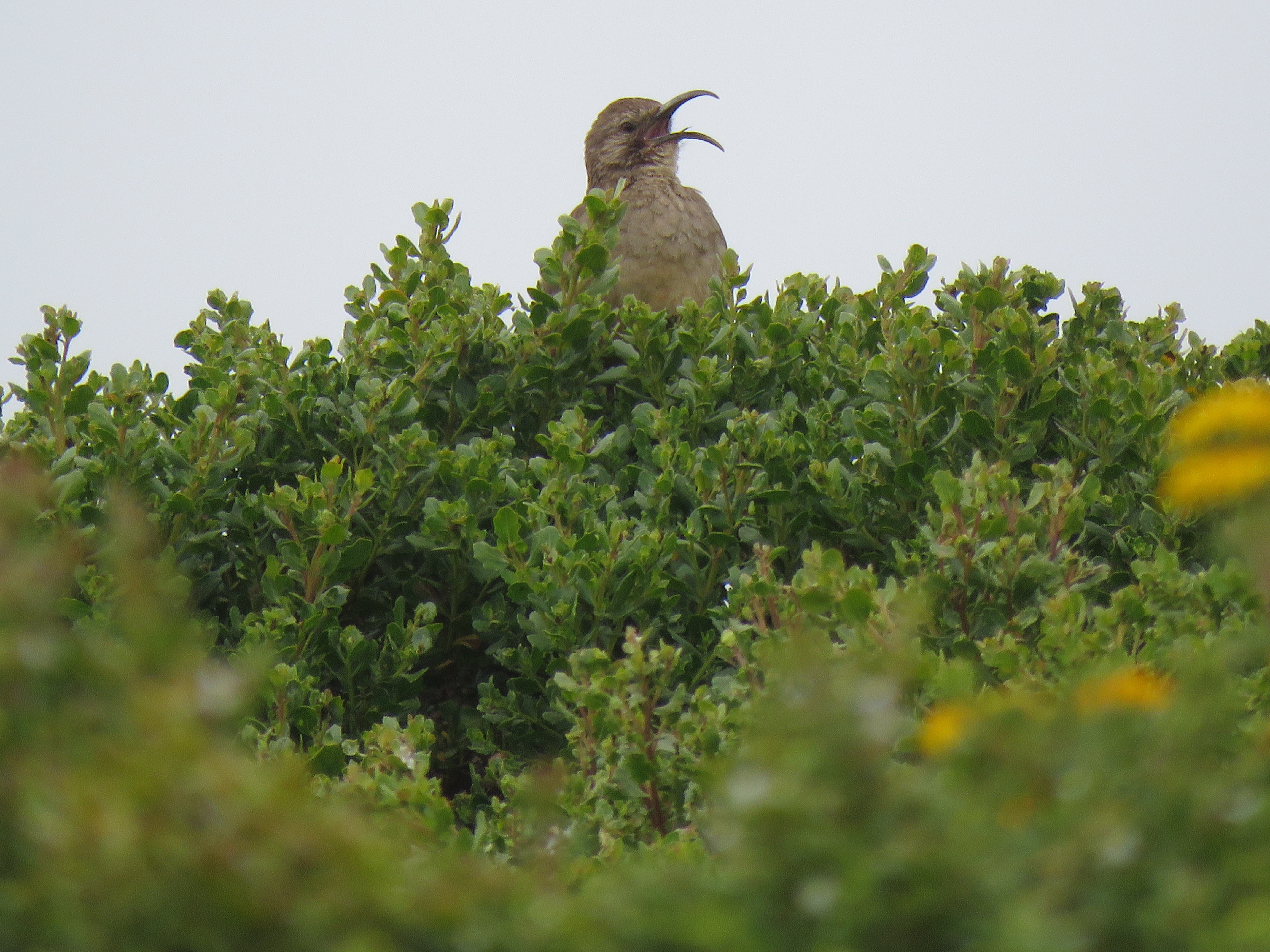
A very accommodating male California quail perched out in the open at the beginning of the Old Cove Landing Trail.Another California namesake, a singing California thrasher perched up in coyote brush. I could hear the thrasher’s warbling song from Fern Grotto Beach.
I headed down the trail to Fern Grotto Beach. This beach is framed by sandstones cliffs that are crowned with lush vegetation. I wanted to sketch the view from the beach and a log dictated where I would sit and my perspective.
For this sketch I used a panoramic Moleskine watercolor journal which was perfect for the expanse of the scene. I first laid in the cliffs with loose washes, letting colors runs into each other in a wet-on-wet extravaganza. I kept all of the painting loose rather than detailed. Once the paint was mostly dry I tied the sketch together with dark sepia pen strokes. I held then pen toward the end in order to keep the lines loose and lively.
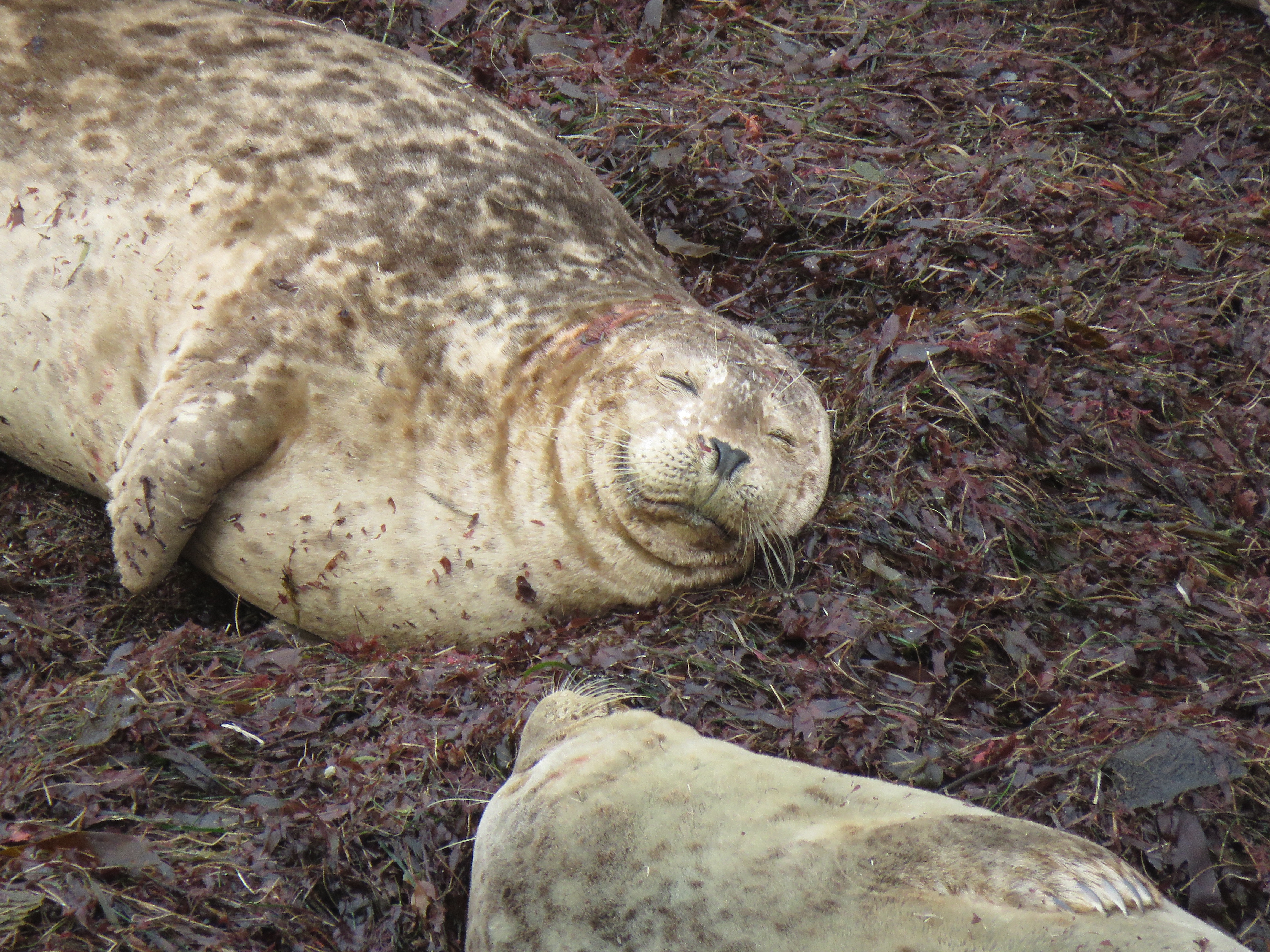
This hike is not just for the birds! Harbor seals at a seal haul out.
The cards I write for my students each year, are always a challenge to start; Even more so when the majority of our time together was through a screen.
How do you get to know your students when they are the size of a postage stamp during a digital class meeting? The answer is you really don’t.
Once we were back in the classroom for half days I devised a plan to learn a little bit more about my students through the clever use of writing prompts. Samples writing prompts were: “If you could be one animal/person/fictional character for one day, what or whom would you be?”, “If you could time travel to any time or place, where would you go?”, and “What is the most treasured person or thing in your life?”
As I have written before, my 6th grade teacher, Mrs. Noether, provided me with the inspiration for these cards. As much as I want to end the tradition this year, because this was such a difficult year, each card that I wrote and illustrated was a balm to the tough school year. These cards were a “reaching out” to the distance learning students that eventually came home to Team 17.
This year’s illustrations where as diverse as my 29 students. The subjects includes pandas, Eurasian hoopoe (the official bird of Israel), the Liverpool FC crest, Ballon d’or winner Robert Lewandowski, a humpback whale, Godzilla, Yogi Berra (with many of his quotes), a F-16 Fighting Falcon, a greater flamingo, Chimney Rock, Pac Man, Calvin and Hobbes, Southern Pacific’s #4449, Rick Astley (who knew), and a goblin shark.
A work in progress. An object I love to illustrate is one of the most beautiful stream locomotives even built: Southern Pacific’s GS-4. This card is for a fellow train fan in my class. Design-wise I was illustrating across the gutter. The letter was written in the white area left by the exhaust. As a rule, I never publish the contents of the letter because that is a message from me to my student.
I returned to the South Yuba River, along the Buttermilk Bend Trail. This time I was with my sister-in-law and my two nieces and nephew.
At this time the hillside reflected the state of California’s drought, which was sans flowers and golden-brown.
We walked about a mile down the trail (up river) and then headed down to the South Yuba River for some nature loafing. The oldest, used her time taking pictures of the rock and river, the middle boy commenced to design and build his own cairn, and the youngest aggressively nature loafed along the riverside.
And Corvid Sketcher does what he always does when near a river: throw rocks or do a sketch and I did both. My river sketch is the featured sketch.
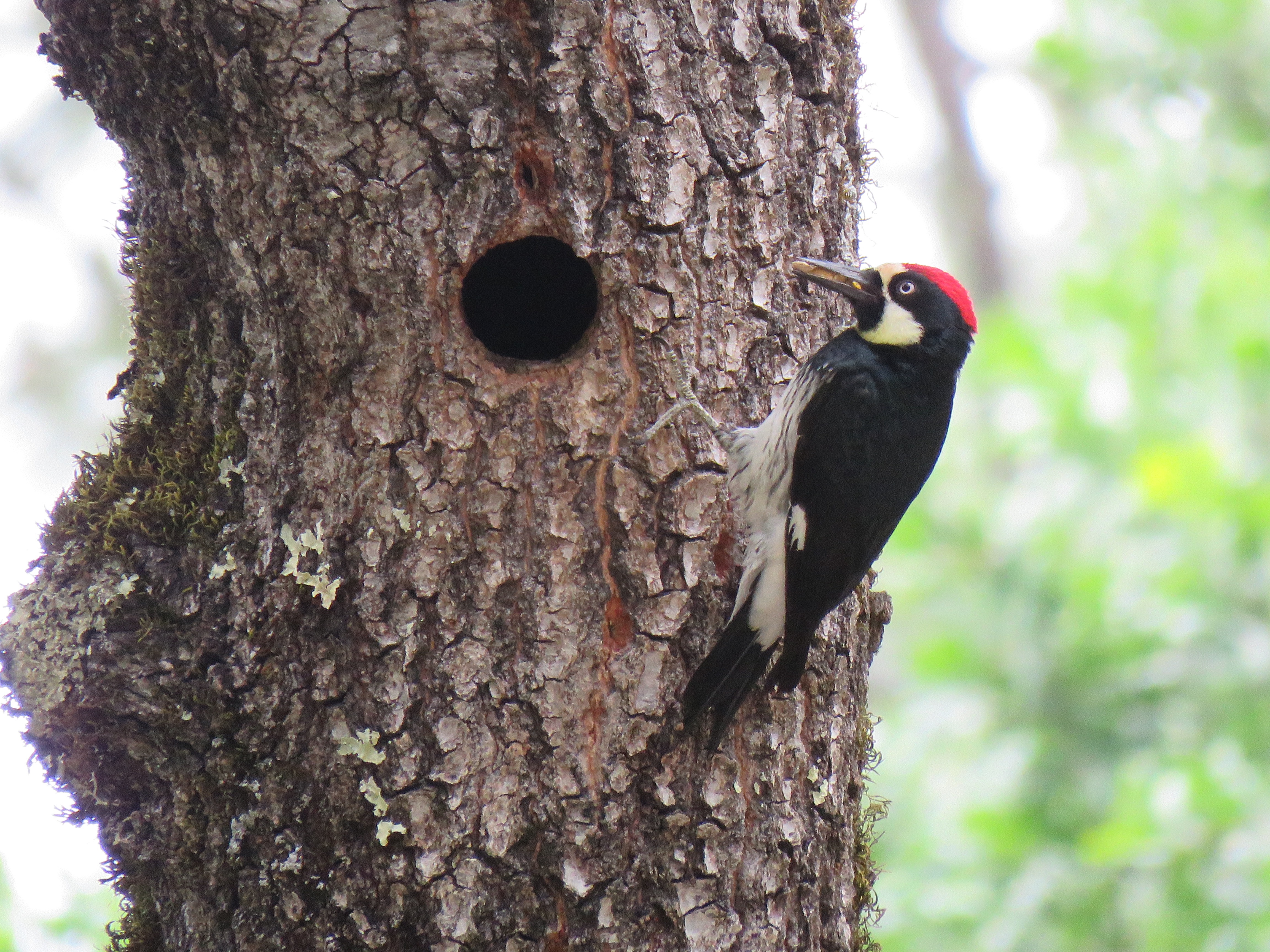
When we returned to my mother’s house I found a new subject to sketch: the active acorn woodpecker nest in the backyard. The nesting cavity was in a valley oak and the begging calls of the nestlings could be heard every time an adult few up with food.
An adult acorn woodpecker with, what else, acorns. I love the symmetry of the perfect circle of the nesting cavity entrance.Feeding the young is truly family affair with the parents and members of last year’s clutch helping to collect food for the growing acorn young.
Birding in the spring is a treasure. Many species are perched out and singing making them easy to see and hear.
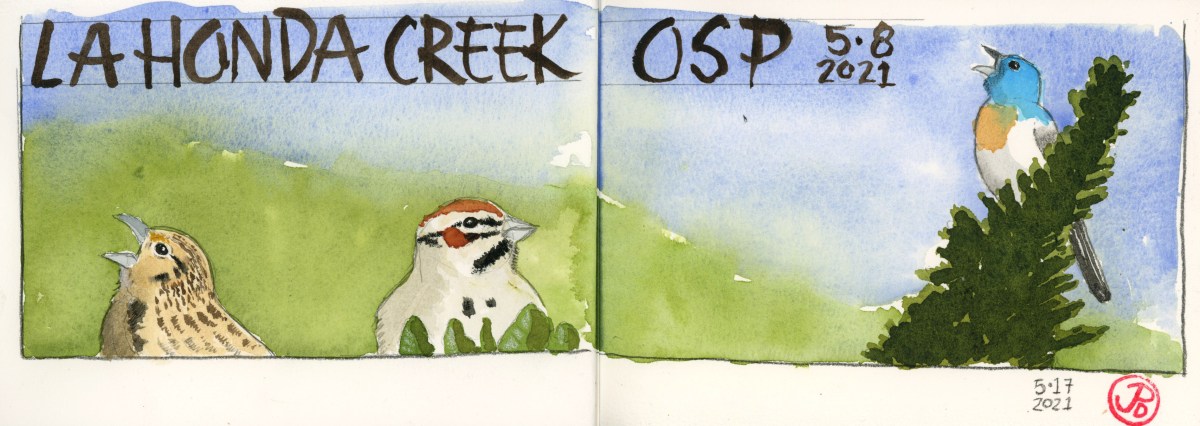
Grasshopper Sparrow had a few lifers he was hoping to check off his list. Western kingbird, lazuli bunting, and of course his namesake: grasshopper sparrow.
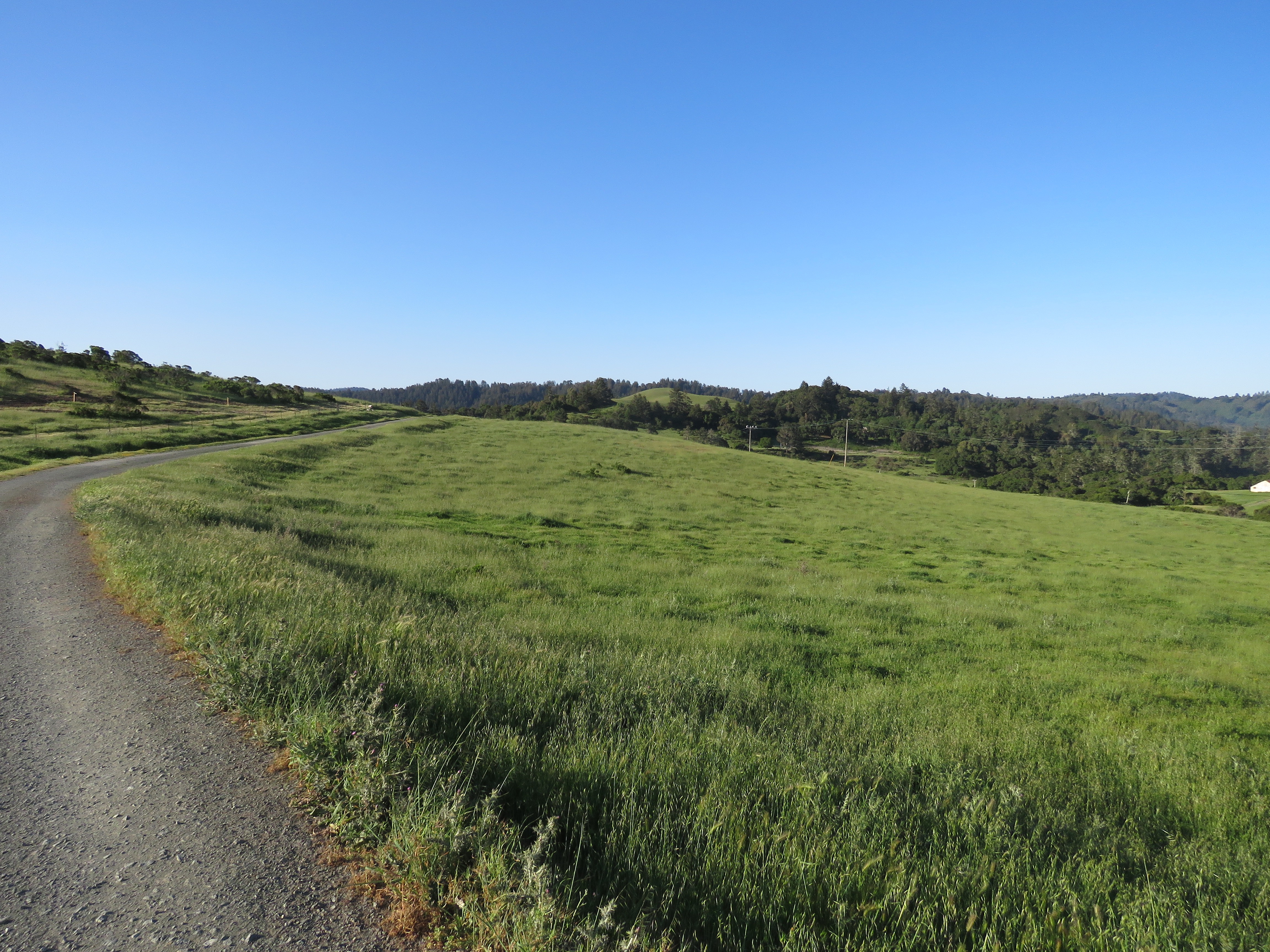
Our destination was in San Mateo County near the small mountain town of La Honda. This is La Honda Creek Open Space Preserve. This OSP contains open meadows surrounded by the curvaceous green hills of California’s Coast Range.
Within 100 yards of the parking lot, as we walked along the wide fire road, we heard our first grasshopper sparrow!
Birding is made easy at La Honda Creek OSP with a graded fire roads with open views of the meadows, perfect habitat for the grasshopper sparrow.
As we walking down the fire road that bisects the meadow, we heard and saw five grasshopper sparrows. They where either perched up on coyote brush or singing from a barbed wire fence.
At this time of year, the grasshopper sparrow are singing their insect-like song, incessantly.Corvid Sketcher and Grasshopper Sparrow as Grasshopper gets his namesake lifer: grasshopper sparrow.
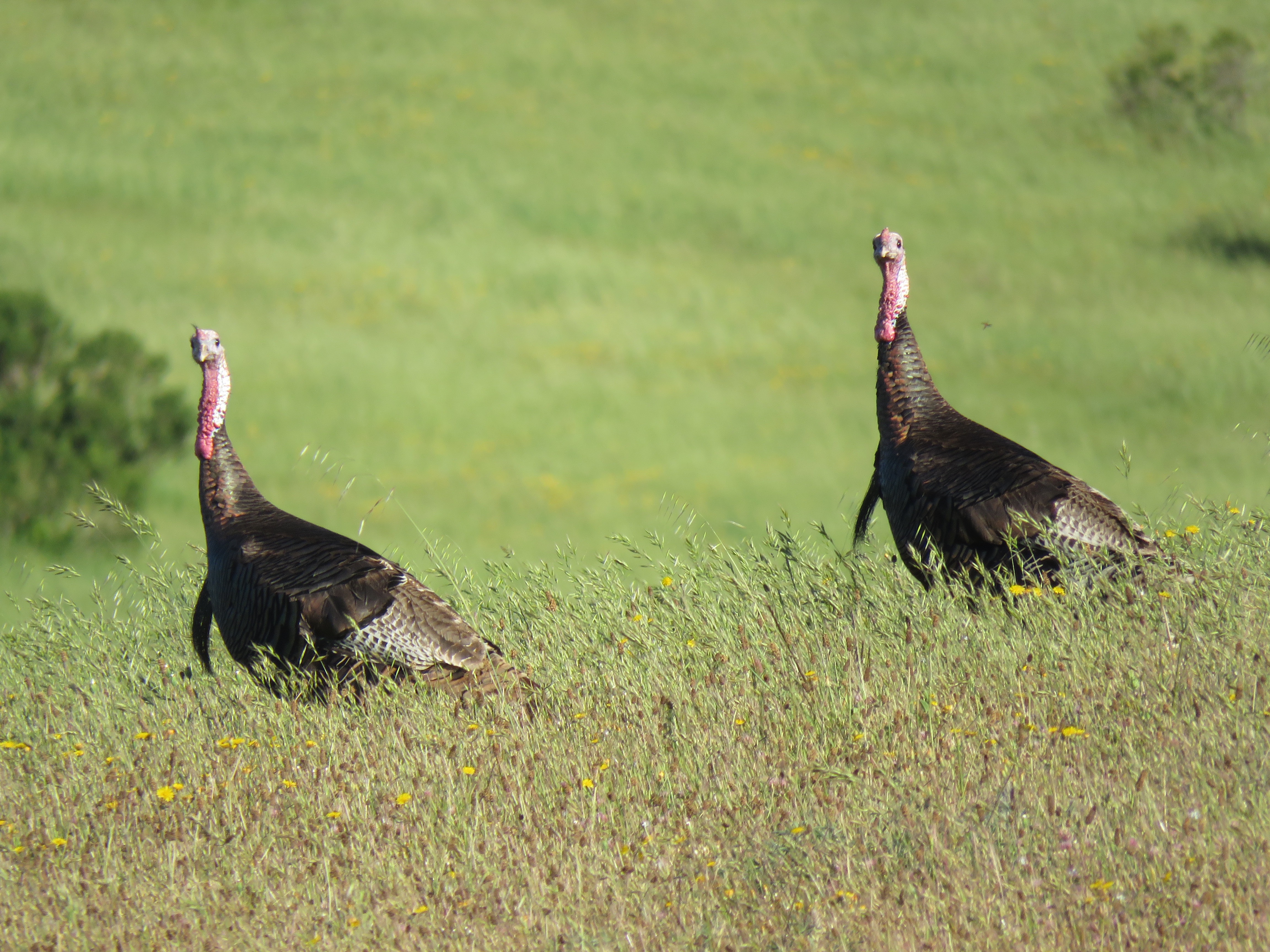
After getting our fill of singing grasshopper sparrows, we continued on down the road where we were greeted by two wild turkeys. Then we headed into a habitat with a bit more tree cover and we saw our first flycatcher, the ash-throated flycatcher.
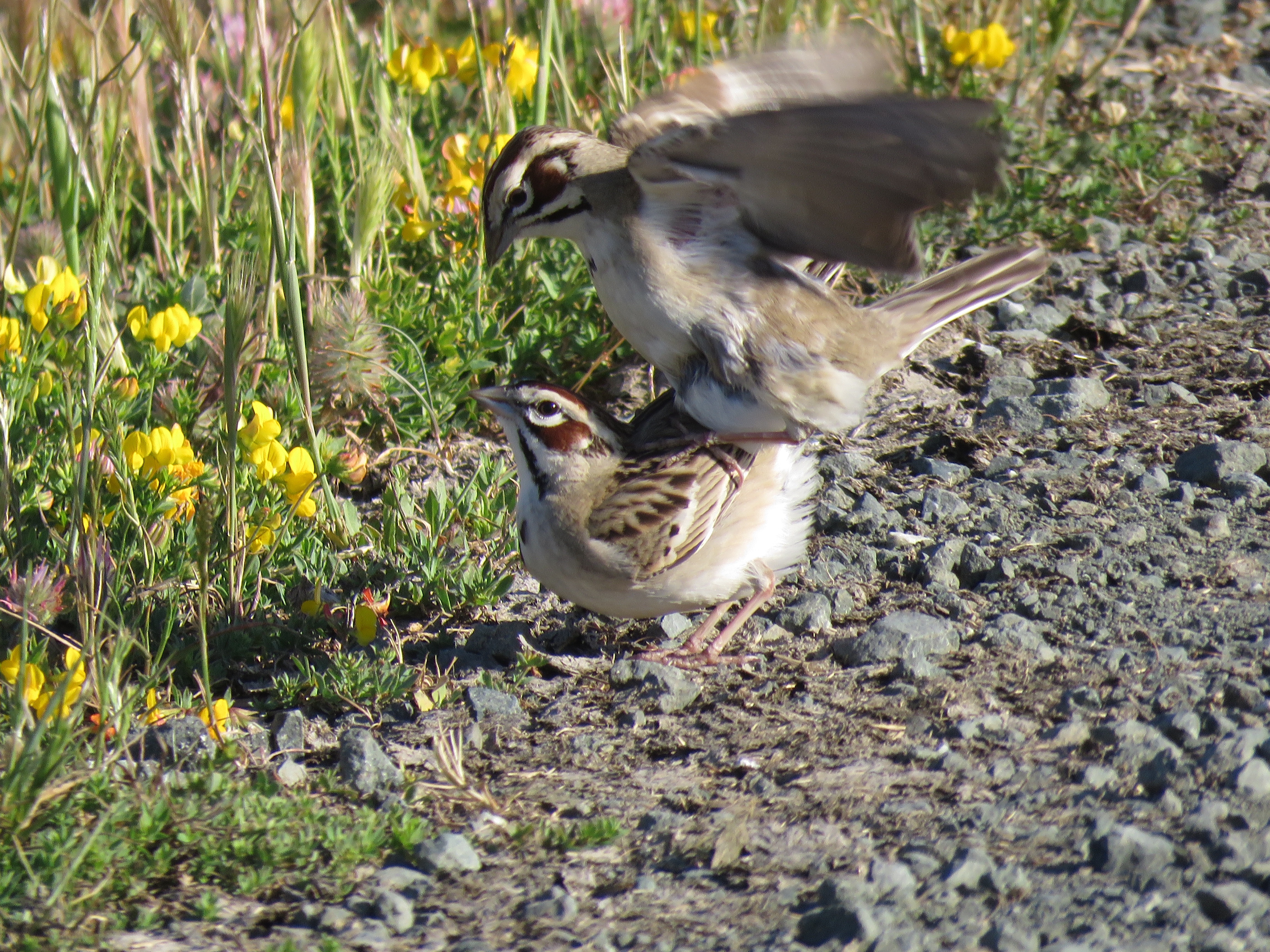
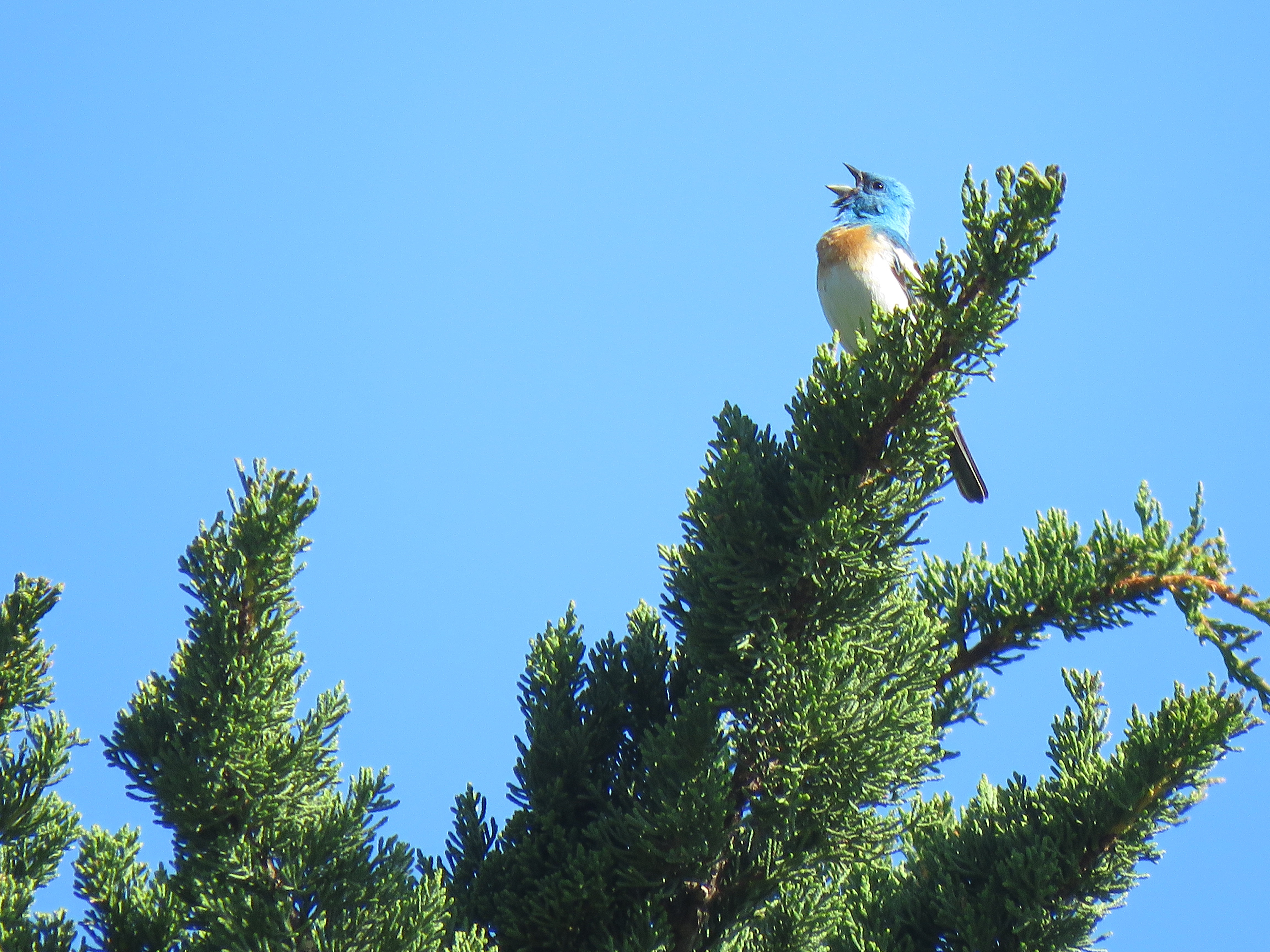
Are pair of wild turkeys in the tall, green grass.Love is in the air, a sure sign of spring: copulating lark sparrows. These beautiful sparrows are considered rare in this location.A singing male lazuli bunting.
On Thursday morning, about 10:30 AM, I found myself on the platform of Roseville. I was waiting for the eastbound California Zephyr number 6. I planned to chase her all the way over Donner Pass down into Truckee, the last Zephyr stop in California. The journey was roughly 84 miles.
In this stretch, the California Zephyr stops at three locations: Roseville, Colfax, and Truckee. All three of these towns were created by the Transcontinental Railroad and they because important servicing sections for the Central Pacific and later Southern Pacific Railroads. Roseville is still an important division point where Union Pacific (the current owners) keep the snow removal fleet, including the rotary plowers, to keep Donner Pass open during periods of snowfall.
It shouldn’t be to hard to keep up with the Zephyr, because it’s average speed is 55 mph and it rarely reaches that as she climbs the western flank of the Sierra Nevada Mountains. The speed limit on Highway 80, the interstate that parallels much of the railroad, has a speed limit of 65 mph.
The Zephyr pulls into Roseville. Roseville was once a major servicing point for Southern Pacific’s cab forward steam locomotives. The railyard had water and fuel tanks and two large roundhouses to turns the massive cab forwards. Today, steam has been replaced by diesel-electric motive power. Just to the left of 74, are service bays to maintain Union Pacific’s current locomotive fleet.
The eastbound number 6 pulled into Roseville on time. The train started it’s journey at 9:10 AM at Emeryville. I was excited to see that on point was an old “friend”, the General Electric P42DC locomotive, number 74. This was the locomotive that brought me from Denver, Colorado to Colfax, California, a few weeks ago. I had gotten to know her when I sketched her profile during a “fresh-air” smoking stop in Reno, Nevada. Her road number was also the year that my younger brother was born, 1974.
The number 6 filled the long platform at Roseville and I did a quick sketch of the eight car consist (featured sketch). The Zephyr was stopped at Roseville for about six minutes, which was enough time to capture the scene. With a quick retort from 74’s horn, the Zephyr started out of Roseville to slowly begin her assent of the Sierra Nevadas. I headed off to my car. The chase was on!
The Zephyr heading out of historic Colfax. The climb up the flank of the Sierra Nevada beginning in earnest at this point.
I made it to the Zephyr’s next scheduled stop, Colfax, with time to spare. I had time to have a quick bite to eat. I wanted to photograph the train from a different angle so I chose the bridge that takes Highway 174 over the two mainline tracks, just north of the historic Colfax passenger depot.
From the bridge I could see the “downtown” and look south down the mainline. Just north of the platform is a grade crossing where I detrained, two weeks before and my mother hugged me tight in the middle of Grass Valley Street, the Zephyr blocking off auto traffic.
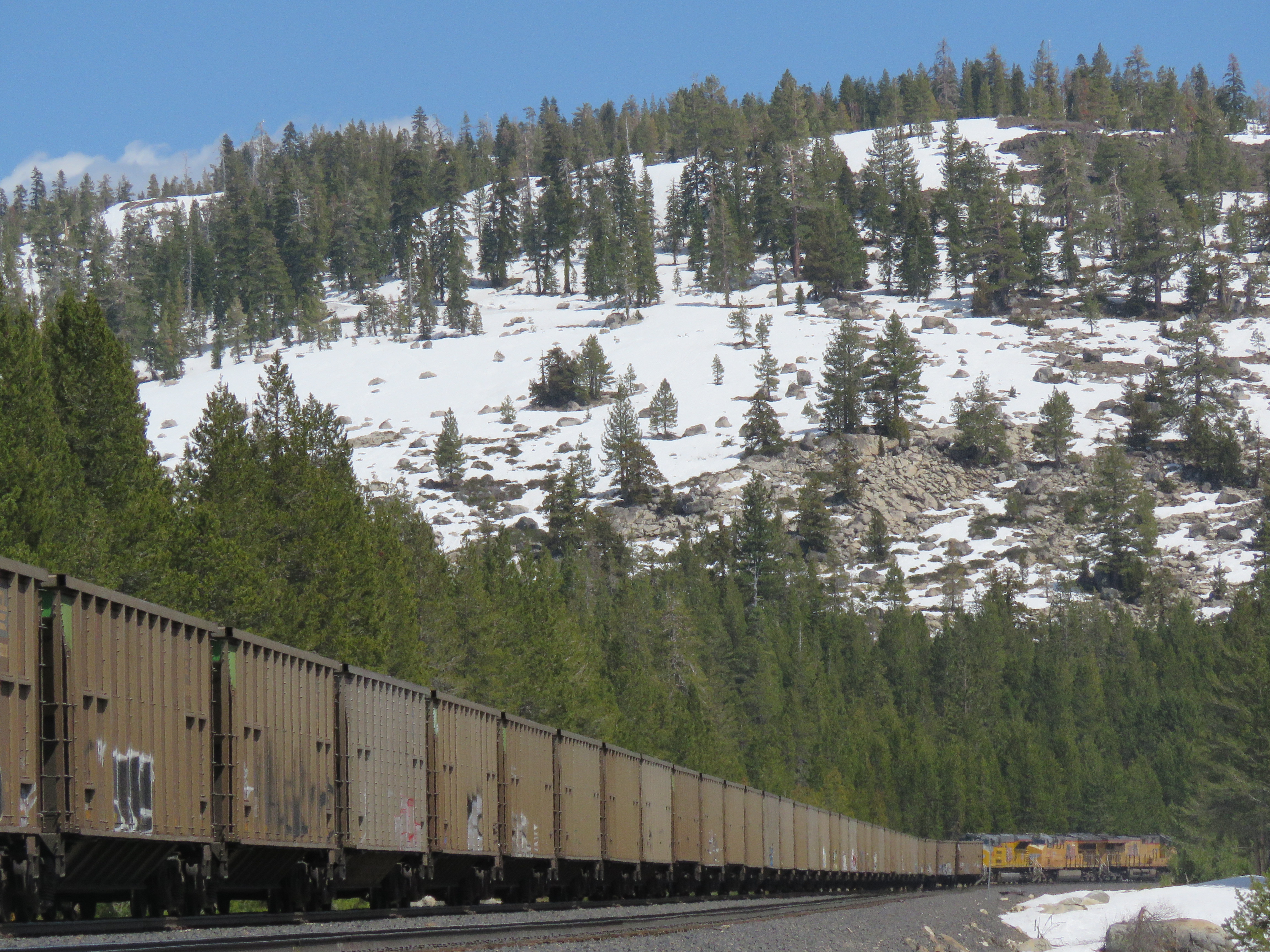
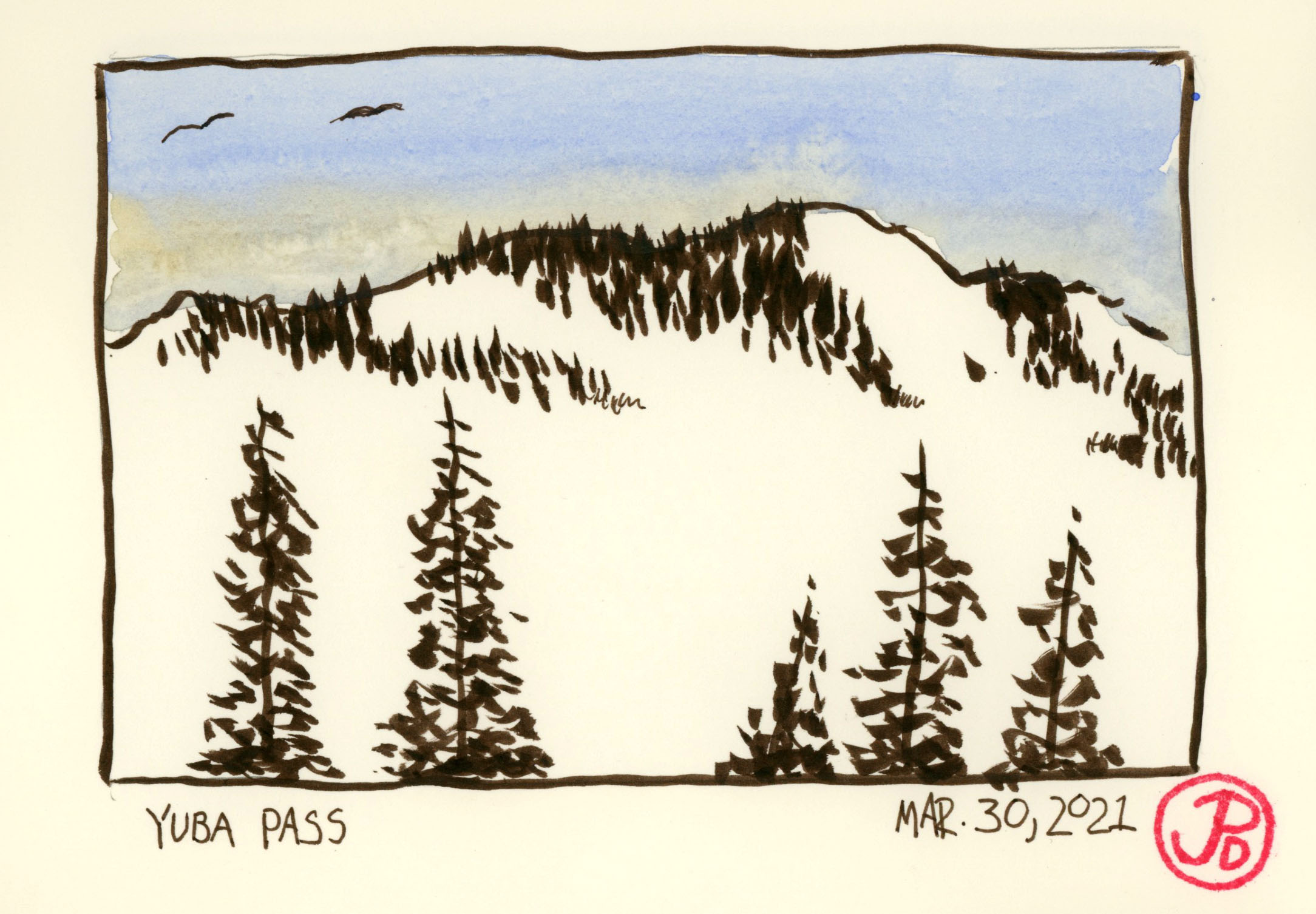
A Union Pacific freight climbs the track at Yuba Pass.
My next encounter with Number 74 was at Yuba Pass, just off Highway 80. At this point I am really up in the Sierras. While the sky was clear I had to don a jacket as I waited for the California Zephyr to catch up to my location at Yuba Pass.
To the south of my location, the rails curved around a bend and to my north, the line disappears into tunnel number 35, the location of the stranding of the City of San Francisco in January 1952. Now was the time of the waiting game, I had no way to gauge when the Zephyr would pass by.
I then heard a far off locomotive horn. It was difficult to locate and place the location of the train. Less than two minutes later I could hear the rumble of a diesel locomotive, climbing up the line. The Zephyr was approaching.
What appeared around the curve was not the Zephyr but a Union Pacific freight train with a consist of hopper cars. The train was headed up by three GE locomotives.
Freight trains now rule the rails in the United States with AMTRAK passenger service following in their wake. Freight certainly pays the bills and moving commerce across the the county has the right of rail, meaning that passenger service such as the California Zephyr are frequently behind schedule. On my journey on train number 6, we where two hours late when we finally arrived at Denver’s Union Station. The cause, we were behind Union Pacific freight trains in Nevada and Utah.
About 25 minutes later, train number 6 followed the UP freight heading east toward Donner Pass. I got and horn toot and a wave from the engineer!
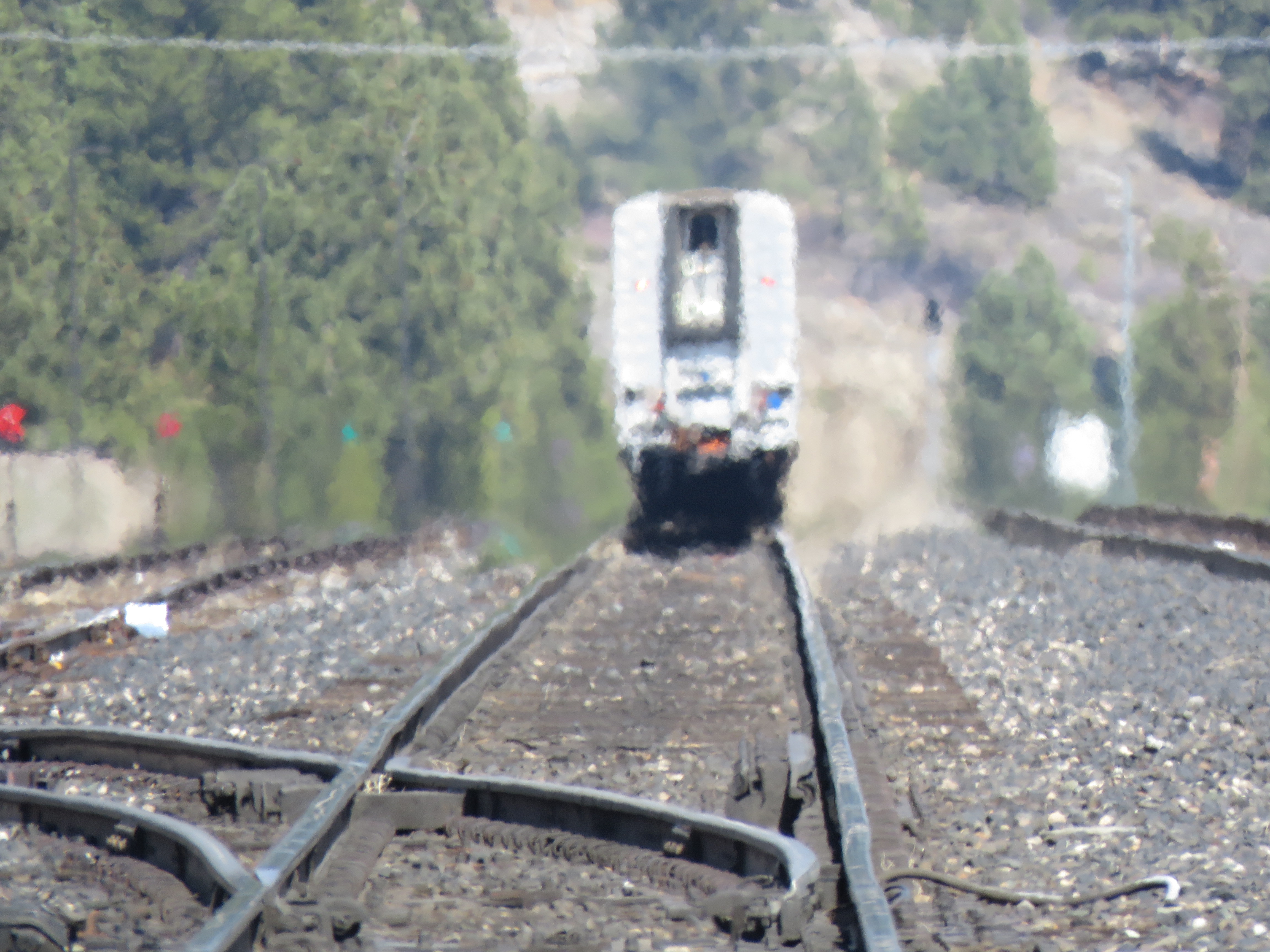
About 25 minutes behind the UP freight, the Zephyr climbs up Yuba Pass with 74 on point.The Zephyr curves into Tunnel number 35 at Yuba Pass.
I headed back to my car and returned to Highway 80 as both train and car climbed up towards Donner Pass. In about 20 minutes I pulled off the Highway at Historic Highway 40 (Donner Pass Road). On this road I passed the South Bay Ski Club’s lodge, where my parents met. I stopped at the grade crossing at Soda Springs. In front of me was the Soda Springs ski resort and further to the southeast is the resort Sugar Bowl, one of my favorite ski mountains in the Tahoe area. Both resorts where closed for the season.
The Union Pacific hopper freight passing through Soda Springs as it heads east to Norden, Donner Pass, and Truckee.
Stopped before the grade crossing was the freight train with the hopper consist waiting on mainline track 1. UP Number 8095 sounded her horn, triggering the crossing arms to lower. Any motorist wanting to cross the tracks would now have to wait a while for the freight to pass.
About 20 minutes later the Zephyr passed through the grade crossing, I got another wave from the engineer. At this point I think he was starting to recognize this Zephyr stalker!
I headed back to Highway 80 and climbed up and over Donner Summit and started my decent to Truckee. I looked over across Donner Lake to the far mountainside and I could see I was level with the UP freight. If I could beat it to Truckee I would be able to see both trains pass through Truckee. One would pass through Truckee while the other would stop to drop off and pick up passengers.
I had time to find a parking spot on Truckee’s main street, Donner Pass Road, pay for parking, and cross the three sets of tracks to position myself for the best light for photos. About 15 minutes after my wait, the Union Pacific freight blazed through Truckee.
Next the California Zephyr arrived. It stopped for a few minutes and with a short blast from the horn, the engineer released the brakes and throttled up the locomotive. With a last wave and a thumbs-up from the engineer, the Zephyr headed out of Truckee and California.
The Zephyr pulls into Truckee, eight minutes late. This is the last stop in California. Next stop for the Zephyr is Reno, Nevada.One last look at the California Zephyr as it heads east towards it’s next stop, Reno, Nevada and eventually, Chicago.
My brother spent almost half of his life in the Central Valley college town, Davis, California. He attended the University of California at Davis (UCD), worked in it’s public and private schools, got married, and raised his three children in “The City of All Things Right and Relevant!”
For Mother’s Day we where meeting my mother and sister-in-law in Davis so I arrived a little early to I sketch the historic train station and do a little railfanning.
Most towns start with a train station and Davisville, as Davis was then known, got their passenger depot in 1868. The original station burned down and the current station was built by Southern Pacific Railroad in 1913. The station is built in a Mission revival style. The University Farm, which later became UCD, opened five years before the current building was finished. At the time, the University wanted a befitting station to the town and the university stop. And they certainly got one!
Three passenger trains stop at Davis: the Capital Corridor, AMTRAK’s Coast Starlight, and the California Zephyr.
A view of Davis Station from Track 1. The SP stands for Southern Pacific. The bike racks in the foreground tells you this is Bike City, Davis.
I sat on the north side of the station and sketched it’s Mission Revival stylings. The station is island by three sets of tracks which at the time was an important stop on the Cal-P line. While I was sketching the station, I was very familiar with it’s curved lines, arches, and tile roof because I had sketched all of California’s Spanish Mission and a few Southern Pacific Mission Revival stations (Burlingame Station comes to mind). Davis Station and the Davis Tower are the only examples of Mission Revival in the city of Davis.
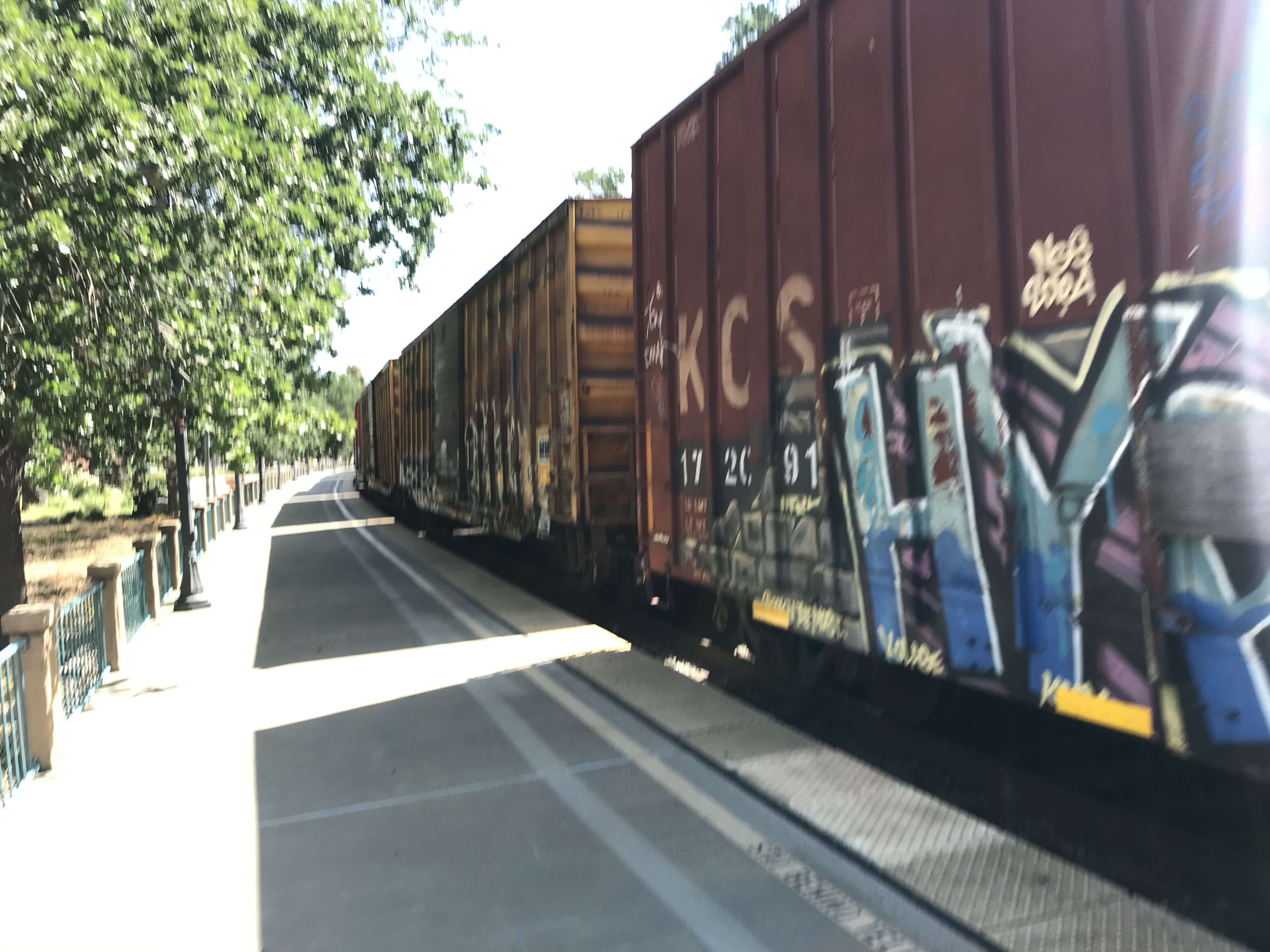
The interlocking control tower still stands just northeast of the station. This will have to be for another sketching day.A Union Pacific freight blazes through Davis Station with it’s curved track. Union Pacific owns the tracks and freight, not passengers service, pays the bills for the railroad.
There were a few clues that a train was coming down the line at Davis Station. The first was that the signal light was green, meeting that whatever train was heading down the line had the “high ball”, in other words, the train had the right of passage. The other clue was that people began to arrive at the station with their flowers in pots or plastic; it was Mother’s Day after all.
At 10:40 AM, a westbound Union Pacific freight train sped through the curve at Davis Station on track 1, the engineer giving me a thumbs up as the train rumbled through. At 10:50 AM, on track 2, the eastbound Capital Corridor train #724, pulled into Davis to take on passengers on her way to California’s capital: Sacramento.
The westbound Train # 731 was right on time and pulled into Davis at 11:10 AM. This Capital Corridor passenger train was heading to San Jose.
On point was locomotive 2004. I looked down at the front truck, containing the leading axels of the locomotive and stenciled, in yellow, where the two letters “GP”. In an odd bit of coincidence, I has replaced the initials “SP” on the Davis Station with my brother’s initials, “GP”, as an honor to his memory.
A westbound Capitol Corridor train pulls into Davis Station on it’s way to San Jose. On point is Locomotive 2004, an EMD F59PHI with “California” styling. I should say so.In one of those “I-can-make-this-sh*t-up” moments, the initials “GP”, my bother’s intials, were stenciled into the trucks of locomotive 2004. Unreal.
To collect myself in nature I headed to South Yuba State Park on the famous Buttermilk Bend Trail.
This trail parallels the South Yuba River and nature loafers come here on mass to in the spring see the wild flowers. The lupine where on show on this April weekday. The most prominent species was spider lupine (Lupninas benthamii).
The Buttermilk Bend Trail with it’s wildflower lined trail that parallels the South Yuba River.
I headed down the two mile, there-and-back trail, looking down at the river with it’s white water and I thought about one bird: American dipper. It was only a matter of time before I saw or heard one.
As I was about a mile in, I heard the joyous song of America’s only aquatic songbird, rising up from the river. A dipper was here and I looked for the closest trail down to the river.
At the riverside I spotted a tightly woven tangle constructed on a riverside boulder with a trail of white washed carpet at its entrance. It had the appearance of a sweat lodge than a nest.
A riverside dipper nest on the Yuba River.
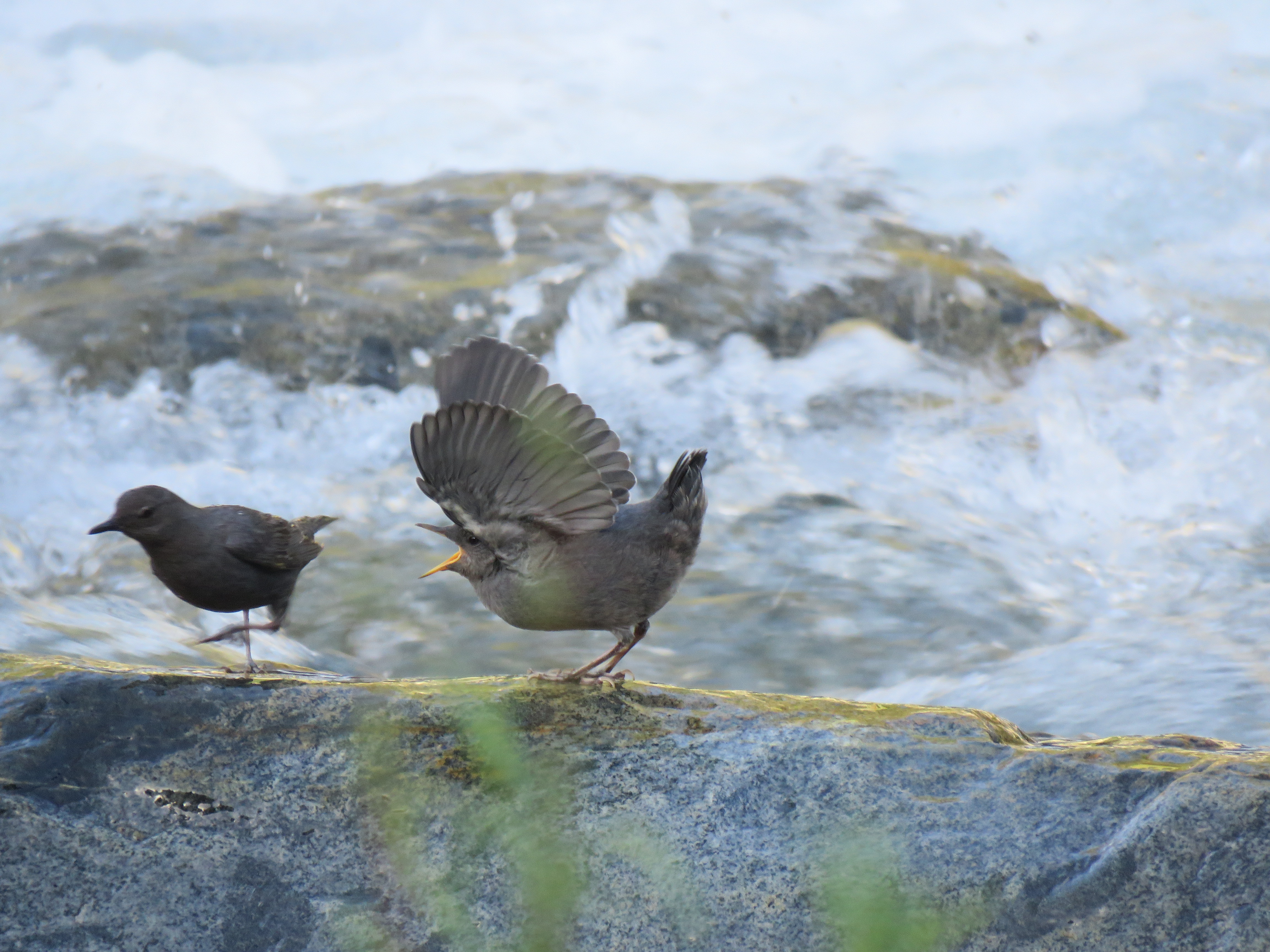
Within a few minutes an adult flew in to the nest and reappeared shortly after. This adult was perched on a rock directly across from the nest, dipping up and down. It’s song was loud enough to be heard above the roar of the rapids. Two juvenile birds flew in and followed the adult around as it foraged among the river rocks.
Not a dead-beat dad. A dipper with some food for it’s two fledglings.This is how a juvenile dipper says, “FEED ME!”
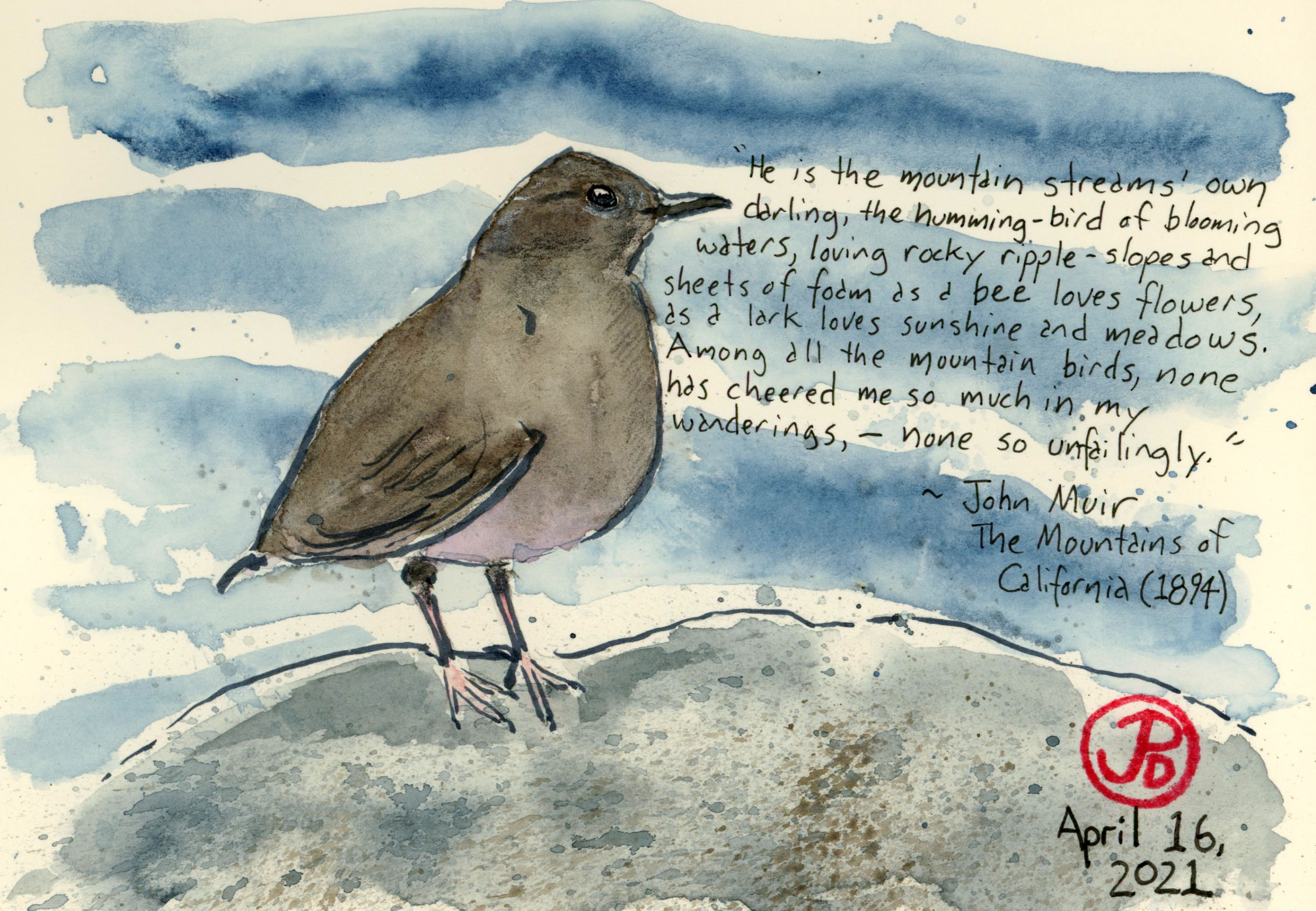
An indigo brush pen sketch of a bird that always puts a smile on my face (and I sure need that now). This is also my favorite quote about the dipper from John Muir.
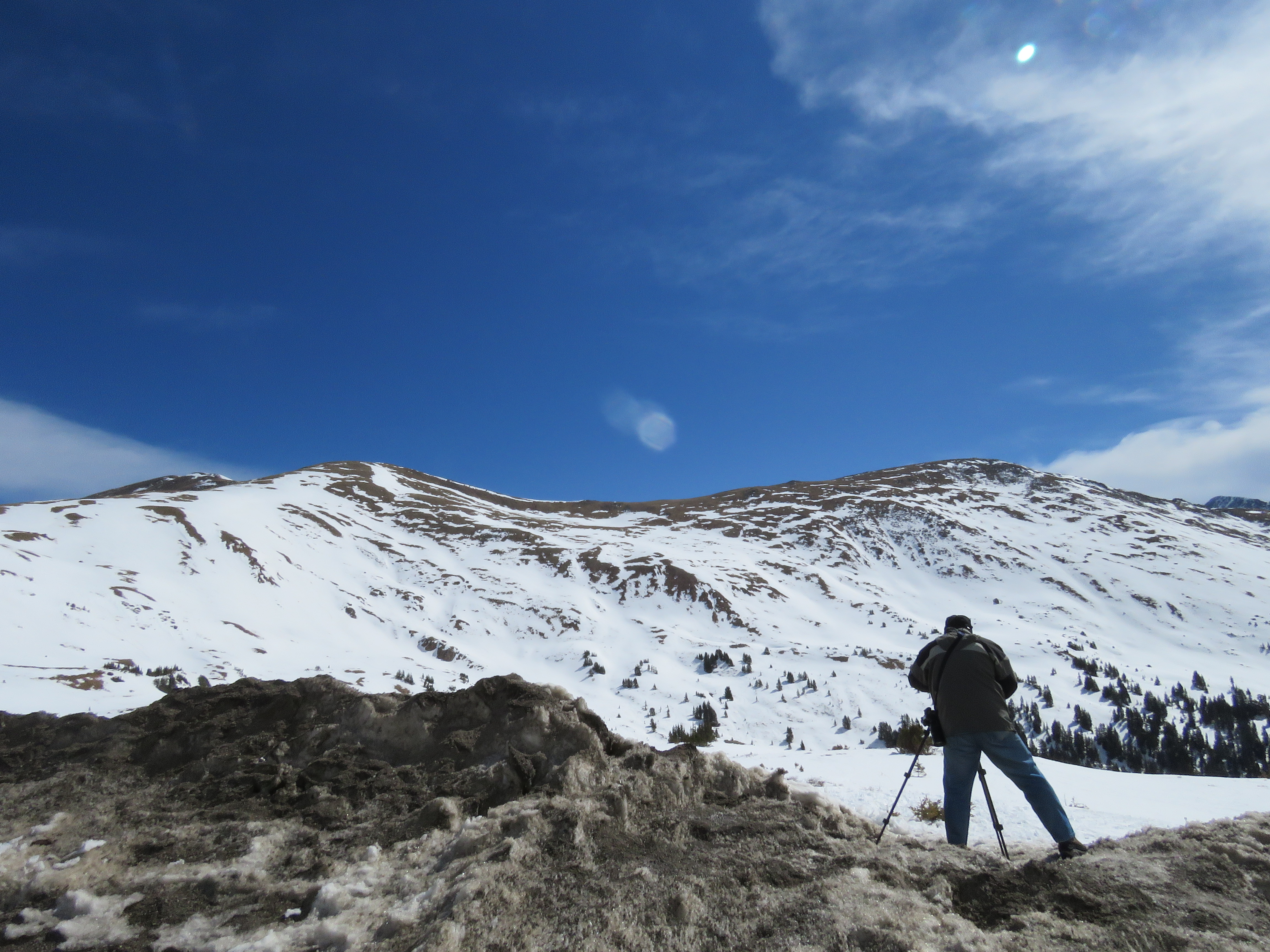
Loveland Pass is a legendary place to look for a sought after Colorado bird: white-tailed ptarmigan.
Logopus leucura is an all white bird that lives above treeline in an all white landscape. This twelve ounce bird is notoriously hard to find because it’s snow white camouflage hides it from possible predators and birders with equal aplomb.
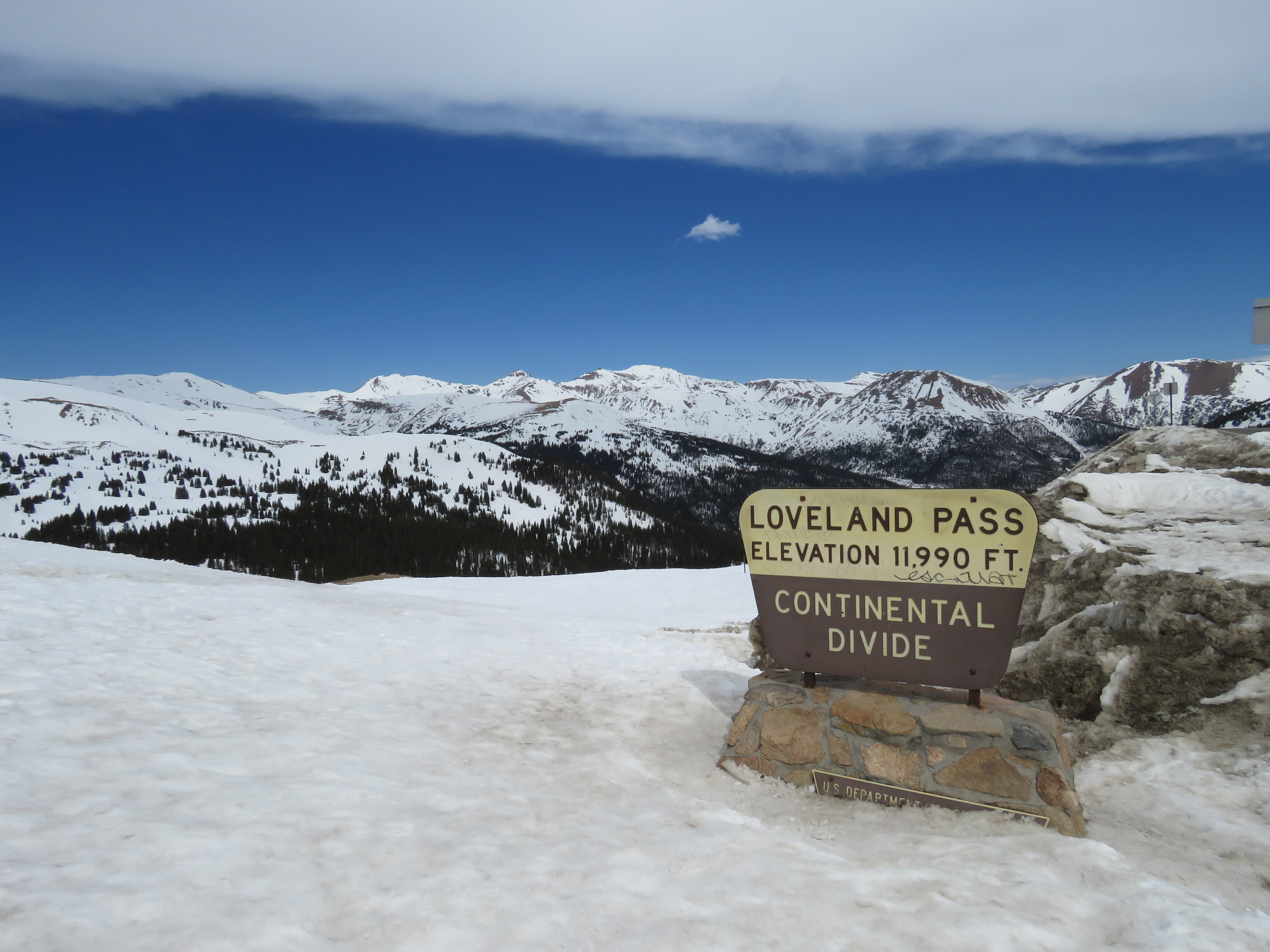
At close to 12,000 feet above sea level, Loveland Pass is exposed, cold, and very windy. Most of the visitors we see quickly get out of their cars, take a few selfies in front of the elevation sign, and then hurry back to their cars and return down to milder climes.
To find this ptarmigan take patience, lots of patience. It also helps to have a scope. What we are looking for is the image profile of the bird. In other words we are looking for a twelve ounce patch of snow with a black beak and eye.
My guide and I scan the bright white slopes for that all white bird in an all white landscape. Is it any wonder that birders don’t suffer from snow blindness while trying to add this game bird to their lifelists?
My guide, Carl, scanning the landscape at Loveland Pass.
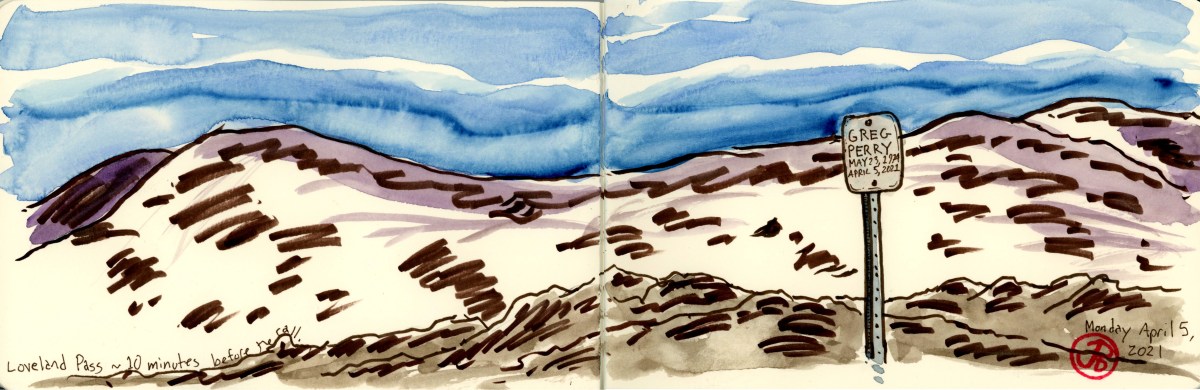
I sought shelter from the cold wind in the passengers seat of Carl’s truck, I also wanted to sketch the scene. I laid out the contours of the mountain in sepia brush pen and then added the twined contour of the dirty snow in the forground. I then added bits of exposed ground on the mountainside with expressive strokes. I then sketched in the sign in the foreground that said” PARKING PERMITTED” In the sketch I left the sign blank, little realizing the words I would be adding a few days later.
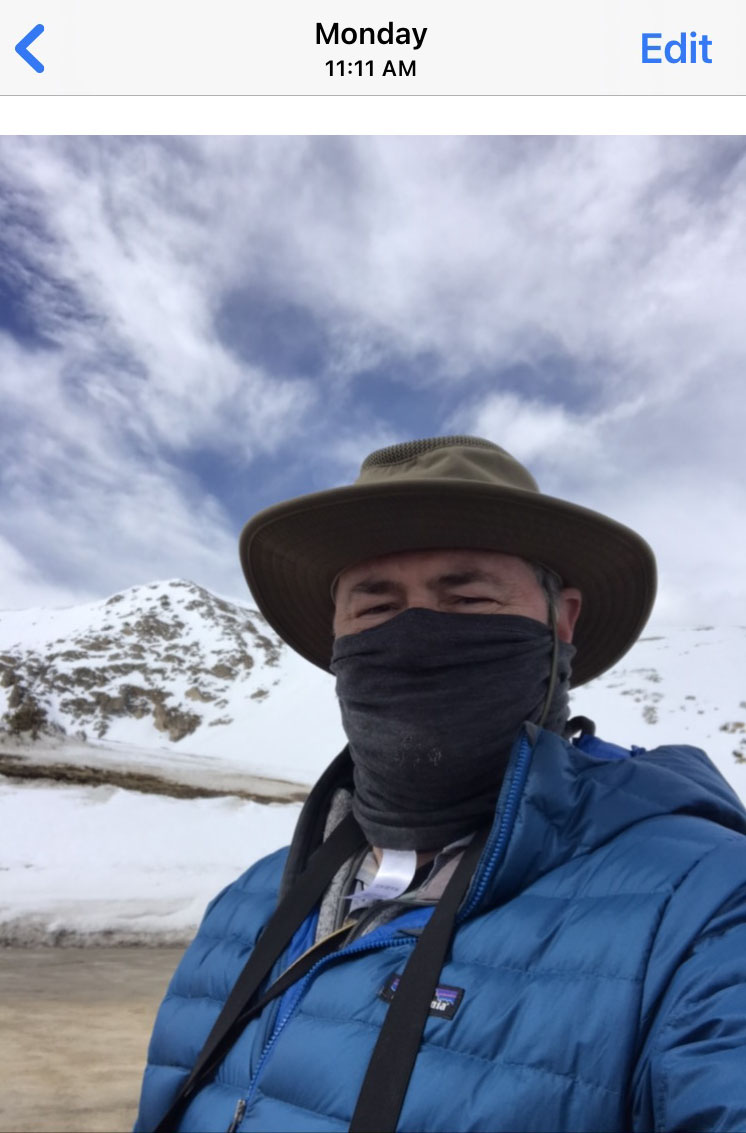
I placed my sketchbook on the dashboard and headed back out to continue the search. But before I that, I though a selfie was in order. . .
I took a shelfie showing me in all my layers and as I was lowering my phone to put it back into my pocket, I received a phone call. It was 11:12 AM Mountain Time, 10:12 Am Pacific Time.
The call was from my mother. This was a odd time for her to call.
I answered and she was sobbing uncontrollably.
She told me my younger brother, Greg, had died.
Loveland Pass is a beautiful place to lose a ptarmigan but is also a beautiful place to learn such horrible news of the loss of your only brother.
My return journey was a beautiful but a somber one.
I spent much of my time in my roomette with short trips to the dining and observation car.
Taking the train back gave me the chance to reflect on the almost 47 years of my brother’s life. I lost myself in the landscapes and continued to sketch during our brief “Sketch Breaks”. Sketching provided the focus and “in the moment” experience my soul needed. Sketcher therapy I suppose.
One other activity that kept my mind busy was train birding. I created a list of all the birds seen from the train, without binoculars. I tallied 43 species as well as six mammals including elk and bighorn sheep. A highlight was having an adult bald eagle keeping pace with the Zephyr while we followed the Colorado River in Utah.
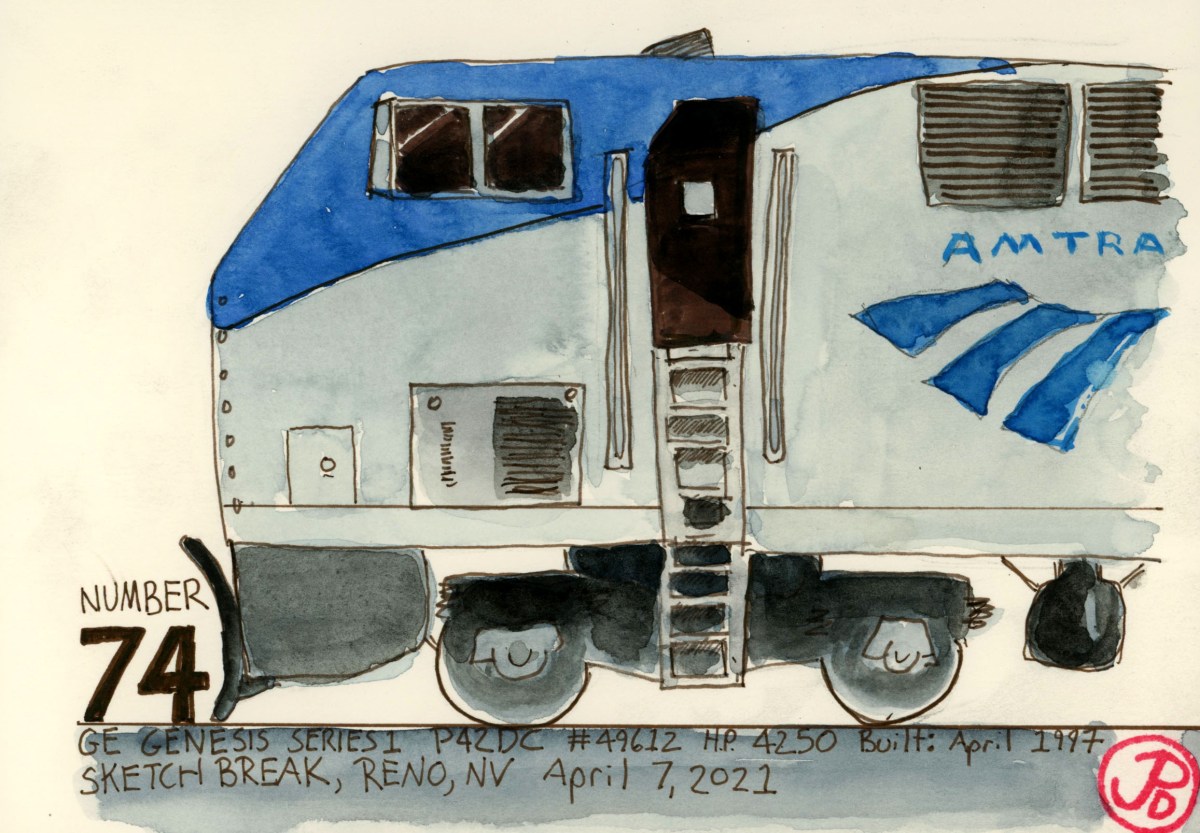
In Reno, the Zephyr pauses for a little longer than most stops because there is a crew change. This is when the engineer is replaced by a fresh one. During this time I sketched the profile of the locomotive on point, a General Electric P42DC, built in April of 1997. In an uncanny instance of coincidence, the locomotive number is 74, my brother was born in 1974. This seems to be the perfect locomotive to lead me back home to my mother.
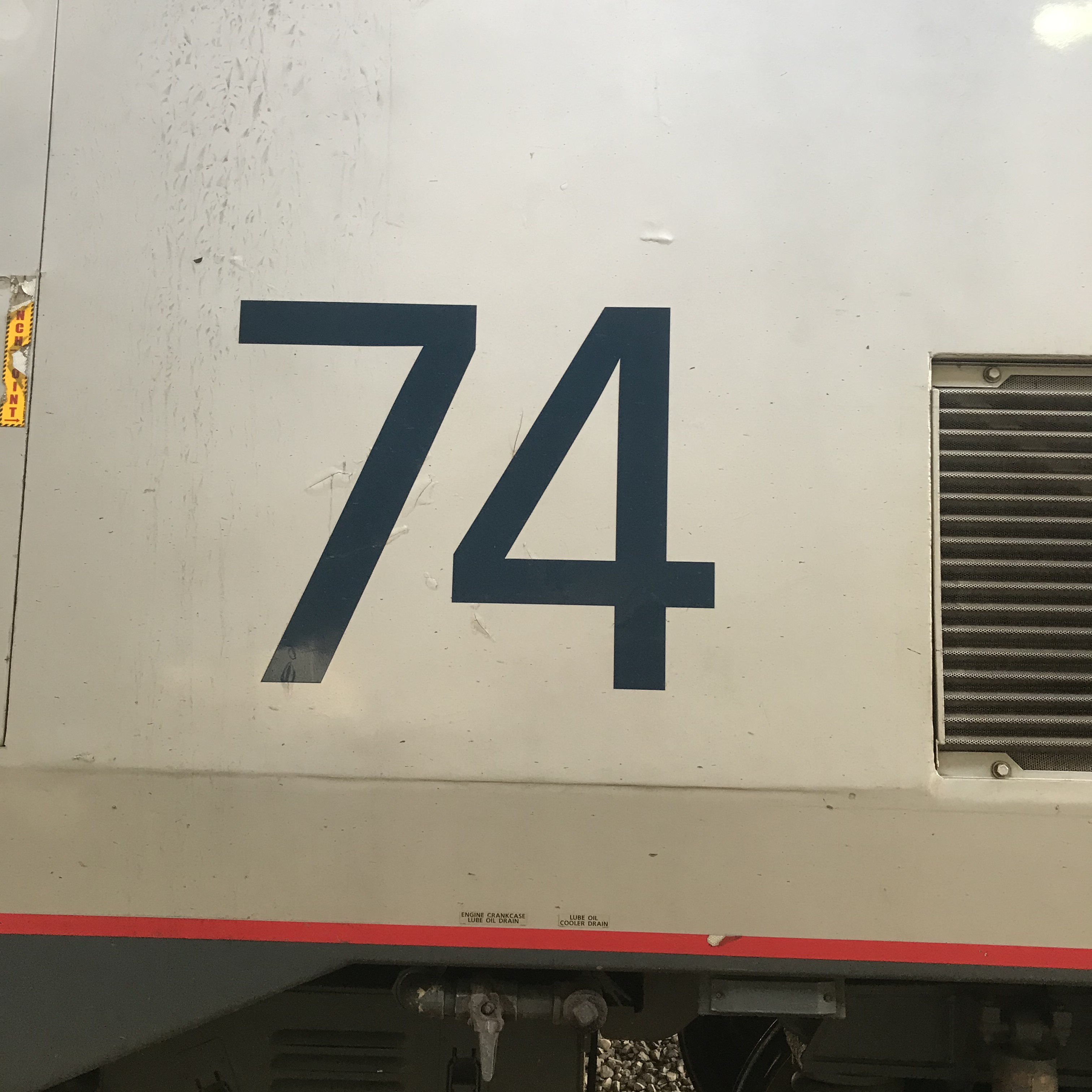
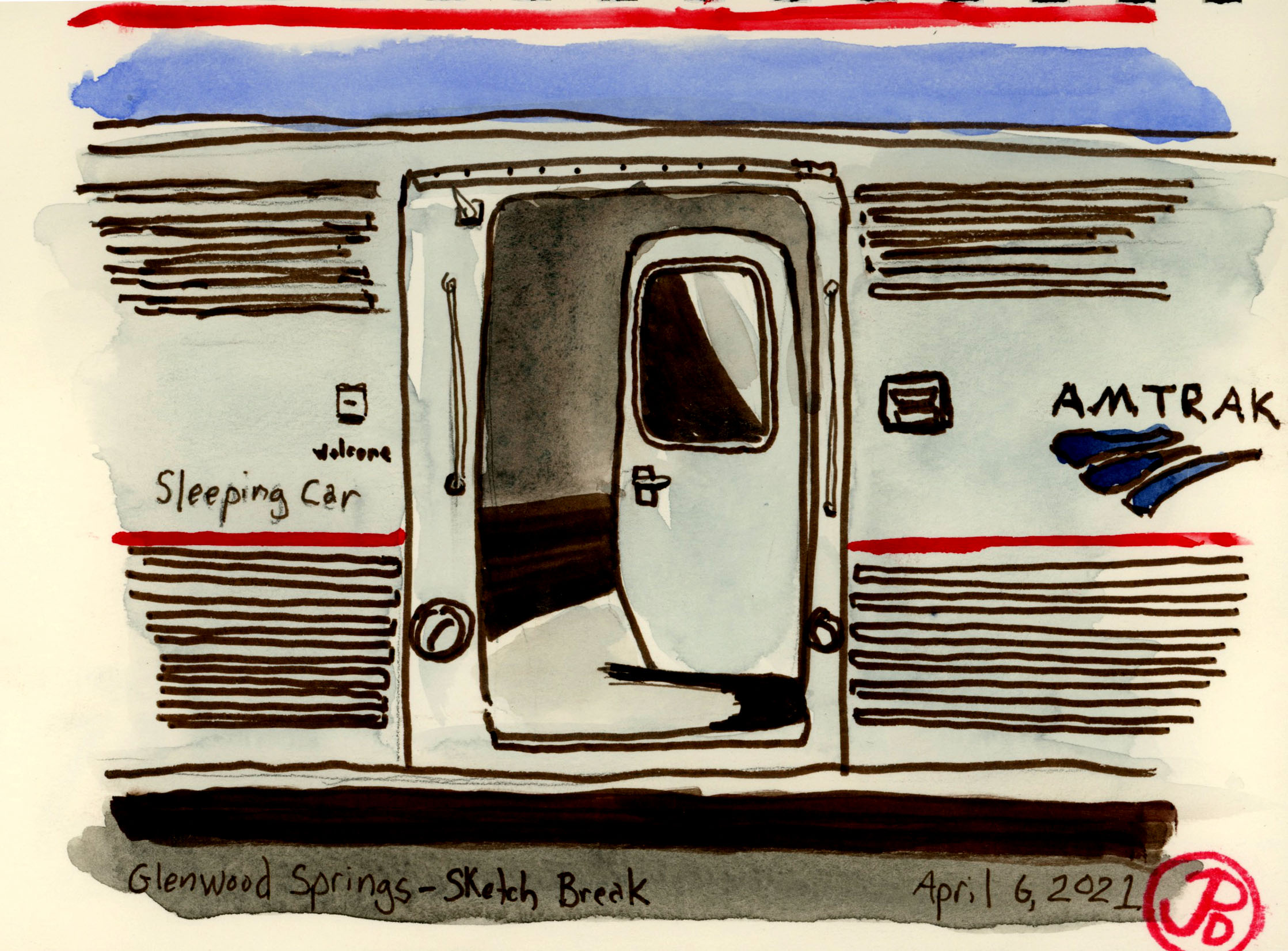
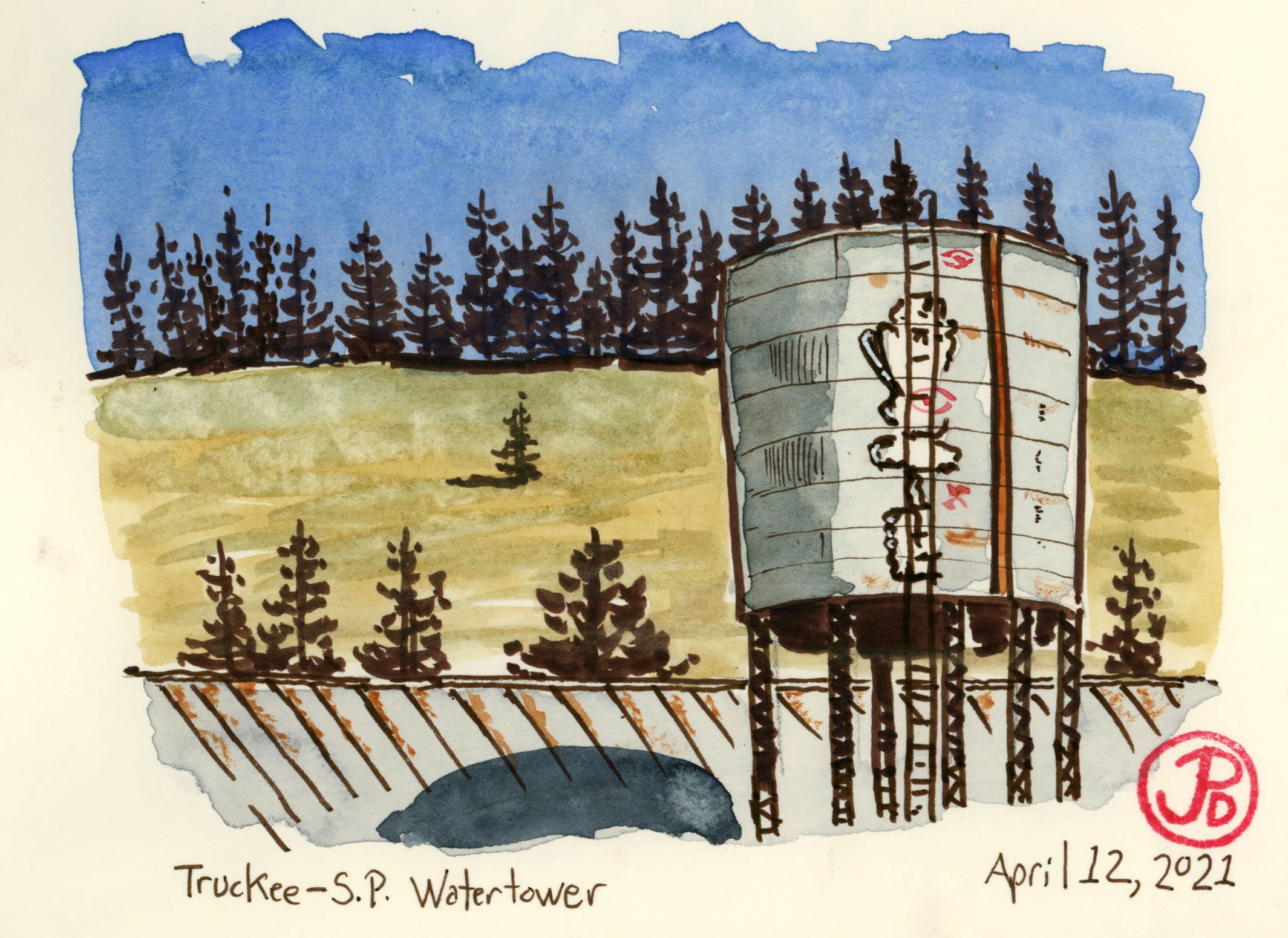
1974 was the year of my brother’s birth. It was also the number of the locomotive on point that would take me back to my mother.A quick sketch of my Sleeping Car entrance during a sketch break at Glenwood Springs. My sleeping car was just behind the locomotives. I added watercolor once I was back in my roomette.I had spent time during the last year sketching the existing Southern Pacific water towers. So I knew the form well. I was surprised to see from my Superlunar perch, an existing water tower as we pulled out of Truckee to climb Donner Pass. I have been to Truckee many times but I had never seen this tower. I returned later to capture the water tower. There are 15 surviving examples in California. I have seen about five.
In Truckee, I called my mom to let her know that California Zephyr Number 5 was running on time. This was going to be the first time I had seen my mom since learning if my brother’s passing. I suppose that I could have booked a last minute fight from the Mile High City to be there much sooner but the pace, the landscape, and the rocking lullaby of the Zephyr seemed to be the right choice for taking me back to California.
At this point I was on the route of the first Transcontinental Railroad. And I would need the strength of those who built it to face the reality, once I stepped off the Zephyr at one of the Central Pacific’s rail camps that was later renamed Colfax.
The anticipation mounted as we ascended down the western flank of the Sierra Nevada Mountains, each mile bringing me closer to my mother.
In past train journeys, one of my favorites scenes is when a train pulls into a station and looking out the window, I see someone alight from the train, search the platform for that familiar face, and then the embrace. I don’t always know the relationship contained in that embrace but it is a story on that reunion of love, in the the stage of the train depot.
What would the observer on the second story of the Superlunar have thought of the man departing the train and embracing someone, clearly his mother, in the middle of the street in Colfax?
Sketching from a moving train takes practice. I figured I had sketched from a moving boat racing up the Cristalino River in Brazil, how hard could this be?
It always helps to have an expansive view, perhaps of a mountain range in the distance that moves slowly, while the foreground blurs by. In any case you have to work fast and create a quick image from different snap shots from the journey.
It helps to have a few tricks in your sketcher’s toolbox. You have to capture things quickly, using a bit of short hand when trying to get the “essence” of the scene. This means leaving a whole lot of information out. You have to only include what is the most important. Good thing the average speed of the California Zephyr is only 55 miles an hour, the maximum speed limit when I got my driver’s permit. The reason for the slow speed is because the Zephyr is on a freight route. These rails are not built for high speed. The trade off is that sketching from the second story of a Superliner car is a bit easier.
Below are a few Zephyr sketches from Colfax to Denver.
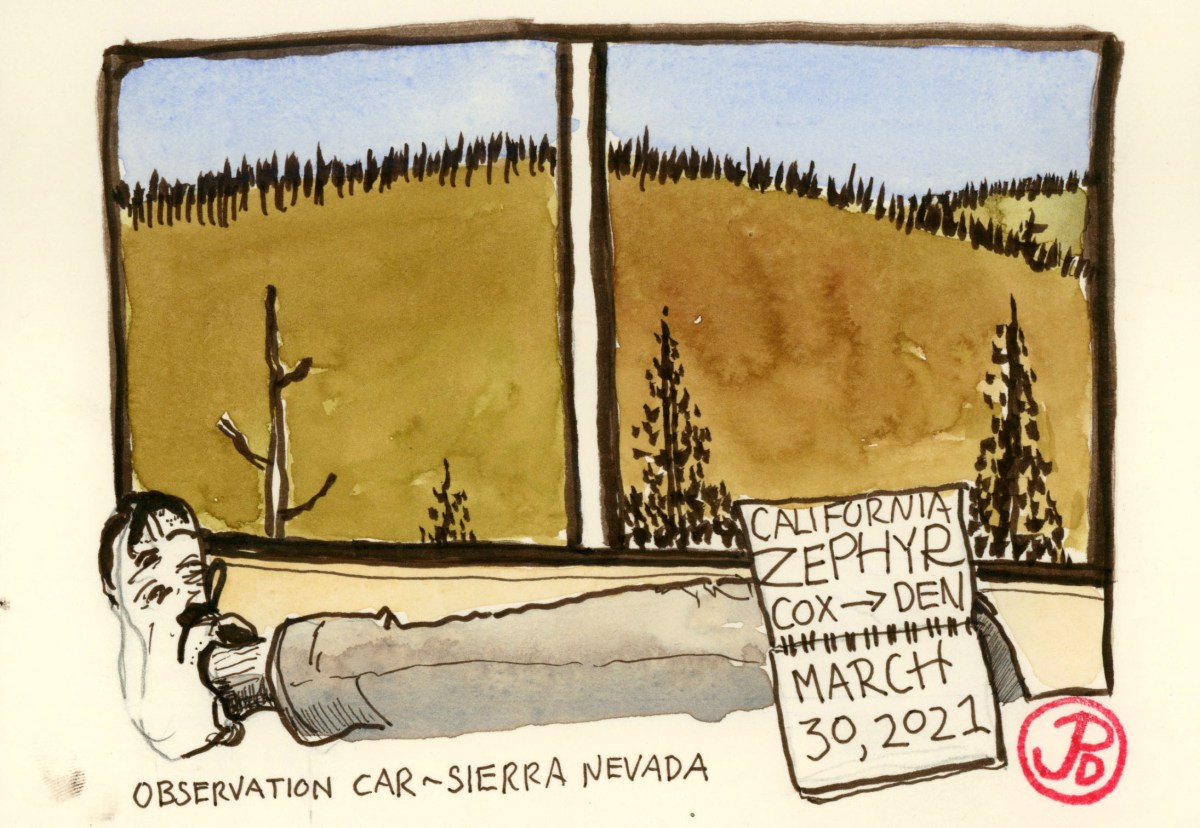
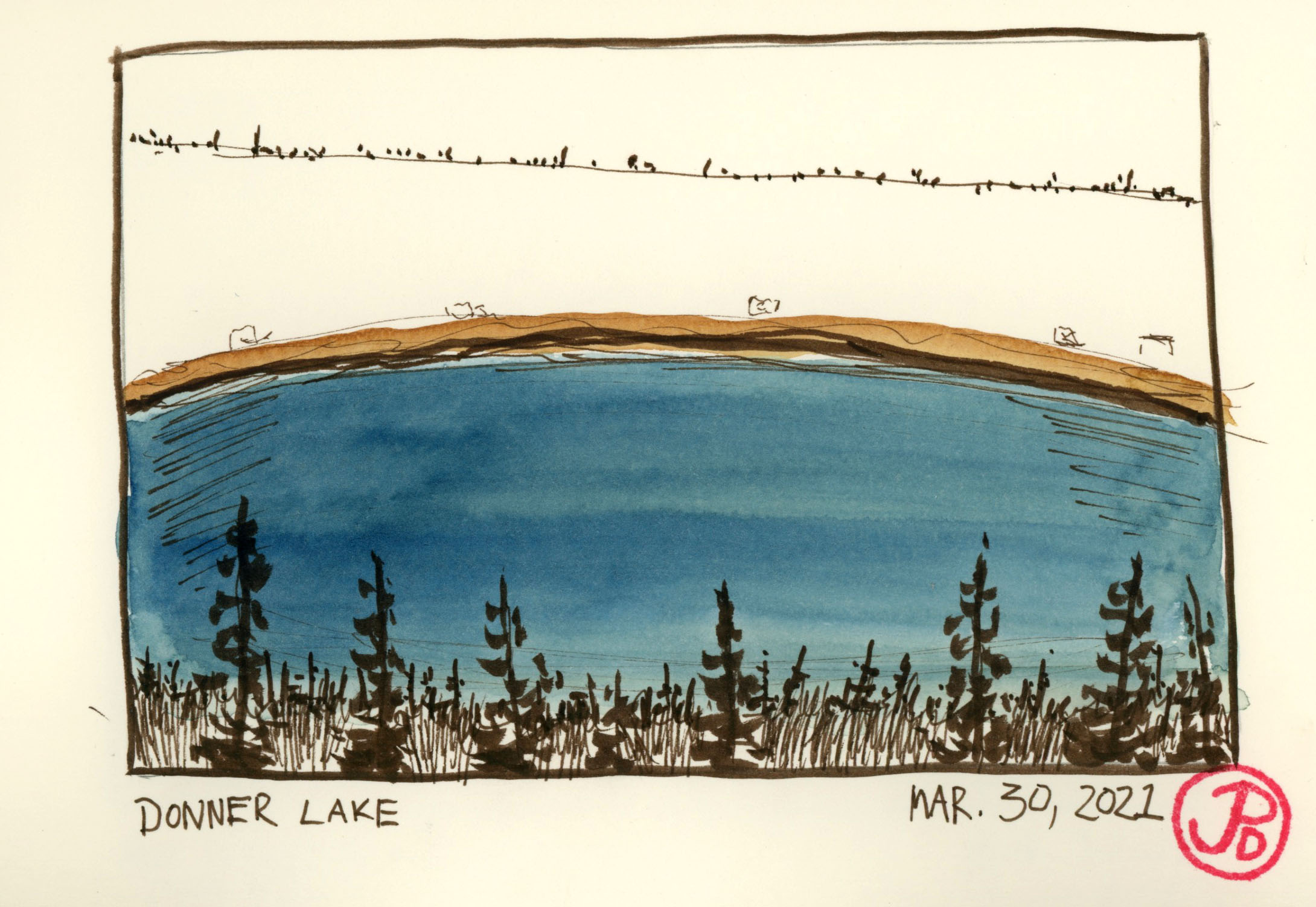
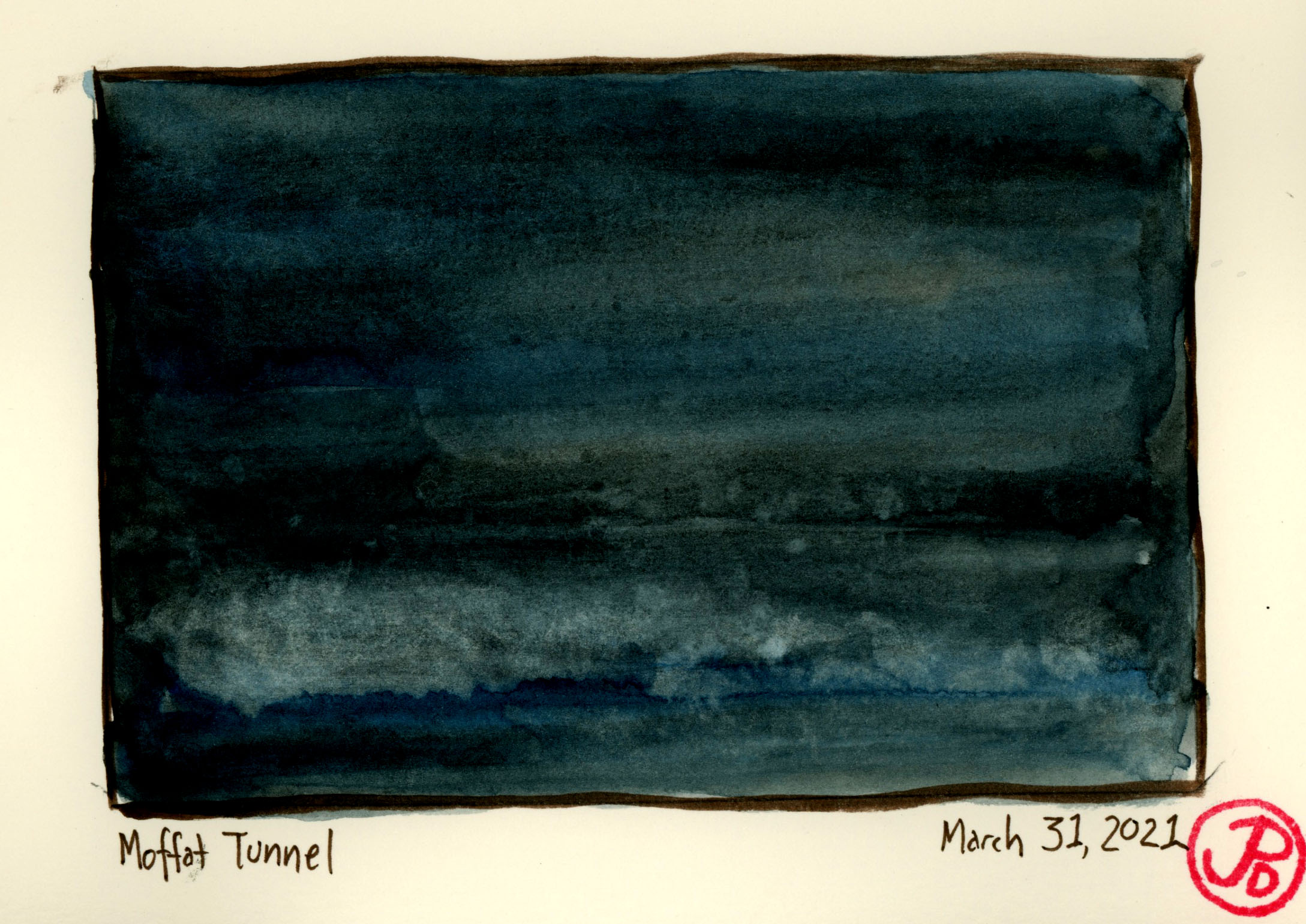
A observation car quick sketch from Yuba Pass.Donner Lake, formerly Truckee Lake. The east shore was the sight of the lake camps of the Donner Party in the winter of 1846-47.Okay I will have to admit that this one is a bit tongue and cheek. Moffat Tunnel crosses under the Continental Divide and is six miles long. It takes the Zephyr ten minutes to pass through the tunnel.
Moffat Tunnel was first opened in 1928 at an altitude of 9,200 feet. At 6.2 miles long, it is the fourth longest railroad tunnel in North America. About 15 trains a day pass through Moffat Tunnel which is about 50 miles west of Denver.














 Corvid Sketcher