Image

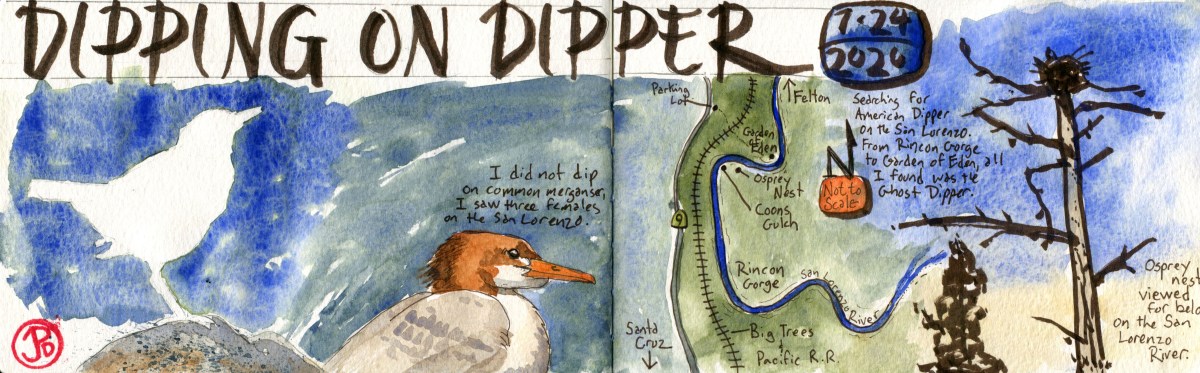
The Search for the American Dipper or Dipping On Dipper

Once, perhaps 35 years ago, I saw an American dipper (Cinclus mexicanus) flying downstream on the San Lorenzo River, between Middle and Sandy Beach in Paradise Park. What an amazing sighting. The bird of John Muir, the aquatic songbird of clear, turbulent mountain streams was on the San Lorenzo!

At the time I did not keep records so I don’t know the month or year of the sighting but since that time I have been looking to find another dipper on the river. This bird is an indicator species for the health of a river. Dippers are considered a rare bird in Santa Cruz County but there was suitable habitat upriver in Henry Cowell State Park that look promising. Large granite boulders, turbulent river water. This is where a dipper should be, I reckoned.

I first checked the location of my first sighting on the San Lorenzo on the turbulent turn in the river between Sandy and Middle Beach. This rocky bend looked like good habitat for dipper and I walked up river, checking river rocks for the tell tale signs of whitewash, bird poop. There was some but this could be from a black phoebe. I did not see a dipper here.

On another day I next searched Rincon Gorge upstream from Paradise Park. Dipper had been reported here in May 1988 and again in May 2009 where a nest with young was seen. That was a long time ago and there were no current reports on eBird. So I searched and I again dipped on dipper.

Now it was time for a bigger expedition on the San Lorenzo, to explore some of the best stretches of river between Coon Gulch and Garden of Eden Beach in Henry Cowell State Park. This effort would require traversing down to the river from the railroad tracks on what only could be called a mountain goat path and then hiking up and often in, the San Lorenzo, towards Garden of Eden.

I parked on Highway 9 and headed down the Ox Fire Road towards the railroad and Garden of Eden. When I was halfway down the trail I heard the primeval calls of our largest woodpecker: the pileated. On a Douglas-fir snag, about 100 yards from the railroad, I spotted a family group of four pileated woodpeckers! Either this was a good omen for my dipper search or a great consolation for dipping.

After leaving the pileated family I headed downstream on the railroad and took the trail down to the popular beach, Garden of Eden. Perhaps this beach should be renamed Garden of Trash. I was appalled at the amount of cans and bottles, random clothes and towels, and toilet paper. Beachgoers clearly ignored the “Pack Out Your Trash” signs.
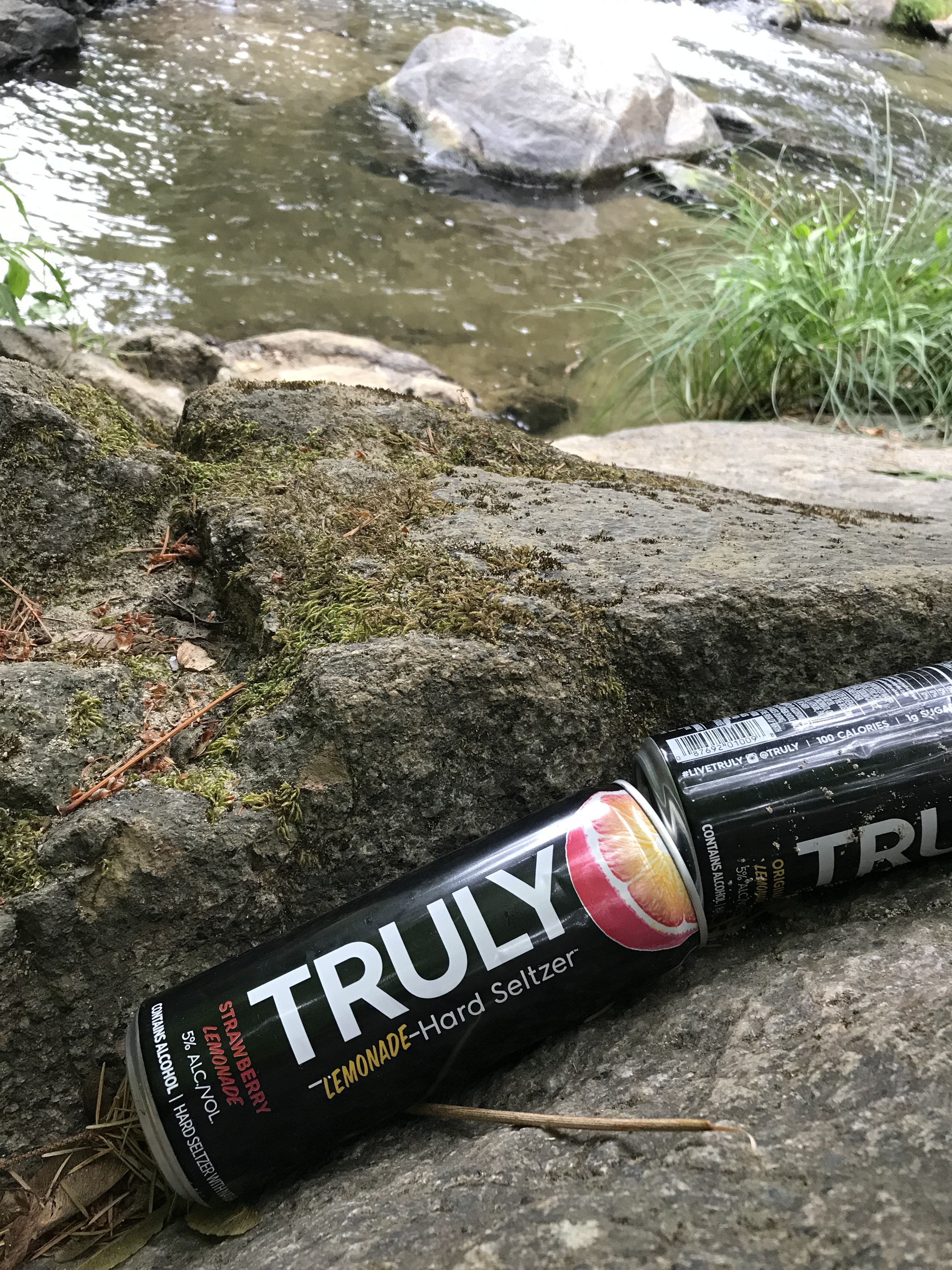
The amount of discarded cans and bottles along the banks of the San Lorenzo was truly disgusting!

I headed upstream from Garden of Eden to check the granite boulders for dipper. I was further appalled at all the graffiti on rocks and logs. It seemed far from the favored pristine rivers that the dipper preferred. And I did not find any dippers upstream from Garden of Eden.
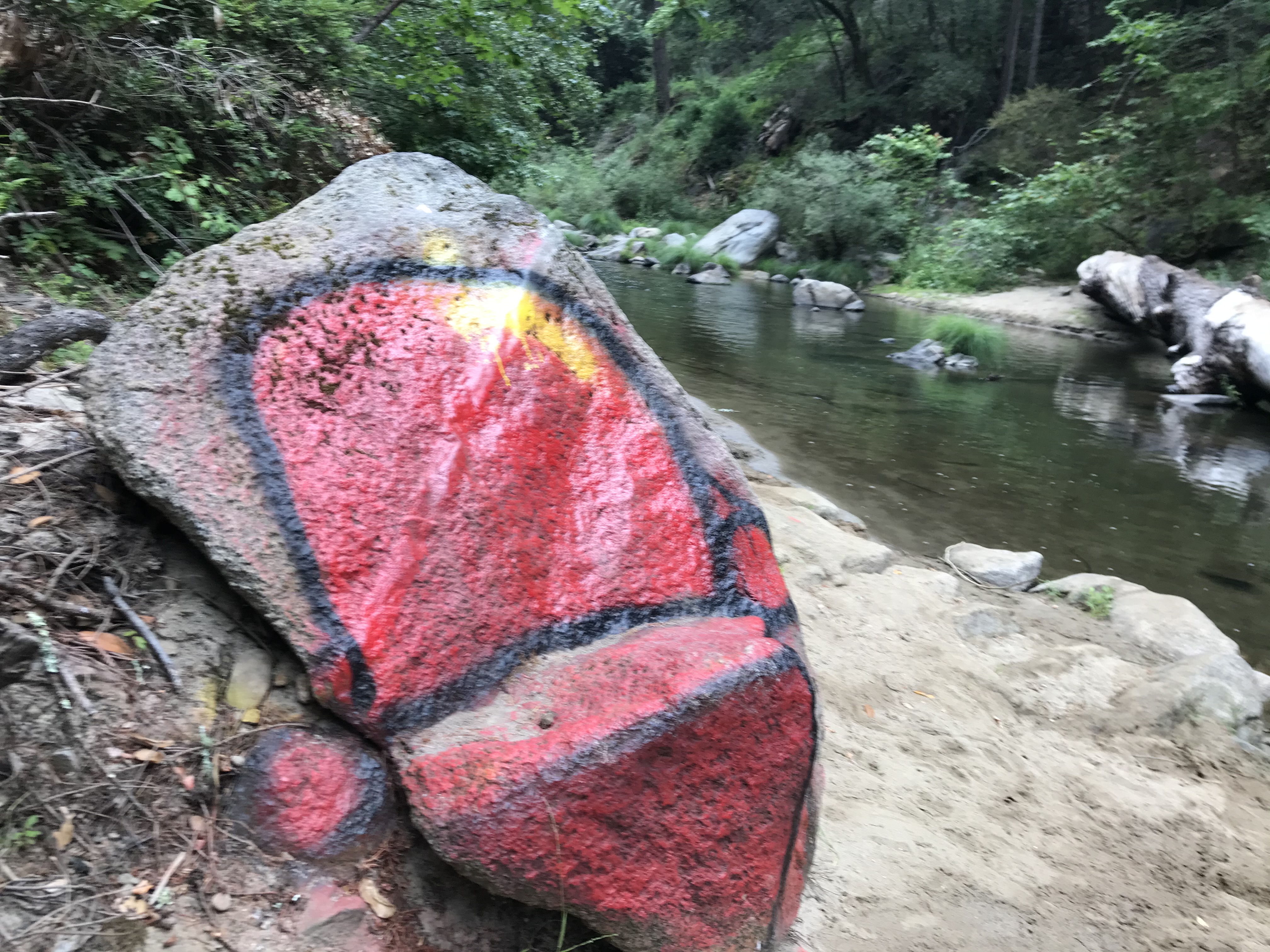
What makes someone come to the San Lorenzo and spray paint a rock, I will never know! No wonder I didn’t find dipper on this stretch of the river.

When I returned to the main beach a young man was wiping graffitti off a sign post that no longer contained a sign. I’m sure the sign said, “Don’t Litter” or “Respect The Trees, Dippers, and Rocks!” or “Save the Painting For Sketchbooks and Canvas!” Turns out he was an interpretive ranger from Henry Cowell State Park who comes to Garden of Eden, before his shift, to clean up the beach. I asked about beach clean-ups and he told me that when litter is removed, there is more to replace it on the following days. Shameful!!

I returned to the railroad and hiked downstream towards Coon Gulch. I paused at the osprey nest where both adults were perched near the nest, indicating that there might be chicks hidden in the deep nest.
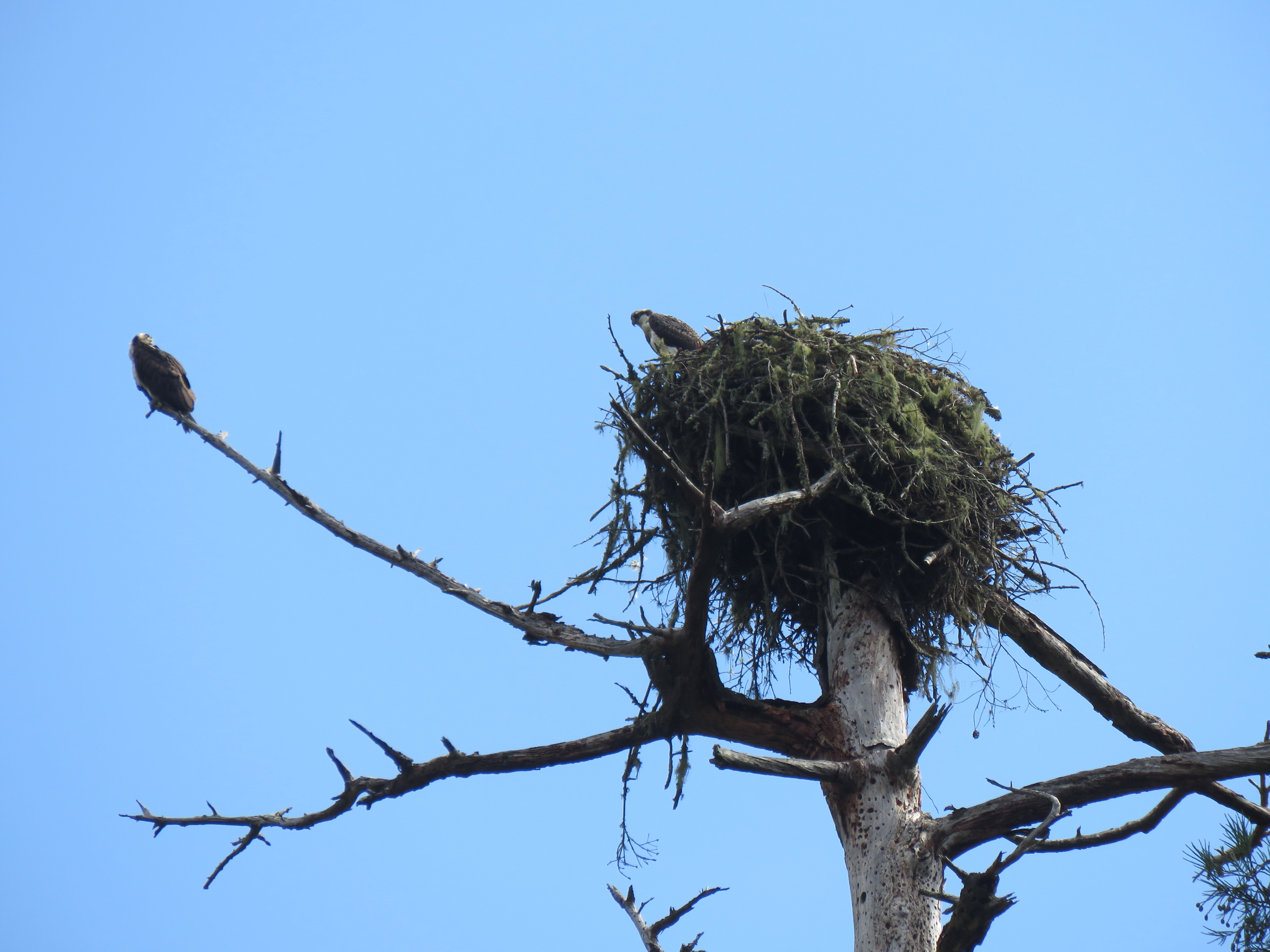
A view of the osprey nest and the two adults from below on the banks of the San Lorenzo. I did a brush-pen sketch of the nest on my journal.

I then headed down the steep mountain goat trail towards the river (this seemed so much easier 30 years ago). The final pitches of the trail had rope tried to trees to aid in the descent. This was a far less accessible part of the river and is not visited as much and seemed a little more “pristine” then upriver.

I traded my hiking boots for river sandals, made sure everything was secure in my dry bag, and I grabbed a hiking stick and headed upstream.

This, to me, is the most scenic and “wild” stretch of the river. The stream bed was lined in large granite boulders, perfect foraging perches for the American dipper.
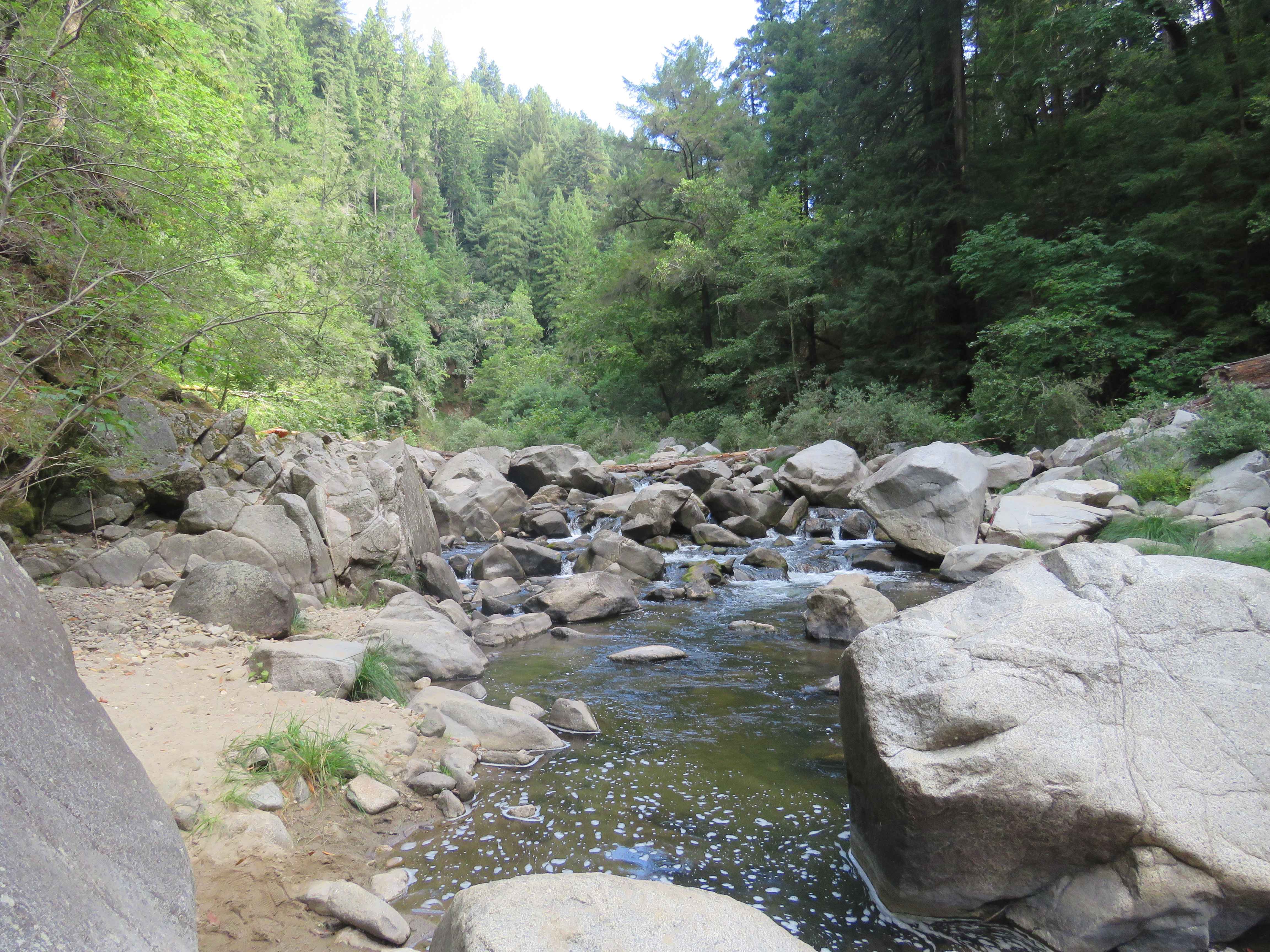
Heading upstream on a beautiful stretch of the river, between Coon Gulch and Garden of Eden. If there was any place on the San Lorenzo that contained dipper, I reckoned this was it.

Progress was slow going as I was hiking in the river, reminiscent of The Narrows in Zion National Park. I had to pick my path through the large boulders often crossing and recrossing the river bed to find the path of least resistance. A bonus was finding a Pacific wren nest built under a fallen Doulas-fir tree that spanned the river.

The river veered to the right and I was in the stretch of river that when viewed from Highway 9 is known as Inspiration Point. I needed some avian inspiration at this point!

The river hike was an adventure in itself but the closer I came to Garden of Eden, I knew the the chances of seeing American dipper on this stretch was diminished. The habitat seemed right but the pollution and semi-turbid waters of the San Lorenzo did not look like the pristine mountain stream that the dipper require.

I have made the journey with no mishaps or injury and as I came in sight of Garden of Eden, which was now full of family groups, I took this time to slip and fall. It’s always good to have an audience. And as Nelson Mandela said, “The greatest glory in living lies not in never falling, but in rising every time we fall.” And so I recovered and stood up again only to see that no one noticed. 
    

Image

Wilder Ranch

On a foggy morning, most mornings are foggy in the summer, I headed northbound on Highway 1. My destination was just out of the city limits of Santa Cruz, Wilder Ranch State Park.

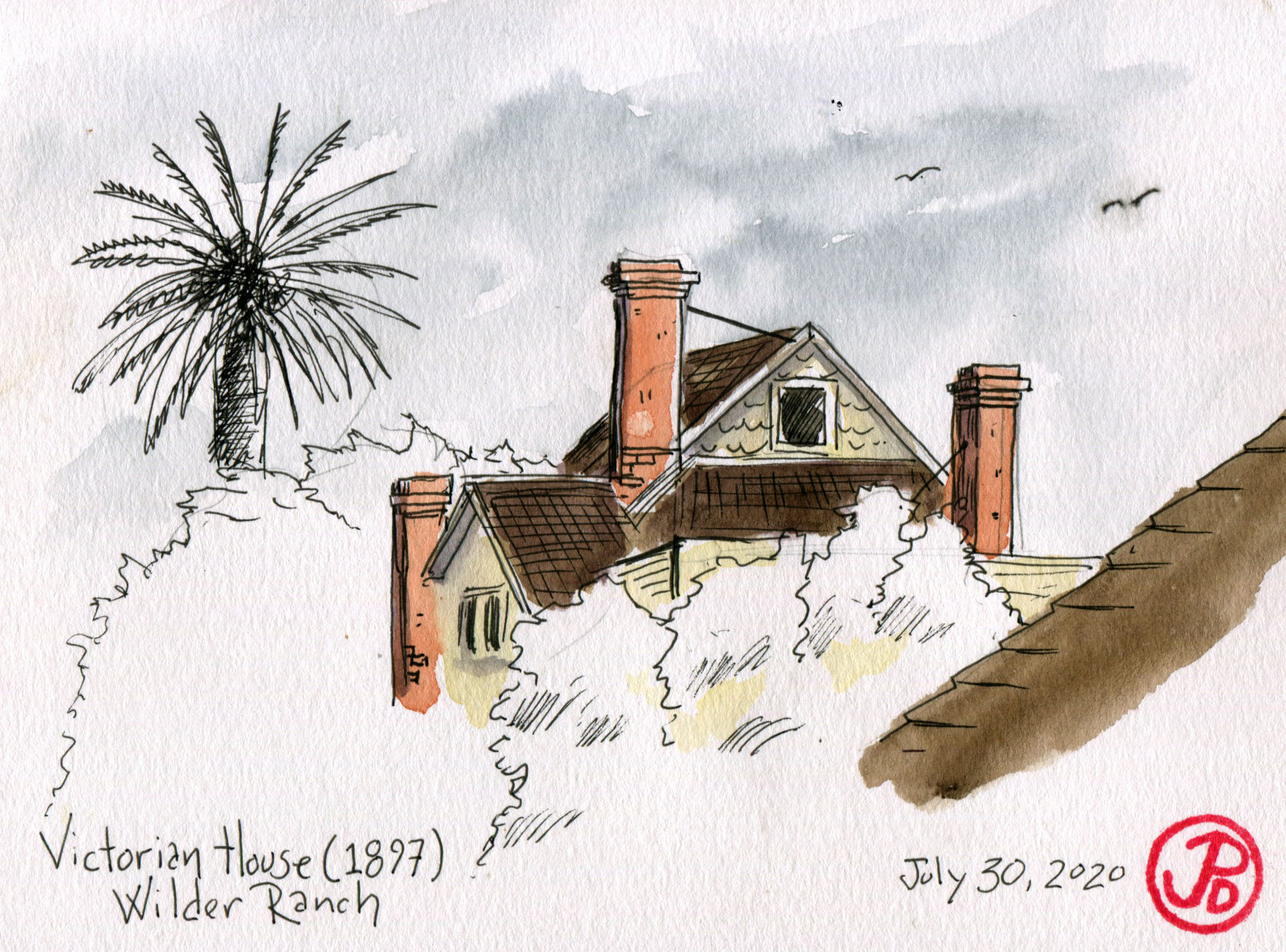
Wilder Ranch is a former dairy ranch on the coast. In 1871, two partners Baldwin and Deloss D. Wilder bought 4,160 acres of the a former rancho. In 1885 the partners split the acres in half and for the the next century the Wilder family farmed the land and their farm was prosperous enough to build a new Victorian farm house in 1897. The Wilder family farmed until 1969 when the farm became unprofitable.

The property became part of the State Park system in 1974. The park today includes 7,000 acres and is visited by hikers, mountain bikers, and birders. And a few sketchers too.

The closer I got to the coast, the thicker the fog. Fog and watercolor don’t always go together.

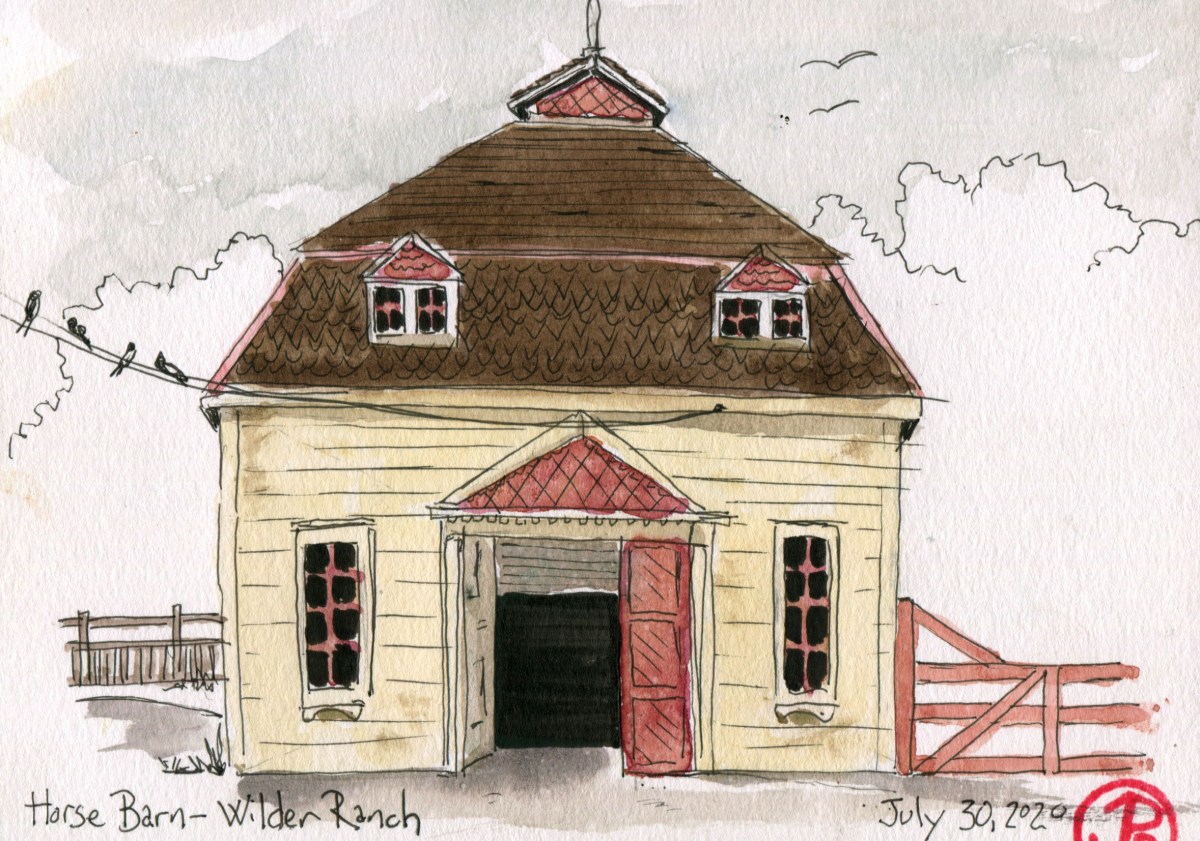
I parked on Highway One and headed down to the historic ranch buildings of Wilder Ranch. While most people hike or mountain bike on the 35 miles of trails of Wilder, I set up my camp chair in front of the Horse Barn.

This is a rather fancy barn, looking almost more like a house than a barn. Today this barn no longer houses horses but the interior provides a substrate for a bird’s nest, the appropriately named barn swallow. This year’s swallow fledglings where perched on the wires and buildings of the farmstead. I made sure to sketch a few in on the wires before they flew off on newly fledged wings.

After I finished sketching the horse barn, I walked a few hundred yards to get a vantage point of the Victorian farm house with the palm tree in the background. For this sketch I keep things a little loose, urban sketching style. For example I kept the sketch of the vegetation loose, and focused on the details and perspective of the house. I carried this over to the watercolor, I only painted the farmhouse and the roof in the foreground.

On my way out, I did a quick sketch of the scarecrow. The scarecrow was wearing proper face protection and was social distancing. There was not another scarecrow in sight! Nor a crow for that matter.

Image

The Voices of the Steller’s Jay

Depth and nuance. That is something I strive for when journalling and sketching. And spending time in nature, on my deck in the Santa Cruz Mountains, for instance, really deepens my understanding and appreciation of nature.

Depth and nuance. When the casual observer, if they are observing at all, will hear the loud call of the Steller’s jay they might describe their call as “jarring”, “annoying”, “unmusical”, or “head-splitting”. But spending time with these birds really makes you love the depth, variety, and dynamics of this western jay’s vocabulary.

For me, this comes with time and awareness. Depth of time and the nuance of the subtlety of sounds these birds produce.

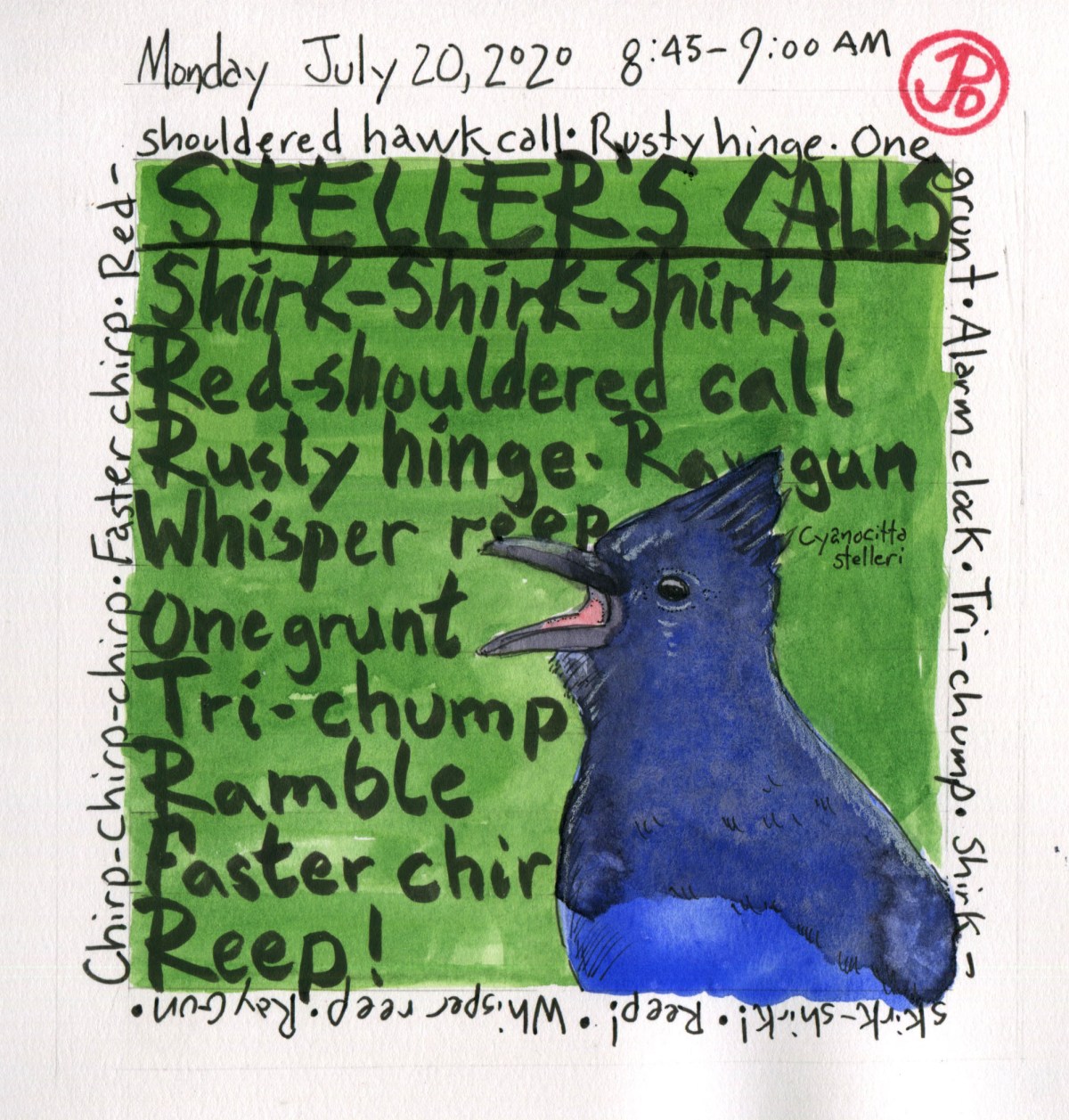
One morning, when the Steller’s jays were thick around the trees near the suet feeder, I decided to log the different sounds the jays made during a 15 minute interval. I tried to give a name or a onomatopoeia facsimile of the sounds I was hearing. Purely a subjective and unscientific exercise but a fun one at that!

The jays were especially vocal and I could only wonder at the meanings of their varied sounds. Even ornithologists do not fully understand the meaning of all the Steller’s jay’s calls. Why, for instance, do they imitate the red-tailed and red-shouldered hawk call?

In the space of 15 minutes, I counted about 15 different calls. I scribbled down in those 15 minutes calls such as: Faster chirp, Red-shouldered Call, rusty huge (Old gear), One grunt, Alarm clock (old school), tri-chump, Accelerated tri-chump, shirk-shirk-shirk, Reep!, red-shoulder whisper, silent whispser-ramble, Reet-Reeet!, and Ray-gun.

The “Reet-Reeet!” call was the call that called attention to an avian predator is close proximity. This was most likely the local Cooper’s hawk. This warning call not only alerted other Steller’s jays of the threat but also other birds in the area that seemed to know the jay’s warning cry.

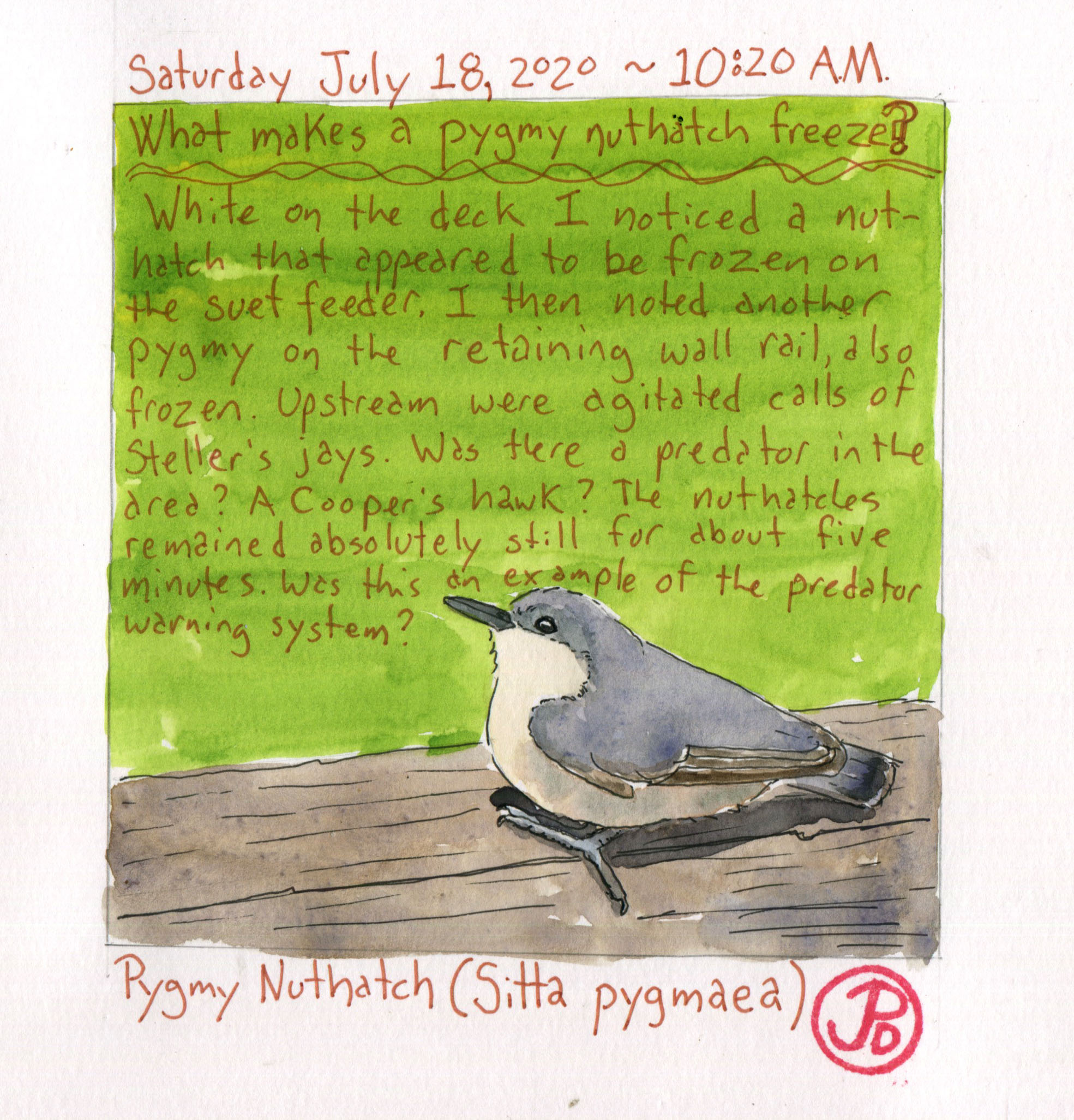
Pygmy nuthatches can be tough to photograph well in low light because they are always in constant motion and images contain lots of motion blur. That is not the case then the nuthatches are frozen.

A few days before I noticed two frozen pygmy nuthatches on and near the suet feeder. Upriver I heard the masses mobbing calls of the Steller’s jay. This seem to be a warning that there was a predator in the area. I wondered what makes a pygmy nuthatch freeze? Was this a response to a predator in the area, just to hold absolutely still.

This is the duality of the Steller’s jay. On one hand they are nest robbers and on the other, they are the avian warning system of the confer forest than saves other bird’s lives.

Image

DIY Birdbath

I wanted to add a new birdy feature to my cabin so headed to the local hardware and garden stores for a birdbath.

Some stores were out of stock while other had baths that were of the cutesy type with frog or bird figurines on the rim. These baths were about three feet of the ground. There was one bath that caught my attention, it was shaped like a whale’s tail rising out of the ground but the high price tag had me moving on.

I finally went to the local big box hardware store thinking they would have a large selection of birdbaths; they did not.

Now it was time for Plan B: which was to repurpose something in the garden section that was not designed as a birdbath. I was drawn to a large 16 inch terra cotta saucer. The type of saucer that you would rest a large pot on. This seemed to me to make a perfect birdbath that could be placed in the ground.

I placed the saucer in the middle of the freshly weeded dirt patch between my cabin and my neighbors. I leveled the ground with a spade and set the bath so it was slightly unleveled, so there was a “kiddie” end and a deep end. In the deep end I placed four small rocks, I was thinking of them as the ladder at the deep end. I then stabilized the bird bath with larger stones and rocks.

Now it was time to fill it with water and wait for the first bathers. I figured it would take a good two week before the local birds became used to the new water feature in their environment.

A song sparrow was the first bird I saw using the birdbath. Not to bathe but to drink.

I was away in Tahoe for a week and when I returned my neighbor reported that she had not seen any birds in bath but noted feathers in the bath and most of the water was gone. That was certainly promising news!

The first bird I saw using the bird bath was not a bather but a drinker. It was one of the local song sparrows coming in for a sip on a warm summer afternoon!

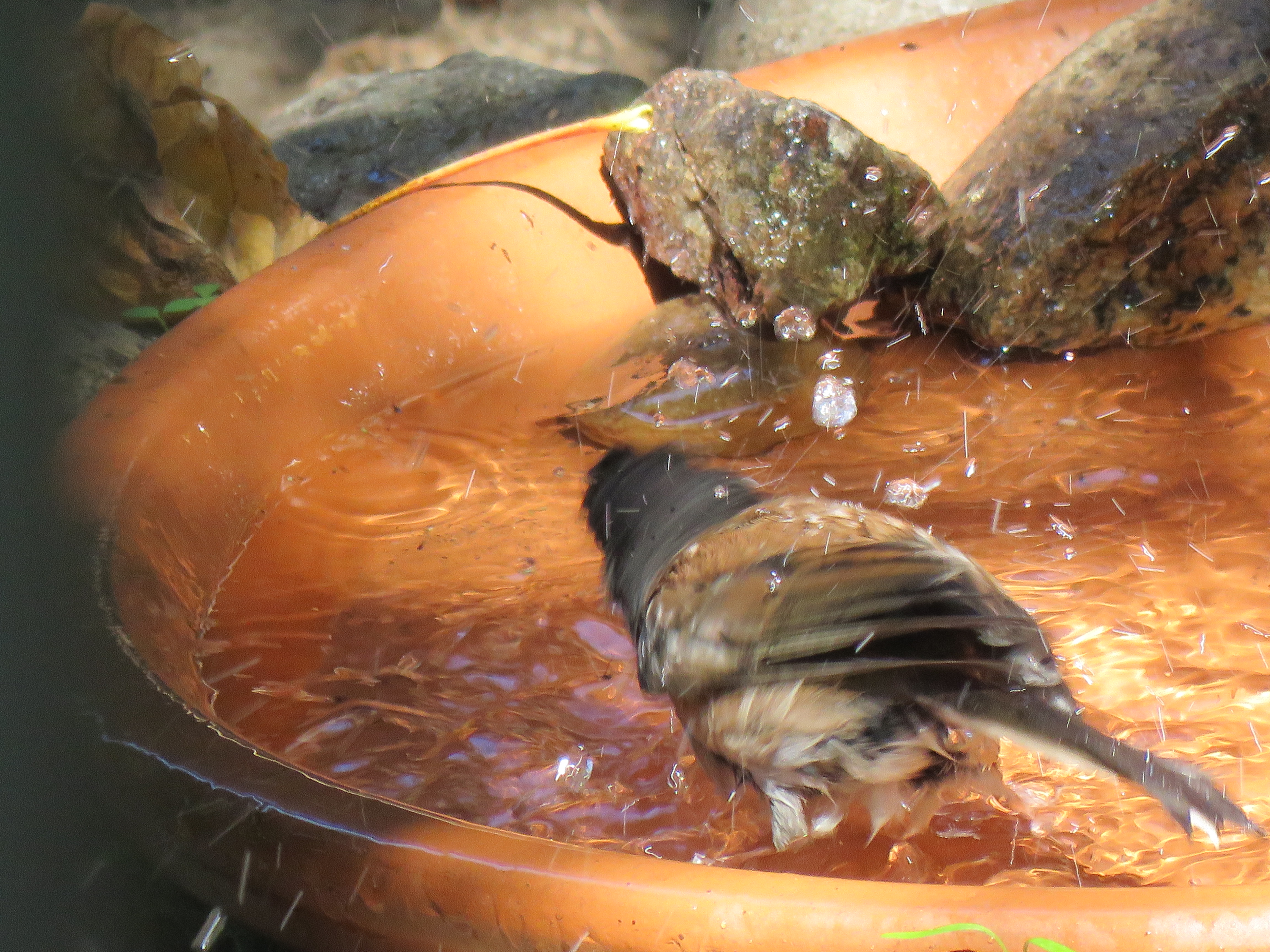
The first bather I saw came a few days later. It was a dark-eyed junco. There is nothing more enjoyable than watching a bird bathe, propelling water droplets in all directions.

A dark-eyed junco taking an afternoon bath!

I noted that the species that used the bath to bathe or as a drinking fountain were song sparrow, dark-eyed junco, and California towhee. These were bird species that spend time on or near the ground. I wondered if the bath was too low to the ground to be used by species that foraged further up in the trees, such as Steller’s jay, chestnut-backed chickadee, and pygmy nuthatch. It will be interesting to see if there birds could be lured down for a bath, especially on a warm summer’s afternoon.

A few days later I saw a California towhee taking a bath. It gives me such joy, in a joyless time, to see nature using something I’ve made. It’s just a small gesture to help species get along in life.

Image

Birding the West Slope: Blackbird Ponds, Truckee

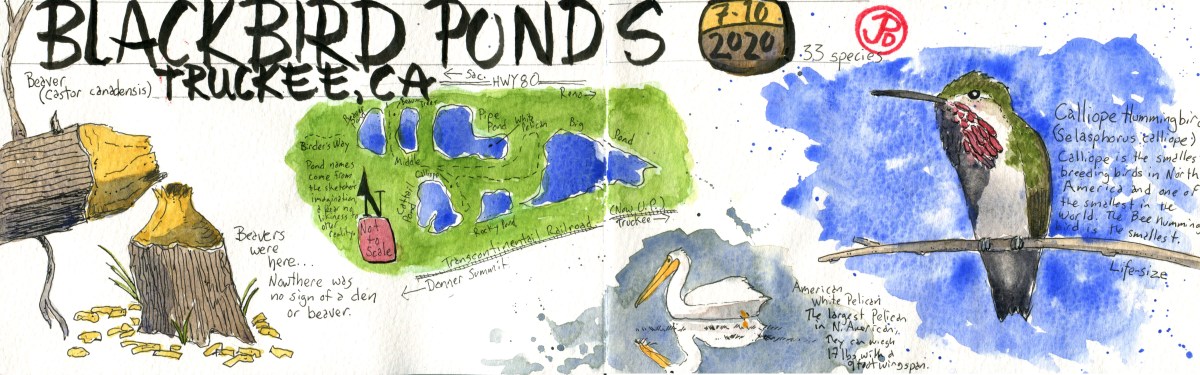
In Truckee, near the Pioneer Monument on the east shore of Donner Lake, is a series of ponds that are a hidden birding gem of the Sierra Nevada Mountains.

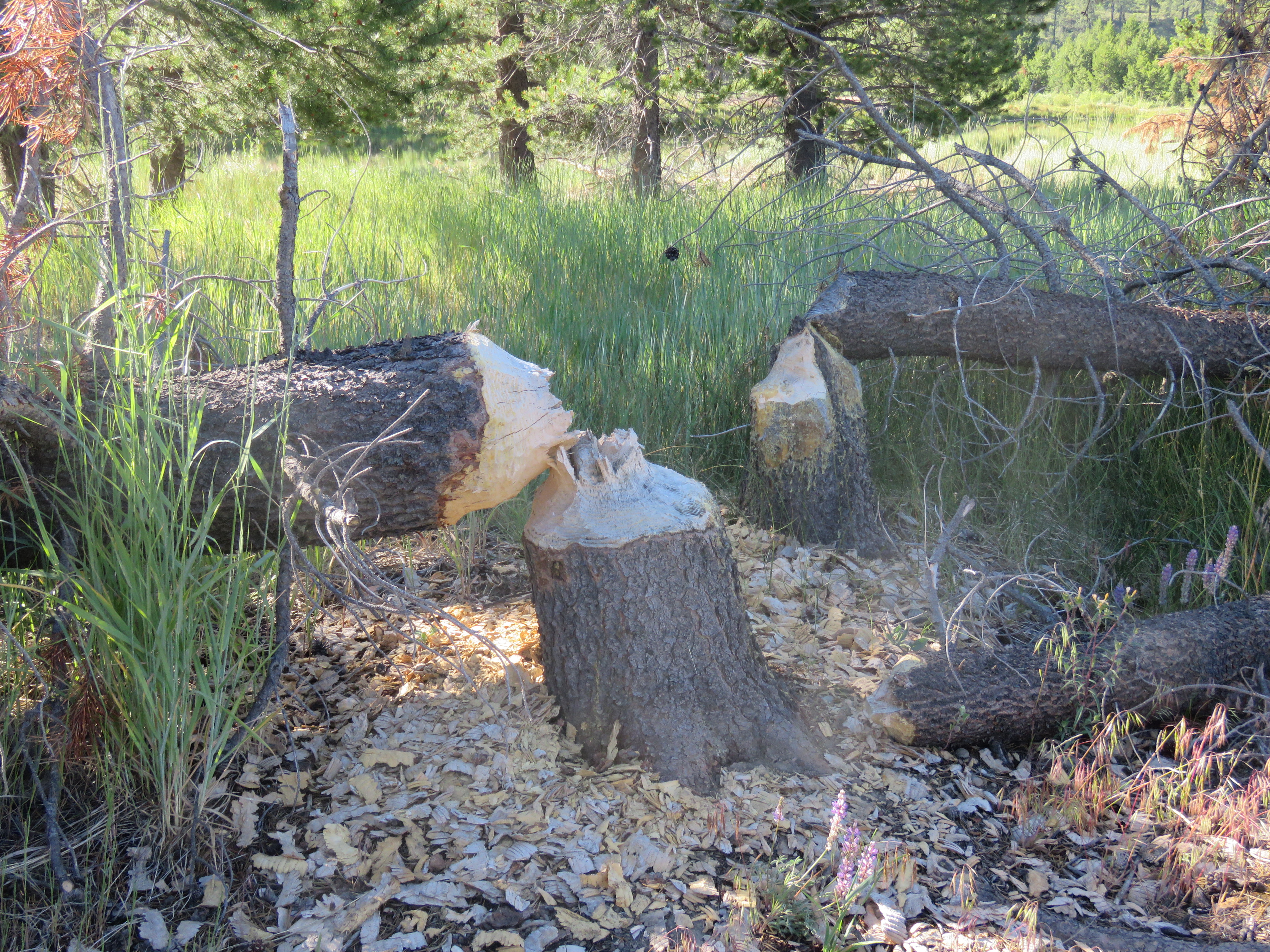
It was such a hidden gem that it took a few attempts just to find access to the ponds. In the end we parked in a Taco Bell parking lot and bushwhacked, forded two creeks (Donner and Cold Creeks), and scrambled up a rocky dyke to finally reach the first pond. A pond I named Beaver Pond because there were many beaver-felled trees on the shore.

We headed up between Beaver Pond and Middle Pond (again these are my own names). The top bird on our wishlist for this birding hotspot was North America’s smallest breeding bird: calliope hummingbird. This can be a tricky bird because of it’s size and fleeting flight.

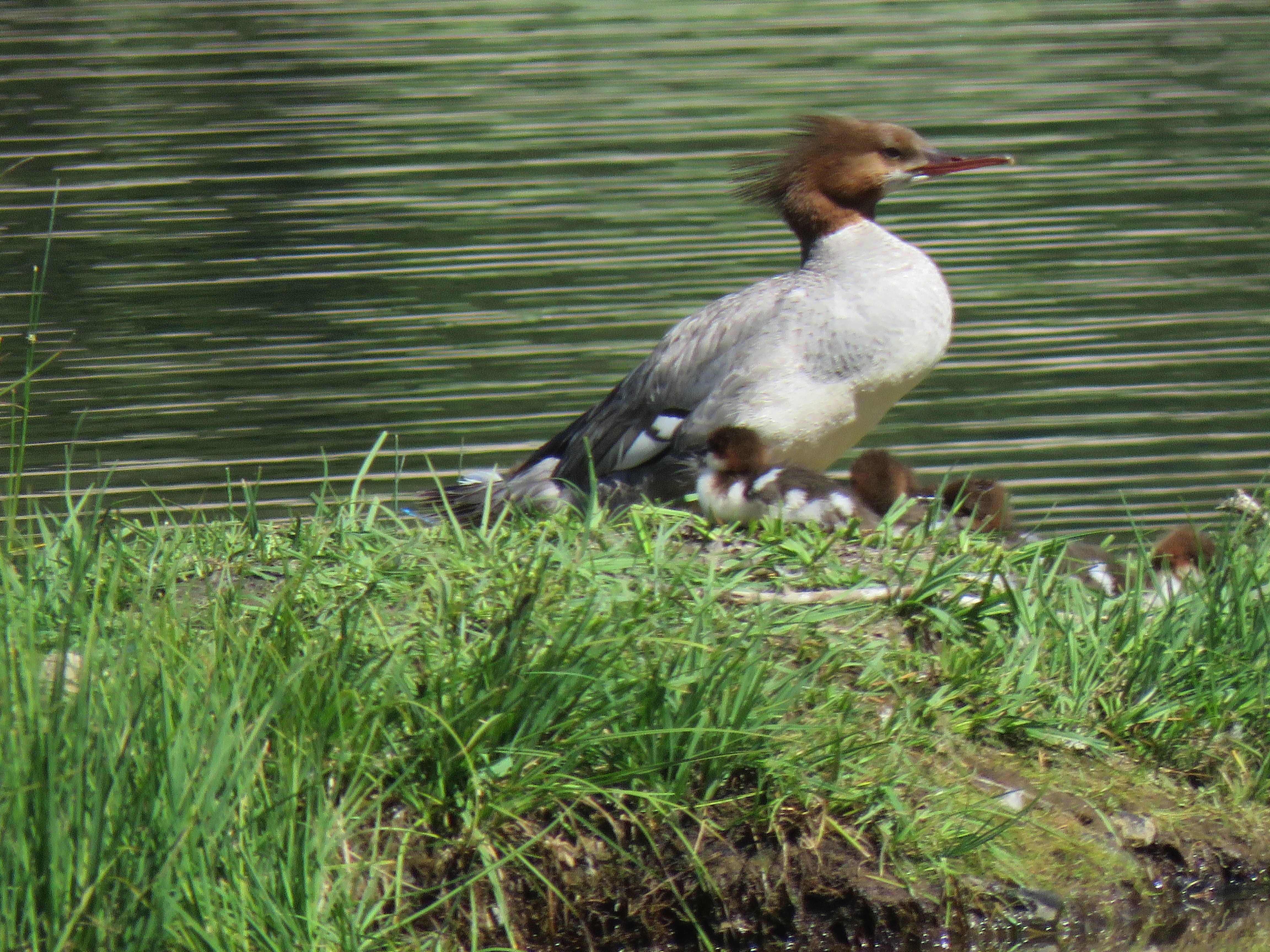
On Middle Pond, there was a female common merganser and her cadre of ducklings. Their breeding season at elevation is later from the sea level mergansers of the San Lorenzo River.

We weaved through the ponds of Blackbirds Ponds, adding more birds to our checklist. We wandered into a flowery meadow between two ponds. This seemed the best habitat for our main target bird, calliope hummingbird. Three calliopes had been reported a few days before. The meadow was full of low flying swallows, but no sign of North America’s smallest bird.

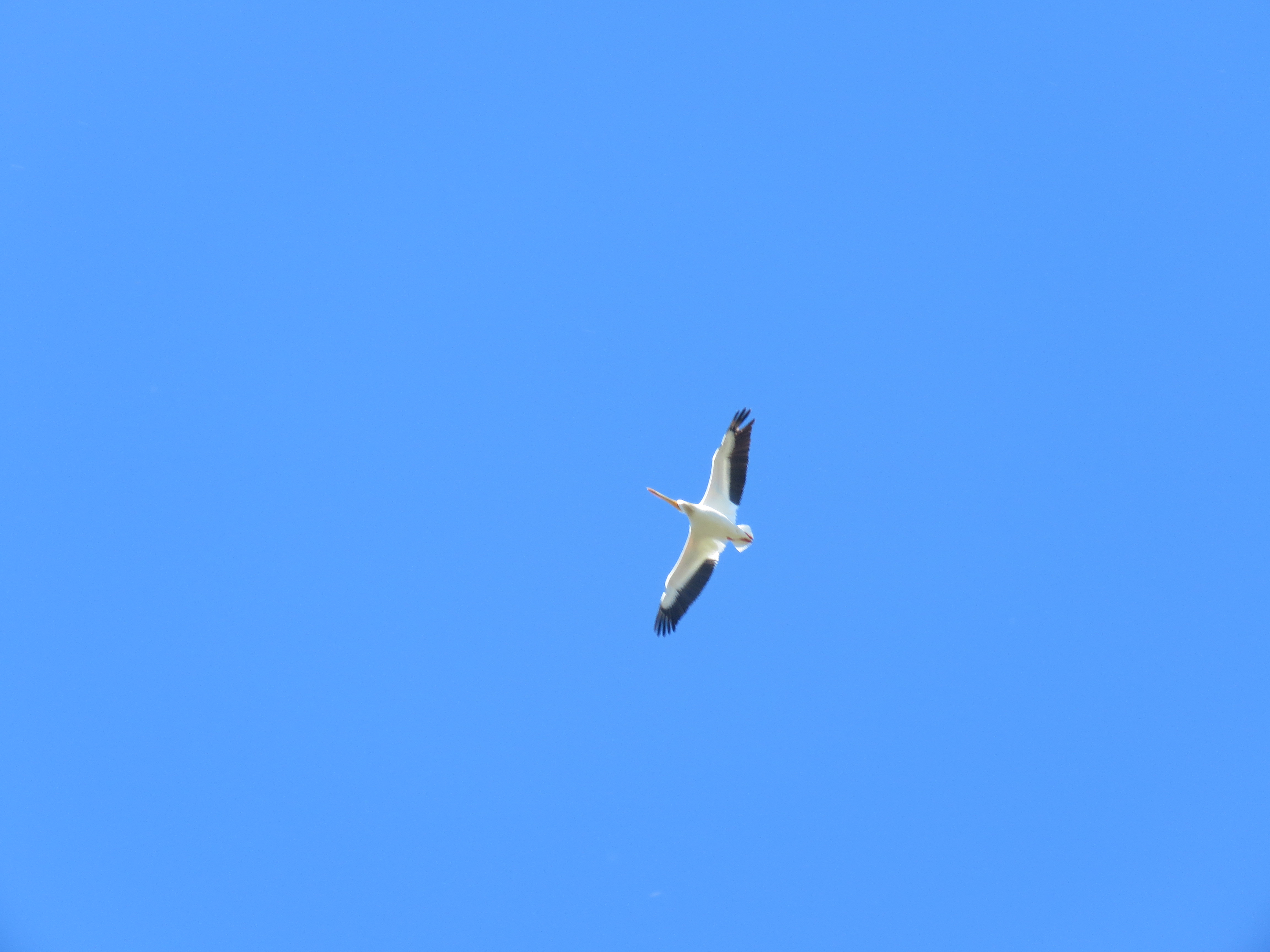
We chased a calling Cassin’s vireo in the willows when Grasshopper spotted on of North America’s largest flying birds: American white pelican. This pelican has a wingspan that is slightly smaller than our largest flying bird, the California Condor.

American white pelican coming in for a landing.

The pelican came in to land on Pipe Pond. We observed this beautiful bird and it’s mirrored twin and then headed back towards the Taco Bell parking lot.

One the way back, we passed some locals who where taking a walk with their pooch. They told us about a path that led to some other ponds to the south that we had not seen yet where, according to the locals, a few more white pelicans spent the summer.

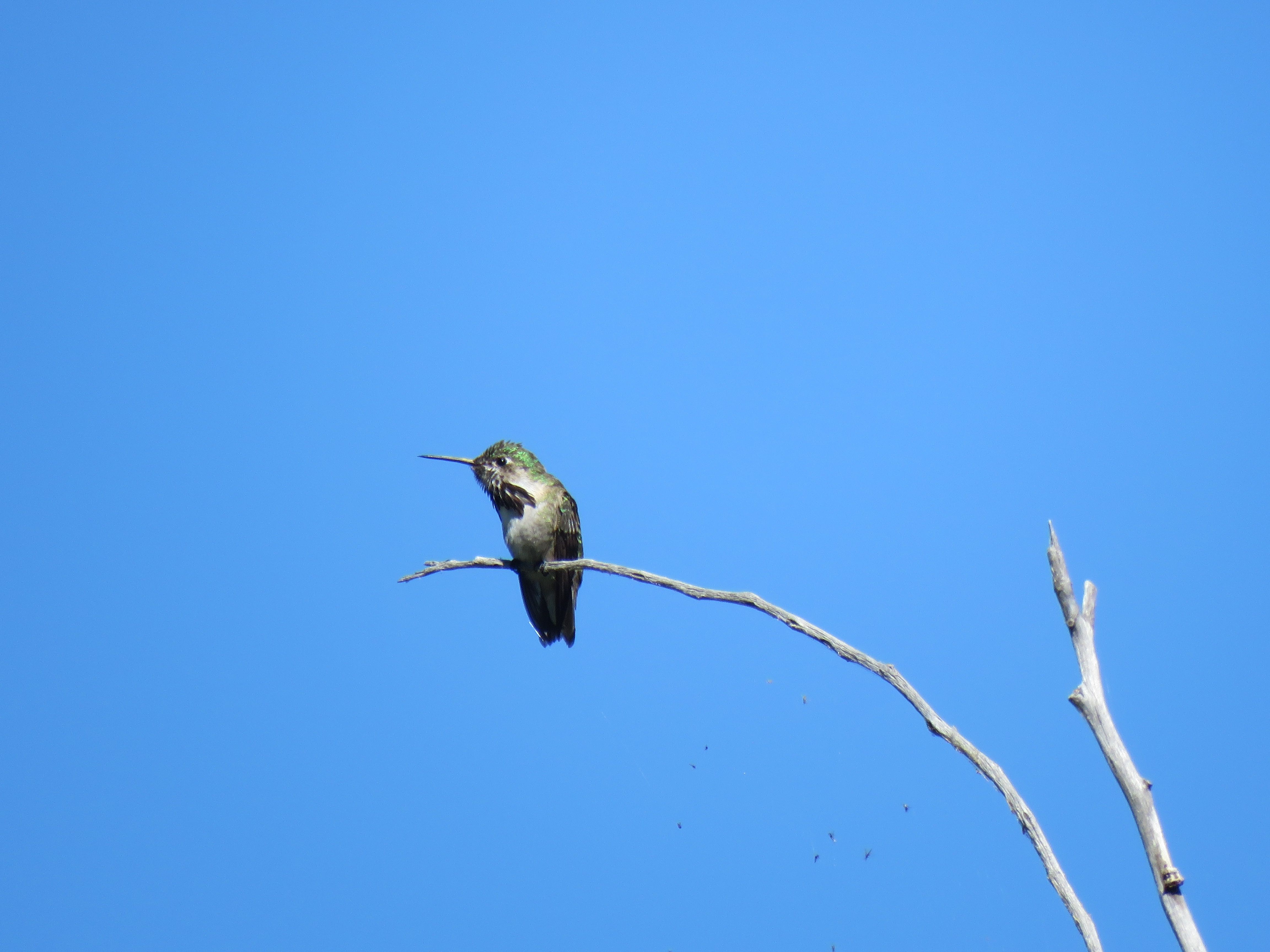
We thanked them and headed south, toward the main line that climbed up towards Donner Pass. That’s when Grasshopper spotted a hummingbird on a snag! When I turned to look, the bird was gone. We waited and the bird returned to the perch. After some great looks and a few photos, we had checked off the smallest hummingbird in the United States, the calliope hummingbird.

Our main target bird: a male calliope hummingbird.
Image

Birding the West Slope: Highway 89

The Donner Party is associated with the lake that now bears the name of the doomed pioneer group: Donner Lake. Family groups from the Donner Party camped for the winter on the eastern shore of what was then called Truckee Lake.

The Donner family broke an axle and George Donner injured his hand while trying to make repairs on the family wagon and were forced to camp six miles away from Truckee Lake at Alder Creek.

No family suffered more than the Donner family. Out of the 16 members of the families of brothers George and Jacob Donner, only eight survived. Their family name is now immortalized in a lake (Donner Lake), a pass (Donner Pass), a state Park (the Donner Memorial State Park) and perhaps most ironically, their former campsite at Alder Creek is now named the Donner Camp Picnic Area.

If the Donner Party are hosting a picnic, I’ll take a raincheck!

This picnic area, by the side of Highway 89, was our first birding destination; a place for Grasshopper Sparrow to pick up some Sierra Nevadian lifers.

We arrived at 6:15 AM, the early birders gets the birds. We were the only ones in the parking lot and at this time in the morning, birds are the most vocal.

We started out on the trail with a wishlist of birds for this site: Cassin’s finch, white-headed woodpecker, calliope hummingbird, Brewer’s, chipping, and Vesper’s sparrow, Clark’s nutcracker, mountain bluebird, Wilson’s snipe, house wren, and green-tailed towhee.

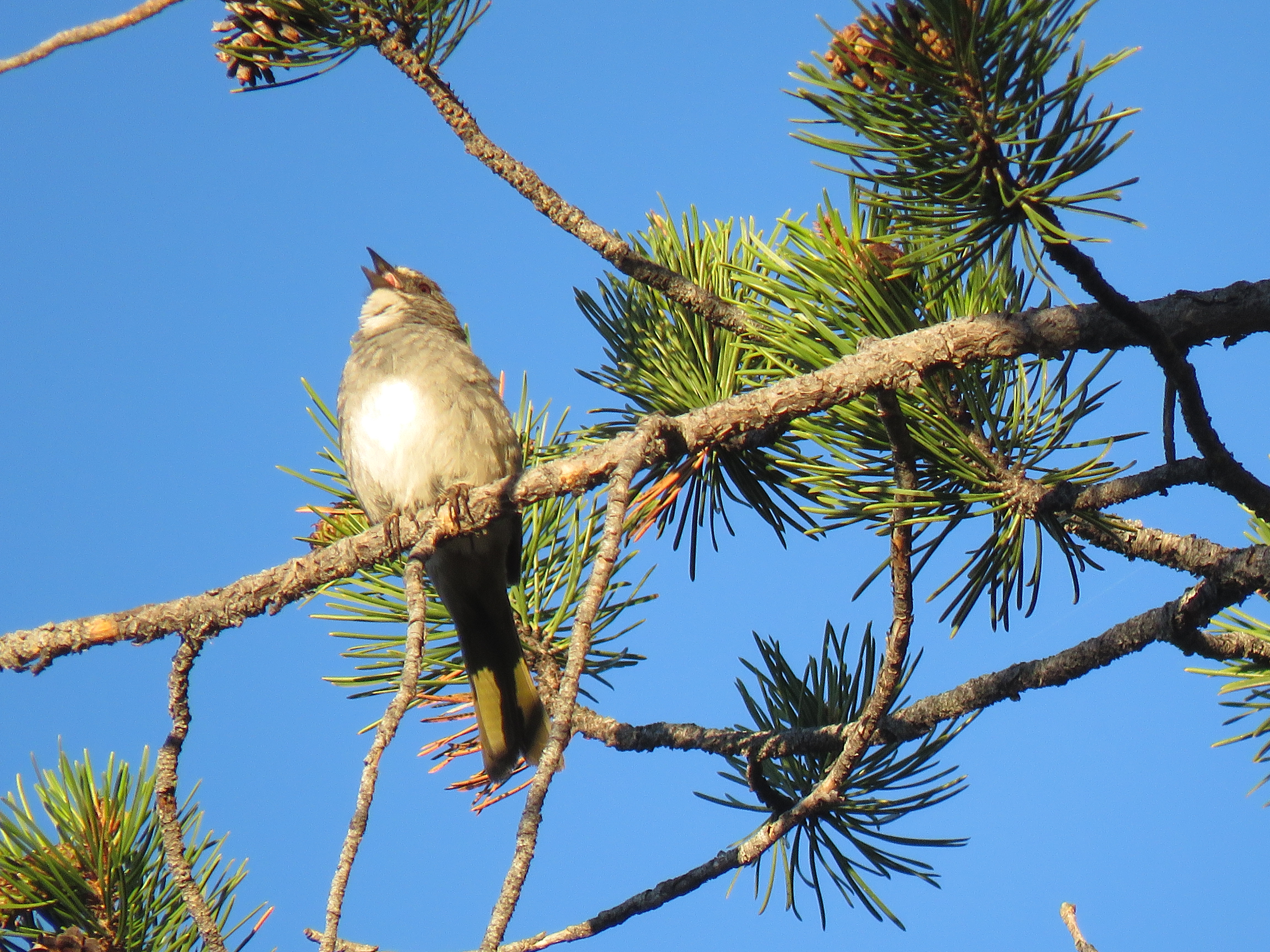
Within the first hundred yards of the walk we heard a singing bird from a pine about 30 feet up. Grasshopper identified it as one of our target birds, the dapper green-tailed towhee!

After getting stunning looks at the towhee in great morning light, we headed down the trail and 20 yards later we checked another bird off the wishlist: a very vocal house wren.

Near the campsite of the Donner family, who camped about 15 feet above the meadow because of the heavy snowfall in the late fall of 1846, we saw other singing green-tailed towhees. The calls of mountain chickadee and western wood-pewee seemed to be the soundtrack of this site.

Further along the trail we had one of the highlights of the day, a stunning male mountain bluebird. We headed back towards the parking lot and we crossed a boardwalk over Alder Creek and we flushed a Wilson’s snipe. Another bird checked off our wishlist!

We headed north on Highway 89 and I wanted to find a very iconic mountain stream bird, the American Dipper and I knew that if we stopped at any stream running under the highway, we might have a chance to get dipper, with a little leg work of course. The first stream course that we crossed was Prosser Creek.

We parked in the pullout and headed to the creek. This looked like good habitat for American dipper. We scanned the rocks and water both upstream and down, no dipper. After we crossed under the Highway 89 bridge we encountered two very vocal spotted sandpipers. They came within five feet of our feet and acted as out “tour guides”. I suspect we were very near their nest, which is built on the ground in a depression, and were leading us away from their precious eggs.

A spotted sandpiper sussing us up!

What they really did was lead us upstream to an American dipper that was bobbing on the shore. Grasshopper got some good looks and then the dipper flew upstream.

Well we weren’t satisfied with just one look at a dipper so we headed north along Highway 89 and our next stop was the bridge over the Little Truckee River. We climbing under the bridge and on the other side was a cliff swallow nesting colony. The swallows exploded into the air!

The cliff swallow benefit from human made structures that they use as a place to secure their mud nests. The highway bridge over Little Truckee River was perfect. There was about 50 swallows in the air!

Downstream was a massive osprey nest with a osprey perched above. There may be young in the nest but it was hard to tell from our far away vantage point.

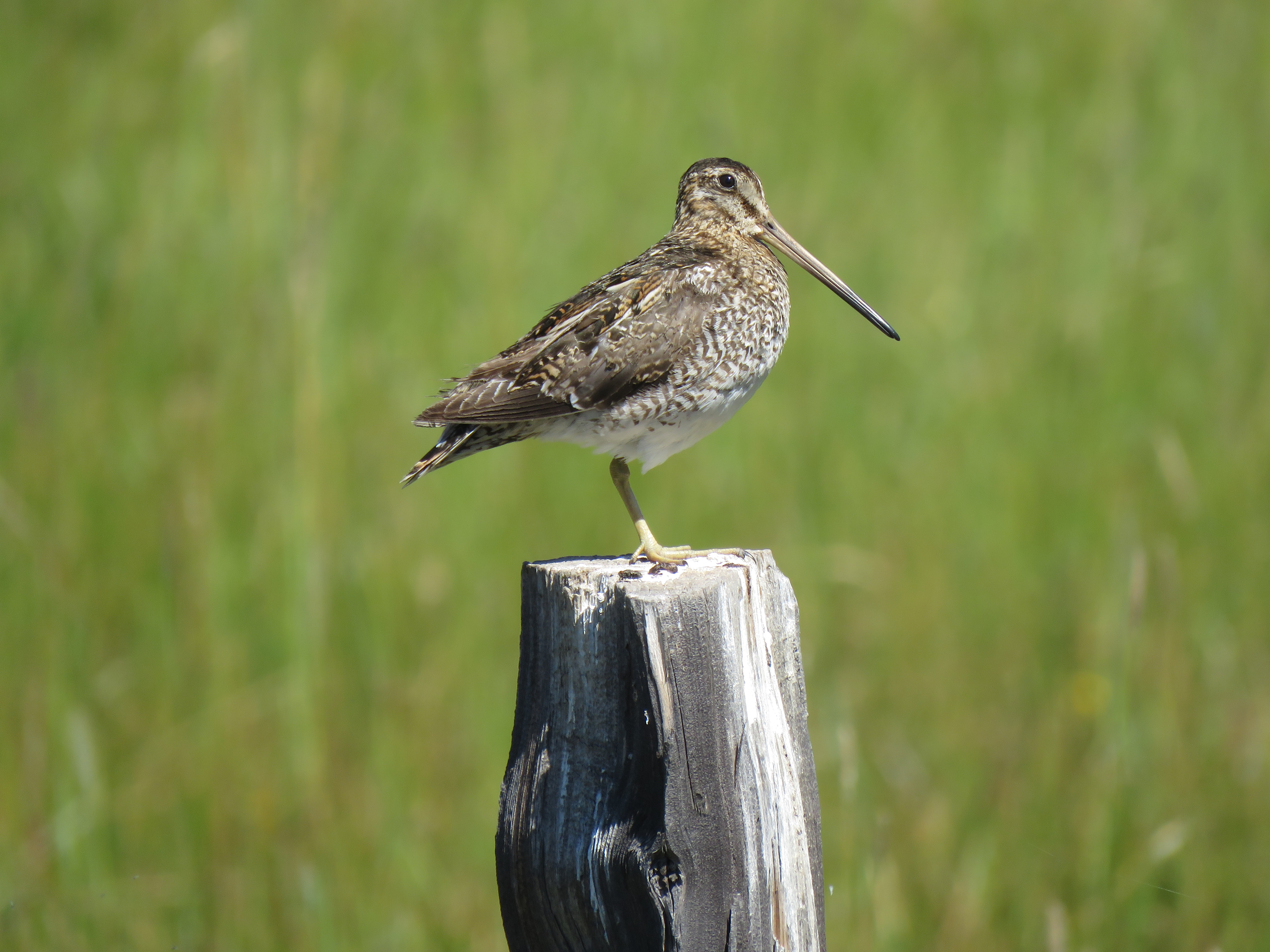
We continued to the end of Highway 89 at its junction with historic Highway 49 at the small town of Sierraville. We turned right and headed a short distance down Highway 49, where on a fence post, we had an incredible view of a bird we had only got a fleeting glimpse of before: Wilson’s snipe.

Image

Birding the West Slope: South Yuba River S.P.

Every time I am at my mother’s house in Penn Valley, I make an early morning trip down Pleasant Valley Road to South Yuba River State Park.

This park includes the settlement of Bridgeport and the 1862 Bridgeport Covered Bridge that spans the Yuba River. This bridge is noted for being the longest covered bridge in the world. It has now been taken apart and is in the process of restoration.

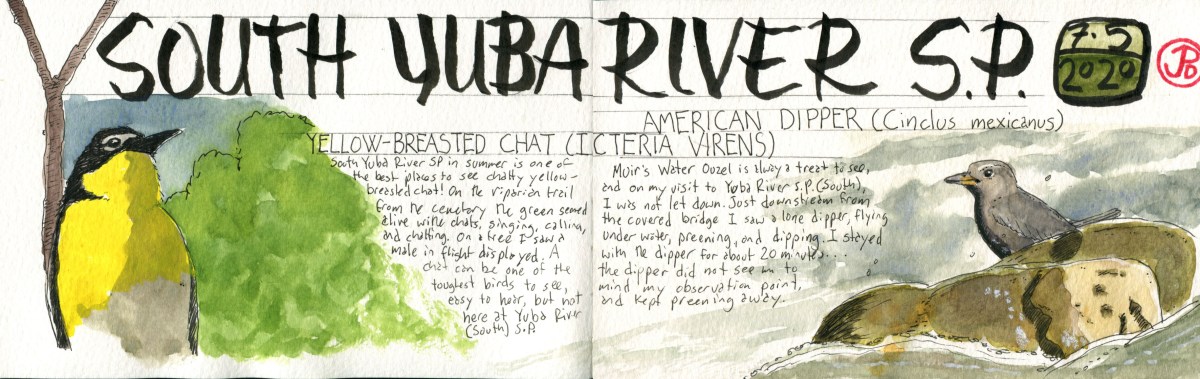
But I was not here for the bridge, I was here for a chat. The yellow-breasted chat. This is a bird that is most often heard rather that seen. In fact these warblers are notoriously difficult to get good looks at this sulky bird tends to keep dense vegetation between itself and any viewer. They have quite a repertoire of songs and they sing very loudly but for such a big, bright yellow warbler, they are tough to spot. Pete Dune says of the chat, “Both a histrionic showoff and a shy skulker”.

When I arrived at 7:30 AM, I could already hear the chatty chat singing and calling from the dense riparian trees near the cemetery. Now I was going to try to locate the source of the song.

I headed down the riparian path and tried to find the singing chat in a top of a tall oak. Then I saw a chat launch into to the air and down down to the oak in a rowing wing motion. This was a chat in a flight display. I was able to locate the chat and I got great view and I was able to get some photos before the bird flew off to another tree.

This is the first photo I took of the singing male yellow-breasted chat.

After getting my fill of chats, I headed down to the South Yuba River where the song sparrows were in full song and on the opposite bank I spotted a spotted sandpiper, teetering up and down while it forages.

The real highlight a visit to the Yuba, especially where waters are at their most turbulent, is the appearance of John Muir’s favorite bird. A small, short-tailed, and dark gray bird, the American dipper.

I spent about 20 minutes with the dipper, watching it dip, forage, and preen amongst the white water of the South Yuba River.

Image

Sketching on Chickadee

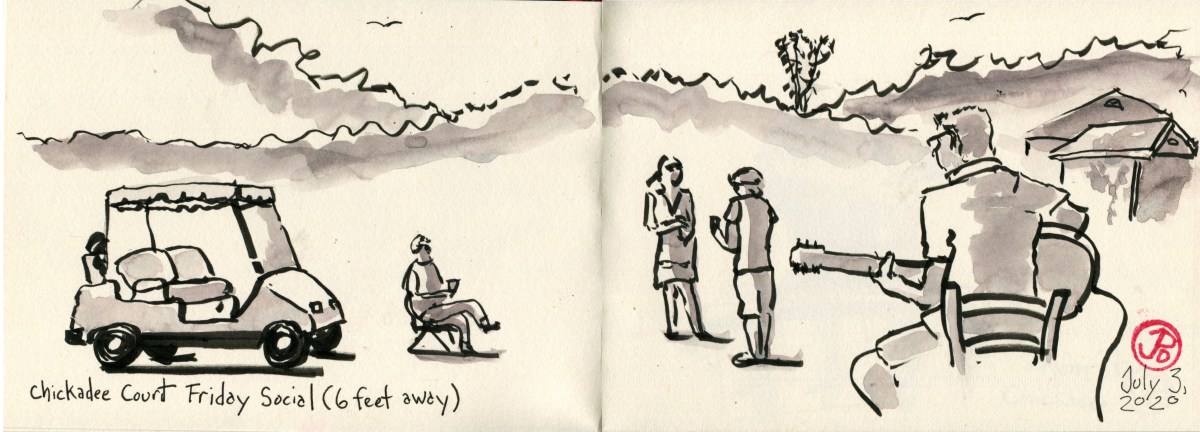
Ever since shelter in place, the Residents of Chickadee Court in Penn Valley, have had happy hour most Fridays (or Mondays or Wednesdays or Thursdays etc.)

They sit at the end of the street, six feet apart of course and drink vino and have a good chinwag. Some stay in their golf carts, while other sit in folding chairs.

I took this time to sit across from the rest to get a sketch in while a neighbor from another street played guitar. I decided that I was not going to sketch everything in front of me. Instead, I selectively sketched, creating little snapshots of the scene. I did not use a pencil under sketch but sketched with my brush pen and added shadow with Daniel Smith Shadow Violet watercolor.

Another subject for my brush pen was my mother’s new puppy, Murphy. Murphy spends much of the time sleeping, making him an easy subject to get a quick sketch in before he changes sleep positions. I have included my favorite sketch above.

Image

California Zephyr, Colfax

“The only way of catching a train I have ever discovered is to miss the train before.” ~G. K. Chesterton

The romance of the rails on a long distance journey has always been calling me. Being rocked to sleep to the rhythm of the rails and meeting strangers on a train, drew me to want to go on an American rail odyssey. On my Spring Break, I booked a ticket on the California Zephyr, from Emeryville in California to Chicago, Illinois. This is Amtrak’s longest daily route. The route covers 2,438 miles and makes 33 stops.

Then the pandemic was upon us and I cancelled by railway journey and sheltered in place for my two week break in the Santa Cruz Mountains. The lure of the rails became the lonesome far-off whistle of a Johnny Cash song (sans Folsom Prison of course).

During early July, I visited my mother near Grass Valley in the Gold Country. She lives 40 minutes away from one of the 33 stops on the California Zephyr Route. So I decided to go make the drive to Colfax.

Colfax is on the route of the Central Pacific side of the Transcontinental Railway and it was, at one time, a railway camp called Camp 10. The camp was later called Illinoistown but was again renamed after the Speaker of the House, Schulyer Colfax by Leland Stanford, when Colfax came to see the progress on the railroad. Colfax later served as the 17th Vice President during Ulysses S. Grant’s first term.

The town of Colfax (population 1,800) bears an important meeting point of the east and westbound Zephyrs. The westbound train (Number 5) arrives at Colfax at 11:48 AM. The train’s final destination is Emeryville in the San Francisco Bay Area. The eastbound train (Number 6) arrives less than 30 minutes later at 12:21 PM. Train number 6’s finally destination is Chicago, the journey will end about 50 hours later, if the the Zephyr is running on time.

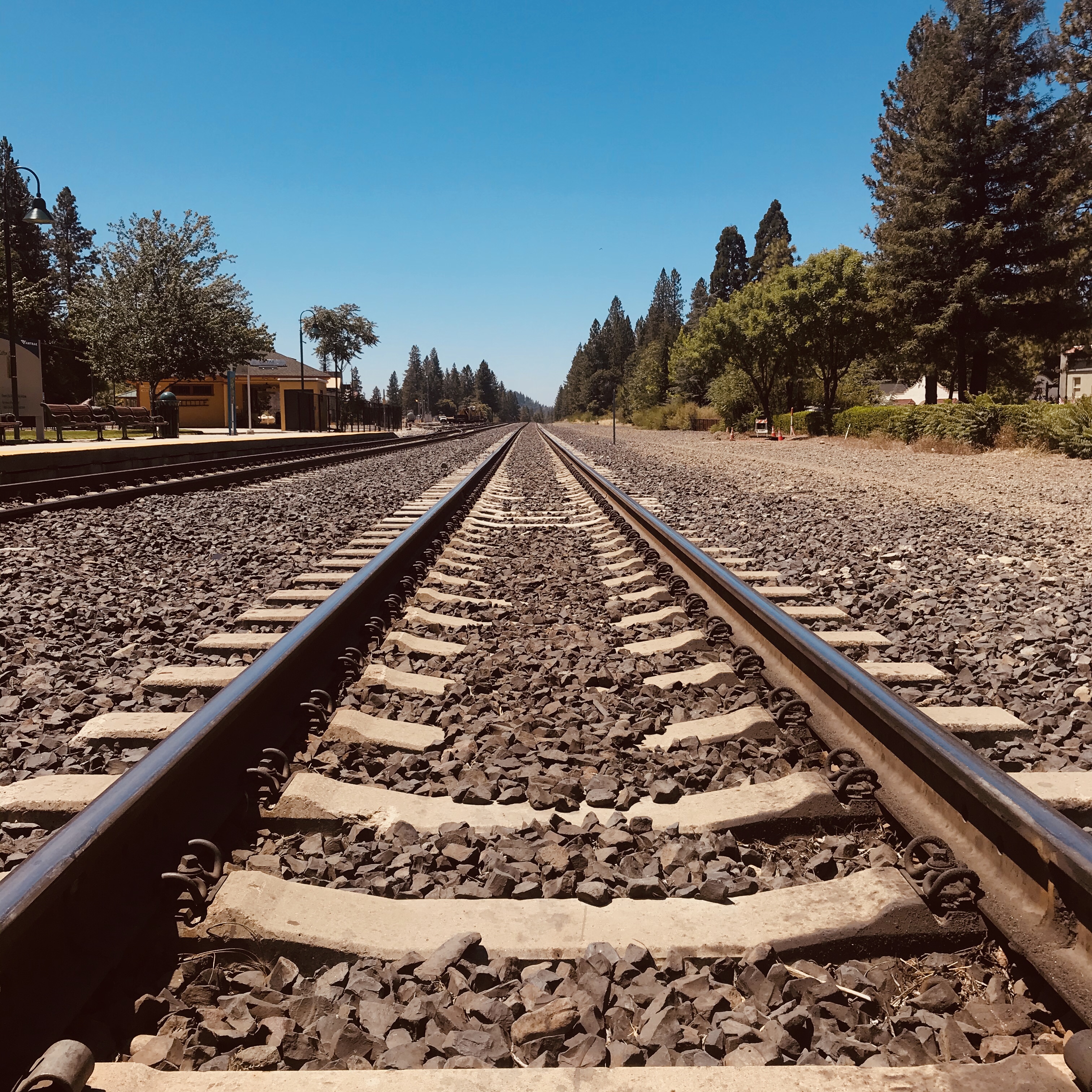
Looking westward down the rails of the transcontinental mainline. The historic Southern Pacific Colfax depot can be seen on the left.

I arrived at Colfax Depot at 11:20. Train number 5 was running on time so I found a view point next to the line and sketched in the perspective, the railway crossing sign, and the background trees. Now all I needed was the California Zephyr to pull in for her portrait and do a quick sketch with my brush pen before she departed. I figured I had about five minutes.

Westbound California Zephyr arrives at Colfax headed by two General Electric P42DC diesel-electic locomotives.

The westbound Zephyr was running a little early, which was pretty incredible because the train’s origin was Chicago. The train rolled to a stop and two passengers disembarked and I was able to get a loose brush pen sketch in before the train made it’s way down the gentle slope of the western side Sierra Nevada Mountains towards Sacramento, the original terminus of the Transcontinental Railroad.

The eastbound train was running about 20 minutes late. So I crossed the tracks and found a new vantage point right next to the rail crossing guard. The Chicago bound Number 6 pulled into Colfax and I have a short time to sketch the Zephyr. A woman passenger had decided to crossed the tracks, always a bad idea with an approaching train, and she became cut off as the Zephyr blocked the road and sidewalks to load and unload passengers. I’m not sure if she caught her train.

While I longed to catch the train I missed back in April, it was good to see, if not sketch, this iconic American railway route, the California Zephyr.

Image

Bat Map

I have always loved that crossover between the ariel insectivores, between the swallows and the bats. Between the diurnal and the nocturnal. In a word: twilight.

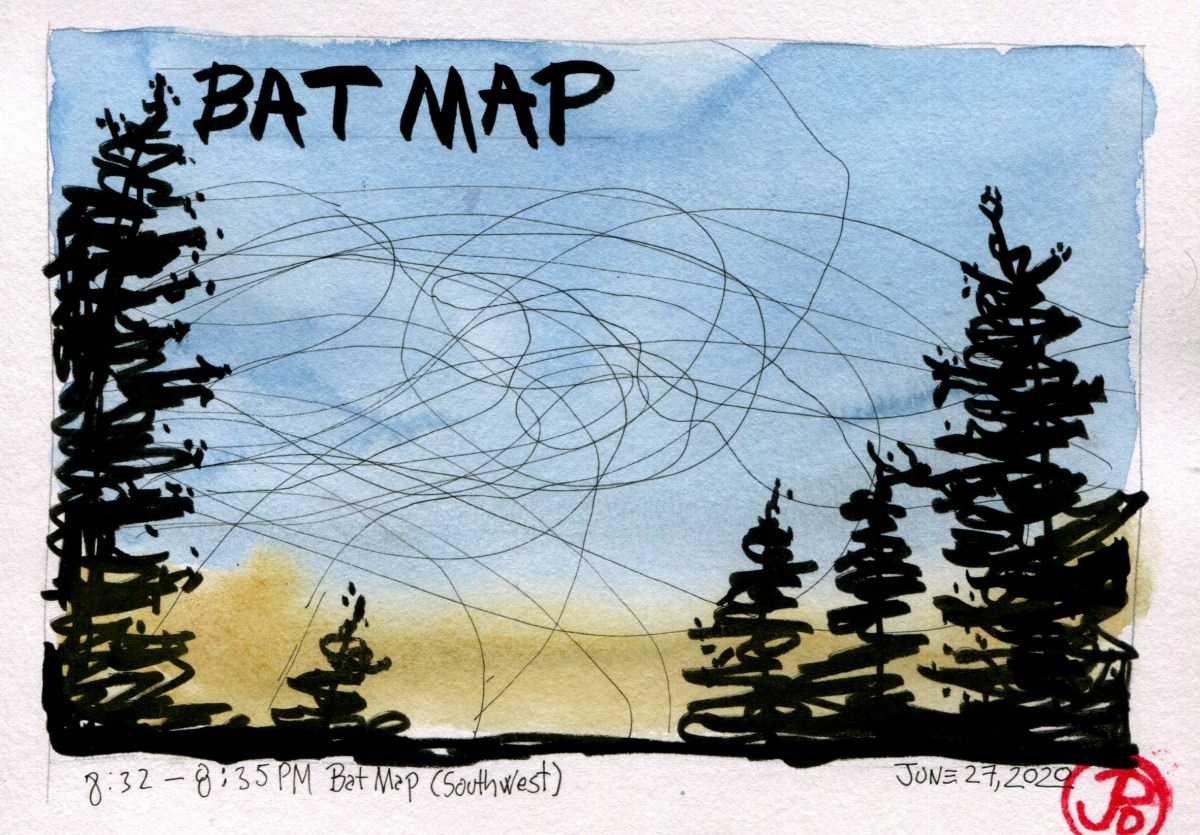
Looking to the southwestern skies, framed by silhouetted redwoods, I watched for the appearance of the first bat. The change over of swing to graveyard. At 8:30 PM there were still a few violet-green swallows catching insects on the wing. At 8:32 the unmistakeable flap-flap-flap of a flying mammal appeared from stage right, while the last swallow made it’s last foray. This is the time of the bats!

I wanted to sketch a bat map, a record of bat movement over a finite time period. I mean really finite, I mean three minutes.

Before the bats appeared, I sketched the silhouetted redwoods as a way to frame the composition and as a way to give me points of reference when it came time to map their flight across the sky.

I may be able to identify all the common species go birds by sight and sound that inhabit the area around my cabin but I have no clue how to identify the 12 common species of bats that live in Santa Cruz County. There are over 1,400 species bats worldwide and the are the second numerous order of mammals after rodents! I know, by default, that they are micro bats because mega bats don’t occur in North America.

Once the two bats appeared it was about going from the eye to the hand as I traced their path in the twilight sky, a sort of flittermouse Etch A Sketch. I felt like a vessel and the bats were dictating the line through their flight path. The bats were creating the sketch, I was just taking notes!