More Powerful Than a Locomotive. . .

In my class one morning we came across the idiom, “faster than a speeding bullet” during our Daily Language Review warm up.

This phrase reminded me of the opening titles of the black and white television show I saw in reruns when I was a child: Adventures of Superman (1952-58).

I certainly had seen the Richard Donner movie Superman that came out in 1978 featuring Christopher Reeve, but originally the story had been told on the small screen featuring the slightly chubby George Reeves as Superman.

The opening of each episode reads:

Narrator: Faster than a speeding bullet. More powerful than a locomotive. Able to leap tall buildings in a single bound.

Man 1: Look! Up in the sky! It’s a bird.

Woman: It’s a plane.

Man 2: It’s Superman!

Narrator: Yes, it’s Superman, strange visitor from another planet who came to earth with powers and abilities far beyond those of mortal men. Superman, who can change the course of mighty rivers, bend steel in his bare hands. And who, disguised as Clark Kent, mild-mannered reporter for a great metropolitan newspaper, fights a never ending battle for truth, justice and the American way. And now another exciting episode in the adventures of Superman.

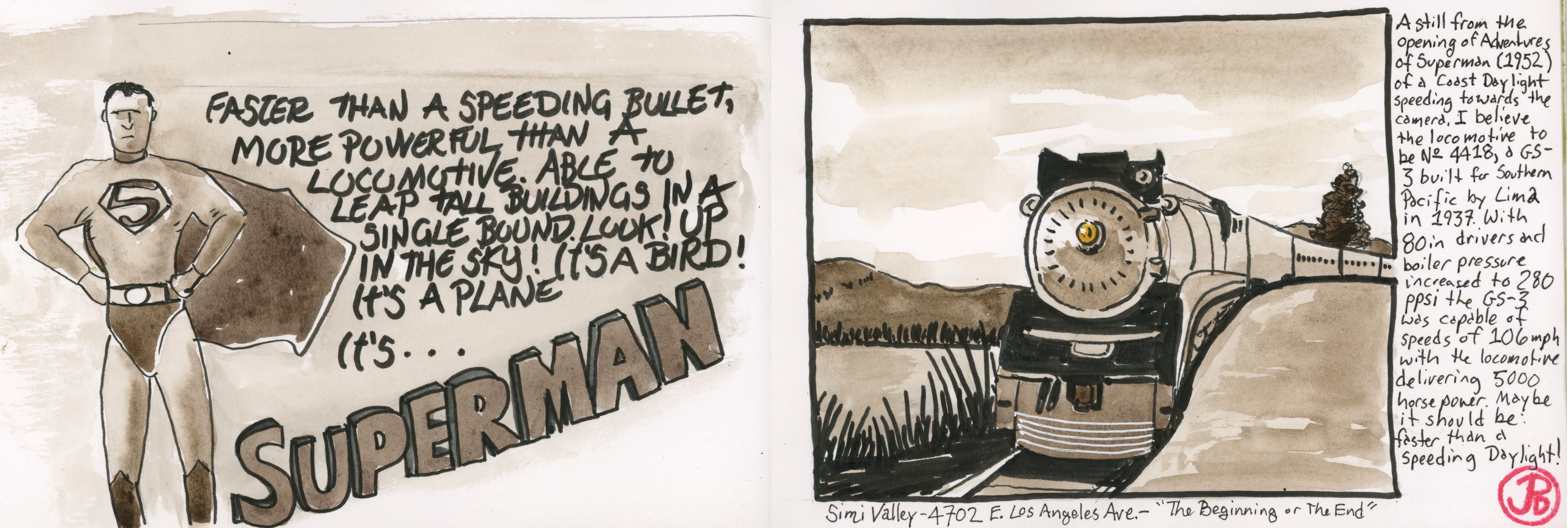
When the narrator announces “More powerful than a locomotive” a Southern Pacific Coast Daylight races towards the camera.

On point is No. 4418, a GS-3 locomotive built at Lima Locomotive Works in 1937.

In 1937, this was Southern Pacific’s most powerful passenger locomotive. It was an improvement on the GS-2, with 80 inch driver wheels and increased boiler pressure of 280 pounds per square inch. These improvements meant the GS-3 was capable of delivering 5,000 horsepower at 60 miles an hour.

The GS-3 could reach speeds of 106 miles per hour, well above the 75 mph speed limit of the railroad. Maybe the narration should have read: faster than a speeding Daylight!

Sketching Notes

I created a spread featuring a still from the opening from Adventures of Superman(1952) of the Southern Pacific Coast Daylight GS-3 speeding towards the camera.

The clip was filmed in Simi Valley in the great Los Angeles area at 4702 E. Los Angeles Avenue. It was originally filmed for the movie “The Beginning or the End” (1947).

On the left side I sketch another still from the opening, George Reeves standing with hands on hip and his cape blowing behind him.
Olompali

In honor of the recent passing of Bob Weir, I decided to sketch an early bit of Grateful Dead history.

This history is not to be found in the Haight-Ashbury but in the county where the members of the Dead spent much of the time when not touring incessantly: Marin County. Most of band lived in Marin, Bobby in Mill Valley, Mickey in Novato, and Jerry Garcia died at a rehab center in Forest Knolls.

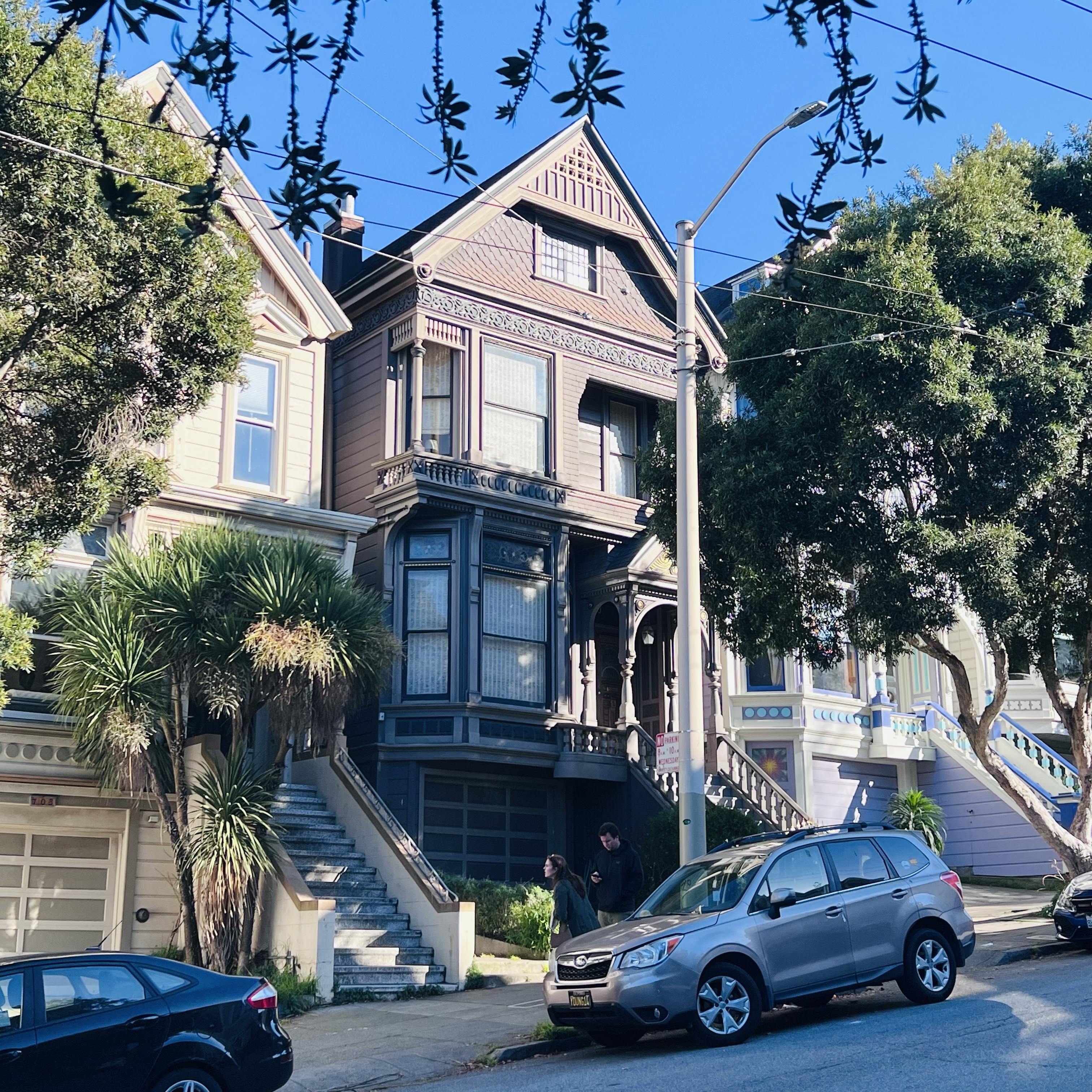
The Dead house at 710 Ashbury. Home to the band in 1966 to 1968.

Just north of the town of Novato is Olompali State Historic Park. They are many layers of California history at Olompali: Miwok, Mexican, the Bear Flag Republic, Californios, and the estate of a wealthy San Franciscan dentist.

In 1911, James Burdell, built a 26-room mansion for the then hefty sum of $15,000.

The land and the house on it was eventually sold to the University of San Francisco. In the 1960s the university attempted to sell the property but the buyers always defaulted, leaving Olompoli unsold.

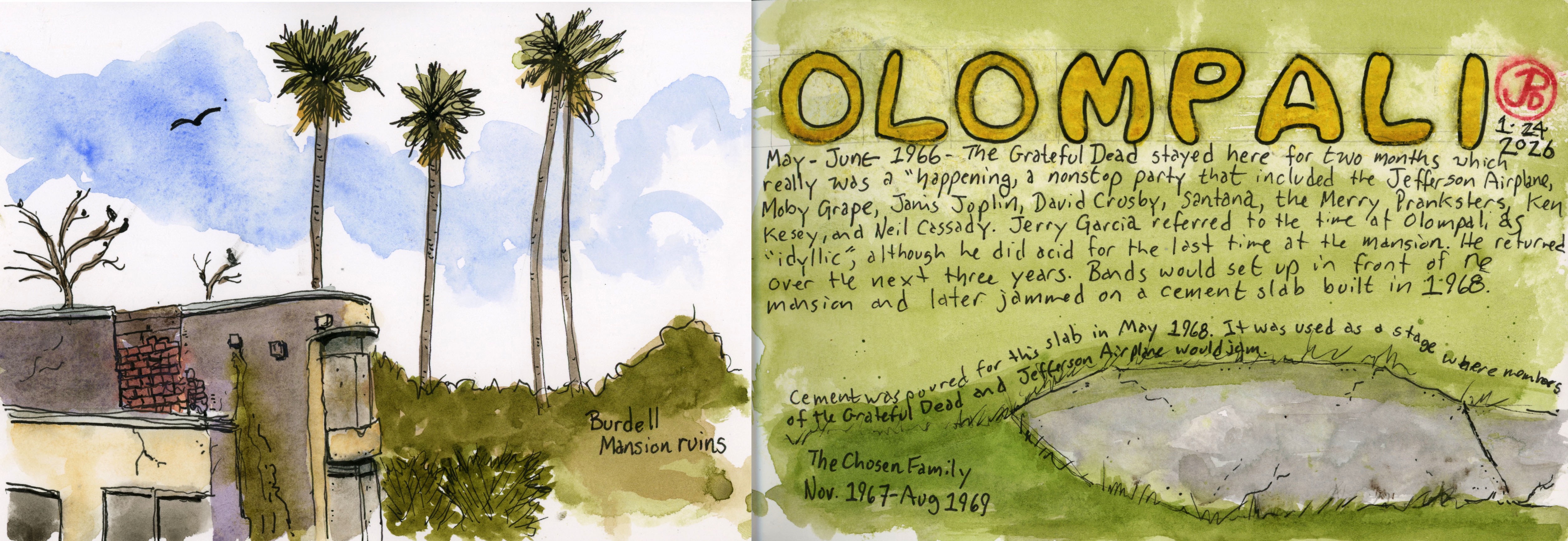
The properties’s most famous tenet was the band the Grateful Dead. The band moved here for a two month stay (May and June) in 1966 to take a vacation away from the Haight-Ashbury.

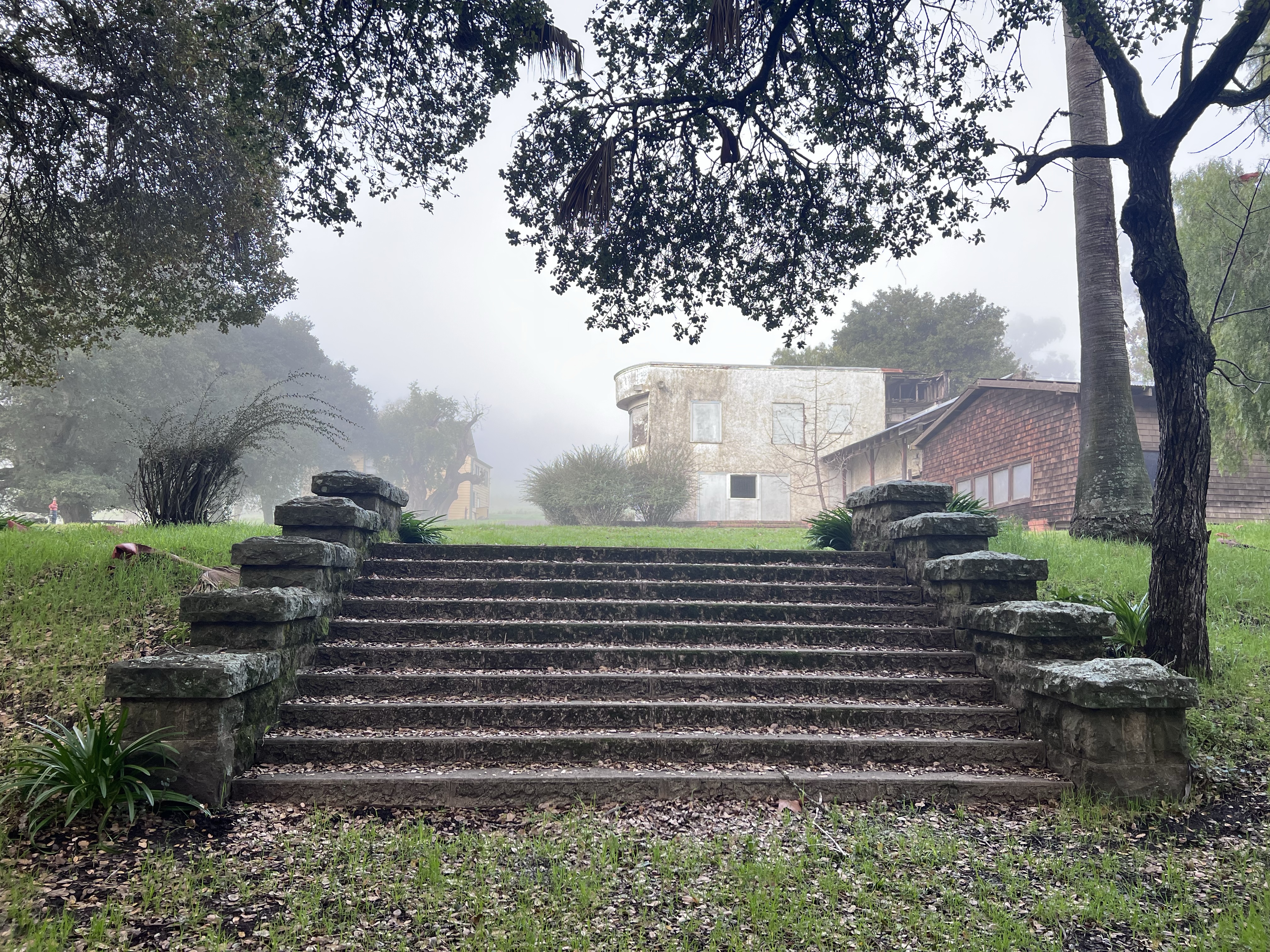
Stairway to . . . The buildings at Olompali have seen better days.

Their two month stay was a “happening”, a nonstop party that included the likes of Jefferson Airplane, Quicksilver Messenger Service, Moby Grape, Janis Joplin, David Crosby, Santana, the Merry Pranksters, Ken Kesey, Neil Cassady, and Timothy Leary.

Jerry Garcia referred to his time at Olompali as “idyllic”. It was also the setting for his last acid trip (it was a bad one). He returned here over the next three years.

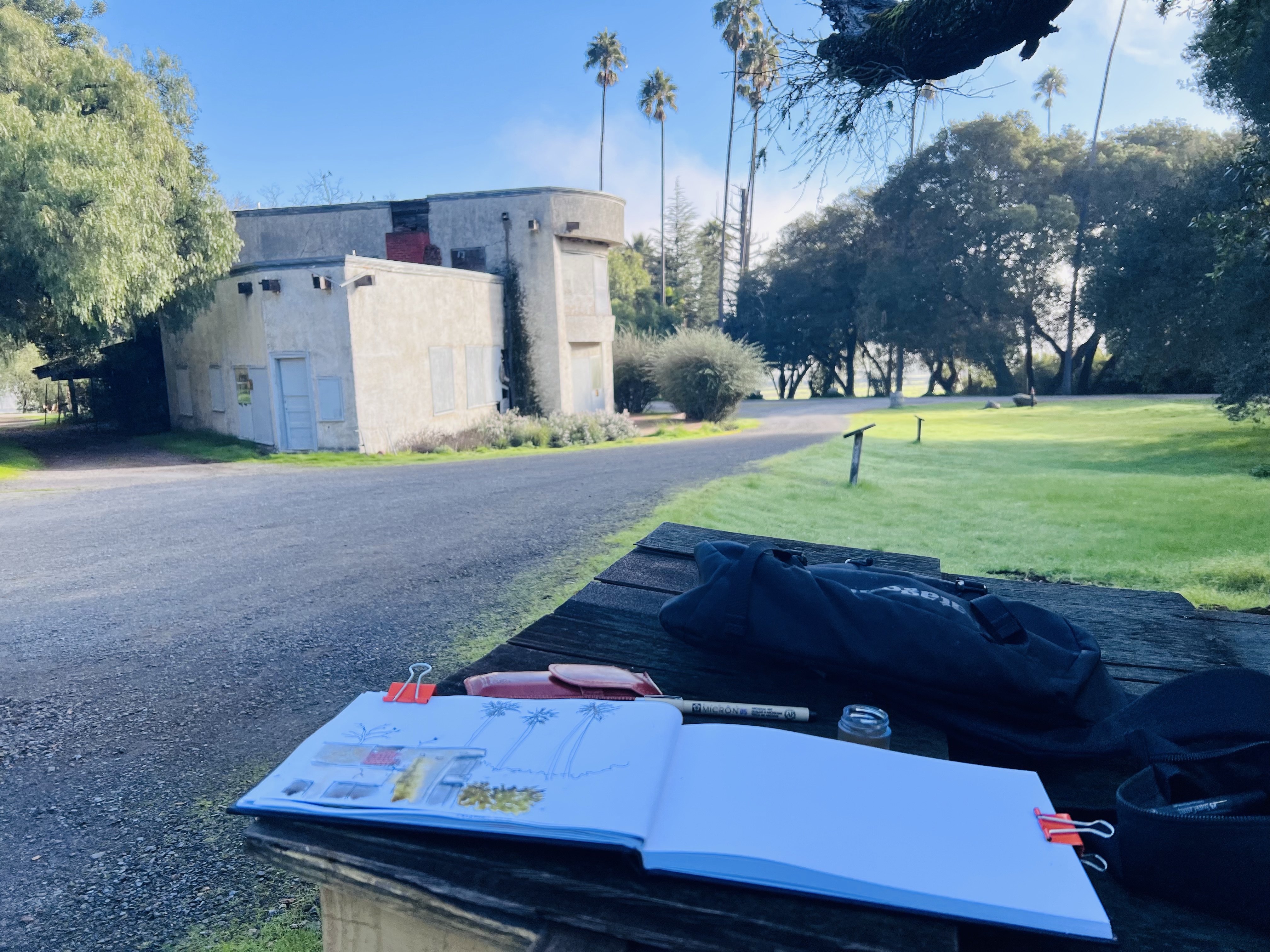
Sketching the remains of the Burdell Mansion. Bands would set up in front of the mansion to jam as people danced on the lawn or cooled down in the swimming pool. The pool was off to the right.

After the Dead left, Don McCoy, a wealthy businessman, turned to the hippie life and started a commune, called the Chosen Family at Olompali in 1967.

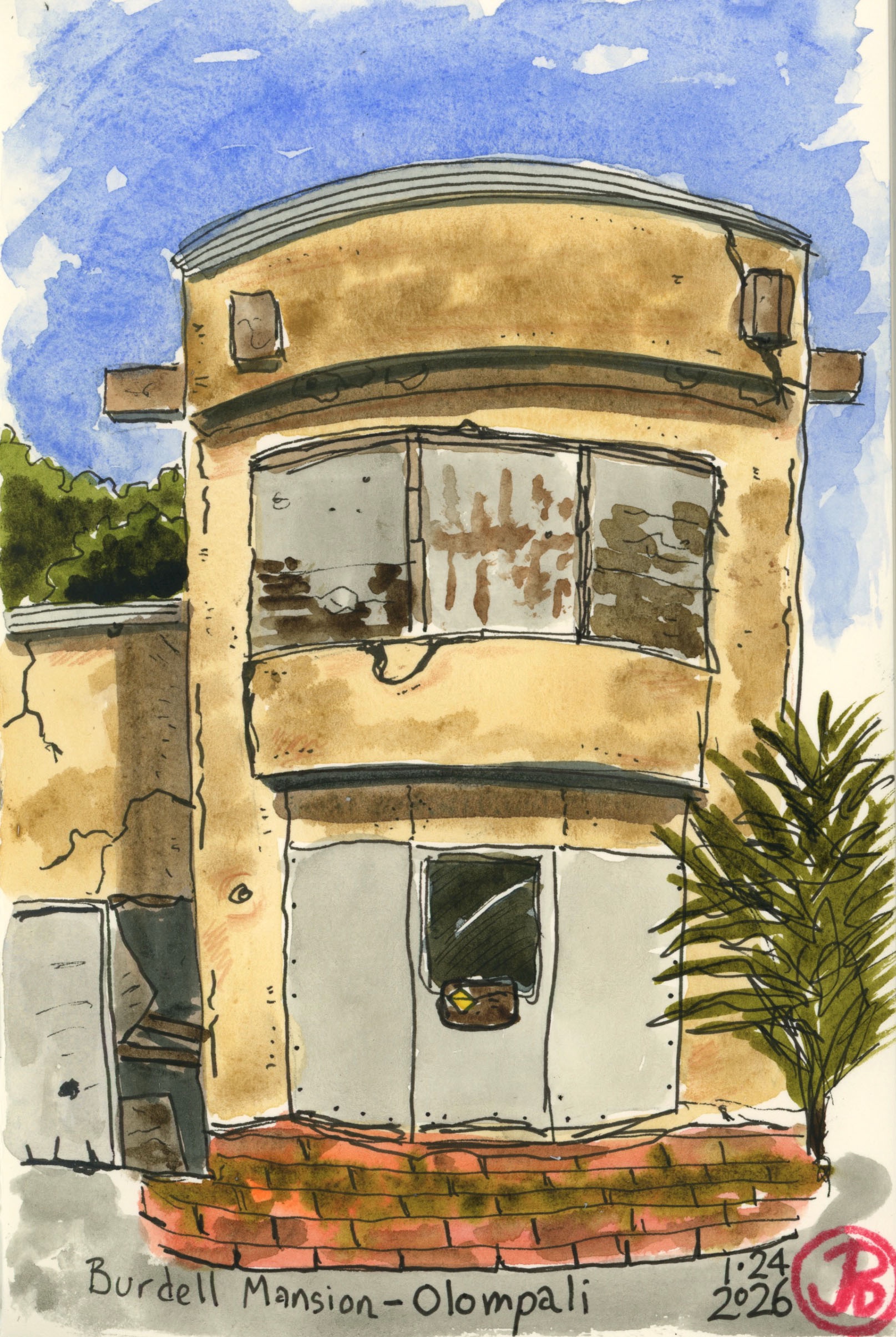
Field sketch of the mansion, which is boarded up.

26 people moved to the mansion where they home schooled their kids and baked bread for charity, amongst other things.

Things soured after about a year with the influx of new members and more drugs and alcohol. Two children drowned in the mansion’s swimming pool. Much of the mansion burned down in a fire in 1969 and the commune was soon evicted.

The land was purchased by the state of California in 1977 and it became Olompali State Historic Park.

Bishop Peak

One SLO goal on my three day weekend visit was to summit Bishop Peak, and at 1,546 feet tall, it’s the tallest of the Nine Sisters.

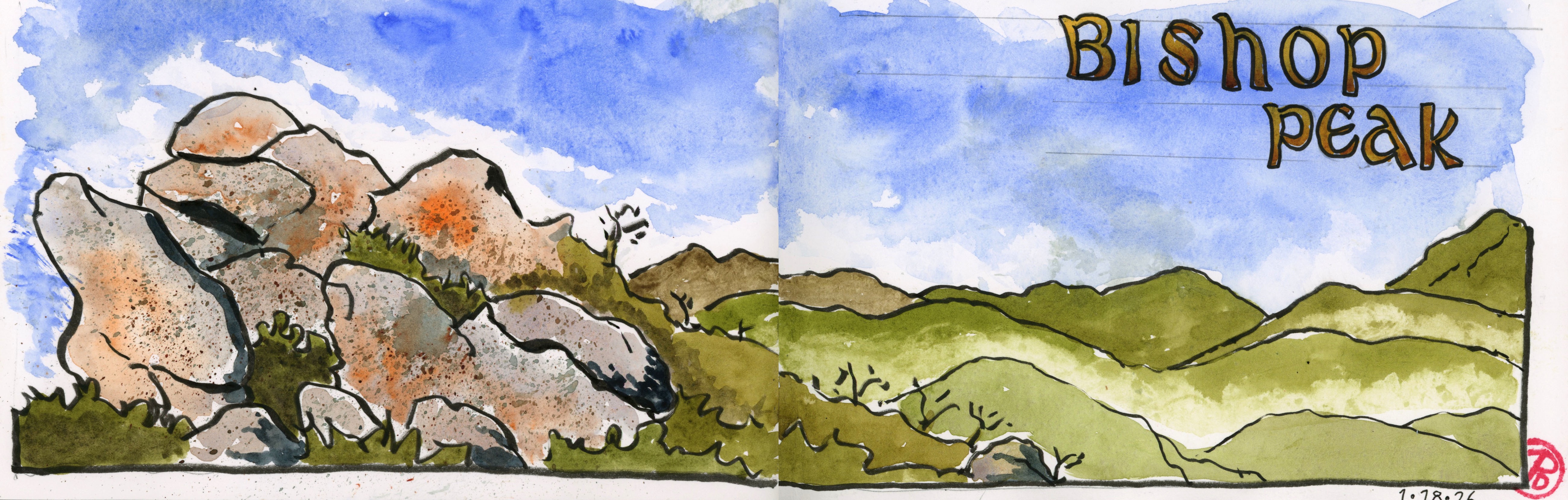
The Nine Sisters, aka the Morros, are volcanic peaks stretching from Morro Bay to San Luis Obispo. Bishop Peak, named after the shape of the summit rocks, is a much sought after destination for hikers and climbers.

With forecasts for the day in the high 70s, I got an early start, hitting the trailhead at Highland Drive at 7:30 AM.

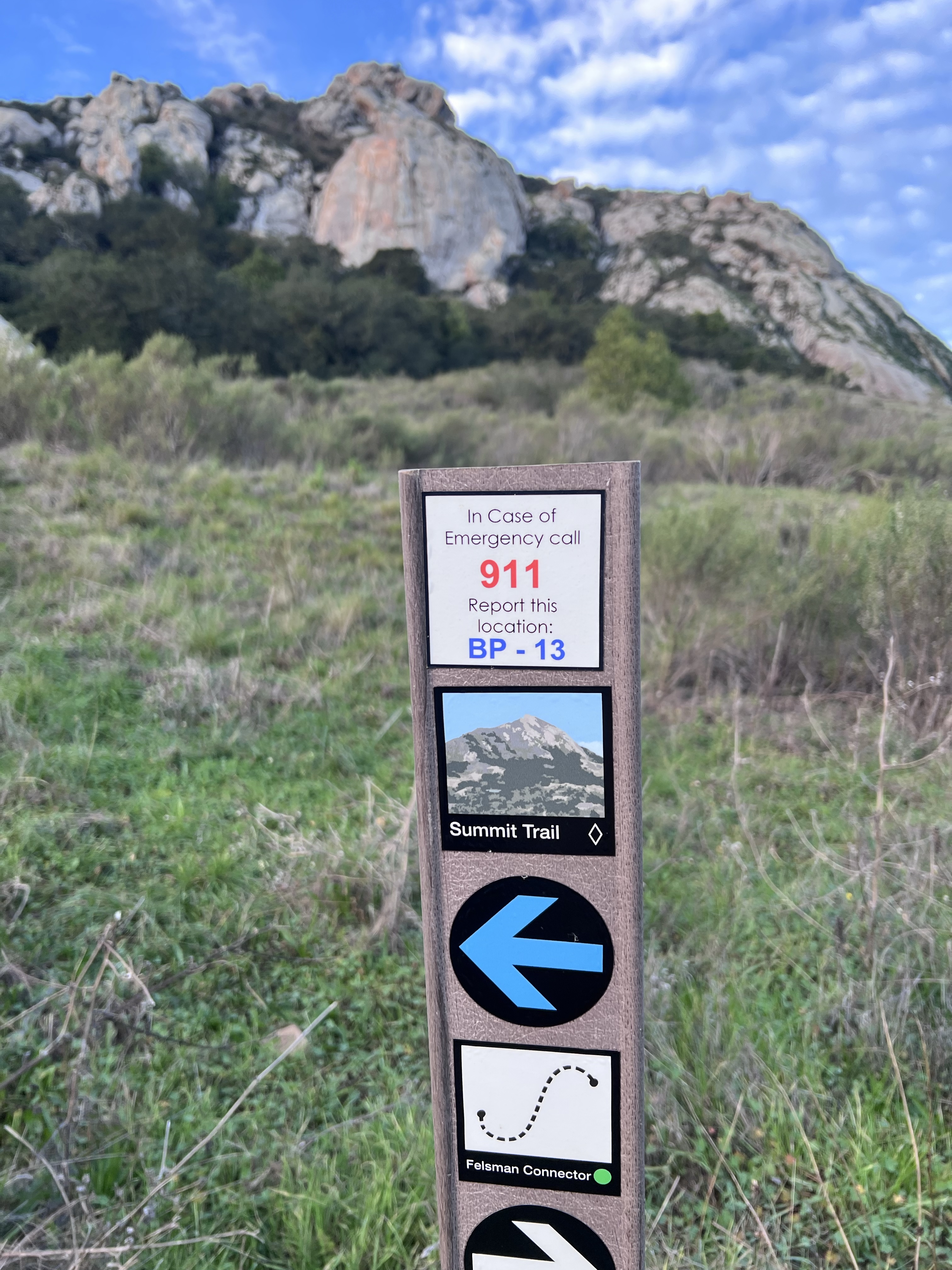
The trail marker lists the Summit Trail as a black diamond. This is not for the weak kneed and out of shape (which could describe me). I duly noted the 911 sign, giving me my location.

One change in my fairly recent hiking gear is trekking poles. I once ridiculed them as useless pieces of hiking chic. But as I grew older I now see them as an essential part of my hiking get up, so much so that I keep a pair in the trunk of my car at all times. They give me more points of contact, improve balance, and take pressure off the knees. And in a pinch I recommend they could fend off a mountain lion or bear. All of which is very necessary on the over 1,200 feet elevation gain thought uneven boulder terrain that is the Summit hike.

The first part of the hike led me to the base of the peak, past a cattle pond. At the top I could see a few hikers that had already summited. They must have gotten a much earlier start and hiked under headlamps. Cal Poly student no doubt.

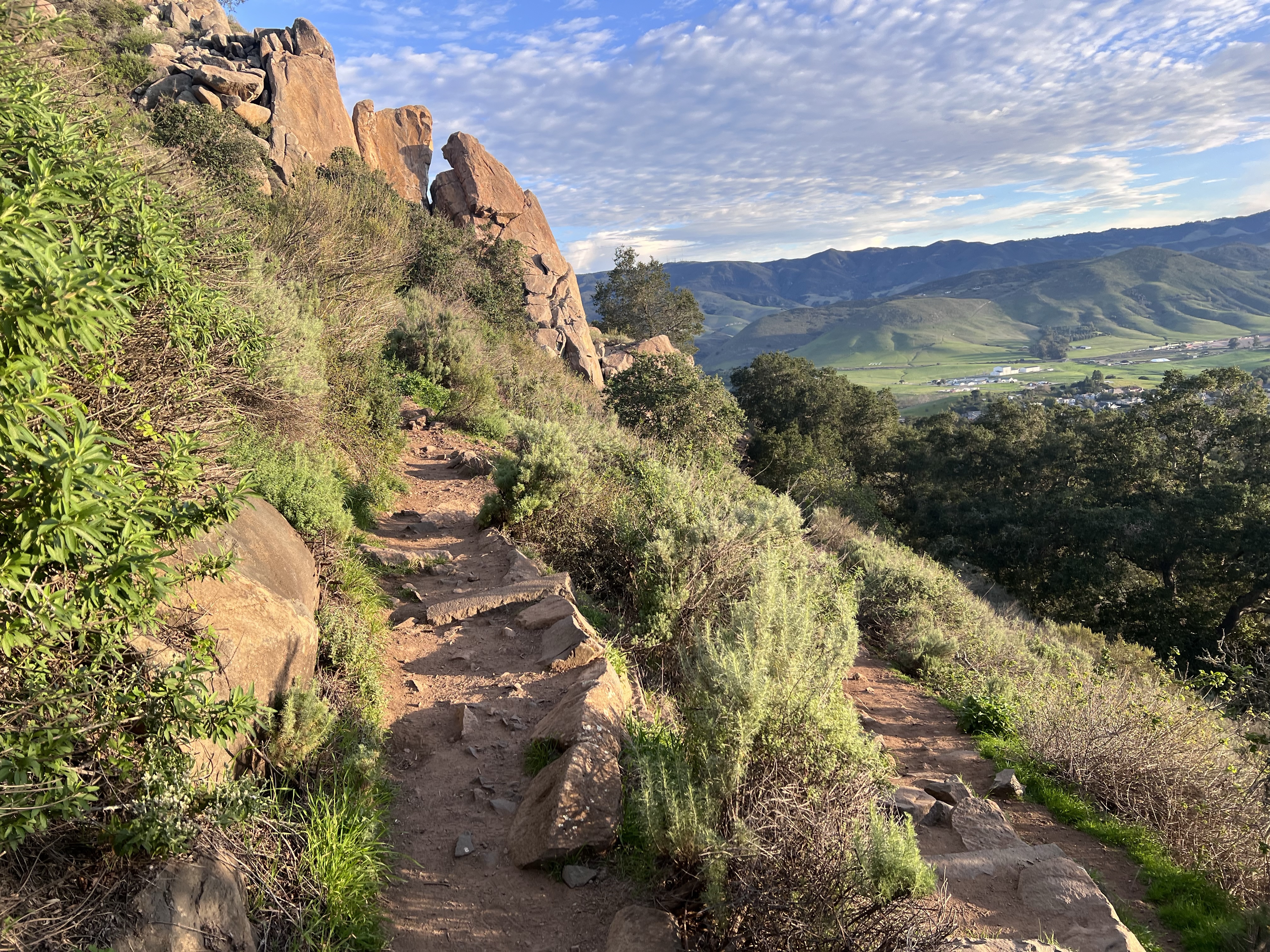
I passed a climbing wall to my right and my climb to the peak really began in earnest when I reached the first of many switchbacks.

The first of many switchbacks to the summit.

There was a dad with his two teenage sons who passed me. They had far less gear and no trekking poles!! I used them as a pacer, a reminder of my much slower pace, as I saw them on the switchbacks above mine. I would see their heads always moving forward above the chaparral. They were getting farther and farther ahead.

I soon started passing hikers coming down from the summit who had gone up to watch the sunrise. They had far less gear, water, and some were not even wearing hiking shoes. One group of girls had forgotten their headlamps so they had to use their phone light instead. Ah youth!

I was glad to have full sunlight and the views kept getting better and better the higher I climbed.

After hiking an hour, I could see the reddish rocks of the summit. The rocks that give the peak it’s name.

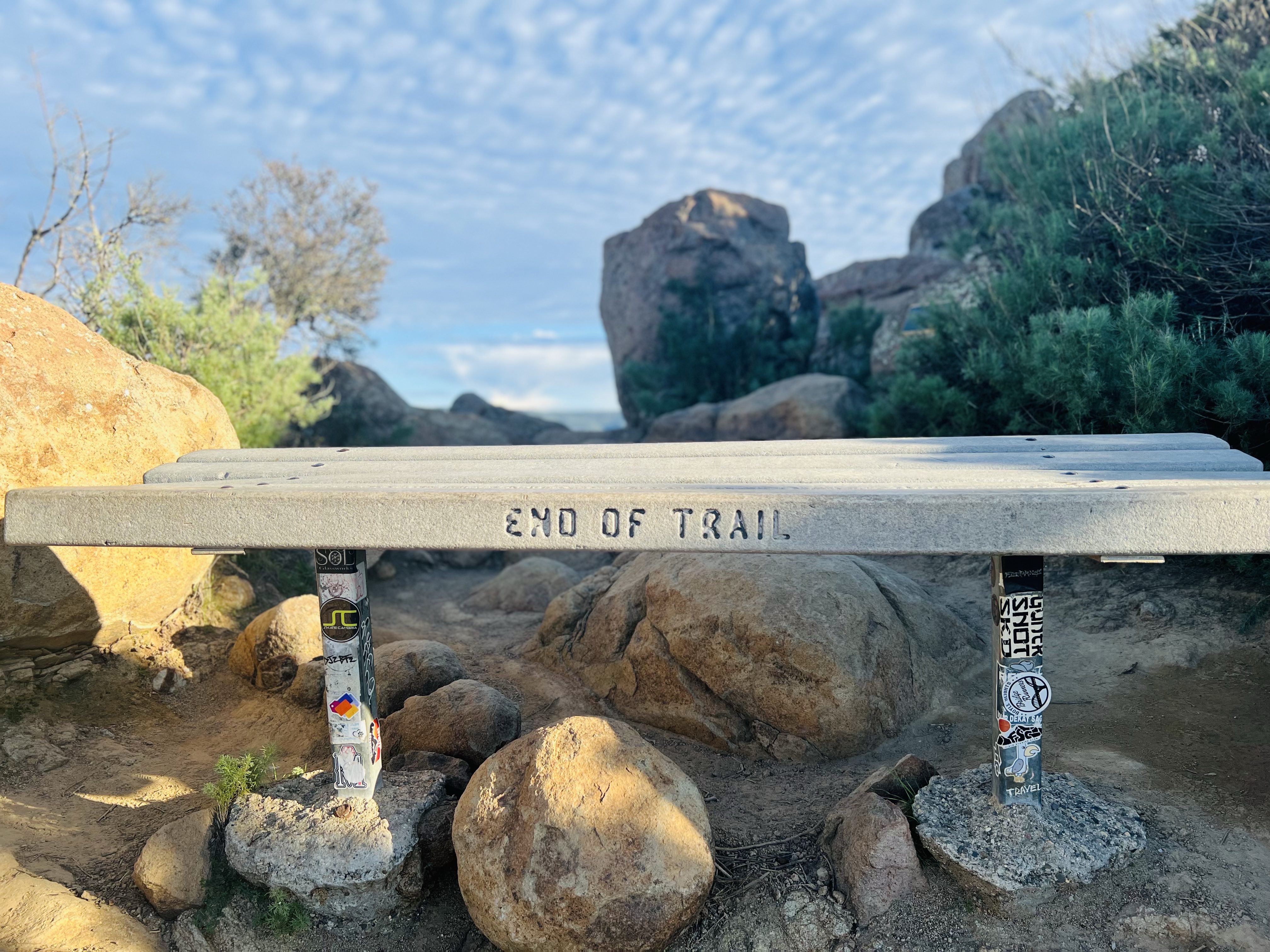
As I got closer to the summit there seemed to be a few false summits and the trail branched off in different directions, hemmed in by brush. One final scramble and I was greeted by a much appreciated bench. It was 8:35 and I had reached the top!

The much appreciated “End of Trail” bench at the summit.

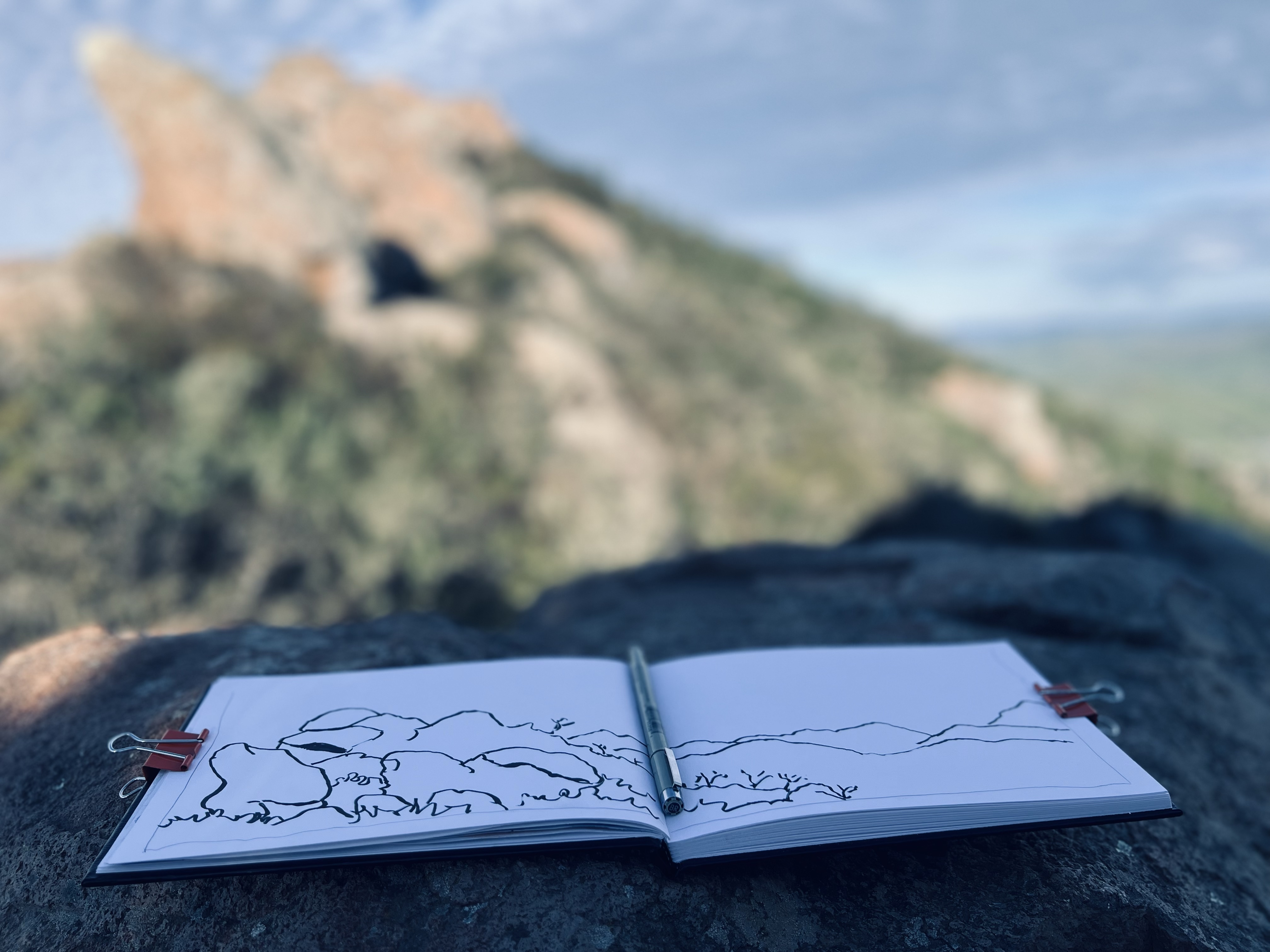
I drank some water, had some trail mix, and unpacked my panoramic sketchbook. It was sketch time.

After my sketch, it was time to descend, which I figured would be much easier than the climb up. It was five minutes to nine.

On my way down I passed about 30 people on their way up, including two large families with toddlers. The summit was soon to be one crowded place. Another great reason for an early start.

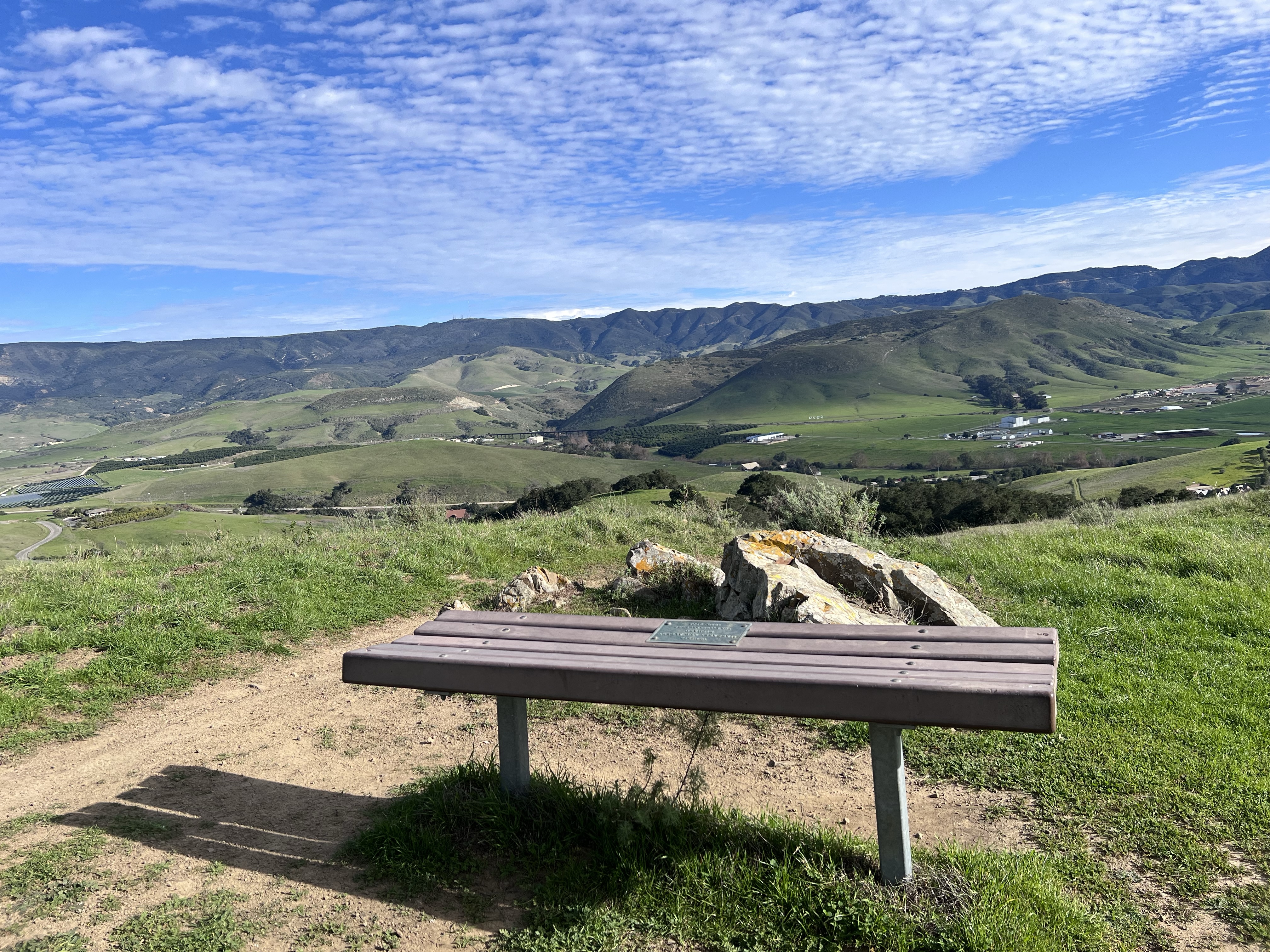
At the end of my descent, I turned left at the cattle pond and walked out on the Felsman Loop Trail toward a sketching bench.

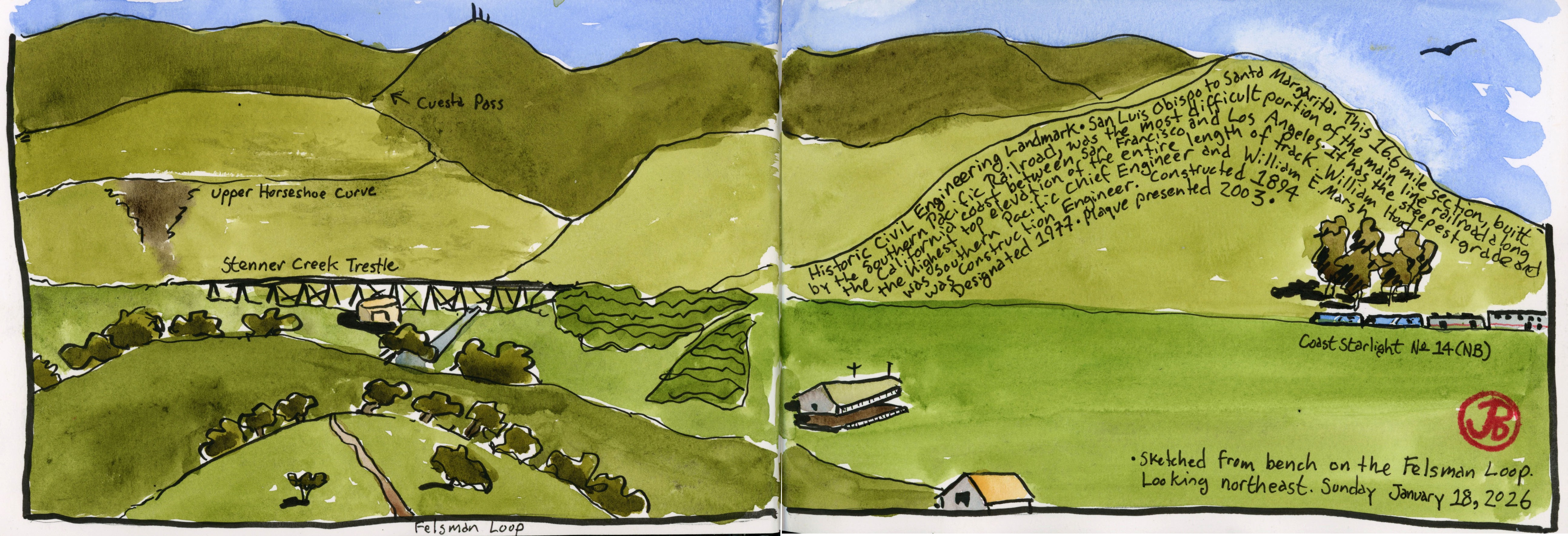
The view before me was an acknowledged Historic Civil Engineering Landmark, the 16.6 mile portion of railroad that climbs the Cuesta Grade and the series of tunnels near the summit. From my vantage point, Stenner Creek Trestle was before me and the line snakes around in the famous Horseshoe Curve.

I sketched the beautiful green Californian curvaceous hills. This was a great time to be here!

SLO’s Southern Pacific Water Tower

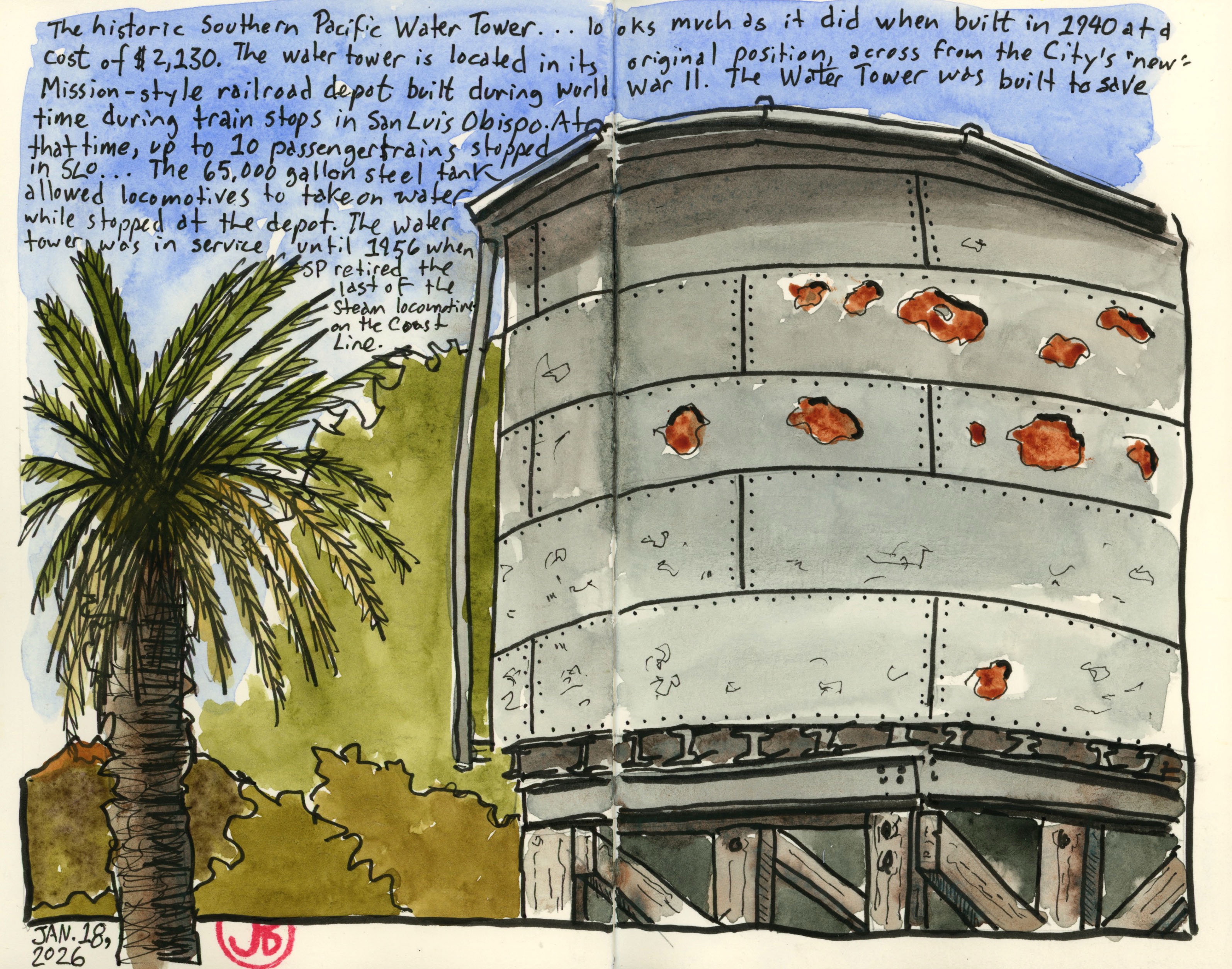
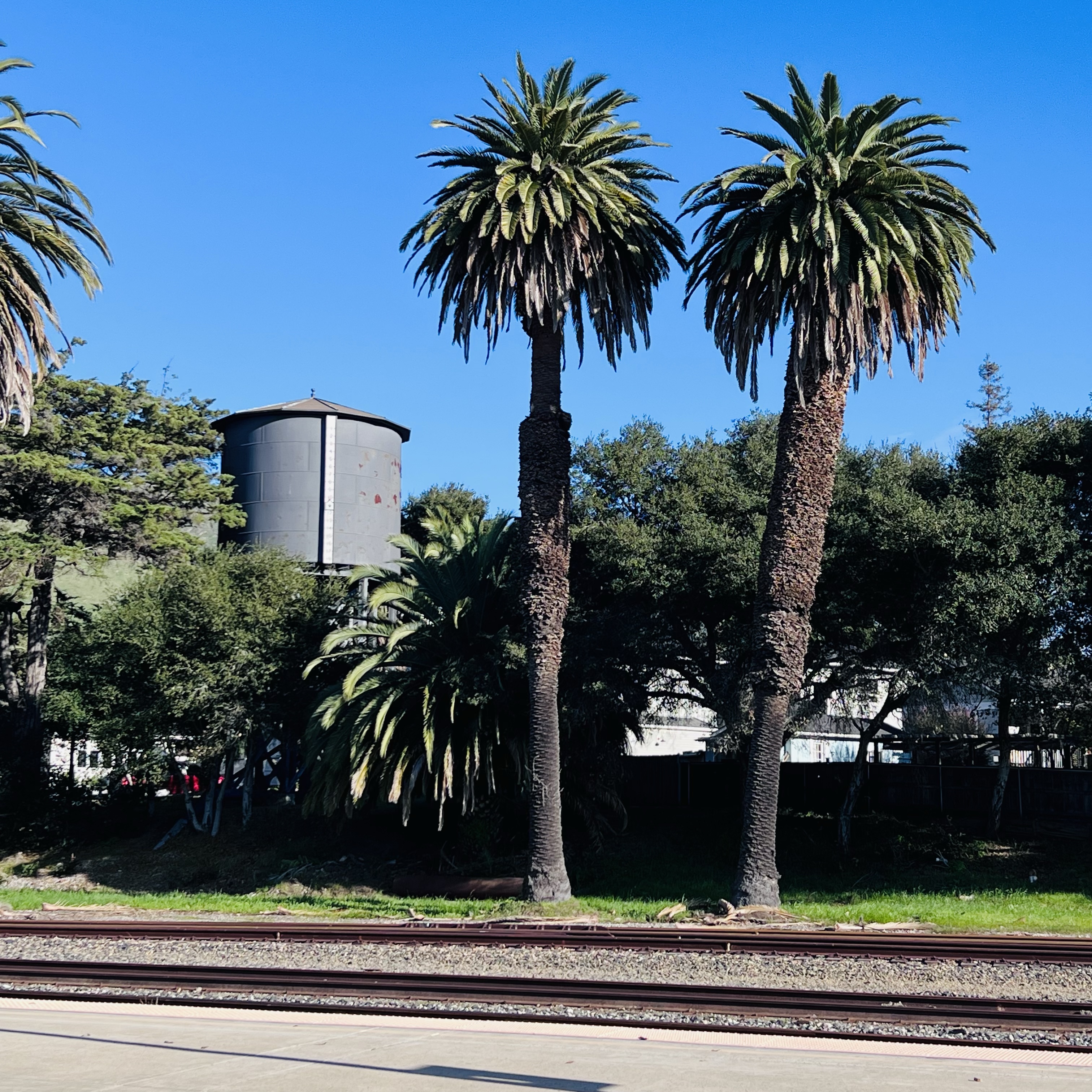
The view from my front door of my San Luis Obispo digs was a looming symbol of SLO’s railroad history. This is Southern Pacific’s 65,000 gallon water tower.

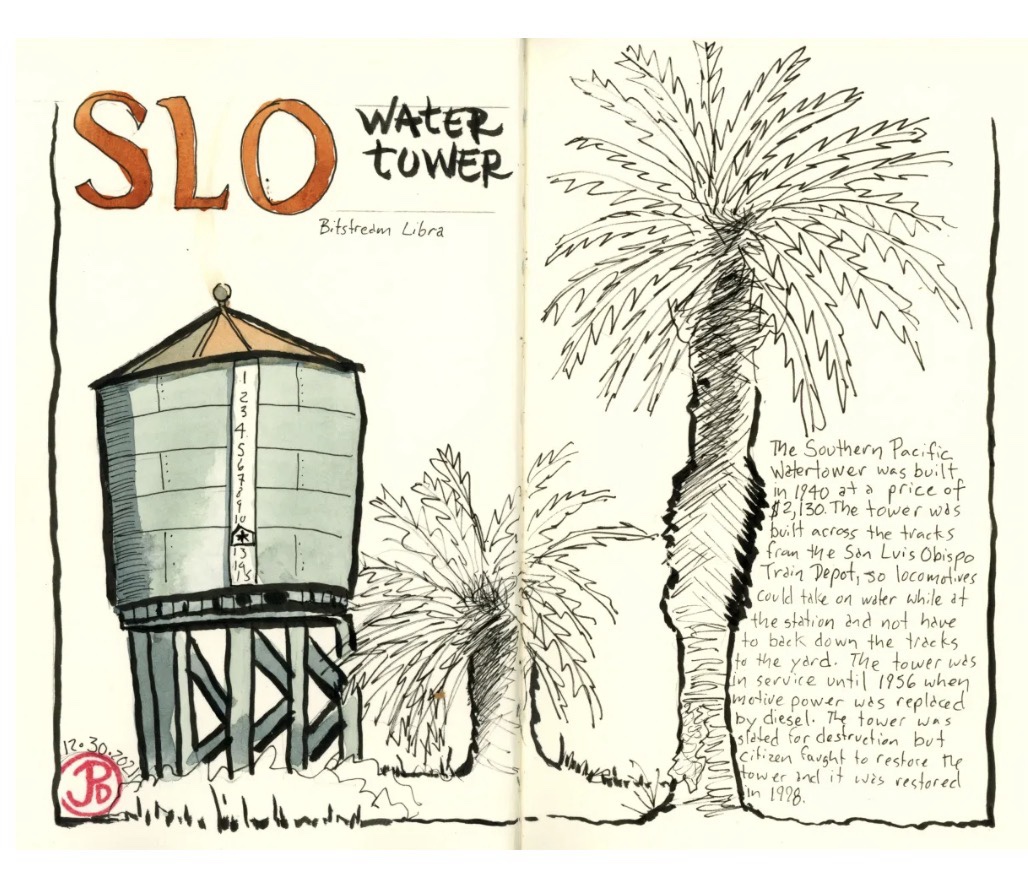
The tower was built in 1940 for the sum of $2,130 (about $50,000 in 2026). It solved a problem at SLO because steam locomotives that needed watering would have to leave the station and head down track for about a half a mile, to the water tower near the roundhouse. Now with the new tower, locomotive’s tenders could be watered while at the station, saving much needed time.

At the time that the new Mission Revival station was built in 1943, ten passenger train stopped at the station including the iconic Coast Daylight with the classic GS locomotives on point sporting the black, orange, and red livery of this premier passenger service. At SLO a helper would be added to assist the Daylight up Cuesta Grade and the helper would be cut off at the top in Santa Margarita.

With the end of steam at the hands of less labor intensive diesel-electric locomotives, the water tower stood unused and time took its toll. In the 1980s Southern Pacific planned to demolish the tower and the city stepped in and bought the water tower.

The water tower was saved and restored, starting in 1989, by the city of San Luis Obispo as a landmark of the deep Southern Pacific history. The full restoration was complete by 1998. Railroads have been part of SLO since 1894.

The SP Watertower as seen from the station platform. My front door is just behind the low palm tree.

I had sketched the water tower before but not from the up close and personal perspective from the front door of my apartment.

My 2021 sketch of the water tower. This is from the station platform.
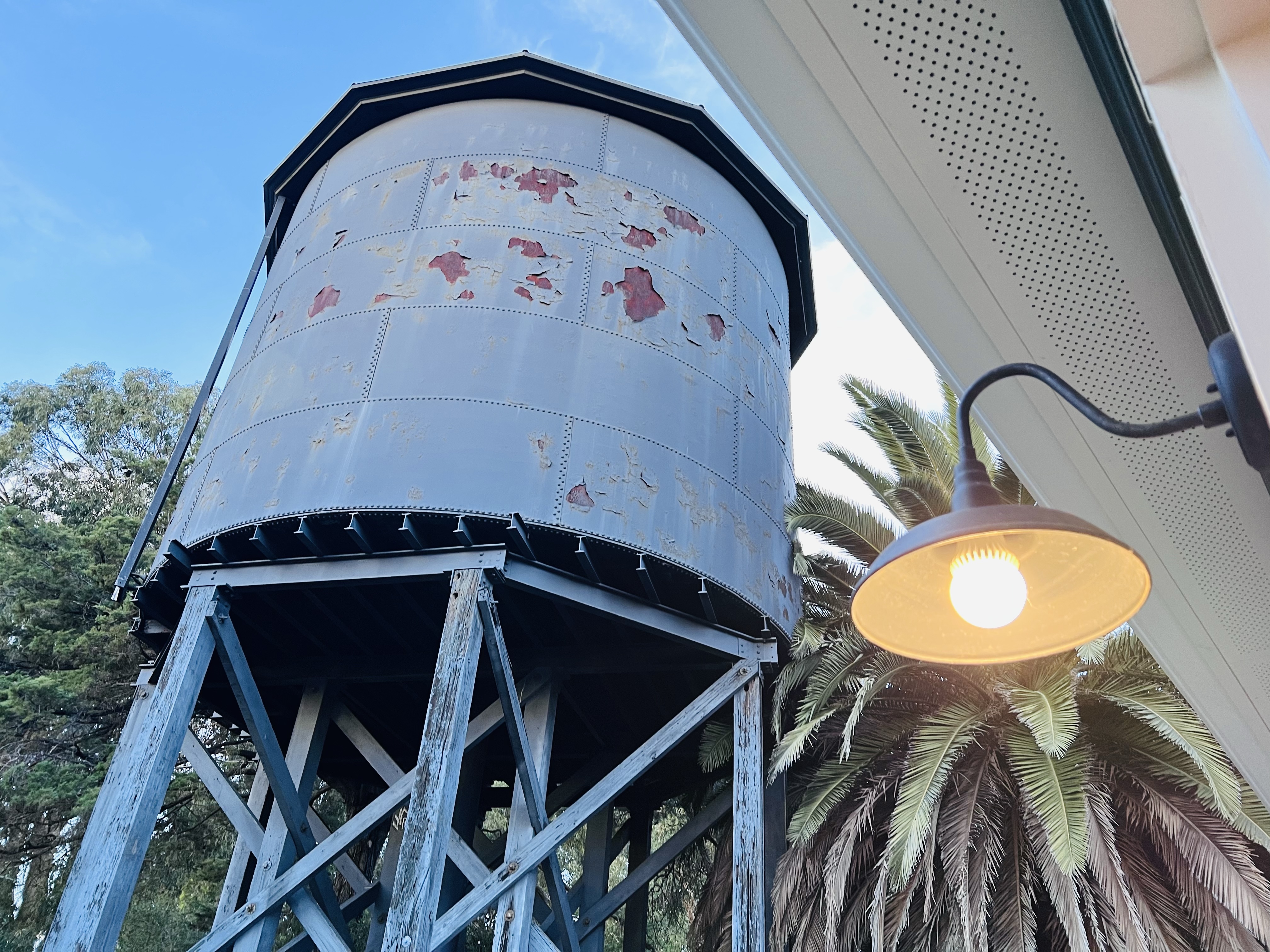
The water tower and my front porch light.
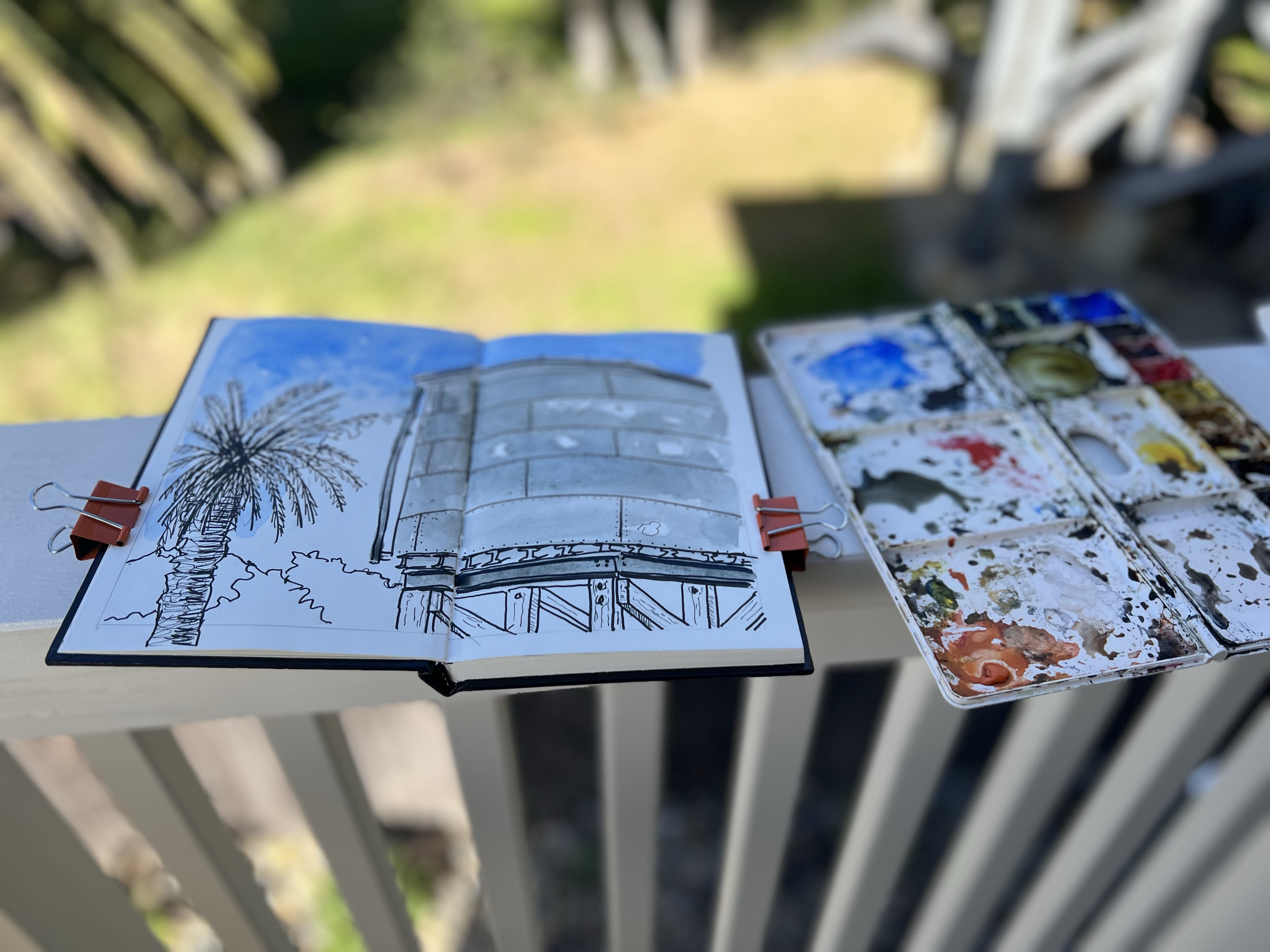
Plein air porch painting.

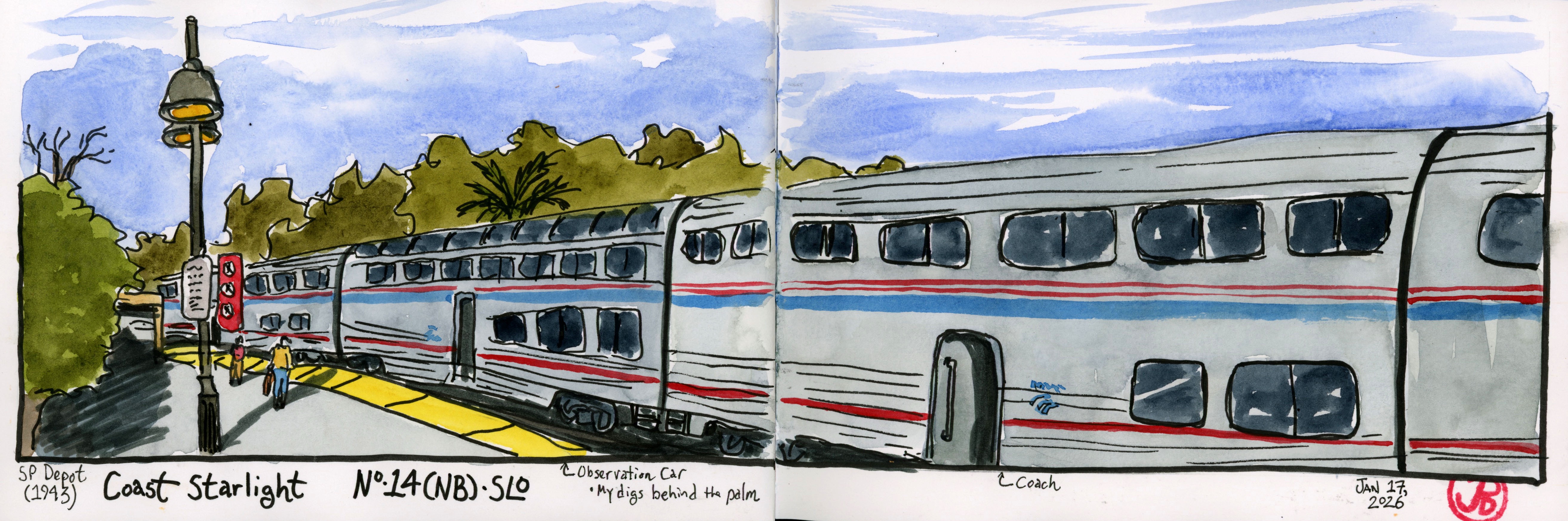
SLO Coast Starlight

The AMTRAK route that parallels the west coast from Los Angeles to Seattle is the Coast Starlight, a journey of 1,377 miles.

In those 1,377 miles the only place that both the northbound and southbound (Trains 14 and 11) meet at a station is San Luis Obispo.

Northbound 14 arrives from Los Angeles at 2:50 PM (if on time) and waits for southbound train 11 (due at 3:24) to descend the single track down Cuesta Grade. And I planned to be there to do some sketching.

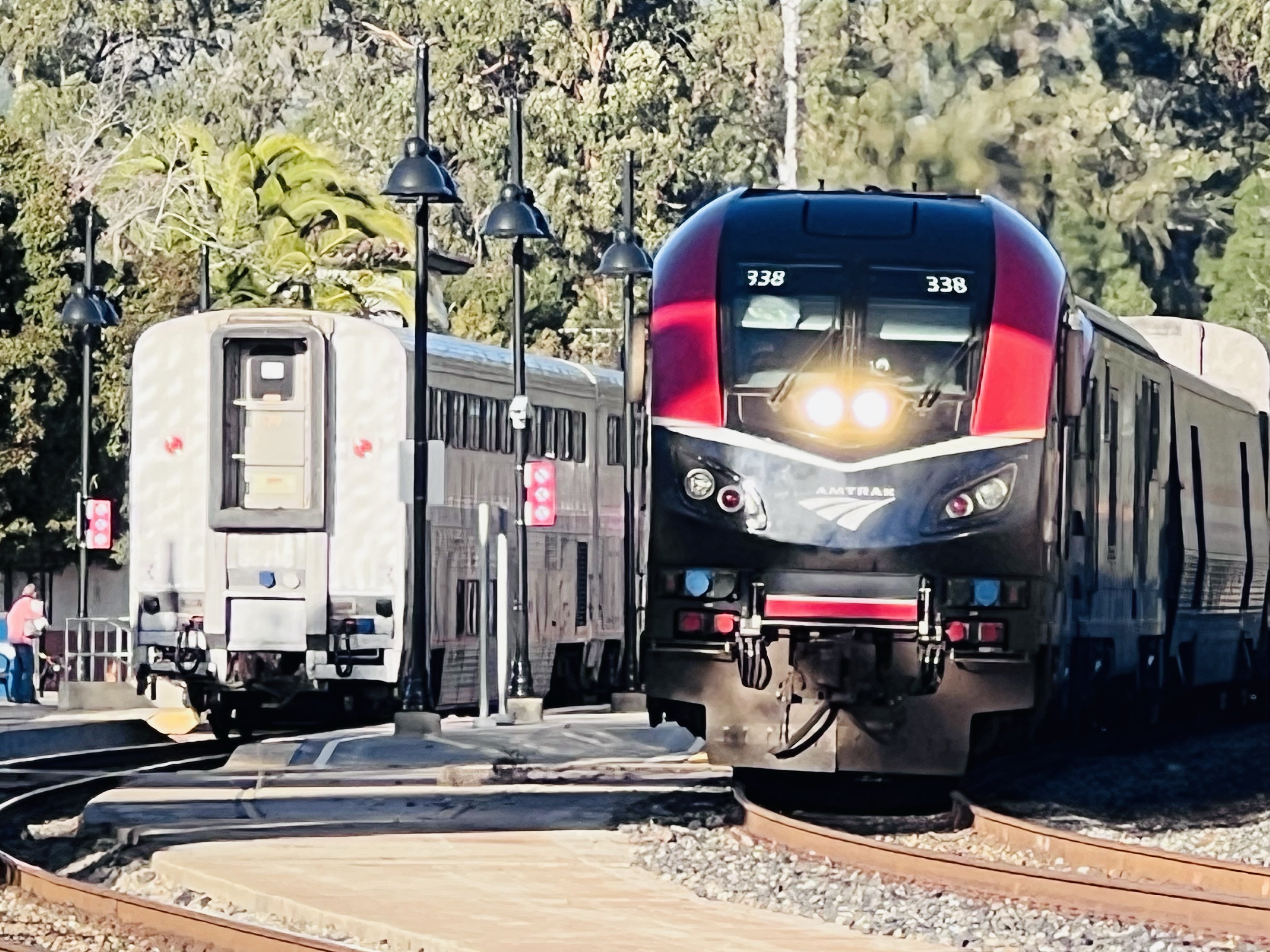
Both Coast Starlights at the station in SLO. Train 14 to the left and 11 on the right.

My plan was to sketch the northbound Train 14 at SLO station. In the age of steam, the Coast Daylight (SF to LA) stopped for only three minutes at San Luis Obispo in order to keep to its timetable.

During this short stop the Southern Pacific GS (Golden State or General Service) steam locomotives would be serviced and tender topped off with water. A helper locomotive would either be cut in or cut off depending on the direction of the Daylight.

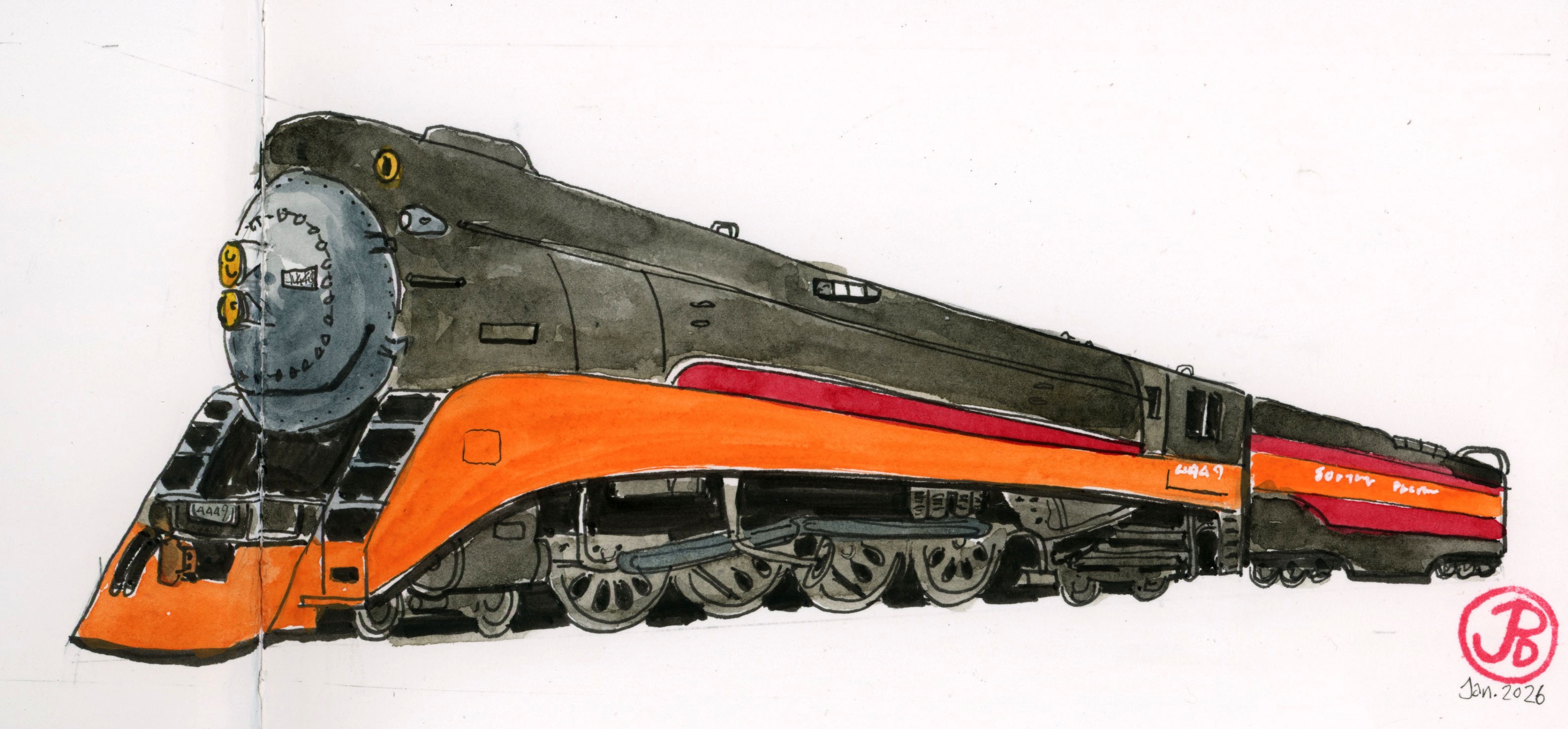
My sketch of one of the most famous steam locomotives in the world, Southern Pacific’s GS-4 No. 4449. This has been deemed “the most beautiful passenger train in the world” and SLO was one of her stops.

Now the AMTRAK train would stop for about 15 minutes, allowing passengers a stretch break, for some passengers this is also known as a smoke break.

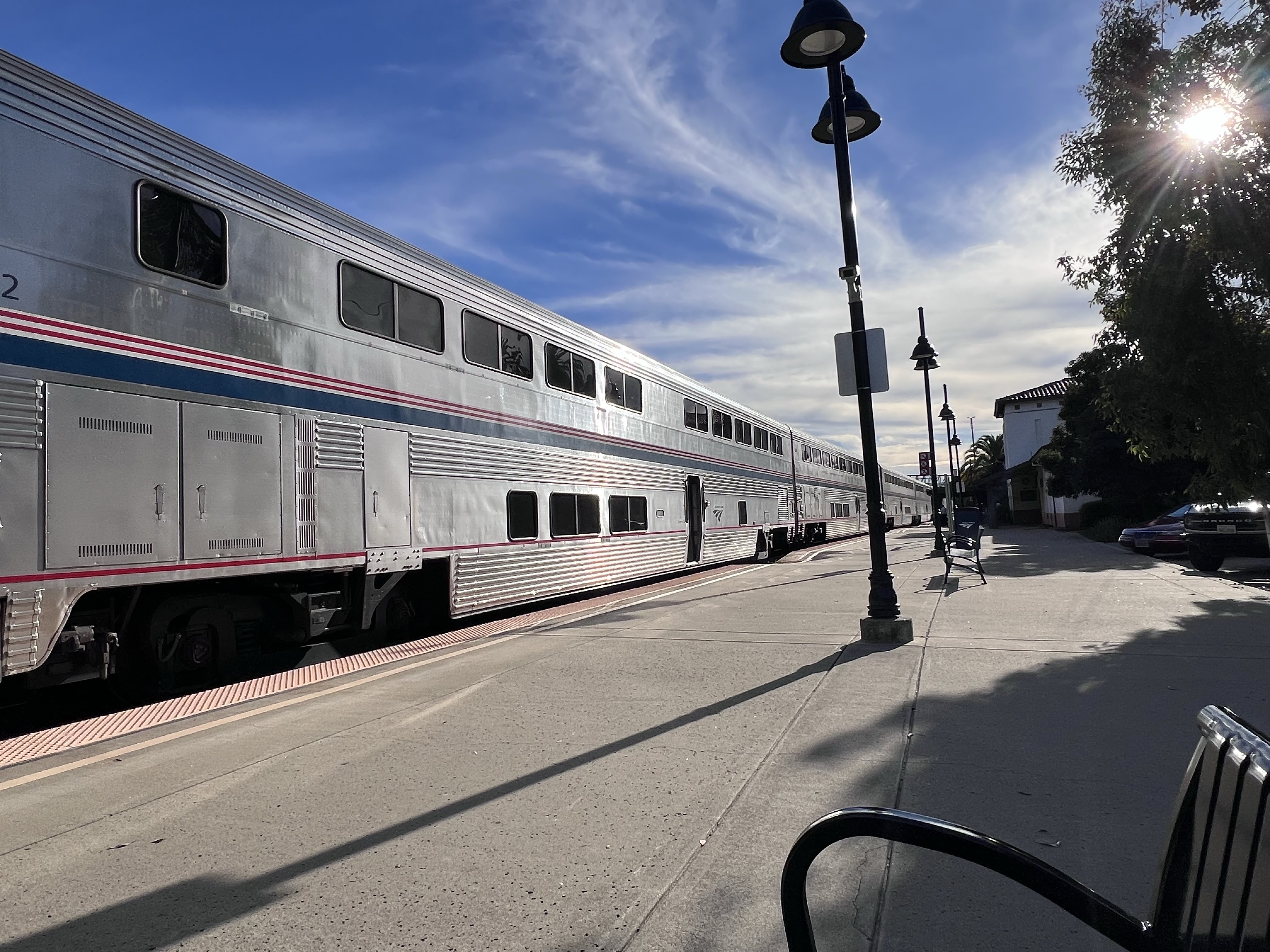
The Superliners at San Luis Obispo under beautiful January sun.

I figured 15 minutes was more than enough time to get a quick sketch in of the train at the platform before the locomotive’s loud retort announced its continued journey up the Cuesta Grade towards Seattle.

I took up my sketching position a little before the Starlight’s arrival. I penciled in the foreground and the trees in the background, not knowing which trees would be eclipsed by the double decker Superliner cars. The answer was: most of them.

When the train pulled into the station, I switched to pen. I love sketching without a net!

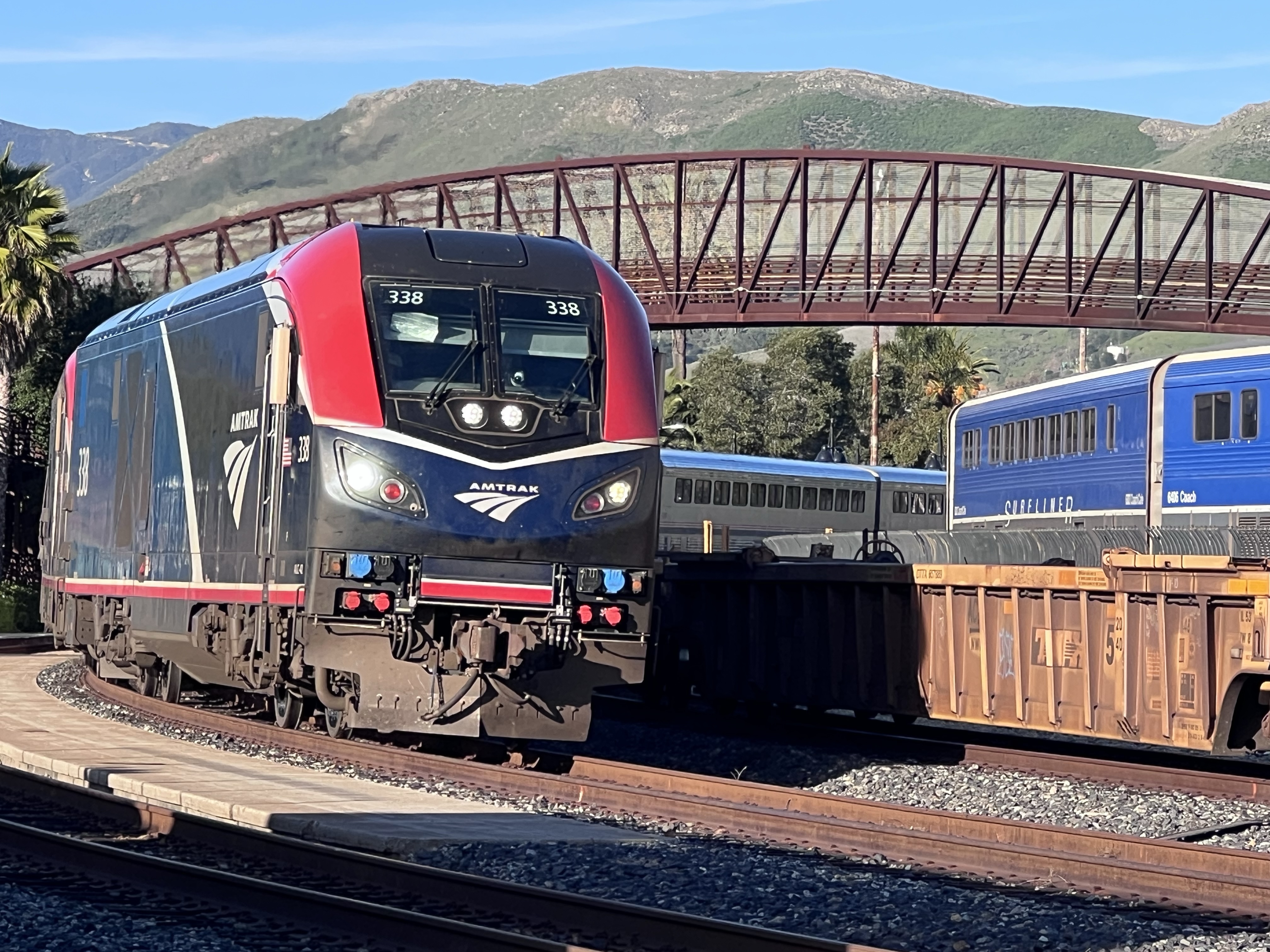
Train 11 heading towards Los Angeles with the AMTRAK’s new motive power, Seimens Charger on point. On the right is the Surfrider train on a side track.

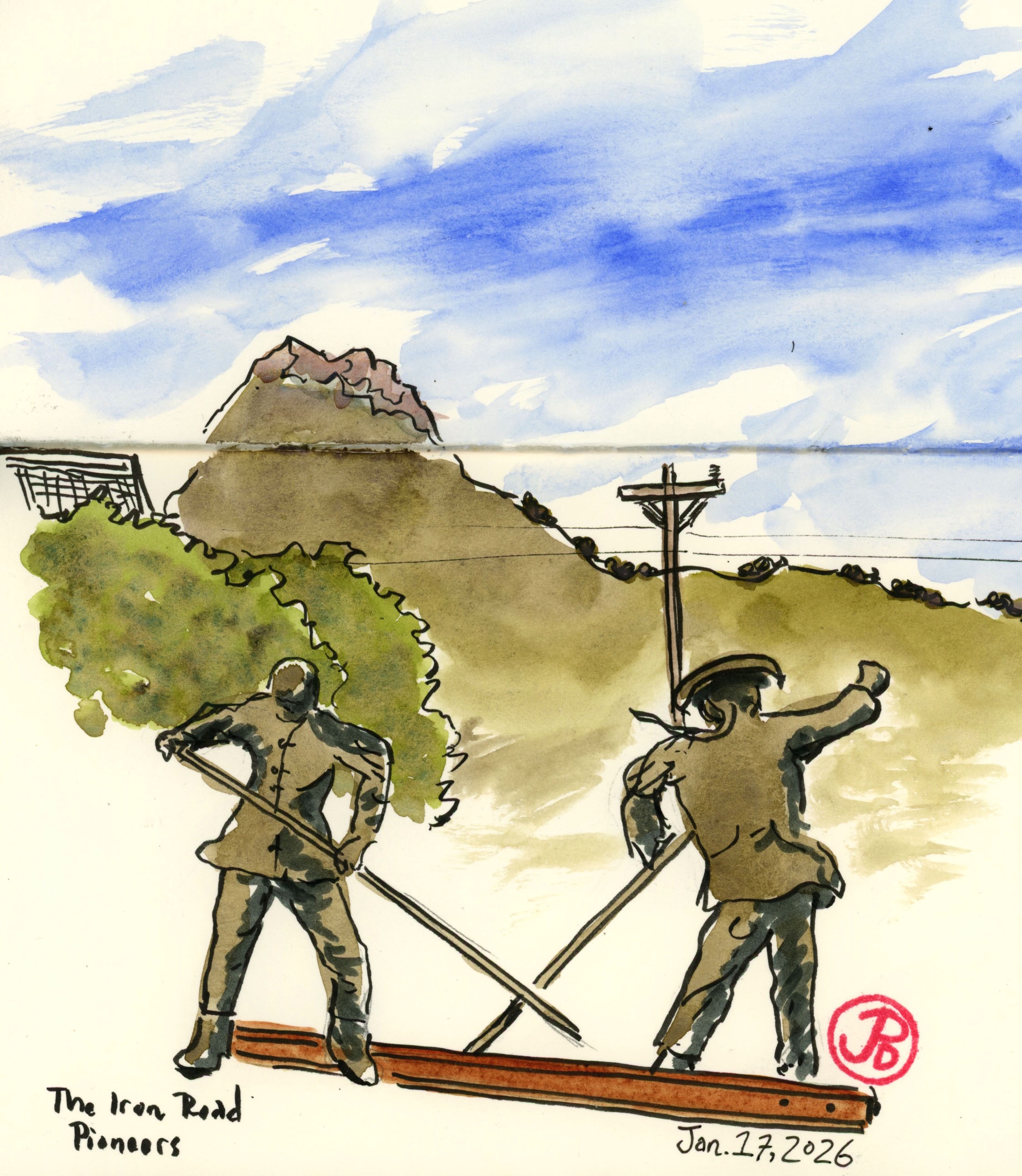
While waiting for the northbound Coast Starlight, I found a bench and sketched the statues near the station called the Iron Road Pioneers, with Bishop Peak in the background.

The statues are a monument to the Chinese immigrant workers who built much of the railroads on the central coast as well as other seminal railroads such as the Transcontinental Railroad.