Mt. Shasta dominates the landscape for miles around.
When you are on Highway 5 in Northern California. Mt. Shasta is a beacon. This perpetual snow covered mountain has a long geologic and human history. In the Native Karuk language they named this mountain “White Mountain”.
At 14,162 feet Mt. Shasta is the tallest mountain in this part of the southern Cascade Range.
Because Mt. Shasta seems always to be within eyesight, when in this part of the Golden State, it seemed that I had to sketch it. The tough decision was from what of the infinite perspectives would I sketch the mountain.
I drove around Shasta City and there were many great perspectives but some marred by buildings or power lines so I headed out to the sticks: Lake Siskiyou.
I found some good views from the shoreline but they would have been better it I was on a boat in the middle of the lake or on that far shoreline if I could only figure out how to get there.
I didn’t find what I was looking for so I continued on driving around the lake, which is really a reservoir made by damming the Sacramento River. I thought the road I was on was going to circle around the lake but at one point it started to head away from Lake Siskiyou. I pulled over and I looked back from where I came and I realized that I had found my sketching perspective! Behind me, Shasta rose above the forested, foreground hills.
I pulled out my sketching stool and gear and had a pleasant encounter sketching Shasta by the side of the road with the two ravens and the stream beside as my companions.
The logo for the McCloud River Railroad was designed by school children in a contest. It features a bear balanced on a log with a fish. And behind is the ever present Mt. Shasta. Mt. Shasta in the background and the McCloud Railroad in the foreground. This is near the point where the railroad joins the Union Pacific mainline in the appropriately named Shasta City.
I wanted to add another night to stay at the Railroad Park Resort in Dunsmuir but the SP Caboose # 17 was booked, so I booked one of the popular Santa Fe cabooses.
I spent my last night at the Resort in Caboose # 28 a former Santa Fe cupola caboose.
This CE-2 caboose was built by the Atchison, Topeka & Santa Fe railway in 1942. It was rebuilt in 1970 and renumbered as ATSF 999448. It came to the resort in the late 1980’s.
A caboose is a uniquely bit of United States railroading. At one time all freight trains had a caboose (usually red) at the end of each train. A caboose came at the time when train crews were larger than they are today, during the age of steam. Each locomotive had an engineer and fireman but the conductor was in charge of the train. The conductor’s office was on rails, this was the caboose.
From the caboose, the conductor could throw switches, aid in backing up, check the train for safety, and fill out paperwork. From the view in the cupola, or later the bay window, he could oversee the train to make sure no loads were shifting on freight cars. He could also monitor the train for overheated axels called “hot boxes”.
Most cabooses where fitted with a desk, bathroom, bed, and storage closets. It really was a home-office on wheels, reflecting the long work days and may miles on the railroad.
Laws where in place that all freight train had to contain a caboose for safety reasons. This changed as technology improved and railroad cuts made more with smaller crews. The new, modern diesel-electric engines had larger cabs which means that the conductor could ride up front.
The technology railroads use to replace cabooses are called an end-of-train device. These devices are fitted to the last car of a freight train and monitors air brake pressure and over heated axels. There is also a blinking safely light that warns other trains behind..
By the early 1980’s, laws were changing that no longer required trains to have cabooses. By the mid-1980’s most freight trains no longer ended with a caboose. The era of the red, cupolaed caboose was over.
Whenever I watch a long freight train pass by, I hopefully expect to find a caboose at the end of the train. This comes from seeing so many cabooses on freight trains when I was a young rail fan. In my mind, some how, the blinking, oblong box at the end of a train will never really replace a caboose
This 1972 built Southern Pacific bay window caboose, #1886, was one of the last cabooses in service on the railroad. It was last in service on November 15, 1995 on Southern Pacific’s Lompoc White Hills branch line. I was told the reason for this was that there was a part of the line where the train had to back over a road crossing and the caboose was required for safety reasons. It is now restored and on exhibit at the San Luis Obispo Railroad Museum.
At one time it was a company town for the Southern Pacific Railroad when 3,000 of it’s citizen’s where employed by Southern Pacific Railroad.
Dunsmuir was previously known as Pusher because this is where helper locomotives where either added or taken off trains. They were put on to make it up the Cantara Loop and the climb out of Dunsmuir as the line headed north. Helpers where also used on downslope freight trains to help with dynamic braking.
The town contains a railyard, shops, and a still functioning turntable to turn locomotives around. In it’s heyday, Dunsmuir had a population of 5,000, many of those working for the railroad, serving the labor intensive steam locomotives. When the stream locomotives were replaced by more efficient disel-electric locomotives, the town’s population was almost halved.
Today, the mainline sees two passenger trains and about 15 freight train daily. Most freight trains are now powered by three to four, 4,000 to 6,000 horsepower, diesel-electic engines, so the need to add engines has become obsolete.
Dunsmuir still feels very much like a train town even though Southern Pacific was aquired by Union Pacific in 1996.
The main street, Dunsmuir Avenue, is beautiful in it’s small town charm. And of course the main street parallels the main line.
The crown jewel of downtown Dunsmuir is the California Theatre. This 800 seat movie palace was opened in 1926. The theater featured a stage and a Wurlitzer pipe organ. The theater is only one block from the passenger station and, in it’s heyday, many of Hollywood’s finest and other dignataries visited the theater including Babe Ruth, the Marx Brothers, and Clark Gable.
In recent times the theater has faced some troubling times, after many stops and starts the theater closed in 2016. There was also a Masonic Lodge that met in the building for close to 70 years.
I parked on Dunsmuir Avenue and did a car sketch (great for social distancing) of the the epic sign and marque. I added a bit of artistic license when I added perhaps the best movie ever made featuring a locomotive, Buster Keaton’s masterpiece, The General (1926).
Across from the station is a mural on an oil tank. The mural was created by rail historian, artist, author, and former employee of the Southern Pacific and McCloud Railroad, John Signor. This is a sketch I did from my photograph. It features a Southern Pacific EMD SD45 T-2R diesel-electric locomotive and the famous Daylight GS-4, 4449. This mural represented the future and the past of the Southern Pacific Railroad. It is also a reminder of the name of the railroad that built Dunsmuir.Only two passages trains stop at Dunsmuir Station. The north and southbound Coast Starlight, an Amtrak service from Seattle, Washington to Los Angeles, California. To catch the Coast Starlight at Dunsmuir, you have to get up very early in the morning (or simply just stay up). The southbound Train 11 arrives in Dunsmuir at 12:35 AM and northbound Train 14 arrives at 4:56 AM!Dunsmuir is an important division point in the Shasta Division where train crews change over. In this case, a BNSF freight train with a consist of hopper cars, change it’s engineer and conductor. BNSF is granted trackage rights to use this route by the tracks owner: Union Pacific.
Note: Part of sketching, and life I might add, is making mistakes and with this sketch I made one. I am a native Californian and I made unforgivable mistake of misspelling my own state! That sometimes happens when you are so focused on form and not spelling. I added the missing “I” on the street below.
Who doesn’t want to spend the night in a caboose? It ignites the inner child in almost everyone!
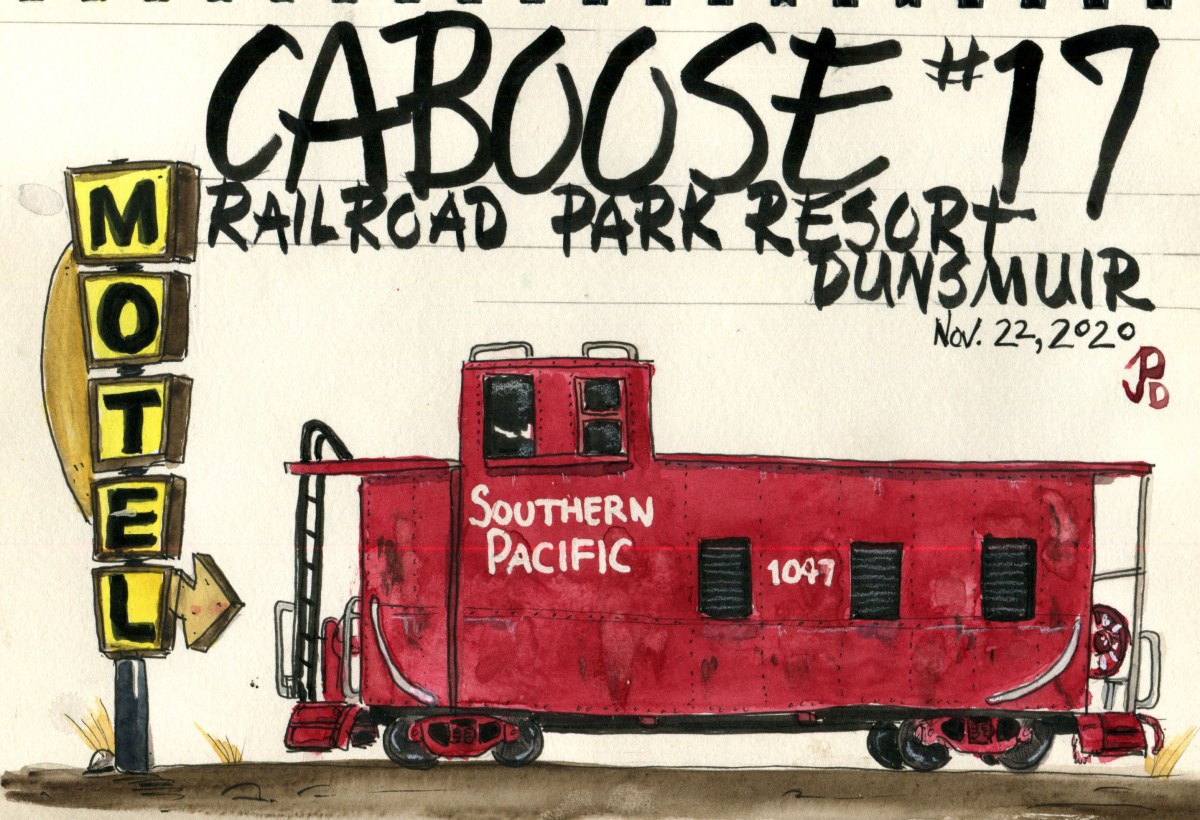
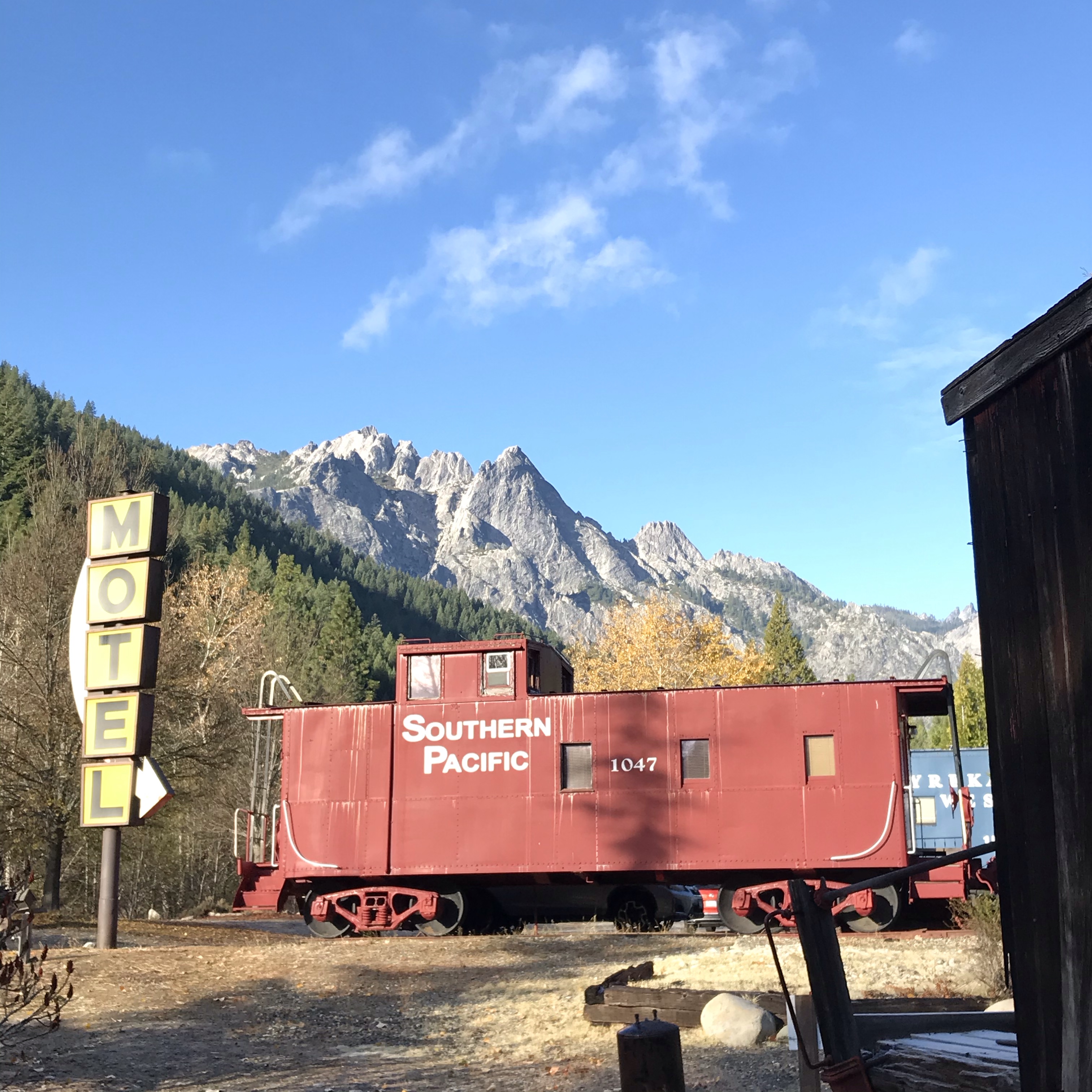
I stayed in a Southern Pacific cupola caboose No. 17 (SP # 1047). This caboose is a class C-40-1 and it was built in 1937 (one of 50 that were built). The caboose arrived at the Railroad Park Resort in the early 1970’s when the interior was remodeled.
This caboose had everything you could ask for in a modern hotel room. The specs of Caboose #17 are: a king sized bed, full bath, refrigerator, microwave, tv (featuring the Resort’s own channel!), an air conditioner (very important on chilly mornings!), and table and chairs. What most hotel rooms lack is a cupola!
The view from the cupola is probably the best out of any of the cabooses at the resort. When looking to the southwest, the rugged peaks of Castle Crags catch the early morning sun.
I put my bags in the caboose, grabbed by sketching bag and chair, and picked my spot to sketch Caboose #17. To the left of the caboose was a sign that proclaimed like a proud exclamation mark: “MOTEL!” with an arrow that shot out of the “L“, pointing to the red caboose as if to proclaim to the unbeliever that, “Yes, you can stay in this caboose!”
A nice way to spend the chilly mornings was to sit in the cupola, with warm coffee, my sketch book and pens. This is s a cupola view of Caboose No. 17. In this view are three other cabooses at the Resort.
Dunsmuir is a railroad town and what better place to spend the night in Dunsmuir than a caboose?
The resort was first envisioned as a railway museum with a collection of rolling sock. The museum idea fell through. In 1968, the original owners, Bill and Delberta Murphy opened the Railroad Park Resort as a railroad-themed hotel with accommodations being in cabooses.
The resort now has 28 different cabooses to stay in and is a rail fan’s paradise. One prominent feature is the 1927 Willamette three-truck Shay logging locomotive on static display. There are only six of these Willamette locomotives in existence.The Shay rests besides a wooden water tower.
The resort also features a restaurant that is housed in three passenger coaches. Dining was closed due to the pandemic but was open for take out with caboose-delivery. I was treated with a tasty ravioli and a Caesar salad.
To represent the Railroad Park Resort in my journal I decided to paint the Shay and the water tower near the entrance to the park (featured sketch). For this approach I pulled up a sketching chair near the soothing water fountain and I decided to block in the shapes of the locomotive and water tower in loose, broad paint strokes. I was not so concerned with fitting the entire locomotive on the page, nor was I interested in rendering every detail. This is the sort of painting that if a bystander where to look over my shoulder, would think I have the artistic talent of a brown trout. But out this spattered chaos, you slowly form the image with pen work, once the paint has dried.
The challenge of drawing a Shay is the complexities of it gears. It you look at it as a whole it is daunting but if you break it down to small, manageable shapes, it is doable.
My caboose for two nights and the epic Castle Crags in the background. (This caboose will feature in a different post).The water tender of the three truck Shay with the water tower in the background.
I headed north out of my caboose digs in Dunsmuir to Highway 88 and the town of McCloud.
McCloud was the epicenter for the logging railroad, the McLoud River Railroad (later to become the McCloud Railroad). Much of the ninety miles of track has now been removed and the railroad bed is slowly being converted into a hiking and biking trail called the Great Shasta Rail Trail.
I wanted to get out on the trail and to see what was left of the railroad; quite a bit as I was soon to find out. One section of the trail that I wanted to visit was east of McCloud near the small collection of buildings at Bartle.
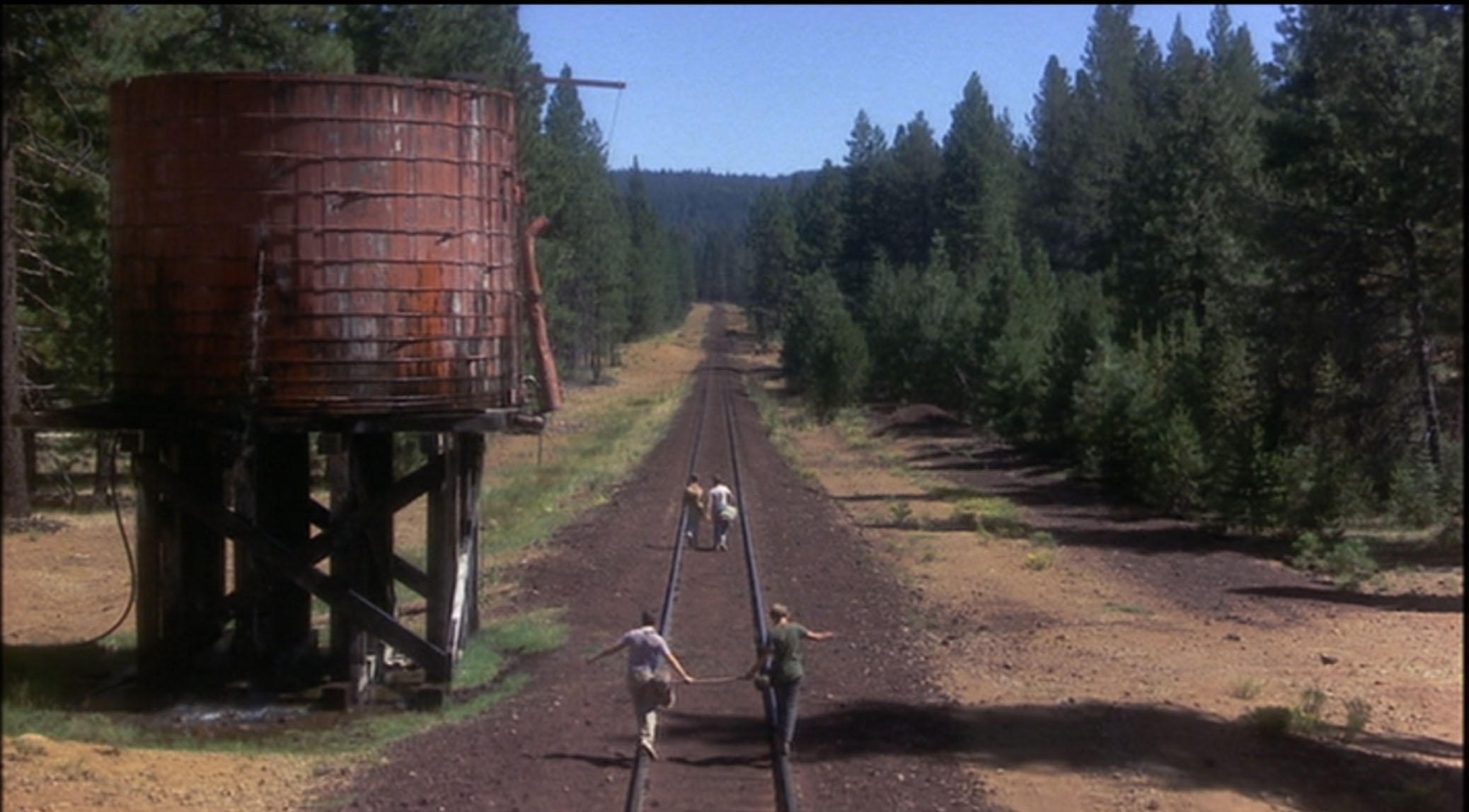
It was here that there was once a 25,000 gallon water tower built in 1933. This tower served as a watering stop for the McCloud’s steam locomotives. The water tower was filmed in a beautiful crane shot in the 1986 film, Stand By Me. In the scene, the four boys are walking east down the railroad and the leaky Bartle water tower is on the left.
The film’s director, Rob Reiner, called this shot “one of my favorites in the whole film.”
Still from Stand By Me (1986) with the water tank at Bartle. The red volcanic rock ballast of the rail bed says, “McCloud River Railroad”.
In 2020, the large water tower is gone, it collapsed in July of 2011. Half of the stand that the tower stood on is still by the side of the former railroad bed. I pulled out my sketching stool and stretched what was left of the tower.
This is all that is left of the 25,000 gallon Bartle Water Tower. The railbed is graded in distinctive red volcanic rock of the McCloud Railroad.
After sketching the remains of the Bartle Water Tower, I headed back along Highway 88 to McCloud. I wanted to see what was left of the McCloud Railroad. The company had abandoned most of it’s tracks by 2006. I had a vague idea that the rail yard was in the northern part of town.
After a search, I came upon a railroad grade crossing. I pulled over and hiked up the tracks and I was unprepared for what I was about to discover.
This was any rail fans’s dream: having an abandoned rail yard all to yourself!
This was the only engine that I was able to find in the McCloud yard. A Baldwin S-12 that the railroad bought new in 1953. It was numbered 30 but now bears the number 203 because it was sold to a railroad in Washington State. It also worked in Pittsburg, Ca at the U.S. Steel Plant before returning to it’s original home in McCloud.Spare rail car wheels in the foreground and freight cars in the background. The 1957 shop building is to the right.This is one of two short length cabooses that was purchased new by the railroad in 1962. Both cabooses numbers 101 and 102 are still in the abandoned railroad yard. I believe this is the caboose that is featured in the famous Lake Britton Bridge scene in Stand By Me.There are still rails left on the McCloud Railroad. This is the set of tracks in Shasta City as it joins the Union Pacific (formerly Southern Pacific) mainline. This is either the beginning or the end of the McCloud River Railroad. Rail still exist from here to McCloud. This section of the track was used by the now defunct Shasta Sunset Dinner Train. There are future plans to use this track for car storage.
A special thanks to railroad author Jeff Moore who helped give me information about the past and present of the McCloud Railroads. I highly recommend his Acadia Publishing book Rails Around McCloud. His website about the McCloud is: http://mccloudriverrailroad.com/index.htm
It was long after dark when we got to Johnson’s Ranch, so the first time I saw it was early in the morning. The weather was fine, the ground was covered with green grass, the birds were singing from the tops of trees, and the journey was over. I could scarcely believe that I was alive.
The scene I saw that morning seems to be photographed on my mind. Most of the incidents are gone from memory, but I can always see the camp near Johnson’s Ranch.
~John Breen, April 24, 1847
John Breen wrote this letter once he had crossed the Sierra Nevada Mountains into the foothills of California as a member of the emigrant group now known as the Donner Party.
Out of the 87 members of this doomed party only 48 survived. Most of the 48 survivors where women and children. Breen and his family were lucky. All of their family members survived.
It is unclear where Breen wrote this well known letter but is was either at Sutter’s Fort (in present day Sacramento) or at Johnson’s Ranch (near Wheatland).
Johnson’s Ranch was the first settlement the emigrants encounter once they entered California on the California Trail. They often paused here after the grueling passage over Donner Summit before heading down to Sutter’s Fort in present day Sacramento. They would camp near the banks of the Bear River.
Once the Breens came into California at Johnson’s Ranch and then Sutter’s Fort, they relocated to the mission town of San Juan Bautista.
Johnson’s Ranch was a Mexican Land Grant that eventually ended up in the hands of Willian Johnson. In 1846 be built a humble adobe house that became known as Johnson’s Rancho.
During the winter of 1847, the seven surviving members of the Forlorn Hope staggered into Johnson’s Ranch. They were a party that set out from Truckee Lake in order to get help for the ill fated Donner Party. The party got lost and of the 17, only seven made it to the ranch. The survivors that made it to included it’s leader William Eddy, and sisters Sarah Fosdick, and Mary Ann Graves.
All of the relief parties that took the remaining survivors from the Lake and Alder Creek Camps back into California, staged and departed from Johnson’s Ranch.
Today the town of Wheatland is near the location of the ranch. Nothing remains of the original ranch. Just California Registered Historical Landmark No. 493. The plaque sits in the town’s park near the railroad tracks. It reads:
The first settlement reached in California by emigrant trains using the Emigrant (‘Donner’) Trail, this was an original part of the 1844 Don Pablo Gutiérrez land grant. It was sold at auction to William Johnson in 1845, and in 1849 part of the ranch was set aside as a government reserve-Camp Far West. In 1866, the town of Wheatland was laid out on a portion of the grant.
One benefit of sheltering in pace and the global pandemic is that it has forced me to walk around my neighborhood (for sanity’s sake).
When you get out in the neighborhood you start to notice details you haven’t seen before. You noticed the little details of houses that before seemed all the same. Details are the route newly noticed.
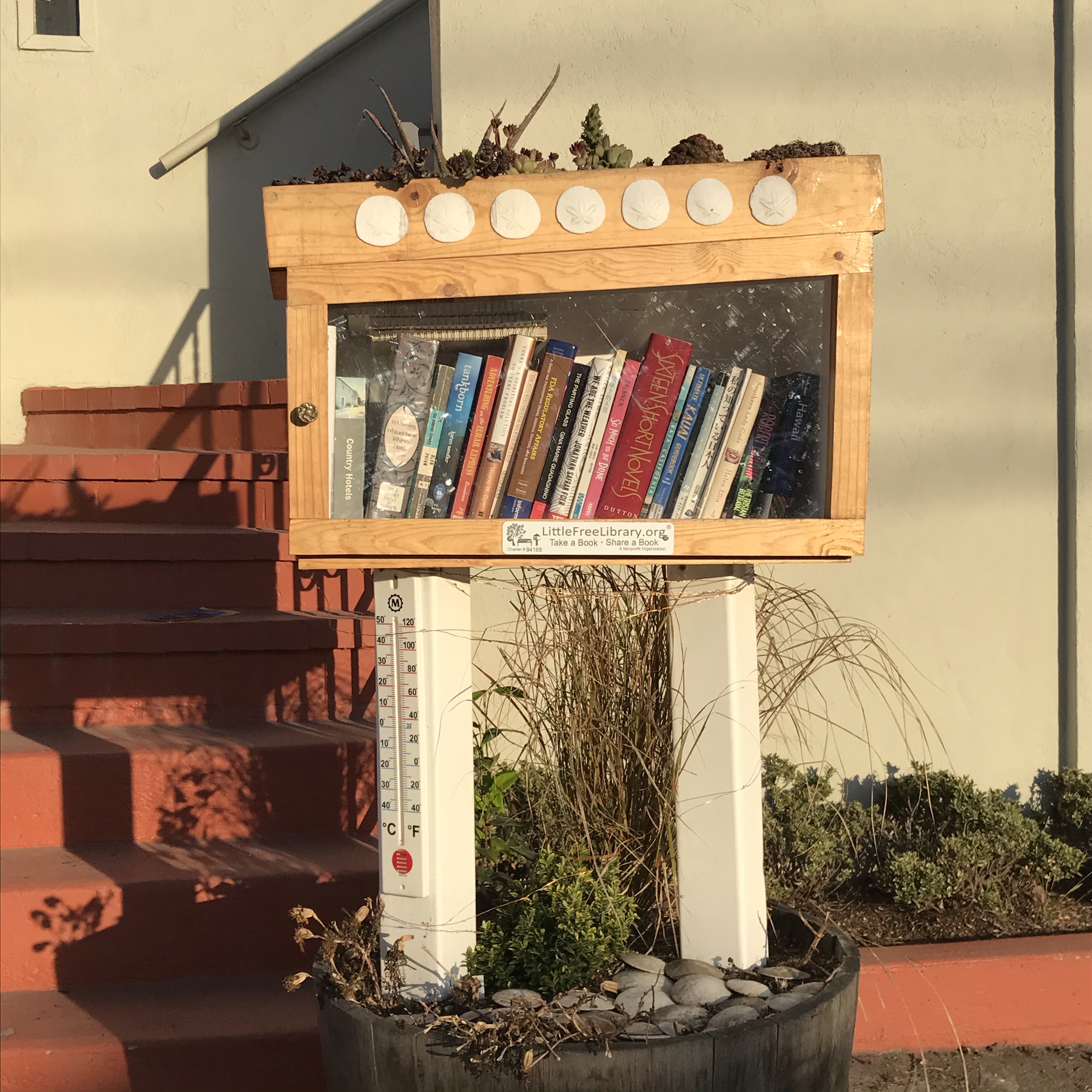
One thing that I have noticed on my walks of San Francisco’s Outer Sunset District is the proliferation of little boxes on wooden poles. These are the little libraries.
The box on top of the pole contains one or two selves lined with books. These boxes are used to take a book or leave a book and they are all free. It seems odd in a city there is actually something free! Well not exactly free. I donated three books:
The Road to Little Dribbling by Bill Bryson (Good but not as good as Notes From a Small Island.)
The Lost City of the Monkey God by Douglas Preston
The Devil’s Highway by Luis Alberto Urrea
The nonprofit company behind these boxes is Little Free Library, a Wisconsin based company that inspired 100,000 boxes (and counting) in 100 countries (and counting).
People can either build their own library of have one pre-made. Once it is installed, usually in the front yard, facing the sidewalk, the library is registered and added to a map so reading in the community know where to find a Little Free Library.
Here’s a two story version on Judah street in front of the St. Paul’s Presbyterian Church and the Far Out West Dune Community Garden.This Little Free Library is a few blocks from Ocean Beach and is topped with succulents and bejeweled with sand dollars. Each of the boxes are as uniques as their owners.
O Mary I have not wrote you half the trouble we have had but I have Wrote you enough to let you know what trouble is. . . Don’t let this letter dishearten anybody never take no cutoffs and hurry along as fast as you can.
-Virginia Reed, letter to her cousin Mary Keyes, May 16, 1847
Once the survivors of the Donner Party made it out of the Sierra Nevada Mountains, they dispersed into the state of California.
One can barely imagine how the horrors of their experience in the Sierra Nevada Mountains stayed with them as then conducted their lives, starting businesses, had families, lived their lives, and died far away from the mountains, settling in to the coastal region of the Golden State.
I headed down to the county of my birth, Santa Clara County, to visit California’s oldest secular cemetery, founded before the Gold Rush in 1847. This is Oak Hill Funeral Home and Memorial Park, southeast of downtown San Jose.
This is the final resting place for ten survivors of the Donner Party. About 20% of the 48 survivors are buried here.
The year 1847 was an important one for the Donner Party. This is the year that the survivors, in five groups, made it out of the jaws of death from the campsites on Donner Lake and Alder Creek to the salvation of the Central Valley at Johnson’s Ranch and then on to Sutter’s Fort.
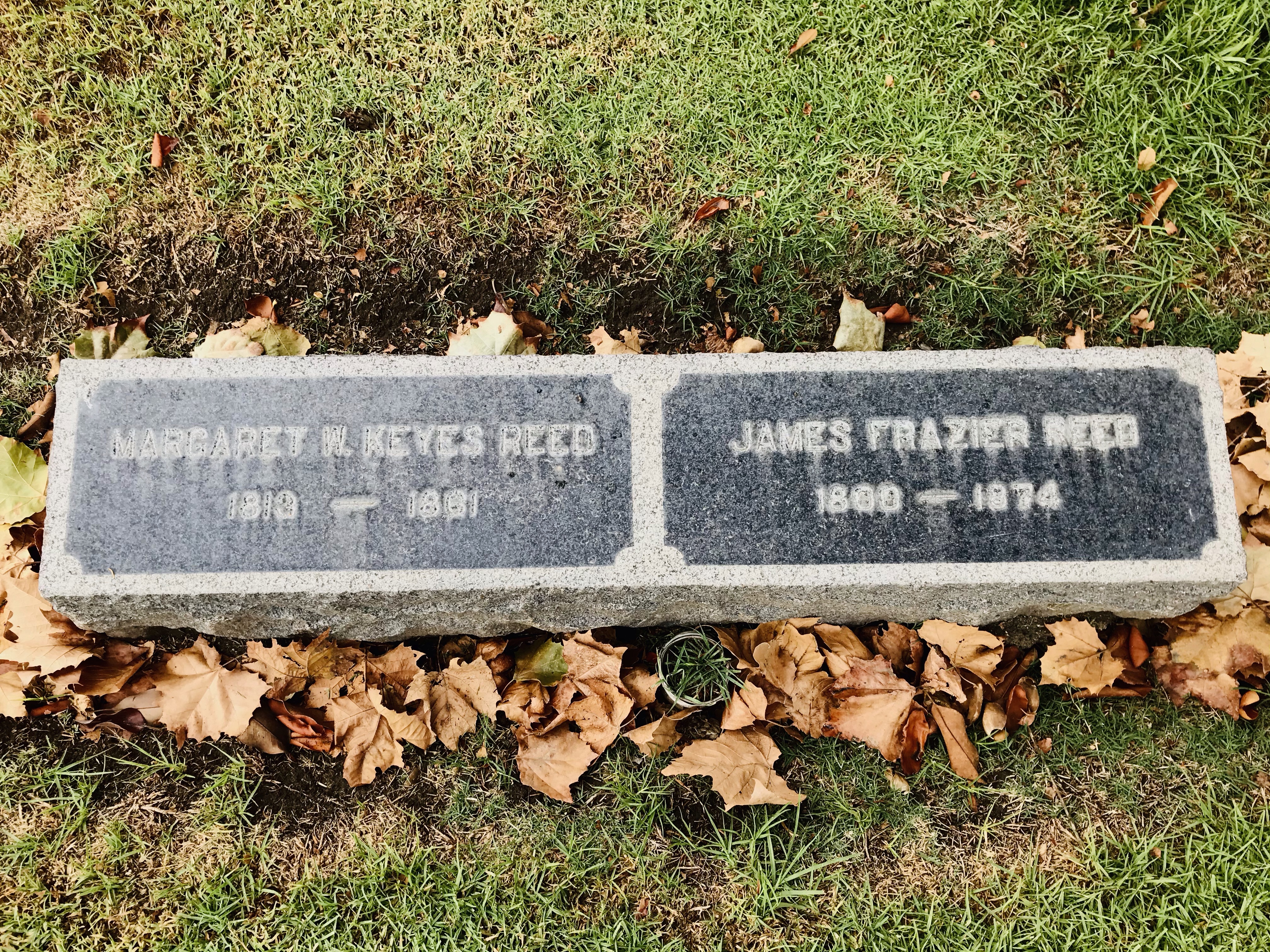
Near the core of the old cemetery is the plot of the Reed and Lewis families in Section D which is now named the “Pioneer” section. Here lies the patriarch of the family James F. Reed and his wife Margaret.
James Reed was one of the leaders of the party and if it hadn’t been for the moment of rage that caused the death of a teamster, stabbed to death by Reed and his subsequent banishment from the party on October 6, 1846, the group might have gone done in history as the Reed Party.
James Reed, because of his banishment, made it over Donner Pass before the historic winter storms of 1846, closed the way to the emigrants. He did return as a member of the second relief party.
The Reed and the Donner families are like a tale of two clans with two different outcomes from their ordeal in the winter of 1846-47. All of the members of the Reed family survived while the Donner family suffered the most out of any family group. All four adults and four children perished.
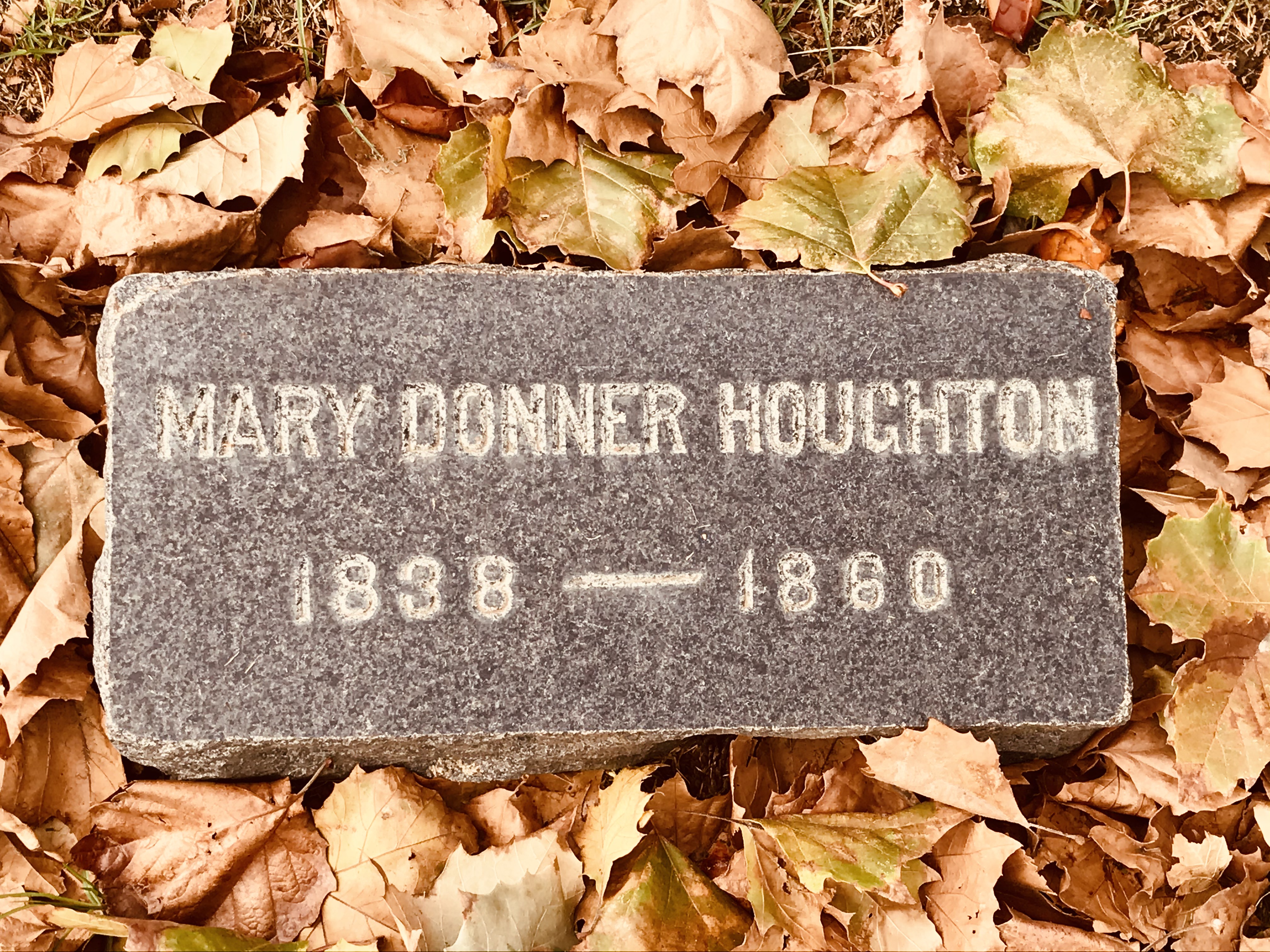
This is the grave of Martha Jane Reed Lewis. To history, she is known as Patty Reed and the story of the doll she kept hidden throughout her ordeal in the mountains has become part of the Donner Party legend. Patty Reed’s Doll is now on display at Sutter’s Fort. Patty Reed did much to keep the plight of the Donner Party in the Nation’s mind. On June 6, 1918, Patty attended the dedication of the Pioneer Monument with her step sister Virginia Reed Murphy at eastern end of Donner Lake.Mary Donner was the orphan of Jacob and Elizabeth Donner. She was seven years old during the horrifying winter of 1846-47. I was puzzled because she was buried in the Reed family plot. Then after further research, I learned that she had been adopted by James Reed and spend her time in San Jose where she died in 1860, aged just 22.
After visiting the graves of the Reeds and Donners I crossed the street into Section C looking for the grave of another Donner Party survivor. I looked at my map and his grave was marked as Historical Points of Interest Number 2.
Who knew finding a grave could to so difficult (I was really about to find out a little later in the morning)? There are 15,000 souls interred here, so it could be like finding the proverbial needle in the haystack. I wanted to find the grave of William Henry Eddy, the “leader” of the third attempt to escape from Donner Lake to get help from Sutter’s Fort. This party of 15 was later called “The Forlorn Hope”.
On December 16, 1846 the Forlorn Hope set out from Truckee Lake (now named Donner Lake) and headed toward the summit (now named Donner Summit). The party started off as 15 and when they made it to Johnson’s Ranch there were just seven of them alive. Willian Eddy was one of two male surviors.
After an exhausted search I finally found Eddy’s unique gate, which was almost eclipsed by a larger headstone. Eddy’s grave is unique because it consists of a rock and a round, coin-like relief portrait of Eddy. A small plaque under the portrait reads: “HE LED THE FORLORN HOPE OF THE DONNER PARTY. DEDICATED MEMORIAL DAY 1949 BY THE ANCIENT & HONORABLE ORDER OF E CLAMPUS VITUS”.
I set up my sketching stool and put down the line work of Eddy’s grave. I then added some watercolor.
Eddy left his wife and two children to head over the summit to find help. When he later returned to the lake camp as a member of one of the relief parties, he learned he was the only member of his family still alive.
I had one more Donner Party grave to find and this one proved to be the most elusive. This is the grave of Virginia Reed, James Reed’s oldest stepdaughter (she was Margaret Reed’s daughter from her first marriage). She was 13 in 1846. She was at the dedication of the Pioneer Monument with her stepsister and she had written a recollection of her experience as a member of the Donner Party and had written the very well known and often quoted letter that is quoted at the top of the blog.
I had the location of her grave: Section D, Block 26, Lot 2, Grave 2. I thought this would be easy as I walked up the road. There was a buddhist funeral ceremony going on in Section B. The chimes that rang out and the chanting reminding me that this was still very much an active cemetery.
Section D had a lot of newer graves that were opulent and ostentatious, unlike the simple markers I had seen of the members of the Donner Party. I searched Section D until it turned into Section N. Then I checked my map and headed back toward Section D. In the middle of this section five guys in lawn chairs seemed to be having a tailgate party. This was very much an active and alive cemetery.
I retraced my steps again with no luck. I must have looked lost as I wandered with frustrated intent, map in hand, that I attracted a groundskeeper who pulled up in his truck and asked if I needed help.
I told him I was looking for Section D, Block 26, Lot 2, Grave 2. Her name was Virginia Reed Murphy. He told me it was back the other way near the corner. He would drive around and meet me there.
I guess he assumed I was a member of the family looking for a great great great grandmother. I walked with intent back the way I came, the chimes and chants to my left and turned right on Observatory Avenue. The groundskeeper had just pulled up in his work truck.
He pointed to a plot. To the left was a humble marker for Murphy and to the right was a fallen headstone. In between was green grass. Virginia Reed’s grave was nowhere to be seen. My search had ended in a dead end (pun intended).
“Sometimes the markers get covered up,” the groundskeeper remarked as he headed to the truck and returned with a shovel! He started poking around with the tip of the spade and he he hit upon resistance. “Here it is.” And he dug in. I advised, half jokingly, not to dig too deep.
What followed was one of those moments of miracle and wonder. A moment that is stranger that fiction.
Under five to six inches of sod and grass emerged a marker. Through the thin layers of dirt I could read the markers simple inscription: VIRGINIA REED MURPHY.
No one was here to care for her grave. All her children and grandchildren were long gone and buried. But then came along a fourth grade teacher with a passion for California history.
Here was my small gift to those who cared to look for the grave of a Donner Party survivor. Her grave must have been covered up for years and I wondered about those who had searched in vain for Virginia Reed’s grave, eventually giving up. Now, as if a historical treasure had been unearthed, as indeed it had, it was here again to be seen; To help along what Patty Reed started, that the struggles and tragedies but also the resilience and successes of the Donner Party be remembered for all generations.
“never take no cutoffs and hurry along as fast as you can.”