Image

Mendocino Coast

The Mendocino County Coast is a sketcher’s paradise with many interesting buildings, coastal views, and flora and fauna (who doesn’t love sketching coast redwoods?).

I have sketched many buildings in and around Mendocino and there are infinite subjects to sketch in this area.

In Ft. Bragg I walked out to Glass Beach. The rock formations appealed to me and I did a loose brush pen sketch from my folding sketcher’s chair (featured sketch). Sketching these rocks was recording a moment in time because the sea coast is always in a state of flux. Rocks crumble and reform, arcs collapse and the unrelenting tide shape and sculpt the coastline.

There seemed to be more common ravens in Ft. Bragg the I remember before. These very intelligent and adaptable birds have been expanding their range along the coast. As I was sketching I was watching these large corvids (the world’s largest songbirds) foraging among the rocks and seaweed like a black oystercatcher. I even slipped one in on my sketch.

I headed south to the scenic and historic town of Mendocino. Here a had a building in mind that I wanted to sketch. This building was built in 1901 by Portuguese settlers and as it turns out, it is the largest hall in the town of Mendocino. This is Crown Hall.

Crown Hall is on a side street (Ukiah Street) that parallels Main Street. The hall can be rented out for weddings and other events. The building features a kitchen, a bar, and a stage.
The stage is what really attracted me to doing a sketch of Crown Hall. This was a venue used by a legendary Northern California folksinger, Kate Wolf. She preformed at various locations in Mendocino and the last Kate Wolf recording released, Live in Mendocino, features live recordings from concerts in Mendocino County, including a concert at Crown Hall in 1982.

Kate Wolf was born in San Francisco in January 27, 1942. When Kate was 27, she visited Big Sur and heard locals playing music in their living rooms. So inspired, she moved to Sonoma County and stared writing and performing music in local bars.

Kate’s following grew in the 1980’s and she performed all around the Golden State and was even featured on the music show, “Austin City Limits” and on the radio show “A Prairie Home Companion”. In 1981, Kate released “Closer to You”, which is probably her best album featuring her own compositions. In 1983 she release the live album “Give Yourself to Love”, the title track becoming one of Kate’s most well known songs.

Sadly, Kate Wolf died at the age of 44 on December 10, 1986 after a long battle with leukemia. In her honor, the Kate Wolf Music Festival was held in June of 1996 in Sebastopol. Since 2001 it has been held at Black Oak Ranch in Laytonville, ca. The three or four day music festival traditionally ends with a cover of “Give Yourself to Love”

I included the first verse and chorus of this song to my sketch.

Image

California Western Railroad: The Skunk Train

For my second road trip of the summer, I chose my base camp: Fort Bragg on the Mendocino County Coast. I knew that one adventure I wanted to experience was a ride on the Famous California Western Railroad, also known as the Skunk Train.

The Skunk Train runs from Ft. Bragg to Willits, a train journey of 40 miles. A round trip of seven hours. The former logging railroad crossed 30 bridges and trestles and travels through two long tunnels.

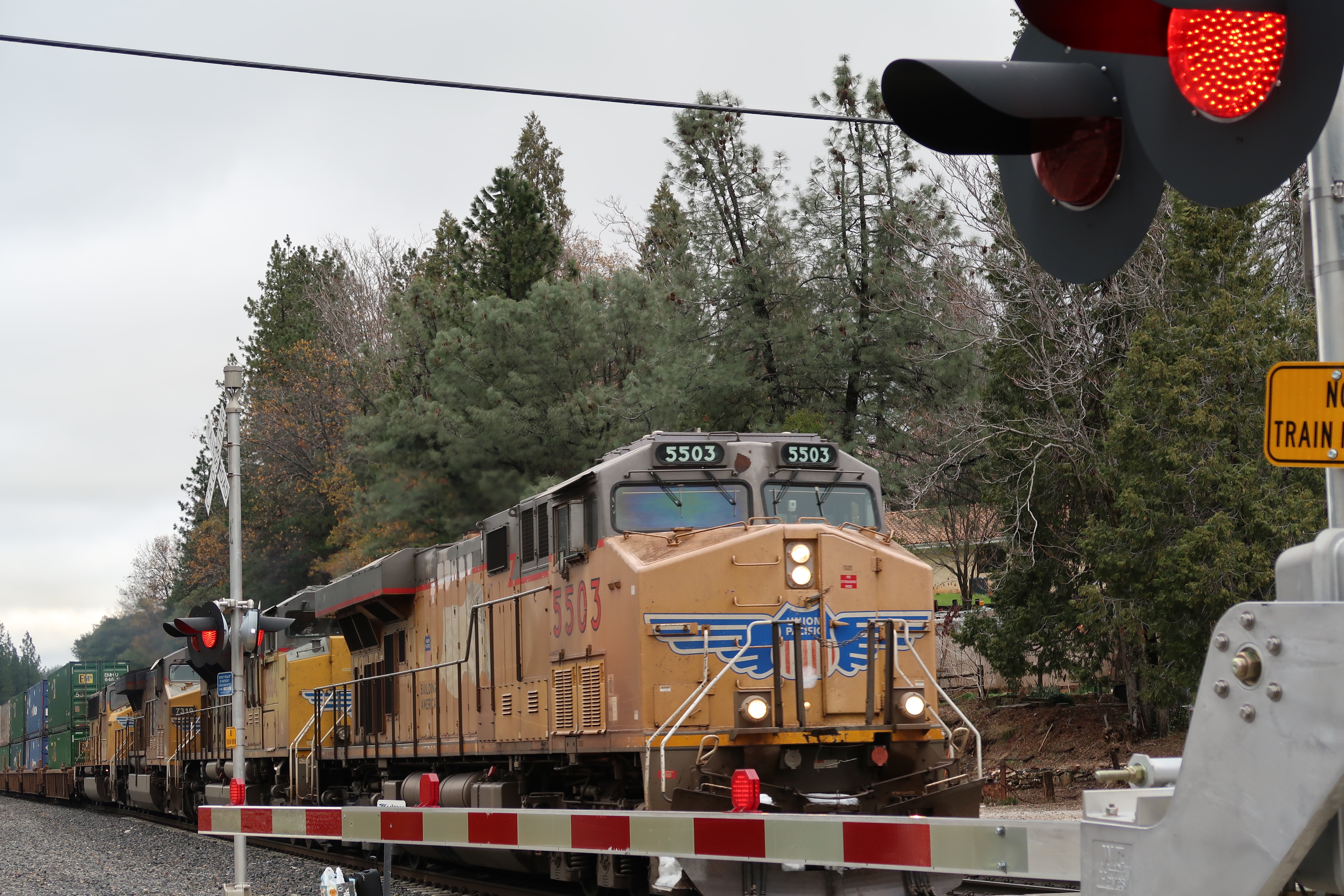
The Skunk at Ft. Bragg. The water tower is for No. 45, a Mikado steam locomotive. Our train (No. 65) was pulled by a former Southern Pacific GP9 diesel built in 1955 by EMD.

The Skunk is a poor reflection of its former self because of the April 11, 2013 partial collapse of the 1,200 foot Tunnel No. 1. The tunnel was built in 1893 and it is in an area known for hill slides. This means that the Skunk Train only runs from Ft. Bragg to Glen Blair Junction, a distance of 3.5 miles. It seems like just when the train gets going, it stops 30 minutes later.

The railroad has also been without an operable steam locomotive. The 2-8-2 No. 45, was built by Baldwin Locomotive Works in 1924. The locomotive is currently being restored and may be once again under steam in the upcoming year.

The end of the line, for now. Plans are underway to open the line in about a year. In the background is the western portal of collapsed Tunnel No. 1.

It is a pleasant ride on the “Pudding Creek Express”, although “express” is hyperbole of the highest order! I chose to get out and explore the area and then catch the second train back to Ft. Bragg. There are a few hiking trails and I hoped to get in a few sketches before the train returned, so I had time to sketch and paint and had extra time to let the paint dry!

I started by sketching the caved in western portal of Tunnel No. 1. The tracks were covered in dirt and rocks filled the entrance. Vegetation was growing up, almost threatening to cover the portal. A train has not passed through here in almost eight years. A maintenance worker told me that they hoped to have the tunnel open in about a year. I’m not sure they could move a mountain but I’m sure that have the funds and the manpower to clear a tunnel.

Motor car M-100 at Willits, facing west towards Ft. Bragg.

On the following day, on a flight of fancy, I decided to drive to Willits to see the eastern end of the line. From Coastal Ft. Bragg to Willits was about an hour with temperature difference of about 30 degrees! I pulled up to the beautiful redwood station in time to see the eastern Skunk pull into the station. The Willits train is a two hour,16 mile, round trip. This trips travels to the highest point on the line (1,740 feet) and travels past the “”Wolf Tree”, a large coast redwood.

The line at Willits is isolated from the Ft. Bragg side of the railroad because of the collapse of Tunnel No. 1 so what ever motive power and cars are what ever was here, prior to April 11, 2013.

On the Ft. Bragg side of the line sits the Motor car M-300 (sketched in the featured sketch). These gas powered cars where used for passenger service in 1925. These motor cars gave the railroad it’s name, because the locals named the cars “skunks” because, “you can smell ’em before you can see ’em.”

The M-100, which is on a siding in Willits, was built by the Edwards Rail Car Company in 1925. It is still operable and used when ridership is down instead of using a diesel with passenger cars.

Image

Truckee’s Rocking Stone

When I was a kid, I remember my father taking my brother and I to see one of the big tourist sites of the Sierra Nevada town of Truckee: the famed Rocking Stone. If you visit Truckee’s Rocking Stone today, you are most likely to have the stone to yourself (sharing it with the local pigeons). The Rocking Stone was a much bigger attraction when it actually rocked. The once perfectly balanced rock stopped rocking, according to the E Clampus Vitus plaque: “The perfectly balanced stone, until recently would rock at the touch of a finger.” The plaque was dedicated on July 15, 1967! It’s hard to tell when “recently” really was.

The 17 ton Rocking Stone sits atop a much larger stone is believed to be a glacial erratic. Once the glacier retreated, the stone was left perfectly balanced, until recently.

I have always loved such historical roadside oddities; Especially when they are often times so underwhelming. The Rocking Stone proclaims that something once, very amazing, happened here. (Please use your imagination).

An early entrepreneur, C.F. McGlashan, built a tower around the rock in 1865. Also displayed with the stone were some artifacts from the Donner Party, and McGlashan’s own butterfly collection. Oh to have a time machine! This is site was also an overnight stop for the Olympic Torch during the winter games in 1960.

McGlashan’s nearby house and 1895 pavilion have since burned down.

Image

Union Pacific’s Steam Shop, Cheyenne, Wy

One of the holy sites to steam locomotives in the United States is the Union Pacific Steam Shop in Cheyenne, Wyoming. This is a building where Union Pacific’s legacy steam locomotives are stored and maintained (and in one case fully restored).

It’s most notable locomotive is the FEF-3 4-8-4 Northern locomotive #844 know to many fans across the world as the “Living Legend”. 844 is notable because it had never been retired since she was built in December of 1944. UP had keep 844 running as an ambassador for the company. As the 150th anniversary of the completion of the first Transcontinental Railroad neared, (where the Central Pacific and the Union Pacific met at Promontory Summit in Utah) Union Pacific had plans, big plans!

They chose the ambitious task of restoring to full operation one of the largest examples of a steam locomotive ever built, the 4-8-8-4 Wasatch type, known to rail fans as the Big Boy. 25 of these massive locomotives were built for the Union Pacific to tackle the the grades between Cheyenne, Wy and Ogden, Ut. There are eight Big Boys still in existence, all on static display, until now.

The steam crew looked at all of the existing Big Boys and decided that #4014, which was on display in the RailGiants Museum in Pomona, California, was the best candidate for restoration. 4014 had been retired in December of 1961 after logging 1,031,205 miles while in service.

The Big Boy was moved, by rail, from California to the Steam Shop in Cheyenne. From 2016 to 2019, 4014 was restored at the Steam Shop and had her first “maiden” run after six decades on May 4, 2019.

So here I stood on the walkway of Highway 180, which spans the tracks and yard in Cheyenne, looking down at the Steam Shop, hoping to get a glimpse of the recently restored monster. Three and a half bay doors were open. In one stood the Living Legend herself, 844!

What’s behind Door Number 3?

I later returned to find that the last bay door was fully opened, revealing the tender of Big Boy 4014! Well her backside will have to do.

Outside of the bay door where 4014 was stabled, there was an extra tender coupled to a UP EMD #4015. It looked like some crew members where making some adjustment to the tender. I didn’t know it at the time but this was a sign that 4014 was soon to be on the move. Two days later, 4014 and it diesel/electric helper an SD70M #4015 indeed were on the move as the crew took the Big Boy out on an unannounced test run from Cheyenne to Denver on July 8 and 9th. This was a test run for the month-long, multi-state tour that 4014 would begin on August 5.

It was hard to believe that I was so close to seeing 4014 in action but had no idea until after the fact, that the Big Boy was strutting out on the mainline. “Ugg!” As Charlie Brown would say.

The tender of 4014. The man in the foreground is 4014’s engineer and director of the Steam Program, Ed Dickens. This feels like a bit of a paparazzi shot. Oh, not for Ed but 4014!
Cheyenne is a trainspotter’s paradise with 80 trains passing through every day like this eastbound freight.
Image

The Lifer That Looks Like a Rock

We had missed the all-white-bird-in-an-all-whire-landscape on April 5 and I was back in July at 11,600 feet to find the master of camouflage, the white-tailed ptarmigan.

This bird encounter in Rocky Mountain National Park in Colorado was to be one of my most memorable and perhaps my most personal.

We headed out on the Medicine Bow Bend trail under clear skies. The air was a bit thin for a sea leveler of the Coast Range like me but the air was not as thin as birding in the Andes at 13,000 feet looking for Andean condor.

We were in the Alpine Tundra of the high Rocky Mountains, above tree level where all flora had a stunted necessity because of the extreme conditions of high elevations coupled with a very short growing season.

We were ten minutes into our search along the trail when we heard the “ku-kurii” call somewhere upslope.

“Ptarmigan!” Carl said with joy mixed with relief.

All eyes scanned the slope, where a ptarmigan can very much resemble a small rock in an environment strewn with small rocks!

Near the top of the ridge, Carl spotted a male ptarmigan, that looked very much like a rock. We trekked upslope to get a closer look. As it turns out, white-tailed ptarmigan are not so wary of humans, despite the fact that they are hunted as a game bird, but not here in Rocky Mountain N. P.

The ptarmigan flew downslope, revealing it’s all white wings. We all got eyes on it and then it promptly disappeared. Carl headed upslope in a round about manner but he couldn’t find the master of disguises. I scampered up to Carl’s position and scanned downslope only to find that Carl had walked right past him. The ptarmigan was sitting right next to a rock, looking very much like a rock.

This male ptarmigan was banded on both of it’s feathered feet that bore the number 47.

The male white-tailed ptarmigan (on the left) and a rock on the right.

I pulled out my sketchbook and we where close enough for me to get a quick sketch in.

We laid low and got amazing looks at the male, #47 by it’s leg bands. He was not focused on us, although we were very much focused on him, but his attention was drawn downslope. Soon the call of another male just down slope told us that we where at the border of a bird dispute where two territories come together.

A male from downslope flew up to where our bird was perched. What followed was a short flighted chase. The male ptarmigans land and both birds faced each other and boxed with their white wings. After the short conflict, the invading male turned tail, and flew back downslope to his territory.

Here is a picture of Corvidsketcher sketching the featured sketch.
A male is his territory. Note the feathered feet, represented in the genius of the species Lagopus (feathered feet) and he’s sporting jewelry, two leg bands that identifies this male as “47”.

Image

Ogden’s Union Station

One of the places I wanted to visit on my Trails, Roads & Rails Roadtrip was Ogden’s Union Station. Ogden, Utah is at an important point where the Central Pacific (later to become the Southern Pacific) and the Union Pacific met. There are many other “Union” stations in the United States and it is an indicator that more that one railroad used the building as a passenger station. In Salt Lake City, for example, Union Pacific and the Rio Grande have separate stations (both are no longer used as station but the building still stand). Unfortunately, Ogden’s Union Station is no longer in service as a passenger station.

But the good news is that the building still stands and contains a cowboy, gun, art, and railroad museum. What they have outside is what really attracted me to Ogden: the locomotives and rails cars on static display! Because they were static and not going anywhere, anytime soon, made them great subjects for my sketch books.

When I arrived in Ogden on July 4, the museum was closed but this didn’t stop me from doing my first sketch of Union Pacific’s passenger locomotive, a 4-8-4 FEF-2 # 833 (a sister to the more well known #844) and UP DD40X “Centennial” #6916 (featured sketch). I set up my sketching chair in the shade provided by Union Station and sketched these two locomotives. #6916 is one of the “Centennial” class and is the largest and most powerful diesel/electric locomotive ever produced. UP always does everything a bit bigger to tackle the steep grades on it’s network, like the Wasatch Range from Ogden to Green River, Wyoming.

I have posted some of the other sketches from my time at Union Station. I returned on another day when the museums were open.

Above is a field sketch of the front of a Southern Pacific SD-45 #7457. Southern Pacific will always have a special place in my heart because this was the most likely livery to be seen where I grew up in the Bay Area. This paint scheme is known as the “Bloody Nose” livery because of it’s red front. #7457 worked from Ogden into California, pulling freight over the fabled Donner Pass.

Keeping with Union Pacific’s mantra “bigger is better” I sketched the Super Gas Turbine locomotive #26. This locomotive is basically a jet engine on rails and is also known as the “Big Blow” for the loud noise it generated in operation. This was the class that was designed to replace the world’s largest steam locomotive, UP’s Big Boy. Union Pacific owned 55 of these locomotives, the only railroad in the country to own and operate these powerful beasts. Thirty locomotives (Numbers 1-30) where ordered from 1958 to 1961. These were the most powerful locomotives ever produced, generating 8,500 horsepower! That much horsepower also means an excessive amount of fuel to operate and they were last used in 1970. Number 26 is one of only two of these powerful locomotives to survive.

This field sketch is of the running gear of a class of successful passenger locomotives. Union Pacific FEF-2 #833 is the sister to the Living Legend, 844. 844 was the last steam locomotive purchased by Union Pacific and it is also notable as having never been retired from UP’s roster. Number 833 was put on display in a park in Salt Lake City and it was purchased by the Ogden Railroad Museum and it is the largest locomotive ever transported by truck.

Image

Sacred Sites the Union Pacific: Wyoming

On my journey from California to Colorado, I had a few historic sights I wanted to sketch along Highway 80 in Wyoming. This is Union Pacific territory, and the route over the Wasatch Mountains from Ogden Utah to Green River is legendary.

The Evanston Roundhouse and the Ames Monument are relics from a different time. The roundhouse was of a time when steam was the prime motive power of the Union Pacific and the monument the Ames brothers at Sherman Summit is no longer near the mainline (the line is now three miles to the south).

The Evanston Roundhouse is notable because it is the last completely intact roundhouse left on the Union Pacific line from Sacramento to Omaha. It had 28 stalls and is 80 feet high.

The roundhouse at Evanston on the left and the powerhouse on the right. The rusted, overgrown tracks in the foreground tells us that this complex has not been used by Union Pacific for a long time. I had to walk a ways back to photograph the whole massive roundhouse.

The roundhouse and yard was build by UP from 1912 to 1914. The roundhouse was part of a 27 acre complex to service steam locomotives. When steam locomotives became more efficient, they did not need to make so many service stops and the yard at Evanston was often bypassed. The Union Pacific deeded the property to the City of Evanston. The roundhouse is now used as a conference center and a meeting place.

Standing before the red brick semicircular roundhouse reminded me of a Plaza de Toros in Spain. Looking at just one part of the structure gives no indication of it’s form. I sketched one side of the roundhouse with the roofline slowing curving around (featured sketch). To see the entirety of the roundhouse, one has to walk back from the roundhouse by at least 100 yards to take it all in.

An intermodal freight passing through Evanston. The two locomotives on point represent the Transcontinental Railroad. The Union Pacific is pointed east towards Cheyenne and behind # 8990 is a former Southern Pacific locomotive (representing the Central Pacific) facing west toward Sacramento.

The next Union Pacific site is to be found off Highway 80 near the town of Buford (population 1). This is a monument to two brothers who were essential in creating the Union Pacific side of the Transcontinental Railroad.

The Ames Monument was built by the Union Pacific and dedicated to the brothers Oakes and Oliver Ames. It marked the highest point on the original Transcontinental Railroad at Sherman Summit at 8,247 feet. Oliver was one of the first presidents of the Union Pacific Railroad (from 1866-1871) and his brother Oakes was a U.S. Representative from Massachusetts. Both brothers, at the request of Lincoln, were put in charge of financing and building the Union Pacific portion of the railroad. Without the contribution of the Ames brothers, the railroad might never have been completed.

The 60 foot pyramid was build in 1880-1882 of granite at the cost of $64,000. On two side are base-relief portraits of each brother. In 1901, Union Pacific rerouted the mainline a few miles to the south.

On my first attempt to sketch the Ames Monument, a thunderstorm rolled in from the west. This monument being 60 feet high and at one of the highest points on the original Transcontinental Railroad, I though it would be wise to head to my car and return in the morning!
Image

The Much Sought After Non-Native: Himalayan Snowcock

4:25 AM, Island Lake Trailhead, Ruby Mountains, Nevada.

Himalayan Snowcock. This introduced game bird is legendarily very hard to add to you ABA life list. Partly because it has an extremely small range in the Ruby Mountains in northeastern Nevada. It is also very skittish because, well, it’s a game bird after all. The snowcock, a native of southern Asia, was introduced in the Ruby Mountains in the 1963 and has a sustained breeding population.

To add this bird to your list you have to put in some sweat equity or have a ton of money (like the Steve Martin character in The Big Year, who hires a helicopter to see this bird!)

To see this bird with sweat and effort takes a two mile hike up the Island Lake Trail. From the trailhead to the lake is an elevation gain of about 1,000 feet and features many switchbacks.

The beginning of all things snowcock, the trail head for Island Lake. (This photo was taken on my return journey.)

What makes this trail perhaps a little bit more challenging is that most of the hike is done in darkness. The snowcock begins calling at about 5:45 AM and I planned to be in place by 5:30 to listen for and scan the ridges for snowcock. They seem to be harder to find later in the morning and in the afternoon.

And so I found myself, after a restless night of sleep, at the Island Lake Trailhead at 4:25 AM. On my forehead was the 400 Lumen Black Diamond Storm headlamp and on my back was an unwelding backpack with my scope, tripod, bins, camera, and sketchbook. In my hands where trekking poles to help with balance and pace and to fend off mountains lions or bears.

The headlamp provided a great pool of light to see the trail ahead. I turned my beam downslope and I picked up eyeshine. I boosted the power and was relieved to see that it was just a deer. Wait, where there is deer, there is mountain lion!!

About 15 minutes into my assent I came to the first switchback. Even in the glow of my headlamp I could see the trail was surrounded by wildflowers. I was looking forward to my return journey in morning light, hopefully with snowcock in the bag.

By the time I reached the wooden bridge across the falls, I was at the halfway point of the accent. At this point it was light enough to see and I stowed my headlamp. Here is where the switchbacks begin in earnest.

After a while I lost count of how many times the trail switched back on itself but I finally saw the ridge line in the half light and I knew I was near the end of the trail at Island Lake.

At the lake the trail forked and I headed to the right and soon the scrabble up to the northwest was to begin. This is where having trekking poles pays off. I headed up to one of the last group of trees, near a creek and I found a boulder seat to set up my scope and scan the ridges. It was now 5:30 AM.

A scope view from my position and the ridges that I would hopefully see this tough ABA lifer.

Now was the waiting time. Other reports had snowcocks calling from the ridge at 5:45. It was just a matter of time. But I also knew that snowcock is not always a given. Part of the unsigned agreement with the Birding Gods is that the more effort you put into seeing a bird does not guarantee seeing the bird.

At 5:55 AM I heard the far off bugle of a snowcock! The call in reminiscent of an elk bugle. I scanned the ridges with my scope to look for a bird silhouetted against the sky. At 6 AM I spotted the snowcock! I had the bird in view for about ten minutes and I was able get some far off photos to document the sighting.

A snowcock calling on the ridge!! All my effort had paid off!

The snowcock moved up slope and then dropped down on my side of the ridge where it disappeared amongst the rock. I pulled out my panoramic sketchbook and sketch the jagged ridge line of the Ruby Mountains and I drew in an arrow where I had first seen the Himalayan snowcock.

What a great experience with a much sought after ABA bird. Any lister wants this bird on their list and it is only found in one place in the United States. It was well worth the effort and the scenery and the return hike amongst the high elevation wildflowers was a nice coda.

Image

Flexing my Sketching Muscles

Before I headed out on my Trails, Roads & Rails Roadtrip I wanted to get into sketching shape. To do this I made it my daily practice to do a sketch in and around Santa Cruz.

Each sketch took no longer than 15 minutes and I chose subjects that would force me to take a complicated subject and simplify it into a quick sketch. Some of my subjects were architecture, trees and foliage, marine mammal anatomy, and old brickwork. I figured that this range of subjects would give we practice for some of the subjects I would be encountering on my trip along Highway 80.

I combined these short sketches with hikes in order to get into birding shape to search for the Himalayan snowcock, which required an early morning two mile hike to get to it’s alpine territory in the Ruby Mountains.

Architecture: Holy Cross Church, Santa Cruz.

For this sketch I wanted to make sure I was getting my angles and perspective right so I held out my pencil at arms length to take measurements and transferred these “measurements” to my journal. Because it was architecture, I worked in pencil to make sure the sketch held together. I was then was freed up to work in pen to capture the backside of Santa Cruz’s namesake church. Then I added watercolor washes and within 20 minutes, I had a sketch.

Lime Kilns, Pogonip. (Featured sketch)

After a hike up the Spring Trail at Pogonip Open Space Preserve, I turned off the trail to head up to the abandoned lime kilns. After timber, producing lime for building was Santa Cruz County’s biggest industry in the 20th Century. There were a few signs of this history at Pogonip but there was none better than these kilns.

For this sketch, I worked in pen and I used a bit of sketcher’s license on this one. In reality the ferns in the center were higher up but I though of this quick sketch as capturing little vignettes or details of the kiln, ferns, and brick work. All these details, when put together, tell the story in representing the lime kilns.

River Sycamore, Paradise Park.

I walked by the sycamore many times on my walks on Washington Way. I thought this grand, old tree would make a good subject for a quick sketch. Working on this sketch had a very organic feel, no pun intended, as I captured the shape of the limbs and let them lead off the page. I only worked in pen on this one.

I have sketched redwood, the most dominate tree in Paradise Park, many times so working on a sycamore just helped me understand the tree just a little bit more.

Image

Trails, Roads, & Rails

“The landscape of the American West has to to be seen to be believed, and has to be believed to be seen.” -N. Scott Momaday

I have many summer memories of road trips across the West.

Often our family trips were to the north through Oregon, Washington, and dipping into southern British Colombia. On another road trip we visited Monument Valley, the incredible Grand Canyon, and the underwhelming Four Corners in our Volkswagon Vanagon. On the same trip we rode on one of the United States’ most famous railroads, the Durango and Silverton Narrow Gauge Railroad.

To celebrate summer and the purchase of a new car (a 2021 Subaru Crosstrek Sport), I decided to take a road trip in the West. My intended destinations reflect my many interests.

My new Adventure-Mobile.

For birds I intend to visit the Ruby Mountains in Nevada for the legendary lifer Himalayan snowcock and Rocky Mountain National Park in Colorado for white-tailed ptarmigan and broad-tailed hummingbird. For history I want to visit Fort Bridger in Wyoming, parts of the Hasting’s Cut-off in Utah, and the California Gull Monument in Salt Lake City. For rail history I planned to visit the Ames Monument in Buford Wyoming, Union Station at Ogden, Utah, and the ground zero of Union Pacific’s steam program, Cheyenne.

For roughly 1,000 miles I would be traveling east on Highway 80. Like the Transcontinental Railroad before it, I-80 is an east-west transcontinental highway. At 2,899 miles it is the second longest highway in the United States, after I-90. The highway was created in 1956 as part of the original interstate highway system.

As I do before any important journey I sketch out the route. In this case I chose to represent the map as a distressed treasure map or perhaps a map to a secret goldmine, like Dr. Buckbee’s map in the Gold Rush classic By the Great Horn Spoon.

I have been a big fan of Stillman & Birn sketchbooks and I love the heavy weight of the cold press, ivory paper of the Delta Series. What I don’t like is that I have not found this high quality paper in a hardbound panoramic sketchbook, until now!

While I was picking up pens at California Arts Supply I was ranting (once again) to the owner Ron about how I wished Stillman & Birn would make a Delta Series hardbound panoramic sketchbook. He told that they did have such a sketchbook, newly arrived! I bought one as my road trip journal!

Finally an improvement on the Moleskine panoramic sketch book that has been my go to journal for years but with better paper. The paper is 270 g, ivory cold press. When opened the panoramic format gives me a 6 X 18 inch painting surface! Perfect for the land of vast vistas! Or painting a very tall tree or tower in the vertical format.