Image

Ogden’s Union Station

One of the places I wanted to visit on my Trails, Roads & Rails Roadtrip was Ogden’s Union Station. Ogden, Utah is at an important point where the Central Pacific (later to become the Southern Pacific) and the Union Pacific met. There are many other “Union” stations in the United States and it is an indicator that more that one railroad used the building as a passenger station. In Salt Lake City, for example, Union Pacific and the Rio Grande have separate stations (both are no longer used as station but the building still stand). Unfortunately, Ogden’s Union Station is no longer in service as a passenger station.
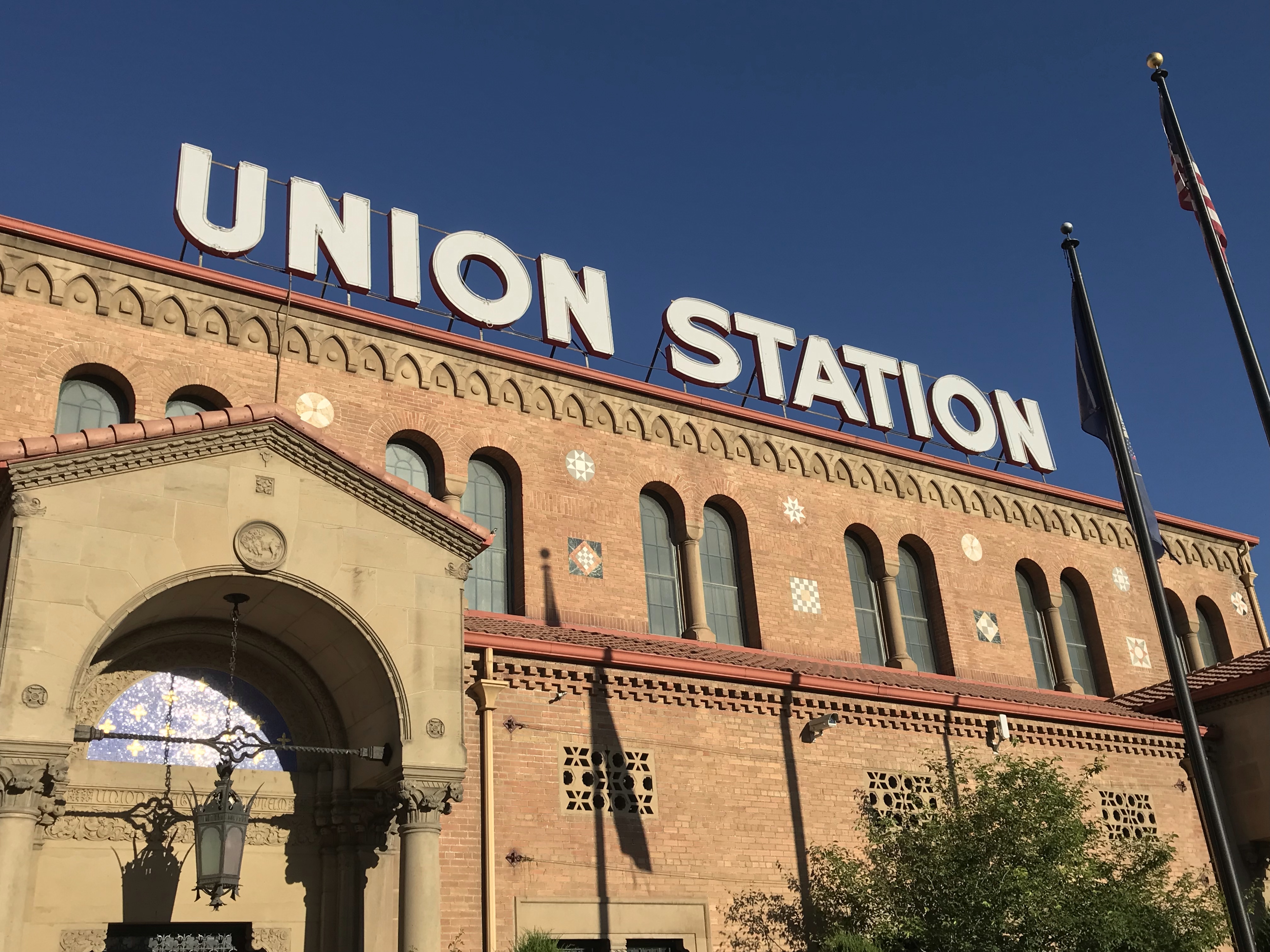
But the good news is that the building still stands and contains a cowboy, gun, art, and railroad museum. What they have outside is what really attracted me to Ogden: the locomotives and rails cars on static display! Because they were static and not going anywhere, anytime soon, made them great subjects for my sketch books.

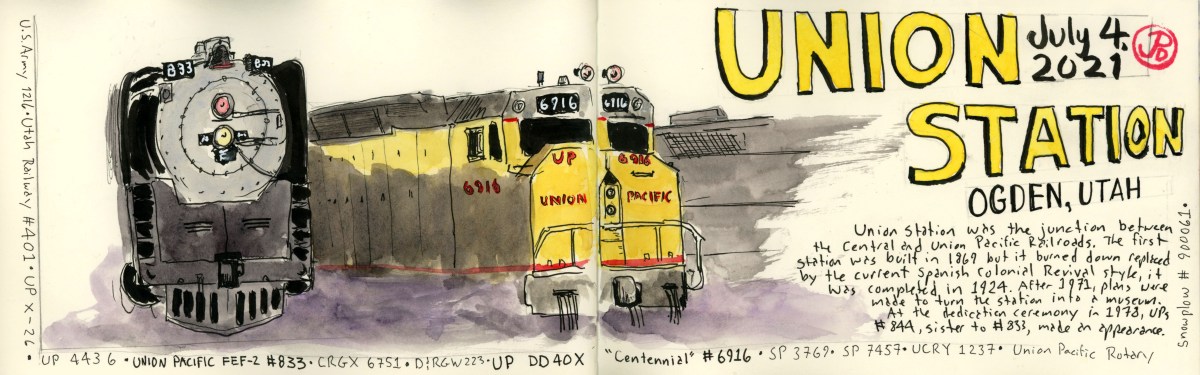
When I arrived in Ogden on July 4, the museum was closed but this didn’t stop me from doing my first sketch of Union Pacific’s passenger locomotive, a 4-8-4 FEF-2 # 833 (a sister to the more well known #844) and UP DD40X “Centennial” #6916 (featured sketch). I set up my sketching chair in the shade provided by Union Station and sketched these two locomotives. #6916 is one of the “Centennial” class and is the largest and most powerful diesel/electric locomotive ever produced. UP always does everything a bit bigger to tackle the steep grades on it’s network, like the Wasatch Range from Ogden to Green River, Wyoming.

I have posted some of the other sketches from my time at Union Station. I returned on another day when the museums were open.
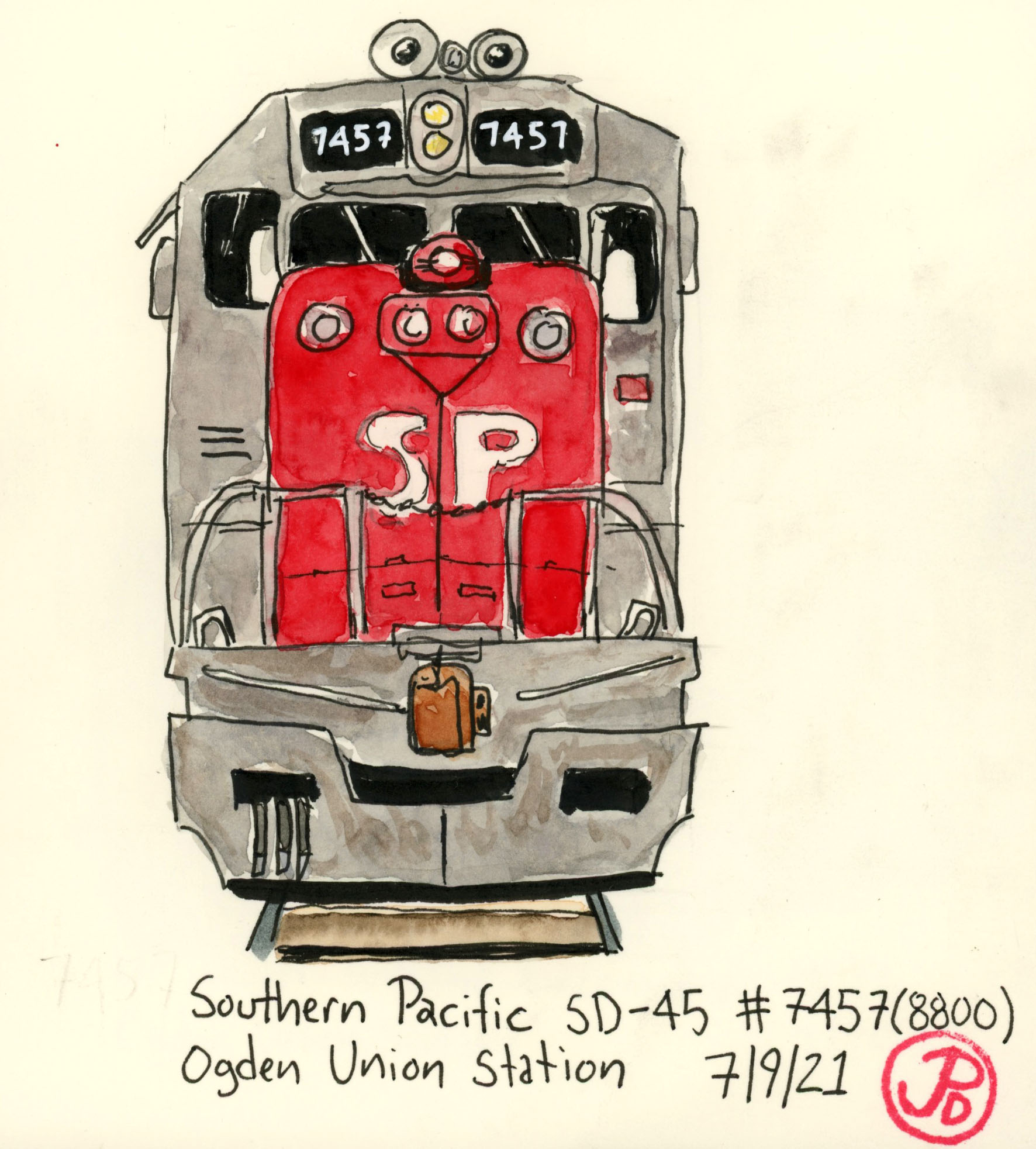
Above is a field sketch of the front of a Southern Pacific SD-45 #7457. Southern Pacific will always have a special place in my heart because this was the most likely livery to be seen where I grew up in the Bay Area. This paint scheme is known as the “Bloody Nose” livery because of it’s red front. #7457 worked from Ogden into California, pulling freight over the fabled Donner Pass.
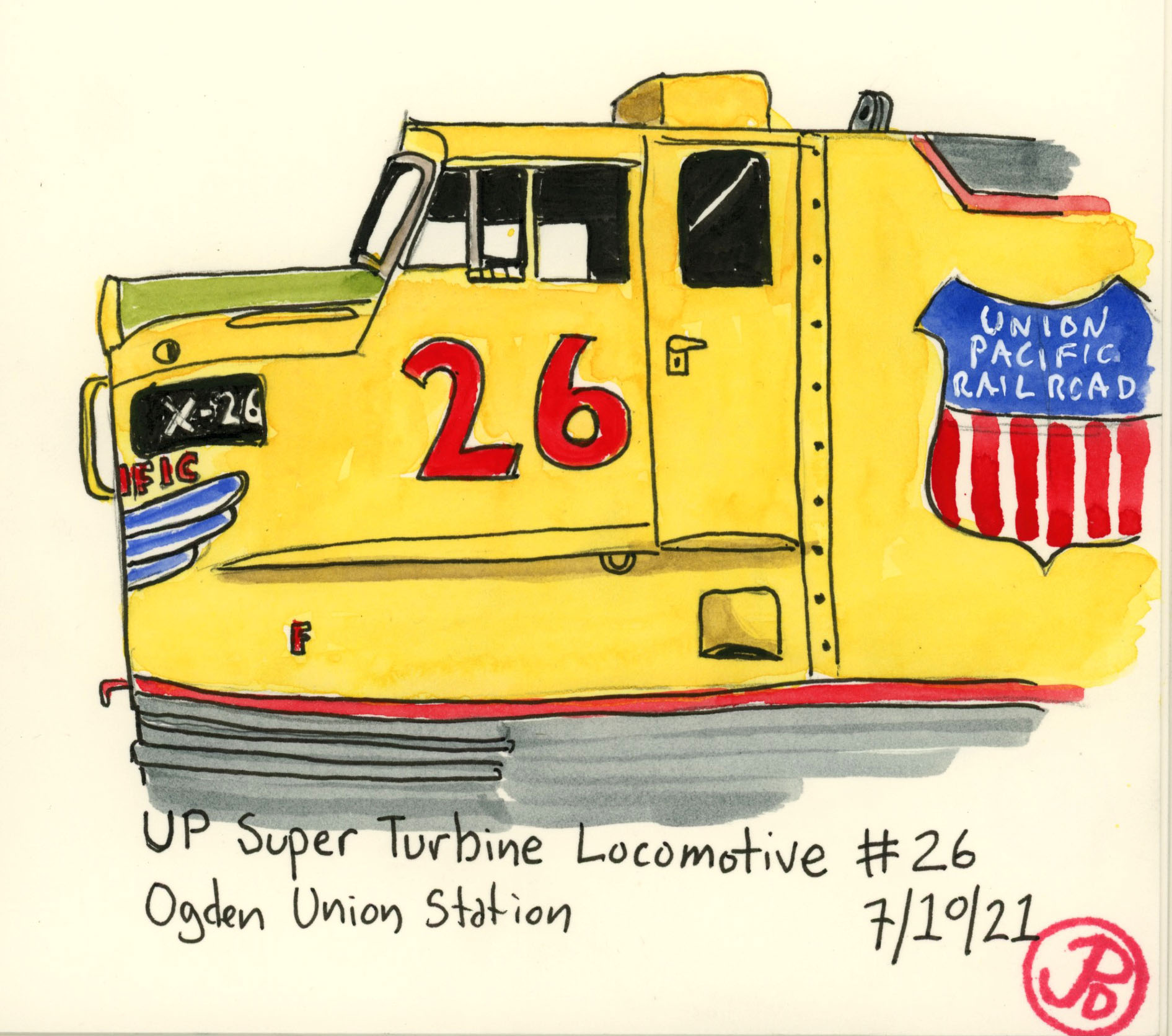
Keeping with Union Pacific’s mantra “bigger is better” I sketched the Super Gas Turbine locomotive #26. This locomotive is basically a jet engine on rails and is also known as the “Big Blow” for the loud noise it generated in operation. This was the class that was designed to replace the world’s largest steam locomotive, UP’s Big Boy. Union Pacific owned 55 of these locomotives, the only railroad in the country to own and operate these powerful beasts. Thirty locomotives (Numbers 1-30) where ordered from 1958 to 1961. These were the most powerful locomotives ever produced, generating 8,500 horsepower! That much horsepower also means an excessive amount of fuel to operate and they were last used in 1970. Number 26 is one of only two of these powerful locomotives to survive.
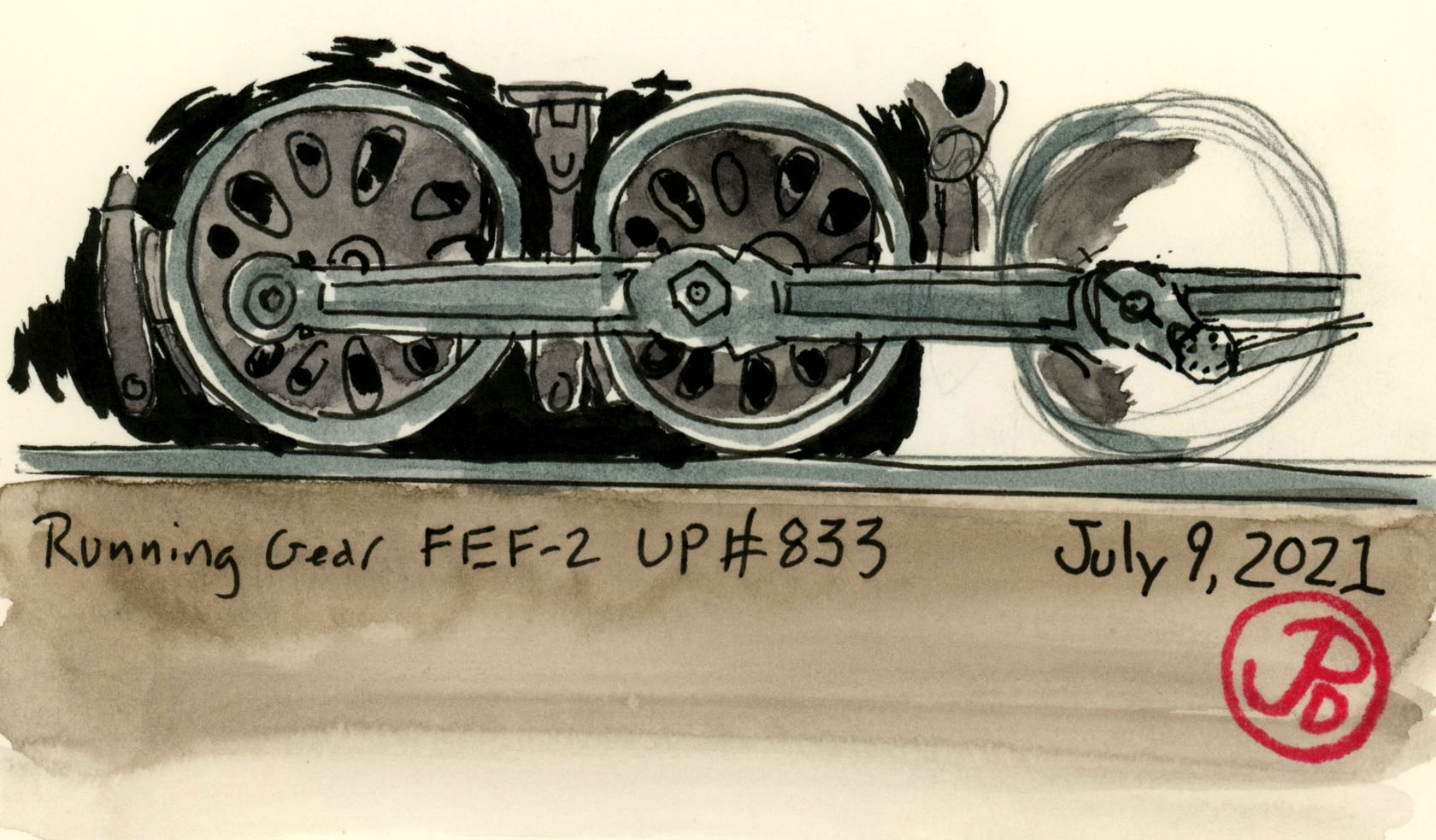
This field sketch is of the running gear of a class of successful passenger locomotives. Union Pacific FEF-2 #833 is the sister to the Living Legend, 844. 844 was the last steam locomotive purchased by Union Pacific and it is also notable as having never been retired from UP’s roster. Number 833 was put on display in a park in Salt Lake City and it was purchased by the Ogden Railroad Museum and it is the largest locomotive ever transported by truck.
Image

Sacred Sites the Union Pacific: Wyoming

On my journey from California to Colorado, I had a few historic sights I wanted to sketch along Highway 80 in Wyoming. This is Union Pacific territory, and the route over the Wasatch Mountains from Ogden Utah to Green River is legendary.

The Evanston Roundhouse and the Ames Monument are relics from a different time. The roundhouse was of a time when steam was the prime motive power of the Union Pacific and the monument the Ames brothers at Sherman Summit is no longer near the mainline (the line is now three miles to the south).

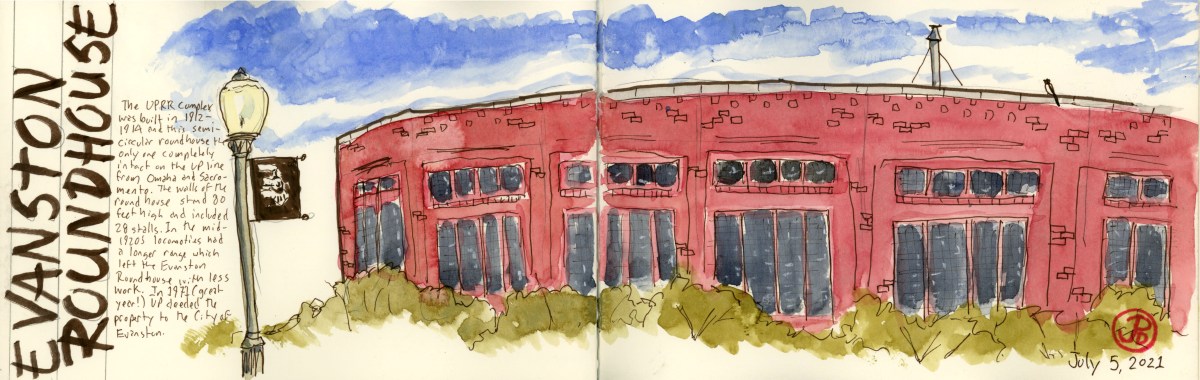
The Evanston Roundhouse is notable because it is the last completely intact roundhouse left on the Union Pacific line from Sacramento to Omaha. It had 28 stalls and is 80 feet high.

The roundhouse at Evanston on the left and the powerhouse on the right. The rusted, overgrown tracks in the foreground tells us that this complex has not been used by Union Pacific for a long time. I had to walk a ways back to photograph the whole massive roundhouse.

The roundhouse and yard was build by UP from 1912 to 1914. The roundhouse was part of a 27 acre complex to service steam locomotives. When steam locomotives became more efficient, they did not need to make so many service stops and the yard at Evanston was often bypassed. The Union Pacific deeded the property to the City of Evanston. The roundhouse is now used as a conference center and a meeting place.

Standing before the red brick semicircular roundhouse reminded me of a Plaza de Toros in Spain. Looking at just one part of the structure gives no indication of it’s form. I sketched one side of the roundhouse with the roofline slowing curving around (featured sketch). To see the entirety of the roundhouse, one has to walk back from the roundhouse by at least 100 yards to take it all in.

An intermodal freight passing through Evanston. The two locomotives on point represent the Transcontinental Railroad. The Union Pacific is pointed east towards Cheyenne and behind # 8990 is a former Southern Pacific locomotive (representing the Central Pacific) facing west toward Sacramento.

The next Union Pacific site is to be found off Highway 80 near the town of Buford (population 1). This is a monument to two brothers who were essential in creating the Union Pacific side of the Transcontinental Railroad.

The Ames Monument was built by the Union Pacific and dedicated to the brothers Oakes and Oliver Ames. It marked the highest point on the original Transcontinental Railroad at Sherman Summit at 8,247 feet. Oliver was one of the first presidents of the Union Pacific Railroad (from 1866-1871) and his brother Oakes was a U.S. Representative from Massachusetts. Both brothers, at the request of Lincoln, were put in charge of financing and building the Union Pacific portion of the railroad. Without the contribution of the Ames brothers, the railroad might never have been completed.

The 60 foot pyramid was build in 1880-1882 of granite at the cost of $64,000. On two side are base-relief portraits of each brother. In 1901, Union Pacific rerouted the mainline a few miles to the south.

On my first attempt to sketch the Ames Monument, a thunderstorm rolled in from the west. This monument being 60 feet high and at one of the highest points on the original Transcontinental Railroad, I though it would be wise to head to my car and return in the morning!
Image

The Much Sought After Non-Native: Himalayan Snowcock

4:25 AM, Island Lake Trailhead, Ruby Mountains, Nevada.

Himalayan Snowcock. This introduced game bird is legendarily very hard to add to you ABA life list. Partly because it has an extremely small range in the Ruby Mountains in northeastern Nevada. It is also very skittish because, well, it’s a game bird after all. The snowcock, a native of southern Asia, was introduced in the Ruby Mountains in the 1963 and has a sustained breeding population.

To add this bird to your list you have to put in some sweat equity or have a ton of money (like the Steve Martin character in The Big Year, who hires a helicopter to see this bird!)

To see this bird with sweat and effort takes a two mile hike up the Island Lake Trail. From the trailhead to the lake is an elevation gain of about 1,000 feet and features many switchbacks.

The beginning of all things snowcock, the trail head for Island Lake. (This photo was taken on my return journey.)

What makes this trail perhaps a little bit more challenging is that most of the hike is done in darkness. The snowcock begins calling at about 5:45 AM and I planned to be in place by 5:30 to listen for and scan the ridges for snowcock. They seem to be harder to find later in the morning and in the afternoon.

And so I found myself, after a restless night of sleep, at the Island Lake Trailhead at 4:25 AM. On my forehead was the 400 Lumen Black Diamond Storm headlamp and on my back was an unwelding backpack with my scope, tripod, bins, camera, and sketchbook. In my hands where trekking poles to help with balance and pace and to fend off mountains lions or bears.

The headlamp provided a great pool of light to see the trail ahead. I turned my beam downslope and I picked up eyeshine. I boosted the power and was relieved to see that it was just a deer. Wait, where there is deer, there is mountain lion!!

About 15 minutes into my assent I came to the first switchback. Even in the glow of my headlamp I could see the trail was surrounded by wildflowers. I was looking forward to my return journey in morning light, hopefully with snowcock in the bag.

By the time I reached the wooden bridge across the falls, I was at the halfway point of the accent. At this point it was light enough to see and I stowed my headlamp. Here is where the switchbacks begin in earnest.

After a while I lost count of how many times the trail switched back on itself but I finally saw the ridge line in the half light and I knew I was near the end of the trail at Island Lake.

At the lake the trail forked and I headed to the right and soon the scrabble up to the northwest was to begin. This is where having trekking poles pays off. I headed up to one of the last group of trees, near a creek and I found a boulder seat to set up my scope and scan the ridges. It was now 5:30 AM.

A scope view from my position and the ridges that I would hopefully see this tough ABA lifer.

Now was the waiting time. Other reports had snowcocks calling from the ridge at 5:45. It was just a matter of time. But I also knew that snowcock is not always a given. Part of the unsigned agreement with the Birding Gods is that the more effort you put into seeing a bird does not guarantee seeing the bird.

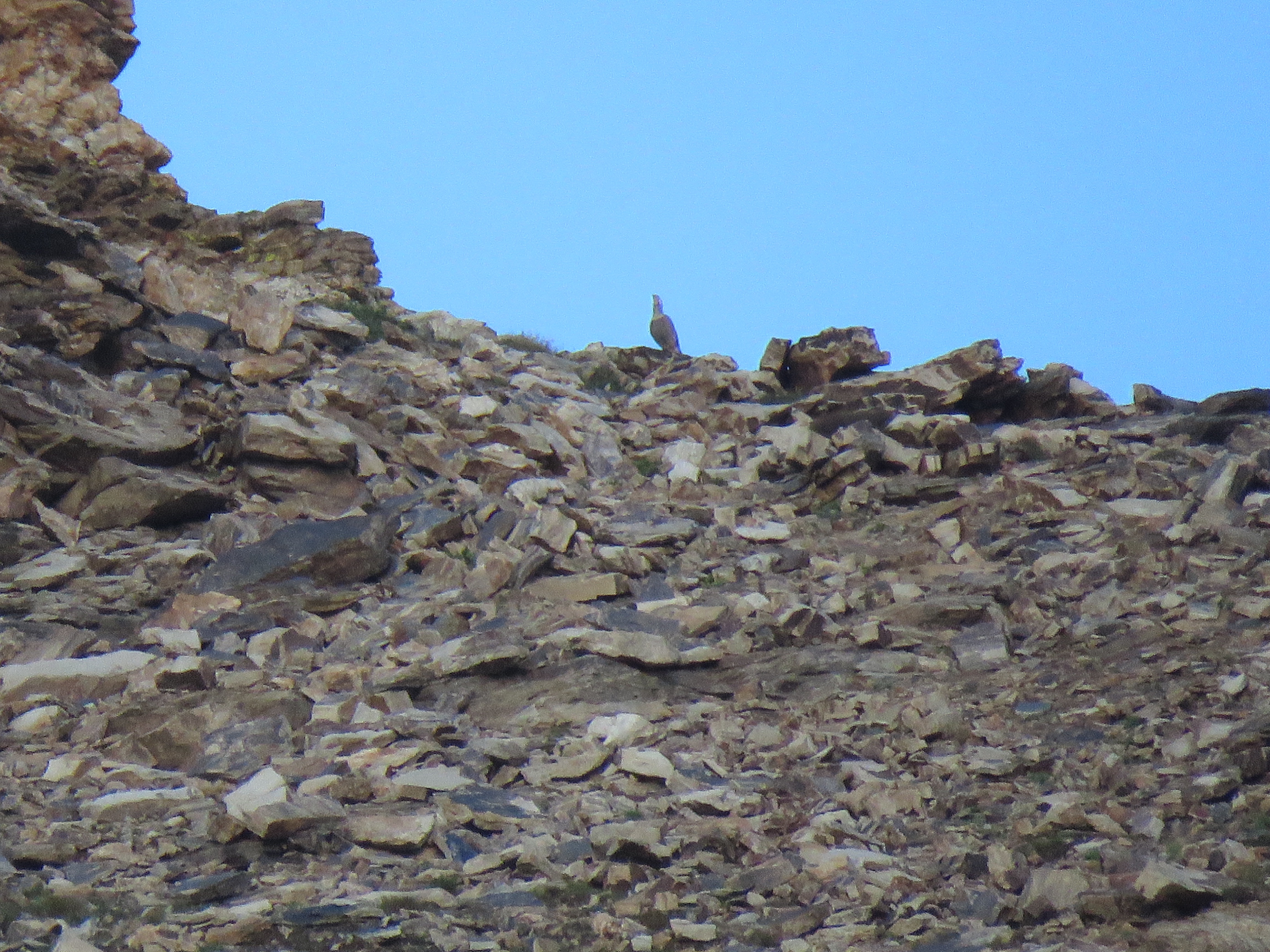
At 5:55 AM I heard the far off bugle of a snowcock! The call in reminiscent of an elk bugle. I scanned the ridges with my scope to look for a bird silhouetted against the sky. At 6 AM I spotted the snowcock! I had the bird in view for about ten minutes and I was able get some far off photos to document the sighting.

A snowcock calling on the ridge!! All my effort had paid off!

The snowcock moved up slope and then dropped down on my side of the ridge where it disappeared amongst the rock. I pulled out my panoramic sketchbook and sketch the jagged ridge line of the Ruby Mountains and I drew in an arrow where I had first seen the Himalayan snowcock.

What a great experience with a much sought after ABA bird. Any lister wants this bird on their list and it is only found in one place in the United States. It was well worth the effort and the scenery and the return hike amongst the high elevation wildflowers was a nice coda.

Image

Flexing my Sketching Muscles

Before I headed out on my Trails, Roads & Rails Roadtrip I wanted to get into sketching shape. To do this I made it my daily practice to do a sketch in and around Santa Cruz.

Each sketch took no longer than 15 minutes and I chose subjects that would force me to take a complicated subject and simplify it into a quick sketch. Some of my subjects were architecture, trees and foliage, marine mammal anatomy, and old brickwork. I figured that this range of subjects would give we practice for some of the subjects I would be encountering on my trip along Highway 80.

I combined these short sketches with hikes in order to get into birding shape to search for the Himalayan snowcock, which required an early morning two mile hike to get to it’s alpine territory in the Ruby Mountains.

Architecture: Holy Cross Church, Santa Cruz.

For this sketch I wanted to make sure I was getting my angles and perspective right so I held out my pencil at arms length to take measurements and transferred these “measurements” to my journal. Because it was architecture, I worked in pencil to make sure the sketch held together. I was then was freed up to work in pen to capture the backside of Santa Cruz’s namesake church. Then I added watercolor washes and within 20 minutes, I had a sketch.

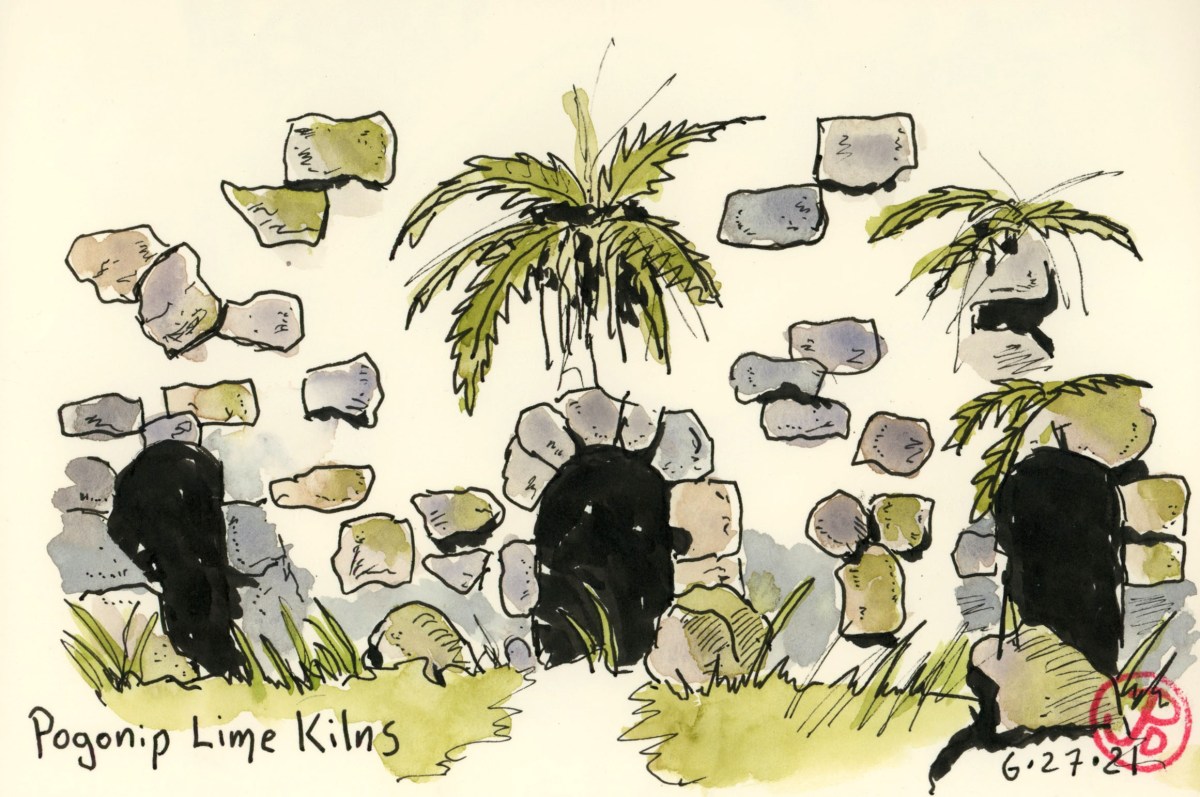
Lime Kilns, Pogonip. (Featured sketch)

After a hike up the Spring Trail at Pogonip Open Space Preserve, I turned off the trail to head up to the abandoned lime kilns. After timber, producing lime for building was Santa Cruz County’s biggest industry in the 20th Century. There were a few signs of this history at Pogonip but there was none better than these kilns.

For this sketch, I worked in pen and I used a bit of sketcher’s license on this one. In reality the ferns in the center were higher up but I though of this quick sketch as capturing little vignettes or details of the kiln, ferns, and brick work. All these details, when put together, tell the story in representing the lime kilns.

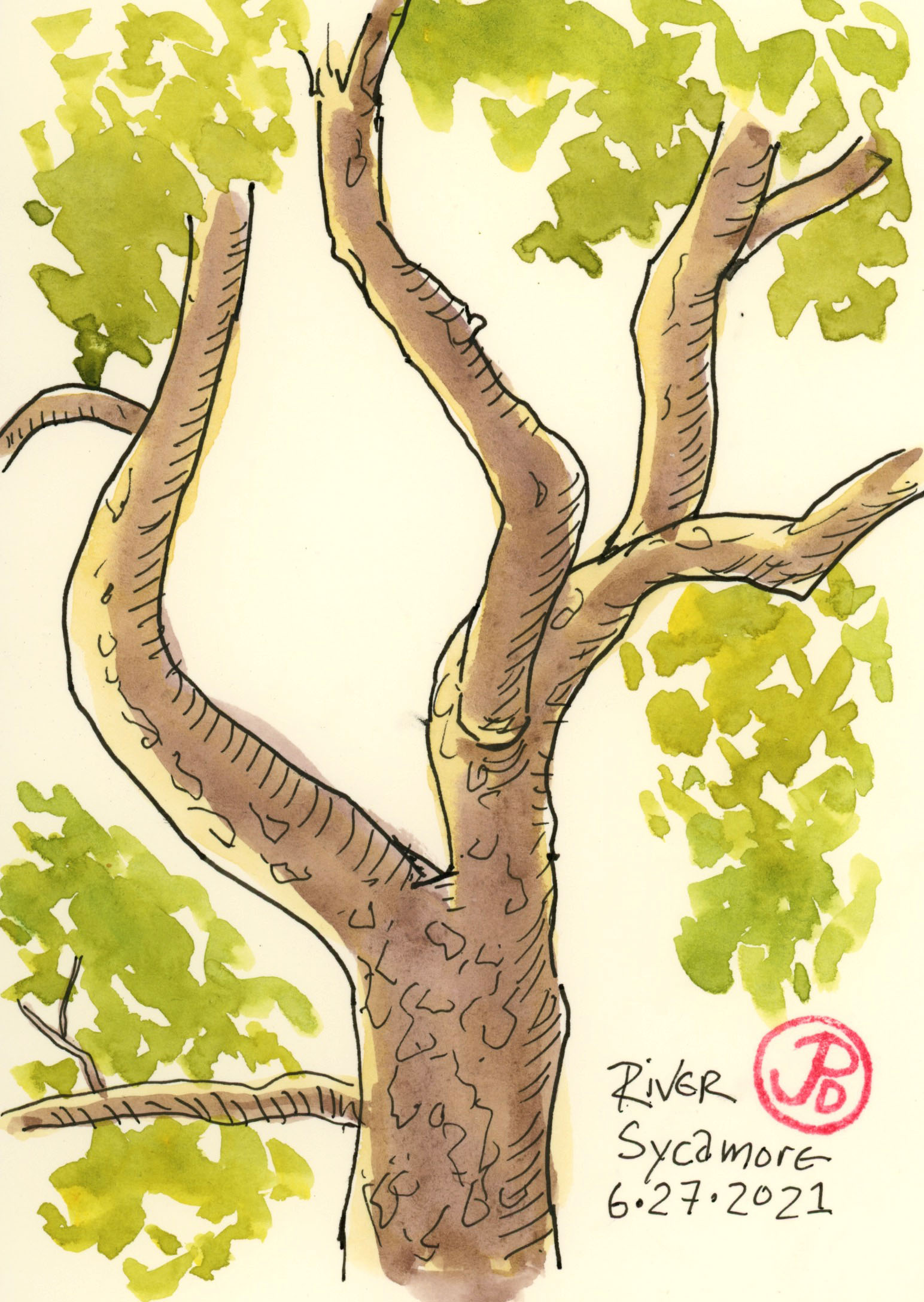
River Sycamore, Paradise Park.

I walked by the sycamore many times on my walks on Washington Way. I thought this grand, old tree would make a good subject for a quick sketch. Working on this sketch had a very organic feel, no pun intended, as I captured the shape of the limbs and let them lead off the page. I only worked in pen on this one.

I have sketched redwood, the most dominate tree in Paradise Park, many times so working on a sycamore just helped me understand the tree just a little bit more.

Image

Trails, Roads, & Rails

“The landscape of the American West has to to be seen to be believed, and has to be believed to be seen.” -N. Scott Momaday

I have many summer memories of road trips across the West.

Often our family trips were to the north through Oregon, Washington, and dipping into southern British Colombia. On another road trip we visited Monument Valley, the incredible Grand Canyon, and the underwhelming Four Corners in our Volkswagon Vanagon. On the same trip we rode on one of the United States’ most famous railroads, the Durango and Silverton Narrow Gauge Railroad.

To celebrate summer and the purchase of a new car (a 2021 Subaru Crosstrek Sport), I decided to take a road trip in the West. My intended destinations reflect my many interests.

My new Adventure-Mobile.

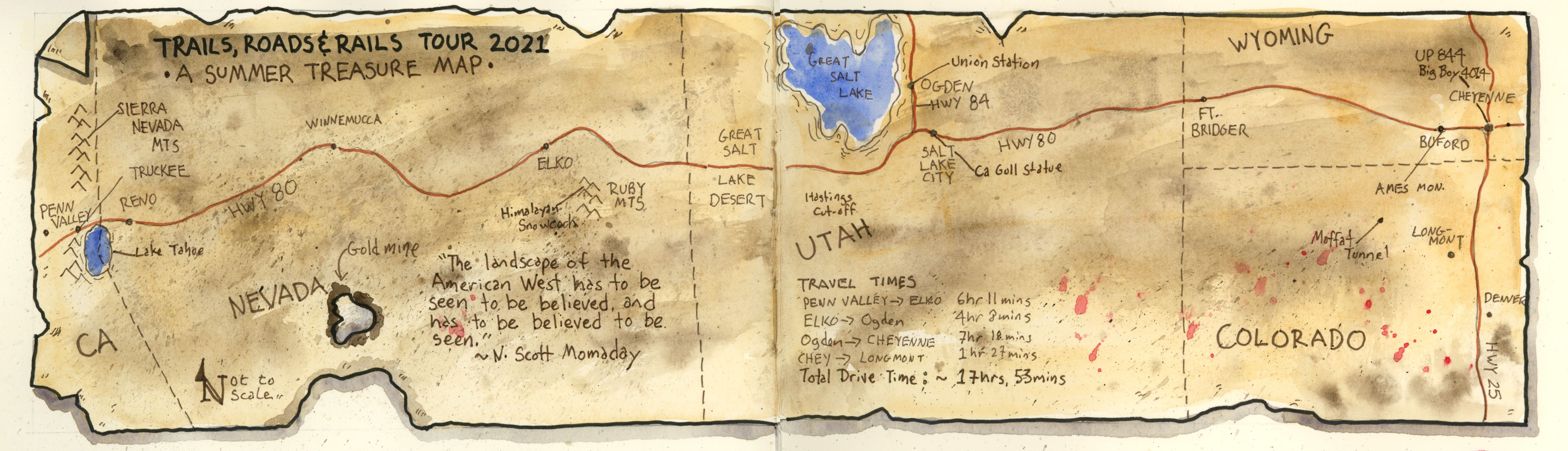
For birds I intend to visit the Ruby Mountains in Nevada for the legendary lifer Himalayan snowcock and Rocky Mountain National Park in Colorado for white-tailed ptarmigan and broad-tailed hummingbird. For history I want to visit Fort Bridger in Wyoming, parts of the Hasting’s Cut-off in Utah, and the California Gull Monument in Salt Lake City. For rail history I planned to visit the Ames Monument in Buford Wyoming, Union Station at Ogden, Utah, and the ground zero of Union Pacific’s steam program, Cheyenne.

For roughly 1,000 miles I would be traveling east on Highway 80. Like the Transcontinental Railroad before it, I-80 is an east-west transcontinental highway. At 2,899 miles it is the second longest highway in the United States, after I-90. The highway was created in 1956 as part of the original interstate highway system.

As I do before any important journey I sketch out the route. In this case I chose to represent the map as a distressed treasure map or perhaps a map to a secret goldmine, like Dr. Buckbee’s map in the Gold Rush classic By the Great Horn Spoon.

I have been a big fan of Stillman & Birn sketchbooks and I love the heavy weight of the cold press, ivory paper of the Delta Series. What I don’t like is that I have not found this high quality paper in a hardbound panoramic sketchbook, until now!

While I was picking up pens at California Arts Supply I was ranting (once again) to the owner Ron about how I wished Stillman & Birn would make a Delta Series hardbound panoramic sketchbook. He told that they did have such a sketchbook, newly arrived! I bought one as my road trip journal!

Finally an improvement on the Moleskine panoramic sketch book that has been my go to journal for years but with better paper. The paper is 270 g, ivory cold press. When opened the panoramic format gives me a 6 X 18 inch painting surface! Perfect for the land of vast vistas! Or painting a very tall tree or tower in the vertical format.

Image

Bird Dunes

On Sunday morning I headed to Watsonville, to worship at the Alter of Shorebird known as Pajaro Dunes.

Yes I know that June us not exactly shorebird central on the Central Coast but I had two shorebirds on my Santa Cruz County wishlist: American avocet, and black-necked stilt.

Pajaro Dunes is a coastal vacation community built on and over the Monterey Bay dunes. No doubt that this development has affected the original residents of these dunes and tidal flats: shorebirds. Their habitat here has been compromised, restricted, and expunged. That is one reason that birders are allowed access to this private community.

I do have a disclaimer: my family has spent much time at Pajaro Dunes when I was a kid. Once a year we rented a house at Pajaro with our neighbors on Cormorant Court. (Pajaro is the Spanish word for bird.) I somehow think that spending time here, as a child, made me appreciate this place and being a noticer, I noticed the natural world that was thriving here. I remember digging for sand crabs and catching lizards. And the brown pelicans that hugged the coast raised my eyes skywards.

On this Sunday morning, after checking in at the gatehouse, I kept my eyes towards the water channel, which was to my left. The tide was in, so water was much deeper, which would not be attractive to both avocet and stilt.

I headed to the bay where the Pajaro River becomes brackish. There where a large group of white pelicans, foraging in a raft and many double-crested cormorants drying their feathers. On the beach was a large flock of gulls, including about 40 Heerman’s gulls, one of the world’s most beautiful gulls, in my opinion.

The beautiful Heerman’s gull a Pajaro Dunes. The white-headed gulls are adults while gray-headed birds are juveniles. These gulls are newly arrived from Mexico or points south.

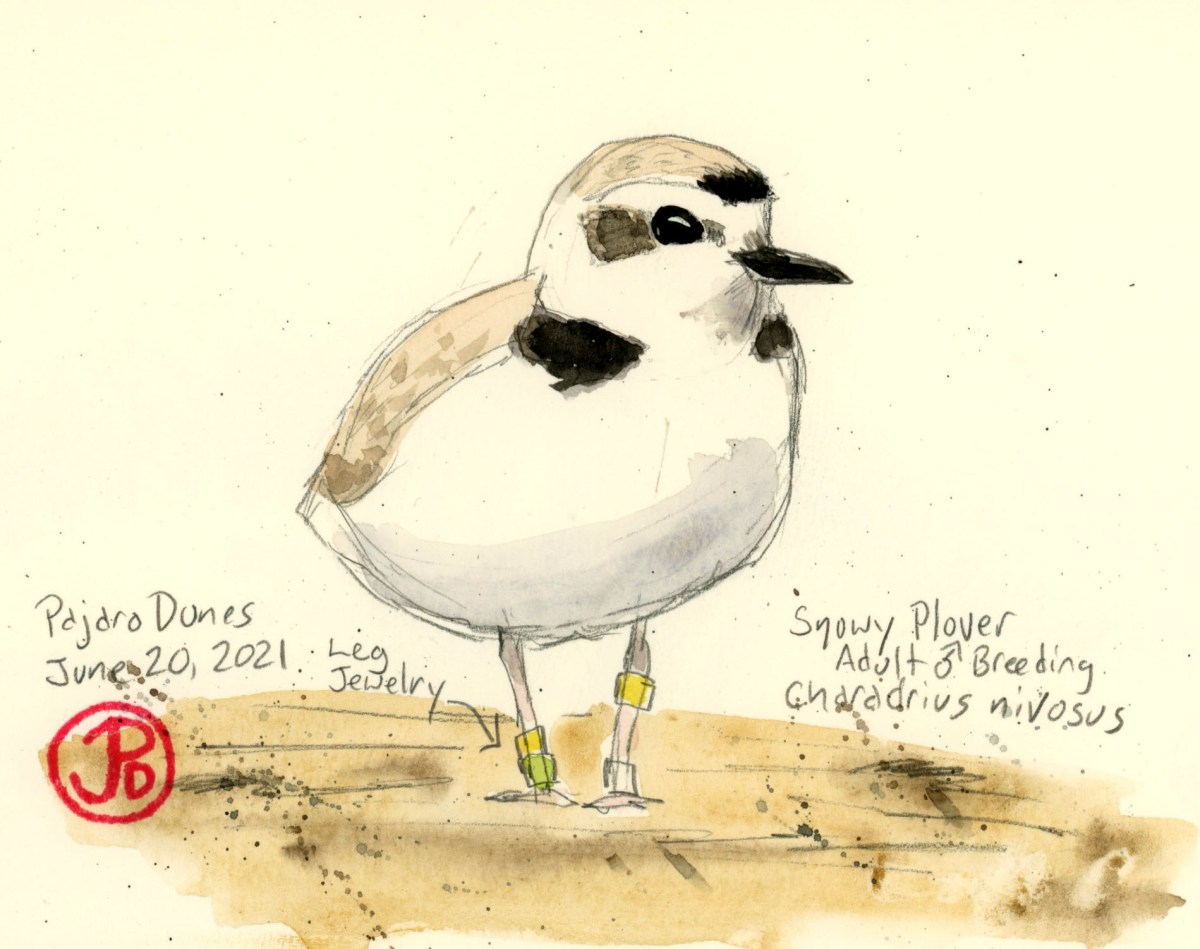
Since I was here last, a fence had been installed around the dunes to protect the breeding habitat of the threatened snowy plover. I have seen snowies here before in the winter where but they where not wearing the black headband and black epaulets of their breeding plumage. Some of the plovers were wearing colored bands on both feet so biologists can identify individual plovers in the field.

A child created sign on the fence placed around snowy plover habitat. Judging by the drawing and the capitalization (or lack of it) I would say it was done by a 3rd grader. It is funny that children draw the head like a separate circle plopped on the body when in reality there is usually a smooth transition from head to body. Sadly, most adults would draw birds in the same way because around this time, nine to tens years old, most realize that their drawing no longer captures realty and their artist development stops at that age.

I did see three snowy plovers. One was running circles around me looking like a windup toy dune-runner. This male was sporting jewelry in the form of four leg bracelets, known as bands in America or rings in Britain. I incorporated the bands in my plover drawing.

It was good to see the plovers on their breeding territory but I did note that there was a woman with her off lead dog that was crossing the fence line. She needed to read and internalize the 3rd graders’ message: “Please Stay away from The BiRDS.” Dog and dog owners vs snowy plover have been an on going conflict on beaches on the west coast where these plovers breed. They nest on the ground, making them vulnerable to walkers and dogs. For all of those whole claim to be “animal lovers” lets not forget about animals that don’t wear a collar, respond to their “given” name, and who are flying free. (I’m starting to sound like the Lorax here!)

I headed back towards the exit gate and I looked to the water channel, which was now to my right. I passed Avocet Circle (no avocets). As I passed the tennis courts and sports field, near Willet Circle, I spotted the undeniable form of a black-necked stilt, foraging on the the far bank. Santa Cruz County life bird!

Black-necked stilt.
Image

Underpainting

I wanted to experiment with underpainting for some recent field sketches. First I put down a loose, cool, blue wash and on another page a warm orange-red wash. I kept it loose with some paint splatter and some ghosting.

Now I had to find a subject to lay over the wash.

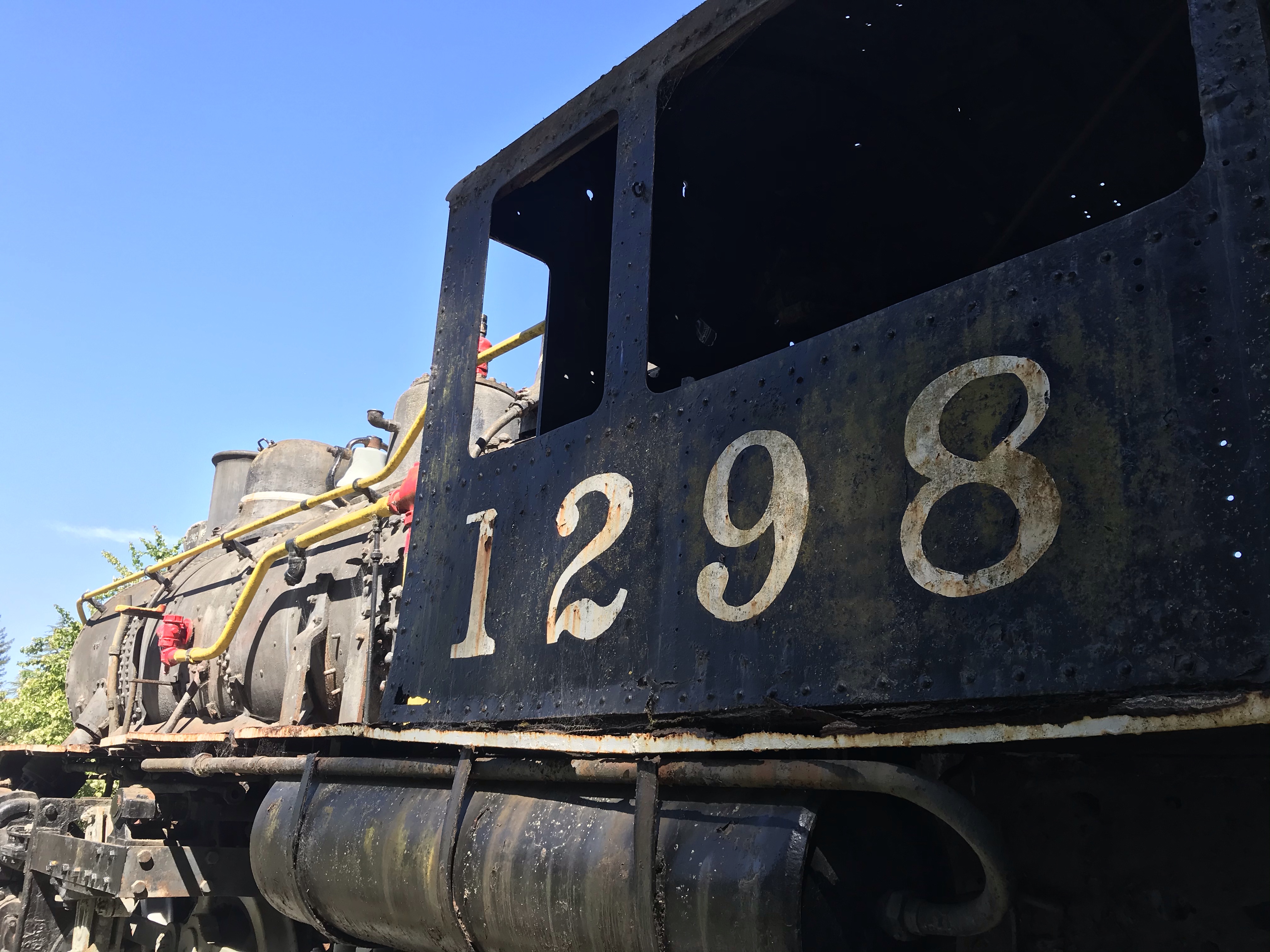
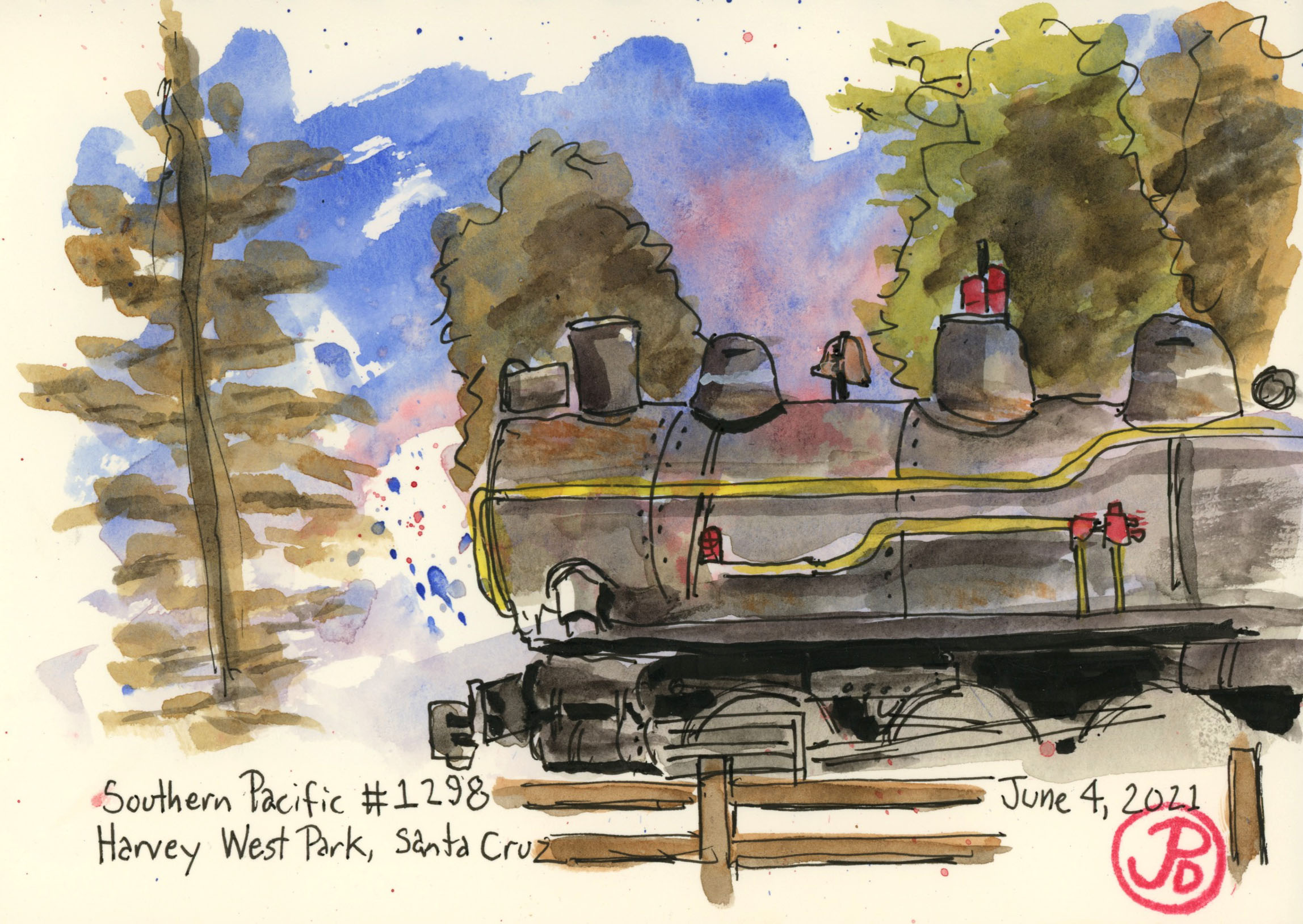
My first subject was to be found at Harvey West Park in Santa Cruz. It was a Southern Pacific 0-6-0 switcher that is on static display in the picnic area. Southern Pacific Number 1298 is an S-10 class yard switcher that was build by Baldwin in 1917. The locomotive was retired in 1956 and was put on static display in Santa Cruz in 1961. In an earlier era, when things was less litigious, children where able to climb on the locomotive and tender. Now the tender was sold and the rusting Number 1298 sits fenced in, in need of a lick of paint.

The word static, implies “not moving”, which is a perfect sketching subject because, well, 1298 is not moving. It was a great subject to capture the form of the locomotive and the trees in the background. For this sketch I chose the page with the cool blue underpainting. I figured it would also work with the sky.

I loosely sketched in the form of the locomotive, tiring to keep details to a minimum. I failed to some degree because I think I added too many details, a problems I have with sketching a highly detailed subject like a locomotive or architecture. The running gear (the driving wheels that propel the locomotive) I simplified and left out a lot of information.

When you put wet watercolor paint over dried paint, it is called glazing. When you glaze in watercolor you can build up layers and depth. Because watercolor is transparent, the underpainting shows through in unexpected ways. And with using a fairly random underpainting the result can be a bit jarring but somehow seems to work. It’s just a sketch, after all.

For my sketch I laid over the warm orange-red wash I choose a jarring subject.

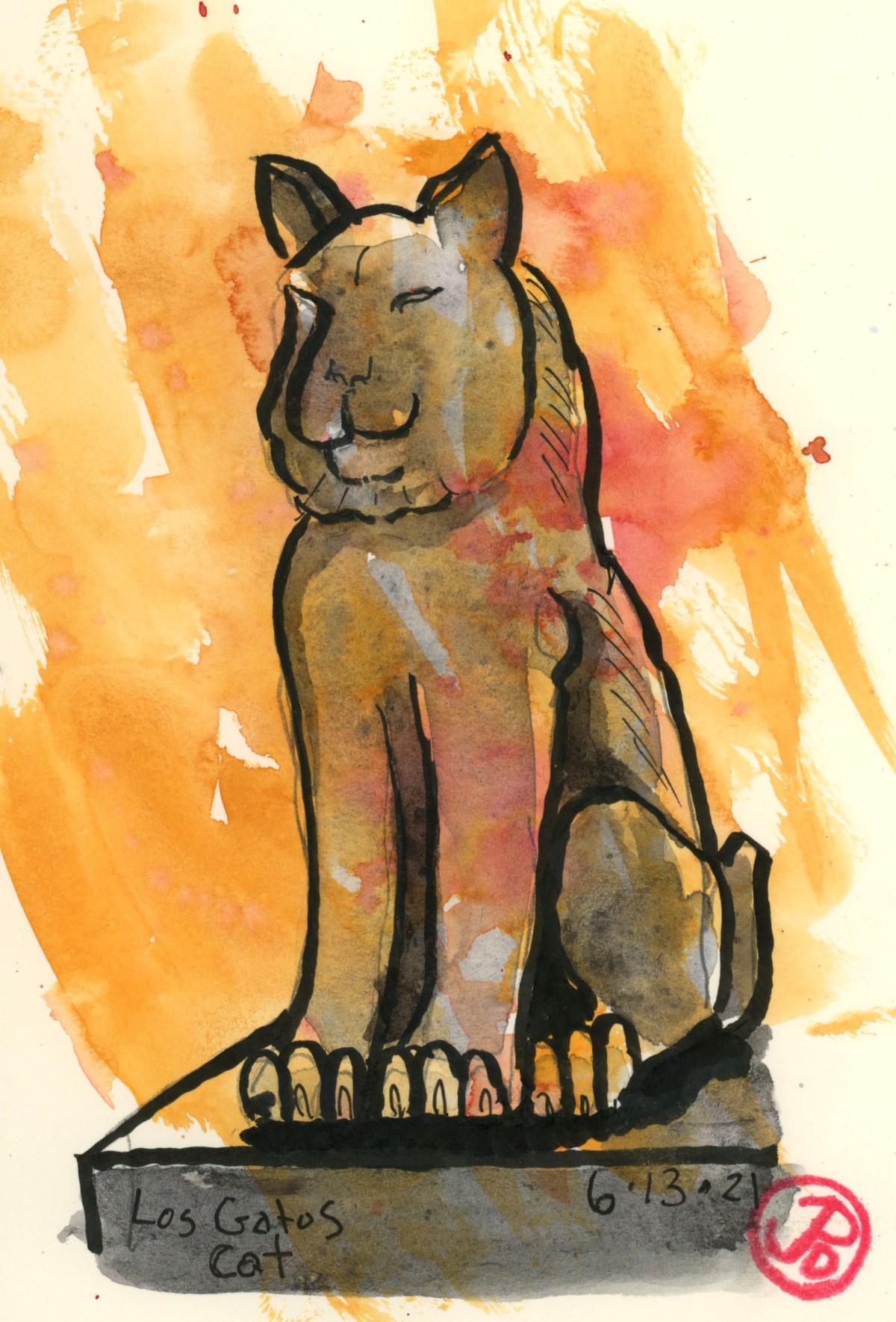
Just outside of Los Gatos, off of Highway 17, are two stone lynx-like statues that guard the driveway to Poets Canyon. The sculptures where created by Robert Paine and are named “Leo” and “Leona”. The sculptures have been in place since 1922. To get to this location is challenging because you can only turn west on Highway 17 (the direction whence I came).

Lucky for me, two 8 foot replicas are to be found at the Los Gatos Shopping Center on Santa Cruz Ave. The new cats are carved out of white marble and weigh in at 6,500 pounds each!

The underpainting is warm and I made no concessions to the true color on the statues. I like the way the sketch turned out (featured sketch).

Image

Fern Grotto Beach

On Saturday morning I headed out on one of my favorite coastal trails, the Old Cove Landing Trail at Wilder Ranch State Park. This is a great trail for hiking and birding featuring coast chaparral and great ocean views. This is also a nice place for sketching.

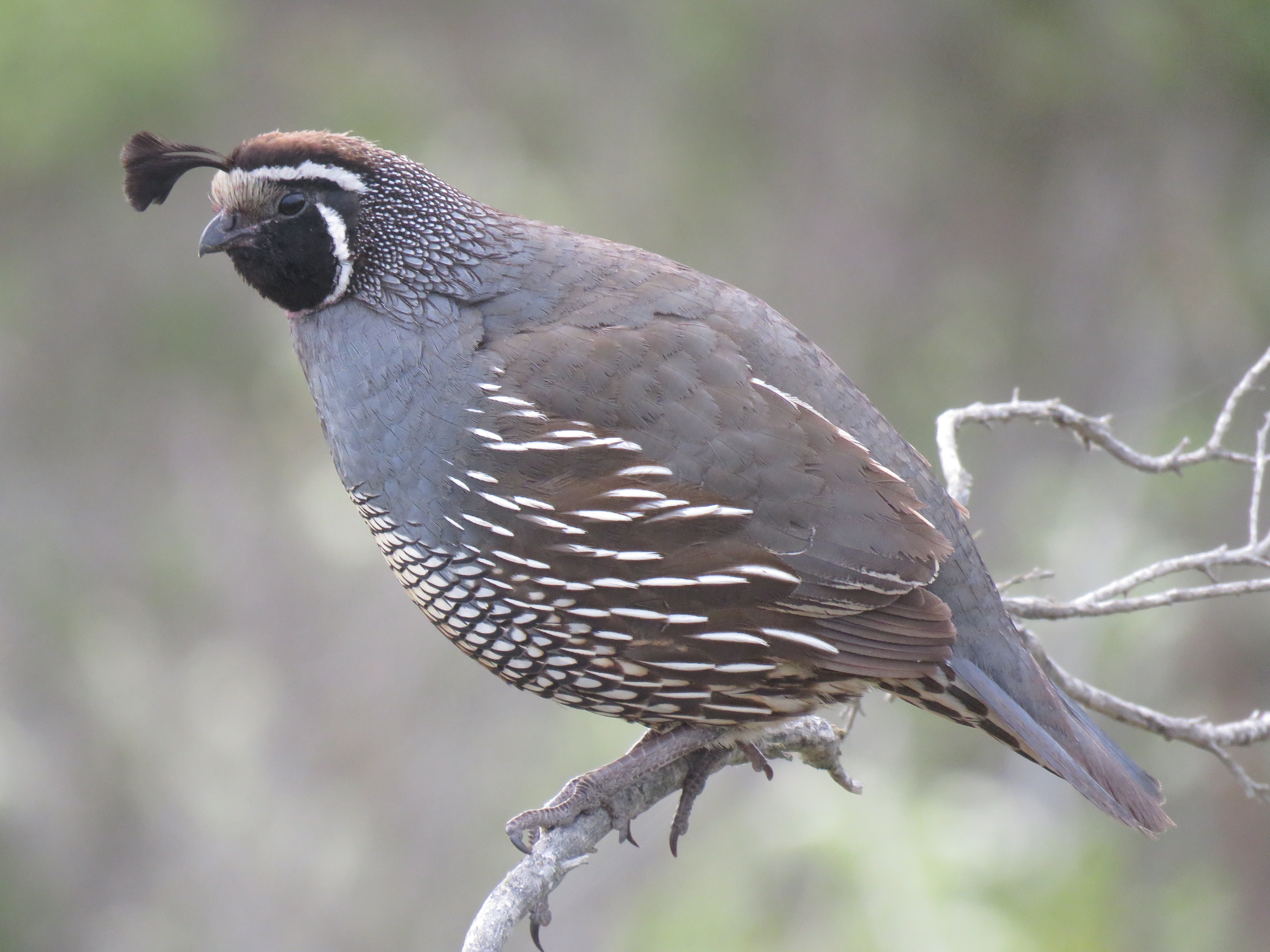
A very accommodating male California quail perched out in the open at the beginning of the Old Cove Landing Trail.
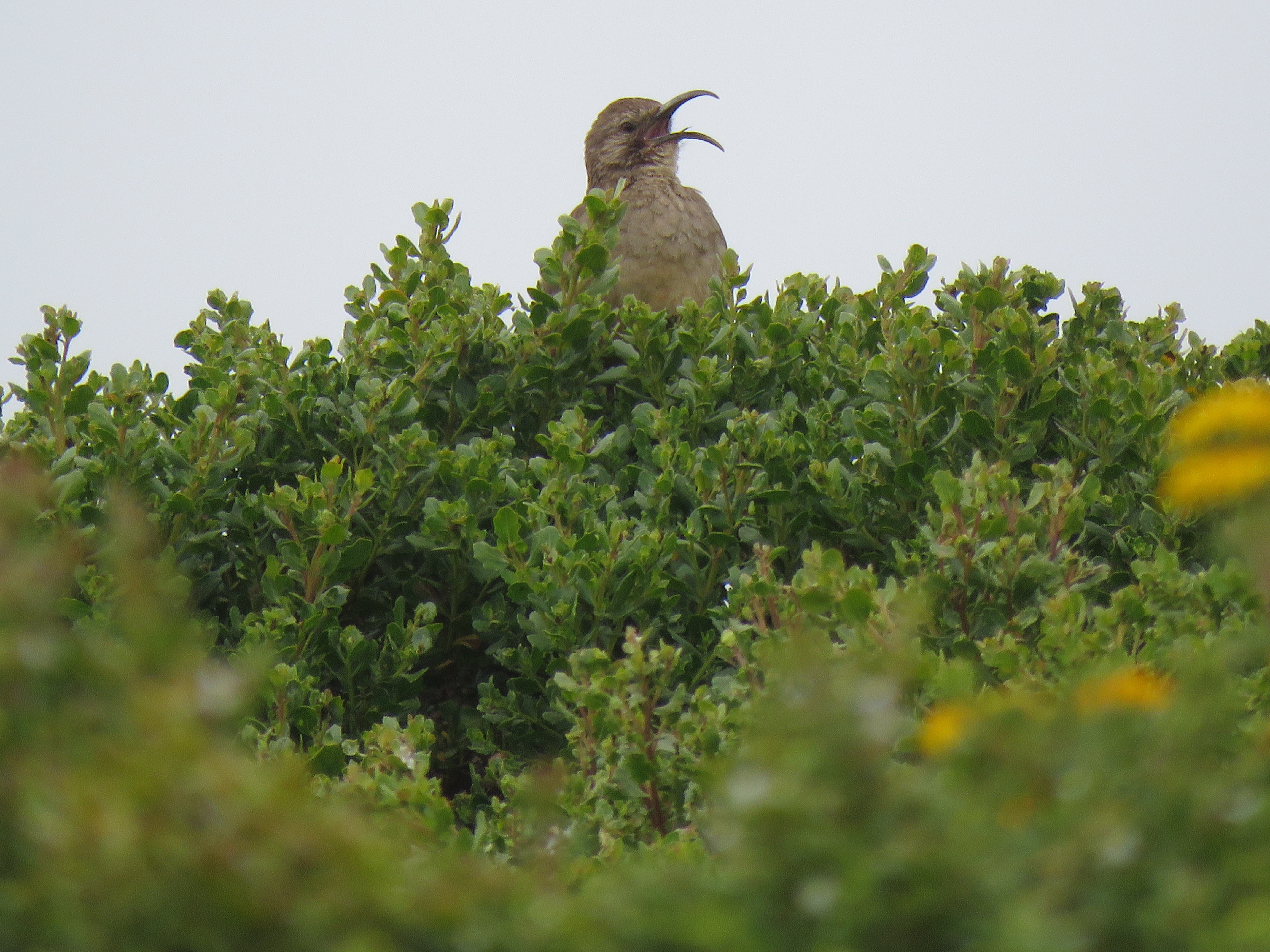
Another California namesake, a singing California thrasher perched up in coyote brush. I could hear the thrasher’s warbling song from Fern Grotto Beach.

I headed down the trail to Fern Grotto Beach. This beach is framed by sandstones cliffs that are crowned with lush vegetation. I wanted to sketch the view from the beach and a log dictated where I would sit and my perspective.

For this sketch I used a panoramic Moleskine watercolor journal which was perfect for the expanse of the scene. I first laid in the cliffs with loose washes, letting colors runs into each other in a wet-on-wet extravaganza. I kept all of the painting loose rather than detailed. Once the paint was mostly dry I tied the sketch together with dark sepia pen strokes. I held then pen toward the end in order to keep the lines loose and lively.

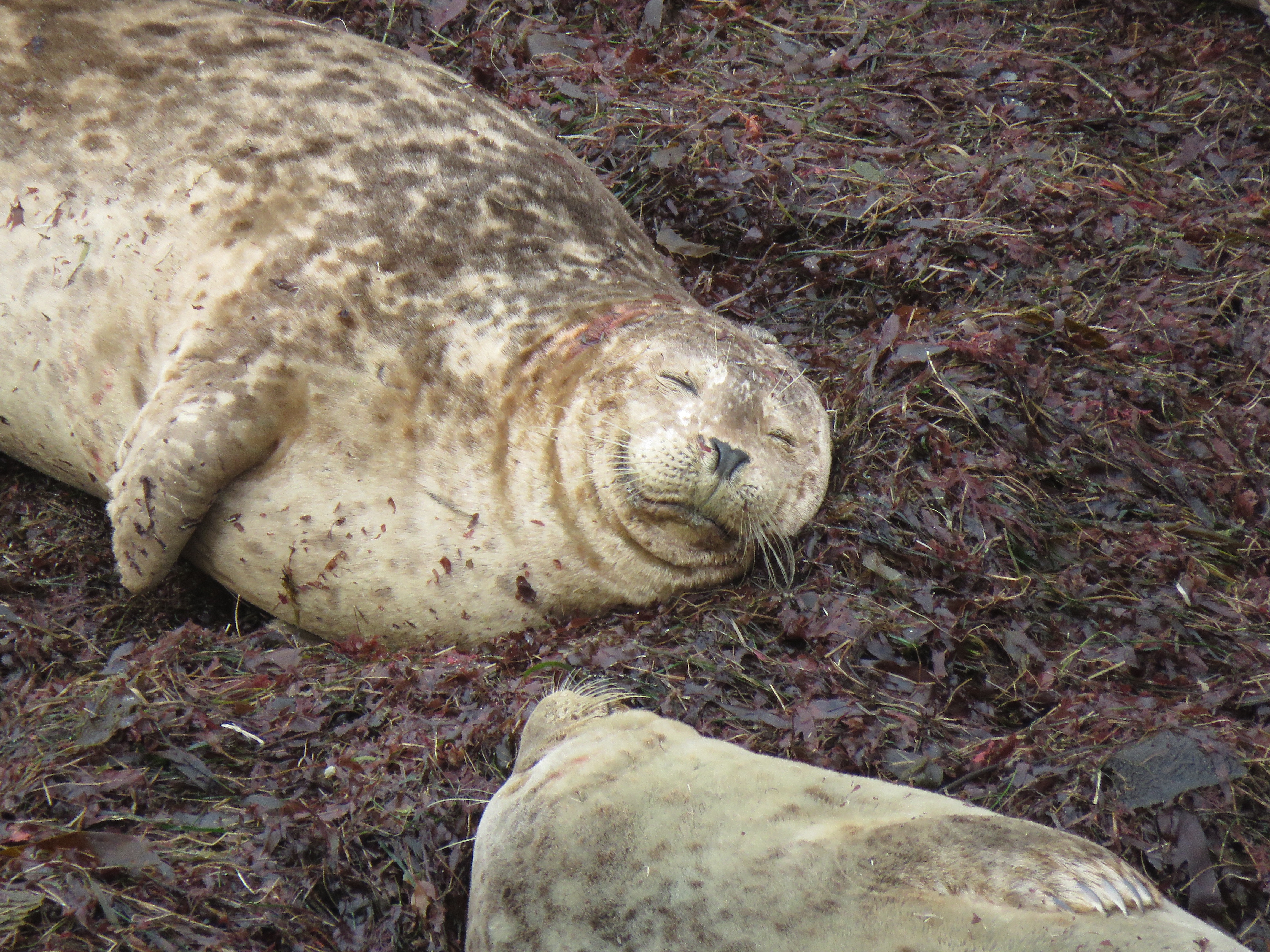
This hike is not just for the birds! Harbor seals at a seal haul out.
Image

Cards in the Time of Covid

The cards I write for my students each year, are always a challenge to start; Even more so when the majority of our time together was through a screen.

How do you get to know your students when they are the size of a postage stamp during a digital class meeting? The answer is you really don’t.

Once we were back in the classroom for half days I devised a plan to learn a little bit more about my students through the clever use of writing prompts. Samples writing prompts were: “If you could be one animal/person/fictional character for one day, what or whom would you be?”, “If you could time travel to any time or place, where would you go?”, and “What is the most treasured person or thing in your life?”

As I have written before, my 6th grade teacher, Mrs. Noether, provided me with the inspiration for these cards. As much as I want to end the tradition this year, because this was such a difficult year, each card that I wrote and illustrated was a balm to the tough school year. These cards were a “reaching out” to the distance learning students that eventually came home to Team 17.

This year’s illustrations where as diverse as my 29 students. The subjects includes pandas, Eurasian hoopoe (the official bird of Israel), the Liverpool FC crest, Ballon d’or winner Robert Lewandowski, a humpback whale, Godzilla, Yogi Berra (with many of his quotes), a F-16 Fighting Falcon, a greater flamingo, Chimney Rock, Pac Man, Calvin and Hobbes, Southern Pacific’s #4449, Rick Astley (who knew), and a goblin shark.

A work in progress. An object I love to illustrate is one of the most beautiful stream locomotives even built: Southern Pacific’s GS-4. This card is for a fellow train fan in my class. Design-wise I was illustrating across the gutter. The letter was written in the white area left by the exhaust. As a rule, I never publish the contents of the letter because that is a message from me to my student.
Image

Nevada County Sketches

I returned to the South Yuba River, along the Buttermilk Bend Trail. This time I was with my sister-in-law and my two nieces and nephew.

At this time the hillside reflected the state of California’s drought, which was sans flowers and golden-brown.

We walked about a mile down the trail (up river) and then headed down to the South Yuba River for some nature loafing. The oldest, used her time taking pictures of the rock and river, the middle boy commenced to design and build his own cairn, and the youngest aggressively nature loafed along the riverside.

And Corvid Sketcher does what he always does when near a river: throw rocks or do a sketch and I did both. My river sketch is the featured sketch.

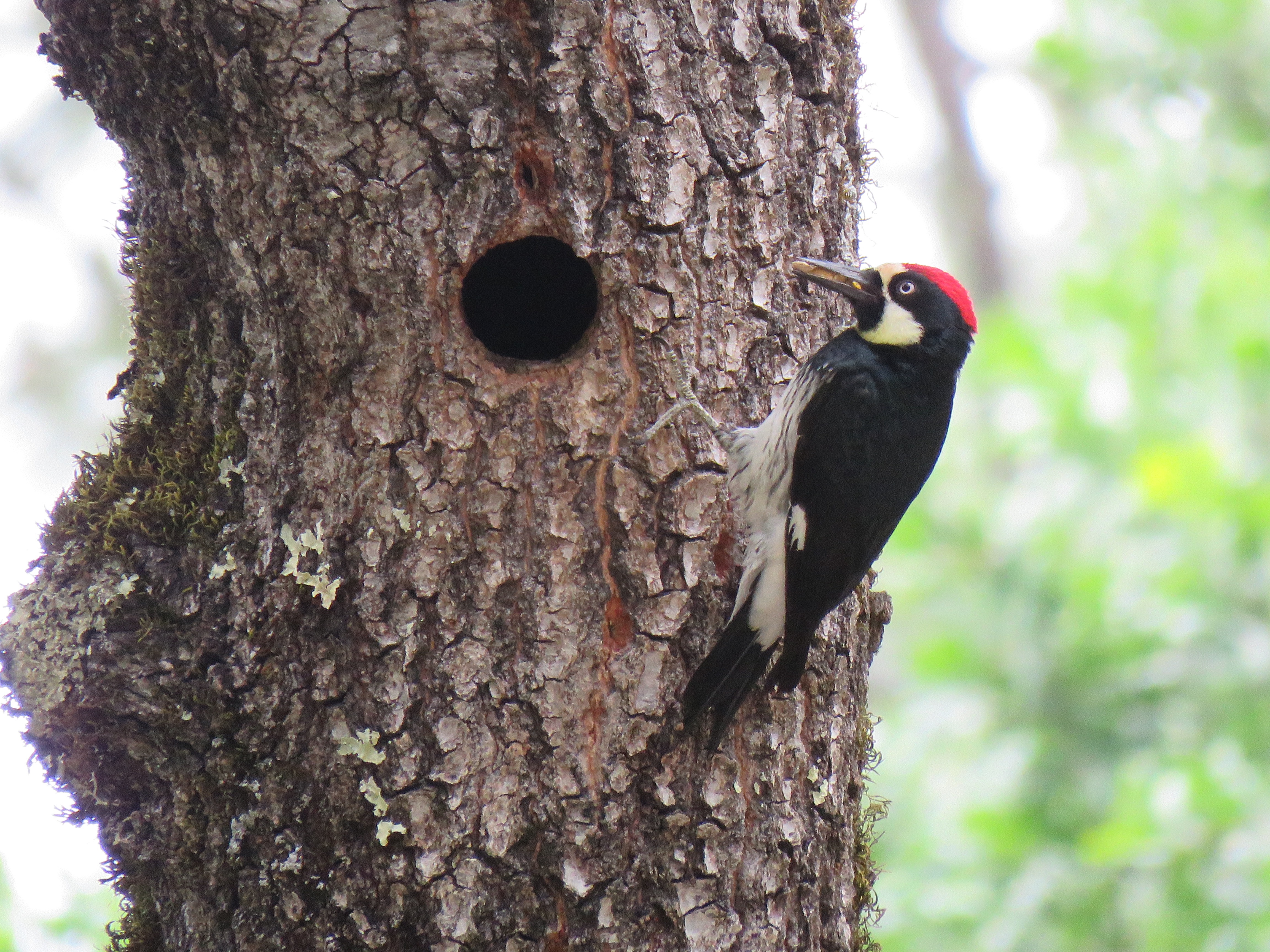
When we returned to my mother’s house I found a new subject to sketch: the active acorn woodpecker nest in the backyard. The nesting cavity was in a valley oak and the begging calls of the nestlings could be heard every time an adult few up with food.

An adult acorn woodpecker with, what else, acorns. I love the symmetry of the perfect circle of the nesting cavity entrance.
Feeding the young is truly family affair with the parents and members of last year’s clutch helping to collect food for the growing acorn young.