The AMTRAK route that parallels the west coast from Los Angeles to Seattle is the Coast Starlight, a journey of 1,377 miles.
In those 1,377 miles the only place that both the northbound and southbound (Trains 14 and 11) meet at a station is San Luis Obispo.
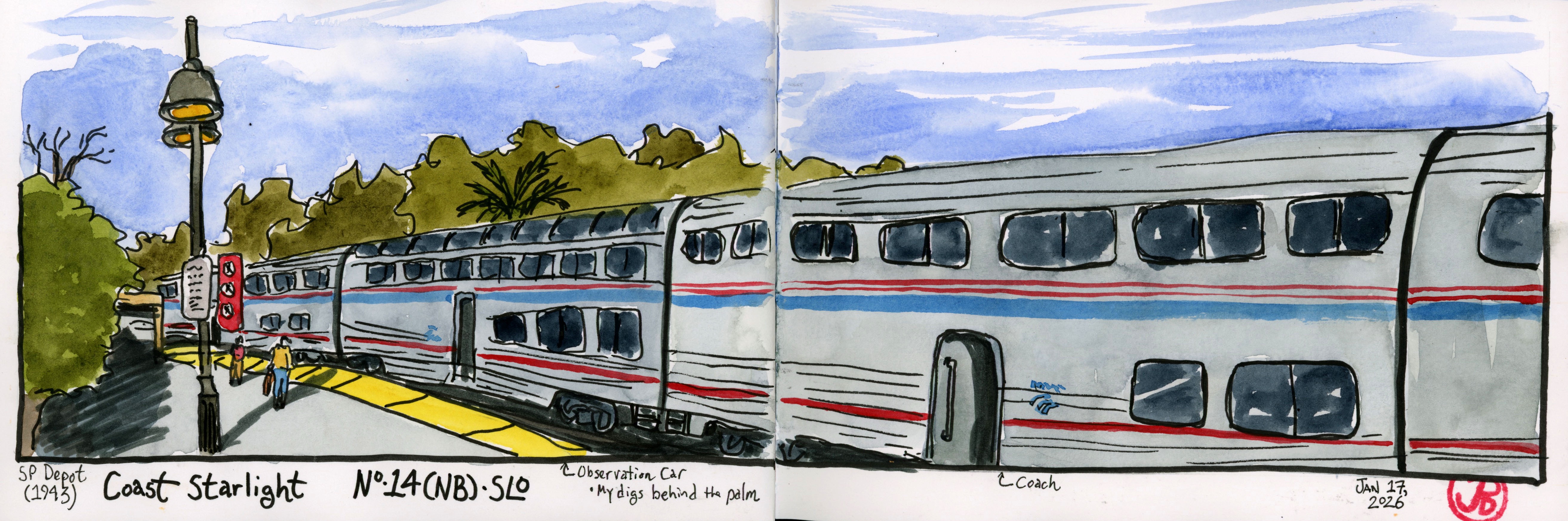
Northbound 14 arrives from Los Angeles at 2:50 PM (if on time) and waits for southbound train 11 (due at 3:24) to descend the single track down Cuesta Grade. And I planned to be there to do some sketching.
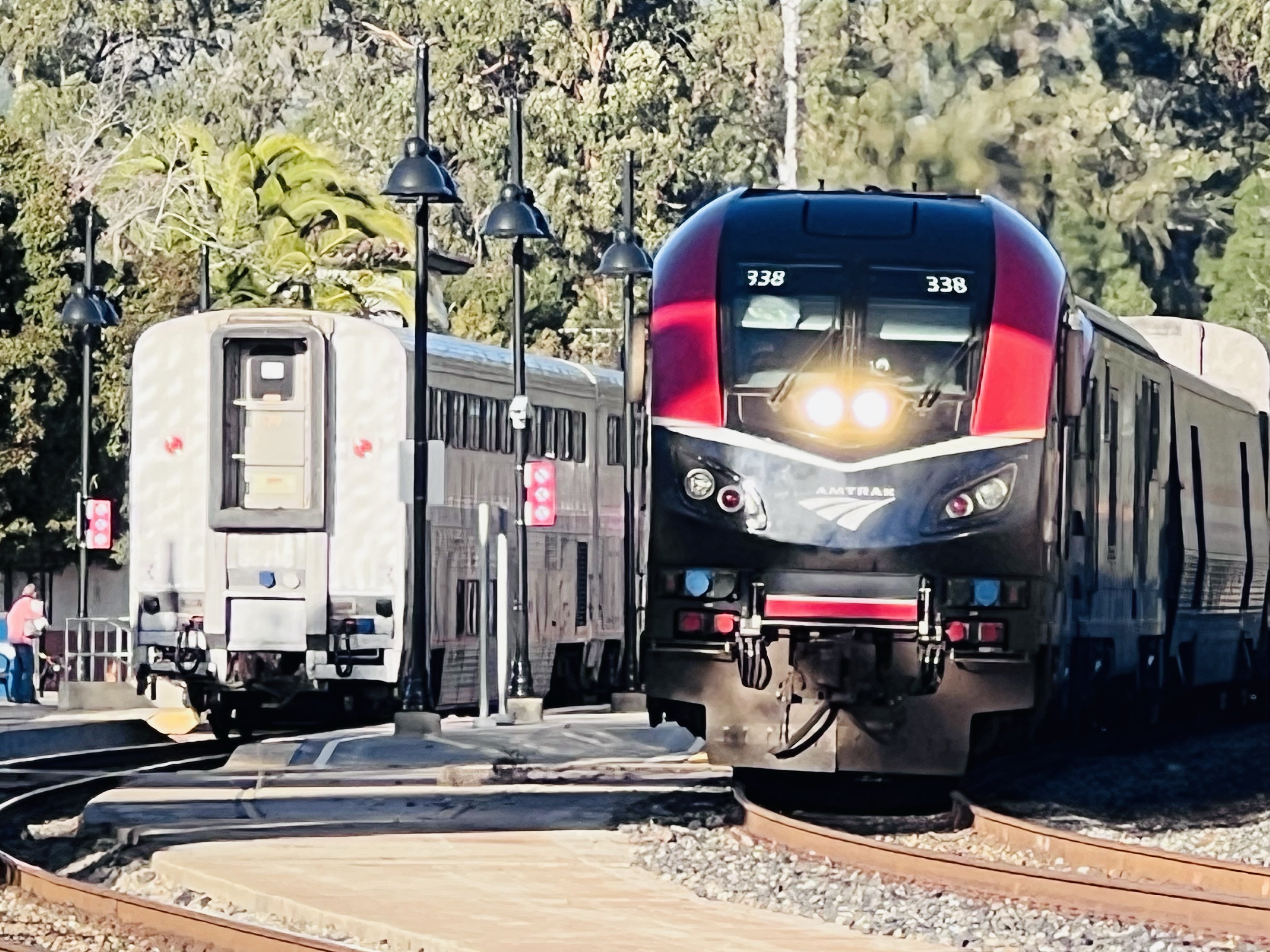
Both Coast Starlights at the station in SLO. Train 14 to the left and 11 on the right.
My plan was to sketch the northbound Train 14 at SLO station. In the age of steam, the Coast Daylight (SF to LA) stopped for only three minutes at San Luis Obispo in order to keep to its timetable.
During this short stop the Southern Pacific GS (Golden State or General Service) steam locomotives would be serviced and tender topped off with water. A helper locomotive would either be cut in or cut off depending on the direction of the Daylight.
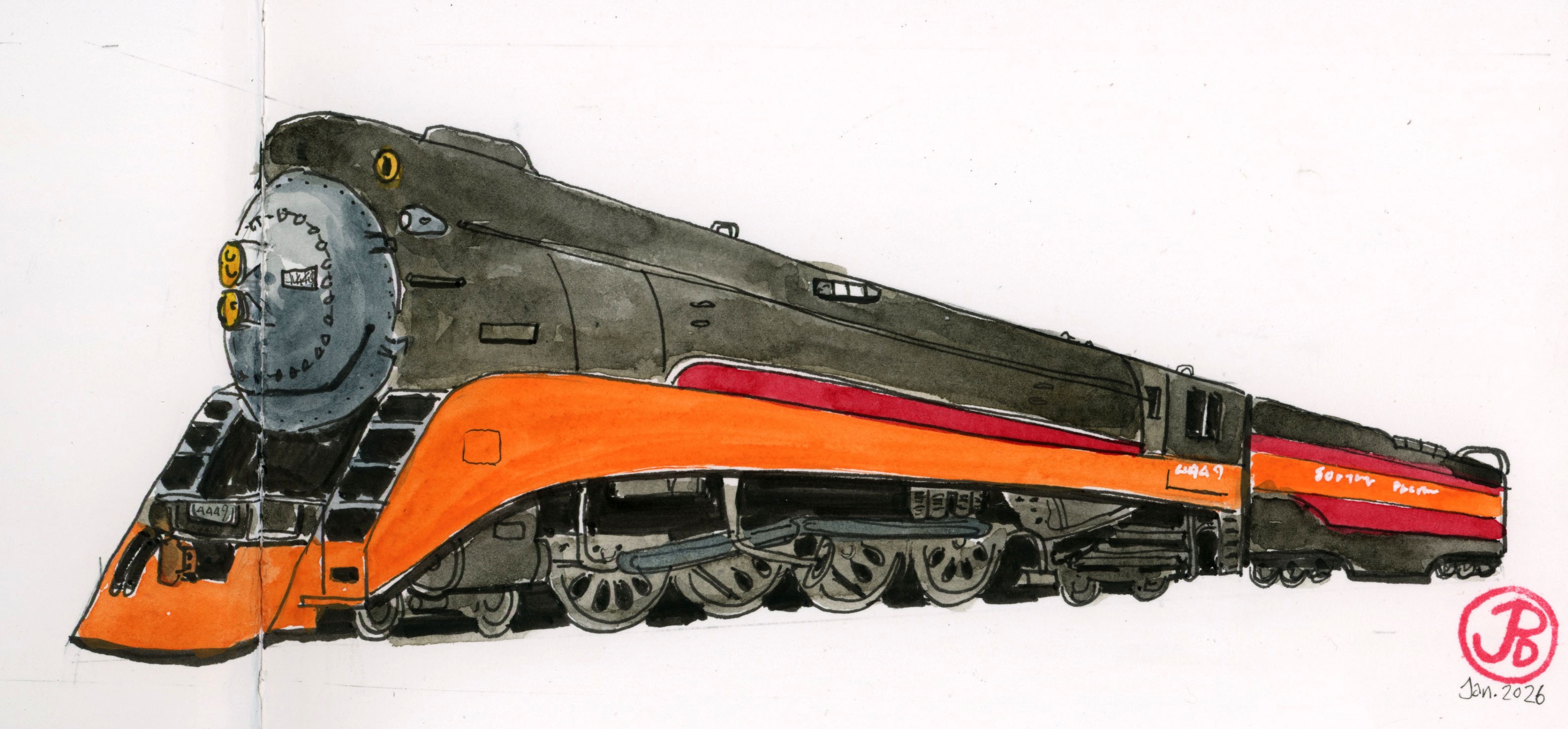
My sketch of one of the most famous steam locomotives in the world, Southern Pacific’s GS-4 No. 4449. This has been deemed “the most beautiful passenger train in the world” and SLO was one of her stops.
Now the AMTRAK train would stop for about 15 minutes, allowing passengers a stretch break, for some passengers this is also known as a smoke break.
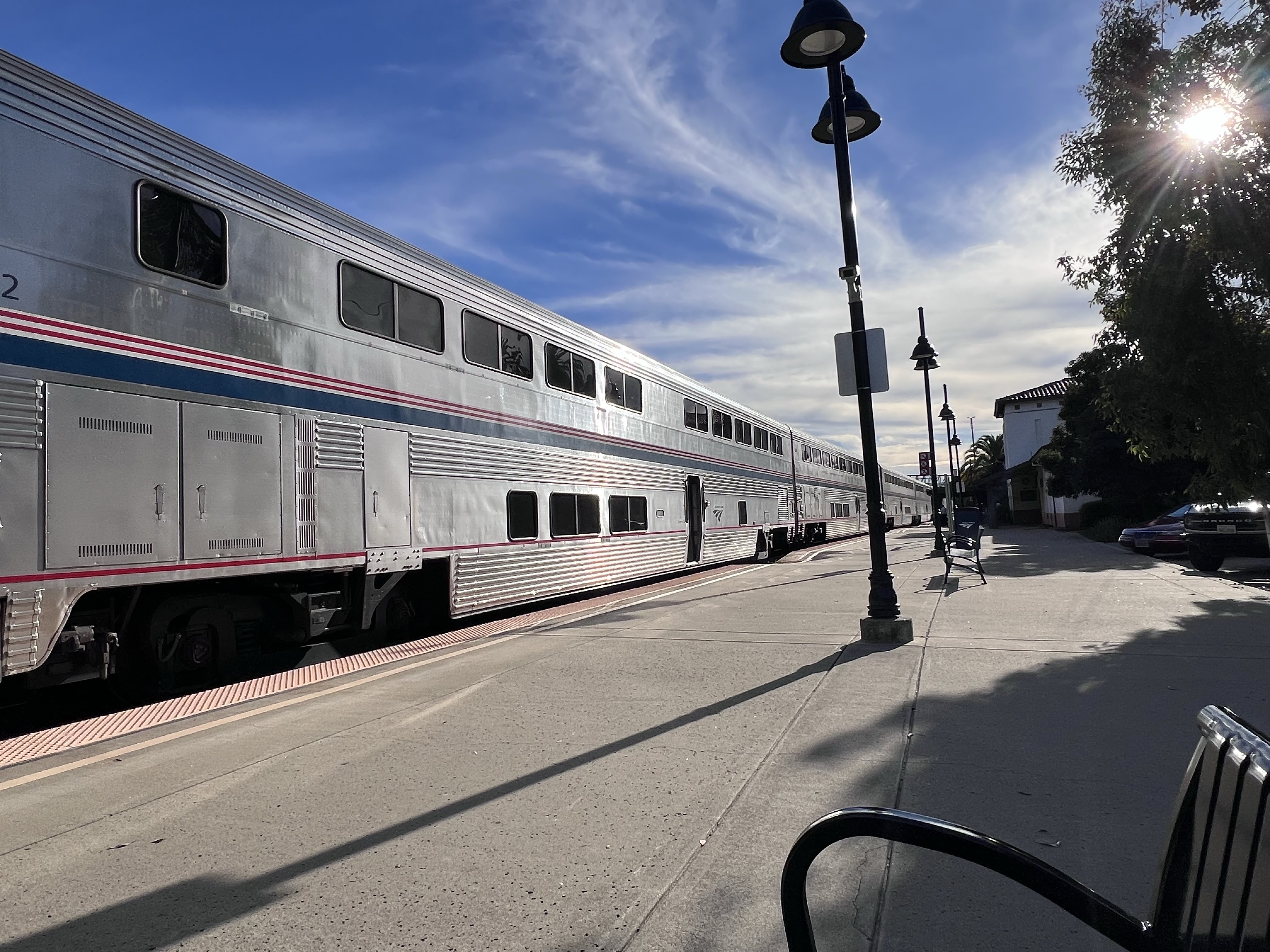
The Superliners at San Luis Obispo under beautiful January sun.
I figured 15 minutes was more than enough time to get a quick sketch in of the train at the platform before the locomotive’s loud retort announced its continued journey up the Cuesta Grade towards Seattle.
I took up my sketching position a little before the Starlight’s arrival. I penciled in the foreground and the trees in the background, not knowing which trees would be eclipsed by the double decker Superliner cars. The answer was: most of them.
When the train pulled into the station, I switched to pen. I love sketching without a net!
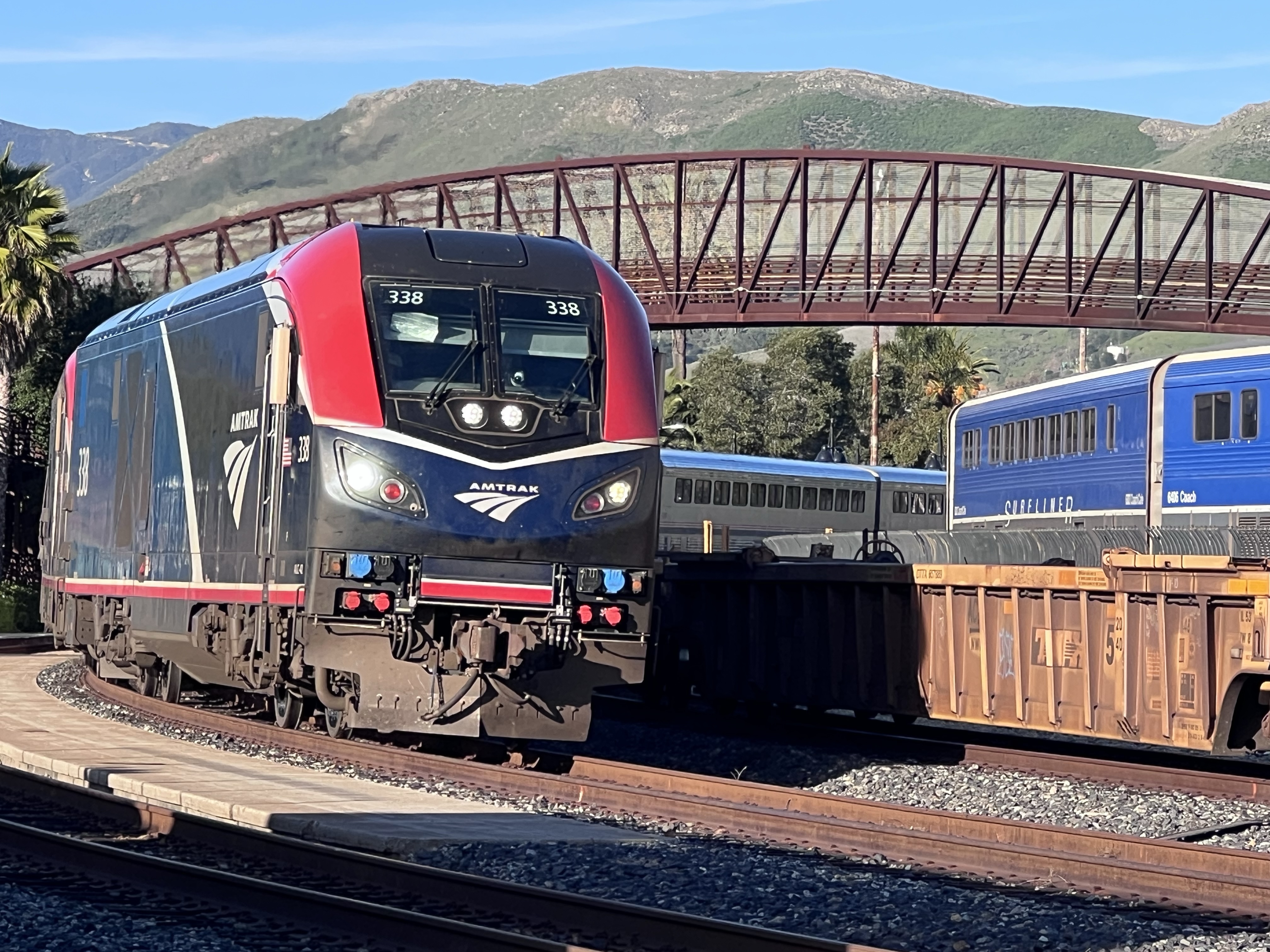
Train 11 heading towards Los Angeles with the AMTRAK’s new motive power, Seimens Charger on point. On the right is the Surfrider train on a side track.
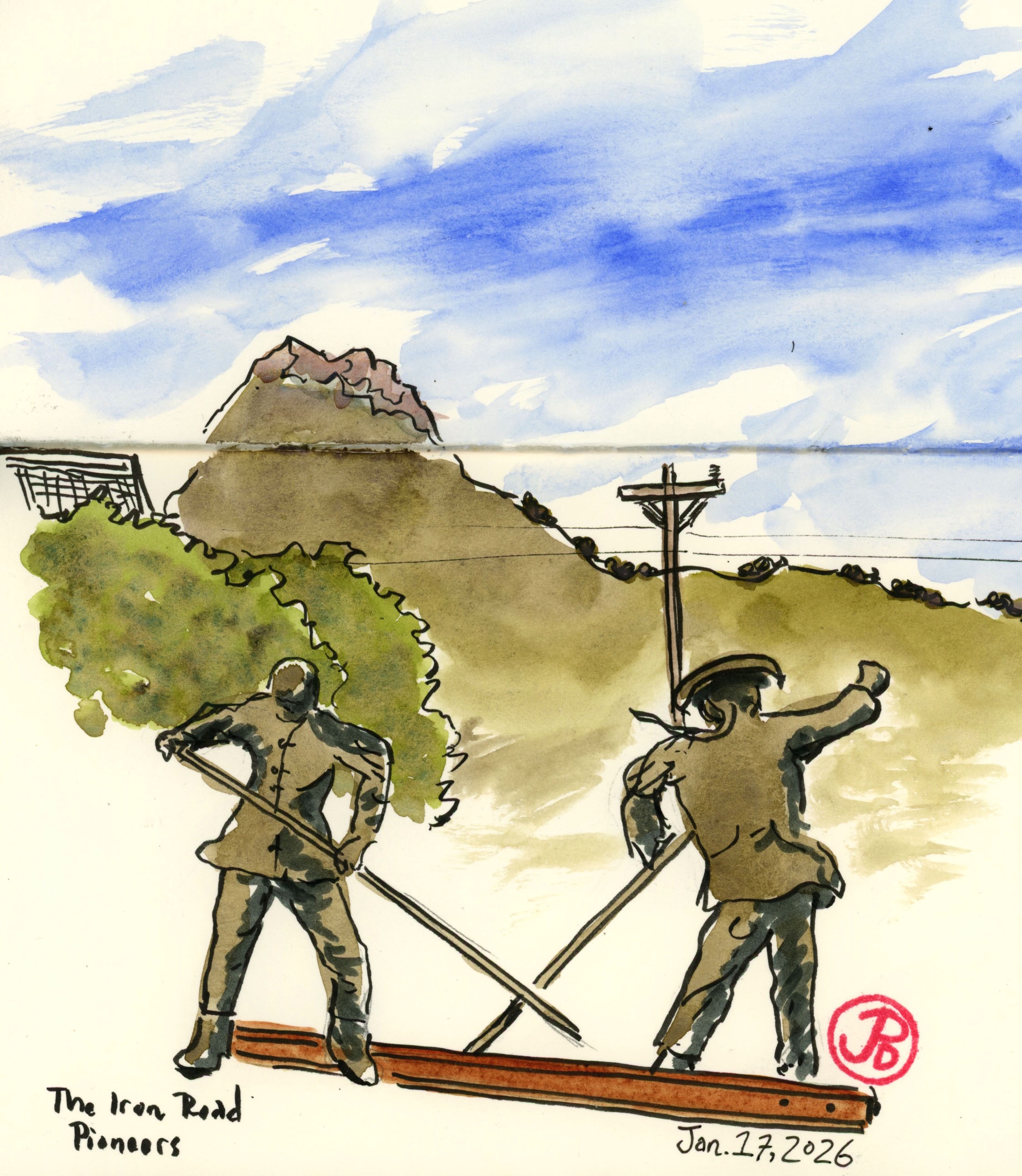
While waiting for the northbound Coast Starlight, I found a bench and sketched the statues near the station called the Iron Road Pioneers, with Bishop Peak in the background.
The statues are a monument to the Chinese immigrant workers who built much of the railroads on the central coast as well as other seminal railroads such as the Transcontinental Railroad.
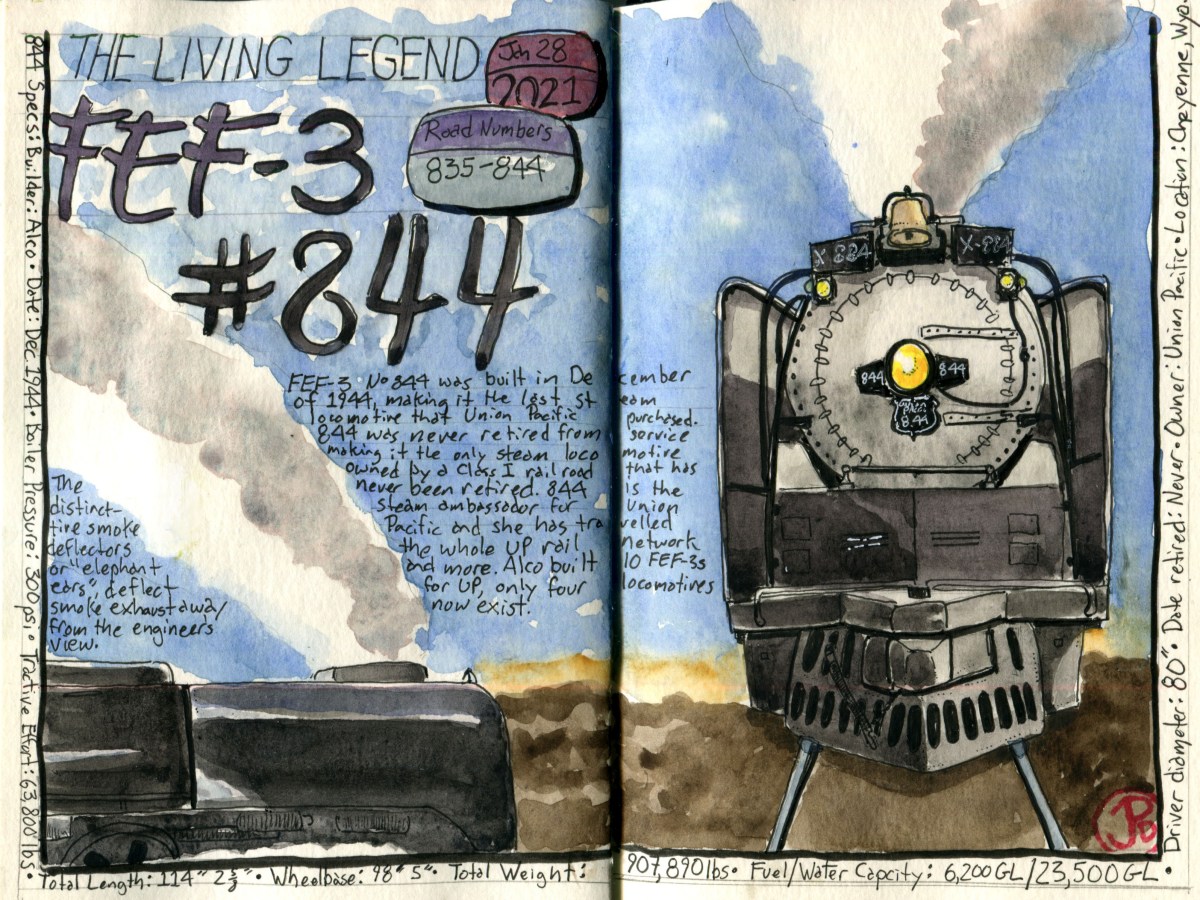
If Southern Pacific’s Queen of Steam is 4449 then Union Pacific’s Royalty must be 844.
The FEF class (4-8-4) No. 844 is known as “The Living Legend”. This class of passenger locomotive is a legend for it’s design and motive power but I want to stress the word “Living” because 844 is the only steam locomotive that has never been dropped from UP’s roster, making it the only steam locomotive, owned by a Class I railroad, that has never been retired.
The FEF-3 was designed to be a high speed passenger locomotive and 844 pulled such Union Pacific passenger services as the Overland Limited, Los Angeles Limited, Portland Rose, and Challenger. 844 really had three phases of life. First as a passenger locomotive, secondly, as diesels replaced steam on passenger routes, 844 hauled freight in 1957.
At the end of the age of steam, when steam was being replaced by diesel, Union Pacific had the foresight to preserve one of it’s classic locomotives and 844 entered into her third life as an ambassador to one of the world’s largest railroads: Union Pacific.
I was 10 years old when I first encounter Union Pacific 8444, as she was known then, at the offical opening of the California State Railroad Museum in 1981. She had to be renumbered because there was a diesel locomotive given the road number 844. For the event, two of the most emblematic survivors of the Northern class (wheel arrangement 4-8-4) were in attendance. Southern Pacific’s GS-4 4449, newly repainted in her Daylight livery and Union Pacific’s 8444. On the tracks outside the museum, which paralleled the Sacramento River, these two Superstars of Steam came pilot to pilot. What a sight to see!
844 is not as streamlined as 4449 but the 844’s steam deflectors, also know as “elephant ears”, gives this 4-8-4 a very unique appearance. The steam deflectors help to loft steam exhaust from the chimney or smoke stack to improve the engineer’s visibility and also to keep the exhaust out of the cab.
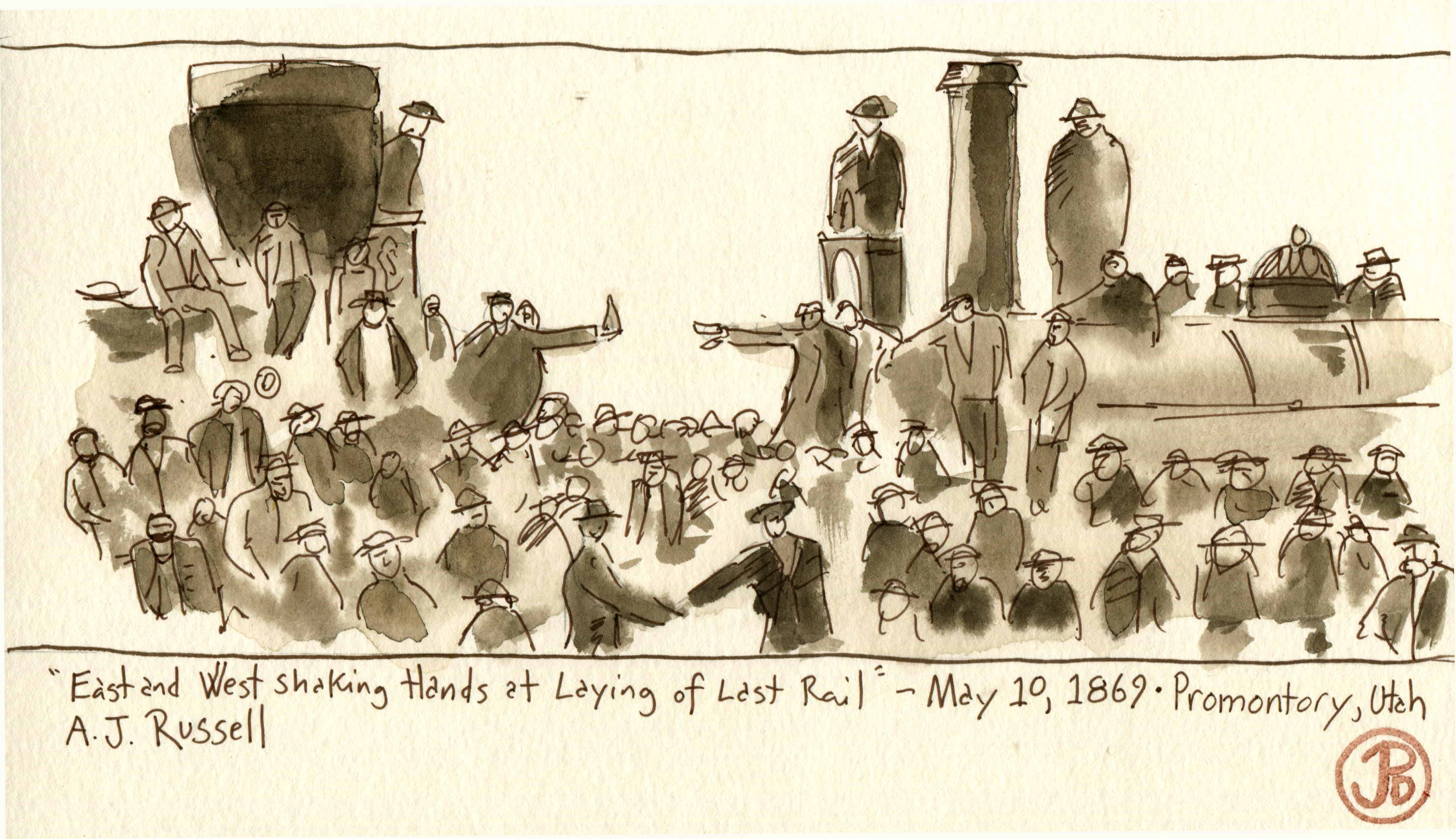
It was an echo of the famous photograph taken at the uniting of the Transcontinental Railroad at Promontory Point, Utah on May 10, 1869. 4449 represented the Central Pacific, later Southern Pacific and 8444 represent, and still does, Union Pacific.
Union Pacific’s steam ambassador has been all across Union Pacific’s rail network. She is a locomotive that brings people to the tracks to see her in action. One annal excursion is Cheyenne Frontier Days from Denver to Cheyenne. In May, 2019, 844 played second fiddle on the inaugural run of the recently restored Big Boy 4014 from Cheyenne to Ogden, Ut to commemorate the 150 Anniversary of the completion of the Transcontinental Railroad. Of course the Big Boy was on point as the lone example of the largest locomotive in operation.
At the ceremony, 844 and 4014 came pilot to pilot, echoing the the famous photograph taken 150 before when Central Pacific’s engine “Jupiter” and Union Pacific’s engine No. 119 came pilot to pilot on May 10, 1869.
The Union Pacific Steam Shop in Cheyenne, Wyoming . This is about as close as I got to seeing the “Air force 1” of Union Pacific: FEF-3 #844 on a visit in the October of 2017. The only sign of steam is the UP yellow tender outside one of the bay doors.
There is a concept known as a “spark bird” in birding. This is the bird that first ignites your passion for birds. For the pioneering field guide artist, Roger Tory Peterson, it was the northern flicker. Why can’t a child also have a spark locomotive?
My “spark” locomotive is Southern Pacific’s GS-4 number 4449.
Many children are attracted to trains. Most often it might be a locomotive on static display or maybe watching a commuter or freight train pass by. My passion for steam locomotives comes from my father, who, as an only child growing up in San Francisco, loved anything that rode on two rails: street cars, cable cars, and trains.
While many children, “put away childish things”, my connection to trains, railroads, and locomotives connects me to my father, and that bond has grown stronger since his passing five years ago.
One Christmas, my father gave me a HO scale model railroad. Together, well, mostly my dad, created an oval layout on a large piece of particle board. It came out on our dining room table, a few weeks before Christmas, and stayed up, certainly as long as our neighbor’s Christmas lights. On a part of the oval track was a paper mache tunnel which spanned the tracks. It was made by my father, probably with some help from his father.
My first locomotive was a Santa Fe F7 in the ironic warbonnet paint scheme. This locomotive pulled a short, motley freight consist around the oval, over and over again.
Then one Christmas came an HO replica of one of the most beautiful steam locomotives ever built: Southern Pacific GS-4 #4449. And later came a Daylight baggage car, a few passenger cars, and an observation car.
A GS-4 was a Northern class (4-8-4) of passenger steam locomotives, built for the Daylight route from San Francisco to Los Angeles. Southern Pacific reached it’s zenith with the design of this streamlined locomotive that also had plenty of power and speed to make the 470 mile trip.
The four drive wheels of a GS-4 provide traction to the rails. The four wheels on the other side makes the wheel configurations a 4-8-4. This is the only surviving member of it’s class, 4449 at the Oregon Rail Heritage Center in Portland, Oregon. The white star on the drive wheel indicates an internal bearing and the type of axle grease used.
Out of the 28 GS-4s built by the Lima Locomotive Works, only one survived. As a point of comparison, Union Pacific produced 25 “Big Boys” and now eight are still in existence, including 4014, which has recently returned to steam, making it the largest steam locomotive in operation.
The last remaining GS-4, 4449, was built in May of 1941 and was retired from service on October 2, 1957. It was donated to the City of Portland, Oregon where she was placed on static display at Oaks Park. In the following years the locomotive was vandalized and it builder’s plate and whistle stolen.
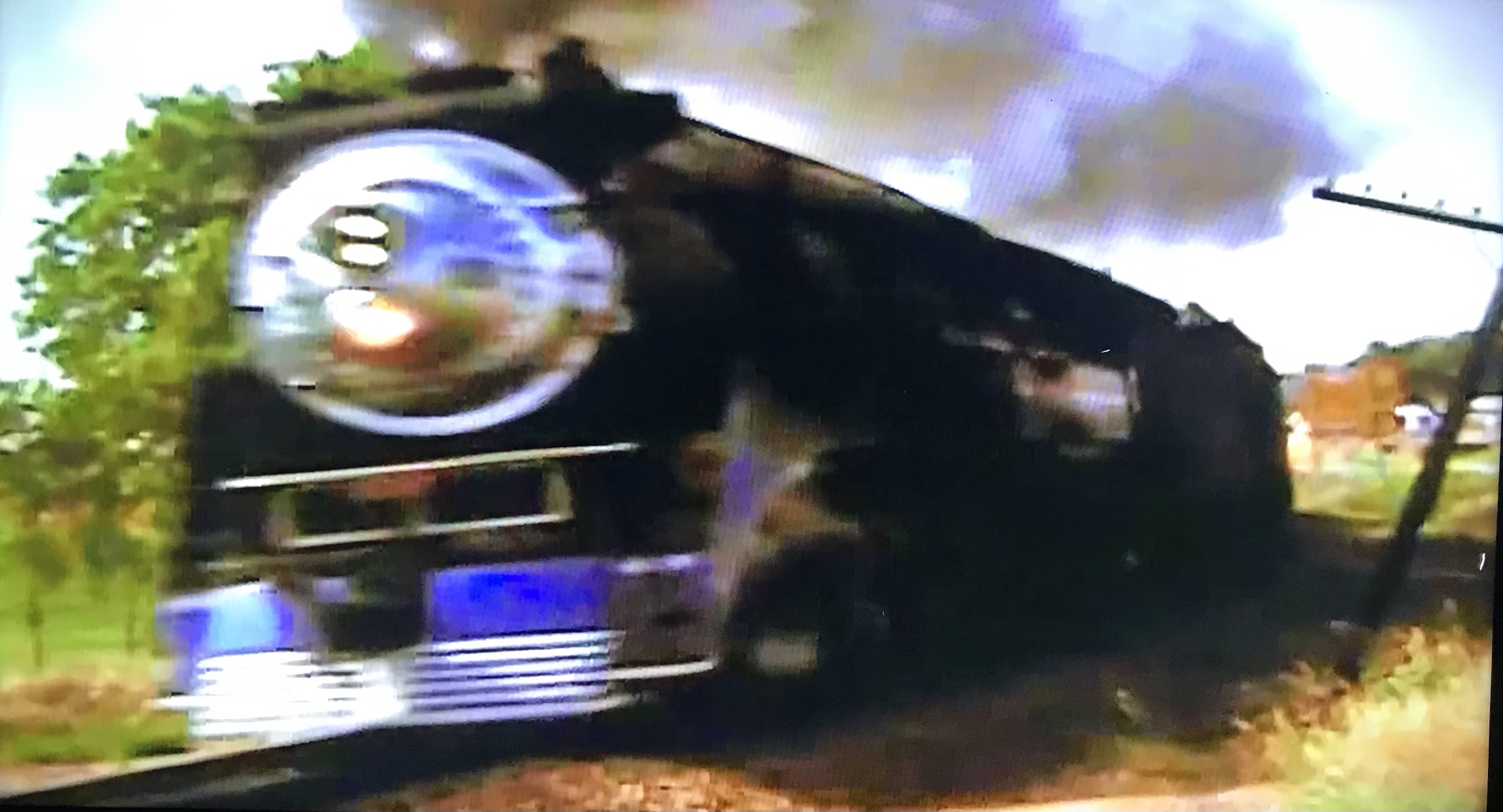
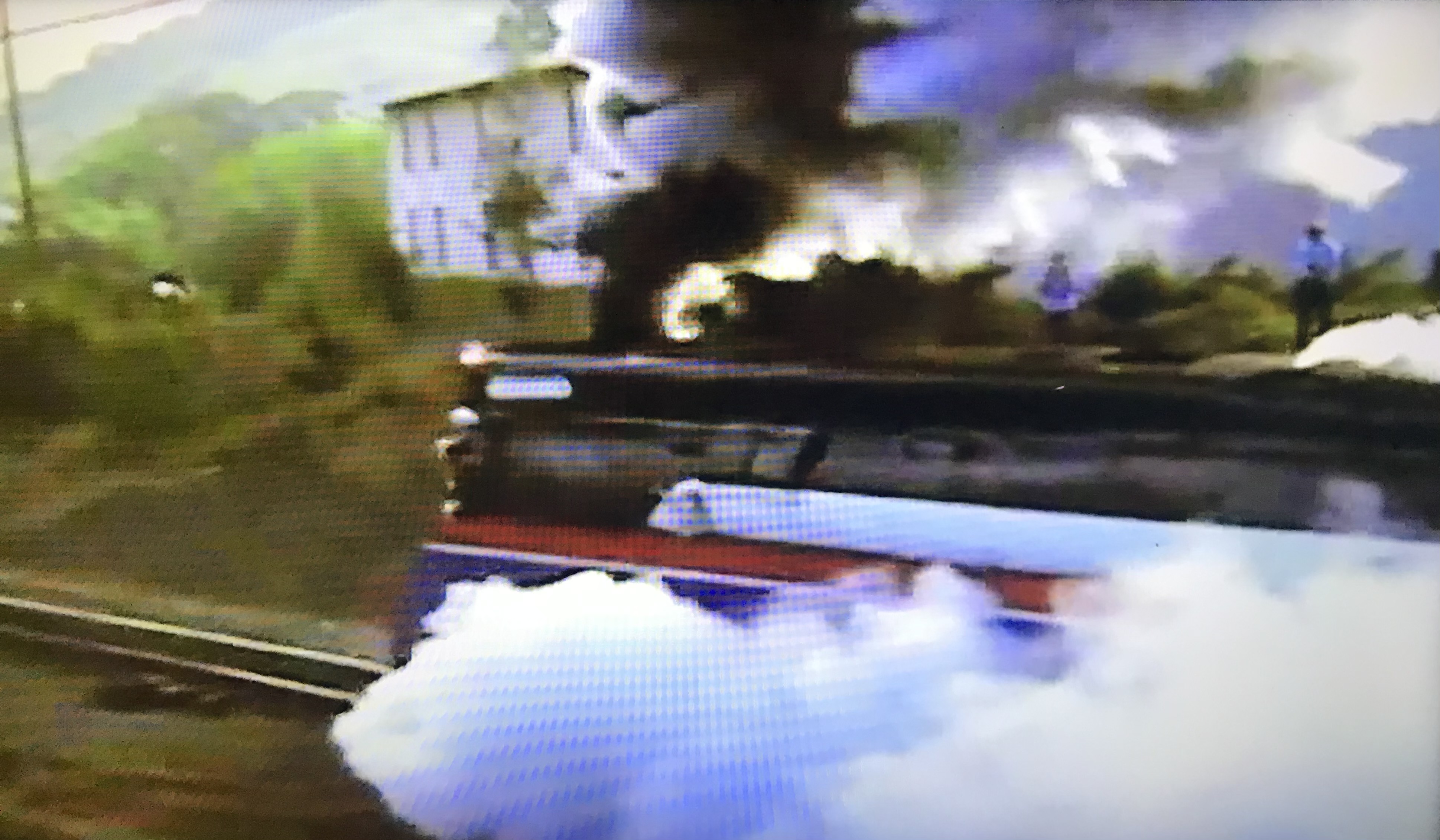
In 1974, as our Bicentennial was approaching, 4449 was evaluated to see if she could be restored and brought back to life to haul the Freedom Train, a traveling exhibit featuring historical artifacts aboard train cars that visited all of the Lower 48 states. 4449 was restored and pulled the Freedom Train for many stretches on it’s national tour. 4449 was given the moniker, “The Queen of Steam”.
4449 at speed. This is a still from a Super 8 film my dad took when 4449 was in its Freedom Train livery from May of 1977. Another still from one of my dad’s Super 8 films of 4449. The amount of steam exhaust emitted from 4449 in this shot would have defiantly put a smile on my dad’s face. Here you can see 4449’s livery of red, white, and blue.
After 4449 was done with it’s two year tour, she returned to Portland, Oregon when in 1981, she was repainted in her red, orange, and black paint scheme of Southern Pacific’s Daylight. During the 1980’s my father and I followed 4449 around the state, this time I took the Super 8 footage while my dad took stills. We even rode on a train pulled by 4449 on a two day excursion from San Francisco to Los Angeles.
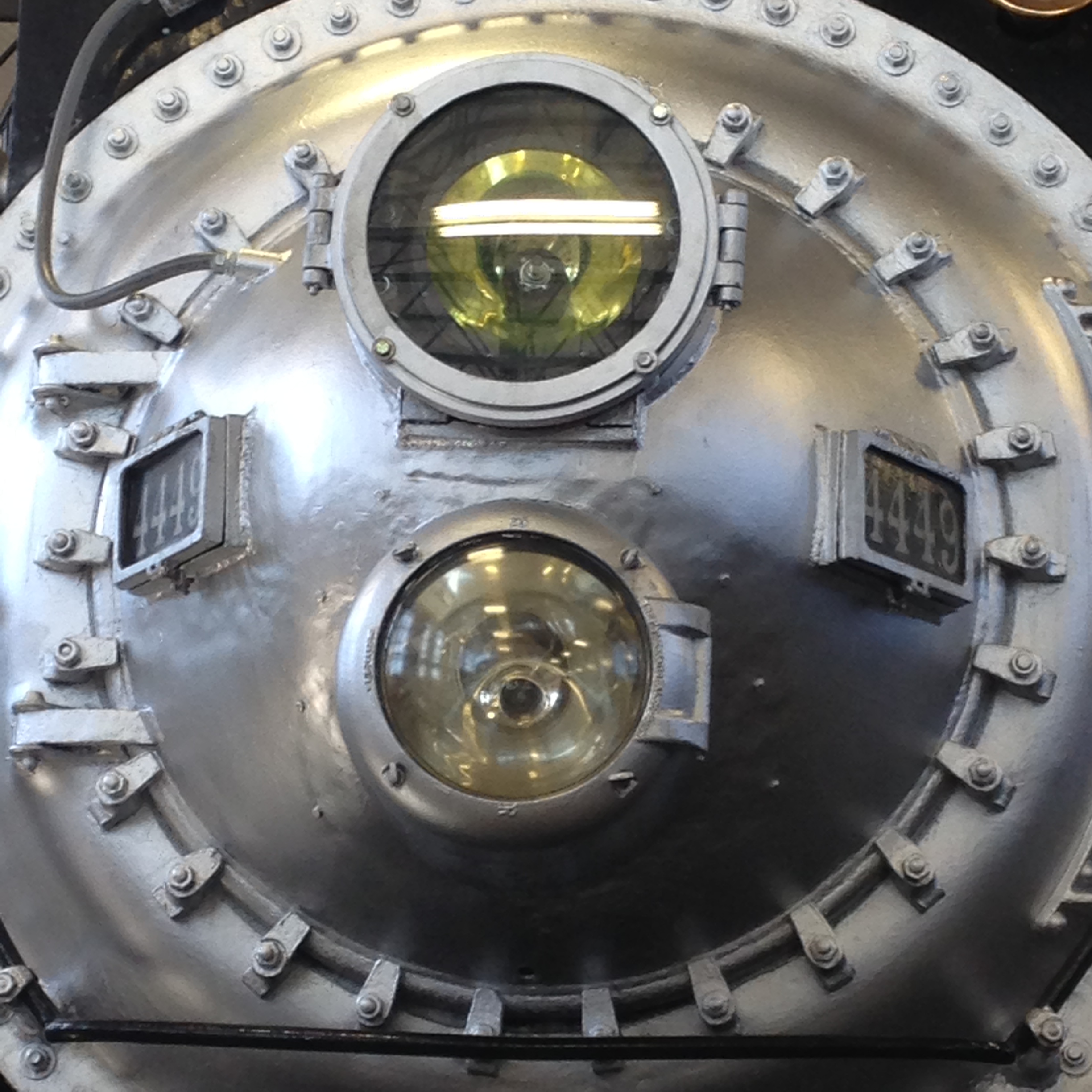
One wonders how to keep connected to someone who has passed? While they are in the ethereal and unknown world, that touchstone is often something earthy and physical. It could be a photograph, a house, or a landscape. For me, that touchstone is a locomotive that was built in 1941, nine years after my father was born. While my father is no longer here, 4449, a touchstone to the past, still lives and breaths. When I look into the eyes of her ever-moving mars light, I somehow see the eyes of my father.
At one time it was a company town for the Southern Pacific Railroad when 3,000 of it’s citizen’s where employed by Southern Pacific Railroad.
Dunsmuir was previously known as Pusher because this is where helper locomotives where either added or taken off trains. They were put on to make it up the Cantara Loop and the climb out of Dunsmuir as the line headed north. Helpers where also used on downslope freight trains to help with dynamic braking.
The town contains a railyard, shops, and a still functioning turntable to turn locomotives around. In it’s heyday, Dunsmuir had a population of 5,000, many of those working for the railroad, serving the labor intensive steam locomotives. When the stream locomotives were replaced by more efficient disel-electric locomotives, the town’s population was almost halved.
Today, the mainline sees two passenger trains and about 15 freight train daily. Most freight trains are now powered by three to four, 4,000 to 6,000 horsepower, diesel-electic engines, so the need to add engines has become obsolete.
Dunsmuir still feels very much like a train town even though Southern Pacific was aquired by Union Pacific in 1996.
The main street, Dunsmuir Avenue, is beautiful in it’s small town charm. And of course the main street parallels the main line.
The crown jewel of downtown Dunsmuir is the California Theatre. This 800 seat movie palace was opened in 1926. The theater featured a stage and a Wurlitzer pipe organ. The theater is only one block from the passenger station and, in it’s heyday, many of Hollywood’s finest and other dignataries visited the theater including Babe Ruth, the Marx Brothers, and Clark Gable.
In recent times the theater has faced some troubling times, after many stops and starts the theater closed in 2016. There was also a Masonic Lodge that met in the building for close to 70 years.
I parked on Dunsmuir Avenue and did a car sketch (great for social distancing) of the the epic sign and marque. I added a bit of artistic license when I added perhaps the best movie ever made featuring a locomotive, Buster Keaton’s masterpiece, The General (1926).
Across from the station is a mural on an oil tank. The mural was created by rail historian, artist, author, and former employee of the Southern Pacific and McCloud Railroad, John Signor. This is a sketch I did from my photograph. It features a Southern Pacific EMD SD45 T-2R diesel-electric locomotive and the famous Daylight GS-4, 4449. This mural represented the future and the past of the Southern Pacific Railroad. It is also a reminder of the name of the railroad that built Dunsmuir.Only two passages trains stop at Dunsmuir Station. The north and southbound Coast Starlight, an Amtrak service from Seattle, Washington to Los Angeles, California. To catch the Coast Starlight at Dunsmuir, you have to get up very early in the morning (or simply just stay up). The southbound Train 11 arrives in Dunsmuir at 12:35 AM and northbound Train 14 arrives at 4:56 AM!Dunsmuir is an important division point in the Shasta Division where train crews change over. In this case, a BNSF freight train with a consist of hopper cars, change it’s engineer and conductor. BNSF is granted trackage rights to use this route by the tracks owner: Union Pacific.
Note: Part of sketching, and life I might add, is making mistakes and with this sketch I made one. I am a native Californian and I made unforgivable mistake of misspelling my own state! That sometimes happens when you are so focused on form and not spelling. I added the missing “I” on the street below.
One of the world’s most beautiful steam passenger trains ran from San Francisco to Los Angles during the 1930s and 1940s.
This was envisioned as a non-stop train connection from San Francisco in the north to Los Angeles in the south. This first started as the Daylight Limited on its inaugural run on April 28, 1922. The first service was only offered on Friday and Saturday.
The rugged 470 mile route became more popular and Southern Pacific added more trains so that by July of 1923, the route ran seven days a week, all year round.
During the Great Depression, passenger railway service was down but Southern Pacific’s president, Angus McDonald gambled on creating a modern train that would provide luxury, efficiency, and speed to the Daylight coastal route. The entire train, from the engine to the observation car would be streamlined in imitation of what was being applied to airplanes and automobiles at the time.
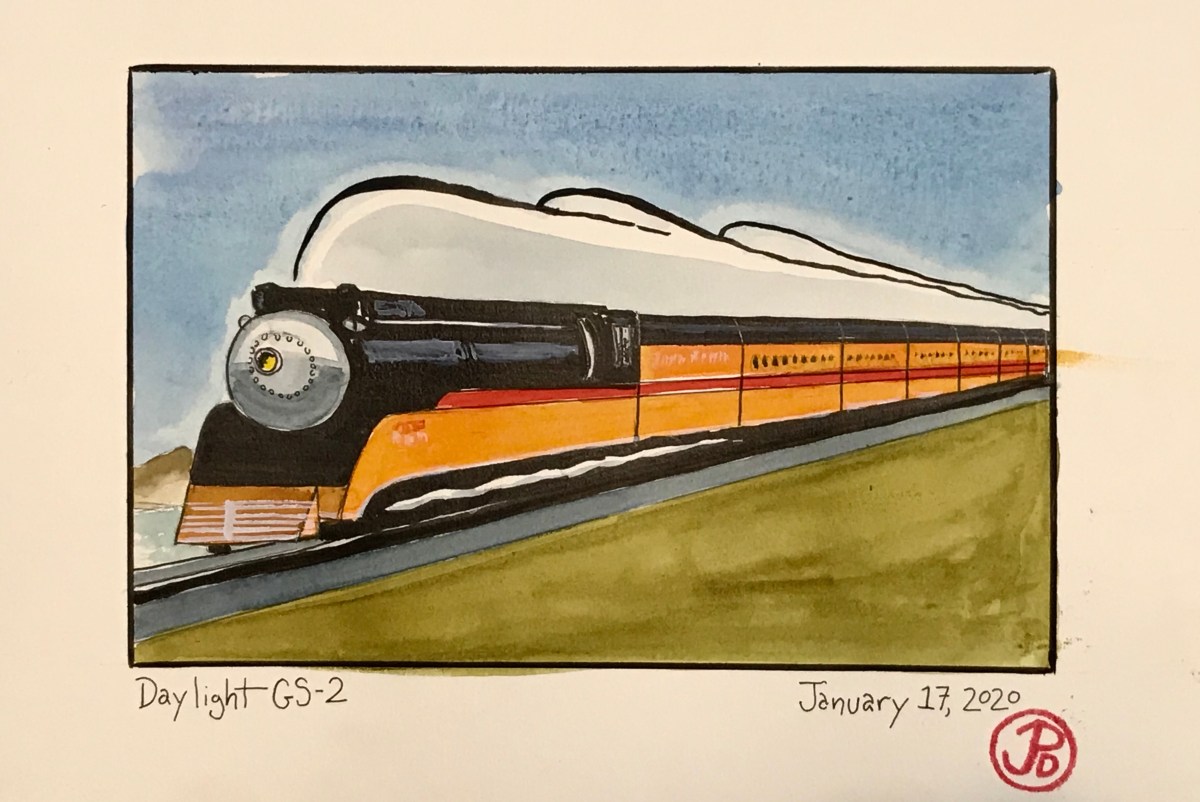
The first steam engine to engender this new vision was the GS-2 (Golden State). An order of six (Numbered 4410 to 4415) were built in Ohio at the Lima Locomotive Works. They were Northern type engines with a 4-8-4 wheel configuration. This engine provided the extra power and speed needed for the 12 hour coastal route.
The GS-2 was the first of the streamlined passenger engines built for Southern Pacific and also the first to feature the classic Daylight livery of orange, red, and black. This paint scheme was extended to the entire length of the train hauled a twelve car train consist, consisting of one diner car.
The first inaugural run of the upgraded Daylight was on March 21, 1937. A champagne bottle was broken on No. 4413 at San Francisco’s Third and Townsend Station. A similar ceremony took place in Los Angles with engine No. 4411 but with a touch of celebrity as film star Olivia deHavilland broke a bottle of champs on the pilot of the GS-2.
All of the stations I have sketched in San Mateo County had the Daylight blow through their platforms. A southbound train leaving San Francisco stopped only at Palo Alto and then San Jose in the Bay Area leaving San Mateo County in the dust.
After San Jose the Daylight’s next stop was Salinas. Then San Luis Obispo, Santa Barbara, Oxnard, Glendale, and finally terminating at Los Angeles’ Union Station.
No GS-2 locomotives survived the dieseization of America’s railways in the 1950s but an updated version of the locomotive, a GS-4, Number 4449, survives and still is operational. She is one of the most popular and beautiful stream locomotives in the world.
It is then fitting that my next destination was in Santa Clara County to the Daylight’s first stop since departing from San Francisco to a Station the bore same streamlined design as South Pacific’s beautiful engine.
A field sketch of the “Queen of Steam”, GS-4 locomotive number 4449 in Portland, Oregon. This is the only operational engine still in existence that worked the Daylight route.
The nose and duel lights of Southern Pacific No. 4449, one of the most famous steam locomotives in the United States. The streamlined nose looks like something out of Buck Rogers.

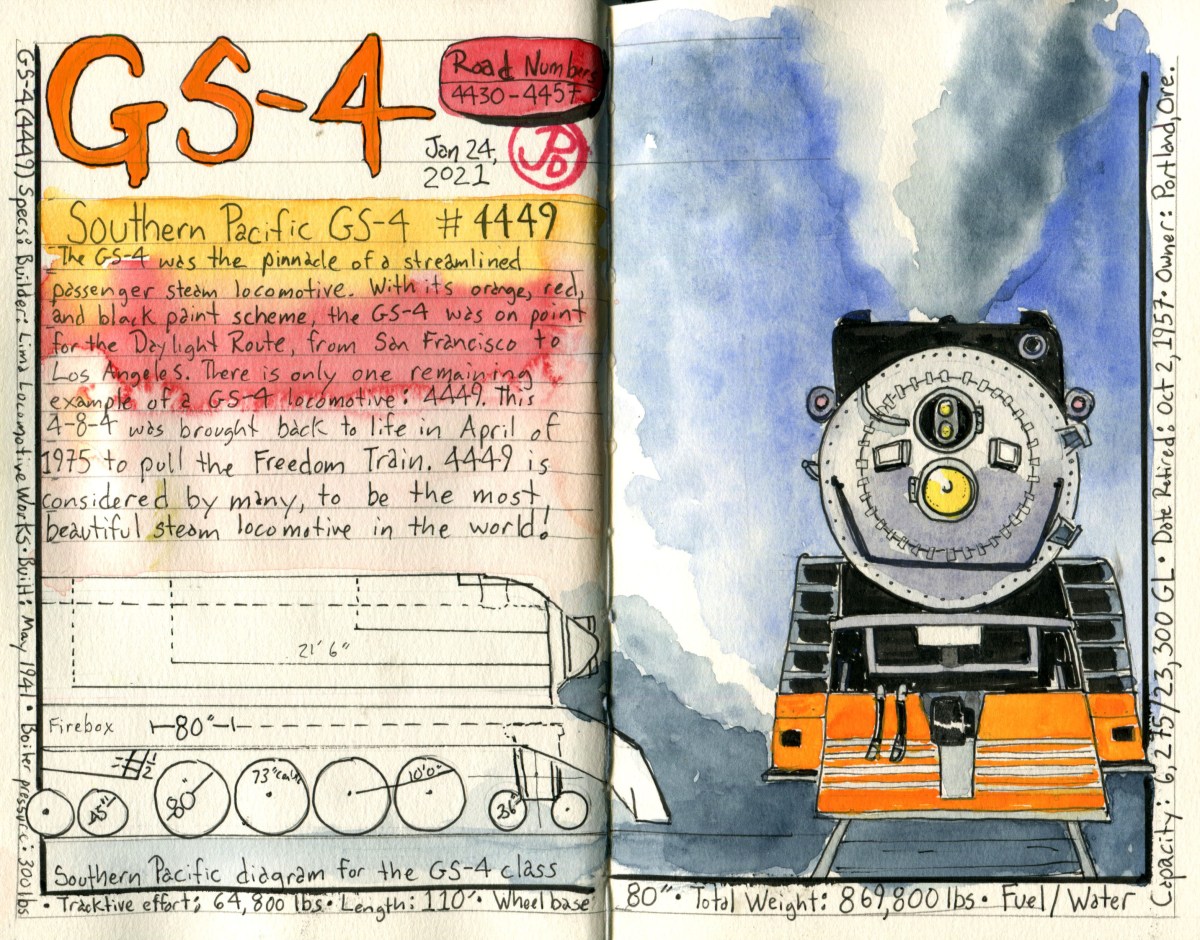



 A field sketch of the “Queen of Steam”, GS-4 locomotive number 4449 in Portland, Oregon. This is the only operational engine still in existence that worked the Daylight route.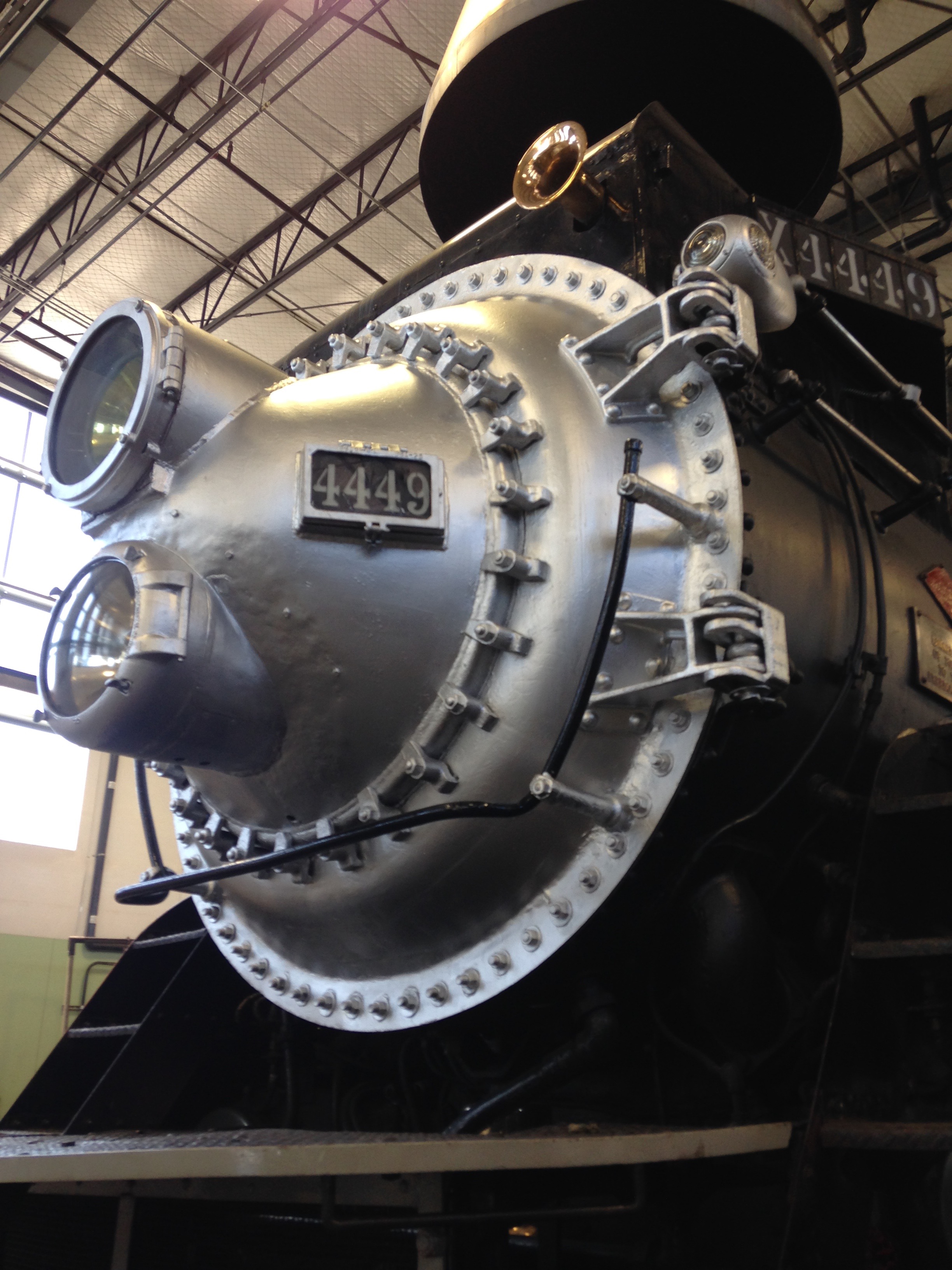
 Corvid Sketcher