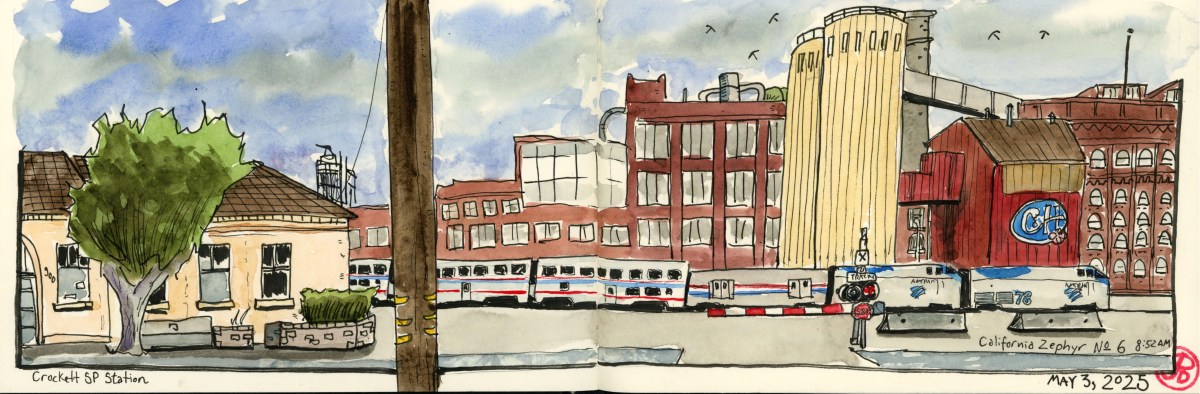
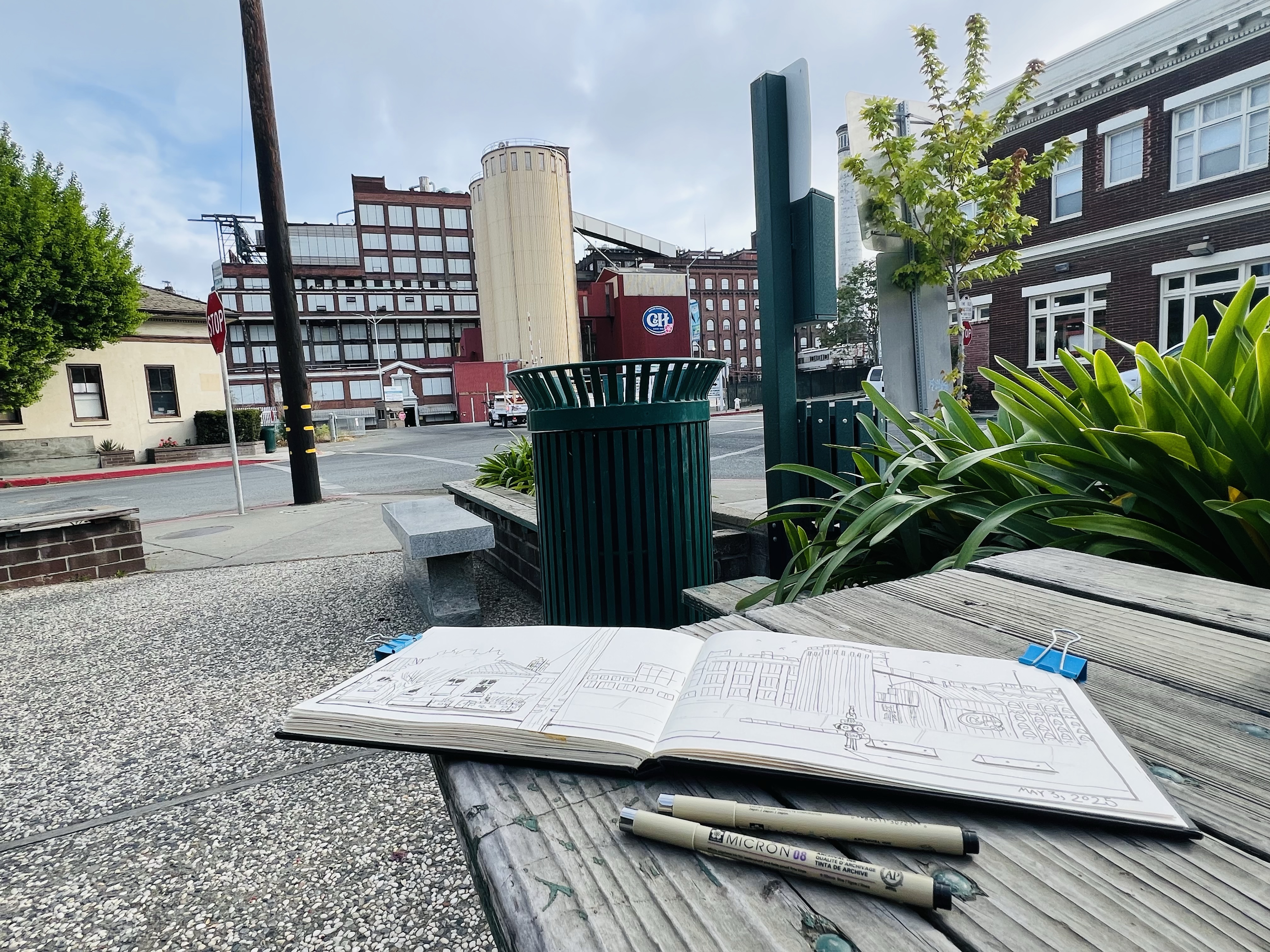
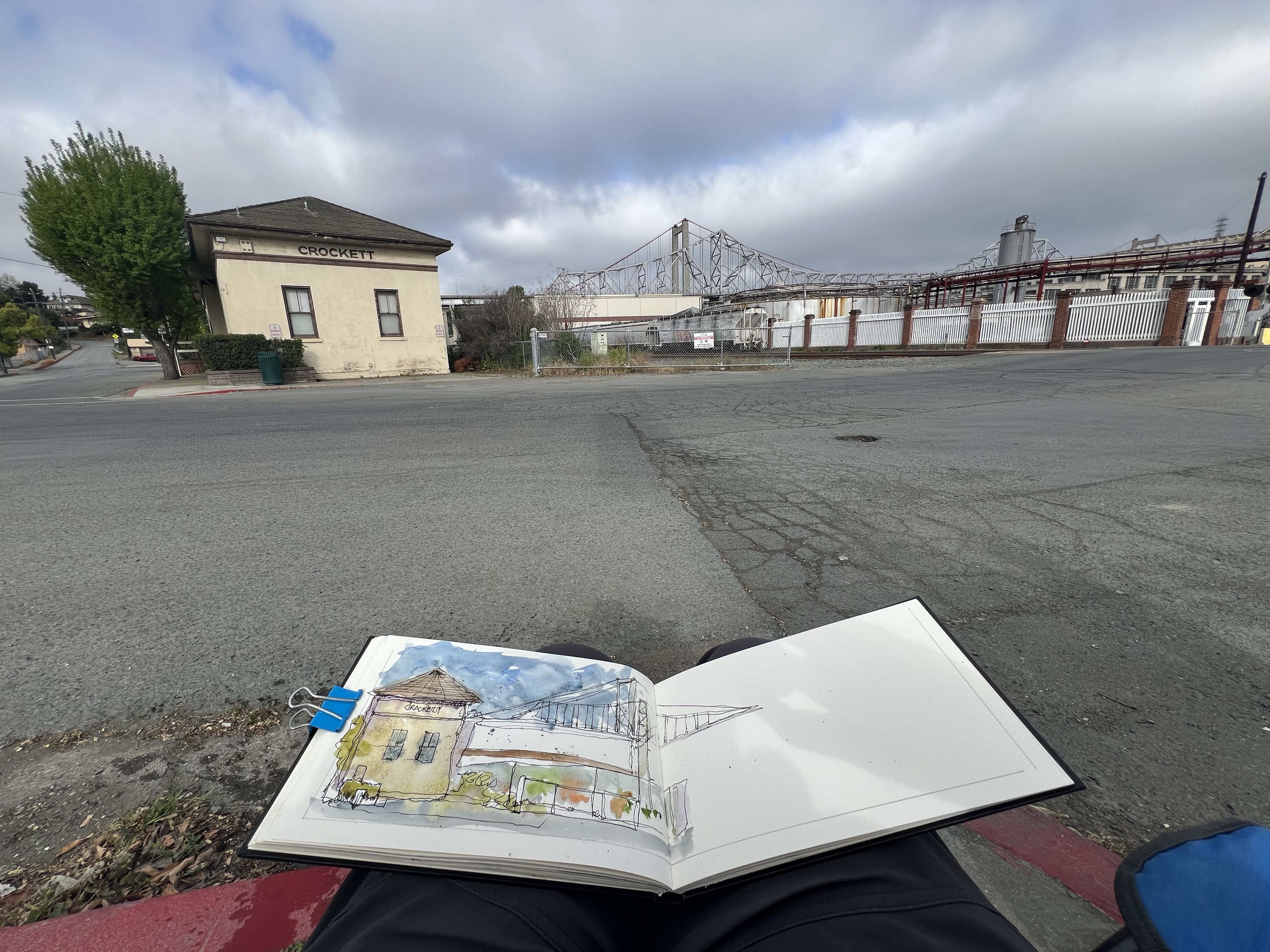
My Saturday morning sketch found me at the corner of Loring and Rolph Ave in the little corner park in Crockett.
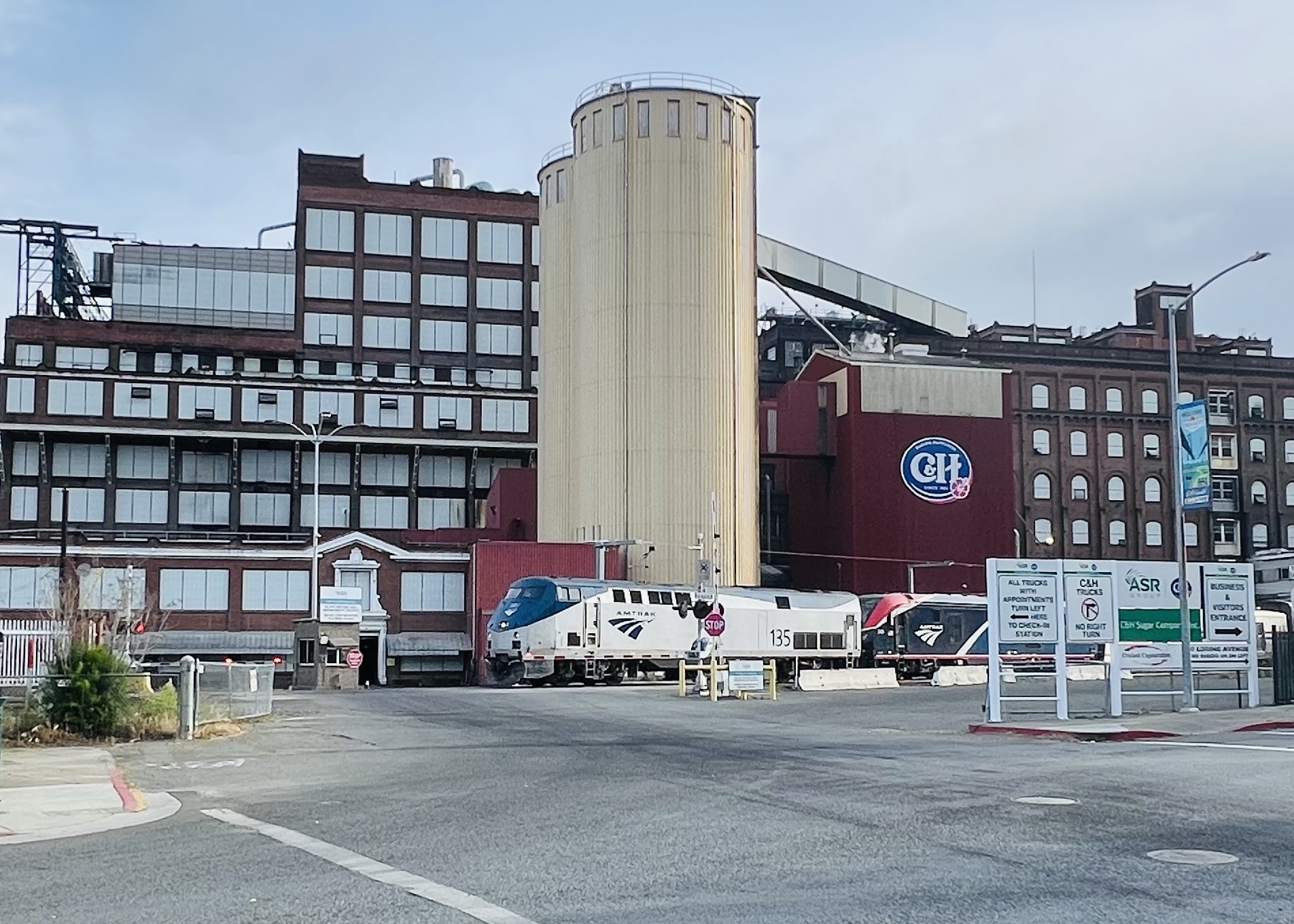
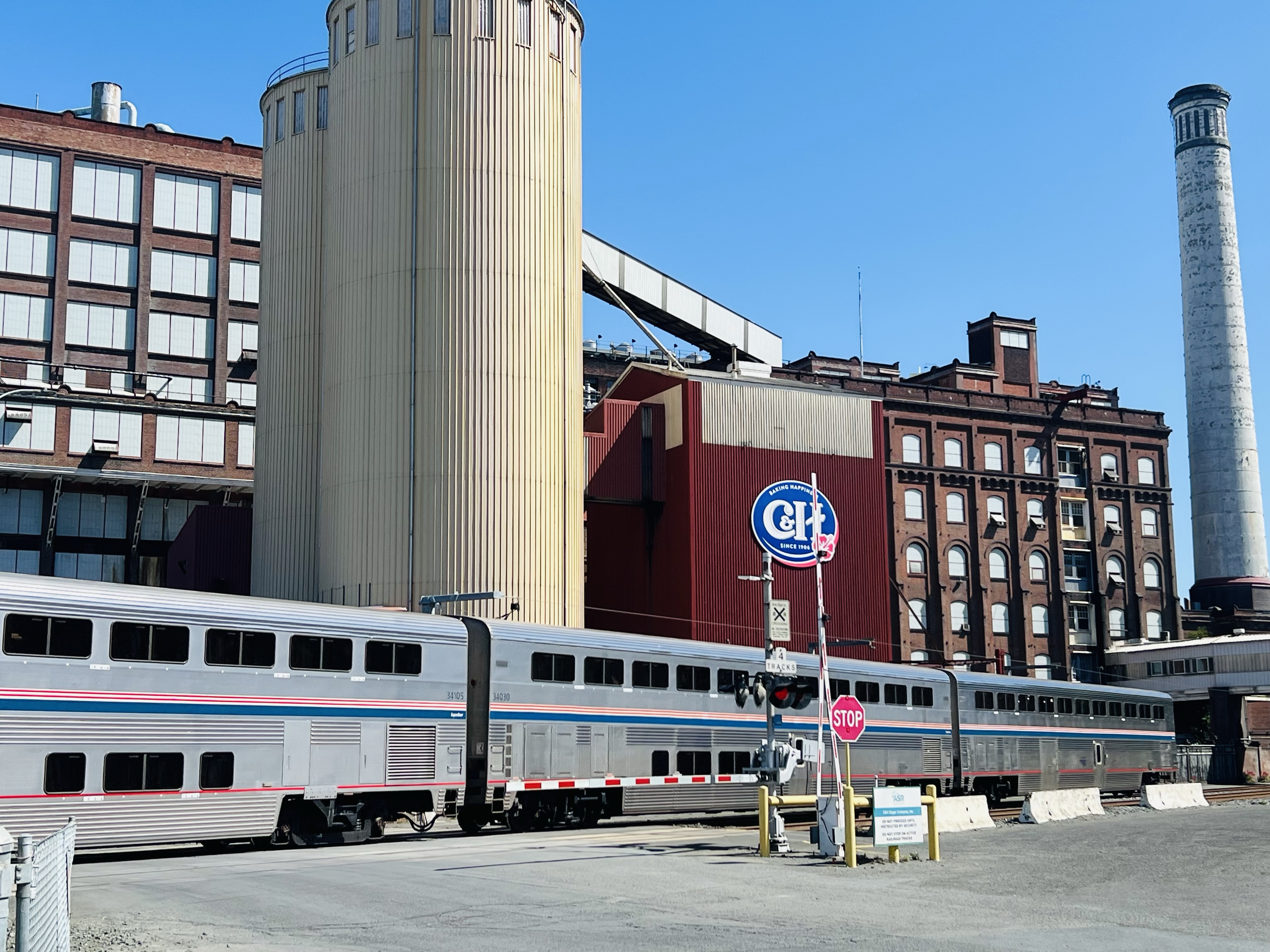
Before me was the C & H factory with the Union Pacific mainline passing in front. To my left was the former Southern Pacific station (sketched on a previous Saturday) and is now a historical museum.
I planned to add my park perspective to my Stillman & Birn Delta panoramic journal. The factory is full of complicated angles and shapes as if the factory was built in stages and at different times (which it probably was). I employed a little sketcher’s shorthand to simplify the details.
In 1906 Crockett became “Sugar Town” when a cooperative of Hawaiian sugarcane growers bought a sugar beet factory and turned it into the California and Hawaiian Sugar Company (C & H). At the company’s peak, 95% of the town’s residents were C & H employees.
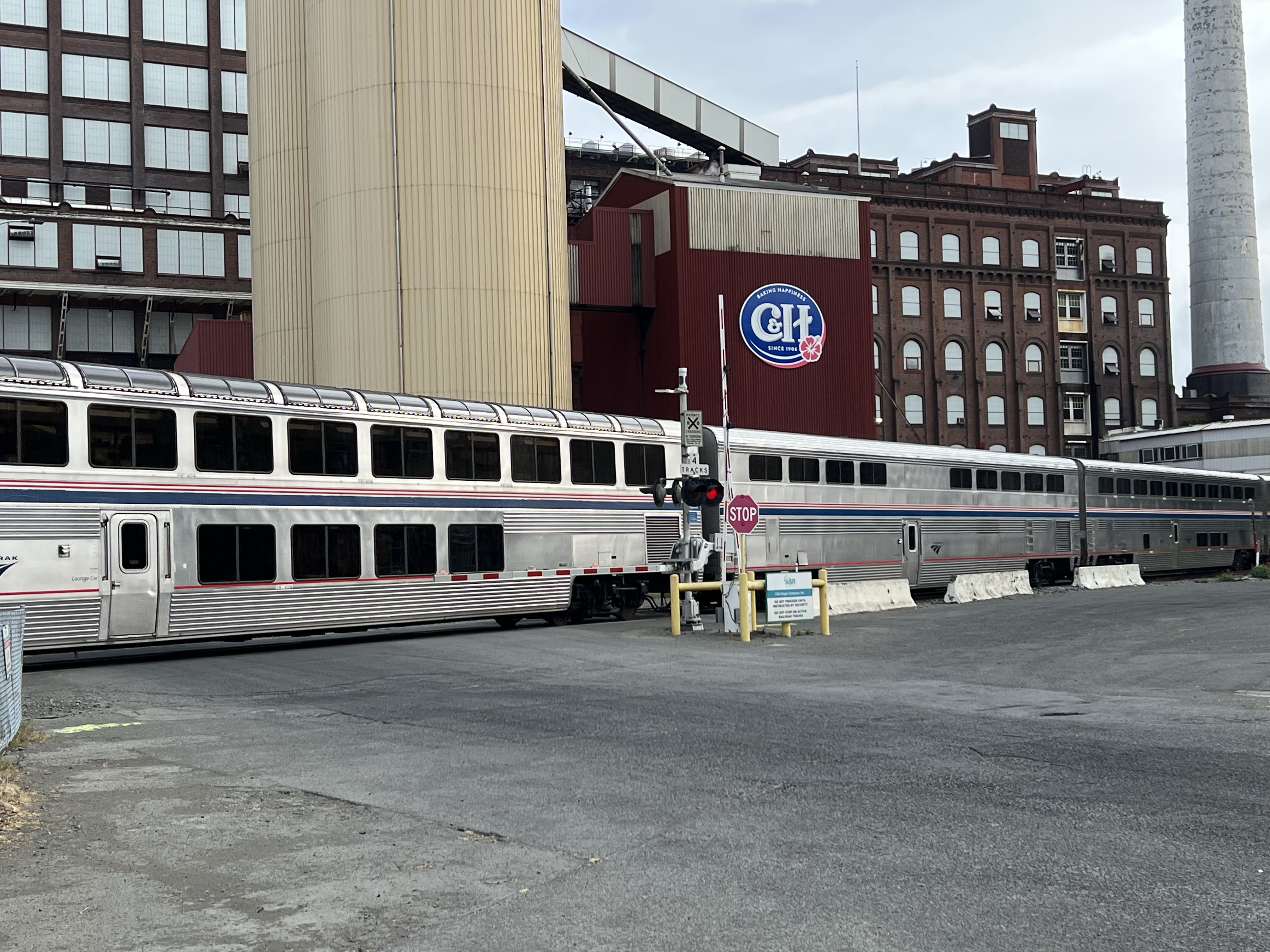
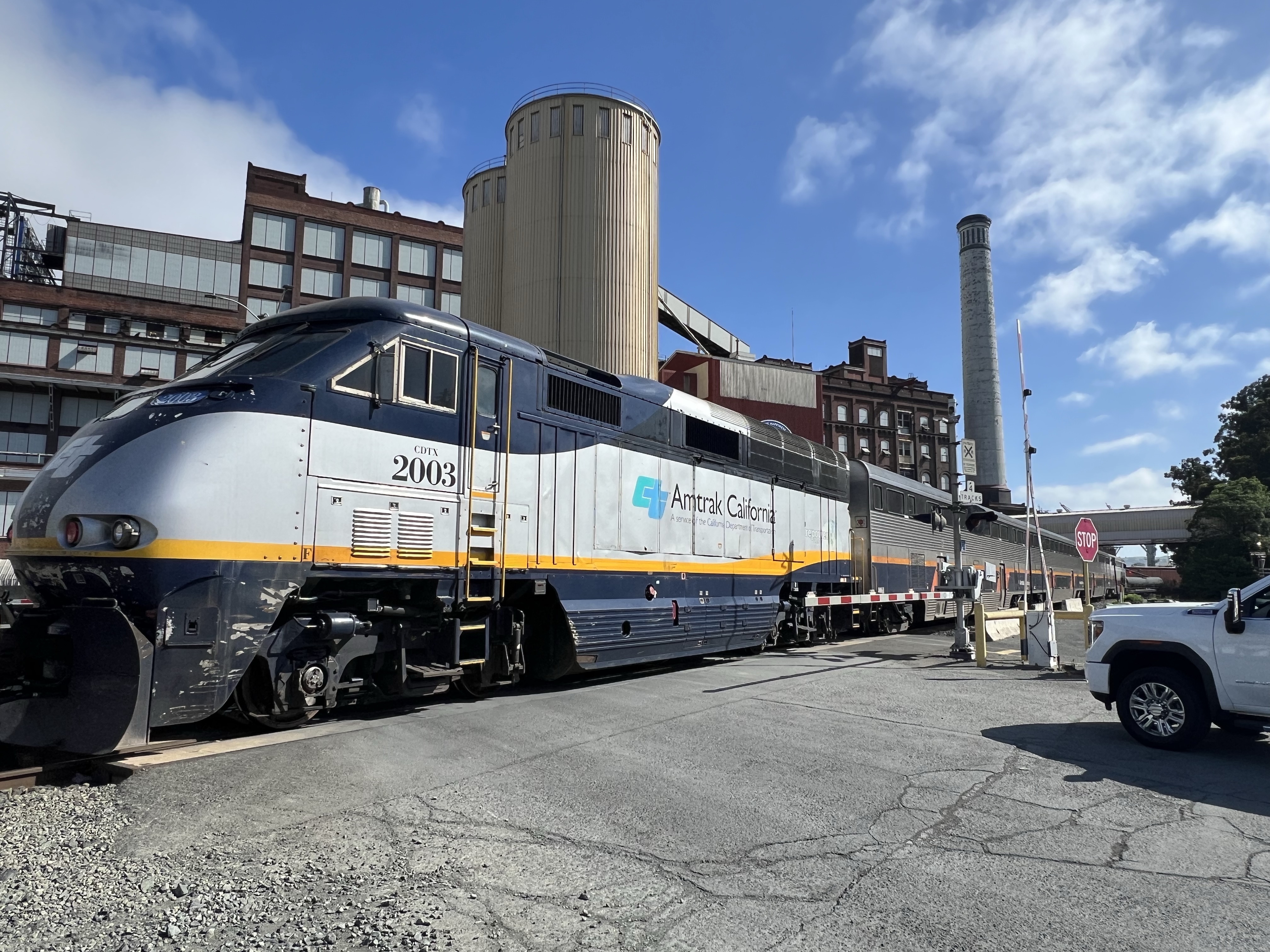
The southbound Coast Starlight No. 11 passes by the complex jumble of the C & H sugar factory at 8:01 AM.
Sketching the factory was a wonderful meditation, as it often is, turning chaos into order. I can think of few other pursuits that offers such satisfaction and peace of mind. I can almost feel my blood pressure drop when I put pen to paper.
Parkside sketching.
I employed a similar sketching techniques to past posts with putting a moving train in my sketch. I draw in the foreground and background and then add the train after it passes (usually from a photo reference).
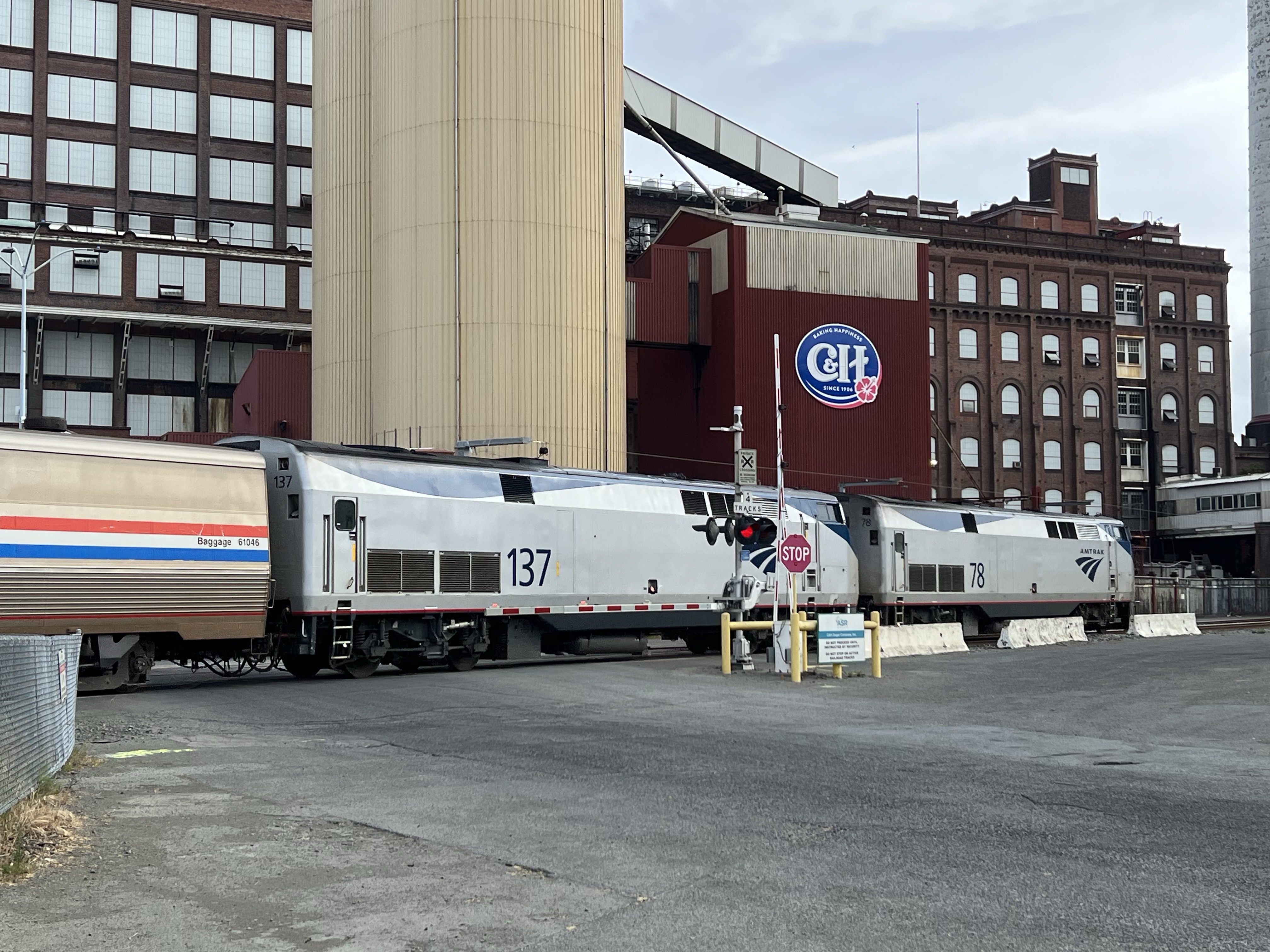
Two GE P42DCs (No. 78 and 137) on point of the California Zephyr. Next stop: Martinez, final destination: Chicago, Illinois.
The passenger train I sketched into the scene was California Zephyr No. 6. I guess I should explain my fascination with AMTRAK’s longest daily route.
The Zephyr observation car crossing the entrance access to the C & H factory.
I have taken the Zephyr round trip twice, from Colfax, Ca to Denver, Co. The first time was for some Colorado birding and we where up in the Rocky Mountains at Loveland Pass looking for the elusive white-tailed ptarmigan.
It was here that I got a call from my mom and learned that my younger brother had died. I was leaving the next day from Union Station and it was a beautiful if not bittersweet rail journey.
The last trip I took with my stepdad was on the Zephyr and it was a great trip through one of the most scenic stretches of tracks in the United States. So whenever I see the Zephyr pass by, it puts a smile on my face.
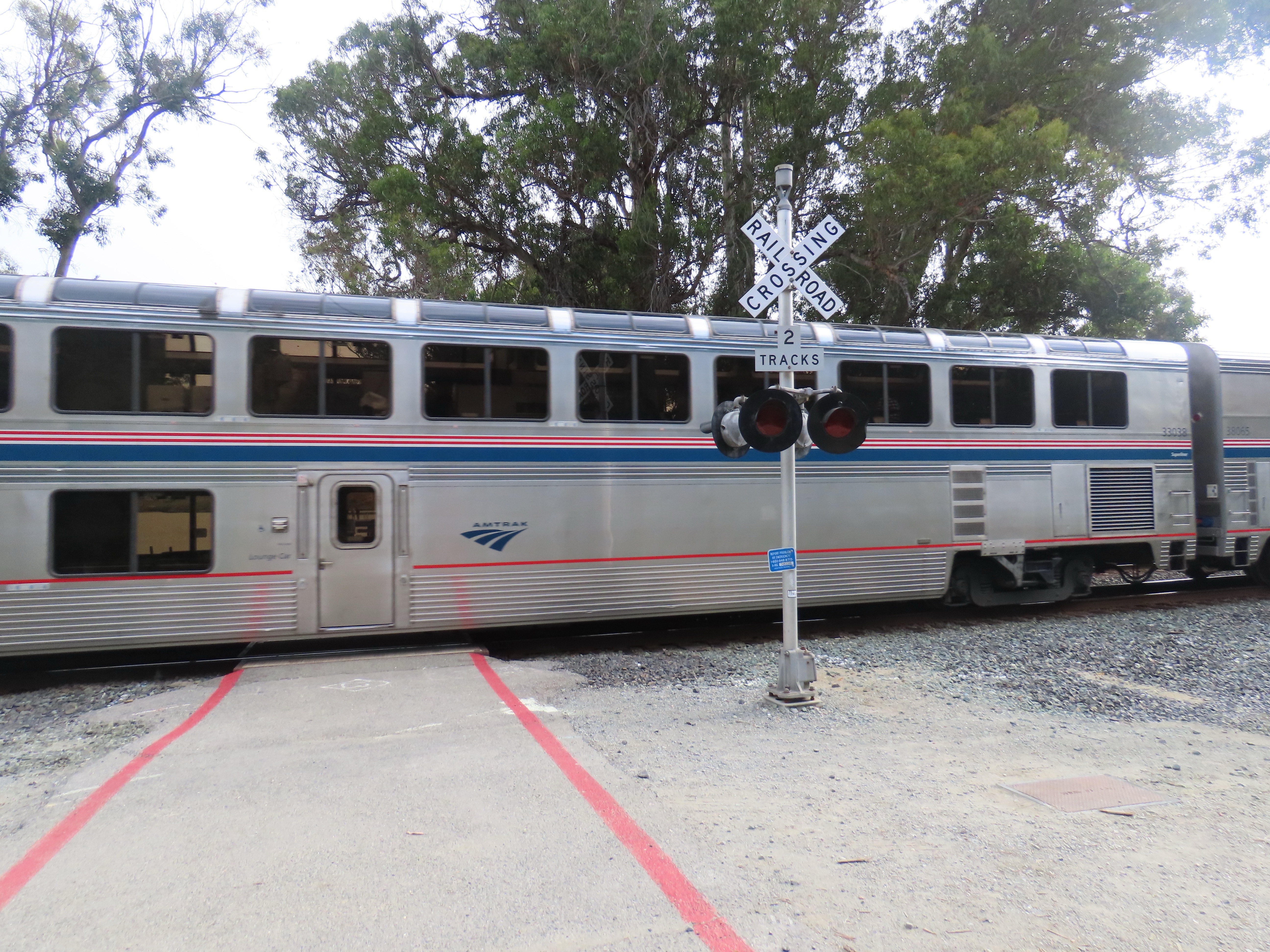
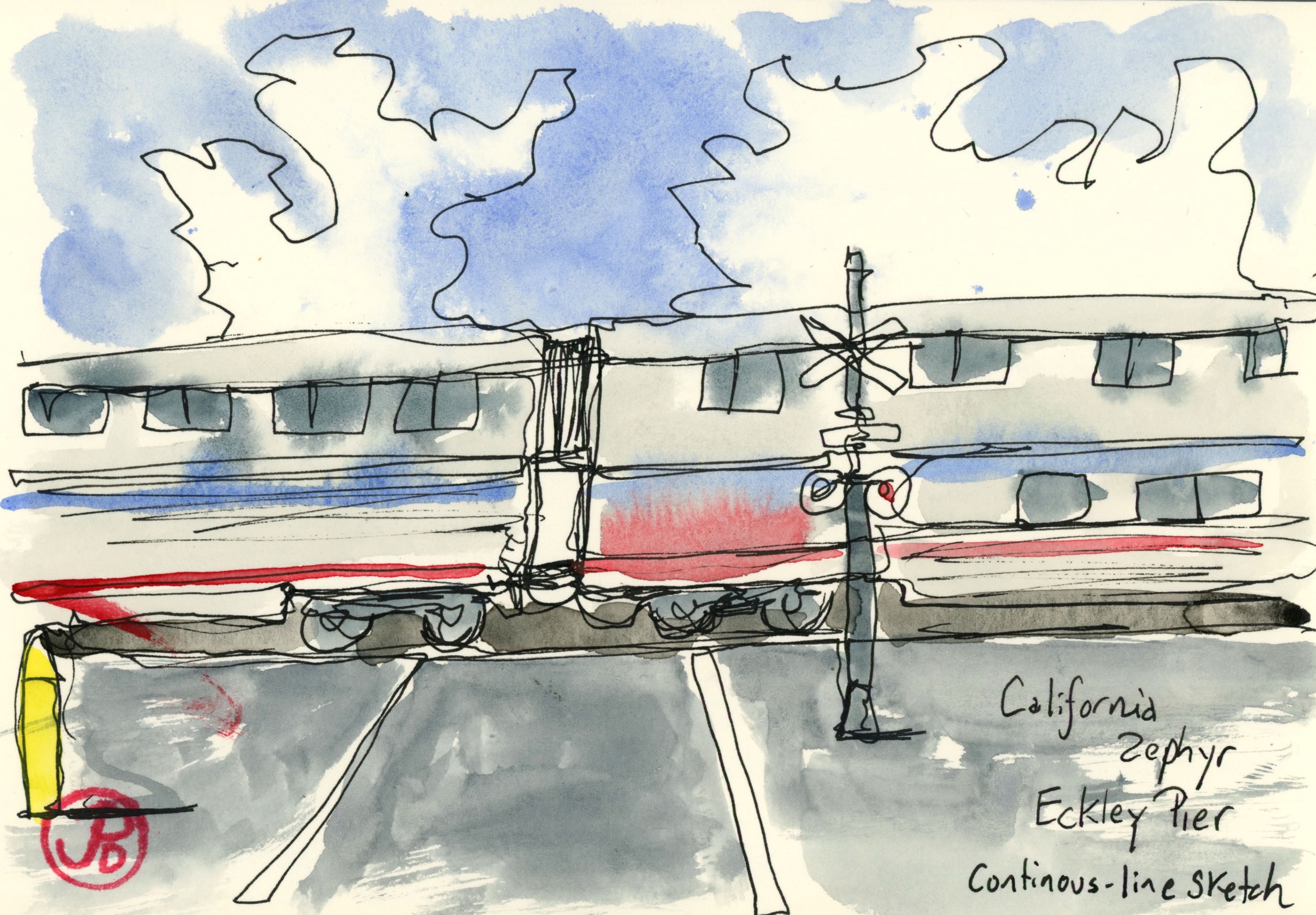
My Saturday morning sketch location was the pedestrian rail crossing at Eckley Pier in the Carquinez Strait Regional Shoreline.
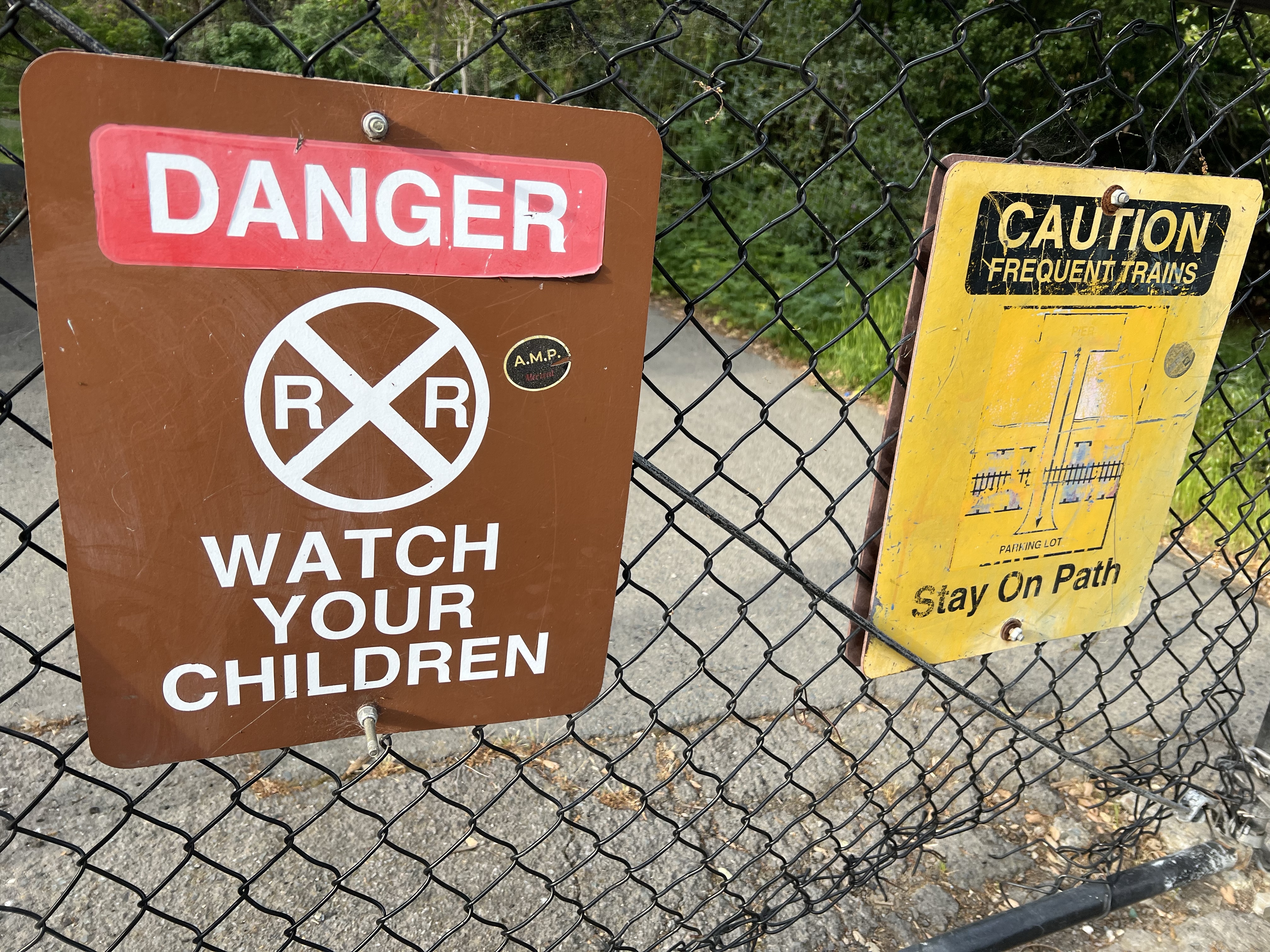
A sign any educator can appreciate.
This pedestrian crossing is quite unusual because there are no crossing gates preventing pedestrians, wanting to go to the fishing pier, from heading across two very busy tracks of the Union Pacific main line.
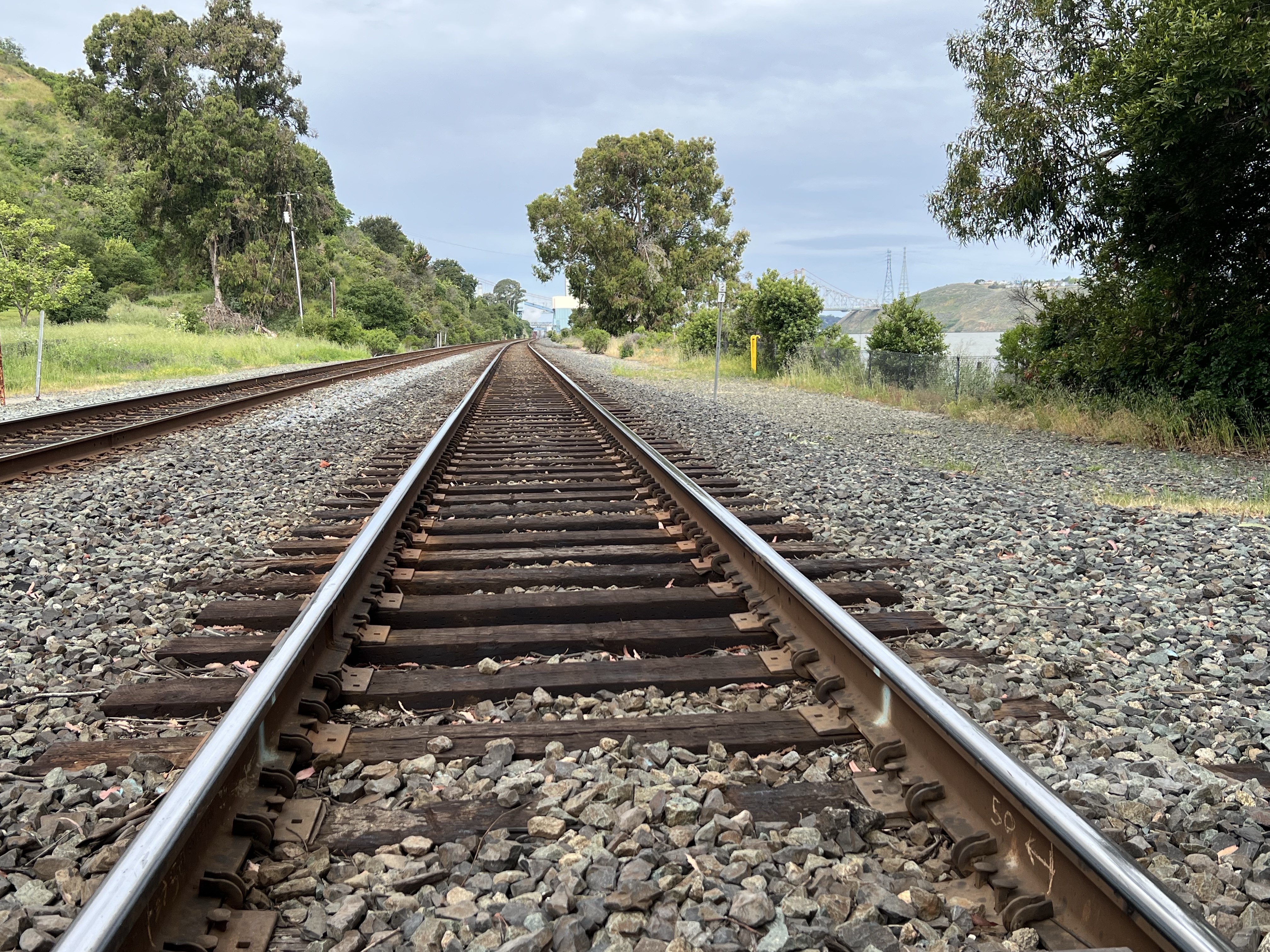
No rusted rails here but polished high iron from lots of use.
I got to the park at 8 AM, when the gates open, and I had plenty of time to catch the Chicago bound California Zephyr No. 6 as it was scheduled to skirt along the southern shore of the Carquinez Strait just shy of 9 AM.
The Zephyr is one of the longest routes operated by AMTRAK (2,438 miles) and as such has the lowest on-time percentage (33%) of any long distance route, primarily because the passenger service is at the whim of their host railroad’s (UP and BNSF) freight traffic. No. 6 should be on time because it left its western terminus of Emeryville at 8:25 AM. It usually gets behind schedule while stopped behind a freight in Nevada or Utah.
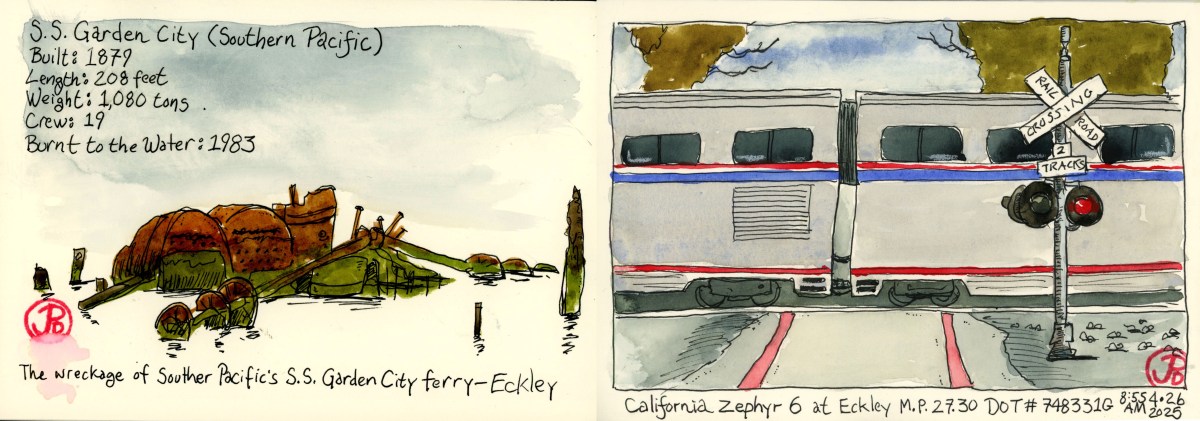
I took a position just south of the parallel tracks to sketch the light signal and crossbuck of the pedestrian crossing.
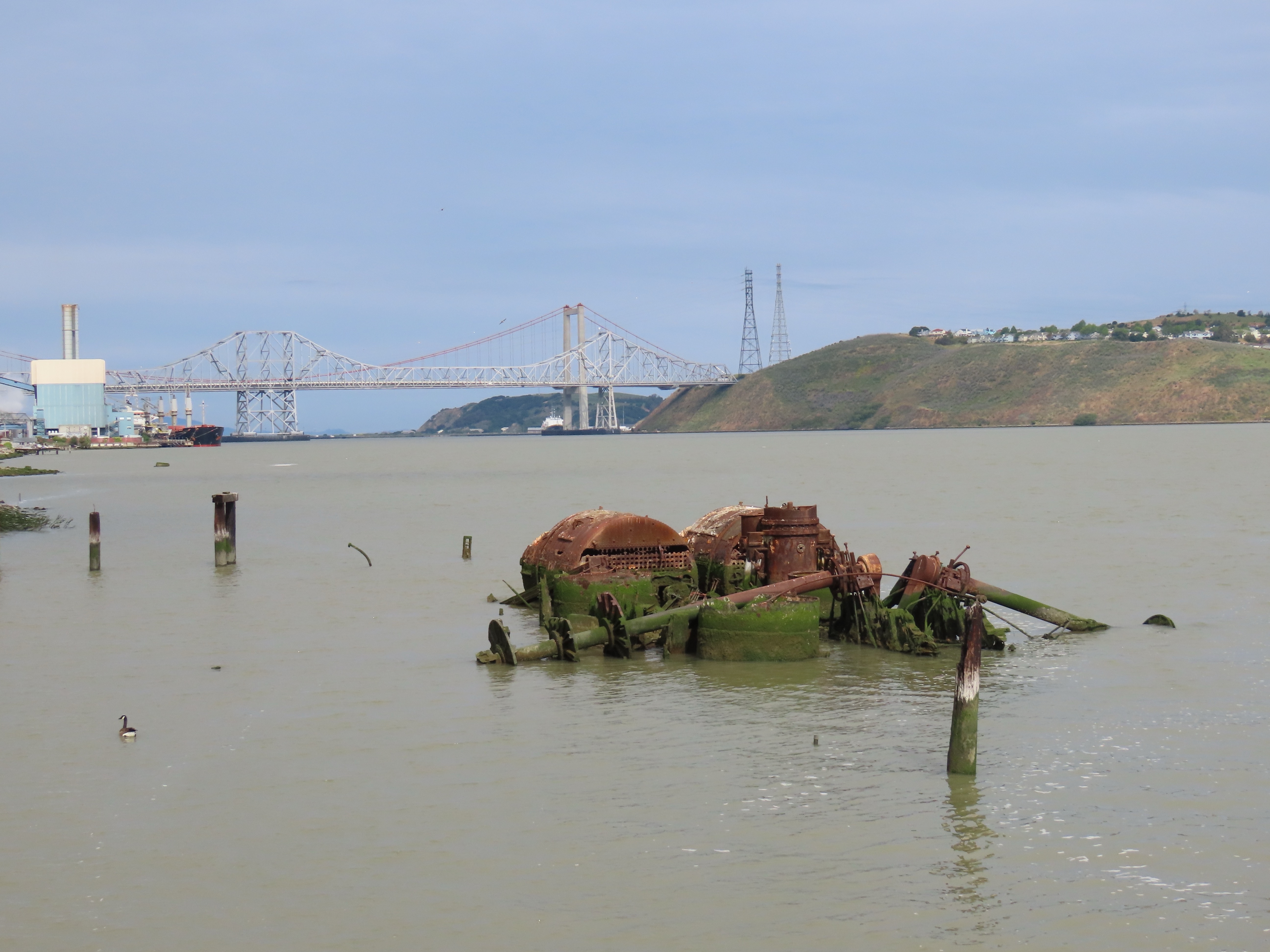
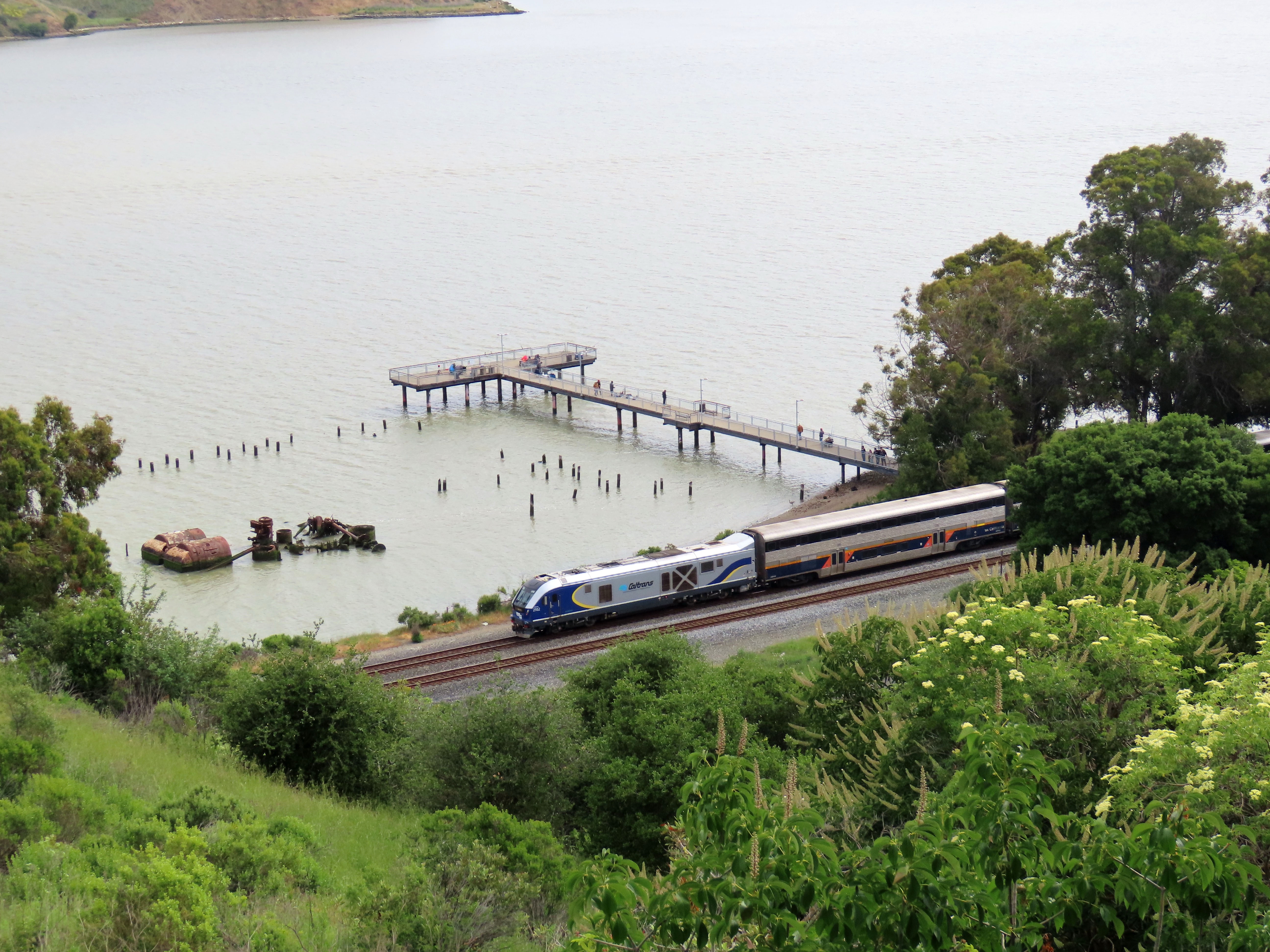
I also had time to get a sketch of another piece of railroad and nautical history: the rusted boilers and paddle wheel hubs of the SS Garden City.
The Garden City was a Southern Pacific ferry that ferried people and automobiles across the waters of the bay. She was built in 1879 and was 208 feet long and weighed 1,080 tons. The wooden side-wheeler had a crew of 19.
The construction of bridges like the Carquinez and Golden Gate rendered the ferries obsolete and in the 1930s, the Garden City was moored at a pier near the current Eckley Pier and it was used as a restaurant and fishing pier until she was abandoned in the 1970s. In 1983, the ferry burned to the boilers, which is about all that remains of this once proud vessel.
What’s left of the SS Garden City in the foreground and one of the bridges that made her obsolete in the background.
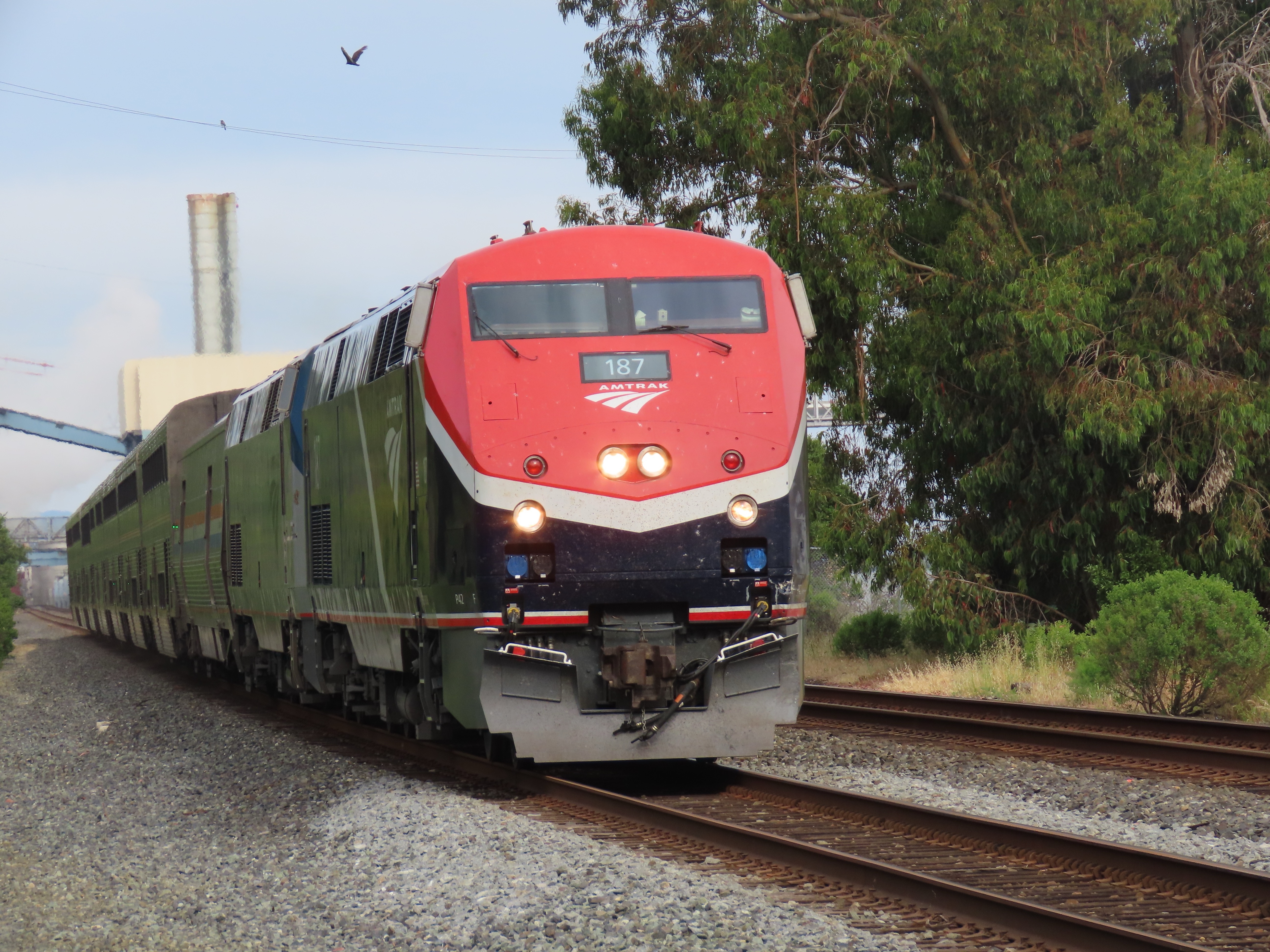
It was now nearing nine so I headed across the tracks to take up a position. Down rail the retort of the horn reached me as the Zephyr blew the crossing at Crockett. Shortly thereafter the crossing signal activated with red lights and bell and the Zephyr appeared around the bend.
A GE P42DC 187 is on point of the California Zephyr as she heads towards her next stop: Martinez. Zephyr No. 6 crossing the pedestrian walkway at Eckley. This is my favorite car to ride in while traversing the Sierras and the Rockies: the observation car!A Capital Corridor heads towards Crockett past the fishing pier and the ruins of the Garden City.
Sketching Notes
Before heading out to Eckley, I pre visualize my sketch. I practice sketching the perspective and location and drew the Superliner train cars that would be a part of the train’s consist so I would be able to draw the cars into my sketch after the train had past. This is using sketcher’s “muscle memory” so drawing the cars would become almost second nature.
A loose continuous line pre-sketch of the pedestrian crossing.
What I drew on location was the foreground and background eucalyptus and then I added the long distance Zephyr from memory. One thing I might do differently is to sketch the train looser to convey the sense of motion.
For my sketch of the Garden City, the core of the sketch was done as a continuous line sketch and I then lifted my pen and add more details.
On a Saturday morning I headed up to Sugar Town on the Carquinez Strait.
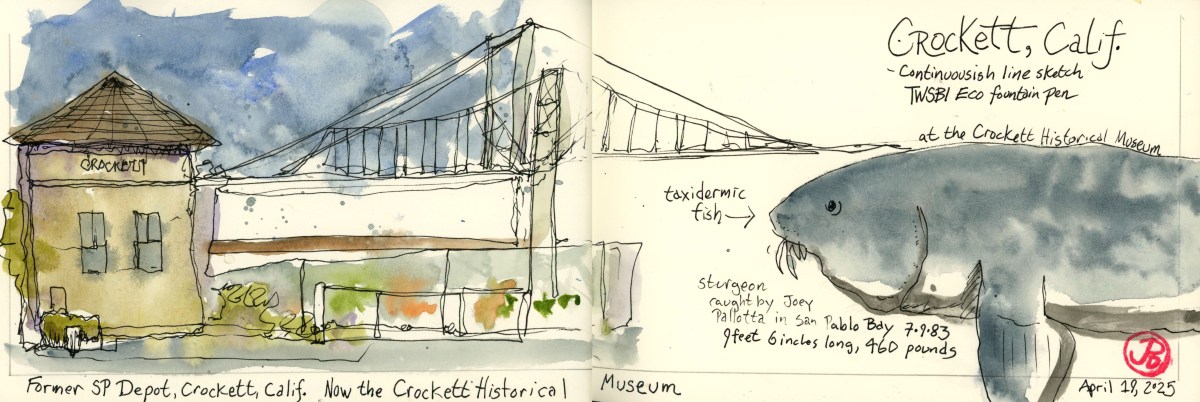
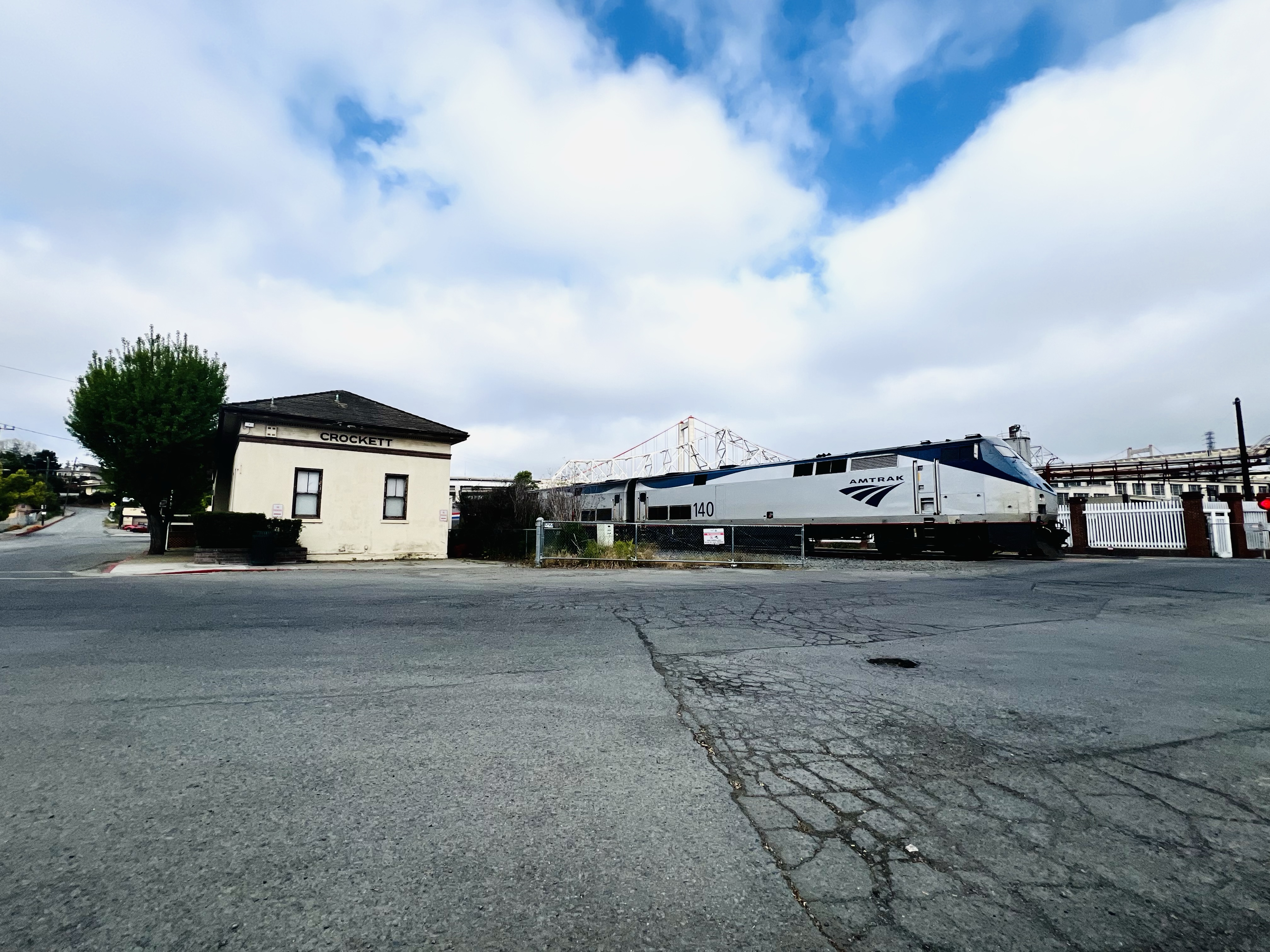
My sketching target: the former Crockett Southern Pacific Depot with the two parallel spans of the Carquinez Bridges in the background. The depot is now home to the Crockett Historical Museum. Open Wednesday and Saturday from 10am to 3pm. Ish!
This is a busy place for rail with seven trains passing by including a California Zephyr, a Coast Starlight, a San Joaquin, Capital Corridors, and a Union Pacific freight during my two hours visit.
Coast Starlight No. 11 passes by the C & H Factory to its final destination of Los Angeles’ Union Station. The train was running a little late. Shocker!
My sketching goal was to render the scene in a continuous line sketch. This means you never lift your pen for the entire sketch. No pencil, no erasing, no going back, this is truly sketching without a net!
Eastbound California Zephyr Number 6 passing the former SP Depot at 8:56 AM without stopping. Final destination: Chicago.
I set up my sketching chair across the street from the depot just at the entrance to the company that made Crockett a company town, the C & H (California & Hawaii) sugar factory. For my sketch I used my TWSBI Eco fountain pen.
Nothing like starting the weekend with a field sketch!
Continuous line sketching can be challenging and I lifted my pen off the page once or twice (to photograph Zephyr Number 6) but I restarted where I left off. So my sketch is really a broken continuous line sketch.
In the end I like the imperfect lines of the sketch. This technique is a great way to loosen up your line work and in the end I am pleased with the result. It may not be the most accurate form of sketching but it sure has a lot of soul!
I added some wet on wet washes and paint splatter, which looseness, matches the line work.
When the museum finally opened at 10:25, I was drawn to the large 460 pound taxidermy sturgeon in a glass case. So I added it to the right side of the spread.
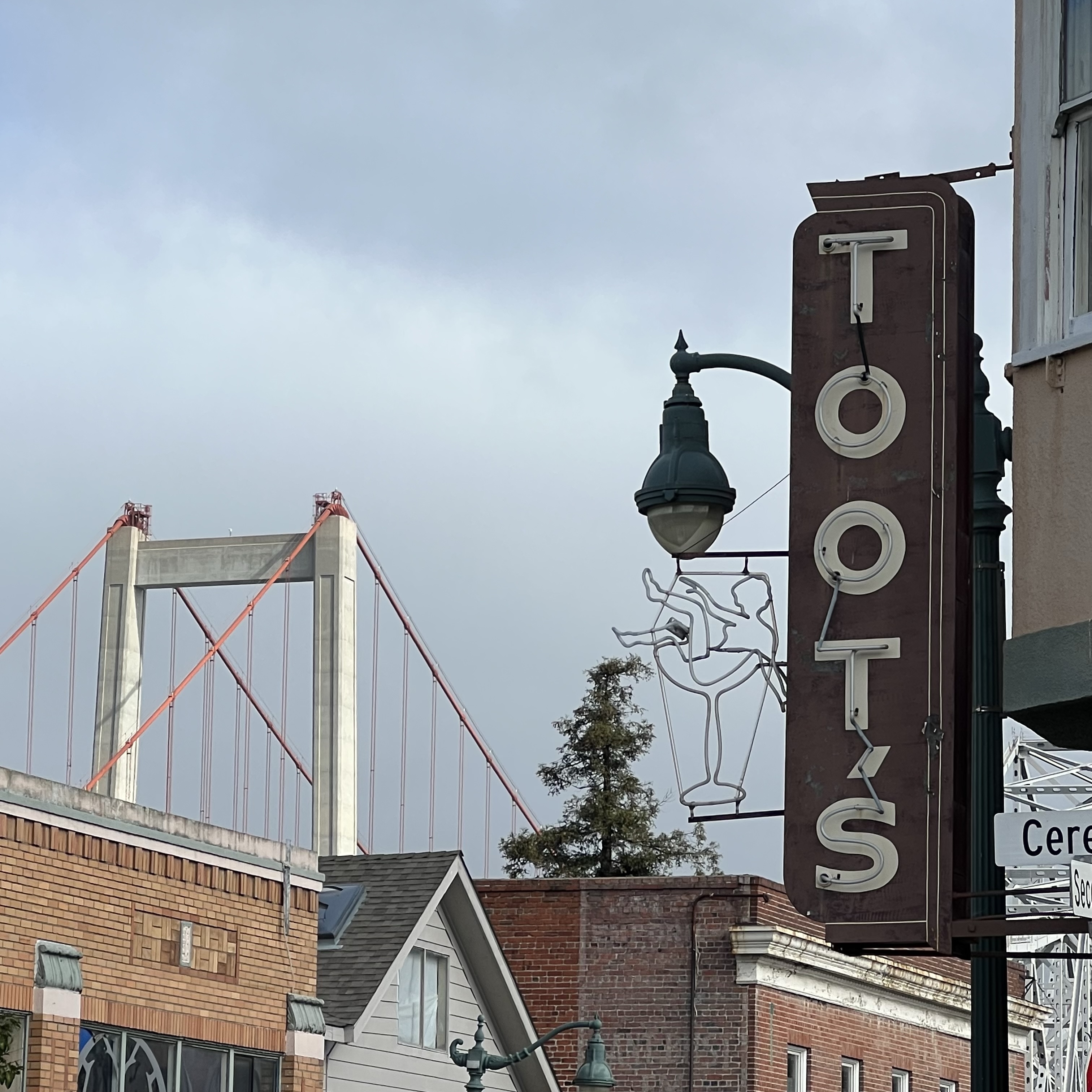
Main Street Crockett with Toot’s bar and the new span of the 2003 Carquinez Bridge towering over the town.
The trains never stop rolling through Crockett. This is a Sacramento-bound Capital Corridor train passing the sugar factory.
I was meeting a friend in the East Bay city of Martinez and I had a little time to sketch before lunch.
Martinez is a hotbed of railroading with both the Union Pacific and BNSF passing through as well as some marquee passenger trains such as the Coast Starlight and the California Zephyr making stops at the Martinez AMTRAK station. And the Capitol Corridor commuter takes on passengers traveling north and south on shorter journeys.
The California Zephyr Train No. 6, at the old Southern Pacific Depot in Martinez. This train is heading east to Chicago. To the right in the background is SP switcher 1258 on static display.
There would certainly be something to sketch here and I was going to start with a historic train trestle.
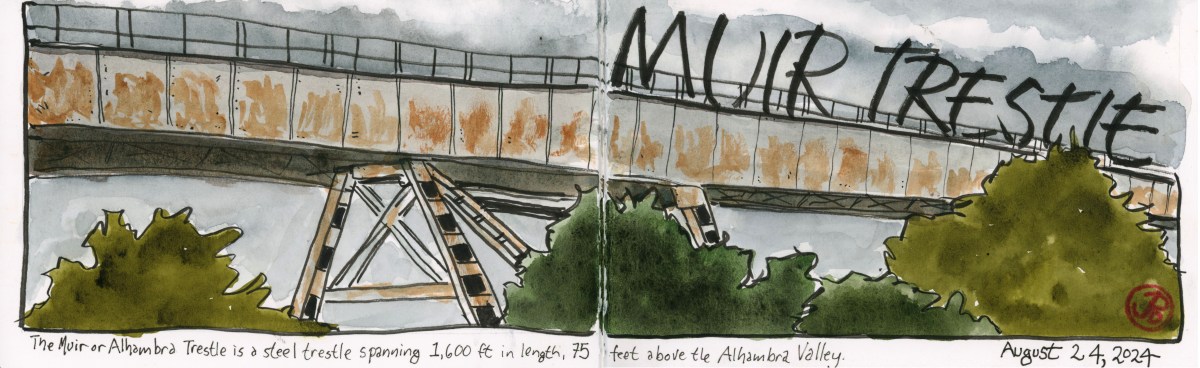
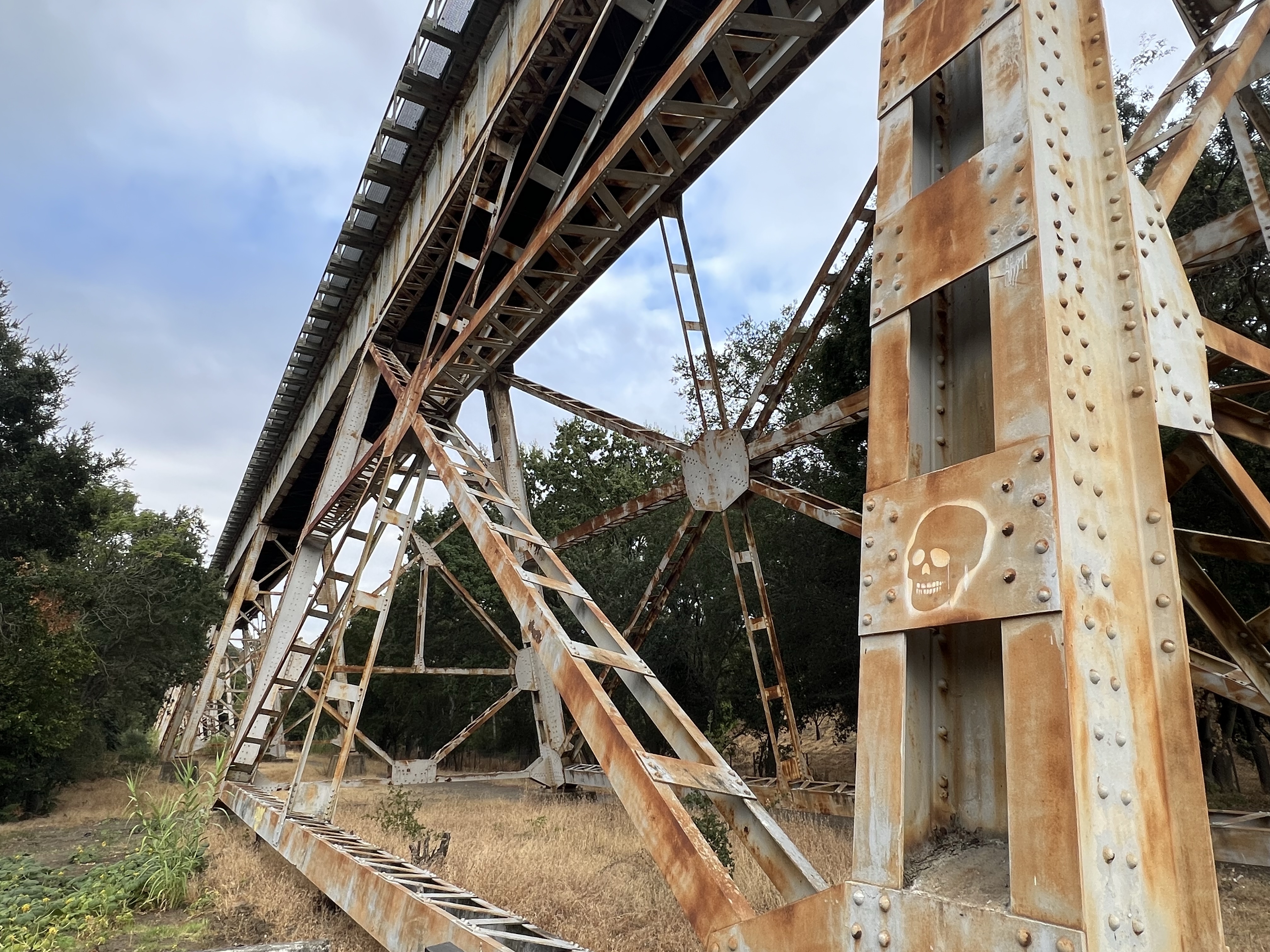
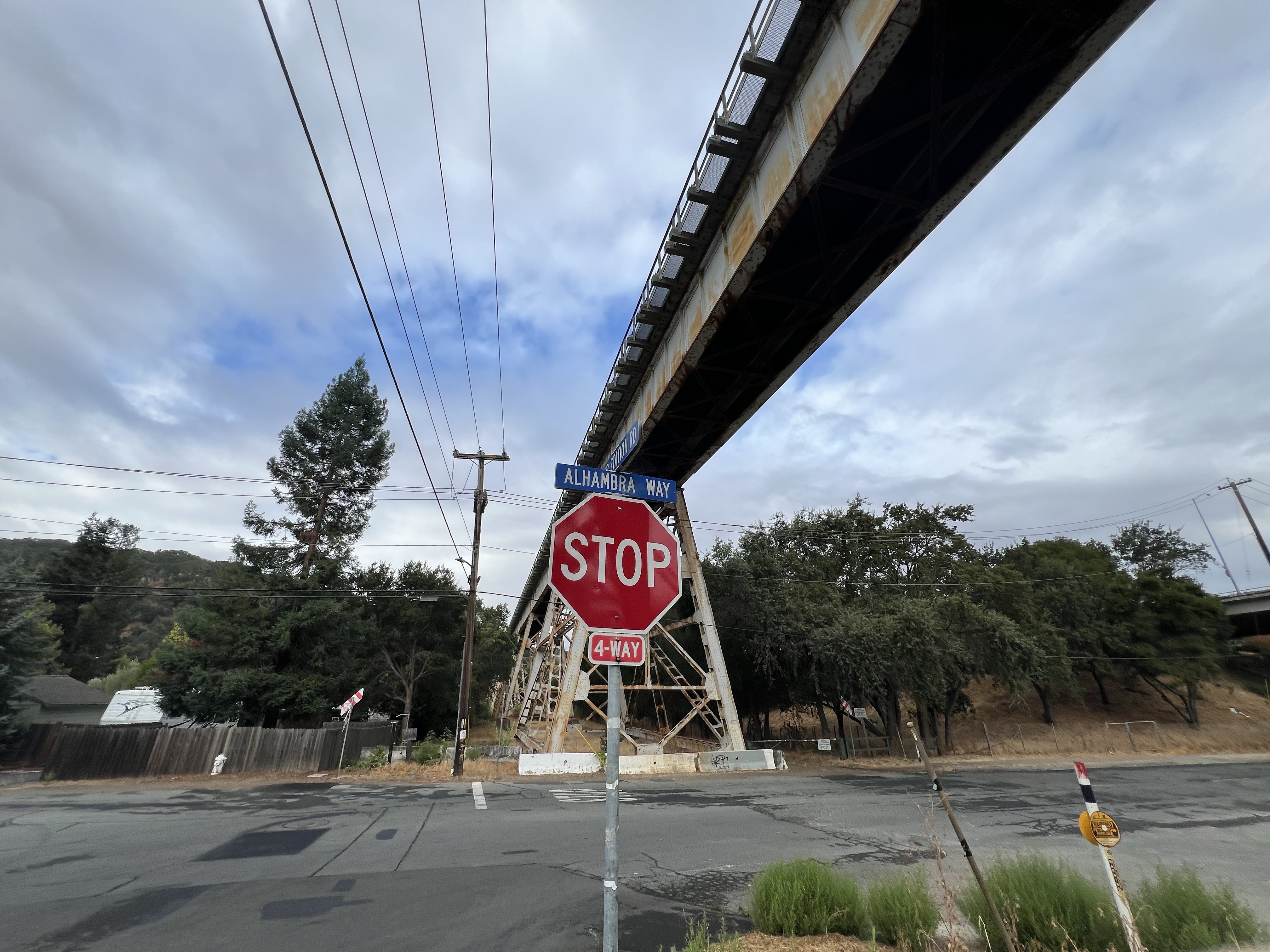
I parked at the Mount Walda Trailhead. Soaring above me was the 1,600 foot long steel Muir Trestle (aka the Alhambra Trestle). The single track trestle was so long that I could only see and sketch one section of it before it disappeared into the trees to the east. The trestle rises 75 feet above the roads, trees, and houses it crosses over.
A detailed view of the steel supports of the Muir Trestle.
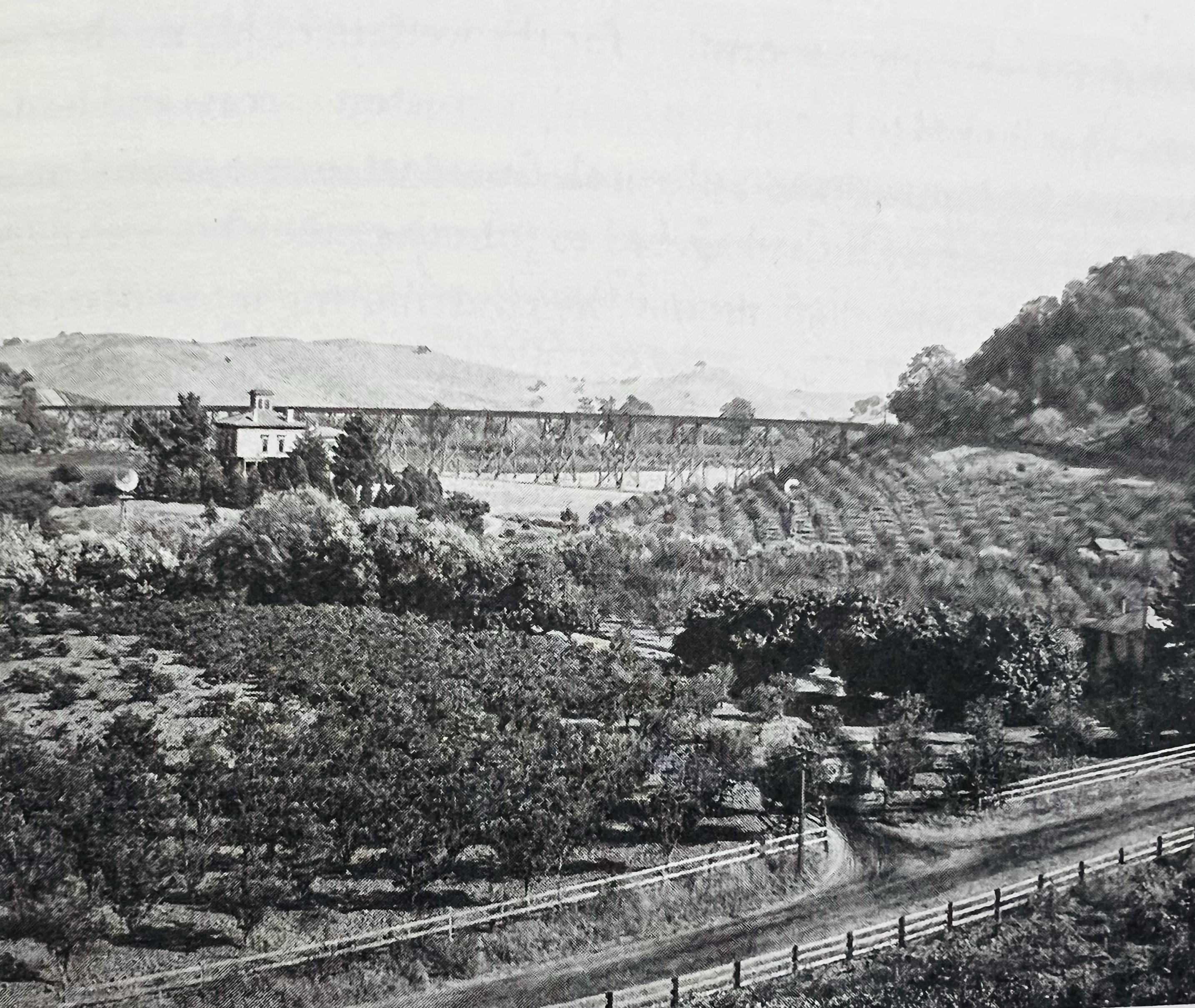
The trestle is within the John Muir National Historic Site. To the north is Muir’s Martinez home. Muir and his wife Wanda sold the land for the trestle for $10 and a lifetime rail pass to the San Francisco and San Joaquin Valley Railway. The original wooden trestle was built through a pear orchard and completed in 1897.
This is a historic photograph of the Stengel-Muir ranch in 1897. The Muir house is on the top left and the trestle is viable behind the house. At the time of the photograph, the trestle was constructed of wood.
At the eastern end of the trestle there was a passenger and freight station named Muir Station. The station is now long gone but is immortalized in a street that parallels the rails named Muir Station Road.
From this station Muir could ship his produce to Oakland or to the port in Martinez.
One of Muir’s neighbors in the Alhambra Valley was John Swett, Muir close friend. Swett was the State Superintendent of Public Education and is known as the “Father of California Public School”.
In 1898, Santa Fe purchased the line and it became their Valley Division. This division still exists as BNSF’s route from Richmond to Fresno.
The Muir Trestle from the intersection of Alhambra Way and Muir Station Road.
I took up a sketching position near the trailhead and started my drawing. The trestle above me is on the Stockton subdivision and is used by BNSF intermodal freight. There was no train crossing during my sketch.
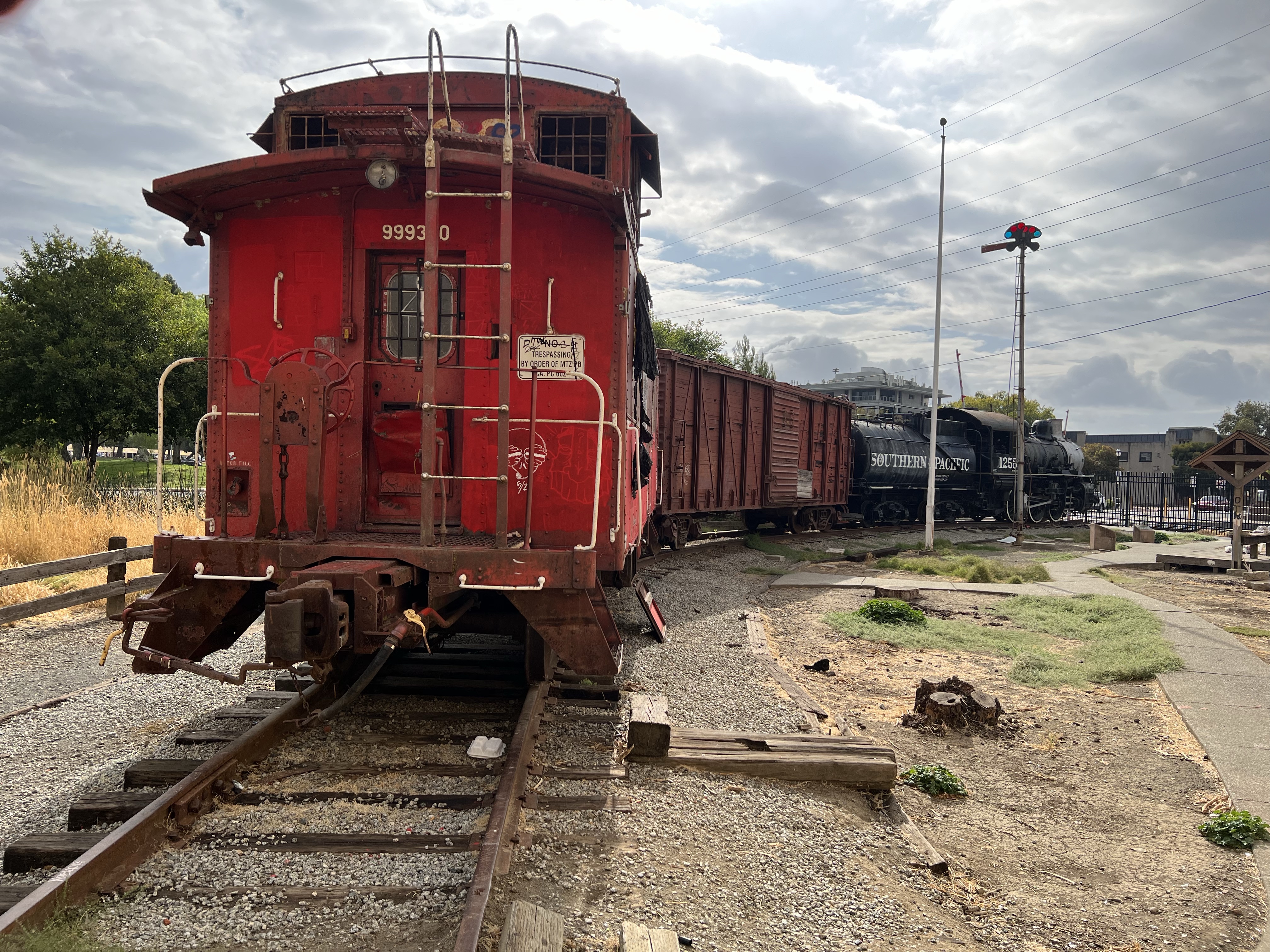
SP 0-6-0 switcher No. 1258 and its consist of a wooden box card and Santa Fe caboose 390 on display across the tracks from the AMTRAK station. The locomotive is in sad shape, missing some hardware like her bell and whistle.
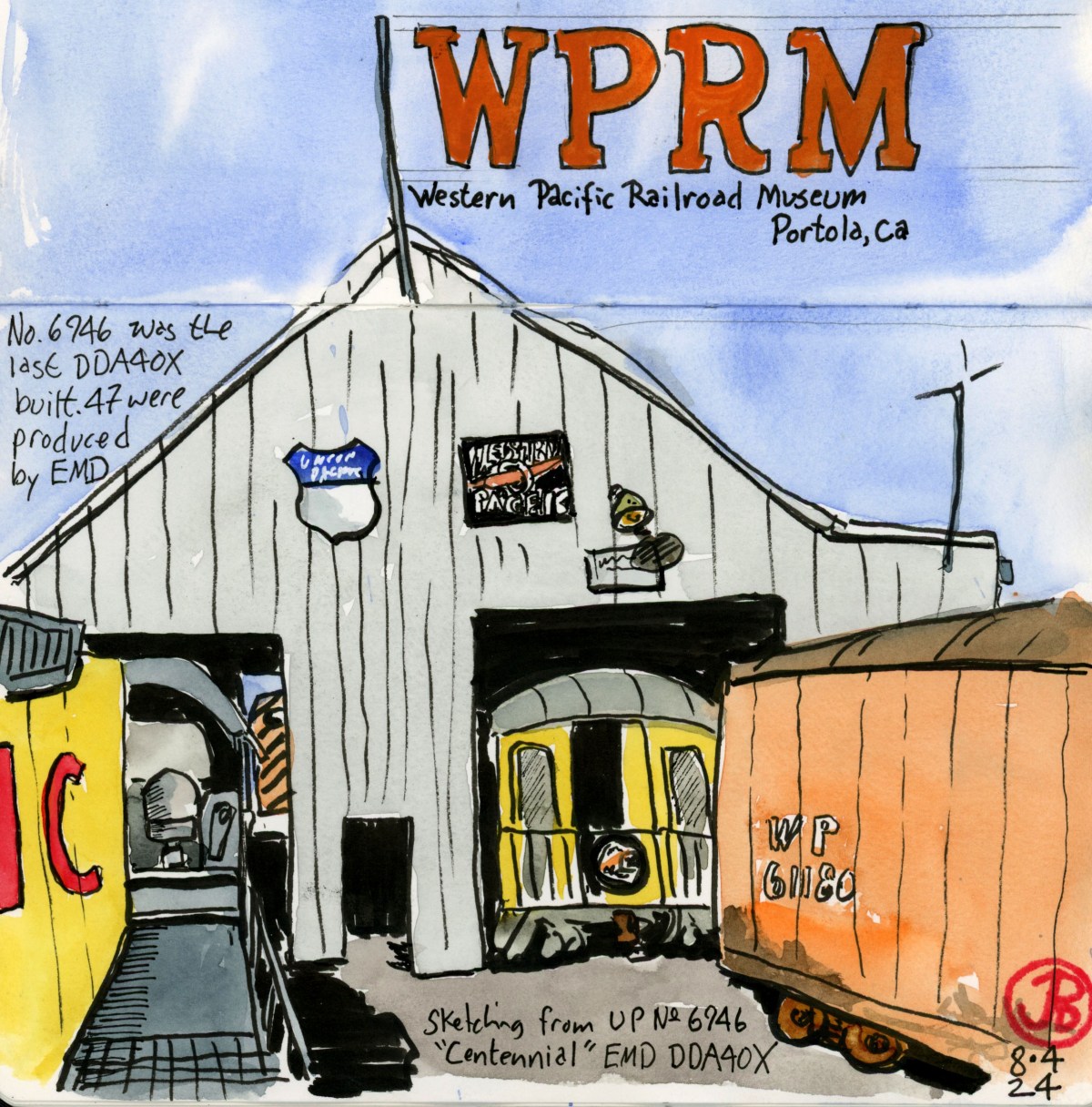
You really have to like trains to make it out to Portola, Ca. From my mom’s house it was a two hour drive over windy roads to reach the small town where the former diesel shops of the Western Pacific were.
These shops and the rails around it, are now the Western Pacific Railroad Museum. The museum is adjacent to the tracks of the Union Pacific which acquired the WP in 1982. Heading west from Portola you enter the Canyon Subdivision which is the WP’s Feather River Route. This is one of the most scenic sections of the the former WP. It was the route the original California Zephyr took from the Bay Area to Chicago.
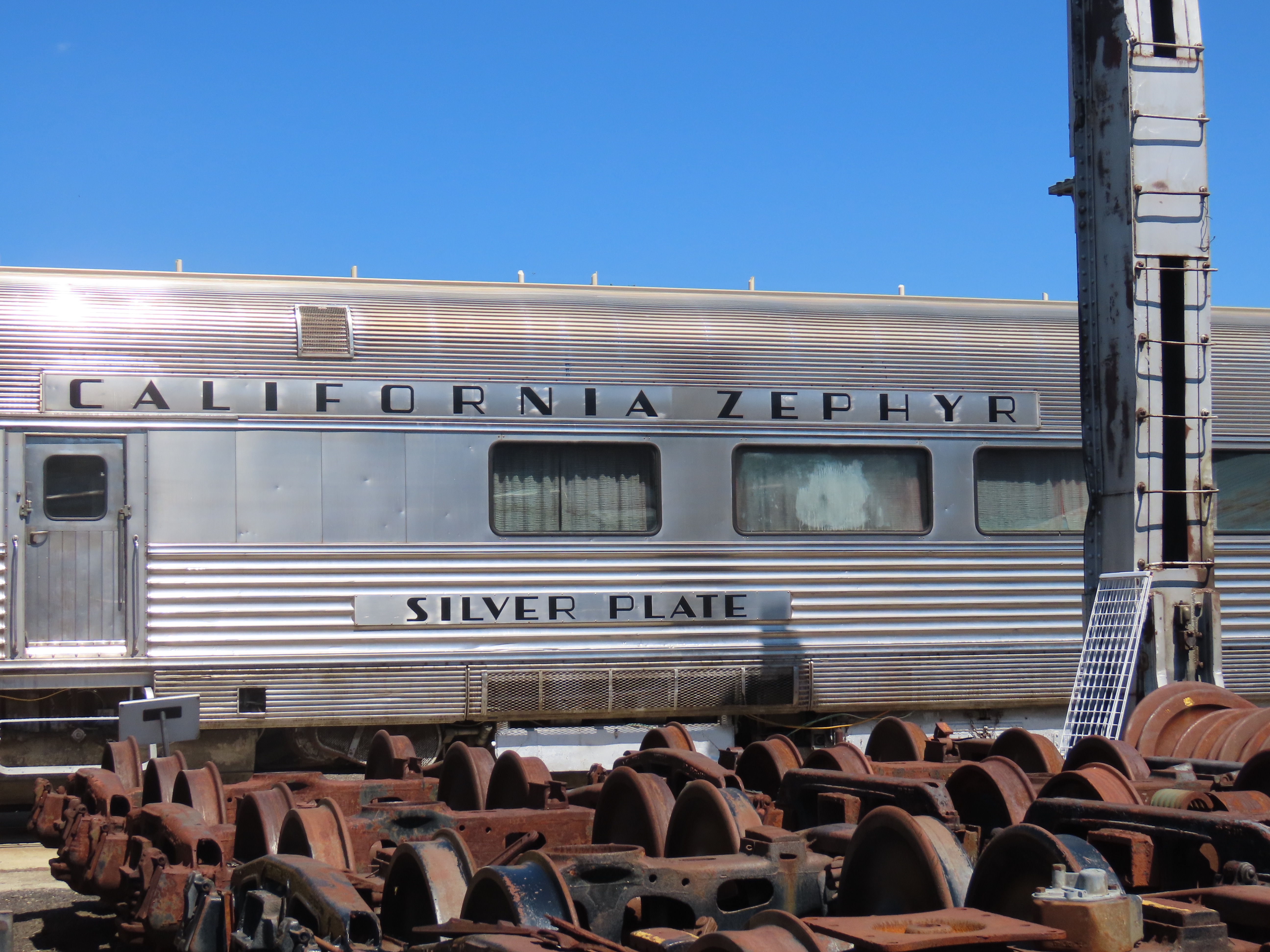
The museum has four cars from the streamliner, the California Zephyr.
While many railroad museums focus on the age of steam, the WP was one of the first major railroads in the west to dieselize. The museum has 29 diesels in its collection.
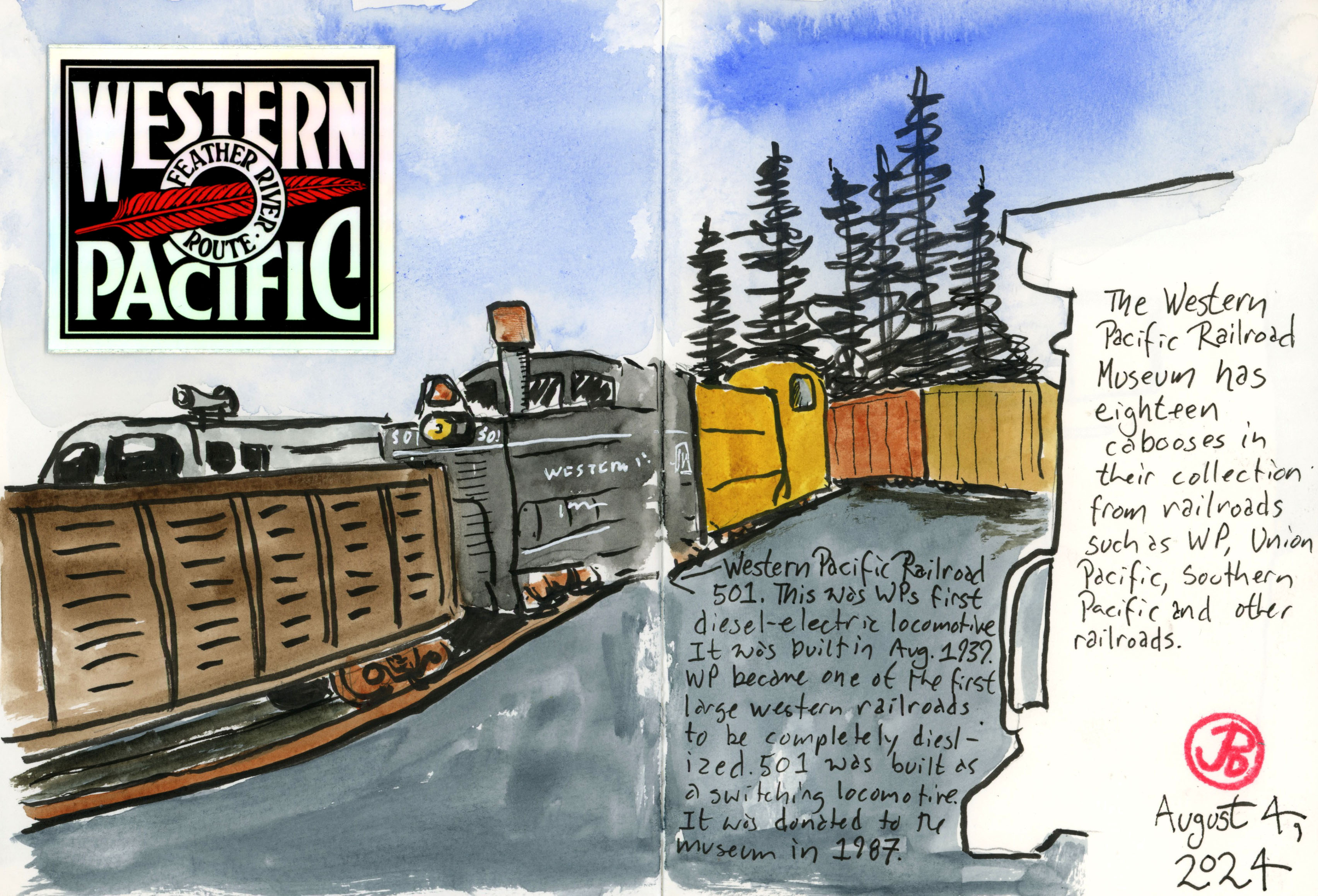
The WP acquired its first diesel in 1939. The SW1 switcher was built by the Electro Motive Corporation for an original cost of $64,525. It was built to work in the yard and with a top speed of 45 MPH, it was not designed to be out on the mainline.
The WP tested out the diesel (No. 501) and liked what it could do. It later ordered two more sister locomotives and 14 years later the Western Pacific was completely dieselized. The genesis of WP’s diesel age is now part of the museum’s collection.
A sketch of some of the WPRM’s collection including WP’s first diesel: No. 501.
The museum has many classic, epic, and iconic diesel-electric locomotives in its collection and I added a few to my sketchbook.
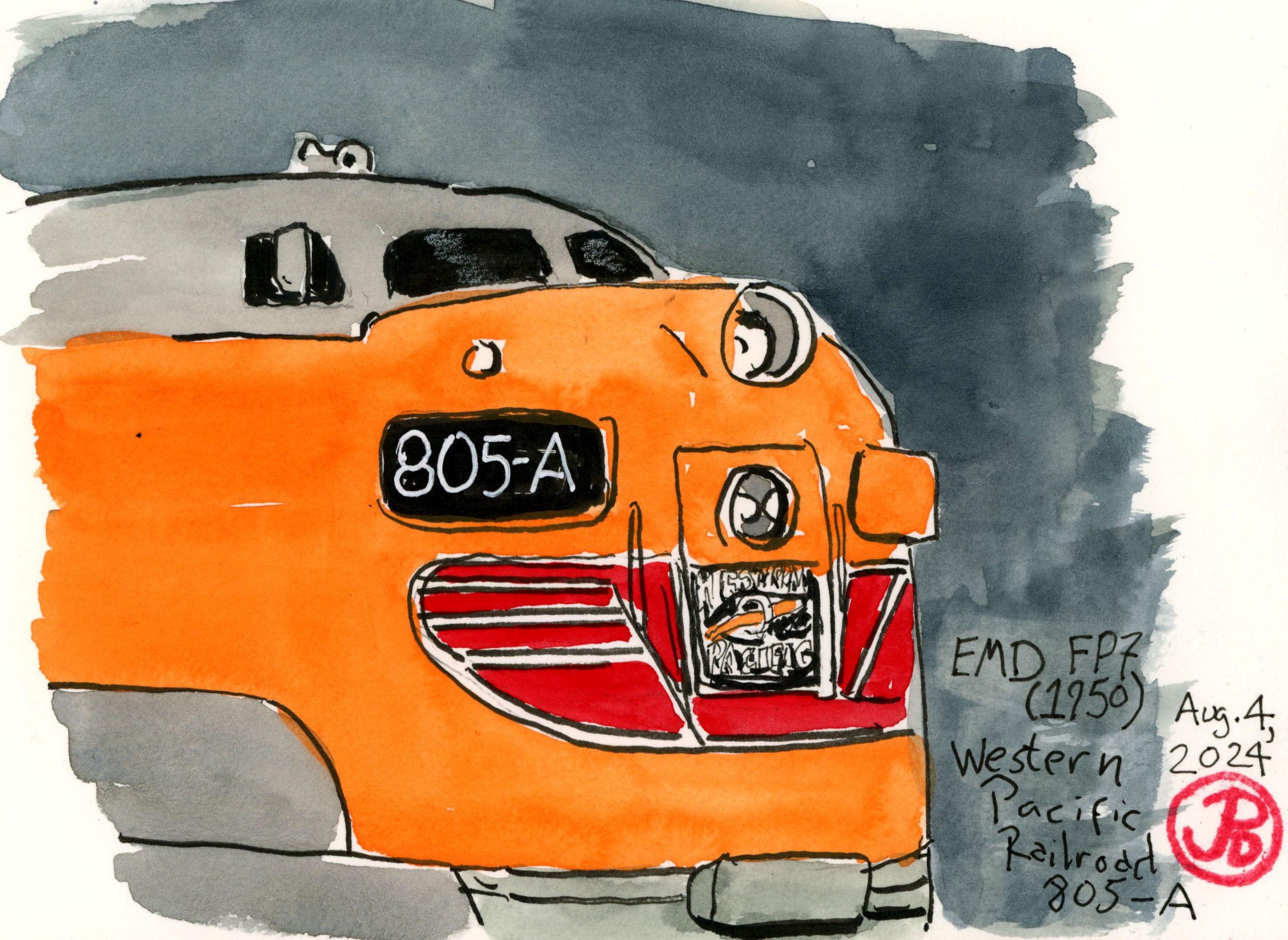
An iconic locomotive is the WP 805-A. This is an EMD FP7. This hood unit was on point of the California Zephyr from Oakland to Salt Lake City. The diesel was in service on the Zephyr from 1950 to the route’s end in 1970.
805-A is the last WP California Zephyr locomotive in existence, so I had to sketch it.
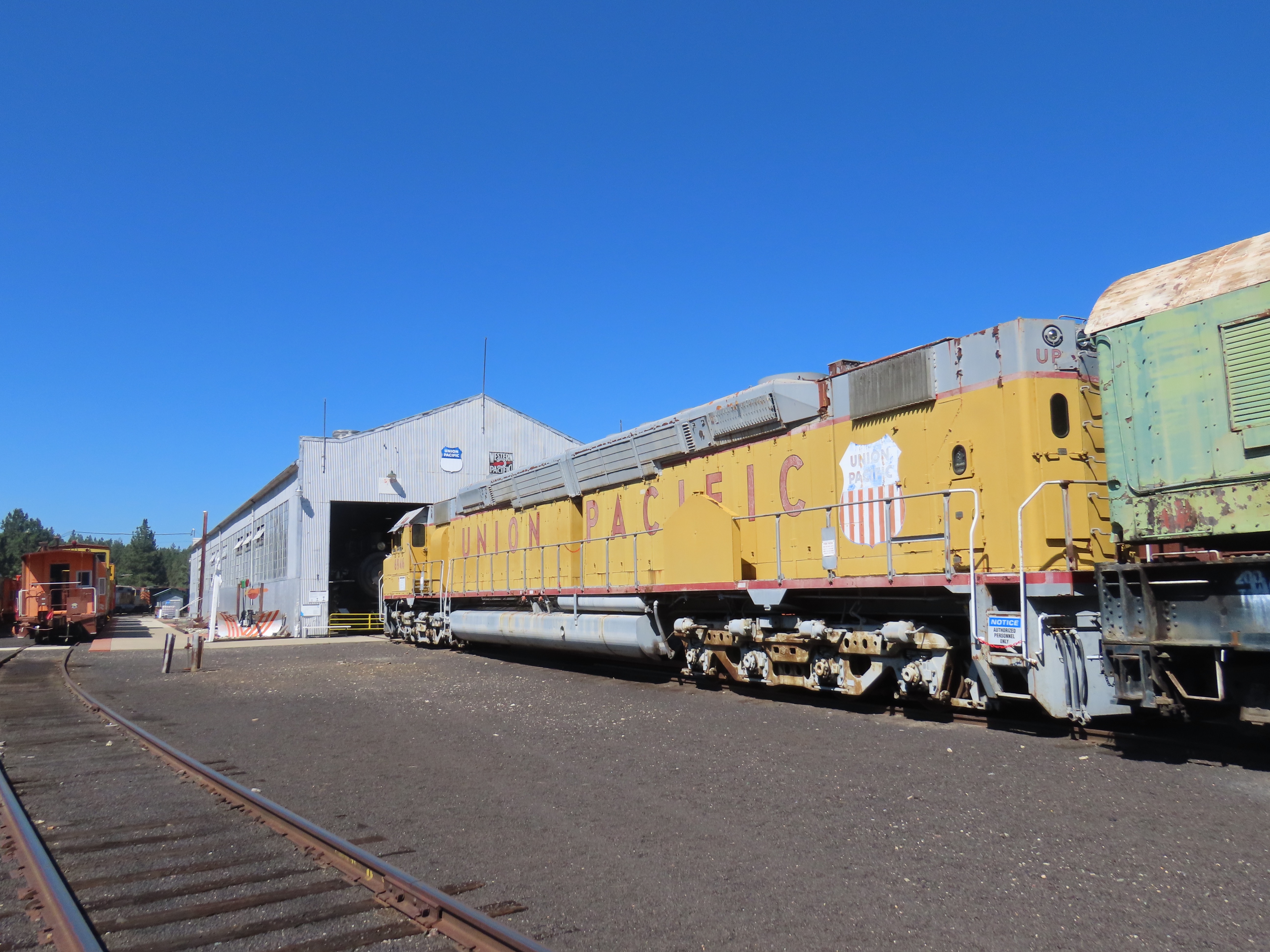
One of the epic diesels in the museum’s collection is perhaps the most epic diesels ever built, this is Union Pacific No. 6946. This 6,600 horsepower behemoth is EMD Class DD40AX “Centennial”, the largest and most powerful diesel-electric locomotive ever built and is the successor of UP’s Big Boy. 6946 is the last (out of 47) Centennial ever built. Only 13 Centennials still exist, the large locomotives having been retired from the UP fleet in 1986.
The beast that is the last Centennial ever built. Like the Big Boy, it’s two locomotives smashed into one mighty powerful machine.
A docent told me I could climb aboard the duel engine workhorse and I walked along the gangway to the cab.
I liked the view so I sketched the 1953 diesel shop from the gangway of 6946 (featured sketch).
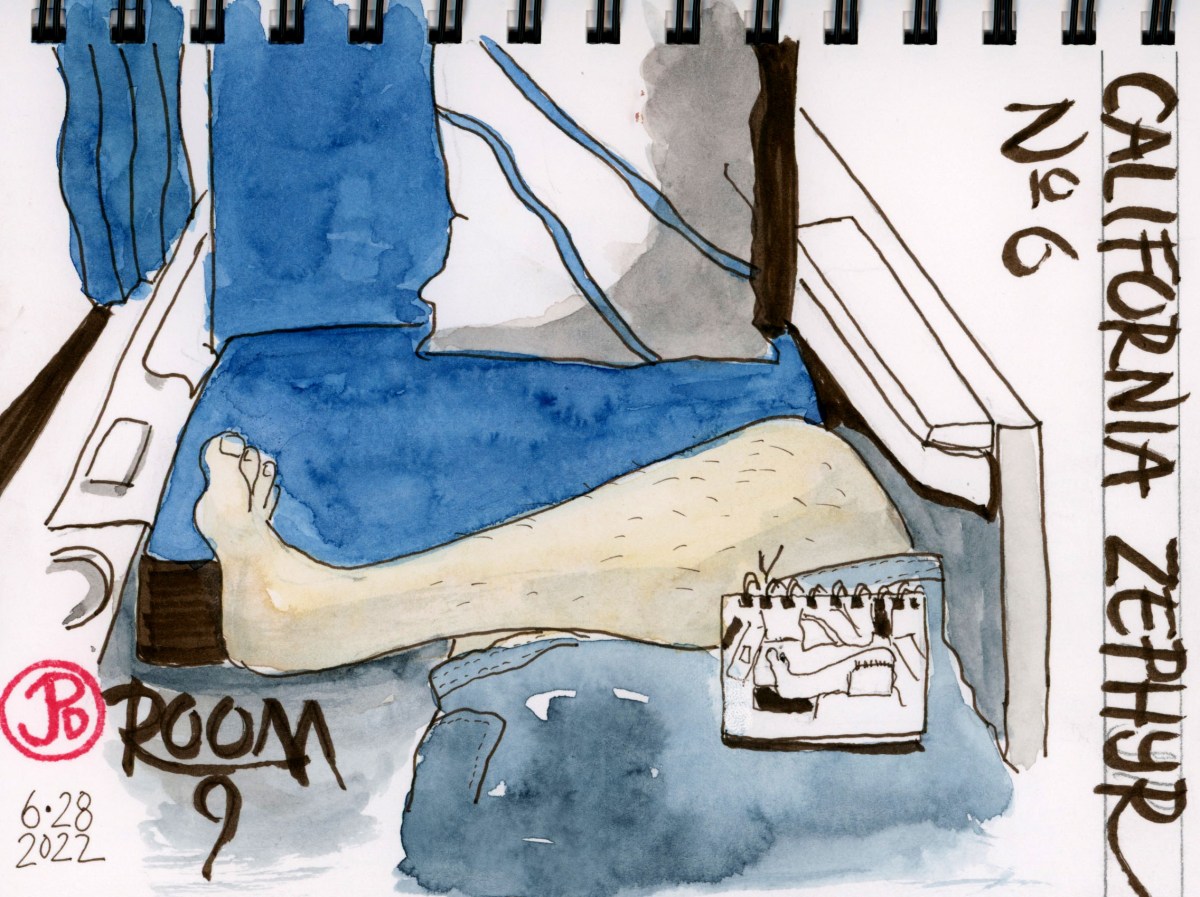
I really wish I could sleep on a train. Once we entered Utah, the Zephyr picked up speed and the train starts rocking and jolting even more.
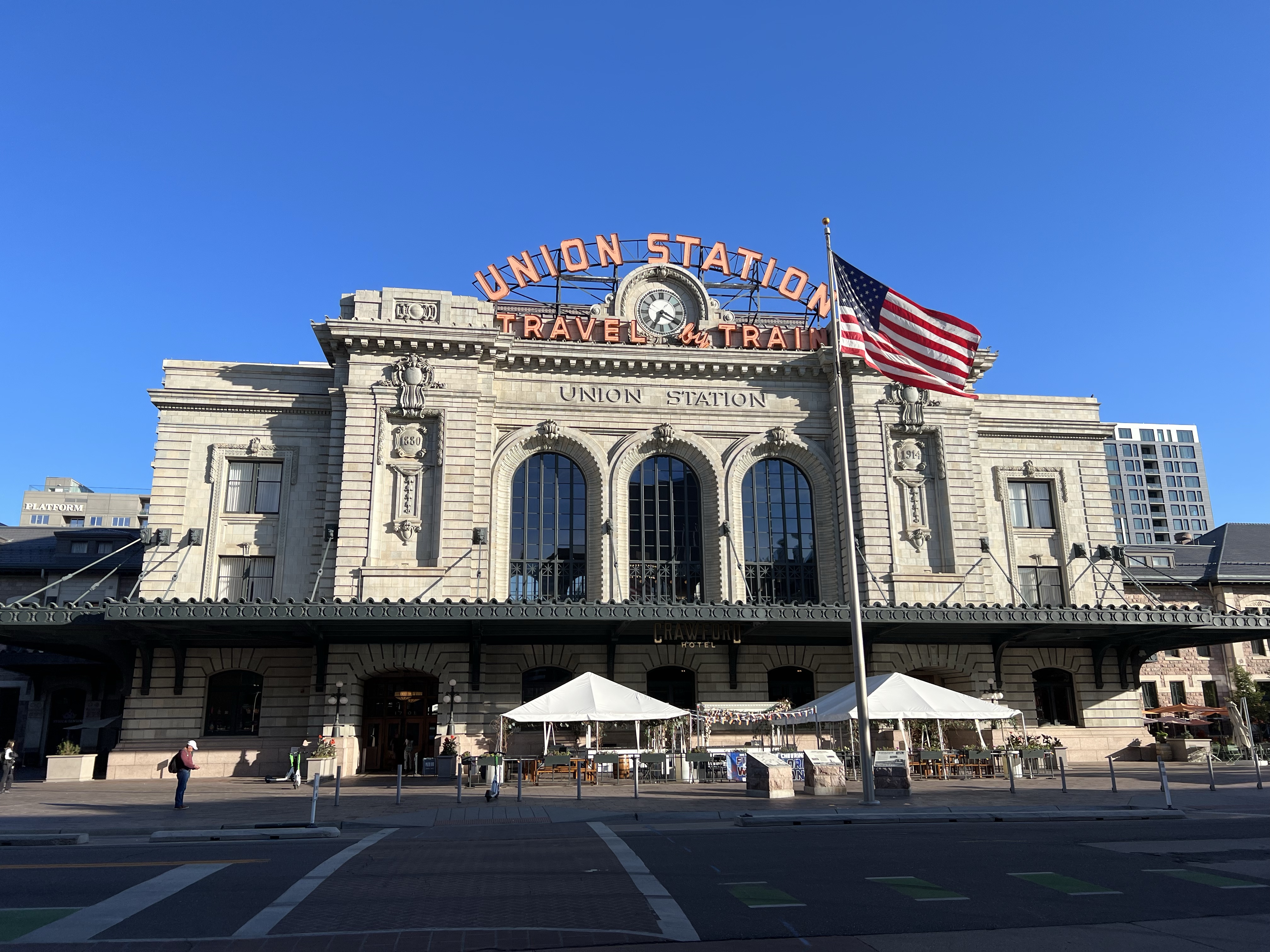
It allowed me a little time to explore the AMTRAK stop at Salt Lake City. You would think that a city with a rich history that SLC would have an equally impressive station as Denver’s Union Station. The truth is that the City of Saints has not one impressive train station but two.
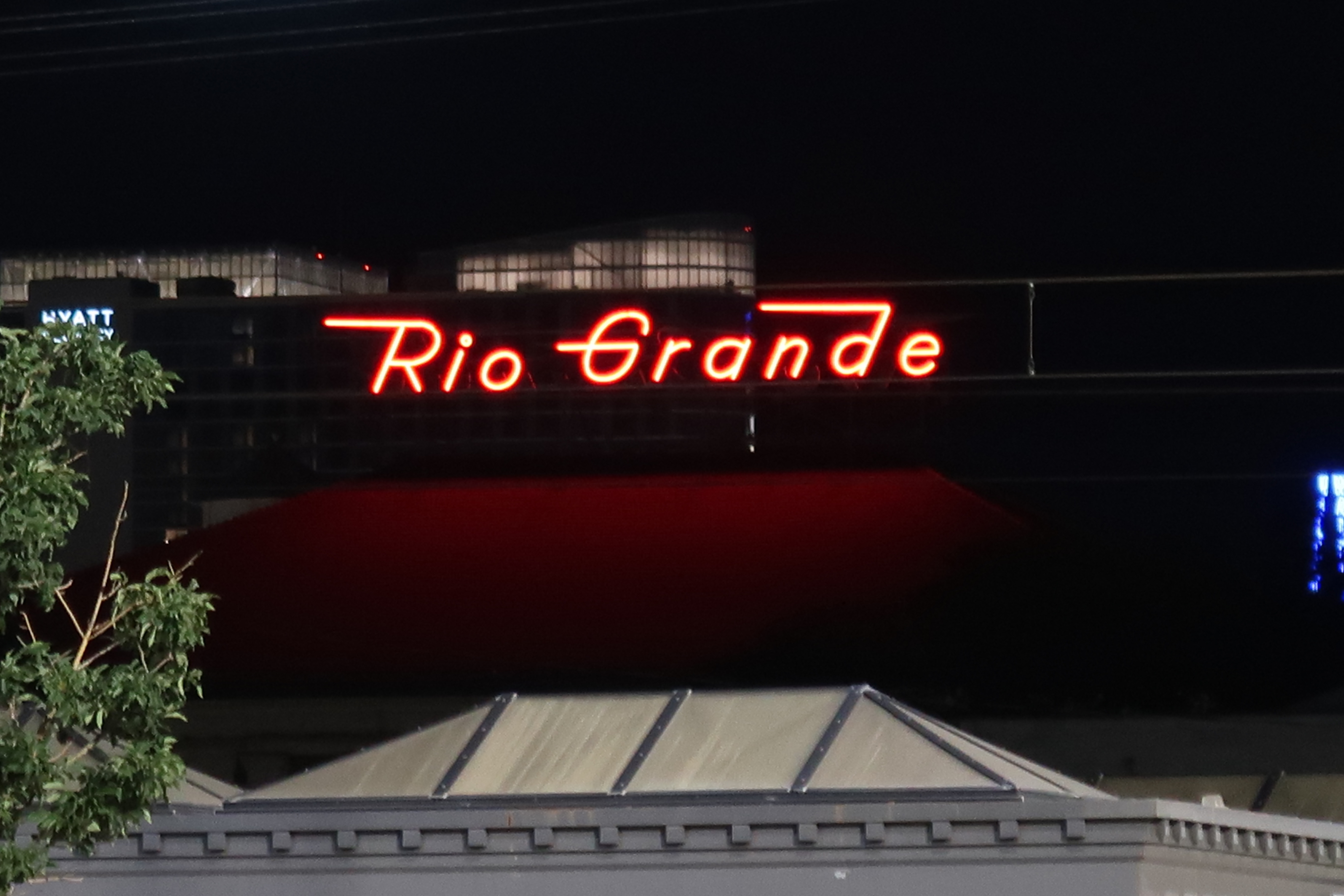
The current AMTRAK station is really a double wide trailer. But beyond the station, you can see the red neon sign of the former Rio Grande Station. The Union Pacific also had a separate station a short distance from the Rio Grande. While both buildings still exist, they are no longer passenger stations. The Rio Grande folded in 1987 and the UP no longer carries passengers.
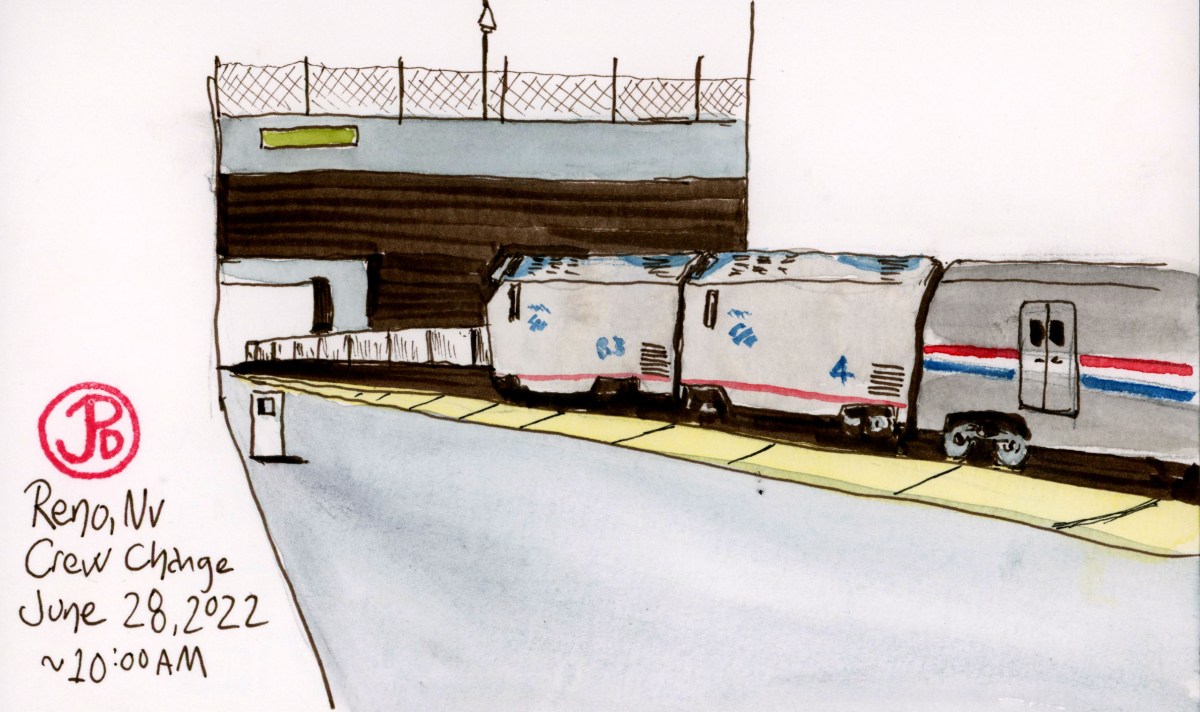
I was looking forward to the stretch break at Reno because it provided enough of a break to get a sketch in (featured sketch). I sketched the Zephyr pointing west towards California as a east bound fright passes on the next track.
Here is a sketch I did last spring of the Zephyr at Reno during a stretch break.
The California Zephyr Train # 5 was early coming into Denver’s Union Station. And we departed from the Mile High City, right on schedule.
The stunning Union Station in Denver.
We climbing up into the Tunnel District, so named because the Zephyr passes through 28 tunnels. The king of all tunnels in this stretch, if not any stretch in North America, has to be the Moffat Tunnel. The tunnel is 6.2 miles long and crosses under the Continental Divide meaning that once we come out of the west portal of the tunnel, the waters will be flowing to the west coast and behind us, the water flows east. At 9,239 ft, the tunnel is the highest point anywhere on the AMTRAK system.
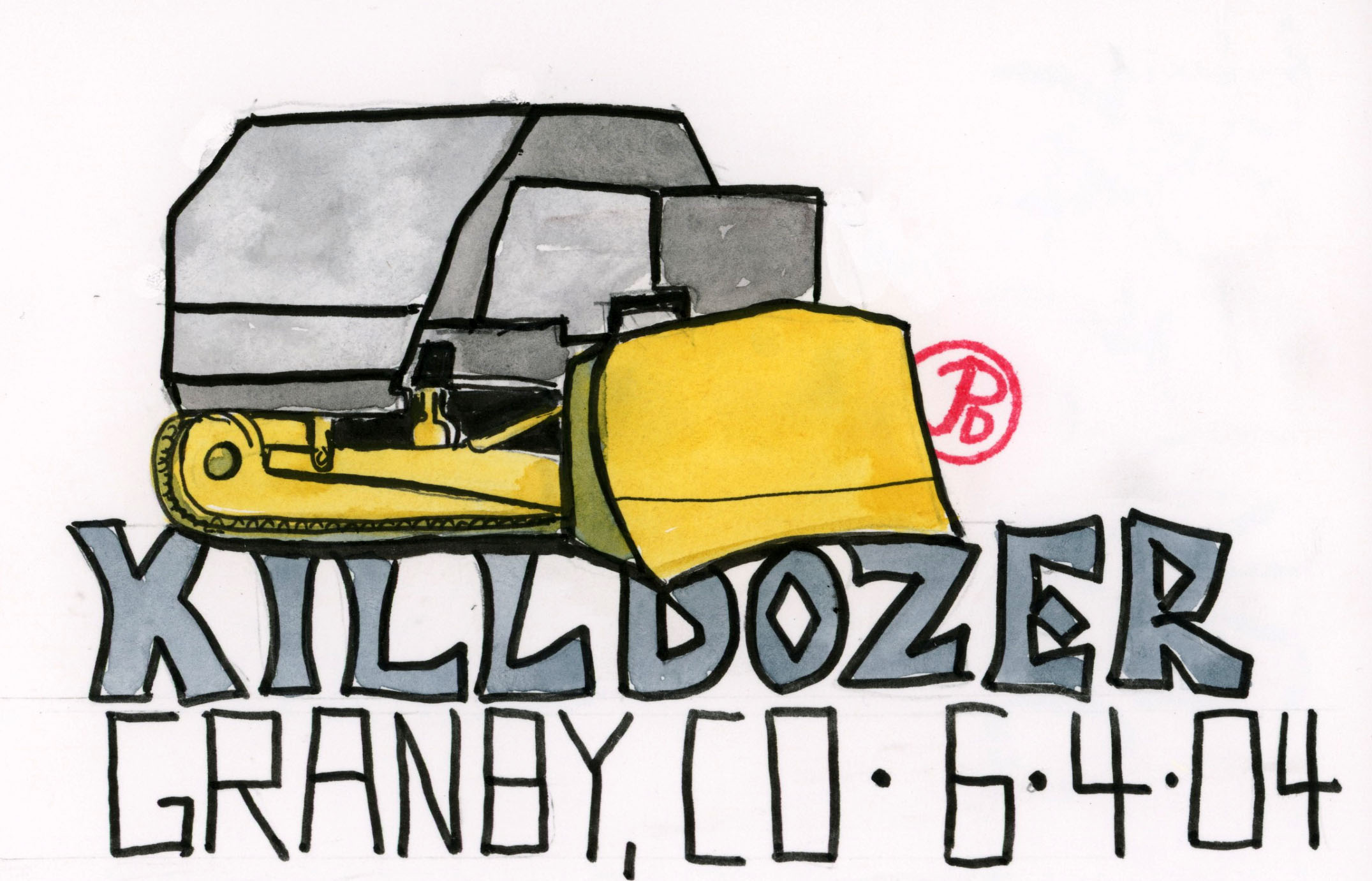
On the western side of the Moffat Tunnel is the stop of Fraser-Winter Park. The next stop on the western route is the small Colorado mountain town of Granby. The conductor told us the little story of Marin Heemeyer and his Killdozer.
Heeymeyer was from South Dakota but moved to Colorado where he became a popular member of the community and one of the best welders in the area. He opened a successful muffler business in Granby. Over the following years Heemeyer feuded with the city and others over zoning, building permits, sewage lines, and entry roads to his business. Over that time many in the community crossed Heeymeyer, which was a big mistake because Marv can really hold a grunge.
He bought a Komatsu D355A bulldozer and he sold his business and property and then rented a building on his former property from the new owners where he secretly modified the bulldozer. For over a year he worked on his bulldozer by fortifying it with steel and concrete creating an indestructible machine of destruction. On June 4, 2004 at about 3:00 PM Heemeyer put his plan into action.
During the two hours and seven minute bulldozer rampage, Heeymeyer destroyed 13 buildings (including the city hall, police station, the former mayor’s house, and newspaper offices). The killdozer caused seven million dollars of damage. The police where helpless to stop the bulldozer and the rampage only ended when the killdozer got stuck while destroying Gambles hardware store and Heeymeyer ended his own life.
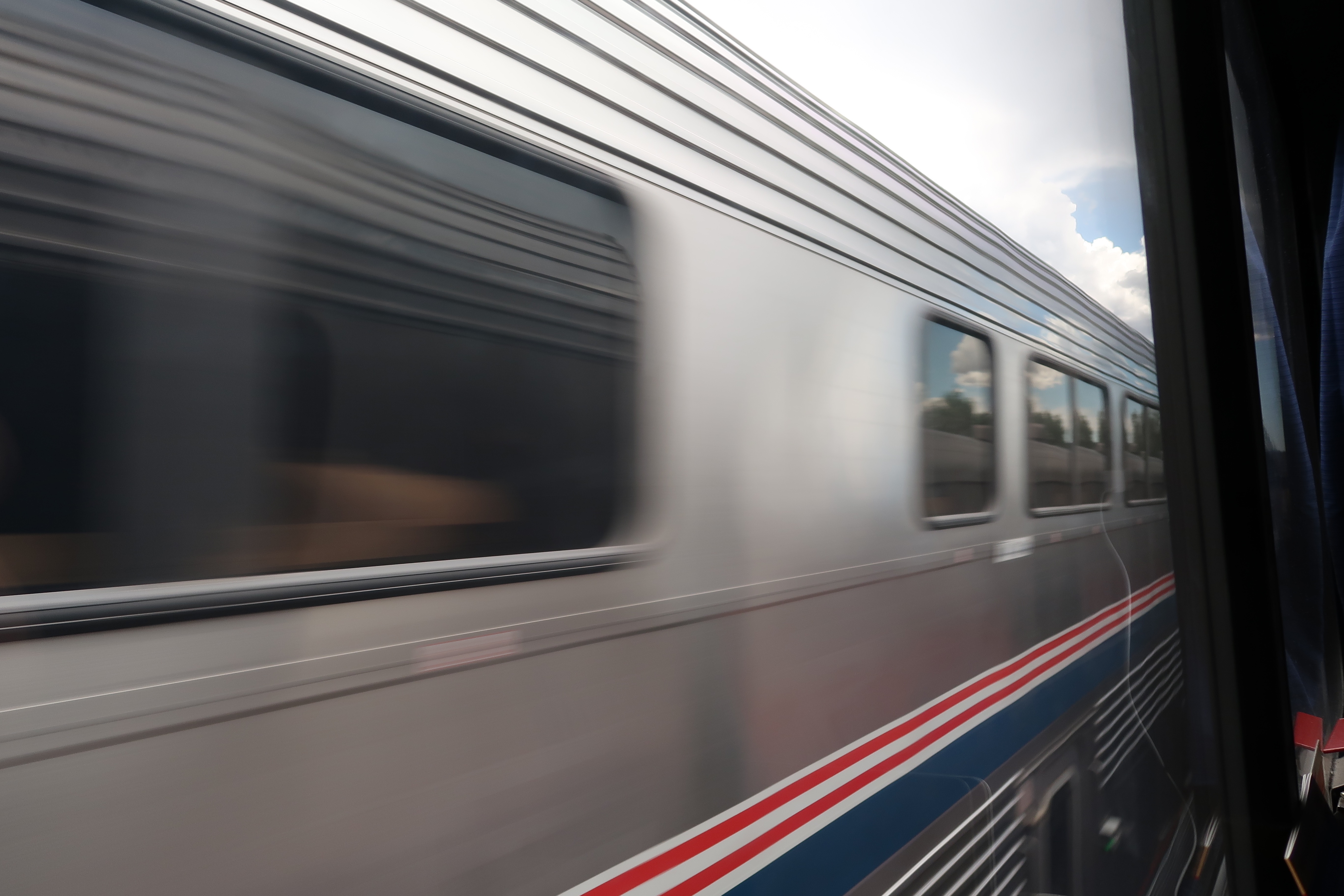
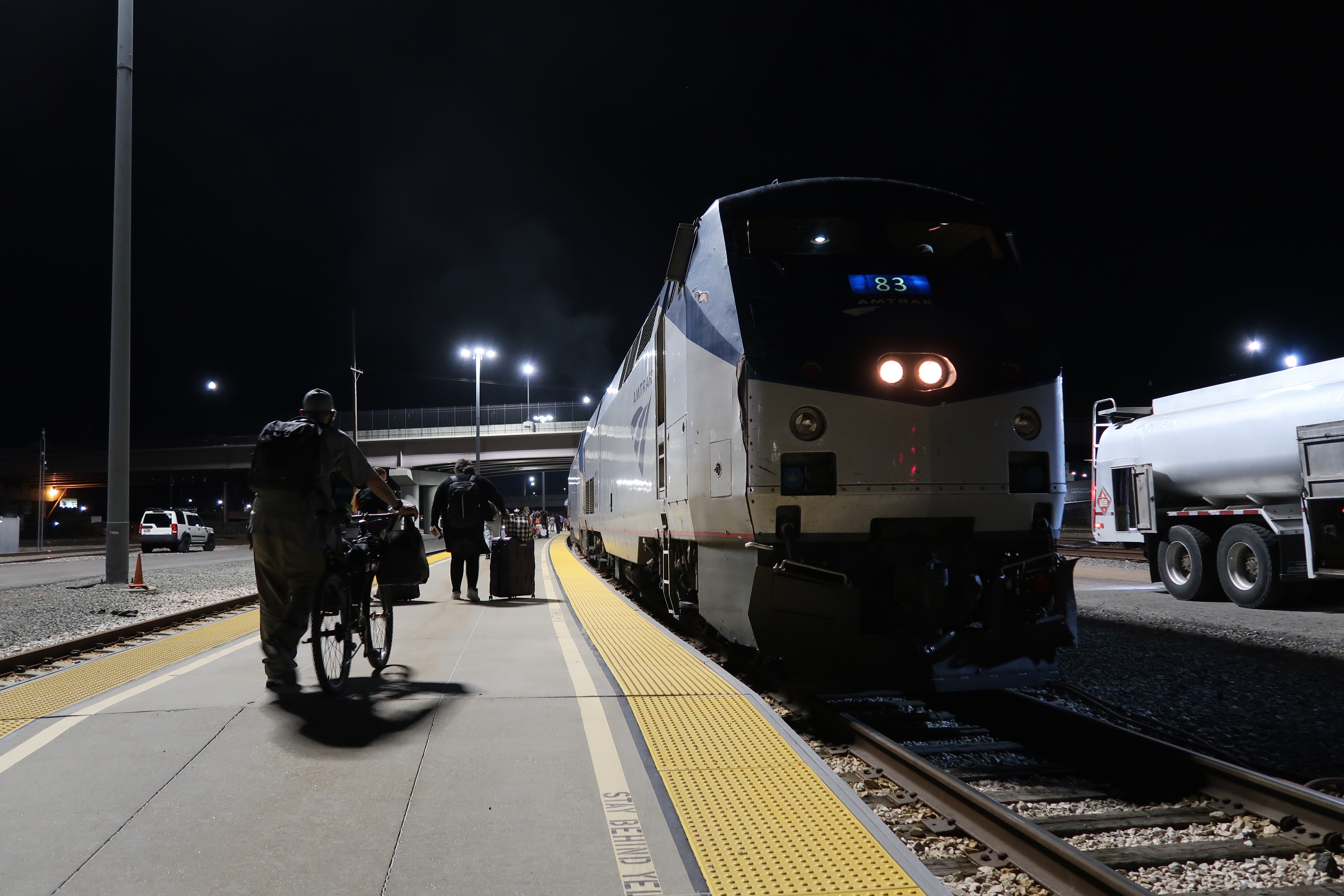
In Utah, the two Zephyrs meet as the westbound Train 6 passes us on it’s way to Chicago.The poor souls of Salt Lake City have to wake up at an ungodly hour to catch the train. The California Zephyr pulls into the City of Saints at either 11:30 PM (Train 5) or 3:30 Am (Train 6). Here we get a stretch break and the locomotives are refueled. I took a stretch break because I rarely sleep on trains.
The California Zephyr Train number 6 pulled into Colfax Station running about 30 minutes late.
I was boarding the Zephyr with my mom and her husband Steve and we were heading to Denver, Colorado. We would be spending the night and eating three meals a day on the Zephyr. This is AMTRAK’s longest daily route and it is a village on rails.
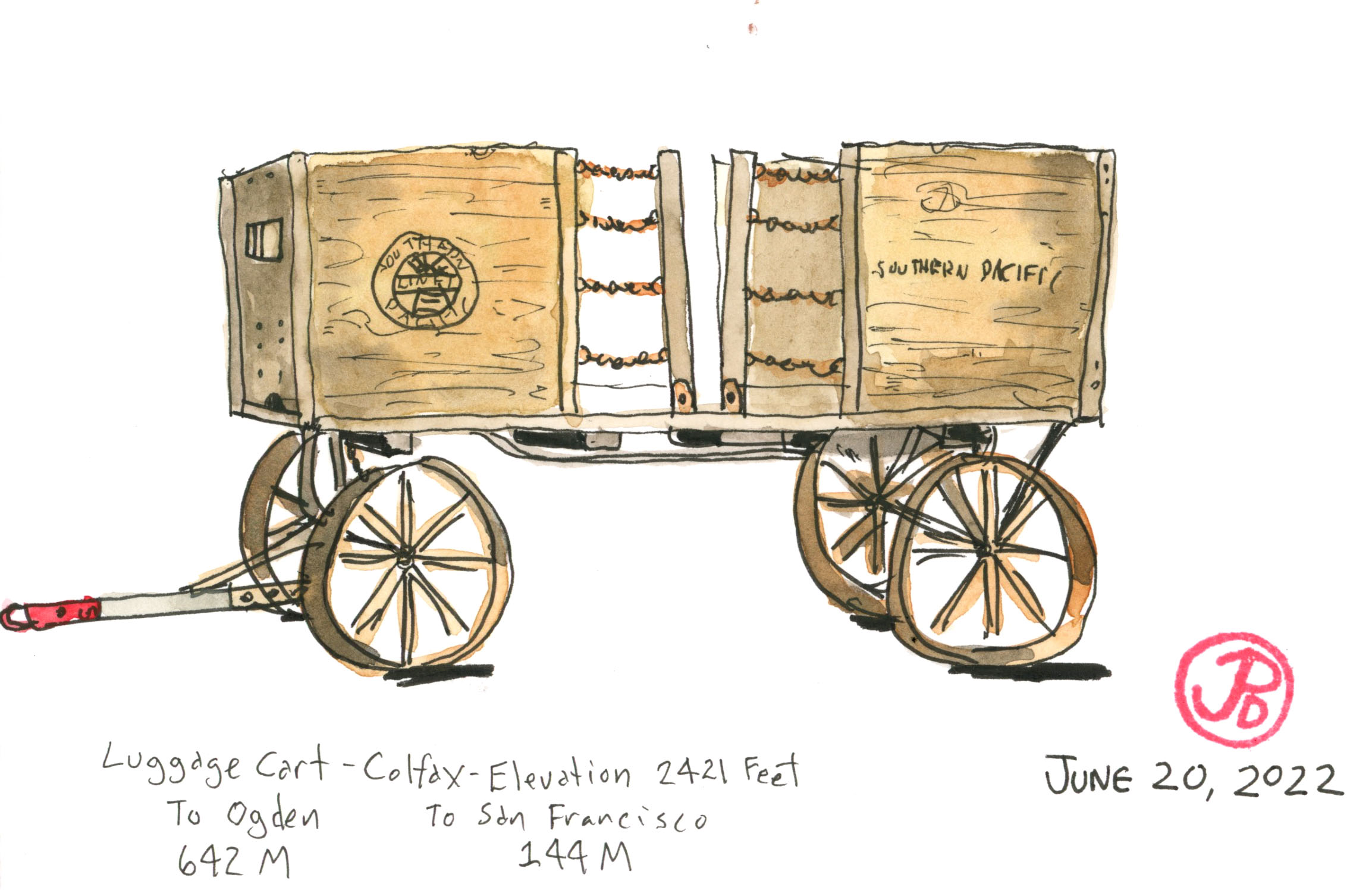
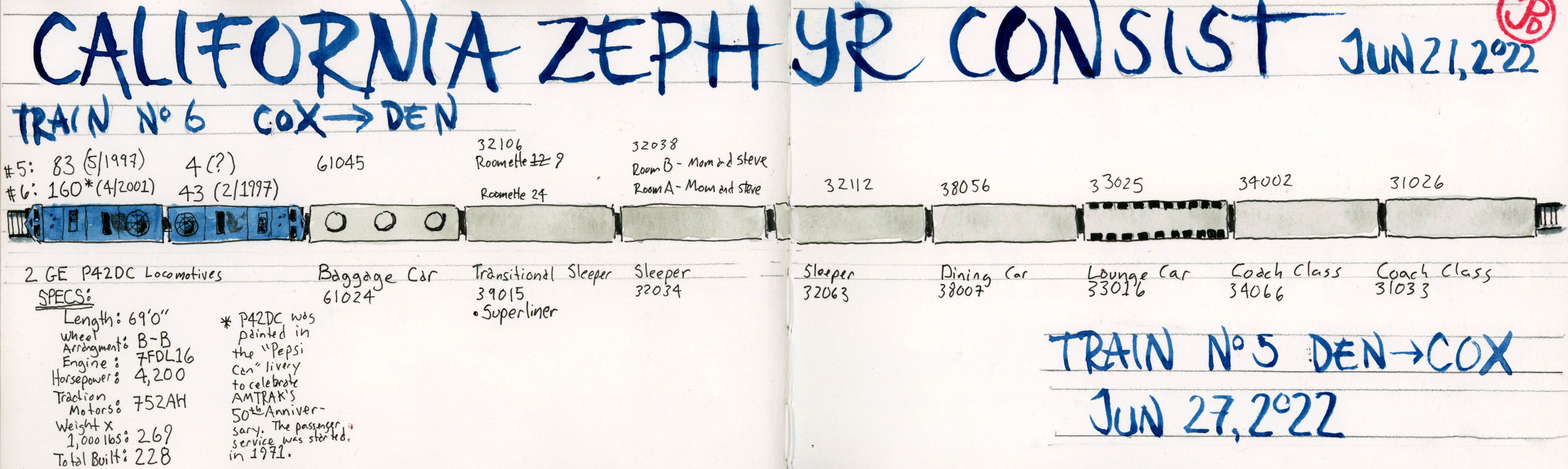
I did a few pre-trip sketches. The first is of the predicted consist of our train. A consist is the make up of the train, for instance: two locomotives, a baggage car, three sleeper cars, a diner car etc. I anticipated two locomotives and eight cars. Turns out I guessed right. I sketched them in and I would label them later during our first stretch break in Reno, Nevada. The second was the baggage cart outside Colfax Station, which I did the day before we boarded the Zephyr.
The eastbound California Zephyr pulls into Colfax. We were the only passengers who boarded. Mom and Steve are “racing” to the platform before the Zephyr’s short stop is over.
I was familiar with sketching from the California Zephyr from my previous trip last April. You have to sketch fast, taking in passing information creating an overall composite or impression. The brush pen was the perfect tool for Zephyr sketching.
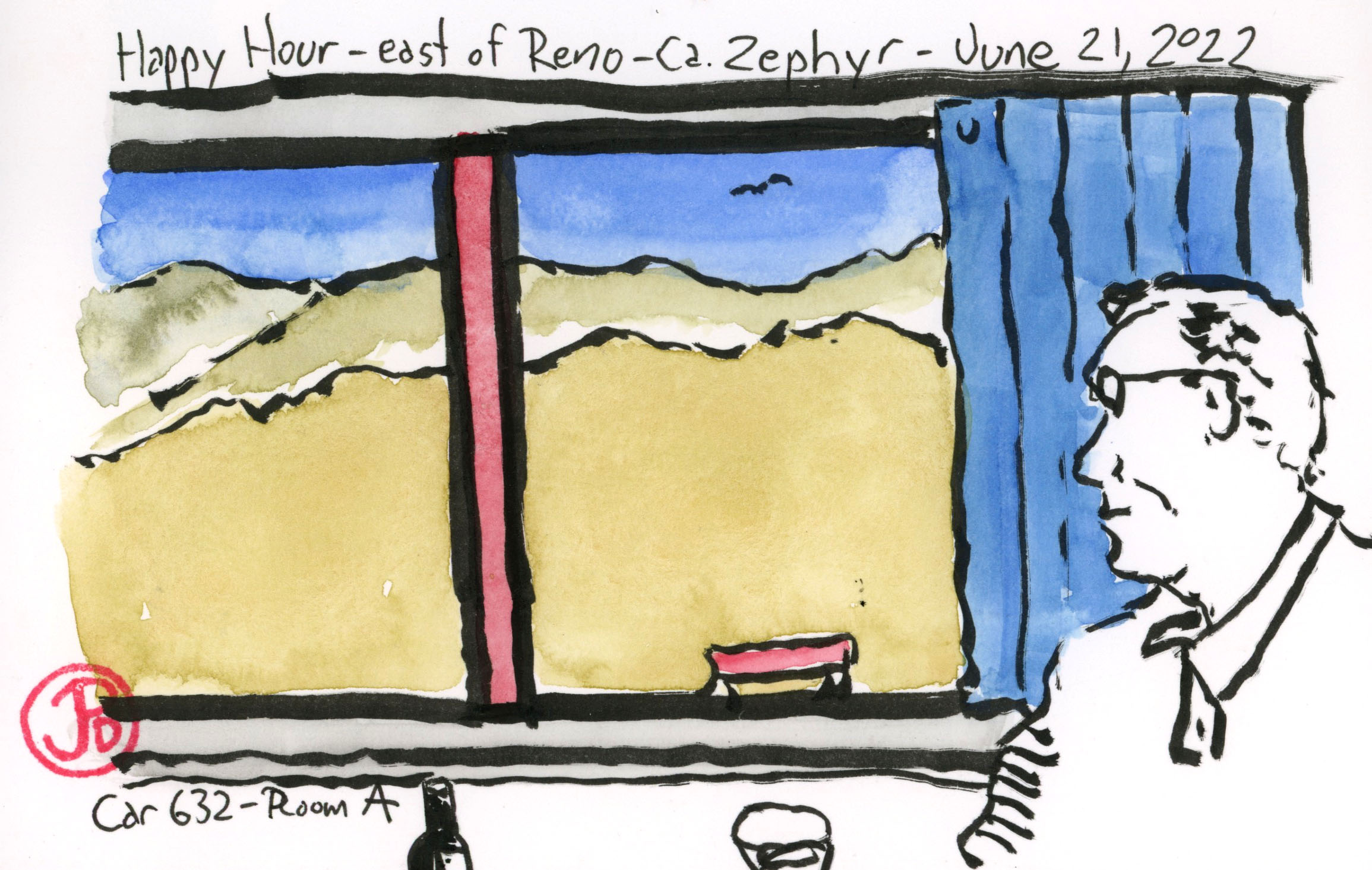
One of my favorite Zephyr sketches was done in Room A (Mom and Steve’s room) during happy hour. We where somewhere east of Reno.
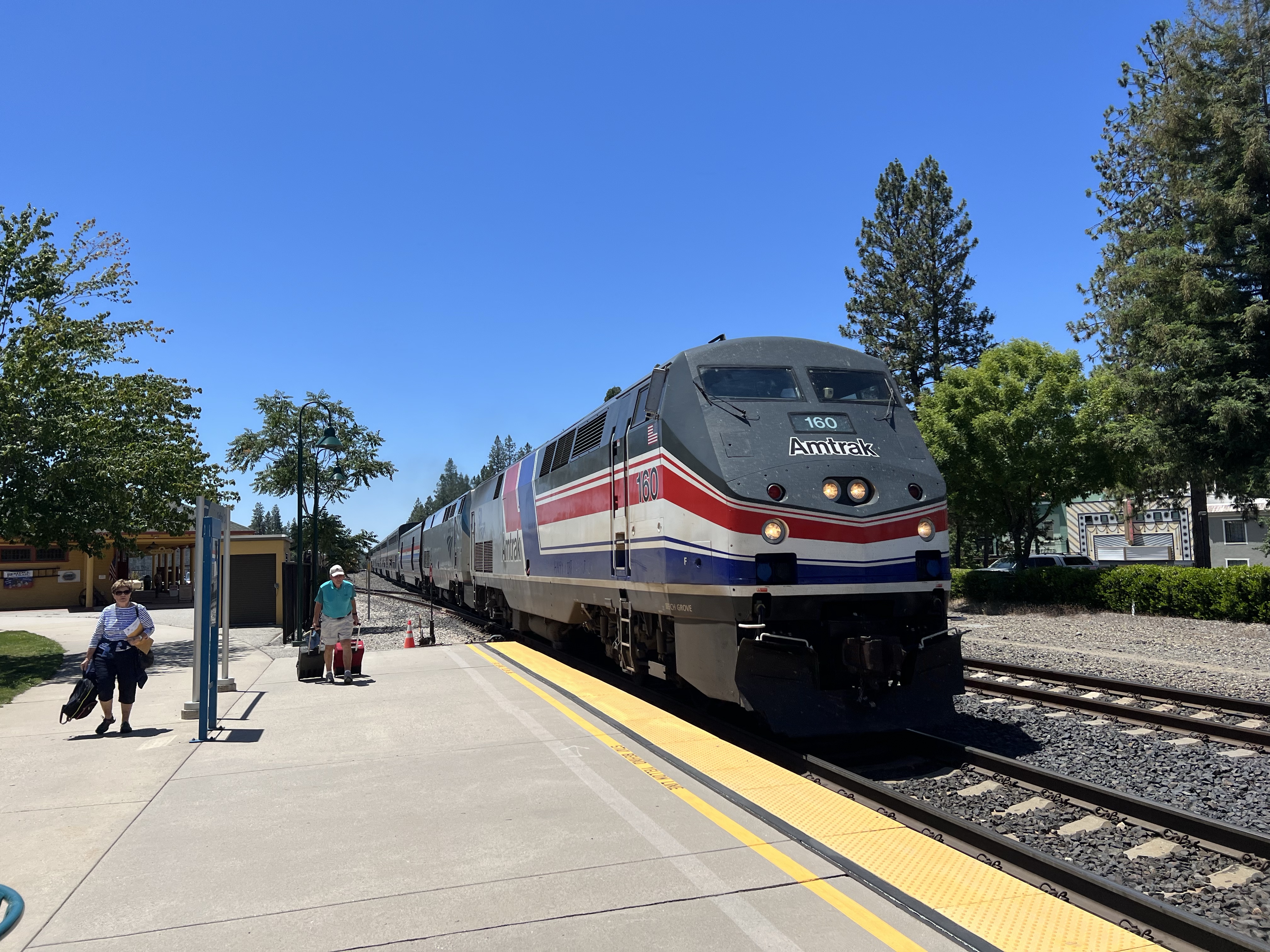
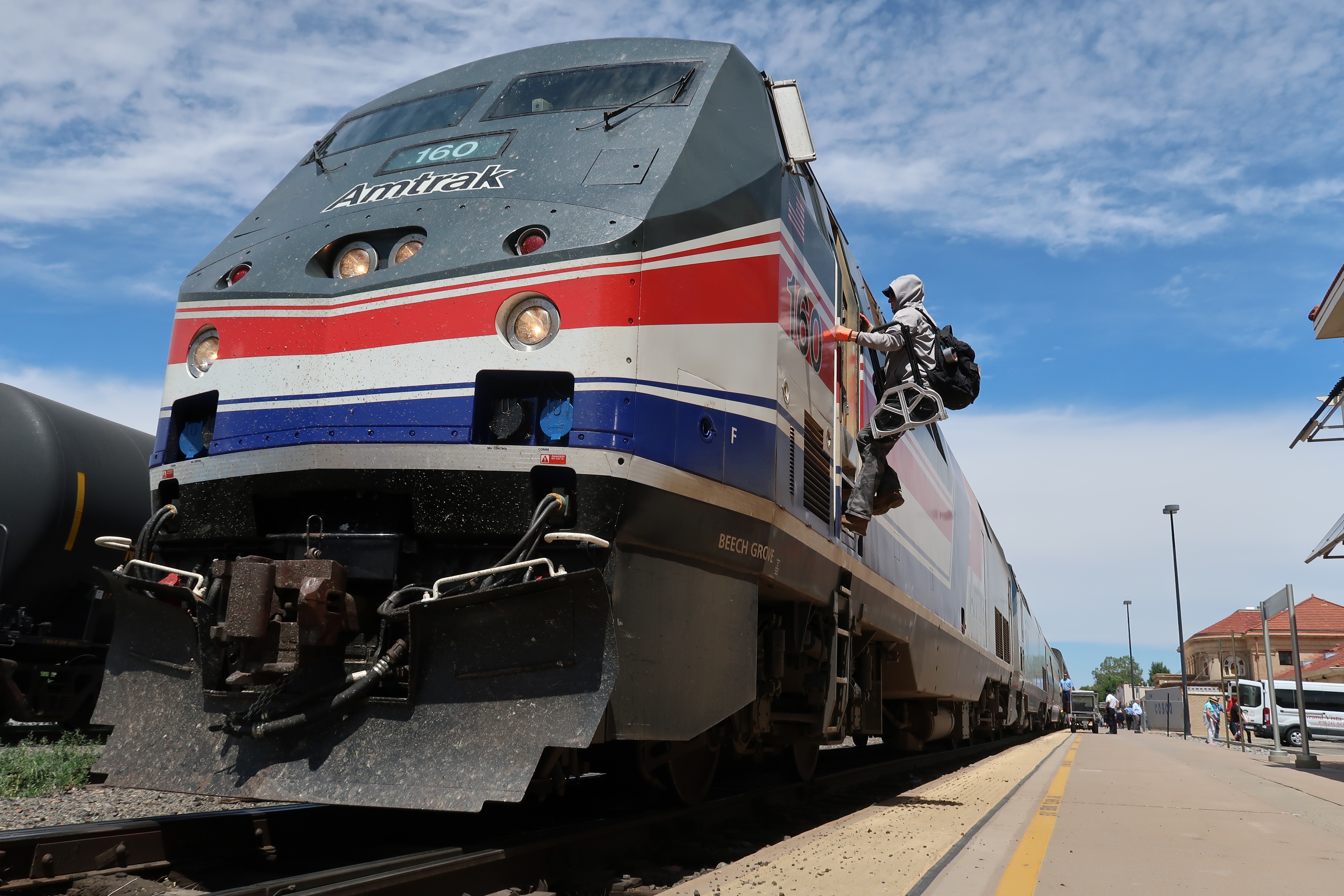
Crew change at Grand Junction, Colorado. Locomotive 160 painted in it’s “Pepsi Can” livery, to celebrate AMTRAK’s 50th anniversary.
Colfax, California is on the original Transcontinental Railroad. At Colfax, the climb of the western flank of the Sierra Nevada Mountains begins in earnest. The town started as a railroad construction camp and then was renamed by Governor Stanford to honor Vice President Schuyler Colfax who visited to check the progress on the western side of the Transcontinental Railroad.
What is special about Colfax is that it is one of the few places on the California Zephyr’s 51 hour and 20 minute route where trains 5 (westbound) and 6 (eastbound), pass within minutes of each other. That is, if the Zephyr is running on time, which is not too often. In California, the AMTRAK passenger service runs on Union Pacific rail and freight always has right of way. It pays the bills after all.
Both Zephyrs where scheduled to be at Colfax within a few minutes of each other at about 12:30 PM. At about 12:15, people with their suitcases began to arrive at the platform. I love the romance of train travel. The farewells at the station as one prepares for a rail journey, often to see far off friends and family over the Christmas Holiday.
12:30 came and went and no Zephyr.
Both Trains 5 and 6 were late. This is AMTRAK after all, a passenger service not known for it’s punctuality. The Chicago-bound, Train #6 was running about 30 minutes late. It had left Emeryville in the morning at 7:21 AM.
The California Zephyr eastbound Train #6 arriving at Colfax, about 30 minutes late. This train’s final destination is Chicago.
Train #6 pulled into Colfax station at 12:59 PM. I had positioned myself on the east side of the grade crossing at Grass Valley Street. The Zephyr had an eight car consist with a baggage car and seven passenger cars and was pulled by two locomotives. The train was too long for the station platform so when the Zephyr stops at the station, it stops traffic on Grass Valley Street. I had no way of knowing which car would be stopped at the grade crossing. It lent a bit of improvisation and serendipity to the sketch. And I would only have a short time to sketch the scene because the Zephyr would be in the station for about three minutes as passenger boarded or disembarked.
The train slowed to a stop and the baggage car came into sketch-view. I would be sketching this car. Great, there are less windows on the baggage car! I quickly sketched in the form of the car and then worked inward to add details. I had all the information I needed in about two minutes of sketch-time (you do lose sense of time when sketching). I would later add a few more details and paint.
Train number 6 headed out of Colfax toward Cape Hope and the summit of the Sierra Nevada Mountains at Donner Pass and then on to Reno, Salt Lake City, Denver, and eventually Chicago. I checked the status of the westbound train train number 5. It was running an hour and a half late. In about 10 minutes I found out the reason why.
Coming down from the summit was a UP freight wearing a dusting of snow on it’s pilot as it headed down towards the Bay Area. The five locomotives (four on point and another at the end) where hauling a long container consist that keeps a lot of trucks off our highways. The Zephyr was running behind this train which explains why it was running an hour and a half late.
I didn’t wait for the westbound Zephyr, I had already gotten my sketch in the book!
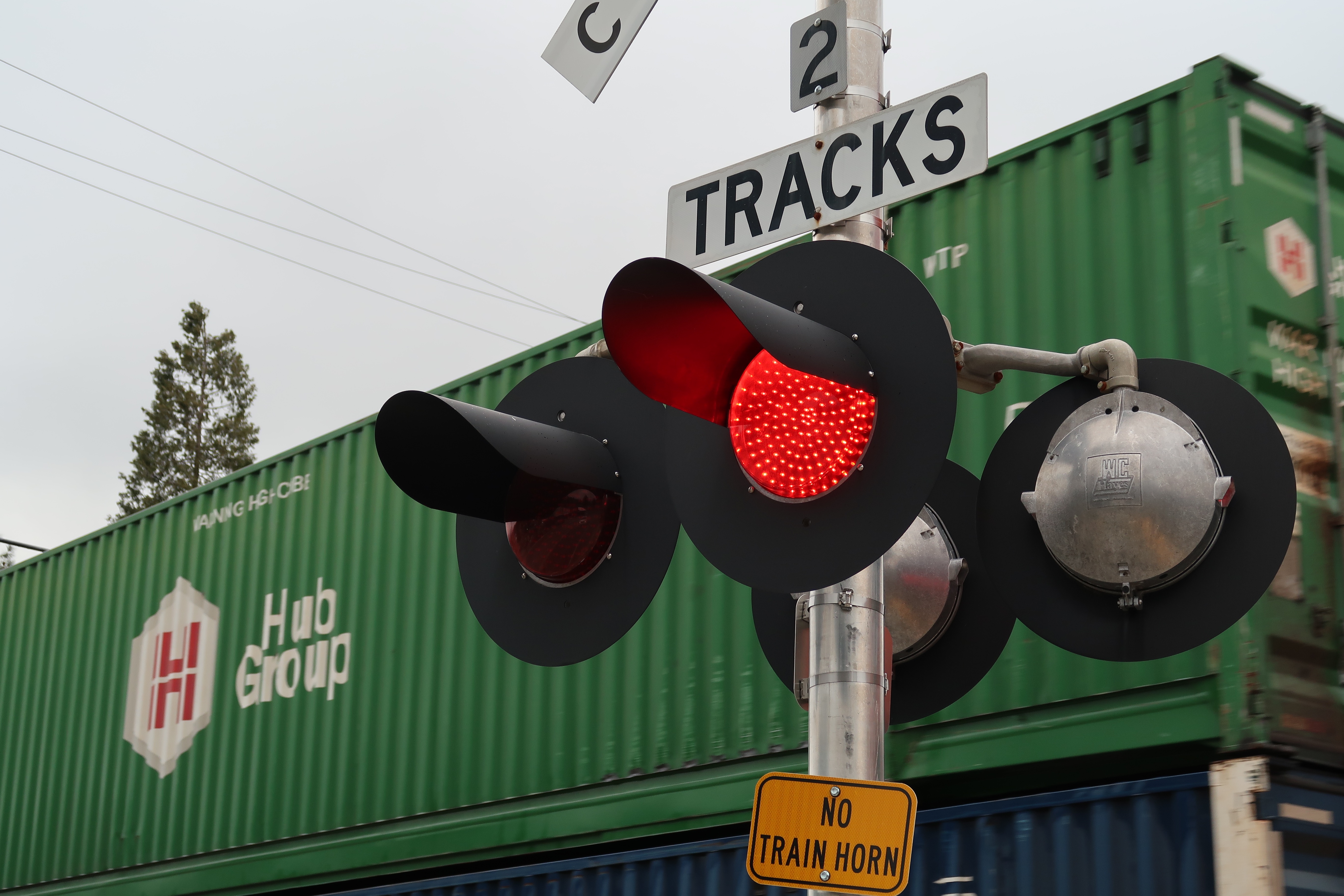
The train town of Colfax is a “No Train Horn” town.
On Thursday morning, about 10:30 AM, I found myself on the platform of Roseville. I was waiting for the eastbound California Zephyr number 6. I planned to chase her all the way over Donner Pass down into Truckee, the last Zephyr stop in California. The journey was roughly 84 miles.
In this stretch, the California Zephyr stops at three locations: Roseville, Colfax, and Truckee. All three of these towns were created by the Transcontinental Railroad and they because important servicing sections for the Central Pacific and later Southern Pacific Railroads. Roseville is still an important division point where Union Pacific (the current owners) keep the snow removal fleet, including the rotary plowers, to keep Donner Pass open during periods of snowfall.
It shouldn’t be to hard to keep up with the Zephyr, because it’s average speed is 55 mph and it rarely reaches that as she climbs the western flank of the Sierra Nevada Mountains. The speed limit on Highway 80, the interstate that parallels much of the railroad, has a speed limit of 65 mph.
The Zephyr pulls into Roseville. Roseville was once a major servicing point for Southern Pacific’s cab forward steam locomotives. The railyard had water and fuel tanks and two large roundhouses to turns the massive cab forwards. Today, steam has been replaced by diesel-electric motive power. Just to the left of 74, are service bays to maintain Union Pacific’s current locomotive fleet.
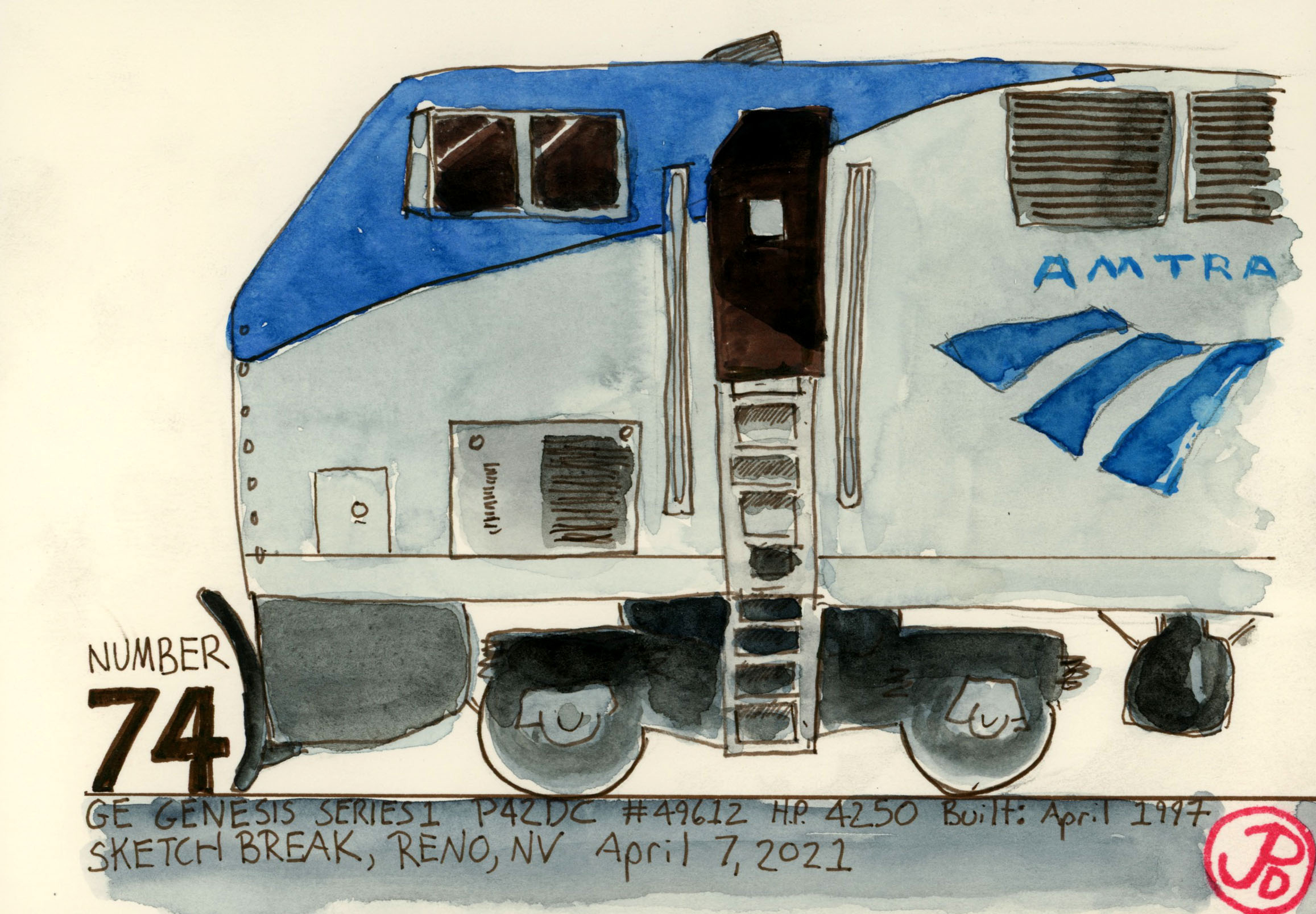
The eastbound number 6 pulled into Roseville on time. The train started it’s journey at 9:10 AM at Emeryville. I was excited to see that on point was an old “friend”, the General Electric P42DC locomotive, number 74. This was the locomotive that brought me from Denver, Colorado to Colfax, California, a few weeks ago. I had gotten to know her when I sketched her profile during a “fresh-air” smoking stop in Reno, Nevada. Her road number was also the year that my younger brother was born, 1974.
The number 6 filled the long platform at Roseville and I did a quick sketch of the eight car consist (featured sketch). The Zephyr was stopped at Roseville for about six minutes, which was enough time to capture the scene. With a quick retort from 74’s horn, the Zephyr started out of Roseville to slowly begin her assent of the Sierra Nevadas. I headed off to my car. The chase was on!
The Zephyr heading out of historic Colfax. The climb up the flank of the Sierra Nevada beginning in earnest at this point.
I made it to the Zephyr’s next scheduled stop, Colfax, with time to spare. I had time to have a quick bite to eat. I wanted to photograph the train from a different angle so I chose the bridge that takes Highway 174 over the two mainline tracks, just north of the historic Colfax passenger depot.
From the bridge I could see the “downtown” and look south down the mainline. Just north of the platform is a grade crossing where I detrained, two weeks before and my mother hugged me tight in the middle of Grass Valley Street, the Zephyr blocking off auto traffic.
A Union Pacific freight climbs the track at Yuba Pass.
My next encounter with Number 74 was at Yuba Pass, just off Highway 80. At this point I am really up in the Sierras. While the sky was clear I had to don a jacket as I waited for the California Zephyr to catch up to my location at Yuba Pass.
To the south of my location, the rails curved around a bend and to my north, the line disappears into tunnel number 35, the location of the stranding of the City of San Francisco in January 1952. Now was the time of the waiting game, I had no way to gauge when the Zephyr would pass by.
I then heard a far off locomotive horn. It was difficult to locate and place the location of the train. Less than two minutes later I could hear the rumble of a diesel locomotive, climbing up the line. The Zephyr was approaching.
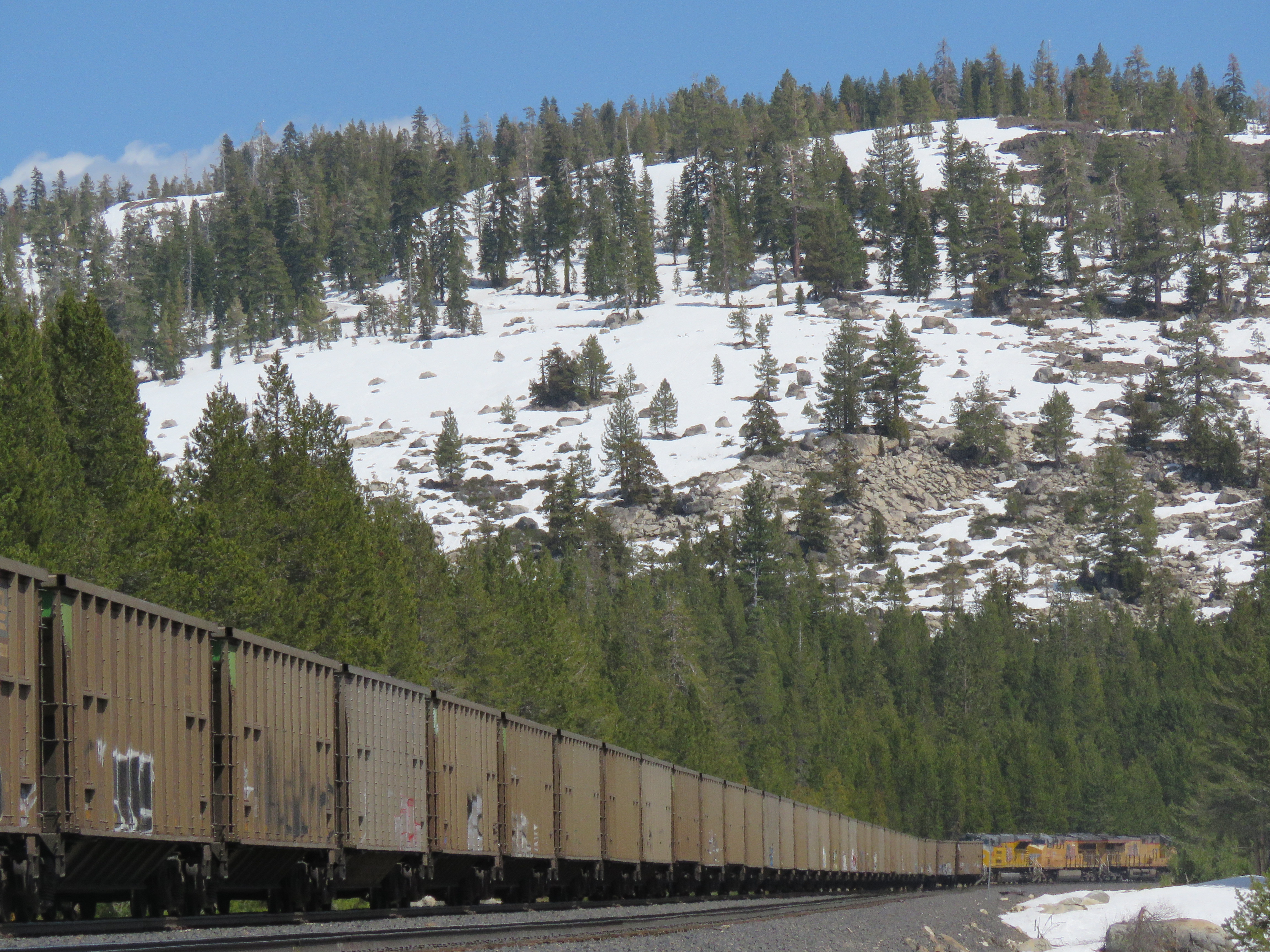
What appeared around the curve was not the Zephyr but a Union Pacific freight train with a consist of hopper cars. The train was headed up by three GE locomotives.
Freight trains now rule the rails in the United States with AMTRAK passenger service following in their wake. Freight certainly pays the bills and moving commerce across the the county has the right of rail, meaning that passenger service such as the California Zephyr are frequently behind schedule. On my journey on train number 6, we where two hours late when we finally arrived at Denver’s Union Station. The cause, we were behind Union Pacific freight trains in Nevada and Utah.
About 25 minutes later, train number 6 followed the UP freight heading east toward Donner Pass. I got and horn toot and a wave from the engineer!
About 25 minutes behind the UP freight, the Zephyr climbs up Yuba Pass with 74 on point.The Zephyr curves into Tunnel number 35 at Yuba Pass.
I headed back to my car and returned to Highway 80 as both train and car climbed up towards Donner Pass. In about 20 minutes I pulled off the Highway at Historic Highway 40 (Donner Pass Road). On this road I passed the South Bay Ski Club’s lodge, where my parents met. I stopped at the grade crossing at Soda Springs. In front of me was the Soda Springs ski resort and further to the southeast is the resort Sugar Bowl, one of my favorite ski mountains in the Tahoe area. Both resorts where closed for the season.
The Union Pacific hopper freight passing through Soda Springs as it heads east to Norden, Donner Pass, and Truckee.
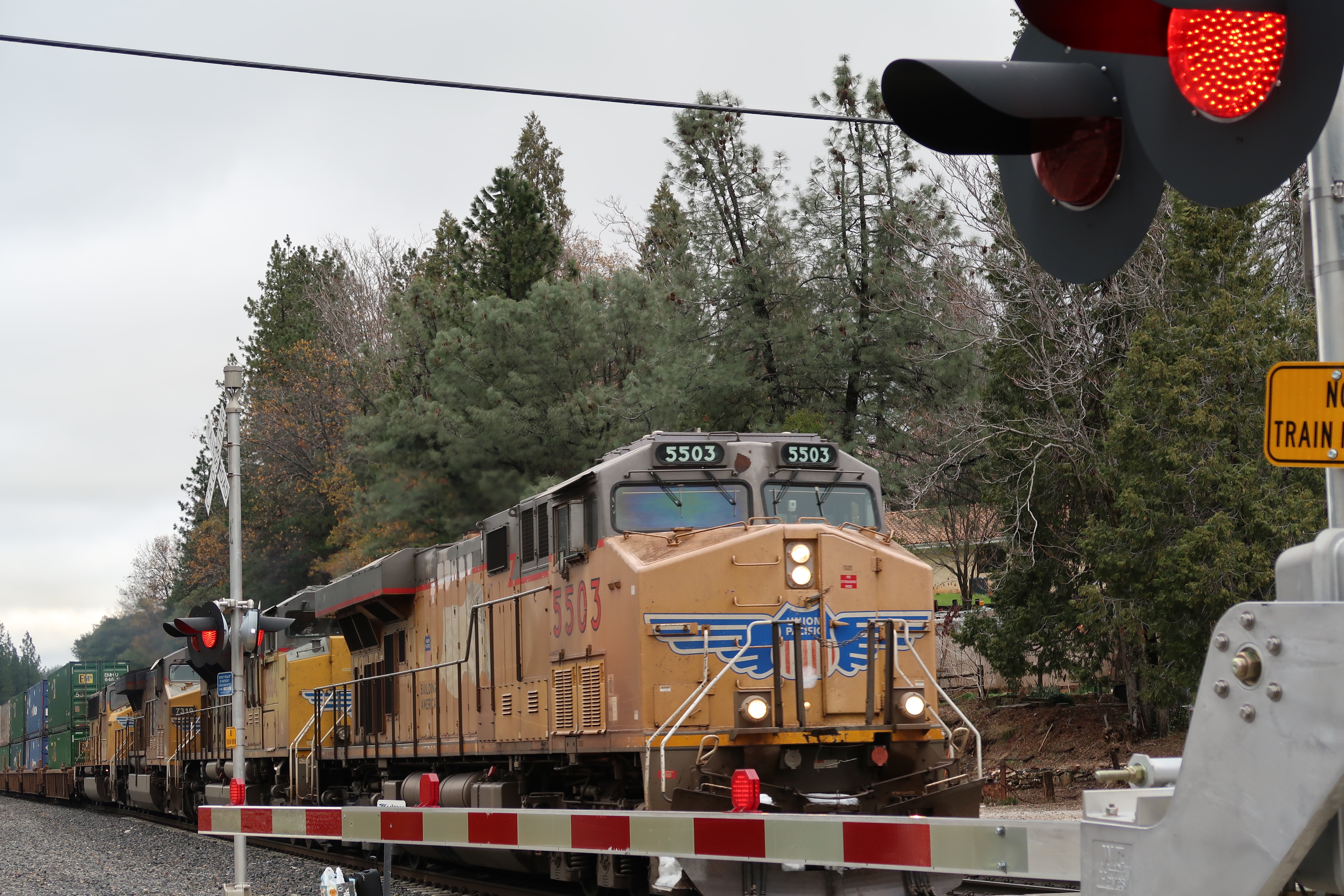
Stopped before the grade crossing was the freight train with the hopper consist waiting on mainline track 1. UP Number 8095 sounded her horn, triggering the crossing arms to lower. Any motorist wanting to cross the tracks would now have to wait a while for the freight to pass.
About 20 minutes later the Zephyr passed through the grade crossing, I got another wave from the engineer. At this point I think he was starting to recognize this Zephyr stalker!
I headed back to Highway 80 and climbed up and over Donner Summit and started my decent to Truckee. I looked over across Donner Lake to the far mountainside and I could see I was level with the UP freight. If I could beat it to Truckee I would be able to see both trains pass through Truckee. One would pass through Truckee while the other would stop to drop off and pick up passengers.
I had time to find a parking spot on Truckee’s main street, Donner Pass Road, pay for parking, and cross the three sets of tracks to position myself for the best light for photos. About 15 minutes after my wait, the Union Pacific freight blazed through Truckee.
Next the California Zephyr arrived. It stopped for a few minutes and with a short blast from the horn, the engineer released the brakes and throttled up the locomotive. With a last wave and a thumbs-up from the engineer, the Zephyr headed out of Truckee and California.
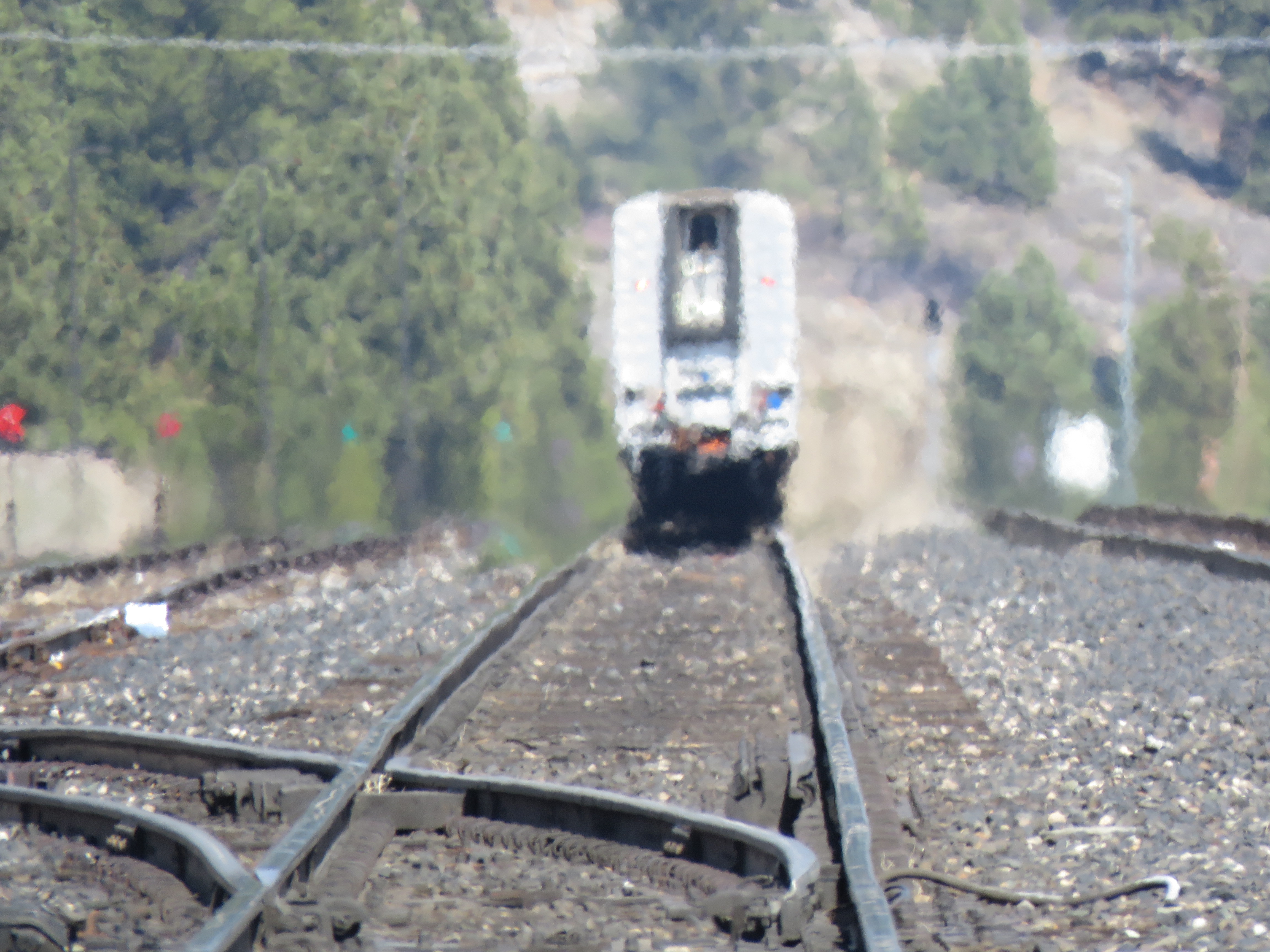
The Zephyr pulls into Truckee, eight minutes late. This is the last stop in California. Next stop for the Zephyr is Reno, Nevada.One last look at the California Zephyr as it heads east towards it’s next stop, Reno, Nevada and eventually, Chicago.







 Corvid Sketcher