Image

California Zephyr

I have always wanted to travel on the original Transcontinental Railroad, from the West Coast to the East and see some the sights from the original right of way over the Sierra Nevada and Rocky Mountains. The closest you can come to doing this today is by taking the California Zephyr.

AMTRAK operates the California Zephyr from Emeryville to Chicago (not the East but the Middle Coast). The daily route covers 2,438 miles and takes 51 hours and 30 minutes (that is if the train is running on time). The route covers seven states and stops at 35 stations including Sacramento, Reno, Salt Lake City, Helper (Utah), Denver, and Omaha, to name a few of the major stops.

So I booked a roomette for my Spring Break in April. Which at $550, I thought was a good deal because it included two nights and all the food was part of the fare.

Since the time of booking the trip, the spread of Coronavirus and Covid-19 (not related to Corvid in any way!) in the United States has thrown a monkey wrench into the works. At this time my continental train trip hangs in the balance as some predictions estimate that the virus might spike in late April.

One thing that I sketched, regardless of if I would be boarding the California Zephyr in Emeryville in early April or not, was to sketched out the route with all the stops in a visual map (featured sketch). I also drew the locomotive that is used on this route, the P42DC, with all it’s specifications (below).

The workhorse of much of AMTRAK’s long distance routes, General Electric’s P42DC.

Image

Camp 20-Illinoistown-Colfax

November 22, 2017. Colfax Train Depot.

I have always loved train travel. The idea of a traveling community that passes through landscapes, towns, and cities in stasis. On this day, one of the biggest travel days of the calandar, I was in stasis in an important railway town on the transcontinental railway, Camp 20. Later to become Illinoistown and later renamed for the Speaker of the House, Schuyler Colfax by then Governor Leland Stanford.

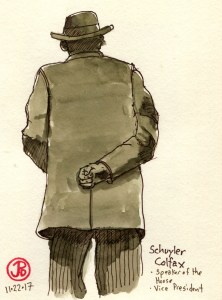
The only statue in existence of Schuyler Colfax, later to be Vice President under Grant. Stanford named the town after him after a brief visit by Colfax. At the Southern Pacific Passenger Depot.

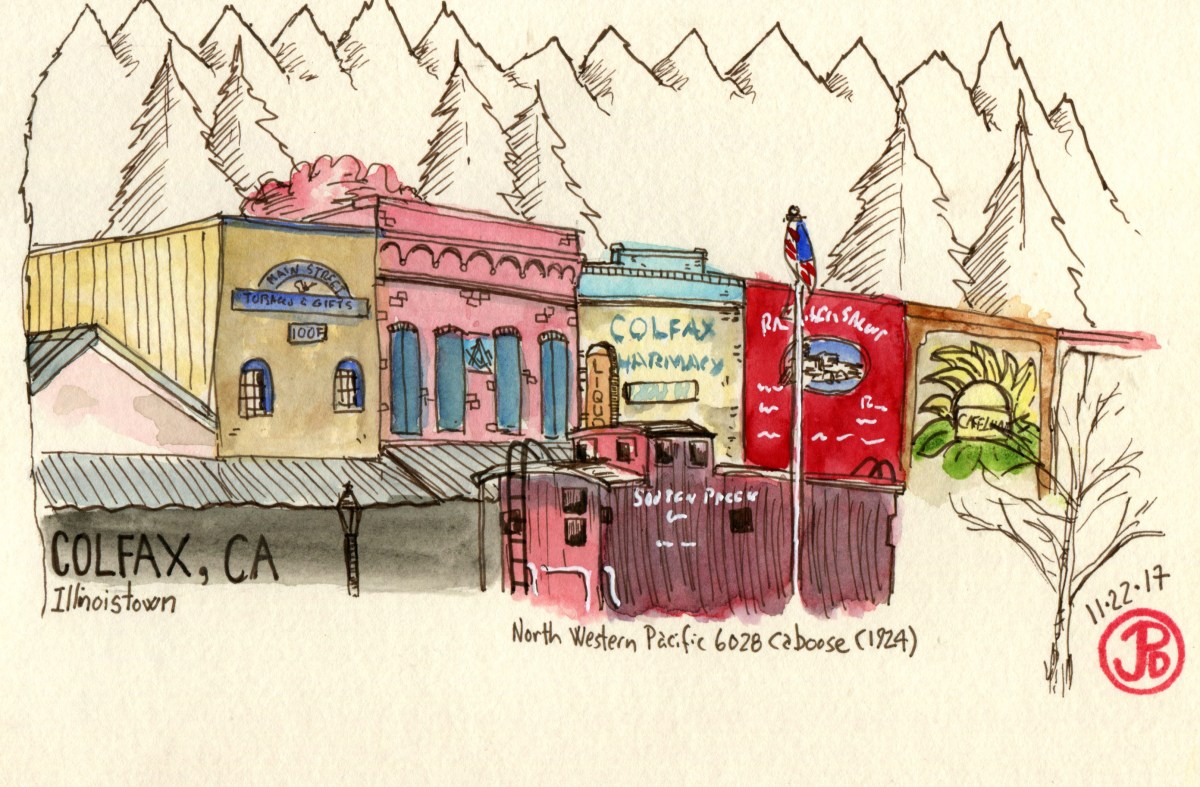
The east bound passanger train from Sacramento, worked it’s way up the valley into the station. The California Zephyr was running a little late. I walked over to my car and headed out towards Highway 174 to the Historical Viewpoint for Cape Horn. I waited and down below, the Zephyr passed and soon, on the distant hill, the train worked it’s way up the mountain and started up the grade towards the Cape Horn cut, high above the North Fork of the American River. The cars rounding the horn and disappearing from sight. I returned to the train depot to start working my Colfax sketch.

I was sitting on a bench at the restored Southern Pacific passenger depot platform as the westbound California Zephyr worked itself down from the heights of the Sierra Nevada, on it’s way to Sacramento and the San Francisco Bay Area. The train, now being headed by two underwhelming Amtrak diesels, paused long enough for passengers to embark and disembark, as relatives greeted or waved goodbye to those on the platform. And I was just in limbo, not on the train but wanting to be there, as the cars rocked gentle on the steel rails.

Colfax east

Eastbound California Zephyr rolling into Colfax station on it’s way to it’s final destination  of Chicago. The old Southern Pacific passenger depot is on the left.