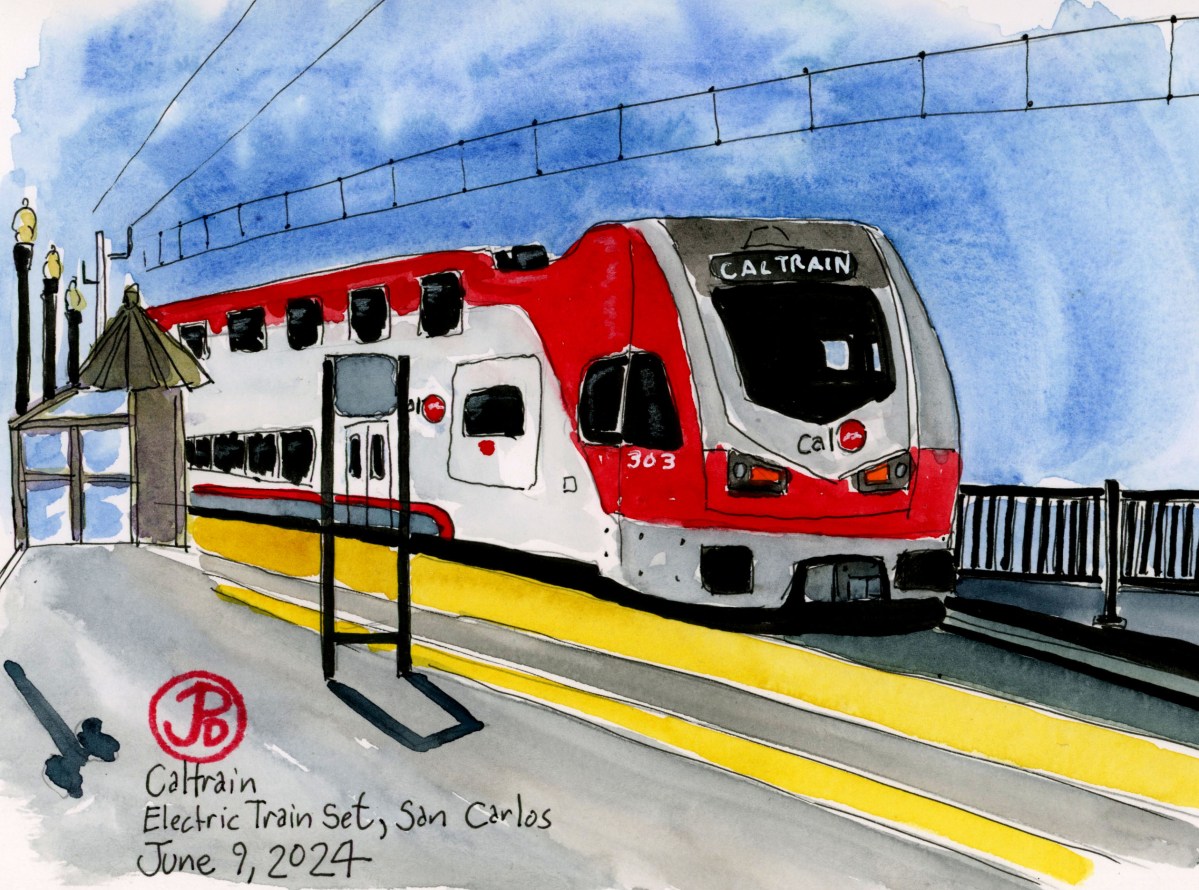
On a recent Saturday morning I had a pleasant surprise as I drove north on El Camino Real at San Carlos. At San Carlos Station was one of the new electric CalTrain sets.
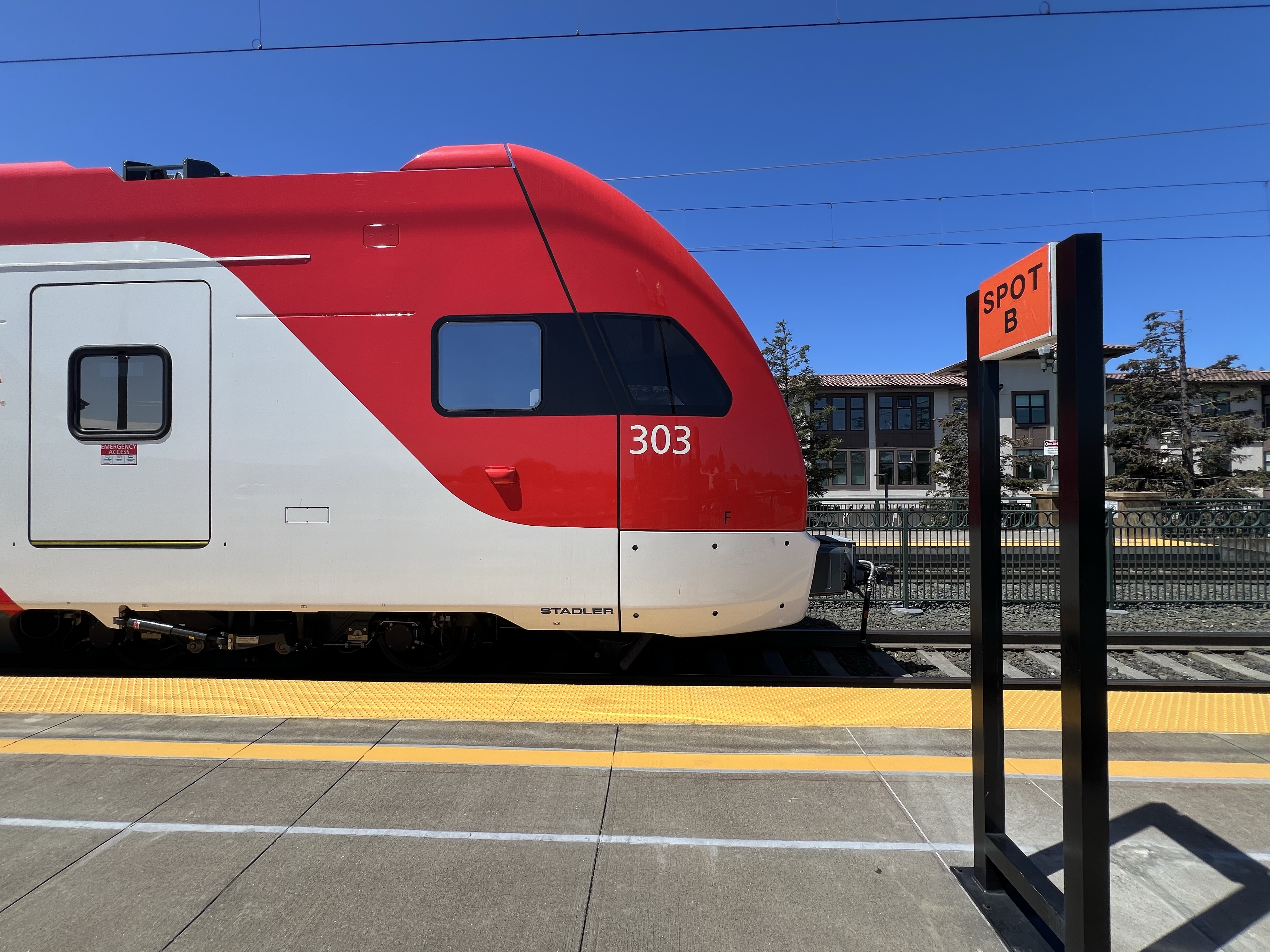
The new trains are built by Stadler, a Swiss-based train manufacturer. The company was founded in 1942 and is headquartered in Bussnang, Switzerland. The company has a factory in Salt Lake City, where Stadler will build 24 train sets for Caltrain.
The train sets are known as BEMUs which stands for battery-equipped electric multiple unit.
I parked, thinking that the train would surely have left the platform by the time I walked to the station but as I walked down San Carlos Avenue, the train was still stationary at the station.
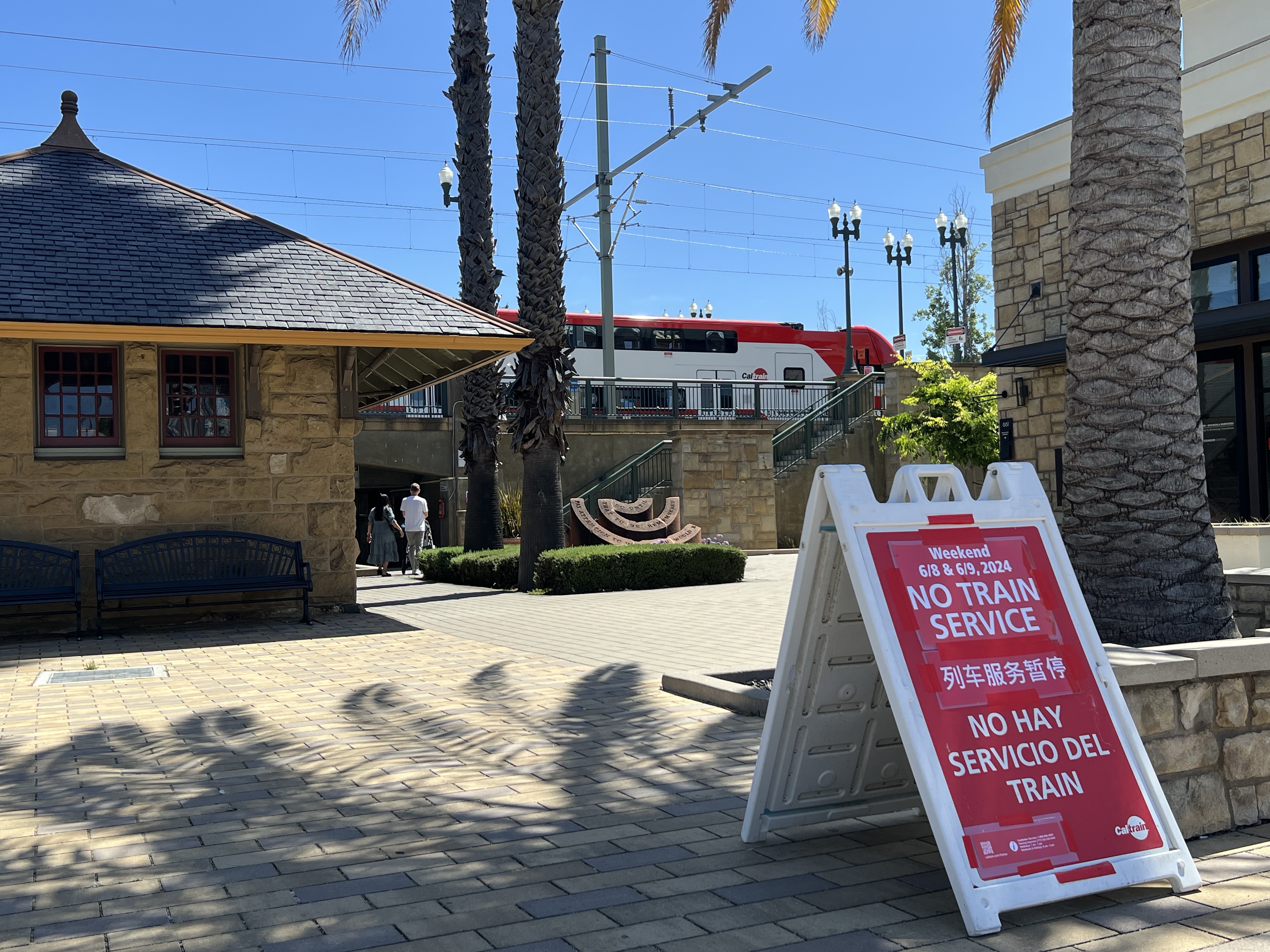
As I crossed El Camino, a placard stated “No Train Service”. The line was closed all weekend.
The line was closed from San Francisco to San Jose so Caltrain could test eight of the new electric train sets. The electrification of the line started in 2017 and electric trains are scheduled to start running on September 21, 2024.
If you think of some of the most iconic passenger trains in modern rail: Japan’s Shinkansen (“Bullet Train”), France’s TGV, Eurostar, Amtrak’s Acela, Chinese Railways CRH, the Bay Area rail corridor was finally being electrified to catch up with the rest of the world, although it would not come close the top speeds of modern Shinkansen (186 mph).
Three quarters of the world’s passenger service are powered by electricity. About time!
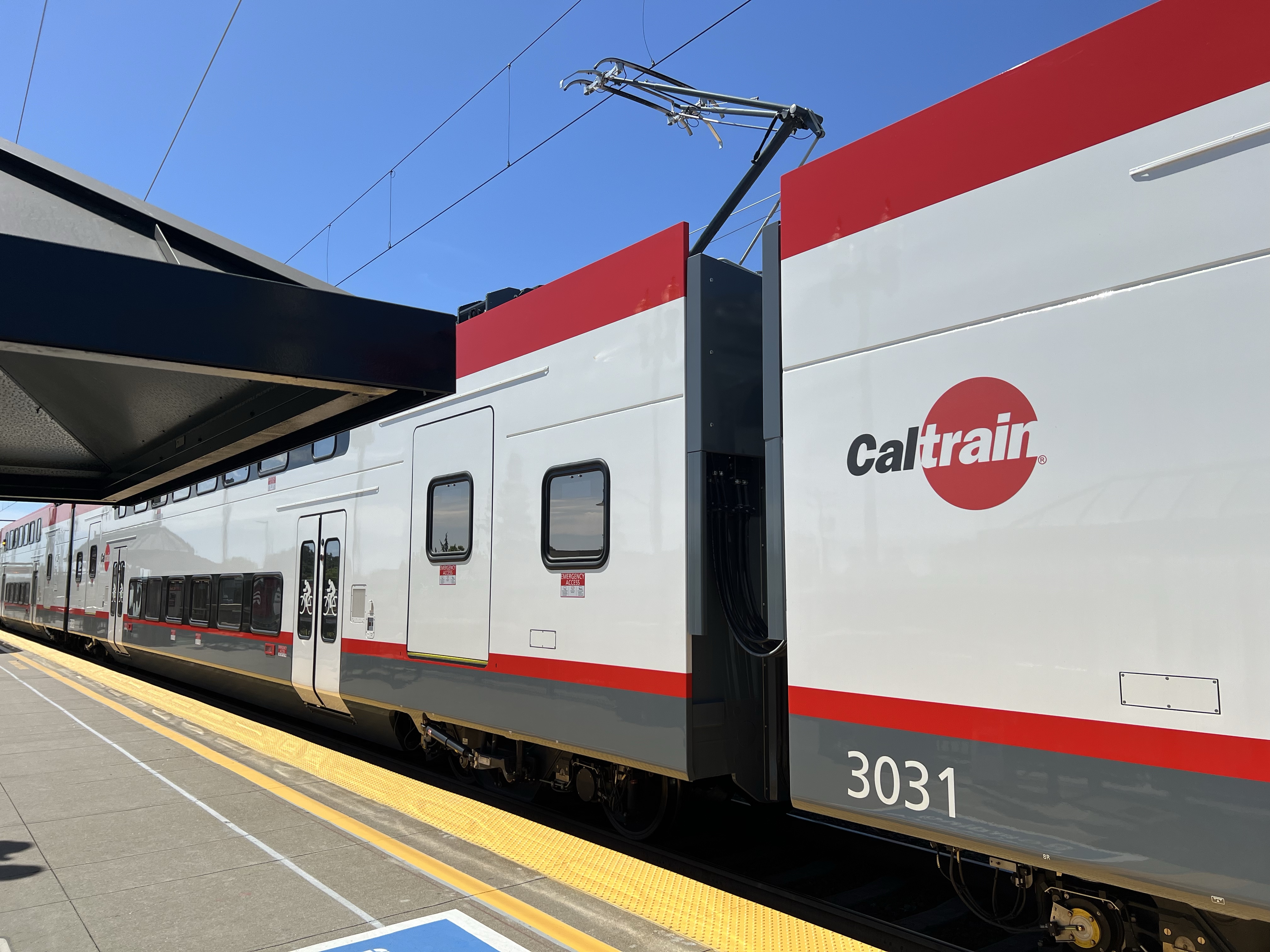
This is what powers the new train sets: the pantograph that delivers power from the wires above to the train set below.Not sure if these new trains sets earn any style points. They look like a large streetcar or tram.
On a gray Saturday morning I decided to explore a recently opened section (opened in December 2020) of the Coastal Rail Trail in Santa Cruz.
The section I was exploring (Segment 7) is between Natural Bridges Drive and Bay Street. The walk takes about 30 minutes and the round trip covers about two miles.
As the name implies, the paved pedestrian trail parallels the former Southern Pacific Davenport branch line from Watsonville to Davenport.
As of the date of writing only two sections of the trail have been opened, one in Watsonville and the section I was walking on in Santa Cruz.
At grade crossings there are pedestrian signals that stops cars so you can cross the street safely. Well that’s the theory anyway. With the trail recently open, pedestrians should still use caution and not assume all vehicles will stop for you.
When the trail is completed, it will cover 32 miles from Davenport to Watsonville. There are also plans to introduce electric rail service using the former Southern Pacific right of way and trackage.
I started where the rail trail ends: Natural Bridges Way.
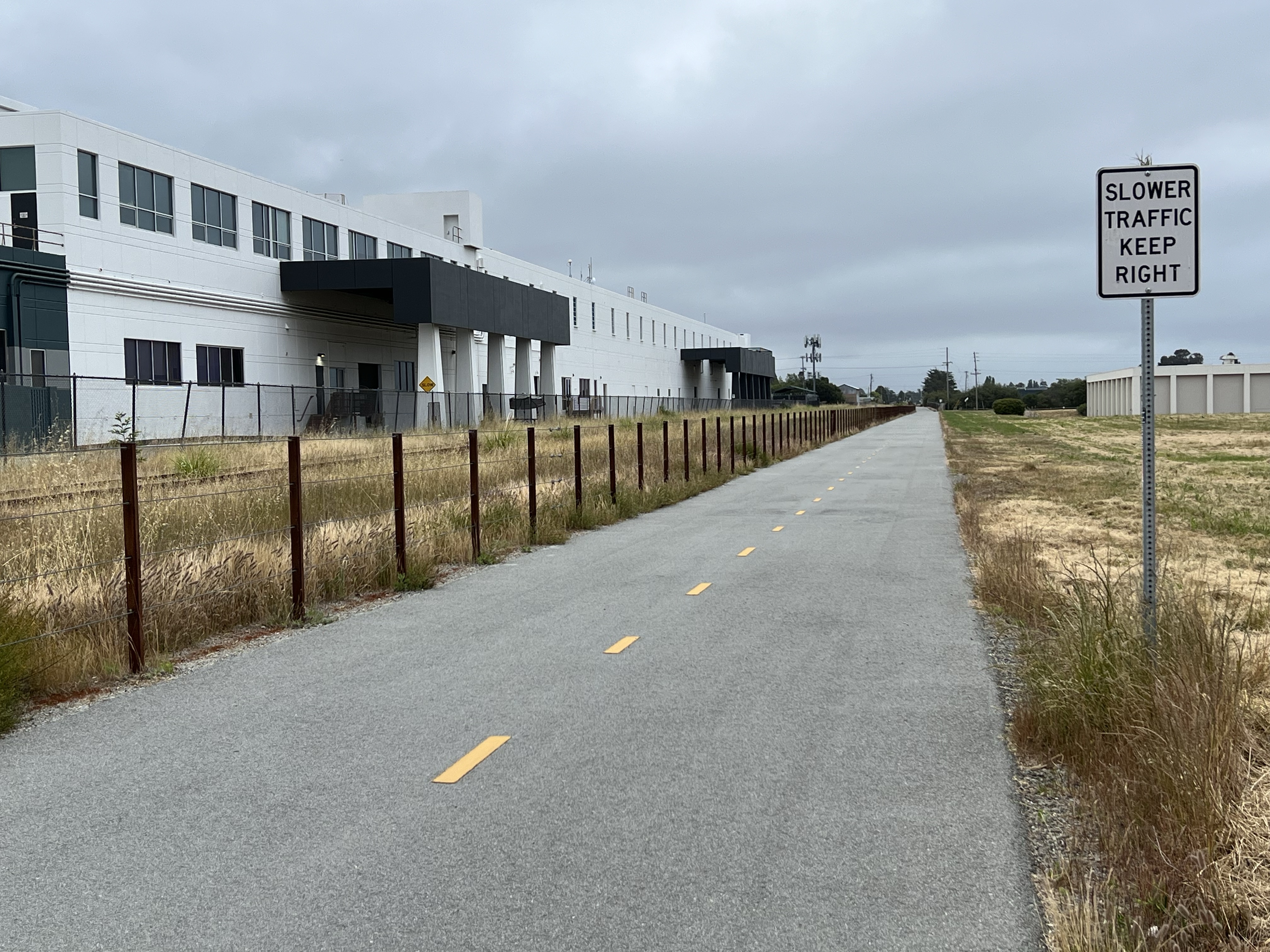
The Rail Trail passes by the former Wrigley Chewing Gum plant (left). The plant was in operation for more than 40 years and produced 20 million sticks of gum per day. The plant had a rail siding that is still visible today.
In my college days I remember visiting the gum factory with my roommate in an unsuccessful attempt to get a plant tour. The receptionist told us that they didn’t give tours but asked us if we would like some gum! We answered in the affirmative and then opened a drawer full of gum. I went for Big Red while my roommate picked Juicy Fruit.
The trail is level as it parallels the rail grade. Railroad grades normally don’t exceed 2%. The steepest mainline railroad grade is 3.3% on the Raton Pass grade in New Mexico. A railroad grade is expressed as a percentage the grade rises or falls over 100 feet of horizontal distance. So a 2% grade rises and falls two feet over a 100 feet distance. These gentle grades are ideal for walking and biking.
I passed by the New Leaf Market at Fair Ave, often my first stop when I head into town, as the trail and line turns slightly to the left skirting the Westside Circles neighborhood.
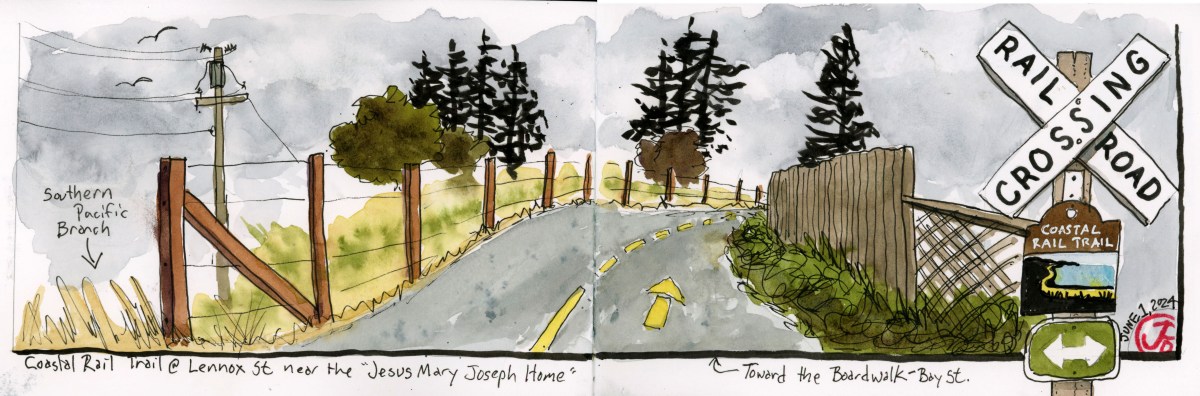
I came upon a scenic curve in the trail at Lennox Street as the rails and trail curve off to the right as it nears Bay Street. I pulled my sketchbook out of my bag and started sketching the view (featured sketch).
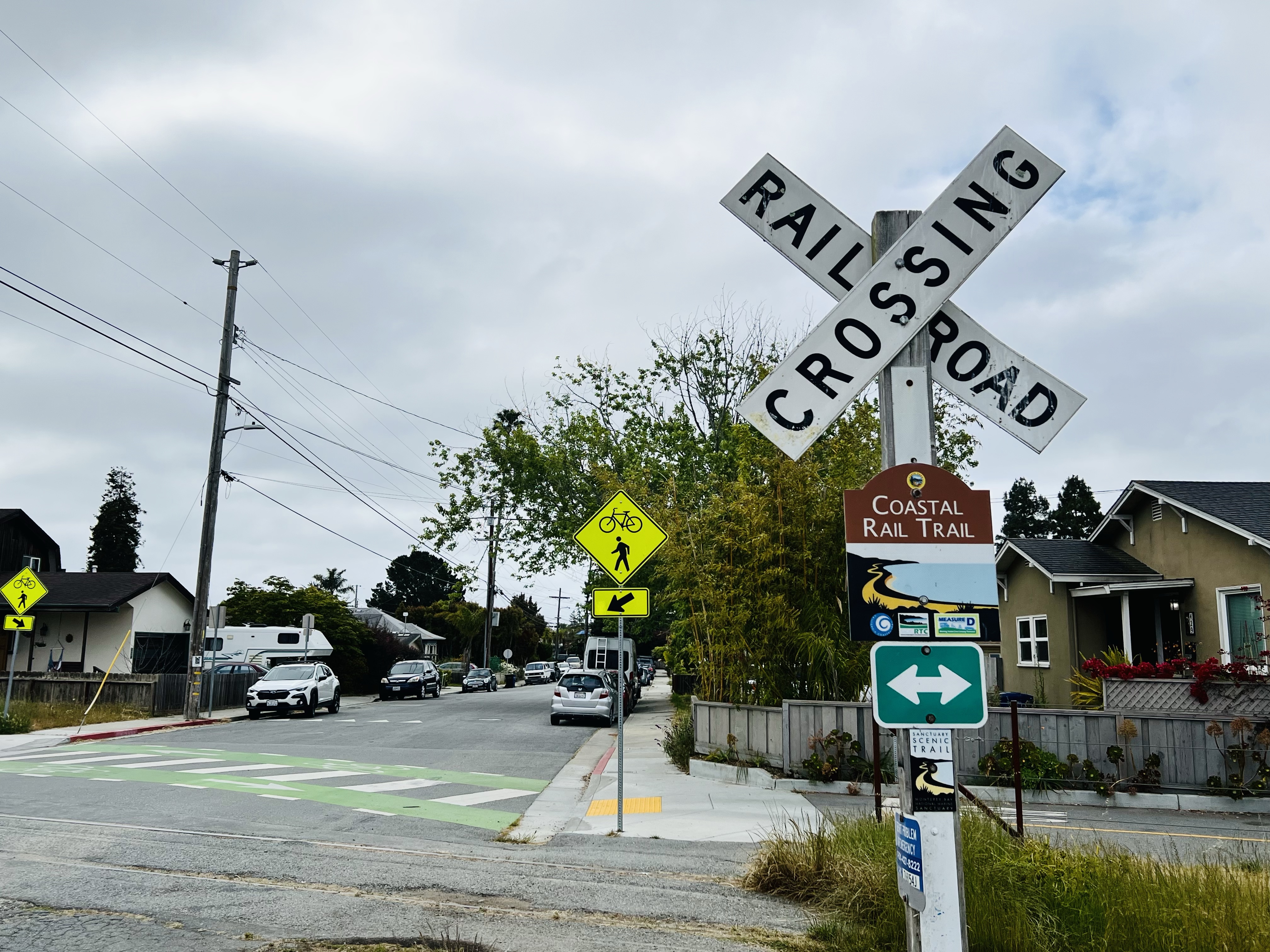
On the right of the spread I sketched the grade crossing sign at Dufour Street with Coastal Rail Trail sign below the crossbuck.
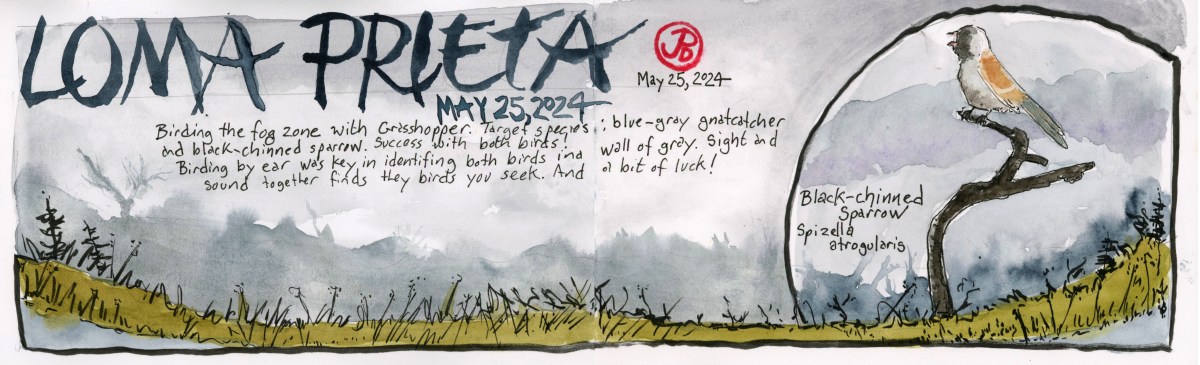
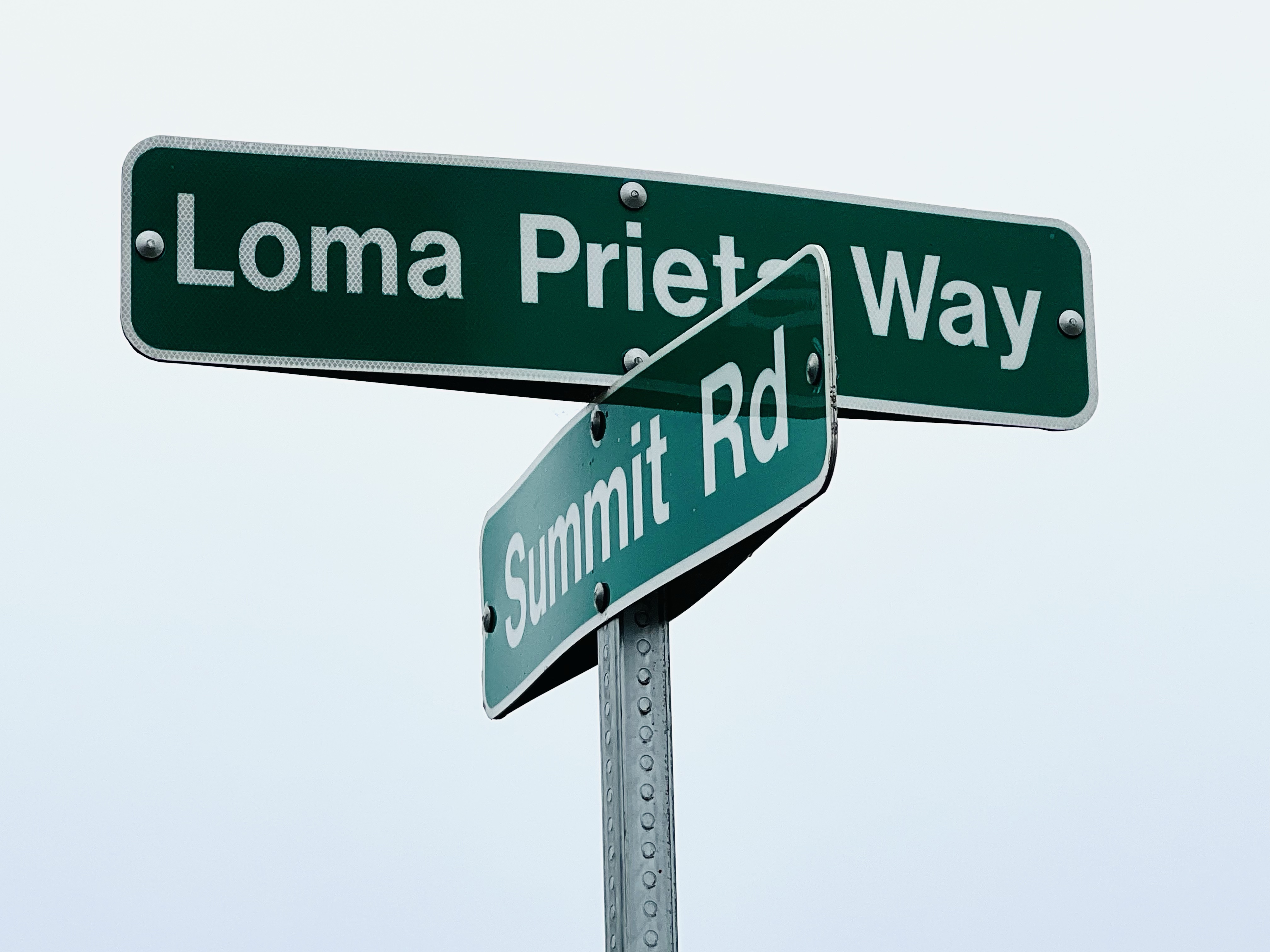
Early on a Saturday morning, Grasshopper and I headed up on winding Summit Road. Our birding destination the Bay Area birding hotspot: Loma Prieta and the “Saddles”.
About 10 miles in from Highway 17 the road devolves into a pock-marked rural ramble as it threads its way over the spine of the summit, defining the line between Santa Cruz and Santa Clara Counties. Near the junction with Loma Prieta Way the asphalt ends entirely and the graded dirt begins.
We parked in the dirt lot, light drizzle covering the windshield. This didn’t look like great birding weather. Wet, windy, with limited visibility. Would be able to pick out a blue-gray gnatcatcher or a black-chinned sparrow in these conditions? Both would be lifers for Grasshopper. And it was my goal to get him life birds number 321 and 322.
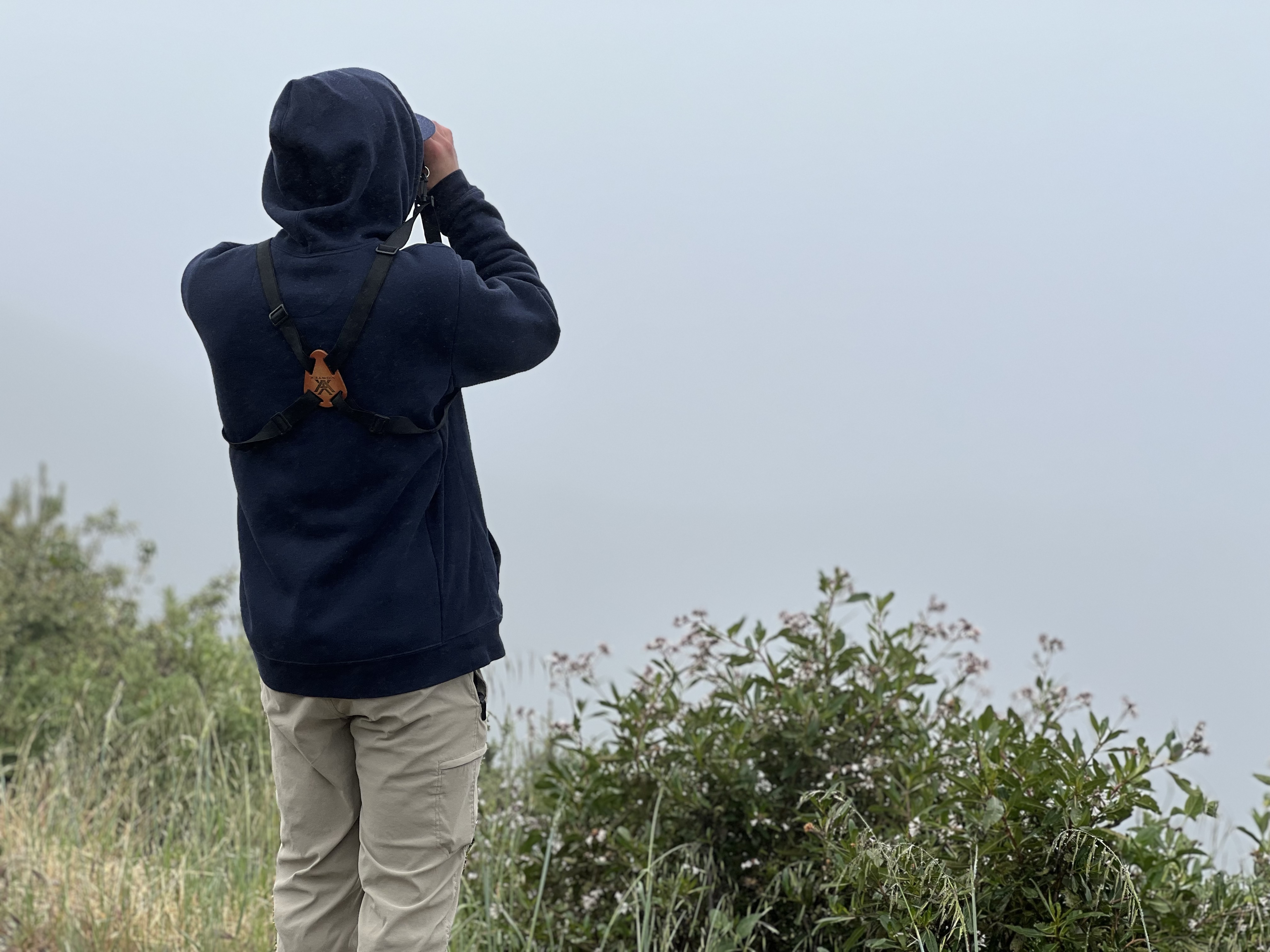
Grasshopper looking at water droplets.
We got out of the car, geared up, and surveyed the wall of grey to the west. I had a feeling we would be birding by ear, something Grasshopper can always get better at.
We headed down Loma Prieta Way stopping and listening as we went. Wrentits, spotted towhees, a far off California quail but none of our target birds, so we walked on. Luckily the damp, windy weather did not stop the birds from their spring songs.
After we were about a quarter of a mile down from the parking lot I heard something different, a cat-like mewing on the upslope. This was not the fooler Bewick’s wren (who had almost fooled me a few yards back) but one of our target birds!
Now we needed to get eyes on it. The younger eyes of Grasshopper found it out on a tree branch: blue-gray gnatcatcher!
After getting so-so looks of the energetic gnatcatcher, we headed a little further down and I first heard our second target bird far up the hill. An accelerated bouncing ball of a song.
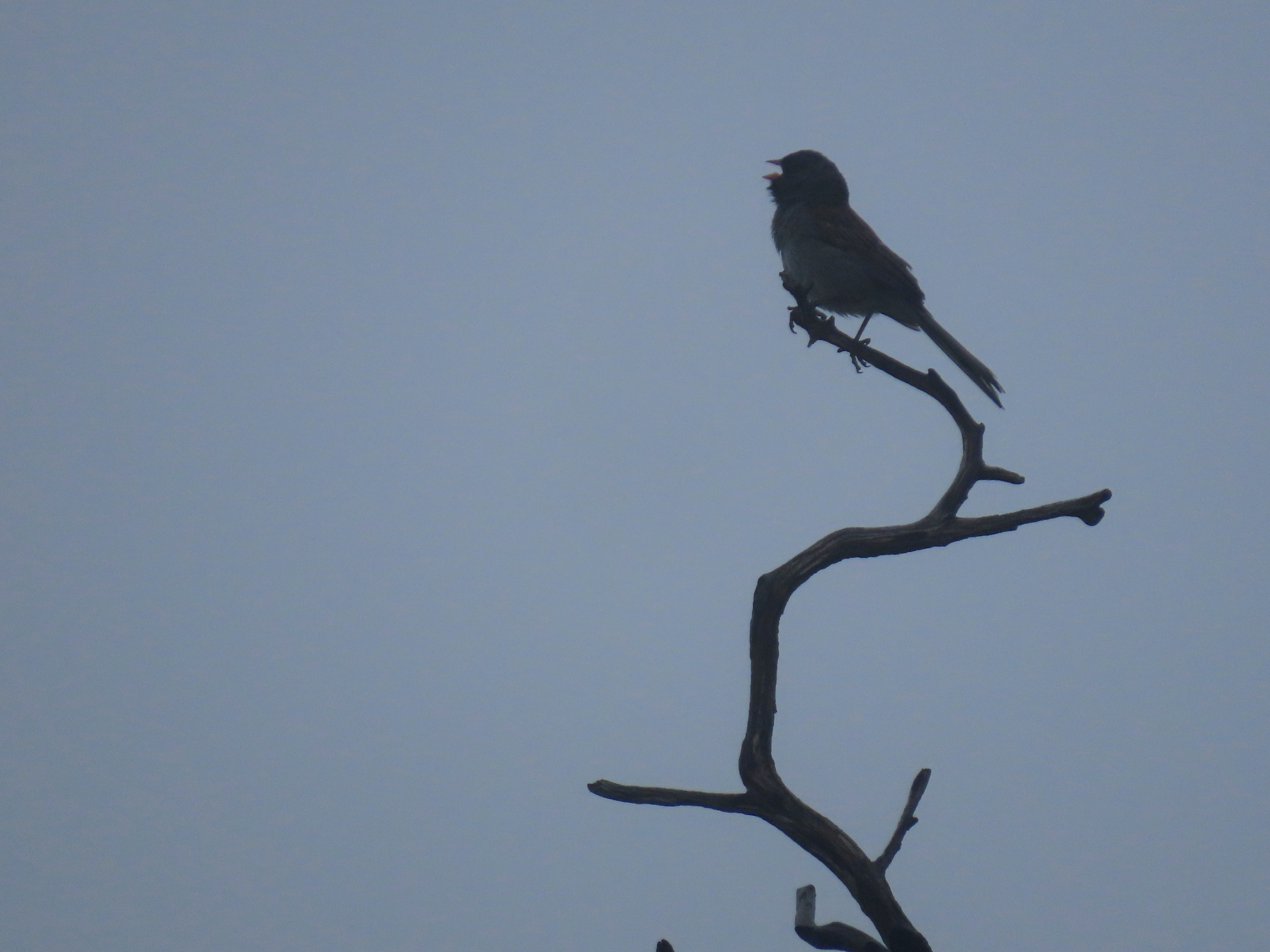
I willed the bird down by saying a little prayer to the Birding Gods and soon enough the sparrow flew over the road and landed downslope on a charred snag. Our binos swung up and we enjoyed prolonged views of a singing male black-chinned sparrow!
The foggy silhouette of one of our main targets: the black-chinned sparrow singing on a burnt snag. The black-chinned is an early adopter of burnt out areas.
Lifer number two for Grasshopper!
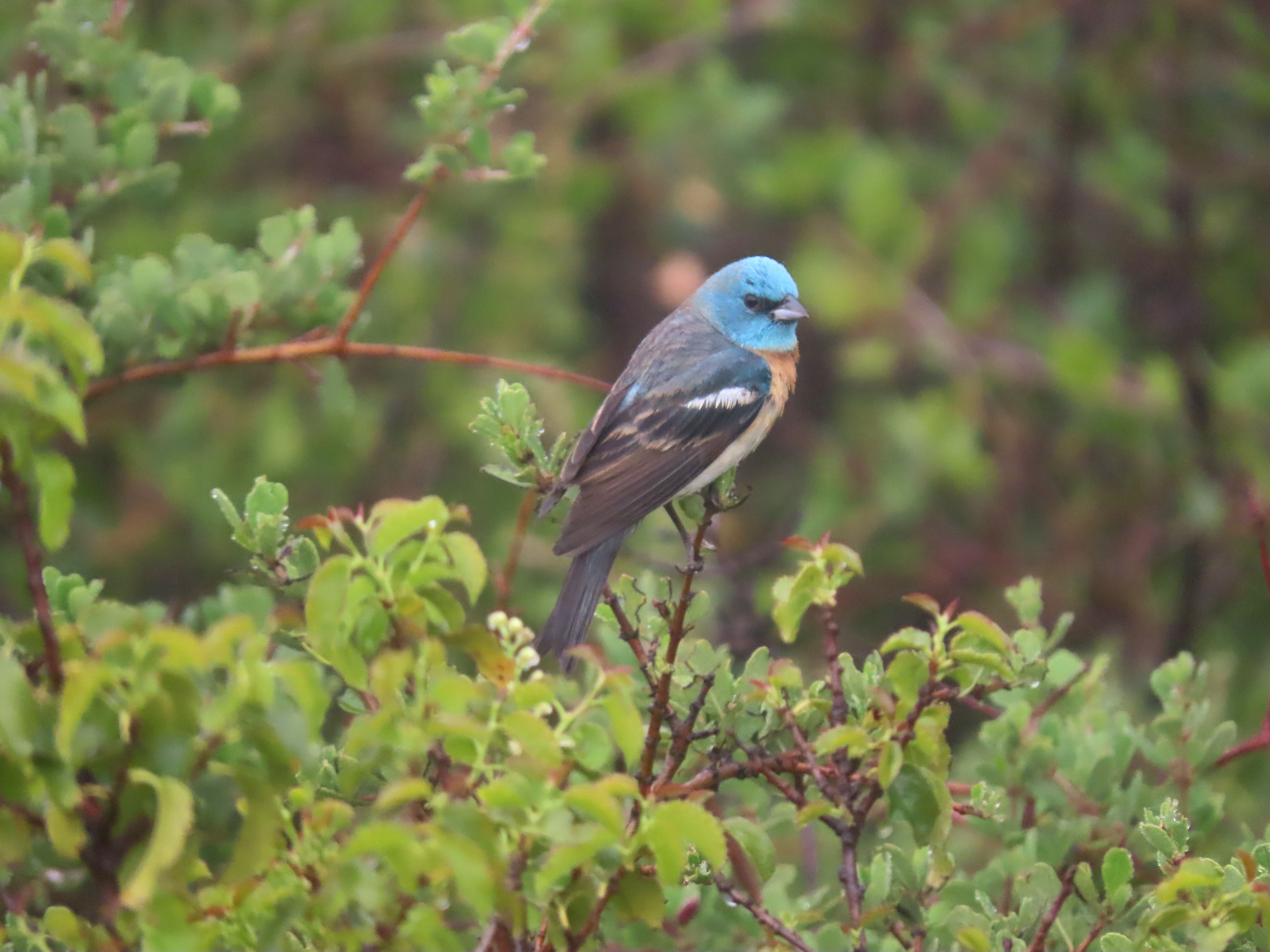
By this time we were coated with dizzily dampness and we headed back up to the parking lot. On the way up Grasshopper saw birds flying below the road. It was a pair of lazuli buntings! This is not a lifer for me or Grasshopper, but it has been a while since I have seen or heard this neotropic migrant.
A stunning male lazuli bunting. I never get tired of seeing and hearing this bird.
This is why birding remains a passion for me. I’m still excited to see and hear birds that I have seen many times before but the excitement remains.
After sketching in Evergreen, I headed north up the Peninsula to San Carlos. My destination: the Hiller Aviation Museum.
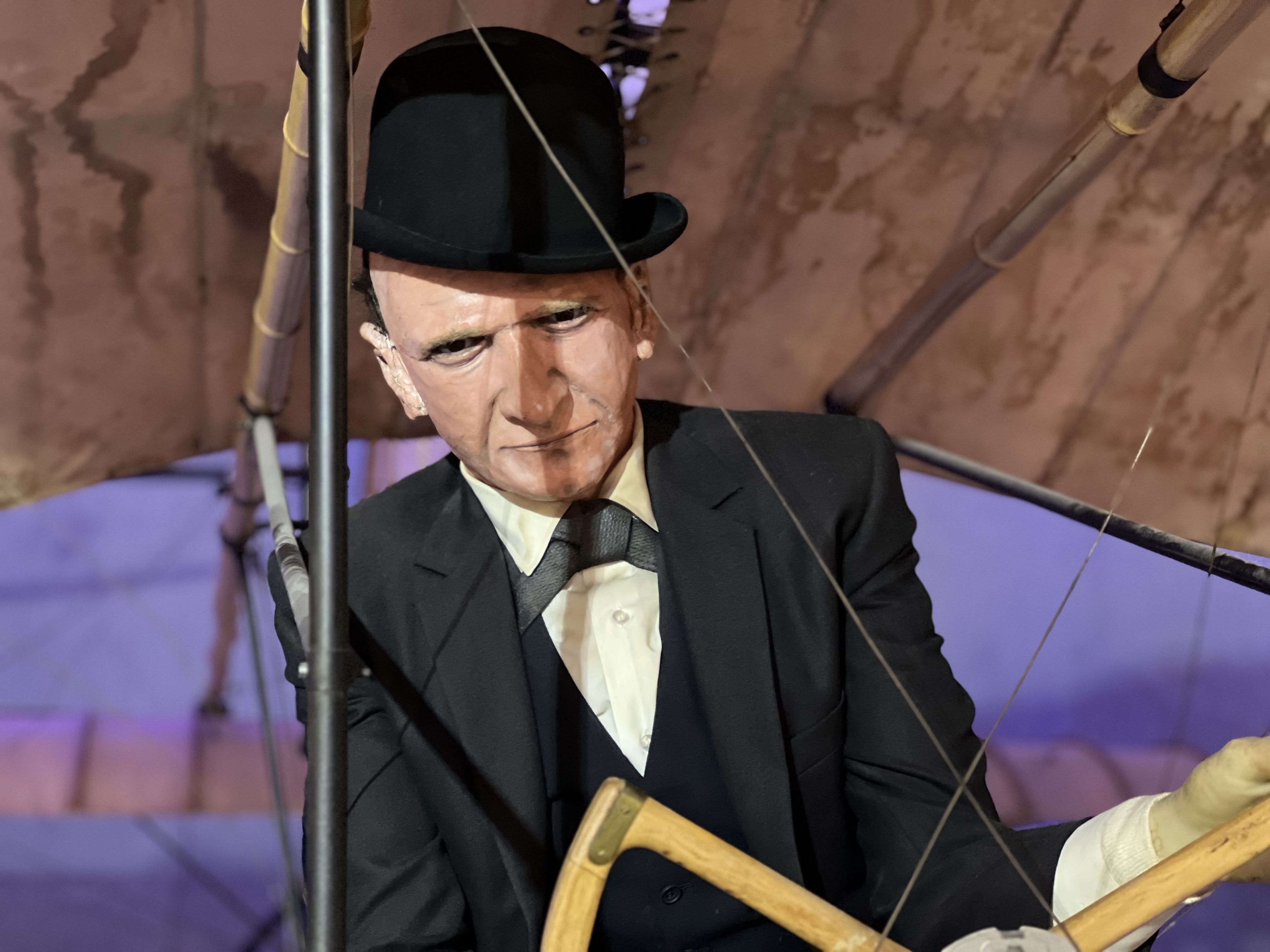
I was here to see and sketch three gliders and look at a plaque. The three gliders are replicas of the Gull, Santa Clara, and Evergreen, all designed by John J. Montgomery. Two are suspended from the ceiling and the Evergreen sits in a dark corner with a dubious mannequin, representing John Montgomery, sitting at the controls.
The odd mannequin of John Montgomery really looks like he’s three sheets to the wind!
The plaque sits off to the left of the replica of the Evergreen and mannequin. I have seen a plaque like this before, last fall in Roanoke, Virginia and also at the California State Railroad Museum in Sacramento.
The plaque in Roanoke honored the engineering achievements of Norfolk and Western’s J-Class No. 611. The plaque at the Hiller, by the American Society of Mechanical Engineers, designates the glider as an International Historic Mechanical Engineering Landmark. The plaque reads:
Montgomery Glider
1883
This replica represents the first heavier-than-air craft to achieve controlled, piloted flight. The glider’s design was based on the pioneering aerodynamic theories and experimental procedures of John Joseph Montgomery (1858-1911), who designed, built, and flew it. This glider was way ahead of its time, incorporating a single parabolic, cambered wing, with stabilizing and control surfaces at the rear of the fuselage, with his glider’s success, Montgomery demonstrated aerodynamic principles and designs fundamental to modern aircraft.
The plaques placement is a bit unfortunate because it actually refers to the Gull, which hangs above and not the Evergreen (the curator I talked to admitted that this part of the museum has been neglected).
John Montgomery was a true Californian, born in Yuba City. He was many things in the Golden State: inventor, pilot, engineer, physicist, and a professor at Santa Clara University.
He studied the soaring flight of hawks, eagles, pelicans, turkey vultures, and gulls around San Diego Bay and further inland and then tried to design his gliders influenced by nature’s own design. He referred to birds as, “tutors in the art of flying”. Montgomery put this understanding the flight of birds with creating a heavier than air glider this way, “It has always seemed to me that the secret of aerial navigation lay in the discovery of the principle of bird’s flight.”
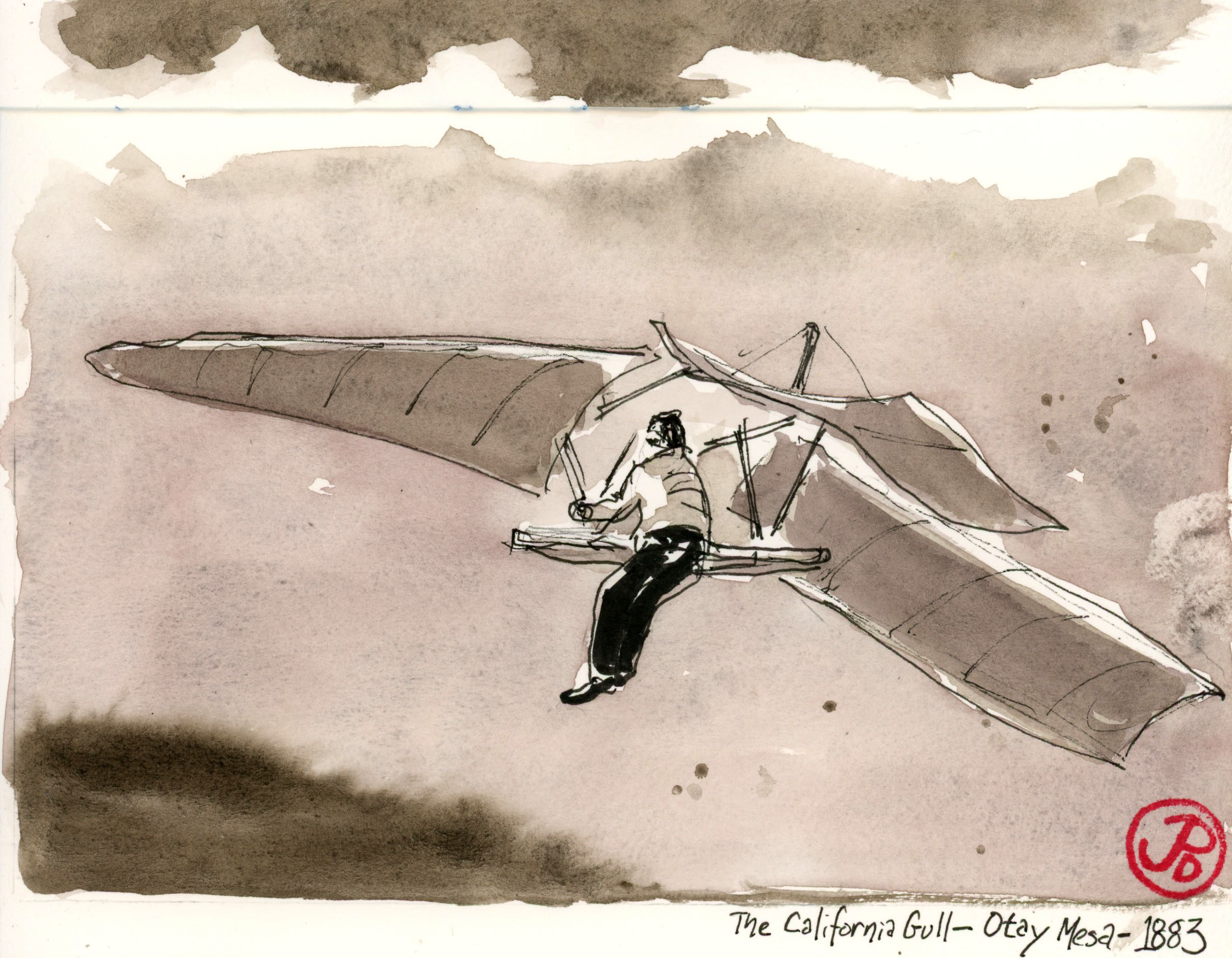
In 1883 the flying professor made pioneering flights near the Mexican border at Otay Mesa. His flights lasted up to 600 feet. He had not yet learned how to design a glider that could soar upwards like a turkey vulture.
Here he flew the Gull, the replica now hangs in the Hiller Aviation Museum.
So I did a loose sketch of the Gull.
I chose to sketched the Gull loosely with another mannequin of Montgomery (as a younger man) perched uncomfortably on the glider’s “saddle”. I left out all the other aircraft around it and used my artistic license to add the setting: Otay Mesa.
Previously I had written about aviation history above the skies of Aptos on the Monterey Bay. The man who designed the glider was a Professor John L. Montgomery.
Montgomery had a long history of flight development in California. He is overshadowed by aviation developments in Europe and on the East Coast. And his accomplishments are eclipsed by the Wright Brothers, who must have had a better PR man.
There are a few reasons for this. Montgomery had trouble securing patients for his flight inventions and being far away on the west coast and far from the national media in New York and Boston meant that his exploits didn’t get the same coverage as the Wrights. Even though he flew a glider 20 years before the famous Wright Brothers.
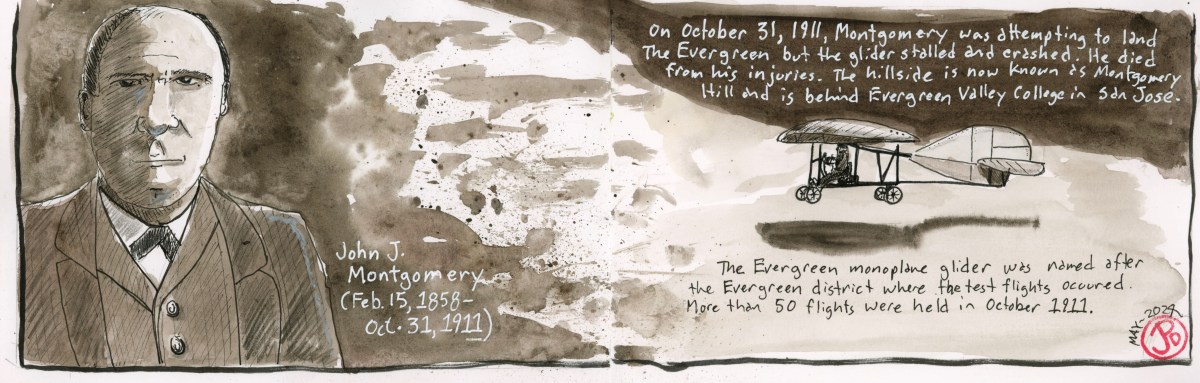
I wanted to visit and sketch the hillside where be flew his last glider. This is in the Evergreen neighborhood of East San Jose. The hillside is now named Montgomery Hill in his honor and is behind present day, Evergreen Valley College.
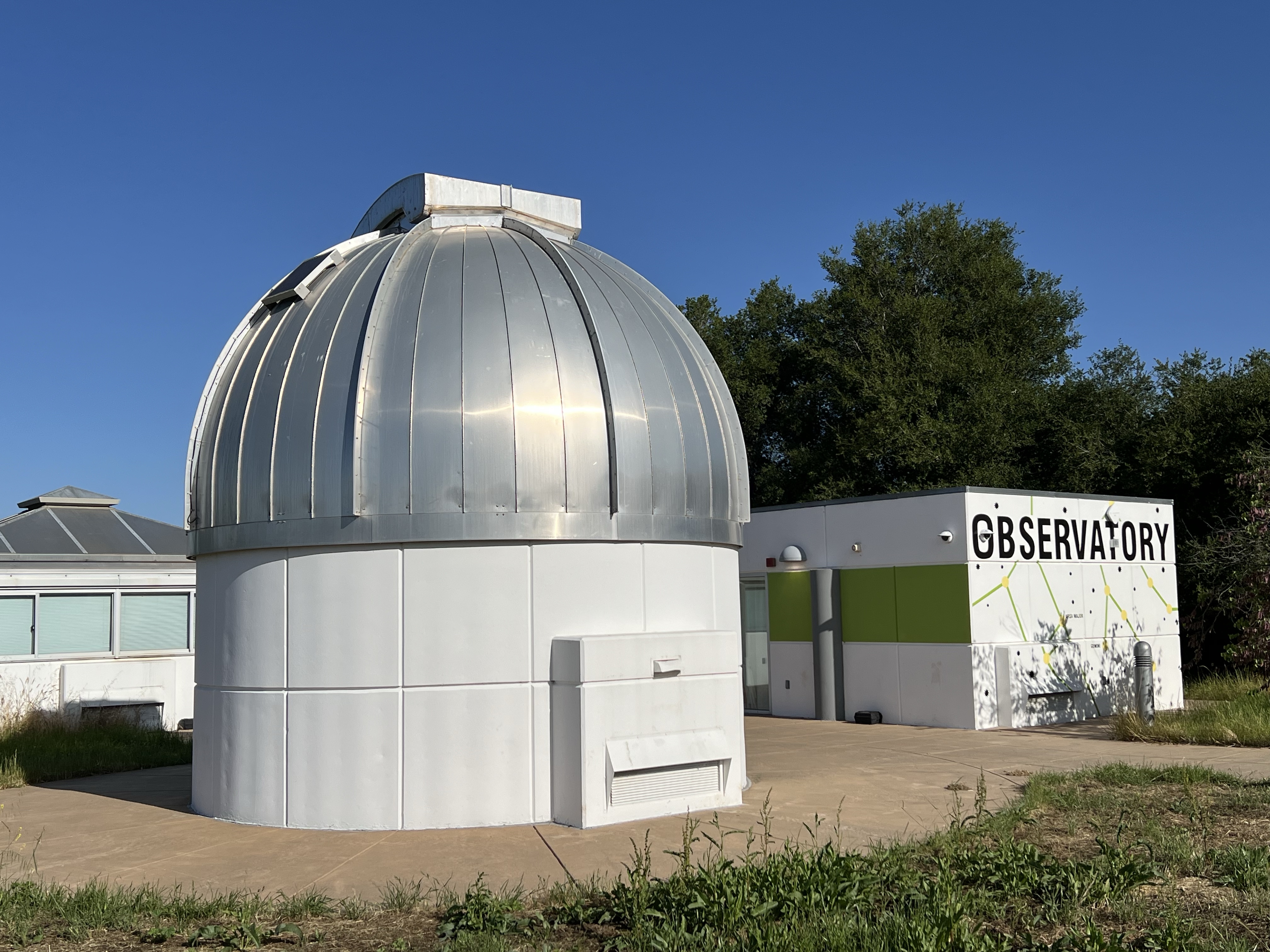
I arrived at the collage early on Sunday morning, free parking! My plan was to walk up to the observatory and sketch Montgomery Hill.
The Observatory at Evergreen Valley College.
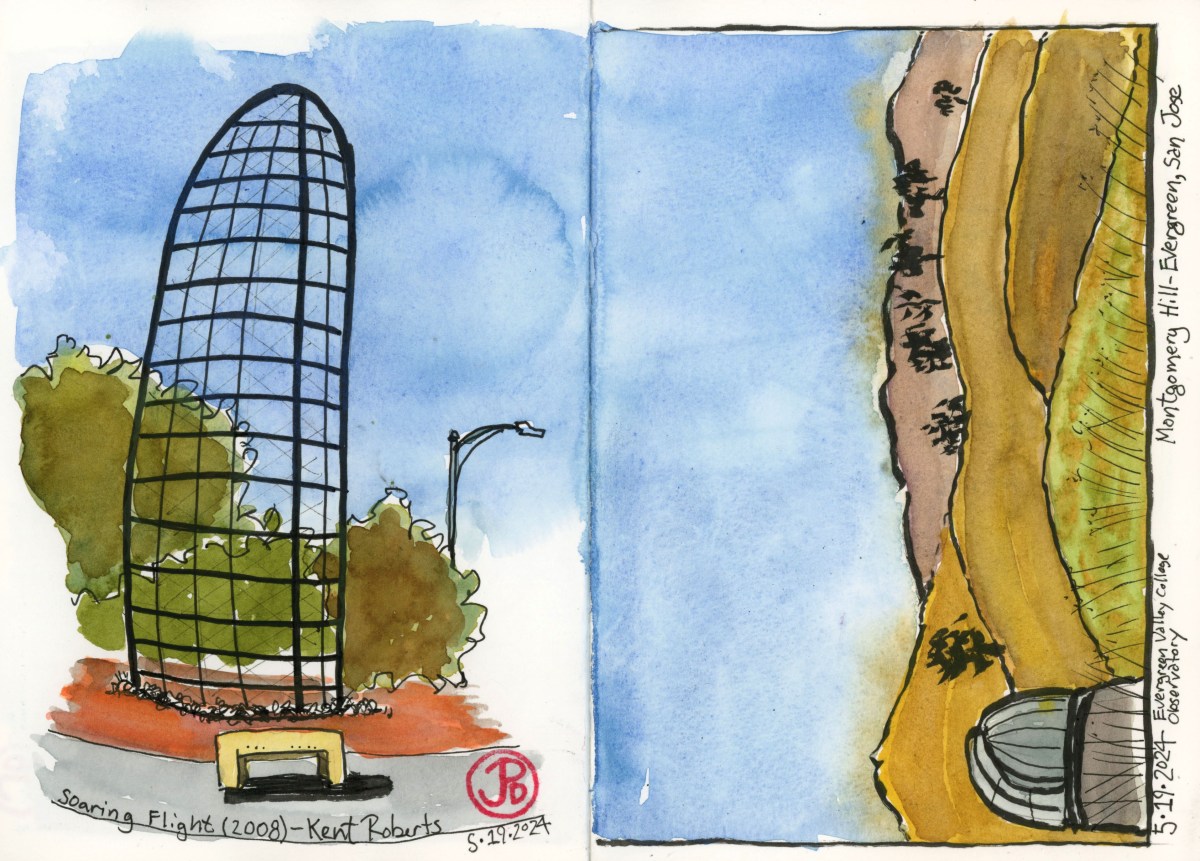
I positioned myself so I could sketch the dome of the observatory in the foreground and the hill that stretched off into the distance (featured sketch right).
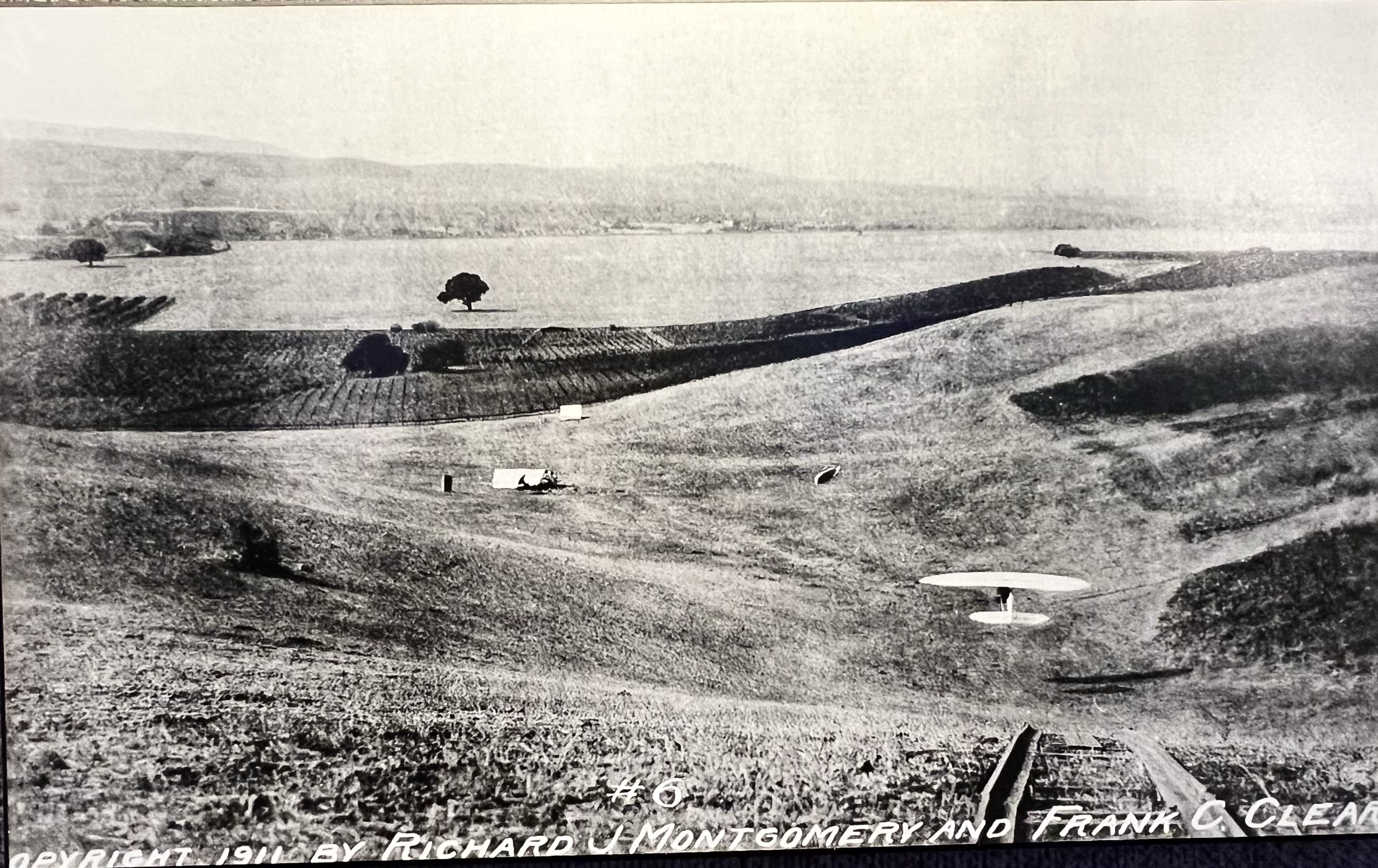
The hill before me was where Montgomery did many test flights with the glider her designed. The glider was named after this area: Evergreen.
A 1911 photograph of Montgomery flying the Evergreen, shortly before his death. The location is now called Montgomery Hill.
In was on this hill on October 31, 1911, that Professor Montgomery crashed his glider Evergreen, and died of his injuries. He was 53 years old.
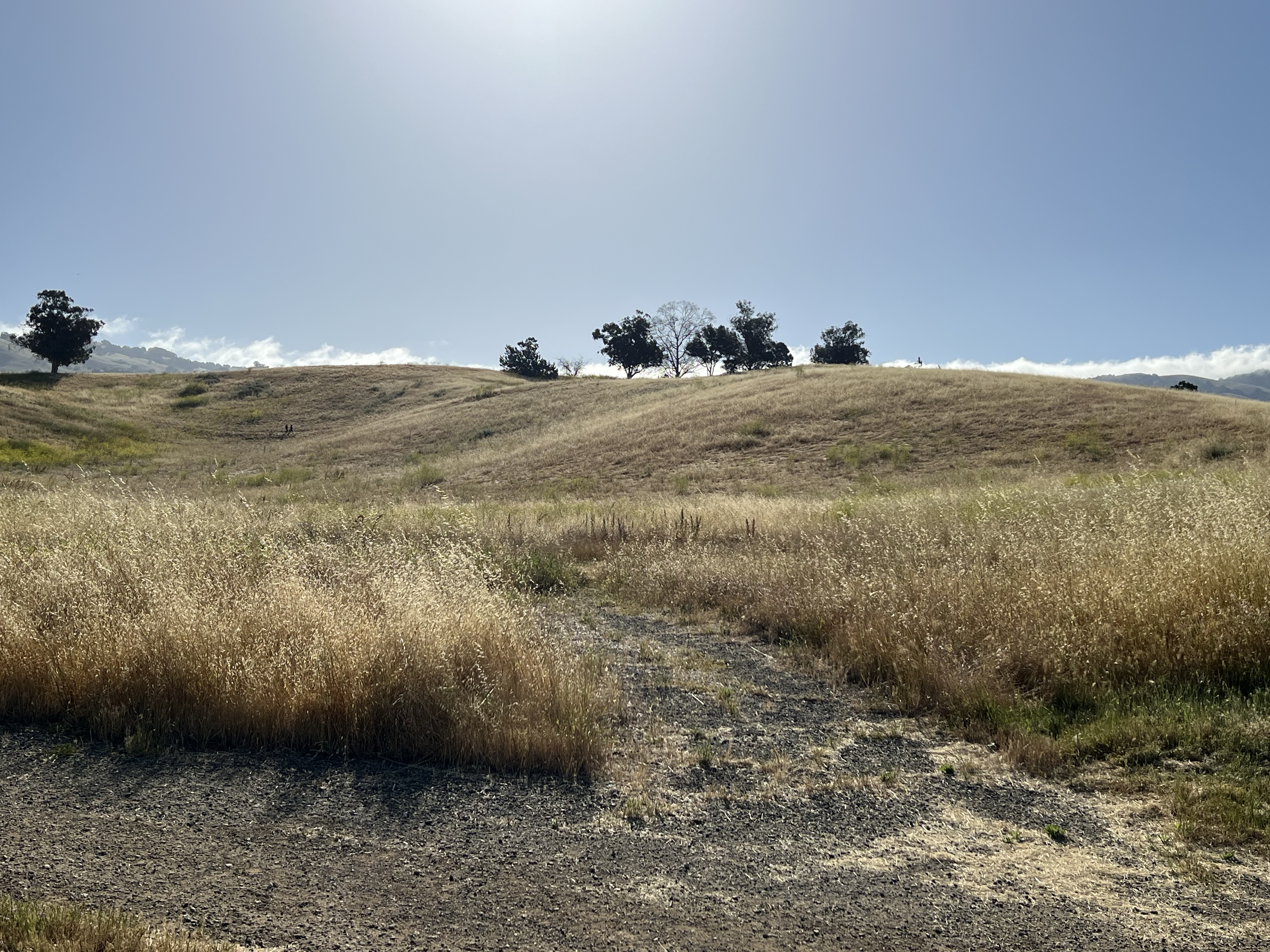
Montgomery Hill, the sight of Montgomery’s last flight.
John J. Montgomery is starting to get the recognition in aviation history that he so rightly deserves. In the Evergreen neighborhood at the intersection of San Felipe and Yerba Buena, there is a 30 foot wing that stretches up to the sky (featured sketch).
This Public art is titled “Soaring Flight” (2008) by artist Kent Roberts.
On an interesting side note, sculptor Kent Roberts (1947-2019) was a Bay Area artist. Before attending the San Francisco Art Institute, he served as an officer in the US Navy aboard an aircraft carrier. The ship’s name: the USS Kitty Hawk.
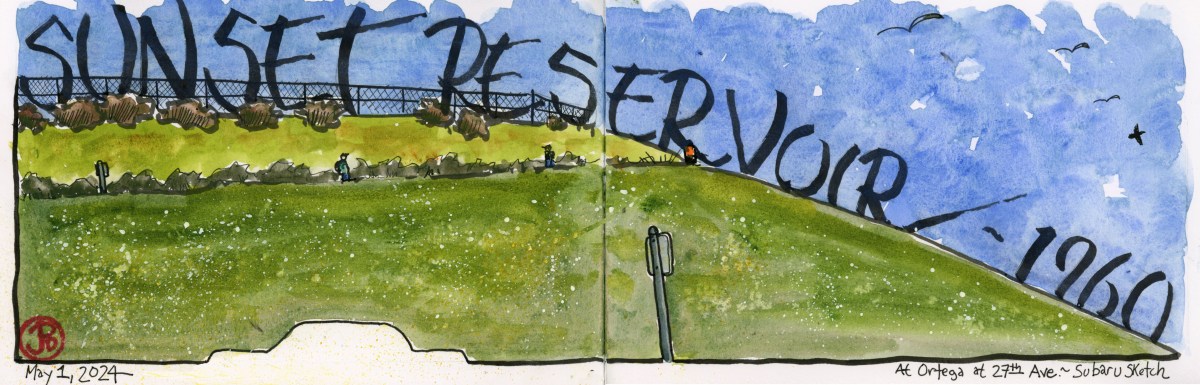
I live a hop, slip but not even a jump from San Francisco’s largest reservoir: Sunset Reservoir.
This terminal reservoir was completed in 1960 and has an impressive capacity of 270 acres. To put this into context the sides of the reservoir are four blocks north and south and two blocks east and west. The surface area is 11 acres.
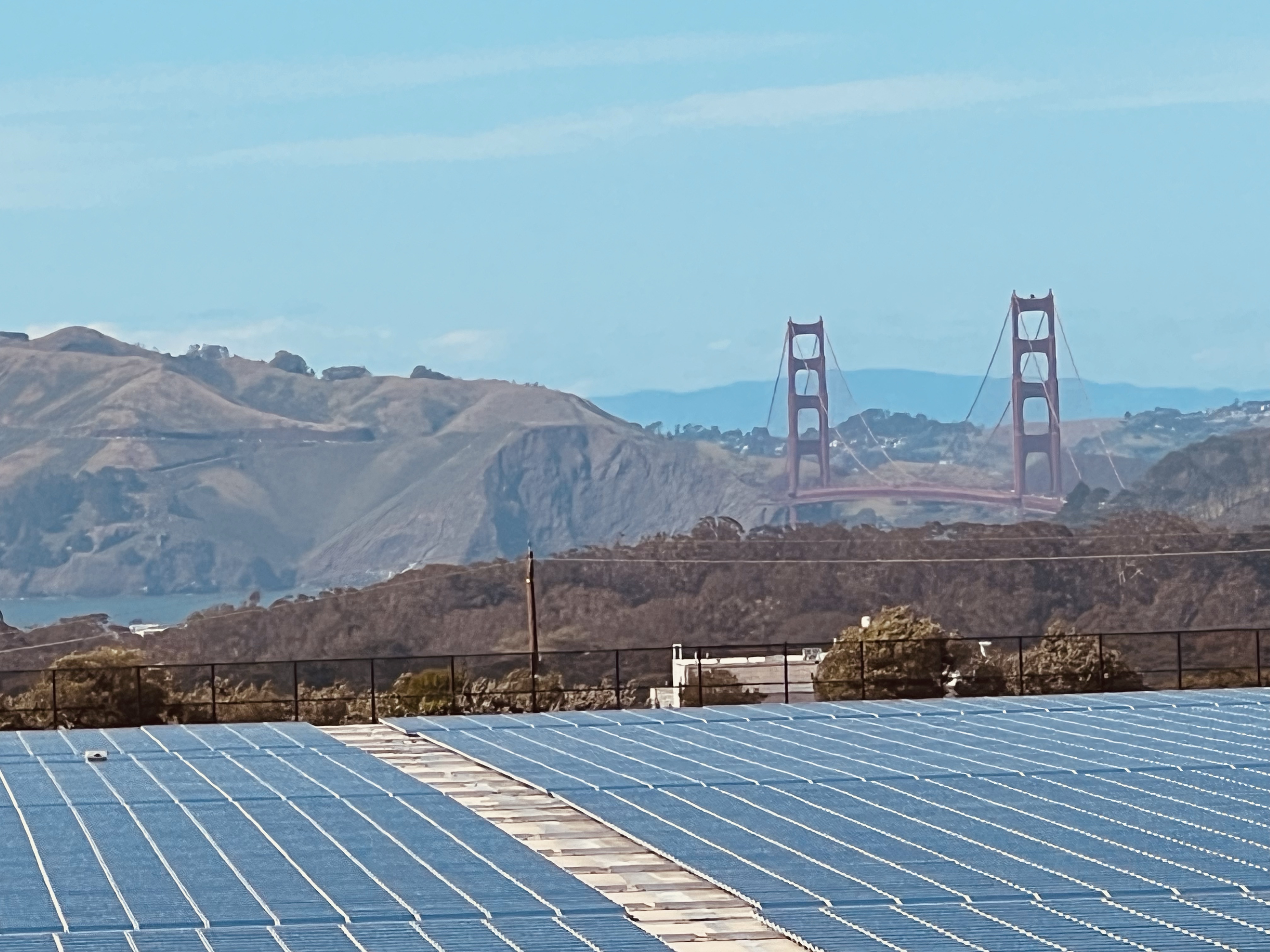
The reservoir is covered and fenced off. Over half of the reservoir is blanketed in 25,000 solar panels. The Sunset Reservoir Solar Project started in December 2010 and has tripled San Francisco’s solar generation capacity.
The irony is that the Sunset is the foggiest part of the city.
Some of the 25,000 solar panels of Sunset Reservoir.
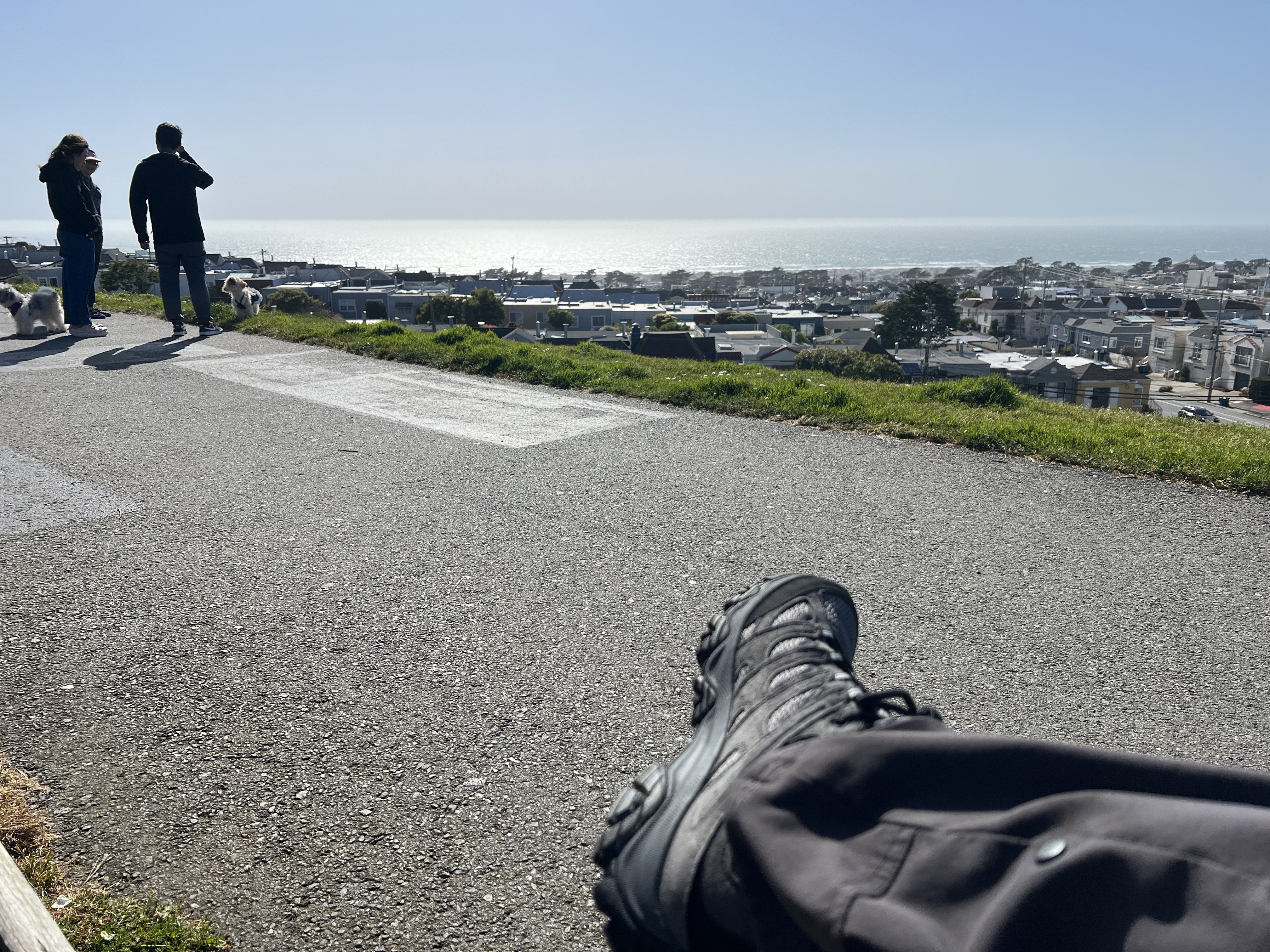
While the reservoir itself is not a sight to behold, the northwest corner (featured sketch) affords some of the best views in the Sunset. Along the embankment are walking paths and at the northwest corner are a line of benches.
The bench-view to the north. I can almost see the Farallons. These paths are popular with dog walkers.
Here you can look out to the west towards the Pacific Ocean and on a clear day, you can see the Farallon Islands perched on the horizon like a large, gray battleship.
The views to the north as just as stunning taking in Golden Gate Park, the Richmond District, the Golden Gate Bridge, Marin Headlands, and Mt. Tam. On really clear days you can see outer Pt. Reyes.
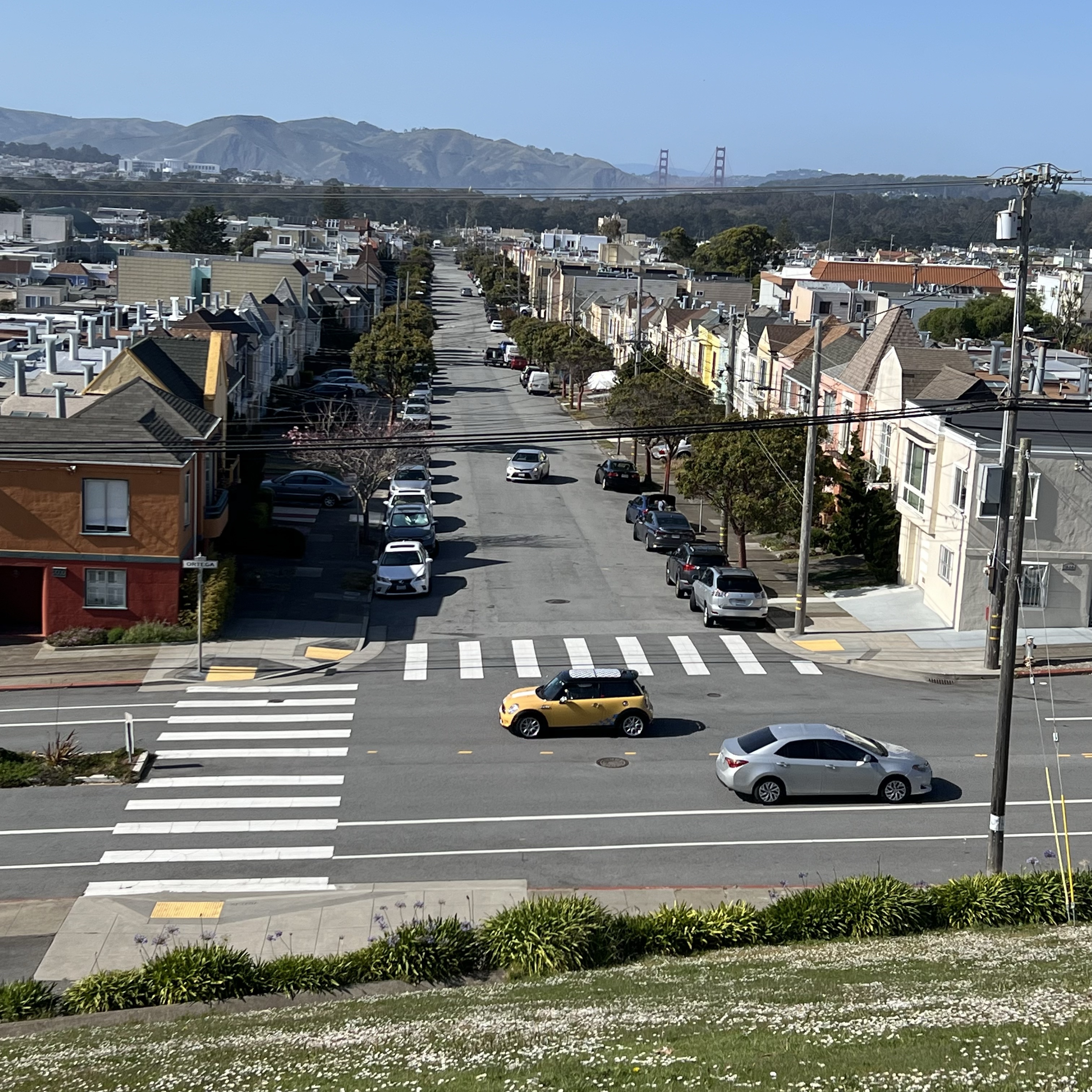
Looking north down 27th Avenue towards the Golden Gate from one of the walking paths.
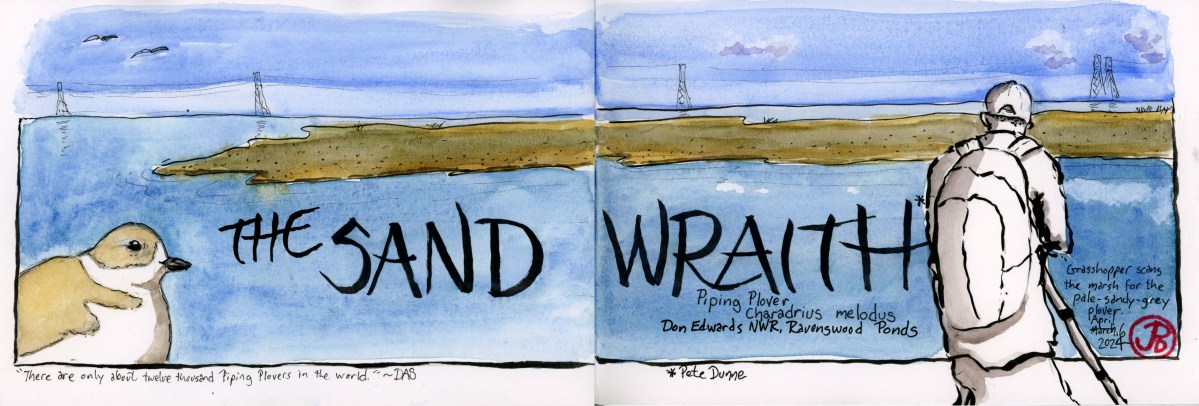
An endangered plover that is rarely seen on the west coast was being seen at the Don Edwards National Wildlife Refuge in southeastern San Mateo County.
Grasshopper Sparrow had seen the piping plover a week before and this Saturday morning was my first opportunity to add a rare Bay Area lifer to my list so I picked up Grasshopper a 7:30 and headed to the ponds east of the vast Meta headquarters.
After a circuitous route around the entrance to the Dumbarton Bridge, we found the muddy parking lot and the trailhead that led to the Ravenswood Ponds.
There were already two cars in the parking lot, the more eyes the better! Within about a five minute ramble we came upon the pond where Charadrius melodus had been seen. Two birders already had scopes focused on the sandbars in the middle of the pond. They had not seen the piping, yet.
We scanned the ponds for about three hours (finding a pale plover amongst hundreds takes time and patience). In that time more eyes with scopes began to arrive.
At times the flock, consisting of western and least sandpipers, dunlin, and semipalmated plovers, would land near the watchers on the mudflats. We would quickly scan the birds for a sandy pale plover with orangish legs that was loosely associating with the semipalms, before the flock would erupt in flight.
Watching the shorebirds fly as one, with flashes of white as the birds twisted and turned as one was an absolute joy!
But the pale stubby-nosed, orange-legged plover was proving to be elusive. It seemed that I had tried to turn every semipalmated plover in my scope-view into a piping, with no luck.
Yup, a rare plover brings the birders out on a clear Saturday morning.
As we were nearing our third hour of Plover Watch 2024, a birder to our left called out, “I got the bird!”
What followed was a play by play of the piping’s location and movement; “Do you see the five wigeon in the far channel? Just to the right below the two pylons? The plover is moving to the right. Passing near the green shrubbery. Now it’s facing us, right near the two ruddy ducks now. It’s now going left just past the two semipalms.”
I was following the plover commentary with my scope, looking for the five wigeon and the shrubbery and the ruddy ducks when I finally came upon a pale plover with a pale broken breast-band.
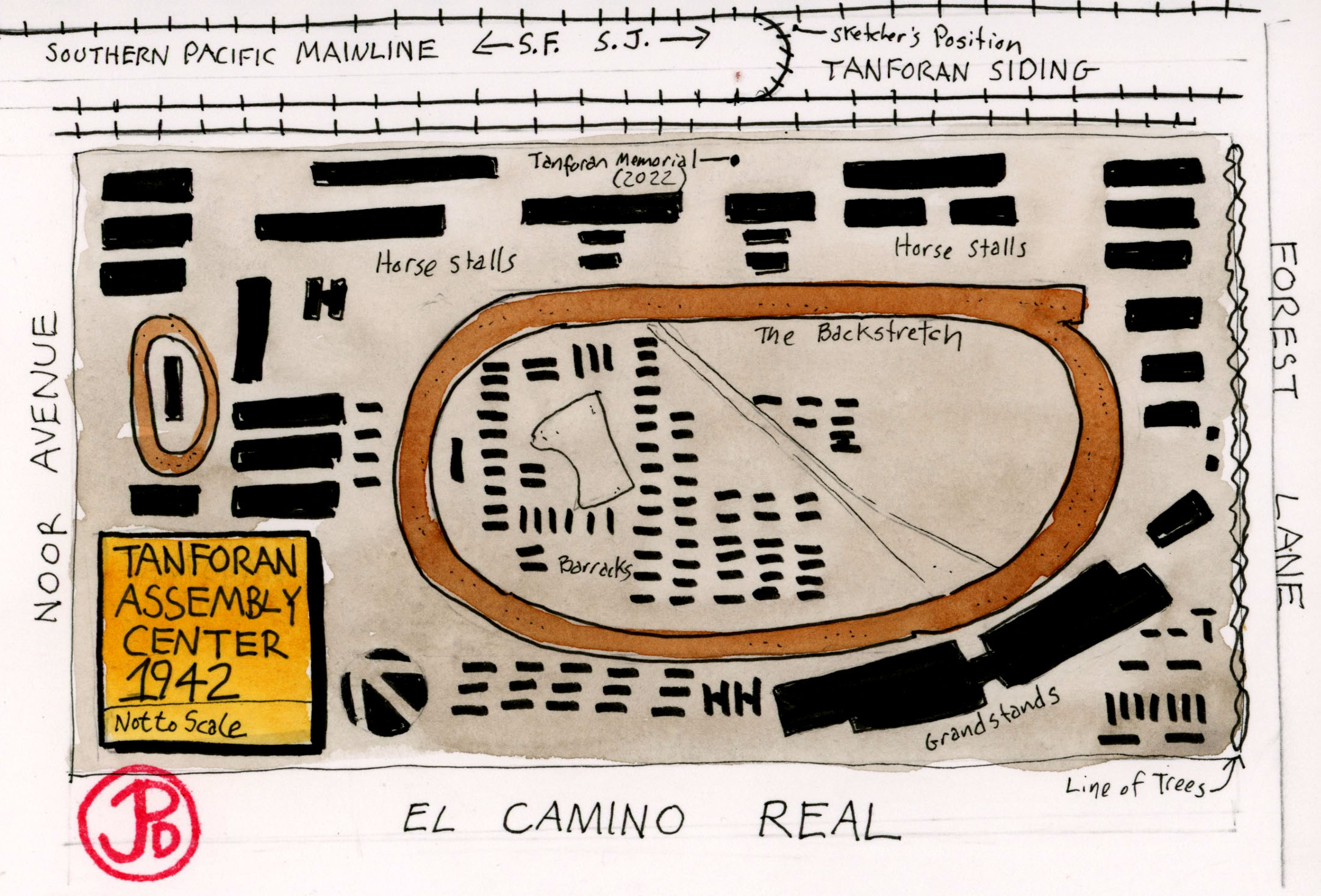
The former racetrack at Tanforan is bordered on one side by the former Southern Pacific mainline (currently used by the passenger service Caltrain).
Heading south, the line joins the wider rail network at Santa Clara and San Jose and on to all points on the National railroad compass.
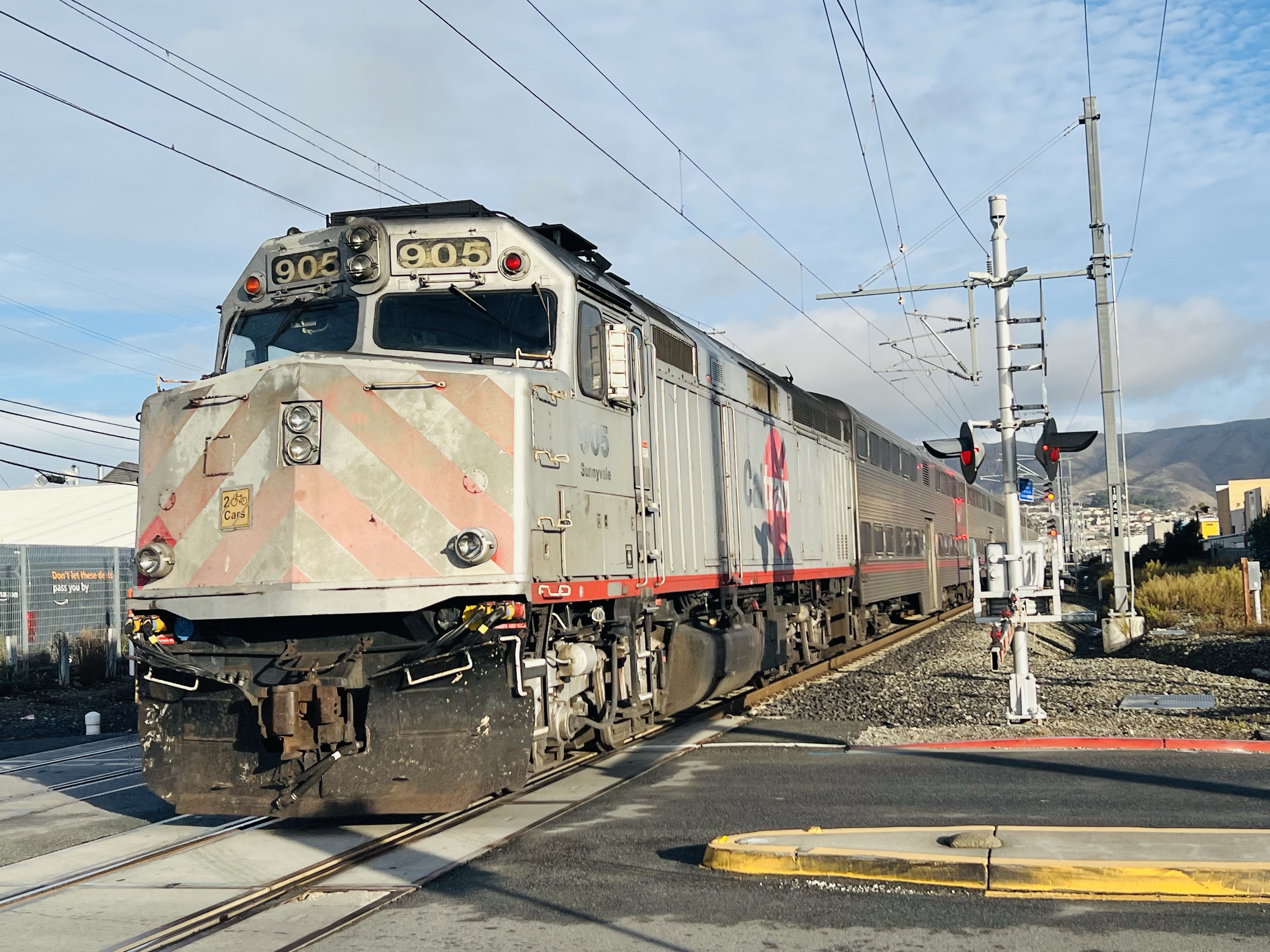
The rails are still very much in use as a northbound Caltrain heads to San Francisco. The train is being pushed by locomotive EMD F40PH-2 No 905 “Sunnyvale”. These diesel-electric locomotives will soon be replaced by electric train sets.
Tanforan was, therefore, connected to the nation through the siding track that brought cars from Tanforan Park proper, to points north (San Francisco) and south (San Jose).
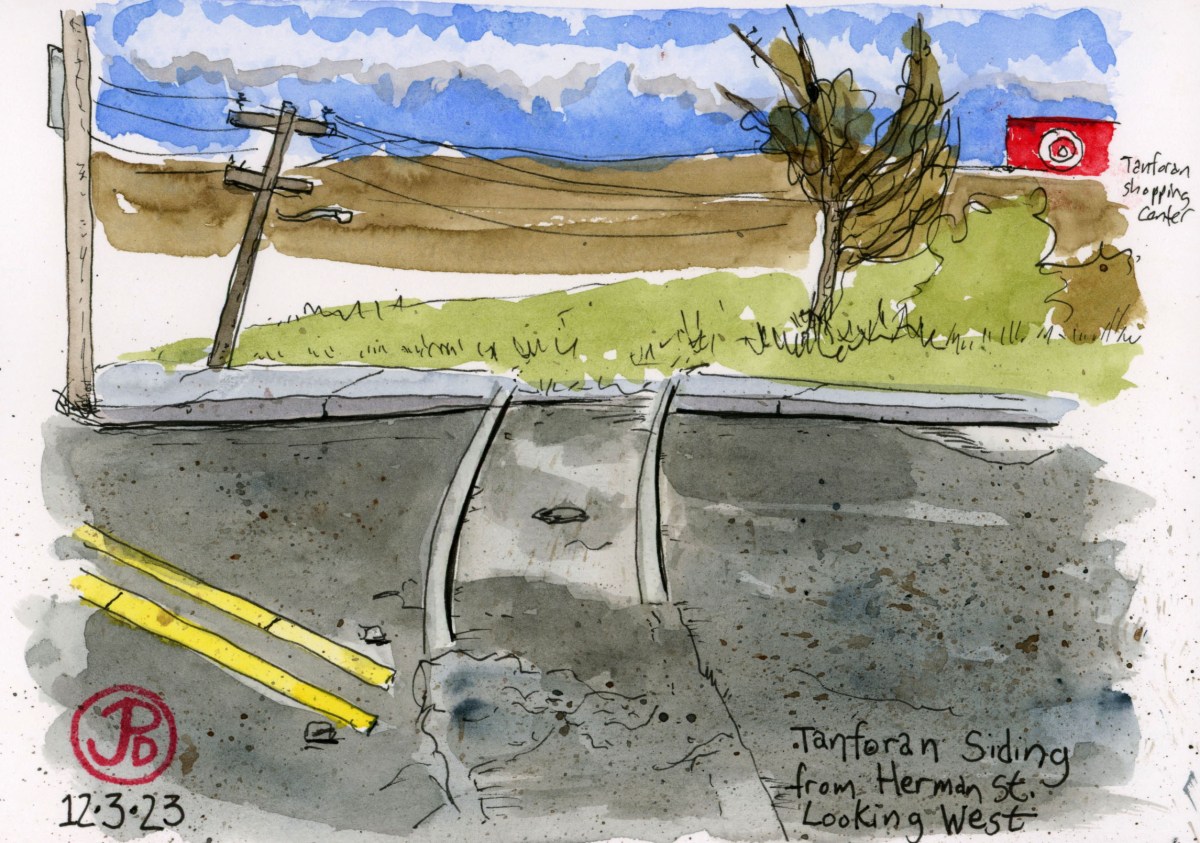
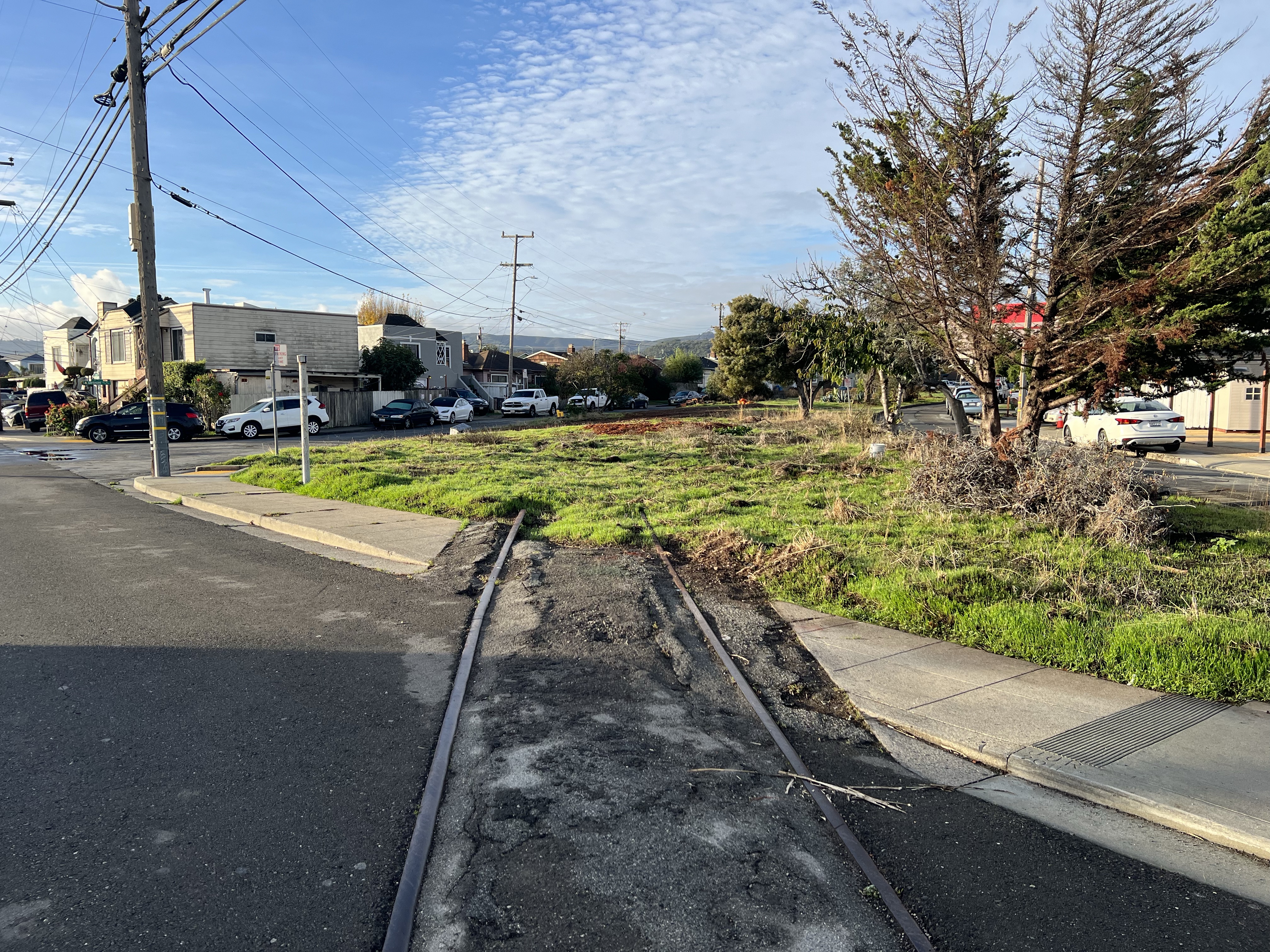
The Tanforan Siding heading towards the former racetrack (now Tanforan Shopping Center). This is the track that connected the siding near the backstretch with the rest of the rail network.
In 1938 the famous thoroughbred racehorse Seabiscuit boarded a special horse baggage car at the Tanforan Siding and he was shipped across the country to the East Coast on his first attempt to beat War Admiral. Large crowds came to see Seabiscuit off at the siding. The first meeting of these racing heavyweights did not happen.
Tanforan does have a dark past. In 1942, the racetrack became the Tanforan Assembly Center (the only assembly center in the San Francisco Bay Area). After the attack on Pearl Harbor, President Franklin D. Roosevelt issued executive order 9066. As a result Japanese Americans where rounded up and about 8,000 men, woman, and children where brought to Tanforan Racetrack now newly christened the Tanforan Assembly Center (one of twelve assembly centers on the West Coast).
Two-thirds of the detainees were U. S. Citizens, born and raised in the United States.
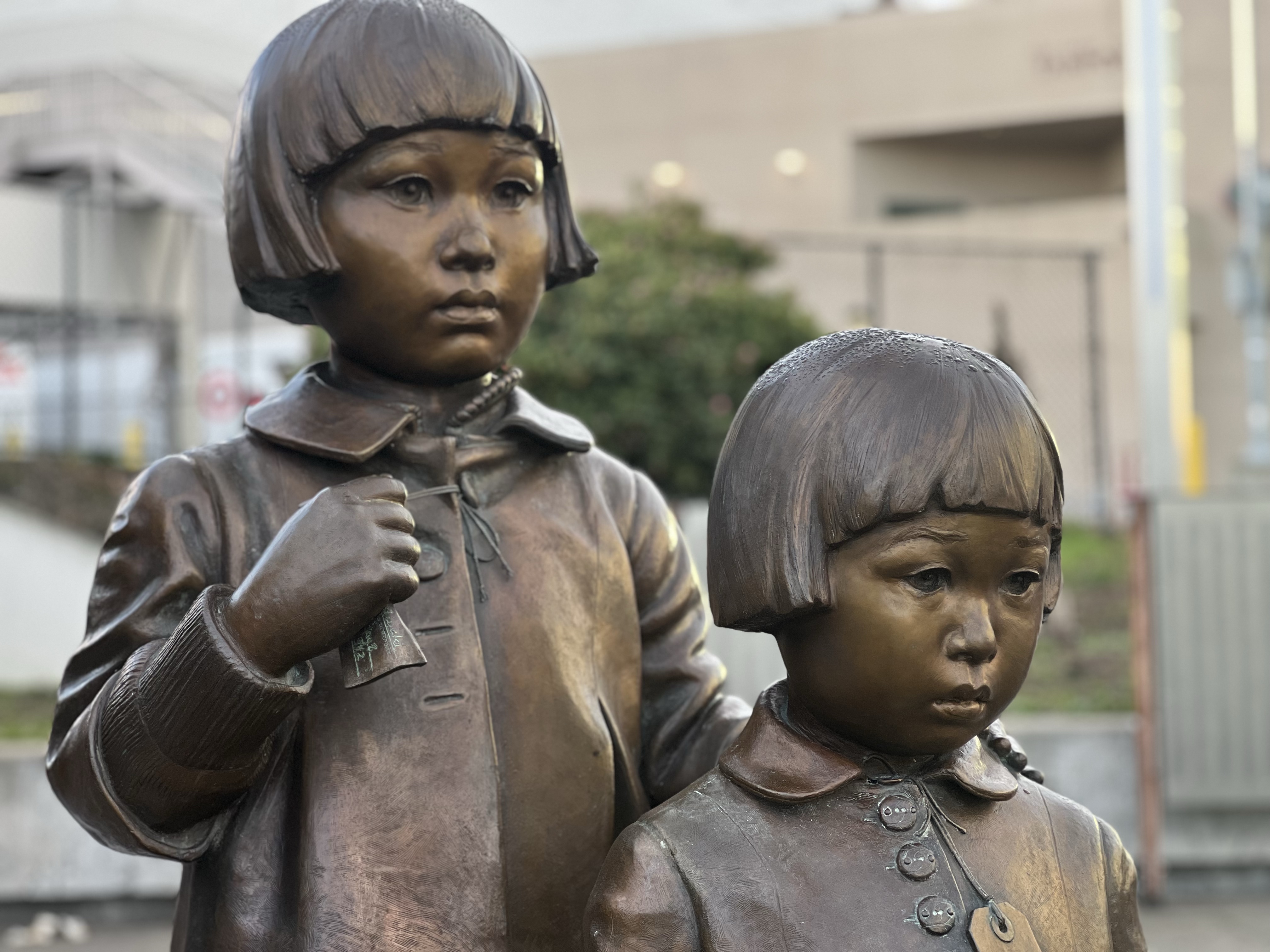
The Tanforan Memorial outside the San Bruno BART Station. The sculpture is based on a 1942 Dorothea Lange photograph of a family on their way to Tanforan. The memorial was dedicated on August 27, 2022.
The first internees arrived on April 28, 1942. They were housed in barracks and horse stalls that reeked of manure and urine. Some families spent about eight months here before being transported, over rail, to the Topaz War Relocation Center in Utah where they remained until the end of the war.
By the fall, the detainees were being sent on a two day rail journey to the Topaz War Relocation Center. On September 9, 1942, the first group of 214 detainees entered the siding that Seabiscuit travelled on a few years earlier and entered the mainline for their trip to the wastes of northeastern Utah. On October 13, 308 detainees, the last to leave Tanforan, entered the siding and then on to Utah.
The Tanforan Assembly Center was now closed.
The site of the former track and assembly center is now a shopping mall.
In 2022 the mall was bought by a developer and there are plans to raze the mall and build a massive biotech campus.
Who knew that the Northern California town of Eureka had some Civil War and presidential history?
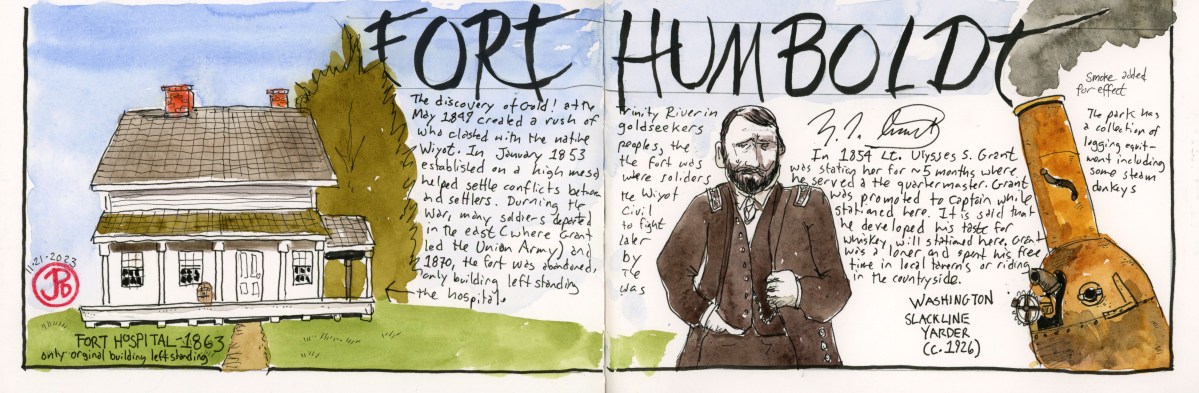
Such is the case when a young captain who served at the fort for five months. He was a loner and spent his free time in local taverns and riding in the countryside. It is said that he developed a taste for whisky while at Fort Humboldt. His name was Ulysses S. Grant.
Of course he went on to become a Civil War hero where he commanded the Union Army. It was Grant that Robert E. Lee surrendered to at Appomattox Courthouse on April 9, 1865.
Grant later served as the 18th president from 1869-1877 serving two terms.
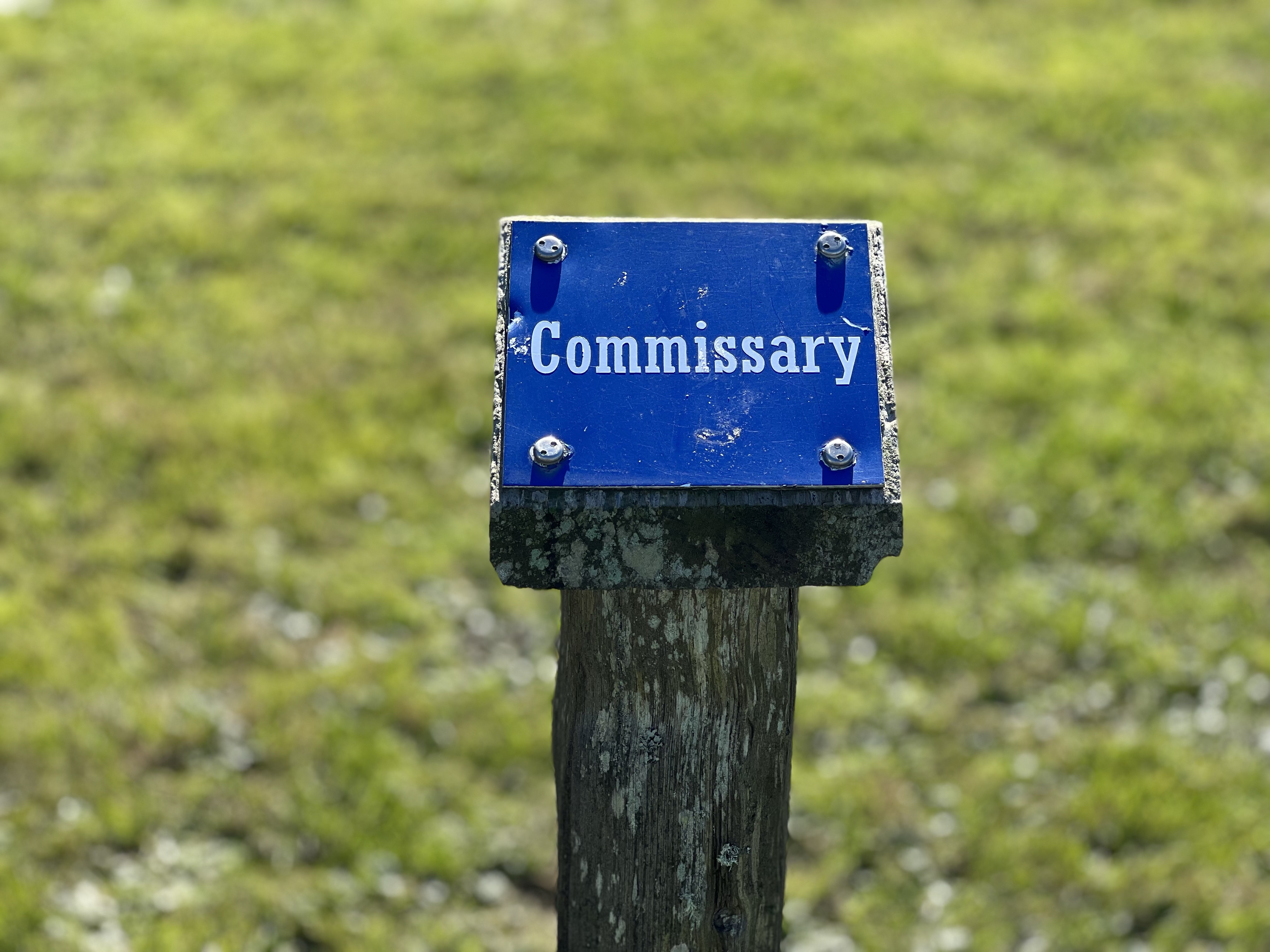
There are not many original buildings left at Fort Humboldt but here is where the commissary once stood. Grant served as the fort’s quartermaster, probably at the commissary.
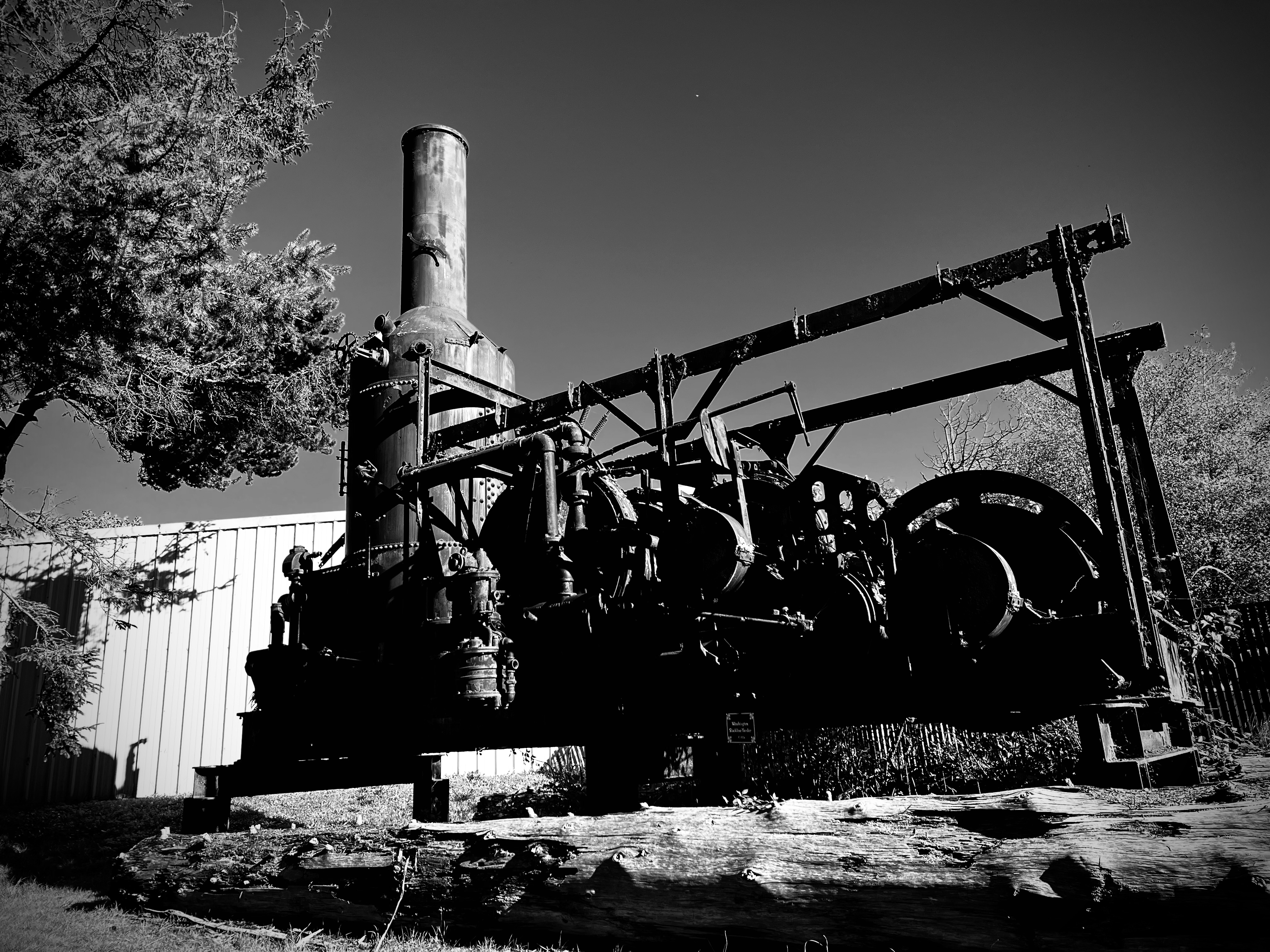
There is not much left of the fort on the bluff above Humboldt Bay and the fort hospital is the only remaining structure of the fort period (from 1853-1870). I pulled up my sketching chair and sketched the hospital building on the left of my spread. On the right is one of the largest steam donkeys ever made.
The state park has some nice relics of the lumber era that put Humboldt County on the economic map.
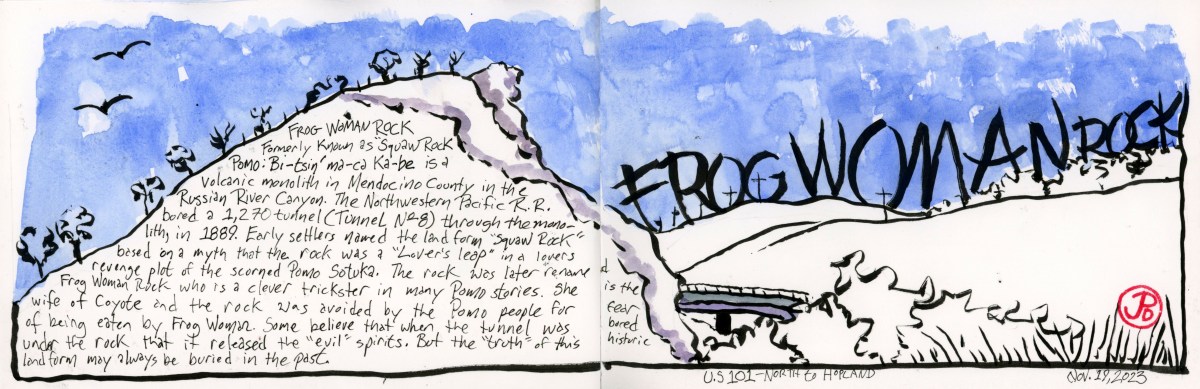
An imposing landmark on Highway 101, just south of Hopland is Frog Woman Rock (formerly known as Squaw Rock).
This was a barrier to the progress of the railroad that was following the Russian River on it’s West Bank. They could not go around the monolith so they had to tunnel through it.
This became the 1,270 foot Tunnel No. 8 on the Northwestern Pacific Railroad (NWP). While this monolith was a new delay to the railroad’s northern progress, the local Pomo people knew this location very well.
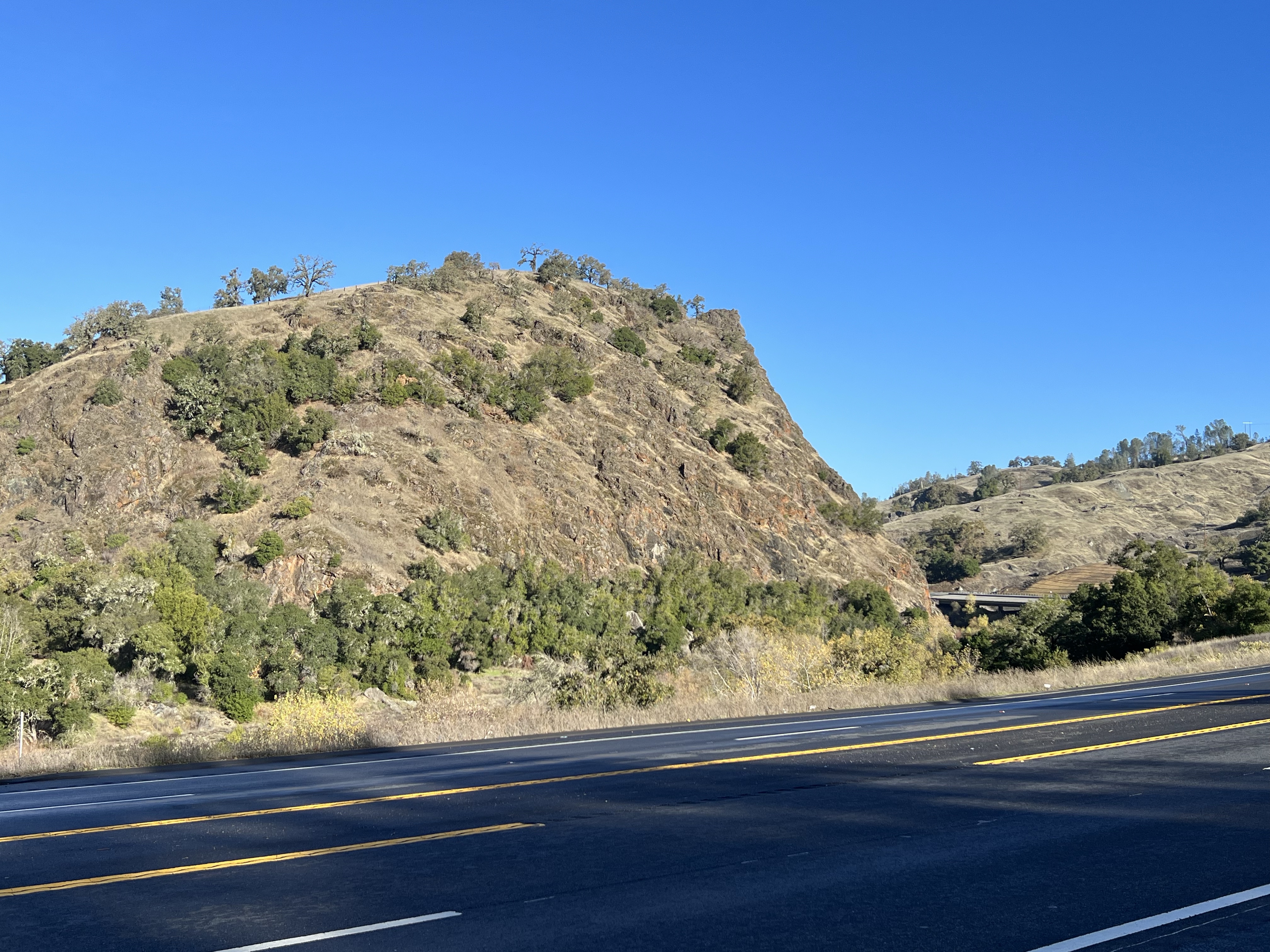
Frog Woman Rock with Highway 101 in the foreground.
To them it was know as Bi-tsin’ ma-ca Ka-be, Frog Woman Rock.
There are various legends of how the rock got its name. One Pomo story, filtered through early settlers, is that the rock was a sort of “Lover’s Leap” featuring in a lover revenge quarrel of the scorned Sotuka. Other say Sotuka is the wife of Coyote the trickster and the Pomo people avoided the rock. While others believe when the railroad tunnels through Frog Woman Rock, it released evil spirits.
Whatever the “truth” behind the legend of the rock, it was always be hidden in the past.
In 2024, Frog Woman Rock was designated California Historical Landmark No. 549. The plaque reads:
Since time immemorial, this monolith has been revered by Pomo people as the home of Frog Woman, the consort of coyote, and a special being in her own right. For native people it is a place of sacred power and a reminder of the connection we still have with our spirituality and natural environment. The presence of this great rock on the local landscape is a solemn witness that will forever be a local symbol of our indigenous collective conscience, strength, and perseverance.
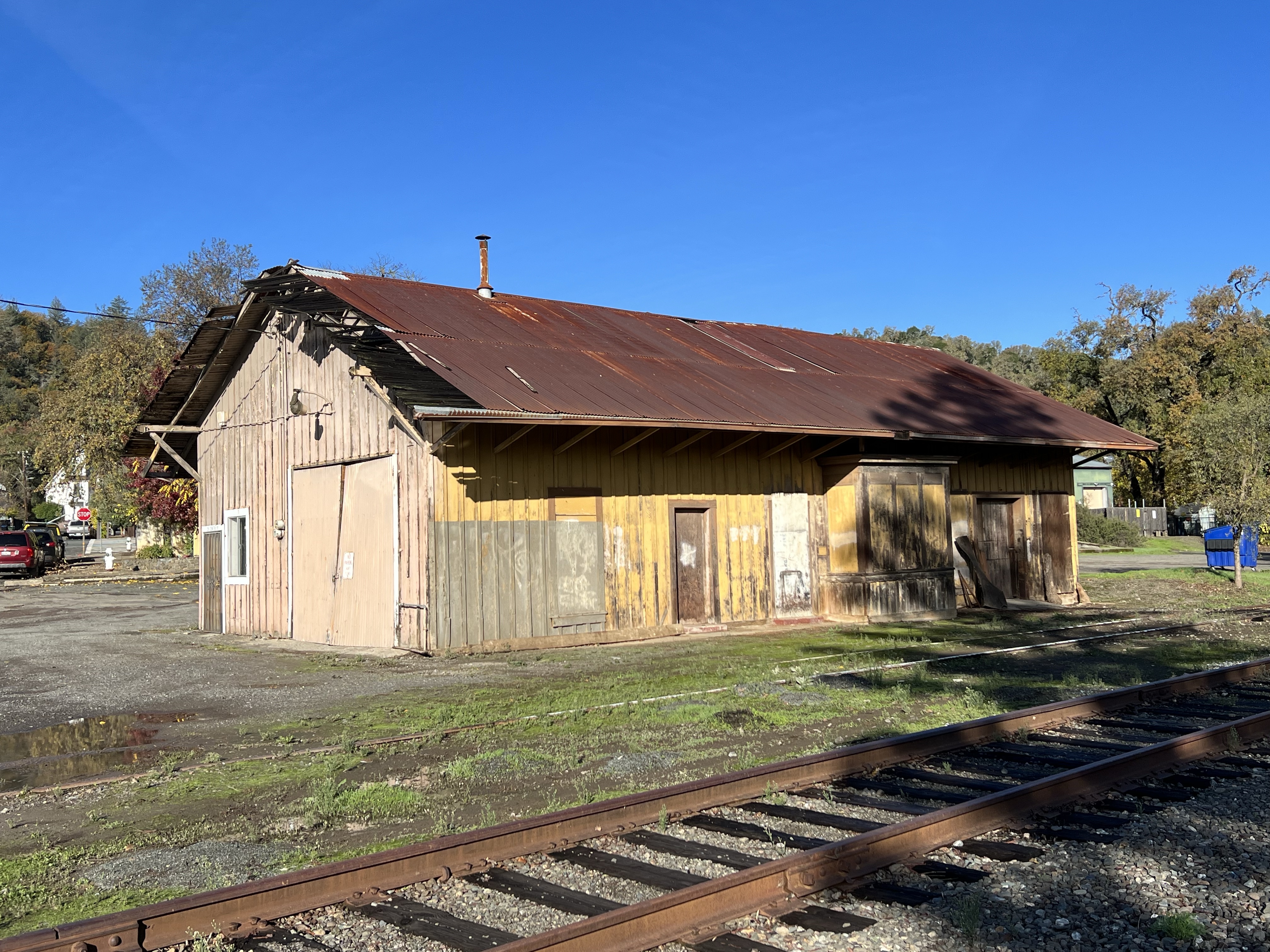
The abandoned NWP train station at Hopland, six miles north of Frog Woman Rock, with rusted rail leading north (to the right) to Willits and Eureka.