Sonoma Bits & Bobs

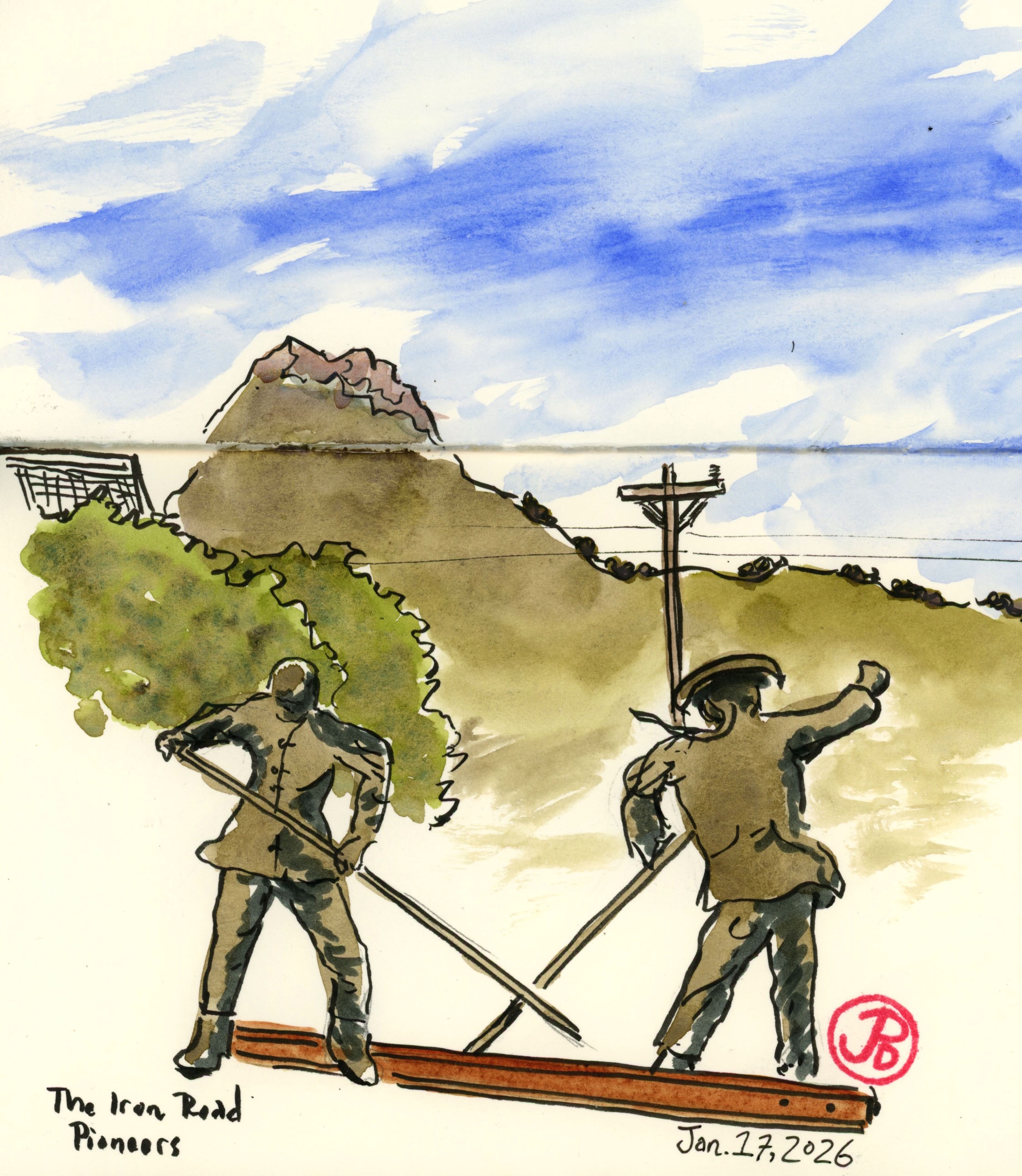
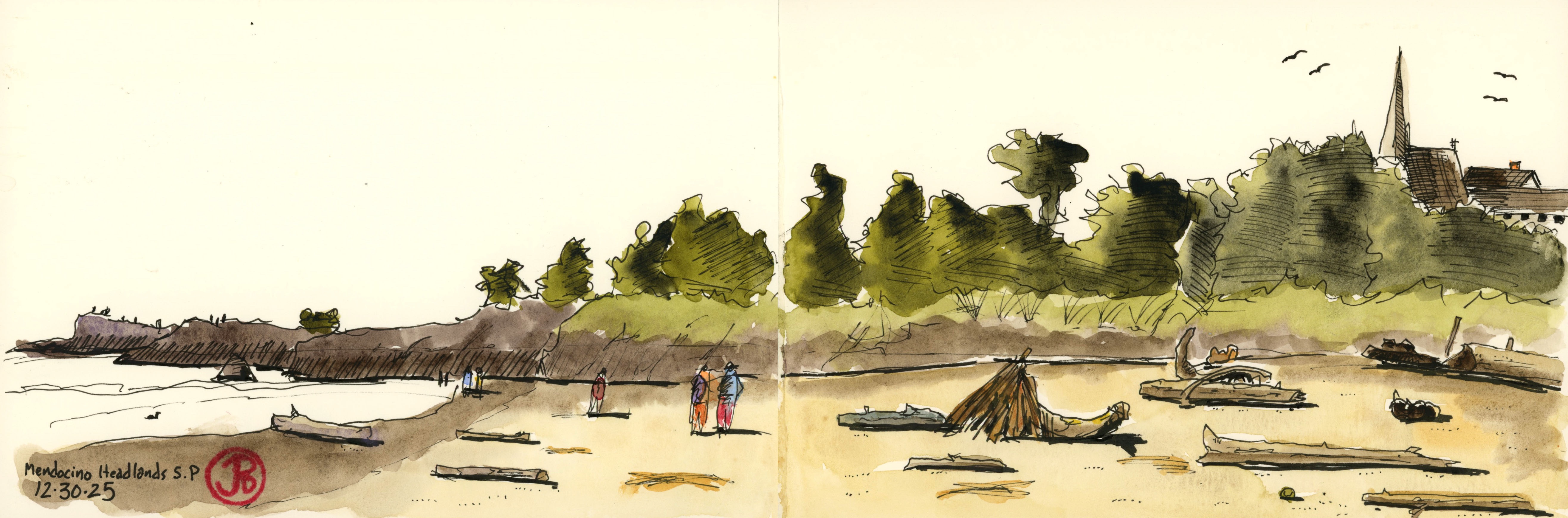
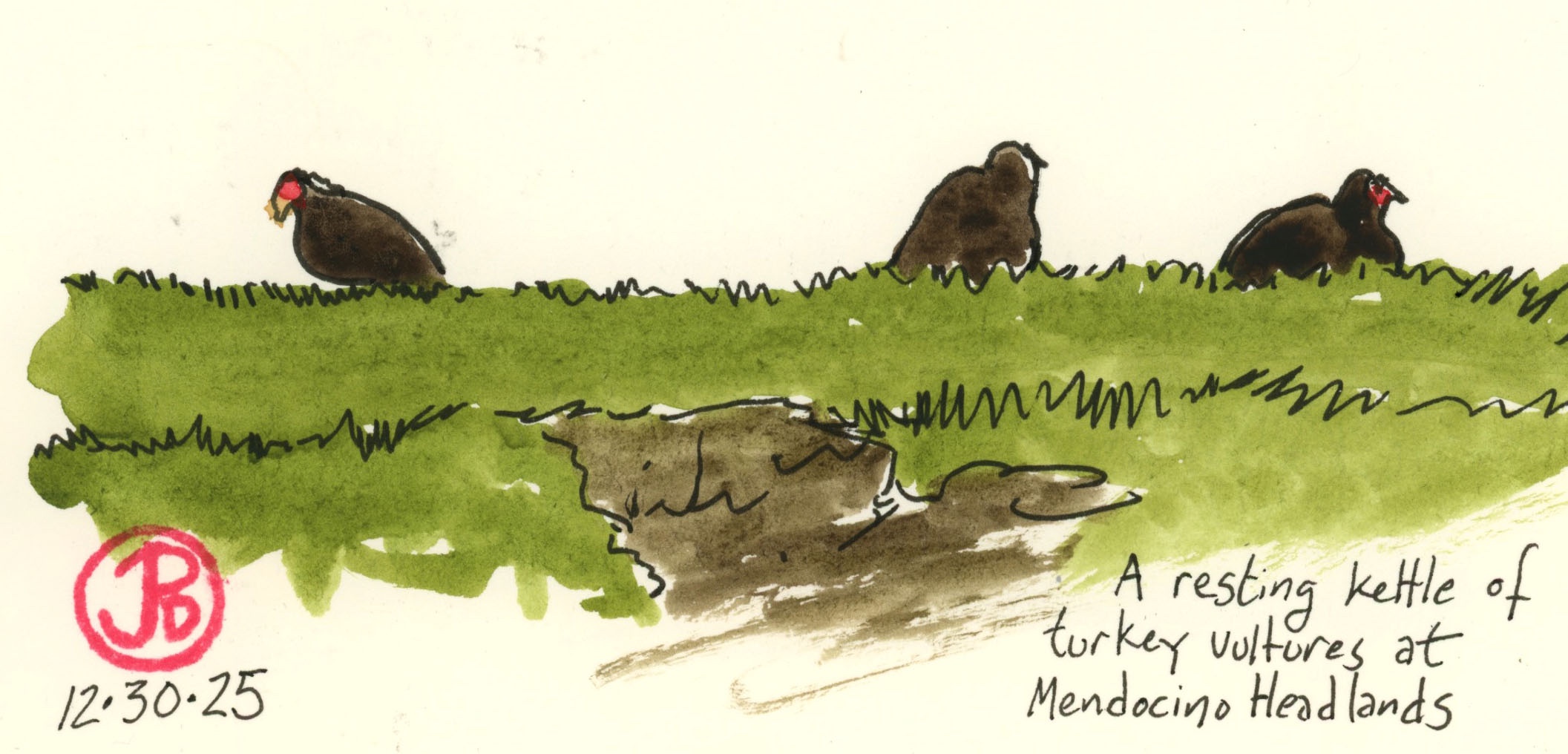
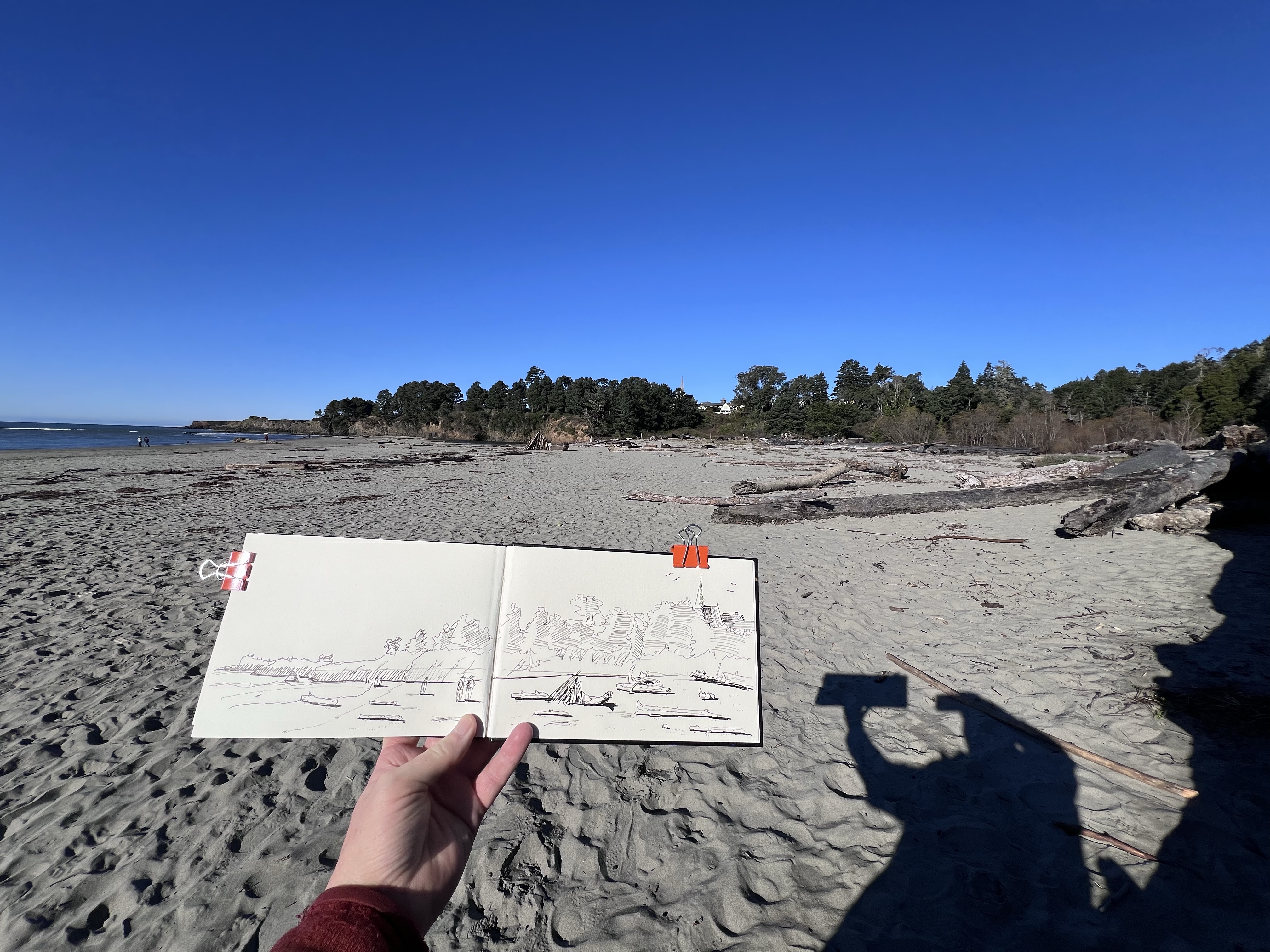
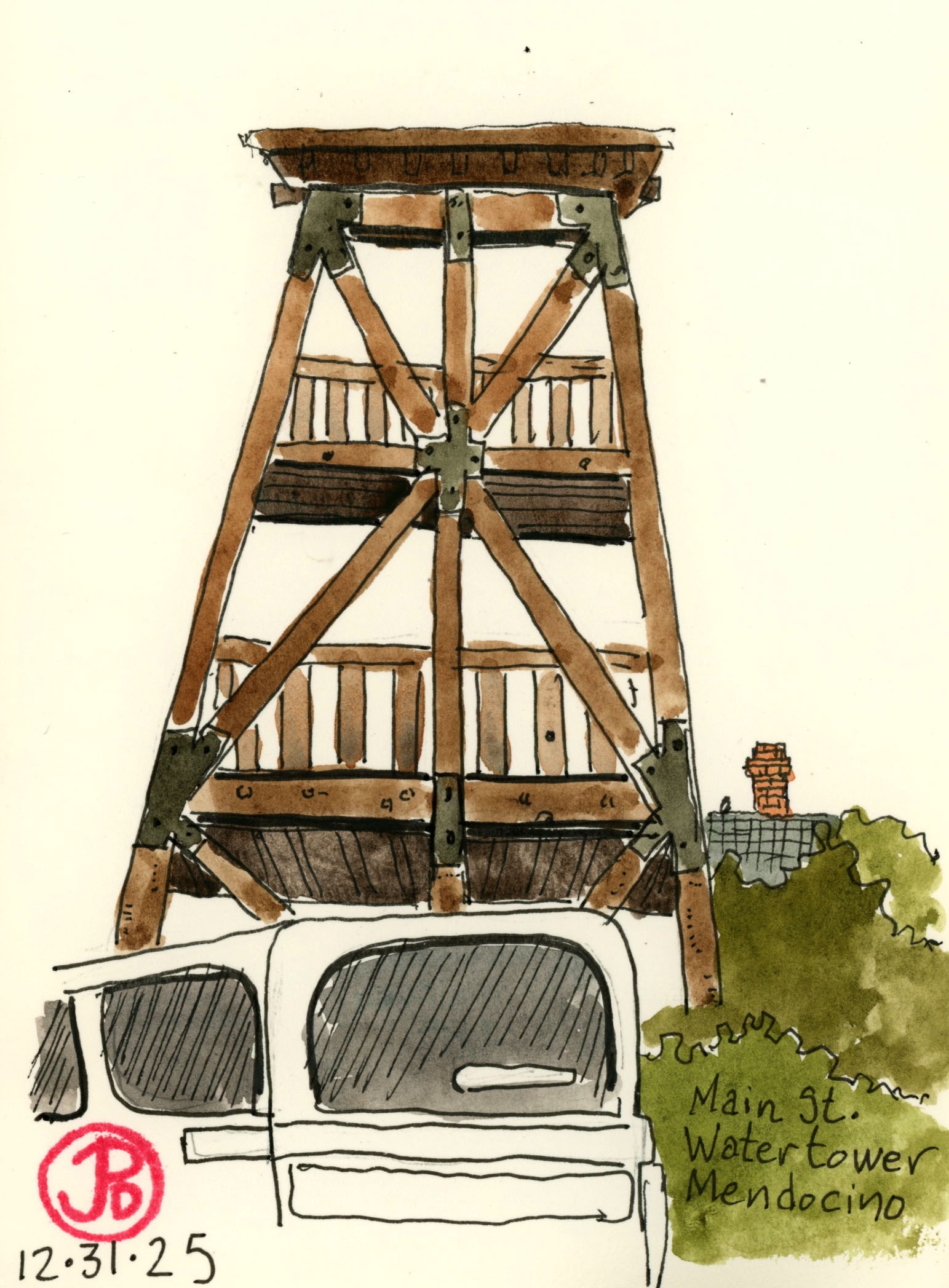
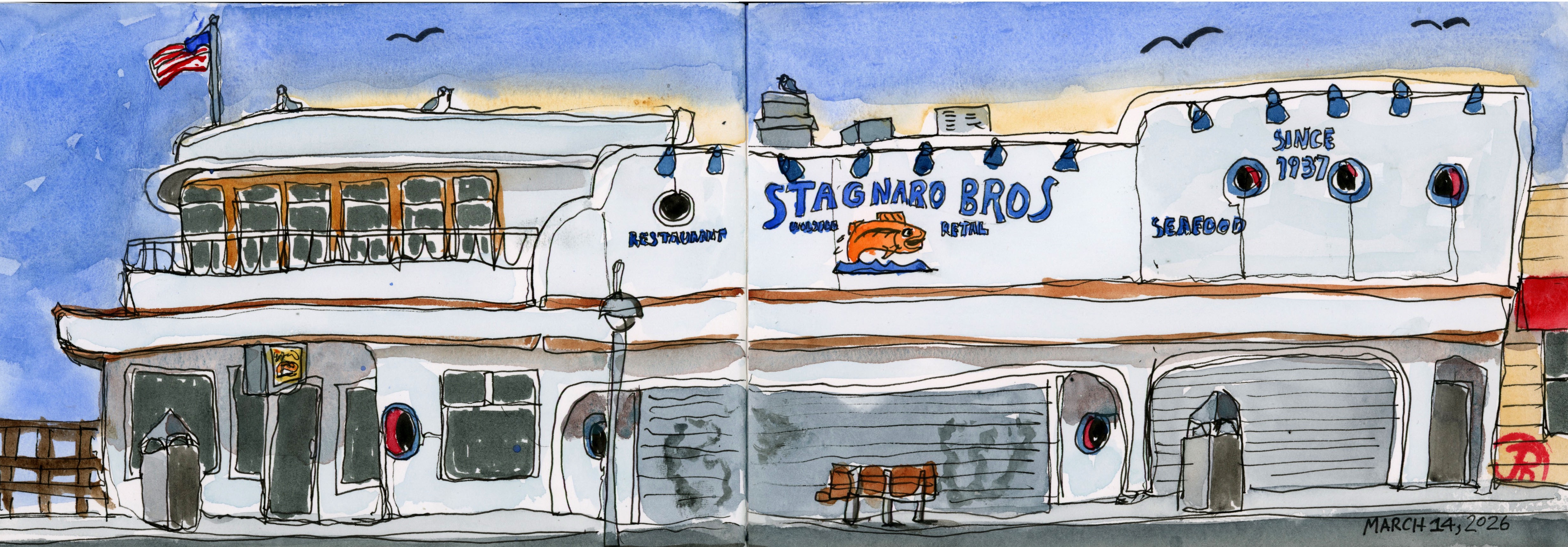
These are a collection of sketches that are related in their location, the Sonoma Coast.

From Mammoth Rock to Fort Ross to the north and into the Russian River Valley to the former lumber town of Duncans Mills.

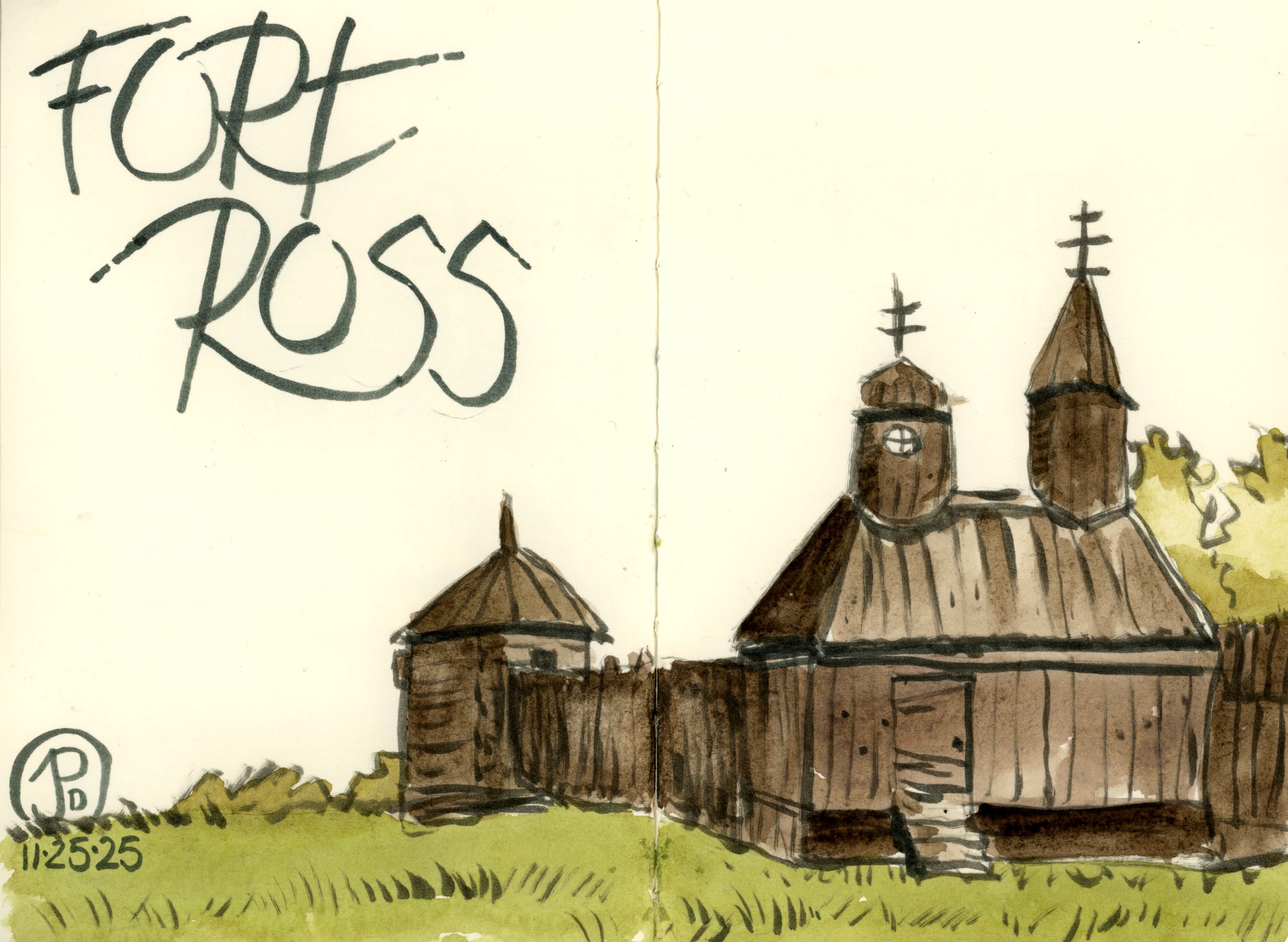
Fort Ross

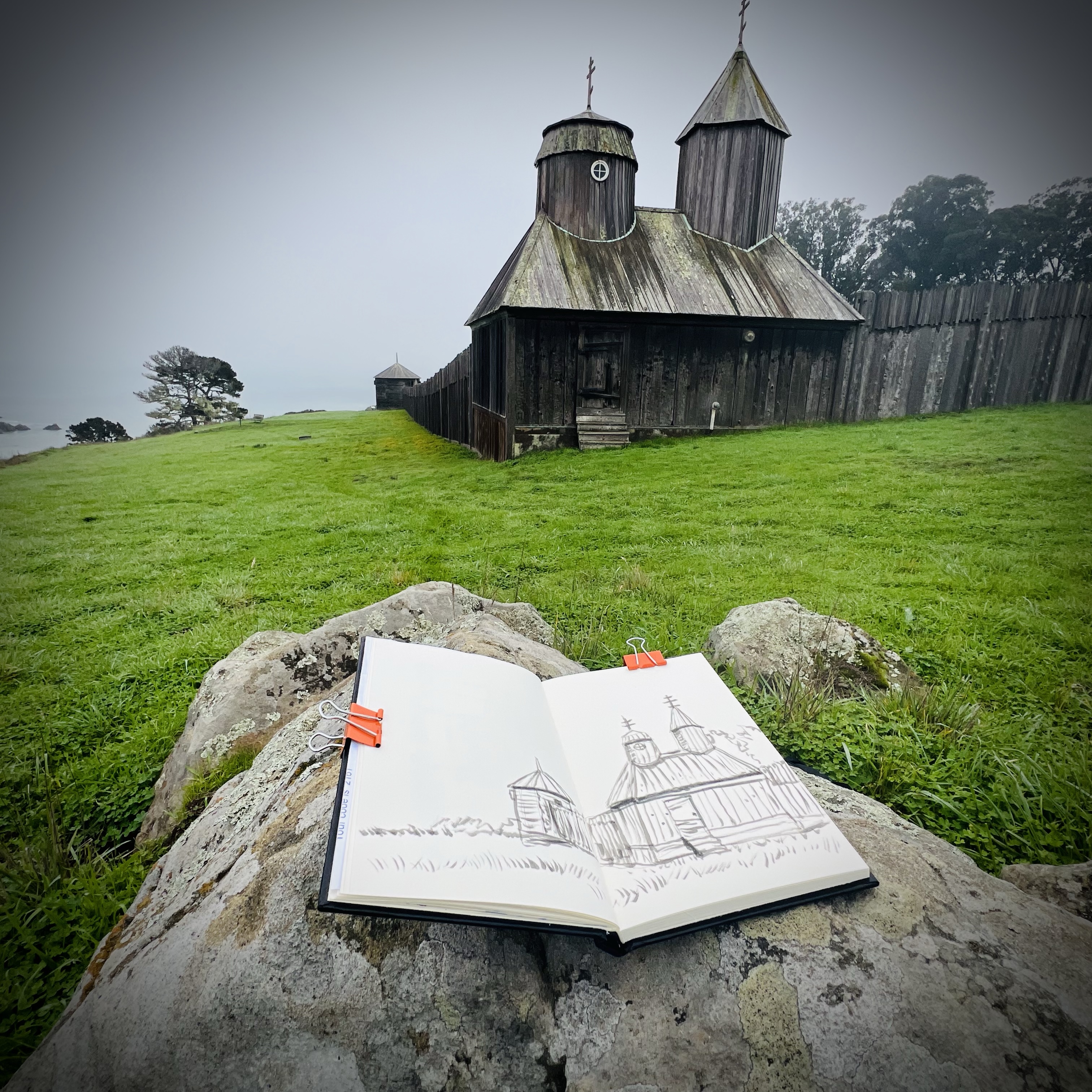
One morning I drove half an hour north from my digs to Fort Ross State Historic Park. Fort Ross is a sketching touchstone for me and I have returned here with my sketchbook many times. This time I chose a different angle sitting on a rock outside the fort looking towards the Russian Church. I had wanted to sketch from a similar perspective on a previous visit, but I was foiled by rainy conditions.

Duncans Mills

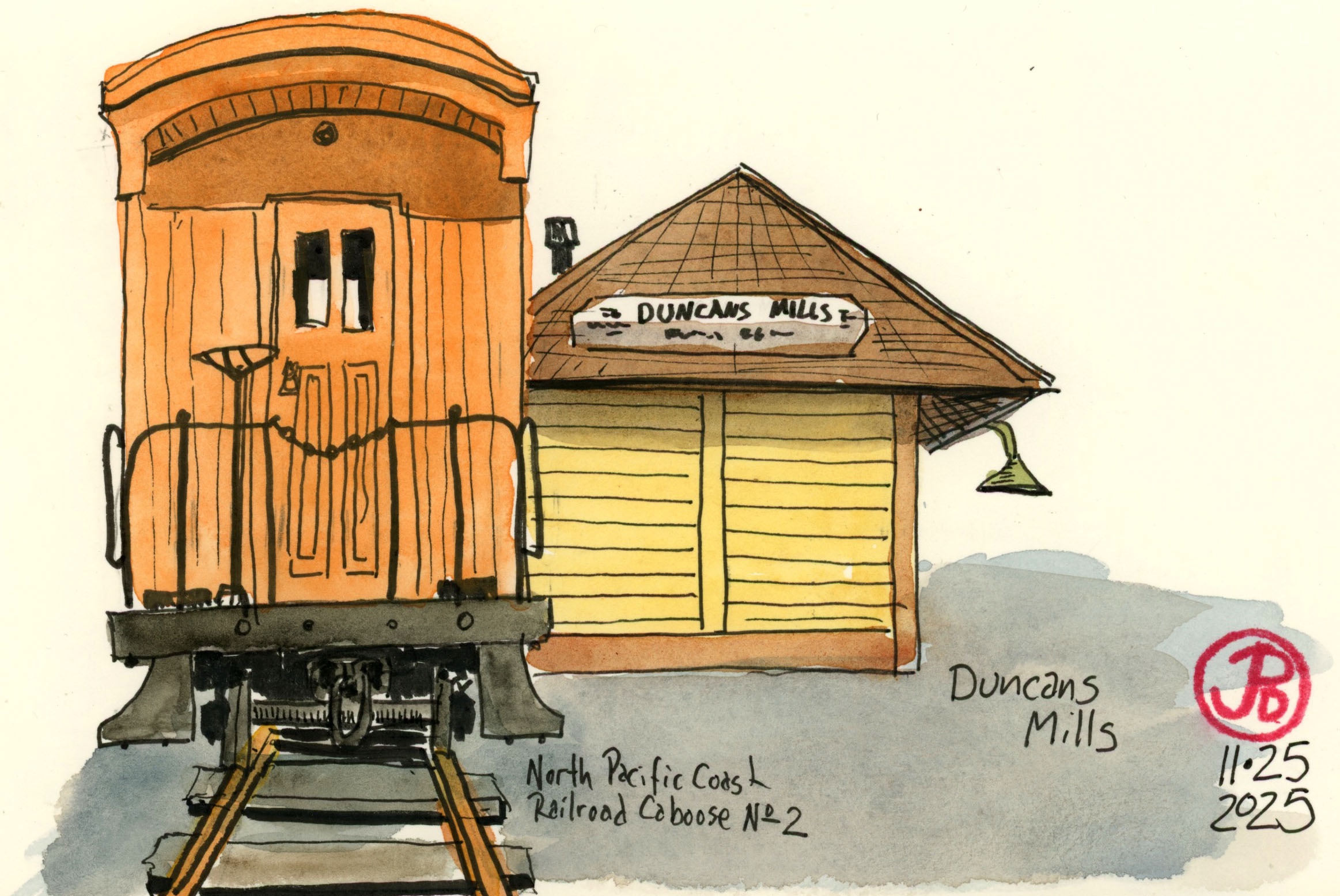
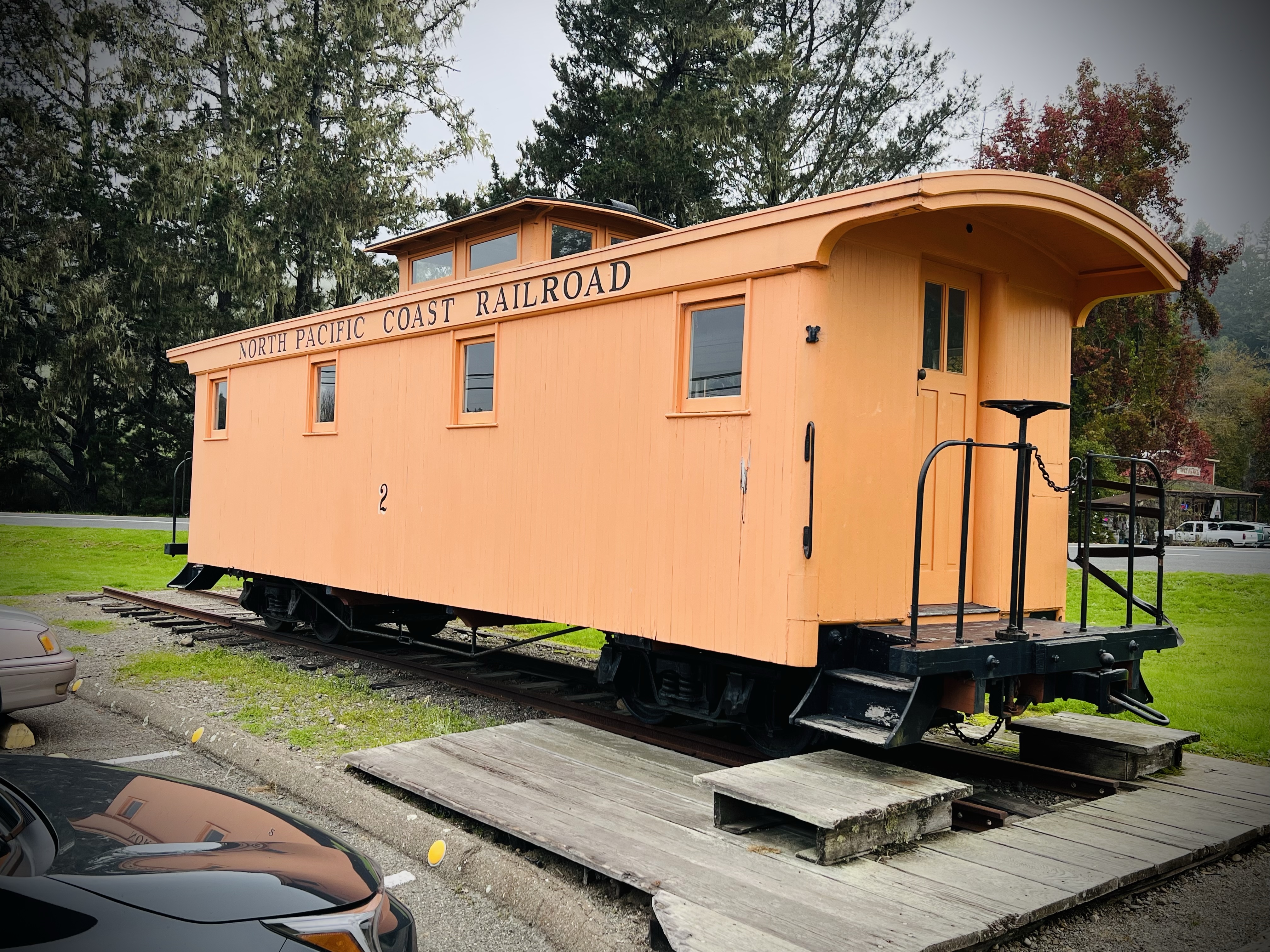
I have wanted to sketch the train station and caboose at Duncans Mills for a while but I had not found the right perspective. There were always cars parked in front and around the station so I sat on the end of the caboose with the back of the station in the background. The narrow gauge line was to the right but is name a paved parking lot.

The narrow gauge railroad came to the lumber town of Duncans Mills in the 1870s and rail, both passenger and freight, until train service was discontinued in 1935.

North Pacific Coast Railroad Caboose No. 2. This narrow gauge caboose was built in 1877.

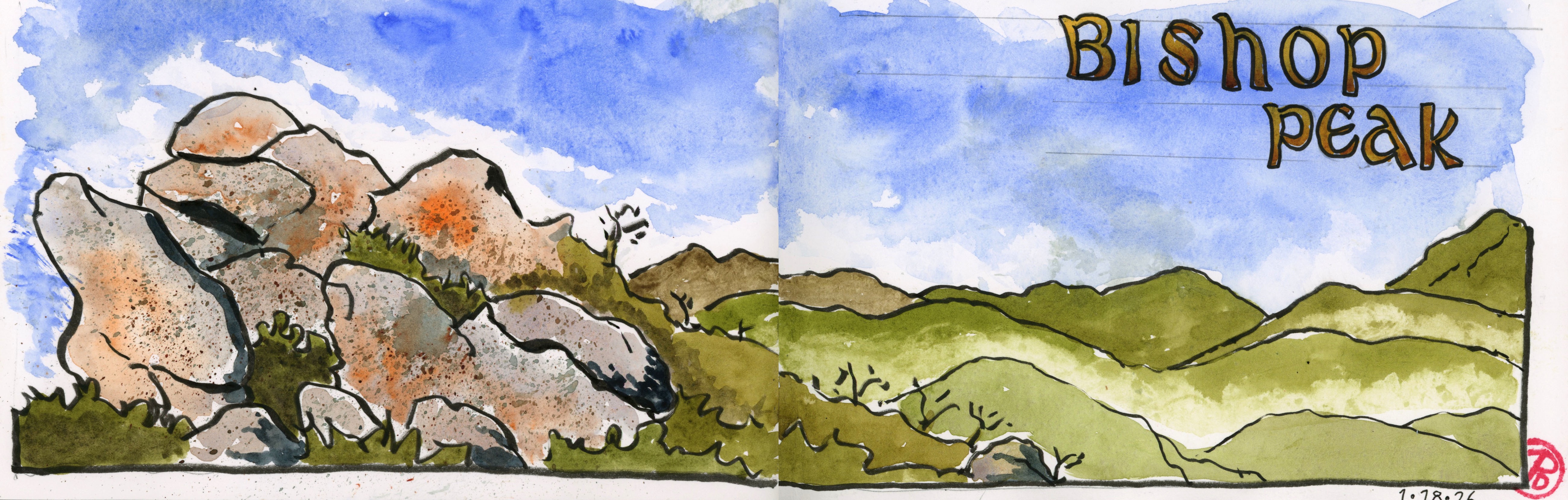
Sonoma Coast SP: Mammoth Rock

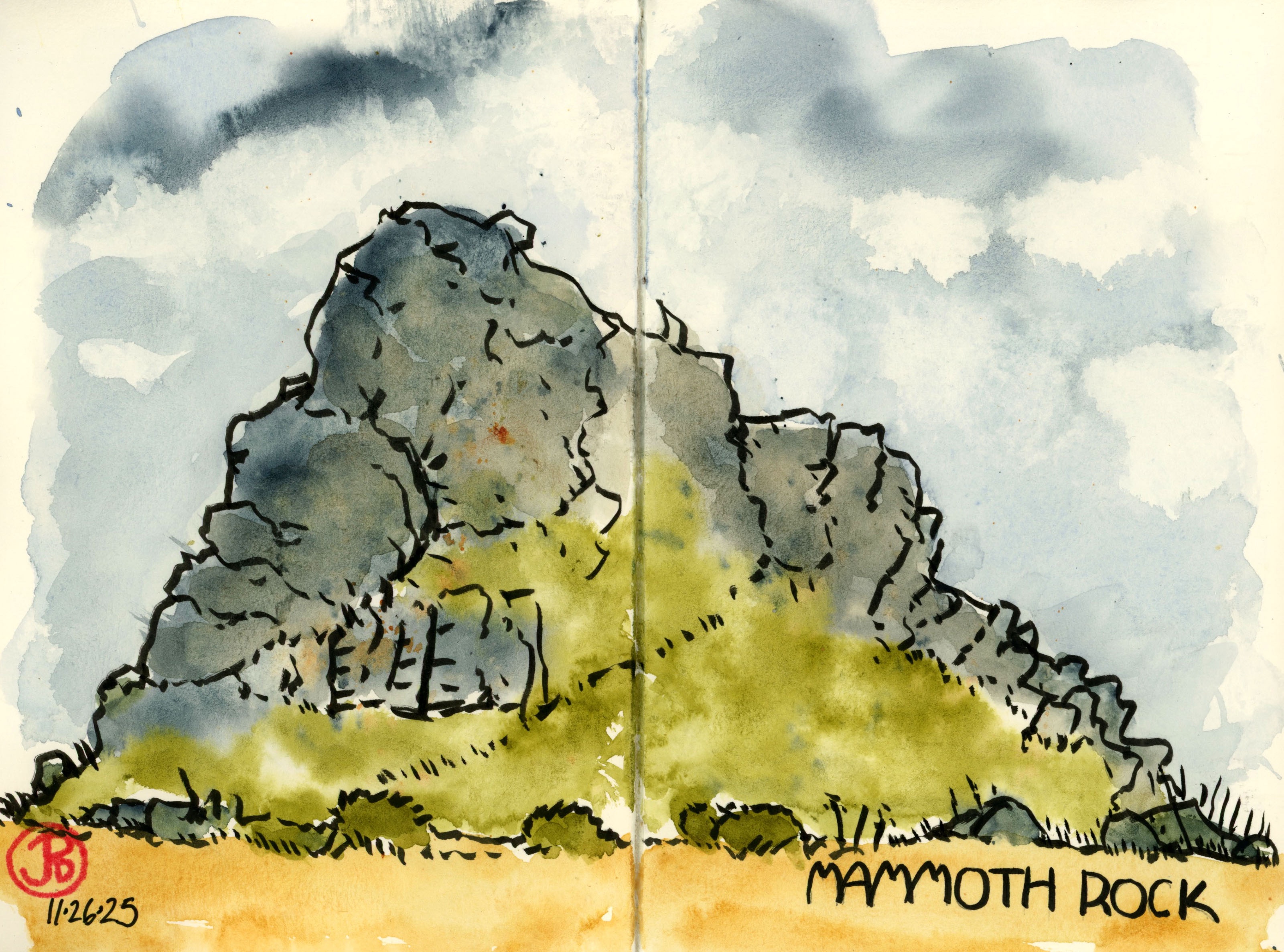
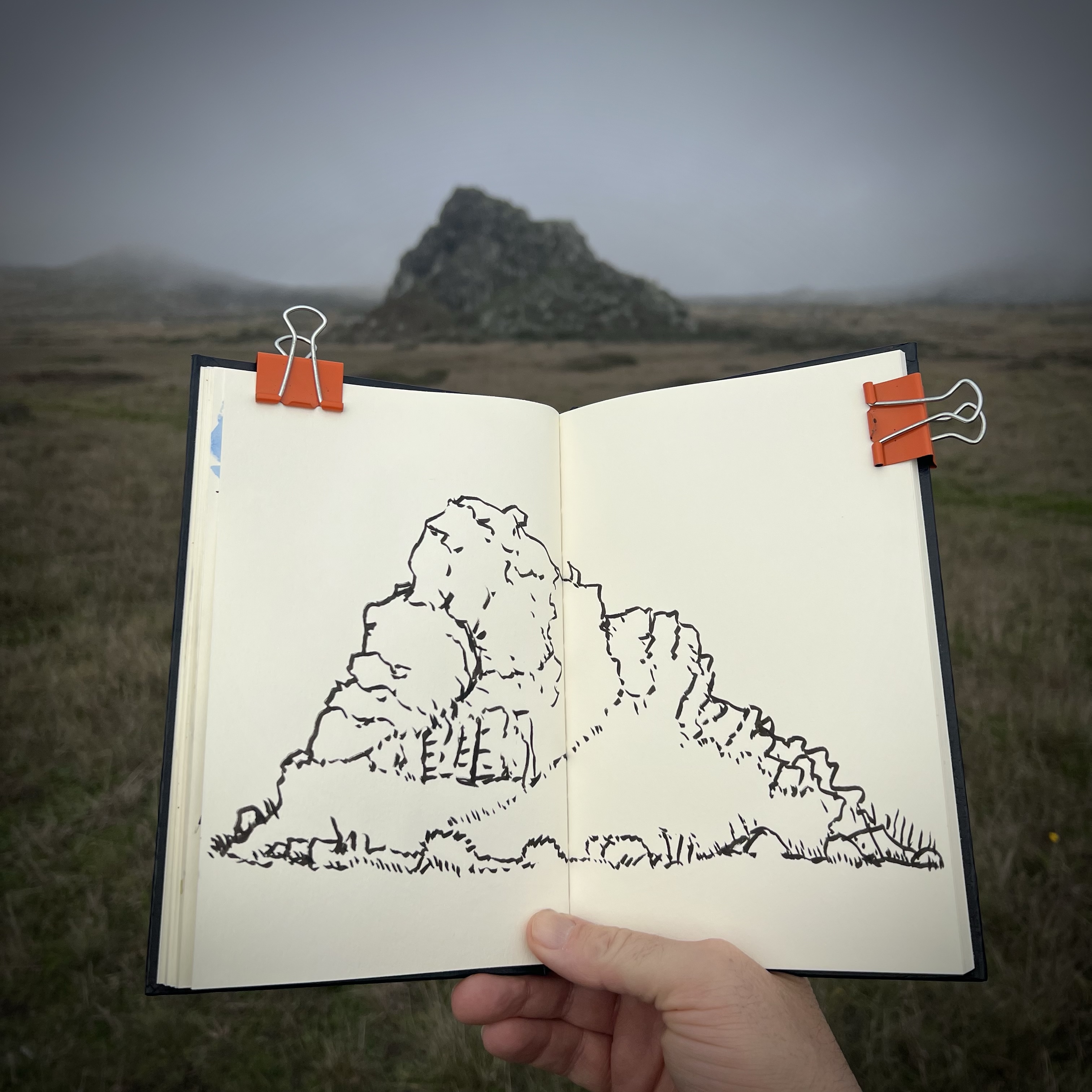
From my digs it was a short drive north to Goat Rock State Beach- Sonoma Coast State Park. My hiking/ sketching destination was Mammoth Rock. It was a blustery 30 minute hike to the large Mammoth Rock.

Wintery and windy weather is never an impediment to a good sketching experience. Driving, windy rain is another monster.

I found a perspective and started my sketch.

Image

Bowerbirds

Australia is home to ten species of bowerbird and I saw half of them.

Bowerbirds themselves are a beautiful and varied group of birds. What makes them well known around the world is the bowers that the males build to attract females. And we thought humans are the only artists on the planet.

All the bower designs are different depending on species and each female of the species seems to be attracted to different colors. For instance, female satin bowers birds prefer blue while great bowerbirds go for white and light gray.

Female satin bowerbird prefers blue decorations like her eye color.

Once the bower had been constructed, the male finishes the bower off with decorations purloined, or foraged, by the male. Many of the decorations are human made plastics.

I was able to see and sketch two bowers on my Australian trip. Bowers constructed by the male golden and great bowerbirds.

I was in Australia during their winter and so it was out of breeding season but some bowers remain standing year round.

One such bower was in a cemetery and our guide showed us the bower of the great bowerbird.

The great bowerbird paints in a palette of whites and grays including a set of plastic toy handcuffs.

I did a spread about the bower and the bird that created it (featured sketch).

Our next bower was in the rain forests of north Queensland at an elevation above 2,000 feet.

We hiked up a short way to the bower. But we also wanted to see the male that the bower belonged to. This required waiting.

This is a where being a sketcher has its advantages. Waiting means, “Time for a sketch!”

I sketched the impressive bower that was constructed of two tall towers. In the off season, the bower was a work in progress with one tower being about five feet high and the other was under construction. Between the towers was the “stage” lined in green moss.

Now we had to wait for Australia’s smallest and most sought after bowerbird.

After about 15 minutes, I saw a flash of gold cross from left to right which caused me to write a haiku:

A bower waiting

Flash of gold across the bow 

Leaves us wanting more

The bower bird flew into a tree out of view, in this case the North Queensland endemic golden bowerbird.

In the darkness under the rainforest canopy I realized another benefit of field sketching, you don’t need a lot of light to sketch but as my shifty photos of the bowerbird proves, you need light to paint with light.

A blurry photo of the male golden bowerbird.

After another wait, the male bowerbird returned to his bower with some green moss to cover his stage. The group all got great looks at this most sought after Queensland endemic.

Image

Sketching a Masterpiece: Sydney Opera House

There is one Sydney building that I wanted to add to my sketchbooks more than any other: Sydney Opera House.

There are few structures in the world that are instantly recognizable whether you’ve seen then in person or not: Stonehenge, Eiffel Tower, Machu Pichu, the Golden Gate Bridge, the Pyramids of Giza, the Taj Mahal, and the Sydney Opera House.

One of the best views of the Opera House is from the Harbour itself, in this case aboard the Manly Ferry.

The opera house was designed by Danish architect Jorn Utzon after a 1955 completion with 233 entries. Utzon’s innovative design was chosen and construction started on March 1, 1959. After many set backs, budget overruns, and redesigns, including the firing of Utzon, the opera house was inaugurated by Queen Elizabeth II on October 20, 1973.

After his firing Utzon never returned to Sydney to see his completed masterpiece.

I was captivated by the Opera House and I did a total of six sketches of the masterpiece and with each sketch, I began to understand the structure a little more.

A sketch from the forecourt. Many concerts have been held in the forecourt perhaps none more famous than Crowded House’s last concert on November 24, 1996. The free concert was attended by about 250,000, which was way more than the forecourt could hold.
A look at the tiled sails of the opera house from the inside while on a tour of the building.
Image

SFO From the Bay Trail

My Tuesday after work sketch took me to the San Francisco Bay Trail which parallels Runways 28R and 28L and Taxiway F.

These are the two runways that handle most international traffic at San Francisco International Airport. In my two hours there, I saw planes landing or taking off from airlines such as Cathay Pacific, Condor (German), Lufthansa, SAS, Aer Lingus, Virgin Atlantic, Qatar, Iberian, Swiss, TAP Air (Portugal), Turkish Airlines, Zipair (Japan), and British Airways. San Francisco is really an international destination.

This trail and Bayfront Park are a well known location for plane spotting as you have unobstructed views of planes taxiing, taking off, and landing.

I was here to see the large passenger jet that largely replaced Boeing’s 747 on long distance international routes.

In an uncanny coincidence a Lufthansa 747-8 was on Taxiway F headed to Runway 28R when I was driving down Millbrae Avenue toward the airport. After I parked and walked up to the Bay Trail the 747 was throttling up for takeoff. Only four airlines currently have 747s in their fleet: Lufthansa, Korean Air, Air China, and Rossiya.

One of the few Boeing 747s throttling up for takeoff on Runway 28R. This is a 747-8, the largest 747 and Boeing’s largest passenger jet. This “stretched” 747 was designed to compete with the A380.

I was here to see the big boy that competed with the 747, Airbus’s A380. Two airlines fly A380s out of SFO, British Airways and Emirates. BA flight 284 was scheduled to depart at 16:20. But the flight was running a little late, which seems to be the norm.

The Bay Trail in the foreground and British Airways A380 is pulling away from Gate A11. This is one of 12 in BA’s fleet.
Flight 284 on the Taxiway F for Foxtrot. This airplane is so large that the suffix “Super” is part of its call sign.
This photo shows the scale of the world’s largest passenger plane compared to others on the tarmac. The aircraft in front of the A380 is an Air Canada Boeing 737 Max 8.
A380 on its way to line up for takeoff as a much smaller United Airlines jet lands.
Gear up with the South San Francisco sign below and San Bruno Mountain above.

Sketching Notes

I found a tree stump seat with the taxiways and runways in front of me. I first sketched in the fill as the runways are surround by the bay on three sides. In the background I penciled in the East Bay hills and mountains including Mt. Diablo. The tide was low when I stared sketching but was slowly filling in during the two hours of my visit.

Later I would add two planes on the taxiway, based on photographs taken in the field.

To my left and in the distance I could see the red, white, and blue tail of the A380 at Gate A11.

Image

Loma Prieta Bell’s Sparrow

In late May I made my annual pilgrimage to the birding hotspot Loma Prieta (Upper Saddle).

I left my cabin at 6:40 AM and 35 minutes later I pulled into the dirt parking lot on the ridge that straddles Santa Cruz and Santa Clara Counties.

It can be very windy and hemmed in by dense fog up here but not today. I could look down and see fog covering Monterey Bay. Today it was clear and warm without much of a breeze. In fact it was already getting warm.

My target was the pair of Bell’s sparrows that had recently been seen here since mid May. This would be a Santa Clara County bird for me.

I walked down Mt. Madonna Road and aside from singing spotted towhees and wrentits, and a far off babbling California thrasher, it was pretty quiet. I did not hear or see any black-chinned or Bell’s sparrows.

On my way back to the parking lot I first heard and then saw a blue-grey gnatcatcher.

Blue-gray gnatcatcher.

As I headed to the parking lot there were now six other birders in the area, looking for the Bell’s.

As I reached my car a pair of birders had just spotted a pair of Bell’s sparrows right from the parking lot. So I figured I’d stay a bit longer.

I was rewarded about five minutes later when a bird flew towards me and perched on a nearby bush in front of me. Bell’s sparrow! A new county bird!

Bell’s sparrow.

Sketching Notes

Loma Prieta Ridge is one of the best panoramic views in Santa Cruz County. So I took a pause in Bell’s sparrow spotting and opened my panoramic watercolor journal to capture the scene.

What a view, best in the county!

I left the lower left side blank. I initially was going to add a Bell’s sparrow but I hadn’t seen one yet. So I thought I would add a blue-grey gnatcatcher to that corner, based on my field photo.

After seeing the Bell’s from the parking lot, I returned to my original plan and the result is my featured sketch.

Image

Embarcadero Sunday Sketching

On Sunday I took the N Judah to Embarcadero Station with the intention of sketching a little San Francisco rail history. My main sketching target was the Belt Line Railroad Engine House or Roundhouse at Embarcadero and Sansome.

On the walk from the Ferry Building I came upon the 1927 ferry Santa Rosa at Pier 3 and I thought I would head back after my roundhouse sketch to add this piece of rail and nautical history to my spread.

Bay No. 5 with Coit Tower in the background.

The Belt Line Railroad was founded in 1889. The railroad connected the Port of San Francisco with many of the piers and warehouses. The railroad shipped freight cars from the ferry freight terminal (at Pier 43) for railroads such as the Western Pacific, Northwestern Pacific, and the Aitchison, Topeka, & Santa Fe Railway. It also had connections with Southern Pacific on the southern portion of its line. The railroad also served Ft. Mason, the Presidio, and Chrissy Field through the Ft. Mason tunnel.

At its height, the railroad had 67 miles of track. The Belt Line operated 12 steam locomotives and six diesels.

Over time, the Port of San Francisco was eclipsed by the Port of Oakland and shipping traffic slowed. The railroad eventually folded in 1993.

Before me was the reinforced concrete Belt Railroad Engine House or Roundhouse. It was built in 1913 and is now designated as City and County of San Francisco Landmark #114.

The house contains five bays with five tracks snaking out of each bay. The tracks disappear under paving at the intersection of Chestnut and Embarcadero. It was nice to see that some of the the rails were still in place although the engine house now houses another business.

PCC car No. 1050 passes by the Engine House on the F Line. The car is painted in St. Louis livery.

After my sketch I headed back to the Santa Rosa and found a nice sketching bench.

For this sketch I chose to keep it loose and render the ferry in a continuous line sketch. Although I did lift my pen a few times to add some details and shading. So I’ll call it a broken line continuous sketch. For this sketch I experimented with a thicker more expressive pen, my Faber-Castell FM (Fude Medium). I love sketching with this pen!

The Santa Rosa was built in 1927 for the Northwestern Pacific Railroad and was in service until 1968. She was sold to the Puget Sound Navigation Company in 1940 and was renamed MV Enetai. She returned to San Francisco Bay in 1968 and sat unused until Hornblower purchased the ferry in 1989.

The Santa Rosa is now the corporate offices of Hornblower.
Image

Sketch Crockett

My Saturday morning sketch found me at the corner of Loring and Rolph Ave in the little corner park in Crockett.

Before me was the C & H factory with the Union Pacific mainline passing in front. To my left was the former Southern Pacific station (sketched on a previous Saturday) and is now a historical museum.

I planned to add my park perspective to my Stillman & Birn Delta panoramic journal. The factory is full of complicated angles and shapes as if the factory was built in stages and at different times (which it probably was). I employed a little sketcher’s shorthand to simplify the details.

In 1906 Crockett became “Sugar Town” when a cooperative of Hawaiian sugarcane growers bought a sugar beet factory and turned it into the California and Hawaiian Sugar Company (C & H). At the company’s peak, 95% of the town’s residents were C & H employees.

The southbound Coast Starlight No. 11 passes by the complex jumble of the C & H sugar factory at 8:01 AM.

Sketching the factory was a wonderful meditation, as it often is, turning chaos into order. I can think of few other pursuits that offers such satisfaction and peace of mind. I can almost feel my blood pressure drop when I put pen to paper.

Parkside sketching.

I employed a similar sketching techniques to past posts with putting a moving train in my sketch. I draw in the foreground and background and then add the train after it passes (usually from a photo reference).

Two GE P42DCs (No. 78 and 137) on point of the California Zephyr. Next stop: Martinez, final destination: Chicago, Illinois.

The passenger train I sketched into the scene was California Zephyr No. 6. I guess I should explain my fascination with AMTRAK’s longest daily route.

The Zephyr observation car crossing the entrance access to the C & H factory.

I have taken the Zephyr round trip twice, from Colfax, Ca to Denver, Co. The first time was for some Colorado birding and we where up in the Rocky Mountains at Loveland Pass looking for the elusive white-tailed ptarmigan.

It was here that I got a call from my mom and learned that my younger brother had died. I was leaving the next day from Union Station and it was a beautiful if not bittersweet rail journey.

The last trip I took with my stepdad was on the Zephyr and it was a great trip through one of the most scenic stretches of tracks in the United States. So whenever I see the Zephyr pass by, it puts a smile on my face.
Image

UP Eckley Crossing: 748331G (M. P. 27.30)

My Saturday morning sketch location was the pedestrian rail crossing at Eckley Pier in the Carquinez Strait Regional Shoreline.
A sign any educator can appreciate.

This pedestrian crossing is quite unusual because there are no crossing gates preventing pedestrians, wanting to go to the fishing pier, from heading across two very busy tracks of the Union Pacific main line.

No rusted rails here but polished high iron from lots of use.

I got to the park at 8 AM, when the gates open, and I had plenty of time to catch the Chicago bound California Zephyr No. 6 as it was scheduled to skirt along the southern shore of the Carquinez Strait just shy of 9 AM.

The Zephyr is one of the longest routes operated by AMTRAK (2,438 miles) and as such has the lowest on-time percentage (33%) of any long distance route, primarily because the passenger service is at the whim of their host railroad’s (UP and BNSF) freight traffic. No. 6 should be on time because it left its western terminus of Emeryville at 8:25 AM. It usually gets behind schedule while stopped behind a freight in Nevada or Utah.

I took a position just south of the parallel tracks to sketch the light signal and crossbuck of the pedestrian crossing.

I also had time to get a sketch of another piece of railroad and nautical history: the rusted boilers and paddle wheel hubs of the SS Garden City.

The Garden City was a Southern Pacific ferry that ferried people and automobiles across the waters of the bay. She was built in 1879 and was 208 feet long and weighed 1,080 tons. The wooden side-wheeler had a crew of 19.

The construction of bridges like the Carquinez and Golden Gate rendered the ferries obsolete and in the 1930s, the Garden City was moored at a pier near the current Eckley Pier and it was used as a restaurant and fishing pier until she was abandoned in the 1970s. In 1983, the ferry burned to the boilers, which is about all that remains of this once proud vessel.

What’s left of the SS Garden City in the foreground and one of the bridges that made her obsolete in the background.

It was now nearing nine so I headed across the tracks to take up a position. Down rail the retort of the horn reached me as the Zephyr blew the crossing at Crockett. Shortly thereafter the crossing signal activated with red lights and bell and the Zephyr appeared around the bend.

A GE P42DC 187 is on point of the California Zephyr as she heads towards her next stop: Martinez.
Zephyr No. 6 crossing the pedestrian walkway at Eckley. This is my favorite car to ride in while traversing the Sierras and the Rockies: the observation car!
A Capital Corridor heads towards Crockett past the fishing pier and the ruins of the Garden City.

Sketching Notes

Before heading out to Eckley, I pre visualize my sketch. I practice sketching the perspective and location and drew the Superliner train cars that would be a part of the train’s consist so I would be able to draw the cars into my sketch after the train had past. This is using sketcher’s “muscle memory” so drawing the cars would become almost second nature.

A loose continuous line pre-sketch of the pedestrian crossing.

What I drew on location was the foreground and background eucalyptus and then I added the long distance Zephyr from memory. One thing I might do differently is to sketch the train looser to convey the sense of motion.

For my sketch of the Garden City, the core of the sketch was done as a continuous line sketch and I then lifted my pen and add more details.

Both sketches are with my TWSBI Eco fountain pen.

Image

Broadway Station

On Monday I did an afterwork sketch of the closed Atherton Station on the Caltrain route and now on Friday I headed to North Burlingame to do another after work sketch of a Caltrain station: Broadway.

The peeling train sticker on the sign is a living metaphor for the downtrodden Broadway Station.

With a name like Broadway, you’d think of a busy station with lots of passenger traffic and a station with a staffed ticket office, a waiting room lined with wooden benches, and perhaps a cafe. Sure that might have been the picture over 70 years ago. Now here is the ticket window:

And there is no cafe. And no passengers for that matter.

Like Atherton, the new electric EMUs speed by this station. The train only stops here on weekends, which is more than can said for Atherton, and the former station is now a restaurant. The platform has some benches, a few shelters, and a sign that reads “No Loitering”. Is sketching a form of loitering?

Looking north toward San Francisco with the former station, now a restaurant, on the left.

The Broadway Station suffers from diminishing ridership and a center loading island platform for northbound trains. This means that a hold-out rule is in effect which means that if a train is in the station, a train heading in the opposite direction must wait outside the station until the other leaves before pulling in. This creates delays and is a major reason the station was closed on weekdays on August 1, 2005.

This southbound EMU is not stopping here.

The original station was opened by Southern Pacific in 1911. The station was renamed Buri Buri in 1917 and then to its current name in 1926.

My field sketch and a southbound EMU speeding by at Broadway.

Sketching Notes

During my lunch I sketched out the scene I wanted to sketch on an index card. This is like a storyboard for a tricky scene in a film. What I wanted to do was convey a sense of stillness and motion. The stillness of the shelter and the motion of the train speeding by. In the presketch, or storyboard, I exaggerated the lines of the train. They are curved and kinetic while the shelter remains calm and pedestrian.

Perhaps I could have exaggerated the lines more in my field sketch. That would entail sketching things that aren’t there in front of me. Like sketching in another dimension.

Image

Next Stop, Atherton

On my weekend Caltrain ride to Palo Alto, we sped past the former passenger shelter at Atherton.

I remember that this used to be a stop on the commuter line but I later found out it had been permanently closed since December 19, 2020.

Where had I been?

I returned to Atherton to sketch the lonely railroad shelter where passengers no longer detrain or board.

There are a few things to know about the San Mateo County town of Atherton (population 6,823). Atherton had been ranked as having the highest concentration of wealth per capita for a town of its size anywhere in the United States. The town also has the highest median house price in the country at an astonishing $7,950,000!

And then there is the infamous Atherton police blotter. Here are a few examples, and yes these are real: “A man was reported to be sitting down and talking to himself. Police made contact and confirmed he was using a cellphone”, “A resident worried that a noisy hawk in a tree was in distress. When authorities arrived, the hawk was quiet and enjoying dinner”, “Police assisted an Atherton man in a San Francisco bar who forgot where he was and called 9-1-1”, “A family reported being followed by a duck who resides on Tuscaloosa Avenue”, and this takes the cake: “A resident reported a large light in the sky. It was the moon”.

From these police blotter examples we can tell that Athertonians are a vigilant and concerned group of citizens.

When Caltrain announced that they would be electrifying the line, the town of Atherton sued Caltrain alleging the construction would damage some heritage trees. Atherton lost the lawsuit and electrification continued.

A train station without a train.

This is not a great way to treat a rail service that has stopped to pick up passengers in the town since 1866 when the first station opened under the then named Fair Oaks.

Southern Pacific replaced the first structure in 1913. This is the core design of the shelter that remains to this day. The shelter was enlarged in 1954 and later rebuilt in 1990.

A northbound EMU speeds by the closed shelter. A barrier fence separates the platform from the busy rails. In the featured sketch I left the fence out.

In 2005 weekday service to Atherton was suspended because of low ridership. The station averaging only 122 boardings a day compared to nearby Redwood City at 4,212 boardings per day. The low ridership combined with improvements needed ($30 million in improvements) to the aging center loading platform island meant that this train stop was doomed.

Perhaps a fitting end for a town that sued to halt progress but in the end now watches the future pass them by.

A busy afternoon in Atherton. During my 45 minute visit, five trains sped past the station. This one is northbound to San Francisco.

I did an afterwork sketch and I can imagine a new police blotter posting: “A strange man was sitting down near Atherton Station. Turns out he was only sketching.”