Image

Martinez Sketching

I arrived a few hours early in Martinez before meeting my friend for lunch. I wanted to do some sketching around the Martinez AMTRAK Station.

The train station in Martinez is a busy place. While I was sketching, three Capital Corridor trains passed through.

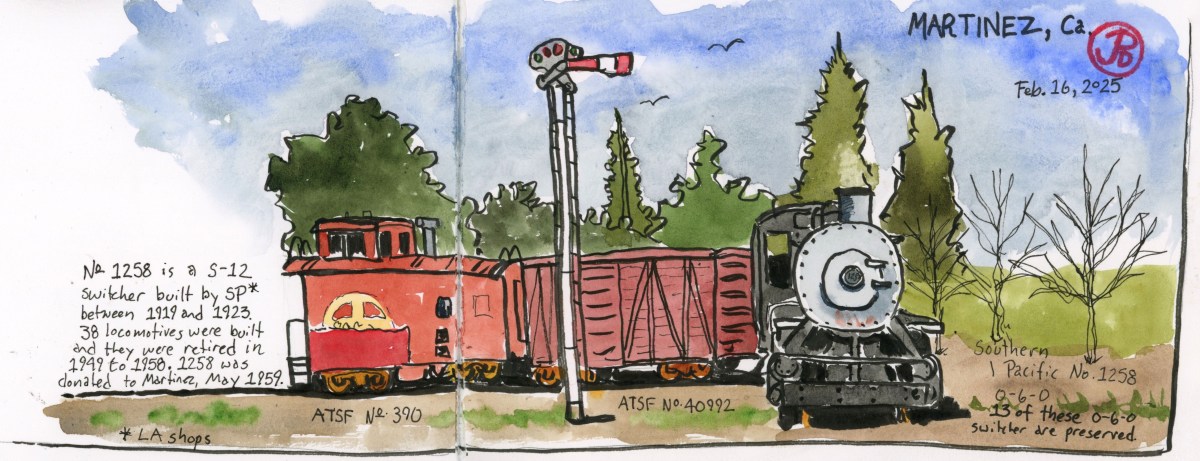
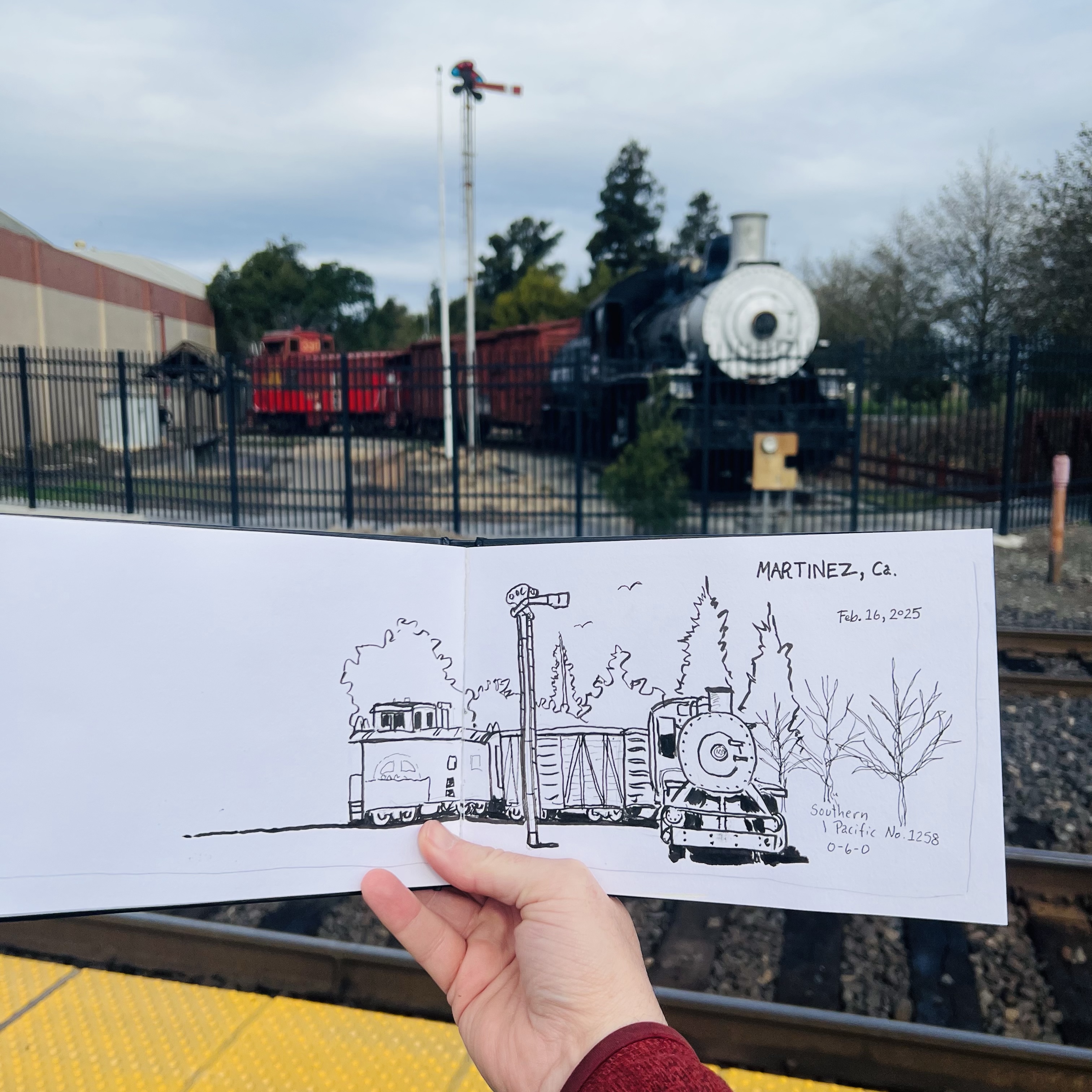
On my last visit I wanted to sketch the Southern Pacific locomotive, with its odd consist of Santa Fe cars, on static display across from the station but I didn’t get around to it. I wanted to add it to a spread on my next visit (featured sketch).

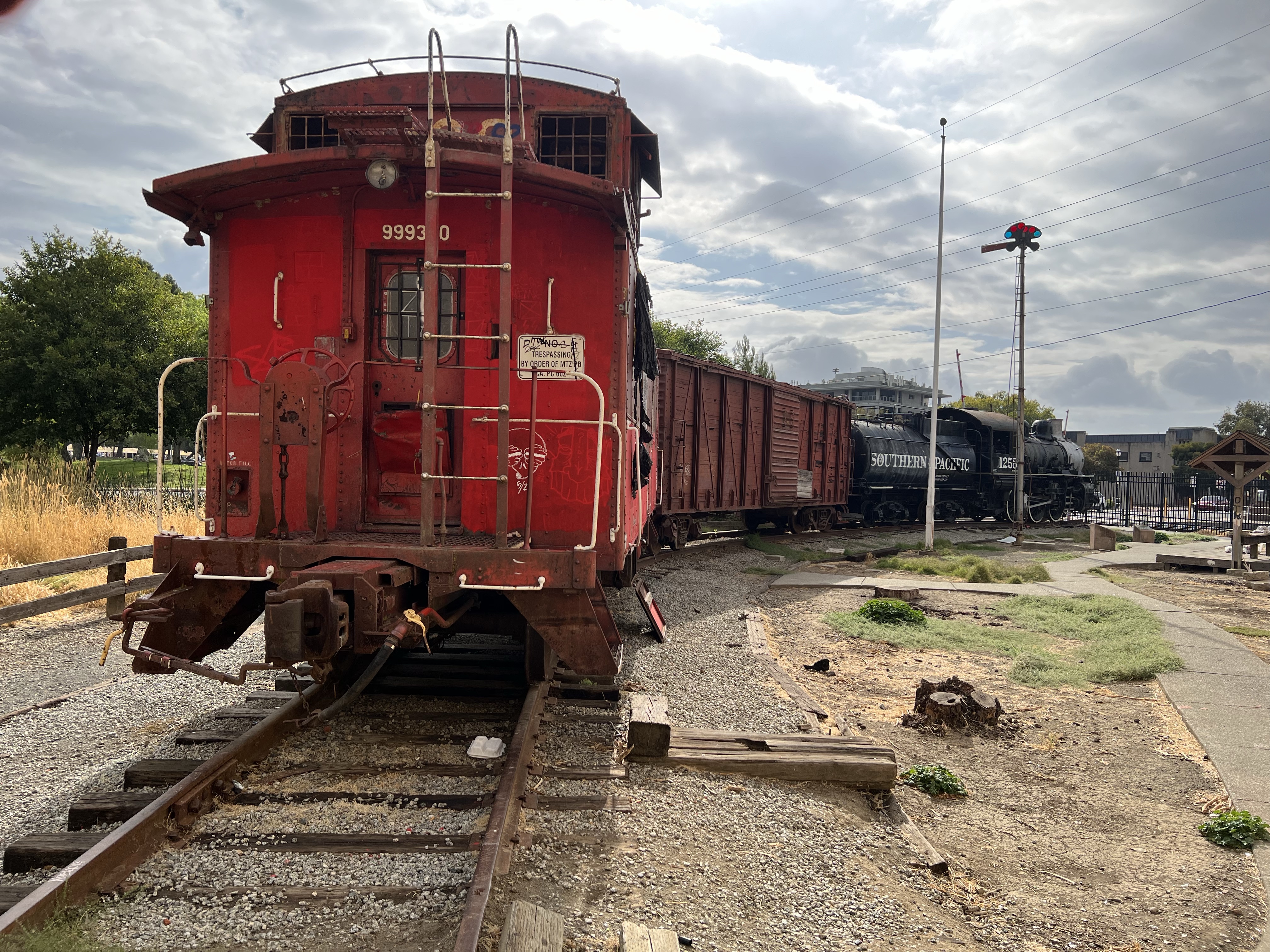
Southern Pacific No. 1258 is an S-12 switcher steam locomotive built at the SP shops in Los Angeles. 38 locomotives where built in this class and there are 13 0-6-0 SP switchers preserved, more than any type of Southern Pacific locomotive built.
Switchers are not sexy nor classy like the GS locomotives. There epitomize function over form. The real workhorses of the Southern Pacific freight yards.

After sketching 1258, I headed to the other side of town to sketch the house of Martinez’s most famous resident.

This resident is the writer and naturalist John Muir. He lived here among the fruit orchards with his wife and family.

Muir married into the Strentzel family in 1880. The Strentzels had been farming the land, mainly fruit ranching, since the 1850s. Muir lived here, except when he was off traveling, from 1880 until his death in 1914.

I knew I wanted to do a sketch of the 1882 Italianate house but I needed to find the right perspective.

The touchstone for my sketch was the not-so-giant sequoia that Muir planted years ago. The tree has failed to live up to its name in the Martinez climate.
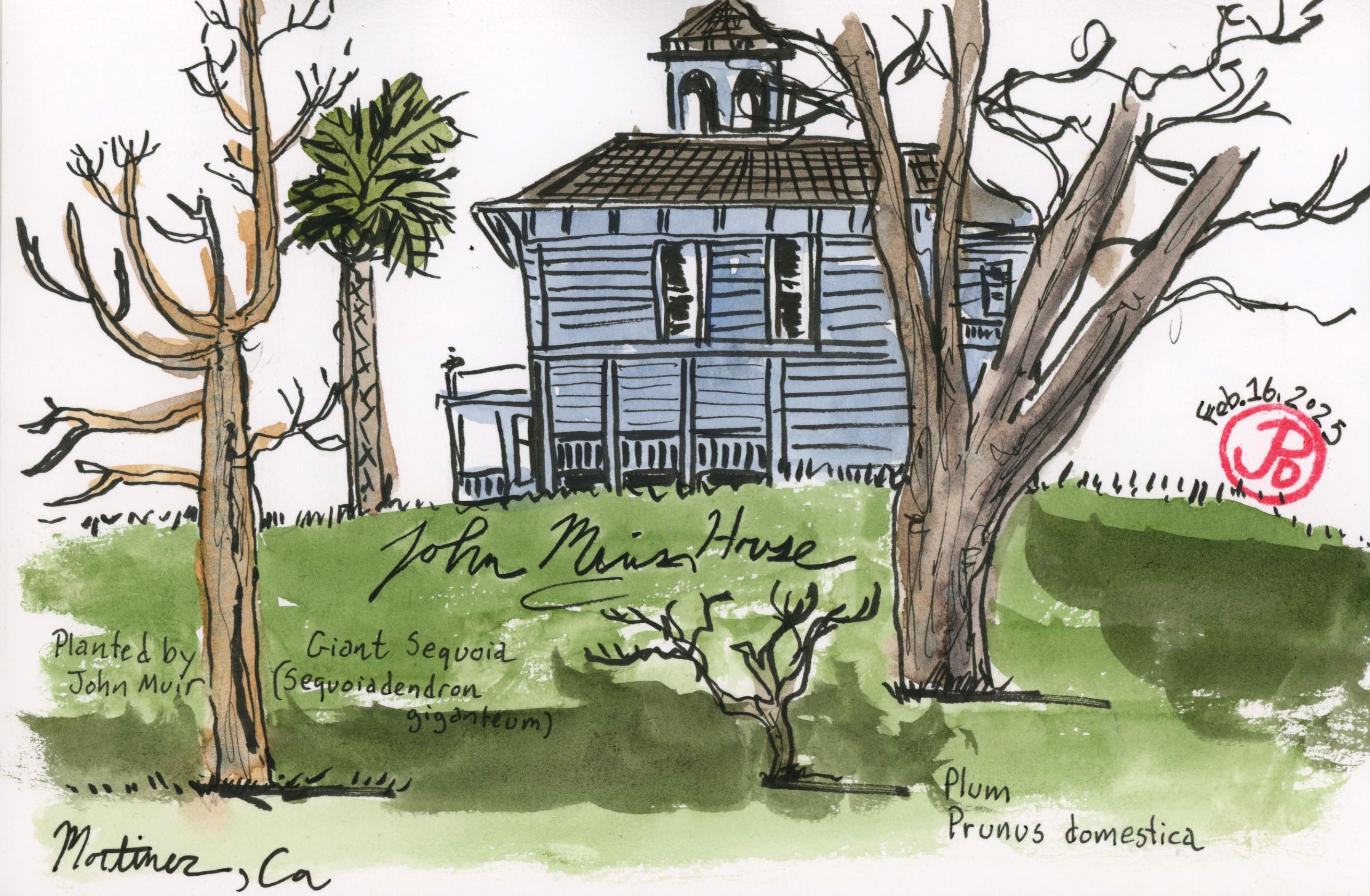
My Muir-sequoia-bench sketch.

I found a bench with the sequoia in the foreground and the Muir House in the background up the hill.
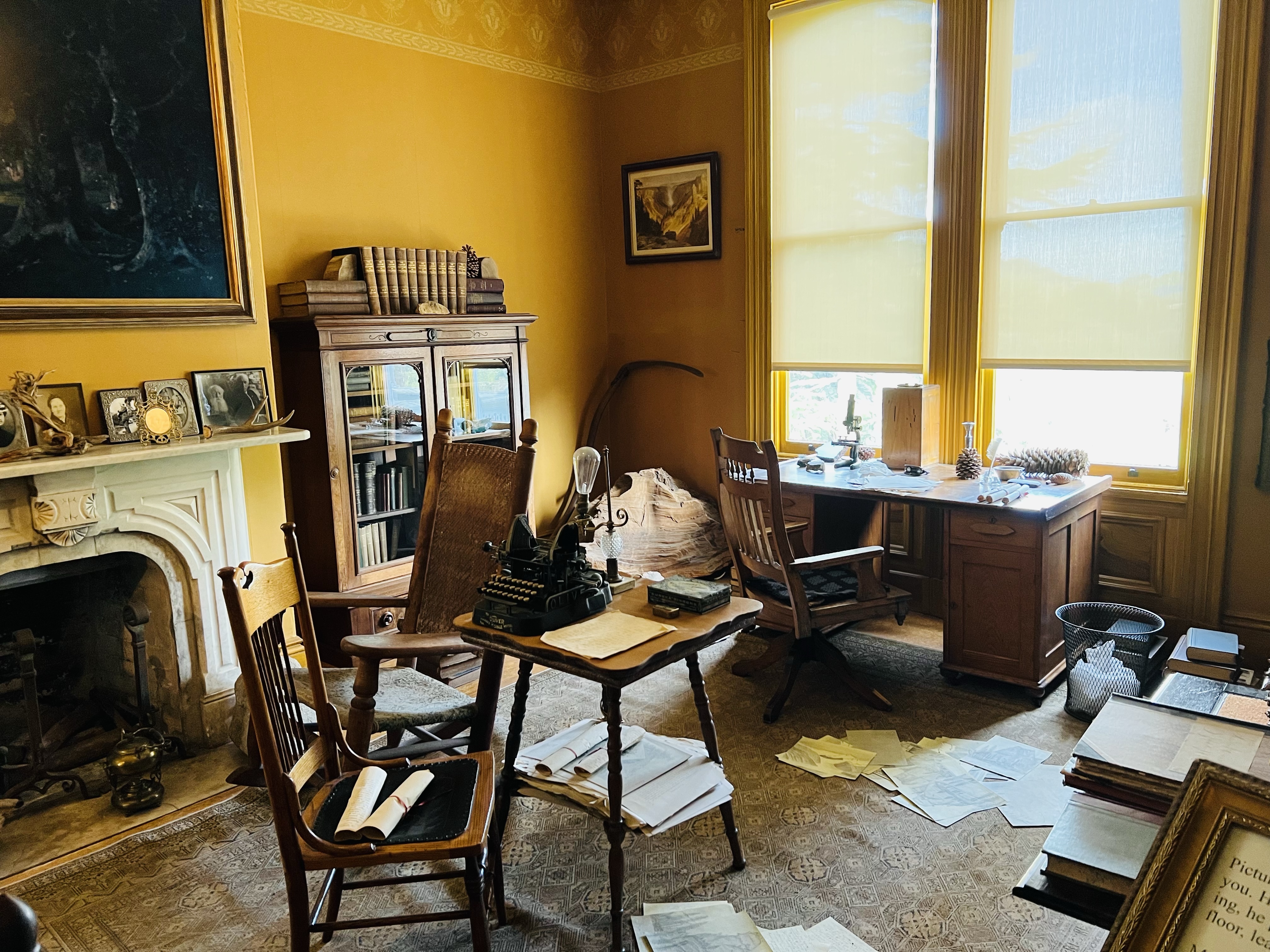
My favorite room in the Muir House. Muir’s “scribble den”.
Image

Muir Trestle, Martinez

I was meeting a friend in the East Bay city of Martinez and I had a little time to sketch before lunch.

Martinez is a hotbed of railroading with both the Union Pacific and BNSF passing through as well as some marquee passenger trains such as the Coast Starlight and the California Zephyr making stops at the Martinez AMTRAK station. And the Capitol Corridor commuter takes on passengers traveling north and south on shorter journeys.

The California Zephyr Train No. 6, at the old Southern Pacific Depot in Martinez. This train is heading east to Chicago. To the right in the background is SP switcher 1258 on static display.

There would certainly be something to sketch here and I was going to start with a historic train trestle.

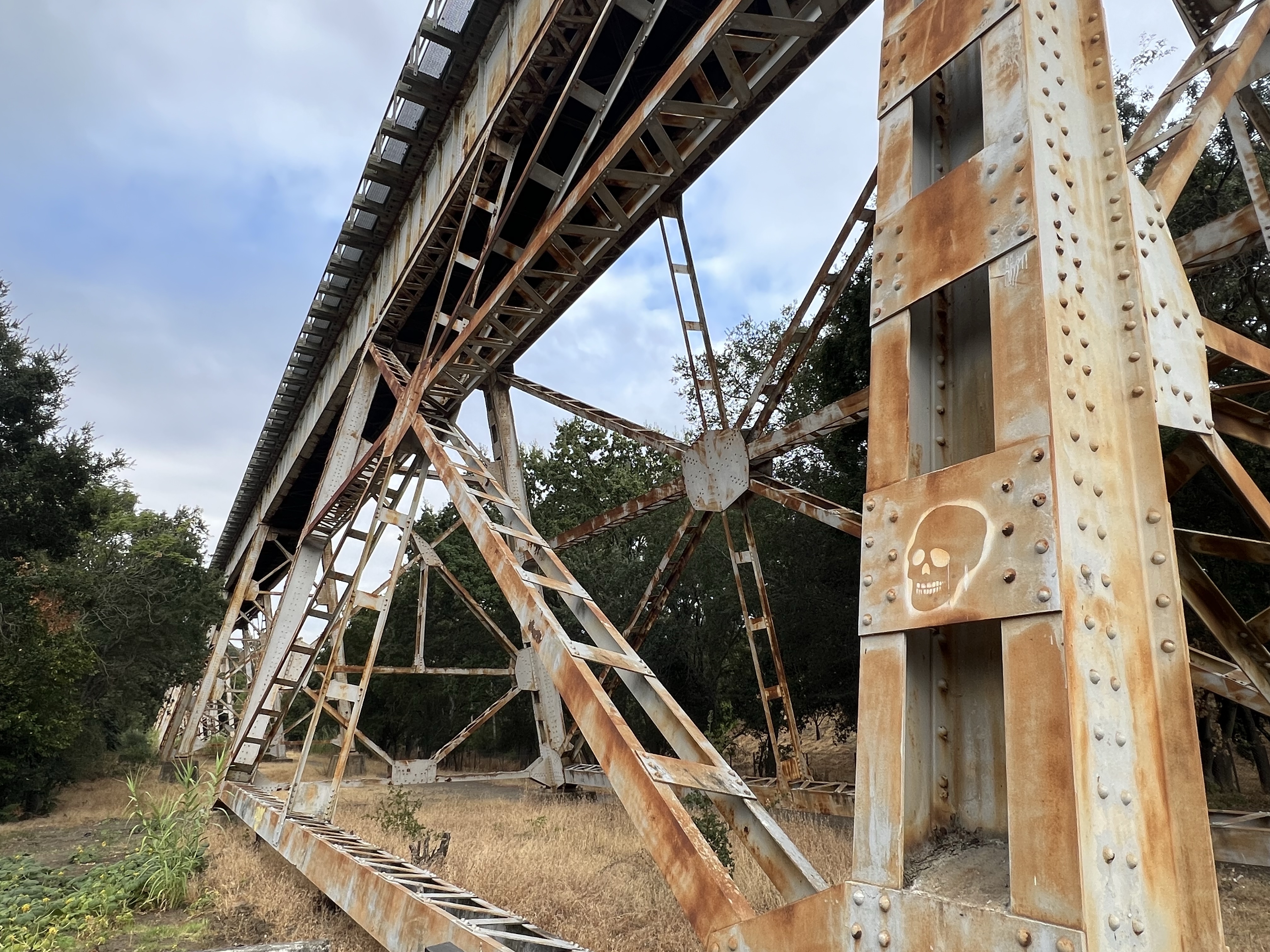
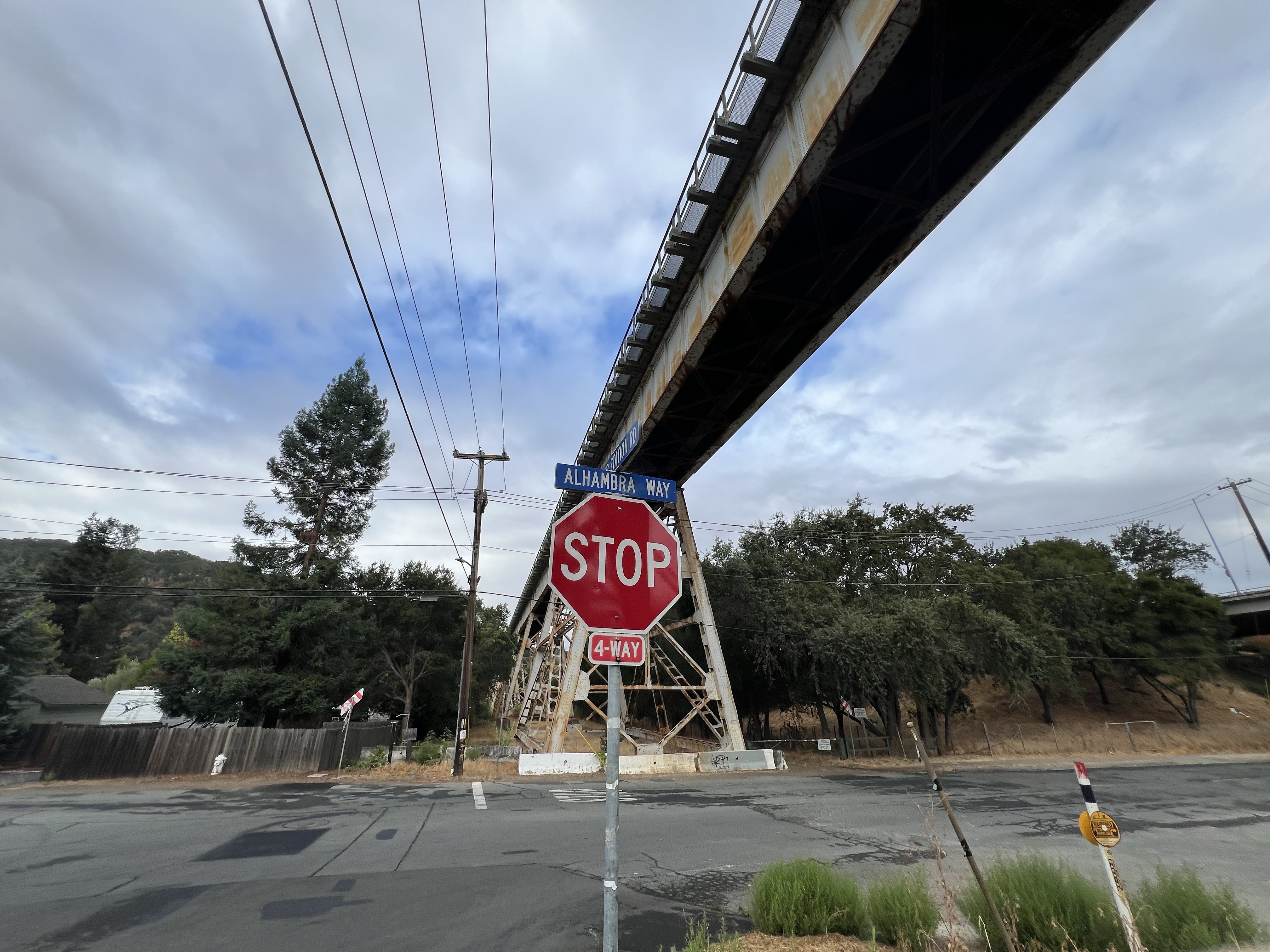
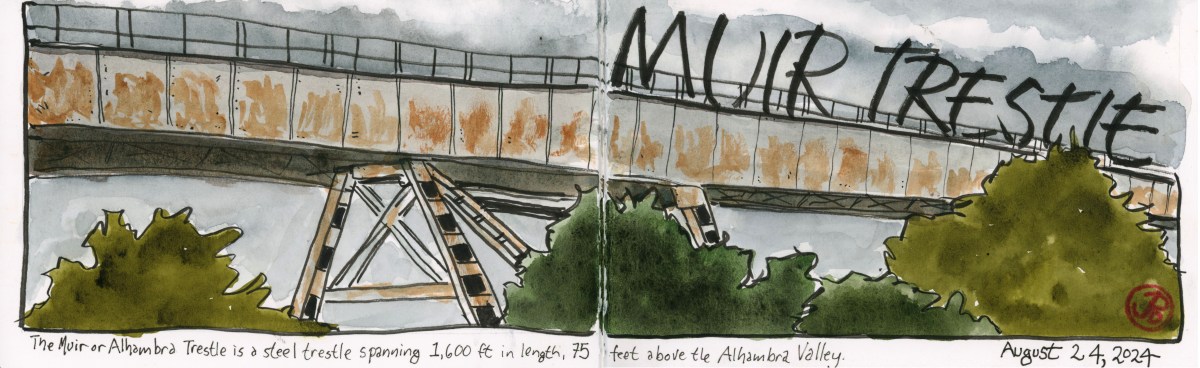
I parked at the Mount Walda Trailhead. Soaring above me was the 1,600 foot long steel Muir Trestle (aka the Alhambra Trestle). The single track trestle was so long that I could only see and sketch one section of it before it disappeared into the trees to the east. The trestle rises 75 feet above the roads, trees, and houses it crosses over.

A detailed view of the steel supports of the Muir Trestle.

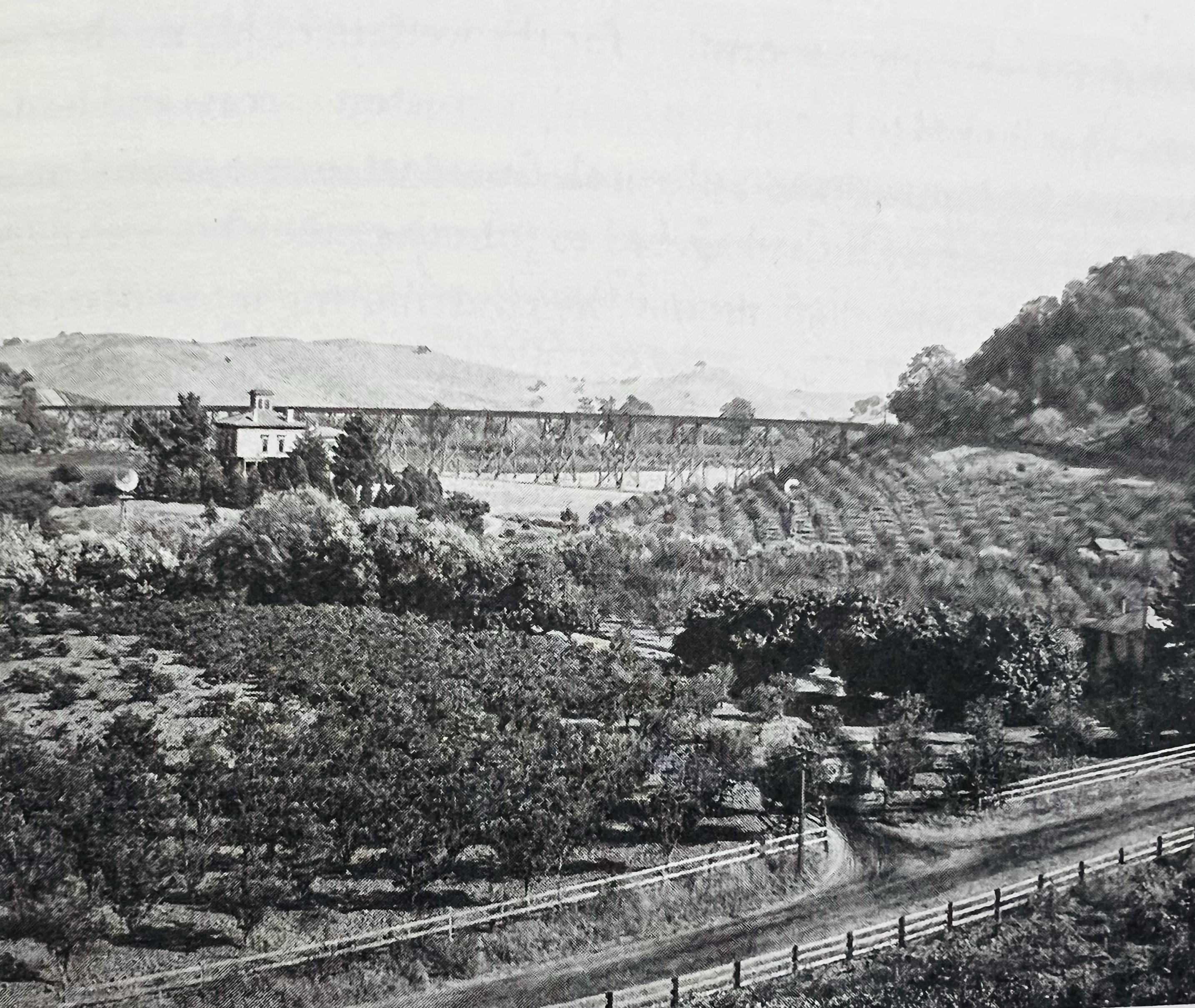
The trestle is within the John Muir National Historic Site. To the north is Muir’s Martinez home. Muir and his wife Wanda sold the land for the trestle for $10 and a lifetime rail pass to the San Francisco and San Joaquin Valley Railway. The original wooden trestle was built through a pear orchard and completed in 1897.

This is a historic photograph of the Stengel-Muir ranch in 1897. The Muir house is on the top left and the trestle is viable behind the house. At the time of the photograph, the trestle was constructed of wood.

At the eastern end of the trestle there was a passenger and freight station named Muir Station. The station is now long gone but is immortalized in a street that parallels the rails named Muir Station Road.

From this station Muir could ship his produce to Oakland or to the port in Martinez.

One of Muir’s neighbors in the Alhambra Valley was John Swett, Muir close friend. Swett was the State Superintendent of Public Education and is known as the “Father of California Public School”.

In 1898, Santa Fe purchased the line and it became their Valley Division. This division still exists as BNSF’s route from Richmond to Fresno.

The Muir Trestle from the intersection of Alhambra Way and Muir Station Road.

I took up a sketching position near the trailhead and started my drawing. The trestle above me is on the Stockton subdivision and is used by BNSF intermodal freight. There was no train crossing during my sketch.

SP 0-6-0 switcher No. 1258 and its consist of a wooden box card and Santa Fe caboose 390 on display across the tracks from the AMTRAK station. The locomotive is in sad shape, missing some hardware like her bell and whistle.
Image

Family: The Gift of Dippers

To collect myself in nature I headed to South Yuba State Park on the famous Buttermilk Bend Trail.

This trail parallels the South Yuba River and nature loafers come here on mass to in the spring see the wild flowers. The lupine where on show on this April weekday. The most prominent species was spider lupine (Lupninas benthamii).

The Buttermilk Bend Trail with it’s wildflower lined trail that parallels the South Yuba River.

I headed down the two mile, there-and-back trail, looking down at the river with it’s white water and I thought about one bird: American dipper. It was only a matter of time before I saw or heard one.

As I was about a mile in, I heard the joyous song of America’s only aquatic songbird, rising up from the river. A dipper was here and I looked for the closest trail down to the river.

At the riverside I spotted a tightly woven tangle constructed on a riverside boulder with a trail of white washed carpet at its entrance. It had the appearance of a sweat lodge than a nest.

A riverside dipper nest on the Yuba River.

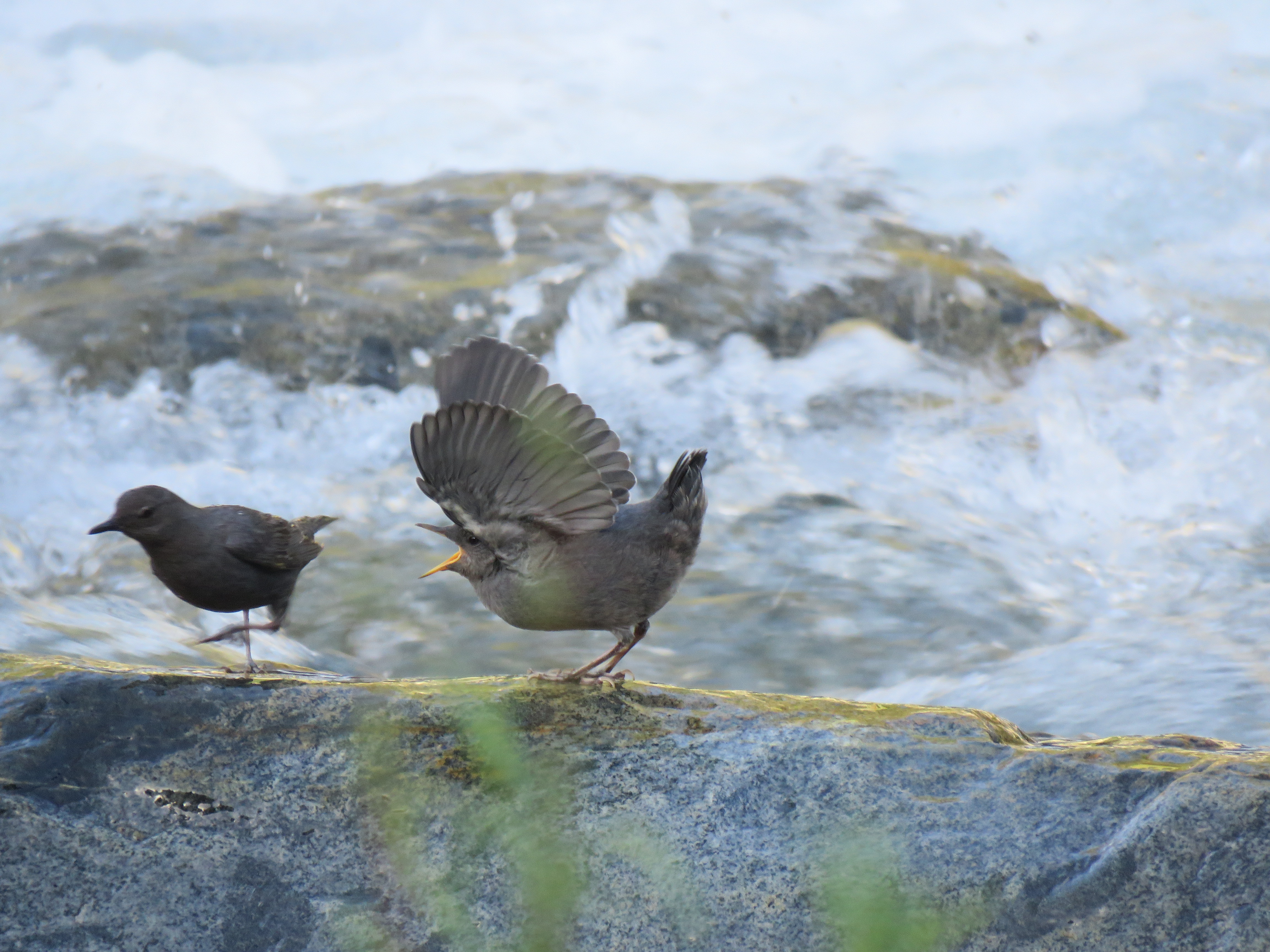
Within a few minutes an adult flew in to the nest and reappeared shortly after. This adult was perched on a rock directly across from the nest, dipping up and down. It’s song was loud enough to be heard above the roar of the rapids. Two juvenile birds flew in and followed the adult around as it foraged among the river rocks.

Not a dead-beat dad. A dipper with some food for it’s two fledglings.
This is how a juvenile dipper says, “FEED ME!”

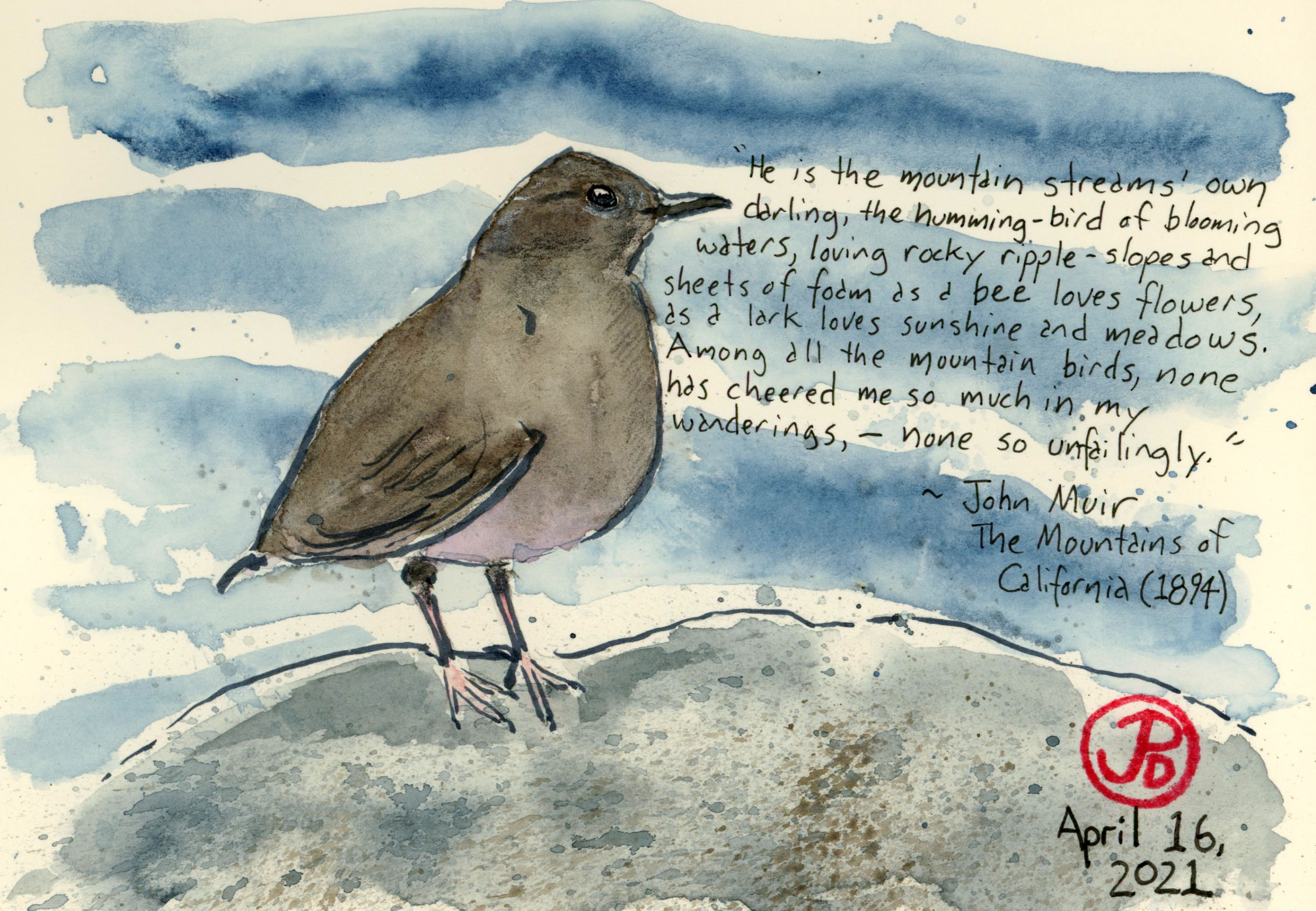
An indigo brush pen sketch of a bird that always puts a smile on my face (and I sure need that now). This is also my favorite quote about the dipper from John Muir.

Cabin Birds Part Two (Audubon’s Birthday)

“Spring work is going on with joyful enthusiasm.” —John Muir

“to live in this world
you must be able
to do three things
to love what is mortal;
to hold it
against your bones knowing
your own life depends on it;
and, when the time comes to let it go, to let it go”. -Mary Oliver

Spending two weeks during my Spring Break at my cabin in the Santa Cruz Mountains gave me the opportunity to slow down and notice the most important things in life. That is life itself. (A nod to you Mr. Ebert)

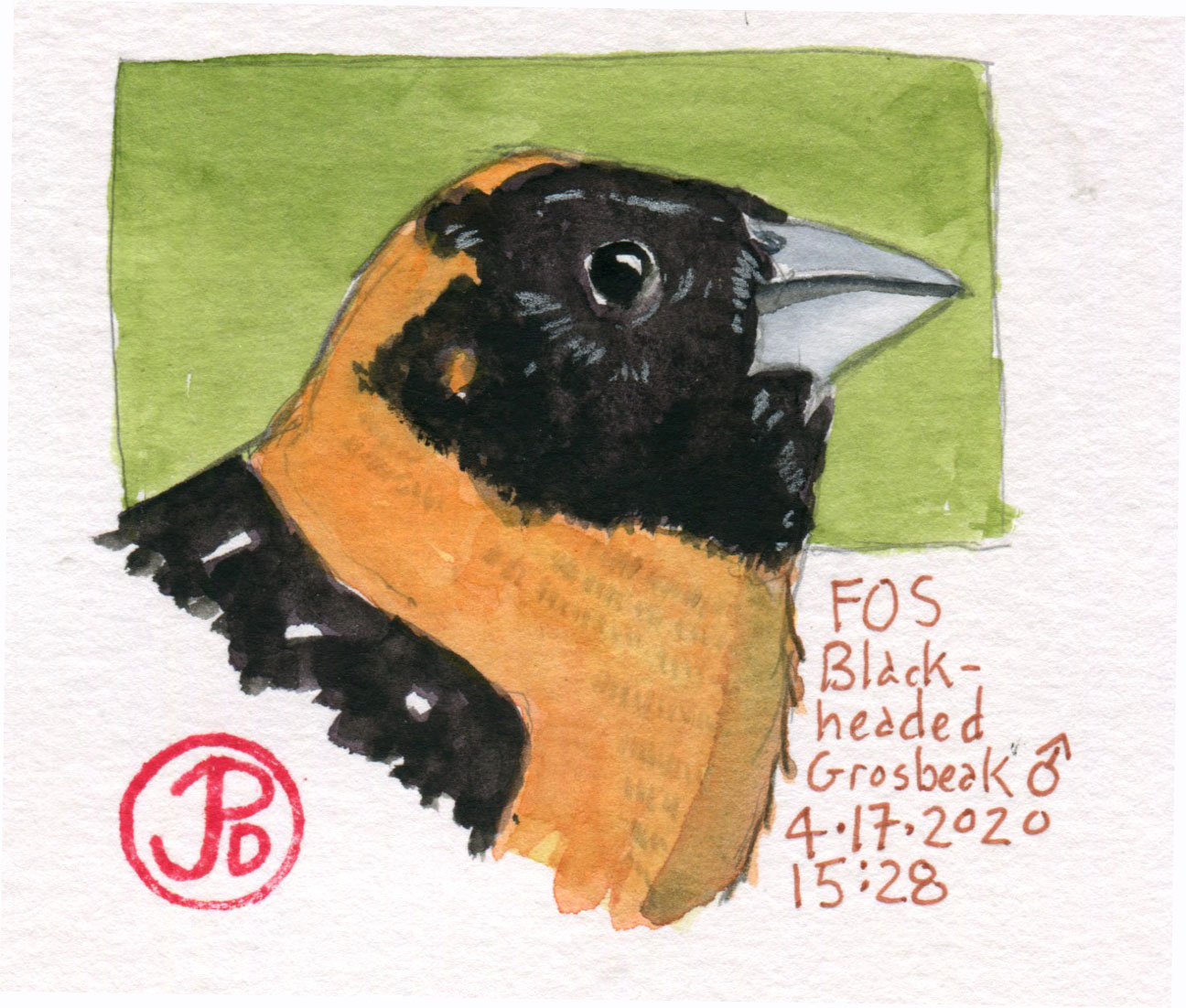
Birding just adds another layer to experience. It is a soundtrack that not many hear. To those aware, the signs of spring are everywhere. To the calls of the Pacific wren and dark-eyed junco to the sounds of the newly arrived neotropic migrants like Wilson’s warbler, Pacific-slope flycatcher, and black-headed grosbeak. The latter bird I heard on my last day at my cabin, when I heard a district “clip” contact call. I headed out to the deck to see this beautiful flash of orange, back, and white.

This was a First of Season (FOS) bird for me. The males arrive on their breeding grounds from Mexico just ahead of the females and the males proclaim their place in the world with their robin-like song. This has always been a favorite cabin bird and it arrives in mid April most years.

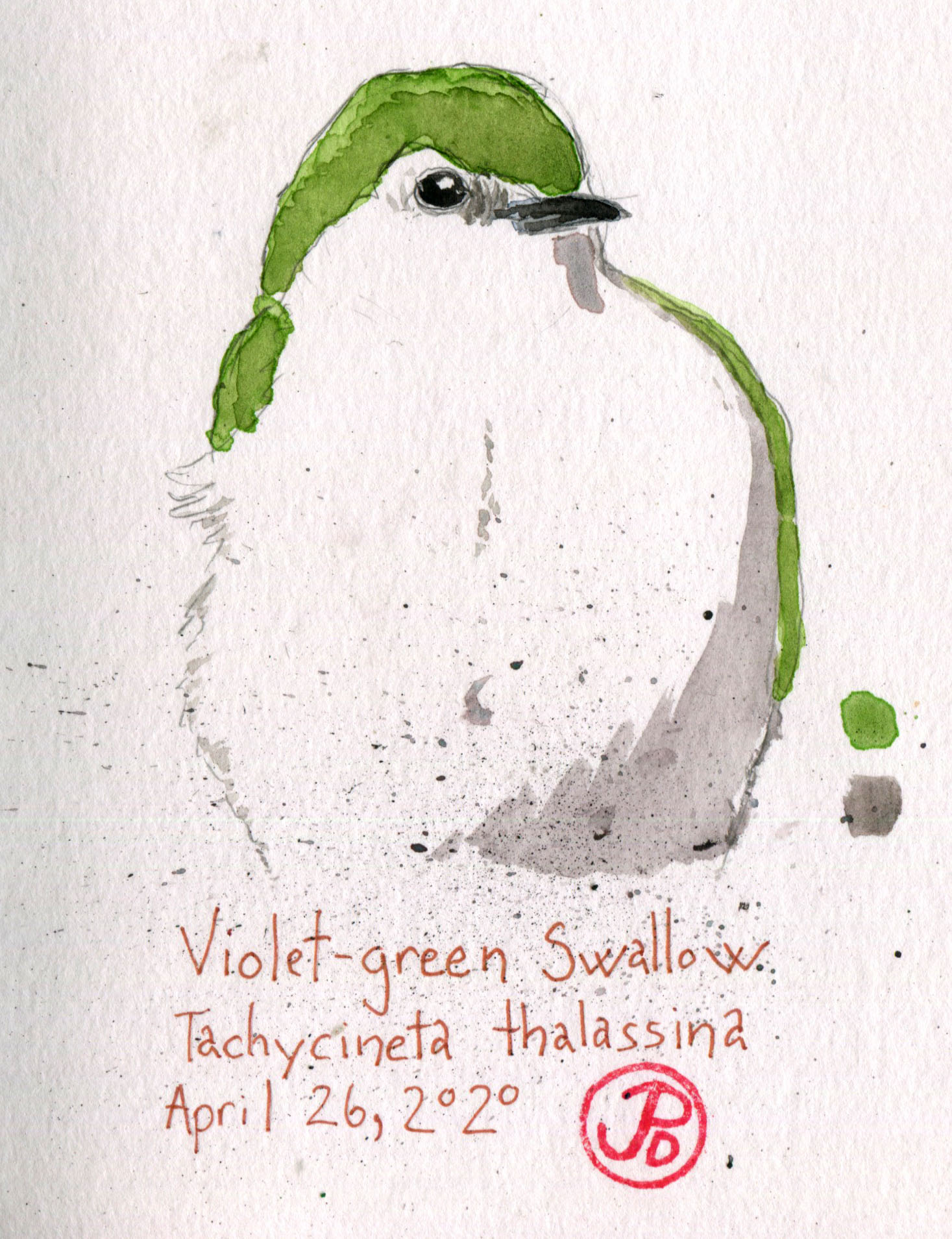
The sky above the San Lorenzo River is filled with newly arrived swallows at this time of year. The most common species are tree and violet-green swallows. Swallows are insectivores and are aerial acrobats that catch flying insects on the wing. Like the Swallows of San Juan Capistrano, swallows are a sign of renewed and the turning of the season from winter to spring.

The aerial insectivore, one of North America’s most beautiful swallow.

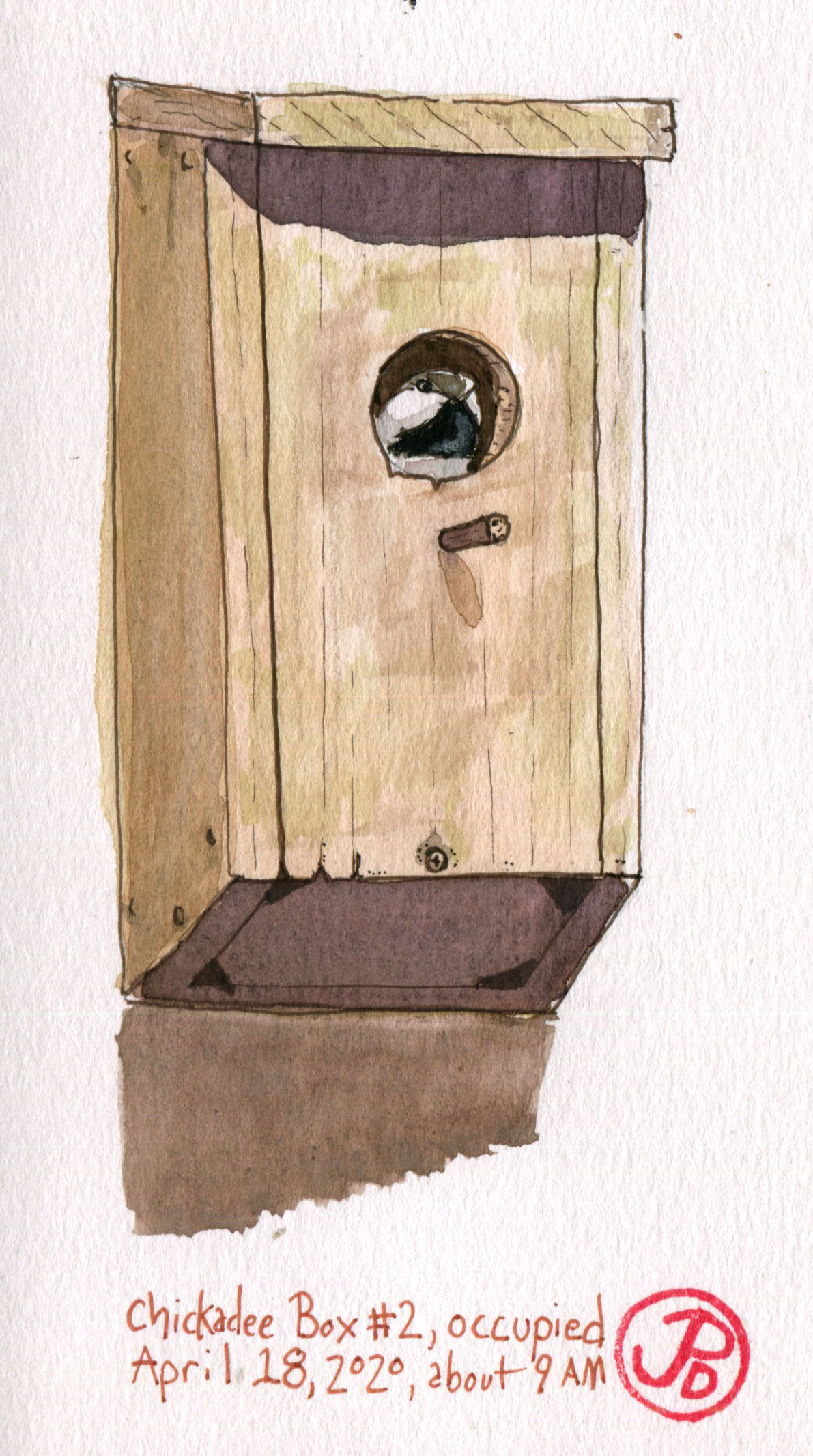
Just as I was packing up the car to return to San Fransisco, the natural world gave me a parting gift. I noticed that a pair of chestnut-backed chickadees were cleaning out one of the nesting boxes that I had built and hung on a redwood near the parking lot. This gives me such a sense of joy that I have played a small part in helping to create life.

The two weeks I spent in Paradise was a great was to slow down and really appreciate life.

Image

Me and a Dipper

I came down to the valley to sketch the monolith El Capitain but instead I stopped at the banks of the Merced River, Bridelveil Falls falling silencing across the valley and I sketched a dipper.

It says a lot about the American dipper that John Muir devoted an entire chapter of The Mountains of California to this small, drab bird. The water-ouzel, as the dipper was known then, rewards the observer with the amount of time put in by simply sitting down on the river bank and watching.

The dipper is seldom still, making sketching a challenging yet exhilarating experience. Just when you start one sketch you stop and restart because the dipper has disappeared under the river, appearing again, perched on a submerged rock, making the bird appear to be standing on water. And the dipper never just perches. Like it’s name implies, it it constantly dipping it’s body up and down.

As so I passed part of my morning in Yosemite Valley, with my back facing the largest chunk of granite in the world but my eyes focused on one of the most captivating creatures to be found in any National Park: the American dipper.

And as Muir wrote about the dipper, “Among all the mountain birds, none has cheered me so much in my lonely wanderings, -none so unfailingly.” And I couldn’t agree with John Muir more.


Image

Lifer #504

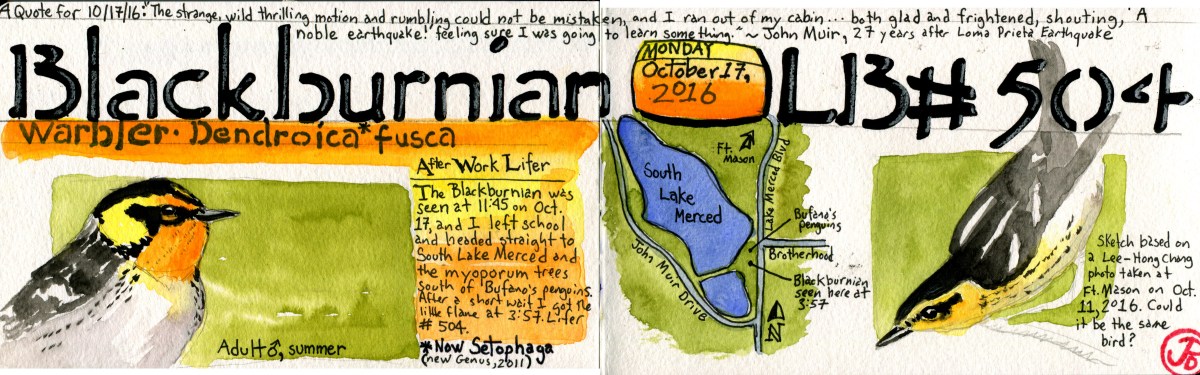
The Blackburnian warbler had been seen on October 11th in Ft. Mason just before the rainy weekend and I didn’t get a chance to add it to my North American list. I assumed the storm would have washed the bird out of the city and I didn’t see any postings of a continuing Blackburnian so I didn’t venture out during one of the rain windows.

It appears that the storm didn’t wash the warbler out of the city limits completely. A Blackburnian, very similar in appearance to the Ft. Mason young male, was found at 11:45, Monday morning at South Lake Merced, within a few wing beats of the San Francisco/ Daly City border. And just south of the Bufano penguin sculpture, very near where I had a black and white warbler in October of 2012.  Now if the warbler could satisfy itself in the trees of South Lake Merced and stay around for another few hours, I might have an after work lifer.

And so it was that I found myself, a little bit before 4 o’clock, in front of some myoporum trees full of  yellow rumped warblers and cedar waxwings, scanning the green for a flashing flame. A local birder had just seen the bird and now it was just about patience. The patience paid off as the Blackburnian appeared at eye-level, right in front of me at 3:57!

The Sketch

I started this spread with the lettering: Blackburnian LB# 504. To create the lettering I used a Parchment 1” plastic stencil and a black Faber-Castell PITT big brush pen. The anchor for the spread is the adult male warbler in the lower left. This sketch was started with pencil and then layered in watercolor. I intentionally avoided using pen, instead attempting to define and contain shapes with brush work with a Winsor & Newton Series 7  number 3 brush. This is not the warbler that I saw but I think sketching a bird at it’s absolute apex (male breeding plumage), I am able to understand and internalize the bird’s appearance. The breeding male’s foil is a loose, Chinese brush style, fall male, based on a photograph of the bird that first seen on October 11 at Ft. Mason. The overall color scheme of the sketch of black, white, and yellow-orange is dictated by the breeding male’s plumage.

Coda

I saw this life bird on October 17, the  27th anniversary of the Loma Prieta Earthquake that rocked the Bay Area, which I experienced when I was a senior in high school. To crown this sketch I included a quote by John Muir that I re-read in the book I am currently reading, Landmarks by Robert Mac Farlane. Muir wrote:

The strange, wild thrilling motion and rumbling could not be mistaken, and I ran out of my cabin, near Sentinel Rock, both glad and frightened, shouting, ‘A noble earthquake!’ feeling sure I was going to learn something.