Image

Bird Dunes

On Sunday morning I headed to Watsonville, to worship at the Alter of Shorebird known as Pajaro Dunes.

Yes I know that June us not exactly shorebird central on the Central Coast but I had two shorebirds on my Santa Cruz County wishlist: American avocet, and black-necked stilt.

Pajaro Dunes is a coastal vacation community built on and over the Monterey Bay dunes. No doubt that this development has affected the original residents of these dunes and tidal flats: shorebirds. Their habitat here has been compromised, restricted, and expunged. That is one reason that birders are allowed access to this private community.

I do have a disclaimer: my family has spent much time at Pajaro Dunes when I was a kid. Once a year we rented a house at Pajaro with our neighbors on Cormorant Court. (Pajaro is the Spanish word for bird.) I somehow think that spending time here, as a child, made me appreciate this place and being a noticer, I noticed the natural world that was thriving here. I remember digging for sand crabs and catching lizards. And the brown pelicans that hugged the coast raised my eyes skywards.

On this Sunday morning, after checking in at the gatehouse, I kept my eyes towards the water channel, which was to my left. The tide was in, so water was much deeper, which would not be attractive to both avocet and stilt.

I headed to the bay where the Pajaro River becomes brackish. There where a large group of white pelicans, foraging in a raft and many double-crested cormorants drying their feathers. On the beach was a large flock of gulls, including about 40 Heerman’s gulls, one of the world’s most beautiful gulls, in my opinion.

The beautiful Heerman’s gull a Pajaro Dunes. The white-headed gulls are adults while gray-headed birds are juveniles. These gulls are newly arrived from Mexico or points south.

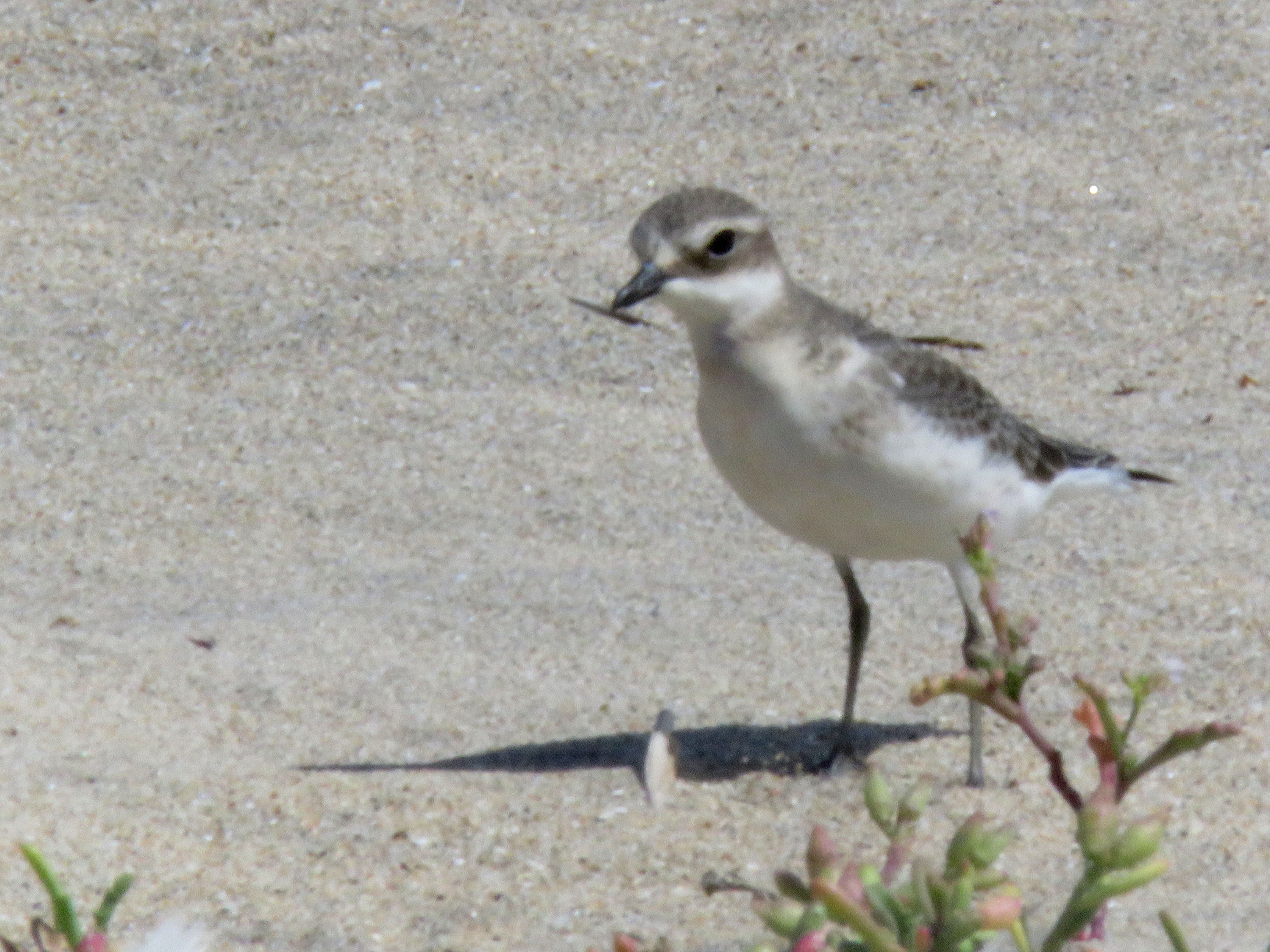
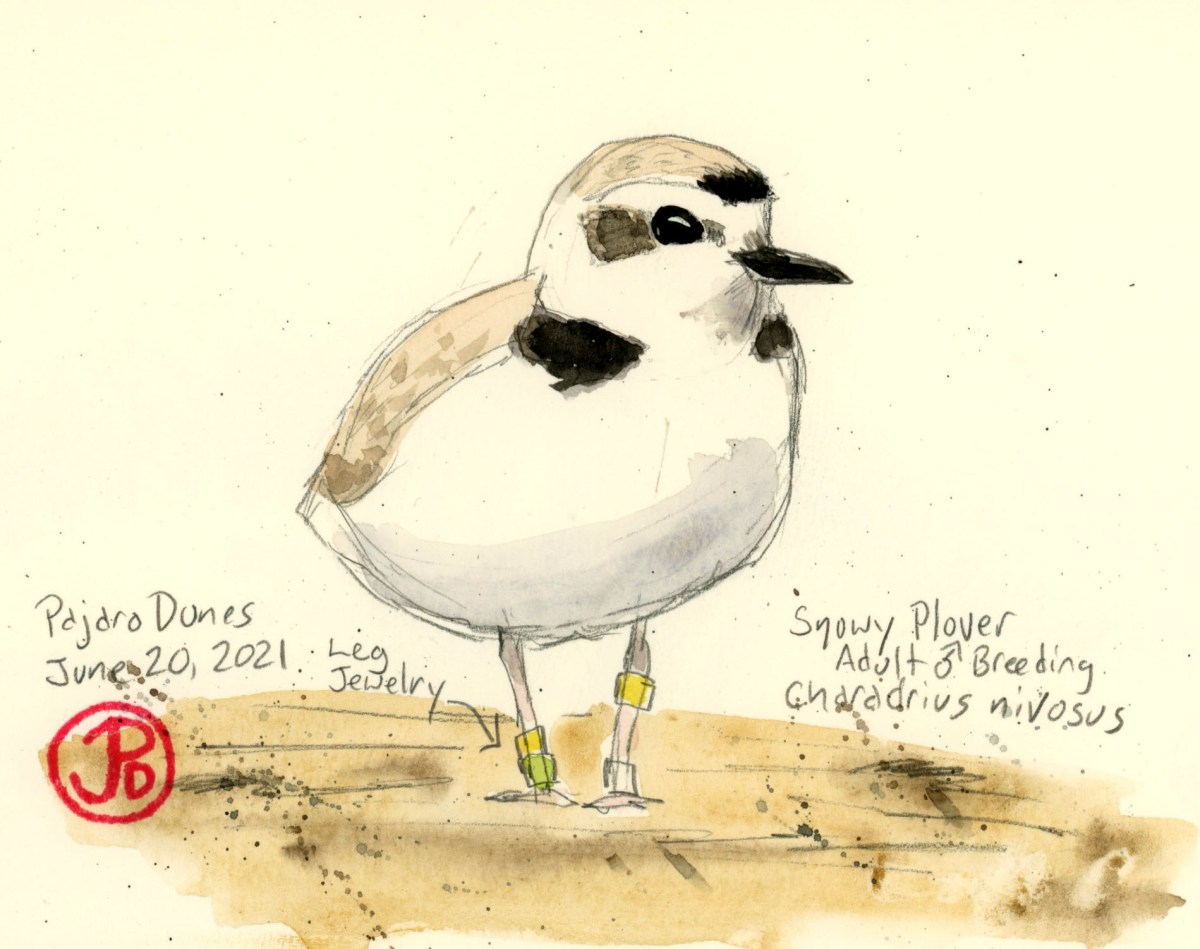
Since I was here last, a fence had been installed around the dunes to protect the breeding habitat of the threatened snowy plover. I have seen snowies here before in the winter where but they where not wearing the black headband and black epaulets of their breeding plumage. Some of the plovers were wearing colored bands on both feet so biologists can identify individual plovers in the field.

A child created sign on the fence placed around snowy plover habitat. Judging by the drawing and the capitalization (or lack of it) I would say it was done by a 3rd grader. It is funny that children draw the head like a separate circle plopped on the body when in reality there is usually a smooth transition from head to body. Sadly, most adults would draw birds in the same way because around this time, nine to tens years old, most realize that their drawing no longer captures realty and their artist development stops at that age.

I did see three snowy plovers. One was running circles around me looking like a windup toy dune-runner. This male was sporting jewelry in the form of four leg bracelets, known as bands in America or rings in Britain. I incorporated the bands in my plover drawing.

It was good to see the plovers on their breeding territory but I did note that there was a woman with her off lead dog that was crossing the fence line. She needed to read and internalize the 3rd graders’ message: “Please Stay away from The BiRDS.” Dog and dog owners vs snowy plover have been an on going conflict on beaches on the west coast where these plovers breed. They nest on the ground, making them vulnerable to walkers and dogs. For all of those whole claim to be “animal lovers” lets not forget about animals that don’t wear a collar, respond to their “given” name, and who are flying free. (I’m starting to sound like the Lorax here!)

I headed back towards the exit gate and I looked to the water channel, which was now to my right. I passed Avocet Circle (no avocets). As I passed the tennis courts and sports field, near Willet Circle, I spotted the undeniable form of a black-necked stilt, foraging on the the far bank. Santa Cruz County life bird!

Black-necked stilt.
Image

Waddell Beach: Black Scoters and an Elephant Seal

I had a nice Santa Cruz County After-Work-Lifer (AWL) as I just crossed into Santa Cruz County on Highway 1.

A pair of black scoters had been reported just north from the dirt parking lot at Waddell Beach.

Three scoters are found on the California Coast in winter: surf, white-winged, and black. The most numerous is the the surf scoter. There were about fifty (probably many more) riding the waves or diving under them, off the sands of Waddell Beach.

Black scoter is the least common off the Santa Cruz County coast. Luckily for birders, it is the easiest to identify. Both the male and female are distinctive. The black has a rounded head where as the surf and white-winged scoter have a flatten head as if they were hit on the head with a frying pan!

The male black scoter, like it’s name implies, is all black. It’s head is rounded and it’s orange “golf ball” at the bases of it’s bill is a beacon that yells out, “Black Scoter!!”
The female also has a rounded head and a dark cap that contrasts with a lighter checks and neck.

I returned to Waddell Beach on Saturday morning to look through the gull flock at the Waddell Creekmouth. I was hopping to see a kittiwake or the rare lesser black-backed gull that had recently been reported. I saw neither.

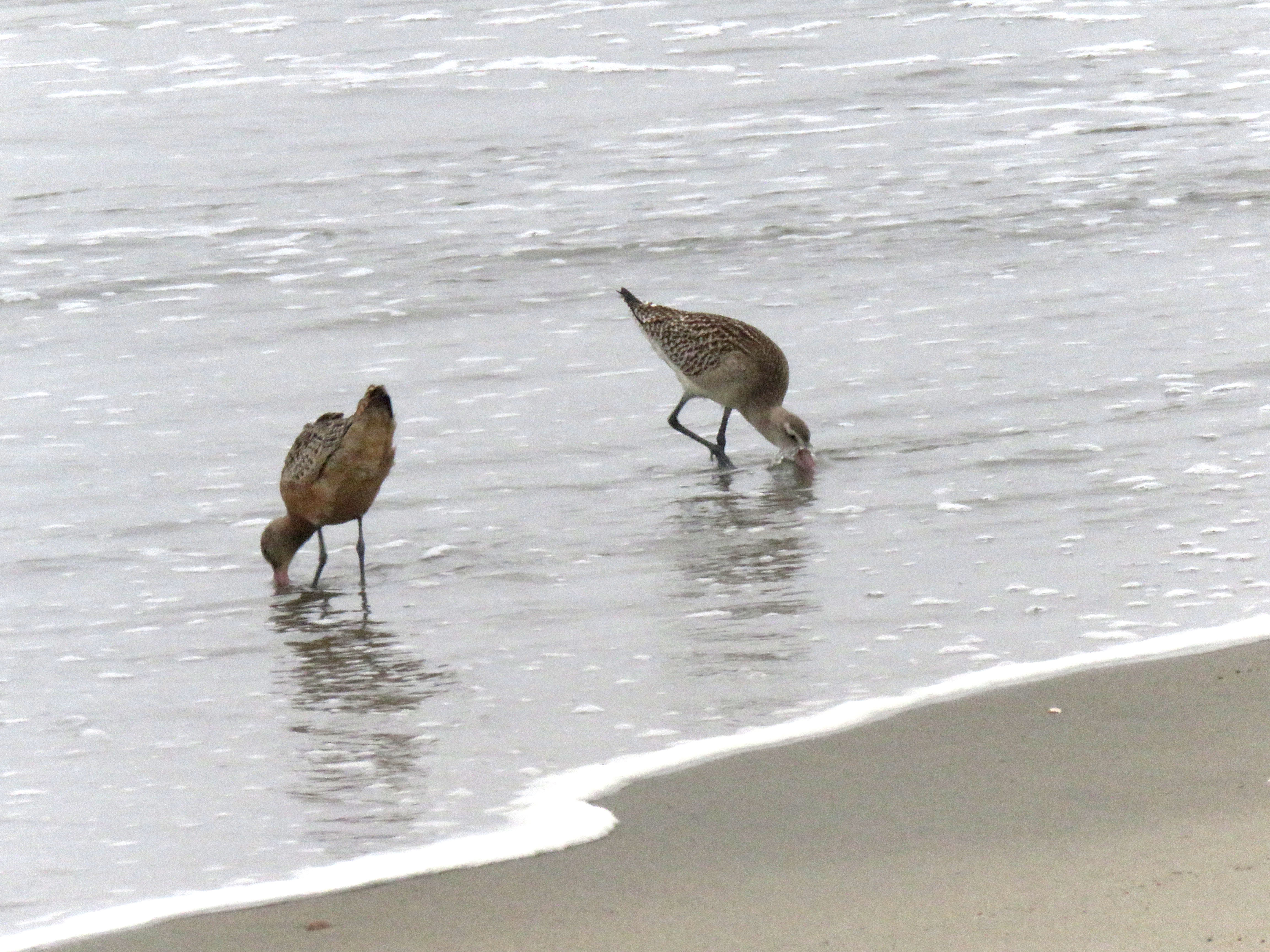
What I did find, foraging in the near shore of Waddell Creek, was a long-billed dowitcher. Turns out that this is a new county shorebird for my list!I always love these shorts of birding surprises!

I did want to look for the black scoters again and try to get a few photos of the continuing sea ducks in good morning light. They obliged as the rode the tide about 40 yards from the parking lot. I was able to photograph the two together and separately as they associated with the surf scoters.

On Sunday morning, I headed back to Waddell Beach. The creek provides a large public gull bath along the coast and this area has produced much sought after gulls as black-legged kittiwake, glaucous gull, Bonaparte’s and, just once, an adult lesser black-backed gull! Gulls congregate here to wash in the fresh water and you are more likely to see a larger number of gulls at this early hour before the beach crowds arrive.

On Sunday morning all I recorded was California, western, mew, herring, and four Heerman’s gulls. Nothing too out of the ordinary. It did give me practice at sorting through gulls which can be notoriously tough to identify.

On my way back to the parking lot I refound the two black scoters in even better morning light. The two photos included in this post were taken on Sunday morning.

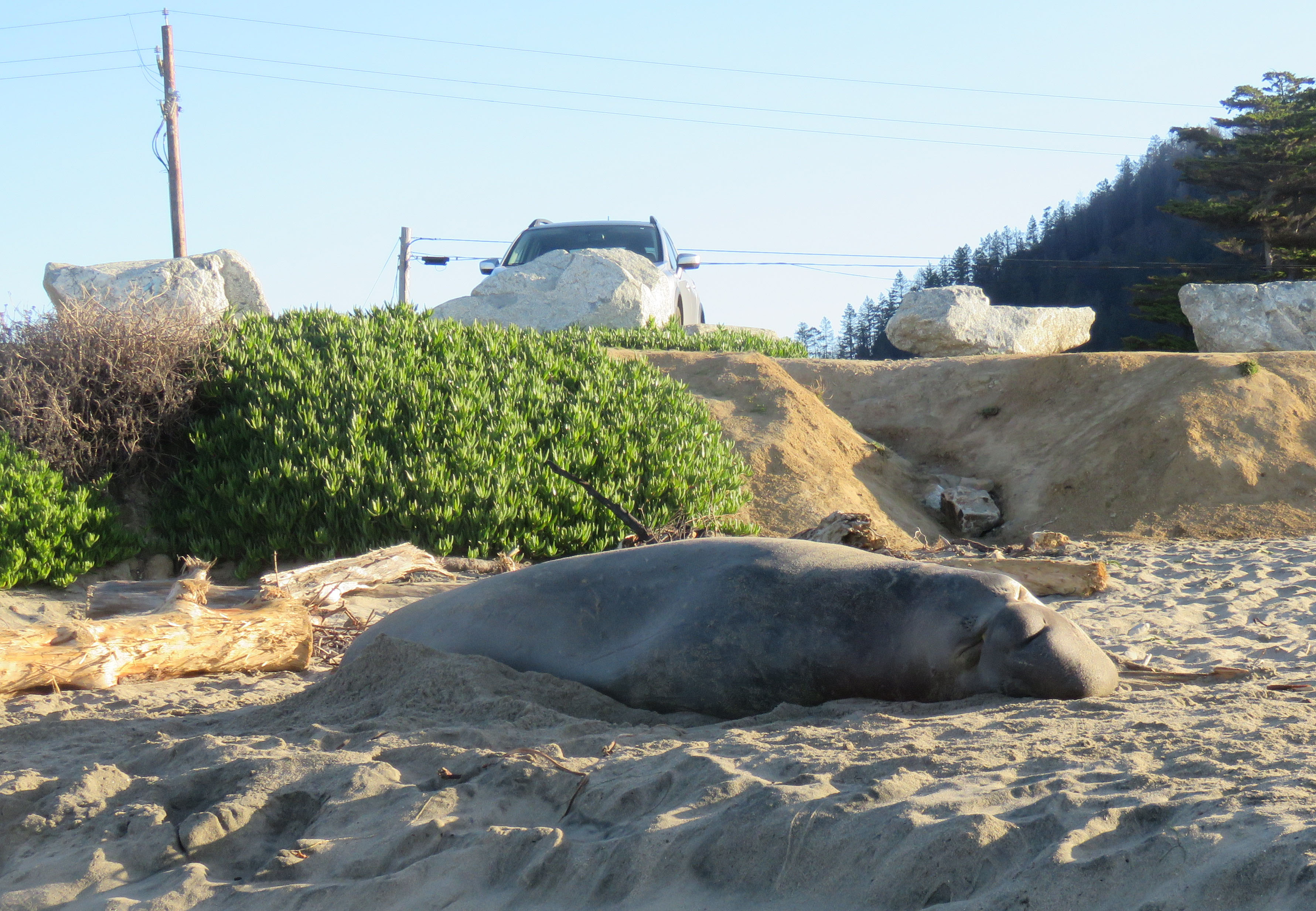
When I returned to my car I looked down at the beach and about 20 feet away was large 12 to 15 foot bull elephant seal resting on the sands. How had I missed such a large beast?

I had come here to see a county life bird. Instead I found a county life pinniped!

The view from the parking lot. Seems so hard to miss.
Here is my car to provide some scale.
This young male northern elephant seal looks like he has been in a few scuffles by the number of scars on his body. He is defiantly the beach master of this beach.
Image

Meder Canyon

With my inward focus on county lifers I begin to realize that I had many common and uncommon species on my life list that now became new targets for the county.

In Santa Cruz County I had five species of owls: great horned, barn, burrowing, short-eared, and saw-whet. I had two more that I had not yet heard in the county, when owling, hearing is believing. These are the western screech-owl and northern pygmy-owl.

As day turned to dark, I headed to the slopes of the Santa Cruz Mountains near Corralitos. Owling is a new kind of birding madness that makes one wake up at an ungodly hour or head up into the hills on one lane, windy roads in the darkening night. My destination was Hazel Dell Road, a productive owling road in the county.

I stopped at the intersection of Hazel Dell and Mt. Madonna Road and got out to listen of my target owling. I heard nothing except for the din of frogs just down the road. I struck out on both species.

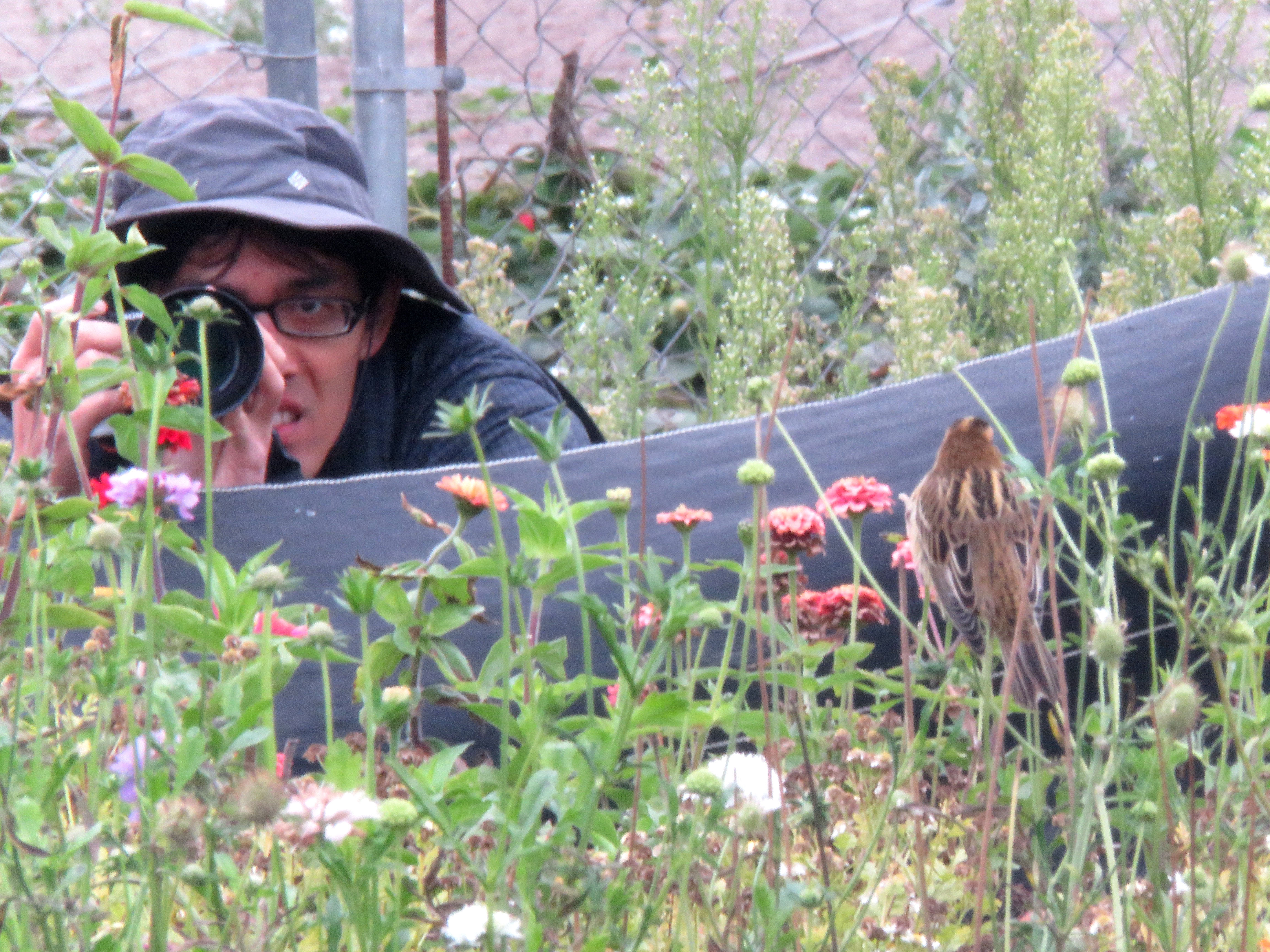
Seeing a recent online birding post, I was reminded that I did not have white-throated sparrow in county. So on a Sunday morning, I headed out early to looking for this beautiful but uncommon Santa Cruz County sparrow.

I headed up Meder Canyon and turned right into the side canyon. This spot reliably produces California thrashers, except for today. I did hear the cat-like “mew” of a blue-gray gnatcatcher. I climbed up the slope to get a better vantage point to see the gnatcatcher and that’s when I first heard the northern-pygmy-owl!

If the toot-toot call of a saw-whet sounds like a owl on too much coffee, then the northern pygmy-owl has had too much NyQuil. I could clearly hear the slow toot-toot call coming from across the canyon. It was just 8AM.

It may sound odd that a nocturnal predator like an owl would be active in the day but northern pygmy-owl is noted for it’s daytime dalliances. According to David Sibley in his Sibley Guide to Birds, pygmy-owls are “active in daylight” and it’s song is “often heard during the day”.

I headed back down slope and to try to locate the owl. It sounded like the owl was calling from brush or trees further up slope. After about two minutes, the pygmy-owl stopped calling and I was unable to locate it. It was a great encounter anyway.

Now it was time for my next target bird, white-crowned sparrow. I returned to the main canyon and headed up to a location were the sparrow had been recently seen.

It was a warm morning and it had a feeling of a spring morning and I was surrounded by the calls of birds: Steller’s and scrub jays, wrentits, yellow-rumped warblers, a Bewick’s wren, a pair of oak titmice, and a northern flicker.

As I neared the end of the trail at Meder Street and University Terrace Park I stopped at the “bird feeder” house. The back of this house faces the trail and the owners put out seed and suet on the upper balcony. There were some juncos and an acorn woodpecker feeding at the feeder when walked up.

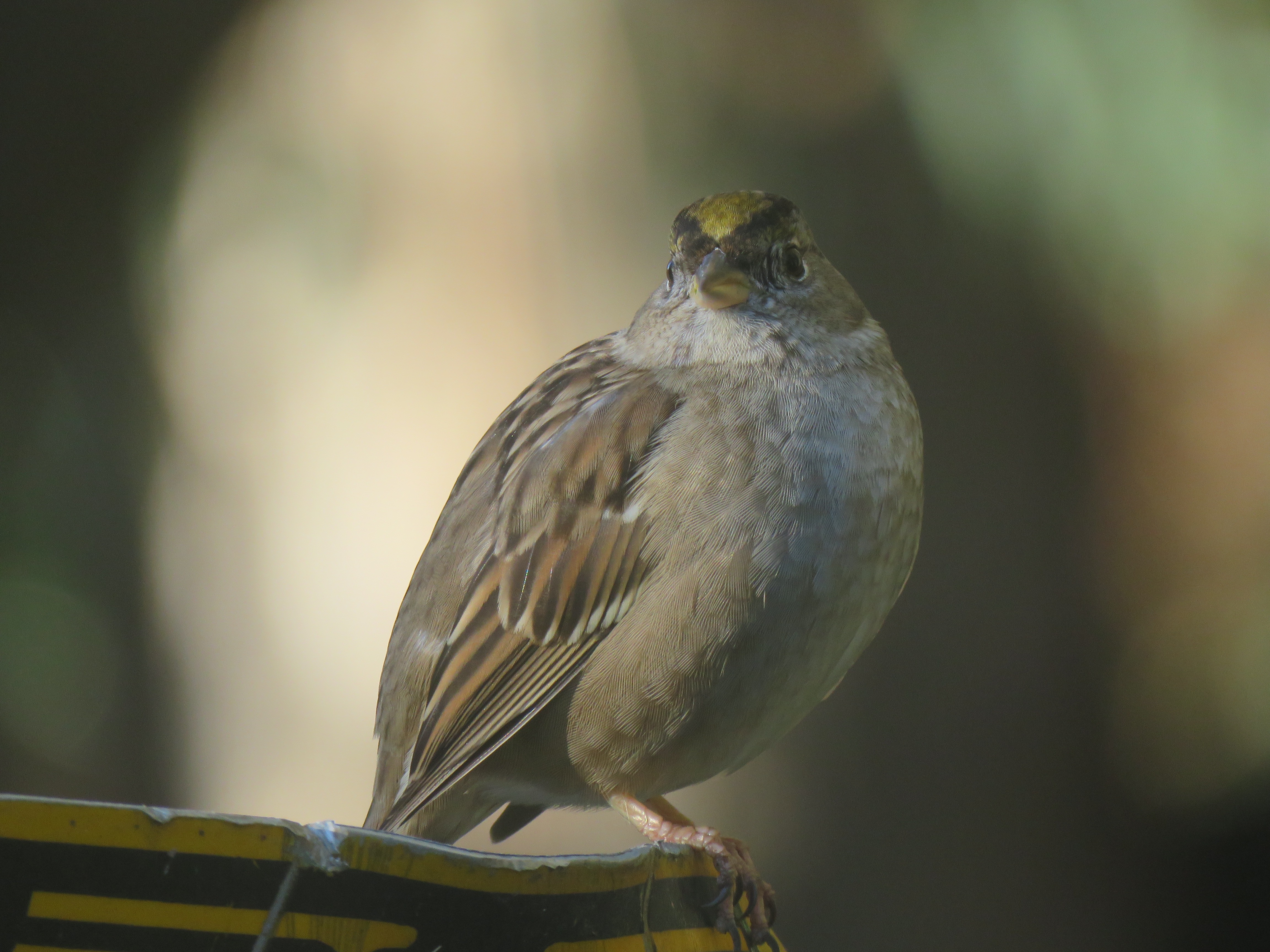
On the right side of the trail was a golden-crowned sparrow perched on a sign. This was a good sign. I was hoping the white-throated was loosely associating with other sparrows.

Golden-crowned sparrow.

I saw a sparrow fly into the eucalyptus about ten feet high. I tried to get a better vantage point. I got bins on the bird: white suplercilium, yellow lores, and the the distinctive white throat! A new county lifer: white-throated sparrow.

White-crowned sparrow singing in the eucs.
Image

Santa Cruz Sapsucker

For some reason I have a sapsucker blindspot in Santa Cruz County.

I have done more international birding over the past few years but because of Corvid 19, I have been forced to bird inward. And I kinda like it. And the focus of my county list has been Santa Cruz.

A resident (human, that is) along Trout Gulch Road in Aptos had reported a red-naped sapsucker, coming in to feed on an old apple tree in his yard. I wanted to boost my sapsucker numbers because my current Santa Cruz sapsucker count stood at: 0.

The home owner is a bat biologist and birder who knew the difference between a hawk and a handsaw, and for that matter a red-breasted from a red-naped sapsucker. He was kind enough to let me bird from his driveway. He had even set up a camp chair for visiting birders. This highlights the friendliness of the Santa Cruz birding community that is not just about seeing a rare bird but also repaying the favor so others can see a rarity as well.

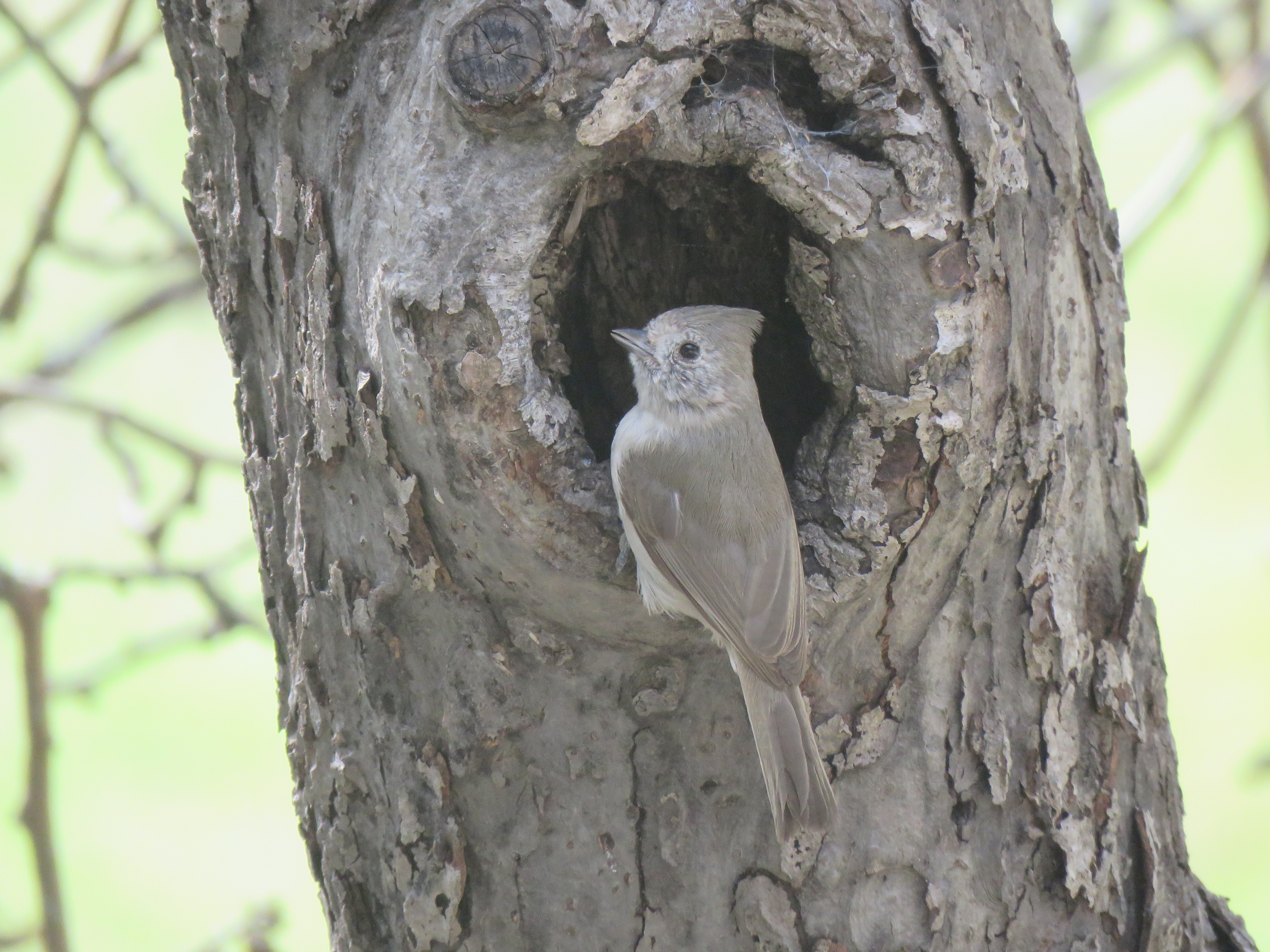
This stretch of Trout Gulch was very birdy, with expansive views of the skies above. Red-tailed hawks circled above and a pileated woodpecker called from the trees across the road. A merlin hightailed it to the south and five high flying swifts moved south. As I waited for the red-naped sapsucker to appeared I became immersed with the micro avifauna. The Anna’s hummingbird had his feeding route and returned to the prominent percent in front of the house. A pair of Oak titmice flew in to investigate a possible nesting nook.

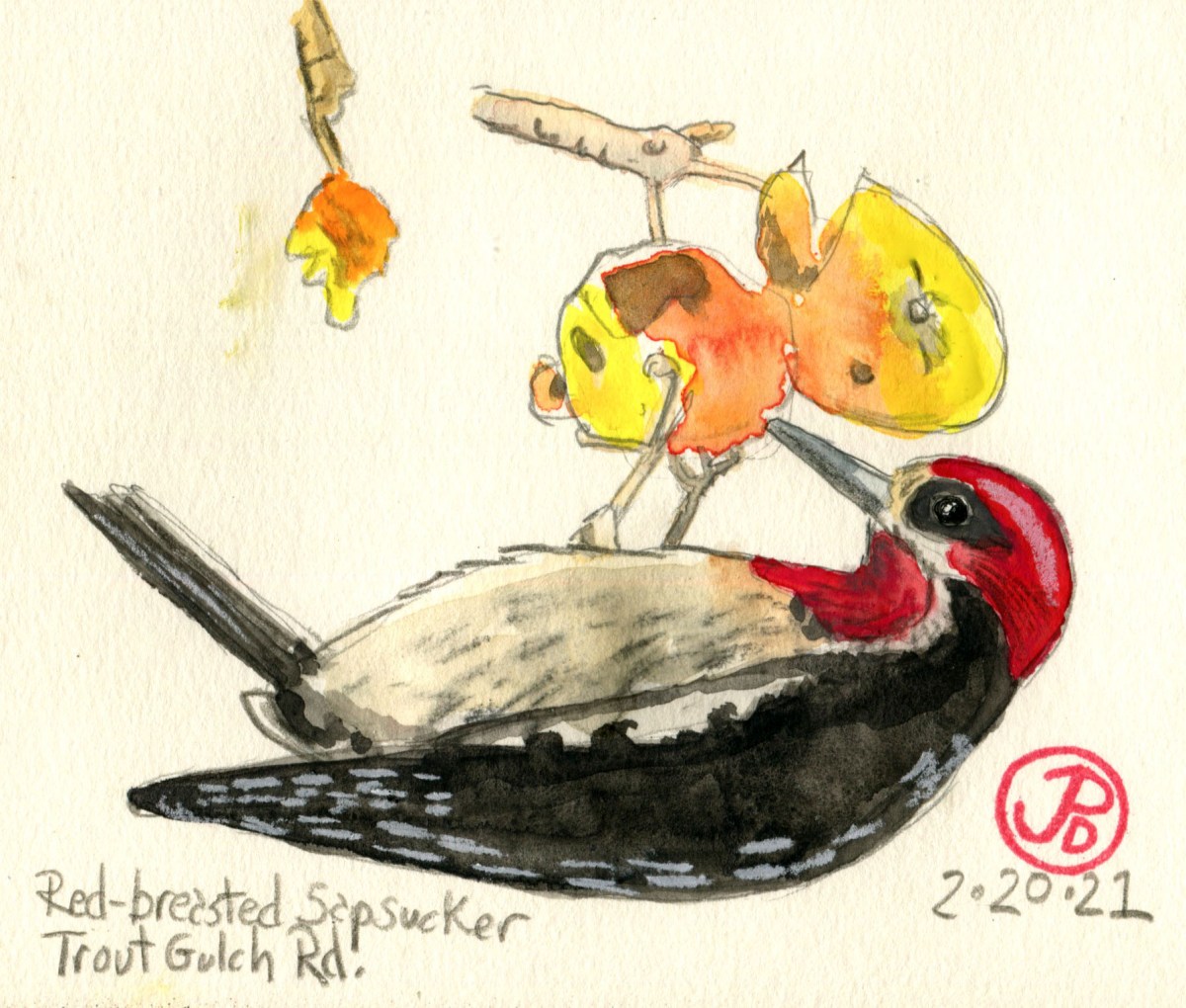
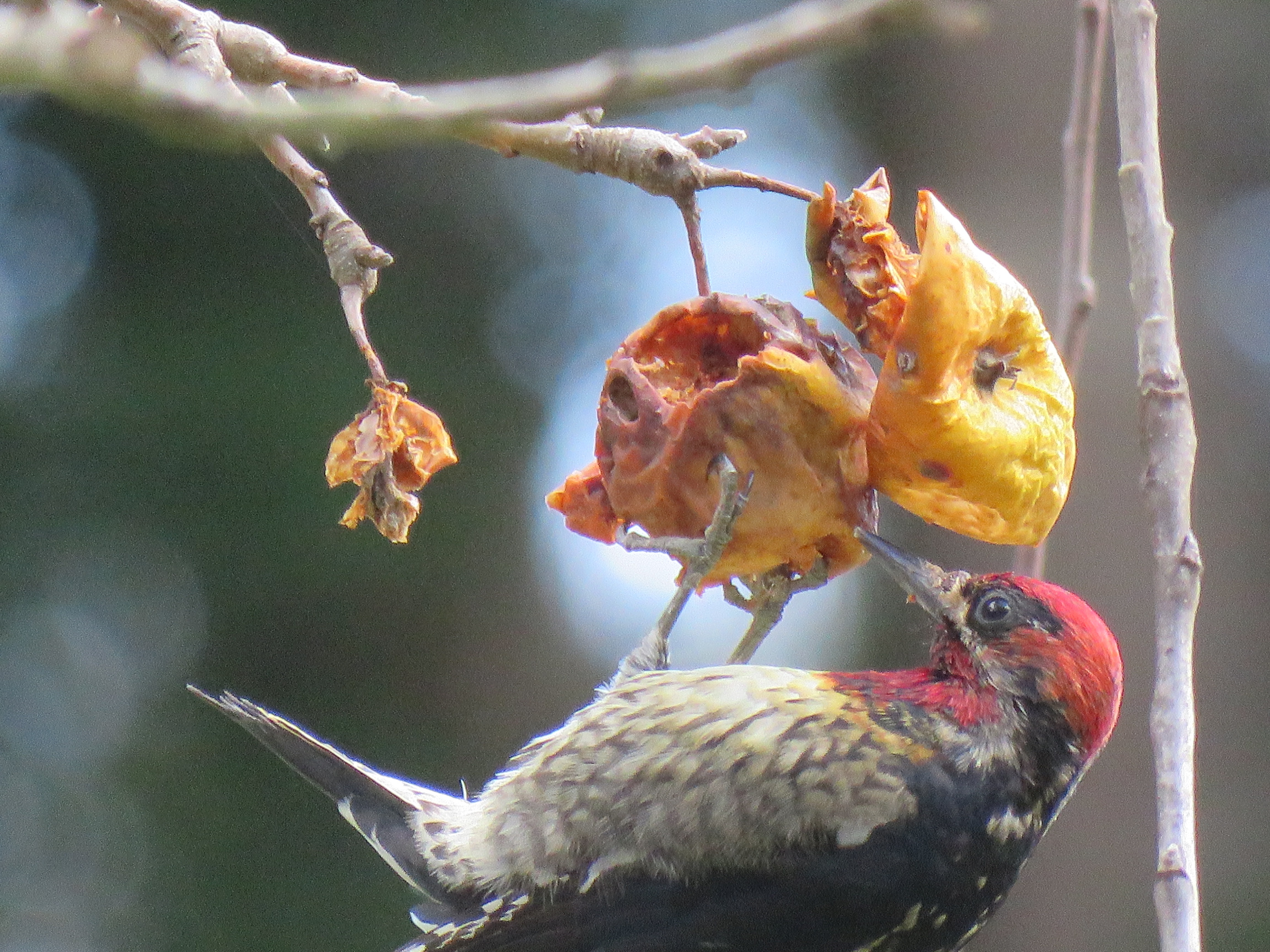
Within the first 30 minutes of my wait, I had a sapsucker! This was a new county bird but but it was the more common red-breasted sapsucker and not the desired red-naped. It flew into the old apple tree and perched on an apple and pecked at it from below. This was a promising sign because the two sapsuckers fed at this tree.

The red-breasted sapsucker having an apple lunch.

This gave me hope that the red-naped was still in the area and it was only a matter of time before the bird would return to the apple tree. So I sat down in the camp chair and sketched to pass then time.

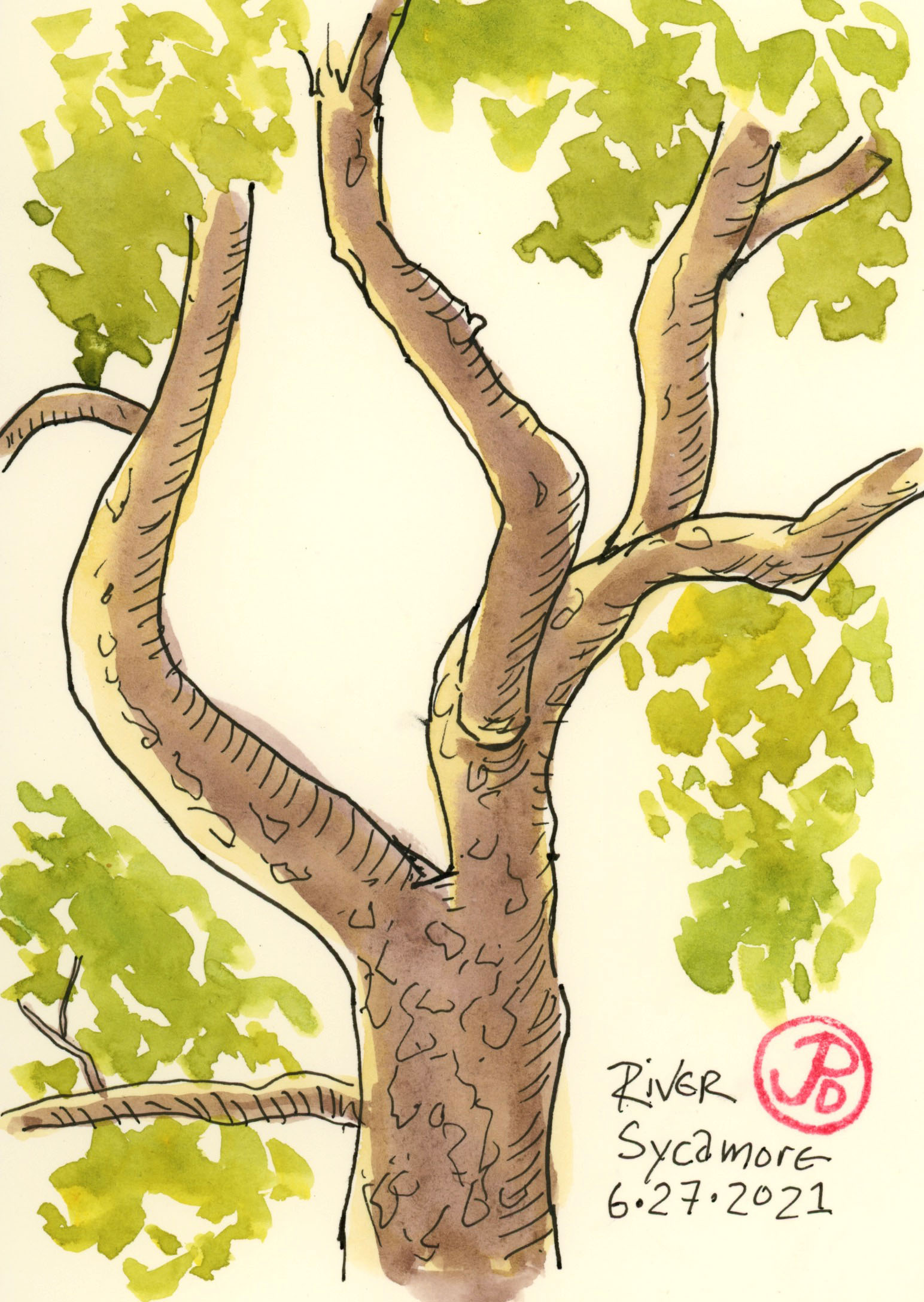
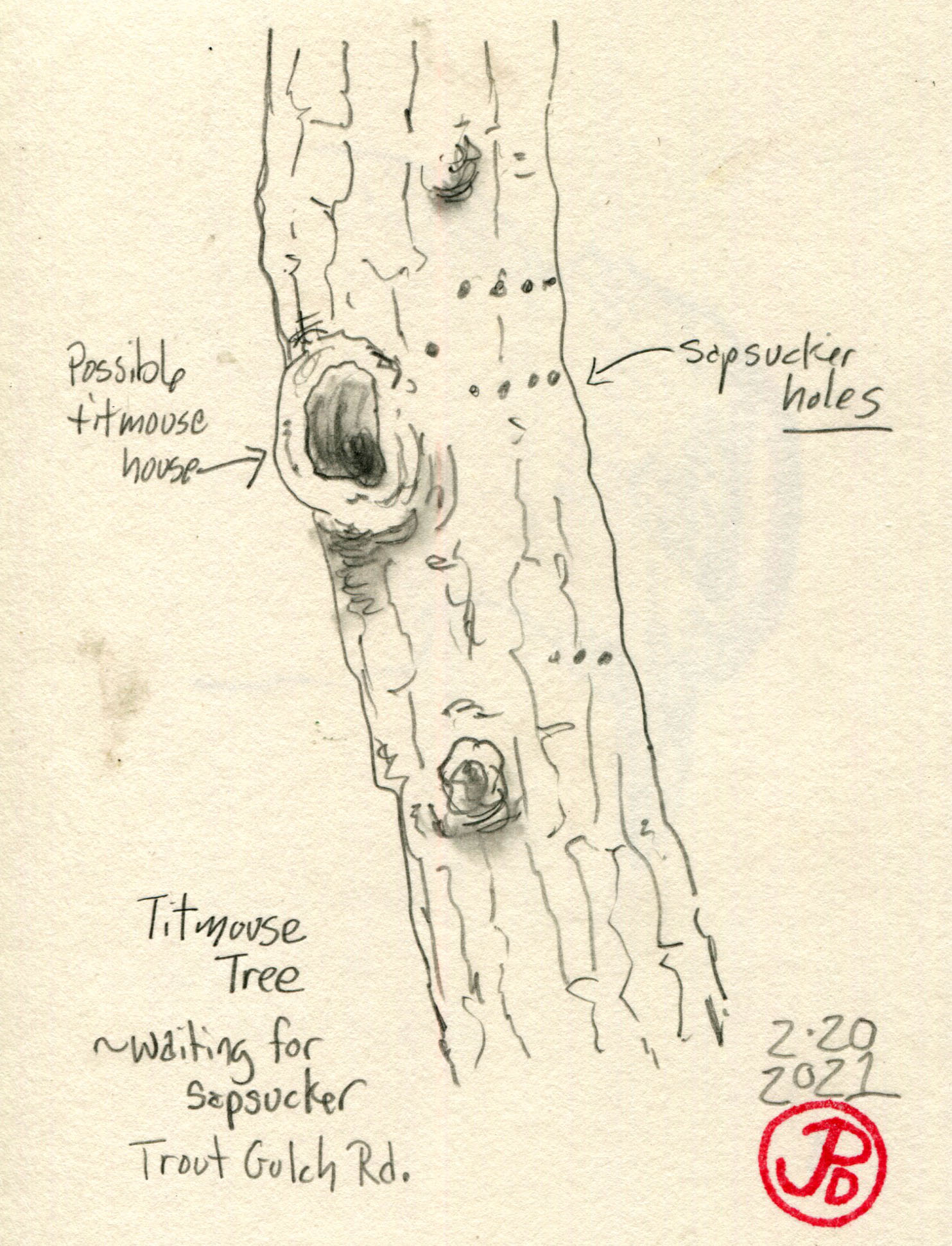
A pencil sketch of the “titmouse” tree. I love to sketch with pencil. It is such a basic tool and the foundation of so much work.

I first sketched the bole of the tree to my right. it was riddled with sapsucker holes. This was the tree that the two oak titmice investigated and I added the potential nesting cavity into my sketch. I next sketched the twisted old apple tree that the sapsuckers favored (but so did the chickadees and juncos.)

I waited for three hours and I decided to end my wait, knowing full well that the red-naped would appear just after I left, with no one to witness it’s continuing existence.

But the experience was so much more that adding a sapsucker to a county list. It was about being in a moment in a beautiful yard, watching the yardbirds and talking with a bat biologist. And it was all made possible by the red-naped sapsucker that refused to show itself in the old apple tree on Trout Gulch Road.

Image

Santa Cruz County Beach Birding

A towhee had taken up winter quarters on Laguna Creek Beach. This beach is close to Davenport on Highway One and 10.2 miles from my cabin (I checked).

Two towhees, a large, sparrow-type bird, are common on the California Coast. The appropriately named California towhee and the spotted towhee. Neither of these two species were the reason I headed north on Highway One on a Saturday morning.

I was here, hiking into a headwind on a sunny but blustery winter’s morning, to see a rare towhee on the coast. It is said that every bird is rare somewhere and the green-tailed towhee is rare here on the California coast. I have seen many green-tailed towhees at elevation in the Sierra Nevada Mountains but I was going to attempt to add this species to my Santa Cruz County list. I wanted a green-tailed towhee at sea level!

Who knows how long this wayward towhee had been on the Santa Cruz Coast but on January 12, 2021, two birders happened to be birding this beach and also happened to know that this towhee was out of place in this location. They reported it and other birders searched for it, some getting momentary looks of this sulky towhee. There where even less quality photos of this ever-moving and scrub-loving bird.

So the bar was low for a quality sighting and capturing great photos was an even lower bar. That’s if I didn’t whiff on this towhee altogether, for any sighting is never guaranteed. As one birder noted, “Ducked into a bush and never reappeared.”

The bird was seen on the northern part of the beach, north of the creek and just left of an “AREA CLOSED” sign. The sight was described as being where the sand meets a six foot high cliff. So here I was, peering into the bushes. Flanked by two nude male sunbathers.

The first bird I saw was a blue-grey gnatcatcher as is foraged and called at eye level in the coyote brush.

I turned on my bluetooth speaker and selected a recording of the towhee’s “cat-like ‘mew'” call. I hit play and after a single call, the green-tailed towhee shot out of a bush in front of me and stood before me on the sand. Sometimes birding is just this easy.

I had amazing views of the towhee as it foraged on the sand and I was able to get great photos in amazing light. The towhee stayed out in the open for about two minutes before disappearing into the coastal brush.

This photo proves just how elusive the green-tailed towhee can be! Now you see it, now you don’t. You have to be quick to photograph this bird.
The green-tailed towhee with it’s rufous crest, white throat, and greenish wings. This bird almost seems to be posing for me.
The profile view would have made Roger Tory Peterson proud. Here you can see the greenish tail.

Image

Saw-whet in Paradise

In mid- January, my neighbor from down the hill from my cabin, emailed me that she heard an owl calling, just after dark.

She thought it could be a saw-whet or a western screech-owl. On following evenings the mystery owl called again and again, just after dark. She confirmed that she thought that the owl calling was a northern saw-whet owl (Aegolius acadicus)!

This would be an amazing Santa Cruz County bird to add to my list and especially so to hear this diminutive owl in my own backyard! Well, close to it anyway.

The Northern saw-whet owl is can be common or uncommon resident of the California coast, favoring mixed conifers and deciduous woods. This owl may be much more common than believed because if it isn’t calling, this owl goes undetected. It is one of our smallest owls with a length eight inches and weighing in at 2.8 ounces. In other words, this owl weights as much as three standard sized envelopes.

The northern saw-whet gets its common name because it’s incessant “toot-toot-toot” territorial call that reminded early ornithologists of the whetting or sharpening of a saw; a common sound in the forests as lumberjacks felled trees to fuel a growing nation.

I have never heard a saw-whet call in Paradise Park. This may be because wildlife has been displaced by the destructive CZU Lighting Complex Fire. This fire burned in the late summer of 2020 for 44 days, consuming almost 400,000 acres of the western side of the Santa Cruz Mountains. Some of those animals are now wildfire refugees and are now establishing a new territories.

I planned to head down to Santa Cruz and do some owling, to see if I could confirm the existence of a saw-whet in Paradise Park. So I set out at 5:30 PM and walked around as the diurnal birds stopped calling, one by one as they sought out their nighttime roosts. The last diurnal call was the “chip” of a California towhee. It was now time for the night shift.

I centered my search at the picnic grounds. This is where my neighbor had recently heard the saw-whet. Now it was a matter of waiting a time with patience. A time to focusing the senses, to filter out the sounds of traffic on Highway 9 and seek the repetitive toots of the saw-whet.

At 6:10 I heard the first call of the saw-whet. It seemed distant and tough to locate. The saw-whet’s call is very loud for such a small bird, it can be heard from half a mile away.

I moved along the road to try and locate the owl, but as always, owls are elusive. At times it seemed the saw-whet was close and at other times far. As if the owl was frequently changing locations. In reality the owl was probably changing the dynamics of it’s song. It would be silent for a short time and then resume it’s name token song. I now had a new Santa Cruz County bird in my own backyard!

On Saturday evening, I went out for another owling ramble, to reconfirm the saw-whets presence in my world. Would I hear it two nights in a row? I also wanted to get a better sound recording of the owl. The evening before I recorded a faint but distinctive recording.

This time I set out a little later. I was at the picnic grounds at 6:30 pm and it wasn’t long before I heard the saw-whet calling up the hill.

I walked up the road toward where I thought the sound was coming. Hanging from my belt loop was my bluetooth speaker (an indispensable piece of equipment for any tropical bird guide).

I was going to use a recorded call of a call-whet to try to bring the owl closer so I could get a better recording of it’s call. In birding terms this is called using “playback”. When I played the recording through the speaker, the saw-whet seemed to accelerate it’s song. The call was getting louder as if the owl was coming closer to my location.

An owl’s flight is silent so I could not hear if the saw-whet was flying towards me. But what I did hear was the owl’s wings brushing against the branches above me. I was able to get two recordings with my iPhone and then I left the saw-whet to it’s “day”of establishing it’s territory and hunting for small rodents.

Here is a link to my eBird checklist with the two recordings I made: https://ebird.org/checklist/S81289488

I headed back to my cabin, satisfied with my night revels but I had one last trick up my sleeve. I stopped outside my neighbor’s house and I turned my bluetooth speaker on and played the saw-whet call at full volume! Within a minute, she came out surprised that it was just me and not a saw-whet. I thanked her for telling me about the saw-whet owl in our backyard!

Image

Santa Cruz County Birding

I’ve never been a huge county birder. County birding is keeping track of how many species seen within the boundaries of a single county.

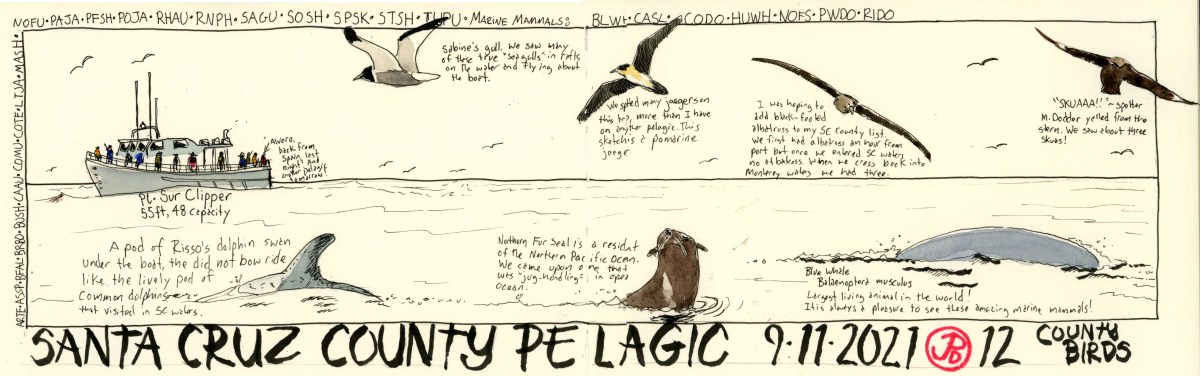
County lines are a purely human made boundary that birds fly over but it is a fun challenge to try to see as many species in a chosen county. The three counties that I focus on are San Francisco, San Mateo, and Santa Cruz. I set the modest goal of seeing 200 species in each of the three county. Over the past year and a half I have tallied over 200 in each county.

But for Santa Cruz I wanted to see if I could become a member of the Santa Cruz Bird Club’s “300 Club”. To reach 200 took awhile and I knew to reach 300 species in Santa Cruz County would take time, persistence, patience, and luck. On the Martin Luther King Jr. three day weekend I thought I would attempt to add few birds to my Santa Cruz County list.

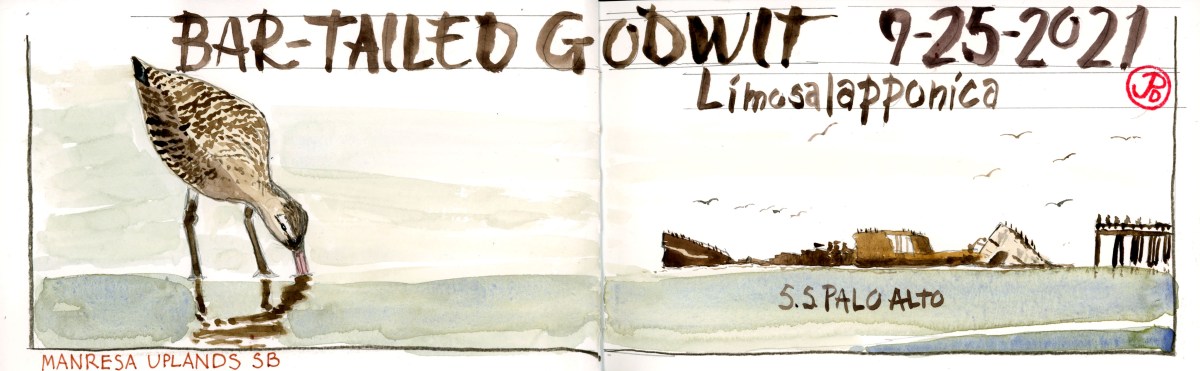
Now these birds were not especially rare nor were any of these lifer birds for me but they had somehow evaded my binoculars in the 831 area code. There are: snowy plover, snow goose, blue-winged teal, and American dipper.

I started my search at the very southern edge of Santa Cruz County at Pajaro Dunes. Pajaro Dunes is a private resort housing development. When I was growing up my family used to rent a house for a holiday so I have been familiar with the area from a early age. The development is gracious enough to allow access to birders.

Once I passed through the security gate I headed to the end of the road near the Pajaro river mouth after first checking the slough near the fire station for the rare long-tailed duck but the bird had flown a few days earlier and had not been seen again.

I wandered across the dunes toward the ocean looking for the small cryptic dune-plover. There were plenty of sanderlings running up and back with the tide. I checked all the flocks but no snowy plovers. I wondered how far down the beach I’d have to walk before I spotted the snowies.

I briefly checked out the backlit gull flock at the river mouth, just south of the river was Monterey County. I turned back and started walking north along the beach in Santa Cruz County. That’s when I spotted ten roosting snowy plovers which I must have walked right past.

This snowy plover is sporting jewelry. These are colored bands which helps researchers identify each individual plover. Snowy plovers are a threatened species because of habitat destruction and intensive use of their nesting grounds. Snowy ploverspopulations are declining with a recent survey estimating the total population of the Pacific Coast as 2,900.

My next stop was Struve Slough, just north of Highway One. This slough in Watsonville is a great winter hotspot for waterfowl. The waters were full of ducks, geese, and herons, but I was looking for five white snow geese. In the Central Valley, it is possible to see thousands and thousands of snow, Ross’s, and greater white-fronted geese in places like Gray Lodge Wildlife Area and Sacramento National Wildlife Refuge. But on the Santa Cruz County Coast, snow geese are a relatively rare find.

The snow geese stood out like five shining stars among the surrounding Canada geese and ducks. Another county bird was mind! Now it was time to head east to an birding hotspot: Pinto Lake.

My main target at Pinto Lake was a duck I had overlooked on previous visits. This is the blue-winged teal. Without too much of an effort I found a drake and duck.

Male and female blue-winged teal at Pinto Lake. The much larger male gadwall provides an interesting size comparison.

The final bird on my county wish list was turning into a nemesis bird for me. I had seen this bird many years ago flying downstream on the San Lorenzo River but it is has not seen on this river a while. So I headed up the San Lorenzo Valley. (I had not added this bird to my list because I have no record of the time I saw the dipper).

I was headed towards Ferndell Falls at the confluence of Zayante and Bean Creeks. This has been the American dipper hotspot in Santa Cruz County for the past ten years or so. But as hard as I tried, looking up Zayante and Bean Creeks, on over three visits, I was not able locate a single dipper. Nobody said county birding would be easy, in fact it can be a form of madness!! It just makes me even more determined to add this nemesis bird to my county list!

A nice consolation on my dipper search of Zayante Creek was seeing the world’s most beautiful duck in morning light. A wood duck pair.
I have searched for American dipper on about ten separate occasions since last summer. Maybe the 11th time’s a charm. This spread was about my July expedition up the San Lorenzo River in search of former dipper sites. The dipper is an indicator of a healthy ecosystem because they prefer clear, clean streams and rivers. This is a sign that San Lorenzo is not so pure.

Image

California Wildfires: CZU Lighting Complex

In the early morning hours of Sunday August 16, 2020, I was awoken by the low thud of thunder. A few minutes later, white light temporarily illuminated my bedroom. A summer thunder and lighting storm! This was a rare occurrence on the California coast.

I lept out of bed and headed to the deck in the same spirit that John Muir climbed up a Doug-fir to experience a windstorm! In this case my survival instinct prevented me from climbing to the top of the tallest tree in an electrical storm. Instead I stood in the open doorway.

I looked upriver and another flash of lighting silhouetted the sloping tree-line and then a clap of thunder filled the darkness. I heard the first drop of rain hit the deck and I reached my hand out from the doorway to feel the life-giving rain. It rained for a very short time, this was a dry thunderstorm.

I stood in the threshold of the back door until that survival instinct willed me to close the door and return to bed. Of course I couldn’t sleep in all the climatic excitement. The center of the storm cell was now moving over my cabin. One clap of thunder was so close that it rattled my bedside lamp.

The whole storm lasted for about 30 to 45 minutes. At that time, little did I know, that this storm sparked wildfires that would create more damage in Santa Cruz County than the 1989 Loma Prieta Earthquake.

I finally drifted off to sleep and when I awoke and looked out across the deck to clear blue skies, I knew the day was going to be warm, extremely warm.

That day I chose to drive over Highway 9 through the San Lorenzo Valley. I rarely drove this route but I had many memories of the area including the town of Boulder Creek, where I worked at a coffee shop just after college. This highway would be a fire line in upcoming weeks. Over 900 structures would be destroyed to the west of Highway 9.

Monday August 17, was the first day of school and it proved to be one of the oddest first days in my teaching career because I was not greeting my students at the classroom doorway but online in my digital “classroom”. Well that was the plan until I got to school and found out that the power was out and PG&E later looked at a power pole on campus that had been struck by lighting (part of the same storm system that started the fire in the Santa Cruz Mountains) and destroyed a transformer. Power would not be restored until two days.

As the news came that a series of forest fires (a complex) was growing into one big wildfire, I kept an eye on Cal Fire’s updates on the contagion. At the same time trying to be present for my students who were no doubt anxious and nervous with the first week’s jitters, especially so because we where all in isolation and we where only seeing a facsimile of ourselves on a screen.

I was also planning for a digital Back to School Night on Thursday and I knew there would be many questions about Distance Learning and I surly did not have all the answers. I ended the presentation by sharing the poem I had written last April about how we were all like pioneers on the Oregon Trail. There would be many hardships but with perseverance and hard work, we would get there.

Back to School Night went better than I had expected and it was very odd not to see my parents and greet then in person. Half and hour later, at 7 PM I received work that a mandatory evacuation order was in place for Paradise Park and my family cabin was in danger of being consumed by the CZU Lighting Complex fire!

At the time of writing the fire that was named the CZU Lighting Complex had burned for 19 days and have consumed over 86,000 acres across San Mateo and Santa Cruz Counties. As of the morning of September 5, the fire is 61% contained.

Cal Fire were able to create fire lines to protect the UC Santa Cruz campus, Santa Cruz, Scott’s Valley, and Paradise Park. The evacuation order was lifted after seven days and residents were able to return to their homes. I headed back to my cabin, a week later, almost 20 days since I had left.

The first thing I noticed was the smoky air and when I looked down the ground was covered in fine white ash, like a light dusting of snow that hadn’t melted away yet. Then I headed to my deck and I heard the rumble of a Cal Fire Huey helicopter with an empty water bucket trading behind.

I looked down and that’s when I noticed the leaves. They were bay laurel leave but they were drained of color and were a charred sepia. How far from the fire storm had these leaves travelled to land on my deck? This evidence of fire was somehow more “real” than the smoky air or the Cal Fire helicopters passing back and forth.

A burnt bay laurel leaf on my front steps.

The suet feeding on the deck was empty and the trees around the cabin were eerily empty of birds. I wondered some animals, like the humans of the community, had fled to less smokey quarters.

I replenished the water in the bird bath and I added some suet to the feeder. Slowly, life was returning. The first bird to visit the feeder was a chestnut-backed chickadee. Life was beginning to return to “normal”.

Image

The Search for the American Dipper or Dipping On Dipper

Once, perhaps 35 years ago, I saw an American dipper (Cinclus mexicanus) flying downstream on the San Lorenzo River, between Middle and Sandy Beach in Paradise Park. What an amazing sighting. The bird of John Muir, the aquatic songbird of clear, turbulent mountain streams was on the San Lorenzo!

At the time I did not keep records so I don’t know the month or year of the sighting but since that time I have been looking to find another dipper on the river. This bird is an indicator species for the health of a river. Dippers are considered a rare bird in Santa Cruz County but there was suitable habitat upriver in Henry Cowell State Park that look promising. Large granite boulders, turbulent river water. This is where a dipper should be, I reckoned.

I first checked the location of my first sighting on the San Lorenzo on the turbulent turn in the river between Sandy and Middle Beach. This rocky bend looked like good habitat for dipper and I walked up river, checking river rocks for the tell tale signs of whitewash, bird poop. There was some but this could be from a black phoebe. I did not see a dipper here.

On another day I next searched Rincon Gorge upstream from Paradise Park. Dipper had been reported here in May 1988 and again in May 2009 where a nest with young was seen. That was a long time ago and there were no current reports on eBird. So I searched and I again dipped on dipper.

Now it was time for a bigger expedition on the San Lorenzo, to explore some of the best stretches of river between Coon Gulch and Garden of Eden Beach in Henry Cowell State Park. This effort would require traversing down to the river from the railroad tracks on what only could be called a mountain goat path and then hiking up and often in, the San Lorenzo, towards Garden of Eden.

I parked on Highway 9 and headed down the Ox Fire Road towards the railroad and Garden of Eden. When I was halfway down the trail I heard the primeval calls of our largest woodpecker: the pileated. On a Douglas-fir snag, about 100 yards from the railroad, I spotted a family group of four pileated woodpeckers! Either this was a good omen for my dipper search or a great consolation for dipping.

After leaving the pileated family I headed downstream on the railroad and took the trail down to the popular beach, Garden of Eden. Perhaps this beach should be renamed Garden of Trash. I was appalled at the amount of cans and bottles, random clothes and towels, and toilet paper. Beachgoers clearly ignored the “Pack Out Your Trash” signs.

The amount of discarded cans and bottles along the banks of the San Lorenzo was truly disgusting!

I headed upstream from Garden of Eden to check the granite boulders for dipper. I was further appalled at all the graffiti on rocks and logs. It seemed far from the favored pristine rivers that the dipper preferred. And I did not find any dippers upstream from Garden of Eden.

What makes someone come to the San Lorenzo and spray paint a rock, I will never know! No wonder I didn’t find dipper on this stretch of the river.

When I returned to the main beach a young man was wiping graffitti off a sign post that no longer contained a sign. I’m sure the sign said, “Don’t Litter” or “Respect The Trees, Dippers, and Rocks!” or “Save the Painting For Sketchbooks and Canvas!” Turns out he was an interpretive ranger from Henry Cowell State Park who comes to Garden of Eden, before his shift, to clean up the beach. I asked about beach clean-ups and he told me that when litter is removed, there is more to replace it on the following days. Shameful!!

I returned to the railroad and hiked downstream towards Coon Gulch. I paused at the osprey nest where both adults were perched near the nest, indicating that there might be chicks hidden in the deep nest.

A view of the osprey nest and the two adults from below on the banks of the San Lorenzo. I did a brush-pen sketch of the nest on my journal.

I then headed down the steep mountain goat trail towards the river (this seemed so much easier 30 years ago). The final pitches of the trail had rope tried to trees to aid in the descent. This was a far less accessible part of the river and is not visited as much and seemed a little more “pristine” then upriver.

I traded my hiking boots for river sandals, made sure everything was secure in my dry bag, and I grabbed a hiking stick and headed upstream.

This, to me, is the most scenic and “wild” stretch of the river. The stream bed was lined in large granite boulders, perfect foraging perches for the American dipper.

Heading upstream on a beautiful stretch of the river, between Coon Gulch and Garden of Eden. If there was any place on the San Lorenzo that contained dipper, I reckoned this was it.

Progress was slow going as I was hiking in the river, reminiscent of The Narrows in Zion National Park. I had to pick my path through the large boulders often crossing and recrossing the river bed to find the path of least resistance. A bonus was finding a Pacific wren nest built under a fallen Doulas-fir tree that spanned the river.

The river veered to the right and I was in the stretch of river that when viewed from Highway 9 is known as Inspiration Point. I needed some avian inspiration at this point!

The river hike was an adventure in itself but the closer I came to Garden of Eden, I knew the the chances of seeing American dipper on this stretch was diminished. The habitat seemed right but the pollution and semi-turbid waters of the San Lorenzo did not look like the pristine mountain stream that the dipper require.

I have made the journey with no mishaps or injury and as I came in sight of Garden of Eden, which was now full of family groups, I took this time to slip and fall. It’s always good to have an audience. And as Nelson Mandela said, “The greatest glory in living lies not in never falling, but in rising every time we fall.” And so I recovered and stood up again only to see that no one noticed. 


Image

Wilder Ranch

On a foggy morning, most mornings are foggy in the summer, I headed northbound on Highway 1. My destination was just out of the city limits of Santa Cruz, Wilder Ranch State Park.

Wilder Ranch is a former dairy ranch on the coast. In 1871, two partners Baldwin and Deloss D. Wilder bought 4,160 acres of the a former rancho. In 1885 the partners split the acres in half and for the the next century the Wilder family farmed the land and their farm was prosperous enough to build a new Victorian farm house in 1897. The Wilder family farmed until 1969 when the farm became unprofitable.

The property became part of the State Park system in 1974. The park today includes 7,000 acres and is visited by hikers, mountain bikers, and birders. And a few sketchers too.

The closer I got to the coast, the thicker the fog. Fog and watercolor don’t always go together.

I parked on Highway One and headed down to the historic ranch buildings of Wilder Ranch. While most people hike or mountain bike on the 35 miles of trails of Wilder, I set up my camp chair in front of the Horse Barn.

This is a rather fancy barn, looking almost more like a house than a barn. Today this barn no longer houses horses but the interior provides a substrate for a bird’s nest, the appropriately named barn swallow. This year’s swallow fledglings where perched on the wires and buildings of the farmstead. I made sure to sketch a few in on the wires before they flew off on newly fledged wings.

After I finished sketching the horse barn, I walked a few hundred yards to get a vantage point of the Victorian farm house with the palm tree in the background. For this sketch I keep things a little loose, urban sketching style. For example I kept the sketch of the vegetation loose, and focused on the details and perspective of the house. I carried this over to the watercolor, I only painted the farmhouse and the roof in the foreground.

On my way out, I did a quick sketch of the scarecrow. The scarecrow was wearing proper face protection and was social distancing. There was not another scarecrow in sight! Nor a crow for that matter.